Since my last Drainage Contractor article, LICA has continued its expansion efforts and seen a flurry of activity. We held our summer meeting in Indianapolis. The meeting was well attended, had great weather, and included a series of fun events and tours, along with a trip to the Purdue farm where we visited a bioreactor and a two-stage ditch project.
We held a successful associates’ night, with a pinewood derby officiated by the Boy Scouts of America (BSoA). The derby included some creative and fast cars, built by our talented associates and members. The derby raised $500 for the LICA Scholarship fund and $500 for the BSoA. Adam Zimmerman from Caterpillar took the top award with the fastest car.
Perhaps the highlight of the summer meeting was having David Pacheco, chief engineer of NRCS, as a guest attendee. Pacheco participated in the water table management, Earth-moving and conservation committee meetings. It was great to have him provide his input on topics of interests to the land improvement industry, given his first hand knowledge of new best practices, as well as his perspective from Washington, D.C. Pacheco was asked about the Environmental Protection Agency’s (EPA) proposed changes to the Clean Water Act (CWA), and he offered his insights when possible. However, it often seemed that he was just as uncertain of the repercussions of the CWA for drainage contractors as anybody else.
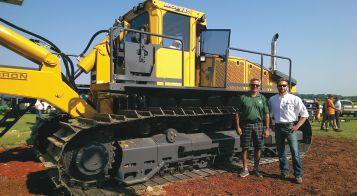
In addition to LICA activities, I was fortunate to attend this year’s LICO field day, just north of London, Ont. Prior to the field day, Mark Ordico and Jason Bleach gave me a top-notch tour of the RWF Bron manufacturing facility. Associate members of LICA play an important role in our success and are greatly appreciated. Many LICO associate members are also LICA associate members. My trip to Canada was to acknowledge their efforts and thank them all for their support of LICA. It was my first trip to Canada, and I was impressed!
SPRINGFIELD PLASTICS HOSTS CONSERVATION FIELD DAY
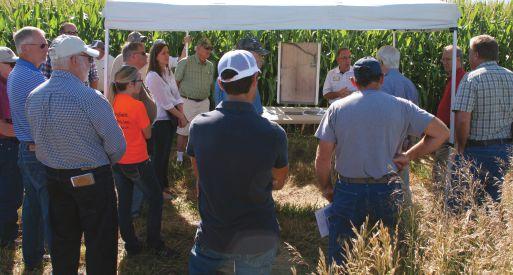
On July 16, 2014, Springfield Plastics Inc. and the Agricultural Drainage Management Coalition (ADMC) hosted a Conservation Drainage Field Day at their facility in Auburn, Ill. Attendees were treated to a firsthand look at three systems that are sparking interest in the drainage industry: drainage water management (DWM), saturated buffer systems and bioreactors.
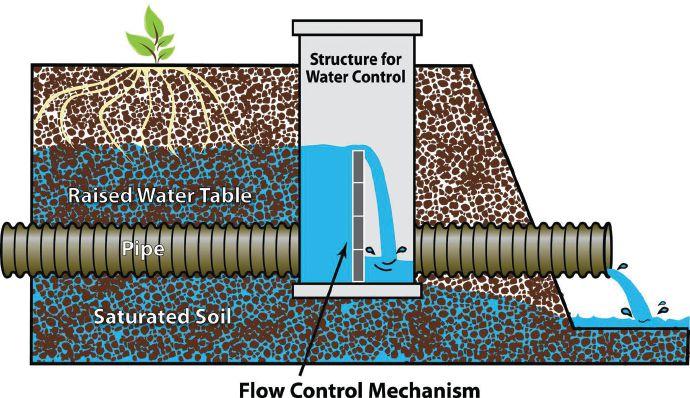
A DWM system uses a water control structure on a main, sub-main or lateral drain and allows the farmer to manage the timing and amount of water discharged from agricultural drainage systems. Water quality benefits are possible by minimizing unnecessary tile drainage and reducing nitrate amounts that leave fields.
“What we’re really looking towards on the drainage side is making sure that all of those inputs that the farmer puts onto his fields are staying in the fields and not flowing out of the drainage tile,” said Alan Bailey, chairman of Sangamon County Soil and Water Conservation District.
Although their main goal is to protect yield, farmers can also protect the environment. Water quality benefits are possible by minimizing unnecessary tile drainage and reducing nitrate leaving fields through DWM.
Meanwhile, the saturated buffer system uses a control structure that diverts the flow of drainage water into a lateral distribution line in a buffer strip. The lateral distribution line runs parallel to the buffer and as the
water is diverted to this line, saturation occurs. As this saturation, or lateral water movement through the buffer, occurs, the vegetation and soil organisms naturally remove the nitrates in the water.
Field day visitors also had an opportunity to learn more about the applications for bioreactors. Bioreactors are structures that contain wood chips (a carbon source) to significantly reduce the amount of nitrates leaving crop fields in tile drainage water. Recent research out of the University of Illinois indicates that bioreactors can reduce about 82.6 percent of phosphate and 46.4 percent of nitrates from tile drainage.
For the first time, Illinois NRCS added bioreactors to the list of practices eligible for environmental quality incentive program funding. Benefits of all three systems were demonstrated throughout the day.
Photo courtesy of Springfield Plastics.
NEW RESOURCE EXAMINES
BEST PRACTICES IN CROPLAND DRAINAGE
Managing on-farm drainage to maximize crop production and minimize environmental impact is covered in one of the latest publications in the Best Management Practices (BMP) series.
The BMP books are developed through collaboration between Agriculture and Agri-Food Canada, the Ontario Ministry of Agriculture, Food and Rural Affairs, and the Ontario Federation of Agriculture. For more than 25 years, these groups have worked together to produce the Best Management Practices resources, delivering useful information on environmentally sustainable farm practices. The newest addition to the series, Cropland Drainage, provides a valuable resource for planning and maintaining effective surface and subsurface drainage systems.
“Water is an essential, shared resource and agricultural crop production is one of its many users,” said Don Lobb, environmental advocate for Land Improvement Contractors of Ontario. “This guide considers cropland drainage as part of an overall soil management system on the farm, and provides farmers with information and guidelines to manage drainage and reduce the impact of excess water, conserve top soil and improve the efficiency of crop inputs.”
Farmers using Cropland Drainage will have a better understanding of how drainage systems work, find ways to improve their existing systems and integrate drainage best practices with other cropland practices to reduce runoff and flooding. Cropland Drainage covers best practices for managing surface and subsurface (i.e. tile) drainage, principles of soil water and cropland drainage, as well as related practices for soil management.
The guide also provides a list of federal, provincial and municipal legislation that can directly affect the design, construction and maintenance of cropland drainage structures.
Cropland Drainage is also filled with color photographs and detailed color diagrams to clearly illustrate dos and don’ts for managing water on cropland. The easy-to-read format includes checklists and an extensive troubleshooting guide for subsurface or tile drainage.
BMP books are available at no charge (shipping and handling charges may apply) and can be ordered online at www.publications.serviceontario.ca, by phone through the ServiceOntario Contact Centre at 1-800-668-9938 or in person at ServiceOntario Centres throughout the province.
LICO DEMONSTRATION DAY A SUCCESS
Approximately 350 drainage contractors from across Ontario gathered in Middlesex Centre at the farm of Steve Pym on July 22 for the Land Improvement Contractors of Ontario’s summer field day.
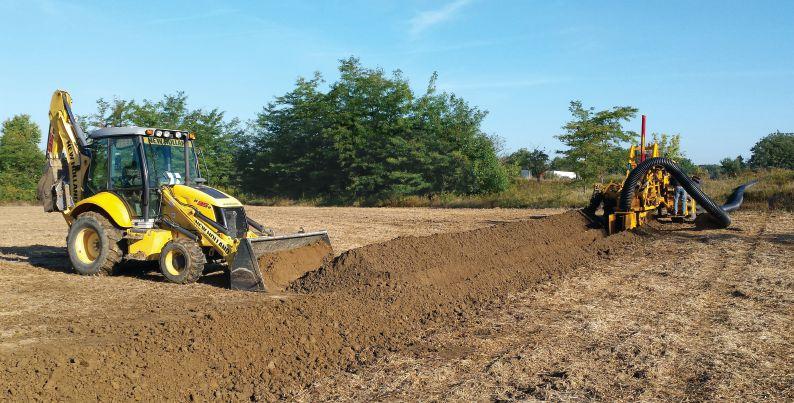
With perfect weather, the day went off without a hitch, beginning bright and early with four contractors – Roth Drainage (Bron), AWF Contractors (Wolfe Heavy Equipment), Dave Stevens Drainage (Link Manufacturing) and Tait Brothers Contracting (Tait Manufacturing) – installing pipe at 30- to 35-foot spacings over 80 acres. The field was split into four and the design featured a 9.5-foot deep main as an outlet, designed in the early 1980s, which was installed too high to properly drain its watershed.
Several exhibitors demonstrated equipment, including groundpenetrating radar for locating existing tile, tile trench closers, a compost turner and static plows. Huron Tractor (John Deere) and Delta Power Equipment (Case IH) participated in a tillage demonstration as well, showing off the latest in tillage equipment.
TIMEWELL AND WOMBLES INTRODUCE THE TILE BRIDGE
A new patent-pending tile bridge could offer pipeline installers and farmers a better way for new pipelines and existing drainage tile to co-exist.
The current method of pipeline installation through productive agricultural land, and the subsurface drainage tile repairs that follow, involve sandbags, which can be costly and labor intensive. Sandbags can also settle, requiring repairs to be made in fields where crops are already planted. The new tile bridges are made from lightweight, durable HDPE plastic, which makes them more cost-effective and easier to handle than sandbags.
But now Timewell Drainage Products and Tom Wombles are introducing the industry to the tile bridge: an adjustable grade beam made from lightweight, durable HDPE plastic that is more cost-effective and easier to handle than sandbags, and designed not to dissolve or conflict with metal pipe. “I witnessed firsthand the time, energy and money being spent on these tile crossings,” said Wombles. “I knew there had to be a better way, so I worked with Timewell to develop the tile bridge.”
To illustrate the ease of use and time saved, Timewell and Wombles recently hosted a proving session.
Timewell and Wombles have also partnered with MECO Engineering Company Inc. and agronomic and soil science professional Matthew Duncan to monitor and prove the capabilities of the tile bridge.
INDUSTRY NEWS
MANITOBA MOVING TOWARD SUSTAINABLE DRAINAGE
Manitoba Conservation and Water Stewardship is requesting input on the proposed new approach to regulating drainage and water retention in Manitoba.
The draining of excess water from lands and retaining it for areas or times when it will be required is vital to the successful production of highquality crops, as well as protection of people and infrastructure. Successive wet years have resulted in a higher than average number of drainage licences requested annually. The resulting wait times for licences and the need to improve the protection of wetland benefits prompted Manitoba to work with stakeholders to develop a new approach to drainage and water retention projects.
A new regulatory approach for drainage and water retention is one action under Manitoba’s Surface Water Management Strategy. A consultation document entitled Towards Sustainable Drainage - A Proposed New Regulatory Approach is available now for review.
The proposed new regulatory framework for drainage and water retention licensing will bring a number of changes for landowners and municipalities, including:
• A straightforward approach including minimum standards and clear timelines.
• Reduction of wait times by 50 percent or more and reduced associated costs.
• Increased economic opportunity by allowing the earliest possible start times on the land.
• Clarity and consistency for all.
• A focus on enforcement of illegal works and penalties in line with other environmental legislation.
• A framework where water retention and drainage projects can be considered together, on a watershed basis.
The proposed changes will adjust the focus of regulation from minor drainage changes to those with a major impact on downstream owners or on the environment.
The proposed changes will also improve protection of Lake Winnipeg by ensuring that more wetlands and their benefits are protected and opportunities for water retention are captured.
The department is inviting comments until Dec. 31. Comments should be provided in writing to: Towards Sustainable Drainage Consultation
Manitoba Conservation and Water Stewardship Suite 160, 123 Main Street (Box 20)
Winnipeg MB R3C 1A5
Email: DWRRconsultations@gov.mb.ca
USDA ANNOUNCES NEW FUNDING TO CONSERVE FARMLANDS, WETLANDS
The USDA will provide $328 million to help landowners protect and restore key farmlands, grasslands and wetlands across the country.
The funding, announced in early September by Agriculture Secretary Tom Vilsack, is being provided through the Agricultural Conservation Easement Program (ACEP).
The program was created in the 2014 Farm Bill to protect critical wetlands and encourage producers to keep lands in farming and ranching. Approximately 380 projects nationwide were selected to protect and restore 32,000 acres of prime farmland, 45,000 acres of grasslands and 52,000 acres of wetlands.
“Conservation easements help farmers and ranchers protect valuable agricultural lands from development, restore lands that are best suited for grazing, and return wetlands to their natural conditions,” Vilsack said. “These easements are making a dramatic and positive impact for our food supply, rural communities and species habitat.”
Through ACEP, private or tribal landowners and eligible conservation partners working with landowners can request assistance from USDA to protect and enhance agricultural land through an agricultural or wetland easement.
ACEP consolidates three former Natural Resources Conservation Service (NRCS) easement programs – Farm and Ranch Lands Protection Program, Grasslands Reserve Program and Wetlands Reserve Program – into two components. One component protects farmlands and grasslands, and the other protects and restores agricultural wetlands.
“The 2014 Farm Bill streamlined USDA’s major easement programs into one, putting the important benefits of protecting farmlands, grasslands and wetlands all under one roof to make it as easy as possible for landowners to participate,” Vilsack said.
A summary of ACEP funding provided to each state can be found online.
To learn about technical and financial assistance available through conservation programs, visit www.nrcs.usda.gov/GetStarted or your local USDA service center.
For expanded industry news, updated regularly, visit www.drainagecontractor.com.
The clean water act
by Bob Clark, president, LICA National
LICA has a key role to play in water quality issues.
Iam sure that many readers are aware of the Environmental Protection Agency’s (EPA) proposed changes to the Clean Water Act (CWA). Anyone who has read the Farm Bureau and EPA websites addressing the issue would have noticed there is no agreement on the impacts the proposed changes will have on farmers and contractors. As LICA national president, and a drainage contractor myself for over 25 years, I thought it was imperative to write a column discussing the issues surrounding both clean water and the CWA. While the intent of the CWA may be noble, its ambiguous language and complex nature make significant regulatory overreach inevitable. It’s also the primary reason that no one can agree on the implications of the proposed changes. Recently LICA sent a letter to the EPA administrator outlining our concerns. The letter is posted on the LICA website under the government relations tab. I encourage everyone to read it, and to comment on the rule during the open comment period.
LICA is working hard to bring together groups and organizations with common concerns about the CWA for meetings in Washington, D.C. Our goal is to work together to stop any unnecessary regulatory overreach – overreach that could impose burdensome economic costs on the broader agricultural community and actually stifle, not promote, conservation innovation. With that said, the issue of water quality is a real one. I’m sure you have all noticed that Toledo, Ohio, was making national news with their drinking water, or lack thereof, this summer. Multiple reports have mentioned the role that agricultural runoff may be playing as a contributing factor to this complex problem. Now, more than ever before, I believe that LICA contractors have the opportunity to provide leadership to address clean water challenges. After all, since 1951, our LICA motto has been
“Dedicated to the professional conservation of soil and water.”
LICA’s effort is to be as much a part of the solution today as we have been in the past. Many LICA contractors are technical service providers (TSP) to the NRCS in drainage water management (DWM). And LICA contractors have installed thousands of conservation projects across the US to improve water quality and soil health. Our drainage systems reduce erosion and improve soil health while enabling the broader adoption of conservation farming practices like no-till and min-till; our DWM systems go the extra mile to further filter and/or hold-back run-off; and our sub-irrigation systems are going to help America get to 300 bushel corn per acre. We’re helping US farmers renewably and sustainably meet the growing demands of a growing global population, while creating greater American food and energy security.
Simultaneously, our state universities are working to address water quality as well, and many LICA chapters have great relationships with their state universities, all in an effort to further advance knowledge and best practice.
While water quality is a real challenge, we are a real solution. However, our impact is only as great as the number of us who promote and implement best practice. Everyone should be ready to share our past and current conservation efforts with those who don’t know or understand much about what we do or how much we’ve helped to conserve natural resources.
As the population grows, both agriculture and the importance of conservation grow with it. These times pose a great opportunity for every LICA contractor. We can’t let people who don’t understand agriculture and land improvement point the finger of blame. We need to help set the record straight, promote best practice, and educate others about the conservation benefits of our work. DC
Company on the move
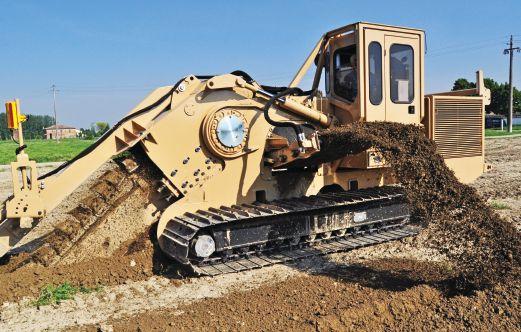
Since 1984 the name Tesmec has been synonymous with quality in the high performance oil & gas pipeline trenching industry. After achieving market leadership, diversification of the product line was important to continue to grow the company. The expertise and quality associated with the high performance trenchers lent Tesmec the opportunity to enter the Farm Drainage segment. How does a manufacturer from Texas decide to enter the Farm Drainage market you ask? Hiring a National Sales Manager from the heart of the Corn Belt in Indiana was a start. Also, having expertise in designing durable, highly productive, easy-to-use, trenching machines capable of handling rugged material was imperative.
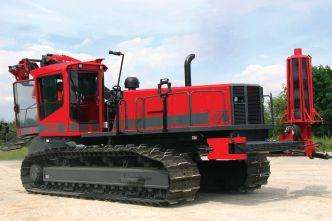
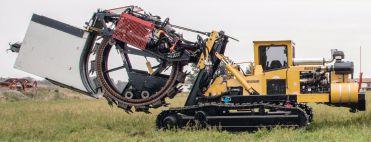
With those qualifications in check and a familiarity with the market Tesmec launched into the business with their first Farm Drainage specific machines. The new 775 DT series is available in both a Chainsaw and Bucket Wheel configuration.
Due to its low ground pressure and high floatation,
the 775DT yields high performance and productivity in various terrains. Jobsite reports have yielded productivity rates up to 55 ft/min. The significant strength of its frame makes the 775DT suitable to be utilized in highly fractured loose materials, highly compacted soils, and permafrost. Both 775 DTs weigh less than 46,000 lbs. The all new 775DT Chainsaw is designed for a maximum dig depth of 8’ with a maximum cut width of 24”, while the all new 775DT Bucket Wheel is designed for a maximum dig depth of 6’ 6” with a maximum cut width of 30”.
Both machines feature a CAT 6.6L 225 H.P. diesel engine and are designed around Tesmec’s Trench Tronic control system, providing maximum productivity whether your operator has 15 years or 15 days of experience.
The close loop hydraulic transmission and the exclusive Tesmec flywheel gearbox allow the 775DT to transmit the full power delivered by the CAT engine.
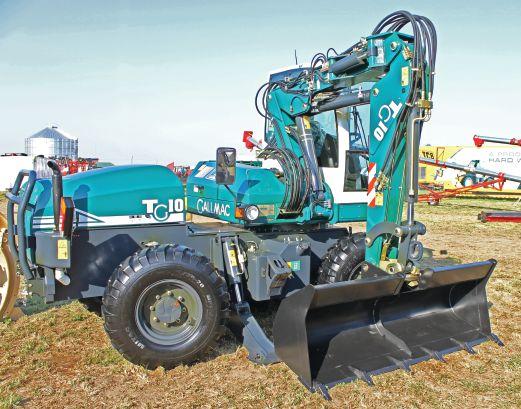
To compliment the DT series machines Tesmec is proud to announce the Gallmac TG series multipurpose wheeled excavator. Gallmac is available in 3 models with corresponding weights of 22,000-24,000-28,000 lbs.
These machines bring a whole new meaning to the term maneuverability. They are road capable and cruise at speeds above 20 mph allowing the operator to save time and money moving to various jobsites without having to load and transport the machine via truck. They also have three steering modes (Rear Wheel, Four Wheel, and Crab) allowing the operator to work in tight areas and also move laterally.
Along with being highly maneuverable the Gallmac has unlimited attachments available giving this machine the ability to replace several machines by performing multiple tasks. The hydraulic coupler allows the operator to change attachments without leaving the cab. Hydraulic downriggers increase the stability of the machine while performing heavy load tasks.
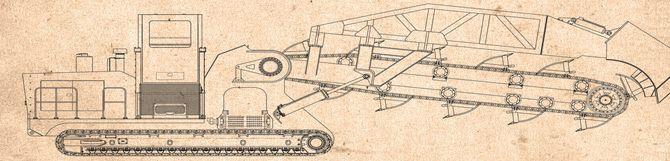
The DT series trenchers and the Gallmac TG series excavators are big steps forward in offering drainage contractors a complete line of solutions to their everyday challenges, however there is more to come. Currently Tesmec has in production an FBK Ladder Trenching Machine. This machine will reach digging depths of 14 feet and 60 inches wide! This is being built specifically for contractors needing to install main lines at extreme depths. A self-contained plow will round out the product line in 2015.
Tesmec is a proud National Associate Member of LICA, Indiana LICA, Illinois LICA, and Minnesota LICA and looks forward to serving this exciting industry.
775DT Chainsaw
FBK LaDD er Tren C hing MaC hine
Setting standards
Accountability for depth and grade-control accuracy
by James L. Fouss, Ph.D., P.E.
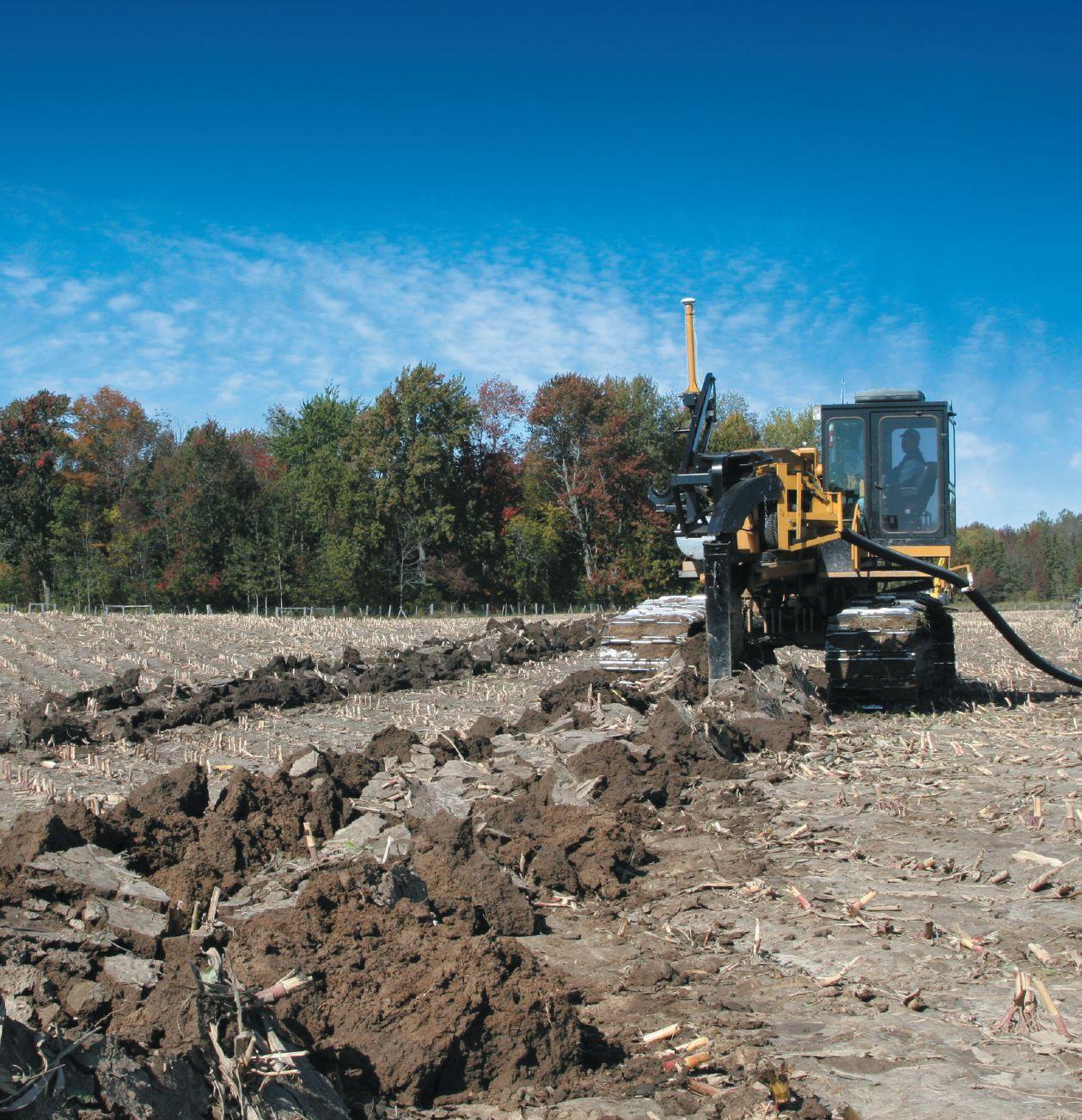
Since the mid-1970s, the province of Ontario has had a plow testing and certification program and is currently updating the program. With the significant increase in plow-installed subsurface drainage over the last several years in both the U.S. and Canada, it seems that it is time that a drainage plow testing and certification program be considered for development in the United States. Corrugated plastic (HDPE) subsurface drain tubing installed with plow-type equipment has increased dramatically since the early 1970s, in both Canada and the United States. All of the early drainage plows were equipped with laser-based automatic depth and grade-control systems. Older systems have now been upgraded on many plows, and some trenchers, with the modern satellite-based 3-D GPS depth and grade-control system.
More recently, innovative designs for self-contained drainage plows have become available and their acceptance by contractors has significantly increased in the U.S. and Canada. Most of the modern plows are very powerful and capable of operating at greater depths, and can install drainage pipe faster than earlier plows. However, current regulations in Canada do not set limits on the maximum speed the plows should be operated at in order to ensure drain tubes are installed accurately at design depth and grade. Although the U.S. has current subsurface drainage design and installation specifications and standards though the American Society of Agricultural and Biological Engineers, the American Society of Civil Engineers, and the Natural Resources Conservation Service of the United States Department of Agriculture, there are no drainage plow performance regulations in place in the U.S.
Ontario’s program is based on specifications and standards stated in the Agricultural Tile
Drainage Installation Act originally passed in 1973. The act includes a provision for training and licensing of drainage contractors that is administered by the Ontario Ministry of Agriculture and Food and Ministry of Rural Affairs. A similar testing and certification program is not available in the United States. The advanced features provided by the GPSRTK systems, including automatic steering of the plow or trencher, should be considered and included in the plow-testing standard. The GPS-RTK system now available may allow higher ground speeds with modern plows, if the machine hydraulics responds quickly enough to the control system feedback signals at the higher speeds to maintain design drain depth and grade. Mounting a second satellite GPS-RTK receiver directly above the drainage tube feeder boot attached to the plow blade may provide the enhanced accuracy needed to establish guidelines for a plow-testing program. The second receiver would monitor and record the GPS co-ordinates (X, Y, and Z-h, where “h” is the height at which the second receiver is mounted above the bottom of the tube feeder boot) at the bottom of the drain tube as it emerges from the tube feeder boot and is installed in the soil channel created by the plow. The co-ordinate data recorded by the second receiver would more accurately define the final X, Y, and Z-h locations along the line of the installed drain tube than a recording of co-ordinates from the controlling receiver mounted on a forward reaching cantilever arm attached to the plow blade. For advanced drainage plows, the Z-h data versus ground travel could be displayed graphically to the plow operator, along with other performance information.
Without regulated programs, it is the contractor’s responsibility to find solutions ensuring accuracy and quality of installation. DC
CONTROLLING NATURE
New system yields better results at research farm
Anew storm water drainage system being installed at the Monsanto Company Learning Center will provide more efficient field drainage, resulting in more consistent results in its development of new seeds and crops.
by Plastics Pipe Institute
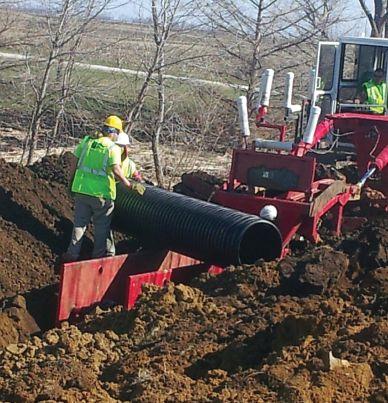
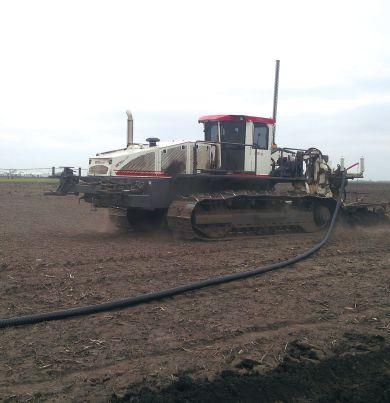
LEFT: The first phase of the drainage system at the Monsanto Company Learning Center has already been completed. All photos courtesy of Plastics Pipe Institute.
RIGHT: The drainage system will provide more efficient field drainage, resulting in more consistent results in Monsanto’s development of new seeds and crops.
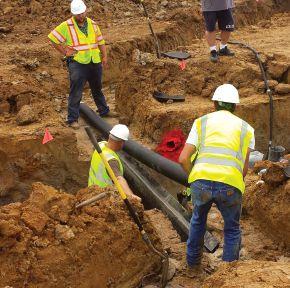
The first phase of the drainage system, which uses a grid pattern of corrugated high-density polyethylene (HDPE), has now been completed and the remainder is scheduled for installation in the fourth quarter of this year.
“We’re in a pretty flat area and with soils that tend to hold moisture very easily, which is good for production, but we just have to get rid of the excess water,” explained Eric Hickenbottom, North American Corn Breeding testing operations manager for Monsanto. “There are a lot of roads through the research farm which are higher than the fields and act as a dam trapping the water, so we don’t get a lot of surface runoff and need to drain it with tile. After large rain events we have water standing in those areas, sometimes for a week at a time; it would take that long for it to drain. What we hope to achieve
is to have those major wet holes drained in 24 hours, at least the visible water sitting on top of the ground. That’s our end result objective.”
For the first phase, 446,000 feet of the HDPE pipe was used, ranging in diameter from three to eight inches of single wall, corrugated HDPE tubing, and 18,000 feet of 12 to 24 inches of dual wall, corrugated HDPE pipe manufactured by Timewell Drainage Products.
“For nearly 50 years, farmers have been using corrugated HDPE pipe for draining their fields,” said Daniel Currence, P.E. director of engineering for the Plastics Pipe Institute’s CPPA division. PPI is the major trade association representing all segments of the plastic pipe industry. “Tile drainage is critical to crop
Continued on page 21
by TONY PALERMO
INNOVATION AT WORK
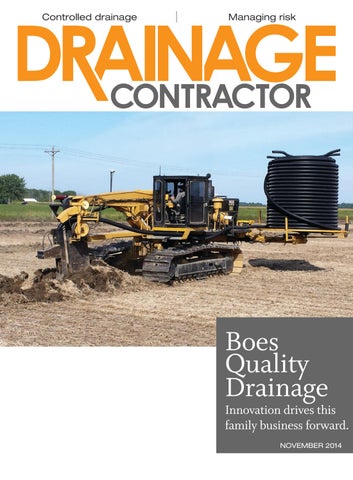
Celebrating 40 years of innovation with Boes
When Fostoria, Ohio, farmer Lanny Boes purchased his first ditch machine 40 years ago, he had no idea it would lead to him starting a drainage contracting company.
“My first farm was really wet and needed tile in a bad way,” explains Boes. “I bought a ditch machine to do the job myself and that project ended up catching the attention of a couple of neighbors.”
Boes says he really enjoyed tiling his farm, and good thing too because one neighbor referral kept leading to another. In fact, Boes became so busy helping his neighbors that he decided to hire an employee and start Boes Quality Drainage.
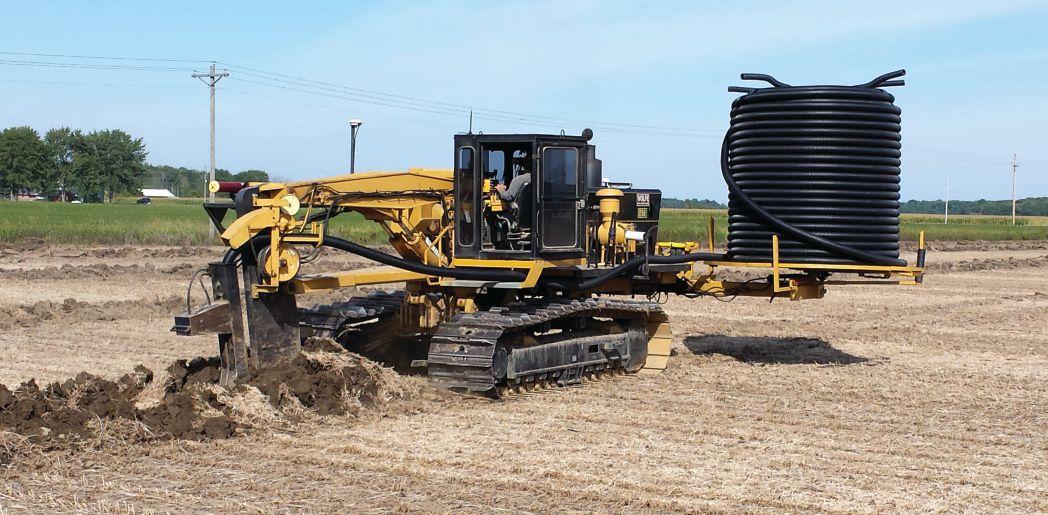
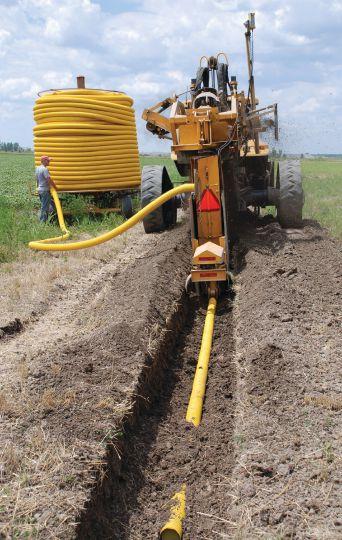
Four decades later, he’s busier than ever. Boes now works with his youngest son, Corey, and two other employees. He keeps his equipment fleet small. On the tiling side, the fleet consists of only a Wolfe 250 drainage plow, a New Holland B95B backhoe and a Buckeye Super H
wheel machine. As the elder Boes says, his company tries to do everything as efficiently – and as simply – as possible so there isn’t a lot of equipment hanging around.
His son Corey agrees. “When some companies arrive to tile, they show up with a couple of stringers, a plow, a ditch machine, a backhoe and a bunch of other equipment,” explains Corey. “The thing is, we’re called in to make the fields drain better. We know soil compaction is an enemy to drainage, and poor drainage causes lower crop yields. So, we minimize our footprint in the field by using less equipment more efficiently.”
The younger Boes says another example of how the company tries to minimize soil compaction is by using an onboard reel
Boes Quality Drainage is a progressive company that is big on innovation.
when they’re working in the field. By using the onboard reel, the drainage plow is the only piece of equipment that drives across the field for each tile line, as opposed to having an additional piece of equipment pulling a tile stringer for every tile line. With this method, Corey explains, the backhoe only has to drive out across the field when it’s time to replace the reel.
“It doesn’t seem to matter how much tile you have in the ground,” says Corey. “If the water can’t get to the tile, the tile can’t be utilized as much as they should be. [Driving less equipment across the field] really makes a difference, especially in the spring and fall when the ground tends to be softer.”
DRIVING INNOVATION
Boes Quality Drainage is a progressive company that is big on innovation. As an example, the Boes family
developed a patented steel trench box that removes the need for stone when installing large tile. This saves their clients both the money that would typically be spent on the stone, and the labor costs associated with handling the stone.
“When you install large diameter tile, you typically dig the trench to grade, put a little bedding of stone down, drop the tile in, and then surround the tile with stone,” explains Corey. “But with our patented steel trench box, we eliminate the cost of the stone, making the job more economical for the land owner.”
As Corey says, there are no downsides to using the steel trench box in place of stone. Rather, when you consider the cost savings and the added safety bonus that working within the structure of a steel trench box provides, it’s an easy sell for both him and his clients.
Corey, whom his father describes as the family electronics expert, has also designed an electronic sensor system for the backhoe that can tell the operator how deep the tile should be.
Corey says the system is so accurate the operator can dig down to within a 1/10-inch of the tile without having to probe it.
NEW PLOW DESIGN
The Boes family and Wolfe Heavy Equipment are also working together to design a new plow that will attach as a fifth-wheel and won’t need a lowboy semi-trailer to haul it. The inspiration comes from the cost and frustration of obtaining a special overweight haul permit to move heavy plows along state highways. As Corey says, the cost of the permit, which in Ohio is over $100, adds up throughout the year, and it’s extremely frustrating to drive a route of travel that is
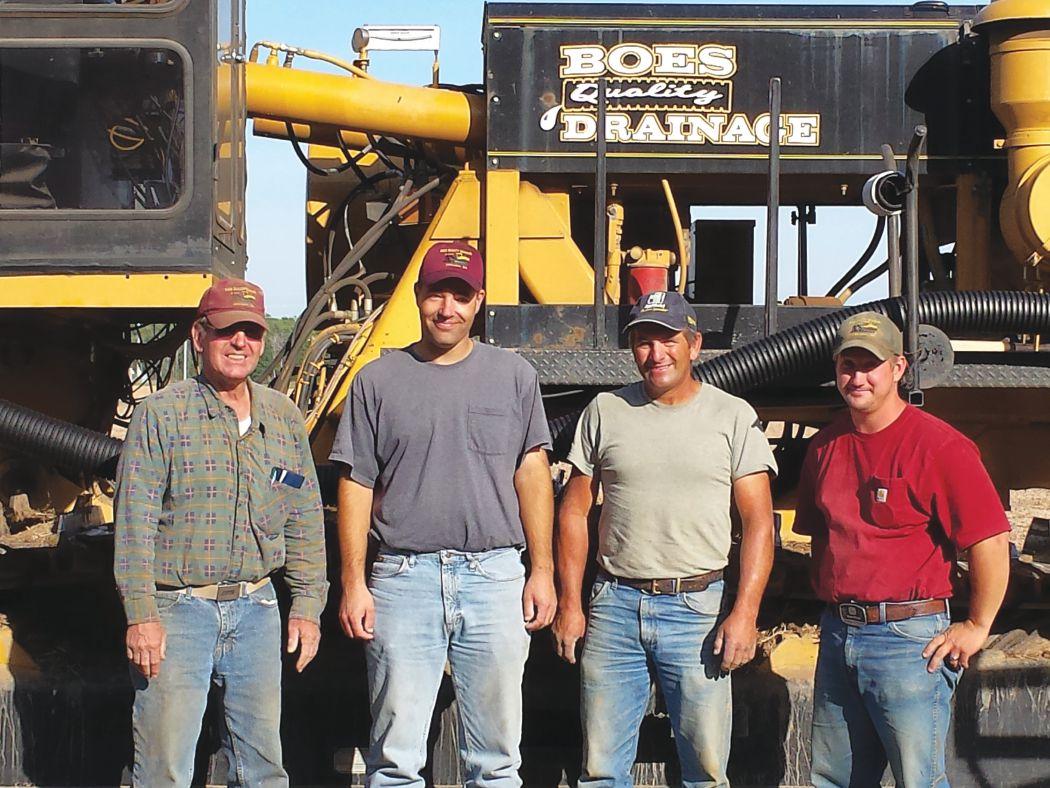
From left to right, the Boes Quality Drainage team: Lanny Boes, Corey Boes, Tom Andrecheck and Matt Stacy.
On the tiling side, the Boes Quality Drainage fleet consists of a Wolfe 250 drainage plow, a New Holland B95B backhoe and a Buckeye Super H wheel machine.
dictated by the state but is often not direct, making it take longer to get to the customer’s site.
In Corey’s words, the dealer jumped all over the concept when his family proposed the idea of a fifth-wheel plow
back in the spring.
“This is probably the first plow that has turn signals and lights on it,” says Corey, laughing. “Really, it’s a great idea that solves a lot of problems, and the dealer has told me they have another half-dozen or so other customers who want to purchase one.”
MOVING FORWARD
Corey says his passion for innovation and technology was instilled by his dad, Lanny, at a very young age. People sometimes shy away from technology but he was always brought up to believe that if technology can be used to benefit you or the customer, you should go for it.
The elder Boes looks back fondly over his company’s 40-year history, noting how much easier the job has become thanks to technology. He notes that 40 years ago the technology was grade stakes and an old ditch machine that did about 15-feet per minute.
Today his plow is equipped with a GPS system and runs at 120-feet per minute.
Lanny, who has Corey and two other sons, says he’s at the point where he’s considering reducing his involvement in the business and passing more of the responsibility for the business down to his sons.
“I’ve been really lucky over the years,” says Lanny. “I have good customers and a great family with a supportive wife. Maybe it’s time for me to start winding down a bit.” DC
For more Contractor at Work profiles, visit www.drainagecontractor.com.
DRAINAGE MANAGEMENT
Continued from page 16
production because it allows excess water to leave the soil. This provides a higher yield for a farm. If not for this system, many fields would be flooded and totally unusable. Tiling saves those fields and increases crop production.”
“Spacing of the pipe for this project was a little tighter than usual,” Currence added. “Typically, you’ll find the rows spaced 30 and even 40 feet apart. Here, because of some of the areas being prone to standing water, the pipe was installed with 20-foot spacing: about 2,000 feet of lateral pipe an acre. Water in some areas gets trapped in there like a pool.”
To install the 88-plus miles of pipe, Timewell’s construction division, Ag Drainage Inc. (ADI), plowed both the mains and the laterals. Depths ranged from 7.5 feet for the mains to 30 inches for the laterals. No additional bedding was used. Installation work took a crew of 10 one week to complete.
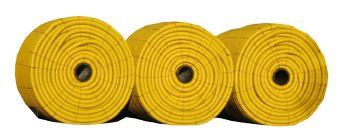
“Because the pipe used for the laterals comes in long coils and is fed on the plow, the installation is rather quick,” noted Currence. “For example, three-inch diameter, perforated tubing that was used on this job comes in a reel that has 6,200 feet. That makes it efficient to get to the field and install.”
With an average annual rainfall of 38 inches, the research farm near where Iowa, Missouri and Illinois meet has mainly silt loam soil.
“We did have some areas that were tiled many years ago in
grid pattern and probably put in a little too far apart, and maybe a little too deep,” said Hickenbottom. “Also, the mains weren’t sized big enough. We want adequate moisture but not a lot at one time. Typically with the way weather patterns have changed here during the past 10 years, we’re seeing heavier rainstorms with more frequency. In a dry year we can handle five inches of rain without a problem and it drains. What happens is that a week later we get another five inches and it’s so saturated we can’t get rid of the water.”
“We are a research facility so we have many, many special projects out here on the farm,” he added. “And quite truthfully, a lot of times, those projects, whether it is a breeding effort or something of that nature, those crops tend to be a little bit higher in value versus just a commercial field,” he said. “If we lose it, there’s potential to lose maybe a year or more of progress with our breeding and yield testing programs. So we went with a pretty aggressive drainage coefficient for the farm... There were 488 acres there that we wanted to get done.”
The center has research labs, classroom training and plot tours. Hickenbottom and his team do advanced research in corn, and some of the other business functions at the site have corn and soybean research testing projects, along with many demos that the learning center plants and harvests every year.
“It’s important that we have proper drainage, which I’m sure we’ll now have,” said Hickenbottom. DC
HICKENBOTTOM INC. ®
LOOK FOR THE BRIGHT ORANGE INLET - HICKENBOTTOM S TRADEMARK
Company on the move Better Drain Process, Better Gain Contractors Gain Efficiencies with WM-Drain
Drainage design and installation can be a time-consuming and complex process. Efficiency and simplicity can mean the difference between an easy install and a difficult one.
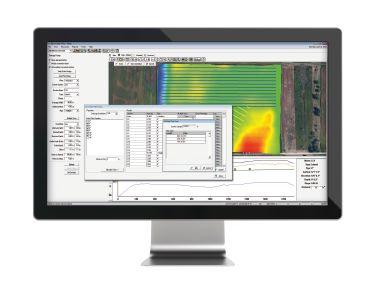
The Trimble® WM-Drain® farm drainage solution enables contractors to quickly and easily manage drainage system designs and installation—and to be more efficient throughout their operation.
In comparison to laser systems, WM-Drain proves to be more efficient. It eliminates the need for multiple laser setups as well as stakes in the field; minimizes the need for operator intervention due to no grade breaks, slope and depth monitoring; and improves machine efficiency due to a constant depth drainage. Overall, the solution can be up to 20 percent more efficient compared to laser-based drainage solutions.
The WM-Drain solution can improve efficiency by up to 20 percent when compared to laserbased drainage solutions.
By streamlining the survey, analysis, design, installation, and mapping steps of surface and subsurface drainage, the WM-Drain solution allows contractors to perform all their drainage activities with one complete solution.
Survey
Contractors can begin by collecting 3D field data with ease using Trimble’s WM-Topo™ survey system or FmX® integrated display. The WM-Topo system is a topographic data collection device that can be taken into hard-to-reach areas such as ditches, steep terrain, muddy fields, or fields with mature crop cover. Data collected with the WM-Topo system or FmX display can then be transferred to Farm Works™ Surface software via Connected Farm™ to create a wireless loop of information between the office and the field—saving contractors valuable time.
Analysis
Once survey data is in Farm Works Surface software, contractors can easily analyze the data to make betterinformed drainage decisions. They can view data from every angle; determine watershed zones to assist with main, submain, and lateral pipe placement; and configure contours at any interval to display topography and relative elevations. In addition, contractors can view field analyses over the top of aerial images to provide a more complete view of the data.
Design
The WM-Drain solution allows contractors to pinpoint and layout a prearranged design before they hit the field, or
conversely, they can create drainage designs on-the-go without leaving their vehicles. With Farm Works Surface software, contractors can utilize drawing tools to tie laterals to mains, create parallel lateral spacings, and clip drainage lines. It also allows contractors to verify that a pipe network will successfully drain to the main outlet before installation.
Using the Autoslope feature, contractors can create optimal depth designs—resulting in a consistent water table to help minimize nutrient loss and also to ensure uniform root depth resulting in a more consistent yield across the field. This feature can also enable on-the-go drainage design within the FmX display.
Installation
Once the design is complete, contractors can use the WMDrain module within the FmX display for precise installation of pipe or surface ditches by using GNSS RTK with Trimble’s T3™ Enhanced Terrain Compensation Technology. With this technology, potential installation errors caused by working on hilly terrain can be eliminated. Additionally, pitch control designed for use on a parallel link style plow ensures a more accurate drain installation by controlling the boot pitch.
Mapping
During installation, contractors can automatically log 3D maps or true locations of installed drainage pipes or ditches. This can help contractors with future maintenance of drainage expansion projects by providing them with an accurate record of where the installation occurred.
So What’s the Benefit for the Farmer?
Too much water on the field can damage crop quality and yield, and can be a detriment to a farmer’s bottom line. By installing a drainage system on fields, farmers can optimize the amount of water on their fields and ensure their crops are not getting too much water.
By using the Trimble WM-Drain farm drainage solution, contractors can ensure that water is drained off the field effectively. It ensures optimal 3D drain placement, which improves crop yields by controlling ponding, optimizing root depth, maximizing planting seasons, and minimizing nutrient loss. In a study conducted by Trimble, an average farm that utilized the WM-Drain solution can increase crop yields up to 30 percent—a direct impact to the farmer’s profitability, and a direct benefit to contractors’ businesses.
Because drainage designs shouldn’t
.
You’ve always been able to quickly and efficiently produce optimal drainage designs using Farm Works™ Surface software. And now you can save more time by using its automatic pipe size recommendations. Eliminate the guesswork from manual calculations, generate an accurate drainage system cost estimate, and start installing your pipe. All with one integrated solution. Introducing automatic pipe sizing recommendations from Farm Works Surface software, part of the WM-Drain ® farm drainage solution. For more information, visit www.trimble.com/agriculture or see your dealer.
NEW PRODUCTS
NYLOPLAST WATER CONTROL STRUCTURE
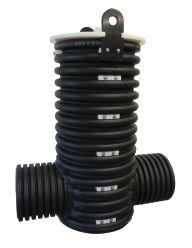
The Nyloplast Water Control Structure from Advanced Drainage Systems
Inc. is a storm water basin that provides an effective way to manage water levels in a variety of applications.
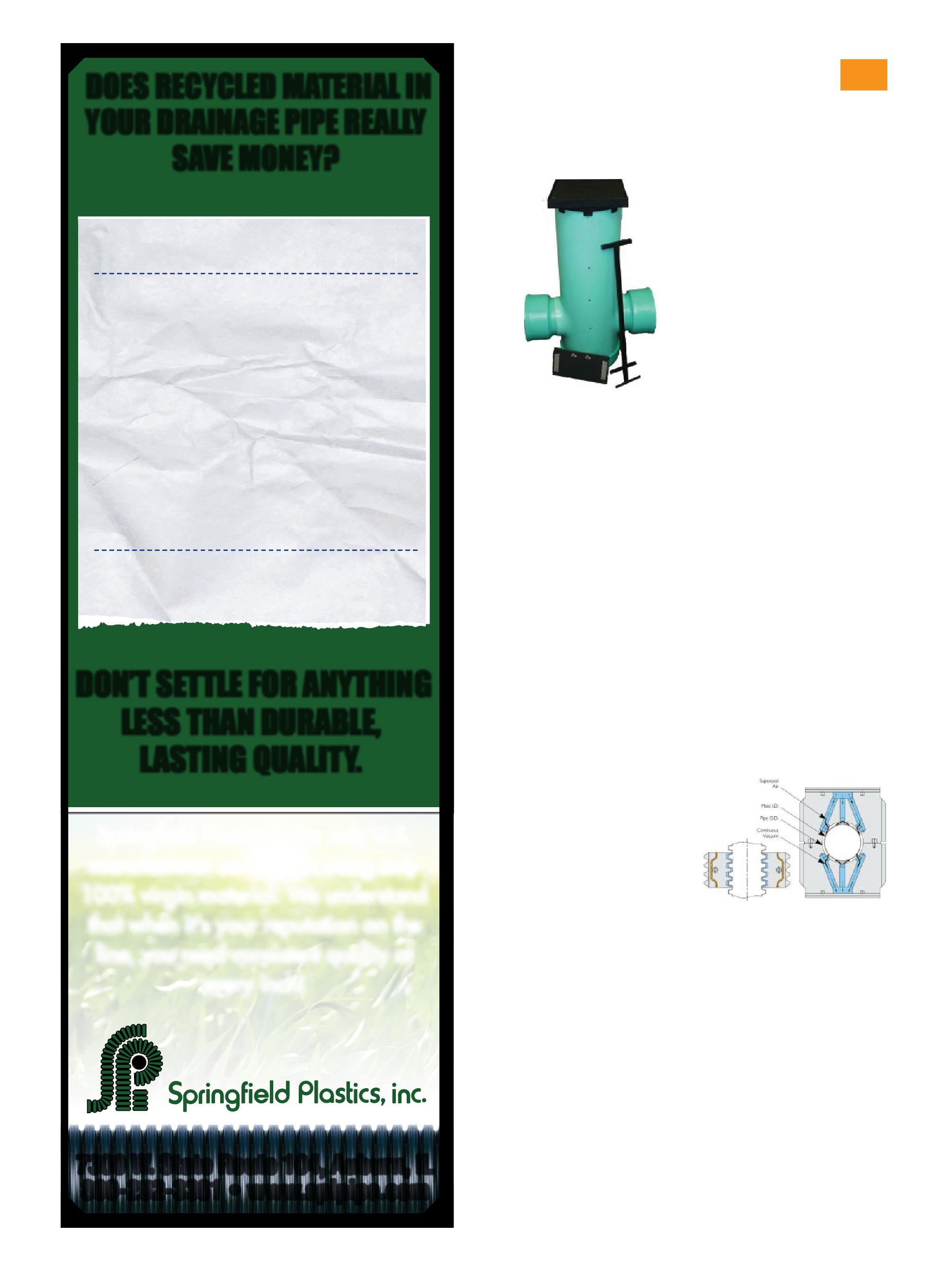
The Nyloplast unit combines ductile iron grates with a rugged, heavyduty PVC structure. A Nyloplast water control structure features ductile iron solid casting, control of water levels in six-inch increments, numerous stub options for different pipe types, watertight pushon pipe connection, no corrosion or degradation over time and easy adjustments.
Nyloplast basin technology provides a system with the ability to control the levels and discharge dynamics, and modify them based on outside boundary conditions and current conditions to economically and effectively improve the water quality of streams, rivers and lakes. For agricultural applications, this water control structure allows for overflow of a heavy rainfall, but also restricts water movement during normal conditions to maximize the time for nutrients to stay in the crop
zone. The structures can also be used in a variety of other applications, including general water level management, wetland management, riparian zone control, residential flow control and others.
Benefits of the unit include: control of drainage basin water levels, allowing for timely drainage to maximize crop development or wetland control; improvement of water quality; and controlled release of outlet flow. The drainage control reduces the annual transport of total nitrogen to benefit waterfowl breeding habitat by increasing water depths to create a better cover of vegetation and reduction of nutrient exports and total suspended solids (TSS) in watersheds.
www.ads-pipe.com
SUPERCOOLING TECHNOLOGY FROM CORMA
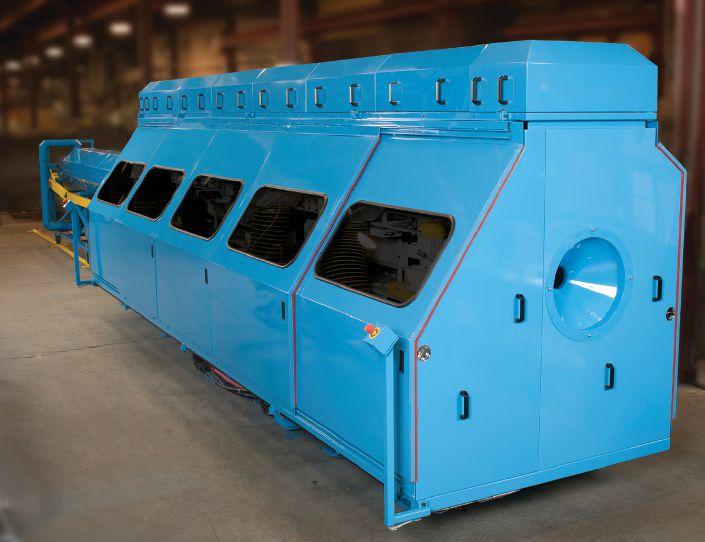
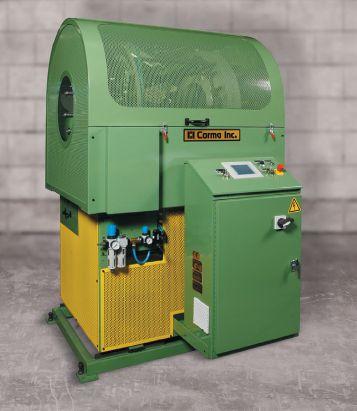
In 1973¸ Corma introduced the first air-cooled corrugator. Since then, all of the company’s corrugators have been air-cooled. The technology has evolved over 40 years to include its patented Supercooling and Cooling Enclosure systems When plastic sets up and cools, it shrinks and pulls away from the mold, creating a gap between the pipe and mold that acts as an insulator. The
Supercooling technology channels cold air into the gap between the pipe and mold to maximize cooling efficiency. Cold air travels through the vacuum slits on one end of the mold into the gap and then exits out through slits on the other end.
Corma’s Insulated Cooling Enclosure is a climate-controlled system that maintains optimal operating temperature throughout the year. Energy requirements are lower than conventional cooling systems because the enclosure only requires energy to cool the corrugator when needed.
The combination of Corma’s Supercooling technology and Cooling Enclosure increases output from 25 percent to 50 percent while using less energy and consistently produces high quality pipes that have minimal inherent stress.
www.corma.com
AFTERMARKET PLOW POINTS
The new plow point from Criterion Machine & Fabrication combines durability and performance and has been designed with the feedback and suggestions of those in the tiling business in mind.
The new plow point will fit Wolf Plow models #320, 400, 450 and 540. They are CNC machined with
solid plate for durability. The solid plate steel will accept hard facing unlike the older cast versions. These points can be easily changed out with hand tools, no torch needed. Also, the newly designed angle of the plow point creates an enhanced “suck,” improving performance in the trenches.
The plow points are one of Criterion’s many customizable products that come out of its CNC operation.
criterionmachinefab.com
HYDRAMAXX 2715 WHEEL TRENCHER
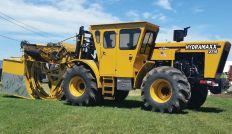
Port Industries Inc. has introduced another new trencher model for 2015. The first Hydramaxx 2715 bucket wheel trencher was delivered in September. It joins the 2700 and 2710 model Hydramaxx trenchers in the 400 horsepower bucket wheel trencher class. The 2715 separates itself from the 2700/2710 models by coming equipped with a more robust digging assembly and drive line components.
The 2715 digging assembly is able to dig up to 48-inches wide and over seven-feet deep. It comes standard with three-quarterinch thick, one piece buckets, and a variety of cutting edge options. The width of the trench can be changed by adding wider cutting teeth, or changing to custom buckets to achieve
The Land Improvement Contractors of America
LICA has been serving contractors for over 60 years, providing members with the benefits they need to work “Smarter not Harder”. Below is a list of the programs available to members.
Petrocon Commodities Program. This program will generate savings for LICA members. They receive a minimum savings of 10% on their oil, tires and possibly much more.
Universal Premium Fuel Program. The LICA Universal Premium Fuel Program can save you up to 15% on fuel and fleet expenses.
Hotel Savings Card. The LICA Hotel Savings Card Program from CLC Lodging simplifies lodging administration while saving 20-40% off hotel rates.
National LICA Payroll Program with ADP. Take advantage of a 25% discount on payroll processing costs.
Contractor Safety Manual. Designed to be your company’s safety program. It is free to contractor members.
National LICA Surety Bonding Program. This program gives LICA members access to proprietary surety companies with exclusive rates.
For more information or membership application contact…
National LICA 3080 Ogden Ave., Suite 300, Lisle IL 60532 Phone: 630-548-1984 • Email: nlica@aol.com Website: www.LICANational.org
NEW PRODUCTS
any cut desired between 24 inches and 48 inches. Bucket profiles can be designed to cut from a flat bottom trench to any desired radius for a round bottom trench. Larger drive sprockets and segments provide for longer service intervals and decreased maintenance costs.
The 2715 Hydramaxx has an improved drive line with larger tires on a rear axle that is 43 percent stronger than previous models. The 35.5-inch-wide tires have a larger diameter in addition to a five-inch wider footprint. This increases flotation while the aggressive Spade Grip (R2) tread design provides the tractive effort to pull through the worst conditions.
www.portindustries.com
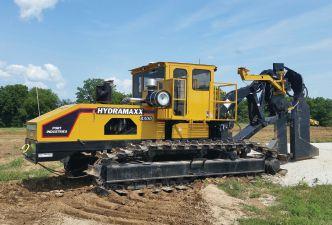
HYDRAMAXX 3310 DRAINAGE PLOW
Port Industries Inc. has introduced the 3310 model drainage plow. The 3310 is powered by a proven Tier III Cummins QSM11 engine that delivers 375 horsepower. The 3310 replaces the 3300 model for 2015.
The Hydramaxx 3310 features an improved undercarriage for faster working speeds. The 3310 is now capable of installation speeds of 240 feet per minute. This is a 30 percent increase over the previous model. The final drives in the 3310 are not only larger, but they also have a new design with better bearings for increased loads and longer life. The 3310 weighs 63,000 pounds with standard equipment. The new track drive system and the frame are designed to handle optional equipment like an on-board pipe handling system and large tile boots that can add significant weight to the machine.
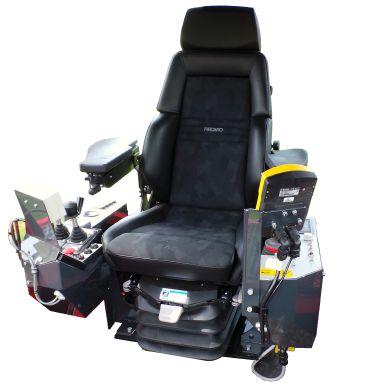
The Hydramaxx 3310 drainage plow has a spacious cab with an air ride seat and large windows for the ultimate in operator comfort. All new processor based controls bring control of all
functions to the operator’s fingertips. www.portindustries.com
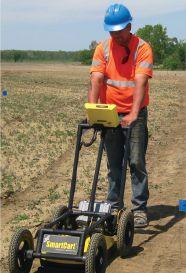
LOCATE AGRICULTURAL DRAINAGE TILES WITH GPR
Sensors & Software Inc. offers two systems suitable for locating drainage tiles: the LMX100 and the Noggin 250 SmartCart system. The LMX100 ground penetrating radar (GPR) system allows an operator to locate and mark the drainage pipes on the spot.
The Noggin SmartCart extends this functionality by also allowing the user to collect data in a grid format and ultimately produce depth slices over the surveyed area for easier 3-D visualization. A GPS can also be connected to the Noggin SmartCart to geo-reference the data for exporting into third party software such as Google Earth.
By using GPR, an operator can rapidly determine the location, orientation, depth, and spacing of drainage tiles with minimal disruption to the surrounding area.
www.sensoft.ca
POLYPROPYLENE FILTER FROM SOLENO
In addition to Soleno’s two filter jackets, with 100-micron and 450-micron openings, Soleno is now offering a new drainage product with openings of 250 microns.
The new, non-woven polypropylene filter is offered for Type 2 and Type 3 (MEGA 3) drains.
The company recommends using the MEGA 3 - 250 micron filter when soil tests indicate a soil rich in fine and medium sand.
www.soleno.com
AUTOMATIC PIPE SIZING FEATURE FROM TRIMBLE
Contractors and farmers looking for improved accuracy and increased efficiency when designing farm drainage
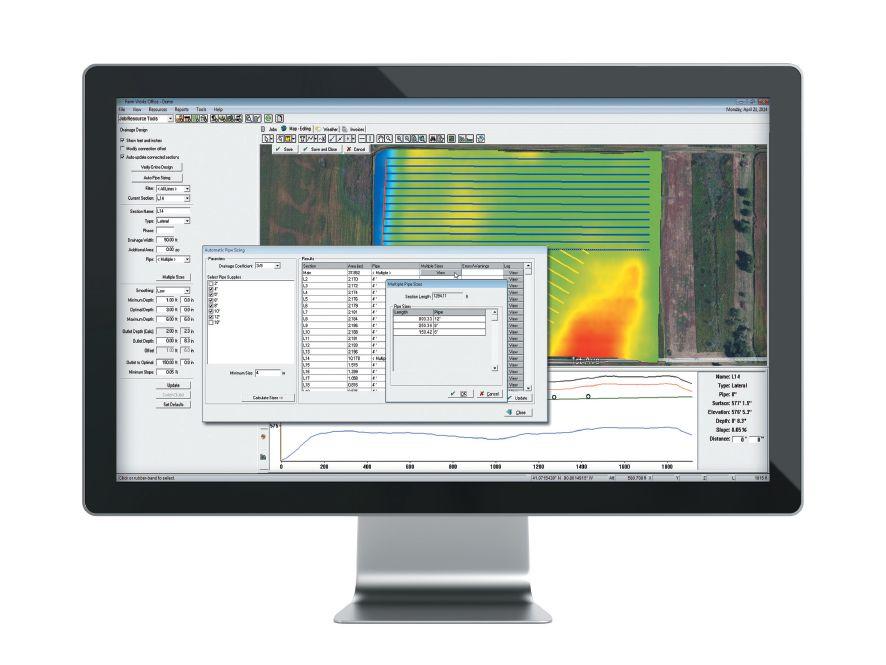
systems now have an additional tool at their disposal. Trimble has added automatic pipe sizing to its Farm Works Surface software, an analysis and design tool that works with the Trimble WM-Drain farm drainage solution. WM-Drain streamlines the survey, analysis, design, installation, and mapping steps of surface and subsurface drainage.
The new feature provides recommended drainage pipe sizes for an entire system design, as well as an estimate on cost and material required for the project. With this feature, drainage contractors and farmers can quickly and efficiently produce optimal drainage designs while also reducing project costs. The designs can be imported to in-field drainage equipment for automated installation using the Trimble FmX integrated display.
Farm Works Surface software recommends diameters for all pipes within the user’s drainage network based on the terrain, depth, pipe materials available for the project, and the drainage coefficient, which represents how much water will be drained from a field within 24 hours. The user can select the recommended pipe sizes or manually assign different pipe sizes. Charts show where the pipe is placed with respect to terrain level, maximum depth, and optimal depth, and can be used to view errors or modify the design to ensure optimal performance. Additional reports help users determine the required length of pipe, the cost of connection supplies, and the total system cost.
www.trimble.com/agriculture
WOLFE 540 DRAINAGE PLOW WITH GPS AUTO STEER
Wolfe is now offering GPS auto steer in its machines. All new machines will come auto steer ready, with installation as simple as adding a module, some minor wiring and entering a password. The Auto Steer feature is programmed directly into the machine’s control systems with all fail-safe redundancies using CAN Based technology. The advanced technology of this CAN Based system allows for the fastest processing time in the industry. This system will quickly, efficiently and accurately control the auto steer, as well as the grade and pitch control. The operator can easily override and disengage the system by moving the control levers.
www.wolfeequipment.com
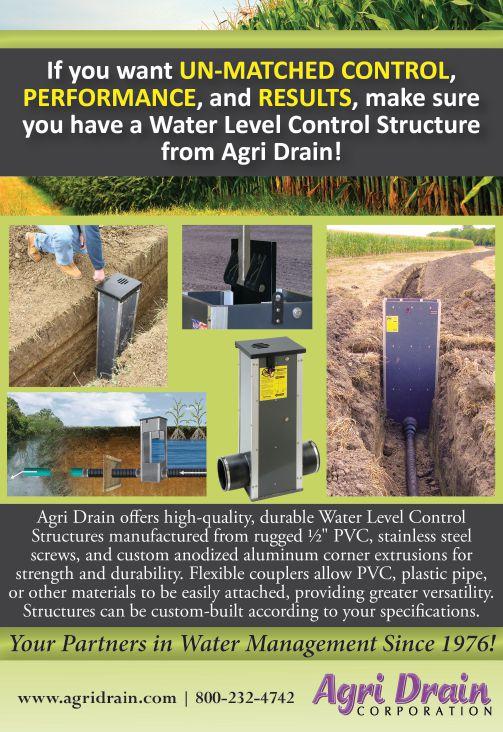
WATER CONTROL STRUCTURES HELP USERS MANAGE DRAINAGE WATER
The water control structure from Just Pipe & Fittings Inc. allows owners to control the height of their water table, according to their needs. These structures can be beneficial in agricultural and wetland applications by bringing ground water closer to root systems and holding water and fertilizer in a field longer. When used in conjunction with an irrigation system, the water control structure serves as an economic approach to conserving water by increasing the efficiency of the irrigation.
Just Pipe & Fittings has been supplying these structures to various
conservation authorities, as well as McGill University, which has installed the units in test fields across Ontario. Conservation authorities and landowners have found Water Control Structures to be useful in increasing crop yield and improving water quality by reducing the annual nitrate and phosphorous discharge rates by up to 75 percent. Research has proven that reducing the flow rate of farm runoff will improve water quality and
reduce algae blooms in the Great Lakes. Just Pipe has also released a number of other environmental products, including an environment protection valve that can be used in spill-prone areas to prevent pollutants from entering the watershed in the event of a spill, and a water quality unit used primarily in parking lots and municipal areas to treat storm water before it enters waterways.
www.justpipe.ca
CONTROLLED DRAINAGE
Use of controlled drains is spreading in Ontario.
On flat cropland, controlled drains may become the new norm in Ontario, replacing conventional tile drainage on many of the province’s farms. The flexibility of controlled drainage delivers benefits for farmers and the environment that standard drainage cannot offer, and the use of these systems is spreading accordingly.
by TREENA HEIN
Drainage contractor Ken McCutcheon (left) and UTRCA’s Brad Glasman (right) planning the project this past spring.
All photos courtesy of UTRCA.
Controlled drains have been studied at the Agriculture and Agri-Food Canada (AAFC) research station in Harrow, Ont., for two decades and some farmers in Essex and Kent have already installed them on their land.
“This practice is somewhat common in that area because the land is very flat there,” notes Ken McCutcheon, owner of McCutcheon Farm Drainage Ltd. in Thorndale, Ont. “The Americans in various states have really embraced controlled drainage as well. However, there are not many areas where it works well in Ontario because it totally hinges on flat topography.”
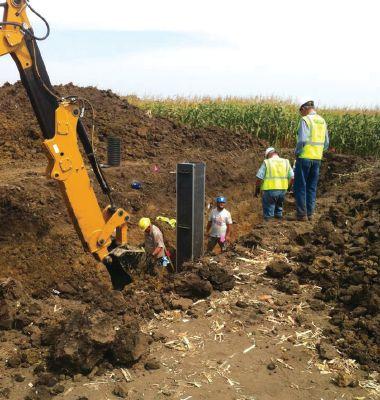
Earlier this year, McCutcheon (who has five employees in the field plus office staff at his 37-year-old business) installed two controlled drains on the farm of Henk and Annie Van Den Berg in Lucan, Ont. The project was spearheaded by Brad Glasman, co-ordinator of conservation services, and Craig Merkley, conservation services specialist, at the Upper Thames River Conservation Authority (UTRCA), along with Andrew Jamieson, senior water management engineer for AAFC. Each controlled drain covers a five-acre field. “It was an ideal site for this project as it was very flat,” McCutcheon
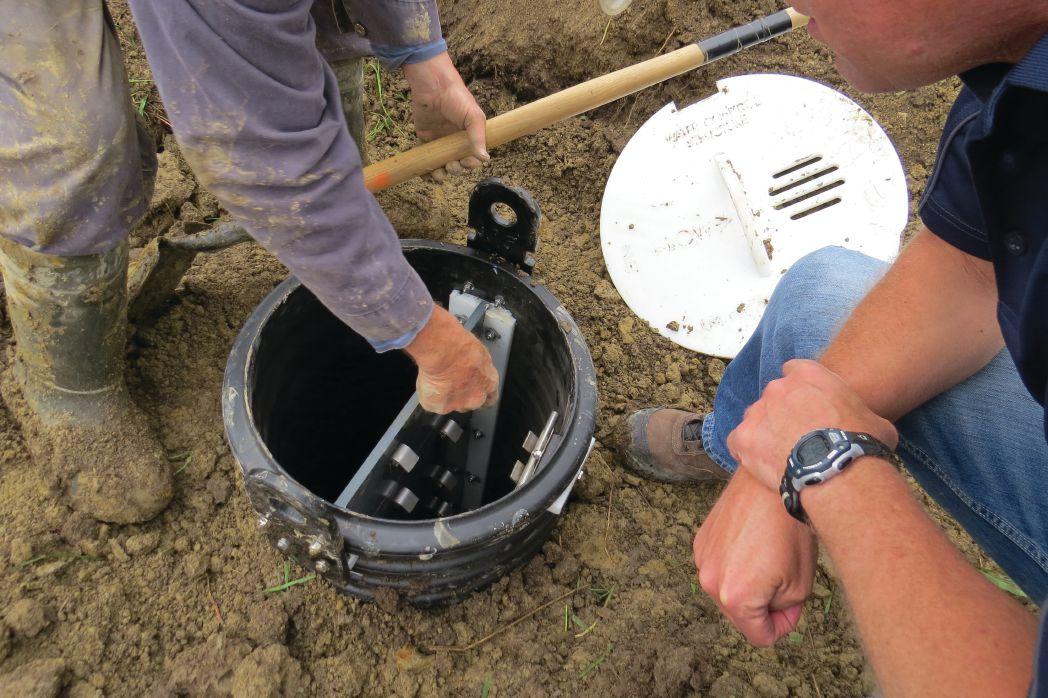
says. “That’s a key factor in making this sort of controlled outlet work. It allows you to control the water table within 12 inches.” He notes that if there are elevation changes in a field, the installation of more controlled drain structures would be required to control water flow, and you end up with structures in the field instead of just at the outlet at the edge of the field. This interferes with planting, harvesting and so on.
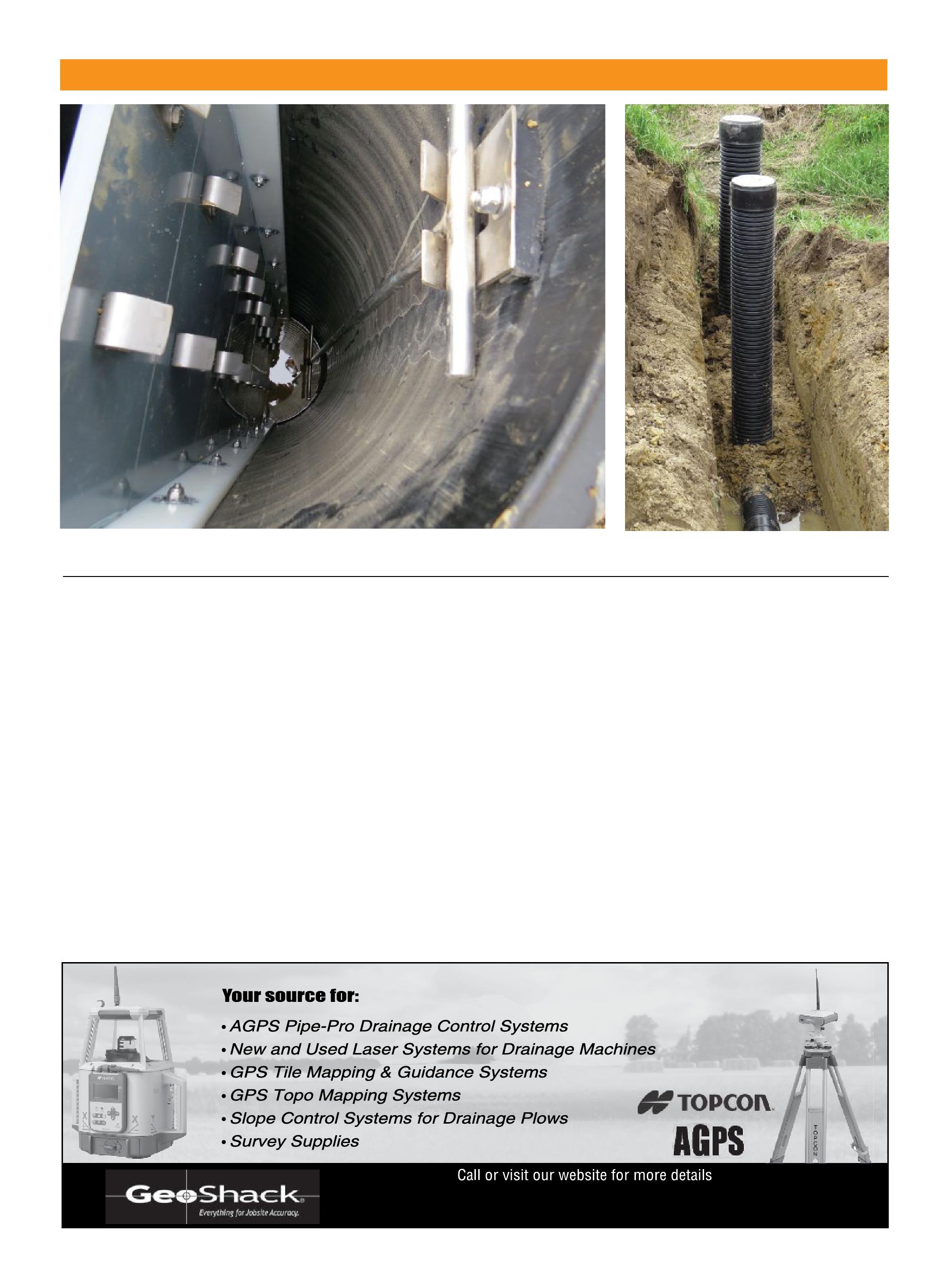
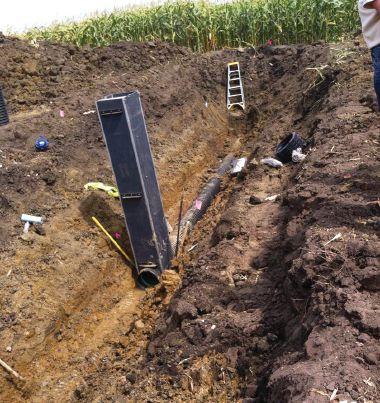
Each controlled drain, placed just before the outlet, consists of a plastic tube 45 cm wide and almost two meters long integrated with the existing drainage tile. Inside each tube are vertical plastic panels that can be pulled up to let the water flow or pushed downward to stop it. Excessive rainfall can cause water to be pushed up and over the panels and flow out, so additional panels must be added to block water flow, if desired.
The system is meant to be left open in the spring and fall to drain the field, and
closed during the summer to retain water. It is designed to allow faster drying of fields in the spring so that crops can be planted earlier, and to conserve the water from summer rainstorms. This year, the Van Den Bergs got a large rainfall at the end of July and closed the two controlled drains. “Water ran through the controlled drains for about a day,” says Henk, “and through the conventional drains on the rest of the farm for four days, which is a substantial amount of water loss in comparison.”
ENVIRONMENTAL BENEFITS
Keeping nutrient-rich water in the field instead of having it flow away, as it does in a conventional tile drainage system, is not just better for crops and farmers. It’s also, as Glasman notes, better for the environment and human health. High levels of phosphorous from fertilizer, for example, can lead to algae blooms in Lake Erie. Nutrient runoff from farms also contributes to generally poorer
water quality in creeks, rivers and lakes in Ontario, including the Great Lakes. The cleaner water provided by controlled drainage therefore benefits all organisms, from invertebrates to birds to human beings.
Glasman, Merkley and Jamieson estimate that about 80 to 90 percent of the phosphorous and nitrogen in a field will stay put with controlled drainage compared to what would have been lost into the watershed with conventional tile. Monitoring equipment to measure nutrient and water outflow from the Van Den Bergs’ controlled drainage fields, as well as their regularly tiled fields of a similar size and topography as a control, were expected to be in place by October. Jamieson says it’s a three-year project and will involve year-round monitoring.
MEASURING BENEFITS
“As far as how the system is working so far, it’s early days yet,” says Merkley. “We are still learning the drainage
Installation of controlled drains on the Van Den Berg farm by drainage contractor Ken McCutcheon and UTRCA.
characteristics of the site and how the system is responding to rain events.” He says there are no plans at the moment to test the system on other fields, but they may look at the feasibility of automating the stop panels, tying in the raising and lowering of the panels to the amount of rainfall received. “We’re not sure it can be done, but there are plans to investigate the idea,” Merkley notes.
In addition to needing flat topography for controlled drains, McCutcheon says newer tile drainage systems – with pipes that are closer together than in older systems – make controlled drains much more effective. “In older systems, the spacing of the tile is wider and you’re
backing the water up in those pipes with the water level varying because of the distance,” he says. “In newer systems, the tiles are closer and you have more pipes in the ground with a more uniform water table, so with controlled drains [incorporated with those systems], you will more evenly distribute and store water.”
In terms of the economic benefits that controlled drainage may supply on the Van Den Berg farm, Henk says, “We’ll have to wait for harvest to see how much better the corn yield will be, but we had a dry August, so it should make a difference.” Glasman says yields should be able to be increased by 10 to
15 percent over time with a controlled drain system. The controlled drainage structures are approximately $700 apiece plus installation and are available from some of Ontario’s largest drainage material suppliers. When a farmer would achieve cost return depends on a few factors. Each year is different in terms of how much water conservation matters (how dry it becomes) in crop yield, weather patterns, the price farmers get for their harvests and so on.
However, in these times of increasing drought conditions, return on investment for controlled drainage may be swift – as may be its spread in flat parts of Ontario and beyond. DC
Installation of controlled drains on the Van Den Berg farm by drainage contractor Ken McCutcheon and UTRCA.
INDUSTRY NEWS
GLRI FUNDING TARGETS ALGAL BLOOMS
In mid October, the Environmental Protection Agency (EPA) awarded Great Lakes Restoration Initiative Grants to Ohio, Michigan, and Indiana.
Four Great Lakes Restoration Initiative (GLRI) grants totaling over $8.6 million were awarded to Ohio, Michigan and Indiana state agencies to protect public health by targeting harmful algal blooms in western Lake Erie. These grants will fund projects that will be implemented by state agencies. EPA will soon announce additional funding for projects that will be implemented by federal agencies.
In early August, the city of Toledo, Ohio, issued a “Do Not Drink” order for almost 500,000 people in northwest Ohio and southeast Michigan when a drinking water treatment plant was adversely impacted by microcystin, a toxin generated by a harmful algal bloom in western Lake Erie. In addition to generating toxins that pose risks to human health, harmful algal blooms contribute to low-oxygen “dead zones” in the deeper waters of Lake Erie and harm shoreline economies.
“This summer’s water crisis underscores the need to approach the issue of harmful algae blooms at all levels –local, state, and federal,” U.S. Sen. Sherrod Brown of Ohio said. “And while local experts and community leaders are
Tait_3.375x4.875 10/18/04 3:09 PM Page 1
“Made to last for years of service.”
•Up to 7ft cutting depth
•High production
•Low ground pressure
•Robustly built plow and frame
guiding our response, the Great Lakes Restoration Initiative funding will play a critical role in reducing phosphorus runoff and giving farmers, producers, and stakeholders the tools they need to meet the challenges ahead. While we know this issue isn’t going to improve unless we act together, today’s announcement of additional federal funding is an important step in making progress.”
These Great Lake Restoration Initiative grants will provide approximately $5.9 million to the Ohio Department of Natural Resources, over $1.5 million to the Ohio Environmental Protection Agency, approximately $807,000 to the Michigan Department of Agriculture and Rural Development, and approximately $360,000 to the Indiana Department of Agriculture.
The grants will be used to provide technical assistance and incentives to farmers in western Lake Erie watersheds to reduce phosphorus runoff that contributes to harmful algal blooms, and improve measurement of phosphorus loads in Lake Erie tributaries.
The Great Lakes Restoration Initiative was launched in 2010 to accelerate efforts to protect and restore the largest system of fresh surface water in the world. Great Lakes Restoration Initiative resources are used to strategically target the biggest threats to the Great Lakes ecosystem. DC
The following options are also available:
•Choices of engines – CAT, CUMMINS, DETROIT
•Oscillating tracks
•Wider cab model
•Variable angle arc plate
•Quick change teeth (reversible)
•Tubing chutes up to 16 inch
•GPS or Laser Guidance
DRAINAGE SYSTEMS
DRAINAGE ON DEMAND
DWM holds promise to expand across the U.S.
An increase in the use of an innovative drainage system called “drainage water management” is being promoted by the U.S. Department of Agriculture’s Natural Resources Conservation Service in Illinois and other states in the region, as it provides significant benefits for both farmers and the environment.
by TREENA HEIN
LEFT: The Illinois Land Improvement Contractors Association collaborated to install a drainage water management project on-site at last year’s Farm Progress Show. Photo courtesy of Illinois LICA.
RIGHT: Visitors to the Farm Progress Show were able to see the DWM installation firsthand. Photo courtesy of Illinois LICA.
Drainage water management (DWM) allows farmers to control the amount of water that’s drained from the top few feet of the field’s surface. A box-like structure is attached to existing drainage pipe near the field outlet, with a number of large thick bars that can be inserted or removed to control water flow. It is similar to controlled drainage systems being used in Ontario, which employ a round structure and vertically movable panels.
The DWM system provides a myriad of monetary and environmental benefits, from boosting crop yields to improving water quality of nearby watersheds through preventing nutrient run-off. “Farming is a risky business, subject to all kinds of influences like weather and global economics that are out of the producer’s control,”
notes Dr. Ruth Book, an Illinois NRCS state conservation engineer. “With DWM, the farmer can decide when to drain the field and when not to. Think about how helpful this could be in a drought year, for example. If the producer knows that the summer is going to be hot and dry, he or she could hold back some of the water from the spring rains.”
DWM can be installed with both new and existing tile drainage, but the field should have a slope of less than one percent. If that sounds restrictive, consider that in the state of Illinois alone, DWM is suitable for use in nearly 10 million acres of fields. There are now 14 counties in Illinois that are targeted for DWM demonstration projects. Many installations have already occurred through technical and financial
support from the Natural Resources Conservation Service (NRCS), and more are in the works.
This year, NRCS sponsored a special DWM project in the 37 square-mile watershed around the town of Tovey in collaboration with the Christian County Soil and Water Conservation District. Book says the predominantly flat, tiledrained cropland in that area of Illinois is very suitable for DWM. “The partnership goal is to help producers implement DWM and related practices on at least 20 percent of the cropland in the watershed over the next five years, or approximately 750 acres per year,” she explains. “The expectation is that this achievement will demonstrate a measurable improvement in surface water quality entering nearby Sangchris Lake.”
It goes beyond the lake, however. Fertilizer use in Illinois crops is a major contributor to the nitrogen load in the Mississippi River Basin. About 90 percent of the nitrate-N that’s discharged via the Mississippi River is due to agriculture, Book notes. Research has shown a definite correlation between tile drainage and high nitrate levels in surface water, and although there seems to be an apparent conflict between needing to drain fields for crop production and the need to reduce nitrates entering surface water, Book says DWM is a way to accomplish both. “During fallow periods, the water table is raised, creating conditions that are very similar to what the field was like before the drainage system was installed,” she says. “Also, the water table can be
raised during the cropping season to retain water that would have otherwise drained away, potentially supplying water to the capillary root zone of the crop, but also reducing nutrient loading.” The effectiveness of DWM in reducing runoff is directly related to the volume of drainage water that is retained in the field, so operators are encouraged to keep the system closed, draining the field only when necessary to grow crops and do field work.
CONTRACTORS, TRAINING AND NEXT STEPS
Book praises the Illinois Land Improvement Contractors Association as “a great partner” in the effort to spread DWM use. “Drainage contractors not only help us sell drainage water management and other conservation practices related to drainage, but they also are out there on the front line, actually installing,” she says. “Most drainage contractors already have the equipment they need to install drainage water management. Implementation is quite simple, usually involving just the addition of a water control structure at strategic places in the drainage system.”
Flat fields can often be managed with a single water control structure, but Book says it’s possible to stair-step the DWM system to accommodate changes in elevation. She explains that when the field has more slope, it’s helpful to lay out the drainage system so farmers can manage the water table with the
minimum number of structures. “We’ve had many drainage contractors attend training sponsored by the Agricultural Drainage Management Coalition and NRCS,” she explains, “where they learn how the drain system layout can be changed to facilitate DWM.”
Illinois is part of the 10-state focus area in the NRCS Agricultural Water Management effort to spread the installation of DWM, but it’s the state with the longest history of DWM use and the one with the most suitable acres. Following in Illinois’ footsteps, some of the other nine states are offering financial assistance and considering the development of special regional DWM projects.
In a few years, Book believes Illinois District Conservationist Tony Hammond will be able to report a dramatic increase in the adoption of DWM in Christian County. “Tony and the staff at the U.S. Department of Agriculture field office in Taylorville have been publicizing the great things DWM can offer, and he’s beginning to show some results. Now that we have our conservation professionals trained on the practice, I think we’ll be seeing much more implementation of DWM all over the state.” With all the benefits provided by the system – and the strong support being offered – DWM is poised to become the standard on flat farmland in the U.S. and beyond. DC
FOR MORE INFORMATION
To watch a new four-minute video showing how DWM works, visit: http://www.youtube.com/ watch?v=j4mYch4RFsY
For more short videos and other resources from the national DWM website, visit: http://www.nrcs.usda. gov/wps/portal/nrcs/main/national/ water/manage/
For an explanation of the DWM funding program created by Illinois NRCS, visit: http://www.nrcs.usda. gov/wps/portal/nrcs/detail/il/programs/ financial/?cid=nrcs141p2_030467
A DWM system allows for controlled drainage. Image courtesy of NRCS.
LEADING BY EXAMPLE
Examining the real impact of leadership.
William James, the famed American philosopher and psychologist, once said, “When two people meet there are really six people present. There is each person as they see themselves, each person as the other person sees them, and each person as they really are.” As a leader, how do you see yourself? And, even more important, how do the people you lead see you?
Every action you take and every interaction you have leaves a lasting impact on others. You can have the best of intentions, but if your impact isn’t aligned with the intention, your leadership may not be as effective as it could be. Why? Because what matters is not who you think you are, but the experience other people have with you.
Now before you say, “I don’t care what other people think of me,” realize that you don’t need to care what they think. You do, however, have to care about the impact you have on others, on your organization, and your industry. Your impact leaves a lasting mark.
Most leaders have never detailed their personal creed. But doing so can be incredibly powerful. Get clear about who you think you are. Who are you and what do you stand for? What do you value? What is your personal creed or stance in the roles that are most important to you in your life? How do you want to be known in your company and industry? Once you have those questions answered, ask the most important question of all: “How do the things I just detailed show up when I’m frustrated or when things aren’t going well? Who am I then?” Most leaders lose credibility when things are
bad because they haven’t thought about who they are in those situations and the kind of impact they’ll have.
There are two ways to get information about your impact: you can ask for feedback either indirectly or directly. An indirect approach is doing an online and anonymous survey of some sort using a tool like Survey Monkey. While it’s simple to do, the results are not always specific. A direct approach is to talk with someone you trust and ask specific questions so you can get key insights.
The secret to making direct questions work is to phrase them properly. If you ask someone, “Can you give me feedback on my leadership style?” you won’t get the information you need. That’s a difficult question for most people to answer because it’s not focused enough, and no one wants to hurt another person’s feelings. Ask a more focused question, like, “During today’s meeting, I think I may have sounded defensive when I told Chris that the idea would never work. How did it land for you? What was your experience of being in that meeting?” Notice that you’re not asking for an evaluation. You’re pointing out a specific incident or behavior and asking the person about their personal
by ALESIA LATSON
experience during that moment – the impact you had.
If the results of the feedback you receive don’t align with your personal perceptions about yourself, it’s time to make some changes, not to you, but to your impact. First, get curious about the mismatch, not furious about the information. You might be a motivating, empowering, and uplifting kind of leader, but under certain conditions, even the most esteemed person can come across as harsh, cold, and defensive. In other words, know your blind spots so you can shed some light on them.
There’s no avoiding it: all leaders leave a lasting impact. What’s yours? DC
Alesia Latson is a speaker, trainer, coach and founder of Latson Leadership Group, a consulting firm specializing in management and leadership development. With more than 20 years of experience, Latson helps organizations and leaders expand their capacity to produce results while enhancing employee engagement. For more information on Alesia’s speaking and consulting, please contact her at alesia@latsonleadershipgroup.com or visit www.latsonleadershipgroup.com.
The mulcher of choice for the drainage industry
the following three options, all of which have been designed so greens can be back in play in a matter of hours or days, depending on the circumstances.
The Shelton Gravel Band System can be carried out during the months when the ground is wet. It is a very simple system that uses the Gravel Band Drainer and Lytag LWA as a backfilling material. Lytag LWA is sold in the United Kingdom and is a versatile lightweight aggregate which is produced from pulverised fuel ash, a by-product of coal burning power stations. It is an ideal medium for land drainage applications, as its rounded shape and regular grading give excellent hydraulic conductivity. Lytag LWA gets better results than gravel due to its rounded shape, and its ability to retain water in the drier summer months. (Alternatives to Lytag LWA are available in the United States). Closely spaced one-inch wide gravel bands lead to a piped drain situated just off the green. Bands of the Lytag LWA are injected into the green by a vibrating channel opener and, as no soil is removed, any surface undulations can be minimised by hollow tining prior to the installation. The beauty of this system lies in its simplicity and speed: a large green can be drained in five hours and played on 24 hours later!
System 25 is a versatile mini trencher used primarily for installing a secondary drainage system over a network of piped drains in a one-pass operation. System 25 may also be used to install land drainage tile and underground services. The trencher cuts a one-inch wide trench, removes the soil and lifts it into a trailer, whilst the Lytag LWA is simultaneously vibrated in. We would then suggest that a free draining top soil be applied over the drainage runs. This system generates fast results and, again, the damage to the green is minimal. In fact, the green can be played on 24 hours later – imperative in the busy summer months. We have seen this system used with great success at many clubs, including Farnham Golf Club in England. This system is carried out to best effect in the drier months.
The third option is a Lightning Drain system. This is very similar to System 25 except the trenches are dug to 1.4-inches wide and a one-inch perforated land drainage tile is installed prior to backfilling with Lytag LWA. This gives greater longevity to the system and also speeds the flow of water out to the exit drain. The results are immediate and with good greens maintenance, including plenty of aeration, the effects will last for years to come.
Lightning Drain is a popular technique, not just because of its effectiveness, but also because its use isn’t restricted to any particular time of year, although for optimum results, colder, wetter months are best avoided, so the grass is able to re-establish well over the cuts. Lightning Drain was recently used with great effect at the beautiful Boyce Hill Golf Club in Benfleet, Essex, England. DC
David Shelton is managing partner of Shelton Sportsturf Drainage Solutions based in England. The business has 30 years of experience in fine turf drainage and manufactures a wide range of equipment. For more information, phone 01507 578288 or visit www.sheltonsdrainage.com.
EVENTS
OHIO LICA
Jan. 5-7, 2015
Dublin, OH
IOWA LICA
Jan. 11-13, 2015
Des Moines, IA
MICHIGAN LICA
Jan. 11-13, 2015
Lansing, MI
SOUTH DAKOTA LICA
Jan. 12-14, 2015
Aberdeen, SD
NEW YORK LICA
Jan. 13-15, 2015
Geneva, NY
MINNESOTA LICA
Jan. 14-16, 2015
New Ulm, MN
ILLINOIS LICA
Jan. 15-17, 2015
East Peoria, IL
NEBRASKA LICA
Jan. 20-22, 2015 Kearney, NE
LICO
Jan. 21-22, 2015 London, ON
MISSOURI LICA
Jan. 22-24, 2015 Columbia, MO
KANSAS LICA
Jan. 25-26, 2015 Salina, KS
INDIANA LICA
Jan. 28-30, 2015
Indianapolis, IN
PENNSYLVANIA LICA
March 26-29, 2015
Harrisburg, PA
INDUSTRY NEWS
EDUCATING FARMERS ON QUALITY PIPE STANDARDS
Springfield Plastics, Inc. is launching a new initiative to educate farmers and contractors on characteristics that set a quality pipe apart from the rest.
Many farmers rightfully expect the drainage pipe they install to serve them for many years and to be top quality, but with so many different types out there it can be hard to ensure the pipe will live up to those expectations. Ensuring that drainage pipe is manufactured with a consistent, quality material is imperative. This is why standard setting organizations, such as ASTM and United States of Agriculture – Natural Resources Conservation (USDA-NRCS), have required the use of virgin materials for many years. There can be wide the physical properties of recycled materials, concern in how they affect the long-term performance of drainage pipe. The variability in recycled materials can lead to stress cracking, poor deflection and impact strengths and uneven wall distributions. If any of these things occur, the farmer could be looking at drainage system failure.
Springfield Plastics has begun reaching out to the agricultural community to inform them of the factors that can compromise the quality, and in turn the reliability, of the drainage pipe they purchase.
The company notes that superior drainage pipe product will have the flexibility to fit the farmer’s needs, yet not be riddled with soft spots, cracks or have the potential for blowouts. When examining pipe options, Springfield Plastics advises that the farmer should test a pipe’s strength and flexibility.
Springfield Plastics is hoping that the campaign will help contractors and farmers gain improved understanding of the variances in pipe characteristics that exist in the market today. DC
Identify inefficiencies and streamline operations to build a stronger business.
The order book is full; we are officially delaying or turning work away for the next couple of months. We simply have no more capacity, there are only so many meters which can be laid per day and just to honor the promises already made we need good weather and to avoid breakdowns. That of course will not happen, but I hope to bend a few promises rather than break them. It’s far from ideal, but with a couple of sympathetic clients and a good dose of honesty from us the odds are in our favor.
This is the busiest we have been for a few years, and I should make two things clear. The first is that I’m not complaining. The nature of our business is that workload is very imbalanced. After harvest we are flat out, in January and February we are fixing machinery, waiting for spring and losing money. Even within this pattern, peaks and troughs are common. Sometimes the jobs are lined up and sometimes we wonder what we can do next week. Being busy can be problematic but it is far better than not having enough to go at. Secondly, despite my considerable efforts to market and sell both Farm Services and drainage to English farmers (an ongoing process which has been more successful than I thought it would be), the weather, harvest and the rising price of land have caused most of this demand. Farmers buy drainage when it is wet and no amount of sales will overcome that obvious fact. The unpredictable and wet weather is helping sales, as is the good yield experienced this harvest. The prices are another matter and I can only imagine what the imaginary, impossible, perfect drainage contractor’s year – wet, good yield, high prices – would do to demand.
At the moment it’s all hands to the deck, with our guys working as much overtime as I can persuade them to log. On site each job is
flooded with men and machinery, anything which will increase production, and in the office we are running around like headless chickens. Gravel and pipe must be waiting for the guys when they turn up on site. Plans are double checked to ensure problems are solved before we are on site. Move days are well co-ordinated and wasted time is kept to a minimum. Most important of all, the drainage machine must keep on moving. When the pressure is on, the cracks appear. I will happily state that we are far from perfect. During my Nuffield travels I have seen better drilled drainage crews and slicker run businesses than ours, but we are trying. I’m desperate to improve the business and drive it forward, and if I’m honest, very few parts of the business cannot be improved. We will get there but it takes time. One idea I’m building up the courage to implement is to swap our foreman from operating the drainage machine to the excavator (or backhoe, as you say in North America). Like nearly all contractors, our foreman drives the drainage machine, but is that really the right place for him? And if not, surely our best man should be where he can affect the job the most? Making sure the drainage machine can continue laying pipe is arguably a harder job, which requires more thought than driving a plow, for example. Of course, making sure the pipe is installed correctly is vital, but once trained and with the foreman checking frequently, can’t someone else operate the drainage machine, leaving the foreman to plan head, solve the problems, mark out the drainlines and make sure the drainage machine keeps laying pipe?
Anyway, I need to stop typing, set up the next job and make hay as the sun shines, as next week might be full of rain. I hope everyone has a busy couple of months and that demand for our services remains high. DC
Since 1973, Corma Inc. has continuously innovated to meet the evolving demands of our customers. For example, our 630-12 and 830-12 High Speed Corrugators combined with our HSC Series 2 Adjustable Perforators will produce high quality 4" single wall HDPE pipes at high output rates up to 2,300 lbs/hr and 115' per minute. To learn how we can make a positive impact on your business, please contact: 830-12 Corrugator 2" (50 mm) I.D. to 12" (300 mm) O.D.