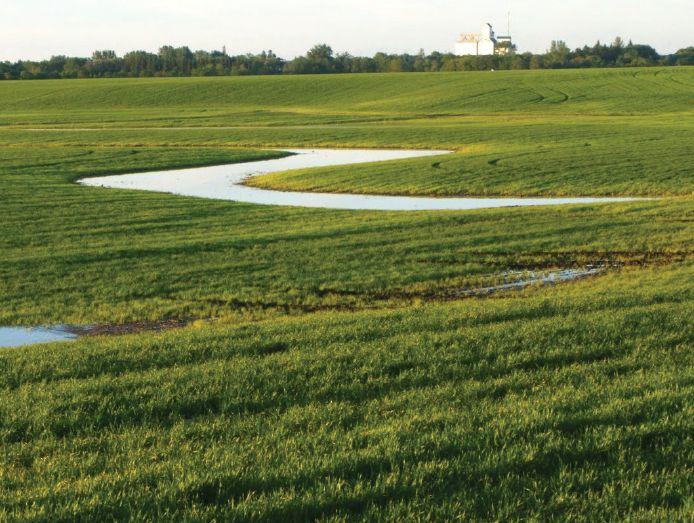
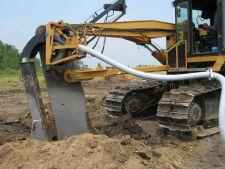
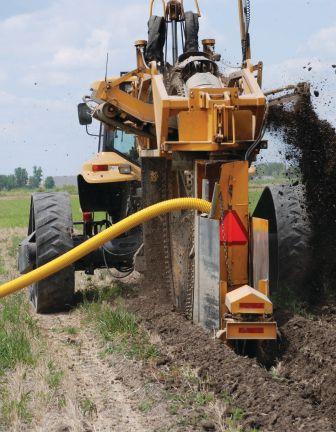
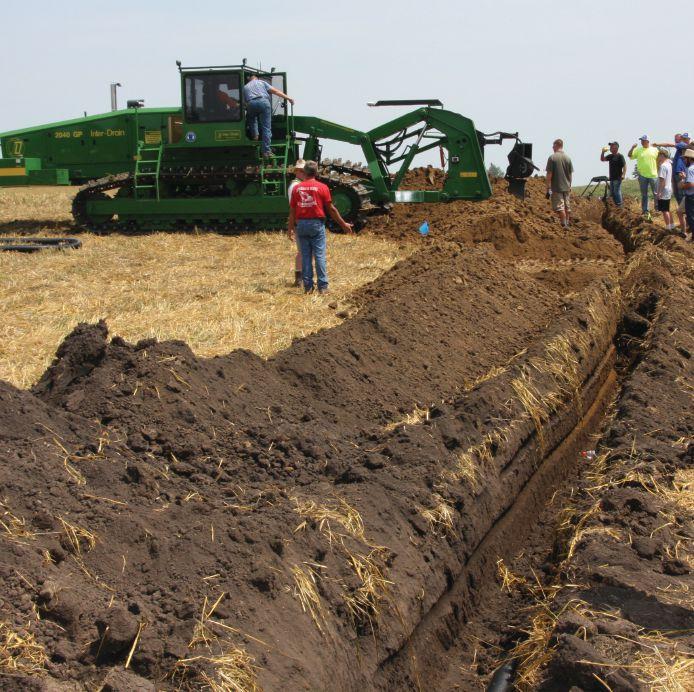
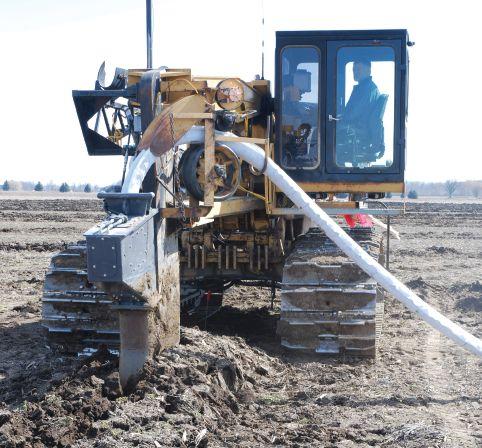
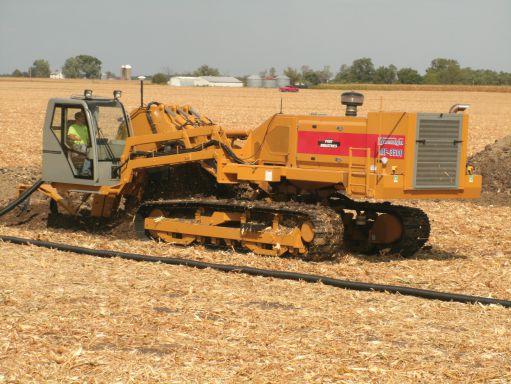
Beaver Creek has averaged another 400 acres of tile installation. The farm has about 9000 acres in production, with 5200 acres tiled. Seeded potato acres have slipped a bit, from the 900-acre range at the start of the tiling program to about 800 acres today. “Everybody is targeting higher yields to get volume contracts,” Wiebe explains. “Our general target today would be 30 to 40 percent more volume per acre than we did in 1997. There’s a variety of reasons and, for us, tile is a big part of it. Irrigation is more common, too. There’s more intensive management, of every aspect.”
Beaver Creek has focused on getting the most return for its substantial investment. Wiebe started with what he refers to as the ‘worst’ of the fields he planned for potatoes in 1997, and has made that a pattern. The farm now is close to completing the program, yet not every field will be tiled. My recommendation to anybody is to start with your most vulnerable, most dramatically affected fields. That’s where your payback will be the highest,” he says.
Tile spacing amounts to a risk management choice. Tighter spacing costs more but provides better protection for heavy rain events. Tighter spacing would have helped more in 2010, when they had three five-inch rainfalls, but even those only led to minor potato losses with their current system.
Crop value also needs to be considered. Payback is fast with potatoes, good with canola, corn and soybeans, yet slow with a cereal grain. Payback can be 20 percent if tile stops a good field from drown-out every second year. “Our overall average yield increase is in
Minor use regulation
that 15 percent range, with a four-year rotation of potatoes, wheat, corn and canola,” he says.
That is for an investment averaging $750 per acre for tiles with 50-foot spacing, large fields and gravity flow. If a field was smaller, or if it needed a pump station at the low end, costs could be more than $1000 per acre. The cost split is roughly 65:35 for material and installation. “The whole picture has to be analyzed by professional people; otherwise, you don’t know. They will give you a quote so you know in advance exactly what you’ll be paying.”
Loan managers are becoming very
The Province of Manitoba introduced a policy called Expedited Authorization of Minor Water Control Works in September 2009, says Perry Stonehouse, manager of water control works and drainage licensing for the Manitoba Water Stewardship department. “‘Minor Works’ are a group of works that are unlikely to cause significant impact. The authorization is good for perpetuity and separates them from works that are more likely to cause impact,” Perry says.
The typical minor work involves fall field drainage work with a V-ditcher or a small scraper. It opens the course for water to leave a field more efficiently in spring. When the field is ready for spring traffic, the field drain gets cultivated and treated as does the rest of the field. “The intention is to authorize those works that have little chance of causing impact, really quickly,” Perry explains. It also applies to municipal work. A minor work permit is required for replacing culverts. If the culvert is in a new
interested in tiling. They analyze it case by case, but the benefit is obvious once they fully understand the impact on a farm.
Anyone interested in starting a tile drainage program needs to plan. The work probably has to be installed in the three months between harvest and hard-frozen ground, although a grower needs to allow a year or more to prepare the plan, get financing and obtain the drainage license.
The good part is that Manitoba now has three tile drainage contractors, a company that manufactures tile locally and bankers who understand the system, Wiebe says. ■
location or if the size is upgraded, it will need a standard permit.
In fiscal 2009/2010, the department issued 1232 licenses. Most were for minor use situations. As of February 2011, the largest backlog of permit requests was in the Red River Valley and the Interlake.
Each proposal is reviewed on site. Applicants must wait for snow to be off the land.
Information, policy information and forms for drainage work are available from Water Stewardship offices and online at www.gov.mb.ca/waterstewardship/licensing/index.html. The application must include a drawing of the proposed drainage work on an aerial photo. The photo can be supplied by a Water Stewardship office. “Our goal is not just to track works but to reduce the probability of impacts by examining proposed works,” Perry says. “If we get a complaint, then we can go to our database and have accurate information.”
Manitoba’s “minor works” regulation expedites minor drainage for a one-time $25 fee.
At Prinsco, we understand that long-term success in farming is dependent on the energy, expertise and attention to detail invested in each critical stage of the process.
In fact, it’s a philosophy we’ve applied to our business, as well. In 1975, our founders decided to plant our first manufacturing facility in Prinsburg, Minnesota, a small town in the heart of the Midwest. From those humble beginnings, we immediately began to grow. We have sustained that culture of growth in both our product lines and our infrastruture for over three decades, giving us the experience and capacity to become one of the largest tile suppliers in the Midwest.
In 2011, as farmers asked for record breaking volumes of tiling products, Prinsco answered by opening a new plant in South Dakota and confirming plans for another manufacturing facility in North Dakota by 2012, bringing our total up to eight.
Over thirty-five years of experience have helped Prinsco mature into an essential, valued partner in the farming industry. We are a family-owned business, just like many of our customers, and have held ourselves to the highest standard of excellence at each critical stage. This attention to detail has helped us ensure a bountiful harvest for our customers and a successful business foundation for our company that can be passed down from generation to generation.
Prinsco. We’re in it with you, for the long haul.
Hitting the fields in the pink
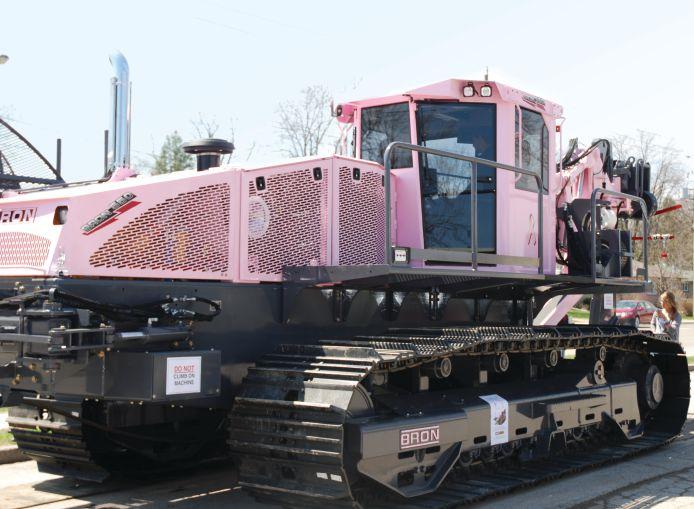
For the family, customers and employees who participated in the barbecue fundraiser held by RWF BRON and Paul Pullins Enterprises, nothing stood out quite like the large, 550 BRON Drainage Plow sitting at the center of the festivities. The event took place Saturday, April 30, 2011, at BRON’s plant in Woodstock, Ontario, and featured the company’s newest machine.
However, it was not the 550 horsepower that caught everyone’s attention; it was the color. When the Pullins family ordered its newest BRON Drainage Plow, they added one request: paint it pink.
For Paul Pullins and his family, installing agricultural drainage tile is their business and they rely on these massive machines to get the job done. However, Paul’s work, in particular, was never far from his family life either. So when a family friend of Pullins’ was diagnosed with breast cancer, the fight against the disease became personal. The new pink BRON 550 Drainage Plow is one way that the Pullins family believed they could bring awareness to the challenges of battling breast cancer. And it already has.
Paul Pullins Enterprises is based in Quincy, Ohio where the new pink plow will be working regularly. However before shipping it out, RWF BRON wanted to support their customer’s
breast cancer awareness campaign by first canvassing their employees and family members, and then holding a fundraising barbecue. More than 250 attended the festive event, enjoying grilled hamburgers and hotdogs and taking their best shot at soaking dunk tank participants.
Deemed a great success, the event raised more than $ 6000, with additional
donations still to come. Proceeds were evenly split between the Breast Cancer Society of Canada and the Stephanie Spielman Fund for Breast Cancer Research based at the Ohio State University.
After discovering a lemon-sized lump during a breast self-exam, Stephanie Spielman was diagnosed with breast cancer at the age of 30. She and her husband,
Right from the start, it is apparent that there is something different about this BRON drainage plow.
Pho
InDUstRY neWs
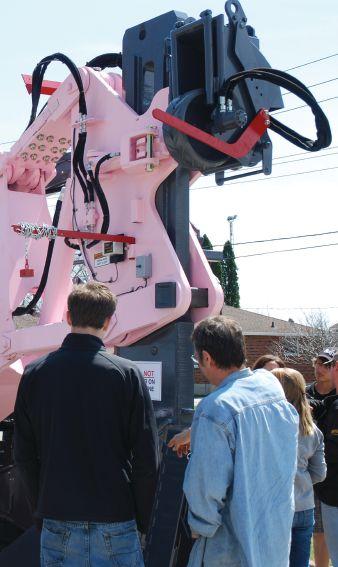
The new pink plow belonging to the Pullins family attracted considerable attention at a fundraising event at RWF BRON Drainage Plow, last April in Woodstock, Ontario.
Chris, a former NFL player, began to speak publicly about the disease. In November 2009, after 10 years of battling cancer, Stephanie finished fighting but left a legacy that has inspired thousands to continue on.
Since 1999, more than $8.5 million has been raised on Stephanie’s behalf for breast cancer patients and research at the Ohio State University’s Comprehensive
Cancer Center, James Cancer Hospital and Solove Research Institute.
Together, RWF BRON and the Pullins family were proud to support the fight against breast cancer. For Paul and his family, they hope their new pink 550 BRON drainage plow serves as a giant reminder that everyone can be part of the cure for breast cancer.
A special thank-you goes out to all
drainage contractors that attended and donated to a great cause. The fundraiser promoted awareness of breast cancer as well as farm drainage.
For more information on the Stephanie Spielman Fund, please visit www.spielmanfund.com.
For more information on the Breast Cancer Society of Canada, please visit www.bcsc.ca. ■
ECOFLO100 is a recycled, dual-wall pipe engineered to provide maximum water flow and capacity for your critical drainage mains. Most importantly, it’s certified to offer a 100 year service life – an unprecedented performance level for recycled material. With ECOFLO100 at the core of your drainage system, your farm’s green future can be passed on from generation to generation. Call your local Prinsco sales representative for more information.
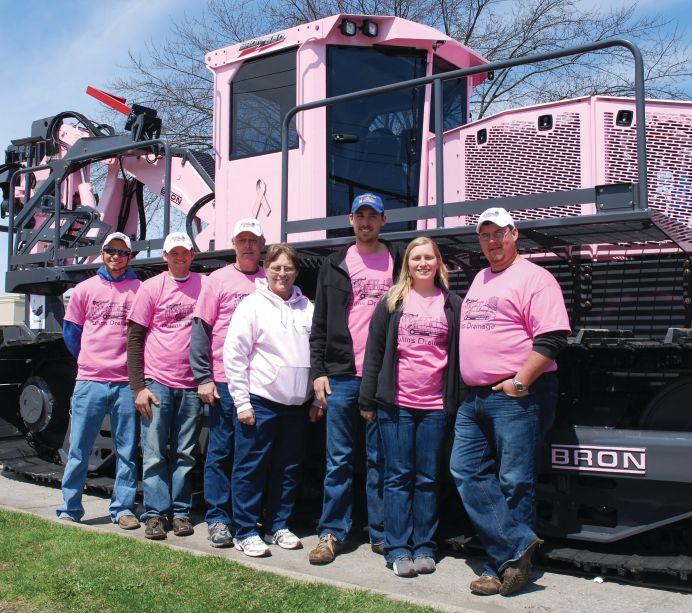
Members of the Pullins family and staff of Paul Pullins Enterprises, from left to right, are Tyler Crooks, Luke Myers, Paul Pullins, Cathy Pullins, Sam Pullins, Ashley Karl and Tim Mullin.
Changes on the way for key player in Europe
new leadership for hollanddrain.
Change is in the air for Steenbergen Hollanddrain B.V., a key player in the worldwide drainage machinery industry. The company specializes in design, manufacturing, marketing and sales of a wide range of heavy-duty drainage, de-watering and trenching machines. Plows, gravel trailers and flushing machines, as well as spare parts complete its extensive product range. Even parts of Barth Holland machines, acquired by Hollanddrain in 1986, are still placed in stock. Customers of Hollanddrain have their core business in a variety of industries, including agricultural, irrigation, recreational, utility, construction and adjacent sectors.
Now, the anchor man of Hollanddrain, Willem de Waard, who worked for more than 45 years for the company, will reluctantly retire, and hand over commercial responsibilities to William Smeekes. Hollanddrain management is grateful for everything de Waard has achieved on behalf of the
company. Smeekes, who is the marketing and sales director, has been appointed to lead Hollanddrain to worldwide growth. “We have set clear objectives; not only in the US, but particularly upcoming markets where we see great potential in the near future.” says Smeekes, who will be responsible for managing the global commercial activities of the complete product range in all market segments.
“We’ve always paid high attention to customer satisfaction and will continue to do that. In fact, the machine owner has two main questions before he decides to buy,” explains Smeekes. “Will it do the job and will it earn money? Hollanddrain assures a very favorable total cost of ownership due to low operating cost and durable design. A long-term value which belongs to a long-term relationship; that is as essential as having direct customer contact.”
Although Hollanddrain will appoint
new distributors in target markets, they will continue to support the end users directly. Hollanddrain’s strength is based on the fact that all of the company’s personnel know the marketplace from first-hand experience and expertise, resulting in putting the right machine at the right place, and above all, providing value for the money from the customer’s point of view. “In addition, the aim is to provide a substantial contribution to a wealthy world with respect for the environment, which is unavoidable,” says Smeekes.
service goes beyond the ordinary Hollanddrain has its focus on corporate social responsibility, which is part of its business philosophy. The process from production to delivery will be carried out with the utmost respect for the environment. “Aspects such as engine emissions, fuel consumption, used materials and production methodology have high attention,” assures Smeekes.
Two of the characteristics of Hollanddrain are performance in the field and value to its customers.
InDUstRY neWs
The machines operate under sometimes extreme circumstances and meet the highest safety requirements for operators, inside and outside the machine.
In 2010, Stephan Reedijk was appointed
as technical director. All operational and technical activities will be managed by Reedijk and his team of qualified engineers, production workers, after-sales and service people. Reedijk states that the engineers are experts in hydraulics and mechanical engineering, particularly as related to crawler systems and digging-chain drive systems. Hollanddrain machines are designed to be used in extreme subsurface conditions up to eight meters, and possibly more, in different types of soil, and with greater ease.
Operators come to rely on the equipment they are using. “With ours, they can,” says Reedijk.
Recent market research indicates that in the past 60 years Hollanddrain machines have become known for having key features rated by operators as most important. Quality, reliability, efficiency, noise level and ease of operation are the qualities most often mentioned. “Of course we are proud of that,” says Reedijk. Thanks to these qualifications, Hollanddrain is in many countries the leader in providing the right solution for the work to be done in a quick and
reliable way, using advanced design and manufacturing technologies.”
Continuous improvement of efficiency, just-in-time supply of A-branded components and Hollanddrain’s accurate quality control provide competitive benefits. “Hollanddrain does not produce a machine: we specifically build one.”
Within its product range philosophy, Hollanddrain has a two-directional focus: producing standard machines but also continuing to build to a customer’s specific needs. “Every situation is different, so we always listen to customers’ preferences and fulfil their demand,” assures Reedijk.
The Hollanddrain line of products is sold globally, thanks to the worldwide network of a dedicated and experienced sales force and dealers. As with any expanding enterprise, Hollanddrain is always looking for capable distributors. If you are interested in representing Hollanddrain, you can request a dealer inquiry form through e-mail, at info@hollanddrain.nl.
For more information about the company and products, visit the website www.hollanddrain.nl. ■
William Smeekes has been appointed as Hollanddrain’s new leader, and will oversee the company’s growth worldwide.
The relatively new world of bioreactors
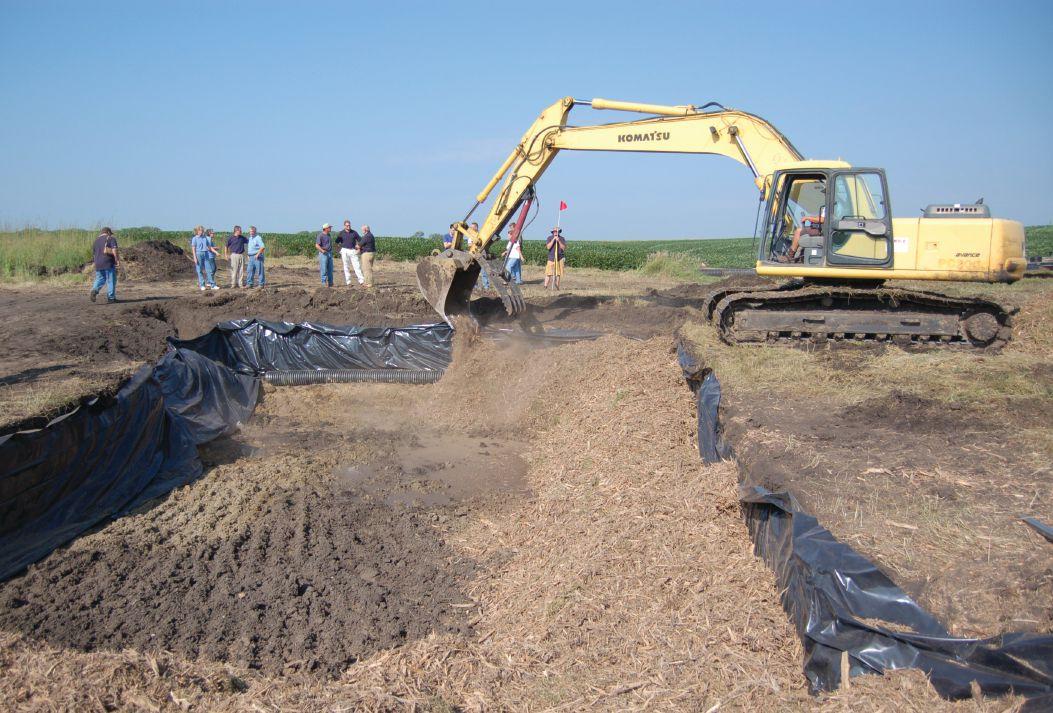
A bioreactor is essentially a buried trench, filled with a carbon source that will help filter nitrates from tile water.
by Ralph Pearce
The development of bioreactors could alleviate many of the pollution issues from farms to waterways.
For quite a few years farmers and drainage contractors have been hearing about pollution issues in the Gulf of Mexico. There have been calls for farmers to do more to control their use of inputs and an alarming amount of negative press aimed at drainage contractors, merely for installing drainage tile for much of the past two to three years. And not to be mistaken, the pollution problems at the mouth of the Mississippi River, and along other waterways across the US, are in fact, serious and must be addressed. Yet the truth is, there is an overwhelming amount of research that proves drainage is a tremendous asset to the farmer. Furthermore, as the world’s population continues to grow, there is greater demand for corn and soybeans, and that means continued use of inputs in order to boost yields.
The good news is, there is a solution; one that is feasible, workable and the latest research indicates it can reduce nutrients by as much as 60 percent. The development of bioreactors is the latest innovation that has shown significant potential to curb some of the concerns regarding nitrate pollution.
basic designs
In its simplest form, a bioreactor is a buried trench which is filled with some sort of carbon substrate – usually wood chips, although there are other options. The wood chips provide an excellent medium for the growth of micro-organisms which use the carbon source as food, and break down the nitrate in any tile water that is run through the buried biomass. The nitrates are broken down by the micro-organisms and expelled as dinitrogen gas (N2), which is a primary – and harmless – component of the Earth’s atmosphere.
The Iowa Soybean Association has been doing a considerable amount of field research into bioreactors, joining other states such as Minnesota and Illinois. The move to introduce bioreactors has been gaining strength, especially since much of the agricultural land in north-central Iowa has been tiledrained. And being near the headlands of the Mississippi River, there has been a greater focus on trying to reduce the amount of nitrates flowing out of drains into streams and rivers that feed the Mississippi. “Getting implemented on a field scale, it’s probably been growing within the last three to five years in the Midwest,” says Keegan Kult, watershed management specialist for the association. “And only in the last couple of years has it been gaining a lot of momentum.”
The Iowa Soybean Association has taken something of a leadership role in the study of bioreactors, including participation in a Conservation Innovation Grant worth more than $350,000 from the US Department of Agriculture’s Natural
DRAIN TODAY • PLAY TOMORROW
For the most comprehensive range of sportsturf drainage equipment in the world, including wheel and chain trenchers with clean-up conveyors, backfilling hoppers and gravel band drainers.
U.S. DISTRIBUTOR - PORT INDUSTRIES, PALMYRA, MO 800-562-8713 email: sales@portindustries.com www.portindustries.com www.sheltonsdrainage.com
Installing a control structure not only helps regulate flow of tile water, but it can also aid in reducing levels of contaminants such as methyl mercury (MeHg).
InDUstRY neWs
source is going to be,” says Kult. “It’ll get spent faster the more you get through the wet-dry cycles or if they’re dry, the faster that carbon will decompose.”
Some of the other advantages cited by the Iowa Soybean Association include:
• Nitrates are removed immediately after completion of the water flow;
• A bioreactor is an option where wetlands cannot be built;
• Bioreactors can be targeted to a specific location in a field, thereby maximizing the impact;
• Use of bioreactors is becoming more acceptable in the eyes of producers.
That last point is especially important, and Kult acknowledges the need to get drainage contractors to be confident in installing bioreactors is just as vital as convincing growers such an installation is a benefit to them. “Part of the grant is also to get education material out there, along with training days, so that contractors would be comfortable recommending a bioreactor to a landowner,” says Kult. “Then it’s a matter of adding a piece of marketability to the contractor on how to install the bioreactors.”
That is one place where ADMC can help. In 2011, the organization held a certification class for bioreactors, and Kult believes there will be more to follow for 2012. “Once they have one installed, I think contractors are fairly confident on how to do the work,” he notes. “And once you get the plan (for the bioreactor), it’s pretty straightforward on how to install it, but as of right now, it’s probably not too high on a contractor’s priority list with as much other work that they have going on at the same time.” ■
Grade control system speeds pipe laying by up to 20 percent
Every year, Agrodrain Systems Ltd. installs hundreds of miles of drainage pipe on thousands of acres of farmland in eastern Ontario and western Quebec. In one pass, Agrodrain’s plow – automatically controlled by a Leica PowerGrade 3D system – cuts a slot and knifes drainage pipe to a precise elevation in the ground.
“In some jobs using laser controls, our man would spend a third of his time moving the laser transmitter around,” says John Wielgut, president of Agrodrain. “Now, with our Leica GPS system, the drainage plow can keep moving. This system is far more productive.”
The Leica PowerGrade 3D system
automatically controls the plow depth, but does not steer the tractor that pulls the plow. A display monitor in the tractor’s cab indicates the unit’s position relative to the designed track line, so the operator steers the machine using that. “We generally can place pipe within one-quarter inch of design grade,” says Wielgut. “We do a lot of our drainage at minimum grades, which for us is one-tenth of one percent, or one foot of drop in 1000 feet. That’s why vertical accuracy is very important.”
Wielgut has run the Leica PowerGrade 3D system for Agrodrain since late 2009. “The overriding observation that I have is, it is so darn dependable,” he says. “We had a small issue with one cable one day last spring
(2010) that we resolved, and we have not had a minute’s breakdown since then. It is a very, very dependable system and is much more efficient than a laser system.”
Wielgut says he finds the GPS system has fewer performance issues than a laser. His laser system was adversely affected by the distance of the machine from the transmitter, by fog, and by the wind, because the transmitter had to be mounted high in the air.
Based in Heerbrugg, Switzerland, Leica Geosystems is a global company with tens of thousands of customers supported by more than 3500 employees in 28 countries, and hundreds of partners located throughout more than 120 countries around the world. ■
by Peter Darbishire
busier times call for more lead time for manufacturers.
The business boom for contractors is driving drainage machine sales demand to levels not seen for decades. Many companies report their order books are filled and some are booking orders for delivery in 2012 and 2013. Many trenchers and plows are being ordered with integrated GPSbased control systems and the other sought-after creature comforts.
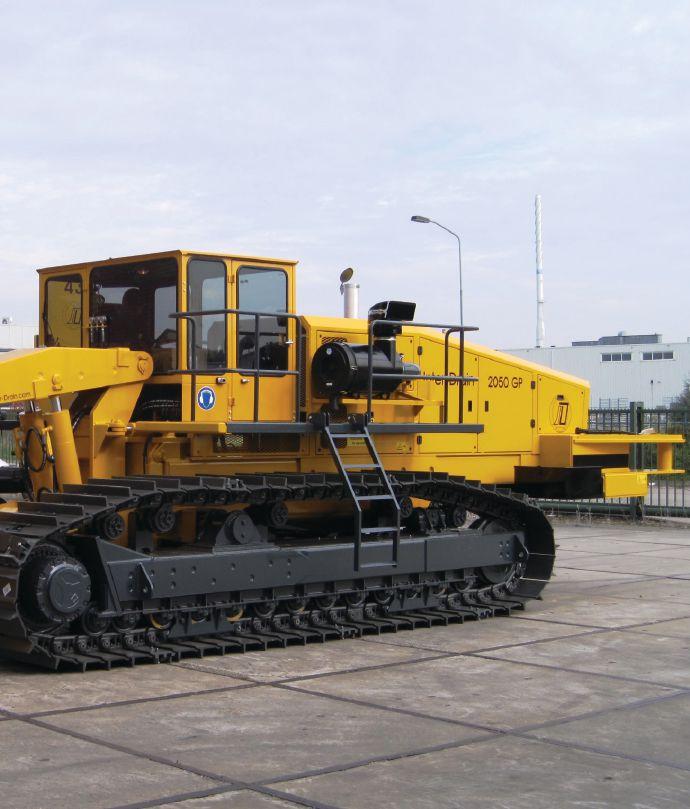
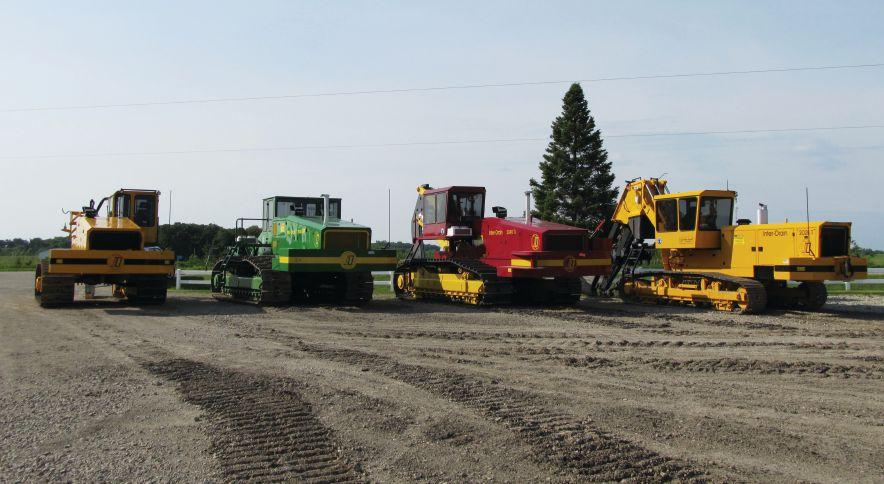
Larry Neid, of Northland Trenching Equipment in Minnesota, says InterDrain machines are now being sold with its “USA” package as standard equipment. This includes a choice of several operator cabs:
• Panoramic cab, traditional onedoor, normally mounted the on left side of the machine, but can also be right-side mounted: available on all plows
• XL cab, larger and taller than panoramic with front and rear doors, normally mounted on left side, can be right-side mounted: available on all plows
Part of the “USA” package with Northland Trenching involves greater visibility and flexibility in cab placement.
• Big “3” Cab, mounted sideways across the width of machine. This cab has three doors so an operator can exit cab from either side: available on GP double-link plow models only.
Carry Mfg_7x2.25 10/15/04 4:44 PM Page 1
Inter-Drain machines are now designed with sloping hoods to improve visibility and sound isolation materials have been added. Doors and panels are now lockable and seats are air-ride cushioned. Cooling fans can be reversed to clear trash and are also part of this package, and track rollers are over-
sized. All machines have US-threaded hydraulic fittings. Other visual additions include chrome exhaust stacks.
Neid adds that the anticipated rubbertired chain trencher has been delayed until 2012, due to the factory in Holland being at full capacity building pre-sold trenchers and plows. ■
HAVING TROUBLE KEEPING YOUR FIELDS DRY?
Is your tile outlet below the ditch level? Is the ditch too shallow to allow proper drainage?
Maybe it’s time to look at a Drainage Pump. A drainage pump can keep your field drier than draining it naturally. With a drainage pump YOU can CONTROL how low or how high to keep the water table in your field.
For more information,contact your local Tile Contractor or Call Carry Pumps direct at: 1-800-492-2779 www.carrymfg.com
Our Stainless Steel Submersible drainage pumps are just right for the job. Pumps are available in a variety of horsepowers to suit your field application. Carry Pumps are available from 1/2 HP to 10 HP in single or three phase power,208,230 or 460 Volts,with pump capacity from 50 to 1450 GPM with 2 to 25 feet of lift.
Industry Leaders in Drainage Products for Over 100 Years
Armtec provides a complete range of drainage products from steel and plastic pipe to tubing designed to collect and remove subsurface water in various situations. For fine soil situations we offer a variety of engineered filter products designed to limit the movement of soil particles into the drainage system while allowing for the removal of subsurface drainage. Our internal standards for tubing quality meet or exceed the requirements set by industry or government.
With several different tubing diameters, a variety of perforation patterns, and an extensive range of fittings and accessories, we have the solution for your drainage needs.
Field demonstration and open house a welcome event for Ontario contractors
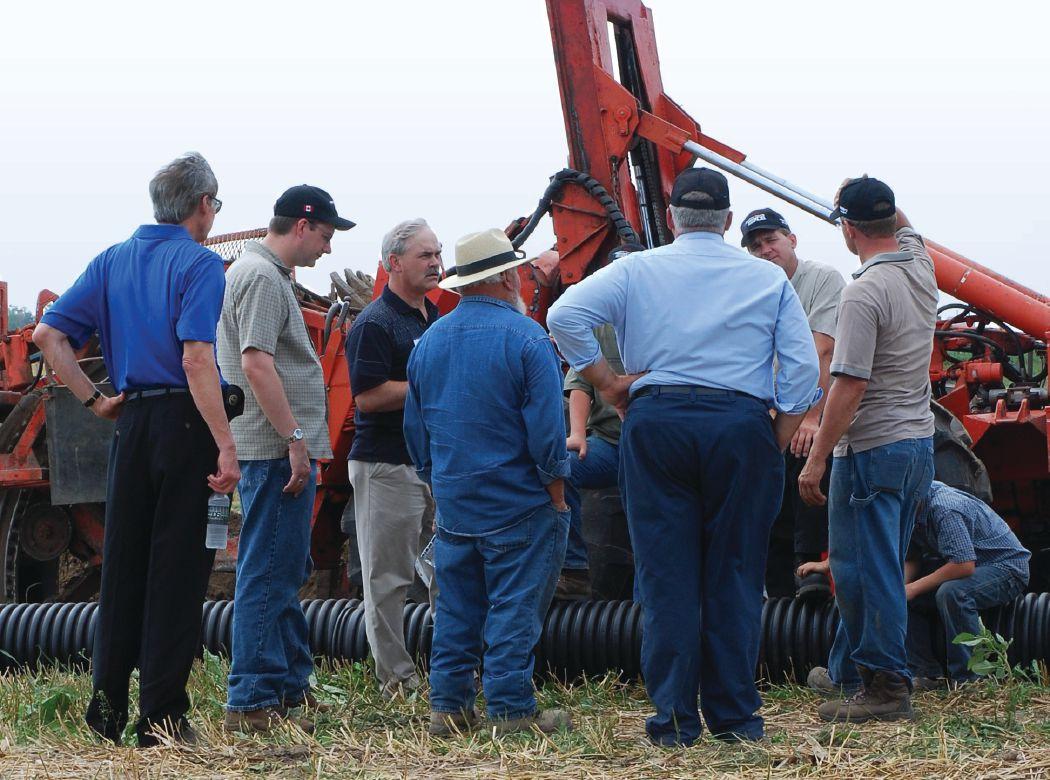
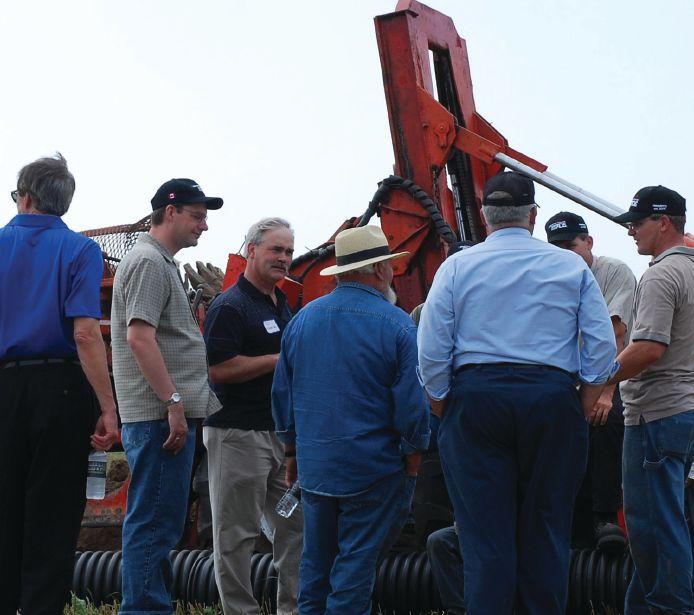
Sid Vander Veen (third from the left) from the Ontario Ministry of Agriculture, Food and Rural Affairs (OMAFRA) holds a discussion during a break in the field installation.
by Ralph Pearce
it is not “old” news; just “news”
It may have taken place in 2010, but the grand opening of a tile manufacturing plant was a newsworthy event because it served to bring together 17 companies for an open house and tiling demonstration. Hancor/Advanced Drainage Systems opened its plant near the town of Heidelberg, northwest of Kitchener, Ontario, with a tiling demonstration and field day down the road at the farm of Oscar Wideman. Among those exhibiting on site were the Land Improvement Contractors of Ontario, A&E Farm Drainage, Wolfe
A field map of the Wideman farm displays the existing clay tile and the work that was to be done as part of the field demonstration.
InDUstRY neWs
Equipment, Agri Drain Corp., Advanced Geo Positioning Solutions and Geo Shack Canada. Contractors from across Ontario attended the event, with some commenting that it was the first such gathering in at least 10 years, maybe longer.
But it was well worth the wait, as those attending were treated to working in-field demonstrations, including some newer, advanced designs in trenchers, as well as a series of guided tours through the Hancor/ADS plant. The tours gave some in-depth perspectives on manufacturing and specifications of the single and dual-wall corrugated HDPE pipe that is the industry standard. ■
Land Improvement
Contractors of America
LICA has been serving contractors across the country for over 60 years, providing our members with the tools they need to work smarter...not harder.
Below are a few of our contractor benefits:
Petrocon
Not only a discount on oil lubricants and tires but a $2,500 savings on membership in the Petrocon Group!
LICA Safety Management Plan
A comprehensive safety manual providing LICA members with recommended safe operating procedures and to outline techniques that are essential for the protection of the industry’s greatest asset “its people and equipment.”
National Equipment Register
NER's services have assisted law enforcement in recovering millions of dollars of heavy equipment LICA members can register their equipment on the NER HELPtech database at a 20% discount off the regular registration fees
Website: www.LICANational.org 3080 Ogden Ave, Suite 300; Lisle, IL 60532 Phone: 630-548-1984
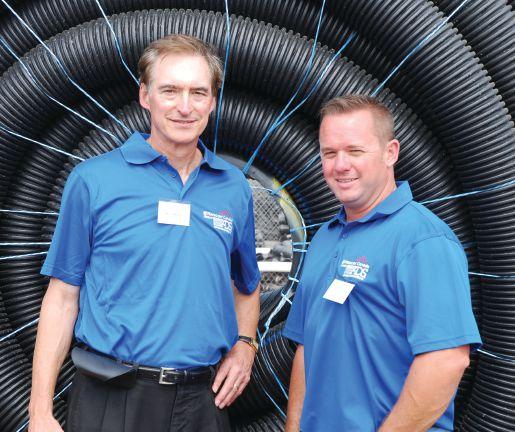
Kevin Rapp (left) and James Turvey from Hancor/ADS, were two of the hosts for the day’s events.
Coming events
Date event Place contact
January
Jan. 3-5
Jan. 3-5
Jan. 5-7
Jan. 8-10
Jan. 8-10
Jan. 9-11
Jan. 12-14
Jan. 14
Jan. 15-17
Jan. 16-18
Jan. 17-19
Jan. 17-19
Keystone Farm Show York, PA (518) 673-0102
Ohio LICA Winter Convention Columbus, OH (740) 751-4703
Missouri LICA Winter Convention Columbia, MO (573) 634-3001
Michigan LICA Winter Convention Lansing, MI (989) 587-3528
Iowa LICA Winter Convention
South Dakota LICA Winter Convention
Des Moines, IA (319) 334-9884
Sioux Falls, SD (605) 224-8689
Illinois LICA Winter Convention Bloomington, IL (309) 446-3700
DelMarVa LICA Winter Convention Dover, DE (301) 248-9313
Minnesota LICA Winter Convention North Mankato, MN (651) 343-5866
Kansas LICA Winter Convention Manhattan, KS (785) 594-3120
Nebraska LICA Winter Convention Grand Island, NE (402) 298-2489
New York LICA Winter Convention Syracuse, NY (585) 219-4802
Jan. 18-19 LICO (Ontario) Conference London, ON (519) 836-1386
Jan. 20-21 Pennsylvania LICA Winter Convention Clarion, PA (724) 475-4625
February
Feb. 7-12 National LICA Convention San Diego, CA (630) 548-1984
Feb. 15-18 Commex 2012 Ahmedabad, India 91 22 2839 8000
Feb. 24-26 Western Farm Show Kansas City, MO (816) 561-5323
March
March 7-8 Hard Hat Expo Syracuse, NY (518) 673-0102
March 7-9 Western Fair Farm Show London, Ontario (519) 438-7203
May
May 15-17 Construction Expo Red Deer, AB (403) 347-8630
august
Aug. 1-2 California Construction Expo Pasadena, CA (877) 822-5266
september
Sept. 11-13 Canada’s Outdoor Farm Show Woodstock, ON (519) 822-2890 For details www.licanational.com • www.drainage.org/LICO
Drainage statistics reveal some interesting facts about Ontario
by Ralph Pearce
For one, the industry is worth $50 million to the provincial economy.
At the annual meeting of the Land Improvement Contractors of Ontario and Drainage Supervisors Association of Ontario, January 20, 2011, Sid Vander Veen of the Ontario Ministry of Agriculture, Food and Rural Affairs (OMAFRA), made a presentation on tile drainage statistics in the province. The presentation included figures and correlations that revealed some surprising details about drainage tile and how the industry is advancing in Ontario. Vander Veen, the drainage co-ordinator with OMAFRA, sat down with Drainage Contractor to discuss some of the findings from the study.
QA
What was the idea behind the gathering of this information on tile drainage in Ontario?
Through the management of the Tile Loan Program and the annual survey of tile manufacturers, we’ve been gathering this data for years. This data was collected to monitor the general state of the industry in Ontario, on an annual basis (e.g., the cost of installing tile on a per-foot or per-acre basis). So the collection of data was not done specifically for the purpose of this project.
QA
Was there one facet that you wanted to study or evaluate more than any other?
This year we decided to look at some historical trends in the data that we had been collecting. One specific area we wanted to know about was how much agricultural land in Ontario was tile drained and how much agricultural land still had the potential to be drained.
QHow much data did you have to comb through in order to come up with your findings (the foreword of your presentation states that plans have been developed by government engineers from 1910 to 1980 – but how much of that data would relate to drainage tile on agricultural land)?
AThe area of land that has been tile drained annually has been captured for many years. Originally this information was plotted each year on Mylar maps for each township. For the past 10-plus years, we’ve been digitizing the information into a GIS tile drainage layer. We’ve also been digitizing the older data stored on the Mylar plans into the GIS tile drainage layer. With the bulk of this digitizing work done previously, it was relatively easy to calculate the total of land tile drained by county and across the province.
On average, 100 million feet of tile is installed annually in Ontario.
QWas there any aspect of the study that shed little or no light on the current situation (in other words, what surprised you the least)?
AAll of the statistics related to the number of contractors and machines.
AQWhat, out of this study, surprised you the most?
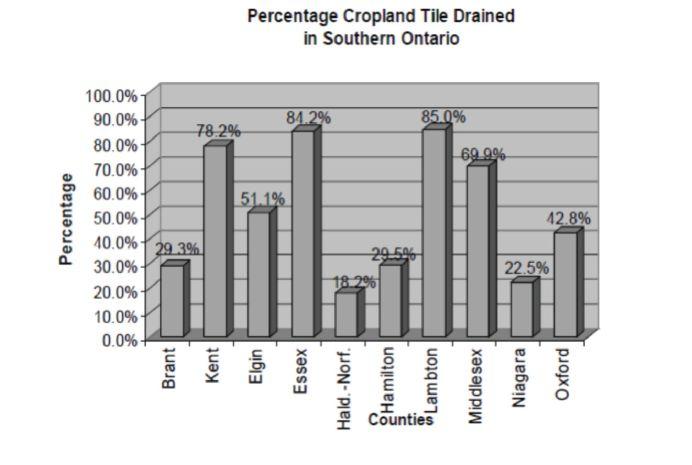
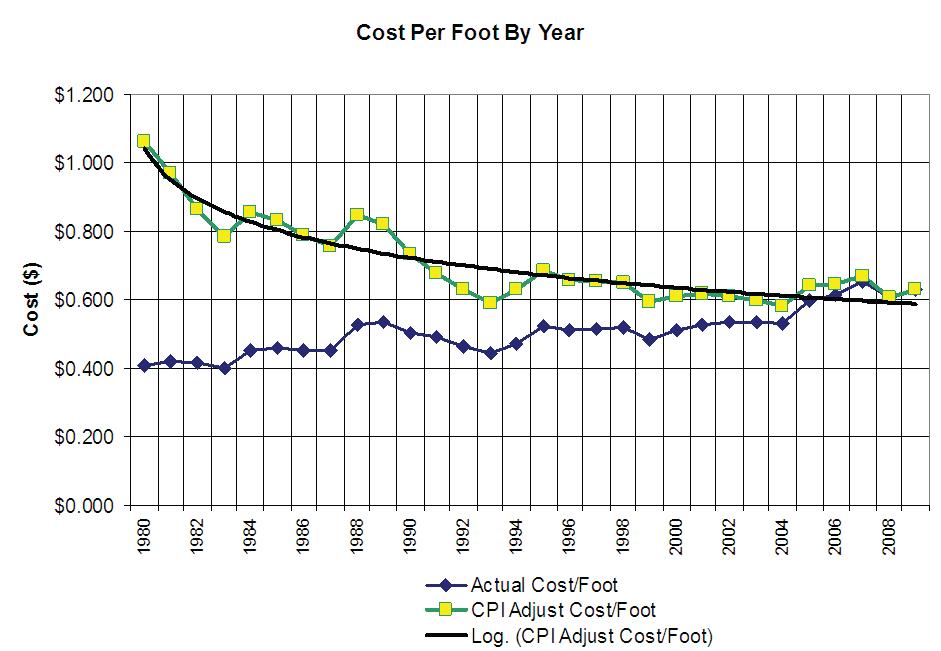
I would say the fact that, with consumer price index (CPI) adjustments, the cost per foot of tile drainage is actually decreasing. That and the percentage of agricultural land that is tile drained in some counties (across southern Ontario, the average is 45 percent, with Lambton County leading the way at 85 percent, Essex at 84.2 percent and Kent at 78.2 percent. Numbers for central and eastern Ontario were considerably lower, e.g., the Regional Municipality of Ottawa led all counties and jurisdictions with 51.1 percent of land that is tile drained).
Also worth mentioning were some of the other summations from the study: On average, 100 million feet of
Another point that Sid Vander Veen, drainage co-ordinator with OMAFRA, takes from the study is that not all agricultural land requires tile drainage.
Also: Buckeye Auger/Backfillers
A Few Key Features:
• 350 HP Cummins QSM11 Engine
• Cab with Heat and Air
• Power Shift Transmission
• 7’ Dual Hydrostat Drive, Tapered Digging Wheel
• Self-Leveling Wheel Up to 8 Degrees Left or Right
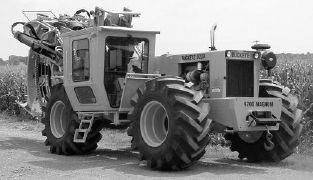
Iowa: Mid America Trenchers Toll Free: 866-376-7453 Alt: 641-344-0640
Buckeye 9200 Magnum
Buckeye 7200 Magnum
tile is installed annually in Ontario; the average project size is 50,000 feet or 1000 feet per acre and the tile drainage industry is worth about $50 million to the Ontario economy, each year. And finally, the quantity of tile installed per machine has roughly doubled in the past 30 years, as has the quantity of tile installed per contractor.
QFor our American readers, differentiate between what is important for contractors here in Ontario (surrounded as the province is by the Great Lakes) versus what contractors in the US Midwest might be facing (with so much information being made available about pollutants from farms and the inaccurate picture of how drainage affects that issue.
AIt concerns me when I read references that suggest that tile drainage is the source of pollutants. Tile drainage can certainly be a conduit for nutrients and pathogens, but it is not the source. Controlled drainage can be an effective means of reducing the movement of nutrients through tile drainage systems, but its
Across Ontario, 45 percent of agricultural land has been tile drained; however, according to this graph, southern Ontario has a higher average.
effectiveness is dependent on a variety of conditions.
I understand that fall nutrient application is common in many US states and controlling drainage outflow during
Tait_3.375x4.875 10/18/04 3:09 PM Page 1
the winter months can reduce the movement of these nutrients. In Ontario, application of nutrients in the fall is almost non-existent and, due to colder temperatures, controlling
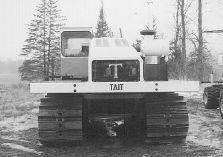
“Made to last for years of service.”
•High production
•Low ground pressure •Robustly built plow and frame
The following options are also available:
•Choices of engines – CAT, CUMMINS, DETROIT
•Oscillating tracks
•Wider cab model
•Variable angle arc plate
•Quick change teeth (reversible)
•Tubing chutes up to 16 inch
•GPS or Laser Guidance •Up to 7ft cutting depth
This figure indicates the cost of installing tile drains, particularly when factored with the consumer price index (CPI), has decreased since 1980.
outflow of tile drainage during the winter is almost impossible.
Most tile drainage systems in Ontario are installed shallow (two to three feet of cover) while in many
parts of the US it is installed much deeper. Unless the land is very flat, controlled drainage is difficult to achieve when tile drainage systems are installed shallow.
Q Do you have any plans to take this research a step or two further? Can you take it any further?
A There are no plans to take this research further at this time.
Q Is there any further extrapolation of the data that is available (can you mine it for more (or more in-depth) information)?
A From our Tile Loan Program, we have more data on the cost of installing tile drainage. We could do an analysis on tile drainage materials and installation costs. We could also analyze tile drainage costs differences between regions of the Province.
Q Is there anything you would like to add, either as a summation or in general?
A We must not lose sight of the fact that tile drainage is a fundamental component of a competitive crop agricultural industry in a humid climate such as Ontario. ■
For more information on drainage issues, services, provincial resources and newsletters, go to the LICO website at www.drainage.org.
Make every job an ideal installation: start with Ideal Pipe
Any job, any size
From farm fields to parking lots. From roadways to golf courses and recreational turf, Ideal Pipe is your ideal choice for complete sourcing of pipe and fittings.
Fast, easy installation
Ideal specializes in flexible, lightweight, easy to handle HDPE pipe.
Reliable delivery
With over 25 years as a Canadian leader in plastic pipe, Ideal is the source to depend on.
A flexible partner
Talk to us today about the products best suited to your business needs.
New Midwest plant will add to increased production of drainage products
In response to the 2011 growing season’s overwhelming demand for agricultural drainage products, Willmar, Minnesota-based Prinsco Inc. has announced its plans to open a new manufacturing plant in the FargoMoorehead area of Minnesota. The company plans to have the plant operational in January 2012, with two production lines and plans for a third by the end of that year. These additions, along with upgrades at other facilities, mean a vast increase in single-wall tile production.
All signs point to an increase in demand, according to company representatives. “2011 is shaping up to be a remarkable year, coming right on the heels of 2010’s record-breaking season. I could not have predicted this kind of sustained growth,” says Kent Rodelius, sales manager for Prinsco Agriculture. “Prinsco has done everything possible to
expand our infrastructure and make the investments needed to meet this additional demand as quickly as possible.”
The Fargo-Moorehead plant is Prinsco’s second new manufacturing facility in 12 months. In February of 2011, they started operations at their new Beresford, South Dakota, plant, which is also slated to add a third production line by October of this year. Prinsco has completed key upgrades that will improve efficiency at all of its Midwestern plants. “There are always growing pains when you expand quickly, but we are committed to meeting the needs of our loyal customers. As they embrace the benefits of strategic water management, we want to continue being their provider of choice. For that reason, our approach to growth has been cautious and strategic, yet aggressive,” adds Jeremy Duininck, Prinsco’s vice president of operations.
“Our investments are focused, not only on facilities and equipment, but on the staff support needed for quality control, safety and efficiency. We need to grow without sacrificing the high standards and values that are important to us.”
“This is an exciting time,” comments Jamie Duininck, Prinsco’s vice president of sales. “As we’ve been expanding our facilities, we’ve also been expanding our product line. Most recently we introduced Ecoflo 100, an industry first. It’s a recycled, dual-wall pipe with an unprecedented 100-year service life. It’s a green-friendly product that will help farmers increase the performance of their critical drainage mains, and also help engineers and contractors feel comfortable using eco-friendly pipe in the commercial storm water and detention projects. We’re really growing right now, in more ways than one.” ■
Summer field day showcases conservation practices
Summer means different things to different people but for drainage contractors, it is a call for two things: get the equipment ready for the busy fall season, but before that, head to the fields for a nearby field day. For a group of Iowa contractors, that field day took place July 27 at the Midwest Construction Expo and Field Day, near Melbourne.
“We have a lot of success stories we can share when it comes to conservation and water quality in Iowa,” said Chuck Gipp, the new deputy director of the Iowa Department of Natural Resources.
Many of the success stories to which he referred include waterways and tiling, as well as terraces, and all were showcased at the 80-acre field day site. The day’s events were sponsored by the Iowa Department of Agriculture and Land Stewardship, the Marshall County Soil and Water Conservation District and the Iowa Land Improvement Contractors’ Association.
gaining support from cities and state More than just contractors and farmers were attracted to the field day. Since Melbourne is so close to Des Moines, the event provided an excellent opportunity to showcase best management practices to both urbanites and state lawmakers. “This field day shows how farmers and contractors are true conservationists who are making great strides as they integrate new technology to save Iowa’s soil and protect water quality,” said state representative Annette Sweeney.
Among some of the displays visited by attendees were a rain garden constructed by LICA members and grass waterways, which can help manage rainwater flow from farmers’ fields and reduce or prevent erosion. The site was also the place for the unveiling of a new tool for contractors. Known as Nancy’s Blanket, the design consists of two sheets of biodegradable plastic mesh with straw sandwiched between. The blanket can cover a newly installed and seeded waterway, to give the construct a good start and minimize erosion. “Often the seed is washed away by the first rain that falls after the waterway is built,
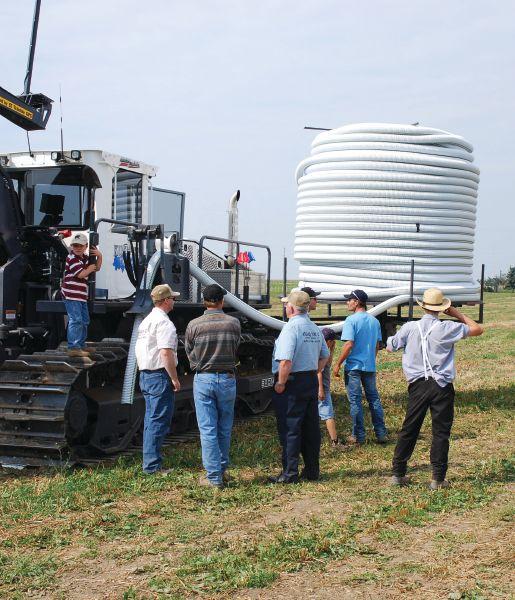
The Midwest Construction Expo and Field Day, held last July near Melbourne, Iowa, attracted a variety of individuals, from drainage contractors and farmers to politicians and urbanites.
and the wind can blow away the straw mulch that some contractors spread over the new waterway,” explained Scott Hamman, whose family created Nancy’s Blankets. The concept has been in use in Ohio since 2005, and it is now being distributed in Iowa by Plunkett Farms from Maxwell.
“The field day is a great opportunity to learn about the newest ways to help preserve our soil and natural resources,” said Keith Rohwer, who manages Dry Run Farm Drainage, and also grows corn, soybeans and raises hogs and horses near Paullina.
additional research
One other facet that was covered at the field day dealt with the Conservation Reserve Enhancement Program wetland on the site, something that contractors
built in 2009. The CREP initiative has been developed – with the help of both state and federal governments – in an effort reduce the nitrate levels in water coming from tile drains on farmland. Research from Iowa State University has confirmed that CREP wetlands are capable of removing 40 to 90 percent of nitrates from tile drainage water. The research indicates more than 90 percent of herbicides are also removed. At the time of the field day in July 2011, the state of Iowa had about 80 CREP wetlands.
In addition to wetlands, other conservation measures, including grass waterways, filter strips and reduced tillage, can make a significant difference. Individuals such as Chuck Gipp see these efforts as a huge step, and believe voluntary moves, not regulated ones, are the better way. ■
Drainage Contractor is read avidly by contractors, suppliers and industry advisory personnel each year and is kept as a reference resource by readers: more than 7000 farm drainage and land improvement contractors throughout North America and around the world look to Drainage Contractor as their most valuable source of information.
High quality, technical information is written specifically for contractors to help them remain up to date and profitable.
If there is a story line, coming event or news brief that you want to see covered in a future edition of Drainage Contractor , contact editor Ralph Pearce, at 519-280-0086 or via e-mail at rpearce@annexweb.com
Latest heavy-duty trencher is the star of the show
a north american introduction paving the way for widespread use.
In 2011, Port Industries introduced the new Mastenbroek M-3500 heavy-duty mechanical trencher to its product line, the first time the company has offered a chain trencher on tracks. The machine made its debut at the Farm Progress Show in Decatur, Illinois, one of the biggest farm equipment shows in the US, in July, attracting unprecedented interest for a drainage trencher.
Previously, Port Industries lacked a track-driven chain trencher in its lineup of trenchers and plows, but the machine cements a 10-year business relationship between the US and UK companies. The M-3500, built by Mastenbroek of Boston, Lincolnshire, UK, one of the world’s leading trencher manufacturers, will be especially attractive to the US drainage contractor. Kevin Shimp, president of Port Industries, says it was well received, with contractors travelling hundreds of miles just to
The timing is right for the Mastenbroek M-3500’s introduction to the US market, with considerable interest shown in the model during the 2011 Farm Progress Show in Illinois.
see the newly imported machine. “We delivered the M-3500 to Kurt Leichty of Leichty and Sons in Wayland, Iowa, in September. They are currently renting the machine for the fall season.
“The M-3500 fits well into our own existing line of trenchers and plows. All of our trenchers are on rubber tires, so the track-driven M-3500 fills a need in our product lineup for
our customers here in the US. This will be the first time Port Industries has offered a chain trencher on tracks. It is the right size machine for the US drainage contractor. It has plenty of horsepower, without being too heavy or too large to move from job to job.” says Shimp.
“We have worked closely with Mastenbroek to make sure that the M-3500 will be accepted into the US market. The heavyduty mechanical drive, along with the oscillating and slewing undercarriage, are very important features in the United States. It has a Cummins engine and Sauer hydraulics and controls. Port Industries already uses the same suppliers, and even the same components, on our own trenchers. This machine is also fitted with components manufactured by Port Industries at some key wear and service areas, so replacement and service parts will be readily available to our US customers.
“Since we made the digging attachment here, all of the normal wear items are in stock at our factory. This includes the digging chain, cutters, sprockets, and bearings. The entire machine is painted the same color as other Port Industries trenchers. Mastenbroek uses many major components that are already widely accepted in the US.”
Shimp continues: “These include Cummins engines, Sauer hydraulics, and Berco undercarriage components. To make the machine even more attractive to the US drainage contractor, Mastenbroek has provided the machine with inch-size hydraulic hoses and JIC hydraulic fittings. These are common to all drainage contractors and easily replaced if needed.”
so far, so good
Leichty already has a Hydramaxx 2500 trencher and it has the same digging unit. Commonality of the parts between the two machines was a big factor in his decision to give the MP-3500 a try.
So far, Leichty is impressed with the production of the MP-3500. It is consistently running from 50 to 70 feet per minute at depths between four and five feet. The MP-3500 had more than 100 hours of service, at the time of going to press.
Shimp notes: “Although this isn’t a lot of time, there have been no service issues to this point. Kurt also says the cab is very comfortable for his operators, and it has good visibility. The operators really like how quiet the cab is. The controls are arranged
Surface Water Intakes
• Parts
• Orifice
• Exclusive
• Adaptor
in a very well-thought-out manner. The controls are also very smooth and easy to operate. The fuel consumption is good and they are getting exceptional footage between refuelling.”
Based on the performance of the MP-3500 to date, and feedback from contractors, Port Industries says the MP-3500 has a solid future in the US drainage market.
The M-3500 has a potentially bright future in the US. “Right now, the market here in the states is at an historically high level. Interest in farm drainage has never been as strong. The M-3500 gives Port Industries the opportunity to take advantage of this strong market in a number of ways,” adds Shimp.
“We currently have new trencher orders booked several months into 2012. The MP-3500 allows us to get a better market share. We are increasing production of all of our Hydramaxx trenchers, but this is a slow process in what is almost a custom-built, or one-of-a kind, production environment. By working with Mastenbroek we can get, or keep, more customers.
“Port Industries does not manufacture chain-type trenchers on tracks. Traditionally, our North American customers have been left with only one choice if they want this particular configuration. The M-3500 gives our customers another choice. There are a certain number of contractors who will only consider a trencher on tracks. Since we only offered a rubber-tired trencher we never got a chance to engage with these contractors. Now we can offer them a superior chain trencher. This allows us the opportunity to introduce our other products and services to these customers.
“Now we can offer a chain type trencher on tracks that has more desirable components for the US contractor. It also has important design features that include a mechanical chain drive, a slewing frame for better turning, and a cab that provides superior comfort for the operator. Mastenbroek has always made well-built, solid machines that are robust and durable. Now we have the opportunity to let the drainage contractors in the US compare their quality and workmanship.”
Mastenbroek provides the tractor portion of the M-3500 and Port Industries supplies the digging attachment, both with proven designs. ■
Down time turning up opportunities
by Jim cody*
necessity, and knowing what works best, makes practical sense.
It was in a time when General Motors was about to fall over, banks needed taxpayer money to keep them afloat, and my dairy farmer customers had taken a hit, as their income had dropped from $7.10 to $4.20 per kilogram of fat. Three years of drought made it hard to sell drainage and a low New Zealand dollar made the opportunity of importing a new trencher from overseas out of the question.
I relied on my own experience and expertise to design my own trencher, which I hope will see me through to end of my career.
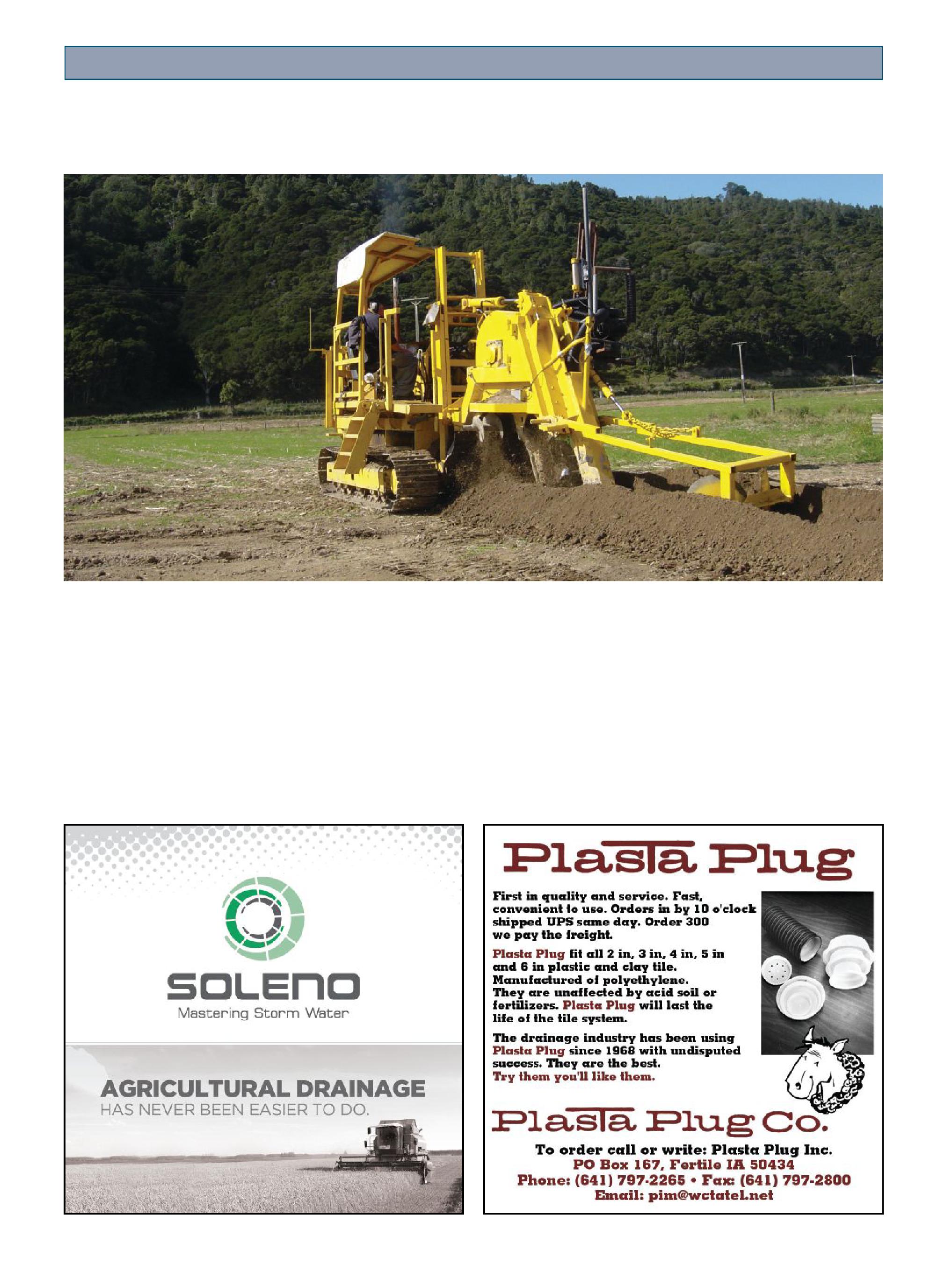
So I set about using my down time and making a new machine to fit my needs.
About 50 percent of my work sees me back-filling the trench with pumice or metal, so cutting a 150-millimeter- (six inch) wide trench keeps costs a lot lower (five cubic meters per 100 meter of trench).
Getting older myself, the machine needed to be easy to get
BUSINESS DIRECTORY
155 FROBISHER DRIVE
(519) 880-2708 UNIT G116
mail@dietricheng.com
(519) 880-2709 WATERLOO, ONTARIO N2V 2E1
K. SMART ASSOCIATES LIMITED
Kitchener • Sudbury • Delhi • New Liskeard • Rainy River 519-748-1199 Toll Free 1-800-265-6456 Fax 519-748-6100 info@ksmart.on.ca www.ksmart.on.ca
on and off, and to walk around. We also need to comply with high safety standards these days.
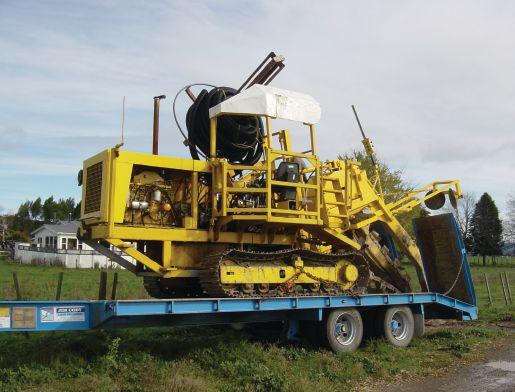
By unrolling the pipe up off the ground on a hydraulic-operated pipe reel, it stops the pipe getting caught on stubble.
When making the trencher I needed, I made it with parts designed by firms that will be around in the future, with the likes of a 180-horsepower Cummins engine, Komatsu tracks and Sunstand pumps and gearbox. There were also 63-cubic-centimeter tandem pumps for the track drive, a 120-cubic-centimeter pump on the chain drive and a 1200 cubic centimeter SAI hydraulic motor.
A 100-millimeter pinch digging chain purchased through Mastenbroek in England, keeps things standard and works out well. The engine, pumps, gearbox, bonnet – in fact, the whole power pack – is made on its own sub-frame and sits inside the main chassis rails; just undo four bolts and some hoses, and anyone can lift the lot out.
One thing I have noticed when cutting a narrow trench: there is a big increase in digging chain life over a wider cut.
I am a great believer that the best way to make trenchers grade naturally is to use a lift mast, mounted a third of the way down and inside the track frames, with the top rams in float.
Having the main frame with auto level keeps the lift mast straight up and down on the cross axis, and is assenting, plus the use of the pivot inside the mast takes the stress off of the digger main frame. When digging around bends, the design makes it easy to keep the trench straight.
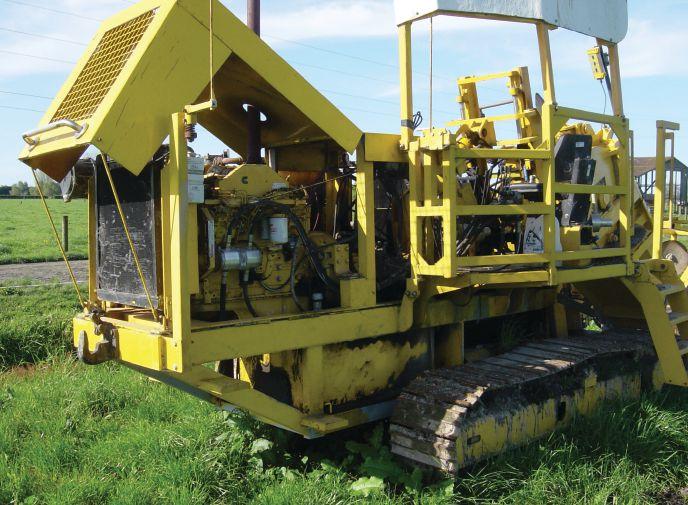
Refuelling the 400-liter tank and checking engine fluids are made a lot easier by being in one location, and having an easy-lift bonnet and footsteps make life simpler still.
Doing maintenance on the digging chain is also made easier by having an access door that opens up to the top drive sprocket, with an added advantage of having a walkway to
stand on. A grease-gun-operated digging chain tension makes maintenance quicker and also helps the chain life. The ladder makes getting on and off the machine easy, and tips up and over centre to keep safely out of the way.
By having a hydraulically operated walk ramp, it is both easy and safe to walk out from the operator’s seating area to feed the pipe into the chute when making starts, and adjusting the height of the Australian-made laser control system that I have used for around 15 years on my other machines.
Keeping the weight down to around seven tons, the width to 2.2-meters and overall length to nine meters – not to mention making it well balanced, makes the machine easy – to use in confined areas, such as a Kiwi fruit orchard.
The trencher has a maximum working depth of 1.9 meters.
The only thing that has not lived up to my expectations is the sunroof, I am not sure how to improve it and keep the machine easy to handle.
To date I have trenched around 190 kilometers using this machine and all is well; the balance of horsepower to speed and weight is right.
In the last 10 months, we have had around 2.5 meters of rain, being a farm drainage contractor, I only get wet farms to drain, and too wet to work does slow down the cash flow.
The dairy farmers are now getting around $7.80 per kilogram of butter fat, but the Kiwi fruit orchards have been hit by the PSA (pseudomonas syringae pv actinidae) disease, and we’re not sure what that means yet.
After building this machine, I can say I have learned a lot, and if doing it again I would do a few things differently. If I put my businessman’s hat on, I think I would have bought a drainage plow machine off the shelf, just not sure how I would pay for it. This being my 31st year in business in Whakatane as a farm drainage tiling contractor, it is hoped this trencher should see me out. ■
*Jim Cody is a drainage contractor from Whakatane, New Zealand.
Refuelling and checking engine fluids are a lot easier from one location and using an easy-lift bonnet.
• New tungsten carbide hard surfacing for extra long wear in all soil types. All cutter sizes available.
• New shape for efficient clean out in a wide range of soil conditions.