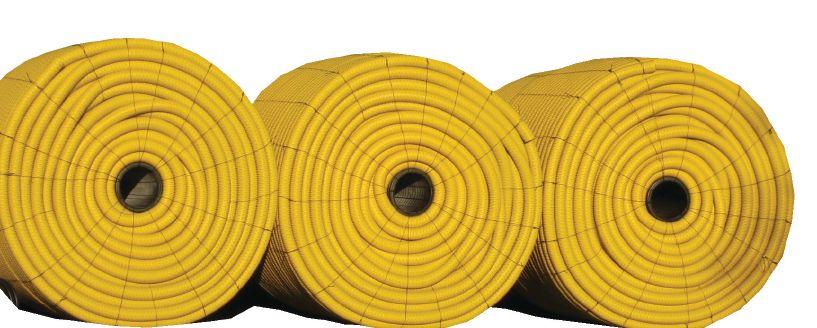
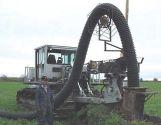
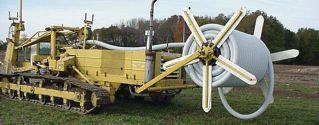
Ideal specializes in flexible, lightweight, easy to handle HDPE pipe.
Reliable delivery
With over 25 years as a Canadian leader in plastic pipe, Ideal is the source to depend on.
A flexible partner
Talk to us today about the products best suited to your business needs.
Success in succession
by Ralph Pearce
“Who will be there when I want to leave?” that is the question.
Success is part of the word succession. So why is it that as a business practice, succession planning probably ranks somewhere below filing tax returns?
Is it that some aging businesspeople have completed the process? Not according to government surveys and industry observers, particularly in fields such as drainage contracting. In fact, the industry runs a rather interesting parallel to the agriculture industry in both Canada and the US. In 1999, a Canadian federal government committee identified farm succession as an immediate concern to the country’s agri-food industry. At a provincial level, ministries hurriedly organized seminars and workshops, and the subject began to appear on the agendas of annual meetings of farm groups and organizations.
Eleven years later, the Canadian farmer is only slightly better prepared for what lies ahead. It has fallen off the radar noticeably, in part due to a general awareness, followed by apathy, but also because the business of farming dictates attention be paid to the day-today farming operations. In Canada, it is notably higher in rank compared to the US, possibly because of the smaller population base involved in agriculture.
Drainage imitates agriculture on many levels
Since drainage is largely reliant on the success of farming, it seems likely that drainage contractors are facing the same scenario. And the parallels are quite astounding: Both industries are aging, both are having a tough time attracting new partners and younger participants, both involve higher capital costs at the point of entry into their respective trades, and both are a complex blend of art-form and science, without a onestop, comprehensive resource to help point the way to success. The only difference might be the Canada versus
One of the challenges in succession planning, says Leonard Binstock, pictured here in the background, is that drainage contracting is a hands-on, learn-by-doing craft, with no single, comprehensive resource for learning.
US perspective, where again, population base arguably has a greater impact on the Canadian situation.
In the US drainage industry, there already has been a succession of the business during the past 40 years, one that has seen a concentration of contractors shift from local to regional. “Back in the 1950s, we virtually had a drainage contractor in every township in this county,” says Leonard Binstock, executive director of the Agricultural Drainage Management Coalition, in Owatonna, Minnesota. “The contractor would start out on a farm in the spring, and put in maybe 3000 or 4000 feet on a farm, and the farmer across the fence would say, ‘While you’re here, I have a couple of wet spots here,’ and
they’d just drive across the fence line and, sometimes, they just moved from farm to farm. Currently, we have one drainage contractor in our county, and he does all the work, probably twice as much from a productivity standpoint.”
In the process, adds Binstock, they eliminated 20 or more contractors, all of whom were sole proprietorships, so attrition has done what a lack of succession planning might have caused. Mike Schwieterman has seen much the same effect in his home state of Ohio. Like Binstock, he is not panicked by the dwindling numbers that he has seen during his 40 to 45 years in the business. “I’ve seen 20 to 40 contractors that came in and out of the business, and there are still enough contractors,”
BUSINESS MANAGEMENT
says Schwieterman. He acknowledges there are some slow times in one year or another. “But there’s never a problem with not getting the work done by somebody; I’ve never seen it where we’re so overloaded that you’d have to be on a waiting list for two years.”
For Canadian contractors, any shortage from attrition or succession may be offset by the level of certification required to enter the drainage industry, or it can hurt the potential for the newer start-ups. For Gerald Neeb, a drainage contractor from Clinton, Ontario, the certification offers some assurances, but in the case of his own succession planning, his son is a partner in the business. Still, he acknowledges the impact of upgrading with new technology, and despite the efficiencies they create, they also compound the issue of the labour demand they need to fill on a daily basis. “On a day when it’s raining, guys want to go home, and we try to work through it if we can, because there are only so many days left until freeze-up,” says Neeb.
Minding today’s success, not tomorrow’s succession
The biggest challenge for drainage contractors, again, as it is with agriculture, is the here-and-now: contractors have to make money and mind their operations. For many, that means having to grapple with growers who might opt for less expensive rates, or needing to install more feet of drainage tile in order to make annual budgets. They may not be able to focus on the hard-to-conceive issues of tomorrow, having to concentrate on today’s realities of staying busy. “It’s frustrating that we do the extra work as far as surveying and design and the GPS, and there are still the clientele who are only interested in the bottom dollar,” states Jon Seevers, who operates Seevers Farm Drainage in Argenta, Illinois. He also cites the continued disconnect between farmers and the benefits of drainage, and the perception that any machine in the field laying pipe must be doing it right.
“One advantage you have in Canada is the certification process, which is not the case in the States. So we’re talking about changing that, and with the LICA association, we’d like to self-govern and regulate our members and offer a credential that’s worth something.”
But costs are also climbing and contractors are having to deal with
tightening margins and higher energy costs. “We’re no different than farmers; we love what we do, but we’ll worry about paying our bills a little later,” says Neeb, citing prices from the mid1970s of 17.5 cents per foot. “But today, I’m fighting to charge 22 cents, and everything has tripled. When we first started with the plows, our goal at the end of the year was to put in between 900,000 and a million feet, and we usually had a profit of about $50,000. Now, you need to put in a million and a quarter just to break even.”
The same is true for Schwieterman, whose father started the business and did not have a wealth of equipment, but a few employees to make things work. “Then he got four of his children involved, bought more equipment, and now we have more crews running and eventually went from half a million to a million feet of pipe in a year, and now we’re up to 4.5 to 5.5 million feet a year,” he says.
the art and science of ‘tug-of-war’
Of all the challenges, perhaps the most difficult to overcome is the fact that there is no hard-and-fast resource, no textbook that defines drainage contracting; it is very much a handson, learn-by-doing craft, much like agriculture, with a knowledge base that can take years to acquire and incorporate into an operation. “I live in an area here where there are some soil types that are very productive,” explains Binstock, referring to his location in Minnesota where contractors regularly deal with a layer of yellow clay. Local contractors likely understand where that clay lies
in a field. Hiring a contractor from outside of the region might earn some savings, but if the system is installed too deep, the tiles will fill with that yellow clay and the perceived savings could turn into a staggering cost. “It’s something you’ve learned; that unseen knowledge that you can’t get out of a book, something you’ve learned from working with the soils.”
the final word
In terms of highlighting the issue of succession planning, some people may consider accessing a government grant, while others, like Seevers, take the selfdetermination approach, preferring to steer the boat instead of being dragged behind it.
Ultimately, some contractors on either side of the border have found their own solution to the issue of farm succession: their children or some branch of the family are involved, as in the case of both Neeb and Schwieterman. Seevers would like to see a more proactive approach from organizations like LICA, to advance the certification issue, as a means of standardizing the industry. And Binstock is in the early stages of exiting the industry, as well, attempting to determine what he wants and where he is at in his life, after farming, and after working in drainage. “It’s time to slow down; I’m not going to say retire, but I want to change how I schedule my days,” he says. “I think the first thing that we need to do is recognize the fact that we’re playing the “Back 9” in life, and that’s the toughest thing for people to do. But once they recognize that, then some of the other things fall into place.” ■
Succession planning may not be front-of-mind for Mike Schwieterman, who can install more than five million feet of tile in a year.
Corrugated HDPE pipe helps boost yields and reduce nitrogen discharge
Improvements in efficiency the key to improving overall performance.
According to the results of practical application studies that commenced in Illinois during 2009, the use of a farm drainage system made from corrugated high-density polyethylene (HDPE) pipe, along with a new bioreactor, can help to stem the amount of migrating nitrogen while increasing crop yield. Managing the nitrogen, a residual of fertilizer, before it travels with water from the fields and is carried downstream has been one of the goals of the project. The Agricultural Drainage Management Coalition (ADMC) is leading the ongoing research with support from other organizations such as the Agricultural Watershed Institute (AWI) and the Plastics Pipe
Hickenbottom_7x4.875 10/26/05 7:42 AM Page 1
Institute, Inc. “We’ve been looking at drainage water control structures and bioreactors where the drainage water control structure helps to direct the
nitrate flow through the unit,” states Steve John, executive director of the AWI. “We’ve been working on that issue in various ways for quite some
time. It certainly involves work to try and manage fertilizer as efficiently as possible and not apply it at rates exceeding recommendations. There have been some projects using inhibitors. But it’s pretty widely accepted that corn fields are going to lose nitrogen. And, that on some tile-drained farms, nitrogen will be found in the system. Since 2006 we’ve been focusing on ways to address that.”
Tile drainage is critical to crop production because it allows excess water to leave the soil. “A tiling system pays back better than anything else you can spend money on for the farm. It’s just unbelievable what it does,” says Garry Starkey, who has a farm in eastern Illinois. Together with his brother, he grows corn and soybeans on land his family began farming three generations ago. “We’ve been tiling our farms for years. It’s extremely wet here. Some people told us when we first moved here 10 years ago that they didn’t get planted until June. After tiling we can plant anytime, which we prefer to do during April.”
He currently has some 640 acres tiled.
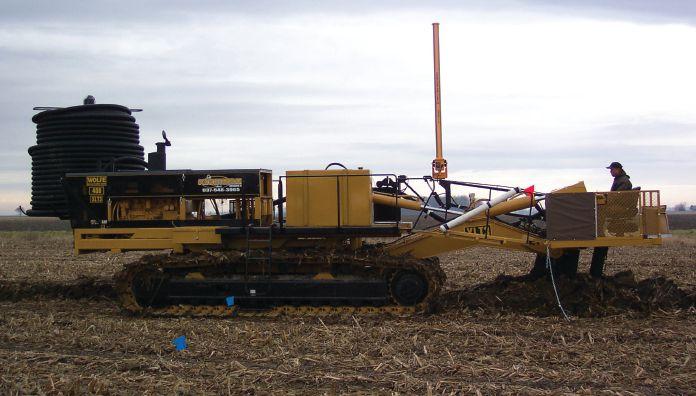
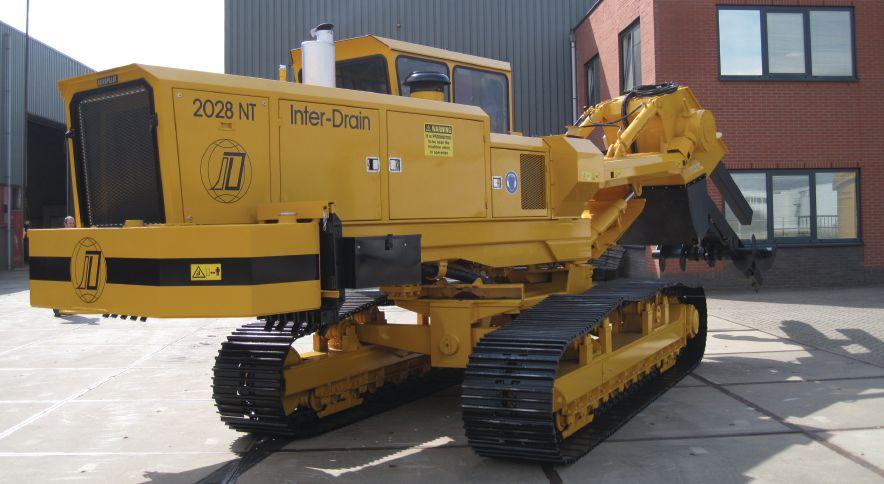
A Few Key Features:
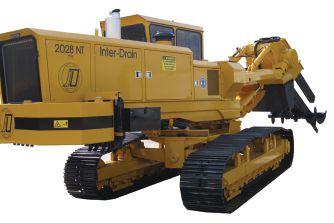
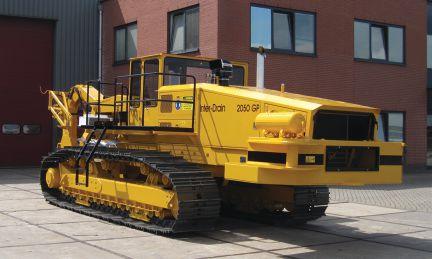
• 350 HP Cummins QSM11 Engine
• Cab with Heat and Air
• Power Shift Transmission
• 7’ Dual Hydrostat Drive, Tapered Digging Wheel
• Self-Leveling Wheel Up to 8 Degrees Left or Right
Mid America Trenchers Toll Free: 866-376-7453 Alt: 641-344-0640
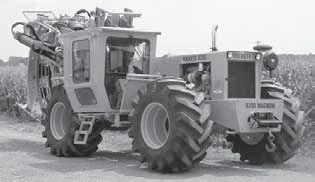
Buckeye 9200 Magnum
Buckeye 7200 Magnum
The bioreactor at work.
Starkey is also concerned about the levels of nitrogen. “The bioreactors have been able to collect nitrogen and cut down on the amount that is lost,” Starkey explained. Studies calculate the reduction to be as much as 90 percent.
His tile system is installed using perforated HDPE pipe three feet underground. “Any deeper and you get into the subsoil and it won’t draw as well. You want to keep it as shallow as you can but not so shallow where you might hit it with the tillage equipment. We have very dark, natural prairie grass soil with the topsoil running about two feet deep. The worst thing is that it holds water and that’s why you need to drain it. You get it to drain, and you really have something good.”
The good, however, does come with the downside of having the water carry off some nitrogen with it. Collecting it and controlling it is now possible because of the HDPE tile drainage system and the bioreactor. “The tiles are a pathway for nitrates to leave the field,” says John. “I view it as a process of recognizing it as an issue, quantifying it as an issue,
and then developing the industry, farmers, land owners and conservation organizations to effectively deal with it. I view drainage water management and bioreactors, and additionally, wetlands and saturated buffers as all potential ways to deal with nitrogen in tile water. It starts with trying to manage the fertilizer as effectively as possible. But even with the most conscientious efforts in fertilizer management, some nitrogen will be lost, so developing a way to deal with the nitrates once they reach the tiles provides a highly beneficial and environmentally positive solution.”
PPI’s executive director, Tony Radoszewski provides his perspective. “The situation is similar to the one we all faced with vehicle pollution. To solve the problem, no one was willing to give up driving. But solutions were developed such as emission controls on cars and more efficient fuels.
“Today, no one wants to give up eating. Drainage systems are required to get the yield from a farm. If corrugated HDPE pipe wasn’t being used on farms today, fields would be flooded and
unable to produce anywhere close to the same level of crop. As a matter of fact, some would raise none. And there are treatment methods readily available to modify the amount of elements in the runoff.”
One of the industry manufacturers who is leading and helping with the study is Steve Baker of Springfield Plastics, a PPI member company. Baker is the chairman of the PPI’s Corrugated Polyethylene Pipe Association (CPPA) division’s agricultural committee. “Using drain water management techniques helps to hold nitrogen and phosphorus on the farm. And that’s the whole issue. For a farm field that has a bit of slope to it, structures such as dry dams or terraces can be put in so that when the water runs off it can be slowed down and the silt is kept on the farm. That’s a typical conservation practice,” explains Baker. “But when you have land that is flat as a pancake, and there’s no water running off, those fields must be tiled. When you tile them, they are very high producing. Some of the best corn and soybean crop land in the world is here in the United States
being drained with underground pipes. The water percolates through the soil and if it has nitrogen, it goes into the pipe. The whole idea is to get rid of the excess water, it runs through the pipe and off the farm. The drainage water management practice that we’ve studied with the ADMC and the AWI has shown that when we keep the water up here at the right time, we keep that nitrogen here. We have studied and put to the test sound drainage water management practices and the bioreactor. This combination works.”
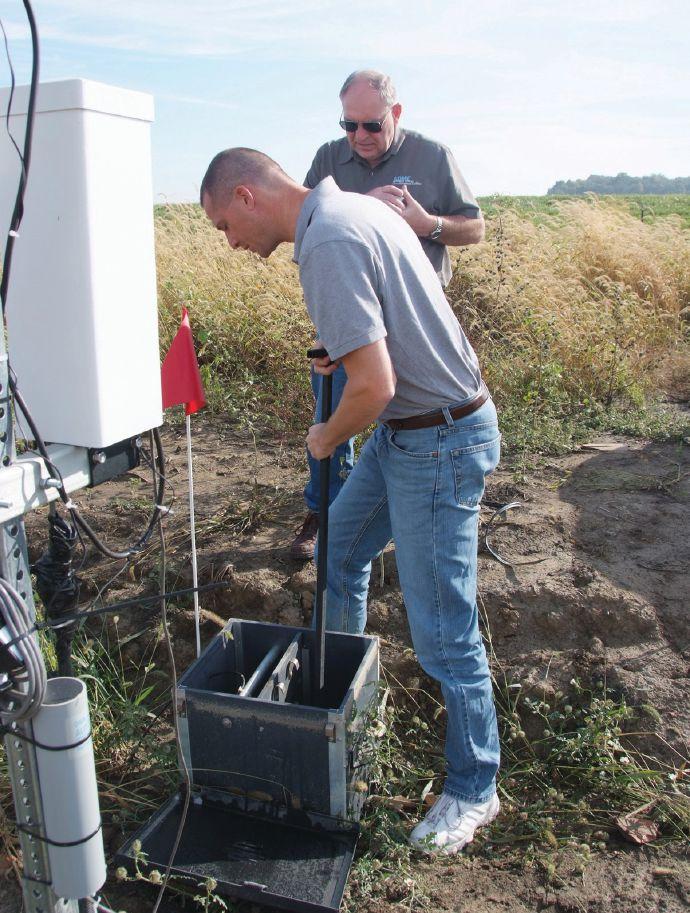
The bioreactor unit helps to remove nitrates from the water carried in the tile drainage system.
One of the researchers leading the program is Dr. Richard Cooke of the Department of Agricultural and Biological Engineering at the University of Illinois, Urbana-Champaign. “The bioremediation technology works at the end of the system by removing elements in the water through the metabolism of stationary micro-organisms as the water flows past,” he states. “The bioreactor consists of a buried trench with woodchips through which the water
flows before entering the surface water. Micro-organisms from the soil colonize the woodchips. These micro-organisms eat the carbon from the woodchips and take in the nitrate from the water. Just as a human being breathes in oxygen and exhales carbon dioxide, these microorganisms breathe in nitrate and exhale nitrogen, which exits the bioreactor and goes into the atmosphere as an inert gas. Through this mechanism, called the denitrifcation pathway, nitrate is removed from the tile water before it can enter the surface water.”
Baker notes that tests show a substantial result. “The research and a program of ‘in-the-field’ studies show that when the water flows in it might have 20 milligrams of nitrogen per liter, but when it comes out, it will have just two milligrams. And the research is very strong for totally reducing the nitrogen loss.”
According to Baker, the Plastics Pipe Institute’s members are supporting the research efforts. “Our industry is behind it 100 percent.”
The PPI Agricultural Committee is made up of corrugated HDPE pipe and
resin manufacturers and others to work with various organizations such as the ADMC and the AWI. “Our work as the Agricultural Drainage Management Coalition and task force has gathered scientists, chemists, famers, fertilizer manufacturers, conservationists, environmentalists and university researchers and teachers to develop sound drainage water methods and this bioreactor,” adds Baker.
Even the bioreactor was designed with environmental considerations. “We’re using woodchips,” Baker explains, “instead of taking live trees. It’s all dead wood mostly from storm damage that is going to be chopped up anyhow. Why throw a match to them; use them for something constructive.”
“The main question farmers ask,” according to PPI’s Radoszewski, “is ‘Will a tile drainage system using corrugated HDPE pipe help my crop?’ The answer is an emphatic ‘yes.’ It’s a proven fact that crop yields are improved. The next question is ‘Will adding drainage management tools and the bioreactor help the environment?’ Again, the answer is ‘yes.’” ■
New technologies, new directions spurring new successes
by Mick Claxton*
Shifting from agricultural drainage to sportsturf has some surprising turns.
New technologies can help future-proof this country’s agricultural drainage contractors against any downturns ahead, helping them diversify into a potentially profitable high-growth sector. Maintaining sportsturf, from golf grounds to athletics fields and race courses, can reduce their dependency on the agricultural industry and its inherent ups and downs.
Increasing numbers of European contractors have successfully made similar moves, and are getting out of their crowded agricultural market after having established healthy, strong growth, sportsturf maintenance-based businesses.
This side of the Atlantic, one man already exploiting the potential is Michigan-based Dennis Rector. His entry into the sportsturf world is so successful he has changed his company name, from Rector Farm Drainage to Water Management Specialists Inc., to help underscore the new thrust of his business.
If you are already thinking it cannot be as easy as waking up one morning and deciding to move out of corn and into golf courses, you are right.
It involves devoting time and effort to showing potential new customers that you are offering them a whole new way of dealing with their problems, a way that can save them time, hassle and money, while producing better playing surfaces for their customers.
Dennis Rector has been there and is reaping the benefits of doing just that.
Unhappy with long-term growth prospects for his agricultural drainage business, he began looking for a new direction. He looked to changing trends in Europe, where growing numbers of contractors were switching to sportsturf and, with the help of emerging technologies and equipment developed specifically for that market, were experiencing much better margins than they could have hoped to achieve by working for farmers.
He began importing their techniques and equipment and has not looked back since.
Today his company is thriving and he is convinced that it will provide his sons, and perhaps their sons, with good, solid futures. Currently about half of its business comes from agriindustry customers and half from sportsturf maintenance, with the latter increasing all the time and yielding the better margins.
Importantly for stability, it now has legs in two separate industries, with obvious benefits should one of those industries hit particularly hard times.
Naturally, he has encountered problems but with a positive approach, both he and his business have become stronger and better equipped with each challenge overcome. “Typically we now work with country clubs, high schools and colleges, and for people running local community sports fields,” says Rector. “Building trust and relationships is crucial, and clients frequently come to regard us as advisors and partners, as well as drainage contractors. Being first in the field with something new is great, but persuading people to buy into it can be difficult.
“We had to work hard at first on convincing people to embrace new advances in drainage systems, even though much
A Shelton Supertrencher laying three-inch tile leaves a clean surface finish.
SPORTSTURF DRAINAGE
Grass grows quickly across narrow trenches, leaving the facility ready for use.
of the basics had already been developed, tried and perfected in Europe over many years,” adds Rector.
“Difficulties have usually revolved around convincing clients that advancements in drainage designs and systems have been made which far outstretch the antiquated designs of the past – which have been proven not to live up to their expectations. Architects and owners can tend to cling to the familiar, only knowing what has been done in the past. Sometimes they only want a quick fix to a small area, and do not look at the bigger picture and realize that problems and failures of the system can all be corrected at one time.”
building close local ties a plus Rector has developed a close and beneficial working relationship with Gerry Korb from Port Industries, a company importing the latest specialist sportsturf equipment from the UK’s Shelton Sportsturf Drainage Solutions Ltd., a European leader in its market.
Simply taking agricultural-scale equipment and methods onto sports fields will rarely win new friends, or repeat business. Most turf managers will expect, and demand, that a contractor drain today so that their customers can play tomorrow. Using
the right equipment and technology Rector meets that demand time and time again. “A country club prides itself on its pristine, manicured fairways, and our equipment has to be tailored to minimize the disruption and damage caused,” explains Rector. “Traditional techniques involve digging trenches up to two feet wide with excavators, often leaving the facility unusable for weeks or months. With modern specialist equipment a drainage system can be installed with minimal disturbance, so that it is back in play almost immediately.”
Solving problems for two important golf clubs gave him a new image, overnight, as a turf drainage expert, with huge benefits to his business prospects. “I had not been allowed to bid on one contract because I was ‘only an agricultural drainage contractor.’ Two months later the same consultant was asking my advice as a sportsturf drainage expert.”
His employees like the new work and are motivated to produce the best results, greatly assisting his drive to provide the best service in their area.
An essential part of his inventory is a Shelton Supertrencher 625. Laser guided for ultimate accuracy, it is tractor mounted and uses circular saw type action to cut exceptionally clean, narrow trenches with surplus spoil going straight into a trailer running alongside.
The results have to be seen to be believed and, as the pictures show, really do enable him to deliver on his “drain today and play tomorrow” offer. ■
*Mick Claxton is the general manager for Shelton Sportsturf Drainage Solutions, based in Lincolnshire, England.
Turning the tables in Wisconsin cranberry bogs
by Ralph Pearce
Shifting designs and layouts boost production and help environment.
Cranberry production in Wisconsin dates back nearly 150 years, and the berry’s sense of tradition is certainly well defined on festive dining-room tables during Thanksgiving and Christmas seasons. Still, at a time when farmers are looking to maximize production and reduce any impacts on the environment, one drainage contractor is doing all that is possible for both scenarios.
For Kevin Ellingson of Ellingson Drainage, based in West Concord in neighboring Minnesota, the 2009 season provided something of a learning curve, particularly where cranberry bogs are concerned. Although the concept is not revolutionary, the process and equipment used required a greater degree of specificity and precision. “With the cranberry bogs, there’s nothing really special about the way they were constructed,” explains Ellingson. There may be nothing special to the construction but the fact that the bogs must be flooded in order to harvest the berries means there are specific issues
to be understood. “Essentially, farmers used the land under there the way it was, maybe put in a small amount of drainage in the wet spots or spots that were troublesome.”
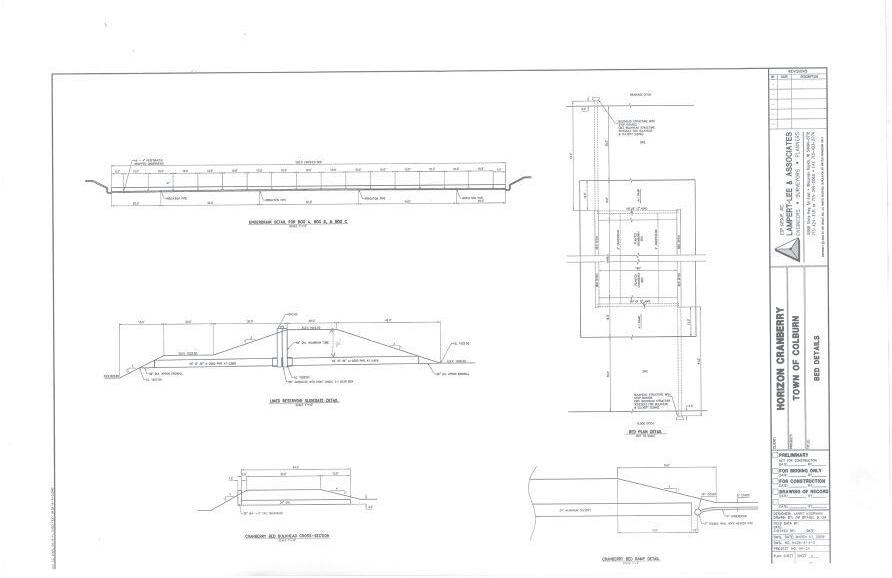
With the bog that Ellingson Drainage worked on in 2009, the farmer, owner of Horizon Cranberry, hired the engineering firm of Lampert-Lee & Associates of Wisconsin Rapids, Wisconsin, to provide the blueprint. A modification of the design called for the actual switching of layers beneath the cranberry plants, with a few in-ground enhancements. The plan for the bog had three basic goals: maintain moisture levels for the plants during the growing season; install a topsoil liner to reduce water needed for flooding and install drainage tile to remove the water once the harvest was complete. “That third goal is definitely one of the reasons for the drain tile, but it’s really more than that,” says Larry Koopman of Lampert-Lee & Associates. “It’s very important to get the water off the beds during rainfall events, and many growers in 2010 were having a tremendous amount of fruit rot in the crop, particularly on beds that don’t have adequate drainage.”
Koopman could not overemphasize the importance of this third goal; if water covers the bed during the heat of summer,
DRAINAGE MANAGEMENT SYSTEMS
Four miles of drainage tile were laid in each of the 23 cranberry bogs, with great care to ensure they did not penetrate below the 18-inch depth of the sand.
it can quite literally cook the fruit and render the crop useless to the grower.
the design and the challenges
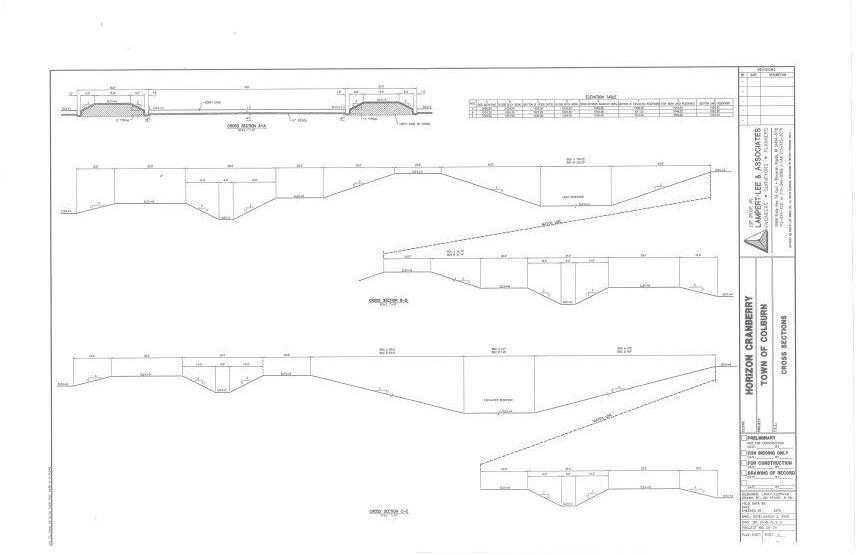
In most of the bogs in Wisconsin, cranberries are grown in sand. Traditionally, the topsoil is taken off, the beds are levelled, and in some cases, they can be cut further down in the sand to get the bed elevation closer to the local water table. “What was different on what we did was that we took that topsoil off, and then undercut the beds down to the elevation needed, so that the surface was where we wanted it to be,” details Koopman. “Then we put six inches of topsoil underneath, and most of that had to do with the fact we can’t
build cranberry bogs in areas where they traditionally did, which is in wetland areas.”
Cranberries are a wetland plant and need water close by the roots, but not actually in the water, which is why drainage tiles are advantageous.
With the environmental concerns, Koopman and Ellingson combined their skills to replicate the necessary conditions for cranberries by creating artificial wetlands, complete with a layer of topsoil to trap the water in the sand above them, which helps in flooding the berries for the harvest. “But they also flood in the winter time, to put a layer of ice on top of the vines, to protect them from the winter environment,” says Koopman. “Then they actually drive on top of the ice and
DRAINAGE MANAGEMENT SYSTEMS
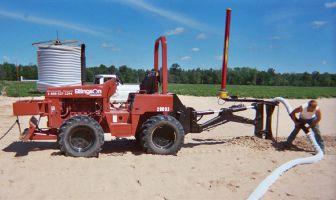
On Ellingson’s modified Ditch Witch, the vibrating plow is replaced with a tiling plow.
put this tile in every 10 feet on center with these bogs, so we ended up with 16 quarter-mile lines per bog.”
Koopman adds that the topsoil was crowned four inches from the center of the bed to the outside edges of the bed, just to provide some positive drainage underneath the sand layer below the drain tile. Another minor hurdle lay in convincing the crew with Ellingson Drainage to lay the tiles perfectly flat. “That flies in the face of everything they normally do, because they put them at a pitch to provide more capacity to carry water away,” says Koopman. “If they lay them flat, they don’t drain very well, but in this particular case, that’s what they absolutely needed to have happen.”
spread a layer of sand, and when that melts, it pins the vines down and helps them to grow.”
It can be challenging in natural sand soil, to flood up, be it for harvest or for winter flood, because the sand is very permeable. Reversing the layers means the topsoil below slows down the water and holds it in the bed. “It does such a good job of holding it in the bed, that now we can’t get rid of the water, so that’s one of the reasons for putting the drain tile in,” says Koopman.
Another benefit of the drainage tile was that it helped redistribute the water around the cranberry bed, so the water
was more uniform, whether it was coming from rainfall, irrigation or from putting on a flood for harvest.
When it came to the actual ground work, Ellingson explains that the topsoil was stripped from the bog, followed by the same process to strip between 18 and 24 inches of sand. The topsoil was then laid back down to a depth of six inches to form a type of liner. Then the sand was brought back in and replaced to a depth of 14 to 18 inches. “The bogs we were working on were 160 feet wide and a quarter of a mile long,” says Ellingson, adding that there were 23 beds for Horizon Cranberry. “And we
Connections and equipment
At each end of the bog, the Ellingson Drainage crew dug-in 12-inch dual wall tiles as the main. “We dug those in first, and then plowed four-inch sock tile laterals from end to end, and connected each four-inch lateral down into the 12-inch dual wall main,” details Ellingson. “So within each bog, we ended up with 16 lines, all tied into the main on each end, and in between that, they were putting in four irrigation lines.”
Now complete, Horizon Cranberry has an ideal system that makes it easier to keep the plants moist while keeping the root system dry enough to reduce the risk of any kind of rotting.
As for equipment needs, Ellingson’s crew employed a custom-designed, refitted Ditch Witch vibrating plow. “We took the vibrating plow off and we built a tiling plow,” he says. “We needed to custom-build a tile plow to fit the specific needs of this project because these lines are so close together and you can’t have a standard-sized drainage plow in there. These lines only go in 13 inches deep, so you have to stay above that soil liner that they’re putting in there; you don’t want to penetrate that.” ■
Figure 2. Bed plan detail
British company sees dual productivity boost for 2010
Mechanically driven chain trenchers are making a comeback.
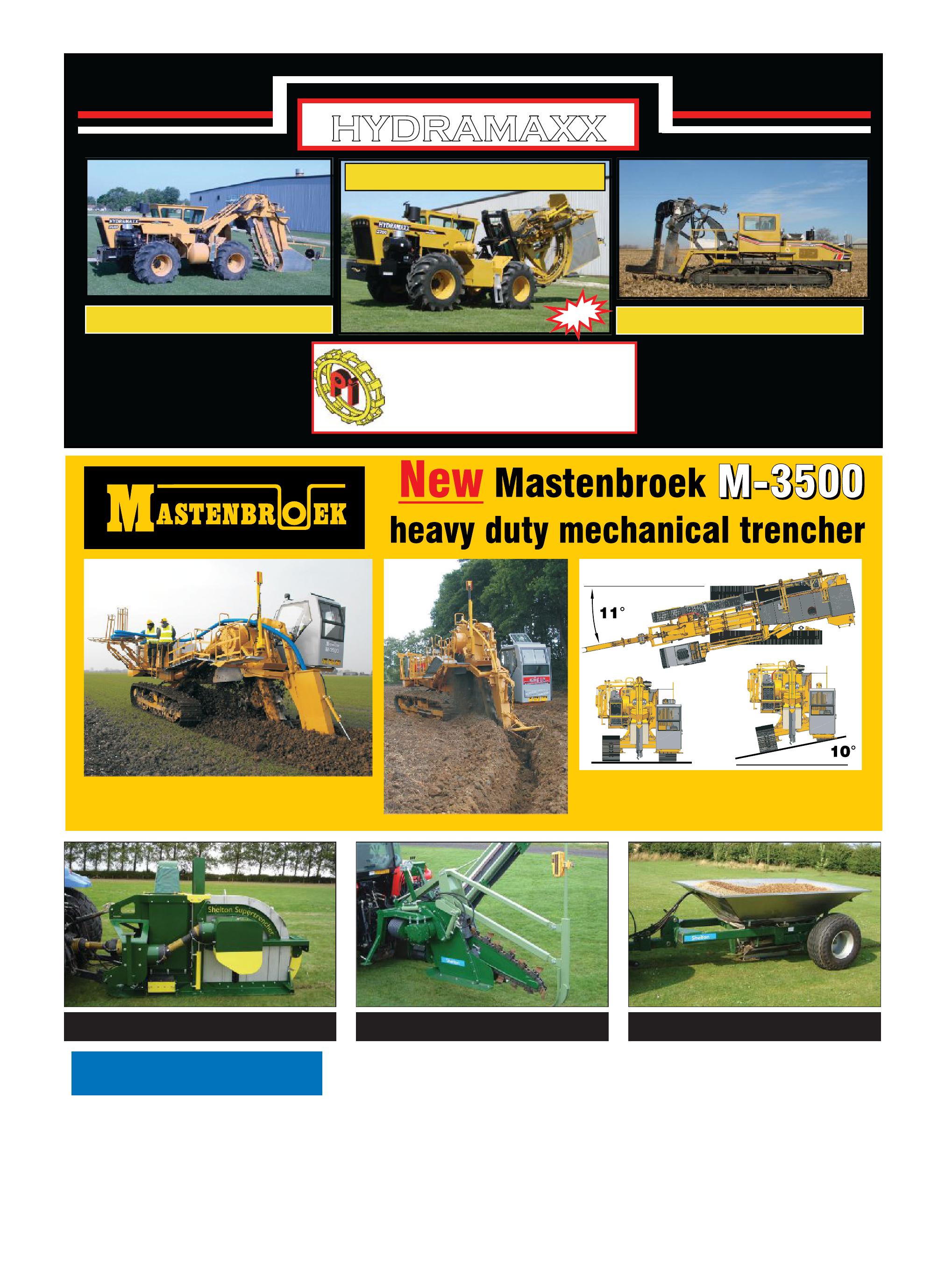
Not content to launch a single major innovation in what has been a landmark year for the company, European manufacturer Mastenbroek has gone a big step further, introducing its new M-3500 – that is ‘M’ for mechanically driven chain – and GPS for chain trenchers.
Drainage trenchers with mechanically driven chains were overtaken, some would say sidelined, by huge advances in hydraulics. But the technology is making a big comeback, largely as a result of Mastenbroek, with nearly five decades’ experience making machines for all types of soil and conditions. The M-3500 brings chain trencher technology bang up to date.
It would be a mistake to view the M-3500 as retrospective technology, in any way. Launched at the triennial Bauma machinery exhibition in Germany early in 2010, the machine was a major star at the show, attracting attention from drainage contractors worldwide. One was German drainage specialist Karl Möhle GmbH, which took delivery of the machine, the latest model to roll off the European manufacturer’s production line, right off the stand.
Early indications from the Möhle machine, and a second, bought by another German contractor, Mors, are that the M-3500 is fast, highly maneuverrable, exceptionally operator-friendly, and sets a new standard in productivity from which contractors working in some of the most difficult terrains in markets around the world could benefit, with its side slope leveling and curved trenching ability. Undercarriage features independent hydrostatic track drive and 650 millimeter- (25.6 inch-) wide pads on oscillating tracks. The machine marks a significant step forward for the drainage contractor, and complements an already impressive lineup from Mastenbroek.
Design specifications
With a gross weight of 22 tonnes (48,500 lbs), the machine comes with a Cummins QSM 11 construction diesel engine, delivering 350 horsepower (260 kW). Digging depth is up to 3.5 meters (11ft6in), with trench widths of between 160 and 550 milllimeters (6.2 to 21.6 inches).
Inside the rise-and-fall operator’s cabin there is an electronic machine display and controls, and a fully proportional joystick that gives the operator total control of the digging mechanism from the seat. The machine also features an independent liftable pipe box, two independent folding pipe reels and machine walkways complying with the latest safety regulations to assist loading pipes.
General manager Christopher Pett says the M-3500 was developed specifically in response to calls for a mechanically driven trenching chain and side slope operation. The German market has traditionally favored such machines and its genre is making a comeback elsewhere in Europe. Since its launch, it has also attracted a great deal of interest in North America,
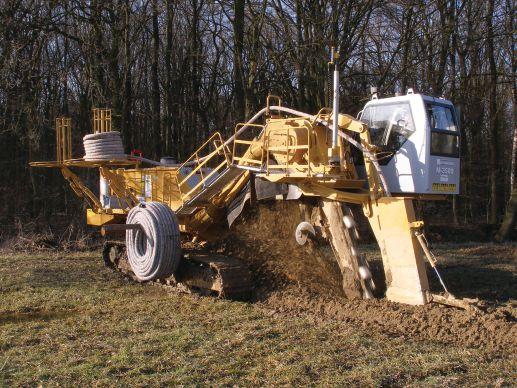
Drainage trenchers with mechanically driven chains are making a comeback, as proven by Mastenbroek’s launch of the M-3500.
where Mastenbroek sees great potential. “There are some key advantages using mechanical drive, as maximum engine power goes straight to the chain. It’s comparatively more fuel efficient and delivers impressive productivity rates. Single joystick control means that setting-in is much quicker, which itself can lead to better productivity.”
The M-3500 is the latest machine to be offered by Mastenbroek with Trimble’s Field Level II GPS system. Following extensive European field trials, the launch in early 2010 signified a major step forward in the positional and grade-control accuracy of trenching applications in land drainage. It will be offered to customers as an alternative to current laser surveying and installation equipment. Mastenbroek has a long-standing relationship with Trimble, which pioneered in the drainage industry in the 1970s, taking land drainage to a new level of sophistication.
Mastenbroek, which championed laser systems more than three decades ago, believes GPS is set to make its mark on land drainage with similar impact, bringing as it does the opportunities to reduce waste of valuable natural or recycled resources, and accelerated pipe installation. There are potentially massive savings in backfill.
trucking companion
Hugely popular in Europe and elsewhere is the Mastenbroek CT/12 crawler truck, an ideal companion to a range of the company’s drainage trenchers, including one of its best sellers, the 30/20. The machine is capable of operating in parallel to, or “tram-lining” in the wake of the trencher. An easily accessible and capacious hopper may be loaded by a variety of plant. Many CT/12s have been sold worldwide. Much more than a gravel cart, the self-propelled CT/12 is a true workhorse of the drainage industry.
MACHINERY REVIEW
Used for backfilling trenches for drainage and other pipeline applications in its standard form, this machine has an engine rated at 164kW (220 horsepower) and weighs in at 17 tonnes (37,400 lbs). The CT/12 has a large 15-tonne (33,000-lb) hopper capacity, independent variable hydrostatic track drive and a 180-degree swing, hydraulically slewable, front-mounted conveyor discharge assembly. Together, the 30/20 and CT/12 are capable of extremely high productivity in agricultural land drainage specification.
Importantly, for contractors that have opted for the CT/12, it extends the season of operation. It is capable of working with drainage trenchers throughout the growing season, not just after harvest. A “moving bed” based at the bottom of the hopper means, additionally, that it is capable of handling a wide range of materials, from sand to coarse aggregates, for trench backfilling. Many contractors can extend their operations outside those of land drainage, using the CT/12, to other utilities works, including pipe-laying, further extending their seasonal operations; the truck is also a tipping hopper and dump truck.
Together the CT/12 and Mastenbroek trencher are an unbeatable combination, according to Dan Sweeting, director of Sweeting Brothers in the North of England. “Dedicated self-propelled plant, operated by an accredited contractor is the farmer’s best choice. The contractor can be on site as soon as a crop is harvested. For example, the farmer can be drilling rapeseed within two weeks of harvesting his winter barley, the drainage having been installed in-between crops,” says Sweeting. “The quality of the trench, and the final installation, are crucial to the success of the finished job. The Mastenbroek ensures a clean and firm trench bottom, laid to laser-level grade accuracy across the whole field. And the machines offer the opportunity to design a scheme to fit the field, not the machine, as is often the case with tractor-mounted devices. All soil types can be accommodated with no compromise on machine stability which can affect three-dimension accuracy of pipe installation.”
His views are echoed by Graham Falkingham, owner of Castle Farm, also in the North of England. “We’re constantly looking at maintaining the quality of the drainage. If there’s a problem, we have to fix it; in the case of potatoes, for example, they must be kept moist, but not flooded. It’s a delicate balance that new drainage methods enable us to achieve. And with laser leveling techniques, installation has improved beyond all measure,” explains Falkingham. “When we buy a new piece of land, we know that it’s probably going to need draining. So we’ve no hesitation at getting the professionals in. It’s a specialist’s job, so we get specialists in to do it.”
Land drainage is enjoying a significant resurgence after a number of years in the doldrums following the withdrawal of grant-aid to carry out the work in the 1980s.
In the UK, where Mastenbroek has its manufacturing base, many respected drainage contractors subscribe to the Land Drainage Contractors Association (LDCA), a trade association that monitors the standards industry-wide. Sweeting continues: “The use of this type of equipment is farmers’ reassurance that the job is done to a high standard. That reassurance is backed up by a host of standards drawn up by the LDCA. It’s not just contractors who sign up to it; manufacturers and suppliers who undertake to comply with recognized standards of workmanship and materials are involved. It means that customers have peace of mind when selecting equipment.” ■
Land Improvement
Contractors of America
For over 50 years, LICA contractors have paved the way for our country’s growth and expansion We have contractors from coast to coast, providing a wide range of services: grading, excavating, drainage, landscaping, paving, wetland development, on-site waste system installation, and site preparation just to name a few.
Our contractors work in cities, on farms, ranches, and in rural areas. They work with dedication and commitment to the professional conservation of soil and water You should always choose a LICA contractor for all your construction needs. Look for the familiar LICA triangle proudly displayed on our equipment
If you are a contractor, you should become a member of this great association! We strive to improve the business climate by working for better legislation and regulations, by keeping our members abreast of the current changes impacting their operations, and providing training in the latest technology Website: www.LICANational.org
Ontario to launch best management practices manual
by Peter Darbishire
Comprehensive publication developed by a wide array of contributors.
Ontario agriculture will soon have a long-planned manual for implementing best management practices (BMPs) for cropland drainage. As part of a series of more than 30 publications prepared during the course of the last 20 years, the Ontario Best Management Practices program will launch its Best Management Practices Manual for Cropland Drainage in the spring of 2011. It is the culmination of almost two years of committee work by many stakeholders who are either directly involved in crop production or whose work and aims focused on best management practices for subsurface and surface water. The Ontario Best Management Practices Program is a partnership of the Ontario Ministry of Agriculture and Food, Agriculture and Agri-Food Canada and the Ontario Federation of Agriculture.
The publication will be full of technical information and will be extensively illustrated, covering the importance of
subsurface and surface drainage design, their benefits to agricultural producers and society in general, while also discussing the impacts of drainage on the environment. The publication delves into how farmers and contractors work together to maximize the benefits while eliminating and reducing the potential for negative impacts. Throughout, it advises how best to achieve these aims. Of note are chapters on how drainage BMPs can assist in reducing both soil erosion and delivery of pollutants to downstream water courses and groundwater while increasing cropland productivity. Both conventional drainage and some emerging concepts are included.
“Best Management Practices publications are consensus projects. This has been one of our most extensively reviewed publications in the BMP series,” says Ted Taylor, who is a program analyst for OMAFRA and program advisor for the Best Management Practices Publication Program for OMAFRA. “We have had input from a producer group in the Ontario Federation of Agriculture, the Land Improvement Contractors of Ontario, the Drainage Engineers of Ontario, the Drainage Superintendents’ Association of Ontario, Ontario
DRAINAGE THEORY
Soil and Crop Improvement Association, the Ontario Farm Environmental Coalition, Ontario’s Conservation Authorities, the Ministries of the Environment, and Natural Resources, Agriculture and Agri-Food Canada, and Fisheries and Oceans Canada as well as the University of Guelph. We have successfully included practical advisory material which is acceptable to all parties and we expect it will be well received as the premium reference for initial planning of drainage systems for cropland in the province.”
The publication’s final format is not yet decided. Many similar publications are more straightforward and are not so extensive. This one might extend to more than 100 pages if it is published in the usual way. Considerations are to produce a shortened print version with components on surface and
subsurface drainage, with additional in-depth information for individual sections available on-line. In addition to overviews on how subsurface and surface drainage work, there are detailed sections on the constituents of soil and soil water, the movement of water in the soil and how it moves to surface water bodies or groundwater. The all-important issue of outfall design and maintenance is included, as is communal drainage systems and the legal aspects of drainage.
“We’re looking forward to the final publication,” says Sid Vander Veen, drainage co-ordinator for OMAFRA. “It will be a great tool for planners and especially for those who are not familiar with the intricacies of farm drainage. In many places, the publication will refer users to the Drainage Guide for Ontario, which is the definitive technical guide for cropland drainage system design and installation. In this way, we expect contractors will be able to use it also as a promotional tool that complements the Drainage Guide.” ■
Drainage Contractor is read by contractors, suppliers and industry advisory personnel each year and is kept as a reference resource by readers: more than 8800 farm drainage and land improvement contractors throughout north america and around the world look to Drainage Contractor as their most valuable source of information.
if there is a story idea, coming event or news brief that you want to see covered in the 2012 edition of Drainage Contractor, contact editor r alph Pearce at 519–280–0086 or via e-mail at rpearce@annexweb.com.
Evaluation of agricultural subsurface drainage in arid regions
by Carlos R. orozco-Riezgo*
Salts and minerals are parameters that
must be considered.
Installation of agricultural subsurface drainage tile in the Mexicali Irrigation District (MID), Baja California, Mexico, began in 1971 with the installation on 100 acres. Later, in 1991, the University of Baja California (UABC) installed five in its experimental field located in the ejido (communal) Nuevo León, and another 45 in the year 1995. During the spring of 1998 in a pilot program, the state government of Baja California gave funds to farmers to install tile in four fields with a total area of 145 acres, to 2010, where there are now about 14,000 acres with tile.
This made it necessary to develop a field evaluation in the year 2008 with the objective to review the impact that have such systems in soils and agricultural production, as well as the current conditions of these systems.
Introduction
The MID is located in Mexicali, Baja California, Mexico, and receives water from the Colorado River. This district is on border with the state of California, and particularly with the Imperial Valley Irrigation District (IID). This is an arid zone with 513,698 acres in production. In summer, the temperatures can reach 123 degrees F and lows of 21 degrees F, with an annual precipitation of 15 inches
and evaporation of around 95 inches per year. These characteristics mark the conditions of an arid area, plus the poor drainage and salinity concentration of the irrigation water of 1200 parts per million (ppm) represent a challenge to maintain adequate soil conditions.
At this moment the tile installation is focused to reclamation of land with shallow water tables and progressive soil salinization, and due to this, it is necessary to conduct an evaluation of existing drainage systems to verify their impact on the crop production and the physical-chemical status of soils in a complementary way.
The objectives that had been raised were:
• To evaluate the agricultural subsurface drainage systems of Mexicali Irrigation District, Baja California, Mexico, and
• To analyze the condition of the pipe filters.
field work
Field tours were carried out in holdings with subsurface agricultural drainage projects installed in the District of
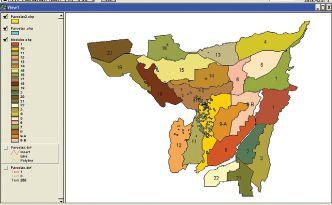
Irrigation 014, along the Colorado River, for organization and processing into a data base using GIS, whereby information was collected.
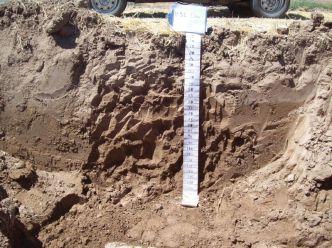
Soil profile was developed in Field 36 in the ejido (communal land of) Oaxaca, where it had four layers differentiated by color. The first horizon was observed loose and dry, but deeper soil aggregates were more defined and generally have greater resistance to the degree of deformation, as noted in the description of horizons is presented below (Figure 2).
Agronomic evaluation allows us to determine qualitatively if spacing between lateral tiles is working based on the design, which notes the development of cultivation. If in the middle of two laterals, the plant size is smaller than the size of the plants on top of it, then we can infer the separation between drains is incorrect. Seventy-two fields were agronomically evaluated and 59 (82 percent) were working very well; in
HAVING TROUBLE KEEPING YOUR FIELDS DRY?
Is your tile outlet below the ditch level? Is the ditch too shallow to allow proper drainage?
Maybe it’s time to look at a Drainage Pump. A drainage pump can keep your field drier than draining it naturally. With a drainage pump YOU can CONTROL how low or how high to keep the water table in your field.
Our Stainless Steel Submersible drainage pumps are just right for the job. Pumps are available in a variety of horsepowers to suit your field application. Carry Pumps are available from 1/2 HP to 10 HP in single or three phase power,208,230 or 460 Volts,with pump capacity from 50 to 1450 GPM with 2 to 25 feet of lift. Carry Mfg_7x2.25 10/15/04 4:44 PM Page 1
For more information,contact your local Tile Contractor or Call Carry Pumps direct at: 1-800-492-2779 www.carrymfg.com
Figure 2. Soil profile of Field 36 at Oaxaca.
Figure 1. Location of evaluated fields.
DRAINAGE MANAGEMENT SYSTEMS
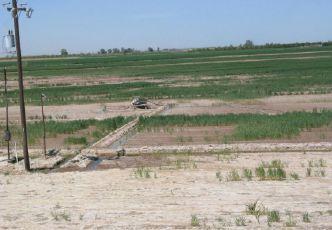
recovery process were 11 of the fields (15 percent) (Figure 3).
Subsurface drainage systems analysis
Sedimentation was found in some drainage systems; up to 75 percent of pipe capacity, specifically in soils that have much silt and fine sand. There were root problems in 10 fields, specifically when the open ditch had weeds and bushes in the area were close to the collector discharge.
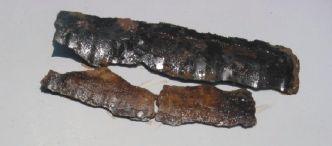
Abrasive deposits of iron (Fe) and manganese (Mn) of one millimeter thick were found both in laterals in the middle of the field and on the main collector. In a total of 172 fields evaluated, five had these problems (Figure 4).
With a portable device, it was determined that the electrical conductivity (EC) of drained water from 45 fields, using pH values, varied from 1.02 to 27.4 dS/m (deciSiemens per meter). The maximum value has an electrical conductivity level similar to seawater salinity data. High salinity detected means that soils are in the process of leaching salt.
As stated previously, of 72 fields evaluated, 82 percent were working very well, with 15 percent in the recovery process. The design of geotextile filters was based on the grading curve and a recommended 400-micron size, and systems to a depth of 46 inches for the filter (3.83 feet) on average. The pipe in some cases had up to 75 percent sedimentation, including iron and manganese sediments, and an invasion
of roots, so it is recommended to perform maintenance on these systems. Sedimentation in drainage systems was present in soils with silt or fine sand, and in loamy-clay or clay soils.
Added conclusion
Following an analysis of the field information generated, we have the followings conclusions:
The maximum water flow in the outlet collector was 158.5 gallons per minute (gpm) and the minimum of 2.9 gpm of salt that is extracted under these conditions is equivalent to 7.38 tons per day and 0.02 tons per day, respectively.
Recognitions
To do this work we had the participation of Rodolfo Namuche, the Mexican Institute of Water Technology (IMTA), the National Water Commission (CONAGUA) and the State Government of Baja California, México.
*Carlos R. Orozco-Riezgo is a soil and drainage consultant, and is working on his PhD in subsurface drainage. He is based in Mexicali, Baja California, Mexico. ■
LEADERS IN THE DESIGN AND MANUFACTURE OF DRAINAGE PRODUCTS FOR OVER 100 YEARS
Armtec provides a complete range of Big ‘O’ and Bruce Tile drainage products from steel and plastic pipe to tubing designed to collect and remove subsurface water in various situations. For fine soil situations we offer a variety of engineered filter products designed to limit the movement of soil particles into the drainage system while allowing for the removal of subsurface drainage. Our internal standards for tubing quality meet or exceed the requirements set by industry or government.
With several different tubing diameters, a variety of perforation patterns, and an extensive range of fittings and accessories, we have the solution for your drainage needs.
www.armtec.com
Chesterville 1-800-449-2806
Comber 519-687-2338
Orangeville 1-800-265-2446
Forest 1-800-265-1447
Walkerton 519-392-6929
Dresden 519-683-6231
Figure 3. Field with sodium problems.
Figure 4. Sheath materials analysis.
Watershed evaluation research confirms numbers and expands applications
by Ralph Pearce
Information that is retrieved is as useful to contractors and planners as it is to farmers.
Three years can seem like a long time, or it can seem as though it is speeding past in a heartbeat.
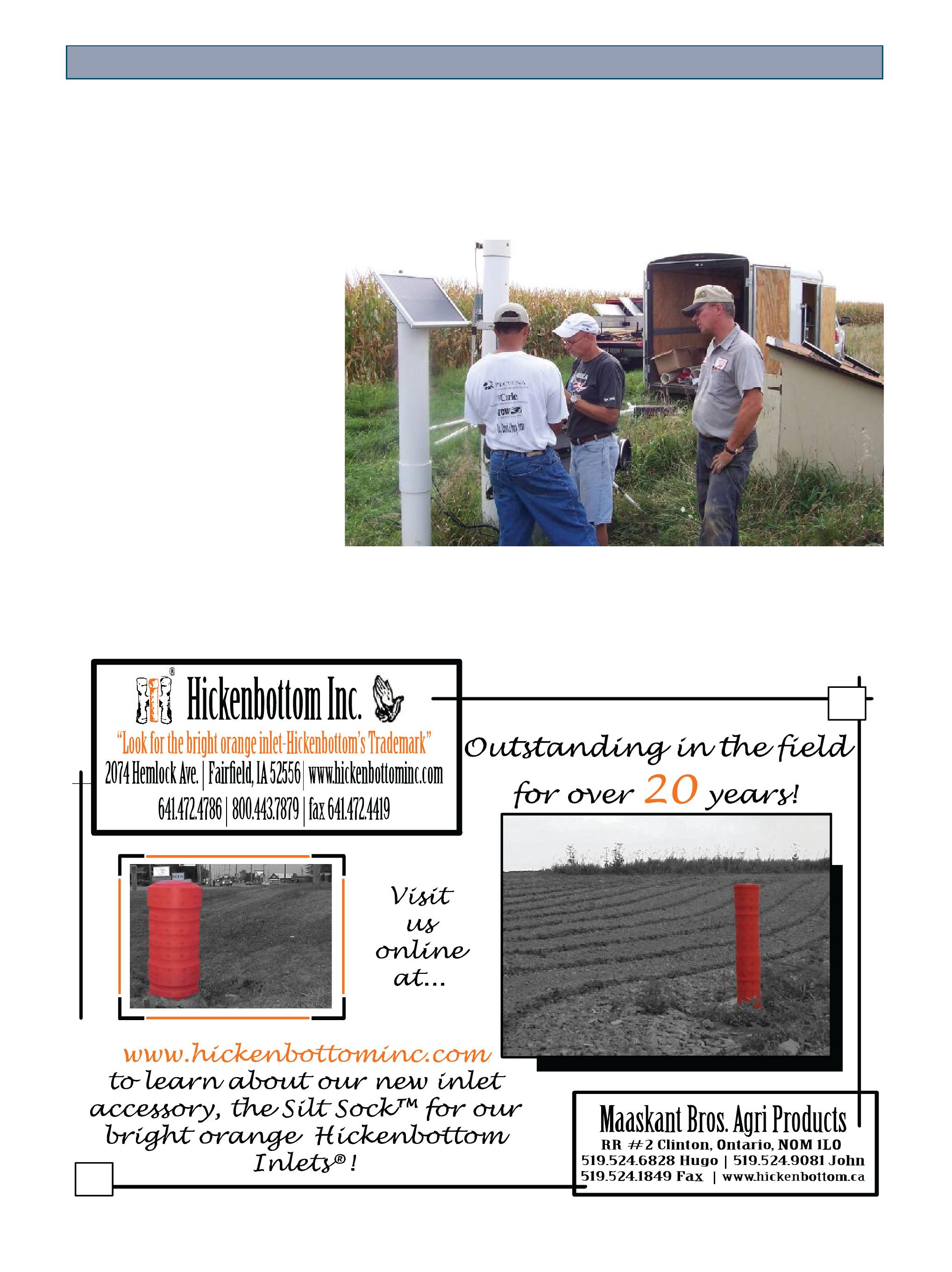
In 2007, David Lapen and Mark Sunohara began monitoring the effects of controlled-tile drainage along a set of tributaries of the South Nation River in Ontario’s Ottawa Valley. Lapen, the scientific lead, and Sunohara, the project manager for Agriculture and Agri-Food Canada’s South Nation Watershed Evaluation of Beneficial Management Practices (WEBs), were setting out to study agricultural best management practices (BMPs) and their effectiveness in improving surface water quality at watershed scales. Although quick to point out that the concept behind such research has been studied extensively in the US and Canada, Sunohara notes that few have taken such a project to a considerably larger watershed scale, or roughly 1000 acres.
Lapen and Sunohara’s work first attracted the attention of Drainage Contractor, among others, in 2007, with an
production •Low ground pressure •Robustly built plow and frame Tait_3.375x4.875 10/18/04 3:09 PM Page 1
“Made to last for years of service.”
to 7ft cutting depth
•Variable angle arc plate
•Quick change teeth (reversible)
•Tubing chutes up to 16 inch •GPS or Laser Guidance
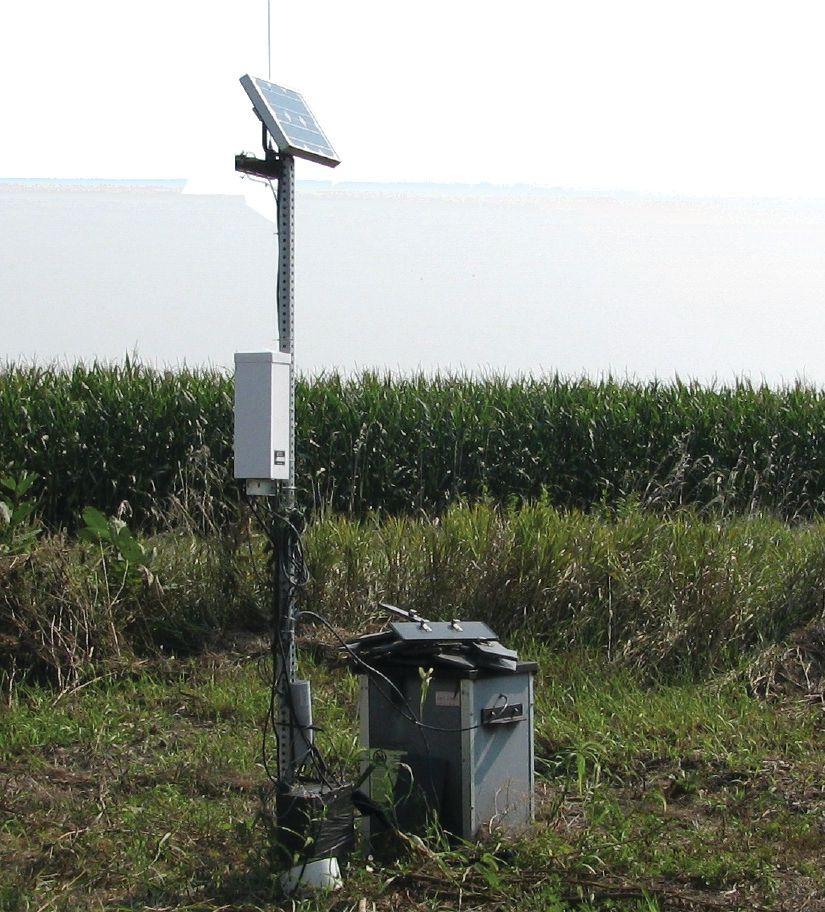
An inline water level control structure used by Mark Sunohara and David Lapen of Agriculture and Agri-Food Canada.
RESEARCH
introduction to the WEBs project. At that point, they had engaged growers along two parallel municipal drains, both within the South Nation River watershed. Originally, they were looking for land bases with similar soil-type and crosscutting land use (most were dairy farms, with crop rotations of corn, soybeans and forage). “We took one of the drains and installed control structures on all of the tile outlets where we obtained landowner co-operation,” explains Sunohara. That process of finding co-operators, and planning and installing the control structures took the better part of three years. “It took us a few years because we picked these spots based on their suitability for controlled-tile drainage; very flat, decent soils, tile drained, and we had to demonstrate to the growers the value and utility of controlled-tile drainage.”
Thus producer co-operation and practice adoption was a gradual process.
Three years later in 2010, their efforts of monitoring the watershed are beginning to show some effects. “We’ve been seeing some benefits, both environmentally and economically. Economically, we’ve seen some moderate increases in yields in crops, so the farmers are benefiting from the controlled-tile drainage that way, increasing yields with the same amount of inputs,” says Sunohara. “Environmentally speaking, we’ve seen at least 50 percent nutrient load reductions, and looking at nitrogen, the total mass load of nitrogen being exported from the field, we’ve seen reductions of at least 50 percent, compared to uncontrolled drainage.”
Sunohara also notes that the research team is finding that if controlled-tile drainage is exercised broadly in the South Nation River basin, significant net reductions in nutrients are
predicted to occur where the South Nation River empties into the Ottawa River.
going forward
In spite of the benefits of tile drainage and controlled-tile drainage, and with the gathering of data to substantiate those stated benefits at watershed scales, the job is to the contractor to convince a farmer or a landowner of the value of such an investment. That is why Sunohara is pleased to see that the kind of BMP work that they are doing is yielding some welcome validation and support from government sources. “In part, because of this project and the work we’ve been doing, controlled-tile drainage is now included in the Canada-Ontario Farm Stewardship Program (COFSP) and South Nation Conservation Clean Water Program,” says Sunohara, adding that the COFSP program provides a costshare format worth 30 percent, up to $15,000 for a control structure installation. This is a new and important addition that has come in the past two years, part of a lobbying effort of WEBs, to evaluate and promote BMPs. “What we’ve come up with is that this is a pretty decent type of BMP; it’s lowcost, flexible regarding management of water table, retrofit, easy-to-install, and on a new installation, it’s easy to design into it. The province of Ontario and the federal government have taken that and included it (in their stewardship program).”
On a more local level, the research that Sunohara has conducted and the data he has gathered thus far, have helped convince the South Nation Conservation Authority (a partner in the project) to include it in its Clean Water
RESEARCH
program, including a cost-share component to provide 50 percent up to $1000 for control structure installation. Just as important, Sunohara reports that many contractors are doing their part in spreading the message about controlled-tile drainage, acting as advocates in dealings with farmers and landowners, based in part on his research findings to date. “They’re informing the farmers or advising them on the utility of controlled-tile drainage, telling them ‘it’s only a small additional cost to the installation,’” details Sunohara. “Five years ago, adding controlled drainage and controlling the water leaving the field at a critical time wouldn’t be something on their minds.”
And further into the future
The next phase for Sunohara includes continued monitoring and an expansion of the data that can or could be retrieved from this project. “Because it’s on such a large watershed scale, and because of weather variability, we can’t really come up with concrete answers in a short amount of time. So long-term monitoring and benchmarking are the keys to be able to provide definitive answers” says Sunohara, adding that the effects of this practice at watershed scales will differ from those at plot scales. “We are also looking at bacteria and other agricultural drainage constituents, so we’ve been working with dairy farmers in our watershed, where they apply manure in spring and fall, comparing controlled and uncontrolled field situations.”
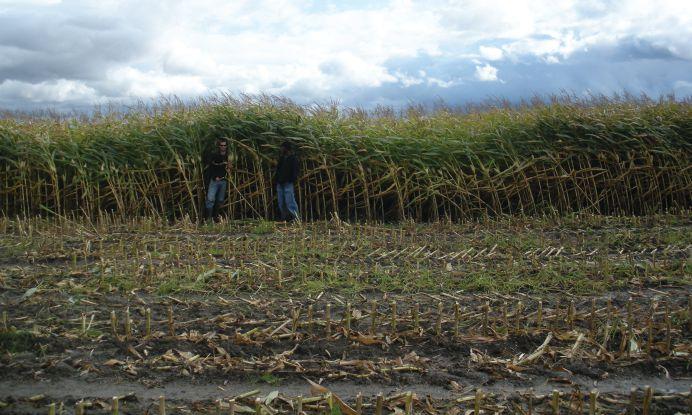
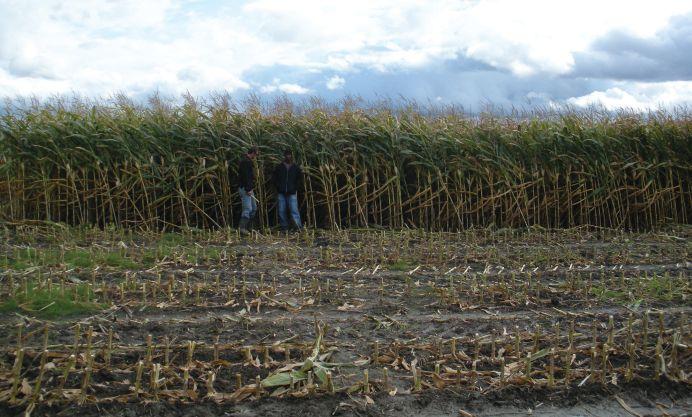
Top: Non-uniform height in a corn field with conventional tile drainage indicates less efficient control of moisture.
RESEARCH
Another interesting expansion of this research that Lapen and Sunohara would like to see, is moving this work to regions where topography has a greater influence on installing tile and controlled-tile drainage. Sunohara concedes that their work has been done on relatively flat land, where controlledtile drainage will work effectively on the whole field. “On a sloping field, you’d have to install tiers of control structures in your drainage system to manage the whole field effectively. So let’s evaluate controlled-tile drainage on less appropriate areas, or areas that need a bit more of a design factor involved,” explains Sunohara. “I know that Agri Drain (manufacturers of control structures) have been working on this tiered system and it’s totally subterranean, so that farmers don’t
have to worry about control structures in the middle of their field. We hope to explore these systems in the context of the WEBs project.”
Most of all, Sunohara wants contractors to understand that their project is continuing, that more data is being farmed from the yields, and the testing parameters (namely, the export of nutrient resources from the fields) are being expanded to bring greater value from controlled-tile drainage. ■
Software accompanies Ontario’s agricultural erosion control course DRAINAGE THEORY
by kevin Mckague*
Recognizing the risks of erosion in one-sixth of farms in ontario.
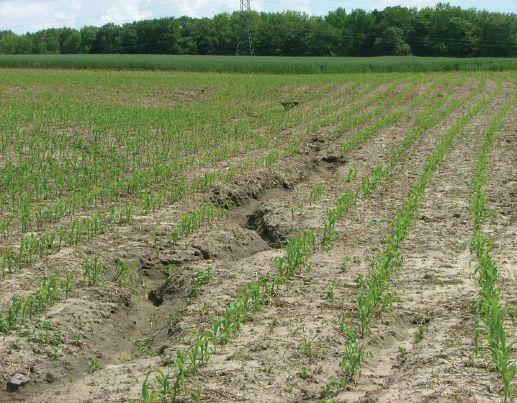
Agriculture and Agri-Food Canada (AAFC) has estimated that 16 percent of the cultivated land in Ontario is at high to severe risk of inherent (bare soil) water erosion. As a result, landowners, especially those intensively cropping their land, need to manage it in a way that can reduce this risk of valuable soil loss. Producers rely heavily on agronomic forms of erosion control such as extending crop rotations to include perennial crops and using cover crops, conservation tillage, residue management and cross-slope cultivation to keep soil loss in check. Despite using one or more of these practices, there are often areas of the field, particularly where water concentrates and flows downslope, that need extra attention. Otherwise large rills and even gullies can form (see photo below). Agricultural erosion control structures such as grassed waterways and diversions, grade control structures, and water and sediment control basins (WASCoBs), are often the best solution in these situations.
nte@hickorytech.net www.northlandtrenching.com
DRAINAGE THEORY
Ontario Ministry of Agriculture, Food and Rural Affairs (OMAFRA) has offered contractor training in the design of the more common agricultural erosion control practices since 1987. Designs developed using the techniques taught in the course are recognized as meeting the minimum design standards needed to qualify an erosion control project for cost share funds through Ontario’s Environmental Farm Plan (EFP) program. The latest edition of the Agricultural Erosion Control Structures Design Manual (Publication 832) can be ordered online.
During the winter of 2010-2011, OMAFRA is offering an updated five-day training course that gives participants familiarity with the information provided in Publication 832. Previous courses covering the manual typically lasted up to two weeks. This course, however, will focus primarily on design aspects of the erosion control structures covered. Background materials will also be provided for participants to review prior to attending the course. An exam will be offered to those wishing to receive accreditation as an erosion control contractor.
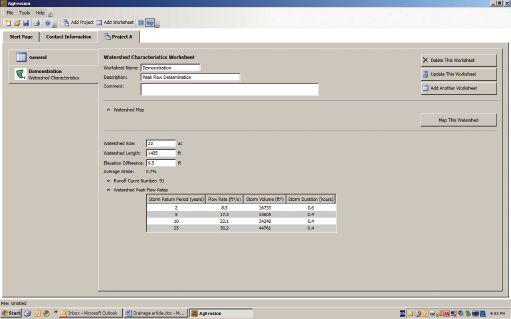
An additional benefit to completing the course will be the opportunity to become familiar with the new AgErosion software that has been developed to simplify the design calculation steps described in Publication 832. Like the course, the software guides the user through the steps needed to complete design calculations for the following:
• Determination of peak flows from small agricultural/ rural watersheds;
• Grassed waterways;
• Rock chutes and spillways;
• Drop pipe inlets;
• Grade control structures, and
• WASCoBs.
The software is currently in “beta testing” stage. The first version’s release is anticipated to correspond with the next course offering (early in 2011). Those attending the course will get an opportunity to become familiar with the software. Those successfully completing the course will be given a copy for their use. Professional engineers, familiar with erosion control design, will be able to obtain a copy of the software when it becomes available, without completing the course, upon their request.
The AgErosion allows the user to organize and design a variety of erosion control projects for their clients. After
entering a client’s address and the project location, the user will typically proceed to the “watershed characteristics” screen. Here, watershed area, watershed length and grade as well as the watershed information needed to determine a runoff curve number is entered to quickly generate a table of peak flows, storm durations and runoff volumes (see Figure 1). Information in this table can then be used to help in the design of a variety of structural measures at the point of concern in the field. The option exists to complete the work in either imperial or SI (metric) units.
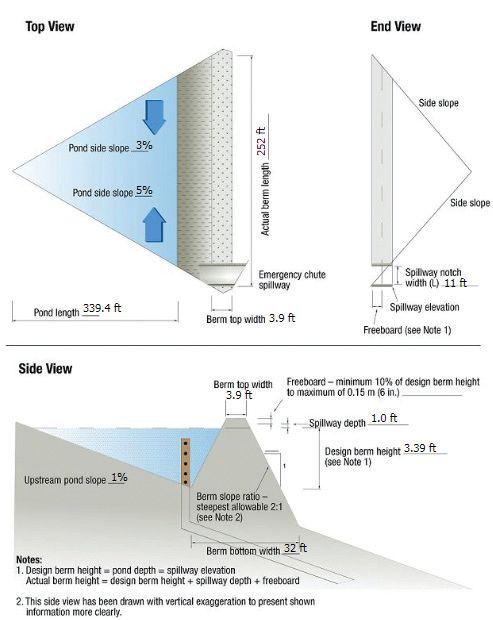
The output will mimic the design information sheets that are provided in Publication 832. This can help make the preparation of design information needed to support a costshare application quicker. Generic sketches of the planned project can also be printed with the design information sheets. Figure 2 shows a sample sketch prepared for a proposed single WASCoB project.
for more information
If you require more information on the erosion control course, Publication 832, or its associated software, contact OMAFRA’s agricultural contact centre. They will be able to answer any questions you may have or place you in touch with other specialists within Ontario’s Ministry of Agriculture, Food and Rural Affairs. ■
*Kevin McKague is a water quality engineer with the Ontario Ministry of Agriculture, Food and Rural Affairs.
Figure 1. Screen capture of the watershed characteristics screen in AgErosion.
Figure 2. Generic sketch showing critical layout dimensions for a proposed single WASCoB project.
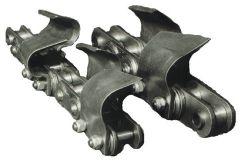
• New tungsten carbide hard surfacing for extra long wear in all soil types. All cutter sizes available.
• New shape for efficient clean out in a wide range of soil conditions.