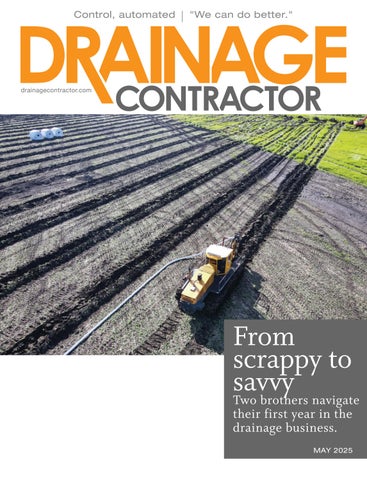
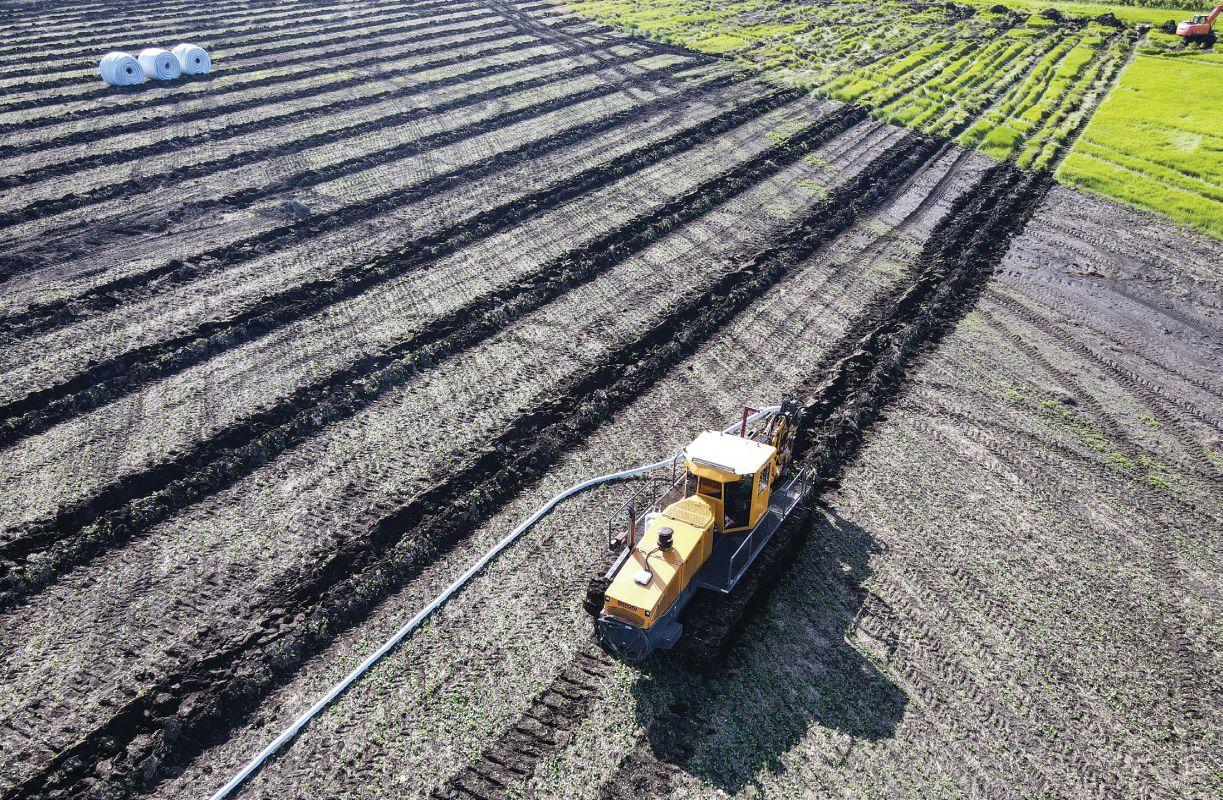
We’re not just planning for our future; we’re actively crafting it with our ingenuity, dedication and relentless spirit. Let us show you how our investments in tomorrow are not promises of what might be, but tangible realities being shaped today.
Audience Development Manager | Anita Madden amadden@annexbusinessmedia.com 416-510-5183
Media Designer | Brooke Shaw bshaw@annexbusinessmedia.com
Group Publisher | Michelle Bertholet mbertholet@annexbusinessmedia.com
CEO | Scott Jamieson sjamieson@annexbusinessmedia.com
Printed in Canada ISSN 1488-4305
Publications Mail Agreement #40065710
Subscription rates:
Canada – 1 yr $17.85 CDN
Canada – 2 yrs $25.50 CDN
USA – 1 yr $35.19 CDN
Foreign – 1 yr $47.43 CDN
From time to time, we at Drainage Contractor make our subscription list available to reputable companies and organizations whose products and services we believe may be of interest to you. If you do not want your name to be made available, contact our circulation department in any of the four ways listed above.
A preview of results for our Drainage Challenges and Opportunities survey.
14 DRAINAGE MANAGEMENT SYSTEMS
Automation in controlled drainage.
18 CONTRACTOR AT WORK
Two brothers reflect on their first year in business. 22
ENVIRONMENT
Bringing parties together on water policy in Saskatchewan.
Looking
at the 2025 North American Drainage Conference.
'And we don’t care about the young folks'
by Bree Rody
Peter, Björn and John might claim no one cares about the young folks, but Gen Z contractors are making waves.
Recently, I realized I was no longer the “young one” at my job. It was as if I blinked, and suddenly I’d been in the industry for 13 years. Before I knew it, I had colleagues a full decade younger than me asking me for advice. I also had a sore back.
Age comes up a lot when you talk about the drainage industry. Installing tile is a highly physical job – one might think a younger, brighteyed worker is the ideal candidate for such a job. And yet, one theme that has come up time and time again in our features and news items is that many businesses struggle to add and, more importantly, retain young talent. That also came up in our recent Drainage Challenges and Opportunities survey (Page 10).
There's opportunity for drainage companies to appeal to Gen Z by highlighting sustainability.
I’m not one to stereotype younger generations – so I won’t. One common complaint from those in the biz has been that younger workers aren’t interested in long hours or highly physical labor. A study from Deloitte published in 2024 found there was far more nuance. Job seekers in Gen Z (defined generally as being born between 1997 and 2012) gravitate toward jobs that reflect their own values and prioritize social activism. One can argue there are many broader social benefits to agricultural drainage, but those unfamiliar with the industry might not see it that way so easily. Plus, the 2008 Great Recession is a distant enough memory for Gen Z (whereas it was the fire under the seats of most Millennials on our first-ever adult job hunt) that financial security is no longer their primary or sole motivator when considering their career options. The top
industries this generation looks to break into are technology, education and healthcare.
There is, however, opportunity with Gen Z. According to the Deloitte survey, Gen Z tends to prefer career development paths that are rife with entrepreneurial opportunity – and that’s drainage to a T. Check out the survey highlights on to learn how some drainage biz veterans are preparing the next generation for leadership. Drainage companies can also appeal to Gen Z by highlighting their commitments to sustainability – drainage, when done properly, is an important practice for creating an efficient agricultural landscape, and advances in drainage are helping keep excess nutrients out of waterways. That's the great thing about innovation in drainage – it's not just new for newness' sake; there's sustainability at the core – check out our feature on automation in machinery for controlled drainage systems (Page 14) for an example.
In the meantime, we’ve changed things up a bit with our Contractor at Work profile. Normally, we profile someone who’s been in the business for a few decades, or a multi-generation drainage business. This issue, we decided to highlight two young contractors at the beginning of their journey – brothers Hudson and Taylor Mealy, who just marked one year in the biz (Page 18).
With the busy season about to kick off, we hope you have a smooth season. Who knows? Maybe some of the summer help you take on will be interested in making a more permanent move into the drainage industry.
OHIO WATER QUALITY PROJECTS FUNDED
The Muskingum Watershed Conservancy District (MWCD) of Eastern Ohio has awarded $1.3M in new grants to 11 projects supporting flood mitigation and water quality improvement/ conservation, including in drainage.
The grants are part of MWDC’s Partners in Watershed Management (PWM) grants, which were established in 2009. This marks the 15th anniversary of the genesis of the program. Investments have totalled more than $10M over the years. Since the beginning of the program, tile drainage projects have been on the receiving end of grants; the program’s second-ever grant supported water testing in farm tile drainage, leading some farmers to reduce fertilizer
“without impacting yield,” according to MSWCD district administrator Lisa Crock.
Although there are no tile-specific grants this year, grants that apply to more general water management issues include $33,000 to expand water nutrient monitoring to canals and inlets in Licking and $150,000 for floodplain control enhancement in McConnelsville.
Non-drainage and water management grants include wetland preservation projects to protect wildlife, architectural and infrastructure improvements; sewage treatment system projects; invasive plant removal and management and more.
OFA SAYS RAILWAYS ARE DOWNLOADING DRAINAGE COSTS TO LANDOWNERS
With the upcoming Canadian federal election underway and voting to take place next month, the Ontario Federation of Agriculture (OFA) has released outlined priorities it believes should be addressed at a federal level.
With agriculture being a shared file between provincial and federal governments, whoever is voted prime minister on April 28 will have to work closely with the recently re-elected Doug Ford and his majority Progressive Conservative government. Ford currently boasts a publicly positive relationship with new/incumbent prime minister Mark Carney, although the rapidly changing political landscape means the outcome of the election is far from guaranteed. Whether Carney’s Liberals or Pierre Poilievre’s
Conservatives form government, they will have to work with agricultural ministries across various provinces, all of which are currently facing unique challenges.
Among the OFA’s top priorities are, naturally, trade issues and bolstering support for the agri-food sector, a sentiment shared by many other provinces. “Amid ongoing tariff uncertainty, the Ontario Federation of Agriculture is urging federal election candidates to take clear and decisive stances on critical issues affecting farm businesses, economic competitiveness and food security,” the association’s news release red.
“Protecting our domestic food supply and ensuring the sustainability and prosperity of our farming businesses has to be a priority for the federal government,” says Drew
Spoelstra, president of the OFA, in a statement. “This is a pivotal time for Canada and for our sector and it’s important for candidates of all parties, whether rural or urban, to be aware of the strategic importance of food and farming to our economy, our communities and our country.”
Specific asks also include a permanent increase to the interestfree portion of the Advanced Payments Program to $350,000 per year, and improvements to the AgriStability program that will make it easier for farmers to access support; they are also requesting a permanent scrapping of the carbon tax and to ensure consistent access to labor across planting, production, quality control, processing, distribution and research.
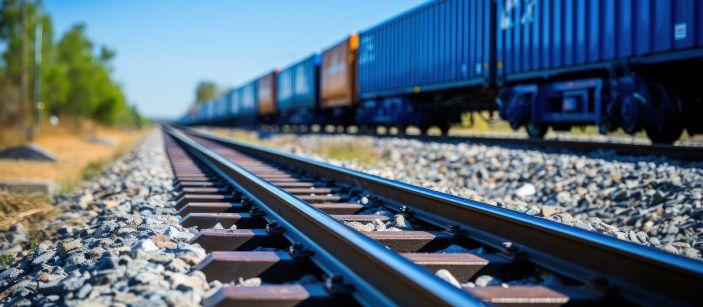
Another issue addressed numerous times in recent months by the OFA is the downloading of infrastructure and drainage costs onto landowners from railways.
Federally regulated rail companies are, according to the OFA, downloading infrastructure maintenance and safety upgrade costs onto farmers and landowners in the areas of drainage and private rail crossings. “The federal government must prevent railways from downloading these costprohibitive expenses onto farmers and landowners,” the OFA wrote.
MORE INTENSIVE ROTATIONS REDUCE RUNOFF: STUDY
A nine-year study comparing a typical two-year corn and soybean rotation with more intensive threeyear rotation involving corn, cereal rye, soybean and winter wheat found that the three-year system can dramatically reduce nitrogen runoff, without compromising yield.
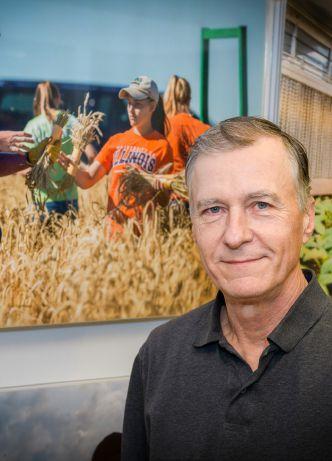
The Illinois-based study (lead researcher Lowell Gentry pictured above) was designed to see if a more diverse rotation would reduce tile nitrate loss and still be competitive with a conventional corn/soybean system. Nitrate loss was monitored from tile-drained fields on a working farm from 2015 to 2023.
A key difference between the rotational systems was the amount of tillage. The control fields were fully tilled in the fall and spring, but the researchers strip-tilled only a narrow swath of the cornfield in the three-year rotation, minimizing the area tilled to one-third of the total field every third year.
The researchers saw a 50 percent reduction in tile nitrate losses in the three-year rotation when compared with the normal rotation. This was accomplished without compromising yields, the team found.
MARYLAND APPROVES CLEAN WATER PROJECTS, INCLUDING DRAINAGE
The Maryland Department of Environment (MDE) has selected 15 projects, including a drainage water management project, that will receive a total of $47M in Clean Water Commerce Act funding for demonstrating pollution reductions that, in its words, “will improve health, tourism and economic success of the Chesapeake Bay.”
The grants are part of the state’s “pay-for-success” model to incentivize farmers and landowners to reduce land and water pollution – projects are funded following the demonstration of guaranteed results, rather than receiving upfront funding. Projects include shoreline restoration, aquaculture, fertilizer applications, best practices and other techniques, and were selected based on rankings that consider the price per pound of nitrogen reductions as verified by Chesapeake Bay Program modelling.
Some of the farms and projects that received funding utilized practices like precision agriculture to result in less nitrogen being applied to land; others utilized edge-of-field practices such as forest buffers. One project that received funding was the Eastern Neck Drainage Water Management, which manages 59 acres of rainwater in the Chester River watershed. The project was confirmed to reduce 482 lbs/year of nitrogen.
The projects will, according to Maryland Department of Agriculture secretary Kevin Atticks, “help mitigate nutrient losses from in-field tile drainage systems.”
Funding sources include Maryland’s Bay Restoration Fund, administered by the Maryland Department of the Environment; the Maryland Agricultural Water Quality Cost-Share Program, administered by the Maryland Department of Agriculture (MDA); and the U.S. Department of Agriculture’s Regional Conservation Partnership Program, through an award to the Environmental Policy Innovation Center (EPIC).
SEEVERS NAMED ILLINOIS LICA PRESIDENT
Cisco-based drainage contractor Jon Seevers has been elected as the 43rd president of the Illinois Land Improvement Contractors Association (ILICA) at the organization’s recent 2025 Annual Meeting.
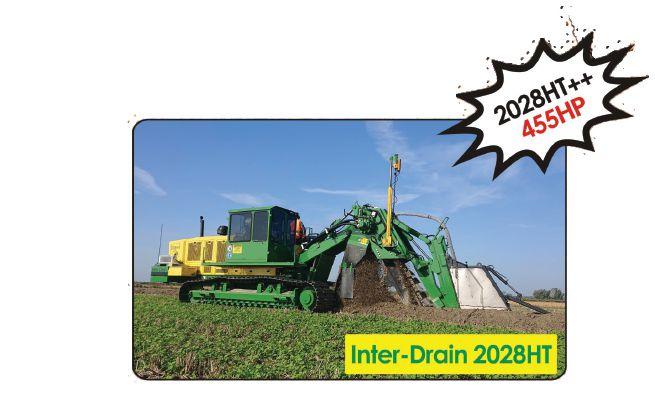
Seevers, a second-generation contractor, replaces president Eric Layden. His family business, Seevers Farm Drainage, Inc. (SFDI), was started in 1975 by his father, Stan Seevers, a Life Member of ILICA who also served two terms as the chapter’s president, once in 1986 and again in 1998. Jon Seevers joined the business at a young age, when tile was still commonly made from clay or concrete. SFDI currently installs tile with a 450 hp diesel machine, which incorporates GPS grade control.
“I’ve not only seen but have personally experienced some of the greatest advancements within our industry,” Seevers said in a statement, reflecting on his decades of drainage experience. He also has decades of ILICA experience, having been a member for 40 years. He’s served on six committees including executive, education and convention.
He has stated his goals for his term include leading contractor members to greater profitability and safety through encouraging utilization of ILICA and LICA’s safety training and business benefits.
In Seevers’ spare time, he serves as a volunteer firefighter and is also active in volunteering with Habitat for Humanity and blood donation.
BUSINESS MATTERS
CHALLENGES AND OPPORTUNITIES
Is the drainage industry bracing for complicated times?
It’s common to hear about all the positive directions in which the industry is heading. And yes, there are many positives. But just because an industry is booming doesn’t mean everything is painless. In fact, rapid growth is oftentimes the biggest source of pressure – hence the term “growing pains.”
For example, businesses are still struggling to attract and maintain a strong team of dependable talent. Others have expressed frustration when it comes to jurisdictional conflicts and/or red tape. And, with looming economic troubles, it’s a stark reminder that the drainage industry’s growth and health is directly tied to that of the agricultural industry.
In January of 2025, Drainage Contractor launched its 2025 Drainage Challenges and Opportunities survey to better understand the people who work in our industry. Of the just under 50 individuals who completed the survey, most identified as drainage contractors; some also identified as designers, engineers, suppliers, etc. We then shared the results and data with industry commentators who provided their own unique POVs and additional insights.
For a full version of the survey results including full data tables and extended interviews, scan the QR code at the bottom of the page.
Editor’s note:Regarding some of the survey questions regarded to economic outlook, readers should note that the survey was live from mid-January until mid-March. Some of the answers about the future, particularly concerning economics and supply availability, may have been given in circumstances that were different from those at the end of the survey period, as much has changed in the last two months regarding tariffs, counter-tariffs, the strength of the U.S. dollar and the overall economy.
AN INDUSTRY OF MULTIHYPHENATES
Most of the respondents of the survey were based in the U.S. Midwest, with Eastern Canada (Ontario to Atlantic) coming in a distant second. This tracks with years of data that shows subsurface drainage is most prominent in the U.S.
by BREE RODY
cornbelt. Nearly 41 percent of respondents reported working for a business of more than three decades. Only 12.5 per cent of respondents’ businesses have been around for five years or fewer. Peter Darbishire, Drainage Contractor’s founding editor and original owner observed that the amount of well-established businesses indicated that many of these businesses “likely [span] more than one generation.”
Speaking of more than one, most respondents also have more than one gig.
This isn’t necessarily a surprise – drainage is a highly seasonal job, and very physically demanding. Only 28.13 percent of respondents said drainage was their sole job, although most said drainage still represents most of their time and/or income.
More surprising, however, is many of those with jobs outside of drainage reported not working in ag – nearly 60 percent. Of the 40.72 percent who did work in ag on top of drainage, primary production/farm ownership was the most common job.
For Steve Gerten, owner of the Ohio-based Inbody Drainage and a contractor for more than 50 years, a farming background has been one of his greatest assets. “We’re still farming,” says Gerten. “I can directly relate to a customer when it comes to drainage issues. We can explain things to farmers and make recommendations on whether we should even be out there doing the work, or wait ‘til the ground conditions change.”
Just under 16 percent of survey respondents did not identify as contractors. Of those who did not identify as contractors, most identified as consultants, designers and/or engineers, although some identified as agronomists and/or farmers.
Vinayak Shedekar, assistant professor of agricultural water management at the Ohio State University, says this could be a demographic to look out for. In facilitating the Overholt Drainage School, Shedekar has met a growing number of
installers who aren’t contractors. “There’s an uptick in farmers and people wanting to install their own drain tile, who are not a typical or conventional contractor,” Shedekar explains. Particularly in the United States, which has fewer regulations around tile installations compared to Canada, says Shedekar, it’s sometimes easier to take a DIY approach rather than hiring a contractor, especially given cheaper access to equipment such as self-propelled drainage plows.
Additionally, 31.3 percent of respondents identified as contractors, but not business owners. Of that cohort, less than one-third said drainage is their sole full-time job, although the majority said drainage takes up most of their time and effort.
Non-owner contractors with other jobs were more likely to have another job outside of ag, or in heavy equipment operation, than in other facets of agriculture like primary production or agri-contracting. By contrast, just over 53 percent of respondents identified as both contractors and owners. Perhaps surprisingly, the contractor-owner cohort was just as likely – or rather, unlikely – as the non-owner cohort to report that drainage as their sole job. Heavy equipment operation is also a popular side gig among contracting business owners, although this group is more likely to work in primary production or other facets of agriculture such as agricontracting or business development than those who don’t own their own business.
Darbishire pondered if there may be a correlation between time spent in the business and the likelihood of having another job. Indeed, respondents who have been in business more than 10 years were three times more likely than those with less than a decade’s experience to report that drainage was their sole job.
JOB CONDITIONS (PHYSICAL AND OTHERWISE)
Drainage is physically demanding and requires a good degree of focus, and contractors are expected to constantly learn new things. Gerten says this naturally doesn’t attract many young would-be contractors to the business. “Anything that’s more physical labor, in today’s society, people don’t really want to do.” His own business consists mostly of family, but says adding a few more employees would still help, especially as he begins looking to the future himself.
Talent certainly appears to be at a premium. Respondents were asked what one change would make the biggest difference in their operation: a new large piece of equipment (such as a plow or trencher); instant access to tile whenever they needed it; a large pool of able-bodied talent to choose from; a cutting down of bureaucracy and red tape; or free continuing education opportunities. The most popular answer, with more than 40 percent support, was access to the talent pool. This matches with more than two-thirds of respondents who said they are understaffed for their current workload. Additionally, more than 60 percent of respondents saying jobs are more complex and challenging than they were five years ago, and 37.5 percent saying they’re doing more work on pre-existing systems.
Shedekar says this may coincide with the rise of noncontractor installers. “Farmers are more interested in installing laterals,” he explains. “They call in a contractor to install a main. It’s kind of a win-win, because contractors are not out
Large-scale excavations and the establishment of mains still tends to require a seasoned contractor, but some farmers have become adept at installing laterals.
there digging holes – they’re in and out in a shorter amount of time.”
For competition, most respondents note a “moderate” amount of competition in their area, but few say there’s been a significant increase in competition in recent years. Gerten notes that the nature of the industry – an extremely friendly and community-oriented one, he says – means contractors tend to perceive competition differently than people in other industries.
“I don’t look at these guys as my competitors,” says Gerten. “I look at them as my best friends.” Learning from and bonding
ABOVE LEFT: Steve Gerten says insurance savings on equipment are one advantage to being an association member.
ABOVE RIGHT: Most in the contracting business say they plan to pass the business down to a younger family member or employee.
with other contractors, especially through organizations like the Land Improvement Contractors of America (LICA), has been one of the keys to Gerten’s success, he says.
In terms of setting oneself apart from competition, the biggest thing contractors prioritize is their equipment, with 65.38 percent stating this is how they differentiate themselves. More than half also say they set themselves apart by specializing in complex and niche systems, and increased knowledge of hydrology, soil health and other earth/ water sciences. Gerten says in-housing services like design and engineering has made a difference, but so has plain-old customer service, such as diligent recordkeeping – handy, since 90 percent of Inbody’s work is with repeat customers, he says.
BEYOND THE BUSINESS
Gerten and Darbishire, both having been involved in various industry organizations throughout the years, understand that drainage often feels more like a community than an industry.
Similarly, Shedekar has his own perspective on this as someone who facilitates a drainage education initiative, where he says just as many lessons are learned in one-on-one conversations outside the classroom – or in the pub after a lesson – as they are within it.
However, only 53.13 percent of respondents said they were currently members of a trade association. Some non-members said they were considering joining one, but about a quarter said they had no plans on doing so. The reasons varied, but cost/dues were a larger concern among contractors who were newer to the business. Those who were members stated access to industry information as the biggest advantage to membership, although some of the responses varied depending on time spent in the industry.
More experienced respondents were more likely to site associated reputation benefits as a major reason for being a member, whereas respondents who were newer to the business were less likely to care about the social aspects. Gerten says besides the camaraderie, insurance savings have been the biggest advantage; Shedekar has also seen examples of creativity through LICA’s Ohio chapter, which partnered with the Overholt Drainage School to offer a registration rebate for attendees of the school who decided subsequently to join LICA.
When it comes to looking to the future, 37.5 percent of respondents have a succession plan (Gerten is among them). Of the 62.5 percent who don’t have one, many say they have “a general idea” of how things will go, but many say they
have no plan whatsoever.
For Gerten, actively gifting shares of stock in the company to eager employees has been the starting point. That might not be the path for everyone, he says, but “my recommendation as far as anybody goes would be to look at that possibility – if they have an employee who wants to take over the business, the present owner aught to consider helping that employee.”
With the North American and global economic outlook unclear in its current state, there might be other matters business owners should be concerned with. Imported machinery would be impacted by tariffs, and agricultural markets are highly dependent on free trade agreements. Gerten says it’s a mistake to think you’re immune.
“I don’t care if you’re a young contractor or one that’s been in the business a while,” he says. “With all that’s stemmed here within the last six weeks, that is definitely an issue. The costs to get a piece of equipment that’s made outside of the U.S., it’s going to get more expensive.” DC
There’s plenty more information where this came from. Our 2025 reader survey e-book contains the full results, data extrapolations, infographics, longer interviews and more. Scan the QR code to access this free resource!
Images: Inbody Drainage
SPECIAL INDUSTRY REPORT
CHALLENGES AND OPPORTUNITIES IN THE DRAINAGE AND LAND IMPROVEMENT MARKET
DRAINAGE MANAGEMENT SYSTEMS
CONTROL, AUTOMATED
Investigating the benefits of automated controlled drainage
Controlled drainage offers multiple benefits to farmers including the ability to control the flow of water and trap nutrients in their fields, yet adoption rates in North America continue to lag. A new pilot project being conducted by researchers at The Ohio State University is looking to change that.
by JIM TIMLICK
The ongoing project is being sponsored by multiple sources including the Ohio Water Development Authority and the AgTech Innovation Hub, a joint collaboration between OSU’s College Food, Agricultural and Environmental Services, Nationwide farm insurance and the Ohio Farm Bureau.
The focus of the project is to study new, automated controlled drainage technology and how it could aid in addressing late-summer water deficiencies and reduce the loss of nutrients from the soil.
As part of the project, Vinayak Shedekar,
an assistant professor of agricultural water management at OSU, and three of his colleagues have installed automated controlled drainage systems at four paired field sites across the state. Each field site has both automated and manually controlled drainage systems installed side-by-side with the results being used as part of a comparison. The same farming practices are being used in each field. The study, which was launched two years ago, will look at a number of different variables including water table fluctuations, soil moisture fluctuations, subsurface drainage, water quality, crop
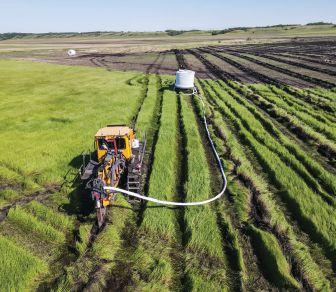
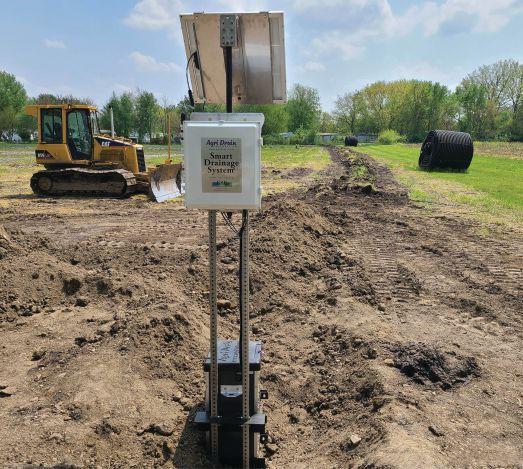
RIGHT: In automated controlled drainage systems, solarpowered controllers open or close the system based on realtime water level data.
Image: Vinayak Shedekar
respiration, and crop yield response.
A second phase of the project, which is being funded through the Great Lakes Restoration Initiative and the Ohio Environmental Protection Agency (EPA), is scheduled to begin later this spring. As part of it, 10 automated controlled drainage structures were installed last fall along the banks of a creek in Defiance County, OH. The purpose is to study the small watershed scale impact automated controlled drainage systems can have on tile drainage discharge into the creek and how it could potentially impact nitrogen and phosphorus losses in the water.
Shedekar says his hope is the study will provide evidence that will convince growers that controlled drainage is effective and doesn’t have to as burdensome a task as they may think.
Data from the Ohio Department of Agriculture and the U.S. National Resources Conservation Service (NRCS) indicates that of the three to four million acres of farmland located in Ohio, only 30,000 to 50,000 of those acres has some form of controlled drainage.
Shedekar says one of the main reasons
why many farmers are reluctant to use controlled drainage is that manually controlled systems can be demanding on their time in spring and opening and closing them can be cumbersome and labor intensive.
Because drainage structures are installed between four and six feet deep in the soil, the pressure from the soil makes it difficult to remove or reinstall the boards that regulate the flow of water. As well, they are often located next to a ditch which makes them difficult to reach in the spring when that ditch is full of water. Imagine having to do this at 15 or 20 locations and it’s easy to understand why some farmers aren’t interested in adopting controlled drainage practices.
Automating the controls on drainage systems would make them far less onerous to operate and could help drive up adoption rates up, says Shedekar.
“I really feel like bringing some automation to the whole process is the future for this practice,” he explains. “Everything you can imagine on the farm has been automated in the last 20 to 50 years, except drainage outlets. Our
drainage outlets look exactly the same as they used to 100 years ago. Automation is like the new kid on the block […] and I think it holds a lot of promise.”
The beauty with automated controls on drainage systems is that they can be opened or closed with the simple click of a button. That allows the operator to release water during heavy rains but also retain it for when crops need it during the dog days of summer in July and August.
Automated drainage systems use sensors, solar-powered controllers and web-based software to monitor water levels and adjust built-in valves remotely through a computer or mobile device. The valves open or close based on real-time water level data, which helps ensure the water table in a field remains optimal throughout the growing season.
Shedekar says it will likely require collecting two or three more growing seasons worth of data before he and his colleagues can provide definitive analysis of the automated drainage technology being used in their study, but preliminary results from the OSU study have been interesting nevertheless. Comparisons
using both manual and automated controls indicated that there was “a little more moisture retention” in the zone that had automated controlled drainage.
Shedekar says this will allow growers to be both reactive and proactive when it comes to controlling the water table in a field. Automated controls can allow farmers to retain as little as 1 to 1.5 inches of water, which can sustain crops for up to 10 additional days during drought periods and benefit crops, especially during their important reproductive stage.
“With the automated structure, you have the ability to look at the future forecast and make adjustments so that you can get a little more aggressive with it because you don’t have to go out and pull the boards out,” he says. “You can remotely control a valve at the bottom of that structure to release water whenever it gets too wet during the growing season. You don’t have that luxury when you’re trying to do it for manual structures.”
The first two years of data from the study also showed a corresponding crop response in the fields with automated controls. Photosynthetic activity was greater in these zones. Shedekar says that was likely the result of more moisture being available to plants when needed.
The OSU researchers are still analyzing data on yield impacts, and Shedekar says more time is needed to “crunch some numbers” before any kind of conclusions can be reached.
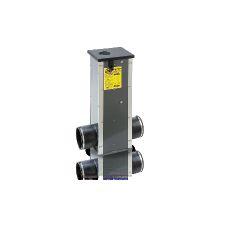
While a form of automated controlled drainage has been around in countries like the Netherlands since the 1980s, it’s still a relatively new concept here in North America. One of the commercially available systems in Canada and the U.S. is manufactured by Agri-Drain. It provides remote access to the system’s control structure via computer or mobile device. It also lets users see what the water level is in the structure in real-time.
But the technology doesn’t come cheap. A manual drainage control system costs between $3,000 and $8,000 including installation; an automated system can cost up to $15,000 including setup. “It’s a very high cost for a farmer to justify unless that one single outlet controls 25 or more acres. If it’s controlling 10 or 15 acres that’s a $1,000 per acre which is very high,” says Shedekar.
LEFT: Agri-Drain makes one of a few commercially available controlled drainage systems in North America.
The good news for U.S. growers is that agencies like the NRCS offer rebates of up to 75 percent of the cost of purchasing and installing an automated system. Shedekar also points out that manufacturers are working on providing more affordable alternatives. Some now offer cheaper versions that can be programmed through an on-site control unit or via a phone app.
As useful as automated controlled drainage can be, the technology does have its limits. It doesn’t currently provide any kind of recommended prescription for water table management, meaning most users must endure some trial and error to start.
“Right now, that seems to be a big obstacle for farmers. If I zoom in on my field, I don’t have a prescription for my field as to when to set these boards, at what depth should I set my points, and when is it time for me to open the valve,” notes Shedekar.
“One of the things that is expected to be an outcome from our research … [is] we’re hoping to develop a decision tool that farmers can utilize to at least get some kind of a recommendation on how to manage these structures. Right now, they have to rely on experts or sales people from the country to give them prescriptions for how to manage them.” He would also like to see future iterations be more user-friendly. He says it took him nearly a year to learn how to operate one system.
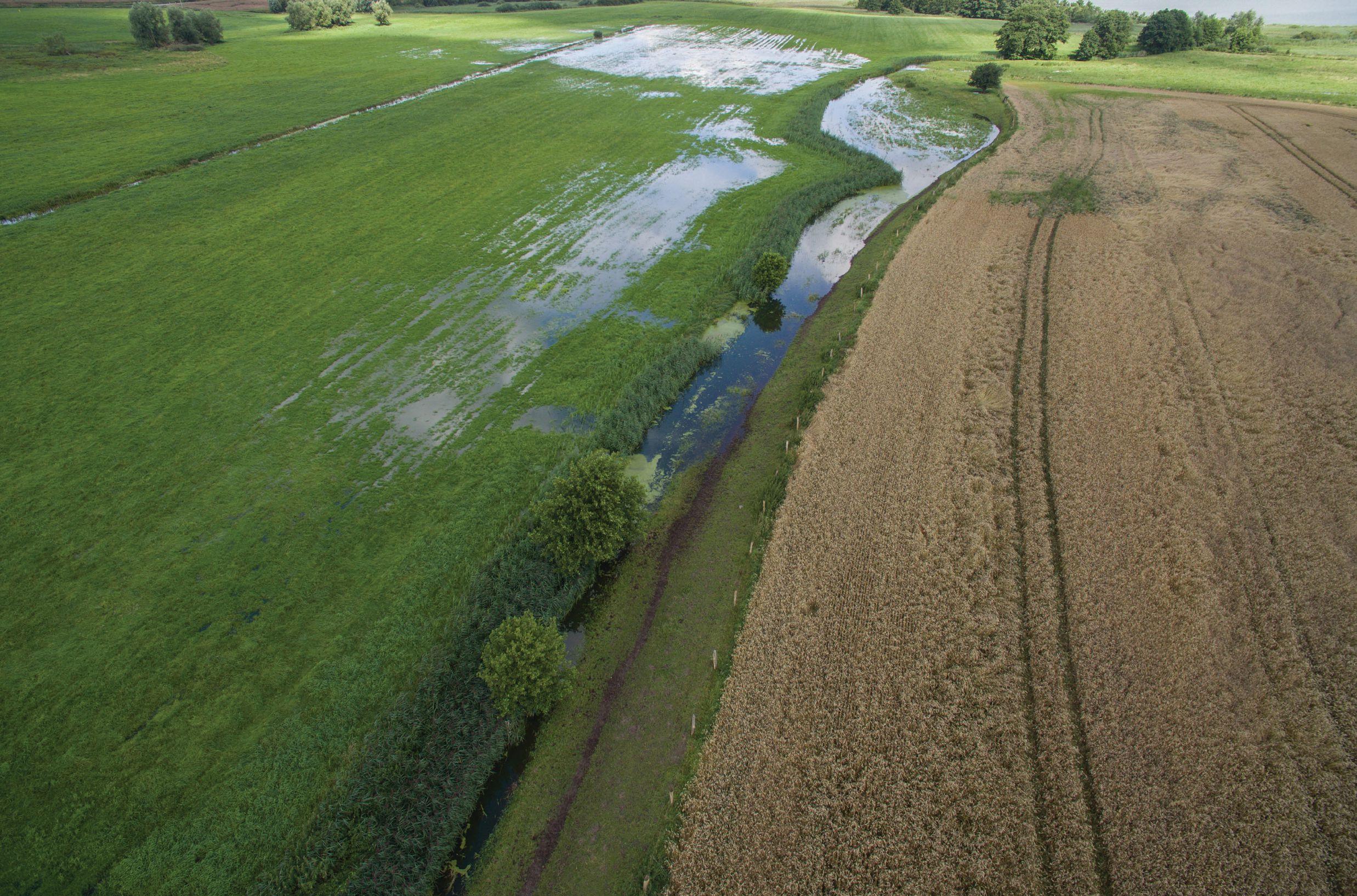
Regardless of whether you are using an automated or manual system, there are some obvious benefits to controlled drainage. Long-term research has shown that it can reduce discharge at an outlet, including nitrate and phosphate loss, by as much as 50 percent. It can also significantly increase water quality on a farm as well as help producers fulfill local regulatory requirements that may be in place in their region.
Shedekar would like to see local and federal governments introduce additional incentives to encourage farmers to actively manage controlled drainage structures. He says the importance of controlled drainage is going to continue to grow as a result of the changing weather patterns and the summer conditions that growers are having to deal with. Extended drought periods have become more frequent in the Midwest and northern latitudes, with beneficial rains occurring less frequently than they used to during summer months. As well, temperatures have been rising, and research suggests they could continue to rise by as much as five to 10 degrees Fahrenheit in the near future.
“With hot weather and drought periods, you’re going to be evaporating a lot more water from the soil profile. If you are pumping a lot of water out (through) evaporation because of hot weather, the soils could run out of available water for those crops in the middle of the growing season, especially in July and August,” he says.
“That’s why we see controlled drainage practices as an alternative for farmers to reduce the risk of drought. I see this becoming a necessity for farmers in the future. Right now there are maybe two years out of 10 that a farmer would benefit from controlled drainage. That might become more like four or five years in a 10-year period that you must have controlled drainage to maintain your production. That’s why I have high hopes for the future of this practice.”
DC
Image: Ben Reinhart
CHEERS TO A YEAR
For the Mealy brothers, a successful start has been anything but beginners’ luck.
As you read this, the owners of Impact Tile Drainage in Minto, MB are celebrating a milestone of their business – hitting one year of operation as a full-service contracting business.
by TREENA HEIN
But while this company is only a youngster, brothers Hudson and Taylor Mealy have built the same solid foundation for long-term success that supports tile businesses that have been around for decades. As they enter year their exciting second year, they share their journey to this point and what’s ahead.
Before they started with tile, Hudson and Taylor grew up on a cash crop farm of about 2000 acres near Minto, in the southwest corner of the province. Their Mom, Ruth, and Dad, Trevor, still run the farm, in Trevor’s case fulltime. As they grew older, Hudson and Taylor (the only children) both felt a desire to run the farm together, but they’d need some sort of business in addition to farming.
“We were both in university and we started
looking at different things,” says Hudson. “After we were both finished school, we looked into tiling. There wasn’t anyone operating in our area, and it seemed like it would be a good fit.” Hudson was particularly interested, which would work well; Taylor leaned toward wanting to mostly farm full-time.
They inquired with a couple of regional tiling businesses, being open with the owners about wanting to learn the ropes in order to start their own operation in Minto. That was about five years ago. “We worked for K&S Tiling for about a year, and then Precision Land Solutions for another year,” says Taylor. “They’re both about two hours away to the east. We took a camper there to stay in, but we were away a lot and staying in hotels with the rest of the crews.
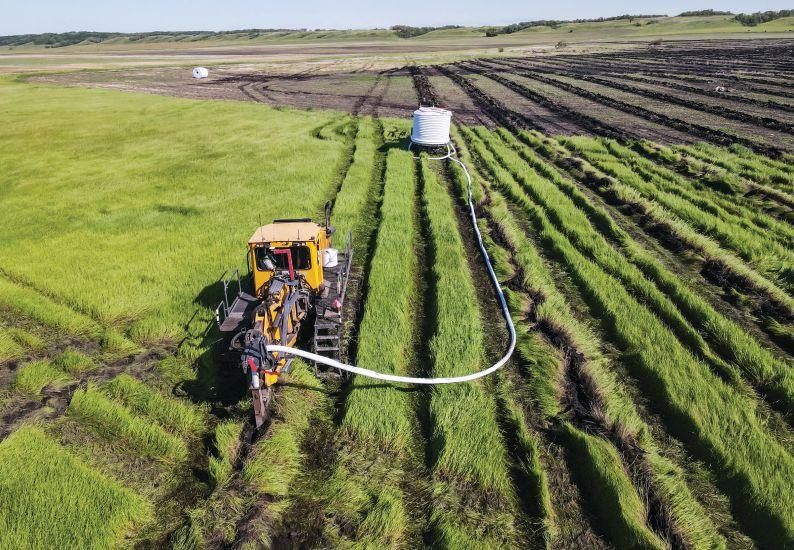
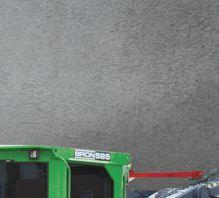
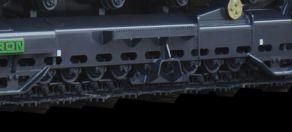
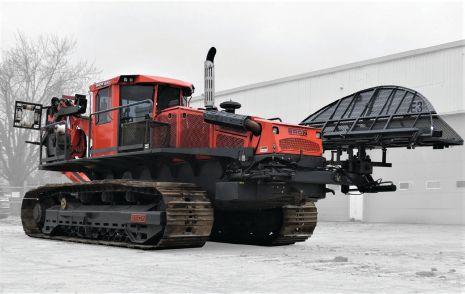
RIGHT: The Bron 550 was the first major equipment purchase made by Hudson and Taylor Mealy when they started their business.
Images: Hudson Mealy
You’re on the road a lot when you do tiling in Manitoba. It’s so spread out.”
It was a wise move. The mentoring the brothers received was top-notch.
“I’d put them up against anyone,” says Hudson. “They’re both very technologically advanced and cutting-edge companies. Keith Loewen at K&S in particular is an innovator in this province.” Loewen was among the first to introduce tiling in Manitoba.
As they learned the factors involved in tile drainage design and how to carry out jobs to completion, the brothers were pleased to feel a growing certainty that tiling was right for them. “We got more and more into it, and we liked the mix with the farming,” says Hudson. “We’re both interested in how water can not just be managed in farmers’ fields, but how farmers can also take advantage of water recycling. There are many benefits to that.”
After their hands-on mentoring experiences, Hudson and Taylor needed to become proficient in designing drainage systems and learn all the ins and outs of the permitting process, with provincial water stewardship rules quite complex. They also bought a GPS system and did some GPS field surveys (with a quad) for free, working towards getting their contractor’s licence. “Some people might work toward it the other way, getting equipment first, but we went GPS first,” says Hudson. “But when we decided last year would be our starting year, we went shopping for a plow.” They bought a Bron 550 with 750 shank in March 2024.
THE FIRST YEAR
No one ever forgets their first year in business, and 2024 held lots of memorable moments for Hudson and Taylor.
But the very start wasn’t something they’ll particularly care to remember that much. “It was super dry in March, so we didn’t have any calls,” says Taylor. “It was scary. We figured, we’ll get the plow and then do some jobs and get some other equipment. And we just didn’t get any jobs. We did some work on the plow; we added GPS and radios and fixed a few things, and then we decided to park it by the highway with a big sign to market ourselves.”
Then, the first call came in. It was a local farmer who had his permits and had planned to do the job himself, but he’d run out of time. Hudson and Taylor had to spring into action. Along with the plow, they already had a smaller excavator (18 ton) on the farm, but they quickly purchased a small tractor from Alberta, a stringer cart, a closer and some tools. At the same time, they scrambled to get a crew together.
“Nine days later, we started,” says Hudson. “We’d just finished seeding [and] we were spraying, and it was really crazy for Taylor. We found a neighbor’s hired man and an experienced person, and also a backhoe subcontractor helped. He also helped us with our fall jobs. We had just one job in the summer.”
In the early fall, the Mealys had the opportunity to do some overcuts and big walls, so they took the plunge and bought
a 35-ton excavator. They also found two employees who are returning this year.
In all, they finished 12 jobs in 2024.
“It was busy,” says Taylor. “I’m the maintenance guy for the farm and this business, so I didn’t have a lot of free time. For one job in the fall, Hudson had a piece of equipment go down and we wondered, ‘How are we going to get parts and how do we handle this?’ But we Facetimed and sent pictures, and we got it figured it out.
“We’re both fairly mechanically inclined. The ability to use hotspotting with your phone is really helpful for diagnostics with your GPS provider too, if the software isn’t working.”
They had some other small equipment issues – little mishaps,
RIGHT: Taylor Mealy says while the cost of drainage may cause some farmers to hesitate, it’s a worthy investment to extract more value from one’s land.
like a tractor door that wasn’t properly latched and ripped off in a big wind; or the time Hudson backed up in an overcut and ripped the pin off the boot of the plow.
But when it came to the actual tile installation, all sailing was smooth. Still, any first year in business is a crazy time. “I don’t know if we took a day off until August,” says Hudson. “Or actually, maybe it was December.”
PROVINCIAL CHALLENGES
In any business, part of success is effective management of customer expectations and good communication. At Impact, this means explaining the permitting process in Manitoba to clients.
“A lot of guys who want to tile don’t know how far out the job will be from their first call to us,” says Hudson. “It can be as short as a month to get your permit, but that would be if everything just happens to line up. It depends on the time of year to some extent, and they have to inspect the fields, and if your outlet to a highway that takes longer, and certain watersheds have their own rules. We try and stress to clients that the rules are there for good reason, and it will take time to get your permit, but you’ll get it.”
The Mealys also took on – and will take on going forward –some jobs in Saskatchewan. However, tiling just became more restricted there. In early 2025, the government implemented a new retention policy for wetlands, and a percentage of water must remain, depending on the watershed. Tiling is also new to many municipalities in Saskatchewan.
But in general, the Mealys expect the demand for drainage to rise in both Manitoba and Saskatchewan over time. “With the increasing cost of land, farmers are looking at how drainage can give them a little more seeding in the corners,” says Hudson. “There are also more guys starting with tiling a low spot, and now they’re adding lateral tiles and then they’re going higher and higher up the hill, and it’s worth it because of the extra bushels.”
Taylor adds, “We think the cost of drainage will turn people away for a while, but land prices are going to keep climbing, and it’ll be something more farmers will invest in. And there will also be more interest in consistent production through drainage water recycling, using saturated buffers and things like that.”
The brothers note that although there is generally too much
water on farmland in their region, if drainage water can be better managed locally by farmers, it’s not only great for crop production but great for keeping nutrients out of water bodies.
“It’s such a good thing for the environment,” says Hudson. “You construct a pond and if you need the water later in the growing season, you can release it. It’s such an opportunity to have that peace of mind about your yield. You can’t do anything about grain prices, but you can do something about some of your fields if the weather gets dry with a proper system. You can feel safer every season.”
Taylor adds that the costs of pond construction may come down a little as more ponds are built and there’s more automation of soil moisture probe readings.
WHAT’S ON THE HORIZON?
In 2025, Hudson and Taylor plan to get on top of inventory management, among other things. “I just kept ordering last fall, because you don’t want to run out when you’re two hours away, but it got out of hand,” Hudson chuckles. “We had a camper full of fittings. And we just want to become more in tune with customers and communicate even better. The most important thing is word of mouth, and we’re really happy that we’ve already got some repeat customer work lined up this year.”
At the same time, Impact Tile Drainage also needs some more field employees and someone to take on more of the bookkeeping and inventory management.
In 2024, Hudson would install during the week and come home to do designs for upcoming jobs, ordering and invoicing on the weekends. He’s not keen to go through that again.
But being busy in year two will be fantastic. And at this point in their business journey, in addition to showing appreciation for their mentors, Hudson and Taylor also want to thank their parents. “They’ve been our biggest help and our biggest support,” says Hudson.
“They listen and give us advice and are always there for us, and we’re very grateful. They make sure we are looked after. When I was away for a job October, it was busy on the farm but they drove with Taylor out to the field where I was and brought homemade lasagna and a cake and we all ate together. It was great.” DC
After a busy first year, Impact Drainage is looking to hire some extra help for the next active season.
by JACK KAZMIERSKI
‘WE CAN DO BETTER.’
Finding solutions to provincial water concerns in Saskatchewan
The phrase, “Whiskey is for drinking; water is for fighting over,” has long been attributed to Mark Twain. Whether he actually uttered those words or not is often debated – but nevertheless, many farmers and drainage professionals would disagree with the statement and would like to change the narrative to: “Whiskey is for drinking, water is for management.”
Water is hotly debated in many places today, including Saskatchewan. In order to better deal with some of the challenges associated with agricultural water management and drainage, in the fall of 2024, the Saskatchewan Farm Stewardship Association (SaskFSA) announced the formation of a provincial drainage research and extension network, which came to be known as the Saskatchewan Drainage Extension Network (SK DEN). The latter has brought a number of stakeholders to the table – including landowners, agricultural organizations, industry, researchers and government – with the goal of finding
solutions to Saskatchewan’s water and drainage challenges.
“Saskatchewan has an important role to play in food production and food security,” says Myles Thorpe, landowner and SaskFSA president, when the creation of the SK DEN was announced. “We host 43 percent of Canadian farmland. Sustainable crop production and soil health depend on proper drainage, whether you have it naturally in your fields or you need a drainage management plan. Without drainage, our fourth-generation farm would not exist today.”
The stated goal of the SK DEN is to
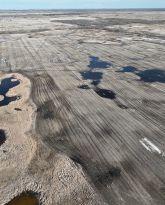
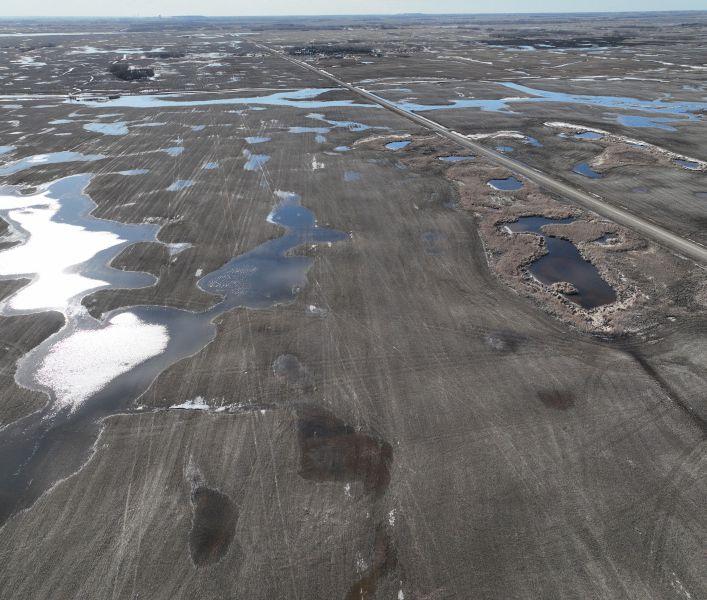
LEFT: Much of Saskatchewan’s farmland is located in what’s called the Prairie Pothole Region.
RIGHT: Saskatchewan hosts nearly half of Canada’s farmland, with wheat being among its major commodities.
Images: Candace Mitschke
“share and build knowledge on innovative and responsible water management practices in Saskatchewan in support of soil health, resilient crop production and healthy working landscapes.”
A lofty goal indeed!
From the news release in September 2024, “Forming this extension network comes at a critical time for the agricultural industry as farmers and ranchers cope with more variable weather in Saskatchewan,” said Water Security Agency president and CEO Shawn Jaques. “We are pleased to begin working with this impressive group of agricultural, industry and research leaders in the coming months. They will be an important resource to help us identify water management solutions and share information with the farming community about sustainable and resilient water management practices that will strengthen their operations and, ultimately, our provincial economy.”
AN ESSENTIAL INITIATIVE
Although the SK DEN was officially launched in 2024, Candace Mitschke, SaskFSA executive director and SK DEN project lead says this initiative has been in the works for a while.
“The idea was born about three years ago,” says Mitschke. “The SaskFSA deals with the regulator and government for ag landowner policy when it comes to water, but historically, in our province, there has been a divide when it comes to water management. Water is that valuable resource that no one wants to talk about properly, or collaborate on.”
The lack of communication hasn’t been helping anyone, which is why it was necessary for stakeholders to find a solution. “So at the SaskFSA, we agreed that this lack of collaboration has to stop,” says Mitschke. “The SaskFSA works hard on the backend advocacy and policy side, but we have all these information silos across the province. The SK DEN was formed to bring those information silos together.”
While the idea of the SK DEN was brought forward by SaskFSA, the SK DEN is a separate entity of private sector leadership, and strategic advisors, with a passion for water management.
Mitschke explains that the SK DEN initiative is well-timed. She has seen a change in attitudes recently that has helped foster an atmosphere where a growing number of stakeholders are more open to sharing information with one another.
“During the past five years in Saskatchewan, we have seen a change in the level of willingness to have better conversations about water management, and they’re looking at water management more collaboratively,” she says. “So it’s perfect timing for the introduction of the SK DEN.”
A MONUMENTAL MEETING
On March 21, the SK DEN hosted a Partner Meet & Greet Information Session in Saskatoon, bringing together additional key stakeholders for what would prove to be a first-of-its-kind meeting.
“This meeting marked a monumental point in history for Saskatchewan in that we have never had those groups in the same room talking about Ag water management before,” says
Mitschke. “We met at the University of Saskatchewan at the College of Agriculture, and we had researchers from across the province, crop associations, and a number of organizations that actually play in the water management space, like the Saskatchewan Assessment Management Agency, the Saskatchewan Association of Rural Municipalities, the Global Institute for Water Security and many others. So all the players who don’t talk to each other that much, if at all, came together in the same room.”
By all accounts, this monumental meeting went very well, and Mitschke notes that they were able to make progress on a number of fronts. “The first barrier we broke was having them come together in the same room to talk about drainage management,” she says. “Over the last year the SK DEN has identified three priority areas. One is drainage research, one is drainage beneficial management practices [BMPs], and the other has to do with education and connection, namely building public trust in agriculture management and farmer-led stewardship.”
Mitschke was impressed by the passion all participants had for the topics they discussed during three priority breakout sessions. “We noticed that they were eagerly participating in the discussions, and they didn’t want to wrap up their conversations,” she says. “That was a good sign.”
At the end of each session, Mitschke adds, participants wanted to know what the next steps would be. “We have operating committees within the SK DEN team for each of the
priority areas, and we were encouraged by some of the comments from the sessions, including an agreement that it’s important to continue networking with folks who are in-the-know. Ultimately we want to welcome more partners into the SK DEN network.”
The success of this meeting was a pleasant surprise for Mitschke, who admits to being slightly nervous at the beginning of the day. “You never know how these things are going to go,” she says, “and historically, we’ve had important stakeholders say that whiskey is for drinking, while water is for fighting over. And when I first heard that, I thought to myself that we need to do better. So we’re doing better. We’re changing that old saying to, ‘Whiskey is for drinking; water is for management.’”
NEED FOR EDUCATION AND COMMUNICATION
One of the goals of the SK DEN is to educate the public and help residents understand why certain water management practices are a must. “Our geography is different, so we need some Saskatchewan-based field-scale science in place, which will also help us build public trust,” says Mitschke. “A lot of times, that urban/rural divide doesn’t help us. People don’t understand what farmers are doing. They think they’re destroying all the wetlands versus managing the water properly to maintain their field efficiency, and to improve their agronomic stewardship.”
The SK DEN is also focusing their efforts on drainage research that will arm the organization with the facts that will help inform policy decisions in Saskatchewan. “There are a number of drainage BMPs work in other areas, but not necessarily in Saskatchewan,” says Mitschke.
In January of this year, Saskatchewan’s Water Security Agency announced a finalized Agricultural Water Stewardship Policy. “Farmers are obliged to retain a certain percentage of wetlands in future drainage projects, which ranges between 40 to 60 percent,” says Mitschke. “But we know that just retaining a wetland, or a small depression on the landscape, doesn’t solve all the policy outcomes.”
Mitschke is hoping that there might
Depending on the size of their land, farmers can lose tens or hundreds of thousands of dollars annually as they try to overcome the challenges of the potholes as seen here.
be some room for flexibility with this policy. “What we would like to do with the drainage BMPs is quantify and validate that if you can improve your field efficiency through responsible drainage, there’s actually that agronomic stewardship side, and the environment co-benefit side, that will then probably offset some of those wetland retention numbers,” she says. “So if a farmer wants to implement some drainage BMPs, he can potentially reduce his wetland retention obligation. That’s what we’re striving for.” We have one field efficiency research project on the ground to further evaluate this, and are planning to implement more across the province.
Saskatchewan’s Agricultural Water Stewardship Policy is only one example of some of the challenges farmers have to deal with when planning and putting in place drainage plans for their fields.
“For the most part,” says Mitschke, “you can go ahead and get a drainage approval following the current process and policy, but our goal is to make it more efficient and to make it more practical. We have different issues throughout the policy framework that
are obstacles, and permission to move water through natural or constructed runways is one of them. We are under British common law here, which means you need permission from all landowners involved in the drainage network. They can say no, and that can shut down a 100,000-acre project. We can do better.”
PRAIRIE POTHOLE REGION
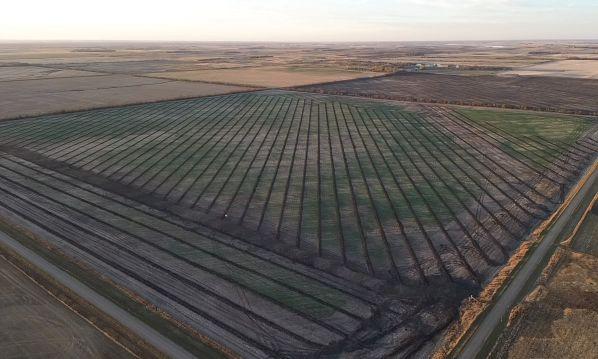
A good deal of the farmland in Saskatchewan is located in what’s known as the Prairie Pothole Region. This is an expansive area that contains thousands of shallow wetlands known as potholes. In turn, these potholes, which range from small to giant, create expensive problems for those who are farming this land, which is why proper drainage is so important.
Depending on the size of their land, farmers can lose tens of thousands or hundreds of thousands of dollars annually as they try to overcome the challenges presented by these potholes.
For example, if the drainage is not managed properly, costs are amplified when farm equipment has to deal with more corners in a given field than would otherwise be necessary if the potholes
weren’t there, or if they were bettermanaged.
Costs can add up when each piece of farm equipment has to make numerous turns in each field when seeding, applying manure, spraying herbicide, etc. “We’ve done a lot of work on how many corners there are in a managed field,” says Mitschke. “In a well-managed field, we have about 75 corners. In an unmanaged field, we’re at 413 or more.”
What adds to the frustration is the fact that so many organizations and individuals believe that they should have a say in how farmers implement drainage solutions. “Environmental activists, for one, believe they should have a say when it comes to how a farmer manages their land,” says Mitschke. “In Saskatchewan, we have some environmentalists who say there should be no drainage at all.” We know that responsible drainage will improve soil and crop health, while supporting the farm business, the local community and the environment.
NEXT STEPS
Clearly, there’s much work to be done, which is why the SK DEN is well placed to tackle some of these challenges headon. Moreover, the meeting they hosted on March 21 proved to be a springboard to action.
“We’re building the roadmap for the SK DEN, based on the outcomes of our meeting,” says Mitschke. “We’re assembling an information package, sending it to our participants, and their job will be to talk with their colleagues, their associations and their boards about it. Then, we’re going to come back to the table for another feedback session.”
Along with bringing people together to communicate, collaborate on drainage research and to develop BMPs for the province, the SK DEN will also be developing an information hub.
“This will be a one-stop-shop when it comes to any information about drainage or irrigation,” says Mitschke.
“The goal is to show all parties that drainage is safe, effective and extremely important for crop production in our province. We have huge potential for production, stewardship and environmental balance. They can co-exist and we all know we can do better.” DC
NORTH AMERICAN DRAINAGE CONFERENCE 2025
Connecting research, industry and community
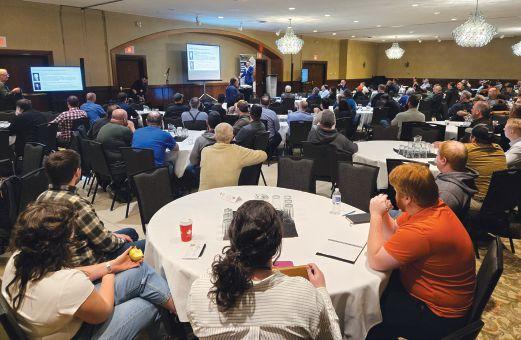
With the highly seasonal nature of agriculture and drainage, this means that December through March are usually a heavy season for conferences, trade shows and educational events. Sandwiched between the LICA National Winter Convention in February and the Overholt Drainage School in March was the newest kid on the block, the North American Drainage Conference. This year’s conference, held March 4, upped the ante from 2024 with more contractor perspectives, new research and even more lively discussion.
by DRAINAGE ONTRACTOR STAFF
Established by Drainage Contractor parent company Annex Business Media in late 2023, the North American Drainage Conference (NADC) was originally intended to serve as an in-person gathering of contractors, designers, researchers and other drainage business stakeholders in Grand Rapids, MI. However, further feedback from contractors far and wide in Canada and the U.S. resulted in the inaugural 2024 conference moving to a halfday, online format. The move allowed NADC to still include the same six speakers over a shorter time period and serve more contractors – although the industry is largely concentrated around the Great Lakes region, attendees from the U.S. Northeast, Quebec, Manitoba and the U.K. were also well-represented. With attendees able to view the conference from anywhere, it was a solid choice for the busy events season, giving contractors and speakers a much-needed travel reprieve.
STARTING WITH SPEAKERS
When discussing how to up the ante for
2025, the team went directly to the audience of the previous year’s NADC. The postevent survey revealed that while the viewers loved the diversity of research perspectives, they also responded extremely well to the
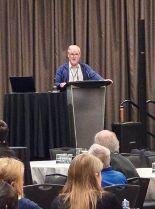
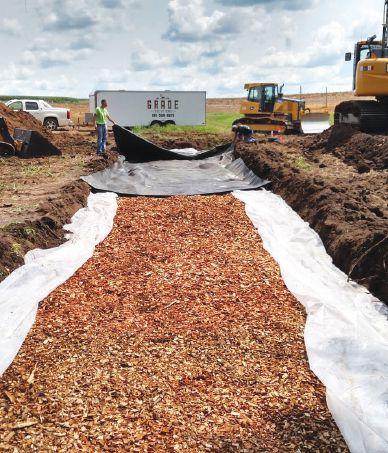
RIGHT: Presenter LaVerne Weber outlined his company’s work in the installation of bioreactors, including manufacturing its own woodchips.
contractor-led session, and thus wanted more. Organizers decided to double the number of contractor-led sessions, with one session led by U.S.-based contractor and entrepreneur LaVerne Weber (also a Drainage Contractor 2023 GroundBreaker), and the other led by Canadian ag and drainage business veteran Mylen Dunbar of NextGen Drainage. The conference also welcomed ADMC executive director (and newly minted Conservation Drainage Network board chair) Keegan Kult, whose work bridges gaps between research, government and industry and allows him plenty of industry face-time. Kult, who is based in Iowa, has contributed to more than 80 edge-of-field projects.
The other half of the conference was led by popular researchers and educators including Jane Frankenberger (Purdue), who discussed online tools for drainage water management; Chad Penn (USDA and Purdue), who previewed P-TRAP software for phosphorus removal structure design; and Gary Sands (University of Minnesota), who spoke of the importance of drain design as a
conservation practice.
DEEP DIVE ON SESSIONS
“For me, it was really important that our speakers not just deliver the latest
research and show some charts on PowerPoint,” said Drainage Contractor editor Bree Rody. “I wanted it to feel interactive. When you have a virtual conference, you don’t have the option of
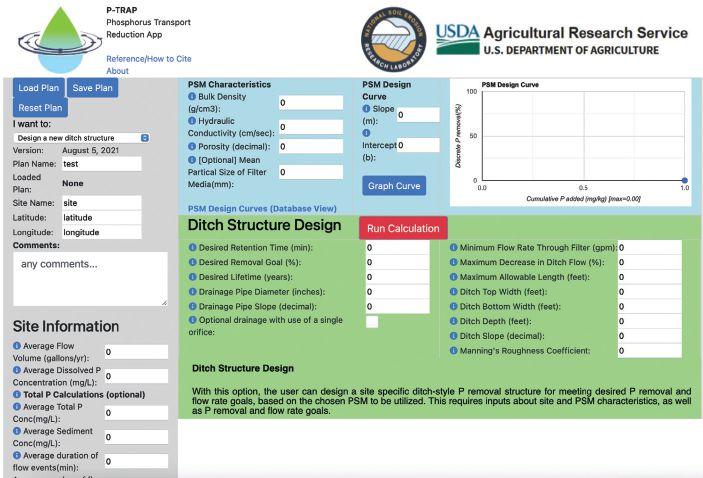
The Phosphorus Transport Reduction App (PTRAP) software showcased by USDA’s Chad Penn, who guided viewers through the process.
SILVER SPONSORS
BRONZE SPONSORS
going up to products and touching them or seeing them in action, so when we convened with speakers, we discussed the best way to deliver that experience.”
Speakers also kept in mind that the majority of the attendees would be contractors or other people who worked in the field, like designers, or farmers who do their own drainage. As such, many chose to focus not only on research but on actionable tools and sessions that felt more interactive.
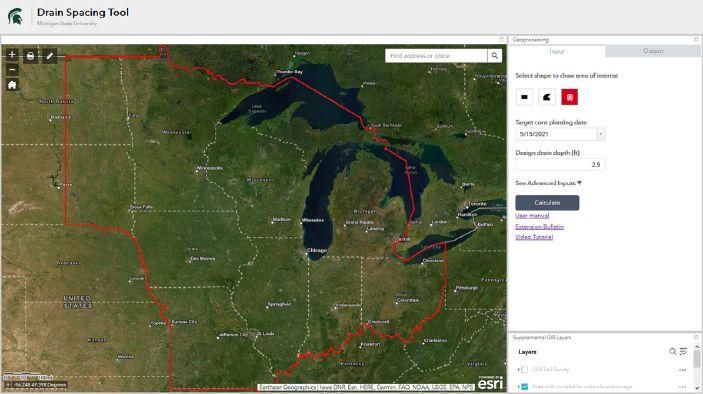
Frankenberger, for example, who spearheaded the $5 million Transforming Drainage project, presented a series of online tools for helping improve drainage and water quality. These tools included drainage design tools related to main sizing, spacing and capacity; rate calculators; and a more complex calculator tool to help landowners evaluate if their land is suitable for larger-concept projects like drainage water recycling.
“Sometimes we have too much water, sometimes we have too little,” Frankenberger explained. “We know
that as extreme weather is increasing, [nutrient loss and runoff] are getting greater. That’s what climate change is doing to water management.”
The tools shown by Frankenberger were also free, although some, like the drainage water recycling, are more complex than others. On top of showcasing the tools, Frankenberger offered advice on how to use them including where to find the information needed, such as soil properties.
For his presentation on Phosphorus Transport Reduction App (P-TRAP) software, Penn offered a primer on phosphorus removal structures themselves before diving into the software. Using a real site in northwest Ohio as an example, Penn showed how he would design a structure. “[For this example] we want to design a structure to handle a flow rate of at least 200 gallons per minute, and we want the structure to remove anywhere from 35 to 40 percent of the 10-year load.” Penn went through the process of designing two different styles – a buried bed with metal shavings
DRAINAGE PODCAST SERIES
LATEST EPISODES INCLUDE:
• Contractor perspectives with Jesse Tait
• Drainage in Manitoba with Mitchell Timmerman
• Water management and collaboration with Keegan Kult
• Drainage water recycling with Chris Hay
Silver
Bronze
Presented by
and a buried tank of activated alumina. After inputting all information, the P-TRAP software generated estimates of annual phosphorus removal, and other key values.
Presenting his perspective as a contractor, Weber shared with viewers
not only Grade Solutions’ valuesbased business philosophies but also case studies, including research-based collaboration with partners such as Illinois-based researcher Laura Christianson or design software providers AGREM. A big focus of Grade
Solutions’ innovation is bioreactors, for which the company develops its own woodchips. Weber says this was a necessity because the specific chips required for bioreactors were not easily sourced in Illinois. “We build a fair amount of bioreactors, so we do need a fair amount of chips [that fit the specifications].”
This kind of experimental approach is important to Weber, who says he would like his company to continue to push the envelope in these kinds of projects. “Our team members are encouraged to bring learnings forward to us – they’ll say, ‘Hey, can we try this on our structures? Can we try this in the field?’ We bring those learnings to the table in our office, and vet them through our key strategic partners.”
That kind of constant learning is key to the long-term success of the drainage industry, says Weber.
Each session also allowed live attendees to claim one-half continuing education credit with Certified Crop Advisor in soil and water management. DC
Presenter Jane Frankenberger showcased a web-based tool to help installers calculate necessary spacing.
A vision for progress
by Keegan Kult
Stepping into a new dual role across two complementary organizations.
As the executive director of the Agricultural Drainage Management Coalition (ADMC), I am honored and excited to assume the role of chair of the Conservation Drainage Network (CDN). This dual position offers a unique opportunity to influence and advance the field of agricultural water management by aligning both organizations’ efforts to disseminate information, set research priorities, and advocate for the effectiveness of drainage practices.
The CDN is a national (international actually) partnership with the goal of improving drainage practices to meet future demands of crop production while utilizing water management as a tool to improve agricultural environmental outcomes.
ADMC is an industry led non-profit organization that advocates agricultural water management through the advancement and implementation of drainage practices to improve agronomic, economic, and environmental outcomes.
ADMC and its members are part of the CDN and provide input from an industry perspective, other CDN members include stakeholders from Research and Extension, State and Local Agencies, Federal Agencies, NGOs and private sector individuals or groups.
As chair of CDN, I am enthusiastic about our network’s mission to expand awareness of the crucial role water management plays in production agriculture. We aim to produce effective communication on pertinent research and enhance educational opportunities for contractors, farmers and landowners. ADMC has been operating in this space, but its efforts will be greatly bolstered by the partnership within the CDN. ADMC’s involvement with CDN has always been to help bridge the gap between theory and practice, ensuring that research findings translate
into actionable solutions. Farmers, landowners, and drainage professionals often face barriers in accessing research that can enhance their farm. ADMC and CDN are committed to breaking down these barriers by creating platforms for knowledge exchange.
CDN will connect practitioners with the latest research findings and innovations. Direct interaction between researchers and practitioners leads to practical application but also provides valuable feedback to researchers on what improvement to practices are necessary. The synergy between ADMC and CDN provides a powerful platform for advancing the field of agricultural drainage. With ADMC’s advocacy and CDN’s research-focused agenda, we are wellpositioned to drive meaningful change. As the executive director of ADMC and chair of CDN, I am committed to leveraging the strengths of both organizations to achieve our shared goals.
Together, we will elevate the discourse around drainage management, expand the audience reached, and facilitate the practical application of research. By uniting our efforts, we can ensure that the drainage industry evolves to meet the challenges of the future.
In conclusion, my dual role is a testament to the commitment and passion that drives both ADMC and CDN. Together, we will continue to push the boundaries of what is possible in agricultural drainage, striving for a future where effective water management practices are the norm. I invite all stakeholders to join us on this journey and be part of the solution for a more prosperous and sustainable future for agriculture. DC
Keegan Kult is based in Iowa and has worked in agricultural water management for more than 15 years, contributing to more than 80 edge-offield installations.
EQUIPMENT NEWS
MASTENBROEK DEBUTS NEW CT12 MODEL
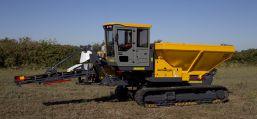
Mastenbroek unveiled its newest crawler at the recent Bauma construction and heavy equipment trade show.
The latest CT12 crawler truck includes enhancements such as a Human Form Recognition safety system, which warns the driver and an approaching person of potential danger, bringing the machine to a halt if necessary.
As well as human form recognition, the 2025 CT12 features a full-width tipping hopper, which is fully visible when the operator cabin is raised to its highest position. The variable speed conveyor on the hopper provides a free-flow discharge for aggregates of varying viscosity. As well as allowing the operator to place materials into trenches accurately, the tipping hopper means the CT12 can be used as a dump truck. At the front of the CT12, Mastenbroek’s variable height and speed, 180-degree swing conveyor makes it easy for the operator to place backfill material directly into a trench or the hopper mounted on the trencher.
The new model also features the hydraulic oil cooler mounted independently to the engine radiator, with side-mounted wideopening doors facilitating access to the CT12’s 248hp Volvo Penta D8 eight-litre six-cylinder Stage 5 emission engine.
“The CT12 with HFR has been developed for two main reasons,” says Mastenbroek’s commercial director, Christopher Pett, in a statement. “First, it takes advantage of the latest safety technology, and secondly, it meets the stringent health and safety regulations that the civil engineering and utility installation companies need for compliance, and this is an area in which our customers are increasingly working. It will also be a useful safety feature for our customers undertaking agricultural drainage.”
JCB GOES MICRO
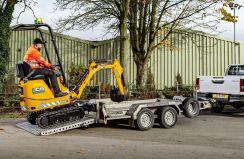
JCB has added to its E-Tech range of electric products with a new 1.0-tonne electric machine, the JCB 8008E CTS.
The new model shares its structure, bodywork and dig-end with the conventional dieselpowered 8008 CTS and has the same control lever functionality. However, the hydraulic pump is powered by an electric motor and uses the same battery and powertrain technology as existing JCB electric products.
Key features include a 9.9kWh battery, which can deliver enough power for a typical full-day shift; sub-1.0 tonne operating weight, which makes it easy to transport behind a van or pickup truck; and 110V and 230V charging capacity to suit construction use. The model has a noise level at the operator station of 66dB(A), with an external noise level of 80dB(a), making it ideal for use indoors or in urban site condition.
The machine made its debut at the Executive Hire Show in February. DC
GEO-KNIT ® - Drainage Filter
Syfilco is a manufacturer of circular knit drainage filter. Contact us today for more information on our GEO-KNIT ® product line.
Ontario Drainage Conference
Another successful year in London.
by Mel Luymes
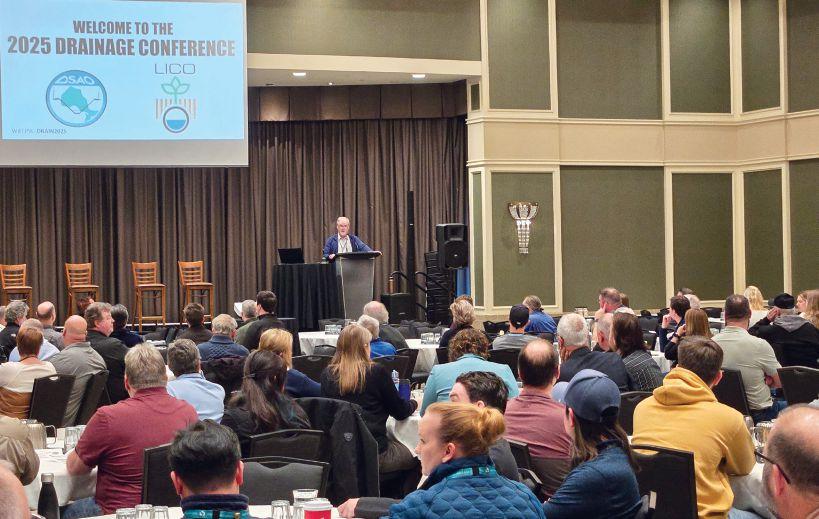
January 22-23, 2025 marked the 65th annual Drainage Conference, and the Land Improvement Contractors of Ontario (LICO) were joined by the Drainage Superintendents Association of Ontario (DSAO), along with drainage engineers and industry suppliers at the Lamplighter Inn in London, ON.
Nearly 30 exhibitors lined the atrium and there was a buzz as the conference’s 350 registrants grabbed their coffee and caught up with old friends.
LICO’s Sid Vander Veen kicked off the conference with a warm welcome and introduced the first speaker. Ron Bianchi is a passionate meteorologist that walked the crowd through some of the weather patterns we’ve been seeing in Ontario, including the polar vortex that was over London during the conference.
The climate has always been changing, says Ron, and it will continue to change. For Ontario’s drainage industry, designing for future weather means increasing a system’s capacity to manage
large storm events. This area of the world is predicted to get both warmer, and a lot wetter, he concludes.
Ron was followed with a panel that included Sara Wood, VP of the Ontario Federation of Agriculture; Lisa Wren, senior fisheries protection biologist with Fisheries and Oceans Canada; and Davin Heinbuck, GM of the Ausable Bayfield Conservation Authority; moderated by Sid Vander Veen.
The panelists outlined the changes to the Conservation Authorities Act that came into effect April 1, 2024, which changed the definition of a watercourse, required contractors and landowners to obtain a permit before working within 30 metres of a mapped wetland or watercourse and required Conservation Authorities to update this mapping every year. As well, Lisa outlined requirements in the Species at Risk Act that related to the drainage industry. The panelists focused on ways they could work together to protect the environment while
still managing excess water in agricultural areas, and they all agreed that mutual respect and communication was key. “Listen to the farmers who are working their lands,” said Wood during the panel. “We’ve worked them for years. We wanted to be included in the discussion.”
The panel acknowledged that many of these discussions have evolved over the years. “The conversations have evolved over the last 10 years, and are now a pleasure,” said Wren. Davin added, “Drainage and conservation authorities have an awful lot in common.”
After a brief networking break, the DSAO and LICO programs diverged, and the LICO program continued with University of Minnesota’s Dr. Michael Pluimer’s presentation on plastics and why materials matter for the longevity of drainage pipe. He outlined the modes of polyethylene failure through Stage 2 brittle failures and Stage 3 chemical failure from oxidation or UV degradation. During installation, pipes manufactured from two different materials may look or feel like the same product, but a lifespan can only be known by understanding and testing the input polymer materials and conducting testing on the finished product.
After lunch, LICO heard from a panel that explored opportunities for Precision Drainage and changing drainage designs based on a deeper understanding of the soil and water table. Rhiannon James, a recent MSc graduate from the University of Guelph in hydrogeology, outlined the deep layers of sediment and till left from periods of glaciation and how that impacts groundwater movement.
She was joined by Caleb Niemeyer from Woodrill Farms’ Groundwork who works to do soil coring and field mapping for precision agriculture. Also on the panel were Keith Frey, A&E Farm Drainage and Dan Frey, AWF Contractors Ltd. After taking soil cores, Caleb mapped the soil types on a field from Woodrill Farms near Guelph, and Keith designed a system with 15-, 30- and 60- foot spacing that varied by the soil type and elevation. The goal is to maximize the drainage on the areas of the field with the highest production potential. Dan Frey and his crew at AWF installed the system last year, so we eagerly await the yield results from the field.
Before LICO’s AGM, the group heard from Jay Moore (Enbridge)
about working near pipelines and in another room, BDO hosted two sessions about business succession planning and mergers and acquisitions.
After a supplier’s reception in the Atrium to meet the exhibitors, participants got dressed up for the Annual Banquet, where they were joined by Hon. Rob Flack, Minister of Agriculture, Food and Agribusiness (OMAFA) as well as by Christa Lowry, Chair of the Rural Ontario Municipal Association (ROMA), who both brought greetings.
The following day, LICO hosted a Conservation Drainage Workshop that brought together contractors and Conservation Authority staff to talk about wetlands and erosion control berms. OMAFA’s Kevin McKague demonstrated his erosion control design tools, Upper Thames River Conservation Authority and contractor, Chris Crump, highlighted some of their projects and Dr. Nandita Basu, University of Waterloo, highlighted the results of research and modelling projects related to wetlands and their environmental impact.
It was another excellent event and we’d gladly have American contractors join us for future years! Unfortunately, it was at the same time as the North American Conservation and Drainage Expo (NACADE) this past year, but check out drainage.org/ conference for upcoming details to make your plans to attend in 2026. It's well worth the trip to London. DC
Legacy phosphorus
The enduring hidden driver of tile drainage loss
by Ehsan Ghane
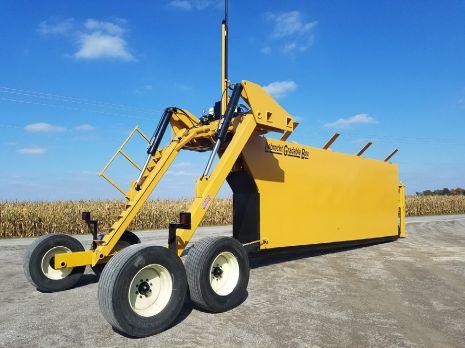
LLIEBRECHT GRADABLE TRENCH BOX
• Install smooth wall pipe from 12” to 36”
• Rounded bottom for proper tile support
• Automatic laser grade or GPS control
• Hydraulic pushers for coupling of tile
Also check out our website for our other drainage products.
ake Erie continues to have algal blooms in the summer because of excess phosphorus. There are various sources of phosphorus (P) entering Lake Erie, but agriculture is a dominant source. Recent research highlights the dominant role of legacy phosphorus (P) and the need for innovative solutions to protect water quality.
PHOSPHORUS LOSS IS DOMINATED BY LEGACY P WHILE NEW P HAS A MINOR ROLE
The Osterholz et al. 2023 study introduced a novel method to distinguish contributions of “new P” (recently applied fertilizers) from “old P” (legacy soil phosphorus) in subsurface drainage discharge from sites in Ohio and Indiana. The findings revealed that new P accounted for only zero to 17 percent of dissolved reactive phosphorus (DRP) loss, while legacy soil P dominated at 83 to 100 percent. These findings highlight the need to emphasize strategies to mitigate legacy P to make a big impact on water quality.
Similar findings emerged from the MSU edge-of-field research project, where old P accounted for 97 percent of the loss from an inorganic fertilizer-applied on-farm site and 84 percent from an organic manure-applied on-farm site. This reinforces the critical role of legacy P in water quality.
THE
ENDURING WATER QUALITY PROBLEM FROM LEGACY P
Simpson et al. 2024 analyzed over 600 soil and sediment samples across diverse sites in the USA. They found that these soils have enough legacy P to sustain high P loss for decades. These findings show that without proactive management, legacy P will continue to degrade water quality for the foreseeable future, presenting a significant obstacle to achieving our water quality goal. The legacy P problem can be addressed by drawdown of the soil test P, but this has its own challenges.
REDUCE THE LEGACY P WITH DRAWDOWN OF SOIL TEST P BY CROP REMOVAL TO MAKE A BIG IMPACT, BUT THIS TAKES A VERY LONG TIME
A drawdown of soil test P (STP) by crop removal can address the legacy P problem, but it will be a marathon, not a sprint;
for center pivot sprinkler irrigation (right diagram) or subirrigation (left diagram)
progress will be steady, but slow. A meta-analysis by Gatiboni et al. 2025 of 56 fields under no fertilization showed that STP could be reduced by 4.3 to 8.2 percent annually, depending on the initial STP levels. Soils with very high STP levels (116–261 Mehlich-3) required 16 years to halve their STP concentration without any fertilizer application. The higher the STP, the slower the drawdown, making it vital to avoid additional accumulation of legacy P through careful nutrient management.
NUTRIENT MANAGEMENT CAN ADDRESS THE SMALLER, BUT STILL IMPORTANT, CONTRIBUTION OF NEW P LOSS OVER THE SHORT TERM
While legacy P is the main driver of water quality degradation, new P loss (recently applied fertilizers) also plays a role. The fertilizer source, timing, rate and application methods each affect new P loss. The Osterholz et al. 2024 study analyzed 155 P applications across Ohio and Indiana. The researchers found that surface broadcast of liquid manure posed the highest risk of increased new P loss, while injection and incorporation methods reduced new P loss. These findings emphasize the
benefit of nutrient management (4R approach) as a faster way to address the smaller but still important contribution of new P loss. However, to make a big impact on water quality, we need to address the dominant legacy P in two ways: first, drawdown of the STP to achieve results over the long term, and second, by implementing water management to achieve results over the short term.
WATER MANAGEMENT CAN ADDRESS BOTH THE DOMINANT LEGACY P LOSS AND NEW P LOSS OVER THE SHORT TERM
Since phosphorus moves with water, managing water movement off the farm can improve water quality more quickly. Drainage water recycling integrated with controlled drainage offers advantages (Figure 2): first, it reduces drainage discharge through controlled drainage, and second it captures and stores the remaining drainage discharge for supplemental irrigation. This practice can improve water quality by retaining nutrients in the reservoir and build crop yield resiliency with supplemental irrigation during drought periods, according to Hay et al. 2021. The water quality and crop yield benefits of drainage water recycling warrant thorough investigation into its economics and additional advantages.
SUMMARY
Without proactive management, legacy P will continue to degrade water quality for decades, presenting a significant obstacle to achieving our water quality goal. Nutrient management is a good start, but by itself may not be enough to achieve our water quality goal. We need to tackle both legacy P and new P by integrating nutrient and water management practices. With collaborative efforts, we can protect Lake Erie’s water quality and sustain agricultural production for future generations. DC
A climate-smart drainage water recycling system that captures, stores, and reuses drainage water
by Gerald Biuso, SR, national LICA CEO
Discover a rich history Winter convention recap
by Tony Cain
The Land Improvement Contractors of America (LICA) is proud to announce the publication of its latest book, The History of Farm Drainage and the LICA Contractor. This essential book takes you through significant milestones and advancements in the field, highlighting the critical role played by LICA.
The impact LICA has had and continues to have on drainage is a story that had to be told!
This book focuses on the dedication and commitment of National LICA, state chapters and individual members through the years. I took it upon myself to have this book researched, written and printed. It took six long years to produce this special book. It will stand as a tribute to LICA and its members.
KEY HIGHLIGHTS OF THE BOOK
• Timeline: Follow a chronological journey through the key events and developments in farm drainage history.
• The Inception of Farm Drainage: Explore the early stages and initial practices in farm drainage.
• The Development of Plastic Pipe: Learn how LICA members have pioneered advancements in plastic pipe technology.
• LICA State Chapters: Get a closer look at the contributions of various state chapters of LICA.
• Conservation Practices and the Future of Farm Drainage: Gain a forward-looking perspective on sustainable practices and future trends.
The History of Farm Drainage and the LICA
Contractor is an invaluable resource for professionals in land improvement, academics and anyone with an interest in agricultural history. This book captures the essence of LICA’s enduring legacy and the ongoing innovations in farm drainage and water management.
GET YOUR COPY TODAY!
Don’t miss the opportunity to own this significant piece of history. Order your beautifully bound, hard cover copy of The History of Farm Drainage and the LICA Contractor today and embark on a journey through the evolution of farm drainage, celebrating the innovations and contributions of LICA and its members. This limited-edition book is in short supply and expected to sell out very soon. Don’t delay!
ACKNOWLEDGEMENTS
This project, spanning over six years, has been a labor of love, with extensive research led by Jerry Biuso, Sr., and contributions from LICA members and state chapters, writers Deborah Dickens, Caroline Krug and Royce G. Morse, along with graphic design by Brenda Basey. From the earliest days of farm drainage to the innovative practices of today, this book highlights the unsung heroes whose contributions have significantly impacted global efforts to feed the world.
For more information or to purchase your copy, please visit licanational.org or contact Caroline Krug at cnational.lica@gmail.com.
The LICA winter convention is always exciting. We've installed our new president, Jeff Schell from Kansas, and VP Steve Anderson from Illinois. Jeff will do national LICA proudly. He served several years in his region (VI) VP position, as well as serving on the Kansas LICA board and officers positions. As chairman of the board, I look forward to working with Jeff, Steve and the RG VPs. For awards: Mike Cook from Michigan LICA received the Contractor of the Year
award. Nordis Estrem from Minnesota received the LICA Lady of the Year award, and Indiana was the Top State. Congrats to all. Serving as president has been an honor. I have learned a lot these past few years about leadership and have met many good people. I could not have done it without good, active members, associates and staff – and my beautiful wife Michelle. Thanks to everyone for helping me grow into a better person. God bless everyone!