Account Coordinator | Mary Burnie mburnie@annexbusinessmedia.com
Audience Development Manager | Anita Madden amadden@annexbusinessmedia.com 416.510.5183
Media Designer | Emily Sun esun@annexbusinessmedia.com
Group Publisher | Michelle Bertholet mbertholet@annexbusinessmedia.com
President/COO | Scott Jamieson sjamieson@annexbusinessmedia.com
Printed in Canada
ISSN 1488-4305
Publications Mail Agreement #40065710
Subscription rates:
Canada – 1 yr $17.50 CDN
USA – 1 yr $34.50 CDN
Foreign – 1 yr $46.50 CDN
From time to time, we at Drainage Contractor make our subscription list available to reputable companies and organizations whose products and services we believe may be of interest to you. If you do not want your name to be made available, contact our circulation department in any of the four ways listed above.
All advertising is subject to the publisher’s approval. Such approval does not imply any endorsement of the products or services advertised. Publisher reserves the right to refuse advertising that does not meet the standards of the publication.
www.drainagecontractor.com
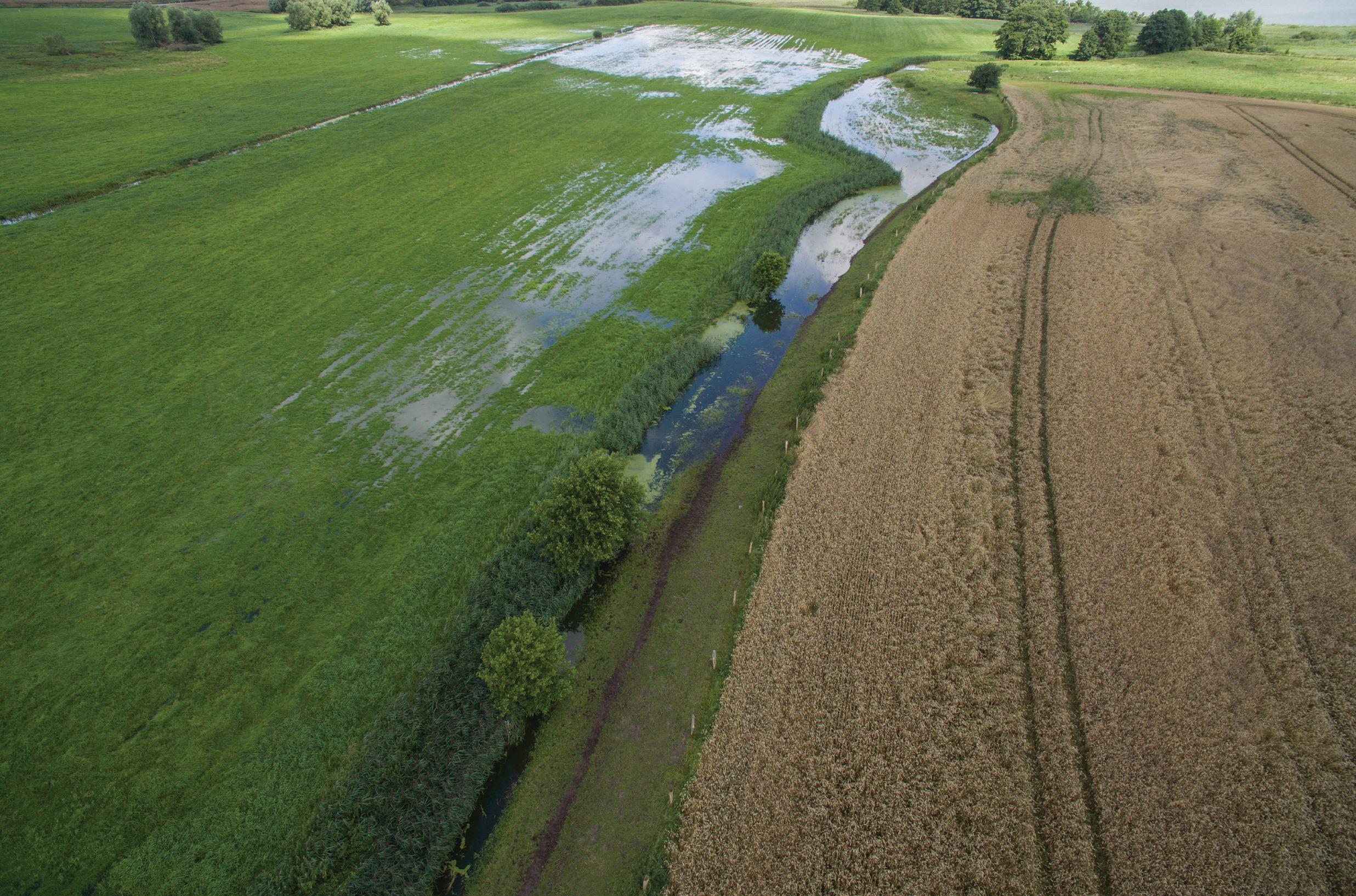
Using winter cover crops to reduce nitrate runoff.
BUSINESS
An Indiana study proves drainage pays (seriously).
SPECIAL FEATURE
Celebrating 50 years covering – and comingling with – the drainage industry.
22 DRAINAGE MANAGEMENT SYSTEMS
What we've learned about drainage management in Ohio. 26 CONTRACTORS AT WORK
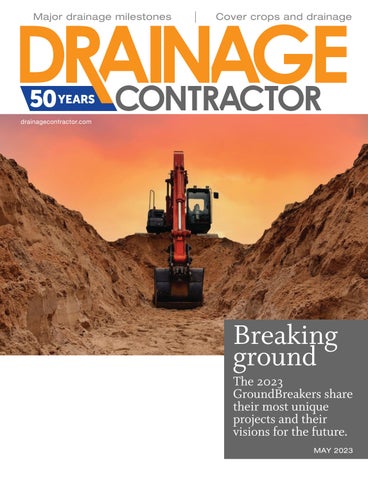
Meet the 2023 GroundBreakers, read their stories and understand their influence.
ON THE WEB:
Subscribe to our Drainage Contractor eNews
New editions are due to your inbox every second Tuesday, and include news, the latest equipment, features, webinars and more.
Stay tuned for the GroundBreakers in podcast form
Subscribe to our agriculture podcast, AgAnnex Talks, on iTunes, Spotify or wherever you get your podcasts, to listen to our GroundBreakers tell their stories. Episodes will begin rolling out in June.
Stay golden, drainage
Reflecting on the last 50 years is great, but looking to the next 50 is even more crucial.
by Bree Rody
Naturally, when looking at the 50th anniversary edition of Drainage Contractor, it’s easy to think of this magazine as a constant. Fifty years is a long time, especially in “magazineyears.” For most of us on staff, it predates our careers in publishing – or our entire lives. And, as I gleaned from my conversations with former Drainage Contractor editor and co-owner Peter Darbishire, this magazine was really the first one in this realm – delivering exclusive coverage of the subsurface drainage industry in North America. And while other agricultural magazines create great content on the value of drainage, we’re proud to still focus 100 percent of our energy on the stuff below the surface, bringing value to both contractors and landowners.
We owe a lot to the innovators in drainage... and not just in labratories and lecture halls.
But when you consider Drainage Contractor in broader contexts – both in the context of magazines and the context of drainage itself – frankly, the magazine is still a baby. For some perspective, our parent company, Annex Business Media, owns a number of titles that have been publishing for even longer than Canada, including our small-but-elite “century club” of Canadian Forest Industries (1881) and Pulp & Paper Canada (1903). And, when considering the evolution of drainage itself, Drainage Contractor came at a time of great advancement and maturation for the drainage industry, but it had already been more than 150 years since John Johnston, believed widely to be the father of modern drainage, first installed a drainage system below the surface of his Finger Lakes-area farm. For more on how Drainage Contractor – and drainage itself – has evolved with the times, check out our feature on Page 16.
The truth is, our minds have a funny way of perceiving time. For some of us (or maybe just me) it’s difficult to think of “50 years ago” and “the 1970s” meaning roughly the same thing. I grew up when
the TV show That 70’s Show was at peak popularity, and back then, the 70’s were a not-so-distant past (which is probably why 2023 was the perfect year to launch That 90’s Show). But unlike the fashion and music trends of the 70s (and 80s, and 90s), which seemingly keep cycling through – I feel like I’ve seen 80s fashion make at least three different comebacks in my relatively short lifetime – agriculture and drainage has a tendency to always drive forward.
We owe a lot to the innovators in drainage – not just our 2023 class of GroundBreakers (page 26), but also the researchers who are consistently finding ways for us to drain smarter and better. If it feels like a lot of our stories in Drainage as of late focus on these kinds of initiatives and new techniques, it’s because, frankly, it's relevant. These days, you can’t turn your head without seeing drainage contractors, landowners and state/provincial agriculture departments trying new things, whether it’s Iowa’s Batch And Build program, which aims to get more saturated buffers in the ground through building in bulk and adoptiong cost-share initiatives, or programs that aim to fund on-farm practices boosting water quality. And remember, this progress isn't just coming from labratories, lecture halls and ivory towers. This year's GroundBreakers prove that the contractors, the researchers and the advocacy groups are working hand-in-glove to ensure that we conserve water quality while helping to grow the best crops possible.
So while the golden anniversary is certainly a milestone, we can only allow ourselves to linger on this achievement for a few moments before we turn our eyes back toward the future – because drainage (and Drainage) is evolving faster than we ever expected. And, should you ever have any doubt, check our story on page 12 for proof that drainage – indeed – works. DC
INDUSTRY NEWS
STUDY FORECASTS TILE DRAINAGE AND CROP ROTATION CHANGES FOR NITROGEN LOSS
A recent study from the University of Illinois’ College of Agricultural, Consumer and Environmental Sciences offers new insights to help understand Midwestern nitrogen dynamics, and forecasts future nitrogen loads under various management scenarios in the region. Agriculture in the Midwest is thought to contribute the vast majority of nitrogen into the Gulf of Mexico, causing hypoxic (oxygen-starved) zones and creating challenges for coastal regions in their biodiversity and water health.
The research upon which the study is based analyzed the relationship between daily flow rate and nitrate concentration across 83 Midwestern watersheds, finding a universal pattern throughout the region: nitrate increases with flow before leveling off at a high flow threshold.
Kaiyu Guan, associate professor in the Department of Natural Resources and Environmental Sciences and senior author in the study, says one of the key scenario predictions in the study was asking how much nitrogen loads change if tile drainage or the corn fraction in the area is increased. He says the study indeed determined that more tile drainage, along with more corn planting in a given watershed, increases the nitrate load in the water. Guan also acknowledges that that conclusion isn’t new, but the ability to forecast the impacts of increased tile installation is new. The team created a map, available on Science Daily, to show how and where a 10 to 30 percent increase in tile or a 20 percent increase or decrease in corn will change nitrate loading.
UNIVERSITY OF WISCONSIN DISCOVERY FARMS DIRECTOR WILL BE ‘GREATLY MISSED’
The University of Wisconsin Discovery Farms announced in March that its director, Eric Cooley, passed away Wednesday, Feb. 22 at the age of 51.
“It is with a heavy heart that we share with you that Eric Cooley passed away,” the farm’s social media post read. “Eric loved his work with Discovery Farms. At times he slept in a tent in a field, got swarmed by mosquitoes and jumped fences running away from bulls. That shows the dedication Eric put into his work.”
Cooley served for six years in the U.S. Navy, where he earned a degree in nuclear engineering technology. He then earned a bachelor of soil science and a master of soil physics from the University of Wisconsin, Madison. In his position with UW-Discover Farms, he “combined his passion for the outdoors with his passion for conservation and sustainability, through research and education.”
“Eric said... he couldn’t believe how long he had stuck with this job. But that makes sense, because of how he was able to blend his passion for research, finding solutions and providing service to others.”
CALIFORNIA ACCEPTING APPLICATIONS FOR WATER EFFICIENCY TECHNICAL ASSISTANCE
The California Department of Food and Agriculture (CDFA) has opened applications for its Water Efficiency Technical Assistance (WETA) program. The program is designed to facilitate technical assistance to agricultural operations for on-farm water and energy use efficiency and nutrient management.
Up to $14.25M will be awarded to organizations to provide technical assistance to farmers and ranchers through one or more of the program’s key objectives: to provide on-farm irrigation system evaluations; to coordinate or provide pump efficiency testing; or to provide training on water use efficiency and nutrient management practices and technology.
The Saskatchewan Agricultural Hall of Fame (SAHF) has selected the five individuals to be newly inducted into the hall this past month. Among the nominees is Laurie Tollefson, who recently retired as a director of the Canada-Saskatchewan Irrigation and Diversification Centre. He is also currently the VP of the International Commission on Irrigation and Drainage, one of the few Canadians to hold the position.
Tollefson obtained his BSA and MSc degrees from USask and has held numerous positions with AAFC and the National Water Quality and Availability Management Project. He is associated with professional and voluntary associations such as the Global Research Alliance on Agricultural Greenhouse Gases, Canadian Water Resources Association, Canadian Committee on Irrigation and Drainage, International Commission on Irrigation and Drainage (ICID), Agriculture Institute of Canada, Saskatchewan Institute of Agrologists and American Society of Agronomy. He has more than 44 publications to his credit.
He has more than 44 publications to his credit and has coauthored several book chapters.
The other SAHF inductees are Bill Huber, Kevin Hursh, Dorothy Long and John McKinnon. The induction ceremony took place April 15 in Saskatoon.
GROWING WITH YOU
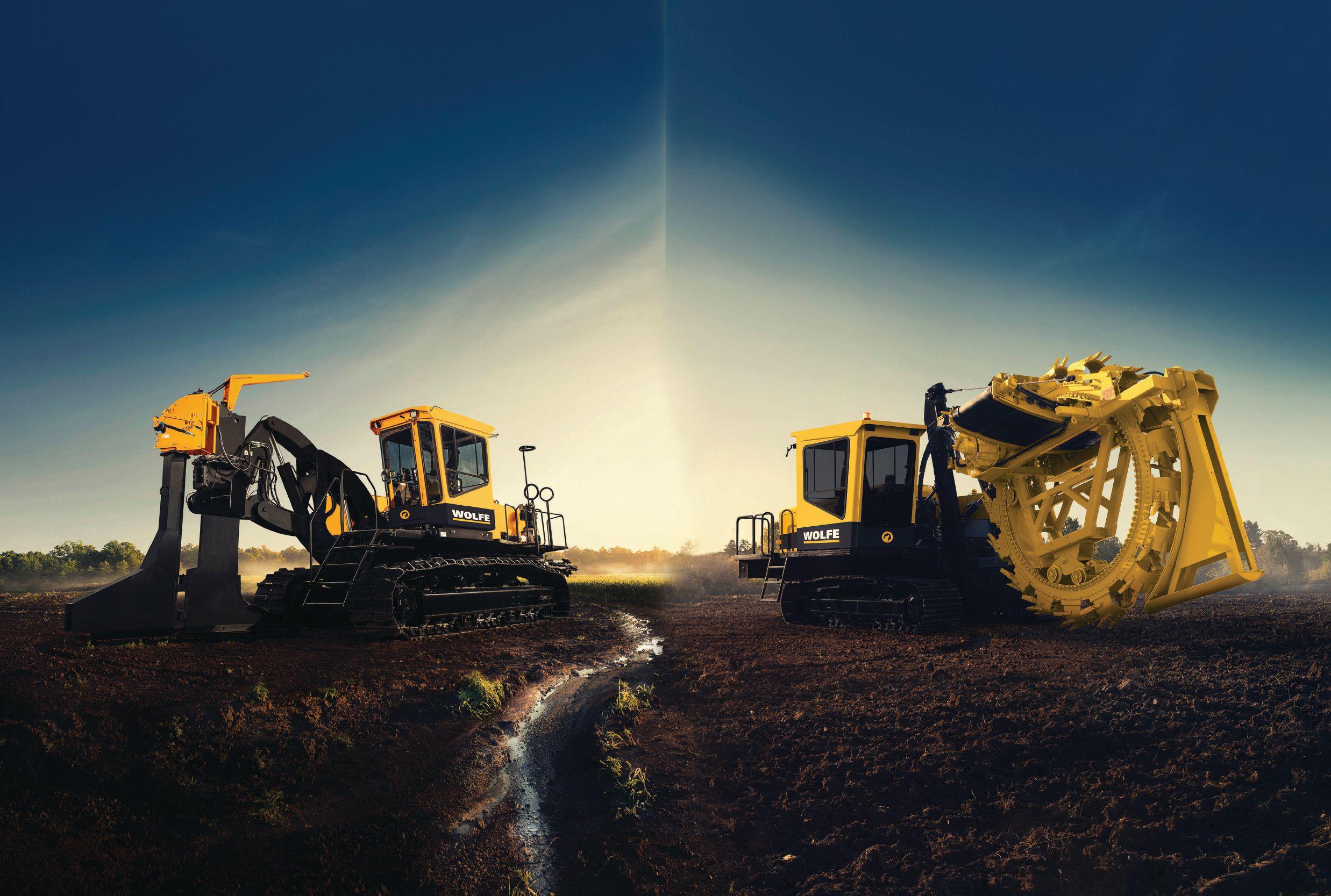
PLOW & WHEEL TRENCHERS
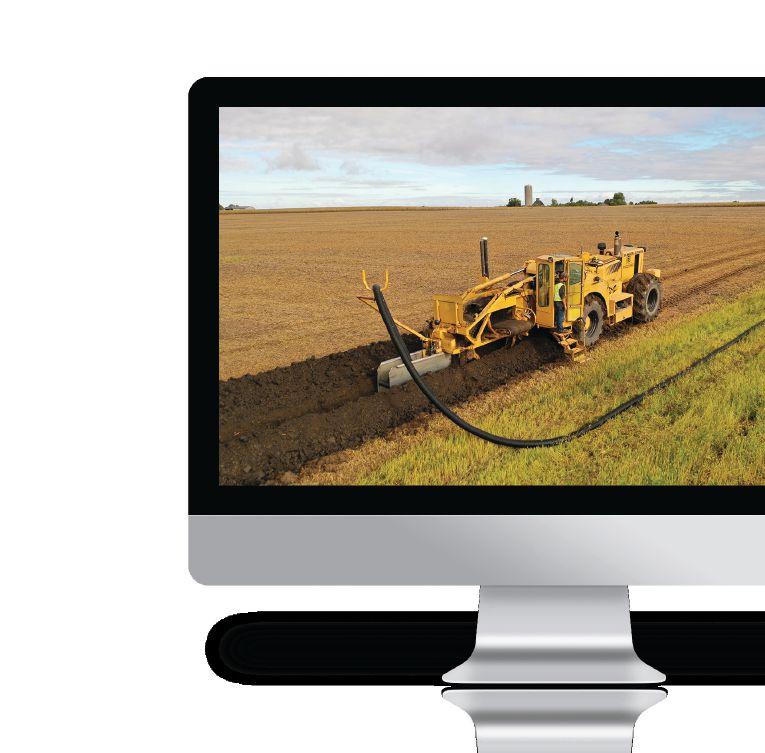
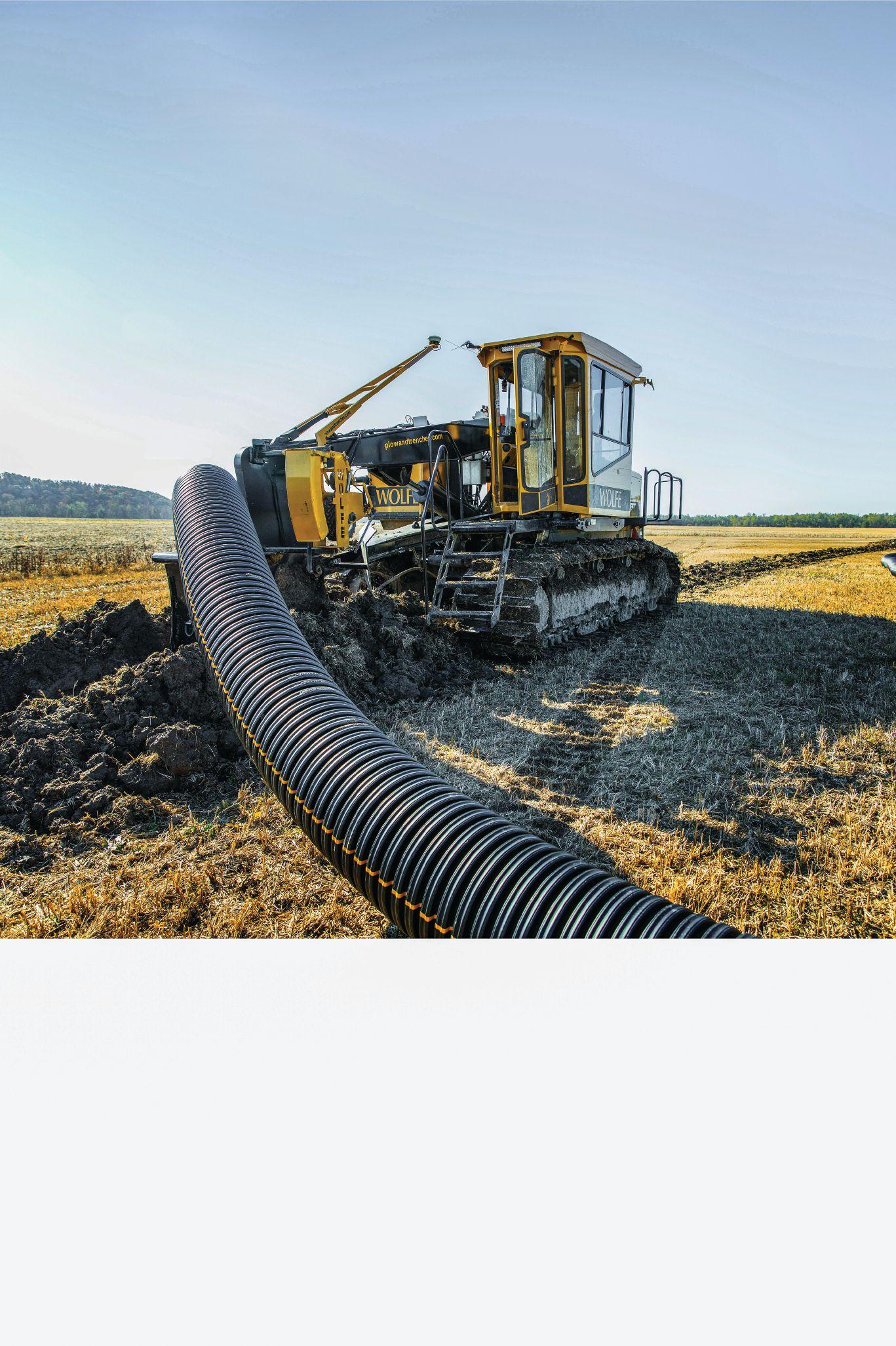
Wolfe Heavy Equipment continues to set the tone for powerful agricultural and commercial trenching equipment. Wolfe’s versatility, superior manufacturing and expert service along with reduced fuel consumption provides increased profitability.
CROPS OF INFLUENCE
Using winter cover crops to reduce nitrate runoff – and make money
Can the right winter cover crops reduce nitrate runoff into tile drainage systems? Based on research conducted by the University of Illinois’ Department of Crop Sciences, the answer is a definite ‘yes’. And it is possible to earn money from this crop as well.
That’s the takeaway from research conducted by the Department of Crop Sciences since 2016. Over the past seven years, the department has assessed the ability of winter cover crops to reduce nitrate runoff at its Dudley Smith Initiative Farm. It is a 228-acre farm in Christian County, Illinois that was donated to the University as a research site by Dudley Smith Jr. in 1993. This nitrate runoff reduction research has proven that “certain winter cover crops can reduce the amount of nitrate that gets into tile drainage below ground,” says Dr. Laura Christianson. She took part in this research as an associate professor in the Department of Crop Sciences. “The right ones can also pay for themselves.”
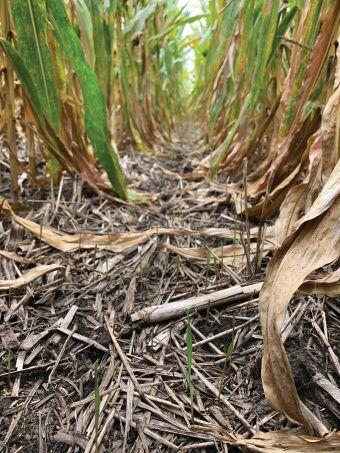
“To achieve this reduction, you need a cover crop that overwinters, which means it starts to grow again in the spring,” explains Christianson. “That's why one of the most common cover crops that we recommend for reducing nitrate runoff is cereal rye, because it grows in the fall. You plant it after harvest, and it grows in the fall. This cereal rye then goes dormant over the winter, but then it starts growing again when spring arrives. In doing so, the cereal rye takes up some of the nitrogen in the soil and holds onto it — thus keeping these nitrates out of the tile drainage system. The question is, can other cover crops do the same job, while also being saleable?”
RESEARCH AND RESULTS
To answer this question, the Department of Crop Sciences laid out 16 individually drained two-acre plots at the Dudley Smith Initiative Farm. “Within each plot there are three lateral tile lines that are spaced 60 feet apart,” says Christianson. “We've designed the system to drain about three eighths of an inch of water per day, which is a pretty standard drainage coefficient for Illinois fields. As a result, these 16 individually drained plots allow us to monitor the amount of nutrients in the drainage water in the tile pipes underneath each of them.”
by JAMES CARELESS
Again, the purpose of this experiment was not just to verify that winter cover crops can reduce nitrate in drainage, but also to determine which crops can do this work profitably as well as effectively. “At the Dudley Smith Farm, we want to answer questions about how other cover crops influence the amount of nitrate that gets into tile drainage, because all cover crops are not the same,” says Christianson. “This is why we divided the 16 plots into four treatment areas.”
The first treatment area was a control in which researchers did not plant a cover crop; just corn one year and soybeans the next with nothing in-between. This provided a baseline of nitrate runoff levels that the other areas could be assessed against.
“The second treatment area is where we're doing corn one year and soybeans the next, with cereal rye being planted each fall after harvest,” explains Christianson. “The third treatment area on the Dudley Smith Initiative farm is where “we're doing something a little different in our choice of cover crop. Usually this mixture involves clover. For instance, this past winter we did kale and Belansa clover. But I’ll be honest: The clover treatments haven't germinated very well, and so we've had some trouble with that treatment.”
The fourth four-plot section is Christianson’s favorite treatment area, and one that farmers should pay atten-
Cereal rye, one of the cover crops tested
of Laura Christianson
tion to. “Last year, rather than a classical cover crop, we planted winter wheat and then double cropped those plots with soybeans ,” she says. “The winter wheat serves the same function as cereal rye: You plant the winter wheat after harvest in the fall. It goes dormant during the winter and starts to grow again in the spring. Then you harvest that winter wheat and sell it, before planting the soybeans. This means that your cover crop is also a cash crop.”
The best part? Based on their measurements of water within the tile drainage systems, University of Illinois researchers confirmed that cereal rye reduces the amount of nitrogen sent downstream by 30 to 35 percent when used as a winter cover crop. Better yet, “We saw a very similar response from winter wheat in terms of the amount of nitrogen sent downstream,”
says Christianson. “This is really good news because winter wheat can be sold whereas cereal rye isn’t a cash crop.”
IMPLICATIONS FOR FARMERS
The University of Illinois’ research into nitrate runoff reduction into tile drains has proven that winter cover crops can make a difference, and that the right crop choice can also make money. For farmers, this is one of those serendipitous occasions where protecting the environment also protects their income.
This being said, results may vary from farm to farm, depending on their actual soil and tile drainage conditions. As well, “even when we're doing cover crops for research at the Dudley Smith Initiative Farm, we don't always have them come up perfectly,” says Christianson “We don't always have them germinate as well as we would like. We don't always get the biomass and the good stands of cover crops that we know are necessary to have a really significant water quality benefit.”
As a result, she advises farmers to adopt a range of options for reducing nitrate runoff, rather than relying solely on winter wheat as a cover crop. “It's important to be realistic about the fact that it can be a challenge to grow cover crops to reduce the amount of nitrogen we send downstream,” she says. “So keeping your mind open to other conservation drainage practices is really important. I'm talking about practices like constructed wetlands, wood chip bioreactors and saturated buffers. There are more conservation-oriented water drainage practices than just our in-field practices. Cover crops are an important practice, but they're not the only practice.” DC
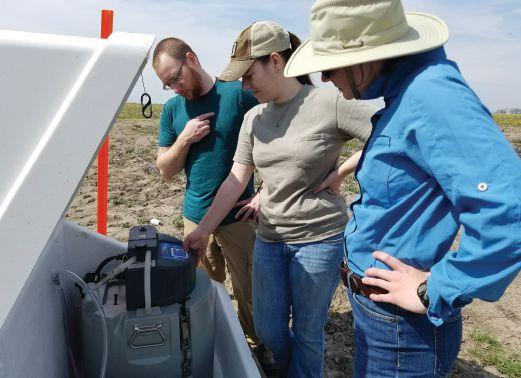
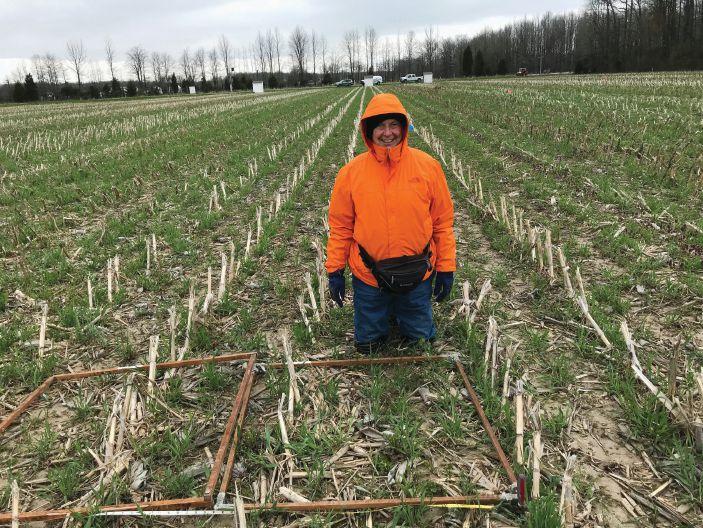
Laura Christianson, center, in the field at the Dudley Smith Initiative Farm.
DRAINAGE PAYS (SERIOUSLY)
A 35-year Indiana study proves drainage improves yields, and conservation efforts, in poorly drained soil
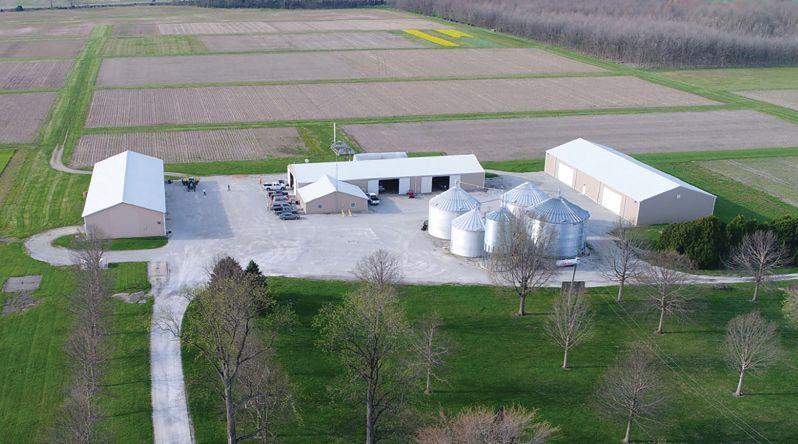
When Eileen Kladivko joined Purdue University’s agronomy department as an assistant professor more than 40 years ago, her new colleagues were just beginning a new drainage research study at the Southeast Purdue Agricultural Center in Butlerville, Indiana that aimed to assess the effects of tile drainage on crop yield, soil physical properties and erosion.
by JULIENNE ISAACS
The Southeast Purdie Agricultural Research Center (SEPAC) was the site of a three-decade-long subsurface drainage project.
“The original thought was that this would probably be a 10 year experiment,” says Kladivko, now a full professor at Purdue. But the study, which began in 1983, ran for 35 years before it officially wrapped up in 2017. (In its most pared-back form, the study is still ongoing at the Butlerville site: yield data is still being collected).
Along the way, says Kladivko, it gained new research questions, including an experiment focused on nitrate leaching and a large conservation practices experiment. “Originally, there
was no goal related to water quality or cover crops. We had several major goals, and different sub-goals got added,” she says. Taken together, the results from the Butlerville study’s 35 years of experiments offer a treasure store of information on the value of drainage systems for poorly-drained soils. Kladivko’s findings have been published as extension articles on Purdue’s website and in scholarly journals. More publications are pending as Kladivko and her colleagues continue to parse the data.
Kladivko
BUSINESS
“I think we’ve pretty much answered the questions we originally set out to answer,” says Kladivko. These answers have relevance for farmers in southeastern Indiana, but will be useful for farmers and contractors across the country working with naturally poorly-drained soils.
YIELD RESULTS
In the northern part of Indiana, most soils have been tile-drained for decades. In Jennings County in southeastern Indiana where one of Purdue’s experiment stations is located, the Clermont silt loam soils are very wet and require drainage, but before the study began, “the old clay tiles didn’t work,” says Kladivko.
“That soil [had] very high silt, low clay, low organic matter. It had almost no internal structure. When it was wet it would slump, the silt seeped into the cracks between the tiles and eventually silted up the tile with sediment,” she says. Farmers in the area were forced to do surface drainage by grading the fields with land levelling equipment to allow them to drain down the slope into shallow ditches.
“They were able to drain the fields by using surface shaping and drainage, but that required a lot of maintenance because they would deteriorate with time. That was the time before no-till, so they’d have to remake those every year,” she says. “When plastic tiles started coming out in the 1970s, folks in that part of the state were petitioning Purdue to do some work on modern perforated plastic drain tube to see if that would work on their soil.”
The experiment was set up with three drain spacings – 16, 33 and 66 feet – and an “undrained” control at a spacing of 133 feet.
Kladivko and her colleagues used fourinch-diameter perforated-plastic lateral drain tubes without socks or filters, installed at a 0.4 percent grade at a depth of 2.5 to three feet, or above the fragipan, which was generally about 3.5 to four feet deep.
In the first 10 years of the experiment, all of the four drain spacing treatments were tilled and planted to corn and soy-
beans based on when soil was considered ready for tillage.
Depending on how wet or dry it was in each year of the study, drainage improved the timeliness of fieldwork by one to 15 days.
Larger yield difference occurred later in the study, when weather was generally wetter. Average corn yields over the entire study period were 168, 163, 162 and 144 bu/ac for the 16-foot, 33-foot, 66-foot and 133-foot plots, respectively, says Kladivko.
By contrast, the researchers did not observe differences in soybean yields in the four treatments; yields averaged 57 bu/ac. Kladivko speculates that this is due to the fact that soybeans are planted later, after the wettest period is past.
CONSERVATION EXPERIMENTS
Another major component of the 35-year trial was its focus on interactions, or “synergies,” between tile drainage and conservation practices such as zero tillage and cover cropping. The researchers wanted to assess whether tile drainage improved soil physical properties and cover crop growth.
This agronomic treatment experi-
ment, added in 1985 and conducted for nine years, had two blocks: one with tile drainage at 50-foot spacing, and one with no tile drains.
The looked at five treatments, split between tillage and zero tillage, replicated four times in each subfield: continuous corn, corn with a wheat or cereal rye cover crop, corn with an annual ryegrass cover crop, corn with dry manure, and a three-year rotation with corn-wheat-orchardgrass or cornwheat-red clover.
For the continuous corn treatment, the tiled block saw 12 percent higher yields versus the untiled control. The conservation treatments with wheat or cereal rye cover crops, ryegrass cover crops or dry manure saw yield improvements of about 20 percent over the control.
“I’ve got a picture of cover crop growth in the drained versus the undrained control,” says Kladivko. “The drained [block] had about four times the biomass [than the undrained block] in that particular year. Almost always, there was less growth where soils were undrained, compared to where soils were drained.
“The implication that I got from that is that if you’re going to have conservation
Kladivko says drainage tends to improve the timeliness of fieldwork by one to 15 days.
practices, you need to take care of drainage first,” she says.
APPLICATIONS
When it comes to how drainage can improve conservation practices, there’s a crucial point to underscore, says Kladivko.
Some soils, like the post-glacial Clermont silt loam in southeastern Indiana, have a very high water table at certain points of the year that’s unaffected by farmers’ practices “at the top.”
“Naturally poorly drained areas may have cemented areas that hold water up. With a dense glacial till, the top two to three feet [can be] good soil, then there’s a layer at some point that’s much denser, at three to four feet deep, so at certain times of the year, the water goes into the soil, and can only move down into that layer very slowly.”
"If you're going to have conservation practices, you need to take care of drainage first."
Soils with a natural high water table present different challenges than compacted soils. The use of cover crops can go a long way to correct compacted layers in the latter case, says Kladivko. But in naturally poorly drained soils like those in southeastern Indiana, water tends to pond at three feet below the soil surface. Cover crops planted in soils like these will struggle to produce much biomass.
“The shallow water table of naturallypoorly-drained soils is the first limitation to growth of cover crops or cash crops,” writes Kladivko in a summary on the research. “It must be managed in order to provide adequate aeration for crop roots and soil biology, and their subsequent improvement of soil health.”
Kladivko says the results speak for themselves: for farmers in Jennings
County, drain tile is a good investment. That isn’t to say the study’s narrowest spacing design should be implemented by farmers. Although the 16-foot spacing saw the highest yields, Kladivko says it also saw higher nitrate leaching into the drains than the other spacings. During the first three years of the trial (19851988), nitrogen losses were 24, 32, and 44 lbs N/acre for the 66-foot, 33-foot and 16-foot spacings, respectively. When cover crops were planted, nitrate concentrations and loads were reduced in
the tiled blocks. Leaching issues aside, depending on soil types, the narrowest drain spacing likely isn’t economical for most farmers. As always, farmers need to take their own soil conditions into account when developing drainage plans. This summer, Kladivko hopes to publish an economic analysis of the study’s findings to help inform producers’ decision-making. Summaries of the 35-year study’s research data can be downloaded free on the Purdue Education Store at edustore.purdue.edu. DC
Celebrating 50 years of using the latest technologies to create innovative drainage, design, and modeling solutions.
by BREE RODY
CELEBRATING 50 YEARS
The evolution of the drainage industry and the publication that covers it
The practice of subsurface drainage for agricultural purposes has been around some 202 years. First introduced to the world by John Johnston, a Scottish immigrant readying his farm in the Finger Lakes region.
When Johnston’s first barley crop failed, Johnston defied advice to simply move somewhere else to find better land that drained naturally. Instead, he set out to improve his soil. So came the arrival of subsurface drainage – first in the form of clay and then, more than a century later, in the form of plastic.
It was not just the growth of drainage as a business but also the innovation in the drainage industry that prompted the launch of Drainage Contractor 50 years ago, says Peter Darbishire.
“It was the perfect storm of things happening all at once,” says Darbishire, the former co-owner and longtime editor of Drainage Contractor. The drainage industry of the late 1960s, he explains, was in a period of fast-paced change. When corrugated plastic pipe was introduced in both the U.S. and Canada, that was driven by high demand for pipe. “There wasn’t enough clay or concrete pipe out there. [For] contractors, their biggest stumbling block was, how much pipe could they get?”
This prompted the establishment of a number of plastic drain pipe manufacturing companies such as Big ‘O’ in Canada, followed by U.S. companies including ADS and others. At the same time, both the modern drainage plow and laser technology to control grade was introduced. Also during that period, researchers in the U.S. and Canada were working hard
and fast on projects relevant to the industry. What the industry lacked, says Darbishire, was a national media and communications platform for education and awareness.
It started with a newsletter, says Darbishire, one put together by a former advertising agency working with Big O. “At the time, it was Ontario-only,” he says. But demand from contractors and industry suppliers on both sides of the 49th parallel led to the inception of what would eventually become Drainage Contractor Magazine.
Now celebrating 50 years of publishing, Drainage Contractor continues to publish two print issues annually, while also engaging in multiplatform media such as podcasts, webinars and eNewsletters, as well as an annual GroundBreakers recognition program. While drainage plows and laser technologies were all the rage when Drainage Contractor first hit the presses, today, drainage is at an intersection of complex challenges – including environmental and bureaucratic challenges –and tremendous opportunity and innovation. Together with some of the industry’s influential voices, we look back – and forward.
GROWING THE BRAND
When Darbishire joined the brand, he came on as technical editor because he had a background in lasers, working as an applications
engineer with Laserplane Corporation prior to his move to Canada. He also had a background in agriculture, so the magazine was “really in my bailiwick.”
Like the industry itself, the magazine was experiencing skyrocketing growth at the time. Initially an annual, Darbishire says it went from a few dozen pages in its first year to around 68 pages in its second. “The next year, it was a perfectbound 200 [pages].” He recalls the peak production being around 1977, when the company produced a 278-page issue, with “massive inserts” of around six to seven pages each. For several years, there was also a European edition, which Darbishire said was born from a similar issue to that in North America – “They just didn’t have any general communications in the industry.” Darbishire also acknowledges that drainage is “such a specialized area that it would be difficult to start it now, because things are so different in communications.” While today's highly digitized and social media-driven landscape make it easy to communicate product launches and share demonstra-
tions, at the time, he says, “All of these new technologies and techniques and machineries were coming out so fast, to get the word out there was difficult.”
Eventually, he and business partner Peter Phillips sold AIS Communications, the company that produced Drainage Contractor and five other B2B titles, to Annex Business Media (then Annex Printing & Publishing) in October 2004. Along with Drainage Contractor came other titles which are still operating today: both regional editions of Top Crop Manager, Gound Water Canada, Glass Canada and Canadian Rental Service.
The biggest recurring issues that Darbishire found himself covering in those early days as technical editor and, eventually, editor, mostly revolved around machinery and a quest for efficiency. “The machinery was being developed very quickly,” he says. “Up until about the late 60s, the majority of pipe in north America was put in with wheel trenchers. Those machines were maybe 60 to 80 horsepower. The companies producing those machines [steadily] increased the
horsepower and increased the productivity of those machines. At the same time, European manufacturers came in with trenchers with much more power and speed as well. And lasers helped contractors to maintain grade and design systems more efficiently in the field. “Let’s say you go from a machine that can go at 20 feet per minute, to a machine that can go 50 per minute. The logistics on the field change because suddenly, ‘oh, I haven’t got enough pipe!’ And if the trencher's not running, it’s not making money, so that increased the pressure contractors to increase their field efficiency. That was something we’d talk about in the magazine. The thing is, everyone was so eager to share their experiences and ideas for improvement, there was plenty of editorial content available!”
INTENSE INNOVATION
Clark Farm Drainage president and LICA past president Bob Clark II agrees that the quest for productivity has continually driven some of the biggest advances in drainage. For example, says
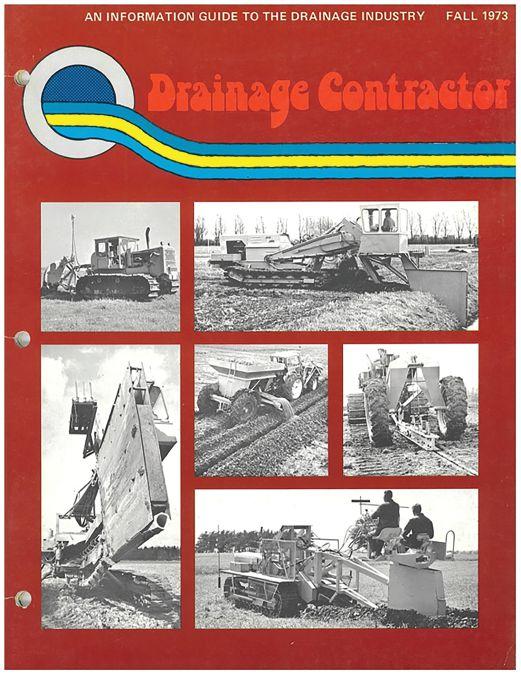
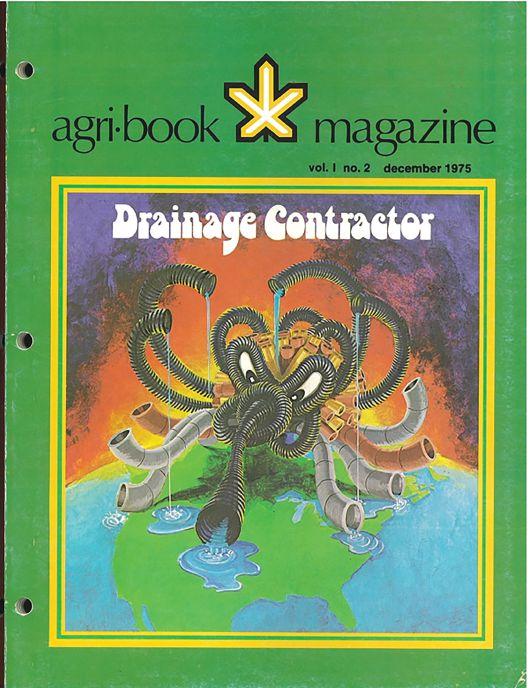
Former editor and co-owner Peter Darbyshire says artistically expressive covers were common in the 1970s.
SPECIAL FEATURE
Clark, the laser grade systems that were in their infancy when Darbishire joined Drainage Contractor would eventually go on to be largely replaced by real-time kinematics, or RTK-GPS machine control. Those, along with geographic information system (GIS) software “dramatically improved productivity,” according to Clark.
Ehsan Ghane, assistant professor and extension specialist at Michigan State University, goes even further – he believes software has been the biggest game-changer in drainage, period. Academia and extension, as well as private companies, have been hard at work over the last several decades developing software for all levels of data. Ghane says there are still different types of people who might install drainage, and thus, the software can’t be one-size fits all.
“There are two groups of people who are going to design a drainage system,” says Ghane. “One are people who might be using small tools for a simple job, just a few farms.” While there are often farmers who choose to install their own drainage, Ghane says that doesn’t mean they want to do it as a career. There are smaller, specific and often even free tools to aid in the design, such as mapping technology. For those who are in the tiling business, Ghane says, they’re more likely to make investments in advanced software, which is often subscriptionbased. “These systems are making a big difference in how fast one can generate a design,” he says. His team at Michigan State
developed a drain spacing tool in 2021 which is equally useful to both the DIY tilers and the professional drainage businesses.
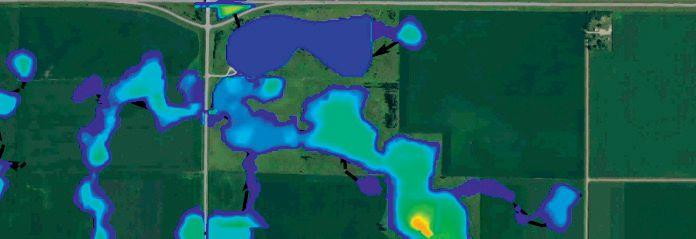
It’s a far cry from the early days of drainage. In John Johnston’s day, according to Geneva Historical Society curator of collections John Marks, no one kept maps of their tile –infrared aerial images still show Johnston’s original tile lines. By contrast, Clark says GPS-based technology has been among the biggest game-changers in all facets of drainage. This includes yield maps, which Clark says “allowed landowners to better manage capital improvements to agricultural lands.”
A MATURING INDUSTRY (AND MAGAZINE)
As a practice, drainage has been considered a miracle by some, but a problem by others – and it’s impossible to say drainage hasn’t been without its controversies. Increased scrutiny on the issue of nutrients leaching into waterways has caused many researchers and activists to zero in on agricultural drainage as an obvious source of nutrient transport.
All of this is ironic, says the University of Illinois’ Laura Christianson, considering the very roots of drainage. “Tile drainage used to be considered a conservation practice,” she says. “The roots of conservation go all the way back to the start of tile drainage.”
Clark echoes that there’s an opportunity for drainage – and challenge – as populations grow. There’s greater demand “for food, fuel and fibre,” and thus a greater demand for agricultural drainage. All the while, climate continues to become more variable and volatile, posing a challenge.
Despite rhetoric about drainage that can be divisive at times, most experts agree that crops grow best on well-drained land. The key is not to eliminate drainage, but rather to design better drainage systems.
Christianson agrees that these challenges in drainage are also an opportunity to innovate, and these innovations have been predominant since the turn of the millennia. “As conservation has really grown form the early 2000s to where we are here in
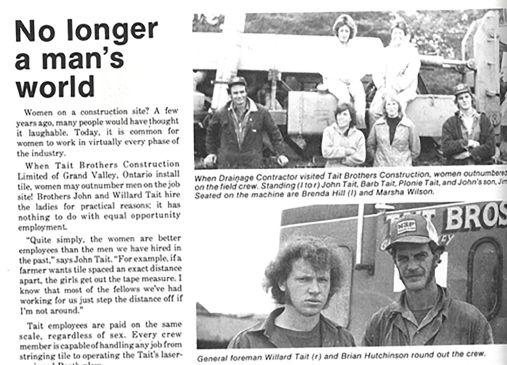
A 1970s issue highlights female involvement in the industry.
2023, what we’ve really focused on is reducing nitrate loss and phosphorus loss with conservation ideas,” says Christianson, who has focused a great deal of her research on saturated buffers and woodchip bioreactors. It’s fair to say that adoption is slow, she says, which is in part because despite their benefits, they provide no yield benefit and thus aren’t a moneymaker. “I feel like there’s a lot of education we can provide to contractors, because they don’t view bioreactors as something to market to clients... It’s just an extra cost.”
She credits partners such as Illinois LICA and the Iowa “Batch and Build” program for raising awareness and adoption. The efforts are the result of collaboration between farmers, landowners, farm organizations, governments (including the Iowa Department of Agriculture and Land Stewardship) and other stakeholders to expand and scale up the deployment of bioreactors and other proven soil conservation practices, while also offering cost-share. “It’s increasing,” says Christianson. “We’ve only really been doing bioreactors for 10, 15 years. You have to grow. [The Batch and Build program] really gets the economy of scale for full engineering firms, as well as drainage contractors. She adds that for landowners considering upgrading their drainage system, it’s the perfect time to invest in a bioreactor. “Every bioreactor is a win.”
Other common practices that fall under the drainage water management (DWM) umbrella include controlled drainage, drainage
from an environmental perspective and an economic one.
“It’s all about managing risk,” says Christianson, who believes that 100 years from now, many drainage systems could be combined with drainage water recycling systems. “We manage wet conditions well, but I believe the problems of drought and dry conditions will only increase in the Midwest. I think it’s a crisis, but it’s a huge opportunity to rethink how we manage water.”
For Clark, better management and design of DWM systems will be key. “With better system management I could foresee better yield optimization, better nutrient management, improved carbon sequestration and overall soil health.”
THE MORE THINGS CHANGE
While the drainage industry is evolving at an overwhelming pace in terms of technology and priorities, some things never change. It’s still considered a tight-knit and highly sociable industry, with annual events such as the LICA National Summer Meeting drawing contractors from around the continent, or last year’s International Drainage Symposium bringing together contractors, landowners and researchers from around the globe to discuss advances in drainage.
For Darbishire, he’s an honorary life member of the Land Improvement Contractors of Ontario. He says it’s about more than just going to the events because he gets a free pass. “I go and try to contribute something.” He adds that when he’s out
INTEGRITY.
DRAINAGE MANAGEMENT SYSTEMS
WHEN TIMES ARE UNPREDICTABLE
Lessons learned from drainage water management in Ohio
Historically, drainage has been part of a wider issue for farmers in Ohio. According to Vinayak Shedekar, research scientist, Department of Food, Agricultural and Biological Engineering at Ohio State University, “For more than 200 years, we have known that you can’t grow crops in the area without draining the soil.”
Historically, this was marshland, Shedekar explains. “Or, if it wasn’t marshland, the regions we now call ‘the corn belt,’ had poorly-drained soil,” he adds.
If we go all the way back in history to the days of the settlers, Shedekar says that when they tried to farm the land, their biggest challenge was how to sustain crop production, “and drainage came up as the practice that allowed them to be able to grow the crops in the first place.”
Fast-forward to our century, and Shedekar says we now know that crop yield can double when a plot of land is properly drained. Experiments show that surface drainage, tile drainage or a combination of both can have a major impact on yield.
However, that’s only part of the problem. The other issue is the variability in the amount of rain Ohio might get in a given year. Some years might be very wet, while others might be very dry. “So in undrained lots,” explains Shedekar, “they actually had years where they did not have any yield.”
The plots of land that were properly drained, on the other hand, did not experience years where they had zero yield. “In their cases,” Shedekar adds, “the
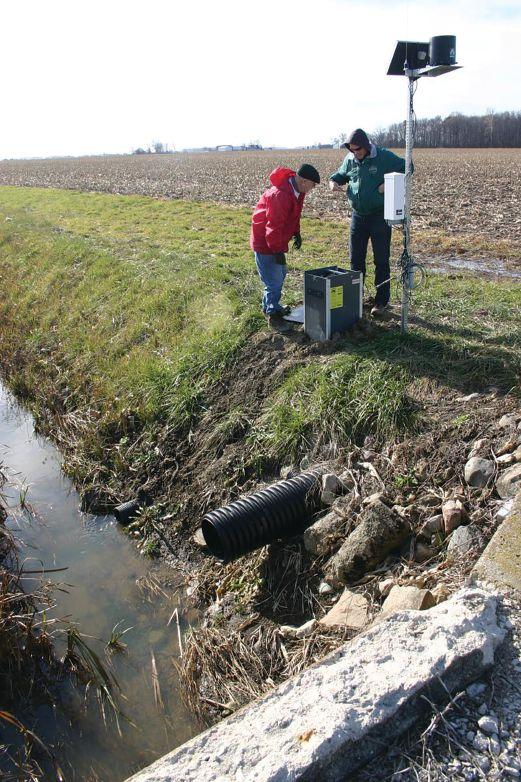
A field-installed drainage water management structure.
variability in yield was plus or minus 20 percent.”
The research that was conducted proved that proper drainage techniques not only boost yield, but they also take the risk out of the equation by providing a more uniform yield. “However,”
by JACK KAZMIERSKI
Shedekar warns, “just because you have drainage, doesn’t mean the yield variability goes down to zero. That’s because other factors will play a part, which is why we still see a 20 percent yield variability.”
The practice of drainage water management, or controlled drainage, came into existence when that 20 percent variability was no longer seen as acceptable, although Shedekar notes that, “the primary benefit of controlled drainage is the reduction in nutrient losses from the field.”
BEST MANAGEMENT PRACTICES EXPLAINED
When it comes to controlled drainage, Shedekar says there are many best management practices (BMPs). “You can divide them into categories,” he explains. “In-field, edge-of-field and stream level, or watershed level. In-field practices include cover crops, nutrient management, and conservation tillage. They’re not all water management related practices, but they are conservation practices.”
Drainage water management, Shedekar adds, is more of an edge-of-the-field practice, and he warns that there may be a bit of confusion about the terminology.
“Drainage water management and controlled drainage are used interchangeably,” he explain. “But drainage water management can also be a broader term for managing the drainage water. So you could take that water from the field, collect it in a reservoir, and recycle that water back into the system using overhead irrigation or a sub-irrigation type of a system.”
This is the approach Shedekar says has worked very well in Ohio. Collecting excess water in a reservoir during the wet months, and then using that same water to irrigate crops in the drier months simply makes sense. “We have already tested this drainage water recycling system, even adding a combination of wetland in there, and we found good results,” he says.
To take it one step further, drainage ditches can be employed as part of a drainage network, Shedekar says. “So if you're managing water at the ditch levels, that still would be considered drainage water management,” he adds.
Edge-of-field BMPs are all about structural practices. The water is concentrated into a singular outlet at the edge of the field, whether that’s a tile outlet or a concentrated surface pathway, Shedekar explains. “Examples include controlled drainage, any kind of nutrient-removal structure, like a wood-chip bioreactor for nitrate or phosphorus removal. Saturated buffers are another example.”
In-stream BMPs are employed where you have hundreds or thousands of acres of land contributing to a drainage ditch or a stream, and you want to improve the water quality. Best practices would include a two-stage ditch channel design or a self-
forming channel design, Shedekar says.
“There is a new practice that we’re experimenting with recently,” he adds. “It’s something called ‘cascading waterways.’ It’s a field-scale practice, and instead of creating just a regular grass waterway, if you have a good amount of relief, then think about a stepped approach where you’re creating artificial cascades of water. At every stage, you’re pooling some water behind a low-level dam, and it's almost like creating a small wetland cell along that waterway, which would essentially slow down the water, and pool the water, which results in additional water quality benefits.”
PROMISING RESULTS
Shedekar says that controlled drainage is one of the practices that was adopted in Ohio early on, “And I think Ohio may be one of the leading states for the adoption of controlled drainage, just in the last eight or 10 years.”
Results seem to be promising. “There are no official numbers per se,” he adds, “But based on my working relationship with the funding agencies, we know that there have been about 30 to 40,000 acres of farmland that have received controlled drainage as a practice, and I would say that a majority of that was done in the last five years.”
According to Shedekar, controlled drainage practices have resulted in a 41 percent reduction in annual discharge from tile outlets, a 40 percent lower nitrate load with a variable effect on phosphorus loss, a six percent boost to corn crop yields, and a 3.5 percent boost to soybean crop yields.
WM Drain GPS Machine Control
Drainage Equipment On-Board Reels and Disc Closers Service on Drainage Equipment
Boring and Welding *NEW*
DRAINAGE MANAGEMENT SYSTEMS
PLANNING FOR THE FUTURE
While these are encouraging numbers, more research has to be done to prepare for an uncertain future. “If you look at 20 years from now, and 75 years from now, every corn-producing grower is going to say that they wish they had water for supplemental irrigation here in Ohio,” says Shedekar.
He adds that the irrigation challenges aren’t limited to Ohio. Rather, the entire midwest, and even the entire U.S. will have to deal with challenges in the future, due to ongoing soil degradation and changing weather patterns.
Climate change alone will have a major impact. “By 2030, Ohio is going to be more like the southern portions of Indiana and Illinois, and by the end of the century, we’re going to be more like Arkansas during the summer months, and more like North Carolina in the winter months,” he adds.
What this means, Shedekar explains, is that Ohio will see a very challenging water situation, coupled with very high summer temperatures.
“So if you’re a farmer, you’re going to be looking for a really good drainage system to get rid of flooding waters and excess rain,” he adds. “And in the summer, you’re going to be crying if you got rid of all that water, and now you have none.”
Even today, Ohio farmers struggle with water issues. “Very few farms in Northwest Ohio have irrigation, and the challenge is that we don't have a source of water to rely on during the summertime,” Shedekar says.
History has shown us that marshland can be turned into productive farmland when best management practices are put in place.
Perhaps the lessons we have already learned from drainage water management best practices, as well as what we have yet to learn and implement, will prepare us for the climate-related challenges that are just over the horizon. DC
Inspecting and adjusting boards to manage water table level.
LAYING THE GROUNDWORK
Your reputation is on the line with every job you do. For 100 years, we’ve held ourselves to the same standard.
When your tomorrow depends on a pipe you can trust, count on Fratco for the quality drainage products you need.
the University of Minnesota in the early 2000s, he found his way back to drainage.
“In the upper Midwest, drainage is so front-and-center. I was able to dive right back in. It was almost like coming full circle.” On top of being a professor, Sands has an extension position, which allows him to spend time with farmers, contractors, agency staff and other stakeholders.
He describes these more hands-on experiences as when he gets to go “back to school” again. “We’ve got the theoretical aspects down pat pretty well, but in terms of how things really work out on the landscape, in the fields and on the farms, we learn every time we’re out there.”
When Sands first came on board at Minnesota, he says there seemed to have been “a void” for some number of years for work involving drainage, particularly in extension. At the time, there were a number of people in the contracting community, such as members of Minnesota LICA and national LICA, who wanted to ensure that there was someone involved in drainage with the extension department.
He had a goal to take stock of where the industry was and where it needed to go. Out of that need came the Drainage Research Forum. At the first Forum, individuals from Iowa State and University of Minnesota signed an MOU pledging that the states would continue their longstanding tradition of working together to advance drainage. Other individuals such as Matt Helmers and Chris Hay came on board, eventually helping expand the Drainage Research Forum to involve South Dakota. As passionate as he is about drainage, Sands is aware that
drainage is a source of nutrient losses from agricultural land. “We’re all working to reduce nutrient losses from agricultural fields.” It was following a hypothesis from the now-retired Wayne Skaggs of North Carolina State University – whom Sands describes as a “giant” in the field – that he and a team of researchers embarked on a project to prove the efficacy of shallow drainage for reducing nutrient losses through drainage. “Turns out he was right,” says Sands. Shallow drainage is not a silver bullet, but is one of the tools in what Sands calls the “suite” of conservation drainage practices. It’s a strong tool, says Sands, because it works in any area where drainage works, unlike controlled drainage or drainage management, which tend to require flat topographies.
Those tools and practices are vital, says Sands. Agricultural areas that are under irrigation and drainage are “some of the most productive systems on the planet." Besides managing reputation, Sands says conservation practices to mitigate the unwanted effects of drainage are vital. “I think one of our biggest opportunities and challenges is to get more of those practices on the ground. I think our implementation of those practices is way lagging behind our knowledge of how they work.”
CREATIVITY AND QUALITY: LAVERNE WEBER
For many in the contracting business, growing up on a farm is a relatively typical origin story. But unlike some of his fellow groundbreakers, Weber didn’t parlay his boyhood days on a farm into a full-time career in agricultural drainage – or at least, not right away. In fact, prior to starting Grade Solutions, Weber
CONTRACTOR AT WORK
had a full-fledged career in the roads industry. So what led him to drainage after a fruitful career in roads?
For nearly two decades, Weber had a successful business in the Chicago area. "Things moved forward – we had a company, we sold it.” Feeling too younug to retire, Weber knew he wanted to continue to do something similar.
It was around that time a decade ago that he became acquainted with 2022 GroundBreaker Jeremy Meiners – who nominated Weber for this year’s program – and Meiners’ family colleagues at drainage design software company AGREM. He describes Jeremy and Bob Meiners as two of his biggest mentors. “One of the things we focused on was water management,” he says, adding that Grade Solutions focuses on site development and road construction as well, but “primarily” water management.
them work for unique situations.
When they started installing bioreactors, Weber says, the company had a difficult time sourcing high-enough quality woodchips. So, he says, they played to their strengths in creativity. “We harvest and recycle our own hardwood and make our own clean chips for our bioreactors, because we want the quality and the standard to be high. It’s almost impossible to find clean-graded hardwood chips.”
One project highlighted in Weber’s nomination package was one using dairy washwater. “We have some corporate clients that have washwater from dairy processing plants and no municipal treatment facility close by. So we take that area that is nutrient-rich with nitrogen and some phosphorus too. We then connect with growers in the area, and we literally take water from their lagoons up, reutilize that, and use it through our subsurface irrigation systems.”
was a lack of knowledge. At the time, his drainage knowledge came mainly from an undergraduate course, but it was through mentors in the field of drainage – including Sands – that Hay eventually rose to become a prominent voice in the Midwest agricultural drainage scene, teaching drainage to students as well as farmers and contractors through extension, and aiding in the design of drainage systems and the development of drainage practices.
It was through that hands-on work with extension and other collaborators that Hay decided he wanted to be a bit “closer to the ground.” In 2015, he departed South Dakota State for the Iowa Soybean Association, which gave him a chance to continue to perform research on topics such as edge-of-field practices while also working with farmers and contractors.
“We’re okay with taking on innovative and challenging situations.” This includes clients for whom Grade Solutions has installed subsurface irrigation systems on hundreds of acres. Weber adds that a lot of the systems his team instals are on contour. “We’re in northern Illinois, so a lot of the topography is quite rolling. So it’s unconventional for one to think of an irrigation system on rolling ground in northern Illinois and in other places.”
Grade Solutions also "big in bioreactors." Every irrigation system installed comes standard with a bioreactor at the end of the main, Weber explains. “So at the end of the season, we open it up to let it dewater, everything can pass through the bioreactors.” Grade Solutions also independently instals bioreactors in existing, conventional drainage systems. Currently, the company is working on placing bioreactors at drainage tile outlets to try to denitrify water going into a manmade lake. He describes this as a “thousands of acres” project. He credits Laura Christianson of the University of Illinois for her work in the field of bioreactors. “She’s coached us along and encouraged us a lot in our process,” adding that she’s helped the team modify designs to make
While Weber is proud of the creativity and flexibility Grade Solutions offers, he says the focus is, and always has been, on quality above all else. “When we formed the company, our intention was, ‘the highest quality of whatever we do for our clients,” he says, reiterating, “We like to take the best concepts that serve the people well and move forward.”
A HANDS-ON EXPERIENCE: CHRIS HAY
Chris Hay, senior research scientist with the Iowa Soybean Association, says he “caught the academic bug” rather quickly, which led him to his PhD at South Dakota State University. His early work focused primarily on irrigation, but he was increasingly fielding calls with questions about drainage. “I came from water-short areas, where everyone argued over too little water as opposed to too much.” He realized, eventually, that it was just another aspect of moving through soil. “As an engineer, I think I’m a problem solver, and when there’s a problem, I want to solve it.” Drainage was relatively new to South Dakota at the time, and one of the problems he saw
One of the current applied research topics he’s working on is drainage water recycling, which he describes as exciting because he gets to combine his two areas of expertise. “There’s been this revived interest in capturing drain water and using it as irrigation,” adding that there are benefits to water quality.
Public education remains a key pillar of the organization. He witnesses firsthand the efforts that contractors are making to mitigate negative effects from drainage. “When we drain more water, nitrate is gonna come with that,” he acknowledges.
“Efforts around edge-of-field practices and doing things as responsibly as possible, contractors becoming aware of opportunities with managing drainage water… There’s still work to do, but we are making progress.
Drainage had a “bad name” for a long time, says Hay, and while the industry is in many ways “still trying to overcome that black eye from when we went from paying people to put drainage in as a conservation practice to saying ‘no, we don’t want to do that anymore.’”
As progress is made, Hay also finds the work not only rewarding, but also fun. “I get excited because there are so many win-win situations we can create with these practices.”
LEADING THE WAY: JACOB HANDSAKER
There probably isn’t a more appropriate name for Jacob Handsaker’s family business than Hands On Excavating and Tiling. It was a hands-on attitude that led the Handsakers to get into the business.
In 2008, Handsaker was at home farming with his brother, father and two uncles on his fifth-generation family farm. Eventually, more of his cousins wanted to come home to work. While crop markets were high at the time, he says there still wasn’t enough work for everyone. The family took the opportunity to diversify. “We’d had a backhoe for years,” Handsaker explains, “We had a family friend I worked for doing excavating work through high school living down in Missouri. When the 2008 bubble burst, he was looking for other things to do, so he came up and taught us to get the ball rolling. It blossomed from there.”
While Iowa is a major drainage market, Handsaker says at the time, there wasn’t a smaller business filling the area’s need for tiling and excavating, which was what
led the company to thrive. These days, Hands On is “pretty busy.” The company places an emphasis on proactivity, “trying to head off problems before they start... Our approach is a proactive approach, rather than a reactive approach.”
Proactivity also applies to Hands On’s approach to water quality. “When the Iowa Nutrient Reduction Strategy started 10 years ago, we made a commitment to look at that and see that that’s going to be the future.” He says the company knew they’d be involved “whether we liked it or not,” and chose to lean into it hard and focus on that. “It’s paid dividends for us.”
Handsaker has worked in partnership with various agencies and initiatives such as the Agricultural Drainage Management Coalition (ADMC), the Iowa Agricultural Water Alliance and the Iowa Department of Agriculture and Land Stewardship (IDALS)’ Batch and Build program. “We’d been doing these [installations] for several years before the Batch and Build program came in, but it was the farmer taking the lead, and it took so long, and it wasn’t efficient for the farmer. We had custom-
Agricultural Drain Systems
ers who were waiting up to three years for a simple design on a bioreactor.” The program took that out of the hands of the farmer, says Handsaker.
Handsaker says the company's involvement with organizations isn't to set them apart competitively, but to set a good example and do some good. “We all need clean water to drink, to recreate in, for our livelihoods. These organizations, they’re really focused on that, and being a part of these organizations takes us to a level at which we’re able to learn and motivate others to be involved – maybe kind of leading the way.”
Contractors “really can do these things,” says Handsaker, who is glad that more contractors are displaying that leadership and involving themselves in such organizations. Handsaker has valued his own mentors, including Matt Helmers, and loves to pay it forward as a mentor himself. “I get calls from quite a few contractors in different states, even, they say, ‘we’ve heard about this, we’ve seen you on social media, tell me about this.’ That really shows me that Iowa is leading the way in these processes.” DC
Law impacts the landscape
An Ontario history lesson through the lens of drainage and drainage law.
by Mel Luymes
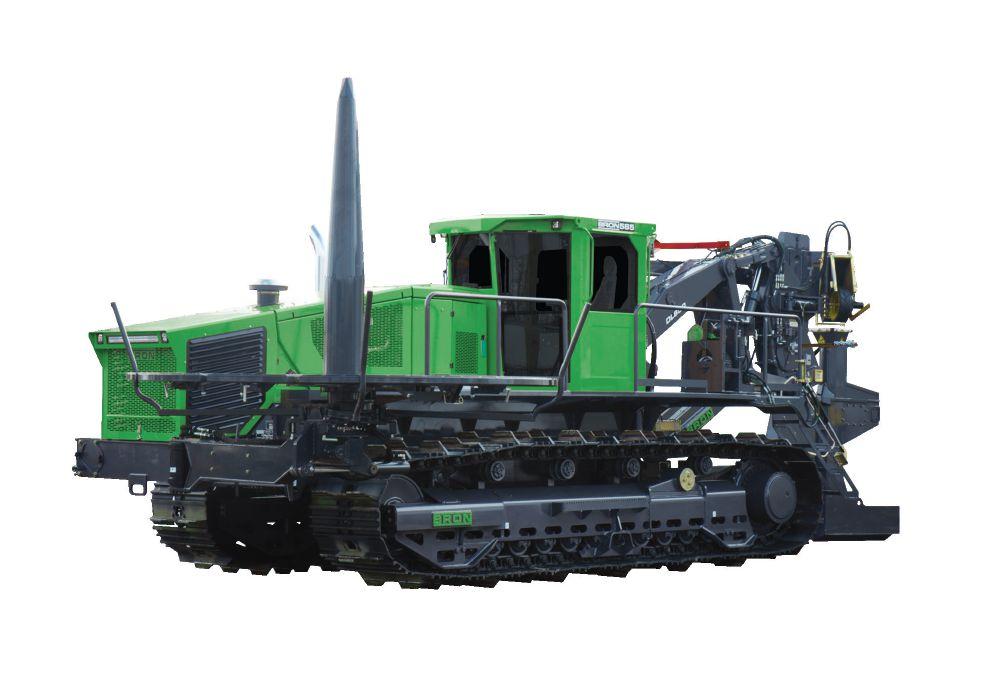
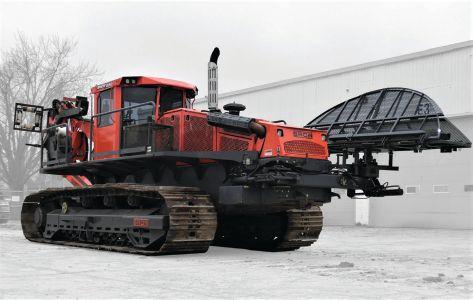
The more I get to learn about drainage contracting in other parts of the world, the more I wonder how we have such a different system here in Ontario. As many readers will know, our drainage contractors need provincial licenses, for our tile drainage machine operators, our machines, and our businesses. And the industry is going strong with incredible farmer demand for drainage, pipe manufacturers working hard to keep up to the demand and plow technology that is ever improving with Bron, Wolfe and Tait here in Ontario.
But this didn’t come from nowhere. To wrap our heads around this, I think we need to go back about 200 years
Well before Canadian Confederation in 1867, drainage laws had been instituted in Upper Canada (later called Ontario) that encouraged farmers to work together across their properties to dig open channels to drain land for agriculture. Under British ‘common law’ there is no right of surface water drainage unless the property is adjacent to a natural watercourse. So, some of the earliest statute laws in Upper Canada created
ways for landowners to acquire rights to drainage.
In 1835, the Act to Regulate Ditches and Watercourses allowed drains to be constructed by all the neighbours involved and it had some teeth. If anyone did not dig or maintain their section of the ditch, they could be sued for the costs of a neighbour to do it. In 1859, another statute law allowed for municipalities (most local bodies of government) to take on the role of design and construction, creating public drains that many still call ‘municipals’ to this day. The province began financial support of these drains in the 1860s and currently support one third of the share of the cost of engineering, construction, and maintenance (two thirds cost-sharing in Northern Ontario) for land that is assessed for agriculture.
In 1963, several previous statutes were put into one act, the Drainage Act. It has nearly 200 years of experience and well over 200 revisions that make it a powerful and practical piece of legislation. This Act has real strength, with the power to expropriate corridors for drainage, even moving utilities.
Full Line of Surface Water Intakes
In 1878, the Ontario Tile Drainage Act began to offer loans directly to farmers to install subsurface drainage, up to 75 percent of the project, administered through the municipalities. This tile loan program is still intact today and is now also conditional on hiring a licensed drainage contractor (unless the landowner completes the work themselves). The licensing program for businesses, operators and machines was implemented in 1972 under the Agricultural Tile Drainage Installation Act and requires contractors to report all the work they do in their annual business renewal. As much of a hassle as it might be for contractors, it gives us all great information to better understand drainage trends.
And we continue to have a great relationship with our regulators, the Ontario Ministry of Agriculture, Food and Rural Affairs (OMAFRA). Both the Ministry and the Ontario Agriculture College have offered continued support to the drainage industry since the beginning with demonstration days, drainage courses and the Drainage Guide for Ontario.
I thought that everywhere else would
have a similar drainage story as us, until I started poking around and got a sense that drainage law unfolded differently in Quebec, New York, Ohio, Minnesota or Saskatchewan. Driving around, we can see how laws impact our landscapes.
And when legislation is vague, it is open to interpretation and can often lead to costly litigation. How many Ohio courts are arguing over whether a farmer or contractor’s drainage work can be considered ‘reasonable’ or not? Without hard-won clarity, the law becomes a weapon for individuals on a power-trip, instead of a tool for improving farmland.
No matter where your province or state’s drainage legislation sits, I think we all need to be contributing our on-theground experience to our politicians and legislators. We are seeing increased pressure to reduce nitrogen and phosphorus losses from agricultural land, and there are powerful lobbying organizations that have the ear of the government but don’t understand the need for farm drainage in the first place. In North Dakota, Ellingson Drainage made a smart move and hired a lobbyist – they know that to have effective
drainage, you first need effective drainage laws.
Farm drainage is not only critical for food production in many areas of the world, but also a best practice for reducing soil erosion and nitrous oxide emissions, and it provides an opportunity to filter out nitrates and dissolved phosphorus as well. I think that drainage water recycling will be crucial for adapting to a changing climate. But we can’t have conservation drainage if we don’t even have drainage!
Ontario’s Drainage Act was last updated in 2021 and will likely be updated again. Under Section 78, it already includes provisions for municipalities to improve drains with ‘green infrastructure’ like erosion control berms, grassed waterways, two-stage ditches, etc. that reduce nutrient loss and can be protected and maintained long-term within municipal bylaws.
Just like a watercourse itself, Ontario’s drainage legislation is an achievement that has been ever evolving, the result of hundreds of years of conflicts and experience. And we still have work to do. DC
DRAINAGE INNOVATION
Lessons learned from success and failure
by Rob Burtonshaw
To keep with the theme, I thought I too would share a little history, and lucky for me we have some here as Farm Services Limited was founded in 1942 during what I imagine must have been dark and tricky times.
Britain had been at war for over three years and whilst in hindsight many of the major turning points had happened by that time, I doubt if it would have seemed like that for those present. Traditionally, all British companies have been formally incorporated and registered in London, but that was not the case for Farm Services Ltd. The incorporation certificate states the place as London but large Xs are typed over the name and Llandudno is written beside. I doubt if many reading this will know of Llandudno or even heard the name before. It is a small Welsh Town in the far west of the U.K., a location about as safe as it was possible to be during that time. As with much else, the department of business had been evacuated from the capital which was still being subjected to bombing raids by the Luftwaffe, so was operating out of a small country town rather than one of the world's largest cities.
To begin with, Farm Services concentrated on general farm contracting. This presumably was the reason why in a command economy focused solely on war production it was allowed to start up. Britain was dependent on food imports, much of it from Canada, and anything that could be done to improve production at home was encouraged. Agriculture was one of the few industries which continued to operate. Once the war ended, Farm Services Ltd soon started to specialize in land drainage, once again the desire to reduce reliance on imports impacted the company’s future. Grants were made available to farmers wishing to invest in drainage, this impacted the company in two ways, first the original founders of Farm Services, the local miller and forester took the opportunity to focus solely on Land Drainage, and the government trained people to be drainage agents, one of whom was my grandfather. My grandfather served as a land drainage agent in North Warwickshire for a few years until he was asked to manage Farm Services. The lure
of private industry, with better pay and prospects proved too tempting to refuse and he moved to south Warwickshire to take up the position. Slow over the next decades my grandfather then my Father built up a share holding in the company until it was solely owned by the father.
Throughout the 50s, 60s and 70s the company thrived. Demand was strong and new technology allowed productively to increase at a steady rate. Government grants were still available and were generous, paying 50 percent of the final costs. Competition was fierce, but with plenty of work to go around these were golden days. Those would not last. Policies designed to increase production had been too successful, the new problem was over supply and the easy solution was to stop subsidizing production. Drainage grants were removed in the early 80s and demand for drainage fell away quickly. At one point Warwickshire probably had more than 20 contractors of varying size operating before the grants, this would quickly be reduced to just three. To survive, Farm Services had to shrink in size, and diversify. The company started to drainage sportsfield and to work in construction as well as agriculture, being close to major cities such as Birmingham and Coventry suddenly became a help rather than a hindrance. By being nimble and adaptable my father, who had taken over running the company was able to keep going.
Now the older schemes installed in the early years of grant aid are failing the need for replacing and agricultural work is once again on the rise, although not anywhere near to the level of the grant years. Now it is my turn to lead the company and it is clear that if the company's history tells me anything, it is that external influences will have a great deal of influence on the company. Whether they be positive or negative there’re effect can be massive, and uncontrollable. However how we respond to them is, being flexible and adaptable means that Farm Services Ltd is still around today celebrating over eight one years of trading. Let's hope we can follow that lesson and be around in another 81 years. DC
NEW PRODUCTS
MASTENBROEK UNVEILS NEW BULLDOG TRENCHER AT CONEXPO
Mastenbroek unveiled its firstever utility trencher designed specifically for North America at ConExpo-Con/Agg 2023's Las Vegas show this past March.
Mastenbroek, which specializes in the design and manufacturing of self-propelled trenchers and crawler trucks, used the international construction trade show to unveil the Bulldog, a smallfootprint trencher designed to meet the need of utility cable and pipeline layers.
The Bulldog, which is 38 feet 7 inches (10.9m) long, is designed to work in confined areas, and its forward discharge conveyor system retracts to give an 8 foot 2 inch (2.5m) width making it is easy to transport. It features a new engine and enhanced digging mechanism.
The new U.S.-specific trencher features a U.S. EPA Tier 4 final compliant Volvo 8-litre engine offering the ideal combination of power, efficiency and emissions. Complementing the Volvo engine is a new diesel hydrostatic drive system developed by Mastenbroek to power the new heavier digging mechanism, which can achieve the six-foot trench depth required by U.S. cable layers.
It also features an offset cutting head and forward swing conveyor making it ideal for operating in cities and on
highways where access is restricted. A steerable undercarriage enables curved trench lines, and the track lift allows the machine to straddle raised pedestrian walkways.
JCB MARKS ELECTRIC EXCAVATOR MILESTONE
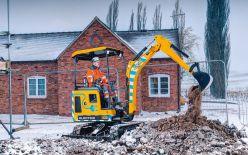
After introducing its landmark electric mini excavator to the market in 2019, JCB recently celebrated the showcasing of its 1,000th machine.
Showcased at ARA 2023 in Orlando earlier this spring, JCB displayed the 19C-1E, which is powered solely by lithium-ion batteries and pro duces zero emissions and onefifth of the noise of common diesel counuterparts.
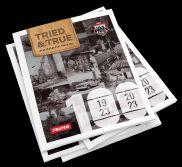
FRATCO MARKS 100 YEARS
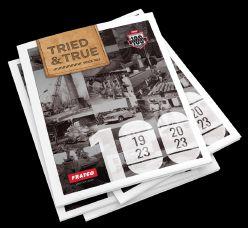
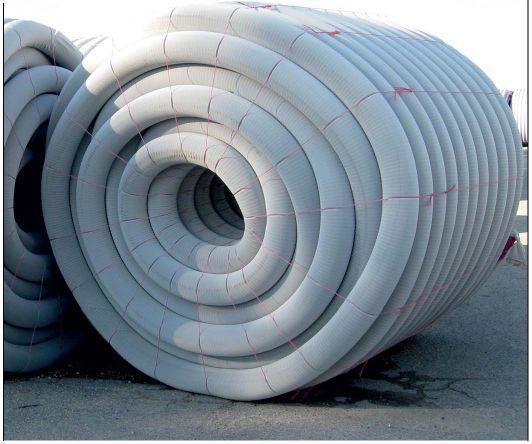
This year marks the 100-year anniversary of corrugated drainage manufacturer Fratco.
The company, which has pipe plants in Illinois, Indiana and Iowa, began with a clay tile kiln, since growing to a four-site pipe producer. Still family-owned, the company says its production rates have grown "exponentially."
It's curently marking this milestone through content online, sharing its history in
a video series narrated by the family ownership group. It's also produced a special, centennial edition of its Tried & True in-house publication. Learn more about Fratco's history and anniversary at Fratco.com/100.
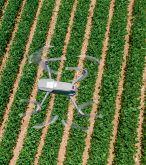
AG DRONE MARKET PREDICTED TO HIT $11B
Research firm Market.us predicts that the market for agricultural drones will grow at an annual CAGR of 21.2 percent,
by 2032 – up significantly from $1.7 billion in 2022. Agricultural drones are often used to examine soil quality and drainage efficacy, as well as pesticide application. Over the next 10 years there will be relatively equal growth in the subsections of drone hardware, software and service, with hardware expected to dominate. The increase is driven by increased adoption of precision farming and a growing need for soil
GEO-KNIT ® - Drainage Filter
Syfilco is a manufacturer of circular knit drainage filter. Contact us today for more information on our GEO-KNIT ® product line.
A proud tradition
by Chris Wagner, LICA, board chair
The
Land Improvement Contractors of America is honored to be part of Drainage Contractor’s 50-year anniversary. Drainage is the foundation upon which LICA was built.
In 1938 a group of terrace contractors in Missouri got together to form the Missouri Terracing and Conservation Contractors Association. In 1948 the Michigan Farm Trenchers Association was formed. Contractors in Iowa and Minnesota in 1949 formed the Midwest Drainage and Soil Conservation Contractor Association, and in 1952 the Kansas Conservation Contractor Association was formed. All of this led to the creation of the National Land Improvement Contractors of America in February of 1952. State chapters continued to be added through the 20th century and LICA keeps expanding today.
LICA has been dedicated to the conservation of land and water for 71 years. LICA members have been instrumental in the development of new drainage techniques, technological adaptations to drainage equipment, GPS, laser technology, and the never ending research into better procedures and conservation efforts. The accomplishments
of individual LICA members in the drainage industry are too long to list here, but they can be found in the LICA publication, The History of Farm Drainage and the LICA Contractor. LICA contractors and State Chapters continue to work with State and Federal administration offices to address the ongoing demands of drainage and environmental concerns.
Drainage has been one of the most important industries in this nation, if not the most Important. As the country moved west and the population exploded, feeding the people was paramount to the expansion of the United States. One of the greatest drainage accomplishments ever was the drainage of the Great Black Swamp in northwest Ohio and northeast Indiana in the second half of the 1800’s. It was done to provide better transport to the West, but more importantly, to create more land to grow food. Today we face an increasing need to produce food as our own domestic, and the world's populations continue to grow, which means we need to make more land available for agriculture.
While the conservation of land and water is
the heart of LICA, safety is its soul. I was fortunate to attend the Pennsylvania LICA State Chapter Conference in February and was both saddened and encouraged by two seminars I attended. I was saddened by the drainage and trenching accidents that were discussed. Encouraged by the incredible passion presented to eliminate accidents. I discovered that as we are expanding the land we need to grow food, we are looking to farmland that is very rural and undeveloped. Many pipes and transition lines were buried in this land years ago. Some we know about; others we do not. More importantly, we do not know how deep they are.
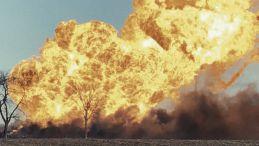
We all work in an extremely dangerous industry. If you have never seen the film produced by Drain Tile Safety Coalition titled Three Seconds Later, I suggest you find it and watch it, but not with your children present.
The accident described happened not so much from negligence but from the unknown on land where things were buried years ago.
We all call 811 for mark outs, but that does not produce depth locations. Today,
we continually install drainage five to six feet deep or deeper. Many pipelines and transition lines are at that depth, and many were buried years ago in land that was never expected to be developed and certainly did not expect to have drainage pipe installed at those depths. Nature has changed the depth of those lines. We can no longer assume pipe depths based on our own historical experiences.
The Drain Tile Safety Coalition pointed out that depth of pipes and lines can be determined. It is a more extensive preexcavation procedure. It requires more planning, more lead time, and more dealing with government agencies that we would rather not contact.
However, our responsibility is not just to the water and soil, but to the safety of ourselves, our employees, our families and their families. Does this require more planning and time on our part? Yes. Do we need to do it? I will let you answer that after you watch the film.
The second seminar that moved me was given by Monica Rakoczy of Entertraining Solutions. It is entitled “Everybody, Anybody, Somebody, and Nobody.” If you
CONGRATULATIONS TO THE 2023
ever have the opportunity to attend one of Monica’s safety seminars or classes, make sure you attend. The premise of the presentation is actually incredibly simple. It is that we, all of us on site, the ones with experience, the ones that have seen what can happen on a site, the ones who know better, are responsible for on-site safety. Not just the safety guy, also the safety book, the safety toolbox talks, the daily morning safety meetings, but all of us. Do not just say to a new guy, “Do not do that.” Tell him/her why. Tell them what could happen and unfortunately what you have seen happen. Be a storyteller. Be the Somebody, not the Anybody or the Nobody. Let us forget the line, “You learn by your mistakes.”
We are responsible for transforming the earth, for providing the food and infrastructure required now and in the future. Drainage Contractor and LICA will continue to be at the forefront of the industry. Let us do it with due diligence and safety. Let us celebrate our history. And as we look forward, let us not only protect the land and the water, but more importantly, our employees, our employees' families, our families and ourselves. DC
GARY SANDS University of Minnesota
CHRIS HAY Iowa Soybean Association
JACOB HANDSAKER Hands On Tiling and Excavating
LAVERNE WEBER Grade Solutions Inc.
We keep business flowing.
It only takes one look at a yield map to see the immense benefits you bring your customers through tiling. Together with drainage contractors across the country, ADS is proud to provide products and solutions to help farmers improve yields, increase farmable acres and create sustainable water management solutions to ensure the long-term success of their operations.