Fratco has been producing the highest quality pipe for nearly 100 years, and we’re just getting started.
Not content with being the first to plastic, recycled materials and zero waste, we’re drawing on our heritage to forge the future of quality drainage products.
Account Coordinator | Mary Burnie mburnie@annexbusinessmedia.com
Media Designer | Curtis Martin cmartin@annexbusinessmedia.com
Group Publisher | Michelle Allison mallison@annexbusinessmedia.com
COO | Scott Jamieson sjamieson@annexbusinessmedia.com
Printed in Canada
ISSN 1488-4305
Publications Mail Agreement #40065710
Subscription rates:
Canada – 1 yr $17.50 CDN
USA – 1 yr $34.50 CDN Foreign – 1 yr $46.50 CDN
From time to time, we at Drainage Contractor make our subscription list available to reputable companies and organizations whose products and services we believe may be of interest to you. If you do not want your name to be made available, contact our circulation department in any of the four ways listed above.
All advertising is subject to the publisher’s approval. Such approval does not imply any endorsement of the products or services advertised. Publisher reserves the right to refuse advertising that does not meet the standards of the publication.
8 FROM SOUTH TO NORTH
How Tait Bros Contracting has expanded with the family – and the province's ag industry.
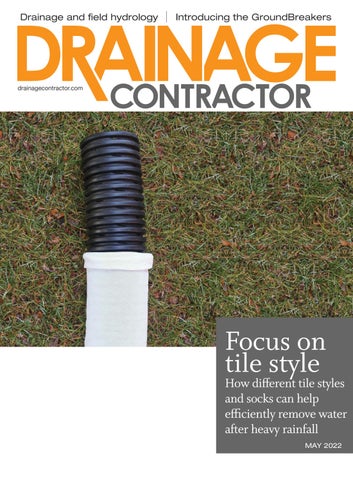
12 IT'S ALL ABOUT STYLE
How the right pipe properties can create more efficient drainage after heavy rainfalls.
18 SCRUTINIZING NUTRIENT LOSS
Understanding phosphorus losses in the Lake Champlain Basin.
26 MEET THE GROUNDBREAKERS
Five honorees share what led them to drainage and where they think the industry is heading.
ON THE WEB:
Never miss an eNews issue
Get the latest in drainage and water management news. Our eNewsletter arrives in inboxes every two weeks on Tuesdays, delivering the latest on funding, research and more.
Stay in touch on social Connect with Drainage Contractor and other land improvement professionals on our Facebook Page (facebook.com/ drainagecontmag), Twitter (@drainagecontmag) and LinkedIn (LinkedIn.com/company/drainage-contractor).
Those in the trenches know drainage best
by
I’ve been working as a trade journalist for the better part of a decade. In that time, I’ve covered land drainage and water management, manure management and other agricultural topics, media buying and advertising, broadcasting, entertainment, tech and more. If there’s one thing I’ve learned from this line of work, it’s that a lot of people like to think they understand others’ jobs – just think of how often we hear comments like “how hard can that job be?” or “I could easily do that job." But the only people who truly understand a job are those who have done it themselves.
Many contractors are at the table actively contributing to solutions.
In the case of drainage, no one understands it like those who are quite literally in the trenches. Drainage can be a contentious topic. The leaching of phosphorus and nitrogen into waterways has serious consequences, and many have pointed to subsurface agricultural drainage as a contributor to this. What some on the outside don't always realize, however, is that drainage contractors are highly aware of, and concerned about, such risks – and many are at the table actively contributing to solutions.
Few experts would agree that simply getting rid of subsurface drainage, especially before adjusting other practices in agriculture, would solve environmental or water quality woes. In fact, there’s plenty of research out there that shows that the benefits of drainage are unignorable. Our feature on page 20 reveals that even amidst concerns about hydrology in Vermont, the number-one reason – by far –crops fail in the state is because of excess moisture.
The honorees of our first-ever GroundBreakers program (see page 26 for our feature interviews) were chosen because they understand that drainage, like all trades and practices, is ever-
evolving, and that much of the excitement in drainage comes in finding new ways to lay tile and drain land while also protecting waterways. For example, AGREM’s Jeremy Meiners' passion for drainage design has led to plenty of research in controled drainage, combination systems and more. Consultant Bruce Shewfelt's career of overseeing large-scale drainage projects has also included the development of best management practices to help keep drainage efficient, effective and equipped to handle the climate challenges of the future. And contractors like Brett Sheffield and Matt Mroz don’t simply place pipe in the ground; they have worked with fellow contractors, specialists and subject matter experts in Canada and the U.S. to help understand what makes Manitoba soils and climate conditions unique – and how to tile for them. Finally, honoree Adam Fisher, owner of the Ditch Doctor, prides himself in always having a finger on the pulse of infrastructure management and effectively spreading awareness on the use case for surface drainage and ditches, the importance of maintenance and more.
Interviewing our GroundBreakers was an eyeopening experience – I didn’t realize there was so much to talk about when it came to drainage, or that after the interviews I would find myself still wanting to know even more. It goes to demonstrate the immense value of different perspectives within drainage and water management. When we have those different perspectives at the table, the industry can not only grow in terms of economics and yield, but also in terms of positive impact to the environment. DC
NEXT ISSUE: Watch for industry news, research updates, long-form features and special guest columns in the November 2022 issue of Drainage Contractor. @DrainageContMag
Bree Rody
INDUSTRY NEWS
ADS DONATES TO OHIO STATE UNIVERSITY, WILL CREATE ‘LIVING LABORATORY’ FOR WATER MANAGEMENT RESEARCH
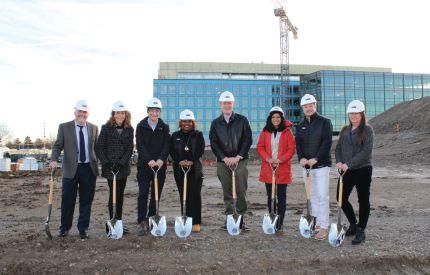
Ohio State University and Advanced Drainage Systems (ADS) have struck a partnership to collaborate on water management research while enhancing student learning and making the school’s campus more sustainable.
ADS has donated two stormwater management systems for the west campus Innovation District, along with a cash gift to install them and fund related research and teaching opportunities. Additional parts of the gift will promote diversity and inclusion by supporting the Engineering House Learning Community and helping the university improve recycling on campus. The total value of the donation and cash gift exceeds $1 million.
In addition to the donation, ADS will support research and teaching opportunities that will use the larger of the two stormwater management systems as a living laboratory for urban water management. Potential projects include comparing the performance of the company’s stormwater management system to water quality from traditional retention ponds and exploring the possibility of tapping the water stored inside the system for irrigation.
SWAN LAKE FIRST NATION MAKES PROGRESS ON DRAINAGE PROJECT
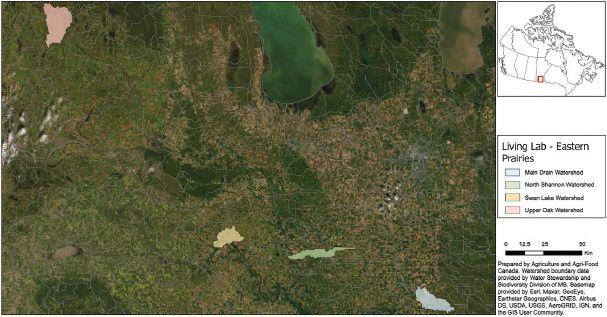
Since 2020, the Government of Canada has supported the Living Lab-Eastern Prairies project, which works to develop best management practices for more sustainable farming and environmental practices on farms within the Upper Oak Lake, Swan Lake, North Shannon Creek and Main Drain watersheds.
For Swan Lake First Nation, that meant significant progress on the Swan Lake First Nation Project SL-S49. Infrastructure was already more than 90 percent complete prior to the funding, and includes enhanced drainage with the installation of tile over an 11-acre wet area in the field and a water retention dam in order to treat runoff from the tiled fields.
Additional measures such as planting plants that are attractive to pollinators have also since been enacted.
While SLFN says more data collection is needed to show specific scientific results, according to the latest update the project is making significant progress. The next major drainage-related project coming soon is a saturated buffer, which will provide additional management of water and nutrient flow from water moving from the field downstream.
INDIANA PASSES BILL TO ESTABLISH DRAINAGE TASK FORCE
A bill authored by State Senator Jean Leising (R-Oldenburg) that would establish a drainage task force passed at the Senate this past winter by a vote of 45-2.
Senate Bill 85 would establish a drainage task force of 19 members. This task force would be required to do three things:
• Review the responsibilities of landowners and state and local authorities according to current laws relating to the drainage of land;
• Make determinations concerning drainage and regulatory matters based on their findings; and
• Determine whether the balance between state and local authority over drainage of agricultural land is comparable to neighboring states.
This task force would also be allowed to make recommendations through a report based on their findings.
“We need more information to review in order to find the best way to tackle this issue,” Leising said. “I am glad to see my fellow legislators supporting this bill. We need to work on bettering drainage in Indiana, especially in our rural areas.”
Ohio State and ADS representatives break ground on their new collaborative project.
A map of lower Manitoba highlighting the locations of four watersheds where Living Lab-Eastern Prairies research is taking place, including Swan Lake.
ONTARIO INVESTS BIG IN DRAINAGE IN THE NORTH
Although tile drainage is more common in the southern regions of Ontario than in the north, a steady uptake in drainage activity has prompted investment from the province. In February, the province announced that it would provide $1.5 million to four agriculture projects in the Sault Ste. Marie area as part of the Northern Ontario Heritage Fund Corporation (NOHFC), with just over $1 million of that funding going to two different tile drainage projects.
The Sault Ste. Marie Innovation Centre will complete two tile projects across more than 2,000 acres of farmland in the Algoma and Manitoulin regions. The project will create 14 new jobs and benefit 21 area producers. The projects are valued at $683,725 and $429,910 each.
More recently, the province announced another round of NOHFC recipients, again including a tile drainage project. Of the $3.4 million allocated to six economic development projects, $1 million has been earmarked for the Northeast Community Network, an economic development network of 12 area municipalities, to install more than 1,800 acres of tile drainage.
EDGE-OF-FIELD WETLANDS COULD HELP MITIGATE NITROGEN LOSSES
A 12-year study was recently published in the Journal of Environmental Quality that thoroughly examines the effects of drain tile on nitrogen and phosphorus runoff into waterways and hypoxia in the Gulf of Mexico.
The study found that of all mitigation measures, one of the most effective was small, edge-of-field wetlands. Those small wetlands were found to effectively treat nitrate-nitrogen export from tiles. Despite their effectiveness in terms of nitrogen, less research exists on their capacity to treat phosphorus. Additionally, longterm datasets are needed to incorporate variability of weather and farming practices into assessments of wetland performance longevity.
NNYADP RELEASES RESULTS OF YEAR-LONG DRAINAGE STUDY
The Northern New York Agricultural Development Program (NNYADP) and Miner Institute have released the results of two projects on collecting data year-round from side-by-side trials of tile-drained and undrained fields on a working farm.
The research began with land provided by the New York State Department of Environmental Conservation; it has since evolved to trials under northern New York growing conditions on a working farm to provide real-time information on how nutrients move in undrained versus tile-drained fields. Surface runoff and tile drainage from four replicate edgeof-field plots were continuously monitored from Jan. 1, 2018 to Dec. 31, 2021, with a brief pause in the spring of 2020 due to the COVID-19 pandemic. Automated water samplers were used to sample runoff every 30 minutes when weather forecasts indicated that runoff would be likely. Samples were analyzed for total P, soluble reactive P, total N, nitrate-N and total suspended solids.
Throughout the study, snowmelt events have been the primary driver of surface runoff, with the spring 2021 snowmelt producing 96 percent of the 1.7 inches of surface runoff for the year. The same snowmelt event also produced 25 percent of annual tile drainage. The combination of snowmelt events, precipitation and seasonally high water tables during the non-growing season, particularly in February through April, creates a high risk for surface runoff events.
The study found that the majority of phosphorus losses occurred in surface runoff despite tile drainage providing 72 percent of the total runoff; the enhanced subsurface drainage rates appear to be effective in reducing P loss from the plots.
These findings are similar to recent findings from the Scotland Rural College which found that although tile drainage contributed to phosphorus losses in Scotland, surface runoff remains the principal driver.
BY THE NUMBERS: BARRIERS TO CONSERVATION
75%
Drainage contractors who were familiar with drainage water management.*
34%
Contractors who reported state and federal programs as an extreme barrier to adoption of conservation drainage practices.
47%
Contractors who reported these programs as a moderate barrier.
29%
Contractors who reported cost and ROI as an extreme barrier to adopting conservation drainage practices.
* Results from the Agricultural Drainage Management Coalition’s survey. For more information on the survey, see page 24.
53%
Contractors who reported cost and ROI as a moderate barrier.
CONTRACTOR AT WORK
FROM SOUTH TO NORTH
How Tait Bros Contracting has expanded with the family – and with the province’s agriculture industry.
In 1955, the Tait family began providing field drainage solutions for farmers in southwestern Ontario, near the Grand Valley. “My grandfather James Tait was a farmer here with 15 kids in his family,” says Jim Tait.
by JAMES CARELESS
“He decided to install tile drains at his own farm after waiting for someone else to do it for a couple of years. After he did it, his neighbors asked him to tile their fields, and so our family drainage business was born.”
A few years later, John Tait, son of James, joined forces with his brothers Steven and Willard to create Tait Brothers Contracting. John’s son Jim eventually joined the company, as did his grandson Jesse. But although Steven and Willard went on to other ventures, the name Tait Brothers stuck – and Tait Brothers remains a father-son operation.
TAIT BROS’ OFFERING
These days, Tait Bros Contracting offers drainage, excavation and erosion control services to farmers and municipal governments. The company website describes
Tait Bros as “much more than a drainage company.” Its services include drainage system installation, farmland and municipal drainage, excavation, erosion control, open ditch excavation, backhoe and bulldozer work and drainage tile repairs.
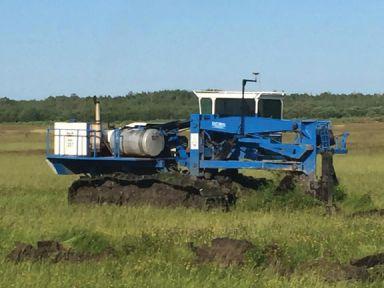
“We do all aspects of agricultural farm drainage, but I’d say the bread and butter is field systems work,” says Jesse. “But we do pump stations and ditches as well. Everything is done in-house from surveying and design to installation. We even built our own self-propelled drainage plows to do the installations.” Jesse’s plow is a Tait 257, while Jim drives a Tait 400-7.
GOING NORTH
Tait Brothers’ home turf is southwestern Ontario. However, sales opportunities motivated the company to start offering tile drainage to farmers in northern Ontario in the early 90s. They started out in the Thunder Bay and Algoma districts, then shifted their focus to the Rainy River district, at the border between Ontario and Minnesota.
According to Jesse, high real estate values in southern Ontario have fuelled the farming boom in the north. “More farmers are buying more land here as the price of land in the south keeps going up,” he says. “People have also found they can grow pretty good crops
RIGHT: Tait Bros has made its operation more efficient in part by manufacturing their own equipment.
up here with the right methods, field preparation, crop varieties and longer hours of sunlight. So, the North is really starting to boom. There is a lot of ground being reclaimed and utilized for farming now.”
The demand for tile drainage is so strong in northern Ontario that Jesse now spends three seasons here each year while his father Jim handles business in southwestern Ontario. He started doing that back in 2012 when up until that point, his grandfather John had been covering the north.
“I was actually ranching in Quebec at that time, but they needed some help,” says Jesse. “So, I came up in 2012 and started working. Then in 2013, the Northern Ontario Heritage Fund Corporation (NOHFC) started providing money to farmers here, and that’s when tiling really took off in the Rainy River district.”
In 2017, John Tait passed away. When this happened, “I decided that I wanted to jump into the ring,” says Jesse. “So, me and my dad formed a new company, but we still called it [Tait Bros]. We wanted the legacy of the company my grandfather founded to live on.”
GOOD HELP IS HARD TO FIND
These days, Tait Bros is busy at both ends of the province. While work has been steady, Jesse says they could do far more if they could find the help.
But these days good help is hard to find – and labor slowdowns caused by the COVID-19 pandemic have only made matters worse.
“One of the challenges up here in finding workers is that there are lots of well-paying jobs in mining and forestry,” says Jesse.
“So, a lot of the people who want to do this kind of work already have jobs in those sectors,” adds Jim. “Meanwhile, oftentimes the kind of people who you need to hire are pretty good entrepreneurs by nature, which means they are able to do jobs like this on their own. The result is that everybody's working from the same small pool of labor for this kind of work.”
“As far as employees go, I think it’s safe to say everyone is in the same boat,” Jesse echoes. “Nobody has enough good guys. Down south, Jim does have a great employee who’s been
with us for years. And he usually finds help when he needs it, but some guys only like shop work or field work, so it can be a struggle to find someone to do both. Over the past years in the north, I can sometimes get some part-time help, but I am always looking for guys.”
Given the Taits’ abilities to build everything they need, including drainage plows, it makes sense for them to design a mechanical solution to the labor shortage. “Right now, we are building carts that you pull beside the drainage plow to help with some of the jobs, so that you don't have to have an operator on the stringer,” says Jim. Our goal here is to reduce the number of hours it takes to lay drainage tile, because it can end up being a pretty long day when you’re doing it yourself.”
LOOKING TO THE FUTURE
Despite the challenges of finding good help, Jim and Jesse Tait are determined to keep growing their business, particularly in northern Ontario. “We are currently in the process of receiving an NOHFC grant for business expansion in the north,” says Jesse. “As I said earlier, the farming market
up here is booming, and people want tile drainage to make their fields more productive.”
In the meantime, the topic of bringing a fifth generation of Taits into the business is already on the table. “I have a son, but he's just 11 now, so it’s too early to say,” notes Jesse. “But it would make sense for him to spend at least some time doing tile drainage work, since John Tait’s grandsons have all worked in the business – even though most of them have moved on to do other things. It would be nice if somebody wanted to keep Tait Brothers going, but my son's a little too young to be thinking about it yet.”
“Meanwhile, my dad Jim will be a lifer one way or the other,” he laughs.
“We always joke that when one of the Taits dies, we just put him in the last joint hole and move on to the next one because we can’t miss a day of work!”
“I don't know if I can quit, but I'm going to certainly try,” says Jim. “But you know, I think I've barely scratched the surface on tile drainage. I mean I’ve done a lot, but there's a long way to go yet. And man, I've loved the ride that it’s taken me on. So, I don’t think I’m going to quit just yet.” DC
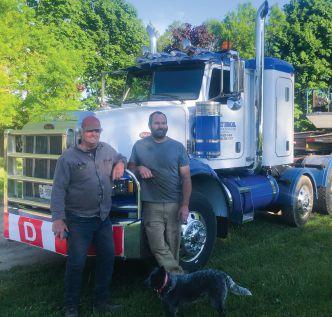
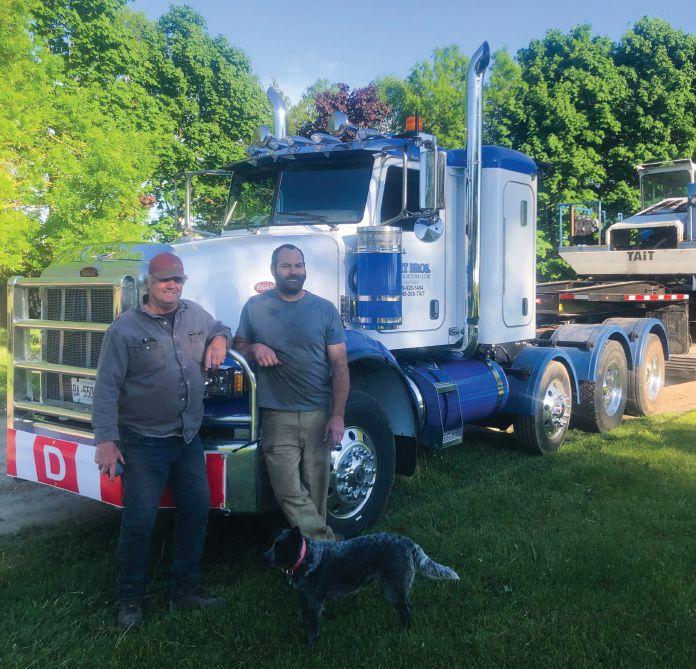
Jim and Jesse Tait keep the business – and the equipment – a family affair.
DRAINAGE MANAGEMENT SYSTEMS
IT’S ALL ABOUT STYLE
How the right pipe properties can create more efficient drainage.
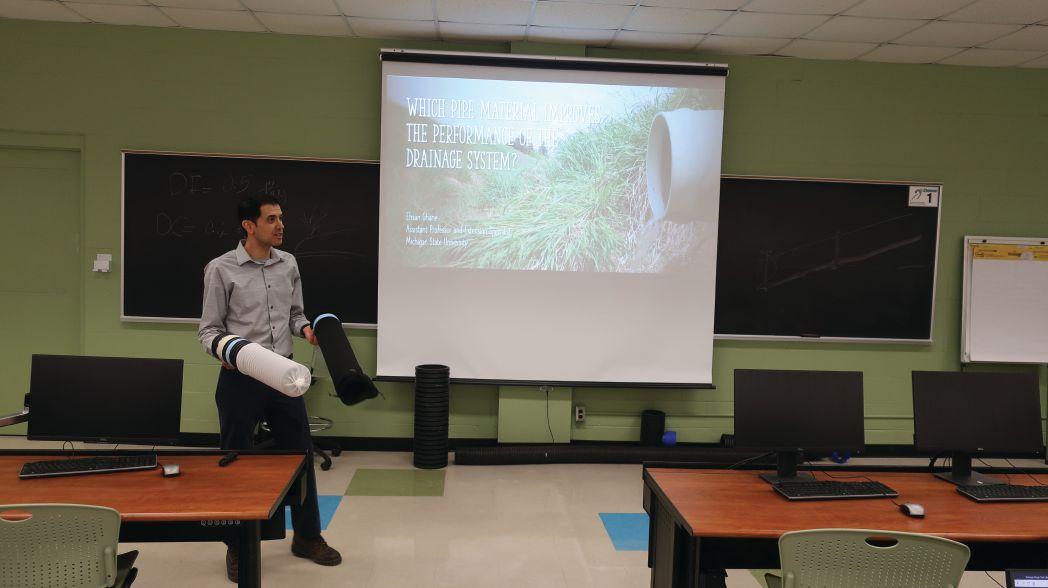
Ehsan Ghane kept a secret for more than 10 years. In 2010, during his doctorate degree work, he began thinking about how different types of pipes could drain water faster, depending upon their properties.
by RONDA PAYNE
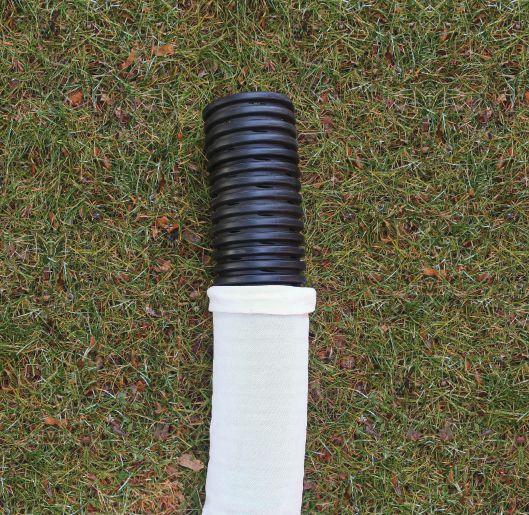
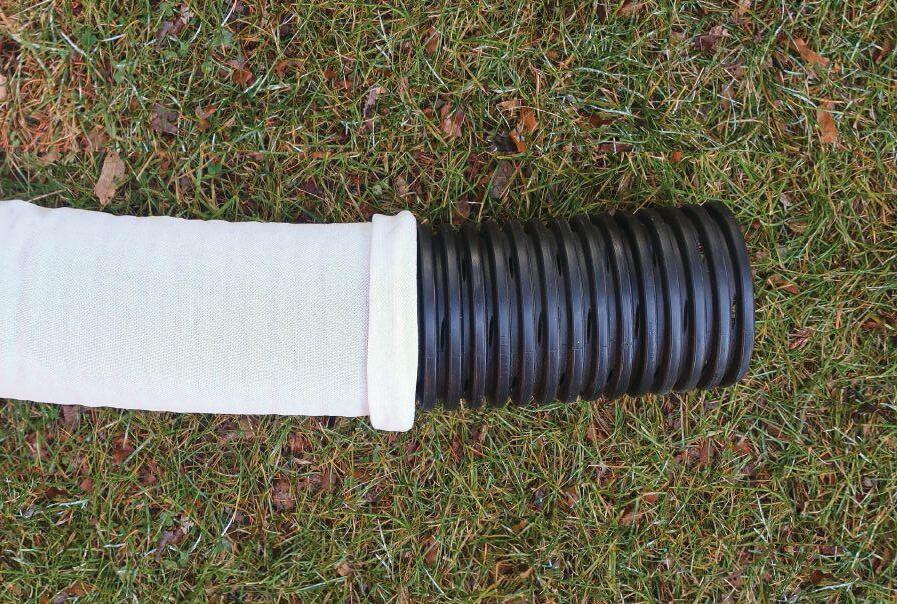
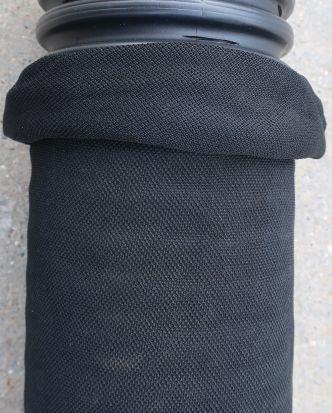
RIGHT: A sock-covered pipe usually costs more, but the benefits in terms of efficiency might outweigh the cost.
He felt a study could reveal differences in efficiency between three styles of four-inch diameter pipe: a knitted sock envelope on a standard perforated pipe, an eight-row perforation sand-slot pipe and a four-row perforation sand-slot pipe.
But Ghane, now an assistant professor and extension specialist of agricultural drainage with Michigan State University’s department of biosystems and agricultural engineering, had to wait to engage in the study.
“I knew there was something going on
explains. “It feels good to tell people. It was like a 10-year secret.”
Fine sand and soil builds up in pipes over time and causes clogging, thus why sockwrapped and narrow sand-slot pipes were developed. Ghane knew that identifying which pipe worked best in a variety of sand, loam and silt combination soils would help in agriculture and other areas.
The study was conducted in Michigan, but any area with these types of soils and heavy rain falls could apply the information he
options that reduce the potential for blockages is recommended.
THE SOCK ROCKS
Ghane’s 10-year secret led to the study of each style of pipe in the field for its water entry, water-table drawdown, drain spacing and cost effectiveness. The findings benefit landowners, farmers and contractors looking to move water as quickly as possible with an appreciation of how each option stacks up.
“There’s a sock-wrapped pipe. A knitted sock envelope is wrapped around it. There are various options,” he says. “And sand-slot pipes, also known [as] knife-cut or narrow cut. It keeps the sand out with really narrow slots.”
When all conditions are equal, a regular perforated pipe wrapped with a knitted-sock envelope moved water most quickly. The eight-row perforated pipe was second and four-row was the least effective of the three options.
“My scientific research shows that when I actually tested this in the lab, the one with the sock-wrapped pipe maximizes the water entering the pipe,” says Ghane. “This happens because when a pipe is wrapped with a sock, it functions as though there is a pipe or a conduit without any walls. It’s maximized. Like a mole drain.”
There was a 16 percent higher drain inflow with the sock-covered pipe over the eight-row sand-slot pipe and a 29 percent higher drain inflow over the four-row pipe.
However, as one might expect, the sock-covered option does cost more than the sand-slot perforated pipes. He notes the difference is about $0.15 USD per foot. The benefits may offset this increased cost in some cases. The eightrow and four-row pipes are usually the same price, making the four-row the most efficient option between those two.
“It really does depend on the farmer,” he says. “If they want to invest in [sockcovered], there’s some benefits. It moves the water more quickly and it helps lower the risk of delayed planting.”
He adds that when drain depth and spacing are the same among pipe types (the study was done at 30-foot spacing and 2.5-foot depth), there can be a minor crop yield increase with the socked-pipe, but not one that covers the increased costs. Therefore, choosing one
pipe over the other will need to be based on other factors.
“You can’t get that much yield benefit to overcome that cost, so overall, it becomes more expensive in terms of cost-effectiveness,” he says. “The eightrow sand-slot is more economical.”
The number one pipe property that determines drainage speed is the number of rows of perforation. The second property is the length of the slots
LEFT: When a pipe is wrapped with a sock, it functions as though there is a pipe or a conduit without any walls.
in the pipe. A sock-wrap allows for more pipe perforation with less sedimentation passthrough. The narrow slits of the sand-slot pipes (about 0.020 to 0.035 inches) also keep sediment out and more slits improve water flow.
Overall, sock-wrapped pipes keep more sediment out of the system, but sand-slot pipes provide adequate protection from sediment buildup.
SHALLOW BEATS DEEP AND OTHER IN-FIELD CONSIDERATIONS
Shallow drains are common in Michigan, but may not be in other regions with drain sedimentation issues. Ghane recommends shallow over deep for drainage.
“They lower the water table more quickly than deeper drains,” he says. When choosing one pipe over another, farmers, landowners and contractors need to consider if a 16 or 29 percent
Enhancing Water Quality + Improving Crop Production
DRAINAGE MANAGEMENT SYSTEMS
increase in drain inflow makes the sockcovered pipe the better option. Farmers may decide to go with the increased cost if it allows them to get into their field earlier for planting.
Earlier seeding may result in earlier or additional harvests that could provide financial benefits. Additionally, improved drainage function may make marginal land productive and could add a new source of income.
Perhaps the most important consideration is if waterlogging of fields is a common or regular concern. When it is, and crop-losses are the risk, the increased expense of the sock-wrapped pipe may be justified to drain land quicker.
The 8-row sand-slot pipe may be more economical than a sock-wrapped pipe given identical spacing and other considerations, but given its efficiencies, the sock-wrapped pipe allows for wider drain spacing at the same water removal rate as the sand-slot pipes. This wider spacing can be beneficial for farmers considering different row spacing options or alternative crop layouts.
In soils of a clay-mix, Ghane says the same basic considerations apply as in
loamy, sand and silt mixes.
“The eight-row [perforated] is the way to go,” he says. “When both [four and eight-row] are at the same cost, eightrow is going to drain much faster than the four-row.”
INSTALLATION IS KEY
No matter what pipe is chosen, it must be installed correctly in order to perform as desired. Installation is ideally done at the ground’s driest point when the water table is at its lowest, but seldom does this timeframe work for a farmer who has potential income in the fields at that time. Non-farming landowners may be able to accommodate a summer installation.
Ghane recommends growing earlyharvest crops in the installation year to permit dry conditions post-harvest for the install timeframe. Field work in wet conditions leads to soil compaction which will impede infiltration and percolation. Plus, installing pipes in wet conditions where the water table is close to the drain depth may lead to smearing of the soil. This is a compaction of soil around the pipe that will break up, but it can take several years of less efficient
drainage to get there.
All pipe installations cause soil disturbance and increased sediment. Even sock-covered pipes may not work at peak efficiency immediately after installation.
“Once the soil around the pipe stabilizes, only a limited amount of clay particles will pass through the sock opening and water will carry them to the system outlet,” he explains in his study documentation.
While sunny, dry weather is preferred for installation, increased heat can allow sand-slot pipes to stretch and increase perforation size. This will eliminate the sedimentation protection. The sun can also cause UV damage to pipe socks, so these should not be exposed to the sun; or a black sock, which has greater UV resistance, should be selected.
Field drainage has always been an important consideration, but with climate change and increased heavy rain events, it has become essential. Ghane says hoosing the right pipe for the situation will improve efficiency of drainage, but it must be considered in tandem with other site factors. DC
Ehsan Ghane presents his research, which he refers to as a “secret” kept for nearly 10 years.
OUR ONLY BENCHMARK: PERFECTION
Fratco tests every material that comes in our doors and every product that goes out. That’s because our customers are counting on us for the highest quality pipe. If it isn’t perfect, it isn’t right. Period. IF
draintilesafety.org
SCRUTINIZING NUTRIENT LOSS
Vermont study finds phosphorus losses within ‘normal’ range for Lake Champlain Basin.
Effective field drainage is a key strategy for farmers in the Lake Champlain Basin, and has been for decades. As environmental concerns surrounding agriculture increase, researchers in Vermont are working to understand how tile drains impact field hydrology and the role they play in surface and subsurface nutrient loss.
by ROBYN ROSTE
RIGHT: More than two years of water data were analyzed to help determine the impact of best management practices and tile drainage.
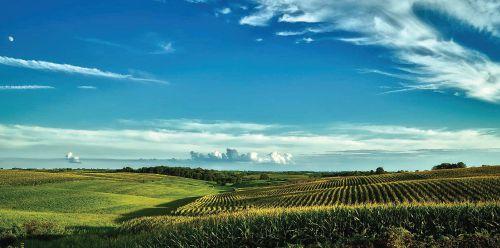
The Lake Champlain Basin stretches for more than 8,000 square miles and reaches into Quebec, New York and Vermont. With 11 watersheds, fertile soil and a growing season averaging between 105 and 150 days, 16 percent of the Basin is devoted to agriculture, according to the Lake Champlain Basin Program.
From Feb. 1, 2019 to Jan. 31, 2022, Joshua Faulkner, Don Ross and Kirsten Workman from the University of Vermont studied how best management practices affected the health of the Lake Champlain watershed. They installed two edge-of-field surface runoff
monitoring stations on a Vermont corn silage field within the Basin.
"The primary objective of this study was to monitor tile drainage outflow and how much phosphorus was leaving the field on a per acre basis," says Faulkner, a research assistant professor with the University of Vermont.
Other objectives included learning how much water is coming into tile drains through soil cracks and how changing rainfall patterns impacts the amount of phosphorus transported into tile drains.
In a recent presentation on the study called "Increasing our understanding of tile drainage
hydrology and phosphorus losses in subsurface and surface runoff in the Lake Champlain Basin," Faulkner said they're seeing an escalation of tile drainage installation due to excess moisture in Vermont.
"Tile drainage is probably the number one adaptation practice that farmers are using—row crop farmers, dairy farmers and some vegetable farmers—to adapt to climate change," he tells Drainage Contractor.
THE REALITY FOR VERMONT’S FARMERS
In the research seminar, Faulkner said the Champlain Valley has experienced an annual precipitation increase of seven inches over the past 30 years.
"With wetter growing seasons, farmers are responding and investing in tile drainage in order to keep their fields drier in the spring, summer and fall," he said.
According to Vermont Dairy, dairy farming makes up about 70 percent of agricultural sales in the state, totalling $2.2 billion in economic activity. For these farmers, tile drainage is primarily used around feed and forage
production for cattle.
As important as tile drains are to farming, there are also environmental concerns regarding the impact of agriculture on watersheds. Nearly half of the total phosphorus load measured at the watershed outlet is attributed to tile drains.
"We are starting to see phosphorus export from our tiles and it is raising eyebrows and causing us to intensify our monitoring efforts, and take on new research to understand the magnitude of these phosphorus losses in tile," Faulkner said. "As agricultural soil and water topics go, it has been a fairly hot topic in Vermont over the past few years."
To help farmers optimize crop nutrient use in Vermont, nutrient management plans are recommended.
Heather Darby, an extension professor at the University of Vermont, has conducted surveys with farmers in the Lake Champlain Basin around tile drainage and nutrient management plans.
"The survey results indicated that tile drainage was really allowing farmers to adopt the conservation practices for water quality that we've been promoting,
things like no-till and cover cropping, because they keep the soil drier in the fall," says Faulkner.
He adds that an important point often missed in the conversation around tile is the fact that tile drains leave the soil drier, which means the risk of compaction is lower so farmers are more willing to do conservation tillage.
GATHERING THE DATA
For this specific study, Faulkner monitored two years worth of data, analyzing discharge and phosphorus loss and assessing the impact of best management practices and tile drainage. Surface and subsurface runoff was collected on two sites, the treatment watershed, which utilized no-till and cover crops, and the control watershed, which practiced tillage and no cover crop.
"In terms of phosphorus leaving the fields, we've seen that we're really kind of within the normal range of what would be expected," he says. The data showed between one pound and 1.5 pounds per acre per year was being transported from the fields. "It's not
Why Vermont Crops Fail (2001-10)
through the roof and it's not this huge environmental concern that some have thought it may be."
Researchers noted the rate and quantity of phosphorus loss changes based on the season, with the largest quantity of phosphorus transported in tile drains happening during heavy rainfall.
"With climate change and more of these extreme events, the need to address phosphorus in tile drainage will probably increase because we see those heavy rainfall events in our soils that have the big cracks and the macro pores. Those storm events are leading to more phosphorus loss than smaller events, the less intense events."
‘MONEY DOWN THE DRAIN’
While the data showed the amount of phosphorus loss through tile drains was only a small fraction of what was applied to the field, it revealed nitrogen losses were much higher than researchers expected, around 70 to 100 pounds per acre per year.
"That's money down the drain, to be honest, for the farmers," says Faulkner. "Certainly we don't want to ignore it from an environmental perspective, but farmers from an economic perspective should really take notice. That's motivation to change how they manage their nitrogen in tile drained fields."
From this research, Faulkner says understanding how tile drains impact nutrient losses is important for both farmers and drainage contractors.
"Tile is a really important tool for farmers, but we need to use that tool responsibly. Maybe we can think more carefully about where we put our tile drainage outlets, maybe put them in places where we have some sort of buffer capacity between the outlet and the nearest waterway; some chance of removing the phosphorus or the nitrogen," he says.
This research project is funded by The Lake Champlain Sea Grant Institute, a cooperative effort between the Rubenstein School of Environment and Natural Resources at the University of Vermont and the Lake Champlain Research Institute at the State University of New York College at Plattsburgh. DC
Joshua Faulkner says tile drainage remains an important tool for farmers, if used responsibly.
PLOW & WHEEL TRENCHERS
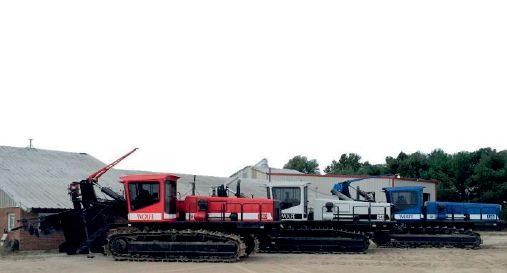
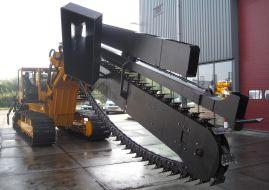
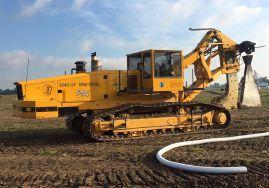
Wolfe Heavy Equipment continues to set the tone for powerful agricultural and commercial trenching equipment. Wolfe’s versatility, superior manufacturing and expert service along with reduced fuel consumption provides increased profitability.
Barriers to adoption of conservation drainage practices
by Keegan Kult
Advances in the science of conservation drainage systems can allow producers to meet their water management needs while delivering on economic, environmental, and sustainability goals. But despite the proven benefits of conservation drainage practices, producers have yet to demand the practices on a wide enough basis to make a meaningful impact. Members of the Conservation Drainage Network Growth Committee conducted a survey of agricultural drainage service providers over the 2021/2022 winter to better understand their familiarity with, implementation of, and barriers to the various conservation drainage practices.
Katie Dentzman, assistant professor of rural policy and rural sociology at Iowa State University, assisted in the generation of the survey, evaluation, and writing of the report that is now posted on the Conservation Drainage Network and Agricultural Drainage Management Coalition website. Ryan Arch, executive director of the Illinois LICA chapter, provided key insights in the development of the survey and led the efforts in distribution.
The survey received 64 responses; 40 (from 19 states) were usable for this assessment. They were asked about their familiarity with woodchip bioreactors, saturated buffers, drainage water management, constructed wetlands, subirrigation and drainage water recycling. Drainage water management was the most familiar practice with 75 percent of respondents reporting familiarity. Drainage water recycling was the least familiar practice with only 23 percent reported familiarity.
Half of the respondents reported a medium or high demand for drainage water management, which was surprising when considering current implementation levels and warrants more investigation. A reported 37 percent of respondents said they had medium or high demand for subirrigation.
Contractors said the highest barriers for clients were cumbersome state and federal programs, cost and the (the biggest barrier) ROI, with 81 percent and 82 percent respectively reporting this as either an extreme or moderate barrier to adoption. This shows that more work needs to be done to improve on practice delivery mechanisms. The successful Polk County (IA) saturated buffer project, where 51 saturated buffers and bioreactors were installed the summer of 2022, provides an example that landowners were willing to adopt a practice, that has mainly downstream benefits, if the practice delivery mechanisms are changed to benefit all stakeholders involved.
ADMC and its partners believe that a largescale investment in a turnkey pilot program is warranted to determine if practice delivery for structural water management practices can be improved to deliver at scales to meet watershed goals.
A smaller turnkey pilot is showing success in Minnesota where NRCS is partnering with a qualified Technical Service Provider (TSP) to conduct outreach, site reviews, designs, and to facilitate the payment to a qualified contractor. This approach could be expanded to involve local conservation districts to provide administration, engage NRCS’s TSP program for site review and design, and utilize LICA contractors to construct the practices in streamlined fashion.
While the Conservation Drainage Network Growth Committee survey of drainage contractors yielded many insights, a comprehensive, sciencebased social assessment of farmers is needed to better understand their level of understanding and their perceived barriers to implementation. Moving forward the group is looking to conduct a comprehensive evaluation of farmers' perspectives on conservation drainage so barriers can be benchmarked and improvements can be made to increase adoption. DC
Congratulations to the 2022
Jeremy Meiners VP water management, AGREM
Adam Fisher Owner, Ditch Doctor
Bruce Shewfelt President, PBS Water Engineering
Brett Sheffield CEO, NextGen Drainage Solutions
Matt Mroz President, Revasto Enterprises
SPONSORED
MEET THE GROUNDBREAKERS
The honorees for the program’s inaugural year offer their perspectives on the future of drainage.
In late 2021, Drainage Contractor launched the GroundBreakers, a recognition program to highlight and honor those in the industry who are moving drainage and water management forward.
After a tight judging race, five GroundBreakers were chosen from various roles within drainage and water management: Ditch Doctor owner Adam Fisher of Glenholme, NS; AGREM VP of water management Jeremy Meiners of Anchor, IL; Revasto Enterprises owner Matt Mroz of Beausejour, MB; NextGen Drainage Solutions CEO Brett Sheffield of Pilot Mount, MB; and PBS Water Engineering president and principal consultant Bruce Shewfelt of Morden, MB.
The honorees all play slightly
different roles in the drainage space –some, like Mroz and Sheffield, work in the fields doing tiling. Others, like Meiners and Fisher, have focused on developing either equipment or technology solutions in order to bring more advanced solutions to drainage in our ever-changing world. Shewfelt, meanwhile, retired from his years in public service to launch his own consultancy firm specializing in subsurface drainage and irrigation. However, all are united by a passion for drainage, water management and improving the land for growers.
by BREE RODY
THE VISIONARY: JEREMY MEINERS
It sounds like a familiar tale: Jeremy Meiners grew up on his family farm in Illinois and, along with his brothers, spent much of his childhood driving tractors, picking up rocks and helping out with the operations wherever he could. In the 1980s, his father founded AGREM, a software company for farmers and landowners that would later develop software that specialized more in drainage design – and today, Meiners is VP of water management for that company.
But Meiners’ path to that position was more meandering than direct, and in fact, he says, he wasn’t certain he wanted to go into agriculture at all when he first left home. “What my dad did… it was very exciting, but when I went to college, I didn’t exactly think I wanted to come back and work in agriculture.” He eventually went on to grad school and later obtained his PhD at Washington University in St. Louis. At the time, says Meiners, “the path for most people coming out of Washington was to go into academia.” But Meiners began to think about what kind of impact he wanted to make on the world. Around then, AGREM had recently developed software for designing subirrigation systems and controlled drainage systems on rolling topography. When he thought about his potential impact on the world, Meiners says that’s when it all became clear. “With agriculture, there’s a call to feed the world – how do we increase production so there’s plenty of food for everyone?” At the same time, he says this addressed the issue of conservation and preserving the environment.
Despite working in technology and software, Meiners has been a “hands-on guy” from the start. Early in his career, he says, “Most of the time I found myself in the ditch learning the best way to make connections, to the point where my father actually said, ‘Jeremy, if I see you in that ditch one more time I’m not gonna let you come out with me to these field sites.’” He says that in the beginning, AGREM worked with contractors exclusively, but in the last decade, it has expanded to working with farmers who wanted to install their own tile,
to see how they could guide them through such systems from start-to-finish. He says there are some farms that he knows like the “back of his hand,” a fact he attributes to his hands-on, connection-driven nature.
For Meiners, the best part about working in the field of drainage design is that drainage is not static, and that it can always be improved, whether that’s through new layout designs or methods such as combining surface and subsurface drainage. But what excites him most, he says, is working with new soil types.
“There’s over 1,000 soil types out there, and I’ve worked with so many, but now and then, particularly when you come to these glacial or erratic areas where there’s 100 different soil types on the field, it’s a process of figuring out how one type of soil might drain differently than the one right next to it and then making sure we can improve that field according to what the contractor wants.”
As passionate as he is about drainage and design, Meiners says it’s crucial to keep an eye on the future with regards to runoff, the solution to which needs to be a holistic approach. “The issue of the negative externality that our farming practices, particularly our fertilizer management, with tile drainage leads to a downstream effect and hypoxy issues in the Mississippi [River]. It’s a very serious situation in the Gulf of Mexico, and it’s going to take some major changes in terms of either fertilizer application or going to something like controlled drainage in order to resolve these without government intervention restricting applications.”
GROUNDBREAKERS
THE ADVOCATE: ADAM FISHER
If you like to use social media to chat with other drainage contractors, odds are you know Adam Fisher. Fisher, founder and owner of Ditch Doctor in Glenholme, NS, likes to partake in discussions of drainage, conservation and water management whenever he can in order to learn from others, make connections and advocate for better infrastructure management.
That passion started young for Fisher, whose father was a contractor who worked on drainage and other projects in the '70s and '80s. “Working with my father is what instilled the knowledge of the importance of draining the land and how to maintain it efficiently and effectively.”
While most drainage issues focus on subsurface and tile drainage, Fisher’s specialization is in surface drainage – hence the name Ditch Doctor. He founded the company Ditch Doctor in 2002 when he built his first Ditch Doctor prototype. The product is an excavator attachment used to create, restore and maintain ditches, and is used as an alternative to using a bucket and trucking away spoil.
His work sees him frequently working with landowners, conservationists, engineers, operators and local government to educate them about drainage, ditches and ditch maintenance.
“Being able to maintain buffer zones and create two-stage ditches is our main mission,” he says. “We want to become a go-to method for maintaining the infrastructure.”
Getting the “good word” about drainage and drainage maintenance out is important to Fisher. He says when you step outside the drainage industry and into the broader infrastructure industry, drainage sometimes seems left out. “It often seems to take a back seat to other issues that come up in agriculture, or even in civil or municipal issues. It’s almost similar to garbage infrastructure – pickup and delivery is a huge industry, but no one wants to talk about it.”
Currently, says Fisher, a number of challenges in the world of drainage mean more landowners are looking not only at surface-level solutions, but also at ways to implement those solutions more efficiently.
An increasing number of farmers in Canada and the U.S. have looked to enhancements to subsurface field drainage in an effort to manage the sudden influx of heavy rainfalls and mitigate potential soil erosion. Combination systems including two-stage ditches have been a popular recommendation. A two-stage ditch has a bottom channel for regular flows, bracketed by “grass steps” that extend back to stepped-back upper ditch walls to create a much larger channel for heavy water events. The extra space can help reduce flooding while also reducing nutrient and sediment loss to downstream water bodies by slowing the speed of the draining water. Fisher and his wife Carole have worked with their local agriculture college to support two-stage ditch studies.
Fisher says the environmental and economic factors currently at play are creating a golden opportunity for Ditch Doctor. “With prices of a lot of our goods increasing at unprecedented levels – fuel, oil, et cetera – I think we’re
going to see a lot of people looking for different methods of doing a job, whether it’s maintaining infrastructure or putting food on the table. People want to be able to do it cheaper and faster.”
A recent study by the Association of Equipment Manufacturers found that there has been an 11.7 percent year-over-year increase in farm machinery prices, and with 81 percent of ag members reporting growth, demand for equipment is unlikely to slow down.
Fisher doesn’t intend on slowing down either. He is currently planning presentations on two-stage ditch methods with local civil engineering university courses, and has plenty of meetings booked with practicing engineers. The last two years of cancelled events and virtual meetings have been a “rollercoaster ride” for the extroverted Fisher, but he says there’s an urgency to get out there and discuss important drainage topics.
“You hear a lot of talk about phosphates and nitrates working their way into rivers and waterways around North America. It’s an issue that’s on everybody’s mind. There doesn’t seem to be a lot of traction on how to solve these issues. Implementing mandatory buffer zones on all waterways… it will filter out a lot of phosphates, a lot of nitrates.”
THE COLLABORATORS: BRETT SHEFFIELD AND MATT MROZ
Pilot Mount is a small town in Manitoba with only 700 residents. But quiet as it may seem, one of the companies there has made a name for itself. In 2019, NextGen Drainage Solutions was named one of Canada’s fastest-growing companies in Canadian Business.
The company, which was officially registered in 2012, placed 77th countrywide based on its five-year growth percentage. With more than two dozen employees, founder and CEO Brett Sheffield says it all comes down to precision, professionalism and pride.
“I’ve been very lucky to have some great mentors,” says Sheffield (pictured above left). This included Roger Ellingson, owner of the Minnesota-based Ellingson Companies, and Bob Clark II, owner of Indiana-based Clark Farm Drainage. “They took me and allowed me to work with them in the United States. The main thing they showed me is how important the quality of work was and how important installing things right the first time is. These products have to go in and last for decades.”
Although NextGen’s growth from two employees to two dozen in a few short years seems like a lot, Sheffield says it was all about being patient. “Rather than experiencing extreme growth early on, we really learned how to do it right. That’s how we became one of the fastest-growing companies in Western Canada – not just in drainage or agriculture, one of the fastest growing companies overall.”
NextGen offers turnkey services to customers – working
GROUNDBREAKERS
with growers, surveying, tile drainage design, permitting and installation. With that holistic approach, it’s likely no surprise that Sheffield grew up on a farm.
While Sheffield still farms with his father Lyn to this day, between childhood and now, he also found himself intrigued by tile drainage. In 2010, he went back to school to complete his agricultural diploma course requirements of the University of Manitoba. It was in his soil classes where he learned the benefits of tile drainage. After doing his own research, Sheffield determined that tile drainage would be beneficial to his family’s 4,000-acre grain farm.
But Sheffield wasn’t one to keep a good thing to himself. “Not only could tile drainage benefit my farm, it could offer amazing benefits to farms in Western Canada.” He says in the last decade of owning a drainage firm, what he finds most gratifying is the immediate appreciation that farmers and customers demonstrate for the effects of drainage. “They see the incredible benefits that tile drainage and water table management brings to their land right away. It’s not as though we’re going to sell something that has no benefit. The benefit is clear. The excitement is there.”
On the surface, Sheffield has had a similar background to Matt Mroz, who both nominated Sheffield and ended up sharing in the GroundBreakers honor. Mroz, president of Revasto Enterprises, is a contracting partner for NextGen,
and met Sheffield at the University of Manitoba in 2010. Like Sheffield, he grew up on a farm. Following his education, Mroz went to work for several years in the oil and gas industry in the hopes of making enough money to purchase land of his own and begin farming. Unfortunately, he says, land prices prevented him from doing so, but that led him down a different path. He went back to Manitoba and reconnected with Sheffield, who had been tiling for two years. Sheffield says he knew Mroz would make a great partner right away. “He does great quality work,” says Sheffield. “The two of us were really able to capitalize on the market.”
While the two have similar backgrounds, Mroz says they also have unique approaches that allow them to go from strength to strength. “Brett has always been a little more business-minded,” says Mroz, who describes himself as someone who’s always really enjoyed equipment. He describes himself as a “farmer at heart” with fond memories of playing around with equipment as a child. In their early days being mentored by Clark and Ellingson, Mroz says Ellingson gave him words that helped him develop his level-headed approach. “He said, ‘there’s always more than one way to skin a cat.’ I don’t know why that one’s stuck with me, but sometimes things can get tough, and conditions don’t allow for things to go as well as they should. Step back, take a breath, reassess things.”
Both Sheffield and Mroz recognize that Manitoba is a unique market for drainage. Mroz says the variability in soil means there’s a good variety of challenges – where he lives, he describes the soil as “really heavy, tight clay,” but only 50 miles to the west in potato country, sand and light soils are dominant. Sheffield adds that there’s less annual rainfall than where his mentors are based in the midwest. As a result, he says, “Our business is mainly targeting areas that are very wet and maybe smaller projects overall instead of whole fields.”
But the two also think one of the biggest barriers to true progress is government regulation. Sheffield says the government has been “changing regulations consistently,” and restriction such as when and where companies can tile are “constantly keeping us on our toes.”
THE THOUGHT LEADER: BRUCE SHEWFELT
agricultural, industrial and highway drainage systems for more than 40 years
Bruce Shewfelt took early retirement from his position of chief of water and biosystems engineering at Agriculture and Agri-Food Canada in 2013. Shortly after, he launched his independent consultancy, PBS Water Engineering. He says with the new variety in jobs and projects for him, there’s no such thing as a “typical day.” “There’s sort of a cycle to it; it’s seasonal. Right now in the spring, we’re trying to finish up some designs. We’re finishing up a small dam – small, but expensive – and we’re getting ready to [purchase] some equipment for a drainage project I’m doing in Southwest Manitoba, and I’m procuring some equipment for a project monitoring stream flow, and we have three projects that we’re supposed to be writing environmental impact
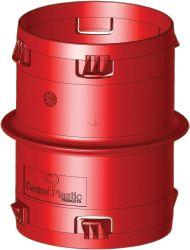
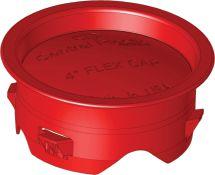
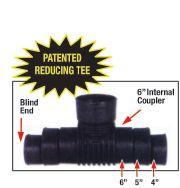
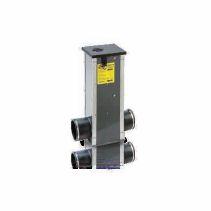
• Constructed of heavy-weight, high-density polyethylene.
• Parts highly adjustable & interchangeable with others on the market
• Orifice plate placed at tee level or at ground level.
• Exclusive locking device on each part. • User Friendly-Priced effectively.
statements for. That’s half of what I’m doing.”
In summertime, he is more heavily involved in construction, whereas fall sees more investigation – “drill rigs, surveyors, ‘the dreaded’ report writing,” he jokes.
After finishing his master’s degree, Shewfelt began working for the Prairie Farm Rehabilitation Administration (PFRA) in Saskatchewan. After several years, he relocated to Morden, where he found there were diverse priorities in water management. “In Southern Manitoba at that time, there’d been a fairly major drought. Producers were looking to add irrigation to their growing. At the same time, we were getting some interest in my office from the Manitoba Corn Growers Association about tile drainage. It was interesting – not enough water and too much water.”
This was the period, says Shewfelt, when his specialization in drainage and irrigation took off. “As we moved into the late '90s, tile drainage was proving itself on farms.” He was instrumental in developing some of the first controlled drainage projects in and outside of Manitoba, including commercial scale projects at Hespler Farm and Bud McKnight Farm, and at the CanadaManitoba Crop Diversification Centre. In the 2000s, his interest was piqued by subjects that he admitted stretched beyond Manitoba. He took an interest in best management practices such as controlled drainage and tile water recycling, which were being studied more in southern Ontario and the upper Midwest. He connected with researchers such as Gary Sands, Matt Helmers and Chin Tan, while working on projects spanning from Newfoundland to the Territories.
Although he’s happiest when he’s managing projects, he’s also engaged in public speaking, thought leadership and knowledge transfer. He co-authored the Beneficial Management Practices for Agricultural Tile Drainage factsheet series for Manitoba Agriculture and Resource Development to foster improved effectiveness and environmental performance of drainage systems in Manitoba.
Paramount to Shewfelt’s beliefs is that it takes more than just one expert to make a project great. “The trick is understanding the limits of your knowledge, and working with people who have that proper knowledge,” he says. “For example, my geologist, who happens to live on Vancouver Island, has been working in Western Canada for more than 30 years. The whole idea of hydrogeology and how it interacts with surficial soils and tile drainage and irrigation is an important topic – once you realize the scope of it, you want to understand that you’re understanding that right from the get-go.”
Looking forward, he foresees one of the key challenges in drainage being the changing climate and how existing systems hold up against it. “A lot of the systems that were built in the last 20 years were built for a different climate than what we’re experiencing. A lot of the challenge is how to understand and adapt to it, and that will take innovation in a couple areas. A lot is just understanding the mechanisms of water movement in the soils, using technology such as soil moisture and water table monitoring.” DC
EQUIPMENT COSTS EXPECTED TO RISE: REPORT
According to the latest report from the Association of Equipment Manufacturers (AEM), a number of challenging obstacles for the agriculture and construction equipment industries lie ahead.
EM has surveyed members quarterly since the onset of COVID-19 to gauge how optimistic they are about economic recovery to prepandemic levels.
One of the biggest impacts anticipated for the ag equipment sector is that of inflation. There has been an 11.7 percent year-over-year increase in farm machinery prices.
Additionally, 90 percent of survey respondents from the ag sector say they have experienced hiring issues, with talent troubles expected to play a part in equipment prices.
Supply chain issues remain a lingering concern for 95 percent of ag and construction equipment manufacturers, while 44 percent say the issue is beginning to turn around.
ADS INTRODUCES NEW SOLUTION FOR AGRICULTURE, INFRASTRUCTURE
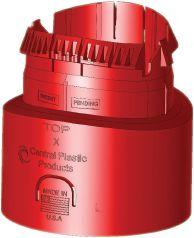
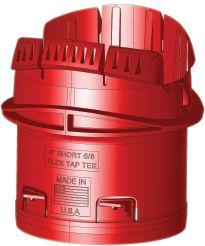
Advanced Drainage Systems (ADS) has introduced its new drainage solution, the Universal 4-Inch Tap Tee for agricultural drainage. The new tap tee allows for a universal fit for all single and dual wasp pipes in the six- to 12-inch (150- to 300-millimeter) range.
Additional benefits include the eight-in-one design, which can reduce overall SKUs to one down from six, thus increasing ordering and inventory efficiency, as well as side wings with pull-out resistant lugs to limit rocking and provide a stable connection.
The new tap tee is available now.
Other recent solutions unveiled by ADS include its new Nyloplast 12-inch universal inline drain solution,
NEW PRODUCTS
which is aimed at contractors seeking a durable, water-tight pipe fitting for stormwater inlets, and the EcoPreau BioFilter urban stormwater management solution.
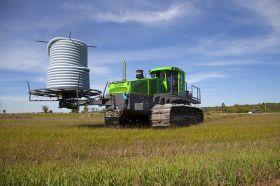
MASTENBROEK’S MAGIC EYE AIMS TO MINIMIZE GRAVEL WASTE
Mastenbroek has launched a new product this month to help contractors save money and improve the accuracy of backfill levels when installing drainage schemes or utilities.
Developed and refined over a six-month period, Mastenbroek’s Magic Eye package combines a radar sensor with a software application to control the amount of gravel or sand that is dispensed by the hopper when backfilling.
Available now as an optional extra on Mastenbroek’s
trenchers and retrofittable to any machine with a suitable hydraulic variable height gravel hopper, the Magic Eye regulates itself to the ground level ensuring the optimum amount of gravel is dispensed.
Mastenbroek developed the Magic Eye in response to customer requests for an automated way of minimizing wastage. The issue was first raised with Mastenbroek by Darren Cotton of Les Cotton Contractors. Operating in Suffolk and undertaking agricultural and sports field drainage across East Anglia, Les and his team also helped test the Magic Eye as part of the development process. Gravel is increasingly expensive, according to some contractors, and can result in wasted aggregate.
The Magic Eye control can be fitted to Mastenbroek trenchers such as the CT12 crawler truck. Currently, Mastenbroek is working with contractors to also adapt the technology to work with a front-mounted gravel hopper on the CT12.
Getting better at getting along
by Mel Luymes, LICO
It is often said that if you want to go faster, go alone, but if you want to go further, go together. And while teamwork sounds nice on paper, it is often messy in reality.
Drains require multiple landowners to agree (and pay) together and, depending on the drain, may involve a few levels or ministries of government before the contractor even comes in. These relationships may be new or may be pre-existing and strained, with or without cause. There are so many opportunities for tension in drainage, and we tend to stumble right into them, don’t we?
If so much of our work relies on working with people, how can we get better at getting along?
Part of the issue, I think, is that we don’t speak frankly enough. When we discuss our collaborative projects, we just tell the pleasant highlights and fail to mention the hard-won lessons of collaboration. And for others to be able to speak frankly, we need to listen to them generously. By generously, I mean assuming positive intent and not jumping to any conclusions.
I attended the Conservation Drainage Network’s meeting in Fort Wayne, IN, on April 6 and 7, and gave a short presentation with Jeremy Meiners (AGREM) about the lessons learned from our Huronview collaboration. By now, if you’ve been reading Drainage Contractor, you’ll know about this innovative drainage demonstration on the field behind the Huronview Health Unit in Clinton, ON. If not, see Huronview.net.
In short, there are a lot of cooks in the Huronview kitchen. The field is owned by the County of Huron, farmed by a committee of the Huron Soil and Crop Improvement Association, was installed by four local contractors, to a design that was made by AGREM remotely with a multi-stakeholder committee. The installation was led by and is now monitored by the Ausable Bayfield Conservation Authority, who is also starting to involve provincial and university research as well.
It was an unprecedented partnership, and while the installation was successful and the
partners continue to meet to oversee the research and operation of the site, the collaborative has had its fair of headaches and heartaches. The design took nine iterations back and forth, I had 25+ meetings and countless phone calls trying to keep everyone in the loop.
We underestimate the amount of extra time it takes to work together… and here were three key lessons from Huronview.
TAKE TIME TO BUILD A FOUNDATION
For nearly two decades, the Huron County Water Protection Steering Committee has been meeting quarterly to discuss local water-related issues. The County of Huron built a multistakeholder group with representation from agriculture, industry, environmental groups and cottage owner associations. Years of meetings have paid off. And, when Meiners spoke to the group back in 2018 about controlling drainage on a slope, he was speaking to stakeholders that had long-standing relationships and could move quickly to seize a funding opportunity. All that was missing from that table was the drainage industry and they were quick to join in.
PRIORITIZE THE PRIORITIES OF ALL PLAYERS
You might think that contractors and conservation authorities would have nothing in common, but we can see how both of them have to deliver improved water quality… or their jobs could be on the line. Water quality: it is personal!
There were five main players on the Huronview committee, and we all knew we needed all of us to stay at the table. That meant making the others’ priorities our own.
• Conservation authorities: water quality in their watersheds;
• Researchers and academics: quality of water and field data, and ability to publish results;
• County councilors and staff: keeping all of the groups and ratepayers happy;
• Farmers: drainage, yield, profitability and sustainability, public trust; and
• Drainage contractors: drainage, public trust in drainage industry.
ALIGN ON A TANGIBLE GOAL
While the team may have had common goals of sustainability and future hopes for a better environment, there was a more immediate project: Demo Day. With June 15, 2019 set well in advance, we were all working towards a successful installation in front of hundreds of people. Having a shortterm project helped bring the group together, and the food (and beverages) that celebrated a job well done was also important.
We need teamwork to do anything important and ag drainage is no exception. Most of us have to work with others, whether we are good at it or not – so why not try to improve our teamwork skills? Drainage crews spend years working together so they are effective and safe in the field. What if we strengthened multi-stakeholder collaboration?
The Conservation Drainage Network was started to be just that and while the agenda was dominated by academic research, I was pleased to see industry reps there too and I hope I’ll see a lot more contractors and farmers there next year! DC
Take care of your business, but mind your mental health
by Rob Burtonshaw
Inflation was an absent ghost that haunted my youth.
When my father talked about it, he did so not necessarily out of fear, but certainly with a respectful reverence. Inflation was powerful and domineering able to cause great change. I hear the tales from the 1970s: oil shocks, devaluation, double digit inflation, a hobbled British economy but my experience is very different. I was a small child in the 1980s and not really politically aware when the pound’s exit from the European Exchange Rate Mechanism caused the last wave of inflation in the U.K.
It is probably strange for people of my father’s generation to hear, but for my entire adult life inflation has been a non-factor. The Bank of England has set a target of keeping inflation under 2.5 percent and, apart from a few brief and relatively insignificant blips, it has succeeded. Prices have, of course, increased. But those increases have been slow and predictable.
Yet as I sit here now, the newspaper headlines are full of stories of crippling prices increases, and a cost-of-living
crisis. What this all means I do not quite know, but prices of fuel, pipe and aggregates are increasing with a new frequency.
For British contractors increases are twofold as we have to contend not only with pipe and fuel prices but also with aggregate prices. The vast majority of our schemes are in clay soils, which often do not crack until the height of summer, therefore a gravel or stone backfill is standard practice. To be honest, this does not make my life any easier. Stone lorries (trucks) are always getting lost or turning up late. But the biggest problem, by far, is the price of the material.
Often around 40 percent of the cost of the job is buying and placing the gravel over the drains. A double-digit increase in aggregates pushes up our costs, and therefore our prices, considerably. It is a significant problem and a worry: if our clients moan at us, it is nearly always to complain about the cost of drainage.
Ask most British farmers why they are not draining more often and price is always the answer. I have been trying to drive down
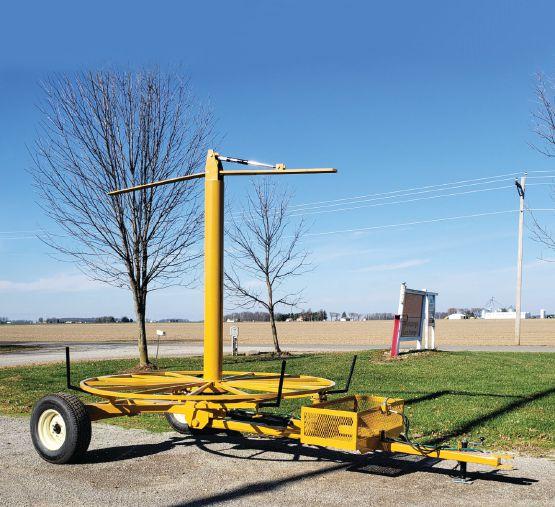
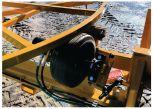
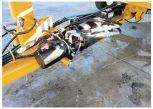
Recoiler Power unit
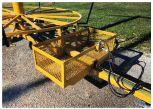
Large basket for fittings
my cost of production for the last few years and really listen to what my clients tell me. The prospect of being forced to increase prices just when the market seems to be growing and appreciating the value that well-drained fields offer is the last thing I need.
I also fear that my efforts to both maintain the sales figures by minimizing price increases and continuing to be efficient will be difficult to achieve. I worry that the result will be both increased turnover but low profits. It’s the problem which keeps me awake at night.
There is always a problem to solve. That is the joy and the pain of running any business. One day the headaches might be caused by a lack of a suitable outlet or a breakdown. The next day it’s inflation or an oil crisis. Sometimes the problem can be solved by the backup plan you put in place for this eventuality and sooner or later that sense of frustration transforms into satisfaction – dare I even say, smugness?
Other times you know the solution is a sticking plaster and the problem will
re-emerge soon. Sometimes the problem is so awkward that it cannot be solved quickly and it becomes a persistent thorn in your side for months. This can be difficult to manage time-wise – one week everything can go smoothly, the next every day can bring another issue.
However, the biggest issue that comes from having to solve problems so frequently is that it becomes hard to maintain a positive outlook. When you have “one of those weeks,” it is hard to not feel like the world is against you. When things go wrong, keeping going is the most important but hardest thing to do.
In British agriculture, a great deal of effort is being focused on mental health. Across the broader ag industry, we have some really appalling suicide rates and many farmers can suffer mental health issues in silence.
Our culture is very much based on selfreliance, getting the job done and being stoic in the face of hardship. Asking for help is difficult, but is part of the answer.
Many British farming charities and
BUSINESS DIRECTORY
industry bodies are trying to encourage people to share their worries, to pick up the phone and chat to a colleague or neighbor. Perspective helps, I find. The problems have been overcome in the past and many, if not all of the issues I have talked about here have been faced before. They are the price of trying to progress and push forward. If you stay in the comfort zone, you have fewer day-to-day problems, but you will soon find yourself slipping back. Only when moving forward do unexpected problems appear. Odd as it may seem, having issues to solve is a good thing. It is also important to remember that nothing stays the same – which is bad news when times are good, but wonderful and comforting words when the problems start to stack up. DC
For more in-depth ag talks, check out the AgAnnex
Moving forward together
Key projects are moving forward, but there are always more opportunities to get involved.
by Bob Clark II
The past several months has been a very busy time for the Land Improvement Contractors of America (LICA).
The new LICA Educational Foundation for Veterans staff has been working diligently to advance the foundation’s mission. Earlier this year we submitted a grant application to help fund the foundation. We will know later this summer if application was accepted for funding. So, we are keeping our fingers crossed and will let you how more in the next publication of Drainage Contractor.
The Cantigny Golf Course, named after the crucial Battle of Cantigny, will be the site of LICA’s upcoming charity golf tournament.
In the meantime, the foundation is quickly approaching its first official fundraising event: a golf outing on May 2, 2022, at the Cantigny Golf Course in Wheaton, IL. At this time, there is likely still room for more participants and sponsorships, if anyone is interested. More information is available at licaveteransfoundation.org.
The golf course was named after the important Allied victory in Battle of Cantigny in 1918 during WW1 in France, so it only seems appropriate to hold our first golf outing there. I want to thank all those who have signed up and sponsored this event, as well as those who helped organize the event. I also would like to thank Drainage Contractor magazine for all its support. Working together we can accomplish the mission of the foundation and help train veterans to become skilled equipment operators.
Another important project LICA continues to work on with ADMC, NACD and the NRCS is the pilot project through NRCS. It will hopefully improve certain conservation practices’
implementation and adaptation metrics. Drainage water management is very relevant to many land improvement contractors across the county. The goal of the pilot project is to simplify and expedite the funding and approval process for the benefit of contractor, the grower and the environment – three big wins! It is a work in progress and LICA will continue to keep all interested parties updated.
Looking ahead to warmer months, LICA’s upcoming summer convention will be in St. Charles, MO on July 12 to 16, 2022, at the Ameristar Casino Resort and Spa. There will be things to do with the entire family, so we are expecting another great turn out and convention. Hope to see you there! Speaking of events, can you believe Con-Expo 2023 is just around the corner? Good news: LICA is already in the planning process.
Lastly, I want to thank all the LICA members, associate members, executive directors, and state and national officers across the country who continue to support this organization with their time, talent and treasure. We could not do this without your support. DC