Account Coordinator | Mary Burnie mburnie@annexbusinessmedia.com
Media Designer | Curtis Martin cmartin@annexbusinessmedia.com
Group Publisher | Michelle Allison mallison@annexbusinessmedia.com
COO | Scott Jamieson sjamieson@annexbusinessmedia.com
Printed in Canada ISSN 1488-4305
Publications Mail Agreement #40065710
Subscription rates:
Canada – 1 yr $17.50 CDN
USA – 1 yr $34.50 CDN
Foreign – 1 yr $46.50 CDN
From time to time, we at Drainage Contractor make our subscription list available to reputable companies and organizations whose products and services we believe may be of interest to you. If you do not want your name to be made available, contact our circulation department in any of the four ways listed above.
All advertising is subject to the publisher’s approval. Such approval does not imply any endorsement of the products or services advertised. Publisher reserves the right to refuse advertising that does not meet the standards of the publication.
A new tool helps contractors determine the optimal spacing for their drain tile.
18 ALL ABOUT BIOREACTORS
How modifications to bioreactors can improve water quality. 20 FOR FARMERS, BY FARMERS
A family tiling business discusses their "farmers first" approach.
SPONSORED CONTENT
Staying on top of demand.
GO WEST, DRAINAGE
Subsurface drainage is a different game in western Canada.
ON THE WEB:
Never miss an eNews issue
Get the latest in drainage and water management news. Our Drainage Contractor eNews arrives in inboxes every two weeks on Tuesdays, delivering the latest news on funding, research and more.
Stay in touch on social
Connect with Drainage Contractor and other land improvement professionals on our Facebook page (facebook.com/ drainagecontractormag). We're also on Twitter (@DrainageContMag) and LinkedIn (linkedin.com/company/drainage-contractor).
The science and the craft
You can't have one without the other.
by Bree Rody
In the last year, amidst chaos, we witnessed a multitude of scientific breakthroughs.
Beyond the lightning-speed development of vaccines that are currently allowing some semblance of normal life to resume, we also saw development in space travel, artificial intelligence and more. We witnessed the unifying powers of computer and mobile technology – and how Nahsir Ahmed’s decades-old vision of rapidly transmitting images and videos between far-apart computer screens has helped keep us connected for everyday occurrences like business meetings, or big milestones like weddings.
If science and tech isn’t your thing, maybe you’ve spent the last year taking comfort in watching sports and seeing the mind-boggling ways in which professional athletes, from Connor McDavid and Steph Curry to Serena Williams and Sue Bird, seemingly bend time and space. Technology, science and human physiology are amazing things.
Like great artists, contractors possess skills that do not come from any textbook or calculation. That's where instincts come in.
We see it in agriculture as well – what the industry has been able to achieve through science; through numbers and stats; through trial and error. It is because of these things we understand how to efficiently drain excess water from a field, or we know (approximately) how deep to dig a trench.
But it is not the physical alone that captures our attention. Behind every unique physical and scientific accomplishment is a great deal of emotion, passion and art. Perhaps a drainage contractor cannot paint like Michelangelo, but like great artists, contractors possess skills that do not come from any textbook or calculation. Just because there’s an approximate depth one should dig a trench doesn’t mean there’s not room for judgment (or spirited debate) on what the exact perfect depth might be.
In our interview with Michigan State University’s Ehsan Ghane about the newly developed drainage tile spacing tool (page 12), he mentions the alternative to scientific method is to rely on instincts and experience – neither of which should be discounted. In fact, Ghane told Drainage Contractor calculations, the tool is meant as a guide –conforming to the exact measurements isn’t always possible or optimal. And that’s where the instincts of the individual user come in.
All of agriculture exists in that marvellous space in which science meets instinct – or, more accurately, where science meets craft. If you don’t believe that there’s art and beauty to be found in the drainage trade, take a look at Madeleine Baerg’s profile on Nohl Tiling (page 20). Beyond tiling, the Nohl family’s work as farmers have helped them gain a new perspective on the practice. The tools and the calculations provide you with the small picture, but we all need a way to see the big picture.
An artist’s approach to drainage also means the ability to see beyond your immediate geographic and physical contexts. That’s why in this issue we’ve highlighted the unique challenges and opportunities of an up-and-coming drainage market – Western Canada (page 24).
A textbook will always be one of the most valuable tools in the toolbox, but experiences and instincts take drain tiling from a trade to a craft.
NEXT ISSUE: research updates and featured guest columns in the November 2021 issue of
UMN STUDY USES DRAINAGE DATA TO LEARN
MORE ABOUT NITROGEN LOSS
New research from the University of Minnesota utilized tile drainage data to show how farmers and applicators can mitigate nitrogen loss in key periods –like the middle of summer.
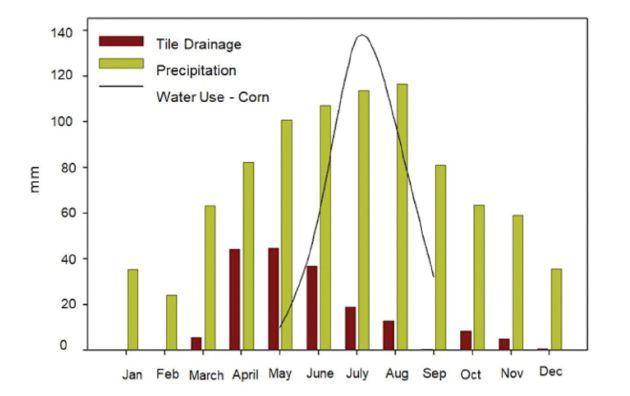
Farm owners and drainage contractors alike have to worry about nitrogen leaching as the temperature warms and precipitation increases. According to 30 years of precipitation data studied by UMN, tile drainage is currently peaking in the state of Minnesota in terms of volume – and both water use by corn and precipitation are increasing, barrelling toward peaks in July and August, respectively.
When precipitation is high and crop demand is minimal, that makes for ideal conditions for water to move quickly throughout the soil, with nitrogen coming along with it. This means applicators on coarse-textured soils should split-apply nitrogen from V6 to around V12, improving nitrogen uptake. If split applications are not viable, a single early sidedress application of nitrogen around or before V4 is preferred. For finer-textured soils, less water tends to move through and into drainage systems, and thus there is naturally less nitrogen loss. However, split applications can still work; if the land is not irrigated, all splits should be done by V7.
POLYETHYLENE PIPE MARKET POISED FOR A DECADE OF GROWTH
Industries that use polyethylene pipe – including, but not limited to, agricultural drainage – could be in for a few positive years.
A new study by Transparency Market Research predicts that by 2040, the U.S. market for polyethylene pipe and fitting will grow to $20 billion for the year. That represents a CAGR of around six percent per year.
The primary driver of growth is use of pipes in the water treatment and wastewater industries.
MSU PARTNERS TO RESEARCH DRAINAGE IN MID-SOUTH
Over the last several years, growers in the mid-south region of the U.S. have expressed an increased need for tile-based drainage systems. That’s why Mississippi State University and its R. R. Roil Plant Science Research Center is particularly excited to undertake a new project. MSU will serve as a research site for drainage specialists Advanced Drainage Systems, as it dives deeper into water management systems that suit the area.
Darrin Dodds, professor and head of MSU’s department of plant and soil sciences, says surface drainage has always been more common in the area, because the Mississippi Delta is, by nature, designed to drain. Now, the project, which will last an estimated three to five years, will study the effects of drainage on soybeans and cotton, return on investment, subsurface water quality and more. It’s the first major foray into drainage projects for MSU, says Dodds.
THIS YEAR MARKS A KEY ANNIVERSARY IN DRAINAGE
There's no time like the present to celebrate a key milestone in drainage history.
The year 2021 marks the bicentennial of John Johnston, thought by many to be the father of tile drainage in America, emigrated to the U.S. from Scotland. After Johnston purchased land in the Finger Lakes area, his first barley crop failed. Defying advice to move elsewhere to find better land, Johnston set out to improve his own soil – and so came the arrival of subsurface drainage.
While the material of most tile has changed and the tools are less rudimentary now, the traditional clay tile of Johnston’s era is still on display in Geneva, NY, through the Geneva Historical Society.
Johnston’s original house still stands today; the Geneva Historical Society offers tours of the house. Due to COVID-19 restrictions, Johnston House will not be open until July 6 and, following the reopening, will be by appointment only. However, attendees who venture in this summer can view samples of some of the original drain tile used in Johnston’s early drainage operations.
PHOTO BY MSU AG COMMUNICATIONS/KEVIN HUDSON.
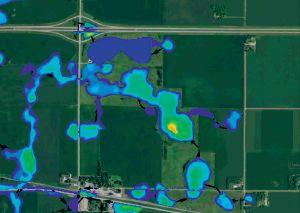
GRAPH BY UNIVERSITY OF MINNESOTA.
INDUSTRY NEWS
SUPREME COURT OF CANADA RULES CARBON TAX CONSTITUTIONAL
On March 25, the Supreme Court of Canada (SCC) ruled Ottawa’s carbon tax constitutional in a vote split six to three.
The plan will impose mandatory minimum pricing on carbon in an effort to curb greenhouse gas emissions. Currently, the tax is $40 per tonne this year. It is set to rise drastically over the next decade, should the government’s plans be implemented. Many provinces, as well as the agricultural sector at large, have opposed the tax wholly or opposed certain elements of it.
Chief Justice Richard Wagner wrote in his decision that the impending threat of climate change justifies the federal government’s plan. “Climate change is real,” he wrote. “It is caused by greenhouse gas emissions resulting from human activities and it poses a grave threat to humanities future.” He says that because emissions are “extraprovincial,” it would be wrong to exempt any one province from the plan. “A failure to include one province in the scheme would jeopardize its success in the rest of Canada.” The federal tax is described as a “backstop” for provinces that refuse to act; Ottawa is encouraging provinces to draft their own plans.
There were numerous dissenting voices against the tax; premiers including Ontario’s Doug Ford and Saskatchewan’s Scott Moe have been vocally opposed to the tax for economic reasons.
Additionally, Canada’s agricultural industry has sought exemptions or alterations to some aspects of the tax.
Earlier this spring, the Ontario Federation of Agriculture (OFA) and Agri-Food Economic Systems partnered to conduct a study, Understanding the Cost Burden of the Federal Carbon Tax on Ontario Agriculture. A report on the findings is expected soon. The study will estimate the explicit costs of the impact of mandated pricing, as well as the costs of mitigation in response to the tax.
The OFA has advocated over the years for the government to broaden exemptions for the agriculture industry under the carbon tax. One such measure includes adding natural gas and propane to the list of qualifying farming fuels under the federal Greenhouse Gas Pollution Pricing Act
OTTAWA VALLEY DRAINAGE PIONEER BECOMES HALL-OF-FAMER
Delbert (“Del”) O’Brien has held many titles throughout the years. He’s been an attorney, operated an airport and served as chair of the first-ever Ontario Drainage Tribunal. He founded the Ontario Agriculture Council and served as its first chair, and in the 1990’s he became the official “drainage referee” for the province's drainage hearings.
Now, O’Brien, who has since retired from many of his duties, was inducted into the Ontario Agriculture Hall of Fame earlier this year.
His nomination was supported by the Ontario Federation of Agriculture, the National Farmers’ union and the Christian Farmers’ Federation of Ontario
O’Brien, who remains a farm owner and operator to this day, was recognized in large part for his contributions to the drainage industry through his work in the Drainage Tribunal.
Since his appointment to the Tribunal in 1975, O'Brien has been credited with streaming processes and clearing major bureaucractic backlogs.
OHIO BILL AIMS TO UPDATE STATE’S PETITION DRAINAGE LAWS
An Ohio bill that recently came into effect could have significant impacts on agricultural drainage projects in the state.
House Bill 340, which was signed at the tail end of 2020, was introduced to modernize Ohio’s petition drainage laws, which would allow them to better handle issues of excess water in key areas (including residential, commercial and roadways). Although it was signed prior to the New Year, it came into effect on March 24.
The bill came together over a period of more than seven years, with stakeholders working to update what they believed were “outdated” statutes and bringing them in line with modern technology. The updates include authorizing the use of new technology in surveying potential projects. For example, while the county would previously conduct the view of the project by walking the entirety of the proposed site, the parties can now watch drone footage or view the area remotely.
Other updates include updated terminology, replacing outdated language from 1860.
The bill was passed unanimously with 33 “yes” votes.
State representative Bob Cupp was the primary sponsor of the bill. Upon passing the initial bill in 2020, he said on the floor, “Water is a life-giving element, but too much water, if not properly handled, can damage crops, compact soil, lead to destruction of property, and diminish productivity and usefulness of land. (The bill) updates Ohio petition drainage laws, which are a vital component of our agricultural infrastructure.”
Forging ahead
An update on some recent events at LICA.
by Bob Clark II, LICA national president
The Land Improvement Contractors of America (LICA) organization continues to move forward through these challenging times.
We did, regretfully, have to cancel our national winter meeting in San Antonio, TX, meaning it has been more than a year since our last national convention. But there is good news, no less. Despite the pandemic challenges, LICA continues to focus on new membership, benefits and enhancing the relationships with other likeminded groups.
Some state chapters have seen significant growth in membership, primarily because of excellent leadership at the state level. New Jersey, for example, has seen extraordinarily strong membership growth through their apprenticeship programs. NJLICA saw an opportunity to provide this service that is in high demand and is reaping the benefits of their foresight. NJLICA membership growth over the past year is trending around 50 percent yearover-year.
We are also looking at ways to expand outreach in the industry and community. National LICA has recently formed an educational foundation for veterans that will, hopefully, provide veterans with the training opportunities in the heavy equipment fields for the construction industry, eventually becoming LICA members. We all know how challenging it can be to find skilled operators, so this could be a mutually beneficial practice to fill a crucial skills gap.
LICA offers a suite of benefits that are second to none. We have tried to utilize the LICA benefits that are a good fit for our own company. I am proud of the benefits we offer our employees. We could not do it without LICA’s benefits program. The medical insurance program has been a huge benefit to our employees. We can now offer free medical clinics through the LICA benefit platform. I encourage everyone interested in a similar program to check with your local providers. One of the clinics in our plan is even located at MacAllister Equipment’s main facility in Indianapolis, so contractors can get parts for their equipment and an annual physical at the same location.
Recently, LICA and Agricultural Drainage Management Coalition (ADMC) signed a memorandum of understanding (MOU). Hopefully, together we can provide input and guidance to policy and program directors at the highest levels of both state and federal agencies that ensure the next generation of best management practices are delivered in the most efficient and effective means and methods possible for the benefit of all the stakeholders.
These MOUs require a team effort to be most effective. The Natural Resource and Conservation Service (NRCS) MOU needs state chapter participation at the state technical committee level to ensure success. LICA’s input can help guide the state’s prioritization of conservation practices that are most important to each state’s most pressing conservation demands. LICA’s state chapters are the backbone of the national association and their leadership has been instrumental over our nearly 80-year history.
LICA is scheduled to hold the 2021 national summer meeting in Niagara Falls, NY, July 27-31. I look forward to getting back to our normal schedule soon. Although the 2021 winter convention was canceled, we have already rescheduled the next winter convention in San Antonio, TX Feb. 15-19, 2022. Looking forward to a big turn out, and hope to see you there! DC
PHOTO
MIND THE GAP, PLEASE
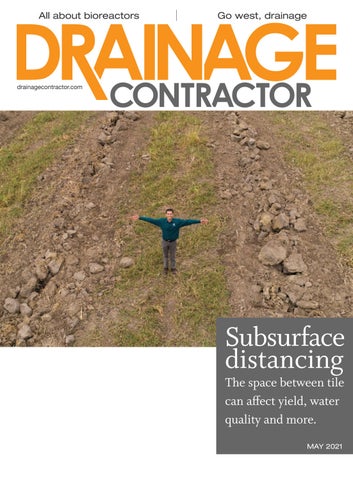
A new project from Michigan State University will help contractors determine optimal tile spacing.
Over the last year, the concept of allowing space has become top-of-mind as people navigate their daily lives. We now know six feet is the minimum distance between people required to keep them safe from airborne viruses – and while there’s a bit more flexibility outdoors, the six-foot rule is somewhat universally applicable.
by BREE RODY
However, drains are not people – and there’s a lot more nuance required in figuring out the optimal distance. Luckily, a research project out of Michigan State University (MSU) aims to help contractors narrow down (or, conversely, widen up) what exactly the optimal distance is.
The efficacy of subsurface drainage is highly dependent on the spacing of the drain tile. Sparser tile means less water is removed at a quick enough pace, causing excess build-up of water and ultimately risking lower-quality crops and/or yield loss – but narrow tile poses just as many risks.
“Slower drainage means more water stress on the crop,” says Ehsan Ghane, a professor of
biosystems and agricultural engineering at MSU and drainage specialist with MSU Extension. “[This] inevitably leads to yield loss.”
But, according to both a 2004 study from the Journal of Environmental Quality and a 2017 study from MSU, tile that is spaced too closely together increases the cost of the drainage system and reduces profit, while also contributing to higher nitrate losses. “It is also not good environmentally,” Ghane adds.
His close work with drainage professionals revealed the problem, but Ghane relied on his engineering background and a passion for precision to find the solution, leading the team on the year-long process to study and develop the ideal drainage spacing tool as a
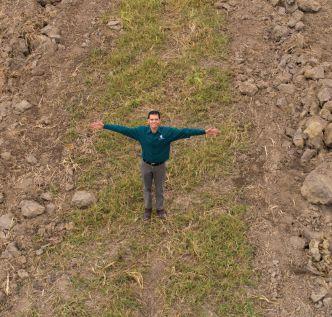
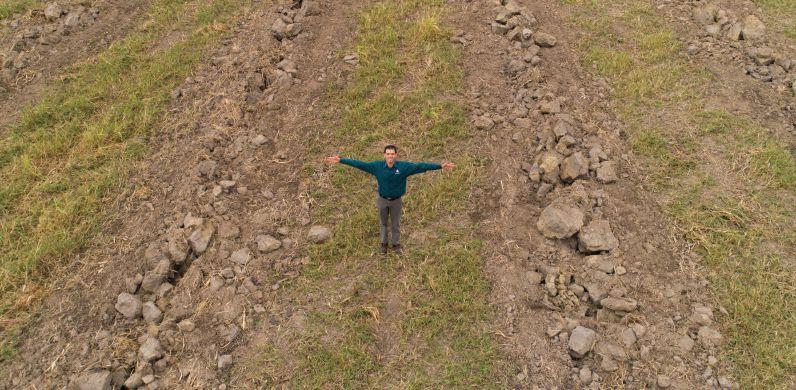
RIGHT: Ehsan Ghane, a drainage specialist with MSU Extension, demonstrates what optimal tile spacing looks like.
guide for contractors. Besides Ghane and his team (which also included Ian Kropp, Amirpouyan Nejadhashemi and Babak Saravi), the tool was developed in partnership with MSU’s Decision Support and Informatics Lab. Now, the research is ready for the world to see –and to use.
The tool is already for the prodrainage crowd – both drainage contractors and those hiring them. It operates under the assumption that subsurface drainage is the best way to approach a water management strategy in corn-soybean rotation. Overall, it aims to help drainage contractors find the optimal spacing for their tile – which, Ghane says, is something that they’ve generally had to judge for themselves.
“Drainage contractors typically decide and choose spacing based on the judgment that they have developed through their years of experience,” Ghane says[SC3] , adding there’s nothing wrong with using your judgment. “The other most common method is to refer to local drainage guidelines that have been developed decades ago that recommend a range of drainage spacing for the particular soil series.”
But those guides can pose problems too. “It is sometimes a big range,” he says. “For example, it might say, ‘you need 40 to 90 ft. of spacing.’ What do you pick? And how do you know what to pick? There’s not an easy way to guarantee maximum economic benefit or maximum profits.”
USING THE TOOL
The tool, which is free to use and was funded by Michigan State University and the USDA NIFA Federal Award grant, is built around a geographic user interface. The tool uses site-specific data on factors such as soil conditions and weather data to estimate the optimum drainage spacing. All of the data on the app is standardized – soil and weather come from 29 years of data (1990 to 2019) from the GSSURGO database (USDANRCS) and the PRISM Climate Group database, respectively.
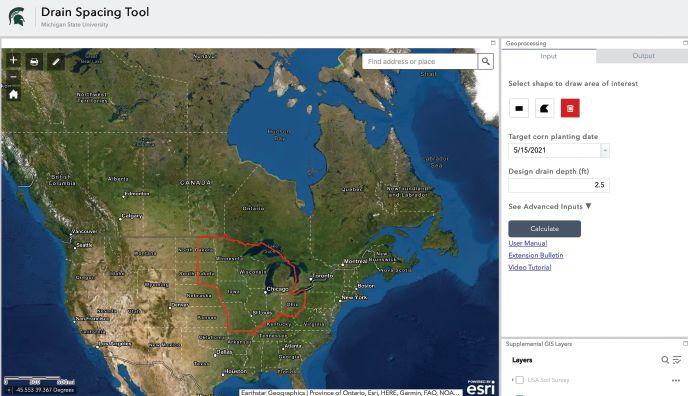
Users can log onto www.egr.msu.edu/ bae/water/drainage/drain-spacing-tool and navigate to their desired field in the Midwest region. Once they arrive at the field, they will be prompted to draw a polygon around their area of
The drain spacing tool is web-based and uses map data. All of the data on the app is standardized, including soil and weather data.
interest. From there, they will add inputs including corn planting date and planting depth. Resulting outputs include recommended drainage spacing (in feet), design drainage coefficient (inches per day), estimated length of four-inch drain pipe required, estimated initial cost, estimated long-term annual discharge (inches) and more.
Ghane notes users may find a shaded layer on top of some fields while searching, which indicates soil that may not need subsurface drainage based on their drainage class. He also says just as the spacing of tile affects many different elements of an agricultural operation, the spacing itself is also affected by many different elements including economics, style and cost of pipes, climate and more. For that reason, the tool also includes advanced input settings to allow
more tailored analysis.
“One of the other things [you can input] is different combinations of corn and soybean rotation,” he explains, adding that the tool is not optimized for so-called “truck crops” – tomatoes, lettuce, melons, beets, broccoli, celery, radishes, onions, cabbage and strawberries. “It’s different [for those crops], which requires more intense drainage because of the vulnerability.” The tool is not valid for subirrigation.
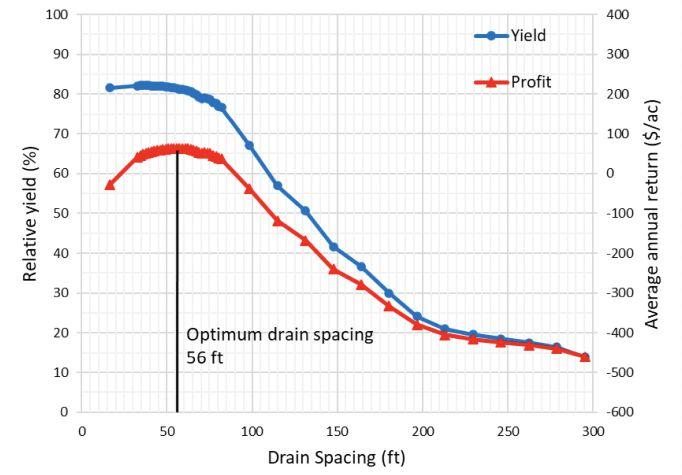
The tool uses an equation developed by Ghane and his research partners to estimate spacing. The equation was based on modeling work for continuous corn production for three different drain depths and five soils at four locations (Albany, NY; Urbana, IL; Lansing, MI; and Waseca, MN). The equation plots both yield and profit on a graph with
an X-axis of drain spacing and Y-axes of both relative yield (percent) and average annual return (dollars per acre). Where both lines are at the highest peak is the optimum spacing. For example, the team calculated the relationship between drain spacing and 30-year average annual ROI for a Drummer silty clay loam soil in Lansing. The peak of the profit was at 56 ft for drains installed at 2.5 ft depth. At that point, the yield line was also between 80 and 85 percent.
While the tool is still new and Ghane has only recently begun marketing it, he says use has risen gradually. “So far, I’ve heard good things,” he says, regarding the feedback. He adds “there’s going to be some transition required,” because up until now, so many contractors have been relying on their judgment and own rhythms. He also encourages users to verify the site’s soil properties to ensure they are matched with the tool’s data.
He says it should never be a case of either/or – the tool is meant to complement the contractor’s judgment and experience, not as a replacement. “The spacing tool should be used as a guide.
It estimates the spacing, but you should use it as a guide. For example, if it says [to space the tile] 38 ft, plus or minus one foot is not going to do any harm. But that doesn’t mean to space it 58 ft, or 28 ft.”
As a rule of thumb, he says, if a contractor is unsure, it’s better to go slightly wider than the tool’s estimates than narrower. According to the team’s research, avoiding too narrow of spacing provides additional water-quality benefit by reducing nitrate loss. The tool can also help boost water quality by encouraging the adoption of shallow drains, which reduce nitrate load more efficiently than deeper drains.
MOVING FORWARD
After a year of hard work, Ghane says, it’s gratifying to see uptick in use from contractors, to receive questions on how to use and to get feedback – most of which, he says, is positive.
However, he adds, because the tool was developed and tested in Michigan, its application is mainly useful for soil types in the Midwest. That already covers a fairly wide breadth of areas –
Schlatter’s Inc.
beyond Michigan and the surrounding states, Ghane says it’s also appropriate for use in Southern Ontario’s claybased soils, meaning some of Canada’s contractors can benefit as well.
The Midwest is a great starting point, he says, because of how predominant subsurface drainage is in the region. But the practice is growing in other areas such as in the U.S. Mid-South and in Western Canada. Ghane says while his team hasn’t independently sought collaboration with partners in those regions yet, it is open to collaborating with extension schools and other research bodies to adapt the drainage tool for other areas and soil types.
“If people really want or need it, I would say we are willing to add those by request, location-by-location,” he says. But he says the Midwest was the obvious place to start – and the area most in need of the tool. “In Michigan and in other parts of the Midwest, as well as Ontario, the reason there is such a need for drainage is that some of these soils are truly poorly drained soils,” he explains. “They don’t drain quickly enough to provide aeration for crop production.”
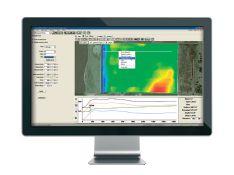
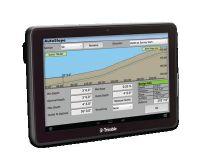
Our integrated subsurface drainage toolset provides concept to completion coverage for every step of the tiling process: survey, analysis, design, install and mapping. The WM-Drain solution ensures optimal 3D drain placement, which improves crop yields by lowering water tables, optimizing root depth, maximizing planting and harvest seasons, and minimizing nutrient loss. Learn more at
1
2
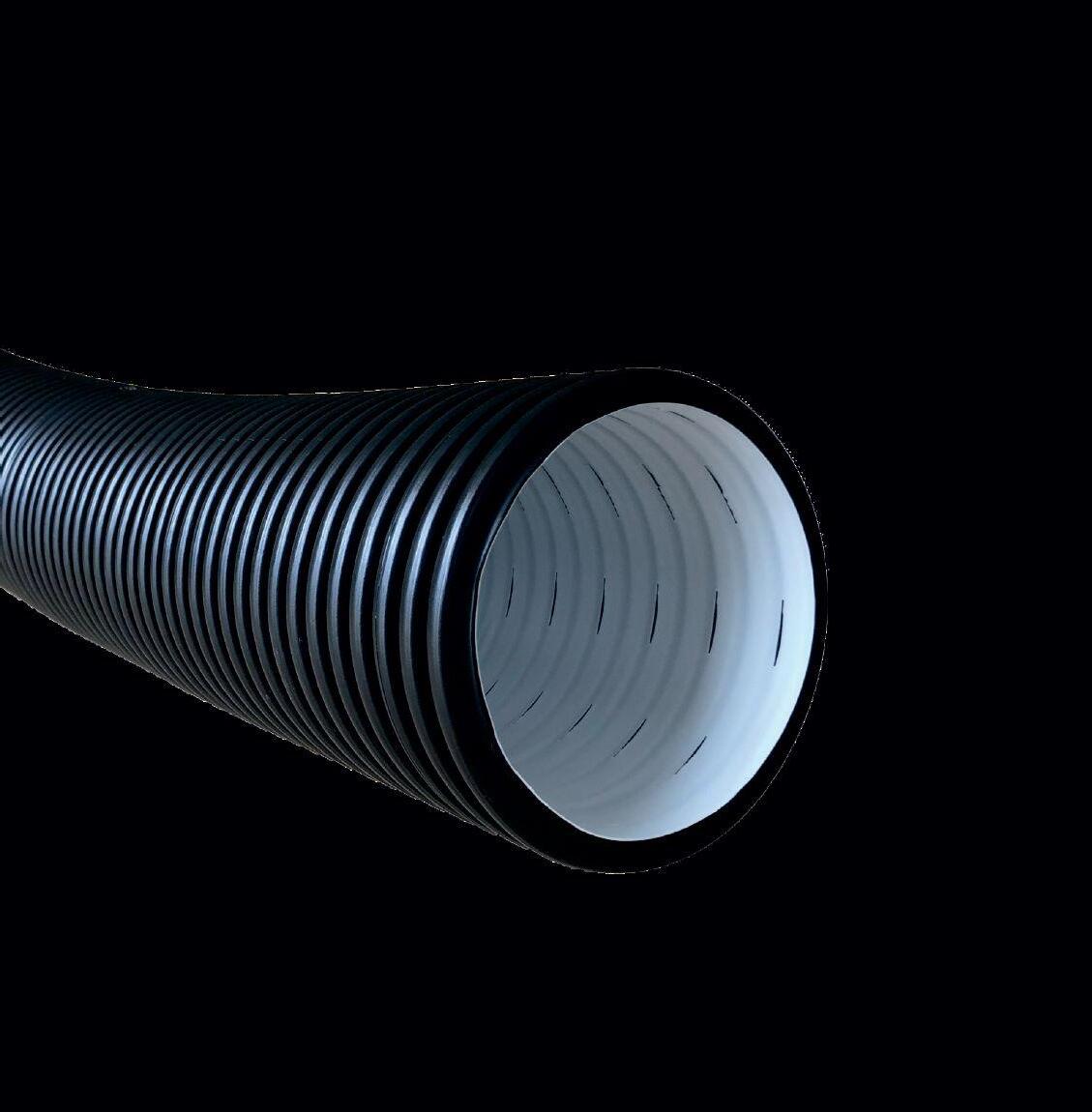
There is a simple reason our competitors won’t publish their flow rating: They can’t beat ours. FlexCorr is the only flexible dual-wall pipe proven to have a Manning’s N-value better than .012. Which makes us wonder... Should we even consider them competition?
THIRD PARTY TESTED
PLOW & WHEEL TRENCHERS
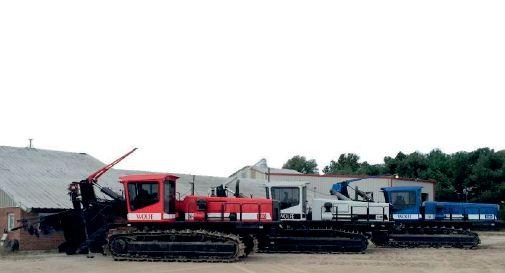
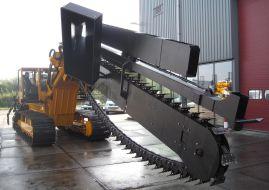
Wolfe Heavy Equipment continues to set the tone for powerful agricultural and commercial trenching equipment. Wolfe’s versatility, superior manufacturing and expert service along with reduced fuel consumption provides increased profitability.
ALL ABOUT BIOREACTORS
How modifications to bioreactors can help water quality
Arelatively new type of technology, known as a bioreactor, is helping farmers in the Midwest reduce their nitrogen (N) loss up to 62 percent.
by ROBYN ROSTE
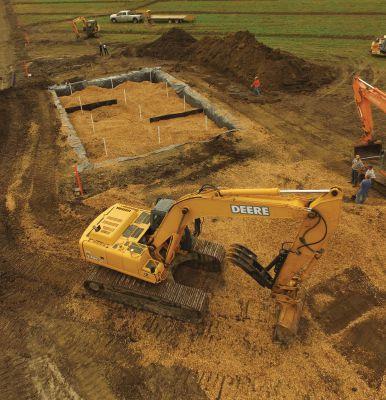
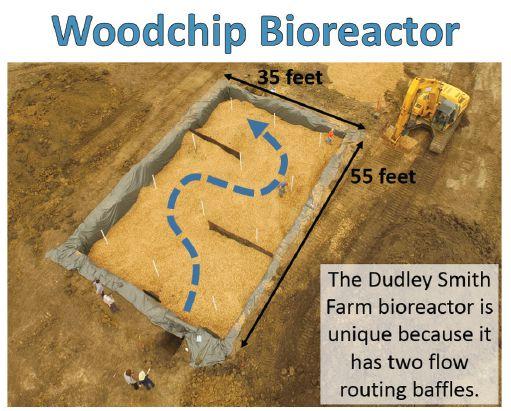
An overhead view of a bioreactor, which typically measure between six and 22 feet wide and 50 to 100 feet long.
Nitrogen is a key nutrient found in fertilizer, manure or compost such as ammonia. It helps grow healthy and bountiful crops, also has environmental implications if it is washed out of the soil.
Through a biological process called nitrification, ammonia is oxidized into nitrate. From there, nitrate follows the nitrogen cycle, and is eventually released as a gas through a process called denitrification. This process is inhibited when nitrate leaches into subsurface drainage. Once nitrate is in water, it causes a process called eutrophication, which leads to algae blooms and other environmental issues.
Surface drainage and reducing N loss is a focal point of a recent study conducted by Laura Christianson and her team at the University of Illinois at Urbana-Champaign. For the past decade, Christianson has studied
tile drainage, and she and her team monitor about 15 bioreactors across the state of Illinois.
This study used a denitrifying bioreactor with modifications to determine whether design improvements could treat more water and reduce N loss by an even greater percentage.
WHAT ARE BIOREACTORS?
Bioreactors are relatively small, edge-of-field devices containing a carbon source (most often wood chips) to create a controlled environment in order to treat and reduce concentrated nitrate-nitrogen that washes out through subsurface drains.
Most bioreactors in this application are between six and 22 feet wide (between two and seven meters) and 50 to 100 feet long
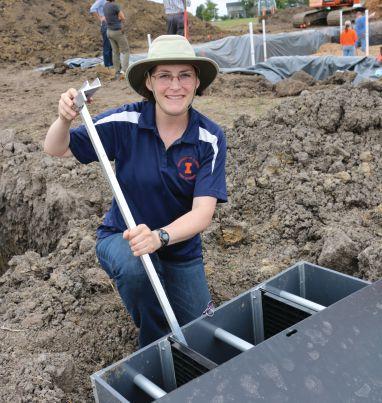
LEFT: Professor Laura Christianson in the field, working on modifications to denitrifying bioreactors.
RIGHT:
(15 to 30 meters), with the excavation depth matching the depth of the subsurface drainage. This size allows bioreactors to be installed without removing any land from production.
"From a research perspective, we want bioreactors to take as much of the drainage water as possible, but also stay small," says Christianson. For this study, titled Design flow and nitrate removal evaluation of a wide denitrifying bioreactor with baffles, Christianson and her team wanted to see if they could treat more water at the field scale, rather than just modelled on computers.
For the purpose of this study, the team built a wider-than-standard bioreactor, around 35 ft. wide (10.7 metres), and installed two flow-routing baffles. The modified bioreactor was installed in Illinois and was then monitored for three-and-a-half years.
The main objective from this research was to determine if changing the size of the bioreactor and making it wider would have any impact on water treatment and nitrate removal.
HOW BIOREACTORS CONTRIBUTE TO CONSERVATION
For those unfamiliar with bioreactors, imagine a subsurface trench filled with wood chips. Water that flows through this trench from tile drains is exposed to the carbon source, which encourages denitrification. Bacteria break down the nitrate, transforming it into nitrogen gas, removing it from the water supply and completing the nitrogen cycle.
In 2015, the Natural Resources Conservation Service (NRCS) approved denitrifying bioreactors as a national conservation practice standard. The efficiency of bioreactors’ annual N load removal has ranged from nine to 62 percent across studies in Iowa, Illinois, Maryland and Canada. Because bioreactors are small and low-tech, they require little or no maintenance to drain effectively and can last up to 20 years. In order for them to aid in improving water quality by reducing N content from subsurface flow, the right environmental conditions must be achieved. Therefore, biochemical engineering is required in the design phase.
There are a number of factors, which can impact how effective a bioreactor is, beginning with the nutrient concentrations (such as pH and dissolved gases) in the bioreactor, as well as external seasonal and temperature changes. For example, in some areas, spring runoff can put a much higher amount of water through the bioreactor than usual, making the bacteria less efficient.
Christianson says the bioreactor's design and plumbing have to be right for it to work properly. On the upstream side of the bioreactor, there's an inline water control structure to help route the water correctly in the wood chips. In addition, there is a bypass flow pipe so drainage water doesn't back up. "We don't want to be backing drainage water up, tile drainage systems are expensive. We want to make sure that they're flowing as they're supposed to flow. With our conservation drainage practices, it's important to have a bypass flow pipe when there's a lot of water coming from the field in the tile system,"
Continued on page 36
FOR FARMERS, BY FARMERS
Nohl Tiling may be a ‘side hustle,’ but the owners’ full-time farm operation gives them a fresh perspective.
Twenty-five years and a second generation into the tiling business, Nohl Tiling has established itself as a trusted name in agricultural drainage tile for farmers in west central Minnesota.
by MADELEINE BAERG
new technological heights, increasing their tile-laying capacity.
Run by brothers Taylor and Corey Nohl, together with their relative Eric Wilson, Nohl Tiling offers comprehensive tile design and installation service. But make no mistake: they consider themselves farmers first.
“We grow corn, soybeans and alfalfa, plus a little wheat. Because we’re farmers ourselves, we understand what’s important to farmers. Each field we tile, we tile it as if it’s our own field,” says Corey. “(Tiling) is a very good side business that allows us to help others.”
In 1908, their great-grandfather homesteaded the land they still run today. In the early 1930s, their grandfather started tiling the farm’s lowest land – all by hand. Much of that tile is still in place and operational. “That’s pretty neat, knowing tile hand-dug by our grandfather is still functional,” says Taylor.
Corey and Taylor’s father, Ray, and their uncle Roy took tiling to a much more intensive level. “My dad really believed in the concept of tiling. He understood how much difference it would make on our farm,” says Taylor. Ray and Roy started laying tile on their own farm. Just as they’d expected, the tile worked wonders. By the early 2000s, Nohl Tiling was a thriving side business.
Taylor and Corey grew up tiling. As children, they helped drive the plow from their dad and uncle’s knees and hefted pipe where they could. As teens, they played a bigger part in the business. When they finished college, both returned to the farm. Corey bought into the business alongside his dad and uncle in 2012. Taylor bought in after Ray died in 2017. Eric came on board last year when Roy retired.
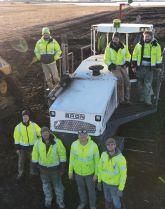
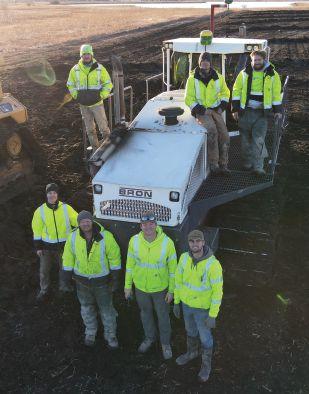
LEFT: The crew at Nohl Tiling, who split their time between tiling and the farm.
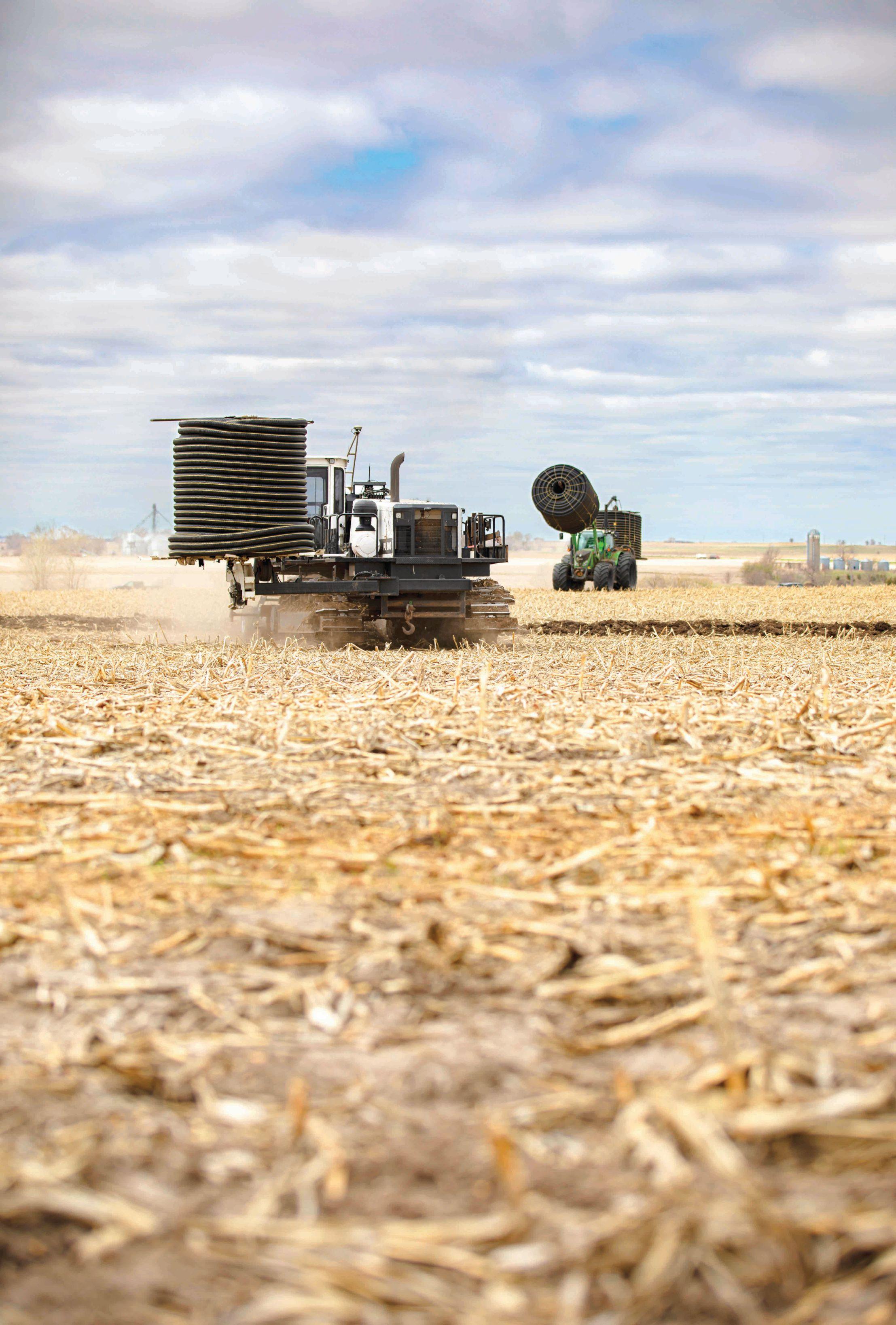
RIGHT: The Nohl brothers have pushed the business to
Though Roy and Ray were progressive for their generation, it was Taylor and Corey who pushed the business to newer technological heights. When they returned from college, they convinced their dad and uncle to give GPS a try. Installing tile with GPS positioning means every inch of tile line can be georeferenced and tracked.
“Our dad and Roy used to use a laser and transit. We presented a whole bunch of information to them showing that GPS is the future, so they let us try it. They were a little sceptical (at first)... But it didn’t take long for them to see its value,” says Taylor.
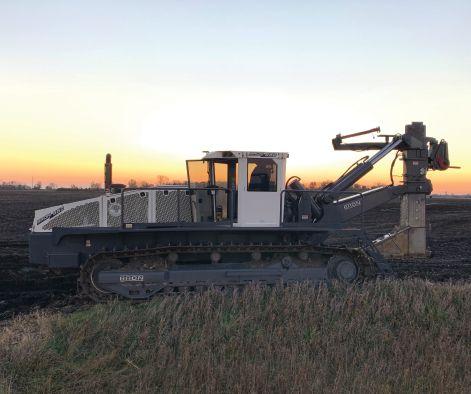
Last year, the they upgraded to a commercial plow, allowing them to make deeper cuts, lay bigger pipe, and work in tougher conditions. That, along with the GPS, the full-swing excavator and the bulldozer that Eric brought to the business, has nearly tripled their tile-laying capacity. It's come in handy; very wet springs in 2017, 2018 and 2019 mean more farmers are turning to tiling.
“Tile has sold itself. Guys with pattern tile are getting consistent crops; guys without are struggling,” says Taylor.
Today, Eric runs the dirt-works side of the business. Taylor runs the plow and manages the family farm. Corey designs the tile installations and handles most of the customer service and sales. The business also employs three full-time staffers who split their time between tiling and the farm.
Because there’s no one-size-fits-all tiling design, Corey depends on LiDAR, an online elevation mapping tool provided by the State of Minnesota. “We can design a lot of a tiling project right from the computer before ever stepping into the field. That’s helped speed up the design stage a lot,” he says.
While their great-grandfather and grandfather would have trouble imagining today's tiling tech they would appreciate the values of Nohl Tiling.
“Most of our customers are within a 45-mile radius of our farm. We know them. We go to church with them. We want to help them improve their farms,” says Taylor.
Corey adds that the goal isn't to tile the most feet in. “It’s to operate our company in a way that builds a reputation for high quality work,” says Corey. DC
STAYING ON TOP OF DEMAND
For many drainage contractors, building good relationships with their product suppliers is an important key
to success.
The demand for water management systems has gone up in recent months, thanks in part to rising agriculture prices that have meant more money in the bank for farmers.
Ryan Yokiel, owner of Ground Works Backhoe Service in Janesville, MN, says his business has definitely benefitted from the growing number of producers who see drainage tiling in their fields as a sound investment.
“Demand is high right now. Crop prices are pretty good, so farmers are wanting to improve their land to get their high yields. And the best way you can do that is to put your money into tiling versus buying equipment or sheds and grain bins,” says Yokiel. “With the wet springs and falls that we’ve been having, they really see that benefit of tile.”
Bob Clark II, head of the Land Improvement Contractors of America, agrees the uptick in prices for agriculture products has helped fuel demand for subsurface drainage on farms.
“I believe the primary motivator for farmers to install these systems is because it improves production agriculture. They’ll spend a dollar to make 10 or 20 cents,” says Clark, whose own business, Clark Farm Drainage in New Castle, IN, services mostly farm customers.
“There is some empirical evidence that strongly suggests that when you manage the air-water balance in the soil profile, you can get bigger, more consistent yields,” he adds. “The increase in commodity prices increases their ROI, and that’s really what gets a lot of growers to make the investment in capital improvements with a water table management system.”
Darla Huff is the agricultural market manager for Advanced Drainage Systems, a leading supplier of tile and other water management products for the agricultural and commercial markets. Huff says the company has ramped up its production capabilities and is investing heavily to keep up with demand for subsurface drainage products.
“This past fiscal year, we invested over $80 million in capital expenditures to expand our capacity and production, and will be spending another $100 million
in the coming fiscal year,” she says.
“Farmers must continue doing more with less. Our land is finite, but we have a growing world population to feed. So how do you become more efficient and increase yields?” she asks. “Water management has proven to do this, and more and more farmers are seeing the economic benefits of tiling.”
Huff adds a heightened focus on water quality and water recycling in farming is another reason for the growing popularity of tiling systems. She adds the increased frequency of severe weather events has become an important consideration for many farmers.
“We’ve seen a lot of unique rainfall and snow events that have caused flooding in areas that have never flooded before, so drainage is becoming a necessity,” she says.
PREPARING FOR INCREASED DEMAND
With increased demand naturally comes the need for manufacturers to implement operational and technological advances. One example is ADS’s new Pin Drop capability, enabling them to deliver products precisely where they’re needed — a feature that Clark says helps contractors run at their most productive pace during tiling projects.
In addition to utilizing technologies like Pin Drop, Huff’s advice for contractors is to focus on business planning and forecasting with their sales reps. For ADS, Huff says working together closely increases its visibility into a client’s business needs — which is essential as the market continues to grow.
“We would tell you to make sure you’re planning with your sales rep ahead of time the best that you can, just to make sure that your orders are in the system and that you’re able to get everything you require — the right product, at the right time, in the right place,” she says.
Yokiel says contractors who can communicate effectively with both suppliers and their customers stand to benefit in times like this when there’s a supply squeeze and demand continues to grow.
He notes ADS is his primary supplier, and he believes his loyalty has been recognized through the service he receives and being able to have open, upfront discussions about supply availability.
“You want to try to keep everybody on the same page and having a good relationship with your sales rep is an important part of that,” says Yokiel. “ADS has always been great to me with having the supply we need, when we need it.”
Like Yokiel, Clark counts on ADS as one of his main suppliers.
“That’s the thing about working with one vendor. You try to collaborate for the mutual benefit of both the supplier and, in our case, the purchaser. We want to help them help us, so we try to make it a win/win situation,” he says. “It’s kind of a team effort.”
Clark says it’s helpful that his ADS sales rep will check in regularly to see what his company’s future supply requirements will be.
“We always try to make sure we give them as much advance notice as we can to help them make the best planning decisions they can,” he says, adding that the communication goes both ways.
“They’ve always kept us in the loop, and they’ve continued to provide us product in a timely manner. I couldn’t ask for anything more,” says Clark.
“No other manufacturer is producing more agricultural or commercial pipe products than ADS,” says Huff. “As the market leader, we are dedicated to investing into maximizing production and leading the response to this unprecedented demand, now and in the years to come.”
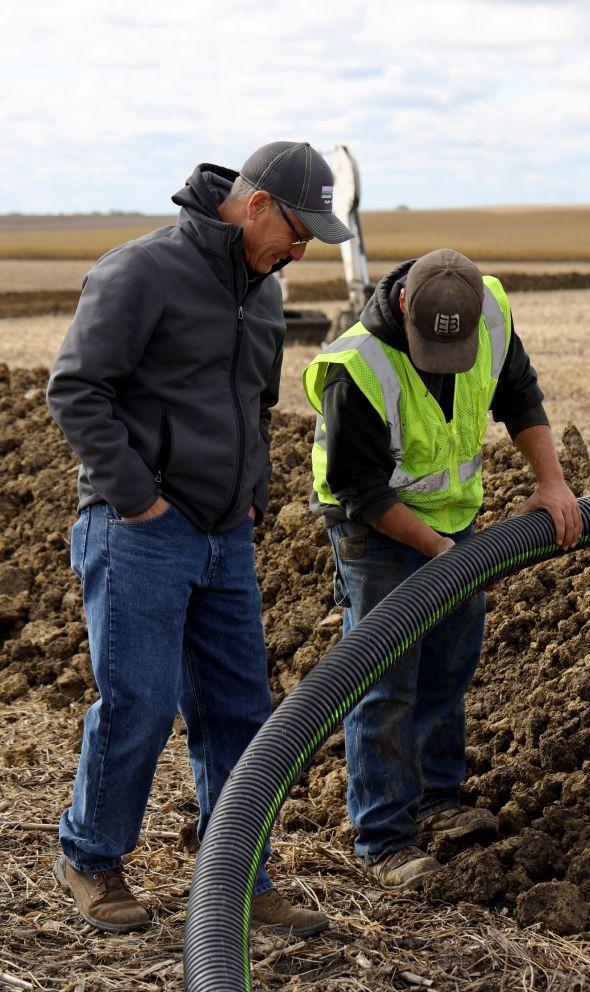
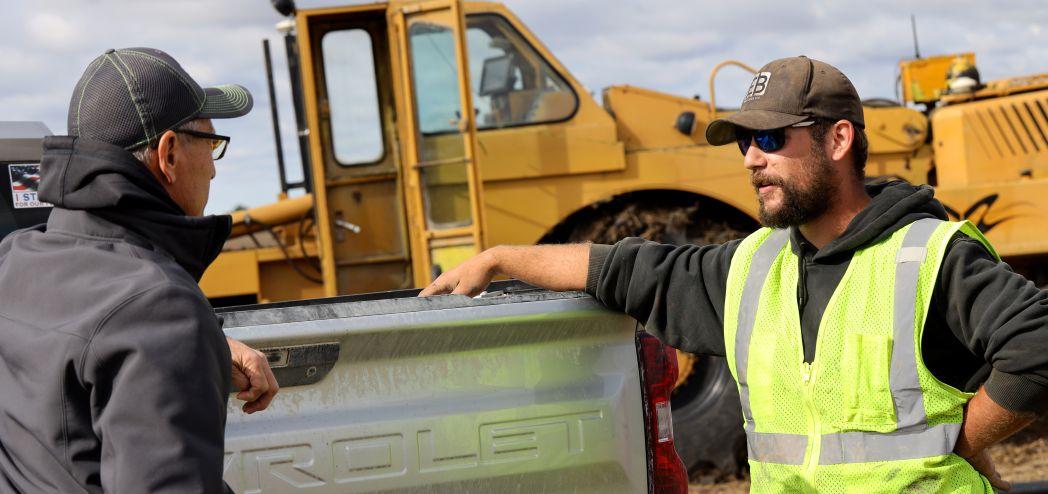
Eric Brown, a second-generation contractor from eastern Iowa, forecasts upcoming business needs with his ADS sales rep.
by JESSIKA GUSE
GO WEST, DRAINAGE
Can drainage make it big in Western Canada?
When standing water can be seen as both the hero and the villain in agriculture, there’s bound to be some setbacks along the way when it comes to water management. But seldom will water sit still without purpose.
What’s unique about subsurface or surface drainage in Western Canada is that there’s been an uptick within the past five years surrounding the conversation aspect of the practice – even if subsurface drainage is far from new. With many citing an increased curiosity around the installation of tile, some are already starting to put their money into the practice for the 2021 growing season.
Keith Loewen, president of K&S Tiling located in Altona, MB, says business hasn’t slowed down over his more-than-20 years in the contracting world. Though a pandemic isn’t helpful, he considers himself lucky to get work not only in Manitoba but also parts of Saskatchewan.
Being a contractor always has its challenges, but Loewen points to the amount
of red tape in some provinces that slows down the process of getting pipe into the ground. Specifically, there is a Class 3 wetland classification in Manitoba. He explains that if water sits in a spot for more than a month, it adds extra paperwork and money to the process, as an extra permit would be required.
“Permits are always the biggest challenge,” he says. “It all depends on what [the farmer] wants to drain. If they want to drain wetlands you have to get extra permission. Then it’s just the process of knowing and finding out who’s all involved, because I've found if it’s just the [rural municipality], it’s not too bad. But then if it’s [Manitoba] Highways or Manitoba Infrastructure, then you have to get two or even three different permits. — I would say that's the trickiest part.”
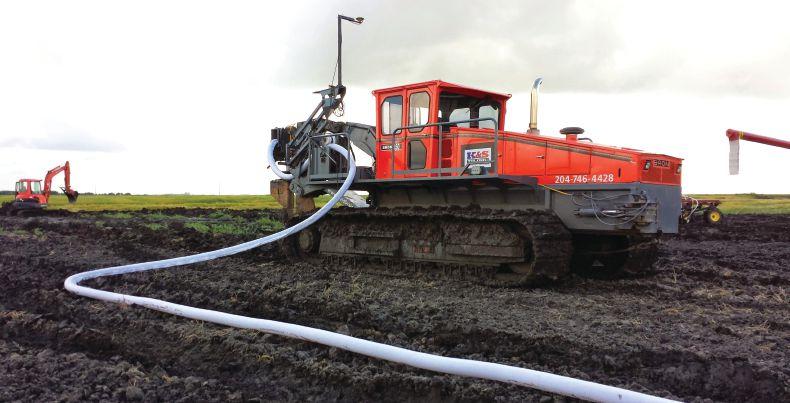
RIGHT: K&S Tiling has been a successful business in Manitobafor more than 20 years.
Though there isn’t a silver bullet solution, he says there needs to be a way to streamline the process as it’s starting to become more popular and that in his belief, “If it’s the farmer's field, he or she should be able to do what he or she wants with it.”
GOOD NEWS: THERE’S AN APPETITE TO LEARN
Helping curb some of the questions surrounding drainage specifically in Manitoba is Mitch Timmerman, AgriEcosystems Specialist for Manitoba Agriculture and Resource Development.
He points to a slight knowledge gap between most parties involved in the process, and says it can be seen as both a good and bad thing.
Oftentimes, local municipal leaders won’t know much about why the farmer wants to install tile drainage. That’s why Timmerman and his colleagues aim to help bridge the gap and ensure people understand “the role of drainage in society and what's enabled our communities to thrive and our agriculture industry to survive.”
Timmerman looks at water management from all angles, and though there’s some negatives along the way, he says the positives surrounding the viability of agriculture as a whole is what it comes down to.
“There is an appetite to learn, at least amongst some, and if they're open to learning, then we have been successful and engaging with the municipal council crowd with municipal leaders to provide them [information to help make informed decisions].”
As far as current regulations surrounding the practice, he agrees with Loewen in that it’s a bit of a “tricky dance” to get projects started in a timely manner. But with a little extra time put in, the outcome can be in the farmer's favor.
BAD NEWS: MORE RESEARCH NEEDED ON SNOWPACK IMPLICATIONS
Working with water comes at a cost. And as mentioned prior, it doesn’t necessarily have to do with the checkbook. Merrin Macrae, a professor in the department of geography and
environmental management at the University of Waterloo in Waterloo, ON, is no stranger to that annotation, having worked in the field for the past 15 years.
She understands producers don’t drain the water without purpose. However, she adds, when doing so, it can come at a cost to the environment. There’s always potential for a contractor to deal with wetland conservation, as well as the future of water quality in the area.
Though her research isn’t entirely focused in the West, from what she’s seen, tile drainage is a necessity for crop production especially when it comes to regions with heavy downpour such as the southwestern end of Lake Erie in Ohio.
“It was [like a] black swamp. They drained it so that they could farm it. You could not cultivate that, unless you drained it. So tile drainage in some areas is a necessity for crop production. But the problem is, of course, there are
ENVIRONMENT
Keeping the Great Lakes great
The drainage industry can play a key part in the quality of the water in the Great Lakes.
by Jacqui Empson-Laporte
The Great Lakes are the largest system of fresh surface water on the planet, containing about 21 percent of the total global resource. The Great Lakes basin covers an area of more than 765,000 square kilometres (295,000 square miles), and is home to 39 million people.
You can imagine that there are many governments, environmental nongovernment organizations (ENGOs), foundations and individuals looking to protect the Great Lakes, and to restore what we have damaged. That being said, anywhere that is home to 39 million people is likely to experience challenges, even if all the best management practices are adopted.
Priorities and actions can occur at different levels, ranging from international to field scale.
At the international scale is the Great Lakes Water Quality Agreement (GLWQA), an agreement between Canada and the United States, first signed in 1972. The agreement identifies shared priorities and coordinates actions to restore and protect the chemical, physical and biological integrity of the waters of the Great Lakes.
The Great Lakes Water Quality Agreement promotes remedial action in areas of concern where the lakes have become significantly impaired for normal use; lakewide management and science; as well as targeted commitments to address specific environmental concerns related to water quality, including aquatic invasive species, climate change, vessel discharges, nutrients and chemicals.
The Great Lakes Water Quality Agreement
commits Canada and the U.S. to prepare and issue Lakewide Action and Management Plans (LAMPs) for each Great Lake every five years. The 2017 to 2021 Lake Huron Lakewide Action and Management Plan sets general objectives including: to be a safe, high quality source of drinking water; allowance for unrestricted swimming and other recreational uses of the lake; and to be free from nutrients that promote unsightly algal or toxic blooms.
The actions that will be taken all focus on specific areas around the lake, particular problems to address and the impacts of different land uses. This is still at a relatively high level (provincial or state level), but there is a key role for the drainage industry to play.
Stormwater runoff and management is identified as one of the threats to water quality. Nutrient levels are highest in nearshore waters near stream mouths that drain urbanized or agricultural areas. Phragmites is
an aggressive, invasive species that outcompetes native vegetation and is a nightmare for municipal drainage. That brings us to the field level. The drainage industry can play a key role in managing water during storm events; implementing designed erosion control features to reduce topsoil and nutrient loss and reintroducing wetlands in strategic areas to retain water.
We can look at best management practices at improving the crop yields for the farmers, but we can also put these actions into the bigger picture. As an industry sector, we can encourage innovation in drainage technologies, adoption of best management practices, and partnerships with agriculture to improve water quality.
The final level is at the individual level. Fundamentally, it will take all of those 39 million people, to take whatever actions they can, to achieve cumulative environmental benefit. It also requires patience, as “we”
(individuals or government) won’t fix complex water quality issues overnight.
The drainage industry has an opportunity to provide input into actions the industry can take in the next Lake Huron LAMP, which is scheduled for completion by the end of 2021. Perspectives on the environmental conditions, issues, or concerns about Lake Huron that should be considered in the development of the Lake Huron LAMP, and any suggestions on actions or approaches that could be taken to address them. DC
While the formal public consultation period may be over by printing, I would encourage the industry to respond anyway. You can find more information at www.binational.net/2021/03/16/20222026-lake-huron-lwam/
You can find the 2017 to 2021 Lake Huron LAMP at: www. binational.net/wp-content/uploads/2018/04/2017-2021_Lake_Huron_LAMP.pdf
Tile
Coalition // Photo Credit: Bob Clark, Clark Farm Drainage
Each drain tile project is as unique as the land itself. Don’t be surprised by an underground pipeline or utility. Call 811 or visit www.clickbeforeyoudig.com in the planning process to identify the location of underground pipelines. It’s a free service and only takes about three days.
Momentum is building for water management
How the ADMC is taking a more active role in conservation and drainage.
by Keegan Kult, executive director, Agricultural Drainage Management Coalition
The drainage industry is currently in an interesting period. Currently, there is tremendous opportunity to advance agriculture for future generations. Changing precipitation patterns along with crop demands are driving the need for farmers to invest in tile drainage to provide consistent returns and mitigate risks. The recently released Iowa Farm and Rural Life poll showed that improving tile drainage is one of the most popular practices to deal with the changing climate, as 47 percent of responding farmers had installed or renovated their tile within the last 10 years, and 42 percent plan on investing in tile in the immediate future.
In addition to investing in water management to ensure profitable production, there is an urgent need to reduce the amount of nutrients escaping the agricultural landscape. Fortunately, members of the drainage industry had the foresight to form the Agricultural Drainage Management Coalition (ADMC) to develop conservation drainage practices that can
meet producers’ needs while also improving environmental outcomes.
Conservation drainage practices such as controlled drainage, drainage water recycling, saturated buffers, and constructed wetlands offer the opportunity to maintain the production benefits of drainage while adding greater nutrient reduction potential. The investment into the ADMC also has given the industry a seat at the table with leaders responsible for rolling out programs aimed at achieving production and environmental goals.
ADMC is now taking a more active approach to accelerate conservation drainage adoption by not only contributing to the development of practices and standards, but also taking the lead role in projects that remove barriers to adoption, and by building partnerships that expand the audience that can hear ADMC’s message. The biggest example would be the Polk County Saturated Buffer Project in Iowa. This is a collaboration among ADMC, Polk Soil and Water Conservation Districts, Polk
County Public Works, Iowa Department of Agriculture and Land Stewardship, and the Natural Resources Conservation Services.
The project team successfully addressed barriers to implementation by creating a strong local team that led an effective direct-outreach campaign and created an innovative fiscal agent funding method. The fiscal agent method allowed the team to remove the planning and contracting burden from the landowner and made the practice installations compatible with a contractor’s business model. Previous projects have focused on more singular practice installations, which are not as cost-effective for a contractor to slow down and install. In fact, a saturated buffer installation can come as an opportunity cost for a contractor with a full client list.
With the Polk County Project, farmer participation was incentivized to create demand for the practices. This enabled the project team to create 51 designs which were grouped into three bid packages based on location. The largest bid package included 40 sites located
within three continuous sections. This is enough work to justify a contractor’s planning efforts and mobilization costs.
In addition to leading in projects that address barriers to adoption, ADMC has been active in developing partnerships to show that the drainage industry has solutions that offer environmental gains in a working landscape. ADMC participated in, and is now helping disseminate the information developed in, the Edge of Field Roadmap which was a culmination of year’s work led by The Nature Conservancy, Meridian and the Soil and Water Conservation Society. ADMC and 25 other partners, all of whom are leaders in the agricultural and environmental sector, participated in a series of working sessions to define actionable steps to lay the groundwork for practice implementation. The partners in the roadmap included industry giants like Syngenta, Walmart and Cargill, among others. Making these organizations aware of the importance of water management will go a long way in creating opportunities that result in practices on the ground.
Finally, ADMC recently strengthened its relationship with the Land Improvement Contractors of America (LICA) by signing a memorandum of understanding to generate a framework to train technical service provider professionals, educate contractors on programs aimed at implementing water management practices and coordinate efforts to benefit the respective memberships with farm bill programs at the state and national level. ADMC has always valued its support from LICA and its state chapters, but this formal agreement will build upon that past relationship. With the momentum behind conservation drainage practices, there will be a large benefit to drainage contractors who are familiar with the practices and can recognize opportunities for installation. DC
For more information on how to take an active role in the momentum behind water management practices, please visit www.admcoaltion.com or reach out to Keegan Kult, executive director of the Agricultural Drainage Management Coalition.
DRAINAGE MANAGEMENT SYSTEMS
Continued from page 25
environmental consequences,” she says.
However, as there’s an increase in popularity of tile drainage, she says more research needs to be done when it comes to surface runoff and points to one of her PhD students’ work in the Red River Valley region.
“[Kokulan Vivekananthan and I] looked at whether or not tile drainage was actually going to do anything to impact water quantity and quality,” she says, adding that it's not necessarily indicative of what's happening outside of the Red River Valley.
“What Kokulan found is that almost all of your runoff — whether you had tile drainage or not — almost all of your runoff, and almost all of your phosphorus losses happen through surface runoff and tile drainage did absolutely nothing to change that.”
She went on to say, the reason for this is that in snowmelt, a farmer typically has about a foot or more of frozen ground, meaning all of the runoff was on frozen ground and the tiles were essentially disconnected.
“You had a little bit of a trickle through your tiles, but you didn't get a lot of action through the tile drains themselves. And instead, most of the runoff just went overland and into the ditches and bypass the tiles and so tiles like tiles did nothing to change that. And so because most of the runoff that happened was associated with snowmelt instead of summer storms, it means on an annual basis, your tiles don't really do very much. Because in the summertime, yes, the tiles will respond. But even still, some of the rain is coming down as big thunderstorms or convective storms and so when that happened on the heavy clays in the Red River Valley, it just went overland anyway before it went into the tile drains. Whereas, if your area had longer, multi-day, gentler
rainstorms – those were the types of storms where you actually saw the tiles flowing.”
Macrae adds that a potential plus for tile drainage in the West is to help with the reduction of water in the fields after those spring and summer storms – though she said there still isn’t enough research to fully backup that theory.
AT THE END OF THE DAY, IT’S YOUR MONEY
Just like any insurance, your return on investment may not come right away, if at all. Drainage is one of those agricultural practises where the benefits might not be visible in the first year – or second, or even fifth year after installed. The only way to immediately see the benefits is to be able to predict the weather ahead of time. And those in the West know all too well how quickly it can go from cold one day, to a light rainfall the next, to several inches of snow by the weekend.
“It really boils down to a business decision, because by far the majority of land is not tiled. So it's really the producer that has to make that decision, and (it’s up to them) if the investment is going to have a payback,” says Brian Wilson, an agri-ecosystems specialist and acting manager for the Manitoba Agriculture and Resource Development alongside Timmerman.
“It's a significant investment on their part. And if it's not generating a return to them, then, it just doesn't make sense to do a practice that doesn't make sense from either an agronomic standpoint or an economic standpoint, and then that's tied to environment. So anytime you look at a major investment — there has to be that balance of the three as you're dealing with that method of dealing with the risk of excess water.”
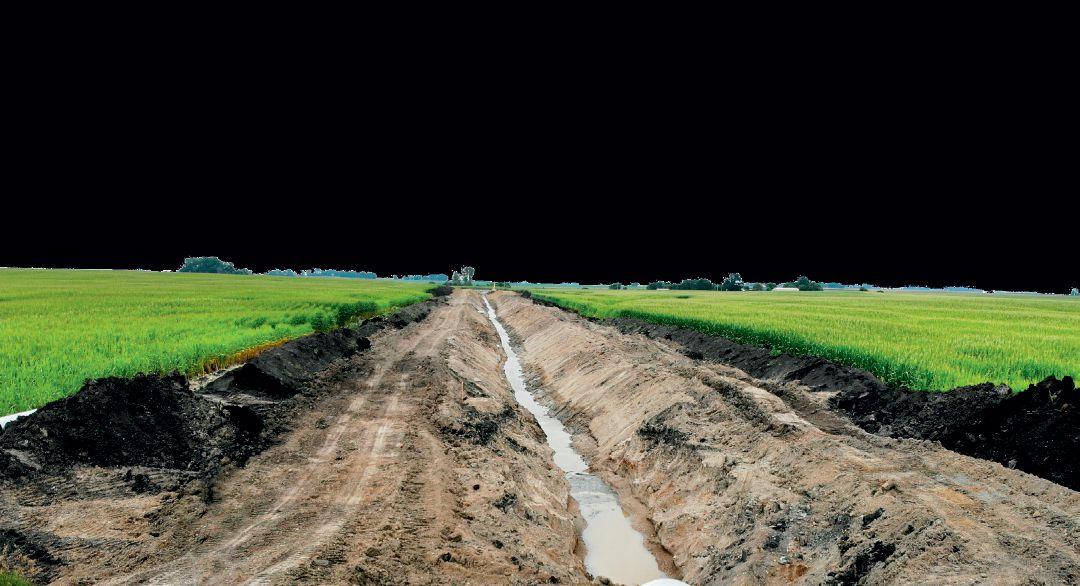
A contractor creates the spacing for tiles to be installed in western Manitoba.
NEW PRODUCTS
MASTENBROEK MAKES AN ENGINE UPGRADE
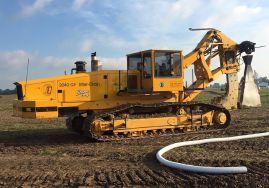
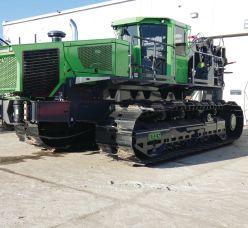
U.K.-based manufacturer and designer Mastenbroek has added a new engine to its CT12 Crawler Truc. Now, going forward, all CT12s manufactured in 2021 will feature the Volvo Penta D8 engine.
The six-cylinder engine is 252 HP, and is compliant with the EU Stage V Emission Standards. It features an advanced exhaust aftertreatment system based on SCR technology, uncooled EGR and a diesel particulate filter.
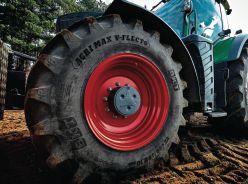
rolled out a new VF 710/70 R 42 size. This year, it’s debuted three additional sizes: VF 750/70 R44, VF 710/75 R38 and VF 710/55 R38. With these new additions, the V-Flecto is now available in 22 sizes.
BKT first launched the Agrimax V-Flecto tires in 2017. Features of the tire include no need to change the tire pressure depending on vehicle speed, the ability to carry 40 percent more weight than standard tires of the same size and with the same recommended rim and added durability.
The CT12 is designed to aggregate backfill for subsurface drainage, and has been through a number of different phases since it was first introduced to the market in 1983. In addition to its forward conveyor, the CT12 also features a tipping hopper, allowing it to be used as a dump truck for hauling aggregate along pipeline rights of way.
BKT ADDS NEW SIZES TO V-FLECTO TIRE LINE
This year, global tire giant BKT has worked toward expanding its line of Agrimax V-Flecto tractor tires. In December, the company first
Its main ambition with the line is to improve tractor performance on all types of terrain by maximizing loads and reducing soil compaction. The tire makes use of narrow rim option technology, conforming to standards set by the European Tire and Rim Technology Organization (ETRTO). This makes it possible to use standard rims with the tires, instead of dedicated rims.
NORTHERN IRELAND FARMER TAKES DIY IDEA TO THE MASSES
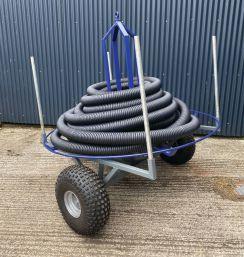
Tangles can be one of the most awkward parts of applying drainage tile. But Donal O’Donovan, a farmer from Coleraine, Northern Ireland, took a DIY approach to solving the issue. O’Donovan, an avid tinkerer,
created the Easi-Reel, a tool designed for a “one-man operation” that can handle coils of up to 72 feet.
The Easi-Reel attaches to the back of ag vehicles. Its design allows users to load the coil upright, then lay it down on a flexible turntable that allows the tile to be continuously fed through as the vehicle moves along.
While O’Donovan initially designed the Easi-Reel for himself, word-of-mouth and a little media attention resulted in requests pouring in – and O’Donovan soon created about 30 in just over a year.
Since then, O’Donovan has taken the tool national. Easi-Reel can be ordered on www.easi-reel.com, although the tool only ships to the U.K. and Ireland for now.
BRON, VERMEER INK DISTRIBUTION DEAL
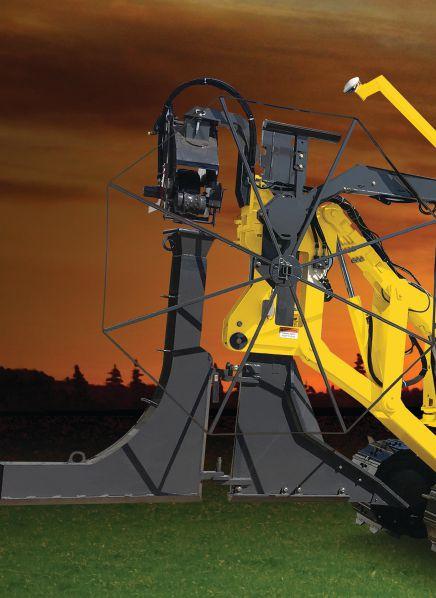
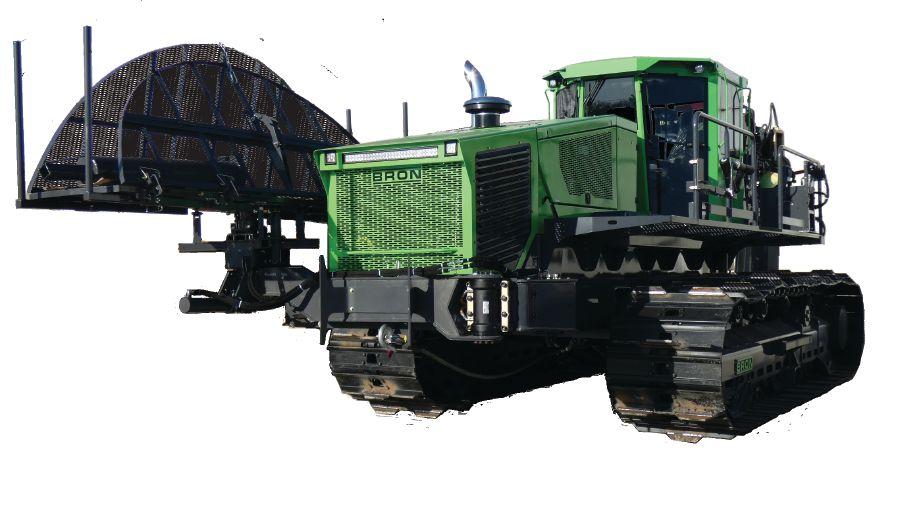
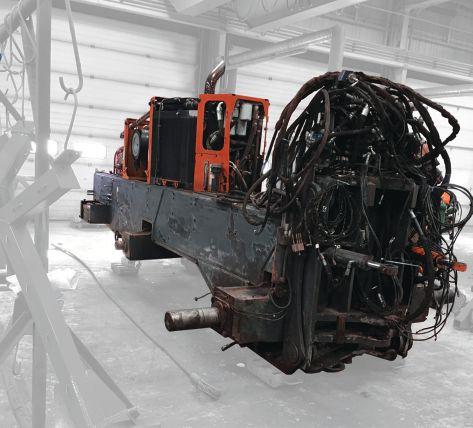
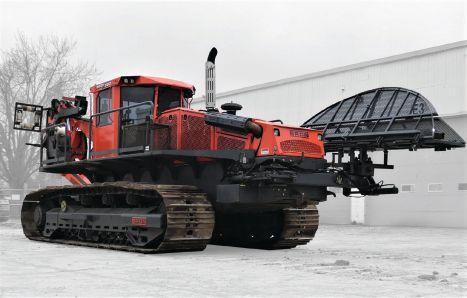
Vermeer has signed a distribtion agreement with Bron, which will result in Bron's track plows and plow attachment products being sold through Vermeer industrial dealers worldwide.
First signed in February, the agreement makes Vermeer the exclusive distributor for two of Bron's plows in the 200 hp and 300 hp class.
Bron, based in Ontario, has been active in the utility and underground installation markets for more than 40 years.
Vermeer said in a statement that there has been a major demand, globally, for the installation of underground infrastructure. By adding Bron's products, Vermeer says its customers will have additional options for heavy-duty plows, as well as attachments geared toward deeper or more extreme installation applications.
For Bron, the deal represents even broader reach. “Our products, partnered with the reach and expertise of the Vermeer dealer network, put us all in a stronger position to support our customers," says Robert Hall, president of Bron.
Other recent expansions from Bron include the opening of its first distribution centre in the Midwestern United States in 2020.
Bron Midwest is a 24,000 sq. ft. facility located in LeRoy, MN, which houses an 1,800 sq. ft. showroom and on-site staff for sales, service and parts.
DRAINAGE EQUIPMENT EXEMPT FROM NEW INDIANA ROAD LAW
New laws to address road damage in Jasper County, IA will limit the weight of vehicles on country roads.
The laws were implemented to mitigate road damage that is compounded during the winter months. However, the law states that vehicles hauling tile drainage and related equipment will not be affected, even if they were to exceed the 16,000 pound (eight ton) limit on county roads. Other exceptions include construction equipment and buses up to 45 ft. long.
ENVIRONMENT
Continued from page 19
she says. "The bypass flow pipe is an important part of the design for practices like bioreactors, or even saturated buffers or other conservation drainage practices."
Bioreactors cost around $10,000 to install, but there are costsharing measures available through organizations like the NRCS.
Throughout Iowa and Illinois there are around 80 farmers using bioreactors. Although bioreactors have been around for a decade, they're still considered a newer practice.
Christianson says farmers from around the world are looking to the Midwest to help them figure out how bioreactors can work for their specific situations.
"The nitrogen cycle is kind of doing its thing everywhere and we're trying to produce food everywhere. In so many locations around the world, we're at this kind of juxtaposition of trying to grow food, but trying to make sure we're not getting nitrogen in the water. And so, bioreactors are a great option. I think that farmers around the world are starting to pick up on this idea, which is really exciting. And they're looking to Iowa and Illinois as farm leaders."
BALANCING AGRONOMIC AND ENVIRONMENTAL GOALS
Across the Midwest, there are millions of tile-drained acres, which are crucial for agriculture, as is the case in many other regions. And while tile drains are essential to production, they also act as a shortcut to move N into downstream waterways. In order to achieve both crop production and environmental best practices, Christianson says more denitrifying woodchip bioreactors are needed.
"There's this concept of conservation drainage practices that we promote to meet both agronomic goals of crop production and environmental goals of making sure we keep our water clean, and making sure that we're good upstream neighbors," she says. As N travels into waterways, it causes sediment to become more fertile. These additional nutrients turn into algal blooms, which leads to "dead zones" where the water is depleted of oxygen and no organisms or wildlife can live within the zone.
In the U.S., the Gulf of Mexico has the largest dead zone, which returns each summer. The Mississippi River feeds into the Gulf of Mexico and that river serves as the drainage area for more than 40 percent of the continental U.S., including agricultural drainage. This flowing water carries nitrogen and phosphorus runoff into the Gulf. In order to reverse these dead zones, it's important for N and other soil nutrient loss to be reduced as much as possible.
The United States Environmental Protection Agency set N and phosphorus reduction goals for the states bordering the Mississippi River. As a result, drainage conservation practices are becoming as important as crop production strategies for mitigating dead zones and limiting N runoff into watersheds.
“The states in the Midwest that drain to the Mississippi River basin all have nutrient loss reduction strategies that guide each state's efforts to meet a 45 percent nitrogen and phosphorus reduction goal,” Christianson says. “That is one
goal that each state is trying to meet.”
As farmers look to upgrade existing tile systems and improve drainage structures, demand for drainage contractors who have experience implementing conservation drainage practices will increase.
"It's a lost opportunity to not also be thinking about water quality, things like bioreactors, saturated buffers, drainage, water recycling and wetlands," Christianson says. "All of these practices are things that drainage contractors can do."
While drainage contractors are the obvious choice to install and plumb the bioreactor, farmers need to work with organizations like the NRCS when designing a bioreactor for their specific field.
BUSINESS DIRECTORY
RESULTS OF THE STUDY
For three-and-a-half years, Christianson and her team studied their modified bioreactor, measuring the level of N in the subsurface flow before and after it entered the bioreactor.
In the end, the specially-designed bioreactor with the increased width and added baffles treated approximately 40 percent of the annual drainage flow volume, resulting in a 22 to 24 percent N removal at the edge of the field. While this demonstrates the bioreactor was effective, it did not result in more water being treated or an increased N reduction percentage.
"The bioreactor still worked and it still worked on par with what we expect bioreactors to do, so it was kind of a mixed bag. It didn't work as well as we wanted it to, but it did work very consistently with what we would have expected otherwise," Christianson says.
Despite this modified design not performing as well as expected, the team continues their research to discover how bioreactors can treat more water.
To effectively sustain agricultural production in the Midwest and around the world, both the growing cycle and environmental impact need to be considered.
"We know tile drainage moves nitrogen from our fields, and we know that nitrogen is going downstream. And so, my personal belief is that our farmers and our drainage contractors are good environmental stewards and know in their hearts that we need to be good upstream neighbors," she says. "There's a better way to do agriculture." DC
AD INDEX
Return to confidence
Picking up steam as the COVID dust settles.
by Rob Burtoshaw
Nothing drives sales and inquiries quite like rain. I have said it before, but no amount of fancy marketing or sales efforts can compare to more water than usual falling from the sky. So, after two straight winters of above-average rainfall (one being extremely wet), our phones have been ringing off the hook. This is not only true for us, but also many British contractors.
Pleasingly, it is not only the frequency of the calls but also the type of project too – much bigger jobs than average. We are busy now, and will have to remain exceedingly busy throughout the year to complete the work we already have on the order books for the critical period after harvest.
A couple of years ago, the amount of work we currently have would have brought with it the realistic worry that we might have taken on too much work. Letting customers down and not getting to them in time is an industry crime – it erodes trust and can destroy a reputation. But having since invested heavily in new machinery, this is less of a worry.
We put pipe in the ground a hell of a lot more quickly now than we ever could even five years ago, and we can only hope to increase speeds again this year. It will be needed – and frankly makes me feel much better about the investments we've made up to this point.
Adding to the increasing workload are the jobs we were forced to delay in the last year. Most of our clients’ businesses were fortunately less affected than others by the pandemic. However, some were, and those jobs were postponed or cancelled, and for a company our size, losing even just a couple of good jobs is a kick in the teeth and can be difficult to recover from.
Additionally, some clients were less affected by COVID overall, but still canceled previously ordered projects, preferring to keep the money in the bank in uncertain times. I can understand
such a decision, even if it did cause us some problems.
So much of business is about confidence, and this is especially true in our industry, where the product we install happens to be designed to last for many years (more accurately, upwards of a century).
Ultimately, investment relies on the belief that not only will the money return to you over time, but it will also reward you with a little extra to make the effort worthwhile.
It would seem confidence in the U.K. is higher now than it has been for several years previously. This is hardly surprising; we have had a few headwinds of late that you might have heard about.
Even as uncertainty over infection rates and Brexit have dragged down investment in all sectors, now it seems the cap has been released from the bottle. Things are looking up. The question is: for how long this is likely to be the case?
I, for one, have no idea what is likely to happen in the broader economy. And, if truth be told, I’ve also not much of a clue about the agricultural sector in particular.
As mentioned previously in this column, it’s all change in the U.K. government’s agricultural policies – and who knows what this will all bring?
Regardless, whether the future brings a benign climate or a more hostile one, all we can do now is hope for the best, work hard and make hay while the sun shines.
It seems likely that the drainage industry will have a good year in 2021 and we will all have a chance to earn some good money – a most welcome event for anyone. While I cannot hold up a crystal ball and predict our specific economic future, I can say this with confidence: regardless of the economic climate, if it rains, we are always going to do well. DC