Ontario land improvement contractors and drainage superintendents gathered in London on Jan. 20 and 21 for the 58th annual Land Improvement Contractors of Ontario (LICO) convention.
Approximately 230 people attended the 2016 convention, which kicked off Wednesday morning. The exhibit room, which hosted about 25 exhibitor booths, was abuzz with coffee, chatter and several opportunities for contractors and associates to network with one another.
This year’s speaker program began with Franklin Kains, the convention co-ordinator, welcoming attendees with the traditional cowbell in tow. Kevin McKague, from the Ontario Ministry of Agriculture, Food and Rural Affairs (OMAFRA) offered insight on the applications of water and sediment control basins (WASCoBs) for drainage and water quality improvement. Water quality was a major topic for this convention, with talks on optimizing the designs for WASCoBs and a discussion on seeding native grasses on disturbed soil, both in an effort to reduce phosphorus in surface water run-off.
LICA WINTER CONVENTION HIGHLIGHTS
PRELIMINARY FINDINGS FROM SATURATED BUFFER RESEARCH RELEASED
Springfield Plastics Inc., in conjunction with the Agricultural Drainage Management Coalition, has released preliminary water quality results for 2014 from their saturated buffer systems, which remove nitrate from water flowing in underground field drainage tiles before it reaches streams, rivers and other waterways.
Springfield Plastics has been working with the Agricultural Drainage Management Coalition on a project spanning 15 sites across Illinois, Iowa, Indiana and Minnesota to study how saturated buffers work under different conditions and other conservation practices. Saturated buffer systems have a control structure that
The rest of the conference covered interesting topics as well. The use of video cameras for the inspection of main drains was a highlight, as it showed how to pinpoint a problem below ground without a lot of digging. A presentation by Trimble exhibited the company’s land forming and drainage software. Toromont presented on the Tier 4 requirements for diesel engines. On a historical note, John Marks of the Geneva Historical Society in New York talked of the legacy of John Johnston, who is considered to be the father of tile drainage in North America. Marks mentioned that in the early 1800s, digging 60 feet of trench over 14 hours was considered a good day. Laying the tile and backfilling were saved for another day. This presentation was a great reminder of how far we’ve come!
The Drainage Superintendents Association of Ontario (DSAO), LICO contractors and various committees also held their annual meetings during the conference.
The Wednesday evening banquet was a time of merriment, awards and entertainment. On Thursday afternoon, guests were treated to a tour of the Ideal Pipe facility in nearby Thorndale. Thanks to the LICO and DSAO organizers for another great event.
diverts the flow from the tile outlet to a lateral distribution line in a buffer strip. The lateral distribution line runs parallel to the buffer, and as the water is diverted to this line, saturation occurs. As this saturation, or lateral water movement through the buffer, occurs, the vegetation, soil organisms and denitrification naturally remove nutrients like nitrate that are in the water, thus reducing the nitrates discharged to the streams.
The preliminary 2014 findings show the nitrate concentrations in the streamside inspections are lower than the levels in the field tile prior to being diverted to the buffer. These findings were consistent across all 15 sites. Research will continue and further findings will be reported. For additional information please contact Steve Baker with Springfield Plastics at 217-438-6167.
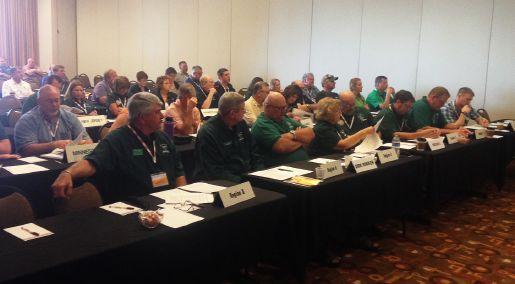
The Land Improvement Contractors of America gathered in San Antonio, Texas, in March for the annual winter convention, with members shown here at a board meeting.
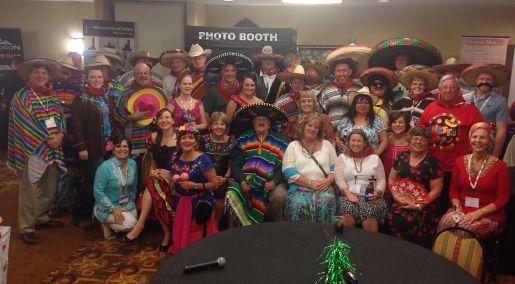
When the work is done, the guests have fun! The delegates enjoyed a fiesta-themed Associates’ Night. Photos courtesy of the Land Improvement Contractors of America.
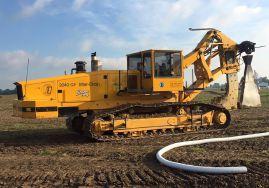
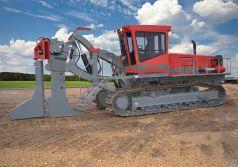
BRON is proud to introduce the newest series of Mulcher Models, the 490 & 590 replacing the previous generation of 475 & 500. Both new machines are powered by a fuel efficient Cummins QSX15 Tier-3i 15-litre engine.
The 490 is rated at a 480hp peak at 1,800rpm. The 590 is rated at a 589hp peak at 1,800rpm. The increased speed rating over the previous models provides additional range for the engine to operate, and results in improved efficiency by using less fuel per horsepower.
Hydraulic power comes from proven closed-loop pumps for both track drives and mulching head, providing awesome performance and control for high productivity.
Purpose built frames unique between the two models incorporate new oscillating track frames with D4 as standard on the 490, with optional D5; the 590 comes standard with D5 tracks. These tracks are powered by heavy-duty planetary drives that are matched to the size of the selected undercarriage.
Two specially designed extreme service heat exchangers are designed for improved cooling in even the hottest climates. Optimally positioned to draw cool/ clean air in from the rear of the tractor, then directed alongside the engine, maximizing air-flow efficiency, reducing wasted horsepower and excessive noise. The open area between the heat exchangers also provides ample room for service to the front of the engine.
Exciting times are ahead for customers of the new BRON 490 and BRON 590 Mulchers, with improved stability & operator comfort, longer operating between fuel filling, and lower noise with increased heat rejection capabilities, the new machines are expected to be in high demand for 2016 and beyond!
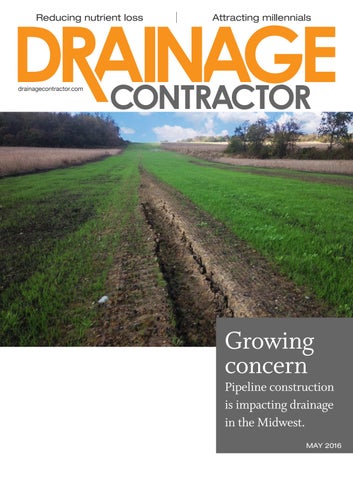
A GROWING CONCERN
How pipeline construction is impacting the business of drainage contractors in the Midwest.
The impact of gas pipeline construction on agricultural drain tile has become a hot topic in the midwestern United
States.
by JULIENNE ISAACS
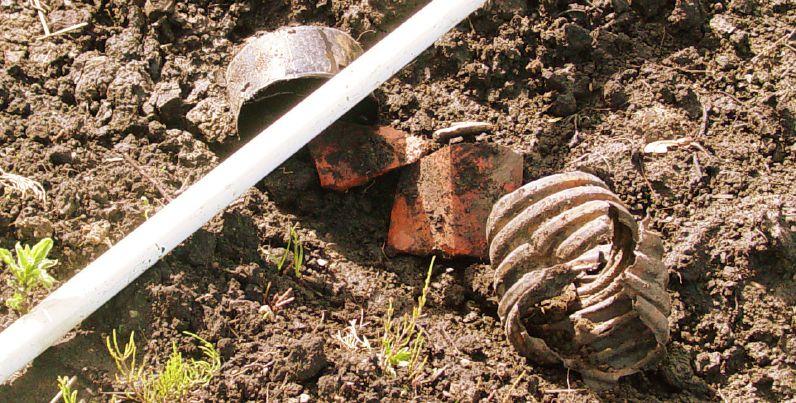
Broken and damaged tile is often encountered during pipeline installations. Photo courtesy of Fairfield Soil and Water Conservation District.
It’s not a new issue – in much of the United States, drain tile has been used for agricultural purposes for at least a century, and potential for damage has existed as long as the oil and gas industry has been constructing pipelines. In Ohio, several pipelines have been proposed by Nexus gas transmission, Energy Transfer, Kinder Morgan and Columbia Pipeline Group, recently bought by TransCanada.
The risk is well-known by all stakeholders – gas companies, landowners and contractors – but perhaps felt most by farmers who rely on tile drainage.
“From the standpoint of Fairfield County, it’s extremely critical to make sure that tile stays in place: some of it has been in for over a century,” says Jonathan Ferbrache,
a professional landscape architect and resource specialist with Ohio’s Fairfield Soil and Water Conservation District. “If the pipelines criss-cross and do damage, it could have a long-term agricultural impact in the area.”
The Fairfield Soil and Water Conservation District is an independent government unit with separate jurisdictional authority that works with the Ohio Department of Agriculture and the United States Department of Agriculture (USDA) to consult on this issue.
Ferbrache has been involved in construction projects across the state. He says that when a pipeline is constructed across an agricultural property, if the landowner signs a contract allowing the
construction, they may relinquish a “perpetual right” to do repairs or lay new tile in the pipeline area. “If you’re a unique property where the pipelines have been in for 100 years, you could have seven or eight pipelines crossing your field,” he says. “So it makes it difficult for day-today business if they’re not properly marked and inspected.”
Rob Hamman is a farmer and drainage contractor with Watershed Materials, an Ohiobased company that offers products related to watershed protection and management.
He says gas companies are required to hire a contractor for a pipeline “spread” – a certain length of pipeline – and take care of any damages to agricultural land.
“The company putting the gas line in an agricultural area is responsible to do everything – fix it, re-grade, reseed, re-establish everything,” he says. The contractor is responsible
for every aspect of the project and can either complete necessary repairs themselves, or subcontract repairs out to drainage contractors.
Since 2009, drain tile damage has increased with the number of pipeline projects in central Ohio, meaning Watershed Materials has had its hands full over the last few years. “In the section through central Ohio farm ground, more than 2,000 drainage tiles were cut in 100 miles of pipeline,” he says.
“I think growers were upset at the quality of the repairs after the fact. Some of the contractors weren’t prepared for the amount of drainage tile they were getting. Some of them were not familiar with drainage tile and didn’t take it as seriously as they should have.”
According to Hamman, the pipeline companies involved in those projects repaired all of the damaged tile and offered landowners two-year warranties. But the growers, in many
cases, were still unhappy with the quality of the repairs.
CASE BY CASE
The extent of the repairs pipeline companies will complete if drain tile is damaged is determined on a case-by-case basis with landowners. Guidance documents, such as the Ohio Pipeline Standard and Construction Specifications document (a voluntary set of measures to help reduce damage to property during construction), do exist, however.
But Ferbrache says the document that holds most weight is the contract negotiated between the landowner and pipeline company at the outset of a project.
This document will include stipulations about the nature and quality of repairs to drain tile, and at what point the repairs can be done following construction.
He says keeping land in agricultural production is to the gas companies’
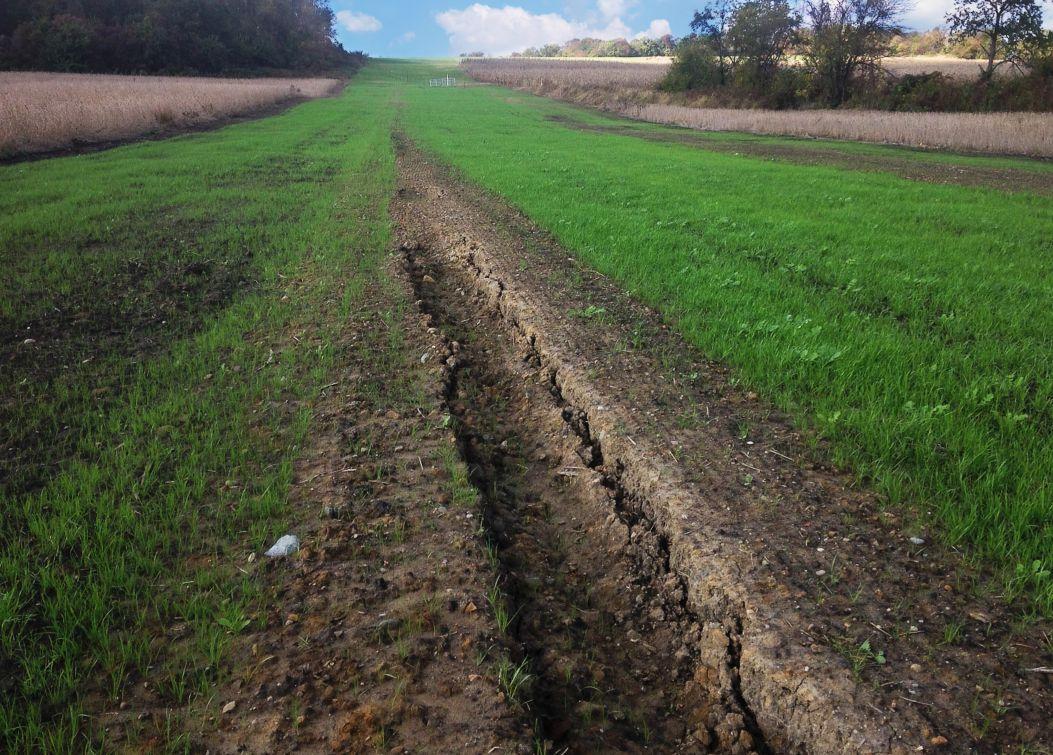
New replacement tile settlement between two pipelines. Photo courtesy of Fairfield Soil and Water Conservation District.
benefit: land that is maintained by farmers does not need mowing, for example – or drainage. “Maintaining the tile has a long-term benefit for the pipeline’s longevity,” he says. “Pipeline companies have an interest in maintaining that agricultural tile. If groundwater starts to rise, you want to have drain tile at 24 to 36 inches carrying that moisture away, because it’s so heavily compacted after the pipeline goes in.”
Jimmy Stewart, president of the Ohio Gas Association, says the pipeline companies doing work in Ohio have a good understanding of the importance of drain tile to agricultural operations. Most companies follow the recommendation set out in the Ohio pipeline standards document.
In addition, he says, pipeline companies talk to landowners early on about the size, location, layout and direction of all drain tiles on the property, as well as their collection outfall, composition and approximate depth. They also ask who originally installed the drain tile field.
Recently, a Nexus drain tile mitigation plan crossed his desk; the company, a joint venture between Spectra Energy and DTE Energy, is proposing a new pipeline in Ohio.
“In the Nexus drain tile mitigation plan, the company states that they are responsible for the costs associated with mitigating and repairing drain tile impacts from construction-related activities,” he says.
“They also state in their plan that drainage systems will be restored to at least the equivalent of their pre-construction condition. Any repairs and restoration to drain tile systems conducted by the company will be monitored for three years, or until restoration is considered successful, to ensure the system functions properly.”
TIPS FOR CONTRACTORS
Hamman says that if drainage contractors are contracted by pipelines to do the work up front, or are hired later, there are a few considerations to bear in mind.
“One of the biggest tips is to check all your Utility Protection Service tickets, and get the phone lines and electric lines marked before you dig, because the gas lines run through more populated areas,” he says. “Sometimes they’ve put a high voltage underground electric or fibre optic lines around the drain tile. Old existing gas lines and other utilities could be mismarked.”
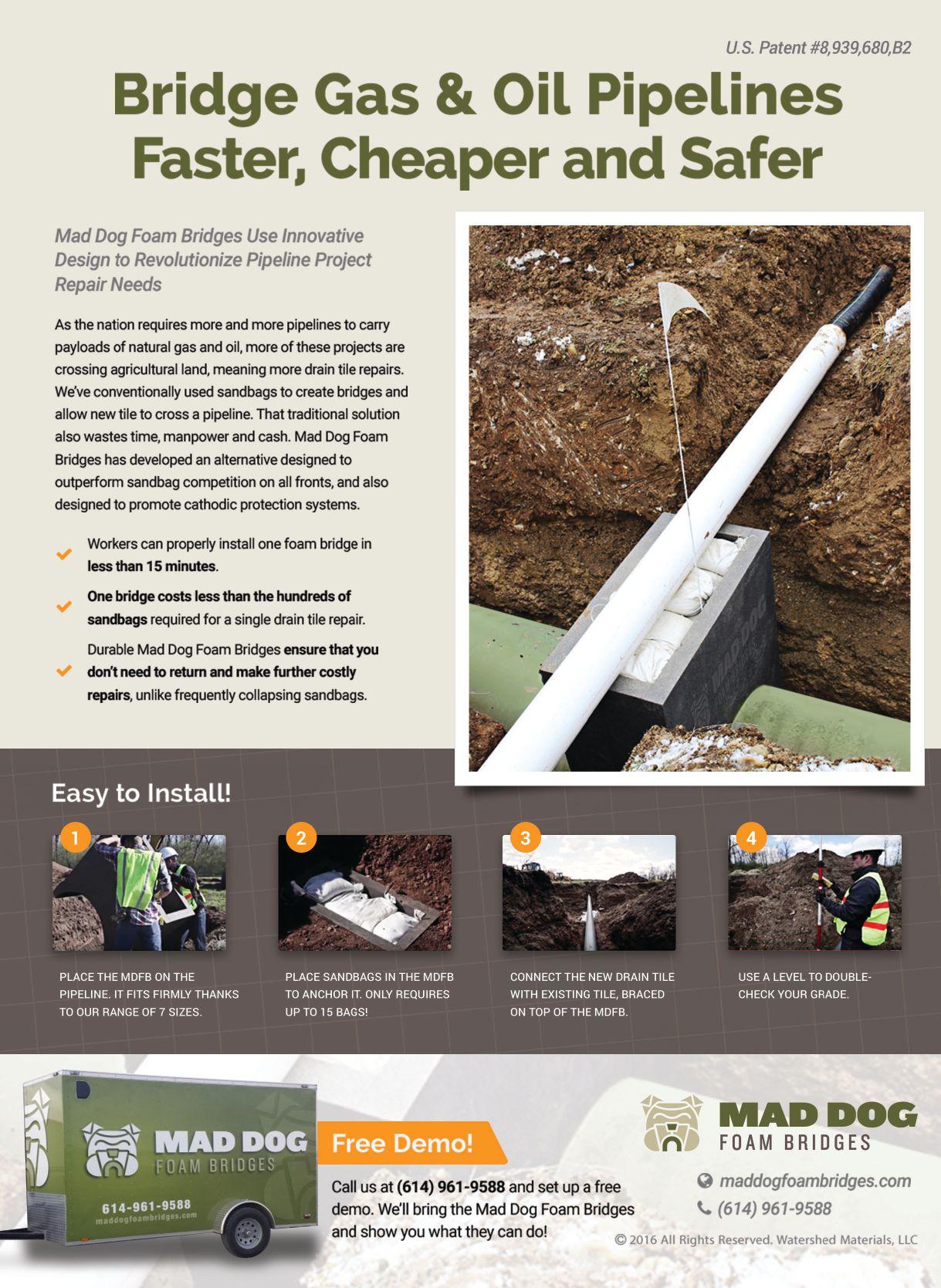
Bridges designed to keep drain tile from settling and shifting off-grade when pipeline is installed may be of particular interest to contractors hired by gas companies. Watershed Materials is currently marketing one called the Mad Dog Foam Bridge and Timewell Drainage Products distributes Tile Bridges.
Ferbrache says it might be a good idea for contractors to get a sense of contracts signed between landowners and gas companies before beginning the work, and potentially seeking legal representation in case something goes wrong.
But Hamman says contractors’ main task is to pay attention to the task at hand. “We’ve been working either directly for landowners or pipeline companies, and the deals the two of them have don’t affect us,” he says. “We’re out there to fix the tile and do it right.” DC
Keeping safety top of mind
New regulations remind us to prioritize safety.
by Steven Anderson
On the little finger of my left hand is my favorite scar. If I gave you 10 chances, you wouldn’t come close to guessing where it came from. Accidents happen at the most unlikely times and places: the scar is from a page in my accounting textbook from college, more than 30 years ago.
Safety is a matter of constant vigilance – even the simplest of operations, like turning a page in a textbook, can lead to rather bloody situations. My finger bled for a very long time and nearly needed medical attention. Had this accident occurred in a workplace, it could have been an Occupational Safety and Health Administration (OSHA) reportable injury.
Drainage contractors work in a potentially very dangerous occupation, with the potential for major accidents to occur at any time and place. We run the risk of being caught in a collapsing trench, or being struck by a rock thrown from a digging wheel, or a simple fall from a machine due to the combination of muddy boots and heavy clothing. However, we do a good job of working safely, and can credit this to the people we work with and the considerable experience we have in keeping our workplaces safe. If you think safely, you get safety. As the old saying goes, haste makes waste. If there isn’t enough time to do it right the first time, there’s always enough time to do it over. If we’re working too fast and forgetting about safety, is that extra few feet of tile installed in a day really going to be worth someone’s limb – or life?
OSHA has enforced this idea of safety in the workplace over the years, and change is in the works, starting this August. For some time now, travelling OSHA inspectors have been mandated to stop and check any excavation they pass while on their way to somewhere else. This is done to emphasize the goal of reducing the amount of cave-in incidences. However, this coming August, OSHA is introducing an increase in the fine structure of up to 80 percent and adding
new inspectors to increase enforcement.
No one wants an employee to get hurt in the workplace, and an OSHA claim can quickly turn into serious money for the employer. Now is a good time to review your safety manual and make sure you have everything in place in terms of paperwork, safety meeting documentation, material safety data sheets (MSDS) and information posters. Of course, implementing these safety regulations in your workplace is most important. The era of complaint-driven inspections is no longer. No matter the size of your business, safety compliance needs to be a priority.
If you are not a LICA member, now is a wonderful time to join in your state of operation. One of the benefits of a LICA membership is a safety manual to help bring you into compliance with OSHA regulations. Included in the book are forms that can easily be copied to create all of the necessary documentation an inspector may ask for. A LICA membership will also give you access to our Zywave portal, which is a wealth of information concerning new regulations and existing requirements, as well as instructions to help complete your documentation.
While OSHA likes all this paper, safety really does get down to the souls doing the work and the presence – or absence – of that feeling of invincibility. When we are young, we feel we will live forever and nothing can hurt us. But we all soon learn that dirt is really heavy and steel is very hard, and if we want to live a long life, we need to respect these materials and the workplace conditions that surround us. Let that respect mirror how you work, so that when that OSHA inspector drives by, he will say hello and continue about his day, knowing all is well in your operation. And don’t forget to tell your kids to be wary of accounting textbooks. DC
Steven Anderson is chairman of the board of the Land Improvement Contractors of America.
REDUCING NUTRIENT LOSS
Two groups join to minimize phosphorus loss in Ontario.
The Ontario Federation of Agriculture (OFA) and the Great Lakes and St. Lawrence Cities Initiative have joined forces to develop and implement a farmland water management and drainage strategy to reduce phosphorus (P) loss in the Thames River basin in southwestern Ontario.
This is a proactive project in response to government commitments at the federal and provincial levels to reduce the amount of phosphorus entering Lake Erie by 40 percent.
As much of the Lake Erie phosphorus load is coming from agricultural and municipal sources, working together on part of the solution made sense.
Drainage of farmland is primarily driven by the need to get water off the land during the growing season. In recent years, there has been increasing interest in improving the quality of water draining off farmland. The impact of run-off is particularly acute in the western basin of Lake Erie, which is experiencing the growth of enormous harmful algal blooms, due in large part to elevated levels of reactive soluble phosphorus. These blooms have already caused some public drinking water systems to be shut off out of concern for the presence of microcystin, a toxic bacteria that can be present in the algae. The Thames River, which connects to Lake St. Clair and ultimately the Detroit River, has been identified as a priority source of P loadings into western Lake Erie from the Canadian side.
The strategy being developed will urge and support landowners to adopt improvements to water management
and drainage on their lands that will reduce phosphorus loss from their fields. Licensed drainage contractors, drainage engineers, drainage superintendents and municipal councils who all have a responsibility for aspects of drainage installation, maintenance and oversight are also being engaged as critical partners in the development of this strategy.
We do not want to reinvent the wheel. There is a tremendous amount of knowledge and experience we need to tap into. The two organizations have enlisted the support of a broad cross-section of farming and drainage interests to help develop the strategy by building on what has already been done.
Groups like the Drainage Superintendents Association of Ontario, the Ontario Certified Crop Adviser Association, Conservation Authorities, Land Improvement Contractors of Ontario, the Land Drainage Committee, Ontario Agri Business Association, the Drainage Improvement Group, academics, non-governmental organizations, and federal and provincial government agencies have all joined in the strategy development process through an advisory committee and four subcommittees. The strategy will be developed based on their recommendations to the Great Lakes and
by NICOLA CRAWHALL
St. Lawrence Cities Initiative and OFA. We anticipate the strategy to be developed by June, and implementation will begin in the fall of 2016.
While the details of the strategy are still being worked out, it is clear that it must address the two biggest challenges: reducing phosphorus loss when, and where, it occurs most.
Research suggests that most phosphorus loss occurs during the non-growing season and during big storm events. Most best management practices (BMPs) are geared towards the growing season, and are not necessarily able to manage the flow from intensive rainfall. New or modified BMPs may be needed, as well as consideration of new techniques and technologies. A subcommittee is tasked with investigating which BMPs would be most effective in the Thames River basin context – buffer strips, cover crops, modifications to inlets, the installation of blind inlets, stormwater ponds and artificial wetlands all may be considered.
Identifying where phosphorus loss is occurring is an ongoing challenge, given the lack of monitoring data available in the Thames River basin. The Canadian and Ontario governments are working on modeling to help identify these areas,
FAST-PACED REHAB
An air base drainage project called for quick installation.
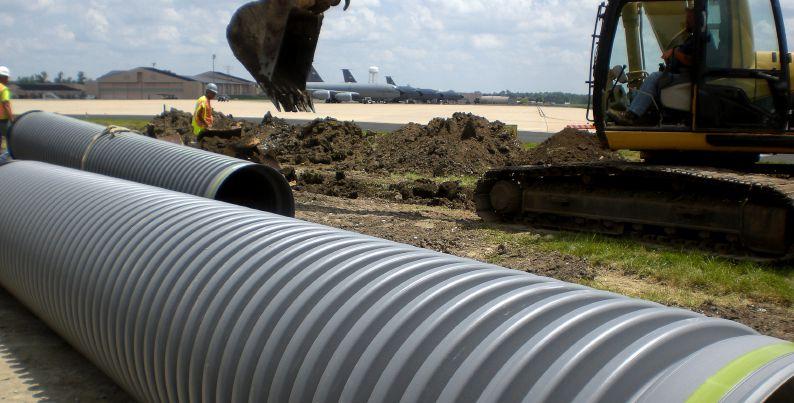
The drainage system along the primary runway at Scott Air Force Base in St. Clair County, IL, was originally clay pipe and perforated corrugated metal pipe. After 50 years, much of the pipe was either leaking severely or had deteriorated to the critical point where replacement was required. Plans called for nearly six miles of large-diameter pipe to be installed, but it had to be done within a strict timeframe, because the runway could be shut down for only a specific time period.
by THE PLASTICS PIPE INSTITUTE
The Scott Air Force Base in St. Clair County, IL, required an overhaul to its drainage system after it was determined that much of the original clay and perforated corrugated metal pipe was deteriorated or severly leaking. Photo courtesy of the Plastics Pipe Institute.
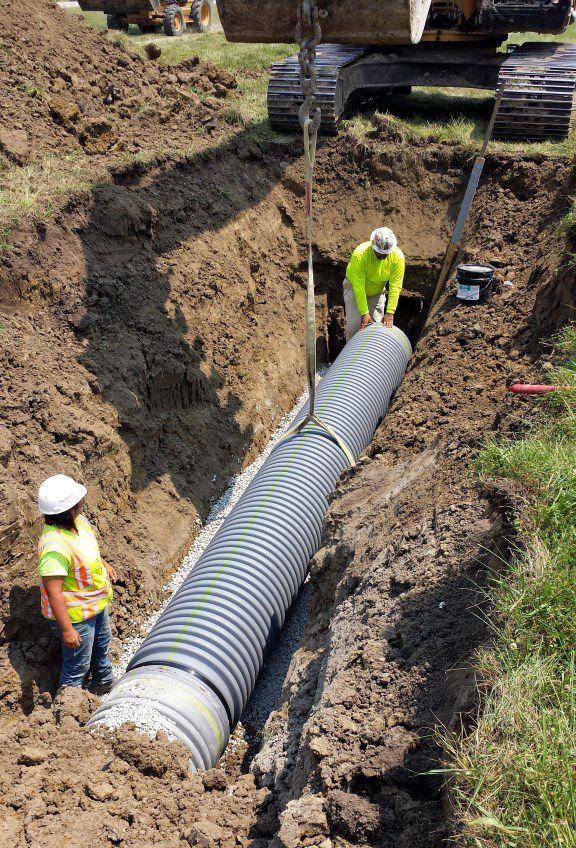
This project included removal and replacement of more than 31,000 linear feet of 12- to 36-inch diameter pipe. After being awarded to the contractor, a value engineering proposal was approved to use corrugated polypropylene pipe in accordance with ASTM standards F2736, F2881 and the American Association of State Highway and Transportation Officials (AASHTO) M330 specifications. The high pipe stiffness and watertight joints of the pipe system allowed for a reduced amount of imported backfill and the subsequent reduced haul off of excavated material. Burial depth would be up to 13 feet.
The selected pipe was a polypropylene pipe for gravity-flow storm drainage applications from Advanced Drainage Systems, Inc. This polypropylene pipe is approved for use by the Army Corps of Engineers for storm drainage applications under Section 33 40 00 of the Unified Facilities Guide Specifications. The pipe’s joint meets or exceeds the 10.8 psi laboratory performance standards, per ASTM D3212 requirements.
“Polypropylene pipe provided a low cost and fast installation at Scott AFB,” says Daniel Currence, director of engineering for the Plastics Pipe Institute’s Corrugated Plastic Pipe
Association (CPPA) division. “This project also demonstrates how the corrugated plastic pipe industry readily meets the requirements for higher-strength construction materials and products that also provide long-term durability and water-tight joint integrity.”
The Federal Aviation Administration (FAA) has approved polypropylene pipe for subsurface water collection and disposal at civilian airports. “The decision to recognize polypropylene pipe as an equal alternative to other materials enables design engineers and contractors to leverage the benefits of this lightweight, costeffective and durable solution for water collection and removal under airfield pavements,” Currence says.
Located 20 miles east of St. Louis, Scott AFB is a global mobility and transportation hub for the Department of Defense (DoD). The 3,589 acre base is home to several command and control elements that represent logistics for the United States military in an environment that brings together the Army, Navy, Air Force, Marines and Coast Guard members – active duty, Guard and Reserve. They are responsible for managing the global mobility missions around the world and also aeromedical evacuation, senior leader airlift and aerial refueling capabilities for the Air Force and DoD. The base has more than 22,000 uniformed, civilian and family personnel.
This isn’t the first time the base has placed a tight deadline on contractors. According to the base’s history, when it was built in 1917, the government gave the Unit Construction Company 60 days to erect approximately 60 buildings, lay a mile-long railroad spur, and level off an airfield with a 1,600
QUALITY IN. QUALITY OUT.
foot landing circle.
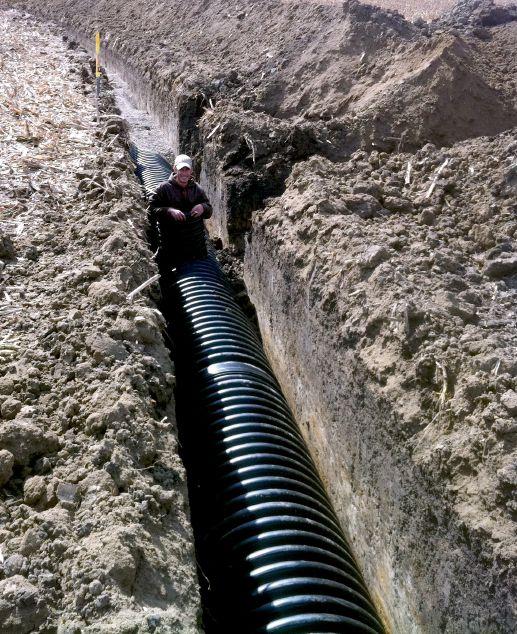
Contractors once again faced pressure to comply with a demanding project end date on the new stormwater pipeline. It had to be completed within the 16 weeks that the runway was to be shut down during the summer of 2014. The pipe’s lightweight, 20-foot length, the ability to nest different diameters of the pipe and ease of handling allowed each of the contractor’s two crews to install more than 400 linear feet a day on many days. This enabled the pipeline to be completed within the allotted time.
“Each day they were easily able to string out the pipe along the trench alignment and move as quickly as the excavator could remove the old pipes,” Currance says. “Often, the crew could insert the pipe in the trench without the need of heavy equipment. The value engineering proposal saved more than $30,000 while providing a sanitary-sewer grade polymer, pipe stiffness and joint. The combination of the high performance joint and durability associated with the corrugated plastic pipe will make this construction a permanent solution to drainage at the base.”
“This project represents all of the many significant advantages that corrugated plastic pipe provides,” says Tony Radoszewski, president of the PPI. “It offered a lowercost installation, very rapid construction, consistent and high-quality buried pipe performance and long-term joint performance. As the need to replace aging infrastructure continues to grow, this project demonstrates how innovation can not only reduce the cost of construction but insure a permanent drainage solution.” DC
The project needed to be completed within a 16-week time frame in 2014. Photo courtesy of the Plastics Pipe Institute.
A lesson in history
The early research behind corrugated-wall plastic drain tile.
by James L. Fouss, PhD, P.E.
The year 2015 was the 50th anniversary for the beginning of the corrugated-wall high-density polyethylene (HDPE) plastic drainage pipe manufacturing industry in the United States. Working for the United States Department of Agriculture, Agricultural Research Service (USDA-ARS), Soil and Water Conservation Research Division at Ohio State University, my former colleague Norman R. Fausey and I conducted research to develop new subsurface drainage materials and methods of installation that could potentially be installed faster and at a lower cost than clay and concrete drain tile.
The first phase of our research began in 1960 and focused on installing a circular plastic liner within a mole drainage channel with an attachment behind the blade of a mole plow. In field experiments, the plastic mole liner was found not to be strong enough for long-term stability under soil loading. In January 1965 we received a sample of a small diameter corrugated-wall HDPE plastic tube used for underground electrical conduit from Haveg Industries of Willington, DE. It was manufactured with corrugation equipment developed in Germany. Narrow slots were sawed into the tubing corrugations for drainage water entry and a modified attachment was fabricated to pull behind the mole plow for installation.
Installation with the drain plow proved successful, fast, and easy, plus the structural stability of the corrugated-wall tubing under soil loading was found to be excellent after several months of field testing. In December 1965, a technical paper on our early field research with the corrugated plastic drain tubing was presented at the first National Drainage Conference held in Chicago, sponsored by the American Society of Agricultural Engineers (ASAE). The paper was published in the ASAE Drainage Conference proceedings and has often been referred to as the foundation paper that attracted the drainage tile industry’s attention to begin a new revolutionary
era for manufacturing corrugated-wall plastic subsurface drainage pipe materials.
We continued our research by developing design criteria for the corrugated-wall plastic drain tubing. To obtain corrugated plastic tubing for testing with our trial corrugation profile, and fabricated with three types of plastic resins (PVC, high-density polyethylene and polypropylene), we contracted with Armco Steel’s corrugated metal pipe division to have corrugation molds made and test tubing fabricated. Armco arranged with the German firm that had developed the corrugation equipment to have the special molds made and the tubing fabricated with a three-inch diameter. Those three-inch diameter pipes were used to conduct laboratory deflection resistance tests for evaluating the corrugated-wall plastic pipe design method; the design procedure was validated. In 1967 the first commercially manufactured corrugatedwall HDPE drainage tubing in the U.S. was four inches in diameter, the same as the recommended diameter for clay or concrete drain tile used for subsurface drain system laterals.
In companion development work, we designed, fabricated and tested a floating-beam type drainage plow mounted on a crawler tractor to install the plastic drain tube at a maximum depth of six feet. An accurate method of controlling the drain depth and grade when installing corrugated plastic tubing with the high-speed plow was required to make the method acceptable to the industry and especially contractors. In the late 1960s we developed a prototype Laser-Beam automatic depth and grade-control system for the high-speed drainage plow. Field-testing and two field demonstrations in 1971 for drainage contractors and industry representatives showed the successful operation of the Laser-Beam controlled plow installing corrugated plastic drainage tubing. The innovative technology was fully adopted and commercialized by the drainage industry over the next few years. DC
Finding best practices
Researching ways to apply manure on tile-drained lands.
by John Carney
There continues to be a growing interest in tile drainage in Manitoba, and the Manitoba Livestock Manure Management Initiative (MLMMI) is working to help determine beneficial management practices for the application of manure on tile-drained lands.
The MLMMI has a mandate to work with Manitoba’s livestock industry to address challenges associated with nutrient management regulation, new technology and environmentally sound practices, while helping the livestock sector realize its economic potential. MLMMI is a Manitobafocused organization, helping producers in our province manage their manure-related issues in the context of their own local conditions.
Producers are well aware of the many agronomic benefits that water management through tile drainage can offer. Many producers have decided this tool has a place in their farm’s toolbox. However, some stakeholders don’t understand tile drainage. Some rural municipalities have questions about the environmental impact of nutrient and pathogen management on tile-drained land. It is essential to understand what scientific evidence is available to answer these questions.
Water management is a high priority in Manitoba, and the risk of manure nutrients and pathogens moving into watersheds has been identified as an area where more information would be helpful.
Since its formation in 1998, the MLMMI has supported more than 70 research and demonstration projects. A recent request for proposals (RFP) issued by MLMMI about beneficial management practices for applying manure on tile-drained land has received an outstanding response from researchers in Canada and the United States.
A total of eight inquiries from researchers yielded six proposals. There are two literature reviews scheduled to be completed and released in June.
The next step to learn more about nutrient run-off on tile-drained land was to call on the science and research community to examine the issue. While
there has been tremendous investment in research and development of beneficial management practices throughout North America, we come back to one issue: what do Manitoba producers and other stakeholders need to know to make informed decisions?
It begins with a good scientific review of what has been learned in other areas that may be relevant here in Manitoba. Ideally, the results from the RFP will show us where there are gaps related to areas in which Manitoba producers have a particular interest.
As with almost every agricultural activity, there are risks and there are ways to reduce those risks. The project proposals for these literature reviews will summarize research on nutrient and pathogen movement from tile-drained land to water. This will include a comparison of nutrient and pathogen movement from tiled and non-tiled land amended with manure.
This work will also identify beneficial management practices that will decrease the risk of nutrient and pathogen movement to water through subsurface drainage systems in Manitoba conditions. MLMMI will work to understand gaps in current research and recommend future research and development on using tile drainage in Manitoba.
As Manitoba’s agriculture industry goes forward, science has an important role to play in informing our management practices. Our organization plays an important role in bringing this information together for all stakeholders to use.
Communicating the research results to stakeholders is a key aspect of completing this work. MLMMI will post the final reports to www.manure.mb.ca. DC
John Carney is the executive director of the Manitoba Livestock Manure Management Initiative. MLMMI is funded by the Canada and Manitoba governments through Growing Forward 2, a federal-provincial-territorial initiative.
ATTRACTING MILLENNIALS
Enticing the next generation of contractors.
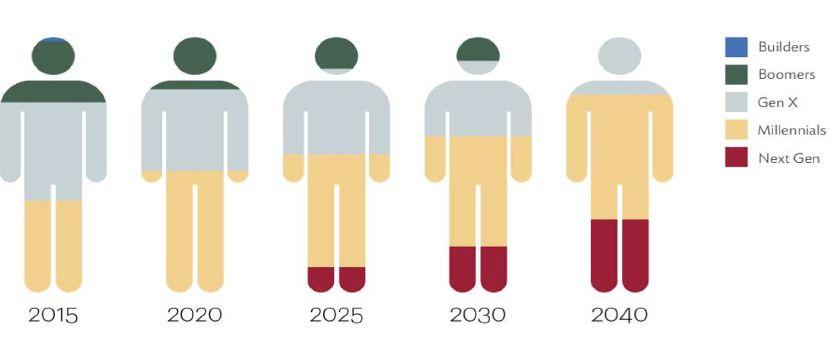
The term “millennials” is usually considered to apply to individuals who reached adulthood around the turn of the 21st century. The precise delineation varies from one source to another, however, for purposes of this article we will place millennials as born between 1980 and 2000.
by COREY RIMMER AND MERLIN WELCH
According to the U.S. Census Bureau, millennials will comprise the majority of the workfoce by 2025.
Millennials do not have a good reputation within the construction industry. Terms like “job-hoppers,” “entitlement,” “no work ethic” and “self-absorbed” have been used to describe this employment cohort, and like it or not, we must understand what makes this group tick.
A career in construction – including contracting and any of the other trades – has a lot to offer this generation. Working in an environment that is always upgrading, expanding and growing gives access to longterm growth and a sustainable economic future.
Companies with a better understanding of what motivates and engages this generation and who can best recruit, manage and mobilize labor will be better positioned to secure and keep talent and provide for their needs.
The following emphasizes three tips on how you can begin attracting and retaining young people in the construction industry.
EMPHASIZE PEOPLE AND SAFETY
Millennials have grown up in an era of intense child protection. As they’ve aged, millennials have been consistently confronted with safeguards implemented by adults. This has been a constant since they were young and they’ve come to expect it. Long gone are the days of wandering latchkey kids and leaving your front and back doors unlocked and open all night. Millennials just didn’t grow up with it – and they probably prefer it that way.
If it already isn’t, make safety a priority at your company and make safety a core part of your construction brand. Not only will it appeal to potential customers, but
prospective young employees will respect it as well. Publish your safety record to appeal to both the public and to your potential employees.
The commitment to safety from any workforce starts with the management team. Demonstrate your commitment to protecting your workers by hiring or designating a safety manager(s) and pushing your employees to go through online and hands-on training and education. Remember, recognizing their training efforts in some way – be it a small reward, a certificate or a wallet-sized card – goes a long way in job satisfaction.
PROMOTE TECHNOLOGY
Adapting a workplace to suit the needs of the millennial generation has taken some innovation by construction management and a lot of understanding from experienced workers in the industry. Millennials want a clear career path that allows for development opportunities and are looking for more contemporary incentives to stay motivated.
Millennials are smart: this age group is considered to be the most educated in the United States, with 34 percent holding a bachelor’s degree or higher. Although graduating from college isn’t a requirement to be considered intelligent, it does indicate one is trained to think and make decisions at an advanced level, with skills required for project planning, group collaboration, and meeting deadlines –all critical parts of being successful in the construction industry.
Encourage your employees to continue their education. Merlin Welch, a member of the Land
Improvement Contractors of America and educator for the National Center for Construction Education and Research (NCCER) says, “Programs like the NCCER are geared towards developing an individual’s skills with technology and working with their hands. Encouragement throughout each training module of learning reinforces the student’s desire to succeed by awarding a certificate of achievement at the completion of each course of study.”
Millennials are tech-savvy. They readily keep abreast of advances in consumer electronics, personal computing, mobile communications and Internet technologies. They have been called the tech generation, which speaks to their comfort level in using devices, software and online networks. As the construction industry becomes more dependent on technology, millennials’ comfort and familiarity with technology will make them a great asset to construction firms. Take pictures of your machinery and equipment using today’s technology of GPS tracking, 3D site imagery, lasers and unmanned aerial systems, and any others to post onto your website, social media and recruiting efforts.
CREATE A PATH TO SUCCESS
Companies who directly recruit with high schools, community colleges, junior colleges, career and technical education programs and contractor associations generally have had a lot of success, particularly if the recruiter takes the time to have one-on-one meetings with potential candidates. By reaching out to guidance counselors and vocational technology teachers,
one should be able to identify high school students with technology skills and who like working with their hands. In addition, community and junior colleges tend to have slightly older and mature students. Many of these students have held previous jobs so any interest in construction should be taken seriously.
“This recruiting effort should not be taken lightly. It must be ongoing, each semester at college and year after year,” Welch advises. “There must be a concerted investment in time, energy and money. There has to be sincere communication in order to develop trust at both the company and student level. Companies can also benefit by offering a place for field trips, donations of materials and supplies, summer employment or an internship.”
Millennials seek out a workplace where they can find coaches and mentors, not bosses and managers. Establish a mentoring system. New recruits need leadership and guidance as they figure out where their strengths lie and what positions interest them the most. Senior management should be accessible and new millennial employees should be paired with more experienced workers who not only want to be mentors, but also want to learn new skills themselves, such as social media or construction apps.
There is a skilled labor shortage within the construction industry, however, this creates an opportunity for those firms with the proper recruitment and image enhancement practices who know how to attract the next generation to the workforce to not only survive this shortage, but to thrive. DC
Creating a project toolkit
An update on the Transforming Drainage project
by Bob Clark
It was a busy and productive first year for the Transforming Drainage research study, according to project manager Ben Reinhart. Funded by the United States Department of Agriculture and led by Jane Frankenberger of Purdue University in Indiana, the project team brings together a wide network of drainage stakeholders to discuss, among other things, controlled drainage, drainage water recycling, and saturated buffers. These practices represent the core focus of this project as ways to promote sustainable crop production while providing protections to water quality.
This past year researchers spoke with more than 700 farmers, drainage contractors, residents, land managers, agribusiness representatives and agency staff during extension events in Illinois, Indiana, Iowa, Minnesota, Missouri, and Nebraska.
Field drainage research is a key component of the project. According to Reinhart, Transforming Drainage has aggregated data spanning 34 experimental drainage sites across eight states to establish an extensive database of agronomic, hydrologic, and climate data from across the Midwest. Approximately half of these locations represent completed research projects, some with 10 or more years of data from the field, while the remaining half are continuing to collect data during the project to add to the ever-growing database. All this was part of the effort to better understand drainage, water storage, and re-use on site. Through 2016, the project team will begin to dive deeper into these questions to identify landscape and economic factors that will provide input to assist practical implementation decisions. Project research and data will be developed into tools for drainage professionals that translate information into action. Want to know how big of a pond you need to subsurface irrigate with your tile system? No problem. Want to know what the expected production improvement of a practice would be? No problem. This information is a key
part of the toolkit that is a focal point of the project – and this is the kind of thing that, in my opinion, will really help new conservation practices take off. I am excited to accompany the development of these tools and communicate their evolution to the contractor community as the project develops. As we continue through spring, the plows and trenchers that many of us spend our days operating, or thinking about, will be steadily installing more and more tile. It’s one of my favorite times of the year – getting back into the field with increasing consistency as winter loosens its grip. There is also excitement as we experience the mad dash to finish work before our customers have finished planting. This spring, take the time to design and implement your tile systems in a way that is suitable for conservation practice retrofits when applicable. It’s an approach to which I’ve found growers to be very receptive, and one that leaves the door open for increased sustainability and production in the future. This could be as simple as planning to install control structure(s) at a later date, or incorporating a saturated buffer or bio-reactor during the summer when it’s dry and ideal for installation. I understand the pressure to get work done, but I also know the best time to evaluate a site for a conservation practice is when you are putting together the tile plan. Don’t miss a future opportunity to sell more work and get more conservation on the ground because you are too focused on today.
Extension products, field days and drainage workshops will continue to be delivered across the Midwest. If you have any questions or comments about the Transforming Drainage project, I urge you to email Ben at breinhar@purdue.edu so that he can build the best toolkit possible. DC
Bob Clark is the president of Clark Farm Drainage in New Castle, IN, and a member of the advisory committee for the Transforming Drainage project. For more information, visit www.transformingdrainage.org.
by TRUDY KELLY FORSYTHE
MEET THE MAXWELLS
A century-old business builds on hard work.
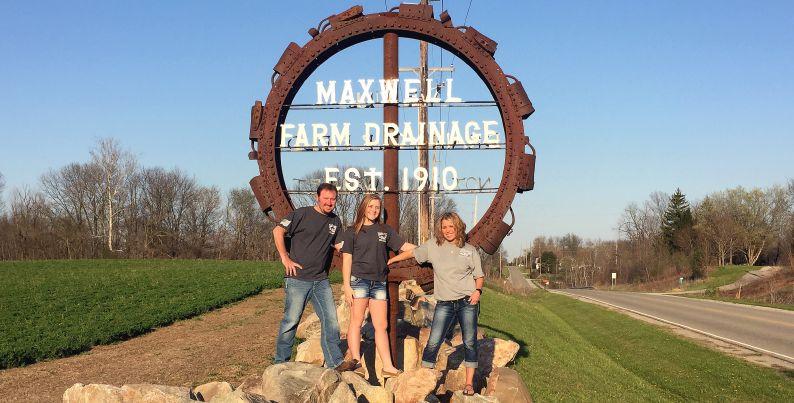
Digging ditches is in Bart Maxwell’s blood, going back four generations to 1910 when his great-grandfather, Alexander Maxwell, began laying clay field tile and building small bridges around Montgomery County in Indiana with his brother, Silas.
Three of Alexander’s 11 sons – Jack, Birle and Walter – followed in his footsteps fulltime, while another, Bart’s grandfather, Ralph, helped out part-time. This sparked the interest in Maxwell’s father, Bart Sr., who took over Maxwell Farm Drainage in the 1960s.
“My great-grandfather and his brother started with slip scoops behind horses, and a lot of the work was done by shovel,” Maxwell says, explaining the family bought the first machines in the late 1940s. Maxwell grew up working with his father but after graduating from Wyoming Technical Institute, he began his career as a heavy equipment technician.
However, fate intervened when Bart Sr. passed away unexpectedly in 1999. Maxwell took a few weeks away from his job to complete some work his father had committed
to and customers began asking him to think about taking over the business full-time. Considering the reputation his family built and the customer base that trusted and depended on the Maxwell name for more than 100 years, a 24-year-old Maxwell took over the business and believes he and his wife, Joellyn, have taken the business to yet another level.
Stepping in made him the 10th Maxwell to be involved in the family business. And it looks like the next generation may follow suit as his 13-year-old daughter Chloe is interested in the business and often helps him out in her spare time.
A CHANGING INDUSTRY
When the first Maxwells began the company, they installed drainage to take care of the worst
Bart, his wife Joellyn and daughter Chloe, are the current faces behind the more than 100-year old business. Photos courtesy of Maxwell Farm Drainage.
areas in Montgomery County, including filling in a lot of open ditches and constructing the first water mains in the county.
However, aside from the invention of the basic wheel trencher in the late 1800s, little changed in the business until the 1960s when Bart Sr. took over the family business. Faster and more efficient chain trenchers and plows entered the marketplace, followed by the laser grade control system and game changers like GPS and plastic field tile.
“GPS is huge,” Maxwell says. “Nothing in the industry has revolutionized the business like GPS has.”
Maxwell explains GPS allows them to survey a field in 10 percent of the time, take information back to the office and design the system.
“Everything is laid out so they know exactly what they need. They take the information from the field, see any grade issues, police their work and find if there are any issues. Operators know exactly what they’re supposed to be doing.”
And weather is no longer the issue it once was. “Even when
it’s rainy, foggy or windy, it doesn’t affect [our work] like it did when running with lasers, so we are able to run more days,” Maxwell says. “All of this happened within about a 10 to 15 year span. I don’t think we have ever seen a period of such innovation.”
Systems have also changed with tile spacings running closer together and decreasing the depth of the lateral lines. “We’re not putting lateral lines too deep,” Maxwell says. “We know we don’t want to be pulling water out that’s not adversely affecting the water table. We want to maintain a good water table.”
As water management and water quality has become increasingly important, the industry has increased the focus on drying the surface quickly, but not getting rid of moisture they might need later. “We have more controlled drainage and are conscious of the water we’re taking off that farm and saving it.”
Another change is a shift in thinking by the farmers who are now installing complete systems. Maxwell says 80 percent of their jobs involve tiling a complete field.
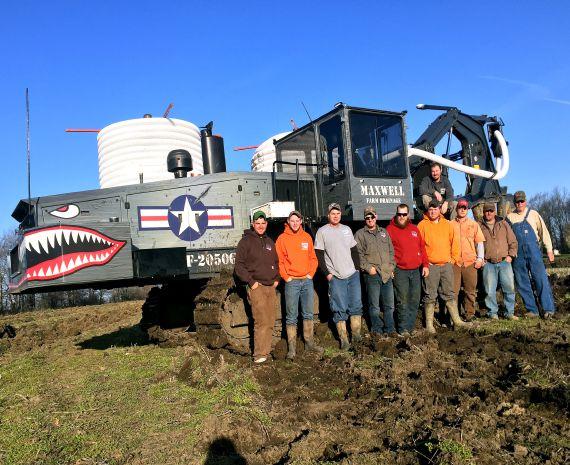
LEFT: Maxwell Farm Drainage – the oldest drainage company in Indiana – has a dedicated team to ensure the job is done correctly and on time. RIGHT: Bart Maxwell has seen many changes during his time as a contractor, including changing tile spacings and depth of lateral lines.
“When we leave, the farmer knows when he pulls into one part of the field that when he gets to another part, it’s not going to be too wet,” he says. “We tell farmers, we can get them on fields two or three days sooner, and many will say, ‘I’ll just wait those days then,’ but some years those two or three days can turn into two or three weeks if we get bad weather.”
KEYS TO SUCCESS
As the oldest drainage company in Indiana, Maxwell Farm Drainage obviously knows what it takes to be successful. Putting their customers first and a reputation for quality work and getting the job done are some of the qualities Maxwell says sets his company apart from the competition.
“We don’t stop running. The weather has to get really bad; it has to get frozen out and be two feet deep [for us to stop],” he says. “And we stay ahead of our schedule and our customers have taken note of that. They know we’re going to get there and get it done.”
They recently completed their largest, single-owner job ever. Over three months, using two million feet of pipe, they installed a 1,400-acre drainage system in Darlington on a corn and soybean operation. The job consisted of a 20-foot pump system and included nearly a mile of 36-inch pipe.
“We can do up to 48-inch pipe with our machinery,” Maxwell says. “That sets us apart too.”
LOOKING AHEAD
After testing different designs and developing their own line of custom attachments, Maxwell grew the business even further in 2015 when he started Maxwell Drainage Innovations.
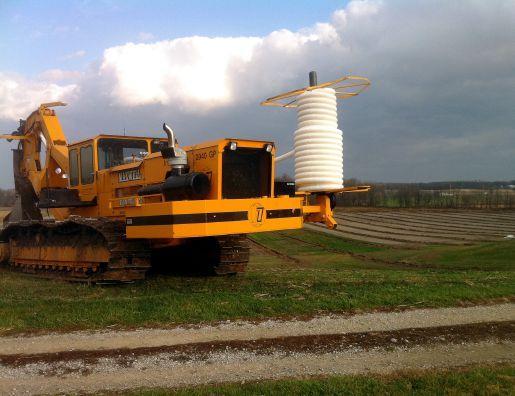
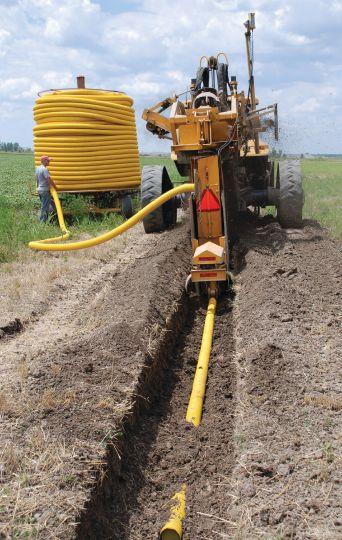
“I come from a mechanical background, so I love to get back to that,” Maxwell says. “Everything I look at, I think there has to be a better way.” Some of Maxwell’s projects, like spoolers – custom tile carriers that enable equipment to carry two rolls of pipe – and installation boots for plows and trenches to install single and dual tile pipe, have brought him success in other areas of the industry.
But for now, Maxwell is focused on maintaining the strong customer service standard that has been recognized for decades, as well as keeping up with what the future of the drainage industry holds.
“Maxwell Farm Drainage will continue to install pipe, grow to meet the demand of our customers and adapt to new technology in the drainage industry,” he says. “And we will build on Maxwell Drainage Innovations in the future too, continuing to research and develop new ideas and expand that company.” DC
Farmers are now installing complete drainage systems, Maxwell says, compared to years past.
DRAINAGE MANAGEMENT
INNOVATIVE SUB-IRRIGATION
Finding solutions in a closed-loop nutrient system.
What do you get when you put a Michigan dairy farmer and a conservationist in a car for several hours? If the dairy farmer is Blaine Baker, co-owner of Bakerlads Farm in Clayton, and the conservationist is Thomas Van Wagner, technical co-ordinator for the Lenawee Conservation District Center for Excellence Program, you get the initial designs of a livestock reservoir wetland sub-irrigation system.
“Tom got the idea from systems in Ohio they are using for irrigation of crops and thought maybe we could put it together for irrigation of wastewater for dairy,” Baker says. “We designed it on the trip out and back to the conference.”
Baker and his brother Kim are the fifth generation to farm the 130-year-old dairy farm, currently milking 500 cows on 2,200 acres. They were looking for a simple way to remove a lot of water without doing it physically, and they wanted to do it environmentally since milk-house wastewater used for washing and sanitizing equipment and livestock can potentially pollute surface and groundwater systems.
Due to state regulation requirements, Bakerlads Farm collects some rainwater along with the water it uses to clean a bulk tank and pipelines each day. The bulk tank takes 500 to 600 gallons, while the lines require more than 1,000 gallons each day, considering they milk three times a day with each wash going through three different cycles. Over a year, the system moves approximately 2.2 million gallons of wastewater.
Designed to collect and store wastewater generated from the dairy
farm for crop irrigation the following growing season, the livestock reservoir wetland sub-irrigation system is a closedloop nutrient system where wastewater is treated in a designed wetland, then circulated through a subsurface tile system. It is stored and used, if needed, for irrigating growing crops or, if unused, circulated back into the wetland or storage pond.
“Most people collect rainwater, wastewater and manure and it all goes into one big pit,” says Baker, explaining this results in a manure slurry to dispose of. “We have two pits, one for manure and the other for parlour wash water and bunker stormwater. So, while we still deal with four to five million gallons, it’s two and a half to three million gallons of manure, and two million gallons of water to utilize, but that’s easy to do.”
To help do that, Baker brought in Dave Dunne of Dave’s Drainage to take care of the sub-irrigation, and Paul Andre of Andre Land Forming to dig the storage lagoon and build a three-section wetland the size of a football field.
“All of the sections are about three feet deep with wastewater going in the south end and pumping out the north end,”
by TRUDY KELLY FORSYTHE
Baker says. “The first section has cattails and other vegetative plants. The second section is filled with pea stones for the water to flow through. The third chamber is open water that sees some UV action from the sun.”
The wetland is designed to manage the surface and subsurface flow and is able to treat it all during a four- to seven-day period at peak flow rates. Its objective is to reduce or remove the biological oxygen demand, suspended solids, pathogenic bacteria, total phosphorus, ammonium and nitrates from the water before it enters the sub-irrigation system.
There are some technical considerations to keep in mind when designing and installing this closed-loop nutrient system. One is elevation, since gravity helps move the water through the system without reliance on pumps.
“The field tile outlet needs to go back into the system to make it a closed loop,” Dunne says. “It requires a pump, but you want it to flow from the top to the bottom.”
While a minimum of three pumps is needed to transport water to the subirrigated cropland and a fourth to return excess water to the wetland, the farm
actually has five pumping plants based on the volume of water, distance and elevations of its site. Each is powered by a single-phase, 110-volt electrical motor and is in a sealed concrete manhole with a slide gate on the outlet to the ditch.
Contractors also need to quantify the amount of wastewater they are dealing with including rainwater, lot and driveway run-off, silage leachate and milking centre wastewater. And the drainage system has to be sized to provide adequate irrigation capabilities. “The tile spacing is closer for subsurface irrigation than for drainage. This project used 30-foot spacing instead of the 40-foot tile spacing normally used for drainage.” Putting the system in did not require a
lot of additional expenses upfront, and Baker says the pump needed to move the water is economical to operate. Plus there are savings by not needing equipment to physically move the wastewater. Dunne adds, “Handling all the wastewater with a simple 110-volt electric pump means no equipment to compact the fields.”
Baker appreciates the simplicity of monitoring a small pump versus driving a manure tanker since the simple 110-volt pump does the job of a lot of diesel fuel, man-hours and equipment.
Comparing water samples taken one year prior to the system’s installation and then during a three-year period during operation revealed reduced levels of sulfate, nitrogen and nitrates as well.
While irrigation was not a primary goal for this system for Bakerlads Farm, which only sub-irrigates about 20 acres of the 1,200 acres of crops it grows, it does offer some benefits in this area as well.
“We’re on clay soil so sub-irrigation is minimal and we only do it on low acreage, but a secondary benefit is an increase in yield, depending on the weather,” says Baker. He explains that they do a corn-soybean rotation with 50 per cent of each growing on 950 acres and alfalfa on an additional 250 acres. “In 2012, we saw a 50 bushel increase in a sub-irrigated corn crop yield.”
But in the end, Baker concludes, “It’s a very economical way to get rid of a lot of water.” DC
NEW PRODUCTS
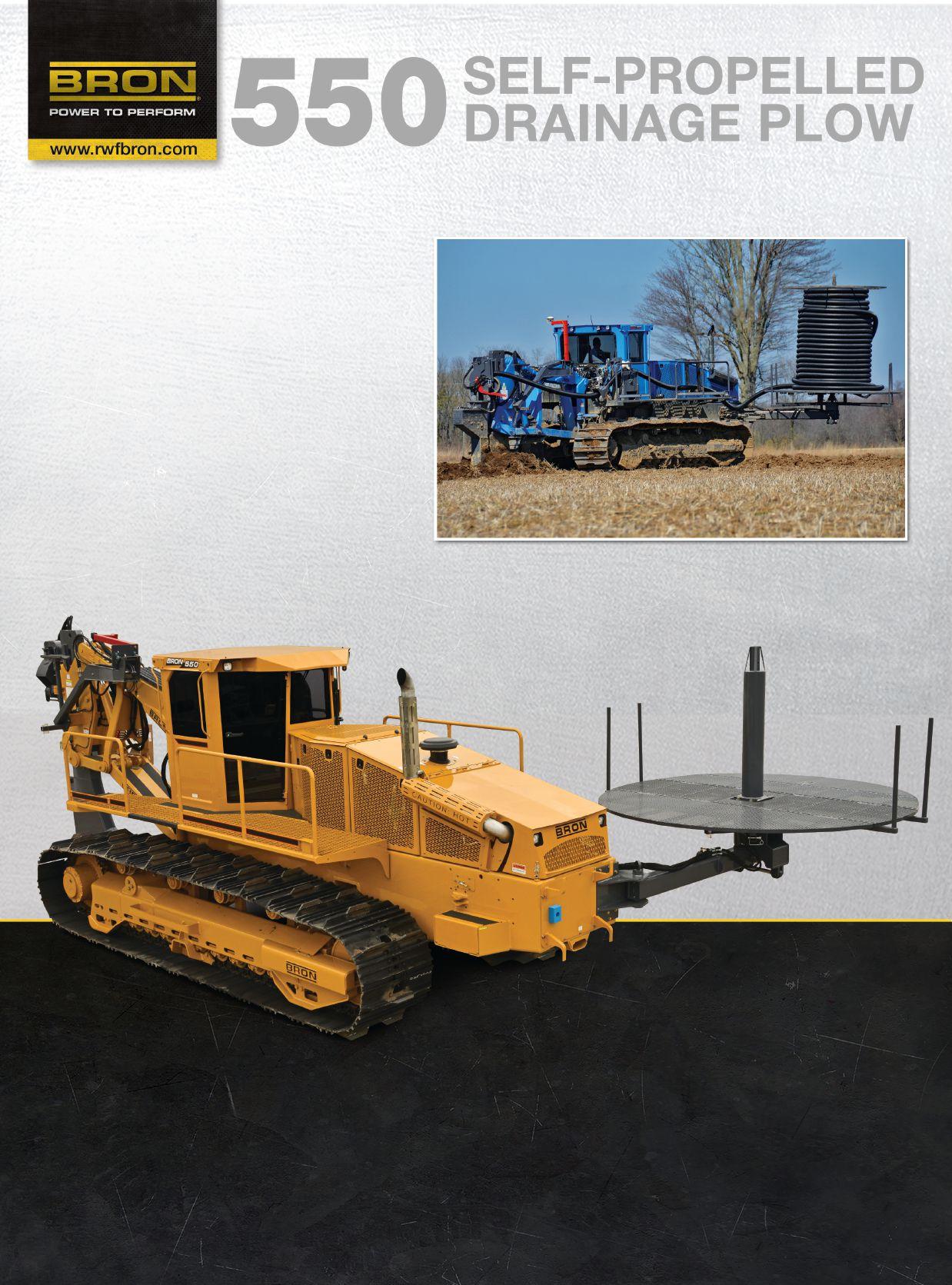
BRON LAUNCHES DL850 PLOW
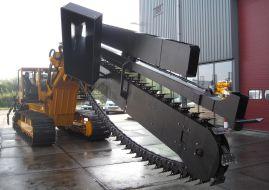
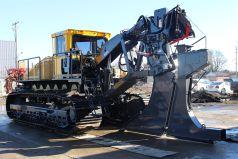
Bron has introduced the Double Link 850 (DL850) plow.
Features of the new plow include heavy-duty trunion mounted swing cylinders, increased swing cylinder pins and main pins, increased cylinder pressure, a one-piece laser/GPS laydown and allnew cylinder designs with bolt-on glands.
The DL850 comes standard on all Bron 550s and is available on special order for Bron 450s and as an add-on for larger dozers.
www.rwfbron.com
DESIGN A FULL WATER MANAGEMENT SYSTEM
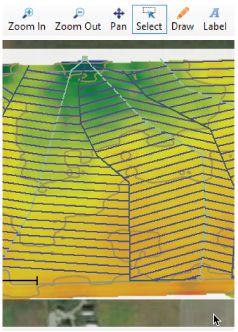
With WaterCourse Design software from AMW Machine Control, contractors can experiment with optimal tile systems or surface drainage based on GPS or LIDAR data. A digital elevation model appears as a topographic map, which the user can
manipulate to appropriately reflect irregularities of the terrain. The colorcoding of the topographic data, with customizable overlays of watershed accumulation thresholds and outlet depths, gives a clear visual guide to the natural movement of water or the best tile placement. A Google Map layer provides additional visual data – trees, landmarks, or other elements that could influence the success of the design or its ease of implementation.
Users can specify inventories of tile sizes; tiles are then automatically sized for lowest costs based on industry standards. The software accepts topographic data from various file types, and maps with tile plans can be exported in a number of file formats for field implementation. Use WaterCourse Field Design for surface and WaterCourse Tile Design for subsurface drainage design; WaterCourse Dual Design equips users for both aboveand below-ground design projects.
www.AMWgps.com
NEW 24-INCH INLETS FROM HICKENBOTTOM INC.
Hickenbottom Incorporated will introduce a 24-inch inlet, the first large-diameter inlet from the company. In addition to offering intakes at five-, six-, eight-, 10- and 12-inch sizes, a new 24-inch line will be added to the roster this fall, including holed and slotted top sections, below ground mid-sections, and matching intake tees. The new 24-inch intake line embodies the needs for high-flow capability in both commercial and
agricultural applications where surface run-off requires demanding drainage input. The trademarked Silt Sock will be available for this new large-diameter inlet line to stop silt and debris infiltration, making the new inlet ideal for stormwater retention basins on large development sites. www.hickenbottominc.com
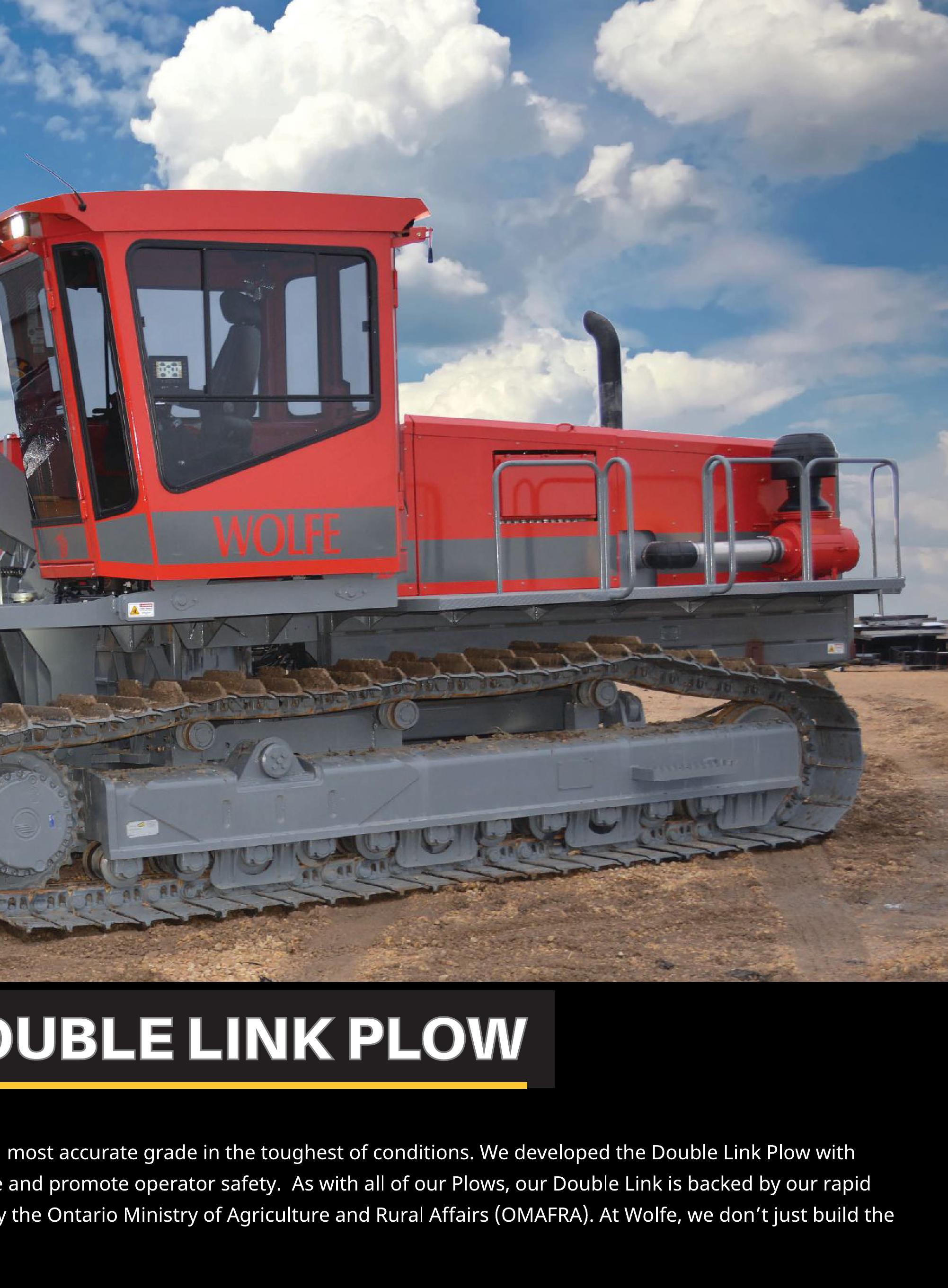
THE WOLFE DOUBLE LINK PLOW
The Wolfe Double Link Plow is the new addition to the Wolfe family. The Double Link Plow is certified by the Ontario Ministry of Agriculture, Food and Rural Affairs (OMAFRA). The testing process included four tests over the course of 540 feet, at multiple depths ranging from three to six feet deep, and only allowed a tolerance of one percent grade.
In addition, Wolfe has made significant upgrades to all of the plow’s features:
• Side Tilt has been incorporated as an option.
• The Tile Feeder is a more streamlined and compact design.
• The Cutter Crusher is now offered as an in-boot style.
• Auto idle will drop the engine RPM after the machine sits for four seconds. The machine will return to the preset RPM when any controls are activated.
• Upgraded to a DP720 control screen with completely new graphics and more machine feedback for the operator.
www.wolfeequipment.com
HOMBURG DYNAMIC
DRIVE DRAIN CLEANER
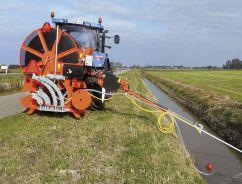
Homburg Dynamic Drive (HDD) is a fully automated drive system that allows for optimal cleaning of drains. After entering the maximum hydraulic pressure and the possible length of the drainage tube, the system will detect any blockage. Once the drive system has reached the set value, the reel will automatically wind up the rinsing hose. An alarm for the driver goes off as soon as the nozzle head has reached the drainage opening. The HDD offers compact and sophisticated construction, a long service life and ease of operation. Homburg
Hurricane Drain Cleaners are fitted with an automatic hose guide system, a spacious toolbox and the Homburg Reel, which allows users to wind the suction hose onto the reel.
The cleaners are fitted with vehicle lighting for proper visibility on public roads. They are also fitted with a set of working lights that allow users to keep going after dark.
www.homburg-holland.com
• Manually reversing fans clean all coolers between auto reversing cycles.
Continued from page 16 which will assist our efforts, but this will take time. In the meantime, our strategy may have to settle for a “good enough” map of phosphorus sources. Some early suggestions from our science subcommittee recommend a combined approach, using the best available water quality data to identify tributaries with elevated phosphorus levels and cross-referencing these locations with GIS mapping of land cover and farming practices that are known to contribute to
water and phosphorus movement into waterways.
Even in our very preliminary discussions, we have identified the opportunity to bring together thinking for the entire system from fertilizer application through land management and then drainage management. While we are looking at the tail end of the phosphorus movement chain, and the Fertilizer Institute, the Ontario Agri Business Association, and the Ontario Ministry of Agriculture, Food and Rural Affairs will be addressing the front end of the chain in terms of fertilizer application through the 4Rs program, there remains a significant middle section of the chain – soil and water management on private farmland – that needs to be integrated in this discussion in a comprehensive way. Participants in our committees are pressing us to consider how our strategy can help integrate these three aspects of phosphorus movement.
These are just some of the challenges our strategy is facing as we forge into this complex land and water management conundrum. While the challenges are daunting, the potential is exciting.
If we can figure this out for the Thames River basin, or even show progress in limiting phosphorus loss from farmland, starting from the drainage system and working back onto the land, perhaps our strategy can inform actions elsewhere in Ontario and the Lake Erie basin. DC
Nicola Crawhall is deputy director of the Great Lakes and St. Lawrence Cities Initiative and is leading the development of the Farmland and Water Management Strategy.
Two groups are joining to develop a strategy to reduce phosphorus loss in southwestern Ontario’s Thames River basin.
BUSINESS DIRECTORY AD
Planning ahead
What happens when unpredictable factors affect your business?
by Rob Burtonshaw
Two factors impact demand for drainage more than anything else here in the U.K.: the amount of rainfall and the price of wheat. The phone tends to ring more often after a month or two of rain or steady price increases. I have expressed my puzzlement that short-term events can affect the purchase of such a longterm investment before, but such is life. Rain and commodity prices are out of my control – if I had a method of controlling either, I would not be wading in the mud as a drainage contractor!
As contractors, our only option is to focus on what can be affected. This does not, however, mean that the weather or the price of commodities should be ignored. The price of wheat is currently low. Making matters worse, virtually every forecast and prediction suggests that the price will stubbornly refuse to rise for a while. It was low last harvest and nothing special the year before. A prolonged dip in price means less money in the hands of our clients. The easiest expenses to delay (or cut altogether) are long-term investments. Individual contractors or geographic areas may buck the trend, but in my opinion, the industry as a whole will be down this year.
We have had a good run and commodity prices fluctuate; it’s their character. Complaining diverts your attention from where it should be, which is facing up to the reality of selling in a more difficult market. For some, a reduction in workload might be welcome; certainly we struggled to keep our word and turn up on time last autumn. But for many here in the U.K., keeping enough work in front of the drainage machine will be difficult. Unfortunately, I do not have a magic solution to persuade people to part with their cash (once again, if I did, I would not be wading in the mud... you know the rest!). However, I will impart this: a problem ignored never goes away. Planning, hard work and facing up to issues is the only way I know to succeed.
I’m expecting the usual glut of post-harvest
work to be down compared to last year. I might be wrong – and if I am wrong, I will be happy. Being slightly less busy might not be bad, though. Last year we had to draft in extra short-term help, which meant an increased cost in order to get the job done. For us, the key to surviving is to be flexible. We have machines that trench and we will work anywhere, which offers us the prospect of profit at different sites, from a golf course to a construction site or farmer’s field. This year we have been able to find off-farm work and have been aggressive when tendering for that work. It might not succeed, but it is a plan. With a fair wind, this strategy should keep profits and turnover somewhere near to last year – which can certainly be considered a success.
I also think our size helps us cope with the ups and downs of our workload. Often I think that the size of our company is just at the wrong level: too big not to employ people to manage people, but not big enough to employ a human resources manager; too big not to have all the necessary health and safety red tape, but too small to employ a health and safety manager. If there’s a task to be completed, I have to do it, as I can’t afford to employ someone else to do it. I’m sure many of my drainage colleagues in the United States are in the same situation. However, our size does help with being flexible. We are big enough to take on a large contract for a large company with their love of paperwork, and at the same time, small enough to carry out one-day jobs. Another true benefit is that a large job (or two) can transform our year on its own – something that would not be true if our company was bigger.
We can never anticipate what’s to come, but with the trends we’re watching this year in commodity pricing (and unpredictable things, like weather), it’s something all drainage contractors should be thinking about. Whether by design or accident, having a plan is a fine idea. You should never be too busy to come up with a plan. DC
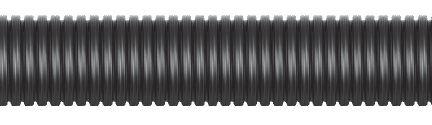
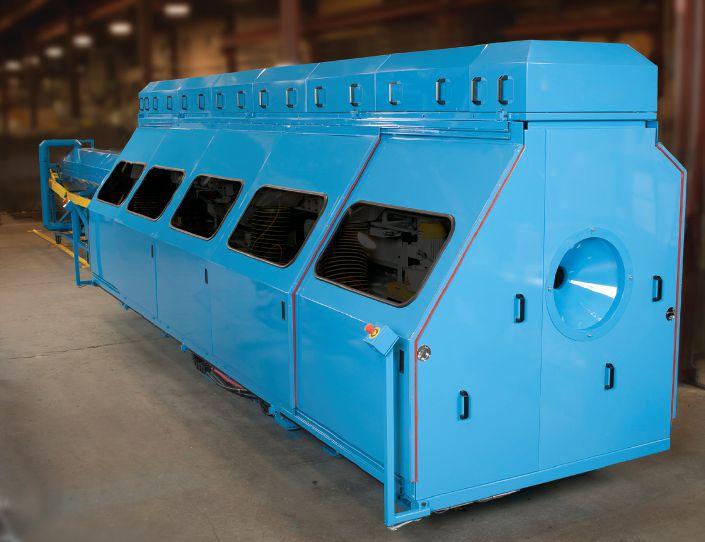
Since 1973, Corma Inc. has continuously innovated to meet the evolving demands of our customers. For example, our 630-12 and 830-12 High Speed Corrugators combined with our HSC Series 2 Adjustable Perforators will produce high quality 4" single wall HDPE pipes at high output rates up to 2,300 lbs/hr and 115' per minute. To learn how we can make a positive impact on your business, please contact: 830-12 Corrugator 2" (50 mm) I.D. to 12" (300 mm) O.D.