All advertising is subject to the publisher’s approval. Such approval does not imply any endorsement of the products or services advertised. Publisher reserves the right to refuse advertising that does not meet the standards of the publication.
www.drainagecontractor.com
your your life – to be.
26 B ig i M paCt, loW C ost Strategies for sportsturf drainage systems.
30 the aging WorkforCe How will it affect your business?
Tradition and progress
Technology and innovation will shape the future of the agricultural drainage industry.
by Stefanie Croley
the fire service is often said to represent years of tradition unimpeded by progress. Unfortunately, this old and rather clichéd adage applies to many industries, and when I became the editor of Drainage Contractor in early 2013, I wondered if the same saying would ring true for ours.
During the 1970s, agricultural tile drainage experienced booming growth like never before. It was a time of great success for the industry: equipment was purchased, tile was installed and crops were thriving. But when crop prices dropped in the 1980s, money had to be prioritized. Although installing drainage tile was proven to be worthwhile, the boom was over.
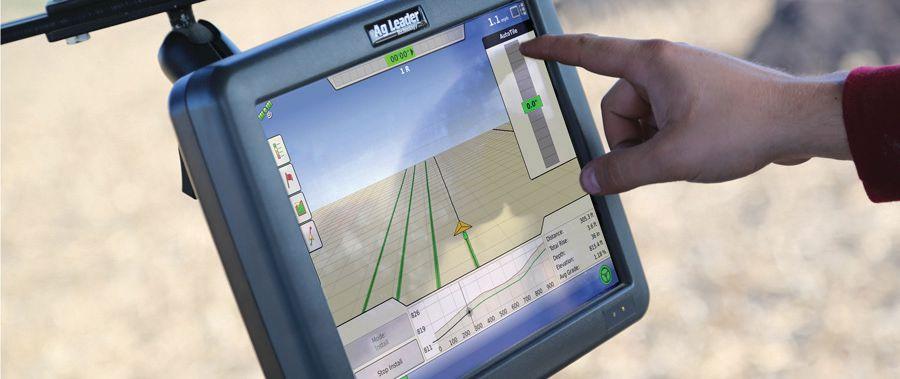
There’s no doubt things like smartphones, GPS and autosteer have offered improvements to the drainage contractor’s work.
I have spent the last year immersing myself in the industry, getting to know contractors, suppliers and everyone in between. In talks with several industry members, I’ve been told that besides the switch to modern tile, not much has changed since the ’70s. Many people I’ve talked with agree that the means and methods of installing drainage tile have stayed the same for many years. But after witnessing displays of progress and innovation at several conferences, trade shows and presentations, it became very clear to me that the old fire-service adage did not ring true for the drainage industry. In fact, I’ve noticed the opposite.
New methods and technologies are often met with mixed reviews. Supporters and cynics will be quick to add their opinions, offering everything from enthusiastic endorsements to skeptical criticisms. But there’s no doubt things like smartphones, GPS and autosteer have offered improvements to the drainage contractor’s work, and the industry seems to be welcoming these changes with open arms. Earlier this year,
the annual convention of the Michigan Land Improvement Contractors Association featured a Gadget Talk session in which participants shared technologies and innovative practices that have proven to be useful to their businesses. From the multiple functions of a smartphone to computer software and Google Maps, contractors were eager to share the technology and innovative practices with their peers, and the ideas were met with open minds and enthusiastic responses. There’s no shortage of innovation in this issue of Drainage Contractor either. In our cover story on page 10, we speak with a former state engineer who found a drainage solution for his farmland. The story of Holdwick Tiling Company is one filled with innovation that you can learn about starting on page 30. And in our regular section of new products, beginning on page 34, we’ve compiled several of the latest advancements and technologies in drainage equipment.
In a recent article in Iowa Farmer Today, Matt Helmers, an Iowa State University associate professor of agricultural and biosciences engineering, said more agricultural drainage tile has been installed in Iowa over the past two years than during any other period in recent history. The article credits technology for the recent boom in tile drainage, and I won’t be disputing this claim.
Tradition won’t impede progress for the drainage industry; rather, technology will only help it grow. dC
@DrainageContMag
NEXT ISSUE: Innovation will continue in our next issue of Drainage Contractor magazine, which will include our 2015 pull-out calendar. Watch for it in November!
INDUSTRY NEWS
Pr E cISI oN LaND SoLUTI oNS hoSTS LaND2014
Approximately 120 people joined the Precision Land Solutions team at the company’s second annual LAND event on March 21 for a day of learning, asking questions of the experts, networking with those in the industry and enjoying lunch with peers.
The day kicked off with coffee and networking, before Todd Stanley, a 12,000-acre farmer from Grygla, MN, spoke on the benefits he has seen from tile drainage. Chris Unrau from Precision Land Solutions joined Andrew DeRuyck and Mark Sloane from Right Choice Management Consulting for a discussion on the economics of tile drainage. The day’s special guest, Mike Renaud, a kicker for the Winnipeg Blue Bombers and product specialist for Northstar Spraying Systems, took the stage before guests enjoyed the PLS Burger Bar for lunch.
Hickenbottom moves sHop
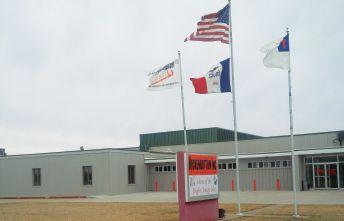
After 35 years, Hickenbottom, Inc., of Fairfield, Iowa, has moved to a new location. The company bought and began restoring the 200,000-square-foot building in the town’s industrial park in 2011. Transferring three decades of product, manufacturing, and technology to the new location took much longer.
On Feb. 25, business resumed at the new location. The entire stock of intakes, intake accessories, plumbing and heating wholesale products, and more is now under one roof. The new location allows for semis and other large trucks to have their tile and intake orders filled while inside and under the protection of the warehouse roof.
S Pr IN g FIELD PLaSTI cS hoSTS r ESEarch
SITE ToU r
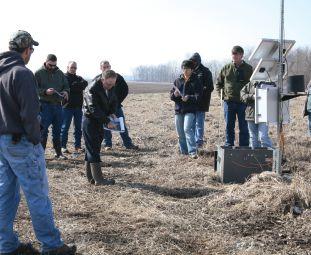
On March 7, representatives from The Illinois Department of Natural Resources, The Nature Conservancy, City of Bloomington and the University of Illinois arrived at Springfield Plastics, Inc., for field demonstrations at two of the company’s research sites. Leading the tour was Steve Baker, president of Springfield Plastics, who spoke about new initiatives and techniques on managed drainage.
The attendees were treated to a first-hand look at two systems: drainage water management (DWM) and saturated buffer systems. DWM is the practice of using a water control structure in a main, sub-main or lateral drain. DWM allows the farmer to manage the timing and amount of water discharged from agricultural drainage systems. Water quality benefits are possible by minimizing unnecessary tile drainage and reducing nitrate amounts that leave fields. DWM systems can also retain water needed for crop production. It allows producers to control water delivery by holding water in root zones when crops need it and draining it when there’s too much.
A saturated buffer system has a control structure that diverts the flow from the outlet to a lateral distribution line in a buffer strip. The lateral distribution line runs parallel to the buffer, and as the water is diverted to this line a saturation occurs from it. As this saturation or lateral water movement through the buffer occurs, the vegetation naturally removes the nutrients in the water. According to a press release from Springfield Plastics, a test site in Northern Iowa showed that after two years, the producer was able to divert 55 per cent of the drainage outflow to a buffer system. Of that 55 per cent of water, they saw a 100 per cent reduction in nitrates.
For more information, visit www.spipipe.com.
Wolfe to offer Gps Auto steer
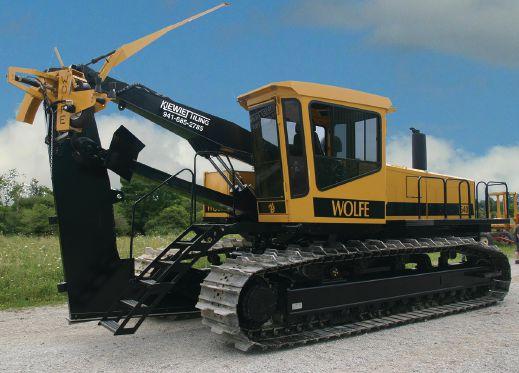
Wolfe will begin to offer GPS Auto Steer in all new machines by late summer 2014. All new machines will come auto steer ready, with installation as simple as entering a password. The auto steer feature is programmed directly into the machine’s control systems with all fail-safe redundancies using CANbased technology, which will control the auto steer, grade and pitch control. The operator can easily override and disengage the system by moving the control levers.
Wolfe plans to update new machines and the used high-speed machines (three speed machines) with Plus One machine control systems first, and the two-speed machine with the Plus One machine control system shortly after. The on/off plows and standalone machines will be updated next, followed by the wheel trenching machine.
For more information, visit www.wolfeequipment.com.
Hickenbottom’s new location is 1801 W. stone avenue in Fairfield, iowa.
C ON v ENTION WRA
innovAtion And netWorkinG At mlicA convention
Land improvement contractors from across Michigan gathered in Lansing from Jan. 12 to 14 for networking, educational seminars and a little entertainment at the annual meeting and convention of the Michigan chapter of the Land Improvement Contractors of America (MLICA).
The conference kicked off on Sunday, Jan. 12, at the Ramada Lansing Hotel and Conference Center, with a board of directors meeting and dinner – the perfect way for attendees to fuel up before a full day of events on Tuesday, Jan. 13. Delegates had the opportunity to chat with their peers and circuit the trade show floor over coffee and breakfast before hearing from Mike Perry, an environmental attorney with Fraser Trebilcock Davis & Dunlap PC, who provided an update on Michigan wetlands and private drainage and the legal implications involved for Michigan drainage contractors.
Mike James, attorney at Fraser Trebilcock Davis & Dunlap PC, followed with a presentation on health care for small business owners. After a lunch and networking session, Scott Everett, MLICA’s legislative consultant and the director of legislative affairs at Fraser Consulting, provided a legislative update to attendees, including progress made on house bills and tax return advice. The 2014 MLICA annual meeting was called to order in the afternoon, during which attendees received committee and executive reports.
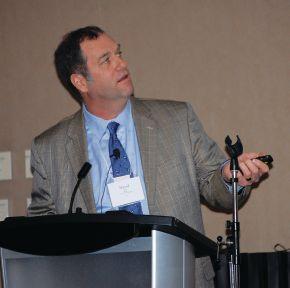
After official business was adjourned, conference delegates put their thinking caps on during the Geeks and Dirt discussion on technology, innovative ideas and tricks of the trade. Highlights included Russ Talaski’s tip on using a ladder rack on his secondary pickup, Mike Cook’s innovative 15-inch boot for feeling pipe, Nate Cook’s smartphone tricks and Joey Schlatter’s Google Maps tips.
The always-entertaining annual banquet and auction wrapped up the day, and delegates were treated to a tour and demonstration on Tuesday morning at AIS.
LI co LaUN ch ES ProFESS or r oSS W. IrWIN M EM or IaL SchoLar S h IP
In memory of Professor Ross W. Irwin, the Land Improvement Contractors of Ontario have made a gift to the University of Guelph to endow and establish the Professor Ross W. Irwin Memorial Scholarship. This scholarship will support a student in Water Resources Engineering who has demonstrated academic excellence in soil and water conservation course work, as well as active involvement in water conservation issues.
Professor Ross Irwin passed away in March 2013 at the age of 92. He researched and taught soil mechanics and land drainage at the University of Guelph for 35 years.
His outstanding contributions have been recognized by many professional societies, and he was inducted in to the Ontario Agricultural Hall of Fame in 2006.
If you would like to contribute to this scholarship, please contact Diane Wiles at 519-824-4120 ext. 54568, or via e-mail at dwiles@uoguelph.ca.
LEar NIN g oPP orTUNITIES aT LI co
Ontario’s drainage contractors and drainage superintendents met in London, ON, on Jan. 22 and 23 for the annual Land Improvement Contractors of Ontario (LICO) and the Drainage Superintendents Association of Ontario (DSAO) convention, which was filled with learning opportunities, site tours and myriad opportunities for networking with peers.
A highlight of the event was Dr. David Lobb’s presentation on phosphorus runoff in Lake Winnipeg, an issue of interest to all attendees. Lake Winnipeg experiences algae bloom caused by nutrients from agricultural land, and traditional methods of solving this problem have proven to be somewhat unsuccessful. Lobb’s presentation offered several suggestions regarding the potential opportunities for land improvement contractors to play a part in solving the algae bloom problem –see page 18 for more details.
Several meetings took place through the afternoon, and Drainage Contractor’s own Peter Darbishire ended Wednesday’s presentations with an entertaining slideshow of archived photos taken on his many travels to events and into the field. Traditionally held on the second night of the conference, the banquet instead ended the formal part of the first day before the evening’s casino night began.
Thursday’s events included a presentation on the lighter side of drainage by Eric Cryderman, the drainage superintendent at the City of Ottawa, and a tour to Wolfe Industries in nearby Strathroy.
INDUSTRY NEWS
a&E cELE braTES M ovE aND aNNIvE r Sary WITh oPEN hoUSE
A&E Construction Supply, Inc. hosted an open house on March 14 at the company’s new location on the western fringe of Mankato, MN, in celebration of their move to Mankato from Truman in spring 2013 and the company’s 40 years of business.
The new site separates the A&E offices from the shop and warehouse. A Wolfe 540 Super Plow was on display in the office during the open house, with more plows, Wolfe Man Wheel Trenchers, and various Eager Beaver Trailers in the lot.
Attendees gathered in the A&E shop for a presentation from guest speakers who addressed issues affecting the agricultural drainage industry. Speakers included Bob Manske, Ed Veeke (owner and president of Wolfe), Kent Rodelius (vice-president of Prinsco, Inc.) and Brian Hicks (farmer and ag consultant), who both represented the Agricultural Drainage Management Coalition, and Phil Algreen of Agri Drain. The speakers discussed drainage water management practices and how tiling has become the new target of water quality issues. Brady Kolbet of Mid-Tech GPS Consulting advised drainage contractors in the audience to use cloud technology to back up tile plotting maps.
Las Vegas has it all – beautiful weather, a plethora of restaurants and plenty of fabulous nightlife and entertainment options. But on March 1, land improvement contractors from across the United States had another reason to venture into the desert.
The 63rd annual National LICA Winter Convention, held from March 1 to 3 at the Riviera Hotel & Casino in Las Vegas, saw delegates from more than 15 states gather for collaboration, networking, and a bit of fun. The convention kicked off on Saturday evening with an executive committee meeting and delegates broke bread and mingled over a breakfast sponsored by Petrocon. Committee meetings began Sunday morning, with delegates separating into groups to discuss such topics as education and technology, by-laws, conservation, water table management and safety and insurance. During discussions about legislative visits, association growth and membership drives and water quality issues, committee members worked to share ideas to better the association.
During lunch on March 2, sponsored by Case Construction Equipment, Dan McNichol gave an entertaining and informative presentation about his tour across the United States to highlight America’s ailing infrastructure. The afternoon concluded with regional and budget meetings before an Associates’ Night reception.
Day three of the conference began with a hearty breakfast, sponsored by True and Associates, followed by a delegates meeting during which Gerald Biuso, the chief executive officer of the national association,
prinsco estAblisHes prinsco cAnAdA
Prinsco, Inc., has established Prinsco Canada Inc and acquired AccuPipe, an HDPE pipe manufacturer in Winkler, MB, welcoming its facility and team into their existing network and rebranding AccuPipe to Prinsco Canada.
Prinsco Canada will also add a second plant in Taber, AB, manufacturing and stocking a full line of pipe and accessories. These facilities join the additional Prinsco locations in Minnesota, Illinois, Iowa, Missouri, California, North Dakota, South Dakota and Wisconsin.
welcomed North Dakota as the newest state chapter of the association. Biuso announced his commitment to adding 1,800 new members over the next three years and 10 months, focusing on Texas and Maryland. More fellowship and camaraderie followed during lunch, sponsored by John Deere, before volunteers rallied to gear up for ConExpo-Con/Agg. The rest of the afternoon and evening brought more fun and entertainment with an indoor racing activity and a reception, sponsored by CNA, and dinner, sponsored by Caterpillar. Several LICA members were honoured with awards at the dinner. Congratulations to all the winners:
• ADS award: Wayne Litwiller, Illinois
• Kemps award: Minnesota
• LICA Lady of the Year: Fran Miller, Iowa
• Contractor of the Year: Lawrence Fischer, Nebraska
• Top State: Missouri
• Entrepreneur of the Year: Allan Clark, California
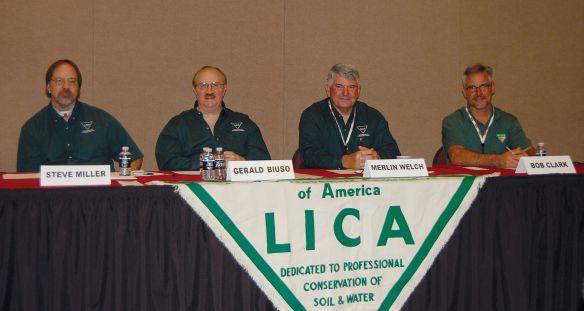
Following the awards, Caterpillar’s Adam Zimmerman presented the award to outgoing president Steve Miller, who passed on his President’s pin to Bob Clark. Miller also recognized Eileen Levy’s 30 years of service. Jeff Civilico provided the evening’s entertainment, with a hilarious audience-involved act combining comedy, juggling and balancing skills and athleticism.
After a full few days at the national convention, delegates took in the sights and sounds at ConExpoCon/Agg. The national summer meeting will be held July 14 to 19 in Indianapolis, IN.
licA lAnds in lAs veGAs
D RAINAg E m ANAg E m ENT
UnTapped opporTU niT y
precision surface drainage may be a solution.
While drainage technology has been improving the productivity of farmland clear across the continent, the Cisne soils of south-central illinois have stubbornly resisted progress. But
the Wendte family has proven more persistent than even the land itself.
by amY PetH erick
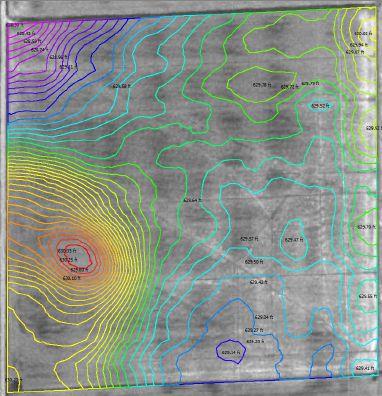
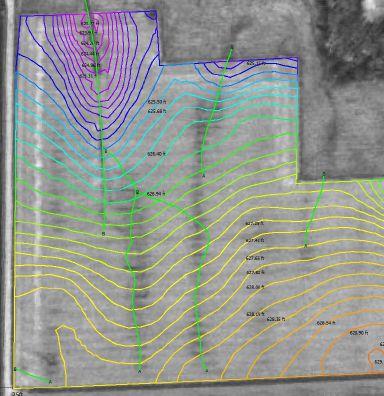
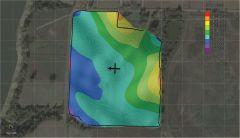
topographic maps help determine the best location for the drainage system. On the left, the map shows one-inch contour lines, and on the right, aB lines for planned surface ditches are superimposted on the map. images courtesy of leon Wendte.
Leon Wendte was armed with a degree in agricultural engineering and 33 years of experience when he retired from his position as New Hampshire’s state engineer for the Natural Resources Conservation Service and came home to the family farm. His brother, Roy, was growing more than 5,000 acres of corn and soybeans near Altamont, Ill., and surface draining the farm exactly the same way farmers have for centuries in that part of the state. Tile drainage is impossible in this area, thanks to glaciation and natural geology, says Wendte. First, there’s an impermeable clay pan layer about 18 inches below the soil surface and second, he says, there’s no more than one to three inches of slope for every 100 feet of land, which really offers water no place to go. “Where most farmers put in tile to lower the water
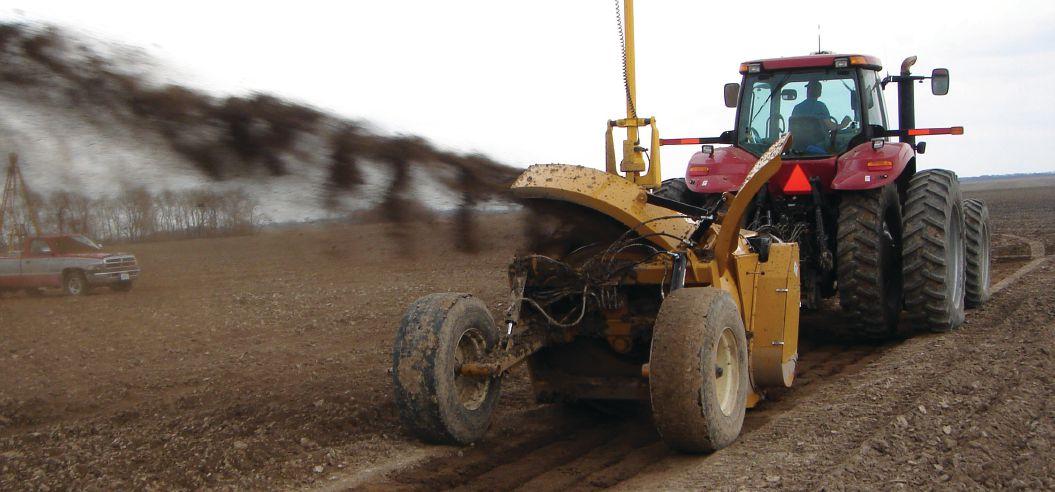
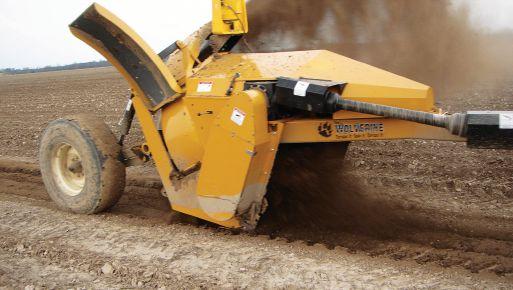
table, we have to rely on evapotranspiration,” Leon explains. Their only other alternative is to grade surface ditches at the same slope most contractors would install a tile drain or lateral. But even the most experienced struggled to maintain margins of error less than a tenth of a foot, grading surface ditches with whatever machine might be available. In years past, farmers have used spade and shovel, mold board plow, and tractor-mounted blades, box scrapers, or small rotary ditchers. On the Wendte family farm, this meant approximately 500 acres remained improperly drained. So Wendte looked to precision implements for improvement. Equipped with a Wolverine rotary ditcher and laser controlled hydraulics, Wendte has installed three- to six-inch deep, five-foot wide, flat-bottomed, surface ditches on over 300 acres
the cisne soil in south-central illinois makes tile drainage is impossible and forces farmers and contractors to come up with new solutions to drain the land, like leon Wendte’s precision drainage method. Photo courtesy of leon Wendte.
in the last three years. He says he slopes the banks on a 10:1 ratio, “so that you can drive a sprayer across it at 12 to 15 miles per hour and not even feel it,” and focuses on the worst fields first. But Wendte also accredits his brother Keith with providing a critical piece of their precision surface drainage system: the topographic maps he uses for planning.
“All our tractors have autosteer and on our farm we’ve found it cost effective to install our own base station, so we generate our own RTK correction factor accurate to one inch or less,” Wendte explains. Using Case IH AFS desktop software, their ‘As Planted’
records, and aerial photos, Keith saved the family hundreds of dollars in survey costs, and it only took him a few days to pull everything together.” So for all 100 fields that we have, I have topographic maps accurate down to a two or three inch contour line just waiting to be used,” Wendte says.
A lot of time goes into planning his drainage systems long before any earth is ever moved. Wendte follows natural drainage paths on the maps Keith made, taking into consideration wet areas identified during scouting, in field histories, on aerial continued on page 16
Company on the move Better Drain Process, Better Gain Contractors Gain Efficiencies with WM-Drain
Drainage design and installation can be a time-consuming and complex process. Efficiency and simplicity can mean the difference between an easy install and a difficult one.
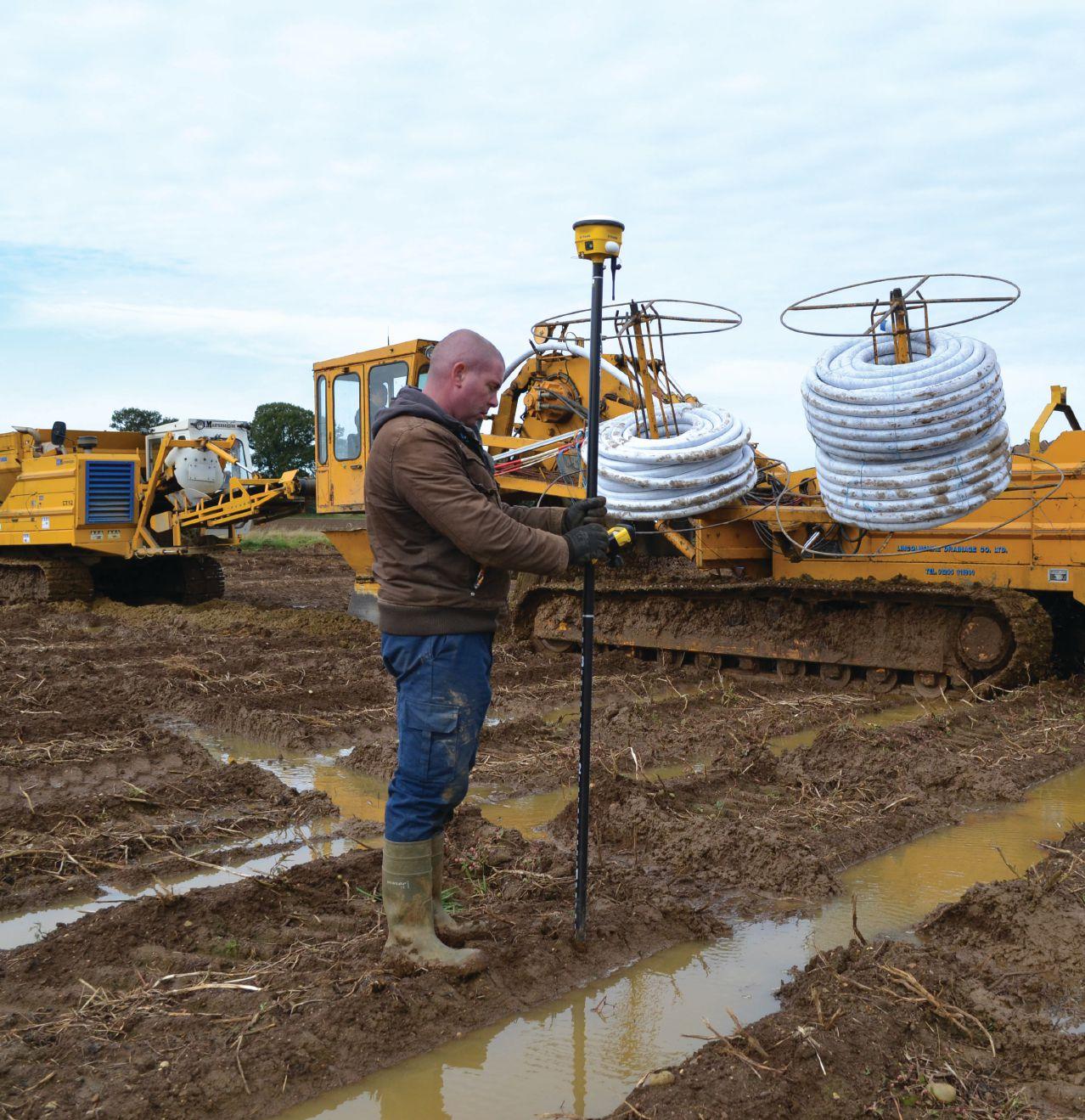
The Trimble® WM-Drain® farm drainage solution enables contractors to quickly and easily manage drainage system designs and installation—and to be more efficient throughout their operation.
In comparison to laser systems, WM-Drain proves to be more efficient. It eliminates the need for multiple laser setups as well as stakes in the field; minimizes the need for operator intervention due to no grade breaks, slope and depth monitoring; and improves machine efficiency due to a constant depth drainage. Overall, the solution can be up to 20 percent more efficient compared to laser-based drainage solutions.
The WM-Drain solution can improve efficiency by up to 20 percent when compared to laserbased drainage solutions.
By streamlining the survey, analysis, design, installation, and mapping steps of surface and subsurface drainage, the WM-Drain solution allows contractors to perform all their drainage activities with one complete solution.
Survey
Contractors can begin by collecting 3D field data with ease using Trimble’s WM-Topo™ survey system or FmX® integrated display. The WM-Topo system is a topographic data collection device that can be taken into hard-to-reach areas such as ditches, steep terrain, muddy fields, or fields with mature crop cover. Data collected with the WM-Topo system or FmX display can then be transferred to Farm Works™ Surface software via Connected Farm™ to create a wireless loop of information between the office and the field—saving contractors valuable time.
Analysis
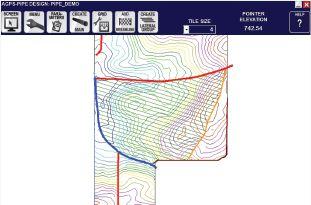
Once survey data is in Farm Works Surface software, contractors can easily analyze the data to make betterinformed drainage decisions. They can view data from every angle; determine watershed zones to assist with main, submain, and lateral pipe placement; and configure contours at any interval to display topography and relative elevations. In addition, contractors can view field analyses over the top of aerial images to provide a more complete view of the data.
Design
The WM-Drain solution allows contractors to pinpoint and layout a prearranged design before they hit the field, or
conversely, they can create drainage designs on-the-go without leaving their vehicles. With Farm Works Surface software, contractors can utilize drawing tools to tie laterals to mains, create parallel lateral spacings, and clip drainage lines. It also allows contractors to verify that a pipe network will successfully drain to the main outlet before installation.
Using the Autoslope feature, contractors can create optimal depth designs—resulting in a consistent water table to help minimize nutrient loss and also to ensure uniform root depth resulting in a more consistent yield across the field. This feature can also enable on-the-go drainage design within the FmX display.
Installation
Once the design is complete, contractors can use the WMDrain module within the FmX display for precise installation of pipe or surface ditches by using GNSS RTK with Trimble’s T3™ Enhanced Terrain Compensation Technology. With this technology, potential installation errors caused by working on hilly terrain can be eliminated. Additionally, pitch control designed for use on a parallel link style plow ensures a more accurate drain installation by controlling the boot pitch.
Mapping
During installation, contractors can automatically log 3D maps or true locations of installed drainage pipes or ditches. This can help contractors with future maintenance of drainage expansion projects by providing them with an accurate record of where the installation occurred.
So What’s the Benefit for the Farmer?
Too much water on the field can damage crop quality and yield, and can be a detriment to a farmer’s bottom line. By installing a drainage system on fields, farmers can optimize the amount of water on their fields and ensure their crops are not getting too much water.
By using the Trimble WM-Drain farm drainage solution, contractors can ensure that water is drained off the field effectively. It ensures optimal 3D drain placement, which improves crop yields by controlling ponding, optimizing root depth, maximizing planting seasons, and minimizing nutrient loss. In a study conducted by Trimble, an average farm that utilized the WM-Drain solution can increase crop yields up to 30 percent—a direct impact to the farmer’s profitability, and a direct benefit to contractors’ businesses.
Drainage StreamlineD
Control your drainage operations with one integrated system. The WM-Drain® farm drainage solution enables you to streamline the survey, analysis, design, installation, and mapping steps of surface and subsurface drainage water management jobs. And by adding the WM-Topo™ survey system, you can stake out key positions in the field for design locations and measure topographic data in hard to reach areas, making your drainage operations more efficient than ever.
For more information, visit www.trimble.com/agriculture or see your dealer.
expansion on the horizon
LICA has great plans for growth.
by Bob Clark, president, LICA National
Ijust returned from the 2014 LICA winter meeting in Las Vegas. The winter meeting was a two-day event, packed with committee, delegate, and board meetings, all in an effort to take care of LICA business and keep the organization running strong. The meeting was held just prior to the 2014 ConExpo-Con/Agg, which made for a fun and busy time for LICA; just as we ended the winter meeting, we opened up our ConExpo booth.
This was my third time attending and ConExpo 2014 did not disappoint! In addition to the impressive equipment to see (or buy, perhaps), there are plenty of educational programs and panel discussions to keep you informed and entertained. This year, LICA worked with ConExpo organizers to provide programs during the convention. We shared a booth with one of our associate members, Petrocon, and together we promoted the LICA organization and recruited new members. The effort was a success with 27 new members recruited and numerous leads for state chapters. This year, LICA left ConExpo and Las Vegas with a sense of accomplishment.
But, it is no surprise that we felt that way. LICA has been growing into new areas of the country and the importance of land improvement has never been so obvious to so many. Just in the last year, two new state chapters were added: Arkansas and North Dakota. This year, we’re maintaining the momentum with plans to add state chapters in Texas and Maryland – all part of our continued plan to grow our membership, spread industry best practices, and play an important role in shaping the regulations and legislation that impact our natural resources, our businesses, and our economy.
State chapters have been proactive in their state legislatures, recently working to change regulations that have unnecessary, negative impacts on their members’ businesses and customers. LICA also works with lawmakers at the federal level and we’re fortunate to have an excellent government liaison, John Peterson, who always keeps LICA informed
on matters important to our members. Later this year, we’ll make a trip to Washington, D.C., to express our concerns on various issues with potential to impact the drainage industry. Drainage contractors see these benefits, and this helps drive membership growth.
At LICA, we work closely with our associate members, which translates into excellent savings uniquely available to our members. For example, many state chapters offer insurance programs that include a safety dividend program that rewards participants who operate their businesses without insurance claims with a dividend check. Our national staff is always looking to improve benefits. For a complete list of benefits, check out LICA’s website at www.licanational.com.
Of course, our LICA executive committee makes all of the benefits, industry leadership and growth possible. Our CEO and the regional vicepresidents, have worked hard to position us for the period of growth and greater industry influence that we are happy to be experiencing.
As president of LICA National, I plan to work with our executive committee to build on the momentum LICA has established over the previous years and to participate in as many LICA functions as time permits. I personally enjoy going to the different state chapter functions – in particular, the winter meetings and summer golf outings. It’s a great way to meet the members and make new friends. Our members are the backbone of the association, and they are, in many ways, like family. The term “LICA family” is often used, and rightly so. It’s an honor to represent such good, hardworking people, and it is people that make LICA so successful.
The next opportunity for members to reunite will be at the LICA National summer meeting, in Indianapolis, IN, from July 14 to 19. With its central location, I expect a big turnout. There will be some very good tours prior to the national summer meeting, and I hope to see many of you there! dC
continued from page 11
Wendte uses a Wolverine rotary ditcher and laser-controlled hydraulics to install flat-bottomed, five-feet-wide surface ditches that range from three- to six-inches deep. Photo courtesy of leon Wendte.
photos and indicated on yield maps. He plans laterals from wet areas to the main ditches to carry water off the field. An AB guidance line is created on the maps for each surface ditch so that when installation begins the exact location and alignment of the channel is transferred from the maps to the field. All of which, he believes, a drainage contractor would find pretty instinctive.
“Any tiling contractor can use the laser equipment and smarts that they already have to install a drain over the surface of the land, in addition to the tile that they install below the soil
surface,” he says. He thinks that if more contractors combined surface drainage with subsurface work, everyone would save more money on their field drainage. “When you have a wet field, it is far more economical to drain whatever water you can off the surface with a surface drain than it is trying to install tile and let the water that’s ponded on the surface infiltrate through the soil and then out through the tile.”
He knows some contractors realize this, but not all. In defense of those who never give much thought to surface drainage, Wendte admits that some fields will not lend themselves to be surface drained. Surface drainage wouldn’t work on prairie pothole soils, for example, where depressions can fill up to two feet deep. But he insists that his family is getting the same benefit from their surface drainage system that they would with systematic tiling at a fraction of the cost, and contractors who can learn to use precision techniques on the surface will, in his opinion, offer customers more bang for their buck.
“The combination of surface drainage and subsurface drainage is by far the most cost-effective and best working system you can have on a wet field,” Wendte says. “Just let your tile work that much more effectively, remove more gallons of water off your field in a shorter period of time, and take the pressure off your tile.” dC
parT of The sol UTion
how can contractors help mitigate nutrient runoff?
across Canada, there are considerable challenges in managing our surface water quality. o ne factor that can greatly affect this is agricultural nutrient runoff, and among those areas where this is a major concern are l ake e rie and l ake s imcoe, in o ntario. n utrient runoff is also an increasing concern in areas of intensive agriculture across p rince e dward i sland, a province in which 100 per cent of drinking water comes from groundwater wells.
by tree Na Hei N
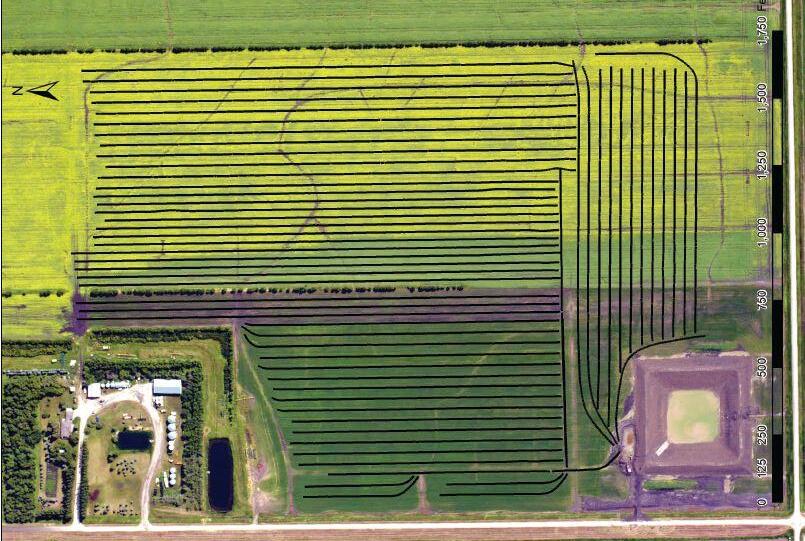
an aerial view of the classen Farm tile project showing tile layout. Photo courtesy of Northern Plains drainage systems.
However, the most notable of all surface water areas of concern is Lake Winnipeg. Serious eutrophication (low oxygen levels) and algae blooms are a frequent occurrence, and they are worsening year by year. The good news is that there are opportunities for drainage contractors and farmers to significantly mitigate the nutrient runoff that’s to blame, says Dr. David Lobb.
Lobb is a professor of landscape ecology
in the department of soil science and a senior research chair in the Watershed Systems Research Program at the University of Manitoba in Winnipeg. In January, Lobb presented his ideas on this topic at the Land Improvement Contractors of Ontario meeting.
“Traditional responses and ideas haven’t done much to solve the problem of nutrient runoff,” he says, “so new and innovative approaches are needed, and drainage
contractors can play an important role in these approaches.”
Lake Winnipeg
Lake Winnipeg is the sixth-largest freshwater lake in Canada and 11th-largest freshwater lake on the planet. It supports a $21 million-per-year inland fishery, as well as multi-million dollar recreational and hydroelectric generation industries. Its watershed is very large, spanning four provinces and four states via the Winnipeg, Red, Assiniboine and Saskatchewan Rivers.
“The runoff from all of these rivers impacts Lake Winnipeg, and the impact continues on into Hudson Bay,” Lobb explains. “The Lake Winnipeg watershed is a major source of runoff to the Arctic, which is an extremely sensitive ecosystem.” Algal blooms, which have become more frequent and more extensive in the lake in recent years, can ruin beaches, produce harmful toxins and represent an overall ecological threat. “Agriculture has had a role to play in creating this crisis and agriculture must play a role in resolving it,” Lobb states.
contamination, not less.
“The agricultural reality is that most farmers have already adopted best nutrient management practices and there is little room left for improvement through further refinement in technology or adoption,” he says. “The existing drainage system is not highly effective as it conveys runoff downstream as fast as possible and treats water as waste. Instead, we need to realize all of the potential benefits of our water by keeping it and re-using it.”
Flooding from snowmelt is also part of the problem – a phenomenon that is occurring more frequently these days. In the view of Lobb and many others, there is a strong linkage between snowmelt runoff, flooding and phosphorus contamination of surface waters. He says small dams have been placed in some of the creeks to hold back runoff during snowmelt and rainstorms, but their effect hasn’t been significant. While these small dams also trap sediments and some degree of some nutrients, they do not lessen nitrogen and phosphorus runoff.
Various municipal and regional governments in Manitoba have established targets over the year in order to greatly reduce phosphorus loading into the lake – targets that were to have been met through a moratorium on hog farming expansion and through the use of best nutrient management practices by farmers. Best practices include conservation tillage practices such as no-till or strip-till, which leave crop residue on the land and improve both soil and water quality through reduced erosion. However, Lobb notes that for other reasons, keeping crop residue on the surface of the field instead of tilling it in may actually result in more water
n e W approaches
Lobb recommends the use of an integrated system, one that combines a drainageretention-irrigation system for water management and a capture-recoveryreuse system for nutrient management. “We already see elements of such systems in Manitoba,” he says. “Retention dams in the Escarpment Region and restored wetlands in the Prairie Pothole Region. These enable retaining and reuse of most of the water and nutrients in most years.” continued on page 33
B USINESS m ANAg E m ENT
Making TransiTions
determining the future of your business.
to put into scale how big of an issue succession planning is in Canada right now, consider that in the next five to 10 years, 70 per cent of today’s businesses will change hands. o r, as g rant r obinson, director of the B do s uccessCare p rogram likes to phrase it, “ three out of four businesses will have reached retirement age in the next one to two car leases.”
by laU ra aike N
Robinson addressed an audience of food processors at a recent State of the Industry event hosted by the Guelph Food Technology Centre (GFTC). He works closely with family businesses across Canada and has a compassionate view of why succession planning is at the bottom of many people’s priority lists.
“Succession to most entrepreneurs sounds like dying or neutering,” he said. “But most businesses transition hands many times.”
Succession feels negative because it implies retirement, which is defined as taking something out of use, said Robinson. People see their friends disliking retirement, and the view permeates. There will come a time when your business will be sold, voluntarily or involuntarily. You have two options for that sale: inside our outside. At its bare bones, this decision seems straightforward, but Robinson noted that it could take 10 years to make the choice.
“There’s no downside to getting ready to make an inside sale because you can always make the outside sale,” he said.
Here are some statistics from Robinson on the state of succession planning in Canada. Fewer than 50 percent of businesses have a succession plan. Around 80 per cent want to keep it in the family, but only half think it’s a reality. Currently, around 30 per cent of businesses successfully transition through the second generation, and less than 10 per cent survive the third generation. In dollar values, demographics suggest that $1 trillion
will change hands in Canada in the next decade. Seventy per cent of wealth transitions in families are unsuccessful and 60 per cent of families failed to consider the effect of a communication breakdown. Starting with this last point, let’s look at some strategies that can prevent a communication breakdown during the transition of your business to the next generation and focus on preparing for an inside sale.
you Lead the Way
The positive mental approach is to treat the future of your drainage business as a transition rather than a succession, said Robinson, adding that most entrepreneurs have transitioned their business many time times without realizing it. Most importantly, this is an initiative that you need to lead. Robinson’s GFTC talk outlined several tips and objectives helpful to the transitioning entrepreneur.
There are several different considerations you will need to take into account when planning for the next generation, such as the well-being of family members, continuing a profitable and successful enterprise, and establishing a cohesive ownership and vision. It is helpful to develop a plan to transition all types of capital: physical (equipment), social (staff) and intellectual (the business environment of competition, consolidation or decline). For you to make a smooth transition to the next adventure in your life, you need to ensure their business can thrive without you.
815-844-6004
815-844-7469
are the principles, values, history, relationships, moods and personalities of those involved. On the other hand, there are the structural realities of common interests and facts (which Robinson notes are negotiable because perception is reality). Bear in mind, 96 percent of family business transition plans fail to find a positive outcome by focusing on the past, and
70 percent succeed by focusing on the concrete side of common interests and facts.
Getting everyone on the same page is critical, Robinson stresses. Eighty percent of transition planning is communication on subjects like policies for family promotion, accountability, responsibility and authority (the latter being the one that is typically not addressed). You need rules about how people will exit the business. It is advisable to create documents that
support paying for people coming and going in ways that don’t harm the business and provide direction on things like compensation. Basically, the components of a shareholders agreement should be addressed.
Conduct meetings with an agenda and be prepared for an open conversation about areas of concern. If you fail to find the structure on your own, bring in family council or an advisory board.
However unpleasant to think about, this is a good time to be transparent about what is in your will.
“Avoid the golden handcuffs. Don’t force kids to be in the business or to partner with each other,” says Robinson, further noting: “Don’t let your kids find out what you’ve done through the will unless a Ouija board works because there’s going to be questions.”
www.fratco.com/drainage-done-right
i dentifying interna L successors
In preparing for an inside sale, the purchaser may or may not be family. In Effective Succession Planning/Ensuring Leadership Continuity and Building Talent from Within, author William J. Rothwell outlines a 10-step plan for developing internal candidates for promotion:
• step 1: Identify the key position(s) for which the individual is being trained and ensure the person is aware and interested.
• Step 2: Determine how much time is available to develop the person for their new role.
• Step 3: Figure out which skills he or she still needs to learn. One way to create this list is by thinking about it as a performance appraisal, but from the vantage point of the position he or she is being groomed for. How well would he or she currently be performing?
• Step 4: Be specific about the learning objectives you determined in step 3. Decide what equipment, information, education or whatever else will be needed to close the gap. How will you measure the learning objectives and under what conditions must the person perform?
• Step 5: Lay out the learning strategies needed to achieve step
there are many things to fret about when it comes to developing a succession plan for your business. communication is the ticket to a positive transition. research suggests that 60 per cent of families failed to consider the effect of a communication breakdown in their business.
4. There may be things needed such as time away from work for further training, mentoring, or experience with specific equipment.
• Step 6: Develop clear measurements and provide feedback on progress as concrete evidence of accomplishment
• Step 7: Determine how performance evidence will be validated: Through passing training? Oral testing?
• Step 8: Review the plan with others. These people could be a spouse, peers or colleagues.
• Step 9: Carry out the plan. People have the best intentions but this step can be toughest to carry out. You need to keep an eye on time span and consider the consequences of failing to implement the plan.
• Step 10: Evaluate! Where does the person stand on the outcomes when you look at the goals?
staying positive, using resources
There are many reasons why exiting your business is a terrifying prospect. First-generation entrepreneurs put everything into the business, according to Robinson, and then can end up 60 years old and on allowances. He has seen many cases of typical entrepreneurs having this post-business ownership experience: 90 days after the business is sold, the phone stops ringing and they start to go nuts. Eighteen months
later, they start investing in things they know nothing about. If you know someone doing these things, rest assured they are not alone.
Although small business owners may be reluctant to admit it, their identity is wrapped up in their business and this is one of the biggest exiting issues, says Robinson. If it’s a lifestyle business, you essentially have nothing to sell but your equipment. If you professionalize your business and put in place a team that can run it without you, then you have an entire business to sell. Your decision may be to sell off the equipment and close up shop, and that’s perfectly OK. It seems fair to say it’s best when that happens voluntarily.
Remember, the transition rests on your leadership. “If left to the spouse and kids to sort it out, that’s where people spend tens – if not hundreds – of thousands of dollars on accountants and lawyers,” says Robinson.
There are resources to help you along the way. The BDO website (www.bdo.ca) has the Discovery Questionnaire intended for family/stakeholders to answer and then discuss the results. You can also turn to the Canadian Association of Family Enterprise (www.cafecanada.ca) and the Family Business Consulting Group (www.thefbcg.com) for more resources. Remember, you are far from alone on this journey! As Robinson says, “Because everybody is unique, we are very much the same.” dC
by david sH eltON
big i M pacT, low cosT
strategies for sportsturf drainage systems.
Most cost effective, most efficient, most economical – this is the end game for management consultants in their efforts to improve processes and save money in any business.
With this in mind, what is the most costeffective, most efficient and most economical way of draining sports turf? Unless the site is free-draining, some form of pipe work will be necessary to carry the water away. But what size? At what depth? What trench width and trench spacing? Some may say bigger is better, and others will disagree. Is there a right way to maximize effectiveness and efficiency while minimizing cost?
trench W idth
We have seen time and time again that the most cost-effective system is one using the smaller-diameter land drainage pipes fitting snugly in trenches, filled to the surface with free-draining aggregates.
When excess soil water enters the land
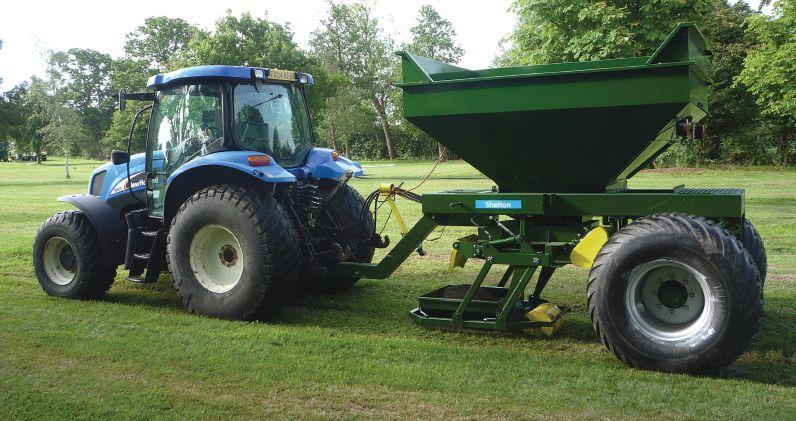
the shelton Fast-flow machine backfills narrow trenches with gravels and sands at forward speeds of up to five miles per hour. Photo courtesy of shelton sportsturf drainage.
drainage pipe, very small particles of soil also enter. When there is a good flow of water through the pipe, these particles, called fines, are carried along and eventually exit the system. However, if too big a pipe is used, the water flow through it is sluggish and the fines settle out, slowing building up and constricting the pipe size (and, consequently, its effectiveness).
Hence, using unduly large pipe can be a waste of money. Not only does the pipe cost more, but it also means digging a wider trench, which in turn leads to the need for substantially more free-draining back-filling aggregates.
The following example compares the installation of two-inch vs. four-inch diameter tile on a 300- by 150-foot pitch.
Notes: Trenches need to be dug a little wider than the diameter of the pipe because they become narrower soon after being dug due to the latent forces in the ground. The excavated soil has to be carted away. In the loose, it is approximately 50 percent more bulky. Normally two different back-filling aggregates will be specified, so two passes with machinery will be required.
trench spacing
The use of the pitch will normally determine the spacing of the drains. A professional pitch will need speedier drainage than that used by a school. In the case of a soccer pitch occupying a 300- by 150-foot area, if one inch of rain falls on it in an hour and the soil is close to capacity, the pitch can only absorb 6,000 gallons. The drainage scheme has to cope with 23,350 gallons of water from that rainfall.
On a school pitch, two-inch pipes are used running across it at 30-foot intervals. Each of 11 runs will have to evacuate 2,122 gallons of water. On a professional pitch, also using two-inch pipes, the trench spacing will be at 15-foot intervals. Each of 21 runs will have to evacuate 1,111 gallons of water.
The types of back-filling aggregates used have a bearing on the speed at which the excess soil water reaches the pipes. Round aggregates drain more quickly than crushed aggregates because there is considerably more pore space.
trench depth
The depth of the land drains should allow for 16 inches of the top soil to remain unsaturated. Installing drains too deep can lower the water table to such an extent that irrigation becomes necessary sooner.
the advent of speciaList machinery
In the 1970s, a pitch would have been drained using a selfpropelled agricultural drainage machine on tracks. These machines dug wide trenches and placed the excavated soil at the side of the trench, to be cleared up later in the operation. Upheaval was substantial, and it was usual to allow 12 months before re-use. Small, self-propelled chain trenchers, which cut trenches over four inches wide, similarly depositing the spoil on the trench side, were also popular. They made less damage to the playing surface, but nevertheless, re-instatement was measured in months. Both methods resulted in wide trenches, soil-contaminated turf and months of recovery time – factors that often challenged the viability of carrying out drainage work.
In the early 1980s, the three-point linkage, tractor-mounted wheel trencher brought new promise. The high-speed cutting disc cut clean, two-inch-wide trenches, which acted like miniditches. These machines were initially used in agriculture but those involved in draining sports fields soon saw the advantages for draining fine turf. The Shelton business then developed an enclosed trencher with a conveyor to load the excavated soil into a trailer running alongside; they further developed the machines to cut trenches from one- to six-inches wide.
With new technology, the optimal width of a trench can be dug precisely; the elevators on the trenchers convey the excavated soil into tractors and the sod is left clean. Re-instatement of the narrow trenches can be done by seeding. It is now possible to drain today and play tomorrow, and this greater efficiency has resulted in lower costs. dC
david shelton is the founder and former managing director of shelton sportsturf drainage ltd in the U.k
by c Na Fi NaN cial cO r PO rati ON
The aging workforce
how will it affect your business?
america’s workforce is changing. Baby boomers, defined as those born between 1946 and 1964, are now reaching the age where retirement is just around the corner. What is the impact of aging on worker health and safety?
While older workers have low absenteeism, turnover, and accident rates, they do take longer to return to work after injuries and illnesses because they are likely to heal more slowly and have pre-existing health problems. Older workers have more severe injuries with longer rates of off-work time than their younger counterparts do.
Aging is natural, and we will all feel the effects to some degree, including loss of strength and muscular flexibility, reduced visual capacity and slowing of our mental processing. Addressing these impacts means looking at the physical, psychosocial, and cognitive issues related to aging. Companies cannot continue to run their businesses as usual.
strength
Loss of strength happens due to decreased muscle mass and diminished force capabilities of our muscles. The muscles take longer to respond to action and fatigue faster as we age. As muscles age, they begin to shrink and lose mass. The number and size of muscle fibers also decrease. Muscles take longer to respond in our 50s than they do in our 20s. Heavy lifting and lowering, awkward positions and static postures are all risk factors for workplace injuries. Tasks requiring grip force and exertion, as well as repetitive tasks, are more difficult with decreased strength and endurance.
Reduced grip strength goes along with reduced muscle and soft tissue capabilities. Handgrip strength decreases, making it more difficult to accomplish routine activities such
as gripping, lifting, turning a valve and opening material. We can assist the aging worker by reducing the time spent in these type jobs or providing mechanical assists. Choosing hand tools and handheld devices that are appropriately sized for the human hand can compensate for reduced grip strength.
To prevent injuries to the soft tissue, find the jobs that possess the greatest physical risks to the various soft tissue groups. This process will prioritize the jobs that need to be changed, as well as those that could be used for return-towork and to keep employees working longer. Some of the ways to help employees include reducing work with static muscle effort (i.e. sustained, fixed postures, increasing the use of mechanized equipment, and reducing or eliminating twisting of the upper torso).
vision
Vision is by far our most important sensory channel. Approximately 90 percent of most of the information we learn in a lifetime enters through the eyes. A 60-year-old person requires two to three times the amount of light as a 20 year old. Normal age-related changes in vision include impaired ability to adapt to changes in light levels, extreme sensitivity to glare, reduced visual acuity (ability to discern detail) and restricted field of vision and depth perception. Impaired depth perception may cause a person to perceive a shadow on the floor as a step or a hole and visual misinterpretation based on visual misinformation can severely impair an individual’s ability to function safely.
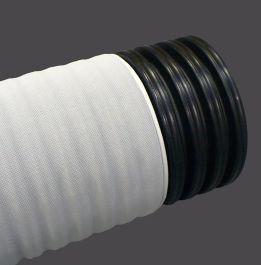
A SILT'S EYE VIEW OF NORTH AMERICA’S FINEST DRAINAGE FILTER
Light
The single largest missing ingredient in workplace facilities to assist aging workers is light and how it is designed for the job task. Well-designed lighting plans are essential. Using more indirect lighting, especially with computer use, creates a better working environment. Using task-specific lighting is also important depending on the job task; this can be by using table and desk lamps with soft, white lights to avoid glare.
Reducing glare contributes to comfort, and helps minimize falls and maximize attention span. Attention to the special needs of task lighting assists workers in seeing the task and increasing levels of performance. Very few managers correlate productivity and efficiency to the correct light levels. High contrast is very effective in enhancing visual function. An edge band of contrasting color on a desk or countertop can help the worker see it more easily. The aging eye is best able to discriminate saturated colors at the warm end of the spectrum. Colors with a high degree of brightness, such as yellow, are particularly visible.
cognitive abiLity
Mental processing and reaction time become slower with age. This slowing of information processing speed actually begins in young adulthood (the late 20s). By the time people are 60 or older, they will generally take longer to perform mental tasks. It is now thought by some experts that older adults do not lose mental competence; it simply takes them longer to process the necessary information. In addition to cognitive decline, slowed processing speed has also been linked to decline in motor
function. Therefore, older adults may have less dexterity and co-ordination than when they were younger.
There are training methods that work well for older adults. Older workers’ best methods for learning are through direct, hands-on experience, as they tend to want to use new skills right away. It is important for older workers to be involved in planning and training. Relating new learning to past experiences, accommodating for vision and hearing loss, and establishing an acceptable pace for learning new information are all critical elements to retaining new information.
It is important to understand that the changes in cognition do not necessarily happen to everyone. There is a wide variation among individuals. The degree of decline is small and should not interfere with day-to-day functioning. It may take an older person longer to learn something new, but they can still learn.
Over the next few years, we will see an increase in the older people in the workforce. Surveys indicate that baby boomers want to continue to work either full or part time. To ensure a long and healthy work life, industry must assess the capabilities and limitations of older workers and design tasks within these parameters. This will positively affect productivity, efficiency, and safety among all age groups. Plan to accommodate for your needs and the needs of your employees as the years progress. dC
The information, examples and suggestions presented in this material have been developed from sources believed to be reliable, but they should not be construed as legal or other professional advice.
continued from page 19
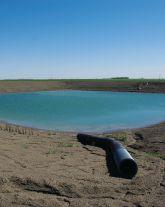
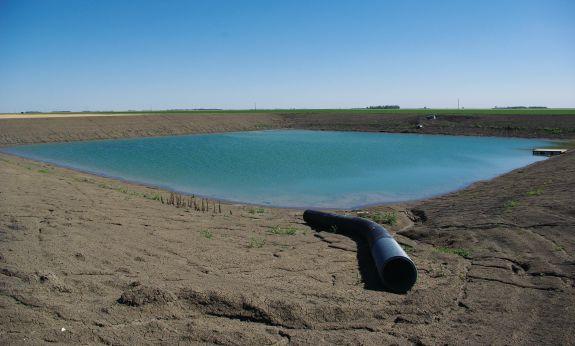
Using existing ditches to collect and direct runoff to a retention pond, like this newly installed one at the carl classen farm near elm creek, m B, may be a viable solution with the help of drainage contractors. Photo courtesy of david lobb
An option to accomplish this in the Lake Winnipeg region is back-flood dams (berms) similar to waffle designed dams, but with modifications, as the waffle design is not suited for agriculture. “A second option is to use the existing ditches and expand them, and temporarily blocking finger ditches (terminal main drains),” Lobb says. “Existing ditches are designed to convey runoff and have little capacity to store runoff, even temporarily.” He explains that the design of existing ditches do not provide for filtering and capture of nutrients by vegetation, nor for the harvesting of vegetation for nutrient recovery. Expanded ditches enable the retention of runoff and delay release to reduce downstream impacts, and ideally, the runoff can be used to irrigate fields.
A third option is to use the existing ditches to collect runoff and direct it to a retention pond-filter field system. “An added benefit of this strategy is increased field crop production through better drainage,” notes Lobb, “and the potential for irrigation of field crops in drought years.” This third option would definitely require the expertise of drainage contractors, he says, but he is sure that they could be involved in all three, as all solutions can incorporate better in-field surface and subsurface drainage.
Lobb acknowledges that direct on-farm economic benefits are necessary to justify implementation of these strategies. “I recognize that there are construction and maintenance costs in upstream water management, and in managing safety, salinity, weed control and invasive species such as hybrid cattails and reed canary grass in wetlands,” he says.
Future research will focus on designing and assessing areas that temporarily detain runoff within the field and disperse it more uniformly through a greater area. Lobb will also be looking at improving the practices used to sediment and vegetation from ditches and riparian areas where nutrients can build up and contribute to surface water quality problems. dC
NEW pRODUCTS
m u Lcher head de Livers fine mu Lch for
ground cover
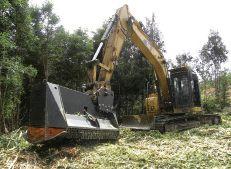
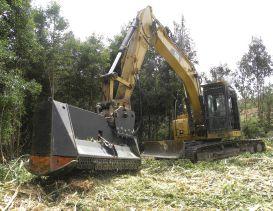
The St. George Company, through its SGC Attachments division, is distributing the Seven E series line of carbide hammer mulchers for hydraulic excavators.
The Seven E Series mulchers feature a close ratio carbide hammer configuration and replaceable internal beater bars, resulting in long hammer life, lower required horse power and the production of fine Class 1 mulch.
Other features include oversized, external-loading main bearings, a fully enclosed body of Domex steel with hydaulic operated gate and skid pads made from .79-inch- (20-millimetre-) thick Hardox steel.
There are four model ranges in the Seven E series, fitting hydraulic excavators from five to 40 tonnes, with mulcher widths of three, four, five and six feet. Wood material up to a maximum 10 inches can be mulched. Fixed and variable displacement hydraulic motors are offered.
www.sgc-group.com
a uger backfi LLer from b ro W n b ear c orp
The PTOAB36-10’ auger backfiller for front or rear farm tractor mount from Brown Bear Corp mounts to Category II or III three point hitches.
The auger backfiller is 10
feet wide and weighs 4,250 pounds. The maximum input is 175 PTO horsepower with a 1,000 RPM PTO input. Standard features include a 1 3/8-inch by 21 spline shaft and ISO (clockwise) rotation, with the option of a 1 3/4inch by 20 spline and counter ISO rotation. The drive and discharge side bearings run in oil lubrication, and the continuous auger has adjustable and replaceable wear plates.
www.brownbearcorp.com imc introduces ne W scraper
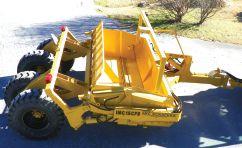
The new Carry All Fixed Blade with Walking Tandem (CFB-WT) by Industrial Manufacturing Corporation Inc. (IMC) was introduced at the World Ag Expo in Tulare, CA, in February.
The scraper has a gate allowing it to transport material. It has a reinforced frame, tongue, and carriage, which are designed to comply with highhorsepower tractors and heavier load capacities. The bowl pivots while the blade remains in a fixed position. This fixed blade hinge design controls the blade height, allowing for precision control. The need for the
walking tandem comes in when the contractor is in the final “finishing stages” of his project. A walking tandem helps to eliminate bounce and reduce the duck walking, allowing for better accuracy and control.
www.imcscrapers.com
Land forming design soft Ware for drainage and irrigation
OptiSurface land forming design software uses three different design models to accomplish the customer’s drainage or irrigation goals. The one-way design model is designed for those who would like all their water to irrigate or drain in a predetermined single heading. The two-way design model is designed for situations when it is necessary to drain/irrigate off of both sides of a ridge/ crown or irrigate/drain both sides of a field towards a waterway or ditch. The four-way design model is designed for situations the customer would like to get the water off the field in any and all directions, while still having the ability to pick and choose where the water should drain. OptiSurface accomplishes these design models using the patented technology of Infinitely Variable Grades (IVG) to optimize the surface while reducing the cost of earthmoving and topsoil disturbance.
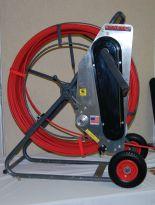
m averick ti Le f inder
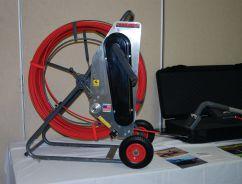
The Maverick Tile Finder was designed to be a simple, mobile, and power-free way to locate existing tile lines.
The user can insert the 3/8 fiberglass/plastic composite rod up a drainage tile, water or sewer line and connect the utility locator to it. The rod has a copper wire inside of it that transmits the signal up the line. The locator will then reveal the location and depth of the tile.
The rod has a length of 650 feet and the locator can read depths of up to 15 feet. The locator that is supplied with the unit can locate other utilities as well. The reel weighs 90 pounds and has a rewind crank system to aid in recoiling the cable. An optional Reese receiver platform can be mounted to a pick-up or UTV for added portability.
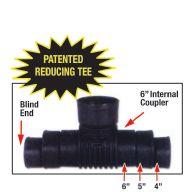
Also 6” square & round risers with patented reducing Tee.
• Constructed of heavy-weight, high-density polyethylene.
• Parts highly adjustable & interchangeable with others on the market
• Orifice plate placed at tee level or at ground level.
• Exclusive locking device on each part. • User Friendly-Priced effectively.
precision_intake_sept09.indd 1
www.optisurface.com
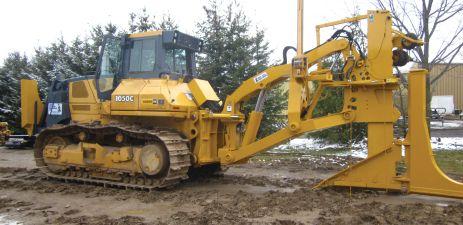
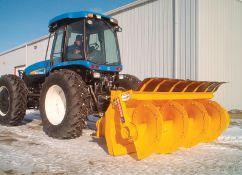
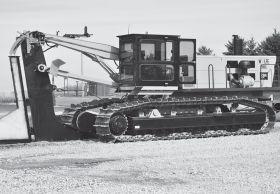
Wolfe has upgraded the 540 drainage plow. The lift and attitude cylinders are now seven inches in diameter, increasing capacity by 30 percent, and the two six-inch grading cylinders have been replaced with one 10-inch grading cylinder. The back step was modified to reduce the likelihood of damage by the dirt berm. The oscillating pins are now locked in from the front side. The auxiliary pumps and valves were reconfigured so that both pumps feed a single valve bank. www.wolfeequipment.com
• Adaptor available to repair old metal or broken intakes.
Why inventory 2, when 1 serves both!
Norm & Coretha Rozendaal 2064
Wolfe 540 Super Plow
The Wolfe 540 Super Plow is Wolfe’s newest machine in the drainage industry. It has a CAT 540 HP engine, plows to 7’ deep, roads at 4.2 MPH, 160,000 pound final drives, and air ride cabs. Boots 6”-12” and 15” & 18” dual wall.
www.a-econstsupply.com
800-736-3413 • 507-776-6121
E v ENTS
p ort i ndustries p L ans summer fie Ld days
Port Industries and Prescott Farms will host a field day and GPS class in June 2014 in Winchester, IN. A Trimble GPS training class will take place on Monday, June 16, and the Hydramaxx ag drainage field days will follow on Tuesday, June 17 and Wednesday, June 18.
Field demonstrations will consist of a variety of Hydramaxx trenchers and plows including a New Hydramaxx 3300 Cantilever Plow. The demonstrations will start around 9 a.m. and run until 4 p.m. each day, with an hour break for a complimentary lunch. The drainage system to be installed will cover 68 acres with multiple outlets and approximately 68,000 feet of drainage tile. For registration and more information, contact the Port Industries’ sales department at 800-562-8713 or sales@portindustries.com.
n ationa L Lica s ummer m eeting
National LICA is planning its summer meeting, to be held July 14 to 19 in Indianapolis, IN.
The meeting will be held at the Indianapolis Marriott Downtown, located at 350 W. Maryland Street.
The tentative schedule is as follows:
Tuesday, July 15: Tour Indianapolis Motor Speedway
Wednesday, July 16: Tour Caterpillar Plant, Purdue
Thursday, July 17: Educational seminars, golf outing at the Brickyard Crossing, Associates’ Night
Friday, July 18: Committee meetings
Saturday, July 19: Board meeting, go-kart racing at Post Recreation Center
For more information, visit www.licanational.com/ events.
Lico to host summer demo day
The Land Improvement Contractors of Ontario (LICO) are planning a farm drainage demonstration day this summer.
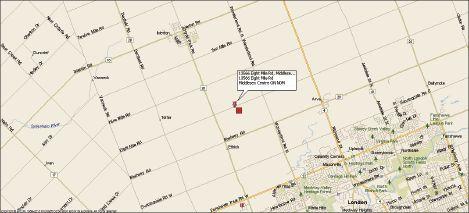
The event will begin at 9 a.m. on July 22 (with a rain date of July 23), at 13566 Eight Mile Road in Middlesex Centre (northwest of Arva), Ont. The day will feature a demonstration of 100 acres to be tiled on 30-foot spacing.
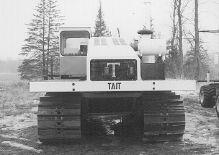
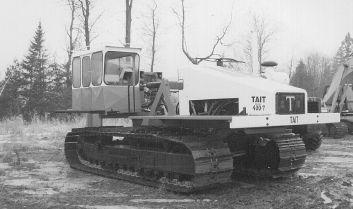
The day is sponsored by ADS Canada, Armtec, BRON, Ideal Pipe, Tait Manufacturing Inc. and Wolfe Heavy Equipment Ltd. For more information, please call Jessica at 1-800-263-1060.
Is there a silver lining to climate change for contractors?
by Rob Burtonshaw
The last time I wrote a column for Drainage Contractor, I thought the weather was so unusual and such a talking point that I could not write about anything else. Yet again, this thought occurs to me: we have had record rainfall levels here in the U.K., and I have read about the chilling weather inflicted on those in North America. However, as this would soon become the dullest part of the magazine if I just gave a weather report, I will resist the temptation. Regardless of what is causing the changes, I doubt many in Britain would disagree that something strange is going on. Every couple of months the headlines report weather records being broken or set. This might be a blip or a pattern, but the weather is headline news like never before, and many believe climate change is the cause. I believe that drainage contractors should greet it as an opportunity.
The environment and the ever-growing green movement has been one of the most significant political developments in the last 40 years, and I can’t see the subject disappearing anytime soon. All businesses in all sectors are (or will be) affected, and drainage contractors are no exception. Rather than fight or ignore this trend, this is a chance to improve our services and raise the profile of the industry. I’m convinced it is pointless and wrong to ignore the fact that nitrates use drainage outlets as a conduit to enter the watercourse. Instead, we need to promote what can be done to mitigate this side effect of agriculture and offer a proactive answer; we need to be part of the solution rather than the problem.
Luckily for us, there are proven ways of solving the problem. I suspect that most people reading this will understand and know about conservation drainage and have seen drainage water management and denitrifying bioreactors in action. I was lucky enough to spend a couple of days with Richard Cooke, a professor at
Illinois State University, who took the time to show and explain his experiments and field trials focused on conservation drainage. I will make the declaration that I’m a big fan, so much so that I have developed a plan to install a bioreactor here in Warwickshire – in fact, by the time you read this, it might be in the ground already, as we have a keen land owner and progress has been made in terms of funding for its installation. As far as I’m aware, it will be the first in Europe, and although it’s a tiny little device compared to Richard’s efforts, it’s an exciting project. It is early days, but if the concept is proven to work in British conditions (and I have high hopes that it will), many more could be installed.
It feels good to say that I’m at least trying to do my – admittedly very small – bit for the environment, but I’m not going to underplay the business element. Drainage contractors have the expertise and will be the ones to design, install and, if necessary, maintain these devices. This gives us another product to sell, often to a different client. We are always going to make the vast majority of our money by putting pipe in the ground, but promotion of our business and services is a huge part of the business. We need to spread a positive message about drainage. We know that it is a great service, and that the higher yields drainage provides are of great service to humanity, but others don’t.
Local and national press are always keen on environmental stories. Conservation drainage is probably our best tool to promote drainage – not only to farmers, but also to the wider public –and this should not be underestimated. Public opinion can have a powerful effect, and the use of social media allows us to get our message out to the public both economically and effectively. Adopting conservation drainage is a win-win for drainage contractors. We should all embrace the ideas, learn the techniques and start putting them in the ground. dC