

SUPPORTING VETERANS FOR 100 YEARS





By Neil Sutton
The past few weeks have been a bit of a blur.
On Oct. 4, I was in Calgary for our Career Expo West event, a Canadian Security co-production with fellow Annex Business Media publications Blue Line, Canadian Firefighter, Wings and Helicopters
As that line-up of magazine titles would suggest, the career fair catered to the needs of students and job-seekers looking for advice on security, policing, fire and aviation.
Less than a week later, I hosted the Advance: Women in Security Breakfast and Canadian Security Honours gala in Toronto — a combined event that focuses on education and networking, and recognizes our annual award winners, including Security Director of the Year.
These events provided a broad perspective of the security industry, from people who are still in college and contemplating their first steps into the world of full-time work, to security professionals who have been employed for decades and are now taking stock of their long careers.
W hat I’ve learned from talking to all of these people over the last few weeks is that the learning never really stops and
education is a lifetime pursuit.
C ollege and university graduates may have finally earned their degrees and diplomas after years of study, yet many of them will soon be looking for industry-specific accreditations to improve their chances of success in the workforce and their chosen professions.
“What I have learned from talking to all of these people over the last few weeks is that the learning never really stops.”
They may also find themselves sitting next to people a few decades older than them, as career professionals expand their skillsets and increase their knowledge by earning new certifications. Or they might go back to school for another diploma or earn a Master’s degree in their free time.
Our last issue, back in the spring, featured an article on established professionals who felt they could be more effective security leaders by better understanding the business world.
Completing an MBA, for example, allowed them to place the security department in the context of the broader organizations they work for and realize how it
Martin Deslauriers: Providis
Services Conseils
Agnes Pienio-Ganthier: Amazon Canada
Ken Doige: ESRM Solutions
Roxanne Krause: CN Tower
Danielle Weddepohl: George Brown College
Rowan Hamilton: Commissionaires Great Lakes
could more effectively contribute to the company’s larger goals.
I was also treated to a wide range of perspectives by interviewing and profiling each of our award winners for this issue.
E merging leader award winner Kelly Onu, for example, is shaping her career as a voice of reason for artificial intelligence — recognizing its tremendous capacity to change work as we know it while also acknowledging the risks it presents to organizations that are unprepared for its transformative power.
One of our 2025 community leader award winners (given the massive support this award category received this year, it was impossible to name only one), is Aladdin AlRadhi, a college professor who began teaching after a long career as an electrical engineer and cybersecurity consultant.
AlRadhi is also well schooled in AI, as well as an expert in related cyber disciplines and IPv6.
Both Onu and AlRadhi see themselves as mentors as they help others become lifelong learners. A commitment to education is really a reliable yardstick to measure career success, whether you’re just starting out or looking back on decades of work. | CS
Fall 2025 Vol. 47, No. 2 canadiansecuritymag.com
READER SERVICE
Print and digital subscription inquiries or changes, please contact Shawn Arul, Audience Development Manager Tel: (416) 510-5181 Fax: (416) 510-6875
Email: sarul@annexbusinessmedia.com
Mail: 111 Gordon Baker Rd., Suite 400, Toronto, ON M2H 3R1
EDITOR
Neil Sutton nsutton@annexbusinessmedia.com
GROUP PUBLISHER Adam Szpakowski aszpakowski@annexbusinessmedia.com
BRAND SALES MANAGER
Trish Sutton tsutton@annexbusinessmedia.com
MEDIA DESIGNER
Graham Jeffrey
ACCOUNT COORDINATOR
Kim Rossiter krossiter@annexbusinessmedia.com
CEO Scott Jamieson sjamieson@annexbusinessmedia.com
Printed in Canada
I.S.S.N. 0709-3403
Publication Mail Agreement #40065710
SUBSCRIPTION RATES
Canada: 1 Year $43.86 + Taxes; U.S.A. (payable in CAD dollars): 1 Year $97.41; International (payable in CAD dollars): 1 Year $112.20
EDITORIAL AND SALES OFFICE
111 Gordon Baker Rd, Suite 400, Toronto, ON M2H 3R1 (416) 442-5600 • Fax (416) 442-2230 canadiansecuritymag.com
Canadian Security is published two times per year by Annex Business Media.
Annex Privacy Officer Privacy@annexbusinessmedia.com Tel: 800-668-2384
Canadian Security is the key publication for professional security management in Canada, providing balanced editorial on issues relevant to end users across all industry sectors. Editorial content may, at times, be viewed as controversial but at all times serves to inform and educate readers on topics relevant to their individual and collective growth and interests.
The contents of Canadian Security are copyright by ©2025Annex Publishing & Printing Inc. and may not be reproduced in whole or part without written consent. Annex Business Media disclaims any warranty as to the accuracy, completeness or currency of the contents of this publication and disclaims all liability in respect of the results of any action taken or not taken in reliance upon information in this publication



Assessing
Amalgamation


Founded in 1955, ASIS International (www. asisonline.org) is a global community of security practitioners, each of whom has a role in the protection of assets — people, property, and/or information.
Represented in Canada by 10 chapters serving over 2,000 individual members, there are more than 100 Canadian volunteers who work to bring members and non-members alike access to local education and networking, and provide a vital connection to programs offered by ASIS International globally.
ASIS Canada is not a chapter and does not run events, but exists to support two initiatives that are shared among all Canadian chapters. Those two initiatives are:
Ca nada Night: This is ASIS Canada’s crown jewel, a much-anticipated networking event hosted on the eve of the GSX conference each year in the United States.
This year, the 31st Canada Night was held on Sunday, Sept. 28, at House of Blues, New Orleans. Stay tuned to the ASIS Canada website (www.asiscanada.ca/canada-night) for pictures from the event, and information on next year’s event in Atlanta.
The Ron Minion Award: The second major initiative of ASIS Canada is the presentation of the Ron Minion Canadian Security Pioneer Award. This award was established in 1999 to recognize the contributions of ASIS Canadian members who have distinguished themselves through their contributions to growth and professionalism in the security industry. The security practitioners that initiated the award not only considered the contributions
that individuals made to the Canadian Security Industry and to ASIS International in Canada, but also to ASIS International globally. Ron Minion, CPP, was the first recipient of the award in 1999. Ron was instrumental in bringing ASIS to Canada. He along with others primarily in western Canada worked tirelessly to establish the first Chapter in Edmonton and then in Calgary. Sadly, Ron passed away after a courageous battle with ALS also known as Lou Gehrig’s disease. You can see a list of previous Ron Minion Award winners here: www. asiscanada.ca/ron-minion-award.
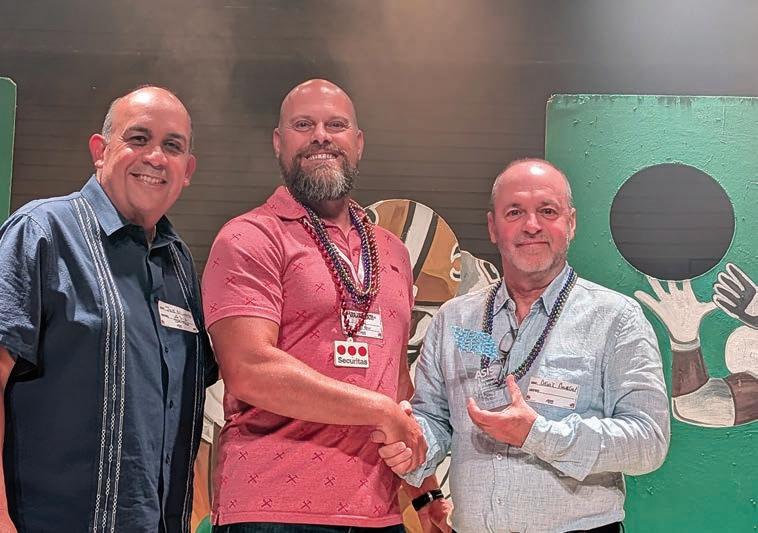
This year, the Ron Minion Award was presented to the current Quebec chapter chair, Denis Bourget, CPP, for his long and dedicated service to ASIS. Denis has been an active member of the security industry in Canada for over 48 years, and has been an ASIS member and
volunteer for the last 20. He was instrumental in revitalizing the Montreal chapter, and merging it with the Quebec City chapter to form the new Province de Québec chapter. Denis was presented with the award at Canada Night in New Orleans by ASIS Canada administrator Jody Reid, CPP.
At a futur e chapter event in Montreal, Denis will be formally presented with “The Bear,” a soapstone carving of a polar bear that has all the names of the past winners inscribed on its base.
ASIS chapters across Canada will be hosting events in the fall and winter months. The Toronto chapter, for example, will host “Women in Security: Driven by Purpose — Fueling Resilience” on Nov. 13 at the Woodbine Racetrack.
Visit the ASIS Toronto chapter website (www.asistoronto.org) for all the details. | CS
According to Allied Universal’s 2025 W orld Security Report, concern for the safet y of business leaders is on the rise — 42 per cent of security chiefs say the threat of violence against executives has increased in the last two years.
The report is based on data from 2,352 chief security officers (or equivalent roles) , working for medium to large global companies in 31 nations, who were surveyed anonymously.
T h e study also includes perspectives from 200 global institutional investors managing more than US$1 trillion in a ssets. Research was conducted in March and April , 2025.
The report states that misinformation and disinformation (i.e. incorrect or purposely false) can put senior ex ecutives at greater risk of harm.
O f the CSOs surveyed, 75 per cent said their companies were targeted by these types of campaigns last year.
“ In a world of increasing polarization, and when mistruths and untruths can be shared instantaneously, companies and their senior leaders face heightened risks,” said Steve Jones, global chairman and CEO, Allied Universal, in a statement.
“As a CEO, this impacts me personally and professionally. Now more than ever, personal safety is on my mind and the

minds of my loved ones. Professionally, I’ve seen an increase in our customers’ concern for the safety of their employees,” he added.
T he report also notes the financial impact of security incidents, with a quarter of CSOs reporting revenue loss after an incident — the average company loss was at least US$9 million.
“Given how high the stakes are, business leaders are increasingly recognizing that robust physical security is a corporate value driver and should be central to their corporate governance and risk management str ategy,” said Ashley Almanza, executive chairman of G4S, Allied Universal’s international business.
Addition findings from the survey include:
• 49% of CSOs say they have enhanced their security procedures
• 45% say they are carrying out risk assessments for leaders
NOVEMBER 13, 2025
ASIS Toronto: Women in Security Toronto, Ont. www.asistoronto.org
NOVEMBER 18-20,2025
ISC East New York, N.Y. www.isceast.com
DECEMBER 3, 2025
IACLEA Canadian Symposium Toronto, Ont. www.iaclea.org
DECEMBER 12, 2025
Focus on Healthcare Security Toronto, Ont. canadiansecuritymag.com
MARCH 23-27, 2026
ISC West Las Vegas, Nev. www.iscwest.com
• 4 4% are monitoring online threats
• 40% are offering training and preparedness for leaders (e.g. self-defence, situational awareness)
• 34% are providing leaders with personal protective equipment
• 25% ar e providing family protection for leaders
• 78% say geopolitical tensions will compromise the security of their supply chains
• 44% say economic instability is the dominating hazard over the next year (up from 36% in 2024)
• The top two internal security threats for the next year are leaking sensitive information (32%) and unauthorized access to company resources or data (28%)
• 80% of CSOs sa y company leaders are more concerned with cyber security than physical security
De tails are available at: worldsecurityreport.com. | CS
APRIL 26, 2026
Security Canada East Laval, Que. www.securitycanada.com
JUNE 3, 2026
Security Canada West Richmond, B.C. www.securitycanada.com
JUNE 15-16, 2026
Security LeadHER Minneapolis, Min. www.securityleadher.org
JUNE 25-28, 2026
IACLEA Annual Conference & Expo Orlando, Fla. www.iaclea.org
JUNE 27-30, 2026
BOMA International Conference & Expo Long Beach, Calif. www.boma.org
SEPTEMBER 14-16, 2026
GSX Atlanta, Ga. www.gsx.org

By Tim McCreight
Resilience is a word we often use in security, but I don’t think we always stop to reflect on what it really means.
To me, resilience is not just an organizational objective — it’s deeply human. My wife and I had a vivid reminder of this in May when our amazing Bullmastiff, Hazel, suffered a devastating spinal injury.
One moment Hazel was heading down our back deck stairs to chase a squirrel, the next she couldn’t use her hind legs. Somehow, my wife got Hazel back into the house and called me — right before I went on stage to present at the ASIS Toronto Chapter’s Best Practices event. Somehow, I calmed her down, gave some quick options on who to call for help, and she got Hazel to an emergency vet clinic while I tried to focus on giving my speech.
The neurologist told us the odds weren’t in her favour without an operation, so we made the decision to go ahead with the complicated spinal surgery. With surgery, therapy and her stubborn determination to walk again, Hazel regained her strength. Today, she’s back on her feet. She’s slower, yes, but walking on her own.
That was my “Hazel Moment.” Watching her journey forced me to reflect on what resilience really looks like for people, organizations and our security programs.
In security, we sometimes confuse resilience with invulnerability. We continually chase perfect defences, flawless compliance and the illusion that risk can be fully eliminated. Hazel reminded me that resilience isn’t about never falling down, it’s about getting back up.
Organizations will face disruptions. A breach will happen, supply
Tim McCreight is the CEO and founder of TaleCraft Security (www.talecraftsecurity.com).

chains will falter, or an incident will test the limits of our systems. The real measure of resilience is how quickly and effectively we recover, how we adapt and how we carry forward the lessons learned.
“Resilience isn’t about never falling down, it’s about getting back up.”
Enterprise Security Risk Management (ESRM) has long been my framework of choice, because it roots security in business goals. But ESRM isn’t just about identifying risks and designing controls. It’s about embedding security into the organizational culture, so that resilience becomes a shared commitment rather than a compliance exercise.
When we understand resilience is built through collaboration, transparency and trust, our organization can r ecover faster and emerge stronger from disruption. Resilience isn’t a product of technology alone, it’s the outcome of a very strong culture.
As security leaders, we need to help our executives and colleagues see that resilience is not abstract. It shows in our day-to-day choices in how we:
• Prepare our teams to anticipate
and adapt
• Design enterprise security programs that engage employees rather than burden them
• Use Design Thinking principles to learn from incidents instead of hiding them
Hazel didn’t recover by herself. She had a network of care, resources and support. Organizations are no different. Our role is to help build that ecosystem of resilience, where the collective strength of the organization carries it forward.
It’s been hard for us to remember what we went through a few months ago. I wanted to share Hazel’s story not just because it’s personal, but because I believe every leader — security or otherwise — needs their own Hazel Moment. It’s a reminder that resilience is not a saying, it’s a journey taken through hardship, persistence and adaptive strength.
The next time your security program faces disruption, think about what resilience looks like in action. Not perfection, but persistence. Not just bouncing back, but bouncing back better. | CS



East
Laval, QC
April 29, 2026

West
Richmond, BC
June 3, 2026

Central Toronto, ON October 21-22, 2026




By Winston Stewart
The role of frontline guards has always been defined by adaptability.
G uards are asked to watch, report, deter and respond across a wide range of sites. For decades, that generalist approach made sense. Most contracts were built on providing a uniform presence, and the expectation was that any trained guard could step into any environment and perform.
That model is changing. The environments where guards are deployed today are more complex, and clients expect more specialized skills. Retail security requires knowledge of loss prevention. Health-care facilities demand training in patient interaction and de-escalation. Corporate and residential concierge roles depend on communication and customer service. Alarm response and mobile patrol require familiarity with technology and fast decision-making. These assignments are not interchangeable, yet the industry continues to treat most frontline positions as if they were the same.
The question now being asked within the industry is whether guards should be divided into levels, with specialized training and differentiated pay. It is not a simple issue, and it deserves serious consideration.
The security industry has been discussing professionalization for years. Better training standards, stronger regulatory oversight, and a clearer public understanding of the role are all ongoing priorities. Specialization fits into that broader conversation.
Employers and clients alike recognize that the expectations placed on guards in certain environments go far beyond basic patrol and observation. A health-care guard who de-escalates a volatile situation is drawing on training and experience that many others in the field will never need. A concierge working in a luxury residential building requires strong interpersonal skills

and the ability to manage access control systems. A retail guard may be expected to investigate thefts or work closely with police.
These differences matter. Treating every role as identical undervalues the skill set required for more complex assignments and risks leaving guards under-prepared.
A structured system of guard levels could address these gaps. In such a system, guards would progress through defined tiers, each requiring additional training and offering higher pay. Clients would benefit from knowing that the personnel assigned to their site had training specific to their environment. Guards would benefit from a clearer career path and better compensation as they advanced.
For example, an entry level tier could cover basic patrol and access control. A second tier might include specialized training in conflict management, customer service, or health and safety. Higher tiers could be created for those working in critical infrastructure, health care or environments where advanced reporting and investigation skills are required.
This type of model would not only raise standards but also improve retention. One of the industry’s persistent challenges is
high turnover. Guards often leave because they see limited opportunity for advancement. If specialization were tied to higher pay and recognition, it could motivate more to remain in the industry and build longterm careers.
At the same time, there are barriers to implementing such a system. Security is a low-margin industry, and many contracts are awarded on cost. Clients may resist paying more for specialized roles, even when the work clearly requires it. Employers may find it difficult to standardize training across jurisdictions, especially given that regulation varies from province to province.
There is also the question of flexibility. A highly specialized guard force may be harder to deploy across multiple assignments. A generalist approach allows employers to move staff between contracts as needed. Too much specialization could create rigidity that adds cost without improving service. The industry would also need to be careful not to create divisions among guards themselves. While some roles are more complex than others, every frontline position carries responsibility and risk. The last
thing the industry should do is diminish the importance of those working in so-called “entry level” roles.
The path forward may not be a fully tiered model imposed overnight, but rather a gradual move toward greater recognition of specialization. Some companies are already taking steps by offering higher pay for health -care or high-risk assignments. Others are providing additional training for concierge or retail roles. Over time, these practices may evolve into a more formal structure.
T he broader industry conversation should focus on balancing client expectations with the realities of service delivery. If clients demand specialized performance, they must be willing to invest in specialized
training and compensation. If employers want to build a sustainable workforce, they must offer clear development paths and resist competing on price alone.
A s with many issues in the guarding sector, this is not something that any one group can solve in isolation. Employers, clients, regulator and guards themselves all have a role to play. Clients must value quality service. Employers must commit to training and career development. Regulators must ensure that standards keep pace with the demands of modern security work. And guards must continue to demonstrate professionalism and adaptability, building the case for recognition of their specialized skills.
The Canadian security industry has already proven its resilience and capacity to evolve. The integration of technology, the rise of hybrid security models, and the
growing focus on customer service all show how the sector adapts to changing conditions. Specialization of guards is another step in that evolution.
Specialization isn’t a threat to the traditional role of the guard. It is a recognition that the work has become more complex and that the people performing it deserve acknowledgement and support.
Whether through formal tiers or more gradual change, the industry must move toward a model that aligns training, pay and responsibility with the realities of today’s assignments.
The conversation is only just beginning, but it is an important one. By addressing specialization openly and thoughtfully, the security sector can strengthen its workforce, improve service for clients, and set a clearer path for the future of the guarding industry in Canada. CS
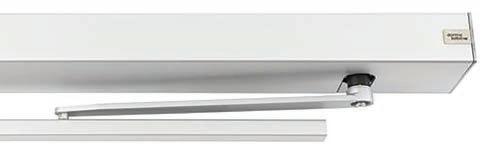
The ED100LE and RCI 910TC deliver sleek design and smooth operation, creating door solutions that look as good as they perform.

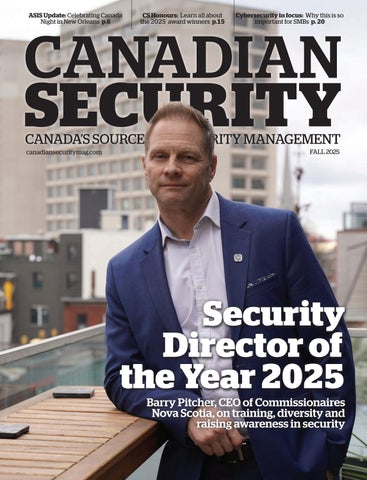
Barry Pitcher, CEO of Commissionaires Nova Scotia, delivers security programs that set a higher standard and emphasize community engagement
By Neil Sutton
Barry Pitcher says it’s a combination of qualities that make him “a bit of a unicorn” in the security world and led to his current role as CEO of Commissionaires Nova Scotia (CNS).
He served in the military before moving into policing and joining the RCMP, eventually retiring in 2020 after a 22-year career.
Before he could think seriously about taking time off and enjoying retirement, he took on some security consulting work which led to new adventures and international travel.
Pitcher is an ideal candidate for a senior leadership role at a security company like Commissionaires, an organization that values its roots and commitment to employ military veterans. Commissionaires, a nationwide not-for-profit, was founded 100 years ago in Montreal to c reate employment opportunities for veterans of World War I.
P itcher, a veteran with a long family history of service, is also a traditionalist and continues his military service as a reservist colonel with the 5th Canadian Division in Halifax. In 2023, he deployed to the
nation of Georgia with the Canadian Army Reserve as part of Exercise Maple Arch, an annual training activity involving 300 international partners. Pitcher’s team supported a training initiative for a Ukrainian airborne unit.
Pitcher also brings other qualities to the table, like a desire to modernize the security industry, embrace new methodologies and raise cultural awareness.
For his commitment to change and for his unique leadership style, Canadian Security’s advisory board awarded Pitcher the 2025 Security Director of the Year award, sponsored by Wesco.
Pitcher was hired as CNS’s CEO in 2022. A veteran familiar with all the trappings of military and police service, he immediately understood the company’s culture but could also see the potential for change.
“You bring all those good lessons learned from both of those worlds and you can readily apply them. I would say I’m a better leader now than I ever was, and that’s through trial and error,” says Pitcher.
Under Pitcher’s leadership, CNS has introduced a new Threat Risk Assessment (TRA) program. Pitch-
er says he wanted to be more proactive with the company’s clients, over and above the obligations spelled out in security contracts.
CNS staff, with its significant number of military and police veterans, is well-equipped to conduct threat assessments, says Pitcher.
“I said, we need to lean into clients, keep an eye on the business landscape and see what is emerging as new technology,” he says. Conducting TRAs for clients “helps keep us sharp,” he adds, and has ultimately translated into more business for CNS
CNS also currently offers a Threat Pattern Recognition Use of Force certification, which has been provided to CNS staff, as well as customer organizations across Atlantic Canada.
In addition to supporting and developing security programs for both internal and client use, Pitcher has championed a Human Trafficking Awareness course.
The issue was brought home to Pitcher through a conversation he had with a CNS commissionaire whose own family had been victim to human trafficking.
Knowing that CNS has boots on the ground across Nova Scotia, Pitcher realized that the organization has the resources to make a difference in the fight against human trafficking.
“ We’ve got 1,300 sets of eyes and ears across this province. At the very least, we could try and identify

“I’m a better leader now than I ever was, and that’s through trial and error.” — Barry Pitcher, Commissionaires NS

[human trafficking] and maybe help the police,” he explains.
In partnership with the Nova Scotia RCMP Human Trafficking Unit, CNS created a foundational training course (Human Trafficking 101). Originally a two-day course, which included presentations from community members personally affected by human trafficking, HT101 w as scaled down to a one-hour course that can be taken online.
All new CNS employees are required to take the HT101 course, and approximately one-quarter of staff across the company have com-
pleted it.
Pitcher is scheduled to present CNS’s human trafficking awareness and training program at the Commissionaires office in the United Kingdom later this year in an effort to take it international.
Pitcher is a big believer in the value of equity, diversity and inclusion (EDI) for the CNS organization.
Pitcher says he has seen the benefits of EDI programs in his military and policing careers and wanted to bring a program into CNS. He
“His leadership has elevated our public profile, championing initiatives that honour our legacy while driving innovation.”
— Jill Smith, Commissionaires NS
formed an EDI committee when he joined the company and completed a n EDI certification program at Dalhousie University in Halifax last year. “ I took that on my own on weekends and evenings,” he says.
“Over the course of a year, I learned a lot. I felt, coming out of there, OK, I think I deserve to be here and I have a voice.”
Through its own EDI program, CNS has formed some key partnerships, including with the Friends United Foundation, an organization devoted to advancing reconciliation with Indigenous Peoples. Since
then, CNS has developed a closer relationship with Friends United, co-hosting information sessions and commissioning Indigenous artwork, which is displayed at CNS offices.
CNS has also formed a partnership with the Black Cultural Centre for Nova Scotia (BCCNS).
Pitcher has a personal connection with the centre: as a military reservist he co-chaired the Government of Canada’s 2022 apology to the descendants of the No. 2 Construction Battalion for their mistreatment.
The all-Black battalion was formed in 1916 as a segregated unit and served their country during the First World War.
The unit was disbanded after the war without acknowledgement of their service or sacrifice. For his role in the apology, Pitcher was awarded the Meritorious Service Medal (military division) by the Governor General.
Currently, CNS works with the BCCNS in recruitment efforts and other programs that foster engagement between the security industry and Nova Scotia’s Black community.
In addition to leading CNS’s EDI committee, Pitcher is an advisor to the Canadian Corps of Commissionaires’ national EDI committee, and also ser ves as co-chair of the Ministr y of National Defence’s anti-racism advisory committee.
“Barry has been able to translate the goal of caring for people and improving our organization’s diversity and inclusion into tangible initiatives that are making a real difference,” says Bryn Weadon, the chair of CNS’s board of governors. “While culture change is never easy and takes significant time and sustained effort, I believe he has been key to setting a new foundation upon which others in the organization can build to make Commissionaires Nova Scotia an employer of choice where all feel welcome.”
For Pitcher, “no idea is too big,”
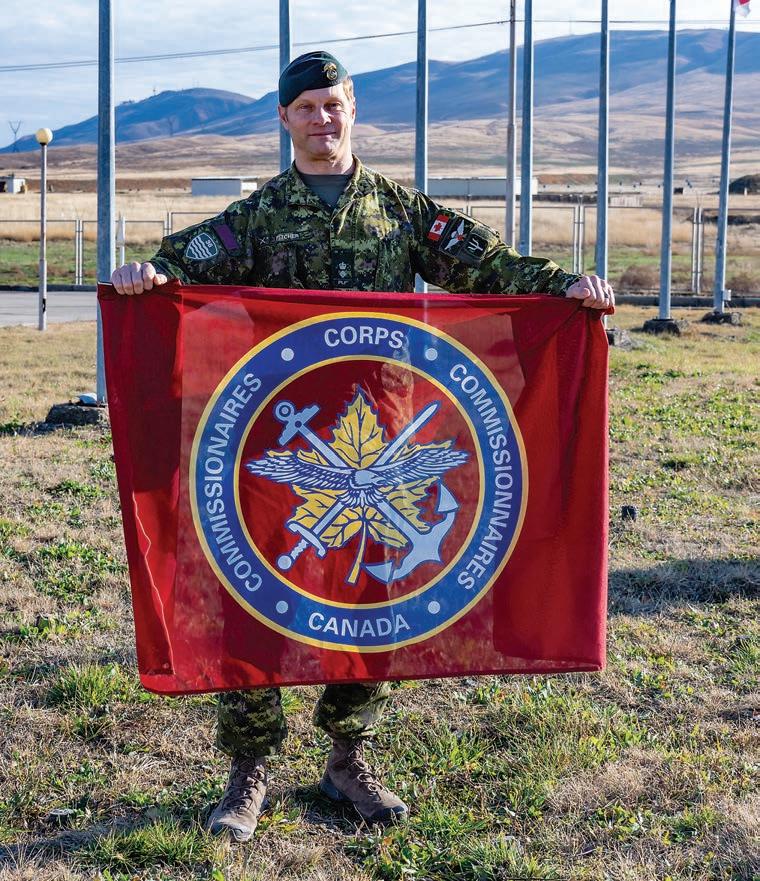
adds Jill Smith, CNS’s marketing and communications manager. “I had the opportunity to report directly to Barry when I first joined Commissionaires Nova Scotia. I experienced firsthand how his leadership has elevated our public profile, championing initiatives that honour our legacy while driving innovation. His commitment to community engagement and security awareness has positioned us as a trusted voice.”
As a veteran of both police and military for more than two decades, and an active reservist now, Pitcher has a deep connection to service and one that feels like an ideal fit for an
organization with the pedigree and values of CNS.
While he wasn’t looking for a fulltime role in his retirement years, it ultimately found him. He’s grateful for the opportunity to participate in a growing security business while also finding personal and professional growth through community-based initiatives
He says that he has adapted his leadership style from the “by the book” approach of a military unit to the more compassionate style that better fits his role today. “I rely on my emotional intelligence more now,” he says | CS
Please join us in congratulating the winners of the eighth annual Canadian Security Honours. The awards program recognizes the accomplishments of professionals from across multiple industries and at different stages of their careers.
This year, we acknowledge: Brad Stewart (Lifetime Achievement), Kelly Onu (Emerging Leader), Grant Lecky (Community Leader), AlaaAldin (Aladdin) AlRadhi (Community Leader,
Honourable Mention), and Barry Pitcher (Security Director of the Year).
Their stories tell us how far the security industry has come, and where it might grow next. For highlights from the Canadian Security Honours awards gala on Oct. 9 in Toronto, as well as the Advance:Women in Security Breakfast meeting, check out our website, www.canadiansecuritymag.com.
Winner profiles by Neil Sutton
Over his 30-plus years in health-care security, Brad Stewart has seen it all.
He worked through the Severe Acute Respiratory Syndrome (SARS) outbreak in the early 2000s, the rise of H1N1 (better known as “swine flu”) in 2009, and of course, the recent COVID-19 pandemic — a global health emergency that lasted almost three years.
Stewart counsels industry newcomers that they will witness mental and physical distress — sometimes severe — but he also lets them know they are indispensable to hospital operations, helping to create a safer environment for staff, patients and visitors.
Stewart got his start in security as a shopping mall guard in his hometown of Owen Sound, Ont. He moved to the city of Kitchener, working as a guard for a tire factory, then for the municipality. He took a contract supervisor role at Freeport Hospital in the mid-90s before moving into a full-time role a few years later, then into a security manager position a few years after that.
He has worked at the same hospital organization for the duration of his
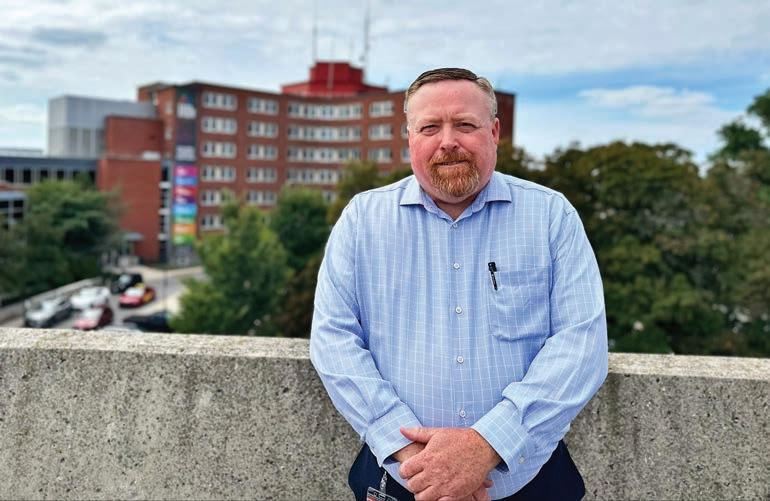
“Everyone has a story. You have to learn and adapt.”
health-care career. Freeport became Grand River Hospital through a merger, and most recently Grand River merged with another Kitchener-Waterloo institution, creating the Waterloo Regional Health Network.
From the outset, he has viewed security — and particularly health-care security — as a profession that requires a devotion to rules and procedure, but also compassion. Patients that enter the hospital are “your friends and neigh-
bours,” he says. “They’re coming in sick and you have to look after them. They’re not just people for processing.” Over his career, Stewart says he’s seen the industry continue to professionalize, as security managers pursue further education, add certifications and credentials, and share best practices.
He is a long-time member of the International Association for Healthcare Security and Safety (IAHSS), and
credits the organization with helping to bring like-minded professionals together. A holder of its CHPA certification from 2016 to 2025, Stewart has also served on the IAHSS’s certification commission as well as secretary of the IAHSS Ontario chapter for 12 years.
In the latter role, he ran an email list and newsletter, connecting chapter members, sharing best practices and disseminating important information. IAHSS members who participated described the e-newsletter as an indispensable source of knowledge and a valuable reference tool.
With no set schedule (there could be three emails in a day, then nothing for a few weeks), the loose but effective format en-
couraged discussion and reminded all concerned that they had common issues and solutions, whether they were in a major city like Toronto or working in a smaller community hospital. More importantly, they were connected through a shared experience.
As security manager for the now amalgamated Waterloo Regional Health Network, Stewart is responsible for the security operations on three different sites. He’s currently in the process of assessing the hospital’s security technology and setting its security agenda for the future.
As a professional with decades of experience, he’s seen how security systems have evolved over the years, helping to support
Kelly Onu sees all the potential that AI and cybersecurity systems have to offer, but is also aware that we must adopt these technologies with our eyes open.
Originally from Nigeria, Onu is a recent resident in Canada, having moved to Toronto earlier this year when she accepted a position as a senior cybersecurity consultant at Ernst & Young (EY).
In her current role she works with clients across finance, health care, retail and other industries on cybersecurity, compliance, and AI-based threat detection strategies.
Prior to moving to Canada, she worked in the U.S. as a cybersecurity consultant and also earned degrees from the Georgia Institute of Technology and Florida International University. She is also a Certified Cloud Security Professional (CCSP), Systems Security Certified Practitioner (SSCP) and Certified Information Systems Security Professional (CISSP).
Onu has made it a priority to
the vision of safer hospitals. It’s not only better surveillance systems and access control, but improved reporting software, which has contributed to the professionalization of the security industry overall.
Stewart is an advocate of training and continual education, and supports security staff who are interested in learning more about mental health awareness or first-aid. He says the goal is ultimately to raise the level of patient care, improve collaboration between security and clinical staff and foster an environment of trust and safety.
“Everyone has a story. You have to learn and adapt,” says Stewart. “As long as I can keep that message going, I’ll be happy with what I’ve done in my career.” | CS

“My goal is to be the voice of securing AI.”
mentor others who aim to enter cybersecurity. She actively participates in Georgia Tech’s “Mentor Jackets” program, which pairs students with alumni who are working in a professional capacity. This year alone, she has mentored more than 20 students.
Onu is an active volunteer. She helped to develop training materials for ISACA’s Secure AI Certification. Onu is also a board member of the TechShift Alliance, a scholarship committee member for Women in Security and Privacy (WISP), and is
currently the co-chair and co-host of IEEE’s “WIE (Women in Engineering) Rise Together” podcast, which is aimed at women who are pursuing careers in STEM. Onu says the most recent episode of the podcast focused on work-life balance for career couples working in technology and cybersecurity. The next episode is devoted to AI and security.
The goal of the podcast, which started earlier this year, is to focus on the lifestyles of career tech workers rather than the technology itself, says Onu, adding that a future episode will likely address how industry professionals can make the adjustment from technical roles into decision-making roles.
As a cybersecurity professional who has studied AI both academically and as a consultant, Onu can appreciate its cap -
acity to both help and harm. While AI might be a huge boon to organizations that wish to speed up workflows and automate certain tasks, there may also be a downside. “Are we thinking about the risks behind it? Are we thinking about how or where the data is coming from, or how training data is used?” says Onu.
She says bad actors are just as ready to use AI as legitimate organizations, and are using it to create sophisticated scams. The ethical considerations are huge and she counsels friends and family to use caution if they receive messages from sources they don’t recognize.
On the positive side of the ledger, AI is helping small businesses to streamline their operations and keep up with larger companies with more resources. “I see a lot of small business owners and entrepre -
neurs leveraging AI to speed up,” she says.
“My goal is really, for one, to be the voice of securing AI across organizations and across businesses, and two, aligning them to industry best practices by following standards. I’ll say the third [goal] is education,” she says adding that she places a premium on improving AI literacy across her mentorship circle.
Onu is a relative newcomer to Toronto, but already has family members who live in the area and she visited frequently before moving there. She says she is enjoying life in the city and appreciates its multicultural vibe.
In addition to her Emerging Leader recognition, Onu received an EY Women in Tech Global Award and last year was named one of the IEEE Computer Society’s Top 30 Early Career Professionals. | CS
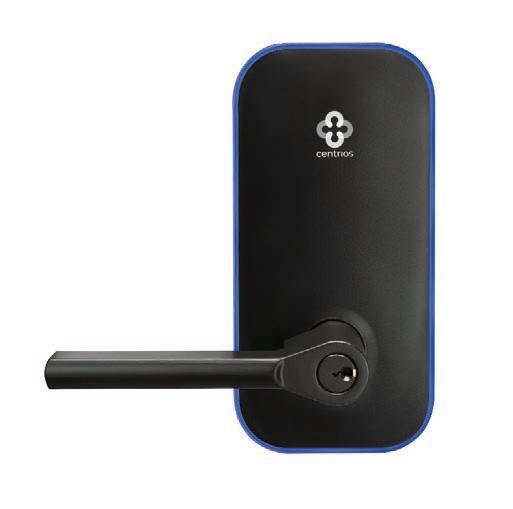
Centrios allows you to manage access to your business by connecting your Centrios locks and smart readers with a simple-to-use mobile app. With Centrios, you can unlock doors with a touch of your phone, manage access for all employees and visitors in one place, and view audit and event reports.





There are many people who can claim to be well connected in the security industry, but it would be difficult to imagine anyone who knows more security, risk and cybersecurity professionals than Grant Lecky.
As co-founder of the Security Partners’ Forum (SPF) in 2011, with his partner Bonnie Butlin, Lecky is not only well connected with a wide variety of associations, groups, experts and professionals, but he has also helped put organizations in touch with one another, facilitating the sharing of knowledge and best practices globally.
The idea for the Security Partners’ Forum emerged from Lecky’s research for his Master’s degree in security-risk management.
“The security professionals I’d been interviewing were all saying pretty much the same thing: how fragmented the industry was,” he says.
Rather than create another security association, Lecky and Butlin established an “agile network” that could help to defragment the industry and put key decision-makers and leaders in touch with one another.
The SPF got its start in Lecky’s home city of Ottawa. The organization quickly spread across the province, then the country, then went international. On any given day, Lecky may be speaking with security professionals from Brazil to New Zealand.
“We’re a global repository of knowledge which we happily and freely share. that’s what the forum has kind of evolved into,” says Lecky who works for the federal government and operates the SPF on a purely volunteer basis.
The SPF became particularly im-

“We try to get the right idea to the right person.”
portant during the pandemic, when associations were effectively shutdown from gathering in-person and had to figure out how to sustain themselves by going almost 100 per cent online.
“We were there to be a network when you needed it,” says Lecky. “When you needed that extra capacity, you could tap into the forum network.”
Lecky’s interests have expanded over the years through his exposure to different aspects of security. He has joined industr y advisory boards and the editorial boards of several professional publications, written articles (including for Canadian Security) and
served in an advisory capacity in the creation of security, resilience and cybersecurity international standards. His efforts have earned him inclusion in the Canadian Who’s Who and he has since joined the publication as a member of its editorial advisory board.
In addition to his recognition as the 2025 Community Leader by Canadian Security, he has also been recognized as Cybersecurity Professional of the Year, Top Security Influencer by the International Security Journal, and was named to Carleton University’s Top 75 for its 75th anniversary.
As a security and risk professional, Lecky has accumulated a large body of knowledge. In addition to his M.Sc. in security and risk management, a holds a BA in criminology and criminal justice, and multiple cer tifications in risk management, business continuity, corporate resilience, fraud-risk management and cybersecurity.
One of his guiding principles, he says, is that ideas should be shared for mutual benefit.
“We try to get the right idea to the right person,” he says. “The fundamental goal of the forum was always to lea ve the industry in a better shape than when you found it. That drives us in everything we do: Is it better?”
Between his full-time work and volunteer efforts through the SPF, Lecky has to juggle a number of different responsibilities, but he says it’s not overwhelming.
One project tends to support and feed the next one. And once they are in motion, they may find new champions or only need tending occasionally. They “converge and coalesce,” he says. “I find myself in the middle of that.” | CS
AlaaAldin (Aladdin) AlRadhi has been teaching cybersecurity and IT in Ontario colleges for decades, but considers himself more of a mentor than a lecturer when it comes to the education and future of his students.
AlRadhi, who received enthusiastic support from his current and former students in his award nomination, began his career in networking and cybersecurity in his homeland of Iraq.
An electrical engineer and IT consultant in the 1990s, he taught in multiple countries including Morocco, Tunisia, Algeria, Sudan, Yemen and Jordan, as well as Iraq. He has also lectured and delivered presentations in Australia and Europe, and holds a BA in electrical engineering from the University of Baghdad and an M.Sc. in cybersecurity from DePaul University in Chicago.
AlRadhi left Iraq in 2003, relocated to Jordan briefly, and ultimately moved to Canada a few years later, settling in the Toronto area.
As a part-time professor, he currently teaches classes at Sheridan College and Humber College, with a curriculum that includes cybersecurity, ethical hacking, digital forensics, artificial intelligence and cloud systems.
As a professor, he sees it as his role to prepare students for the realities of the workplace and the rapidly changing world of cybersecurity.

“I’m more of a mentor than a professor. That means I shape the mindsets of my students,” he says. “I try to reflect what’s going on in the industry. So from day one, I tell them that I’m a mentor, that I will prepare you for your future jobs, and I am preparing your mindset for a career.”
In addition to college education, AlRadhi is also an advocate of technical and industry c ertifications. “I keep telling them that I will mentor and sponsor hard-working students when they graduate from my class and they want to have a plan for certifications,” he says.
AlRadhi also encourages students to attend relevant conferences, and will frequently accompany them to events. He says embracing experiences outside of the classroom and networking with established industry professionals will help students build confidence and get a taste of what it’s like in the real world.
AlRadhi has a lifetime of
experience in electrical engineering and cybersecurity, but
he is also a recognized expert in IPv6, the most recent version of Internet Protocol and the successor to IPv4. IPv6 has been a par t of the internet conversation since the mid2000s and while Canada lags behind some nations with an adoption rate of approximately 40 per cent, AlRadhi recognizes it as an important future step for networking and communications, and also makes it a part of his teaching curriculum.
A lifelong learner himself, AlRadhi sees it as both a privilege and a duty to pass along his knowledge to others. | CS

By Muraly Srinarayanathas
In today’s hyper-connected world, cybersecurity is no longer just an option; it has now become a necessary component of a business.
For small to mid-sized businesses (SMBs) in Canada, cyber-risks are growing faster than ever, fuelled by advances in technology that are being used for both good and harm. What was once seen as a cost centre, security has now become a strategic asset, not only protecting businesses, but also building trust and driving revenue through enhanced credibility and employee and customer confidence.
While many of us now take advantage of AI for its efficiencies by helping us automate processes and scale operations, these same tools are now aggressively used by cyber attackers. Where once an attack required human effort, today, a single individual can launch complex, multi-pronged attacks using AI agents that replicate strategies at scale. Cybersecurity risks have become so prominent that there are now two types of SMBs: those that have been hacked, and those that are unaware of it yet.
Gone are the days when cybersecurity meant telling your employees not to click on suspicious links. Today, attackers don’t even need you to click anything.
We’re now living in the era of zero-click worms: malware that can infect your systems without any user interaction at all. Cyber attackers are

now commonly using deepfakes, misinformation campaigns and data-driven AI attacks, which often evade traditional firewalls undetected.
“SMBs in Canada must adapt with smarter, faster and more integrated strategies.”
Firewalls, as most companies know them, were designed for an era when threats originated from clear, external sources and required user action to be successful. However, today’s threats are often invisible, internal and autonomous, and organizations might already be compromised without even realizing it.
Small and mid-sized businesses are attractive targets. They often lack the robust security infrastructure of large enterprises yet still hold sensitive data, such as personal, financial or operational information, which makes them prime targets, as even fragmented data can be pieced together and sold not only on the
dark web, but increasingly in the open. It’s no longer just about ransomware attacks; hackers are after data that helps them pursue largescale felonies, including identity theft, business espionage or fraud networks.
With the rise of cloud-based services, distributed teams and accessible AI tools, the opportunities to attack have expanded significantly. Attackers no longer need to be highly skilled hackers; they just need the intent, and AI can now handle the rest.
Canadian SMBs can incorporate three fundamental actions to boost their cybersecurity significantly: 1. Elevate cyber-awareness beyond annual training: Many companies offer annual cybersecurity training, but that’s no longer enough. Like fire drills, it’s essential to have regular cybersecurity drills. These can include simulated
attacks, “escape room” style exercises, as well as scenario-based learning to help employees stay alert. By running such drills, testing reactions and incorporating security into a company’s business culture, employees can become more alert to potential threats and learn how to respond to them effectively.
2. Cybersecurity is not just an IT problem: The IT department may manage infrastructure, but security is a separate and evolving discipline. Many SMBs make the mistake of lumping the two together. If companies cannot handle their security resources internally, they should consider outsourcing to a managed security service provider (MSSP) that specializes in their industry — this is especially important for SMBs. Whether it be health care, finance, education or retail, there are sector-specific threats and compliance requirements that demand deep expertise, and MSSP services
can range widely in cost, from premium offerings to more budget-friendly options.
3. Partner with your cyber-insurance provider: Cyber-insurance is a proactive tool that most providers use to help you conduct risk assessments, identify blind spots and pinpoint areas where your policies may fall short. It is much more than just coverage after an incident; they’re partners in prevention, not just protection, and companies need to take better advantage of their services.
At Computek College, we recognize this gap and are taking proactive steps to address it. We’re preparing to launch a major cybersecurity operations centre where students are not only trained in real-world scenarios but also offer shared cybersecurity services for
Canadian SMBs with support from the Canadian Centre for Cybersecurity and the Province of Ontario Centre of Excellence.
Providing a live cybersecurity team run by trained students and guided by expert faculty who can monitor, identify and respond to cyber threats in real time — this will be an affordable, scalable solution for businesses that don’t have in-house teams but can’t afford to be vulnerable.
Cyber threats aren’t just evolving, they’re also multiplying. As they do, SMBs in Canada must adapt with smarter, faster and more integrated strategies.
Awareness, structure and access to new forms of protection, such as shared operations centres, are how we are levelling the playing field, as cybersecurity expertise is becoming more in demand for all types of companies. | CS
Muraly Srinarayanathas is the CEO of Computek College (www. computek.edu).
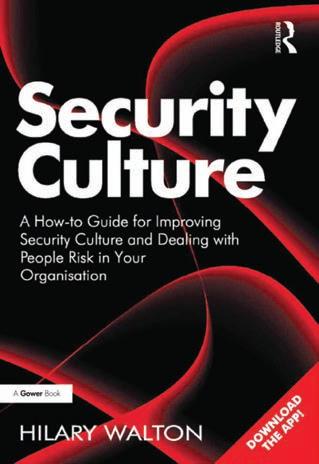

SecurityCulture starts from the premise that, even with good technical tools and security processes, an organisation is still vulnerable without a strong culture and a resilient set of behaviours in relation to people risk.
Applying the techniques included in Security Culture will enable you to introduce or enhance a culture in which security messages stick, employees comply with policies, security complacency is challenged, and managers and employees understand the significance of this critically important, business-as-usual, function. $67.70 | Item #1032837512
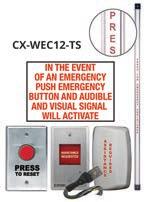
Camden Door Controls
Camden introduces two new emergency call system kits designed for universal restrooms with or without low-energy door operators. Both kits meet the latest OBC and City of Toronto Building Code requirements. The CX-WEC12-TS and CX-WEC13-TS kits include a 33 1⁄2” vertical ‘PRESS FOR EMERGENCY ASSISTANCE’ Ribbon Switch. When the Ribbon Switch is pressed, it activates the exterior corridor LED annunciator and illuminates the interior LED ‘ASSISTANCE REQUESTED’ annunciator. The units feature adjustable volume annunciation and 1/2” depth single gang electrical box mounting. Both kits include the CX-LRS24 24V latching relay assembly and emergency assistance white panel signage available in English, French and bilingual. www.camdencontrols.com
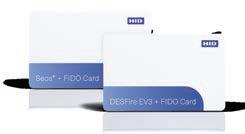
HID’s Seos and MIFARE DESFire EV3 FIDO (Fast Identity Online) enabled cards offer a secure, all-in-one solution for passwordless access to both business applications and physical spaces. Certified to the latest FIDO specifications, this solution eliminates the need for passwords by storing PKI-based passkeys on the device. The Seos FIDO-enabled card combines advanced physical access technology with FIDO2.1 authentication in a single credential, while the MIFARE DESFire EV3 FIDO-enabled card integrates smart card capabilities with unified digital access. www.hidglobal.com

Symmetry Access Control V10 brings together modular software, modernized hardware, mobile-first capabilities, and expanded cloud offerings into one unified security ecosystem. Symmetry Access Control V10 introduces two major enhancements designed to improve system visibility and elevate the user experience. The System Health Dashboard delivers real-time insight into system status, device performance, and key metrics. V10 also makes it easier to adopt Symmetry Wallet, AMAG Technology’s mobile credential solution that provides secure access via a smartphone. AMAG Technology will release a major version of Symmetry software each year, starting with V10 in 2025. This consistent cadence brings greater predictability, allowing product management to communicate clear timelines for backward compatibility and support.
www.amag.com
Salto has launched the XS4 One S, a next-generation addition to the XS4 One product family. This new series offers enhanced features and a contemporary square design. Compatible with a wide range of global door standards, the XS4 One S supports easy installation and retrofitting for new and existing doors. The XS4 One S Series integrates Salto’s smart access technologies, including Salto Virtual Network and BLUEnet Wireless connectivity. These solutions allow new electronic locks to function offline, online or in a hybrid mode.
www.saltosystems.com
Allegion


Allegion has introduced the Outdoor Defense (OUT) option for 98/99 exit devices, the first Von Duprin product designed to protect device functionality in outdoor conditions. The Outdoor Defense option is designed to safeguard against moisture, temperature variations and corrosion in exterior applications and is available for the 98/99 Series rim and surface vertical rod exit devices. The Outdoor Defense option is also available for mechanical devices as well as electronic components, such as switches, latch retraction, delayed/controlled egress, alarm kits and more. Outdoor Defense products are designed to perform in outdoor conditions within the parameters of the products testing conditions such as courtyards, perimeter security, rooftops and patios. www.vonduprin.com






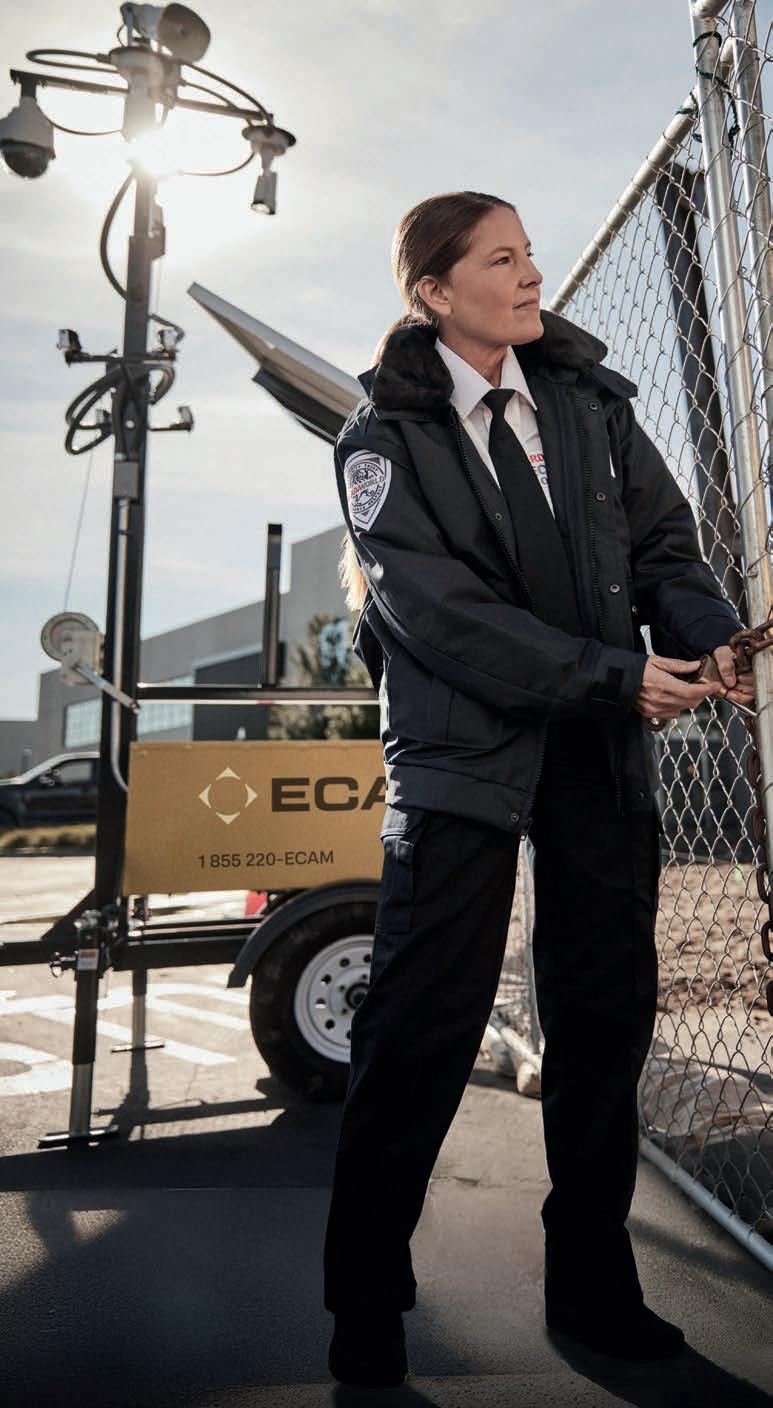
GardaWorld Security is ready with tailored, cutting-edge hybrid solutions that provide more value at every turn. By combining security guards and mobile surveillance units, we lower risks and reduce the costs of negative events in real time by preemptively addressing potential damages, identifying false alerts, and ensuring immediate resolution.
Key benefits:
Rapid response
Wide area coverage
Proactive measures
Cost effective
garda.com/hybrid-security