(800) 265-2827 or (519) 429-3966 Fax: (519) 429-3094
READER SERVICE
Print and digital subscription inquiries or changes, please contact Angelita Potal, Customer Service
Tel: (416) 510-5113 • Fax: (416) 510-6875
Email: apotal@annexbusinessmedia.com
Mail: 111 Gordon Baker Rd., Suite 400, Toronto, ON M2H 3R1
EDITOR I Mike Lacey mlacey@annexbusinessmedia.com (416) 510-5115
ASSOCIATE EDITOR I Macenzie Rebelo mrebelo@annexbusinessmedia.com (416) 510-6851
BRAND SALES MANAGER I Nav Matharu nmatharu@annexbusinessmedia.com (226) 931-5095
ACCOUNT COORDINATOR I Barb Comer bcomer@annexbusinessmedia.com (519) 429-5171
AUDIENCE DEVELOPMENT MANAGER Shawn Arul sarul@annexbusinessmedia.com (416) 510-5181
MEDIA DESIGNER I Brooke Shaw
GROUP PUBLISHER I Danielle Labrie dlabrie@annexbusinessmedia.com (226) 931-0375
CEO I Scott Jamieson sjamieson@annexbusinessmeda.com
Publication Mail Agreement #40065710. Printed in Canada ISSN 0383-7920
Subscription Rates Canada- 1 Year $ 45.90 + tax U.S.A. - 1 Year $104.55 (CDN)
Occasionally, Canadian Rental Service will mail information on behalf of industry-related groups whose products and services we believe may be of interest to you. If you prefer not to receive this information, please contact our circulation department in any of the four ways listed above.
All rights reserved. Editorial material is copyrighted. Permission to reprint may be granted on request.
Serving the Canadian rental industry for 45 years. www.canadianrentalservice.com
The value of first impressions really hit home when my family was suddenly in need of a new car. 6
Manufacturing sector sees biggest decline since 2021. 20
10 INDOOR ADVANTAGE
Due to no emissions and little noise, electric-powered equipment is suitable for a variety of situations.
A
How to protect your business from cyber crime.
Breaking up with your customer.
24 PRODUCT SHOWCASE
A preview of the latest compact wheel loaders on the market.
30
SNOOK’S LOOK
Perhaps Canada’s construction sector can turn lemons into lemonade? 16
It should’ve been an easy sell
by Mike Lacey
The value of a first impression really hit home when my family was suddenly in the market for a new car
The last thing I wanted to do was buy a car.
In my experience, there is never a good time to buy a new vehicle, but this a particularly difficult period to do so. That is evidenced by the June inflation numbers released by Statistics Canada. While overall inflation increased to 1.9 per cent in Canada, the rise was far more pronounced among passenger vehicles where the price rose 4.1 per cent year over year. Even used vehicles saw a price increase year over year, the first time in 18 months, Stats Can noted.
Of course, it was a used vehicle I was in the market for – and not by choice.
Like many Canadian families, ours is a twocar household. One of those vehicles was a 2015 Honda Civic. It was a good little car, great on gas and, I’m proud to say, well looked after.
“The vibes weren’t right. I know vibes shouldn’t matter, but often they do.”
It was also the car we let our teenage son drive. It was while he was driving, waiting to turn left, that a pickup truck slammed into the car’s rearend. My son was fine and so was the pickup truck. Our old Civic? Not so much. The damage was extensive, and the insurance company wrote off the vehicle.
That left us looking for a new car (new to us at least).
Our plan was to purchase a similar vehicle –older, a couple hundred thousand kilometres, but reliable enough to last a few years. We did not want to spend any money out of our own pocket so had to keep the budget to within what the insurance paid out. Which was not much. This meant we had to widen our search and branch out from our small city.
My wife hopped on AutoTrader.com and narrowed down a few possibilities. One vehicle was at a dealership just outside Toronto, about an hour or so from our house. My wife and son decided to check it out.
I know it’s now cliché to discuss the value of customer service, but it’s cliché because it’s true. The pair were ready to buy, willing to pay for it with cash and just wanted to get a good look at the vehicle before making a final decision.
It should’ve been an easy sell. However, poor customer service made sure they wouldn’t be coming back.
When they entered the dealership, they were greeted by two employees sitting a few feet behind the counter and chatting. My wife and son stood at the counter and … waited. They were ignored for a few moments before a third employee turned up and asked what they wanted. My wife explained they were interested in looking at a specific vehicle.
That led to a slight, and uncomfortable, argument between the three employees over who would show them the vehicle. Once that was worked out, my wife and son were brought to the car and left to look at it.
They spent some time going over the car, but the employee did not stick around to answer any questions.
Eventually, they went back inside to get some answers. They were led down a dark and filthy hallway and to a slightly less dark but just as filthy office. My wife knew she wasn’t buying this car. The vibes weren’t right. I know vibes shouldn’t matter, but often they do.
She left and we continued our search, eventually buying a vehicle from another dealership where the treatment was completely different.
But that first car was still probably at the top of our list. However, the attitude of employees and the state of the business scared us off.
It was a good reminder to me that first impressions really do matter.
mlacey@annexbusinessmedia.com
INDUSTRY NEWS
BRANDT APPOINTED AS DEERE CONSTRUCTION AND FORESTRY DEALER IN AUSTRALIA
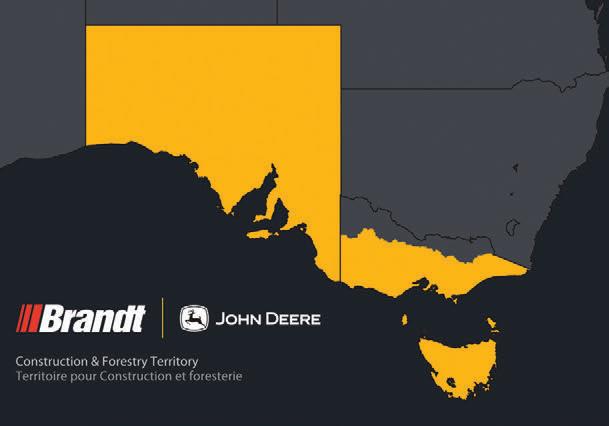
Canadian company Brandt is named the new John Deere Construction and Forestry dealer for Victoria, South Australia and Tasmania.
Brandt started with a single John Deere construction dealership in Saskatchewan, Canada, in 1992 and through a customer-first philosophy, they have built a reputation in each region they serve. Today, Brandt has a global presence with 64 locations across Canada, Australia and New Zealand.
Brandt’s extension into Deere’s lineup of equipment is the next chapter in its ongoing investment across Australia. Since entering the Australian market in 2021, Brandt has invested in their network of agriculture, golf and compact construction equipment dealerships, growing their teams, putting more parts on the shelf and more technicians on the road. Brandt will be responsible for serving construction and forestry customers in all of South Australia and Tasmania as well as key areas throughout Victoria, including: Metropolitan Melbourne, Gippsland, Barwon, Southwest Victoria and Parts of Northeast Victoria, Hume and Loddon Mallee.
FALCON EQUIPMENT EXPANDS SERVICE FLEET IN THOMPSON-OKANAGAN REGION
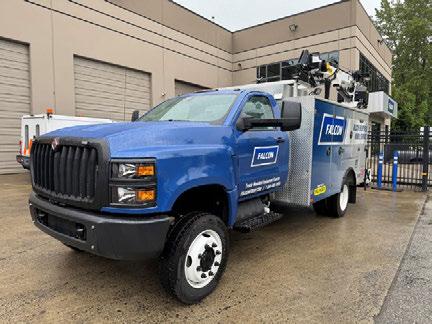
Falcon Equipment has expanded its mobile service fleet into B.C. Thompson-Okanagan region. Falcon Equipment will now offer on-site equipment support to customers in Kelowna, Kamloops, Penticton, Vernon, Merritt and surrounding communities.
Falcon’s fully equipped mobile service trucks are staffed with trained technicians and heavy-duty mechanics who can handle a wide range of tasks, including:
• Diagnostics and troubleshooting
• On-site repairs and maintenance
• Crane inspections and safety testing
• Hydraulic system service
• Parts delivery and installation
Falcon Equipment states its mobile equipment service helps reduce downtime and keeps operations running smoothly, saving you time, towing costs, and lost productivity.
COMING EVENTS
2025
Sept. 9
Canadian Rental Association Webinar: Equipment Theft in Canada Online
crarental.org/Web/Events
Sept. 17
Western Canada 2025 ARA Golf Tournament Acheson, Alta. www.theranchgolf.com
Sept. 30 - Oct. 1
The Canadian Rental Mart Etobicoke, Ont. canadianrentalmart.com
Oct. 7- 9
The Utility Expo 2025 Louisville, KY. www.theutilityexpo.com
2026
Feb. 11-12 2026
Canadian Concrete Expo Toronto, Ont. canadianconcreteexpo.com
March 2-4 2026 ARA Show Orlando, FL. arashow.org
March 3-7 2026
CONEXPO 2026 Las Vegas, NV. www.conexpoconagg.com
Visit canadianrentalservice.com for updated Coming Events listings
PHOTO: BRANDT
PHOTO: FALCON EQUIPMENT
MANUFACTURING SECTOR SEES BIGGEST DECLINE SINCE 2021
Statistics Canada has released its gross domestic product (GDP) by industry data for April.
The GDP edged down 0.1 per cent in April, following a 0.2 per cent increase in March; the goods-producing industries were down 0.6 per cent in April, with the manufacturing sector accounting for nearly all the decline.
The manufacturing sector contracts on broad-based declines in April
The manufacturing sector was down 1.9 percent in April, the largest drop since 2021, across both durable and non-durable goods manufacturing aggregates, according to Statistics Canada. In April, durable goods manufacturing was down for the first time in four months as eight of 10 subsectors contracted. The transportation equipment manufacturing subsector was the largest contributor to the decline, registering its largest monthly contraction since 2021, when prolonged global supply chain disruptions and semiconductor shortages hit motor vehicle manufacturing.
Estimate for real gross domestic product by industry for May 2025
According to Statistics Canada, advance information indicates that real GDP decreased 0.1 per cent in May. Decreases in mining, quarrying, and oil and gas extraction, public administration and retail trade were partially offset by an increase in real estate and rental and leasing. Owing to its preliminary nature, this estimate will be updated on July 31, 2025, with the release of the official GDP by industry data for May.
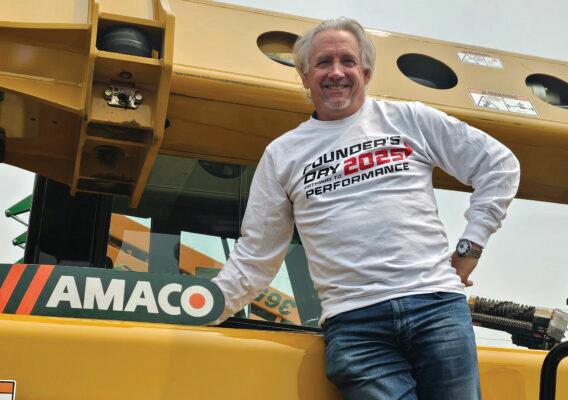
AMACO GENERAL MANAGER JEFF MACDONALD RETIRES
Amaco Construction Equipment Inc., one of Ontario’s oldest heavy equipment dealers, announces the retirement of general manager Jeff MacDonald. Jamie Armstrong, vice president of Amaco, has been appointed as president and assumes the role immediately.
Jeff MacDonald joined Amaco in 1987 after starting his civil engineering career. MacDonald joined the business his father founded in 1983, and began his tenure at Amaco as a sales representative serving Southwestern Ontario. Over the years, McDonald held senior roles, eventually acquiring the company in 2010.
Jamie Armstrong brings over a decade of leadership experience at Amaco, having joined the company in 2012. Armstrong plays a pivotal role in driving modernization initiatives, including the development of Amaco’s refreshed brand and forthcoming website.
VOLVO CE EXPANDS PRODUCTION IN NORTH AMERICA
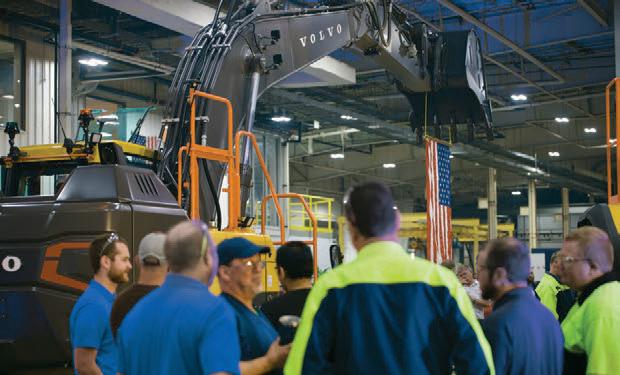
As part of a larger global industrial footprint investment to support growing customer demand, Volvo Construction Equipment (Volvo CE) will begin producing crawler excavators and large wheel loaders in Shippensburg, Pennsylvania.
• Shippensburg will add capabilities to produce mid-to large-size excavators, thereby increasing its global industrial footprint and flexibility.
• The total global investment of $261 million aims to strengthen Volvo CE’s crawler excavator position across three main production sites in South Korea, Sweden and the United States.
• In addition, the Shippensburg site will add four large wheel loader models to its current wheel loader production.
• Production plans to start in the first half of 2026.
Volvo CE is investing in expanding production worldwide
For crawler excavators, three main sites will see approximately $261 million invested to expand crawler excavator production to meet growing customer demands, mitigate supply chain risks and reduce reliance on long-distance logistics. These sites include the U.S., South Korea, and Sweden.
In Shippensburg, Volvo CE will not only add crawler excavator production but also expand wheel loader production to include large wheel loaders. Currently, soil and asphalt compactors and mid-size wheel loaders are manufactured at the Shippensburg factory.
Updates will be made to the existing space within the factory to install assembly lines, integrate more automation technologies into the manufacturing process and train employees, with the goal to be production-ready in the first half of 2026.
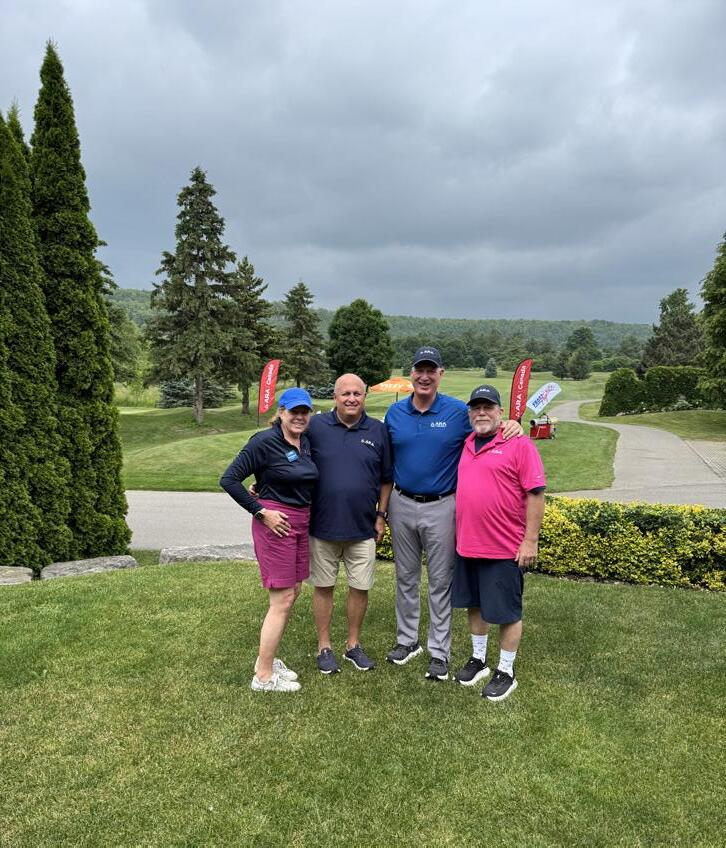
HAPPY GOLFERS
The American Rental Association’s Ontario golf tournament took place Wed., June 18 at Ridge Golf Club in Milton, Ontario. Despite torrential rains, nearly 100 golfers still had a great day of golfing, lunch, dinner and awards.
Jeff MacDonald, retired general manager of Amaco.
Volvo CE employee town hall meeting.
PHOTO: AMACO
PHOTO: VOLVO CE
VOLVO CONSTRUCTION EQUIPMENT
WINS RED DOT AWARD FOR NEW ELECTRIC DESIGN
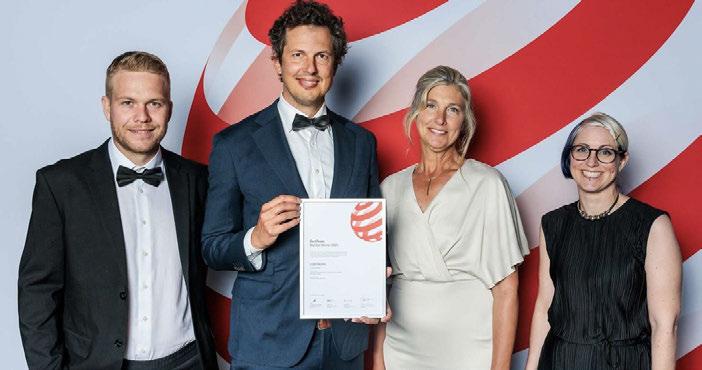
A global team of Volvo engineers and designers won a Red Dot Product Design award for the L120 Electric wheel loader at the annual ceremony in Essen, Germany.
The thoughtful design supports improved visibility, safety and sustainability and is the first of its kind within Volvo’s broad portfolio of electric solutions. The Red Dot is one of the world’s largest and most respected design competitions and recognizes outstanding achievements in product and industrial design, states Volvo.
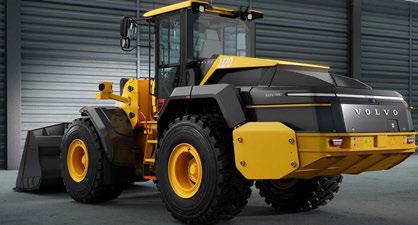
The streamlined frame of the electric loader is made possible because of the removal of a combustion engine. The result is a transformation from a boxy rear end common to diesel machines into a sleeker shape for the new era of electric.
If designers replaced the combustion engine with larger batteries, this would have not only created a bulkier shape but would have also reduced visibility from the cab. As wheel loaders are designed to be driven both forwards and backwards in equal measure, all-around visibility is crucial to their safe and efficient operation. Instead, engineers and designers worked together on
a more thoughtful solution and agreed to integrate the batteries into the counterweight of the machine. The heavy weight of a battery is often seen as a problem in electric machine design, but in this case, the battery is being used to replace a concrete counterweight required for wheel loaders.
PHOTO: VOLVO
PHOTO: VOLVO CE
Above: from left, Jonas Fredberg, studio engineer, Peter Reuterberg, senior chief advanced designer, Jenny Arnell, group manager, and Nina Augustsson, design director.
Left: The new look L120 Electric.
INDOOR ADVANTAGE
Due to no emissions and little noise, electric-powered equipment is suitable for a variety of situations
by MIKE LACEY
As a wave of electric-powered construction equipment hits the market, it’s important to consider what applications these machines are suitable for.
While electric-powered equipment may meet the needs of those who are environmentally conscious, there are also more practical advantages to consider besides helping a company reach its carbon reduction goals, explains Darren Ashton, with Volvo CE.
“Noise is one. Emissions is a big one too because a machine like that works really well inside of buildings,” he explains.
As an example, he notes a customer of one of Volvo’s dealers was doing work inside a grocery store and they used a compact electric excavator.
“Not only could he bust the concrete around, he could load it into the wheel barrels far more faster and efficient than what he used to be [doing],” he says.
ELECTRIC EQUIPMENT SUITED FOR INTERIOR DEMOLITION
Toro’s Kaitlyn Ignli agrees and says there is a growing demand for electric-powered equipment because of that versatility.
“Propane and diesel with scrubbers can only go so far,” she says. “If there are low noise or low smells, if you’re in an active building, schools are probably the most prominent. If you have kids on one side (of a building), you can’t have a lot of exhausted emissions.”
The company highlighted three new pieces of electric-powered equipment at this year’s American Rental Association conference. The eDingo TX 750, Ultra Buggy e2500-TS and Ultra Buggy e2500-THL
were all designed and built with a focus on the challenge of interior construction.
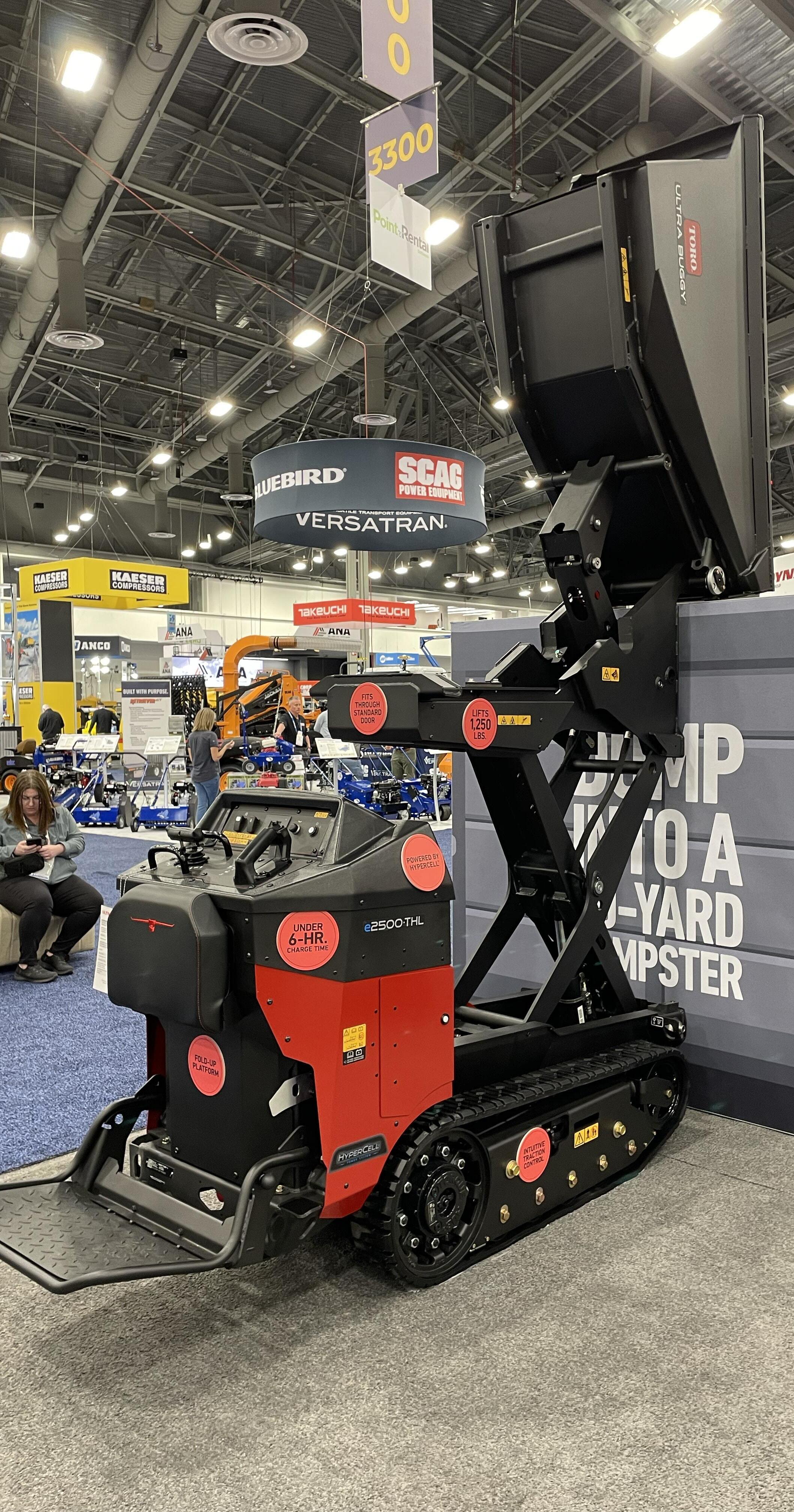
The high-lift Ultra Buggy e2500-THL can dump into a 30-yard dumpster and operate continuously for up to eight hours on a single charge.
It has a carrying capacity of 1,250 pounds at full 76-inch dump height and 12.8 cubic feet volume. With a 31.5-inch width, the machine can navigate tight indoor spaces, doorways and hallways. Toro designed the electric buggy to work hand in hand with the Dingo.
The genesis of the machine was five years ago while Toro was watching a customer on the jobsite, Ignli says.
“They were demoing a building, and they were bringing the debris out and throwing it on the ground. They had rubber made trash bins, wheel barrels. They were just throwing it on the ground, and then they would have a skid steer come in and lift it and throw it into a dumpster. And so, for us, that was two points of contact for that material. It was one contact too many. We wanted to figure out a solution that could get that customer to get one fluid motion, getting the three out of the building it into the dumpster. This is where that high lift was born.”
LACK OF NOISE EMISSIONS ARE AN ADVANTAGE
Beside interior demolition, Aston says electric-powered machinery also works well in the food production industry. The lack of exhaust is one reason, but
the lack of noise is another.
“We’re starting to find anything with cows, they don’t like noise.”
Dairy operations, as an example, would prefer that electric equipment is used, he explains.
“(Volvo) also did a trial at the Toronto Zoo. We were able to work around the buffaloes without having to get them caged while (crews) were doing some work around a pond,” he says.
Case Construction Equipment says it noticed a growing demand in the construction industry for electric equipment on the jobsite. To meet the unique requirements where noise and emissions are to be kept as low as possible, Case bolstered its electric lineup with the addition of five new machines. Case’s lineup now has the industry’s first fully electric backhoe (the 580EV), two mini
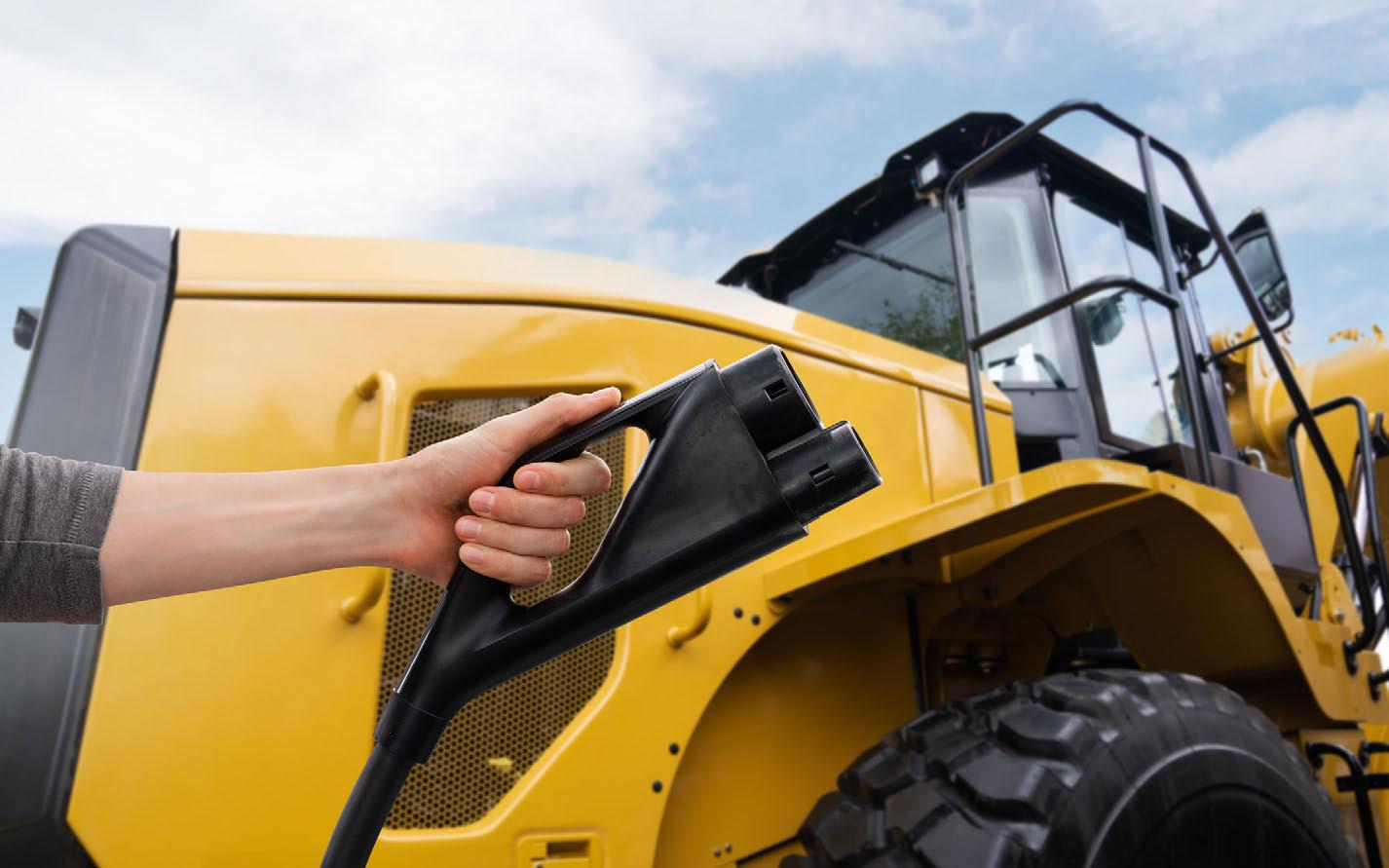
Electric-powered equipment is suitable for a variety of applications where noise and emissions are a factor. PHOTO:
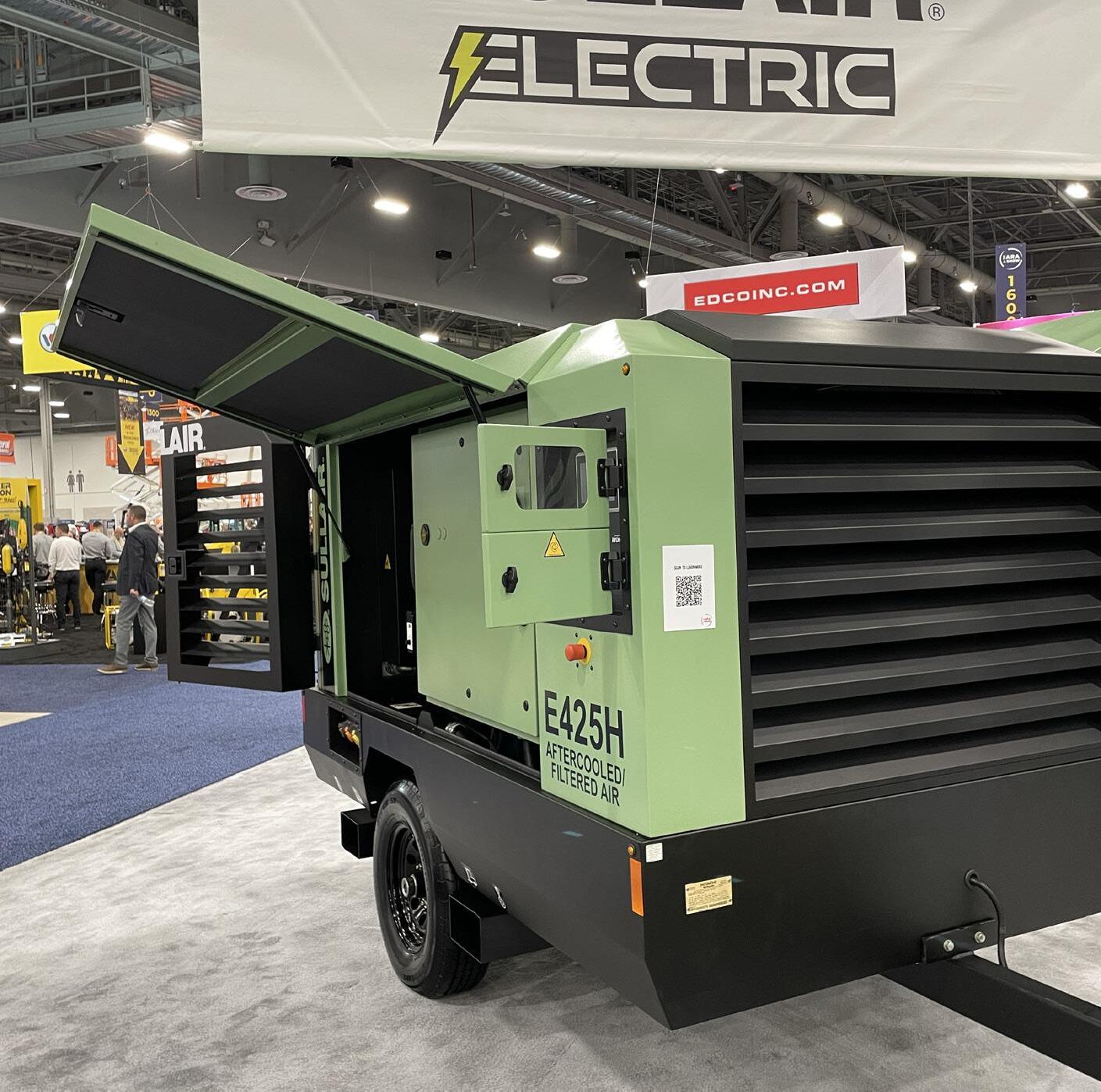
Sullair’s E425H electric rotary screw portable air compressor delivers 425 CFM at 150 psi of compressed air power with the same performance as a diesel-powered compressor.
PHOTO: MIKE LACEY
Toro’s Ultra Buggy e2500-THL can dump into a 30-yard dumpster and operate continuously for up to eight hours on a single charge.
excavators, a small articulated loader and the new CL36EV electric compact wheel loader, which was released in April of this year. According to Case, the CL36EV is a versatile machine that performs the same as its diesel counterpart but has the benefits of an electric-powered machine with zero emissions, low noise and simplified maintenance. The CL36EV can be used for landscaping and hardscaping to largescale building renovations or projects where indoor operation is required.
Portuguese company Nors sells and rents Volvo CE equipment in countries around the world, including in most of Canada.
COO Francisco Ramos says Volvo CE (and by extension Nors) is and wants to be a leader in that transformation to electric-powered construction equipment.
“Volvo Construction Equipment has developed significant investments in that equipment because want to be industry leaders – and they are,” he says.
However, while he notes the presence of electric-powered equipment will increase in all segments of the construction industry over the next few years, he says the question remains on how quickly that transformation will happen.
“It’s difficult to know with which speed this growth will happen,” he says. “I have no doubt we will have permanent growth. But if you ask me how many units we expect to sell in next five years, I don’t have accurate figure to give you.”
COST AND LACK OF INFRASTRUCTURE STILL A CONCERN
That is due to a few factors, he explains. First is the cost.
“The total cost of ownership is not yet recognized by customers. Initial investment is higher than a normal machine and a lot times you buy this machine, you make an investment decision, you have a certain amount of money to spend. It’s
PHOTO: MIKE LACEY
clear at this moment, the initial price is off [for] electric machines compared to classic machines,” he says.
However, he notes, the gap in the price difference is quickly decreasing.
A second problem is the lack of infrastructure in some jurisdictions to fuel electric-powered equipment.
“Most of countries are not prepared to have infrastructure for machines to operate 24 hours a day if you need it,” he says.
However, he notes the quality of electric-powered equipment is quite good and those who may be skeptical of their performance will change their tune once they test out the machines.
Dave Andrews, with Sullair, says it’s the customer who is really driving the demand for electric.
“A lot of people are asking for more environmentally friendly solutions,” he says, adding they are seeing it through the United States. “Even Canada, the demand is electric. In general, Canadians are
“Most of countries are not prepared to have infrastructure for machines to operate 24 hours a day.”
– Francisco Ramos
much more concerned with the environment than most Americans, especially the farther south you go, you go to Texas, they like their oil.”
Sullair’s E425H electric rotary screw portable air compressor was unveiled at this year’s American Rental Association conference. The all-electric portable air compressor delivers 425 CFM at 150 psi of
compressed air power with the same performance as a diesel-powered compressor. The only difference is that it has no emissions so it can run indoors.
“And this is key for the rental market. You can bring this inside. So, when we think about rental, most people look at a compressor like this, and they go, ‘OK, we’ll pull it alongside for a construction project.’ But there’s a huge opportunity for what’s called a backup plant air.”
He explains if a factory using a compressor, needs to take it down or maintenance or some other reason, they can don’t need to shut the factory down.
“You can rent this, literally put it right into the factory, hook it up to your main airlines inside the factory, hook it up to power and go. Because it’s completely ready to run inside electric, no emission.”
Sarah Vincent, with JLG, says the company is seeing growing demand for electric-powered telehandlers, particularly in warehouse applications. CRS
More Reliable
Maximum Uptime
24/7/365
Superior Fleet
Appeal to more customers with more options, including ride-along, walkbehind, and towable equipment.
EVENTOLOGY Supporting the backbone of events
by Michelle Nicol, CERP
In the fast-paced, high-demand world of event rentals, it’s easy to think of ‘company culture’ as something that happens solely in the front office. In reality, culture also lives and breathes in the warehouse, on the road and in the middle of downtown Toronto during an intense festival install. If you’ve been accidentally overlooking your delivery, logistics and warehouse teams when it comes to culture-building, you’re missing the heart of your operation. In an industry where seasonal surges, long days and hard physical labour every day are expected, turnover can be high, but it doesn’t have to be. With a few intentional practices, companies can build loyalty, morale and a team that sticks around – for better or for worse.
1.
APPRECIATION GOES FURTHER THAN YOU THINK
You don’t always need flashy perks or expensive bonuses to show your team they matter. Genuine and consistent recognition is powerful and fills the cups of your employees. A sincere thank you at the end of a busy day, a surprise team lunch after a major setup, or a simple shout-out for extra effort. Recognizing that warehouse and delivery staff are an important part of the client experience, not just the behind-the-scenes crew, shifts how they view their role. After all, these are the people clients often interact with first and last on event day and how they act, represents your brand and sets the tone for more business. If you treat them like the ambassadors of your brand that they are, they’ll rise to that standard with every client interaction.
2. CLEAR COMMUNICATION PREVENTS BURNOUT
Miscommunication is one of the fastest ways to create frustration between staff and crew members. Your team shouldn’t have to guess what’s happening and come to their own conclusions. Quick daily or weekly huddles, printed schedules and detailed floorplans can go a long way toward keeping everyone on the same page. Even
more importantly, create space for your team to share their input. When individuals feel heard and well-informed, it fosters a sense of trust and respect which are the key components to a healthy and positive workplace culture.
3. SYSTEMS THAT SUPPORT NOT STRESS
Clear systems don’t just improve efficiency; they reduce stress and eliminate blame. When teams know exactly how to pick an order, load a truck, prep for an installation, or pack a job site kit, they work faster, more accurately, and make fewer mistakes. This builds trust among team members and gives new or seasonal staff a fair shot at success. Creating clear documentation of your processes will not only to meet standards, but build confidence in your team.
4. BUILD A WORKPLACE WHERE EVERYONE FEELS AT HOME
Culture doesn’t always just mean ‘corporate’ and positive employee engagement scores. Sometimes it’s music in the warehouse, a good hoodie with your logo on it that crew love to wear, cold water bottles on a hot day, or celebrating a teammate’s birthday with a coffee run. These things might seem small, but they matter and are so appreciated. Physical work environments can feel transactional. A little effort here and there to build personal connection makes your space feel like a team, not just a production line of employees completing tasks. At the end of the day, a strong company culture, across every department from sales to warehouse to logistics, isn’t just a nice-tohave, it’s a true competitive advantage.
In our industry, whether it be event rental or tool and construction, it’s not just your inventory that moves the business forward, it’s your people. Invest in them, and they’ll invest right back. CRS
Michelle Nicol, CERP, is an award-winning account executive for Element Event Solutions in Toronto.
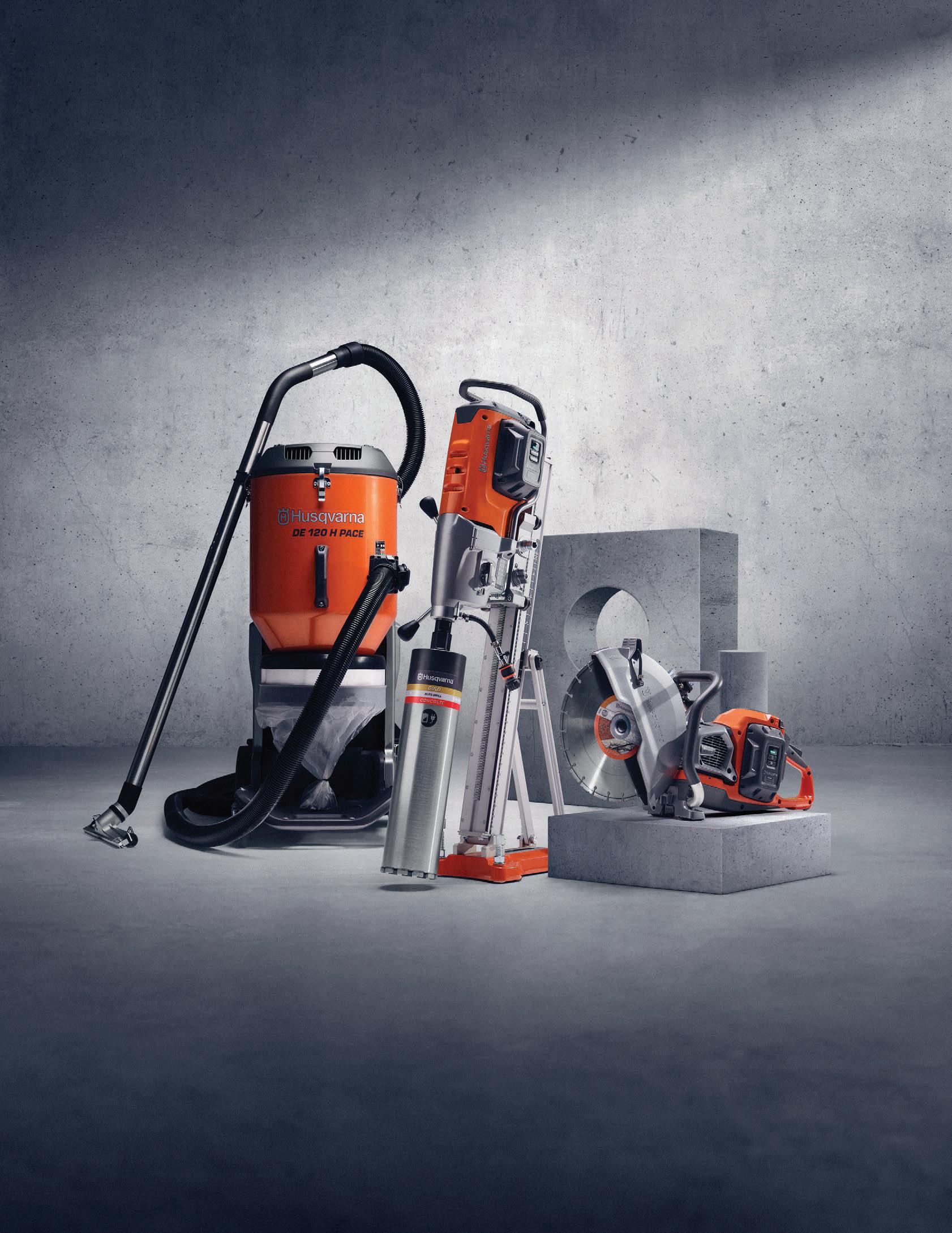
The Husqvarna PACE battery system is a growing family of heavy-duty machines and equipment that gives you and your customers 94V of real power – wherever. See how it opens new opportunities amongst a range of hardcore applications – all using the same batteries and chargers to minimize operating costs. Contact your sales representative today! www.husqvarnaconstruction.com
RENTAL MART IS BACK
Two-day event for equipment and event rental stores returns to Toronto Sept. 30 and Oct. 1.
The only event for Canadian equipment and event rental stores is returning to its roots.
by MIKE LACEY
Canadian Rental Mart is back in Toronto for the first time since 2022. The two-day event takes place at the Toronto Congress Centre on Sept. 30 and Oct. 1. It will feature exhibits from some of Canada’s top suppliers, informative education sessions and an opportunity to meet with friends and colleagues at social networking events.
WIDE RANGE OF EXHIBITORS
Canadian Rental Mart is Canada’s only show dedicated to the equipment rental market. With more than 50 booths to visit, exhibitors represent the diverse range of the construction and landscaping market from manufacturers to dealers to parts suppliers.
Equipment manufacturer Zoomlion will have a significant presence at this year’s show. The company manufactures a wide range of heavy and compact equipment in the agricultural, construc-
tion and mining sectors.
Software companies tailored for the rental market are well represented at Canadian Rental Mart. Alert Rental Software, Kerridge-Klipboard, Point of Rental Systems and Quipli will all be in attendance.
This year’s show features manufacturers of aerial work platforms such as Platform Basket
Canada and Skyjack as well as equipment dealers, including G.C. Duke Equipment and forklift specialists Heli Canada. Parts suppliers such as All States AG Parts also have booths.
Want to learn more about generators? Companies such as Genrep will be on hand. Construction heaters? Flagro or Sure Flame have you covered.
Along with a diverse group of exhibitors, Canadian Rental Mart also features a series of informative sessions.
WOMEN IN RENTAL PANEL DISCUSSION
To kick off day one of Rental Mart, Canadian Rental Service magazine associate editor Macenzie Rebelo will lead a panel discussion with women leaders in the equipment and event rental industry. Panelists are:
• Tracey Scholes, branch manager, Herc Rentals Inc.
• Kristina Sheridan, branch manager, Cooper Equipment Rentals.
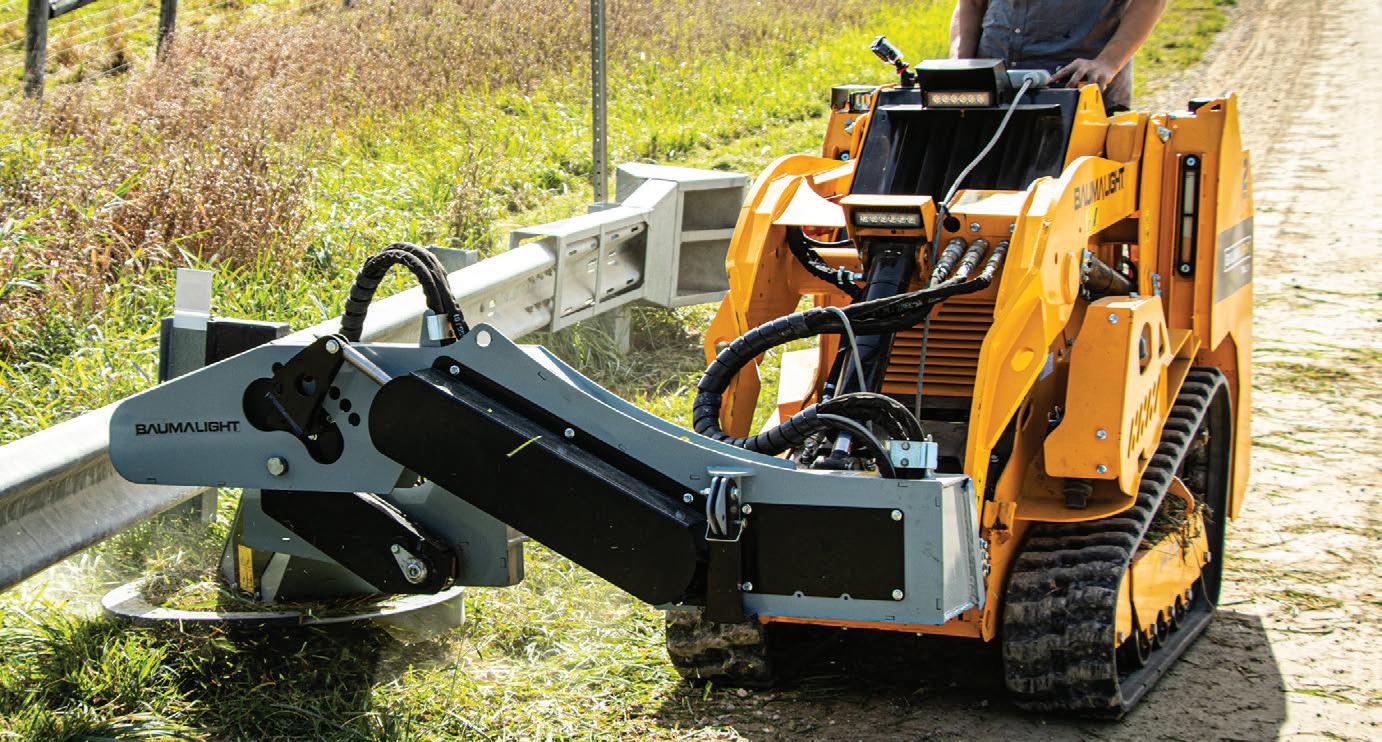
BARRIER MOWER
Full Schedule
DAY
ONE
9 a.m. Show floor opens
9:45 a.m. Leading Women In Rental panel discussion
11 a.m. Safe, Smart and Secure: Team-Based Safety Compliance and Theft Prevention
1:15 p.m. Trade, tariffs and what to expect in 2026 3
Canadian Rental Association offsite hospitality event at Belmont Event Centre
DAY TWO
10 a.m. Show floor opens
10:30 a.m. Succession Planning: How to prepare to sell your business
11: 30 a.m. Canadian Contractor Productivity Forum: Renting the latest technology to get it done faster and better.
12:45 p.m. Canadian Contractor Productivity Forum: The uses of AI for small contractors, today and tomorrow.
2 p.m.
Canadian Contractor Productivity Forum: Build it here, assemble it there: The advantages of modular construction in custom building
COVER STORY
• Diane Slater, chief human resources officer, Stephenson’s Rental Services.
• Louanna Rioux, sales and marketing director, Hangcha Forklift Canada.
WHAT TO EXPECT IN 2026
It’s no secret 2025 has been filled with uncertainty. Will that trend continue in 2026? That’s what Ryan Mallough, VP of legislative affairs with Canadian Federation of Independent Business, will discuss.
Mallough will talk trade, tariffs and what to expect in 2026.
UNSURE WHERE TO START WITH SUCCESSION PLANNING
Robert Bezede, a partner at Harmony Succession Partners and a seasoned mergers and acquisitions advisor, will discuss the ins and outs of pre-sale readiness.
Harmony Succession Partners specializes in selling private, lower middle-market businesses valued between $three million and $30 million across Ontario. The company has facilitated the sale of more than 50 companies in the manufacturing, distribution, construction and trades sectors. Bezede’s focus is on private, family-owned companies. He usually starts working with business owners up to five years in advance of a sale on pre-sale readiness to ensure a successful exit.
AMERICAN RENTAL ASSOCIATION IS ONSITE
The American Rental Association (ARA) will host a valuable session discussing team-based safety compliance and theft prevention. As well, the ARA’s social networking event will close out day one. The event runs from 3 to 5 p.m.
All States AG Parts LLC
Alert Rental Software
CM Equip
Canadian Concrete Crushers
Canycom
Dynamic Tires
Diamond Products
Elationtech
Flagro
Forst Global LLC
G.C. Duke Equipment
Genrep
Greenline Hose and Fittings
Heli Canada
Kerridge-Klipboard
Platform Basket
Point of Rental Systems
Quipli
Skyjack
Sure Flame
Tsurumi Canada
Wacker Neuson
Wolf Products Limited
Zoomlion
Robert Bezede with Harmony Succession Partners.
by MACENZIE REBELO
According to Jocelyn Rhindress, senior manager at CFIB, 95 per cent of all cyber crime is due to human error. Although that sounds scary, it is actually good news. That means there is a lot of control in preventing future errors.
STAYING ALERT
How to protect your business from cybercrime
Small businesses are easy targets for cyber scammers as online fraud schemes are becoming more sophisticated over time.
Across the country, fraud has nearly doubled over the decade, from 260 incidents per 100,000 population in 2013 to 501 incidents per 100,000 population in 2023, according to Statistics Canada. The cases of fraud continue to rise as technology has advanced and become more sophisticated over time.
More than 50 per cent of small businesses in Canada have experienced business fraud, explains Jocelyn Rhindress, senior manager at the Canadian Federation of Independent Business (CFIB). Cybercrime is a major component, says Rhindress.
“About 85 per cent of all businesses have been a target of email scams and phishing emails based on our 2023 research report.”
Rhindress suspects the number could be larger, as some cyber scams go unreported.
Chris Brown, senior product marketing manager with VikingCloud, predict-to-prevent cybersecurity solutions, adds, “Small and medium-sized businesses are increasingly targeted by cybercriminals. They are prime targets but often underestimate the risks.”
Brown and Rhindress explain the impact that cyber scams can have on the rental industry and why business owners should be proactive.
WHAT IS CYBERCRIME?
Rhindress: Cybercrime can be a type of fraud. There is a lot of overlap between the two. However, cybercrime specifically attacks the data
According to Chris Brown of VikingCloud, the cybersecurity landscape is continually evolving and presenting new challenges.
and the digital infrastructure of businesses. This can be done with the intent to commit fraud, shut down a business, or hold information ransom for money. So it can be fraud, but it does have its special category.
HOW CAN BUSINESS OWNERS PROTECT THEMSELVES FROM CYBER SCAMS?
Brown: The implementation of strong passwords and multi-factor authentication adds an extra layer of security and makes unauthorized access more challenging.
Employee training is also important. Educate your staff on recognizing phishing attempts and other social engineering tactics, since human error contributes significantly to security breaches. Recognize what is and is not phishing based on phrasing. Implementing these measures can significantly reduce the risk of cyber incidents and enhance overall security posture.
Rhindress: I know small businesses often lack good cybersecurity practices just because they think they’re too small to be a target. But the reality is, people who commit cyber crimes don’t care who they catch; they’re throwing the net out to all the fish, including the small ones.
MasterCard has a statistic that over 95 per cent of all cybercrime is due to human error. That might sound scary, but it is good news. That means there’s a lot of control in preventing errors. Keeping your software up to date is super important; make sure your patches are all up to date. If a business is not updating its software, it could be missing critical security updates in its operating systems, like antivirus software. Without that, you could have a security breach or be hacked.
WHAT ARE THE LATEST CYBERSECURITY CHALLENGES?
Rhindress: Artificial Intelligence has made it trickier to recognize a scam. Software is getting more sophisticated and can interact with your social media profiles. AI can discern what you interact with online, such as hobbies or shopping habits, and use data to target you in phishing emails. These emails can look very legitimate, and may appear from official Canadian government agencies, like the Canada Revenue Agency. It is a concern because people let their guard down, click on phishing links and provide personal information.
Brown: The cybersecurity landscape is continually evolving and presenting new challenges. Ransomware attacks have become more sophisticated, moving beyond traditional encryptand-demand schemes to incorporate data extortion tactics. Additionally, with increased reliance on third-party vendors, like office and computer hardware suppliers, chains have become attractive targets for cyberattacks, potentially compromising multiple organizations through a single breach. Notably, 40 per cent of cyber teams have refrained from reporting cyberattacks
due to fear of job loss, indicating a significant underreporting issue that can hinder effective response strategies. Addressing these challenges requires a proactive approach for business owners, including regular risk assessments, employee training and robust incident response planning.
WHAT STEPS SHOULD A BUSINESS OWNER TAKE IF THEY BELIEVE THEY ARE A VICTIM OF CYBERCRIME?
Rhindress: The CFIB works directly with the Royal Canadian Mounted Police (RCMP). The RCMP have a department that specifically focuses on cybercrime and how to eliminate it. They encourage you to report a cyberattack. Reporting can prevent further cyberattacks that will harm other businesses. As a business owner, you may have legal obligations to protect your data and inform customers of a data breach. If you don’t report it, it could affect your ability to get your insurance coverage in the future.
Brown: It is important to conduct a thorough investigation. Work with cybersecurity professionals to identify the breach’s source, assess the damage, and implement measures to prevent future incidents. Contact banks and credit card companies to alert them of potentially fraudulent activity and prevent unauthorized transactions. Also, you should inform customers, employees, and partners about the breach, detailing the steps being taken to address the situation and prevent future occurrences.
WHAT TOOLS ARE AVAILABLE TO KEEP UP-TODATE ON CYBERSECURITY ADVANCEMENTS?
Rhindress: This is a big topic that covers a lot of ground. Cybercrime doesn’t just impact finances or data, but also peace of mind. There are plenty of resources available online, and the CFIB provides information on how to protect your business on our website. If you feel vulnerable, there are tools like security software to help you stay vigilant.
Brown: Cybersecurity is not solely an IT concern but a critical business imperative. Notably, nearly one in five SMBS would be forced to permanently shut down following a successful cyberattack, which underscores the severe impact an incident can have. Companies like VikingCloud help businesses become proactive by managing digital risks. Ultimately, this will safeguard businesses against evolving cyber threats and keep you informed. Implementing cybersecurity measures and fostering a culture of security awareness can significantly reduce the risk of cyber incidents to protect the organization’s assets, reputation, and ability to keep operating. CRS
PHOTO: VIKINGCLOUD
The Break Up
by Russ Dantu
For years, I would do anything and everything to keep every customer I had. Some of them drove me crazy. Demanding way more than should be expected on orders. Others took forever to pay and then complained 45 days after delivery that it wasn’t quite what they were hoping for. Or ask for a discount, despite being happy with the order and customer service.
I never wanted to be that guy who lost a customer. But there is a difference between losing and parting ways with a customer.
No matter what business you’re in, you’ve likely experienced similar happenings with some of your customers.
It became such a problem that I sought out advice from a very successful old friend in sales. He said something so profound to me that I’ll never forget it and will always share.
“Russ, sometimes you have to give up your babies for adoption!”
I remember my jaw hitting the floor when I heard those words. In the real world, it’s a tough decision to give up a customer, and it can be an immense challenge to actually follow through. But if you look at it from a business standpoint, letting go of a difficult customer makes sense.
Still, that first time and every time after, it takes considerable thought. I felt so guilty after the first one that I didn’t sleep for a few nights. After that, it got a little easier with each one that needed to go.
Now, I don’t just dump customers. I cherish every one of them. But sometimes you realize that a customer relationship isn’t win-win anymore, and when that happens, action should be taken.
Here’s my simple guideline from the many years of owning and managing a business:
1. Grade your customers: A, B and C list customers. My A-listers are customers who order regularly, are easy to get along with, know what they want, give reasonable deadlines and pay on time. My B-listers are close to the same, but
only order five to six times a year. They are still nice to chat with and add to your bottom line. The C-listers are the customers we all need to focus on. These are the ones that maybe only order once or twice a year but no matter how much we work with them to keep them happy, they take up so much time, and sometimes it’s for a very small order.
2. After we complete our list, we need to narrow down which ones we need to chat with and which ones we are going to part ways with. This can be tricky, but when we part ways, we don’t want to burn bridges. Some of these customers may have you pulling your hair out, but they also refer people your way who are good business. Being open and honest with them is the best method. “We’ve been working together for a few years now. I truly appreciate your business. But there always seems to be an issue with the items I deliver and payment. What can we do to fix this, or should we shake hands and part ways?” This approach puts the ball in their court, and if they walk away, you are not really any worse for it. If they want to stay, it’s a soft warning.
3. The other C customers are the ones you need to let go. “I appreciate all the business you have given me the past few years, but I no longer feel I am a good fit as I cannot seem to please you. I am going to part ways, and I wish you all the best!” Of course, some people will not be happy to hear this, but at the end of the day, you need to be happy. Saying goodbye to customers can be very stressful, but it is an essential part of running your business.
Take care of yourselves…and your business! CRS
Russ Dantu is a 30-year veteran of the rental industry and has been delivering workshops, keynotes and seminars on customer service for 25 years. Visit russdantu.com.
COMPACT WHEEL LOADERS
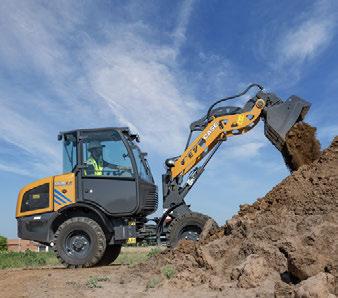
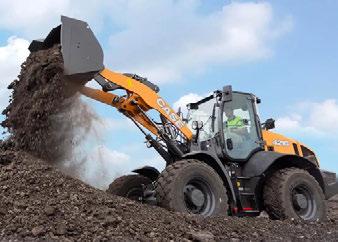
CASE CL36EV
Case Construction Equipment launched the 3.6-metric ton CL36EV electric compact wheel loader in April 2025, after previewing the model in 2024. The launch was part
of a larger ramp up of the company’s electric equipment lineup.
The CL36EV is a versatile machine with performance equal to its diesel counterpart. It also comes with all the advantages of electrification -- zero emissions, minimal noise, simplified maintenance and, Case states, a lower total cost of ownership.
According to Case, the CL36EV is an ideal machine for renters who need to take on green-credentialed jobs or work in highly regulated environments.
The CL36EV is a versatile
machine that can tackle a broad range of jobs, while also delivering next-generation technology for sustainable construction. It has a hingepin height of more than 10 feet and is compatible with attachments like forks, rakes and sweepers. It’s well-suited for tasks ranging from landscaping and hardscaping to large-scale building renovations or projects where indoor operation is required.
8 www.casece.com
WACKER NEUSON
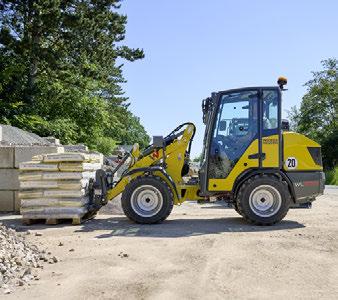
WL250
Wacker Neuson’s WL250 was
released in February of 2025 and is the first in the company’s new series of articulated wheel loaders. The compact yet powerful machine can maneuver in heights under two metres even with a fixed
CL36EV compact wheel loader
The WL250 compact wheel loader
canopy.
The machine has a 0.25 m3 bucket volume capacity and, due to its low centre of gravity, can handle heavy loads.
Attachments are easily interchangeable with a universal skid steer plate and hydraulic quick-hitch system.
The WL250 is equipped with a hydraulic wheel hub drive so all four wheels are directly driven. This provides enhanced efficiency, impressive acceleration and responsive driving dynamics.
The cab offers plenty of headroom and freedom of movement, as well as an excellent view of the attachment, immediate working area and machine surroundings. As well, the steering wheel, pedals and joystick are clearly arranged for an enhanced operator experience.
“Simple to operate with intuitive controls, compact wheel loaders are a solid alternative to a wheeled skid steer and a great solution for the rental market,” states Jay Quatro, commercial product manager at Wacker Neuson.
“Fleet owners will appreciate their fuel efficiency and reduced tire wear over a skid steer, while operators will benefit from the ease of entry, 360-degree visibility of the jobsite, and less turf disturbance. Features like a tight turning radius and a positive power to weight ratio make loaders like the WL250 ideal for tree service, agriculture and landscaping, as well as snow removal.”
8 www.wackerneuson.com
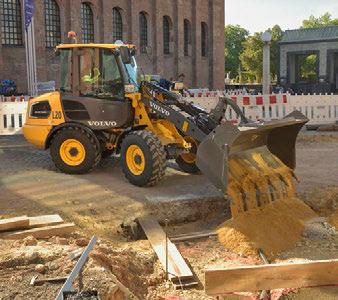
VOLVO CE L20 AND L25 ELECTRIC
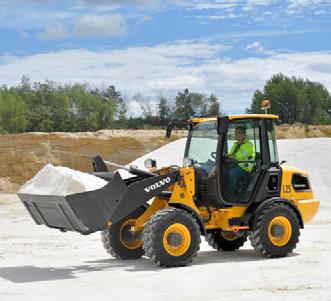
Volvo CE L20 Electric and L25 Electric compact wheel loaders offer all the power and
performance of their diesel equivalents but the advantages of an electric machine. That means zero emissions, lower noise and vibration, and no fuel or DEF.
According to Volvo, maintenance of the machine is simple because of so few moving parts. In fact, the company estimates users will see a 35 per cent savings in maintenance costs and time over the life of the machines.
Both models feature 48-volt traction batteries with a capacity of 40 kWh, a net 29.5 hp (22 kW) and a maximum travel speed of 20 km/h.
The machines’ instant torque separates it from diesel machine where the operator might feel a delay. In fact, Volvo states it has heard from customers that the machine feels more powerful because of that instant torque.
Another advantage is the L20 and L25 do not idle. When the operator pauses, the machine shuts off. This not only saves battery life but also the number of operating hours accumulated.
COMPACT WHEEL LOADERS
Operators are also less fatigued at the end of the day due to the decreased vibration.
Both machines are also well-suited to the rental market, according to Volvo. Their compact size is attractive to renters, while their lack of emissions and noise allow the machines to operate in a variety of locations, such as indoors, in urban areas or even at night.
8 www.volvoce.com
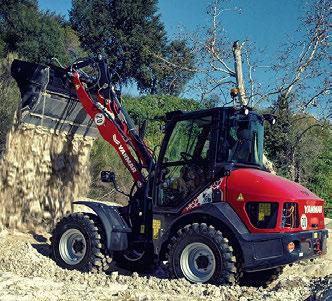
YANMAR V8E ELECTRIC
Like all electric machines, a big advantage of the V8e is that it operates with minimal noise. This makes it ideal for work in urban areas or anywhere requiring low noise levels, such as parks, golf courses or indoor locations. The low noise is also a benefit to the operator. Another benefit of
its electric design is simplified maintenance and lower longtime costs.
The 4.5 tonne, eight-foot-tall machine has bucket capacities from 0.8 cubic metres to 1.2 cubic metres. On forks, its payload is 1,800 kilograms. It has a dump bucket lifting height of 2.49 metres and, for pallet forks, a height of 3.02 metres.
The V8e has an on-board charger with a type 2 socket. It provides a charging
Volvo L20 Electric
Volvo L25 Electric
Yanmar’s V8e Compact Wheel Loader
capacity of 11 kW. Charging cables along with adapters are included. This ensure it is compatible across various job sites. The standard 39.9 kWh battery capacity offers approximately 3.1 hours of use on a V-cycle, while the optional 53.2 kWh capacity extends usage to 4.2 hours.
8 www.yanmar.com
184 G-Tier
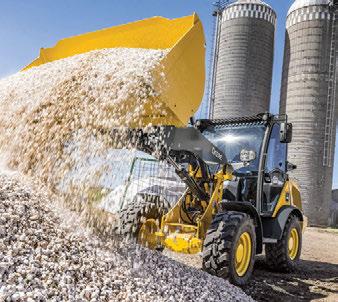
JOHN DEERE 184 G-TIER
The smallest of John Deere’s G-Tier compact wheel loaders, the 184 G-Tier was designed to operate in small areas. With a height of eight feet (when config-
ured with a canopy) and a width of five-feet 10-inches, the 48-horsepower machine is suited for customers in agriculture, landscaping, site development, snow removal and rental. The 184 G-Tier is an easy-to-operate model that comes standard with limited slip differential, which automatically engages if one wheel loses traction. There is also an optional ride-control that reduces spillage from the bucket when traveling over rough terrain. This can be set to engage and disengage at certain speeds.
The enclosed cab provides a clear line of site due to its frameless, fully glass door, floor-to-ceiling front windshield and remounted machine display. Inside, there is an adjustable steering column, slip-resistant steps and an optional LED lighting package.
It comes with 0.7 cubic metre general purpose
bucket. It is also suited for a variety of attachments, and is fitted with the skid steer Quik-Tatch coupler and hook/ Euro style couplers. This allows the option to use a range of attachments.
John Deere also highlights the maintenance ease of the machine. Ground level service makes daily maintenance simple, and allows operators to change fluids quickly and cleanly. The machine also features extended service intervals for engine oil and filter, final drive oil and hydraulic oil.
All G-tier compact wheel loaders also have a 30 per cent larger fuel tank. 8 www.deere.com
BOBCAT’S L65, L85 AND L95 COMPACT WHEEL LOADERS
Bobcat’s L65, L85 and L95 compact wheel loaders may share a common foundation of robust design, maneuverability and attachment
versatility, but they each have different performance levels and advanced features to suit diverse operational needs.
Let’s start with what they share. All three models are equipped with Bobcat Tier 4, turbo-charged engines, and they all feature articulated steering, which means excellent tight-turning and low ground disturbance. They also come with three drive modes and the standard Power Bob-Tach attachment mounting system for quick and easy attachment changes. Where the three machines differ is in power, lifting
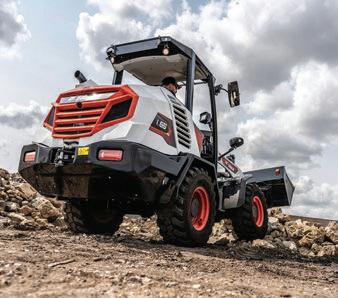
Bobcat L65
capacities and speed.
As an entry model, the L65 offers 55.0 hp, a tipping load (straight) of 6,266 pounds and a maximum travel speed of 24.3 km/h.
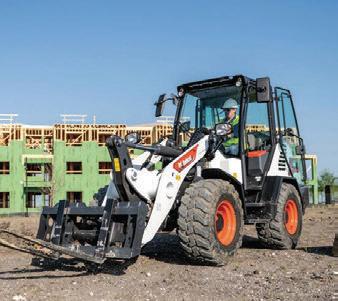
Bobcat L85
Meanwhile, the L85 boosts horsepower to 68.0 hp, increases the tipping load to 7,947 lb., and offers a slightly higher top speed of 26.23 km/h. The L85 also introduces standard high-flow auxiliary hydraulics, providing 27.3 gpm for more demanding hydraulic attachments, a feature not standard on the L65.
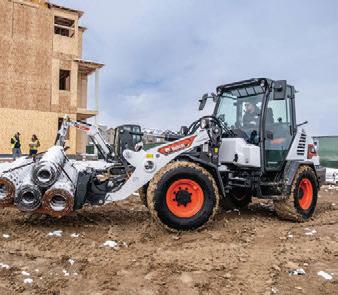
The L95 sits at the top of the range, delivering 74.4 hp, a tipping load of 7,962 lb., and a significantly higher maximum travel speed of 38.95 km/h.
Unique to the L95 is the standard inclusion of four-speed travel, offering greater versatility in matching speed to
the task. While automatic ride control is optional on the L65 and L85, it comes standard on the L95, further enhancing operator comfort and load retention. Additionally, the L95 features a heated air-ride seat option for superior comfort during extended operation, whereas the L65 and L85 offer a cloth suspension seat.
8 www.bobcat.com
CASE 421G COMPACT WHEEL LOADER
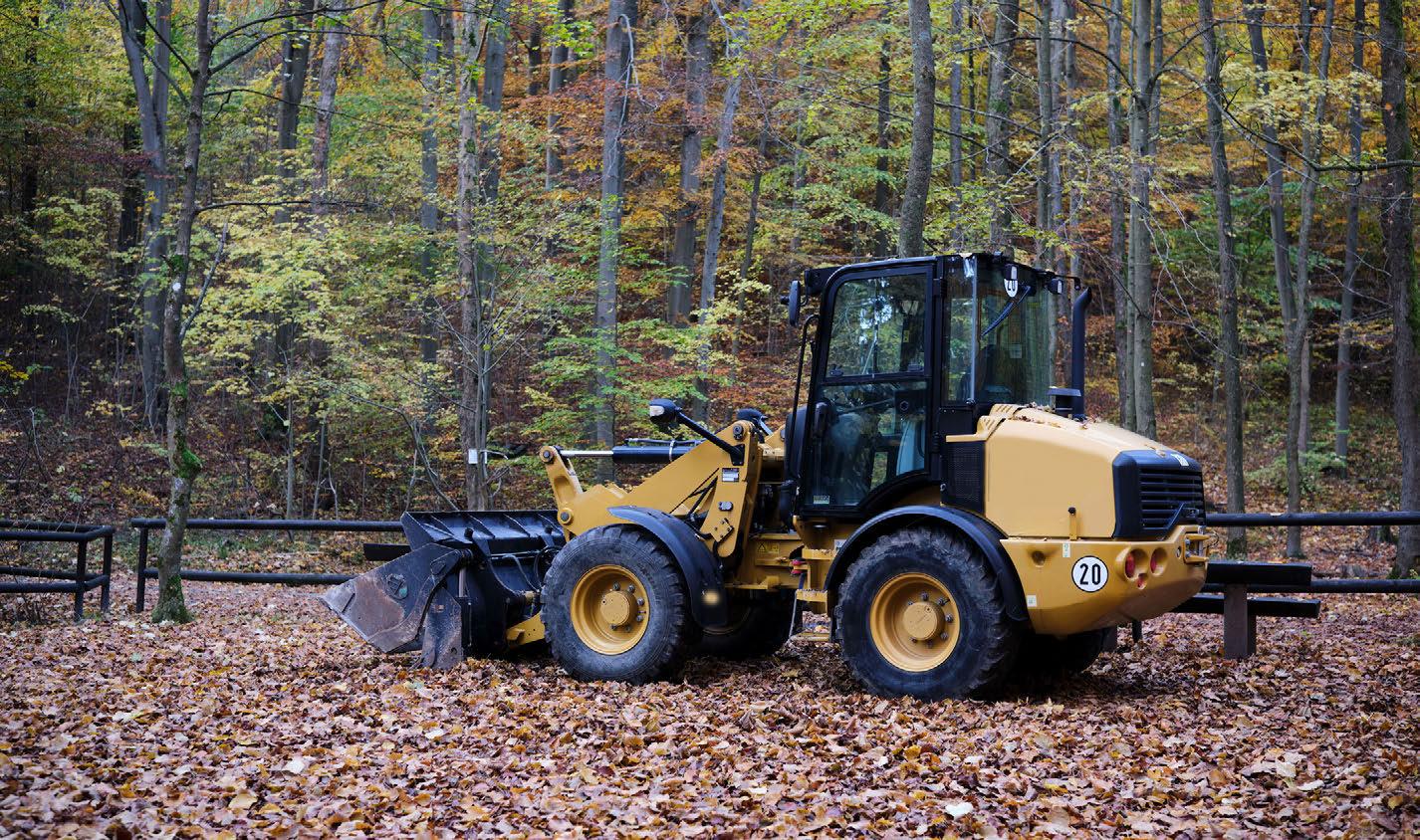
The Case compact wheel Loader 421G has a 112 hp engine that delivers torque you need to bust piles and manhandle aggregate. Plus, thanks to a lifting capacity of 15,806 lb (7,170 kg) and hinge pin height of 145 inches, an operator can rest easy knowing that the machine will never be vertically challenged. A JRB compatible coupler
comes standard allowing for easy attachment changes without ever leaving the seat. The 421G has a comfortable operator’s seat with EH controls, a post-mounted monitor display, and unheard of 270-degree visibility for better sightlines to attachments. Including a ground-level serviceability with a rear hood that lifts with a touch of a button – providing easy access to all maintenance points.
8 www.casece.com
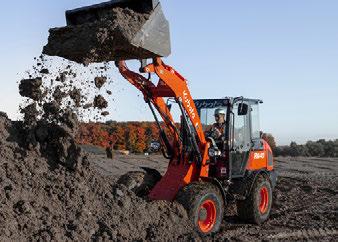
KUBOTA COMPACT WHEEL LOADER R40 SERIES
Kubota’s next-generation R640 and R540 wheel loaders come with all the power and comfort needed to get the results you demand. Its high-visibility cab is loaded with modern features to make work simpler for oper-
ators of any level. Features include an expanded cabin that allows a panoramic view for easier and safer operation. The full glass door, and wide opening window provide visibility to the left and right, while the rear window offers an unobstructed view when traveling in reverse. The R40 series features an updated interior layout focused on easier operation and visibility. The major switches are now located on the right side for quicker access. All major loader functions are on a single lever that is easy to operate with just one hand, both on the R540 and R640. The two step speed control switch lets an operator change speeds efficiently. Additionally, bright LED work lights provide plenty of illumination for nighttime tasks.
8 www.kubota.ca
Bobcat L95
421G Compact Wheel Loader
Kubota Compact Wheel Loader R40 Series
ELECTRIFYING THE MARKET
Star Power Atlantic introduces green power to the rental industry
Pascal Gellrich saw a gap in the rental market and took a leap of faith when he opened his portable electric generator rental business, Star Power Atlantic.
by MACENZIE REBELO
Gellrich always considered himself to be an environmentally conscious and sustainable consumer. For him, products that were both efficient and environmentally friendly were a no-brainer purchase. His enthusiasm for electric vehicles (EVs) and green technology began when he bought his first used EV in 2019.
“I am an energy nerd and kept a spreadsheet to see how much money I was saving by not purchasing gasoline,” he says. “And within four years, my EV basically paid for itself.”
His passion for sustainable clean technology became a business proposition in 2022 when he spoke with his friend Mark Rabin, founder of Portable Electric, and decided to bring the technology to the East Coast.
“I jumped at the opportunity,” he says. “And started up the company with a small team of
people.”
By May, Gellrich founded the Nova Scotiabased business. He felt that the rental industry, specifically, was not leveraging ROI for its clients with battery energy storage systems.
“The cost of renting battery energy storage systems pays for itself in fuel savings, resulting in increased savings for rental clients,” says Gellrich.
To him, it made sense to offer a rental business for electric generators and battery systems, as most people cannot sustain financing to purchase equipment for a one-time project. Renting out energy storage systems allows customers to get their job done efficiently while using sustainable equipment.
“There was a hole in the Canadian market,” says Gellrich. “Many other parts of the world,
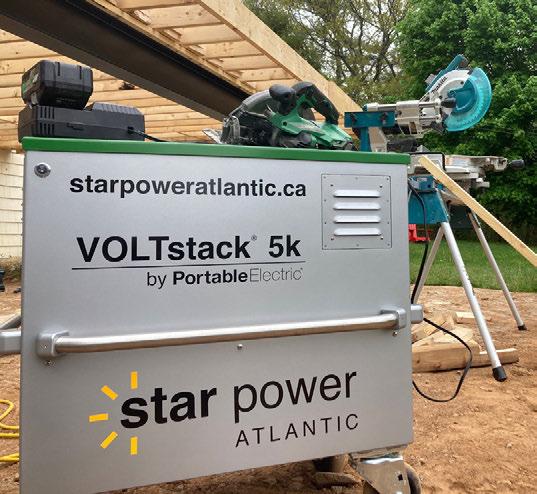
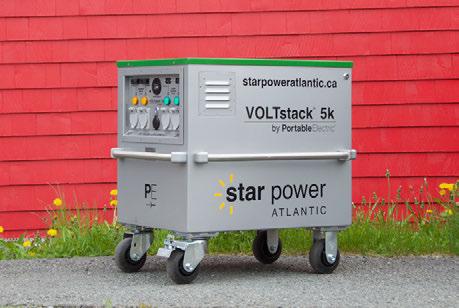
LEFT: Star Power Atlantic’s Voltstack 5K, a portable electric generator, is frequently used on construction sites and film sets.
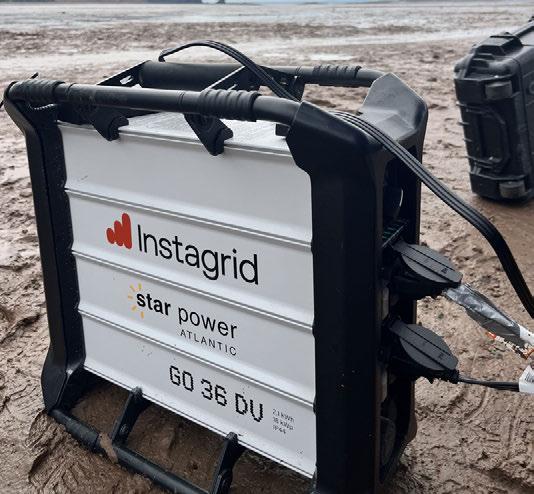
RIGHT: Instagrid Go, a portable electric power source, is Star Power Atlantic’s most popular item.
including Europe, are replacing diesel and gas generators with battery energy storage systems. Which is a much more efficient way of providing electricity.”
According to the Facilities Engineering Associates (FEA), a typical diesel generator produces more than twice the amount of greenhouse gases (GHG) than electrical power. Yet, diesel generators are still the most common option for power, states the FEA. Additionally, the Canada Green Building Council (CGBC) states that embodied carbon from building construction is responsible for 10 per cent of all energy-related emissions globally.
“Many businesses do not consider the alternative to diesel and gas generators just because it has been the technology we’ve been using for so long,” he says. “But it’s a quickly shifting landscape.”
Gellrich purchased four Portable Electric units, and within two weeks, they were rented out on film sets. Film and television production has become one of the more lucrative markets for Star Power Atlantic’s business.
“We’ve run upwards of 20 film and television sets and several live events, including the Junos,” he says.
A lot of gear is rented out for film, explains Gellrich, and according to him, production companies appreciate power stations that make no noise and emit zero emissions.
“With a battery power station, there is no need for sound shielding or lengthy cable runs to mask the sound of a diesel or gas generator. You can hear the actors. You don’t need to worry about wires, just place the unit where you need to film.”
As the business grew, Gellrich purchased additional units, including the Voltstack 5k, the Voltstack 30k (an 80kWh unit), and Sunstacks, a portable solar kit that harnesses the power of the sun to deliver clean and sustainable energy. Star Power Atlantic products are also used in the construction industry, rental market and emergency response sectors.
“If someone’s building a house, we can bring in our power on a trailer and park it on site. The contractors will use it from Monday to Friday, and then on the weekends, we tow it away, charge it and return it on Monday.”
Gellrich calls this offering ‘power as a service.’
Film
and television production has become one of the more lucrative markets for Star Power Atlantic’s business.
“Battery power stations provide a much more efficient use of energy, as there is no wasted idle time. The energy only draws down when there is a load requirement,” he says.
Although battery energy storage systems do cost more than diesel and gas generators, Gellrich argues the ROI for clients is better because no fuel purchases are needed.
“There are benefits to using this kind of technology,” says Gellrich. “Star Power Atlantic is presenting a new way of delivering power.”
Gellrich believes making connections across Canada is important to his business model, as battery power stations begin to replace or hybridize with traditional gas and diesel generators.
“The market continues to grow as the construction, events, and film sectors experience the benefits of this technology. Though traditional gas and diesel generators continue to serve a useful purpose, the portable power market will continue to shift to hybrid and battery energy storage system solutions.”
What makes Star Power Atlantic unique is there isn’t a physical warehouse; instead, it uses gear distribution locations throughout Eastern Canada, currently servicing the Atlantic Provinces with planned expansion into Ontario and Quebec. Like traditional equipment rental stores, Star Power Atlantic manages its products through fleet optimization systems and software.
“Our most popular item right now is the Instagrid Go,” says Gellrich. “It’s small and portable but powerful. There is a lot of excitement around it.”
Ryan Larscheid, marketing lead for North America at Instagrid, agrees that
there is a gap in the market for battery-based portable power supplies, especially in construction and rental.
“Construction tools demand high peak power,” says Larscheid. “Saws and jackhammers, really anything you need to be plugged in on the job site requires pure instant power.”
In essence, the Instagrid Go allows workers to place a power grid wherever they need one, despite not being next to an outlet or power source.
The product is also sustainable, which is why Gellrich feels electric generators will become popular in the next few years, as Canada is aiming to be net-zero by 2050. The federal government’s Canadian Net-Zero Emissions Accountability Act aims to decarbonize new builds and construction. In 2019, the World Green Building Council called for a 40 per cent reduction in embodied carbon by 2030.
The push for electric and green equipment in the construction industry is not unheard of, as sustainability has become a popularized trend. Gellrich feels it is likely that electric generators and batteries will become more popular. He hopes Star Power Atlantic will be a forerunner in the electric rental industry.
SNOOK’S LOOK
Promises require people
by Andrew Snook
When there is a federal election taking place, it hardly comes as a surprise that politicians tend to make an excessive number of promises to win over voters. But, now that Prime Minister Mark Carney is in the driver’s seat, his goals have included a massive increase in home-building rates; constructing a national electricity grid; a massive carbon capture project in Alberta, and a variety of other major infrastructure projects.
Carney might legitimately want these projects to get a speedy green light, especially in light of these uncertain times and new job losses being generated due to U.S. tariffs. However, he’s making the same mistake many other politicians before him have made: he’s not considering skilled labour in Canada.
According to BuildForce Canada’s most recent report, “Canada Construction & Maintenance Looking Forward: Highlights: 2025-2034,” the construction sector is expected to continue to be plagued with labour shortages. By 2034, the report stated that 21 per cent of the current workforce will retire. This accounts for approximately 269,000 workers in the sector. During this same period, demand for workers is expected to grow by an additional 111,600 workers. To counter these future shortages, the industry has been working hard at recruiting new workers and has been somewhat successful. The current projections show construction companies hiring approximately 272,200 new workers under the age of 30 from 2025 to 2034. While this is an impressive number of new workers, this means that the construction sector could be dealing with a labour shortfall of more than 108,000 workers by 2034. Yikes!
While this number can be daunting, there is a massive untapped workforce that the construction sector has still been slow to attract that would absolutely help solve this issue: women working on the job site.
BuildForce Canada reports, there were 217,680 women employed within Canada’s construction sector. But of those women, only about 29 per
cent worked on job sites.
The 29 per cent of women that work on job sites accounted for 63,700 out of more than 1.2 million workers in 2024, a measly five per cent of on-site employees. Far more needs to be done to attract women to on-site employment opportunities to help manage the current and future shortages facing the sector.
For managing more current needs, perhaps Canada’s construction sector can turn our automotive sector’s lemons into lemonade?
The U.S. tariffs announced throughout the first half of 2025 have resulted in some of Canada’s biggest car manufacturers laying off thousands of employees. If these layoffs continue long-term, many of these workers will be looking for other employment opportunities that offer good wages similar to the automotive sector. The construction sector may get the opportunity to offer competitive wages and recruit many of the workers in the manufacturing sector into the world of construction. Obviously, not all those people would make the jump, but I’m sure there are many who would consider it for similar wages. After all, we all need to pay our bills, right?
While the labour shortages plaguing the construction sector are an extremely complex issue, this is only one of several challenging factors at play creating potential roadblocks to the Prime Minister achieving his goals. Add to the labour challenges that you require a huge amount of public sector funding, massive investment from the private sector, complex partnerships and agreements with many different First Nations, and a ton of environmental approvals, and all these projects get complicated in a hurry. While I applaud the Prime Minister for embracing Canada’s need to grow as an energy and resource superpower, there is still a long road ahead towards making this a reality. CRS
Andrew Snook is the editor of Canadian Forest Industries, Pulp & Paper Canada and Canadian Biomass .