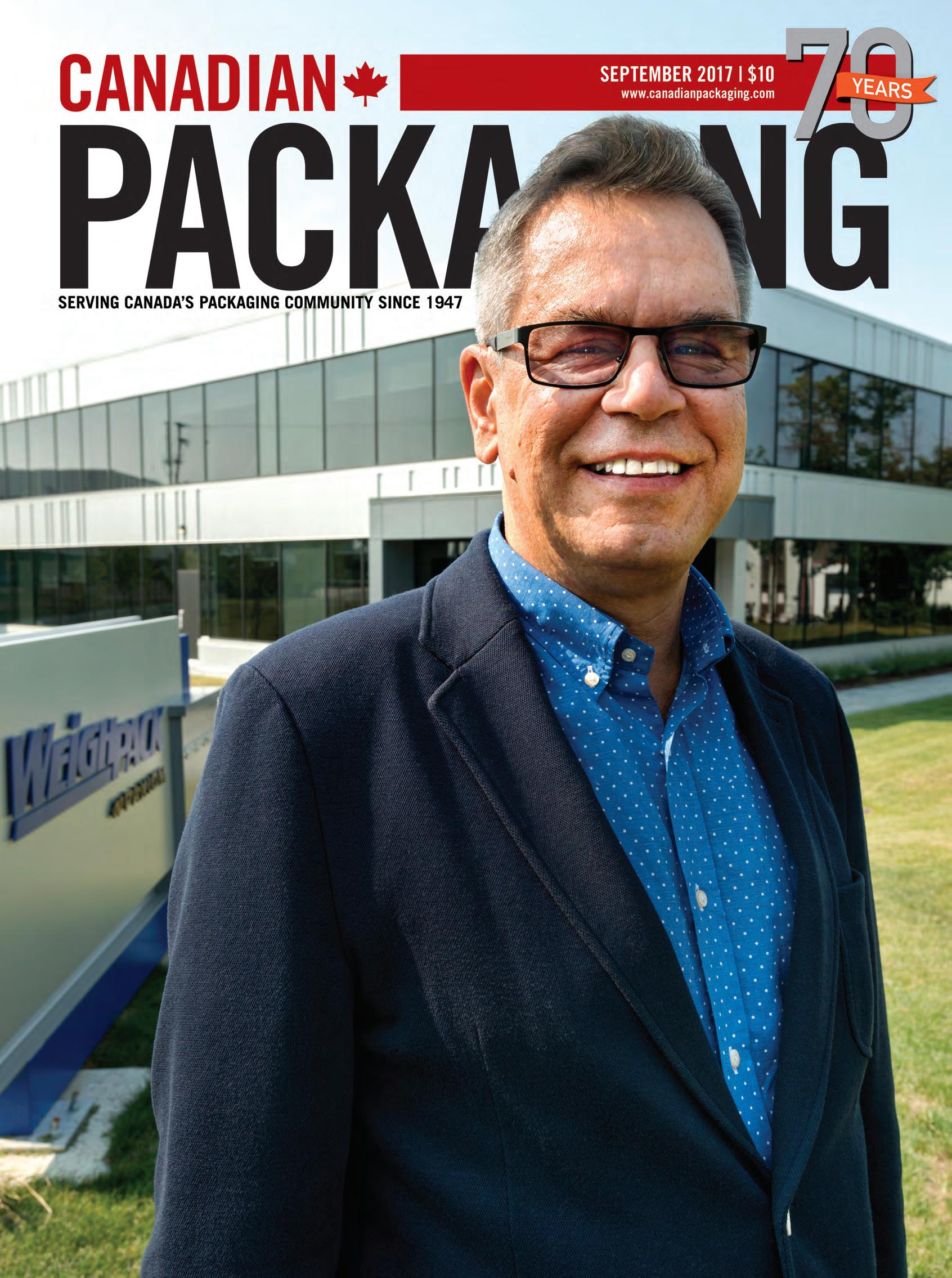
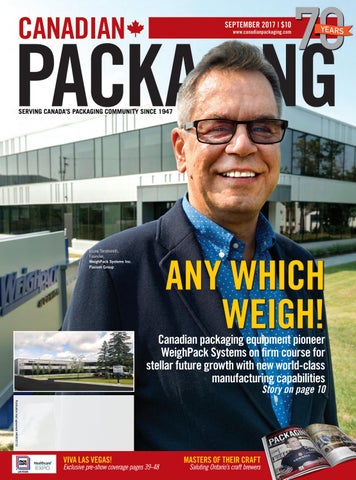
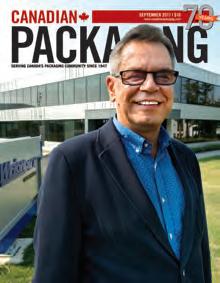
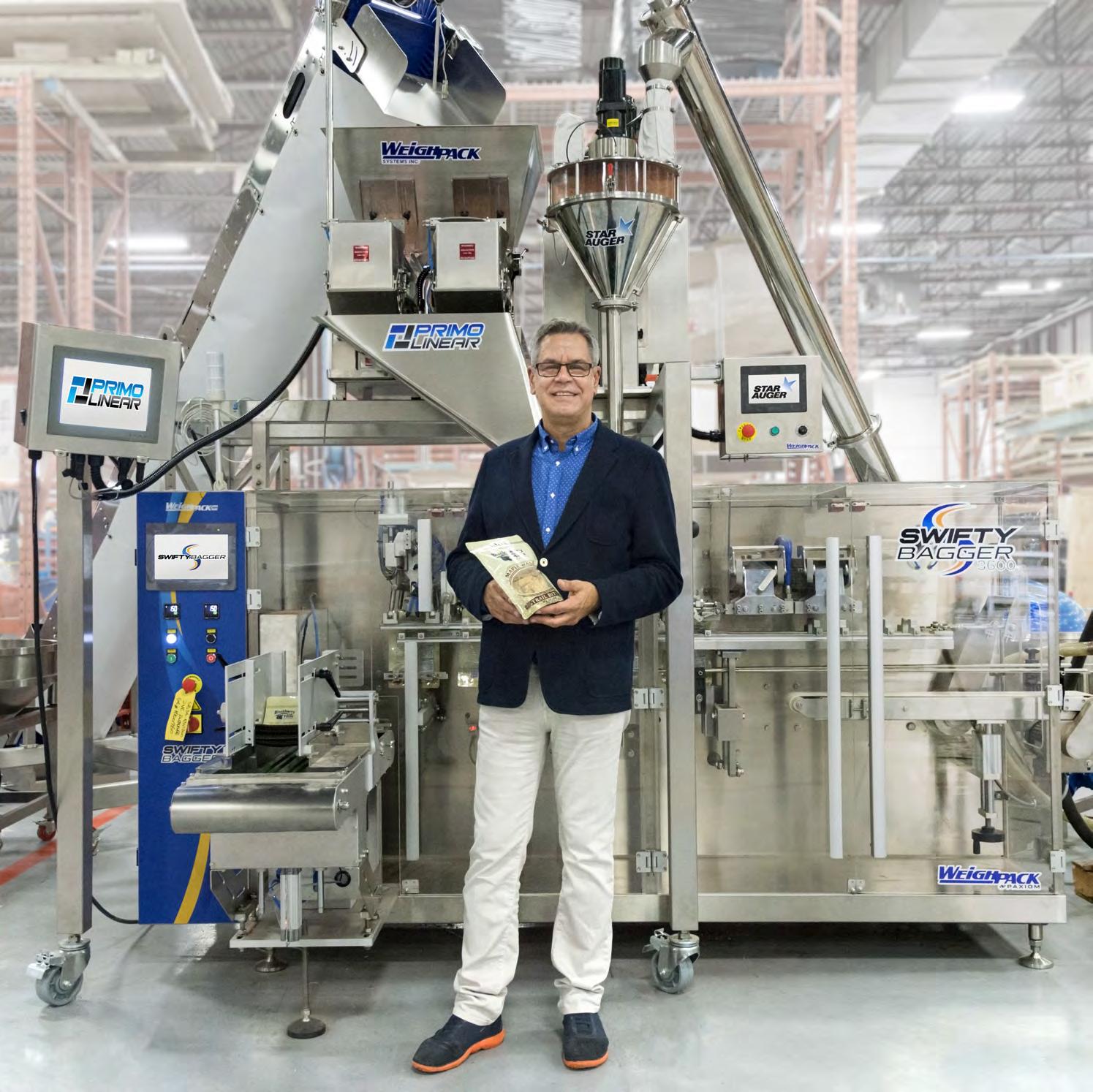
Louis Taraborelli, Founder, WeighPack Systems Inc. Paxiom Group
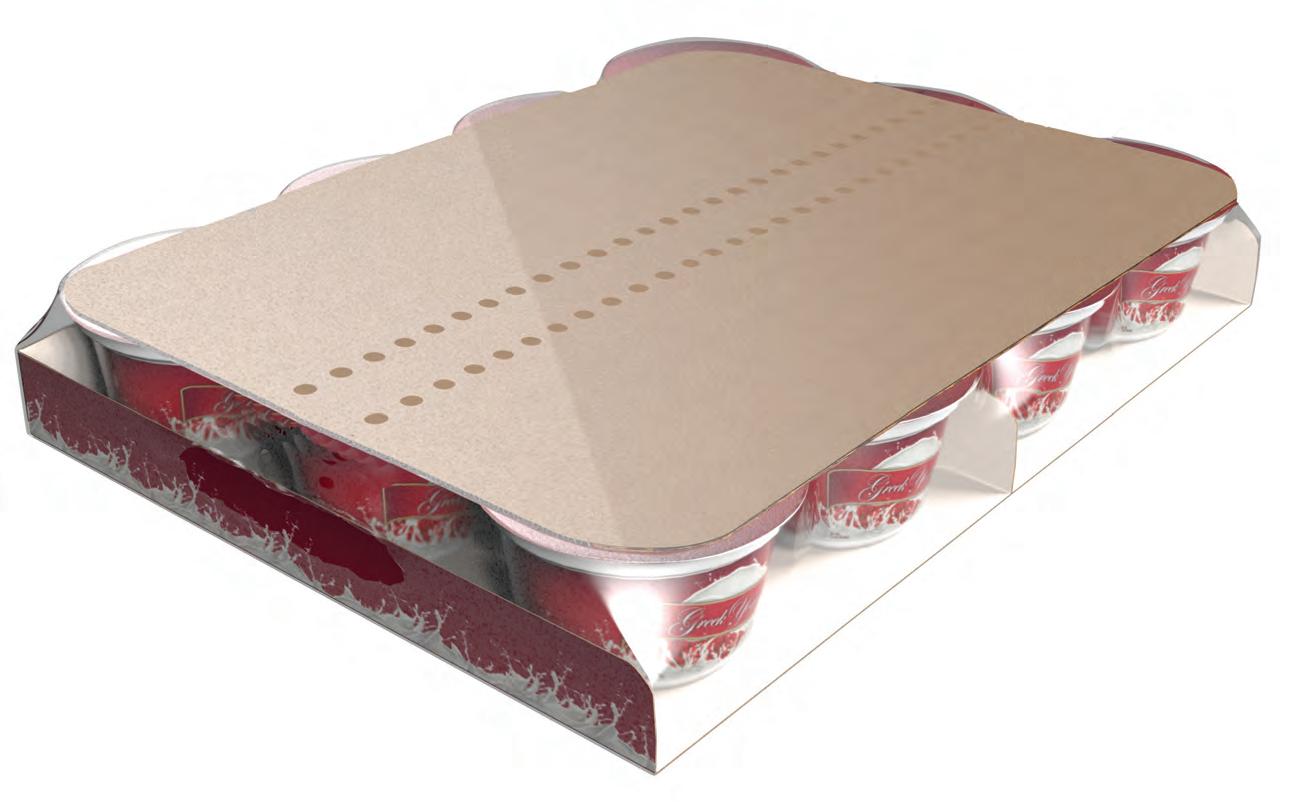
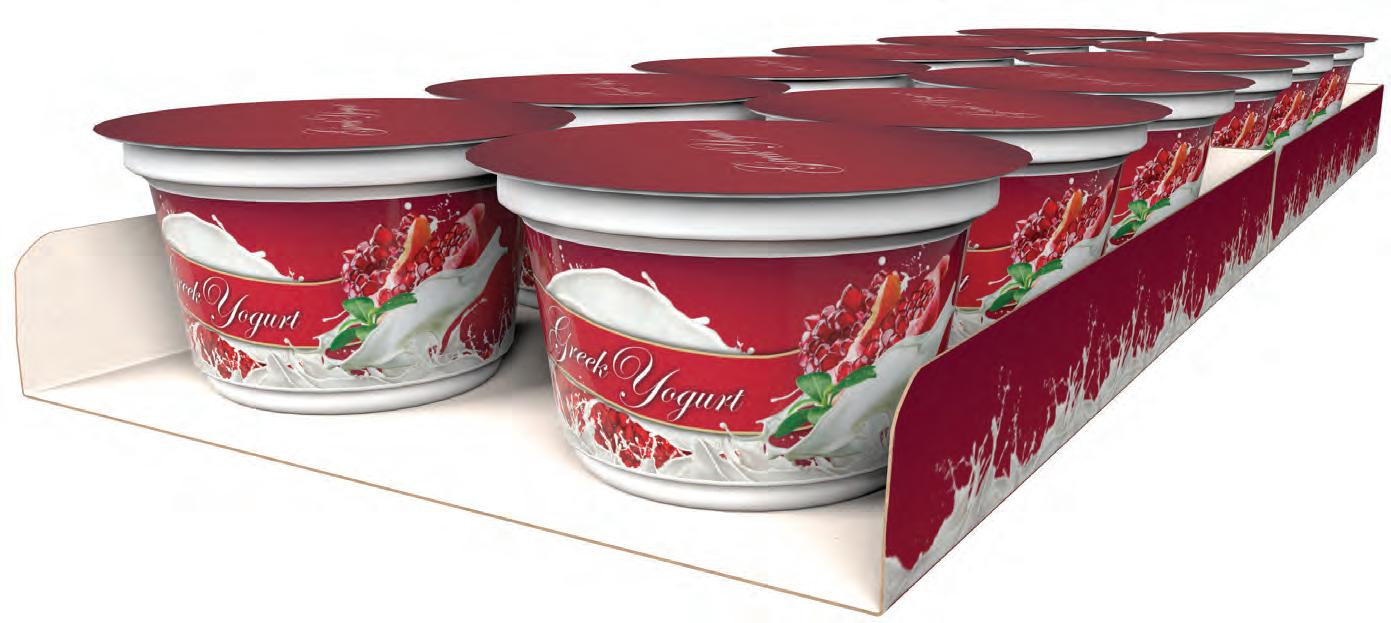
The Delkor Turbo Case™ is patented.
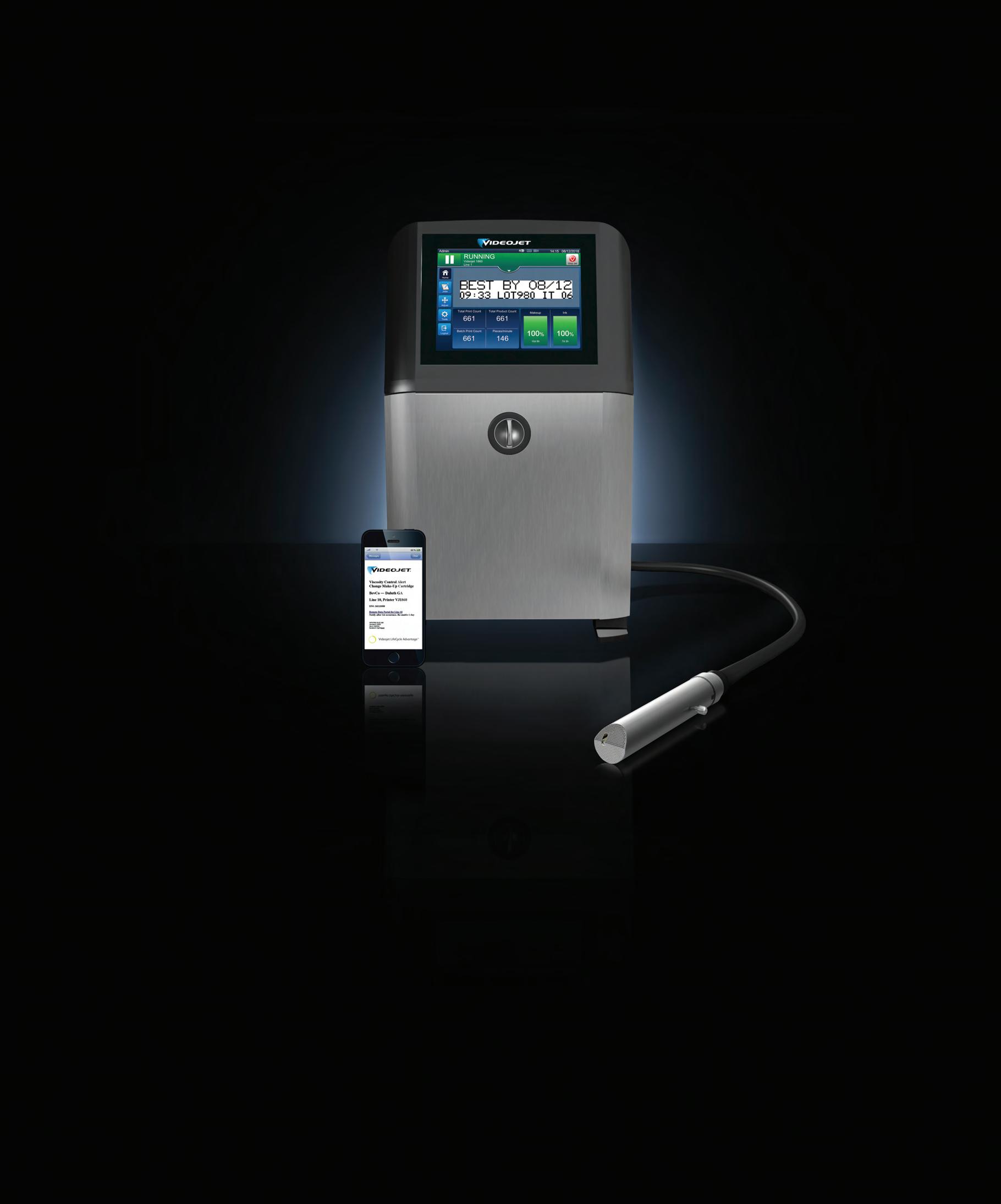
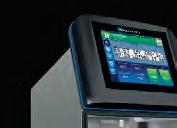
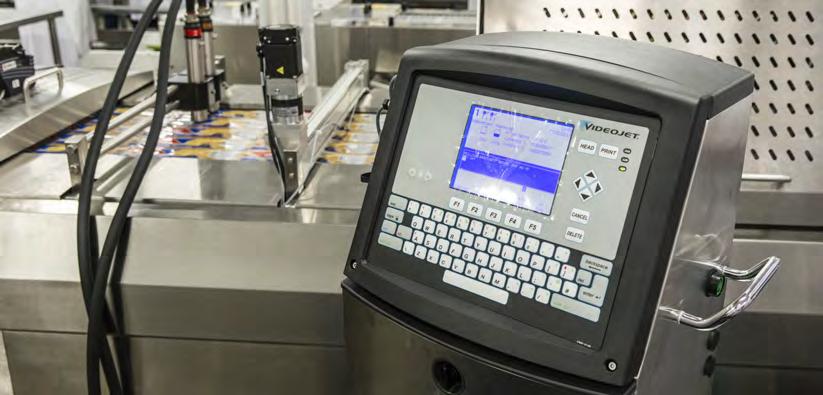
Videojet 1860 Continuous Inkjet Printer
1. True predictability
Industry-first ink build-up sensor provides true predictability and warnings of possibly degrading print quality, even before a fault occurs.


True remote services*
Multiple access options (Ethernet™, WiFi) and secure VPN communication meet highest standards in the industry as part of VideojetConnect™ Remote Service, and help to improve machine uptime and customer experience.
* Subject to availability in your country
True IP rating
Optional IP66 rating for entire cabinet and hygienic design following industry guidelines; easier integration with slanted printhead design.
True scalability
Workflow modules help to customize the printer to perform the exact need required. It is easy to adapt the printer with new capabilities and functionalities, and to meet growing demands.











SEPTEMBER 2017
VOLUME 70, NO. 9
SENIOR PUBLISHER
Stephen Dean • (416) 510-5198 SDean@canadianpackaging.com
ACCOUNT MANAGER
Adnan Shah • (416) 510-5117 AShah@canadianpackaging.com
EDITOR
George Guidoni • (416) 510-5227 GGuidoni@canadianpackaging.com
FEATURES EDITOR
Andrew Joseph • (416) 510-5228 AJoseph@canadianpackaging.com
MEDIA DESIGNER
Brooke Shaw • (519) 428-3471 bshaw@annexweb.com
ACCOUNT COORDINATOR
Barb Comer • (888) 599-2228 ext 235 bcomer@annexweb.com
CIRCULATION MANAGER
Anita Madden • (416) 442-5600 x3596 AMadden@annexbizmedia.com
VICE PRESIDENT
Tim Dimopoulos • tdimopoulos@annexbizmedia.com
COO
Ted Markle • tmarkle@annexweb.com
PRESIDENT & CEO Mike Fredericks
ANNEX BUSINESS MEDIA
80 Valleybrook Drive, North York, ON, M3B 2S9; Tel: (416) 510-5198; Fax (416) 510-5140.
Canadian Packaging, established 1947, is published 10 times per year except for occasional combined, expanded or premium issues, which count as two subscription issues.
PRINTED IN CANADA
ISSN 008-4654 (PRINT), ISSN 1929-6592 (ONLINE)
PUBLICATIONS MAIL AGREEMENT NO. 40065710
CIRCULATION
e-mail: rthava@annexbizmedia.com
Tel: (416) 442-5600 ext 3555
Fax: (416) 510-5170
Mail: 80 Valleybrook Drive, Toronto, ON M3B 2S9
SUBSCRIPTION PRICE PER YEAR (INCLUDING ANNUAL BUYERS’ GUIDE):
Canada $74.50 per year, USA $130.95 US per year, Outside Canada
$149.00 US per year, Single Copy Canada $10.00, Outside Canada $27.10.
From time to time Canadian Packaging will mail information on behalf of industry-related groups whose products and services we believe may be of interest to you. If you prefer not to receive this information, please contact our circulation department in any of the four ways listed above.
ANNEX PRIVACY OFFICER privacy@annexbizmedia.com
Phone: 800-668-2374
DISCLAIMER: No part of the editorial content of this publication may be reprinted without the publisher’s written permission. ©2017 Annex Publishing & Printing Inc. All rights reserved.

Sometimes even the best packaging idea can have unintended negative or tragic consequences that become obvious only with the benefit of hindsight. When leading multinational CPG (consumer packaged goods) multinationals first launched the now ubiquitous single-dose, watersoluble laundry detergent pods into the market several years ago, the new products were hailed as one of the greatest triumphs of packaging innovation of the new century—for many right reasons.
Checking all the right boxes for consumer convenience and packaging sustainability, the colorful little packets offered a game-changing alternative to the bulky plastic bottles of liquid detergent and spill-prone traditional boxes of laundry powder for millions of North American households across all the key demographics. Sadly, they also caught the eye of the one age group brand-owners wanted no part of—young kids who would unintentionally swallow the colorful capsules thinking it was candy.
Several fatalities and thousands of severe poisonings later, the CPGs are trying their best to remedy the troublesome oversight. Earlier this month, Cincinnati, Ohio-headquartered Procter & Gamble (P&G) has launched its bestselling Tide PODS and Gain Flings tubs outfitted with childresistant Child-Guard lids that, in theory, should significantly minimize the incidence of accidental exposure to the powerful chemicals packed inside the pretty little pods.
According to P&G, the company invested three years of “in-depth R&D and testing” into the
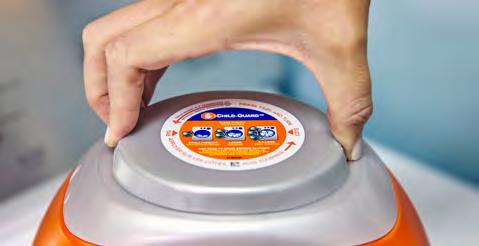
Child-Guard closures to optimize and ensure their effectiveness. Requiring users to squeeze both sides of the lid and twist it at the same time to open the packaging, this may not be exactly the pinnacle of consumer convenience, but consumer safety should always take precedence when it comes to life and death issues.
“Nothing is more important to us than the safety of the families who use our products,” says Sundar Raman, P&G’s North America vice-president of fabric care products. “Knowing that access is a key factor in accidental exposures, we’ve made the new Child-Guard tub easier to close, but harder to open so parents and caregivers can both conveniently and safely store the product.
“With this key change, child-resistant packaging will now be available for all of our laundry pack products,” says Raman, citing other related safeguard enhancements that include introduction of bags with a Child-Guard zipper, the addition of a bitter substance to the pack’s outer film, and an increase to the pack’s film strength to delay the release of its contents.
When it comes to consumer safety, child safety in particular, too much is never enough.

14
ALWAYS ON THE GO-GO-GO! By Andrew Joseph Quebec sandwich maker using advanced thermoforming technology to spread its convenient meal solutions offering across Canada. 37 HOME AND DRY

MOTIONAL RESCUE By Julia Duwe
41-49 PRE-SHOW REPORT Our preview to the upcoming PACK EXPO Las Vegas 2017 features special insights from the show’s producers and some exciting new technologies to be displayed at the event. 39 COMING CLEAN By Sean Riley

BIGGER AND BETTER By Maria Ferrante
A SAFER HAVEN By Dirk Schlueter & Owen Tucker

Our special tribute to Ontario’s craft-brewing industry begins opposite of page 20.

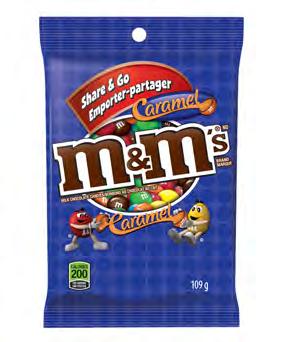
Chocolate and caramel sound like a match made in candy heaven. So while it may seem surprising the iconic M&M’s brand of chocolate-coated candies has only just doubled down on this sweet idea in Canada this past summer, the recent nationwide launch of M&M’s Caramel line of soft-center button-shaped treats has been well worth the wait, according to its brand-owner Mars Canada Ltd
“Thus far the reception to the product and packaging has been very positive, says Mars Canada’s vicepresident of marketing for chocolate products Diana Frost. “Canadian consumers seem very excited to have a new flavor and texture within the M&M’s line-up.
“They have a delicious soft center that will satisfy consumer’s cravings for a soft and chewy texture, perfectly paired with chocolate and a delicious candy shell,” Frost explains.
“The consumer feedback has been great so far,” she says, “and initial results have exceeded expectations.”
Produced and packaged at a Mars Chocolate plant in Topeka, Ks., the M&M’S Caramel is currently available across Canada in three packaging formats:
• T he 109-gram Share & Go peg-packs;
• T he 185-gram Take-Home Size stand-up pouch;
• The 380-gram Bowl Size stand-up pouch.

As Frost explains, “The Canadian M&M’S Caramel packaging was adapted from the design created by our Mars Chocolate counterparts in the U.S.
“Our packaging was designed to convey the new soft-center texture of the product, while also being fun and playful in keeping with the M&M’s brand,” Frost explains.
“We wanted to play with the delicious, gooey caramel texture through typography and really convey some appetite appeal via the packaging,” says Frost, crediting leading packaging converter Sonoco for supplying the vibrant, high-quality, resealable stand-up pouches used for the 185- and 380-gram sizes.
Says Frost: “Caramel is the second most-preferred chocolate flavor in North America following ‘plain,’ and it is the fastest-growing flavor segment outside of confectionery segment, and we aim to capitalize on the caramel food trend and drive total category conversion by building an exciting new reason for consumers to buy chocolate.”





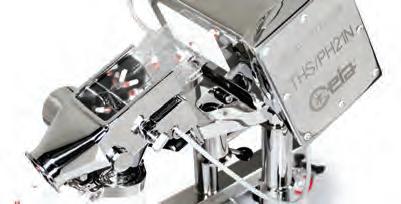

units installed. CEIA PH21-Series pharmaceutical metal detectors deliver unparalleled accuracy and sensitivity to all metals and provide high throughput rates for pills, tablets, and capsules. In addition, CEIA offers a complete range of solutions for packaged and non-packaged tablets, powders, liquids and other products; with all solutions including FDA 21CFR compliance.
Ishida X-ray Inspection
Find foreign objects including metal, glass, bone, plastic, hard rubber, shell and stones. Or detect product defects like cracks, voids, missing items and improper weights.
Ishida Checkweighers
Verify product weight, count, or missing items with DACS checkweighers. User-friendly controls include advanced data collection and management features.
Leading Canadian paper packaging and tissue product group Cascades Inc. has announced plans to construct a brand new US$80-million containerboard and packaging plant in Piscataway, N.J., creating 120 new jobs there.
Scheduled to start operating in the second quarter of 2018, the 400,000-squarefoot facility will have the capacity to manufacture over 2.4 billion square feet of corrugated packaging a year using the most modern technologies in the market.
According to the Kingsey Falls, Que.-headquartered Cascades, the new plant is part of the company’s ongoing efforts to achieve better synergies through closer integration of its primary production and converting facilities, as well as to consolidate its business assets in the northeaster U.S. markets.
“The investment is part of the deployment of our strategic plan that aims to modernize our assets and increase the integration rate between our primary production and converting activities,” says Mario Plourde, president and chief executive officer of Cascades, saying the new plant will help Cascades to achieve about a five-percent improvement in the integration rate.
“It is also part of our continuing process to reorganize and consolidate our containerboard and packaging activities in northeastern U.S. to help us better serve our customers and boost our production capacity, thus increasing our market positioning,” Plourde states.
As Frost relates, the Canadian launch of M&M’s Caramel has been backed with the biggest multimedia marketing campaign conducted by Mars Canada in seven years, comprising a multitude of television, online video, digital/ social media, and in-store promotional displays. Heat and
“The Piscataway conversion plant will have state-of-the-art technology and will be among the fastest in the industry,” adds Charles Malo, president and chief operating officer of Cascades Containerboard Packaging
“It will offer increased flexibility and allow us to provide more efficient and innovative products to meet our customers’ needs,” says Malo.
“Located close to the major urban centers along the eastern U.S. seaboard, the site was also chosen because it has room for subsequent development,” Malo adds, “to further strengthens our position and continue our growth.”
However, this asset reorganization means the end of the line for the company’s packaging plant just outside of New York City in Maspeth, N.Y.
Currently employing 148 people, the Masbeth facility will cease operations by the end of 2018, with its production gradually transferred to other more modern Cascades operations.
“This decision was necessary as the current site has reached its physical limits,” says Malo, adding the property occupied by the plant has already been put up for sale for about US$72 million.
According to Cascades, which promises a “seamless transitions” for the plant’s existing customers, the company will assess the options of relocating some of the plant’s affected workers to other Cascades facilities.

Express Packaging Chooses the Ax-Series Inkjet for a Reason.
"It [the Ax350i] saves us money, it runs faster for us and we have clearer print.
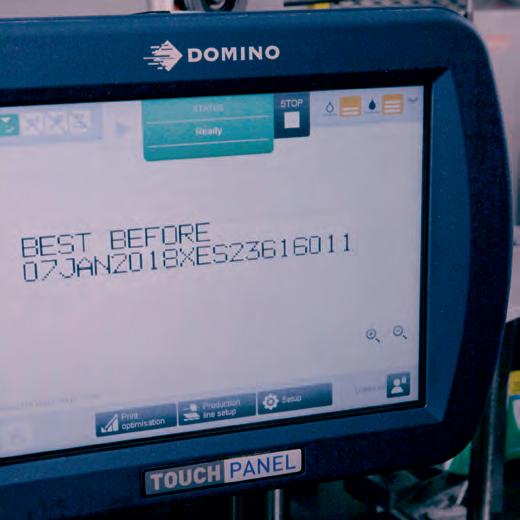
We've used other suppliers in the past but no one has equalled the production that a Domino printer puts out and the service that Domino technicians back it up with."
- Fred Hartzler, President, Express Packaging
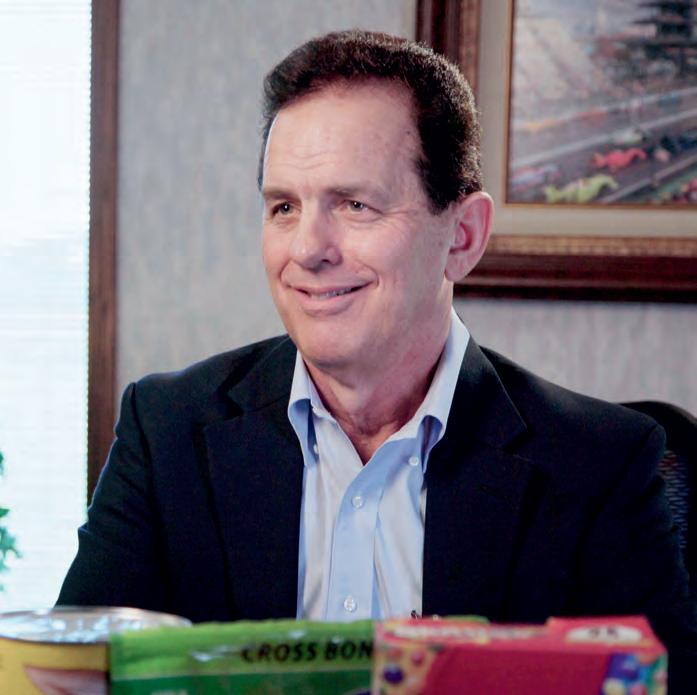
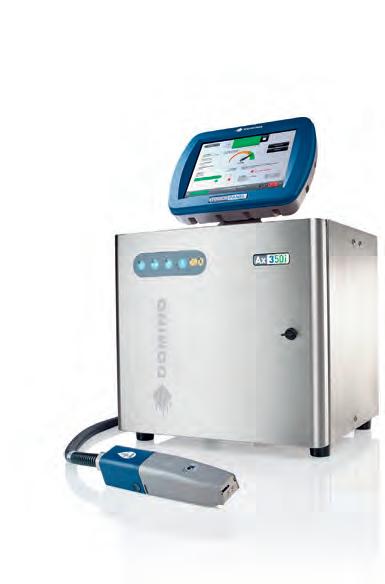
“It [the Ax350i] saves us money, it runs faster for us and we have clearer print. We’ve used other suppliers in the past but no one has equalled the production that a Domino printer puts out and the service that Domino technicians back it up with.”
- Fred Hartzler, President, Express Packaging
To find out more or to book a demo, visit www.ax-series.com

THE RULES
nSilgan Holdings Inc., Stamford, Conn.-headquartered supplier of rigid packaging for consumer goods products, has completed a US$1-billion acquisition of the dispensing systems business of leading U.S. corrugated packaging producer WestRock Company of Norcross, Ga. Operating a global network of 13 plants across North America, Europe, South America and Asia, WestRock’s dispensing business generates estimated annual revenues of approximately US$570 million on sales from highly engineered triggers, pumps, sprayers and dispensing closures used on major branded consumer good brands in the home, health and beauty markets.
nCincinnati, Ohio-headquartered packaging equipment group Pro Mach, Inc. has completed the acquisition
of Weiler Labeling Systems, Moorestown, N.J.-based supplier of high-speed rotary labeling, serialization and coding systems for pharmaceutical and medical packaging applications. “Weiler has built a stellar reputation among the world’s leading pharmaceutical companies and their solutions are a great addition to our product portfolio,” says Michel Lapierre, president of Pro Mach’s Pharmaceutical Packaging Group business unit. “Their expertise and vision has repeatedly put them at the forefront of pharmaceutical industry trends well before they are adopted in the marketplace [and] combined with the existing solutions of our NJM Packaging brand we can now offer customers one of the most sophisticated pharmaceutical labeling and packaging platforms in the industry today.”
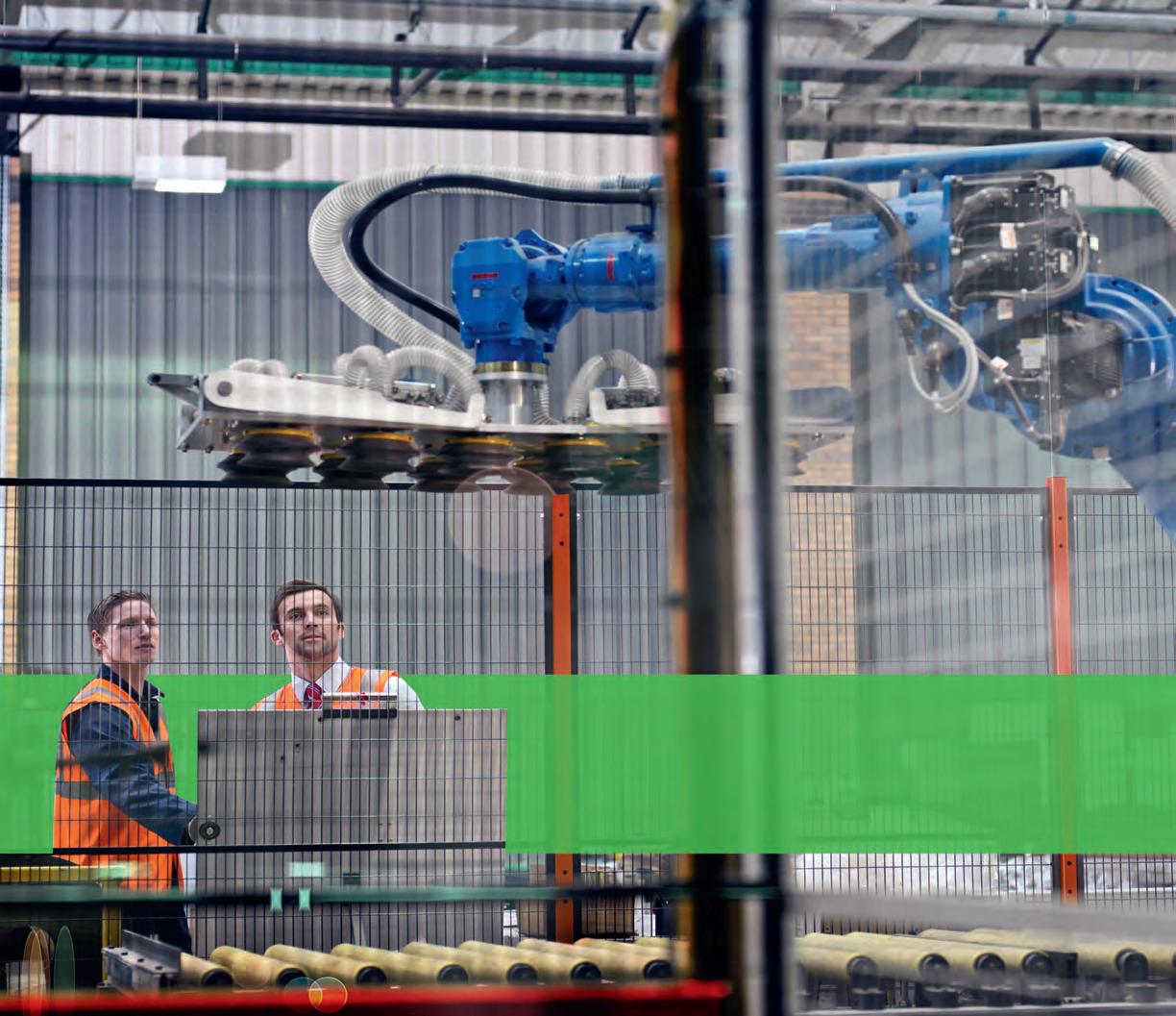
As a pioneer in smart automation technologies, Schneider Electric makes it easier for you to offer your customers machines that protect people, assets, and the environment. We help you combine safety and cybersecurity features into your machines and processes with ease and speed, so you can enjoy greater business efficiency and sustainability. Both today and tomorrow.





The Ontario Independent Meat Processors Association (OIMP) says it expects next month’s 2017 Meat Industry Expo —running Oct. 20-21, 2017 at the Scotiabank Convention Centre in Niagara Falls, Ont.—to be the biennial’s show finest edition to date.
“The only show of its kind in Canada, this is a valuable opportunity to network with colleagues, learn from industry experts, and keep up to date on trends and issues in the meat industry, while visiting over 70 exhibitors showcasing the latest innovations, newest technologies, and equipment and service solutions,” says OIMP marketing and communications director Heather Nahatchewitz.
According to Nahatchewitz, this year’s show will feature a vastly expanded Flavours section to enable visitors to sample some of the finest meat and poultry products available in Ontario, along with 16 OIMP business members on hand answering all questions about getting these unique artisan products onto the retail store-shelves.
“A local winery and brewery will also be present to complement the food offerings with the best the region has to offer,” Nahatchewitz adds.
For the first time, the show will also showcase some of OIMP commodity partners—including Ontario Pork, Turkey Farmers of Ontario, Veal Farmers of Ontario, Chicken Farmers of Ontario, and Beef Farmers of Ontario —providing valuable information on promoting locallysourced proteins across the province, while offering expert opinion on virtually any protein-related question.
Always one of the show’s most memorable highlights, the final round of the Ontario’s Finest Butcher competition—featuring three top Ontario butchers competing head-tohead for meat-cutting supremacy—will take place in the Flavours section right on the trade-show floor on Saturday afternoon, with the winners announced later that evening at the OIMP Awards Gala dinner.
All attendees and exhibitors are also invited to join OIMP at the staff the Friday night open-house social event, hosted by Handtmann Canada, taking place at the designated expo hotel Marriott on the Falls, right across the street from the Scotiabank Convention Centre, from 7 p.m. to 11 p.m.
Make it simpler to adopt safe automation Download our FREE resource papers to learn more today!
To register for the 2017 Meat Industry Expo, please go to: www.meatindustryexpo.ca
PAC ENDORSES ALL SAFE & SUSTAINABLE PACKAGING & TECHNOLOGIES
PAC LEADS THE ENTIRE VALUE CHAIN IN TRANSPARENT COLLABORATION
PAC
PAC
PAC







Leading German chemical and consumer goods multinational Henkel AG & Co. has pledged its full support for the three-year NPEC (New Plastics Economy) global initiative aiming to build momentum toward a plastics system based on the so-called “Circular Economy” principle.
Led by the U.K.-based think-tank Ellen MacArthur Foundation , the Circular Economy concept is based on the central idea of gathering discarded plastic materials after they have been used and reintegrating them into another production process over and over again to save resources and reduce the environmental impact.
As part of worldwide efforts aimed at bringing this concept to life, the NPEC initiative aims to bringing key stakeholders together to rethink and redesign the future of plastics, starting with packaging.
Specifically, it is targeting a shift away from incremental improvements and fragmented initiatives, and moving towards a shared direction that will deliver positive outcomes along the entire plastics value chain.
“Henkel is delighted to be part of the New Plastics Economy, and we’re looking forward to working with partners to drive innovations that make a big impact,” says Dr. Thorsten Leopold, head of international packaging development for Henkel’s Home Care Products business.
“Our company is in a strong position to make a valuable contribution to the NPEC because of its unique business model,” Leopold explains.
“On the one hand, Henkel can contribute as a manufacturer of fast-moving consumer goods (FMCG) like laundry detergent, shampoo or glue sticks.
“Conversely, the company is also a global leader in adhesives and other

advanced technologies that are used for packaging applications,” Leopold points out.
“These range from glues that seal boxes or secure product labelsto functional and protective coatings for plastic packaging, and adhesives that hold the different layers of flexible packaging together.

“Taken together, this means we’re able to offer expertise from both perspectives, which gives our teams a uniquely broad understanding of the challenges and possible solutions related to packaging,” Leopold states.
According to Leopold, Henkel’s corporate sustainability strategy includes having dedicated teams of packaging developers work on creating innovative, intelligent and resource-efficient packaging solutions, by focusing on three principles of Prevent, Reduce and Reuse.
Some of the company’s most recent innovations in sustainable packaging include:
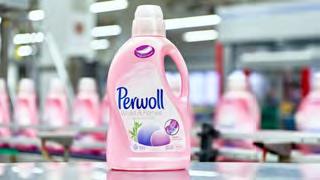
• D evelopment of new bottles for its premium Perwoll Wolle & Feines liquid laundry detergent brand in Germany, which were manufactured with 15 percent recycled highdensity polyethylene (HDPE) from post-consumer sources during a recent pilot project, without any compromises on the performance or fragrance of the product.
• Recent collaboration with metal packaging products manufacturer Ball Corporation to develop a new technology enabling the use of up to 25-percent recycled aluminum in cans for the deodorant sprays for Henkel’s bestselling Fa , Souplesse and Neutromed brands.
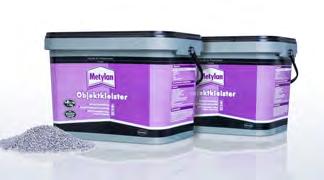
• T he development of new buckets for Henkel’s Metylan brand of wallpaper paste—made with 50-percent recycled material and 50-percent waste from industrial production that is fed back into the process for manufacturing new buckets.
According to Leopold, participating in the NPEC forms part of Henkel’s comprehensive strategy for sustainable packaging built around a set of key targets for the year 2020.
This includes reducing the weight of packaging measured against net sales to 20 per cent; increasing the content of recycled PET (polyethylene terephthalate) in bottles to 33 per cent in Europe, and the amount of recycled aluminum in cans to nine per cent; and to reach more than 300 million consumers through more targeted information on recycling.
According to Henkel, the company’s overall sustainability strategy Factor 3 aims to triple the value it creates for the environmental footprint of its operations, products and services by the year 2030, compared to 2010.

hile it’s true that there’s no such thing as too many good ideas in the world of packaging, the number 50 sounds like a nice place to start, at least for one day.
It has certainly worked well so far for this magazine’s annual Top 50 Packaging Ideas Expo tabletop exhibition, with its fifth edition set to turn the Mississauga Convention Center into A memorable day of packaging education, brainstorming and networking next month on Oct. 24, 2017.
Produced by the Canadian Packaging magazine of Annex Business Media in Toronto, the one-day event is structured to bring together 50 leading packaging product and services providers in an intimate networking environment to share their collective knowledge, experience and solutions for achieving world-class packaging excellence and innovation.
“It is the polar opposite of the large, noisy multiday trade shows where there is just too much going on with the displayed machinery and huge crowds of people to have a meaningful conversation or an exchange of ideas,” explains Canadian Packaging publisher Stephen Dean, citing overwhelmingly positive feedback from past attendees and exhibitors.
Drawing an average of 300 visitors to the last four Top 50 Packaging Ideas Expo exhibitions, this year’s event will offer attendees the value-added bonus of fourhighly informative presentations delivered by leading experts from food and automation fields who are extremely well-qualified to offer unique and highly informative perspectives on modern packaging.
critical role played by new package designs and formats in launching new yogurt products.

nLaura Studwell, Packaging Industry Marketing Manager at Omron , discussing the importance of operational flexibility in today’s industrial market, and the role of automation technologies in achieving it.
With free admission to the sessions and



plenty of free parking available right outside the host venue, attending this year’s Top 50 Packaging Ideas Expo is a bright excellent idea in its own right.
For further information on exhibiting and sponsoring opportunities, contact Stephen Dean at (416) 510-5198; via email sdean@canadianpacakging.com; or go to: www.top50packagingideas.com
Offered for free to all Top 50 Packaging Ideas Expo attendees and exhibitors, the presentations will feature:

nDoug Alexander, Director of Engineering at fresh produce processor Ippolito Group in Burlington, Ont., offering his recipe for success in integrating processing, packaging and machine automation for optimal line efficiency in high-speed production environments.

nTom Egan, Vice-President of Industry Services at PMMI, The Association for Packaging and Processing Technologies, sharing the latest PMMI research on plant operational excellence procedures.

n Simon Small, VicePresident of Marketing at a leading Canadian dairy products group Ultima Foods , discussing the

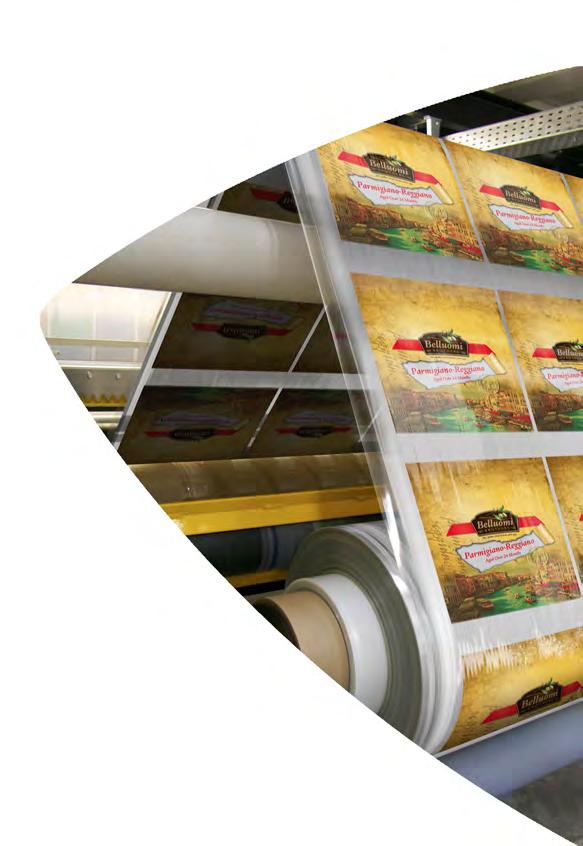
Appearance matters, so much so that one-third of consumer purchases is made solely based on packaging. And as product offerings continue to evolve and broaden, you are faced with the constant need to adapt.
Choosing the right packaging to allow for flexibility to meet your unique needs can affect the speed, cost, and impact of your graphics. With more than 75 years of packaging experience, Sealed Air’s Cryovac ® Printing and Graphic Services brings a holistic approach to packaging design and printing, without compromising efficiency, and most importantly, the integrity of your brand. Whether it’s our High Impact rollstock or digital printing capabilities, or our vast graphics expertise, our fully integrated team is equipped to continually differentiate your brand in a crowded marketplace.
Working with Cryovac Printing and Graphic Services means you can achieve the brand presence you desire while remaining adept and responding quickly to the ever-changing market.
To learn more about how you can help our brand stand out on shelf, visit www.sealedair.com/printing-graphic-services.
Montreal machine-builder eager to build on stellar market success and reputation at a new state-of-the-art manufacturing complex
BY GEORGE GUIDONI, EDITOR PHOTOS BY PIERRE LONGTIN
Simply standing still is a sure way of falling behind the competition in any industry these days, and the highly competitive and dynamic global packaging machinery business is certainly no exception.
Fortunately for WeighPack Systems Inc., casually resting on past laurels and accomplishments is simply not part of the venerable Montreal company’s DNA make-up and, thanks to the stellar management skills and entrepreneurial spirit of its founder Louis Taraborelli, has never been. And having just completed a move to the company’s spanking-new, state-of-
the-art headquarters and production facility located in Montreal, Que., WeighPack seems clearly intent on raising its proud track record of business growth and capital expansion to a whole new level.
“Our new facility clearly positions us for further growth ahead,” Taraborelli told Canadian Packaging in a recent interview, praising the many new capabilities and competencies the new $8-million facility provides to both WeighPack and its constantly growing list of customers across a broad spectrum of CPG (consumer packaged goods) industries.
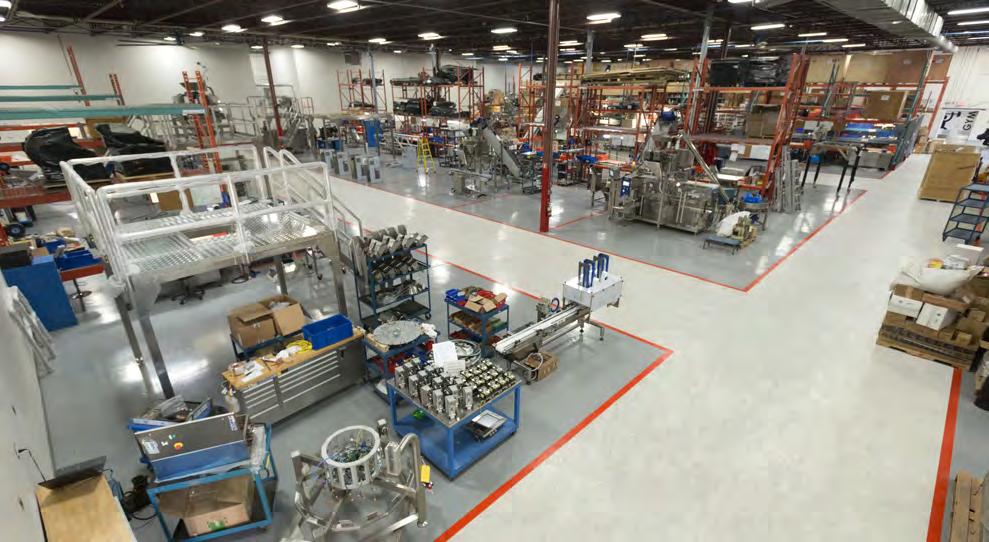
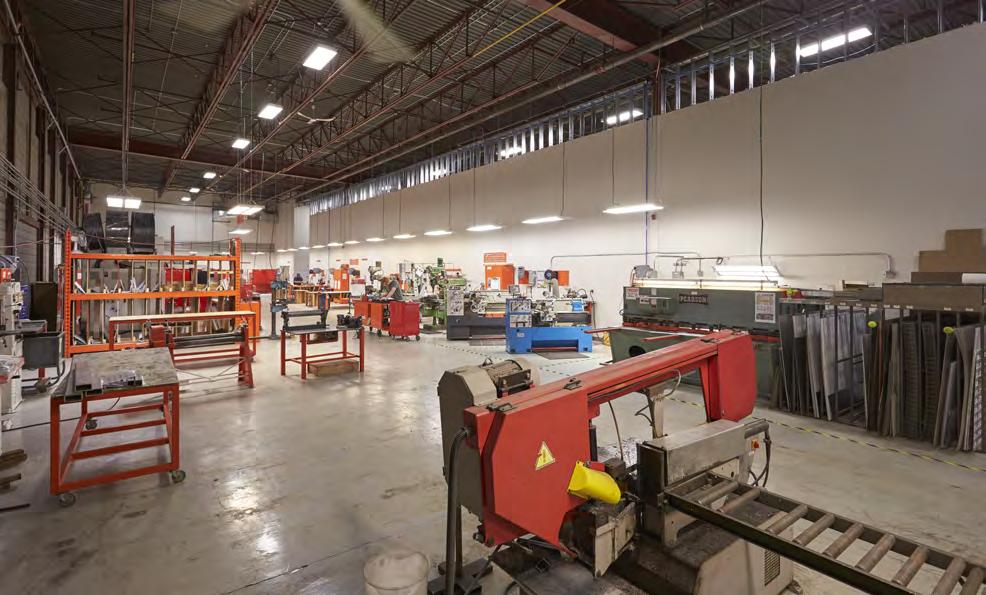
Housing the company’s fabrication department, 16 assembly workstations, and a separate protected R&D (research-and-development) area, the modern building will significantly “increase our production capacity to supply growing global de-
mand for our products,” Taraborelli relates.
“And sitting on 250 thousand square feet of land prepares us for any future expansion to respond to market demands.”
“We even went so far as installing a huge and very tall walk-in climate-controlled area, where we can test our machines in refrigerated environments with highpressure, washdown capabilities,” Taraborelli extols.
“We can completely simulate a customer’s working environment at our new plant.
“As part of our design criteria, we instructed our architects to create a campus style environment,” he continues.
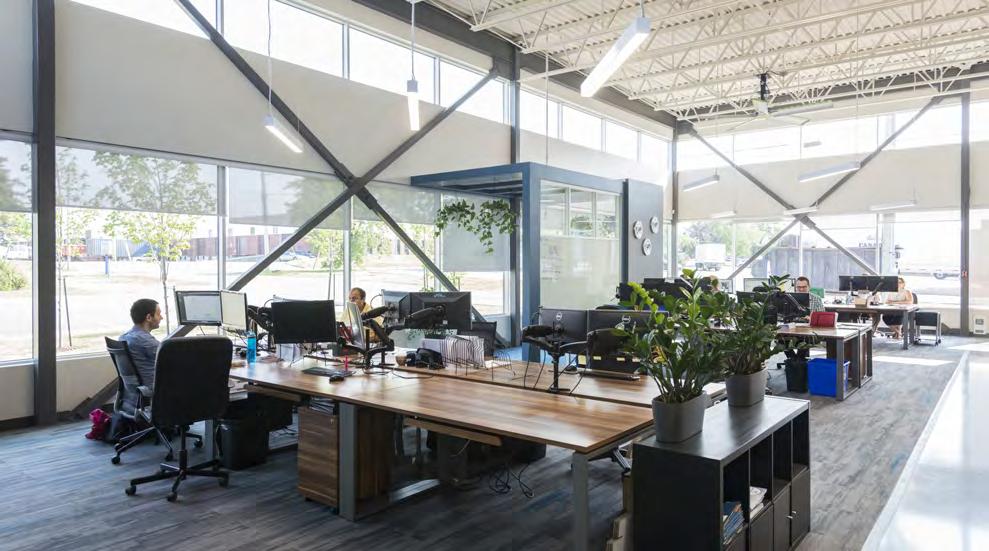
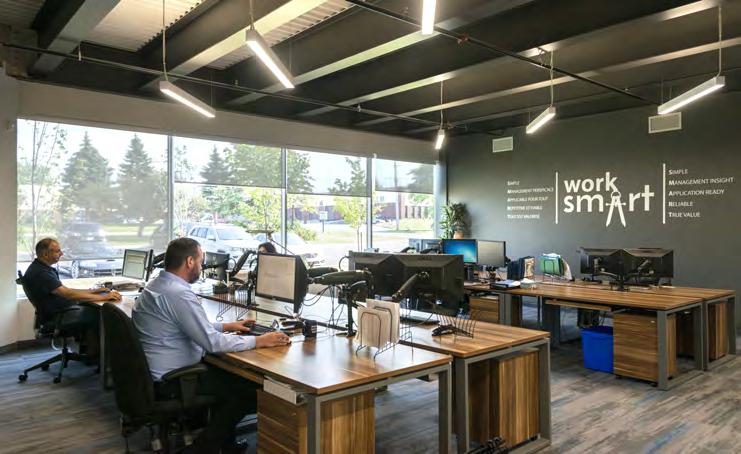
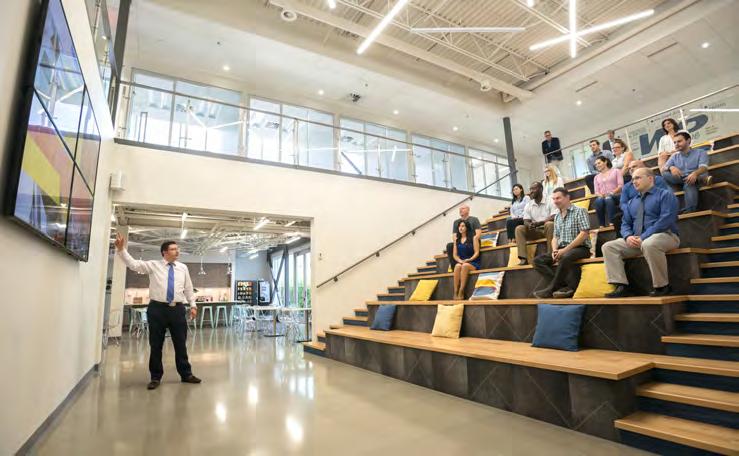
“Our open areas, our cafeteria and our leisure room are all a testament to our commitment to create a positive, enjoyable work environment for our employees,” Taraborelli points out.
“As we continue to grow, we want our employees to be proud to come to work every day,” says Taraborelli, describing the company’s 200-employee staff as “an awesome pool of talent.”
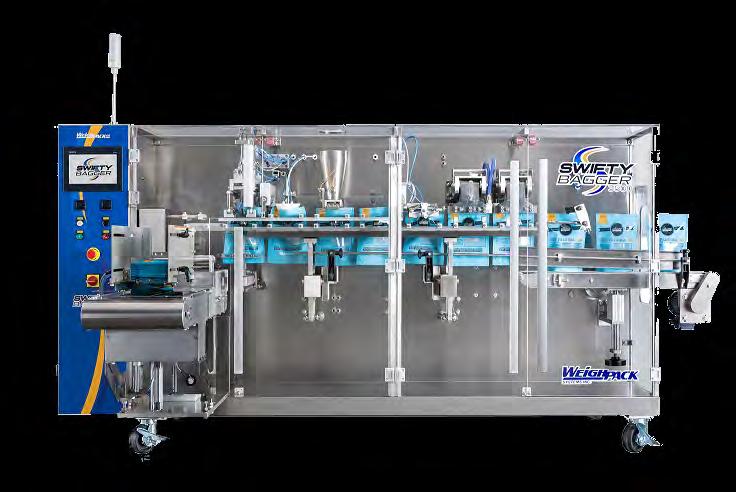
Widely acclaimed in global packaging industry circles as one of the world’s leading manufacturers of primary packaging machinery such as weigh fillers, automated bagging solutions, container fillers, custom conveyors and custom automated systems, as well as system integration, WeighPack’s rise to industry prominence is an inspiring ‘rags-to-riches’ story offering compelling proof that Canadian manufacturers of packaging and industrial machinery are more than capable to compete on a global stage—if they’re willing to put in the time, effort and commitment like Taraborelli has for more than 45 years in the business.
“I began my journey in the packaging machinery industry in 1972 as a 17-year-old, when I was hired by Ed McPhee as a parts order clerk and shipper/receiver at the Montreal branch office of what was then largest packaging machinery sales service company in Canada, the Paul Moore Company,” Taraborelli recalls, crediting former boss Rick McLeod for nurturing his prolific sales skills so early in his career.
“After having shown initiative by generating over $300,000 in parts business in my first year, I was promoted to a sales rep position,” he relates. “I think I was the youngest packaging machinery sales rep in Canada back then—surrounded by guys ranging from late 20s to well into their 50s.
“I still remember the day Rick McLeod asked me to come to work well-dressed so that I could now officially start selling.
“I did not own a shirt and tie,” he chuckles, “but I had a nice turtleneck.
“I drove a beat-up Volkswagen and I borrowed my father’s 1974 Lincoln Continental to make my first sales call, where Joe Lombardo, general manager at Pastene, gave my first order.”
Quickly rewarded with a company car, a brand new 1974 Chevrolet Nova, Taraborelli went on to build up an impressive client list in very short order.
“Some of my most memorable early sales were to Frank Saputo,” Taraborelli says, recalling the special bond he built with a co-founder of a fast-growing cheese producer that has since grown into a globally operating dairy product giant Saputo Inc.
“I had a great respect and admiration for Frank,” he confides.
“I initially sold them their first ricotta filling machine in 1974, which was a semi-automatic Autoprod piston filler doing one ricotta cup at a time,” Taraborelli recounts.
“Then in 1975 he bought the automatic cup denester, a filler, a film sealer and a lidder,” says Taraborelli,“as well as the first-ever Lantech pallet wrapper installed in Canada.”
Taraborelli says the experience gave him the confidence and faith in his ability to make a name in the business for himself.
“So I left Paul Moore at the ripe age of 20 to start my own business—quickly learning the first hard business lesson of not quitting one’s job before having something solid in place to go to,”Taraborelli recalls.
To get the fledgling business going, Taraborelli hit the road to attend some of the industry’s biggest trade shows to line up some of the exhibitors for representation in the Canadian market.
“I went to the PMMI (Packaging Machinery Manufacturers Institute) show in 1976 expecting to meet some key suppliers that I did very well with when I was with Paul Moore,” he recalls,“and at the end of the day I left the show representing two companies.
“The two companies were Autoprod and Universal Packaging, a fledgling manufacturer of vertical form-fill-seal machines starting at $6,900,” says Taraborelli.
“I also visited the Ipak-Ima show in Milan and came away representing the Soteco Group, which manufactured IMA, BFB, and Farcon that, at the time, were all unknown brands in North America. In 1977, I introduced Ilapak to North America.
“Ultimately, though, I decided that at some point our future had to be built with our own products,”Taraborelli states.
As it turned out, it was a brilliant decision by any measure.
From humble beginnings, with only a few people,WeighPack Systems has grown from a fledgling upstart producing six machines a year into a diverse manufacturer of well over 400 machines annually.
Moreover,WeighPack has expanded from being a stand-alone business into a bona fide group of companies operating three manufacturing plants and two systems centers in three countries,Taraborelli points out,“employing over 200 incredibly dedicated people.”
Not surprisingly, the team includes three of Louis Taraborelli’s sons—Nicholas, Justin and James—filling in senior management roles at the three major parts of the Paxiom Group business.
“My son Justin, vice-president of operations now running the show at WeighPack in Montreal, started in the family business over 10 years ago and grew through the ranks—today managing a large team of highly-qualified professionals,”Taraborelli says.
For their part, vice-president of sales and marketing Nicholas Taraborelli manages the company’s two Paxiom System Centres in Toronto and Las Vegas, Nev., while James Taraborelli recently returned to Canada after overseeing the startup and growth of the company’s subsidiary in Shanghai, China.
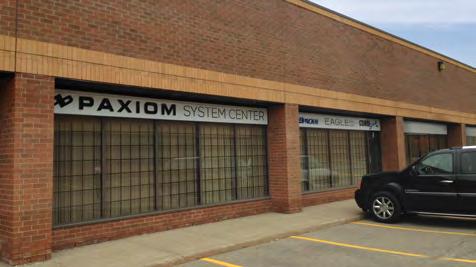
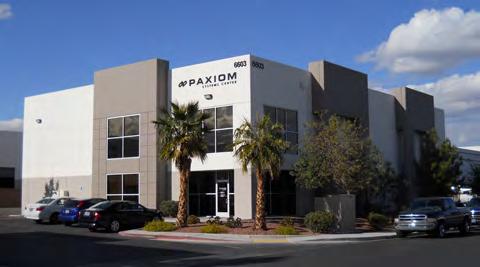
The company’s Paxiom System Centres—the Las Vegas location started up in 2004 and the Toronto branch in 2014—are totally “unique in the industry,” according to Nicholas Taraborelli.
“Both locations have over two million dollars of machines permanently on display and available for demonstration to the exact needs of our clients,” he explains.
“We offer technical support and can dispatch field service techs promptly with easily available flights to all cities in Canada and U.S.,” says Taraborelli, citing the company’s high comfort level with using advanced information and communication technologies to provide immediate feedback and technical support to its customers.
“We use a lot of new-generation software and hardware tools to operate efficiently. Our business-integrated software with advanced MRP (Material Resource Planning) functions and our VoIP (Voice over Internet Protocol) technology allow us to process parts orders from any of our locations in real time,” says Taraborelli, adding that the company plans to open more strategically-located regional System Centers in the next two years to get even closer to its customers.
“I firmly believe that the future of this business lies in having superior regional sales and service support,” he states.
“The competition is ferocious,” he stresses, “and in the end it’s all about reliability of the product and after-sales service and support.
“The closer we get to our customers the more we are going to win them over for good.”
According to Taraborelli, opening shop in China back in 2006 has greatly en-
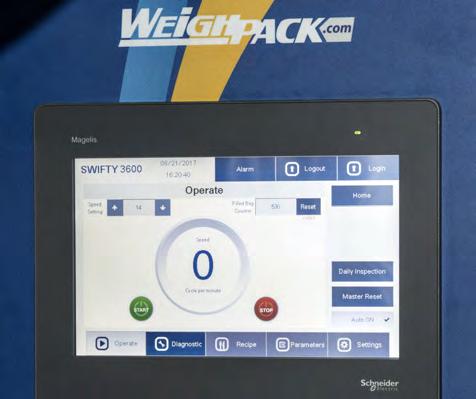
WeighPack Systems makes extensive use of the high-quality Schneider Electric Magelis HMI (human-machine inteface) touchscreen terminals to control the operation of its machinery and equipment in the most user-friendly way possible, with a short learning curve.
hanced the company’s geographic reach and influence in the increasingly globalized marketplace for packaging equipment.
“We were surprised at the amount of Chinese producers of packaging machines that already existed in China,” he recalls, “but we also learned early on that each and every machine bought there needed to be thoroughly inspected, tested and fixed prior to customer delivery.
“The Chinese were not consistent in any way with the quality of their workmanship, so we decided to open our own manufacturing facility as a WOFE (wholly-owned foreign enterprise) in the free trade zone in Shanghai.
“With labor costs being so cheap in China we wanted to outsource sheet metal and machined parts to keep our product costs low, while offering a quality product at a reasonable price, but we knew we had to be there ourselves to apply western management and quality standards,” says Taraborelli, noting the Shanghai plant nowadays employs over 50 full-time people. “We now have installations up and down the AsiaPacific market, including Japan.
“We are very proud of our achievements there.”
In 2008, Taraborelli successfully completed the pur-


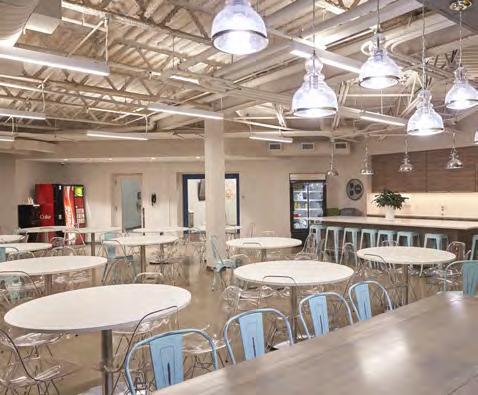
new plant’s cafeteria is also designed to encourage positive social interaction among the plant’s personnel from across all departments.
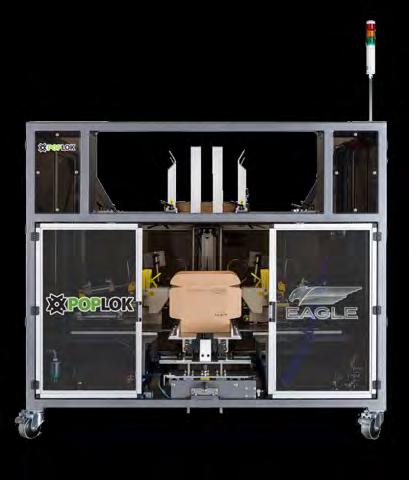
chase of Eagle Packaging Machinery in Miami, Fla., a well-established manufacturer of self-locking box formers, case erectors, tray formers and casepacking systems.
“This strategic acquisition provided us a diverse portfolio of end-of-line packaging solutions that fit seamlessly with the WeighPack Systems,” Taraborelli notes, “providing us the ability to deliver a true complete system solution designed, manufactured and serviced by one company.
“So not only can we take raw product and weighfill fill into a bag, jar , box or most any package,” he explains, “but now also put that package into a formed case and place it onto a pallet, managing the entire packaging process.
As Taraborelli strongly points out, “We are fully committed to providing our customers a single-source supplier for high-quality packaging solutions delivered and serviced by one company.
“We pride ourselves on having complete responsibility and being totally accountable,” he states, adding there are plans in place to eventually move Eagle Packaging to a newer and bigger facility to accommodate the growing business.
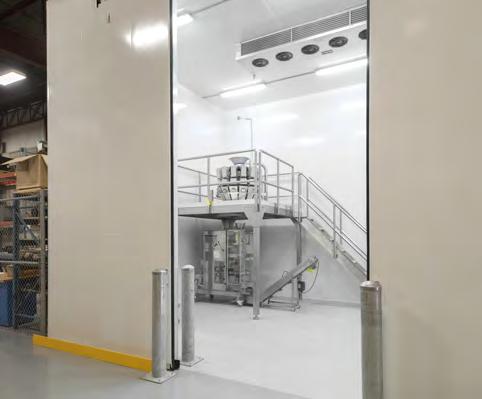
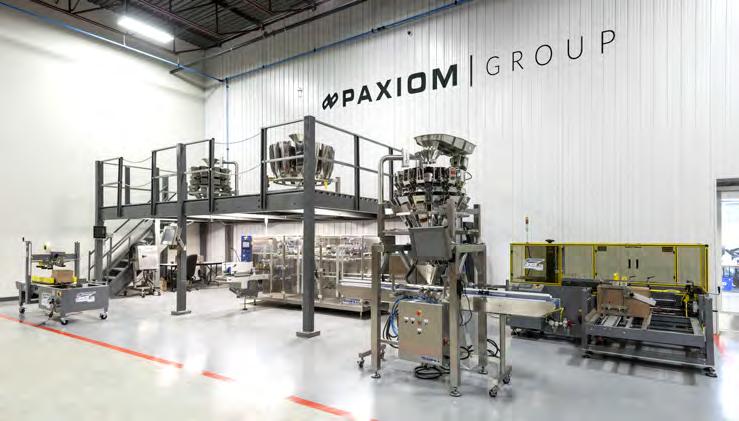
The plant’s segregated temperature-controlled room allows WeighPack to faithfully simulate the working conditions of its end-user customers in order to design the most optimal packaging solution for their application needs.
In the meantime, Taraborelli says he is relishing the opportunity to see what WeighPack Systems can accomplish at its new Montreal home digs.
“Our engineering team includes mechanical, electrical and automation experts who are very experienced in machine design,” he proclaims.
“Our fabricators deliver quality parts we dare to compare to any world-class manufacturer, and our assemblers fully understand how the machines work prior to signing off for delivery.
“Our project managers are all dedicated company veterans that understand applications well and follow through from sale to startup,” he adds, “and all our support teams are staffed with dedicated and hardworking people that all contribute to the success of our business.”
While WeighPack Systems has contributed a multitude of technological and design innovations to the packaging equipment sector, Taraborelli says he is particularly proud of true ‘industry-firsts’ such as:
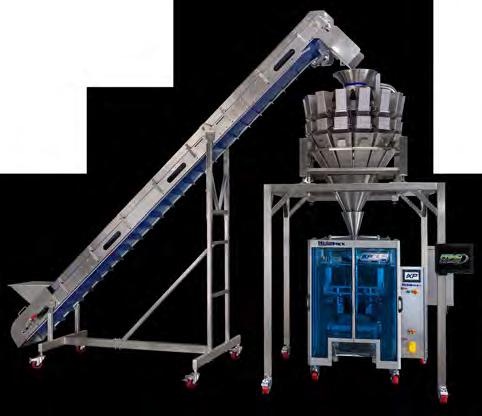
• The design and features of the PrimoCombi multihead weigher, the first and only combination weigher designed and built in Canada.
The Bingo range of automated bagging machines for controlled atmosphere bagging applications.
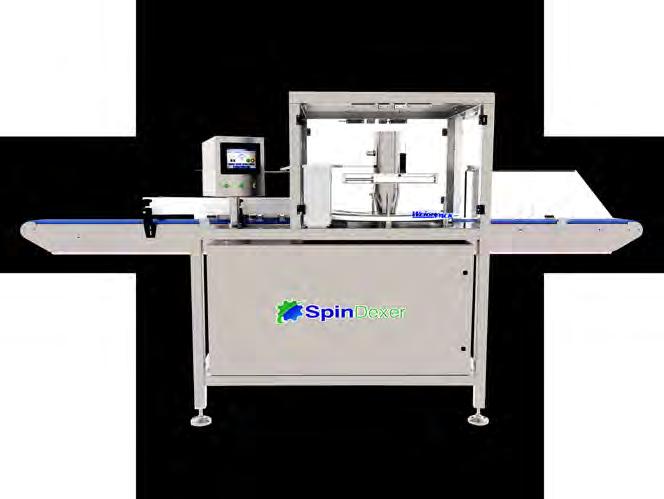
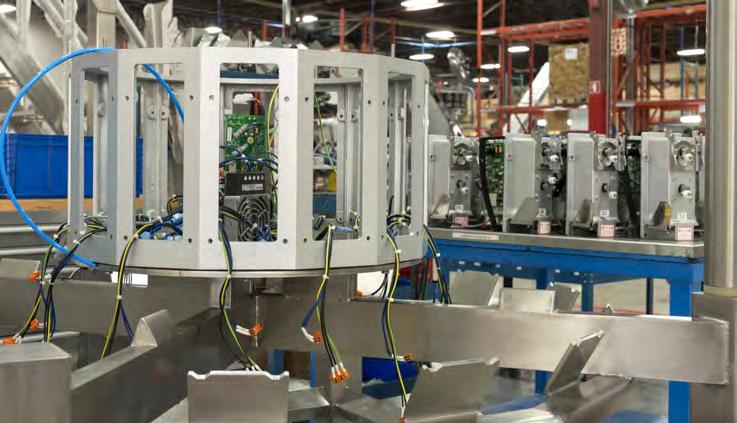
• The SpinDexer container filling machine that Taraborelli calls “a standard in vitamin gummy filling.”
• The very first model V-25 bulk box filling system purchased by Hershey Chocolates 20 years ago—and recently made an additional equipment purchase.
• A recent partnership with an Italian-based company that builds the new Sleek range of horizontal flowwrappers.
Says Taraborelli: “We are extremely proud to have built such an innovative, diverse and robust product line that has allowed us to promote ourselves globally into all packaging industries.
“Our ability to lead, innovate, adapt, make decisions and invest will continue to serve us well into the future,” he adds.
“Like all technology-intensive industries, we recognize that we cannot rest on our laurels, and that we must continue to drive change, new products and continued value for our customers,” he concludes, “and the incredibly motivated team that we have built here at WeighPack will continue to lead and think big for many more years to come.”
BY ANDREW JOSEPH, FEATURES EDITOR
PHOTOS BY PIERRE LONGTIN
After spending 24 hours at gaming table around 1762AD, England’s 4th Earl of Sandwich John Montagu requested the establishment’s cook prepare a meal that would allow him to continue playing with one hand, while allowing him to eat with the other.
While the name of that cook is lost to history, the meal of slices of cold beef presented between toasted bread came to be known as a sandwich after the man who requested the nourishing repast.
Of course, it could just as easily been called a ‘portsmouth’ that many North Americans eat for lunch.
The first Earl of Montagu was going to take the title of Earl of Portsmouth, but changed his mind at the last moment to instead honor the town of Sand-
wich in Kent, England where the fleet he was commanding happened to be offshore from.
Perhaps owing to its high-stakes origin, the sandwich has become known as a meal of convenience and flexibility, as a meal that can be taken and eaten on the go.
Nowadays, the sandwich’s ingredient list has evolved from the Earl’s slices of cold beef—though it is still a very popular standard fare—to a plethora of ingredients too numerous to list, with the addition of butter, margarine and dressings, to the inclusion of fruits and vegetables, meats and fish, and, of course cheeses of every type.
In short, if it can be placed between two slices of bread or toast or bun, it can be turned into an enjoyable portsmouth, er, sandwich that can be enjoyed at breakfast, lunch or dinner and all points in between.
While sandwiches were a popular lunch staple for the brown bagging worker, small local cafes in every North American town would offer a sandwich as a
quick, easy-to-make, inexpensive meal alternative to the classic burger or meatloaf orders.
In the more recent past, restaurants and cafes began to turn the humble sandwich into fancy feasts with the consumer eating it up in ever increasing numbers.
Less fancy, but no less satisfying, popular sandwich chains such as Subway and Quiznos began taking a huge bite out of revenues from fast-food franchises, prompting major chains of coffee shops such as Starbucks and Tim Hortons to realize that good coffee and donuts aside, people might also prefer a sandwich as a viable option.
This rise of the sandwich trend was noticed by companies that supply the chief ingredients for a sandwich—bread manufacturers and deli meats suppliers—which may have inspired Maple Leaf Foods’ Canada Bread division to pay big bucks in 2009 for the production facility of Quebec’s Aliments Martel Inc., a manufacturer of pre-made packaged sandwiches.
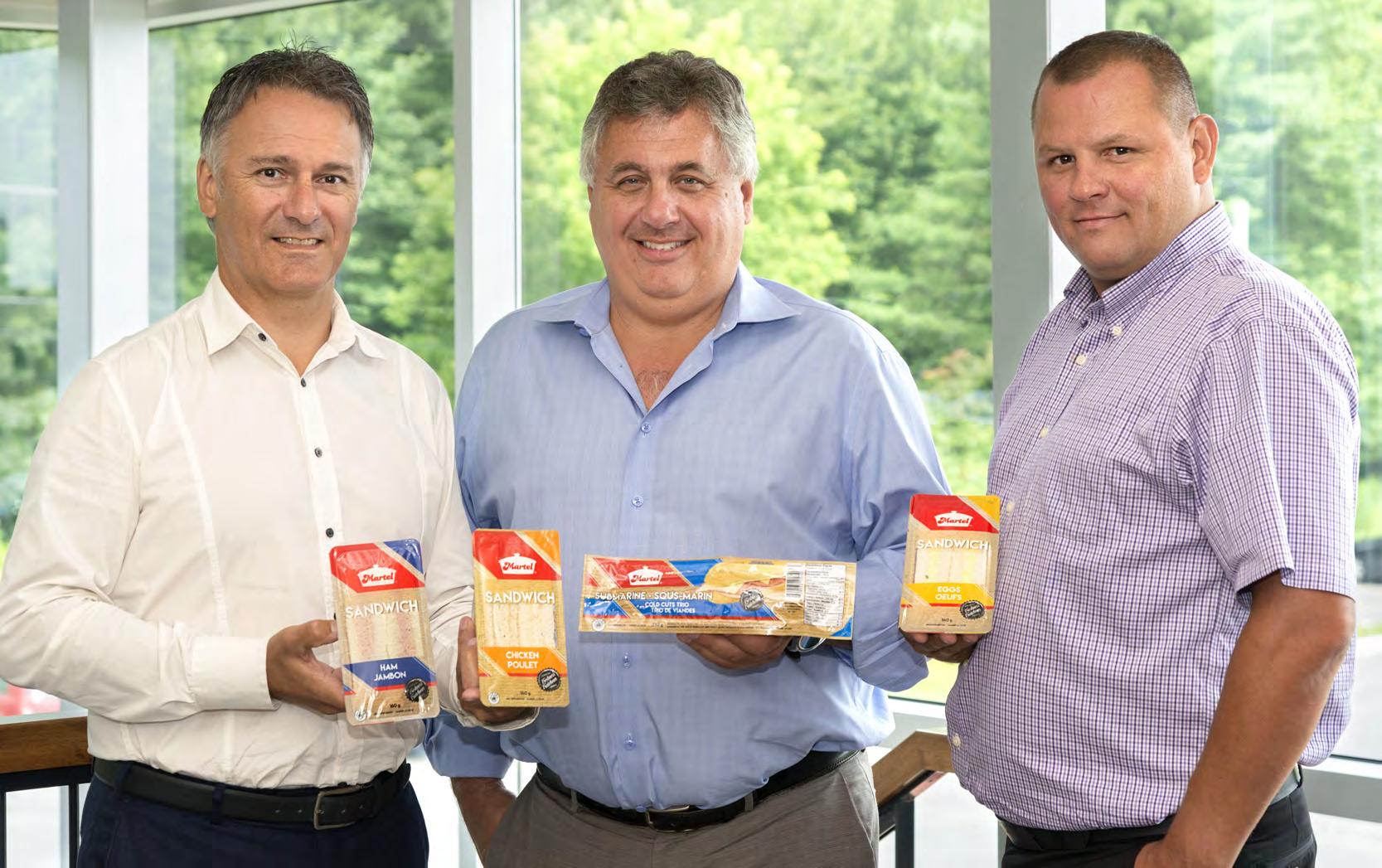
“They only purchased our production facility, not our brand,” Ailments Martel vice-president Serge Martel explained to Canadian Packaging magazine during a recent interview.
“To continue our sandwich-making, we utilized a third-party company to manufacturing our sandwiches for us following our recipes,” he continues, “until we purchased another company in June of 2016 and took back our sandwich-making for ourselves.”
The new privately-owned Aliments Martel of Terrabonne, Que. is part of The Martel Group that produces and distributes ready-to-eat meal products such as sandwiches, salads and submarine sandwiches, serving small businesses such as convenience stores and gas stations, as well as large grocery and supermarket chains, club stores and distribution centers.
Martel says that product distribution is done via its own brands of: Martel, Martel Vita (the healthy alternative), Selection Martel; and Relais Frais.
Along with supplying its on-the-go meals to such customers as gasoline provider Esso, Ultramar
CST, Sobeys, Couche-Tard—one of the largest convenience store operators in the world with over 12,000 stores across North America, Europe, Japan, China and Indonesia—and MAXI, a Quebec grocery retailer subsidiary of Loblaw Companies, Aliments Martel also provides its food fare menu to institutions such as hospitals, drug stores, cafeterias, daycares, schools, as well as government agencies.
Just one year ago when the company was rebooted, its landscape focus was just the province of Quebec. But now, Martel points out, the federally-inspected 70,000-square-foot facility and its 100 employees has successfully entered the Ontario market, opened a facility in the east coast and is about to expand into























































western Canada hopefully by the end of the year.
“Approximately 50 percent of our output revolves around the production of sandwiches, 40 percent for submarines, with the remaining 10 percent for salads and other convenience foods,” relates Martel.
He says that Aliments Martel’s bestsellers in its two main categories are the chicken sandwich and the Caesar salad.
“Because of the shelflife dependent nature of our food products, our production acility runs two shifts a day,” says Martel, “as it is imperative we always have fresh products available for our customers to have on their retail shelves.”
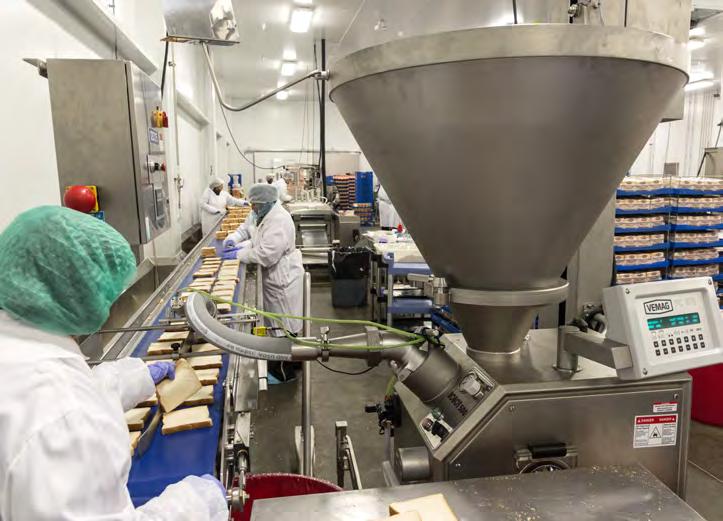
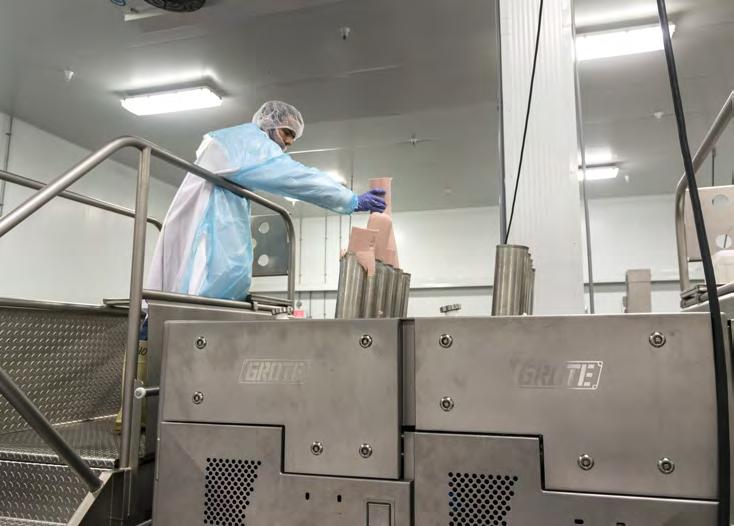
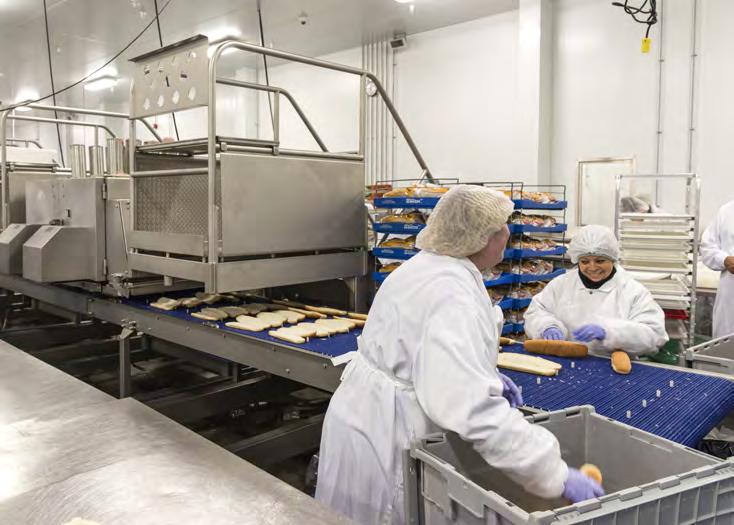
Contained within the HACCP (Hazard analysis and critical control points)-certified facility are five automated sandwich production lines.
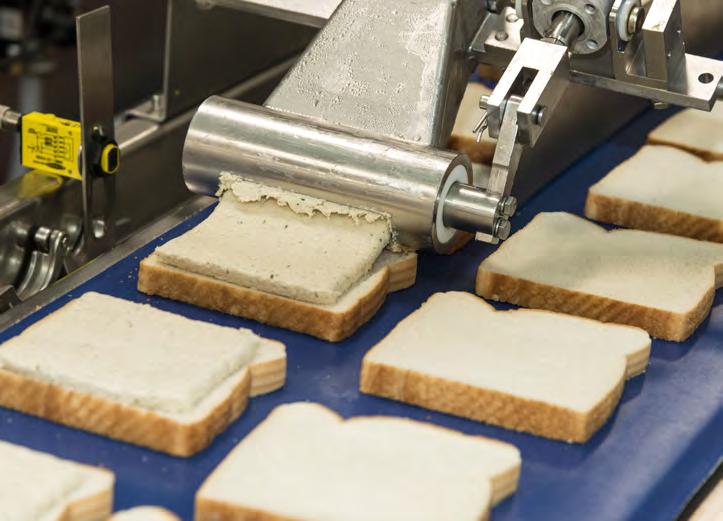
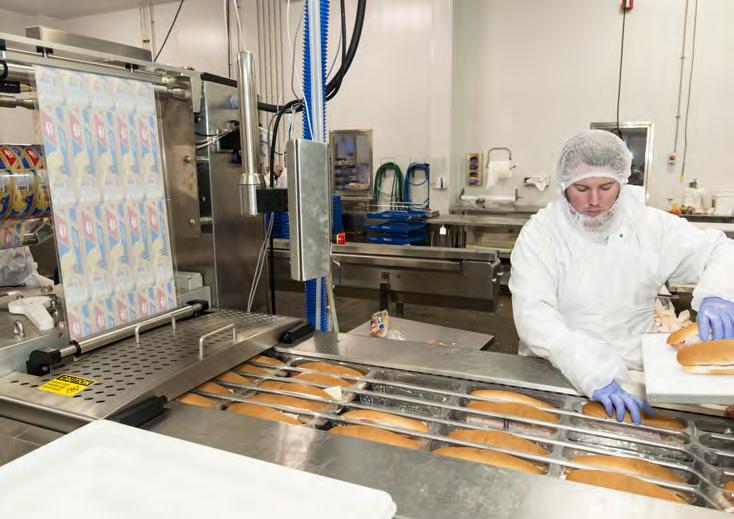
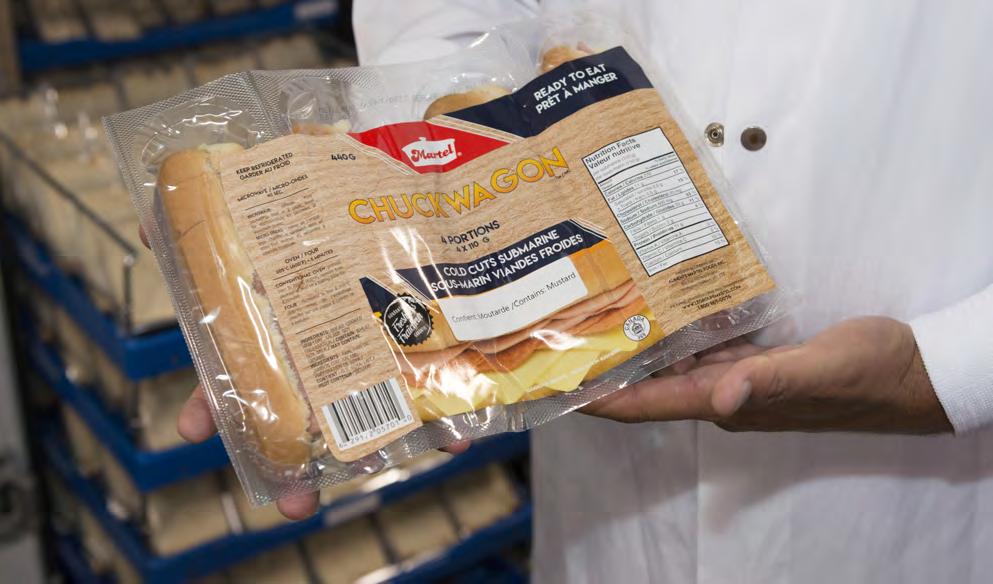
Long chubs of meat are placed within various slicing machines that can each portion five chubs at the same time. These sliced meats are then allowed to fall atop a bottom bread layer with other pre-determined ingredients automatically placed atop it.
“Our five automated production lines producing and packing our sub and sandwiches products are a very efficient process,” says Martel, “that not only helps keep costs down, but has provided us with a production line efficiency that enables us to consistently get our product out to our customers in a timely fashion.”
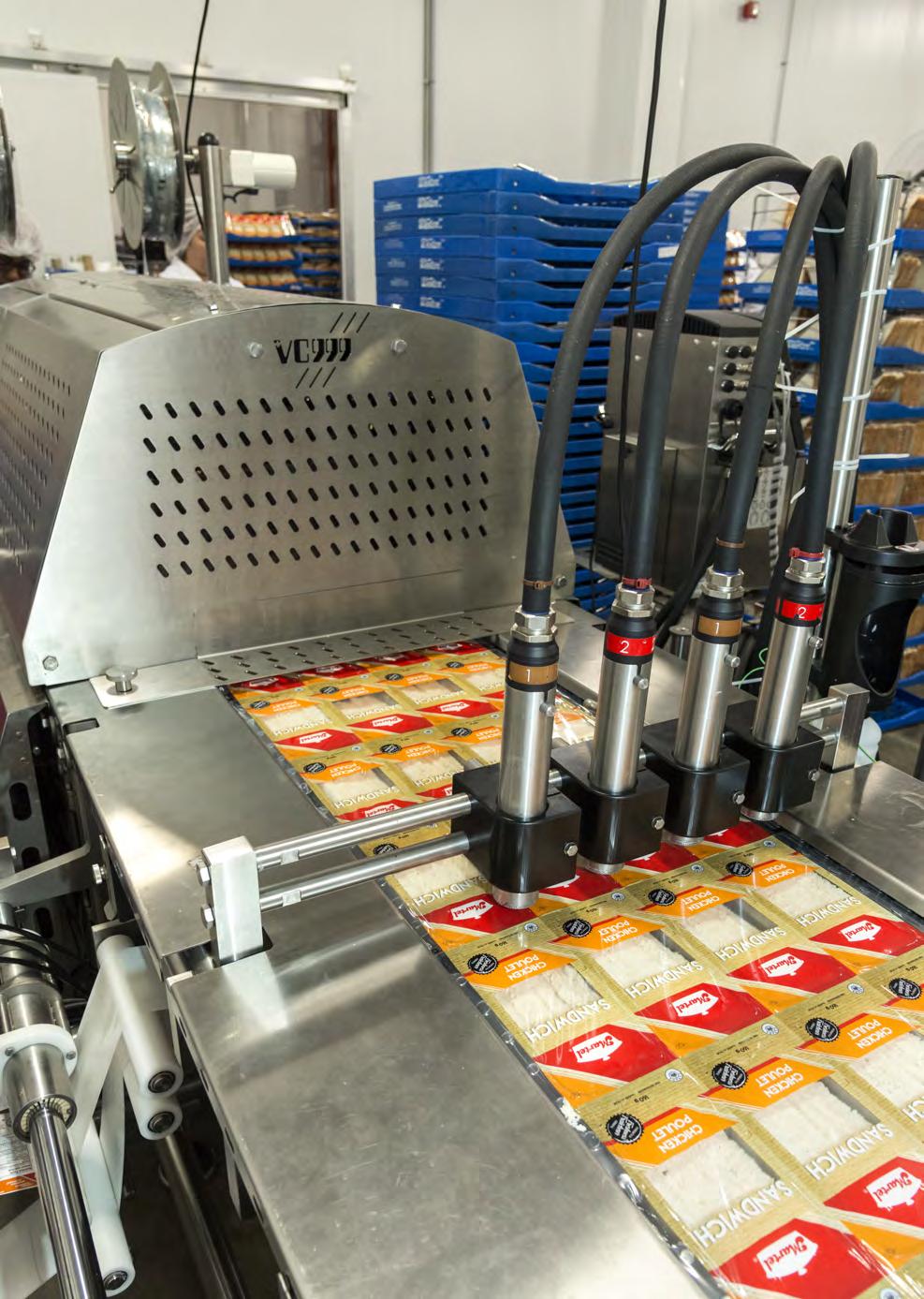
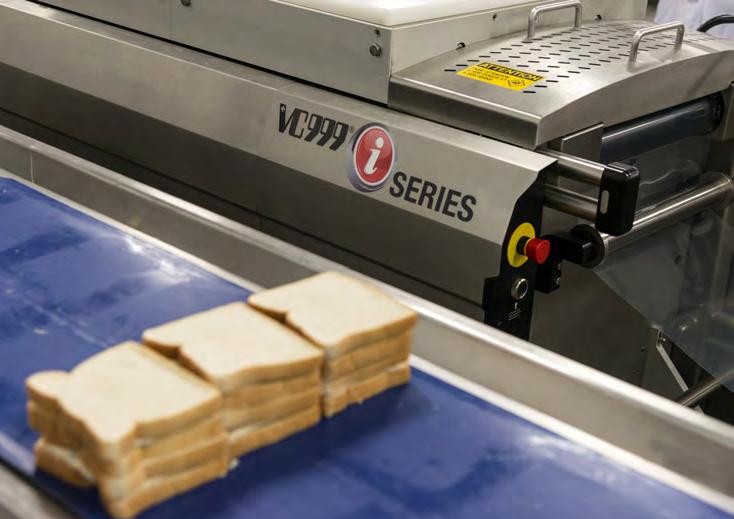
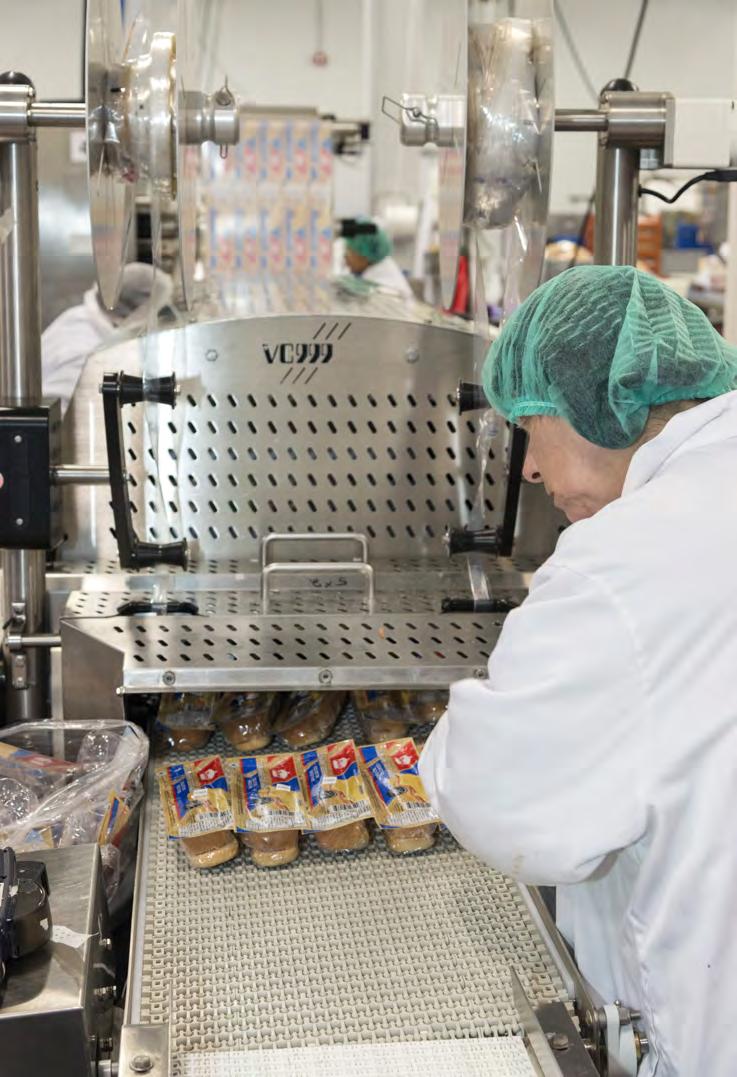
Each sandwich produced is individually-packed at the Aliments Martel facility by equipment designed and manufactured by VC999 Packaging Systems, a Kansas City-based company manufacturing packaging machines exported worldwide.
The VC999 brand consists of thermoformers, high-speed traysealers, and vacuum machines; its XtraVac brand offers economical equipment solutions such as flowwrappers, metal detectors, vacuum chamber machines, multihead weighers and more; while its XtraPlast division provides all of its plastic products.
When Aliments Martel purchased the business in 2016, along with its facility and employees, it also inherited its older production line equipment it felt would not allow it to be competitive enough for them to grow its business.
“We worked directly with VC999’s sales/project manager Carl-Michel Cloutier to determine the best equipment for our needs,” explains Martel.
“We chose equipment and materials that were of a high quality, but were still not going to break the bank,” he continues. “And after just one year, we contacted VC999 again to make additional
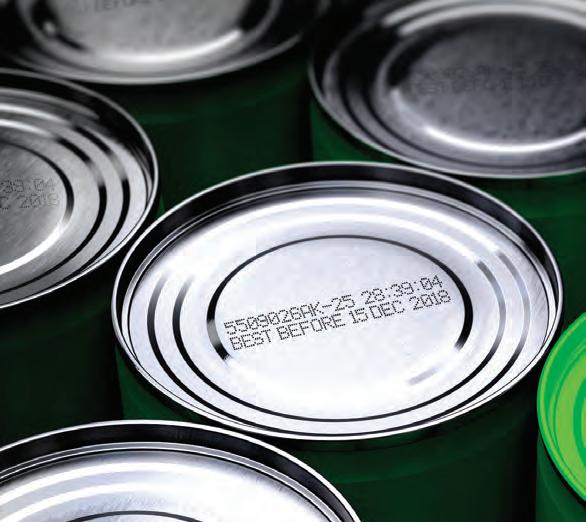
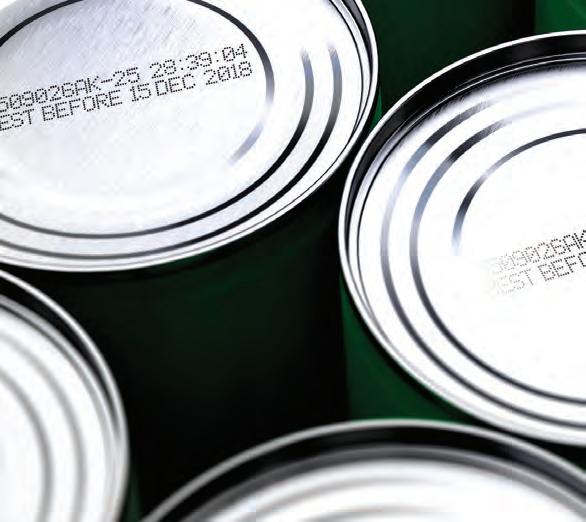


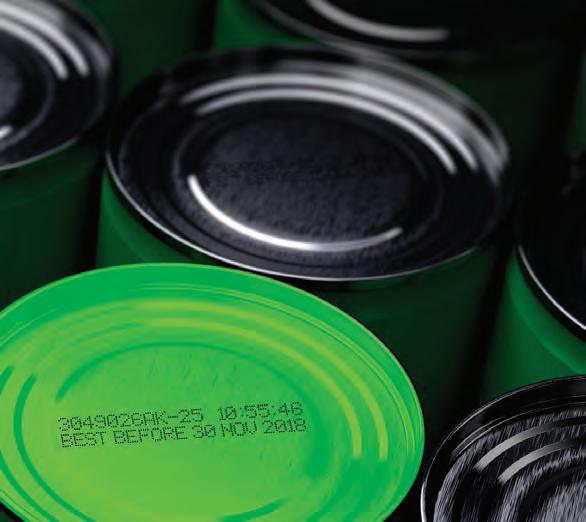
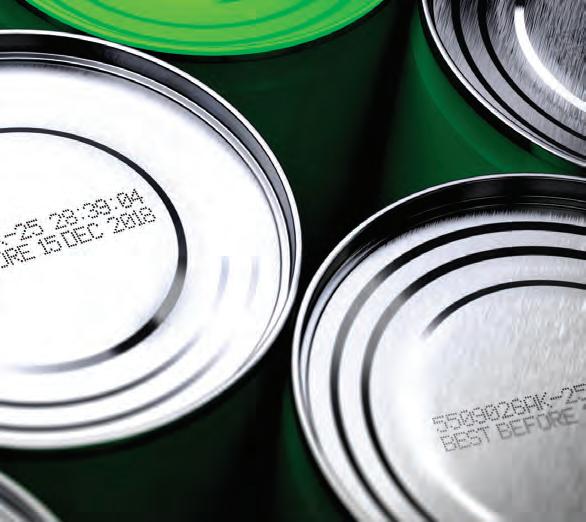
Production line variables and packaging material affect the way text is printed. Deformed, degraded or obscured text? Not to worry. Matrox® SureDotOCR™ is the most comprehensive solution for reading dot-matrix text.
With its unique reading capabilities and improved speed1, Matrox SureDotOCR ensures accurate, reliable reading of product information written as dot-matrix text by inkjet printers. Track and trace items from beginning to end— with utmost peace of mind.
Be sure with SureDot ™
www.matrox.com/trackandtrace/cp
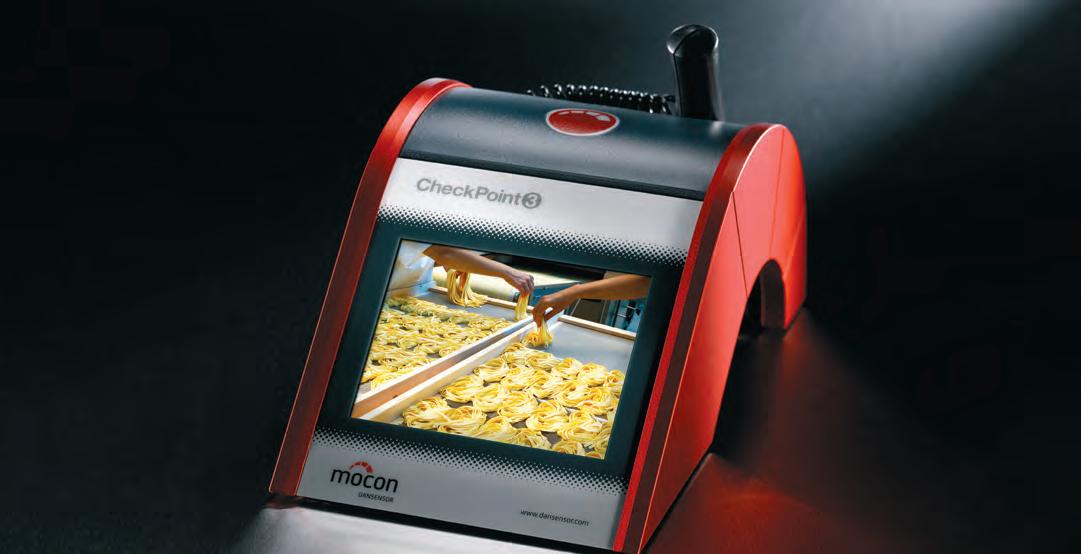


machine purchases that reflect our current and future requirements.”
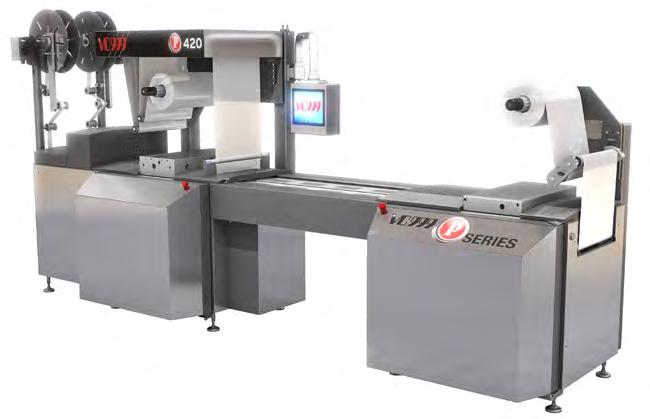
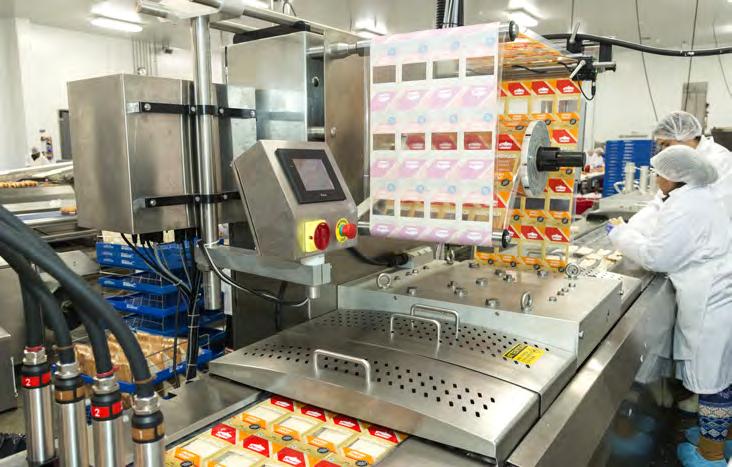
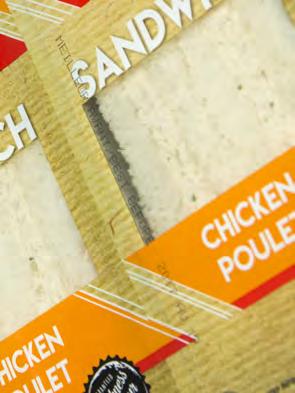
In 2016, Aliments Martel installed a pair of VC999 rs-Series model RS323 flexible thermoforming machines with Videojet thermoprinters.
“One of the RS323 units was set up to work with both rigid and flexible materials, while the other just handles flexible,” mentions Martel.
A third VC999 machine installed at that time was a RS355 rigid/flexible thermoforing machine with a Videojet inkjet printer.
The rs-Series of VC999 thermoformers are a robust form-fill-seal vacuum pack machine that forms deep-drawn pockets from rolls of film that allow the processor to place the product within before the rs-Series thermoformer quickly seals multiple packs via vacuum or modified atmosphere at a rate of approximately eight to 10 cycles per minute.
During the first year of the reborn Aliments Martel, sandwiches were still being created by a third-party processor, while the three new rs-Series thermoformers were used to pack complimentary products such as sandwiches,
croissants and more.
“All three of the VC999 rs-Series machines exceeded our expectations,” Martel relates. “We knew of the VC999 reputation from talking with other food processing companies, but even we were pleasantly surprised at how easy to use the equipment was, and at the level of service we received from them.”
As such, when it came time for Aliments Martel to expand its automation, Martel says he did not hesitate to once again use the services of VC999.
The “I’S”
Installed in 2017, Aliments Martel added a pair of impressive i-Series VC999 machines:
• an i423 rigid/flexible thermoforming machine with a VC999 bottom labeler and two Videojet inkjet printers, mounted on the jumbo roll at the forming unit to limit the number of roll changes required per day, thus enhancing production line efficiency producing sandwiches exclusively;
• an i459 flexible thermoforming machine with two Videojet inkjet printers, also mounted per the i423 unit, producing only subs.
“We use one to pack only sandwiches, and the other i-Series just for subs,” mentions Martel.
The sandwich maker opted for the new i-Series because it had a situation advantage: Aliments Martel needed a machine to achieve the high speeds it required to meet its unit-per-day output of sandwiches and subs to match customer demand, and only the i-Series could do that while being able to fit within the remaining limited floorspace.
“Another key reason we opted for the i-Series,” relates Martel, “is that it’s the only such thermoformer that can switch from a rigid MAP application to a regular flex vacuum or MAP application in less than 30 minutes without a mechanical adjustment.
The i-Series of thermoformers is designed for medium to large volumes of packing, and features the high-quality hygienic standards of VC999, with Cloutier saying its designs exceed global standards.
According to VC999’s Cloutier, the iSeries is constructed with an extra-strong fabrication of stainless steel to handle the daily, heavy-duty application process.
“Along with being fast, the quality of seal on the i-Series is delivered with a 50-tons of pressure die lift system that Serge Martel wanted to ensure the company would have very few rejects,” recalls Cloutier.
“We also equipped VC999 labelers and printers at the end of the line so that the package is complete with all the required labels and lot numbers and best-before data,” he adds.
Martel notes that its two i-Series ther-
moformers each work at a rate of 10-12 cycles per minutes which “is pretty fast considering we are forming deep packs with thick rigid films and MAP.”
Cloutier adds that VC999 also worked on redesigning some of the other equipment around the thermoformers to bring products quicker to the machine.
Although Aliments Martel opted to go with an allVC999 line-up for its five production lines, the VC999 machines are designed to be flexible enough to be integrated with other brands as well.
“The VC999 equipment has an excellent reputation for quality, high-speed output, but we were also swayed by their fast and high-quality service,” says Martel, noting
the one-stop complete offer. “Their ability to not only provide the machine, but the films required from a single supplier helped when they also opted to pick a maintenance program from VC999 that revolved around their choice of XtraPlast high-quality films.”
Adds Cloutier: “VC999 also developed a complete concept of final package from machine, film and artwork development of images to go on the pre-printed films.
“As well, we offered Aliments Martel our complete expertise in packaging line development, including engineering, equipment choice, best film options, graphic design and
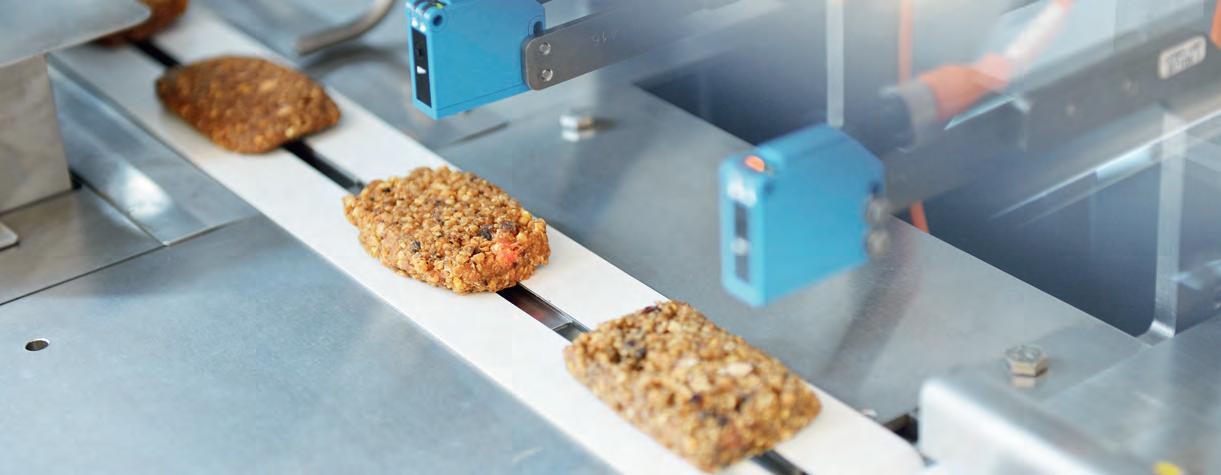
Experience our Bar Packaging System Pack Expo Las Vegas Central Hall, Booth #C-2800
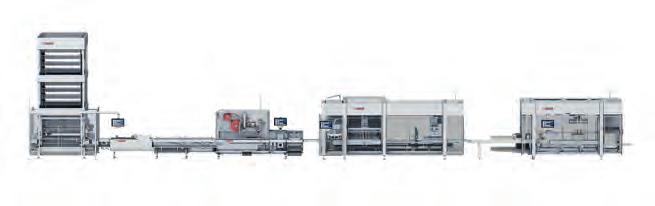
Inspired by our customers, we developed a system solution that is ready to cope with the specific requirements to efficient bar production. The Bosch Bar Packaging System features a seamless design architecture that raises productivity, expands capacity and boosts availability. The interfaces across the entire system have been harmonized to create a production process you can rely on.
Output and uptime are critical to a successful production operation. The Bar Packaging System carefully balances speeds across all components and is capable of a continuous output of up to 1,500 bars per minute. Innovative solutions such as the intelligent and contact-less infeed module with linear motor technology, the flow wrapper’s fully auto mated splicer, the topload cartoners’s tool-less format change over and the system’s overall hygienic design ensure a consistently high output with minimal downtime. All modular components in the Bar Packaging System work as one seamless system from product distribution to end-of-line packaging.
Bosch Packaging Technology is your experienced partner, providing you with comprehensive support throughout planning and installation, right through to after sales support. We will work closely with you, providing local, efficient service once production has started and beyond.
Raise the bar in efficiency and quality with the Bosch Bar Packaging System.
X High Overall Equipment Effectiveness (OEE)
X High process safety and easy operation
X Future safe format flexibility
X Quick format changes and vertical restart
X Hygienic design
even after sales,” says Cloutier.
The plastic films used by Aliments Martel on its five VC999 production lines is from the XtraPlast division:
• XtraPlast Rigidex Forming web films: 14-mil to 18-mil used depending on the type of product being packed;
• XtraPlast Aquasun Flexible Forming 9-mil film;
• XtraPlast Aquasun Flexible Non Forming Easy Peel 2.4mil film, printed via high-resolution rotogravure 11-colors, Cloutier says.
“At this time, none of the salads at Aliments Martel are being packed via VC999 equipment,” acknowledges Martel. “It’s all subs, sandwiches, and handheld breaded products.”
He says that all of the VC999 thermoformers at Mar-







• one FW50 flowwrapper for shrink and regular films;
• one CS501M casesealer;
• one PS1521 automatic pallet stretchwrapper machine;
• and two rotary tables.
tel are working in MAP (modified atmosphere packaging) mode.
“Utilizing MAP with our thermoformers has given our sandwiches a shelflife of 30 days using a vacuum of 1-mbar (an atmospheric measurement known as millibar) with an oxygen gas residual of less than one percent.
Aliments Martel also uses a VC999 XtraVac flowwrapper—a special design flowwrapper that can use a shrinkfilm without gas, as well as a regular laminated high barrier film should gas be required for a longer shelflife.
Other VC999 XtraVac equipment purchased by Aliments Martel are:
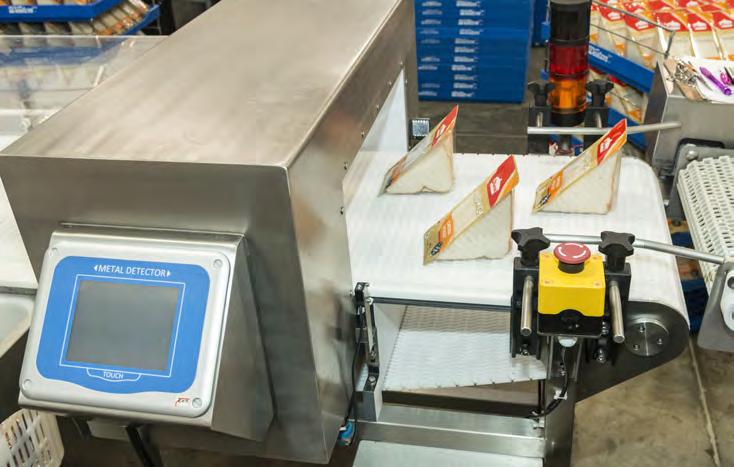
• three MD4121 metal detection systems;
• three MD3113 metal detection units;







Aliments Martel is also a participant within the VC999 XtraPlast Rewards program where every plastic product purchased rewards them with points that can be exchanged for free maintenance, service or free parts for their owned machinery.
“The past couple of years have been a whirlwind of activity for us,” exclaims Martel.
“The new business venture has been quite successful,” he says, “which is why we are expanding our customer base right across Canada.
“That success is derived from the tasty, affordable, quality on-the-go products we offer our customers, coupled with our on-time delivery.”
He says that on-time achievement is owing to his hardworking employees and to the high-quality automation on his five production lines.
“We are very happy with our business partnership with VC999,” sums up Martel. “Working with the VC999 Canada team has helped make our production line an efficient beast.
“Everything works well—better than what we expected, which has helped us quickly reach our goal of having our sandwich products across Canada.”














“A fine beer may be judged with one sip, but it’s better to be thoroughly sure.”
- Czech Proverb

We couldn’t agree more. So while you focus on making great beer, let us take care of your packaging needs. Let’s talk.
Corrugated beer trays
Custom case designs
Stock sizes available to minimize packaging costs
Short runs with high quality digital graphics available
The right print solution for your needs. (Digital, Screen, HD Flexo, Litho)


Rural Ontario craft brewer building its own unique path to marketplace glory with a bold go-to-market strategy and authentic craftsmanship
BY GEORGE GUIDONI, EDITOR
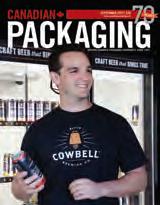
Running a commercial brewery may seem like worlds away from operating a propane business, but in the wonderful wacky world of craft-brewing, oddities and curiosities are largely more of a refreshing norm than exception to conventional thinking. And being different is just how the good folks of Cowbell Brewing Co. in Blyth, Ont., like to roll.
So while the tiny Huron County village in Ontario’s farming and cottage heartland may sound like a curious place to start up a multimillion-dollar, stateof-the-art craft-brewing, fine dining and event-hosting venue, it’s all part of the upstart brewer’s unique approach to entering Ontario’s fast-growing craft-beer business with a real bang and plenty of good cheer and fanfare.

by
ing seems truly blessed in having everything it needs to live up to its proud claim of being a “unique destination craft brewery unlike anything else in Canada.”
Drawing well over 3,000 visitors over its grand public opening weekend in early August, the immaculately crafted 26,000-square-foot building—faithfully replicating a 19th Century German Bank Barn—accurately captures the passion and dedication of its owners and staff to producing world-class craft beers for the Ontario market and, ultimately, well beyond.
Looking like it belongs at a Swiss Alps skiing resort, the area’s new landmark seems to fit like a glove with the nearby farmhouses and old-town charm surrounding the 111 acres of pristine, privately-owned rural property in the heart of Huron County that Cowbell can finally call home.
According to brewmaster and director of operations Stephen Rich, Cowbell Brewing first got its feet wet in Ontario’s craft beer market by having the early runs of its flagship Founders’ Series beers contract-brewed and co-packed by industry counterparts Collective Arts brewery in Hamilton and Brunswick Brewing in Toronto, while waiting for the multipurpose Blyth facility to come together.
Having just started up the company’s brand new 50-hectoliter closed-loop brewhouse manufactured by the Abbotsford, B.C.-based brewing equipment builder Newlands Systems Inc., Rich is a picture of pride and optimism about the company’s growth prospects and market opportunities.
“We definitely have some big plans for this beautiful facility,” Rich told Canadian Packaging on a recent visit to the spacious building bathed in natural light and housing an on-site gourmet kitchen with a wood-fired pizza oven, a posh bar area, a family-friendly restaurant, several private meeting rooms, and a well-stocked retail store selling a plethora of branded glassware and other eyecatching merchandise.
“This is a first purpose-built destination brewery in Canada, with the idea that for every hour that it takes to travel here, we will provide visitors with at least two hours of entertainment.
“There are many breweries one can go to for a tour and a beer while doing that,” he explains, “but they won’t have as many different beers like we have on draft, along with two cold-pressed nitrogenized coffees, two craft sodas on draft, a full restaurant, a theater, and full access to the brewhouse without an official tour.
“We already have 95 employees working here, which is over 10 per cent of Blyth’s working-age population,” says Rich, a self-described craft beer aficio-
nado who left his former chosen career path in financial services 10 years ago to immerse himself in the craft-brewing business.
“Our owners really wanted to do something that would drive the younger people back to the local communities,” says Rich, “and based on the reception we’ve received so far, it makes us feel that we are building something really special here.”
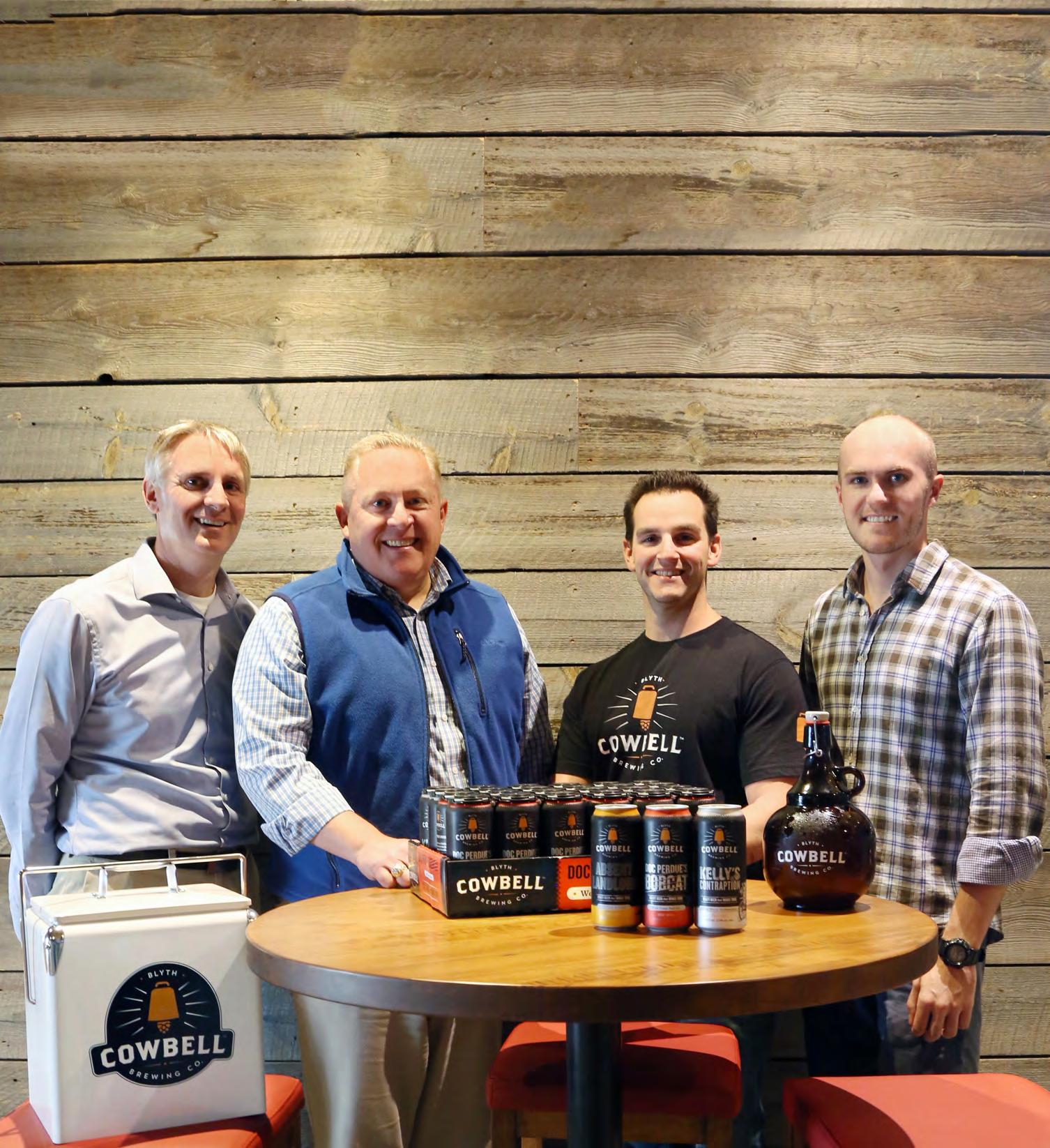
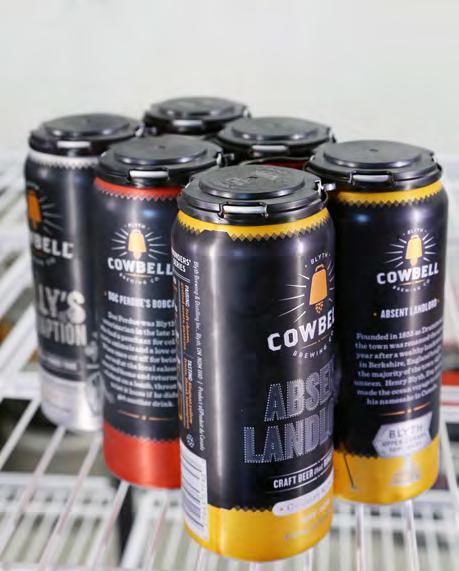
Rich relates that the craft beer market in Ontario has also responded well to the newcomer with strong early sales of the Founders’ Series first three core brands, including the Doc Perdue’s Bobcat (West Coast red ale), Absent Landlord (country kolsch) and Kelly’s Contraption (German-style wheat beer).
“These are the first three beers that we are already retailing through the LCBO (Liquor Control Board of Ontario) stores with some success,” says Rich, noting that there are three more beers in the Founders’ Series to be launched into the retail market in coming months as the Blyth operation scales up.
“For now they are only sold on tap and in growlers, but the plan is to have them sold at LCBO and in retail stores across Ontario within the next year or so,” says Rich, noting the three brands are currently sold at LCBO stores across southwestern Ontario and as far east as Ottawa.
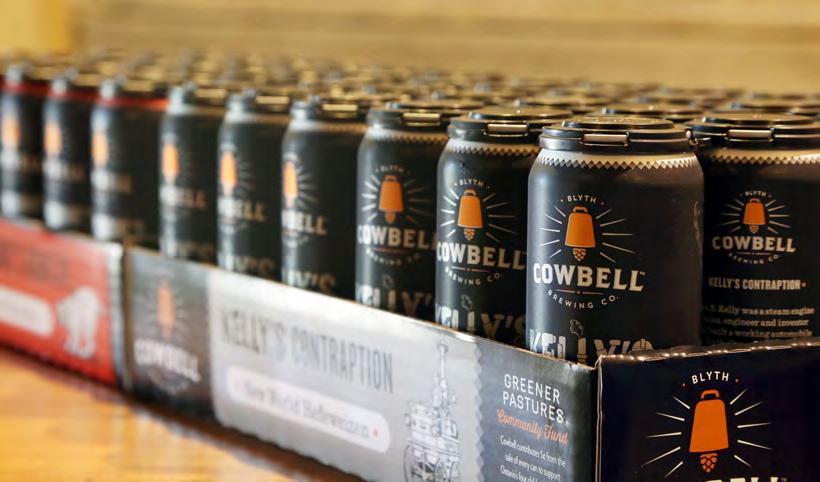
“Each of the beers in the series is brewed as a tribute to one of the several colorful historic characters that have lived in this area,” Rich explains, “and we use attractive and engaging graphics and colors on
the cans to try to bring those stories to life.
“The Doc Perdue’s Bobcat, for example, is named after a local vet who was also an avid collector of wildlife,” he relates.
“According to local folklore he was once sent home from the tavern at closing time before he was ready to leave, so he returned with a menacing wild bobcat on a leash that he threatened to let loose if he was not served,” Rich continues.
“Happily for all, he got his beer,” quips Rich, citing attractive images of wild beasts and birds of prey directly printed onto the 473-ml aluminum tallboy cans from Crown Beverage Packaging used to package the brand for retail sale.
In similar vein, the Absent Landlord brand is so named after the one of the town’s earliest owners in Victorian-era England, Lord Esquire, who actually never made it to the New World to visit his own Canadian land possessions.
“Every beer we make here tells its own story of the area and its people,” says Rich, “and they are all based on historical evidence, even accounting for some creative license.
“We have found that featuring these little historical tidbits about the region on the back of the cans is really resonating with people in other parts of Ontario,” says Rich, “who just may be persuaded to come and visit.
“We wanted this brewery to be an economic driver for the Huron County region,” says Rich, noting that all the trades employed in the construc-














tion phase of the brewery were local businesses, using locally-sourced supplies and building materials.
“The only thing that we could not find locally were the massive wooden beams holding up the ceiling, which we had to bring in from British Columbia simply because we do not have trees of that size growing in Ontario.”
Rich explains that the owners’ preference for using as much made-in-Canada materials and machinery also played a role in selecting Newlands Systems to build and install Cowbell’s state-of-the-art brewhouse, rather than importing one from Europe.
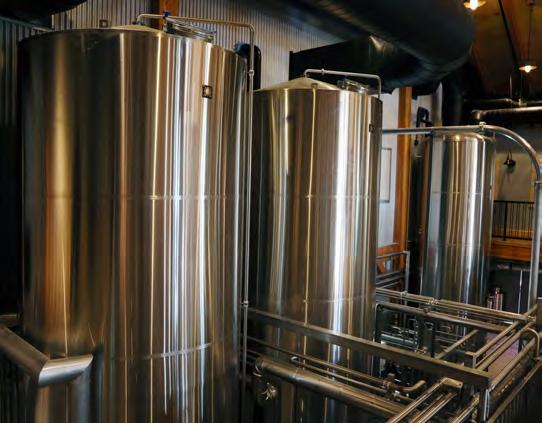
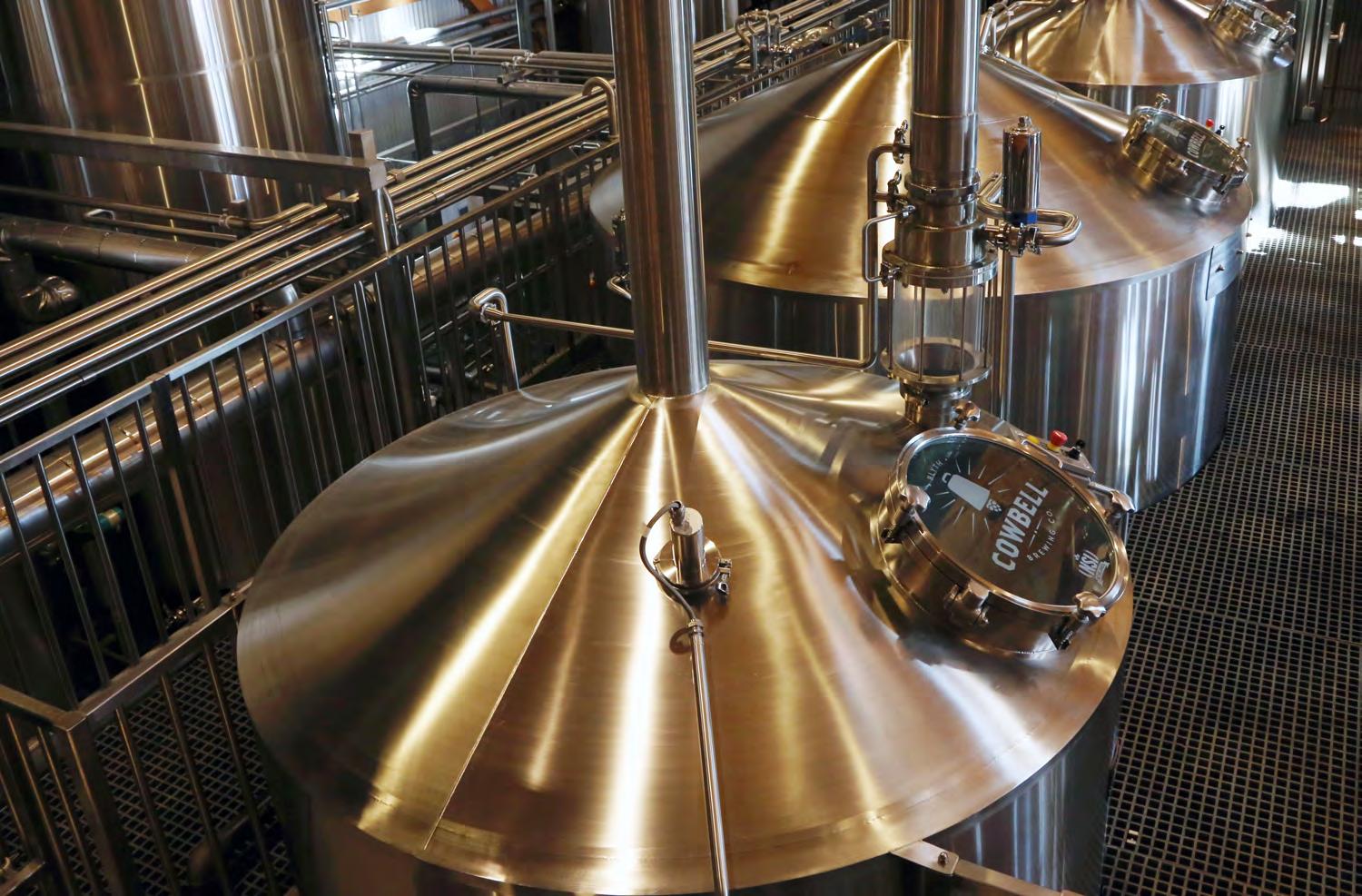
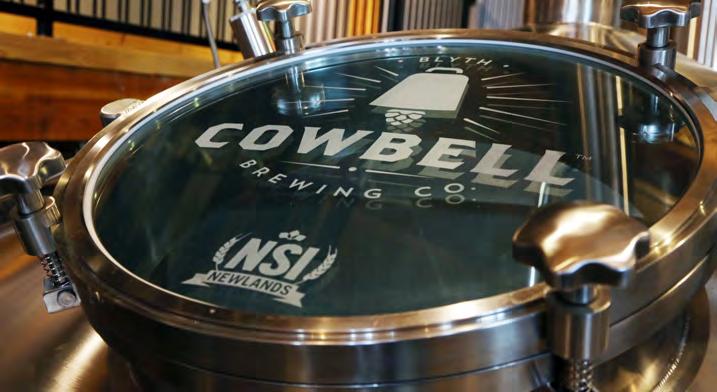
Comprising an all-stainless-steel mash tun, a lauter tun, a brew kettle with a rectifier and a whirlpool, the gleaming new brewhouse—kept fully accessible to visitors and diners during all hours of operation—was designed for optimal energy conservation and resources management, according to Rich.
Many of its critical components are equipped with variable frequency drives to reduce electricity consumption, further enhanced with innovative rectification boil technology that reduces primary energy consumption by using all excess vapor generated during the brewing process into reusable hot water.
“Having this rectifier hooked up to the brew kettle allows us to reduce our energy usage by 20 per cent and our water use by 50 per cent during the brewing process,” Rich points out.
“We are the very first brewery in North America to have installed a rectifier,” he notes, “and are also the smallest brewery anywhere in the world to have one right now.”








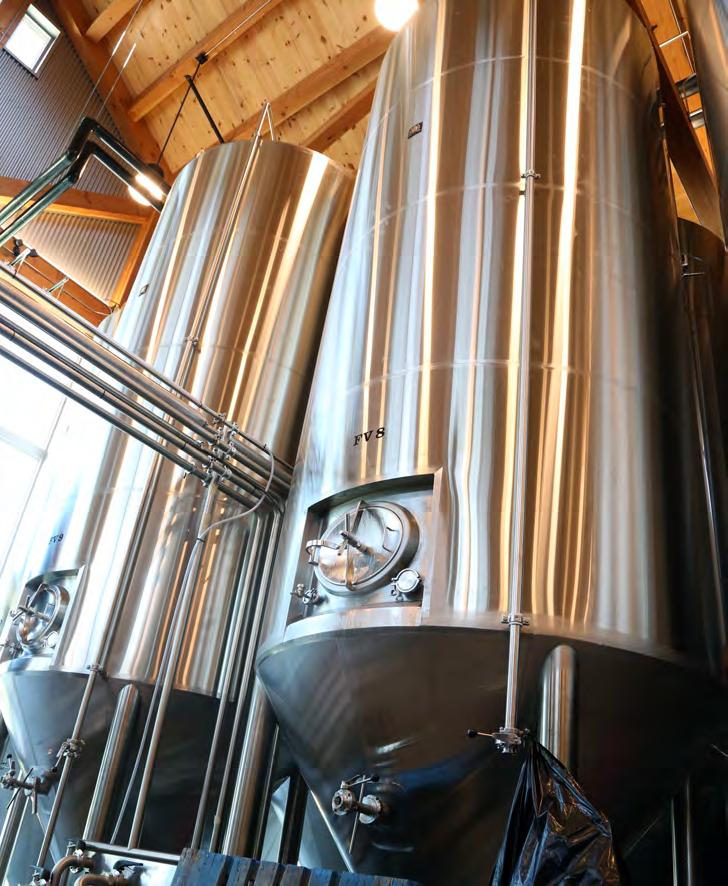
Although the Newlands brewhouse has the capacity to produce up to 100,000 hectoliters of beer in continuous 24-hour operation, for now Cowbell has only 10 fermenting tanks on-site—limiting annual capacity to about 15,000 hectoliters.
“But sitting on 111 acres of land means that we can easily expand our output whenever we wish simply by adding some more fermenting tanks,” he explains.
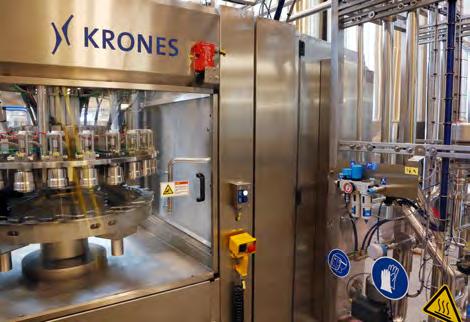
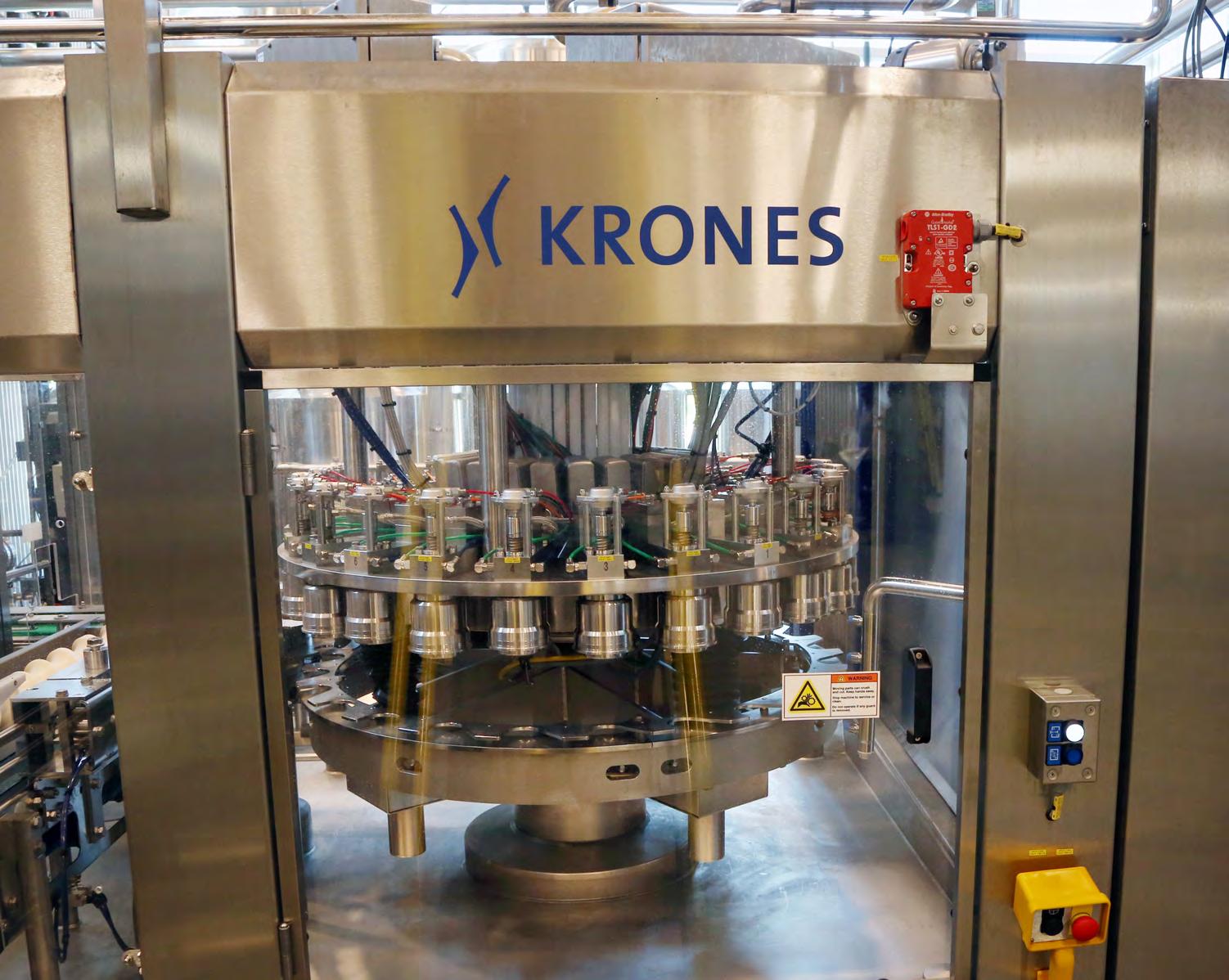
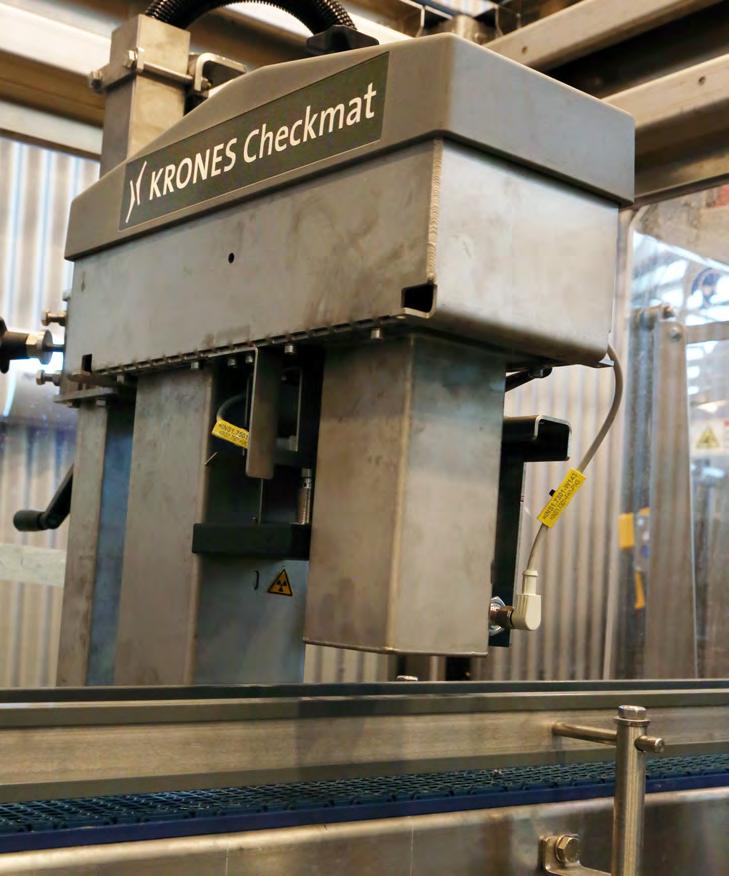
In fact, Rich says he wants to install all the additional fermenting tanks into the plant’s existing packaging area, which house the brewery’s Krones canning line and a Comac kegging line.
“Our longer-term goal is to have all the packaging moved into a whole new separate building,” Rich notes, “but for now this Krones canning line is just about right for the volumes we currently produce.”







While Rich says there are plans to start bottling some select limited-edition beers in the future, cans currently account for about 70 per cent of the company’s sales and output—meaning that any further product launches in the near future will be done on the Krones Craftmate line commissioned and installed earlier this year.
Fully integrated with the fully-automatic DPL-1000 model depalletizer pur-
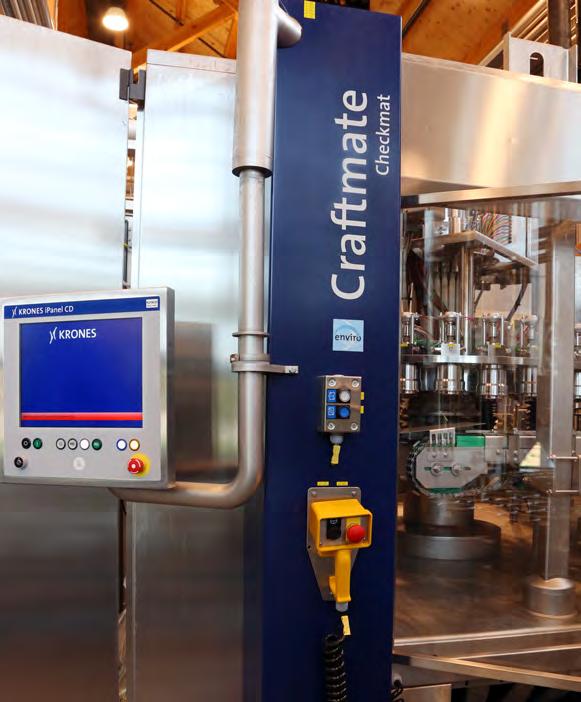
chased from Codi Manufacturing, Inc. of Golden, Colo., the Krones Craftmate canning line is “a real marvel of engineering” according to Rich.
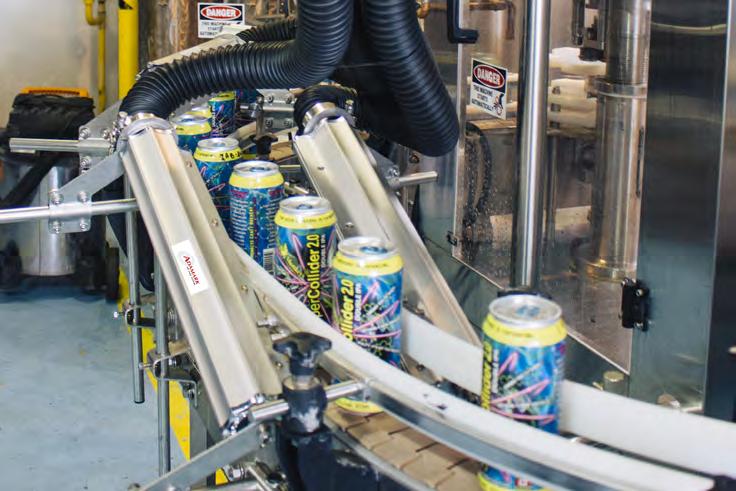
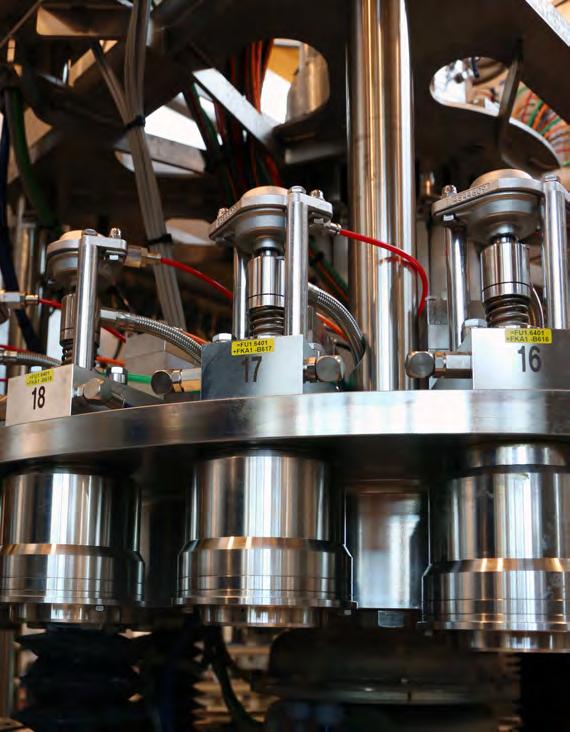
Engineered to allow lower-volume craft brewers the flexibility to process a broad range of can sizes and formats, the 24-head volumetric Krones Craftmate filler comes with a fully-integrated four-head Ferrus seamer; a compact valve manifold with a product tank and a control cabinet with an integrated pneumatic control system; an operator-friendly touchscreen control terminal; an inclined tabletop with a fully-enclosed cabinet with integrated pneumatic control systems for the valve manifold; and an integrated CIP (clean-in-place) station.
“Not only does the Krones Craftmate line provide astonishing performance levels and help create superior quality levels,” says Rich, “it does it in the smallest footprint that Krones has ever installed a machine of this size in,” Rich extols.
While the Krones Craftmate can handle throughput speeds of up to 240 cans per minute, the line is currently running at speeds of 80 to 100 cans per minute because the case-packing of filled cans is still being done manually.
“As we come up to scale we naturally intend to operate this and other end-of-line packaging operations in the separate new building,” Rich says.
According to Rich, using an ionized air rinser to clean the incoming individual cans without water is expected to save the brewery five million liters of water per year, while the advanced technology incorporated into the Craftmate filler will allow Cowbell to achieve low oxygen content levels of less than 50 ppb (parts per billion).
Says Rich: “Packaging is probably the most sensitive part of the beermaking process because that’s where you carry the biggest risk of air intake, light exposure, infection and all the other negative environmental factors.
“Therefore packaging is the last line of defense to ensure that we are producing high-quality beer for our customers,” Rich asserts.
“All the effort, time and energy we put into making the recipe, getting the right ingredients, doing the proper brewing procedure, controlling fermentation, pushing the beer into the right beer tanks, carbonating, nitrogenizing and so on, will be wasted if we don’t can, keg or bottle that product properly.
“If we cannot ensure every step of the way is not of the highest quality in terms of procedures, ingredients and process, then we’re failing the customer,” Rich reasons.
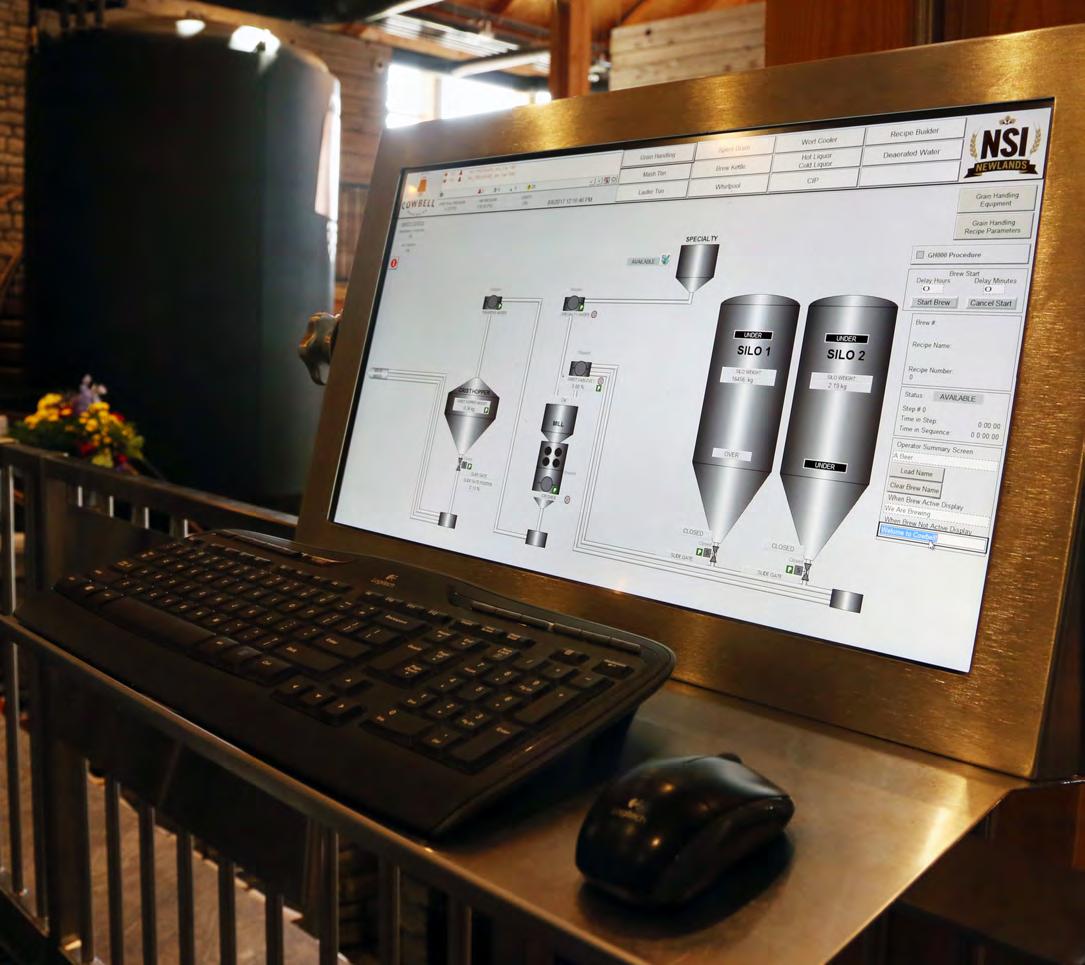
All the brewhouse operations are displayed and monitored in real time on
icons and graphics to keep plant personnel constantly updated on the
“Having a Krones Craftmate gives us a peace of mind that this will not happen with our product offerings.”
Similarly, Rich has nothing but high praise for the graphic design and branding work that London, Ont.-based Arcane Digital Marketing developed to decorate the Founders’ Series cans, along with the draft tap handles, glassware and other merchandising memorabilia retailed at the Blyth retail storefront.
“For people who can’t have that full face-to-face Cowbell experience, they need to be sold by that can sitting on an LCBO store-shelf alongside 50 other SKUs (stock-keeping units),” Rich remarks, also complimenting Crown Beverage Packaging for the high-quality reproduction of all the graphics, logos and text directly onto the cans’ surface to give the Founders’ Series beers an elegant upscale appearance and their own unique personality profiles.
“It was important for us to be real in how we appear on the can and to be real about the brands and flavors we are trying to showcase to them,” he continues.
“I really think our cans are already resonating with the people by being fun, beautiful, unique and engaging by telling interesting stories about our different beers.”
Says Rich: “Like all craft brewers, we put a lot of focus and passion into our brewing.
“Before we started, our owners said that the world does not need another beer and it surely doesn’t need another brewery, so if were going to do this, it would have to be done in our unique way,” Rich relates.
“So when we’re developing our beers we always think about what our guests would want to drink and what is right for the market.
“It’s not just about the beer but rather the whole beer experience,” Rich states, “which extends right to the moment when the final customers put that beer to pass their lips.
“One of our biggest goals is to introduce people
to the wide world of all the wonderful beers available for them out there,” Rich concludes, “and I hope that our attractive packaging reflects just how genuinely committed we are at Cowbell Brewing to accomplishing that goal.”
Without breaking the proverbial bank, Toronto craft brewer gets good reviews for its innovative packing and packaging solutions
BY ANDREW JOSEPH, FEATURES EDITOR
PHOTOS BY COLE GARSIDE
Love of beer–check. Know how to brew beer—check. Ready to take on the big boys of the beer industry—uh, no.
For one small Toronto brewer, keeping things simple and growing its community-like atmosphere is not only key to the company’s success, it’s the master plan.
Henderson Brewery Co. in the city’s west-end doesn’t have plans to create a plethora of beer tastes in an effort to capture everyone’s ever-changing and discerning tastebuds, rather it wants to make one beer that it wants to make— and maybe a few limited edition brews when the urge hits.
Founded in 2015 by general manager Steve Himel, brewer Mark Benzaquen, and sales lead Adin Wener, Henderson Brewery takes its name from Robert Henderson who opened Toronto’s first-ever brewery in around 1800 producing around 30 barrels a week.
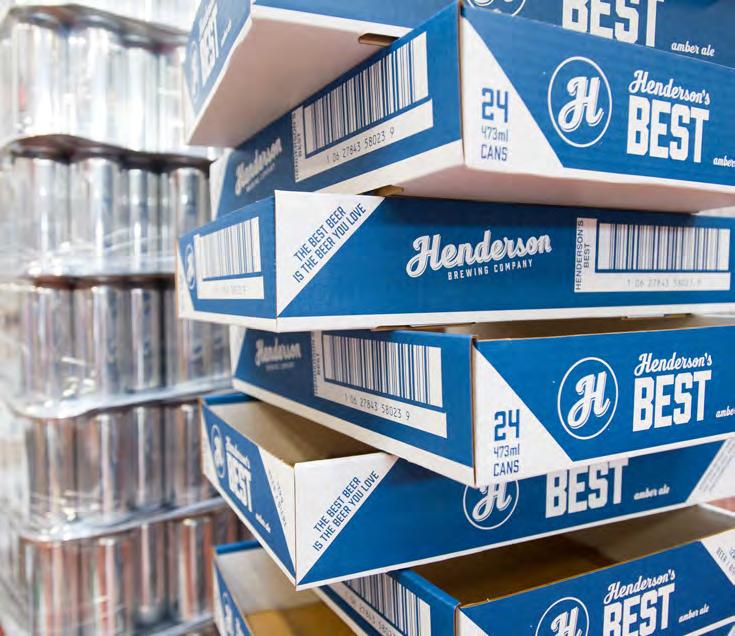
Like that brewery, the current Henderson Brewery is all about serving the local neighborhood, and a bit beyond, delivering its flagship brew—an amber beer simply called Henderson’s Best to bars and restaurants in and around the Toronto area, as well as to the LCBO (Liquor Control Board of Ontario) stores and to The Beer Store
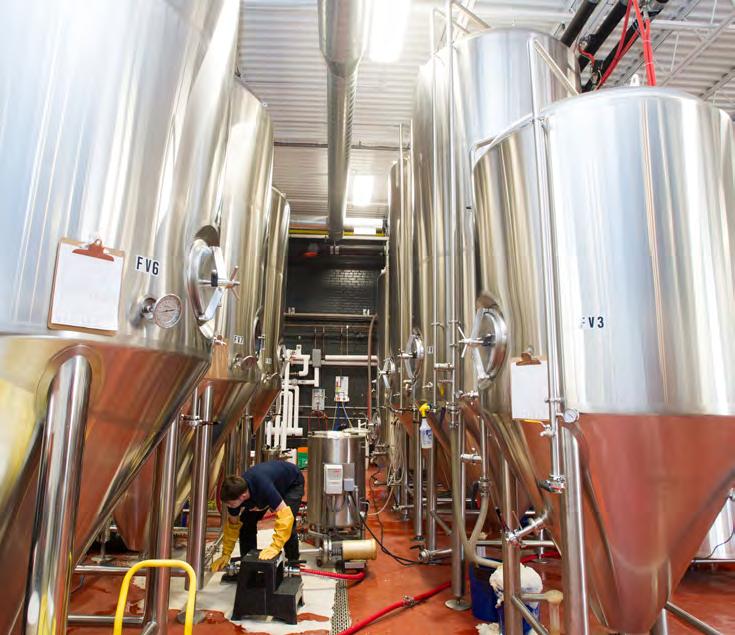
Unlike the old brewery, Henderson Brewery has an annual 15,000 hectoliter capacity, and is environmentally green with about 85 percent of the brew kettle steam recycled back into the facility and operation.
The brewery itself, located in what is affectionately known as the Junction
Triangle of Toronto featuring the communities of the Junction, Roncevalles and Bloordale Village, is more than just the sterile confines of a beer manufacturer; it’s also a hub—a meeting place where community members can gather to meet, chat, play board games, share a beer, and if non-drinkers and children or youth are involved imbibe a made-on-the-premises lemon/ginger soda or rootbeer from the brewery’s own recipes.
Situated within a tidy, well-maintained 9,000-square-foot brick facility, Himel says what attracted him to the brewery was the single reason of wanting to spend more time at home with his family.
First involved in making beer professionally back in the 1980s for Toronto brewer Don Valley Brewing Company producing Conners, Himel went onto other business ventures that he said he enjoyed being involved in, but meant he did not get to spend as much time as he would have liked with his family.
“I still kept my hand in the beer business by making my own home brews,” Himel told Canadian Packaging during a visit to the brewery, “but when it came time to start the brewery, I wanted to work with a brewmaster who could impress me.
“To me, brewing is true alchemy, and I wanted a wizard who felt the same way.”
Brewmaster Benzaquen certainly knows his way around a brewhouse, having previously worked as a brewmaster for 15 years at Molson, and seven years as a consultant designing and custom-building breweries all over the world.
“I know my beer, but Mark really knows beers,” says Himel. “He’s an artiste.”
Despite the oft-times fantastic plans of many a craftbrewer willing to try what
sounds like outrageous ingredients to create a unique taste, Himel and Benzaquen may want to keep things hip, but aren’t in the mind to be hip while being known for odd.
Henderson’s Best is a nod to the city’s immigrant roots, providing a 21st century spin on the extra special (ESB) British pale ale—only a wee bit hoppy with a clean, dry and refreshing taste.
“We aren’t just about making a single beer,” says Himel, “our plan is to always have four beers on tap here at our facility.”
The light tasting Food Truck Beer meant to compliment cuisines from food trucks, and UPA (Union Pearson Ale) a pseudo nod to the Toronto Pearson

International Airport shuttle train that rolls along the track within earshot of the brewery—are two of the brewery’s other beers.
Food Truck, along with Henderson’s Best, are now available at The Beer Store.
“We decided quite early that the fourth beer we offer will be part of an ‘Ides of …’ that will be based on a Toronto place, event or historical moment, or person,” notes Himel.
He says that when it comes to beer, there are truly only a limited number of styles or flavors that are tasted by the average consumer.
“As such, a defining beer moment for the consumer is the label. And when it comes to the one-off ‘Ides of...’





beers, we have the ability to provide some very cool things.”
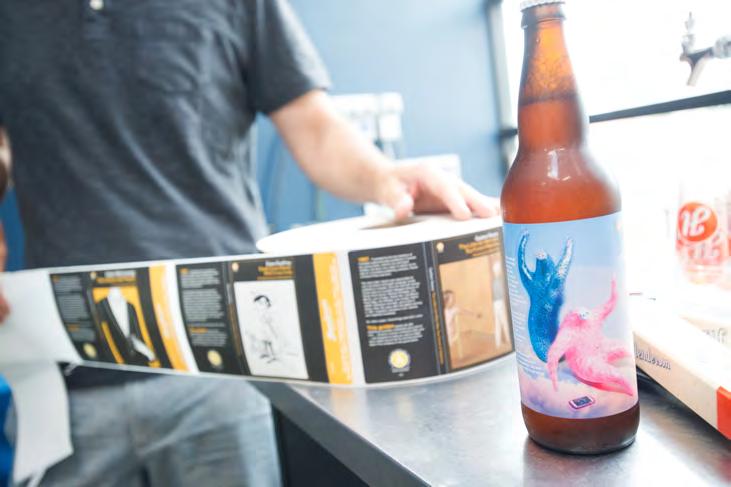
While Henderson Brewery has been making short run monthly beers for a while now, it really pushed things to a new level for April 2017 when, for a promotion for nearby Anancy Press books celebrating its 50th anniversary, and created a singular new flavor available with 30 different labels, each representing the bookstore’s top-selling books.
“We can turn these paper labels around in a week, which really allows us to run on our feet,” Himel relates.







The label, says Himel, is one of the key features of Henderson’s canned and bottled beers from the get-go, but says the brewery’s initial work with a label provider left it with a bad taste in its mouth.
At a local community event Himel and Henderson’s art director and brand consultant Tony Halmos met Lorpon Labels vicepresident of business development Jeff Sommer.
After listening to Halmos vent about the recent negative experience with another label company, Sommer described the options of the Lorpon pressure-sensitive labels.
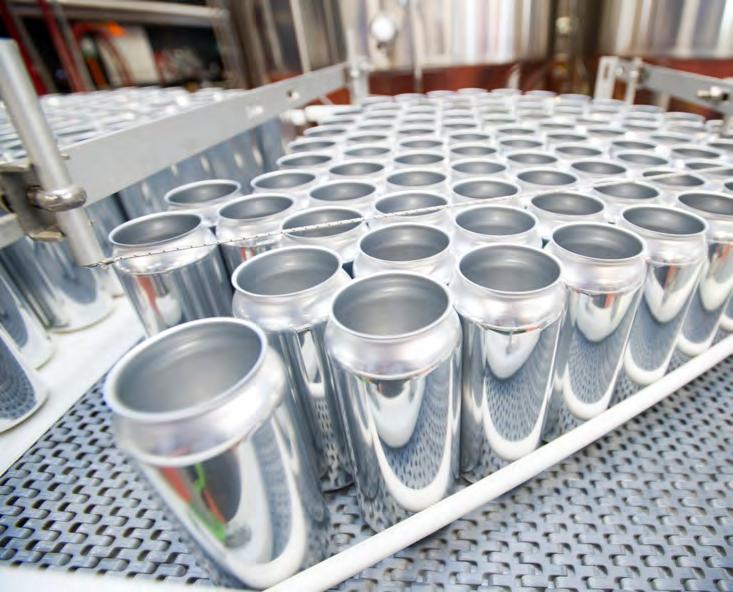
“Eventually we decided on using digital labels to mimic the trend in the U.S. that shows off a lot of the can while extolling the stainless steel look of the container.
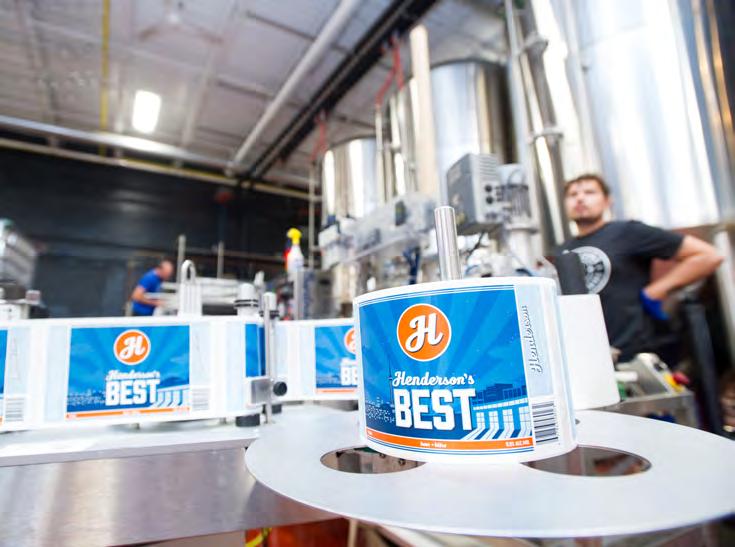
“I didn’t like the look of all the other types of sleeve labels everyone was doing—there’s also a perception that since cans are cheap, you are a cheap consumer, so we didn’t want to add to that by using a plastic shrink sleeve,” recalls Himel. “We decided to make the Henderson label a little bit more classic, a little bit retro and opted for a matte textured pressuresensitive label to help reinforce that Hender-
son Brewery makes a quality beer.
“It was crucial to underscore the premiumness of our product.”
Calling his beers simple, but well-made, Himel insists he wanted a label that could reflect that while extending the experience to the customer.
“That’s how we ended up with this paper label, with a superb tactile finish that the customer can feel and immediately know that it is something different,” says Himel noting its silky feel possesses enough of a grain to provide the consumer with a grip. “When you feel this label on the can, you know it’s superb.”
Himel says that the brewery uses the exact same die-cut for all of its beer containers— kegs notwithstanding, meaning the same paper label is used to wrap around a can and bottle with an adhesive at a single end.
“In a big run, a label—a single label—costs us about nine cents,” Himel explains. “But in an individual run, a label would cost us $1.20, as such, we try to do our runs quarterly.”
He says the brewery will utilize as many of its different types of labels in a single filling run thanks to the same die cut.
“All a digital printer has to do is swap out the art with a small art-change fee of $50, which helps us get our label costs down,” Himel offers, “which is why we can costeffectively produce our limited run ‘Ides of’ series of beer.”
Continuing, Himel says: “Our single-size labels really are a competitive advantage for us, allowing us to do short-run print jobs for both our cans and bottles.”
Despite Himel’s rave reviews for the paper label, he announced that the company would be moving away from the paper label for its bigger-selling brews like Henderson’s Best because of cost prohibitions.
“Because we are selling more beer, and thus require higher volumes of packaging-related materials, it is more cost-effective for us to switch—for larger runs—to a pre-printed aluminum can,” relates Himel. “I personally feel it’s a step backwards as far as the tactile connectivity goes, but we need to keep our costs down, which is something we can achieve with a pre-printed can.”
The pre-printed cans are manufactured by Ball Corporation—and while Himel says they are a great product, he is more impressed by how much money it will save the brewery on a per can basis.
“Ball makes a great can—don’t get me wrong—it’s a great can with great artwork, but I am very impressed at how a pre-printed can will only cost is $0.155 delivered at a committed purchase of 150,000 cans,” Himel admits.
He says a blank can would cost him $0.19 each, but then there would still be the associated cost for the printing of the label, and its application, “which would cost us anywhere from $0.30 a can and up.”
As Himel states, running a brewery, even a
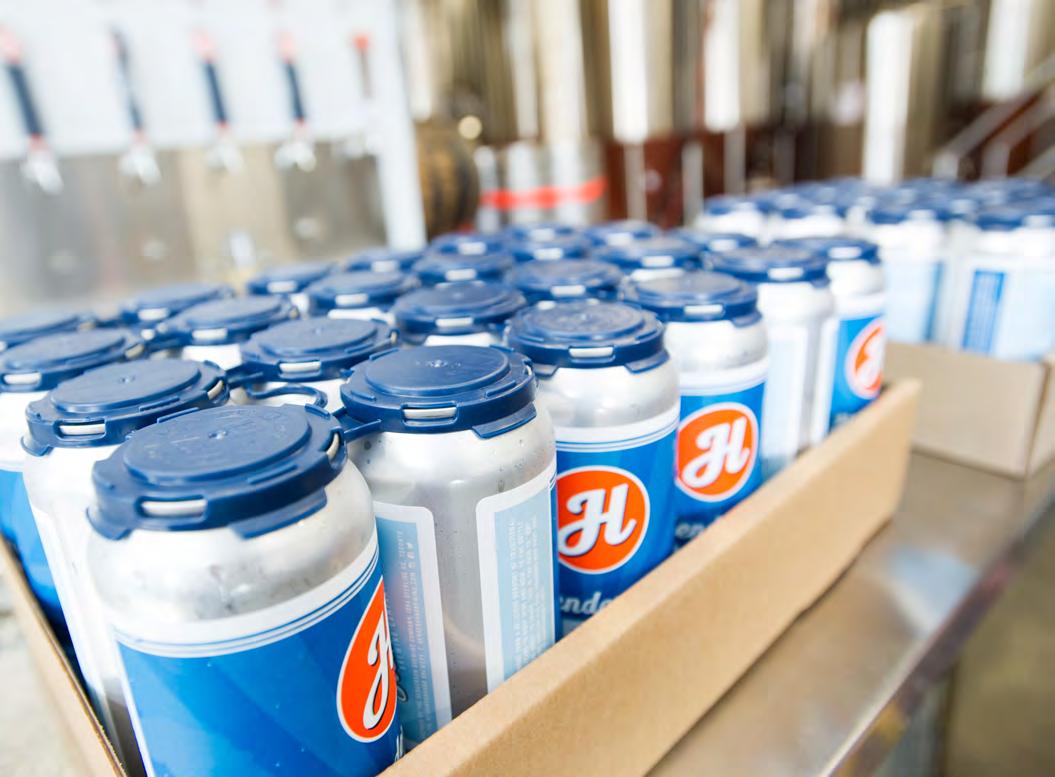
smaller craft brewery, is an expensive proposition. Even discounting the magnificent brewhouse manufactured by McDonald Steel out of Hamilton, Ont., and all the vats and tubs required to create the beer, the business plan also calls for the purchase of bottling and canning equipment, not to mention labeling.
While Himel was very pro-active in finding the best label options for his beerline, it was also imperative to find a more cost-effective method for filling the beer containers.
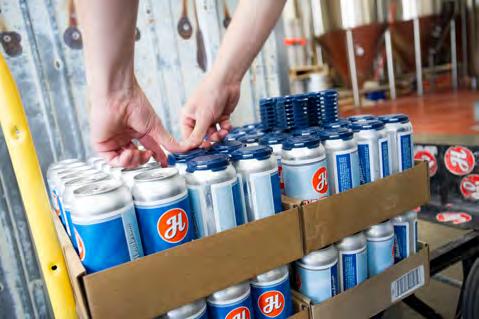
small workforce to take care of his packaging requirements.
Sessions Craft Brewing, founded in 2014, is the


www.webermarking.ca
1.800.265.9974
info@webermarking.ca


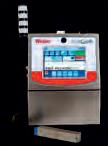
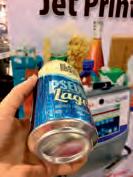
We have all types of label material available to make your craft beer brand get noticed including metallic, clear film, textured paper, and even real wood!
And with a comprehensive line of Labelling Equipment and Continuous Inkjet Printers for date & lot coding; we can help any size brewery become more efficient. So grow your brand with us… one can or bottle at a time.
For all things label and code.
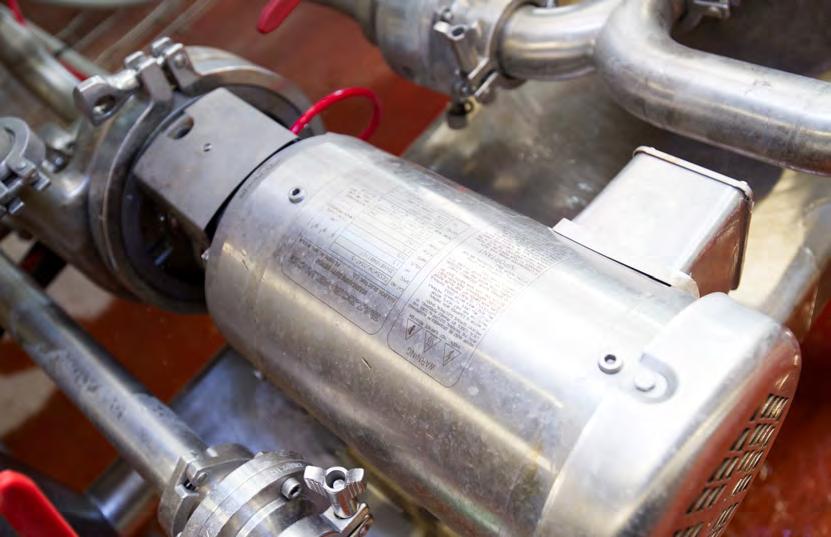
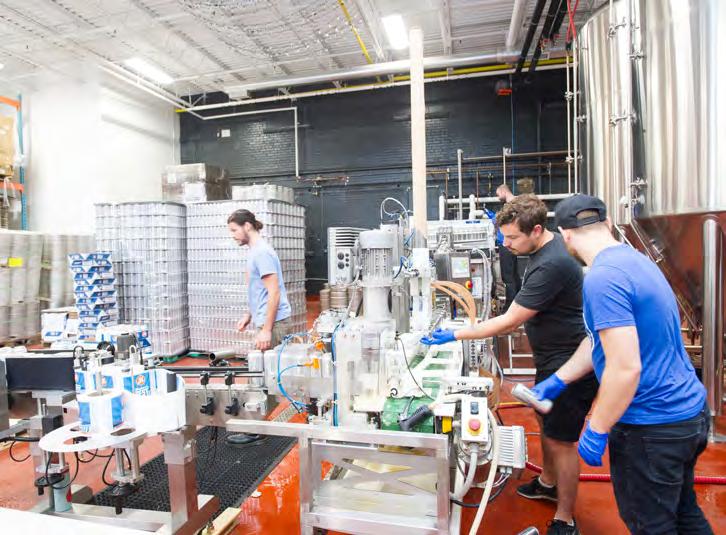

brainchild of co-founders Clay Robinson and Jeff Rogowsky, and has three mobile filling lines and personnel to travel around to numerous Ontario craft brewers to can fill and label—if required—their short run beers.
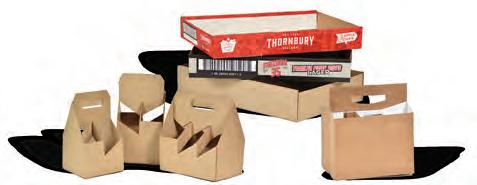

“Although the majority of our business is for the craft brewing industry,” acknowledges Rogowsky, “we have been called in to help out a major beer manufacturer after their filling line went down.”
Rogowsky says that while the size of the container being filled plays a role in just how fast Sessions works, less carbonation in a brewery’s beer makes the fill rate higher.
“We generally run about 900 liters of beer per hour per line,” states Rogowsky, noting that each line requires two workers to run a portable Wild Goose manufactured canning line.
Rogowsky’s two-man crew will bring all of the required equipment and 20,000 cans—5,000 cans per pallet—and take about 90 minutes to set up in the craft brewery
After running a can cleaning program and testing the seams on the cans, the Wild Goose canning line is hooked up to the brewer’s tank so the filling, sealing and labeling can begin.
“We began working with Henderson from about the third month of their opening,” notes Rogowsky. “For Henderson Brewing Company and other craft brewers, we can help small- and medium-sized breweries grow their business as they keep their costs down.”
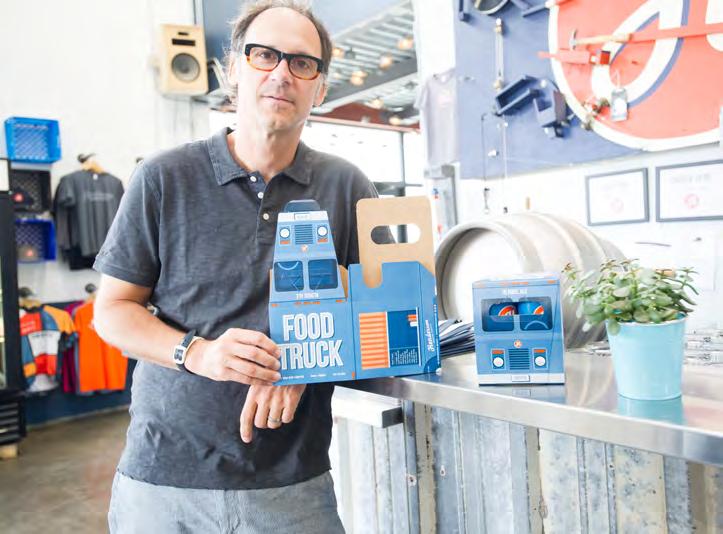
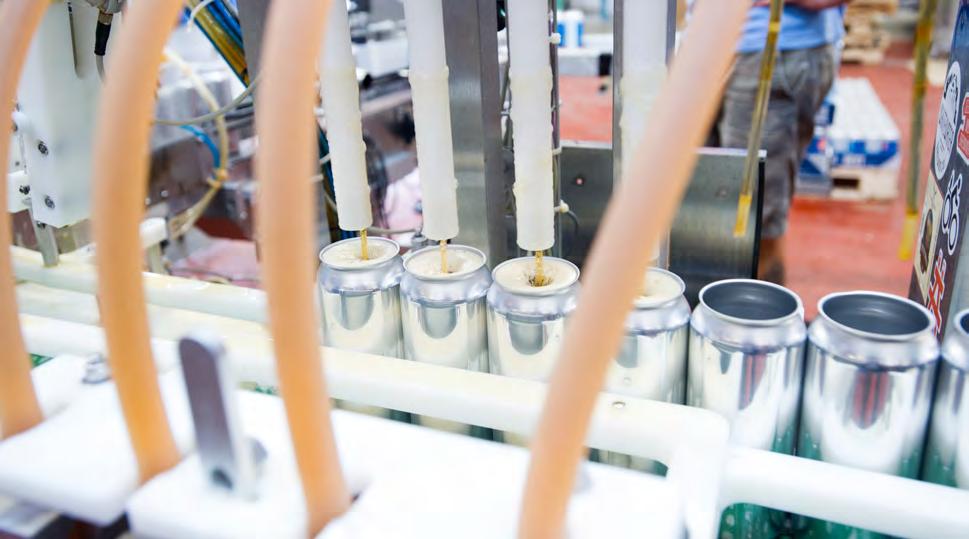
Himel also likes that Sessions stores all of the empty cans and brings it in when they arrive at the brewery.
“When we need to can-fill a 60-hecoliter (approximately 2,000 cans) run of our beer, we call up Sessions. We don’t have the hassle of having to store all those empty containers. After they fill, seal and label it, the beer is in our facility for a short time until we transport it out to our customers.
“As a small craft brewer, we are always interested in conserving space,” says Himel. “Sessions has been great at doing that for us, filling our beer, and even helping us get a great price on the containers.
“It allows us to focus on what we do best— make beer.”
After filling, the cans are placed within a corrugated tray by Henderson employees who then add a special blue plastic lid manufac tured by PakTech that snaps one by one over a four-pack of cans.
PakTech of Eugene, Oregon is a designer and manufacturer of handles and application equipment for the consumer goods, and food and beverage markets.
“We love these PakTech four-pack handles that make it easier for a consumer to grab ahold, carry and release multiple products,” says Himel. “Plus it’s a 100 per cent recyclable product.”
The handles are produced from HDPE (High-density Polyethylene) plastic, which PakTech says provides it with the strongest, least-brittle option that has to possess physical properties while being able to handle its injec tion molding process.
While many people may not find a corru gated tray sexy, Himel was very excited about the recyclable single wall corrugated tray manufactured by Packaging Technologies Inc., of Concord, Ont.
“The cans of beer filled by Sessions Craft Canning, are cold, and are stored cold and
transported cold to our customers,” says Himel. “Because these cold cans are placed upon a corrugated tray, once they are moved from within a refrigerated unit at our place or from within the transport truck, the cans sweat.
“A wet can will pass on the wetness to the corrugated and make it weak… but Packaging Technologies has created a tray that, while it does nothing to eliminate the can sweat, does present a solution to strengthen the tray to avoid it collapsing while being carried,” explains Himel.
While anyone carrying such a tray filled with cans would grip it at the narrow ends, to combat tray fatigue Packaging Technologies has proffered a corrugated tray that has double thickness along the longer edges to provide greater strength and stability.
“It’s a simple thing, isn’t it?” muses Himel “But having a tray collapse while someone is carrying it is em-
barrassing—beer cans roll on the floor, getting damaged and being unable to be displayed on a retail shelf at the LCBO or Beer Store—who needs that?
“These corrugated trays are double thick along the length, and are a nice packaging modification that the customer will never see, but appreciate every time they hold a perfect can of Henderson beer in their hand.”
Love of beer–check. Know how to brew beer—check. Create more family time—check. Have fun making beer—check.
“We’ve worked hard to create a beer that people enjoy drinking, but we’ve worked equally hard with our partners to create the packaging our beer comes in is on a par with the premium quality we are evoking,” sums up Himel.
“While the beer itself is simply a great-tasting beer recipe of ours, much of who we are today is thanks to the innovative processes and forward-thinking mechaniations of the companies we work with like Lorpon, Sessions Craft Canning, PakTech, Packaging Technologies and Ball,” he continues.
“It’s been a community effort to get Henderson beers to the level we are at considering how young we are, and I’m excited to see where it will lead to next.”


For an industry event that’s only been around for less than six years, the upcoming sixth annual Ontario Craft Brewers Conference & Suppliers Marketplace 2017 in Toronto is a crowd-pleaser par excellence.
Taking place at the newly-renamed Beanfield Centre (formerly Allstream Centre) at the Canadian National Exhibition ground on Oct. 19, 2017, the one-day event will bring together more than 1,000 craft beer industry professionals for a full day of educational sessions, lively panel discussions, and incredible networking opportunities offered by a lively Suppliers Marketplace featuring more than 100 exhibitors, along with delicious craft beer and food served throughout the day.
By any measure, the event will be a fitting way to toast and celebrate the breathtaking growth of
the Ontario’s craft-brewing sector and the Ontario Craft Brewers (OCB) association, which now comprises more than 80 independently-owned brewers united by their shared passion for product authenticity and traditional recipes based on the use of only all-natural, pure ingredients.
According to OCB, “Ontario craft brewers continually strive to improve quality and honor traditional craft brewers through a replication of timehonored brewing styles and a commitment to this Brewing Philosophy.
“We continue to remain committed to individual expression to create high quality, innovative, and unique beers,” OCB states. “The result is a variety of distinctive, flavorful styles and taste profiles that appeal to beer lovers with a sense of discovery and adventure.
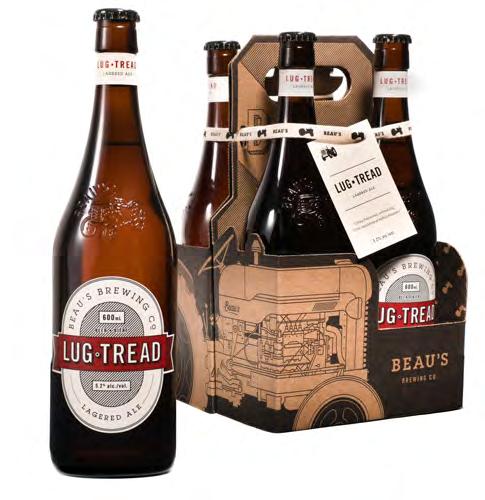
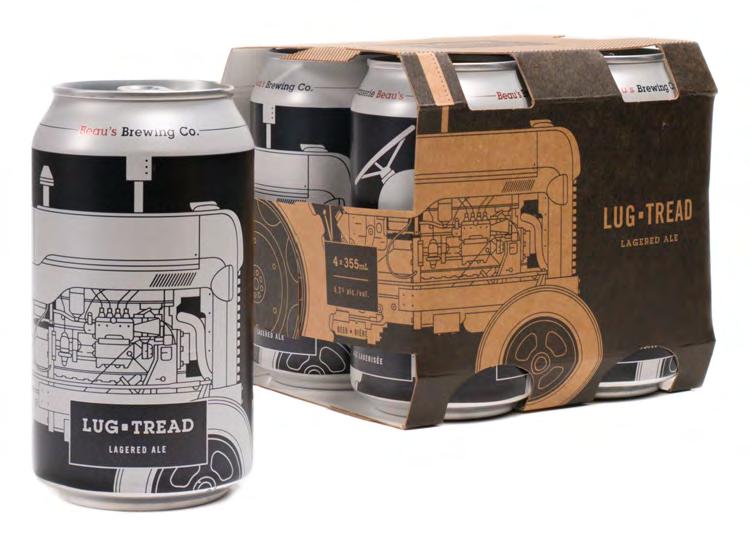
“All Ontario Craft Brewers pledge to brew naturally with malt and other grains, not wort extract, as a foundation for their beers, maintaining authenticity to traditional styles, and using only all-natural, pure ingredients with no chemical additives, fillers or preservatives.
“The result is a variety of distinctive, flavorful styles and taste profiles that appeal to beer lovers with a sense of discovery and adventure,” says OCB, adding its member-companies currently offer more than 450 distinct brands based on either traditional brewing styles (Pilsner, Vienna-style Lager, Munich Dunkel, Weiss Beer, Nut Brown Ale, etc.) or the highly innovative styles such as Hemp, Cranberry Wheat, Cask-conditioned Lager, Mead, and Coffee Porter
The Canadian Packaging magazine recently caught up with OCB co-chair Steve Beauchesne, co-founder of Beau’s Brewing in Vankleek Hill, Ont., to get an insider’s perspective on where the province’s craft brewing industry is headed.
What are the current hot-button issues and challenges for your industry?
Freshness and quality are always top-of-mind topics for this industry. As craft brewers, we all have a shared responsibility to deliver fresh and high-quality beer, because any slip-ups in freshness and quality can impact the entire industry. For this industry to grow and thrive, all craft brewers bear the responsibility of making sure that freshness and quality take center stage with what they’re trying to deliver to their customers.
With Ontario finally allowing some limited beer sales at mainstream grocery outlets, what has been the impact on your industry?
The impact has been very positive for our industry. In grocery stores, craft beer has a market share that is more than double compared to what it is in other sales channels—in many ways thanks to the better access to customers. We hope that government will continue to help out craft brewers by keeping up the pace of rollouts of stores that are selected to sell craft beer.
Is the Ontario craft-beer business nowadays getting too crowded for its own good?
It’s exciting to have new entrants come into the marketplace with new ideas, and I believe there is still plenty of room in the market to support local craft brewing as long as the companies focus on what makes craft beer great—freshness and quality.
Please reflect on the role and importance of packaging for the Ontario craft brewers.
Effective packaging is an absolute necessity for selling the product in the retail space. It’s a cost of business that no craft brewer can avoid, so it makes all the sense in the world to use it to your advantage and leverage that initial investment to really go above and beyond its primary purpose.
In many ways it’s another type of POS (point-of-sale) advertising, and for a small producer it can be more effective than more expensive advertising options, and just as effective as costly in-store promotions.
On the shelf, where you have a captive audience who is ready to make a pur-
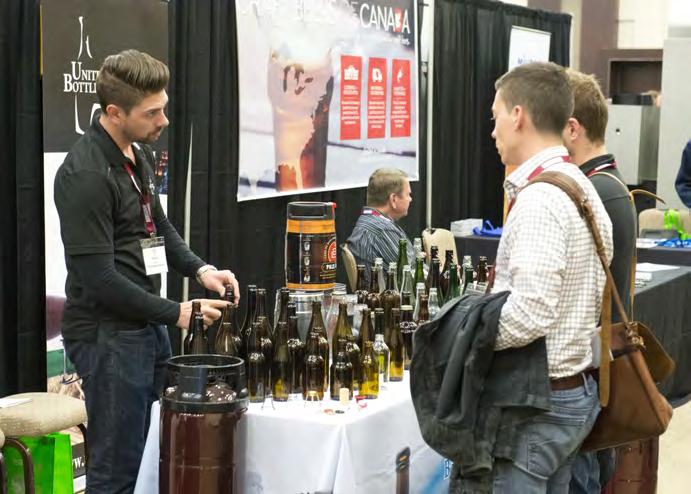
chasing decision, packaging can be the proverbial difference maker.
In general, craft brewers are using thoughtful graphic design and illustration to sell their product, with many also using materials and techniques in interesting unconventional ways—focusing on the consistency of brand application and using brand grouping/blocking techniques to cultivate brand loyalty.
All in all, packaging is the most efficient and pragmatic way for craft brewers to differentiate themselves from the Big Beer brands in the marketplace.”
To register for the Ontario Craft Brewers Conference & Suppliers Marketplace 2017 event, please go to: www.ontariocraftbrewers.com


Amillion of anything is a lot, but a million gallons of water saved is a windfall of highest order in the fast-growth North American craft brewing business.
That’s how much water Sierra Nevada Brewery, located in Chico, Ca., estimates to have already saved since retrofitting its kegging line about 16 months ago by installing a dry-running conveyor system utilizing the proprietary System Plast NG Evo technology from Beloit, Wis.-based Regal Beloit Corporation
“We have already picked a lot of the low-hanging fruit when it comes to sustainability, in the past,” says Sierra Nevada’s project manager Pat Young, “but being able to achieve both our productivity requirements and to address California’s urgent need to reduce water usage is something we are very proud of.
“The System Plast dry-running conveyor technology has enabled us to do something that no one else in this industry has done before,” Young enthuses.
Running without lubrication or water, the System Plast NG Evo dry-running technology will save Sierra Nevada about 750,000 gallons of water annually, according to Regal Beloit, a leading manufacturer of electric motors, electrical motion controls, power generation and power transmission components.
The System Plast NG Evo conveyor chain is made from advanced, low-friction, FDA-approved material designed for running conveyors dry in a broad range of food and beverage applications.
Its unique thermoplastic design can help eliminate or greatly reduce wasteful water-and-soap lubrication, slip hazards, and premature failure of bearings, gearboxes and other conveyor components typically seen in washdown conveyors, according to Regal Beloit, while allowing food and beverage plants of all types and sizes to meet their productivity goals.
“Our technology allows many of our customers to meet their sustainability and water conservation goals, while also helping to reduce energy and water reclamation and treatment costs,” explains Regal Beloit’s material handling director Tom Eure.
“Considering Sierra Nevada’s strong commitment to environmental sustainability in every aspect of their operations, System Plast was the ideal solution to help them achieve their production and watersaving goals,” Eure states.
“The line runs without the use of water, soap or dry lubricants, which has also helped to reduce component maintenance significantly,” says Sierra Nevada’s plant manager Stephen Russell.
“We quickly completed the retrofit and started saving water with the help of the System Plast team right away,” says Russell, pointing out that the Chico brewery was certified by the U.S.-based Zero Waste Business Council as a zero-waste facility in 2013.
“Water reduction is quickly becoming ubiquitous
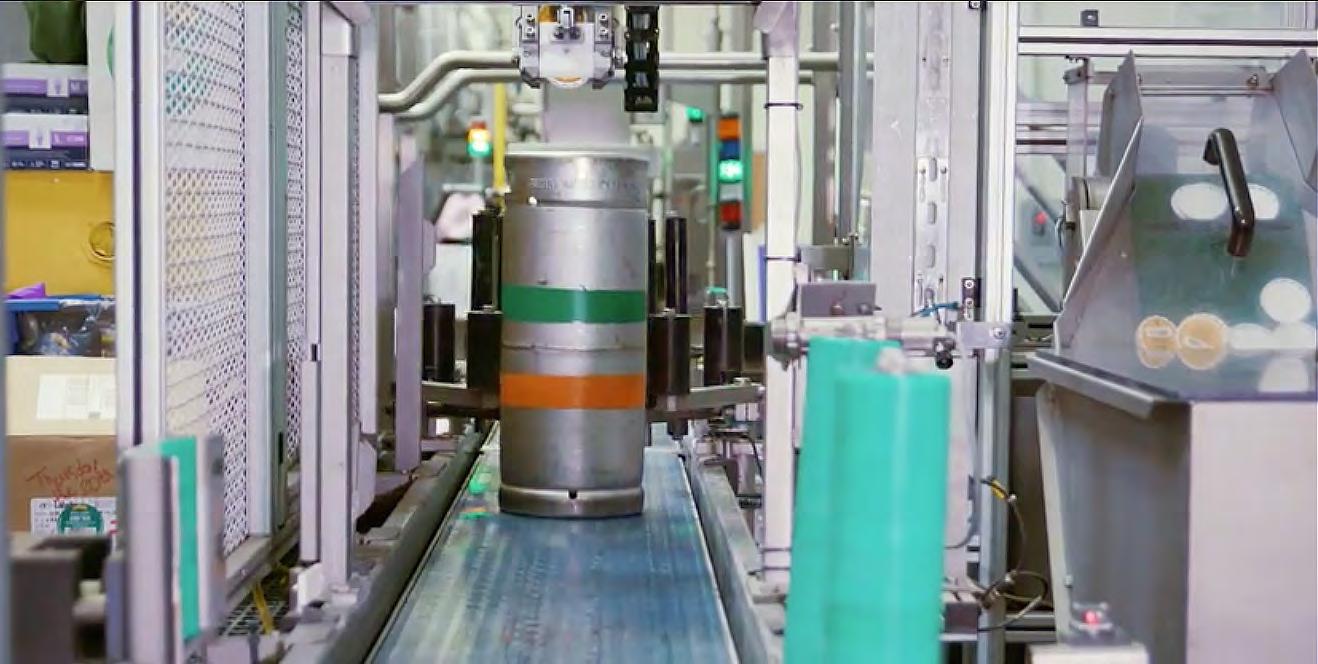
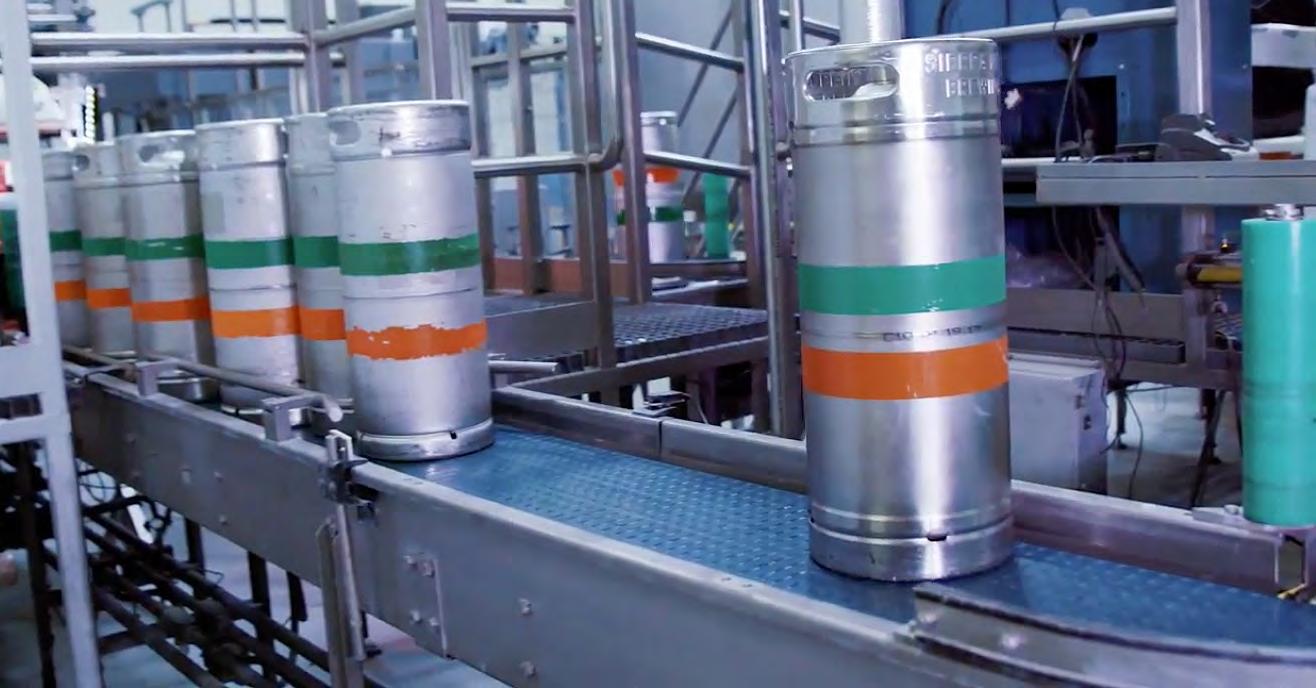
in the beverage and brewing industry, and we have been working over the past 30 years to steadily reduce our water consumption,” Russell explains.
“In light of California’s water concerns, it became even more important that we evaluate any and all means of reducing water consumption,” says Russell, noting that California is only beginning to recover from a prolonged drought, with the driest four-year statewide precipitation rate on record between 2012 and 2016.
As Russell relates, Regal Beloit’s team worked with Sierra Nevada engineers from design through installation, and remained on-site during startup to ensure the keg line ran smoothly.
“The team was also able to reduce the clean-inplace frequency, saving water as well as time,” says Young, noting that the new dry-running keg line also reduced the plant’s overall maintenance require-
ments by eliminating the risk of water or soap corroding critical line components such as bearings and gearboxes.
“Accounting for all the different areas where we’ve reduced water usage, running a dry keg line translates into approximately 750,000 gallons of water that we’ll be saving annually,” Young concludes.
“The System Plast solution from Regal Beloit helped to turn my original dream of a lube-less conveyor system into an efficient way to reduce water usage into a very satisfying reality.”

BY JULIA DUWE
Pneumatics is intrinsically a user-friendly technology.
And thanks to the latest developments in piezo technology and software, it is set to become even more straightforward, versatile and flexible.
Just as the smartphone turned the mobile communication market on its head a decade ago, the new Festo Motion Terminal VTEM has similar potential to revolutionize the industrial automation technology.
Using 10 advanced motion apps to replace over 50 individual hardware components, the Motion Terminal VTEM enables a whole new method of function integration—combined with software apps—to simplify the entire value chain with one single piece of hardware.
Beneath the somewhat unassuming exterior and classic Festo product design lies technical refinement based on state-of-the-art information technology to enable true Industry 4.0 functionalities.

We supply the latest Eagle PI X-ray technology to your site, operated by our certified Plan Automation Product Inspection technicians.
Our technology & support services will quickly help you inspect and reclaim your nished goods
INSPECT YOUR FINISHED GOODS, CASE OR PRIMARY PACKAGE:
• Food & Beverage
• Meat & Poultry
• Cosmetics & Pharmaceutical
• Consumer goods
• Industrial
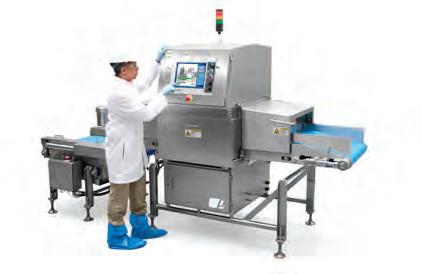
We also sell new equipment and offer lease to own or long term rentals.

This unique combination of piezo technology and integrated stroke and pressure sensors, together with control via motion apps, will open up entirely new perspectives for machinery and plant manufacturers.
Combining the best attributes and advantages of electric and pneumatic technologies, the fusion of mechanics, electronics and software featured in the Festo Motion Terminal VTEM will transform a pneumatic product into a true Industry 4.0 component—enabling unprecedented levels of production flexibility.
The new VTEM offers 10 time-saving motion apps: from basic modification of the directional control valve functions to energy-efficient motion, and from proportional behavior to different motion profiles.
What makes this so special is that the same valve hardware is used for everything it is tasked to do. Thanks to the fast activation of new functions via apps, machine developers can create a basic machine type and then select the relevant apps to equip it with different functions and features as per the customer requirements.
Assigning functions via software has the added benefit of protecting against tampering and protecting know-how, since it is not possible to tell from the outside which functions the valves are executing.
Moreover, maintenance is also significantly simplified, with the long lists of spare and wearing parts soon destined to become a thing of the past.
The terminal also generates intrinsic energy efficiency with specially developed motion apps, as well as the leakage diagnostic function save energy during operation, while the terminal’s air consumption can be flexibly adapted to the requirements using the system’s “Selectable Pressure level” and “ECO Drive” apps.
With the Selectable Pressure Level app, a digitally selected pressure can limit the pneumatic force to the level required for the application. For its part, the ECO Drive app reduces the compressed air consumption to the required minimum level, provided no pressing and holding forces are needed in the end position, to enables energy savings of up to 70 per cent compared to standard operation, depending on the application.
All in all, the Festo Motion Terminal permits both fast and powerful movements and leakage diagnostics at much lower costs than current solutions. Not only does it require far fewer controllers compared to electrical systems, its uses one valve to replace the need to have a valve, a pressure regulator and a pressure sensor—decreasing required installation space by 65 per cent.



For packaging and other machine builders looking to reduce their machine complexity and accelerate their time-to-market, the new Festo Motion Terminal VTEM offers a plethora of opportunities to get their Industry 4.0 learning curve started in full stride.
Dr. Julia Duwe is the head of future solutions management at Festo AG & Co. KG in Esslingen, Germany. The above text is an edited version of her Revolution in Automation presentation made at Festo’s annual international press conference this past summer in Paris, France.



Sean Riley, Senior Director, Media & Industry Communications, PMMI
BY SEAN RILEY
Many consumers look at the label when making decisions about their food choices, and they are increasingly looking for the so-call ‘clean-label’ foods to complement their healthier lifestyles. According to last year’s Food and Health survey conducted for the International Food Information Council (IFIC), 47 per cent of consumers look at the ingredients list when making a purchasing decision.
Asked to define a “healthy eating style,” 41 per cent of respondents cited “limited or no artificial ingredients or preservatives.” As for defining “natural” food, 29 per cent cited food products “associated with having no preservatives or additives.”
Today, demand for clean labeling is affecting nearly half of food-processing operations, according to the 2017 Trends in Food Operations Report published recently by PMMI, The Association for Packaging and Processing Technologies
The report points out that as consumers’ shopping habits are increasingly affected by the perceived healthiness of foods, brands must do more to display the health benefits of their products.
Advances in smart packaging, visual graphics, and even package recyclability can all play a key role in attracting today’s health-conscious shoppers.
As more companies make clean label claims, innovations in the packaging industry make it easier than ever for brands to call attention to the health and environmental benefits of their products.
To see the fast-growing range of these innovations under one roof, there is no better place to start than the upcoming PACK EXPO Las Vegas 2017 international packaging technologies exhibition at the Las Vegas Convention Center, Sept. 25–27, 2017.
Co-located with the Healthcare Packaging EXPO, also produced by the PMMI, the three-day event will showcase plenty of new-generation view design and labeling solutions like active and intelligent packaging, eye-grabbing graphics, and easily recyclable labels.
According to recent market research, the North American market for active and intelligent packaging market is estimated to grow from US$6.35 billion in 2016 to US$9.34 billion by the end of 2021, with printed electronics and Cloud-based communications opening up new ways for brands to connect and share information with shoppers. Incorporated or embedded into the package structure, these technologies can be easily deployed
convey nutrition and allergy information, expiration dates and much more.
“Brands have an opportunity to make sure consumers understand the value of their products and things like expiration dates,” says Joe Stodola, chief commercial officer at Jabil Packaging Solution s.
“We are an emerging packaging company for brands that want to use their packaging as part of their differentiation in the market,” says Stodola, whose company specializes in Cloud-connected solutions to enable shoppers to look up nutritional data, allergy information, portion sizing and other product information right from the package.
“We’re always working on capabilities that change how brands connect with their consumers,” Stodola states. “That differentiation can be visual or reflected in the performance and function of the packaging.”
As consumers demand cleaner food and more transparency from brands, companies must find ways to help their products stand out among the hundreds of other healthy options.
Last year alone saw the launch of 4,591 new products carrying a USDA-approved “no additives or preservatives” label; 3,732 marked as GMO-free; another 3,011 claiming to be organic; 6,552 as being low- to no-allergen; 6,123 as gluten-free; and 5,056 as being sold in an “environmentally-friendly package.”
The proliferation of products with health claims creates a challenge for food manufacturers, with brands increasingly resorting to special features like matte varnishes, clear panels, and eye-catching visuals to help their products stand out on the shelf.
Justin Slarks, director of marketing at Sleeve Seal (Booth #C-5406 ), says he has noticed brands gravitating toward using more photographic elements in their packaging.
“Whether it’s an actual picture of the food inside the package or a bottle of pomegranate juice with a photo of a pomegranate on the front, photographs of fresh foods offer shoppers a sense of trust in the healthiness of their food,” Slarks explains. “It all boils down to customers wanting more transparency.”
When calling out benefits on the package, brands should include not just the nutritional value of the food, but also the environmentally friendly assets of the package itself, Slarks suggests.
“Current innovations in product labeling show higher levels of recyclability, including de-steaming technology that helps separate labels from containers in the recycling process,” says Slarks, citing global food products group Danone as one of the first leading brand-owners to adopt the new technology for its water bottles.
To register for PACK EXPO Las Vegas 2017, please go to: www.packexpolasvegas.com
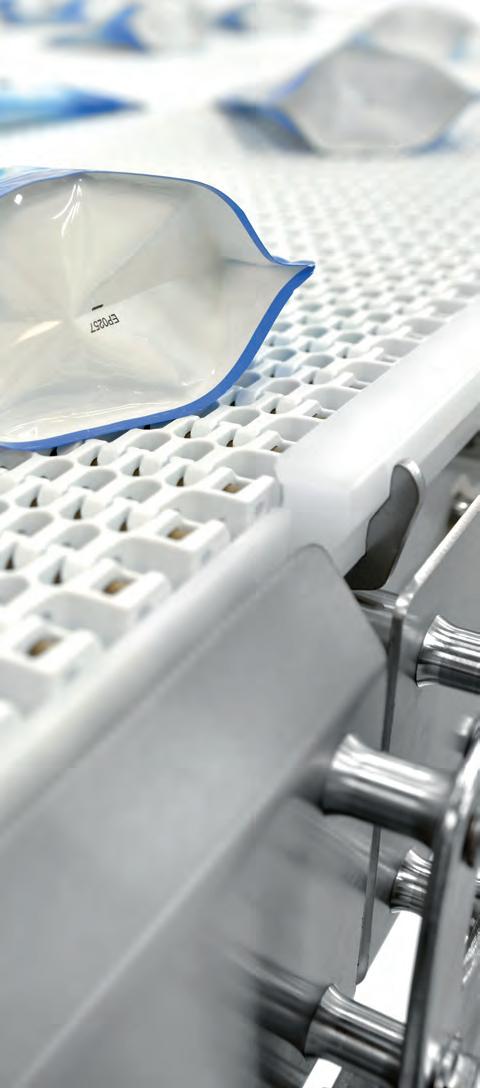
Designed for maximum available production time and operating convenience, the new modular belt conveyor in stainless steel is robust, safe and easy to clean.
The standardized design and modularity make changes of the production line easy. It’s the smart, long-term investment in your bottom line and your operators!
For more information, please contact us at +1 905-639-6878 or by email at info.us@flexlink.com.
flexlink.com

Maria Ferrante, Senior Director, Marketing & Communications, PMMI
BY MARIA FERRANTE
The retail landscape keeps on changing to keep up with the ongoing shift in consumer preferences.
With online shopping booming, and consumers seeking out unique and healthier options to address various health issues, the rapid growth in the number of startups in bakery, cereal and snack segments is poised to continue, according to global market research firm Mintel
While big brands remain important to consumers, the demand for increased variety, to go along with lifestyle changes, means smaller companies with artisanstyle products are gaining consumer appeal.
However, many of these smaller companies are finding out that launching new products and competing alongside the so-called ‘Big Brands’ is no easy feat.
With consumers looking for healthy options seeking out products that appear more natural, smaller companies benefit from growing public appetite for hand-crafted artisanal products—something that larger operations often have a hard time replicating.
But as these niche products grow in popularity, how
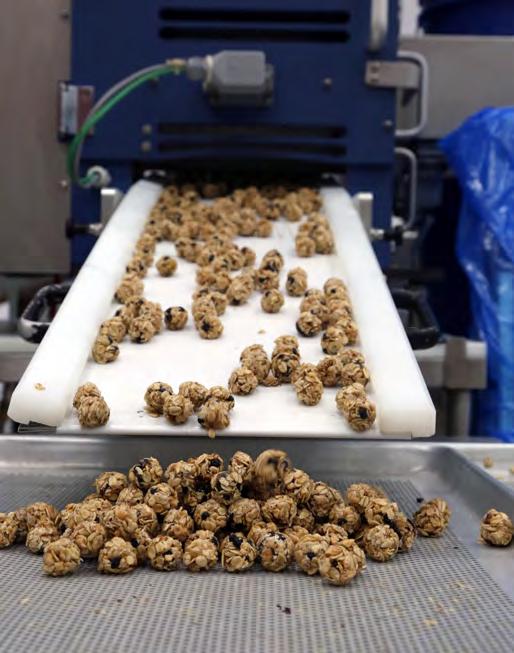
do you scale operations and maintain quality control, as well as maintain that home-baked, natural image?
A good place to start would be a visit to the upcoming PACK EXPO Las Vegas 2017 exhibition at the Las Vegas Convention Center, Sept. 25-27, 2017.
Produced by PMMI, The Association for Pack-
Increase the

in an application.
• Production line tooling changed in seconds for maximum flexibility.
• Change tools in seconds for maintenance and repair.
• Increase operator safety by changing tools automatically.
• Million-cycle tested for reliability.

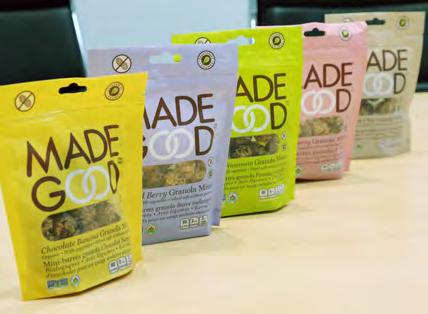
aging and Processing Technologies, the three-day event is the biggest packaging exhibition in North America this year, with more than 2,000 exhibitors eager to display their latest packaging innovations for the food, beverage and other CPG (consumer packaged goods) industries.
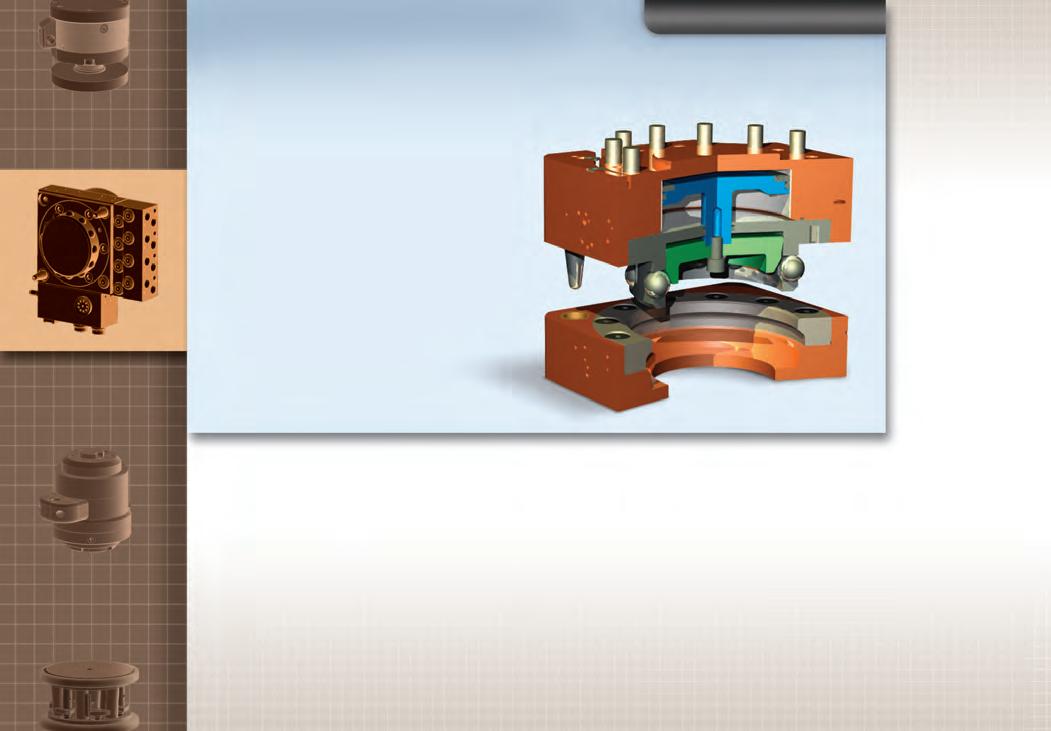
Growth-minded bakeries and snack-food manufacturers face many tough challenges when scaling up operations—staffing, extra production capacity, meeting safety regulations, more distinct advertising, marketing budgets, and other variables that many small companies struggle to come to grips with.
They must consider not only their plant’s floorspace and workflow, but also details that larger commercial bakeries take for granted, such as managing changeovers and maintaining acceptable sanitation standards for an automated line.
According to the recently released Vision 2020 report from PMMI, many manufacturers struggle to meet continuous changes in consumer demand—trying to balance the benefits of large, fast and efficient processing and packaging lines with the ever-increasing need for small, nimble and flexible ones. For some manufacturers, rethinking the use of physical space provides relief to some of their operational challenges by turning warehousing space into co-packing or contract manufacturing space, for example.
Several Vision 2020 survey participants also report adopting more of a co-packer or co-
manufacturer mindset in trying to become more nimble, more agile, and more focused on shorter runs.
As artisan bakers consider the move from a manual or semi-automated operation, they need to be concerned with their processing operations such as dough quality, fermentation time and humidity.
Hence today’s automated equipment needs to handle the dough gently enough to retain its delicate cell structures, while also replicating product variations created by human hands.
But while much of the emphasis is traditionally focused on production equipment, there is a critical need for packaging to catch up.
As they scale up, bakers must strike a perfect balance between high-speed automation and versatility.
Engineering flexibility into the packaging operation to scale up production volumes for artisan-style products, or to place buns and premium rolls in new formats, is a top priority.
Scaling up to automation can be overwhelming, as bakers need to understand their operation from the highest level down to how each shift operates.
However, even smaller bakeries have to adopt some level of automation nowadays to keep up with market demand and to keep the business growing.
Sanitation is also a major concern for small operations trying to scale up.
With low-moisture bakery and snack foods especially, the risk of recalls and food safety incidents is critical.
Staffing is also a critical component of upscaling any operation.
Simply put, managers must have the right people with the right skills to handle any new technology or automation needed to increase production and improve efficiency.
The current manufacturing skills gap makes this a challenge.
According to a recent comprehensive survey of North American manufacturing industries conducted by global business consulting group Deloitte, survey, the next decade will see the creation of nearly 3.5 million manufacturing jobs, but the skill gap result in about two million of those jobs going unfilled.
This shortage will stem in large part from an aging workforce, but also due to a lack of STEM (science, technology, engineering and mathematics) skills among available workers, along with the gradual decline of technical education programs in public high schools.
mand, and 78 per cent believe it will impact their ability to implement new technologies and increase productivity. Moreover, the surveyed executives say the skills gap also impacts the ability to provide effective customer service (69 per cent); the ability to innovate and develop new products (62 per cent); and the ability to expand internationally (48 per cent).
In an effort to help employers identify skilled workers, PMMI established the Mechatronics Certification program, whereby mechatronics is defined as the synergistic application of mechanical engineering, electrical engineering, controls engineering and computer science to build and maintain high-tech equipment.
Today’s employers increasingly need multiskilled workers to operate, maintain, and troubleshoot equipment on the plant floor.
These certifications help employers identify qualified, skilled workers needed when implementing automation or other new technology.
As PACK EXPO Las Vegas 2017 approaches, make plans to check out the PMMI U’s NextGEN Networking Fair on the show floor for an opportunity to network with the next generation of packaging professionals.
To register for PACK EXPO Las Vegas 2017, please go to: www.packexpolasvegas.com
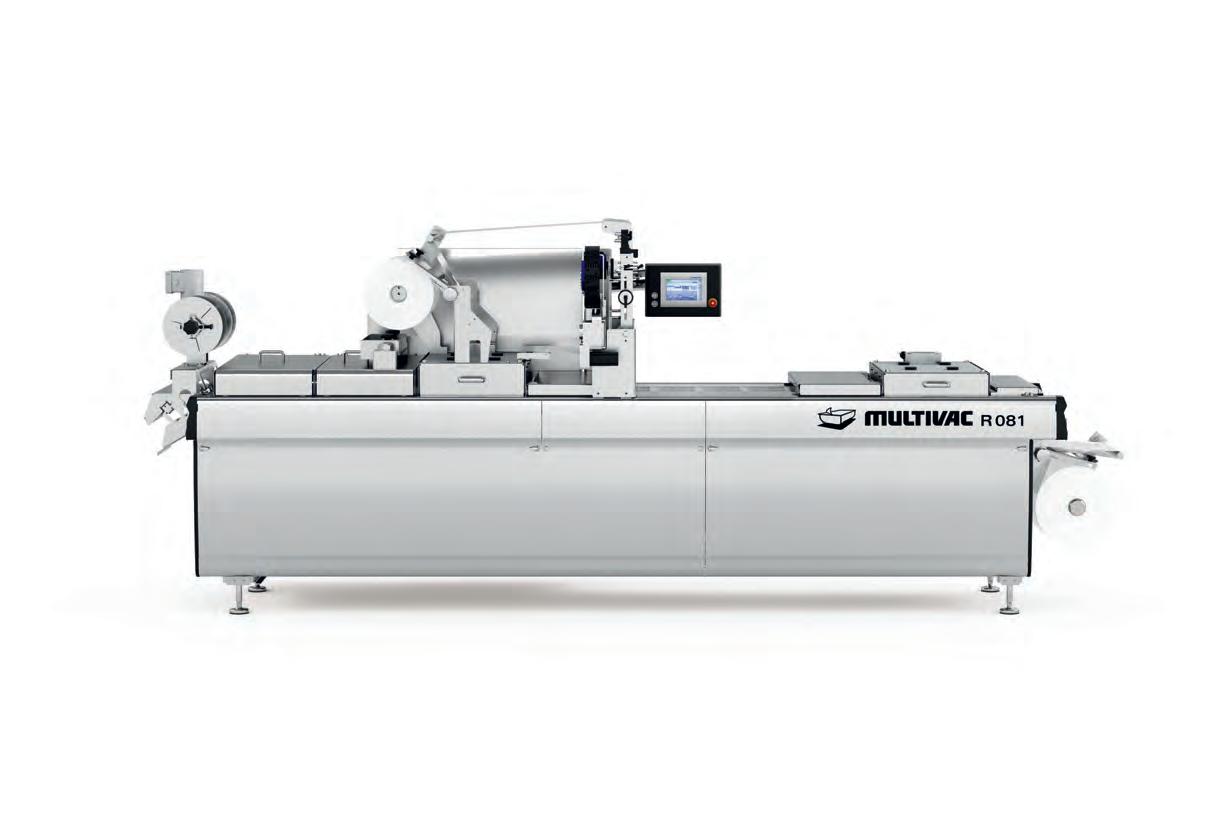
This skill gap will impact manufacturers in many ways, including the ability to grow and expand operations.
Among the senior manufacturing executives recently surveyed by Deloitte, 82 per cent indicated they believe the gap will impact their ability to meet customer de -

With this new compact model thermoformer, MULTIVAC offers an entry-level machine that reliably processes both rigid and flexible films. It features a high degree of package format flexibility and an excellent price/performance ratio.
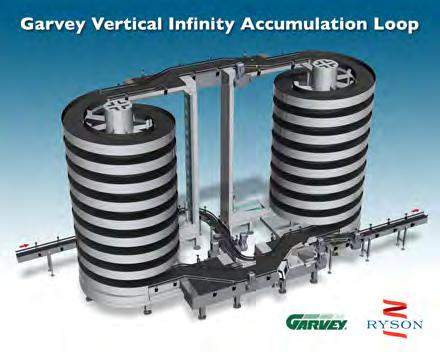
Garvey Corporation will demonstrate the company’s patented Infinity Loop conveying system integrated with two Ryson Mass Flow spiral conveyors in a highly efficient Vertical Infinity layout configuration making maximum use of available vertical space in a compact footprint. Using patented loop technology to handle transferred products with no back pressure, breakage or label damage, the low-noise Vertical Infinity technology can accumulate at unmatched transfer speed, according to Garvey. For their part, the Ryson Mass Flow spirals can handle full or empty
bottles, cans, jars and other types of containers to convey them up or down in single file or continuous mass flow—utilizing Ryson’s patented high-capacity spiral technology designed for reliability, low maintenance and long service life.
Booth #C-3809 (Garvey)
Booth #C-4642 (Ryson)
Harpak-ULMA, LLC will demonstrate the many benefits of using the G. Mondini Trave tray-sealing equipment and the proprietary stretch seal technology for the packaging of fresh poultry products, including:
• The sealing of film in the perimeter of the tray, so that no liquid can escape over the edge and get
underneath the tray, as it so often happens with the standard foam trays. Wet trays are a major complaint about poultry packaging.
• The use of fully-recyclable PET material and a special textured tray design that helps contain the liquid within packaging.
• Attractive and upscale “fresh look’ of the packaging.
• H igh output rate of the Mondini Trave equipment, capable of running over 100 trays per minute.
• The elimination of shrink tunnels from the packaging process, helping to significantly reduce the packaging line’s footprint.
• The ability to overlap flanges—enabling the use of slightly smaller case sizes.
• Full compatibility with a broad range of thermaltransfer printers can be integrated to print variable product information and UPC codes inline.
Booth #S-6101
Bosch Packaging Technology will conduct live demonstrations of the new Osgood RFS-Series rotary fill-and-seal machine and the latest Ampack FCL inline fill-and-seal machine, with both systems featuring highly hygienic and sanitary designs
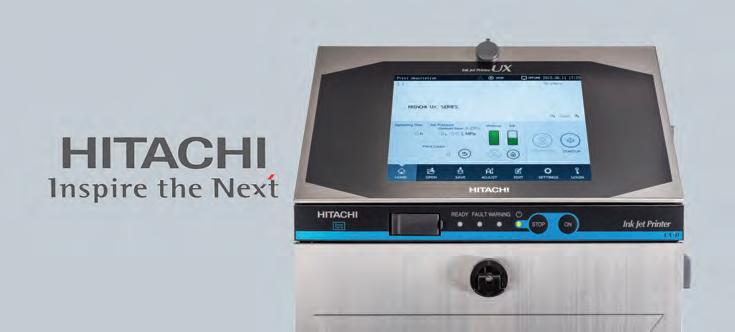


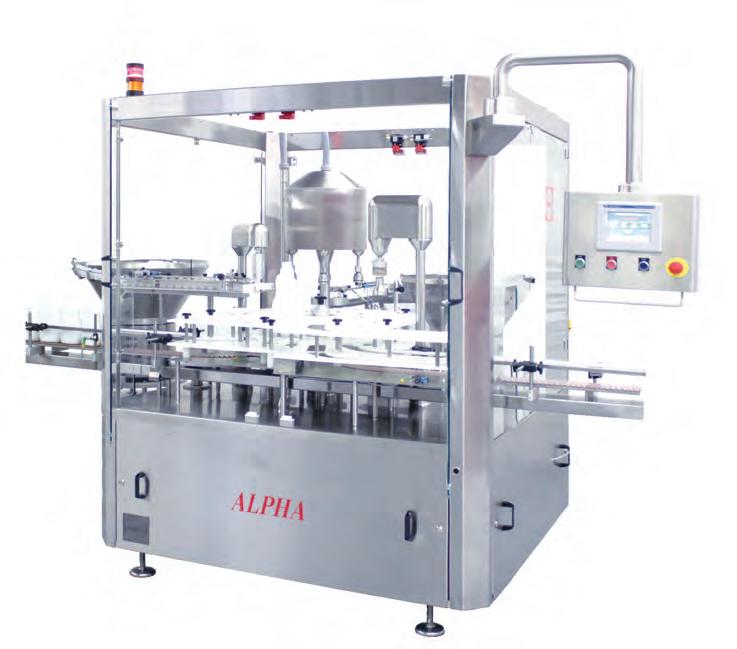


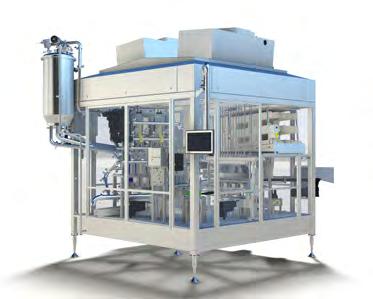
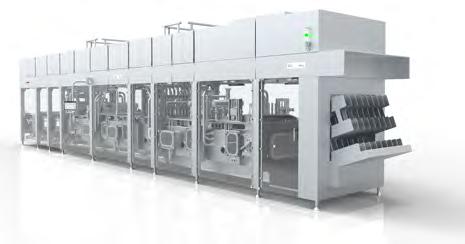
to meet all health and safety requirements of the dairy and liquid food industries. Designed as an efficient alternative for producers with limited available production space without compromising output, the rotary machine from Osgood can handles cups at speeds of up to 9,600 products an hour on four lanes in clean and ultra-clean environments. For its part, Ampack’s new aseptic linear filling and sealing machine provides an ultra-clean to aseptic hygienic packaging solution for products requiring a longer shelflife outside the cooling-chain. By extending it from four to six weeks (ultra-clean) or up to 12 months (for aseptic), producers of baby food and clinical nutrition can enjoy the highest hygienic filling level available on the market, according to Bosch Technology, with throughput speeds of up to 20,000 cups per hour.
Booth #C-2800
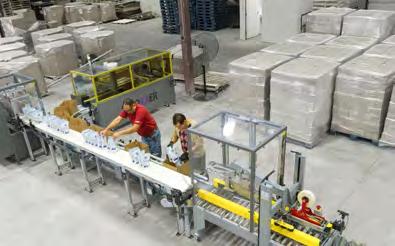
Beckhoff Automation LLC will demonstrate the company’s diverse product offering for industrial automation and Industry 4.0 applications with a lively display of socalled Smart Factory solutions, including a wall of IoT (Internet of Things)-enabled devices, as well as articulated robot arms from Stäubli, accessed by any mobile device with a web browser. The expansive exhibit will also showcase:
• T he TwinCAT HMI (human-machine interface);
• H MI software platform for visualizations that can dynamically scale to suit the screen formats of industrial displays and any mobile device with a web
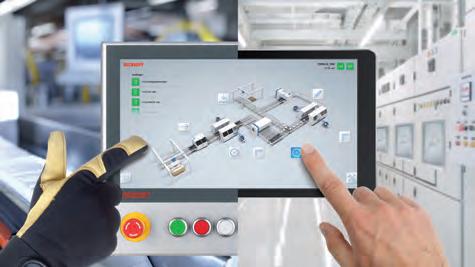
browser;
• T he TwinCAT IoT and TwinCAT Analytics software packages to facilitate quick Cloud connectivity for
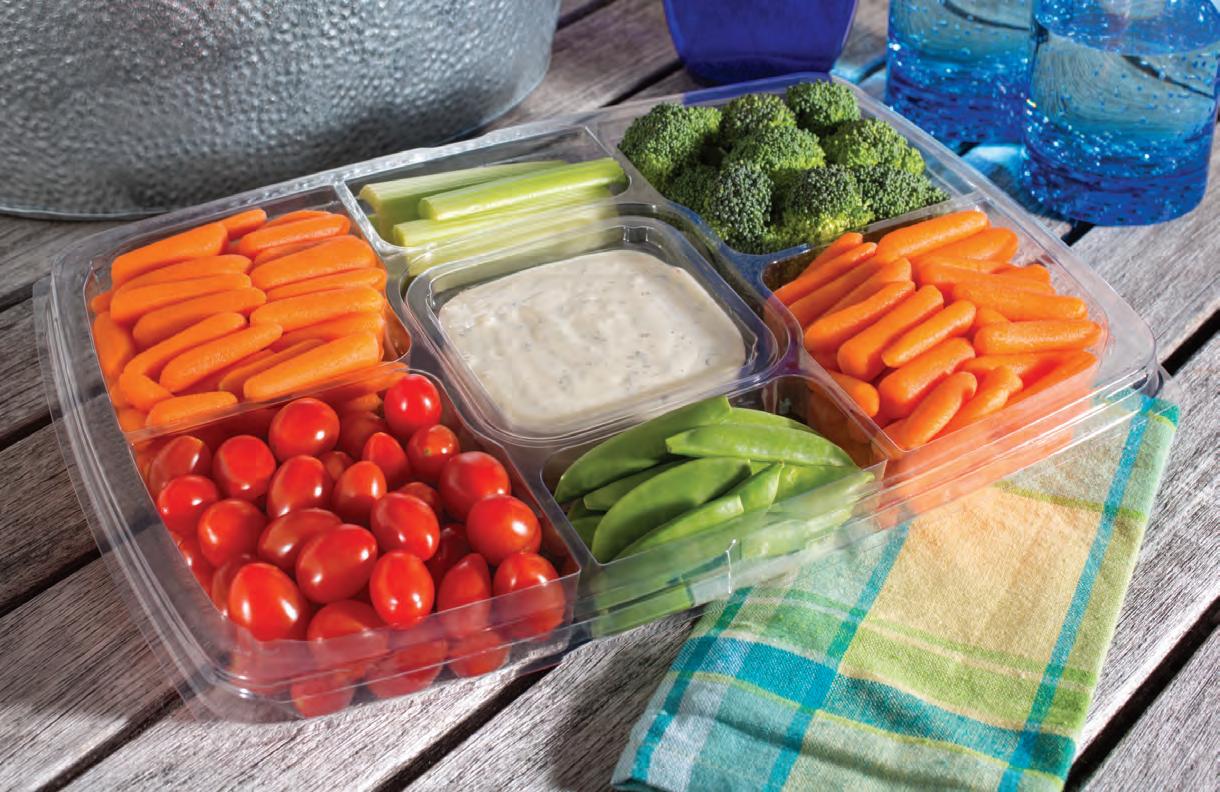
Eagle Packaging Machinery will demonstrate the company’s new labor-saving BoxxPak’s integrated pick-and-pack system that effectively combines caseerecting, product loading stations, and case-sealing into a compact and efficient workcell that virtually eliminates the need for frequent repetitive wrist movement and arm motion during the case-packing process. Able to accommodate up to four operators, the highly customizable BoxxPak is a highly efficient workstation that neatly conveys the transferred product alongside each erected case to minimize physical stress and decreasing the likelihood of operator injury.
Booth #C-3614


Nothing keeps your product fresher than MAP packaging produced on a Ross IN inline tray sealer.
n Produces MAP packages using preformed trays of almost any size or shape –easily packages your entire product line.
n Consistently produces packages with reliable, high-quality seals that extend shelf-life.
n Fast, highly flexible, and extremely easy to operate.
n Innovative tool/storage cart allows rapid, tool-less changeovers between tray sizes in 10 minutes or less.
n Stainless steel washdown construction and IP67 components.
n Compact footprint allows it to fit into tight areas.
n Test the Ross IN for yourself. Contact us to set up a demonstration at the
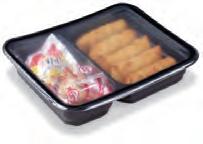
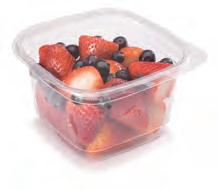
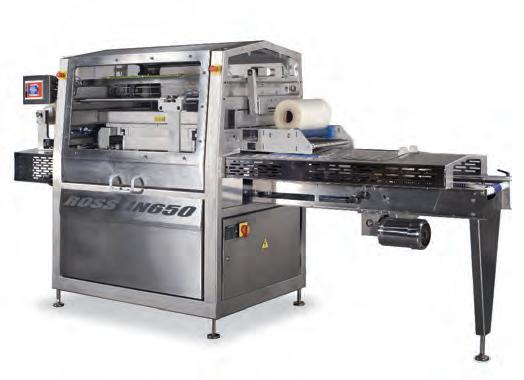
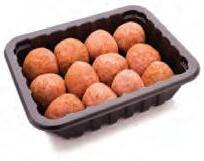

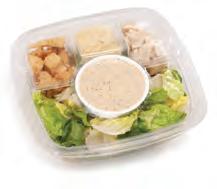
packaging machines optimized to operate in the Industry 4.0 environment;
• T he new high-end ELM series EtherCAT I/O modules for ultra-precise measurement and data acquisition;
• T he super-compact model C6015 Industrial PC (IPC), powered by Intel Atom microprocessors, facilitate cost-efficient implementation of automation, visualization and system-wide communication in small- and mid-size applications with a minimal device footprint.
Booth #S-6302
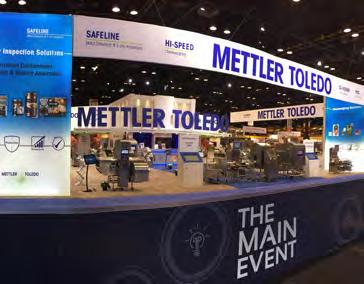
Mettler-Toledo
Product Inspection will unveil the company’s extensive and diverse range of technologies designed for providing thorough, accurate and reliable inspection of food, beverage and other products and their packaging. Focusing on critical areas such as
food safety, brand protection and regulatory compliance—as well as enhancing productivity and increasing operator efficiency to improve OEE (overall equipment effectiveness)—the company’s display will showcase various checkweighing, metal detection, X-Ray and vision inspection systems designed to protect product quality and brand image by detecting physical contaminants, as well as ensuring accurate package weights, complete contents and correct labeling.
Booth #C-1814
Canadian-based
Pineberry Manufacturing Inc. will display the company’s new CartonTrac FC (Flat Carton) serialization system, designed for complex coding and high resolution thermal inkjet printing require -
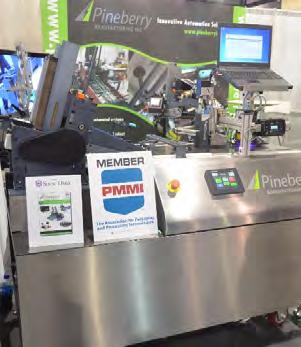
ments for packaging and pharmaceutical serialization and traceability. Engineered to produce the cleanest possible codes, verified with an inline tamperproof reader—the system facilitates full control of all types of pharmaceutical and packaging cartons with optimal precision by generating codes and data superior to inkjet coding technology, according to Pineberry, with zero printing consumables or downtime.
Booth #C-3704
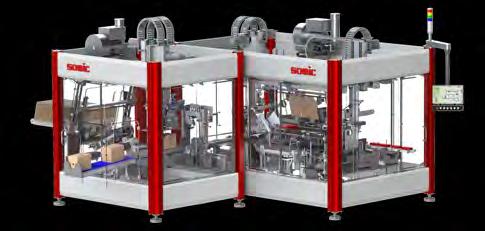
Somic America, Inc. will demonstrate the versatile capabilities of the company’s 424 T2 (D) multi-purpose, retail-ready case-packer, designed to deliver high performance by collating, grouping and packaging products in open display trays, as well as trays with covers and wraparound cases. Capable
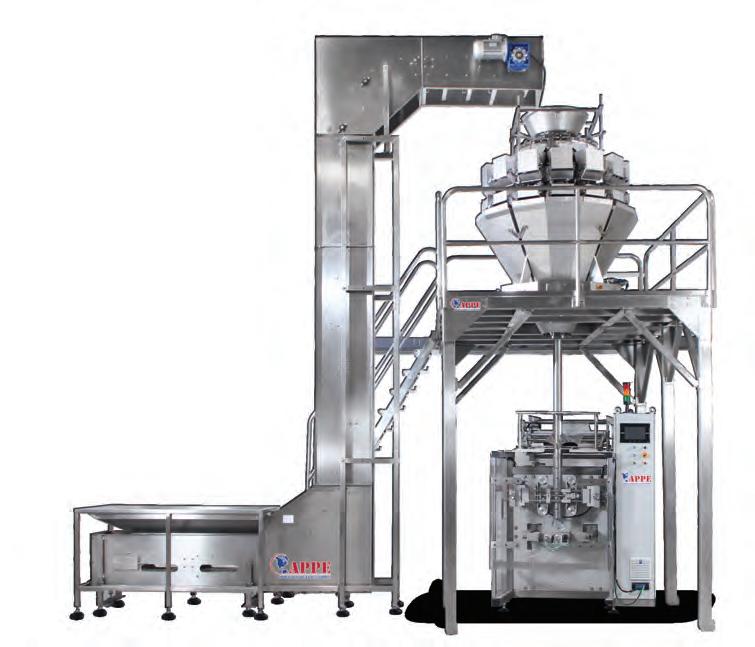













of collating up to 600 units per minute, depending on size, and processing up to 35 carton cases per minute, for a diverse range of products from coffee and cereal to flour, jam and noodles, it also can be fitted with individual format tools for a wide range of product dimensions, along with the ability to form, load and condense soft or flexible products into a tighter package to provide significant savings on carton costs.
Booth #S-8468
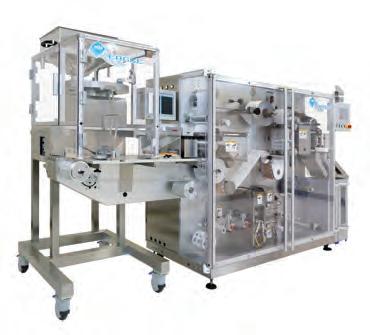
Maruho Hatsujyo Innovations will showcase its versatile and cost-effective Eagle blister thermoforming machine, designed for maximum versatility and process reliability in pharmaceutical and nutraceutical packaging applications involving varying batch sizes. Offering a time-saving advantage with a quick, recipe-driven changeover that requires no tools, the compact servo-driven machine runs all the forming films and lidding materials—including push-thru, peelable and peel/push formats—to produce up 100 blisters per minute at a maximum index length of 90-mm and maximum index width of 130-mm, the compact-footprint machine is compatible with a wide range of third-party feeders, cameras, printers and cartoning equipment.
Booth #N-630

Printing ink specialists Sun Chemical will showcase a broad range of innovative formulations designed to help brand-owners and package converters achieve their packaging goals and objectives, and Sun Chemical will also highlight its SunBar (aerobloc) oxygen barrier coatings that can facilitate significant lightweighting of primary flexible packaging by removing
some of the polymer layers from packaging, while providing improved laminate flexibility.
Booth #S-6285
Squid Ink will present a broad range of the company’s coding and marking systems for product identification and traceability applications—from high-quality inks to low-maintenance printing equipment—for generating highly legible barcodes, batch numbers, date codes, logos and large- or small-character text directly onto corrugated cases, plastics, metals, glass, wood and other substrates. The extensive display will feature the com -
pany’s advanced new Streamline 5 continuous inkjet (CIJ) printer— equipped with the CleanJet self-cleaning printhead—capable of generating up to five lines of small-character print on a broad variety of both porous and nonporous substrates.
Booth #C-5017
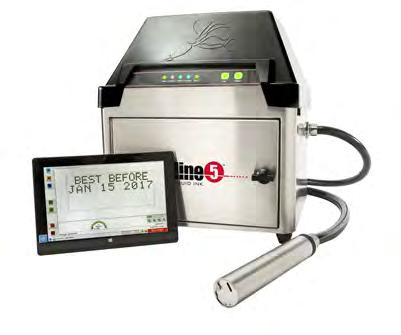



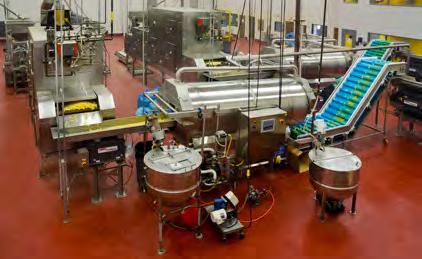
Heat and Control will showcase the company’s comprehensive and diverse range of processing, coating and seasoning, conveying, weighing, packaging, and product inspection systems for the food industry, including the latest technologies from the company’s business subsidiaries FastBack , Spray Dynamics, CEIA and Ishida
Booth #C-1603
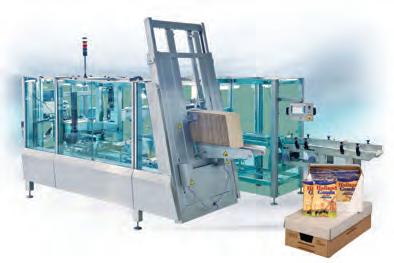
BluePrint Automation will showcase the company’s CPIII wraparound case-packer that automatically erects, loads and closes wraparound cases, trays, tray-lid combinations and RSC (regular slotted carton) cases. Featuring highly hygienic design for food applications, fast and tool-free changeover, modular configuration to accommodate a broad variety of standard product handling systems, and a frequency-controlled motor drive which
guarantees accurate erection of the carton blank. In operation, case blanks are grabbed and erected by a twin vacuum arm system, the product is collated into a group—using a customized two-axis gantry-style robot—and side-loaded into the erected wraparound case, with the case flaps securely closed with hot-melt adhesive. Well-suited for industries such as dairy, snack, bakery, confectionery and beverage, the CPIII wraparound case-packer can accommodate bottles, pouches, folding cartons and other package format at speeds of up to 30 boxes per minute.
Booth #C-4400
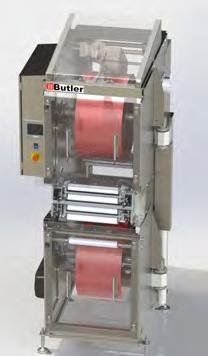
Butler Automatic will showcase the company’s model SP1 automatic film splicer and SP3HSL automatic shrinksleeve splicer—both designed to eliminate roll change downtime caused by manual film roll changes. Running at speeds of up to 600 feet per minute, the SP1 features a simple mechanical design to ensure long-term, trouble-free automatic splicing performance whereby the device senses the diameter of the expiring roll of film and automatically splices the end of each expiring roll onto the new roll. For its part, the SP3HSL automatic shrinksleeve splicer can increase line efficiencies by about nine per cent, according to the company, by minimizing the number of the required roll changes in various consumer packaged goods and pharmaceutical applications utilizing shrinksleeve packaging.
Booth #C-3916
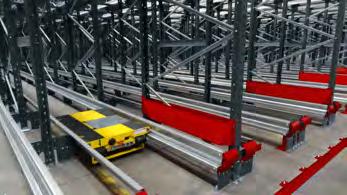
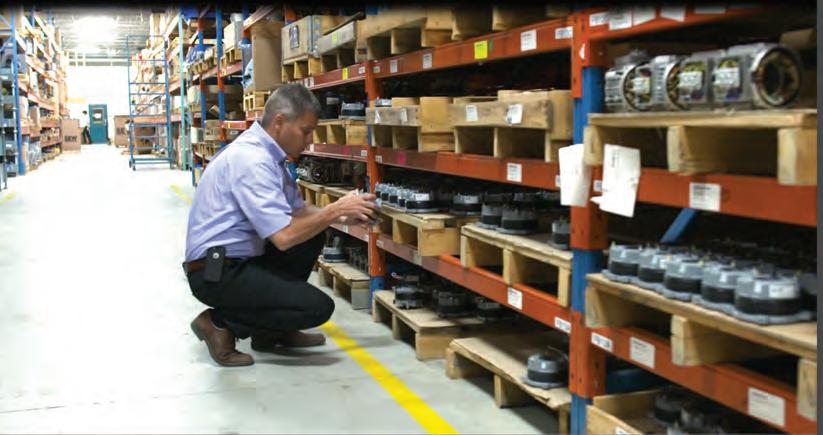

Storax will display the numerous space-saving and other performance benefits of the company’s Poweracks mobile storage racking system, designed to maximize space utilization through use of a moving aisle to facilitate direct access to every pallet location, while greatly reducing the number of required static access aisles. In addition, the company will display its innovative Ranger high-density storage solution that automatically circulates pallets on a shuttle system by hand-
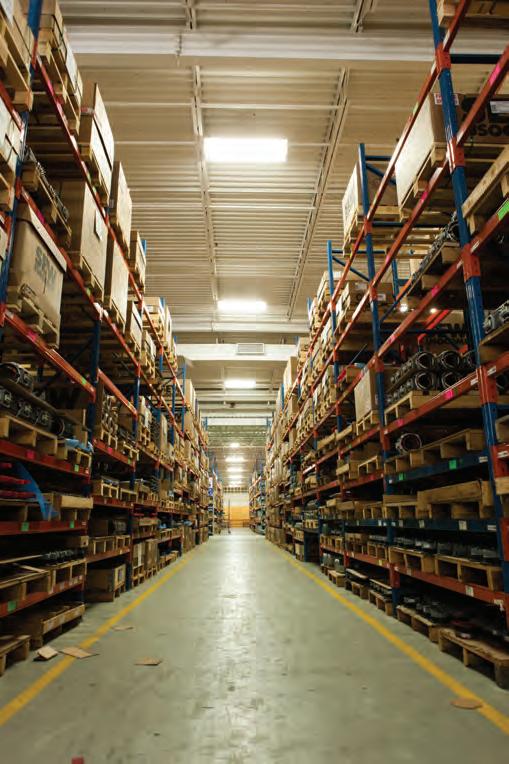
a Connector and Calculate Cost Savings With HARTING’s Industrial Connector Configurator and Savings Calculator App


held remote control or WiFi PDA (personal digital assistant) by utilizing advanced photocell technology to position the Ranger underneath a pallet to lift and move pallets within a deep lane tunnel rack system— leaving operators free to execute other tasks.
Booth #S-7193
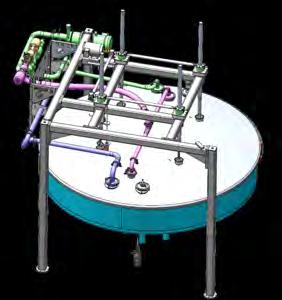
Fogg Filler, manufacturer of rotary filling systems for the liquids industry, will display advantages of the company’s new recovery trough built-in sensors for optimized temperature management in various hot-fill applications. According to the company, the built-in sensors allow the operator to manage product temperature in the bowl and filling valve tip temperatures when line stops occur—allowing the operator to send the trough into position to purge the cooled product in the valves until production can be resumed, while sending only a small amount of product back to rework.
Temperature management for hot-fill applications has been made simple with use of the Fogg recovery trough.
Booth #C-1654
Coperion K-Tron will exhibit a broad variety of advanced components and solutions for handling bulk solids materials in different process steps, as well as the latest innovative technology for optimizing feeder design and control in food processing applications. The display will showcase the company’s P-Series central receivers, said to be designed for applications with a higher degree of sanitary requirements. They
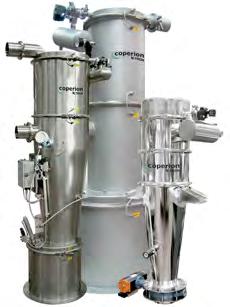
are designed to provide solutions for difficult conveying applications for the food industry and meets 3A Dairy sanitary requirements, the P-Series sanitary receivers can be used for gain-in-weight or loss-inweight feeder refill applications, both in simple up-and-in systems or as part of larger, central vacuum conveying systems.
Booth S-7844
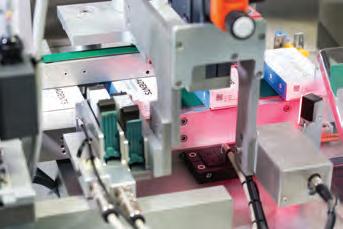
In addition to leading a roundtable discussion on pharmaceutical trackand-trace requirements and solution—featuring its own and Microsoft executives—Adents will showcase the company’s robust Adents Prodigi software-drive solution for infrastructure connectivity, cloud architecture, and ways to empower serialization data for beyond-compliance benefits, such as production improvements and business intelligence. According to the company, Adents Prodigi is the only Level 4 traceability solution that can centrally manage all regulatory requirements mandated in the pharmaceutical industry, as well as to allow pharmaceutical companies and CMOs to take advantage of the massive amounts of data generated during the serialization and track-and-trace process.
Booth #N-219
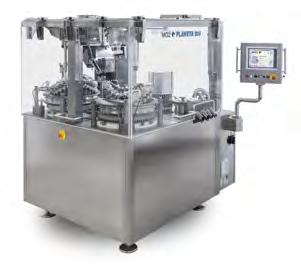
MG America, the U.S. subsidiary of Italian machinebuilder MG2, will showcase a variety of premium packaging and processing machinery, including the highspeed PLANETA 200 capsule filler.
Capable of producing up to 200,000 capsules per hour, the highly flexible machine’s modular design provides a highly configurable platform suitable for a wide array of production requirements, including an ability to fit several dosing units simultaneously and enabling one capsule to be filled with differing products. The fully scalable machine can also be initially configured for medium throughput speeds and then upgraded later for maximum speeds—reaching different performances depending on the number and type of dosing units installed. The PLANETA 200 also can be equipped with isolators satisfying different containment levels, as well as various washing systems ranging from wet-inplace to wash/clean-in-place automatic systems.
Booth #N-227
The Marchesini Group will be debuting the new MA 400 continuous motion horizontal cartoner for highspeed packing of all product types—blisters, bottles and vials, rigid and squeezable tubes, sachets and trays—for the pharma-
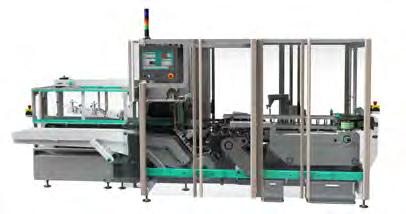
See how YuMi - the industry’s first truly collaborative dual arm robot - can facilitate to numerous applications side by side with your employees. YuMi stands for “You and Me, working together”, and with a 500 Gram load per arm paired with a 500 Millimeter reach, YuMi is ideal for efficiently working in hard to reach areas with accuracy. www.abb.com/robotics

ceutical and cosmetic markets, featuring enhanced ergonomic design, compact footprint, fast changeover times and improved reliability for optimal performance in high-speed production environments.
Booth #N-121
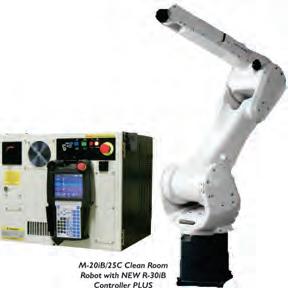
ESS Technologies, Inc. will conduct live demonstrations of its redesigned Robotic Mini Pallet Cell incorporating FANUC’s new model M-20iB/25C robot—a cleanclass, food-grade robot designed specifically for settings requiring a high degree of cleanliness. With payloads of up to five kilos and a reach of 1,853-mm, the compact M-20iB/25C palletizing robot is integrated within a PLe -rated enclosure that houses the robot as well as the new model R-30iB PLUS A-cabinet robot controller, which features a redesigned iPendant with enhanced screen resolution and processing capability. The system’s iHMI user interface offers an icon-based screen to facilitate familiar, easy-to-use user experience, with intuitive guides for set-up and programming. The front panel of the stackable controller A-cabinet fits flush with the PLe -rated interlocked and gasketed safety guarding system to create a streamlined robotic cell that does not require additional floor space for the robot controller.
Booth #N-121
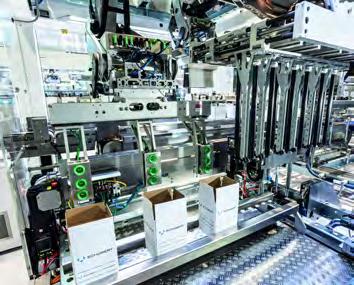
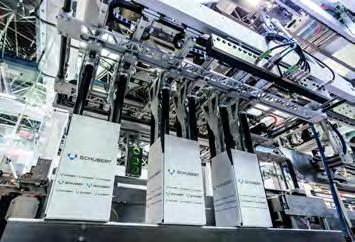
Gerhard Schubert GmbH will showcase the company’s new high-performance case erector for RSC (regular slotted case) cartons to provide fully-automated forming and filling of folding cartons with bottles or other containers at high throughput speeds and with quick changeovers, whereby the system’s carton magazine and TLM (top-loading module) robot tools automatically adjust themselves to accommodate a new product run. The carton magazine is designed to handle an extensive selection of carton sizes, according to the company, while also automatically converting between one-, two-or three-lane versions. For its part, the system’s A2 robot is outfitted with a special tool boasting a total of 12 spreading elements, which can be adjusted automatically by means of an NC drive. Four of these elements are inserted from above into the previously opened carton, further expanding it by positioning the centering elements into the carton corners, with the spreading tools incorporating with intelli-
gent sensors that enable automatic compensation for carton tolerances during the spreading movement in both longitudinal and transverse directions. The system also uses the DC servo drive to regulate the clamping force during the carton-erecting process. The erected cartons are then placed on the vacuum conveyor by an F2 robot and transported to the next station, where they can be loaded with product by the system’s fully-integrated F2 robot and moved downstream for end-of-line packaging.
Booth #S-7665
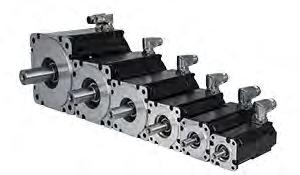
Kollmorgen will unveil the company’s new-generation AKM 2G synchronous servomotors outfitted with optimized electromagnetic technology for highest performance levels. Featuring six frame sizes with up to five stack lengths and performance levels between 0.3 kW and 10 kW, the configurable motors feature increased power density and improved torque/speed ratio to provide OEMs the ability to get up to 30 percent more performance out of the same motor size, according to the company, while offering selectable options such as feedbacks, mounting configurations, and performance capabilities.
Booth #C-1751
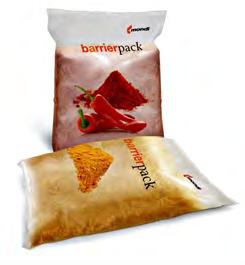
Global packaging and paper product group Mondi will display a wide range of the company’s industrial and consumer packaging solutions designed to address the latest industry and market trends, including flexible packaging, bags and pouches, barrier coatings, technical films and industrial bags, with a special focus on the food and beverage market needs.
Booth #S-6715
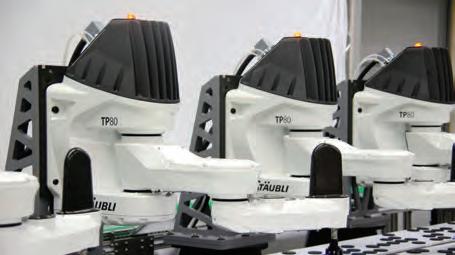
maceuticals, biotechnology, food, electronics, semiconductors, cleanrooms and laboratory environments to suit an extremely diverse range of applications. In addition, the company will unveil its all-new TX2 series collaborative robot—available in six models to handle loads from two up to 15 kilograms—integrated into a Smart Factory demonstration designed to showcase the new robot’s dual compatibility with the Industry 4.0 work environment.
Booth #S-5956
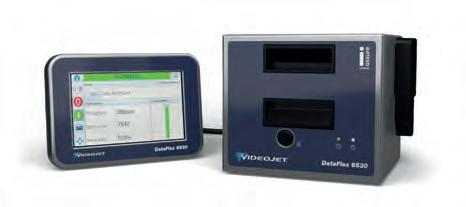
Videojet Technologies Inc. will unveil the company’s brand new generation of thermal transfer overprinters (TTOs) to meet the stringent product quality requirement of manufacturers using flexible packaging and labeling to pack their products. Featuring innovative proprietary iAssure technology, an industry-first, integrated code assurance system that automatically checks every print for alphanumeric print defects, the all-electronic DataFlex 6530 and DataFlex 6330 model printers are designed to catch all common defect caused by printheads, uneven print surfaces or ribbon wrinkles, according to the company, and can be used to print on zipper packs and pouches of varying thickness with no special setup. Featuring a modular design to enable a seamless fit into any existing packaging line, the DataFlex 6530 and 6330 printers allow the power supply to be placed with the controller, separated and mounted inside the packaging machine cabinet, or to be controlled directly through the packaging machine’s web interface—enables manufacturers to have a single point of control for their printer and the packaging machine.
Booth #C-1851
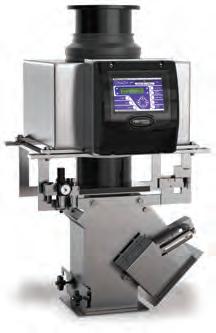
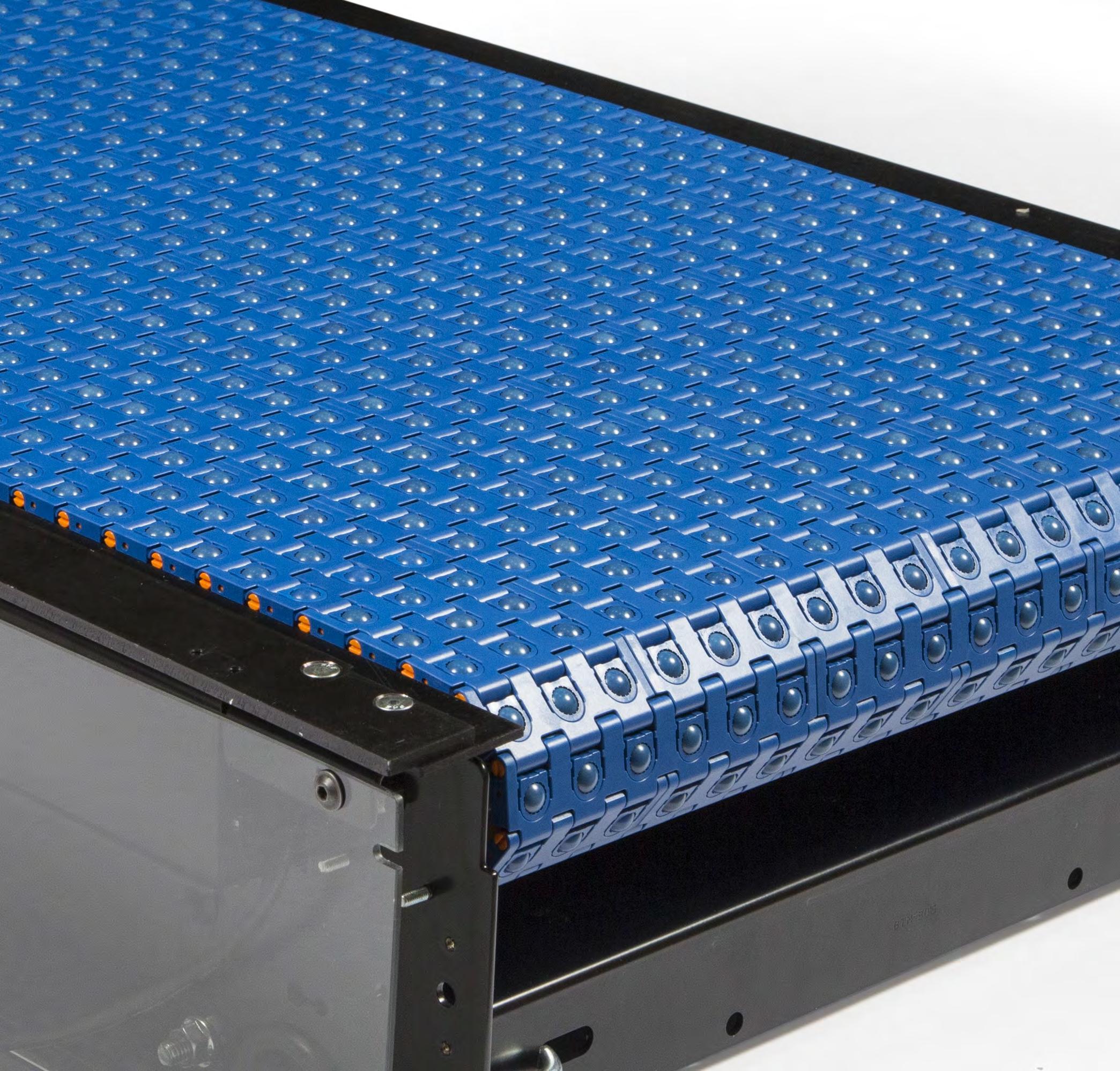
robots designed for high-speed throughput in the food, medical, phar -
Canadian metal detection systems manufacturer Fortress Technology, Inc. will debut the company’s new-generation Halo automatic testing system for checking the performance of the reject system and independently testing ferrous, non-ferrous and stainless-steel samples on all new Fortress metal detectors, including the company’s flagship Stealth series. Designed for applications where manual testing of a metal detector is made difficult due to access, position, access to the product flow, environmental conditions, etc., the Halo system harnesses the signal generated by an electrically-conductive loop system outside of the detectors coil system to provide users with costeffective, automatic, accurate and consistent testing at programmed intervals, while ensuring full compliance with all the pertinent HACCP, FSMA and other food safety standards.
Booth #C-5204
one easily-integrated station could divert, transfer, and sort?
The MODSORT station is an innovative low-noise, low voltage modular transfer and diverter station. It can easily integrate with new or existing material handling systems, eliminating the need for a lift, pneumatics, or Z-direction position feedback devices, and can help achieve energy savings from 50-60% when integrated with a motorized roller-based system.
MODSORT utilizes System Plast™ 2253RT Roller Top Belt featuring a 1-inch on-center sphere array, allowing very small packages to be moved. Motorized Drive Rollers and controls allow flexibility in wiring, the ability to move everything from exceptionally small polybags to boxes, and safe, efficient, quiet and low-maintenance operation. For more information, visit www.RegalBeloit.com

BY DIRK SCHLUETER AND OWEN TUCKER
Just as products come in packaging of all shapes and sizes, today’s demands on packaging machines are equally diverse.
Although packaging is primarily there to protect the contents, product presentation frequently boosts the incentive to buy, which is why it is constantly adjusted to meet varying point-of-sale requirements.
Even when the packaging tasks are changed frequently, operators expect reliability, high cycle speeds and, in particular, flexibility from their packaging machines.
Because today’s machines have a high degree of automation incorporated in their design, there is a need for intelligent, modular safety concepts that seek to maintain economic viability and to deliver a meaningful competitive edge.
To address that need, German automation components manufacturer Pilz GmbH & Co. KG recently launched the PNOZmulti Mini configurable control system, integrated with the company’s PSENslock safety gate system and the PDP67 digital input modules to ensure complete safety for plant personnel working alongside automatic and semi-automatic packaging equipment.
Workplace safety has been high on the list of corporate priorities at Oystar North America Inc. for many years.
Headquartered in Davenport, Iowa, the company’s diverse product portfolio ranges from stand-alone traypackers and case-erectors to conveying systems, palletizing stations, and full turnkey packaging lines used in the dairy, pharmaceutical, cosmetics and food industries.
The company’s Oystar A+F division, specializing in end-of-line packaging solutions, has recently embraced the open, flexible and decentralized safety system from Pilz, which also boasts extensive diagnostics functions.
The Oystar A+F palletizing stations feature several doors that have to be opened regularly or temporarily throughout the day, which have to be fitted with safety gate systems and guard locking devices to protect the process.
In the past, these tasks would have involved costly and labor-intensive cabling work to install mechanical safety switches with guard-locking devices, with all signals evaluated centrally via safety relays.
Precise alignment between the switch and actuator was difficult because the mounting tolerances were low and diagnostics were not always reliable—sometimes resulting in damaged switches and attempts to manipulate the safeguards.
Initially, Oystar A+F considered integrating the safety technology into the control systems of the various leading automation suppliers.
This idea was soon shelved, however, on account of the high level of complexity of the software tools for the various systems and the complicated software validation this process involved.
“Our primary aim was to define an open and decentralized safety concept that could not only be designed in accordance with protection type IP67 but could also
be implemented with clear separation of responsibilities between safety and standard,” says Manfred Schuster, head of electrical design at Oystar A+F.
Because the company was already familiar with Pilz’s range of products and services following years of cooperation, it opted for the configurable control system PNOZmulti Mini in combination with decentralized periphery, the input modules PDP67
Installed in the main control cabinet, the PNOZmulti Mini base unit features 20 digital inputs and four digital semiconductor outputs to monitor the emergency stop button, the reset button and the mode selector switch, as well as taking control of the servo amplifier all the way to a safe operational stop.
The safety gate system PSENslock from Pilz monitors the machine access points via the PNOZmulti Mini, combined with a non-contact magnetic interlock for flexible connection options to provide optimal safety gate monitoring, both individually and in series, to ensure maximum manipulation protection.
During operation, the gate system passes the signals to the decentralized PDP modules/ PNOZmulti Mini Gates that do not require guard locking are fitted with the coded safety switch PSENcode, with the connection made directly on-site via the decentralized PDP67 modules.
When plant and machinery are interlinked and the machines are assembled as modular systems, the PNOZmulti Mini systems are simply linked to each other to ensure safe exchange of all the signals.
“By swapping the mechanical switches for the safety gate system PSENslock from Pilz, our customers can increase the productivity and reliability of their machines considerably,” says Schuster.
“The software tool PNOZmulti Configurator makes light work of the configuration of the whole system, with the clearly structured, intuitive user interface speeding up the commissioning process.”
“All the configuration and function elements are available either as icons or in selection menus, and all inputs and outputs can be linked using logic elements via a simple drag-and-drop function,” says Schuster, also complimenting the user-friendly software’s pre-defined, approved function blocks and menus.
“Safety functions require in-depth specialist knowledge, particularly during configuration and implementation, so the fact that certified safety blocks are already stored within the software tool helps tremendously in gaining quicker approval for the machine,” he states.
The Safety Calculator PAScal calculation software from Pilz calculates and verifies the key safety parameters such as Performance Level (PL) and Safety Integrity Level (SIL) for plant and machinery safety functions.
The software can use a graphic editor to model safety functions and define not only their structure, but also the usage pattern of the individual components.
The software’s extensive library functions make it possible for users to import machine data in the standard library formats or to create and manage their own libraries.
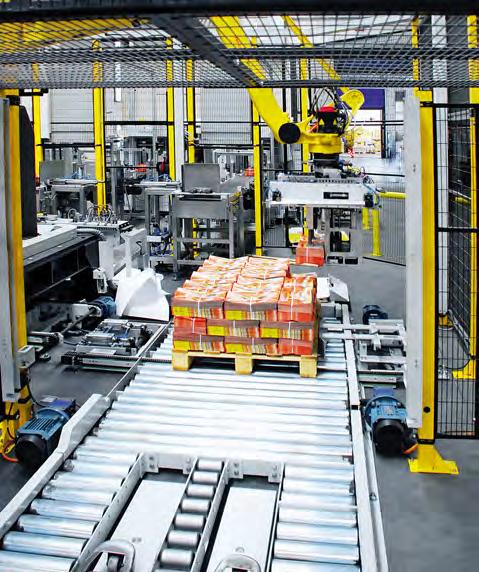
Says Schuster: “The close collaboration between Oystar and Pilz resulted in a system standard for safety that can be adapted to cater to the individual needs and requirements of the various installations and machine types.


“Not only did Pilz supply the machines and systems but the company was also responsible for the design, product selection, commissioning, after-sales service and support,” he adds.
“For us it was a big advantage that even during the commissioning phase we were able to call on Pilz’s technical support at any time, and that support was always straightforward,” Schuster points out.
With their distributed structure, the products in the PNOZmulti range developed by Pilz are ideally suited to systems requiring a standardized solution, from the stand-alone machines right through to modular networks, according to Schuster.
“The large number of different communication interfaces makes the configurable control system into a safety standard that can be applied all over the world because it can be used independently of any specific operating control system
“We were looking for a new, universal safety solution that could be clearly structured,” he sums up, and we found it with the PNOZmulti Mini and the decentralized PDP67 modules.”


n Case-packing machinery manufacturer Schneider Packaging Equipment Co. Inc. of Brewerton, N.Y., has appointed Bob Brotzki as president.
n Danfoss, Baltimore, Md.headquartered manufacturer of electrical control and components for industrial heating and cooling applications, has appointed Ashwani Girdhar as Canadian sales manager for the heating business.


n Dorner Mfg. Corp., Hartland, Wis.-based manufacturer of industrial conveying systems, has appointed Scott Lister as regional sales manager for Texas and Louisiana.
n Davis-Standard LLC, Pawcatuck, Conn.-based manufacturer of plastic extrusion and converting systems, has appointed Gerry Sposato as senior sales engineer for the company’s Sheet and Foam Group business.
n Legacy Pharmaceutical Packaging, St. Louis, Mo.headquartered contract manufacturers and co-packer for the global pharmaceutical and healthcare industries, has appointed Michael O’Kelley as executive director of packaging and Reddy Nandipati as director of quality.



n Pittsburgh, Pa.-headquartered Matthews International Corporation has appointed Gary Kohl as president of the company’s SGK Brand Solutions business unit, a globallyoperating provider of brand development, package design and other integrated marketing services.
n SAKI Corporation, Japanese manufacturer of optical and X-Ray inspection systems, has appointed Alex Malek as vicepresident of sales and service for North America at the company’s SAKI America subsidiary in Freemont, Ca.
n Maxcess International, Inc., Oklahoma City, Oka.-based manufacturer of precision rolls for printing, paper, converting, plastics and other web-handling industrial applications, has appointed Darren Irons as global product manager for the Webex brand precision rolls.
Sept. 25-27
Las Vegas, Nev.: PACK EXPO Las Vegas 2017, international packaging technologies exhibition by PMMI-The Association for Packaging and Processing Technologies. Concurrently with Healthcare Packaging EXPO, pharmaceutical and packaging conference and trade show by ISPE (International Society for Pharmaceutical Engineering). Both at Las Vegas Convention Center.To register, go to: www.packexpo.com
Sept. 27-29
Montreal: 2017 Conference on Canadian Stewardship, sustainability and circular economy summit by PAC Packaging Consortium and Eco Enterprises Quebec. At Le Centre Sheraton Hotel.To register, go to: www.canadianstewardship.com
Sept. 27-29
Ottawa: Forests: A Way of Life, 2017 SFI Annual Conference of SFI (Sustainable Forestry Initiative) Inc. At The Westin Ottawa.To register, go to: www.sfiprogram.org
Oct. 3
Toronto: Circular Economy or Spinning Our Wheels?, packaging sustainability conference by the Paper & Paperboard Environmental Council (PPEC). At Islington Golf and Country Club. To register, contact PPEC via email ppec@ppec-paper.com
Oct. 19
Toronto: Ontario Craft Brewers Conference (OCBC) & Suppliers Marketplace 2017, by Ontario Craft Brewers. At Beansfield Centre. To register, go to: www.ontariocraftbrewers.com

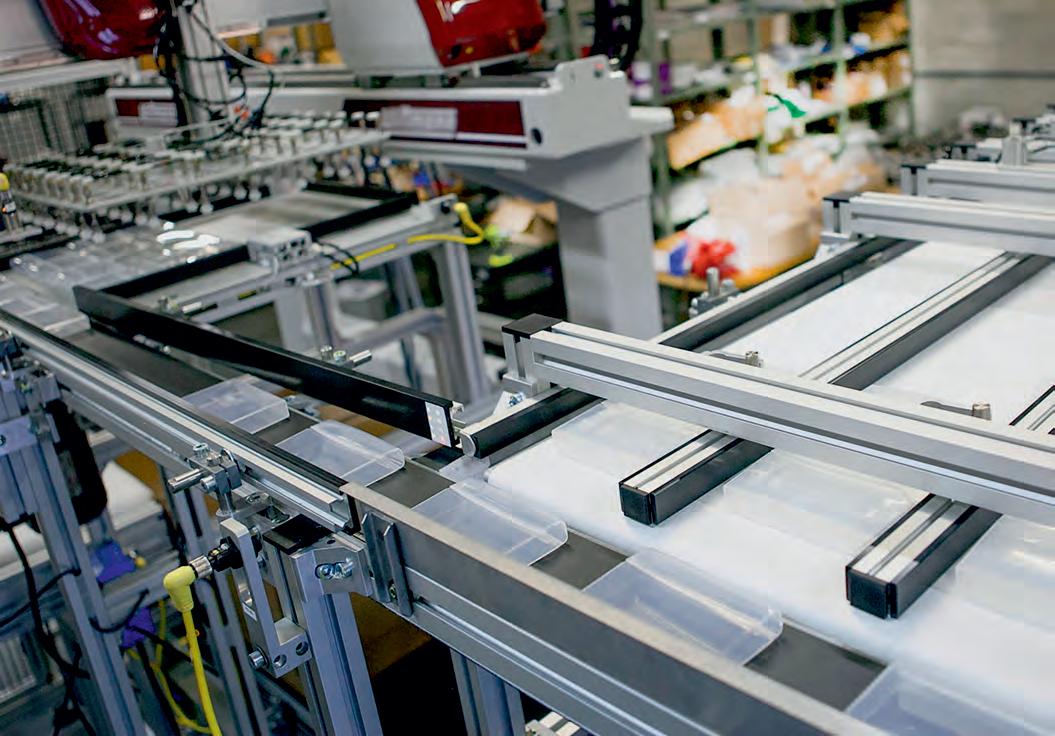


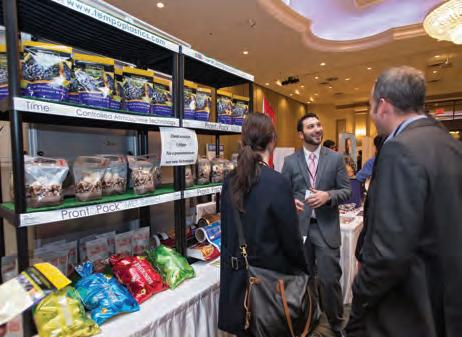
n Plastic Technologies, Inc. (PTI), Holland, Ohio-based designer and manufacturer of plastic beverage containers and preforms, has appointed Thierry Fabozzi as president of global operations.



As September rolls around to usher in yet another season of change, maintaining a healthy lifestyle routine becomes a testing challenge to one’s self-discipline. Be it trying to bike to work more often, getting the kids to school on time or, in my case, resisting the temptation of morning muffins and late-night snacks, staying on the righteous path just feels more tasking than it does in the summer months. For those who crave snacks to boost their personal comfort levels, separating things that are good for you from empty calories, and served up in convenient consumer-friendly packaging, can be tricky. Happily, some leading snack producers seem to be warming up to the idea of using their packaging to help consumers make healthier snack-food choices.

For smoothie aficionados, the Welch’s Fruit & Veggie Blends brand of frozen foods and vegetables is a treat on many levels, including the colorful and supremely functional stand-up pouch packaging outfitted with a sturdy, reliable and resealable closure to ensure extended product freshness and avoid accidental spillage. Featuring stunning product photography depicting a healthy heapful of blueberries, grapes, raspberries, kale and purple corn garnishing a glass of a freshly-blended burgundy smoothie inside, the 600-gram bags of the brand’s Purple Disco flavor project instant “life of the party appeal” with the vivid purple-pink burst of colors. The bubble-shaped nutritional claims of 2+ servings of fruits and vegetables make it a highly appealing prospect for the nutritionally-minded consumers, without being preachy about it. Best of all, the back of the bag features several easy-to-make recipes that lets consumers enjoy the product as a wholesome breakfast, a sweet-and-salty snack, or just as a decadent guilt-
free snack at different times of the day. Just like disco, this product virtually had me dancing in the aisles after adding it to the shopping cart.


For those looking for something more substantial than a beverage, U.K.-based Rude Health has all the angles covered with a growing range of cereal mixes specially prepared to help you “Eat right, stay brilliant,” as the brand’s motto proclaims on its website. With no artificial flavors, added salts or sweeteners, the Rude Health cereal mix is not shy in the least about targeting the on-the-go, social media-savvy consumers with enticing ingredient graphics on the front panel of the gabletop paperbox used to pack the cereals, aptly enriched with interesting tidbits of information on the back panel explaining the product’s origins and the inspiration behind it. Which is perfect for the MUESLI No Flamin’ Raisins mix of rolled oats and flakes combined with a tasty infusion of apricots, apples, brazil nuts and dates—with a peekaboo window cutout on the sky-blue front panel allowing the shopper to get a good look at the wholesome bits of goodness inside. It’s hard not to crack a smile looking at the cheeky, die-cut graphic of lipstick-covered lips wrapped around a set of gleamingwhite teeth, captured in some kind of a spontaneous rant, on to take a healthy bite of an apricot in front of it.
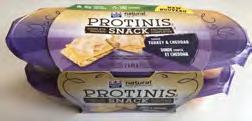


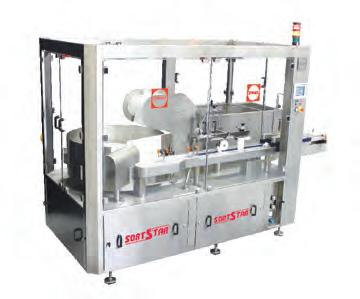
The Capmatic SortStar bottle unscrambler is designed to handle a wide range of plastic bottles. Using centrifugal disks and adjustable guides, most bottles can run on this machine without the use of any change parts.

One of the hardest things to pack for yourself from scratch is a nourishing, simple and protein-loaded snack for an afternoon pick-me-up. While throwing a banana into the lunch bag is a good last resort, it does get a little long in the tooth when doing it on a daily basis, and there is always the risk of bruising or crushing it by accident by the time you get around to eating it. So I was absolutely delighted to come across the Maple Leaf Natural Selections Protinis packs, which combine nutrition and convenience without all the hassle of preparation. The light, slender 49-gram plastic containers—filled with perfect-sized portions of shaved turkey, cheese, and chia-seed crackers—easily fit into the tiniest of bags to provide a convenient and nutritious pick-me-up when you need it the most. Offered in two-pack paperboard sleeves decorated with eye-catching product depiction, the foil-lidded containers also have special dividers inserted inside to keep the three different foods separated from each other until opening to prevent them from blending into a crumbly mess.
Megan Moffat is a freelance writer living in Toronto.