Find the inspiration to advance your business at the largest processing and packaging trade show in the world this year.
PACK EXPO Las Vegas is your only chance to access the newest processing and packaging technologies, all in one place.
No matter what your industry — food, beverage, pharmaceutical or another — if it can advance your business, it’s here at PACK EXPO. You should be, too.
Start by visiting www.packexpo.com
MAY 2013
VOLUME 66, NO. 5
SENIOR PUBLISHER
Stephen Dean (416) 510-5198
SDean@canadianpackaging.com
EDITOR
George Guidoni (416) 510-5227
GGuidoni@canadianpackaging.com
FEATURES EDITOR
Andrew Joseph (416) 510-5228
AJoseph@canadianpackaging.com
ART DIRECTOR
Stewart Thomas (416) 442-5600 x3212
SThomas@bizinfogroup.ca
PRODUCTION MANAGER
Cathy Li (416) 510-5150 CLi@bizinfogroup.ca
CIRCULATION MANAGER
Diane Rakoff (416) 510-5216
DRakoff@bizinfogroup.ca
EDITORIAL DIRECTOR
Lisa Wichmann (416) 442-5600 x5101 LWichmann@canadianmanufacturing.com
EXECUTIVE PUBLISHER
Tim Dimopoulos (416) 510-5100 TDimopoulos@bizinfogroup.ca BIG MAGAZINES LP
Vice-President of Canadian Publishing Alex Papanou
President of Business Information Group Bruce Creighton
SWIMMING BACK TO SHORE
Epic-scale industrial disasters are for the most part a combination of negligence, incompetence and plain bad luck. But the sheer enormity of the 900-plus death toll of last month’s collapse of the eight-story garment factory in Rana Plaza on the outskirts of Bangladesh’s capital Dhaka is bound to have a profound reassessment of the pros and cons of manufacturing outsourcing—a key feature of the modern global economy—not only for the international garment producers who had their products made at the tragically unsafe building, including Canada’s own Joe Fresh discount brand owned by Loblaws, but throughout the wider global CPG (consumer packaged goods) circles.
And rightly so. No one has to die anywhere so that western consumers can keep buying $10 shirts and $20 jeans in their domestic markets, while their local clothiers and shoemakers keep going belly-up in face of cutthroat price competition.
It’s a horrible way to force large multinational corporations to reassess their current CSR (corporate social responsibility) strategies and agendas—particularly in the area of fair labor and fair trade practices, but it’s a responsibility they cannot and must not ignore or underestimate.
Substandard building construction, shady business practices and poor local working conditions may not necessarily be something that multinationals have full control over, but the risk of having to pay for the company you keep is the risk that they take on their own conscience whenever they move their production lines offshore for a fatter profit margin.
It’s no secret that consumers like low prices, but if it’s the only thing that Canadian consumers really cared about, we would all only shop at Walmart and Dollarama, no?
Just like the global diamond business has come clean in recent years about its dirty little ‘blood diamonds’ secret of flooding world markets with precious gems obtained from war-torn regions in Africa and elsewhere, CPGs must also be held to a higher
& COLUMNS
standard of global accountability than they collectively display to date. It’s fair enough that the global economy will have its winners and losers—that’s just how capitalism works—but competition in international trade should never be allowed to descend into a life-or-death free-for-all.
Especially since the lure of manufacturing outsourcing is already starting to wear rather thin.
According to recent market research, many North American companies—particularly the socalled ‘advanced manufacturers’ of high-tech and complex parts requiring skilled product design and mold and tool development—have been moving some of their operations back to Canada and the U.S. as part of a growing “reshoring” trend that in hindsight, at least, gives a whole new meaning to the old time-tested caveat emptor (buyer beware) cautionary advice about unprincipled pursuit of a greater profit for its own sake.
A new research paper from Messe Düsseldorf GmbH—organizers of the upcoming K 2013 international trade fair for the global plastic and rubber industries—neatly puts this into proper perspective.
“The great migration of manufacturing to China began 20 years ago when companies, believing they could reduce production cost by 30 to 40 per cent, began establishing facilities and working with third parties there to benefit from special economic zones, new industrial infrastructure, low currency exchange rates and, importantly, cheap labor,” the Reshoring Lifts Business in North America article states.
“In reality the savings, while sizeable, never matched expectations [while] long-standing expenses are further diminishing margins, longstanding expenses are further diminishing margins. These include trips to and from China by North American managers to check operations, rising local taxes and tariffs; the time and growing cost of product transit; and the frequent reengineering of molds to correct mistakes and poor quality work, which not only adds costs but delay time-to-market schedules, which affects sales and a company’s competitive advantage.”
Caveat emptor indeed.
18
THE CROP By Andrew Joseph Innovative Quebec distiller thriving against the grain with award-winning apple-based wines and ciders.
23 A CLEAN SWEEP By Andrew Joseph Sanitation products manufacturer leverages upscale packaging technologies to keep things clean and simple on the production oor.
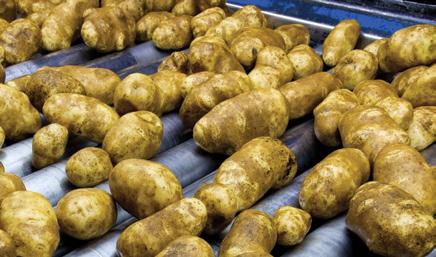
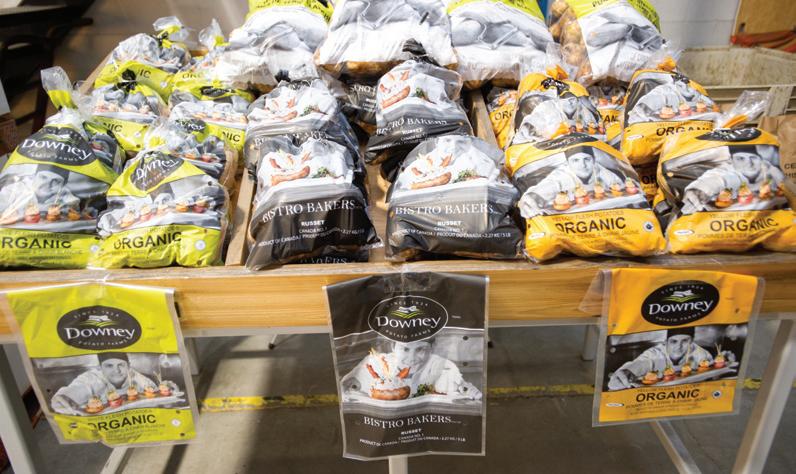
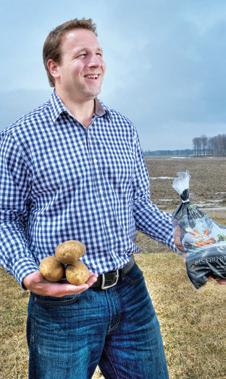
26 PICTURE PERFECT By Andrew Joseph Ontario potato grower sets itself apart in the crowded marketplace with quality product and award-winning packaging.
DECORATIVE TISSUE BOXES GIVE CONSUMERS BROAD RANGE OF STYLISH OPTIONS
A box of tissues is never really just a box of tissues when it comes to the venerable famed Scotties brand of facial paper napkins.
Manufactured by leading Canadian paper products group Kruger Products L.P., the country’s bestselling facial tissue brand has never been shy about making an aesthetic statement—as evidenced by an expansive product family comprising 10 different ‘collections’ (sub-brands) and over 60 different box designs ranging from sophisticated and feminine, to luxurious, stylish and super sleek.
“I’m very happy to work with the team at Scotties to demonstrate how its unique box designs are the perfect touch to any room décor, providing a wide range of accents that blend perfectly into the consumer’s personal design style to keep it timeless and elegant.”
As part of the marketing campaign, Taylor Eustace will be featured in full-page Scotties print ads running in leading English and French lifestyle magazines across Canada this summer—sharing her style expertise on how to incorporate Scotties boxes into any home’s design palette.
NEW SPICE BLEND PROMISES NO MORE TEARS
Although onions may well be one of the most beloved and popular food spices and ingredients in Canada, the tear-filled experience of chopping up fresh onions in a kitchen is often enough to make some home chefs give it a reluctant pass.
With a box design to match and enhance virtually every home décor, the Scotties brand team is planning to help Canadian consumers select just the right one for them with the expert help of Dee Dee Taylor Eustace, one of the country’s leading authoritative architects and designers, in a summer-long print advertising campaign structured to showcase how the inspired Scotties box designs can add a perfect touch of style and elegance to every room.
In addition, Kruger will launching several new box designs for the Scotties Lotion brand of super-soft three-ply tissues containing aloe and vitamin E skin moisturizers, and four new box designs for the Scotties Supreme line of extra-thick facial tissues.
“Consumer research tells us that Canadians care just as much about the style and design of their Scotties box as they do about the premium quality of the tissue inside,” says Nancy Marcus, corporate vicepresident of consumer marketing at Kruger Products.
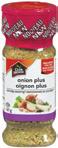
But not any longer—thanks to last month’s Canada-wide launch of the new Club House One Step Onion Plus blend by Canada’s leading spice producer McCormick Canada
Blended and packaged in clear 147-gram plastic containers at the company’s manufacturing facility in London, Ont., the Club House One Step Onion Plus seasoning is a certified kosher product that contains no transfats or artificial colors or flavors, according to McCormick.
“Onion Plus is a versatile seasoning blend with notes of caramelized and toasted onions, and subtle flavors of leeks and chives,” says McCormick Canada’s product manager Stacey McKellar.
“Enhanced with garlic, herbs and a hint of balsamic vinegar, it puts a new twist on a kitchen staple.”
“As an architect and interior designer, I always start with a design plan by choosing tones that contrast with color from accents such as tissue boxes, flowers and accessories,” says Taylor Eustace.
“We are delighted to partner with such a highly credible Canadian architect and interior designer of Dee Dee Taylor Eustace’s caliber to give relevance to our ad campaign through her insights and style tips that demonstrate how every Scotties design box has a room in mind,” Marcus adds.
As with all the Club House One Step seasonings, Onion Plus features a unique peel-back label— graphically designed by Toronto-based Novellus Graphic Resource and printed by ASL Print FX of Vaughan, Ont.—that is filled with easyto-follow recipes, with the new blend featuring cooking instruction for making ‘onion-and-pea bruschetta’ and ‘home-made meatballs,’ while many more recipes are also available online at www.clubhouse.ca
NESTLÉ TESTING THE WATERS WITH UNIQUE NEW FLAVORS AND PACKAGE OPTIONS
Turning plain water into a full-on beverage experience on a massive scale is no small feat, but luckily for Canadian consumers looking for healthy and tasty drinking alternatives, Nestlé Waters Canada (NWC) is not the sort of company to settle for half-measures in anything it does.
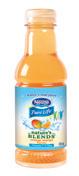
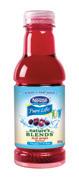
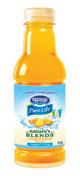
And it’s no different with the recent Canadian launch of the company’s Nestlé Pure Life Nature’s Blend flavor-enhanced water brand—boasting a light fruity taste and a healthy Vitamin C and Zinc content.
Packaged in 473-ml PET (polyethylene terephtalate) bottles supplied by Amcor Rigid Plastics —decorated with catchy labels designed by Cornerstone Branding and printed by Hammer Packaging —the brand currently offers three real fruit juice-based flavors at grocery, drugstore and convenience outlets across Ontario and Quebec, including Acai Grape, Orange Mango and Tropical Citrus varieties.
“Our Nestlé Pure Life Nature’s Blend is a tasty, refreshing and natural alternative, particularly for those consumers who want a beverage featuring natural fruit
flavors, rather than artificial flavors, or for those who simply want to stay properly hydrated with a more flavorful beverage,” says Carol Guier, NWC marketing manager for domestic brands in Puslinch, Ont.
“These products offer consumers convenience and choice, in that they allow them to consume a healthy, tasty and refreshing flavor-enhanced water wherever they are.”
In addition to introducing Nestlé Pure Life Nature’s Blend to Canada, NWC is also boosting local profile of the world-renowned Perrier Carbonated Natural Spring Water brand—owned by NWC’s parent company Nestlé Waters North America of Stamford, Conn.—with introduction of singleserve, 250-ml Perrier Slim Cans
First imported to Canada back in 1979, the Perrier product family has steadily expanded over the years—today offering a growing choice of flavors and package sizes that also include 330-ml cans, 500ml PET plastic bottles and 750-ml glass containers.
Retailing in 10-packs of natural, grapefruit and lime flavors, the Perrier Slim Cans —designed by
Quickstep conseil and manufactured by Ball Packaging Europe —offer Canadian consumers a convenient, 100-percent recyclable, all-natural refreshment option with no sugar and zero calories, according to NWC.
“The Perrier Slim Cans will deliver on Canadians’ growing desire for a flavorful yet natural, no-calorie alternative to artificial-flavored and high-calorie beverages that they can consume on-the-go or at their favorite restaurant or bar,” says Jennifer Semley-Robert, NWC’s marketing manager for premium brands.
“Perrier Slim Cans offer a tasty, thirst-quenching healthy choice that will keep consumers properly hydrated in the most convenient, satisfying and pleasurable way possible.”
As with all Perrier products, the Perrier Slim Cans are filled and packed at the company’s source facility in a small village of Vergeze in the Provence region of southern France, where a local spring’s unique balance of minerals and light effervescence provides the water’s distinctively fresh, clean taste enhanced with a one-ofa-kind blend of gases and minerals that helped Perrier become the world’s most popular brand of carbonated spring water.
Dee Dee Taylor Eustace
METAL CANS DELIVER CROWNING MARKETPLACE GLORY TO MAPLE SYRUP PRODUCERS
Some packaging traditions seem to develop a life of their own over the years, and when it comes to packaging iconic national products like maple syrup, packaging it in metal cans is the only way to package it right for true maple syrup purists, according to the Montreal-based maple syrup processing and packaging systems manufacturer Dominion & Grimm Inc.
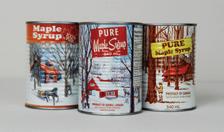
While some maple syrup producers have been experimenting with flexible and other packaging formats in recent years, none of those alternatives come close to achieving the level of product and flavor protection offered by the 540-ml metal cans manufactured by the Philadelphia, Pa.headquartered metal packaging products group CROWN Food Packaging North America, according to Dominion & Grimm regional sales manager Heather Clark.
“We have come to understand that not only is the can a highly efficient format for syrup, but that it’s imperative to driving the purchase at the pointof-sale,” says Clark, adding her company has been working with Crown-made metal cans for over 50 years to provide maple syrup producers with optimal packaging solutions.
“To a Quebecer, taking maple syrup from a can is simply how it’s done, and alternative packaging formats fail to perform as strongly in the market,” Clark states, citing the inherent benefits of metal packaging to ensure product quality and build brand awareness.
“Derived from the sap of maple trees, the syrup is boiled and then packaged in cans which are hermetically-sealed—thereby eliminating the possibility that air or pathogens can enter and protecting the flavor of the pure syrup,” says Clark, adding that the can packaging for maple syrup has changed very little in general appearance over the years precisely because Canadian consumers have established such a strong connection with this classic design.
In addition to being an efficient format to ship and store the product, the shelf-stable cans require no refrigeration—thereby providing significant energy savings, Clark relates.
“Syrup has a significantly longer shelf-life when packed in metal, and cans are both tamperproof and highly resilient,” Clark points out. “In addition, since metal is the most widely recycled packaging
format, our customer can promote their brands as a more sustainable solution to the increasingly environmentally-conscious consumers.”
Adds Clark: “Crown has proven to be an ideal supplier for us for many reasons, not least of which is outstanding customer service.”
In addition to providing a high level of mechanical and technical support, Crown also conducts frequent on-site visits to test product performance, review the line, and assist in troubleshooting the equipment to resolve any performance issues, according to Clark.
“Crown has been instrumental in package design, assisting with printing adjustments and cost-savings as well as helping them to maintain the recognizable ‘sugar shack’ imagery that consumers have come to expect,” Clark says.
“As consumers become more health-conscious, they gravitate toward products like maple syrup because it is all-natural, not bleached, and a ‘true’ sweetener.”
Adds CROWN Food Packaging North America
marketing manager Hella Gourven: “The partnership between Crown and Dominion & Grimm reflects the strong commitment Crown has to helping its customers build their brands through packaging.
“Based on mutual respect for collaboration and customer support, the relationship has led to an enduring, iconic package that provides consumers the product they want in the packaging they expect.”
Notice of Appointment
Mario plourde President and Chief Executive Officer of Cascades
Chief Executive Officer.
Mr. Plourde is Chief Operating Officer of Cascades and has been managing the company’s operations since 2011. He works in close collaboration with the President and heads up the management team responsible for operations of the various business segments of the company’s three major groups (Tissue Group, Containerboard Group and Specialty Products Group).
Since his arrival at Cascades in 1985, Mr. Plourde has occupied various positions including Controller, Plant Manager and General Manager. In 1997, he was appointed Vice-President and Chief Operating Officer of the Specialty Products Group, and was President of this group from 2000 to 2010.
‘‘He belongs to the new generation of competent and dedicated leaders at Cascades, and he is a true believer in our values. My brothers and I have complete trust in Mario Plourde, and we firmly believe that he will perpetuate the company’s philosophy as he leads it into the future,’’ said Mr. Alain Lemaire, Executive Chairman of the Board.
Founded in 1964, Cascades produces, converts and markets packaging and tissue products that are composed mainly of recycled fibres. Cascades employs more than 12 000 men and women, who work in over a hundred modern and versatile production units in North America and Europe. With its management philosophy, close to half a century of experience in recycling, and continuous efforts in research and development as driving forces, Cascades continues to deliver the innovative products that customers have come to rely on. Cascades’ shares trade on the Toronto Stock Exchange under the ticker symbol CAS.
Cascades is pleased to announce the appointment of Mario Plourde to the position of President and
NOTES & QUOTES
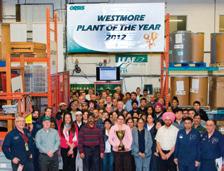
ORBIS Corporation, Oconomowoc, Wis.headquartered manufacturer of reusable plastic pallets and other material handling, shipping and storage products and systems, has awarded its annual Westmore Plant of the Year recognition to the company’s Rexdale manufacturing facility in suburban west-end Toronto, citing the operation’s top-level performance in the areas of delivering customer value, employee safety, financial results, project deployment, community involvement, teamwork, support of company goals and employee engagement. One of 10 manufacturing facilities operated by ORBIS across North America, the Rexdale plant—dedicated primarily to producing the company’s popular ORBIS Green Bin line of organic waste collection containers—has implemented a broad range of environmental initiatives that has significantly lowered the facility’s water consumption, according to the company, while recording an
Rexdale plant employees celebrate the facility’s recognition as
almost 20-percent increase in shipments. “We are very pleased to present this award to the Rexdale
team,” says ORBIS vice-president of operations Pat Feeney. “Over the past year, this plant has excelled in several key areas and made significant process improvements to help meet our customers’ needs faster and more efficiently.”
Toronto-headquartered consumer packaging products conglomerate CCL Industries Inc. has completed a US$14-million acquisition of Germanbased INT Autotechnik GmbH , manufacturer of stainless-steel and aluminum tread plates for German automotive OEMs (original equipment manufacturers) posting revenues of about $22 million in 2012. “This represents another interesting acquisition in the rapidly developing durables sector of out CCL Label business,” says CCL’s chief executive officer Geoffrey Martin. “Together with our CCL Design business in Germany, we now supply all the leading automotive customers with decorative and functional products, with a very strong market-share position in luxury cars.”
Good seal.Pe rf ectseal.
Repak horizontal form-fill-seal packaging machines from Reiser offer the best sealing integrity in the industry. Only Repak machines are constructed with two 4-point lifting stations, which can generate up to five metric tons of closing pressure for reliable sealing and more uniform forming. No matter how complicated your package, Repak will produce it perfectly. For more information, contact Reiser today at (905) 631-6611
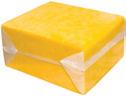
Oshkosh, Wis.-based plastic food packaging manufacturer Curwood, Inc., a subsidiary of flexible packaging group Bemis Company, Inc., has been awarded the Flexible Packaging Achievement Award for Technical Innovation in this year’s edition of the Flexible Packaging Association (FPA)’s annual awards competition for the company’s new EZ Open Block-Tite packaging for bulk cheese products. Rather than relying on sharp knives and brute physical force required to handle the traditional skintight, puncture-resistant film packages, the EZ Open Block-Tite packaging significantly simplifies the opening and stripping process with an easy-open, peel-away Block Tite barrier film and the EZ Peel opening feature for quick, lift-and-peel package removal. With the EZ Peel feature, processors simply lift the flap on the block’s back seal using special grasp notches to pull the film away in a straight line that perfectly follows the block shape of the cheese, according to the company. “While working with our cheese customers, we recognized that an easy-peel package would be a big step forward in opening and stripping cheese blocks for further processing,” says Brian Sturgill, market manager for Bemis Curwood “By taking our consumer opening technology and applying it to bulk cheese, we are able to offer a win-win solution for original cheesemakers and cheese processors,” says Sturgill, citing further benefits of personal safety and reduced risk of cheese cross-contamination from non-sterile knives and leftover film shards.
SIX DEGREES OF FREEDOM
Jointly developed by Nordson Corporation and Henkel, the Freedom Integrated Hot Melt Packaging Solution is now making its long-anticipated commercial debut—promising customers a full ROI (return-on-investment) in less than 12 months by helping them contain adhesive costs, while increasing productivity, sealability and sustainability performance. Featuring Nordson’s innovative ‘tankless’ Freedom Series hot-melt dispensing equipment working with Henkel’s high-performance Technomelt adhesives, the robust new system promises customer freedom from:
Adhesive availability concerns, with the Technomelt adhesives using readily available polymers that are less affected by petrochemical feedstock shortages.
Downtime from charring and contamination, as the tankless melting method prevents adhesive degradation and char that often occur in conventional melter tanks, while Technomelt ’s superior temperature stability drastically reduces the risk of charring and the potential clogging of filters, applicators and nozzles.
Manual adhesive filling, thanks to the use of an integrated automatic fill system to transfer roomtemperature adhesive to the melter, thereby minimizing operator involvement.
Machine mounting and integration limitations. Unlike traditional cube-shaped melters, the Freedom melter saves space using a vertical footprint that also allows it to be mounted almost anywhere within parent machinery, on a wall, and on fixed or moveable mounting stands. Confusing controls and diagnostics, enabled by the use of a simple, intuitive, touchscreen terminal displaying all diagnostic alerts and fault messages in simple text.
Excessive adhesive use, achieved via improved adhesive density and the use of intermittent bead dispensing capabilities.
Nordson Canada, Limited 401
IN FOR A SPIN
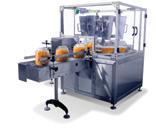
Designed for both high-speed applications and for filling a voluminous product into small-opening containers, the new SpinDexer container filling machine from WeighPack Systems Inc. features a servo-driven rotary star-wheel that allows for a more efficient filling process, whereby each passing container is indexed around the star-wheel to each station. In operation, the product is dropped from a filling machine via traveling funnels— each one equipped a no-container/no-fill and a clog detection sensor—that follow the container and makes sure the product has the sufficient time it needs to transfer from the funnel to the container without losing production time. At the next station, the container is shaken at the bottom to allow product to settle—creating more room inside the
container. Equally well-suited for filling rigid containers made from plastic, glass and/or fibers, the high-speed PLC (programmable logic controller)operated SpinDexer can be easily integrated with any weighing machine, auger filler, volumetric or piston filler, or a combination of several fillers, according to WeighPack.
WeighPack Systems Inc. 402
DOMINO EFFECTS
The new model A420i continuous inkjet (CIJ) coder from Domino Printing Sciences features a brand new i-Tech (intelligent Technology) service-free ink system that delivers ultra-low makeup usage to reduce costs and operator intervention. In addition to making ink last about four times longer than most competing CIJ printers, the A420i coder’s patented CleanFill cartridges can be easily changed while the printer is in operation, while its innovative Qube ink system containing ink and ink filters can be changed in less than 10 minutes, according to Domino. For enhanced application versatility, the new coder comes with a choice of two high-efficiency printhead options, including the special twin-jet Duo for high-volume applications requiring high-speed generation of multiple lines of text, and the high-precision Pinpoint printhead capable of ‘micro-printing’ discreet, high-legibility characters and logos as small as 0.8-mm in height on items such as consumer electronics, pharmaceuticals, automotive parts, cosmetics and personal-care products.
Domino Printing Sciences plc
FLEXIBLE OUTPUT
403
packaging in operations requiring safe disposal or destruction of off-spec, mislabeled, overrun, or otherwise unsalable wet products in a safe and secure manner. According to the company, the ProductSaver system combines package infeed, package opening, and contents and package separation processes into a single-stream product recovery sequence—whether dealing with full pallet loads, cases or single packs—without using any break-pack device or razor knives, thereby protecting personnel from potential accidents and repetitive-motion injuries. Claimed to be capable of achieving up to 99.95-percent product recovery, the ProductSaver systems are designed for efficient handling of a very broad range of packaging materials and shapes, including ampoules, gabletop boxes, coated paperboard cartons, polypropylene dairy containers, aluminum cans, aseptic cartons, plastic bottles, poly-based tubes, rollstock packs, laminated foil pouches and much more.
Designed for high-performance flexible package converting applications, the new dsX flex-pack extrusion coating line from Davis-Standard, LLC boasts multiple capabilities and flexibility to handle and process a highly diverse range of flexible packaging products, including salted snack and noodle bags, toothpaste tubes, sachet packs, personalcare products, condiment packs, standup pouches, etc. Fully preengineered and customdesigned for specific application needs in less than six months, according to the company, the dsX flex-pack flexible packaging line comprises a flexible packaging unwinder; corona treaters; extrusion laminator; gravure primer coater/dryer; pull roll with nip; winder; electrically heated, air-cooled Davis-Standard extruder with advanced feedscrew design; downstream carriage; and advanced Siemens drives and controls to ensure a seamless, fully-automated process. Davis-Standard, LLC 404
BULK SAVINGS
The new ProductSaver line of product recovery systems from National Bulk Equipment, Inc. is designed specifically to facilitate fullyautomated, controlled removal of free-flowing liquids or flow-resistant wet contents from their
National Bulk Equipment, Inc.
JUGULAR HOLD
405
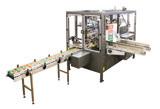
Designed specifically for automatic case-packing of large round and square jugs, the new BOXXER case-erector, loader and sealer system from Eagle Packaging Machinery LLC is designed to ensure a highly accurate loading process for heavy one-gallon round and 2.5-gallon square filled and capped jugs transferred to the machine via an infeed conveyor. Unlike other conventional drop-packers that literally drop the jugs from the top of the box—potentially causing damage to the containers and risking liquid spillage—the BOXXER system employs a servo-driven mechanism to facilitate gentle lifting and handling of the heavy containers to put them into the right places inside the cases, which are then automatically conveyed to the sealing station for tape or glue application.
Eagle Packaging Machinery LLC
DOWN TO THE BONE
406
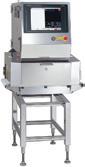
Designed specifically for highvolume poultry processing and environments, the new high-speed DualX X-Ray product inspection system from Anritsu Industrial Solutions USA utilizes two X-ray energy signals to simultaneously distinguish between the product and the contaminants to provide for increased sensitivity to poultry bone fragments and to enable bone-free poultry processing. According to the company, the user-friendly, lowmaintenance systems is capable of detecting calcified bone fragments as small as 2.0-mm, while detecting glass, stone, rubber and metal fragments as small as 0.7-mm in height.
Anritsu Industrial Solutions USA
407
ECO-PACK NOW
Foam food trays don’t exactly leap to the top of mind when looking for sustainable packaging choices at your local grocer, but this perception my well change soon after recent launch of the new EVOK trays by leading Quebec grocery chain Metro Inc. at its supermarkets.
Developed by the Cascades Specialty Products Group, the EVOK trays—said to be first polystyrene foam food trays made with 25-percent recycled content—were developed as an ecofriendlier alternative for retailers
we used before with recycled material, Cascades can reduce GHG (greenhouse gas) emissions by almost 20 per cent, compared to the traditional packaging made with polystyrene foam,” says Luc Langevin, president of Cascades Specialty Products Group in Kingsey Falls, Que.
“Innovation and development of specialized products that respect the environment is key for Cascades: this is our daily goal and part of our corporate values,” Langevin states.
“We
When you talk financing with FCC, we’ll listen
Ready to expand? We learn how you want to grow, then create a financing package that helps you do it. Work with the leading lender to agriculture, agribusiness and agri-food in Canada. Let’s talk business. www.fccfinancing.ca
Now available at the grocery
equivalent of 200 compact cars.
“Rethinking packaging is one of our priorities in our corporate responsibility approach,” says Serge Boulanger, Metro’s senior vice-president of national procurement.
“We’re very pleased to contribute to the best practices by becoming the first national brand to use EVOK foam trays in all our stores in Quebec.”
According to Langevin, polystyrene foam packaging has long been unfairly singled out as an environmental villain.
“Being 90-percent air, polystyrene foam provides an undeniable environmental advantage on many levels.” says Langevin, adding the launch of trays by Metro will help educate consumers on the foam’s environmental and other attributes.
CUTTING PET FOOTPRINT DOWN TO SIZE
If reducing packaging weight is the essence of packaging susAmcor Rigid must be the heavyweight champion in ‘lightweighting’ of the PET (polyethylene terephthalate) plastic bottles commonly used by beverage producers.
Earlier this year, the Manchester, Mich.based plastic container manufacturer capped off an intensive R&D effort to launch a stock 64-ounce container that weighs nine grams (13.2 per cent) less than the typical 68-gram PET bottles used to package juices, iced-teas and other hot-fill beverages.
“This is a major breakthrough because we achieved a highly sustainable packaging solution without compromising performance,” says Amcor’s principal engineer Michael Lane. “Our unique lightweight design retained line/ stack handling performance and maintained ergonomic features for consumer handling.”
Lane reveals that the Powerblock container was developed with novel design, tooling and process technologies to engineer a lightweight and strong hot-fill stock PET bottle with superior filling and stacking performance.
Lane adds the container’s unique construction also features a 38-mm lightweight finish, compared to the standard 43-mm finish for a 64-ounce PET bottle, to help deliver further material savings for high-volume bever-
Arnold Drung, President, Conestoga Meat Packers, Breslau, Ont.
Sign
Course 1 - May 6, 7, 8
Graphic Design, Printing, Digital Printing, Printing Prepress, Bar Codes, Food Safety, Food Preservation, HACCP, Labels and Perspectives on Packaging. Three days including a plant tour.
Course 2 - June 4, 5, 6
Packaging Polymers, Sheet & Film Extrusion, Flexible Packaging, Injection Molding, Blow Molding, Bottle Design and Bio Plastics. Three days including a plant tour.
Course 3 - Sept. 24, 25, 26
Paperboard & Folding Cartons, Specialty Packaging, Closures, Specialized Packaging, Adhesive and Introduction to Sustainable Packaging. Three days including a plant tour.
Course 4 - Oct. 22, 23, 24
Corrugate, Distribution, and Machinery, Packaging Law, Quality Management Systems and Planning a Production Line. Three days including a plant tour.
The PAC Packaging Certificate Program offers an excellent combination of classroom-type sessions, covering fundamentals of packaging and current trends; hands-on presentations from industry experts with practical examples; and thoughtfully selected plant tours. Whether you are new to packaging or an experienced industry professional, be prepared for a dynamic and interactive learning experience with many opportunities for networking.
Irina Kem, Marketing and Corporate Communications, Unisource Canada, Inc.
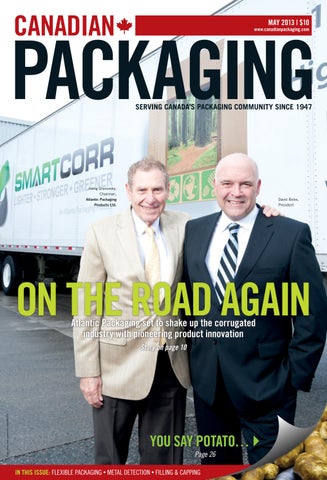
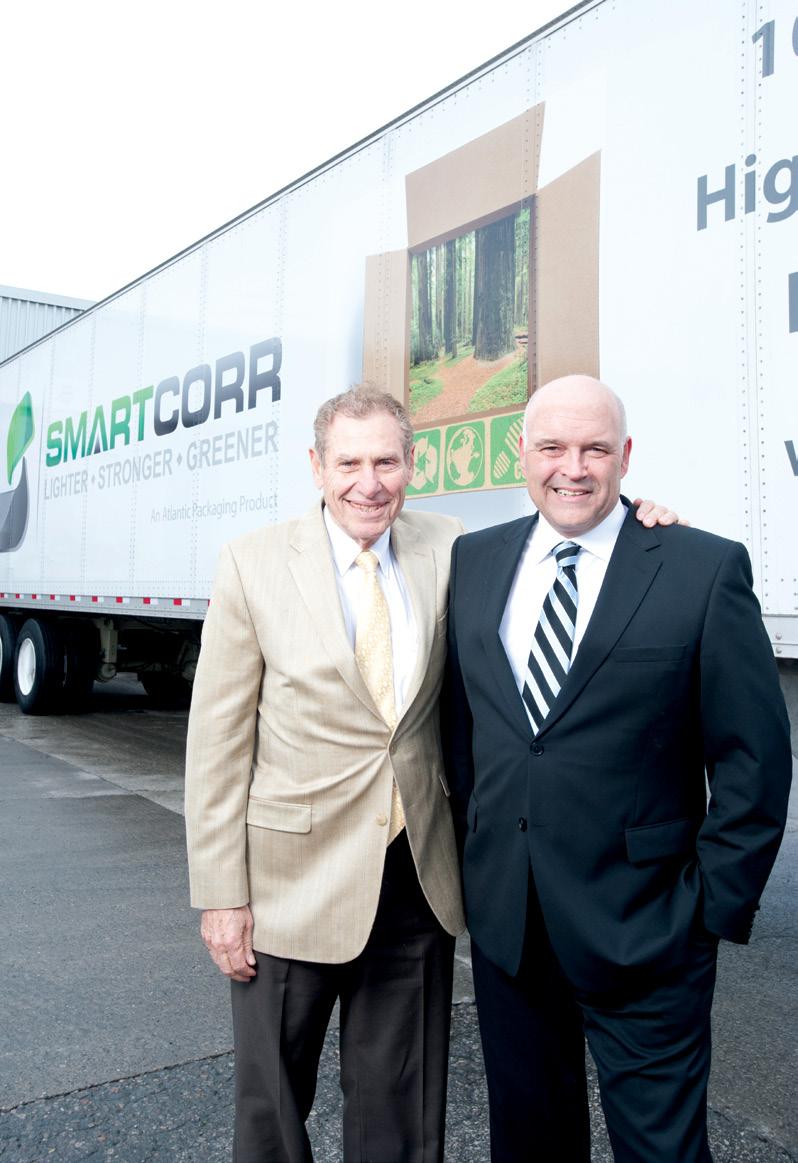
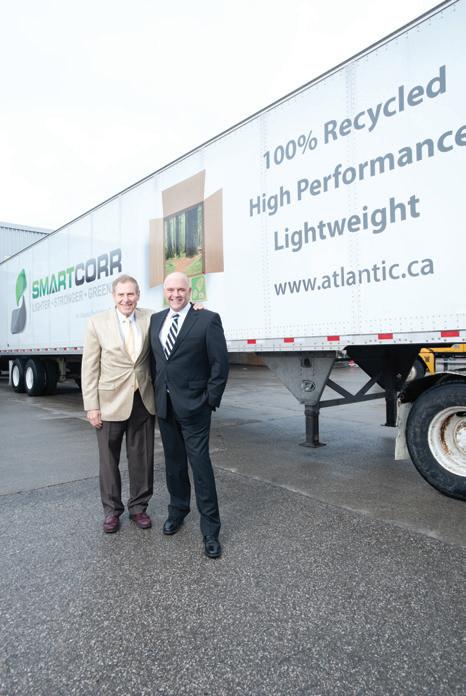
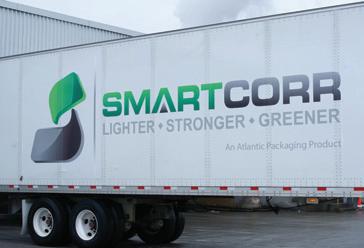
Atlantic Packaging Products chairman Irving Granovsky (left) and president David Boles pose outside of the company’s Toronto headquarters in front of a freshlyrepainted trailer destined for many U.S.-bound deliveries of the newly-launched SmartCorr range of packaging papers produced at the company’s papermaking plant in Whitby, Ont.
will be a game-changer in the North American corrugated industry,” Boles told Canadian Packaging on a recent visit to the company’s corporate headquarters in east-end Toronto, about a half-hour drive from the Whitby plant.
“We have made a major, multimillion-dollar capital investment in the Whitby facility to produce this product, and you cannot recoup that kind of investment without expanding your market reach.
“What has enabled Atlantic Packaging to grow through all these years is the way the company has always approached the business with a long-term thinking mindset, and it is no secret that the real long-term growth opportunities for our company nowadays are definitely in the U.S.,” says Boles.
THE PAPER TRAIL
Canadian corrugated packaging stalwart taking its act on the high road with innovative new products and recharged production capabilities
BY GEORGE GUIDONI, EDITOR
PHOTOS BY COLE GARSIDE
Second chances are something of a rare commodity in the cutthroat competitive corrugated packaging markets these days, but for a newly-restarted corrugating mill just outside Toronto in Whitby, Ont., sweet dreams are made of a welcome second lease on life.
Owned by the Toronto-headquartered paper packaging products group Atlantic Packaging Products Ltd., the former newsprint manufacturing facility—idled in 2010 due to free-falling newsprint prices and excess industry capacity—is currently in the process of completing a massive, multimillion-dollar plant upgrade aiming to position the facility as the home production venue for what may be one of the more innovative new products developed by North American corrugated producers in recent times.
All geared-up and ready-to-go for spring delivery to customers in both Canada and northern
U.S., the patented new SmartCorr paper made at the Whitby plant’s fully-rebuilt papermaking machine will underpin the 68-year-old company’s most ambitious and far-reaching foray into the U.S. export markets to date this spring, according to the company’s president David Boles.
Coming Up
“They know we are coming, and they all know that we really mean business,” asserts Boles, a high-energy Montreal native with a booming voice and imposing physical presence well-befitting a former university football player.
“Of course, we would not going through all the cost and effort of finding new markets if we did not believe we have the right product to sell into those markets,” Boles acknowledges.
Strong Belief
“But we strongly believe that the SmartCorr paper is exactly the kind of product that those markets will show great demand for—particularly among the CPG (consumer packaged goods) manufacturing industries,” Boles says. “Quite simply, this is not the kind of product they can get anywhere else.
“We are the only ones to make what I would dare call a truly revolutionary product—at least in the context of a rather stagnant corrugating industry that has so far not really delivered the sort of breakthrough technological innovation that its customers have been demanding in recent years.”
States Boles: “SmartCorr is the first true lightweight recycled paper available in North America—offering customers sustainability and strength characteristics unlike anything available in the market today.
“The make-up and equipment traditionally employed in a newsprint mill makes it an ideal site for the production of lightweight recycled paper production, with some upgrades and alterations of course,” says Boles, adding the SmartCorr paper will offer a broad range of performance attributes—from high-impact color printability to advanced microfluting design
“This new SmartCorr
capabilities—while consuming between 20 and 30 per cent less fiber in the manufacturing process than conventional liner papers.
Made from 100-percent recycled OCC (old corrugated container) fibers, the SmartCorr liner papers boast unique construction and design properties that will help deliver “higher performance” in terms of strength, product protection and package integrity to enable CPG manufacturing customers achieve substantial and meaningful reduction in the overall packaging footprint of their products, the company insists.
“Not only will this SmartCorr paper help CPGs improve the sustainability profile of their packaging as demanded by most major North American retailers, but it will also provide additional value by virtue of enabling a higher packaging performance,” asserts Atlantic Packaging chairman Irving Granovsky, who joined his father’s company back in 1957 upon graduating as a mechanical engineer from the University of Toronto
Adding Value
whole to reduce packaging and to utilize materials that are more sustainable.
“That’s a major market trend that has been progressing for years,” he points out, “but unfortunately this is the one key area where the North American corrugated industry has not produced any significant advancements.
“But SmartCorr is going to change all that!”
rebuild” of the plant’s original paper machine that will eventually reach daily production capacity of 1,100 tonnes of paper.
A long-time industry trailblazer in implementing ‘Lean Manufacturing’ practices throughout all of its operations, Atlantic Packaging is “very wellpositioned” to make a big impact in the U.S. markets—for now extending to about a 550-mile radius from the Whitby plant—thanks to its competitive internal cost structure and the SmartCorr brand’s clear performance advantages, according to Boles.
High Stakes
“The fact that we are entering the U.S. markets at a time of a high Canadian dollar that is virtually on par with U.S. currency is a testament to our confidence in this unique product,” Boles reflects.
Adds Boles: “Major retailers like Walmart are constantly pressuring the packaging industry as a
“We have realized for some time that for Canadian manufacturers of any product, not just packaging, being competitive nowadays means being competitive on a North American basis and not hiding behind a low Canadian dollar, which frankly I don’t see dropping to low levels any time soon.”
According to Boles and Granovsky, operating as a vertically-integrated corrugated business—maintaining full control of the entire supply chain from fiber collection to its own fleet of tractor-trailers— enables the company to keep its operating costs in line through continuos improvement in all aspects of its operations, while in turn generating the necessary funds to reinvest back into cutting-edge
“Not only will this SmartCorr paper help CPGs improve the sustainability pro le of their packaging as demanded by most major North American retailers, but it will also provide additional value by virtue of enabling a higher packaging performance.”
Employing about 1,500 people across Ontario and Quebec, Atlantic Packaging currently operates four corrugated plants—in addition to its Toronto-based Add Ink decorative and display packaging business and several boxmaking facilities owned jointly with its St-Laurent, Que.headquartered sister company Mitchel-Lincoln Packaging Ltd
Boles relates that Atlantic has already secured partnership agreements with a number of reputable U.S.-based distributors and logistics services providers to ensure smooth and reliable shipment deliveries of SmartCorr products to all the U.S. accounts.
Says Boles: “We are big enough to be very resourceful when necessary, but we are also small enough to be very nimble when we have to be in order to act very quickly to satisfy our customers’ requests.
“No customer is too big or to small for us to provide them with the best customer service in the industry,” he states, “and you never really satisfy your customer by merely being a ‘me too’ company.”
Adds Granovsky: “We have always been ahead of the curve in terms of providing top customer service.
“No customer is too big or to small for us to provide them with the best customer service in the industry, and you never really satisfy your customer by merely being a ‘me too’ company.”
— David Boles, President, Atlantic Packaging Products Ltd.
U.S. clients to justify the comprehensive, topto-bottom “transformatory
development) to pioneer innovative new products
“The vertically-intecontrol of our own desalso to provide a full ‘onestop-shop’ destination for of all their packaging needs.
need
grated model not only enables us to be in full tiny,” Boles remarks, “but stop-shop’ destination for our customers, to take care
Boles relates that the new product has already attracted enough interest from prospective fleet through to R&D (research-andnew like the SmartCor r papers.
“Our customers really appreciate us giving them the peace of mind they need to focus on their core business at hand.”
“We are proud to have maintained a virtually flawless record in terms of on-time deliveries,” he points out, “while also building up the required capabilities to serve all of our customers’ unique needs and requirements.
“One of their biggest requirements right now is to improve the environmental footprint of their product packaging while also improving its performance, which is exactly where our introduction of SmartCorr and reopening of the Whitby plant fit in,” Granovsky explains.
“At a time when other corrugated producers
are downsizing their operations and production to stay afloat, we are proud to be creating dozens of new jobs at the Whitby facility, while also really putting our name on the map as a major player in the North American corrugated industry,” adds Boles, crediting the company’s highly-energetic,
Atlantic Packaging also manufactures a range of high-quality industrial plastic lms and overwraps.
Forever Young: Atlantic Packaging Timelines
1945 Co-founders Abraham Granovsky and his son Phil Granovsky start up Atlantic Packaging Products Limited in small Toronto facility to manufacture paper bags.
1957 Irving Granovsky, Abraham’s other son, joins the company on a fulltime basis after graduating with a diploma in Mechanical Engineering from the University of Toronto
1960 Atlantic Packaging takes the rst step towards vertical integration, while commencing production of corrugated containers—initially for internal use and soon after expanding it for sale to other companies.
1963 Atlantic Packaging moves to larger premises in the Toronto’s east-end suburb of Scarborough at 111 Progress Avenue, which remains the company’s corporate headquarters to this day. The move enables Atlantic to install its rst corrugator to produce containerboard— eliminating the need to purchase paper from outside suppliers.
1967 With limited access to paper from outside sources, Atlantic Packaging pioneers the use of 100-percent recycled containerboard in North America by commissioning the construction of its rst paper mill paper mill for manufacturing exclusively with recycled paper bers. This leadership in environmental stewardship proves to be a big success, with numerous North American paper mills following suit over the next 40 years.
1972 In order to service a growing manufacturing base in the west end of Toronto, Atlantic Packaging opens up their second corrugated plant in Mississauga, Ont. Meanwhile, the mill at 111 Progress Avenue is doubled in size to boost production volumes in order to keep up with growing customer demand for its 100-percent recycled paper products.
1977 Atlantic Packaging acquires the Paper & Distribution Division of leading Canadian paper product manufacturer Domtar Inc. Originally operating under the name Domkraft, the business becomes the forerunner of today’s Flexible Packaging Group unit of Atlantic Packaging.
1978 Atlantic Packaging expands its manufacturing base outside of Toronto, by opening up a new corrugated plant in Ingersoll, Ont., about 100 miles west of the GTA (Greater Toronto Area) region.
1982 Atlantic Packaging reaches a new milestone with installation of a 100-percent recycled bers tissue mill and a bathroom tissue/paper towel converting plant in the east-end Toronto suburb of Agincourt, operating as the Consumer Products Group of Atlantic Packaging. Looking to expand its Corrugated Group, Atlantic Packaging also acquires nearby competitors Hallmark Containers and Brock Containers establishing itself as the premier corrugated supplier in the GTA region.
1984 All of the recent acquisitions are formally amalgamated into Atlantic Packaging Products Limited
1985 With growing demand for high-end graphics, Atlantic forms a new company called Color Pak and installing state-of the-art equipment to position the new business as “outside-the-box” printing specialists.
1990 Atlantic starts up its second 100-percent recycled tissue mill east of Toronto in Whitby, Ont., while expanding its original tissue/towel converting facility.
1991 The Whitby facility commissions Atlantic’s rst newsprint mill—the rst mill in Canada to produce 100-percent recycled newsprint—forming the basis for the Atlantic Newsprint Company
1996 The Flexible Packaging Group expands operations by installing state-ofthe-art bag converting equipment at a new facility in Scarborough.
1997 The Corrugated Group continues to grow by opening up its fourth converting facility in Scarborough—making Atlantic Packaging the only company to start up a new corrugated plant in the Toronto area since 1978.
2000 Atlantic rede nes the role of the traditional paper distributor with formation of the Supply Chain Management Group unit, using strategically-located facilities throughout Ontario to help Atlantic’s customers with logisics solutions such as inventory management, product sourcing, and third-party supply services.
2001 To keep pace with growing North American demand for its products, the Consumer Products Group expands its converting facility in Agincourt with newer converting equipment and state-of-the-art robotics.
2002 In order to be able to supply their corrugated customers with a comprehensive product offering, Atlantic purchases the decorative display division from Chesapeake Packaging to form a new subsidiary called Add Ink, specializing in supplying high-end graphic packaging and displays, as well as providing co-packing services.
2003 The Corrugated Group opens up its fth corrugated plant northwest of Toronto in Brampton, Ont., which becomes a de facto model for all future modern corrugated facilities.
2006 Atlantic Packaging forms a strategic partnership with its Quebec-based sister company Mitchel-Lincoln and starts up the rst 100-recycled containerboard mill to open in Canada in over 30 years. Operating under the New Forest Paper Mills corporate banner, the new mill in east-end Toronto creates a signi cant number of new jobs and employment opportunities in an otherwise ailing North America paper industry.
2007 Atlantic Packaging sells the Consumer Products Division to a prominent Canadian forest products group
2010 Atlantic Packaging announces the closure of its Newsprint Division
2013 Still guided under the leadership of Irving Granovsky, the Atlantic Group of Companies retools and reopens its former newsprint facility in Whitby to manufacture the new SmartCorr range of 100-percent recycled, lightweight high-performance packaging papers, commencing shipments to North American customers in the spring of 2013.
After being idled for over two years, the former Atlantic Packaging newsprint mill in Whitby has been completely overhauled and modernized to enable high-volume production of the new lightweight SmartCorr range of packaging papers for both the U.S. and Canadian markets, with targeted production capacity of about 1,100 tonnes per day.
well-trained and dedicated workforce for nurturing a real culture of innovation and continuous improvements throughout all of its daily operations.
“Packaging innovation is our mantra: it is behind everything we do for our customers on a daily basis,” sums up Boles.
Daily Challenge
“We constantly challenge every member of the Atlantic team to find new ways to bring innovation to the forefront of what we do—whether it’s in the materials we manufacture, the way we design the packaging, or in the way we approach the many new challenges our customers face in today’s global markets.
“Innovation is the backbone of Atlantic Packaging,” Boles concludes, “and it will continue to be so for the foreseeable future.”
METAL DETECTION
BEEFING UP SECURITY
Wisconsin meats processor adds a level of product protection with Canadian-made metal detection systems
ANDREW JOSEPH, FEATURES EDITOR
Wisconsin is well-known and respected for more than a few things—the famed Green Bay Packers football team and cheese come immediately to mind. But it also has a world-class reputation for the processing of meat and is, in fact, one of the largest meat-producing states in the U.S. because of its large German heritage and a huge dairy industry to provide plenty of raw products for sausage and other meat processors.
In many instances, its reputation for sausagemaking was formulated by European immigrants arriving to the U.S. and bringing their ‘Old World’ recipes with them, which is exactly how the CherMake Sausage Company in Manitowoc, Wis., got its start.
Back in 1928, Emil Chermak brushed up on his family’s secret recipes, opened a small butcher shop, and began processing blended beef and pork sausages in natural casings, and then having his young son, Art, walk the streets with a wagon selling them to nearby homes.
Nowadays, Cher-Make is owned and operated by a third generation of the Chermak family, who along with 120 full-time employees annually process some 13 million pounds of meat. And while the quaint wagon-delivery option is a thing of the past, the family cooking recipes remain ingrained in the company’s fortunes.
Operating within a 70,000-square-foot processing and packaging operation, the plant has undergone its fair share of additions and upgrades, with the latest taking place in 2006.
At that time, a pre-blend department was added along with a new packaging cooler, while the smokehouse area was also expanded.
The busy season for Cher-Make lasts from May through November, when the processor runs three daily shifts, six-days-a-week, with some 90 per cent of its output dedicated to processing beef and pork, with the remaining 10 percent for chicken and turkey.
“When it comes to the way we process, we specialize in utilizing natural casing for products such as brats, hot dogs, Polish-style sausages and more,” company president and grandson of company founder Tom Chermak told Canadian Packaging magazine during a recent interview. “We also process skinless cocktail mini-sausages, skinless sausages, skinless summer sausage and summer sausage—each more delicious than the other.”
As one of about 500 meat processors operating in Wisconsin, Chermak acknowledges that his company is still one of the smaller processors of branded meats, and it does have a lot of competition for shelf-space in grocery stores from larger companies like Johnsonville
“We are a USDA (United States Department of Agriculture)-inspected facility, so we can and do sell our brand nationwide across America,” says Chermak.
Despite the popularity of the Cher-Make brands sold to a customer base that includes grocery retailers, snack and appetizer producers, meat dis-
tributors, gourmet gift-packers, and foodservice distributors, Chermak says about 60 per cent of the meats processed at his plant are for co-packing and private label interests, with the remainder dedicated to its own Cher-Make brand.
“Our brand is sold throughout Wisconsin, Minnesota, Northern Illinois and Northern Michigan markets in all retail grocery chains,” explains Chermak, “but we also co-pack for customers across the U.S., whose co-packed products often go to Canada, Mexico, Korea and Japan.”
According to plant manager Fred Konchan, “We produce 60 SKUs (stock-keeping units) of our own Cher-Make brands but, if we include all of the copacking, we produce well over 250 SKUs.
“While our production processes have evolved over the years, our recipes have remained pretty constant since the 1970s,” says Konchan. “Why mess around with something that doesn’t need messing around?”
Something New
Despite the strict adherence to Old World recipes, Cher-Make still managed to produce a few new world brands like Natural Casing Wieners with Applewood Smoked Bacon, 100 Calorie Chicken Bratwurst, and Authentic Beer Bratwurst made with Point Amber Beer
If Cher-Make is particular when it comes to its own product quality, it is even more so when it comes to processing meats for co-packers, as Konchan says the company makes the final decision to determine if the customer’s product is a good fit for the processor.
“We’re not interested in providing a low-value
“We’re not interested in providing a low-value product that uses mechanically separated meat and fillers,” acknowledges Konchan. “That’s just not who we are. We will not sacrifice quality for financial gain—Cher-Make has to be a good match for the customer.”
Along with visual appeal, taste and texture,
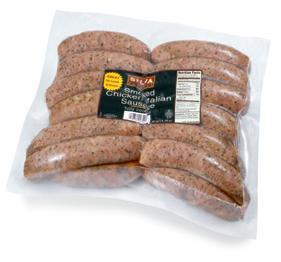
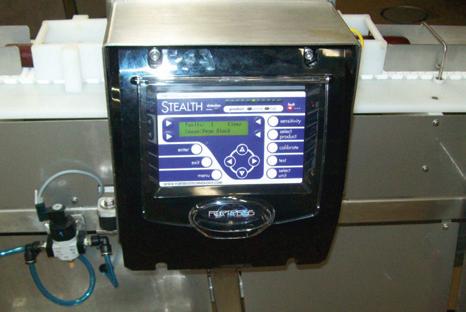
Cher-Make Sausage Company utilizes three recently purchased Stealth model metal detection units manufactured by Toronto-based Fortress Technology as part of its food safety processes.
Konchan acknowledges that Cher-Make also takes food safety seriously, ensuring throughout the processing that the products are constantly monitored and measured for consistency.
“Of course, we also take great care during the packaging, too,” notes Konchan adding that the facility is HACCP (Hazard Analysis Critical Control Points) -certified, follows GMP (Good Manufacturing Practices), and boasts Level 2 SQF (Safe Quality Food) -certification.
After packaging, products move through one of three Stealth model metal detection units manufactured by Fortress Technology Inc., a Toronto-headquartered manufacturer with offices in the U.K. and Brazil.
“Cher-Make purchased two of the Stealth units in 2012, and the other earlier this year,” notes Konchan. Introduced in late 2011, the Stealth is the latest addition to the Fortress Technology Phantom series of metal detection units.
Key features of the Stealth include: User-friendly interface; Contact Reporter Lite software;
Detailed data collection; Digital signal processing technology; Ultra-sensitive detection; Self-diagnostic testing; Automatic calibration; Flash memory stability; Multilevel password protection; Fast and easy system set-up in seconds.
“We run the metal detection units at various speeds depending on line speeds for products, as we have placed them inline with other machinery,” notes Konchan. “In some cases, we place them prior to packaging, in others post-packaging.
“Regardless of where we utilize them, all of the Stealth units have done a terrific job for us.”
Although a standard brand of Fortress, each Stealth is custom-manufactured to suit any application to make optimal use of advanced digital signal processing technology that provides ultra-sensitive detection capabilities to detect even the smallest ferrous, nonferrous and stainless-steel contaminants.
Possessing a built-in data collection software and a USB-port for data transfer, the folks at Cher-Make have found the Stealth an easy-to-use solution to follow HACCP procedures.
According to Fortress Technology, the Stealth systems offers a key benefit of a modular design with fewer components, and it comes with a company commitment to never be obsolete, meaning all Fortress Technology detectors are designed to be always upgradeable.
Easy Sell
For Konchan, the decision to purchase the Stealth equipment was an easy one.
“At a previous job, I saw the efficiency and outstanding performance of the Fortress Technology metal detection systems,” he says, “which immediately put the machines onto our short list.”
Despite Konchan’s glowing report on other Fortress Technology metal detection units, Cher-Make still wanted to make sure its customers were getting the best protection available, performing side-by-side trials with similar equipment from other manufacturers at its meat processing plant.
“We enjoy the fact that the Stealth is very user-friendly,” points out Konchan, “and that the maintenance costs are minimal.”
Another valued feature is that all electronics are backwards-compatible, so that any metal detector from Fortress can enjoy a very long life-span.
Noting that Cher-Make has several pieces of competitor products mothballed in a storage area because the model’s technical support is no longer provided, Konchan likes the fact that any upgraded electronics board from Fortress can be used on an older metal detection unit, thereby immediately upgrading the older machine.
METAL DETECTION
Konchan recalls: “At a previous place of employment, I once required a new operator interface because an employee used a knife to depress the buttons, but the Fortress representative I deal with hardly batted an eyelash as he ran up a replacement interface immediately. It was truly outstanding service!
“When it comes to finding components, we don’t have any foreign materials complaints, so the Stealth must be doing its job,” relates Konchan.
Other equipment utilized by Cher-Make, includes:
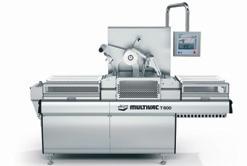
a Multivac R249 thermoform tray-sealer, along with six other Multivac machines;
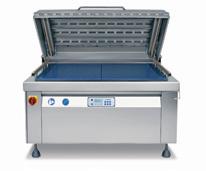
a Cryovac vacuum-chamber machine used for products like ring bologna; Multiple Videojet inkjet coders to apply bestbefore or sell-by dates.
Summing up, Chermak says that although his
company is a processor of Old World products, it takes a modern approach to ensuring and maintaining product quality and food safety.
“While we have established an 11-person, professionally-trained sensory panel to monitor product attributes, our recent inclusion of the Stealth metal detection equipment is definitely a step up from the detection units we had before both in sensitivity and service,” says Chermak.
“Unique recipes, happy employees and good equipment—it’s all part of providing a quality product.”
For More Information:
of the sub-machines; the TLM components and the TLM Vision System. Changeover can be fully automatic. TLM – the compact machine which leaves nothing to be desired in terms of flexibility.
PICK OF THE CROP
Quebec orchard and cidery produces unique awardwinning alcohol beverages that have purists purring
ANDREW JOSEPH, FEATURES EDITOR PHOTOS BY STEVE PELLERIN
It may come as bit of a surprise for some wine aficionados, but the key ingredient for the tasty drink is not limited exclusively to red or green grapes. In fact, it can actually be derived from any fermented fruit via the natural chemical process that converts the fruit’s sugars into alcohol—a process that has been part of human history possibly for as long as 8,000 years.
A little closer to home in 1988, an early cold snap in Quebec left grapes frozen on the vine, leaving many local wine producers crying in their empty cups.
Bad luck aside, one plucky grape farmer tried to make wine anyways, and came up with the happy accident dubbed “ice wine,” although it wasn’t until 1996 that the concept became widely accepted and respected in the established wine industry circles.
And although apples have long been drunk as juice and as a non-alcoholic cider beverage, apple wine simply did not possess the same cache as its grape cousin—until now.
Tracing its origins to Germany and Austria, apple wine has often been dismissed by purists as being too sour or tart, remaining a largely ignored niche product that never really caught the fancy of the global wine-loving audience.
But thanks once again to either Quebec ingenuity or fortuitous bad luck with the weather, a Dunham, Que.-based cider processor named Christian Barthomeuf created the world’s first ice cider in 1990, managing to get it stocked in various Quebec shops six years later.
In a mere 17 years, ice cider has become a very popular alcohol beverage in the province of Quebec, nowadays counting some 60 cideries trying to make inroads into the niche market.
But that’s not what drew Charles Crawford into the industry—it was vacation planning.
Back in 2000, Crawford and his wife Susan Reid were searching for a summer home when they drove through the village of Frelighsburg, a picturesque tableau situated less than four kilometres from the Canada-U.S. border with Vermont, in a valley of apple orchards at the foot of Mount Pinnacle on the Quebec side.
After spying and then purchasing a local farmhouse that was built in 1859, Crawford wondered what they could do with the 430-acre apple orchard that was originally planted in the 1920s.
Weekend Retreat
Much like having a metaphorical apple fall on his head, Crawford was struck with the idea of getting involved in the ice cider business—a side project that he could amuse himself with on the weekends when he and his family would become urban refugees from the nearby metropolis of Montreal.
“It was just supposed to be something to do with all of the apples on the property—it wasn’t supposed to become a full-time passion,” Crawford told Canadian Packaging during a recent interview.
“Now my ice ciders have a 39 per cent market share across Quebec.”
In fact, Crawford’s entrepreneurship has taken his Domaine Pinnacle cidery to the upper echelons of not only the ice cider business, but also into creating unique varieties of maple whisky and premium gin—with the key factor being the use
of locally-grown, made-in-Canada ingredients that has not only translated into growing sales, but also caught the eyes and tastebuds of ice wine and blended spirits connoisseurs the world over, while winning many prestigious industry awards.
Leaving the suit and tie behind in the city, Crawford became a gentleman farmer, first selling a 2000 vintage Domaine Pinnacle Ice Cider in 2002.
Buoyed by its highly successful reception in alcohol beverage shops in Quebec, the family decided to make a permanent move into their ‘weekend home’ to take up the mantle of fulltime cidery operator.
After outgrowing the faram’s production capacity, Crawford purchased an existing 25,000-squarefoot building in nearby Cowansville, Que., which now allows Domaine Pinnacle to produce and sell some 30,000 cases annually of its award-winning crop of ice cider brands and other spirits.
Crawford says that local history shows that his farmhouse actually used to be a stop on the famed Underground Railway escape route, which once offered a safe haven for American slaves looking for freedom up in Canada.
“And coming full circle, during the Prohibition era the farm house was also a meeting place for bootleggers of alcohol who would transport hooch down across the nearby U.S. border to the thirsty Americans,” reveals Crawford.
In a remarkably short period of time, Domaine
Using apples harvested after a spell of frost or a snowfall, Domaine Pinnacle cidery owner Charles Crawford has followed up on the award-winning success of his ice ciders by expanding into the infused whisky and gin markets.
Pinnacle’s impressive range of alcohol beverages have garnered over 60 gold medals at many prestigious national and international competitions.
“Our ice cider is produced from a select blend of six apple varieties grown in our orchard—some tart and some sweet—that we harvest after frost, ferment for eight months, blend for vintage, bottle and store for over a year to ensure the flavours become more round,” explains Crawford.
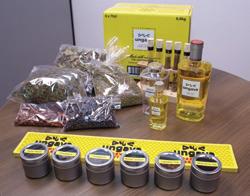
The family-run Domaine Pinnacle produces annual vintages of Domaine Pinnacle Ice Cider, Domaine Pinnacle Sparkling Ice Cider, Signature Réserve Spéciale Ice Cider, Verger Sud Still (sparkling cider); Domaine Pinnacle Crème de Pommes, Réserve 1859 Domaine Pinnacle, Coureur des Bois Maple Whisky, Coureur des Bois Maple Cream, Coureur des Bois Maple Cider and Ungava Canadian Premium Gin
“After the initial success of the ice ciders, we began to examine different ways to establish ourselves,” says Crawford, “so we formulated new products like our Crème de Pommes, featuring fresh cream, ice apple wine and apple brandy.”
Even with the plethora of awards beginning to crowd his shelves, Crawford understood that future growth of his young company could be stumped by a lack of primary ingredients.
“I love producing ice ciders and the other products, but we are actually limited by acreage as to how much of it we can produce annually,” says Crawford, noting he is reluctant to purchase apples from outside sources because he can’t provide due quality assurance.
He continues: “So in an effort to find additional revenue streams, we began processing our own unique whisky blends featuring locally-produced premium-grade maple syrup with our Coureur des Bois brands,” he relates, “and then thought we should try something completely different.”
Not one to sit on his laurels, Crawford leaped outside his comfort zone of award-winning sweet beverage production he was known for to create a drink that would, again, be uniquely Canadian, namely the Ungava Canadian Premium Gin
“I thought that spirits segment would be an interesting niche we could cultivate, as there really aren’t that many gin producers out there that truly possess a Canadian identity,” notes Crawford.
According to Crawford, who launched the product in 2010, “The first thing everyone notices about his gin is the bright, rich yellow color, which really makes them wonder what the heck it tastes like.”
Recently declared the world’s best gin, the novel Ungava spirit utilizes six all-Canadian botanical herbs unique to the northern Quebec arctic region: Wild Rose Hips, Arctic Blend, Cloudberry, Labrador Tea, Crowberry and Nordic Juniper,
with juniper berries being the key ingredient in the gin distilling process.
Beating out global competition, Ungava won a Platinum Best in Show award under the Flavored/ Infused category at the prestigious World Spirits Awards held this past spring in San Francisco, with judges notes citing: ‘unique take on gin, with an unusual color that helps grab your senses.’
While historically there have been many gin brands possessing color, Crawford’s Ungava seems to be in a class all its own, arriving at its hue thanks to the choice of ingredients.
Wild Things
“The wild rose hips—a fruit of the rose plant—is the chief reason for the yellow color, but truthfully, it’s the combination of all of the ingredients which gives it such a rich hue,” explains Crawford.
For Crawford, like in the creation of all his beverage recipes, the ingredients had to be Canadian, and in the case of the Ungava Canadian Premium Gin, it had to use ingredients that were present in Canada long before the arrival of the Europeans, who planted many non-native species of flora.
Situated at the northern tip of Quebec, the Ungava region is covered in ice and snow for nine months of the year, having provided home to the Inuit and their ancestors for thousands of years.
In fact, the name Ungava is taken from the Inuit language Inuktitut, meaning “towards the open water.”
Because there is usually only a four-week window to harvest the six key ingredients, Crawford says he hires two pickers from the northern village of Kuujjuaq to pick the botanicals some 1,500 kilometers north of the farm.
“These pickers are great,” says Crawford. “They get us everything we need, picking maybe 200
kilograms of the botanicals into clear bags.”
In keeping true to its colors, Crawford has imbued the labels for Ungava Gin with a label design that pays homage to the drink’s Inuit roots. The label itself is produced by Groupe Lelys Inc., a 50-year-old printing company located in Laval, Que.
“They did a great job on the label,” says Crawford, adding that Lachine-based Bruni Glass Packaging provides the glass bottles for the Ungava brand.
For the whisky and apple brand alcoholic beverages, Domaine Pinnacle relies on the services of the Sainte-Julie-based Imprimerie Saint Julie Inc., a family-operated label suppler with a pair of converting facilities that specializes in flexographic and digital printing.
“We print a lot of labels for Domaine Pinnacle,” explains Imprimerie’s vice-president of sales and administration Caroline Fournier. “We have been producing labels for about 20 different products over the years.”
Fournier explains that the company she runs with her sister Marilène primarily uses a HewlettPackard (HP) WS6000 digital press, with an additional pass or two along a Galaxie press from SMAG Graphique to add little extras such as spot gloss varnish, hot-stamping, silkscreening and embossing—all key features that make the Domaine Pinnacle labels pop on the retail shelves.
The WS6000 can print up to seven colors and includes what HP describes as an “improved white” for printing on metallic label stock and flexible packaging films.
HP’s SmartStream labels and packaging solutions runs on robust EskoArtwork software that allows for more efficient file processing, excellent color-
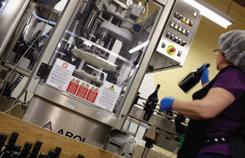
A close-up view of the SEW-Eurodrive motor that distrutes power to the AROL automatic capping system.
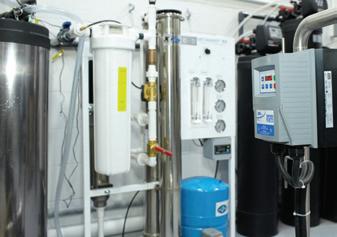
The energy-ef cient, long-life SMVector variable-frquency drive supplied by Lenze Americas provides an ef cient means of helping Domaine Pinnacle pump water from one ltration tank system to another (background on right).
After capping, a Domaine Pinnacle employee hand-packs the bottles of nished product inside wooden crates.
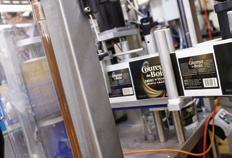
Imprimerie Saint Julie Inc. supplies full-color labels for the distiller’s Coureur des Bois Maple Cream liqueur.
LABELING
up controller capabilities, step-and-repeat work, and variable-data applications.
“We are a family-run business, and I believe customers like Domaine Pinnacle enjoy the more personal touch that we can bring to the table,” says Fournier.
“I think we have developed an excellent relationship with their marketing team, and we cite Domaine Pinnacle as our best example of product development, innovation and trust between customer and supplier.”
Although there are two other lines, the main bottle filler used by Domaine Pinnacle is a 12-head monoblock custom system manufactured by the Italian firm Eurostar, designed to clean the bottles before filling them, and to apply different caps styles as required.
Domaine Pinnacle also utilizes a special water treatment system to purify the water used in the
manufacture of its Ungava Gin brand.
On this treatment system, an SMVector variable-frequency drive (VFD) supplied by Lenze Americas helps to pump the water from one filtration tank to another.
Built for Speed
According to Lenze product leader Thomas Robbins, “The VFD is available in a wide variety of standard voltage and power ratings, and can be used for improved motion control of many applications.”
The SMEVector will also help reduce mechanical shock and large power surges to the motor, which can contribute to a longer life for the motor, Robbins adds.
“There is also the added benefit of better speed control, as infinite speed adjustments are possible with Lenze’s different input control methods,” explains Robbins.
The SME Vector that Domaine Pinnacle uses is actually a sensorless vector drive, which means that there is no closedloop feedback, allowing the motor to control the current more accurately.
According to Robbins, the actual SMEVector VFD used by Domaine Pinnacle is the com-
pany’s NEMA-4X enclosed drive which can be safely used in a washdown application.
Says Crawford: “I’m proud of the equipment we have purchased along the way: it has definitely played a big part in helping us produce our wonderful ice ciders and now maple-infused whiskey and gin beverages.
“By creating superior ice cider products, Domaine Pinnacle has helped grow the category not only here in Quebec, but also across Canada and in parts of the U.S. as well.
“In fact, we have a distributor who has successfully helped us get our products to a whole new customer base in Europe and Asia, totalling about 50 countries worldwide,” he sums up.
“We are happy to welcome more thirsty connoisseurs ready to take a big bite out of some tasty award-winning alcohol beverages.”
Working together, Schneider Electric’s Telemecanique contactor is used to start the conveyor’s motor, whose variable speed is adjusted by a Lenze VFD control.
Domaine Pinnacle product manager
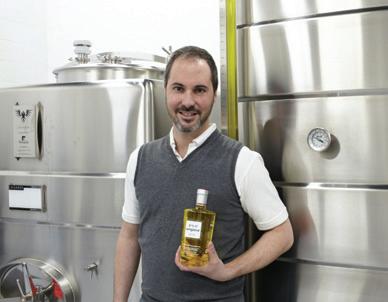
David Marino poses in front of the stainless-steel La Garde wine tanks used to make products like the yellow-colored Ungava Canadian Premium Gin made from inidgenous ingredients.
Robert Pieper, Senior Vice-President, Production and Logistics, Virox Technologies Inc.
FILLING & CAPPING
And while creating the ideal disinfectant is the goal of every such chemical manufacturer, Virox has not only found a solution, it found a solution that utilizes hydrogen peroxide as its base ingredient providing the best possible balance of safety and efficacy, he explains.
Utilizing hydrogen-peroxide, Virox has engineered a broader acceptance of hydrogen peroxide products with a patented technology known as AHP (Accelerated Hydrogen Peroxide), Pieper calls a “synergistic blend of commonly used safe ingredients that when combined with low levels of hydrogen peroxide, produces an exceptionally potent germicide and cleaner.”
According to Virox, independent studies confirm that many disinfecting products like chlorine bleach, phenols, quaternary ammonium-compounds and water are poor cleaners that only remove between 12 to 16 per cent of organic matter and soil from a surface.
Dirty Deeds
A CLEAN SWEEP
Domination in the war against microbes propels Ontario disinfectant manufacturer to healthy gains in global health protection segment
BY ANDREW JOSEPH, FEATURES EDITOR PHOTOS BY COLE GARSIDE
When it comes to home cleaners and disinfectants, people tend to picture someone with a spray bottle and a cloth performing a quick wipe. But for industries within the medical healthcare segments, it’s a completely different ballgame, as the ability to control and eliminate harmful bacteria can often mean the difference between life and death.
For medical institutions, the war against germs and harmful bacteria is an everyday battle undertaken seriously to ensure the health and safety of everyone that may come into contact with the devices or environmental surfaces in the hospital. And it is an epic battle indeed, as evidenced by the $20-billionplus global market for cleansing and disinfectant products.
Headquartered in Oakville, Ont., a 30-minute drive west of Toronto, Virox Technologies Inc., is a key combatant in the war against microbes. Having engineered several revolutionary disinfectants based on unique hydrogen-peroxide formulation, the company enjoys a well-earned world-class reputation in the industry for its R&D (researchand-development) and the manufacture of highquality products.
Easy Does It
“It’s easy to make a strong disinfectant to kill pathogens,” explains Virox senior vice-president of production and logistics Robert Pieper.
“However, it is difficult to create one that won’t damage the surfaces it’s put on, won’t harm the user that has to apply it, or harm the environment that has to absorb it,” Pieper told Canadian Packaging during a recent visit to the state-of-the-art plant.
Moreover, these materials also tend to place most of the dirt into a solution that gets redistributed over a surface where it re-dries to create a layer of dirt— the perfect place for harmful bacteria to take root.
“But, along with being a fantastic disinfectant, AHP is also an excellent cleaner. We have found that it achieves an 86.5-percent cleaning efficiency under standardized tests,” states Pieper asserting that the Virox cleaning levels are tops in the industry.
“AHP immediately begins working upon contact, stripping away the layers of dirt on a surface until it gets down to the base material,” Pieper says. While a hydrogen-peroxide solution purchased at a local drugstore will be a three-percent solution mixed with water, Virox is able to reduce the percentage of active ingredient to only 0.5 per cent by adding de-ionized water; surfactants (surface acting agents); wetting agents to reduce the surface tension of a liquid and allow the solution to spread more easily across a surface of a solid; and chelating agents that help to reduce the metal content and/or hardness of the water.
As for the safety of these extra ingredients used in the solution, Pieper notes that along with AHP being “effective from a disinfectant standpoint, it is also a real green and safe product.”
Moreover, AHP is not irritating to the eyes and skin, notes Pieper, and all the ingredients are listed on the EPA as well as the USFDA Generally Regarded As Safe (GRAS) list, adding that all chemicals used in the formulation of AHP at the Virox facility are actually commonly found in both com-
Bottles lled with Virox Technologies’ disinfectant move past a SK-800 cap tightener and retourquer manufactured by SureKap and installed by Speedway Packaging Machinery.
Passing through a Speedway Packaging ller, plastic bottles containing AHP disinfectant move down the line towards a Surekap SK-800 cap tightener and Piller induction sealer.
FILLING & CAPPING
mercial and industrial cleaners and disinfectants.
Virox claims that its AHP formulation provides a perfect balance between “speed of germicidal efficacy, cleaning efficacy, safety for users and occupants, and environmental profile.”
“Our plant is clean, of course, but it is important to note that even as a manufacturer of a chemical cleaner and disinfectant, there is little to no smell in our facility,” says Pieper, adding that plant workers use no special breathing apparatus or masks.
Founded in 1998 by president and chief executive officer Randy Pilon, the privately-owned Virox employs 40 people, including three in R&D, five in quality control, 14 in production and warehousing, and the remainder in administration and what Pieper calls “professional and technical services.”
Virox manufactures its AHP products in two basic forms—disposable wipes and in bottles— with the liquid applications usually packaged in spray bottles and larger-format jugs.
“The formats we manufacture are based on the needs of our customers,” explains Pieper, noting that Virox generally does not sell its products directly to the end-user.
Instead, the company prefers to align itself with specific global customers like Diversey for the industrial and institutional markets; Steris for medical-device reprocessing; Deb for hand hygiene; SciCan for the dental market; Bayer HealthCare for the veterinary market; DeLaval for the dairy market; and Bissel , a newly-formed relationship for the household cleaning market.
In addition, Virox produces its own brand Accel, which it sells directly to the medical, laboratory and professional beauty markets throughout North America.
“Even though we are a relatively new company, business has been good to Virox,” relates Pieper.
In 2007, the company added an additional 12,000 square feet of production space, but to keep up with growth, it eventually moved into its current 47,000-square-foot plant with Silver LEED (Leadership in Energy and Environmental Design) certification, making it the very first chemical manufacturer in Canada to receive this certification.
With sales reaching the $25-million benchmark in 2012, Pieper says further expansion may well be in the cards again.
“Although we’ve only been in this facility a short time, it seems as though we will soon have to make some additional decisions regarding expansion, but at least we own an additional 20,000 square feet of land alongside this facility,” says Pieper.
“For Virox, the way the business continues to grow, the question regarding expansion revolves more around ‘when’, rather than ‘if’.”
ities of the manufacturing and warehouse facility, stocking the plant with the right equipment is key to maintaining the company’s successful growth.
To use an example, Pieper cites a new pallet racking storage system from Concept Storage Solutions, which has helped reduce the footprint required per aisle by allowing for more racking space to be fully utilized.
Pieper says that Virox currently produces over 150 SKUs (stock-keeping units) based on 18 to 20 formulas of AHP for its dynamic customer base.
“The numbers change rapidly, as we are either working with our customers on new formulations or we simply add new partners,” he says.
Monthly Dues
“Typically in a month, we manufacture about 60,000 units of AHP,” suggests Pieper, “which is about 500,000 to 600,000 liters of finished product.”
The large discrepancy in numbers is due to the amount of wipes required. Virox purchases the melt-blown polypropylene wipes already in the cannister from Priority Plastics, Inc., and uses a filler to add the AHP liquid formulation to it, whereby 99 per cent of the solution is absorbed by the wipe substrate.
According to Pieper, the wipes and the 32-ounce bottles are the two biggest sellers for Virox, with different AHP containers ranging in size from eight ounces all the way up to 1,000-liter totes.
For Pieper, who oversees the day-to-day activ-
Pieper refers to the system as a shuttle racking system, whereby a forklift will place a loaded pallet onto a set of metal rails. The racking system can then be independently operated to transport the pallet across the racks, as well as to pick up and retrieve them.
While the five-level pallet system has greatly helped warehousing capabilities, Pieper also tips his cap to Speedway Packaging Machinery Inc., of Gormley, Ont.
Although a fairly small but highly competent manufacturer of custom packaging machinery, Speedway Packaging also manufactures lines of liquid fillers, cappers, turntables and conveyors.
“The majority of the equipment we use has been purchased from Speedway Packaging,” acknowledges Pieper. “Not only have they been great to work with, but so has all of the machinery.”
The high-performance equipment manufactured by Speedway on the six main Virox filling lines includes: four 48-inch infeed tables; four conveyors; five 48-inch accumulation tables;
two LF90P manual-feed overflow adjustable two- to 12-head fillers;
two LF90CA-C inline fully-automatic overflow adjustable two- to 12-head fillers;
one PF90 12-head piston-filler used for wipes; one MP90CA 12-head metering filler, a custombuilt unit developed to perform foam-free filling for a wide range of containers shapes and sizes specifically for Virox;
two CP-10 120-mm cap tampers.
According to Speedway, the LF90 units are pressure gravity overflow fillers that come with stainless steel filling heads with or without drip trays and sanitary positive displacement pumps.
While the actual speed of the filler varies on the number of heads and size of the container, it can accommodate fill sizes from as small as 150-ml to 10 liters, making it a very handy piece of equipment for Virox.
“Speedway certainly provides 100-percent support for every piece of equipment they manufacture,” relates Pieper. “We appreciate the fact that before we ever receive a piece of equipment from them, Speedway has already thoroughly tested it before inviting us to their facility to see it in operation and answer any and all questions we might have.”
Pieper adds that customer support for the equip-
A Speedway Packaging PF90 12-head ller adds a wet AHP solution to the pre-loaded containers of dry wipe.
A close-up view of a MP90CA 12-head metering, foam-free ller built and installed by Speedway Packaging at the Virox plant.
A Markem-Imaje 18i thermal-transfer printer applies lot code data to labels before they are attached to the bottles of Virox Technologies’ own Accel brand of disinfectant.
A self-supporting thriple-leg semi-automatic Wulftec WRT-175 stretchwrapper secures a pallet load of cartons.
ment has also been superb, with Speedway taking the time to troubleshoot and walk them through issues by telephone, or immediately come over with a replacement part if needed regardless of the age of the equipment.
In addition to providing Virox with its own equipment, Speedway also supplied it with equipment from RNA Automation Ltd., a U.K.-based global specialist in automated feeder and handling systems, including a SRC-N vibrating stainless-steel bowl feeder and an incline cap feeder.
Prior to integration of this equipment, Virox used to hand-place the caps onto the containers.
Auto Pilot
The new automated system naturally delivered a tremendous increase in line speeds, says Pieper, which provides consistent capping quality with minimal noise levels.
Speedway also tapped the resources of the Taiwanese-based manufacturer of labeling systems Pack Leader Machinery Inc. to supply: one GCG-BL-2/1000 two-head piston filler; four PL-501, one PL-611D and one SPM-10 label applicators; two PW-5535 and one PW-557F tape-case sealer; and one PW-563 semi-automatic case-erector.
Since the early 1990s, Speedway has maintained an excellent relationship with the Winder, Ga.-based SureKap Inc., which manufactured the two SK-800 eight spindle cap tighteners and retourquers installed at the Virox plant.
“We began our relationship with Speedway 14 years ago when Virox first opened its doors,” recalls Pieper. “We had acquired a pair of bench-top gravity fillers in an acquisition that had their name on them, so we called them to learn how to automate them.
“Speedway was great in the way they helped us out on this and other issues even though we were not purchasing anything from them, as we did the equipment modifications ourselves,” Pieper continues.
“They were a source of great help for us during our first few years of existence when money was tight and we were not in a position to purchase new equipment.
“So when we began to grow and it came time to purchase more equipment, Speedway was first on our list of suppliers.
“They haven’t let us down,” says Pieper, “and over the years they have continued to provide a very high level of support—even on topics that don’t directly apply to their product lines.”
Along with the support, Pieper was impressed with just how technically sound Speedway is in the design phase, noting that the equipment manufacturer and supplier took the time to ensure it understood the requirements of Virox.
“It was heartening to discover that Speedway would request the necessary product samples from us before proceeding, and would then design and develop a production line perfect for our requirements,” Pieper relates.
As much as Virox enjoys working with Speedway, Pieper points out that the company has also purchased additional equipment from other manufacturers, including:
one WRT-175 stretchwrapper from Wulftec International; two CL408e barcode printers from Sato; two S420 inkjet printers from Saturn ; five Markem-Imaje model 18i thermal-transfer printers; one Artel top label applicator; one ST-2200 sleeve applicator from Styrotech Corp.;
two Belcor tape-case sealers, along with two BEL505 semi-automatic case erectors;
one Enercon foil cap-liner detection and ejection system, and three Super Seal induction sealers; one Piller induction sealer; corrugated cartons supplied by RockTenn and Norampac
“Because quality is an extremely important component of the Virox philosophy,” says Pieper, “once an hour we perform a quality and assurance check on lot numbers, packaging, labels straightness on the packaging, and to ensure we have the proper skid configuration.”
With infection control and the need for safer and more effective cleansers and disinfectants definitely being anything but a passing fad, Virox appears to be well-positioned for further growth, says Pieper.
“The Virox plan, as formulated by Pilon, has been to collaborate with the infection control community and to develop AHP products based on the needs of the most reputable companies involved in each of the market segments we target,” says Pieper.
“And we’ve done the same with our relationship with Speedway, working with an excellent equipment manufacturer and supplier who provide a high level of service that we truly appreciate.
“We look forward to growing with them.”
For More Information:
PACK EXPO Makes it Fast and Easy to Discover Total Systems Solutions
With more than 1,600 exhibitors, PACK EXPO Las Vegas 2013 (September 23-25; Las Vegas Convention Center) will be the most comprehensive show in North America for brand owners to discover solutions across the supply chain that address critical issues like:
Food safety
Sustainability
Shelf life
Freshness
Lean manufacturing
Machine-to-machine communication
Flexibility
For attendees, having both packaging and processing technologies all in one place makes it faster and easier to discover innovation and broadens their sourcing horizons.
Integrated Solutions
An increasing number of brand owners are taking a unified approach to processing and packaging to streamline production, increase output, enhance sustainability measures and increase efficiency.
This total systems approach also allows processing and packaging teams to better understand what product or packaging changes can feasibly run on the line. Communication between processing and packaging operations also helps to assure that any new machinery added to either line is equally adaptable to future changes.
The Processing Zone at PACK EXPO Las Vegas 2013 will address the trend of integration at a greater level. Since its debut in 2010, The Processing Zone has grown by 42 percent, underscoring the demand from manufacturers to see processing and packaging technologies under one roof. Located in the South Hall, this sold-out area of the show will highlight the latest processing technologies for a range of market sectors including food, beverage, baked goods, snack food, meat, dairy and produce. Attendees will find additional examples of these technologies throughout the exhibit halls.
A Customer-Centric Approach
To add further value for attendees, PACK EXPO Las Vegas 2013 will include several special features:
Specialized Pavilions
Candy producers will find the innovations that resolve their processing and packaging challenges inside The Confectionery Pavilion, sponsored by the National Confectioners Association (NCA). Pharmaceutical manufacturers will be able to turn to The Pharmaceutical Pavilion, located in Central Hall for the latest in track-and-trace, inspection and other technologies critical to the pharmaceutical and nutraceutical industries.
Industry Specific Lounges
Dedicated lounges on the show floor will offer specialized opportunities for professionals in the baking and snack, beverage, confectionery and pharmaceutical industries to connect with suppliers for even faster access to the solutions they need. Each lounge will house an “Ask the Expert” forum, where attendees can receive guidance from experts on specific packaging- and processing-related challenges.
The SMB FastTrack Program
Small- and medium-sized manufacturers with annual revenues between $50 and $500 million qualify for the new SMB FastTrack program. This free program will connect attendees with exhibitors that offer special incentives, programs, pricing or other services to SMBs. Additional benefits are available to C-suite executives with the SMB FastTrack Platinum program. Full program details are available at www.packexpo.com/fasttrack.
Food Safety Summit Resource Center
Featuring leading industry and subject matter experts, the Food Safety Summit Resource Center will provide processors with the opportunity to learn about the latest breakthroughs in food safety and gain valuable insight into potential solutions.
Education to Innovate
The Innovation Stage will provide attendees with convenient educational sessions on important trends and issues as well as special presentations of the latest technologies. Register for PACK EXPO Las Vegas now at www.packexpo. com and take advantage of discounted rates. We look forward to seeing you in Las Vegas!
Cases of product are securely taped shut by a Belcor sealing system supplied to Virox by Speedway Packaging.
PICTURE PERFECT POTATO PACKS
New packaging creates outstanding retail shelf appeal for one of Ontario’s leading potato growers and packers
ANDREW JOSEPH, FEATURES EDITOR PHOTOS BY COLE GARSIDE
Grown under the soil, the potato is known in French as pomme de terre —apple of the earth—a testament with religious overtones to the hearty goodness of the humble spud. A starchy, tuberous crop, potatoes were a key ingredient in cultures in the Andes mountain range in South America, and were only introduced to the rest of the world a scant four centuries ago. Since that time, potatoes and its 3,000 or so varieties have become the planet’s fourth-largest food crop after rice, wheat and corn, and have a wide field of uses ranging from human and animal food to distilling alcohol.
Prepared in many ways—skin-on or peeled, whole or cut—cooked potatoes can be eaten hot or cold, and are widely enjoyed as potato chips, potato salad, baked potatoes, French fries, hash browns and pancakes, to name but a few lipsmacking possibilities.
When one talks about potatoes and its place in the pantheon of Canadian farming, the Province of Ontario does not usually come to mind as a major contributor to the starchy tuber’s estimated $1-billion Canadian industry.
But while 2012 data compiled by Stats Canada shows that the country as a whole produced some 100.474 billion pounds of spuds across the 10 provinces, Ontario was right in the middle of the pack, growing over 7.505 billion pounds.
Situated in the town of Shelburne, about a 90-minute drive northwest of Toronto, Downey Potato Farms has been growing and selling potatoes since 1924, albeit it was recently purchased by a capital investment company.
But despite the Downey family no longer owning the farm outright, the fourth generation of the Downey family, led by vice-president Trevor Downey, has not skipped a beat.
Projecting a boyish ‘aw-shucks’ attitude, even though the business is considered to be one of the largest potato growers in the province, Downey estimates that the company grows, processes, packages and co-packs over 100 million pounds of spuds per year.
“My dad and uncle took over the family business back in 1970 and really began to grow it,” Downey told Canadian Packaging magazine during a visit to the picturesque farm, which it has also been a premium grower for Loblaws its biggest single retail customer, and its related brands since that time.
Game Face
While Shelburne has a population of just under 6,000, the Downey family name is well-known and respected in the town and surrounding area.
While Downey reluctantly admits to being a pretty decent hockey player who played professionally for ‘a cup of coffee’ in the minor leagues, he proudly notes that elder brother Aaron used to play for the famed Detroit Red Wings franchise of the National Hockey League, helping the team win the Stanley Cup in the 2007-2008 season.
And while Trevor did not find the same success as his brother on the ice, he has more than made up for it with his management of the farm and business growth, along with a few successful private ventures, such as his partnership in nearby Alliston restaurants: The Bistro Burger Joint and The Poutine Joint. Not surprisingly, both popular eateries utilize the high-quality spuds grown at Downey Potato Farms.
Despite Downey’s other food-related ventures, it still boils down to the old family business of potatoes. According to Downey, the company produces 15 different premium-grade and specialty-grown varieties of gold, white and russet potatoes. Downey says he is grateful to Hunter Wilson, his farm manager who oversees the 3,000 acres of potato
Downey Potato Farms worked with Alpha Poly Pack Solutions to create a flexible polybag, lending a touch of class to its potatoes while garnering a silver award at the 2013 PAC Packaging Competition.
Tried, tested & new
Unlike retrippers, corrugate is always new. It does not need to come from or return to washing stations in the USA. Corrugate is the food industry’s packaging of choice. Branded, new and trusted.
FLEXIBLE PACKAGING
fields, and to all his employees—like twins Paul and Perry Stevenson, who have been working for the business since 1975—but adds that while having a high-grade line of products is key to the success of any company, so too is the ability to market it.
“What gave us a leg up on the competition back in the 1970s was that we were actually one of the first companies to provide packaging for potatoes at the retail customer level. Before that, all potatoes were purchased loose from the grocer.”
Nowadays, Downey Potato Farms packages all of its table and baking spuds in two basic formats in over 20 SKUs (stock-keeping units)—the more familiar stitched paperbags; and a plastic polybag that Downey has used to take the humble spud to a whole new level of shelf appeal.
“It’s classy and it definitely sparks interest,” says Downey. “That’s the best way to describe our new packaging.”
Apparently Downey’s not the only one, with PAC—The Packaging Association recently awarding the bag’s designer Alpha Poly Pack Solutions a silver award in the Flexibles Category of its 2013 PAC Packaging Competition
Downey relates that Alpha Poly first approached him about two-and-a-half years ago wondering if he might consider using their strong high-end plas-
tic bags as a way to stand out on the grocery shelves.
Located in Brampton, a mere 20 minutes northwest of Toronto, Alpha Poly is a Kerrigan familyowned packaging solutions business opening up its doors in 1989, with its primary product at that time being a PE (polyethylene) plastic bag designed specifically for the waste management market.
With the second-generation of Kerrigan family running the day-to-day operations, Alpha Poly diversified into the flexible packaging converting business to include products for a wide range of industries, today serving foodservice and co-packing customers throughout the U.S. and Canada.
“It was Spring 2011 when my sister Stephanie approached Downey Potato Farms with our matte finish LDPE (low-density-polyethylene) plastic bags,” explains Alpha Poly vice-president of sales and marketing Matthew Kerrigan.
Downey says he was initially reluctant to alter the company’s packaging set-up.
“But it had a matte finish as well as a glossy finish,” Downey recalls. “I had seen veggies packed in plastic, of course, but never with a combination matteglossy finish. I told Alpha Poly that I was interested in applying a photographic image to the bag, and they said they would be able to do something for me.
“I just needed to figure out what eye-catching
image to use.”
While sitting down one day for a meal at Bistro 77, he discovered the classy little Alliston restaurant used his potatoes on their menu.
“I immediately thought that I should strike up a partnership with Bistro 77,” admits Downey, “hoping that they could lend us a touch of class and credibility by helping us market the potatoes.
“I thought of combining imagery of Bistro 77’s owner and chef Jason Klausen with my potatoes onto the new plastic bags offered by Alpha Poly.”
Photo Finish
Contacting Alpha Poly, Downey outlined his vision, and three months later the farm was packing potatoes in the LDPE plastic bags complete with the photographic image he wanted.
“There wasn’t any great urgency about the project, but the turnaround time was quick,” relates Kerrigan, acknowledging that Downey was not only intrigued in an alternative form of packaging to paper, but that he was also impressed by the superior graphic design and high-quality printing options offered by the polybag.
“Trevor provided the direction and vision for the design of the pack, and we put it together for him,” notes Kerrigan. “Our impetus was to provide a high-end look to help differentiate it from his competition by emphasizing the potato, while at the same time maintaining a real organic feel.”
Kerrigan says that Alpha Poly’s on-site graphic department created the design: right from the on-site photoshoot all the way through to the finished product.
“The unique combination of matte and glossy inks are very eye-catching,” says Kerrigan, adding that Alpha Poly uses a Uteco Coral press that it recently upgraded with automated computerized viscosity control to optimize print consistency from job to job.
Downey says that with help from Alpha Poly, who supplied the photographer, they took a day’s worth of photographs of Chef Klausen posing with his potatobased gourmet creations.
“I told Jay that I wanted him to prepare dishes utilizing specific potatoes, with the idea that each dish and photographic image, and the colors printed on a bag, would represent a particular potato variety,” Downey explains. “It’s been so well-
Working inline with a Volmpack 12000 six-head vertical filler, a Domino A-Series plus inkjet printer adds lot code data to closure tabs prior to placement onto polybags of potatoes.
The polybags designed by Downey Potato Farms and Alpha Poly contain a cutout coupon for a high-end restaurant that also naturally happens to utilize its spuds.
received that we are now up to six different polybag creations, with more to come.”
More business was no problem for Alpha Poly, relates Kerrigan, saying that even with the volatile nature of the retail market with shifts in demand and promotions, the ability to provide quick turnarounds for any customer has been aided significantly by its high-volume wicket bag converting equipment.
“Our philosophy at Alpha Poly has been to continually reinvest in our business, making capital investments in new equipment almost every year to either in crease our capabilities or capacity,” explains Kerrigan. “And when equipment wasn’t required, we invested in ‘lean manufacturing’ and continuous improvement training.”
Kerrigan says that 2013 will not be an exception, as Alpha Poly has plans for its largest expansion to date, which will include renovations to some freshly acquired space in its building.
“Because business is growing, we will be adding some new high-performance lamination and slitting equipment, and will also have a new printing press installed by the spring of 2014,” says Kerrigan.
“We feel that this expansion will give us an edge out in the marketplace that will really help to differentiate Alpha Poly from the competition.”
Along with the six variants in photographic imagery, Alpha Poly produces two different sizes for Downey Potato Farms—a 1.5- mil thick LDPE polybag for five-pound packs; and a 2.25- mil poly for 15-pound retail options.
Nice Surprise
“Both myself and Chef Klausen were pleasantly surprised at the positive reaction our potato bags garnered at the grocery stores around Ontario,” admits Downey, saying he is especially pleased with brisk sales of the Bistro Bakers and Bistro Organics brands.
After the annual September-October harvest, potatoes are brought to one of two huge cold storage facilities on Downey Farms property, where some 70 million pounds of spuds are kept at a temperature ranging from 38°F to 45°F.
When Downey Potato Farms is ready to process, the spuds are transferred to a huge mechanical bathtub to wash and scrub the dirt from its surface.
“We recycle about 75 per cent of the water that flows through the washer, and we utilize four different filtration and sediment points,” says Downey.
The potatoes are quickly conveyed to a Wyma Vegie-Polisher system, which is a shaker-sorter that directs potatoes to fall through successively smaller openings. Once done, line workers perform a second visual check to remove potatoes not deemed to be up to the farm’s stringent quality standards.
With the various sizes of potatoes conveyed to different points in the facility, the tubers move along the plant’s Line 1 to a Volm Volmpack 12000 six-head vertical bagger with a poly wicket attachment that can utilize both poly and paper bagging components to fill five- and 20-pound paperbags and three-, five-, 15- and 20-pound polybags.
Mounted inline, a Domino A Series Plus inkjet coder is used to apply lot code data directly onto the bags. Other equipment includes:
harvesting
FLEXIBLE PACKAGING
an AFS filler for packing 50-pound paperbags, with a A Series Plus inkjet coder applying code to the bag;
a Berhnard Upmann Verpackungsmaschinen Upmatic 2112d 12-head double wicket filler—to fill five- and 20-pound paper, and three-, five, 15- and 20-pound polybags, with an A Series Plus inkjet coder placed inline; another Volmpack 12000 used to fill five-, 10- and 20-pound paperbags, with an A Series Plus coder placed inline.
“For a customer like Loblaws, we pack a lot of different SKUs,” notes Downey, listing Specialty President’s Choice Organic three-pound polybags; five-pound polybags of President’s Choice All Purpose Potatoes; five-pound polybags Bistro Baker, for russet, white and yellow potato varieties; a five-pound paperbag for Bistro Roasters; 10-pound paperbags of Fresh Cuts; 10-pound paperbags of Farmer’s Market for red, white and yellow varieties; and 15-pound Downey’s Jumbo Russet and 20-pound polybag potato pack.
For all of the polybags filled by Downey Potato Farms, the A Series Plus inkjets apply lot code data directly onto the clip tag, which are then attached to the neck of each bag.
After filling, the polybags move via a conveyor system up to a second filler that drops a set number of polybags into a large paperbag provided by Sac Drummond. These paperbags are then sealed by an inline Nordson ProBlue 4 adhesive system and readied for transport to the customer.
For Downey Potato Farms, its involvement with packaging has helped transform the company during various stages of its existence, and Downey credits the skill level of Alpha Poly staff for the most recent upswing.
“I enjoy working with Alpha Poly,” says Downey. “They have a good team and they are very openminded when it comes to articulating all the aspects I wanted in the design, and then taking the time to make it a reality.”
As to the future, Downey says he looks forward to improving the retail potato category by adding new specialty spuds that are based around taste and uniqueness, but in smaller packs.
“I also plan to move more brands onto the Bistro line—all with the classy look featuring Chef Klausen,” says Downey, adding he looks forward to working with Alpha Poly well into the future.
“The new technologies that Alpha Poly keeps coming up with to improve the packaging also keeps me on my toes to come up with additional ways to utilize them,” he says.
“It’s fun actually: I don’t have to change my product, but I can add a plethora of varieties and tastes the general public has never had the pleasure of trying before,” he concludes.
“And by putting it into exciting new packaging options, I can change the way it is perceived in the market.”
Hibar Systems Limited of Richmond Hill, Ontario is pleased to announce the appointment of INOX Pumps and Process Inc. of Anjou, Quebec as their distributor for the Quebec, Maritimes and Greater Ottawa region. INOX will provide sales, service, support and parts for Hibar’s extensive line of Precision Dispensing Pumps and Filling Systems.
Contact Information
INOX Pumps and Process Inc.
Pierre Dumontet
Tel. : (514) 744-0224 / 1-888-881-0224
Fax : (514) 744-4121
7960 est, Jarry Anjou, Québec H1J 1H5
Web : www.inoxpumps.com
Web : www.hibar.com
After
in autumn, Downey Potato Farms holds 70 million pounds of dirt-covered spuds at its cold-storage facilities for year-round production.
EVENTS PEOPLE
June 6-7
Amsterdam, Holland: Sustainable Foods Summit, by Organic Monitor. At Mövenpick Hotel. To register, go to: www.sustainablefoodssummit.com
June 12-13
Paris, France: Pack & Gift 2013, international event and gift packaging exhibition by IDICE. At Porte de Versailles. To register, go to: www.packandgift.com
June 18-20
New York City: HBA Global Expo & Conference, beauty products and cosmetics exhibition and conference by UBM Live. At Jacob K. Javits Convention Center. To register, go to: www.hbaexpo.com
Aug. 28-31
Bangkok, Thailand: Pack Print International 2013, packaging and printing exhibition for Asia by Messe Düsseldorf GmbH. Contact Messe Düsseldorf North America at (312) 781-5180; or go to: www.mdna.com
Sept. 8-12
Chicago: PRINT 13 exhibition and conference by the Graphic Arts Show Company (GASC), jointly with the CPP (Converting & Package Printing) EXPO by H.A. Bruno, LLC. Both at the McCormick Place. Contact GASC at (703) 264-7200; or H.A. Bruno at (201) 881-1632.
Sept. 16-20
Munich, Germany: drinktec 2013, the world fair for beverage and liquid food technologies by Messe München GmbH. At the New Munich Trade Fair Center. To register, go to: www.drinktec.com
Sept. 23-25
Nürnberg, Germany: Active & Intelligent Packaging Congress & Exhibition, by the Active & Intelligent Packaging Industry Association (AIPIA). At Messe Nürnberg. To register, go to: www.aip-worldcongress.org
Sept. 23-25
Las Vegas, Nev.: PACK EXPO Las Vegas 2013, international packaging technologies exhibition by PMMI. At Las Vegas Convention Center. Contact PMMI at (703) 243-8555; or go to: www.packexpo.com
Oct. 8-10
St. Petersburg, Fla.: Sustainable Packaging Forum & Expo, by Packaging Strategies. At Renaissance Vinoy Resort. Contact Karen Close of Packaging Strategies at (610) 935-2183; or go to: www.sustainablepackagingforum.com
Oct. 16-23
Düsseldorf, Germany: K 2013, international trade fair for the world’s plastics and rubber industries by Messe Düsseldorf Gmbh. Contact Messe Düsseldorf North America at (312) 781-5180; or go to: www.messe-duesseldorf.com
Industrial automation components supplier CARLO GAVAZZI (Canada) Inc. of Mississauga, Ont., has appointed Chris Tomkins as the company’s account manager for the province of British Columbia; Greig Harrison as account manager for southwestern Ontario; and Serkan Onat as account manager for eastern Ontario.
Neehan, Wis.-headquartered flexible packaging product group Bemis Company, Inc. has appointed William Jackson as vice-president and chief technology officer.
Norristown, Pa.-based RondoPak , manufacturer of folding cartons for pharmaceutical and medical device industries, has appointed Victor Dixon as president and chief operating officer, and Richard Leppert as vicepresident of global business development.
Bunting Magnetics Co., Newton, Ks.based manufacturer of precision magnetics for food-and-beverage, printing, plastics and other industrial applications, has appointed Sonia Cox as director of marketing.
Lithographic printing press technologies supplier KBA North America of Dallas, Tex., has appointed Sam Pernice as web offset sales representative for the U.S. western region, as well as parts and service solutions sales rep for the entire U.S.
Industrial automatiion products group Yaskawa America, Inc. has appointed Hiroyuki Nagatsu as senior vice-president of the Global Sales Team of the company’s Motoman Robotics Division , manufacturer of industrial, packaging, palletizing and material handling robots headquartered in Dayton, Ohio.
Chicago-headquartered brand development and deployment services provider Schawk, Inc. has appointed Jackie DeLise as vice-president of business development.
Great Northern Corporation of Appleton, Wis., has appointed Rick Bishop as vice-president and general manager of the company’s StrataGraph LLC packaging paperboard manufacturing subsidiary in Oshkosh, Wis.
Tomkins
Harrison Onat
Dixon
Cox
Pernice
Nagatsu
Bishop
Leppert
Paperboard packaging products group MeadWestvaco Corporation (MWV) has received the prestigious Compliance Package of the Year award from the Healthcare Compliance Packaging Council (HCPC) for the company’s Avive multiplemedication patient adherence solution—making it three years in a row that MWV has received the council’s top honors. Developed jointly with pharmaceutical packaging designers LTCPCMS, Inc., the patented Avive package (picture above) was designed to provide an efficient, simplified, patient-customized solution for people prescribed multiple daily medications with advanced features such as ready-to-dispense format, pre-filled medication packets labeled with medication names, and patient education information inside the container. “We always strive to revolutionize the way patients interact with the medicine they need to be healthy,” says Tom Grinnan, MWV’s senior director for the Global Patient Adherence business unit. “Our Avive package simplifies the process and allows pharmacists the time they need to counsel patients, while also providing patients with more time to enjoy their lives.”
to provide an effective packaging solution for an extend range of products like powdered infant formula, instant drinks, powders and snacks. According to Amcor Flexibles, the biggest challenge in the development of Alufix Dry Smart was conversion to a new solventless and PVC-free lacquering system, while retaining superior mechanical properties such as burst-pressure, smooth peel and heat/ temperature resistance.
Flexible packaging product manufacturer Constantia Flexibles has commenced a US$12million upgrade of its manufacturing facility in Blythewood, S.C., which will create over dozen new jobs at the plant following completion of a 15,000-square-foot expansion to accommodate
installation of several new production and converting machines. Started up in 1997 and expanded in 2001 and 2005, the Blythewood plant manufactures many types of custom packaging for the pharmaceutical and food industries—including packaging foils for blister packages, child-resistant packaging, and lids for portion-controlled containers—using a brord range of laminating, coating, rotogravure printing, slitting and other converting equipment. “Like previous expansions, the current project reflects our solid growth in sales and our leadership as a packaging innovator,” says Steve Godwin, Constantia Flexibles chief operating officer for the U.S. operations, adding the expansion is scheduled for completion this fall. “More room means additional equipment and new employees to build further upon our successes, so we are as excited as we are proud in looking forward to the expansion’s completion.”
COMING END OF SUMMER 2013
Amcor Flexibles , Swiss-based Amcor Limited subsidiary specializing in flexible packaging products, has picked up two prestigious Alufoil Trophies 2013 awards at the recently-held annual competition of the European Aluminium Foil Association (EAFA). The winning packages include the Formpack advanced blister-pack design—winner in the competition’s Resource Efficiency category—and the Alufix Dry Smart peel-off end membrane for non-retortable cans, which topped the Technical Innovation category. According to Amcor, the newly-redesigned Formpack blister-packs require 30-percent less materials in their construction compared to the original design, while achieving more than a 40-percent improvement in moisture protection for the medications they hold. “We are particularly proud to receive this Alufoil Trophy, as it recognizes our continuous effort in developing sustainable packaging solutions [and] acknowledges our commitment in this field by an independent panel of experts,” says Andrea Della Torre, R&D pharma director at Amcor Flexibles Europe & Americas For its part, the new BPA- and melamine-free Alufix Dry Smart peeloff membrane has proven to obtain much improved efficiencies on high-speed sealing machines, without any equipment modifications,
ANN UAL BUYER S' GUID E AUTOMATION ROUN DTABLE PACK EXPO LAS VEGAS PREVIEW LEADI NG FOOD & BEVERAGE IN-PLANT PH OTO-ESSAYS LASS OND E - Feature expose on Canada's leading juice processor
CHECKOUT MEGAN MOFFAT
PACKAGING PARTY FAVORS FOR SUNNY SEASON
With spring in the air and summer around the corner, one of the first things that comes to mind is entertaining. Whether you are throwing a small BBQ with family and close friends, or a full-on beach extravaganza, a big part of pleasing your guests with your hospitality lies in the choice of food and drinks purchased for the occasion. On these shopping trips, bold standout packaging oozing with colorful artwork, vibrant design, and innovative packaging bells and whistles can have a major impact on the consumer’s purchasing decisions. It’s time to go big, as the saying goes, or go home.
Hailing from the Bear Flag Farm winery near Sacramento, Ca., the Bear Flag wine brand offers a compelling example of an innovative and bold packaging design immediately drawing consumers’ attention from the banal backdrop of ‘Plain Jane’ white wine bottles on the shelves. Boasting eye-catching graphics designed by renowned Argentinian illustrator Eduardo Bertone, the artsy wine label makes a striking statement against packaged conformity with the use of adventurous colors against the backdrop of graffiti-drawn images of a ferocious bear, a number wheel and other bits of faux Americana memorabilia, with the volume and alcohol content displayed in hip tongue-in-cheek on sketches of the judges’ point cards and a stadium scoreboard. The hip and crazy art decal works perfectly for the brand’s Soft White Wine Blend product, which is suitably topped off with an easy-twistoff, lime-green cap to make for an interesting conversation piece at any social gathering.
For its part, the Corkcicle wine chiller—designed for maintaining chilled wines in their ‘chillaxed’ state long after being taken out of the fridge or cooler—offers a case of bold-and-simple being the best option for enabling the product package make an effective connection with consumers. This highly innovative bar tool is a faux corktopped, elongated, icicle-shaped cooling form— containing non-toxic thermal encased in BPA -free plastic icicle—that will keep white wines at their ideal temperature for about 45 minutes, inside or outdoors, while cooling reds to ideal state in just 10 minutes. The sheer simplicity of the genius of this product is clearly communicated with the use of large, capitalized, striking-black letters—neatly emphasized with a bold, no-nonsense period rounding off the confident brand logo. Paired with a beautiful close-up photo of fresh grapes on the adjacent panel, along with easy-to-follow instructions on keeping your vinos at perfect drinking temperatures, this offbeat package is sure to win over many true, unpretentious wine-lovers out there.
With guests relaxing after enjoying some great food and drink, choosing the right sweets is one of those decisions that can really make or break the party’s afterglow. While there is no pleasing everyone every time, the Burnt Sugar brand of treats offers consumers a selection of fun and tantalizing sweets that most people will enjoy, especially with its guilt-free reassurance of an allvegetarian, gluten-free recipe and a
legit ‘Fair Trade’ label certification. Offering a selection of offbeat flavors such as the Sea Salt Caramel Fudge, the brand’s stand-up paperboard box cleverly mimics its flavor with matching nautical graphics of a sail boat, anchor, and a charming ‘treasure box’ peak of the treats inside via a see-through window cutout. The adorable, child-like artwork by Kate Sutton will bring out the child in many of us with a captivating package design sure to spark up another memorable conversation starter.
by Megan
After the party is over and the clean-up is done, few things help relax the mind and body more than a soothing cup of hot tea. Marketed as a nod to the culinary passions and journeys of celebrity chef Marcus Samuelsson, the Ambessa line of tea blends from Harney & Sons serves up a perfect package of culture and flavor with a convenient, reusable metal tin that really stands head-andshoulders above the multitude of standard ‘me too’ paper teaboxes out on the store-shelves. The vibrant and graphic design visually seduces the consumer with natural warmth of the red, pink and orange color tones to reflect upon the essence of its Safari Breakfast tea brand. The tin also boasts a handy QR (quickresponse) code to for modern on-the-go consumers to use their smart mobile devices to learn all about the brand at will. With packaging this inviting, you just know the tea itself just must be a really sweet reward.
Megan Moffat is currently completing her double major in Honours English and Film Studies programs at the Wilfrid Laurier University in Waterloo, Ont.
Photos
Moffat
• Optimized interfaces between motor and gear unit
• New motor concepts
PInput reduce
• New electronic components and intelligent control modules
increase
PLosses minimize
POutput
That’s where Unisource comes in. Our packaging experts are focused on delivering leading-edge solutions that help improve productivity, consistency and quality of packaging operations. These are among the benefits of automation, which helps speed your product to market and creates new opportunities. We partner with leading manufacturers to ensure performance, reliability and innovation – all to help your business reach the next level.
Visit www.UnisourcePack aging.ca or call 1-877-240-7373 to find out what we can do for you.