VICE PRESIDENT Tim Dimopoulos • tdimopoulos@annexbizmedia.com
COO
Ted Markle • tmarkle@annexweb.com
PRESIDENT & CEO Mike Fredericks
ANNEX BUSINESS MEDIA
Valleybrook Drive, North York, ON, M3B 2S9; Tel: (416) 510-5198; Fax (416) 510-5140.
THE CROWNING GLORY OF INNOVATION
It’s been over 20 years since a brand new beverage can manufacturing facility has been started up in the U.S., but the prolonged drought is over, big time, thanks to massive capital investment by Philadelphia, Pa.-headquartered metal packaging products group Crown Holdings, Inc.
Publicly unveiled at a special ribbon-cutting ceremony in early May in Nichols, N.Y., the greenfield plant is by any measure a resounding statement of intent from venerable beverage packaging pioneer proudly celebrating its 125th anniversary this year.
Situated in the Tioga County Industrial Park in southern New York, the 533,853-square-foot building boasts all the latest technologies to produce two-piece aluminum cans in a broad range of specialty sizes to meet growing consumer demand for soft drinks, beer, ready-to-drink tea and coffee, wine and spirits, juices and functional beverages packaged in sizes other than standard 12-ounce containers.
“Beverage cans remain a valued trusted format with consumers around the world due to their portability, durability and sustainability,” Crown’s chief executive officer Timothy Donahue said at the plant’s public unveiling that drew as ‘Who’s Who’ of New York State’s political and corporate elite, including governor Andrew Cuomo and labor commissioner Roberta Reardon.
As Donahue explained, “In the United States the demand for specialty can sizes is flourishing, as brand-owners seek to refresh their packaging mix and increase appeal to different demographics.
“This new facility underscores our philosophy of delivering innovative metal packaging that
responds to demands of modern consumers.”
Expected to create 160 new full-time jobs by 2018, the Nichols plant is Crown’s the 15th North American canmaking facility—designated for production of aluminum cans, ranging from 7.5- to 16-ounce sizes, as well as a diverse variety of beverage can ends and closures.
Coming online against the backdrop of a fearstoking narrative on inevitable lights-out demise of North American manufacturing, the new Crown facility is a fitting testament to timehonored virtues of innovation and continuous improvement en route to corporate longevity of historic proportions.
Founded in 1892 in Baltimore soon after local entrepreneur William Painter invented the world’s first bottle cap (crown cork) to revolutionize the packaging of beer and soft-drinks, the Crown’s patient ascent to elite ranks of true global packaging titans has yielded a multitude of technological breakthroughs mirroring the accelerated evolution of modern food and beverage packaging. From easy-open can ends and aerosol containers to peel-off lidding and temperature-sensitive inks that can change the printed graphics, Crown’s track record of continuous innovation over the years enabled it to roll with the punches through every seismic social, cultural and political shift thrown its way. From Prohibition and world warfare to computer revolution and the Age of Internet, Crown’s relentless focus on developing more practical, convenient and safe packaging solutions for contemporary consumers has always steered it in the right direction in challenging times in the past, and the new Nichols plant is a well-suited crowing glory for a job well done.
G eorge Guidoni
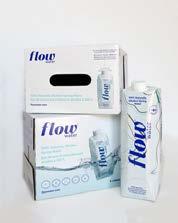
water producer chooses aseptic Tetra Pak beverage cartons and 100-percent
corrugated six-pack carriers from Cascades for its one-of-a-kind alkaline spring water to offer consumers a genuinely sustainable eco-sensitive alternative.
DEPARTMENTS & COLUMNS FEATURES
25
By Andrew Joseph Thriving western Canadian brewer expands its cross-country reach with startup of a new state-ofthe-art Toronto brewery to serve the Ontario market.
By Andrew Joseph
Leading East Coast shellfish processor raises its food safety credentials to new heights with thoughtful end-to-end X-Ray inspection systems installation.
30 TO SERVE AND PROTECT By George Guidoni Family-owned Quebec producer of custom-made corrugated protective packaging solutions is on a hot winning streak fueled by innovative design and topnotch manufacturing skillset.
NEWSPACK
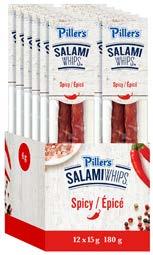
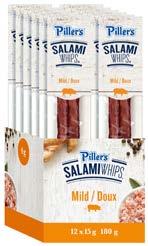
DELI MEAT PROCESSOR WHIPS IT REAL GOOD IN THE SNACKING SEGMENT WITH TASTY NEW MEAT STICKS
With consumer demand for protein-rich, shelf-stable meat snacks continuing to grow at a healthy pace, a venerable Ontario meat processor is shaking up the lucrative product category with an innovative range of wood-smoked meat sticks boasting a refreshingly soft texture and a unique, long-and-slender shape with whip-like flexibility.
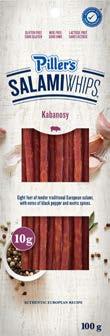
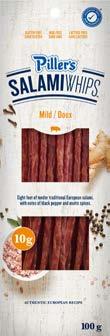
Produced according to authentic European recipes at the Piller’s Fine Foods production facility in Brantford, Ont., the recently-launched Piller’s Salami Whips brand of naturally wood-smoked, semi-dry cured sausage sticks offer meat-lovers a truly innovative alternative to the traditional meat jerkies and dry peperoni sticks dominating the niche segment.
Retailing at leading grocers across Canada—excluding Quebec—the flavorful meat sticks are packaged in resealable 100-gram and singleserve 15-gram flexible packages, supplied by Winnipeg-based Winpak Ltd., that make them a perfect snacking companion for lunchboxes, light meals and snacking on-the-go, according to Piller’s.
Offering a tender bite, high protein content, and zero MSG and any other major food allergens like gluten, milk, peanuts, tree nuts, mustard, sesame, egg, fish, soy and sulphites, the Piller’s Salami Whips are currently offered in three tasty flavors, including:
• Salami Whips Mild: traditional German salami with notes of black pepper and exotic spices;
• Salami Whips Spicy: traditional Central European salami with robust onion, garlic and habanero notes;
• Salami Whips Kabanosy: traditional Polish salami with garlic and paprika.
“Our new salami whips are created to meet consumers’ needs for artisanal products that do not appear mass-produced, and are free from major food allergens,” says Piller’s marketing manager Stephanie Egan.
“Piller’s Salami Whips represents a unique combination of technology and format innovation,” Egan explains, “while staying true to Piller’s time-honored traditions of salami-making—the best of both worlds.
“The slender ‘buggy whip’ shape is widely available in Europe,” Egan relates, “but this is the first whipshaped product available in Canada’s leading grocery stores.
“The product has a soft bite as a result of using a new vegetable-based casing technology, not used in any other meat stick product in Canada,” says Egan, also citing “a resurgence of interest in charcuterie, as seen by the popularity of restaurant menu offerings.
“When placed on a charcuterie tray, the product’s distinct artisanal look is a real crowd-pleaser,” says Egan, complementing outstanding packaging design work for the new product executed by the Torontobased branding agency Weaymouth Creative
Says Egan: “The packaging design has two large window areas, allowing the consumer to see the product, and it uses an ivory-colored, wooden-textured backdrop to communicate the lightness of this product, with its low calories and absence of allergens.
“The design also incorporates images of the natural spices in the ingredients, which differs by variety but include onion, garlic, red bell pepper, ginger and cloves,” says Egan, also complimenting Waterloo-based boxmaker Beresford Box Company Inc. for replicating the uplifting design on display boxes and other secondary packaging for the new brand.
Already a winner of the high-profile 2017 Best New Product Award, as voted by Canadian consumers surveyed by Toronto-based BrandSpark Research, and a finalist in the upcoming 2016 Canadian Grand Prix New Product Awards ceremony of the Retail Council of Canada (RCC), the new salami whips are produced using decades-old natural aging, curing and smoking processes, rather than liquid smoke used by most other brands in the meat-stick segment.
According to Piller’s, the resealable 100-gram packs feature an unobtrusive peel-off pull tab that helps the whips maintain up to 150-day shelf-life inside a fridge.
“Authenticity continues to be a key trend in food, including snack foods, with consumers increasingly interested in ‘real food’ and a return to the values of craftsmanship and time-honored traditions,” says Egan, citing recent Nielsen consumer research showing meat-based snacks to be outpacing the growth of other popular snacks like chips and corn snacks, dry fruit and nuts.
“Much of the growth in meat snacks is being driven by millennials,” Egan proclaims. “Snack foods are the most commonly found consumer packaged goods in millennials’ shopping baskets.
“With easy-open and resealable features offering practical convenience and versatility for snacking onthe-go, our new whips really deliver on consumers’ growing desire for great-tasting, protein-rich deli meat snacks that are convenient and portable,” she adds.
According to the Nielsen survey, snacking between meals has increased dramatically in the last two years in Canada, with four out of 10 Canadian consumers now snacking as a meal replacement.
“Consumers are also looking for ways to balance healthy, purposeful snacking with their desire for indulgent and emotionally satisfying snacks,” the report states.
Celebrating its 60th anniversary this years, the Waterloo, Ont.-Piller’s Fine Foods is one of North America’s leading producers of specialty European deli meats—employing over 600 people at production plants in Brantford and Arthur, Ont., as well as at its central distribution facility in Waterloo.
LIGHTWEIGHT PLASTIC KEGS ALLOW
CRAFTY BREWERS TO GROW THEIR PET PROJECTS
The thriving North American craft-beer industry has definitely lifted the bar for beverage retail packaging excellence in recent years—most recently extending their packaging prowess to their kegged product.
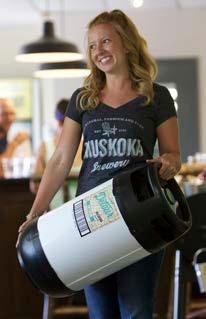
Earlier this year, Bracebridge, Ont.based Muskoka Brewery and Le Trou du Diable of Shawinigan, Que., became the latest Canadian craft-brewers to start using the petainerKeg Linestar keg system to ship their beer in bulk outside of their traditional market reach.
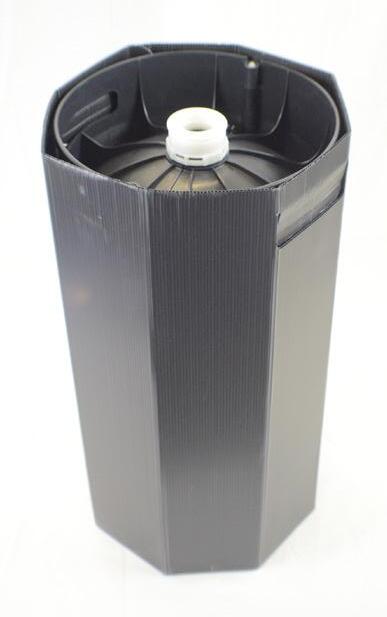
Designed to enhance the filling, handling and logistical benefits of the classic one-way PET (polyethylene terephthalate) kegs, the new PetainerKeg Linestar kegs feature a solid and robust external casing for superior impact resistance; considerably lighter weight compared to steel kegs; easy stackability on the shipping pallets; ergonomic handling for the working staff at bars, clubs and restaurants; and over 430 square inches of packaging real estate for branding logos and merchandising graphics.
Manufactured by the U.K.-headquartered Petainer Group in 20-liter and 30-liter volume sizes, the fullyrecyclable Linestar kegs are specifically designed to be able to run on most existing steel-keg filling lines, according to Petainer.
“We developed Linestar to provide breweries with a seamless transition from steel to PET kegs without the need for a bespoke filling system,” says Petainer Group’s commercial director Annemieke Hartman-Jemmett, citing at least 30-percent reduction in logistics and transportation costs compared to steel kegs.
“It allows breweries to use spare capacity on existing steel keg lines, while enabling our customers to enter new markets thanks to its superior logistical performance,” says Hartman-Jemmett.
As she explains, “It once used to be unthinkable to transport beer, wine and cider in steel kegs, instead of wood, and PET is simply part of the ongoing evolution of the keg.
“We are now taking that evolution a step further with the petainerKeg Linestar by making it easier for fillers and brewers to benefit from a lightweight, more flexible packaging system that reduces freight costs—without the need to invest in new filling lines or systems.”
Muskoka Brewery’s supply chain director Brian Eyers agrees.
“We are focusing on expanding our market by exporting our draught beer beyond our local province,” states Eyers, “and Petainer’s Linestar has provided us with an easyto-use and cost-effective solution for exporting our beer across Canada and into the U.S.”
Adds Le Trou du Diable president and director of business development Isaac Tremblay: “We chose the new Linestar because it looks great and is easy to use in terms of filling and handling.
“As we continue to expand our business, we intend to use Linestar to send our beer across Canada and to the U.S., while also exporting it to Europe more cost-effectively.”
NEW WIDE-FORMAT PRINTER A BIG PRODUCTIVITY BOOST NEWSPACK
Modern branding extends far beyond primary packaging today, with corrugated boxes and shelf displays fast becoming an important new element for carrying the product’s branding message into the market right from the production and packaging lines.
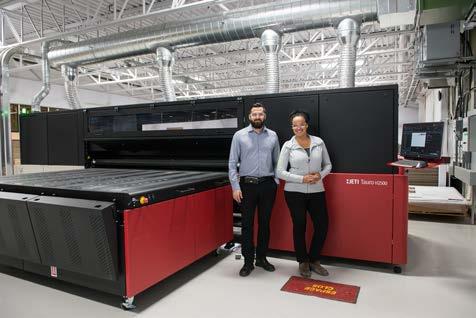
For companies like leading Canadian containerboard packaging producer Cascades, Inc. of Kingsey Falls, Que., that means continuous investment in new-generation printing and converting technologies, as displayed by recent installation of a brand new Jeti Tauro H2500 wideformat inkjet printer with an automatic board feeder (ABF) at the company’s busy corrugated manufacturing facility in Victoriaville, Que.
Supplied by the Mississauga, Ont.-based package converting equipment group Agfa Graphics Canada , the Jeti Tauro is a high-end, 2.5-meter-wide, hybrid sixcolor UV inkjet printer featuring exceptionally vivid printing capabilities and robust at speeds of 275 square meter per hour.
Handling print widths of up to 2.54 meters and accommodating rigid media up to four meters in length, the H2500 features continuous and automated feeding of rigid media, as well as an integrated roll-to-roll system for flexible media.
Driven by Asanti workflow software optimized to work with Agfa’s high-pigment UV-inks, the wideformat printer is ideally suited to the quality and productivity demands of high-end sign and display printers, according to Victoriaville plant manager Jean-Philippe Maurais, citing high productivity levels enabled by the 32 fast-firing Ricoh Gen5 heads—each with four nozzle rows and two colors per head.
Evenly spread out over the eight color bars, the Ricoh printheads achieve high-accuracy dot positioning via precise mechanical mounting, according to Marais, along with “smart-drop” formation and precise velocity control.
“Working in harmony with these printheads, Agfa’s fast-curing inks help us achieve high productivity levels,” he notes, “while maintaining superior and repeatable print quality.”
Upgraded with the ABF, the new Jeti Tauro printer can process up to four stacks of board automatically, whereby the operator can be preparing the next set of boards for printing at the same time as the currents set is being printed.
“This makes it possible for operators to parallel-print up to four boards,” says Marais, “thus reducing downtime and increasing production efficiency via higher throughput.
“Depending on the media size, number of boards and print mode, the use of the ABF can result in productivity gains from 20 to 30 per cent, compared to manual feeding.”
COCA-COLA SKIPS
TO A
HAPPY SUMMER BEAT WITH MUSICAL UPDATE
Teaching the world to sing is a long-enduring, time-honored Coca-Cola brand tradition that Canadian consumers happily got behind over the years in one way or another, but this summer’s encore performance for Coca-Cola Canada’s popular Play a Coke marketing campaign promises Coke -drinking musiclovers an real off-the-charts feast of music like never before.
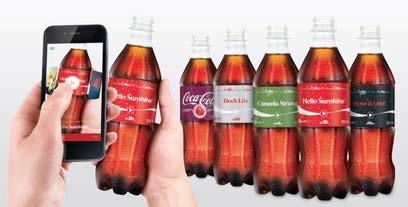
Launched last month across Canada, this year’s new and improved Play a Coke program will let consumers expand their individual music collections far and wide with more than 150 different summer-themed Spotify playlists with the purchases of 500-ml bottles of bottles of Coca-Cola, Coca-Cola Zero Sugar, Diet Coke, Coca-Cola Life and Sprite, as well as fountain cups, sold in Canada.
Using the unique Play a Coke app developed in Canada specifically for the Canadian market, consumers will be able to digitally interact with their bottle of Coca-Cola or Sprite by activating a playlist from a specially-marked bottle label by pointing their smartphones at a specially-marked bottles or fountain cup and pressing play.
Once a playlist is unlocked, users can play, pause and control song selection through the app’s innovative AR (augmented reality) feature by twisting the bottle back and forth, as well as being able to save the playlist to their Spotify account for summer-long enjoyment.
At its Annual General Meeting, the Canadian Corrugated and Containerboard Association (CCCA) elected John Pepper, Director of Sales - Mills, Atlantic Packaging as its Chairman for the new term beginning in May, 2017.
Joining him on the Executive Committee are Gary Johnson, President, Maritime Paper as Secretary/Treasurer; Jean Parent, VP Sales and Marketing, Cascades Containerboard Packaging as 1st Vice Chairman; and Jimmy Garfinkle, President and CEO, Emballages Mitchel-Lincoln as 2nd Vice Chairman. Michael (Mike) Lafave, Senior VP and COO of Kruger, Inc. becomes the immediate past Chairman. The meeting was held May 2, 2017 at the CCCA offices in Brampton. The full Board of the CCCA consists of the representatives of Canada’s major Canadian containerboard mills and corrugated converters. The Board also consists of one representative each from the Paper and Paperboard Packaging Environmental Council (PPEC) and the Association of Independent Corrugated Converters (AICC Canada).
For a full listing of the Member representatives on the Board, please visit the CCCA website: www.cccabox.org.
With an estimated 30 million specially-marked Play a Coke bottles to be distributed during the summer, Canadians will be able to download an extensive selection of their favorite summertime tunes from a diverse set list section available in both English and French, with catchy set list titles such as Dock Life, BBQ Time, Wristband Ready, Nothing But Net, and Allô l’été, among others, offering something for just about everyone.
“Music is a universal language that brings all of us together, no matter our culture or background,” says Michael Samoszewski, vicepresident of marketing at Coca-Cola Ltd.
“I’m thrilled we’re bringing back Play a Coke and making it even better with an amazing selection of new moments to make summer occasions even more memorable and fun,” he says.
“It’s a fantastic way for Canadians to enjoy ice-cold refreshment and share their personal favorite soundtracks to summer.”
GARY JOHNSON
JOHN PEPPER
JEAN PARENT
JIMMY GARFINKLE
MICHAEL (MIKE) LAFAVE
Pant manager Jean-Philippe Maurais (left) and production manager Pia-Maria Dorcal pose with the new Jeti Tauro H2500 printing press recently installed at the Cascades corrugated plant in Victoriaville, Que.
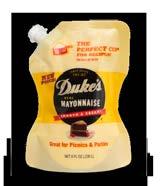
nCincinnati, Ohioheadquartered packaging products group ProAmpac has picked up two 2017 WorldStar food category awards from the World Packaging Organisation (WPO) at last month’s interpack 2017 global packaging exhibition in Düsseldorf, Germany, for the innovative packaging developed for the 100-year-old Duke’s brand of mayonnaise retailing in the U.S (see picture), and an all-new packaging concept for the JANS Marinade brand of non-dispensing marinades recently launched in the German market. “Winning these awards validates our intention to be innovative,” says ProAmpac’s chief commercial officer Adam Grose. “We planned to break the mold and we’ve done so with two popular consumer food products,” says Grose, noting the eight-ounce Duke’s brand mayonnaise pouches—incorporating a one-piece flip-top fitment manufactured by WestRock Company—uses about 95 per cent less packaging material than a comparable conventional rigid plastic container.
nMilwaukee, Wis.-headquartered industrial automation technologies supplier Rockwell Automation has awarded its annual Best Future Machine Award to Italian packaging equipment manufacturer Cama Group for the company’s new IF318 robotized monoblock loading unit—a fully-integrated, modular, roboticsassisted system leveraging Rockwell’s iTRAK intelligent track system combining liner and rotary motion control for optimal operational flexibility.
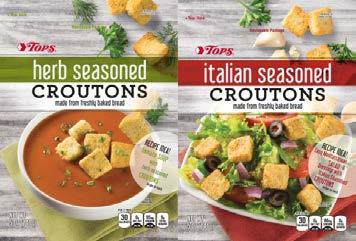
nTC Robbie, Lenexa, Ks.-based subsidiary of Montreal-headquartered flexible packaging products group TC Transcontinental Packaging has picked up the Best-of-Show award in the Wide Web/Process/Film category of the 2017 Excellence in Flexography Awards Competition of the Flexographic Technical Association (FTA) in recognition of the superior
print performance, process innovation and execution in the development of new packaging for the Tops Herb Seasoned and Tops Italian Seasoned Croutons store brands of prominent U.S. retailer Tops Markets, LLC of Buffalo, N.Y. “We brought together the best of the latest technologies in prepress, plate materials, and tooling to showcase the capabilities of flexography,” says TC Robbie’s general manager Pepper Stokes. “It is a great honor to win this award and be recognized by the industry for setting a new bar for package printing.”
nHenkel Adhesive Technologies group, part of the Düsseldorf, Germany-headquartered chemical and consumer goods conglomerate Henkel AG & Company, KGaA, has reached a definitive agreement to acquire the
NOTES & QUOTES
assets of Darex Packaging Technologies, Cambridge, Ma.-based supplier of sealants and coatings for metal packaging applications, including food-and-beverage and aerosol cans. Employing about 700 people at 20 manufacturing sites worldwide, Darex posted revenues of nearly US$300 million in fiscal 2016. “We are excited about the opportunity to add the high-performance Darex business to our existing Adhesives Technologies portfolio,” says Henkel’s chief executive officer Hans Van Bylen. “Darex’s experience in developing innovative, high-performance sealants and coatings will underpin our commitment to provide our global customers with best-in-class solutions. This business is the perfect fit for our existing portfolio serving the metal packing industry, and will therefore strengthen our position in this highly attractive and non-cyclical business.”
FIRST GLANCE
PUTTING EVERYTHING ON THE TABLE
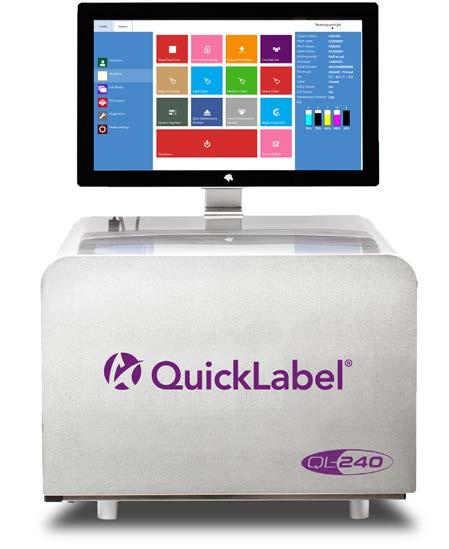
The new tabletop model QL-240 digital high-resolution label printer from the QuickLabel division of AstroNova, Inc. is an entry-level, wide-format label production system designed to offer smaller-sized brandowners and manufacturers a cost-effective JIT (just-in-time) alternative to maintaining a physical inventory of expensive, pre-printed thermal transfer labels at their facilities. According to the company, the high-speed inkjet printer provides up to 1,600-dpi resolution and print speeds of up to 12 inches per second, with built-in networking software enabling users to operate up to five printers simultaneously. Requiring minimal training and set-up time, the QL-240 printer employs an innovative airflow ventilation system to prevent ink build-up, along with a stainless-steel and aluminum enclosure to enable its use in rugged industrial environments.
QuickLabel (Div. of AstroNova, Inc.)
THINK BEFORE YOU INK
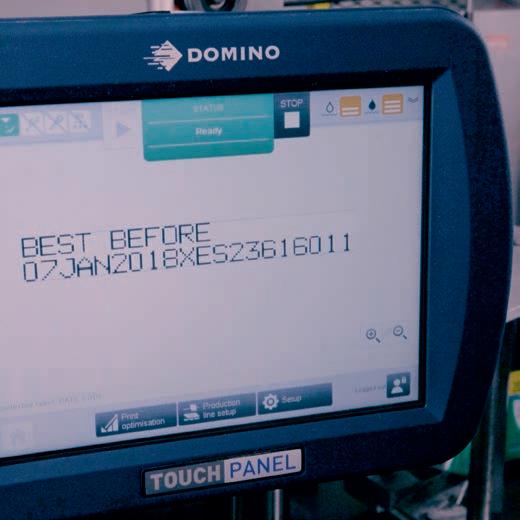
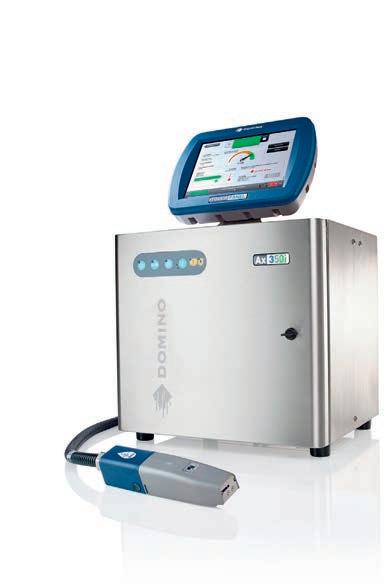
Domino Printing Sciences plc has introduced a new comprehensive i-Pulse range of CIJ (continuous inkjet) inks engineered specifically for the food and beverage packaging sectors. Compatible with Domino’s latest Ax-Series range of CIJ printers, each ink has been formulated, optimized and rigorously tested to ensure reliability, dependability and consistency to generate the highestquality codes possible, according to the company. The new inks include:
• The i-Pulse 2BK858 black fast-dry retort resistant), designed especially to resist a wide range of industrial retort (steam sterilization) processes encountered in food packaging applications for coding onto a wide ranged of rigid and plastic materials.
• The i-Pulse 1BK111 black ethanol plastic ink—a ketone-free formulation featuring excellent adhesion properties on a wide range of flexible and rigid plastic substrates used not only in food packaging, but also for beverage, dairy and personal-care products.
• The i-Pulse 2YL855 yellow ink—featuring high opacity and contrast on dark substrates—designed for marking colored returnable glass bottles and plastic kegs.
• The i-Pulse 2BK156 black fast-dry ink for coding onto both PET plastic and clear returnable glass bottles.
Domino Printing Sciences plc
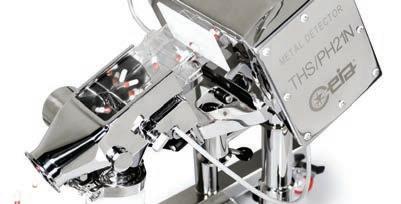
Heat and Control offers a complete line of metal detectors, checkweighers and X-ray inspection systems for pharmaceutical products from the leading manufacturers: Ishida and CEIA.
CEIA Metal Detection
The world’s largest manufacturer of metal detectors, with over 90,000 units installed. CEIA PH21-Series pharmaceutical metal detectors deliver unparalleled accuracy and sensitivity to all metals and provide high throughput rates for pills, tablets, and capsules. In addition, CEIA offers a complete range of solutions for packaged and non-packaged tablets, powders, liquids and other products; with all solutions including FDA 21CFR compliance.
Ishida X-ray Inspection
Find foreign objects including metal, glass, bone, plastic, hard rubber, shell and stones. Or detect product defects like cracks, voids, missing items and improper weights.
Ishida Checkweighers Verify product weight, count, or missing items with DACS checkweighers. User-friendly controls include advanced data collection and management features.
FEATHER IN THE CAP
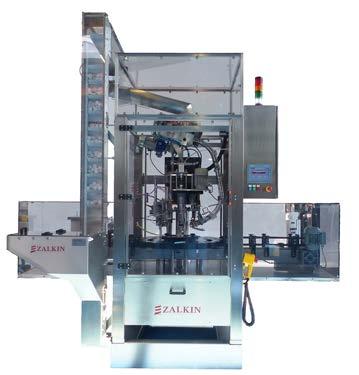
The new fully-integrated TM300 FILLCAPP filler-capper from the Zalkin division of Pro Mach, Inc. is a single-head, stand-alone capper capable of automatically filling and capping up to 30- cpm (containers per minute), and up to 60- cpm for two-station models for smaller-volume containers ranging from energy drinks to mini-bottles of distilled spirits to travel-sized personal care products, extracts, condiments, oils, etc. Boasting a compact space-saving design that eliminates the need for a separate filler, conveyor and capper, the rugged machine offers multiple benefits of quick changeovers, fast CIP (clean-in-place) capabilities, and superior fill accuracy within 0.25 to 0.5-percent of volume for a wide range of light and semi-viscous products in the food, beverage, spirits, personal-care, homecare, automotive and chemical industries. Designed to apply screw, ROPP (roll-on pilfer-proof) and push-on caps, the TM300 FILLCAPP can fill both glass as well as plastic bottles with up to five-inch diameters, and it can also be easily integrated with other systems, such as induction sealing, for enhanced operational flexibility and versatility.
Zalkin (Div. of PRO Mach, Inc.)
FEEDING TIME
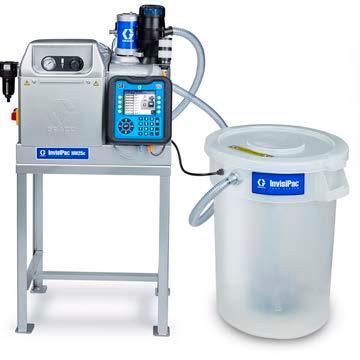
Designed to ensure reliable feed and to reduce adhesive clumping that results in downtime, the new InvisiPac Feed System from the AFD (Advanced Fluid Dispense) division of Graco Inc. is designed to work with the company’s InvisiPac Tank-Free hot-melt delivery system. It operates with a vacuum transfer pneumatic pressure range of 40- to 100- psi ( pounds per square inch) to perform automatic feeding of pellets from the adhesive bin into a fullyenclosed, chicklet feed hopper that keeps the adhesive free of dust and contaminants. The system employs an innovative internal shaker with vibrating arms that extend to the edge of the fully-enclosed hopper, which reduces air consumption needed to support external shakers, to feed from the center of the hopper—thereby eliminating adhesive build-up on one side or the other; breaking up clumps; and reducing the likelihood of bridging. Unlike other technologies that stop feeding with as much as eight to 12 inches of adhesive pellets left in the hopper, the InvisiPac Feed System is designed to keep feeding to within four inches of the bottom of the hopper, according to the company, with its quick disconnect vacuum hose assembly enabling operators to attach hoses in 20 seconds or less.
Graco Inc. (In Canada: OBX Works)
PRESSING THE POINT
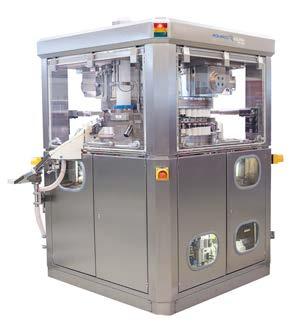
Primarily developed for packing soup cubes, the new high-speed KTS tablet press from Romaco Kilian can compress up to 3,000 cubes per minute in monolayer, bilayer and triple-layer formats, while working with even highly viscous or abrasive powders in continuous 24/7 operation. Featuring patented wear-free punch brake magnets for constant re-dosing and hydraulic overpressure, the robust machine’s patented bellows protect the tablets from contamination with lubricants during compression to ensure optimal product quality and process reliability, while also maintaining strict separation between the compaction and service areas to prevents tablet dust from entering the machine compartment during the production process.
Romaco Group
STICKING TO THE PLAN
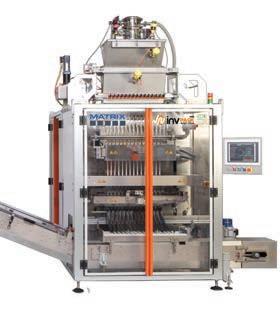
The INV Pack flexible packaging business unit of Pro Mach, Inc. has developed a new feedback filling-and-checkweighing system for ensuring high-speed and accurate weight for pharmaceutical packaging of powders packaged in stick-packs. Achieving repeatable high accuracy within 0.05-gram per pack at production rates of up to 1,000 stick-packs per minute, the new PH Series 600 and PH Series 900 multilane stick-pack machines feature a highly reliable quality assurance system based on feedback loops, embedded in each stick-pack lane, and servo-controlled augers feeding the powder into the lanes. According to the company, this design effectively solves the weight assurance problems typically found with volumetric filling of powders, where changes in humidity can result in unintended changes to product weight. Designed to form, fill, and seal stick-packs for powders, granulates, liquids and pasty products for the pharmaceutical, nutraceutical, dairy, food and cosmetics industries, both PH Series machines feature a fully-closed frame for clean operation, along with high-quality laser printing and pack scoring capabilities.
INV Pack (Div. of Pro Mach, Inc.)
COLD COMFORTS
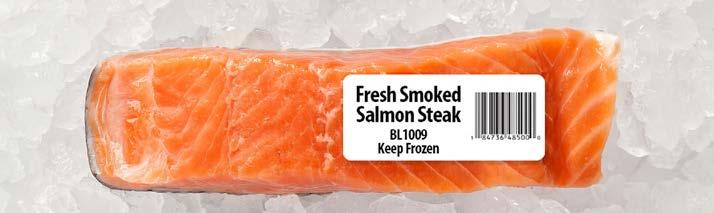
Developed specifically for cold-temperature applications, the new Flexlyte Arctic 300 label material from Weber Packaging Solutions is a white, quicktack film incorporating high-strength adhesive to make it adhere reliably to food packages handled in wet, damp and freezer conditions, according to the company, as well as for use with the high-resolution color primary labels commonly used in frozen-food packaging.
Weber Packaging Solutions
THE CHICKEN RUN
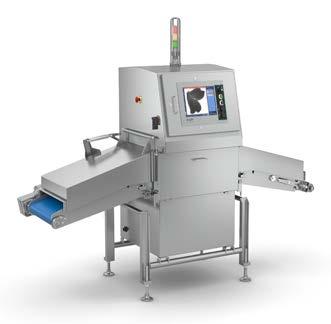
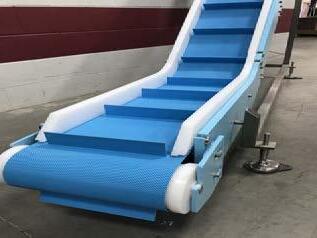
Distributed in Canada by PLAN Automation, the new RMI 400 X-ray inspection system from Eagle Product Inspection was designed specifically for demanding poultry processing applications with very strict sanitary and hygienic requirements. Unlike traditional X-Ray systems that employ protective curtains to ensure radiation emissions are kept to a safe level, the RMI 400 machine uses an innovative conveyor system designed to incline at a gradual angle on the infeed and discharge to create a curtain-free tunnel. Featuring unobstructed sightlines, open and contoured surfaces that minimize potential contaminant harboring areas, while facilitating fast visual inspection, the entire machine can be disassembled by a single person in minutes for sanitation.
Eagle Product Inspection (In Canada: PLAN Automation)
DIAMONDS IN THE ROUGH
The DynaClean conveyor line from Dynamic Conveyor Corporation now offers ThermoDrive embedded diamond-top belting as an extremely handy option for conveying sticky products with minimal product loss. According to the company, the new belting ensures superior release of sticky product because the diamond pattern is embedded not only into the surface of the belt, but also both sides of the drive flight and the synchronized sidewalls—making them especially useful for hygienic food-processing applications.
Dynamic Conveyor Corporation
GET INFORMED AT THE
Laura Studwell, Packaging Industry Marketing Manager at Omron discusses the importance of flexibility in today’s industrial market.
Doug Alexander, Director of Engineering at Ippolito Group, talks about how to integrate processing, packaging and machine automation.
Simon Small, Vice President Marketing of Ultima Foods, discusses the crucial role played by new package designs in launching new yogurt products.
Register now to book your seat at these presentations at the Top 50 Packaging Ideas Table Top Exposition & Conference.
Attendance and parking are FREE, but you must register in advance to save your seat.
After you listen to our speakers, take a tour of our Top 50 Packaging Ideas Expo and find your next great packaging idea.
WHERE: Mississauga Convention Centre, 75 Derry Road West
WHEN: October 24. Conference speakers start at 9:30 am REGISTER AT www.top50packagingideas.com
For questions about the show or Sponsorship options, contact:
Stephen Dean at 416-510-5198 or Adnan Shah at 416-510-5117
LEADING U.K. BEVERAGE PRODUCER TAKES THE LEAD ON SUSTANABILITY
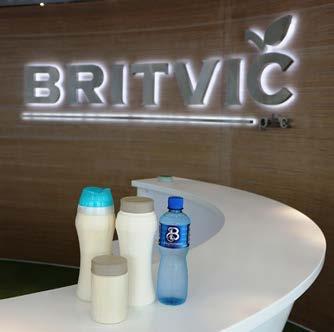
As Britain’s largest branded soft-drink bottler and distributor, Britvic PLC is keenly aware of the social obligation to reduce the environmental footprint of its operations—starting right at its bottling lines.
An active participant in the far-reaching $450-million supply chain investment program launched a year ago by the U.K.’s so-called FTSE 250 Index companies— consisting of the 101st to 350th largest companies listed on the London Stock Exchange —the company claims to have taken significant steps towards exploring wood fiberbased bottles as a viable packaging option for multiple sectors.
In partnership with government agencies Innovate UK and Natural Resources (2000) Ltd., the soft-drink producer “has been working to revolutionize packaging with sustainably sourced, renewable wood fiber materials which are fully recyclable,” according to Britvic’s chief supply chain officer Clive Hooper.
“At Britvic, we know that to be a successful business in the long-term we must be a sustainable business,” says Hooper, “and this means listening to the needs of our consumers, our customers, our communities and our employees.”
Founded in mid-19th Century under the British Vitamin Product Company moniker, the Hemel Hempstead-headquartered firm has really hit its stride in the new millennium as a licensed bottler of popular PepsiCo brands such as Pepsi , 7UP and Lipton Ice Tea , along with growing its own product portfolio comprising the bestselling Robinsons, Tango, J2O, Fruit Shoot , Teisseire and MiWadi brand beverages.
“We understand that packaging and the environmental impact of waste is a major concern, and we are committed to working collaboratively with others to explore innovative solutions,” says Hooper.
“The wood fiber bottle is a great example of what potentially can be done,” he states, “and its development has provided great insight into what will and won’t work in terms of quality standards and mass production in the future.”
“We’re now working hard to take our learnings from the fiber bottle development to investigate fiberbased sustainable packaging materials further.”
As part of its sustainability initiatives, Britvic invested nearly $40 million at its beverage plant in Leeds to install a brand new high-speed bottling line that has already yielded a 22-percent reduction in water use and 45-percent savings in energy consumption, according to the company.
The new line also allows the bottler to blow and fill much lighter bottles than before, thereby reducing the amount of plastic packaging needed per year by 155 tonnes per year—the equivalent weight of over 10 double-decker buses.
Other investments in upgrading equipment and processing techniques aimed at improving water efficiency enabled the company to reduce its overall water use by 0.4 per cent in the past year, according to Hooper, despite a 0.7-percent increase in production volumes.
“This saving is equivalent to the volume of water needed to fill five Olympic swimming pools,” Hoover points out, adding the company has also sent “zero waste” to U.K. landfills last year, while maintaining a nearly 92-percent recycling rate for its bottles.
PERFECT FINNISH FOR GREENER POUCHES
While stand-up pouches remain one of the fastest-growing packaging formats in the world, the use of bio-based materials to make them has been held back over the years due to their inability to achieve effective barrier properties similar to plastic pouches made from fossil fuels.
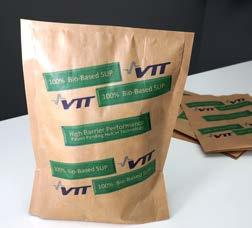
But that may be about to change soon, thanks to some breakthrough research work done by the VTT Technical Research Centre of Finland Ltd. in Otaniemi, Finland, where researchers claim to have developed a 100-percent bio-based stand-up pouch with vastly improved oxygen, grease and mineral oil barrier properties by using different bio-based coatings on paper substrate.
According to VVT, the new pouches use a breakthrough patent-pending HefCel (highconsistency enzymatic fibrillation of cellulose) technology to achieve a tenfold increase in solids content of wood-derived nanocellulose FILMSs.
“Our HefCel technology exploits industrial enzymes and simple mixing technology as tools to fibrillate cellulose into nanoscale fibrils without the need for high energy consuming process steps,” explains VTT’s senior scientist Jari Vartiainen.
“The densely packed structure of nanocellulose films and coatings enable their outstanding oxygen, grease and mineral oil barrier properties,” he says, adding that nanocellulose has shown itself to be potentially useful for a wide range of future technical applications.
“One-third of food produced for human consumption is lost or wasted globally,” he says, “and packaging with efficient barrier properties is a crucial factor in the reduction of this enormous food loss.
“Our solution offers an environmentally-friendly option for the global packaging industry to achieve that goal.”
STACKABLE CONTAINERS GET A GREEN THUMBS-UP
Reaping what you sow is all in the day’s work for modern-day crop producers and their suppliers, who are increasingly pressed to adopt cleaner and greener ways to bring their products to market.
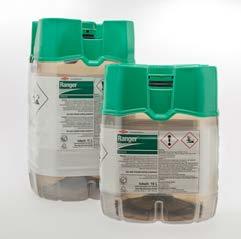
For the U.S.-based Dow AgroSciences LLC, a wholly-owned subsidiary of Dow Chemical Company specializing in the production of pesticides, herbicides and other crop protection solutions, the company’s eco-sensitive mindset is an integral part of its packaging strategy and execution, as reflected in the recent launch of new 10and 15-liter custom-made containers offering an impressive range of environmental benefits.
Produced by the German-based RPC Promens Industrial and RPC Promens Innocan—both subsidiaries of leading global plastic products conglomerate RPC Group —the new bespoke containers feature a speciallydesigned safety top that enables them to be securely stacked on top of one another on the shipping pallets without a need for secondary paperboard or corrugated packaging—resulting in improved logistics, easier handling, and reduced environmental impact for a broad range of liquid crop protection formulations produced by Dow AgroSciences.
containers they replaced, the new packs’ square design provides vastly excellent strength and durability, according to RPC, as well as improved handling for the end-user.
“It also delivers an efficient palletizing pattern for increased pallet loads to optimize logistics in terms of both pallet-fill and truck-fill rates,” according to a spokesperson for the Dow AgroSciences’ EMEA (Europe, Middle East and Africa) packaging team, citing a 20-percent carbon-footprint reduction per liter over the life-cycle of the bottle, compared to the currently-used HDPE ‘jerry can’ design.
“The new packs represent a major advance in terms of their lightweighting, improved logistics and elimination of the outer cases,” says Dow AgroScience.
“We are delighted with the solution from RPC, and with their enthusiasm and commitment throughout the development of the project.”
Said to be about 30-percent lighter than the HDPE (high-density polyethylene)
Recently selected as Best Packaging Innovation in the recent Agrow Awards competition of the U.K.-based Agribusiness Intelligence market information group, the new containers feature a centered 63-mm neck compatible with closed transfer systems and allows for easier pouring, with its bore seal caps minimizing the operator’s exposure to the product and requiring no additional sealing.
Smart Packaging & Smart Retail: Connecting Brand Owners and Retailers with Next Gen Consumers October 17, 2017
SMART PACKAGING is an active or intelligent interactive packaging system that delivers benefits and added functionality to the value chain. The Global Smart Packaging Market is exploding and is poised to reach approximately $26.7 billion by 2024, according to a report by Research and Markets.
The GET SMART SUMMIT is an inaugural intelliPACK event to mobilize industry to accelerate the development and adoption of SMART PACKAGING innovations.
What will you will learn?
The latest industry developments and forecasts of their potential impact on the global market for smart packaging. Who should attend?
Retailers, Brand owners, Brand and Design Agencies, Packaging Engineers, Technology Developers, Equipment and machinery suppliers, Packaging converters, Raw material suppliers, Consultants and analysts, Logistics, End of Life/Recycling
Key Drivers, Trends, Technologies and Markets
IoT, Analytics, Changing Consumer, Changing Retail, Brand Interaction, Increased installed base of smartphones, Anti-counterfeiting and brand protection, Track and Trace, Cutting food waste, Secure supply chains, Printed electronics, Engineered Materials, Improved Modified Atmosphere Packaging, Waste/ Recycling
Sign up and become an intelliPACK Founding Member with these leaders
SPRINGING INTO ACTION
An upstart
Ontario mineral water producer puts packaging sustainability at the front and center of its branding message to offer consumers a planet-friendly choice
BY GEORGE GUIDONI, EDITOR
PHOTOS BY NAOMI HILTZ
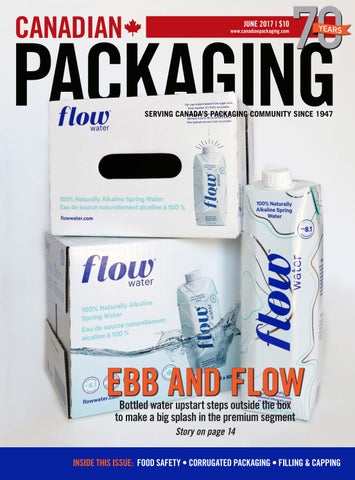
Every startup business has a lot of ebbs and flows to get through on the way to growth and commercial success. But if early days are any indication, the recently commenced Flow Water water-bottling operation in Aurora, Ont., is catching the rising tide of consumer demand for more environmentally responsible and sustainable products just at the right time.
Whatever the new company’s fully-rebuilt 21,000-square-foot processing and packaging facility may lack for now in terms of volume and throughput capacity, company founder and chief executive officer Nicholas Reichenbach is clearly poised for a long run in the increasingly crowded marketplace for premium bottled-water products.
Sourced from a glacial spring on Reichenbach’s family property in South Bruce County, in close proximity to the Lake Huron shoreline, the one-of-a-kind spring water is said to contain natural electrolytes and minerals such as calcium carbonate, magnesium, potassium and zinc, with the water levels continually replenished by rainwater that takes decades to trickle trough the earth’s surface into the limestone aquifer underground.
With the spring’s origins traced back to about
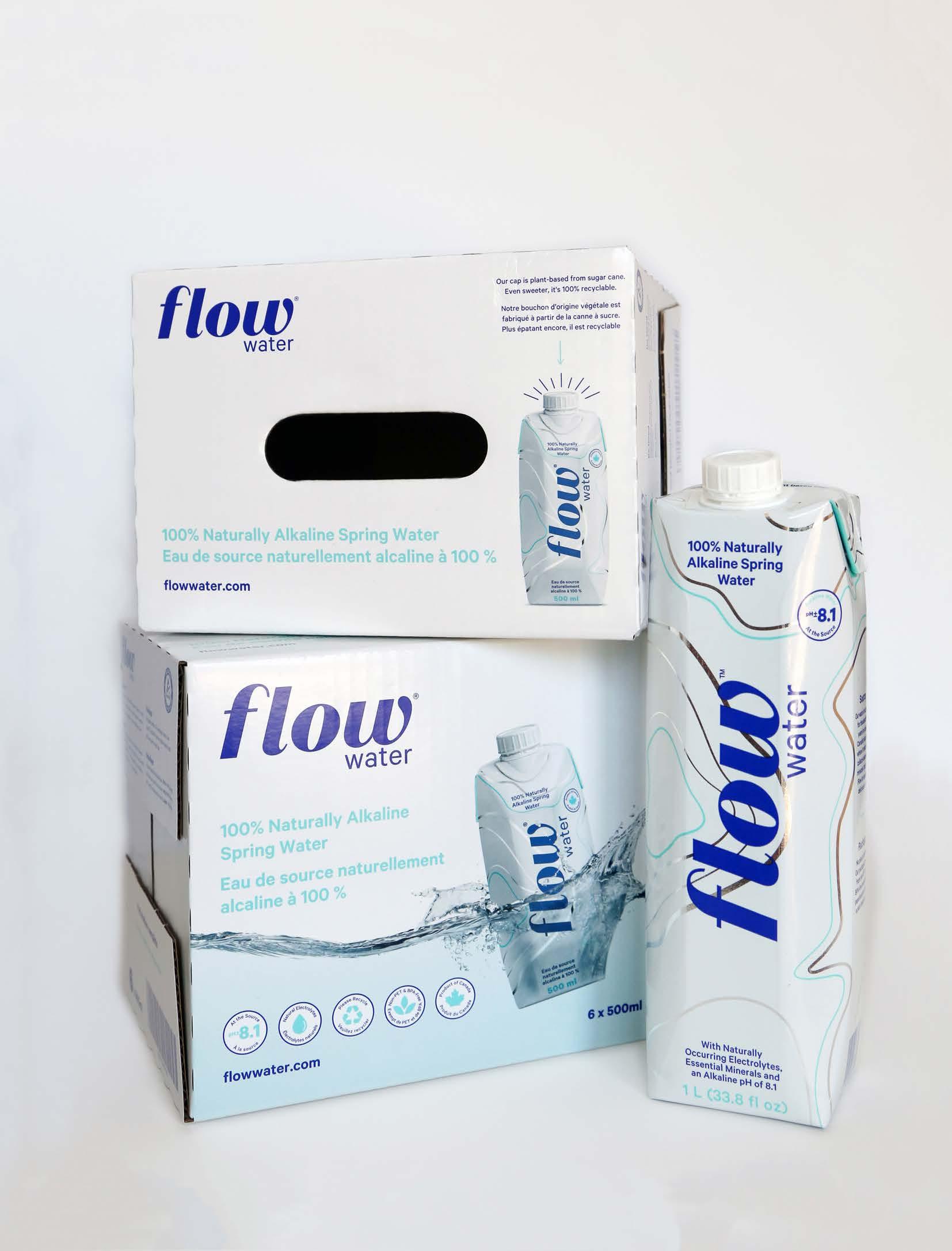
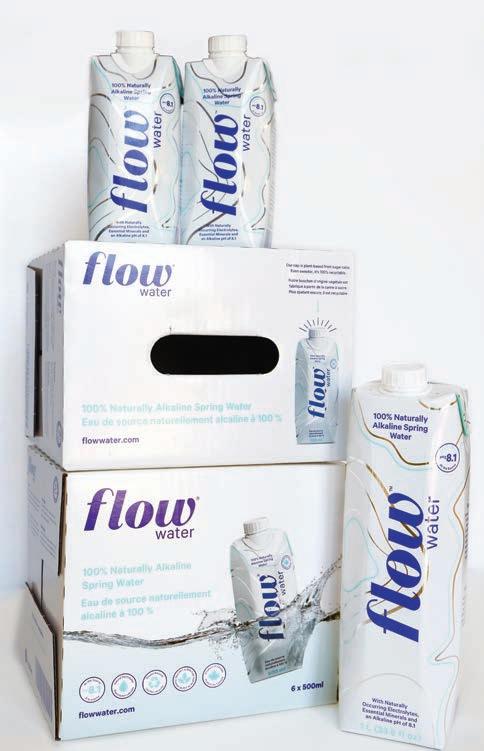
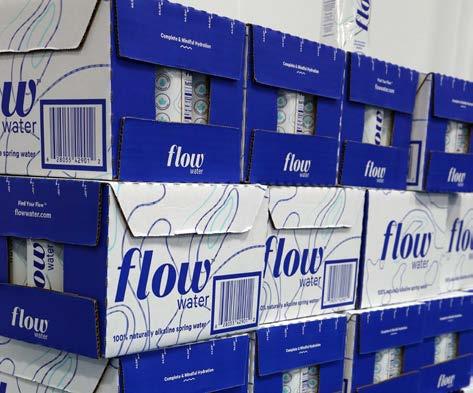
Decorated with clean-flowing and soothing graphics designed by Toronto-based agency Jackman Reinvents, the Tetra Prisma Aseptic cartons of Flow brand mineral spring water, packed inside corrugated boxes manufactured by Cascades Inc., are the first North American branded product to be topped off with Tetra Pak’s renewable DreamCap caps made from sugar cane, which are also 100-percent recyclable.
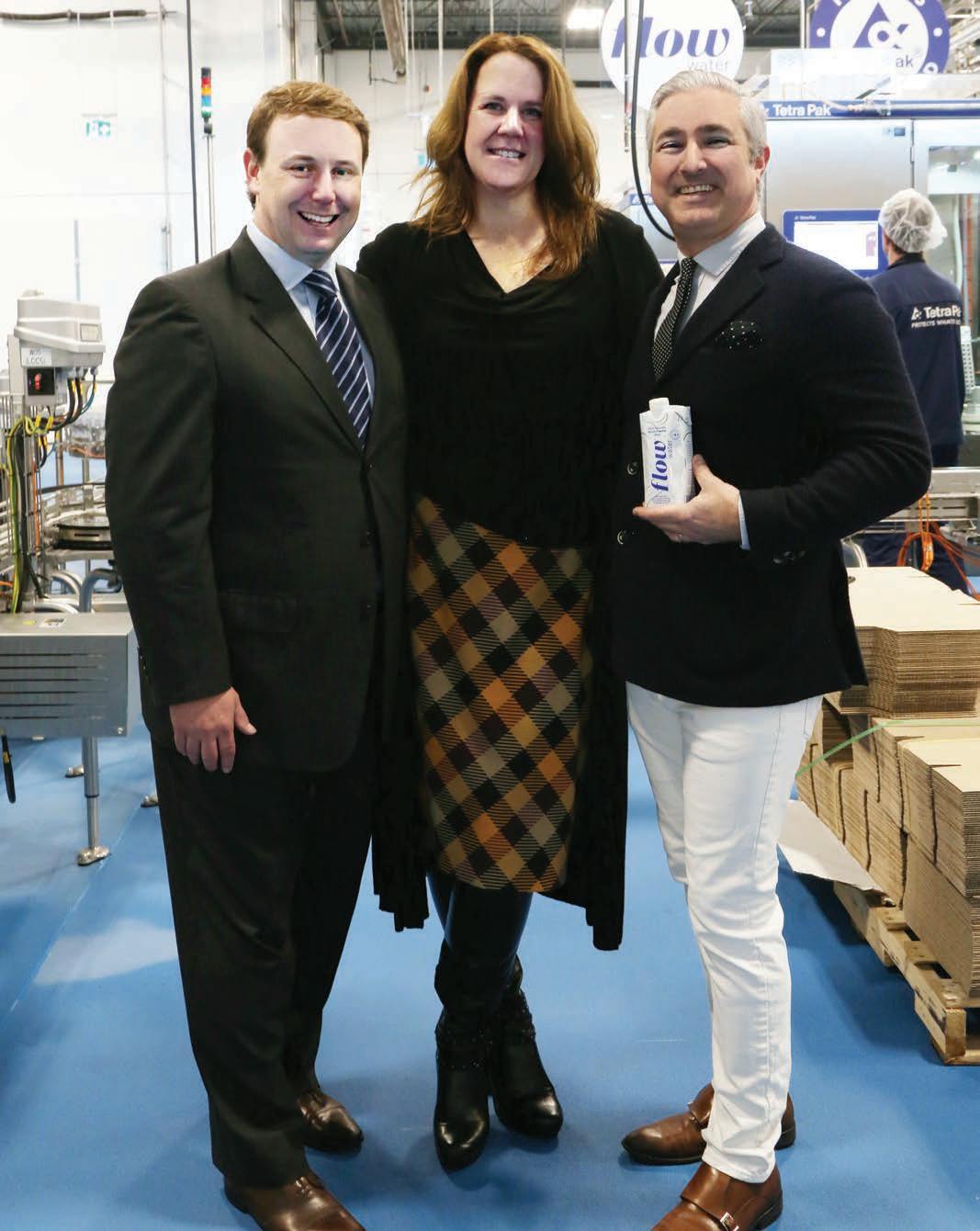
Tetra Pak Canada’s managing director Scott Thornton (left) and Carmen Becker, Tetra Pak’s managing director for U.S. and Canada, join Flow Water’s founder and chief executive officer Nicholas Reichenbach during the public unveiling of the company’s first production facility in Aurora, Ont.
from the top
comprises a
the
the
Cardboard Packer 32 automatic case-packer
eye
10,000 years ago, the water’s purity and all-natural origins make it a true premium product, according to Reichenbach, who first started marketing it in Canada back in 2015.
But rather than selling it in industry-standard PET (polyethylene terephthalate) plastic containers, Reichenbach made a conscious decision to bring the Flow brand water to market in fully-recyclable aseptic beverage cartons made mainly from renewable resources manufactured by leading global aseptic food processing and packaging systems manufacturer Tetra Pak
While Flow is currently available in both Canada and the U.S., it was originally co-packed in Canada. Now with the new plant online, Flow will now selfmanufacture in Canada and continue to sell in both countries.
Reichenbach decided the time was right for the company to begin filling its own Tetra Pak water cartons full-time, rather than rely on outside co-packers.
For now employing 10 full-time production people, the Flow Water plant’s day begins with an earlymorning delivery of a 45,000-liter tank filled with the mineral-rich, naturally alkaline water harvested at Reichenbach property’s spring.
“For now, this is the amount of water we need to supply a full day’s production needs,” Reichenbach told Canadian Packaging on a recent visit to the Aurora facility.
After being transferred inside massive stainless-steel holding tanks positioned near the plant’s receiving doors, the water is continuously fed into the attached Viquae UV sterilizing and filtering systems to remove any impurities, after which it’s ready to proceed to the state-of-the-art, fully-integrated, high-speed turnkey packaging line installed earlier this year by Tetra Pak Canada Inc.
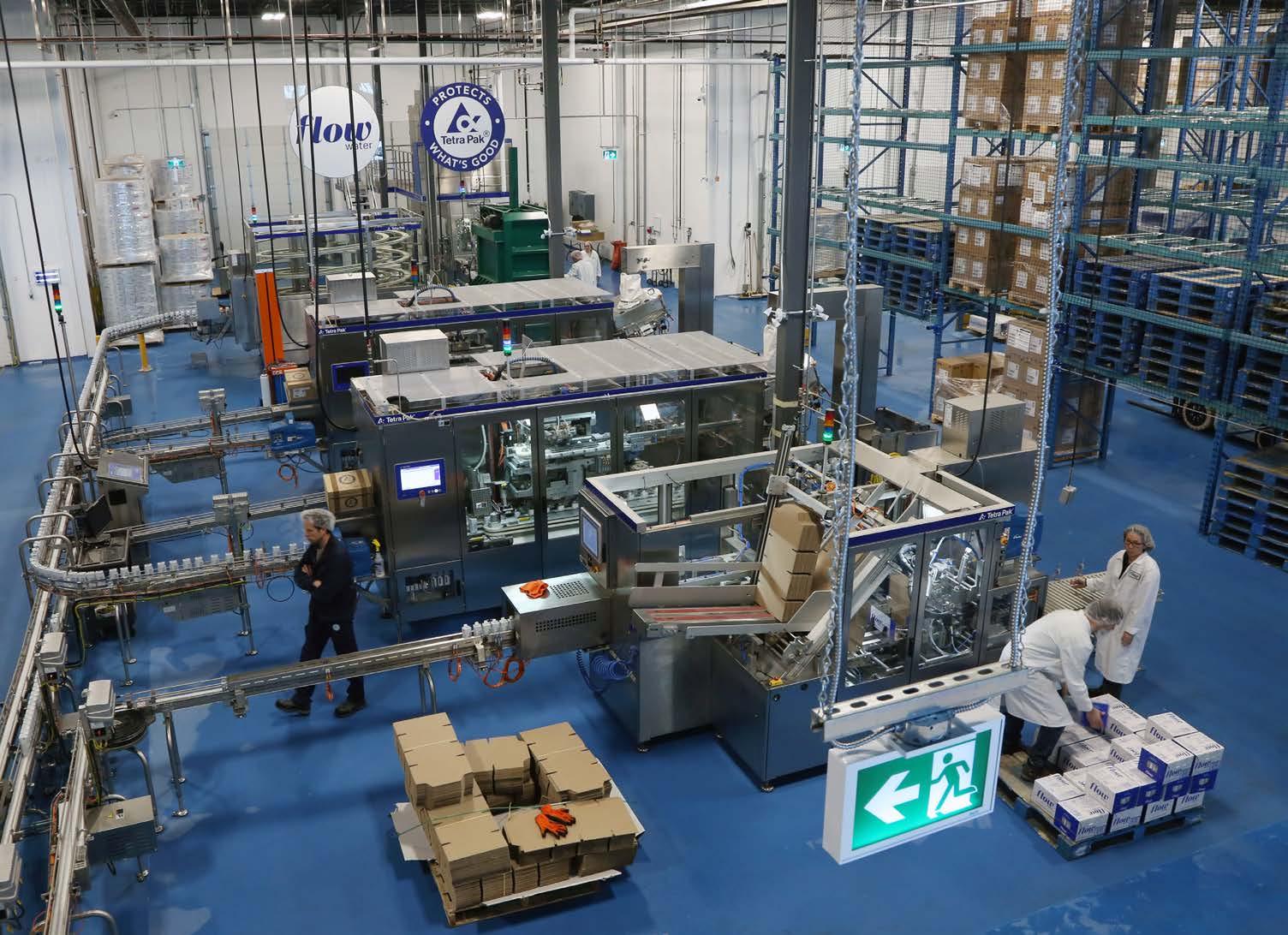
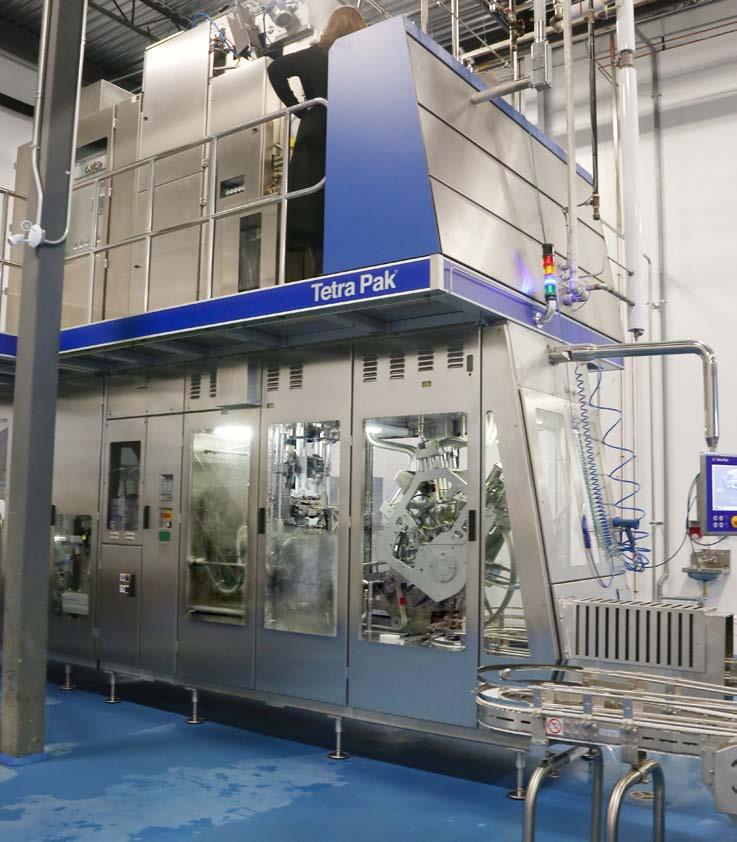
All linked together through a series of Accumulator Helix 10 product transfer and accumulation conveyors, the spanking-new line comprises a high-performance Tet-
Captured
of
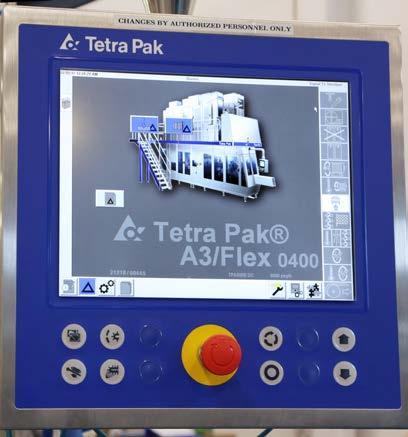
Tetra Pak A3/Flex aseptic filler,
bird’s
view of the Flow Water plant’s packaging area demonstrates the efficient design of the entire packaging line, which
Tetra Pak
(foreground), two side-by-side Tetra Pak Capper 30 Flex cap applicators, and a network of interlinked Tetra Helix conveyors.
The towering high-speed Tetra Pak A3/Flex Aseptic filler at the Flow Water production facility provides robust throughput speeds of up to 8,000 Tetra Prisma Aseptic 500-ml cartons per hour, and up to 7,200 cartons per hour for the one-liter boxes.
ra Pak A3/Flex filling machine; two Tetra Pak Cap Applicator 30 Flex cap applicators; and a Tetra Pak Cardboard Packer 32 automatic case-packing system.
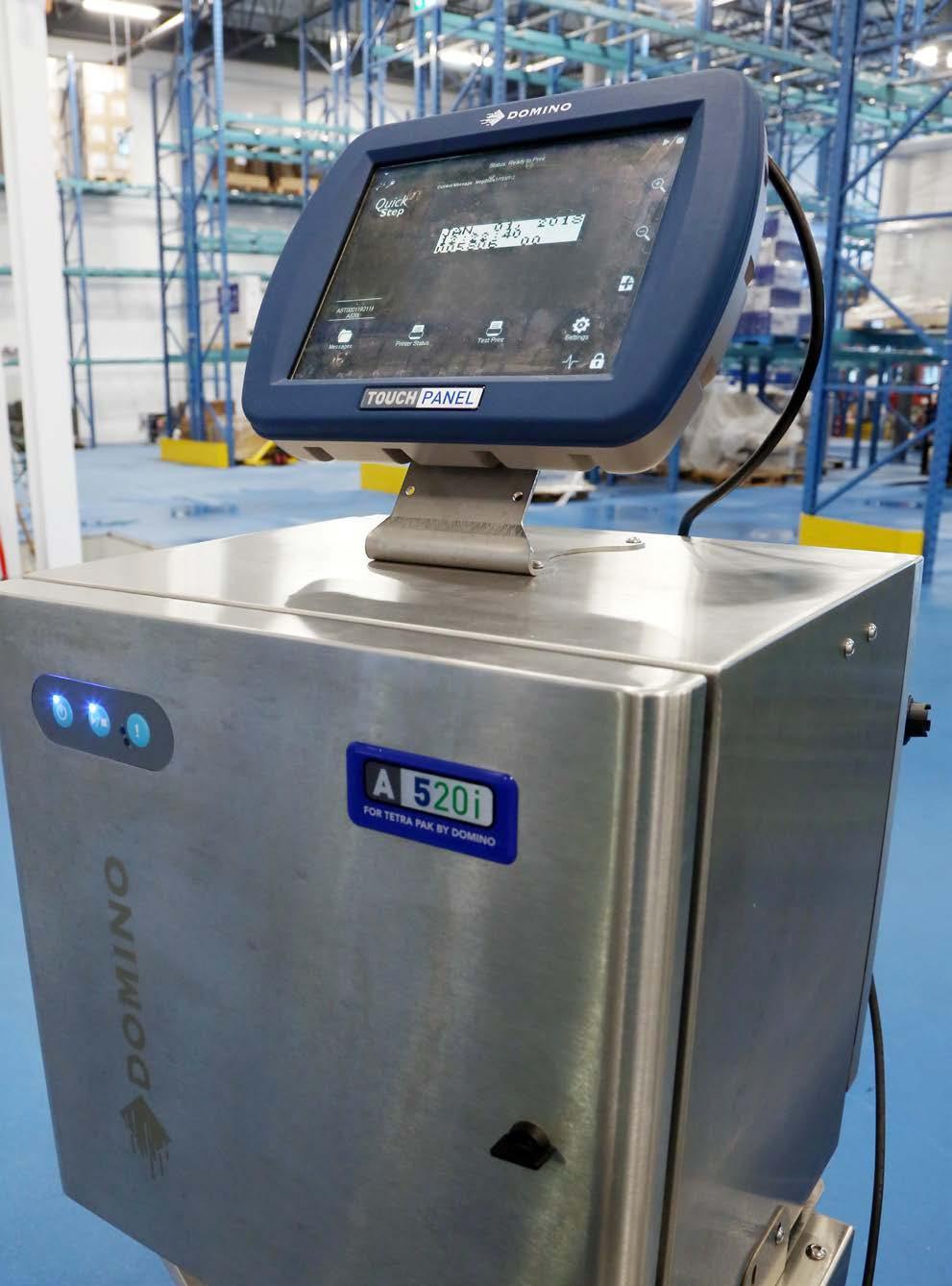
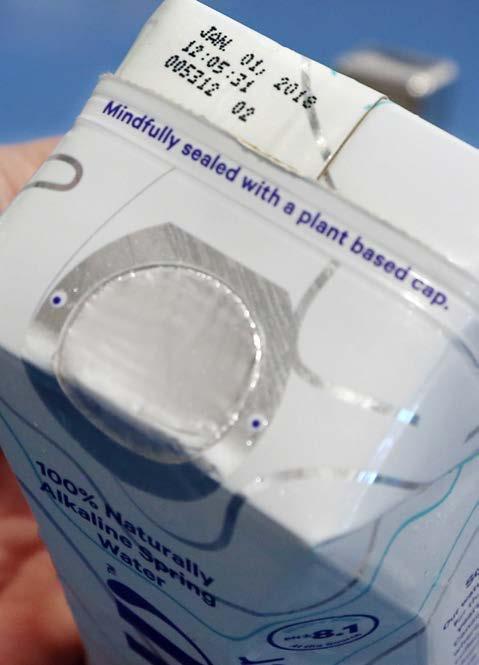
To apply product codes coming off the Tetra Pak A3/Flex filler, the line employs a model A520i continuous inkjet (CIJ) coder manufactured by Domino Printing Sciences plc, a long-time strategic technology partner of Tetra Pak worldwide, to print three lines of small-character product codes and variable product information in the top left corner of each box’s top panel.
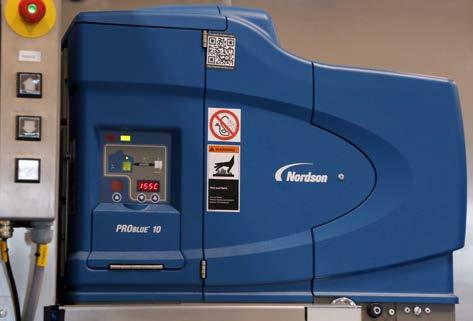
The line also uses the high-performance ProBlue series adhesive applicators, manufactured by Nordson Corporation, on both cap applicators and on the case-packing machine—using specially-formulated,
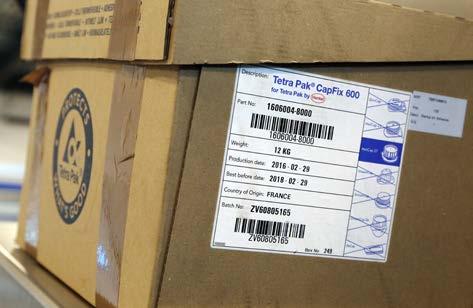
food-safe hot-melt adhesives custom-made for Tetra Pak by Henkel Adhesives Technologies
All hooked up and synchronized to run all of the machines in perfect unison, the Tetra Pak line can produce up to 7,200 one-liter cartons, and 8,000 finished 500-ml drink boxes, per hour.
“That’s about two cartons per second, which is pretty fast in my books,” says Reichenbach, while lavishing praise on the sleek, multipaneled Tetra Prisma Aseptic Edge cartons tastefully decorated with the brand’s logo and basic product information set in deep blue against a mostly white background.
“I am very happy about our collaboration with Tetra Pak because it allows us to go about our business in the most environmentally-friendly and progressive way
possible,” sates Reichenbach, noting that Flow Water is actually Tetra Pak’s first North American customer to begin using the new bio-based DreamCap resealable closures (for 500-ml boxes) made from bioplastic polymers derived from sugar cane.
“We are the only water company to be using Tetra Prisma Aseptic cartons with caps made from sugarcane to differentiate ourselves from the competition, whose products are invariably packaged in plastic or glass,” Reichenbach explains.
“Compared to plastic or glass, there is no question that packaging our water in BPA-free renewable packaging is better for the consumers and better for the environment,” he states.
“There is a whole new younger generation of consumers out there embracing the ‘better for you’ products and packaging,” he says, noting that there were about a half-billion Tetra Prisma Aseptic cartons of coconut water sold last year in North America alone.
“Consumers are becoming used to seeing more natural hydration products being packaged in shelf-stable aseptic cartons, and I believe that this is a perfect format for the ‘grab-and-go’ products like ours.”
Says Reichenbach: “We conducted extensive research with Tetra Pak to ensure that the tiny bit of polypropylene film lining on the inside of the cartons left no residual ‘cardboard’ taste in our water.
“We spent a considerable amount of time to make sure that there is no taste compromise with our product,” says Reichenbach, noting that the Tetra Pak cartons also do a much better job at keeping the water cool longer than any disposable plastic container, due to an aluminum layer embedded into the carton’s construction just beneath the lidding.
“Recent market research shows that 40 per cent of North American consumers really care about where their brand’s packaging is sourced, and the inherent renewability of the lion’s share of Tetra Pak cartons’ raw materials is definitely an important factor in their decision-making,” adds Tetra Pak Canada’s managing director Scott Thornton, citing the company’s long-stated strategic goal to develop a 100-percent renewable package for commercial use, with one such gabletop carton
The Tetra Pak A3/Flex filling line employs Domino’s high-speed model A520i continuous inkjet printer to apply three lines of crisp small-character product codes and other variable product information atop each passing Tetra Prisma Aseptic carton.
already available in Europe for chilled products.
“The last remaining stumbling block to full renewability is the aluminum,” Thornton says, “but we are making steady progress towards developing an aluminum-free structure down the road.”
Says Thornton: “The DreamCap closure was designed with consumers at hear: we went to understand what consumers needed, what they wanted to hear and what they expected from their packaging.
“The DreamCap has a wide 26-mm opening to help the water flow easier, it is totally resealable and, of course, it is bio-based and renewable, with all the safety and convenience features the consumers expect.”
According to Reichenbach, the Flow brand water’s pH of 8.1 is extremely rare in the mineral water business, with this level or purity enabling the brand to compete in the premium water segment against the likes of the popular Fiji and evian water brands.
“In fact, we are the only Canadian mineral spring water company in the market,” says Reichenbach, adding there is only one other spring in North America with similar purity and other quality attributes to Flow Water’s spring.
“People drink Flow brand water because it has a lot of minerals and calcium that convert acidity to base in their bodies to reduce inflammation,” he relates,“while the magnesium in the water produces the natural electrolytes that act as a super hydrator.
“If you were to make ice cubes with this water,” he adds, “you would actually be able to see some mineral and calcium deposits forming underneath.
“We do not do any kind of industrial processing with our kind with Flow water: we put nothing in and take nothing out.”
Happily for Flow Water, product supply is not a problem, as Reichenbach explains.
“Because the spring is in artesian condition, there is about a million liters of water a day that is naturally released into the environment,” he says, “and we just take out a tiny fraction of that amount.”
For now retailing Flow in six-packs of 500-ml cartons and in single oneliter boxes, the company used the services of Toronto-based boutique design studio Jackman Reinvents to design the graphics and other key branding elements for the pre-printed Tetra Prisma Aseptic boxes, which are continuously rollfed onto the line to keep the Tetra Pak A3/Flex filler running at optimal speeds.
“The company’s owner, Joe Jackman, is actually a board member and a major investor in Flow Water, with many years of experience working with some multibillion-dollar brands,” Reichenbach reveals.
“So you can tell he really poured a lot of heart into designing a package that would enable us to compete against the evians of this world in the premium water category, while giving consumers the option of picking something better.”
As Reichenbach explains, the curvy metallic foil lines running across the Tetra Prisma Aseptic cartons in seemingly random manner are actually a topographical representation of the spring’s aquifer.
“The fact that it’s made in Canada and introduced into the market on the eve of Canada’s 150th birthday, is also something that should strongly resonate with the Canadian consumers,” Reichenbach reasons.
“People love this product not only because they can feel good about the packaging, but also because it’s the only Canadian premium water out on the market,” says Reichenbach, adding the company will be running a concerted With Love from Canada promotional campaign throughout the summer months, which will include special on-pack graphics featuring the Canadian flag
Stay ahead of equipment fixes, so the lines are always humming.
Track and manage your assets coast-to-coast on Canada’s largest LTE network1. Gather and share data and information from the assembly line to the transportation of goods. By analyzing and optimizing that data, you can remotely monitor assets and increase efficiency while reducing downtime.
Run your business better with IoT solutions from Bell.
Partner today. Visit bell.ca/iot
COVER STORY
Continous Motion MonoBlock System PRIMARY PACKAGING SOLUTIONS
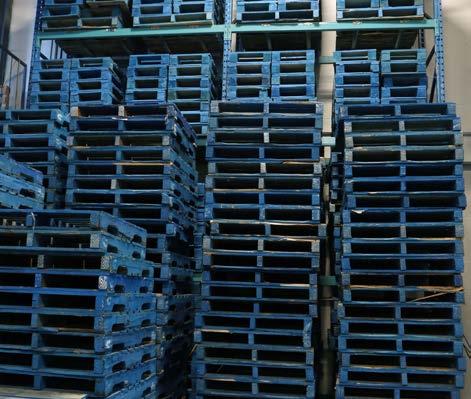
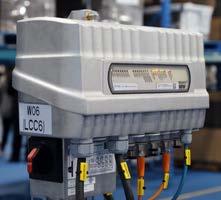
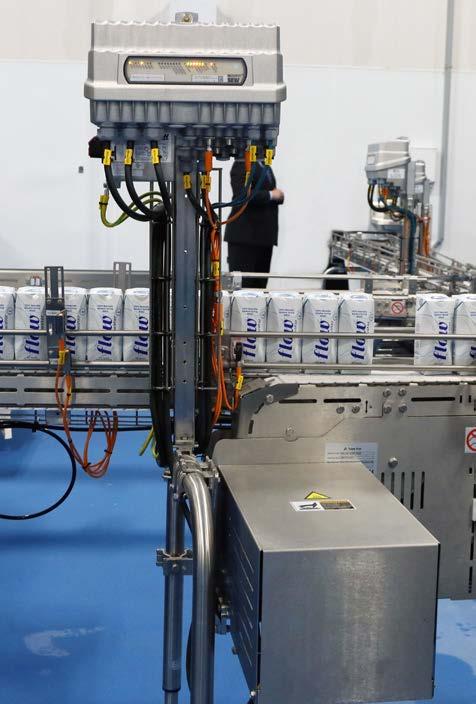
Clockwise from top left: Some of the essential packaging line supplies and machinery components at the Flow Water plant include the Cascades-made preprinted corrugated shipping boxes; signature-blue distribution pallets supplied by CHEP Canada; Movifit decentralized drive controllers from SEWEurodrive; ProBlue 10 hot-met adhesive applicating systems from Nordson Corporation; and specially-formulated hotmelt adhesives developed exclusively for Tetra Pak equipment by Henkel Adhesive Technologies.
and ‘Happy Birthday Canada!’ brand messaging.
Already retailing at about 4,500 retail locations across Canada, Reichenbach expects to expand that base to about 5,200 locations, citing strong interest from leading retailers like Loblaws, Sobey’s, Rexall, Metro, London Drugs and other retail industry leaders, as well as a multitude of independent grocers.
Similarly, he expects the number of U.S. outlets retailing the Flow band to grow from 500 to over 2,000 by the summer’s end.
“Some locations actually have us listed twice, stocking right next to all the massproduced plastic bottles, but also in the stores’ all-natural product sections,” Reichenbach relates.
Says Reichenbach: “Every entrepreneur ultimately wants one main thing: people loving your work.
“From what I have observed so far, people really love Flow water for how it tastes, how it makes them feel about the product’s environmentally-friendly packaging, and for how much care we take in delivering this product to them in its all-natural state, with no industrial processing.
“We see the consumers’ strong positive reaction all over the social media with postings from many celebrity and everyday brand loyalists,” he says, “and we are also very encouraged by the product velocity numbers gathered by our retail partners.
“We are already Number One in Canada in the alternative boxed water product category,” Reichenbach concludes, “and we have every reason to be optimistic going forward.”
Please see an online video of the Tetra Pak A3/Flex packaging line in action at the Flow Water plant on Canadian Packaging TV at www.canadianpackaging.com
SUPPLIERS
Tetra Pak Canada Inc.
Domino Printing Sciences plc
Nordson Canada, Limited
Henkel Adhesives North America
Cascades Containerboard Packaging
SEW-Eurodrive Co. of Canada Ltd.
CHEP Canada Inc.
Viquae UV
Jackman Reinvents
FILLING & CAPPING
After expanding its manufacturing base from Calgary and Vancouver into Toronto in 2016, Big
is a cost-effective, high-accuracy filling line designed specifically to suit the lower-throughput requirements
EAST MEETS WEST
Thriving Alberta brewer sets up shop in Toronto to pursue assertive growth strategy aimed at expanding its market reach and customer base
BY ANDREW JOSEPH, FEATURES EDITOR
PHOTOS BY NAOMI HILTZ
Much has been said in recent years about storied iconic Canadian beer brands being acquired by foreign-owned multinational brewing conglomerates—not all of it complimentary to say the least.
But thanks to companies like Big Rock Brewery Inc., there seems to no shortage of a new crop of Canadian-owned brewers willing and able to keep supplying the market with genuine made-in-Canada suds to a new, more discerning generation of Canadian beer-lovers proud to support the domestic beermakers—both on patriotic principle and well-earned merit.
Founded in Calgary in 1985 by the late Ed McNally to create a “beer that he wanted to drink, not what would be popular,” according to the company’s website, Big Rock has gone on to become a well-recognized player on the Canadian beers scene.
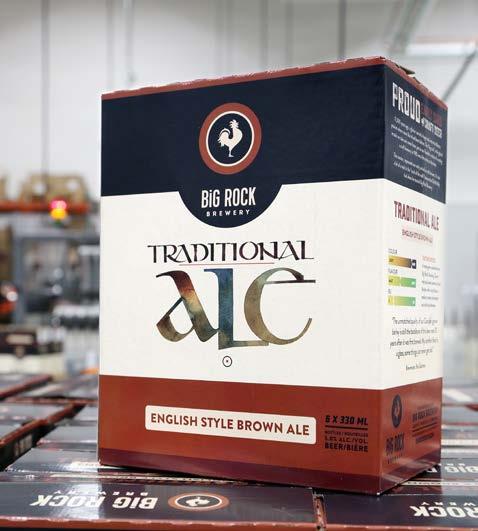
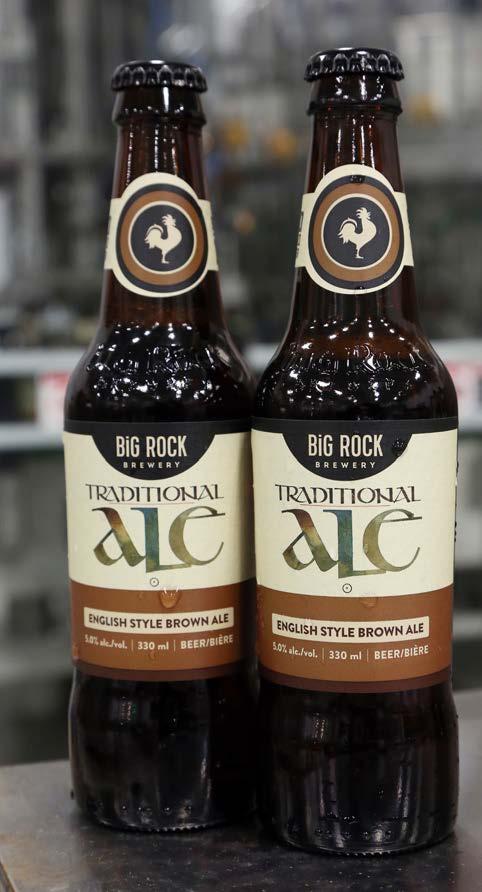
Naming itself after the giant 16,500 quartzite glacial boulder dramatically rising from a barren stretch of flat prairie lands five miles west of the town of Okotoks, Alta., Big Rock Brewery hit the ground running almost from the get-go with the launch of well-received Big Rock-branded Bitter, Porter and Traditional Ale beers that quickly resonated with the local audience—especially for the Traditional Ale recipe’s distinct toasty malt and sweet caramel and nutty flavor.
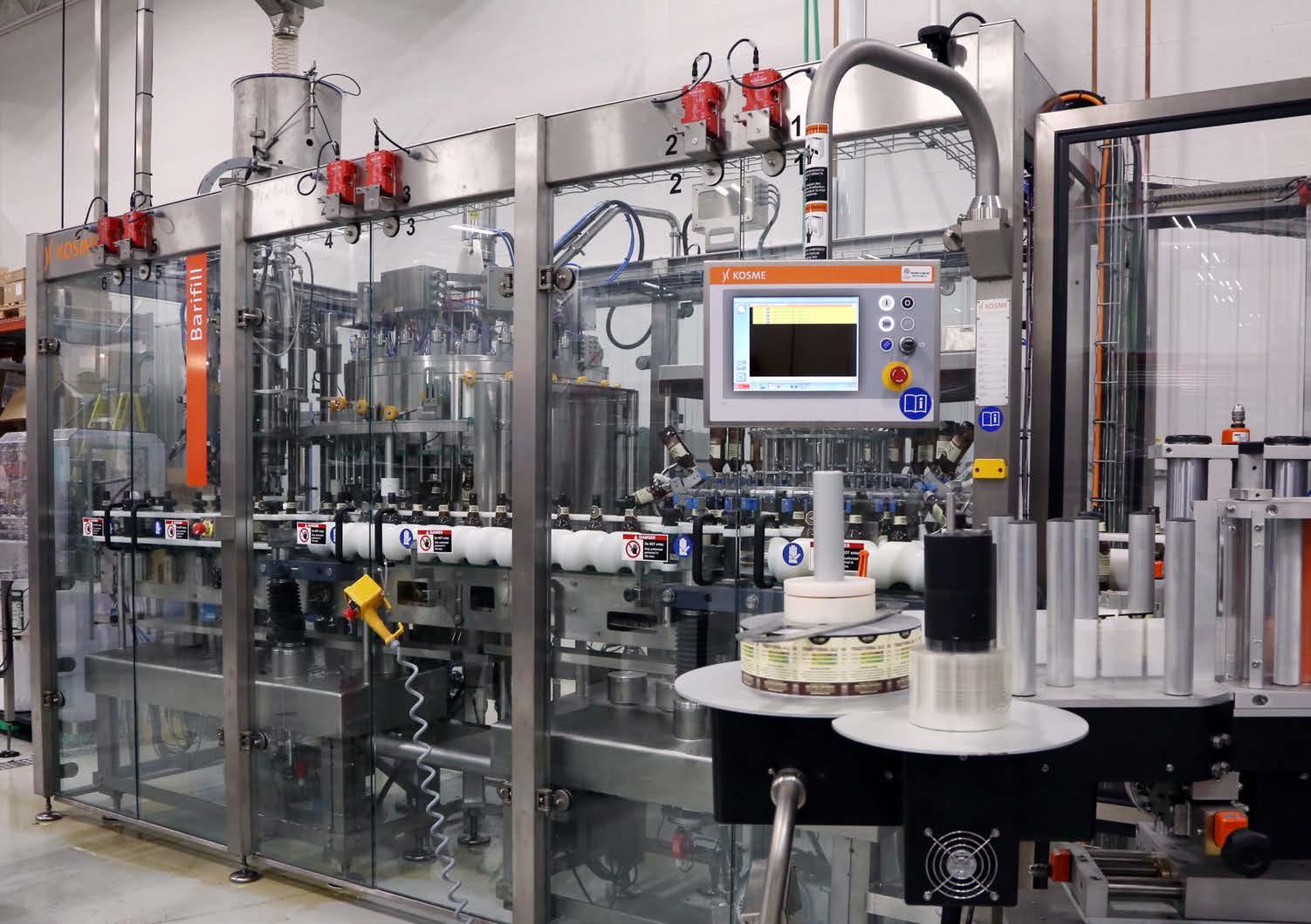
Rock Brewery opted for the Kosme Barifill Rinser/Filler Bloc bottling line from Krones AG, which
of craft brewers looking to expand their market reach in the fast-growing segment.
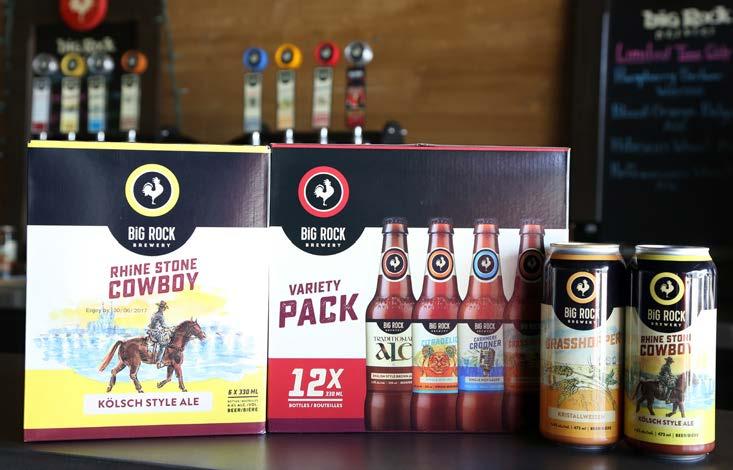
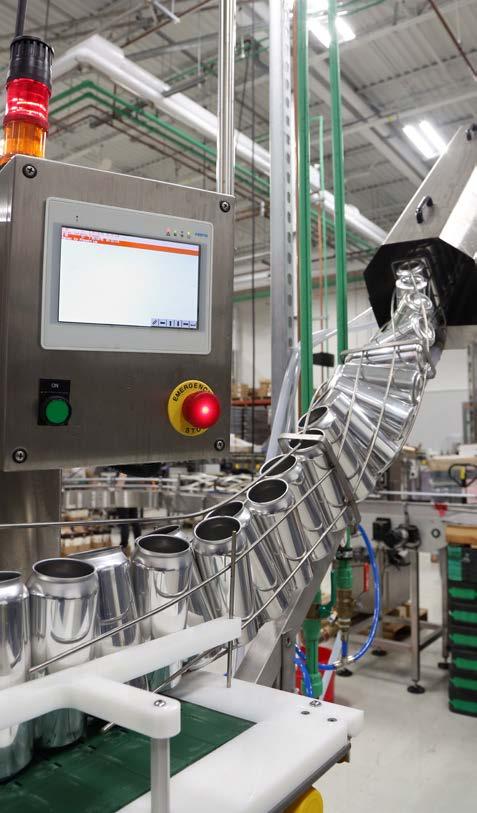
A sampling of canned and bottled beer produced at the new Big Rock Brewery plant, featuring corrugated cases from Cascades, glass bottles supplied by TricorBraun, aluminum cans from Crown Holdings, and high-graphics shrink sleeves supplied by SGS Canada.
FILLING & CAPPING
Today operating as a publicly-traded company listed on the Toronto Stock Exchange (TSE), Big Rock produced over 182,000 hectoliters of beer in 2015, with some of that output generated by the opening of a new brewery in Vancouver, B.C., in 2013 and, more recently, the startup of a brand new brewery in the west-end Toronto district of Etobicoke.
While some of Big Rock’s more popular brands have been retailed in Ontario for some time, establishing a local manufacturing presence in Canada’s biggest city is a serious statement of intent to grow its market share in eastern Canada, according to the Toronto operation’s brewmaster Connor Patrick.
“The southern Ontario market is an extremely competitive market,” Patrick told Canadian Packaging in a recent interview, “but building our own brewery in Toronto really demonstrates our competitive streak in taking up that challenge.
“We’re in it for the long haul,” says Patrick, citing the company’s expansive product portfolio bursting with traditional craftsmanship and bold flavor innovation, as demonstrated with year-round brands such as Citradelic Single
Hop IPA, Grasshopper Kristallweizen, Warthog English Style Mild Ale, Honey Brown Lager, Pilsner, Rhine Stone Cowboy Kolsch Style Ale, Scottish Style Heavy Ale, Session IPA and Wunderbier, along with seasonal small-batch brews and barrel-aged favorites.
Having joined Big Rock in Calgary about 10 years ago, Patrick immersed himself in learning all the tricks of the brewing trade under the guidance of head brewmaster Paul Gautreau, while also attending leading brewing schools to further his education in the complex, dynamic and constantly evolving industry.
Obviously, running the show as brewmaster at the new Toronto facility is a proud step forward for Patrick on both professional and personal levels.
Says Patrick, “There’s always something new to learn and to try, and I’m lucky I’ve been afforded this opportunity to not only help grow Big Rock’s business, but to grow myself as a person.”
Patrick relates that shortly after his once-promising hopes to play in the CFL (Canadian Football League) were dashed by an injury in his early 20s, he took an extended trip to Europe with some friends—discovering a lot of interesting Old World beers along the journey.
“It wasn’t the standard beers we had back home at the time,” he recalls. “All the European beers we tried, in particular the U.K. beers, had so much flavor and variety, and all being unique and original in some special way or nuance.
“When it comes to beer, not every patch of taste-buds are created equal,” Patrick proclaims, citing Big Rock’s expansive portfolio of signature beers, seasonal brews, and even one-off beers designed by the local brewmasters for special events and occasions.
“Much like that big glacial rock sitting in the middle of the Canadian prairies is often referred to as an ‘erratic,’ for being prone to movement, Big Rock is deliberately erratic about brewing many types of different beers, and always willing to experiment.”
Commencing full commercial production this past January, the new plant is currently on track to produce about 7,000 hectoliters of beer this year, according to Patrick, with capacity to add another
The 24-head Kosme bottle filling and capping line from Krones normally runs at the Toronto brewery at a steady pace of 90 bottles per minute, but can be ramped up to 130 bottles per minute.
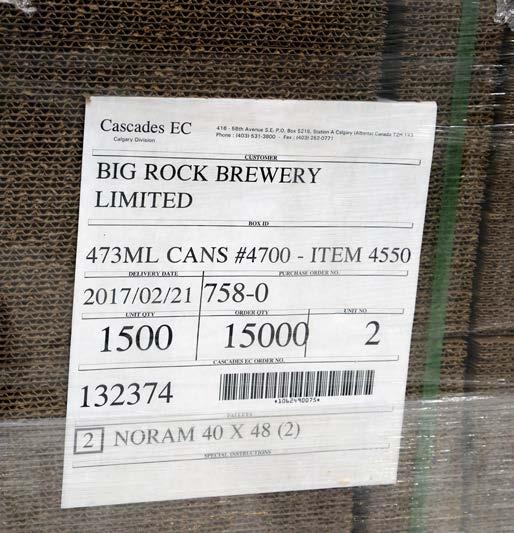
Leading Canadian paper products group Cascades Inc. manufactures and supplies the paperboard packs used by Big Rock Brewery’s Toronto brewery to pack its cases of bottled beer, as well as the trays used to pack its canned products.
21,000 hectoliters in the future as market demand grows.
“The goal is to have all the beer that Big Rock sells in Ontario to actually be produced in Ontario,” he explains. “At the moment, we are producing just the right amount to satisfy local demand in southern Ontario, with enough capacity to grow the Big Rock brand in this province in a big way down the road.”
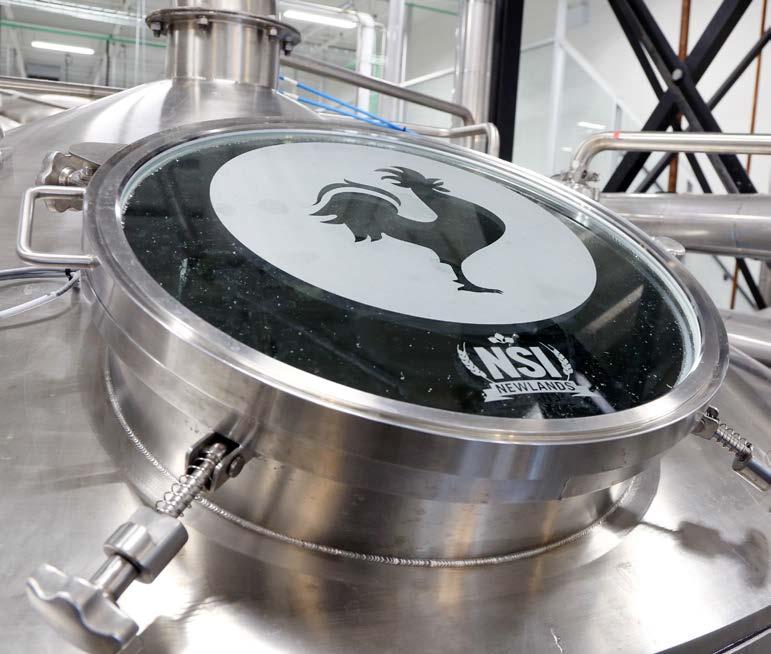
To get the Toronto operation set up, Big Rock first contacted Newlands Systems, Inc. to custom-build a brand new brewhouse for the brewery—including all the required tanks, vessels, mixers fermenters and other essential pieces of equipment.
“We opted for a 30-barrel system,” says Patrick, citing Newlands’ vast brewhouse experience and an extensive installation base at more than 500 brewing plants worldwide.
“What’s interesting about Newlands’ brewhouses is that you don’t call them up and ask them to deliver a new brewhouse: they work with you to build a customerspecific brewhouse,” he says.
“And while you have to wait a little longer to have it built and installed to perfectly fit your specific needs,” he allows, “the results are worth it.
“It is a very impressive brewhouse.”
After the beer is ready for packaging, its is piped to the plant’s canning line, supplied by the Boulder, Co.-based Wild Goose Canning Systems, or the newlyinstalled, state-of-the-art Kosme Barifill Rinser/Filler Bloc bottling line manufactured by leading German-based beverage production equipment manufacturer Krones AG
“We already have Krones equipment installed in Calgary, which has performed extremely well and are very easy to use,” says Patrick.
“So it was the case of, Why mess with success?
“We chose to install Krones equipment because of past reliability, straight and simple,” Patrick asserts. “It really was an easy choice in the end.”
That said, choosing the Kosme brand filling equipment—manufactured in Italy by Krones’ recently acquired Kosme business—was a first for Big Rock, Patrick notes.
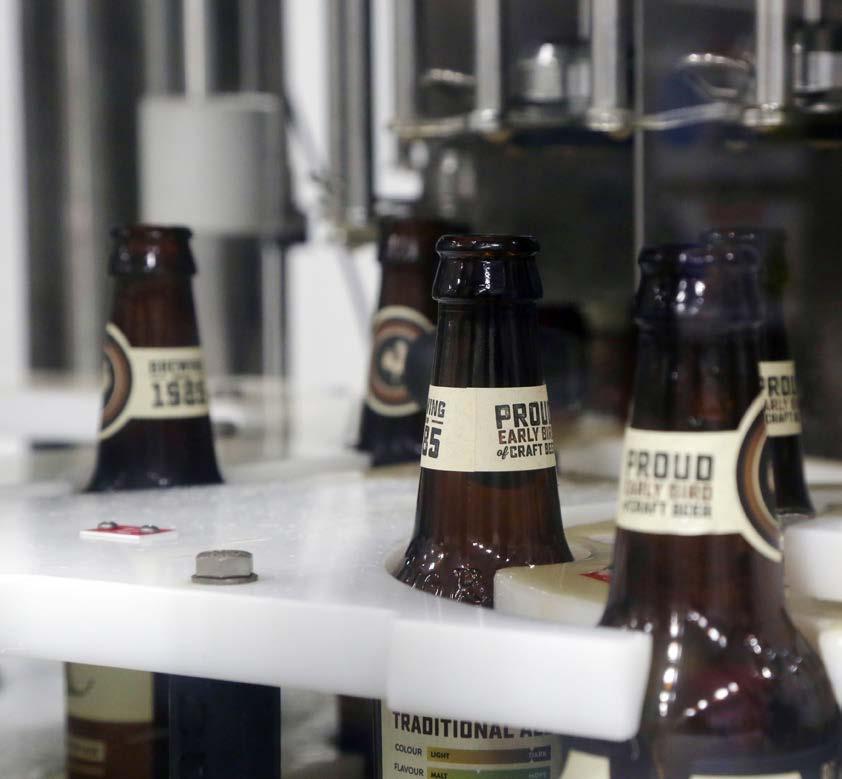
Used by the Toronto brewery to fill and cap the industry standard 330-ml glass bottles supplied by TricorBraun, with capabilities to bottle 650-ml seasonal and special-occasion beer products—the Kosme 24-head rinser and filler combination currently runs at a comfortable rate of 90 bottles per minute, with plenty of builtin capacity to speed up the throughput up to 130 bottles per minute, according to Krones.
The bottles begin their packaging line journey by being unloaded from an automatic depallteizer manufactured in-house—but do also utilize a depalletizer from
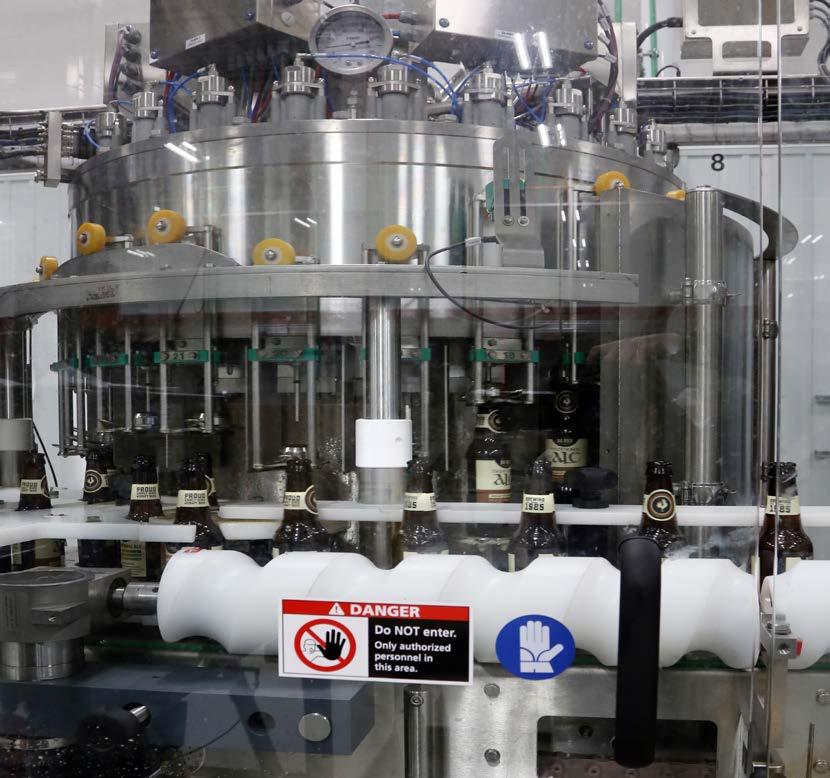
Bottles of beer positioned for filling on the Kosme Barifill bottling line at the Toronto brewery.
To hit the ground running in the highly competitive and crowded Ontario beer markets, Bid Rock Brewery decided to outfit its new Toronto brewery with a state-of-the-art, custom-designed brewhouse manufactured by the British Columbia-based brewing equipment specialists Newlands Systems Inc.
FILLING & CAPPING
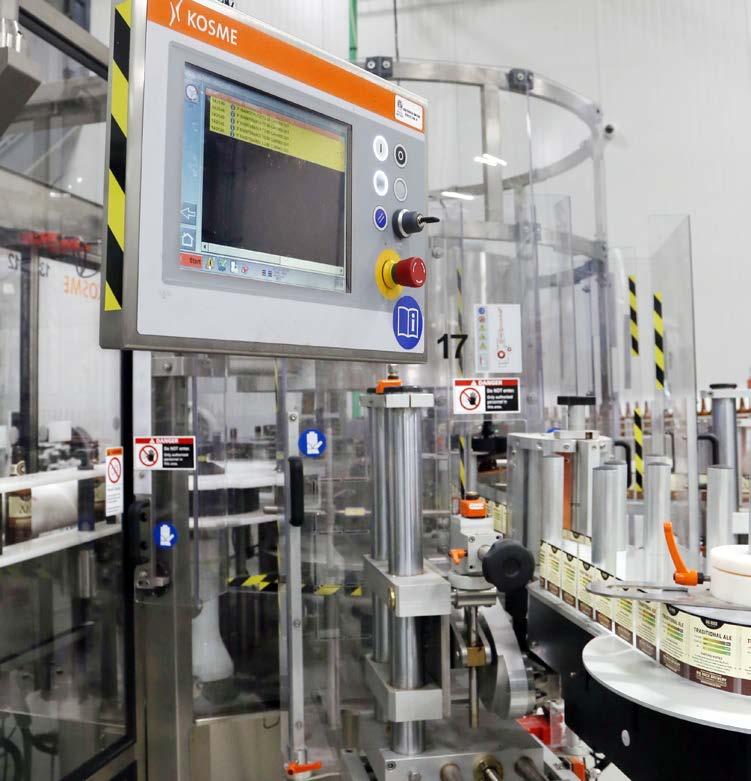
Ska Fabricating for its canning line—and conveyed in single file onto the Kosme Flexa Sensicol pressure sensitive-labeler, which swiftly applies three pressure-sensitive labels to the front, back and neck of the bottle.
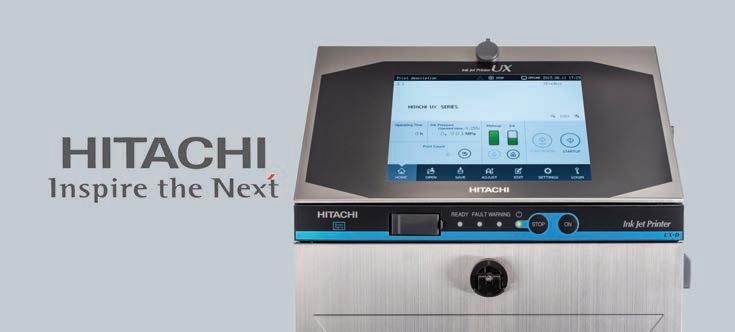
After the labels are applied, a Hitachi inkjet small-character printer, supplied by the Edmonton, Ont.-based Harlund Industries, Ltd., applies the lot code and best-before data onto the rear label.
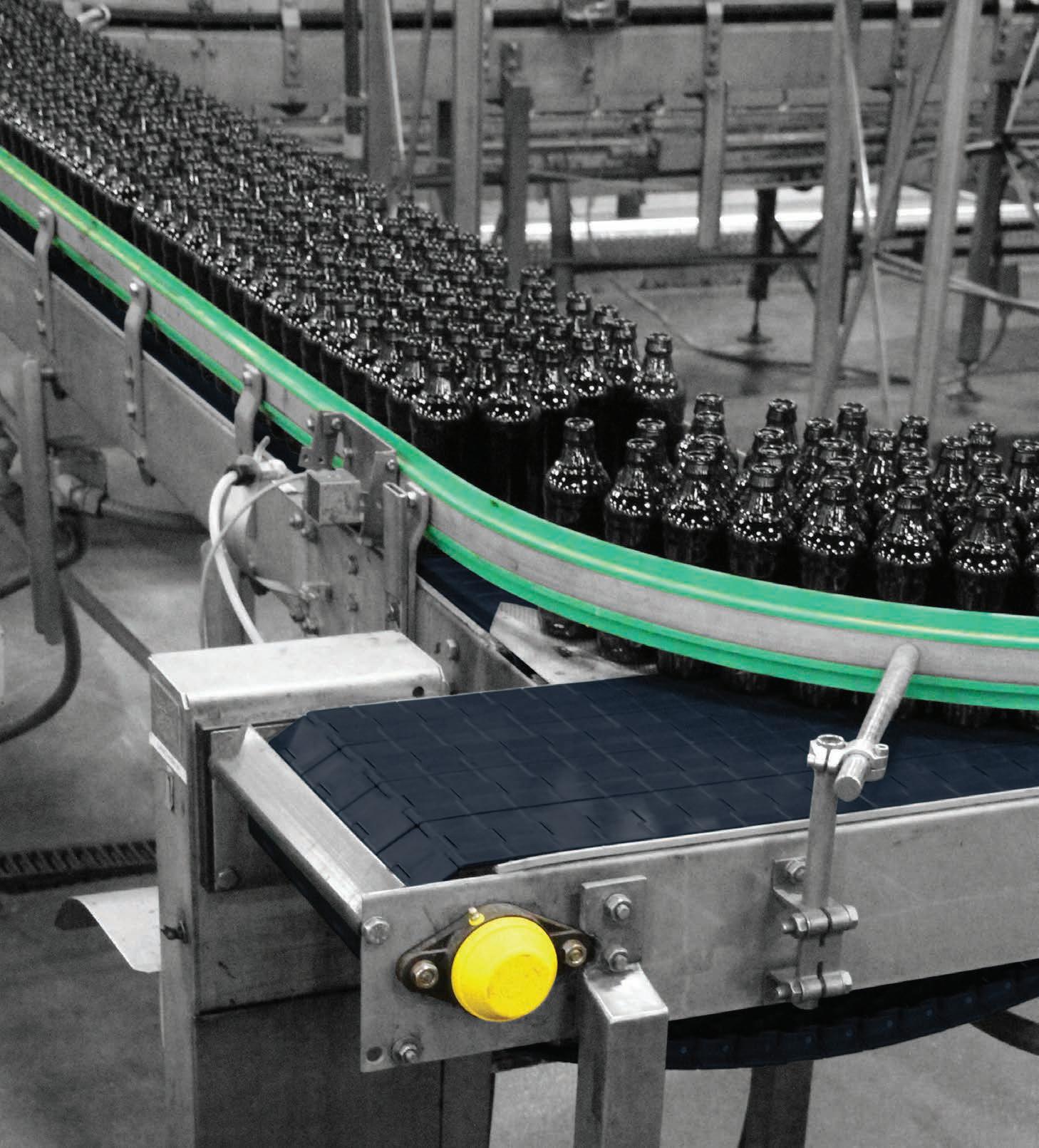
The bottles are moved further downstream, where they are flipped upside down on the conveyor to receive a quick water rinse, followed by a quick purge with a blast of carbon dioxide, making sure they are totally dry upon entering the 16-valve Kosme Barifill Rinser/Filler Bloc unit.
The Kosme Barifill utilizes robust, pneumaticallyactuated Krones filling valves providing Big Rock with quick, non-foam fills to ensure superior beer integrity.
The actual fill process consists of a tube bottom filling the beer, with a probe attached at the top to monitor the fill.
As the bottle reaches the pre-set fill level and the liquid comes in contact with the probe, an electrical discharge is communicated to the filling system that the bottle is at the optimum fill height.
To achieve optimal high-accuracy filling levels on a consistent basis, the Barifill filler employs:
• an isobaric filler with electropneumaticallycontrolled filling valve functions;
• a compact valve manifold;
• a rinser with several capping systems;
• a highly hygienic design with no sharp corners that could allow dirt to accumulate.
Once filled, the bottles are quickly crowned with a securely placed cap before exiting the Kosme Barifill unit.
The bottles are rinsed again and then moved through a warming tunnel, designed to physically raise the temperature to prevent condensation forming on the bottle and label.
“Along with it preserving the integrity of the label, by stopping the bottle sweat, we also prevent it from damaging the shelf packs,” says Patrick.
Retailed in Ontario at LCBO (Liquor Control board of Ontario) and The Beer Store outlets in six- and 12-pack cases, the bottles are manually packed into paperboard packs, supplied and made by Cascades, and sealed on a semi-automatic casesealer with hot-melt adhesive supplied by Technical Adhesives Limited of Mississauga, Ont.
For their part, the 355-ml and 473-ml blank cans manufactured by Crown Holdings coming off the canning line already outnumber the bottled product, according to Patrick, although the number can fluctuate throughout the year depending on seasonality and market trends.
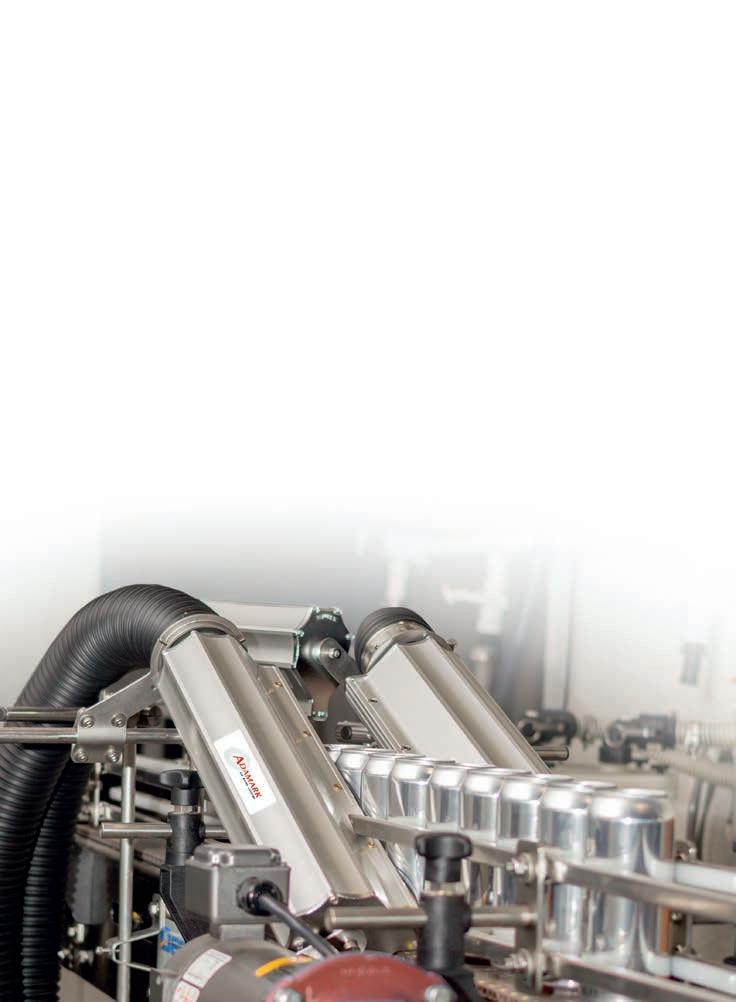
After being filled and crowned with a crimped cap at rates of 32 cans per minute, “The cans then pass through a warmer to stop condensation from forming on the package surface,” Patrick explains.
“By ensuring there is no condensation forming in the can, it helps our shrinksleeving equipment to apply a snug plastic film sleeve over the container,” says Patrick.
After the film sleeves produced by SGS Canada are properly affixed by the shrinksleeve labeler manufactured by Pack Leader Machinery Inc., the cans pass through a heat tunnel to produce a tight seal around the container with the brand’s
graphics.
The cans are then hand-placed onto 24-unit corrugated trays, also produced by Cascades, covered with a clear plastic film sheet, and moved through heat sealer to secure them in place.
All in all, Patrick says he’s very encouraged by how well the Toronto brewery’s startup and early production have gone so far, singling the new Krones Kosme filler for special high praise.
“The relationship between Big Rock and Krones has been very good for a number of years,” he notes, “and it was no surprise that the Calgary headquarters reached out to Krones again after deciding to expand into the Ontario market.
“I’m certain that Krones people will fully agree that our partnership has worked out very well for both companies so far,” he adds, “and will continue to grow in coming years,” he concludes.
“As Big Rock continues to grow, our relationship with Krones will continue to be an important asset in making this new brewery a highly successful operation.
SUPPLIERS
Kosme s.r.l.
Newlands Systems Inc.
Ska Fabricating Hitachi
Harlund Industries Limited
Pack Leader Machinery Inc.
Cascades Inc.
Technical Adhesives Limited
TricorBraun
Crown Holdings, Inc.
SGS Canada Inc.
R.E. Morrison
Supplied by TricorBraun, the glass bottles used by Big Rock’s Toronto brewery have labels placed on it front, back and neck via a Krones Kosme Flexa Sensicol pressure-sensitive label applicator.
After the aluminum cans are rinsed and dried, they are turned rightside up on the inverted conveyor line heading towards the Wild Goose Canning line.
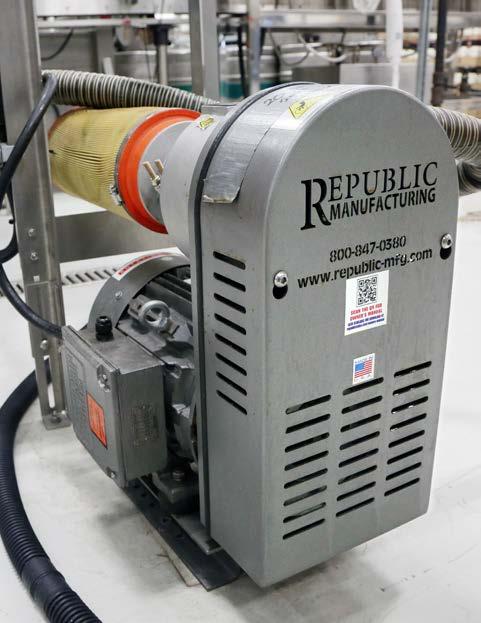
A Republic air knife blower supplied by R.E. Morrison dries all excess moisture off the beer cans immediately after filling.
Krones Canada
Stunning flexible packaging...
Don’t just settle for any package. Prototypes ensure satisfaction. Avoid unwanted surprises. Order your 3D mock-ups today to see all the possibilities. *
FOOD SAFETY
BORN TO BE WILD
Wild-caught seafood processor goes the extra nautical mile to deliver uncompromised food safety and quality control with high-speed X-Ray inspection
BY ANDREW JOSEPH, FEATURES EDITOR
PHOTOS BY BEATRICE SCHULER
For a business that started out by selling fresh lobsters and other shellfish from the back of a parked truck on the side of the road, Bedford, N.S.-based Clearwater Seafoods Limited Partnership has many valid reasons to think the world is its oyster.
Formed in 1976 by quick-thinking local entrepreneurs John Risley and Colin MacDonald, the fledgling two-man operation has grown into one of North America’s largest vertically-integrated seafood companies—harvesting, processing and distributing shellfish and related products to over 40 countries
Nowadays employing over 1,900 employees and generating annual revenues of about $500 million, Clearwater enjoys worldwide renown not only as a reliable supplier of high-quality wild lobster, crabs, scallops, clams, whelk, shrimp, and the masago fish
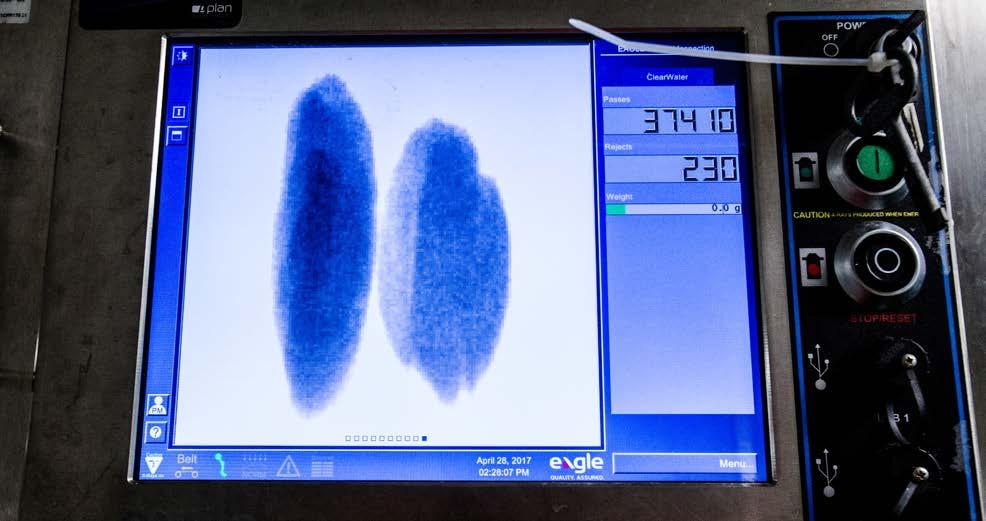
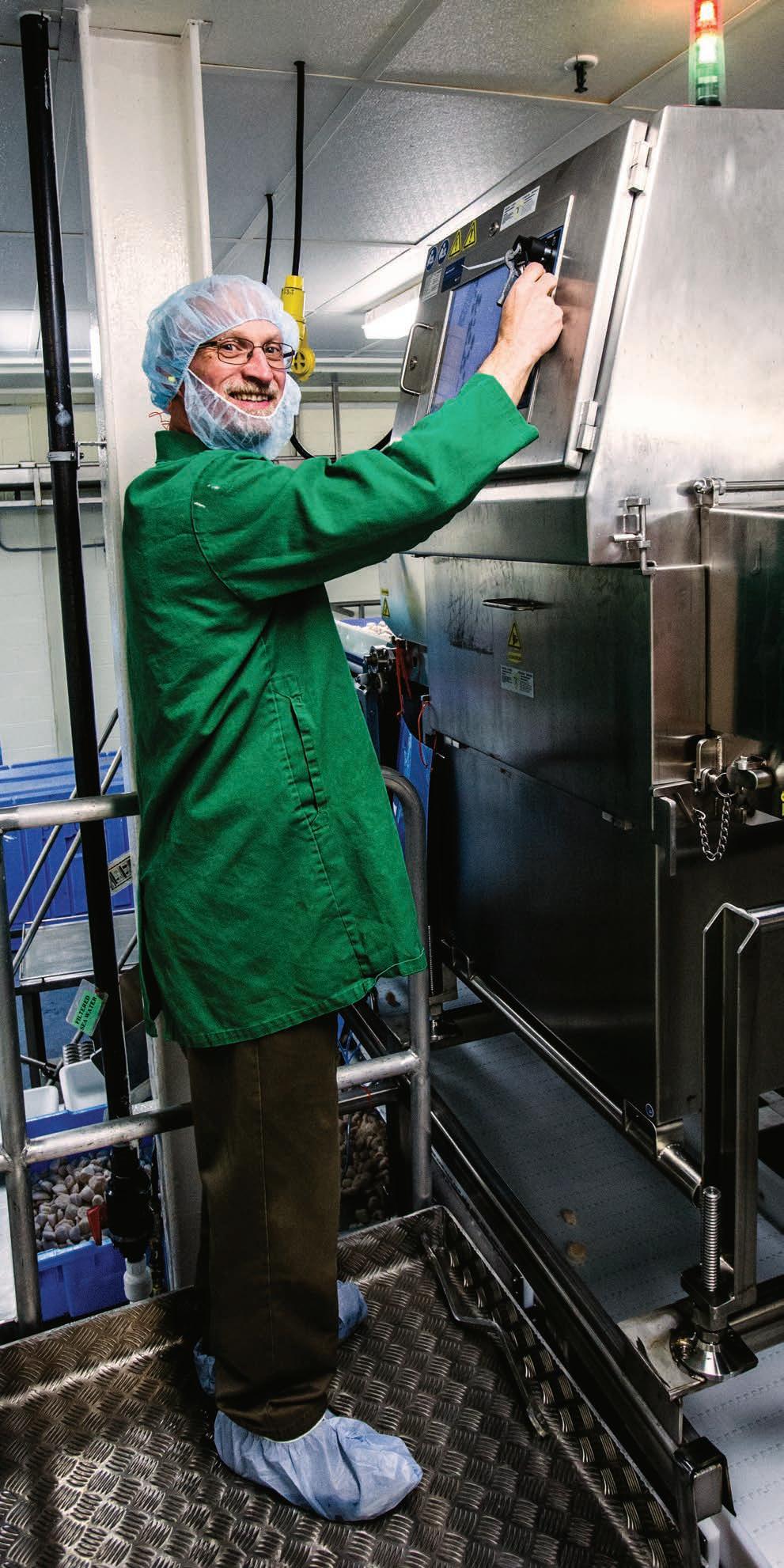
Clearwater’s Pierce Fisheries Division plant manager Mike Roy says he enjoys the peace of mind he gets from the recent installation of Eagle Product Inspection model Eagle PACK 320 PRO X-Ray systems purchased through the manufacturer’s Canadian distributor and integrator PLAN Automation. A close-up view of the Eagle PACK 320 PRO X-Ray system screen showing two scallops being meticulously inspected for any possible foreign objects and potential contaminants inclusions at the Pierce Fisheries facility in Lockeport, N.S.
FOOD SAFETY
roe typically found on many sushi dishes—but also as a highly-principled seafood processor firmly committed to the highest standards of responsible marine stewardship and sustainability.
“We say it again and again: in order to build the world’s most extraordinary wild seafood company, we must be dedicated to sustainable seafood,” says Mike Roy, plant manager at Clearwater’s Pierce Fisheries Division production facility just outside of Bedford in Lockeport, N.S.
Situated in a traditional Nova Scotia fishing village situated on a peninsula in Allendale Bay, the 135,000-square-foot Pierce Fisheries plant annually processes about five million pounds of raw, frozen lobster per year, along with about seven million pound of scallops, employing over 400 people during the peak season.
As such, it is an important strategic asset among Clearwater’s extensive operational network that also comprises:
• Twenty-three fishing and one research sea-going vessels;
• A major distribution center in Louisville, Ky., to serve mainland North American markets;
• Six other processing facilities in Nova Scotia and two more in Newfoundland;
• 20 cold storage facilities around the globe for expedited product delivery to customers across North America, Europe, Japan and China.
• Recently-acquired assets of the U.K.-based Macduff operations, adding another 15 million pounds of premium, traceable wild-caught shellfish to Clearwater’s annual allowable catch.
In addition to retailing its wild-caught seafood products via the company’s own Clearwater brand label, Clearwater also uses a far-flung network of distributors and direct-sales agents to serve the global foodservice market segments, with its catch making it to countless dinner plates around the world.
FAR AND WIDE
“We also send our products to food companies for further processing and value-added manufacturing,” says Roy, whose Lockeport plant handles the bulk of Clearwater’s scallop production.
“We also maintain great working relationships with importers and wholesalers to help expand our global reach on a continuous basis, Roy told Canadian Packaging in a recent interview, citing Clearwater’s well-acknowledged credentials as a leading industry innovator and pioneer.
“We are actually the first company to develop Arctic surf clam frozen-at-sea factory vessels back in the 1980s,” says Roy, adding that Clearwater also led the development and commercial success of Argentinian scallops and clams during the 1990s.
To support the Lockeport plant’s daily processing volumes of over 1.6 million scallops harvested off Nova Scotia’s coastline, Clearwater employs a fleet of state-of-the-art fishing vessels equipped with a specially-designed dredging system that can pluck the shellfish from depths of 100 meters.
Once aboard the ship, the scallops are shucked and cleaned via an automatic shucking system and are quick-frozen to lock in the scallop’s flavor and freshness.
Each vessel spends several days at sea harvesting, Roy explains, and after returning to port at Shelburne, the scallops are immediately unloaded and
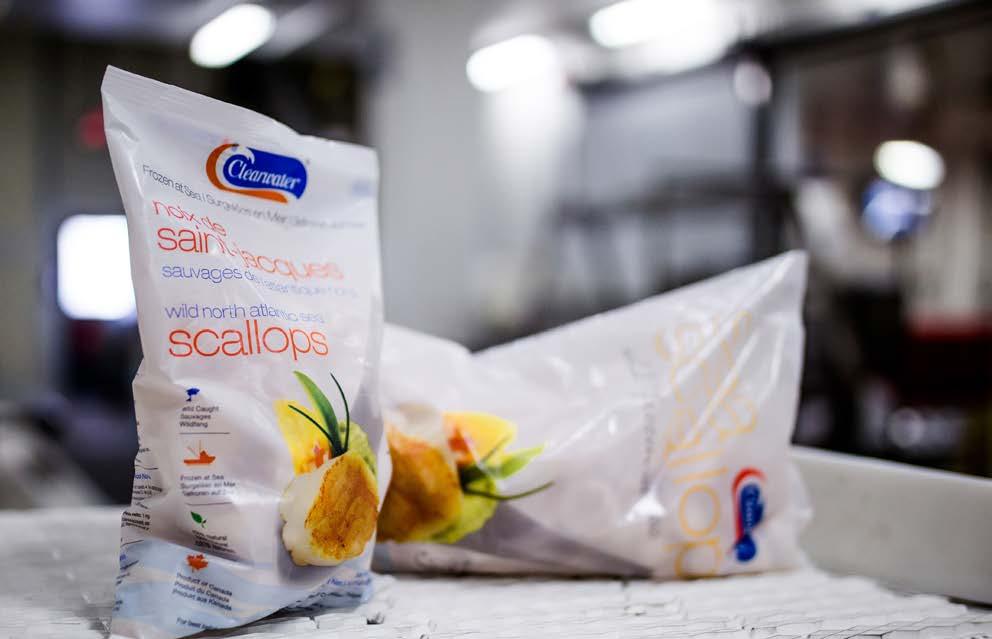
The Pierce Fisheries facility of Clearwater Seafood packages its wild North Atlantic sea scallops and wild Argentine scallops in plastic film pouches supplied by Alpha Poly‚ processing a total of about seven million pounds of scallops annually.
Frozen scallops exit the Pierce Fisheries’ Eagle Product Inspection (EPI) model Bulk 400 HC X-Ray system, which is used to inspect the product right upon arrival at the facility prior to sorting the product by size.
FOOD SAFETY
shipped by truck to the Pierce Fisheries facility.
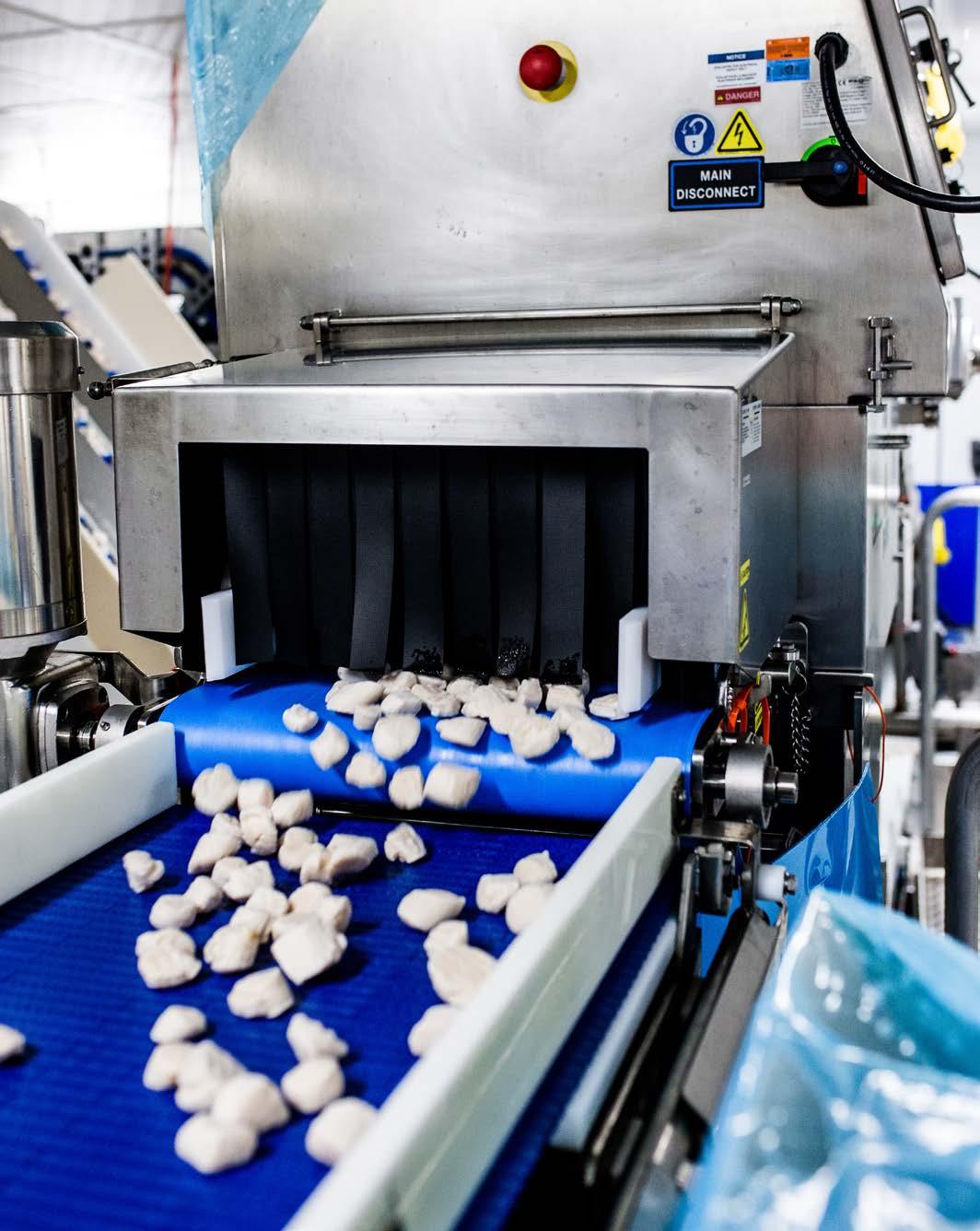
Upon arrival at the state-of-the-art plant, the shucked scallops are quickly conveyed in bulk past an Eagle Product Inspection (EPI) model Bulk 400 HC X-Ray system to detect and remove any tiny bits of shell or other tiny foreign objects still stuck to the product from the previous shucking process.
Capable of inspecting about 30,000 pounds of scallops per hour, the Bulk 400 HC (highly cleanable) X-Ray system performs a critical and vital inspection for the incoming product before it proceeds to the sorting stage to be screened for size.
“For premium retail purposes, the screening process identifies uniform-looking scallops weighing about 10 to 11 grams apiece,” says Roy, “which are temporally boxed and set aside for further processing in sauces and bacon.
“Having the scallops inspected for possible inclusions before we further process the scallops is a big time- and money-saving measure,” explains Roy. “Not only does it save us from wasting a scallop, it also saves us in wasting bacon during our value-add production of bacon-wrapped scallops.”
THE INCREDIBLE BULK
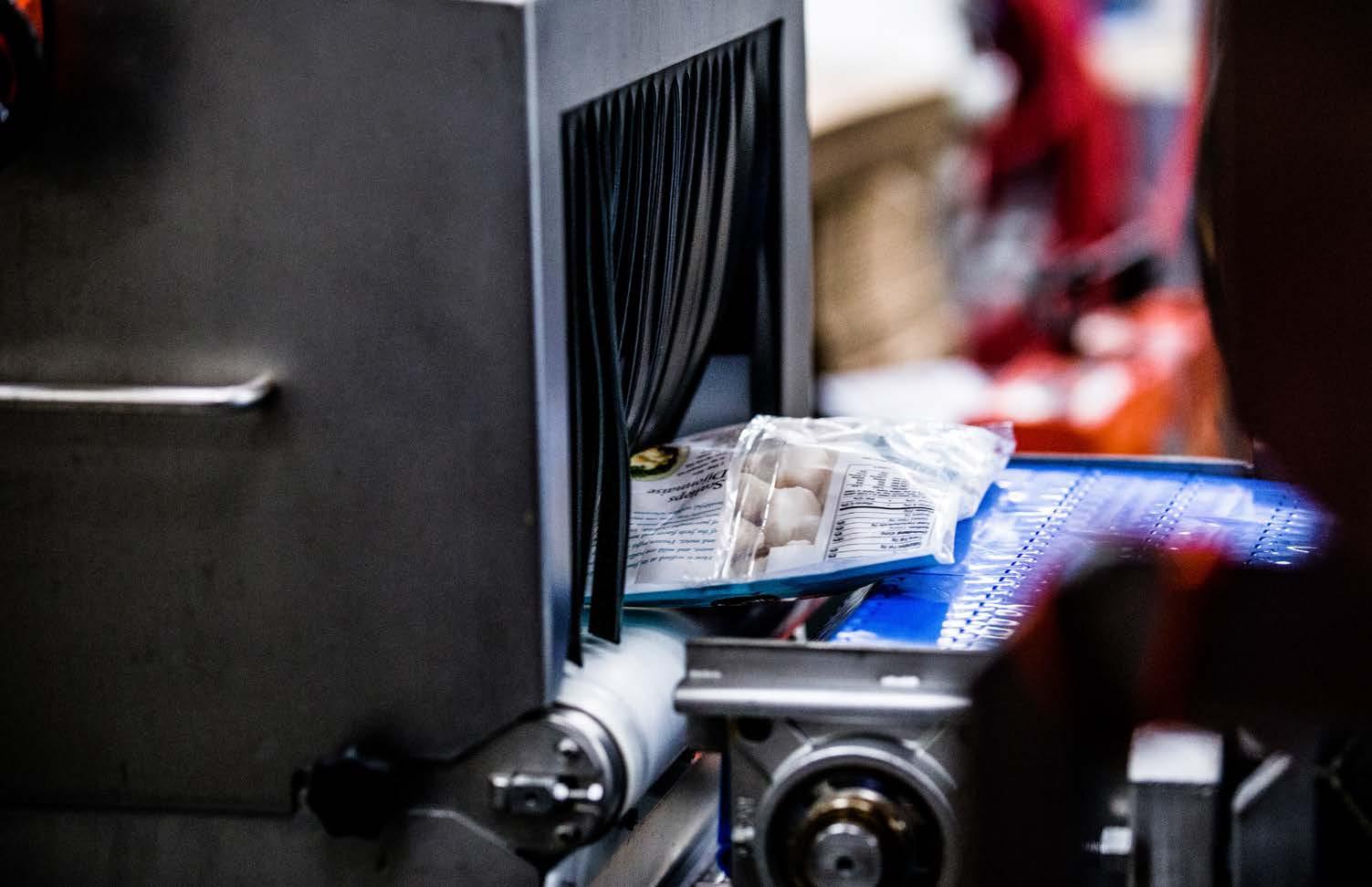
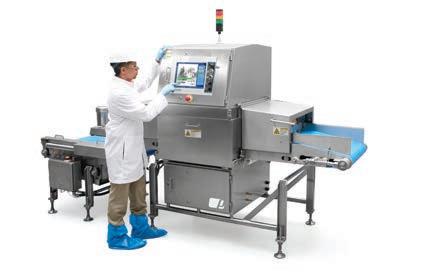
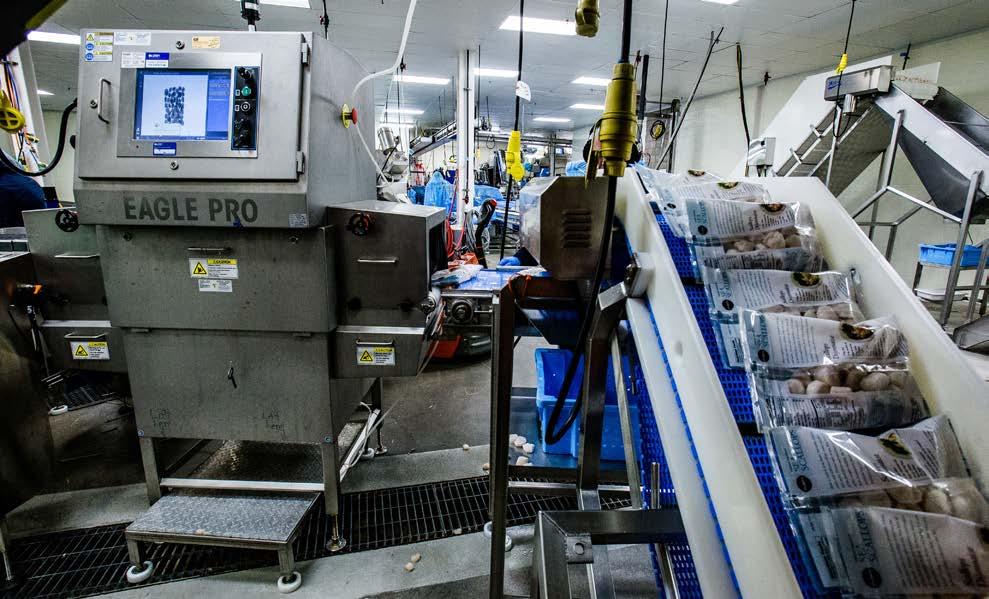
As Roy relates, the Bulk X-Ray inspection system was installed at the plant in April 2016 by leading Canadian packaging systems integrators PLAN Automation of Orangeville, Ont., along with two model Eagle PACK 320 PRO X-Ray systems used to inspect scallops after they have been bagged and sealed.
“Having a bulk product X-Ray system shows a company’s commitment to food safety,” says Roy, “but having two additional X-Ray units at each end of the production line demonstrates a deep commitment by Clearwater to ensure the consumer is only receiving premium, tasty scallops.”
In addition to detecting the bits of shell, the Eagle X-Ray inspectors also help detect and remove any bits of glass, metal and stone pulled up during dredging, according to Roy.
For their part, the high-speed Eagle Pack 320 Pro X-Ray inspection systems are capable of scanning some 100,000 pounds an hour to detect tiny 1-mm to 1.5-mm bits of shell; 0.6- to 0.7-mm metal particles; 1-mm shreds of glass; and 1.5-mm bits of stone.
After sorting and sizing, the scallops are moved upwards along a vertical conveyor toward a multihead scaling system, which releases the pre-set weights of scallops down into a bagging system below, whose integrated product coder applies the best-before dates and lot-code information onto the plastic bags right after they formed, filled and sealed.
“The bags then move past a second X-Ray unit—one of the Eagle Pack 320 Pro
ON-SITE X-RAY SERVICES
We supply the latest Eagle PI X-ray technology to your site, operated by our certified Plan Automation Product Inspection technicians.
Our technology & support services will quickly help you inspect and reclaim your nished goods
INSPECT YOUR FINISHED GOODS, CASE OR PRIMARY PACKAGE:
• Food & Beverage
• Meat & Poultry
• Cosmetics & Pharmaceutical
• Consumer goods
• Industrial
We also sell new equipment and offer lease to own or long term rentals.
After bagging and sealing, a bag of scallops enters one of the two Eagle PACK 320 PRO X-Ray systems at the end of the line, making sure that all the scallops processed at the facility are thoroughly inspected at least twice before leaving the plant.
FOOD SAFETY
systems—to further ensure the contents of the bag contain only the tasty scallop meat,” says Roy. After passing this inspection, the bagged scallops move down the line to be hand-packed into corrugated master cartons, sealed and placed back into a freezer until they are ready to be shipped to customers.
To make the premium Clearwater branded baconwrapped scallop retail products, the carefully selected scallops are manually hand-wrapped with a single strip of bacon and placed onto foam trays—weighed to the approximate ideal weight.
The trays are then placed within a plastic film envelope and heat shrunk—creating a nice tamperevident safety seal—and conveyed through a spiral freezer for 15 minutes to chill at -30°F temperature.
Along the way, random packs of scallops are continuously tested for food safety issues and other quality control criteria by Clearwater’s in-house quality assurance, including on-site taste-tests, to ensure the product is up to the company’s exacting standards.
HIGHER GROUND
“We are certified by numerous food safety and quality assurance programs that make it imperative for us to maintain the highest possible standards for food safety,” says Roy, citing globally-recognized certifications such as HACCP (Hazard Analysis and Critical Control Points); QMP (Quality Management Program) in-plant quality-control system of the Canadian Food Inspection Agency; and the BRC (British Retail Council) global food safety standards.
After the trays of scallops are placed onto an automatic cartoning line fed by pneumatically-opened carton blanks, a mechanical arm moves a tray of scallops into the just-erected paperboard boxes, after which dual arms close each open end of the pack and quickly seal the boxes with a hot-melt adhesive applicator.
According to Roy, installing the three Eagle XRay systems at the Lockeport plant has been a massively beneficial and proactive capital investment for the facility.
“Not only do we have great product inspection with our Eagle X-Ray systems, but the people at PLAN Automation really stood out for us with their local support for the East Coast region,” says Roy, stressing the importance of having local technical
Clearwater Pierce Fisheries plant facility manager Mike Roy says the company’s goal is to always be dedicated to sustainable fishing practices in the short and long term.
Just another typical early morning at Shellburne, N.S., where Clearwater’s scallop fishing boats call home when they are not out on high seas on scallop fishing treks lasting up to several days.
The Eagle Pack 320 PRO X-Ray system scans filled and sealed bags of scallop product—its second X-Ray food safety inspection on the production line.
FOOD SAFETY
support in place to minimize the possibilities production downtime.
Part of that support comes from PLAN Automation senior associate Greg Pulsifer, who leads the technical sales and support in Atlantic Canada, working closely with Clearwater on this project.
“We take our safety initiatives very seriously, so having an X-Ray system go down for any length of time would mean at least 50-per cent slowdown in our production throughput, while we ensure every bag is properly checked,” he says.
“If an X-Ray goes down, we are not selling our product in a timely fashion, so having support with great service is critically important for us.”
As Roy explains, being proactive in the food safety area fits in perfectly with Clearwater’s overall ethos of being a responsible employer and corporate citizen.
“Clearwater is of the opinion that by providing a high-quality work environment, we further our own company’s ethics in being socially responsible,” says Roy, citing the Atlantic Canada’s Top Employers Award for 2017 recently garnered by Clearwater.
Moreover, Roy points out that Clearwater is always continuing to develop strategies to reduce waste and its environmental footprint with modern harvesting and processing techniques such as ocean bottom mapping, frozen-at-sea processing, dry-land storage, automated shucking, and many other industry innovations.
FULL HARVEST
“Our approach is to know and understand our harvest areas and their ecosystems, treat them with respect, and manage our impact,” says Roy.
“We think beyond the shellfish we harvest to broader ecosystem-based fisheries management that considers non-target species and overall habitat,” says Roy, citing the globally-recognized Marine Stewardship Council Certification validating that all of the company’s product originates from a sustainable and well-managed fishery.
Maintained through continuous third-party audits since 2012, the certification applies to all the main shellfish species harvested by Clearwater, including Argentine scallops; Canadian offshore sea scallops; Canadian offshore lobster; Nova Scotia in-shore lobster; Canadian coldwater shrimps; Arctic surf clams; and Nova Scotia and Newfoundland snow crab.
Says Roy: “What does responsible fishing mean?
“We do habitat mapping and we target areas where we know we can fish in the most efficient manner while leaving
sensitive habitats undisturbed.
“To ensure we follow that guideline, we provide full 24hour tracking and transparency of our fishing activity to Clearwater shore-side managers, government regulators, and the general public,” Roy explains.
“Along with our own self-regulation and customer audits, there are also government audits and surveillance at every stage of the ocean-to-plate process,” he says.
“We don’t mind—in fact, we welcome it,” states Roy.
“Clearwater is proud to source its raw product from fisheries operating under rights-based fishery management systems that promote responsibility and long-term investment in healthy oceans,” he proclaims.
“Having great equipment, top-notch suppliers and partners like PLAN Automation, and caring employees helping us get quality seafood to our customers in an ethical and sustainable manner is why we all think Clearwater’s future is bright.”
NOTHING EXTENDS SHELF LIFE LONGER THAN VACUUM SKIN PACKAGING FROM REISER.
Maximize the shelf life & eye-appeal of your perishable food products with Ross Vacuum Skin Packaging.
n Ross VSP packaging provides nearly twice the shelf life of a traditional MAP package.
n Ross VSP packaging wraps tightly around the product’s shape, acting as a second skin while removing all atmosphere from within the package.
n High-clarity, wrinkle-free, glossy skin film provides an impressive presentation and puts the focus on your product.
n Ross VSP packaging machines are available in a range of model sizes to match specific application and output requirements.
TO SERVE AND PROTECT!
Corrugated packaging producer leverages innovation and engineering savoir-faire to create custom protective packaging solutions across the industrial landscape
BY GEORGE GUDONI, EDITOR
It may not have the eye-candy polish and sexy sizzle of high-graphics consumer packaging, but everyone in the industry knows that without highstrength, durable and rugged industrial packaging products being available to manufacturers of all shapes and stripes to move their products, the wheels of the industry would quickly grind to a halt.
Happily, there are companies like LM Packaging to make sure this never happens.
Proudly celebrating its 25th anniversary this year, the family-owned manufacturer of corrugated boxes, intermediate bulk containers (IBCs), cardboard blocks, sheet and pallets and a multitude of custommade corrugated protective packaging products like are U-channels, edge protectors and honeycomb fillers is happily celebrating its milestone in style.
A double winner in the recent 2017 Canadian Leadership Awards competition of the Toronto-based national industry association PAC Packaging Consortium—including a Gold Award in the Corrugated Containers and a Silver Award in the Sustainable Packaging categories—LM Packaging is clearly enjoying seeing the collective fruits of its labors coming to life in a concerted way.
Nowadays employing 45 people at two nearby manufacturing plants a short drive outside of Quebec City in Saint-Francois, Que., the company is hitting its stride at the right time to capitalize on growing market demand for sustainable packaging solutions with minimal environmental footprint.
“Like many other business sectors, protective packaging is very competitive,” says LM Packaging sales and marketing manager David Welsh.
“However, our main competition doesn’t come as much from the other corrugated companies as it does from other raw materials like foam, wood, plastic, etc.,”Welsh recently told the Canadian Packaging magazine, describing the company’s fairly swift rise up the ranks of the domestic market for industrial and protective packaging.
“I think we are now in the position of being a leader in our industry for two main reasons,” Welsh expands.
“For one, we provide our customers with 100-percent recyclable green solutions, which helps our big retail chain customers like Costco and Walmart to fulfill their environmental goals and waste reduction objectives,” he says.
“Moreover, we don’t just sell products: we develop, design and manufacture them,” adds Welsh.
Machine operator at the LM Packaging plant in Saint-François, Que., readies the facility’s operational equipment for a busy production run to manufacture high-strength corrugated edge protectors (above) and other specialty custom-made protective packaging products for industrial customers located across the provinces of Quebec, Ontario and Alberta.
“This way, we can have an influence not only in the cost of the product itself, but on the global budget of the logistics and packaging departments by reducing packaging time, the amount of material used, the number of SKUs (stock-keeping units) used, and by reducing the costs of returns due to damages in transport.”
Originally starting out as a supplier of packaging for the local furniture industry, LM Packaging discovered the value of product diversification first-hand when one of its major long-time customers, Morigeau Furniture, went out of business in 2008.
“Not long after, LM Packaging decided to review their business position and focus on developing personalized products instead of concentrating on specific industries,” Welsh relates.
“Since then, the company is focusing on material
development, innovation and creation of solutions for customers in all sectors,” he says.
Today serving a fast-growing client base in Quebec, Ontario and Alberta, LM Packaging is still a major supplier to the furniture and home building sectors— its products widely used to package cabinets, glass, windows, doors, etc., for safe transport and storage— while also establishing itself as a major player in bulk liquid packaging.
“We also have clients in the woodworking, plastics, metalworking and high-tech manufacturing sectors,”
says Welsh, “and we are constantly working on ways to broaden our customer base further because we are very confident in our abilities to serve more than these sectors.”
In addition to providing its clients with impeccable service levels, with Welsh citing 99.5-percent on-time delivery record, LM Packaging has also strengthened its profile in industry circles in recent years with a relentless focus on material development, innovation and creation of solutions, Welsh points out.
“We have a real passion for finding new ways to package all sorts of goods in order to help our clients save money,” he says.
“Hence we don’t really have any off-the-shelf products: everything is custommade.
“So in essence we create new items every day,” says Welsh, noting that protective packaging now accounts for about two-thirds of the company’s total output, with specialty corrugated boxes for the remainder.
“We create and launch new products every week because most of what we sell is ‘made-to-order’ in accordance to the clients’ specific needs and requirements.
“Everything that we develop, create, sample and make is done in-house with our R&D, product development and production teams,” says Welsh, calling the company’s product development team lead Etienne Jean the “guru” of LM Packaging’s innovation efforts.
As Welsh tells it, Jean played a key role in the development of the PAC Gold Award-winning Smart Tote cardboard container with 275-gallon (1,041-liter) holding capacity.
“This is probably the biggest and most important proprietary product launch made by LM Packaging to date,” Welsh notes, “and I believe we are the only Canadian manufacturer of this kind of product.”
Well-suited for a diverse range of liquid foods, beverages, household chemicals, soap and detergents, paints, solvents and many other types of liquids, the highstrength, 100-percent recyclable Smart Tote IBCs comprise eight layers of nearly two-inch-thick corrugated cardboard and seamless construction that enables it to resist up to 20 tons of compression forces, according to LM Packaging, along with full benefits of foldable design that allows operators to collapse it or set it up for re-sue in about a minute.
“The Smart Tote liquid packaging solution is an excellent combination of standardization and made-to-measure service,” Welsh extols.
“It was created to meet the needs and standards of the IBC industry while offering incomparable advantages as a liquid packaging solution,” says Welsh, citing the broad variety of barrier films, fittings and various optional accessories that the CFIA- and FDA-approved Smart Tote can deploy to meet specific application requirements for dispensing, storage, transportation, product handling, etc.
“In our opinion, the Smart Tote is the most efficient way to package bulk liquid while reducing fees and storage space,” Welsh proclaims.
CORRUGATED PACKAGING
Ink Jet Printer
Next-generation leadership performance
UX Series continuous inkjet printers represent the pinnacle of innovation in marking and coding technology, all while showcasing Hitachi’s reputation for Reliability, Efficiency, and Ease of Use.
The Smart Tote bulk liquid packaging system (top left) and the Cafection solution for packing commercial coffee brewing machines for worldwide distribution made LM Packaging a double-winner at this year’s PAC Canadian Leadership Awards competition this year.
LM Packaging’s sales coordinator Sarah Lavoie (left) and general manager Frédéric Jean pose with three different packaging industry awards won by the company last year, including a 2016 CorrPack best-of-show structural design award from corrugated industry group TAPPI.
Hitachi’s
CORRUGATED PACKAGING
Always respectful of customer input, LM Packaging also worked closely with Cafection Industries, a major North American manufacturer of commercial coffeebrewing machines, to create a new, 100-percent corrugated packaging solution that completely eliminated the use of non-recyclable foam from the packaging equation.
A recipient of the PAC Silver Award in the Sustainable Packaging category, the Cafection solution incorporates a series of folding and interlocking laminated and grooved blocks, large-size U-channels and tray pads to maintain optimal product protection and stability during transport.
“Notably, Cafection was able to improve and speed up its own packaging line time with our fast and simple
packaging solution,” Welsh points out.
“We work hard to design and make packaging kits made from 100-percent corrugated, replacing all sorts of other material such as foam, plastic and wood,”Welsh states.
“We do this through putting more effort on the inside of the package, meaning inserting more protective items inside to keep the products safe, steady and secure.”
To make its innovative products, LM Packaging employs a state-of-the-art Rapidex 66 rotary die-cut folder-gluer, manufactured by global converting equipment conglomerate Bobst Group, along with an assortment of flatbed diecutters, laminating equipment, slitters, band saws, and other cutting edge converting machinery.
“But what also makes us different is that many of these special machines have been designed and built by ourselves to make all manner of these specialty protective products,” Welsh points out.
“While the production of boxes, U-Channels and edge protectors is fairly automated,” he says, “for many other products we make we still need a fair amount of manual labor, as most of these products require more than one operation to assemble, often being manufactured on different mixes of production lines.”
Being able to do all that cost-efficiently and sustainably is a tribute to the company’s loyal dedicated workforce and astute business skills of its senior management team, says Welsh, confiding that LM Packaging is already working on expanding its markets further with exports to the U.S.
“LM Packaging is a family-owned business and we want everybody working here being treated as a member of this family,” says Welsh.
“We sprung a surprise one month ago by closing the plant for one afternoon to bring the employees to the cinema to watch a movie, without anyone knowing until the coach showed up,” Welsh recalls.
“We are planning a few more of these little social get-togethers throughout the year,” he says, “including a big celebration on a private cruise ship on the St-Laurent River.
“We are definitely a company of winners,” Welsh concludes, “and anyone who joins the LM Packaging family, either as an employee or client, becomes a winner as well.”
SUPPLIERS
LM Packaging
Bobst Group North America
POWERING INNOVATION IN PACKAGING
Technology. Expertise. Perspective. At PACK EXPO Las Vegas 2017 you’ll find the tools you need to transform great ideas into valuable solutions and remain relevant in an ever-changing marketplace. The year’s largest packaging event in North America, at the Las Vegas Convention Center, has it all:
■ Packaging machinery in action from 2,000+ exhibitors
■ Dynamic ideas generated by 30,000 attendees
■ Best practices and breakthrough technologies presented in free Innovation Stage presentations, right on the show floor
ANNOUNCEMENTS
n Pregis LLC, Deerfield, Ill.-based manufacturer of protective packaging products and systems, has completed the acquisition of Sharp Packaging Systems, Sussex, Wis.-based supplier of flexible packaging bagging systems and materials, for an undisclosed amount. Founded in 1984 and employing about 200 people, Sharp Packaging operates three manufacturing locations—including a newly-built a 160,000-sqaure-foot facility in Sussex—to produce a broad range of flexible bagging systems and bags for applications ranging from e -commerce to retail displays and linen services. (See Picture) “The shift to dimensional weight-based transport pricing is making bagging an attractive option for a variety of products that do not require cushioning protection,” says Pregis president and chief executive officer Kevin Baudhuin. “By adding bagging systems to our already robust protective packaging product
offering, we can offer customers—particularly those whose market strategy includes e -commerce—another option to deliver their products to consumers.”
n Wayne, Pa.-based Tekni-Plex, Inc. has acquired the assets of BrunaSeals , Doral, Fla.based manufacturer of induction seals and foam closure liners for beverage, cosmetics, pharmaceutical, and household and industrial chemical products, with plans to integrate them into the company’s fast-growing Tri-Seal global closure liner business. Founded in 1986 primarily to supply Latin American markets for packaging liners and gaskets, BrunaSeals has significantly enhanced its geographic reach and market presence with successful brands such as ProTecSeal , LuxeSeal and SniffSeal , among others. “BrunaSeal’s expertise in supporting the Latin American marketplace, coupled with its innovative product line, will help further expand the global TriSeal closure liner business,” says Tri-Seal’s sen -
ior vice-president and general manager David Andrulonis. “Our combined capabilities create an even stronger liner portfolio from which to service brand owners around the world.”
n The Klöckner Pentaplast Group (KP), leading German manufacturer of rigid plastic film and packaging solutions, has reached a definitive agreement to acquire LINPAC Group, one of Europe’s largest producers and converters of plastic films for food packaging applications. The pending deal, expected to pass all the required regulatory approvals this summer, will create one of the world’s largest one-stop-shop suppliers of both rigid and flexible food packaging products, with combined annual revenues of over US$2 billion and a global workforce of over 6,300 employees across 32 locations in 16 countries. “This is a highly-complementary acquisition that will help KP expand our technological capabilities and presence into the food industry and the rigid and flexible film market, as well as further develop our offerings in end markets such as pharmaceuticals, food and beverage, and consumer and industrial products,” says KP’s chief executive officer Wayne Hewett. “We look forward to be enriched by LINPAC’s innovations, adjacent products and know-how, and are excited about the new opportunities that lie ahead of us.”
EVENTS PEOPLE
n Milliken & Company, Spartanburg, S.C.headquartered producer of specialty chemical additives, colorants and other formulations for packaging and other industrial applications, has appointed Nicole Yeske as director of marketing for the company’s Performance Solutions business unit.
n Multinational packaging products and systems conglomerate Mondi Group, headquartered in Vienna, Austria, has appointed Peter Oswald as its new chief executive officer.
n Bethel, Conn.headquartered Society of Plastic Engineers (SPE) has appointed Patrick Farrey as the group’s new chief executive officer.
n Colbert Packaging Corporation, Lake Forrest, Ill.-based manufacturer
of folding cartons and specialty paperboard packaging, has appointed John Lackner as vice-president of corporate operations, and Kevin Kenjarski as vice-president of sales and marketing.
June 20-21
Cologne, Germany: Plastics Recycling Technology 2017, conference by Applied Market Information (AMI). At Maritim Hotel.To register, go to: www.amiplastics.com
Sept. 19-20
New York City: MakeUp in New York, international beauty products exhibition by Bauteam US Inc. To register, go to: www.makeup-in-newyork.com
Sept. 20-23
n Motion Control Robotics, Fremont, Ohio-based robotic systems integration services provider, has appointed Earl Raynal as regional sales development manager for a territory comprising the province of Ontario and the U.S. state of Michigan.
n Sun Automation Group, Sparks, Md.based supplier of printing and converting equipment for the corrugated industry, has appointed Chris Kyger as the company’s new president, and Paul Aliprando as vice-president of digital technologies.
ENGAGE TECHNOLOGIES
ANNOUNCES NEW CEO DAVID R. MYLREA
BROOKLYN PARK, MN, May 23, 2017 – Engage Technologies Corporation, the parent company of Squid Ink Manufacturing, Eastey Enterprises, American Film & Machinery, and Cogent Technologies, announces David R. Mylrea as CEO. Mr. Mylrea will continue the legacy of Engage Technologies founder William Hoagland, who passed away December 30, 2016.
Prior to becoming the CEO, David was Executive Vice President, Secretary and General Counsel of Engage. In addition to his duties with Engage, David was a Capital Partner with the national law firm Hinshaw & Culbertson LLP, a firm of in excess of 600 lawyers in 30 cities across the United States, as well as London UK.
Since 1999, David has held several management roles with Hinshaw, including Partner-inCharge of the Minneapolis office, Regional Director, Practice Group Leader, Department Head, Business Development Partner, and also served as a member of the Firm’s Executive Committee. Previously, David was Chief Operating Officer, Secretary and General Counsel of PDS Gaming Corporation (NASDAQ “PDSG”), a publically traded financial services company.
Mr. Mylrea holds a Bachelor of Arts degree in Political Science and Education, and a Juris Doctor from William Mitchell College of Law.
About Engage Technologies Corporation
Engage Technologies Corporation is the parent company of Squid Ink Manufacturing, Eastey Enterprises, American Film & Machinery, and Cogent Technologies. Squid Ink (www.squidink.com) manufactures industrial ink jet printing equipment and high quality inks for a variety of industrial coding and marking applications. Eastey (www.eastey.com) manufacturers a complete line of L-sealers, sleeve wrappers, shrink tunnels and bundling equipment, and American Film & Manufacturing (www.afmsleeves.com) manufactures and supplies shrink sleeves and shrink labeling equipment. Cogent Technologies (www. cogent-tech.com) manufactures infrared drying systems used to dry ink in the industrial and graphics industries.
Founded in 1991, the company is headquartered in Brooklyn Park, Minnesota with facilities in Spring Lake Park, Minnesota, Rogers, MN, Corona, CA, The Hague, The Netherlands, and Shanghai, China. For more information on the Engage Technologies family of companies, visit the individual websites listed above, or the Engage Technologies site at www.engagetechnologies.net.
June 21-22
Paris, France: Pack & Gift, promotional packaging and giftware exhibition and conference by IDICE. At Porte de Versaille.To register, go to: www.packandgift.com
July 9-11
Las Vegas, Nev.: Cosmoprof North America, international beauty products and cosmetics exhibition by North American Beauty Events LLC. To register, go to: www.cosmoprofnorthamerica.ca
Sept. 11-17
Munich, Germany: drinktec 2017, world fair for the beverage and liquid food industry by Messe München GmbH. At Neue Messe Exhibition Centre. To register, please go to: www.drinktec.com
Bangkok, Thailand: Pack Print International 2017, packaging and printing machinery, materials and processes exhibition by Messe Düsseldorf. At Bangkok International Trade & Exhibition Center. In Canada, contact Messe Düsseldorf (Canada) at (416) 598-1524; or go to: www.mdna.com
Sept. 25-27
Las Vegas, Nev.: PACK EXPO Las Vegas 2017, international packaging technologies exhibition by PMMI-The Association for Packaging and Processing Technologies. Concurrently with Pharma EXPO 2017, pharmaceutical and packaging conference and trade show by ISPE (International Society for Pharmaceutical Engineering). Both at Las Vegas Convention Center.To register, go to: www.packexpo.com
Reiser Canada welcomes Aled Bryant as a Territory Sales Representative dedicated to The Maritimes. Aled comes to us from Gordon Food Services, where he was responsible for a Sales Territory in the Toronto area selling GFS products direct to restaurants, Food Outlets etc.
Aled studied Culinary Food Science at Guelph/ Humber and Marketing and Business Development at Fanshawe College. He is a Certified Red Seal Chef.
Aled will be located in the Moncton, New Brunswick area. His contact number is 506 227 9567.
Yeske
Raynal
Kyger
Aliprando
Oswald Farrey
CHECKOUT PAUL PETHICK
DOLLAR STORES MAKE PACKAGING SENSE
Dollar stores have come a long way since I was a kid, when they were tucked away in the sketchy domain of dusty old curios, hiding in darker sections of malls where few cared to wander. The wares for sale consisted of knockoffs of dubious quality and discarded junk that begged the question: Why would anyone buy this stuff? It’s a totally different picture these days, with deep-pocketed players like the Montreal-based Dollarama and the Dollar Tree Canada of Burnaby, B.C., battling it out for the budget-conscious consumers’ hard-earned dollars by providing cleanly-organized, well-lit stores that offer a fast-growing multitude of inexpensive, but highly useful items. And while most items at these outlets actually now cost more than a dollar, it is still amazing to see just how much stuff you can actually get from a pocketful of change, along with some offbeat packaging to go along with it—some naturally being better than others.
een and Christmas as well. In fact, it seems that no season or celebratory occasion is ever really out of season at these stores, as I discovered with the Unique Wedding brand of disposable wedding photo booth props—a smattering of low-budget party accessories intended to enhance the special day’s merrymaking with a little goofball humor and silliness. As with most dollar store items, the packaging is simple—a flexible flat plastic pouch with a fairly plain cardboard insert—but effective in keeping the costs low and the margins high, or at least high enough. Could this product have been packaged up with more whistles and bells? Of course it could, but probably at the expense of getting into unnecessary packaging overkill for no good reason. As it is, the crisp and clean photography get the product’s message across in a flash, and by simply flipping the package over, consumers can see exactly what they’re getting and the condition it’s in.
I normally wouldn’t recommend buying electronics at any dollar store, for obvious reasons, but having impulsively purchased the three-foot-long Tech-1 Charge & Sync Cable for my iPhone at my neighborhood Dollarama recently, I have been pleasantly surprised ever since. As anyone with a dying cellphone will attest, cables don’t last forever. Before long, the wires inevitably split to become both ineffective and something of a possible fire hazard to use. And whereas a more slicklydesigned one-meter replacement cord from the Apple Store would have cost close to $30, I really don’t feel any guilt or envy about having paid just a little over onetenth of that price for the Tech-1 alternative, even if it does have a more questionable service-life expectancy. Moreover, the greenand-white paperboard component of the upright square package looks professional enough to entice consumers to have a good look at the product through the see-through clear-plastic window, where it’s locked securely into place within a tight-fitting plastic blister cavity. All in all, it’s a fairly decent packaging execution that inspires confidence among the less hardcore tech crowd looking to replace or purchase accessories for their personal devices without paying through the nose.
It has become something of a running joke among dollar store shoppers to be able to pop in during late summer not only to see the Thanksgiving decorations already on display, but also entire product sections dedicated to Hallow-
While I don’t expect to be in need of any wedding accessories this summer, I did want to spruce up my balcony with a fun little accent or two. And what could be classier than a string of party lights made out of those ubiquitous red plastic beer cups? Well, how about five strings of party lights made out of ubiquitous red plastic beer cups? Just think of it as a hoser’s DIY balcony decorating project in honor of Canada’s upcoming 150th anniversary, eh? Be that as it may, I really enjoyed the way these Red Cup Party Lights were festively lined up in two uniform rows of five inside the clear plastic pillow-bag And here lies the problem with these kinds of discount stores where everything can be bought with mere pocket change: it all adds up. What interested me about the packaging was the simple and straightforward way it displayed the red cup lights as a more or less finished, idiot-proof assembly, with the cardboard hanging tab on top making it clear what that product was all about and why I just had to have it, in multiples.
Another pleasant development that helps me see today’s dollar stores in a much more favorable light is the number of reputable brand-named goods on the shelves, including Heinz, Nestle, Ivory, Kraft, Hershey and Cadbury, to name just a few choice favorites. But it was the discovery of my all-time snacking favorite Hawkins Cheezies that quickly had me reaching for my remaining loose change at the nearby Your Dollar Store With More outlet. Manufactured by W.T. Hawkins Ltd. in Belleville, Ont., the iconic curly cheese puffs literally ooze with patriotism with their on-pack claims of their Canadian origins, the use of real Canadian cheddar cheese to make the one-of-a-kind product, and the carnival-like, striped red-and-white packaging graphics arrangement that seems to have remained blissfully frozen in time since the 1980s. What a fitting way to say, ‘Happy Birthday, Oh Canada!’
The Capmatic SortStar bottle unscrambler is designed to handle a wide range of plastic bottles.
Paul Pethick is a Toronto-based writer and editor working in the healthcare communications industry.
PHOTOS BY PAUL PETHICK
Express Packaging Chooses the Ax-Series Inkjet for a Reason.
Reason.
"It [the Ax350i] saves us money, it runs faster for us and we have clearer print. We've used other suppliers in the past but no one has equalled the production that a Domino printer puts out and the service that Domino technicians back it up with."
- Fred Hartzler, President, Express Packaging
“It [the Ax350i] saves us money, it runs faster for us and we have clearer print. We’ve used other suppliers in the past but no one has equalled the production that a Domino printer puts out and the service that Domino technicians back it up with.”
- Fred Hartzler, President, Express Packaging
To find out more or to book a demo, visit www.ax-series.com