Barbara Adelt (416)-442-5600 x3546 badelt@annexbizmedia.com
VICE PRESIDENT Tim Dimopoulos tdimopoulos@annexbizmedia.com
PRESIDENT & CEO Mike Fredericks
ANNEX BUSINESS MEDIA
80 Valleybrook Drive, North York, ON, M3B 2S9; Tel: (416) 510-5198; Fax (416) 510-5140.
Canadian
PRINTED IN CANADA
ISSN 008-4654 (PRINT), ISSN 1929-6592 (ONLINE)
PUBLICATIONS MAIL AGREEMENT NO. 40065710
CIRCULATION
e-mail: rthava@annexbizmedia.com
Tel: (416) 442-5600 ext 3555
Fax: (416) 510-5170
Mail: 80 Valleybrook Drive, Toronto, ON M3B 2S9
SUBSCRIPTION PRICE PER YEAR (INCLUDING ANNUAL BUYERS’ GUIDE): Canada $73.95 per year, Outside Canada $120.95 US per year, Single Copy Canada $10.00, Outside Canada $27.10. From time to time Canadian Packaging will mail information on behalf of industry-related groups whose products and services we believe may be of interest to you. If you prefer not to receive this information, please contact our circulation department in any of the four ways listed above.
The low global price of oil is a double-edged sword that spreads its pains and gains in fairly arbitrary ways, though rarely to the benefit of the average Joe Public consumer.
Sure, it is a little cheaper to drive around nowadays compared to a couple of years ago, but not enough to make a huge game-changing positive impact on the disposable incomes consumers have at the end of the day, while the prices of meat, produce, dairy and most other everyday staples that rely on longdistance transport to get to market have remained on their perennial climb upwards.
For all this asymmetry though, the big picture impact of cheap oil may be even more detrimental to the higher cause of environmental sustainability, as consumers, corporations and governments slip back to their former gas-guzzling ways at the expense of stymieing the considerable progress made during the last decade in the development of renewable energy and, more to the point, sustainable packaging solutions.
This is an especially worrying scenario in the manufacture of plastic product packaging, where the high oil prices of recent years had accelerated the development of bioplastics and other sustainable packaging options.
and effort into the development of ecologicallyfriendly alternatives, stopping that progress dead in its tracks would be an unforgivable setback.
Considering that the development of sustainable packaging—renewable, recyclable, reusable, compostable, biodegradable et al —is still in its infancy stages in the greater historic context, some newgeneration packaging alternatives that have become commercially feasible are simply astonishing in their scientific merit and commercial promise.
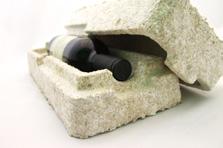
While space prevents us from listing them all here, the biodegradable, fungus-based Mushroom Packaging developed by the U.S.-based firm Ecovative ticks all the boxes for sustainable packaging ingenuity— being both 100-percent renewable and compostable, while offering a generally affordable alternative to traditional polystyrene foam, with all its end-of-life costs and a heavy carbon-footprint legacy.
Only a few weeks ago, global furniture giant Ikea announced plans to replace the use of polystyrene to pack some of its furniture shipments with the aforementioned fungi packaging.
But now that the price of oil is largely out of the equation, the risk of sliding back into the previous mindset of blissful ignorance or indifference cannot be underestimated enough, in our humble opinion. Having invested so much capital, resources, time
COVER STORY
fresh
Considering that the first prototype package sample of this mushroom packaging was only unveiled four years ago at PACK EXPO International 2012, the use of this once-experimental material to protect product shipments of a global corporate heavyweight in such short space of time says as much about Ikea’s commitment to environmental protection as it does to the potential of sustainable packaging to make a real positive impact on the planet. Giving up on that potential now would be a shame of the century for us all.
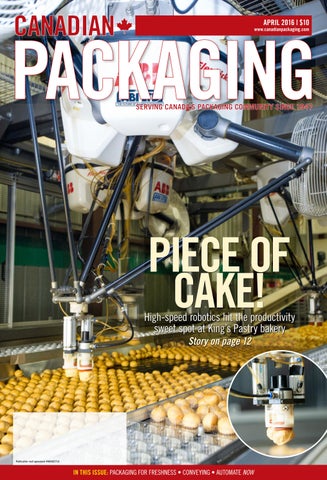
and desserts manufacturer picking up plenty of speed and momentum in productivity performance since recent installation of high-speed pick-and-place robotics. Cover photography by Cole Garside
DEPARTMENTS & COLUMNS
FEATURES
44 CHECKOUT By Rhea Gordon. Joe Public speaks out on packaging hits and misses.
19 FAMILY MATTERS By Andrew Joseph Ontario meat processor living up to proud family legacy with proactive product development and packaging know-how.
26 CATCH OF THE DAY By Andrew Joseph Freshwater fish processor charts new course for robust market growth with new thermoform packaging capabilities.
32 ALL DUE RESPECT By Andrew Joseph Manufacturer of friction feeders and fulfillment systems leverages advanced automation for superior machine design.
38 CONVEYING SHOWCASE
The latest in industrial conveying technologies.
41 IDEAS TO FRUITION
A heads-up on our upcoming Top 50 Packaging Ideas Expo
42 SHAKE AND BAKE! Preview of the upcoming Bakery Showcase 2016 exhibition and coference.
NEWSPACK
PASTA PRODUCER PUTTING A HEALTHY PACKAGING SPIN ON ITS NEW WELLNESS PRODUCT OFFERINGS
Despite being one of the world’s oldest and most popular comfort foods tracing back to 12th Century Sicily, pasta has had more than its share of critics in recent years for its alleged complicity in North America’s obesity epidemic and related health issues.
To help put some of those misconceptions to rest, venerable Canadian pasta producer Catelli Foods Corporation has recently performed some groundbreaking product and packaging development at its Montreal manufacturing facility to offer Canadians two new pasta option combining the best nutritional attributes of Canadian-grown durum wheat and high vegetable content.
Launched across Canada earlier this month, the new Catelli Smart Veggie and Catelli SuperGreens dry pastas are packaged in distinct, high-quality folding cartons—designed by Norwalk, Conn.-based branding services provider Hunter Straker —featuring the authoritative Non-GMO Project Verified certification and attention-grabbing product photography to create high-impact shelf presence.
“We wanted to also ensure the packaging conveyed the appetite appeal of both products via the use of strong recipe photography to showcase the benefits of each brand,” explains Catelli Foods, which incidentally will be celebrating its 150th anniversary next year.
“For example, the use of color and the addition of on-box callouts of the five greens in Catelli SuperGreens and the half-portion of veggies help to showcase the wide selection of wellness pasta that Catelli Foods provides to meet the taste and dietary needs of Canadians today.”
Retailing across Canada, the new Catelli Smart Veggie pasts is offered in 340-gram macaroni, spaghetti and spaghettini varieties, while the new Catelli SuperGreens—for now retailing throughout eastern Canada—is avilable in 300-gram boxes of fusilli, rotini and spaghetti variations.
According to Catelli Foods, “The key changes we made to our traditional packaging were related to ensuring consistency between our subbrands and to optimizing the shoppers’ experience by allowing them to make a quick and easy purchase decision at the shelf level.”
AN INTERACTIVE POS DISPLAY LIGHTING UP THE IN-AISLE SHOPPNG EXPERIENCE
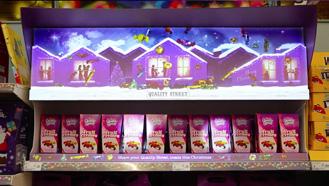
Just as it is a job of the package to sell the product it contains on the shelf, a well-made POS (point-of-sale) display is a critical marketing tool for creating a fuller brand experience along the store aisles by drawing the attention of passerby consumers with a well-delivered brand message. For the world’s largest food multinational Nestlé, the company’s pi-
lot interactive POS campaign, conducted across 10 U.K.based ASDA supermarkets a few weeks ago, has resulted in a massive spike in sales for its popular Quality Street brand of chocolate bars.
Jointly developed by the Chicago-headquartered global branding services provider Anthem and the U.K.-based computer technology group Projection Artworks , the groundbreaking POS project leveraged Anthem’s DisplayMapper software to bring existing store shelving to life with animations and real-time data by combining daylight-visible projections and 3D mapping software.
According to Anthem, the cloud-based system can centrally control and distribute creative branded content across a universe of retail supermarkets or uniquely to each store, whereby content updates can be pushed out ‘live’ within minutes for targeting consumer preferences and product promotions at the local, neighborhood level.
According to ASDA, the participating stores reported a 41-percent increase in the sales of Nestlé’s Quality Street brand at outlets that featured the DisplayMapper technology, compared to other stores, with the best-performing product categories also located closest to the projection units.
“This technology is incredibly innovative and takes POS displays to a new level,” says ASDA’s general store manager Great Bridge. “We’ve had a positive response from customers who are stopping to take a good look at a novel technology that provides a whole new way of active selling,” says Bridge, adding that Nestlé and ASDA are already planning to roll out the technology to more stores and create additional campaigns later this year.
Says Anthem’s director of brand experience Rob Hollands: “We’re very aware of the challenges inherent in engaging consumers within the store aisle, which is why we’ve seen little innovation in-store amongst the U.K.’s grocers and FMCG (fast-moving consumer goods) brands, until now.
“We’re thrilled to lead this genuine and exciting innovation to give brands a new space to tell their story and to deliver a truly ‘connected’ aisle.
“The results speak for themselves,” Hollands states. “Interactive in-aisle advertising not only drives consumer engagement, it drives brand performance—delivering top-line growth to the business.”
Adds Projection Artworks managing director Tom Burch: “As the world’s first cloud-based content distribution and display system with a full 3D video-mapping engine, DisplayMapper is a low-cost, easy-to-use technology solution that can create genuine standouts in the retail environment.
“Its dramatic impact on sales at ASDA suggests a new chapter in point-ofsale display has begun,” says Burch, adding the new technology also offers tremendous opportunities for social media-driven marketing campaigns and promotions.
n Eclipse Automation, Cambridge, Ont.-based distributor and integrator of industrial automation systems and technologies, has been named as one of Canada’s Best Managed Companies in 2015 for the second consecutive year, as selected by an independent judging panel evaluating participating companies on overall business performance, including leadership, strategy, core competencies, cross-functional collaboration throughout organization, and talent. “Eclipse is focused on collaborative business and tech partnerships on an international scale,” says Eclipse Automation president Steve Mai. “By continually creating relationships and improving our capabilities, we are not only able to enhance our North American operations, but also establish leading services and solutions worldwide.” Established in 1993, Canada’s Best Managed Companies is one of the country’s leading business awards programs recognizing Canadianowned and managed companies with annual revenues of over $10 million that have implemented worldclass business practices and created value in innovative ways to demonstrate world-class strategy, capability and commitment to achieve sustainable growth. “It takes a dedicated effort from an entire team to focus on a core vision, create stakeholder value and excel in the global economy to achieve this level of success,” said Peter Brown, partner with program co-sponsor
Deloitte and the co-leader of Canada’s Best Managed Companies program. “Over the past year, Eclipse has focused on evolving its core competencies to enable the company to stay flexible, expand its offerings, and enhance its internal pool of knowledge and expertise to effectively ensure growth even during periods of recession.”
n Toronto-headquartered labeling and specialty packaging products group CCL Industries, Inc. has reached a definitive agreement to acquire the assets of Checkpoint Systems, Inc.—leading supplier of advanced RFID (radio-frequency identification)-based product labeling, tagging, tracking and loss-prevention products for the global retail and apparel industries— in an all-cash transaction estimated at approximately US$556 million. “We have admired Checkpoint for many years as they built a unique, leading global position in providing technology-driven label solutions to the retail and apparel industry,” says CCL president and chief executive officer Geoffrey Martin. “We are very pleased to welcome their deeply experienced people to CCL, where they will continue to focus on this important industry for the emerging ‘smart label’ technologies.” Headquartered in Thorofare, N.J., Checkpoint Systems currently operates 21 manufacturing facilities worldwide, generating net revenues of
approximately US$820 million in the company’s last fiscal year ended Sept. 27, 2015.
n Milwaukee, Wis.-headquartered industrial automation technologies group Rockwell Automation has reached an agreement to acquire MagneMotion, Devens, Ma.-based manufacturer of intelligent conveying systems used across a broad range of packaging, material handling, automotive and general assembly applications. According to Rockwell, which has recently acquired complementary iTrack technologies formerly manufactured by Jacobs Automation, the acquisition will enable the Architecture & Software segment of the company’s motion business to speed up the development of new-generation “independent cart” technologies for lean manufacturing applications in various goods-producing industries. “This acquisition continues our strategy to build a portfolio of smart manufacturing technologies that brings next-generation performance to our customers today,” says Marco Wishart, general manager of Rockwell Automation’s motion control business. “We see a future where the transportation of products within the factory, whether inside of a particular machine or between machines, will be fully controlled to optimize the productivity and flexibility of the entire process.”
n Australian-headquartered global packaging products group Amcor Limited has completed a US$45million acquisition of Yuba City, Ca.-based flexible packaging converter Deluxe Packages, which specializes in the production of flexible packaging products for customers in the fresh food and snack-food segments. With estimated annual revenues of US$42 million, the acquired business will form part of Amcor’s newly-created Amcor Flexibles Americas business group, according to the company. “North America is an attractive region for flexible packaging and this acquisition represents an excellent opportunity to accelerate profitable growth,” says Amcor’s chief executive officer Ron Delia. “With the addition of Deluxe Packages, Amcor’s customer value proposition in the specialty food packaging segment is strengthened with a combined east and west coast footprint,” Delia points out. “As a result, this acquisition will enhance growth in our chosen priority segments and generate strong returns for our shareholders.”
The Eclipse Automation team strikes a cheerful celebratory pose at the company’s headquarters in Cambridge, Ont.
FIRST GLANCE
THE FINISHING STRETCH
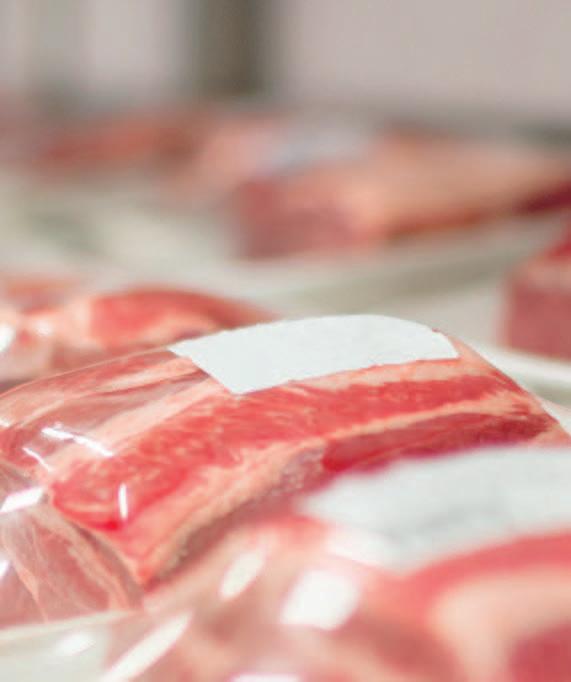
Designed to create highly attractive packages that make food like red meat, poultry, seafood and produce look fresh and ‘just packed,’ the Fabbri automatic stretch film wrappers from Reiser employ innovative four-way stretch technology to produce tight, over-the-flange, wrinkle-free packages in pre-formed trays with securely sealed bottoms and superior case presentation, according to the company. Built for high speed, versatility and productivity levels, the Fabbri machines use low-cost packaging materials to deliver comparatively low cost-per-pack, while their compact, robust design and
VBT
servo-driven operation enable them to handle a wide range of tray sizes with no changeover downtime, and they can be easily integrated with existing weighing and labeling equipment. Featuring a user-friendly, programmable control panel with 99 package tray look-ups, along with diagnostic software to allow easy operation and maintenance, the Fabbri stretch film wrappers are available in three models, including:
The Fabbri Model 55+ for producing up to 55 packs per minute;
The Fabbri Model 55 HS to produce up to 62 packs per minute;
The highly flexible Fabbri Model 38 machine, offering a choice of two operating speeds of 21 or 31 packs per minute.
Reiser Canada
OPEN DOOR POLICY
401
according to the company. Unlike expensive vacuum-seal systems with complex operation, Savior doesn’t require a bulky hard-to-use pump or dangerous electricity—creating an air-tight seal in seconds with just three easy twists of your wrist, with the vacuum seal easily released when required with a simple push of the button on the bottom of the container.
Ankomn
JUST IN CASE
403
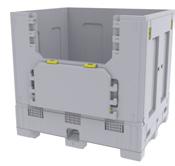
Buckhorn Inc. has expanded its Intrepid line of intermediate bulk containers (IBCs) with the introduction of a new 48x40-inch Intrepid IBC available with or without a drop door in top- or bottom-discharge configurations. According to Buckhorn, the bottom discharge is designed specifically for providing optimal ease-of-use for liquid applications, while the drop door provides better access to contents and improves ergonomics when installing a disposable liner. Constructed of FDA -approved material and featuring smooth interior and exterior surfaces for easy cleaning, the reusable and 100-percent recyclable container is designed to solve many problems that users can experience with traditional corrugated bins and wood pallets, including leakage, shifting of the pallet during transport, dust and debris build-up, and limited one-time use. Also well-suited for temporary storage, WIP (work-in-process), incoming ingredients, shipments among plants and shipments to customers, the heavy-duty can handle loads up to 2,500 pounds, with its non-sequential folding panels assembling and collapsing in mere seconds.
Buckhorn Inc.
FOOD SAVIOR
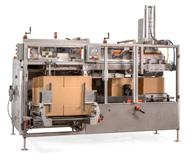
Combi Packaging Systems LLC has developed a new multifunctional machine designed specifically to meet the demands of the fast-growing craft beer industry by automating the tedious and repetitive tasks of manually erecting four-and six-pack carriers and loading them into the shipping cases by hand. Designed after extensive consultations with many leading craft-brewers across North America, the new BrewPack system automatically erects the four- and six-pack carriers and places them directly into the RSC (regular slotted case) mastercase to create a complete, bottle-ready case ready for loading and distribution.
402
The new Savior container from Ankomn incorporates the company’s proprietary, award-winning technology that helps to keep food at the peak of its freshness for an extended time by forcing air out with each twist—thereby locking out excessive humidity as well as dry air that can make food go stale—to maintain product freshness for at least eight times longer than conventional food containers. Available in a range of small and large sizes, the Savior vacuum-sealed container can be used across a diverse product range that includes nuts, tobacco, coffee, tea, truffles, herbs, fish, meat, vegetables, fruit, cheese, chips and baked goods, and it is also ideal for marinating meats,
Combi Packaging Systems LLC 404
ANALYZE THIS
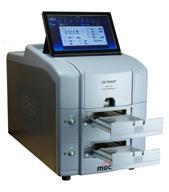
Designed for quick and accurate measurements of oxygen transmission rates (OTR) across a broad range of highbarrier materials and packages, the new OX-TRAN Model 2/22 L oxygen permeation analyzer from MOCON, Inc. was designed to provide vastly improved repeatability specification and quicker test times for end-users in the food, pharmaceutical, medical device, film and resin industries looking to provide expanded shelf-life properties for the packaged product by reducing oxygen permeation of the packaging, according to the company. Boasting many fully-automatic features—including relative humidity (RH), temperature, pressure and flow testing—that are easily set up via the system’s integrated, intuitive touchscreen interface, the analyzer’s automatic sequential testing capability is said to be especially useful in film testing application involving various RH and temperature levels, whereby the operator can establish up to 10 different RH and temperature conditions in a single test set-up, and then automatically run all the tests without further operator input.
MOCON, Inc. 405
TREADING WATER
Developed specifically to meet the high sanitary and hygienic requirements of food and beverage manufacturing operations, the new Tork Washstation Dispenser from SCA is said to be the world’s first water-resistant paper towel dispenser to be certified by HACCP
FIRST GLANCE
International. Unlike traditional dispensers, the Tork Washstation Dispenser is highly water-resistant and it does not need to be covered or removed from walls during routine sanitation procedures— including high-pressure spraydowns—with the dispenser’s unique design helping to channel water off the housing and away from the paper-towel refills inside, thereby eliminating the risk of bacteria growth caused by pooling water, while keeping moisture away from the paper refills inside.
SINGLE LIFE
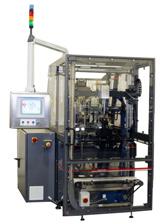
Bradman Lake Inc. has redesigned the company’s popular HSS Double Head glue-and-lock style carton/ tray-forming machine to create a brand new singlehead version with a smaller footprint and a more economical operation for lower-speed applications, according to the company.
The new HSS Single Head former features a low-level, large-capacity carton blank magazine that is fully shaft-adjusted to suit different carton sizes, along with a servomotorpowered carton feed bar that extracts carton blanks from the front of the carton magazine and positions them onto the flat deck shuttle mechanism. In operation, the carton blanks are shuttled forward and gripped at each side to ensure precise positioning of glue above the carton plunger cavity, with the hot-melt adhesive fired downwards with precise accuracy. According to Bradman Lake, the lock-erect style cartons can also be handled on this former by just turning off the glue firing. Unlike many traditional formers using mechanical drives, the HSS Single Head machine
features pre-programmed speed of plunger descent and ascent to achieve faster forming speed of up to 60 cartons or trays per minute, while also plunging further into the forming cavity to process cartons or trays with taller side-walls, as well as enabling it to work with the coarser grades of corrugated materials.
Bradman Lake, Inc.
CURTAIN CALL
407
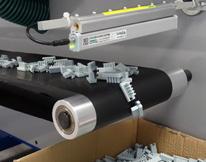
Designed to provide effective static neutralization and dust removal in a wide range of industrial applications across the plastics and packaging industries, the new Hyperion 959IPS ionizing air curtain from Meech International is a highly effective hybrid solution that comprises a Hyperion 924IPS anti-static bar mounted on a Meech-made, energy-saving air curtain to produce a high-speed laminar sheet of ionized air. Running on a 24-V DC power supply, the system’s compatibility with the Hyperion BarMaster programmer means the output voltage, frequency and balance can be adjusted remotely by the operator, according to the company, while the system’s proprietary ICM (ion current monitoring) technology helps to maintain high performance levels with local and remote alerts whenever the bar requires cleaning.
Meech International
NEW CODE OF CONDUCT
408
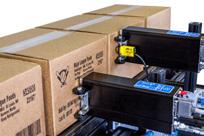
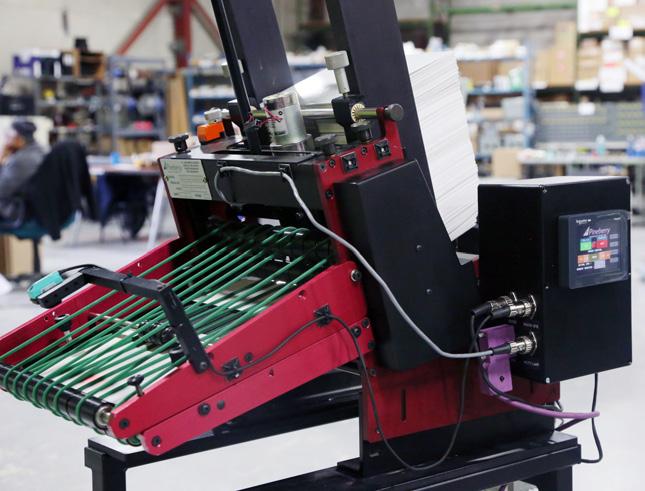
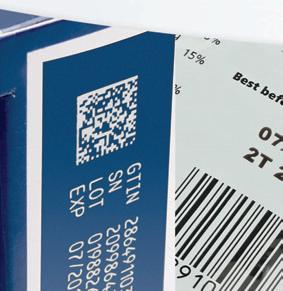
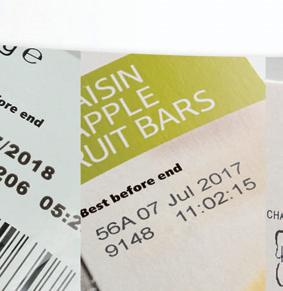
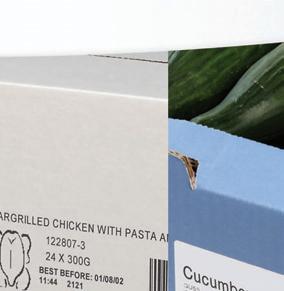
Designed for high-quality printing of alphanumerics, barcodes and graphics onto porous substrates, the new model IJ4000 high-resolution, largecharacter impulse inkjet system from Diagraph incorporates three new innovative features that ensure optimal consistency on packaging lines where boxes are rarely perfectly uniform in size, shape or orientation. This includes a new roller
retractor to provide a consistent gap between the print surface and print engine, working with a synchronized digital level sensor accelerometer with a green LED light to indicate when the print engines are perfectly aligned and perpendicular with the packaging material to be printed. Secondly, the print engines of the IJ4000 system can achieve up to 0.5-inch throw distance for alphanumerics and 0.25-inch throw distance for barcodes—thereby greatly reducing the impact of corrugate dust, glue and other contaminants on the final print quality. Moreover, the redesigned print engine ensures that the finished print is at least 15 per cent darker than most competing models on the market, according to the company, translating into a 35-percent improvement in barcode decodability. Diagraph 409
POWER DRIVE
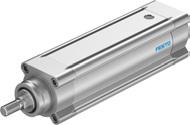
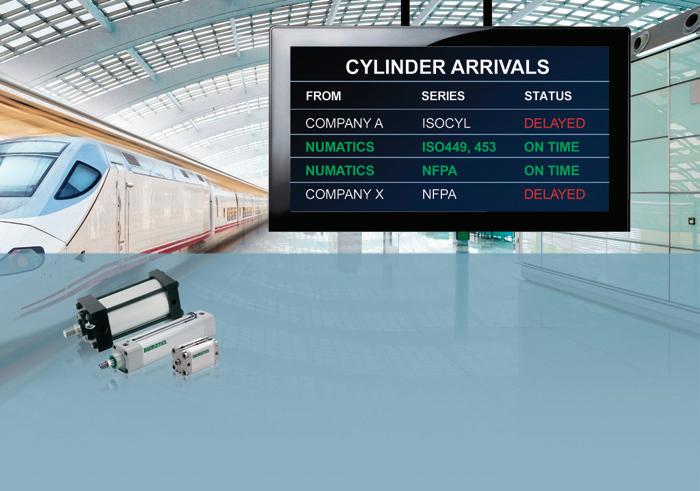
The new ESBF series of heavyduty electrical cylinders from Festo Inc. are outfitted with a high-performance spindle drive to provide optimal flexibility and control in a diverse rang of demanding high-load applications. Available in six sizes to prove maximum stroke lengths of 800-mm to 1,500-mm, depending on the size selected, the clean-look, high-powered linear drives with a piston rod comes with an optional bellows protection kit to make them suitable for operation in arduous splash zones by ensuring optimal protection for the rod, seal and bearings against unwanted media like dust, oil, grease or filings.
Festo Inc.
410
LONG LIVE THE CARTON!
BY ISABELLE FAUCHER
My first year as managing director of the Carton Council of Canada (CCC)—a group of carton manufacturers united to grow carton recycling in North America—has been an exciting one.
I am thrilled to see a real concern for the current sustainability challenges the industry faces. From field to plate, and on to the recycling bin or the compost pile, the journey of food makes us accountable as a society for the waste it leaves behind and, ultimately, its diversion from landfill.
This concern is every bit as valid when it comes to packaging milk, juice, wine, soup, broth and other liquid or soft food products inside paperboard cartons.
The Carton Council’s approach to this issue has been to work with stakeholders across all stages of the recycling value chain in order to grow recycling of used food and beverage cartons in Canada.
With this in mind, we have implemented a number of initiatives over the past year to help build a sustainable carton recycling supply chain.
In late 2015, we partnered with four Ontario mu
nicipal programs to launch a digital advertising campaign aiming to remind and encourage consumers to recycle their food and beverage cartons. (See Infographic)
With the campaign reaching over 4.6 million views preliminary indications concerning the number of cartons recovered after the advertising campaign started are promising.
Earlier this year, we developed and released the Carton Recycling Primer report, with the goal to share our knowledge and expertise around carton recycling with recycling stakeholders.
This comprehensive report provides information, data and best practices about carton recycling collection, sorting and marketing.
Aiming to maximize the amount of cartons recovered, we also provided technical advice to municipalities and MRF operators in order to optimize carton recycling in their respective facilities.
In December 2015, I had the chance to visit Des Moines, Iowa-based The Rewall Company, a recycler specializing in converting used cartons and other poly-coated packaging into high-performance ‘green’ building materials.
The unique process uses the whole carton, does not require any water, and does not produces any emis sions. It was fascinating to see the final product —
namely roof cover board and wallboards—made from Canadian carton bales.
Progressive companies like Rewall represent an exciting new end-market option for recovered cartons in addition to the existing paper mills.
Packaging is an intrinsic part of the food and beverage industry and plays a crucial role when it comes to food protection, food waste prevention, and enabling efficient distribution.
In addition to fulfilling these functions, we are proud of the fact that carton packaging has one of the lowest environmental impacts within the packaging industry
We seek to reduce this impact further by increasing carton recycling across Canada throughout 2016 by continuing to strengthen our critical collaboration with all the key stakeholders to achieve this goal. When the contents are gone, let the carton live on!
Isabelle Faucher, managing director of the Carton Council of Canada (CCC), may be reached by email at ifaucher@recyclecartons.ca
PAC Events Calendar
Just One Package Innovation Challenge
Retailers challenge the packaging industry to innovate solutions to reduce consumer reliance on single-use packages/bags at retail
Special Feature Student Competition
Packaging Certificate Program
September 28 & 29, 2016 Niagara Falls,
May 18, 2016 PAC Golf
Course 1 - May 3, 4, 5
Course 2 - June 13, 14, 15
Course 3 - September 20, 21, 22
Course 4 - October 25, 26, 27
Legends on the Niagara September 27 Niagara-on-the-Lake, ON tropolitain
Tournaments
Club de Golf Métropolitain
May 31
Montreal, QC
Redwoods Golf Course
June 20
Langley, BC
Cardinal Golf Club
June 21
Newmarket, ON
Mountain Woods Golf Club
April 19-20
Oakville, Ont.: CPES2016, conference by the Canadian Printable Electronics Industry Association (CPEIA). At Sheridan College conference center. To register, go to: www.cpes2016.ca
April 26-27
Mississauga, Ont.: Partners in Prevention 2016, national occupational health and safety trade show and conference by Workplace Safety & Prevention Services (WSPS). At The International Centre. To register, go to: www.PartnersinPreventionConference.com
April 26-27
Cartagena, Colombia: Label Summit Latin America 2016, labeling technologies exhibition by Tarsus Group Ltd. At Hotel Las Americas Convention Center. To register, go to: www.labelsummit.com/colombia/
May 1-3
Mississauga, Ont: Bakery Showcase 2016, national baking industry trade show and conference by the Baking Association of Canada. At The International Centre. To register, go to: www.bakingassoccanada.com
May 10-12
Rosemont, Ill.: Food Safety Summit, conference and exhibition by BNP Media. At Donald E. Stephens
Convention Center. To register, go to: www.foodsafetysummit.com
May 17-20
Mexico City: EXPO PACK México 2016, packaging technologies and materials exhibition by PMMIThe Association for Packaging and Processing Technologies. At Centro Banamex. To register, go to: www.packexpo.com
May 18
Mississauga, Ont.: Just One Package Innovation Challenge, package design competition by PAC, Packaging Consortium. At Mississauga Convention Centre.To register, go to: www.pac.ca
May 31 - June 10
Düsseldorf, Germany: drupa 2016, global trade fair for print and crossmedia technologies and solutions by Messe Düsseldorf GmbH. At Messe Düsseldorf Fairgrounds. Contact Messe Düsseldorf (Canada) at (416) 598-1524.
June 7
Mississauga, Ont.: Top 50 Packaging Ideas Expo, tabletop exhibition and networking event by the Canadian Packaging magazine. At Mississauga Convention Centre. Contact Stephen Dean at (416) 5105198; or go to: www.top50packagingideas.com
June 9-10
Amsterdam, The Netherlands: Sustainable Foods Summit Europe, eco-labeling and food waste prevention conference by Organic Monitor. At Mövenpick Hotel Amsterdam City Centre. To register, go to: www.sustainablefoodssummit.com/europe
June 21-24
Munich, Germany: Automatica 2016, international robotics and automation technolgies exhibition by Messe München GmbH. At the Messe München Trade Fair Center. To register, go to: www.automatica-muenchen.com
June 23
Toronto: The Business of Water: Canadian Water Summit 2016, by PAC, Packaging Consortium. At Hilton Toronto. Contact Lisa Abraham via email registration@watersummit.ca; or go to: www.watersummit.ca
Sept. 7-10
Jakarta, Indonesia: IndoPlas, IndoPack and IndoPrint, international plastics, processing and packaging, and printing exhibitions by Messe Düsseldorf Asia and PT. Wahana Kemalaniaga Makmur (WAKENI). All at the Jakarta International Expo. In Canada, contact Messe Düsseldorf (Canada) at (416) 598-1524.
Perfect Packages,
One Size Doesn’t Fit All
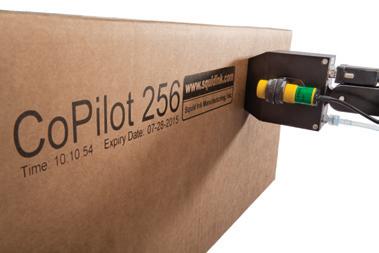
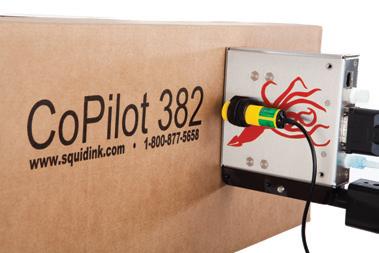
Squid Ink’s new family of CoPilot Printing Systems offers 3 different print heights for your different applications.
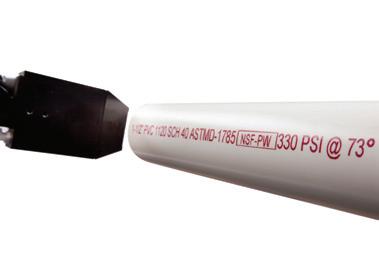
Squid Ink’s CoPilot 128 is a proven choice for printing small character codes or barcodes on egg cartons, PVC pipe, corrugate cases or more. The CoPilot 382 is ideal for replacing costly print and apply labels or printing GS1 barcodes on the side of a box. The CoPilot 256 fits right in between, making Squid Ink’s CoPilot family the ideal solution for your specific coding and marking applications.
For more information visit www.squidink.com or call 1-800-877-5658 for your local Authorized Squid Ink Distributor today.
www.squidink.com info@squidink.com 1-800-877-5658
BY GEORGE GUIDONI, EDITOR PHOTOS BY COLE GARSIDE
It is tempting to think that life is a piece of cake for the owners and employees of King’s Pastry, a thriving fresh pastry and desserts manufacturer quickly earning itself a stellar reputation for the high quality and diverse range of delicious, authentically-made baked goods produced at the company’s 120,000-square-foot commercial bakery in Mississauga, Ont.
But thinking so would do a disservice to that vast amount of hard work, continuous research and investment, artful culinary creativity, and cuttingedge technological savvy unfolding there on a daily basis.
“We invest millions of dollars every year into new equipment at our facility to ensure continuous improvement in product quality and process efficiency,” says company co-owner Lewis Tsang, who founded King’s Pastry along with two business partners 19 years ago to produce a small variety of French-Oriental style cakes and pastries for local restaurants and bake shops.
“We compete in a highly competitive marketplace with very thin profit margins, which makes cost control and lean production critical for our business,” Tsang told Canadian Packaging on a recent visit to the 200-employee production facility operating two shifts over a steady, five-days-a-week schedule throughout the year to produce a staggering array of cakes, desserts, cookies, tarts, rolls, puffs and other high-quality baked goods in an ever-growing range of serving sizes and packaging formats.
Nowadays producing well over 200 different SKUs (stock-keeping units) at a single location for a steadygrowing customer base in the foodservice and retail markets, the facility ships out over 2,000 full truckloads per year to leading foodservice distributors like Sysco; a multitude of restaurants, catering services, hotels, institutions and other foodservice operators; and to major Canadian supermarket chains such as Loblaws, Metro, Sobeys, Safeway, Costco and Walmart, among others.
PURE PASSION
According to the bakery’s engineering coordinating manager Ivy Jiang, the company’s “exponential growth” of recent years stems directly from “our passion and dedication to producing quality products.
“Our customers are continually impressed by the combination of the high quality of our products and the extremely competitive pricing that we offer for those products,” she says.
“They are also often surprised to find the large variety of product categories—covering singleserve cakes, bite-sized desserts, bar cakes, coffee cakes, mousse cakes, etc.—that we manage to make all under one roof,” Jiang states.
This diverse product variety is aptly underscored with the high-quality packaging used to ship its products.
ICING ON THE CAKE
Expertly integrated pick-and-place robotics serve up sweet productivity gains for a fast-growing fresh pastries producer looking for a bigger slice of the retail market pie
For bulk shipments, the plant makes extensive use of pre-printed corrugated cases supplied by the Norampac division of leading Canadian forest products group Cascades Inc. of Kingsey Falls, Que.
For retail customers such as grocery chains and drugstores, King’s Pastry uses a broad selection of shapes and sizes of rigid plastic clamshell packaging supplied by the Brampton, Ont.-based Pactiv Canada, Inc.
Typically comprising a black plastic base and a clear-plastic, shape-fitting dome with built-in, snap-on closures to hold the two pieces in place throughout distribution, the fully-recyclable clamshell packaging offers terrific product protection and transparency that enables the eye-catching King’s Pastry creations—from round 750-gram coffee cakes and rectangular 800-gram layered bar cakes to the single-serve cakes and crispy puff pastries—virtually sell themselves on the shelf.
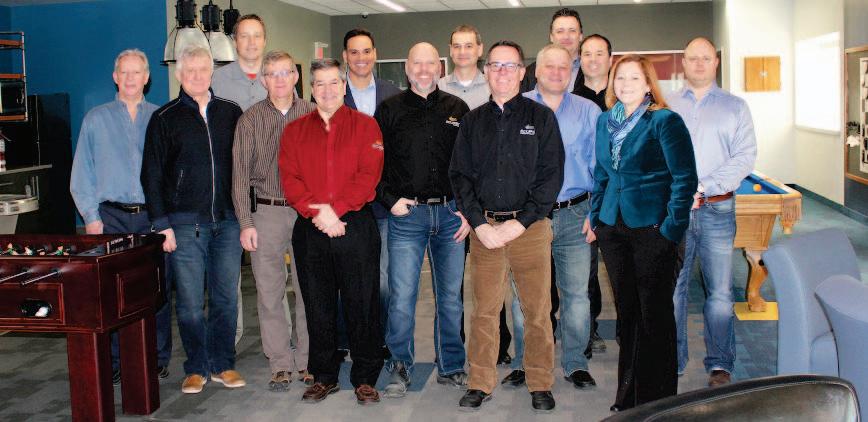
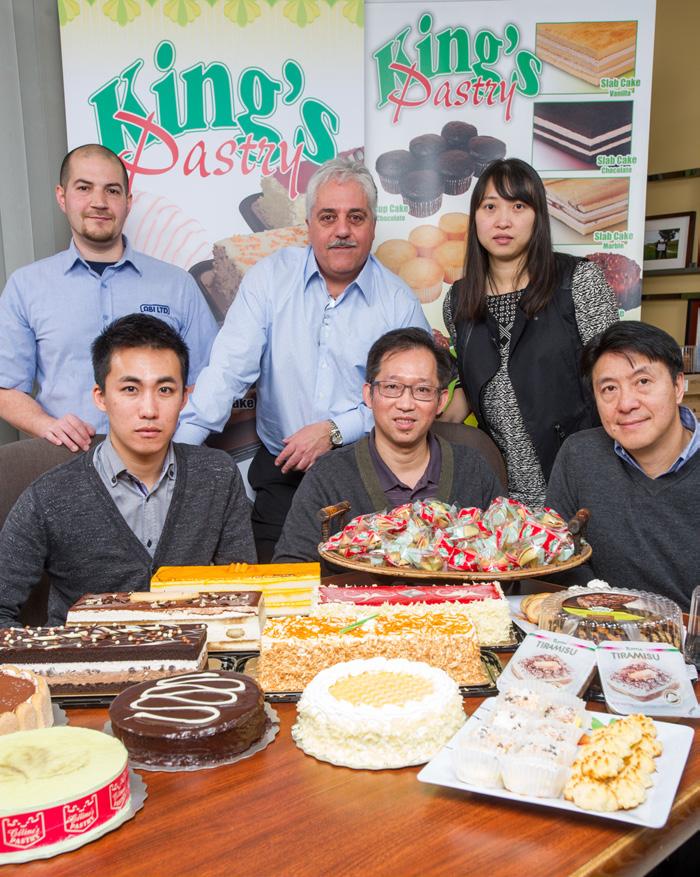
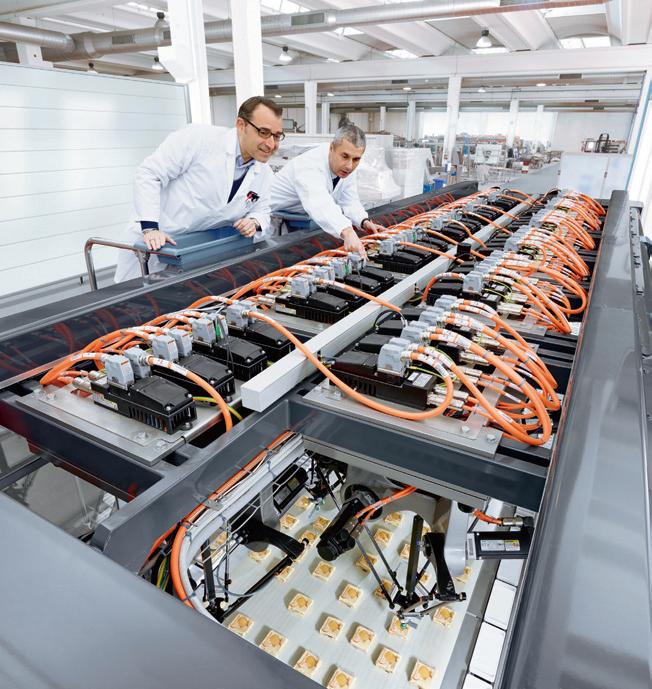
Key players in the bakery’s robotics integration project include (sitting from left) King’s Pastry operations manager Kelvin Tsang, co-owner Lewis Tsang and director of marketing Kevin Chan, joined by (standing from left) ABI communications director Aaron Burke and sales rep Tony Cacciola, and King’s Pastry engineering coordinating manager Ivy Jiang.
“Packaging plays a very important role in the retail pastry and dessert business,” Jiang states.
“With the keen competition and limited shelf space, we have to make our product stand out,” says Jiang, citing the prevailing trend to the so-called ‘clean labeling’ of easily-recognizable ingredients as one of the more important recent developments in the bakedgood industry.
“The ongoing consumer trends toward healthier lifestyles and dietary habits are creating an opportunity for King’s Pastry to become both cleaner and greener,” Jiang reflects.
“As a result, we are in the process of moving to a ‘cleaner’ deck of ingredients—in order to be consistent with the prevailing new consumer attitudes.”
With a fully-equipped on-site R&D lab dedicated to developing new recipes, flavor variations and formats to keep its foodservice and retail customers consistently coming back for more, the Mississauga facility is naturally a beehive of fast-paced activity.
BALANCING ACT
To keep up with its robust production volumes, the plant houses 14 different production lines, each specializing in a particular product line such as pastries, slab cakes, bar cakes, puffs, coffee cakes, retail cakes, etc., Jiang explains.
“Our production philosophy is based on finding the optimal balance between automation and manual labor in order to provide the best possible product quality, consistency and value to our customers,” Jiang states.
“To achieve that, we source the latest and most efficient production equipment in the industry,” she relates, “while ensuring that we also hire the most qualified staff for doing all the finishing touches, so that all our cakes remain pictureperfect from start to finish.”
Naturally, the King’s Pastry also uses only the best raw ingredients it can get its hands on to get the production process rolling, which is done at the plant’s large-capacity, centralized Silo System.
Comprising five advanced subsystems—three for handling three types of flour and two for sugar—the Silo Ssytem produces all of the plant’s cake mixes and
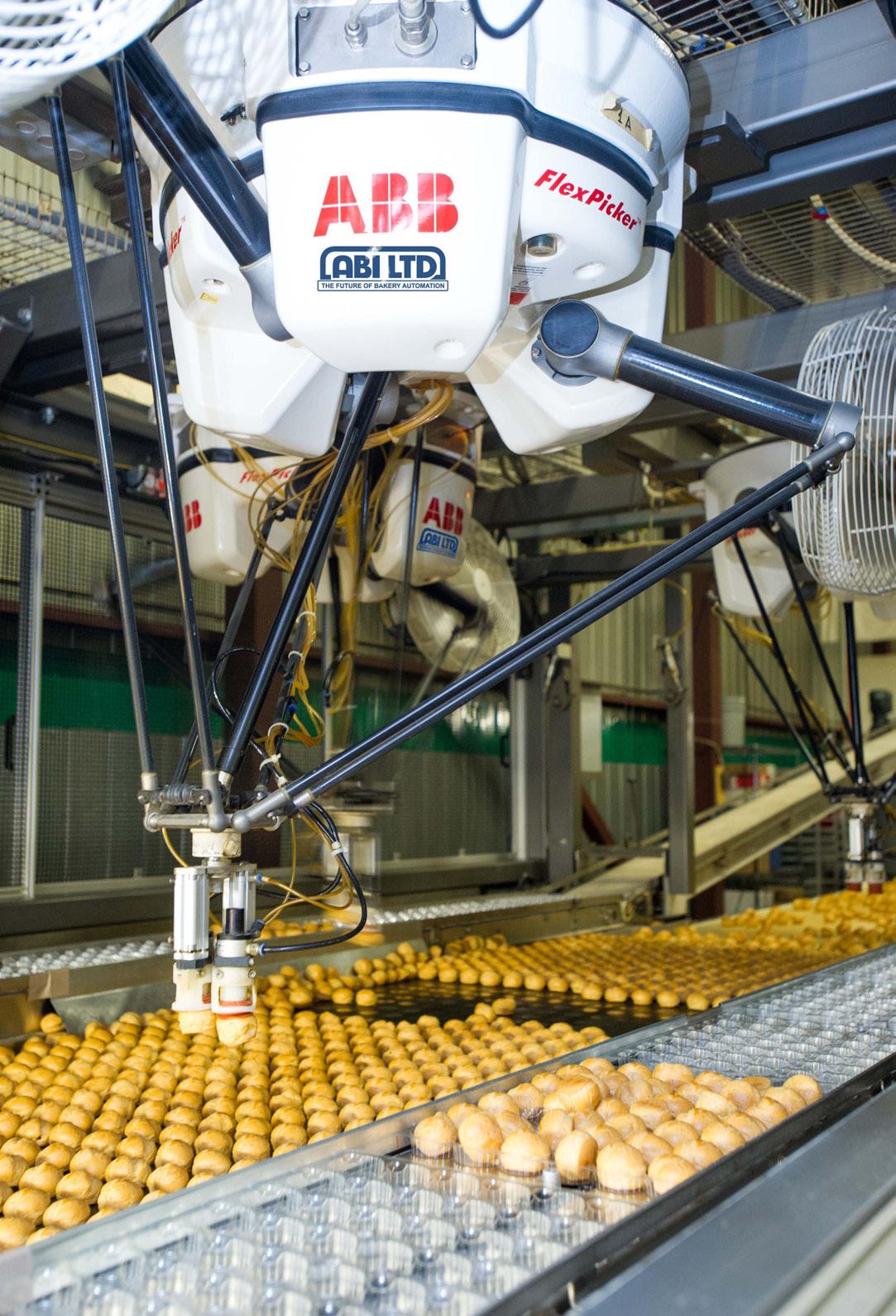
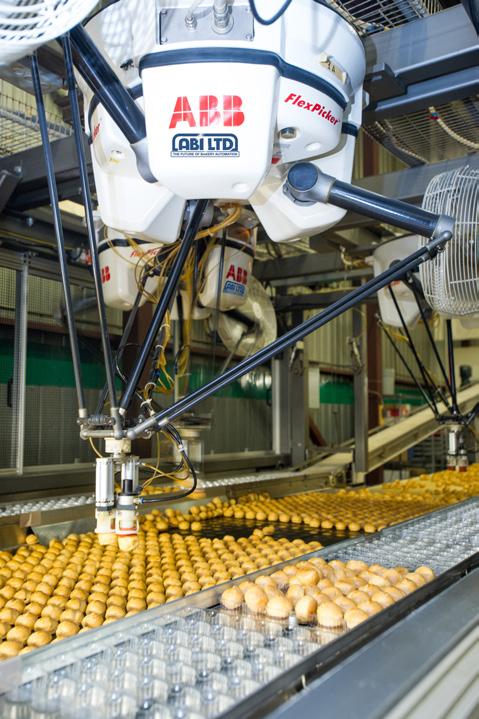
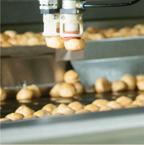
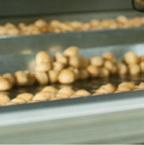
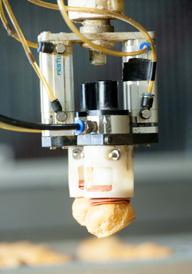
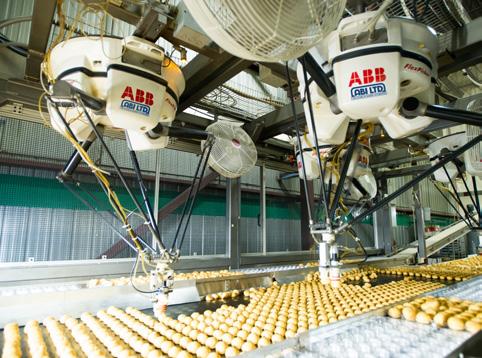
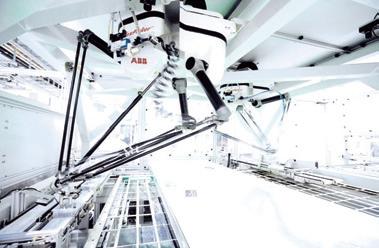
Comprising four high-speed ABB model FlexPicker IRB 340 pick-and-place robots outfitted with special soft-touch Festo grippers for gentle produt handling, the workcell enables the plant to keep up with vast demand growth for its high-quality cream puffs.
gelatin dessert mixes from scratch, reaching maximum monthly production capacity of 2,000 tonnes.
With storage capacity of 100,000 kilograms, the Silo System goes through 50,000 kilos of sugar and 25,000 kilos of flour each week, enabling the plant to ship out an equivalent of 100 truck-trailer loads of dry-mix products monthly.
The mixed batches of raw product are continuously fed through the plant’s two high-performance cyclo-thermic tunnel ovens—one catering to pastries and the other to cakes—to cook the mixed dough to desired texture and consistency levels.
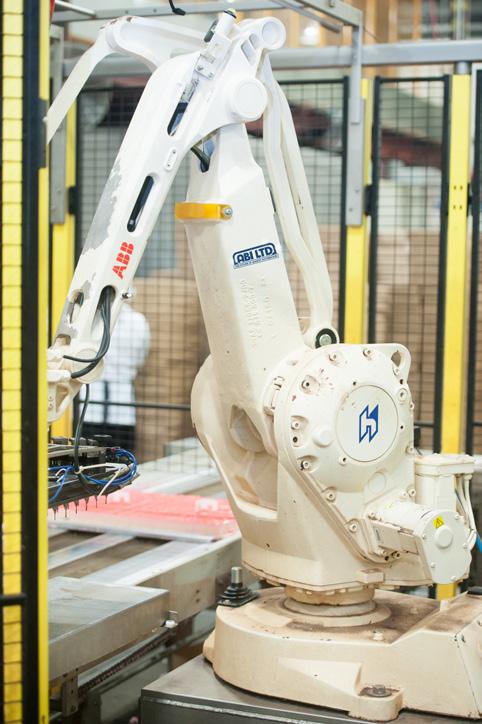
Installed and integrated by baking equipment and systems specialists at ABI LTD, the ABB robotic workcell at the King’s Pastry state-of-the-art production facility a short drive west of Toronto in Mississauga has enabled the plant to achieve multiple production line efficiencies, along with significant reduction in manual labor costs and requirements.
Measuring about 150 feet in length, each tunnel has a production capacity of about 140 truck-trailer loads—equaling to 630,000 trays of product—per month.
While foodservice customers currently account for about 60 per cent of the company’s total output, King’s Pastry is determined to grow the retail part of its business at a quick pace in the months and years ahead, Jiang relates.
“We are working hard to bring the retail side of the business into a high percentile,” says Jiang, cit-
ing strong growth trajectory for the company’s three core retail brand labels, including:
The King’s Pastry brand of miniature bitesized pastries and cakes, multilayer slab cakes, bar cakes and round coffee cakes, etc.
The premium Celine’s brand of signature mousse cakes and traditional multiserve round and slab cakes; The Golden Blends range of gelatin dessert, pudding, cake and other mixes for the DIY home chefs.
To boost the packaging throughput levels for some of the company’s bestselling, fast-moving products such as bite-sized cream puffs and jelly-filled round and long puffs and éclairs, King’s Pastry recently turned to one of its trusted technology suppliers, Concord, Ont.-based system integrators ABI LTD, to provide a high-speed, fully-automated solution for placing the delicate pastries inside the preformed, clear-plastic clamshell trays in several rows of product at a time.
“ABI has provided us with state-of-the-art pro -
Manufactured by ABB Robotics and integrated at the King’s Pastry facility by ABI, the FlexPicker model IRB 640 robot can replicate more than 1,000 hand-drawn decorative patterns stored in its computer memory at speeds of up to 126 pieces per five seconds.
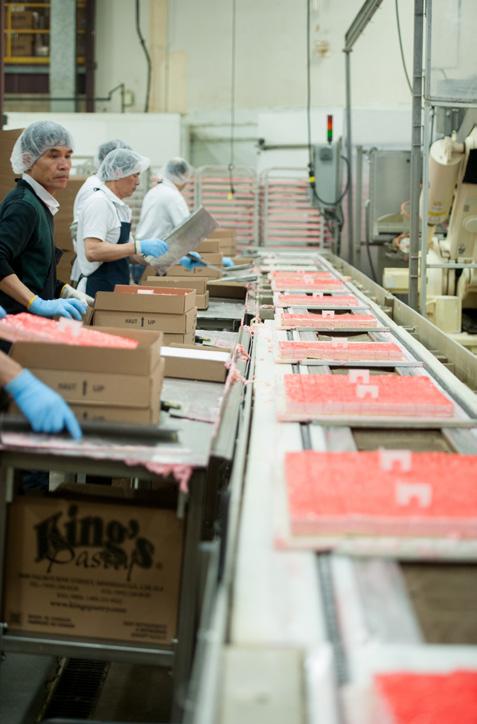
Line workers at the King’s Pastry plant in Mississauga placing trays of freshly decorated pre-cut pieces of moist and delicious raspberry layered mousse cake inside the Norampac corrugated boxes used for bulk product shipments to foodservice customers.
Above: After being packed into the plastic clamshell tray bottoms by the ABB pick-and-place robots, the freshly made rolls are pierced from the top and filled with whipped cream just prior to lidding.
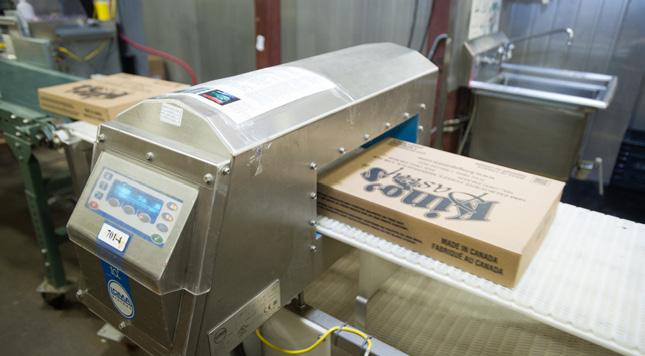
Right: All the products made at the King’s Pastry facility go through one of several Loma Systems model IQ3 metal detectors as part of the plant’s rigorous quality control and assurance regimen.
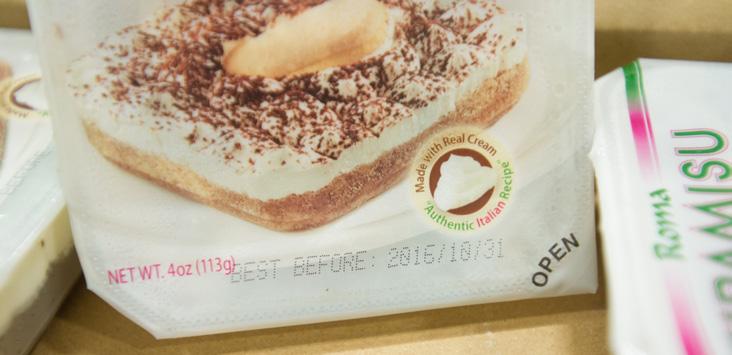
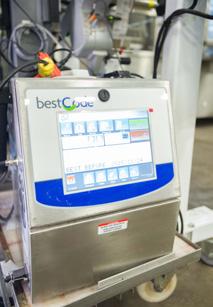
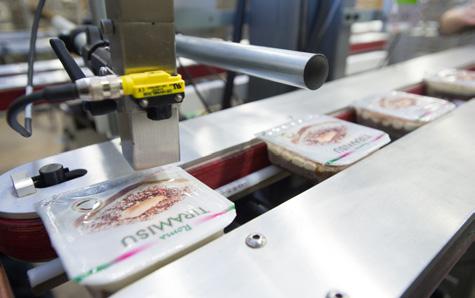
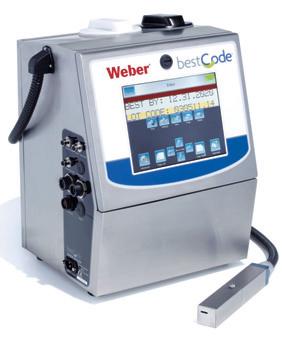
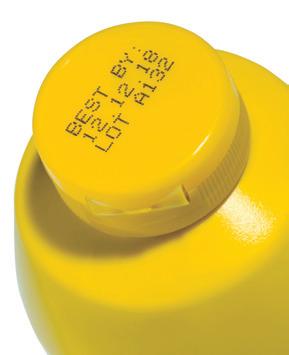
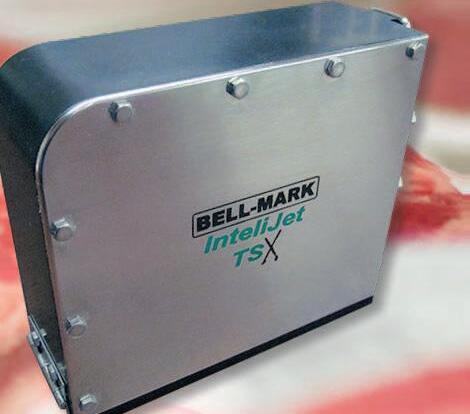
Originally developed for the U.S. privatelabel market, the Tiramisu refrigerated cakes have their best-before dates applied by one of two high-speed BestCode inkjet coders (inset) supplied to the bakery by Weber Marking Systems.
duction capabilities that are instrumental in our ability to deliver consistently high-quality finished products, even as the demand for our products grows rapidly,” Jiang relates.
“Being in a position to quickly scale up our production rates and meet the needs of our expanding customer base has been one of the catalysts of our success in recent years.”
PICK OF THE CROP
The full-enclosed robotic cell designed and integrated by ABI employs four high-performance FlexPicker IRB 340 pick-and-place robots—manufactured by ABB Robotics —to perform the highly-repetitive task of gently picking up the individual puffs and placing them into their proper cavity inside the trays at a blink of an eye.
With each robot outfitted with robust Cognex machine vision system for optimal accuracy and repeatability, the low-noise robotic cell virtually runs itself, according to Jiang, in what is for the most part an error-free process.
“We used to have a lot of people taking up a lot of room on the production line manually loading the rolls into those trays,” recalls Jiang.
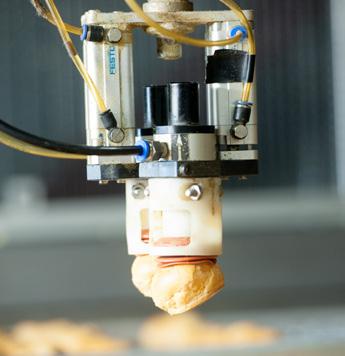
“It was a very labor-intensive operation that took up a fair bit of time and also resulted in some quality control issues that you always encounter with so much manual product handling,” says Jiang, praising the robots’ specially-designed grippers for ensuring supremely gentle product handling throughout the process.
“We are still in the fairly early stages of deploying this new robotic set-up within our existing production process,” Jiang relates, “but based on the labor savings that we have already calculated to date, we are looking forward to a tremendous bottom-line impact once the deployment is complete.”
Designed for optimal operational flexibility in a compact footprint, each of the four high-precision, four-axis FlexPicker IRB 360 robots can perform up to 150 picks per minute, with their advanced IRC5 controller helping to ensure the highest speed and path-following accuracy to track fast-moving products.
In addition, the FlexPicker IRB340 models installed at King’s Pastry feature washdown-ready construction with special water-repellent paint finish, corrosion-resistant material surfaces, and fully-sealed components for easy cleaning and maintenance.
This is of particular importance to the Mississauga facility, which works hard to annually renew its hard-earned SQF (Safe Quality Food) and HACCP (Hazard analysis Critical Control Points)
COVER STORY Make even better connected machines.
Easily.
Achieve business excellence with
machine solutions
As a pioneer in smart automation technologies, Schneider Electric makes it easier for you to offer your customers better connected machines. Our future-ready machine solutions intelligently connect people, devices, machines, and data to simplify machine design and boost business efficiency. Both today and tomorrow.
How you can benefit from digitization and the IIoT Download our FREE white paper to learn more today!
certifications.
“We must always strive to ensure that our food is perfectly safe and is of excellent quality,” Jiang states.
“We are audited by food safety auditors for globally-recognized SQF accreditation, one of the highest standards in this industry, on a yearly basis.
“More recently, we voluntarily added the Costco food safety audit on top of the main SQF audit and achieved a perfect score,” Jiang reveals.
“We really want to show that we are dedicated to investing in our food safety program for all our customers, including Costco and all others.”
In addition to the pick-and-place robots, ABI also supplied the King’s Pastry plant with a custom-engineered, computerized cake decorating robot used to add finishing design touches onto the individual surfaces of the company’s multitude of mini-cake varieties—ranging from the dry-mix carrot and cappuccino cakes to the soft-textured coconut, mango and raspberry mousse cakes.
Employing a custom-designed, 126-nozzle depositor connected to a touchscreen computer, the modified ABB-made FlexPicker 640 model robot can execute up to 1,000 different hand-drawn patterns stored in the computer’s
memory—flawlessly recreating these patterns onto each individual mini-cake by applying just the perfect amount of chocolate and other icings/toppings at a rate of 126 pieces every five seconds.
According to Jiang, the plant’s highly positive experience with robotics to date has prompted the management to allocate additional investment in robotic technologies for later this year, as robust demand growth from customers both in Canada and the U.S. is driving the need for installation of additional production lines.
To help the plant meet all of its objectives, ABI is already hard at work on a new project involving high-tech mixing of icing and batters, as well as fully automating an existing complete product line at the plant.
With ABI sales representative Tony Cacciola leading a dedicated team of expert staff mechanical and electrical engineers through all the rigorous testing and R&D procedures, it’s a safe bet that the final project will meet all of King’s Pastry’s high expectations.
In fact, meeting and exceeding customer expectations on a consistent basis is ABI’s signature calling card, according to Cacciola.
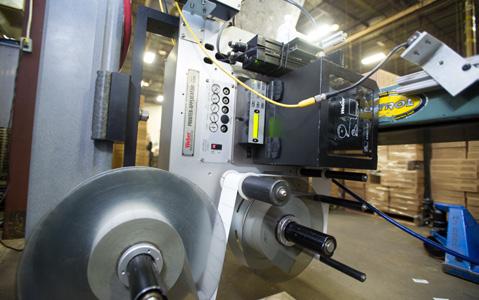
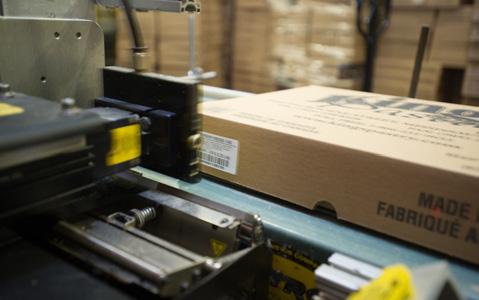
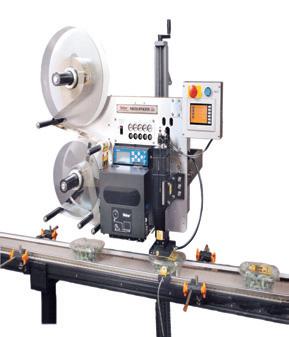
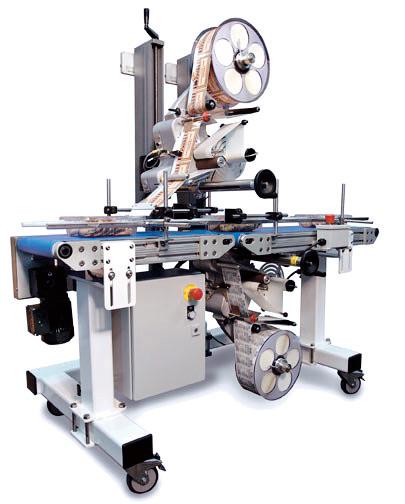
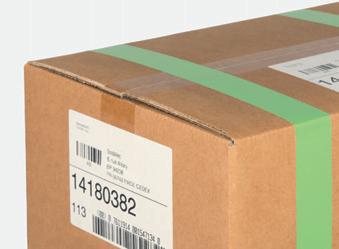
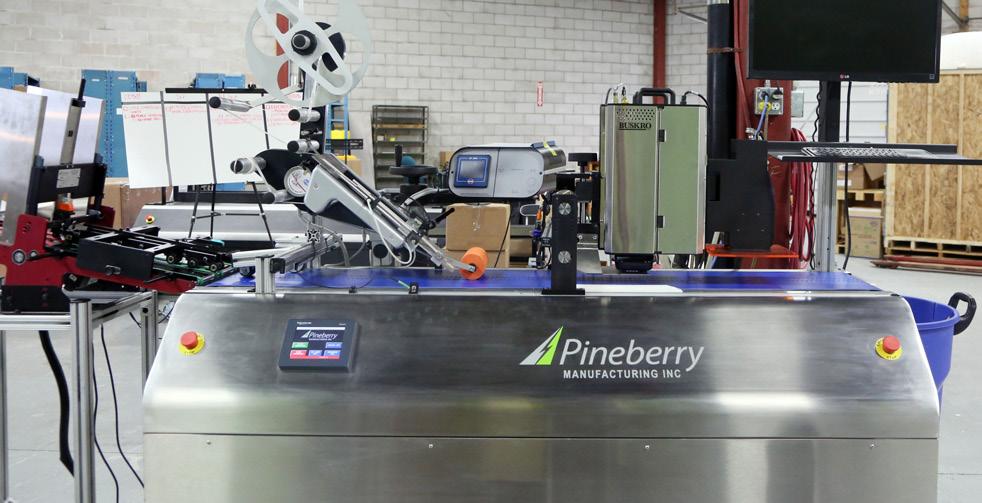
The high-speed printer-applicator from Weber Marking Systems applying individual product labels onto the front side panels of passing boxes with unfailing placement accuracy.
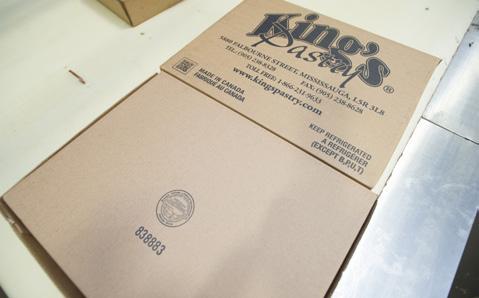
The pre-printed corrugated shipping container made by the Norampac division of Cascades Inc. provide superior product protection and stability for bulk product shipments.
A roll of pressure-sensitive labels processed by a high-speed printer-applicator from Weber for precise application of individual labels onto the corrugated shipping boxes.
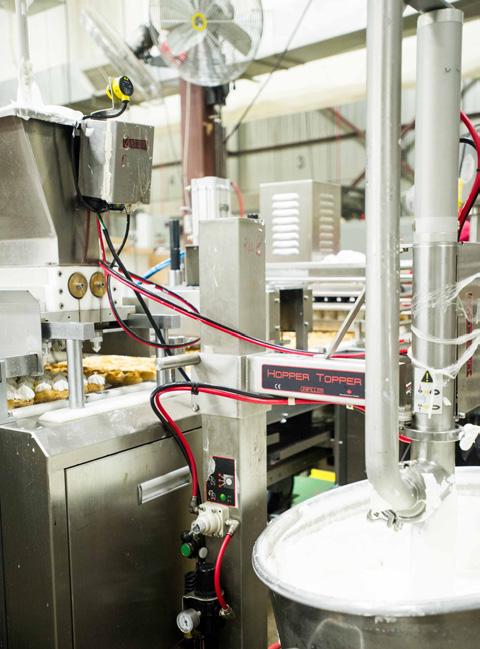
The high-speed Hopper Topper filling system manufactured by Unifiller Systems Inc. deposits precise amounts of whipped cream onto the freshly-baked cream puffs.
Sealed trays of single-serve Tiramisu cakes pass by a BestCode inkjet coding system for high-speed application of best-before dates and other key variable product information.
Founded about 30 years ago by Alex and Mike Kuperman, who selected the company names as verbal shorthand for “Auto Bake Industries,” ABI started out by focusing on bagel and bread manufacturing equipment, Cacciola relates, but has since expanded its skillset and knowledge base to include packaging, palletizing and many other key related processes in the value chain.
“Once the new processing workflow at King’s Pastry is perfected, then the automation of the packaging portion of the project will follow soon,” Cacciola states.
“Our partnership with King’s Pastry is a long-term relationship that often requires patience in the planning stages,” he says, “and we’re fortunate to have an understanding client who really appreciates the value of getting everything right from the outset.
“We love working together with a company whose progressive mindset matches our own,” Cacciola points out.
“Our facility is continuously being upgraded at all times in an effort to remain on the cutting edge of food production technology,” concurs King’s Pastry’s Jiang.
“Our core strength lies in being able to make our mass production process incorporate high efficiencies that save us time and labor costs, thereby enabling us to pass on those savings to our customers,” Jiang explains.
“These efficiencies are a direct result of our heavy investment in automation and the continuous improvement achieved by reengineering our production processes and workflow on a yearly basis,” she points out.
“Our strong partnerships with state-of-the-art equipment providers like ABI and world-leading robotics manufacturers like ABB Robotics have proven to be important relationships that help us remain on the cutting edge of our industry at all times.”
Says Jiang: “With industry-leading partners such as ABI and ABB Robotics, as well as other companies through which we source equipment, ingredients and materials, we believe we are poised to continue growing and improving our operations well into the future.
“The quality of the equipment that both companies have provided has been excellent,” Jiang concludes, “while the service levels and technical assistance they provide are on par with what one would expect from companies that are both leaders in their field, servicing industrial-scale clients across the globe.
“Therefore, we plan to continue to integrate more similar equipment into our daily production processes, as we continue to grow our business.”
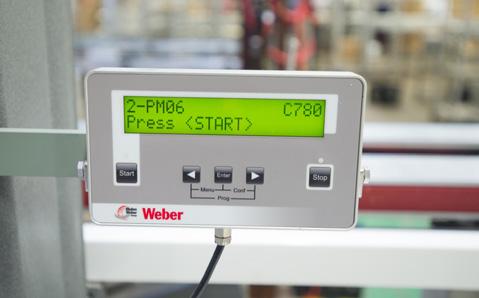
A touchscreen operator control panel for the high-speed Weber print-and-apply labeling system enables user-friendly operation and fast product changeovers at the busy plant.
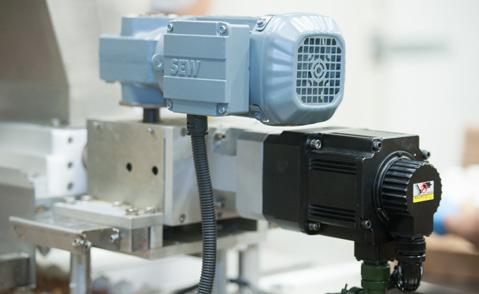
The King’s Pastry production facility employs a large number of SEW-Eurodrive motors to help maintain optimal performance and reliability of the plant’s many conveyor lines.
PACKAGING FOR FRESHNESS
FAMILY MATTERS
Thriving Ontario meat processor happy to carry on a proud family legacy with new high-performance thermoforming machinery to create high-impact retail packaging
BY ANDREW JOSEPH, FEATURES EDITOR PHOTOS BY COLE GARSIDE
For anyone fancying themselves as being part of a living legacy, it takes more than mere lip service to make that point come across resoundingly loud and clear to one’s existing and potential customers. Especially so in the cutthroat processed meats market, where quality is a highly dynamic and ever-evolving concept.
For the family-owned meat-processor Schinkel’s Legacy, founded in 1993, it really all comes down to upholding and surpassing the exceptional product quality of a one-time small-town butcher shop originally founded 30 years before the company’s modern-day reincarnation and transformation into a bona fide player in the highly-competitive market for processed, value-added meat products.
The company owes its beginnings to brothers Herman and Gerry Schinkel, former long-time employees in a meat business who one day decided to start up their own butcher shop in the southwestern Ontario town of Essex back in 1963—namely by purchasing an existing butcher shop in the community.
BIGGER PICTURE
After years of operating it as a small, cottage industry type of business with a fairly limited product selection at the in-store counter, the brothers decided to broaden their horizons by moving their operation to the bigger nearby community of Chatham, with a long-term view of operating their own dedicated meat-processing facility.
“As a small shop in a small community, they knew that the best way for the business to survive and thrive was to offer superior quality meats,”
Schinkel’s Legacy owner and president Tim Schinkel told Canadian Packaging during a recent visit to the company’s 13,000-square-foot meat processing facility in Chatham currently employing 19 full-time staff.
“They opened up a second shop in Chatham in 1985,” Schinkel recalls, “and I began working there in 1988—building on the authentic and highly successful recipes that my father had developed over his many years in the business.
“And that’s more or less what my brother, my cousin and myself have been doing for ourselves in the meats processing business since then—living up to their legacy.
“The best part is that having my three sons working here with me means that the Schinkel legacy is in very good hand with the family’s next generation,” he proudly points out.
As he explains, the current incarnation of the
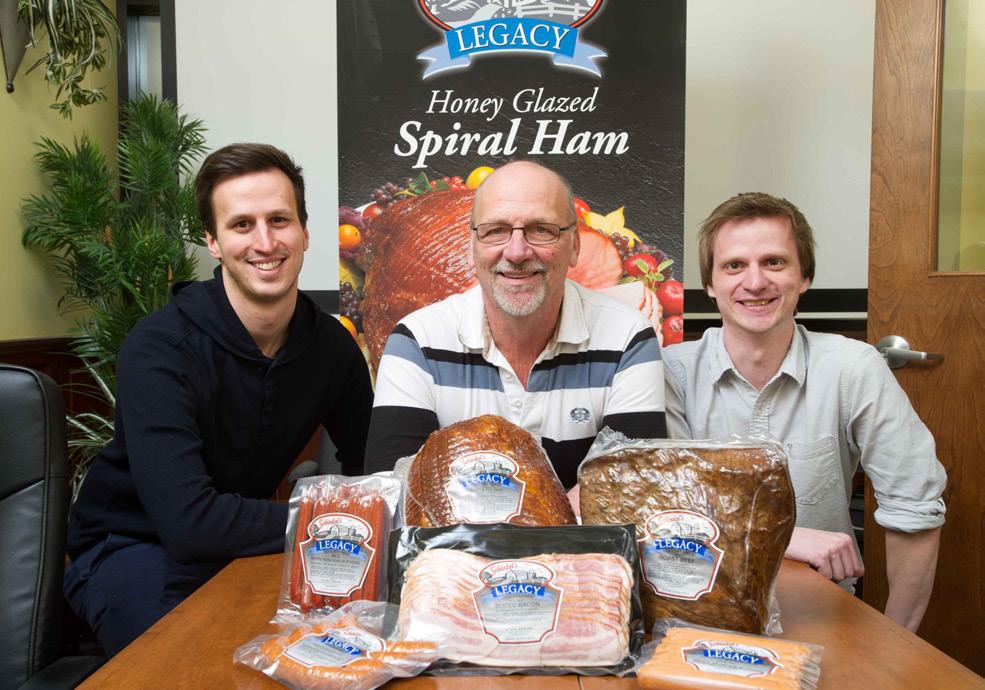
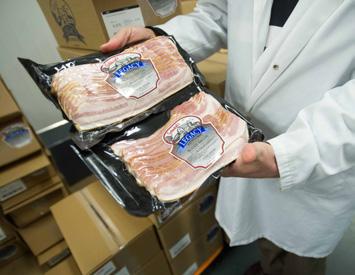
Maintaining the family tradition are (from left ) Schinkel’s Legacy production manager Kevin Schinkel, owner and president Tim Schinkel, and office manager Matt Schinkel, posing with some of the high-quality meat products they produce and retail at their third-generation family business in Chatham, Ont.
PACKAGING FOR FRESHNESS
legacy was started up by Tim and his wife Marian in 1993 under the Schinkel’s Sausage and Deli Products corporate banner.
“But we eventually decided to rebrand ourselves as Schinkel’s Legacy in 2003 to better reflect our heritage, while also creating a unique brand that would allow us to better market ourselves,” Schinkel relates.
According to Schinkel, the Chatham site for the facility was chosen because of its central location between London and Windsor—its target markets.
It was a local demand for processed meat products that created the need for the separate facility in Chatham, that Schinkel says was the reason why he and his wife began the separate business that would allow them to produce packaged meat products that could be sold on a retail level to grocery stores outside the local area.
“We started off in 1993 in a 4,000-square-foot place and plugged away, maintaining our family’s successful formula of creating trust and loyalty by providing a quality, safe and competitively-priced range of meat products to independent retailers throughout southwestern Ontario,” explains
Schinkel.
“After an expansion in 2000, we expanded again in 2011 to our current size of 13,000 square feet, with room and infrastructure to add another 10,000 square feet when we’re ready,” Schinkel notes.
The facility became HACCP (Hazard Analysis Critical Control Point) -certified in 2006, under the now-deceased Ontario Advantage Program , but continued to follow its food safety outlines.
But a return to the official HACCP -certification is in the cards for Schinkel’s Legacy, as the company will soon be going Federal.
“We only sell in Ontario presently, with Provincial meat inspection restricting us to that boundary,” explains Schinkel. “But in April of 2016, we will be migrating to the Federally-inspected system, which will allow us to expand outside of Ontario if the market calls out to us to do so.
“We are who we are because we cater to small independent retailers, whom we feel best understand our focus on a higher-quality local product, as opposed to a product that is produced under a least-cost formulation.”
Schinkel’s Legacy produces a variety of 56 deli
items that make up over 150 SKUs (stock-keeping units), including: Bacon—smoked and fully-cooked in both slab and sliced formats; Ham—bone-in, boneless, Black Forest, spiral sliced, etc; Fermented salami and pepperoni; Sausages—smoked, fully-cooked, mild, spicy; Wieners—a wide range of sizes, naturally smoked Jumbo Legacy Wieners and All-Beef Wieners; Deli coils—Polish Sausage; Kielbasa; Smoked Turkey Kielbasa; Old-Fashioned Kielbasa; Pork loin; back bacon and peameal bacon; and smoked loins for chops; Deli lunch meats—bologna; bierwurst, beefroasted products; turkey-roasted products; ham products and baked loaves.
Approximately 80 per cent of the company’s production is used to pack its own Schinkel’s Legacy brand, with the remainder earmarked for co-packing, which Schinkel says it does in part to optimize some of its automation capabilities in order to remain a competitive enterprise.
FAMILY FIRST
For Schinkel, who is joined at the business by his sons: office manager Matthew; production manager Kevin; Thomas who manages the packaging and shipping departments; and daughter Jessica, also involved in the ownership structure, being in the meat processing business is something of a passion.
“I love to tinker and I love to make sausage,” states Schinkel, “which my dad knew well when he invited me into the business.
“I took it upon myself, however, to try and create new product,” he says. “I’m always looking to develop a unique product with a unique flavor profile.
“I put my heart and soul into this industry.” He says that many of the recipes they use today actually come from his father’s recipe book, but notes that the new product’s Schinkel’s Legacy has produced have evolved from those original principals.
“It’s something that has been engraved into our family tree,” Schinkel says, adding his company also makes a conscious effort to act and market itself as a truly local enterprise.
For Schinkel’s Legacy, there is also a desire to keep things local.
“We purchase our meats—the pork, turkey and the beef—locally whenever we can, with the majority coming from within an hour’s drive from our facility.”
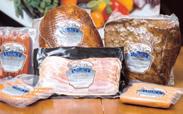
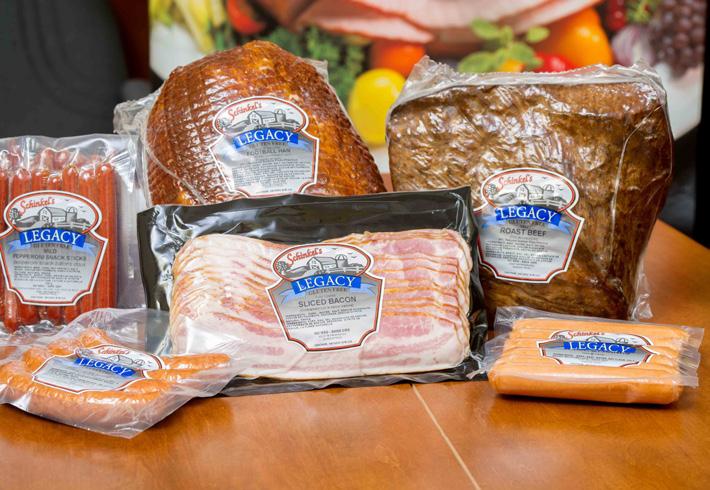
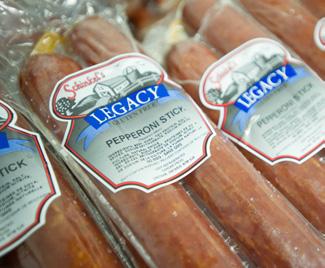
Schinkel’s Legacy Pepperoni Snack Stick, Football Ham, Roast Beef, Smoked Sausage, Sliced Bacon and Legacy Weiner are just some of the 150 SKUs, comprising 56 varieties of deli meats, produced at the Chatham facility.
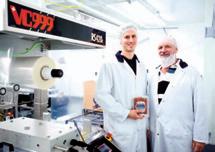
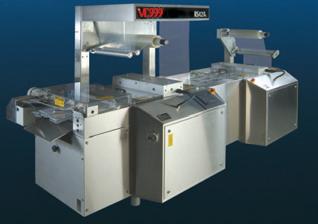
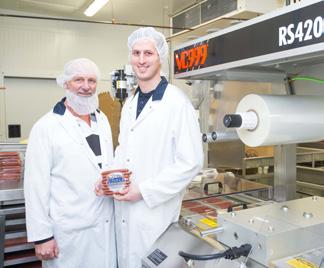
Company president Tim Schinkel (left ) and son Matt hold up a sample of Schinkel’s Legacy MIld Pepperoni Snack Stick packaged by the VC999 model RS420c rollstock thermoform packaging machine, which has helped reduce packaging costs and improve the overall look and performance of the finished package.
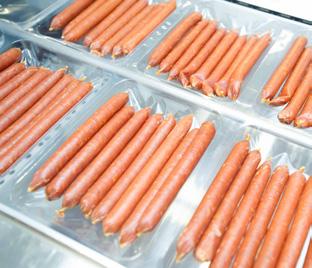
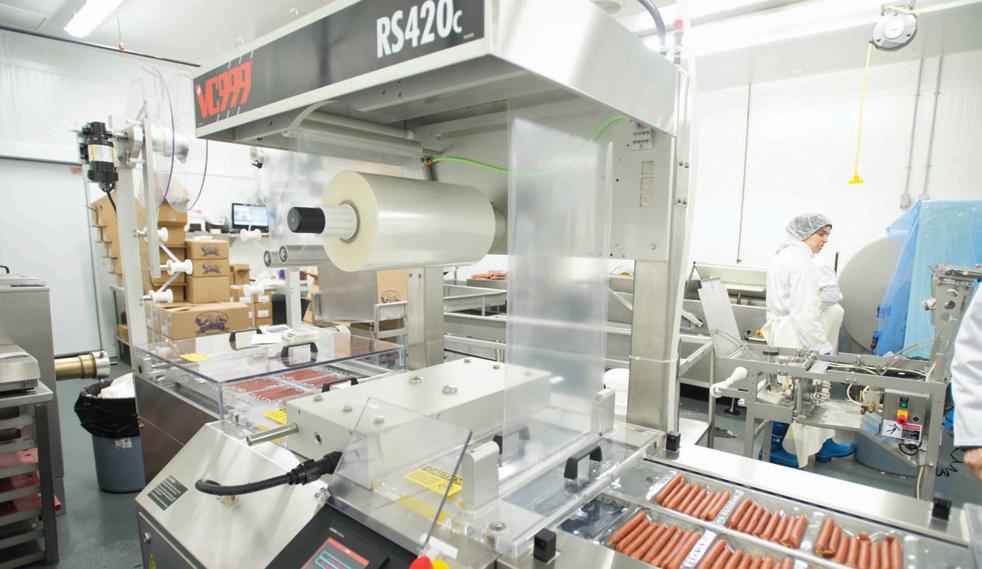
Pepperoni sticks are hand-placed onto the bottom film layer on the VC999 RS420c thermoforming machine, before a top layer of film is added to seal in the flavor.
He calls it a ‘confidence’ for the consumer to have faith in the product’s quality.
“Along with that confidence, it also provides comfort to us knowing that there is going to be consistency in the quality of meats we receive and process,” offers Schinkel, “and I think our consumers really appreciate that.”
Being a small business also has it advantages, according to Schinkel, noting that along with hands-on quality control, “one can also respond quickly to client requests without any bureaucratic red tape getting in the way.”
“If a product is going to be the best that it can be, then it needs to serve the growing and changing needs of the consumer,” Schinkel explains, adding that his business theme mirrors the way he likes to live his life. “Simpler is better.”
None of the Schinkel’s Legacy brand of products contain MSG (mono-sodium glutamate), with Schinkel saying that each product’s flavor should speak for itself and should not contain a flavor enhancer.
Are you ready for the fourth industrial revolution?
PACKAGING FOR FRESHNESS
“We are also gluten- and lactose-free on most of our products,” extols Schinkel, adding that meats also tend not to have huge amounts of salt in them, “which is great for people with certain sensitivities.
“Actually, right from when we opened up in 1993, our facility has always been gluten-free, and it has only been recently that the public has caught up to make it a popular lifestyle choice,” Schinkel points out.
SAME BUT DIFFERENT
He admits that there are a number of companies that are similar to Schinkel’s Legacy in size and focus, though each has its own unique products and styles.
“Rather than compete against each other, I think we compete against the status quo of the large producers, and we set ourselves apart with our unique products and customer service that is often difficult to get from the major seller,” expounds Schinkel. “I believe that our family’s
business values allow us to deliver a product that discerning customers have come to trust.”
Schinkel acknowledges that food safety has been a hot topic for more than 10 years now, and continues to be escalated by large food chains and governments, but that his company isn’t necessarily a follower.
“We are always looking at ways in which we can improve food safety,” relates Schinkel, adding that the last expansion undergone by the company was to create better washdown facilities and to add new equipment.
“We are always exploring new equipment options as well as new products,” he notes. “Our most recent capital investment was for a Rollstock machine that we can use to more efficiently diversify SKUs to include smaller packages.”
After fresh meat from its local sources is delivered to the facility, it is divided into two distinct product lines: whole muscle and sausage.
Whole muscle meats are the ‘intact meats’ used to produce bacon, ham or roast beef, and moved
Ready for intelligent manufacturing systems that fl exibly respond to new demands?
We move products, processes and people, because our intelligent sensors and networking solutions are setting the pace for Industry 4.0.
ON THE PULSE OF THE PACKAGING INDUSTRY
With over 50 years of sensor experience, Balluff is a world leader and one of the most effi cient manufacturers of sensor, RFID, and networking technologies.
Balluff offers local inventory via our Canadian headquarters located in Mississauga, Ontario, as well as application and integration support, and Best in Class training that you need to ensure your success both locally and globally.
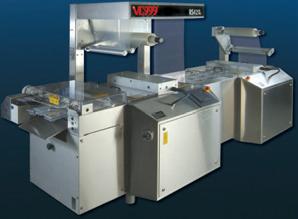
Manufactured by VC999, the RS420c thermoform machine combines a small footprint with high packaging throughput for the pepperoni sticks produced at Schinkel’s Legacy.
DEAR FUTURE, WELCOME TO THE PRESENT.
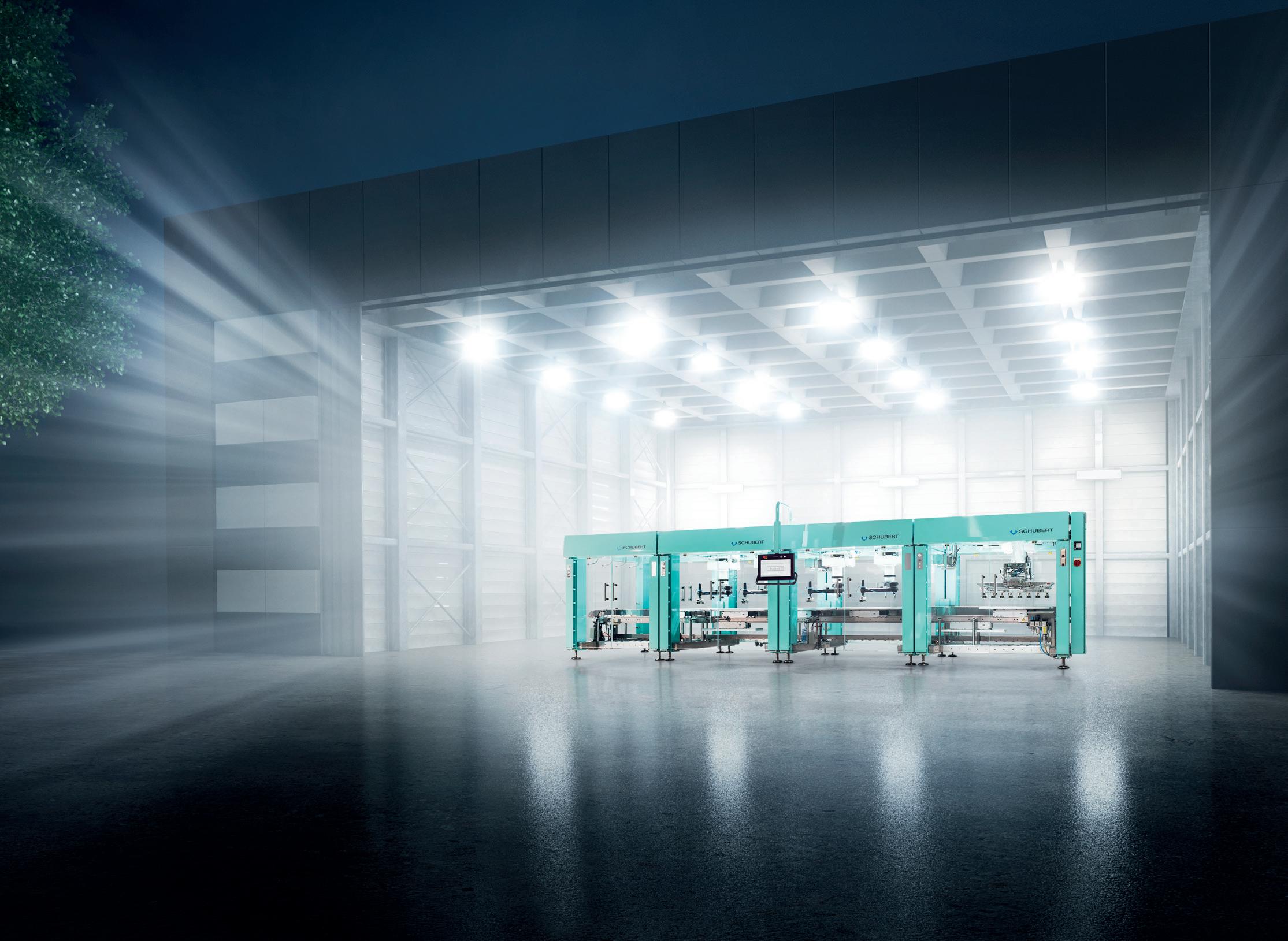
The world’s first packaging machine without an electrical cabinet.
With the world’s first packaging machine without an electrical cabinet you can meet the challenges ahead with confidence. This latest innovation from Schubert entirely redefines reliability and cost-efficiency. The intelligent digital control eliminates a multitude of electrical components –enabling reduced maintenance, higher availability and lower costs.
Talking about efficiency: in addition to exceptionally low energy consumption, the fault diagnosis system also sets new standards. Find out more about the future of packaging technology at www.schubert-magazine.com
PACKAGING FOR FRESHNESS
through a brine and massaging process before being smoked and cooked.
The meats for the sausage production—wieners, smoked sausage, pepperoni and bologna—are ground and mixed with spices and other ingredients before being stuffed into casing, smoked and cooked.
“Once cooked, all of the products are chilled then prepared for packaging,” Schinkel explains. “Some of the product is packaged whole and in bulk, while some are packed in smaller packages and sold as retailready products.”
To create more efficient packaging options on the sausage line, Schinkel’s Legacy purchased a VC999 model RS420c thermoformer machine in August of 2015, allowing it to create pack sizes ranging from 250 grams up to two kilograms.
“It was important for the company that we utilize a machine that could offer us more efficient packaging of smaller-sized packs,” recalls Schinkel. “There were opportunities available for us to produce and sell more product through various pack sizes, and thanks to VC999, we can do so quickly and effectively.”
FULL TRUST
According to Schinkel, he has long enjoyed a very beneficial business relationship with VC999, mostly through contact with local reps Remy Boudot and Rudy Hueni.
“I’ve known those two gentlemen for as many years as I have been in business,” relates Schinkel.
Counterfeiting is a global problem. In your world, that means thieves are trying to steal your most prized possession — your reputation. Fortunately, Sun Chemical has the anti-counterfeiting technology you need to protect your brand and reputation. From infant formula to adult beverages and more, it’s just one more way Sun Chemical helps you go securely from concept to consumer — all from a single, trusted source.
Request your copy of our white paper, Anti-counterfeiting Technologies for Packaging, at www.sunchemical.com/ anticounterfeiting or call 1-708-236-3798. working for you.
“As representatives of VC999, they have been very service-oriented and trustworthy. Their experience means they have a vast array of industry knowledge that can benefit myself and other customers.
“They were able to analyze my situation and determine just the right machine for my needs.”
With offices around the globe, VC999 is a Switzerland-headquartered global designer and manufacturer of vacuum chamber machines, thermoform (rollstock) packaging machines, tray-sealers, skin packaging, and flowwrappers, as well as related robotics, vision inspection systems, conveyor/converger systems, weighing, labeling and product scanning machinery.
According to VC999 vice-president of Canada Remi Boudot, when it came time for the meat processor to find a solution to improve packaging speed, decrease packaging cost and enhance the package look, Schinkel called on them first.
Boudot says, “We consulted with Tim and his sons a few times, took product samples, and designed a machine that would handle all the different sizes and products they manufacture.”
PACKAGING FOR FRESHNESS
He continues: “After analyzing their production line, we offered Tim a very unique thermoforming machine, model RS420c, with a small footprint but good packaging output.
“It’s a very flexible machine that can receive add-ons whenever required for printed film, coding, dating and labeling systems.”
According to Boudot, Schinkel was concerned about the discrepancy in size between his smaller products, so VC999 designed a ‘double index’ that allows them to package small products with short advance with a single die set, and larger products with a longer advance.
“The changeover between the die sets is very quick and easy to perform,” admits Schinkel.
Adds Boudot: “This design is part of VC999’s commitment to deliver simple, convenient and very reliable packaging systems.
“Being very efficient in sizing was the perfect solution for Tim and Schinkel’s Legacy allowing them to do it all on a single machine while enjoying the saving of materials regardless of the product size.”
VC999’s Hueni took over the project to ensure that VC999’s Xtraplast supply division would provide Schinkel’s Legacy with the proper film material to achieve the best shelflife capabilities, thermoforming properties, and achieve a very high quality of resistance and clarity, even offering print capacity to supply up to eight colors for registered print.
“Xtraplast and VC999 work hand-in-hand to deliver customer solutions with a one-stop shop for customers to ensure equipment installation is quick and painless,” says Boudot, “and is continued with excellent local service.
“When looking at the packages Schinkel’s Legacy produces today, I have a satisfying sense of accomplishment that we were able to deliver an efficient packaging solution that will aid the production efficiency of Schinkel’s Legacy for years to come,” states Boudot.
Schinkel adds: “VC999 has been in the industry for many years and have an excellent reputation for service and trust,” says Schinkel. “Plus, they had the perfect machine suited for the product size we wanted packed, was within our budget, and offered us a high level of product protection and hygienic cleanliness.”
Regarding his new model RS420c compact rollstock thermoformer, Schinkel has been very impressed with its output.
“Although we aren’t close to running it at its top speed, I have been impressed by the quality of package it produces for us,” he says. “It’s a nice tightly-sealed package that makes our
products look fantastic.”
While the RS420c rollstock thermoformer also helps Schinkel’s Legacy save on packing time and dollars, it also provides the valueadded benefit of an extended product shelf-life because of superior product protection and the hygienic cleanliness it affords.
Some of the other equipment used by Schinkel to create its award-winning meats, include:
A Handtmann VF 628 sausage maker that can produce 425 portions of pepperoni sticks per minute;
A model Boss CE X880 chamber vacuumpacker manufactured by Vacuum Boss , used for products of various sizes with little to no changeover;
Product management is controlled via the Carlisle Symphony Productivity Suite information system. Developed by Carlisle Technology, it enables real-time execution of inventory control, recipe management, batch coding, traceability, order entry, invoicing, shipping and other critical functions;
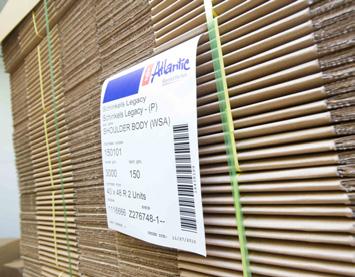
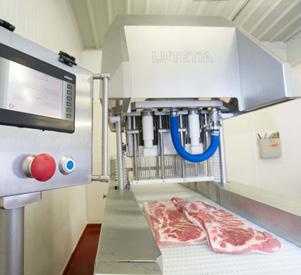
Brine and massage equipment from Lutetia to make the meat tastier and juicer, controlled via a user-friendly Omron HMI (human-machine interface) terminal; Corrugated cartons for shipment of finished product supplied by Atlantic Packaging
“My big challenge,” sums up Schinkel, “is how I am going to sell more product, but still be regarded as a small and local producer.
“That has always been one of the core strengths of Schinkel’s Legacy, along with consistently producing quality, tasty meat products.
“The way I figure it, the best way for Schinkel’s Legacy to attain that goal is to continue generating respect in the industry, just as my dad and uncle did with their butcher business half a century ago.”
Clean, safe conveying
Designed for maximum available production time and operating convenience, the new modular belt conveyor in stainless steel is robust, safe and easy to clean. The standardized design and modularity make changes of the production line easy. It’s the smart, long-term investment in your bottom line and your operators!
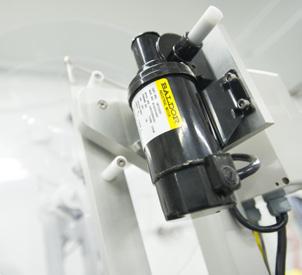
A DCPM industrial motor manufactured by Baldor provides exceptional starting torque, adjustable speeds, and reliable performance of the conveyor system.
Moved via a conveyor, the whole muscle cut of raw bacon is about to receive an injection and massage of a brine solution on custoim equipment built by Lutetia.
PACKAGING FOR FRESHNESS
IBEST CATCH OF THE DAY
Ontario freshwater fish processor makes optimal use of cutting-edge thermoforming technologies to finetune production line efficiencies and to gain
market share
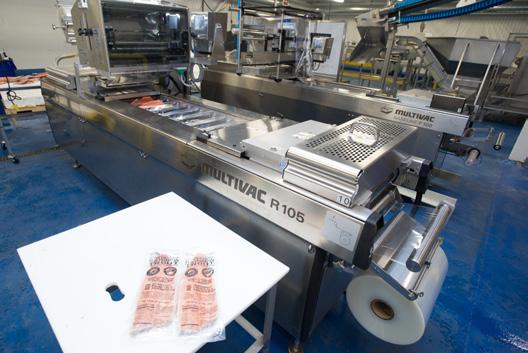
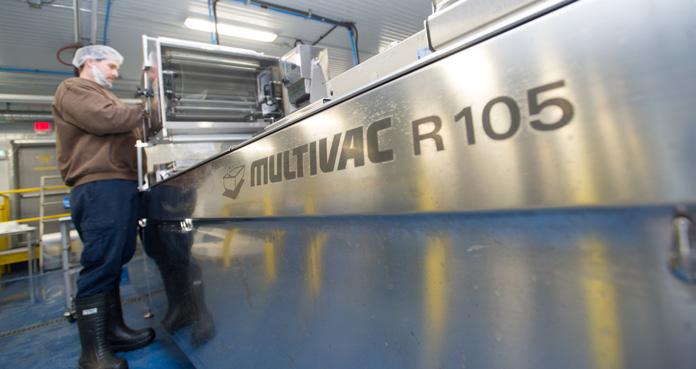
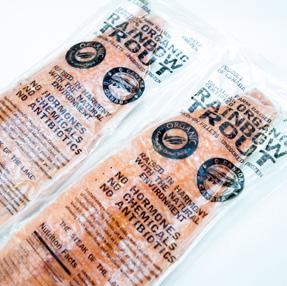
Purchasing a Multivac F 100 thermoformer (background ) and an R 105 thermoformer (foreground ) in the last two years enabled the John O’s Foods plant to extend the shelf-life of its frozen packaged trout up to 24 months.
brand—the core pillar of business that enabled back financing to acquire the Tecumseh Green Giant plant in the autumn of 1995,” says Omstead, “and after a successful 14 years, both Green Giant and ourselves mutually agreed that it would be in the best interest of us both to sell the Tecumseh plant to Carriere Foods in 2006, which then packaged for all of their plants. It was later sold to Bondouelle, the largest canned and frozen vegetable company on the planet.”
Prior to selling his vegetable company, Omstead had already opened up his own fish processing company back in 2000— John O’s Foods Inc.—as a way of looking ahead by looking back.
Despite this company having been haled as one of the best freshwater marketers and processors in North America, Omstead says he owes a lot of what he knows to family, tradition, hard work and a combination of each—lofty family ideals he learned well and continues to learn, he says.
“I believe that taking that sidestep from the family’s original business of fish into the vegetable industry helped me create my own identity,” he says even after going back into the family’s freshwater legacy.
BY ANDREW JOSEPH, FEATURES EDITOR PHOTOS BY COLE GARSIDE
t wasn’t supposed to be about the fish for John Omstead—it was supposed to be about the vegetables.
Omstead is the fourth generation of the family that began Omstead Fisheries back in 1911 in Wheatley, Ont., on Lake Erie, a business that eventually grew to become the largest freshwater fishery in the world.
In 1984, the family sold Omstead Fisheries to Lab -
batt and five years later in 1989, John Omstead decided he needed to venture out on his own, starting up a high-end frozen vegetables company processing company called Family Tradition Foods even having its own brand called John O’s
It became a very successful company, with his veggie business farming some 2,800 hectares of land in an around southwestern Ontario, with Omstead employing in excess of 2,000 workers during the summer peak seasons.
“We were privileged to secure a long-term contract with Pillsbury to co-pack its Green Giant
Nowadays, John O’s Foods is a fish processor and distributor of domestic and European freshwater fish species, such as perch, pickerel, trout, whitefish and white bass, offering its product in both fresh and frozen via its own brand, as well as a co-packer for other brand owners.
There is a quota for the amount of fish—in total for every person and business—that can be fished from the Great Lakes in one year—11-million pounds, with John O’s Foods actually receiving about 25 percent of that total.
And that’s still not enough to satisfy its huge international customer base, which is why, including
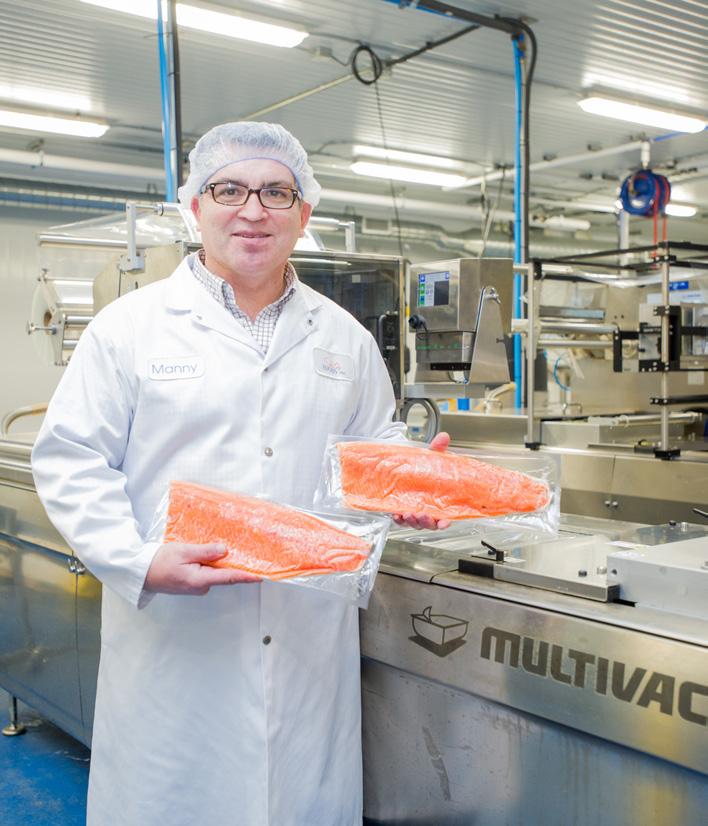
John O’s Foods vice-president of operations Manny Resendes holding up two packs of ruby-red trout sealed via the company’s recently-purchased model R 105 thermoforming machine supplied by Multivac Canada.
Verify
Manage
Assure full compliance
Reduce product rework
Minimize line downtime With
PACKAGING FOR FRESHNESS
Lake Erie, John O’s Foods also receives fish caught from various waters up to a 2,000 kilometer radius, as well as farm-raised ruby-red rainbow trout from Blue Goose Farms
Drawing on their vegetables past which required the most state-of-art facility and equipment, the John O’s Foods fish processing company is housed within a 55,000-square-foot facility acccredited with full BRC (British Retail Consortium) global standards certifications and validated adherence to the required GMP (good manufacturing practices) protocols.
“While we do offer a hand-filleting operation, we also have an automated whole fish and fillet grading machine, an automated descaling machine for all lake species, as well as de-heading and filleting lines for perch, walleye, white-fish and steelhead trout,” Resendes mentions.
Other equipment used includes: an inline thermal sealing vacuum-packing system; dual-lane pin bone machine/skinning machinery; the latest technology in a cryogenic freezing tunnel; a 160-ton-capacity blast freezer; an automated glazing, conveying and packaging system for everything from fresh fillets to frozen-in-case fish; metal detection systems.
TRUE TO FORM
The newest capital investment for John O’s Foods is its R 105 thermoform machine manufactured by Multivac that was installed on February 1, 2016.
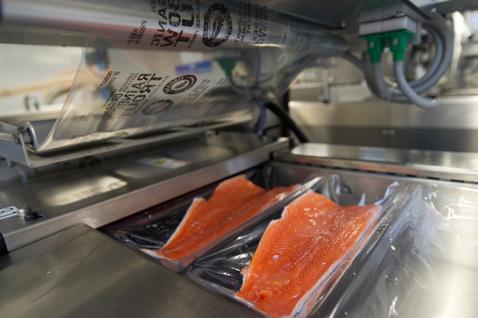
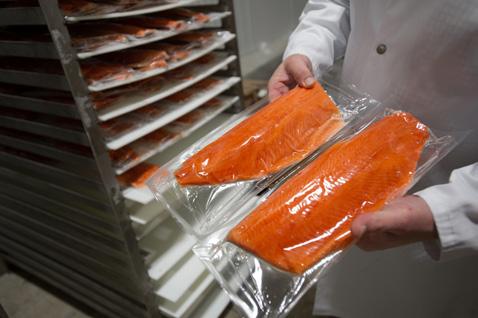
“We use it to vacuum pack frozen trout and white-fish for the food industry, which essentially gives it a shelf-life up to two years,” explains Resendes.
John O Foods purchased its R 105 from Multivac Canada Inc. With over 50 years of packaging experience, Multivac designs, manufactures, sells and supports a wide range of quality packaging equipment, including thermoforming machines for automatic packaging; tray-sealers for use with pre-made trays: and chamber machines for packaging in pre-formed pouches.
Fresh fillets of trout are placed in the lower tray of the R 105 thermoforming machine, designed and manufactured by Multivac, to create a hermetic seal around the fish to maintain fish color, texture and taste, while effectively locking in any fishy scent inside.
After being sealed in a clear, plastic film pack via the Multivac model R 105 thermoform packaging machine, the individual trout fillets will undergo a thorough freezing process before being shipped to the company’s customers across Canada and the U.S.
A John O’s Foods line operator at the Wheatley production facility performs a quick changeover on the model R 105 thermoform packaging machine from Multivac to set up another production run of packaged freshwater fish fillets.
Known as a simple plug-and-play packaging system, the Multivac R 105 thermoformer is said to provide excellent value for a relatively small investment.
“It is simply a great machine that has helped greatly increase the efficiency of our production line which will in turn allow us to increase our market share,” extols Resendes.
NEW SCHOOL
Prior to the Multivac addition, John O’s Foods utilized a more manual approach to processing with a double-chamber machine that could vacuum seal six sleeves during a 45-second cycle.
The process required a manual labor-intensive pre-sleeving of the product in order to keep up with the loading and unloading of each respective chamber.
But, with the addition of the Multivac R 105 thermoforming equipment, the system process at John O’s Foods almost doubled production, while showing significant savings on material costs and
labor.
PACKAGING FOR FRESHNESS
“The final packaging we get from the Multivac R 105 is far superior to the old method, significantly more hygienic, has a better product look or presentation, and is certainly worth the investment,” says Resendes.
The R 105 is a full-automatic packaging system that is, according to Multivac, able to provide economical packaging with a superior hygiene, technology and quality on par with other more high-end machines from the company.
The Multivac R 105 thermoforming machine can form packages, fill and seal via vacuum, or with a modified atmosphere—all with the same machine.
“We love the tight seal the R 105 forms over our trays and sleeves,” notes Resendes.
The machines is compact and quick, but importantly, is geared towards hygiene from top to bottom. The R 105 design avoids edges and corners, offering instead smooth, slanted surfaces to allow proper run-off of cleaning solution and dirt. It also has an easy-access frame
profile for both cleaning and maintenance tasks.
Inside the R 105, Multivac maintains the hygiene optimization via its chain guide, chain design, lifting mechanism and mechanical elements, motors, valves and cabling.
Available with 24 different die formats and a maximum forming depth of 95 millimeters, the R 105 easily packages fish, meats and cheese, as well as non-food medical and consumer products.
SECOND LINE
Another Multivac machine to recently enter the fold at John O’s Foods is the F 100 packer, installed in July of 2014 to vacuum-pack portions and trays.
According to Multivac, the F 100 packs all types of products automatically, hygienically and economically.
The F 100 is modular, easily expandable and with custom-made dies and equipment options, it can be set-up for very specific packaging tasks.
Made of high-quality, durable stainless steel, the is another easy-to-clean design that Multivac is known for, allowing for complete wet cleaning.
For operators, there is ease-of-use thanks to the touch display HMI 2.0 user interface, while the machine’s energy-efficient film transport systems, lifting systems and cutting units provide costsavings.
“Prior to us purchasing the F 100, we used four people working that previously-mentioned vacuum chamber system,” recalls Resendes, “essentially allowing us to pack approximately 240 pounds of fish an hour.
“But all that changed, thanks to Multivac.”
Resendes says when John O’s Foods began looking for a way to increases its packaging line efficiency, he performed his own due diligence and researched the companies he had heard good things about from other businesses.
“One of the telling signs to influence my decision,” explains Resendes, “was the fact that Multivac had about 80 percent of the market, was also know for its high-quality machinery, and was well respected in the industry.”
He says that initially he looked to purchase a used Multivac thermoformer, but after factoring in costs to adapt the system to his needs, as well as to have various dies made, “it was actually better for us to
A plant employee at the John O’s Foods fish processing plant hand-loading the single fillets of trout onto the bottom layers of individual film trays processed on the company’s new high-performance Multivac R 105 thermoformer.
The easy-to-operate touchscreen HMI (human-machine interface) terminal of the BELLMARK EasyPrint mlp thermal-transfer printing system generates a graphic image to indicate which ‘label recipe’ is currently being printed and applied onto the packaging.
An EasyPrint mlp multilane, inline thermal-transfer system from BELL-MARK prints batch codes, sell-by dates, and other key product information directly onto the plastic film substrate to provide clear, easy-to-read data for the consumer.
PACKAGING FOR FRESHNESS
get new equipment.
“It was our first Multivac, so being cautious, we wanted an entry-level machine,” says Resendes. “But what I didn’t expect—even after being told of it beforehand— was just how much John O’s Foods was able to save with reduced labor and gain with increased capacity.”
With the F 100 and the R 105 from Multivac, Resendes says his company was able to pack some 18 sleeves every minute, running at 900 pounds of fish per hour per machine.
“We are very happy with our Multivac equipment,”
extols Resendes. “We have been able to quadruple our capacity since 2014. While also reducing the number of people to do the same work to just two people per machine.”
Other equipment used at the John O’s Foods facility, includes the spectacular 48-inch wide Air Liquide Ultra-Freeze liquid cryogenic freezer.
Featuring a modular design, the Ultra-Freeze is constructed of rigid steel framework and four inches of polyurethane insulation encapsulated in a smooth, sleek fiberglass body for durable and easy-to-clean machinery.
• Increase the flexibility of your robots by adding the
• Production line tooling changed in seconds for maximum
• Change tools in seconds for maintenance and repair.
• Increase operator safety by changing tools automatically.
• Million-cycle tested for reliability.
At John O’s Foods, the fish have its freshness sealed within the Multivac equipment and are then placed through the Ultra-Freeze cryogenic freezer.
Fresh fish, which Resendes says is 80 percent water, can be flash frozen within the Ultra-Freeze in under four minutes at -80ºC.
“The freeze is done so quickly there’s little to no drip-loss,” says Resendes noting that John O’s Foods calls this its Frozen Beyond Fresh theme.
The Ultra-Freeze is a two-stage cryogenic injection system of N2 or CO2 following product heat load to minimize cryogen consumption.
The cryogen flow is automatically adjusted in each zone to meet changing processes heat load.
COLD AS ICE
“Rather than the more standard mechanical refrigeration freezing, we opted to cryogenically freeze our products because the dehydration is minimized by a large enough amount that the fish, when thawed, will maintain better texture, taste and aromatic properties—not to mention it’s a much faster mechanical process,” explains Resendes.
Other equipment and supplies utilized by John O’s Foods include:
Corrugated carton tape sealing at the end of the production line is achieved via the fast and accurate 3M-Matic case sealing system from 3M , helping avoid bottlenecks;
Marathon Electric -made PowerWash SXT washdown motors on the hand filleting line; Singlewall corrugated cartons manu-
Above : Single-wall corrugated cartons supplied by WestRock Company are used by the John O’s Foods plant to ensure completely safe and secure shipping of its products to customers.
Left: The speed and accuracy of the 3M-Matic adhesive tape case-sealing system, manufactured by 3M Company, helps John O’s Foods avoid unnecessary end-of-line bottlenecks.
factured by the Milton, Ont.based WestRock , the combined global packaging solution company of MWV and RockTenn; BELL-MARK EasyPrint mlp multiple lane, inline thermal transfer technology that prints batch codes, graphics, logos, sell-by dates, bar codes and other variable information directly onto packaging substrates; Loma Systems IQ3 metal detection high-level product inspection system, featuring true variable frequency;
A food-grade, stainless steel constructed Avery WeighTronics ZQ375 checkweigher that quickly provides complete visibility of weighing data and statistics to help maximize performance;
A PortionCutter I-Cut 10 manually-fed fillet portion machine designed and manufactured by Marel Food Systems, can accurately and consistently portion filleted fish with or without skin featuring a maximum knife speed of a nominal 180 cuts per minute. A laser vision system scans the fillets with Innovia software, providing real-time data to the processor.
The future looks bright for John O’s Foods, says Resendes.
“The capital investment in the two new Multivac systems allows us to quicken our production line, which in turn allows us to look for more fish to process,” he sums up.
“Along with the longer shelf-life it provides, and the hygienic food safety requirements we demand, we are very pleased at how things are working out for us.
“Our top-end processing equipment is giving us the chance to enlarge our market share in the industry, and we aim to take advantage of that opportunity.”
Two sides of the same fish after being filleted by the Marel Food Systems model
PortionCutter I-Cut 10 fillet portioning machine at the John O’s Foods plant.
PACKAGING FOR FRESHNESS
AUTOMATE
AWITH ALL DUE RESPECT
A mutually respectful partnership with a global automation powerhouse helps Ontario original equipment manufacturer of feeding machines grow its worldwide business base and enrich its design skillset
BY ANDREW JOSEPH, FEATURES EDITOR PHOTOS BY NAOMI HILTZ
s the immortal bard Aretha Franklin crooned, “R-E-S-P-E-C-T, find out what it means to me. R-E-S-P-E-C-T. Take care, TCB”—one Canadian industrial equipment manufacturer has inadvertently taken the theme to heart on its ride to success as a well-respected global leader in the field of automation.
For Pineberry Manufacturing Inc., “respect” and “TCB (Take Care of Business)” it’s a twopronged belief on that the friendly, stress-free way one treats its employees, customers and suppliers is the manner in which proper relationships are built, nurtured and grown.
Situated in the light industrial part of picturesque Oakville, just 40 minutes drive west of Toronto, original equipment manufacturer Pineberry designs and builds dispensing and feeding equipment such as friction feeders, tray denesters and custom automation for the food and mailing markets.
Although the company has been in existence since 1984, its current ownership has been responsible for its tremendous growth and global reputation.
“Actually, then as now, Pineberry has earned a reputation for taking on the difficult one-off jobs and making them work,” Pineberry president and chief executive officer David McCharles told Canadian Packaging during a visit to its tidy 12,500-squarefoot headquarters.
McCharles joined the company in 2004 to work in sales. “Right from the moment I joined Pineberry, I was impressed by the people we had working here, and told the owner that one day I was going to buy the company from him.
“And, after five years, I did just that.”
Not one to kick anyone to the curb, McCharles continues to work together with the previous owner every now and then on Pineberry projects—a tip of the hat for the respect he still maintains for his former boss.
Playing on the fact that he is also a salesman, McCharles has surrounded himself with people possessing “great technical knowledge and the willingness to go that extra mile to ensure that what Pineberry creates, is something they, and we, can all be proud of.”
Pineberry manufactures what McCharles calls robust automation solutions for the packaging, pharmaceutical, printing, food, and plastic card industries, designing and manufacturing equipment that isn’t off-the-shelf, but rather tuned directly to what the customer needs.
“It isn’t necessarily about us designing equipment based on what the customer wants, but rather after lengthy discussions, it’s about us providing what they need to perform the most effective job within their budget,” offers McCharles.
Pineberry Manufacturing president David McCharles says cultivating relationships with suppliers is a key factor in his company becoming a better machine manufacturer.
Schneider Electric industry and automotive account manager Roger Lapierre has worked closely with Pineberry Manufacturing to provide equipment and design advice.
Since 1978 , Domino has evolved to offer a comprehensive portfolio of end-to-end coding solutions designed specifically to meet compliance and productivity requirements. But our advantages don’t stop with our remarkable products. We work hard every day to ensure our service is just as exceptional as our products.
At Domino, our people constantly do more to provide you with a true difference in printing.
The difference is in our people. The difference is in our printing.
1.800.444.4512
Domino. Do more.
Case Coding Print & Apply Labeling
Thermal Transfer Overprinting Laser Inkjet
AUTOMATE NOW
Hitachi Continuous Inkjet Printers have set the standard for reliable, user friendly, and cost effective product coding and marking for more than 35 years. With a reputation for relentless reliability and up to 50% less fluid consumption than other brands, our printers keep your uptime up and your operating costs down. Call us at 1-866-583-0048 or visit us Online at www.hitachi-america.us/ice/inkjetprinters/.
In Canada contact: www.harlund.com 1-877-427-5863
One of the suppliers McCharles says he is fortunate to work with is Schneider Electric, a leading global electrical and energy dsitribution product group specialist that manufactures, among many other things, a broad variety of automation controllers and servomotors.
“Pineberry has partnered with Schneider Electric for over three years now, integrating PLC (programmable logic controller) products as part of our automotive solutions,” recalls McCharles. “I’m pleased to say it has been a successful partnership.”
While many businesses today change suppliers at the drop of the hat in order to find the least expensive pricing, McCharles says that Pineberry finds true harmony and economic success thanks to creating long-term partnerships with suppliers.
“We take on suppliers who not only have good equipment,” begins McCharles, “but also have good people who are going to help us along the way.”
He points directly to a fabulous connection he has with Schneider Electric industry and automotive account manager Roger Lapierre, noting that even though the supplier has helped provide new products to improve their own equipment, it’s that personal touch of friendship that makes it all work.
TEAM EFFORTS
“While we have indeed been very successful working with Schneider Electric for the past three years seeing our own reputation grow in the global markets, the past six months have been a time of even greater growth between our two organizations,” acknowledges McCharles.
He is talking about the introduction of open source technology via a new platform on all Pineberry friction feeders via Schneider Electric’s touchscreen PLC (programmable logic controller).
“It gives our friction feeder fully open-sourced technology,” McCharles extols. “Available as of April 2016, there are no proprietary spare parts—a definite boon to our customers.”
Both McCharles and Lapierre agree that open-source technology is the way the future is being built.
“Secrets are no longer secrets,” says McCharles. “You can build your products at the best price without having to back your customers into a corner.
“We sell our machines to customers all over the world, and when parts wear out, the last thing we want is for our customers to suffer severe downtime waiting for a replacement part to have to come from half-way across the globe.
“We want them to be able to get the product anywhere off the shelf, around the world, from local suppliers.”
Adds Lapierre: “For a small company with international customers as Pineberry has, using the resources that Schneider Electric can provide is a good thing. We offer support all over the world.” In food processing there are plenty of things to worry about. Your product coding equipment shouldn’t be one of them.
Hitachi Industrial Equipment
Hitachi Industrial Equipment Systems Co., Ltd. Hitachi America, Ltd.
An HSF Friction Feeder with Schneider Electric touchscreen controls providing the operator with ease-of-use and full availability of real-time machine performance data.
Schneider Electric provided a Magelis touchsceen control panel for operator use on two recent Pineberry projects, providing the friction feeders with open-sourced technology.
McCharles says that the biggest complaint customers have is downtime.
“Being down because of equipment, means money lost,” he notes. “Having to constantly purchase equipment parts—which costs money—and having to store them on the shelf is a waste of resources.
“It doesn’t matter what speed you can run your equipment at. If your machines run at 98 percent efficiency but are down for an hour a day, then that efficiency is lost,” relates McCharles.
“By working with companies like Schneider Electric, Pineberry takes away that concern.”
Even for specifics like packaging for the food and beverage market segment, Schneider Electric has groups and services around the world with key centers and dedicated people.
“In collaboration with Pineberry’s electrical engineers working with our application design engineers and product experts, we can help improve and redesign their machine products to work more efficiently for their customers,” states Lapierre.
With Schneider Electric’s help, Pineberry has updated its machines, by tak-
ing it to the next level with a reduction in the overall number of components.
“We also simplified the architecture so that the products are pretty much all off the shelf, readily available,” Lapierre explains, “and helped reduce the wiring of the machine, reduced the lead time of providing parts, and the overall implementation of the machine.
“We helped improve the overall performance of the machine, as well as its look.”
McCharles agrees: “We’ve gone from a 24 x 24-inch box down to nothing, which has made our friction feeder more portable, easier to ship, easier to pack, and, for our customers we’re excited because it allows them to get quick service anywhere around the world.”
For Pineberry, its collaboration with Schneider has been extremely helpful, with McCharles noting that as a machine manufacturer performing custom automation, it can be a difficult business to be involved in.
“Even with the skillset we have at Pineberry, to bring brand new equipment to a customer isn’t always easy,” McCharles relates. “But every time we’ve been confronted with a particularly challenging issue, Schneider Electric has
Pineberry Manufacturing designed and built this high-speed transport system equipped with an integrated friction feeder, a label applicator and a DOD (drop-on-demand) printing system to provide a fully-automatic turnkey system solution for customers in the order fulfillment industry.
AUTOMATE NOW
been right up there beside us to help support and resolve problems, with the end result being that we have become better manufacturers.
“Now, I don’t mean to imply that we struggle on problems—we’re aware that for every problem, there are multiple solutions, and one that is best for that particular customer,” continues McCharles.
“But there was one time we were having difficulty resolving a problem and we needed to get a project to our customer as soon as possible,” he explains. “Schneider Electric flew in a guy from Montreal to help us out over a weekend to work with our electrical engineer. Come Monday morning, we had a solution.
“Problem solved.”
According to Schneider Electric, for two recent Pineberry projects involv-
ing machines for the pharmaceutical industry, its controller replaced a proprietary control board, meaning that data that was only accessible via a PC or laptop was now being displayed on a simplified graphic terminal.
“We were able to now provide a lot more real-time information about what is going on such as product counts, while providing greater user flexibility and ease-of-use all in a single graphic display,” Lapierre mentions.
“It’s a far simplified end result—rather than having to utilize multiple operating terminals—Pineberry can now offer its customers a smaller, simpler, but smarter machine that not only is easier to use, but to maintain as well.”
McCharles notes that the machine operator can even receive information from the terminal via an app on their iPhone
“It’s a pretty significant advantage to allow one to keep track of what the feeder is doing: time of service, amount of operations, when it’s time to change a part— really, as much as you can dream of, you can use it to find out everything about the machine’s operational efficiency,” says McCharles.
He adds that flexibility is also key for his customers.
“It’s not an exaggeration to say that 99 percent of the time, our feeders are being integrated to other pieces of equipment already on a production line,” muses McCharles. “With the way the Schneider Electric products can easily communicate with the inputs and outputs of other pieces of equipment allows for our machinery to be simplified in its design.”
For Schneider Electric, Lapierre shrugs as he offers up the company’s mantra: “we help with the amount of information we can give to a customer to help them maximize their uptime, minimize their downtime and really optimize their throughput along all parts of their process.”
Simply put, the Schneider Electrical components are open architecture without protocols that utilize the Ethernet allowing easy transference of information back and forth.
“The machine operator can now have all the information available to them to learn what their machine is actually doing which allows them to determine how they can make their production line more efficient,” explains Lapierre.
“We help make the equipment smarter and thus the machine operator smarter.”
THE PHARMA PLUS
Regarding its two new systems involving serialization for the pharmaceutical industry, Pineberry’s David McCharles was all smiles because of his company’s achievements.
As of 2015, pharma manufacturers in the United States must incorporate product transaction data in a single document available via paper or electronic medium each time ownership is transferred.
The document must include lot data, complete transaction history, and a transaction statement that must be kept for six years after said transaction.
By November of 2017, all of that data can only be available electronically with the product identifier visible—either affixed or printed—on both the product label and shipping case level.
It means pharmaceutical companies are in a hurry to ensure they are not left in the waiting room while their competitors move forward.
“Every pharmaceutical product being packaged by 2017 will require a variable serial number with a matrix barcode on it created either with an inkjet or laser printer,” relates McCharles. “Each will need to be scanned with a camera system to get back to the serialization software.”
Featuring a large reel to hold rolls of label blanks in place, the Pineberry Manufacturing Labeling System provides high-speed label application throughput for a growing global customer base in the pharmaceutical sector.
Pineberry has partnered with Adents International , a France-headquartered serialization company with an Americas head office in East Windsor, New Jersey.
“Their software allows us to present a full solution where we can provide full identification that can go on the back of any carton line,” says McCharles.
“But, specifically, we created a mechanical solution for carton flats where we will enable small- to medium-sized users to serialize cartons even before they are filled,” he adds noting that the Pineberry solution provides packers with the opportunity to print even before products are manually-loaded or cartons added to a cartoner machine. “We give them the ability to serialize those cartons.”
Schneider Electric helps on the packaging side, integrating the equipment from Pineberry’s supplier and/or the documentation into its system.
“For pharmaceutical companies, they require non-corruptible information,” offers Lapierre. “We can provide a stream of data to the pharma server side.
“Our equipment has on-board communication via Ethernet that allows information/documentation to be served up to a Cloud or the customer’s server,” Lapierre says.
Pineberry knows that integrating third-party solutions into other people’s equipment already in place is never as easy as it sounds.
“With Schneider Electric, we are able to integrate the camera system, a Domino inkjet system and put everything into one controller,” mentions McCharles, “then work our parts and communicate with the Adents software with ease.”
The serialization program in place now and to be fully-realized by 2017 is one way consumers and pharmaceutical companies can be assured that the product on the shelf is genuine and not substituted along any of the ownership paths with a knockoff product that may not promise the consumer with the expected results, but could be harmful as well.
Pineberry’s McCharles says that counterfeit pharmaceuticals are a bigger problem in general society than is perhaps realized, but with his company’s serialization technology, “We can provide the consumer with a confidence that the product they are purchasing is exactly what they want to purchase.
“It’s all about tracking and traceability,” he states.
In one huge example that affected a brand, in 2005, three businesses and 11 people were indicted in America on a US$42 million conspiracy to sell counterfeit, smuggled and misbranded/repackaged Lipitor, Celbrex and other drugs, as well as for their involvement to sell stolen drugs from South America in the U.S. and Canada.
The eventual recall of eight million Lipitor tablets is the largest counterfeit medication recall in the history of criminal investigations.
The Pineberry serialization solution will allow consumers to use their smart phones, scan the pharma product and via the Cloud know the product in hand can be traced directly back to the manufacturer, enabling them to know: when it was manufactured; the date and time it was manufactured; and the satisfaction to know it is a real brand product and not a counterfeited one.
“Our solution into a packager’s assembly line allows consumer goods companies to easily add this failsafe to provide the customer and the consumer with an ease-of-mind,” opines McCharles. “It allows manufacturers and packagers to provide tracking and traceability options to the consumer.
“But really, it essentially takes counterfeiting out of the marketplace, which is a good thing on multiple fronts,” he continues.
“Yes, it helps ensure they get the
AUTOMATE NOW
product they are paying for, but eliminating counterfeit products also keeps costs low for the manufacturer, and thus also for the consumer or insurance company.
“At the end of the day, the solution we provide makes everyone more accountable with regards to tracking and traceability,” mentions McCharles.
“We’re trying to make it easier for our customers to do what they need to do, which is to focus on manufacturing and packing and providing quality goods to the customer.”
Summing up, McCharles gratefully acknowledges the
Please see the online video of Pineberry Manufacturing and Schneider Electric on Canadian Packaging TV at www.canadianpackaging.com
work Lapierre and Schneider Electric have performed in helping Pineberry reduce design times and project labor costs that it can pass on to the customer.
“But if that was all we were about, it would be great,” notes McCharles, “but Schneider Electric has helped us improve the way we create our machinery, which has helped us grow as a known commodity in the global fabric of industrial equipment manufacturers.”
What do bad seals really cost? Rework. Returns. Food safety problems. Lost customers. Supervac automatic belt vacuum chamber packaging machines feature a Double Biactive high-pressure sealing system that provides two superior seals to every bag, virtually eliminating leakers and the problems they cause.
Superior seals are just the start. Supervac machines reduce labor costs while increasing productivity. Their ergonomic design allows a single operator to load, style and run the packages. Supervac’s exclusive Expansion Cushion reduces evacuation times by up to 30%, pushing the operator to keep up with the machine and resulting in more packages at the end of the day. Their small footprint allows the Supervac to fit into tight areas where other machines cannot. Its low cost of ownership and stainless steel construction make Supervac the smart choice.
CONVEYING
CHOOSING THE RIGHT SIDE FOR BETTER SANITATION
The innovative Vertical Belt Technology featured on the new staggered sidewall belt for Dorner Mfg.’s AquaPruf VBT conveyor was designed to make it vastly easier to clean and sanitize, while providing greater pocket capacity and requiring less maintenance than a traditional bucket elevator.
According to Dorner, the company spent more than a year developing the staggered sidewall belt with its belt manufacturing partner. Focusing its efforts into developing the belt first, Dorner engineered the rest of the conveyor around the belt—ultimately coming up with a new sanitary conveyor that radically redesigns the industry-standard pleated sidewall belts commonly used for vertical lift conveying applications.
The belt itself is made from an FDA -approved and USDA -certified food safe urethane belt material—making it ideal for elevating bulk products in 90-degree sanitary applications in handling products such as vegetables, fruits, grains, nuts, popcorn, pet-food, pharmaceuticals and many other similar products.
According to Dorner, the belt provides 15 per cent more pocket capacity and improved product release than traditional sidewall belt designs.
Other notable features and benefits of the new staggered sidewall belt on
the AquaPruf VBT system include quick belt change in 20 minutes or less; open-frame sanitary design for fast cleaning; a drive gearmotor located on main column outside food drop zone; belt speed capacity of up to 100 feet per minute: and availability of custom-configured, application-specific belt sizes available in 25 days or less.
Dorner Manufacturing 490
MAKING CLEAN LIVING A REAL MODERN-DAY NECESSITY
Originally introduced to the North American market in early 2015, the CleanMove line of conveyors from mk North America is a full sanitary stainlesssteel conveyor product line designed to handle a broad range of demanding applications in the food and pharmaceutical industries.
“Borne out of both necessity and requests from our customer base,” according to mk, the stainless-steel conveyors are a significant upgrade on the company’s first food-grade conveyors originally launched in late 2012.
“After creating similar products for years as custom offerings time and again, we decided that the time was right to make these stainless-steel options a standard part of our business,” explains Viet Nguyen, mk’s engineering manager for stainless-steel technology.
“We wanted to give our customers access to all of the tools that they would need to increase efficiency in hygienic and sanitary environments,” says Nguyen, crediting the company’s highly experienced senior engineers for the successful project execution.
Covering all three major sanitation levels with the Standard, Plus and Ultra product offerings, the CleanMove platform currently comprises four different conveyor types and a complete range of accessories, belts and a choice of motors options that customers can select to match their needs.
mk North America, Inc.
A PRO-ACTIVE APPROACH TO GREATER PRODUCTIVITY
491
The new high-precision ActiveMover pallet transfer system from Bosch Rexroth Canada was designed primarily to increase productivity in numerous short-cycle applications by employing linear motors to execute quick and precise workpiece pallet changeovers in 0.1 to 0.3 seconds, according to the company.
Comprising a series of linear motors with an integrated measuring system to position the sturdy workpiece pallets precisely on a closed-type trackway using a powerful drive, the ActiveMover transfer system consists of straightsection and curve units with vertically installed low-wear linear motors for accelerating workpiece pallets to achieve robust maximum speeds of up to 150 meters per minute.
According to Rexroth, the integrated measuring system means that no additional indexing is necessary, which enables end-users to employ as many workpiece pallets as they want on the straight section and curve units, which they can control individually, if desired, with simple programming of travel direction, speed, acceleration, position and process sequence of each workpiece pallet.
Because the transfer system combines the conveyor section and 180-degree curve units into a freely configurable closed trackway, the vertical arrangement of the workpiece pallets means that they can be easily accessed from any side.
With high drive force allowing each pallet to carry a payload of up to 10 kilograms, along with holder width of up to 500-mm, the systems also ensures extremely gentle product handling across a broad range of applications in the electronics manufacturing, the automotive parts industry, and in the medical technology and life science fields.
CONVEYING
EVERYTHING ON THE TABLE
Louisville, Ky.-based material handling systems manufacturer VertiLift offers a comprehensive line of scissor lift-tables, turntables, and tilt-tables with virtually any type of conveyors built in to optimize production, ergonomics and safety.
Offering a broad range of vertical tables from 24 to 60 inches, along with lifting capacities from 2,000 to 6,000 pounds, the Verti-Lift products are available in single or tandem scissor lifts, with single, double or custom widths in floor- or pitmounted designs.
All Verti-Lift conveyor-fed equipment features easily accessible internal power units, heavy-duty cylinders, hand or foot controls, heavy-duty tubular frames and hydraulic cylinders, and lifetime lubricated kingpin bearings to ensure a long service life with no maintenance.
Verti-Lift, Inc.
IMAGE IS EVERYTHING
493
The new model IL5-H 5MP highspeed camera from Fastec Imaging enables users to record everything that happens on their high-speed conveying lines for follow-up analysis or system troubleshooting using the camera’s slow-motion replay.
With recording speeds of over 630 frames per second at HD (high-definition) resolution and over 3,200 frames per second at VGA (video graphic array) resolution, the IL5-H lets users save images to an SSD or SD card, while recording high-speed bursts of hundreds or even thousands of images at a time.
Moreover, the camera’s LR (longrecord) FasCorder Mode function
allows users to operate it as a regular camcorder to record and pause as needed and follow the action, to stop recording and review, and to append additional footage at will.
Fastec Imaging
494
CAPTURING THE HEAT OF THE MOMENT
Capable of handling extreme heat of up to 650°F, the No. 894 electric heat belt conveyor oven from The Grieve Corporation incorporates a 24-inch-wide, stainlesssteel conveyor belt driven by a 0.25-HP motor to provide optimal speed flexibility from 0.4 to 8.4 inches per minute, along with an 18-inch-long belt loading zone; a 48-inch insulated heat zone with recirculated airflow; and an 18-inch-long open belt unloading zone.
Constructed with aluminized steel exterior, thick insulated walls, stainless-steel interior and an exhaust
hood over each end of the workspace, the No. 894 also includes a magnehelic pressure gauge on the blower outlet and exhauster outlet, a manual reset excess temperature controller with separate control contactors, a recording temperature controller, and an SCR (semiconductor-controlled rectifier) power controller.
The Grieve Corporation
More
exible and effi cient automation with IndraDrive Mi
With IndraDrive Mi, the intelligent drive system, you relocate the entire drive technology from the control cabinet directly into your machines. That saves space, sharply reduces the wiring costs up to 90% and optimizes your energy balance. Thanks to the integrated motion logic, complex motion sequences can be achieved right at the drive level. The IndraDrive Mi is a fully-equipped automation system, with a wide variety of certified safety functions and multi-protocol interface. Put the intelligence of this system to use in your modular machine concepts as you start your journey into Industry 4.0.
Leading packaging suppliers under one roof at the same time – ONE DAY ONLY! Network, discuss, and exchange ideas so you can drive your business forward!
Meet some of the most innovative suppliers of the best new packaging materials, containers, machines and automation options in:
Package Design
Packaging Automation
Food Safety
Package Decoration & Coding
Retail Ready Packages
Augmented Reality in Packaging
Packaging Machinery
Every bright new idea needs a good launching pad to take off and morph into a successful commercial venture, and for Canadian packaging innovators, the upcoming Top 50 Packaging Ideas Expo provides a perfect platform for takeoff.
Taking place on June 7, 2016, at the Mississauga Convention Center west of Toronto, this fourth annual tabletop exhibition of Canadian packaging ingenuity—produced by the Canadian Packaging magazine of Annex Business Media in Toronto—aims to bring together 50 leading packaging product and services providers in a cozy, intimate networking environment to share their collective knowledge and know-how along their open-ended journey to packaging innovation excellence.
“The success of our past three exhibitions confirms there is plenty of interest in the Canadian packaging community for a more intimate and informal get together allowing for more one-on-one interaction than what they would find at a large, multi-day industry trade show featuring hundreds of massive exhibitor booths with noisy running machinery and equipment,” says Canadian Packaging publisher Stephen Dean.
With an average of nearly 300 visitors attending the last three Top 50 Packaging Ideas Expo exhibitions, this year’s event will offer attendees the value-added bonus of two highly informative presentations delivered by leading authorities from the industry and academia:
Tom Egan, vice-president of industry services at PMMI-The Association for PackagingandProcessing Technologies, will share his well-informed perspective on the impact of SKU (stock-keeping units) proliferation, emergence of e-commerce, changing supply chins and unrelenting cost pressures on CPG (consumer packaged goods) operations, while providing thought-provoking ideas on applying operational excellence practices to today’s leading trends in packaging materials and machinery.
Professor Robert Gerritsen, coordinator of Additive Manufacturing Resource Center at the Mohawk College’s School of Engineering Technology, will conduct a lively PowerPoint presentation on the latest developments in metal 3D Printing technologies and their implications for the “open sourcing” of packaging machinery parts and components.
SHOW PREVIEW
TAKING IDEAS TO FRUITION
With free admission to both conference sessions and plenty of free parking available outside the host venue, attending this year’s Top 50 Packaging Ideas Expo just may well be quite a brilliant idea in its own right.
For further information on exhibiting and sponsoring opportunities, contact Stephen Dean at (416) 510-56198; via email sdean@canadianpacakging.com ; or go to: www.top50packagingideas.com
“ FCC is key to our company growing.”
Let’s talk business
Work with the leading lender to agriculture, agribusiness and agri-food in Canada. fcc financing.ca 1-855-230-6821
in metal detection
METAL DETECTOR
At a much lower cost of ownership than x-ray systems, this new simultaneous multi-frequency technology provides food producers, a cost effective alternative for their food safety programs.
The Interceptor, effectively processes the transmission and reception of multiple frequencies continuously over a broad spectrum. This revolutionary operation facilitates an improvement in detection capabilities of up to 100% with stainless steel, especially when inspecting traditionally difficult “wet” products.
Learn more about the INTERCEPTOR Metal Detector. sales@fortresstechnology.com / 888-220-8737
Meb Gilani, President, Gilani Group Food Processing and Distribution
ATIME TO SHAKE AND BAKE!
Upcoming national bakery industry showcase provides ample opportunity to learn, network and generate new ideas for faster
future business growth
ny trade show that’s been around for more than 50 years obviously know what it’s doing to keep the exhibitors and visitors coming back regularly for more, and the biennial Bakery Showcase of the Baking Association of Canada (BAC) lends plenty of credibility to that line of thinking.
Making its debut in 1965, the national exhibition of Canada’s multibillion-dollar baked goods industry is still going as strong as it ever has, with next month’s Bakery Showcase 2016 poised to set new benchmark for exhibitor and audience participation, according to BAC.
Running from May 1 to May 3, 2016, at The International Centre exhibition grounds just west of Toronto in Mississauga, Ont., the show will feature nearly 400 booth displays spread out over 100,000 square feet of exhibit space—demonstrating the latest in baking ingredients, equipment, services, technology and baked goods: from fresh and par-baked to freezer-to-oven and thaw-and-serve offerings.
With an anticipated total of almost 5,000 professional visitors representing a multitude of retail, wholesale, commercial and in-store bakers—along with most major grocery and foodservice outlets—the three-day event will also offer an expanded education program featuring:
Harold Lloyd, one of the North American food industry’s best-known consultants and thought leaders, who will share a range of money-making ideas and solutions for baked-goods producers; Dr. Joe Schwarcz (aka Dr. Joe to his McGill University students in Montreal), offering his unique and highly entertaining perspective on the growing amount of nutritional advice and whether or not there is a solution to all the resulting confusion.
Leslie Beck, a long-time columnist with The Globe and Mail, providing her first-hand perspective on how the mass media is attempting to deal with the increasing, and often contradictory, flow of new food and nutrition science information.
The Special Baker panel, comprising of some of the country’s pre-eminent industry leaders offering their views on where the industry is today and where it’s heading.
The State of the Industry panel, featuring leading industry analysts and insiders exploring how the baking industry in both Canada and the U.S. is responding to their consumers and governments in repect to today’s increasingly complex food and nutrition challenges.
In addition, the show’s brand new Knowledge Centre pavilion will provide the perfect place to learn about the bakery sector’s hot topics and trends: from how to get more whole grains into your bakery products to expanding your understanding of the different wheat varieties and their baking properties.
While the estimated $8.6 billion in annual revenues rank Canada’s baked goods industry as the country’s second-largest packaged foods sector, the Canadian bakery business has had to deal with a multitude of profound challenges in recent years, which have contributed to a fairly slow annual revenue and volume growth averaging around two per cent.
According to a recent report from leading U.K.-based market research company Euromonitor International Ltd, “Canadian consumers are shifting away from packaged versions of baked goods towards artisanal and specialty products with higher-quality ingredients and in smaller quantities, limiting growth in volume sales.
“Similarly, rising health consciousness has led to the popularity of addedvalue products such as organic and gluten-free bread, typically with a higher price tag, which has contributed little to the growth of volume sales,” the Euromonitor report states.
“On the positive side, after being hit hard in 2012-2013 due to a rapidlygrowing gluten-free trend, the industry has somewhat recovered due to efforts towards consumer education and product development by the industry,” the report notes, underscoring the vital importance of continued consumer education and product innovation and development in getting the industry back firmly on the fast-growth track.
In that light, there is no better opportunity to start than taking part Bakery Showcase 2016
For more information on Bakery Showcase 2016 and Baking Association of Canada, please go to: www.baking.ca
Produced every two years by the Baking Association of Canada, the Bakery Showcase is the nation’s meeting place for the baked goods industry professionals, as well as an outstanding opportunity for leading Canadian bakers to show off their culinary creations.
n Manufactured by the Flexibles division of Hartsville, S.C.headquartered consumer packaging product group Sonoco, the innovative Daisy Squeeze package was picked as winner of the Gold Achievement Award of the Flexible Packaging Association (FPA) last month in FPA’s annual Flexible Packaging Achievement Awards competition. Introduced commercially in the U.S. just over a year ago, the proprietary Daisy Squeeze package is an inverted, wedge-shaped pouch incorporating a sturdy flip-top dispensing closure—manufactured by Aptargroup, Inc.—featuring a SimpliSqueeze valve and a tamper-evident pull ring to provide a easyto-dispense, mess-free reclosable package. “By leveraging insights into how consumers use sour cream both as a topping and an ingredient, along with expertise in materials, lamination processes, dispensing fitments, market research and design, our collaborative team was able to deliver a new package that not only protects the high quality of the contents, but also solves multiple functional consumer challenges,” says Sonoco’s director of marketing Pete Gioldasis. “It differentiates the brand on the shelf, while meeting important production efficiency requirements.”
n Atlanta, Ga.-headquartered packaging products group Printpack has announced plans to invest US$25.7 million to expand its rigid packaging manufacturing operations in Newport News, Va., creating an estimated 50 new jobs at the 30-year-old facility specializing in the manufacture of high-barrier, shelf-stable, consumer-friendly packaging containers for food industry applications. “We decided to expand in Virginia largely because our well-established, capable workforce provides us a solid base of expertise to build upon,” says Printpack Rigid director of operations Jim Stevenson, citing the facility’s unique historical roles as birthplace of the so-called SPPF (solid phase pressure forming) process that allowed for many traditional canned products like applesauce and diced fruit to be packaged in plastic. Celebrating its 60th anniversary this year, Printpack is also credited with being the first company to incorporate the use of thermochromatic inks—formulated to remain invisible until exposed to sunlight—into flexible packaging. “Printpack has shown amazing adaptability and longevity over the last 60 years in a market that is truly ever-changing,” says Printpack’s vicepresident of marketing and technology David Read. “A large part of that is rooted in our constant willingness to reinvest in our equipment and employees in order to deliver the best products possible for our customers.”
n The Crown Aerosols North America division of the Philadelphia, Pa.-headquartered metal packaging products group Crown Holdings, Inc., has completed the certification of all five of its U.S.-based manufacturing facilities to the internationally-recognized SQF (Safe Quality Food) Level 2 management system standard to verify full compliance to the required GMP (good manufacturing process) and SOP (standard operating procedures) protocols.
“We are excited about this new certification and the opportunities it brings,” says direc-
tor of quality Douglas McFadden. “Not only does it improve service for our current business, but it prepares us for new customers who require this specific SQF certification level.” According to Crown, the company spent 24 months going through extensive training modules in preparation for the final audits—ultimately achieving the coveted Excellent ranking for each plant with an average score of 99 per cent. Says McFadden: “Ultimately, we are providing peace-ofmind that our plants are adhering to the highest product safety standards.”
Line operator monitoring aerosol can production at the Crown facility in Alsip, Ill., now certified to the SQF Level 2 standard.
CHECKOUT
RHEA GORDON
A HEALTHY SERVING OF PACKAGING PIZZAZZ
Dried packaged soups have long sent the benchmark for consumer convenience and portability with their lightweight, yet crushresistant bowl containers and easy-peel foil lids that just left consumers with the easy task of adding some hot water into the mix to enjoy a quick and fairly nutritious pick-me-up. With imitation being flattery in disguise, cereal king Kellogg Canada Inc. has belatedly picked up on this deft packaging idea for some of its popular brands. It’s a great update on the company’s original singleserving Snack Pack paperboard boxes that just did not feel right to use as serving bowls, despite the company going out of its way to get the idea across with diecut box perforations and waxed paper liner inside the cartons. With the switch to plastic bowl-type containers, the company’s iconic Tony the Tiger and Snap, Crackle and Pop mascots are once again given the graphic prominence they deserve on the colorful 55-gram single-serve bowls of Frosted Flakes and Rice Krispies that also provide parents with useful portion-control discipline for their kids’ breakfast on-the-go.
were. And it’s a big credit to the company’s thoughtfulness to extend that protection into the consumers’ kitchens with the offer of a free rigid canister with a purchase of its popular Ryvita Multi-Grain Wholegrain Rye Crispbread soft-packs to keep them from getting crushed after purchase. With its uncluttered white background providing a soothing backdrop for the brand’s cheerful red-and-white logo and graphic splashes of serving suggestions near the bottom, the elegant canister is a picture of refined understatement that also provides good functionality with its slide-in lid design to create an air-tight seal for the leftover biscuits inside.
Delicate crispy products like the Ryvita brand crispbreads, produced by the U.K.-based Jordans & Ryvita Company, Ltd., naturally can use all the product protection they can get while they make their way though the value chain and onto the store-shelf in one piece, as it
A recent burgerand-fries takeout led to a chance discovery of a Heinz Megapack 26-ml sachet of ketchup that, as the pack proudly proclaims on the back, offers “3x more ketchup than our 8-ml ketchup packet.” While the math is technically slightly off, there is no doubting the fact that the new square-shaped packet uses considerably less plastic to make than three small rectangular packets that never actually contain enough ketchup per pack to take care of a full serving of fries—often resulting in unintentional food waste on top or the discarded plastic destined for the landfill. Hopefully, relish and mustard suppliers will be quick to catch on to this commendable and long overdue packaging upgrade in the foodservice arena.
Olives have traditionally been thought of as an adult snack indulgence, but the Bolton, Ont.-based
Sardo Foods is clearly aiming to clear up that misperception with the new singleserve, 90-gram brinefree packs of Li’l Oliver Pitted Black Olives featuring a charming, lip-smacking brand mascot that looks like a distant green cousin of the better-known M&M ’s candy brand icons. With only 20 calories per serving and no gluten, cholesterol, transfats or saturated fats to worry about, Canadian moms may well have a healthy new option to consider for their kids’ lunchboxes to help cultivate the tastes of younger next-generation consumers.
by
It would have been so easy for General Mills Canada Corporation to simply use one of its existing cereals to ride the wave of the Batman v Superman: Dawn of Justice Hollywood blockbuster all the way to the bank, but that simply wouldn’t do justice to two of the world’s most popular superheroes of all time. Instead, the company actually created a new Chocolate Strawberry Cereal for the Batman crowd and the Caramel Crunch Cereal for Superman fans—with both “Collector’s Edition” boxes superbly decorated with the stylized letter S and flying bat graphics set against the darkly-patterned, textured backdrops of well-toned pecs and six-pack abs to stage a breakfast-time food fight for the ages.
Rhea Gordon is a freelance writer living in Toronto.
Photos
Rhea Gordon
The C3000 Checkweighing System Imagine What You Could
The new C3000 system has been designed for top performance at the highest speed and for a wider weighing range in order to reduce false rejects, minimize waste production and help you improve your quality management system. No matter which working environment or which packaging type, the C3000 system offers superb reliability and highest uptime adapted to your specific needs.