The afternoon traffic in Melbourne was busy but the cab was quiet. Tired after a long flight and nervous about his assignment, Tony, wearing a casual shirt and jeans, asked the driver where he could find Chinese or Thai girls. Brothel owners often pay kickbacks to cab drivers who deliver customers. The driver smiled, then nodded. “They (the cab driver) would take you to four or six places and personally introduce you to the brothel manager by name,” Tony explains.
The driver pulled up to an innocent looking house in a residential neighbourhood and waited. Asian men answered the door and brought several girls to the foyer to be put on display. Sometimes the brothel manager, or his bodyguards, would reach out for a hug, but they always patted Tony’s clothes. It was an effort to find hidden cameras or microphones.
“I’ve got to go back to the hotel to check in before I lose my room,” Tony told them. “I’m just here to check out the women but I’ll return later.” Then he would leave. The prescreening had a purpose. He wanted to avoid a search from bodyguards and also look for evidence that trafficked women were working in the brothel.
“I’d try to find the youngest girl or the ones who spoke the least amount of English,” he said. “They’re most likely the most recent arrivals, the most scared, because of the horrific ordeal they are going through.”
Often these women are required to have sex with as many as 40 men in a single day. Most work seven days a week and only have one day off after two or three months.
Tony returned later with covert video equipment, mentioned the girl that he wanted to see and went to the room alone. “Most times they wouldn’t search (on the return visit),” he noted. He carried a back pack with a towel and some chocolates inside for the trafficking victim, in case they did look.
The rooms were sparse except for a bed, with dim lights and dirty bare walls. He could hear a padlock click after the door was closed. This ‘security’ method was to prevent the girl from fleeing should her John decide to beat her during sex or mistreat her.
Tony would quickly scan the room after entering. Some have covert cameras in the picture frames, boom box or even in pin holes on the ceiling. Tony looked for light reflecting off the lens. “So tell me about yourself,” he would ask the girl. “How did you get here?” It was a hook. He was looking for indicators of human trafficking. “How did you hear about this job? What type of Visa did you enter the country with? Does your family know you are working here?”
Familiar trap
The traffickers used a similar pattern –employing older women from target countries who looked for girls who fit a profile; young teens who were not too skinny or fat. Those without fathers were prime targets, since they could be blackmailed or threatened without fear that someone would attempt a rescue or revenge.
The girls are offered work in another country, usually in a hotel, restaurant or as a maid. All they needed was an ID card and birth certificate. The older women even help with visa papers if they needed to see the consulate, and sometimes travel with the girls. That way it looks like they’re traveling on a tourist or student visa with their mother. The traffickers often send men to escort the girl, under the guise of being their boyfriend or fiancé. Reality hits when they arrive at their destination. Traffickers tell them what they were really hired for and say they now owe travel costs plus daily living expenses, often exceeding $50,000, which they’re told they have to pay back before returning home.
One 18 year old Thai girl expected to get a
restaurant job and resisted trafficker’s efforts to force her to work as a prostitute. That led to two weeks of beatings and attempts to starve her. She continued to fight back until five men employed by the trafficker gang-raped her, then worked for several months until she convinced a client to help her escape. Contacting the local police led to another shock. “Unfortunately there are police officials who look at these women as illegal aliens and not as victims,” Tony explained.
Those back at the brothel had other threats. Traffickers take pictures during gang rapes and threaten to show them to family members if the girl escapes. “That’s their culture,” Tony said. “They still believe in honour. It would disgrace their family.”
Back-up when you need it
Tony found help from foreign NGO’s when he uncovered cases in need of immediate intervention. “We never wanted to burn our cover,” he said. The primary mission was documentation. Girls who were trafficked would give away that information during their interview.
Sometimes Tony went back to the brothels to see the same girl. “The girl would be happy to see you because you didn’t want to have sex, yet you paid them for their one-hour of service,” Tony added. He’d tell them his real name and ask theirs. Everything was being recorded and the girls would open up more about their families and personal experiences as trafficking victims, and this is where it would get emotional.
“These are young girls 16-to-18 years old,” Tony said. “They’re desperate to get back to their families. “That feeling of hopelessness is horrible,” he explained. “Many of these helpless girls just wanted to die… There’s a high suicide rate among trafficking victims; the younger they are, the worse it is.”
Tony said he heard screams coming from the second floor of one brothel when he entered. “Can I help you?” a worker asked as he pointed at several girls. “No,” Tony hesitated. “I’ll wait for the others.” A Korean man waited beside him in a sharp business suit. Tony tried to start a conversation with the customer to learn his identity and glean some intelligence from his experience with illegal brothels, but was interrupted by an Australian man coming down the stairs with a young girl who was crying hysterically. “The guy was beating her up,” Tony said. “The brothel manager didn’t care if she got beat up, as long as the customer paid an additional $100.”
The customer paid extra for the damage and left. His face showed no expression. The girl, who had tears in her eyes and laundry in her arms – the sheets are changed for every customer – received no sympathy. “Get upstairs and get cleaned up,” the brothel manager snapped at her. “Your next customer has been waiting!”
“I’ll take her,” the Korean man said. “That’s a trafficking victim,” Tony said. “No ‘legal’ prostitute or brothel manager would tolerate that.” Tony tried to get law enforcement involved but his job there was research. It was another example of the conflict that pulls at investigators when they go for evidence and see the injustice.
Job demands get personal
One hundred documented cases of human trafficking are required for a country to be included in the US trafficking report. Tony’s NGO received research grant funding so he had to stay with the parametres of the project – even when it became tough to watch.
The worst part was the children, who showed up in the Czech Republic or on the border of Germany, Latin America or the Caribbean. On an Indonesian island close to Singapore, the brothels are called fish bowls, Tony recalled. “You walk into a living room. The girls are sitting there behind a large glass with
numbers on their clothes.” A client picks a number and the brothel manager, usually a woman, gives them a room.
Tony saw two that he wanted to interview. One was eight-years-old and “you could see the terrified look on her face. She kept trying to get behind another girl for protection. When I saw the fear in her eyes, imagining that she would be raped by another foreigner, emotionally it became too much for me and I had to leave. I couldn’t do anything about it.”
He was there only to document, but “how can I leave this child here knowing she is going to be repeatedly raped?” he asked. “This stuff’s taking place every day and there aren’t enough undercover investigators, NGO’s and governments to stop the wave of human trafficking around the world.”
Allies on both sides
Help comes from unexpected sources, Tony discovered while in Australia. Legal brothel owners wanting to remove ‘illegal’ competition even drove him around cities to identify the houses used as brothels and provide intelligence information on trafficking trends, organizations and particular traffickers operating in the region.
He also received information from the traffickers themselves by going to night clubs known for open solicitation of prostitution. Each trafficker would control four to six girls. Tony would approach a woman and be told to “talk with her friend” so they could negotiate a price, since none of the girls carried money. Tony started conversations with the men and many were willing to explain the system and organization used in trafficking.
More NGO’s, such as International Justice Mission (IJM), employ investigators and are looking for more. IJM began in 1997 as an international group to fight injustice and recently received $5 million from the Bill and Melinda Gates Foundation to fight human trafficking.
Another group, Shared Hope International, was started several years ago by former Washington State Congresswoman Linda Smith, who organized homes in seven countries for sex workers wanting to escape the industry. It recently developed a program called ‘Defenders’ which encourages men to protect women and children from the harms of pornography.
The Polaris Project started in 2002 as a grass roots organization in Providence, RI and now has three offices and 4,000 members from all over the world. They compare human trafficking to slavery and provide outreach programs for victims.
Job with a mission
Tony now works in the corporate world, which keeps him closer to home, but says he wants to return to investigating human trafficking “and get directly involved in the rescue of women and children from the death grip of these trafficking organizations. There are more organizations getting involved now… and a lot of them need professionally trained investigators.
“Not everybody can do it. You need skills and convictions for this job. It’s hard to see the victims and walk away unaffected. There are thousands (of these girls),” he said. “You just pray.”
For more information, visit www.ijm.org, www.sharedhope.org or www.polarisproject.org
The Trafficking in person’s report can be found at: http:// www.state.gov/g/tip/rls/tiprpt/2006/index.htm
Those interested in helping NGO’s fight human trafficking can reach Tony at crenick@mylifeline.net.
Human trafficking, “the new global slave trade,” is now the fastest-growing criminal industry in the world, netting an estimated $10-billion annually –so lucrative that only illegal drugs and arms generate more profits.
For years the United Nations and Canadian government has recognized it as an internationally growing problem. Canada introduced the Immigration and Refugee Protection Act in June 2002, replacing the Immigration Act
This new act sets a broader focus for protecting immigrants and refugees in Canada. The most noteworthy change is the criminalization of migrant smuggling and human trafficking.
Section 118 has fines of up to $1 million and imprisonment for up to life, which can be levied against those convicted of human trafficking.
“International Crime and Terrorism,” migrant smuggling and human trafficking are considered two separate offences and differ in a few key areas. ‘Smuggling’ refers to enabling the illegal entry of a person into a state; ‘trafficking’ includes the element of exploitation.
Criminal organizations are choosing to traffic human beings because they can be used repeatedly with little investment. Trafficker’s retain control over the migrant, typically in the sex industry, through forced labour or threats of violence towards the vicitm or their families.
Migrant smuggling also reaps financial dividends for criminal groups who charge migrants massive fees for their services. Intelligence reports from the Canadian government indicate that drug-traffickers and other criminal elements are switching to human cargo to obtain greater profit with less risk.
To help prevent foreigners from being victimized, thousands of brochures — in 14 languages — are being distributed through Canadian missions and non-governmental organizations.
Putting First Nations first
Retiring deputy chief stuck it out for almost three decades
by Ryan Siegmund
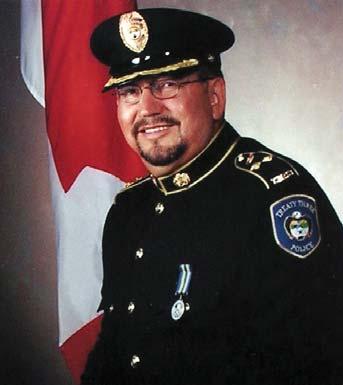
Much has changed since Ernie Jones put a banana in his holster and began policing Couchiching First Nations more than 28 years ago. Jones, deputy chief of the Treaty Three Police Service, retired recently.
Jones’ policing ties to the Couchiching reserve in Fort Frances, Ontario date back to his high school days, when he was already dreaming of being a Mountie. When the OPP run special constable program had an opening in 1978, he lost no time in applying and was hired, leaving his job at a Minnesota paper mill. With family in the area, his new job was a homecoming of sorts, yet he knew the challenges that lay ahead.
Growing up in Garden River First Nations, Jones noted at an early age the dire need for more policing on reserves and an authority that Aboriginal communities could identify with.
“The community needed people to serve long-term and to be there when young kids and babies were crying because their parents were in a domestic situation,” Jones says. “The only people brave enough to go into these situations were police officers – nobody else would.”
Residents didn’t look kindly on OPP officers, who they felt came to reserves simply to arrest and take people away. This perception led to some very bad treatment of police officers, Jones recalls.
With a first hand knowledge of Aboriginal issues, he remained adamant that First Nation people should police themselves.
Individuals hired under the special constable program policed their reserves under the supervision of the nearest OPP detachment. Upon returning from the OPP academy, even Jones was taken aback by the realities of his new job.
“I came back to the reserve and thought I was going to have a partner, but my (assigned) partner at the time had resigned so I was by myself with no coach officer,” he recalls. “All the First Nation officers that patrolled their reserves in Ontario at the time had to do things on their own and rely on their own intuition to get the job done.”
Eager for the challenge, Jones managed to put a positive spin on the shortcomings.
“I couldn’t carry a sidearm until the chief in council passed the BCR (Band Council Resolution) and I think it took two and a half months to sign it, but I went to work, put on the full uniform and put a banana in my holster because there was room there for my lunch!”
Jones patrolled the Couchiching reserve by himself for about a year before another officer was hired, which wasn’t uncommon on reserves in the Rainy River district. The OPP was called for backup when he deemed it necessary, although Jones says help wasn’t always available when needed.
The locals often criticized special constables for not taking incidents seriously enough and for not having the expertise or resources
to conduct investigations like the OPP could. Comparisons to an established police agency caused many disagreements, but Jones believed in what he was doing and remained confident relations would eventually improve.
He began lobbying chiefs from reserves with special constable programs in 1991 to allow officers to patrol together. The chiefs and their councils signed a BCR to this effect, allowing four constables to share policing duties on three large reserves and two smaller ones.
“The area I worked in, most people wanted the police and needed them. There were only a few of us to go around so it was pretty difficult to be everywhere at one time and to please everybody. The criticism we got over the years was that we weren’t in their communities enough and it was only because we didn’t have enough personnel.”
Later that year the chiefs met again and proposed hiring more officers for the OPP First Nation program. Four more native officers were hired, bringing the compliment to eight, and Jones was promoted to supervisor. “I believed it would work because not only do you know where they (residents) come from, but you know them personally,” he recalls.
Sometimes Jones discovered he knew them too well. Trips to the corner store for bread and milk would often involve run-ins with individuals he had dealt with on previous evenings. “If you didn’t treat them fairly or with respect, it would come back to haunt you because you see these people in your daily life, day after day,” Jones says. Those people included his own in-laws and cousins and he remembers the strain of having to “stick to his guns.”
The special constables program was eventually recognized as an improvement over policing by regular OPP members. Officers understood residents better and were earning a reputation for responding quickly to calls.
Jones was promoted to staff sergeant in 1998 and began working as a liaison officer between the Orillia First Nation policing section and the chiefs in council from the five re-
serves, which had now grown to nine.
It wasn’t until 2003 that Treaty Three council negotiated a stand alone contract to take over all policing and Jones was promoted to deputy chief, though he notes his job remained much the same.
Jones expects the Treaty Three Police Service will become more structured and completely independent from the OPP. The more than 20 officers at the Couchiching detachment are looking forward to moving into a new building which will better accommodate the growing service. He also predicts it will act on its biggest challenge – building a strong core of young officers and promoting them through the ranks.
“In the old First Nation program, there was a lot of turnover; the people didn’t stay around long and I don’t blame them. Policing isn’t the greatest when you are all by yourself in an isolated reserve. Many move on to either other police services or back to the private sector.”
Jones himself was recruited by the OPP but committed to sticking it out, no matter what went wrong.
“I hung in there only because I had the dream since I was a kid that First Nation people need a strong police service within their community to be a safe place for people to live,” Jones says. “I couldn’t leave the communities to go to another service or another city after being trained for so many years to do this.”
Jones determination paid off and he held on to see the community embrace its policing service. His many years of service gave Jones a unique sense of having endured a historic sequence of events. He can’t recall another individual who began and ended their entire career as a First Nation police officer.
Jones says he will now dedicate his time to his family, especially his 11 grandchildren. “I am busy here on Rainy Lake. I have a beautiful home and property and the kids come out every weekend to swim, boat and fish.”
OTTAWA - The federal government is preparing three-strikes legislation that would make it easier to label criminals as dangerous offenders after a third serious conviction.
The proposed federal bill will not trigger an automatic life sentence for repeat offenders. What it will do is reverse the burden of proof in dangerous-offender hearings for people already found guilty of three violent crimes.
That means that once someone has been convicted a third time they will be considered guilty until proven innocent of being a dangerous offender.
The bill is part of the Conservative anticrime package to be tabled this fall.
The new legislation would make it easier for judges to slap three-time offenders with the designation which brings an unlimited prison sentence, although offenders could begin applying for parole after seven years.
The law will apply to violent offenders and serious sex-offenders. Reverse
I recently became aware of Captain Mark Giles’s appointment as the head of communications for Interpol. Throughout the years, Mark has been an invaluable source of information for me and I am delighted to hear that he will continue to regularly contribute to Blue Line Magazine.
As a communications strategist working for a law enforcement agency, I operate in a relatively unique environment when it comes to media scrutiny, accountability and information flow. I think all of us (military, police, civilian oversight) are challenged to share the facts while abiding by investigative protocols and legislative restraints; as a result, the common goal of promoting confidence and credibility through effective media relations and outreach does not always come easy. In this regard, Mark has encouraged a camaraderie and brought insight, understanding and information to a range of topics through his articles. I believe he has provided a valuable perspective by sharing his experiences and framing media and public affairs issues in the context of the environment in which we operate.
It was a real joy and a highlight of my month to read Mark’s articles in Blue Line. I wanted to pass on my thanks to Mark and to those at your magazine for fostering and supporting a great initiative.
Rose
Bliss Communications Manager Ontario Special Investigations Unit (SIU)
I have been a reader of your magazine for many years and I must admit that I enjoy reading it. Very useful tool for the law enforcement community around the country.
Having said that, in the August/September edition, I read a commentary by Mr. Morley Lymburner where he comments on how the Federal Government is using one agency, the RCMP, for so many different tasks. In that text, Mr. Lymburner takes for example that the RCMP is responsible to provide security to our embassies around the world. I would like to point out that this is not true.
In fact, the Department of Foreign Affairs and International Trade have a memorandum of understanding with DND/Canadian Forces for the provision of security services for our embassies. The Canadian Forces’ Unit responsible for that task is the Military Security Guard Unit. This Unit is composed of sworn Military Police members.
I do understand what Mr. Lymburner was trying to achieve in his commentary and I respect that. However, I cannot stand by and have the RCMP (which, I believe, is one of our nation’s great institutions) take the credit for this mission/task.
The Canadian Forces Military Police provides security and police services to DND and the Canadian Forces and to many military communities around Canada and around the world. And, I must say, I take pride to see that another Federal Department is seeking expertise from the Military Police to ensure the safety of our embassies throughout the world.
D. Blais
Military Police Borden, ON.
I used to enjoy reading Blue Line on the occasion, but it seems that you focus a little too much on RCMP faults?
This magazine appears to be pro-O.P.P. and pays little attention or give credit to enough “other” agencies. At this point I have lost the desire to view this magazine due to this perceived content.
Mark Rushton Nova Scotia
The recent article on the potential of criminal profiling to mislead was disappointing. What could have been helpful for the police community or an exercise in critical thinking was instead a biased viewpoint with no specific or helpful insights. The authors contradicted themselves by faulting the research upon which their own conclusions were based, and then went on to make usupported remarks. The authors clearly make subjective comments outside the scope of the articles they reviewed. This article cannot be regarded as a critical review of available research on criminal profiling.
Overall, the article conveys a biased unfamiliarity with the scope of criminal profiling services, the criminal investigative process and the major case management system. The title, “The Potential to Mislead” applies equally well to the content of the article.
Jim Van Allen
Criminal Profiling Unit
Ontario Provincial Police
Combined factors can establish reasonable grounds
by Mike Novakowski
The Quebec Court of Appeal has found that several factors, when taken together, provided reasonable grounds to arrest.
lance; about an hour later, a vehicle resembling Mohammadi’s arrived on the scene, parking across the street from the apartment building. Within a very short time, another vehicle arrived and parked parallel to Mohammadi’s vehicle. Both drivers appeared to talk to each other and the other vehicle then departed.
In R. v. Mohammadi, 2006 QCCA 930, police received information that there was a significant cache of drugs in an unidentified unit within an apartment building and that the accused used this facility. A briefing was held later that afternoon where photos of Mohammadi and another suspect were distributed, along with a description of his vehicle, a Yukon, and its licence plate. The building was placed under surveil-
Mohammadi crossed the street and entered the apartment building using a key. He came out a few minutes later carrying a black plastic bag, appearing nervous and looking behind him and in all directions. He got back in his vehicle but left precipitously when he saw police arriving to intercept him. He threw the black plastic bag and the car keys onto the street and attempted to flee but was arrested not far away. The bag was found to contain approximately two kilograms of heroin. His vehicle was
Reasonable grounds requires objective analysis
by Mike Novakowski
A police officer must not only believe they have reasonable grounds, the grounds must be justified from an objective point of view.
In R. v Johnson, (2006) Docket:C42377 (OntCA), two uniformed patrol officers saw a known crack addict pacing back and forth outside a subway station. They watched as Johnson walked towards the addict from an alleyway, nodded his head, looked around and then reached into his pants pocket and briefly extended his open palm to him.
After the addict looked at Johnson’s palm, he closed it, put it back in his pocket and they walked away together for a while, then went in separate directions. The officers did not hear anything they said or see what was in Johnson’s hand.
The officers called Johnson over and arrested him for possession of crack cocaine for the purpose of trafficking. A search turned up individually wrapped packages of crack cocaine, a knife with residue and two cell phones. At trial in the Ontario Superior Court of Justice, the trial judge found police had reasonable grounds to arrest Johnson and he was convicted of possessing cocaine for the purpose of trafficking.
Johnson appealed to the Ontario Court of Appeal arguing, in part, that the trial judge erred in finding police had reasonable grounds to arrest him. He suggested they had neither the subjective nor objective foundation upon which to base the arrest and that the judge also conflated the two.
The Ontario Court of Appeal noted that a lawful arrest requires “both subjective and objective reasonable and probable grounds to believe that an offence has been committed,” stating: With respect to the subjective grounds for
arrest, (the addict’s) alleged admission as to his cocaine use, coupled with the officers’ observations, informed the officer’s subjective belief that they had grounds to arrest (Johnson).
In our opinion the trial judge did not conflate the subjective and objective grounds to arrest. She correctly stated that the objective person is a person with the knowledge that the police had. That is, the objective person would know the particular area involved, and the particular location within that area, was frequently used for drug trafficking. The reasonable person standing in the shoes of the officers would also know of (the addict’s) drug use.
The police also had other information about (the addict’s) drug use. Evidence that (the addict) was a known crack user was properly before the court. Information received from individuals can form part of the grounds for a subsequent arrest.
On an objective basis, a person standing in the shoes of the police officer would have also seen:
•(the addict’s) behaviour of pacing in a location known for crack cocaine trafficking;
•the guarded mode of acknowledgment between (the addict) and (Johnson), typical of drug transactions;
•(Johnson’s) act of showing (the addict) a small item in his cupped hands, typical of drug deals; and
•both men walking off together.
Having regard to the above factors, we are not prepared to second guess the trial judge’s assessment that the police had reasonable and probable grounds, on both a subjective and objective basis, to arrest. Her assessment of reasonable and probable grounds is entitled to deference on appeal (paras. 6-9).
Johnson’s appeal was dismissed.
searched and $5,000 cash and 107.2 grams of hashish were also uncovered.
Mohammadi was tried in Quebec Superior Court on charges of possessing heroin and hashish for the purpose of trafficking. He presented a motion to have his arrest declared illegal and to exclude the evidence obtained thereafter. In his view, there was an insufficient basis to proceed with the arrest under s.495 of the Criminal Code. The judge, however, found the arrest lawful. Mohammadi was known to police, had a prior drug trafficking criminal record and had previously been under surveillance for possible trafficking in drugs with his cousin.
Police also had information that he would be present at the location, which was a cornerstone of heroin trafficking. Furthermore, his conduct in leaving with a plastic bag, after entering without one, was suspicious, as was his demeanour when he left the building.
Mohammadi was found guilty by a jury and sentenced to 11 years and seven months in prison. The drugs were ordered destroyed, the $5,000 cash, pager and cell phone confiscated and he was prohibited from weapons for 10 years.
Mohammadi appealed to the Quebec Court of Appeal arguing, among other grounds, that the trial judge erred in failing to find his arrest illegal and not excluding the evidence obtained incidental to a search. Although the timing of Mohammadi’s motion to exclude the evidence at trial wasn’t proper, the Quebec Court of Appeal nonetheless commented on the merits of it. Justice Hilton stated:
(The accused) argues that the information on which the police acted on the afternoon in question was insufficient to justify his arrest. This information, however, included the specific identity of (the accused), his photograph, a description of the vehicle he would be driving, with the licence plate, along with the location of the building in which the drugs were said to be found. In my view, this constituted an adequate basis to proceed to his arrest without a warrant in light of his conduct as it was observed by the police when he arrived on the scene….
Not the least of these factors was his attempt to flee after he had taken his position at the wheel in the Yukon when the vehicle was intercepted, after which he was seen throwing the plastic bag onto the middle of Queen Mary Road.
As far as the items seized subsequent to the arrest are concerned, this issue wasn’t raised before the trial judge. Since there is no judgment of the trial judge on the subject, there is nothing for this Court to review….
In any event, having abandoned the plastic bag in which the heroin was found by throwing it onto Queen Mary Road, Mr. Mohammadi can no longer contend for a privacy interest with respect to the contents of the bag (references omitted, para. 54-55).
The appeal was dismissed.
by Mike Novakowski
No need to prove cell usage
Police don’t have to prove a person was talking on their phone to obtain a conviction under the province’s cell phone legislation, the Newfoundland Court of Appeal has ruled.
In R. v. Aisthorpe, 2006 NCLA 40, a police officer saw the accused driving while cradling his cell phone against his ear. The officer did not know if Aisthorpe was talking on the phone but still charged him under Newfoundland law with operating a motor vehicle while using a cell phone.
It is an offence under s.176.1 of Newfoundland’s Highway Traffic Act (HTA) for a person to use a hand-held cellular telephone while driving a motor vehicle on a highway. This is a strict liability offence, where the Crown need only prove the actus reus beyond a reasonable doubt. A “cellular telephone” is defined as “an apparatus which can send and receive a two way voice communication.” Phones are handheld if their use requires them to be “placed in the proximity to the mouth and ear by being held in the hand or by another means that uses one or more parts of the body.”
At trial in Newfoundland Provincial Court Aisthorpe testified he was waiting for a call and was “pretty sure” he wasn’t talking to anyone. He also claimed that if his phone had rung he would have pulled over to answer it. He was
convicted nonetheless, since in the judge’s view, the test wasn’t whether someone was actually talking or listening on the phone, but whether it was useable or in use. The fact it was up to Aisthorpe’s ear was sufficient to establish a prima facie case.
Aisthorpe appealed to the Newfoundland Supreme Court, which overturned the conviction. In the appeal court judge’s view, Aisthorpe wasn’t using the cell phone because there was no evidence that he was sending or receiving a communication, as required by the definition of a cellular telephone under the legislation.
The Crown then appealed to the Newfoundland Court of Appeal. Justice Rowe, authoring the unanimous judgment, ruled that holding a hand-held cell phone to your ear while driving is contrary to the province’s HTA.
In granting the appeal and reinstating the conviction, Rowe examined several areas:
•The word “use,” as defined in the dictionary, would suggest utilizing a cell phone for “any purpose;”
•The purpose of banning cell phone use is to prevent drivers from being distracted while driving;
•If the definition of use was restricted to sending and receiving a communication, actions such as looking up a number in the cell phone’s directory, dialling a number or reviewing numbers of persons who had called
would not be included – even though these actions all give rise to the driver looking away from the road and being distracted from driving; and
•The definition of “hand-held cellular phone” describes the manner of use – having the cell phone in proximity to a person’s mouth and ear –which points to a meaning that is wider than “sending and receiving a communication.”
In concluding that Aisthorpe was using the cell phone, Rowe stated:
“I am satisfied that ‘use’ in s. 176.1(2) has a wider meaning than that given to it by the summary conviction appeal judge – ‘sending and receiving a communication.’ I would hold that ‘use’ in s.176.1(2) encompasses a variety of operations of a hand-held cellular telephone that could result in the driver being distracted, including (the accused’s) actions as charged (para. 32).”
The Court of Appeal also rejected Aisthorpe’s argument that Newfoundland’s cell phone legislation violated s.7 of the Charter because it was unconstitutionally vague.
Officer intent determines implied licence
by Mike Novakowski
The reason police approach a home to knock on the door determines whether a search was conducted, the New Brunswick Court of Appeal has held.
In R. v. Fowler, 2006 NBCA 90, two police officers responded to reports the accused drove his truck into a vehicle parked at his estranged wife’s residence, left to go to his parent’s home and was possibly impaired. The officers proceeded to Fowler’s parent’s home and saw a truck parked in the driveway that had been recently running, as evidenced by heat emanating from its underside and a ticking sound coming from the engine. The house was in total darkness but some windows were wide open. Wanting to speak with the occupants to further their investigation, the officers knocked on both the front and rear doors but received no response. While returning to their vehicle, they heard a voice from inside the house state, “Don’t answer the door. I’ve been home all
night. I’ve been home all night.” The officers returned to the back door and knocked again. Fowler answered the door, but was dressed only in his underwear. He had a strong odour of liquor on his breath, his eyes were red and glassy and he was unsteady on his feet. One of the officers told Fowler he had reasonable and probable grounds to believe he left the scene of an accident and was impaired. Fowler replied he had been home all night and closed and locked the door.
While the officer discussed the matter with a supervisor, Fowler exited the house and approached the officers. He was cautioned, advised of his right to silence and breath samples were demanded. Two breath samples subsequently obtained revealed a blood alcohol level of 150mg%. Fowler was charged with impaired operation of a motor vehicle and operating a motor vehicle with a blood alcohol content over 80mg%.
At trial in New Brunswick Provincial Court Fowler argued the certificate of analysis was
Watchdog agency struggling to adequately scrutinize RCMP
OTTAWA — The watchdog that oversees the RCMP says the force’s expanding anti-terrorism surveillance activities are not being properly scrutinized.
In the annual report of the Commission for Complaints against the RCMP, chairman Paul Kennedy said the agency is struggling to keep tabs on the ever-expanding role of the national police force.
Since the federal Anti-Terrorism Act was passed in late 2001, Kennedy said, the commission has not always been able to obtain the proper documents to investigate potential abuses of power.
Kennedy, who became chairman last fall, said he has had little trouble accessing Mountie documents for his investigations. However, he said his commission should not have to go cap in hand to the RCMP when it investigates complaints.
“We have to negotiate with the RCMP on a caseby-case basis,” he said. “In my tenure, I have encountered no difficulties, but the decision is still theirs.”
Kennedy wants the federal government to update 1988 legislation that created the complaints commission. In particular, he wants the commission to become an auditor with “unfettered access to all information” about RCMP activities, except the papers of federal cabinet ministers.
The commission is complaint-driven, Kennedy said, which means it often learns of concerns only from media reports.
The commission also wants the power to summon any officer as a witness and the ability to share its findings with provincial police watchdog groups.
“There is a whole ream of activity not being investigated,” Kennedy said.
Sgt. Sylvie Tremblay said the RCMP is as co-operative as it can be under the law, but that there are important considerations that need to be reviewed before documents are handed over to the commission.
“There’s obviously a need to protect confidential sources and other sensitive information when we’re dealing with national security.”
Kennedy said the commission could have access to this information and still respect the need for confidentiality. He said he has made sure his staff have security clearance to view confidential information.
In his presentation to the Arar commission, Kennedy noted that any sensitive information given to his agency could be handed over with certain legislated conditions that prevent it from going public.
The commission’s annual budget, $3.8 million in 1988, now is $5.1 million. But Kennedy said he is working with a comparatively smaller budget when inflation is considered.
The RCMP employs 22,000 and has a budget of $3 billion.
Kennedy said he’s particularly concerned by reports that 300 officers in the RCMP are permanently assigned to national-security matters, which places them outside the oversight of his commission.
“It doesn’t make sense to disentangle 300 people from the review when what they do flows out of a whole series of other investigations,” he said.
Since many links have been drawn between organized crime and terrorism, for example, the agency needs better access to the RCMP’s antiterrorism activities, Kennedy said.
inadmissible because police violated his right to be secure against unreasonable search and seizure under s.8 of the Charter. In Fowler’s view, police could not attend at the home and knock without a search warrant – and because there was no warrant, the observations they made during the unreasonable search tainted the certificate of analysis.
The Crown submitted that police had the right to enter on to the property to communicate with its occupants under the implied licence doctrine. Their observations therefore did not constitute an unreasonable search, it argued, and the certificate should be admitted.
The trial judge ruled the police attended the house to communicate with the occupants, not to obtain incriminating evidence against the occupant. Accordingly, Fowler’s Charter rights were not breached and the certificate of analysis was admitted. He was convicted of the over 80mg% charge and the impaired driving charge was stayed.
Fowler appealed to the New Brunswick Supreme Court, which overturned his conviction. The appeal court judge found that one of the police purposes for knocking at the door was to obtain evidence Fowler was impaired. They therefore exceeded their authority under implied invitation to knock and violated his Charter rights in the process. The breathalyzer results should have been excluded under s.24(2) and a new trial was ordered. The Crown then appealed to the New Brunswick Court of Appeal.
Under the common law there is a longstanding principle that people, including police officers, have implied licence to approach and knock on someone’s door for the purpose of convenient communication with the occupant(s). If the police purpose is to communicate with the occupant(s), there is no search for constitutional purposes.
However, if the police approach the residence to secure evidence against the occupant, then a search has taken place and a reasonableness enquiry will be undertaken under s.8. Similarly, if the police have a dual purpose in mind (eg. to communicate with the occupant and secure evidence against the occupant), their conduct will constitute a search and s.8 is engaged.
In this case the trial judge rejected Fowler’s position that police attended the residence to obtain incriminating evidence, holding that their purpose was to communicate with the occupant(s). This finding was unassailable based on the facts and the appeal court judge exceeded her authority when she determined that one of the police purposes was to obtain evidence against the accused.
The Crown’s appeal was allowed and Fowler’s conviction restored.
Visit www.blueline.ca/resources/caselaw for the complete cases. E-mail caselaw@blueline.ca to reach Mike Novakowski
Navy returns to Northwest Passage, tends historic RCMP graves
by Bob Weber
The Canadian Press
The Canadian navy returned to the Northwest Passage this summer for the first time in more than a generation to get a first-hand look at shipping in the increasingly ice-free waters, and to tend the graves of two longdead RCMP officers near the derelict remains of one of the force’s loneliest outposts.
“We maintain historical gravesites and there are many throughout the North,” said RCMP spokeswoman Jennifer Hayward. “Once a member, always a member.”
Operation Lancaster took the army, navy and air force into Lancaster Sound, the channel off the north coast of Baffin Island, which is considered the east end of the Northwest Passage. It’s the first time in decades the navy has operated that far north.
“Talking to the old salts, we think the last time they were in Lancaster Sound, particularly this far into (the passage) was probably 30 years ago,” said navy Lieut. David Connelly.
Connelly said it was also been at least that long since the Forces mounted an Arctic operation of this size, at least 400 soldiers, sailors, air crew, RCMP and Canadian Coast Guard officers.
The Aug.12-24 operation employed the frigate HMCS Montreal as well as two smaller coastal defence vessels, six aircraft, Twin Otters, Griffin helicopters and maritime patrol airplanes flew overhead.
A platoon of 35 soldiers from the Quebecbased Royal 22nd Regiment, the Van Doos, were deployed along with Ranger patrols from several Nunavut communities.
The patrol visited Dundas Harbour on the southeast coast of Devon Island, where the RCMP maintained a small detachment in 192433 and 1945-51, an expression of Canadian Arctic sovereignty from an earlier time.
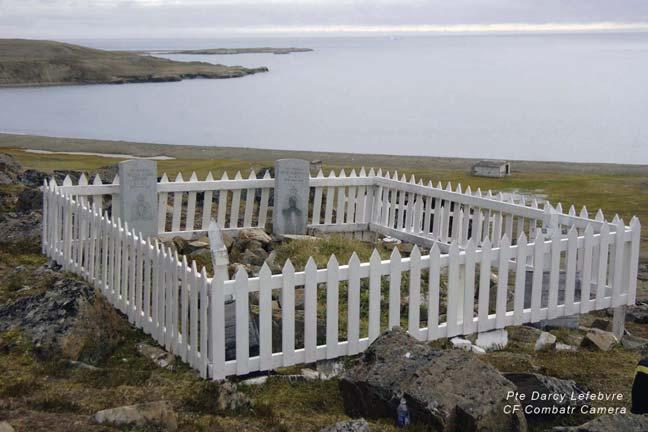
Two tumbledown houses, a stone path and an outhouse are all that is left, as well as the remains of two constables whose postings to this remote place ended in tragedy.
Const. William Stephens was shot Aug. 26, 1927, in a walrus-hunting accident. Const. Victor Maissonneuve died June 16, 1926, of a selfinflicted gunshot wound.
“He was serving alone at the time,” said Hayward. “There were no witnesses.”
There are 25 such lonely RCMP graves
throughout Nunavut, tended by the nearest detachment. At Dundas Harbour, a 2002 visit from Grise-Fjord-based members noted that Stephens and Maissonneuve needed some care. The ships sailed up Baffin’s east coast and set up a series of observation posts along Lancaster Sound to observe shipping, which has
been increasing in recent years as retreating ice makes Arctic waters more navigable. The ships also patroled Lancaster Sound and conducted fishing surveillance.
The patrol ended with stops in communities along Baffin Island’s east coast to allow residents and members of the Forces to mix. The idea was for the two groups to get to know each other a bit as the military extends its reach in the Arctic, Connelly said.
The navy has been gradually working its way ever further north since its return to the Arctic in 2002 with a patrol to the southern tip of Baffin Island. Patrols by the Rangers, a largely aboriginal force of reservists, have increased in number and extent. The air force is expecting the purchase of new patrol aircraft, and the Conservative government has promised a new deep-water port and winter warfare school.
September 11, 2001 Two airplanes crash into the World Trade Centre, another hits the Pentagon and a fourth hijacked plane crashes into a field in Pennsylvania.
Fall, 2001 Imminent terrorist threat post-9/11 places stress on CSIS resources. The RCMP is given cases that can be investigated on criminal bases.
October, 2001 5: RCMP start surveillance of Abdullah Almalki, a suspected extremist.
12: Maher Arar and Abdullah Almalki meet at Mango’s Cafe in Ottawa. End of October: Project asks Canada and US Customs to place border lookouts for Arar, his wife Dr. Monia Mazigh and their children. All are flagged as suspected terrorists instead of the less severe “persons of interest.”
November, 2001 The RCMP conduct surveillance of Arar.
29: Arar is detained at the airport and a secondary examination of his personal effects is conducted.
December, 2001 20: Arar is again detained at the airport and a secondary examination of his
personal effects is conducted.
January, 2002 The RCMP requests warrants to search target residences but not Arar’s home. Border lookouts for Arar and his family are renewed as an individual “suspected of belonging to or being connected to a terrorist organization.”
22: The RCMP conducts simultaneous warrant based searches of residences in Ottawa, Toronto and other cities. The project requests an interview with Arar at his home and learns that he is in Tunisia; Arar attempts to contact the RCMP from there, without success.
25: Arar returns to Ottawa and a Mountie requests he attend an interview at RCMP offices. Arar consents to be interviewed the following day and then attempts to contact lawyer Michael Edelson, but can’t see him before January 30. The meeting for January 26 doesn’t happen. Edelson later attaches strict limits on when, how and where the interview will be conducted and for what purpose the information will be used. Later, in reports sent to the US, Project A-O Canada states that Maher Arar declined to be interviewed.
31: All agency meeting to discuss material seized in searches.
February, 2002 FBI members visit Project AO Canada offices to review and analyze documents on Arar for “intelligence purposes.”
April, 2002 The RCMP shares its entire Supertext database, without caveats, with US agencies, including information on Arar. The CDs also include erroneous notes taken by RCMP officers during an interview with Youssef Almalki (brother of Adbullah Almalki) saying that Arar and his brother have a business relationship. Almalki actually said that he was not sure if Arar and his brother had such a relationship.
June, 2002 Arar leaves on a three month trip for Tunisia. The Criminal Intelligence Directorate (CID) appoints Corporal Rick Flewelling as “file co-ordinator” for Project A-O Canada to bring information-sharing practices back in line with pre-9/11 methods.
July, 2002 15: Project A-O Canada informs US of Arar’s alleged “sudden departure” for Tunisia.
September, 2002 26: The FBI notifies Project A-O Canada of Arar’s pending arrival in New York and its intention to deny him entry to the U.S. The agent also asks if the RCMP have questions they want to ask Arar while he is in custody. Project A-O Canada sends questions, without caveats, to US Customs.
26: Arar arrives at JFK Airport from Tunisia, via Zurich and is detained.
27: The FBI informs Project A-O Canada that Arar is still being held in New York.
October, 2002 1: The U.S. Immigration and Naturalization Service (INS) institutes removal proceedings under section 235(c) of the U.S. Immigration and Nationality Act, charging Arar with being a member of a foreign terrorist organization.
3: The FBI requests information from the RCMP, indicating that it might be used to remove Arar or for law enforcement purposes.
4: Information from the November 29, 2001 airport examination and answers regarding the Arar investigation are faxed to the FBI. This response includes caveats stating that the information is the property of the RCMP and can’t be distributed or acted on without authorization from the RCMP. No mention is made that all previous shared information was also subject to the same caveat.
7: The regional director of the INS issues an order finding Arar to be a member of al-Qaeda and ordering his removal from the United States. The order specifically refers to information obtained from the RCMP questions and used without the force’s permission. This is the first time the RCMP is informed that Arar may be deported to Syria instead of Zurich or Canada.
8: Arar is flown to Jordan, still in US custody, and driven to Syria a short time later. The RCMP liaison officer at the Department of Foreign Affairs and International Trade (DFAIT) shows project members consular reports about Arar, alerting them to the possibility he will be sent to Syria. An FBI official meets with project members, telling them Arar is still in New York but “could well be sent to Canada or Syria.”
10: A CSIS official in Washington contacts American authorities about Arar’s detention in New York.
17: A briefing note to the RCMP commissioner describes Arar as a “target” of the investigation and not a “person of interest” and contains other inaccurate information about the investigation into Almalki and Arar’s relationship to him.
21: The Syrian deputy foreign minister informs the Canadian ambassador that Arar is in Syria.
31: Edelson and the director general of consular affairs, Gar Pardy discuss asking the RCMP to send Syria a letter stating that: the force didn’t request to have Arar “deported’ to Jordan or Syria, Arar didn’t have a criminal record, wasn’t wanted in Canada for any offence and there was no warrant for his arrest and that he wasn’t a suspect in any terrorism-related crime.
November, 2002 14: The RCMP produces a timeline omitting several significant facts: providing information without caveats, supplying the entire Supertext database to US agencies without screening information for accuracy, the requested border lookouts where Arar and his wife are described as Islamic extremists and phone
calls by Flewelling with an American agent on Oct. 4 and 5, 2002. The same day, Mazigh is subjected to a secondary examination at the Montreal-Dorval International Airport and US Secretary of State Colin Powell meets with Minister of Foreign Affairs Bill Graham to discuss the operational details of the Arar case.
16: The RCMP responds to the Edelson letter, which it considers highly inappropriate, and indicates it played no role in the situation Arar found himself and that he had no criminal record. It also states it would be improper to comment on Arar’s situation in relation to its investigation and did not confirm that Arar was not wanted for arrest in Canada. No further RCMP assistance is requested until May and June, 2003.
21: Mazigh and her children’s secondary examination information is sent to Canada Custom’s Intelligence Management System, where they are described as, “known or suspected to be a potential border risk.” The inquiry later finds customs should not have uploaded these profiles to the databases since neither Mazigh nor her children belong to this category.
January, 2003 15: Canadian consul Leo Martel delivers a letter from the RCMP to Syrian general Hassan Khalil and Syrian military intelligence containing questions to be posed to Abdullah Almalki. This could have suggested that the RCMP was investigating terrorist cells in Canada and that there was a connection between Arar and Almalki.
16: Graham indicates to the Syrian foreign minister that Canada’s position is that Arar should be released and returned home.
April, 2003 30: A briefing note to the RCMP commissioner describes Arar’s status and again contains the same inaccurate information provided to the American agencies. The inquiry notes in its report that “these statements are a good example of how inaccurate information can, over time, become the accepted truth and be passed on as such.”
June, 2003 18: The RCMP, with CSIS approval, suggests new language for a letter to Syria: “Mr. Arar is currently the subject of a national security investigation in Canada. Although there is not sufficient evidence at this time to warrant Criminal Code charges, he remains a subject of interest. There is no Canadian government impediment to Mr. Arar’s return to Canada.” The language was still not helpful. Arar was not a “subject of a national security investigation.” RCMP Deputy Commissioner Garry Loeppky later agreed that this language was counter productive.
October, 2003 5: Maher Arar is released from a Syrian prison without a formal trial, after several months of negotiations by Canadian diplomats and dignitaries. DFAIT officials were summoned to the Palestine Branch (Syrian prison) and told by Khalil that Arar had been acquitted by the judge and was free to go. Syrian officials also told Canadian officials that they would release documents relating to Arar and criminal matters at a later date, but never did.
For the full-text of the report from the Commission of Inquiry into the Actions of Canadian Officials in Relation to Maher Arar, visit www.ararcommission.ca
1. The RCMP should ensure that its activities in matters relating to national security are properly within its mandate as a law enforcement agency.
a.The RCMP should take active steps to ensure it stays within its mandate as a police force to perform the duties of peace officers in preventing and prosecuting crime, while ensuring that it respects CSIS’ distinct role in collecting and analyzing information and intelligence about threats to Canadian security.
b.The RCMP should continue to develop its capacity for intelligence-led policing while ensuring it remains within its law enforcement mandate.
c.The RCMP should establish internal controls for national security investigations to ensure that they are properly within its law enforcement mandate to prevent, investigate and prosecute crimes.
2. The RCMP should continue to engage in integrated and co-operative operations in national security investigations, but agreements or arrangements in this respect should be in writing.
a.The RCMP’s integrated policing initiatives with other Canadian police forces are necessary and beneficial and should continue.
b.While respecting their different mandates, the RCMP and CSIS should continue to co-operate with one another and expand upon these efforts.
c.The RCMP should continue to adhere to and refine its policy of co-operating with other federal agencies or departments involved in national security investigations.
d.The RCMP should continue to work with foreign agencies in pursuing its law enforcement mandate in national security investigations.
e.The RCMP’s agreements or arrangements with other partners in integrated national security operations should be in writing.
3. The RCMP should ensure that those involved in national security investigations are properly trained in all aspects of these investigations.
a.Investigators in the national security field require all the skills and expertise of investigators in other criminal investigations, but should also have training specific to national security.
b.The RCMP should ensure that informa-
tion at the basis of national security investigations is analyzed accurately, precisely and with an understanding of its original context so there can be a successful prevention and prosecution of a crime.
c.The RCMP’s National Security Enforcement Course curriculum should be reviewed in light of the findings and recommendations of the inquiry. Training curricula should be reviewed periodically by the RCMP and by the proposed independent review body.
d.Training for national security investigators should include a specific focus on practices for information sharing with various agencies and countries that may become involved in national security investigations.
fore sharing it.
e.The RCMP should continue and expand upon its social context training so that investigations can ensure fairness to individuals and communities.
4. The RCMP should maintain its current approach to centralized oversight of national security investigations.
5. In national security investigations the minister responsible for the RCMP should continue to issue ministerial directives to guide policy in the RCMP.
6. The RCMP should maintain its policy of sharing information obtained in national security investigations with other agencies and police departments, both domestic and foreign, according to the principles discussed in these recommendations.
7. The RCMP’s Criminal Intelligence Directorate (CID), or another centralized unit with experience in national security investigations, should be responsible for the oversight of information sharing with other domestic and foreign departments and agencies.
8. The RCMP should ensure that information provided to other departments and agencies, both foreign and domestic, is transferred according to clearly established policies on screening for relevance, reliability and accuracy and with relevant laws respecting personal information and human rights.
a.The RCMP should maintain its policy of screening information for relevance be-
b.The RCMP should ensure that information provided to other countries is reliable and accurate and should amend its operational manual accordingly.
c.Information should also be screened by the RCMP for compliance with laws on personal information before it is shared.
9. The RCMP should never share information in a national security investigation without attaching written caveats according to its existing policy. The RCMP should review existing caveats to ensure that each precisely states which institutions are entitled to have access to the information subject to the caveat and what use the institution may make of that information. Caveats should also set out an efficient procedure for recipients to seek any changes to the permitted distribution and use of information.
a.The RCMP’s current policy of requiring caveats on all documents being provided to other agencies is sound and should be strictly followed.
b.The RCMP should review the language of its existing caveats to ensure that it clearly communicates the desired restrictions on the use of information being shared. Caveats should clearly state who may use the information, what restrictions apply to that use and whom to contact should the recipient party wish to modify those terms.
10. The RCMP’s information-sharing practices and arrangements should be subject to review by an independent, arms-length review body.
by Dorothy Cotton
Everyone can be creative Encouragement is the key
I ran across a little blurb recently describing a new tool the Los Angeles Police Department (LAPD) is experimenting with. There are a lot of car chases there and, as we all know, chases are sometimes not such a hot idea because of the inherent risks involved. Apparently, about one person a week dies in a police car chase in California. Holy mackerel!!! So someone came up with this nifty idea: instead of pursuing, officers shoot a little adhesive dart with a GPS on it, which sticks to the fleeing car and allows headquarters to track it.
Cool eh? I wonder who thought up that. I always get a kick out of these slightly off the wall ideas. I mentioned this dart stuff to a friend of mine who is of the police persuasion and he just shrugged. “What if the dart falls off?” he said. “What if the suspect gets out of the car? Doesn’t seem like such a good idea to me.”
What a poop. I’m glad I do not work for this man, as he is not exactly one to encourage creativity. He reminds me of a former boss of mine who used to refer to me as “a change agent.” It took me a while to realize that, in her mind, that was the same thing as ‘pain in the butt trouble maker’ (let’s just say I no longer work for that organization!!).
These stick-in-the-mud folks notwithstanding, I think there is a place in the workforce for people who are creative – even in the police workforce. Until we have good answers to all problems, we need creative people.
When you think about creativity, there is a tendency to think about artists and musicians, or people who plan to write the Great Canadian Novel, but creativity does not have to refer to the arts. It is much broader and can be defined as the tendency to generate or recognize ideas, alternatives or possibilities that may
be useful in solving problems, communicating with others and entertaining ourselves and others. Creativity is probably not one of the characteristics police recruiters actively seek but there is no doubt that it can be an asset.
Some of the problems requiring creativity are systematic – like dealing with the problem of car chases. It would also come in handy in figuring out where suspects are likely to reside based on a series of crimes, finding an effective way to reduce paperwork or coming up with a unique approach to deploying staff.
Is there a new way to engage youth from groups who typically dislike police? How 5’2" officer with a 23" waist position all that stuff police have to carry? If measuring clearance rates of crime is not the best way to measure organizational performance, than what is?
Some aspects of creativity are more evident on a case by case basis. Can you think up a new way to approach a particular suspect so that he is more likely to ‘fess up?’ What are the best questions to ask to get the answers you want?
If all this were as simple as following the established tried-and-true rules and regulations, we’d all live in a perfectly safe country where all criminals are caught – or better yet, we’d be 100 per cent effective at preventing crime in the first place. That is not the case so we need creative people who think up new ways of doing stuff. So how do you support creativity?
Well, first of all, you have to support creativity in the workplace. Duh, but that’s not as obvious as it sounds. The friend I quoted above would not be viewed as supportive. If I went to him with the dart idea and that was his response, I’d learn pretty quickly not to go to him with other ideas. A creative workplace is one where there are no wrong answers and attempts to problem solve are valued; where no one says ‘but we have always done it this way’ or ‘it will never work.’ It doesn’t mean carrying through on every half-cocked idea – but it does mean people should feel okay about having the occasional weirdo idea, because every now and then, one of them works.
A creative workplace is also one in which people have enough time to think. There is far less creativity going on in the new down-sized/ right-sized/stream-lined organizations that have emerged over the past decades. Hardly any that downsized when that was in style actually saved money, in part because when people do not have time to think, they don’t. That is never a good thing.
Creativity also tends to happen when people are feeling good. Those who are stressed, anxious or angry are not creative – but we all know that some people are just creative and some are not. Err, not really.
All the research tells us creativity is a function of experience, knowledge, skills, talent and the ability to think in new and different ways. In the big scheme of things, creative people
love what they are doing, work in environments that support innovation and change, are part of a team that collaborates rather than competes and have managers who reinforce and reward creative ideas.
That could be all of us, really – and that would be a good thing.
You can reach Dr.DorothyCotton, Blue Line’s psychology columnist at deepblue@blueline.ca, by fax at (613) 5303141 or mail at: Dorothy Cotton RTC(O) PO Box 22 Kingston, Ontario K7L 4V7.
WRP Detective wins international award
Waterloo Regional Police Detective
Deb Bodkin was the only Canadian recipient of a 2006 International Association of Women Police award. Bodkin was selected as officer of the year and presented the award at the 44th annual training conference in Saskatoon, Saskatchewan in September. She also made a presentation about her UN experiences during the professional development component of the conference.
Bodkin was recognized for her significant contributions on a one-month NATO mission to Bosnia. She used her annual leave in July 2004 to volunteer for the US State Department’s Atrocities Documentation Team, travelling to Chad, Africa to interview more than 110 Sudanese refugees.
Later the same year she took a twomonth leave of absence and was contracted by the UN as an investigator for the Commission of Inquiry for Sudan. Her experiences have made her a highly sought after lecturer.
She was transferred to intelligence on her return to Waterloo Regional Police and was once again a pioneer by becoming the first female intelligence Investigator. She remains in this role and has considerable specialized responsibilities.
Bodkin has been an instructor with the Criminal Intelligence Service of Ontario, where she mentors officers in a number of investigative courses.
In May, she received the Ontario Women In Law Enforcement – Law Enforcement Professional of the Year Award at the 8th Annual Banquet.
by Liz Brasier-Ackerman
Who do you answer to?
People are always watching what we do. It’s human nature, it seems, to observe, compare and judge. Police are likely to be observed closer than civilians and from many sides.
The public keeps a critical eye on law enforcement officers, watching for unacceptable behaviour and always ready to ‘blow the whistle’ on the big things or relishing the chance to criticize the smaller ones. A conversation I had recently with a friend serves as a good example of this scrutiny. She was upset by an incident on her morning commute when, in her words, she was “cut off” by a police cruiser. “Don’t they have to obey the rules of the road like everyone else?” she wondered.
Those in positions of authority also keep a close eye on an officer’s activities, ensuring they do their job correctly and to the best of their ability. Reports must be completed, standards met and the officer held accountable.
Fellow officers count on each other to do their share, pull their weight and stand with them. They expect professionalism, loyalty and dedication.
Much is expected from police officers and they are scrutinized harder than most people, day in and day out. It’s trying enough to live under this microscope, but police officers of faith
are watched even closer. Their professional acquaintances and co-workers watch with curiosity how their faith dictates and influences interactions with the public and co-workers.
Neighbours know them both as police officers and people committed to a particular religion – someone who must, they assume, live by high personal standards, be above reproach and adhere to the tenets of their faith. Parents, friends and just about everyone else they meet, both on and off the job, expect a certain level of conduct. It must be a daunting challenge.
There’s plenty of pressure to live up to the expectations of others – superiors, partners, next door neighbours. How much effort should a person expend to meet other people’s expectations? Who do you answer to?
Obviously there is no way anyone can ever live up to everyone’s expectations. It’s impossible even under normal circumstances, but people in the public eye have no chance. No one can be expected to be perfect and beyond reproach. No faith asks that. Yes, we are to strive for perfection, righteousness, holiness –whatever you want to call it – but it is a given that perfection is too lofty a goal for us to reach without the help of a higher power.
All one can hope for is to live with integrity and you can’t do that by trying to live up
to everyone’s expectations. It will drive you to distraction to even try. Living a life of integrity means striving to live according to your beliefs. Following the teachings of your faith, as best you can, will reflect in your work, family and social life and will highlight your strength of character and consistency.
Living a life of faith has beneficial effects in all quarters of a person’s life. Police officers who follow this path will become known as steady and reliable – and who doesn’t want a rock-steady partner in times of crisis? They will offer strong help to those who need it and become a source of peace and strength in the midst of chaos; pillars for their families, a person who leads and teaches, models faith and inspires others to also strive for the principled life.
Most important of all, they can rest knowing that, as they endeavour to live a life of faith and trust in their God, they are doing all that can possibly be expected of them. No more trying to be everything to everyone. No more feeling they are under a giant microscope. Everyone is free to live up to only one set of standards, ones which encourage them to be the best they can be in all areas of their life – the standards of their faith.
Liz Brasier-Ackerman can be contacted at Liz@BlueLine.ca.
National Youth Justice Policing Awards
The Minister of Justice National Youth Justice Policing Award was established in 2000 by the Department of Justice in collaboration with the Canadian Association of Chiefs of Police (CACP). The award recognizes the efforts of police officers, who singly or as a team, in an innovative and creative manner, look beyond the formal court system in dealing with young persons who come into conflict with the law.
The award celebrates innovative policing and serves to inform the police and wider community about creative responses to youth crime. The Award is presented each year at the CACP Annual Conference. This year’s conference was held August 20-23, 2006 in St. John’s, Newfoundland. The following are the recipients of the various awards presented at this event.
Youth Justice Award winners RCMP – Hopedale Detachment
The Hopedale Detachment RCMP members were nominated for their work with Community Justice Forums (CJFs) in a northern Labrador Inuit community. CJFs support police discretion at the front end of the youth justice process and use community-based conferencing as an alternative to the formal court system. They also offer a controlled, safe setting in which the offender, victim(s) and supporters are brought together to decide how to deal with a specific incident of offending.
In the presence of a trained community member, participants agree on a response to the incident. The Hopedale officers then work with the youth to follow through with the response. The forums promote respect for societal values, such as accountability, appropriate behaviour, co-operation, responsibility and teamwork – and by helping the community to respond to youth in conflict with the law.
The officers arrange for community members to be trained on the forum and actively educate the public on their effectiveness. Police officers in Hopedale have a strong belief in the system and used a CJF themselves following one incident in which the windows of the
The youth benefit from the alternative to the court system, learning to understand the impact of their actions on the community and take responsibility for those actions. In addition, relationships have developed from the forums that help youth have greater respect for police officers in their community.
The members of the RCMP Hopedale Detachment have invested countless hours of personal time to make the forum program a success. While providing youth with an alternative justice option, Sgt. Jim McEntegart and his team are helping promote the traditional values of Inuit justice and culture in the community.
For more information, call the detachment at 709 933-3820.
Certificate of Distinction
Greater Sudbury Police Service
The Aboriginal Youth Referral Program provides extra-judicial measures for first time Aboriginal offenders who have committed a non-violent crime. The aim of the program is to address a youth’s behaviour in a positive way by offering an alternative to the court process and using culturally appropriate community programs that provide appropriate consequences and help change offending behaviour.
The police mentoring component involved
Grant Dokis and Robert Thirkill were nominated for their work in developing an Aboriginal youth strategy in the Sudbury area which focuses on two components – a youth referral program that draws upon community resources of particular relevance and meaning for Aboriginal youth and, second, a police mentoring program directed towards aboriginal youth who may wish to pursue a career in criminal justice.
Hopedale Detachment were broken by a youth.
Cst. Grant Dokis
Sgt. Robert Thirkill
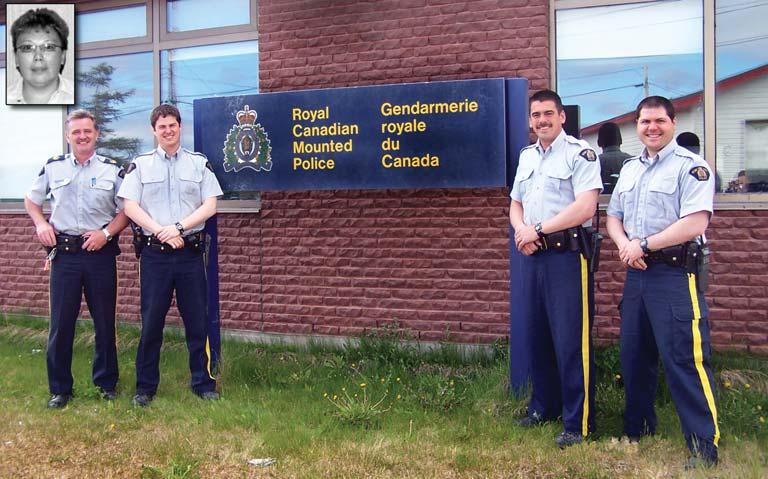
Sgt. Jim McEntegart, Cst. Gavin Moore, Cst. Geoff Pittman, Cst. Sandy Goudie, Clara Winters (inset)
the creation of the Police MkWa Education Circle, which provides opportunities for Aboriginal youth in the Sudbury area who are interested in a career in the criminal justice field. Developed with the help of numerous partners, the program involves a number of phases, ranging from mentoring between the youth and police officers, a special, accredited interdisciplinary course of study for Aboriginal students interested in criminal justice and summer work placements.
The strategy has resulted in profound shifts in attitudes for both the police and the aboriginal communities. Trust, respect and collaboration are emerging in ways previously not contemplated. Dokis and Thirkill were invited to present the strategy to the Ontario Police College and the presentation is now included as a component in the basic recruit program. This has increased awareness and sensitivity to issues facing Aboriginal people and information on ways for police services to build long-term solutions to addressing the issues.
Contact: Cst. Grant Dokis or Sgt. Robert Thirkill at 705 675-9171.
Honourable Mention
Halifax Regional Police
J.D. McKinnon was nominated for his work as a community response officer in the Halifax area. He recognized a need for a better relationship between residential care providers for youth and the police when he assumed the position in 2004. McKinnon worked to develop a rapport with the staff and the youth at each
Media policy hasn’t changed
VANCOUVER — Some Mounties in B.C. want to reduce the number of crime stories reported by the media in an effort to ease public fears.
The RCMP say its policy on how it issues information to the media hasn’t changed, despite a report suggesting they unnecessarily raise public alarm.
The commissioned report by the RCMP’s B.C. communications section suggests the policy of quickly issuing news releases on crimes might unduly raise public fear. The report also recommends the force’s media relations officers review their policy about responding quickly to reporters’ inquiries.
Cpl. Tom Seaman, a spokesman for RCMP E Division headquarters in Vancouver, said no new guidelines have been issued in response to the report.
“We haven’t decreased the amount of press releases,” Seaman said. “We’ve tried to improve the quality of them to ensure that our message is getting out to the public, not just responding to the obvious, so that the public is reassured that the police are acting upon what’s taking place.”
In some cases when there is no pressing need to ask for public assistance in solving a crime, Seaman says press releases may take longer.
The report suggested a connection between how serious crime is covered and the percentage of people fearing they could become crime victims.
“Research has shown that fear of crime is directly related to what the public are reading or seeing or hearing through the media,” said Seaman. “So what we’re trying to do is make sure that we as a police service ... are getting accurate information out to the public, not only the facts about certain incidents but what the police are doing about those incidents.”
Cst. J. D. McKinnon
facility, visiting them on a daily basis and engaging in such activities as cooking lunch for the residents and participating in outings.
McKinnon has also had the opportunity to work with youth when dealing with issues that arise in the facilities, helping them to understand the impact of their actions. He makes a point to gain a solid knowledge base of the youth’s background and trigger points to better connect with them and to help them turn their lives around.
McKinnon typically meets one-on-one with a youth before they are released from a facility, helping them reintegrate back into the community. He provides recommendations on their resumes and takes them job-hunting to assist with their transition.
McKinnon’s innovative approach to youth has resulted in a more symbiotic relationship between the police, residential programs, community and youth.
Contact: Cst. J.D. McKinnon, 902 4905016.
Honourable Mention
York Regional Police
Terri Lynn Hazell was nominated for her work in the development, implementation and delivery of the York Regional Police Strategic Approach to Youth Services Program.
The Program includes a community refer-
Cst.Terri Lynn Hazell
ral developed in conjunction with Ontario’s Ministry of Children and Youth Services and the Community Counselling Services of York Region that is available as an alternative to the formal court process. The program ensures that young people are held accountable for the actions, while still receiving appropriate counseling and support for the underlying causes of their offending behaviour. The Strategic Approach also provides opportunities for youth in conflict with the law to engage in mentoring programs and volunteer opportunities—all of which are facilitated by Cst. Hazell.
In addition, Cst. Hazell has brought preexisting programs into York Region, including the Duke of Edinburgh Award program which helps youth set and realize specific goals and the Empowered Student Partnership program which gives students a voice in the safety issues of their schools.
Cst. Hazell has achieved all of this by working countless hours outside of her schedule and by being flexible, compassionate and dedicated to youth. She has worked hard to build partnerships with other agencies, and community groups in developing a comprehensive approach to addressing youth issues.
E-mail recipient nomination form requests to prix.police.award@justice.gc.ca
by Tom Rataj
Personal computers today – and coming soon
The one constant with personal computers is change – and things seem to be changing even faster than usual the last few months, with the introduction of new technology and lower prices.
Many of the same purchasing guidelines still apply, including buying as close to the leading edge as you can afford, sticking with major name brands and keeping an eye on the near future, which delays the inevitable – the day your shiny new hardware becomes obsolete – by a few months to even a year or two if you’re lucky.
Processing power
The two major central processing unit (CPU) manufacturers, Intel and Advanced Micro Devices (AMD) have been locked in a bitter market battle. Intel dominates with about 70 per cent of the market, compared to AMD’s 20 per cent (other companies hold the remaining 10 per cent). AMD has steadily eroded Intel’s lead by building more efficient processors that perform better and faster than more expensive Intel processors.
Both manufacturers have moved away from naming processors after their internal clock speeds – which are now measured in gigahertz (GHz) – to model names and numbers. You now have to check specifications to find out a processor’s clock speed – generally the higher the clock speed, the faster a processor will run, all other factors being equal.
Another major development has been the move to building processors with more than one core, which is the part of the chip where all the work gets done. Adding a second core to the same chip is a fairly cheap and simple way to provide a significant performance boost without having to increase clock speed. Dual core processors are also more energy efficient, which is particularly important in mobile applications such as laptops, and generate less heat.
Intel’s top of the line dual core processor line is known as Core 2 Duo, although it also offers a dual core Pentium D. AMD’s top of the line dual core processor is the Athlon 64 X2 Dual Core.
Both manufacturers offer dual core designs in both their mobile and desktop lines and are working hard to manufacture quad core processors in the short term and processors with eight or more cores in the longer term.
Memory
Next to the processor, system memory is probably the most important consideration when deciding what computer to buy. Since more memory is always better and relatively cheap and easy to add during the purchasing process, it is best to do so right up front.
Since Windows XP realistically requires at least 250 MB of system memory just for itself, even a budget system would benefit from having at least twice that amount. Com-
puters without enough memory will run slowly because program data constantly needs to be swapped between the relatively slow mechanical hard drive and relatively fast electronic system memory.
As with computer processors, memory operates at different clock speeds. Adding memory to a computer can be a complicated process because the new memory has to match any existing memory and there has to be enough physical room on the motherboard to accommodate it.
Most budget systems offer 512MB of memory, while most mainstream machines now offer at least twice that (1GB). Higher end machines often offer a generous 2GB or more.
Fixed storage
Computer hard drives have increased in capacity at a phenomenal rate, to the point where the leading single hard drive now has a staggering 750GB! Despite the massive capacities, the price per gigabyte has continued to fall.
In these days of digital video and photography and the ubiquitous MP3 music files, the need for mountains of storage capacity has never been greater. Even budget desktop computers often ship with 250GB hard drives and many laptops ship with at least 100MB drives.
The biggest change with hard drives in the past year or so has been the move to a new connection technology known as Serial ATA (SATA). It offers much higher data transfer speeds and capacities over the older EIDE (now also known as Parallel ATA) and because it needs fewer wires to communicate with the computer, the connectors and cables are much smaller. The smaller cables also allow for better air circulation inside the computer case. External drives are also starting to offer SATA.
Removable storage
Removable storage falls into two general categories: optical discs such as CD’s and DVD’s and solid state memory units, often called USB keys.
With optical discs, the biggest changes have been with the ability of DVD drives to
record data at 16X and write to two distinct layers on dual layer discs. Prices for recordable media have dropped to around four cents each for CD’s and around 30 cents each for single layer DVD’s. Dual layer DVD’s run around $1.40 when purchased in quantity.
From all the research and tests I have read, the best guidance here is to stick with major name brands. They appear to be more reliable in all aspects of use and when purchased on sale the price difference between no-name and name brand discs is negligible.
The next generation optical discs are just coming to market, but unfortunately for the consumer, there are two competing and incompatible technologies. A group led by Sony is marketing Blu-Ray technology, which offers an astounding 25GB of data capacity on a single layer disc. The Toshiba led group’s HDDVD technology offers only 15GB of data capacity on a single layer disc.
This battle has only just begun and first generation burners currently cost more than $1,000. Blank recordable Blu-Ray discs cost around $25 each, making for an expensive storage solution when compared to DVD.
The solid state USB key market has gone crazy in the past six to nine months, with prices dropping more than 50 per cent and larger capacity 2, 4 and even 8 GB units coming to market. A name brand 1 GB key can often be purchased for less than $50 on sale.
Displays
The days of the clunky old cathode ray tube (CRT) computers monitors (and televisions, for that matter) are numbered. With the massive price drops seen even in the last nine months or so, the new computer display technology to use is flat-panel Liquid Crystal Display (LCD). They use far less electricity, generate much less heat and use substantially less desk space than a similarly sized CRT and generally offer a brighter, clearer and flicker-free picture.
The desktop standard is now more or less a 19" flat panel, although budget systems generally only ship with 17" units. Also quite popular are 20" wide-screen flat panels.
Flat panel monitors connect to computers by either the traditional D-SUB (blue coloured) analog connector or the newer and better DVI (beige coloured) digital connector. In order to use DVI both the monitor and the video output on the computer need to have DVI connectors.
Generally monitors featuring DVI will also offer the older D-SUB connector and will be of better quality and usually come with a three year instead of the one year warranty usually seen on cheaper monitors. The price difference between the two is usually only about $50 for a 19" monitor. Even if you don’t use a DVI connection, the DVI equipped monitor is still a better buy.
Other features to watch for are height, tilt and swivel adjustment. Many budget flat
panels offer only tilt adjustment. Better monitors offer height adjustment, while a few premium displays also offer swivel (left to right movement) and pivot (where the user can rotate the monitor by 90 degrees clockwise) to go from the standard landscape (wider than taller) orientation to portrait (taller than wider) orientation.
Operating systems
Most desktop and notebook computers currently use the Microsoft Windows XP operating system. This is all about to change as Microsoft is in the final stages of preparing Windows Vista, the replacement for XP. Vista is a complete top to bottom makeover that features a number of new technologies and a revised interface.
This is the biggest operating system overhaul since Microsoft replaced Windows 98 with XP. There will be five or six different versions of Vista available, with increasingly stringent hardware requirements between the basic ‘home’ version to the loaded, top of the line business version. Some older computers will not meet the new, tougher hardware requirements. Check Microsoft’s web site for details.
Unfortunately for Microsoft, the consumer version of Vista will not be available for the crucial Christmas buying season. I expect any computers sold during that time period will come with a coupon for a free or discounted upgrade for Vista when it is released in January 2007. Some new hardware on the market today already comes with a label indicating it is Vista certified.
The Mac Plenty of developments have occurred at Apple, maker of Mac desktop and laptop computers. In addition to a major upgrade of its operating system, now know as OS-X, Apple has begun using Intel processors instead of its traditional IBM manufactured Power PC processors.
The company plans on completely transitioning all its computers to Intel processors. This should drive their cost down and also makes them capable of running Microsoft Windows, although most Mac users no doubt find that ability to be of no advantage!
is Blue Line Magazine’s technology editor and can be reached at technews@blueline.ca
HIGH PRAIRIE, AB. — The northern Alberta town wants the province to change its rules so special constables enforcing town bylaws can carry guns.
Though Alberta’s solicitor general, Harvey Cenaiko, says he won’t rule out the plan, the change won’t come any time soon.
He points out the officers aren’t trained to carry guns, and the municipal bylaws they enforce shouldn’t have them dealing with criminal acts.
The Town of High Prairie argues some of the people that special constables must deal with are also very well known to the RCMP. Town officials say unarmed special constables are putting themselves at risk.
But Cenaiko said there are clear distinctions regarding who can carry a sidearm.
“The Alberta sheriffs, for example, are peace officers in the province of Alberta and they have the authority to enforce any provincial act,” he said.
“Special constables in municipalities don’t have that authority. They have authority under the Traffic Safety Act to enforce some traffic act offences.”
OTTAWA — The federal government plans to tightly regulate nine chemicals it says can be used by terrorists to build bombs.
Proposed regulations under the Explosives Act would require companies selling the restricted materials to register with the government, keep meticulous inventory records, and notify police if they believe a customer will use the materials to build bombs.
The new list of chemicals was drawn from a 1998 U.S. National Research Council report that identified the same nine ingredients that can be readily adapted as explosives.
Companies selling the nine chemicals will have to maintain lists of workers who have access to the restricted materials, have secure storage facilities, and must closely examine a purchaser’s identification. Detailed sales records are also required.
The new regulations would apply to sales of even small quantities.
Interested parties have 90 days to comment on the proposed rules, which are expected to be in place by the end of the year.
The proposed list of restricted chemicals include:
• ammonium nitrate in solid form, at a concentration of 28 per cent to 34 per cent nitrogen
• nitric acid at a concentration of at least 68 per cent
• nitromethane
• hydrogen peroxide at a concentration of at least 30 per cent
• potassium nitrate
• sodium nitrate
• potassium chlorate
• sodium chlorate
• potassium perchlorate.
KELOWNA, B.C. — RCMP officers in Kelowna, B.C. are riding in some district school buses in an effort to catch motorists who break school zone traffic laws.
Cst. Annie Linteau says police had ticketed 27 drivers by the second week of September.
Motorists won’t know if officers may be on buses in the morning or afternoon.
Linteau says until police see a drop in violators, the officer on the bus strategy will continue. ***
CALGARY — More than 250 police officers from the United Kingdom could be swapping their bobby helmets for Calgary Police Service uniforms.
Calgary police say it is the first time they have sent a recruitment team to the U.K. and it is a direct response to increased competition from private security firms and the high-paying oilpatch.
Recruiters have received more than 500 inquiries from officers in the United Kingdom, he said. Almost all of them are employed by police services in their homeland.
The U.K. recruiting trip - expected to cost about $40,000 - is the latest marketing tool to be used by the police service, which has struggled to recruit enough officers to fill its ranks.
Calgary police failed to meet recruitment goals this year, falling nine officers short of the expected 121. The service’s most recent recruitment class had just 15 graduates instead of the usual 24.
O’Neill, a former City of London detective seconded to Scotland Yard, said there is an increasing job disillusionment in the U.K., prompted by increased crime and a lack of respect towards police.
TomRataj
by Danette Dooley
A short vacation trip to Newfoundland three years ago dramatically changed the lives of a 30 year RCMP veteran and his wife.
Glenn Zemdegs and wife Elizabeth had always wanted to visit Newfoundland, “so we came here in June of 2003 with no particular destination in mind,” Glenn explains. “We had a car reserved for ourselves and we were just going to drive around the island for a week.”
Before long the Zemdegs found themselves heading towards the historic town of Bonavista – the site of John Cabot’s landing in 1497. “We were only going to stay one night but I ended up extending my holidays by a few more days and we stayed a week,” Glenn says.
Soon smitten with the area, the couple decided a week wasn’t nearly long enough and, before heading back to their home in Toronto, bought a piece of property “on a handshake...
“We bought three small properties. One had an old house that was vacated, and attached to that were two potato gardens owned by different families,” Glenn says. “We went around the night before we left and found out who owned which, then we shook hands and walked off owning the entire property.”
Glenn served in numerous Ontario detachments during his long RCMP career, reaching the rank of sergeant and heading the commercial crime section at the Newmarket detachment when he retired six years ago. (Glenn changed his name from Samson to Zemdegs when he married Elizabeth).
While never formally on the VIP squad, he was trained as a bodyguard and often called upon for close personal protection of world leaders. That experience made taking on his next job, heading some 85 employees as director of security at the Ontario legislature, an easy fit. Before long though, the quietness and beauty of the little piece of paradise on the Rock beckoned to the couple.
“We were looking around for some place to settle eventually and when we got back to Toronto, the heat was extreme, we had a number of smog alerts and so Elizabeth J. says, ‘We’re crazy. We should go live in Newfoundland.’”
Glenn chuckles when recalling his initial reaction. “Pardon me? (I asked)... but we talked about it and we made a decision to move to Newfoundland.”
They were soon on their way back to Bonavista to search for a contractor to build the home Elizabeth had designed. On the way, she brought up the subject of building more
than one home on their land.
“Right out of the blue, Elizabeth J. says, ‘You know what – I’m going to build the best cottages in all of Newfoundland. I’m going to build articulately designed cottages in style with the old houses in Bonavista.’”
True to her word, she lost no time in drawing up heritage style designs for the two cottages, which offer a breathtaking view of the ocean, complete with icebergs, puffins and whales. The business soon became affectionately known in the area as Elizabeth J. Cottages.
Elizabeth then quickly turned her attention to the task of furnishing the buildings.
“We were planning to move into our finished house by April 2004 and, in that fivemonth period, Elizabeth J started going out and buying furniture and artwork and Persian rugs – and of course, we had a lot of furniture made locally here in Newfoundland,” says Glenn.
The couple settled in Bonavista two years ago and were soon welcoming their first guests. Business has been great, Glenn says.
“We have a four-and-a-half star rating and I’m very proud to say that the business has done very well. We’re opened all year round and our cottages were fully booked this past two years.”
Working alongside his wife is a far cry from guarding famous people as a Mountie. Glenn has fond memories of providing security for prime ministers Pierre Trudeau and Brian Mulroney and world leaders such as Margaret Thatcher and Ronald Reagan.
“I was with the Royal family on numerous occasions and I was able to work on the RCMP team with young Prince William and Prince Harry when they were younger,” he recalls.
“We were with them for a week. We took them around incognito to places like Toys ‘R Us and we’d have a great time with them.”
The children were returned to the Royal Yacht Britannia each evening, giving Glenn a chance to make small talk with their parents.
“We’d take them back and we’d talk to Princess Di for a few minutes. We’d tell her what we did all day.”
Glenn’s warm personality and excellent communications skills allowed him to be as comfortable mingling with the rich and famous as he is sitting and chatting with salt of the earth Newfoundlanders on his cottage deck, which overlooks the bay.
There really is life after policing, he says, adding you never know where your life is going to take you.
“Bonavista is a wonderful spot. Newfoundland and Labrador is a wonderful province. We were fortunate that we discovered it. We’ve got the ocean at our feet and we’re watching fishing boats come and go. What more could we ask for?”
For more information on ElizabethJCottages visit www.elizabethjcottages.com
Corporal JonWilson, a Mountie from Grande Prarie, Alberta, has been recognized for his work solving a decade-old cold-case involving the sex assault of a nine-year old girl. The girl was accosted by a man in a black pickup truck in Grand Prarie in 1995. Four years ago, the case was assigned to Wilson. He worked on his days off, re-interviewing witnesses, tracking down leads and eventually matching up the DNA to a suspect convicted in a similar case in BC. The suspect died in Kelowna almost two years ago.
YorkRegionalPolice(YRP) have been awarded the International Homeland Security Recognition Award by the International Association of Chiefs of Police for its Project Ready program, a planned and coordinated strategy that directs officers to always be aware of global events and how they could affect the community as a whole. The award recognizes police services that demonstrate community policing through practical applications as an integral part in terrorism prevention and response. Along with increased neighbourhood patrols following global or national events which could have an effect locally, all YRP officers and residents are encouraged to pay special attention to significant locations such as places of worship, government facilities and other critical infrastructures within the region.
An accused bank robber appearing in court on the charges had other ideas than facing the music.
He made a run for it.
Twenty-nine year-old William Charles Izzard knocked over a sheriff’s deputy and ran out of the Bridgewater, Nova Scotia courthouse.
Izzard then jumped into a nearby river and began swimming towards the ocean, much to the amusement of onlookers.
“He was just swimming along casually,” said Peter Barss, among those residents who lined the banks. “He just stuck to the middle of the river. “People were cracking jokes and calling out things.”
Police launched a boat and caught up with Izzard some half-kilometre swim later, dragging him back to shore.
RCMP said there was no chance he could have escaped.
“We were at every possible place he could come ashore,” said RCMP Corp. Robin Churchill. “We were ready for him.”
Provincial police in Ottawa say a man accused of stealing a boat was arrested after he got lost and asked for directions.
Compounding the problem of being lost, the accused asked directions from what turned out to be a friend of the victim.
The man he asked recognized the $13,000 boat the man was towing and called police.
The thief was arrested after he stopped in the village of Russell to ask directions to a ferry.
A 34-year-old man from Papineauville, Que. is charged with theft and various other charges, including possession of marijuana and having open liquor.
December11-15,2006
Hotel Hosted by the Toronto Police Fraud Squad. Provided will be a mixture of lectures, case studies and panels on a wide variety of fraud issues and practices. Cost $360.00 per person. For further information and contacts go to www.torontopolice.on.ca under seminars and conferences, or contact Allister Field at 416-808-7332 or allister.field@torontopolice.on.ca; or Kerry Watkins at 416-808-7311 or kerry.watkins@torontopolice.on.ca.
April24&25,2007
Take advantage of the early booking special rate prior to December 1. Contact Kathryn at 905 640 3048 or Kathryn@blueline.ca .
A Winnipeg woman says a mix of disbelief and aggression sparked her to chase after her stolen car on her bicycle.
Jillian Brown was out bike riding when her stolen car drove right past her.
Brown, 26, says she gave chase and eventually caught up to the male driver and told him to get out of the car.
She was just as surprised that the man obliged.
The thief told her he didn’t steal the vehicle, then turned around and walked away between buildings in the downtown area.
‘Beemer’ the police dog chomped down on the wrong leg during a suspect chase.
Ventura, California Police Chief Pat Miller was on his way to a meeting and wound up helping his officers by taking part in a chase, which crossed over to Oxnard.
Beemer’s handler on the Oxnard force let the dog loose when the suspect eventually got out of his car.
The Ventura chief, however, was wearing plain clothes and confused the dog.
Miller says the dog literally picked him up off the ground and bloodied his leg.
Beemer later redeemed himself by helping capture the suspect.
***
Normally an afternoon nap isn’t an excuse to skip jury duty, but it isn’t all that often that 103-year olds are summoned to court.
After receiving her summons, Phyllis Perkins asked to be excluded from jury duty because it might interrupt her nap time.
Perkins, born in Parkhill, Ontario in 1903, moved with her family to Saskatchewan as a baby.
Perkins now lives at the Luther Tower care facility in Saskatoon.
Citizens over 65 are automatically exempt from jury duty upon request, but can attend if they want to.
***
It sounds like a good plan.
Plant a car with the intention of someone stealing it.
And it worked - a little too well.
Police in Dallas report one of their “bait” cars is missing.
Investigators think the tracking gizmo may be on the blink.
The car is gone and police can’t find it.
Authorities haven’t revealed the details on the make or model of the missing bait car, or where it had a been parked.
Tactical eyewear Laptop storage
The PT-3 by Wiley X Eyewear features a “Take-Flight” rubber set on wire core nose bridge, that adjusts to the bridge of any nose. Comes with adjustable leash cord and T-Peg Docking elastic strap to fasten across your temples. Meets Vo Ballistics MIL-PRF-31013 standards and ANSIZ87.1-2003 high velocity impact standards.
Vacuum glove box
Canadian Safety Equipment’s Banthrax Safe-T-Dome is light weight, sturdy, and sized for use on a counter, lab bench or tabletop. Safe-T-Dome meets or exceeds the standards for Class II or Class III safety cabinets for handling dangerous microorganisms, toxins and other high risk materials.
TWB Designs Mobile Ammunition Combustion System (MACS) is designed as a safe, affordable and portable turnkey system capable of disposing 60 lbs of ammunition per hour. The only one of its kind to have Ministry of Environment approval. MACS is endorsed by the Royal Canadian Mounted Police.
Mega-Tech introduces the Laptop LockUp a storing, charging unit for notebooks with sensitive and confidential information. Drawers and cabinets are vented on bottom and sides with power supplied to each drawer by coiled cord with 3 prong grounded outlet.
House breaching sledge
BlackHawk Dynamic Entry introduces the Breaching Sledge which combines the best of a sledge hammer’s strike face and the prying wedge of a Hallagan tool. The Breaching Sledge micro-metals head allows metal-on-metal use with reduced spalling. The Sure-Grip handle is non-conductive and available in 22" and 32" lengths.
Water resistant camera
CEID Corporation’s water, shock and dust-resistant Ricoh Caplio 500G Wide digital camera has 8 Megapixel resolution, 28 - 85mm lens (3X optical zoom), 1 cm macro function, 2.5” LCD screen, 3-way power supply, shake blur reduction, skew correction mode, and large buttons and dials for easy handling.
Tactical gun backpacks
SEALS Action Gear recently introduced Eberlestock’s line of tactical gun carrying backpacks. Integrating a rifle case/drag bag and a functional backpack is a popular design making these packs a sought after addition to police and military sniper gear lists. Several models are available, to suit any mission.
Elementproof boxes On-site drug screening
Otterbox’s waterproof, crushproof and floating boxes protect valuables from the elements. Cases are available to guard your: small digital cameras, sport sunglasses, cell phones, PDA’s, Minidisk players and more.
Dav-Tech’s MedTox Verdict II on-site drug screening device provides a single screening for various drugs including: THC, AMP, COC, OPI, PCP and more. Provides qualitative results in 5 minutes. Sold in cases of 25.
Mobile Ammunition Combustion
What old style justice was really like
by Morley Lymburner
It’s always interesting to chat with old policing vets and a recent visit with a long retired senior officer was no exception.
“Anyone doing real police work can’t always follow the Marquis of Queensbury rules,” he told me. “Every officer, now and again, has to step around the official rules of engagement or the job would never get done.” Out of respect, acknowledging what was said more than in agreement, I nodded my head.
This reminded me of my early years walking the beat and getting to know everyone who lived and worked there. The barber shop owner, bank manager, waitresses at the corner coffee shop, real estate salesmen and bartender at the tavern were important people to me. They kept me abreast of what was going on and, if push came to shove, I was confident they would help me in any way they could. As I soon discovered though, the best help came from the old copper who used to walk my beat... but it proved to be a double edged sword.
I made a habit of standing in a certain blind alley because it was particularly sheltered from the street lights. With my dark navy uniform, my presence was known only to myself as I stood patiently watching the storefronts and sidewalks of my beat. Through the hustle, bustle and quiet times on that street, I was proud that nothing went unseen by myself or my ‘informing deputies’ living and working in every building.
One evening, just around midnight, I heard the sound of breaking glass at a local car dealership. It was only about 50 metres to the north of my alley position and I briskly walked toward the sound. I had learned never to run; running sounds are louder and running feet tend to rush into danger with no strategic plan of attack or defence.
I rounded the corner to see a well known local hood rummaging through a new Lincoln, frantically trying to remove the radio as quickly as possible. Catching him completely by surprise, I touched his shoulder and he jumped so hard he hit his head on the door sill. He yelled in pain and shouted at me not to hit him again. He was absolutely shaking uncontrollably with fear.
A larger man than myself, his face was scarred and bent, making it clear he has seen the wrong end of something hard on many occasions. I watched this quivering hulk cover his face from imaginary blows and thought about the kind of copper who had preceded me. The hood had the experience and common sense to promptly obey my orders, laying down on the ground and placing his hands behind his neck, awaiting my handcuffs.
I stood him up and was surprised by a man, who had been cowering on the other side of the car, who bolted away at blazing speed to the edge of the parking lot. As I contemplated my next move he surprised me by jumping over the edge, crashing into the gravel and stone river bank. I heard him scream out in pain as his left leg snapped. He completed his tangled fall by tumbling to a stop, writhing in pain, by the river’s edge. It had to be a 10 metre drop. Again I was stunned at the way these two men had reacted to my presence.
I walked the prisoner in hand to the phone booth across the street, calling for a scout car to take him in and another to search for the poor soul screaming in pain by the river bank.
I noticed as I arrived at the station that my prisoner had a nasty cut on the top of his head; the blood was not quite noticeable under the dim streetlights. I paraded him in front of the sergeant, who looked at the wounded man, smiled and said “A fine piece of police work, constable.” I explained the injury was caused when the prisoner struck the door jam after I surprised him but the grizzled sergeant simply smiled. “That’s a good one son. I hear you dispatched his brother down the river bank. It looks like my old beat will be well taken care of.”
There was a transition taking place when I joined the force; a generation with a slightly different view of policing was slowly replacing the old guard. Although a good dust-up was still required on occasion, most of the time the old, back-alley justice of catching a miscreant and rapping him in the mouth instead of arresting him was disappearing.
My experience arresting these individuals was made a lot easier by that old sergeant who walked my beat before me, but a grudging fear and hate that yearned for reprisal was the price paid in the balance. Several years later these boys would get their revenge by killing a cop as he pleaded for his life.
We can all take pride in the officers of today and yesteryear. Both do and did their jobs as best they could given the circumstances society permitted them. Stepping around rules, however, can lead to a lot of unintended aggravations. Rapping a person in the mouth to teach them a lesson only teaches the wrong lesson.
A law breaker has to understand that when they break the law, they do so alone. The ultimate goal is to never give them the satisfaction of seeing the person arresting them breaking other laws. Given the frailties of the human spirit, it can at times be a tall order, but one that is demanded of us if we are to maintain the life-style we enjoy and crave.
MorleyLymburner is a former 25 year member of the Toronto Police Service. He may be reached at publisher@blueline.ca.