8Positive community focus Policing one of Canada’s fastest growing cities 12What’s
5Publisher’s
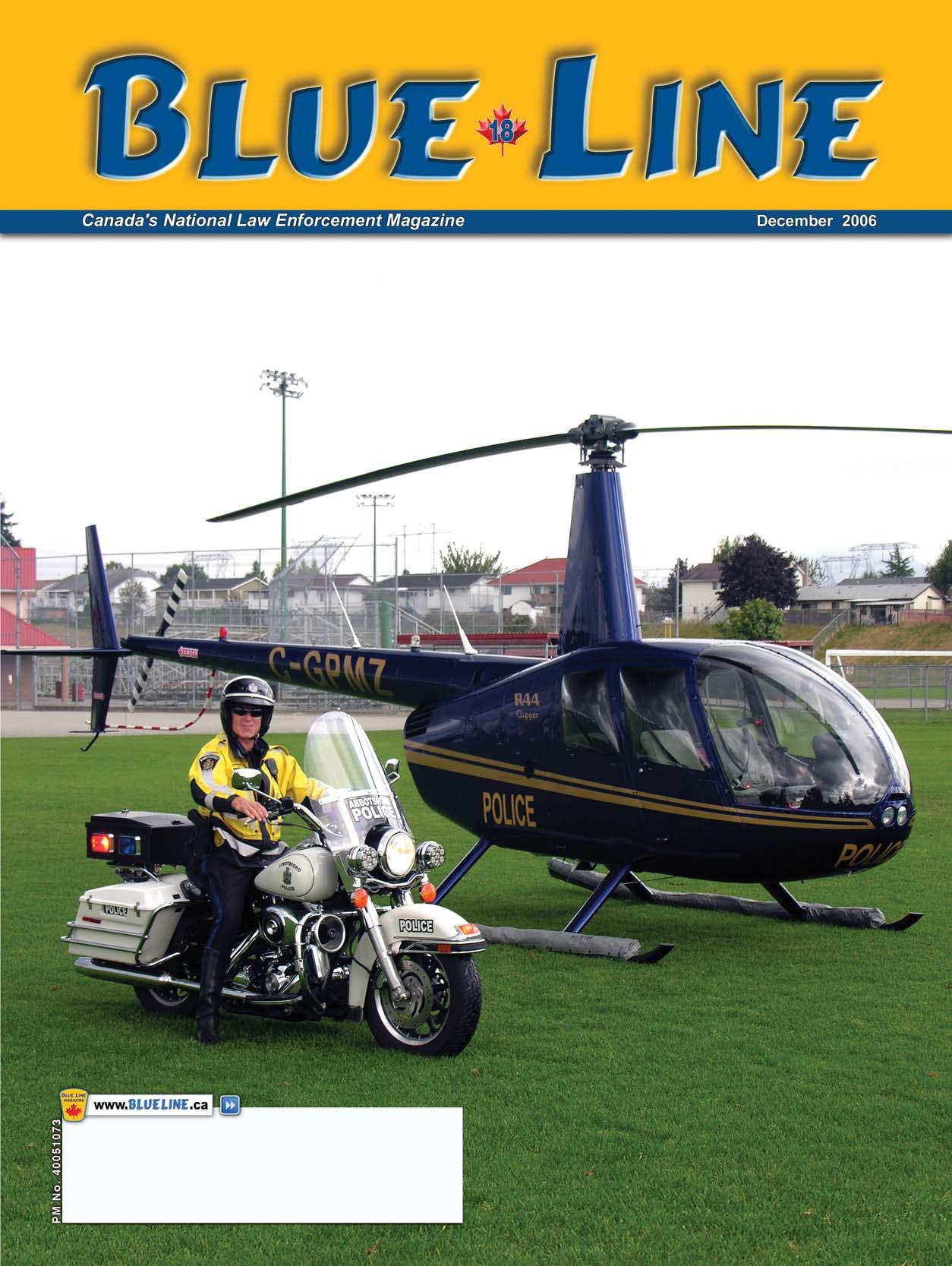
Cst. M. Drebit tactical flight officer
Abbotsford Police Department. See story on page 6.
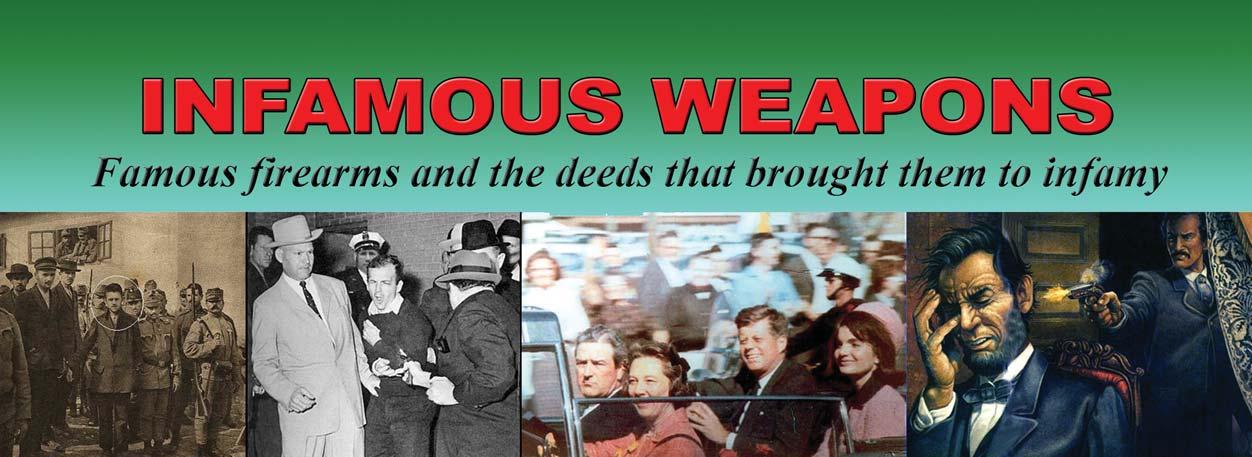
16Infamous weapons
Famous firearms and deeds that brought them to infamy
20A crime of opportunity
British Columbia unites to fight scrap metal theft
24Gold medal policing
Commitment key to high performance
28Detention defined by several factors
CORRECTION
The RCMP’s National Child Exploitation Coordination Centre (NCECC) investigates 200 files each month, not a year, as was stated in the October issue of Blue Line ( Child porn investigators need support).
Recruiting attitudes need a serious overhaul
by Morley Lymburner
“I would rather be an opportunist and float than go to the bottom with my principles round my neck,” Stanley Baldwin once commented. Many Canadian police agencies have heeded this philosophy, capitalizing on well trained and wandering feet at the expense of other agencies. This has caused an undercurrent of interdepartmental angst and bitterness. It is high time police recruiters understood this problem is self inflicted and undertake a transformation in both form and attitude.
The style and history of police recruitment has changed enormously over the past 150 years or so and the process of determinging suitable candidates today is daunting. When I look through some recruitment brochures, I feel compelled to look around for a cube farm in a Dilbert cartoonesque corporation, complete with a benevolent but incompetent pointy haired boss.
It wasn’t always thus. During the early part of the last century the local cop’s qualifications were nothing more than being big enough to handle a good dust-up and a willingness to work for welfare wages. By the mid 60s, police labour groups were making moves toward better pay, benefits and working conditions. In Toronto things came to a head when Cst. Syd Brown was shown on the front page of the Toronto Star sitting on the sidewalk at Yonge and Bloor, in full uniform, with a tin cup in his hand. The subsequent furor was the beginning of a long battle to improve things for cops everywhere.
By the time I came on the scene some five or so years later, the qualifications were basic. You had to be 21-years old, in good health, at least five foot eight inches tall, no glasses, have grade 10 or better, be of good character and pass a 10 question intelligence quiz in 10 minutes. Oh yes – and this was a biggy back then –you had to be willing to have a haircut.
I did an unofficial survey of my recruit
mates and half of them (including me) never thought they would be cops. It was tough to get steady work back then with anything near a good pay cheque. I was paid about $2,600 a year in my previous job, but earned $7,860 my first year as a cop.
With the clear understanding that my recruitment process was far from stellar, I am still appalled to see what today’s recruitment candidates must endure. Needless to say, many would-be officers approaching today’s recruitment offices might as well walk under a sign reading “Abandon all hope ye who enter here.”
The shortages many agencies are approaching, or have already arrived at, are close to catastrophic – and for the most part, their problems appear to be self inflicted. Too many agencies scan candidates with the hope of getting near perfection right off the street.
Many recruiters have taken on the appearance of Captain Jack Sparrow, with a cutlass in their teeth as they Shanghai trained and experienced candidates. This has somehow been viewed as a cost saving, with no thought about missed opportunities to custom build your own recruits.
Career aspiring recruiters have created many new buzz words; “Hiring the full package” is one of the worst that comes to mind. This is an attitude of hiring only mature in-
dividuals with a range of skills, training and life experiences. The ideal candidate has had one or two jobs and are in their late 20s or early 30s. Little thought has been given to a shorter career path due to age, entrenched negative attitudes, lack of loyalty to the agency or even how this older person is going to handle shift work.
The Canadian armed forces recently discovered that cherry picking recruits hasn’t served it well. There is a shortage of young people interested in even applying to the military these days, especially since they are expected to enter the ranks in absolute top physical form. Necessity has driven army recruiters to go back to basics. They check out backgrounds as best they can, but when it comes to physical fitness, they simply size up the candidates and decide whether that lump of coal can be turned into a diamond by the end of basic training.
This is precisely the attitude which existed when I signed on the dotted line with my police force 35 years ago. The hard-nosed instructors of the day were confident that training would conclude in one of two ways – a physically fit recruit or one who walked out the police college doors directly to the unemployment line. A few took that walk but the majority of us stuck it out; that pay cheque just looked too good.
With the military’s new attitude and their dire need for people, it is high time all police departments took a hard look at their recruitment practices. They must forget about demographic hiring quotas, payment for training and the expectation that every applicant not built like a Greek god is not even allowed in the front door.
The alternative is to turn off a lot of potentially good cops, who in turn bad mouth a system, which in turn reduces the number of potential candidates. Breaking this circle is necessary on so many levels and you can’t afford to wait. The crisis is now.
by Elvin Klassen
Nestled in the shadow of majestic Mount Baker, Abbotsford, BC’s fifth largest city, is situated between the Fraser River to the north and the US border to the south. This ‘City in the Country,’ home to 140,000 people, has an intriguing mix of urban amenities and rural comfort.
The third most ethnically diverse Canadian city, after Toronto and Vancouver, and only 40 minutes from Vancouver, Abbotsford is one of the fastest growing cities in Canada; unfortunately crime has also increased.
“We deal with many of the same issues that large cities across Canada experience,” says Abbotsford Police Department (APB) Public Information Officer Cst. Casey Vinet. “Drug addiction, prostitution and other social problems such as homelessness are part of everyday policing here.” Despite its rapid growth, the city has experienced some of the lowest crime rates in the Fraser Valley region for several years.
The APD celebrated its 50th anniversary last year, however the service’s history stretches back to the early part of the 20th century when provin-
cial police came to town. The RCMP took over in the 1950s but council felt the city was shortchanged and reincarnated the municipal force in 1955 as the Matsqui Police Force.
The municipalities of Matsqui and Abbotsford amalgamated in 1995 to form the City of Abbotsford and the force’s name was also changed.
Citizens approved the amalgamation in a referendum and also voted to keep a municipal police force – Matsqui had been patrolled by the Matsqui Police and Abbotsford by the RCMP.
The marriage wasn’t easy. Newspaper headlines of the day told the story,
“RCMP must jump some hoops”
“Shouting behind closed doors”
“Bye, bye Mounties”
“RCMP stunned by lack of protocol.’
Only four of the 30 RCMP officers ended up joining the new APD. Then chief Barry Daniel said in a news release that he expected to see a savings of some $500,000 by going with one force.
Today Chief Constable Ian Mackenzie leads the APD, which is the third largest municipal police force in BC, with an author-
ized strength of 195 officers, 80 civilian employees and more than 230 volunteers, including more than 100 with the victim services unit alone.
“We have much to take pride in; our innovative and dynamic approach to visible proactive crime control and our long-standing partnership with our community,” he says.
Mackenzie credits the “great citizens” of the city and “dedicated people” in the department, “for without them we could not enjoy our firstrate reputation.”
Mackenzie joined APD in 1993 as deputy chief after serving with the Vancouver Police Department for 17 years as a staff sergeant. He was promoted to chief constable in 2001.
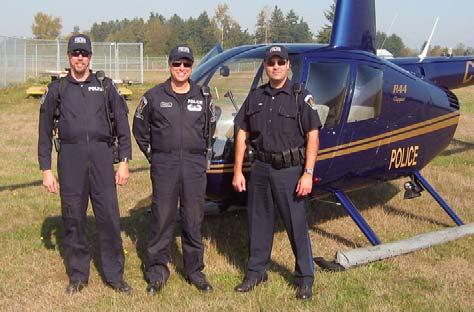
Cst. Mark Gartner, Pilot Dean Russell and Cst. Mike Drebit
Positive community focus
APB volunteers are trained through a first of its kind in Canada reserve constable program, offered in partnership with the University College of the Fraser Valley (UCFV). It’s coordinated by Cst. Denys Scully, who has watched the program grow from concept to reality.
“This is the first instance in Canada where reserve constables are trained in a university setting and where students gain university credit for the work they do in the reserves. It’s a tremendous partnership that brings ‘town’ and ‘gown’ together in a very logical, practical way. Everyone wins: the students, the police force and, most importantly, the community.”
The first 18 students graduated from the program in June, after completing nearly 100 evening training hours over six months with APD Sgt. (and Blue Line case law editor) Mike Novakowski, who is also an adjunct faculty member at UCFV.
“This program was designed to strengthen community/police partnerships and enhance quality learning opportunities for students,” Novakowski says. “No one has ever tried anything like this before and the model is working incredibly well. We’re proud that these dedicated young people are now part of the APD’s face to the community.”
Matt Shirlaw, 21, is heading into his final year of the program. It’s “a great way for me to get hands-on experience as a community peace officer,” he says. “It’s hard work, but I’m gaining valuable connections, good references and tremendous insight into policing as a possible career.”
Reserve constables commit to working at least four hours a week for two years as uniformed community peace officers.
Regional forces work together
Ten APD officers work with the Lower Mainland Tactical Group, part of a contingent of 150 officers, and receive special training in crowd control and large-scale investigations.
Fifteen APD officers are seconded to integrated units and work together with other police departments. This includes areas such as road safety, gang control, national security, police academy, organized crime and border enforcement.
“The integration of such specialty units makes tremendous economic and investigative sense and has had a positive impact on the communities in which they serve,” Vinet notes.
The APD also contributes two police dogs to the Integrated Fraser Valley Dog Section.
Education
The APB is very “education minded,” says Vinet, who notes there are many courses offered for officers and some also go to UCFV to enhance their education and earn pay increments. “We also award a scholarship each year to those members pursuing education consistent with values of the department,” he adds.
Another education program, the 10-day junior police academy, is co-ordinated by the APD’s Youth Squad and targeted at high school students. The program, which has been operating for 10 years, focuses on teamwork, confidence building and teaching youth about policing as a career. Students put in about 100 hours, which can be applied as work experience hours.
Sports
The department is also very sports-minded. The APD soccer team plays in the community league and there is also an APD hockey team. The department’s light tug of war team was inducted into the Abbotsford Sports Hall of Fame over the summer, recognizing its three gold medals at the World Police/Fire Games and over 100 victories in competition.
The Abbotsford Police Association organizes an annual golf tournament, which was renamed the John Goyer Memorial Golf Tournament in honour of the force’s first officer to die in the line of duty. Goyer contracted ALS
(Lou Gehrig’s disease) in 2001 after a violent fight at a domestic call and died this year. Doctors and an adjudicator ruled that the disease was triggered as a direct result of the incident and his employment as a police officer.
The Annual Abbotsford Police Challenge Run, held in September, raises money for three local charities. More than 1,000 runners, wheelchair athletes, amateur joggers, seniors and children from all over the Fraser Valley ran, walked, wheeled and volunteered to raise money for the ALS Society of BC, the United Way of the Fraser Valley and BC Special Olympics.
“The run is an excellent community event which has raised close to half a million dollars since its inception 16 years ago,” says Vinet.
The APD hosted the North American Police Soccer Tournament as part of its 50th anniversary celebrations last year, welcoming more than 30 teams from across the continent. It was the second time in 12 years that the department has hosted the tournament and it is the smallest force ever to do so.
The APD is committed to being an open and transparent organization, says Vinet, and communicates with residents in a variety of ways, including an e-mail newsletter. A recent issue included a crime alert for taxi drivers and sections on wanted high-risk offenders, recent arrests and media advisories.
Cst. CaseyVinet can be reached at cvinet@abbypd.ca
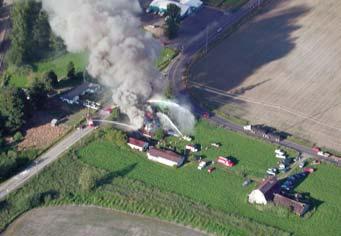
A fire in Abbotsford with support from Air 9
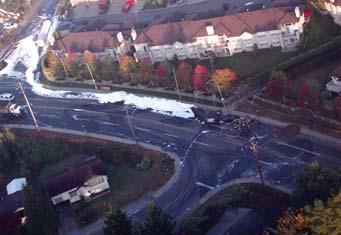
A fuel spill in Abbotsford taken from Air 9
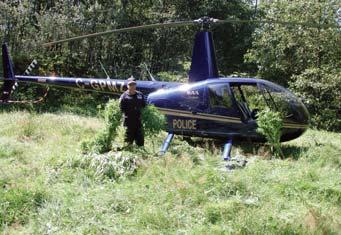
S/Cst. Russell in a Pot Field
by Elvin Klassen
by Elvin Klassen
In an unprecedented move for a city its size, a non-profit society is on track to buy a new helicopter for the Abbotsford Police Department (APD) and pay to run it full-time.
The department would only have to cover training and salary costs for the officers using the helicopter. The BC Air Watch Society will raise the money from the community for a $500,000 Robinson R44 and run it 750 hours a year. The department has committed to running the helicopter program full-time for three years.
Having a helicopter is nothing new for residents of the city and surrounding area, thanks to the efforts of Special Constable Dean Russell, who uses his own personal helicopter, also an R44, volunteers his time and even covers operating expenses and maintenance for a test program run since May 2005.
Russell became interested in helping police after flying RCMP friends over their pa-
trol areas so they could become more familiar with them. He then contacted APD Sergeant Daffydd Hermann, who is now a tactical flight officer, and they together proposed the project to the APD. The police board and upper management “have been very supportive,” he says.
Russell has worked closely with Hermann, who has developed departmental policies and procedures for the air unit. Air 9 has proven very useful to the department on a variety of calls, including suspects fleeing on foot or vehicle, the discovery of rural marijuana grow operations and searches for missing seniors suffering from dementia. Feedback from officers and the public has been very positive. Russell says he’s motivated by an interest in giving back to the community.
A part time paramedic with the BC Am-
bulance Service, his training has also proved valuable. He recently flew over a rural area and spotted an ATV accident, with a youth lying nearby on the ground. He radioed for police support, landed and administered first aid until the BC Air Medi-Vac helicopter arrived to take the injured person to hospital. This fast assistance to seriously injured people has saved lives – at least five in the two years Air 9 has been flying, Russell notes. His R44, with a call sign of Air 9, can fly up to 225 kilometres an hour but typically patrols at 150
km an hour. It is equipped with a standard police radio, public address system, GPS-based moving map and police dispatch computer.
Flight officers use powerful binoculars to identify small objects on the ground.
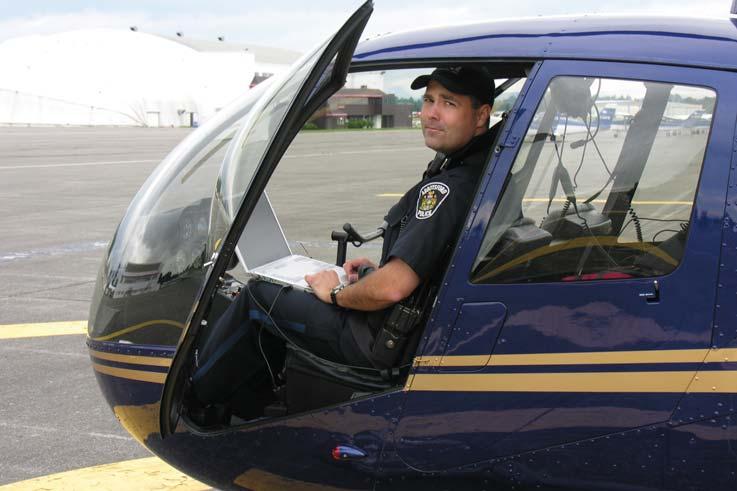
APB Constables Mike Drebit and Mark Gartner, who each have more than 12 years of service, received training last summer to also act as flight officers. They are also receiving flight training, which was donated by Coastal Pacific Aviation, so they can pilot the new helicopter.
I had an opportunity to experience Air 9 on a warm October afternoon and it didn’t take long to see some action. We were asked to help locate a stolen van immediately after becoming airborne. Then a constable radioed a ‘Code 4,’ requesting additional support for a robbery that had just occurred. Russell asked for clearance from air traffic control, since we were still near the Abbotsford Airport, and then headed to the robbery scene.
As usual, the helicopter was the first police support unit to arrive on scene. We could see the officer who called for assistance had the three robbery suspects handcuffed and lying on the pavement. Once satisfied that things were under control, we headed to the border to check on a wooded area where frequent drug exchanges have taken place.
Then it was on to the Fraser River to check on a light plane which was landing in an undesignated area. After landing to make sure no assistance was required, we headed to the shoreline to check for abandoned vehicles; Air
9 recently located eight stolen cars in the water.
“Our geographic profile is probably the biggest advantage,” says Hermann, noting that it takes a police cruiser 45 minutes to get from one end of Abbotsford to the other but less than five minutes in the helicopter.
“It’s not practical to have a cop on every corner out there or a cop in every neighbourhood. This gives us additional advantages. It puts the message out there to the criminals: don’t expect that police aren’t going to be close by.” Hermann says the helicopter can be used in all types of situations, including police pursuits, natural disasters, regular traffic patrols or tracking prison escapees.
In early September while doing area patrols, the APD helicopter flew over a house and spotted flames coming from the porch and extending up the side of the residence. Two nearby police units were dispatched and the fire department notified. There was no movement at or near the house so Russell circled lower and activated the helicopter’s siren to notify the residents.
Neighbours came out of their houses to see what was going on, saw the smoke and pounded on the door. Also alerted by the siren, the occupants of the house were already at their door, on their way outside to investigate the noise.
Two police cars arrived and ensured all occupants had escaped. One of the residences kept the fire at bay with a garden hose and almost had it extinguished as fire crews arrived.
It was clear that the rapid detection by the helicopter crew and its alerting residents gave the occupants time to escape and greatly re-
duced the fire’s damage.
In another situation a man approached two homeless women, grabbed a purse and fled on a bicycle. Air 9 responded and quickly spotted the suspect downtown and radioed his location to officers on the ground, who arrested him without incident.
“We are very pleased that such progress has been made in acquiring the funds necessary to cover all capital, operating and training costs for three years,” says Abbotsford Police Chief Constable Ian Mackenzie. “It certainly reflects the commitment and support the community has for our police department and city.”
The department is excited that the helicopter will be available for day to day operations for the foreseeable future, he adds. “We have already experienced many positive results and are confident that Air 9 will continue to prove to be an effective police tool for our community.”
The program “is an example of how the commitment and philanthropy of one person can result in such a positive impact on community safety,” says Mackenzie, who is impressed with how Hermann and Russell have developed and built “this very innovative idea.”
“The current model, which focuses on community-based fundraising, demonstrates how a medium sized police department such as ours can provide a cost-effective service through a partnership with the community.”
DeanRussell can be reached at drussell@abbypd.ca
by Matt Kirkpatrick
Testing weapons pays off
Many police services have sizeable weapons programs that represent a large capital investment. Whether replacing a general issue pistol, starting a patrol rifle program or procuring less lethal weapons for the first time, budgetary constraints, high level of public scrutiny and accountability and the absolute need for safe and reliable weapons demand a well designed process.
The military has faced these concerns for decades and some of the lessons it has learned can be applied to a law enforcement model so that everyone wins: you, your service and the public you are sworn to protect.
Define a need
•Number of test teams/individuals;
shooters, etc);
Just like any problem solving model, the first step is identifying a need. In the military, this is often articulated by the front line soldier. This is where you separate want from need. Consider making a task based statement about what target effect is required, including limitations and considerations.
Rather than eliminating options up front by stating which weapon you want, start by stating what you need to get done. For example, ‘the service requires a less lethal weapon capable of temporarily incapacitating a violent offender rapidly and reliably from not less than five metres,’ or ‘the service requires a lethal firearm capable of rapid and accurate incapacitation at ranges up to 100 metres for rapid deployment use.’
Identify options
Use the Internet or professional contacts to identify a list of options that appear to meet these needs. Contact manufacturers and distributors for technical data. Holding each option up to the target effect statement and requirements will eliminate a number of unsuitable options and leave a small number of possibilities.
Test and evaluate
Plan a cost effective test program that outlines how you will choose a weapon from the options you identify. The test should reflect your unique requirements – for example, working in extreme cold. A military trial can cost millions of dollars just to identify a single weapon system. That is well beyond the means of even the largest services, however you may find that another department or the military has done a trial and may share its well documented results with your service.
Your test plan should include:
•Initial inspection outline;
•Tests to conduct – for example, accuracy, endurance, left handed firing, etc.;
•Performance criteria matrix – what is pass/ fail or how to assign a score;
•Number and type of systems for testing;
•Quantity and type of ammunition for each weapon;
•Record keeping – a test log based on weapon serial numbers and rounds fired;
•Ranges and facilities required;
•Special equipment to measure wear, head space, etc;
•Safety.
One large Canadian police force asked for a list of technical information from manufacturers and rated them according to a scoring matrix. Based on this, a number of systems were acquired for testing and some weapons eliminated. The service then conducted a controlled test of technical requirements such as reliability, accuracy and maintainability. It included information from other users and large tests.
The service then conducted an extensive user trial and collected and scored feedback, considered price and delivery and selected an overall winner based on the score.
NATO (North Atlantic Treaty Organization) rates weapons systems using reliability, availability and maintainability data (RAM):
•Reliability measured in mean rounds between failures (MRBF) that can be classified as Class I (clearable stoppage 10 sec), Class II operator correctable stoppage/failure 10 sec), or Class III (failure not correctable at operator level). Failures can be attributed to personnel, ammunition, magazines and the weapon itself.
•Availability is measured in the percentage of time a system is available for use. For example, if a weapon’s batteries take six hours a day to recharge, it is only available 75 per cent of the time; a weapon that requires an hour of cleaning each day would be available 95 per cent of the time.
•Maintainability is the ease of maintaining the system, measured in mean time to repair (MTTR) and how much of the scheduled/unscheduled maintenance can be performed by the service.
A value can be assigned easily to each of these factors. You may also want to consider some of the following for law enforcement use:
•Safety;
•Accuracy;
•Durability;
•Portability;
•Ergonomic considerations (single hand use for dog handlers, ease of use for left handed
•Interchangeability/interoperability (with other systems currently in use, or other agencies);
Based on your scoring system, you should now be able to select a system. If they all meet or exceed your technical requirements, then consider support and pricing. Your report should outline the need as you define it, options, test parametres, program costs and which system is recommended and why. Include all supporting documentation.
Tips:
•Document every aspect of the test and selection;
•Obtain more than one system for testing and, where possible, a representative sample;
•Maintain a firing log, by round count, of every incident, good or bad;
•Use other services tests as shortcuts or supporting documentation;
•Include feedback from a range of users: big and small, patrol and tactical, experienced and new officers;
•Beware manufacturer’s claims – ask for test data and test for yourself;
•Beware “MIL SPEC;” find out which military is using the system and how many they use;
•Most firearms have four aspects to consider: weapon, magazine, ammunition and operator. It may cost time and money now to test and evaluate weapon systems – but you will save more money and maybe lives down the road by selecting the best equipment for your officers. You can avoid many pitfalls, such as selecting a system that you can’t get spare parts for, by following a selection plan. A well documented test will justify the expense and your choices well into the future.
MattKirkpatrick is a certified technical writer with 15 years of military experience, including operational tours in Bosnia and Afghanistan.
by Dave Brown
Budgeting for new weapons
When a law enforcement agency is looking to replace or improve existing weapon systems, the cost of the new weapon itself is the smallest component of the total acquisition cost. Other expenses must be planned and budgeted for, or an agency runs the risk of settling for something that may not be up to the task just to reduce the final cost of the program.
Selecting an inferior product is false economy. If decision-makers feel that “it’s not the best product for the job, but it will do for now” or “it’s better than nothing,” they may find out very quickly that nothing really might have been better.
Proper budgeting that acknowledges all the various costs might mean delaying a purchase slightly but, in the end, the officer at the end of that barrel must be confident they are equipped with the best choice available. Just as no marine unit wants their new boat to sink at the dock in the first rainstorm, no one wants a weapon that fails when you need it most.
Capital costs
Weapons, whether new handguns, rifles or shotguns, are all going to require hardware and accessories. New handguns will need new holsters. There are no universal fit retention holsters and shopping for new handguns is also a great time to explore new belt designs and improved accessory pouches on the market.
Rifles and shotguns that will be mounted in vehicles must have well designed racks. Nobody wants to be wearing a shotgun or rifle in a car accident. If
vehicles are still using the console mounts, now is a good time to look at the latest in overhead rack designs and trunk mounts. (My preference will always be for the shotgun in an overhead rack and the patrol rifle in the trunk. I want the shorter-range defensive weapon to be the closest.)
All new firearm purchases require cleaning kits sized for the appropriate calibre and a supply of spare parts such as replacement springs and magazines.
One item sometimes overlooked is body armour that must be matched to the issue sidearm. Patrol officers should never carry a sidearm that can penetrate their own soft body armour, although this is much less of an issue today with improvements in armour technology and wearability.
Operational costs
Operational training will likely be one of the biggest single costs in acquiring new weapons. This will include physical facilities such as training ranges and personnel resources such as instructors and support
staff, as well as replacing officers for the time they will spend in training.
How much time to dedicate to training depends on the weapon. Upgrading from revolvers to semi-automatic pistols will require three to four solid days of training per officer. Patrol rifles can take from one to three days on the shooting range and new shotguns can be trained in one day – or even less if equipped with the latest technology in electronic sights.
Less-than-lethal weapons require high standards in both understanding the rules of engagement and knowing exactly where and how to deploy them, so training time can be even longer.
If facilities allow, operational training can be done with larger groups but there still should be a student to instructor ratio on the shooting range of five to one or less. Not everyone has to shoot at once, though, so these ratios can be maintained with larger forces by splitting into two or three groups. Maximum efficiency can be accomplished on the range if one group is shooting, a second group is observing and helping to supervise and the third group is taking a break or loading magazines.
Not every shooting range can accommodate rifle fire, so patrol rifle acquisitions might also include outside facility rentals.
Modern police weapons training is a science and instructors need to be properly trained and upgraded too. Instructors can often be trained directly by the manufacturer or by outside specialists and this is a good time to increase their working knowledge about the myriad factors in physiological and psychological responses of the human body to sudden stress.
Whats new on the shooting range
by Dave Brown
Driving past the Blue Line Magazine international corporate headquarters in Markham, Ontario, you can’t help but notice the gleaming 32 floors of glass and steel, with our logo prominently displayed on the roof. (Little known fact: the Town of Markham made us remove the original Blue Line Magazine lettering, which was aligned horizontally up the side of the building. Apparently, airplanes landing at nearby Buttonville Airport mistook it for a lighted parallel runway.)
What you won’t see is the pristine 18-position rifle and pistol shooting range, deep beneath the sub-basement, where we test the hundreds of products various manufacturers send us daily. Equipped with a computerized turning and moving target system, the range also boasts one of the most advanced ventilation systems in the world. It completely exchanges every molecule of air inside the range every 90 seconds…
And then I wake up.
The reality is that I spend my own hardearned dollars buying things that I think will improve the quality of my life or the enjoyment of my pursuits, the same as everyone else. Occasionally companies send me products to review, with the understanding they may not be returned in the same condition they were in when I received them. Come to think of it, they are never sent back in the same condition.
After all, when it’s my money, I want things to work – and if I were a law enforcement agency, I would expect nothing less when spending taxpayer’s money. I don’t simply regurgitate a company’s press releases; I test products the way they were designed to be used – and abused.
Here are a few of the latest products that impressed me and may be coming soon to your shooting range.
Recoil-reducing shotgun stock
It’s no secret; I am a big fan of shotguns. They are one of the most versatile weapons in an agency’s arsenal. Every officer should have easy access to a good pump-action shotgun.
Patrol rifles do have their place, just as sometimes one needs the equivalent of knitting needles to put the bad guy down, and other
times only a freight train will do. If I had my way, every Canadian officer would have a good double-action-only sidearm on their hip, a shotgun in an overhead rack and a patrol rifle in the trunk. Shotguns are an ideal short- and intermediate-range defensive weapon, especially against multiple assailants or those who are behind cover.
One of the disadvantages of shotguns is their felt recoil, especially with the heavy buckshot and slug loads police agencies favour. I maintain this is mostly poor technique and a training issue – but have to admit that even if 90 per cent of shotgun recoil is in the mind, the other 10 per cent still hurts. This makes many officers leery of using them, which is too bad; a slug will punch through almost any cover short of an engine block and one shot will stop any threat – four-legged or two – that an officer will ever encounter.
A variety of products have claimed to reduce shotgun recoil, but few live up to their billing. I should know; I’ve tried them all. If you added up all the advertising claims, my shotguns should be violently leaping forward and downward with every shot.
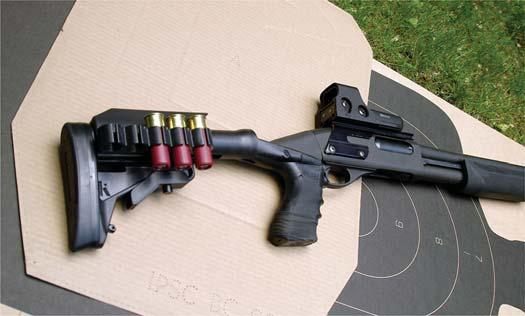
Knoxx Industries, which has quietly made recoil-reducing stocks for shotguns and rifles in its California plant for many years, has come up with what is probably the most effective recoil-reducing accessory on the market.
Their latest design, the SpecOps adjustable shotgun stock, is available to fit most Remington, Mossberg and Winchester police shotguns. It has more than four inches of adjustable length to fit any shooter or adapt to any thickness of body armour. Made from polymer and alloy, it uses two recoil-reducing spring mechanisms – one in the pistol grip and another in the rear of the stock.
While it may look lightweight at first glance, it actually adds to the weight of the shotgun which, as most know, is usually a good thing when it comes to firearms – especially ones we don’t have to cart through the woods for great lengths of time.
While the stock will reduce the recoil of all loads, it is said to be truly effective on heavy rounds like buckshot and slug. Knoxx claims that felt recoil is reduced by up to 95 per cent. While recoil may be a science of energy and momentum, felt recoil is more a mixture of
technique, perception, anticipation and perhaps a little black magic. All I will say is that it noticeably reduced the felt recoil of light training rounds and substantially reduced the recoil of heavy slug and buckshot loads. Every shooter who tried the stock liked it and, once they got used to the weight, all agreed that it made slugs feel more like birdshot loads.
Watching the stock during firing revealed how much the frame retracts under heavy spring pressure across the top of the stock. It also neatly illustrates why support hand position becomes very important when using flashlight fore ends to prevent a painful bruise.
The optional PowerPak module adds a raised cheekpiece for use with optical sights, a holder that keeps five 12-gauge shells ready for quick reloads and a watertight storage compartment for spare batteries. Those who have tried aftermarket bolt-on shell holders that fit on the left side of a police shotgun receiver, interfering with your vision and getting in the way, are going to love the PowerPak’s shell holder. It can be installed on the proper side for speedloading directly into the ejection port (just the way I teach it), or into the loading port on the bottom, regardless of which hand you are using. The PowerPak module snaps very solidly over the stock; I would not welcome trying to remove it once installed.
Illustrating how solid and dependable the product line seems to be, Remington is now offering the SpecOps stock as an option on its 2007 Remington 870 police models.
The SpecOps lists for $130 US and the PowerPak for $50 – money well spent, it seems to me, whether the cash comes from my pocket or the public purse. As a taxpayer, I want the people who protect me and my family to have the best equipment possible – and to stop worrying about bruised shoulders.
Safety eyewear
This may not come as much of a surprise to people who know me, but I was a dork in high school. While that was a long time ago, I can still remember the shame of chess club bullies beating me up regularly for my lunch money.
Perhaps it was because I was dim enough to keep those big, ugly, framed safety glasses on my head right through the entire chemistry class, even when the teacher wasn’t looking.
In retrospect, I can’t help wondering whether even facing exploding particles would have been better than wearing those uncomfortable safety glasses.
Well, things have changed – at least in safety eyewear (I am still a dork).
The latest in safety glasses have lightweight polycarbonate lenses in a stylish wrap-around design and can provide serious impact protection at a very reasonable cost. No one should be allowed onto a shooting range unless they are wearing safety glasses that meet American National Standards Institute (ANSI) and Canadian Standards Association (CSA) standards.
Uvex has a long history of manufacturing quality safety eyewear. Its name stands for “ultra violet excluded” and indicates that their lenses absorb more than 99.9 per cent of the most harmful UVA and UVB radiation. All the company’s safety eyewear meet this standard.
While it is nice to know that the glasses
meet ANSI Z87 and Z87+ standards – many also meet the more stringent CSA Z94.3 standards – the thought of a bunch of lab technicians in white coats dropping steel balls onto lenses from various heights is way too boring for Blue Line readers.
Many of the company’s latest designs also meet the US military Vo ballistic test for impact protection, but I am sure that is just another bunch of technicians, in olive drab lab coats, dropping steel balls onto lenses from heights seven times greater.
No, we decided to save the lab results for all those ex-chess club bullies, who probably make 20 times my salary. Perhaps they could steal my lunch money, but when it comes to testing safety glasses, I get to do something none of them can: take them out to the shooting range and blow the crap out of them with a shotgun. Now that’s a test!
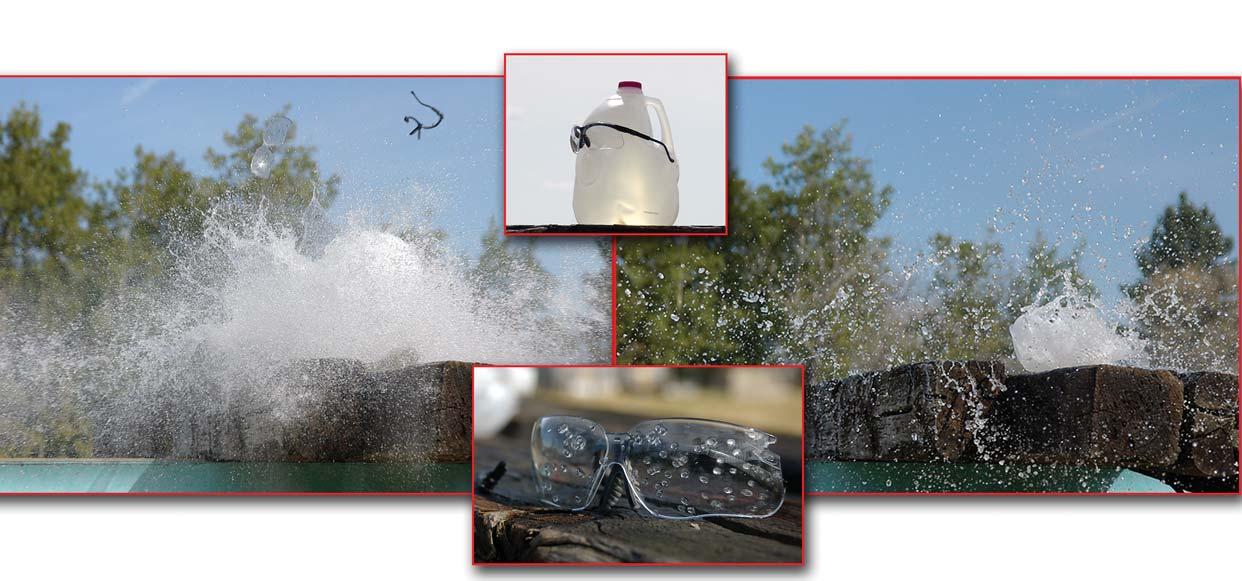
The lack of a practical application notwithstanding, I wanted to see if these safety glasses can really protect against flying particles in a worst-case scenario – a 12 gauge shotgun firing #8 shot at three metres. After all, when the company sent me these samples to test, I didn’t say how I was going to test them.
Due to a distinct lack of volunteers willing to wear the glasses while I shot at them, I was forced to instead use a water-filled milk jug; I put the glasses on it, stepped back three paces and opened fire. The results were quite spectacular – and somewhat dampish.
The milk jug completely disappeared in a spray of water and plastic and the safety glasses were propelled about 20 metres straight up. The frames completely separated from the lenses and it took a couple of minutes of searching to find one of the arms. Most surprising – not one single shotgun pellet managed to penetrate the lenses (sadly, the milk jug did not fare nearly as well).
Of course, should one ever get shot in the face with a shotgun at three metres, the intact nature of your eyeballs will be of concern only to the grateful next recipient of them, but it is truly comforting to know that all those whitecoated lab technicians might actually be right. These things really DO work!
The ultra lightweight design, adjustable arms, non-slip nose pieces, anti-fog coatings, stylish wrap-around lenses and ultra violet protection means that economical safety eyewear has now moved from the ‘must-wear’ category to the ‘want-to-wear’ category. If you haven’t experienced some of the latest designs, try them out next time you head to the shooting range.
And to Uvex: thanks for the sample products. Sorry about the condition they are in now, but next time you talk to those white-coats at CSA, tell them they did a great job of setting standards for safety eyewear in Canada; Oh, and tell them I want my lunch money back.
DaveBrown is Blue Line Magazine’s Tactical Firearms Editor. He has kept our corporate legal department on its toes with his impartial and brutally honest evaluations on a variety of firearms-related products over the years – but his description of our corporate headquarters is (slightly) exaggerated!
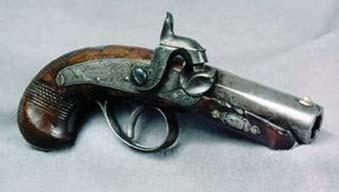
The gun that Booth used to assassinate President Abraham Lincoln now resides in the basement museum of Ford’s Theatre, in Washington, D.C. The gun is a single-shot flintlock, made by Philadelphia gunsmith Henry Derringer. It’s tiny—just six inches total in length with a 2.5 inch barrel—but it’s powerful, firing a .44-calibre bullet. The gun was found on the floor of the theatre box where Lincoln sat. Also in the museum is the knife with which Booth stabbed one of Lincoln’s companions, Major Henry Rathbone, in the arm before Booth jumped from the box to escape.
What about the bullet that killed one of the most revered figures in American history? You can see that, too. It was removed during a postmortem autopsy and was kept by the U.S. War Department until 1940, when it went to the Department of the Interior. It can be viewed today at the National Museum of Health and Medicine in Washington, D.C.
June
Archduke Franz Ferdinand, and his wife, Sophie, in Sarajevo, Bosnia. The assassinations caused a chain reaction of events which, within less than five weeks, led to the start of World War I. The gun was a Browning semiautomatic pistol, model M1910, serial #19074.
Princip, just 19, was a member of the Serbian nationalist group called the Black Hand. He fired seven shots into the royal couple’s car from five feet away, then attempted to shoot himself, but was stopped by passersby and quickly arrested. Princip died in prison of tuberculosis in 1918 (the disease was one reason he took the mission). After his trial, the pistol was presented to Father Anton Puntigam, the Jesuit priest who had given the archduke and duchess their last rites. He hoped to place it in a museum, but when he died in 1926 the gun was lost...for almost 80 years.
In 2004 a Jesuit community house in Austria made a startling announcement: they had found the gun (verified by its serial number). They donated it to the Vienna Museum of Military History in time for the 90th anniversary of the assassination that started a war that would eventually kill 8.5 million people. Also in the museum are the car in which the couple were riding, the bloodied pillow cover on which the archduke rested his head while dying, and petals from a rose that was attached to Sophie’s belt.
The Mussolini Machine Gun
On April 28, 1945, Italian dictator Benito Mussolini and his mistress, Claretta Petacci, were captured while trying to flee into Switzerland. They were executed by an Italian communist named Valter Audisio, who shot the pair with a French-made MAS (Manufacture d’Armes de St. Etienne) 7.65mm submachine gun.
The gun disappeared until 1973, when Audisio died. He’d kept it in Italy until 1957, when, during a resurgence of Mussolini’s popularity, he secretly gave it to the communist Al-
banian government for safekeeping. With Audisio’s death, the Albanians proudly displayed the gun “on behalf of the Italian people.” Its home is now Albania’s National Historical Museum. Audisio once wrote that the only reason he used the machine gun was that the two pistols he tried to use had jammed. He also said that he had no orders to shoot Petacci—but she wouldn’t let go of Il Duce.
Lee Harvey Oswald’s Guns
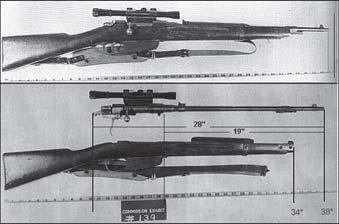
The gun that Lee Harvey Oswald allegedly used to assassinate President John F. Kennedy is a Mannlicher-Carcano .38 bolt-action rifle, 40 inches long, and weighs eight pounds. He bought it through a mail-order company for $12.78. Something with as much historical significance as Oswald’s rifle would become the property of the people of the United States, right? Wrong. Murder weapons are normally returned to the families of their owners, and Oswald’s gun was no exception—it was returned to Oswald’s widow. The National Archives purchased the rifle from Marina Oswald. The Archives also has the .38 Special Smith & Wesson Victory revolver that Oswald had with him that day and used (allegedly) to kill Officer J. D. Tippett before being arrested. Two days later, Oswald was shot and killed by Jack Ruby.
Jack Ruby’s Gun
Ruby was a Dallas strip-club owner and small-time mobster who killed the alleged killer of the president. Just why he did it remains a mystery. But on November 24, 1963, in the basement of the Dallas jail—which at the time was crowded with police officers, reporters, and cameramen—Ruby walked right up to Oswald and shot him once in the side. The gun he used was a .38-calibre Colt Cobra revolver that he bought
Courtesy: The Bathroom Reader’s Press
John Wilkes Booth’s Gun
The Sarajevo Pistol
On
28, 1914, Gavrilo Princip shot and killed the heir to the Austro-Hungarian throne,
at Ray’s Hardware and Sporting Goods (on the advice of Dallas police detective Joe Cody).
The gun was returned to Ruby’s family, where it promptly became tangled in a legal battle over Ruby’s estate between the lawyer who was appointed executor and Ruby’s brother, Earl. It wouldn’t be resolved until 1991, when a judge found for Earl Ruby, who immediately put the gun up for auction and it sold to a collector named A. V. Pugliese. Price: $220,000. In 1992 a friend of Pugliese’s brought it to Washington, D.C., and offered to show it to Speaker of the House Thomas Foley.
The gun was seized by police and almost destroyed, per D.C.’s strict gun-control laws, but lawyers were able to get it back. On November 24, 1993, the 30th anniversary of the shooting, Pugliese had Earl Ruby fire 100 shots with the gun and offered the spent shells for sale. Price: $2,500 each. (They only sold a few.)
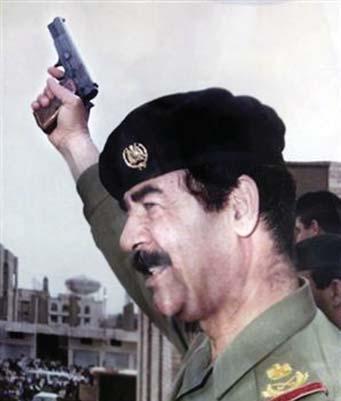
Sadaam Hussein’s Pistol
When former Iraqi president Sadaam Hussein was captured in a “spider hole” in Iraq in December 2003, he had several weapons with him. One was a pistol. Major General Raymond Odierno reported that Hussein was holding the loaded pistol in his lap when he was captured, but didn’t make a move to use it. The Army had the pistol mounted and, in a private meeting, the Special Forces soldiers who took part in the capture presented it to President George W. Bush.
When news of the war souvenir broke in May 2004, reporters asked President Bush if he planned to give the pistol to the next Iraqi president. No, he said, “it is now the property of the American government.” The gun is kept in a small study off the Oval Office, and, according to one White House visitor who later spoke to Time magazine, the president “really liked showing it off. He was really proud of it.”
Justice Douglas Rutherford of Ontario Superior Court has struck down what he calls an “essential element” of Canada’s legal definition of terrorism, saying it infringes on freedom of religion, thought and association guaranteed in the Charter of Rights.
The judge chose to “sever” the offending clause from the Anti-Terrorism Act and leave the rest of the law in place.
Rutherford was ruling on a constitutional challenge brought by accused terror suspect Mohammed Momin Khawaja, the first person charged under the new anti-terror law. His case is a test for the terrorism provisions.
In a 32-page written decision, Rutherford zeroed in on the provision that makes proof of terrorism dependent on showing a religious, political or ideological motive for the criminal activity.
He wrote that this definition is “an essential element that is not only novel in Canadian law, but the impact of which constitutes an infringement of certain fundamental freedoms . . . including those of religion, thought, belief, opinion, expression and association.”
Khawaja’s lawyer said the ruling strikes to the core of the law and should have resulted in the seven terrorism charges being quashed.
***
Fred Hollett, director of Newfoundland and Labrador’s Emergency Measures Organization says he wants proof that the province’s com-
munications system can be trusted.
Hollett thought the province had a “stable and secure system,” but a major outage in October has him concerned.
A small cable fire at a switching station in St. John’s left 100,000 people in the area without phone and 911 emergency service until early the next morning.
The main power supply and a backup were shut down to prevent the electrical fire from spreading. Initially, the backup was unable to start because of where the cable that caught on fire was located.
Pat Harkness, president of the Canadian Emergency Preparedness Association, said the Newfoundland outage should prompt other provinces to look at how reliable their telecommunications networks are.
***
An interim parliamentary committee report recommends that two controversial antiterrorism powers granted to police after 911 should be extended to 2011.
The public safety committee says the measures should be reviewed again once Canada has had a decade of experience with them.
Neither measure - preventive arrest and investigative hearings for material witnesses in terror cases - have been used.
If the majority report doesn’t pass in the House of Commons and the Senate, the two provisions will expire fat the end of this month.
Responding to lethal violence RCMP use of deadly force
by Rick Parent
Contemporary police officers face the challenge of intervening in community crises while maintaining public and personal safety. Unfortunately, this sometimes includes precarious life and death encounters which require using deadly force.
The very nature of a police officer’s duties will at times place them in immediate risk. In other instances, they will be required to use deadly force to save the life of a citizen or fellow officer.
Police use of lethal force can only occur in those few situations where no other reasonable option is available. An officer is issued a firearm with the expectation they will use it only in very limited circumstances; the vast majority complete their entire careers without having to use potentially deadly force. However, in those rare instances where it must be used, an officer’s decision-making is often complex, multifaceted and instantaneous.
Deploying force requires “reasoned discretion,” depending upon the unique circumstances of an incident. Operational street level police are often the first to encounter intoxicated, mentally ill, suicidal or aggressive individuals.
In recent times, the deinstitutionalization of the mentally ill, increased use of hallucinogenic drugs, wider availability of methamphetamine and other factors have added to this situation, forcing police to deal with more disturbed and violent individuals.
Large numbers of distressed individuals suffering from mental disorders such as schizophrenia have been released from institutions over the past 20 years. Many now live on the streets and are frequently encountered by police, placing officers in the precarious situation of being required to correctly and instantaneously assess the people they confront.
In other instances, convicted violent offenders are released back into the community to, in some cases, offend once again. An officer may unknowingly deal with a hardened individual who, well aware of the consequences, may resort to extreme methods to avoid apprehension if found committing a crime. Now, more than ever before, police are likely to frequently encounter violent or deranged individuals.
Decision making and force response
Prior to reacting to a situation with force, a police officer is required to analyze all of the known information and attempt to select the most appropriate use of force response. By law and profession, the response must be the least violent option available that will safely gain control of the situation.
When police face a violent individual or su-
perior numbers, the level of potential danger increases significantly and they must quickly disable the attacker(s) and improve the likelihood of control. In some instances, less-lethal compliance tools such as pepper spray and impact weapons may achieve this objective; in other instances, only their firearm will incapacitate the lethal threat they are facing.
Confronted individuals can demonstrate various levels of potential danger, typically in the form of weapons or levels of resistance. Both the type of weapon and the manner in which it is carried or held can influence an officer’s perception of potential danger. It is important to emphasize that the dangers associated with non-compliant or irrational individuals can quickly change within the context of any particular incident, so police must be alert to all possibilities.
RCMP
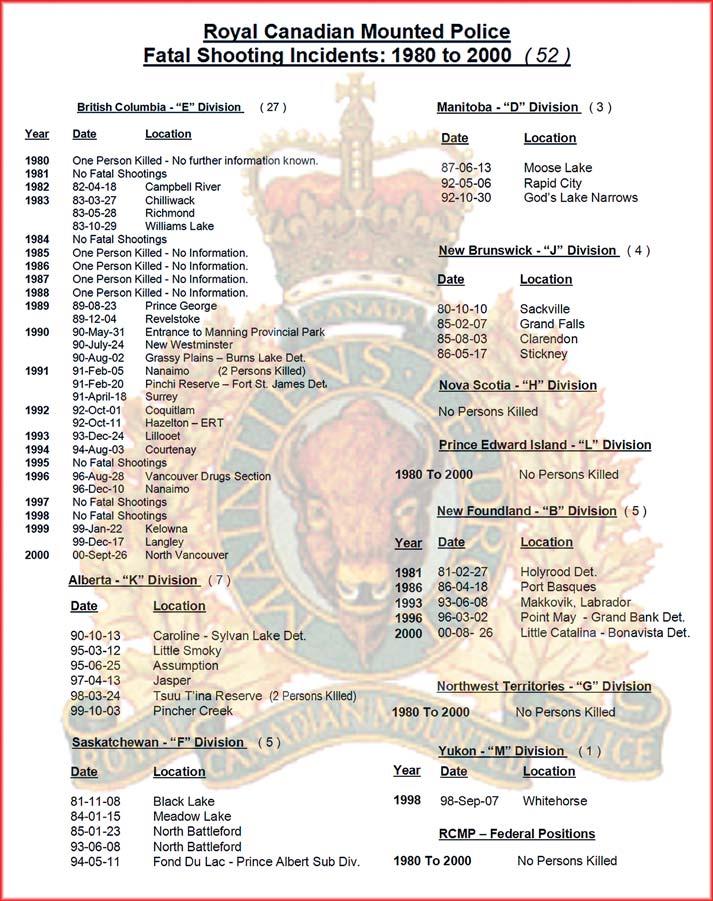
A recent research project examined the instances of deadly force by RCMP members. A detailed record of fatal shootings was tabulated and analyzed using coroner’s inquests, interviews with individual members, media reports and information obtained from governmental and other sources.
This analysis revealed RCMP officers were involved in 52 fatal shootings during the 21 year period studied (from Jan. 1, 1980 through Dec. 31, 2000). The majority (27) occurred in British Columbia and the officer was typically alone when suddenly confronted with a lethal threat. In many instances, they attempted to resolve the threat against their life with a less-lethal means of intervention. However, as the attacker increased their deadly intent to the officer or another, they were left with no other option.
During one incident, a lone RCMP officer shot and killed a father and his son after responding to the report of a disturbance involving drunken males. One individual fought him on the street when confronted and the other joined in, causing the officer to perceive that he was in imminent danger of grievous bodily harm or death, forcing him to shoot them.
In another incident, a lone officer shot and killed a mother and her nine year old son after responding to a request for assistance from a tribal police officer. The female fired on him with a high powered rifle when he arrived; in an attempt to maintain cover, the officer returned fire by firing one round from his shotgun. Unfortunately, unbeknownst to the officer, the son was standing beside his mother and both were hit and killed by the pellets.
Media reports exacerbated the incident by initially reporting that the female was pregnant. The media also highlighted the fact that the officer was Caucasian and the two deceased Aboriginal. A subsequent inquiry exonerated the officer.
Tragically, in some instances the officer was murdered. In one case, a detained individual killed the arresting RCMP officer and then took his own life.
In another case three RCMP officers responded to a routine domestic dispute. The senior officer arrested the male subject and placed him in the rear of a squad car. The suspect suddenly produced a handgun and fatally shot the officer in the back of the head through the Plexiglas barrier. He then got out and shot at
the other two officers, who were nearby, before turning the gun on himself.
Interestingly, the very next day two RCMP officers who were at that scene were forced to shoot a male armed with a knife, resulting in a serious head wound. It was alleged in a lawsuit that the two officers had used excessive force and over-reacted during the shooting as a direct result of witnessing the previous day’s fatality.
Conclusion
This research study revealed that individuals acting in a violent or irrational manner have frequently confronted members of the RCMP,
resulting in their death. Typically, the offender’s actions, or inaction, will ultimately determine the level of force the officer is required to use.
Should the offender choose to attack the officer or display a potentially lethal threat towards them or another individual, police are likely to have to respond with their firearms. In many instances, the assaultive individual was noted to have been drinking or taking drugs, suicidal or have a mental disorder; this added to a complex picture of violent and irrational behaviour.
These findings also illustrate the complexities that surround lethal threats to police and how individual officers are often given few options to resolve a potentially lethal conflict. In many instances, police have no other option but to use deadly force. Their failure to do so may result in their own death.
References
Griffiths, Curt and Parent, Richard and Whitelaw, Brian (1999) Canadian Police Work. Scarborough: ITP Nelson.
Parent, Richard (1996) Aspects of Police Use of Deadly Force In British Columbia: The Phenomenon Of VictimPrecipitated Homicide. Burnaby, BC: Simon Fraser University. (Master’s thesis).
Parent, R. B. and Verdun-Jones, Simon (1998), “Victimprecipitated homicide: police use of deadly force in British Columbia,” Policing: An International Journal of Police Strategies and Management, 21, 432-48.
Parent, Richard (2004) Aspects of Police Use of Deadly Force In North America: The Phenomenon Of Victim-Precipitated Homicide. Burnaby, BC: Simon Fraser University (Doctoral dissertation).
Whitelaw, Brian and Parent, Richard and Griffiths, Curt (2006). Community-Based Strategic Policing In Canada (Second Edition). Scarborough: Nelson.
Sgt. RickParent, Ph.D., a 26-year serving police officer, recently completed a research project examining more than 800 police shootings in Canada and the US. The manager of research and academic development at the Justice Institute of British Columbia – Police Academy ( www.jibc.bc.ca ), Parent can be reached at rparent@jibc.bc.ca
Sales of smuggled rings helps police force’s bottom line
Sarnia police are claiming finders keepers and selling off about 1,000 semi-precious gold rings that were confiscated during a failed smuggling attempt in 1999.
Police Chief Bill O’Brien says the rings were recovered after arresting men who were trying to enter the U.S. under the St. Clair River.
Police contacted jewelry stores across Canada and the United States and checked with insurance companies to see if any claims had been made for a large quantity of missing rings.
The rings are all made of yellow gold inset with a variety of semi-precious gemstones including ruby, amethyst and topaz.
After several years of fruitless searching, the rings have became the property of the Sarnia Police Services Board through the official board policy of finders keepers.
Any future revenue from the sale of the rings will be put into an equipment reserve fund.
O’Brien is hoping the rings’ revenue will somewhat help the force’s bottom line.
“We bought low, but hopefully we can sell high.”
A crime of opportunity
British Columbia unites to fight scrap metal theft
by Cris Leykauf
It wasn’t just investors and metal wholesalers who noticed the sharp increases in scrap aluminium and copper prices this spring and summer.
The price of clean, good quality scrap copper increased to $3.80 a pound in July in British Columbia, double the previous year’s price. Hoping to cash in, thieves went to great lengths to steal unlikely items such as aluminium bleachers, graveside plaques, used electrical wire and more. That presented a serious problem for municipalities, utility companies and businesses. It was obvious that business and, eventually, taxpayers would have to absorb the costs of this expensive problem.
LMD Advisory NCO S/Sgt Randy Marquardt, to help municipalities respond to this increasingly expensive problem.
“Criminal charges are difficult to lay with this type of theft. One of the ways the committee members hope to tackle this problem is to draft a bylaw that could be used by all municipalities across the district,” said Marquardt.
“Once that’s in place, we’ll be in a position to look at joint enforcement strategies. We’re also sharing information on preventative measures, such as lock boxes for street lighting – and for the cases that do get to court, we’re looking at templating victim impact letters to impact sentencing.”
Former Toronto police chief JulianFantino returned to uniform as the new commissioner of the Ontario Provincial Police. Fantino, who was born in Italy in 1942, has also been chief in York Region and London, Ont., and started his career in Toronto in 1964 as a beat cop, working his way up through the ranks to undercover officer, homicide detective and division commander. Fantino was Ontario’s Commissioner of Emergency Management. He was appointed to the OPP after a cross-Canada search by a professional recruitment agency.
Nova Scotia’s justice minister MurrayScott , is urging the federal government to bring in stiffer penalties for people who assault police and other peace officers. Currently the maximum penalty of five years in prison applies to both assaulting police officers and people in general. Scott also wants the offence of aggravated assault of a peace officer created as a new charge under the Criminal Code.Community Safety
The City of Richmond reports that wire stolen from between two street light poles cost more than $150 in labour and $1,000 in materials to replace. The city’s school district spends $2,000 to replace each flag pole stolen, $18 each for new brass fire sprinkler plugs, $1,000 to reinstall copper water piping stripped from boiler rooms and $3,000 to $5,000 to replace goal post sets.
Thieves in Langley caused some $100,000 in water and other damage to a closed-up movie theatre in July when they stole copper piping from the washrooms. Surrey estimates that vandalism and theft by criminals looking to cash in on higher scrap prices will cost $200,000 by year’s end.
The toll is not just financial. In late May Langley RCMP discovered a body lying in an underground BC Hydro junction box. The man had a criminal record and wasn’t a hydro employee, nor did he have a legitimate reason to be on hydro property. A preliminary investigation revealed he was electrocuted while attempting to cut a live wire.
So far the response to the problem has varied from municipality to municipality – some are starting to amend bylaws or enforce existing bylaws more aggressively. That has led thieves to trek with stolen property across the region to find a buyer. It has even spawned a new middleman level of metal thief, who buys direct from individuals who bring in their stolen goods by foot or bike, and then takes a pickup load to a scrap metal yard that accepts deliveries only by the truckload.
The RCMP’s Lower Mainland District office has put together a committee, chaired by
The committee includes representatives from RCMP detachments, municipal police and bylaw officers. For example, the Vancouver Police Department has shared its best practices and the results of its undercover operation, which targeted scrap metal buyers, with the committee.
With input from committee members, Marquardt is developing a business case, draft bylaw and potentially other recommendations about municipal zoning and license fees. For example, all scrap metal buyers could be required to record the seller’s information in detail, including driver’s license number. If the buyers are found to have violated the bylaw, fines up to and including business license suspension would also be outlined in the recommendations.
The committee will also recommend an electronic reporting system to assist police officers in tracking goods purchased by scrap metal buyers. For example, scrap metal buyer A will be required to input data saying that on a specific date he bought 50 pounds of electrical wire from identified seller one and 20 pounds of plaques from identified seller two. If a theft of similar goods is reported, police could use this information in their investigation.
The RCMP’s Lower Mainland District Office hopes to present the proposal to municipalities before year’s end. Each will then choose whether to adopt the proposal and make it a bylaw.
CrisLeykauf is a communications strategist in RCMP “E” Division. He can be reached at Cris.LEYKAUF@rcmpgrc.gc.ca
Minister MonteKwinter has announced the McGuinty government is providing $2 million for a pilot project to help fund public surveillance cameras for high-risk Toronto neighbourhoods in an attempt deter gun crime and gang activity. Fifteen cameras will be installed to start, but police will be able to move them to other high-risk areas if needed. The cameras will be night-vision capable and will be remotely operated. The system is to be fully operational by April 2007.
OPP deputy commissioner, JayHope has been appointed the head of Ontario’s Emergency Management. Hope, who took the post Nov. 14, has a distinguished 30-year career in policing. Hope will co-ordinate the province’s response to a declared emergency and times of crisis. He is the highest ranking black police officer in Canada and received the Order of Merit of the Police Forces last May.
PaulKennedy , the RCMP Public Complaints Comissioner, has concerns on how the Taser is being used, and believes a full report on its use could save lives. He says there’s no consensus on the stun gun use by police and at times he says it’s being used as a “come along tool,” to zap people. Kennedy recommends that police oversight bodies get together to create the report.
Alberta Solicitor General HarveyCenaiko has launched a new domestic violence program that will spend $1.7 million on domestic violence teams in select cities to help police assess risks of violence. Teams will be available on a 24hour basis to provide advice to officers investigating domestic disputes. The program is a response to a Statistics Canada report that suggested Alberta leads the country in domestic violence incidents.
Preparing to react to terrorist attacks
by Ian Barraclough
Thousands of Canadian soldiers battle daily to expel the Taliban and its Al Quaida supporters in the NATO led initiative to stabilize Afghanistan, but the war on terror on the home front is far less tangible.
We must all rise to the challenge of combating an enemy who remains hidden until the point of attack, strives to strike civilian targets and is bent on creating as many casualties and resulting mayhem as possible. Perpetrators bent upon sacrificing themselves in order to take out hoards of innocent people are a sobering challenge.
The Canadian Security and Intelligence Service and police-based anti-terrorism units are expanding and going into overdrive to collect and process intelligence to meet this challenge and stave off future attacks.
Events such as 9/11, when the 60,000 strong NYPD force was backed up by the US Army National Guard and the flooding in New Orleans has highlighted the importance of police and military working together. A symbiotic working relationship at both the strategic and tactical level is crucial.
This necessity hasn’t been lost on the Vancouver Police Department (VPD), which has appointed a liaison officer to forge working links with the Canadian Forces (CF). As a direct consequence of this appointment, the VPD played a key role in the 39th Canadian Brigade Group annual Cougar Salvo exercise the past three years. Cougar Salvo is a large international military exercise held each spring in which federal and municipal police officers work alongside Canadian, US and UK soldiers in a week-long joint exercise.
Building upon the operational success emanating from these exercises, VPD officers were invited this summer to join members of the Canadian Forces in Operation Temperate Forest. This five-day training exercise involved soldiers from the 15th and 5th Field Artillery of the Royal Canadian Artillery (RCA) and took place at Fort Lewis in Washington. It was designed, in part, to test the operational effectiveness of troops, fighting in an urban environment and faced with a defeated enemy who takes cover among an innocent civilian population.
Police officers, who face unknown risks daily when clearing buildings while protecting innocent inhabitants, were invaluable in guiding fully-armed combat soldiers, fresh from the battlefield, in managing an urban civilian environment.
The exercise saw Canadian artillery batteries dig their long-range guns into allied soil and await intelligence from reconnaissance
units, who were sent deep inside enemy territory to provide accurate co-ordinates of various target locations. Using this information, the batteries began pounding the insurgents with 105mm Howitzer rounds packed with high explosives. Once enemy forces were deemed to be effectively neutralized, combat troops secured their field artillery pieces and re-formed themselves into sections to patrol a nearby town, gaining intelligence by searching for, identifying and arresting for questioning any remaining suspects.
This extremely valuable exercise accurately reflects recent changes in modern warfare. Uniformed combat troops no longer advance toward an equally identifiable uniformed foe across scorched battlefields. Indeed, the last such clearly-marked chess-piece conflict occurred in 1982 during the Falklands War. In contrast, troops in the first Gulf War (199091) scoured buildings in urban areas for insurgents hiding amongst the general populace following their conventional war victory.
To better prepare troops for such changes, the US Army has constructed a small town on one of Fort Lewis’ 60 firing ranges. Named Lechetown, this six-block by four-block, lifesized advanced training complex is complete with vehicles, houses, apartment buildings, a hospital, school, church, cemetery and numerous other buildings found in a modern community. Each room of each building has carefully placed cameras and microphones to capture the action taking place during each training exercise, so it can be dissected later and used constructively in debrief sessions.
VPD officers worked alongside RCA directing staff inside Lechetown as armed Canadian patrols worked around the clock over several days, moving carefully through an ambivalent population. Hostilities were periodically encountered as armed insurgents embedded within the civilian population took opportunities to cowardly engage their better-armed counterparts. Police were able to dissect the
actions of soldiers during these brief engagements and discuss opportunities for improvements with CF directing staff. Equally valuable, they were able to study the operating procedures of combat soldiers and discuss parametres for joint operations with the directing staff.
With the Vancouver 2010 Olympics on the horizon and the threat of terrorist attacks omnipresent, the more opportunities police have to work with armed forces, the smoother the operational relationship will be if Canadian Forces are deployed on Canadian streets. To this end, the VPD will continue to foster positive ties with the CF and participate in all future operations.
The resulting symbiotic relationship could one day result in patrol officers and combat troops working side by side to protect our civilian population should a domestic operation – the CF refers to it as a DOMOPS –be required.
IanBarraclough is a constable with the Vancouver Police Department.
I was reading the latest issue of Blue Line when I came across the noted article encouraging “faith in god.”
I found this article disturbing. Since when did this magazine become a pulpit for the Christian right. This magazine is supposed to address law enforcement issues. Members of law enforcement act on behalf of “the state” and separation of church and state must be maintained.
I am an atheist and so are the vast majority of police officers I know. As you know, there is absolutely no verifiable evidence that there is a god. Your magazine should not be promoting superstition based belief.
Your author quotes some benign Christian scriptures about love. Your author should be well aware that many other Christian scriptures are filled with hate, violence, oppression and subjugation. We don’t need to look to Christian scriptures to love or have hope.
I will object to the distribution of this magazine if it continues to promote religion.
Cpl. Steve GOSS NCO i/c
Economic and Computer Crime Section Richmond Detachment
PUBLISHER’SNOTE
Blue Line Magazine is not published on behalf of “the state.” We wish to draw our reader’s attention to our mast and disclaimer which can be found on page 5. It is published for the benefit of our intended readers. We accept no government grants or subsidies.
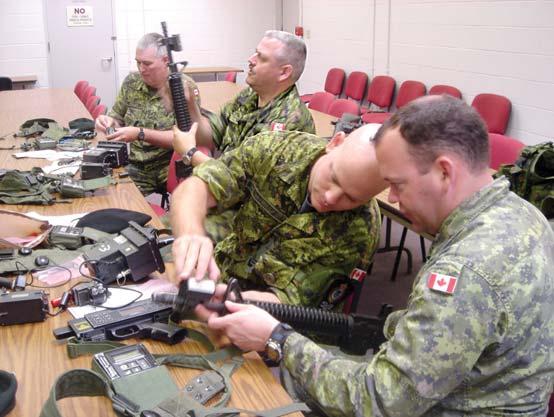
Master Warrant Officer Kevin Walker works with Departmental Sergeant Major James Pearson, while Acting Sergeant Ian Barraclough assists Warrant Officer Joseph Shortt in calibrating their M16 A2 assault rifles.
by Kathryn Lymburner
Gold medal policing
Committment key to high performance
Olympic athletes, surgeons, air traffic controllers and police have at least two things in common – they have higAh performance careers and have participated in mental readiness studies.
The driving force behind many of these studies, Judy McDonald, a researcher at the Institute of Population Health at the University of Ottawa, adapted her studies of these professions from an original study by Terry Orlick on athletes who participated in the Sarajevo and Los Angeles Olympics.
Policing as a high performance career is characterized by, “life and death, whether it is yours or someone else – when there is money because of training or the type of equipment being used, and if there is a big decision being made that affects a lot of people, or the outcome affects a Alot of people’s lives,” McDonald says.
McDonald partnered with the University of Ottawa, Institution of Population Health, City of Ottawa, Canadian Police Research Centre (CPRC) and the Ottawa Police Service on the study, which profiled emergency scenarios instead of the team and shift situations investigated by previous studies.
“Police have it all; they’ve got life and death scenarios, they have certainly a lot of dollars spent on equipment and training and their decisions on the road make people’s lives different.
“I had absolute carte blanche to go into the police,” McDonald says. “I did 27 ride-alongs and 13 training days over a six month period, totally immersed trying to understand how I could adapt the interview to a policing situation and understand how to determine who the excellent people are.”
At the Olympics it was easy to figure out who excelled, but determining which Ottawa police officers to study was more complex. She began by collecting anonymous feedback during her ridealongs, but after getting double and triple hits, asked staff sergeants to recommend front line officers and she crossed the two lists together.
McDonald culled her list down to 50 officers and conducted 90 minute to three hour interviews with 48 of the 50 officers she sent requests to.
She also examined success skills.
“There are actually seven characteristics that I was looking for, to see if there was a comparison between what high performance was in other fields,” she explains. These severn characteristics include: visualization, commitment, self-belief, confidence, ability to visualize, mentalpreparedness, staying focused and managing distractions and must be found in combination with each other.
“Commitment and self-belief are at the core,” explains McDonald. “Somebody can be very committed and they can put a lot of hard
work into something, but when push comes to shove they don’t have the backup plans, mentors and know-how to handle difficulties when they get into them.
“On the other hand, someone can be very confident, even cocky about their performance, but they may not have the commitment, so they may not have the high standards or put in the time for being committed.”
Core competencies for each of the seven success characteristics were further developed, since mental preparation and commitment can be different for each occupation.
“We have a detailed breakdown of what an officer would consider to be commitment,” says McDonald. These included: empathy, enjoying the job, professional discipline, responsibility, a sense of competitiveness, dedication, a sense of identity and pride in the uniform, feeling a part of the force and job security.
Visualization was used extensively by officers preparing for court as they reviewed their notes about an event, McDonald found.
Distraction control, the handling of distractions in policing before, during and after a call, can also be characterized as handling blocks to performance. In other words, what gets in the way of an officer performing at their best.
These blocks can be subdivided into three separate categories: inherent blocks (those specific to policing), organizational blocks (those specific to the agency) and other blocks (encompass everything from home life and non job commitments to finances).
“Inherent blocks would be dealing with shift work, car collisions, court appearances, issues around equipment and even getting lost trying to find a location,” McDonald says. “Organizational blocks are things like the work load, coaching issues, bureaucracy and having few resources. Things that are totally outside of policing can be everything from fatigue issues (and) family conflicts to day to day pres-
sures that you might face.”
These three categories are further broken down into the severity of the block.
“If 75 per cent (of officers) identified something then it was categorized as an immediate need,” she explains, “and if it was 50 to 75 per cent, it would be a serious block; less than 50 per cent would be an individual block.”
Once McDonald had a profile of success skills, performance blocks and influence factors for the core front line, she decided to look at the various branches of policing and the success and blocks for each.
“School resources officers are incredible time managers and diplomats with principals, political appointees and the public,” she notes, “and they have this neat ability to smooth out problems in a very diplomatic way.”
The study shows tactical officers have exceptional training with the tools and specialized equipment that they use and are able to streamline urgency, while K9 officers don’t realize that they go through a tremendous amount of rituals to perform their job.
Much like Olympic athletes, K9 officers “have very specific patterns that they repeat to be predictable and consistent and they have to be able to plan out a sequence of things and be ready,” McDonald says.
K9 officers also handle failure well, she found. “They know the scope of how to evaluate their successes. That’s a pretty healthy attitude when your odds (of success) can be low because of contamination and timing.”
Patrol officers are better at controlling distraction than any other group, she notes. “They deal with it at such a rapid pace and they have such street savvy, that they can come in and out of situations very quickly and have excellent skills at fixing a situation and then getting on to the next item.”
Neighbourhood officers have incredible amounts of internal and external contacts and network really easily, the study found, while traffic officers are incredible negotiators and work hard to turn negative scenarios into positive ones.
The Ottawa Police Service is working to incorporate this wealth of knowledge into its selection and recruitment process and internal career and succession planning.
For example, if you’d like to be a tactical officer, McDonald says, you can look at the core skills needed and begin “developing your training around that and really get a picture of what to expect.”
Work has also begun on developing webbased self-assessment tools for mentorship programs, McDonald says.
JudyMcDonald is a researcher at the Institute of Population Health at the University of Ottawa, and can be reached at jmcdonal@uottawa.ca
What now... and what next?
Career management for new police officers
by Irene Barath
With increasing demand in Ontario, competition among police services to hire and retain qualified personnel is fierce.
The mean age for new officers is 25 and only 8.8 per cent have no post secondary education. This translates to a mature, well-educated group, some of which left more lucrative jobs and enter the profession with high expectations. Realistic or not, these expectations are based on information from recruiters and anecdotal sources – police and non-police friends, peers and family members.
The first year of their training and operational assignments are closely monitored through in-service and basic constable training at the Ontario Police College and time spent with a coach officer at their police service. The police recruit job function and career is managed by others as the officer learns the fundamentals of policing in a front line capacity. This is fundamentally sound as the career can be dynamic and involve a steep learning curve for new officers.
“An underlying theme that appears throughout the training and promotion process in police services is competency-based training, which focuses on the acquisition of specific, measurable skills and knowledge that can be transferred to the operational level.”
The mentorship and competency-based training focus continues throughout the first few years of an officer’s career, even after they are working independently. The increased number of new officers has required many police services to use coach officers with less than five years experience. This may foster a perception of quick advancement potential rather that a situation reflective of limited human resources.
Generally it takes four years for an officer to reach first class status and advancement in rank at this point can only be achieved by competing against their peers in the promotional process. With so many officers reaching this promotional threshold at the same time, a funnelling phenomenon occurs where many officers are competing for few available positions. This can create the first source of frustration as expectations for advancement and the reality of achieving their aspirations are no longer congruent. Officers can start to become disillusioned and cynical.
Some police officers even leave the police service that initially hired them and join another, with the expectation that career opportunities will be more in line with their perception of where they should be. Their change in attitude toward their profession, which they take with them, is problematic and so the results are often unsatisfactory. Officers at this stage of their careers often ask themselves why their service is not looking after them and their interests by providing advancement opportunities.
To mitigate this situation and lessen the stress and frustration experienced by officers, police trainers and services should continue to provide new officers the skill set to educate themselves around the policing profession, in
addition to the competency-based training format. There are numerous resources available to assist officers in the process of cognitive restructuring so they can break out of a negative attitude or, better yet, avoid it all together.
Secondly, the policing community should be encouraging new police officers to determine how they will define success in their careers. Policing is a long-term commitment. Will they consider their career successful based on assignments, promotions, training opportunities, family friendly scheduling and short-term goals both within and outside of their organization.
“Career development is not a program, but a process that integrates and supports ongoing activities, maximizing the value of on-the-job experience with training and development opportunities.”
Thirdly, police officers should be encouraged to ask themselves:
•What do I want to do next?
•What areas of specialization am I interested in?
•What division would I like to work in next?
•What opportunities am I going to pursue?
•How do I let people know about what my interests are?
•What can I do to prepare myself to take advantage of the next available opportunity I am interested in?
•What is required or expected of me to be promoted or get a desirable assignment?
Police services and trainers can encourage members to reassert control over their personal development. They can assist officers in identifying job stressors that create problems for them, most of which are systemic issues, and provide them with positive stress management techniques.
New officers are older, more experienced and well educated so trainers and police services can use these attributes to help their personnel answer the questions of ‘What now?’ and ‘What next?’
This article expresses the opinion of the author and in no way reflects the opinion of the Ontario Police College or the Ontario Ministry of Community Safety and Correctional Services. Irene Barath is co-ordinator, sexual assault investigation, and criminal investigation team leader at the Ontario Police College. She can be contacted at irene.barath@jus.gov.on.ca
A bridge to survival
Trust a crucial component in police assistance programs
by Ryan Siegmund
“Police officers are always dealing with the negative,” observes Roger Dodson, manager of the Toronto Police Service’s Employee and Family Assistance Program (EFAP). “Ninety per cent of the people in this world are great, but police officers live 100 per cent in that 10 per cent negative.
“They need a place of safety, a place they can trust and go to for help without the fear of being criticized, condemned or reported; a place they can take off their ‘mask’ and just be allowed to be themselves.”
Canadian police services began establishing employee assistance programs (EAP) in earnest in the mid 1980s after police suicides began increasing. Research into the troubling trend found officers didn’t trust toll free help lines and needed a place they could go for confidential, personal help.
A Blue Line survey in 1996 found Canadian police agencies made little effort to develop sound support systems for their members. Our latest survey of major Canadian police services shows much has changed in 10 years, with agencies now making a conscious effort to support their members during stressful times.
Awareness
The immediate benefit of EAPs is that they offer employees assistance at little or no cost and are designed and managed to meet the specific needs of police rather than public employees in general. Also internal services often have staff that are or have been involved in policing, enabling clients to talk to someone more likely to understand their situation.
It’s crucial that officers know who they will be talking to and where to go for assistance. Agencies now begin educating officers early in their careers, before they begin facing significant personal or professional challenges.
Members are often introduced to the benefits of EAPs during training. Program staff spend up to a week speaking to and meeting with recruits. The message is often reinforced through department newsletters, bulletins, union calendars and the service web site or Intranet.
Initial engagement
“Trust” is the biggest factor in determining how successful a program will be, says Roger Dodson, who manages the TPS EFAP. Many of his staff are former police officers, which is an important factor in earning trust. He recalls receiving a phone call from someone involved in a shooting and remembers the pain they were experiencing in believing no one could identify with their situation.
“‘You don’t know what it’s like to be in a shooting,’” (he told me). I said, ‘Yes I do. I have been in two shootings. I have had to shoot somebody before also.’ The guy finally said, ‘Who the hell are you anyhow?’ to which I replied, ‘I was a police officer for 36 years.’ After hearing that and getting over his inclination (that) I was a social worker, he calmed down.
“Education is great, walking the walk is better... We can appreciate what the person is going through ‘cause we have been there ourselves.”
A psychological problem is sometimes caused by a physical problem, says Dodson. “(I ask them) have you seen your family doc-
tor? Have you had a physical? Sometimes it could be a chemical or hormonal imbalance and there is nothing psychological at all. It becomes psychological because you think you have cancer, a tumour, that kind of thing.”
EAP staff act as a bridge for members who may need to see a certified counsellor or registered psychologist. Some agencies offer trained police volunteers for those skeptical of speaking to civilians.
Halifax Regional Police Service’s (HRPS) EAP provides an internal system of peer referral volunteers to members and their family. The volunteers – comprised of civilian, management, uniformed and retired members – are available 24/7.
“The peer referrals (20 on staff) are a listening ear or a resource for members to inform them of what is available to them and to walk them through the referral to a psychologist if that is what they want,” says Glen Selig, who co-ordinates the program. The referral process is confidential, which Selig says is integral to maintaining the programs credibilty.
“Not all contacts are for a referral to a psychologist. For the most part, folks just need someone they know and trust to talk to and provide the help that is asked for. If a referral is asked for, then that support person sometimes goes to the first appointment with the person (and) reassures them that the psychologist is an okay person to talk to.”
HRPS volunteers have a variety of skill sets but all have general training in addictions, suicide prevention and listening skills. Great care is taken in choosing them, Selig notes.
Many police agencies also conduct outreach initiatives and have policies requiring officers involved in critical incidents to undergo psychological assessments. Additional help is available if needed.
Appointed counsel
In many cases, both internal and external psychologists and social workers fall under the EAP umbrella. Holding consultations off-site is essential, notes Adriana Celser, clinical psychologist for the Calgary Police Service’s (CPS) in-house psychological services section. She says her team monitors privacy and staggers appointments so people don’t “bump into one another.”
Many EAPs have multiple confidential entries and exits to internal and external resources. External programs, which are often set up for all city employees, lessen the likelihood of run-ins with peers.
“I think the best situation is for members to benefit from choices,” says Celser. “Many times we act as case managers, primarily when we combine internal resources such as therapy (and) psychological evaluations for diagnostic purpose with external resources, including sleep specialists, psychiatric consulting, cou-
ple therapy and child therapy.”
Toronto’s EFAP staff ensure the member is matched up with a registered psychologist that fits their individual needs. All specialists on the program’s referral list are screened so members can be referred to one with the expertise they require.
Measuring effectiveness
EAP administrators unanimously concede confidentiality, accessibility, familiarity and reputation are the cornerstones of an effective program. Many point to a programs utilization rate as a telling indicator of how well they work.
The absence of police officer suicides is another good indication of a program’s success or lack thereof, says Dodson, pointing out that nine Toronto officers committed suicide in 1984 but there have been none since.
Other departments have used Toronto’s EFAP as a guide and staff have fielded requests from agencies in Canada and around the world looking for help in establishing their own programs, he says. One Ontario police agency reached out to Toronto after two members committed suicide.
EFAP does a follow-up after the member has gone to his or her appointment(s) to get an indication of how things went. Officers are sent a survey requesting feedback on the response from the psychologist along with their referrals. Dodson says it is very important to know who you they’re being sent to, noting it is the only indicator the psychologists are doing the job expected of them. The 70 psychologists on
the EFAP referral list are constantly monitored because many do not understand the police culture, he notes.
The Winnipeg Police Service’s Behavioural Science unit is transitioning from its longtime psychologist to a new one – quite a challenge considering familiarity and trust are elements of success. There will always be limited resources for in-house support systems, notes Paul Isaak, WPS’ wellness officer.
“In the end I believe these programs will only survive if the leadership of the organization values the services offered,” Isaak says. “It will not be as a result of a measurable benefit to the organization, it will be because of a belief that it is the right thing to do.”
EAP evolution
Post-war EAPs were once a “one trick pony,” set up almost exclusively to deal with alcohol related concerns, with little concern about saving an organization money, says Glenn French, an EAP external consultant and vice president of a firm that works to reduce short-term disability costs.
Over time, some became less of a benefit and more of a corporate strategy, he says, noting organizations wanted to lessen short term disability costs and minimize turnover and absenteeism. The vast majority of Canadian employers now offer external EAPs, with more migration to larger consulting firms that provide services to a variety of clients, says French.
“Sometimes when you have a very large consulting firm managing things, they will hire
less experienced people to see the clients who may be in it for the short-term, so you get higher turn over. They may not know the organization that the client comes from very well, if at all. If you have a program that is dedicated to a particular organization and understands it, staff can look at the behaviour within a context.”
There has always been debate over whether an internal or external EAP is best. French says there is no right or wrong, adding programs should be tailored to specific needs.
“My feeling is, if you have seen one EAP –you have seen one EAP. They are all different to a large extent. Many times I get called to audit or evaluate EAPs and the question is always whether to make an internal program external.
“Many of the paramilitary type organizations such as police services often have a strong sense of brotherhood. There has always been a tendency to have those programs operated by people who understand the field and the demands of policing, fire services, jobs like that.”
Utilization numbers average seven to 15 per cent, says French. “If you have a program that isn’t used – is that because people don’t know about it or trust it? Some utilization rates are quite high but it doesn’t necessarily mean problems – (just that) people are using it and that could be a good thing.
“If the utilization rate indicates people are using it because of a particular problem – say a work related problem or stress – then an organization can perhaps identify an issue... people working too hard or too long, (for example) and make some adjustments based on that.”
Detention defined by several factors
by Mike Novakowski
Several factors determine whether a detention, as defined by the Charter, has occurred, Ontario’s top court has reiterated.
In R. v. Grant, (2006) Docket:C43132 (OntCA) , two plainclothes police who were proactively policing a neighbourhood school hot spot, asked a uniformed officer to stop and chat with the accused after seeing him walk by in a “suspicious” manner. He had “stared” at the officers in an unusual manner and “fidgeted” with his pants and coat, which looked suspicious.
The uniformed officer stood in Grant’s path, told him to keep his hands out front and began asking questions. The two plainclothes officers arrived and stood behind the uniformed officer. Grant was initially only asked for identification, but later asked if he had ever been arrested and whether he had anything he shouldn’t have.
Although initially saying “no,” he did admit to having a small amount of mariuana and, when asked if there was anything else, divulged that he had a loaded revolver. Grant was arrested, the revolver was seized from a waist pouch and he was charged with five firearms offences.
At trial in the Ontario Court of Justice, Grant’s motion to exclude the gun from evidence because his rights under the Charter had been violated was dismissed. The trial judge found there was no detention. He ruled that the conversation between the uniformed officer and Grant was merely “chit chat,” while the officer asking Grant to keep his hands in front of him was a “request,” not a “direction or demand.” Finally, Grant could have simply walked around the officers and kept on going.
He was convicted on all counts and sen-
tenced to 18 months imprisonment but appealed to the Ontario Court of Appeal, arguing, in part, that he was detained and that the police questioning amounted to a search. Further, if his rights were violated, he submitted, the revolver should have been excluded as evidence.
The detention
Section 9 of the Charter guarantees the right not to be arbitrarily detained. If police have reasonable grounds to detain for an investigative purpose, the detention will not be arbitrary. However, in this case the Crown conceded police did not have reasonable grounds to detain, taking the position that there was no detention.
Justice Laskin, authoring the unanimous appeal court judgment, first reviewed what constitutes a detention. Under the Charter, a detention can occur in two ways: physical or “psychological.” A psychological detention can occur when a police officer gives a direction or demand to a citizen in which the citizen feels (reasonably believes) they have no choice but to obey (and submits or acquiesces to the direction or demand) – even if there is no legal
Hair length complaint dismissed
by Mike Novakowski
The BC Human Rights Tribunal has dismissed a police officer’s complaint that his department discriminated against him because women could grow their hair longer than men.
In Mosher v. West Vancouver Police Department & others, 2006 BCHRT 86, an officer alleged that his department, police chief and inspector discriminated against him on the basis of sex, contrary to s.13 of the Human Rights Code, because there are different grooming standards for male and female hair length. In his view, this was discriminatory and the same standard should apply to both genders.
After reviewing the purposes of the code,
tribunal member Barbara Humphreys dismissed the officer’s complaint, stating:
In my view, a different hair grooming standard for female and male officers does not constitute an impediment to (the officer’s) ability to participate fully in the economic, social, political or cultural life of British Columbia, nor does it impact on his dignity. Given the substance and context of this complaint and its de minimus nature, it would not, in my opinion, further the purposes of the code to proceed with the complaint (para. 10).
Visit www.blueline.ca/resources/caselaw for the complete cases. E-mail caselaw@blueline.ca to reach Mike Novakowski
authority for the demand or direction, and thus no offence committed for failing to comply. Laskin noted:
The definition of “psychological detention” reflects a judicial balance between competing values. On the one hand, the police have the duty and the authority to investigate and prevent crime in order to keep our community safe. In carrying out their duty, they must interact daily with ordinary citizens. Not every such encounter between the police and a citizen amounts to a constitutional “detention.” This court and other courts have recognized that police must be able to speak to a citizen without triggering that citizen’s Charter rights.
On the other hand, ordinary citizens must have the right to move freely about their community. Thus, the police cannot detain a citizen for questioning unless they are authorized by law to do so (paras. 10-12).
In describing the criteria for a psychological detention, Justice Laskin stated:
A “psychological” detention includes three elements: a police direction or demand to an individual; the individual’s voluntary compliance with the direction or demand, resulting in a deprivation of liberty or other serious legal consequences; and the individual’s reasonable belief that there is no choice but to comply. Grant sought “bright-line” rules governing whether a police-citizen encounter amounted to a detention. He suggested that merely asking questions about identity would not be “psychological detention,” but questions about personal possessions or inviting incriminating responses would. Laskin rejected this submission, recognizing that police-citizen encounters take on such a myriad of circumstances and contexts that bright-line rules were not desirable. Rather, a fact-specific and context sensitive inquiry must be made into whether a police-citizen encounter gives rise to a detention.
In this case, Laskin ruled the accused was psychologically detained, although it was a difficult and close case, because of the following:
•The uniformed officer’s initial demand was made while standing in front of Grant. His path was blocked and he was told to keep his hands in front of him. This was a demand which Grant wasn’t free to ignore;
•The actions of the plainclothes officers. They did not stay in their car, but got out, showed Grant their police badges and stood behind the uniformed officer;
•The three officers were bigger than Grant and effectively formed a small phalanx blocking his path, exerting control over his movements throughout the encounter;
•The uniformed officer’s questions went well beyond a mere request for identification or other non-incriminating information. These questions amounted to further “demands;”
•Grant acquiesced to all the officers’ demands. He put his hands in front of him and gave incriminating answers, leading to his
arrest, the search and the ultimate deprivation of his liberty;
•Grant’s manner in answering the questions suggested he did not believe he had the right to walk away and end the conversation, but rather believed that he had no choice but to answer their questions. He paced nervously and hesitated before answering questions. Furthermore, he wasn’t told that he was free to go or free not to respond to their questions;
•Grant wasn’t a sophisticated adult but an 18year-old youth, facing three police officers standing a few feet away from him in his path on the sidewalk;
•The duration of the encounter was about seven minutes. It wasn’t a long encounter, but it wasn’t so short that it could not give
rise to a detention.
Since Grant was detained and the Crown conceded the police did not have reasonable grounds to detain him, the detention was arbitrary and a violation of s.9 of the Charter.
The search
Grant also argued the police questioning amounted to a search that began when they asked him whether he had anything he shouldn’t have. Laskin disagreed with this submission, stating:
The divide between questions that begin a search and questions that do not is sometimes not easy to draw. In this case, I am not persuaded that the police’s question to the (accused) “if he had anything that he shouldn’t”
Court accepts short delay in test
by Mike Novakowski
A 10 minute delay in conducting a roadside screening test after a demand was made did not take the test outside the meaning of “forthwith,” the Saskatchewan Court of Appeal has held.
In R. v. Janzen, 2006 SKCA 111, police were patrolling a local bar after midnight when they saw the accused drive by. Noting his eyes appeared glassy and unfocussed, an officer stopped the car and asked him to get out and produce his driver’s licence and registration.
Smelling alcohol, the officer made a roadside screening demand under s.254(2) of the Criminal Code, put the accused in the backseat of his police car and radioed for an approved screening device. The time between the demand for the test and its administration was 10 minutes. The accused failed, was given his right to counsel and detained further for a breathalyzer test. He subsequently provided two breath samples over the legal limit and was charged with operating a vehicle over 80mg%.
At trial in the Saskatchewan Court of Queen’s Bench the accused argued, in part, that the 10 minute delay between the initial demand and the arrival of the screening device constituted a breach under s.8 of the Charter. He further submitted that the unreasonable search rendered the certificate of analysis inadmissible under s.24(2)
The trial judge ruled the delay rendered the taking of the screening sample unreasonable. In his view, s.254(2) requires the sample be taken “forthwith,” meaning immediately or without delay. The length of the delay in this case wasn’t forthwith. Since the Crown failed to establish compliance with the section, the conscripted screening sample violated s.8 of the Charter and could not be used as part of the evidence leading to the breathalyzer certificate. The certificate was thus excluded and the accused acquitted.
The Crown appealed to the Saskatchewan Court of Appeal, arguing the trial judge misconstrued the term “forthwith” to mean instantly.
Justice Cameron, delivering the judgment of the court, agreed, ruling that ‘forthwith’ means “without delay,” which in turn means “without unreasonable or unjustified delay.”
In determining whether a particular roadside screening test has been administered forthwith, it is necessary to have regard for the circumstances of the case, including the extent of the lapse of time and the reason for it and to assess the matter with the following considerations in mind:
(i)the balance between Parliament’s objective in combating the evils of drinking and driving, on the one hand, and the person’s constitutional right to be free of unreasonable search or seizure, on the other; and (ii)the fact that a person’s constitutional right to consult counsel is suspended upon demand to provide a sample of breath pursuant to section 254(4) (para. 33)
Relying on a 2004 case, R. v. Ritchie, where the Saskatchewan Court of Appeal ruled that the roadside screening test taken after an 11 minute delay in similar circumstances to this case had been administered “forthwith,” Justice Cameron concluded the trial judge erred in his analysis.
The appeal was allowed and a new trial ordered.
began a search. In my view, the search began, at the earliest, after the (accused) admitted to possession of marijuana. At that point, however, the police had reasonable and probable grounds to arrest the (accused).
Then, when in answer to (the uniformed officer’s) follow-up question, “is that it?,” the (accused) admitted to carrying the revolver, the police had the right to search the (accused), incident to arresting him. Indeed they had that right even if they did not arrest him (reference omitted, para. 33).
The question was general in nature and police had not already formed the intention to conduct a search. This was unlike other cases, where accused persons were asked to empty their pockets, questioned about the content of their open gym bag or asked what was in their pocket after police had touched it and felt a hard lump. Although those questions amounted to a search, the nature of the officer’s question in this case did not since they were asked in a different context. Since there was no search, there was no violation under s.8 of the Charter.
The evidence
Although Grant’s s.9 Charter right had been breached, the evidence was nonetheless admissible under s.24(2). Even though the revolver was “derivative evidence” that arose from his answers (which were “conscriptive evidence”), he had a lesser expectation of privacy in a public area, the detention was brief, the questioning minimally intrusive, police did not physically restrain him until after the arrest and they acted in good faith.
Furthermore, possession of a loaded firearm in public is very serious, the accused was near several schools, the evidence was crucial to the Crown’s case and was entirely reliable. Therefore, admitting it would not bring the administration of justice into disrepute.
Grant’s conviction appeal was dismissed.
Judges can’t order probationer drug tests
by Mike Novakowski
A judge has no statutory authority to require a person on probation to submit to alcohol breath tests, Canada’s highest court has ruled.
In R. v. Shoker, 2006 SCC 643, the accused was convicted of break and enter to a dwelling house with the intent to commit a sexual assault. He had entered the victim’s home, undressed himself and tried to climb into her bed. The victim called 911 and Shoker was subsequently arrested. As part of his sentence, he was placed on probation for two years with several conditions, including the following:
Abstain absolutely from the consumption and possession of alcohol and non-prescription narcotics and to submit to an urinalysis, blood test or breathalyzer test upon the demand/request of a peace officer or probation officer to determine compliance with this condition. Any positive reading will be a breach of this condition.
Shoker appealed to the British Columbia Court of Appeal arguing, among other grounds, that the condition was unreasonable under s.8 of the Charter because it didn’t require reasonable grounds before a demand for samples was made. In a 2:1 decision, the court held that the condition was unconstitutional.
S.732.1 of the Criminal Code allows a sentencing judge to require a probationer submit to tests of bodily substances. The condition imposed in this case was unreasonable and violated s.8 because “there are no legislative or regulatory standards or safeguards for the protection of the (accused’s) privacy in the enforcement of the condition,” said Justice Levine. In the absence of a statutory regime, the offender cannot be said to be “secure against unreasonable search and seizure.”
Levine deleted the impugned provisions
from the condition and left it to read, “Abstain absolutely from the consumption and possession of alcohol and non-prescription narcotics...”
The Crown appealed to the Supreme Court of Canada. Justice Charron, authoring the opinion of the majority, dismissed the appeal. Although a judge may impose an abstention condition as part of probation sentencing, they cannot authorize a search and seizure of bodily substances as part of the probation order. The condition compelling the seizure of bodily samples as an enforcement mechanism was invalid, Charron wrote:
The seizure of bodily samples is highly intrusive and, as this court has often reaffirmed, it is subject to stringent standards and safeguards to meet constitutional requirements. Significantly, in R. v. Borden… this court held that where there is no statutory authorization for the seizure of bodily samples, consent must be obtained if the seizure is to be lawful.
In R. v. Stillman… the majority held that the seizure of bodily samples such as hair, buc-
Discipline found unfair in drug case
The Supreme Court of Newfoundland and Labrador has ruled it would be unfair to discipline an officer who was asked to use a drugsniffing dog to conduct a random search of a St. John’s high school.
But Justice David Orsborn also concluded the province’s Justice Department should provide legal advice to the Royal Newfoundland Constabulary and school boards to assess constitutional issues associated with such searches.
In 2002, at the request of school authorities, Sgt. Michael Adams and police dog Storm conducted a sniff search at St. John Bosco Junior High School.
The dog, on a leash held by Adams, walked up and down the aisles of a classroom.
Afterwards, the father of a Grade 8 student lodged a complaint with the Public Complaints Commission, claiming the search was unlawful.
After an investigation, the commission laid disciplinary charges against Adams, alleging conduct unbecoming an officer on the grounds of an unlawful search.
A disciplinary adjudicator later dismissed the charge because the complainant’s child was not searched, Adams had a legitimate belief in the lawfulness of the
search and school authorities consented to it.
The child was not suspected of having drugs. The adjudicator recommended police and the school board develop policies for school searches.
The parent appealed, sending the case to the Supreme Court of Newfoundland and Labrador. Justice Orsborn dismissed the appeal but upheld the adjudicator’s recommendations. In his ruling, Orsborn said Adams conducted himself in a proper manner.
“Subjecting Sgt. Michael Adams to disciplinary action because he carried out a task requested by the school and sanctioned by his superiors would be unfair and unjust,” Orsborn wrote.
He said the provincial Justice Department should provide legal advice to the police and school boards to assess the legality of school searches.
Under a new directive, searches are permitted if there is reason to believe there has been a breach in school regulations, but sniffer dogs can’t go in the classrooms and are only permitted in the hallways and washrooms.
Teachers are to be notified beforehand and students are to remain in classrooms while the search takes place.
cal swabs and dental impressions wasn’t authorized by the common law power to search incident to arrest… Again here, it is my view that such statutory authorization cannot be read in the general language of s. 732.1(3)(h) (allowing the imposition of other reasonable conditions).
In the various circumstances where Parliament has chosen to authorize the collection of bodily samples, it hasn’t only used clear language; it has also included in the legislation, or through regulations, a number of standards and safeguards: see, for example, the collection of DNA samples for investigative purposes or, on conviction, for inclusion in the DNA databank… the collection of breath and blood samples during the investigation of impaired driving offences… and the collection of urine samples from federal inmates and parolees…
The establishment of these standards and safeguards cannot be left to the discretion of the sentencing judge in individual cases. There is no question that a probationer has a lowered expectation of privacy. However, it is up to Parliament, not the courts, to balance the probationers’ Charter rights as against society’s interest in effectively monitoring their conduct (paras. 23-25).
The Supreme Court concluded there was no statutory authority for the condition requiring Shoker to submit to bodily samples. The court left it to Parliament to determine appropriate standards and safeguards for the collection of bodily samples for enforcement purposes.
In the absence of such authority, enforcement of such an abstention condition must be done through other investigative tools.
Visit www.blueline.ca/resources/caselaw for the complete cases. E-mail caselaw@blueline.ca to reach Mike Novakowski
BlueLineMagazineInc. is pleased to announce the appointment of BobRodkin as their new Manager of Sales and Marketing. A former Toronto police officer with more than 25 years of advertising, marketing and sales experience Bob brings with him a wide range of talents and experience in the police, security, magazine publishing and marketing industries. In 1978, following three years at a family owned advertising agency Bob joined the Toronto Police Services. In 1984, he left his police career and joined Canadian Security Magazine, eventually becoming the associate publisher. Bob has since launched his own advertising agency, and two trade magazines; one in the security industry, and the other focused on access and egress control. Most recently, Bob was responsible for business development of T riform Evidentiary Products at Thomson Carswell.
BobRodkin may be contacted at 416-6197549 or bobrodkin@blueline.ca
Jamaican intelligence shared
A high-ranking Jamaican officer visited Toronto recently to help build an informationsharing network abroad.
Deputy Commissioner
Mark Shields, an English native who initially began work in Jamaica on behalf of Scotland Yard as part of an investigation into the slayings of officers, was in town to see how Toronto does business.
“We have huge links to Toronto,” Shields said, of the criminal linkages between Jamaica, the United Kingdom, the United States and Canada. “If there is a gang-related murder in Kingston and they can’t retaliate there, they will contact London, New York or Toronto, who can seek retribution.”
Shields spent time with the urban organized crime squad, working on a means of exchanging intelligence to prevent crimes and murders at home and abroad. He has also paid visits to the gun and gang task force and the Toronto Drug Squad.
He said cell phones, text messaging and email make communication easier for gangs, while their rising sophistication at hiding money is a serious concern for law enforcement.
The Jamaican Constabulary Force has also bought IBIS and AFIS technology but is now researching how to best employ it. “We’re in the process of loading data,” Shields said. “Toronto has shown us that you need proper in-
frastructure to support IBIS in order for it to be effective.”
He said analytical work by officers tying crimes together with all evidence, including witnesses, still needs to be done in order to get convictions.
As deputy commissioner of the crime portfolio, he is joined by foreign officers heading up major crime investigation, firearms (tactical training), community policing and anti-corruption.
“It’s an opportunity to bring new ideas and
technologies to curb one of the most difficult crime problems in the world,” Shields said.
Jamaica also has to make inroads into police corruption, he says, which he attributes to a lack of investment in policing and officer salaries.
“It’s one of the most difficult and dangerous jobs in the world,” said Shields, of the need to compensate officers better. Last year, there were 1,674 murders on the island as organized criminals battled it out on the streets of Jonestown, Denontown and Spanishtown, among other troubled areas.
“My primary concern is to reduce that number,” said Shields, cautiously noting a 24 per cent drop in murders this year. The drop is credited to a new task force to tackle gang murders and the international Operation Kingfish, which dismantled gang-related, drugtrafficking rings.
Shields wasn’t only drawn to the country from a professional standpoint and has been charmed by its citizens. “Jamaicans are some of the friendliest people in the world,” he said.
“An extremely violent criminal minority in some ways taints Jamaica.”
He said the Jamaican government has pulled the country back from a precipice of violence and the country can regain control of gang warfare. “I passionately believe it’s going to happen.”
This article was reprinted, with permission, from the Toronto Police Service publication The Badge
This article was reprinted, with permission, from the Toronto Police Service publication The Badge
Jamaican Constabulary Force Deputy Commissioner Mark Shields and Toronto Deputy Chief Tony Warr.
by Mark Giles
Fighting international crime Interpol enables police co-operation around the world
Set between the Rhone River and the “Parc Tete d’Or” in Lyon, France – about an hour’s drive southwest of the Swiss border – is a rather unique looking building. As some of its security features become visible to the casual passer-by, including marked police vehicles and uniformed officers at the entrance, some might wonder what purpose it serves.
Although highly secured, its location is no secret. Clearly marked on the city map and on the front of the building, even the casual observer can quickly determine that this facility belongs to Interpol, the International Criminal Police Organization. Interpol’s mission, however, may not be as clear to many within the local community and around the world.
As the world’s largest international police organization, with 186 member countries, the facility is home base for Interpol’s General Secretariat, serving as the headquarters for global efforts in facilitating international co-operation and communication among police agencies. With three core functions – providing secure global police communications, data services and databases for police and operational police support services – Interpol focuses on assisting and co-ordinating investigations among member countries.
As technology and communications have advanced in recent years, so has Interpol’s ability to assist in the fight against international crime. Unfortunately, so too has the ability of criminals to interact and cross borders – especially with electronic and Internet-based crime. To counter this, law enforcement around the world must work closely together, sharing resources and information when appropriate.
“Globalization and advanced technology have made fighting international crime as complex and challenging as ever,” said Ronald Noble, Interpol’s Secretary General. “With police expertise and extensive resources, however, Interpol is well positioned to assist law enforcement agencies around the world in pursuing cross-border investigations.”
A former head of law enforcement with the U.S. Treasury Department, Noble is in his second, five-year term as secretary general. Overseeing Interpol’s efforts along with the organization’s president, he has been instrumental in several key initiatives in recent years.
In 2002, Interpol introduced its secure global police communications system, known as I-24/7. The system is administered through each member country’s National Central Bureau (NCB), normally located in its capital city,
to ensure co-ordination and support at the national level. Connecting law enforcement officials in member countries, it allows rapid and secure sharing of crucial information on criminals and criminal activities.
Using I-24/7, each country’s NCB can search and cross-check data in a matter of seconds, with direct access to databases containing information on suspected terrorists, wanted persons, fingerprints, lost or stolen travel documents, stolen motor vehicles and stolen works of art. Member countries continue to maintain
and manage their own national criminal data, but can also make it accessible to the international law enforcement community.
Although initially installed at NCBs, Interpol is encouraging member countries to extend their I-24/7 connections to national law enforcement entities such as border police, customs and immigration. NCBs will retain control of the level of access other authorized users have to Interpol services and can also request they be informed of enquiries made to their national databases by other countries.
The General Secretariat in Lyon, France, serves as the headquarters for Interpol’s efforts in facilitating police co-operation around the world.
Canada first to connect to I-24/7
Canada was the first country to connect to the system, becoming operational in January 2003. Its NCB is located at RCMP headquarters in Ottawa and serves as a conduit between Canadian police agencies, Interpol’s General Secretariat in Lyon and other NCBs around the world.
For Canadian law enforcement, this assistance is most beneficial when dealing with other regions of the world, especially outside North America. For joint Canada-U.S. cases, Canadian police agencies normally deal directly with their American counterparts, but Interpol Ottawa can be of assistance in less familiar territory, especially when a criminal case involves three or more member countries.
Interpol functions with five working regions: the Americas, Europe, Asia, Africa and the Middle East and North Africa. Supported by regional offices in Argentina, El Salvador, Côte d’Ivoire, Kenya, Zimbabwe and Thailand, as well as a liaison office at the United Nations in New York, Interpol provides operational police support with a focus on five priority crime areas: drugs and organized crime, public safety and terrorism, fugitives, trafficking in human beings and financial and hightech crime.
Child sexual exploitation is one area that crosses jurisdictions and borders, especially since the development and increased use of the Internet and electronic images. As part of the specialized crime directorate, currently led by an assistant RCMP commissioner assigned to Interpol for a three-year period, its investigators manage Interpol’s Child Abuse Image Database. Created in 2001, it contains thousands of images of child sexual abuse submitted by member countries and facilitates the sharing of images and information to assist law enforcement agencies with the identification of new victims.
The central hub of activity is Interpol’s command and co-ordination centre (CCC), which was established in 2003, linking its General Secretariat with the NCBs in all 186 member countries and regional offices and allowing operations 24 hours a day, seven days a week. Serving as the first point of contact for member countries faced with crisis situations, the CCC operates around the clock to determine the priority level of each message received and to reply immediately to urgent requests.
The CCC also co-ordinates the exchange of intelligence and information for operations involving several countries and assumes a crisis-support role during serious incidents. In doing so, Interpol provides member countries with a full range of police-support services, including instant searches of its databases, investigative support, co-ordination of disaster victim identification (DVI) efforts and deployment of incident response teams (IRT) to sites of major disasters or terrorist incidents.
Incident response teams
In December 2004, the CCC initiated Interpol’s response to the tsunami in Southeast Asia. After consulting with affected countries to offer assistance, Interpol informed its network of national DVI teams and immediately sent an IRT to Thailand – later also sending teams to Sri Lanka and Indonesia.
Ronald Noble is currently serving his second, five-year term as Interpol’s Secretary General and has overseen the implementation of several initiatives, including the I-24/7 system, which provides Interpol and its member countries with secure global police communications.
Following the train bombings in Madrid in March 2004, an IRT of specialized police officers and analysts was deployed and, through co-ordination by the CCC, a number of investigative leads and intelligence reports were pro-
duced to assist the Spanish National Police. Recently, IRTs have also been sent to Egypt, Indonesia and other locations following terrorist incidents. Since 2002, 19 IRTs have been sent to support terrorist-related investigations. Working together in law enforcement has always been necessary for success. In today’s world of advanced communications, Interpol is more accessible than ever and member countries around the world should ensure they take advantage of the services it provides. As a member of Interpol since 1949, Canada has long realized its value and has regularly provided personnel and resources to assist with its mission.
“Canada is well recognized as a leader in professional policing standards and is a strong supporter of Interpol,” said Noble. “We are grateful for Canada’s ongoing support in the fight against international crime.”
Communications services, whether by telephone or email, through the website or publications, are available in Interpol’s four official languages: English, French, Spanish and Arabic – and information related to cross-border investigations or police-related projects is promptly posted to Interpol’s website at www.interpol.int . Good news stories involving international police co-operation are always welcome and can be sent to Interpol through the website. From the homepage, go to “Contact” and then to “Communications and Publications Office.”
MarkGiles is Blue Line’s correspondent for public and media relations, military and international issues. He is also the chief of communications and publications at Interpol, based in Lyon, France.
The D. B. Cooper caper
Modern-day Robin Hood? Or high-flying robber? He hijacked an airplane, stole a small fortune, then parachuted out of sight... and straight into legend.
Courtesy The Bathroom Reader
On Thanksgiving Eve, November 24, 1971, a nondescript man wearing a conservative dark suit, white shirt, narrow black tie, and sunglasses stepped up to the Northwest Orient Airlines ticket counter in Portland, Oregon. He paid $20 in cash for a one-way ticket to Seattle on Flight 305.
Once the 727 was airborne, the man summoned the flight attendant, Tina Mucklow, introduced himself as “Dan Cooper,” and handed her a note. It said he had a bomb in his briefcase and would blow up the plane if they didn’t grant his demands. He wanted two parachutes and $200,000 in $20 bills.
When the plane landed in Seattle, Cooper kept the pilot and crew hostage but let the passengers off in exchange for the chutes and the loot. Then he ordered the pilot to take off again and set a course for Mexico with some special instructions: Keep the landing gear down, and the flight speed under 170 mph. Somewhere over the Lewis River, 25 miles northeast of Portland, Cooper strapped on a parachute, tied the money around his waist, and jumped out the rear stairway of the plane. He was never seen or heard from again.
The crime in name only
In the ensuing investigation, the FBI questioned a man named Daniel B. Cooper. Although that person was never a serious suspect, the FBI reported to the press that they’d interrogated a “D. B. Cooper.” And those initials became forever linked with the skyjacker.
The FBI manhunt that followed was unprecedented in scope and intensity. It was a showcase investigation, meant to display the competency and professionalism of the world’s greatest law enforcement agency.
Every inch of ground in the vicinity of the purported landing site was searched from the air and land, with teams of trackers and dogs, for 18 days. So it was a humbling moment when, after weeks of tracking down leads, the FBI admitted that they had come up with... nothing. No credible suspect. No trace of the loot or the parachute. No further leads to follow. A complete dead end.
If Cooper survived, he’d pulled off the crime of the century.
A star is born
Something about the hijacking caught the public imagination, as the media reports raved about the audacity of the crime and the calm, competent way in which Cooper carried it out. According to the flight attendants, Cooper behaved like a gentleman throughout the ordeal, even requesting that meals be delivered to the crew while they were stuck on the ground in Seattle, waiting for the ransom money to be delivered.
He became a folk hero, a latter-day Jesse James. Songs were written about him, and a movie was made, starring Treat Williams as
Cooper and Robert Duvall as the FBI agent on his trail. Portions of the story are re-told in the current TV series “Prison Break.” Half a dozen books, mostly by former FBI agents, published theories about what happened to him. He was living the high life on a beach in Mexico. Or he’d slipped back into his former life somewhere in the States, undetected, unnoticed, and forgotten.
On February 13, 1980, a family picnicking on the Columbia River, 30 miles west of Cooper’s landing area, found three bundles of disintegrating $20 bills ($5,800 total). The serial numbers were traced to the ransom. The rest of the cash has never been found.
...So who dunnit?
• Possible Suspect #1. On April 7, 1972, four months after Cooper’s successful hijacking, another hijacker stole a plane in Denver, using the same M.O. as D. B. Cooper. The Denver flight was also a 727 with a rear stairway, from which the hijacker made his getaway by parachute. A tip led police to Richard McCoy Jr., a man with an unusual profile: married with two children, a former Sunday school teacher, a law enforcement major at Brigham Young University, a former Green Beret helicopter pilot with service in Vietnam, and an avid skydiver. When FBI agents arrested McCoy two days after the Denver hijacking, they found a jumpsuit and a duffel bag containing half a million dollars. McCoy was convicted and sentenced to 45 years.
In August 1974 McCoy escaped from prison (he tricked the guards into letting him out of his cell with a handgun made from toothpaste and then crashed a garbage truck through the prison gate). The FBI tracked him down and three months later killed him in a shootout in Virginia.
In 1991 former FBI agent Russell Calame wrote a book titled D. B. Cooper: The Real McCoy, in which he claimed McCoy and Cooper were the same person. He quoted Nicholas O’Hara, the FBI agent who tracked down McCoy, as saying, “When I shot Richard McCoy, I shot D. B. Cooper at the same time.” But there’s no conclusive evidence. In fact, McCoy’s widow sued for libel and won.
Possible Suspect #2. In August 2000, a Florida widow told U.S. News and World Report that her husband was D.B. Cooper. Jo Weber claimed that shortly before his death in 1995, her husband, Duane, told her, “I’m Dan Cooper.” Later she remembered he’d talked in his sleep about jumping out of an airplane. She checked into his background and discovered he’d spent time in prison near Portland, Oregon, then found an old Northwest Airlines ticket stub from the Seattle-Tacoma airport among his papers. She found a book about D. B. Cooper in the local library — it had notations in the margins matching her husband’s handwriting.
She relayed her suspicions to FBI Agent Ralph Himmelsbach, chief investigator on the D. B. Cooper case. To this day he insists Weber is one of the likeliest suspects he’s come across. More recently, facial recognition software was used to find the closest match to the composite picture of D. B. Cooper. Of the 3,000 photographs used (including Richard McCoy’s), Duane Weber’s was identified as the “best match.”
Possible Suspect #3. Elsie Rodgers of Cozad, Nebraska, often told her family about the time she was hiking near the Columbia River in Washington in the 1970s and found a human head. They never really believed her until, while going through her things shortly after her death in 2000, they found a hatbox in her attic...with a human skull in it. Could that have been the remains of D. B. Cooper? And if so, what happened to the ransom money? Thirty years later, his fate remains a mystery.
A Canadian Connection
Such news stories always refer to Cooper as the grandfather of such crimes. But he was believed to be a copycat to an Air Canada hijacking.
Two weeks before the Cooper caper, a passenger on an Air Canada flight over Montana named Paul Cini, brandished a handgun to the crew. He extorted money and a parachute, just like Cooper, but he was rushed and subdued by the jet’s crew when he put down the gun to don the parachute. Agents from the FBI believe Cooper borrowed his basic plan from Cini and the detail of a bomb in his briefcase from the plot of the movie “Airport,” a disaster flick released six months before the Cooper hijacking.
There were three other copycat hijackings after the Cooper caper with all three surviving the skydive. In these incidents two were captured on the ground and one was shot dead. This cooled the copycat incidents considerably.
Families sacrifice for policing career
by Danette Dooley
The early mornings, endless days and worries about neglecting her two young children made Michelle Reid wonder if training to become a constable with the Royal Newfoundland Constabulary had been a mistake.
Setting out each morning at 4:45 am for the commute to St. John’s from her home in Dildo left plenty of time to wonder about her decision and worry about five-year-old Keanna and Kalei, 3.
Husband Dean supported her giving up her job at the youth centre and heading to Memorial University to take the recruit training program, but “there were many days when I second guessed and wondered if I was doing the right thing,” Reid admits.
“I’d get home in the evening and my kids would be clung on to me, asking if I had to go back again tomorrow... and there were days that I just wanted to get home and put my feet up, but I couldn’t. There are still times when I get home that I don’t sit down until I actually lie down, because you’ve got to give 100 per cent to your kids when you are with them.”
Reid is confident her children will realize down the road that the sacrifice the family made was well worth it.
“People say to us, as parents, the time will pass and really, the kids won’t even realize that we were gone so much and that they’ll look at us as role models.”
Reid was one of 26 men and women from across the province who graduated in the second RNC recruit class at Memorial. She says her career change would not have been possible if RNC recruits were still forced to travel to PEI, at a cost of as much as $30,000, for training.
A determination to serve and protect residents of the province they call home is a common thread among the recruits, who have now taken to the streets in Labrador West, Corner Brook and St. John’s. Family support and the availability of local training also played a large part in their decisions.
Stephen Kennedy is the son of two teachers, holds a university degree and was working at a community services council. His lifelong dream was to become a police officer and when he heard the RNC was looking for officers, he saw his opportunity.
“The support was here to train in Newfoundland and to police in Newfoundland so I jumped at the chance,” he says.
Seizing the opportunity meant making a big sacrifice; fiancé Tracy Kelly gave birth to the couple’s first child about a month after the program began. Parker is now ten months old.
“Having Parker really helped me focus on the program,” recalls Kennedy. “You miss so much when you’re not with your baby all the time, but having the responsibility of a child really helps with discipline – and that’s what a lot of this program is based on.”
Heather Wiseman taught school in Ontario and Japan and was married to a teacher but always felt a draw towards policing. Enrolling in the program meant long periods away from her husband and two children.
“There was a time when I didn’t see my husband or kids for six weeks. Shawn’s had to be a single parent for 12 months. When we met in 1989, he knew that policing was something I always wanted to do, but after we got married and had kids, life just took us down a different path,” Wiseman says.
Like Reid, she often second guessed her decision to change careers.
“My little boy (Nicholas) is six and he doesn’t like having me away from home. I’ve
heard many times, ‘Mommy, I don’t want you to be a police officer, can you just quit and come home?’ They’re (Nicholas and three year old Ayana) not old enough to know that I’m doing this for us and not just for me,” she says.
RNC Chief Joe Browne was thrilled to welcome the new officers, who he calls exceptional, to the force and notes that completing the program is not an easy task.
“The recruit training program, developed in partnership with the RNC and Memorial University, is a first-class program that offers the highest standard of modern training in law enforcement. These outstanding cadets are more than ready to serve the people of this province.”
The province promised in 2004 to training 75 new police officers at the St. John’s university.
Kennedy says he will long remember the swearing in ceremony.
“When we were done and marching together, the 26 of us, on our final march, there was a lot of emotion because we never got carried along. We worked hard and we earned where we are today.”
Reid says she also felt teary eyed.
“When the final graduation came, you couldn’t help feel emotional because you knew all that sacrifice had paid off,” she says. You can reach DanetteDooley at dooley@blueline.ca
Photos: Doug Gaulton
Knowing ‘type’ helps in handling aggression
by Dorothy Cotton
I was sitting in front of the fireplace last night sipping red wine and watching one of my favourite TV shows – it was, I sheepishly admit, CSI. One of the crimes they were trying to solve involved a group of young people who seemed to enjoy going out and beating tourists to death. As far as one could tell from the show, they seemed motivated to some extent by money, but it was also clear they simply enjoyed beating up people.
I must admit that this is not my idea of a hot time – in fact, it makes my flesh crawl. One can almost, but not quite, understand a guy who knocks off the person his wife is sleeping with or ends up shooting a store clerk during a robbery gone wrong – but killing tourists just for the fun of it or as a source of income? Yikes. What’s with that?
There are lots of different reasons people become aggressive – out of frustration or fear, to defend themselves or their turf, to gain control or protect loved ones. Perhaps they can’t inhibit aggressive responses for some biological cause, learned such behaviour as a child or couldn’t think of another way to handle the situation – it really does vary.
Aggression is a big issue in your work –trying to stop people from being aggressive to others, for example, while also making sure you’re not on the receiving end – and, of course, carefully monitoring and controlling the
amount of aggression that YOU use. Weeding out people prone to being overly aggressive is one of the reasons most police services have psychological pre-screening assessments for candidate officers.
Why do some people respond to situations with aggression? Aside from upbringing, learning and biological ability to inhibit aggression, it also has to do with some personality factors. Researchers studying why people become aggressive found there were essentially two types of aggression. Some people call them reactive and proactive, others talk about hostile and instrumental aggression.
The aggression displayed by the guy who goes after his wife’s lover or who ‘accidentally’ shoots the store clerk most likely falls in the category of reactive or hostile aggression. In other words, it was the result of a perceived threat or provocation. It’s a reaction and something brings it on. The aggressor may feel pushed into responding to things happening around them; they were provoked.
The provocation may be physical (like a physical attack), emotional (such as an insult or someone taking up with the wife) or perhaps someone causes the frustration by getting in the way of their achieving a goal (like the store clerk). As I said, in a perverse way one can see where this aggression came from. We can understand being pissed off or fearing for your life. When dealing with people who act this way, we sometimes shake our heads and wonder why
Just moments after having their paws "printed" in 2005, the 14-week-old black German shepherd pups are pictured here with Sgt. Marc Lapointe (left), with Jeti; Museum Curator Jeanie Tummon; and S/Sgt. Wayde Jacklin (right), with Thunder. Over a year later, these dogs are progressing well and still with the Unit. Monoprint collages, created with the paw prints and names of the OPP Canine Unit's 45 dogs as well as handlers' signatures, were part of the innovative character of The OPP Museum's award-winning temporary exhibition in 2005, The OPP's Best Friend: Celebrating 40 Years of the Canine Unit. Earlier this year, the museum received "The Museum Award of Excellence in Community Involvement and Programming" from the Ontario Historical Society and just recently an Award of Excellence from the Ontario Museum Association for The OPP's Best Friend.
they could not control themselves or come up with a better solution; why was their judgement so bad and what made them so angry?
Dealing with those who engage in instrumental or proactive aggression is more likely to make us shake in our boots than shake our heads. Someone who engages in proactive aggression may just be trying to gain resources or control; they have a goal and use pre-planned aggression to meet it, just like we might plan on using the car to get to the mall. It is simply a tool used to meet an end; a way of doing business. No emotion there. These are the cold, unemotional types that certainly give me the willies.
Both types of aggressors are likely to be more irritable and angrier than your average person on the street, but there are some personality differences that separate the two types of people as well. The reactive are more likely to have trouble with impulse control. They might not be so good at coming up with other solutions to problems and may be generally just more emotional and reactive.
We sometimes like to describe the proactive aggressors, on the other hand, as cold-blooded (rather than hot headed). They are quite good at planning and organizing and engage in aggression because it suits their purposes, not because they are provoked or lose control. Unlike the reactive, they may be well aware of other options but elect not to use them. Psychologically, they are described as antagonist; they have little regard for others, don’t trust people and seem cold, contemptuous and unfeeling.
In some ways this is all rather academic and dividing aggression into “types” may seem a bit arbitrary or artificial. A person who displays reactive aggression might shoot the clerk after robbing a store because the clerk pursues them with a gun. A person who engages in proactive aggression shoots the clerk first, then opens the till. I suppose it doesn’t much matter to the clerk which type of aggression is which, but there really is a difference.
I can refer you to a really good review paper on the subject that has pages and pages of data, graphs, long words and convoluted explanations, but to me, the value in all this research and description is simple; when I’m confronted with a scary person – someone known to be aggressive – it helps to figure out a little about where they are coming from. Calming down a reactive person and offering them options, or appealing to their decency, might help. With an instrumental aggressor, it might do more good to explain why the things they’re doing will not get them what they want.
When I work with aggressive offenders in prisons, sometimes I get them to co-operate by explaining how my work is going to help them control their anger and keep them out of trouble. For others, I just tell them the parole board is likely to give them a hard time if they do not co-operate. It doesn’t always work – but so far, no one has hit me.
You can reach Dr.DorothyCotton, Blue Line’s psychology columnist at deepblue@blueline.ca, by fax at (613) 5303141 or mail at: Dorothy Cotton RTC(O) PO Box 22 Kingston, Ontario K7L 4V7.
Photo courtesy of The OPP Mu-
by Liz Brasier-Ackerman
The many benefits of tolerance
Responses to my first column alerted me to the fact that we all tend to jump to conclusions about others, assuming things based on what we believe their worldview to be. Instead of judging people based on their dress, ethnicity and religion, we instead need to understand them, and the only way to do that is by getting to know them better.
They say Canada can no longer be called a ‘Christian’ country. Some go on to say that the new Canadian religion is tolerance. Although I wouldn’t go that far, tolerance is a good idea. We are a multifaith nation and should acknowledge ourselves as such. We claim to value the diversity of our people. It follows that if our cities and towns, neighbourhoods and even families are diverse, multifaith populations, it is imperative that we learn to live and work together in a tolerant and understanding environment. It is essential that we give others room to live according to their personal beliefs and respect each other.
The best way to achieve that much-needed understanding is by getting to know each other. We need to recognize that whether we are followers of a religion, agnostics or atheists, our beliefs are part of our worldview. Whether at work or play, our worldview affects how we
respond to our world. The idea of leaving one’s religion at home is unreasonable. What you believe colours how you view the world and interact with it, positively or negatively.
Police officers need to be aware of the underlying currents of thought that might influence the way they deal with others in the course of their duties. Perhaps a partner of one faith is uncomfortable working with someone of another faith, or discomfort is created when a nonreligious person is paired with someone who is religious.
We can feel uncomfortable around that with which we are not familiar. Whether we like to admit it or not, we all have a tendency to judge others based on past negative experiences, learned attitudes and sometimes even current world issues. We often do or think these things subconsciously, unaware of our biases, and in doing so unwittingly create barriers to effective working partnerships or public service.
There is a simple way to overcome these barriers: understanding. The key to understanding is knowledge. Getting to know people you work with – what they believe and how it plays a part in their personal and work life – leads to an understanding of their reactions to different situations. It can also help a person anticipate how co-workers may react and make it easier to help them if need be.
public effectively.
Acknowledging our lack of understanding and overcoming it is tolerance and understanding – and making an effort to understand what makes others tick will be noticed and much appreciated.
Getting to know a co-worker or neighbour whose belief system is different is easy – all a person has to do is ask. People like to talk about themselves and will welcome a genuine, respectful interest and respond positively. Questions about faith are also welcomed, as long as they aren’t posed in a challenging or negative manner.
Rather than being taboo, questioning someone about their beliefs and how they guide their life can lead to conversations which enrich friendships, working relationships and lives. Respectfully conversing with others on matters of faith and lifestyle can be done without making them feel compelled to change their mind or making you both feel that you are somehow required to be of the same mind.
We are indeed a diverse nation and our cities, workplaces, neighbourhoods and families reflect that rich diversity. We need understanding and mutual respect in order to do our jobs effectively; knowledge is the key to that understanding and respect.
EDMONTON — Rural Canada’s idyllic image as a peaceful and protected oasis is a myth that often hides “nasty little cauldrons” of police haters, says Bill Pitt a University of Alberta criminologist.
Pitt says the rural landscape is littered with “ticking time bombs” - socially marginalized people who hate police authority and are increasingly willing to act on those feelings.
“Rural areas can be a very dangerous place to be, it can almost set you up to the point where there’s a false sense of security,” said Pitt, a former Mountie . On the surface, working in a small town where everyone knows each other would appear to be the picture of safety.
“It belies the fact that there are a lot of weapons in these rural areas, there are a lot of people (who) have been socially marginalized ... and there are people who have a willingness to use firearms,” he said..
“When you start peeling back the layers, (small towns) can be as dangerous - if not more dangerousthan urban areas.”
There are other communities across the country where police officers don’t want to be transferred, where they perceive the threats to their safety are higher.
“They’re not as rare as you might think,” said Pitt. “It’s like these little pockets of anomalies that gain reputations of having bad relations with police, that have people (who) are openly cop haters.”
“The notion that there are ticking time bombs living in our communities is real,” said Chief Supt. Mike Woods, who oversees community policing within the national police force.
“There are people who have problems, issues, concerns with authority. But I think those kinds of problems exist as much in rural as urban communities,” Woods said from Ottawa.
Be aware of your feelings about those who differ from you or have different beliefs, especially if you become uncomfortable working with them. Denying that discomfort is not helpful to us or those we work with. It’s something we all experience from time to time. Nursing a view of those who are different is prejudice. It makes for a strained working partnership and hinders one’s ability to serve the
Striving to understand those whose worldview is different from ours will only enrich our lives and lead to stronger, more positive working relationships, better management skills, communication and public relations, mutual respect and more effective work with the civilian population.
Liz Brasier-Ackerman can be contacted at Liz@BlueLine.ca.
Rural Canada a “Time Bomb”
by Tom Rataj
Putting liquid ink to paper
The primary printer for the vast majority of home and small office computer users is the now very affordable colour inkjet printer. Often available for under $100, they offer excellent colour output for text, graphics and photographs.
Output speeds are now generally very fast, with text pages being delivered at around 25 pages-per-minute; colour pages and photo-lab quality 4x6" colour prints take under a minute.
Most general-purpose printers do an incredible job with a wide variety of output, while specialty ‘photo’ printers excel primarily at photo-lab quality prints. They can also do an excellent job with text and graphics, although they’re tuned specifically for photo output. This allows smaller rural police services that don’t have access to 24-hour photo labs to easily print photo-lab quality crime scene photos within minutes of having them taken, assuming they use a digital camera.
Inkjet printers first appeared on the consumer market in the late 1980s. Initially offering only black ink, they were designed as an alternative to the noisy mechanical dot-matrix printers. Colour inks became available a few years later, although output quality was fairly basic and more suited to spot colour in text.
The technology
Most inkjet printers function by rapidly heating liquid ink up to the point that it is ejected from the print head in a very small bubble, typically only 50 microns in diametre (a human hair is around 70 microns). Several manufacturers –including Canon, which calls its version BubbleJet – use this ‘thermal’ inkjet design.
Epson pioneered the other major printing technology, which is known as piezoelectric. It uses vibrations to draw ink out of the cartridge and deposit it on the paper. Ink droplets are similar in size to those created by the thermal design. Either technology generally produces excellent results by precisely placing the ink bubbles or droplets onto the paper.
Ink
While the printers are now more affordable than ever, the actual cost-per-page for output can be quite high, primarily because of the expensive ink. It often costs more to replace all the ink cartridges than to buy the printer.
The majority of inks on the market are formulated with dyes. A small percentage, generally higher-end archival quality photo printers, use pigment based inks because research indicates photos and other output printed with them lasts longer.
Because the ink is liquid, the output needs to be kept away from water to prevent smudging and running, although some newer ink formulations are advertised as being water resistant.
The majority of inkjet printers are configured with one larger capacity black car-
tridge and one 3-colour cartridge featuring cyan (blue), magenta (red) and yellow. Better quality printers from Canon, Epson and HewlettPackard offer individual colour cartridges – an improvement because only the empty cartridge needs to be replaced, rather than the entire cartridge, when one colour runs out.
In my experience with an Epson printer, which I recently replaced after about five years of use, the colours generally ran out at about the same time, although I rarely replaced more than one colour cartridge at a time.
Many more advanced inkjet printers, particularly photo printers, feature special photo versions of colour and black inks. These broaden the overall spectrum of available colours and produce more accurate and saturated photos. Some printers feature as many as 10 individual colour cartridges.
Because of the high price of ink, there is now a burgeoning ink-aftermarket of businesses that both sell ‘compatible’ ink cartridges and refill existing cartridges.
All the tests I have read indicate the quality and reliability of aftermarket inks and inkjet cartridges is somewhat questionable. The printer manufacturers, of course, protect their cash cow and make it clear that using aftermarket inks will void their warranties and may result in poor quality output.
The best advice appears to be to either use original branded inks or, if venturing into the aftermarket, stick to a store or other namebrand that guarantees satisfaction and covers any printer damage their ink may cause.
The latest battle for the consumer’s dollar is the introduction of photo inks advertised to last 100 years. The names differ – Canon calls its line ChromaLife 100, Epson has DuraBrite and Hewlett-Packard Vivera. Buried in the fine print is the qualification that the printed output needs to be stored under glass and away from direct sunlight. The manufacturers base their durability claim on accelerated lab testing done by 3rd party labs such as Wilhelm-Research.
Print heads
Print heads are very finely manufactured instruments that can be easily clogged by residual ink, which dries out, or by using poor quality aftermarket inks.
Some manufacturers build the print head unit right into the printer, without any option for manual cleaning or replacement, which means the entire printer has to be replaced when it becomes permanently clogged.
Other manufacturers such as Canon include a user replaceable print head on some models that can be easily removed and replaced by the user. Since the biggest problem area with inkjet printers is plugged print heads, this appears to be the best design.
Lexmark takes a different approach on some of its models by putting the print heads directly on each cartridge, so the user always has a new one. The drawback to this design is that the cartridges tend to be more expensive, but conversely it is also an advantage because it greatly improves reliability and extends printer life.
Clogged print heads and other printing and print quality problems can be fixed using various utilities included in the printer’s software, but head cleaning utilities should be used sparingly because they waste a lot of ink.
Paper
All the major manufacturers also sell an extensive array of specialty papers designed to be used with their printers. The research reports I have read over the years found the best results are generally achieved using the manufacturer’s papers. This is apparently because they put a lot of research and development into formulating inks and papers to work together for the best results.
Several paper manufacturers and photo giant Kodak also produce a variety of inkjet papers that are said to be very good. Buying in larger quantities appears to be the best strategy to mitigate the high cost of specialty papers.
Print quality
The quality of printer output is measured in dots-per-inch (dpi), which is expressed as the number of dots printed horizontally and vertically in a 1" by 1" square.
First generation inkjet printers generally only achieved 300x300 dpi output (for a total of 90,000 dots in the 1" square). This is fairly coarse by today’s standards, where colour photo printers are often capable of printing at 9600x2400 dpi (for a total of over 23 million dots in the 1" square).
Achieving this kind of high resolution and highly accurate printing means using print heads with over 6,000 individual nozzles and ink droplets as small as 1 picolitre (or 1 trillionth of a litre).
Generally, printers with higher dpi ratings and smaller ink droplets will produce the best results. Many lower end (under $150) printers offer their highest resolution only when printing photos and use a much lower 600x600 dpi resolution when printing text. While adequate for basic correspondence, this resolution is too low for printing graphics and shaded images.
Connections
Most inkjet printers are attached directly to a personal computer using the standard universal serial bus (USB) connection, although most ship without the cable. Some models also offer the older parallel port connection.
Photo printers offer a whole new world of connectivity; many can print directly from digital camera memory cards using built-in card readers. Most new photo printers can also print directly from PictBridge compatible digital cameras through a front panel USB connector and many can print without a computer. They include a small colour screen so users can preview what they are printing.
A few printers also have a wired Ethernet connector so they can be connected to a network or a wireless (WiFi) Ethernet connection, which allows wireless printing from a laptop. A handful even offer infrared and Bluetooth wireless connections for printing from laptops, personal digital assistants (PDA’s) and some cellular phones.
Multifunction
In addition to single purpose inkjet printers, most manufacturers also offer a selection of inkjet based multifunction machines which feature a flatbed scanner. These can scan images or documents into a computer or act as standalone photocopiers as well as printers. A few higher end multifunction machines also function as fax machines.They generally offer decent output at a reasonable price, especially when compared to buying separate devices to perform each dedicated function.
Unfortunately, there are a lot of compromises made with each function of a multifunction machine to keep it relatively affordable, so they are not necessarily as good at any one function as a dedicated device is.
The best buying advice here is to purchase a higher-end machine (around $300 and up) to get better overall output and quality, high resolution scans.
TomRataj is Blue Line Magazine’s technology editor and can be reached at technews@blueline.ca
Toronto’s police services board has voted to equip all frontline police supervisors with Tasers by the end of the year.
Board members voted in favour of spending almost $1 million to purchase 439 additional Tasers.
The decision follows a three-month pilot project in which 60 Tasers were issued to supervisors.
***
Albertans who have been avoiding a traffic ticket or two will have to pay up, or risk not getting their income tax refund.
A pilot project will let the Alberta government intercept tax refunds and GST rebates to pay for overdue tickets.
People with outstanding fines will first be sent a letter asking for payment.
If they don’t pony up within 30 days, their names will be registered with the revenue agency.
At any one time, there are about 600-thousand unpaid traffic fines in the province, equal to more than 100 million dollars.
The project will start in Edmonton, and expand to the rest of the province over the next few years. ***
A $50-million investment to upgrade Montreal’s Bordeaux jail will do little to solve Quebec’s chronic prison overpopulation problem but will improve security at the institution say officials.
The brunt of the funds, announced by Quebec Public Security Minister Jacques Dupuis, will go towards remodelling the A wing, one of six in the prison that houses about 1,000 inmates.
The 155-cell, three-storey wing will be converted into a grouping of smaller units holding about 30 inmates each. No extra cells will be built.
***
The country’s money-laundering watchdog tipped police and the federal security service to more than $5 billion in suspicious deals last year - more than double the figure for the year before.
About $256 million of the suspicious money was related to terror financing.
The Financial Transactions and Reports Analysis Centre of Canada, known as Fintrac, says the growth in the dollar value was due to a strategy of hunting large-scale moneylaundering schemes.
In all, Fintrac tipped authorities to 168 suspicious cases, up from 142 the year before.
Of last year’s cases, 134 involved suspected money laundering, 33 were linked to suspected terrorist financing, and one involved both.
***
The military’s chief judge has announced sweeping changes to the Canadian Forces justice system, saying they will bring uniformed justice more in line with “Canadian values and legal standards.”
In his annual report, the judge advocate general says 52 of 57 recommendations made by a federal review have been accepted.
The changes will strengthen the independence of military judges by providing them with
security of tenure until retirement and increase the system’s timeliness and flexibility by creating a reserve force panel made up of parttime military judges.
The new measures will modernize military sentencing, introducing absolute discharges, intermittent sentences, restitution orders, and victim impact statements.
They will also for the first time require unanimous decisions by six-member courts martial panels. The panels, composed of a military judge and three or five servicemen and women, depending on the process, are currently required only to vote by majority to convict or acquit.
A study on marijuana use in BC shows people are lighting up twice much as they did a decade ago.
The joint study by the Centre for Addictions Research and the Centre for Applied Research says one in six BC residents smoke pot.
The report says most use is occasional, with a minority of users being daily, or binge smokers.
In some parts of the province pot is more prevalent than alcohol or tobacco use.
The study found that 1.8 million British Columbians - out of a total population of just over four million - have tried cannabis at least once.
***
An analysis of the reality-based television show Cops determined that police officers on the show used seatbelts less than 40 per cent of the time.
This despite the fact that motor vehicle accidents are a leading cause of death for police officers - killing nearly as many officers as gunshot wounds did in 2003.
In the article, published in the October issue of the Journal of Trauma, researchers evaluated more than 200 scenes from the show spanning a 15-year period and found no differences for age, race or gender. Even in a high speed chase, officers were only slightly more likely48 per cent wore them - to wear seatbelts.
Study authors contend that when police officers don’t wear seatbelts on popular television shows like Cops, they are putting their lives at risk, and missing a good opportunity to serve as role models.
The study recommends that states take a serious look at their seatbelt laws and consider mandatory seatbelt use for police officers and other people who drive emergency vehicles.
***
Toronto’s Crime Stoppers program is the cream of the international crop.
The city’s program won more awards than any other in the world at this year’s Crime Stoppers International conference in Albuquerque, New Mexico.
Toronto’s Crime Stoppers took away seven awards including one for exceptional productivity.
Other multiple winners were Victoria Crime Stoppers in Australia with six, and the program in Trinidad and Tobago with four.
Police and coroner co-operate on resolve initiative
by Patti L. Cameron
A one of a kind partnership has been established between the OPP and Office of the Chief Coroner. This co-operative will benefit the OPP and provincial law enforcement agencies in locating missing persons and identifying bodies throughout Ontario.
The Resolve Initiative was unveiled in May by OPP Deputy Commissioner Maurice Pilon, Chief Coroner Dr. Barry McLellan and OACP Vice President Chuck Mercier. It includes a web site (http://opp.ca/Investigative/UnidentifiedRemains/index.htm) that provides the public access to all unidentified bodies/remains in Ontario and all missing persons cases reported to the OPP. There is also a toll free line the public can use to report tips and leads.
The Resolve Initiative: Missing Persons and Unidentified Bodies and Remains Unit (MPUBRU) is housed within the OPP Behavioural Sciences Section, Investigative Support Bureau. It’s managed by a detective staff sergeant and staffed by two detective sergeants and a civilian co-ordinator.
The initiative will see missing persons and unidentified bodies/remains cases, where foul play cannot be ruled out, uploaded into the ViCLAS National Database as they are received. This will allow for ongoing examination and analysis of these cases across Canada. As a result, families will have a renewed sense
of ongoing investigative efforts and the risk of cases going ‘cold’ will be minimized. This will serve to increase public trust and confidence.
Changes to OPP policy pertaining to lost/ missing persons’ investigations is at the final approval stage. New policy will include the defined role of the MPUBRU in assisting related investigations, as well as, new standards and procedures for actual investigations relating to missing persons.
The Resolve Initiative will provide investigative support to front-line officers and criminal investigators by offering access to a ‘one stop’ shop for missing persons and unidentified human bodies/remains cases. Members will forward tips, which they will receive via toll free and international telephone lines, to
investigators for follow-up. Through the international exposure on the web site and a means to communicate tips, front-line investigators will receive leads they may not otherwise have obtained, which supports equitable, specialized and front-line service to all the communities we serve.
A further goal of the unit is to support and encourage consistent and quality investigations in all cases where a person is reported missing, regardless of personal traits or circumstances. The initiative will assist in identifying the unique needs and challenges impacting marginalized persons’ success within society.
Unit members continue to liaise with police services, Crimestoppers and non-governmental agencies to better support investigations and victims of crime.
In the second phase of the initiative, the unit will work with the OPP Academy on a training package to enhance the response to missing persons and unidentified bodies/remains cases where marginalized persons are involved. It will also promote a best practices approach to all Ontario police investigations involving such cases, with a view to encouraging the development of national policing standards and strategies.
The initiative has been directly involved in the resolution of five cases since its founding. There are currently 106 unidentified bodies cases on the web site (five were identified) and 183 missing persons displayed (five have been located). Hits have averaged 4,000 to 6,000 monthly.
To date, 132 tips have been received by phone, GHQ duty office, e-mail or letter and given to investigator for follow-up. The Resolve Initiative is exciting, it’s new and it works!
OPP Det/Sgt PattiL.Cameron is with the OPP’s Behavioural Sciences Section, which is managed by A/D/ Supt. Angie Howe. For more information, call 1-877-9-FINDME (934-6363) or e-mail opp.isb.resolve@jus.gov.on.ca .
Chinese cops catch Toronto murder suspect
Courtesy Toronto Police Service-The Badge
An alleged killer who fled the country six years ago has been captured by Chinese authorities who travelled to Toronto recently to gather evidence before his mainland trial.
Chinese police caught Chaun “Charley” Cai in Wuhan province last fall. The elusive Cai had assumed a new identity.
“There was a frustration that he was untouchable,” Giroux said. He and partner Det. Al Comeau built a case on Cai but he eluded them, travelling to a country with no extradition treaty with Canada. “He could so easily blend into the country of a billion people.”
Xiaoyan “Shirley” Liu, 28, was murdered on New Year’s Eve, 1999, and found stuffed in a suitcase at the back of a closet.
Officers found her decomposing body in her apartment six days after her sister – who lives in Chicago – reported her missing.
“The closet was packed in, everything was put back in place,” said Giroux. “Clothes were folded neatly in the suitcase on top of her body.”
He said the murder, which they immediately thought was domestic-related, was crystallized in its focus as they learned of the couple’s break-up and Cai’s purchase of a oneway plane ticket to China prior to the murder.
Callous homicide
His car was found at a Park-and-Fly lot near Pearson airport – a parking lot receipt noted the vehicle was parked New Year’s Day.
Handwritten notes on labels were stuck to the suitcase: “Wishing you all the happiness!... To-day (sic) is your day!”
Giroux said Cai was wanted on a first degree murder charge because of what he believes was a planned murder, noting Liu may have been drugged before her strangulation.
The break came last fall when a bank security adviser called Giroux to ask him about the wanted man, who had tried to tap into $75,000 held in a joint Hong Kong account.
“He made inquiries to get the money but the woman at the bank recognized the name,” said Giroux. “We were trying to set up a sting for him to go to Hong Kong on the premise he had to show ID and sign for the money.” While Cai didn’t take the bait, 10 days later Chinese authorities notified Giroux that they had his man after also being told of the attempted banking transaction.
Victim’s family relieved
“The family is ecstatic he has been caught,” said Giroux, who has been in contact with Liu’s sister ever since his initial investigation.
Chinese authorities were in Toronto to gather evidence, such as the suitcase, blood and DNA samples and other evidence crucial to building their case.
Gao Hong, a director with the ministry of public safety in China, who led the delegation to Toronto, said Cai has confessed to the crime following his arrest.
“This arrest is important for us in China and Canada – it was the result of hard work,” Hong said through his translator – TPS Const. Bill Chan. He thanked Toronto officers for their help in seeking a conviction, hoping they can further solidify their working relationship.
“We have the same responsibility to catch him,” he said, of the common link between officers worldwide to catch the bad guys.
IAWP Bullets debut a rousing success
by Myra James
The idea of organizing a historical hockey game was born in Leeds, England during the 2005 International Association of Women Police (IAWP) training conference.
Saskatoon Police Service sergeant’s Sue Grant and Shelley Ballard arranged for Wayne Gretzky to provide a warm welcome on video that was shown to delegates in Leeds to promote the Saskatoon ’06 conference. The hockey theme flourished and dialogue began with potential team participants.
IAWP Canadian Regions 11 and 12 were well represented on the Bullets, with officers
of various ranks and years of service. The age of players ranged from 23 to 48 and members came from municipal, provincial and federal law enforcement agencies from Halifax to Vancouver. Bullet members attended a training conference, in conjunction with the game, on their own time and at their own expenses.
Grant and Ballard used their networking/ marketing skills to sign up sponsors to cover ice time, including a 60 minute practice session so the team could bond and plan game strategies. A game night brochure featuring photos and biographies of all the players was prepared and Olympian sports, CCM and Reebok picked up the tab for the team jerseys
and socks. Best of all, they managed to secure Canadian Women’s Hockey Olympic Coach Shannon Millar as coach.
The game featured friendly competition with the Western Canada Montreal Canadiens Fan Club men’s hockey team, and attracted a record crowd of more than 600 people, including IAWP delegates from 25 countries, and many Saskatoon residents. The game raised more than $3,300 for Saskatoon inner city children’s hockey programs and Cops for Cancer.
MyraJames can be reached at MJames@hamiltonpolice.on.ca
Documents entered as evidence in a case involving a Hells Angels associate in Winnipeg show the local biker gang has job application forms, a list of members and a phone directory.
Many of the items were found during a February 2006 raid at the Hells Angels clubhouse in north Winnipeg.
They included a “personal information sheet” that reads like a job application asking for an address, phone numbers, birth date and social insurance number.
Other questions included: Are you employed? Do you own a Harley Davidson? Do you have a reliable car or truck? Are you willing to help out if needed at a party or run? How much notice do you need to travel out of town? Do you have a passport? Do you have a criminal record? If so, what are your recent charges?
The Crown also filed a company phone directory and a members list which includes a number for a “24/7 club pager that will be answered by a member,” a clubhouse phone number, fax number and email address.
This Bud wasn’t for him.
An apparently thirsty thief stole a delivery truck loaded with beer from outside an Edmonton liquor store, but he didn’t get very far.
After driving three blocks, the thief hit a parked minivan, so he got out of the truck and took off with all the Budweiser he could carry.
He ended up ditching the suds and was collared by a police dog a short time later.
An Ohio man who couldn’t find steady work came up with a plan to make it through the next few years until he could collect Social Security.
Timothy Bowers robbed a Columbus bank, then handed the money to a guard in the lobby telling the man it was his day to be a hero and waited for police.
Bowers told a judge that a three year prison sentence would suit him and the judge obliged.
The 62 year-old man said at his age the jobs available to him are minimum-wage.
He pleaded guilty to robbery and a court-or-
dered psychological exam found him competent.
RCMP in central Alberta are scratching their heads after someone turned in a rocket launcher as part of the provincial government’s gun amnesty program.
The weapon, which is designed to destroy armoured vehicles, had already been fired.
There isn’t much information about the rocket launcher or the person who turned it in.
In Tiptonville, a small Tennessee town, the fire chief and three volunteer firefighters have been charged with arson, arising from a string of fires over the past two years.
The police chief didn’t give a motive for the arsons beyond saying the suspects had formed a clique.
Tiptonville, 145 kilometres northeast of Memphis, has about 2,400 residents.
***
When Andrew Zwicker, 18, heard somebody had brought a gun to his school, he knew he had to do something about it.
Zwicker, and his friend C.J. Woolman, 17, grabbed the 15 year-old from behind after school let out for the day.
After wrestling the student to the ground, they handed over a knapsack - with a sawedoff shotgun inside - to the RCMP.
The teens say they’d do it again.
“In a heartbeat,” said Zwicker. “I’ve got more guts than brains.”
Students said the quiet, small youth isn’t known to be a troublemaker and was showing off the weapon at lunchtime.
The 15-year-old boy was picked up by police later and is facing charges.
***
A North Carolina dad whose son’s action figure is spouting the “F” word, is asking Toys “R” Us to take the “Elite Operations Role Play Set: Police,” off their shelves.
The toy cop cusses when you take a nightstick out of its belt.
A spokeswoman for Toys “R” Us says it’s
an isolated problem, probably due to a faulty micro chip.
The chips were reprogrammed after the chain got another complaint earlier in the year.
***
TV cop Jesse L. Martin became a real-life crime victim after returning to his hometown to shoot a film, “Buffalo Bushido.”
The “Law & Order” star was eating breakfast in a Buffalo, NY restaurant - signing autographs and even offering career advice to the cook - when someone broke into an SUV and stole his luggage, iPod and dozens of autographed photos.
“He’s lived in New York City for 20 years and has never been robbed or a victim of theft,” the film’s director, Peter McGennis, said. “He comes back here and in two days he gets fleeced.”
Martin, who plays Detective Ed Green on the NBC series, flew back to New York City a few hours later with only the clothes on his back and his wallet.
***
A boy from the Orlando, Florida area stole a bus, but drove it along a public transit route, picked up passengers and even collected fares.
The 15-year-old, Ritchie Davis, took the bus from a lot where it was awaiting sale at auction.
He was stopped 20 kilometres away with two fare-paying passengers aboard.
Passengers and police say Davis drove at normal speeds and made all the appropriate stops on the route.
Davis boasted to police that he was a better driver than most transit-authority regulars.
***
They don’t call them Mounties for nothing.
An RCMP officer mounted a bike courtesy of some local teenagers to chase a robbery suspect who was fleeing on another bicycle.
The officer eventually collared the man, a suspect in a string of violent robberies.
The teenagers who offered their bikes got a note of thanks from the local RCMP commander and tickets to a junior hockey game.
SCBA integrated mask
International Safety Instruments and Canadian Safety Equipment introduce the new Viking DXL SCBA with integrated mask demand valve, internal “Heads Up” LED display and internal waterproof voice activated microphone with integrated voice amplifier eliminating background noise and loose wiring.
Adjustable head wrap
Hatch’s all-new ArmorCool brand of headgear provide heat and flash protection, and are made entirely of Nomex material so that they will not support flame or decompose up to 427°C. Nomex’s moisture wicking properties help keep the head cool and comfortable under a helmet or other protective head gear.
Portable firing range
Laser Shot’s Containerized Shooting Range (CSR) is a portable range facility built into a standardized shipping container for laser and live-fire simulations for training, all in a 48 ft. container. The CSR is equipped with a rubber block bullet trap for pistol or rifle training and an HVAC system with HEPA filters.
Magnetic LED light
Lumastrobe Warning Lights come in a sturdy six-pack carrying case for quick deployment at any scene requiring a warning procedure. Each unit has a heavy duty base magnet and can be placed on any metal object. Each LED unit gives a 360° signal at 60 flashes per minute for over 400 hours on two D-Cell batteries.
Personal mobility unit
T3 Motion introduces the T3 Series, a personal mobility system for patrol application featuring: a zero degree turning radius, integrated LED lighting system, audible sirens, lockable glove box and optional GPS tracking system. To recharge, simply plug the T3 into a standard electrical outlet.
Holster shirt
5.11 Tactical’s Holster Shirt allows the wearer to comfortably carry a small to medium sized handgun while going through their day-to-day actions. The Holster shirt’s Velcro enclosed pockets easily conceal a wide range of weapons or an MP3 player, energy bar or cell phone and is made of a moisture-wicking, antimicrobial fabric.
Rapid battery tester
Cadex Electronics’ QuickSort checks cell phone and PDA batteries in 30 seconds and is based on electrochemical dynamic response rather than resistance measurement. Built into the Cadex C7000 C-Series battery analyzers, the QuickSort analyzers also revive over-discharged packs and provide full battery analysis.
Wireless display system Console furniture
Remington’s Eye Ball R1 is a compact wireless 360° mobile display system, designed for tactical operations where personnel need to see the situation before entering a building, floor or room. The ruggedized Eye Ball R1 allows officers to roll, toss, lower or throw it as needed while transmitting streaming video and audio.
Watson Dispatch is a leading manufacturer of console furniture for emergency communications. The company’s ruggedized consoles provide personalized fit and comfort for emergency communications professionals and are designed to accommodate the latest communications technologies.
“Four Pillar Program” a success
Partnerships
byP. R. W. Kendall BC Provincial Health Officer
I am writing in response to another article by Inspector John MacKay who is questioning the “real agenda” behind the harm reduction pillar of the Four Pillar approach to dealing with the problems of drug use and abuse. He asserts this “real agenda” is the legalization of all psychoactive drugs.
First, let us be clear that there are groups and individuals actively involved in examining different ways of regulating and controlling access to psychoactive drugs including the legalization of some substances. People involved include members of the Canadian Senate, past and present mayors, past and present chiefs of police, past heads of Interpol, BC’s Health Officer’s Council and in the US an organization called Law Enforcement Against Prohibition. All these groups advocate openly for reforms to the existing legal frameworks. Why Inspector MacKay would feel there was a need for a Trojan Horse and why it would be situated in the harm reduction pillar of the four pillar strategy is a little unclear.
Rather than being a Trojan Horse, the harm reduction pillar openly aims at reducing harms from drug use and in Vancouver and elsewhere can claim successes in reducing overdose and disease risks and facilitating referrals to medical and addictions treatment. Harm reduction was never touted as the solution but rather as part of a continuum that includes enhanced and targeted policing.
Treatment on demand for everyone is a great goal, one day I hope we will get there, however, in 2005, addicts did not, as MacKay states, have to wait six weeks for treatment. By 2005 treatment services offered through Vancouver Coastal Health Authority, had been improved to the point where the average wait
key to an effective response
times for medical detox, home detox, intensive outpatient treatment, and methadone maintenance had been decreased to less than two days. The records show that Insite, the supervised injection site (SIS) in its first two years of operations (with 7,300 registered attendees), referred 1,634 individuals to Vancouver Coastal Health Addiction Services for withdrawal management.
MacKay also notes an increase in overdose deaths in Vancouver in 2004, and by inference suggests that this demonstrates a failure of the SIS. However, on examination of the coroner’s data it is apparent that half of these occurred outside the DTES and half are also associated with the increased use of methamphetamine which is not usually associated with injection.
that drug consumption other than by injection is both a public order issue and a route of disease acquisition. Some European programs do permit both assisted injection and drug inhalation, but neither are covered by the SIS’s section 56 exemption.
After lengthy and intense discussion, the committee concluded that both could be considered as potentially scientifically researchable projects but that the legal, ethical, practical and budgetary implications ruled out support at that time.
As a counterpoint the coroner’s data shows that in 2005, overdose deaths in Vancouver were at their lowest level since 2001. Tellingly, of the many hundred overdoses that occurred at Insite during 2004/2005 none resulted in a fatality.
As chair of the Provincial Supervised Injection Site Steering Committee I must also correct Inspector MacKay’s version of the meeting in late 2005, at which consideration was given to the possibility of seeking an exemption for assisted injection or drug inhalation. Far from being another attempt to normalize drug use, the Committee members had some serious issues before them. There are clear additional risks associated with assisted injection, as persons who seek assistance are frequently more vulnerable to blood borne disease than those who can self-inject. There is similarly data to show
Finally, Inspector MacKay repeats the assertion that only the harm reduction pillar has received funding. This is simply not substantiated by the facts. The law enforcement investment in DTES doubled between 1995 and 2003 and has increased since then. Significant investments have been made to treatment resources in Vancouver, as witness the shortening of wait times referenced previously. In fact, for every $1.00 spent by Vancouver Coastal on harm reduction, $4.00 are spent on addictions treatment. Prevention too has seen some significant investments with a recent focus on methamphetamine. To suggest, as MacKay does, that health authorities have not put a single message in the media “stating that heroin, cocaine, methamphetamine or marijuana is bad for health is breathtakingly inaccurate.
As I noted in a previous response to Inspector MacKay: “The Vancouver Police Department, its Chief and those inspectors and officers who worked with city and health officials to establish and support a range of interventions to address the public health emergency of injection drug use are to be commended.”
I would add to this that their successes should be lauded as well and agree that this doesn’t happen enough. I truly believe that partnerships between health and enforcement are key to an effective response to the human, health and law enforcement challenges posed by addiction.
But, woefully inaccurate articles like MacKay’s are less than helpful in building or sustaining the necessary partnerships.
Dr. PerryKendall is a former Medical Health Officer for the City of Toronto and a former CEO of the Addiction Research Foundation of Ontario. He is considered to be one of Canada’s leading authorities on public health and drug addiction. He was co-chair of the task group on the feasibility of Supervised Injection Site Research. He was also instrumental in developing needle exchange programs and Canada’s first safe injection site in Vancouver in 2003. He may be contacted by phone at 250 952-1330 or eMail at Perry.Kendall@gov.bc.ca