— Publisher — Morley S. Lymburner eMail: publisher@blueline.ca
— General Manager — Mary Lymburner, M.Ed. eMail: admin@blueline.ca
— Editor — Mark Reesor eMail: editor@blueline.ca
— News Editor — Ryan Siegmund eMail: news@blueline.ca
— Advertising — Mary Lymburner
Dean Clarke
Bob Murray Kathryn Lymburner eMail: sales@blueline.ca
— Pre-press Production — Del Wall
— Contributing Editors — Communication SkillsMark Giles Police ManagementJames Clark Tactical FirearmsDave Brown TechnologyTom Rataj PsychologyDorothy Cotton Case Law Mike Novakowski
Blue Line Magazine is published monthly, September to June, by Blue Line Magazines Incorporated with a mailing address of: 12A - 4981 Hwy. 7 East, Ste. 254, Markham, Ontario, L3R 1N1.
Individual magazines are $5.00 each. Subscriptions are $25.00 per year or $40.00 for 2 years. (U.S. & Foreign - $50.00) Group and bulk rates available upon request.
All material submitted for publication becomes the property of Blue Line Magazine unless other arrangements have been made with the publisher prior to publishing.
The authors, advisors and Publisher accept no liability whatsoever for any injuries to persons or property resulting from the application or adoption of any of the procedures, tactics or considerations presented in this magazine. Readers are cautioned and advised that articles presented herein are edited and supplied for your personal awareness and should not be used for further action until appropriate advice and guidance is received from a supervisor, Crown Attorney or other person in authority.
This publication is a private venture and receives no subsidy or grant from any level of government. — Affiliations —
International Association of Law Enforcement Planners
Canadian Advertising Rates & Data
International Police Association
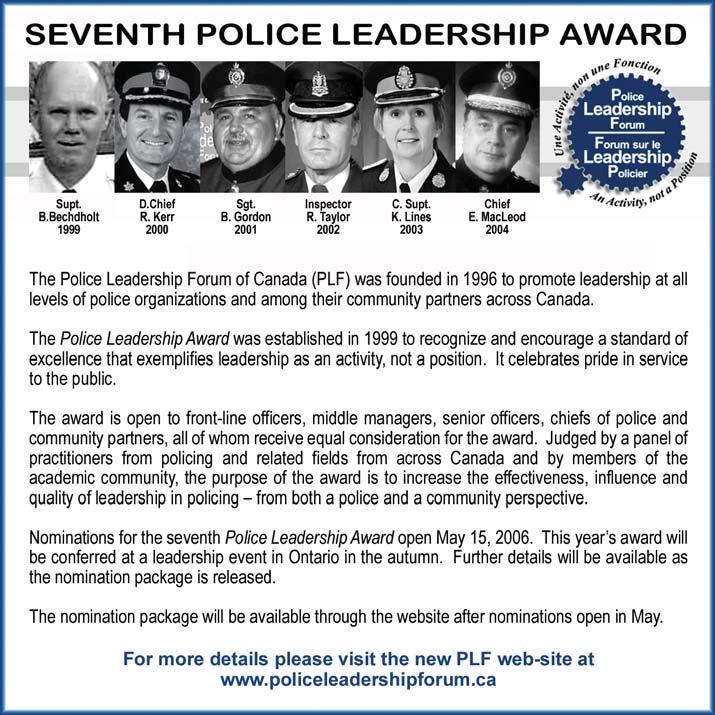
The Police Leadership Forum
Periodical Publishers Exchange
The Canadian Press Newswire
Harvey Research
Printed in Canada by Tri-Tech Printing ISSN #0847 8538
Canada Post - Publications Mail P. S. A. No. 40051073
Publisher’sCommentary5 Legislated discretion is an oxymoron
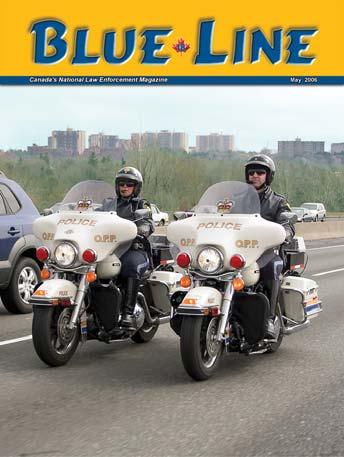
Acommandingpresence6 Creating a new culture in highway safety
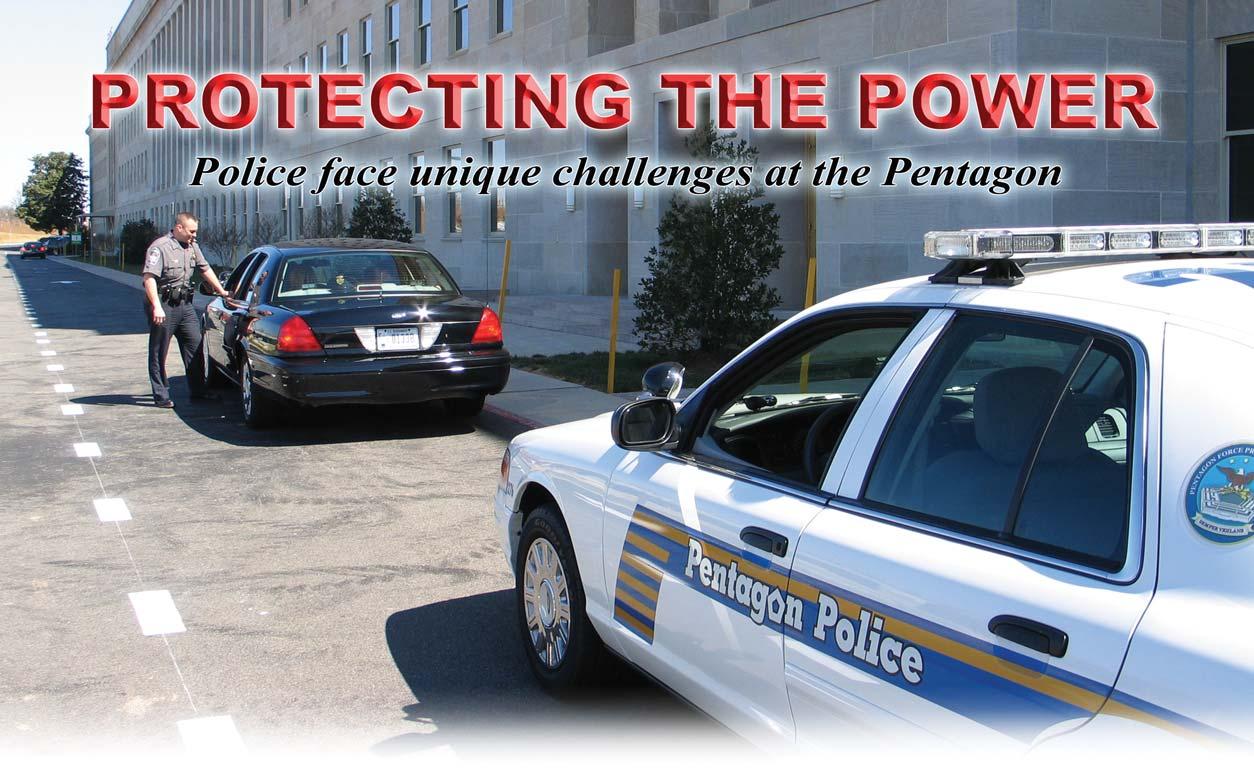
Protectingthepower8 Police face unique challenges at the Pentagon
GulfCoastpoliceneedyourhelp12
ArevolutioninCanada’scops14
Yournewneighbours16 The mouldy side of marijauna grow-ops
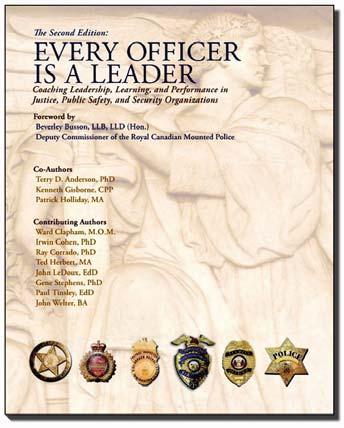
Everyofficerisaleader18 People don’t change with leaders they don’t trust
•Evidence from tainted detention inadmissable •Police often pressed for time
Achallengetoprivacy22 Guidance for the use of video surveillance
Everyonewins24 Distance education — career development
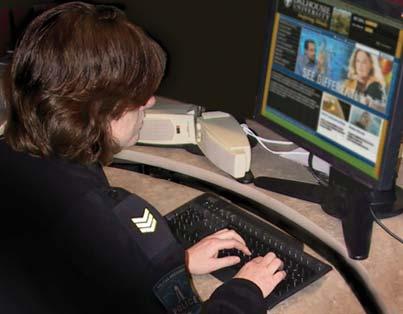
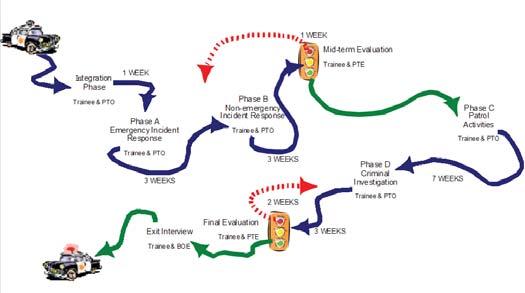
Aproblemsolverineverypatrolcar26 Innovative police training comes back home
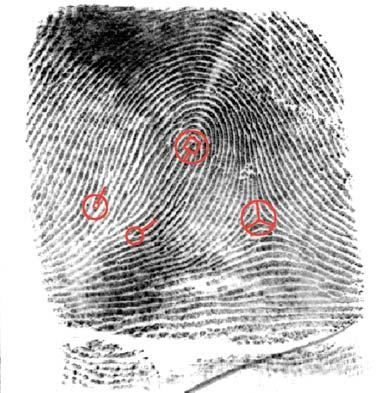
Fingerprintmatchingtemplates29
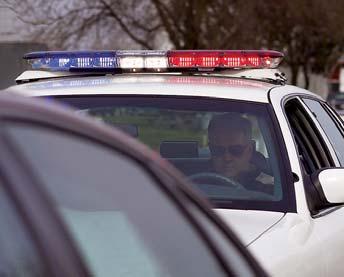
Traffic enforcement doesn’t appear to be the priority it once was with most Canadian police forces – and drivers have clearly noticed. Motorists routinely speed, cut each other off and engage in road rage, with little fear of being caught. The Ontario Provincial Police is aiming to change that with a renewed effort to target aggressive drivers. Its new highway safety division is taking a page from the best practices of other forces and, as Ryan Siegmund learned, getting back to basics in an effort to reduce Ontario’s average toll of 550 to 600 traffic fatalities a year.
Protecting and policing one of the largest office buildings in the world is a challenge in itself – but when that building is as sensitive and well known as the Pentagon, the task becomes much more difficult. MarkGiles visited Washington recently and profiles the Pentagon Force Protection Agency, which is dedicated to creating a “hard target” while also providing polite and professional police services.
Combatting criminal networks and threats posed by multi-national terrorist groups required police to develop networks of their own. JohnThompson, president of the Mackenzie Institute, looks back to when police first recognized the need to work together.
Former Canadian police officers Gerry Cleveland and GregSaville have trained police across the United States using a model based on problem solving and adult education philosophy. Their Police Training Officer program, which began in Canada, is now being offered to Canadian officers.
In our regular features, ElvinKlassen writes about how police in the storm devastated Gulf Coast need our help, Mike Novakowski has case law, DorothyCotton discusses how compassion can take a toll on first responders, DanetteDooley looks ahead to the Atlantic Women in Law Enforcement’s 15th annual training conference and TomRataj takes a look at the 311 system, little brother to 911, which is coming soon to a city near you.
Legislated discretion is an oxymoron
by Morley Lymburner
Recently I read a story out of the UK telling how the government had sent out a policy which almost legislates an officers’ use of discretion. I have several concerns about such a manoeuvring of the justice system but my biggest worry is that a Canadian jurisdiction would want to copy it.
Britain’s Home Office (sort of a Solicitor General’s office) sent out this set of rules to police agencies advising them not to send certain violators through the court system and to let them off with a caution. The list of violations would make an anarchist dream in wide screen technicolor. Can you imagine cautioning someone for a sexual assault on underage girls? Other offences listed are burglary (but only if it involves commercial buildings), threatening to kill and possession of cocaine or heroine.
need or make a bad law work. They can’t help themselves. It is in their nature to want to help and if there is no law or rule, they will find a way to patch things up — but this concept of ‘I can’t believe it’s not a law’ law goes a little too far.
It was once said that poverty is the mother of crime and stupidity is its father. If that’s the case, the mother can be helped but the father is hopelessly lost. In the same fashion we see a problem that must be addressed but, due to a political shortfall, no solution can be derived.
The policy lists violations that it suggests would otherwise be dealt with by fines, community service or short jail terms. The officers would issue the individual a form, providing they admit the violation and have no previous criminal record, which notifies them that they now have a criminal record. This despite the fact no court has ever seen the accused or determined the level of community standards or deterrence to others.
The new instructions on how to keep criminals out of the courts are given in a ‘Gravity Factor Matrix.’ This breaks down offences into four categories, with the most serious rated as four and the least as one. For criminals over 18 who admit offences ranked at the third level of seriousness, officers are instructed to lay a charge, though they’re also told a simple caution may be appropriate if it is a first offence.
Officers dealing with those who admit level two crimes are told to give a simple caution for a first offence, although a charge may be appropriate if there are previous convictions or other mitigating circumstances.
The whole concept of instituting this policy is backwards driven. The Home Office has been concerned for many years with the problem of prison overcrowding and has made efforts to advise the judiciary of this problem, but to no avail. The judges are still sending miscreants to jail in at least the same numbers as before.
In an effort to reduce the prison population, therefore, someone decided that if the intake is reduced then the opportunities to sentence them to jail are also reduced. This same thinking process now sends a directive for officers to not lay charges, and goes further by regulating the circumstances and charges that should not proceed. All of this is somehow described as “discretion.”
Where does one begin? Let’s start by getting “discretion” out of the way. I would not go so far as to say the politicians are temper-
ing discretion with deceit but using the word discretion to describe this process certainly casts doubt on their ability to value community concerns. Once discretion is regulated it magically disappears. In the case at hand this process does not even fall into a category of law because it has never borne the burden of public debate or even a legislative process.
The true attempt here is one that every officer knows only too well. Once politicians find anything in society that is out of control, they reach out to control that which is the most controllable. No organization is more accommodating than cops. They will always try to fill a
Judges certainly have a grasp of community standards but far too often lack available initiatives for rehabilitation. It is strange that western democracies have limited the tools courts have to correct societal ills. When everything is reduced to either jail or fines, probation or parole, we can expect nothing else more creative.
Great Britain and anyone else who wishes to emulate this ‘Gravity Factor Matrix’ must come to terms with the issues in a more direct fashion. If there are not enough jails, then build more. If there is not enough rehabilitation services, then ensure more are created. Once rules are sent to police to effectively alleviate a legal and political shortfall, someone should stand up and draw a line in the sand.
by Ryan Siegmund
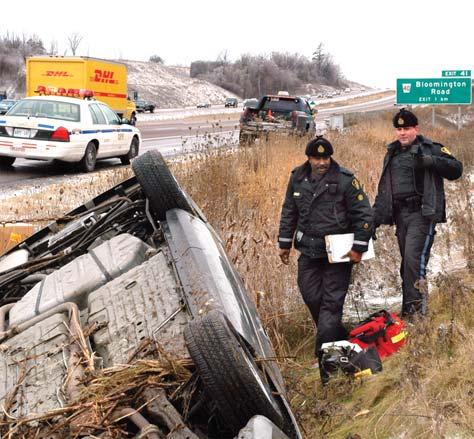
The new highway safety division (HSD) has put the Ontario Provincial Police back in the drivers seat in its effort to prevent fatalities and target aggressive driver behaviour.
In establishing the division the force cited the need to go back to its roots and broaden the scope of traffic enforcement across the province. Local problem-solving and effective deployment strategies at the detachment level, an integrated system to investigate serious motor vehicle collisions and an information sharing ‘warehouse’ highlight the restructuring process.
Tasked with patrolling a wide range of highways in Ontario, the OPP faces unique challenges in each of the six regions it’s responsible for. Efforts over the years were often localized and very seldom shared beyond a particular region – an indicator the force needed a more collaborative system.
The issues have not changed much since 1961, when the first of six studies on highway safety in Ontario was conducted. A representative from each of the six OPP regions the agency operates in formed a group in 2004 –the provincial traffic review project (PTRP) –to examine current traffic functions. With a vision to house best practices under one umbrella, the PTRP aimed to integrate the collective knowledge from the past 40 plus years to create a new HSD.
Using the Ohio State Highway Patrol as a successful case study, the project team high-
lighted particular areas of focus and made 23 recommendations to the OPP Commissioner’s Committee. They were approved in 2004 and an implementation team was established. The recommendations were condensed into six main themes – structure, leadership, supervision, awareness/education, image/profile and a traffic management plan.
C/Supt. Bill Grodzinski is in charge of the HSD, which was officially launched last year, and was tasked with championing the recommendations across the province. He says the force needs to get back to basics to improve public awareness and confidence in its highway safety activities.
“Sometimes being progressive is getting back to the basics,” echoes OPP Insp. Jim McDonnell, who heads up the traffic review implementation team and the provincial centre of excellence. “Saving lives is the mission statement of the highway safety division. I think the OPP is very good at what it does but we can always improve.”
Deployment strategies
About 20 per cent – 550 to 600 – of the approximately 3,000 fatal accidents on Canada’s highways each year occur in the OPP’s jurisdiction. McDonnell feels the force has a significant opportunity to reduce that total.
One of the contributing factors to Ontario’s high fatality rate remains occupant restraint; a Transport Canada study conducted over several years attributes 40 per cent of deaths to failure to use a seatbelt. The study indicates those numbers have been consistent across the province and the country on a year-to-year basis.
Occupant restraint is just one of the issues the OPP is zeroing in on that incorporates the Road Safety Vision 2010 (RSV 2010), a national program with the goal of reducing fatalities across the country by 30 per cent. Adapted by the Canadian Council of Motor Transport Administrators, it’s supported by all levels of government and other public and private groups.
The RSV 2010 mandate includes raising public awareness of road safety issues, improving communication and collaboration among agencies, toughening enforcement measures and better collection of national road safety data. The OPP has adopted new performance standards for officers across the province, in line with the program.
“No longer will our front-line members patrol without really knowing how their efforts fit into the big picture,” says McDonnell. “They will have specific targets such as impaired driving and occupant restraint... what really is important is getting out there in a marked car, at the proper time, and doing the right type of professional stops. Enforcement is not about doling out a bunch of tickets but more about positively impacting on people and changing driver behaviour.”
The force is returning to fully marked, roofracked cars – the aim is to have them make up 80 per cent of the fleet – because they are more visible and may act as a deterrent. The OPP is also entertaining the idea of returning to black and white cruisers, which are more recognizable to the public.
“We are letting our officers know and emphasizing to all new recruits that visibility is
part of the expectation when they go out there on patrols,” says Grodzinski. “One of the complaints we have heard over the years is that we are not seen enough on the highways. The notion of visibility patrol is not just driving up and down the highway but also strategic parking; placing a vehicle in a safe spot where it’s highly visible to people going by. You can observe a lot more by staying put then driving up and down the highway.”
Each OPP region has a different approach to dealing with issues, says Grodzinski, and methods are continuously analyzed. The most critical need is enforcement on the province’s many kilometres of controlled access highways, which require a lot of resources to patrol.
Aircraft patrols, which the force hasn’t used since 1981, could be one solution. Support for such an initiative is mounting and the OPP feels it is an essential method to apprehend extreme drivers in a safe manner. For a short term last fall, the force successfully used an RCMP fixed-wing aircraft on the 400 series highways in the greater Toronto area.
Case management system
Grodzinski says supervision gaps were identified in the investigation into an August 2001 where a driver crossed over the centre line of a two lane highway, striking another vehicle head on and killing five people. Although the responding officers did all the right things in the first instance, as time went on, the follow-up pieces to the investigation were not done appropriately, he notes.
The OPP is using the same investigative approach in dealing with serious traffic collisions as it uses for serious crimes such as homicides. The creation of a case management system – which has evolved over the past several years – allows officers to take a systemic approach and ensures collisions are followed up on properly.
Within each of the six OPP regions, the HSD (in conjunction with regional command staff) has designated area traffic sergeants –each with major case management training –to oversee benchmarking cases and work closely with local investigators. The system allows them to oversee an investigation through to its conclusion, gathering resources to do the investigation, collecting evidence, consulting with crown attorneys and following up with the victim.
A seasoned homicide investigator has been promoted to traffic staff sergeant and is championing the new collision investigation procedures for the entire province. He will work with McDonnell at the newly established provincial centre of excellence (PCE), overseeing major cases to ensure all the proper steps have been done.
“From the time the crash happens to seeing the whole court process through, our involvement doesn’t end,” says McDonnell. “We have to ensure we put the best case forward in court and get the best result... in the past, we have had some instances where those things were not done and we have learned from that. We are taking the OPP crime management approach and applying that to our serious traffic crashes where multiple people are killed (and) or where there is a criminal offence. We want to cross all the T’s and dot all the I’s.”
The driver was charged with careless driving but that was dismissed by a justice of the peace, who found there had not been proper disclosure, says Grodzinski, recalling the community’s outrage.
“When you have a serious collision, you have a responsibility to make sure all the right things are done,” he says. “The most important piece that quite often falls off the rails –not just in traffic collisions but in any criminal investigation – is keeping contact with the family and the victim.
“If you don’t have a system in place that ensures that happens, it is very easy for those things to slip off the rails – not out of neglect necessarily – but officers get busy. You have to have a system in place to support the officers; more importantly train them, lay out the expectations.”
Further illustrating the need for good case management is the amount of crossover between drivers who drink and drive aggressively on both roadways and waterways.
In-car cameras
Now in the second year of a three-year pilot project, the OPP sees their in-car camera pilot project as a very positive evidence gathering technique. Though not part of the anticipated outcomes of the new HSD, the project addresses the desire to increase public awareness and confidence in OPP highway safety activities.
“A picture is worth a thousand words,” says Supt. Nora Skelding, chair of the in-car camera steering committee. “The officers are enjoying the use of the video because it helps meet their needs in terms of documenting what took place at the scene. It also makes the officers more accountable to the public in terms of what
officers are or aren’t doing on the roads.
“We are looking at feedback from the public and reducing public complaints and civil litigation,” she says. “So far we have noticed a decrease in public complaints... usually when someone complains and they realize the whole incident is on video, it tends to resolve the issue.”
Incidents which can be resolved by pre-paid fines reduces the time officers have to spend in courts, Skelding says. For those incidents that do go to court, the in-car cameras provide good visual evidence and should have a positive impact in the criminal courts, she adds.
The OPP will evaluate the program when the pilot concludes in 2007.
Provincial centre of excellence
The PCE, located at main headquarters, encourages the sharing of best practices and performance standards from region to region. The centre funnels communication to and from area traffic sergeants and the regional traffic managers.
“What we want to do in the highway safety division and the provincial centre of excellence is to have a warehouse of best practices to share across the province,” says McDonnell, who began overseeing PCE operations in March. “It is a co-operative team effort. People supporting each other, from the initial detachment investigator to his detachment traffic sergeant to his area traffic sergeant – right up to the regional manager, who would have a link to the provincial centre of excellence.”
Two staff sergeants under McDonnell’s direction head up the PCE’s three core components: 1) the investigative support unit, which correlates the work of the case management system; 2) the specialized patrol function, comprised of the marine unit and snowmobile deployment strategies; and 3) the knowledge management unit, which will house best practices and identify trends to be passed on to the OPP Academy.
Grodzinski chairs a new traffic management committee, which brings together PCE affiliates and a representative from each OPP region. The group will engage in ongoing dialogue about high level highway safety issues. The committee recently endorsed a pilot project which began last May and focuses on data integrity by examining officer reports. Front line officers are the most important part of the chain, says McDonnell, noting the task at hand is monumental.
“The whole goal of this work is to save lives and get our people back on the roads with visibility and getting the aggressive drivers – that is the motivating factor,” he emphasizes. “We are seen as a leader in highway safety in the province of Ontario and we are expected to be a leader. The mission statement of the highway safety division is “to saves lives on Ontario’s highways, trails and waterways through professionalism, leadership and visibility.”
by Mark Giles
The desk clerk at the Watergate Hotel had no doubt heard it before, but he smiled when I asked in jest if my room would be wiretapped during my stay. At the heart of the now infamous Watergate scandal of the early 1970s, the hotel – set on the Potomac River in downtown Washington, D.C. – is a landmark among many others, including the White House, Capitol Building, Kennedy Center, and numerous war and presidential memorials.
The Watergate affair is now history, but the intense media and public scrutiny of government is not. Nor is the requirement to provide a high level of security for the many landmarks in the US capital. Several police agencies have special jurisdiction, including the Secret Service, which handles White House and presidential security, and the US Capitol Police, with responsibility for Capitol Hill and members of Congress.
On the west side of the Potomac River is another landmark – one that receives more than its share of media scrutiny and also has its own police and force protection agency. Built in the early 1940s as the headquarters for the War Department – now Department of Defense (DOD) – the Pentagon is one of the largest office buildings in the world, employing 26,000 military and civilian personnel.
Like other Washington D.C. landmarks, the Pentagon draws tourists and admirers, as well as its share of protests and external threats. Seen by some as symbolic of the US military presence around the world, the Pentagon was hit by terrorists on Sept. 11, 2001,
and will likely remain a high-profile target for enemies of the US.
In this threatening environment, protecting Pentagon personnel and assets is a huge task – one handled by the Pentagon Force Protection Agency (PFPA). Responsible for several directorates, including policing, anti-terrorism, security services, and chemical, biological, radiological and nuclear defence, PFPA manages an integrated and comprehensive force-protection program.
A civilian police agency
The largest directorate of PFPA is the Pentagon Police Department (PPD), which provides a professional on-site policing presence. Although it has a military-like rank structure, the PPD is a civilian agency with responsibility for policing the Pentagon – and its military and civilian personnel, visitors and local pedestrians – as well as approximately 40 other facilities in the metropolitan Washington, D.C. area (designated as the National Capital Region) housing DOD personnel and assets.
As military police cannot normally arrest civilians under US law, using civilian PPD officers provides the needed flexibility to do so if required. This contrasts with Canadian law that allows military police to arrest Canadian Forces members of any rank, civilian employees or others found committing offences on Defence property.
With uniforms, vehicles and equipment similar to other civilian police in North America, PPD officers provide traditional services such as uniformed patrol, plainclothes investigations and speciality support. In some
ways, however, their role and jurisdiction are unique.
“The Pentagon presents some unique challenges,” said Maj. William Stout, a senior PPD officer with 15 years experience. “We’re an open (facility), but we need to maintain our security footprint and create a hard target, while being responsive to our neighbouring communities.”
The Pentagon’s location in a large metropolitan area means that the PPD must maintain an appropriate balance between the security needs of a national military headquarters and those of surrounding communities, including the flow of large volumes of traffic on adjacent highways.
“There has to be a balance between what we do in force protection and the intrusion we place on the communities we serve,” said Chief Richard Keevill, the Pentagon’s chief of police.
After retirement as a senior commander with the Virginia State Police, Keevill joined the PPD as chief in early 2004 and holds the equivalent of the rank of colonel. With a uniform and equipment maintained to ‘boot-camp’ standards, he fits right into the military environment. Speaking slowly and with confidence, he explained the organizational structure of the PPD and expectations of his officers.
With deputy chiefs responsible for operations, special operations and investigations, the PPD has capabilities similar to those of most other major police agencies. Specialty units include an emergency response team, crowdcontrol unit and canine. In addition to an obviously visible policing presence, the chief made it clear there are many other resources and capabilities that are not seen.
Perimetre security and access control
Security is tight and multi layered, but not oppressive. With marked and unmarked police vehicles, and motorcycle and bicycle patrols, the perimetre of the Pentagon is actively patrolled both day and night. This presence is supplemented with a wide array of high-tech security systems – including cameras, sensors and other surveillance and monitoring equipment – and more traditional physical-control measures such as fencing, and heavy-duty gates and barriers.
Access control uses a combination of technology and police personnel. Visitors are carefully processed in stages, passing through an airport-like screening procedure. It’s thorough and in line with the chief’s philosophy of protecting the Pentagon while providing polite and professional policing services.
“I tell my officers to smile, but to keep their guard up,” said Keevill. “We try to be as outwardly friendly as we can, but we have a job to do too.”
As in any security or policing operation, achieving the right public relations versus security balance can be difficult. For properly documented employees or visitors, the process is smooth and allows quick entry to the workplace. The challenge comes when visitors – sometimes general officers or other senior-level officials – arrive at the last minute without pre-clearance. Often in a hurry to attend important meetings, PPD officers must achieve the balance – one that is tested from time to time.
Although most last-minute arrivals are visitors with normal business at the Pentagon, they are occasionally part of an audit – similar to those employed at most major airports to test the screening process. If the appropriate public relations versus security balance is not achieved, the incident is reported to the chief. After review, the lessons learned would
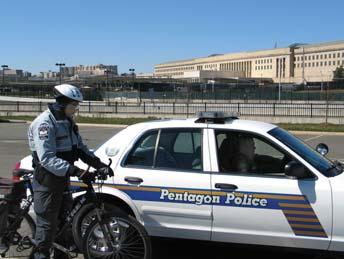
As part of a civilian police agency, Pentagon police officers provide a variety of policing services, including bike, motorcycle and marked and unmarked patrols.
then be incorporated into future operations and training.
Although many aspects of its policing operations are routine, the PPD conducts some random actions to maintain a tactical advantage, sometimes implementing anti-terrorism measures without warning. These random actions act as a deterrent to would-be criminals or terrorists, further enhancing an already solid force-protection program. They can, however, have a significant impact on the flow of local traffic, which is heavy at the best of times.
“A random anti-terrorism measure changes how we look to the outside world, sometimes backing up traffic for miles and miles,” said Keevill. “We have to be careful – but the people who were here on 9-11 won’t forget that day. Terrorists don’t take days off and neither can we.”
Liaison and accreditation
In addition to protecting the building and thousands of military and civilian personnel, the PPD must also deal with vehicle and pedestrian traffic in the area. With several highways in close proximity and a Metro (subway) station at the Pentagon, developing and main-
taining strong working relationships with other agencies is essential. The PPD works closely with other law enforcement and regulatory agencies in the Washington, D.C. area, including the FBI, Metro Transit, US Parks and Arlington County police and the Federal Aviation Administration.
“The close relationships we have with neighbouring law enforcement are invaluable,” said Stout. “On Sept. 11, we could set up a joint command structure very quickly because we already knew each other and our respective roles.”
In addition to ongoing liaison with other law enforcement agencies in the region, the PPD makes efforts to establish relationships in specific areas and currently has an officer assigned to the FBI’s Joint Anti-terrorism Task Force. The department is also actively pursuing accreditation with the Commission on Accreditation for Law Enforcement Agencies (CALEA) and the International Association of Chiefs of Police – a rigorous process that can take two years or longer.
Staffing
Providing policing and security services for the Pentagon – essentially a small city – is no easy task. Although the chief would not release the PPD’s actual strength for operational security reasons, he did confirm that PFPA has an authorized strength of more than 700. Even assuming that PFPA and the PPD operate at less than full strength, the police-to-population ratio appears to be far higher than that of most North American cities. The Pentagon is no ordinary city, however, and considering its vital role, additional resources to ensure a safe and secure environment are easily justified.
The PPD recruits both new and experienced officers. New officers complete a 12-week training program at the Federal Law Enforcement Training Center in Glynco, Georgia. They are paid relatively well, earning a starting salary of $44,000 (US) – sometimes more for those with additional education or experience – and progressing through a series of pay increments over a 15-year period to a maximum of almost $100,000 for frontline officers.
With its high ‘cop-to-pop’ ratio, professional policing presence, close relationships with other agencies, and a vast array of sensors, cameras and other high-tech security equipment, the Pentagon is probably one of the best protected buildings in the world. Criminals or terrorists should probably think twice before contemplating any action against what appears to be a very ‘hard target.’
“The Pentagon is a fast-paced work environment with many important missions,” said Maj. Susan Idziak, press operations officer with the Office of the Assistant Secretary of Defense for Public Affairs. “With the Pentagon police and PFPA providing force protection, security and policing services, we can better focus on our own jobs.”
Mark Giles is Blue Line’s correspondent for the National Capital Region (Canada), public and media relations, and military-related issues. This article was written with the assistance of PFPA and the Office of the Assistant Secretary of Defense for Public Affairs.
Photo by Mark Giles
Gulf Coast police need your help
by Elvin Klassen
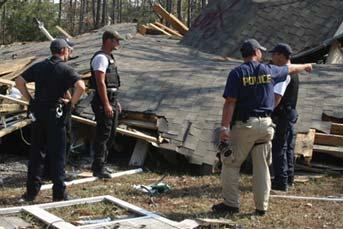
‘Officer down, officer down.’ The words which galvanize all police officers crackled over the radio as Hurricane Katrina blasted the Gulf Coast last fall. The airwaves soon fell silent as 240 KPH winds and wave surges up to 13.5 metres destroyed everything in their path.
Caleb Williams, a 24-year-old Gulfport Police Department officer, was just leaving for a holiday with his wife and three daughters when he heard the news that Katrina was on its way. He sent his family to Texas and reported for duty; that night the storm claimed his home and all its contents. To this day William’s house is just a pile of debris, but he is still expected to pay the mortgage payments.
Many residents continue to live with the devastation. A curfew is still enforced at night in the beachfront cities of Biloxi and Pass Christian; some areas have not been touched since Katrina and visitors require a police escort to enter.
“We have all seen the newsreels of the damage... and wondered how anyone survived,” said Brian Gannon, chaplain of the Surrey/Delta Fellowship of Christian Peace Officers (FCPO). “I took many photos (while visiting) but even after four to five months, it can never truly show the utter devastation that is in these cities.”
On the beach, huge white machines sift the sands, removing buried trees and sometimes
human bodies. Trees and other material stick up for many hundreds of metres out into the Gulf, reminders of what was stripped off the land and then swept back out to sea as the waters rushed back. Everywhere there is a smell of decaying matter, although much effort has gone into cleaning up the streets.
“When I arrived, traffic lights were finally being hung back up in the downtown business section of Gulfport that took the brunt of Hurricane Katrina’s force,” says Gannon. “Houses that appear ready to be bulldozed have signs written in large letters ‘Please do NOT destroy,’ (put up) by homeowners not wanting their house bulldozed.”
Suicides and homicides have increased greatly in the months since Katrina struck and the population in many Gulf cities is half of what it was before the storm. Restaurants are trying to reopen but cannot find the staff they need.
Forty one members of the Gulfport Police Department, which serves 250,000 people, lost everything and others had varying amounts of damage to their homes. Police and firefighters wore t-shirts or whatever else they could scrounge with their agency name on it in the weeks after the storm; they are now back in full uniform.
FCPO members from across Canada and the US are helping Gulfport and Biloxi first responders rebuild; several hundred in the first five months alone spent up to ten days ripping out walls, repairing roofs and moving tons of refuse. Twenty homes have been restored, says Gannon, who adds these were the easy ones and it’s now time to rebuild entire homes. Williams’ family is still living in Texas and he has resigned from the Gulfport department so he can join them, leaving behind a home that still holds all their destroyed belongings – except for his youngest daughter’s black teddy bear, which a Canadian FCPO member found and cleaned.
Many people are staying put. Gannon tells of a female officer who “kept saying her home was livable and that she needs to help others first. On inspection it became apparent that she and her invalid husband were trying to remove walls and redo the roof. Now, thanks to FCPO, they have a new roof and the walls are back up. She did not know how to thank the workers. Her appreciative hugs made coming to help all worthwhile.”
Volunteers will continue to be needed, says Gannon, who adds you don’t need construction experience to help. “Anyone who can swing a hammer, please come.”
Elvin Klassen, Blue Line’s west coast correspondent, can be reached at elvin@blueline.ca
Saskatoon Police Chief Russell Sabo was honoured by Saskatchewan First Nations leaders for healing broken relations between the First Nations community and police. Federation Vice-Chief Lawrence Joseph says members wanted to thank Sabo for his work, noting things have improved in Saskatoon under his leadership. Joseph says federation members are upset Sabo’s contract was not renewed by Saskatoon’s board of police commissioners. “Open your eyes. There haven’t been any freezing deaths since he’s been here,” he said. “He had the courage to stand up to the status quo.” Seventyfour aboriginal leaders from the Saskatchewan First Nations attended the special ceremony.
Saskatoon Deputy Police Chief Dan Wiks is retiring, avoiding further disciplinary action relating to the Neil Stonechild inquiry. Wiks became embroiled in controversy after he told a reporter that police had no indication of possible officer involvement in the freezing death of Stonechild. Saskatoon Police Chief Russell Sabo, concerned the remarks gave the appearance police were hiding the truth, filed charges against Wiks. Wiks, cleared of those charges, was found guilty of a minor charge of negligence. Wiks says he holds no grudges against Sabo, saying the chief did what he thought was best for the police service. “I want to leave the department with a positive feeling and the police service has treated me very well over the course of 33 years,” Wiks says.
Durham Regional Police Deputy Chief Rod Piukkala has announced his retirement from the service. Piukkala started his career with the Peel Regional Police almost 34 years ago and has been instrumental in many policing initiatives during his career. In 1994, he was chosen by the US government to deliver international training to police officials and those training to be officers in foreign countries, most notably Somalia. Over his career, Piukkala has received the police exemplary service medal, the police medal for bravery, as well as being chosen as officer of the year in 1984, then with Peel. He led DRPS in the establishment of the nuclear security division, post 9/11.
Former Federal Privacy Commissioner George Radwanski has been charged with fraud and breach of trust stemming from an expense abuse scandal in 2003. Radwanski’s lawyer, Eddie Greenspan , says it was unnecessary for the RCMP to make their investigation public over two years ago and then leave a cloud hanging over his client. Greenspan says the charges will give Radwanski a chance to clear his name, adding the investigation has not revealed anything new since the auditor general discovered over $500,000 in improper travel and hospitality expenses in the privacy commissioner’s office. Radwanski, who resigned amidst the 2003 scandal, had his $82,562 severance package reduced to nothing as a penalty.
Calgary Police Chief Jack Beaton is pleased with the results of a $140,000 review of the Calgary police service complaint process. The independent review found the current system provides top quality investigations, although the results are slow coming in. “This report highlights some of the best practices we’ve put in place . . . but also some opportunities to improve,” Beaton says. The review recommended the force look into a high-tech system that would register all complaints filed against an officer, with red flags issued to reoccurring problems. Beaton deflected any suggestion the proposed profile system would unfairly flag officers who are doing their jobs.
A revolution in Canada’s cops
by John Thompson
For the last few decades, Canadian police have had to cope with an increasingly sophisticated criminal environment and severe technological challenges. Yet today’s police officers are now part of a series of networks reaching through our entire society and far more likely to engage in predictive policing – getting ahead of problems before they manifest themselves. How is this done?
One of the maxims in the War on Terror is that “it takes a network to fight a network.” Most modern terrorist groups and criminal societies evolved into networks years ago, with loose cells clustered around specific localities or activities and group reliance on shared backgrounds and common ethnic/cultural identities for socialization between these nodes. Traditional police and security approaches could only tackle one node at a time, seldom with decisive effect.
In the early 1960s, some Canadian police were already beginning to recognize the limitations of conventional approaches in tackling criminal societies. A meeting of Canada’s Attorney Generals in 1966 proposed to create a central clearinghouse for information on organized crime. By 1970 this had manifested in the Criminal Intelligence Service of Canada (CISC), with a central bureau in Ottawa and nine provincial entities.
The CISC has grown slowly, with every sign of the usual cautious reticence about public involvement that is typical of Canadian civil servants and senior police officers. Yet even as early as 1976, it led to the creation of the Automated Criminal Intelligence Information System, one of the world’s first police compu-
ter networks. The CISC gathers raw data and specific intelligence and pools it for further refinement and analysis.
Currently some 380 agencies and entities contribute to and make use of the CISC. The RCMP’s commissioner heads the organization and 22 representatives from other police forces with permanent intelligence units meet twice a year to steer the group, share new concerns and direct new priorities.
The main focus of the CISC is on criminal societies and major criminal activities. Counter-terrorism is not a part of its usual brief or mandate, but there are many ways around this. The report for 2004 highlights the leaky security at Canada’s ports and airports, a situation that organized crime already capitalizes on, but also one which represents a risk from opportunistic terrorists.
A central role for Canada in North American security also revolves around the Smart Border Initiative along the Canada-US border. The CISC is expressing concerns about organized criminal activities on the border and supports the new Integrated Border Enforcement Teams (IBETs) in countering them.
Some police intelligence units are large formal organizations and mirror the CISC in their own right. The Criminal Intelligence Service of Ontario (CISO) is largely run by the Ontario Provincial Police, but has representation from several municipal and regional police forces. Others face complex jurisdictional environments in their localities – Halifax and Vancouver police have to contend with major rail and port facilities within their cities, which are often administered by federal laws and once had their own specialist agencies.
Vancouver, like Montreal and Toronto, have also seen large suburbs evolve into cities in their own right, leading to a need to co-ordinate more closely with nearby municipal police forces than might be the case for Saskatoon, St. John’s or Yellowknife.
The initial role of police intelligence services, particularly in cities, is to collect and collate data concerning criminal activities that occur on an ongoing basis. One of the usual functions of these groups, particularly after the formation of the CISC, was to liaise with other
forces and share information. Most members were long time detectives or specialist investigators recruited from vice, narcotics and homicide squads. They also enabled the internal transfer of information between such squads, which sometimes wasn’t easily accomplished.
While the RCMP Security Service was concerned with foreign spies and members of hostile political groups within Canada (such as the Communist Party of Canada or the KKK) provincial and municipal police forces had no mandate to investigate these issues. Outside of Quebec, where police faced FLQ bombs throughout the 1960s, terrorism was barely on the mental horizon of most police.
In preparing for the 1976 Olympic Games in Montreal, the memories of the massacre of athletes in Munich in 1972 loomed large. The RCMP was aware that Black September and other Palestinian groups were trying to stick their toes into Canadian waters as early as 1972. Police in our major cities were also coping with increased political violence from émigré communities and had learned from the European and American experience with radical leftist terrorists.
The 1985 Air India bombing and the takeover of the Turkish embassy in Ottawa proved instructive and more forces started to devote intelligence resources to potential sources of terrorism. An additional spur came from the growing activities of the Animal Liberation Front (ALF).
While free to investigate a terrorist attack and treat it purely as a criminal matter, collecting material on Anarchists, ALF supporters, activists for the Khalsa movement or the Tamil Tigers was only incidental for most police forces. Without the authority and legal tool kit to act against terrorist groups, most could only collect material for background purposes.
Another development in police intelligence emerged from investigations into high profile serial offenders in the 1980s and ’90s. Police were slowly learning the benefit of using multiple professional perspectives, particularly from the forensics side, in trying to uncover the habits of some serial killers to learn more about their behaviours and future patterns. Some vital pioneering work in this field came out of the geographical profiling methodology that was developed in British Columbia in the mid-1990s by the Simon Fraser University’s School of Criminology, in co-operation with the Vancouver Police Department and the RCMP. This is one of several tools in suspect prioritization and data management that have emerged within the last decade in Canada, the U.S. and Great Britain. Another technique that emerged from organized crime and street-gang investigations in the U.S. has become widely accepted. Police
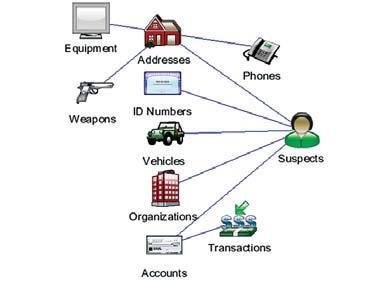
intelligence agencies now start to map out the organization by taking known gang members or mobsters and then charting out all of their movements and all of their social contacts. Eventually sufficient data enables analytical models to provide a picture of the larger network and to identify pivotal figures who might have otherwise escaped the notice of the police.
The creation of the CSIS was the result of a lengthy inquiry into the RCMP’s Security Service, its long time intelligence branch. The whole history of the service has been recounted elsewhere and someday the service might actually get the plaudits it often deserved, but it was clear that the federal government wanted to make a new start.
Since 1984, the agency has managed to mature as a security service. Between mishandling the Air India investigation, jurisdictional issues and teething problems, there were numerous press reports about CSIS/RCMP infighting, even though both organizations report to the Solicitor General. The seeds of a fruitful co-operation with police were planted with the Canadian Security Intelligence Service Act, which mandated the creation of the organization and defined its powers. The act allows CSIS to enter into joint activities with Canadian police forces, with the oversight of the Special Intelligence Review Committee and the various provincial attorneys general. It took a few years for police and CSIS to warm up to each other, especially as both tended to remain protective of their sources.
In the early 1990s, the police were starting to recognize the worth of networking through CISC and its satellite organizations and were getting used to occasional inputs from CSIS.
For the criminals, a major engine of growth was the black market in cigarettes, although the overall size of this industry at its height in 1993 was a fraction of that of the ongoing market in narcotics and illegal drugs. The tobacco smuggling conduit across the Canada/U.S. border was also leading to a flood of illegal small arms inside Canada, most of which were ending up in the hands of an increasingly diverse criminal scene on our streets. Cops are invariably the first to recognize a new problem and the flood of firearms triggered “Project GunRunner,” a collaborative investigation among five Ontario forces between 1992 and 1994.
The startling findings from Gun-Runner lead to the creation of Ontario’s Provincial Weapons Enforcement Unit (PWEU) to try and tackle the problem. The unit was created as a subset of CISO and became a task force with involvement from the RCMP, OPP and numerous metropolitan/regional forces in the province.
The growing diversity of Canada’s criminal scene was also noted in the early 1990s. This also led to a proliferation of police task forces, oriented toward particular problems. Expertise especially with municipal police in some major cities and long- serving detachment commanders with the RCMP, led to a greatly increased appreciation between various police forces. The task forces were also holding seats open for representatives from Transport Canada, Canada Customs and Revenue, Im-
migration Canada and for occasional American liaison officers.
The rapidly accumulating experience in joint task forces would soon stand Canada in good stead. With the passage of Bill C-36 and a set of tough new anti-terrorism laws in early 2002, Canadian police had the go-ahead for even closer work with CSIS and started to aggressively develop intelligence on terrorism. One early spinoff was the creation of Integrated National Security Enforcement Teams (INSETs). These combine police with assets and personnel from Transport Canada, National Defence, CSIS and the Border Agency. INSETs have been created in several Canadian provinces, particularly for work in major ports and other areas with complex jurisdictional environments.
Ontario has also seen the creation of the first JFO (Joint Force Operation), which again combines municipal, provincial and federal police with CSIS and input from other federal and provincial agencies. The JFO is mandated to undertake strategic intelligence work and is developing its own ‘human sources’ informers, to facilitate its own investigations. In Ontario, both the JFO and the CISO have also established regional task forces and a similar process is at work in other provinces.
PATS is another new acronym on the Canadian policing scene: Provincial Anti-Terrorism Sections. Most provinces have created them to work with their INSETs and IBETs. These preceded work on the new smart border initiative between Canada and the United States and combine a variety of Canadian and Ameri-
can agencies working as joint forces around critical border areas. The successes of the smuggling industry in the early 1990s are not likely to be repeated.
This alphabet soup of acronyms shows how Canadian police intelligence has been extensively re-organized in the last five years. Most major municipal and regional police now have reorganized their intelligence services to reflect the multi-agency task force concept. Some Canadian municipal police forces also have liaison officers from major American cities and vice versa. These networks of interlaced agencies at the federal, provincial, regional/municipal and local levels are working in loose conjunction. The organized criminal and the terrorist/security-focused networks operate in loose tandem to add an extra dimension to their capabilities.
Canada’s police intelligence agencies at every level of government have become nodal points in overlapping networks, which share information and intelligence data on a timely basis and can work on joint investigations without any of the time consuming delays and obstructions that occurred so often in the past. Being a network-oriented structure, they can now be more flexible and responsive. To fight networked problems, the police have finally developed networks of their own.
John Thompson is president of the Mackenzie Institute, which studies political instability and terrorism. This article is an extract from the Institute’s July 2005 newsletter. Thompson can be reached at jt@mackenzieinstitute.com Visit www.mackenzieinstitute.com for more information.
by
It looks like a regular house from the outside but inside, the grow-op is a disaster. The growers are on their way to the station after the raid and officers are leaving for their next call.
You’ve just brought the property owner into the house and she’s stunned at the tangled mess of wiring, warped floors, damaged ceilings, mould stains and planters left behind by her renters.
You’ll check her background, of course, but it appears she had no idea that this illegal indoor farm had been operating on her property, so your role is to build community relations by advising how she can make the best of a bad situation. To do so, you will need to understand some of the structural implications of grow-ops.
The big reason behind their growth is money. Some estimates indicate that a residential operation can produce 1,600 plants a year and $1.6 million in profit. Marijuana grow-ops are big business throughout the country, but particularly in BC. Environmental health and safety firm Golder Associates reports its Vancouver office receives three or four calls a week requesting assistance in assessing and remediating former indoor grow operations.
The Canadian Real Estate Association estimates that there are at least 50,000 grow-ops in Canada today and this number is likely to increase. The operations leave behind a host of problems:
•Growers generally alter the electrical system to disguise the sudden increase in demand from dozens of high-wattage bulbs – and their amateur wiring can pose a major fire hazard.
•Ventilation systems are usually reconfigured.
•Hazardous substances and controlled products such as pesticides, fungicides and herbicides may have been applied in high dosages and remain as a residual hazard.
•Perhaps most devastating, the increased water activity in the home usually results in high
humidity, causing indoor mould proliferation.
In most cases, the homeowner’s insurance policies will not cover the assessment and/or remediation costs, which can range from $5,000 to $50,000. According to the Insurance Bureau of Canada, the average claim to repair the damage caused by a grow-op is $41,000. Sometimes, the damage is so extensive that demolition of the building becomes the only fiscally responsible option.
In many cases, the problem is with sublet properties. Property owners may find that a carefully vetted tenant was transferred out of province or overseas for work and the people who sublet the space found it a perfect, worry-free opportunity to produce an unauthorized crop.
Anyone who discovers an illegal grow-op on their property should be cautious. Pot growers often show little restraint in protecting their livelihood. They may have guard dogs and rig booby traps, such as electrifying doorknobs.
While it is not the job of police to provide legal advice, giving property owners some suggestions and an idea of their legal obligations to the municipality may help build community relations. It is important to note that these obligations vary widely, even among adjacent municipalities.
The Canadian Mortgage and Housing Corporation is developing national remediation guidelines for grow-ops, to be made available later this year, which may include qualifications for companies who assess and remediate damage. Until then, property owners should consult a qualified professional to assess structural and mechanical damage; lists are available from some municipalities.
Assessing mould and moisture damage should be done in general accordance with recognized protocols for microbiological assessment and control, which typically includes:
•a visual investigation of the building’s accessible interior areas;
•moisture level measurements of building materials showing signs of previous and/or
current moisture damage;
•installing visual assessment ports by removing building materials where fungi and/or moisture can be seen to examine building cavities;
•covering the inspection ports with polyethylene sheeting and duct tape;
•lifting floor coverings and ceiling tiles;
•inspecting the heating, ventilation and air conditioning (HVAC) systems;
•collecting bulk/surface samples from materials suspected of being contaminated with fungi;
•collecting and analyzing air samples for fungal analysis;
•documenting existing building conditions, including site photographs.
Following the assessment, a detailed work plan for remediation of mould and water damaged building materials must be developed and a qualified contractor retained to complete the work.
A structural or building science engineer or other specialist may also have to be retained following the mould remediation work in order to determine if repairs are required to the building envelope and HVAC systems.
For any rental property, the key to dealing with grow-ops is prevention. In conversations with the general public and specifically with property owners, police should spread awareness of the telltale signs of a potential problem tenant. This can include applicants who prefer to pay their rent and deposit in cash, do not offer good references, show little interest in the layout of the house and, perhaps, show undue interest in its electrical system.
Property owners must screen and select tenants carefully and insist on approving sub lease tenants. In helping prevent grow-ops from sprouting in a community and in detecting those that do, police perform a valuable role in preventing a very unpleasant situation from developing.
Andreas Wagner, M. Eng, CIH, ROH can be reached at awagner@golder.com or 905 567-4444.
Andreas Wagner
Street had six grow-op homes
CTV.ca News Staff
In an exclusive investigation, CTV Toronto has obtained a list of locations of former grow-op houses throughout Toronto, including one street that had six different operations within the last three-and-a-half years.
Using a freedom of information request, CTV Toronto received the list from the Information and Privacy Commission of Ontario. The commission overturned an initial refusal by police, calling the issue a matter of public safety.
A small residential street in Vaughan, Purcell Crescent stood out amidst all the others on the list. The street has had six marijuana grow operations dismantled in the last three-and-a-half years. One house on the street was busted by police in 2003 and then again in 2005. The new owner, who bought the house in a private sale, was caught off guard by the news saying he “just bought the house.”
A few doors away, another owner said she only found out that her home was once used as a marijuana grow-op after she bought it.
York Region Police Chief Armand La Barge told CTV Toronto that the street was targeted by criminals because most of the properties are rented.
“Where there’s a higher preponderance of houses for rent or lease then you’re probably going to find more marijuana grow operations,” La Barge said. “It’s easier, believe it or not, in a busier subdivision to carry on these types of activities without being noticed.”
Many on the street were aware of the raids but were still shocked by how many homes have been busted.
To avoid buying a former grow-op home, prospective home buyers should ask their real estate agent questions about any prospective house. Agents are legally obliged to disclose any damaging information about a house. Another option is to send a certified home inspector to the house before closing a deal or
including a disclosure clause in your contract.
Bob Aaron, a real estate lawyer, said he thinks the CTV Toronto investigation will set a precedent in Canada for disclosure to become a common practice. “I think finally the privacy commissioner has realized that the police were wrong in refusing to release the information,” Aaron said.
Currently, police services in London, Ont. and Calgary post a list of grow-op street addresses on their website.
“I can just imagine now there will be a host of freedom of information requests to police forces across the province and eventually, hopefully sooner than later, it will become common practice across the province,” Aaron said.
Police at 42 Division in Toronto have recently started to release information after an abundance of requests. Supt. Gary Ellis is leading that ground-breaking initiative. “It’s public information,” Ellis told CTV Toronto. “If people know they can help; what they don’t know they can’t help with.”
But other agencies in Toronto, Peel and York regions continue to reveal information only on a caseby-case basis. That means if the grow-op house does not pose a specific health risk to the public the information will remain confidential.
Commenting on the investigation, Minister of Community Safety Monte Kwinter told CTV Toronto that home buyers should be kept aware of former grow-op houses. “If a house has been used as a growop and there is a possibility that there is physical deterioration, whether it be mould or structural damage, then a potential buyer has the right to know that that is the case with that house.”
He said that a proposed grow-op registry will be discussed at a future meeting involving police, government officials and real estate agents.
Crack house handed over to province
HAMILTON — The site of many criminal activites in the city of Hamilton’s recent memory has been forfeited to the province of Ontario under a court order.
Ontario’s Attorney General’s office took over control of a crackhouse in the downtown part of the city that has had a history of drug deals and murders occur there. The building was turned over to the province under the Civil Remedies Act, on the grounds it was being used for unlawful activity.
Ontario’s Attorney General Michael Bryant and Hamilton police Chief Brian Mullan stood on the notorious property to make the announcement.
Bryant called the building a “blight on downtown Hamilton” and said he’s pleased it “has been shut down for good.”
The property forfeiture not only included the defunct Sandbar tavern and two floors of cheap rooms for rent, but also a bank account containing approximately $10,000.
In the past 10 years, the property has seen two crack cocaine related murders, stabbings and numerous drug charges.
by Terry Anderson
Every officer is a leader
People don’t change with leaders they don’t trust
“The First Law of Leadership: If we don’t believe in the messenger, we won’t believe the message.” — Jim Kouzes and Barry Posner
In all organizations, the catalyst for high-performing teams, productivity, and quality enhancement is people. Change agents must understand how to assist leaders to plan for and implement change. If those leaders do not have the skills to be effective with their people, the change effort will likely be perceived as undesirable and therefore undermined to some extent—and momentum for positive change can be lost.
Leadership is the primary factor that distinguishes organizational effectiveness from ineffectiveness over the long term. Most organizations perform poorly in the selection of competent leaders because they lack a clear description of the skills good leaders should have. Some organizations have discovered that through good fortune rather than good practice, they have had good leaders.
But luck is no longer good enough for even organizational survival. Stories are told of communities where decisions are suddenly made to reduce law enforcement agencies or replace emergency medical services with private providers. In some cases, these changes have resulted in reduced effectiveness.
In our complex and demanding time in his-
tory, everyone must become a leader of at least himself or herself to even live effectively. This inner strength forms the foundation of effective leadership of others. Therefore, the successful people and organizations of the future will have taken personal, leadership, and management development seriously. Self-leadership will become a common word; effective leaders will become culture-change leaders. They will engage in what Kotter calls “the high-
est act of leadership”—“to institutionalize a leadership-centered culture.” This quote expresses the most profound of insights about leadership development and its relationship to organization development.
We support the research that suggests it is impossible to reduce observed and effective leadership to a definitive set of skills, traits, or competencies. True transformative leadership includes many other factors such as character, spirit, vision, wisdom, and skills.
We have also observed over and over again that many well-intentioned, sincere, committed, honest, inspiring, and even wise leaders often lack self-management, interpersonal communication, and coaching, counseling, and consultative skills. These absolutely critical skills deficits can seriously interfere with the leader’s ability to carry out systems thinking, achieve personal mastery, use mental models, build a shared vision, and facilitate team learning.
How many managers have you personally observed who were competent in doing the technical aspects of the job—often the main reason they were promoted—but who lacked the basic skills to be innovative in designing systems and building relationships, teams, and organizations with credibility? In truth, you have likely seen some of them even be destructive.
The worst turn of events observed by the authors is that people are promoted to supervisory or management positions because of task or technical competencies and the assumption that they are competent for the systems design, interpersonal, problem-management, and team development aspects of their new leadership roles. If they assume they are already competent as managers, what do they do? Stop learning? Manage more? Lead less?
Think of people you know who are like this. What problems have they caused you or others? What names or words do you and other people use to describe their incompetence? Yet, it usually isn’t their fault. They have not been trained to the required level of competency in these critical skills.
In one author’s personal interviews with many managers enrolled in the Transforming Leadership courses at the two universities where he taught them, he observed that managers are often full of theories about effective leadership and that they lack many of the practical skills, the know-how, and the capability to implement them. Without a strong grounding in the skills of leadership, the practices of the learning organization will not get off the ground. Efforts will be undermined because people will not cooperate or change with leaders they do not like or trust.
If managers are not skilled leaders, it’s probably not their fault.
Providing people with opportunities to assess and learn the foundational skills of selfmanagement, communication, counseling, consulting, and versatility will prepare and equip them to be exemplary leaders in their new learning organizations.
Why are leadership capabilities, as Senge
says, so rare among managers? Most managers have not developed the competencies they must have to lead effectively—and it is usually not their fault. They have not been able to find education or training programs that truly equip them with the competencies they need to lead teams toward higher performance and morale. Most of the universities and training programs they have attended have not coached them to competency in the critical leadership skills they must have to be effective.
The reason for this is that the education they have received has rarely been competencybased, comprehensive, or applied in their lives or workplaces—where it counts the most. Learning often gets lost when it is confined to classrooms or to isolated, off-site training sessions. Their program of learning is usually education about theory—with no or little awareness of skill—or Level 2 or 3 on the five-point rating scale used to assess competency.
Level 1 Not familiar with the skill
Level 2 Familiar with the skill, but cannot perform it very well at all
Level 3 Can perform the skill on his or her own with conscious effort
Level 4 Can perform the skill naturally in a wide range of situations
Level 5 Can help others learn the skill
For example, in the law enforcement community, there is a prevalent and unwritten presumption that training is something that is done when you are not doing real work. When you leave training, it is time to return to the real world. When you add to this assumption a general lack of organizational support for the development and promotion of true leaders, the current lack of demonstrated leadership skills is not surprising.
Even most MBA programs in the past few years have begun to realize how important it is to provide a competency-based curriculum. Smart employers are demanding that MBAs present a wide range of demonstrable competencies before they hire them.
Many universities—for example, City University, Trinity Western University, Simon Fraser University, Ball State University—have used the First or Second Edition of Transforming Leadership: Equipping Yourself and Coaching Others to Build the Leadership Organization to provide a map and a training program for learning the attitudes, qualities, and skills of leadership in their leadership programs. This is in addition to their traditional theory-based curriculum.
More and more companies now have formalized mentoring or coaching programs to ensure that those who move into management positions are realistically prepared to meet the challenge successfully.
Many organizations “throw their new managers into the deep end, see who can swim best, and promote the strong swimmers further.” Others orient them to their new jobs by pairing them up with politically correct but relatively incompetent senior managers who model and pass along the “psychopathology of the average.” But most of all, the job role and skills of leadership (compared to the traditional manager) have been poorly and vaguely defined; therefore, it has been most difficult to formulate a relevant curriculum for leadership development.
Another factor influencing leadership development is that some managers may not be
comfortable with competent leaders in their organization for fear that their own lack of leadership skills will become evident to others. Also, some managers are uncomfortable with building a learning organization because of the requirements for transparency and accountability. Organizations that are hierarchical in nature are often managed by those who prefer the political accountability afforded by that traditional hierarchy. For example, a study of situational leadership in the law enforcement community, conducted by one of the contributors to the book Every Officer is a Leader, contained data indicating that virtually no executives are comfortable with Level 4 behavior. . At this level, the leader allows the follower to
take the lead. The subjects are far more comfortable using a level where the boss keeps control. Many law enforcement and paramilitary executives do not seem to believe they can be perceived as successful if they let go of the traditional controls. This exclusive reliance on formal sources of legitimate, reward, and coercive power by managers has made employees increasingly wary, in a time of challenge, to traditional management approaches.
This has been an excerpt beginning on page 13 of the recently revised book “ Every Officer is a Leader ” CoAuthored by Terry Anderson, Kenneth
and Patrick Holliday. This recently released book may be obtained through the Blue Line Reading Library or order on line at www.blueline.ca .
Hells Angels rebuilding
MONTREAL (CP) — Hells Angels bikers, once the scourge of Quebec streets, are rebuilding after their ranks were decimated five years ago in the massive Operation Springtime police crackdown.
Although a number of the imprisoned bikers will be locked up for more than 20 years, others have started to trickle out and the gang’s visibility is beginning to grow.
“It’s started already since the beginning of the year,” said Guy Ouellette, one of the top experts on outlaw bikers in Canada. “They show their colours everywhere they go.”
But the notorious Nomad chapter, led by the swaggering - and now imprisoned - Maurice (Mom) Boucher is history.
“The best thing about Springtime (is) the Nomad chapter doesn’t exist anymore,” said Ouellette, a retired Quebec provincial police officer. “The name Nomad will never be seen again in Quebec.”
The Springtime raids were the largest ever push against the bikers in Canada and involved more than 2,000 police officers.
It particularly targeted the notorious Nomad chapter, which was composed of the so-called generals in the bloody eight-year biker turf war, which cost 165 lives including that of a child who was a bystander to a car bombing.
Puppet clubs, which used to do the bulk of the grunt work for the Hells, have been mainly abandoned since 2001 because the gang realized part of the police success in the Springtime raids was due to their ability to recruit informants in the affiliates.
“They kept only the best recruits,” said Ouellette. “They helped these guys into the entourage of the Hells Angels and they promoted these guys.”
But there’s little interest in reviving the Nomads.
“It brings too much attention from police agencies,” Ouellette said. “When you talk about Nomads, you’re talking about the biker war, you’re talking about death, innocent victims.
The name Nomad will never be used again and will be scrapped in their vocabulary.”
Restructuring was left to the five remaining chapters and that is going well with increased numbers, Ouellette said.
Even some of the Hells rivals in the Bandidos have switched sides in jailhouse conversions since 2003.
The Bandidos no longer exist in Quebec but are present in small numbers elsewhere in Canada.
Ouellette added that bikers scooped up in another major drug sweep after Springtime are expected to reappear from jail in 2008.
Police appear to be trying to avoid repeating the mistakes of the 1980s when they staged their first major crackdown on the Hells after the massacre by the gang of their rogue Laval chapter, most of whose members
were killed for dipping into the club’s stash of drugs for sale.
Satisfied their efforts then had crippled the gang, the police basically laid off, opening the door for a reorganization that laid the groundwork for the bikers’ efforts in the 1990s and beyond.
This time police aren’t letting up.
Ontario has taken over from Quebec as the province which has the most bikers but Det.- Insp. Don Bell of the Ontario Provincial Police Biker Enforcement Unit says there’s no hint of shenanigans like in Quebec.
“I think they’re keeping a lower profile across the country,” Bell said in a recent interview. “I think the rationale behind that would be that they found the civil war in Quebec just generated too much adverse publicity and led to police budgets getting increased to combat the problem created by their violent activity.”
Sixteen of the Hells’ 34 Canadian chapters are in Ontario and they are about to add two more, said Ouellette.
The newest chapter is in Hamilton and another is likely in Guelph. Ontario has about half the Hells membership in Canada.
“The Biker Enforcement Unit has a huge task to fight organized crime,” Ouellette observed, noting there are about 200 Hells in Ontario. “It’s going quite well because just last year there were five major operations involving Hells Angels and arresting Hells Angels across the province,” he said. “I think they’re doing their job.”
Several other successful operations have also been carried out in other provinces.
Staff-Sgt. Bob Bazin, director of the Criminal Intelligence Service Saskatchewan, said the Hells have “changed their tactics quite a bit.”
“What you had going on in Quebec was not the norm in the rest of the country, in fact probably in the rest of the world, for the Hells Angels,” Bazin said. “You tend to see a lot of stuff here behind the scenes. “Certainly they’re very much in control of the drug trade in a good part of the country, although they are learning to co-exist with some of the many other groups that are also engaged in the same activity.”
Bazin said Saskatchewan has a couple of puppet clubs that work with the Hells and the bikers have ties to the growing street gang population, which also deals in drugs and guns ranging from handguns and rifles to automatic weapons.
“Frankly, they tend to co-exist together quite well,” he said. “We do have many indications where they’re working together.”
Bazin, who is an RCMP officer, said police in Western Canada continue to hammer away at the bikers and noted there have been several operations against them in British Columbia in recent years.
Gisborne
Evidence from tainted detention inadmissible
by Mike Novakowski
The Supreme Court of Canada has reinstated the acquittal of a man police detained and searched in suspicious circumstances, ruling his Charter rights were violated.
scales in plain view, more marijuana under the driver ‘s seat and just over a kilogram of marijuana in the trunk. After the search was complete – about 20 minutes after the arrest –Chaisson was advised of his right to counsel, taken to the police station and searched further, which turned up additional drug items in his pockets.
In R. v. Chaisson, 2006 SCC 11, a police officer saw a lone vehicle with two occupants parked in a dark parking lot behind a closed gas station just after midnight. There was a 24-hour donut shop and a closed restaurant nearby. The car wasn’t running and its lights were out. The officer pulled up along the passenger side, about three feet away. The occupants did not initially see him, but were shocked when they did and the driver threw something on the floor.
The officer asked the men what they were doing and requested they get out of the car. As the passenger exited, the officer saw, in plain view, a plastic bag containing marijuana on the floor and a small piece of the drug on the seat. He arrested Chaisson, who was behind the wheel and placed him in the back of the police car, then arrested the passenger and held him outside the vehicle.
A search of the car turned up two sets of
At trial in Newfoundland Provincial Court (2004 N.J. No. 120) Chaisson was acquitted on a charge of possession of marijuana for the purpose of trafficking. In the trial judge’s view, his Charter rights were violated. The detention was arbitrary since the officer was acting only on a hunch (a s.9 breach) and should have cautioned the vehicle’s occupants before they were told to get out (a s.10(b) breach).
As the judge noted, “but for the detention, the marijuana on the floor would not have been discovered (and) but for the marijuana on the floor being discovered, there would have been no right to arrest (the occupants).” The warrantless search was prima facie unreasonable and infringed s.8 of the Charter. Although, in the words of the trial judge, the officer “served the community well by getting such a large quantity of drugs off the street,” the evidence was excluded under s.24(2). The Crown appealed to the Newfoundland Court of Appeal (2005 NLCA 55), conceding breaches of the accused’s rights under ss. 8 and 9 but arguing the trial judge’s decision to ex-
clude the evidence was in error. In authoring the unanimous appeal court judgment, Justice Welsh rejected the Crown’s concessions. Although Chaisson was detained when he was asked to get out of the vehicle, Welsh found the detention wasn’t arbitrary.
In her view police are entitled to detain persons for investigative purposes, provided they act within the scope of their duties recognized under statute or at common law – which includes the preservation of peace, prevention of crime and protection of public order – and the detention is necessary to perform the recognized duty (reasonable grounds to detain – formerly known as articulable cause). In holding that the detention passed constitutional muster, Welsh stated:
I conclude that the officer did not arbitrarily detain Mr. Chaisson within the meaning of section 9 of the Charter. Given the location of the vehicle, the time of day and the reactions of Mr. Chaisson and the passenger, exhibiting shock and apparently trying to hide something, the officer had reasonable grounds to suspect that the occupants of the vehicle were involved in criminal activity and that a detention for the purpose of questioning them was necessary. The detention was conducted in a reasonable manner and was very brief in duration (para. 28).
The seizure of the evidence in this case, Welsh concluded, fell into two categories –plain view and search incident to arrest. Following the seizure of the plain view bag containing marijuana, the officer arrested Chaisson. The power to search incident to an arrest may include an automobile, provided police are attempting to achieve some valid purpose connected to the arrest, such as protecting or discovering evidence. Here, “the search was conducted in a reasonable manner and for the purpose of discovering and preserving evidence incidental to arrest,” said Welsh. Similarly, the search back at the police station was also conducted in a reasonable manner and for a valid purpose incidental to the arrest.
However, under s.10(b) of the Charter, an arrestee is entitled to be advised of his right to counsel without delay (which effectively means immediately). In this case, the officer did not advise Chaisson of his rights until some 20 minutes after arrest, which amounted to a breach –but contrary to the trial judge’s decision, Welsh ruled the evidence admissible under s.24(2). The Crown’s appeal was allowed, the acquittal set aside, a conviction entered and the matter remitted back to the trial judge for sentencing.
Chaisson appealed to Canada’s highest court, which unanimously allowed the appeal. In the high court’s view, the trial judge was entitled to reach the conclusion he did based on the facts as he found them in holding Chaisson’s rights under ss.8, 9 and 10(b) were violated.
Furthermore, the trial judge did not err in finding that the cumulative effect of these breaches warranted the exclusion of evidence under s.24(2). In holding otherwise, the Newfoundland Court of Appeal erred in “substituting its own findings of fact for those of the trial judge.”
The acquittal was restored.
Police often pressed for time
British Columbia’s highest court has upheld a man’s cocaine possession conviction after police detained him and searched his vehicle in what the trial judge described as “urgent and heightened circumstances.”
In R. v. Mollazadeh, 2006 BCCA 35, a police officer received a priority one call of a shooting at a nightclub. He took up a containment position and heard over his radio that the persons involved were reportedly leaving in a black, four door vehicle. The car was travelling through an intersection and passing a police vehicle, the caller said. At that moment the officer saw a black four door Jetta drive by, accelerate and pass other vehicles.
He followed and stopped the car once backup arrived. The driver, Mollazadeh, and his passenger were ordered out and a search for weapons turned up crack cocaine. At trial in BC Supreme Court Mollazedah argued that police ignored other information available (the suspected shooter was a black male, a Corvette was of interest and six males ran into a dark, four-door sedan) and therefore did not have articulable cause to detain him. The trial judge, however, found the detention justified, stating:
The accused argues that the police ignored information that, if considered, would have alerted them to the possibility that the Jetta wasn’t reasonably involved in the shooting. That information included the police radio broadcast concerning a black Corvette,
six male occupants in a four-door sedan and a black male suspect in a red T-shirt. However, (the officer) could not recall hearing that information.
He testified that, once he saw the dark fourdoor sedan pass him on Hornby Street and heard that the suspect vehicle was travelling north on Hornby and was passing a police vehicle at that location, he was then focused on the task of following that vehicle.
The police were responding to a high priority call, which calls for immediate response. They had a duty to check all leads. They did not have the luxury of waiting and synthesizing all the information available to them.
When the police pulled over the Jetta, they knew that a shooting had recently occurred at the Urban Well. They had a description of a dark four-door sedan. They were
told it was travelling north on Hornby Street.
The sedan was reported to be passing a police vehicle at the very location (the officer) was posted in his police wagon. There was a reasonable concern that the persons fleeing the scene of a shooting would have firearms in their possession.
In my respectful view, that information constitutes, in the urgent and heightened circumstances of this case, a combination of objectively discernible facts that justified the police detaining the occupants of the Jetta.
Mollazadeh was convicted of possession of a controlled substance for the purpose of trafficking but appealed to the BC Court of Appeal, arguing he was arbitrarily detained and the drugs should not have been admitted as evidence.
Justice Ryan, delivering the opinion for the court, disagreed. In her view, the trial judge did not err in her analysis and the appeal was dismissed.
Visit www.blueline.ca/resources/caselaw for the complete case. E-mail caselaw@blueline.ca to reach Mike Novakowski
REGINA — The government of Saskatchewan has begun a new chapter in the way criminal complaints against police officers will be investigated.
A new public commission will handle such complaints against officers, a function that was previously the responsibility of the police service themselves and or an outside agency.
Public complaints dealing with discreditable conduct, neglect of duty, and abuse of authority is the responsibility of a civilian police complaints commissioner.
The change in governance stems from recommendations made in the inquiry report on the death of 17-year-old Neil Stonechild, who was found on the outskirts of Saskatoon back in 1990. It has been alleged Stonechild had been taken there by police means of punishment.
The five member complaints commission must have First Nations and Metis representation.
Stella Bignell, Stonechild’s mother, said her youngest son had been taken outside the city before but feared repercussion. She says having such a commission before may have saved her son’s life.
The change in practice calls for the new commission to investigate criminal complaints with police, as well as complete an investigation against a member or chief of police even after a resignation occurs.
Police will also be required to consult with the deputy minister of justice if someone is severely injured or dies while in police custody. It will then be the minister’s responsibility to appoint an investigation observer from another police service or RCMP detachment to see it though its progression.
Former NDP justice minister Bob Mitchell, who has been serving as the police complaints commissioner, will chair the new commission.
New Saskatchewan complaints system
Salvadore
Dali
Over the past ten years, digital cameras have shrunk in cost and size, and have proliferated across the country. Networking these cameras used to be a significant expense, but now thanks to the Internet, wireless hubs, and progress in digital streaming and image compression, transmission adds little expense or technical challenges.
As a result, and partly in response to a growing perception that surveillance increases our security, video surveillance of public spaces by public sector authorities, private sector parties, and property owners is increasing rapidly.
Video surveillance of public places presents a challenge to privacy, to freedom of movement and freedom of association, all rights we take for granted in Canada. This is especially true when the surveillance is conducted by police or other law enforcement authorities.
Widespread use by law enforcement
The use of video surveillance to detect, deter and prosecute crime has increased significantly over the last few years. Police and law enforcement authorities increasingly view it as a legitimate tool to combat crime and ward off criminal activity—including terrorism. Recent events have heightened the interest of public authorities in deploying video-surveillance in public places. It is widespread in the United Kingdom and increasingly used by law enforcement and anti-terrorism authorities in the U.S. and Canada, particularly since September, 2001.
Here at home, police and public security agencies monitor public parks and streets. Some cities have put in place video surveillance systems for specific festival periods. The RCMP use cameras to monitor high-se-
curity areas such as Parliament Hill. Cameras are used to survey Canada-US border crossings. They are extensively used in airports, and port authorities are becoming increasingly interested in using video cameras to monitor their facilities.
A challenge to privacy
Video surveillance of public places subjects everyone to scrutiny, regardless of whether they have done anything to arouse suspicion. At the very least it circumscribes the expectation of privacy and anonymity that we have as we go about our daily business.
The medium allows law enforcement to observe and monitor a large number of persons, most of whom are law-abiding citizens. When video surveillance was done with tapes, where an operator had to watch each event to make a judgment about an individual, the volume of work kept misuse down to a minimum. Now facial recognition systems and pattern recognition software can massage the vast stream of images, so the actual use of the data increases, even if it is not by human operators. The likelihood of images being retained for further data mining increases because the workload is now manageable. The risk of systematized observations of groups or persons now exists, because it is technically feasible. On top of all this, fear of terrorism and street crime has driven the numbers of cameras up, as public officials seek to assuage the fears of citizens and gain control.
The spread of video-surveillance raises a concern that inferences will be drawn about people, and that the data will be used for trivial or discriminatory purposes. People are well aware of the presence of cameras, and there is good reason to believe that video surveillance of public places by the police or other law enforcement authorities has a chilling effect on behaviour—and by extension on rights and freedoms.
The need for guidelines
Given the widespread use of video surveillance in public spaces, and its potential effect on privacy, the Office of the Privacy Commissioner of Canada (OPC) offers these guidelines to help define the use of video surveillance. The guidelines set out principles for evaluating the need for video surveillance and for ensuring the impact on privacy is minimized.
These guidelines established jointly by the Office of the Privacy Commissioner of Canada and the RCMP with other stakeholders, following a 2001 investigation into the use of video surveillance in Kelowna.
In formulating the guidelines, the extent of use of video surveillance in Canada and abroad, the circumstances that gave rise to this use, the way in which video surveillance has been conducted, and an assessment of the effectiveness of the tool in curbing or investigating crime were examined.
Nothing in these guidelines should be considered to interfere with the discretion of the RCMP or the Officeof the Privacy Commissioner of Canada to carry out its responsibilities, especially with respect to any complaint filed by an individual under the Privacy Act or the Personal Information Protection and Electronic Documents Act (PIPEDA).
Scope of application
The guidelines are meant as guidance for overt, general video surveillance, “community cameras,” by law enforcement agencies in places to which the public has largely free and unrestricted access, such as streets or public parks.
They apply to continuous or periodic video recording, observing or monitoring of individuals in open, public spaces, in the absence of particularized suspicion of an individual(s).
While the guidelines can be used to promote and protect privacy in cell blocks or in-
by The Office of the Privacy Commissioner March, 2006
terview rooms, and more generally could be useful as guidance for other applications of video surveillance technology, their scope remains within the limits of generalized surveillance of public spaces.
These guidelines are not intended to apply to circumstances where targeted video surveillance may be used as a case-specific investigative tool for law enforcement purposes, under statutory authority or the authority of a search warrant.
The OPC anticipate that there will be further technical advances in video-surveillance, and that the appetite for its deployment will continue to grow. Since they started working on these guidelines, there has been continued interest on the use of video surveillance by privacy and data protection authorities, in Canada and abroad. For example, in early 2005, the United Kingdom Home Office published an in-depth study assessing the impact of closed-circuit television systems implemented in a range of contexts. Closer to home, a number of provincial governments and authorities have published guidelines for the use of video surveillance by public bodies. These include British Columbia, Alberta, Saskatchewan, Nova Scotia, New Brunswick, Newfoundland & Labrador, Ontario, and most recently Quebec in particular which completed an extensive consultation on the use of video surveillance cameras in public places.
As our knowledge of the efficacy and impact of video surveillance increases and becomes more precise, adjustments to how this technology should be controlled will need to be made. As part of its Contributions Program, the OPC awarded funding to Quebec’s l’École nationale d’administration publique (ENAP) in the fall of 2004, for research on the use of video surveillance cameras in public spaces in Canada. The OPC received ENAP’s research report in December 2005 and plan to integrate its findings in future work on video surveillance.
The Office of the Privacy Commissioner will monitor the guidelines set out in this document to ensure they continue to reflect needs dictated by technology and its implementation. Meanwhile, OPC is analyzing the application of PIPEDA to the deployment of video surveillance by the private sector, and plans to publish its findings this year.
Guidelines
1. Video surveillance should only be deployed to address a real, pressing and substantial problem. Specific and verifiable reports of incidents of crime, public safety concerns or other compelling circumstances are needed, not just anecdotal evidence or speculation.
2. Video surveillance should be viewed as an exceptional step, only to be taken in the absence of a less privacy-invasive alternative.
3. The impact of the proposed video surveillance on privacy should be assessed before it is undertaken.
4. Public consultation should precede any decision to introduce video surveillance.
5. The video surveillance must be consistent with applicable laws.
6. The video surveillance system should be tailored to minimize the impact on privacy.
7. The public should be advised that they will be under surveillance.
8. Fair information practices should be respected in collection, use, disclosure, retention and destruction of personal information.
9. Excessive or unnecessary intrusions on privacy should be discouraged.
10.System operators should be fully aware of the purposes of the system, and fully trained in rules protecting privacy.
11.Security of the equipment and images should be assured and limited to persons authroized in writing. Recordings should be securely held, and access within the organixation limited to a need-to-know basis.
12. The right of individuals to have access to their personal information should be respected.
13. The video surveillance system should be subject to independent audit and evaluation, and should ensure compliance with policies governing the system.
14. The use of video surveillance should be governed by a comprehensive written policy and should clearly set out:
•The rationale and purpose of the system.
•The location and field of vision of equipment.
•The rationale and purpose of the specific locations of equipment and fields of vision selected.
•Which personnel are authorized to operate the system.
•The times when surveillance will be in effect.
•Where and when recording will take place.
•The place where signals from the equipment will be received and monitored, and
•The fair information principles applying to recordings, including: security, use disclosure, retention and destruction, rights of individual access to personal information captured, and rights to challenge compliance.
15. The public should have a right to know about the video surveillance system that has been adopted.
Police forces and public authorities should recognize that individuals will want information about video surveillance systems. They may seek to know who has authorized the recording, why their images have been recorded, what the images are used for, who has access to them, and how long they are retained. Police forces and public authorities should be prepared to provide this information.
The full text of this document may be obtained by going to the web page at: http://www.privcom.gc.ca/information/ guide/vs_060301_e.asp
Who is the Privacy Commissioner of Canada?
The Privacy Commissioner of Canada is an Agent of Parliament who reports directly to the House of Commons and the Senate. The Office has two Assistant Privacy Commissioners, Heather Black and Raymond D’Aoust and an External Advisory Committee, which launched in February 2004.
The Commissioner is an advocate for the privacy rights of Canadians. Her powers include:
•investigating complaints and conducting audits under two federal laws;
•publishing information about personal informationhandling practices in the public and private sector;
•conducting research into privacy issues; and
•promoting awareness and understanding of privacy issues by the Canadian public.
The Commissioner works independently from any other part of the government to investigate complaints from individuals with respect to the federal public sector and the private sector.
Individuals may complain to the Commissioner about any matter specified in Section 29 of the Privacy Act. This Act applies to personal information held by the Government of Canada.
For matters relating to personal information in the private sector, the Commissioner may investigate complaints under Section 11 of the Personal Information Protection and Electronic Documents Act.
As an ombudsman, the Commissioner prefers to resolve complaints through negotiation and persuasion, using mediation and conciliation if appropriate. The Commissioner has the power to summon witnesses, administer oaths and compel the production of evidence if voluntary co-operation is not forthcoming.
Privacy Commissioner of Canada
Jennifer Stoddart was appointed Canada’s Privacy Commissioner by the Governor in Council, effective December 1, 2003, on unanimous resolutions adopted by both Houses of Parliament for a seven year term.
Ms. Stoddart was previously President of the Commission d’accès à l’information du Québec, an organization responsible for both access to information and the protection of personal information, to which she was appointed upon resolution by the Quebec National Assembly in 2000.
Ms. Stoddart has held several positions in public administration for the Governments of Quebec and Canada, including at the Canadian and the Quebec Human Rights Commissions.
She has been active in the Canadian Bar Association and is currently a member of the Board of Directors of the Canadian Institute for the Administration of Justice.
She has taught history and legal sciences at the Université du Québec à Montréal and McGill University. She has published for both professional journals and the wider public on questions ranging from Quebec social history to the administration of justice and human rights.
Ms. Stoddart received a licence in civil law from McGill University and was admitted to the Quebec Bar in 1981. She also obtained an M.A. in History from the Université du Québec à Montréal, and pursued doctoral studies at the Université de Paris VII.
Everyone wins!
Distance education can be a vital key to career development
by Tom Haney
Most police services recognize that in order to keep pace in a fast changing world, modern police personnel have to embark on what amounts to a career-long educational journey.
The law, technology, citizen expectations and service delivery methods have undergone a paradigm change in the past generation and all indications are that things will move at an even greater pace in this new wireless world. If for no other reason than due diligence or civil liability, a chief has to ensure that they are leading a smart, well informed service. In fact, the cost of in-service education has and will continue to be one of the major line items in any police budget. The challenge is how to get the best bang for the buck.
The fact is that distance education is not suitable for all types of police training or education. Some technical, hands on skills can still best be taught in a classroom setting and there is no substitute for the personal interplay, mutual instruction and vital networking that takes place in SPAC type courses. These form a vital part of a police career experience and should be savoured.
Distance education however does offer certain distinct advantages to both the police of-
ficer and his/her service and should be considered when thinking of the spectrum of training and education throughout the officer’s career.
Disruption – Police managers today have pretty well signed on to the notion that a holistic approach to an officers work is in everybody’s best interests. The fewer times that he/she is taken away from their families, the less potential trouble there is on the home front. Life as a police officer is hard enough with the shift work, trauma exposure and social isolation without adding absences that can
be avoided. Every time an officer is away on training, there has to be backfilling which is both disruptive to those filling in and of course results in costly overtime. Some small departments or isolated detachments can’t function without a member and as a result either training does not take place or it can only be done by distance education.
Direct Costs – When you sign up for a distance course there is the initial cost (usually lower than residence courses) and that is it. As budget managers know so well it is the hidden costs that drive up the training budget. Distance education means that no travel, meals, accommodation or overtime bills come back to bite the budget. This produces a situation that can radically lower the individual cost per course allowing either a direct savings or greater opportunity for more training across the board.
Suitability For Promotion – Several police services have made police leadership distance education courses a prerequisite for a candidate to even submit his/her name for consideration to a promotion board. There is good foundation for this reasoning. For an officer to be successful in a distance education course they will have to dedicate quite a bit of their own time and effort to the task. This not only demonstrates that the officer is willing to invest in their own future but also that they have the self discipline and organizational skills that are required of a police leader. These courses also establish a common threshold knowledge level that is very useful for the promotion board’s decision making platform.
Faculty – By using distance education, with its reduced necessity for on campus staff, travel, and disruption, the learning institution is able to retain the best subject matter experts available. For example distance courses now available retain a combination of practicing and retired police officers and educators that reads like a ‘who’s who’ in the world of police theory and practice.
Distance education is not the only method available when considering how to train and educate within a police service but, for all the reasons listed above, it should be used to keep costs down and stretch the training budget while still receiving a top quality product.
Tom Haney is the Director, Police Leadership Programmes Dalhousie University College of Continuing Education. A graduate of St. Mary’s University, Tom spent 30 years as an officer in the Military Police, where he filled a variety of operational, staff and instructional posts including two tours of duty with the Special Investigation Unit. He is the former Chief Instructor of the Military Police Academy and was the Canadian Exchange Officer to the Royal Military Police in the UK. He may be reached by phone at 902494-6440, by Fax at 902-494-2598 or eMail to Tom.Haney@Dal.Ca
RCMP puppies get names starting with ‘S’ from kids in Canada-wide contest
Canadian Press - Tuesday, April 04, 2006
Innisfail, AB — Ten Royal Canadian Mounted Police (RCMP) puppies now have new identities—or at least new names—following the sixth national “Name the Puppy” contest held by the RCMP Police Dog Service Training Centre (PDSTC) in Innisfail, Alta. Once again the contest was very successful with a total of 7,500 entries, including 250 classroom entries, from across the nation.
As in previous years, participants came up with original, popular and unique names. One winner was selected by draft for multiple entries of the same name. The ten winning puppys’ names and winners are:
•Scout, named by Zachary Grigg, age 12 from Tyne Valley, P.E.I.
•Sherman, named by Samantha Meeker, age 10 from Mount Pearl, Nfld.
•Sniper, named by Rebecca Konynenbelt, age 13 from Lethbridge, Alta.
•Steele, named by Brendan Holmes, age 13 from Regina, Sask.
•Swat, named by Ross McBee, age 8 from Whitehorse, Yukon
•Star, named by Jovonni Simpson, age 11 from Wha Ti, N.W.T.
The top ten winners will receive a laminated photograph of their “officially” named puppy, an official RCMP ball cap, a stuffed puppy named “Justice” and a certificate.
•Sonic, named by Kayla Louie, age7 from Vancouver, B.C.
•Serge, named by Eric Webster, age 8 from Langley, B.C.
•Sherlock, named by Nicolas Clavette, age 10 from Edmundston, N.B.
•Smudge, named by Piero Buldo, age 13 from Toronto, Ont.
The winners of the classroom entries—selected on the basis of creativity—are Ethelbert School, Ethelbert, Man., and Miss Tiercey’s grade three class, Mary Queen of Peace, St. John’s, Nfld.
Each classroom will receive a laminated picture of RCMP puppies, a stuffed puppy “Justice” and a certificate. Please note that other entries will also be used to name future puppies.
The officer in charge and the staff of the RCMP Police Dog Service Training Centre would like to thank all the young Canadians who entered the contest and express their sincere appreciation for their efforts.
PDSTC is the national training centre in Canada for all RCMP police dog teams. Currently, there are 133 RCMP police dog service teams from coast to coast. In the last 71 years, RCMP dog teams have saved hundreds of Canadians’ lives.
A problem-solver in every patrol car Innovative police training comes back home
by Gerry Cleveland and Gregory Saville
A successful police training model based in problem solving and adult education philosophy is sweeping across the US – and the good news is that it began in Canada. With many baby-boom generation officers nearing retirement, its arrival is fortuitous.
The Police Training Officer (PTO) program uses problem-based learning (PBL) as its predominant teaching method and incorporates modern research on teaching and learning. PTO encourages and trains problem solvers and reduces the current training-inspired mentality of random patrol, rapid response and post crime investigation. The objective is to train recruits to effectively apply problem-oriented policing while learning other fundamental policing skills.
Many police services call themselves COPPS (Community Oriented Policing and Problem Solving) organizations – but naming a thing does not make it so. Despite the best efforts of its advocates, COPPS hasn’t had the institutional impact at a grass roots level that many community and police leaders had hoped. To ensure imbedded change occurs, police leaders must distance themselves from traditional field training, which reinforces the incident-driven call-responder and saps the creative, problem-solving skills of new recruits. Instead, they must look forward towards PBL and more advanced training opportunities for new officers.
Those of us reforming COPPS are often frustrated at the glacial pace of change. “I think the vast majority of claimed efforts to implement community policing are very superficial and very, very thin,” observes Herman Goldstein, “because of a lack of understanding of what it is we’re trying to achieve… and because of a lack of real commitment.”
The long standing question remains – what can be done to both accelerate and entrench COPPS reform? It may simply be a matter of waiting until reforms take hold but in other instances, research suggests reforms are hampered by the reality of daily policing, which occurs in a complex environment with a heavy workload. Most officers in a class we conducted in the US Midwest felt they were moving rapidly from call to call, all day, every day. The silence was deafening when the chief told them current data showed they were answering only four calls per shift.
Whatever the case, one fact is certain. Recruit training is where attitudes in our profession are first formed. That precious 12 to 24 weeks often serves as an attitudinal gateway where minds are either opened or closed to COPPS. Each agency passes on its values and mission through the filter of recruit trainers. For reform to work, new members need more than just basic COPPS training.
Commitment and training to make intelli-
gent decisions, solve problems and think critically is crucial to forging a community focused mindset. Officers often roll their eyes when asked about community policing, describing it as serving meals to ‘shut ins’ or other tasks that take them away from ‘serious policing.’ Even younger, keener officers are often not sure exactly what it entails or how they can engage in it more effectively. Many officers intuitively know this negative perception is incorrect but seem locked into a cycle of training that perpetuates silo thinking.
A broader approach will only occur when they learn how to apply problem solving and task analysis in daily work. This rationale led to the creation of the PTO model, which employs PBL, activity analysis and self-discovery as its core behaviours.
The need for a new model
We and members of various agencies have developed and implemented just such a change of practice. This project was sponsored by the office of Community Oriented Policing Services (COPS) and supported by the Police Executive Research Forum (PERF). Our research team realized that it had the opportunity to fundamentally change the attitudes, practices and habits of the next generation of officers. To use Thoreau’s phrase, we decided to dig at the roots of the problem rather than hack at its branches.
With officers who regularly and creatively employ problem solving from the earliest stages in their careers, we have moved the implementation of COPPS to a new level throughout the US. The PTO program increases both its awareness and practice, with the goal of creating a new era in police-community responsiveness.
History of the model
The Reno Police Department, with our help and money from COPS, began working on a new training officer program in 1999 in collaboration with PERF. We met with various experts and conducted a nation-wide survey of more than 400 police agencies, reviewing dozens of training manuals and the field training systems of agencies across the US and Canada. The result was a manual and problem-based learning course for training officers which has spread widely across the US. In conjunction with the COPS office, we are currently training instructors from across the country to satisfy the demand for more PTO courses.
Why focus on field training?
This phase provides an ideal opportunity to influence a trainee’s future behaviour as he or she passes through the ‘gateway’ into the profession. The axiom ‘get them early and train them right’ has significant application to police training. It is critical to introduce recruits to the essential practices and customs of the job during their first few months. Field or police training officers play a critical role in establishing the operating practices and philosophy of their trainees.
The PTO model stems from the needs of police recruits to learn problem solving methods of COPPS as part of their duties. More than 70 per cent of departments surveyed use traditional field training officer (FTO) model programs, which are increasingly ineffective at helping recruits learn how to apply problem solving. Recruits do not practice community policing and problem solving, or they engage in it incidentally and randomly rather than consistently and comprehensively. This trend is worrisome at a time when police and community leaders herald COPPS reform as the new orthodoxy in law enforcement.
What is PBL?
Problem-based learning(PBL) begins with a real life problem, with subsequent learning and teaching occurring in the context of solving that problem. Learners generate ideas, discuss known facts and learning issues and decide on a plan of action or way to resolve the problem. In essence, they think, act and learn within the context of solving assigned community problems. Each must develop problem solving skills, such as breaking down the problem, understanding the issues and managing time in resolving problems effectively. This benefits the officer throughout their career and engenders a more creative, thoughtful approach to policing a community.
The PBL method, formalized decades ago to train doctors in medical school, creates a small learning group for problem solving and discovery. Traditionally students are taught unrelated and often isolated and disparate facts, then asked to apply them at some later date. PBL calls for learning within the structure of solving a given problem and using learning groups to achieve it.
The PTO model differs from other PBL approaches because of the unique nature of the patrol car classroom, making it necessary to modify the learning group format. The recruit continues to learn by solving problems presented by their training officer but must begin to reach out to appropriate community members as part of their leaning group.
For example, recruits must solve a problem regarding gang activity and drug sales in a park near a high school. They learn during the resolution how best to apply drug law, search and seizure, officer safety, constitutional rights, weapons offences, interpersonal communication techniques and other knowledge acquired at the academy. Their training officers support and guide them throughout the process.
Recruits also learn to reach out to the community to help solve the problem. In this case, they should consider local school officials, neighbours, park maintenance workers, by-law enforcement officers, local council officials, area youth and other police officers – all constituents in the ‘learning group’ trainees must consult to find and implement an appropriate solution.
Recruits are expected to develop a schedule to accomplish these tasks within their workload and learn to develop their own policing style by applying academy knowledge rather than engaging in mimetic learning and simply copying their training officer’s style. This builds both competence and confidence and encourages them to use the skills and talents they brought into the profession.
Evaluation
Daily evaluation reports are fine if your main purpose is evaluating, but recruits need to learn how to properly and confidently apply policing methods. Officers should be trained, not just evaluated.
The new PTO model moves away from the intensive focus on evaluation of previous models. PBL focuses on training new recruits to a desired level of competence, not evaluating them from the first moment they hit the street.
The burden of daily observation reports stifles learning and decreases willingness to move beyond the training officer’s vision, according to many officers and survey feedback. The PTO model uses many more types of evaluation than previously offered, all based on helping the recruit learn.
Evaluations occur in:
•12 weekly training and coaching assignments;
•4 phase assignments;
•1 neighbourhood portfolio exercise; •2 formal assessments by external evaluators (other than the training officer) at two points during training.
PBL concepts apply in each of these sessions. The recruit’s can self evaluate and use negative experiences for learning without fearing low scores on a daily observation report. They are encouraged to keep a daily journal, which is used to track learning experiences rather than evaluation.
The PTO model - a break from copy-cat training
The first step in using PBL is realizing that traditional lecturing or ‘ex-spurting knowledge’ through war stories or other media just does not work. A teaching method combining the instructor as model and the learner as a tabula rasa (blank slate) fails to address a host of problems, including different learning styles, multiple intelligences, emotional intelligence and the trainer’s commitment to problem solving.
The PTO model addresses all of these issues and concerns and also recognizes that, to learn effectively and creatively (‘failing for-
ward’), adults must know it’s safe to make mistakes. PTO ensures mistakes are done safely and with the purpose of illustrating how learned knowledge has real-life relevance. Recruits recognize that they can transfer what they learn to other areas of their work or lives, and are allowed the freedom to discover and explore, under the training officer’s guidance, what works. Most people recognize that they learn more when things go wrong than when they work well. Within the reasonable bounds of officer safety, our trainees are encouraged to explore approaches and avenues and retain only what works. Research survey respondents said daily evaluations prevented them from trying new approaches for fear of receiving a low mark on the performance sheet.
Another benefit results from the trainee officer’s requirement to adopt a team oriented focus. Recruits are taught to become problem solvers by working with the community from their first day on the street rather than simply engaging in short term, police generated solutions.
Program structure
The PTO program has four substantive topic areas, each representing a different phase of training:
•Phase 1: Non-emergency incident response
•Phase 2: Emergency incident response
•Phase 3: Patrol activities
•Phase 4: Criminal investigation
Individual agencies may vary the order based on situations on the street from week to week. If an ideal training opportunity arises on criminal investigation in the first week, for example, the
fourth phase can be moved forward.
Each substantive topic area is assigned a three week training phase. Recruit and trainer use a PTO ‘learning matrix,’ which lists 15 core competencies supplied by hundreds of police trainers in a nation-wide survey. We subsequently tested them in interviews and focus groups. They can be applied to every call for service and include officer safety, problem-solving skills, ethics and conflict resolution. Tools in the PTO program use this learning matrix to reinforce these core competencies throughout training and evaluation.
The program begins with an integration period to introduce and orient the recruit to the organizational structure, rules and regulations. Agencies should also introduce the PTO program and PBL method and provide an opportunity to self-assess learning styles.
The recruit then begins working with the first of two training officers and is given a PBL exercise on non-emergency response. They spend three weeks using regular calls for service and use discussions with the PTO, other officers and local area knowledge to formulate a response to this exercise. The trainee presents their findings and working with their trainer completes a phase evaluation. The PTO manual has examples of exercises but as trainers become more skilled, they develop their own directly from the areas where they patrol, which provides real-life significance. After successful completion, the same process repeats in phases B, C and D.
In addition to PBL exercises, the recruit and PTO use regular duties and calls for service to reflect weekly on both exercise and core competencies – the latter are used on each call for service until they become second nature. They select an incident for evaluation on each of the core competencies within a coaching/ training report and the trainer documents their progress.
The recruit also does a neighbourhood portfolio assignment, analyzing their work environment throughout the 14-week period – an enhanced ‘beat profile.’ This teaches them to scan the various geographical, social and crime-related factors characterizing their neighbourhood and learn about their areas of responsibility, including responding to emergencies, solving problems and the importance of using local contacts to resolve crimes.
The ‘neighbourhood’ criteria is established by the training officer and recruit. For example, in Toronto’s diverse and complex cityscapes, the trainee can focus on any of several dissimilar areas in the same patrol region. Finally, the recruit presents the portfolio assignment at the end of the training period for evaluation.
At the end of the sixth week, an independent evaluator rides with the recruit for a week, beginning a review of core competencies, and asks the recruit to self-identify weak and strong areas. Weak areas and additional topics needing attention are assessed and remedial instruc-
tion given.
When a recruit successfully completes the first evaluation week, they transfer to a second PTO and begin phases C and D. Upon completion, the recruit presents the neighbourhood portfolio assignment for evaluation before transferring to another independent evaluator for a week of final review. If problems arise, evaluators and PTOs develop remedial training.
A board of evaluators should also assess the recruit’s readiness or any other issues about either the recruit or PTO. The board monitors the program and may enhance or update it at any time, which helps lead to early identification of weak or incompetent training officers.
PTO program structure
The apparent lack of structure requires discovering how the PBL model will work for you – class instructors must resist the temptation to give away the answers.
PTO training officers receive five days of instruction on PBL methodology, problem solving and the program structure. They also learn about multiple and emotional intelligence, time management and conflict resolution, all integral parts of the program. In short, they are taught how to properly coach, mentor and help the recruit self-discover material. The course is taught using PBL and the officers must learn the material in the same manner they will use to teach recruits on the street.
This methodology was later refined and improved during the subsequent six training sites but experience from the early phases of the Reno training is instructive. Training officers were uncomfortable with the program’s apparent lack of structure in the program, expecting to be told outright specifically how to run the program. Most had been trained in traditional field training models and wanted to be told what to do.
Some complained they were uncomfortable with this confusion, expecting instructors to give them all the answers. This is precisely the situation recruits face during the first few weeks on the street, we explained, noting that handing out answers without a relevant context only serves to undermine the learning experience. It became clear that instructors must resist this temptation and never forget that the point of PBL is discovering and engaging problem solving skills. Self-directed learning serves as the key to its success; spoon-feeding answers
prevents recruits from truly learning what they require to become confident and competent.
The apparent lack of structure required training officers to discover how the PBL model works for them by participating in groups, creating learning environments to solve problems and evaluating each other using PTO methods. Their own ability to self-discover the model was precisely the means by which they could help recruits learn how to apply problem-solving to police work. Officers in our early classes also needed to create the proper forms and reporting procedures and iron out any operational bugs. Not surprisingly, they were able to successfully use the PBL methodology to complete all these tasks.
Several thousand officers were trained in the PTO model and now patrol the streets in many US communities. Preliminary results indicate they are better able to solve problems and use problem-oriented policing skills while doing traditional tasks such as responding to calls for service.
Real life learning
When they finish the PTO training course, officers are expected to describe and teach all elements of the program to each other. We found the motivation to learn came from knowing they would have to implement the program in their agency. Learning the material this way – similar to what they would require from their trainees –was the single most decisive element in convincing them of the efficacy of the PTO model.
Command staff must also show they are solidly behind the program. The presence of chiefs and senior officers, despite their busy schedules, sends a strong message to PTOs that this is the direction their agency is taking. This gives them the confidence they need to move away from the comfort of a well known system and immerse themselves in a cultural change.
The next phase
The final cluster conference of all test sites was held in April, 2002, where we were elected as president and vice-president of the Police Society for Problem Based Learning (www.pspbl.com). Our instructor training manuals were published by the US Department of Justice and we committed to training 100 PBL/PTO instructors in three training sites last year.
The Edmonton Police Service sent officers to PTO training programs in the US and now plan to become the first Canadian police agency to simultaneously implement PBL in field and academy training. We are both former Canadian police officers and will teach the model to them. Although officers from various parts of Canada have also come to the US for training, we hope to train Canadian instructors so that they, rather than Americans, can train agencies here.
Bringing the model home
The time has come for a new direction in Canadian policing. We know from experience that training officers, police executives, chiefs and the communities they serve want everyone to work together to resolve on-going issues. Nowhere is the need more acute than in Ontario, where the new police services act demands agencies demonstrate problem-oriented policing. Unfortunately, outdated training models fail to inculcate the values of problem-oriented policing. In non-progressive agencies, recruits receive static, skills based, ‘evaluation-focused’ police training, which ultimately creates barriers to values sought by the community.
Traditional mimetic, rigid and militaristic training serves only the interests of those committed to marginalizing and confining policing agencies to reactive policing. PTO offers an alternative route to ensuring that new officers, from their first day of training, are focused on community based, problem-solving solutions to the questions currently facing communities across Canada. We intend, with your help, to bring this Canadian invention back home.
Gerry Cleveland is a former Toronto police officer, educator and consultant for the US Department of Justice and COPS office who trains police across the US. Cocreator of the PTO/PBL training model and currently working in community development in Australia, he can be reached at gcleveland@pspbl.com
Greg Saville is also a former Canadian police officer who taught problem-oriented policing across Canada for 15 years and wrote the first Canadian university course on the topic. The other creator of the PTO/PBL model, he is adjunct professor at the University of New Haven and senior partner with the consulting firm Alternation. He can be reached at gsaville@email.com
Fingerprint matching with minutiae templates
A study by the National Institute of Standards and Technology (NIST) shows that computerized systems that match fingerprints using interoperable minutiae templates – mathematical representations of a fingerprint image – can be highly accurate as an alternative to the full fingerprint image.
NIST conducted the study, called the Minutiae Interoperability Exchange Test (MINEX), to determine whether fingerprint system vendors could successfully use a recently approved standard for minutiae data rather than images of actual prints as the medium for exchanging data between different fingerprint matching systems.
each other.
Fourteen fingerprint vendors from around the world participated in MINEX. Performance depended largely on how many fingerprints from an individual were being matched. Systems using two index fingers were accurate more than 98 percent of the time. For single-index finger matching, the systems produced more accurate results with images than with standard minutia templates. However, systems using images and two fingers had the highest rates of accuracy, 99.8 percent.
Minutiae templates are a fraction of the size of fingerprint images, require less storage memory and can be transmitted electronically faster than images. However, techniques vendors use to convert fingerprint images to minutiae are generally proprietary and their systems do not work with
MINEX was sponsored by the U.S. Departments of Homeland Security and Justice.
Results of the test are available at http:// fingerprint.nist.gov/minex04/
by Harry Black
Allegations of ‘neglect of duty’ arise frequently in policing. Sometimes this serious Police Services Act charge is alleged in an atmosphere of workplace acrimony and discord: the subject officer feels management is using it to flex its muscles for purposes other than maintaining high professional standards of performance.
What exactly does neglect of duty mean and how might one best prepare to respond to such a charge? Recently this issue was addressed in a context that might seem rather mundane to most police officers: the failure to direct traffic. I refer to the case of Toronto Police Service Cst. Winter (not his real name).
Background
Winter accepted a paid duty to direct traffic between 9:30 AM and 1:30 PM at an intersection where traffic ranges from very congested to reasonably manageable. The lights would be repaired during his shift.
Winter began at 9:30 as scheduled. At 11:30 he expressed concern about the slow pace of work to a contractor supervisor, reminding him that his paid duty ended at 1:30 and that he would have to leave to begin his shift in another part of the city at 2 PM.
The foreman assured Winter that the work would be completed on time and didn’t arrange for another officer to take over. This omission was later argued by the defence to be very significant.
At noon, much to Winter’s surprise, all of the electrical contractor’s employees took lunch and work stopped. On returning, they told him they wouldn’t be finished until at least 2:30. Winter left at 1:30 in his personal vehicle, driving through the now unregulated intersection with no difficulty and arriving on time to begin his duties as scheduled.
Two other facts are important:
•upon leaving the officer called a sergeant on duty at the division responsible for the interesection and reported what had happened;
•another officer could not be reassigned to continue the paid duty until about 2:30, by which time the repair work was completed, so the intersection was entirely unregulated for about one hour.
The electrical contractor complained about Winter, who found himself facing a neglect of duty charge in Service Court. There are eleven different subsections in the Police Services Act Code of Offences that define the charge – the prosecution in this case sought to rely on section 2(1)(c)(i):
Neglect Of Duty, in that he or she, (i) without lawful excuse, neglects or omits promptly and diligently to perform a duty as a member of the police force.
Counsel for the officer sought to have the case proceed on the basis of an “agreed statement of facts,” thereby rendering unnecessary
A neglect of duty?
the calling of prosecution witnesses, however he did call Winter in his own defence. This can sometimes be a strategically advantageous position to adopt, for two reasons:
•the hearings officer will probably be so delighted at saving time that he/she may see the officer (and his counsel) as being incredibly reasonable; such a favourable impression, although infrequent, can help the officer at the hearing;
•it never advances anyone’s prospects at any trial or hearing to hear prosecution witnesses enthusiastically recounting, time and again, allegedly deficient performance of duties.
The prosecutor did not dispute the defence’s proposed statement of fact, even though it did not include any assertion that the officer “through (his) actions... left the contractor’s personnel and members of the public exposed to dangerous conditions,” something that the notice of hearing had specifically alleged. The draft omitted that assertion because the prosecution brief had no evidence indicating that such a dangerous condition had existed.
In acquitting Winter, the hearing officer referred to a prior decision in which OCCOPS(Ontario Civillian Commision on Police Services), referring to this offence, stated:
This (neglect of duty) is a serious allegation. To be successful a number of requirements must be established. First, it must be shown that a duty exists. Second, it must be proven by clear and convincing evidence that the officer has neglected or omitted to perform that duty in a prompt or diligent manner. Finally, an officer will avoid discipline if he or she is able to show a lawful excuse for failing to meet the required standard.
Was there a duty in this case? The hearings officer observed that the sergeant didn’t order the officer to remain at the intersection until the work was completed. His paid duty was for a definite period.
Was there some other basis of liability – a
duty as a constable at common law to direct traffic, quite apart from any express duty in this case, requiring the officer in these circumstances to stay beyond 1:30 PM?
On the one hand, the hearings officer found, all constables had, at common law, a duty to preserve the peace (including the duty to stop stampeding horses pulling carriages), prevent crime and protect life and property. This common law duty was preserved in the Police Services Act as follows:
Section 42(3) - A police officer has all the powers and duties of a constable at common law.
The critical importance of the wording of the agreed statement of fact was now readily apparent: the hearings officer observed that there was no assertion that a real and present threat to public safety or protection of life existed at the intersection. He left no doubt that, had there been evidence that leaving exposed the public to more than traffic jams or even the odd fender bender, he would have convicted the officer.
The subject officer’s counsel asked this interesting question:
Superintendent, if the prosecutor is correct, does this mean that when an officer, including any senior officer, is driving his own personal vehicle home tonight, off duty and he encounters an intersection where the traffic signals are not operating – would you consider that officer to be guilty of neglect of duty if he did not park his car and step out into the intersection and begin to direct traffic?
In concluding his analysis, the hearing officer made the following comment that, in my view, must always be borne in mind by those required to judge the conduct of police officers in the performance of their duties:
The reasonableness of the officer’s conduct must be examined in light of the circumstances as they existed at the particular time. An officer is expected to use discretion and judgment in the course of his duties on many occasions. The police officer’s discretion and judgment ought not to be examined scrupulously by the benefit of hindsight... it is essential to examine the circumstances under which the officer exercised (his or her) discretion or independent judgment.
Police must exercise discretion and judgment during the execution of their duties, at every hour of the day and night.
This case presents yet another example of why those who judge the conduct of police officers must avoid the unfairness of an ‘after the fact’ analysis that ignores the circumstances the officer faced at the time. Not considering them offends one of the most basic requirements of fairness in disciplinary hearings.
Harry G. Black , QC, and Joanne Mulcahy are Toronto barristers specializing in defending police officers facing disciplinary charges or investigations. They can be reached at hblackqc@bellnet.ca or 416 860-9400.
PORTCOQUITLAM — A 911 call to Coquitlam RCMP led to the seizure of thousands of keys, mail box locks, stolen mail and identification and the recovery of weapons, which were displayed Friday during a press conference.
Also seized was key-cutting equipment, a thermal printer used to make counterfeit credit cards, a book titled A Guide to Picking Locks, debit machine key pads and manuals for various types of automated teller machines used at banks.
“It is a little shocking how much equipment they had,” RCMP Const. Dave Babineau explained. “I think it’s unusual to have this amount of keys.”
Police also seized three baseball bats, a .357 Magnum handgun, a revolver, a shotgun, ammunition, a pellet rifle and a number of uniforms from Canada Post and the Delta fire department, an ambulance paramedic jacket and a Brinks home security ball cap.
Babineau said criminals are stealing legitimate uniforms to commit crime and make it appear they are trusted members of society.
The uniforms may have been stolen out of parked vehicles that were broken into, he said.
Police are still investigating the thousands of seized items, which included several hundred pieces of identification: Birth certificates, B.C. Health Care cards, bank cards and driver’s licences, which were likely stolen from mail boxes.
No charges have been laid in connection with the seized items, Babineau said, but charges of theft of mail and possession of stolen property are expected.
Police wanted to make the public aware of mail theft and identity theft, he added.
He said the investigation began with a 911 call at 11:30 a.m. on March 2 to Coquitlam RCMP, when a male stated that four men had grabbed a man and woman and were hitting them with baseball bats and guns. The caller said it appeared the men were trying to force the couple into a home.
Police were dispatched to a house in the 1300-block of Una Way in Port Coquitlam, where officers were told two suspects had left and a might be driving a black pickup truck.
An officer tried to stop a black pickup, which accelerated, and a short police pursuit followed. The pickup crashed into another vehicle at a traffic light. Two men were arrested and remain in custody, along with four other suspects.
A .357 Magnum handgun was found in the vehicle and police later obtained a warrant to search the home on Una Way, where the majority of the items were seized.
Bob Taylor of Canada Post, who also attended Thursday news conference, advised people not to allow mail to collect in mail boxes — he said mail should be collected daily and not be allowed to pile up.
“You have to become more aware,” he said, adding that if residents plan to be away from their homes for an extended period, the post office will charge $6 a week to hold mail until residents return.
Canada Post moves 37 million pieces of mail a day and some of it gets stolen, Taylor said, adding that locks are changed when mail boxes are broken into.
He said he didn’t believe organized crime has infiltrated the post office, saying security checks are done on employees. “The integrity of the system is not in question,” he said Told that a man in witness protection once testified at a trial that he was told by police that criminals had tracked him down because he mailed letters to his mother in Vancouver, Taylor said: “That’s news to me.”
EDMONTON — Women linked to Edmonton’s sex trade are increasingly submitting DNA samples to police that may assist them in future investigations.
As police continue to look for answers concerning the growing number of deaths and dis-
appearances of people who lead high-risk lifestyles, sex-trade workers are cooperating to give their families answers in the event they go missing.
More than 400 women linked to Edmonton’s sex trade have already complied and the list continues to grow, says Kate Quinn, the head of the Prostitution Action and Awareness Foundation of Edmonton (PAAFE).
PAAFE is in partnership with Project KARE, the RCMP led task force, partnered with the Edmonton Police Service and Criminal Intelligence Service Alberta.
Quinn says while the practice of giving genetic and next-of-kin information constitutes a grim nature, it really shows the prostitutes’ humanity.
“They’re saying, ‘If I was murdered I would want my family to know,’ “ Quinn says. Prostitutes in Calgary meanwhile, are voluntarily providing police with personal information, which will be kept in a registry to be accessed by police forces across the country. Calgary Police say the information they are gathering will be shared with Project KARE.
In addition, Calgary police is going to resurrect the Deter and Identify Sex-trade Consumers (DISC) program - a program it discontinued more than a year ago that assists in tracking violent johns.
DISC, an information management system that categorizes noted players in the sex trade, is currently used by RCMP in Vancouver and Edmonton.
York Region Police Chief Armand La Barge received a telephone call early one morning from a Toronto police officer asking him if he knew where his car was.
When La Barge replied it was in his garage, he was informed police had just chased it across Highway 401.
It was then that the chief realized his back licence plate had been switched.
Turns out, thieves took the licence plate from La Barge’s car and put it on a stolen car of the same model to use in a break-in.
Police responded to the scene, wherein multiple vehicles fled.
In the ensuing pursuit, police discovered one of the vehicles they were chasing had its plates issued to La Barge.
In an attempt to not raise suspicion, the thieves replaced his plate with a stolen one that started with the same letter.
Toronto Police managed to find the vehicle and the chief’s plates, but not the suspects.
Despite driving a stolen car, a BC man had little patience for sharing the road with bad drivers.
Enraged by another driver’s behaviour, the suburban New Westminster man pulled over his car to issue his complaint to a West Vancouver police officer checking for speeders.
After the man drove off, the officer promptly ran the plates on the complainant’s 2002 Land Rover and discovered they had been stolen.
The officer was forced to cut his pursuit of the man short due to traffic.
The Land Rover, which had been stolen in Canmore, Alberta was later found by other officers abandoned.
An officer found a suspect walking a dog on the beach nearby.
“It was very unusual,” Sgt. Paul Skelton of West Vancouver police said. “No. 1, he engages police in a conversation while he’s in a stolen vehicle, and No. 2, he’s trying to blend in with the beach crowd.”
A 39-year-old faces several charges, including dangerous operation of a motor vehicle and flight.
***
Authorities in Florida are hoping poker for inmates will increase the odds of solving cold cases involving homicides and missing persons.
The Palm Beach County Sheriff’s Office are dealing playing cards to prisoners that detail cold case files on 52 victims. The agency is trying to mimic the success of Polk County, Florida, wherein the initiative has been credited in the arrests of two murder suspects.
The playing cards also detail how inmates can collect rewards for the information they provide, which includes up to $1,000 cash. In addition, the cards will also include instructions on how to play poker.
The Crime Stoppers initiative is modelled after the playing cards the government issued to US troops following the invasion of Iraq. Those cards targeted war criminals, and featured Saddam Hussein as the Ace of Spades.
Crime Stoppers plans to deal out the cards to inmates across Southwest Florida.
***
While it is probable it won’t be a coming attraction. “Band of Sisters” was showcased outside a restaurant in Ottawa.
Police say a man pedalled up on his bike to an open car door and tried to steal a briefcase while three sisters chatted nearby after dinner at a restaurant.
The attempted theft of the brief case, belonging to one of the sisters, provoked quick reaction by them.
The sisters, aged 46 to 61, took the matter into their own hands, apprehending and disarming the man. Two sisters detained the suspect while the other sister ran into the restaurant to call for help.
Police say the man tried to pull a hammer from his waistband and get away, only to have the women take it away before he was able to pull it out of his pants.
Thirty-two year old Greg Brown is charged with theft under $5,000 and obstructing police.
***
Police say an Ontario man is lucky to be going to court.
In an effort to evade police, the man seeked a hiding place under a parked tractor trailor.
His grip on the underside of the truck probably tightened when the truck became mobile and headed down Highway 401 in eastern Ontario.
50 kilometres later, a motorist driving by noticed him and called police.
An Ontario Provincial Police officer says once they stopped the unaware trucker, they arrested the man - who “wasn’t in any mood” to run away.
Police have dubbed the man “the human popsicle.”
Police were looking for the man and two accomplices after a stolen car was clocked at 143 kilometres an hour going through a speed trap near Morrisburg.
The other two were caught by two undercover Toronto officers and a police dog respectively.
The three Hamilton men face a long list of charges.
A business man may never again ask a taxi driver to play DJ.
Upon his arrival at a British airport, Harraj Mann, was abruptly stopped by security personnel.
Turns out, Mann’s taste in music raised too much suspicion in the taxi driver.
Reports say Mann asked the taxi driver to play “London Calling” by the Clash, wherein the verse lyrics were “London calling from the faraway towns, now war is declared and battle come down.”
The “Immigrant Song” by Led Zeppelin, also rang warning bells for the driver, with the opening lyric, “The hammer of the gods will drive our ships to new lands, to fight the horde singing and crying Valhalla, I’m coming!”
The driver alerted airport authorities and Mann was apprehended as he boarded a flight for London’s Heathrow Airport.
Police say the plane took off before they established that the man was not a threat.
Mann, who took another taxi home, called the incident “preposterous.”
by Dorothy Cotton
Compassion takes its toll
During psychological screening interviews I often ask candidate officers what appeals to them the most – and the least – about police work?
I get quite a range of responses to the first half of the question. It’s really amazing what some people say – they want a steady paycheck, like blood and gore, saw CSI on TV and thought they’d like to do that, want to teach all the bad guys in the world a lesson; answers like these generally cause me to doodle on my notepad and watch the clock to see how soon I can end the interview without it being embarrassing (I have often thought I should have a big gong in my office).
Many tell me they want to help people or give some variation on that theme, and I think that is a reasonable motivation. Most legitimately care about other people – or at least perceive that this is a good thing to tell a psychologist.
‘Having to tell someone their family member was seriously injured or killed’ is a common answer to the second part of the ‘appeal’ question, and it’s also a pretty decent answer. I can’t imagine anyone enjoying doing this and recent evidence suggests that people who deliver bad news pay a price.
I suppose it wouldn’t be so bad if you could just waltz up to the door, leave the message and run, but often you end up listening, holding their hands, solving problems and even witnessing a complete meltdown. If you’re at the scene of an accident or crime, you may see family members cradling a dead or injured child. Sometimes you work with a sexual assault victim as their case works its way through the legal system or help a child who was abused.
Stories I’ve heard in my years as a psychologist have haunted me – young children being sold as sex toys, horrible lingering deaths from awful diseases, not quite successful suicide attempts which resulted in significant impairment, self mutilation, deprivation… it makes me shudder just thinking about them.
Sometimes people do more than shudder. A little of the trauma rubs off and you end up suffering from secondary post traumatic stress disorder (PTSD), AKA ‘vicarious trauma.’ Sometimes you get so sick of other people’s stories, tragedies and disasters that you just tune it out and stop listening – or caring. That’s what we call ‘compassion fatigue.’
I think most of us are aware of the PTSD phenomenon these days and know we are vulnerable to having long term ill effects from being directly involved in traumas – picking body parts out of cars, being involved in a shooting or hostage taking or having someone point a gun at you. However, sometimes we can get the same kind of symptoms just from being exposed to traumatized people.
Compassion fatigue results from absorbing the emotions of people who have suffered or are suffering from illness, addiction, violence or other tragedies. Conceptually it sort of falls midway between PTSD and burn out but the symptoms can be similar. You start avoiding situations that remind you of events which
brought on the problem, experience a lot of physical stress symptoms and drink more to avoid thinking about the whole thing – and if you don’t take care of it, you sort of tune out and turn off. It often has quite an effect on your personal life.
I remember one guy who worked child sex crimes for a long time and reached the point where he would not go to any family events if there were kids present. Another tended to engage in what we in my trade so profoundly refer to as ‘sliming’ – not talking about work until he could no longer stand it, then spewing it out, in gory detail, at the family dinner table or during a social event. This generally causes other people to look horrified, then turn and run.
Compassion fatigue is essentially the price you pay for caring. People who never gave a darn to start with don’t get it. Bummer, eh? It has been commonly diagnosed among those in healthcare (doctors, nurses, EMTs and nursing home attendants) but is beginning to show up among anyone who works closely in a caring capacity – social workers, judges, lawyers, psychologists, firefighters, police officers, soldiers, child custody workers, teachers, ambulance drivers and clergy.
People who provide disaster relief assistance are especially at risk. Sufferers can over-identify with clients and others to the point they begin to experience (or re-experience, depending on personal history) the same emotional trauma
as those they’re trying to help. The hitch is that in order to help, you have to have a certain amount of hope and optimism about the future.
When compassion fatigue sets in, there is a pervasive sense of hopelessness and futility; when that happens, your ability to help – the very thing you set out to do when beginning your career – is gone.
There is no doubt that we all get a little crustier as our careers progress and that’s not a bad thing. You have to have a certain amount of ‘psychological reserve’ in order not to have PTSD or compassion fatigue by the end of your first icky call. Besides, it is hard to maintain the level of blind faith in humanity that one had as a young pup; it’s probably not even a very good idea because, let’s face it, the world is really not all that nice a place.
It does have some good features though and we actually do some good work. There is a purpose – and sometimes we achieve it. If you are rolling your eyes right about now and thinking ‘that’s a crock of psychological excrement,’ then you just may have compassion fatigue. Visit http://www.ace-network.com/cftest.htm to take a quiz and learn more.
You can reach Dr. Dorothy Cotton, Blue Line’s psychology columnist at deepblue@blueline.ca, by fax at (613) 5303141 or mail at: Dorothy Cotton RTC(O) PO Box 22 Kingston, Ontario K7L 4V7.
Atlantic officers to meet on the Rock
by Danette Dooley
Atlantic Women in Law Enforcement (AWLE) is holding its 15th annual training conference November 7-10 in St. John’s. Organizers are confident the event, which is being held in Newfoundland and Labrador for the first time, will be remembered long after the officers return to their home provinces.
The province’s Lieutenant-Governor, the Honourable Ed Roberts, will host a wine and cheese to welcome officers to the province. The event will see about 100 women from various law enforcement organizations marching in uniform from the Fairmont Hotel to historic Government House.
The conference is co-hosted by the province’s two police forces: the RCMP and the Royal Newfoundland Constabulary (RNC).
“We are entirely focused on the training aspect of the conference as well as the social and cultural aspects of hosting it here in Newfoundland,” says RCMP conference co-chair
Cst. Colleen Fox.
“This conference is an opportunity to learn about what’s been happening throughout Atlantic Canada and other areas of the country as well,” adds RNC cochair Cst. Sue Bill. Officers on both forces are enthusiastic about welcoming their peers to Newfoundland and Labrador, she notes.
“It’s also the first time we’ve attracted international speakers, which speaks of just how much Atlantic Women in Law Enforcement has grown over the years.”
Organizers are expecting about 140 police officers and invited guests for the conference, says Cpl. Chris MacNaughton, AWLE president and member of the RCMP Integrated Technological Crime Unit.
While both men and women are invited, the conference is an ideal chance for female east coast police officers to network with their peers and learn more about issues they face.
Policing a priority in Newfoundland and Labrador budget
ST. JOHNS — Increasing police presence as well as funding for specialized programs highlighted the policing aspect of the Newfoundland and Labrador provincial budget.
The budget entails:
•$3.1 million to strengthen the police presence throughout the province, including hiring nine new RCMP officers, filling nine vacant regular member positions, creating eight new Royal Newfoundland Constabulatory (RNC) constable positions and creating a new RNC dog unit in Corner Brook.
•Approximately $6.9 million for RCMP and RNC operations, including five new administrative positions, four new civilian dispatchers, two RCMP Operational Communication Centre positions, two RCMP public service positions in Labrador and various other operational pressures.
•$100,000 for sex offender and spousal abuse treatment programs.
•$219,500 to expand court security in Happy Valley-Goose Bay, Wabush and Grand Falls- Windsor.
•Funding for 55 new child, youth and family services positions over the next three years, beginning with $1.5 million in 2006-07.
•An additional $305,000 to support transition homes in Labrador West, Hopedale and St. John’s.
•$1.25 million to support a new six year violence prevention action plan.
MacNaughton says the conference is open to all law enforcement agencies and draws participants from customs to military police. Fisheries and Oceans enforcement personnel and corrections also find the conference beneficial, she says. “The training captures everything from basic street level techniques right up to promoting our female officers as tomorrow’s leaders.”
With many female officers now on the job 10 to 20 years, the time is now ripe for many to move up the ranks, she notes. “We’re trying to add more mentoring and leadership seminars and that’s where a lot of our emphasis will be at our conference.”
AWLE was founded “on the desire to work together equally and inclusively to achieve excellence in your profession for all members,” says retired RCMP Cst. Kathy Long, who wrote a history of the organization. The seed was planted in 1992, she explains, when then RCMP ‘J’ Division Commanding Officer C/Supt. Roy Berlinquette decided female RCMP officers in New Brunswick should get together to explore issues of similar interest.
“His view was that if we had the opportunity to gather in one place, then maybe we could collectively lead and improve our situation in the police environment,” noted Long, who was stationed in Fredericton at the time. She retired in 2003.
“Approximately 30 women were requested to attend; some with great enthusiasm, others with skepticism and fear of the treatment that they would have to endure by their male counterparts for being perceived as being given special treatment and attending a male bashing forum,” she recalls of the initial idea.
Much was learned and taught during that
first two-day conference.
“There was a lot of discussion about what wasn’t right in the work environment; some were horror stories that only we could understand. For those from the more remote postings, it was the first time anyone had ever listened to them and it helped them realize they were not alone.”
It was agreed that getting together had been beneficial and something that should continue – and much has been accomplished at each and every conference, says MacNaughton, who chairs a commanding officers’ female advisory committee. The majority of female officers no longer have problems with gender issues, she says, which speaks to the inroads that have been made.
“Where they’re finding a hard time now is balancing their shift work with their families, so we try to enhance and talk about work place balance and family happiness and balancing those things. Part of the mentoring and networking by having female officers come together is a morale booster as well as a training and learning experience.”
Several internationally recognized speakers are on this year’s conference agenda, including Dr. Elliott Leyton, author of a dozen books, including Hunting Humans. An expert in investigating serial murders, Leyton has worked out of Scotland Yard.
British homicide officers will present the case study of Adam’s Story (the Torso Boy) and Newfoundland motivational speaker Anne Marie Hagan will tell how she has managed to forgive the man who she watched murder her father with an axe. Hagan was a teenager at the time.
Members of the Toronto Police Services will tell of their success with an international investigation and an aboriginal Winnipeg Police Service officer will speak about her pathway to policing. As a first responder to computer crime scenes, many of which involve child exploitation, MacNaughton will also make a presentation.
AWLE also recognizes the contributions of female officers in Atlantic Canada with an awards presentation – “the awards banquet is an amazing evening,” MacNaughton says.
“A female officer of the year is chosen for Atlantic Canada and this year for the first time we have Team Endeavours Award, where female officers who are working in a team capacity are recognized.”
For more information on AWLE visit www.awle.org. To register for the conference call RCMP Cst. Colleen Fox at 709-596-5014 or RNC Cst. Sue Bill at 709-729-8637.
Cpl. Chris MacNaughton
by Tom Rataj
911’s little brother arrives
The more or less universal implementation of 911 as the emergency telephone number for police, fire and ambulance services in Canada has saved lives and improved emergency services response times significantly. Amalgamating the previously disparate phone numbers into one also resulted in better overall emergency response co-ordination.
Similar improvements for non-emergency callers are beginning with the implementation of new 311 service to access municipal and regional government services. Already up and running in Calgary, Windsor and Gatineau and coming soon to Toronto, Mississauga, Hamilton, Halton Region (west of Toronto), Laval, Montreal and Halifax, 311 is set to revolutionize access to local government.
In most municipalities, reaching local government means dialing a collection of phone numbers listed in the local telephone book or web site. Finding the right one is often a frustrating challenge, made worse by generally poorly designed and implemented automated phone systems and voice-mail.
311 changes all that by being the only telephone number to call for all municipal services. Instead of an automated attendant, a caller reaches a real person who (hopefully) directs their call to the correct department or individual.
History
311 was implemented in the United States in the mid-1990’s after the US Federal Communications Commission (FCC) designated it as the non-emergency local government number. The positive impacts were felt immediately, including a reduction in non-emergency calls to 911.
The Canadian Radio-Television and Telecommunications Commission (CRTC) approved the creation of the service here in 2004 after a joint application from Calgary, Toronto, Montreal, Gatineau and Halifax and Halton regions.
The primary purpose of 311 service is to redirect non-emergency callers and provide a single way to access a local municipality. In addition to the simplicity for callers, it allows municipalities to provide better customer service by responding to inquiries and calls for service at any time of day or night. Response times, types and numbers of calls and other factors can be more easily measured, allowing better
management of resources and services.
Statistical analysis of the collected data can give an indication of the number and nature of requests, how well they are handled and any number of other factors. This can be used to more accurately set budgets and staffing levels.
Components
First and foremost is the appropriate telephone equipment and computer infrastructure to support a call-centre. Call takers need to be equipped with an extensive and complete database and personal knowledge of municipal services in order to effectively handle and route incoming calls.
Some type of customer relationship management (CRM) database is needed to manage calls and record data — caller information and the type of call or action required, which is used to generate a work-order. It can then be automatically forwarded to the correct individual or department and accessed through desktop computers and wireless devices such as pagers, PDAs and BlackBerrys.
As with 911 services, name and number display, address verification and any number of other enhancements can be built into a system to further enhance efficiency. Many municipalities use their existing geographical information systems (GIS) to automatically plot calls for service and more efficiently dispatch the appropriate and nearest crew.
Another enhancement is ‘reverse 311’ — auto-dialers which automatically alert residents about boil-water advisories, major road closures or other important news in their area.
Some municipalities, such as Mississauga, began discussing implementing 311 services when it changed its traditional phone system over to voice over Internet protocol (VOIP). The two services actually work well together, primarily because VOIP systems are so flexible.
Some jurisdictions have also integrated non-emergency police, fire and ambulance telephone numbers into their 311 system.
Vendors
A variety of big-name vendors are involved in developing or producing 311 system components, including Motorola, IBM and Accenture. Unisys builds complete 311 call
centres and services, including physical facilities and all the hardware, software and training required to get a centre up and running.
Bell Canada is heavily involved in the telephony infrastructure to support 311 call centres and also provides CRM and other call-centre systems and services. Telus is also heavily involved in infrastructure and offers its own CRM solution.
Language Line Services can also be integrated into 311 services to improve non-emergency access for the large ethnic communities in cities such as Toronto and Montreal. The service was included in Windsor’s installation.
Budget
Developing, building and implementing a 311 solution is not cheap because it requires so many components. Calgary budgeted $10 million over eight years (2000 to 2008) to build its system. New York City spent $25 million (US) to get its project up and running while Minneapolis held costs to $3.2 million (US).
A complete average sized 311 solution typically costs between $1 and $4 million, dependant on the size of the municipality.
Benefits
Any municipality that already runs a 911 emergency call centre knows that many calls received are not really emergencies and do not require police, fire or ambulance services. Many citizens apparently don’t know any other ‘government’ numbers — or don’t bother looking them up.
Studies found more than 75 per cent of all non-emergency calls for service to US cities were simply requests for information; the remaining 25 per cent were either service requests or follow-up calls.
Any relief in caller volume to 911 centres is welcome, and a well-implemented and publicized 311 system will do this. 911 calls dropped 42 per cent in Baltimore and 30 per cent in Austin after their 311 systems began operating. Baltimore was also able to dramatically cut overtime, saving more than $300,000 in the first year alone.
Tom Rataj is Blue Line Magazine’s technology editor and can be reached at technews@blueline.ca
Surveillance sight
Bullard TacSight’s SE35 is designed for surveillance applications in low thermal contrast conditions. Features include: 4X digital zoom, image enhancement and reverse polarity, and is compatible with TacSight accessories.
Vehicle vaults
Console Vault’s vehicle vaults are constructed with 12-gauge, plate steel and standard three-point, highsecurity locks. The dimple key design makes duplication nearly impossible, and are completed with balanced spring-assisted lid and rear-locking pins.
Low profile lightbar
RadioWorks distributes the Federal Signal Arjent LED low profile lightbar, with off-axis warning, high and low priority modes and is available with black or white mounting hardware, and clear or coloured domes.
Wireless data extraction
Logicube’s CellDEK allows the quick extraction and review of cell phone and PDA data. Features automated device and adapter identification systems, reducing the average time of data acquisition to less than 5 minutes.
Night vision monocular
N-Vision Optics’ GT-14 night vision monocular, with Gen 3 image intensifier tubes, can be used as a hand-held monocular, or head, helmet, or weapon mounted and is submersible, shockproof, waterproof, lightweight and compact.
Saliva test kit
Independent Forsensics’ RSID(Rapid Stain Identification) confirmatory saliva test with less than 1 uL sensitivity allows for retention of sample prior to analysis. Tests include semen, blood, and urine.
AJ Stone now distributes Pac Barrier, a temporary free standing barricade banner for use in traffic, crowd, parade or entry/exit control. For indoor or outdoor applications.
Trafficking solutions Motorcycle radio
VisuaLinks and Digital Information Gateway (DIG) from Visual Analytics retrieves information from many formats and sources to expose activity and behavioural patterns and then data mine, visualize and analyze information for narcotics solutions.
Setcom Corporation’s Liberator Wireless System eliminates the cable between officer and motorcycle, providing flexibility and freedom of movement. Operating at 900MHz ISM, the system avoids interference and is backwards compatible with most of Setcom’s equipment.
Barricade banner
One death is one too many
Workplace safety campaign for emergency services personnel
Thirty seven emergency services personnel have been killed or injured while responding to traffic emergencies in Alberta in the last 16 years alone.
RCMP constables Jose Agostinho and Robin Haney are numbers 36 and 37 on that list. Agostinho was killed and Haney injured when their separate, fully marked cruisers were struck by a 15 ton delivery truck on July 5, 2005.
Fire, police, EMS and tow truck drivers experience countless near-misses everyday, which prompted the John Petropoulos Memorial Fund (JPMF) to produce a public service announcement (PSA) addressing the issue. Far too many motorists speed by emergency scenes and don’t give first responders room to safely do their jobs.
With support from JPMF’s “Partners for Positive Change” and community groups, the fund co-ordinated the production of SLOW DOWN: It’s No Picnic Out Here, which has aired across Canada. The PSA juxtaposes emergency services personnel, in full uniform, enjoying picnic activities, with a mock-up of a nighttime traffic emergency scene. Its point is to drive home to motorists that it’s no picnic out there for first responders – so slow down and give them room to work.
The PSA directly supports the new Alberta traffic safety legislation for safely passing emergency vehicles and tow trucks. Motorists are now required to slow to 60 km/h, or less if the posted speed is lower, when passing emergency vehicles and tow trucks stopped with their lights flashing. Fines for speeding in these areas are doubled.
The JPMF was set up in memory of Cst. John Petropoulos of the Calgary Police Service, who died in the line of duty on Sept. 29, 2000 at the age of 32. He was investigating an unfounded break and enter complaint when he fell through a false ceiling – there was no safety railing to warn of the danger – and succumbed to a brain injury. Several of his recruit classmates set up the fund and raised money by selling memorial pins.
The JPMF is conducting an ongoing national workplace safety campaign to alert the public that first responder safety is a shared responsibility. In collaboration with community partners, it produced its first PSA, Make your workplace safe for everyone, in 2004. It uses Petropoulos’ death to emphasize the importance of making workplaces safe.
Sadly, there is a misconception by some people that the lives of first responders are ex-
pendable because they work in dangerous situations. As one complainant said after viewing the first PSA:
“People who apply for positions on the police force and fire department obviously know beforehand they’re going to be working where they’re in constant danger, so why even make a commercial regarding safety about them? Police and firemen get killed everyday; that’s the risk they took when they applied for the job.”
The JPMF has taken up this challenge by continuing to reinforce the message that emergency services personnel have just as much right as anyone else to return home to their families at the end of each shift. Risks can be minimized and many workplace deaths and injuries – for all workers – are preventable. Traffic safety is one such area.
Visit www.jpmf.ca for more information about the JPMF and to view the workplace safety PSAs. To learn more about becoming a Partner for Positive Change or how to use the PSAs in your community, contact Shannon Lyons at shannon@jpmf.ca or 403 995-4666.
May 25 – May 31, 2006
PPCT Spontaneous Knife Defence System & Ground Avoidance Ground Escape (GAGE) Oakville, ON
Hosted by the Halton Regional Police Service Training Bureau, the knife defence course is designed for police and correctional officers to raise awareness of strategies and use of techniques. GAGE is a self-defense training program for those who have to confront and arrest violent offenders in close quarters. Fee is $400. Contact: Sgt Chris Collins, 905 825 4747 x5106 or chris.collins@hrps.on.ca .
May 31 – June 2, 2006
Western Canada Robbery Conference
Fairmont Palliser Hotel, Calgary
Hosted by the Calgary Police Service Robbery Unit. Provided will be a mixture of lecture and case studies discussing a wide variety of fraud issues and practices. Cost is $250.00 per person. Information at http://www.calgarypolice.ca/news/ wcrc06.html or contact S/Sgt Dave Louie at 403206-8746 or Det. Tim Shannon at 403-206-8788 or wcrc.2006@calgarypolice.ca.
June 5, 2006
The Winning Edge Seminar Halton Region, ON
Hosted by the Halton Regional Police Service Training Bureau, the Winning Edge seminar is an audio visual presentation that sets the stage for success by motivating to “win” every time a threatening environment is encountered. Fee is $90; early registration discount. Contact Cst Derek Davis, 905 825 4747x5096 or training@hrps.on.ca .
August 11 - 13, 2006
Quadra Reunion
Comox, BC
A reunion by the alumni association to celebrate the 50th anniversary of the commissioning of HMCS Quadra. Calling all police officers who trained at Quadra to form a full troop in uniform for the march past of alumni. Contact Cst Gord Cave, lgcave@telus.net or www.quadraalumni.com.
Cst.Jose Agostinho
John Petropoulos
by Kim Sheridan
Even though I have a belt full of force options and am trained to handle a variety of dangerous situations, I feel more vulnerable than ever before when on patrol.
I am more vulnerable to the whims of the courts, and the criminals they seem to so often protect, than I ever thought possible. It hardly seems fair that the courts and public have hours, days or weeks to scrutinize the life-altering decisions I must make, sometimes in a matter of seconds.
It has become popular to demand that police be held accountable for their actions, but we are more accountable than anyone else. We face not only criminal but police act charges.
Lottery by cop
Lately we’ve been hearing a lot from the families of criminals, some of whom died as a direct result of their involvement with crime. They want police to be held responsible financially for their loss. Is this simply an opportunity to cash in – lottery by cop, if you will? What is it that the family hopes to gain, other than maybe a new house or car? They certainly can’t buy back a second chance to care for their children, perhaps steering away from a life of crime this time around.
I spent years working very hard to achieve my goal of becoming a police officer and I’ll be damned if I’ll let a criminal ruin the career that I am so proud to have, or cost me a penny of the money I earned while protecting the public. There is also no way that a criminal driv-
ing a stolen vehicle is going to take my life. Does the family of an individual who has no regard for his/her own life, or that of another, deserve to have them around more than my young son or husband deserves to have me come home safely at the end of my shift?
The public has a right to expect that police officers will make careful, well intentioned decisions, act in the best interest of all involved and follow departmental policy and best training and tactical practices. Doing so should be sufficient to ensure that we are not held liable for the poor decisions that others make — like stealing a vehicle and going for a joyride, for example.
What measures can be put in place to pro-
tect the public and ensure that justice is still carried out? Sadly enough, it seems almost ridiculous to even use the word justice in reference to some aspects of our society today.
Police officers should begin suing the criminals that injure us in the line of duty or, in the case of young offenders, their parents. A fellow Delta officer was rammed twice in the last three months alone by people driving stolen vehicles. He was injured both times. The teen driver in the second incident established eye contact first, clearly making a conscious decision before gunning the engine and heading straight for the patrol car. While that young man may not care about his life or that of his passengers, the officer has many people in his life who care for him.
I’d like someone to explain why a police officer killed in the line of duty is a hero while an officer who protects their own life, and those of the people around them, by using appropriate force, also in the line of duty, is portrayed as a villain.
Perhaps we should go to the media with the story and make our demands every time an officer in this department is injured as a direct result of interacting with a criminal. Sadly, I don’t think the public would be as interested and outraged as they seem to be when criminals loudly proclaim that the police have wronged them.
How’s that for justice?
Kim Sheridan is a constable with the Delta Police Department. Her opinions are her own and do not represent those of her department. She can be reached at ksheridan@police.delta.bc.ca