After 10 years of operation and training, the Vancouver Urban Search and Rescue Team — made up of firefighters, paramedics, police and city workers from various fields — is now capable of assisting in any major disaster.
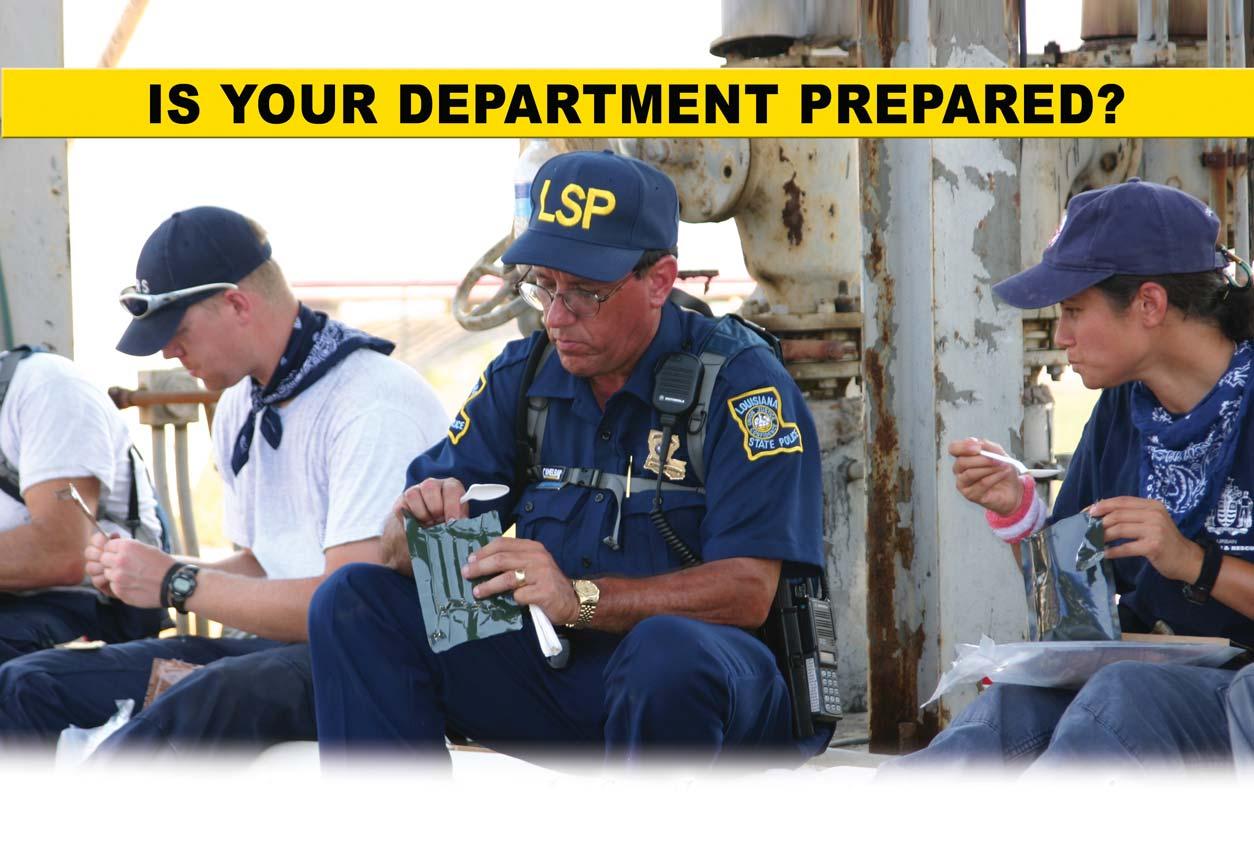
The team was put together to deal with post earthquake search and rescue and has since been trained and accredited to United Nations standards. Members responded to the Gulf Coast last year to assist Hurricane Katrina victims and were attached to the Louisiana State Police.
It soon became apparent that, despite the advanced warning they had of the hurricane, none of the city, state or federal law enforcement agencies encountered appeared to have a contingency plan for the policing issues that they were facing. The necessity to take care of themselves took priority over crucial law enforcement duties like maintaining social order and protecting life, at least initially.
Anecdotal reports about the New Orleans Police Department indicated things there were even more dire. Some members were so consumed with protecting themselves from targeted attacks that self preservation determined how they ate, drank and slept until help arrived.
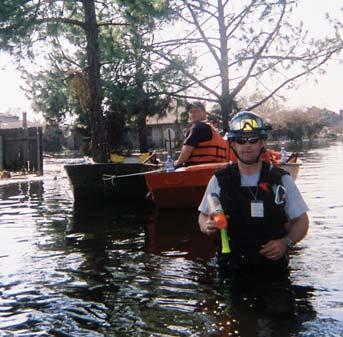
The team was deployed in St. Bernard Parish, east of New Orleans. The devastation in this suburb of approximately 90,000 people was difficult to comprehend. There was plenty of wind damage but the flood water created the most formidable issue. Many neighbour-
hoods were completely submerged, with the water level over the roof lines. It had risen so quickly that many people couldn’t dive down to their doorknobs and open the door in time to escape from their homes. One man survived four days standing on his dining room table, with four inches of room between the water level and the ceiling. He finally rescued himself after the water receded enough for him to swim out his doorway.
It was shocking how Mother Nature had brought the world’s mightiest country to its knees. The scope of the disaster was so huge that the 45 person Vancouver team was the first outside assistance this parish had seen in the five days since the hurricane came ashore.
The local sheriff’s department lost all of its police stations and had only six vehicles left. The fire department lost all but one of its fire halls and most of its rigs. The contract paramedic service pulled out the night before the storm and had not attempted to return. Firefighters and police from the community had been working 24-7 for five days trying to rescue or evacuate victims and provide food and water to the citizens trapped in their homes by the rising flood waters.
The St. Bernard Sheriff’s Office ‘station’ was now an open air warehouse on a jetty by the Mississippi River. Members slept on cots and lawn chairs, gun belts on and shotguns propped up on the wall behind them. The Chalmette Fire Department was now housed in a fire station at a local oil refinery. When the team began its search and rescue operations, it met up with firefighters who were getting food
and water from boarded up stores, by necessity because they had no provisions and had not been re-supplied.
By the time the team pulled out, numerous resources, including USAR teams from California and Tennessee and the National Guard, were coming into the area. Members had seen and accomplished a great deal, rescuing and evacuating 119 residents.
Many images and issues are memorable and the operation demonstrated how woefully prepared the Vancouver Police Department is to deal with the often discussed ‘big one.’ It would be in serious trouble if forced to operate without access to food, water, communication, fuel, vehicles, weapons and equipment, all of which could conceivably be lost after an earthquake.
Although there are only a few spots in Canada likely to experience a hurricane, the lessons learned from the Gulf Coast apply to all potential disaster scenarios. The west coast
is vulnerable to an earthquake and the entire country could face a pandemic, severe weather, terrorist events that specifically target police facilities or weapons of mass destruction.
If a resource rich country such as the US and a large metropolitan area such as New Orleans has trouble obtaining adequate rescue services and supplies, Canada’s obvious deficits in this area become clear.
The Canadian Forces have been reduced to specific major bases throughout the country and its ability to move materials by air has been severely degraded. If an earthquake were to occur in Vancouver, the nearest support is Edmonton. Where is your support coming from and how long will it take to get there?
•Does your police force have food and water to sustain emergency operations 24-7 for 10 to 14 days? That’s double the response time of our US counterparts last summer, but Canada has fewer resources to call upon. Your department needs enough food and water to feed your entire strength of sworn members and key civilian staff when they all show up for work. Consideration should be given to establishing memorandums of understanding with bottled water companies or food distribution warehouses in the event of an emergency. Although police and emergency agencies will commandeer provisions as needed, identifying specific locations and knowing what their supply capacity is ahead of time may mitigate problems that arise from trying to do it all in the days following the disaster.
•Do you have an alternate cache of weapons, ammunition, uniforms and other necessary equipment in the event that terrorists strike at police facilities? In Vancouver, if an earthquake or terrorist event were to compromise police buildings, the only officers who would be operational would be the ones who were at work and out patrolling. If it were to occur
at night, a full 75 per cent of the department would be useless, with no firearms, ammunition, uniforms or equipment. The ability to deploy officers that can be identified by the public as police officers with the necessary tools to do their job is the cornerstone to maintaining social order.
•Do your officers have emergency supplies in their patrol cars? If they are cut off from the rest of the department, hurt or injured without communication, do they have any first aid or emergency rations to help them survive for a few days?
•Do you have a contingency plan for rest and rehabilitation of members? This means places to sleep, cots and bedding and sanitation contingencies. In a huge disaster scenario like a pandemic, travel to and from home by police and other crucial infrastructure employees will be affected by sickness and quarantines. If people cannot come to work, who will operate important infrastructure? If sewer and water infrastructure are compromised then toilets become a huge issue. In New Orleans there were piles of human waste everywhere, including police facilities.
•What will you do for families? The Louisiana State Police had 100 per cent attendance
after it commandeered hotels and set up secure areas for police families. Officers were able to concentrate on work knowing their families were safe and secure, despite many losing everything, including their homes. This wasn’t the case with the New Orleans Police Department. Face it, where do individual priorities lie? If an officer doesn’t know if their family is safe or taken care of, they may not come to work, or may not stay there. This is an area that requires legislation. All emergency workers’ families need priority care.
•Do you have emergency plans that are disseminated down to the constable working the street. It’s no good to have a plan if no one knows about it. If communication infrastructure goes down, how are your officers going to know what to do? In Louisiana, all affected state police returned to their detachments to find out what to do after they lost their communications. There were no police officers out on the street doing police work when they were needed the most. On their return to detachments they waited several hours before commanders could decide a deployment model –and even that was a last minute contingency. These are just some of the crucial issues that need to be confronted by all Canadian police agencies. Quick action is required. Although some of these suggestions are being acted on, if Vancouver were hit by an earthquake, suffer a terrorist attack or be hit by a pandemic in the near future, the department and a majority of individual members would be horribly unprepared.
Cst Dan O’Donovan is a Senior Constable with 15 years service with the Vancouver Police. He is now working on the Marine/Waterfront Team. He has been a member of the Vancouver Urban Search and Rescue Team for 8 years and is currently a member of the specialized Technical Search Team. you may contact him by email at dan.odonovan@vpd.ca
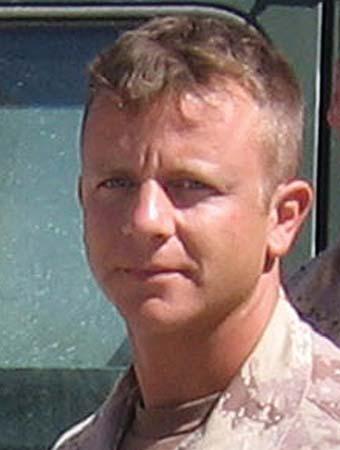
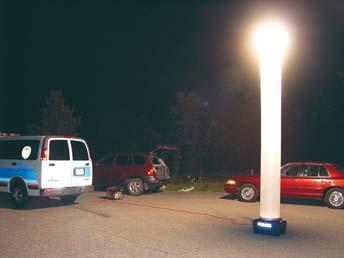
Just grabbing what you can was the order of the day. Finding an abandoned Jeep permitted this Vancouver Team to use it as an ambulance as well as emergency response and part time bedroom.
For taking risks on my behalf - you are my hero
by Michael Dunnill
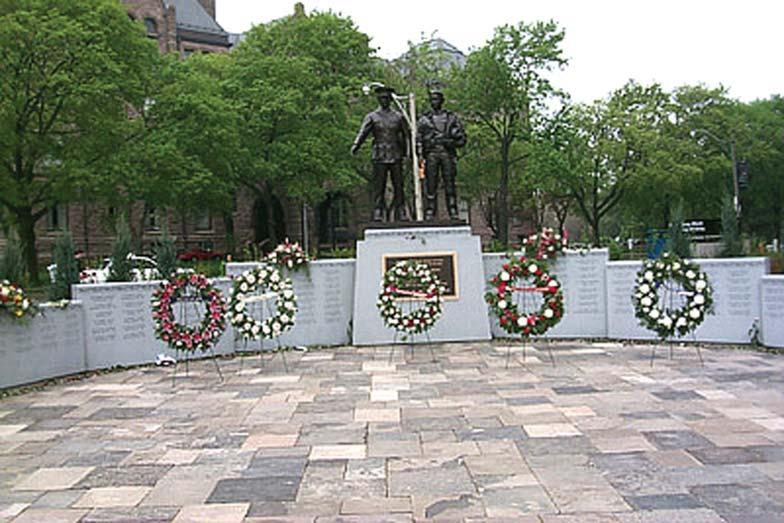
Heroes in Life, Not Death. I have thought a great deal about those words. Quoting from the booklet given out at a memorial service in 2005, “On August 12th, 1998, Waterloo Regional Police Constable David Nicholson lost his life while trying to recover the body of a child who drowned in the Grand River at the Parkhill Dam in Cambridge, Ontario.”
In expressing their appreciation and gratitude to family and friends, Wendy Nicholson and sons Mitch, Reid and Josh stated “Dave’s death has been painful and devastating. He was our hero in life, not death. Our memories of him are rich and immeasurable, filling our hearts with both deep joy and profound pain.” Wendy’s words are the inspiration for the inscription on the Ontario Police Memorial.
I think of you, the officers who will read this, as I write this article. You have been sworn in and issued uniforms and badges identifying you as persons trusted to uphold the law and ensure the safety of the communities you serve. All chaplains are proud and humbled to wear the uniform – I am in my 18th year of doing so – but I cannot attain the level of heroism that you do.
Albuquerque, New Mexico, the accent of the police officer was different but the calls could have occurred in Thunder Bay or any other city in this country. As you are taking the offender from an upsetting scene of a disrupted family, you are a hero in someone’s eyes.
Each day as you go about your job – your profession – you are certain of one thing; the day will bring the unknown and occasionally, the unexpected, and you may become a hero in the eyes of someone you encounter.
I have watched officers intervene in domestic disputes. It’s the same everywhere. When I went for a ride-along in 1994 in
The problem of ‘stand-off’ seems to be growing. ETF or ETU officers are pulled away from their families on their days off. Your hours and hours of training and honing skills are about to pay off. Tomorrow the ‘man on the street,’ media and, worse still, the lawyers, will have a hey-day telling you how you should have done your job. Everyone in the commu-
nity thinks they know just how the situation should have been handled.
You do a job that no one else wants and when all is analyzed, your role can border on heroic. You go into our schools and teach our children how to stay safe. Those little eyes look wide at you – and you are a hero. Have you replaced Wayne Gretzky or Spiderman?
The seemingly routine traffic stop may cause the driver or passenger to consider how your action may have saved their life and the lives of others. Although some may show disdain, others look at you as the hero. I found this especially so as I was allowed into your world to minister to families whose lives were shattered by the death – accidental, suicide or murder – of a loved one.
I have sat with families awaiting the organ retrieval team before the plug is pulled on their son, a murder victim. I have sat with families while the police dive team searches for a body, their role changed from rescue to recovery. I have seen these people look to you as heroes of the day.
I have also sat with officers and families shocked by the shooting of an officer and trying to come to grips with why it happened. I have shared your tears and the trauma you suffer after being forced to take a person’s life in order to preserve the lives of others.
Perhaps you have driven a shaken up, elderly man to his home after he was in a collision. You convince him and his family that he ought to go to the ER to make sure he is okay. The family thanks you for your concern. You came into their lives as a cop; you left as a hero.
The top cause of on duty police officer deaths is traffic accidents, followed by occurrences during traffic stops. An officer cannot know the state of mind of the person they have
pulled over; someone who appears to be just another speeder may be armed and carrying a cache of drugs.
Here in the north we have long and lonely stretches of highway, which are patrolled by lone officers with only someone in the Comm Centre listening, hoping and praying for their safety. You make a routine stop and run a name or plate through the system, only to realize you’re talking to someone who has skipped out on his parole or has an outstanding warrant and is driving a stolen car. These are the risks and what a blessing it is that you are prepared to take such risks. John Q. Public may never be made aware of what you did overnight but you were a hero.
Officers handle these many and varied situations, and the emotions they must conjure up, extremely well most of the time. I never cease to be amazed at how well you cope. Most people would not tolerate being spat upon or vomited upon. They would not want to look upon, much less touch, what you must handle in the normal course of your daily duties.
I like to joke with our new officers, after their swearing in ceremony before a judge, that ‘now you have been sworn in; for the next 30 years you will be sworn at.’ At the moment it seems funny – or is it?
You took an oath, dedicating yourself to do these tasks, whatever the cost. I want you to know that there are many people who believe, love, respect and pray for you, for what you do.
It is ironic that little is said or done by those who have the power and authority to address such violence, except to restrict you and your fellow officers in carrying out your duties. I have personally witnessed the lives of officers being shattered, or put on hold, while the criminals are treated as victims.
I have seen the things you handle, witness, tolerate and experience! I have watched you pay the price while others would quit or run in fear or disgust. You stand by your commitment – rain or shine, hot or cold, fun or tragedy, you do your job and you do it well!
Saying thank you seems grossly inadequate.
May your badge continue to shine even more, your resolve and dedication be stronger
than ever and your peace become more unshakeable than ever. May blessings and happiness come to you in ever-increasing abundance. May your job be full and overflowing; may the dawning of each new day bring you the appreciation, admiration and recognition you so richly deserve from the society you serve and protect. Until all these wonderful things are yours, I thank you for who and what you are and for being there, doing what you do for all of us. You who have taken the oath and wear the badge command my respect and admiration. You are my hero.
TORONTO — After years of review and calls for changes, Ontario plans to let complaints against police be handled by an independent civilian body.
Attorney General Michael Bryant, who introduced the legislation, said this group would be led by an independent police review director, who would screen complaints from the public and decide how they would be handled.
The independent director could decide to investigate a complaint, refer it to the police force involved, or get another police service to investigate.
If passed, the bill “would provide the public with a new and significant option for bringing forward their concerns to an independent, civilian director of police review,” Bryant told the legislature.
The changes would also ensure the system wasn’t bogged down by frivolous complaints and won’t interfere with the police’s primary job in keeping the province safe, Bryant said.
People who want to deal directly with police about their complaint would still have that choice and it’s expected that local police services would continue to play a role in resolving complaints, Bryant said.
In addition, complaints by a third party - a group or person not directly affected by the actions of a police officer - would be allowed “where certain legislative criteria are met,” Bryant said.
Civilian oversight of police complaints isn’t a new concept for Ontario. Such a system existed until it was scrapped in 1997 by the previous Conservative government.
Last spring, former justice Patrick LeSage reviewed the current system and called it “flawed” since police investigate each other.
LeSage said public complaints against police should be handled by an independent body of civilians.
Bryant said this proposed legislation is based on LeSage’s recommendations.
Michael Dunnill is minister and police chaplain for the Thunder Bay Police Service. He can be reached at tbgodsquad@shaw.ca
Use of force reporting – we can do better
by Joel Johnston
British Columbia is on the verge of implementing standardized, province-wide “subject behaviour” reporting. Use of force, critical incident and control tactics reports have been around in one form or another for many years, but the very names carry a negative connotation and inherently places police officers in a defensive position. It is time for a paradigm shift.
I do not object to the term or concept of ‘use of force’ and have long recognized that the public expects officers to use force; the law requires them to do so to enforce the law, in fact, when certain conditions exist. It should be noted however, that police do not arrive for their shift and ponder ‘who can I use force on today?’ Instead they have a mandate, are assigned an area to work and accept what comes along with that jurisdiction.
Officers are routinely dispatched to deal with situations that a member of the public reported because they felt it important enough to call. Alternatively, police may observe situations in which they are compelled by duty to intervene. They are responding to behaviour that needs to be controlled or quelled – generally because someone is being victimized by a crime against property, person or a combination of both.
NATIONAL USE OF FORCE FRAMEWORK
work for and the profession. The public is cheated out of accurate information. The negatively skewed statistical data is subject to media abuse. Front line law enforcement officers are put on the defensive and in jeopardy from a disciplinary perspective. Organizations are increasingly placed at risk of civil liability.
The profession’s reputation suffers over time from misrepresented and oft misinterpreted police use of force statistics. Our ability to effectively serve the community’s needs may be undermined. An aggregate number of use of force incidents absent of any other context is virtually meaningless.
We currently guess the percentage of incidents in which force is used. The Vancouver Police Department (VPD) is estimated to make more than 1.5 million contacts with the public – dispatched calls for service, on-view incidents, street checks and traffic violator contacts. Contrast this number with how often ‘force’ is reported –VPD officers do not even file 1,000 use of force reports a year. Can we say force is used less than 0.1% of the time?
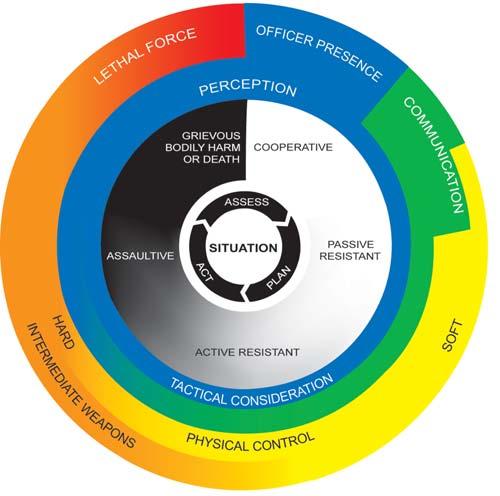
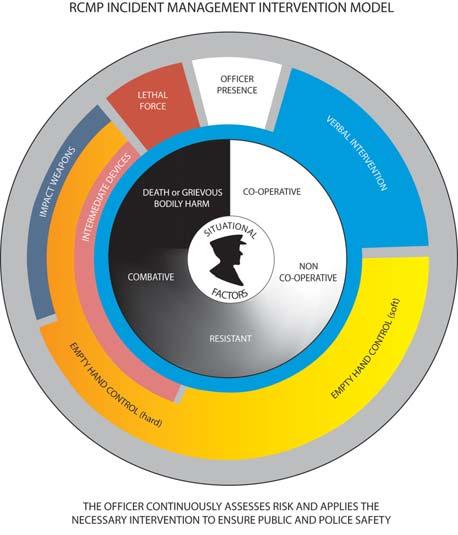
Remember, police officers respond to situations, arriving, assessing behaviour and circumstances and attempting to resolve the situation according to the law, their training and experience. Central to that resolution is the behaviour of the person who has, for whatever reason, become the subject of their attendance. These behaviours are characterized in all use of force models, including the National Use of Force Framework and RCMP Incident Management Intervention Model (IMIM). These models build themselves outward from the actual incident or situation.
Police attend to the situation, assess circumstances, plan and make decisions and carry out actions, continuously re-assessing the situation until it is resolved in a satisfactory manner. The immediate behaviour of the subject or subjects (compliance, passive or active resistance, assaultive or deadly force behaviour) of police attendance is central to the assessment process and, in fact, primarily drives their response. To that end, police are trained in and equipped with a variety of response options –their physical presence, tactical communication skills, empty hand control tactics; a variety of intermediate weapons, including Taser, baton and OC spray; and firearms.
Police officers are expected to respond lawfully to any given situation and use their tools and training to resolve problems in the community. It is always preferable for police to resolve these problems with the lowest level of intervention possible – their mere physical presence
and ability to communicate with people; this is preferred by both the community and the police but, of course, this is not always possible.
According to section 25 (1) b of the Criminal Code of Canada, peace officers are sometimes required to use force – that is, they have a positive obligation to use force. They do so specifically as a peace or public officer, as they are “required or authorized by law to do anything in the administration or enforcement of the law” and, if acting on reasonable grounds “in using as much force as necessary for that purpose.”
The law, in conjunction with police training and equipment, would suggest that the governing bodies and public expect that police will, on occasion, have to use physical force in dealing with non-compliant, resistive, assaultive and/or deadly violent individuals.
It is incredible how few times police officers use force in resolving tense, complex, violent, difficult situations. I wish I could give you a definitive percentage but I cannot. Because of the way law enforcement has typically reported on the ‘use of force,’ the best I can do is estimate that officers use it less than two per cent of the time.
Unfortunately, as a profession we only report those times we actually use physical force (impact, neck restraint, etc.), a weapon, fire shots, injure people or when we receive a complaint about the use of force. This creates a negatively skewed perspective; in order to extrapolate the frequency with which officers use force, we have to consider the number of incidents where force has been reported vs. the total number of incidents dealt with.
Force reporting without context cheats the public, police officers, the organizations they
Unfortunately, this is not an accurate method of calculating police use of force because we cannot tell how many of the contacts were with ‘co-operative’ people and how many were with confrontational, non-compliant, resistive, hostile, assaultive people.
I know definitively that the vast majority (more than 99 per cent) of high-risk critical incidents (ERT/SWAT) are resolved through sound tactical containment, a highly prepared, professional physical presence and professional negotiations and tactical communication. Rarely is a shot fired or physical force used, even though the subject has usually demonstrated extreme violence, hostility, threats, resistance and/or non-compliance.
It is time we began to gather relevant, realistic, meaningful data on police use of force. This requires focusing on what brought police into contact with the public and the behaviour that required officers to consider the appropriate response options for controlling and influencing it. As demonstrated by the national framework, we need to focus on “subject behaviour” to understand and properly contextualize “officer response.”
The term ‘use of force reporting’ should be replaced with ‘subject behaviour reporting,’ and any behaviour beyond compliant or cooperative should be recorded. Nationally recognized terminology makes this extremely simple to do. We also need to record any demonstrated, internationally recognized ‘pre-assault’ or ‘threat’ that indicate someone is about to act out physically – these are also described within the national framework. Of course, it is also necessary to record the response the officer selected to control and influence the demonstrated behaviour.
The officer continuously assesses the situation and acts in a reasonable manner to ensure officer and public safety
An officer could roll up to a ‘suspicious circumstances’ call, for example, and make contact with a man who hurls verbal abuse, clenches his jaw, balls his fists and takes a bladed stance. The officer may take a tactical interview stance and employ effective tactical communication strategies, calming the person down, positively influencing their behaviour and resolving the situation. Previously, this type of contact would not be recorded because no physical force was used, but the subject’s behaviour warrants a report since this provides context to what police actually do most frequently. A simplified example, using choices from the National Use of Force Framework on drop down menus, is below:
Type of call: Suspicious circumstances
Subject behaviour: (List of subject behaviours and pre-assault cues)
•clenched jaw
•balled fists
•fighting stance
•verbal threats
•verbal abuse
Officer response: (response options)
•Officer presence
•Tactical communication
Brief narrative: Attended a/m call, used presence and communication to calm down subject who was threatening and indicating violence toward us. Provided verbal direction. Subject released w/o charges
Now I know what you may be thinking –
‘can you imagine the paperwork associated with documenting each and every time we calmed someone down with communication?’
The reality is we are required to complete some form of general occurrence report whenever we engage the public or take a call. I am proposing a simple electronic report, associated with existing processes and behaviour/response
terminologies, that officers could simply click on. A brief space for a bare-bones narrative would complete this report.
In British Columbia we have been using the PRIME system, which already has a ‘use of force details page’ that could be easily modified to accommodate this reporting methodology.
If our objectives as a profession include:
•effectively lobbying for resources and funding;
•supporting valid, task-related training which is skewed to the realities of the job;
•providing accurate, contextual accountability;
•maximizing our service to the public;
•amassing liability protection for individual officers and their agencies;
•accumulating hard data that counters the sometimes irresponsible media strategies which negatively impact our reputation;
•accurately reflecting the police mandate and reality of our conduct;
•we will implement this subject behaviour reporting system.
Veteran VPD sergeant Joel Johnston is the use of force co-ordinator for British Columbia. A former emergency response team leader, he is the force’s control tactics coordinator and founding member and supervisor of the force’s crowd control unit. He is currently seconded to the Ministry of Public Safety and Solicitor General – Police Services Division. A frequent contributor to Blue Line Magazine, he can be reached at jajohnston@jibc.bc.ca
Best practices critical in digital forensics
by Francis Graf
The information age has profoundly and irrevocably changed the shape of our society, including the way criminals conduct their business.
Computers, the Internet, cell phones and personal digital assistants (PDAs) have inadvertently created more efficient ways to commit many kinds of criminal activity, including child pornography, kidnapping, assault, homicide, robbery, fraud, stalking, indecency and drug trafficking. Fortunately, a new field of science – digital forensics – is also on the scene to combat crime by accessing data once thought to be irretrievable.
Computers, cell phones, iPods, PDAs, smart cards, memory sticks, CDs and DVDs contain information in many formats which can be extracted using formalized techniques and tools which fully preserve, recover and analyze the data for use as evidence in criminal or civil actions. This scientific process is called digital forensics.
Because digital evidence is volatile and easily corrupted or lost, it is essential that the forensic investigator approach it carefully and acquire it appropriately using forensically correct methodology, tools and expertise. The investigator who neglects to use proper procedure, advanced techniques and reliable tools to undertake this work risks losing or invalidating digital evidence that may be key to the case.
Digital evidence includes any file, record, source code or program stored on a digital storage device such as a computer hard disk drive, mobile phone or PDA and takes many forms, including data about the file itself (metadata). These files could be sensitive word processing documents, personnel records, customer lists, e-mail routed via the Internet and local intranets, system operation logs, images, videos, audio recordings, cell phones contain a call register (incoming, dialed and missed calls), abbreviated dialing numbers (speed calls) and text messages (including deleted messages).
Preservation
At the crime scene, it is imperative to resist the temptation to “just take a quick look” at a suspect’s computer, cell phone or PDA; doing so risks spoiling the data, whether from
key files inadvertently being overwritten, lost altogether or changed from their original state and rendered useless as evidence. Just booting a Windows computer can alter between 500 and 700 files. Turning on a cell phone can permit incoming messages to overwrite (potentially incriminating) messages on the phone, losing them as evidence.
Best practices include:
•Photographing the computer/ digital handset in situ.
•Preventing the subject from touching the device for any reason.
•Recording any information located on the screen of the device.
•Searching the immediate area for any PIN or related code numbers.
•Documenting chain of custody of all exhibits seized.
•Pulling out the plug or shutting down a running computer without altering or losing data.
•Removing the battery from a blackberry.
•Placing a cell phone in a labeled faraday bag (prevents signals from going in or out) or tamper-proof exhibit box for immediate transportation to the (ideally) secret-security level, protected ‘B’ lab.
•Seizing all available chargers and cables.
•Being aware of potential links, including wireless, between handheld computers and mobile phones.
Recovery
Evidence collection begins with the forensic acquisition of all digital media present by making a bit-for-bit copy of everything seized. The validity and integrity of this forensic copy must be verified using an accepted HASH algorithm. All subsequent analysis is undertaken on the forensic copy in order to preserve the evidentiary integrity of the original media, which should then be securely stored as ‘best evidence.’
In order to validate file date and time stamps from the acquired evidence, the system date and time of a subject’s computer should also be validated by comparing it with a known time source.
Analysis
This phase is often the most critical to determining the outcome of an investigation. Effective development of keyword search terms such as names, dates, credit card and bank account numbers, email addresses, telephone numbers and website URLs will determine how long it will take to complete the analysis – and the likelihood that key pieces of evidence will be located in the enormous amounts of data being analyzed.
The particular type of investigation will determine the scope of the analysis to be undertaken. For example, computer activity between key times and dates may be critical to one investigation, while the establishment of relationships between suspects may be critical in another. Each scenario requires a different analytical approach.
The forensic analyst should be able to view the entire contents of the subject media, including deleted files and file metadata in a Windows environment, which allows the efficient analysis of large and complex cases involving multiple pieces of media of different formats, including MAC and Linux.
Documentation
Upon completion of the examination and analysis, any findings should be organized and presented in a readable format that the target audience will understand. The examiner should be able to provide the report in more than one format; for example, Microsoft Word, HTML or burned to a compact disc using a hyperlinked summary of sub-reports and supporting documentation and files.
With cell phones and PDAs, the report format should be consistent regardless of the type of phone examined. In this way, phone data recovered from multiple exhibits of different makes and models can be easily correlated for intelligence and analysis purposes.
Documenting the digital evidence extends into the courtroom, where the digital forensic expert can further assist in a case by providing appropriate affidavits and expert witness testimony.
The emergent science of digital forensics is a constant challenge to law enforcement agencies because new computer and cell phone technologies are being developed every day and criminals use these devices extensively. That makes more work for already-overworked police departments.
The Victoria Police Department Chief Paul Battershill meets that challenge with strategic partnerships. “It is invaluable to work with computer and digital forensic experts who support our ongoing computer and cell phone-related investigations by staying abreast of the evolving best practices for preserving, recovering and analyzing digital evidence and by being available 24/7,” he says.
Francis Graf is president and CEO of Forensic Data Recovery Inc. He can be reached at fgraf@forensicdata.ca
‘Test driving’ promotion candidates
by Colin Renkema
The Justice Institute of British Columbia (JIBC) not only trains police officers – more than 2,500 since the police academy’s inception in 1975 – it also screens recruits and officers seeking promotions.
The Assessment Centre, which was begun in 1977, assists municipal police departments in selecting recruits and, if requested, helps screen and develop candidates for promotion. The exercises it conducts are designed to simulate real-life situations that the candidate will encounter once hired or promoted.
Since beginning to keep computerized records in 1988, the centre has assessed more than 3,600 recruit candidates and about 800 police supervisors and managers. Promotional centres are used to evaluate candidates for the corporal rank and above.
The assessment is broken into a series of specific ‘dimensions’ used to measure behaviours against pre-established standards. Scoring for each ranges from one (poor) to five (excellent). The 13 dimensions used to test recruits include measuring a candidate’s ability to learn, level of decisiveness, interpersonal skills, stress tolerance and willingness to confront problems.
Potential recruits spend one day at the centre going through various exercises designed to test their ability to interact with each other and the public. Police assessors trained in the centre’s method take turns role-playing and documenting their performance throughout the day. A typical recruit level centre consists of the following exercises:
•leaderless group discussion
•fact-finding exercise
•background interview
•written report
•oral communications exercise
•administrator’s debrief
The assessors spend the second day working independently, scoring the performance observed the previous day and consult with the centre’s administrator the next morning to determine the final scores.
An ‘in-basket,’ designed to evaluate administrative skills, is added to the role-play exercises for a supervisory or manager centre. Exercises vary but generally involve a group discussion, formal written paper and presentation and either an employee interview or managing a community meeting.
The in-basket exercise was paper-based until last year. Candidates were given a package containing various memos and reports and expected to organize, prioritize, set management controls, delegate and make decisions on the issues presented with hand written responses. An electronic version, developed with the assistance of the JIBC Learning and Information Services, was first used in April 2005 for an Inspector’s level centre with the Saanich Police Department.
Candidates worked on line, reviewing and assessing the documentation and responding to the problems posed through e-mail. All meetings and commitments were expected to be
logged on the electronic calendar contained within the program.
The program is designed to immediately update the JIBC server as e-mails are sent and calendar entries made, avoiding the potential for lost work if a technical problem develops.
The server supporting the application is in New Westminster but candidates can be anywhere. The first electronic in-basket was completed by candidates in Victoria.
Among the benefits of the new system:
•Work is done the same way a supervisor/manager conducts business – electronically.
•A master file allows new exercises to be developed and the documents simply ‘plugged in’ to the existing coding.
•The assessment program can be used for other police departments or businesses wishing to evaluate an employee’s administrative skills.
•A candidate’s skills and abilities are tested before they are promoted, allowing their competencies to be assessed objectively.
•Marking is easier because poor handwriting and the identity of a candidate are no longer factors.
Assessors also gain valuable tools to help them identify and classify behaviour. This makes them much more effective as trainers, mentors, supervisors and managers because the training gives them the skills to identify, classify, document and provide feedback on a subordinate’s performance.
Most organizations conduct rigorous re-
cruiting and promotional processes with varying degrees of success. Assessment centres do not take the place of these processes but rather enhance them by providing an objective ‘outside’ look at their candidates. The exercises also allow them to ‘test drive’ a candidate and see exactly what they would do in a given situation rather than relying on answers to questions posed during an interview.
A validity study concludes that “the JIBC Police Academy Assessment Centre is an accurate and valuable tool in both the selection and promotional process... (with) no systemic bias against women and minorities.”
A 30-year police career begun today will, conservatively speaking, cost an organization $3 million in wages and benefits, which highlights the cost of not using every available assessment and selection tool. Simply put, the centre need only catch one unsuitable candidate a year to more than pay for itself. Other costs of hiring and promoting unsuitable people include workplace disruption, re-training, negative media reports and civil liability.
Hiring or promoting the wrong people in an organization has serious consequences. Assessment centres enhance an organization’s ability to select the right people by ensuring the candidate’s competencies match its needs.
Sgt. Colin Renkema , B.B.A., manages the JIBC Assessment Centre. He can be reached at crenkema@jibc.bc.ca
Paying the premium Maintaining reputation means
fixing mistakes
by Mark Giles
When you mess up, your stock goes down – and you must pay a premium to get back in the game – Leil Lowndes in Little Tricks of Big Winners. Covering some of the basics of communications, Lowndes outlines a concept many forget – it’s often necessary to make an extra effort to put things right after making mistakes.
It’s not a new concept – restaurants and other service industries use it all the time, often providing discounts or other compensation to customers when expected service is not up to standard – but it’s one sometimes forgotten by those in government, including law enforcement.
Fixing mistakes not only resolves a problem at the time – it also lessens the likelihood that its result will negatively impact an individual’s or organization’s reputation over the long term. As discussed in my March article on reputation management, it was traditionally thought that government agencies and services didn’t need to place a high priority on reputation. Without an option for the public of switching to a competitor, bad news, poor brand image and a bad reputation were not always seen as problematic. This thinking has changed in recent years, however, as even public sector organizations have come to realize the benefits of effectively managing reputation.
While more attention and resources have been directed at corporate communications and public affairs, sometimes the details of frontline delivery get lost in broad strategies and mass communications. Good strategies are vital, but the handling of smaller, day-to-day issues can
often make a big impact – for better or worse –on the perception of an individual or organization. Lowndes uses a personal experience to illustrate the concept. A colleague he invited to his house one evening for some Italian cuisine failed to show. Calling the next day with a semi-plausible excuse, the colleague “proved himself to be in the little leagues when he asked when we could re-schedule at my house,” rather than inviting Lowndes for linguine at an Italian restaurant to compensate for his oversight.
Paying the premium for a mistaken arrest
It’s often the small premiums that make the difference – keeping the public happy and preventing complaints. As a police officer, I remember an occasion when I was able to use this concept. My partner and I went to a residence with an arrest warrant for impaired driving, looking for a man who’d apparently failed to attend court or pay his fine after conviction. Finding a 60-year-old man, matching the name on the warrant, who admitted that he’d been charged with impaired driving some nine months earlier – we advised him he was under arrest.
The man insisted there was no reason for the warrant and resisted our attempts to arrest him. After spending some time trying to convince him to cooperate, we resorted to force, resisting his wife’s attempts to stop us and wrestling with the man until we finally got him handcuffed.
As we prepared to leave, we heard a voice behind us say: “I think you’re looking for me.” Turning around, we found the man’s 18-yearold son – a young man with the same name as his father, but with “junior” tacked on the end. Checking the warrant again, we noted, with some embarrassment, a date of birth matching the son rather than the father. After taking the cuffs off father and picking mother up off the floor, where she’d ended up during the scuffle, we arrested the son – who also admitted to a recent impaired charge and being the subject of our warrant.
It was an honest mistake on our part, but our inattention to detail had definitely caused some unnecessary disruption for the accused’s
parents that evening. We’d messed up and our stock was definitely down with this couple. After dropping the 18-year-old accused off at the arrest-processing unit, we decided to return and try to make amends – perhaps avoiding a citizen’s complaint at the same time.
When the couple answered the door, they were understandably not too happy to see us again and immediately launched into a tirade denouncing our actions. We listened, and then we listened some more, before humbly explaining our mistake and apologizing profusely. A few minutes later, we found ourselves sitting in their kitchen sipping tea and discussing their native Italy, policing and life generally. We left about 30 minutes later, having paid a premium by making the extra effort to return to the house, admit our mistake and spending enough time to put things right.
Having also been on the receiving end of mistakes, I’ve experienced the frustration when someone is unaware of the concept or perhaps too arrogant to fix the problem, and the goodwill generated when they’re handled well. A few weeks ago, I saw a stellar example when a colleague inadvertently failed to properly format a web page feature on a time-sensitive issue. When I raised the issue the next business day, she apologized, explained what had happened and immediately fixed the problem.
I was already reasonably satisfied with her response, when a few minutes later she turned up in my office with a smile, a further apology and a cup of coffee for me. It was a class act –she’d messed up, but took the appropriate actions to fix her mistake, paying a small premium and earning my respect in the process. It was a little trick of a big winner, one that definitely raised her stock and credibility in my eyes.
The wrong attitude
Unfortunately, not everyone seems to gets the concept. Having requested a renewal of facility passes with an area support unit, my repeated e-mail and voice-mail messages were ignored. After finally receiving a response from the government employee responsible about three months later, I was advised they would be ready for pick-up in a couple of weeks. When the time arrived, I called to confirm and was told that they hadn’t been done because the employee needed new photos, having lost the previous ones on file during a change of computer hard drives.
After making arrangements to get new photos, which I could have done earlier had I known, another appointment was made for pick up. After driving across town, the person sent on this task found the employee’s office locked, without any apparent attempt to communicate or leave the passes with someone else as a courtesy.
There was no apology or effort made to put things right, despite a series of errors on his part. Even when I sent an e-mail to express my frustration, it was ignored. After finally complaining about the lack of service more than four months later, his commanding officer didn’t seem to get the concept either. After my suggesting that it might be nice, after such a long delay and unnecessary efforts on my part, to courier the passes to me in an expeditious
fashion, he refused, saying that would cost his organization money. The final insult came when he lectured me that it was a privilege to have the passes.
So what was I looking for? An apology, of course, with some kind of acknowledgement that the ignored e-mails and phone calls, and apparent inattention to detail over a considerable period of time, would be followed by a small gesture or premium to put things right. Rather than paying a small premium, these two ‘little-leaguers’ chose not to properly fix the problem.
Making up for mistakes or inadequate service usually means paying a premium to get back in the game – often little more than a sincere apology and perhaps a cup of coffee.
Minor issues can become big ones quickly when handled poorly. They may not reach the local news, but can still influence opinions and perceptions over time and hurt an organization’s reputation.
Both public and private organizations are subject to human error – it’s part of life. What seems to make the difference, however, is the attitude towards fixing the errors. Those that make the extra effort to do so – employing the little tricks of big winners – will usually be well rewarded in both the short and long term.
Mark Giles is Blue Line’s correspondent for the National Capital Region (Canada), public and media relations, and military-related issues. Mark Giles can be reached at giles@blueline.ca .
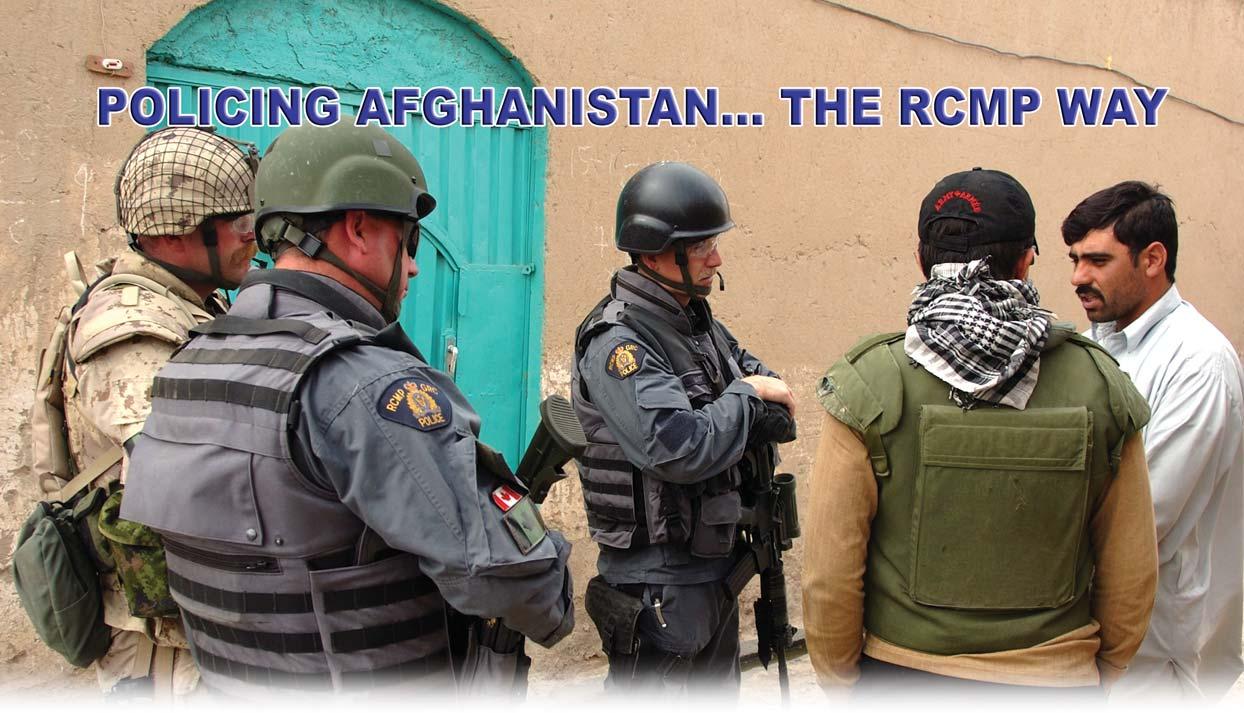
When Supt Wayne Martin and Cpl Bob Hart departed for Afghanistan this past August to take part in the Canadian Provincial Reconstruction Team (PRT) in Kandahar, Afghanistan, they embarked on a major Canadian effort to help a troubled country become a stable nation.
Afghanistan’s full and sustained recovery is the key to eliminating the regional threat of terrorism and achieving greater international security and stability.
Through the Government of Canada’s 3D approach - defense, diplomacy and development - Canada is providing much-needed support to the people of Afghanistan as they work toward building a stable and secure environment for their country.
The Canadian government asked the RCMP to take part in the reconstruction effort because the skills taught by Canadian police officers in the international arena are unparallel.
In fact, since 1989 more than 2,000 Canadian police officers have participated in more than 35 international police peacekeeping and peace support operations around the world.
In Afghanistan, Martin and Hart are responsible for assisting and advising the local Afghan police forces, and encouraging and supporting Afghan police ownership in reconstruction efforts.
Their various duties include: advising on logistics support, reviewing and making recommendations on police standard operating procedures, advising on the command and control structure of the local Afghan police forces, advising on the relationship between local police and their communities, and conducting police training.
Recently they took part in two important training programs to strengthen the ability of both the Afghan National Police (ANP) and the Afghan National Highway Police
(ANHP) to deliver security to the population of Afghanistan’s Kandahar Province.
In early September, the PRT, along with the Ministry of the Interior (MOI), distributed 160 rifles to the Afghan National Police and trained them in the principles of basic maintenance, safe handling and marksmanship.
This training has increased the national police force’s ability to provide armed defensive response to threats against the National Assembly and Provincial Council Elections process, as well as the people of Kandahar.
A week later the PRT gave 17 motorcycles to members of the highway patrol, and provided them with training on maintenance and operating techniques particular to these new bikes.
With 17 more motorcycles on inventory, the highway patrol is now better positioned to deliver on its mandate of providing safe driving for those who travel the highways that connect Kandahar’s vast communities.
“Through these two key training programs, the PRT enhanced the ability of the Afghan National Police and the National Highway Patrol to meet security needs in anticipation of the upcoming provincial elections and beyond,” Martin says.
“We are very pleased to work with these two professional policing organizations and their officers to help realize the goal of safe homes and safe communities for the people of the Kandahar Province.”
The Provincial Reconstruction Team members hope that by sharing these Canadian best practices, the ANP and ANHP will one day be self-sufficient and no longer need the help of international partners.
Photo by Sergeant Carole Morissette
Photo by
Sgt Jerry Kean
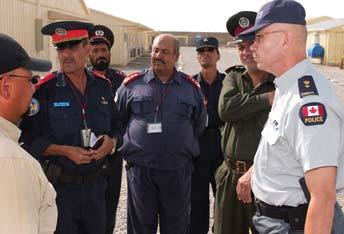
Royal Canadian Mounted Police (RCMP) Superintendent Wayne Martin (Right) greets the commandant of the Afghanistan National Police (ANP) Academy, General Zarill (Left), prior to attending a graduation ceremony of ANP students.
Photo by Sgt Jerry Kean
Royal Canadian Mounted Police (RCMP) Superintendent Wayne Martin presents a graduation certificate and a MagLite Flashlight to a top student of the Afghanistan National Police (ANP) Academy. Superintendent Martin attended the graduation ceremony as the guest of the Academy Commandant, General Zarill. Superintendent Martin is a member of the Provincial Reconstruction Team (PRT) in Kandahar, Afghanistan.
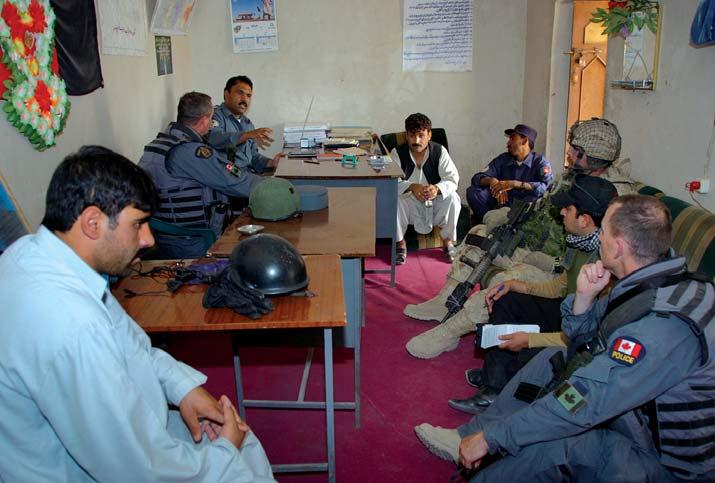
Members of the Canadian Forces and Royal Canadian Mounted Police are conducting a presence patrol through the streets of Kandahar City. They are inspecting the construction site of Sub Station 9 which is a Canadian funded project to assist the police in Kandahar City. Staff Sergeant Alan McCambridge, Station Commander Wali Mohammad, Sergeant Trevor Parkinson, Translator Sardar Wali and Corporal Bob Heart are shown here discussing the day’s patrol strategies. The Kandahar Provincial Reconstruction Team (KPRT) located at Camp Nathan Smith in the heart of Kandahar City is comprised of approximately 250 soldiers, drawn largely from Land Forces Western Area (LFWA) and 1 Canadian Mechanized Brigade Group (1 CMBG) based in Shilo, Manitoba and Edmonton, Alberta.
Task Force Afghanistan is part of Canada’s contribution to the Islamic Republic of Afghanistan. Canadians and their international partners are helping Afghan people to rebuild their lives, their families, their communities and their nation. The mission is to improve the quality of life of Afghan people by providing a secure environment in which Afghan society can recover from more than 25 years of conflict.
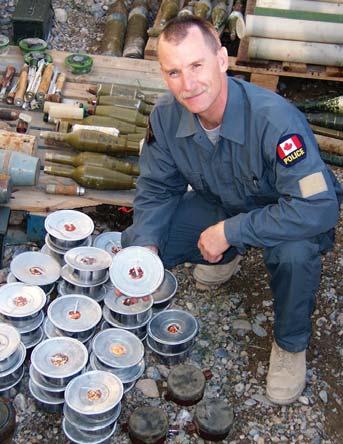
of the RCMP officers stationed with the PRT in Kandahar city.
Canada’s mission in Afghanistan is part of our contribution to the international campaign against terrorism. The overarching goal is to prevent Afghanistan from relapsing into a failed state that gives terrorists and terrorist organizations a safe haven. The next phase of Canadian operations in Afghanistan will continue to help improve the quality of life for the Afghan people, and to ensure that the progress made is sustainable.
Photos: Sergeant Carole Morissette
Corporal (Cpl) Bob Hart is pictured with some of the 43 explosive devices that were turned in to the Canadian Provincial Reconstruction Team (PRT) by the Afghan National Police. Cpl Hart is one
DON’T BUY THAT GUN!
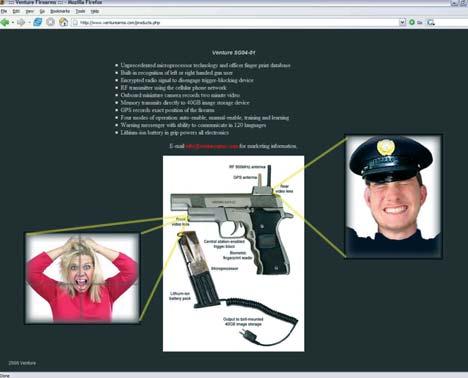
Once again Blue Line Magazine staff pulled off a successful coup with our (almost) annual April Fools story. This year the collaborative effort included our tactical firearms editor, Dave Brown. We also incorporated our technical and web people to set up the web page and design it with a corporate impact design. Blue Line reserved the web page space for the next year so if you want to take your friends there for a bit of fun please do so –www.venturearms.com .
We have had terrific fun each April for the past several years presenting semi-spectacular stories with a questionable pedigree. We began with the HMOS Boniface destroyer (floating OPP Headquarters ship), then it was the remote control scout cars and a profile of the rather small (actually non-existent) Pembina Police Department. This agency was going to clean up the Liberal sponsorship scandal by taking a big government grant, no doubt funneled through the CorrupAction advertising agency, to get to the bottom of that mess back east.
We also had fun last year by not running an April Fools story. We received a great number of calls and e-mails pointing out various stories that would have been perfect candidates (the one we had in mind turned out to be a little too close to the truth!). After that one year break we thought it was time to hit you again, this time with a gun that ensures total control of who, what, why, where and how it is used.
So here are a few comments... at least the ones that are printable!:
Hahahhaha!!!! Very funny! I am a Firearms Instructor with our department. I remember turning the page in your April addition and seeing something resembling a firearm. I had to read the article as the weapon looked ridiculous!
I even got out the highlighter marker and started highlighting the ridiculous points on this weapon. Then it all came to me. April Fools! Or should I say Lirpa (April backwards) and the model number SG04-01 (04th month....01....April the 1st).
Ya got me! I was ready to tear this weapon apart. I thought I had escaped April fools this year... congrats!
John Meneray (Firearms Instructor) CN Police Service
The product was frightening. A weapon which is only to be used when your own or another’s life is in imminent danger, however: (1) the best you can hope for is a two second delay and
(2) you KNOW that in some cases it won’t work at all e.g. dead cell phone areas. How long would it take the bad guys to figure out what parts of a city would disarm the police? No wonder the senior officers explained “that lower ranks were tied up....” and unavailable for comment. Or was it because there had been “....only a slight rise in officer fatalities”? I finally sensed that the author’s tongue was deeply imbedded in his cheek. Very good! I fall for every April fool’s joke everytime.
Not as an excuse but by way of explana-
tion, I used to work (way back in the early 80’s) in the military division at Honeywell and a lot of the products that were proposed were just that crazy. As one person said to me: “It doesn’t have to work. The other side just has to believe that it would.”
Please tell me that I wasn’t the only one from the Red Face Department!
John Propper
Toronto ***
I was PRAYING – PRAYING!!! that I would see an April Fools message. I was reading the article in your magazine and was nearly pulling my (already very short) hair out!! I even went to the web page (www.venturearms.com). You got me, hook line and sinker; now if we can make sure that somebody doesn’t come up with the great idea to try and build the thing.
John Maitland
Toronto
We hope you all had as much fun convincing others that it was real as we did writing it. Several years back an officer (who shall go unnamed!) thought his colleagues had fallen for one of our April Fools stories. He tried desperately to convince them that it was a joke but no one was buying it.
Finally, as a last resort (and believing he was the only one who could see it), he called the publisher and asked him to tell them the article was all a joke. Laughter exploded in the background while he was still on the phone — and he quickly realized that he was the butt of a reverse April Fools joke!
Identity theft a fast-growing crime
by Danette Dooley
When the collections agency called, Gerald Gillis thought a friend was pulling a prank on him. It never occurred to the Halifax resident that someone had stolen his identity, a crime which has affected 50,000 Canadians over the last four years alone.
“The woman at the collections agency told me that she was calling on behalf of American Express,” Gillis said in a recent telephone interview. Neither he nor his wife had an American Express credit card yet he was told they owed more than $7,000 for purchases made last summer.
“After I talked to her for awhile I got off the phone and called American Express. They told me that they had an outstanding bill and that my American Express was used in Guelph, Ontario. I said, ‘I’ve never been to Guelph, Ontario and I’ve never lived there.’”
After making numerous calls, Gillis found out that the statements for ‘his card’ were being sent to a fictitious address in Ontario and notified creditors about what had happened.
“I found out that he had my social insurance number, name and address, so another thing I had to do was go to the federal government to make sure he didn’t use my social insurance number to get a job – because then, I could be stuck with the taxes.”
Gillis also discovered the culprit had unsuccessfully applied for credit at Sears and The Bay.
Before becoming a victim, Gillis thought thieves stole another person’s identity by looking over their shoulder to see their personal identification number (PIN). “After all this happened, I cancelled all my credit cards except my Visa… because I know he might try to use the card somewhere else at another time. So, hopefully I’ve got all my bases covered now.”
Gillis’ story is a familiar one to OPP Det./ Sgt. Barry Elliott, the creator and co-ordinator
of PhoneBusters, which collects information on telemarketing and advance fee frauds (Nigerian letters) and identity theft complaints and distributes it to police across the country.
“The program started back in the early 1990s, based on a couple of telemarketing complaints that we received at North Bay, Ontario where I was working commercial crime,” Elliott explains. His interest in the complaints led to a more in-depth analysis of what was happening in other provinces.
“I asked everybody to send me their complaints and that led to all of Canada. I accidentally created a solution to the problem, which was to central source all the complaints into one solution and then come up with ideas on how to attack the complaints.”
PhoneBusters has expanded from telemarketing fraud to include all mass marketing fraud, including identity theft. What was once a lone cop working to tackle a huge problem has grown into an organization that employs more than 20 people.
As Canadians have become more savvy in spotting scams, Elliott says organized crime groups have targeted other countries in order to maintain profits.
“Last year we received 105,000 calls and we’re now international in nature. We take complaints from around the world as long as it involves Canada in some way.”
A joint OPP/RCMP initiative with task forces operating across the country, Phonebusters obstructs those trying to pull consumer fraud crimes, educates the public about specific scams and investigates offences.
March was Fraud Prevention Month and Elliott spent much of his time visiting cities across the country to teach about consumer fraud, including Newfoundland, where he gave lectures to police and businesses.
“The whole idea is to raise the level of consumer awareness, what’s going on and what
Canadians should be watching out for,” he says.
Approximately 50,000 Canadians have been victims of identity theft since 2002, with loses in excess of $100 million. Elliott puts the number of victims at about 13,000 a year and growing.
“The big risk that everybody faces, and that includes you and I, is a corrupt employee working at an institution… selling information to a criminal. Of course you have little control over that, in a sense that once your name gets in a company, you fall to the mercy of their security.”
He encourages all Canadians to review their credit reports regularly. “The two major credit bureaus in this country are Equifax and Trans Union. It’s free to do that and if you do it through regular mail it just takes a couple of weeks to get a report.”
Both companies also offer online checks. Each charge $15 for a report that’s good for about a month. Private companies will monitor a person’s credit record 24-7 for about $15 a month. Elliott says checking regularly will alert you that you’ve become a victim of identity theft.
“A lot of our victims will have their names used in purchasing cell phones, getting credit cards in their names… there are all kinds of places that their names can be used and usually people will be victims in three or four, five or six places.”
While identity theft victims aren’t responsible for accumulated debts, the onus is on the victim to alert the credit card companies involved about what has happened, Elliott says.
“You need to alert them that this is not you. It’s time consuming and it’s also frustrating for the consumer because sometimes you’re treated like a criminal.”
Visit www.phonebusters.com for more information. dooley@blueline.ca
PhoneBusters tips to minimize your risk
1. Before you reveal any personally identifying information, find out how it will be used and if it will be shared.
2. Pay attention to your billing cycles. Follow up with creditors if your bills don’t arrive on time.
3. Guard your mail. Deposit outgoing mail in post office collection boxes or at your local post office. Promptly remove mail from your mailbox after delivery. Ensure mail is forwarded or re-routed if you move or change your mailing address.
4. Use passwords on your credit card, bank and phone accounts. Avoid using easily available information like your mother’s maiden name, birth date, last four digits of your SIN or phone number.
5. Minimize the identification information and number of cards you carry.
6. Do not give out personal information on the phone, through the mail or over the Internet unless you have initiated the contact or know whom you’re dealing with.
7. Keep items with personal information in a safe place. An identity thief will pick through your garbage or recycling bins. Be sure to tear or shred receipts, copies of credit applications, insurance forms, physician statements and credit offers you get in the mail.
8. Give your SIN only when absolutely necessary. Ask to use other types of identifiers when possible.
9. Don’t carry your SIN card; leave it in a secure place.
GATINEAU, Que. — The province of Quebec is calling on volunteers to help curb growing residential complaints regarding noise and dangerous driving of all-terrain vehicles and snowmobiles.
Quebec’s Transport Minister Julie Boulet says the province is recruiting individuals to train under Quebec’s provincial police to become special volunteer constables, wherein they will be given the authority to issue tickets to drivers who bend the rules.
Drivers who modify their ATVs or snowmobiles, aren’t wearing helmets, are driving off established trails or outside of the hours of operation is the focus of the crackdown, says Boulet.
In addition to the special constables, the province is imposing stricter rules to increase safety, reduce noise, regulate hours when trails can be used as well as limit vehicle modifications.
Based on consultation with residents in Quebec’s 16 regions, the new regulations allow the province to ban ATVs and snowmobiles that exceed their standards. There will also be a ban on the sale of high performance exhaust equipment for such vehicles.
The required age to drive off road vehicles has been raised to 16 from 14, and they as well as 17-year-old’s must take driver training courses.
The stricter rules targeting Quebec’s more than one-million off road drivers will allow rural residents and off-road vehicle operators to co-exist, says Boulet.
VANCOUVER — Medical experts say the death of Abbotsford police Cst. John Goyer was triggered from an altercation he had while making an arrest over four years ago.
Goyer, who died in April from Amyotrophic Lateral Sclerosis (ALS), never returned to work after the Sept. 26, 2001, encounter with a man who resisted arrest during a domestic dispute.
The fourty-year-old’s death is considered in the line of duty, Abbotsford police spokesman Sgt. Brett Crosby-Jones said.
A world-renowned expert in ALS - also known as Lou Gehrig’s disease - says the link between trauma and the onset of the disease may be tenuous, but supported Goyer when his application for a disability pension was questioned. Dr. Andrew Eisen says the evidence in Goyer’s case was so overwhelming that he testified on the officer’s behalf.
People are prone to ALS based on a combination of genetics and environmental factors, however, Eisen says less than 10 per cent of ALS sufferers have an overt family history. Of that 10 per cent, less than 20 per cent have an identifiable gene.
Goyer, a three year officer from North Vancouver, was a well-respected officer known for his quiet, calm demeanour and sense of hu-
mour, says Crosby-Jones, adding he was the same throughout his battle with the disease. ***
EDMONTON — The Alberta Alcohol and Drug Abuse Commission is set to launch five treatment centres as part of a program that forces young addicts into detox.
The commission announced in April plans for 20 forcible confinement beds, ready for when the Protection of Children Abusing Drugs Act takes effect.
Under the Act, parents and guardians will be allowed to seek court orders to force their addicted children into five days of detox, which
will be housed in group homes known as safe protection houses.
The program will cost $13.9 million in the first year covering the costs of the 20 beds and 24 extra front-line staff.
The Alberta drug commission hopes child addicts who have refused help will comply to take voluntary drug treatment while in detox.
Murray Finnerty, president of the drug commission says he is unsure the tactic will work but maintains optimism after reviewing similar initiatives done in the United States.
Saskatchewan was the first Canadian province to pass similar legislation, whereas Manitoba has proposed a similar bill.
Julie Boulet
Tip helps establish reason for investigation
by
Mentioning a Crime Stoppers tip in a search warrant application merely showed why police started their investigation, not reasonable cause, Ontario’s highest court has ruled.
Mike Novakowski which the warrant could be granted. The search was reasonable and therefore the evidence was admissible, the judge ruled:
Even if the hydro information is excised from the affidavit, however, it seems to me that there are sufficient grounds upon which the justice could have issued the search warrant. In fact, in those common cases where the hydro has been bypassed, there is no hydro consumption data at all.
In R. v. Jacobson, (2006) Docket:C43119 (OntCA), Crime Stoppers informed police that a caller felt a 25 year old white man may be cultivating marijuana at a residence. The caller gave the address and described the house as having heavy blinds, newspapers, a vent in the garage, constant running water and heavy lights. There was no activity at it during the day, the caller said, but people could be seen entering in the evening.
Police followed up and made several observations confirming much of the information. The windows had condensation and were covered with heavy blinds or thick sheets and towels, a vent was attached to the garage, there was a roll of heavy clear plastic at the side of the house and the accused’s vehicle was in the driveway. It was concluded from hydro records that power consumption was much higher than that of neighbours.
A warrant was obtained and executed and Jacobson was convicted in the Ontario Superior Court of Justice of producing marijuana and possession for the purpose of trafficking. Although she struck the references related to the hydro records from the information to obtain because of inaccuracy, the trial judge concluded that the tip (confirmed in part) and subsequent police investigation provided reasonable grounds upon
It seems to me in this case that the corroborated tip, the observations over four weeks on five separate occasions that the front windows were covered with heavy blinds or towels; that there was condensation on the front windows; that there was no condensation on neighbouring houses even where there was a similar window; that there was a vent on the side of the garage, even if it was covered or not being used, is reliable evidence that might reasonably be believed on the basis upon which the authorization could have issued.
Jacobson appealed to the Ontario Court of Appeal, arguing the warrant was invalid and the evidence should have been excluded under s.24(2). Justice Rosenberg, in a unanimous judgment, agreed that the tip could not be used to form part of the grounds for the warrant, stating:
The tip wasn’t compelling for the following reasons. The informer only had a suspicion of illegal activity. It is significant that the informer describes his or her state of belief as follows: “Caller feels a suspect living at 522 Douglas Avenue may be cultivating marijuana.” There is nothing to indicate the informer’s means of knowledge; certainly there is no indication the informer has been inside the house and observed criminal activity. Rather, the informer was merely describing circumstances that anyone watching the house might observe and it is not apparent that the informer
had personally made the observations or was passing on an observation made by others.
As to corroboration of the tip, the police were only able to confirm the broad outlines of information and some important information could not be confirmed. For example, the police did not see the vent running 24 hours and did not hear water running all the time. (The officer) went to the house four times and he did not observe any of this.
Further, while the informer said there was no activity during the day and only activity late at night, the police did see some activity during the day (vehicles were present). They did not go to the house at night. Since the informer wasn’t accurate about the daytime activity, I do not see how his or her nighttime observations could be relied upon (paras. 17-18, emphasis in the original).
Rather than forming part of the grounds for the warrant, the Crime Stoppers tip could only be used as part of the narrative to explain why police launched their investigation.
“The substantial grounds for the officer’s reasonable belief are the fruits of his own investigation,” said Rosenberg. “These grounds, omitting the hydro information, can be distilled to: the heavy blinds and towels, the vent, the condensation that wasn’t observed on any other house in the area, indicating a large heat source and the officer’s experience that a hydroponics marijuana operation requires lamps that produce large amounts of heat.”
In holding that this was sufficient for a warrant to be issued, Rosenberg stated:
Without the hydro information this was a close case. However, the police officer’s observations, filtered through his experience with marijuana cultivation operations, provided sufficient information upon which the justice of the peace could have issued the warrant.
The heavy blinds, the use of the towels, the condensation and the vent all indicate the house and the garage contained a substantial heat source that the occupant was attempting to shield from view. A reasonable inference, based on the officer’s experience, was that the house and garage were being used to grow marijuana.
While there could be other inferences, the officer’s investigation tended to dispel them. For example, the fact that the blinds, sheet and towels were present for over a month tended to minimize the possibility that the homeowner was merely engaged in some temporary lawful activity, such as painting the house or conducting an extensive fumigation operation.
There were no trades people’s vehicles present that might explain renovations that might have called for the coverings on the windows. It may be that the occupant was preoccupied with his privacy, but this would not explain the condensation or the vent in the attached garage.
The standard of reasonable grounds does not require proof beyond a reasonable doubt or even proof on a balance of probabilities. If the inference of specific criminal activity is a reasonable inference from the facts, the warrant could be issued (para. 22).
Jacobson’s appeal was dismissed.
Second search warrant application okay
by Mike Novakowski
Reapplying for a search warrant without adding any new information is not necessarily wrong, British Columbia’s top court has ruled.
In R. v. Duchcherer & R. v. Oakes, 2006 BCCA 171, a police officer applied by fax for a tele-warrant under s.11 of the Controlled Drugs and Substances Act (CDSA) to search a residence. A Judicial Justice of the Peace (JJP), informed the officer of her reasons for rejection, noting he could “re-apply with more info.”
The officer added three paragraphs to the information explaining the JJP’s reasons for rejection and arguing why they were not proper and applied to a Provincial Court judge, who authorized the search warrant.
A search was carried out, which turned up 150 marijuana plants hidden behind plywood barriers and equipment indicative of a commercial operation. Both Duchcherer and Oakes were arrested and charged with unlawfully producing a controlled substance.
During a voir dire in British Columbia Provincial Court, the trial judge concluded the search was warrantless and the evidence ought to be excluded under s.24(2) of the Charter. The JJP rejected the warrant for substantive reasons (the grounds were insufficient) and the officer didn’t add any new information when reapplying. Had he done so, a different judge could have heard the application de novo (new or fresh); since he did not, the officer was seeking a review of the JJP decision, something for which no statutory authority existed. Therefore, the judge hearing the second application exceeded his jurisdiction. The trial judge wrote:
In my view, (the officer) had two options. He could have obtained more and better information and re-submitted the ITO to a JJP or judge. Alternatively, he could have sought judicial review in the Supreme Court. He chose neither option and, for these reasons, the search warrant is invalid and a nullity. The ensuing search of the residence was, therefore, a warrantless one and in the result the accused persons’ rights against unreasonable search and seizure in section 8 of the Charter were breached (para. 42, 2004 BCPC 547).
The evidence was excluded and both accused were acquitted.
The Crown appealed to the BC Court of Appeal, arguing the trial judge erred. The accused, on the other hand, contended that once a search warrant has been rejected, any new application without new information is a review or appeal of the earlier application, and there is no authority allowing for a re-hearing by another justice (or judge).
Justice Thackray, authoring the unanimous appeal court judgment, sided with the Crown. The officer disclosed his first application to a JJP. The judge hearing the second application wasn’t overruling the justice but exercising his own discretion at a hearing de novo. Although an initial warrant refusal may influence a second justice’s opinion, the refusal does not govern that second opinion, nor cause the second justice to sit in an appellate capacity. Moreover, this wasn’t a case
of “judge shopping,” abuse of process or subversion of the judicial system.
Thackray also noted that there is no process of appeal or statutory right to review a rejected search warrant under s.11 of the CDSA. A judicial review by prerogative writ in the form of certiorari or mandamus could be sought in Supreme Court but these reviews are limited to jurisdictional issues and not errors of law. Sufficiency of search warrant grounds is not a jurisdictional matter and therefore would not give rise to a judicial review by prerogative writ. By allowing police to make succes-
sive applications based on the same material, an opportunity to review an error of law within jurisdiction was afforded.
It also did not make any difference that a ‘justice’ rejected the first application and a ‘judge’ granted the second one. A justice is defined in the Criminal Code as “a justice of the peace or a provincial court judge.” Thackray found both justices and judges had equal jurisdiction when issuing search warrants.
The Crown’s appeal was allowed, the accused’s acquittals were set aside and a new trial was ordered.
Courts differ on YCJA sentencing onus
by Mike Novakowski
Two provincial appellate courts recently reached different conclusions about whether the presumptive adult sentencing regime found in the Youth Criminal Justice Act (YCJA) is constitutional.
A youth charged with a serious crime under the old Young Offenders Act (YOA) could be raised to adult court but the YCJA has a presumptive offence regime. A youth 14 or younger convicted of a presumptive offence such as manslaughter or murder is to be sentenced as an adult unless they apply for an order that they be sentenced as a youth. If the Crown opposes the application, a hearing will determine the appropriateness of a youth sentence. This legislation places the onus on the youth to justify a youth sentence rather than on the Crown to justify an adult sentence.
In the British Columbia case of R. v. K.D.T., 2006 BCCA 60 and the Ontario case of R. v. D.B. (2006) Dockets:C42719 & C42923 (OntCA) it was argued that the YCJA presumptive sentencing regime breaches s.7 of the Charter, which provides:
Everyone has the right to life, liberty and security of the person and the right not to be deprived thereof except in accordance with the principles of fundamental justice.
In K.D.T., the accused, a young person under the YCJA, was convicted of manslaughter in BC Supreme Court. Since manslaughter is a “presumptive offence” under s.2 of the YCJA, an adult sentence was required. The accused applied to be sentenced as a youth but the Crown opposed the application.
The trial judge ruled that the accused’s rights under s.7 of the Charter had been breached because the youth bore the onus of persuading the court that he should not be sentenced as an adult. The Crown needed to prove the accused should get an adult sentence, the judge ruled it could not and K.D.T. was sentenced as a youth. The Crown appealed to the BC Court of Appeal.
In D.B., the accused, also a young person under the YCJA, plead guilty to manslaughter in the Ontario Superior Court of Justice. D.B. applied to be sentenced as a youth, the Crown was opposed and the accused challenged the constitutionality of the YCJA sentencing regime.
The trial judge in D.B. concluded that the presumptive sentencing provisions violated s.7 of the Charter. The Crown applied to have D.B. sentenced as an adult but D.B. was sentenced as a youth and the Crown appealed to the Ontario Court of Appeal.
BC’s view
In K.D.T. the BC Court of Appeal ruled that s.72 of the YCJA did not violate s.7 of the Charter. After reviewing several cases and considering the transfer provisions under the former YOA, Justice Braidwood stated:
The onus described in… s.72(2) of the YCJA is not one that contains a requirement of
proof, nor does it remove the onus on the party bringing forward contested facts to prove those facts. As in any sentencing situation, if the Crown wishes to bring forward evidence of aggravating factors, the Crown bears the burden of proving any relevant facts that are contested. Likewise, contested facts in support of mitigating factors must be proved by the offender. As in all sentencing situations, the aim of the judge is to balance the considerations raised and arrive at an appropriate sentence.
It is also important to bear in mind that s.72(2) of the YCJA does not mark the debut of a presumptive offence regime or a reverse onus in the Canadian youth criminal justice system. The post-1995 YOA contained a presumptive offence scheme as well: a young person charged with a presumptive offence had to apply to be tried in youth court, as opposed to the general court system, and satisfy the court that the change of forum was appropriate in the circumstances. Courts in several jurisdictions, including British Columbia, held that there was no constitutional breach created by the onus provision set out in the 1995 version of the YOA…
Once guilt has been established, our fundamental principles of justice dictate a focus on the most appropriate sentence for the guilty party. By establishing the presumptive offence regime under the YCJA, Parliament has said that the appropriate sentences for serious violent crimes are adult sentences. By providing the convicted youth the opportunity to satisfy the court that an adult sentence is not appropriate in his or her circumstances, Parliament allowed an appropriate sentence to be crafted that takes both the vulnerability of young persons and the purposes of the YCJA into account.
In summation, the onus on the applicant under s.72(2) of the YCJA… does not place an onerous burden of proof on the convicted youth. While it is true that the framework in the YCJA is, in some respects, different from that in the YOA, it is not sufficiently distinct to indicate that there is a different onus being placed on the convicted youth under s.72(2) than the onus on the accused youth at a transfer hearing.
If the onus was constitutionally acceptable at the pre-trial stage, where s.7 rights play a more significant role, then it is also constitutional at the sentencing stage. I find that s.72(2) of the YCJA is not contrary to s.7 of the Charter. It is not necessary therefore to address whether the provision is justified under s.1 (references omitted, paras. 62-68).
Justice Braidwood went on to conclude:
The onus on the convicted youth to demonstrate that he or she should be sentenced as a youth is a legislative choice that forms part of the balancing of considerations that occurs in the sentencing procedure. It is not a heavy burden, but is consistent with the standard described by the Supreme Court of Canada… Further, it is not an onus that applies with regard to issues of guilt or innocence, nor are concerns about a fair trial raised when deal-
ing with the sentencing process.
In the context of the YCJA, I am not persuaded that a young person would face an unreasonable burden in a sentencing hearing under s.72. When the tests in s.72 are properly applied, the persons who will receive an adult sentence for a presumptive offence are those for whom a youth sentence would not provide accountability (paras. 82-83).
Ontario’s view
The Ontario Court of Appeal took a different view in D.B. Justice Goudge, writing the decision of the court, found that D.B.’s liberty interests were engaged by presumptive sentencing because young persons are exposed “to the harsher sentencing regime imposed on adults, rather than the youth sentencing regime.” For young persons committing a presumptive offence an adult sentence is the norm and a youth sentence the exception.
Having found the accused’s liberty interests engaged, the court examined whether any principles of fundamental justice applied. A ‘principle of fundamental justice’ must be (1) a legal principle (not merely a policy matter),
(2) vital or fundamental to society’s notion of justice and
(3) capable of being identified with precision and applied to situations in a manner that yields predictable results.
In this appeal, the court found there were at least two principles of fundamental justice in play;
(1) treating youths separately from adults and (2) the burden of proof upon sentencing.
“It is a principle of fundamental justice that young offenders should be dealt with separately and not as adults in recognition of their reduced maturity,” said Goudge. “Put another way, the system of criminal justice for young persons must be premised on treating them separately and not as adults, because they are not yet adults.” This principle meets the criteria governing a principle of fundamental justice.
The court found that treating youths separately was clearly a legal principle because there has been a system of youth criminal justice, distinct from adult justice, for more than 100 years in Canada (Juvenile Delinquents Act:1908, Young Offenders Act:1985 and Youth Criminal Justice Act:2002).
It is also fundamental to society’s notion of justice. The YCJA preamble and the International Convention on the Rights of the Child, of which Canada is a signatory, reflect its fundamental nature. Finally, “the principle is sufficiently precise to yield a manageable standard against which to measure deprivations of life, liberty or security of the person.” The norm is that the youth will presumptively be dealt with separately from adults in recognition of their reduced maturity. In individual cases where it is shown that the youth should be dealt with as an adult, the principle will not be undercut.
The second principle of fundamental jus-
tice identified by Goudge was that “the Crown must assume the burden of demonstrating beyond a reasonable doubt that there are aggravating circumstances in the commission of the offence that warrant a more severe penalty” during the sentencing phase. This simply means that the Crown bears the onus of justifying why a more serious punishment is necessary, not the other way around. However, s.72 of the YCJA places the onus on the youth to prove that a youth sentence (less severe penalty) is sufficient, rather than the onus being placed on the Crown to show that an adult sentence (more severe penalty) is appropriate.
Furthermore, even if the burden imposed by s.72 is one of persuasion, not proof, the principle is nonetheless violated. The Crown can still have the more serious penalty of an adult sentence without discharging any burden of persuasion.
As a consequence of these two impugned fundamental principles, Goudge concluded that the presumptive sentencing provisions violated the accused’s s.7 Charter rights because he/she had to satisfy the judge that they should get a youth sentence.
Furthermore, the infringement could not be justified under the saving provisions of s.1 of the Charter. Although there are cases where the imposition of an adult sentence would be appropriate, these more serious outcomes are still available and the onus should not be placed on the youth to escape them.
If the onus is placed on the Crown to demonstrate why an adult sentence is appropriate, the objectives of accountability, public protection and public confidence in the administration of justice can be achieved without violating the youth’s s.7 rights.
The Crown’s appeal on the constitutionality of the YCJA’s sentencing legislation was dismissed.
What now?
For the moment, the YCJA presumptive sentencing regime is valid in British Columbia but unconstitutional in Ontario. Once again the Supreme Court of Canada will need to weigh in and clear up the disparity on this issue.
Disclosing informer’s source not mandatory
by Mike Novakowski
A police officer does not always have to identify an informant’s source of knowledge in an application to obtain a search warrant, Manitoba’s highest court has ruled.
In R. v. Deol, 2006 MBCA 39, an officer received information from a previously reliable confidential informant about a drug courier with 50 ounces of cocaine in two pieces of hand luggage. The source, who was involved in the Canadian drug trade, said the accused was aboard Via Rail Train Two, Car 214, Room Two and had left Vancouver destined for Sudbury. Other details were also provided, including Deol’s description and that he bought a one way ticket with cash.
The officer contacted Via, confirmed Deol purchased a one way ticket from Vancouver to Sudbury and was on the train and in the room (a one person sleeping unit) the informant specified. Deol also had a record for prior drug related charges. Via said the train would stop in Winnipeg for about an hour, so police obtained a warrant to search the sleeper room and any of Deol’s luggage. Officers carried out the search at the station and found one kilogram of cocaine in a duffle bag found in Deol’s room.
At trial the judge found the warrant valid and convicted Deol of possession of cocaine for the purpose of trafficking, sentencing him to four years in prison. Deol appealed to the Manitoba Court of Appeal arguing, in part, that the information in support of the search warrant did not establish reasonable grounds, largely because it did not disclose the informer’s source of knowledge.
When a reviewing judge examines whether a search warrant could have been granted, they are not to substitute their own view for that of the authorizing judge. Rather, they simply determine whether a search warrant could have been issued based on the “totality of the circumstances.” During this review, the onus is on the accused to establish on a balance of probabilities that the reasonable grounds threshold hasn’t been met. Justice Hamilton stated:
Where the ‘totality of the circumstances’ includes information from informers, the heart of the analysis to be done by the reviewing judge is an assessment of reliability, both of the informer and of the tip. Where the alleged presence of reasonable and probable grounds depends largely upon information supplied by a confidential source, certain concerns must be addressed before concluding that the tip was reliable and that reasonable grounds have been established (para. 9).
This reliability assessment includes the following concerns:
(1)Was the tip compelling (including the degree of detail and the specificity of the tip)?
(2)Was the source credible (including the informer’s past performance)?
(3)Was the tip corroborated (including confirmation by other investigative sources)?
In this case the trial judge found that the
information was compelling, from a credible source and had been corroborated, even though the informer’s source of knowledge wasn’t disclosed. As Hamilton noted, “while information concerning the specific source of knowledge of the informer is desirable and can be key to the establishment of reasonable and probable grounds, it is not mandatory.”
The trial judge in this case was entitled to conclude the tip was compelling on the basis of its specificity. Hamilton continued:
When read as a whole, the judge’s reasons demonstrate an understanding of the principles established… and a consideration of the facts to those principles. While the tip lacked specificity as to the informer’s source of knowledge, on the basis of the compelling nature of the details of the tip, the reliability of the in-
former and the extent of corroboration of material facts, the judge was entitled to conclude that the information in the affidavit “meets the criteria for a warrant and provide(s) reasonable and probable grounds for the exercise of the search warrant.
His reasons demonstrate that he applied a higher threshold than the applicable test of whether the magistrate could have issued the search warrant. Obviously therefore, the accused failed to demonstrate, on a balance of probabilities, that the warrant could not have been issued (para. 19).
Deol’s appeal was dismissed.
Visit www.blueline.ca/resources/caselaw for the complete case. E-mail caselaw@blueline.ca to reach Mike Novakowski
On Friday April 28 2006, members from the Nanaimo based RCMP West Coast Marine Service presented the "Kids Don't Float" Program to the residents of the First Nations Village at Kingcome Inlet, B.C.. They were accompanied by personnel from the Alert Bay Detachment which is situated 40 miles east of Vancouver Island.
The RCMP West Coast Marine Service has established the "Kids Don't Float" Program in a variety of small remote villages along the west coast, a program first developed by the Canadian Auxiliary Coast Guard. Kingcome Village is at the head of Kingcome Inlet which is completely dependent on water and air transportation. To access the village, one needs to travel through Queen Charlotte Straits, through a variety of inlets, then finally up a 4 - 6 mile stretch of river. The risk of drowning in this environment is high,
particularly for the young children.
The "Kids Don't Float" program consists of posting a large sign which identifies the program with various sizes of life jackets hung next to it for access when needed for a trip on the water. Once the child has finished using the life jacket it is returned to a hook near the sign for other children to use.
This program has been very successful in numerous other coastal communities promoting water safety around the marine environment. In fact in some locations, lifejackets for all age groups ended up being donated and hung all over the sign - more than were purchased for the program.
The focus for the RCMP is to work towards "Safe Homes and Safe Communities" all across Canada. Programs such as “Kids Don't Float” targets that focus as well as two prioritiesyouth and Aboriginal policing programs.
photo taken by Cst. John May
A force multiplier on the beat
Once an affluent suburb, Winnipeg’s Osborne Village, on the south side of the Assiniboine River adjacent to downtown Winnipeg, changed dramatically in the late 1960s.
Construction of high rise apartment buildings, the emergence of a cosmopolitan society and the development of a busy traffic corridor for the outlying suburbs transformed the area into one of the most densely populated in the city; a racially diverse neighbourhood, including a significant number of seniors, with commercial businesses, restaurants, boutique shops, apartments and traditional urban housing.
Leon DeCaire, who received a Manitoba excellence in policing award and was recognized by the mayor’s office for his contribution to community safety, is one of two Winnipeg Police Service (WPS) constables who patrols the area full-time on foot.
Osborne Village was originally conceived as a business and entertainment hub and tourist attraction, but fulfilling this vision has been a struggle. The village and nearby Corydon Avenue beats were created in response to the need for a concentrated police presence and both have gone through the usual ups and downs.
“I worked general patrol in this area with Cst. Cory Letourneau until assigned to the beat in 2004,” says DeCaire. “Police visibility was a top priority but it was difficult to improve public perception, given the limited coverage and around the clock street scene.’’
Street problems included panhandling, graffiti, drunkenness, robbery and petty theft. In the summer, young people from all across Canada congregate in the village, causing anxiety among seniors. Marijuana dominates the street drug market, with some cocaine and meth.
DeCaire set about revamping a defunct volunteer foot patrol in the area to supplement police resources. Donating several hundred hours of his personal time to ensure its success was a clear indication of his dedication to the community he serves.
“The Osborne Village Business Improvement Zone (BIZ), comprised of local businesses, came together to create a healthy and productive environment for commerce. The BIZ is a steadfast and vigorous partner of our police service and supported us with start up funding for uniforms and equipment and I began recruiting volunteers” says DeCaire.
Objectives
The Osborne Village Foot Patrol (OVFP) has four objectives:
1) Provide a visible uniformed presence.
2) Deter crime and promote public safety.
3) Act as ‘eyes and ears only’ for the WPS. 4) Act as ‘good-will ambassadors’ for the BIZ.
Students from university and community college justice programs and others interested in exploring a career in policing proved to be the best source of applicants. “We have had several volunteers go on to policing careers with the RCMP, Calgary PS and the WPS,” notes DeCaire.
There are currently 25 volunteers, with a good mix of gender, maturity and cultural diversity evident on the roster. Members wear gold polo shirts, black cargo pants and high visibility jackets with ball caps and toques. They carry a cell phone, notebook, small medical pack and flashlight. The WPS QM stores donates belts and flashlight holders from disused kit.
“Patrols are fielded from 7 AM to 10 PM, seven days a week, resources permitting, and we try to ramp up our presence on evenings and weekends,” says DeCaire.
“Terry Bambrick, now a WPS member, designed a web site that permits volunteers to self-select and book their shifts on-line. This was a terrific boost to attendance. While there is a minimum hour requirement, most of the members exceed their quota,” he explains.
Last year volunteers worked over 3,000 hours, operating from a donated retail office. Each member submits an occurrence report at the end of their shift, emphasizing the patrol’s primary role as eyes and ears for the community and police.
Members are taught to de-escalate disturbances, defuse emotion and gain compliance to help maintain peace in the community. In the event of a problem beyond their limitations, they call for police assistance. A flyer with crime prevention messages and contact information for police and the volunteers is distributed throughout the neighbourhood annually.
“We also liaise with building managers in the nearby apartments,” notes DeCaire. “We have good supporting relationships with neighbourhood social services and the local fire hall.”
Support systems and incentives
Administration of the patrol is guided by an operation manual, dealing with everything from operational routine to problem solving and training information. This provides all the documentation needed for sustainability. As a result of the initiatives with the OVFP, the Corydon Ave Foot Patrol (CAFP) was also invigorated. DeCaire, working with Corydon beat officer Cst. Gary Clarke, began conducting initiatives involving both teams.
“Since many of our volunteers aspire to a police career, the initial training is designed to give them insight into policing, including information on statutes and by-laws,” says DeCaire. The district inspector and chief attend volunteer appreciation nights and police guest speakers are brought in, which helps to motivate and encourage the volunteers. The program has been a great success for the community and the WPS.
“Between both volunteer programs, we have been averaging two or three of our people in each WPS recruit class. Over time, we are building up an alumnus of veteran volunteers and that adds to the camaraderie,” says DeCaire.
Force multiplier
The WPS operates in a high-pressure work environment. Call stacking is common and patrols must deal with constant demands for service and high public expectations. DeCaire and Clarke both have a counterpart who works the beat on their days off. All four officers provide back up to the foot patrol, take dispatched calls for minor offences and carry out self-generated enforcement to lighten the workload of the district cars.
“I can’t say enough about the support we receive from patrol officers and the administration in Division 16. The volunteer foot patrol strategy is a force multiplier and an ideal supplement to a busy police service, particularly in areas with high volume pedestrian traffic and a supportive community,” says DeCaire.
“We could not do this without the steady stream of high quality volunteers attracted to community service. I am very appreciative of the BIZ and other sponsors, including our local MLA and city councillor, who have provided financial, material and moral support.
“Recognition from the province was a nice gesture and a credit to all those volunteers and police officers who made this a success. This is a real life example of community partners and the police working together and I am very proud of how our volunteer commitment benefits Osborne Village.”
Robert Lunney is the former Chief of Edmonton and Peel Regional Police Services. He may be contacted via eMail to Lunney@BlueLine.ca
Cst. Leon DeCaire
As interviewed for Blue Line by Robert Lunney
Canine monument to honour police dogs
by Doug Marianchuk
Many Canadian police service dogs have paid the ultimate price protecting their handlers and the citizens of the communities they served. It is time they were honoured for their sacrifice and devotion.
I have been working for years to honour these heroic dogs and, sadly, future police dogs killed in the line of duty. Let’s make this monument a permanent legacy for the rest of time.
The concept of a national monument first came about in 1998. Considerable research found that Canada had no national monument for police dogs, although there are several local ones. We contacted the Canadian Professional Police association with the idea; they unanimously approved and offered their assistance.
I learned in 2000 of Sgt. Pete Nazaroff, RCMP Dog Services, and the ‘SHEP’ program he was involved with, which was working to change laws about police animals. He was assisted by Cst. Dave Mounsteven of the Durham Regional Police K9 Unit. I contacted both of them with the idea of a national monument and we decided to work together towards this goal.
Tragedy struck the Saskatoon Police Service K9 Unit when one of our dogs, PSD Cyr, was shot and killed while trying to apprehend an armed individual. The memorial service was well attended by handlers from across Canada, Pete, Dave and myself were finally able to meet and we officially formed the Canadian Police Service Dog National Monument Society, Inc.
The next step was applying for official charitable status, which finally happened after numerous forms, fees and red tape. Work on the monument was abruptly stopped by the cowardly attacks on September 11, 2001. Not much was done for some time as everyone waited to see what the outcome was going to be. For the next two years, work was somewhat sporadic due to changes in both personal and professional lives of the members involved, which was topped off when Pete (Nazaroff) left the dog services and was transferred to Ottawa.
Sgt Gord McGuinness of the Vancouver Police Dog Squad, who began working with us in 2003, began looking for land in BC on which to build the momument, which had been our biggest stumbling block. Locations had been proposed in Ottawa but due to red tape, nothing had transpired. Unfortunately, again due to professional and personal commitments, work was slow and sporadic.
After an exhaustive search Insp. Lawrence Aimoe, OC of the RCMP Training Kennels in Innisfail, Alberta, graciously offered a spot at the kennels on which we could build the monument, across from a memorial being built to honour fallen RCMP dog handlers. However,
we are still in the planning stages and would welcome suggestions for a suitable alternate site and offers to help secure another property.
We have had two designs presented. One consists of a large square base upon which will be inscribed the names, police services, dates of birth and death of each of the police dogs. On top of the base would be a life sized, possibly larger, statue of a German Shepherd Dog in a suitable medium of stone, bronze etc.
The second design suggested is a triangular base, with the same information inscribed, surmounted by three statues of dogs – a German Shepherd, Belgian Malinois and Labrador Retriever, representing the three most common police service dogs used in Canada.
The monument itself is still in the planning stages and any suggestions about style or medium would also be entertained by the committee. Suggestions can be sent to Doug Marianchuk at d.marianchuk@sasktel.net or call 306 955-5688. Donations (tax receipts issued upon request) can be sent to: The Canadian Police Service Dog National Monument Society, Inc 1027 Brookhurst Cres Saskatoon, Saskatchewan S7V 1G6
Simon Hallsworth begins his introduction in a novel manner: by describing his personal experience of having been mugged at knife point on a street. Though the author was not harmed physically, and was able to retrieve his rucksack undamaged and without material loss (he was a poor student at the time), he sought to underscore on page two how his sleeping pattern was upset by this single encounter and how his routine activity changed: “I became far more suspicious of all groups of young men.”
It is this attempt by the author to modify his habits in seeking to lessen his vulnerability to street crime that best introduces the merits of this publication for police officers. Hallsworth’s book provides contemporary guidance and insights on the issue of situational crime prevention techniques, by framing the traditional analysis of the interaction involving a motivated offender, a suitable target and the absence of a capable guardian to the “direct-contact predatory victimization” that characterized street crime.
On page 95, the author does not direct his scholarship principally to the goal of enhancing the work of police agencies as capable guardians. The many lessons he draws from his review of the criminological literature, and his understanding of the dynamics underlying the choice to offend guides police tactics and attempts to ensure that Canadians enjoy “a just, peaceful and safe society.”
Having noted that the book begins in a novel way, I should also observe that it concludes in a novel way. The author’s careful scholarship and in-depth interviews of offenders, victims, police officials and community agencies is leavened by multiple references to the proliferation of cell phone theft. This leads him to say that it would be quite sensible to give a phone to all young people at a certain age, as this would reduce the need to acquire one by force. As well this would confer part of the “consumer-related” status that so much
Street Crime
violent behaviour seeks to achieve.
In his professional opinion, any response to street level crime will fail if it refuses to note that many young offenders involved in these violent episodes are prisoners of the “Madison Avenue” syndrom, where self-worth and self respect are dependent upon buying consumer items, such as clothing and cell phones. Far from being “outsiders” or “alienated” young offenders have assimilated the materialistic teachings of a consumer driven world and want a slice of the “good life” that their material deprivation have denied them.
Chapters 6 to 9 review the key analysis of situationl crime prevention. Any police officer will find theses analyses of society useful:
1.The production of motivated offenders in our “Mac-job” economy;
2. Deteriorating social fabric and the deficits in social control that hamper the ability of police officers to “serve and protect” against a background of increased technological tools;
3.Diminished opportunities for community policing.
Hallsworth’s book, Street Crime, succeeds in providing a much-needed study of this emerging issue in policing. He presents clear and coherent solutions for tackling a problem
that has resonated strongly at the community level. When he suggests that all young persons be given a cellular phone, he is implying that all young persons need a helping hand, a step-up to overcome material difficulties in achieving social elevation, and a means of communicating with the whole of the community. As far as situational crime prevention techniques go, these goals are not only worthwhile, they appear essential.
1. Interested readers wanting to further their knowledge of situational crime prevention literature should read “Ethical and Social Perspectives on Situational Crime Prevention,” edited by A. von Hirsch et al., reviewed in Canadian Journal of Criminology and Criminal Justice, Vol. 48(2), (April 2006) (forthcoming). The question of the difficulties inherent in policing the nighttime economy is studied in “Bouncers Violence and Governance in the Night-Time Economy,” edited by D. Hobbs et al, [Oxford University Press: Oxford, 2003], reviewed by myself in Law Society Journal, February 2004, pp. 94-95.
2. See as well “Situational Prison Control Crime Prevention in Correctional Institutions,” by Richard Wortley, [Cambridge University Press: Cambridge, 2002].
3. A sound introduction into the difficulties associated with closed-circuit television “surveillance” is found in a related text published recently, touching upon the difficulties of maintaining order when confronted by organized hoodlums. As read at page 16 of “Football Hooliganism,” [Willan Publishing: 2005, Portland, Oregon], “… intensive policing coupled with the excessive use of closed circuit television largely displaced the violence from inside the [football grounds to outside].” Further assistance respecting policing and television is found in “Arresting Images: Crime and Policing in Front of the Television Camera,” by Professor Aaron Doyle [Toronto: University of Toronto Press, 2003], in particular at Chapter 5 “Television and the Policing of Vancouver’s Stanley Cup Riot.” Refer to my forthcoming book review in Canadian Journal of Criminology and Criminal Justice, Vol. 48(3) (July 2006).
OTTAWA — Canada’s Supreme Court has upheld provisions of the national DNA data bank that stores genetic profiles of sexual and dangerous offenders.
The court ruled that portions of the law challenged by Dennis Rodgers, a repeat sex offender from Sudbury, Ont., are constitutionally sound.
Rodgers objected to a judge’s order requiring him to turn over a DNA sample after he was convicted and served four years for a 1997 sexual assault.
His conviction came before the law establishing the data bank was passed by Parliament, but he was ordered to give a DNA sample retroactively.
Just under 2,000 people among the more than 90,000 with files in the data bank have been compelled to submit samples retroactively.
The data base was set up as an investigative tool to help police match the genetic profiles of known offenders with DNA collected at crime scenes across the country.
TORONTO — Following the murders of eight bikers, the Ontario government wants to examine municipal licensing requirements for tow-truck operators.
The requirements were called into question after it was discovered two of the Bandidos bikers slain in April worked as tow-truck drivers in Toronto. A tow truck was found at the scene where the bodies were discovered
Public Safety Minister Monte Kwinter says rules that allow some tow-truck operators to be licensed despite criminal records need to be addressed, echoed by Government Services Minister Gerry Phillips.
Industries that show ties to biker gangs and murder calls for municipalities to look into their regulations, Phillips says.
It has also been alleged tow trucks can offer criminals an ideal system for transporting drugs, since a driver can easily disclaim any knowledge of the car’s contents if the drugs are ever discovered.
EDMONTON — The Solicitor General’s Department says the Amber Alert system will now be used by police in Alberta to advise the public of adult abductions.
The alert system will be linked to the province’s $1.7-million plan to monitor violent relationships by collaborating the efforts of police, shelter workers and judges in identifying high-risk cases. Alberta’s Threat Assessment Management Initiative targets stalkers, parents or partners who pose a serious danger to their families.
The joint effort will be helpful in the fight against serious kidnapping cases, says Edmonton police Staff Sgt. Tony Harder, who heads most abduction investigations.
“An extra tool in cases of serious abduction is always a good thing to have,” Harder says. “This is a very serious and scary crime.”
The consideration to have an alternative Amber Alert system for adults stems from a
decision Edmonton police made last year to issue an alert for a 27-year-old woman believed to have been taken by her former boyfriend.
“These are the really tough cases, and they are rare,” says Kathy Collins, manager of specialized policing programs for the Solicitor General.
The Threat Assessment Management Initiative, which Collins helped design, is expected to be operating by the end of 2006.
Amber Alerts, utilized by police to notify television and radio stations of potential life threatening abductions to be relayed to the public, were bulletins originally meant for children.
TORONTO — There has been a dramatic drop in the number of suburban marijuana grow operations police have shut down spanning the last few years, Peel Police is reporting.
Det. Rob Muscat of the Peel Region police morality bureau says all the Greater Toronto Area police services are “hammering them,” leaving to speculation pot growers may be getting discouraged or just smarter.
With fewer than 40 grow-ops taken down in Peel this year, the numbers are still on last year’s pace, wherein 152 were shut down. In contrast, Peel police took down 239 grow-ops in 2004 and 376 in 2003.
Muscat says there is still plenty of work to do, citing the fact Canada is still the number one source of marijuana into the U.S.
The current trend has grow-op operators living in the homes, Muscat says, adding they are trying to blend in the neighbourhoods more. Cutting the lawn, leaving garbage at the curb and keeping children with them are examples of this.
To gather intelligence and to monitor hydro workers or police visits, grow-op operators are increasingly installing small cameras on their homes.
On average, a grow-op is in a detached house of between 2,500 square feet and 3,000 square feet, and contains some 400 to 500 plants. Officials say corner lots are preferable, reducing the likelihood of suspicious neighbours.
EMONCTON, N.B — News of the Canadian Corps of Commissionaires forming a union has prompted the Greater Moncton International Airport (GMIA) to invite tenders for a new security force.
Revealing the decision was partly motivated by the 30 to 40 commissionaires’ plan to unionize, GMIA CEO Rob Robichaud says increased security requirements also plays a hand in the move.
While the commissionaires are free to submit a bid, Robichaud says the tendering process will help create new security policies.
The commissionaires, which currently provide security at the eastern New Brunswick airport, have been operating without a set of security conditions and requirements.
Small-town girl big time achiever
by Lindsay Hayes
A cancer patient arrives at the hospital for a very important operation, certain things will go as planned. He’s confident because he knows his doctor will be using the best medical equipment and is up on the latest research – both made possible in part through fundraising led by an energetic local police officer.
Very active in her community, City of Kawartha Lakes Police Service Cst. Tammy Brydon coordinated the first Cops for Cancer fundraising event in the area, raising $31,500, the most ever for any event by local police. She also organized this year’s ‘Jail and Bail’ fundraising event for Crime Stoppers, which netted $14,400, another record.
with the Lindsay Police Service and was sent to the Ontario Police College.
Trained as a breathalyzer technician, she worked general patrol until becoming a court officer in 2003 and a community service officer in August, 2004.
“I haven’t seen a police officer with such drive join our service in a long time,” says Jim Hayes, one of her training officers. “She’s a real go getter and will do anything for anybody. She is a lot of fun to work with but also takes her job seriously, with a great amount of enthusiasm.”
Windsor police Constable John Atkinson was killed in the line of duty while disrupting an alleged drug deal. Atkinson was shot as he approached two men involved in a crack cocaine transaction in a parking lot outside a Windsor convenience store. The 14 year veteran was hit by a single bullet but was able to return fire before the suspects fled on foot. Atkinson, 37, was assigned to the Provincial Anti-Terrorism Section. He was married and had a 6 year old daughter and 9 year old son. Windsor police Chief Glenn Stannard said Atkinson was the first officer slain in the force’s history of more than 120 years.
“She’s very passionate about helping others and raising awareness,” says Leanne Richards, Cops for Cancer Volunteer. “She really knows how to bring a community together for a good cause.”
Brydon’s community involvement doesn’t stop there; she sits on a number of community boards, including the local boys and girls club, Block Parents and drug awareness group, coordinates Crime Stoppers and works on police fundraising programs. She also volunteers with a variety of organizations, including the Special Olympics and local figure skating club, and is working on her Bachelor of Arts.
Born and raised in the small Ontario community of Norwich, Brydon was always active in the community, whether through figure skating, baseball or gymnastics. One of five children, she always wanted to be a police officer. After a house fire destroyed everything her family had, she began to see police as the heroes who raised money to help her family recover from the tragedy. There were no female police officers at the time but she still held that dream high above the rest.
“I always wanted to be a police officer for as long as I can remember,” says Brydon. “After my house fire I shared my dreams with my grandmother, who was very important in my life, and she always supported me to fulfill them.”
Brydon did pursue other interests, including counselling, sign language, crisis intervention and human service management, but her thoughts often returned to a police career. After looking into the requirements for the job, she enrolled in a law enforcement program and took a few courses in advanced police studies. After graduating, she applied for a job
As a Kawartha Lakes community service officer, Brydon attends 11 elementary and three high schools on a regular basis, teaching the younger grades about stranger safety, bullying, playing safe, 911 and Elmer the Safety Elephant. Older students take the Values, Influences and Peers (VIP) program. Brydon shows students fatal-vision goggles, which gives the illusion of being intoxicated, brings in Strike, the drug dog and a paramedic and representative from Mothers Against Drunk Driving (MADD) to speak to the class. She finishes with a tour of the police station. “I love teaching the young kids. Senior kindergarten through grade two are my favourite. They are in such awe of the police and they take in everything. They are funny, honest and very impressionable,” says Brydon. “I’m known around the schools simply as, ‘Officer Tammy’ and I think that is just great. It’s important for kids to see me and other police officers as someone they can turn to for help, not someone to fear.”
Brydon is also an important role model for high school students, who she teaches about drug and alcohol awareness and sexual responsibility. “She’s awesome,” says high school student Marleah Richards. “She’s really down to earth about her ways of teaching and you can truly see the excitement in her face when she is speaking. She tells stories that really hit home; they really make you think.”
Brydon has designed and implemented a number of community programs, including teaching seniors about avoiding fraud, staying safe and what to do if they are abused, and an effort to educate local businesses about credit card fraud, identify theft and counterfeit money.
Lindsay Hayes is a public relations student at Durham College. She can be reached at lindsay.hayes@mycampus.durhamcollege.ca
The sudden death of Saskatoon police Cst. Dylon David Piper has left his family and friends searching for answers. Police were called to the 25-year-old officer’s home in Martensville, just north of Saskatoon, after being told someone inside required medical assistance. Although an autopsy was ordered, the RCMP major crimes officers and forensic identification specialists are still investigating the cause of death. Piper’s father said his son had a “zest for life” like few other people he knew, and that he received “more glee from doing an act of kindness than any personal gain.” Chief Russell Sabo, who hired Piper three years ago says, “It’s always tough for our members to lose such a strong officer, somebody with so much promise. It’s devastating and we will miss him.”
Former New Brunswick judge Drew Stymiest has been sentenced to five years in prison for his role in defrauding a local hospital corporation of approximately $1 million dollars. Stymiest, who chaired the Miramichi hospital board and three former hospital executives were all found guilty of 40 counts of fraud and breach of trust following a two-year investigation. The scheme diverted cash away from the hospital corporation through shell companies, double billing, inflated bonuses and kickbacks between 1994 and 2000. The four men were also ordered to pay $1 million in restitution, with Stymiest on tap for more than $200,000. Stymiest, who received the longest sentence, became the fourth judge in Canadian history to be convicted of a crime.
Ontario’s community safety minister Monte Kwinter says he will consider starting a province wide registry of houses used as grow-ops. Kwinter says such a registry will be a topic of conversation in ongoing meetings with police and other concerned parties. Kwinter says buyers have a right to know whether they are purchasing homes that were used to grow marijuana. He says such homes pose the possibility of physical deterioration. Currently, houses once used as grow-ops can be sold privately without anyone being told about its history.
Calgary Police Service dog ‘Odin’ has been inducted into the Purina Animal Hall of Fame for his heroics in disarming an armed criminal back in 2004. Odin, a German Shepherd, went to the rescue of his partner Constable Bill Dodd after a fleeing criminal emerged from a hiding spot and pointed a gun in Dodd’s direction. Odin acted quickly, knocking the gun out of the criminal’s hand and forcing him to the ground so he could be successfully handcuffed. Credited with saving his partner’s life and protecting other officers, Odin is no stranger to dangerous criminals, says Dodd. “He has performed against armed people in the past and he’s always come out on top,” Dodd says.
Chief Sabo
TV crime shows mislead jurors
by Linda Deutsch
LOS ANGELES (AP) — Reality TV they are not, but two hit shows are so convincing as imitations of life in the criminal justice system that some legal experts worry they’re distorting the expectations of real jurors.
The influence of the CSI: Crime Scene Investigation and Law & Order franchises has permeated courts. Lawyers ask would-be jurors whether they watch the shows and then change strategies depending on the answers. Law schools maintain video libraries of the programs as teaching tools and even analyze the plot lines in class.
Which side benefits the most – prosecutors or defence attorneys – is debatable. While Law & Order glamorizes prosecutors, CSI can set standards for the infallibility of forensic evidence that prosecutors can’t often meet – a science-solves-all formula that millions of viewers may bring to jury service.
There is no debating, however, one clear, very widespread result of these programs: The justice system is now facing what legal experts call, “the CSI effect,’’ a TV-bred demand by jurors for high-tech, indisputable forensic evidence before they will convict.
“These programs have a potential for great mischief but also for great learning,’’ said Laurie Levenson, a Loyola University (Los Angeles) Law School professor who discusses Law & Order in her classes and whose school maintains a library of episodes.
CSI dominates network rankings for CBS with versions set in Las Vegas, Miami and New York, while Law & Order and its spinoffs are an NBC stalwart. Both occupy many hours each day on cable. A single first-run episode of CSI can draw 26 million viewers while a Law & Order episode averages 11.4 million. Multiply that by spinoffs and cable reruns, throw in other crime-based series and there’s a virtual world of crime-show junkies who could end up deciding guilt or innocence in real trials.
“The expectations of jurors are more elevated,’’ said Elissa Mayo, assistant lab director for the California Attorney General’s Bureau of Forensic Services. “They think that we have all the space-age equipment that they see on TV and before you come back from the commercial break you have the results.’’
In response, scholarly law journals have included articles suggesting that prosecutors warn jurors at the outset that it can be very difficult to obtain forensic evidence and that circumstantial evidence is sufficient to prove a case.
The problem is that many cases have little forensic evidence, notes Michael Asimow, a UCLA law professor who teaches a course on law and popular culture.
“Shows like CSI are teaching people that without forensic evidence you can’t convict anybody,’’ said Asimow.
In Baltimore, for example, less than 10 per cent of homicide cases in the state attorney’s office in 2004 involved fingerprint or DNA evidence. Evidence, instead, often was circumstantial or reliant on eyewitnesses.
In one case, an 11-year-old girl pointed at a defendant and said, “That’s the man who shot
my father.’’ But jurors found him not guilty. One later explained: “I would have liked to see some evidence, like finding the gun with fingerprints.’’
In last year’s murder case against Robert Blake, prospective jurors were asked whether they could fairly evaluate evidence prosecutors contended would show the former toughguy actor killed his wife.
“Oh, that’s easy,’’ said one prospect. “I’ll just go by the DNA.’’
A prosecutor informed the potential juror there might not be DNA evidence – and as the case played out there was none. Forensic testimony focused on a smattering of gunshot residue and blood spatter and the claim that police mishandled evidence – an issue stressed in Blake’s successful defence by attorney M. Gerald Schwartzbach.
Schwartzbach acknowledged that jurors probably were more receptive to his hours of laborious cross-examination on scientific details because of their exposure to TV forensics shows – though he dismisses those shows as “electronic relatives of tabloid journalism.’’
Hollywood’s take on forensics is what millions of viewers get each week as they watch pistol-packing sleuths peer at bloody crime scene evidence and get the bad guy thanks to technology. The fact that a forensic expert with a gun could possibly contaminate evidence
The 10th anniversary of the Blue Line Trade Show was a big success this year, with over 700 attendees registered to attend the trade show or take courses on: non-accusatory interview techniques, methamphetamine labs, media training, urban graffiti, gangs and crash data retrieval. Blue Line Magazine Inc, at the exhibitor’s
doesn’t bother Ann Donahue, executive producer and co-creator of CSI Miami.
“What we’re doing is entertaining,’’ she said. “It’s like a medical show. When you go to the hospital, you’re not going to find that doctor you see on TV.’’
Dick Wolf, who launched the Law & Order franchise 16 years ago, traces his show’s roots to a pitch he made to the late NBC chief Brandon Tartikoff for a program based on “the front page of the New York Post.’’
“And that’s still it,’’ he says, “‘Headless body found in topless bar’ is still a great story.’’
The Law & Order series frequently offers thinly disguised dramatizations of high-profile cases. But Wolf says the shows are more than mere entertainment.
“I think we have raised people’s awareness of how the justice system operates, how evidence is obtained, the conflicts between cops and prosecutors, why evidence is excluded that the jury never gets to see,’’ he said.
Last year in Texas, the conviction of Andrea Yates in the drowning deaths of her five children was reversed because of an error involving the TV show Law & Order.
Forensic psychiatrist Dr. Park Dietz, a key prosecution witness and one-time consultant for the show, testified that an episode in which a woman drowned her children in a bathtub aired before the Yates killings.
Prosecutors suggested Yates concluded from that episode that she could get away with the murders.
However, it turned out, there was no such episode and Dietz has admitted he was mistaken.
In reversing Yates’s conviction, an appeals court said his testimony could have affected the judgment of the jury.
reception, honoured its loyal exhibitors, M. D. Charlton and Current Corporation, who have been exhibiting at the Blue Line Trade Show since its inception in 1997.
Honourable mentions were given to: Panasonic, Matte Industries, Whelen Engineering, Deister Electronics, and Pelican Products.
Exhibitors recognized for ten years at the Blue Line Trade Show
Alec Rossa, M.D. Charlton; Kathryn Lymburner, Blue Line Magazine; Joe Martindale, M.D. Charlton
Kathryn Lymburner, Blue Line Magazine; Ryan Houghton and Don MacLeod, Current Corporation.
Tips on being an excellent talk radio guest
Police departments are always eager for opportunities to interact with their community – and talk radio shows are constantly looking for guests; the match is obvious. These 35 ‘inside’ tips by Marsha Friedman of Florida based Event Management Services will help you become the kind of guest every host wants on their show.
1.Be confident and confidently present yourself and your message. Know your topic inside and out. The audience will perceive you as more credible if you project an air of confidence.
2.Don’t force it or try too hard. Just relax and let go. Don’t try to work too much information into too short of a time. If you come across as trying too hard or sounding too rushed, you risk losing the audience’s attention.
3.Compliment the host. Radio hosts typically have fairly healthy egos. Massage them whenever you can, and compliment them on their show or their line of questioning when appropriate.
4.Remember names. When taking calls from listeners, always write down the first name of the caller and use it when possible and appropriate. This helps the listening audience better relate to you. You may want to also write down the host’s name beforehand, just in case. Forgetting the name of the person interviewing you on the air is a big ‘no-no!’
5.Be prepared for confrontation. You may be ambushed on the air by a combative radio show host. While this is rare, you should be prepared to deal with negative comments from hosts and callers. Don’t get into a screaming match with the host because you will never win. He or she always has the last say. Be firm, but polite.
6.Learn what you can about the show beforehand. Whenever possible, make sure to check out a station or show’s web site before an interview. That way there will be no surprises and you will be more relaxed and collected on the air.
7.Be punctual. Whatever you do, don’t be late calling in. Some hosts will cancel your interview if you don’t call at the designated time. If anything, try and call a few minutes early. If the station is scheduled to call you,
stay by the phone and keep your line clear.
8.Be sensitive about political views. If you are discussing a controversial political issue, always try to acknowledge that the other side has some good points. Remember that radio audiences are diverse. By ‘giving and taking,’ you will win credibility points with your audience.
9.Don’t try to hide anything. If you have made mistakes, admit them. They may come out at some point in your interview and you are better off coming clean from the get-go. We all make mistakes and listeners will relate better to someone they see as honest.
10.Be entertaining. The ultimate goal of every talk show host is to entertain the audience and keep them tuned in. If you are an entertaining guest, you will make the host’s job that much easier. Work on presenting compelling information in a way that retains the attention of the audience. Remember that a bored audience will be unreceptive and more likely to tune out.
11.Be a good listener. Although it’s certainly important to present compelling informa-
tion to the audience, it’s equally important to be a good listener. Make an effort to understand the host’s questions and comments, along with anyone else who calls in. Don’t just yammer away incessantly without directly responding to their line of questioning and/or comments. A good interview requires the highest level of communication possible between you, the host and callers.
12.Speak in sound bites. Although they may not remember extended monologues or statements, listeners have a tendency to remember sound bites. Before an interview, it’s good to come up with several that pertain to your message and write them down on note cards. Read them over prior to your interview and have them nearby in case you need to refer to them.
13.Be prepared to answer any and all questions. It’s always best to anticipate the tough questions beforehand. Although the majority of talk radio hosts are friendly and receptive, you should be ready to answer negative and/or tough questions. Try not
to let the host catch you off guard. By answering tough questions intelligently, you build credibility with your audience.
14.Prepare yourself for both long and shortform interviews. Some of your interviews may last as little as five to ten minutes, while others may go an hour or even longer! Make sure that you prepare show outlines that cover either scenario.
15.Adjust your attitude to fit your message. If you have a positive message, make sure that you present yourself with a positive attitude. If you want to be perceived as being passionate, make sure that you present yourself as being ‘full of attitude.’ The more attitude you have, the more likely the audience will listen to what you have to say.
16.Be distinctive. No one ever remembers a boring guest. Work on making your message special and distinctive. Hosts love unique guests because it keeps their audience entertained. Avoid a flat or monotone delivery at all costs.
17.If you can, stand while you are speaking. If you stand during your radio interview, your voice may sound broader, more confident and more expansive. When you sit, your voice may not project as well and you may have a tendency to sound too relaxed. While it’s not true for everybody, you may find that standing helps you project your message with excitement.
18.Never, ever use a speaker phone. Speaker phones do not provide broadcast quality sound and should be avoided at all costs. Your best bet is to use a hands-free telephone headset.
19.Prepare an opening that gets to the “meat” of your message immediately. This is important because interviews can and do get cut short from time to time. If you’re not prepared for this possible scenario, you lose the opportunity to get your key message out.
20.Be energetic. Make sure that you bring ENERGY to the table. Radio hosts love it when you show enthusiasm on the air. If you’re excited about your message, the listeners will be excited, too – and more inclined to want to learn more.
21.Avoid distractions. Make sure that there are no dogs barking or kids screaming and clutching onto your leg. Turn off your computer and the television and make sure that you switch off your cell phone. Shut yourself into a room where you can have total privacy, with no distractions, so you can stay focused!
22.Be honest. Always be open and honest with the host. Don’t be afraid to be who you really are and say what you really think. Don’t put up a false or manufactured front. If an audience perceives you to be fake, your message will fail.
23.Define your message. Before going on the air, know the key points you want to communicate. Make sure you stay ‘on message,’ no matter how far off the host’s questions take you.
24.Be mindful of your word inflections. Practice saying your main points out loud before your interview. Remember that it is not only what you say, but how you say it. In-
flections help keep the listener’s interest.
25.Speak slowly and clearly and make sure that you E-NUN-CI-ATE. You don’t want your words to mush together. If you speak too quickly, the listeners won’t be able to understand you. Make sure to enunciate so that people will stay interested.
26.Have notes handy, but try not to read from them. Know your material cold. Reading your notes or word-for-word answers sounds stiff and rehearsed and you’ll lose your audience.
27.If you stumble, stutter or slip-up during an interview, forget about it and move on. Don’t dwell on your mistakes. Don’t get flustered. Stay on message and you’ll be fine.
28.Don’t get technical or use words that most listeners wouldn’t know. Remember that you are trying to get a large audience to relate to you. Use layman’s terms if at all possible and save the four-syllable words for your next game of Scrabble.
29.Smile. If you are physically smiling while you are talking, the listeners will feel it. If you are frowning, they will feel that also. Although they won’t be able to actually see you on the radio, they will be able to ‘feel’ your interest and enthusiasm.
30.Familiarize yourself with the current news climate. Stay up to date on current events Don’t be caught unaware about a current or breaking news story.
31.Do NOT use a cell phone. Cell phones are unreliable for on-the-air interviews and you stand the chance of getting cut off in the middle of your interview. If your interview
is cut short due to cell phone problems, don’t expect them to put you back on the air or reschedule you.
32.Match your interview pace with that of the radio host. If the host is a ‘fast-talker,’ pick up the pace. If their style is slow and easy, do your best to adapt. By adapting to the host’s rhythm, you’ll develop a better camaraderie with them.
33.Limit numbers and statistics during your interview. If you have a particular statistic that you think applies very strongly to your message, use it and hammer it home, but be careful; throwing too many numbers at the audience will make them lose interest and tune out.
34.If you are in the dark about an issue, don’t fake it! If you aren’t familiar with an issue the host brings up or don’t know the answer to a question, don’t be afraid to admit it. You will lose immediate credibility by pretending to know something when you really don’t. On the other hand, your credibility goes through the roof when you are perceived by listeners as being honest.
35.Try to give your interviews an intimate feel . Remember that radio is a one-on-one medium. Talk to the host in a personal and conversational manner and if there are callers, do the same with them. This will help keep the audience interested and they’ll be more likely to relate to you.
Visit http://www.event-management.com for more information on Event Management Services.
Roadside technology combats drug driving
by Brian Thiessen
Australia had a problem; a third of drivers killed on roads in the state of Victoria tested positive for drugs other than alcohol.
Police had been testing for driving impairment using the Standardized Field Sobriety Test (SFST) and Drug Recognition Expert (DRE) programs, which are also used in Canada. The limitation of both tests are that they are only used when police have cause to suspect a driver and are not a strong enough deterrent to drug driving. Something more was needed to combat a problem that was becoming more severe each year.
The solution? The Victorian Parliament passed legislation in Dec. 2003 empowering police to randomly test drivers for the presence of cannabis (Delta 9 THC) and methamphetamine. Anyone found guilty of driving while on these illicit drugs faces fines up to $1,200 and could lose their driver’s license.
Critics argued that the link between the ‘presence’ of drugs and road safety was tenuous, since detection of an illegal drug doesn’t indicate whether a person is fit to drive. Advocates argued that the real power of the law was in the message it sends; drug driving is dangerous and zero tolerance is needed. Moreover, thresholds cannot be set, as in the case of alcohol, because the relationship between drugs and impaired driving is still relatively new.
Roadside testing for drugs is not as simple as for alcohol. Few drugs are detectable in the breath, therefore a bodily fluid sample is required. This can be messy and an unduly invasive procedure.
The Victorian Government approved the drug-testing program providing roadside testing devices used met the following requirements:
•the preliminary roadside screening test must not take longer than five minutes to complete;
•only saliva is tested;
•the component of the device which collects the saliva sample must not be overly intrusive;
•the test subject must receive a portion of the second saliva sample to use as evidence in legal proceedings.
A significant government concern was that the devices were highly accurate, as even a small number of false positives would erode public support for the program. A tender for
devices capable of testing for meth and Delta
9 THC was released in February 2004. Evaluation consisted of four regimes of testing.
•university laboratory testing using spiked saliva samples;
•controlled dose human volunteer testing, also at a university, which produced results in line with the spiked testing;
•false positive testing done on drug free human volunteers;
•field-testing under operational conditions.
The Securetec Drugwipe II and Cozart Rapiscan devices were assessed as reliable and accurate. A police roadside drug testing process was designed which required three separate tests before a driver was fined or prosecuted. This ‘safety net’ approach helped assure the public that the process was fair and beyond reproach.
When a vehicle is stopped, a preliminary test is conducted with the Drugwipe II using a saliva sample. The driver is delayed no longer than five minutes and is free to go if the test is negative. If it’s positive, the driver is asked to undergo a second, confirmatory saliva test in a
specially equipped bus. This is done with the Rapiscan and takes about 20 minutes.
Neither preliminary test on its own results in prosecution. Rather, should the driver again test positive, the sample taken is divided in two. One half is sent to an accredited laboratory, which tests the sample using Gas Chromatography Mass Spectrometry (GCMS). The other half is given to the driver, who is free to have an independent test done; they are prosecuted only if the lab test is positive.
Should a driver be unable to provide a saliva sample, a registered medical practitioner or approved health professional takes a blood sample, either at the roadblock or a nearby police station. This process ensures that no one is subject to an unwarranted prosecution.
Random testing for cannabis and meth began in December and Victoria Police (VP) had tested 1,518 car drivers and 337 truck drivers by Jan. 27, 2005. Three truck drivers (one in 112) and 15 car drivers (one in 101) tested positive for drugs. However, by the time the Canadian Police Research Centre (CPRC) began working with the VP in March 2005, the over-
all rate had risen to one in every 67 drivers testing positive. That’s three and a half times higher than the rate for alcohol roadside testing in the state (one in 250).
The results were surprising and disturbing even to Insp. Ian Cairns, who heads the VP Traffic Alcohol and Drug Section. Impaired driving by alcohol had dropped in the state after roadside testing began and it was hoped the drug testing program would achieve the same result.
The drug-driving program hasn’t been without its problems. Three drivers who tested positive both at the roadside and in the bus in the first three weeks of the program were later cleared by laboratory testing – false positives. As a result, handling procedures were changed and since then each positive has been confirmed by the lab.
Interviews with the media, police and drivers has shown overwhelming support for the initiative.
Situation in Canada
The Canadian Society of Forensic Science reports there are currently fewer than 200 cases per year of impaired driving by a drug in Canada; a small amount when compared to the approximately 81,000 C.C.C. impaired driving incidents occurring each year
In response the CPRC is embarking on a project to examine roadside drug testing technologies. This project will include:
•a national study and roadside drug testing to determine the scope of the drug driving problem in Canada;
•an analysis of legal issues;
•laboratory testing of roadside drug testing technologies;
•an examination of the Drug Recognition Expert program in a Canadian context.
Laboratory results are expected this summer.
European study confirms the effectiveness of road-side alcohol counter-measure testing
The European Union (EU) conducted a Roadside Testing Assessment study to identify requirements for roadside testing equipment and compare existing equipment/prototypes. The assessment addressed result validity, equipment reliability, usability and usage costs. The project studied 2,968 subjects and compared 15 different on-site urine drug tests and three on-site saliva tests (one also used perspiration) in eight countries. It was concluded that roadside drug tests:
•are needed and useful under both impairment and per se type legislation;
•will increase the confidence of police officers when prosecuting drugged driving, since without an on-site tool to confirm the suspicion, officers will be more reluctant to prosecute;
•can save time and simplify the enforcement procedure by, for example, avoiding the need to take the subject to a police station or health care facility for testing;
•can save money by excluding a drug as the cause of an impairment, thus avoiding more expensive laboratory analysis – and by reducing the inconvenience experienced by people who didn’t take drugs by allowing them to continue on their way more rapidly;
•are and should always remain preliminary tests that allow police to take immediate measures on-site. A legal sanction should only be based on the result of a reference method in a certified laboratory and/or on the signs of impairment of the subject (depending on the type of legislation in force).
Other conclusions:
•Subjects are impressed by the result – even more so if the procedure was complex or if the result is read electronically – and often confess when confronted with a positive result, even if they vehemently denied taking drugs before the test result;
•Roadside tests and the publicity from them can have a deterrent effect because the subjective risk of being caught increases;
•On-site tests will be more targeted and economical if based on a suspicion by a trained police officer. Training to recognize recent drug use or impairment is also essential to effective enforcement of drugdriving laws;
•Users of on-site tests have shown great creativity in overcoming some of the encountered problems;
•The need for on-site tests is so great that in some countries police officers would rather use an imperfect device than wait for a more suitable one;
•Those countries which do not permit roadside drug testing, such as the UK, should consider legislative changes to permit future use of on-site tests of proven validity.
The initiative is strongly supported by Mothers Against Drunk Driving (MADD). “We need to keep impaired drivers off our roads, whether they drink alcohol or use drugs,” says national president Karen Dunham. “We want the government to provide police with the legal framework and appropriate tools so they can catch and charge drug-impaired drivers.”
“Our goal is to save lives,” says Jim Cessford, Chief Constable of the Delta Police Department and Chair of the CPRC. “We use approved screening devices at roadside spot checks to catch drivers who drink but we have nothing comparable to deal with drivers using drugs.”
Brian Thiessen is a staff sergeant with the Abbotsford Police Department who is currently assigned to the Canadian Police Research Centre as program manager, Pacific Region. He can be reached at brian.thiessen@cprc.org
Retailer branches out into police work
bySarah Bridges Special to The Washington Post
When arson investigators in Houston needed help restoring a damaged surveillance tape to identify suspects in a fatal fire, they turned first to local experts and then to NASA. With no luck there, investigators appealed to the owner of one of the most advanced crime labs in the country – Target Corp.
Target experts fixed the tape and Houston authorities arrested their suspects, who were convicted. It was all in a day’s work for Target in its large and growing role as a high-tech partner to US law enforcement agencies.
In the past few years, the retailer has taken a lead role in teaching government agencies how to fight crime by applying state-of-the-art technology used in its 1,400 stores. Target’s effort has touched local, state, federal and international agencies.
ment agencies in sting operations and surveillance concerning crime in their stores. Target began helping law enforcement on cases that had nothing to do with its business. It wasn’t long before Target was analyzing criminal evidence for police, the FBI and the Bureau of Alcohol, Tobacco and Firearms.
“One of the nation’s top forensics labs is located at Target’s headquarters building in downtown Minneapolis,” said FBI Special Agent Paul McCabe, who has worked with Target. “They have abilities and technology that far surpasses many law enforcement agencies in the country.”
Target forensics investigators spend 45 percent of their time offering pro-bono assistance to law enforcement. Target declined to say how many cases that involves per year.
Besides running its forensics lab in Minneapolis, Target has helped co-ordinate national undercover investigations and worked with customs agencies on ways to make sure imported cargo is coming from reputable sources or hasn’t been tampered with. It has contributed money for prosecutor positions to combat repeat criminals, provided local police with remote-controlled video surveillance systems and linked police and business radio systems to beef up neighbourhood foot patrols in parts of several major cities. It has given management training to FBI and police leaders and linked city, county and state databases to keep track of repeat offenders.
The efforts are part of a trend in corporate donations directed at solving societal problems. Target’s law enforcement efforts date back at least a decade but intensified after the Sept. 11, 2001, terrorist attacks. The company has applied in-store practices, such as inventorytracking technologies, to the business of identifying and locating criminals. “In many ways, Target is actually a high-tech company masquerading as a retailer,” said Nathan K. Garvis, Target’s vice president of government affairs.
It is typical for big companies, especially retailers, to co-ordinate with law enforcement in safeguarding their properties. Wal-Mart, for example, takes a “one store at a time” approach, in which bicycles and other gear are given to law enforcement agencies in need, spokeswoman Sharon Weber said. “We are also very proud of our outreach program with police in some cities,” she said. “We teach kids the true consequences of shoplifting.”
Target’s approach is more comprehensive. Target has replaced the concept of “assets protection” in its stores with crime prevention in the community. A program called “Target and Blue” defines its approach to philanthropy and partnership with law enforcement agencies.
Chief executive Robert J. Ulrich made cooperating with law enforcement a priority in the mid-1990s, when crime rates skyrocketed and his hometown of Minneapolis was nicknamed “Murderopolis.”
“The turning point occurred for me when I read about a repeat offender walking out of the courtroom because the judge didn’t know he had a criminal record in a different part of the state,” Ulrich said in an interview. “He raped a woman the next day.” Ulrich slapped the table. He said he wanted to know how the man got out of jail so fast.
Ulrich assigned Garvis to figure that out and he began by interviewing police, judges and politicians to understand why one branch of law enforcement may not have access to another agency’s records. He learned that city, county, state and federal criminal record systems had different ways of entering data and couldn’t routinely share information.
“It struck me that following repeat criminals was really an inventory-management problem,” Garvis said. He turned to the partnerships Target had already developed with law enforcement – Target’s assets protection group is headed by Brad Brekke, a former FBI agent and is staffed by former police officers.
Working with local and state jurisdictions, Target donated what boiled down to tracking technology and database translation, as well as employees to work on the project. “This kind of thing has been tried before,” said Richard W. Stanek, a former Minnesota public safety commissioner. “The extra thing that Target brought was neutrality – and mediation. They physically brought the different arms of law enforcement together and helped get us talking.” For several years, a database called CriMNet has been used in Minnesota in the prosecution of the felonies. It is one of several alternatives under consideration for a national criminal database.
As the project gained footing, Target investigators began working with law enforce-
Visiting the forensics lab entails a trip to Target’s corporate security department, past red-and-white bull’s-eyes and up the elevator to the second floor. Through password-protected doors is a windowless room – the desks packed with computers and flat-screen monitors and a wall decorated with the badges from the law enforcement agencies that Target has helped. Motion-detection sensors linked to silent alarms sweep the ceiling above the locked evidence room; only four employees have access to the facility.
The lab’s first big outside criminal case was the Houston arson-homicide in 2004. Thomas D. Wood, a senior arson investigator for the Houston Fire Department, oversaw the case and was the first law enforcement official to use Target’s lab.
A woman and two children died in the fire. A surveillance tape from a nearby convenience store showed what appeared to be two juvenile suspects buying gasoline hours before the fire, but the tape was damaged and Wood struggled to restore it. He happened to go to lunch with a Target investigator, who mentioned the forensics lab. Wood sent the tape the next day.
“Not only were the Target people able to clean the tape, they also made still shots from it that were used by the boys’ school principal to identify them,” Wood said. Both suspects confessed and are now serving prison sentences.
As word spread about what Target’s lab had accomplished in the Texas arson case, the requests for help soon became overwhelming. “We had cops in here every day – chairs pulled up next to my computer,” said Target forensic investigator Craig Thrane. “We finally had to make criteria for the cases we take. The only ones we do now involve violent felonies.”
At a work station in the lab, Thrane popped a videotape into a machine with 60 tiny knobs, then tapped a series of commands into his computer. “This is a video from a bank robbery that the FBI brought to me to try to figure out who the criminal is. In this case, it is a gun woman
very unusual.”
Thrane measured the robber’s height electronically and zoomed in on some of her features. “Notice the space between the corner of her mouth and her lip – there is something unusual about it – I’m guessing she is missing teeth,” he said, making several more measurements of unique characteristics that he sent to the FBI. A week later, word arrived that agents nabbed a suspect – a 40-year-old woman who was a methamphetamine addict. “They also told me she lost her teeth,” Thrane said.
Besides helping law enforcement solve crimes, Target has a prevention program called ‘Safe City.’ It began two years ago in a police precinct in Minneapolis and has spread to dozens of other cities including Washington, Boston, New York and Atlanta.
Modeled after a community surveillance program in England, Safe City uses video and computer equipment to help police patrol neighbourhoods by remote control, co-ordinated with security workers at participating businesses.
Target also has been paying for a lawyer and a paralegal in the Minneapolis prosecutor’s office through its charitable foundation, with an emphasis on prosecuting repeat criminals. “They don’t just give us money – they demand accountability,” said Hennepin County Attorney Amy Klobuchar.
“There were huge strings attached when we received the funding for our new staff and we were expected to routinely communicate how the money was used and what kind of results we’d gained. Here’s an example: In the past, the DA’s office tracked input numbers (how many criminals were charged), though once we were working with Target, we were required to track output numbers, or how many convictions we get in a year.”
Before Target’s involvement, the prosecutor won convictions for about three re-
peat criminals a year. Since adding the new staff and changing how it operates, the prosecutor now has more than 90 such convictions in a year.
Target’s latest ventures include building a forensics lab for the Minnesota Bureau of Criminal Apprehension, including FBI and other agency officials in their corporate leadership programs and providing various agencies with “sting trailers,” trucks filled with electronics and other merchandise to lure criminals – and containing wireless devices that send information to police. The company also has run programs for the World Customs Organization to determine how to protect cargo through advanced technical systems and “smart boxes.”
Such close co-operation sometimes has Target employees working as de facto law enforcement officials. Chris W. Nelson, director of assets protection for the retailer, recalled one case in which he worked with federal agents for two years to break up a crime ring. He questioned informants, got to know some of the suspects and was there as a federal SWAT team surrounded one of the ringleaders on a speedboat on a lake in Minnesota.
The suspect “stopped short as he spotted me in the crowd and shouted, ‘What the (expletive) is Target doing here?!’” Nelson said. “I still love that one.”
Judicial security breach
WINNIPEG — Private information of some of Manitoba’s top criminal judges was found on the computer of a Bandidos motorcycle gang associate after police executed a search warrant.
To avoid any type of reprisals for their decisions, the information discovered, such as the names, addresses and phone numbers of the judges is confidential information.
Jay Prober, a defence lawyer who has represented outlaw motorcycle gang members in the past, says the discovery couldn’t be for any legitimate purpose.
“It’s obviously not to send the judges Christmas cards or invitations to social functions,” said Prober. According to the Winnipeg Free Press, only the names of Queen’s Bench and Court of Appeal judges were on the list, wherein there are approximately 30 and 10 respectively.
After catching wind of the security breach, police and justice officials were busy in their attempts to inform the judges of what happened.
The Free Press reported police also found a handgun, two stun guns, crack cocaine and several thousand dollars in alleged proceeds of crime during the search.
A robbery victim has solved his own case thanks to tips he learned from Matlock.
Calgary police say thieves broke into the man’s home sometime between March 25th and 28th and stole four guns from a safe, along with some other property.
When the victim returned home on March 28th and discovered he was robbed, he decided to do what he once saw on the television show Matlock and hit the redial button on his phone.
A woman answered the telephone and talked briefly to him before hanging up.
As a result of that telephone call, police raided a home in southwestern Calgary the next day and recovered some of the stolen property, including two rifles and a shotgun.
Donald Olson, 52, and Margaret Warburton, 49, face several firearm related and stolen property charges. ***
According to a convicted heroin dealer, the Alberta government should be held responsible for his poor treatment in jail that led to his receding hairline.
Nicholas Chan is suing the province, alleging assaults by guards at remand centres and being deprived of a vegetarian diet played a factor in his lost sex drive and reduced vision.
“As a result, the plaintiff will require future psychological and medical treatment,” says a statement of claim filed by Chan in Calgary.
The allegations have not yet been proven in court.
Chan had attempted to have his conviction stayed on similar grounds a year earlier, however, Justice Peter McIntyre upheld the conviction.
McIntyre did rule in his decision that Chan’s right to religious freedom was violated by his treatment. ***
Ask Indiana resident Lauren Yoder if the back of a police cruiser is a good place to take a breather.
Indiana police officer Brandon Lopossa says he opened the door of the parked squad car to let the 20-year-old woman out, only to arrest her for public intoxication.
A police report says Yoder - who was very intoxicated at the time - didn’t realize that
back doors of police cars can’t be opened from the inside.
***
The things prisoners do to avoid their court hearings.
Serbian prisoner Zoran Raskovic, 27, successfully averted his scheduled court appearance after he stitched his lips and tongue together using a needle, thread and safety pins.
Raskovic is one of six people charged with a 2003 bank heist in the central Serbian town of Mladenovac and did not want to attend his hearing in the case. The group of robbers allegedly stole the equivalent of about $153,000 Cdn. in the heist.
The morning of his hearing, a prison guard at Belgrade’s central prison discovered Raskovic had sewed his mouth together by using tools allegedly smuggled into the prison.
Despite a prison surgeon’s work in successfully removing the stitches, Raskovic had lost blood and was too weak to appear in court.
Sanja Radenkovic, his lawyer, says she was “in shock” by the ordeal, noting her client is not known to be “psychologically unstable.”
She says her client likely wanted to protest the unfair length of his imprisonment pending trial.
***
An Ontario Provincial Police officer took a cold detour responding to 911 call concerning a woman in distress.
The officer raced to a wooded area north of Cobourg, but ran out of real estate and drove his cruiser into a lake.
The cruiser was totally submerged, forcing the officer to stand on the roof with water up to his waist.
He ended up nearly 30 metres from the shore and was later rescued by a fellow officer and taken to a hospital.
The officer was treated for mild hypothermia, whereas the distressed woman was eventually found unharmed and intoxicated.
***
The walking drunk now has some rights in Michigan.
City and county officials in Mount Pleasant, Michigan have agreed to stop forcing walkers to submit to Breathalyzer tests without a warrant.
The agreement stems from a lawsuit filed by the American Civil Liberties Union that challenged state law sanctioning breath tests for non-drivers.
Michigan is the only state in the U.S. to mandate such warrantless tests, says the ACLU.
***
A Regina man’s call for help led police to an unexpected discovery.
Fearing his home was surrounded by men with weapons, the man led arriving police officers into his home to scan the area.
Police surrounded the area but couldn’t find anyone, but inside the home, officers discovered more than 100 marijuana plants.
The 23-year-old suspect, accused of running a grow operation awaits his fate in court. ***
Police fired a bullet directly into one of the chambers of a gun wielded by an angry man as they shot him to death in a confrontation at a bus stop, authorities said.
The man never fired his gun, but the fluke police shot showed he was aiming it, said Deputy Police Chief Clark S. Kimerer.
“Physically, I believe, it is impossible to conclude anything other than the fact that the suspect was pointing a weapon directly at the officers,” Kimerer said.
Police said the 18-year-old man became belligerent after a fight with his girlfriend on Tuesday and raised his gun at officers responding to a call from a concerned storekeeper. Authorities said they ordered the man to put his gun down, but he refused.
Officers fired a total of about four shots from their .40-caliber Glock handguns, authorities said. One of their bullets entered one of the chambers of the man’s .38-caliber revolver, shoving the bullet inside backwards, said Kimerer.
“I’ve not seen anything quite like that in my 24 years,” Kimerer told the Seattle PostIntelligencer.
The man’s name was being withheld because family had not been notified, according to the King County medical examiner’s office.
Both officers were placed on paid leave, a standard procedure in shootings involving law enforcement personnel.
OTTAWA — Two RCMP officers have headed to Sudan to take part in the United Nations Peacekeeping Mission in Sudan (UNMIS).
RCMP Sgt. Richard Davis and Cpl. Barry Meyer made the trip in April to conduct what Public Safety Minister Stockwell Day says is a key element of the peace process in the African country torn by civil war.
Both officers will partake in assisting the UN in training and supporting Sudanese police and advising them on policing methods.
“Achieving peace, stability and the rule of law in Sudan is a massive international undertaking,” says RCMP Commissioner Giuliano Zaccardelli. “Our members will be there to help the Sudanese people build the foundation of safety, security and human rights that all people deserve.”
The UN Security Council established its Sudan mission in March 2005 with a mandate to support implementation of the Comprehensive Peace Agreement as well as assist in humanitarian and human rights functions.
The Canadian Forces participation in UNMIS is carried out under Operation SAFARI.
There are 32 CF members presently deployed to Sudan with 25 serving as Military Observers (MO) and the other seven serving as staff at the UN Headquarters in Khartoum, Sudan.
WINNIPEG — One of Canada’s only major cities without a municipal police commission is being urged by community groups to put one in place.
The Community Education Development Association (CEDA) says trust and accountability between police officers and the public needs to be restored in the city of Winnipeg. The groups concerns are supported by several council members.
Councillor Harvey Smith says such a governing body would bring greater accountability in terms of dealing with public complaints. He says it would be far more effective than the province’s arm’s-length Law Enforcement Review Agency (LERA) in dealing with such complaints.
“We’d get all the information on officers indulging themselves in their authority,” Smith told the Winnipeg Sun.
Tom Simms, one of CEDA’s directors says, “you need enforcement and you need some of the other broader roles of policing, like peacekeeping.”
Citizens are a part of finding that balance, he adds.
“Either Winnipeg is way ahead of everyone else in seeing that it’s not the way to go, or we’re out of step,” Simms said.
The city has not used such a watchdog since 1986.
Winnipeg Police Chief Jack Ewatski says he must stay out of the debate because the issue is like asking him whom he wants as a “boss.”
Ewatski pointed out, however, that the public has a voice in police directions through advisory groups and through city hall’s protection committee.
Feds to enhance security measures
OTTAWA — The Federal government’s $1.4-billion plan to bolster national security sets new standards for anti-terrorism measures, more policing and border initiatives.
The Federal budget is devoting $161 million to hire 1,000 new RCMP officers and federal prosecutors to focus on crimes involving drugs, corruption and border security.
The budget devoted $20 million to protecting streets and communities the government says are “increasingly threatened by gun, gang and drug violence.”
Another $26 million will go toward victims of crimes, wherein they will be partially compensated for travel expenses to attend parole hearings. Financial crimes, such as money laundering, terrorism financing and counterfeiting is slated to get $73 million.
Thirty-seven million is also slated to expand the RCMP’s national training academy, Depot.
The government has announced plans to move ahead in providing firearms to Canada Border Services Agency officers. The busiest border points will first be introduced to this $101-million program, which mandates that officers do not work alone.
A total of $95 million will be spent on
new transit security measures and emergency preparedness exercises.
Other budget highlights include:
•$303 million on a range of border initiatives, including a strategy aimed at efficient movement of low-risk trade and travellers to and within North America.
•$172 million for measures allowing the secure flow of road and rail shipments, building on an existing sea cargo plan.
•$133 million to help the federal air transport security authority deal with increased numbers of passengers.
•$64 million for federal agencies that combat money laundering and terrorist financing.
•$50 million to permit more effective collection of information about passengers flying on European airlines and expansion of a pilot project easing the movement of air travellers between Canada and the United States.
The Conservatives have additional funding to expand the national DNA data bank, preventing youth crime as well as giving victims a stronger voice in the justice system.
Finance Minister Jim Flaherty
Police boards consider national standards
by Ryan Siegmund
A new ‘best practices’ initiative is spurring police boards across Canada to take a closer look at how they operate and carry out their core functions.
The Canadian Association of Police Boards project seeks to establish a national framework for professionalism and success by identifying common elements and initiatives that promote more effective police governance.
The idea for the initiative came from an examination of what police boards could learn from scandals such as Enron and Worldcom, says Fred Biro, executive director of the Peel Regional Police Board. Boards have run into trouble in the past because of poor governance, he notes, something he feels this project can alleviate.
“Board governance is an invisible function – it should be invisible to the general public,” Biro asserts. “The general public will look to the chief of police as being the head of the police service, as they should. It is only when matters go sideways that the real value of a board comes out and unfortunately, almost on a monthly basis – certainly a yearly basis –there are examples of how boards didn’t get it right and the damage it caused.”
Training is one of the key fundamentals of board governance; despite the relative ease of running training programs, Biro says they aren’t widely used.
“Part of the reason is costs, however boards tend to undervalue their role and function and don’t see the need to put themselves through some degree of training,” Biro says. “In contrast, if you were to use the analogy of a police officer, they have to go through refresher courses and have their techniques and tools upto-date and we accept it because we see the work they do as extremely valuable. I would argue the same is true for boards.
“By their very nature, boards tend to go through peaks and valleys and the intent of this project is meant to be very practical; review the developments of governance from various jurisdictions, interview key stakeholders and people in the police environment and then come out with some very practical recommendations.”
Key recommendations
One size does not fill all, says Biro, because of the unique challenges and in some cases limited resources each board faces. “You have to account for the experience and history of a police board,” he says. “Secondly, all boards need to look at board fundamentals,
along with their chiefs and thirdly, boards by definition are robust and effective social systems, meaning they have to learn to work together and with their chief and management.”
Biro says there are just a few key issues boards must consider to be successful, beginning with appointing the right people and making sure they get the training to do the job that is required.
“Most boards don’t have the ability to do that (appoint members) because it is done by order-in councils of their provincial government, however they can still provide their own input to the appointing body. After that, all board members need to go through some sort of training, whether it is called orientation or a sit-down with the board chair and/or chief. There has to be a ramping-up of the knowledge of the individual to do the job properly.”
One very practical recommendation is to establish a prudence process which documents, in writing, decisions and activities – something most boards don’t have, Biro notes.
“Boards should have policies that actually set out their own operations; how to take minutes, what goes into an agenda, how you follow-up on agenda items – very basic things that are required because they work to defend the board should it be the subject of a review or a lawsuit. If you can demonstrate the decision making authority, properly applied by the board, it is the first line of defense for any action it takes.”
One important issue is a board’s relationship with its police chief, the board’s lone employee, says Biro. His recommendations speak to ensuring the relationship between the board and chief is constructive and consistent in application and built on trust and co-operation. Another recommendation centres on how a
board should work to develop a relationship with the police association.
“It is recommended because in our sector, 90 per cent of the budget will go to wages and benefits, so you should have a pretty good method of ensuring open lines of communication with your police association – it just makes common sense,” Biro says.
The last recommendation, one that Biro is unsure the police sector, including his own board, is ready to accept, is to adopt a robust audit system.
“In the private sector you often have an internal auditor who has a direct line of connection to the audit committee of the board, but at this point, I don’t think it is a model that will be accepted in the police community. Certainly having an audit policy capturing how the chief of police, through board policy, ensures there is an appropriate degree of checks and balances within an organization (is crucial).”
Some of the recommendations are designed to be looked at every two years or so, whereas others require on-going monitoring, often by the board chair.
“There is a real need for boards to sit back and ask, ‘do we have all the systems in place to do our job properly’ and in a way that is transparent and accountable?”
Biro, who has directed the Peel police board since 1991, has extensive experience in board governance over the years, including with the CAPB and Ontario Association of Police Boards. He was involved in the first two board governance projects undertaken by the CAPB and developed the recommendations for this more in-depth third initiative when he was the CAPB executive director.
Field testing
Four police boards have been applying and studying the recommendations since March; a finalized version will be presented at the CAPB conference in August. The CAPB selected the boards, based on Biro’s recommendations and their size – one large (Vancouver), one medium (Regina) and two small (Truro and Kawartha Lakes).
The field testing is to see how practical and easily the recommendations can be incorporated and if they work in a real life scenario. Not all the test sites have incorporated all of the recommendations because they are not applicable in some cases.
“It is really a risk assessment tool,” says CAPB President Lynne Kennedy. “Analyze your own board, see if you have followed the best practices and then we’ll review it.
“From a governance standpoint, we are trying to see where the corrections need to be made and then use it as sort of our bible to work from. In the end, we hope to have a model for each size board and it will be a ‘how to’ manual regarding what best practices are and standards of excellence. It will be an overall plan boards can work towards.”
A board’s activities becoming a subject of public discussion is an indication members are not doing their jobs well, says Kennedy. “A board doesn’t want to wake up in the morning and read you are in conflict with your mayor or with your council, nor does the chief,” quips Kennedy, adding not understanding one’s role can be exemplified by past practices in Toronto and Edmonton.
“When you find a chair of a police board, as in Toronto, having a relationship with the police department that is perhaps not as appropriate as it should be, or in Edmonton with their inappropriate behaviour... it is usually a result of someone not understanding their provincial act that governs policing.”
Confusion results from individuals who leave such legislation open to interpretation, she notes.
“Whether you are a university or a crown corporation, usually you are governed by a provincial act that tells you the parameters that surround the behaviour of your role – so it is up to interpretation of that act by the board.”
Police act expectations
Most provincial police acts stipulate that each police board/commission member has a fundamental responsibility to make effective and informed decisions with respect to directing and supporting a police agencies’ work. Members are expected to attend training sessions throughout their term to stay current with the wide array of issues facing police, but most provinces lack readily accessible training resources.
Many also don’t stipulate where boards should focus their training, leaving the onus on members to determine their own standard. These vague expectations have hindered police agency and board relations, but has also prompted provinces to re-evaluate their respective police acts.
Alberta, for example, is currently amending its police act and plans to address inconsistent commission training. Amending the legislation and trying to address the needs of all concerned has not been an easy task but the hostility between Edmonton police, the association and commission, for example, demonstrated that reform was needed.
After the infamous firing of former Edmonton police chief Fred Rayner, commission members didn’t support each other. One city councilor and commission member alleged the body acted improperly by firing the chief without just cause while trying to replace him without proper authority.
The commission was “talking out of both sides of their mouth,” Edmonton Police Association President Peter Ratcliffe said at the time. “On one hand they want complete oversight, yet they are publicly in a state of turmoil.
“In Alberta, you don’t need to have any training or experience at all to be a police com-
mission member. You put your name in and, of course, depending on who is doing the selection, you can get anyone in there that you want...
“You don’t need to have any knowledge whatsoever on the police, what they do, what their role is, what the role of the commission is, what to expect, what to ask – any of that type of stuff.”
Ratcliffe recalls a meeting early last year in which “the two new members and even some of the current members hadn’t a friggin’ clue when we were talking about internal disciplinary hearings.
“I don’t expect people to have that when they walk in the door, but I certainly think that the option should be there when you put your name forward; that there is an expectation that you learn the friggin job, at the very least.”
The stability of the Edmonton Police Commission has progressed nicely over the past year, says Ratcliffe, noting members appear to have learned from their past experiences – but the councilors’ comments show the ugliness that can occur.
Police commissions are a “marriage of sorts between council and appointed members,” said then member Dave Thiele. “Sometimes it’s for better and sometimes it’s for worse – and sometimes it’s even worse than that.”
When the dust settled on picking a new commission chair, the newly appointed John Watson quipped, “I guess I was the one who drew the shortest straw.” Given its internal problems, few were surprised it took the commission nine months to select a new police chief.
Moving forward
Biro says the CAPB’s best practices initiative may help alleviate some of the issues surrounding provincial legislation governing police boards.
“A lot of the acts are deficient in certain ways in speaking to certain issues, so it is going to be the responsibility of the local boards to try and make sure they cover off any shortfalls,” Biro says. “I have been doing this (board governance) for 15 years and I do see a great deal of improvement and attention to the issues. Fifteen years ago, very few people were talking about governance issues as being a key driver – it just wasn’t on the radar.”
Biro is unsure if the CAPB initiative’s potential as a principles-based framework replaces or supplements mandatory requirements in legislation.
“Legislation consists of rules, so you want some degree of flexibility within that legislation to allow boards to fully explore the methods that work best for them,” he says. Provincial leaders should pay attention to the best practices initiative, he stresses, as should the boards themselves.
“If you appoint the right people and make sure they get the training and work on the communication with the important players, I am pretty sure it will improve the effectiveness of police board governance across the country.”
Ryan Siegmund is a staff writer and news editor with Blue Line Magazine.
Rocker now helps hunt down criminals
by Frank Eltman
HEMPSTEAD, NY (AP) — As he walks to the stage of a Hofstra University lecture hall, Robert Leonard’s attire is every bit the college professor: blue blazer and shirt, charcoal slacks, yellow tie, glasses.
He’s a long, long way from the summer of 1969 when the uniform of the day was a gold lame jumpsuit. Leonard was a founding member and bassist for Sha Na Na, a zany doo wop group that played one of its first gigs at Woodstock.
Leonard’s specialty today is forensic linguistics – employing the science of language to help identify the writers of ransom notes, threatening letters and other correspondence. Leonard directs Hofstra’s forensic linguistics program while also consulting for law firms, advertising agencies, TV networks, police and government agencies.
He recently advised the NYPD in a case where someone was sending threatening letters to celebrity interracial couples and assisted on a Pennsylvania homicide probe.
“To understand law, one must understand language,’’ Leonard tells a gathering of law enforcement officials at a Hofstra seminar on his techniques.
“Who wrote a ransom note? Who called in a bomb threat? What is the meaning of a phrase in a contract?... Could a fourth grade dropout actually have written a confession with the phrase: ‘He approached the vehicle
and I raised my weapon?’
“All of these questions address aspects of language.’’
People who intentionally try to disguise their identity in ransom notes or threatening letters are usually done in by their own words, Leonard says. The way people speak or write often reflects their age, gender or upbringing.
“Even when people try to disguise their speech, there are still characteristics of their own speech,’’ Leonard says.
For investigators trained to analyze language, those characteristics serve as verbal fingerprints.
Although he only spent two years as a “rock star,’’ the 57–year–old Leonard says his involvement with Sha Na Na “really got me into thinking of applying linguistics to
legal matters.’’ The group, which later went on to have a successful TV variety series in the ’70s and appeared in the classic film Grease, was formed by Leonard and classmates who performed with the glee club at Columbia University.
“He as much as anyone personified these Ivy League guys doing this theatrical thing,’’ says “Screamin’’ Scott Simon, who still tours with Sha Na Na. “Robby performed songs like Teen Ange l and Tell Laura I Love Her and he really toed the line between satire and playing it straight. He’d fall to his knees and let out one tear. It wasn’t done with a wink or a smirk. He did it straight.
“He really was a defining persona at the start of the group.’’
In his current field, Leonard has little opportunity to draw upon his musical roots, although he quoted Paul Simon while instructing law enforcers about interpreting the contents of an audio tape.
“A man hears what he wants to hear and disregards the rest,’’ says Leonard, citing the lyric from Simon’s The Boxer.
Leonard says the invitation to play at Woodstock was engineered in part by one of the festival’s biggest stars.
The group was performing in early 1969 at Steve Paul’s The Scene, a New York City club where bands like the Doors, Pink Floyd and Traffic played. Jimi Hendrix was a regular visitor.
“The whole place was like a small living room and I look up and there’s Jimi Hendrix 10 feet away from me, standing on a chair waving his arms, going, ‘Great, great,’’’ Leonard recounts. “He got us booked to Woodstock out of that.’’
The band, which played just before Hendrix closed the show in the early hours of an August Monday, also appears in the Oscarwinning documentary about the festival.
“That was truly amazing,’’ Leonard says. “To go out on stage and see this ocean of people, most of whom thought they were hallucinating: these guys in gold lame jumpsuits and greased back hair.’’
Like many of his generation who attended the legendary festival, Leonard’s recollections of the weekend are mixed.
“It was muddy, it was messy, it was awful,’’ he says, quickly countering, “But it was really wonderful because what they were so proud of at the time and it’s very true, is they had all those people there and there was no violence. There was no dissent, everybody really was as if they were one tribe.’’
He spent two years with the band before being offered a fellowship at Columbia.
It was a difficult decision.
“I wanted to do both, but I was afraid if I stayed in the group I couldn’t do Columbia,’’ Leonard recalls. “So I said I’ll retire at 21 from the music business. I’ve been on the Johnny Carson show, what more do I need? I’ve been at Woodstock, I’ve drunk with Janis Joplin and Jimi Hendrix.
“OK, let me go on and go back to school.’’ And he still hasn’t left.
Two Canadian Forces military police officers were killed in action April 22 while travelling with a convoy 75 km north of Kandahar, Afghanistan. Corporal Matthew Dinning and Corporal Randy Payne were two of four CF members who died when their vehicle hit an improvised explosive device. Both were members of a military police close-protection team assigned to protect the Canadian commander in the region.
CF operations in Afghanistan include two military police platoons that provide security and policing support, and an investigative detachment from the National Investigation Service. The Military Police Branch assumed responsibility for some aspects of close protection within the CF in early 2005. After a rigorous selection process, members must complete special training before joining the team.
June 5, 2006
The Winning Edge Seminar
Halton Region, ON
Hosted by the Halton Regional Police Service Training Bureau, the Winning Edge seminar is an audio visual presentation that sets the stage for success by motivating to “win” every time a threatening environment is encountered. Fee is $90; early registration discount. Contact Cst Derek Davis, 905 825 4747x5096 or training@hrps.on.ca .
July 15 10, 2006
FBINAA 2006
Toronto, ON
Hosted by the Toronto Police Service. Conference theme is “International Co-Operation - Navigating the World”. Contact 416-808-2006 or fbinaa2006@torontopolice.on.ca
August 11 - 13, 2006
Quadra Reunion
Comox, BC
A reunion by the alumni association to celebrate the 50th anniversary of the commissioning of HMCS Quadra. Calling all police officers who trained at Quadra to form a full troop in uniform for the march past of alumni. Contact Cst Gord Cave, lgcave@telus.net or www.quadraalumni.com.
September 17 -21, 2006
International Association of Women Police Conference Saskatoon, SK
Hosted by the Saskatoon Police and the RCMP, the conference will address topics such as operational issues, forensics, management and leadership strategies, technological advances, human behaviour, diversity, education and police governance. Information: www.iawp2006.com or contact Sgt Sue Grant or Sgt. Shelley Ballard at iawp2006@police.saskatoon.sk.ca or 1-306-220-4297(IAWP). Check out the video message from Wayne Gretzky!
Corporal Matthew Dinning
Corporal Randy Payne
Victoria police target bike thieves
by Elvin Klassen
“Any bike could be a bait bike. Don’t get hooked,” a poster warns Victoria residents. “Our members are waiting to reel in bike thieves.”
Some 750 bikes are stolen every year in Victoria and Esquimalt and that number has remained constant over the years. Less than 15 per cent are recovered, prompting the Victoria Police Department (VPD) to launch a program to combat the thievery.
Bike riding is very convenient in Victoria. Many residential areas are close to the city core; buses, roads and trails are bike friendly and the area boasts the mildest climate in Canada, allowing the many cycling enthusiasts to get around on two wheels year round. Stealing a bike means also stealing a lifestyle.
Victoria and its 78,000 residents act as a downtown for all of the lower island communities, which adds significantly to the crime problem; the greater Victoria area is home to 335,000 people.
The department, which also polices neighbouring Esquimalt, has asked owners to record identification data, increasing chances that a stolen bike can be returned to its rightful owner, and set up ‘Protect Your Bike,’ an educational program kicked off in March with full participation from local media. The Downtown Victoria Business Association donated $10,000 to pay for developing materials, including a brochure with tips on locks, parking areas and insurance. It concludes with:
Don’t support the market for stolen bicycles. Knowingly purchasing a stolen bicycle is ‘possession of stolen property’ and against the law! Only buy a second hand bike from a bicycle dealer or someone you trust.
32,000 brochures were distributed to homes in Victoria and Esquimalt and 25,000 placed in bike retailers, insurance brokers and libraries.
“John Arnold, a volunteer, deserves all the credit for developing and promoting (the program),” says Sgt. Keith Lewis, co-ordinator of Victoria’s IMPACT Bait Car Program. Arnold put in more than 1,000 hours helping the department last year alone.
“My first plan was to assist the reserve constables to recover stolen bikes,” explains Arnold. “Then I decided to be proactive and develop a plan to prevent bicycle thefts.”
Volunteers inspect bikes parked on the streets and attach safety audits, checking to ensure the bike is locked correctly, noting whether safety improvements are needed and complimenting those who have followed all safety procedures.
Presentations on bike safety are made at schools and mall kiosks. Cycling associations assist in promoting safety and include related information in their newsletters.
“The main emphasis has been education, yet we realized that some measure of enforcement was needed,” notes Lewis.
The bait bike program was begun in February and has already resulted in a string of arrests, says Lewis, who notes three bicycle thieves were arrested shortly after the program began.
A recently arrested suspect knew immediately why he’d been caught. “He said ‘Is this a bait bike? Where’s the GPS?’ We thought that was fairly telling, that the word’s already spreading among the criminal world,” says Lewis.
“If you’re going to steal a bike, your chance of getting caught is greatly increased in Victoria and Esquimalt. Any bike you pick up may have GPS and you may be directly under surveillance at the time.”
Police won’t say just how many bait bikes have been planted, and encourage cyclists to place a This Could be a Bait Bike sticker on their bike, making thieves think twice about grabbing and running.
Victoria is proud to be known as the ‘Cycling Capital of Canada,’ says VPD Chief Paul Battershill, and also proud to have initiated “what is believed to be the first integrated and comprehensive anti-bike theft campaign ever undertaken in North America.”
Contact Sgt. Lewis at 250 995-7654 or John Arnold at arnoldtor@shaw.ca for more information.
Blue Line advertisers at FBI National Academy Associates (FBINAA)
Facilitating centralized collision reporting, at no cost to police or taxpayers. Reallocate manpower & operating cost savings. Our Microsoft Award winning Collision Reporting & Occurrence Management System (CROMS), electronically captures collision details & location (Lat/Long) to share with stakeholders in real-time.
See advertisement page 49
As one of Canada’s foremost legal publisher for more than 150 years, Canada Law Book has established itself as an industry leader, publishing some of the finest legal resources available. Enlist Martin’s Annual Criminal Code –Police Edition, Police Legal Access System (PLAS) on CD-ROM, Admissibility of Statements, Police Edition 2004 and Sentencing Drug Offenders, as your ammunition for making a difference in the line of duty. Our word is the law.
See advertisement page 54
Law enforcement has unique needs
when it comes to warning the public of emergency situations. Police officers are challenged more every day as they seek a safe path through heavy traffic with increasingly distracted motorists. To help meet this challenge we brought together the finest engineers, distributors, and field and customer support people to create a specialized Police Products Group. Our job is to serve you every dayand keep Federal Signal the number one name in emergency products.
See advertisement page 25
First Choice Armor & Equipment, Inc. is an international leader in personal protection technology and design. As an ISO 9001:2000-certified company, First Choice has pioneered the development of innovative ballistic/stab-shank resistant vests and protective equipment that is state-of-the-art, lightweight and comfortable. First Choice provides their premium equipment to both law enforcement and military agencies.
See advertisement page 2
Panasonic manufactures a full line of rugged and semi-rugged notebook computers designed to withstand the demanding conditions of mobile professionals in fields that include law enforcement, military, utility, and first response markets. Ruggedized features include a full or partial magnesium case that’s 20 times stronger than ordinary plastic, a shock-mounted hard drive, and sealed keyboards that resist the hazards of dirt, dust and spills.
See advertisement page 64
Whelen designs and manufactures stateof-the-art visual and audible warning equipment including strobe and halogen lightbars, power supplies, sirens and secondary lighting products.
See advertisement page 33
This issue of Blue Line Magazine is in the delegates’ kits for the FBINAA training conference.
by Dorothy Cotton
It’s an odd way to make a living, being a clinical psychologist. You develop a weird outlook on life. When cell phones first became popular, every time I saw someone walking down the street talking to – apparently – no one, I assumed they were psychotic and hallucinating.
One of my best friends, who is also a psychologist, likes to laugh and say that her biggest claim to fame is the ability to talk to psychotic people. That may sound simple but if you have ever talked to such a person, you’ll know it isn’t something that comes naturally. I was reminded of this recently when a police officer asked how one should go about talking to a person who seems to be hearing voices –or whether that is even possible. It’s a good question – how indeed DO you do that?
Actually, you probably already know how, since we all frequently talk to people who are hearing voices. Think about the last time you tried to converse with someone on a cell phone. You could not see or hear the other voice but you assumed there was one. If you need to talk to someone who is on a cell phone, how do you do that?
The first thing to be aware of is that you are interrupting and that’s rude. People get annoyed when you break into a private conversation. It
Talking to psychotics
might be a good idea to wait for a lull, which is easier if the conversation is going on in person. When someone is on a cell phone – or hearing voices that you don’t hear – it’s hard to know when to interrupt. I often just kind of hang around and look like I am trying to say something; they may get the hint, pause and ask me what I want. If this doesn’t happen, I might use some nonverbal hints – raising my hand, waving or gesturing in some fashion, raising my eyebrows or just looking interested.
If this doesn’t work, you might try just getting their attention (you don’t like to scare people by sneaking up behind them). Try saying things like ‘Scuse me, could I have word?’ or ‘Can I talk to you for a minute?’ If the person looks like they could need help, ask ‘Is there something I can help you with?’ Don’t shout at the person. It can be hard to talk to people who are talking to someone else; have you ever tried to interrupt when your kids are on the phone? Or better yet, think about the last time the kids tried to interrupt you during a phone call. I’ll bet you got annoyed. Like I said, it is rude to interrupt but if you do it diplomatically, most people will tolerate it.
On the other hand, it can be trickier if the person is involved in an argument or clearly upset by a conversation. Then you have to be REALLY careful so you don’t make things worse. You might want to somehow get across
that you are on their side. Try asking ‘Is someone upsetting you?’ or ‘Can I help?” You can even ask them what’s going on – perhaps ‘Is someone talking to you? I can’t hear them. Can you tell me about it?’
Even after you engage a person in conversation, they may still get distracted. Think of how hard it is for you to pay attention to more than one conversation at a time. It does get confusing.
That’s where some basic, helpful hints come in. Try to look friendly. You might smile a little, or at least look like you want to be helpful rather than wanting to do something scary. There is a reason why many officers on mental health teams do not wear uniforms; it is just too scary for people who are psychotic. When people are scared, they are more likely to become aggressive, so stand back, look relaxed and perhaps smile pleasantly.
The hitch with people who are hearing voices is that they may also be experiencing what we call thought disorder, which means that their thoughts don’t make a lot of sense and can be rather disorganized. They might jump from one thing to another – like I was talking about voices and that reminded me of my son who sings which reminds me that I was going to buy a CD when I was in Vancouver; did I tell you about my helicopter ride which was really cool but noisy and that noise sometimes keeps me awake so I close the curtains but then it keeps the light out and I like daylight but it was foggy but what can you expect this time of year, and speaking of the year did you notice there were two 0’s in 2005?...
I’ll bet I left you behind on that one.
People who are hearing voices might just also have thoughts that are Tuesday and therefore in the big scheme not oblong or after, rather, but blie is Ok and you never think that is or because is indeed.
Ahem – I mean they might not make sense.
The point here is that you might need to go back to the subject now and then, as the person you are talking to may have moved on. They may be having a hard time grasping what you are saying, as their thoughts are all over the place. So now it is like trying to have a conversation with someone on a cell phone who does not speak English. That means using short sentences, simple sentence structures and repeating things if necessary – perhaps many times – while looking friendly and helpful. So how can you talk to someone who is hearing voices? Carefully. We all do it all the time. You just have to take into account that a lot of conversations are going on and the person might be confused and/or scared.
My experience is that police officers are generally excellent communicators – that’s how you got the job – so you likely have the skills you need to do this; just be respectful, calm and friendly.
You can reach Dr. Dorothy Cotton, Blue Line’s psychology columnist at deepblue@blueline.ca, by fax at (613) 5303141 or mail at: Dorothy Cotton RTC(O) PO Box 22 Kingston, Ontario K7L 4V7.
Blue Line advertisers at the 2006 Ontario Association of Chiefs of Police Trade Show
Accident Support Services International
See advertisement page 49
Facilitating centralized collision reporting to Police & Insurers, at no cost to police or taxpayers. Reduce traffic congestion and minimize risk of secondary collisions. Reallocate manpower and operating cost savings to higher priority needs. Improve response times and traffic charges with proactive enforcement. Increase “No Insurance” and “False Statement” charges. Photo imaging of damage and “Reported to Police” stickers help reduce insurance fraud. Our Microsoft Award winning Collision Reporting & Occurrence Management System (CROMS) electronically captures collision details and location (Lat/Long) to share with stakeholders. Our services are flexible to meet your needs, whether the population is only 20,000, or 3,000,000.
Atlantic Police & Security
See advertisement page 21
Atlantic Police & Security Supply continues its growth throughout Canada with some of the most innovative products in law enforcement. Sabre OC Spray is quickly becoming the most common spray used by law enforcement and Elbeco maintains it status as the premier clothing manufacturer.
Atlantic Police is a national distributor offering a complete line-up of products including uniforms, duty gear, outerwear and fleet equipment.
Canada Law Book
See advertisement page 54
As one of Canada’s foremost legal publisher for more than 150 years, Canada Law Book has established itself as an industry leader, publishing some of the finest legal resources available. Our continued commitment to excellence helps to ensure you meet your law enforcement responsibilities both knowledgeably and confidently every day. Enlist Martin’s Annual Criminal Code – Police Edition, Police Legal Access System (PLAS) on CDROM, Admissibility of Statements, Police Edition 2004 and Sentencing Drug Offenders, as your ammunition for making a difference in the line of duty. Our word is the law.
Dataradio
See advertisement page 39
Access to critical information and reliable communications are significant contributors to the safety and effectiveness of field officers. As the amount of information increases, so does the need for an efficient and secure way to handle this information.
Dataradio provides state-of-the-art 43.2 Kb/s private networks that are compatible with the major suppliers of dispatch software, workstations and associated products.
When less secure and less robust networks overload or simply don’t cover the required territory, your Dataradio private network will continue to perform because we designed it according to your needs. Once deployed you control your network’s operation, maintenance and evolution.
Gordon Contract
See advertisement page 16
Gordon Contract carries a complete line of law enforcement, security and EMS uniforms, accessories, body armour and footwear. We carry the leading brands including: Streamlite; Smith & Wesson; Peerless; Asp; Uncle Mike’s; Hi-Tec Intervention; Perfect Fit; Hatch; and in footwear: Magnum, Viper, Danner, Bates, Original SWAT, Rocky and Deer Stags. Our four locations (three in Toronto, one in Winnipeg) are ready to serve you. Call for a quote and you will be impressed with our pricing. Give us an order and we will impress you with our service and the quality of our products. We look forward to serving you.
M.D. Charlton
See advertisement page 4
MD Charlton Company is one of the largest law enforcement equipment distributors in Canada. We now offer Cellboost, a disposable battery/charger for cell phones, smart phones, iPods, camcorders and more. Also new are Laser Grips by Crimson Trace, helping gun owners hit their target with speed, accuracy and confidence.
Mega -Tech
See advertisement page 57
Mega-Tech is pleased to offer to our customers a full line of quality products and factory trained technicians. Our Eastern Regional office allows us to better serve you from two full service facilities. In many cases the products we offer are recognized as industry standards that offer the very best in quality and customer support.
Panasonic Canada
See advertisement page 64
Panasonic manufacturers a full line of rugged and semi-rugged notebook computers. The Toughbook series is designed to withstand the demanding conditions of mobile professionals in fields that include law enforcement, military, utility, and first response markets. Ruggedized features include a full or partial magnesium case that’s 20 times stronger than ordinary plastic, a shock-mounted hard drive, and sealed keyboards that resist the hazards of dirt, dust and spills. Panasonic Toughbook notebook products are marketed in Canada by Panasonic Canada Inc., a principal Canadian subsidiary of Matsushita Electric Industrial Co., Ltd., of Japan, one of the world’s largest manufacturers of quality electronic and electric products for industry, business and the home.
Pelican Products Canada
See advertisement page 37
The world’s most technically advanced flashlights and toughest protector cases. All Pelican flashlights are manufactured to be the brightest, toughest and safest lights in the world. Pelican protector cases are dustproof, corrosion proof and virtually indestructible. Every Pelican product is backed by our legendary lifetime guarantee – if you break it, we replace it … forever!
Second Chance Armor
See advertisement page 17
Second Chance Body Armor is featuring the new Ultima Level II soft body armor, 37% lighter than previous technology, wrapped in Gore-Tex Comfort Cool pad covers. Lightest, thinnest, most comfortable Second Chance vest. New Second Chance Ballistic Helmets and Shields, featuring revolutionary, lightweight ballistic technology
TWB Designs
See advertisement page 24
TWB Designs Inc. designs and builds tactical specialty equipment. Our feature product is the Mobile Ammunition Combustion System (MACS). Utilizing state of the art design, it is a safe, efficient and environmentally responsible unit which disposes live ammunition up to 50 caliber. MACS is also capable of disposing illicit drugs, pepper spray containers and VHS tapes. Our other products include an Artificial Rappel System which provides tactical agents with instant rappel anchors on vehicles. We also build custom robot trailers designed to maintain clear video reception from great distances. Please visit www.twbdesigns.com for more info.
Whelen
See advertisement page 33
Whelen designs and manufactures state-of-theart visual and audible warning equipment including strobe and halogen lightbars, power supplies, sirens and secondary lighting products.
Zoll Medical Canada
See advertisement page 31
According to the American Heart Association, portable automated defibrillation has the potential to be the single greatest advance in the treatment of ventricular fibrillation cardiac arrest since the invention of CPR. Zoll’s AED Plus with Instantaneous CPR Feedback, designed specifically for non-medical professionals, is the only public access defibrillator available today that coaches rescuers through all steps of the American Heart Association’s chain of survival.
In-car digital video
Safety Vision’s PatrolRecorderTM series mobile digital video recorders (MDVRs) operates as a stand-alone system or integrates with pre-installed in-car computer. Features include the Speed Zoom camera which automatically zooms in on an object and a 900 MHz audio unit.
Revolver sight
LaserMax introduces their new laser sighting system for J-frame revolvers. The new sight features the LaserMax pulsating beam allowing for faster target acquistion and accurate shot placement in low light.
Ballistic soft cases
Telum Corporation has added ballistic fibre to its soft cases and gives excellent protection from assault, fire or bomb blast. Lightweight and waterproof, the cases are buoyant with the sniper-drag-bags able to support the user in water.
LED fiberscope
This new fiberscope from Optim Incorporated features an LED light source in the handle, delivering mobility, flexibility, and high resolution. The lightweight, rugged design allows the user to see inside gas tanks, hides, and concealed areas.
Window bulletin boards
Visual Planning Corporation’s wall mounted bulletin board is made to appear sealed yet it opens easily if you know the secret. Front plexiglass door opens and snaps closed firmly with built-in magnets, but will never open accidentally. Available in Kling, self stick, cork, Trakker and magnetic systems.
Traffic Safety Management introduces the GTM Portable Light Tower which provides emergent and temporary field lighting with illumination up to 100,000 square feet in the darkness. The 1000 watts metal halid lamp is positioned at a height of 15 feet and can be quickly set up in three minutes.
Hearing protection
TacticalPro from Peltor is the first in a series of electronic hearing protection products with the new DSS chip technology offering ambient sound reproduction, instant harmful sound suppression and natural directional awareness.
Video recorders
Sequent offers a 1-Channel and 4-Channel mobile digital video recorder systems that can be used as wide-area digital wireless video transmitters capable of delivering digital television quality video, audio and data files from anywhere using satellite or wireless network.
Current Corporation offers the MRAD (Medium Range Acoustic Device), a directional hailing and warning system for mass notification, crowd control/ compliance and evacuation. Available inputs for prerecorded or real time communication, phrase translation or warning tones.
Portable light tower
MRAD
by Tom Rataj
Hard drives move out of the box
Since its introduction to the personal computer market in the 1980’s, the hard drive has been a standard piece of equipment that resided out of view inside the computer case.
Originally called a ‘fixed disk’ because it was fixed in place inside a computer, it later became know as a ‘hard’ disk (or drive) to distinguish it from the various sizes of removable ‘floppy disks.’
First developed and introduced in the 1950s, the first hard drives had enormous 20 inch disks that held just a few megabytes (MB) of data. They have become substantially smaller since then, of course, and capacities have increased dramatically. Seagate recently began selling a standard 3.5 inch drive holding a massive 750 gigabytes (GB) or 7,500 MB of data.
Another change has been the emergence of the external hard drive, largely because prices have tumbled substantially during the last two or three years and connection technologies have matured.
High-speed universal serial bus (USB 2.0) technology has become pervasive, offering data transfer rates of 480 megabits per second (Mbps), about 40 times faster than those of the original USB 1.0 technology (12 Mbps).
FireWire, an alternative connection technology pioneered by Apple and often seen on video cameras and Apple computers, originally offered about the same transfer speeds as USB 2.0 but now manages almost twice as much speed in its newest version (FireWire 800).
The most recent development is hard drives that connect directly to a computer network through an Ethernet (network) cable.
The guts
Hard-drives share their fundamental technology with audio and video cassettes, which are made by bonding a layer of microscopic iron oxide particles to a flexible plastic tape. As the tape is dragged across the recording head it electronically manipulates the orientation of the magnetic particles to hold the sound being recorded. One of the reasons tapes eventually wear-out is because they are constantly dragged back and forth over the record and playback heads.
A very similar magnetic substance is bonded to the disks of hard drives by a variety of means, including vapor-deposition and a form of electroplating. The disks are often made out of aluminum or other non-magnetic materials, including glass and ceramic.
The recording and reading process essentially works in the same manner as with tape except the read/write heads hover a tiny fraction of a millimetre above the disk surface. They are attached to the end of a small arm that moves horizontally to and from the spindle, at the centre of the disk, and the outside edge.
Hard drives can easily be damaged if they are dropped, or jarred or bumped while running, so they should be handled gently. Damage typically results from the read/write heads contacting the disk surface, damaging both the head and the surface.
Most hard drives for desktop and laptop computers contain two or three disks (or platters) stacked together on a central spindle. Both sides of the platter surface holds data so a three-disk unit actually has four arms holding six pairs of read/write heads.
offers some significant advantages over USB or FireWire drives. For example, the drive is generally connected directly to a network, allowing each computer to access it directly rather than through another computer, as is required with regular external drives.
The disks typically spin at speeds of 5,400 or 7,200 rpm. Higher end drives, such as those found in servers or high-performance computers, often run at 10,000 or even 15,000 rpm, which translates into faster access speeds, also known as seek and scan times. Most hard-drives also feature a few MB of regular random-access memory (RAM) on board that helps speed delivery of data. Better drives offer 8MB or more of on-board memory.
Most laptop hard-drives use platters measuring 2.5 inches, although some newer ones are only 1.8" in diameter. Even smaller hard drives, measuring just 1.0 or even 0.85 inches, are found in the massively popular iPOD and other portable music players. These mini drives are also found in some of the newest generation video cameras.
Despite their diminutive size and resulting lower capacity, smaller hard-drive platters are actually better because they are easier to manufacture and the smaller disks are inherently more rigid and flatter than larger disks. Also, because the smaller platters have less mass, they can achieve operating speeds much faster than their larger counterparts, resulting in less power use and heat when running. The size advantage also extends to the other mechanical components, including the arm the read/ write heads reside on.
Many of the smallest external ‘drives’ are actually solid-state flash memory units, about the size and shape of a small lighter, with capacities up to 4MB. Some models use ultrasmall hard drives, such as Toshiba’s 0.85" micro-drive, which has a capacity of 4MB.
Interfaces
The latest arrival on the external hard-drive market is the very versatile network hard-drive, which connects using either an Ethernet cable or wireless WiFi connection. Also commonly known as network attached storage (NAS), it
A number of network hard-drives also offer additional features such as ports to connect a USB drive or printer. Some units are configured so that a user can connect to the drive over the Internet.
The main downfall with network hard drives is their transfer speed, which is limited to the maximum speed of the network, typically 100 Mbps, less than a quarter of the speed obtainable through a USB 2.0 interface. External hard-drives are available in a wide variety of enclosures and users wishing to re-use an old drive or use a favourite brand can buy empty enclosures. Some enclosures come with or accept two drives, offering one terabyte (TB) of storage, capacity that was available only to large companies just a few years ago.
Security issues
Sticky fingers are always an issue with portable electronics and external hard-drives are no exception, since they can be so small and easily concealable and store so much data.
Many users opt to use external hard-drives for backing up crucial data on a desktop or laptop computer, reducing the risk of losing it in the event of a drive failure, theft or damage in a fire or flood. Unfortunately, unless the external drive is secured, it will also be lost, making its use as a backup pointless. To overcome this problem an external drive used for backups should be stored off-site or in a secure location away from the main computer.
The massive capacities of today’s external drives also increases the possibility that large amounts of data could be lost if the drive is stolen or damaged. Because an external USB drive can be connected to virtually any Windows or Apple computer in seconds, without the need to install any software or drivers, it can easily be used to steal confidential information. The substantial transfer speeds and capacities allow copying of several hundred megabytes of data in a matter of minutes.
As with regular internal drives, the issues of safe decommissioning of old and broken drives also adds some concerns.
Tom Rataj is Blue Line Magazine’s technology editor and can be reached at technews@blueline.ca
Windsor Star
Cst. Atkinson: Our community mourns
Published: Monday, May 08, 2006
It is a curious thing about the grimmest of tragedies. We want to avert our eyes, hug our children and shut the doors of our home to a world that seems indiscriminately cruel. But we also feel compelled to scour the news in a bid, however futile, to comprehend the incomprehensible and explore the depths of our collective sorrow.
That’s why you’re reading this editorial. That’s why you couldn’t find a paper in the box Saturday when you went out for your morning coffee . The papers — headlined “THE ULTIMATE SACRIFICE,” above a picture of the first on-duty Windsor police officer murdered in the force’s more than 120-year history — had been snapped up by early risers who didn’t get the grim news on their doorstep as the sun rose following one of the darkest days this city will ever know.
two could be shot and killed, just minutes away from his home, while working to make his community safer.
We all want to make sense of the Friday afternoon slaying of Const. John Atkinson, 37, a 14-year officer with more than 35 letters of recognition and six divisional commendations. We all want to know how a married father of
Words are inadequate and can provide us only accounts of what happened and our reactions to it. Atkinson, an on-duty, plainclothes officer, approached two suspects in a store parking lot and flashed his badge. He was shot and left to die on the cold concrete, just one day before his daughter’s seventh birthday. A family, a tight-knit police force and this com-
munity have been plunged into mourning. Words cannot explain to us why bad things happen to good people but they can offer a measure of solace if they help us to understand we are not alone with our feelings of helplessness and impotent anger; if they help us to come together and mourn the death of a “good cop” — a good man — who served his community and provided for his loving family by working one of the loneliest jobs of all.
A police officer’s job is dangerous and thankless. They encounter us at our worst and lowest and are usually called upon to save us from ourselves or each other. We never phone the police when times are good and many of us have cursed them after receiving a ticket. They are lauded for heroic acts but dismiss their bravery with a shy and stoic shrug, insisting they were just doing their jobs.
Because they carry guns and have the powers of arrest and detention, police officers tend to make headlines only when that power is abused and the actions of one rogue cop tarnish the reputation of an entire, dedicated force. It is unfair, but the lot of a police officer.
As an undercover officer with the province’s anti-terrorism unit, Atkinson’s job was lonelier than most. He toiled in anonymity and worked long hours away from his loving family to make his community — our community — a better place. He loved his job and he was good at it. We owe him a debt of respect for his service and his family, especially his young children, a debt for his sacrifice.
The fortunate among us live long and well enough to lay down roots in a community but many have to travel for years and miles to find soil rich enough to sustain their hopes and dreams. Atkinson’s roots ran deep and sturdy in the east Windsor neighbourhood where he was raised and murdered. He lived, in a home next to his parents, with his wife Shelley, son Mitchell, nine, and little Nicole, who marked her birthday mourning her father, a fallen hero.