

Policing the modern era Is policing a craft or a profession?
by Robert Lunney
Sir Robert Peel clearly envisioned policing as a craft, not a profession, when he created the first civil police force in 1829.
The tasks assigned to these forerunners of modern policing were the gritty business of keeping the public peace and bringing thieves and other law breakers to justice. Peel designed the starting pay scales so low as to ensure that men accustomed to a genteel life would not be attracted – a condition that later triggered the first police strike.
In a letter to the Duke of Wellington some time after launching the Metropolitan Police, Peel revealingly said: “The chief danger of the failure of the new system will be, if it is made a job, if gentlemen’s servants and so forth are placed in the higher offices.”
Sir Robert, I believe, would have been in sympathy with the view that policing is more an art than a science, more a craft than a profession. Today however, these once-opposing views are approaching convergence. Sci -
ence and technology increasingly dictate the structure and the tools, but when it comes to dealing directly with people, policing remains very much an art.
The art and craft of policing is a fascinating field of study not often open to public scrutiny. This brief vignette is revealing: A clutch of new civilian crime analysts were hired by a police service. They were technically skilled but needed insight into how the job was done and were assigned to ride-alongs. After half a dozen tours one of them returned to the office brimming with enthusiasm and said, “Today I worked with a real policeman!”
During his first shifts he was assigned to relatively junior officers who went through the routine of “call to call,” dealing efficiently but perfunctorily with the usual grab bag of dispatches. On the last shift he accompanied a senior constable, not a high performer by recognized measures, but one who was steady and reliable. This officer dealt with six or seven calls, but each incident was methodically assessed and evaluated and solutions found that

satisfied the circumstances and, in most cases, the client. Although not one charge was laid, neighbourhood disputes were settled, tempers calmed and problems large and small sorted and solved – in short, a display of policemanship.
The real police
I had the privilege of interviewing four beat officers from across Canada for a series last year in Blue Line Magazine . Each, in their own way and in different urban settings, practiced the art and craft of policing. Three officers were responsible for large tracts of big city streets, where violence involving gangs and street people were not uncommon. They were familiar with guns, knives, swarmings and robberies, plus the everyday challenge of moderating the hundreds of minor incidents of incivility and the signs of distress that blemish our city streets.
The fourth officer displayed brilliant organizational skills by beginning a volunteer foot patrol for an eclectic neighbourhood where bars and popular restaurants border

on quiet neighbourhood streets. All of the officers interviewed patrolled on foot and sometimes alone. They spoke of strengthening partnerships with private security and business improvement associations and they were on familiar terms with the regular inhabitants of their neighbourhood.
Regardless of the differing circumstances, these talented officers demonstrate a common philosophy and skill set. They possess excellent verbal skills and know how to use body language and tone of voice to gain compliance. They practice keen observational skills and exercise common sense. They are skilful in managing informants and contacts and gathering street intelligence. They know their limits and call in response cars or specialized teams to quell major problems or incidents. They think about outcomes, beyond a collection of activities and they work relentlessly towards their objective. They have control over their actions and an air of proprietorship about their job.
These officers spoke of invoking zero tolerance for serious misbehaviour or law breaking and using law enforcement and court orders as a tool to achieve their ends. Ownership of turf is an imperative for them. Their approach to the job speaks of optimism, persistence and determination. Making a difference is important and you sensed satisfaction, even delight, in a job well done.
In the background, obviously, were perceptive supervisors and managers who gave them the space to use their creativity and discretion, while providing them with resources and reassurance. Clearly, behind every successful beat officer stands a quality manager.
Bottling policemanship
One of the worries of modern policing is that the basic skills of policemanship will not be cultivated and nurtured as they should, and that valuable methods and techniques will be lost. At the moment there are worthy people in all police services with experience, ability and the skill set for the practice of policemanship. The challenge is to manage the transfer of those skills to the next generation at this critical time when a major cycle of retirements is well underway. The clues for accomplishment lie in the experience of the expert officers. Three of the four beat officers acknowledged the influence of experienced mentors; older and experienced comrades who tutored them by word and deed and became the role models influencing their choice of career path.
Working with a role model will always be the best method but it has its limits as a training strategy. Increasingly, human resource professionals are probing opportunities for knowledge sharing, which identifies the skilled operators and introduces them into a group environment with learners. The training technique revolves around story telling. Problems and their solutions are described and discussed and the benefit of experience is passed on and influence imparted. This is an inexpensive method of sharing the concepts and tools of policemanship – just one or more skilled practitioners, a small group of learners, four to eight hours of time; and a group discussion leader.
Although it sounds simple, there are barriers to developing a knowledge sharing environment. The ‘knowledge is power’ syn-
drome discourages some from sharing. Then there’s the ‘not invented here’ syndrome, when people convince themselves that while a method or technique may work in another environment, ‘it won’t work here because we are different.’
Not realizing the value of a piece of knowledge is another barrier, as is lack of trust and time.
A positive policing culture
At the heart of the matter is organizational culture. A culture that encourages teamwork and unity is ripe for knowledge sharing. A culture with little capacity for teamwork and poor communication will have difficulties getting it off the ground. These problems are by no means unique to policing, but are issues to be taken
into account during a readiness assessment. Our vocation has been mocked recently with jibes about over-reliance on technology and ‘push-button policing.’ To the contrary, in an understated way, policemanship is thriving, but the legacy will be sustained only as long as there is a nucleus of expert practitioners to demonstrate, teach and nurture the skills of the succeeding generation.
In the balance, democratic policing, by definition, will always be more an art than a science; more a craft than a profession. For the sake of a just and caring society, we should all hope this will remain the case.
A former senior officer with the RCMP, Edmonton and Peel Regional Police, robert Lunney can be reached at lunney@blueline.ca .


Vancouver police officer serves in Afghanistan
by Elvin Klassen
Perry Fiedler has taken an 18 month leave from his regular job – a patrol officer with the Vancouver Police Department – to serve with the Canadian Armed Forces in Afghanistan. Fiedler will switch hats again in October to resume his four year career with the VPD, where he’s one of two officers who’s received leave to serve in Afghanistan.
Warrant officer Fiedler has served as an infantryman with the Royal Westminster Regiment for 23 years. Previous tours of duty included assignments with the United Nations to Cyprus and Croatia. He is also a highly qualified paratrooper with 90 jumps to his credit and is aerial delivery qualified, meaning he can rig-up jeeps and artillery for deposit into drop zones. As a jump master, he can supervise other paratroopers leaping out of aircraft during airborne operations.
Just why would he leave a comfortable job in rainy Vancouver for hot and dry Afghanistan, you may wonder.
“It’s an experience I can learn from and then bring that knowledge back to the Vancouver Police Department and the community,” he say. “Besides, life should be a series of adventures.”
Afghanistan’s democratically elected government faces huge challenges in rebuilding a nation destroyed by three decades of war. More recently the country was dominated by a repressive Taliban regime which offered sanctuary to Al Qaida and other terrorist organizations.
As platoon warrant, Fiedler is in charge of 40 soldiers stationed at Camp Nathan Smith, where they provide security for the Kandahar Provincial Reconstruction Team (KPRT). Their home away from home is named after Nathan Smith who, together with three other Canadian soldiers, was killed by friendly fire in April, 2002 by an American F-16 fighter jet.
The KPRT has been under the command of the Canadian Forces since August, 2005. Approximately 350 personnel, including military, diplomatic, law enforcement and development experts, operate out of the camp, which is about 25 kilometres from Kandahar Airfield (the home of the Canadian Task Force’s 2,500 soldiers). The KPRT is made up of personnel from the Canadian Forces, Foreign Affairs, the
Canadian International Development Agency, Correctional Service of Canada and the CIVPOL Detachment (civilian police, including officers from the RCMP and other municipal police departments).
Fiedler has commanded civil-military cooperation foot patrols in Kandahar City and assisted CIVPOL in mentoring the Afghan National Police Force. The goal is to build the community’s trust in their local police, who have a reputation for being corrupt. Fiedler is also in charge of maintaining camp security and conducting mounted patrols throughout Kandahar Province.
The KPRT provides an integrated effort to reinforce the authority of the Afghan government in and around Kandahar and to help stabilize the region. It conducts security patrols, contributes labour and resources to local reconstruction efforts, supports local governance institutions and helps reform the security sector.
Canada’s reconstruction goals follow the principle of enabling Afghan communities to lead and own the development projects. Governance objectives are likewise focused on helping Afghans establish institutional capacity to bring about long-term and sustainable progress instead of temporary fixes.
Security objectives follow the principle of training and enabling Afghan police and military forces to gradually assume responsibility for security from the international community.
Some 60 nations are actively involved in redeveloping Afghanistan and 37 nations have troops on the ground – at the request of the Afghan government – to assist with security. In order for development to be successfully achieved, security is also required.
Canada stands by the international community and United Nations in striving to help the people of Afghanistan. Fiedler is committed to the development of a stable infrastructure that allows the people to feel secure. After all, security is what they need the most. A key component in fostering that stability is ensuring the local police are properly trained and have an ethical foundation to stand on.
elvin Klassen is Blue Line Magazine’s West Coast Correspondent. He may be reached at elvin@blueline.ca .


The arrest
What to do with mentally ill criminals dilemma
by Dorothy Cotton, Ph.D.
To arrest or not arrest, that is the question. The suspect has clearly committed a crime but appears to be mentally ill. Many factors go into determining the answer, including the person’s history, awareness of their actions, nature of the crime and the options available to deal with them.
An officer raised another, more practical issue in a recent conversation – fitness. Like many of us, a suspect he encountered would have benefited from more time at the gym but, more importantly, it was also unclear whether the individual was fit to stand trial.
The notion that a person’s mental state might have some bearing on how a court deals with them is far from new. As far back as 700 BC, folks like Marcus Aurilius pondered how best to deal with a mentally ill person who committed a misdeed.
Our Criminal Code has two provisions for taking “mental disorder” into account. The first is the possibility that one might be “not criminally responsible” or NCR, a concept similar to what is often colloquially referred to as “not guilty by reason of insanity.” It also speaks of the need for an individual to be “fit” to stand trial. Let’s concentrate on fitness for now; I’ll talk about the NCR designation in a future column.
It is integral to the Canadian system of justice that a person is assumed innocent and given the right to defend him/herself against whatever their charges, but what if they cannot participate in this process in any meaningful way? That’s when the concept of fitness kicks in; it has nothing to do with guilt or whether a person was mentally ill at the time the alleged crime was committed, but rather their present capacity.
A court may find a person unfit if they’re unable to participate in their defense because of a mental disorder or illness. Unless someone raises the question – and generally no one does – all defendants are assumed to be fit.
If there is a mental disability or disorder of some kind, the court may ask someone

(usually a psychiatrist) to consider whether the person understands the nature of the trial (who are the people involved, what is the process), the possible consequences (what could happen at the end of the trial) and can communicate effectively with and direct their lawyer.
Practically, the Canadian standard for fitness is pretty low. Mental health professionals

use questionnaires and scales and talk to the defendant at some length. You don’t need a degree in political science to be fit – just some general notion that there are people on your side and people against you, with the judge in the middle. You have to understand what people have accused you of doing, what might happen and be able to tell your lawyer what you want to do; plead guilty, fight the charges, maybe take a particular approach to your own defense – but that is pretty well it.
Consider, for example, a person with schizophrenia who assaulted a complete stranger in a store because he believed the government sent them to assassinate him. He was clearly quite psychotic and may indeed be declared NCR at some point, but there was no doubt he was fit. He knew who his lawyer was and that he was on his side, knew the “other guy” was trying to get him sent to jail and that he was accused of hitting someone. He was quite clear that he did not want to go to jail and wanted his lawyer to tell other people that. All in all, he was fit to stand trial.
On the other hand, consider a somewhat similar case where a person with schizophrenia was charged with assault, again for accosting a stranger on the street – but the defendant was absolutely convinced his lawyer and the judge were part of the government plot. The court even got him a new lawyer but he remained convinced that the whole thing was part of an elaborate plot – and thus would not participate in any defense. He also thought the court
would send him to Guantanamo Bay if he were convicted and as a result, expressed suicidal ideation. This man was found to be unfit.
Some people found unfit, like the man above, can be treated, become fit and thus go to trial at a later date. Others remain unfit forever; a person unfit because of extremely limited intellectual ability, for example, is incapable of understanding what is going on.
A person with a severe memory impairment that cannot be remedied due to a major brain injury or Alzheimer’s disease would be another example. They may be unfit because they cannot remember enough to defend themselves, recognize their own lawyer from one meeting to the next or keep track of what they said from one day to the next.
The unfit defendant presents a number of challenges to the legal and mental health systems. They may be detained at a psychiatric facility until they become fit or it is felt that they are no longer a risk. The options vary slightly depending on the province you live in – even though the Criminal Code is federal legislation, each province determines how the “mental disorder” provisions are carried out.
Look at Part XX.1 of the Criminal Code if you want to check out the specific wording on this and other issues related to mental disorder provisions.
Dr. Dorothy Cotton is Blue Line’s psychology columnist. She can be reached at deepblue@blueline.ca



SUrVeIll AnCe training is a must
by Hal Cunningham Part 1
A police officer is often called upon to covertly observe; this can range from something as simple as waiting for a suspect to return home from a hit and run to a team effort gathering evidence over many months. In the first of a series of articles, Hal Cunningham reveals tactics and considerations for agencies conducting surveillance operations.
Candidate selection
Surveillance is a well developed technique of definite do’s and don’ts and strict guidelines that should be followed. Numerous agencies offer no formal training for new members, opening themselves up to difficult questions during a civil liability hearing if an accident occurs. Are your personnel trained?
With more than two decades of police and private investigation experience, I appreciate the manpower and budget constraints agencies face. It is therefore imperative that your staff development program accommodate surveil-
lance situations, whether they involve one or two officers or a full team.
I’ve always attempted to learn the most proficient method available and adapt to the situation. It is much easier to lower your expertise for an easy target well within your ability than it is attempting to learn on the fly to handle a target beyond your expertise.
Avoiding detection and observing and/ or obtaining photographic/video evidence requires the use of surveillance principles. Anyone can follow another person but only a trained operative can do it without being detected. The art of ‘shadowing’ someone without attracting attention to yourself is seldom done without proper training. Too frequently, the untrained or sloppy operative attracts more attention with their cloak and dagger methods of following the target.
The ability to blend in with the surroundings is essential. You must be able to enter and leave the target’s area without anyone knowing you were there. Shadowing is exactly that. You are repeating a person’s movements behind them in a discrete manner.
As a police or private investigator, your mission is to obtain the evidence you require and leave the scene totally undetected. Unfortunately, anything less can be very detrimental to your project. Because surveillance is extremely challenging, it requires a special type of person; not everyone is suitable. It demands the best of the best to respond in a team atmosphere. Even if you intend only conducting one person surveillance, that is all the more reason to demand the operative have special skills. Disastrous results have occurred where average and below average personnel have attempted surveillance under difficult situations.
The ideal operative must be unobtrusive, patient, alert, adaptable and be a team player, able to blend into their surroundings, in all areas, at all times of the day. Their appearance, demeanour, dress and actions will determine their success.
They must appear as average as possible – the goal is for no one to notice them – and constantly assess their performance and look for ways to improve. There is always a better ‘eye’

to get, a better ‘con’ to play or method to get further away or closer when the time is right.
Operatives should never get too complacent in their duties. There are a lot of people involved in police and private investigations who learned surveillance either on their own or from someone who ‘thinks’ he knows how it is done. Unless it was a structured program taught by a qualified person, then unfortunately others could have learned the bad habits of unqualified personnel. A properly structured training program for your staff will reward you with professional, accountable and efficient personnel.
Surveillance and acting
A successful surveillance operator must be able to blend into their surroundings at all times of the day and night, appearing average and someone that a target would not give a second glance. The most important method in either mobile or foot surveillance is the ability to act.
The best advice I can give is to study people, pick a part and then play it! The art of acting does not come easy and requires hours of studying the average person on the street, standing at a bus stop, sitting in a restaurant or driving home from work. The macho, bravado male image has to be sacrificed for that ‘average Wally’ appearance.
Female operatives must dress down and strive for that ‘plain Jane’ appearance. Remember that the eyes of male targets may be drawn to attractive looking women. You’re trying to achieve a bland, non-descriptive look that partially removes the real image and personality you transmit through your body language.
When I stop at a traffic light, I make sure I’m slouched slightly, grasping the steering wheel at 10 and 2, my coat on during cold weather and either tap to the music or insert the index finger up to the second knuckle into my right nostril. WHY? Because that’s what people do!
By studying people intensely, I’ve developed several parts and acted them out. If I wasn’t playing the act I’ve chosen, my body language would telegraph a dangerous, unwanted message. I do not want my target to think that I am a wheel man, with my right palm on top of the wheel, working in the car for the day with my coat off and starched when beside the player acting in an unusual manner. The act has allowed me to get comfortable; in case his eyes are studying me, I want to look like the thousands of other average Joes driving home that day.
Do we stop and stare at the person waiting on the street for a bus? Only if they act in an unusual manner and draw attention to themselves would we give them a second glance. I strive to copy their demeanour and play the same part while I’m standing on the street watching the target.
Even if it’s only carrying my car keys while I follow him into an apartment building, I’m playing the part of the resident arriving home and that’s what I’m acting out for his and my benefit.
The self confidence in your act, mannerism and ability will give you the confidence to feel like the invisible man that can get close
to the target on foot and while mobile a dozen times a day. Act out the person at the airport awaiting the arrival of relatives from abroad. The terminal is my favourite place to study people; hundreds of average folk linger with a purpose and do not draw any attention to themselves. It has given me numerous parts to play on different stages.
Study citizens in restaurants, subway trains, driving cars, inside buildings and walking on the street and in malls. Future articles will discuss utilizing props to aid in your act.
Your chosen career allows you to be any citizen you choose; enjoy the opportunity and play an Oscar winning performance while performing your police duties. Create your script and improvise; enjoy the opportunity to
act on any stage you choose. Start today using the streets as your script for the parts to play. The lack of applause or a standing ovation will be your measure of success.
Good luck to all the plain Janes, Wallys and average Joes. With dedication to task, you will enjoy this unique opportunity and the experience will be rewarding.
Hal Cunningham is a surveillance consultant and trainer who teaches techniques to police officers and private investigators. He retired as a S/Sgt after 30 years with the Toronto Police Service and served on the elite surveillance unit within the intelligence bureau. A court recognized expert in surveillance and counter surveillance, Hal will present the classroom portion of his three-day course at the 2009 Blue Line Trade Show. Call 613 398-1113 or e-mail surv.consultants@sympatico.ca for more information.


by Tom Rataj
Long live the keyboard!
Personal computing is all about the mouse these days. It started in the late 1980s with the popularisation of the graphical user interfaces (GUI) in the early days of the Apple’s Macintosh, Microsoft’s Windows and IBM’s now defunct OS/2 operating systems.
The mouse has evolved a lot from those early days. A typical first generation model was a simple mechanical affair that used a weighted ball in the base to track movement and a solitary button to select on-screen items.
The latest generation is typically a fancy, wireless, ergonomically correct electronic device using a red laser for tracking movement. It has five or more buttons – some even user-programmable, a scroll-wheel that also clicks and lets the user pan side-to-side and, for hard-core gamers, even force-feedback!
Although it has generally been the wonder-child of modern personal computing, the mouse has also bitten back, so to speak, by leaving some heavy users with a painful repetitive stress injury – nerve inflammation known as carpal tunnel syndrome. This happens in the wrist and forearm on the ‘mouse-hand’ side. In the worst cases, it requires surgery and rehabilitative therapy.
Lost in all this star-studded commotion is the good old computer keyboard. Not to be outdone by its rodent sibling, the modern keyboard has also undergone a substantial make-over, including the wireless ergonomically correct treatment, more dedicated and programmable buttons, backlighting and yes,


even the force-feedback treatment.
As with the mouse, some heavy keyboard users also suffer from carpal tunnel syndrome. In both cases, it is often the result of poor ergonomic placement or generally poor ergonomics, such as keyboards on desktops (instead of on keyboard drawers or shelves closer to the level of the elbows). Excessive use and lack of breaks from the repetitive motions of typing and mouse use also frequently contribute to the problem.
Around the keyboard
In addition to the basic ABCs and 1,2,3s of the standard keyboard, there are also a number

of specialty keys that are holdovers from the days of the mainframe computer. Many are still added to every keyboard, although they no longer serve any common purpose for most users.
Interestingly, despite the substantial work that has gone into the keyboard, it is somewhat handicapped by the common English language ‘QWERTY’ style letter organisation. Referencing the sequence of keys at the left end of the top row, the style was introduced in the 1860s for the first mechanical ‘Type Writers.’ Its design was substantially influenced by a need to eliminate key-arm collisions during fast typing.
Since collisions are no longer an issue, QWERTY should be replaced by a far more efficient layout. The most popular alternative is the ‘Dvorak Simplified Keyboard.’ Dating back to 1936, its design centres more on efficiency of use by placing the most frequently used keys on the home row and arranging them so that letters are typed by alternating between hands. It also takes advantage of human physiology to help avoid fatigue.
The Dvorak layout can be reprogrammed on most keyboards and models with the Dvorak design are available. Not all is lost though with this key-laden slab of plastic and electronics. Through the ingenuity of modern computer manufacturers and software engineers, the old keyboard has quite a few tricks up its sleeve. These ‘keyboard shortcuts’ can actually increase user efficiency and leave the rodent sibling feeling downright neglected!
Despite the fancy onscreen GUI that, at first blush, appears to be designed exclusively for the mouse, plenty of keyboard specific planning and design has occurred behind the scenes. Learning to recognise and take advantage of these shortcuts increases user efficiency by eliminating many repetitious trips between the keyboard and mouse.
In most dialogue boxes, the cursor has a
starting and ending field. When the box opens, the cursor is located in the starting field. Pressing the Tab key (upper left beside the Q) will advance it to the next field, and so on. This is often much faster and more accurate than a trip to the mouse.
In most cases, the dialogue box also contains an Ok and Cancel button. The Ok button will usually be active so if the user presses the ‘enter’ key, the change or command will be performed. Again, if your hands are already on the keyboard, this is far faster than moving one hand off to use the mouse. Also in this example, the escape (Esc) key provides the same functionality as using the cancel button, again eliminating a trip to the mouse.
Most people are familiar with the usual specialty keys, such as Shift and Shift Lock, Tab, Backspace, Delete, Enter (sometimes labelled ‘Return’) and the four arrow keys. Also, out in the open are those somewhat mysterious ‘F’ keys running along the top of the keyboard above the number row.
The F1 key is more-or-less the default ‘Help’ key in the Windows world, opening the help file for most programs. The remainder of the F-keys have a variety of dedicated function that can be accessed either by using the F-key alone or in combination with the Shift, Alt or Ctrl keys. Many of these have fallen out of favour, although their heritage goes back more than 20 years.
In the early days of personal computing, many programs shipped with F-key templates designed to be taped to the keyboard. They displayed all the levels of F-key shortcuts to
help users learn them. These were a popular aftermarket product available at many computer retailers, although they are now hard to find. For a complete list of F-key functions, press F1 in the desired program and search for keyboard shortcuts.
There are a wide selection of other shortcut key combinations, which are a huge aid in changing the formatting of text in word processing, spreadsheets, desktop publishing and a wide variety of other applications. Many have been standardised across all computer platforms and in most leading programs.
In the Windows world, the Control key (usually marked ‘Ctrl’), which is located in both the lower left and right corners of the keyboard, unleashes a large selection of otherwise buried shortcuts. Some keyboards have the common shortcuts printed on the front side-face of the keys.
The Shift, Tab, Alt, Home, End, Page Up and Page Down keys all offer a great variety of shortcuts for navigating around documents and accomplishing various editing features. Some of these can be used in combination with one another or with the mouse.
To find all the functionality, open an old document that you no longer need, or resave an existing document under a new name, and experiment with key combinations. Good luck and enjoy your newfound keyboarding skills!
tom rataj is Blue Line’s Technology columnist and can be reached at technews@blueline.ca .

Control Key functions (hold down the Control Key and press):
X = cut (cuts selected text from a document)
C = copy (copies selected text from a document)
V = paste (pastes or inserts text or image from memory to current curser location)
B = bold (applies bold formatting to selected text)
U = underline (underlines selected text)
I = Italic (applies italic, aka ‘oblique’ formatting to selected text)
P = Print (opens the print command dialogue box)
E = Centre alignment (aligns the current paragraph to the centre of the page margins)
R = Right alignment (aligns the current paragraph to the right margin of the page)
L = Left alignment (aligns the current paragraph to the left margin of the page)
J = Justified alignment (adjusts the current paragraph to space text so that it fills each line from the left to the right margin)
F = Find (opens the find command dialogue box)
A = All (selects all the text in a document)
Z = Undo (reverses the most recent input – I call this the rescue button)
O = Open (opens the Open file dialogue box)
S = Save (saves the currently open file)
N = New (opens a new file or document)
f = Moves the cursor one whole word to the left, g = Moves the cursor one whole word to the right, h = Move the cursor one paragraph up, i = Move the cursor one paragraph down,


A commitment to
change
Keith Clark heading the RCMP’s journey to change
by Heather Hamilton
Just days before Commissioner William Elliott named a person to head an RCMP Change Management Team (CMT), the word in the hallways at Ottawa HQ was that the search was on for a “young, bright shining light.”
The possible contender?
An officer who could re-engage employees in healthy discussions about the RCMP’s future. Someone who would encourage diverse views and opinions and pave the way for renewed leadership throughout the organization.
Enter A/Comm Keith Clark.
The tall, moustached Mountie is no stranger to the thrill and uncertainty of change. In just six years, he has taken on seven key positions in the Force.
His experience includes a diversity of roles: general duty and drug enforcement work in E Division, a background in counter-
terrorism, tactical training and emergency response, cadet training officer at Depot, secondments to the Department of National Defence (Year 2000 Project) and the Privy Council Office, and the OIC of the strategic planning and policy directorate. Clark was the acting d/comm for human resources for just five months when tasked with heading up the CMT.
“I was a bit surprised but very honoured,” says Clark of his new appointment. “I can’t think of a more important file that the RCMP has to work on. To be part of shaping the future of the RCMP is a daunting sort of task, but I’m very honoured that the commissioner has the confidence that I can lead this on his behalf.”
Clark’s first task will be to select the right people to assist him with the difficult job ahead.
The ability to think outside the box and envision solutions that may appear unpopular at first glance, is just the mix that Clark is looking for on his team. This kind of work will also require real courage, he adds.
The team of approximately 15 to 20


people will include both internal and external candidates to the force. Clark is also looking for individuals with particular competencies and skill-sets based on five identified themes (see accompanying sidebar). His key managers will include: Joe Oliver (2nd in charge and OIC initiatives), Ian Atkins (accountability), Angela Workman (project manager), Rich Boughen (leadership and engagement), Maury Medjuck (governance and alignment), Paul Dowden (sustainable workforce), Al Lucier (implementation council), Richard Dupas (governance and alignment), Shawna MacDonald (executive assistant), Alison Whelan (strategic policy), Cory Lerat (organizational capabilities) and Matt Waroway (project management).
“Most of the people I’m picking because they are diverse thinkers,” explains Clark. “They are good analysts. They are good people. They are people I can trust. Their interpersonal skills are very good and they are enthusiastic about this kind of work.”
The team will carry on the recent work of senior management in examining a variety of reports issued over the last couple of years on the governance and culture of the RCMP. These include the Brown Task Force recommendations, Dr. Linda Duxbury’s report on the health and wellness of RCMP employees and Justice O’Connor’s report on anti-terrorism.
“We’ve sort of painted a picture of what others feel we should change to become a progressive, leading-edge policing service for the 21st century, that both they and we believe the RCMP should become,” says Clark.
The RCMP is still waiting for word from the federal government on what key recommendations from the task force it will endorse, but Clark says he is encouraged by the announcement of the RCMP’s Reform Implementation Council and any additional support or guidance it may provide to his team.
The biggest hurdle he foresees is an internal one – managing employees’ expectations and educating members to understand that meeting all of the task force’s 49 recommendations is not the end of the change management journey.
“We can do a lot of these things ourselves but a lot of these changes are going to require the will of government. Some of these are really big and complicated issues, from the
separate employee status (SES) and board of management, to fixing the grievance and promotional system,” explains Clark. “We can tick the box on all of the recommendations and the sum total won’t be where we need to be. We need to move from being so rule bound and process driven and get back to the basics.”
Fundamental to this will be employee engagement, the encouragement of diverse ideas and opinions and leadership at all levels of the organization.
“If we are going to make the changes we need to, then no single transition team is going to do that. It is going to take the will of everyone to participate,” adds Clark.
That task will be daunting, says national executive member Brian Roach, in view of the existing culture that many of the RCMP’s elected staff relations representatives (SRRs) say continues to exist across the organization.
“We can’t just move forward without coming to terms with the past,” says Roach. “There are still members hurting out there. There are still cases of harassment and bullying that exist in our workplace. From what we’re hearing, members have very little faith in this process and that any real meaningful change will occur. To convince them, we need real, honest, straight forward communication without the buzz words of the day. We also need full consultation with real participation, which starts with the makeup of the change management team.”
Clark views the cultural challenges as a leadership issue.
“To be an effective 21st century leader you have to embrace diversity and diverse thinking.... You can’t do things differently, you actually have to change what you are doing.”
Clark and his team will begin by meeting with detachment commanders, hosting town halls at the divisional level and joining RCMP members on ridealongs to hear from them firsthand.
Clark will be asking the regions to appoint a head of change. He will also be looking for representation from the divisions. SRRs will have a designated representative appointed to the CMT so they are involved in decision making. The public service unions will also be part of this process.
To date, Clark says he is encouraged by the number of people putting up their hands to become engaged in the work ahead.
“I think there are a lot of people who want to make a difference within the organization and I would have been discouraged if they had heard about this and no one came forward.
Clark blushes when asked if he would consider a promotion to a higher rank. After thoughtful reflection, he admits he’d be honoured, but for now, his focus is set on the task at hand and that’s a huge role to fill.
“As much as the RCMP needs to change, we also need to protect those things the organization is doing right. There’s a lot of good out there... and some pretty stiff competition,” he admits with a smile.
This article was first published in the RCMP’s Frontline Perspective magazine and is reprinted with permission of the SRR Program. Heather Hamilton is with RCMP CMT Communications. Contact her at heatherd.hamilton@ rcmp-grc.gc.ca for more information.
The CMT is organized into five themes with some key questions:
1) sustainable workforce - How do we ensure that we include performance in our promotion processes? - How do we do a better job of supporting learning and development? - How do we identify and develop leaders? - How do we do a better job of managing performance at the individual level?
2) Leadership and engagement - How do we build an environment that rewards innovation and initiative? - How do we engage employees and inspire them to do their best? - How do we reward leaders who embody the RCMP core values?
3) Organizational capabilities - Where do we need to build capacity? - How can we prioritize our work? - How can we reduce administrative burdens? - How do we simplify processes? - How do we remove waste and layers of bureaucracy? - How do we modernize the RCMP with technology? - How do we effectively manage our resources?
4) governance and alignment - How do we remove complexity and simplify governance structure?How do we work effectively with our partners? - How do we prioritize?
5) Accountability - How do we define ownership of internal issues? - How do we ensure we are accountable for our actions? - How do we create an open and fair environment of trust?


By the turn of the century many child welfare advocates were convinced that troublesome youth were more often victims than perpetrators. They argued that many young people suffered from the results of neglect and a poor home environment.
Over a century of evidence gave strong support to this view. Survey after survey of young offenders revealed a common denominator of family problems and parental neglect. For example, out of 166 boys in residence at the Penetanguishene reformatory in September, 1869, 24 had lost both parents, 39 had a deceased father and 27 had a deceased mother. Fourteen of the boys had parents who were heavy drinkers, 41 where the father was intemperate, and nine where the mother was a chronic drinker. Youth workers regularly observed, as did the Brothers who ran the Montreal Industrial School, that the majority of young delinquents were more to be pitied than blamed.
As a result, many reformers sought legislation and changes that would amount to a completely new approach. They wanted a system that viewed a young offender not as a criminal but as a troubled child in need of understanding and help. Instead of processing children through a judicial system, they sought a process more akin to the working of a social welfare program.
The new century, reformers hoped, would bring success to their campaign for improved treatment of child offenders. For many, the key to reform was new legislation that would change judicial practices. A key component of the pack-

age of changes that were being sought was the children’s court. Supporters argued that a separate court system for the processing of accused juveniles would open the door to an entirely new approach in the treatment of delinquency. Buttressed by this belief, reformers mounted a broad-based campaign for new legislation.
Under the strong leadership of J. J. Kelso and W. L. Scott, a lawyer and President of the Ottawa Children’s Aid Society, the reform community mounted a widespread lobbying and public relations campaign. There was still opposition, however, from some who opposed any more benign treatment of delinquents. For example, one outspoken critic, Inspector David Archibald of the Toronto police, dismissed reformers like Kelso and Scott as superficial and sentimental faddists. He complained that he did not want to be put in a position in which he would have to kiss and coddle a class of perverts and delinquents who require the most rigid disciplinary and corrective methods to ensure the possibility of their reformation. But despite such opposition, the efforts of Kelso, Scott and others came to fruition with the passage of the Juvenile Delinquents Act in 1908.

Reformers persuaded the federal government to enact the Juvenile Delinquents Act[9] in 1908, the spirit of which was to make the treatment of accused delinquents more of a social welfare exercise than a judicial process. The Juvenile Delinquents Act was philosophically grounded in the doctrine of parens patriae, which held that the state could intervene as a “kindly parent” in situations where a family could not provide for the needs of its children. The juvenile justice system was now governed by the overarching principle of the best interests of the child; consequently, due process rights were minimized in the interests of an informal process and the promotion of the welfare of children.
The Juvenile Delinquents Act stated that “every juvenile delinquent shall be treated, not as a criminal, but as a misdirected and misguided child.” In keeping with this approach, the Act provided for separate courts and that all cases involving children be brought before juvenile court. The Act, however, also provided that children over the age of 14 and accused of an indictable offence, such as murder or treason, be transferred to ordinary courts. Transfers were at the discretion of a juvenile court judge.
Young persons detained pending a hearing had to be placed in detention homes or shelters exclusively for juveniles. Proceedings were also to be private, and neither the names of the accused nor their parents could be published. The Act provided greater sentencing options and placed restrictions on the punishment of young children. With the exception of juveniles transferred to adult courts, no convicted youth could be put in custody in any place “in which adults are or may be imprisoned.”
The Juvenile Delinquents Act was a significant piece of legislation that set the tone for the Canadian justice system’s approach for nearly 75 years. The juvenile justice system created by the Juvenile Delinquents Act was an enormous improvement over the previous treatment of children and adolescents. Nonetheless, the Juvenile Delinquents Act was still considered an imperfect solution and was often criticized.
In the 1960s, the federal Department of Justice reassessed its long-range plan for the development of federal correctional services, and a committee was set up to study the matter. As part of its mandate, the committee released
Part 6 - Drawing the line - The Juvenile Delinquents Act of 1908
a report entitled Juvenile Delinquency in Canada, in 1965. The report drew attention to the many shortcomings of the system by pointing out the lack of uniformity across Canada in terms of types or sizes of institutions, the number and qualifications of staff and the policies to be administered in the operation of training schools. Committee members noted that, within the provinces, seldom did any one government department have charge of children’s services, that many centres had inadequate facilities and that some of these were poorly located.
The report placed even more emphasis than the Juvenile Delinquents Act did on the non-judicial treatment of delinquents, called for stricter limitations on the exercise of court powers, and recommended the use of more sentencing options. Moreover, the report called for more standardization of services and programs, equal application of the Juvenile Delinquents Act across Canada, better training for judges and other court officials, and mandatory pre-sentence reports. It also recommended that the court be obliged to inform the accused of his or her rights to retain counsel, that provisions be made for more formal procedures and protection of the accused’s rights, and that broader rights of appeal be instituted.
The 1965 report was the beginning of a lengthy period of debate and gradual reform. Some provinces, most notably Quebec, took steps to change their juvenile justice system by, for example, ensuring that young persons had access to lawyers and
establishing a formal system of juvenile diversion. Other provinces lagged behind.
In 1970, the federal government introduced Bill C-192, the Young Offenders Act. While this bill restricted the jurisdiction of the proposed Act to federal criminal offences in order to appease provincial concerns, it nonetheless generally adhered to the approach and substantive proposals recommended by the 1965 committee. As a result of resistance from the provinces and opposition parties in Parliament, as well as opposition by interest groups (it was criticized as too legalistic and punitive and as a “Criminal Code for children” by welfare and treatment interest groups), the Bill could not be adopted before the end of the session of Parliament in 1972.
In response to the failure of Bill C-192, the federal Solicitor General in 1973 established a committee to review developments that had taken place in the field. That committee released its report, entitled Young Persons in Conflict with the Law, in 1975. The report included 108 recommendations concerning various issues such as recognizing the right of a young person to have legal representation or assistance from a responsible person, setting the minimum age at 14 years and affording more protection to young persons in relation to statements made to authorities.
neXt mOntH: The Young Offenders Act of 1984Bringing the Act in line

OPC implements major case management course beware Serial predators
by Wayne Shorrock
Managing major cases such as sexual assault and homicides continues to challenge police agencies. The complex, expensive and daunting investigation surrounding Robert Pickton’s property and the missing Vancouver women are the most current chapter in the investigation and prosecution of serial predator crime in Canada.
In his inquiry into Paul Bernardo’s sexual assaults and murders, Justice Archie Campbell sought input from police services, the Centre of Forensic Sciences, Ontario’s chief coroner and the public in drafting recommendations to better respond to managing crimes of this nature.
Campbell pointed out that, “Ontario has, in its existing law enforcement agencies, the essential capacity to respond effectively to another case like this, but only if certain components of those agencies are strengthened and only if systems are put in place to coordinate and mange the work of the different agencies.”
Ontario used these reports and recommendations to create a major case management methodology, including designated software to help identify and investigate serial predator crimes. This framework moved from voluntary compliance to a legislated regulation attached to and forming part of the
Ontario Police Services Act. With its codification, training in Ontario major case management became the focus of police services across the province.
The history of major case management training in Ontario is as colourful and storied as the cases requiring the application of major crime investigation principles and practices. Major case management training began at the Canadian Police College (CPC) in 1992, with a focus on instructing those officers who take on the leadership roles in the investigation of major crimes. The CPC team commanders course continues to provide participants with the tools they need to be a major case manager, including the skills to formulate and execute an operational plan.

training focused on functions and roles using the hard copy file management system.
PowerCase® was selected in 2001 to manage and share information on identified major case “criteria offences.” Training was retooled to reflect this additional electronic monitoring requirement and a new integrated model emerged, with the focus on software entry and use, coupled with fundamentals, functions and roles of officers involved in major case investigations.
Following the release of Campbell’s report, Ontario created a major case project office, under the Ministry of the Solicitor General. One of its mandates was to develop training. The Ontario Police College (OPC) seconded an instructor to this multi-jurisdictional project and a two week training program was developed and delivered to the province’s police services. The software to manage major cases had not been selected at the time and

Each Ontario police service implemented strategies which created the best fit for their organization; training reflected this tailored approach because it was delivered at and by the local service.
Police clients and stakeholders continued to challenge the major case management framework in an effort to match human resource commitments to business plans and fiscal restraint. Peer auditing and participant reviews suggested voluntary compliance wasn’t achieving the desired results.
Ontario Regulation 354/04 came into force on January 1, 2005, compelling police services to use the Ontario Major Case Management (OMCM) methodology, contained in a revised manual, and PowerCase®.
Both content and delivery training came under intense scrutiny from police agencies. Changes were sought to meet client needs. Software training was designed to be delivered as a stand-alone course and a new OMCM course was devised, which is the recognized (regulated) course for police officers conducting major case investigations.
Pilot courses were drafted, presented and critiqued. This process culminated in the formation of an advisory committee drawn from police services, the OMCM office and the OPC, which was tasked with designing and developing the OMCM Principles and Practices course.
The new course presented a number of challenges to the committee, which were reflected in end-of-course evaluations indicating dissatisfaction with content and delivery. Redundancy was also a concern, as the committee struggled to ensure participants would not be exposed to
material presented in other OPC courses such as general investigation techniques, sexual assault investigation, investigative interviewing techniques and homicide.
After six months, the OPC unveiled the new OMCM Principles and Practices course at a satellite class hosted by Durham Regional Police. Extensive subject evaluations were conducted and minor changes made.
The second offering took place at the Greater Sudbury Police Service training facility. A third course was delivered at the OPC in December, 2007; end-of-course student evaluations reflected appreciation for the design committee’s hard work and strong support for the course and its delivery.
The hiatus in training during the re-design, coupled with the demographic shift in police years of service, dramatically increased the demand for this legislated training. The course continues to be delivered at OPC or at satellite locations and is also designed for police service delivery, to meet the growing needs of our police partners. To date it has been delivered by police services in Belleville, Hamilton, London, Peel Region, Ottawa and York Region; the OPP and Niagara Region have scheduled it.
The course provides training on: fundamentals of OMCM, functions and roles, information and document management, investigative pre-planning, active investigation, managing victims, witnesses, crime scenes, canvasses, the media, human sources and admissibility of statements. Subject matter experts include the Centre of Forensic Sciences, Office of the Chief Coroner and OPP Behavioural Sciences Section.
The focus is on managing investigations for criteria major cases, therefore executive management training has been included to assist the learner with components of leadership, including team building and selection, emotional intelligence, conflict resolution and risk management.
Learners are challenged with an investigative scenario which lasts for the duration of the course and includes segments to focus the learner on discussion pertinent to the content. Group work drawn from actual investigations has been included to spark discussion and challenge the student, allowing students to apply leadership intervention strategies in small group sessions. Students are tasked with preparing a media brief and are required to successfully complete an end-of-course open book examination.
Each student receives a binder with the course notes, laminated criteria assessment chart and a CD with all course material, including the case law referenced during the course.
The course is currently delivered in eight days, with an optional ninth day for servicedelivered courses to allow for the presentation of local policy and procedure, or to act as a platform for the launch of new investigative strategies.
The OMCM software course lasts ten days. A software instructor course has also been designed for delivery at the OPC, with a prerequisite in PowerCase® software use and knowledge. It takes the candidate through a review of the material, including an entrance qualification evaluation, and then allows new
trainers to deliver subject matter under the guidance of OPC instructors.
The evolution of criminal investigation techniques continues at an incredible pace. The OMCM model and accompanying software training are designed to give police officers the tools they need to identify early the pattern of predatory behaviour which puts citizens at risk. We endeavour to provide professional training reflective of and responsive to this fast paced climate of investigational change.
Police can never forget their commitment to the community and victims such as the French and Mahaffey families, and their pledge to ensure the safety and security of all persons. Public trust and confidence are paramount and it is imperative that investigators
have the most current training and tools as they embark upon complicated and convoluted serial predator crimes.
“The standardized case management system recommended in the Campbell Report should be implemented as soon as possible,” urged Justice Fred Kauffman in his 1998 review of the Guy Paul Morin case.
“Adequate resources should be available to train sufficient police investigators to ensure that the case management system is used in all major crime investigations across Ontario.”
Wayne shorrock is the co-ordinator of major case management training at the OPC Criminal Investigations Training Unit. He can be reached at wayne.shorrock@ontario.ca . This article in no way reflects the opinion of the Ministry of Community Safety and Correctional Services.


by Brian Ward
Scientists and students answer police research needs
Few agencies can afford the luxury of fingerprint and trace evidence identification research. Scientific papers published daily around the world highlight the latest evidence recovery techniques and new high tech forensic equipment is continuously introduced. Forensic officers scramble to keep pace.
The infamous ‘CSI effect’ has placed a burden on forensic identification units to provide techniques and processes that, in reality, are not valid for everyday use. Were it not for the efforts of several unique and diverse research programs, forensic evidence’s impact in the legal process could be reduced.
rCMP support
The RCMP Forensic Identification Operations Support Service (FIOSS) has provided formal scientific evaluation of existing and proposed evidence recovery techniques for years. Scientists such as Dr. Della Wilkinson and Dr. Brian Yamashita of the the National Services & Research (NS&R) section have contributed invaluable guidelines and protocols for forensic identification officers. They receive an average of 80 inquiries from the field each month.
Wilkinson, editor of Identification Canada, the Canadian Identification Society journal, is involved with an international project which uses isotopes in hair as a geolocatory tool – a technique already proving useful in forensic investigations.
From a criminal perspective, there is already interest in using the tool to identify human remains which cannot be matched to a missing person report. It would be incredibly valuable for police to be able to use the project database to determine the community, region or country where a person may have originated.
Wilkinson’s section is also researching the effects of bacteria contamination on exhibits which require chemical techniques to detect fingerprint ridge impressions.
Yamashita, editor of the Canadian Society of Forensic Science Journal, is conducting several projects related to blood spatter evidence and barefoot morphology (the identification of barefoot impression evidence through the shape of the weight bearing areas).
The FIOSS team is also mandated to take the lead role in helping forensic investigators safely investigate and collect evidence in criminal acts involving chemical, biological, radioactive, nuclear or explosive components (CBRNE).
Wilkinson and her colleagues are also researching forensic officer health and safety, the effects of arson or an explosion changes on the chemistry of fingerprints and whether vacuum metal deposition works efficiently with aluminum.

Forensic science students
Universities also stepped in to fill the research gap, beginning in 1997 when the University of Toronto Mississauga science department supplied student interns to local police agencies to assist in forensic research. The students earn degree credits.
The concept has now spread to universities and colleges across Canada. Fourth year forensic science students are assigned to forensic identification units for mentoring and to research topics as diverse as blood spatter patterns and decomposition.
The intern program provides “an experiential learning component” to students, says Jennifer Storer-Folt, the university’s internship support officer. “It’s a win-win for both the school and the police services.”
More than 250 students have participated since the program’s inception. Policing partners include London, Waterloo, Halton, York, Peel and Durham police, the OPP and RCMP.
University of Toronto Mississauga students involved in the specialist program make up the majority of the intern program and have produced an amazing number of research projects. The program has expanded to private and other agencies, placing interns in the Linde Group, Maxxam Analytics and Ontario’s Centre of Forensic Sciences (CFS).
Police mentors
Cst Wade Knaap, a trainer and scenes of crime officer program coordinator with the
Toronto Police Service (TPS) Forensics Unit, is a typical police mentor. He works closely with students, providing them with research topics, and assisting on such diverse projects as obtaining fingerprint impressions from mummified and decomposed human remains, interpreting blood spatter and using a portable laser to discover burned human remains in fire debris.
Some of the interns were given the opportunity to present their research findings at the recent TPS Forensic Ident. annual seminar. Experienced forensic officers and scientists were reportedly glued to their seats during the three hours allotted to the students.
Cross Canada participation
Following the U of T success, universities across Canada began placing their forensic science program interns in the field. Dr. Shari Forbes, an assistant professor at Oshawa’s University of Ontario Institute of Technology’s forensics program, is excited about the prospects for that institution’s first graduating class, which is now entering its final year.
The university has already lined up the Durham Region and Toronto police services, Canada Border Service Agency and the CFS. Weekly and full-time (240 hour) summer placements were to be offered.
Visit www.cellebrite.com for more information. brian Ward can be contacted at forensics@blueline.ca
Doctors Della Wilkinson and Brian Yamashita use an alternate light source to examine a jaw bone. Photo courtesy Dr. Della Wilkinson.

by Jay Hope
Preparing for a pandemic lessons from SArS
As deputy minister of emergency planning and management, I am often asked about lessons learned from the SARS crisis – and what we can do to ensure we’re prepared for a future pandemic.
More than 330 people in Ontario were infected, 44 succumbed and thousands more (including many emergency responders) spent days quarantined in their own homes. I remember these days very well from my time as a senior OPP officer. The economic consequences for the province were severe, especially in the tourism industry. It is vital that emergency services leaders and front-line responders work closely together to make sure we can learn from the SARS experience and prepare today for a pandemic that could lead to a far greater personal cost than SARS.
The outbreak garnered national and international attention from March, 2003 into that summer. Notably, the crisis was the first declaration of a provincial emergency under new emergency management legislation passed following the 1998 ice storm and 9/11 (the second and only other declaration to date occurred during the North American Blackout, just a few months later). As such, it
has led to considerable discussion and reflection about how the province and communities can improve their preparedness for what will almost inevitably be future challenges related to disease outbreak, including the potential for an influenza pandemic.
law changes
Following SARS and the blackout, the Ontario government undertook a significant review of the Emergency Management Act, leading to new legislation, the Emergency Management and Civil Protection Act (EMCPA), becoming law in 2006. Unlike the previous act, the EMCPA included provisions for the government to make emergency orders and specifically references orders related to regulating travel/movement, closing public places, fixing prices and ordering evacuations. While they can only be made during a provincially declared emergency, the act provides for considerable penalties for noncompliance, including a fine of up to $100,000 for individuals ($10,000,000 for a corporation) and a year imprisonment. Also, under the Health Protection and Promotion Act, a local medical officer of health can make orders about control of communicable diseases. This may include quarantine measures, as occurred during SARS.
Forcible quarantine
One of the major issues during SARS related to the role of police services in enforcing orders issued by a medical officer of health or judge. We found that when public health officials requested judicial enforcement, neither they nor judges were necessarily fully informed as to how police could actually enforce them. For example, once an individual was ordered confined to their home, how were police to enforce this and by what means?
With thousands of people under quarantine, it was obviously not practical to place an officer outside of every home; what action could they take if a person left? Arrest would pose a number of challenges, including possible exposure of the officers to the disease and the need to isolate prisoners from the general jail population. These are questions that I have grappled with in my more than 27 years in policing and, while some of these challenges remain today, a major lesson is that police must be present when public health officials go before a judge to request enforcement of a quarantine order. We must seek specific guidance as to what powers we are authorized to use and how the court and public health officials envision enforcement taking place.

response planning
Following SARS, the health ministry and Emergency Management Ontario worked together to develop a pandemic planning guidance paper for communities. This document is specifically written from an emergency management perspective and speaks to the response activities that would most likely need to be implemented in support of the health community during a pandemic. In other words, it is not a document about how to address the disease, but rather the emergency management and response actions associated with such an incident.
Incident management
The SARS Commission (Second Interim Report, 2005) provides a number of recommendations specific to the need for enhanced incident management practices and standardization. Specific recommendations cover areas such as information management processes, the use of incident resources and the importance of “an orderly, consistent and flexible chain of command and control.”
My article on Ontario’s Incident Management System (IMS) project provided much more detail on IMS in policing. I am very proud of the positive response from police to this project. Organizations such as the OACP and major police services have contributed a great deal to the draft IMS doctrine for Ontario. I am planning another article on IMS once the doctrine is released which will talk about accessing IMS training and discuss some ques-
tions around implementation. I thank those that have already e-mailed on this topic.
Continuity of service
As the former director of OPP human resources, I know first hand the staffing challenges many police leaders face. SARS demonstrated that during a disease outbreak, emergency responders can and will be exposed to disease. We can expect many officers to become ill or require quarantine during a pandemic. Families also may be affected, leading to considerable personal stress and perhaps a need to provide care in our own homes. Such a situation could lead to severe limitations on our ability to provide core policing services.
As police officers and leaders, we need to consider continuity of operations plans for our organizations and even for our various individual divisions/detachments. We need to consider how our most vital services will be delivered with up to a third or more of our officers incapacitated or quarantined throughout various waves of illness over months.
Remain vigilant about pandemic planning. As SARS demonstrated, we live in a truly global environment, where disease can travel overnight and outbreaks can strike over a fortnight. The next SARS-like crisis could happen tomorrow, next year, or never. We cannot over prepare.
Visit www.sarscommission.ca to read the SARS Commission report. Jay Hope can be reached at jay.hope@ ontario.ca


Taser madness
When will the hysteria end?
by Jamie Graham and John McKay
It has been almost ten years since the Taser was first field-tested and subsequently implemented as a less-lethal force response option in Canada. The goal seemed altruistic at the time – to reduce injuries and deaths in violent police-citizen encounters.

Litanies of studies have demonstrated that the goal is being achieved, however there is a tremendous push to ban the Taser or “move it up the continuum” – so far, in fact, that it will render it useless from a practical law enforcement perspective.
Ironically, a powerful police ‘watchdog’ advocated tightly restricting the use of conducted energy weapons (CEW) like the Taser on the same day in June that a coroner’s inquest jury recommended CEW training for all police officers. The same week, the Australian media ran a story headlined Cops in fatal shooting did not have Taser.
Elsewhere, a police officer in High Level, Alberta was stabbed by a pregnant woman because he was afraid to use the equipment he was provided with and trained to use for fear that he would be persecuted and possibly prosecuted.
A week earlier in Salinas, California, the rising tide of public sentiment against Tasers resulted in the first civil jury verdict against Taser International, in the range of $5 million dollars. It was handed down despite the fact the police officers, department and city were all exonerated of any criminal or civil liability and the acceptance at trial that the Taser was likely the best method of intervention in the case.
Some time ago at a British Columbia coroner’s inquest, police were challenged as to why five officers used a Taser instead of wrestling a subject under control; at another inquest in the same jurisdiction, officers were challenged as to why they wrestled so long with a subject instead of using a Taser to more quickly end the confrontation. A police officer’s lot is not a easy one! Such is the hysteria surrounding the discussions. This is occurring in a country where no less than 10 federal, provincial and local inquiries, inquests, external and internal reviews are being conducted. People have a right to be confused but one thing is clear –the duplication of process, effort and financial expense is astounding.
CBC News ran a story on June 16 indicating that their research had revealed Tasers
caused injury 28 per cent of the time they’re used, including punctures (from probes), burns (from contact or probes) and injuries relating to slipping and falling. These rates were determined from “those requiring medical attention.” Interestingly, most law enforcement agencies require medical attention be provided in any case where the Taser is deployed as a matter of policy.
The majority of injuries the CBC report alluded to were minor at best – and are actually expected outcomes, requiring either no treatment or little more than Polysporin and a Band-Aid. If thoroughly and properly analyzed, the CBC data would likely align closely with the figures from the 2007 Wake Forest University Medical School (North Carolina) study of 962 real-world US Taser applications, which revealed no or minor injury in 99.7 per cent of applications. Undoubtedly more serious injuries can and do occur as a result of falling and the dynamics of an encounter – but they are, by all accounts, rare.
Missing from the CBC story: what caused a police officer to deploy the Taser? The answer, of course, is the behaviour of the subject. It is an important point. We have all read about, seen video and, in rare cases, actually witnessed inappropriateness and lack of judgement exercised by an inordinately small number of police officers with Tasers – and other force options, for that matter. These include relatively rare media images and print stories from around the world – all to make us believe that the Taser problem is pandemic. The manufactured, relentlessly repeated, misleading media hyperbole is simply amazing. What is also amazing is how profoundly this tactic has affected the public.
This weapon system should never be used when dealing with merely verbally confrontational or strictly passively resistant subjects; it should only be considered for actively resisting subjects where there’s an imminent need to control that behaviour and less intrusive options have been ruled out. Police officers abusing this force response option – or any force response option – must be held accountable. This is where proper training, comprehensive reporting, active supervision, suitable investigative processes and appropriate oversight need to be consistently applied.
So, is the Taser ‘safe’? There are no ‘safe’ physical force response options to gain physical control of a resisting person; safe indicates
free from risk, harm, injury – none are safe! Significant Canadian research/data indicates that there is a four-fold risk of injury when hard physical control is used compared with a Taser; injuries routinely consist of deep softtissue bruising and sometimes bone bruises and/or fractures.
The risk of injury with a police baton or ‘impact weapon’ is three-and-a-half-fold compared with a Taser, and deep-tissue bruising, bone bruising and/or fractures are routine. We think the comparative risk needs to be explored.
It is also said Tasers cause stress on the heart and repeated cycles can cause the buildup of lactic acid in the muscles (acidosis), making one more prone to cardiac crisis. Seemingly forgotten in all of this is that all use of force encounters, particularly protracted struggles, also cause significant heart stress and lactic acid build-up. The muscles often have little ability to mitigate this build-up as the struggle continues because the body cannot service its need to expire carbon dioxide and inspire oxygen while continuing to fight and/or resist. This was the theory behind proper Taser use – a window of opportunity for control could be created very quickly. The subject could be restrained more rapidly. Less protracted confrontations end quicker so the subject (and officers) would be lesscompromised, enabling more timely medical aid and the reduction of injuries and death. Pretty straight forward.
How intrusive are small bee-sting sized punctures and transitory, minor burns when compared with the alternatives? Everyone agrees that resolving confrontation through dialogue, without the need to apply physical force, is the ultimate goal. Police achieve this in more than 99 per cent of all encounters with the public. The remaining less-than one percent of subjects have not historically been conducive to talking.
Injuries are never taken lightly, but they are a real-world fact of controlling violent people who need to be controlled. Minimizing injury potential for both violent, resistive subjects and the police officers tasked with controlling their behaviour is desirable. It would seem that the Taser affords this opportunity when used properly.
A number of special interest groups and oversight bodies want to see the Taser moved “up the continuum.” Fundamental to this notion
is that we do not use a continuum in Canada, which infers a linear pathway – a direct and defined relationship between a specific subject behaviour and specific officer response.
In the real world, police seldom have time to work through a ranked order of response options. An officer must move directly to the most appropriate response option(s) based upon the facts present, totality of the situation and assessment of perceived risk.
It is not possible to specifically, accurately and appropriately ‘rank’ response options to specific behaviours. First, behaviours do not occur in isolation; they ebb and flow dynamically and rapidly. Second, most force response options offer a range of ‘intrusiveness; that is, all ‘intermediate weapons’ afford a range of application, from coercive ‘implied use’ (pointed; laser sight activated; spark display activated; baton extended; etc.) to actual use – many can be used in several modes with varying degrees of intrusiveness. They cannot simply be pigeonholed on a continuum.
Proper use of trained techniques and tools at appropriate junctures prevent situations from escalating to where more intrusive interventions are required. Quite simply, moving the Taser up the continuum will render the option moot for all practical intents and purposes. If it is recommended as an “alternative to deadly force,” it is not an effective substitute for a firearm, since it fails with some degree of regularity. This is not acceptable, as someone’s life depends upon immediately stopping the existing threat.
We read with interest the recent RCMP report and its recommendation to restrict Taser
use to Mounties with more than five years service. So – you leave the Depot after six months of training. You have a uniform, are trained to use a firearm and every self defence option imaginable and are authorized to take away a person’s liberty, make arrests, use force – but when it comes to a Taser, ‘not so fast constable, you are not quite mature enough to decide how to use that.’ What nonsense!
Perhaps the Taser should be removed altogether as a force response option. This would create a very interesting social experiment, with the lives and safety of the public and police hanging in the balance. Make no mistake, there would be careful analysis and very carefully tracked statistical data on whether a CEW, properly used at the appropriate time, could have made a difference – primarily by plaintiff’s attorneys, but also perhaps by police widows and widowers.
Society needs to decide what it wants from police. Does it want the laws of the land enforced; all subjects ‘talked-into’ co-operating; police allowed a variety of options for controlling the varied behaviours they face – knowing full-well that they all carry risk; a return to the days of bare hands, billy-clubs and guns?
If Tasers are banned or moved “up the continuum,” injuries to the public and police officers will increase, as will the need to use firearms. Ultimately society gets the level and kind of policing that it deserves.

Jamie graham is the former chief of the Vancouver Police Department. John mcKay is a use of force expert and instructor. Jamie can be reached at ntegrity@telus.net .

Officers “blown away” by student gesture
by Danette Dooley
The unexpected highlight of a police versus students hockey tournament in Newfoundland turned out to be a gesture made long after the clock stopped ticking.
More than 1,000 people showed up to watch students from local Corner Brook schools take on the Royal Newfoundland Constabulary (RNC) April, 7. More than $4,000 was raised, exceeding organizer’s expectations, says RNC Cst. Terry Follett.
“We initially didn’t think we’d get that great of a turnout but the community really came together to support this,” Follett says.
The game remembers RNC Sgt Geoffrey C. Walsh, who passed away last February following a lengthy and inspirational battle with cancer. Police officers, teachers and students shaved their heads for the Cops for Cancer
cause after the final whistle blew.
The event set out to raise money for the Canadian Cancer Society’s Daffodil Place project in St. John’s, which will be a haven for cancer patients having to travel to the capital city for treatment, and the graduation ceremonies at Corner Brook Regional High School (CBRHS).
Community policing is all about building bridges within a community, Follett says, and cementing them through co-operation, mutual respect and understanding between the police and residents.
“We have a great relationship with the people we are serving and that’s very important, because policing isn’t just about the criminal aspects,” he says.
The event would not have been possible without that strong relationship and support from local business, he adds. “This wasn’t just

about the police and the students.”
While Follett insists police won the game 11-10, he agrees that the real winners are those who will need to leave their homes because of a cancer diagnosis.
“Many people have lost a loved one to cancer and many others have a family member or a friend who is a cancer survivour or is battling the disease right now,” he says. Daffodil Place is being touted as “a place to call home when it means the most.” The $7 million initiative will include the construction of a 24-suite residence that will play a vital role in assisting cancer patients during their treatment regime.
While officers recognize the crucial need for such a facility, the students clearly demonstrated that they also understand its importance in a gesture that touched the entire community.
Officers were still tallying up the take a few days after the tournament, preparing to cut the cheques, when the students contacted them. Rather than taking their share to help make their graduation a success, they requested that the entire amount be donated to Daffodil Place.
“We had no idea they were going to do that and, from our standpoint, we were just blown away by such a generous gesture,” Follett says.
Police are sometimes called to the school to deal with incidents, says special education teacher and student council advisor John Dennison, but they are also there for more positive initiatives – and while police won this year’s “Rusty Cup,” he says everyone took something positive away from the experience.
“We’re sure this will lead to other events because the door between the school and the police has been opened a little more now,” he notes.
“After the game, we heard from a lot of people who said they would have loved to come – so next year, we’ll be back bigger and better.”
Danette Dooley is Blue Line’s East Coast correspondent.She can be reached at dooley@blueline.ca

Memorial reflects the best and the worst of society
mAYertHOrpe, Alta. - Hundreds of police officers, family members and townspeople applauded as four statues honouring four mounties gunned down in 2005 were unveiled Friday, the centrepiece of a memorial park near where they died.
The murders were “a monstrous insult to all that is good and decent in the Canadian way of life,’’ said Prime Minister Stephen Harper, contrasting the horror of the shootings to the peaceful Alberta farming community where the officers were stationed.

Harper said the memorial should remind Canadians of officers who continue to serve.
“Let us resolve that the Mayerthorpe memorial be not only a tribute to those who died doing their duty for us, but also an eternal reminder of our duty to those who are carrying on.’’
Each of the statues in the Mayerthorpe, Alta., park shows the officers in different poses, reflecting their time of service with the force.
The statues are arranged in a circle, reflecting the aboriginal heritage of Cst. Leo Johnston, one of the slain officers. At the centre of the circle stands a tall concrete pillar, wrapped at the base with a big red ribbon with bronze birds flying from the top.
Harper marched into the park, accompanied by Alberta Premier Ed Stelmach. Family members sat in bleachers near the statues. One by one, drapes were pulled away from the statues to unveil them to the clear blue Prairie sky.
Colleen Myrol, the mother of slain Cst. Brock
Myrol, previously expressed her admiration for the effort it took to create the parks.
Community members spent more than three years organizing, fundraising and building the $1.8-million park near the RCMP detachment.
“We have seen the worst of humanity and now we are seeing the best of humanity,’’ Myrol said.
Creating the statues has been a labour of love for sculptors Don and Shirley Begg and their staff at Studio West in Cochrane, Alta.
They’ve toiled under tight security to ensure the public didn’t see their work until the unveiling.
The Beggs have consulted closely with each Mountie’s family to ensure his 400-kilogram statue is as lifelike as possible.
Working from photographs, the sculptors slowly built frames for each statue, then fleshed them out in clay, nimbly using their fingers to capture the likeness and character of each man. The mothers were consulted to ensure they got it right before making the final moulds and pouring the bronze.

“We began to feel that we knew these young men ... we had to know their personalities in order to portray their likenesses properly.
They are such a part of our lives we call them by their first names,’’ said Shirley Begg, who was planning to attend the ceremony with her staff and their families.
“You know how a mother strokes her child’s head? Mothers know what the hairline on the back of their son’s head looks like. They wanted them lifelike and accurate. Wait until you see.’’


Coaching our staff for
success
by Gary Askin
Several friends decided to find out what makes a National Hockey League coach successful and shadowed a coach for a few days, examining his leadership style. It struck me while listening to their experiences that our community must be full of leaders we can learn from.
Learning outside of formal police institutions has many benefits. It meets organizational goals and values on staff development, partnerships, teamwork and excellence and injects a police presence into the community. I decided to put this into action.
Some say growth only occurs while operating outside your comfort zone, so with this in mind I selected a local leader with whom I’ve had no previous connection. I wanted to determine the challenges they face, leadership skills they use and whether those skills are transferable to policing.
Kitchener Rangers (now Florida Panthers) coach Peter Deboer ranks fifth in victories among Ontario Hockey League (OHL)


Motivation
coaches. He has won the Memorial Cup, a gold medal with the Team Canada Juniors and has twice been named coach of the year.
Armed with 200 interview-style questions and a digital recorder, I spent several hours talking to Deboer about his career, motivation, development and the challenges he has faced. He was gracious and receptive from the moment we met.
Junior A players are expected to be self motivated and give 100 per cent effort at all times, lured by the possibility of a pro contract. We expect the same from professional police officers – as well-educated, well-paid pillars of the community – but the reality is that players and police are just people adapting to a role that we have given them. It’s up to coaches (and police managers) to create the environment which promotes motivation

and a desire to grow and develop.
Deboer and his staff seize every opportunity to find inspirational and motivational stories to tell their players. He provided me with books, articles and DVDs on leadership and coaching which he and his staff frequently draw on to motivate and develop their young players.
One DVD, Can: The story of Dick and Rick Hoyt, profiles a father who pushed, carried and biked his disabled son through four grueling Iron Man competitions, Boston Marathons (24 at last count) and more than 212 triathlons. He carried his son on his back while mountain climbing and would pull him in a dinghy while swimming the 2.5-mile leg of a triathlon. Their story can bring the toughest player to tears and always provides a jolt of reality which gives them perspective.
Commitment to team goals
Deboer showed me press clippings of a former OHL superstar, now struggling in the NHL, who would not conform to the team’s vision or philosophy. “This guy was a 130 point man in our league; now he’s a healthy scratch from his NHL team. If it can happen to him, what are your chances?” he asks his players.
He uses this to illustrate that every member must strive for continuous improvement while adhering to the team philosophy. As police leaders, we should provide education and sound reasoning for our organizational direction. We must secure ‘buy in’ to a common vision to maximise team performance and realize success.
Personal attention
Deboer feels his leadership success starts with respecting and considering a players’ personal needs. He frequently calls them in for one-on-one session to discuss everything from their goals and abilities to educational and personal issues. He recognizes that his players need to know that he cares about them individually and understands their goals, noting that the ‘team’ concept is pushed so hard these days that we often lose site of what’s important to the individual.
Deboer is acutely aware that, at some point in the season, he will be asking his players to make a sacrifice on behalf of the team; it’s not a matter of if but when. If they know that he cares about them individually, he feels they are much more amenable to making sacrifices for the team. He describes this as one of his biggest challenges.
These words resonated within me as I began to question whether I was too focused on the team and not enough on the members. I constantly ask my staff to sacrifice, work late, come in early and change their shifts; do I spend enough time looking after their personal needs?
Most of my energy is directed towards pushing team goals and objectives and building a strong core of members. Our officers sacrifice for us every day. This was a timely reminder
for me not to lose sight of the fact the team only exists when you have a group of content, dedicated and trusted members who recognize that you care about them personally.
Team chemistry
Team chemistry is the biggest intangible, says Deboer. “Every year it’s success or failure and it’s the toughest thing to control, as you don’t always know what you’re bringing into the dressing room.”
He has learned through experience that selecting the right leader or captain is imperative for successful chemistry. Care and consideration is also required to build our police teams. Everyone needs to understand
their role and how they contribute to organizational success.
leadership
“The team will take on the characteristics of their leader,” observes Deboer in describing Mike Richards’ tenure as team captain. He selected Richards – a hard-working, honest player who could always be counted on to do the right thing – because he represented everything Deboer and what the Rangers organization stands for.
“The dressing room was in cruise control when Mike was the captain… everyone fell in line; they had to. There was no other choice. You can’t win any other way.”

The Philadelphia Flyers appear to agree. They named Richards their assistant captain in only his second year in the NHL.
As our organization was in the middle of the promotional process, it reminded me of the importance of leadership selection. Our leaders should exude the qualities and values thir service stands for. It only makes sense to promote the candidates who already demonstrate leadership.
Community responsibility
The Kitchener Rangers are owned by the city; like the police, Deboer feels he owes a duty of responsibility to his community. He learned the importance of customer service from a former NHL executive and returns calls to the many community members who call him to complain, advise and congratulate him on his successes.
“Return phone calls; it doesn’t matter if it’s the popcorn lady. If someone takes the time to phone, you should find a way to return the call. In my old job, my boss made me do it and I’m glad he did.”
Discipline
“The toughest things are always the discipline issues,” says Deboer, “especially when they’re your best players.” Discipline issues have huge ramifications for the player and the community-owned team. Players who jeopardize their reputations can lose thousands of dollars at contract time, embarrass the orga-
nization and reduce faith in its leadership.
“If I don’t deal with it (discipline issues), I’d lose the dressing room,” he explains. Since he never punishes anyone who doesn’t know the rules, he “throws a ton of paper at them” so they know the policies. This eliminates excuses as the players know the team’s expectations.
Mistakes
Deboer recalls selecting a captain for another team who didn’t exhibit leadership traits. He and his staff hoped the skills would develop, but they didn’t. He learned that “you’re not going to make someone fall in line by rewarding them.”
Discipline in the policing world is no different. We use it to correct errant behaviour, deter misconduct and reassure the community. Unfortunately, today’s officer is bombarded with policies, procedure, legislation and laws which govern their acts. They should not have to worry about being sanctioned for carrying out their duties in good faith. We need to ensure that they are apprised of all the legislation that governs their job. This reminded me of the need for continuous monitoring and education, tempered with a level understanding that aims to resolve and correct rather than punish.
The similarities between building a hockey team and a police service are numerous – leadership, motivation, personal attention, team chemistry and discipline – and we also share many other organizational similarities.
The Rangers even have their own version of intelligence-led policing.
Before each game players get a list of their opponents’ weaknesses and tendencies. They adopt an analytical approach and use technology to critique and review their systems and processes. Where we identify vulnerabilities and gear our operations to prevent crime, the Rangers do it to prevent their opponents from scoring goals.
Other challenges we share include succession planning, recruiting, partnerships, media relations and technology, which are all used as measuring sticks to determine our organization’s successes.
Speaking to Deboer was a real eye-opener. While I wasn’t surprised to learn that he was such a skilled leader and coach, I did not expect that so much of what he had to say about hockey could be adapted to leadership in policing. I can use much of what I learned to develop my own leadership skills.
It was also a healthy reminder that our community is filled with leaders that we can learn from. We don’t need to work in isolation. It’s up to us to seek out these individuals and tap into the abundance of talent and leadership that is right in our own back yard.

gary Askin is an inspector and 28-year member of the Waterloo Regional Police Service. He currently oversees internal affairs and public complaints in the policing standards branch. Gary can be reached at Gary.Askin@wrps.on.ca .

ST. AUGUSTINE, Fla. - Beer belted?
Check. Toddler belted? Oops.
Police in St. Augustine, Florida, report pulling over a woman for running a red light.
Officers say Tina Williams had a 24-pack of Busch beer strapped in with a seat belt.
But a 16-month-old girl in the car wasn’t secured with a child safety seat or a seat belt.
The girl was sitting in the backseat with her mother.
Williams now faces a number of charges, including driving under the influence, driving without a license and child abuse.
DILLON, S.C. - Call him the short arm of the law.
Police in Dillon, a small South Carolina town near the North Carolina border, say a 13-year-old with an interest in law enforcement twice stole a police cruiser and took it out to do some patrolling.
The boy’s mother saw him bring the car home both times but didn’t see anything wrong with the joyrides, police Sgt. Jason Turner said.
The boy, who was charged with larceny and second-degree burglary, was not identified because of his age.
His mother, Patricia Gillespie, was charged
with contributing to the delinquency of a minor. She was released on $5,000 bond.
Turner said residents called police Sunday to say they’d seen the boy driving a police car. He said the boy also took the cruiser the previous Sunday and drove it around before returning it to the station. No one noticed it was missing.
The boy apparently watched someone enter a code to get into the department, then used it to get in and take the keys to the cruiser, Turner said.
Police are looking for some help in “fingering’’ criminals.
Departments in a number of cities are inviting people to send in tips via cell phone text messages.
Police hope the idea helps recruit teens and 20-somethings who are used to texting their BFFs - best friends forever.
Lisa Haber, a sheriff’s detective with the Tampa, Florida-area Crime Stoppers unit, says real-time texting is a great communications tool.
Police in Boston report they’re now getting nearly as many text tips as phone tips.
The texters in many cities can also receive cash rewards for letting their fingers do the talking.


Putting local crime on the web
by Elvin Klassen
The Brandon Police Service (BPS) has become the first Canadian law enforcement agency to implement crimereports.com, which gives the city’s 45,000 residents daily updates of the offences committed in their community.
“This is a neat little program that we believe the community will find very useful,” says BPS Chief Keith Atkinson. The service, which has 80 sworn officers, has set a goal of making the southwestern Manitoba city the safest community in Canada.
The website provides easy-to-read crime activity reports in near real time, highlighting locations on Google Maps. This can include traffic stops, assaults, thefts and break-ins. The user simply clicks an icon on the map to see more information, including when and where the activity occurred and the resulting police action. Crime addresses are not house specific but identify the hundred block. A user can discover how far the location is from a predetermined point on the map and use an identifier number to call police with information about the offence. Reports are available for a one-month period – daily information is posted overnight – but users can also view offences from previous years.
The site empowers residents to help improve the safety of their families, friends, property and the community at large. Citizens often express concern that police are not visible in their neighbourhoods, notes Atkinson. The map icons not only show that officers were in their area but how they dealt with an incident. Site users can sort by date, time or offence, he adds.
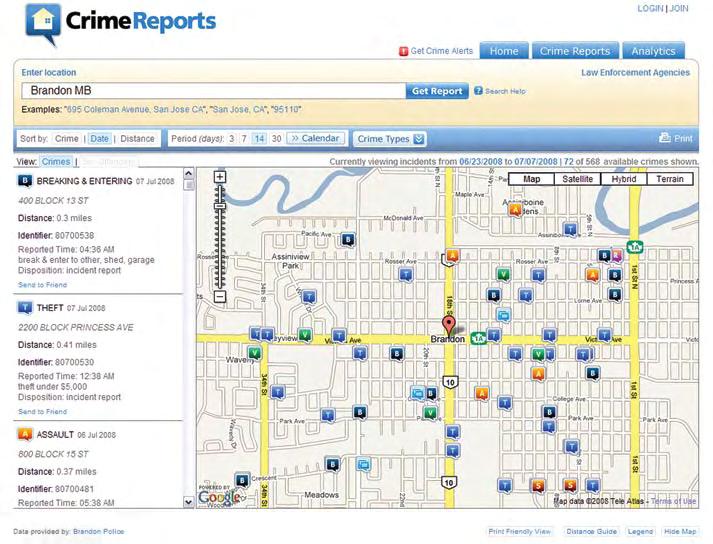
The program also allows residents to sign up for free e-mail alerts when crime occurs in their neighbourhood. The BPS would previously provide this information by placing coloured dots on a map to show where police activity had occurred, but this proved inadequate and confusing. An officer read about crimereports.com in a trade magazine and, after investigating, the BPS tried the service

and soon made it available on its website.
“The $100 monthly fee for the use of the software is a wise investment,” Atkinson says. “Many American police departments use this service but Brandon is the first community in Canada to subscribe to it.”
Crimereports.com was developed after the designer experienced criminal activity in his Arlington, Virginia neighbourhood and was first used by the Washington DC Police Department in May, 2007. A stranger followed a woman into a parking lot and further investigation revealed that the same offender had been involved in similar activities in the area in the previous days. With a need to alert area residents, police realized there was a need to develop a service to inform the public about such incidents so they could protect themselves. Hundreds of cities have since subscribed and the service is expanding to Mexico and the United Kingdom.
In addition to informing and involving the public in helping to combat crime, the service includes an analytical function to help officers decipher crime trends and hotspots, helping them to identify and target trouble areas. The BPS believes the service will be a valuable tool in promoting community safety, Atkinson says.
Visit http://www.brandon.ca/compstat to see the service in action or contact BPS sgt. rod Koscielny at 204 729-2321 for more information.
elvin Klassen is Blue Line Magazine’s West Coast Correspondent. He may be reached at elvin@blueline.ca .
Staying in touch during disasters
Whether natural or man-made, disasters can cripple public and private telecommunication services, leaving emergency teams helpless to coordinate a quick and timely response.
British Columbia emergency responders can now turn to the sky for help; a BC company has released a mobile satellite system (MSAT), built to allow them to keep in constant communication under the most critical circumstances.
Known as EmergNet BC, the system, created by Glentel Inc., consists of two newly created satellite radio talk groups to aid reliable, inter-operational communications in the event of a disaster or wide-spread emergency.
Developed in conjunction with Simon Fraser University’s Telematics Research Lab, the groups can operate independently of terrestrial satellite or public and cellular telephone networks, and do not rely on traditional communications infrastructure.
Both talk groups – BC Emergency Private Mode and BC Emergency Interoperability –are capable of interfacing with multiple users. Each offers a variety of applications to allow users from different organizations to remain in uninterrupted contact.

The emergency interoperability group also allows communication between multiple users at the same time. This one-to-many (or point-to-multipoint) functionality enables a single message to be quickly and concisely delivered to a number of different parties, saving time and mitigating the likelihood of dangerous miscommunication.
The talk groups are not meant to replace an organizations’ private communications networks but rather to provide a safe second line of defence. In the event of a threatening forest fire, earthquake or tsunami – which could devastate the province’s terrestrial sites, shut down power grids and overwhelm limited phone networks –subscribers will still have access to secure voice radio dispatch communications among various agencies and organizations.

The effectiveness of mobile satellite in disaster response has led to its use in a variety of disasters and public emergencies in recent years. More than 300 MSAT units were deployed in Mississippi prior to Hurricane Katrina in 2005 and remained operational before, during and after the hurricane hit. A number of units were also deployed during the ice storms which paralyzed much of eastern Canada in 1998.
BC talk group users include the West Coast Regional Districts Health Authorities, which links together its major assets and resources so its hospitals can continue to communicate.
Another subscriber, BC’s Coastal Communities Network, uses the system as a link for tsunami warning, response, and coordination as the primary reason. The talk groups enable it to provide a much-needed communications link between small, remote coastal villages and various agencies and ministries should an emergency situation occur.
For more information got to www.glentel.com or contact: Dale b belsher, Chief Financial Officer for Glentel at 604.415.6500


RR-5: Centralize the application and candidate screening process.
Examine and improve upon current regional models used by Ontario and Alberta.
Currently the application process in the policing sector can take anywhere from six months to well over a year to become a police officer. Today’s youth think that the hiring process, whether for police or not, should not exceed two to three months. Very few think that a period of more than three months is a reasonable length of time for the hiring process, although most recognize and expect that the process will take longer in the police sector than in many other fields of employment.
Our recommendation is for the policing sector to implement a national centralized application process that reduces the hiring practice down to six months for people who are actively engaged in pre-recruit education and to three months for those who have the pre-requisite educational qualifications. If the process takes longer than this the police sector is at a significant risk of losing potential good applicants.
Of equal importance, we recommend that ongoing communication and feedback needs to occur with the applicants throughout the process to maintain their interest and commitment.
We believe that this recommendation is feasible in conjunction with other recommendations that we make. These other recommendations (discussed elsewhere) are: partnerships with educational institutions, standardized testing, competency-based assessment tools, and acceptance to the Academy contingent on a job offer. The proposed national application process is illustrated on the next page. It is modeled on the process currently in place in Ontario, which is regarded as a best practice. We recognize that the province of Québec has a unique recruit process, which is reported to be highly effective, and which we believe can continue to exist in parallel with the proposed national process.
The process begins when an interested party chooses to complete an application. The application process will be online but will also allow paper-based applications. To take this description further we will outline the online process (which will have the same components for paper based), as it would relate to the typical candidate for a “Constable-in-Training” or Constable entry.
To begin the first step, the applicant reviews the online literature of screening criteria, which enables them to screen themselves in or out. If they think they meet these criteria, they are invited to proceed with the application
process. This includes a standardized application form, standard template for submitting their resume and for providing references, and an opportunity for candidates to indicate their preferences with respect to which service(s) they want to join. If they choose to proceed, the applicant is charged a $100.00 application fee plus applicable taxes.
Initially, when we heard about the use of application fees we considered this to be
a potential barrier to recruiting candidates. However, in this situation, along with the other recommendations identified above, the candidate has much more available to him or her and the fee is warranted. Furthermore, we believe that the national application processing agency should be self-financing through the application fees (20,000 applicants per year at $100 each provides a revenue stream of $2Million per year). There is no limit to the

number of police organizations that an applicant can apply to, and their application will be forwarded to all indicated services. However, if for example, the applicant has only applied to one police organization and is declined, there would be a further fee if they wish to reapply for consideration by other police organizations. Moreover, the central agency will attempt to encourage good applicants to consider vacancies that exist in other services than those indicated on the application. If a candidate accepts such an invitation there would be no additional application fee. Indeed, police organizations that receive good candidates this way could be encouraged to provide a small incentive to the applicant and the central agency.
Application submitted
A recruiter at the national application processing agency receives the application and forwards it to all of the indicated police organizations for consideration along with the file on the applicant, which will include their educational results (high school and college or university), and their references. The services are asked to advise the recruiter of their response, which may be one of three options:
1. Yes, lets proceed,
2. Interested, but not at this time,
3. No, not interested.

If the applicant receives all “No, not interested,” responses from the police organizations, the applicant is notified and offered an opportunity, if feasible, to apply to other
police organizations. If not, then the applicant is notified that the application is discontinued and the reasons why.

If the applicant receives at least one “Interested, but not at this time,” the applicant is notified and offered an opportunity, if feasible, to apply to other police organizations. If not, the applicant is notified that the application is kept on file for a period of one year at which time, if there is no further interest, the applicant is notified that the application is discontinued and the reasons why.

If the applicant receives at least one “Yes, lets proceed,” the file proceeds forward. The applicant is notified of the police organization(s) that indicated “Yes,” and the applicant is invited to proceed with the next stage of testing.
Standardized testing
The Recruiter contacts the applicant and indicates the location of the police organization that will provide the standardized testing. We expect that many police organizations will run standard testing a number of times per year. The standardized tests (see 9.4 Candidate Assessment) will be such that they can be administered anywhere and produce consistent results. The Recruiter co-ordinates the testing with the relevant police organization and the applicant. The police organization conducts the initial testing and sends the test results to the Recruiter. The Recruiter provides the

police organization that has conducted the initial testing with a $25 reimbursement (which comes from the application fee).

The results of this initial testing are attached to the applicant’s file and forwarded to the interested police organization(s) for review. If the service(s) are not interested in pursuing this further, the applicant is notified of this decision and the reasons why and, depending on the circumstances, the applicant is invited to consider other services or the application process is discontinued. It will need to be determined what results beyond pass or fail can be shared with the applicant and whether a time limit between testing and retesting needs to be determined.

If the applicant receives at least one “Interested, but not at this time,” the applicant is notified and offered an opportunity, if feasible, to apply to other police organizations. If not, the applicant is notified that the application is kept on file for a period of one year at which time, if there is no further interest, the applicant is notified that the application is discontinued and the reasons why.
If the applicant receives at least one “Yes, lets proceed,” the file proceeds forward. The applicant is notified of the police organization(s) that indicated “Yes,” and the applicant is asked to confirm their preference in terms of which police organization they wish to move forward with. The police organization(s) that indicates a “Yes,” are

contacted and advised of the candidate’s preferences and the first choice police organization is invited to proceed with the second and subsequent rounds of testing.
local police organization testing

The second (and subsequent) rounds of testing are the responsibility of the hiring police organization and may include whatever tests that police organization deems suitable. There is no reimbursement of funds from the central agency. The police organization will either decide to make a conditional offer of employment or to discontinue their interest in the candidate. They will notify the Recruiter of their decision in either event along with the reasons if they choose not to employ the candidate. Depending on the service’s reasons for not moving forward, the Recruiter may forward the file to the second choice police organization for consideration. The Recruiter will inform the candidate of the change in status of their application and the relevant reasons. The process repeats with the second (and subsequent) police organizations until either an offer of employment is made, or no police organization is interested in making an offer. The Recruiter notifies the applicant and offers an opportunity, if feasible, to apply to other police organizations. If not, the applicant is notified that the application is kept on file for a period of one year at which time, if there is no further interest, the applicant is notified
that the application is discontinued and the reasons why.
If a police organization is interested and wants to make an offer to this person, it is done directly between the police organization and the applicant. The Recruiter is notified of the results. These results are attached to the applicant’s file, which is removed from the application process and archived. Until this time the applicant’s file is available to any police organization until the applicant accepts an offer.
Once the applicant has completed and passed all testing and the police organization presents the applicant with an offer and it is accepted, the next step is for the applicant to attend the academy. This ties into another recommendation that states that all recruits at the academy should have a job offer in hand, contingent on passing the academy.
We believe that implementing this recommendation would significantly reduce the hiring time by having candidates self screen at the beginning of the process and by streamlining the application process. It will not include time at the academy, as the academy will only be for those people with conditional job offers.
We also recognize that it may be easier for the sector to implement the spirit of the recommendations through a series of regional or provincial organizations rather than a single, national body. We see this as a viable alternative, as long as it is essentially the same process administered regionally.


Canadian Banks Law Enforement Award
by Edo van Belkom origins
Athough police officers had been recognized by the banking community for many years, there was no consistent method of recognition. And so in 1971, Canadian banks agreed that the ideal form of recognition should be a medal accompanied by a citation. The medal was designed with input from the Awards and Decorations Committee of the Canadian Association of Police Chiefs and the support of the association. The following year, the Canadian Bankers Association has presented the Canadian Banks Law Enforcement Award to recognize outstanding police performance in fighting crime against Canadian banks.
Criteria

All active (at the time of the incident) law enforcement officers considered to have exhib-
ited outstanding bravery, detective ability, or other noteworthy achievement involving Canadian chartered banks are eligible to receive the award. The award can be presented to a single officer or a team of investigators.
Insignia
The circular medal is struck in 14k gold. The obverse features a stylized door to a bank vault with the words “The Canadian Banks” above and “Law Enforcement Award” below. The obverse of the French version of the medal has the words “Medaille D’Honneur Des Banques Canadiennes” above the door and “Pour Action Policiere Meritoire” below. On the reverse is the inscription, “Awarded by the Canadian Bankers’ Association for Distinguished Law Enforcement,” surrounded by a full laurel wreath. The reverse of the French medal reads, “DeCernee Par L’Association Des

Banquiers Canadiens en Reconnaissance De Sa Valeureuse Conduite.” The recipient’s name and the year of the award are engraved around the rim of the medal.
ribbon
The ribbon adopts the unoffical colours of the Canadian Bankers Association and is made up of three stripes, a central grey stripe bordered on either side by a narrower maroon stripe.
other
Since 1972 the medal has been presented at a formal ceremony at the annual conference of the Canadian Association of Chiefs of Police. It is presented along with a miniature medal and undress ribbon in a black box lined with a burgundy path and white satin fabric.
nominations
Nominations are accepted in letter format addressed to the Director of Security, Canadian Bankers Association, from CBA member banks and Canadian law enforcement agencies. Nomination letters should be addressed to: Box 348, Commerce Court West, 30th Floor, Toronto, Ontario, M5L 1G2.
edo van belkom is both a special constable and auxiliary constable with Peel Regional Police. He can be contact at VanBelkom@aol.com .

Legitimate persuasion okay to get statement
by Mike Novakowski
videotaped and could be used in court.
After answering a few questions about where he had grown up, Sinclair told the officer he didn’t have anything to say until his lawyer was present to advise him what was going on. The officer told him it was his decision whether to say anything, but that he wasn’t entitled to have his lawyer present during the interview.

Police are not required to hold off from questioning a detainee who has exercised their right to counsel and again asks to speak with a lawyer.
In R. v. Sinclair, 2008 BCCA 127, police arrested the accused for murder on a Saturday, advising him of his right to retain and instruct counsel, call any lawyer he wanted and his option to use a legal aid lawyer without charge.
Sinclair was taken to the detachment, booked-in and taken from his cell to a room where he spoke privately with his chosen counsel for some three minutes. He spoke again to his lawyer about three hours later for another three minutes. After each call, an investigator asked whether he was satisfied with speaking to his lawyer, and he replied that he was.
After the second call, an undercover officer was placed in Sinclair’s cell. A judicial justice of the peace subsequently remanded him until Monday by teleconference and later that day an officer interviewed him. He began by confirming that Sinclair was advised of and had exercised his right to counsel. He also confirmed that the interview was being
Sinclair indicated that he wanted to hear what the officer had to say and was questioned further about his background. After answering a few questions, he said he was uncomfortable without his lawyer and wanted him present during questioning. The officer reminded him of his rights and option not to talk, explaining that police are required to advise arrested persons of their right to counsel. Sinclair had spoken with his lawyer and twice indicated he was satisfied with having done so, the officer added; he wasn’t entitled to a lawyer during the interview and needed to decide whether to answer questions.
The interview lasted for about 4½ hours and, as it progressed, the officer revealed more and more evidence police had gathered, referring to it as “overwhelming.” He suggested Sinclair might have an explanation for what had happened, such as alcohol or rage, suggesting the victim may not have been without fault.
The officer confronted him about finding the victim’s blood stains on the motel room floor.
Sinclair said he would rather talk to his lawyer about it first and didn’t want to say anything at the moment. The officer then disclosed the existence of two witnesses who had seen him trying to clean up the blood stains, played a portion of a videotaped statement made by one of them and then asked him to explain what had happened.
Sinclair again said he wanted to talk to his lawyer, adding he would see him Monday. The officer left the room and returned to tell Sinclair police had found the victim’s body and bedding from the motel room and Sinclair’s DNA on the bedding (which wasn’t true).
“You got me, I know it,” Sinclair responded, telling the officer what happened the night of the victim’s death. He was returned to his cell, where the undercover officer said, “That was a long time, it must be serious.” Sinclair explained the events leading to the death, essentially repeating what he had said during the interview.
Later that same night, he accompanied police to where the victim had been killed and took part in a videotaped re-enactment, again repeating what he had earlier told police.
Sinclair’s statements were admitted at trial in British Columbia Supreme Court. The judge ruled police were not required to terminate the interview when he again asked to speak with counsel since he had been advised of his rights under s.10(b) and exercised them. Police were then entitled to

continue the interview and were not obliged to stop or allow Sinclair’s lawyer to be present during the investigation or interrogation.
Police cannot override or overbear an accused’s right to choose, such that the interview becomes so oppressive or overbearing that the person’s decision to talk is no longer voluntary, but that did not happen. Sinclair was aware that he could choose to discontinue the interview.
Although he “might have liked to have been able to talk to his lawyer, he understood what his choice was and the police were not obliged after he had been able to retain counsel to give him a further opportunity in this particular interview,” the justice concluded. The Crown had proven beyond a reasonable doubt the voluntariness of his statement.
Sinclair’s statement in the cell was also admissible because the undercover officer wasn’t a person in authority and did not attempt to elicit any information or discuss the offence. The reenactment was also admitted because Sinclair had participated in it voluntarily and police were not required to “re-Charter or re-warn.”
A jury convicted Sinclair of manslaughter and he appealed to the BC Court of Appeal. He argued police were required to suspend further questioning when he asked to again consult with his lawyer, and could not continue questioning until he was provided a reasonable opportunity to do so.
Justice Frankel, writing the court’s decision, found police are not under a duty to refrain from speaking with a detainee who has exercised their right to counsel merely because they want to talk to their lawyer again. The principle underlying
the right to counsel found in s.10(b) “is to ensure that persons who are in the vulnerable position of just having been arrested or detained are informed of their right to obtain timely legal advice, particularly with respect to their right to remain silent.” He continued:
The right to counsel is intended to ensure that detainees receive immediate legal advice so that they will be able to make informed choices in their dealings with the police... once a detainee has exercised his or her right to counsel, the police are entitled to use legitimate means to persuade him or her to speak. I see no policy reason for providing a detainee, who does not have the right to terminate an interview by stating “I wish to remain silent,” the peremptory right to do so by stating, “I want to talk to my lawyer again” (references omitted, para. 40).
Under s.10(b):
(1) Police have the duty to inform the detainee of their right to retain and instruct counsel without delay and of the existence and availability of legal aid and duty counsel; (2) If a detainee indicates they want to exercise this right, police must provide them with a reasonable opportunity to do so (except in urgent and dangerous circumstances): (3) Police must refrain from eliciting evidence from the detainee until they have had that reasonable opportunity (again, except in cases of urgency or danger).
After reviewing the case law, Frankel found “one constant theme: s.10(b) does not require the police to “hold off” when a detainee who has exercised his or her right to counsel asks to speak with a lawyer again.”
Nor did the court accept Sinclair’s submis-
sion that there were special circumstances requiring police to stop questioning him until he had again spoken to his lawyer. The fact that he only had two three-minute telephone conversations with his lawyer without an opportunity to meet him in person did not mean he did not have a meaningful discussion. Sinclair bore the burden of proving, on a balance of probabilities, that his opportunity to consult counsel was inadequate. Neither he nor his lawyer testified on the voir dire, therefore the specifics of the advice are unknown. However, the trial judge found that he was well aware of his right to silence.
The fact he did not make incriminating statements until after the last of his five requests to speak with his lawyer were made and ignored did not require police to refrain from questioning him, the court stated:
I fail to understand how the number of times a detainee asks to speak to counsel can make a difference when the police have already complied with s.10(b). If the police have no duty under s.10(b) to refrain from further questioning when such a request is made, then such a duty cannot arise simply because the request is repeated. To hold otherwise would create an unworkable situation for the police, as it would be impossible for them to determine when to “hold off” in any particular case. The duty either exists, or it does not; there is no continuum (para. 65).
Frankel also rejected Sinclair’s contention that he was entitled to speak with his lawyer again because, as the interview proceeded, his understanding of the case against him and therefore, his jeopardy, significantly changed when the interviewer revealed more about the

evidence police had gathered:
The flaw in this argument is that there was no change in (the accused’s) jeopardy during the interview. He understood from the outset that he had been arrested for the murder of (the victim) and was, thereafter, in a position to make an informed decision as to whether to co-operate with the police in that investigation. The fact that (he) became more aware of the strength of the case against him over time did not amount to “a fundamental and discrete change in the purpose of the investigation” giving rise to a renewed right to obtain legal advice (references omitted, para. 67).
Sinclair also argued he should have been allowed to speak again with his lawyer because his request to do so wasn’t a “dilatory tactic.” There was no urgency to the investigation, he added, and police could have accommodated his request by suspending their interrogation until he met with his lawyer two days later.
This was also rejected. Even if true, it could not impose a constitutional duty on the police when none otherwise exists. “The interests protected by s. 10(b) of the Charter are served when a detainee is afforded an opportunity to obtain legal advice on how to exercise his or her rights,” said Frankel. “Once the police have fulfilled their obligations to a suspect under s.10((b), they are entitled to ‘attempt to tap this valuable source.’”
The court found police were not obligated to stop questioning Sinclair when he asked again to speak with his lawyer and dismissed his appeal.
August 23, 2008 (9am to 3 pm) police insignia Collectors show Calgary, Ab
The Calgary Police Association Club, The Cuff and Billy Club, 428 - 6th Ave, Calgary, Alberta. Host: Colin Mills, colinmills@dewinton.ca (403) 938-6110
september 27, 2008 (9am to 3pm) Peace Officer’s Memorial Insignia Collectors show Ottawa, On
Tom Brown Arena, 141 Bayview Road, Ottawa, ON. Tables are $10 in advance, profit’s made go to the Childerns Hospital. Host: Bob Pyefinch & CPICA, pyefinch@sympatico.ca (613) 345-8431
•••
september 13, 2008 (9am to 2pm) police insignia Collectors show Welland (niagara), On
Niagara Regional Police Service Building, 33 Division 5 Lincoln St. West, Welland, Ontario. Host: Ken McGregor, kanine43@yahoo.ca

Gun gear built to take the heat Wouldn’t it be great to find inexpensive gun gear that wasn’t “cheap”?
Three such products are now available. 5.11 Tactica l has partnered with Blade-Tech Industries to engineer superior quality, heat-resistant production holsters, mag pouches and training barrels that perform as promised and are easy on the budget. Constructed of a proprietary polymer that retains its shape in temperatures over 300º Fahrenheit, yet remains stable in low temperatures, this all-season gun gear is essential equipment.
SoMS bag: the monster’s little brother

The popular CAMS (Carry All My Stuff) 40” Outbound bag from 5.11 Tactical® is affectionately referred to as a MONSTER of a bag. Users like it so much that they asked for a smaller version with one main compartment. This spring, the SOMS (Some Of My Stuff) 32” Outbound bag was born. Although the SOMS bag is roughly 25% smaller than the CAMS bag, it’s still substantial. The 32” x 14-1/2” x 13-1/2” SOMS bag is reinforced with fibreglass rods for stability, so it can stand on either end. Oversized wheels, skid rails, grab and haul handles and compression straps are standard on this solidly built rolling case. The interior features a main storage compartment with an adjustable
divider. Outside are three padded pockets, an ID window and a large document window for your deployment papers, documents or colored paper for fast identification.

Investigator knife is a sharp investment
Need a great medium-sized, all-around folding knife for uniformed, undercover or casual wear?
You’ve found it with the Investigator Knife from 5.11 Tactical – one of eight outstanding duty knives born from tactical need and engineered for general use. The Investigator delivers superior durability and functionality. Precision crafted of premium 154CM Crucible steel, the 3” flat-ground, 1/8” thick blade features a bead blast finish, back lock, G10 scales (.125” thick) and full .04” steel liners. It has few moving parts, an extra thick blade, rugged handle, friction ramps and oversized Torx screws.
SafteyStrobe with megaphone
The SafetyStrobe comes complete with the following built in features: flashing strobe, solid signal light, 20-watt megaphone, loud signal whistle, flashlight, and rechargeable NiMH battery. Best of all, the weight of the entire device is just one pound. Ideal for assisting in building emergency evacuations, crowd control, traffic enforcement and many other situations.
October 12, 2008 (11am to 3pm) police serv. insignia Collectors show Altona, mb
The Richmond Pioneer Centre, Altona Curling Club 227 10th Ave N.W. Altona, MB. Host: Mike Turnbull, miket@townofaltona.com (204) 324-4539
•••
search & rescue Conference
October 15-18, 2008 St John’s, NL.
Learn about new equipment and emerging technologies, share best practices, and tackle issues facing SAR. Contact: info@sarscene.ca or 866-671-9970.
•••
April 28 & 29 2009 blue Line trade show 2009 markham, On
The 13th Annual Trade Show for law enforcement personnel from across Canada to view and purchase a wide spectrum of products and services in the law enforcement industry. Visit blueline.ca to find out more.
Avenger series super-leD dash/deck warning

Avenger is a compact dash and deck light with a big attitude delivering full-size linear Super-LED power that rivals strobe in intensity. Choose a single, dual or split module, all with a snap-on polycarbonate hood to minimize driver flashback. Avenger is lightweight and sturdy, mounts to the vehicle by a standard swivel/bail bracket with three suction cups. Offers multiple flash patterns, including alternating and synchronized modes.
SpitFire series super-leD dash and deck warning

SpitFire is the high performance, cost effective alternative to the larger Whelen Avenger Series providing wide-angle visibility and high intensity warning using less amp draw of a similar strobe unit. Available in single or split colour with a clear non-fluted lens and features forty-five Scan-Lock flash pattern including alternating and simultaneous patterns and steady-burn.
Court rejects high waiver standard for voluntary sample
by Mike Novakowski
The legal standard for admitting DNA samples voluntarily provided by an accused is a balance of probabilities, not the proof beyond a reasonable doubt required for statements.
In R. v. Colson, 2008 ONCA 21, the accused was convicted of sexual assault, forcible confinement and assaulting police and was imprisoned for four years, five months in the special handling unit of the Quebec Penitentiary.
Police contacted him before his release – he planned to live with relatives in Toronto – and detectives supervising high-risk offenders met him at the bus terminal when he arrived. He was taken to police headquarters, interviewed and subsequently entered into a recognizance under s. 810.2 of the Criminal Code. His conditions were to attend counselling, undergo therapy or treatment as directed and enter a program of regular polygraph examinations to monitor and manage his sexual behaviour.
Colson complied, developing a cordial relationship with detectives over the following months, but failed the polygraph testing. A woman complained to police that he had sexually assaulted her. Although detectives believed they didn’t have reasonable grounds to arrest him, they nonetheless interviewed him at length on videotape, during which Colson made statements and voluntarily provided a saliva sample.
About six months later a woman was murdered in an office building attached to the building where the other woman alleged Colson had sexually assaulted her. DNA samples (semen) taken from the murder victim’s body were found to be similar to Colson’s saliva sample and he was arrested and charged with first-degree murder. A further blood sample pursuant to a Criminal Code DNA warrant was obtained while he was in custody and also matched.
An Ontario Superior Court of Justice judge ruled the DNA evidence admissible and a jury
convicted Colson. In the judge’s view, Colson was well aware of the reasons the saliva sample was requested and its potential uses when he consented. He provided the sample without being physically or psychologically detained and his relationship with police was not based on oppression, fear or coercion, but rather was “based upon cordiality and informality.”

The judge concluded Colson’s rights were not infringed during the course of the interview and the court, applying the balance of probabilities standard, found he gave an informed, express and voluntary consent to the taking of the saliva sample.
Colson appealed to the Ontario Court of Appeal, arguing the sample and its results were inadmissible under the common law. He submitted that the trial judge failed to apply the appropriate standard of proof in determining whether a proper waiver, in the form of a voluntary and informed consent, had been provided.
Rather than using a balance of probabilities standard for determining waiver (like consent seizures under the Charter), Colson contended that a voluntary and informed consent to the taking of a bodily sample should be treated no differently than a statement under the common law confessions rule. Under that rule, the criminal standard of proof beyond a reasonable doubt applies.
Since statements and body samples are both “conscriptive” forms of evidence, and their admission when illegally obtained would tend to undermine the overarching principles of trial fairness and the right not to self-incriminate, the higher standard of proof is required.
Justice Blair, writing the judgment for the unanimous court, rejected Colson’s posi-

tion. First, the common law with respect to giving bodily samples does not parallel the confessions rule in standard of proof.
Second, there are significant differences between statements and bodily samples. Reliability remains one of the essential underpinnings in the evidentiary exclusion/admission exercise under the common law confessions rule.
There was no policy reason or justification for extending the common law rule to body samples to accommodate the process concerns underlying the modern emphasis on trial fairness.
Confessions rule
In addition to trial fairness and protection against self-incrimination, the common law confessions rule remains concerned with reliability as an underlying rationale, because an involuntary confession is often unreliable. That is why, to avoid miscarriages of justice, a statement given to a person in authority requires a standard of proof beyond a reasonable doubt before it may be admitted in evidence. Bodily samples do not give rise to the same concerns about reliability, especially in the DNA context.
“Reliability is not a concern with respect to bodily samples, particularly DNA results taken from a bodily sample of saliva,” said Blair.
Indeed, reliability is the hallmark of properly introduced DNA testing. Thus, there remains an important distinction between the admissibility of DNA results taken from a bodily saliva sample and a confession, notwithstanding that both are considered to be conscriptive evidence under s. 24(2) of the Charter...
Statements given to persons in authority are notoriously unreliable if their voluntariness, in the sense of their freedom from inducement or threat, is not assured. Different considerations arise with respect to the voluntariness of a waiver or consent to provide bodily samples however, and with respect to the exclusion of test results emanating from those samples, which are not fraught with the same frailties (para. 40).
The confessions rule has been confined to statements and not extended to the taking of bodily samples. Thus, Blair found there was binding authority that “bodily samples and the results of physical tests are not to be treated in the same fashion as statements because the rationale behind the confessions rule only applies to statements.”
Policy
The court saw no policy reason or justification for extending the standard of proof under the common law confessions rule to the common law treatment of the taking of bodily samples. Reliability concerns differ and there is a “well-developed Charter landscape for determining whether improperly obtained evidence should or should not be excluded.” Nor would the court create a new common law right:
At a more general level, however, I see no justification for creating a new common law right – infused, the argument goes, by the Charter tool of equating bodily samples and statements as “conscriptive evidence” and by the now Charter-guaranteed fundamental principles of trial fairness and protection against self-incrimination. That would provide greater protection to an accused than the Charter safeguards he agrees have been properly applied in the circumstances of this case.
The (accused) would derive greater protection because, under the proposed common law principle, the bodily samples would be automatically excluded from evidence unless the Crown could demonstrate a voluntary and informed waiver or consent beyond a reasonable doubt. Under the Charter, on the other hand, the (consent waiver doctrine) need only be established by the Crown on a balance of probabilities.
In short, the (accused) invokes the Charter
and Charter-related values, to push the common law to the desired point, then invokes the common law (devoid of the Charter) to achieve the more advantageous legal result that he seeks. This approach makes no sense, particularly where... there is no need for it, given the well-developed Charter jurisprudence respecting trial fairness and its included values in the context of improperly obtained evidence (para. 38).
Blair ruled that the consent test, including the balance of probabilities standard, adequately addressed the core concerns of the criminal law, stating:
DNA samples, for example, do not bring with them the unease associated with potential wrongful convictions, whereas false confessions do and the common law confessions rule reflects that danger. (The Wills consent test) also directs trial judges to be alert to issues going to abuse of process and interference with individual autonomy (for example, police oppression, coercion or other external conduct negating freedom of choice). On the other side of the scale, Wills balances the need of the state to investigate and solve crimes, a factor that speaks in favour of the less stringent standard of proof...
The underlying criminal law policy concerns – wrongful convictions, abuse of police power and coerced self-incrimination and respect for human choice and autonomy – are all adequately preserved and accommodated through the Charter regime. A new common
law regime is not required (paras. 42-43).
The court held that the trial judge applied the correct standard of proof in determining that Colson voluntarily consented to providing a saliva sample. It and the DNA results flowing from it were admissible, as were the DNA results emanating from the second bodily sample provided, pursuant to the Criminal Code DNA warrant.
Colson’s appeal was dismissed.

Child seatbelt violation is strict liability
by Mike Novakowski
The Ontario Court of Appeal has held that a child seatbelt ticket is a strict liability offence, making the due diligence defence available.
In R. v. Kanda, 2008 ONCA 22, a parked traffic officer watched a vehicle come to a halt at a four-way stop. There were three people inside – a male driver (the accused) and two children, one in the front passenger seat and the other in a rear seat sitting forward, unbelted and leaning against the back of the driver’s seat.
The officer pulled the vehicle over and issued a ticket for violating s.106(6) of Ontario’s Highway Traffic Act. This section makes it an offence for a person to drive a motor vehicle on a highway with a passenger under 16 years old not wearing their seatbelt.
At trial before a justice of the peace, Kanda testified he had ensured both his sons were wearing their seat belts when they left the family home, and wasn’t aware until told by the officer that one had unfastened his belt. The JP determined that s.106(6) was an absolute liability offence, which precluded a due diligence defence, and convicted Kanda.
On appeal to the Ontario Court of Justice, the judge concluded that s.106(6) wasn’t an absolute liability offence but rather one of

strict liability. As a result, the matter was referred back to the JP to determine whether Kanda was entitled to advance a due diligence defence. The Crown appealed to the Ontario Court of Appeal.
Justice MacPherson, authoring the court’s opinion, first outlined the three types of offences:
1. Mens rea (full liability) offences consist of some positive state of mind – such as intent, knowledge, or recklessness – which the prosecution must prove either as an inference from the nature of the act committed or by additional evidence. Criminal offences are mens rea.
2. Strict liability offences do not require proof of mens rea – doing the prohibited act prima facie imports the offence. However, an accused may avoid liability by advancing a due diligence defence, proving that all reasonable care was taken to avoid the particular event in the circumstances, or the accused reasonably

believed in a mistaken set of facts which, if true, would render the act or omission innocent. Public welfare offences presumptively fall into this category, unless words such as “wilfully,” “with intent,” “knowingly,” or “intentionally” are contained in the statutory provision creating the offences, which render them mens rea.
3. Absolute liability offences do not require proof of mens rea, but unlike a strict liability offence, the accused cannot exonerate themselves by showing they were free of fault.
Section s.106(6) of the HTA is a public welfare offence – ensuring the safety of vulnerable young passengers who cannot be relied upon to take responsibility for their own safety – by making drivers responsible for ensuring their under 16 passengers are belted. In deciding how to classify an offence, a court will consider four factors: the overall regulatory pattern, subject matter, penalty and precision of the language used.
Although the overall regulatory pattern was neutral in assessing whether s.106(6) was an offence of strict liability and the penalty (a modest fine without fear of imprisonment) was consistent with an absolute liability offence, the subject matter and precision of the language used supported a strict liability offence. MacPherson stated:
In my view, the subject matter of s.106(6) of the HTA supports a classification of the offence as strict liability. This classification strikes an appropriate balance between encouraging drivers to be vigilant about the safety of child passengers in their vehicles and not punishing those who exercise due diligence with respect to children’s seat belts (para. 32).
And further:
The classification of strict liability strikes an appropriate balance between encouraging drivers to be vigilant about the safety of child passengers in their vehicles and not punishing those who exercise due diligence with respect to children’s seat belts (para. 44).
Even though the subsection used the triggering language “no person shall,” that did not automatically make it absolute liability. Other provisions using such language and found to be absolute liability offences proscribed conduct resulting directly from the person’s own action. S106(6) on the other hand, dealt with a situation in which another person – the child passenger – was potentially involved in creating the violation.
An accused should be able to raise a defence of due diligence or reasonable care for an offence of failing to meet a standard in respect of another person. Finally, s.106(6) does not expressly exclude the defence of due diligence. Thus, a person caught driving a car containing a child who is not wearing a seat belt can raise a defence of due diligence.
The Crown’s appeal was dismissed. Visit www.blueline.ca/resources/caselaw for complete cases. You can email mike novakowski at caselaw@ blueline.ca

by Julian Fantino
Policing without borders
Tolerating, managing or demonstrating only a token acceptance of diversity is not enough. We must genuinely commit to it as a mission critical element of all that we do.
In essence, diversity is the differences in the human dynamic of our society.
People are on the move; some leave developing countries for opportunities in cultures where everything is new and different.
More than 200 million people lived outside their country of birth in 2005. High-income countries have 16 per cent of the world’s workers, over 60 per cent of migrants and benefit from their contributions in many ways.
Between 70 and 80 per cent of new entrants to Canada are racialized, and with some 3.7 million people approaching retirement in 2006, our workforce will become more diverse. Some 3.4 million of Ontario’s workforce – more than 28 per cent – is foreignborn, and some 26 per cent of residents speak a mother tongue other than French or English.
Almost a quarter of Canada’s one million Aboriginals live in Ontario – their population rose 45 per cent between 1996 and 2006, a rate nearly six times faster than non-Aboriginals.
Meeting these current and emerging challenges requires leadership – leadership to galvanize people by living a shared vision and
promoting and championing mutual trust and respect in all that we do – all of the time.
“For long-term success,” said Andrea Zintz of Ortho Biotech, “we need to attract and retain the best people in the industry. To do that, we must create a company in which everyone can contribute his or her best, in which everyone is valued, regardless of differences.”
Police leaders need to demonstrate and, where necessary, develop the competencies needed to truly value difference. We must be aware of how biases and assumptions impact our perceptions and interactions, recognizing our own cultures and how they vary with those of others and resolving conflicts arising when people with different perspectives interact.
There is a strong link between the way conflicts and complaints of racism, discrimination and/or harassment are resolved internally and how much communities trust our ability to police without bias or discrimination.
The OPP ensures our managers can deal effectively with an increasingly diverse workforce, devoting resources to assure employees of a responsive and effective internal complaints system. We are committed to ensuring our recruiting, retention and promotion practices are open, transparent and fair to all.
Our experience with female officers highlights the significant challenges. Despite years of outreach, few women hold senior-ranking

positions. We are working to understand and address this inequity, and will apply the lessons learned to other under-represented groups.
We cannot wait another 20 years (the average time it takes a new recruit to become an inspector) to ensure our initiatives are working. The drive to keep pace with our changing communities demands innovative ways to accelerate and drive sustainable change.
We must also effectively investigate such areas as trans-national organized crime, terrorism or simply helping people overcome their mistrust and even fear of police.
It is not enough to seek help after a crisis. We need a diverse group of people who can inform our work from the earliest stages. We have a fundamental duty to ensure we are truly in sync with society and keep pace with changing communities, rising to the difficult task of proactively promoting our democratic system of policing in all that we do, all the time.
Our commitment to representation, inclusion and fairness must be a core belief, clearly demonstrated. We do not police the community, we police with it in a trusting and mutually respectful relationship.
Our democratic policing system demands we appreciate a fundamental reality: our legitimacy and authority is derived directly from the will of the people.
Understanding diversity and overcoming the many barriers we face will not be easy, but with great challenge comes great reward – the chance to build strong relationships based on mutual trust and respect.
We have to extend and apply ourselves, earning trust by being available, proactively sharing information, educating and genuinely connecting with the experiences, fears and aspirations of all our constituents. We must give them the chance to know us. Developing and fostering trust requires reciprocity – a willingness to talk long before there is conflict.
Building and nurturing trust and good will is a work in progress. We will win people over one contact, opportunity or relationship at a time, not unlike deposits in a savings account for the day we need a withdrawal.
We are occasionally forced to draw on that savings account of good will, trust and rapport. Community relations are relatively uncomplicated. Embrace these principles and you will keep pace with changing demographics:
• Encourage and demonstrate the utmost respect for human rights and dignity of all persons.
• Ensure your organization truly reflects your community’s demographic, and that all policies, procedures and practices enhance and support diversity.
• Set goals, plans and communicate widely the purpose and logic of diversity.
• Constantly monitor progress and seek authentic and meaningful feedback. If not us, then who – if not now, then when?
This is an edited text of the speech OPP Commissioner Julian Fantino gave to the 15th Annual International Police Executive Symposium in Cincinnati on May 16.