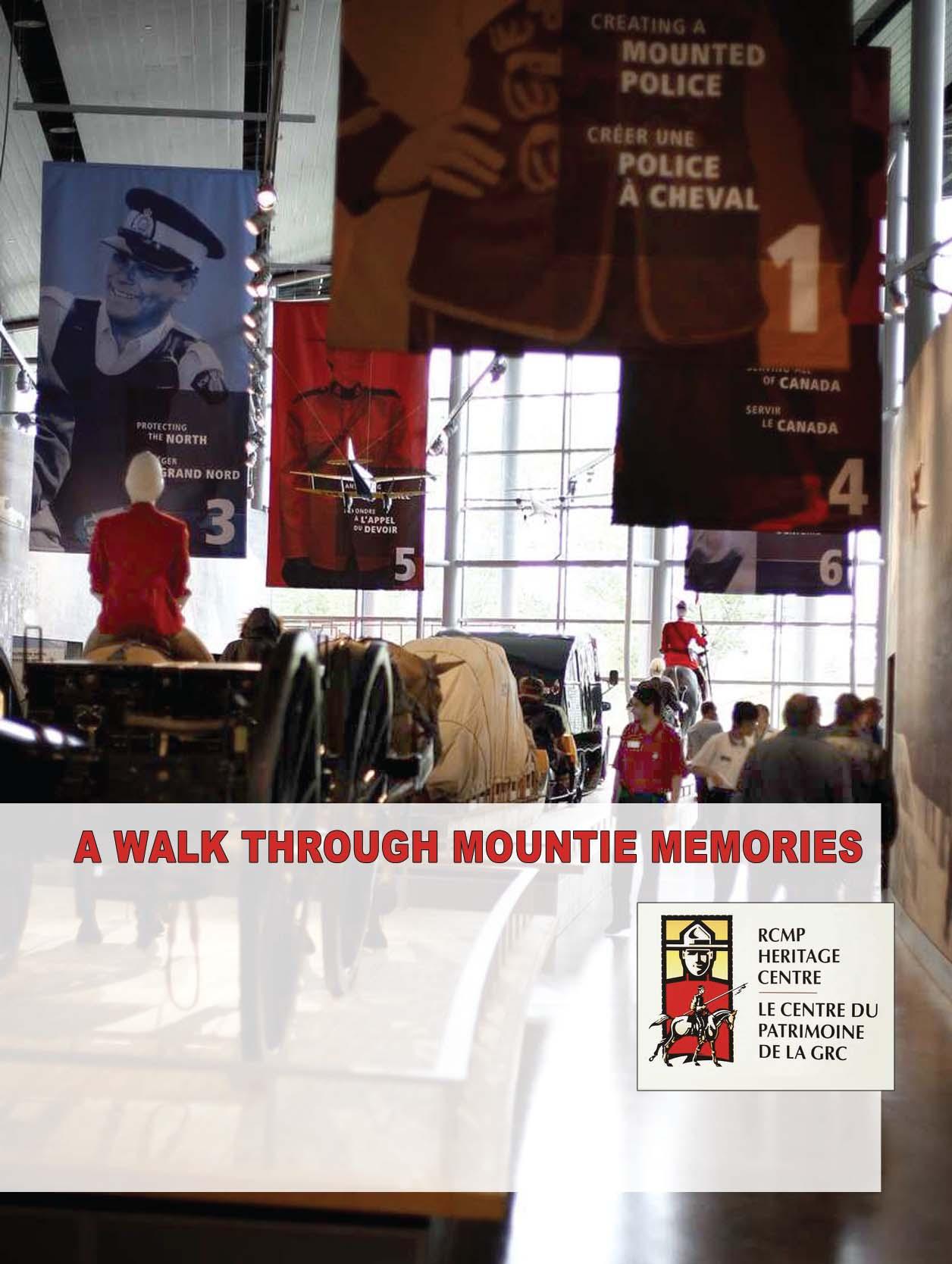
The recently opened RCMP Heritage Centre in Regina is the equivalent of a policing time capsule. Interactive and multimedia exhibits take visitors from the force’s inception to the present day as they journey through a $40 million, 70,000 square foot building which took two full years to construct.
The breathtaking centre was designed by world famous Canadian architect Arthur Erickson, who used old school architectural features to accent the force’s history. One of the main objectives is to show the public that the RCMP is much more than just red serge, large hats and horses, says centre president Vic Huard.
“We really have a theme here that the
RCMP is a living, breathing police service,” he says. “It’s a service that’s doing all kinds of work most Canadians aren’t familiar with, and works very closely with other police services in doing that every day.”
Huard recommends tours begin with the 27 minute multimedia presentation Tour of Duty, shown in the 124-seat SGI Canada Theatre. It quickly goes over the force’s history before focusing on the policing techniques and equipment used today.
“We talk in the show about things like community policing, forensics and international criminal investigations,” Huard explains. “It’s a really high quality production, all high definition video and audio; there is even a car chase. It’s not at all what people expect because it’s not
some boring old slide show about the history of the force.”
Visitors move from the theatre to chronologically positioned exhibits which include thousands of artifacts, helping to convey the conditions of days gone by. The first, ‘Creating a mounted police,’ takes people back to May 23, 1873, six years after Confederation, when an act of Parliament authorized the formation of a mounted police force of 300 men for the North-West Territories.
The original name was intended to be the ‘North West Mounted Rifles,’ but US concern about the prospect of an armed force patrolling the Canada-US border prompted the substitution of ‘mounted police.’ Interestingly though, Parliament did not specify a name and it wasn’t until 1879 that the designation North West Mounted Police became official.
The force was responsible to the federal justice minister, not local authorities, and was tasked with patrolling the frontier, suppressing the whisky trade, collecting custom duties, establishing friendly relations with the Indians and maintaining law and order. All commissioned officers were also to act as justices of the peace.
The government followed the recommendations of numerous observers, including P. Robertson Ross and Governor General Lord Dufferin, in choosing a uniform for the new force. They drew attention to the Indian tribes’ long standing respect for the red-coated British soldier.
Next is ‘Maintaining law and order in the west,’ depicts the difficulties of policing a new frontier. The illicit whisky trade had largely disappeared by the end of 1874 and order had been established. In the years that followed, there was little serious crime, with horse stealing the most common criminal offence. In preserving the peace, the force’s responsibilities consisted largely of enforcing liquor ordinances, which prohibited the importation of intoxicants into the North-West Territories “except for medicinal and sacramental purposes.”
From 1882 to 1885, the NWMP was given the responsibility of maintaining order during the construction of the Canadian Pacific Railway. A special detachment was organized under Insp Samuel Steele to enforce the ‘Act for the Preservation of Peace in the Vicinity of Public Works.’ The new legislation prohibited drinking and gambling for an area of 10 miles on each side of the surveyed railway line.
Mounties also escorted the railway paymaster, settled quarrels, dealt with angry strikers and prevented thefts and holdups. With the appearance of a growing number of towns and villages along the railway, detachments were established. The force took on more officers to meet its new responsibilities and, in 1882, moved its headquarters from Fort Walsh to the new territorial capital of Regina.
‘Protecting the north’ showcases the NWMP’s role during the Klondike gold rush, when duties included patrolling the Arctic, maintaining good relations with native people and protecting Canada’s sovereignty in the north. Officers also carried mail and reported on weather conditions, fish and game, migratory birds, timber resources and travel routes. The challenges the young force faced and enduring legends such as the lost patrol and the mad trap-
RCMP Commissioner Beverly Busson greets guests at the opening ceremonies of the RCMP Heritage Centre in Regina.
per of Rat River are also highlighted.
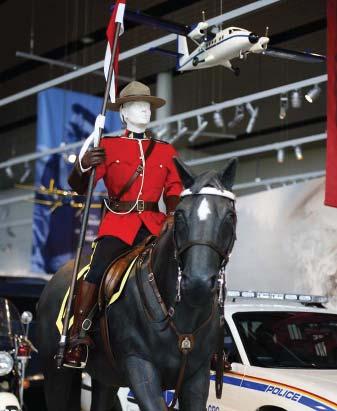
The ‘March of the Mounties’ has the largest artifacts – vehicles and equipment used over the years. Included is everything from an old cannon, Bombardier snowmobile and replica dog-sled and team right up to a modern day police interceptor.
The last artifact-based exhibit is called ‘Serving all of Canada’ and takes visitors through the RCMP’s evolution into a modern police force as it responded to an ever-changing community. Topics include the NWMP receiving its royal designation, community policing and modern day intelligence gathering to counteract terrorism.
Visitors then encounter interactive exhibits, popular with both children and adults, including theatres featuring the forces role in community policing, securing ports and major roadways, international investigations and peacekeeping.
‘Answering duties’ call’ looks at what it
takes to become a Mountie, showing physical and educational requirements and the training new recruits receive before they are sworn in. “There is a really cool interactive piece there where we have lockers set up. Kids get to try on uniforms and hats; that’s been hugely popular –they love it,” Huard says.
A 12 foot high graphic novel takes visitors through the investigative steps of busting an international drug ring, showing how officers work with other agencies and deal with lesser known crimes such as human trafficking, counterfeit operations and identity theft.
Most popular, “by far, is the forensics exhibit called ‘Cracking the case,” says Huard. “What we’re trying to do there is show people that (TV shows like) CSI, as entertaining as it might be, isn’t how it’s really done. It doesn’t happen in 48 minutes.
“We don’t just pick on CSI, but it is interesting to see the look on people’s face when they realize how complicated it really is.”
Things begin with a mock crime scene photo that was staged in a hotel room. Visitors
are part of an identification team, seeing the many different stages of an actual investigation and learning what to look for at a crime scene. Forensics matches bullets to firearms and spots counterfeit money used in the crime. A forensic light source theatre demonstrates fingerprinting. An optical fingerprint scanner allows visitors to see their own fingerprints and find out which of the five major patterns it falls under.
“It takes you through about 12 panels and then, by the end, you figure out who the perpetrator of the crime was and you look into a cell and he’s sitting in there,” explains Huard. “Big and little kids absolutely love it.”
One of the best aspects of the centre is having it on the same grounds as Depot, says
Huard. Visitors can see the RCMP Chapel, which dates back to the 1880s and is still in use, the parade square and cadets doing live training all around the grounds. It creates an atmosphere of pride and tradition that Huard describes as “simply incredible...
“Having the base itself here makes us all feel like we have a Heritage Centre that’s several hectares in size, not just 70,000 square feet, because we have all the outside elements as well,” he says. “It just adds a level of authenticity and really makes it a neat place to be.”
Huard says his greatest reward is the reaction of visitors and especially, wide-eyed, awestruck children.
“I was walking through the lobby the other
day and these kids are there and they’re talking excitedly about one of the exhibits. This one kid came running past me, with his teacher yelling after him to stop running, but, of course, he didn’t. (He was) on his way to the washroom. Just as he went by me I said ‘How do you like it so far?’ and he just whirled around and said, ‘It’s awesome!’
“That’s just a neat thing to hear from a kid because he was just so excited.”
Matt Collison is a staff writer with Blue Line Magazine He may be reached by email at matt@blueline.ca. For more information about the RCMP Heritage Centre go to the web site at: www.rcmpheritagecentre.com
A mor al compass is not enough A moral compass is not
by Darren Laur
All police leaders need a strong moral compass based upon the ethical standards of Chivalry, Bushido and the Jedi Code, but their subordinates will view them as only pseudoleaders without a strong ‘leadership ethos.’
Especially during crisis situations when there is no playbook to follow, a leadership ethos allows leaders to turn a decision into action and seize the moment. Modern police leadership academia has created moral compartmentalization – behaviours that focus on self preservation and careerism. This inevitably erodes the important foundation of trust between would-be leaders and their rank and file and does nothing to encourage the ‘follow me’ leadership attitude needed to move ahead in today’s challenging times.
Aristotle described leadership ethos as a leader influencing others to change their values and thus their performance. It is not about what a person says or promises – it’s a leader’s presence, comportment and core leadership principles that determines how others will follow. A leadership ethos creates a personal internal rallying point that others will turn to in time of need.
Police leaders need to be the most ready when society is least ready, especially during times of crisis. We should be idealists to the core, who want to make our community a better and safer place to live. A police agency’s Non-commissioned officers (NCO) rank and file are central to projecting this leadership ethos because they are the central figures and principle in fl uencers of subordinates. They can inspire or, at worse, sabotage those they lead.
NCOs should be leadership icons that embody the very best of an agency, leading with passion while teaching, mentoring and training, thus promoting both professionalism and an agency’s vision, goals and objectives.
Unfortunately, some believe that we can teach leadership didactically through an educational process in isolation. Not everyone can absorb and apply leadership taught through academia alone. How many times have we heard of peers being promoted or transferred because they are thought to have the “appearance” of a leader, primarily based upon an educational pedigree, only to see them fail time and time again? They may have the academic background and operational experience but lack the ethos needed to become a successful leader.
Like it or not, appearance over substance encourages individualistic rather than principle based ethics in the leadership decision making process. Those who rely on the appearance of competence created by education or rank will not be able to hide their lack of substance forever.
As NCOs, we often face ill-defined, chaotic situations that transcend benign and antiseptic academic leadership methods and protocols. A strong moral compass, principlebased leadership ethos and academic leader-
ship background, combined with operational experience, will more often than not guide us in making the correct decision – one that others will want to follow, especially during times of friction or chaos.
It is an unfortunate reality that good people who lack the ethical, moral and emotional leadership ethos needed to succeed are set up for failure when they are promoted into leadership. Those who fail are labelled as ‘weak’ and sent on academic leadership courses to strengthen their weaknesses. The courses usually have nothing to do with promoting a leadership ethos but instead teach them rote leadership attributes that were the main cause of their failure in the first place. This process then becomes a negative feedback loop which only promotes further leadership failure.
The weak label becomes even more entrenched because ‘hey, we sent them on a leadership course to strengthen their weaknesses and they could not meet the challenge.’
The NCO becomes even more marginalized, causing a very negative psychological and emotional effect on a personal level. From a leadership standpoint, these NCOs are seen to be impotent and are usually shuffled off to an area where, as a good person, they can maintain or even prosper, but will have a very limited ability to supervise and command others.
Principles
A leadership ethos is based upon foundational and timeless principles, rather than values, which usually come from accepted norms whose underlying bases rely on contemporary wisdom. Values tend to fluctuate with trends and conventional wisdom, but principles transcend time, feelings and individual desires. Their fundamental truths are the basis for reasoning or action.
The principles of truth, honour and duty are keystones to the leadership ethos and
should be uncompromisingly adhered to by all police leaders. They have sustained leaders faced with uncertainty throughout history, ensuring they acted ethically, morally and professionally, but many see them as nothing more than words.
Modern leadership gurus and even some high level police managers have become cynical to the point where they mock or ridicule those who promote such a leadership ethos in today’s modern police environment, dismissing the concepts as outdated, outmoded and without utility.
The words of General Douglas McArthur in his farewell speech at West Point still ring as true today as they did in 1962 when he delivered them:
Duty, honour, country – those three hallowed words reverently dictate what you ought to be, what you can be, what you will be. They are your rallying point to build courage when courage seems to fail, to regain faith when there seems to be little faith, to create hope when hope becomes forlorn. The unbelievers will say they are words, but a slogan, but a flamboyant phrase.
Every pedant, every demagogue, every cynic, every hypocrite, every troublemaker and, I am sorry to say, some others of an entirely different character, will try to downgrade them even to the extent of mockery and ridicule – but these are some of the things they build. They build your basic character. They mould you for future roles as the custodians of the nation’s defence. They make you strong enough to know when you are weak and brave enough to face yourself when you are afraid.
Rather than encouraging a strong leadership ethos, some police agencies and managers focus instead on organizational structures and systems, doing very little to foster strong ethical principles to front line officers, NCOs and even other police managers. The result of too
much focus on this, at the expense of fostering strong ethical principles, can be found in a 1978 report called Crisis in Command, written for the United States War College:
The disparity between ideal standards of principled behaviour and manifested behaviour was the result of selfish, promotionoriented behaviour; inadequate communication between junior and senior; distorted or dishonest reporting of status, statistics, or of fi cer ef fi ciency; technical or managerial incompetence; disregard for principles but total respect for accomplishing even the most trivial mission with zero defects; disloyalty to subordinates; senior officers setting poor standards of ethical/professional behaviour
A leadership ethos based upon the principles of truth, honour and duty allow police leaders to make the right decision, for the right reason, even when no one else is watching. Choosing the ‘harder’ right over the ‘easier’ wrong is a must. Some call this integrity; a police leader who sacrifices their integrity for self-survival or self-gain will lose the respect and trust of those they seek to lead.
“Maintaining trust in leadership is a critical component in a healthy organization,” Donald Eckhart notes in his article, What Do Ethical Leaders Follow? The Way of Truth
“If an atmosphere of misinformation and distrust exists, work activities may continue even though the workplace is hampered by rumours and suspicion, however motivation and efficiency will be hindered.”
SEAL Team Six founder Richard Marcinko developed his own leadership ethos, with seven basic principles, for his book Leadership Secrets of the Rogue Warrior:
1. I will test my theories on myself first. I will be my own guinea pig.
2. I will be totally committed to what I believe and I will risk all that I have for these beliefs.
3. I will back my subordinates all the way when they take reasonable risks to help me achieve my goals.
4. I will not punish my people for making mistakes. I will only punish them for not learning from their mistakes.
5. I will not be afraid to take action, because I know that almost any action is better than inaction – and I know that sometimes not acting is the boldest action of all.
6. I will always make it crystal clear where I stand and what I believe.
7. I will always be easy to find: I will be at the centre of the battle.
These principles, combined with truth, honour and duty, create a strong leadership ethos. Internalize and truly believe them and they will project that others can turn to you for strength, stability, calmness, reassurance, clarity, decisiveness and action during friction or chaos.
Those who have a strong leadership ethos also have, at their core, strong leadership traits such as:
• Drive;
• Bias for action;
• Creative/asymmetrical thinking;
• The ability to adapt, overcome and improvise;
• Desire to lead;
• Honesty and integrity;
• Self-confidence;
• Cognitive ability;
• The drive to produce sustainable results;
• Successors for effectiveness.
As a profession, we need to identify those who possess these traits early in their career and foster their leadership ethos and skill growth as they mature. We need to push down leadership to the lowest level, thus allowing others to make decisions when needed. A strong principle-based leadership ethos, inculcated early and reinforced throughout an officer’s career, will allow agencies to place the right people in the right positions, for the right reasons.
Theodore Roosevelt captured the essence of leadership ethos when he wrote:
It is not the critic who counts: not the man who points out how the strong man stumbles or where the doer of deeds could have done better. The credit belongs to the man who is actually in the arena, whose face is marred by dust and sweat and blood, who strives valiantly, who errs and comes up short again and again, because there is no effort without error or shortcoming, but who knows the great enthusiasms, the great devotions, who spends himself for a worthy cause; who, at the best, knows, in the end, the triumph of high achievement and who, at the worst, if he fails, at least he fails while daring greatly, so that his place shall never be with those cold and timid souls who knew neither victory nor defeat.
Darren Laur is a sergeant with the Victoria PoliceDepartment and can be reached at laurd@police.victoria.bc.ca .
Renewing ties with the Emer ald Isle ties with the Emerald Isle
by Danette Dooley
The Royal Newfoundland Constabulary (RNC) returned to its roots recently, strengthening historical ties and forming new and exciting partnerships with the Irish police force it was patterned after.
The RNC, Royal Ulster Constabulary (RUC) and An Garda Siochana “are children of the Royal Irish Constabulary (RIC),” explains RNC Chief Joe Browne, “and members of the old Royal Irish Constabulary helped form our police force in Newfoundland.”
The RNC’s first three chiefs were former RIC members, adds Brown, who led the 12member contingent on its visit to Northern Ireland in June. The first leg of the journey took the group to Belfast; it spent the last five days renewing connections made two years ago when a RNC team visited Dublin in the south.
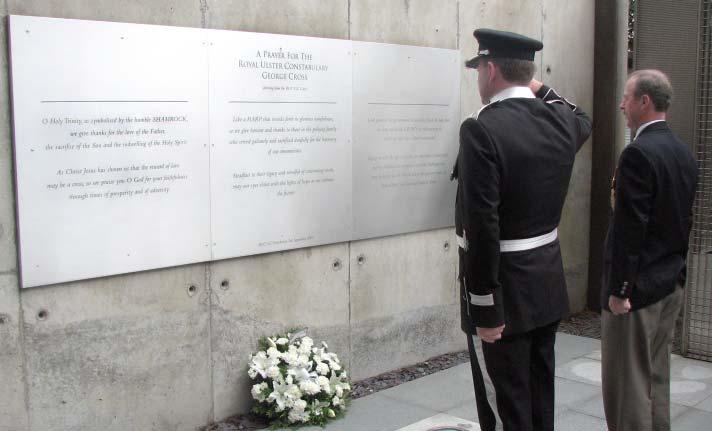
One of the highlights of the trip was attending a memorial service organized by the RUC George Cross (RUCGC) Foundation and laying a wreath at the RUCGC Memorial Garden. The foundation was established to honour RUC veterans.
The RUC was formed in 1922 when the south became the Republic of Ireland and formed its own police force, the Garda. More than 300 RUC members were murdered between 1922 and 1998 as part of what is known today as “the troubles.”
“Each year they hold a memorial service to commemorate these officers and to honour the thousands more that were injured,” Browne says. The RUC became the Police Service of Northern Ireland (PSNI) in November, 2001. Browne met with PSNI Chief Cst Sir Hugh Order and took part in a colour exchange of flags at the PSNI training college. The historic service was attended by police officers from eight European countries who were studying at the college.
In another event of special significance, the RNC group was hosted at the Parliament Buildings of Northern Ireland and met with the
new parliamentary speaker, who told them how parliamentarians are working with citizens to cement a lasting peace in the country.
In another milestone, RNC Insp Jim Carroll, Supt Robert Garland and Memorial University of Newfoundland Faculty of Education Professor Robert Shea met with representatives of Belfast’s Queen’s University to discuss Memorial’s police studies program, which is presented in partnership with the PSNI.
The meeting was significant for both Memorial and the RNC – an opportunity to share program content and discuss future partnerships, Shea says. “It was an extremely positive conversation which has already provided significant impetus for future partnerships between PSNI, Queen’s University/Belfast and the RNC/Memorial University.”
While delighted with the trip, Browne says it’s also important for the RNC to build on its relations with the An Garda Siochana.
While in Dublin, he and D/Chief Robert Johnston met with An Garda Commissioner Noel Conroy to discuss ways both forces can interact in the future. RNC and Royal Newfoundland Constabulary Historical Society (RNCHS) members stayed at the International
Police Association (IPA) house while in Dublin. The IPA has houses and accommodations around the world where members and police officers can stay at a reduced rate. This is intended to foster interaction between police and their families.
Browne and RNC Honorary Insp/RNCHS Chair Bill Mahoney were so impressed by the accommodations and reception the group received that they discussed opening an IPA facility in Newfoundland and Labrador to encourage police from around the world to visit the province. The discussions didn’t take long; an IPA affiliated facility will be operational in St. John’s by September, 2007, Mahoney announced at a reception IPA Ireland hosted at the Garda Boathouse, on the banks of the Liffey. The facility will be located in the Premiere Executive Suites, O’Dwyer Manor, located in the heart of historic downtown St. John’s.
Browne says the trip was well worth making.
“By forming a relationship with both the north and south of Ireland, we are drawing on the experience of over 20,000 police officers. There’s a lot we can learn from them and we’re confident that, as the oldest police force in North America, we can share our experience with both forces as well.”
The Newfoundlanders who made the trip to Ireland included:
• Chief Joseph (Joe) Browne
• D/Chief (Criminal Operations) Robert Johnston
• Supt (OC Western and Labrador Divisions) Robert Garland
• Insp (OIC Training) James Carroll
• Insp (Honorary) and RNC Historical Society Chairman William Mahoney
• Sgt. Darrin Feehan
• Constables Bruce Mesh and Wayne James
• Support Services Manager David Hickey
• MUN Associate Professor Rob Shea
• Honorary Insp and Public Service Commission of Newfoundland and Labrador Vice Chairman Keith Barry
• James Lynch, RNC Historical Society.
Blue Line’s east coast correspondent, Danette Dooley can be contacted at dooley@blueline.ca
by Liz Brasier-Ackerman
I write this in the wake of the South Carolina warehouse fire, which claimed the lives of nine firefighters. Such tragedies are a sobering reminder of how line of duty deaths impact the entire first responder ‘family.’
Much has been written on dealing with the resulting sorrow – and with the sixth anniversary of the tremendous losses of 9-11 fast approaching, it’s a subject that will be on many of our minds. Knowing what to expect may make it a little easier to cope with when the unimaginable happens.
When one falls, all suffer
The individual police agency, wider police community and general public respond quickly when an officer dies while on duty. Waves of emotion rock the workplace. Co-workers experience disbelief and grief and pain is felt acutely by all. Depending on the circumstance, there may be tension and anger. The police family gathers to offer fellowship and consolation. Counsellors and chaplains are turned to for understanding and comfort and guidance is sought from superiors.
The wider police community also feels the pain and loss and reacts by offering support in every way possible – symbolically by lowering flags, and actively by joining grieving comrades in honouring the lost and saying goodbye.
Sadly, this scenario has been played out again and again over the years as many have made the ultimate sacrifice. This is certainly not news to anyone reading this, but it is important to recognize that these responses to line of duty deaths are important and need to be appreciated for their value and significance.
From a chaplain and counsellor’s point of view, it is equally important that police are aware of the potential impact a line of duty death can have on them, especially if they react in unexpected ways which they don’t feel particularly comfortable with.
There is an emotional impact even if one doesn’t personally know the fallen officer. There are immediate feelings of shock, loss and grief that all experience to some degree. The ‘what if’ questions crowd one’s mind for a time and many unnamed concerns surface. How would I react at the critical moment? How would the family cope? How would they get on without me? The knowledge that one’s family also struggles with such thoughts prompts worries about how they are coping, what they’re thinking and what can be done to alleviate that fear.
The deaths also have a deeper psychological impact. Personnel directly involved or associated with the fallen officer should seek both psychological and spiritual counselling but even those not closely associated with the person need to acknowledge the psychological impact. One cannot help but think that ‘this could have happened to anyone; it could have
happened to me.’ It is a constant that goes unmentioned and is not pondered until an incident brings it out once again. Any officer could meet with disaster, when one does the pain is very real, and the questions asked are especially intense.
Then there are the big questions of what comes after – questions of faith that are best explored now. If a person does not, a line of duty death can send them scrambling, trying to make sense of life and death, needing to know if there is a higher power watching over them or if there is more to life. If a person has never
given much thought to their spiritual life and an incident leads them to ask the deep questions, a chaplain can be a great help and comfort. Search one out and don’t be afraid to ask them to wrestle through the hard questions with you. They are glad to do so.
Those who associate with a religious group will find that faith can be a priceless source of strength, preparing them to better deal with the loss of a co-worker, the ensuing grief, profound sense of loss and personal thoughts and concerns that follow. Like trust in a higher power, your faith community is a source of strength and comfort. Look to them for support. No matter the religion, the benefits gained from your surrounding faith community are universal.
Line of duty deaths are a sad reality in law enforcement and their impact is far reaching and many sided. The best anyone can do is to be prepared, as much as possible, for how they and those around them will respond. Doing so allows one to deal with the feelings and stress that accompany the incident and subsequent events -- and to help others do the same.
Liz Brasier-Ackerman is Blue Line’s Faith and Ethics editor. She may be reached by email at Liz@BlueLine.ca
by Brian Ward
New method recovers difficult latent prints
Industry driven technology advances have provided unintended benefits to the forensic identification field for years. Decades ago, Xerox discovered its laser caused latent fingerprints to glow under the vibrations of the new light. Cyanoacrylate, the super glue, has proven to be one of forensic investigators most potent weapons.
Now, research by Mississauga’s BOC Canada, the University of Toronto Forensic Science Department and Peel Regional Police has yielded a new method of using vacuum metal deposition (VMD) technology to find latent fingerprints.
“The new VMD process develops 36 per cent more identifiable prints compared to the conventional gold/zinc VMD method,” says Calvin Knaggs, manager for Edwards Thin Film Coating Systems Americas.
How it works
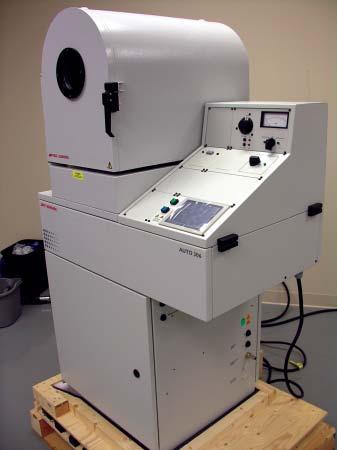
The process uses a vacuum chamber to thinly coat pieces of fragile evidence with metal. It was developed in England in 1936 as a means of depositing thin layers of gold onto parts for the fledgling electrical industry. BOC has become a worldwide company specializing in these processes, however it wasn’t until 1963 that someone saw a potential for using them to develop fingerprints.
The Police Scientific Development Branch of the British Home Office became involved and, by 1976, VMD chambers were in limited forensic identification use. Only three Canadian police forensic units have the systems. The RCMP uses a BOC Edwards Identicoat 500 system in Ottawa and North Vancouver Police use a BOC Edwards E600 system. Toronto police have a chamber made by US-based Vacuum Metal Deposition. A third company, England’s West Technology Systems, also makes VMD systems.
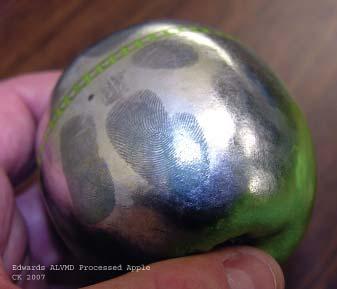
VMD print development is best used on fragile surfaces such as plastic bags, guns, bullets or where traditional latent development has proven difficult such as the apple shown here.
The conventional gold/zinc technique deposits two thin layers of gold and zinc onto the suspect material. The evidence is loaded into the system and pressure is lowered to approximately one millionth of an atmosphere. First, gold is evaporated, deposits uniformly over the surface and is absorbed by the ridges of the human sweat that form the invisible fingerprint pattern.
Zinc will generally condense only onto another metal, so when deposited by a second evaporation, it adheres only to the gold coated areas that lie between the sweat ridges, thus a visible pattern is developed from the latent fingerprint image.
“A key to the process,” explains Knaggs, “is the extremely low pressure created inside the vacuum chamber, combined with unifor-
mity and control of film thickness.”
Without oxygen, metals can be heated and evaporated without burning. By reducing the number of air molecules, the evaporation cloud can travel unobstructed from the source to the article, allowing for the deposition of very pure fi lms. “This surpasses other techniques for fi nding latents on dif fi cult non-porous surfaces,” Knaggs says.
Technology causes problems
“During some routine testing we conducted in 2005, it was apparent that our success rate on some plastics was proving difficult,” Knaggs relates. “We realized our technology had not kept pace with the changes in plastics.”
Manufacturers have changed chemical formulas and the surface chemistries are dramatically different than they were in the 1970s, when VMD was first optimized. Today’s plastic bags are now manufactured using a variety of recyclables and may include surface treatments such as colour, odourreduction or anti-microbial coatings.
“Our research and development staff found that gold/zinc, although highly effective on many surfaces, was proving difficult on some of the new plastics.”
To counter this problem, BOC Canada began experimenting with different metals and found aluminum developed prints more readily and with higher definition on many of these difficult surfaces.
The company required an independent evaluation. Using university-approved methodology, University of Toronto forensic science student Adrian Gunaratne and the team attempted to develop 1,500 latent prints on various plastic surfaces.
Peel Police Insp and forensic unit commander Steve Burns provided facilities for the evaluation. Cst Dale Stansbury was assigned to mentor Gunaratne and his study. Burns, Stansbury and Knaggs have mentored the forensic program for several years.
Results
The latents were split, with one half developed using the gold/zinc method and the other half processed using vaporized aluminum. The result – aluminum was more successful in obtaining identifiable latents.
Ridge detail was found on such items as a lubricated condom, high intensity bulb from a marijuana grow house, vinyl tape, Mylar film and a fresh apple.
“Our enhanced VMD technology gives forensic identification officers a wider window of opportunity to develop latent prints,” Knaggs concluded.
While large organizations such as the RCMP and US Secret Service have invested in these systems, so have a dozen other police agencies, including the sheriff’s department of Thomasville, Georgia – population 30,000. A tool that can develop high definition prints from a wider variety of surfaces will shorten the crime-to-conviction cycle, saving agencies money in the long, Knaggs pointed out.
Operation of the VMD is relatively simple and begins with determining the evidence to be examined. The chamber provides one of the few non-destructive latent techniques available to investigators and can be used after fuming with cyanoacrylate.
During a demonstration, Knaggs examined a white plastic courier bag that had been handled by his staff. A vacuum was created inside the chamber and he began introducing current to the aluminum. Within seconds, a dark sheen began to appear on the bag.
Knaggs maintains that an experienced operator can control vaporization of the aluminum by observing the results in a view port. It can be stopped at any time and the evidence is available for examination within seconds.
Although clear ridge detail was visible, he used fluorescent-friendly powder for further development. The latent prints remained intact during the powdering process and proved difficult to remove, even with rough handling.
Brian Ward is Blue Line Magazine's Forensic Science editor and he may be contacted by email at Forensic@blueline.ca.
Police Service presented with colours
by Joan Atchison
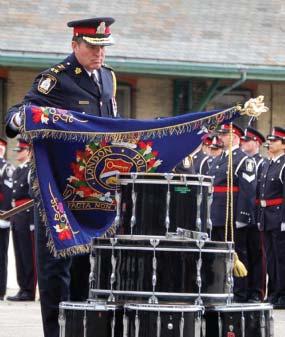
During 2004, Chief of Police Murray Faulkner embraced the idea of creating a Colour (ceremonial flag) for the London Police Service (LPS). It was discovered that the coat of arms currently used by the City of London and the police service had not been officially recognized by the Canadian Heraldic Authority. The city subsequently gave the London Police Service permission to develop their own London Police Service coat of arms. Their Colour Committee was formed consisting of Rob Brown, Dave Ellyatt, John Legault, Steve Hartwick, Bernie Scheid and Greg Childs.
A new motto had to be adopted. The criteria was that the motto be written in Latin and should neither describe who they are, nor what they do. It had to be ageless and inspirational to police service members, being just as valid sixty years from now as it is today. The
unanimous choice was Detective Constable Zaia Lazar’s submission, ‘Facta Non Verba!’ (Deeds, not words!), or better still, deeds of valour, not talk, stressing the importance of action over conversation.
Negotiating back and forth with the Heraldic Authority, the armorial bearings began to take shape. It had to adhere to the Canadian standard for police and would be the centre piece on the London Police Colour flag.
The devices and different colours each represent very specific attributes in ‘Blazon’, the language of heraldry, each being selected as very personal to the LPS. The centre shield was gold (generosity) taking the shape of the police service’s issued pocket badge. A second border of black (constancy or tenaciously staying the course) represents an additional layer of security for the citizens of London whom they are sworn to protect.
The inverted silver (peace and sincerity)
chevron separates the two fields within the shield. The beaver represents industriousness, kept from the old London coat of arms on a blue (loyalty and truth) background. The key on a red (fortitude and magnanimity) background is their cell block key. The key represents the trust between citizens and their police service as well as the police service’s central role in maintaining the security of London.
London Police is boldly written in the annulus and is surrounded by a wreath of maple leaves which are multi-coloured representing police service and preparedness in all seasons. The maple leaf represents Canada, the trillium represents Ontario, and the peony is the official flower of London.
The Royal Crown indicates that London Police serve the Crown’s justice and uphold the Constitution and the rule of law. These armorial bearings were petitioned to Buckingham Palace and granted by Queen Elizabeth II in May, 2006.
by Mike Novakowski
Basketball scores with teens
The Abbotsford Police Department’s youth basketball night is a hit with the city’s youth and cops alike.
The local youth commission has held weekly drop in youth sports events for many years. About four years ago it asked police to play basketball against teams 12-14 years old. This game was advertised as a ‘come and play against the police’ event and attracted a larger than normal group. The response prompted the commission to ask police to show up every month.
Abbotsford Police have seen a large number of youth come and go. Older youth now attend the program. They come from a variety of backgrounds, including those with criminal histories, and police have developed a good relationship with the teens.
“It’s neat to see a cop outside of his uniform... they are like real people,” said one participant. Cst Kelly Wong, a traffic officer agrees, “it gives me a chance to engage youth in the community in a fun and friendly atmosphere.”
Cst. Steve Kern of the youth squad also recognizes the relational aspect of the events. “This program gives young people the opportunity to view police in a very different light,” he says. “The interaction is positive, competitive and a lot of fun. It also provides an opportunity to socialize with youth that may not otherwise have any positive role models in their life.”
“The youth take this relationship quite seriously,” reports Cst. Rob Joiner, a youth squad officer and the department’s point man on organizing the police participation.
One youth who attended was wanted on an arrest warrant. Rather than embarrassing him in front of his peers, he was told to go turn himself in – and he did so – immediately after the game. Another youth was found to be in need of clearing up an outstanding criminal matter in another province. He was told to take care of the matter or he would not be allowed to come back. In response, he traveled back to the prairies from BC to deal with the outstanding charge so he could continue to play.
Youth who ‘age out’ (become too old to play) have returned as volunteers with the youth commission. Participation by police has also been excellent, with members attending the majority of games on their own time.
“Sports teach some of the most important lessons in life and with basketball, the focus is on teamwork and sharing,” says Cst. Ian Parks, a patrol officer and regular attendee. “I enjoy playing basketball with the youth because I can see the kids develop those skills on the court and know that they will use them in everyday life as well.”
The department’s management is also behind the program. It allows on duty members to play, purchased team jerseys and supports covering injured members through WCB. In fact, Deputy Chief Rick Lucy is a regular player.
The program has been so successful that police organized an outdoor three-on-three basketball tournament during Police Week Family Day this past May. The tournament was advertised in local schools for grades 9 through 12 and several teams registered. Despite the rainy weather, all the teams showed up and, with the help of some volunteer referees from Columbia Bible College’s women’s basketball team, the tournament was a success.
The department hopes to continue the monthly games and make the three-on-three tournament an annual event.
Mike Novakowski can be reached at caselaw@blueline.ca
by Tom Rataj
Mining databases key to solving cases
Collecting information about people, places and incidents and processing it into electronic form for later use is a large part of modern policing. The cost of doing this is enormous and generates the apparently inevitable mountains of paper.
The process generally starts with officers recording incident information in their memo books, much of which is later transposed into electronic form and stored in a database, making it available to anyone else with access to that system. ‘Tombstone data’ –typically names and addresses, dates of birth, phone numbers and the like – is entered into data fields specifically designed for that information.
numbers are valid, either by using a mathematical formula or cross referencing information such as gender and date of birth.
In more advanced database programs, certain quality control features can be added to these fields so that only the right information can be entered and only in the correct way. This reduces the chance of erroneous data and transposition errors and ensures the information is formatted to certain standards for later searching and retrieval.
For some information, such as driver’s licences and social insurance numbers, the quality control features can ‘proof’ that the
All non-tombstone data generally goes into a free-form text field, which usually consists of a narrative or synopsis of the incident or event.
Officers can generally search only the tombstone data. Any information, no matter how valuable, entered into the narrative portion of the incident report cannot be searched using standard search tools, effectively making it non-existent for officers. In many cases, the only way they can access it is by retrieving the report and reading through it for information
they think may be relevant to their investigation – an expensive, time consuming process to say the least. If the right report is not found or information is overlooked, it’s lost to the investigation.
Another major problem with free-text fields is that they often contain tombstone data that should have gone into the appropriate fields. This may happen because there are not enough fields of a particular type to accommodate all the information collected or there is no field for the type of information entered. Officers may also not deem the information important enough to put into the appropriate fields, don’t have time to enter it, aren’t thorough enough or are even just plain lazy.
A lot of potentially valuable information is also dumped into the free-form text field because there is nowhere else to put it. Older databases may not even contain tombstone data fields for relatively new information types such as e-mail addresses and phone fields other than home and business.
Additionally, individually insignificant routine text in a narrative or synopsis – “a red minivan,” for example – may appear in numerous reports but never be connected, even if it is the same vehicle in all. This undiscovered relationship may be the key to solving one or
more criminal offences.
Let’s say reports for four occurrences – a suspicious incident, dispute with a neighbour, potential sex offender and domestic dispute –all mention the same red minivan, operated by the same person. He/she could be a dangerous offender getting involved in a series of minor incidents leading up to a serious crime. If the words or phrase “a red minivan” are not entered in a prescribed vehicle field in each of the occurrences, there may be no apparent connection and the potential to make an arrest in the next incident is greatly diminished.
Fortunately the burgeoning field of data and text mining is offering a solution to many of these problems
Mining
In its most simple form, text and data mining is a computerized system which searches all of a database, not just tombstone fields, to locate information that may be useful for specialized needs or demands. It uses a combination of several different technologies and techniques, including machine learning, statistical analysis and modelling and computational linguistics. It may also be referred to as text data mining and knowledge-discovery in text (KDT).
Systems will typically run automatically, continually searching for seemingly insignificant text, data, patterns of information and subtle relationships. They will make the connections and hopefully help to solve problems. Features vary from system to system but can also include different levels of intelligence, including, for example: knowing that Vancou-
ver is a city in British Columbia, that BC is a Canadian province, in the Pacific time zone, with a 604 area code.
The relationship between those five items may not be made or recognized during the course of a traditional paper based investigation, but may be the key to solving a series of criminal incidents.
In the ‘red minivan’ example, a text and data mining application would probably make the connection between the four previous occurrences and the fifth incident and point the investigators in the right directions. The potential is huge, particularly in law enforcement. In many situations the occurrences that mention the red minivan may happen outside a single station’s area or jurisdiction and ordinarily escape detection by even the best investigators.
We have seen examples in the past where a sex offender commits offences in several neighbouring jurisdictions yet remains unidentified because no connections are made. In large urban areas such as Toronto or Montreal, there are numerous police stations spread across each city. An offender committing single offences in more than one station’s area would typically escape detection unless the right investigators from each area were to talk about the right investigations at the right time. Text and data mining would automatically make the connections and give the information to investigators – provided that the system is set up to work across the different jurisdictions.
Canadian police agencies should all run text and data mining applications on their databases, maximizing the value of the infor-
mation they spend so much time and money collecting. In our example, this would allow individual investigators to do free-text searches for ‘a red minivan,’ because the mining application constantly indexes the data. The officer’s search would just search the indexed data instead of the entire database.
Big business extensively uses text and data mining. Credit card companies typically use it monitor transactions, since its pattern recognition technologies are very effective at recognizing fraudulent activities or spending associated with lost or stolen cards. Other companies use the programs to establish shopping pattern data, used to target advertising to customers.
Thoroughness is crucial
Until text and data mining starts to become the norm, it is vitally important that all police officers concentrate on being thorough when they enter their reports on the computer. Over the course of many years, I’m repeatedly surprised by how much valuable information I routinely find buried within the narrative portions of reports. Suspect names, addresses, phone numbers. It’s always difficult to understand why an officer fails to put the information in its proper place.
Unfortunately, without the advantages of data and text mining this will continue to be a serious problem.
Tom Rataj is Blue Line Magazine’s Technology Editor. He may be reached at TechNews@blueline.ca
Transit constables adapt to new challenges
by Ryan Siegmund
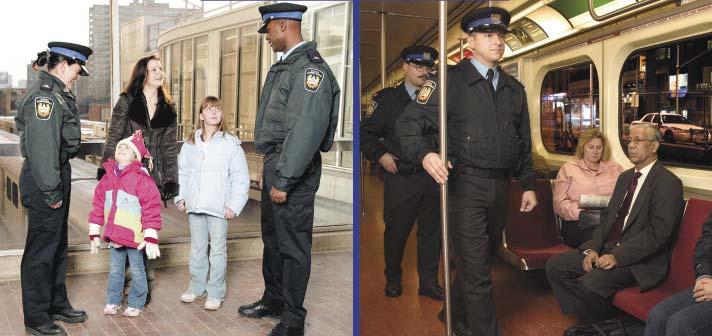
Toronto Transit Commission (TTC) Special Constables begin evolving into the eyes and ears of the transit system on their first day of training, learning to combat today’s more sophisticated crimes such as terrorism and counterfeiting.
The TTC’s more than 10,000 employees serve some 1.4 million passengers daily (444 million a year); that’s one of the highest per capita ridership rates in North America. Special Constable Services (SCS) not only protects the customers who depend on the system, but also transit employees, facilities and vehicles. That’s a lot of geography for the 87 special constables to cover – the TTC has 69 subway stations, three subway lines, 138 bus and 11 street car routes and more than 2,000 subway cars and buses.
Organizational and community policing partnerships have paid dividends in the SCS’ 10-years history. It was founded in 1997 when the Toronto Police Services Board designated all TTC employees responsible for law enforcement as special constables. The Toronto Police Service (TPS) has lent its expertise to everything from training special constables to investigational support; the SCS also has special constable agreements with the Peel and York Region police services boards.
“The agreements in place with the various police services boards not only define the special constable authority but also their limitations,” says TTC Chief Special Constable Terry Andrews, who is responsible for operations, planning and co-ordinating all SCS activities.
“The agreement really sets out requirements regarding reporting occurrences, training, uniforms and also public complaint investigations.”
Newly hired special constables undergo
a comprehensive 11-week in-class training program; all training is prescribed by the province’s special constable best practices standard and approved by the TPS. The program includes instruction on arrest and release, use of force, search and seizure, criminal and provincial legislation, diversity issues, racial profiling awareness, community based policing, interview and interrogation, court procedure and evidence, persons in crisis, defensive tactics and officer safety.
Both experienced TTC staff and instructors from various police services are used.
“We want our officers to go out in the field with a wide array of knowledge and skills,” explains Andrews.
“The in-class instruction is supplemented by a six-month coaching program where we have special constables certified as coach officers who provide field instruction to new recruits.”
Deployment
The force is organized into three sections – transit patrol, systems security and investigative services. New recruits generally begin in patrol, a uniformed function with essentially three components:
1) Subway division: the community response unit targets crime and disorder at problem stations and on trains. Comprehensive review and analysis of reported crimes guide the high visibility patrol team to specific stations and the foot patrol team to priority subway zones.
2) Mobile division: responds to both subway and surface calls dispatched by the transit control centre and supports the foot patrol team. Between calls, division officers are encouraged to walk through subway stations and interact with employees, retail tenants and customers, combining proactive activity with their reactive role.
3) Field support unit: responsible for the courts, training special constables and administering policies, procedures and contracts,
including fleet and equipment.
Systems security works at preventing crime through security planning. Members plan and co-ordinate the installation of security cameras and intrusion detection systems and conduct security inspections and risk assessments to identify areas which need improvements. They maintain and analyze a database of security information from special constables and police, plan for emergencies and prepare security operation plans and exercises.
The investigative services section includes the criminal investigations unit (CIU), which follows up crimes and security incidences and conducts complex investigations into issues such as graffiti and counterfeit crimes, sexual assaults and pick pockets. Members also ensure major crimes victims are offered counselling and support services, retrieve video images and track charges laid after assaults on TTC operators.
The section also includes the special investigations unit, which co-ordinates complex investigations involving counterfeit tickets, tokens and passes, going after the major manufacturers and distributors. Members also recommend security improvements to fare media and conduct internal asset protection investigations involving theft, fraud and property damage.
Countering the counterfeiter
The TTC takes in about $750-million dollars in fares annually; about one per cent of the tokens, coins and tickets it receives are counterfeit. Beginning in 2003, it experienced an alarming increase in the number of counterfeit fare tickets received. This activity carried over to 2004, with losses estimated at $2 million. The SCS responded by initiating COPS (Counterfeit Operations); in co-operation with TPS, the project set out to apprehend and prosecute counterfeiters, break up distribution networks and shut down large scale producers.
The 14-month investigation used detailed computer analysis, surveillance, undercover
operations and follow-up of all reported uses, resulting in 307 arrests and 221 criminal charges. Two major manufacturers and several distribution networks were shut down, briefly cutting losses.
Counterfeit tokens soon began taking the place of fake tickets and, in late 2004, an SCS investigation of one major ring led authorities into the U.S. The co-operation of eight police agencies, the CBSA, FBI, US Customs and the US Attorney’s office in Buffalo, NY, led to multiple arrests of low level suppliers and middlemen. The investigation revealed counterfeit tokens were being produced by a legitimate business under false pretences. When the dust settled – with a handful of more arrests and a large quantity of phony tokens seized –the TTC was out an estimated $10 million in lost revenue over a two-year span.
“When an investigation of that magnitude occurs, it always results in staff reviewing the various controls currently in place… quite often it results in a new design of the fare media and a review of the associated procedures,” Andrews says.
Although just one of many counterfeit operations unravelled, the setback prompted the TTC to embark on a costly redesign of its subway token which added additional security features.
Increasing presence
The TTC plans to double the number of special constables and significantly increase the number of officers dedicated to the subway system, Andrews says.
“It will result in a significantly improved visible law enforcement presence in the subway – that is what we are focusing on,” he notes.
“What we find is that the subway system is where we carry most of our riders and from our security analysis, we feel the subway needs to be prioritized. We are concerned about crime and disorder but also the general threat of terrorism against the transportation sector. We want to ensure that we have an appropriate patrol strategy in place to address these issues.”
That means strengthening partnerships as well as communication.
Shortly after 9/11, the TTC developed a corporate security escalation plan which outlines responsibilities, duties, procedures and guidelines to be implemented when terrorism activity is considered imminent or underway, or if the system is believed to be a potential target. Each department has a security plan, which is shared with the TPS and the city and provincial emergency management offices. Although the corporate plan has never been activated, three mock exercises have been conducted since 2004.
The TTC’s Emergency Procedures Committee “is an excellent forum to discuss issues of mutual concern relative to emergency plans and procedures,” says Andrews. The corporation also has a threat advisory group, comprised of Andrews and the general manager of security operations, which is responsible for ensuring all suspicious incidents and threat information is reported to the TPS.
“We feel it is very important to have a strong liaison with TPS to ensure they get the information in a timely fashion,” Andrews says.
“We are also responsible for receiving threat information and threat response recommendations from the TPS.”
The TTC has formalized communication protocols with various agencies to ensure the effective exchange of threat related info and intelligence, Andrews adds.
All TTC employees have been given information designed to assist them in remaining vigilant and recognizing suspicious behaviour and/or suspicious packages. Significant improvements made to the quality of radio communications underground has also proved
helpful. A $15 million, five-year capital project will see an additional 1,500 cameras installed at subway choke points and platforms.
“Over the years we have tried to educate the public on the roles and responsibilities of the special constable,” says Andrews.
“The transit system is a very unique operating environment and our special constables have the specialized knowledge to work in it. If people do not feel safe, they will not want to use the transit system. I think what the special constables do has a direct correlation to the success of the TTC.”
Ryan Siegmund is a freelance writer for Blue Line Magazine . He may be reached through publisher@ blueline.ca
Taking the office on the road
A small Ontario police service takes on big city technology
by Roger Pelletier
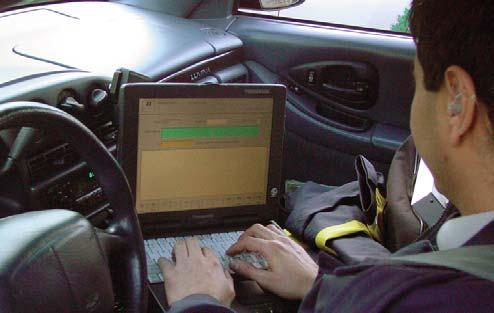
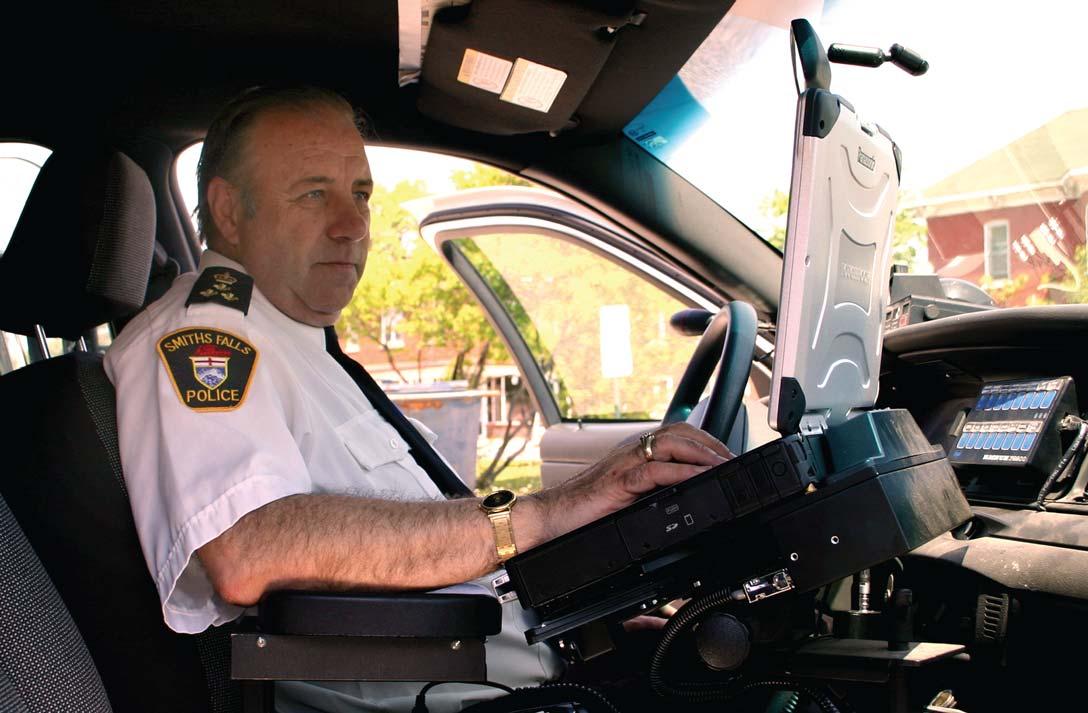
Larry Hardy smiles proudly as he logs on to the police information portal. “Let me show you all we can access from the car,” the Smith Falls’ police chief says, proceeding to bring up the records system while sitting in a cruiser parked behind the station.
As members of the Ontario Police Information and Technology Co-operative (OPTIC), Smith Falls 24 sworn officers have access to records management information in the office. They will soon have that same information, available 24/7, in their cruisers through a state of the art private mobile data transmission system.
The newly acquired technology and rugged mobile workstations will connect officers to all the tools they can now access only at the station. CPIC access to stolen vehicles, wanted persons and stolen property directly from the field is not new, but access to all records management functions, including mug shots, gun registry and occurrence logs, is.
More importantly, officers can enter some of their own occurrence data while in the field instead of doing it later at the station, giving the service a lot more presence around town. More police visibility on the road where it’s needed,
without having to hire more staff, is key. Police visibility on the streets is a known deterrent. Seeing more police cars also makes the general population feel safer. In Hardy’s words, “officers are most effective when out on the road, not inside doing paperwork.”
As always, officer and citizens’ safety is of prime importance. Going into a situation with the best and most recent information is the safest way to proceed. Having a quick look at the history of an address or individual before intervening will give officers an additional margin of safety. Instant access to the province-wide occurrence logs will help them compare what’s happening locally with incidents in neighbouring towns.
When dealing with domestic calls, for example, a quick check of the gun registry will be much easier and may help avoid a violent escalation that could end in tragedy.
Officers often use quiet times to run multiple stolen vehicle checks and generally get a feel for who’s in town. Now they will be able to run all those checks without creating additional workload for already overworked dispatchers.
The Smith Falls system is connected through the Ontario government’s justice network through a router/firewall. A very so-
phisticated radio server maintains that secure environment by creating a highly encrypted Virtual Private Network (VPN) tunnel to the mobile workstation. Each vehicle using the system is authenticated from a white list of allowed devices and static IP addresses. The over the air encryption meets US and Canadian federal standards for data transfer.
“It took a lot of work on everyone’s part to solve the financing and technical challenges,” Hardy says. “Then we had to make sure the system was secure and met the high standards imposed by the OPTIC committee. Now we have a top of the line system that will free up officers so they spend more time out in the field instead of behind a desk.
“The choice of a private radio system means that once everything is amortised over three years, we will just need to maintain our system with no user fees or airtime to pay. We can expand and enhance our system without worrying about paying additional air time fees to a network provider. We control our own network and can use it to its fullest extent.”
Hardy is already planning additions to the system. Future enhancements include
field-reporting forms that can be done in vehicle and printed at the station for review by a supervisor.
Since the system provides optimized Internet protocol (IP) connectivity to the fleet, standard Windows tools such as browsers and e-mail can be easily deployed. That will allow officers to build their own private Intranet portal, opening up a whole new world of possibilities. They will be able to log on and view daily alerts, listings, special instructions, missing person photos, persons of interest and most wanted files.
Access to e-mail directly from the vehicle will add to efficiency and visibility while providing a great way to quickly get crucial data and special instructions.
The new system also comes with GPS
technology; eventually the location of each police vehicle will be available to dispatchers in real time. Even undercover cars with no computers can be tracked automatically by the system.
While this is not the first of the OPTIC members to go mobile, Smith Falls is the first to deploy a private mission critical solution and to make all of these additional features directly available to its members in the field. The unlimited transmission capability of a private radio system makes this a very cost effective proposition for the taxpayers.
The citizens and officers of Smith Falls and its police service will be just a bit safer.
Contact Chief Larry Hardy at larry.hardy@jus.gov.on.ca for more information.
OPTIC is a three-way partnership between the Justice technology service representing the Ontario Provincial Government, the Ontario Provincial Police and the listed municipal services below.
The cost of the program is approximately $9.5 million and is a shared cost between the partners (OPP and municipal police services) and the government.
All participating police agencies in such a co-operative must be prepared to sign a memorandum of understanding (MOU) that identifies the governance issues identified as important to the organization and outlines ways of ensuring compliance. There are six key governance issues often addressed in MOUs, described in more detail below:
1) Information sharing
2) Data standards
3) Data security
4) Technical issues
5) Election of board of directors
6) Financial operating procedures
Current OPTIC Police Services are as follows:
Amherstburg Police Service
Aylmer Police Service
Barrie Police Service
Belleville Police Service
Brockville Police Service
Chatham-Kent Police Service
Cobourg Police Service
Cornwall Community Police Service
Deep River Police Service
Dryden Police Service
Espanola Police Service
Essex Police Service
Gananoque Police Service
Hanover Police Service
Kawartha Lakes Police Service
Kenora Police Service
Leamington Police Service
Michipicoten Township Police Service
Mnjikaning First Nation
Midland Police Service
Temiskaming Shores Police Service
North Bay Police Service
Ontario Provincial Police
Orangeville Police Service
Owen Sound Police Service
Oxford Community Police Service
Pembroke Police Service
Perth Police Service
Peterborough-Lakefield Community Police
Port Hope Police Service
Saugeen Shores Police Service
Sarnia Police Service
Sault Ste. Marie Police Service
Shelburne Police Service
Smiths Falls Police Service
Stirling-Rawdon Police Service
St. Thomas Police Service
Strathroy - Carodoc Police Service
Greater Sudbury Police Service
Timmins Police Service
Treaty Three First Nations Police Service
West Grey Police Service
West Nipissing Police Service
Wingham Police Service
Standard of care in police chases entrenched
A pair of B.C. Court of Appeal rulings has entrenched the responsibility of police officers engaged in potentially dangerous car chases.
In both cases, the province’s top court dismissed appeals against judgments that held two officers partly responsible for collisions - one of them fatal - that stemmed from the chases.
In one July, 2000 case, Surrey RCMP Const. Sharan Badyal spotted a car being driven erratically, which sped away when she tried to pull it over.
The police cruiser pursued the car through residential lanes as it sped past 80 kilometres an hour but Badyal decided to break off the chase.
Seconds later, the fleeing vehicle collided with another car, killing 11-yearold Tina Burbank and injuring four other people in it.
The speeding car turned out to have been stolen and driven by a 15-yearold identified only as R.T.B. stoned on methadone.
The driver, who had a long history of vehicle thefts, was convicted of dangerous driving causing death.
The Burbank family and the car’s other occupants sued the driver, the police officer and the province. They won a judgment in 2005 that put the lion’s share of blame on the fleeing driver but held Badyal 15 per cent responsible.
The trial judge concluded the Mountie was negligent and should never have started the chase in a residential area with a high volume of pedestrian and vehicular traffic.
Breaking off the pursuit was “far too little and far too late.’’
The appeal argued the judge erred, saying there was no evidence Badyal failed to meet the standard of care of a reasonably competent officer and in his conclusion the chase caused the accident.
The three-judge Appeal Court panel ruled 2-1 in dismissing the appeal.
Justices Peter Lowry and Edward Chiasson essentially supported the trial judge’s conclusions that the chase should not have been started in the residential area and the crash was a direct result.
In a separate case, Lowry also upheld a decision that found Burnaby RCMP Const. Robert Kurtz 15 per cent
liable for serious injuries suffered by Christopher Radke when a 15-year-old boy driving a stolen vehicle collided with his car.
Lowry concurred with the trial judge that the youth, who was using the vehicle in a break-and-enter, would not have sped away and run a stop sign on a busy Burnaby street if Kurtz had not chased him.
The Appeal Court judge pointed to his ruling in the Burbank case in saying it was not necessary to provide evidence about the standard of care to be met by a police officer for a judge to assess the impact of the officer’s conduct on public safety.
The question for the judge was simply whether the nature of the driver’s crime - car theft - justified the risk of the consequences of the brief chase that became obvious as the cars sped towards the busy intersection.
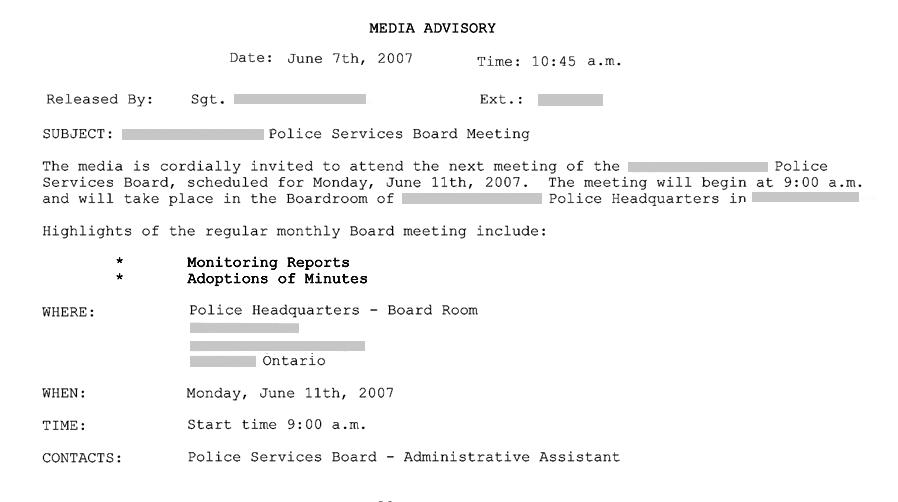
The counter-productive media release
‘Monitoring reports’ and
‘adoption
of minutes’ hardly a media attraction
by Mark Giles
After dealing with a police complaint many years ago –where a woman alleged her ex-husband had taken a soccer ball from her residence when picking up their son for a visit – my sergeant asked me if I’d taken a written statement. I had not – the matter had been easily resolved, and no further action was contemplated or realistic – but he felt that a statement was necessary.
Asking him why, his response was a classic: “Because that’s what we do – we go to people’s houses and take statements.” We both knew that such a statement would go nowhere, but he thought it a necessary part of the process.
Police statements, reports, and media releases all serve a purpose, but sometimes they seem to be written to satisfy a process requirement – not because of any reasonably anticipated outcomes. A media release can be a productive tactic – highlighting upcoming police activities and issues, and generating positive coverage locally and beyond – but if full of redundancies, or lacking interesting and relevant information, its communications impact is minimal or even counter-productive.
A media release issued by the board of a major Ontario police service in June appears to be a good example. Highlighting the monitoring of reports and the adoption of minutes, it seems unlikely to arouse the interest of mandatory attendees, let alone local media. Yet the advisory appears to have been designed to do just that – inviting media in the lead paragraph and its conclusion, and drawing attention to these supposedly attractive agenda items.
Perhaps these are in fact the highlights of such meetings; if so, no one can criticize the board for a lack of honesty. The question, however, is why such apparently mundane agenda items would be highlighted in a media release. It may be another case where process seems to trump likely outcomes – ‘because that’s what we do.’
Although a police agency normally has an obligation to inform media and the public of its commission or board meetings, the media release doesn’t send a message that its meetings are of much interest. Without newsworthy issues in the highlighted reports and minutes of the June meeting, this media release may even be counter-productive, diluting the impact of others that actually contain information of value to the media and the community.
The June media release not only highlights mundane information, it redundantly lists the date, time and location of the board’s meeting in both the opening paragraph and later in bullet form. The media release for the board’s next meeting in July includes the same redundancies, but does at least highlight some specific activities, including a presentation by an area club and discussion of another agency’s management-development program (the RCMP Full-Potential Program). The vague description of its agenda items, however, is not likely to generate much media excitement.
An internet source cites the RCMP FullPotential Program as one that identifies and develops individuals, both civilians and officers – reaching as far down as the front-line constable – who demonstrate the potential for future management roles. I’m not convinced this agenda item is overly newsworthy, but with a little effort, it could have been described in a way more likely to generate media interest, encouraging reporters’ attendance and subsequent coverage of the program and its possible implications.
Developing credibility with the media through openness and transparency means ensuring reporters and the public are aware of significant events – both positive and negative. It doesn’t mean, however, that a media release is needed for every board meeting. If these meetings are held on the second Monday of each month, a standing invitation – with monthly date, time and location details posted to the website – is adequately transparent in creating an open invitation to these routine events.
Media releases should be reserved to highlight
issues that actually merit special attention – not ‘because that’s what we do.’ This also increases the likelihood that editors and reporters will pay attention when an issue really needs media coverage. This Ontario police agency is undoubtedly engaged in many worthwhile crime-fighting and crime prevention-related activities, and may even hold some interesting board meetings, but when you’ve got nothing to say, don’t say it. Maintain your agency’s credibility and save your media pitch for when it counts.
Mark Giles is Blue Line’s correspondent for public and media relations, military and international issues. He is also a senior communications analyst for defence and foreign affairs at the Privy Council Office in Ottawa. He may be contact by email at giles@BlueLine.ca
Preparation key in designing versatile ranges
by John E. Pepper
The new Kingston Police Force (KPF) headquarters includes a state of the art indoor firearms training centre. It’s not easy to set up a range that meets the needs of multiple users, especially when it must fulfill a number of diverse functions.
Kingston’s new 120,000 square foot police headquarters includes an eight-position, 25-metre multi-purpose range. Although primarily for 9mm handguns, it’s also designed to accommodate 9mm submachine guns and projectiles up to 2300 fps.
The Waterloo Regional Police Service Firearms Training Centre opened in 2006 with a 10 position, 25-metre multi-purpose firing range. It’s used for a variety of training, practice, re-qualification and tactical purposes and designed to accommodate most commonly-used police firearms with projectiles up to 2300 fps.
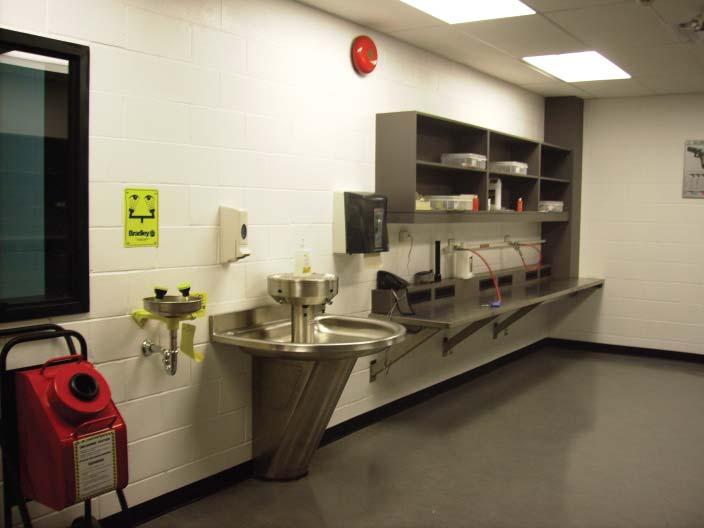
Officers advance on remotely-controlled targets, set up at pre-determined locations and train at different shooting distances. Lateral ‘running man’ targets add a degree of versatility and training challenge. Support spaces include a gun cleaning area, repair workshop, target and ammunition storage, briefing area and office for training staff. The preparation area is behind the firing line and large enough for in-session briefing.
Common features and design objectives
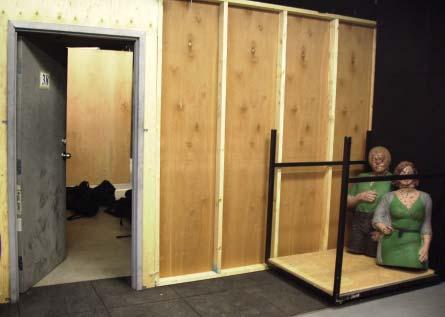
Both ranges are multi-functional, with shooting occurring from various positions. Although most shooting is done towards the backstop, they accommodate limited fire within a 180-degree zone for tactical training purposes. Large bullet-resistant doors allow vehicles and large props to be brought in.
To enhance the training experience, obstacles, props and different lighting scenarios – including low-light, strobes, cruiser light bars and even smoke generators – can be used. The ranges feature air-wall ventilation concepts; air is ejected from a plenum at the back so flow past the shooters is uniform and the velocity carries contaminants downwind and downrange safely. Too low a velocity and smoke will not be carried away from the shooter effectively; too high and eddies may carry smoke and fumes back to the shooter’s face.
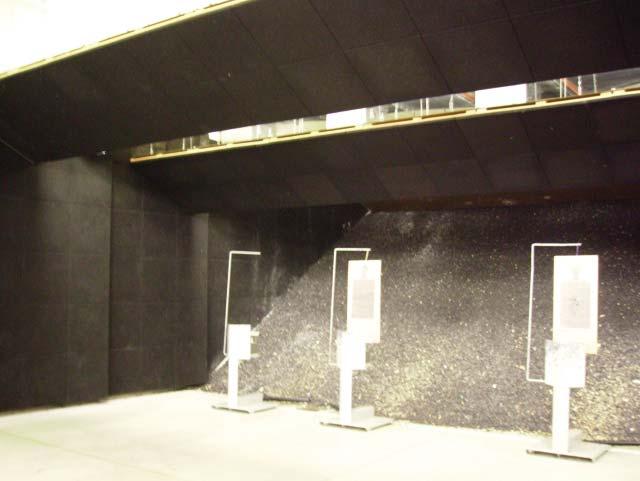
Air can be extracted at various points downrange, resulting in optimum flow depending on the shooters’ location or target positioning. Minimizing fumes and dust particles is important for user health and safety. In addition to using low-lead training rounds, the rubber medium backstop systems are designed to minimize projectile fragmentation and dust particles – and after a million rounds or so, the metal fragments can be removed and the rubber recycled.
Alternatives to the rubber chip backstop include a ‘snail’ trap, where bullets hit a steel plate ‘ramp’ at a shallow angle, enter a cylindrical container and spin to lose their kinetic energy. Snail traps also have dust-reducing features – a
common one is a ‘wet ramp’ which is continually covered with a mixture of water and glycol.
Both ranges also feature ballistic ceiling baffles to protect ductwork and other building components overhead. These are angled to minimize the risk of ricochet. Baffles and sidewalls are covered with rubber tiles which safely absorb bullets and absorb sound. The underside of the structure and wall inside the air-wall plenum are also treated with soundabsorptive material and pre-cast concrete roof structures form a completely bullet-resistant
envelope around the shooting area.
Acoustics played a large part in the design. In Kingston, it was crucial that airborne and structure-borne noise not travel to other areas. It was constructed out of solid concrete, with appropriate control joints and the range was placed as far as possible from the communications centre, office and public areas of the building.
Special attention was also paid to acoustics in Waterloo, as there is a children’s safety village nearby. Absorption inside limits the sound escaping from the structure and there are special
silencers on major ventilation ductwork. Gunfire is barely perceptible outside and less intrusive than the nearby trucking centre!
Process and movement through the various spaces, which affects user safety, was critical. The design team made sure it understood safety protocols and how trainees were moved through the facility –from the time they enter, through the briefing session, unloading duty ammunition and loading training clips, collecting safety gear, completing the course of fire and cleaning up afterwards.
Safety was the primary concern during every aspect of the design. The risk of ricochet had to be reduced as much as possible and every precaution was taken to minimize the risks associated with unintentional discharges and other ‘accidents.’ Users were actively involved in all aspects of the design, from the overall layout and planning, to selecting special door hardware.
Unique features
trolley system.
In Waterloo, while the majority of shooting takes place at the 25m firing line, shooters are free to move down range to get closer to their targets, which are placed in special slots in the floor (advance on target). Both ranges feature lateral ‘running man’ targets.
The range designs were a direct response to the specific needs of each user group and heavily influenced by their unique needs and preference. The primary difference between the two is in the way the targeting system is set up. Kingston users selected a target retrieval system, where shooters remain in position at booths at the firing line. Targets are presented at varying distances and return on an overhead
Both systems are designed and manufactured by Mancom, an Ancaster, ON company which supplies many high-profile organizations around the world. Its system allows targets to be randomly rotated from the edge-on position to present ‘good-guy, bad-guy’ images.
Kingston has a bullet-resistant control booth, which allows the range master to oversee training and practice sessions safely and use
the program controls remotely. Waterloo doesn’t have a booth; control equipment is on a mobile cart in the preparation area.
Different strokes
Kingston and Waterloo illustrate two different approaches for very similar-sized facilities. Tough decisions had to be made to ensure that the end result met a variety of needs in the best possible way.
Interestingly, the Vancouver Police Department adopted both approaches when building a tworange complex to meet both its needs and potentially those of outside agencies. A 12-position, 25-metre range used for practice and re-qualification is fitted with shooting booths and overhead target retrieval system. A 16-position, 50 metre tactical and multi-purpose range features mobile, advance-on-target systems.
In all cases the design team, including consultants and users, extensively evaluated the various systems available, touring indoor ranges across Canada and the US and talking to users. While personal preference plays a part in the decision-making process, research and tours are always beneficial and often help guide the design direction to the correct conclusion.
John E. Pepper is president of Rebanks Pepper Littlewood Architects Inc., which designed the Waterloo range and co-designed the Kingston Police headquarters.
Canada’s poppy quarters, the surprise explanation behind the US government’s sensational but false warnings about mysterious Canadian spy coins, have given some US officials red faces.
The 25-cent piece, produced by the millions in 2004, features the red image of a poppy inlaid over a maple leaf.
The coins were so unfamiliar to suspicious US army contractors travelling in Canada that they filed confidential espionage accounts about them.
Contractors described the coins as filled with something man-made that looked like nano-technology.
The supposed nano-technology actually was a conventional protective coating the Royal Canadian Mint applied to prevent the poppy’s red colour from rubbing off.
It seems no one can escape from paying banking fees - even a gullible bank robber.
The robber demanded $5,000 from a teller in a Peterborough, ON bank, only to be told it wasn’t that simple.
The teller explained she had to follow bank rules and told the robber he was only entitled to $200 - minus a $5 service fee.
The robber, who hadn’t thought to wear a disguise, patiently waited for the teller to complete the paperwork while surveillance cameras recorded his image.
Police soon caught up with him at his apartment where he was overheard asking neighbours to say he had been home all day.
A Guelph man accused of asking women to kick him in the groin as they jogged through a city park is free on bail.
Court heard that in the span of one month, a man approached six women and asked them to “kick me in the balls,” even telling one that his doctor had recommended kicks as a way to cure a chemical imbalance.
Five of the women refused his request, but one kicked him four times.
The Crown told court the man thanked the woman and drove away on his bicycle after being kicked.
Some patrons of a library that straddles the border between Vermont and Quebec may have to adjust the way they get to the building.
US officials want to tighten that very border due to a recent increase in illegal activity
in the area because smugglers have become aware of three unguarded side streets that cross the border.
Currently, depending on where library patrons are inside the building, they can either be in the US or Canada.
Outside, a security crackdown would mean the library’s Canadian patrons would no longer be able to park in Quebec and walk to the building’s front door - which is in Vermont.
Instead, they’d have to detour through one of two ports of entry that link the municipalities.
A man in London, ON., was so mad at being given a speeding ticket that he raced away from the officer, rubber burning.
That didn’t go over well with the officer, who had just caught the man doing 84 kilometres an hour in a 50 zone and slapped him with a $157 fine and four demerit points.
The officer nabbed him a second time and gave him another ticket and another two demerit points, this one for doing 69 kilometres an hour in a 50 zone.
The driver also picked up a $110 fine for making unnecessary noise.
Experience alone not always the best teacher
by Dorothy Cotton
There are moments when all sorts of random observations come together.
Random Observation (RO) #1: I was just reading a really interesting article about whether it was cheaper for a police service to buy a bunch more police cars, assign one to each officer and let them take it home – or have a smaller fleet that hangs out at the police station, thus making officers drive to work in their own cars like us normal people. Seems like a no-brainer on the surface; a small fleet is less expensive than a large fleet, right?
I have bought cars and know they are not cheap – but the curious thing is that it turns out to actually be cheaper to buy more cars and let people take them home. Add up the time lost organizing and setting up cars, maintenance and replacement costs and a gazillion other factors and the obvious answer turns out to be the wrong answer.
RO #2: Psychologists have spent years trying to identify personality characteristics that contribute to counterproductive work habits among police officers – only to discover recently that it looks like intelligence might be a bigger predictor than personality. That is not what I would have guessed.
RO #3: The actual rate of ‘routine’ crime and calls for service actually increased outside of the actual Olympic area during the Salt Lake City Olympics. Conventional wisdom had been that it decreases in such extraordinary circumstances, as the type of people who attend Olympics are a pretty benign lot, and bad guys stay away because of the increased police presence. Not so, apparently.
RO #4: My slacks felt a little big when I dressed this morning. I was sure I had lost weight but when I weighed myself, alas –twasn’t the case.
What do all these anecdotes have in common? They all point out that things are not always as they seem – and are not even always as you might logically think they ought to be. They all point to the need for data collection, the mere thought of which makes most people’s eyes roll, and data measurement. I know – I have gotten that look – the look that says “why bother doing all that contorted ivory tower stuff when people like us have been there, done that and KNOW what’s really happening?”
The fact is none of us have been everywhere and done it all. I personally have never had any experiences that do not involve me and I’ll bet the same thing applies to you. That means each of us has a warped perspective – the reflection of our own experience. It’s not that our experience is not valuable; it’s just not enough.
I worked in a psychiatric hospital for many years and it certainly appeared to me that very few people diagnosed with schizophrenia ever did very well in life. I was shocked when I read a study indicating that only about a third of people with that diagnosis had repeat hospital admissions; it seemed more like 90 per cent to me, but when I stopped to think about it, I realized that I never saw
the people who were doing well. Duh.
Even if 99 per cent of people with the diagnosis were doing fine, nearly 100 per cent of the people I saw were NOT doing well. If they had been, I would not have seen them. It was a bit of a catch 22, but it did make me stop and think about where my own experience begins and ends – and when I need outside information.
In fact, ‘outside information’ is generally what research and data collection are all about. Collecting data allows us to see past the end of our own nose and control for factors that might otherwise lead us to false conclusions. It is easy to think that our experience is the only one and typical of all experience, but you just might not always be right.
Someone recently asked me what percentage of male offenders have some kind of brain damage. My inclination was to say “almost all of them.” I work with male offenders and if I think of all the guys I have ever seen, I’d say at least 80 per cent had a good bonk on the head or similar mishap serious enough to have lasting repercussions – but I also know that, because of the type of work I do, generally only the guys that someone thinks have brain damage are referred to me.
My estimate would likely be wrong. It may be that 80 per cent of the folks I see have brain damage, but they probably are not a representative sample of the entire popula-
tion of offenders. It’s the same reason why the public seem to think all sex offenders re-offend and that treatment does not work. I have yet to see an article in the local paper about a sex offender who went to prison, got treated, went back into the community and did just fine afterwards.
I’ll bet you rarely see released sex offenders who are doing just fine in your work either, but if you collect data, you’ll find that, contrary to popular belief, 75 per cent of released sex offenders have not re-offended, even after 15 years – and the percentage who re-offend after being treated is smaller yet. If, while reading this, you thought “That’s bull. I KNOW it’s much higher than that,” then you have just provided convincing evidence of how necessary it is to conduct formal research, collect data and measure things.
There is no substitute for personal experience. Without street smarts and the wisdom of experience, we never know the real issues and challenges – but I think it wise to consider that, while our experience can lead us to ask the right questions, it doesn’t necessary give us the data to answer them.
There is indeed room for both experience AND research.
You can reach Dorothy Cotton at deepblue@blueline.ca
by Matt Collison
Canadians are increasingly choosing plastic over cash – only Finland uses debit cards more often than we do – and this trend has not gone unnoticed by criminals.
With debit and credit card fraud increasing every year, Peel Regional Police, in affiliation with the other Greater Toronto Area (GTA) police services, began an educational effort in late 2005 to combat the problem where it begins – at the retail counter.
Project Protect’s initial target was debit and credit card skimming at gas stations. Frontline officers were taught how the scheme works so they could educate owners and employees about ways to prevent it. The project provided a co-operative structure; police worked together with the petroleum and financial industry to regularly check point of sale (POS) terminals, ensuring they had not been compromised.
Its success motivated the director of the OPP’s Anti-Rackets Section, Det/Supt Bob Goodall, to expand the project to all retail outlets in Ontario in February, 2006.
A pamphlet explaining how card skimming is accomplished and the Criminal Code sections under which charges can be laid has been distributed to all Ontario law enforcement officers. It includes photos which show what to look for when inspecting a POS terminal. A CD ROM containing a Power Point presentation has also been made available to all Ontario police services.
OPP Det S/Sgt. Barry Colquhoun has been an enthusiastic proponent of the projects’ multi-faceted approach to prevention and has actively promoted the program. “We did these (pamphlets) as a proactive crime prevention initiative; we wanted our officers to be educated as to what to look for,” says Colquhoun. “We did these to go out to all law enforcement, including First Nations.”
All OPP detachments have been issued several easy-to-use magnetic stripe-reading devices that field officers can use to check the data on suspect cards. The devices will eventually be distributed to every police
service in the province.
The Interac Association, in partnership with the Retail Council of Canada, is giving store owners, managers and employees pamphlets detailing the perils of financial card skimming and what to do if approached by a fraudster. It also warns about the consequences of being caught using a skimming device.
“Interac is involved in this heavily with us,” says Colquhoun. “Out of all the transactions that are done in Canada, 99.9 per cent are fraudulent free but there was still 291 million dollars worth of fraudulent spending on credit cards in 2006, and it was approximately the same figure for debit cards.”
Fraudsters looking to install card-skimming devices often approach retail employees at the end of their shifts, promising quick cash and no legal responsibility. Many are taken in. The devices can easily be concealed and are apparent only to the trained eye. Culprits can also create a diversion, giving them time to replace a legitimate terminal with a fraudulent one.
A card skimmer can be placed almost anywhere and all that’s needed to steal the card data is one quick swipe.
“It’s not an offence to have any of these devices,” he says. “It’s an offence to possess them knowing other people’s information is on them, or to put other people’s information on different cards.”
Skimmers read information from the card’s magnetic stripe and save it. After the device is removed, the data is uploaded to a computer and then, with the proper equipment, written on to new cards.
“What usually happens is we’ll do a bust of a shop where they’re doing this and they’ll have a whole bunch of white cards, and on them they will have the name of the bank and the PIN,” explains Colquhoun. “They will give those cards to the ‘runners,’ and they try to target the cards’ home branch, as the withdrawal limit is usually much higher there.”
Credit cards are the easiest target, as culprits only need the information on the card’s magnetic stripe. To use a debit card, they also require the personal identification number (PIN). Methods of obtaining that information include:
• Pinhole cameras placed in strategic locations – the ceiling, a smoke detector or on the top part of an ATM – any place with a clear view of the keypad.
• Dummy shoppers who observe or use a cell phone camera to catch a PIN as it’s typed into a terminal or ATM.
It takes only a few simple steps to stymie the fraudsters, Colquhoun says.
“When using a credit card, try to make sure that it stays within your sight at all times, and question any double swiping,” he advises. “Clerks can keep skimming devices anywhere from their belt buckle to the inside of their sleeve, so maintain vigilance.”
Protecting the PIN is key. Colquhoun says people should always use both hands to input their code and carefully observe surroundings for pinhole cameras and suspicious persons.
“The number one way to protect yourself is still to completely cover the keyboard when entering your PIN because it defeats the pinhole cameras,” he says. “We also recommend that people change their PIN number once a month to really combat this problem, but not everyone has time to do that.”
Colquhoun hopes the initiative will spread across the country over the next several years.
“Calgary has now initiated their own Project Protect with the RCMP, based on our model,” he notes. “Edmonton is interested in doing it as well, and we’re hoping to get Vancouver up and running soon too.”
Contact Barry Colquhoun at barry.colquhoun@ontario. ca to learn more about Project Protect.
Jim Chu , deputy chief of the Vancouver Police Department will be that service’s next chief of police. Chu beat out five other contenders for the post to replace retiring chief Jamie Graham Chu joined the Vancouver police department in 1979 and was promoted to deputy chief in 2003.
***
Vancouver Police Superintendent Kash Heed , is the new chief constable of the West Vancouver police force. Since 1979, Heed has moved through the ranks of the Vancouver Police Department and was on the short list to replace Jamie Graham as Vancouver’s top cop.
***
William J.S. Elliott was appointed the new Commissioner of the RCMP on July 16, 2007. This is the first time the force has chosen a Commissioner from outside the force and without law enforcement background. Elliott, who is trained as a lawyer, has worked in many senior level government positions including: National Security Advisor to two prime ministers and as deputy commissioner of the Canadian Coast Guard.
***
One of OPP Commissioner Julian Fantino’s executive staff members has been promoted to deputy commissioner. Chris D. Lewis became deputy commissioner of field operations May 18, 2007. A member of the OPP since September, 1978, Lewis has served in diverse positions, assignments and secondments within the organization.
***
Al Hutchinson, a former high ranking officer in the RCMP, was appointed to lead investigations into complaints against the Northern Ireland police, one of the most politically explosive jobs in the divided British territory. Hutchinson, a 34-year veteran of the RCMP finished his career as the force’s top officer in Ontario.
***
William Sornberger, currently the officer in charge of Toronto Police Services’ proceeds of crime and anti-gambling unit, has been appointed to deputy chief of the Owen Sound Police Services. Sornberger replaces Frank Elsner, who left Owen Sound Feb. 1 to take over as deputy chief of the Sudbury Regional Police Service.
An exception to warrantless presumption
by Mike Novakowski
Searching a trunk for more weapons was proper as an incident to arrest, Ontario’s top court has ruled.
In R. v. Alkins, 2007 ONCA 264 two police officers spotted a vehicle registered to the accused’s father parked, but running, in an apartment building lot at about 1 am. Alkins was in the driver’s seat, along with three other men.
Suspecting the occupants were committing liquor offences and smoking marijuana, one of fi cer approached Alkins; the other arrested the front seat passenger for breaching a probation order prohibiting him from being in the area. When asked if he had any weapons, the passenger said he had a large knife tucked into the right side of his pants. A search turned up what later was identified as a pellet gun in his front waistband and he was arrested for carrying a concealed weapon. Meanwhile, the other officer asked to see Alkins’ driving documents and told him to turn off the engine. After learning that the passenger had a weapon, he asked Alkins to step out of the vehicle and a handgun fell out of his pant leg. Alkins was arrested for possession of a firearm, which also turned out to be a pellet gun. He was patted down, but no other weapons were found.
While Alkins and the front passenger were being arrested and searched, the two men in the back had been placing their hands underneath the seat and moving around suspiciously, so they were told to put their hands on their heads. Back up was called and informed that two handguns had been located.
One of the backup officers opened the rear passenger side door to make an arrest for possession of firearms in a motor vehicle and saw the passenger trying to kick a large knife under the seat in front of him. The passenger was arrested, handcuffed and searched. A second back up officer went to the rear driver’s side door and saw that passenger trying to conceal an item, which turned out to be another large knife.
Once all four occupants had been arrested and secured, the vehicle was searched. A large kitchen knife was found on the back seat, an X-Acto knife on the floor behind the driver’s seat, a large knife on the rear floor and a blue backpack in the trunk. Alkins then said, “Ah, shit. Here we go. This should be interesting.”
The backpack contained a sawed off shotgun with a shell chambered in the ready
to fire position. Alkins was searched again at the police station and a knife with a three inch blade was found hidden in his pants.
Alkins was tried on eight weaponsrelated offences in the Ontario Superior Court of Justice -- two charges relating to the knife and pellet gun and six in connection with the shotgun. The trial judge ruled the searches of Alkins and the vehicle interior were lawful as an incident to arrest, but found the Crown did not prove the knife or pellet gun were “weapons” under s.2 of the Criminal Code. He also found the search of the trunk breached s.8 of the Charter.
Alkins had a reasonable expectation of privacy in the trunk, the judge ruled, and there was no reason why the search needed to be done immediately without a search warrant. Neither safety nor destruction of evidence were at issue because the car could have been detained while a search warrant was sought. The evidence obtained from the trunk search was excluded under s.24(2) and the accused acquitted on all eight counts.
The Crown appealed to the Ontario Court of Appeal arguing, in part, that the trial judge erred by finding the trunk search breached s.8. Justice MacPherson, writing the unanimous decision, first examined the power to search as an incident to arrest:
Section 8 of the Charter protects against unreasonable search and seizure. Searches conducted incident to arrest have been recognized as an exception to the rule that warrantless searches are prima facie unreasonable… A search incident to arrest must still be reasonable within the meaning of s.8…
The search will be reasonable only if it is authorized by law, the law is reasonable and the search is conducted in a reasonable manner. A search conducted incident to arrest will be authorized by law if it meets the
(following) requirements… First, the arrest must be lawful. Second, the search must be truly incidental to arrest. Third, the manner in which the search is conducted must be reasonable (references omitted, para. 26).
MacPherson concluded that the trial judge erred on two points; 1) the accused’s privacy interest in the trunk and 2) the absence of a supportable reason for the search. He continued:
The privacy interest of the (accused) with respect to the car trunk was, in my view, miniscule. The car wasn’t the (accused’s); it belonged to his father. Moreover, there is “a lesser expectation of privacy in a car than there is in one’s home or office, or with respect to their physical person”…
The (accused) had been lawfully searched and a handgun had been seized. A passenger in the car had been arrested and a large knife and a handgun were seized from him. More police arrived on the scene. When (the backup officer) and his partner searched the interior of the car – a lawful search – two more large knives and an Exacto knife were discovered. In these circumstances – four arrests, lawful searches of four persons and the interior of a car and discovery and seizure of what appeared to be two handguns and four knives – it is dif fi cult to see any serious privacy interest that the (accused) might have in the contents of the car trunk.
The reality is that the car appeared to be filled with weapons and people connected to those weapons (para. 40).
These same circumstances, in MacPherson’s opinion, provided a strong and supportable reason for the car trunk search.
“The search for more weapons wasn’t only the natural thing to do; it was also fully compliant with s.8 of the Charter,” he said.
“The purpose of s.8 of the Charter is to protect against unreasonable searches... (The) search of the car trunk for more weapons strikes me as the antithesis of an unreasonable search.” MacPherson concluded:
In summary, I conclude that in the circumstances of this case, where multiple suspects have been lawfully arrested and several weapons have been discovered pursuant to lawful searches of the arrested persons and the interior of a car, it is appropriate for a police officer to search the trunk of the same car with a view to discovering additional weapons. These weapons can be relevant to the weapons charges that have already been laid; they can also ground additional weapons related charges (para. 48).
The search of the trunk was reasonable and the evidence admissible. Furthermore, even if there was a Charter breach in this case, the evidence was admissible under s.24(2)
The Crown’s appeal was allowed, the acquittals set aside and a new trial ordered.
Search reasonable because unrelated evidence found
by Mike Novakowski
Finding evidence unrelated to an arrest does not render a search incidental to arrest unreasonable.
In R. v. Duong, 2007 BCCA 227 , the accused was pulled over in his van after attempting to solicit the sexual services of an undercover police officer posing as a prostitute. He was arrested for communicating for the purpose of prostitution and searched. Police found a wallet with a driver’s licence, two cell phones, a small calculator and keys.
A search of the van turned up cocaine valued at $5,700 in a shopping bag and $15,000 cash on the driver’s side floor. A gift bag near the driver’s seat contained a kilogram of cocaine, valued at $25,000. Duong was arrested for possessing cocaine for the purpose of trafficking.
At trial in British Columbia Provincial Court, Duong conceded he was lawfully arrested but argued police were only allowed to pat him down, not search his pockets or van. The officer said he conducted a cursory search of the van, looking for items that could comprise a “sex assault kit,” such as duct tape, zap straps and weapons to assault or kidnap prostitutes. The trial judge ruled that the search was reasonable, even though there was no reason to suspect Duong might possess such items.
Assaults on prostitutes by their customers are serious and relatively common, the judge ruled. A search around the driver’s seat of a vehicle driven by a person arrested for communication was lawful and reasonable when undertaken to look for weapons. He admitted the evidence and convicted Duong of possessing cocaine for the purpose of trafficking.
Duong appealed his conviction to the BC
Court of Appeal arguing, in part, that police had no justification in searching either his person or the van. The officer did not have the necessary subjective or objective grounds to reasonably believe there were weapons, escape aids or a rape kit in the van, Duong submitted, or that he was connected to assaults or kidnappings of prostitutes. The searches were thus not truly incidental to arrest and were unreasonable under s.8 of the Charter.
Justice Kirkpatrick, authoring the unanimous judgment, upheld Duong’s conviction. The officer had a valid reason related to the arrest for conducting the searches. He “was lawfully arrested in an area notorious for the sex trade” and “the numerous types of unlawful behaviour connected with the sex trade warranted care in the search of the (accused) and his van.” Kirkpatrick continued:
Furthermore, in my opinion, the trial judge did not err in his conclusion that the search of the (accused) and the van he was driving fell within the permissible limits articulated in Caslake. As (the officer) explained in his evidence, persons arrested for this offence often carry multiple sets of identification, which may require further investigation as to the true identity of the arrested person.
In addition, I consider that there was a
reasonable basis for (the officer’s) search. It is true that he did not have specific knowledge that the (accused) was known to carry weapons, or that anyone had been abducted in the area, or that the (accused) or the van had been involved in any unlawful conduct. However, that is not the test. The test, as stated in Caslake… is whether there is “some reasonable basis for doing what the police officer did.”
In my opinion, the occurrence of a limited police search of the arrested individual and his vehicle, in furtherance of the stated objectives in Caslake – officer safety, preservation of evidence and discovery of evidence – was supported by (the officer’s) evidence and the other evidence tendered on the voir dire.
(The officer’s) search incidental to arrest, which was for a validly articulated purpose such as safety of the public or the police, did not become unreasonable by virtue of the discovery of evidence relating to offences other than those for which the (accused) was being investigated (paras. 26-27).
Even if the search breached s.8, excluding the evidence would not have been warranted under s.24(2) of the Charter, Kirkpatrick ruled.
Duong’s appeal was dismissed.
by Mike Novakowski
Search justified as incident to arrest
Ontario’s highest court has found that searching an entire vehicle, including the trunk and glove box, incidental to arrest was reasonable.
In R. v. Shankar, 2007 ONCA 280 two police officers on patrol saw a vehicle being driven with no taillights at 2:29 am. They pulled it over and asked Shankar for his licence, registration and insurance. He provided a licence, but could not spell the name on it properly, also producing a handwritten note and photocopied registration.
The officers believed the address he gave was a possible crack house and he matched the description of a crack dealer who operated from there. They arrested him for attempting to mislead them about his identity. As he was physically removed from the car he told police they were not allowed to search it.
The officers patted Shankar down and discovered he was wearing two bullet resistant vests – he said he needed them because someone wanted to kill him. They secured him in the back of a patrol car and searched the vehicle, finding a semi-automatic pistol with a fully loaded 30 round clip in the trunk and a hunting knife and fully loaded nine shot revolver in a shoulder holster in the locked glove box.
At trial in the Ontario Superior Court of Justice, police said they had two purposes in searching the car: 1) to find documentation relating to Shankar’s true identity and 2) for public safety (to search for weapons).
The trial judge concluded the officers could have obtained a search warrant quickly without creating safety issues, so the extended search wasn’t reasonably necessary in the circumstances and breached Shankar’s s.8 Charter rights. However, he found the officers acted in good faith throughout the encounter and admitted the guns into evidence under s.24(2). Shankar was convicted of two counts of possessing a loaded firearm, possessing a prohibited device, driving while disqualified and public mischief.
Shankar appealed to the Ontario Court of Appeal, arguing the guns should have been excluded as evidence because police did not act in good faith and were ignorant of the scope of their powers. This increased the seriousness of the Charter breach, he submitted, and admitting the firearms would bring the administration into disrepute. The Crown, on the other hand, asked the appeal court to reconsider the s.8 issue, arguing the search was proper as an incident to arrest.
Justice Gillese, writing the opinion of the Ontario Court of Appeal, first reviewed the power of search incident to arrest, stating:
The common law power to search incident to arrest endures under the Charter. The power flows from a legal arrest and there need not be separate reasonable and probable grounds that
the search will yield evidence or weapons. However, the scope of the power is constrained by its source, the legal arrest. The main purposes of search incident to arrest have been articulated by the Supreme Court of Canada as follows:
• To ensure the safety of the police and the public;
• To prevent the destruction of evidence; and
• To discover evidence of the offence or offences for which the accused was arrested.
In order for a search to be incidental to an arrest, the police must have one or more of the valid purposes in mind when the search is conducted and there must be some reasonable basis for the belief that the purpose will be served.
In Caslake, Chief Justice Lamer stressed that this is not a standard of reasonable and probable grounds but, rather, a common sense observation that an objective or purpose cannot be valid if it is not reasonable to pursue it in the circumstances. In making this observation, the chief justice cautioned that “(t)he police have considerable leeway in the circumstances of an arrest, which they do not have in other situations” (citations omitted, paras. 11-12).
In this case, there was no argument that Shankar was lawfully arrested; police subjectively believed they had grounds to arrest him and there was ample objective justification. Further, “the search of the car flowed directly from the lawful arrest and was prompted by the nature and circumstances of the arrest.”
In concluding that there was no s.8 breach, Gillese wrote:
Having lawfully arrested the (accused) for attempting to mislead the police, it was proper to check the car for documents pertaining to his true identity. Furthermore, the circumstances of the arrest and taking the (accused) into custody gave rise to real concerns about safety, which made it appropriate to check the car for weapons.
The officer’s concern about public safety arose from the bullet-proof vests that the (accused) was wearing, the (accused’s) comments about people wanting to kill him, the time of night and the fact that he believed that the (accused) was involved in the crack cocaine trade.
While a fairly extensive search of the vehicle was conducted in this case, in my view, it was reasonable in the circumstances. Those circumstances… include the following:
• The search followed a determination by (the officer) that it was merited in order to locate weapons and/or discover evidence as to the (accused’s) true identity;
• It was conducted pursuant to valid state objectives – i.e. public protection and the discovery and preservation of evidence which could be located at the scene of the arrest – and not for any oblique or improper motive;
• The search was relatively non-intrusive. It began with an inspection of the interior of the car, under the seats and proceeded logically from there to the trunk and the glove box;
• There is a diminished expectation of privacy in a motor vehicle;
• There wasn’t anything abusive in the manner in which the search was conducted. No damage was done to the car, no individuals were interfered with and the seizures were selective and related to the purpose of the search;
• Immediately upon finding the first gun, the Emergency Task Force was called so as to properly secure the guns and make them safe (paras. 15-16).
Moreover, even if there was a breach of s.8, the evidence was admissible under s.24(2). The officers acted in good faith and reasonably believed they were entitled to search the car.
Mike Novakowski can be reached at caselaw@blueline.ca
Paul Gauvin, the RCMP’s chief financial officer at the time of the force’s pension fund management scandal has resigned after eight years on the job. Gauvin reached his decision in consultation with the Commissioner, and Acting Commissioner Bev Busson has accepted his decision.
The lead investigator into the scandal said Gauvin should take some accountability for the mess that was created out of the pension fund management. Despite his resignation, Gauvin will continue to draw a salary from the Mounties by serving as a special adviser on major Crown capital project. Alain Seguin, an assistant commissioner in the RCMP’s finance
department, will take Gauvin’s place until a permanent replacement is found.
If charges are laid against Gauvin it will be the second time since 2002 that a civilian staffer within the Mounties faces criminal charges. At that time it was Alfred J. Dupuis, the former head of RCMP procurement in Ottawa who ended up pleading guilty to committing a fraud against the government in November, 2002. Mr. Dupuis admitted he and another family member accepted a free trip and lodgings from the Ford Motor Company of Canada to attend car races at the Indianapolis Motor Speedway in 1999 without prior permission from the RCMP. Ontario Superior
Court of Justice Hugh Fraser gave Dupuis a conditional discharge and put him on nine months probation after he entered a guilty plea and agreed to make a $1,000 donation to the Salvation Army.
In an interesting twist, Dupuis was recently discovered to be teaching ethics to rookie bureaucrats at the Canada School of the Public Service. The introduction to procurement seminar, which included a discussion about ethics, was held at the Asticou School for Public Servants in West Quebec. Lisa Allaire, communications director for the federal public service training school said she was unaware of Dupuis’ past legal troubles. ***
Appeals Officer Douglas Malanka of the Canada Appeals Office on Occupational Health and Safety has ruled in favour of National Park Wardens in their fight to arm their officers. The decision was made after many similar findings by other panels and appeals processes. The matter follows health and safety complaints presented by Park Warden Douglas Martin under the Canada Labour Code, Part II.
Mr. Malanka agreed with Mr. Martin and his union, the Public Service Alliance of Canada, that Park Wardens engaged in law enforcement activities were exposed to danger by reason of Parks Canada’s failure to equip them with sidearms. Mr. Malanka’s decision was released May 8, 2007 and followed several weeks of evidence and argument provided in hearings between November 2005 and June 2006.
In his conclusions Mr. Malanka took upper management to task for adhering to flawed reasoning and that in their haste to make policies to mitigate officers wearing guns they were being reactive instead of proactive. He continued that the committee was essentially provided text and asked to either provide comment or to approve it. “This is less than the sense of partnership and participation that is envisaged in the (health and safety code). To my thinking, this could explain the seeming disconnect between the Law Enforcement Management Directive and actual practice in the field.”
***
A tiny Arctic hamlet has decided to allow two Alberta filmmakers to try to settle one of the North’s most enduring mysteries by exhuming the body of the Mad Trapper of Rat River.
Albert Johnson entered Arctic myth in January, 1932 when he died in a gun battle with police after a brutal mid-winter manhunt that cost the life of an RCMP constable.
Although he is buried under the name Albert Johnson, it was never more than an alias. His fingerprints revealed nothing and no family came forward to claim the body. Albertabased Myth Merchant Films wants to use DNA analysis to try to solve the mystery.
by Scott Easto
Dress and deportment Your appearance is the first step to staying safe
Some officers just seem to get into it every time. Their presence alone can send things in a downward spiral and whatever they say seems to ignite things or add fuel to the fi re. A better ‘bedside manner’ can prevent confrontations from becoming conflicts. Communication is not just words; body language, attitude and posture can all send messages.
Keeping order, preventing breaches of the peace, enforcing laws and apprehending criminals can all put an officer into a position of confrontation or conflict, which people find uncomfortable. The resulting stress is generally proportional to the degree of conflict. It is now common knowledge in police training circles that the stress of confrontation arouses the sympathetic division of the nervous system. The degree of arousal depends on the perceived severity of the threat.
equipment can gain submission to authority and subsequent compliance. Police arrival at the scene of a disturbance is often enough to end it and send the participants fleeing, which is why officer presence is recognized and incorporated into use of force models.
Arousal can, in extreme cases, cause loss of higher thought processes as the ‘primitive’ brain takes over for survival and the ‘flight, fight, or freeze’ response kicks in. Animals threatened by a member of their own species will ‘posture’ before submitting, running or fighting. How police behave in threatening situations affects the behaviour of the people they interact with and the way they perceive the officer. As posturing often determines whether a fight will occur, it is an important process of intra-species conflict for police to understand.
Picture two animals of the same species squaring off over territory or a mate. They will stamp the ground, make threatening noises, bare their teeth, snarl, strut and their fur will stand on end (piloerection) so they look ‘bigger and badder.’ The purpose of this display is to intimidate the other into backing off, submitting and establishing a pecking order or hierarchy in the group.
People posture in many ways to let others know not to mess with them. Gang colours, tattoos, clothing and hairstyles may all be considered pre-emptive posturing. Police are given powers to enforce rules and, like others with similar authority, wear uniforms to clearly identify ourselves. We are issued weapons for protection and are authorized to use force to defend ourselves or control others. Marked police vehicles are a clear sign that the police have arrived. These days they are dressed up for greater impact.
Posturing with impressive uniforms and
The person who chooses not to flee and challenges your authority postures and then decides whether to submit, run or fight. Both the officer and suspect postures. The officer approaches and interacts with the suspect, who assesses the officer’s abilities and professionalism based on cues, including stance, confidence, voice, tactics, equipment, clothing and apparent fitness level. The suspect will consider these factors (posturing) in deciding whether to submit, run or take the officer on physically.
The of fi cer will also be assessing the suspect, using available information and how the suspect looks and acts (posturing) to help decide the necessary use of force option.
Positive and negative posturing
Posturing to influence another to submit is safer than risking injuries in a fight. Looking professional and competent is the first step to convincing others to not fight you. Interviews with inmates have shown that an officer’s level of awareness, apparent fitness level, tactical competence (stance, distancing, weapons ability, etc.) are assessed in deciding whether or not the officer would be easy to overcome. Picture these two extremes:
• An overweight officer gets out of his vehicle, leaving his hat inside. His boots are dirty, an unclipped tie hangs loosely out over his jacket, his coat covers access to his equipment and he stands with his hands in his jacket pockets, unaware that his gun side is toward the suspect. This officer’s posturing gives the impression of someone who doesn’t look after his equipment or
himself, doesn’t practice of fi cer safety tactics and probably isn’t competent with his equipment. This can be termed negative posturing at the ‘officer presence’ level of a use of force model.
• The stereotypical ‘state trooper,’ all spit and polish, in good physical condition, hat on, equipment accessible, using good officer safety tactics when standing in an interview stance and keeping the reactionary gap. This officer’s positive posturing – his professional appearance and behaviour – leaves little doubt that he is serious about survival and is competent at what he does – not someone you would have an easy time resisting.
There is a current trend among young officers to look more casual by leaving their hats behind. Hats give you more height, provide a ‘dressed’ look, are adorned with a badge as a symbol of your authority and complete the uniform. Giving up the advantages derived from wearing the complete uniform may lessen the authority and professionalism you could otherwise portray. Granted, there may be times, such as when developing a rapport with a child victim, that you would remove your hat to become less formidable.
The tools of the trade we carry on our duty belts and the weapons we use to help gain control offer other opportunities for positive or negative posturing. Remember the animals squaring off, each trying to show the other it is ‘bigger and badder?’ Consider other levels of force in which an officer may display
competence or incompetence to a suspect –drawing an expandable baton only to have it fail to lock out, ineptly drawing a gun or pepper spray or dropping handcuffs; contrast that image to an officer who is smooth and skilled (read practised) in their use.
Classifying posturing as positive or negative does not depend upon the other person’s decision to fi ght but on the perception it reasonably conveys. Our society is complex enough; a subject may elect to fight, against all logic, for a myriad of reasons – alcohol, the presence of women or friends or to save face in front of others. The cost of submission (prison) may be higher than the cost of submission in the animal kingdom. Most intra-species conflict in the animal kingdom is not to the death and ends when the stronger, more aggressive participant gets the upper hand and the other submits, thus ensuring survival of the species.
Posturing/intimidation
As posturing is a form of intimidating another to submit during an adversarial situation, using it inappropriately may lead to complaints against police. The most intimidating posturing we can do is to pointing or discharging our firearms (I am bigger and badder. I have a gun. Do as I say). If officers pull out the ‘big intimidator’ to gain compliance/submission without the requisite reasonable belief of a threat of serious bodily harm or loss of life, they haven’t considered the legal authority for their behaviour and
are acting out of a desire to gain compliance through intimidation.
Intimidation based on threats work only if the person being threatened believes – 1) you are able and 2) you are willing – to carry out the threat. If they don’t, they will continue
to challenge. This is a recipe for an out of control escalation.
Where this animal behaviour to posture takes over can be seen on videos showing the end of police pursuits. When a driver refuses to stop their vehicle, they haven’t recognized the authority of the officer, which is visible in the marked cruiser and signalled with the lights and siren. This is an affront to the officer; a challenge to their position in our social hierarchy.
As a high speed chase develops and the heart rate climbs, adrenaline kicks in and the sympathetic nervous system is aroused. The officer starts to focus more and more on catching the fleeing suspect and gaining submission/compliance. When the vehicle stops, the pursuing officers want the suspects to obey their commands but the suspects have already shown they do not respect or want to obey the police.
At this point the officers should consider whether they reasonably believe there is a threat of serious bodily harm or death before pulling out the ‘big intimidator’ to back up their commands. Stopping to think, assessing the situation objectively and asking this question is not as easy as it seems. The cerebral cortex can make these determinations during low stress levels (anxiety), but if the chase was particularly harrowing, the limbic system part of the brain may dominate behaviour enough that the officer will have difficulty reasoning.
To end the chase, an officer may act by pulling out a firearm to accomplish the goal of submission, on which they are so focused. You see it all the time on police videos. Although training may overcome this impulse, officers need to be aware of how stress can affect their behaviour and discipline themselves to overcome the natural animal behaviour – the impulse of posturing.
Conclusion
People assessing each other during the pre-physical stage of conflict – the confrontation – is nothing new. It is important that police recognize that posturing occurs, intimidation can get them into trouble and their professional image and behaviour can influence whether a suspect decides to comply or fight. Posturing is behaviour and officers decide and are responsible for how they behave. Good practice leads to competence and confidence in one’s abilities, and that is portrayed in positive posturing.
All police agencies need to promote positive posturing by enforcing standards in appearance and professional conduct, monitoring tactics and providing adequate training and supervision. If some officers are having more conflict than others in similar circumstances, they need to objectively assess themselves and decide what message they may be sending to the public through their posturing.
Brantford Police Service Inspector Scott Easto has been involved in training police for many years. He may be reached at seasto@police.brantford.on.ca
Community leaders: separating the wheat from the chaff
by John Thompson
A few times over the years, I have watched riots from start to finish. The demagogues who call these events, prime the audience and knowingly unleash chaos on the streets are seldom called to account for their actions. The news media refers to them as ‘community leaders’ and they are subsequently consulted by politicians and others.
Often the group a demagogue leads is a façade – particularly if it has an ethno-cultural basis. Most members of minority communities often have no idea about the intentions of the leaders who claim to represent them. The leaders’ entourages are frequently just a handful of malcontents and activists; everyone else from that community is too busy with their work and families to bother.
Instant recognition for self-appointed leaders with a flair for publicity and threatening postures isn’t new. Many of the Mohawk Warriors in the 1990 Oka Crisis were not Mohawks, and a clear majority of traditional and elected Mohawk leaders distrusted the movement. Indeed, many that the Warriors claimed to be leading rejected the militants but lacked the ability to generate media interest – not least by refusing to posture with guns and masks – and so went unheard.
Nobody ever learns. Has anyone checked to see if the organizers of the Caledonia protests actually have the backing of ordinary Mohawks? Has any protest leader ever won elected office in band councils or truly been among the traditional leadership? Has anyone tried to find out just who
exactly they represent? When a spokesperson claims to represent the Six Nations, does anyone actually check their credentials? Anybody? Hello? I thought not….
In the last 25 years or so, as Canada has diversified, troubles have arose out of various communities – and almost every time selfselected representatives come forth claiming to be their leaders. Usually, their credentials go unchecked.
Politicians at ‘community events’ seldom notice that anything is amiss, though police sometimes do. Toronto officers on the South Asian Gang Task Force turned up at community meetings run by political fronts for the Liberation Tigers of Tamil Eelam (LTTE). They found one sign in English declaring that it was a community meeting and another in Tamil endorsing one of the world’s most notorious terrorist groups.
Organizers for the Babbar Khalsa, the group responsible for the 1985 Air India bombing, pulled identical stunts in British Columbia. Never mind that many Tamils loath the Tigers or that many Canadian Sikhs died because they stood up to the Babbar Khalsa. Likewise, many Canadian Muslims are disturbed and repulsed by the self-selected Imams and activists who generated so many organizations to represent them.
One growing feature in police-community relations in contemporary Canada is the growth of police advisory boards and community liaison councils, etcetera. In a diverse society, the idea of such bodies is useful, but sound ideas often fail when their implementation is faulty.
Responsible corporations and organizations exercise due diligence when recruiting senior management, ensuring an applicant’s credentials are accurately represented, their experiences suitable and that their references check out. Why are such pains not taken when finding members of community groups to sit on advisory boards for Canada’s police and security agencies?
A classic case in point is the Canadian Branch of CAIR (Council on American Islamic Relations). The council has long been ‘outed.’ they are defendants in the trillion dollar 9-11 survivour’s suit, receive funding from the same sources that bankroll Hamas and several organizers have direct connections with Middle Eastern terrorism.
CAIR’s apparent purpose is seemingly to weaken our defences, make hard-line Wahhabi extremism acceptable and gain credibility with police and politicians by playing the multicultural game. (A full debrief on CAIR is available in Daniel Pipe’s article “CAIR: Islamists fooling the establishment” in the Middle East Quarterly, Spring, 2006).
CAIR will also sue its critics, but invariably backs off when that critic looks ready to fight – as its Canadian branch did after suing terrorism expert David Harris – yet it often gets to consult with Canadian police and security agencies. This isn’t a good idea, nor is it when Khalsa and LTTE political fronts do the same.
In any community, there are real leaders whose authority does not depend upon maintaining division and promoting harmful ideologies. There are Imams who represent the older traditions of Islam and really are quiet and peaceful men of faith – not Dawa-funded Wahhabis or Salafists.
Who really needs to give credibility to the activists, rabble-rousers and demagogues? Find someone else, someone who doesn’t appear to build a reputation out of uproar and discontent. There are plenty such people in all communities, usually working hard and raising families; seek them out instead.
John Thompson is president of the Mackenzie Institute, which studies organized violence and political instability. He can