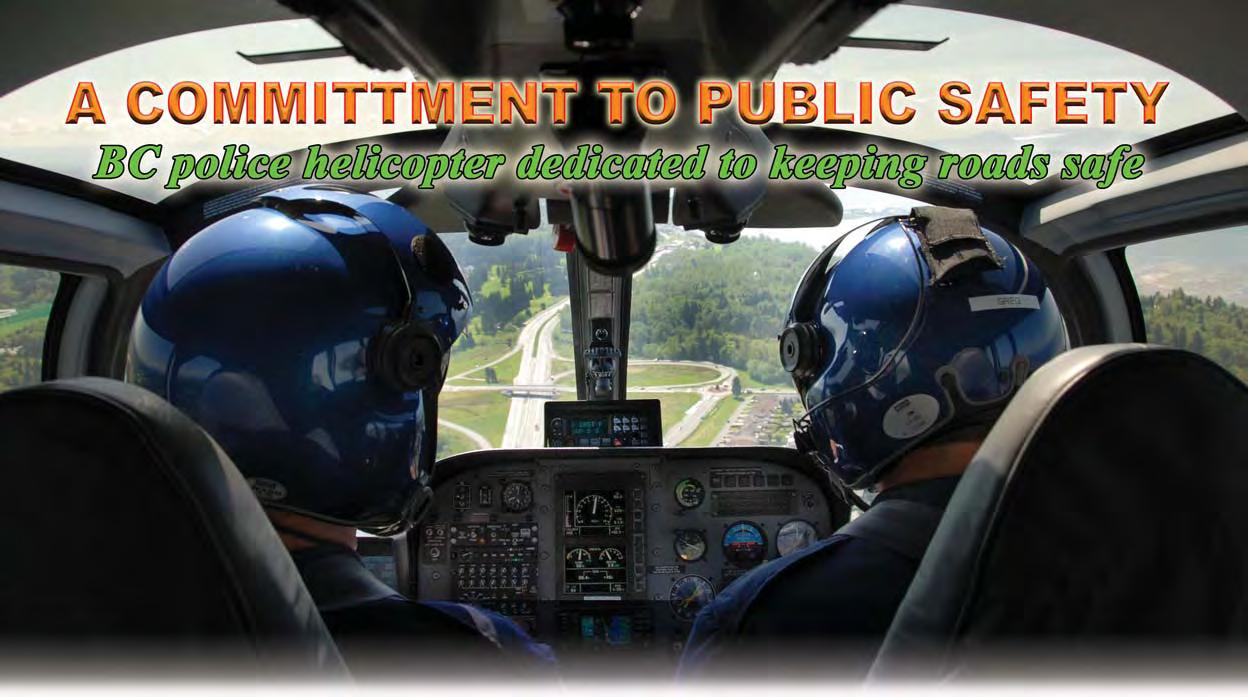
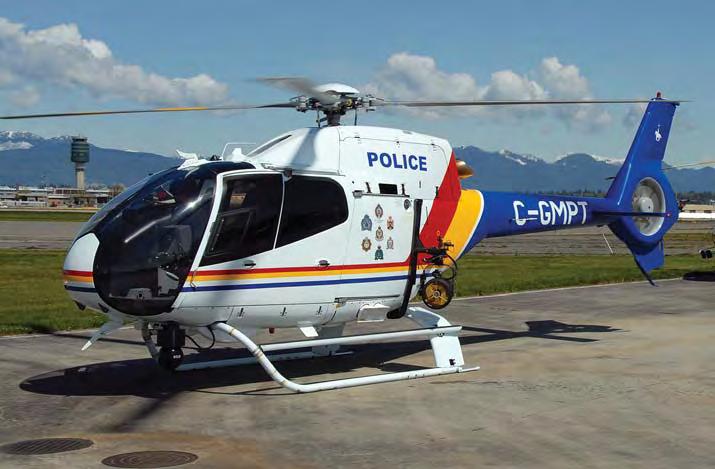
A new, fully equipped Eurocopter EC120B Colibri helicopter will focus on maintaining traffic safety in the greater Vancouver area and BC Lower Mainland. Air One will concentrate on pursuits, street racing and impaired driving but can also assist with other high-risk criminal offences if needed.
“Each year car accidents and hit-and-runs kill more British Columbians than all violent crimes combined,” said Solicitor General John Les. “The helicopter will help police spot and track dangerous drivers and will reduce the chance of high speed chases that put the public at risk....
“The $2.2-million dollar price tag is pretty small when you consider the potential lives that will be saved, and the increase in public confidence in the safety of their communities and their streets.”
The helicopter will provide aerial support to 17 municipalities, said RCMP Pacific Region Deputy Commissioner Beverley Busson. “It will enhance the ability of police traffic services to address overall safety on roadways, provide safer conduct and control of situations involving drivers who are attempting to evade police, and assist with overall crime reduction as part of our strategic goal for safer homes and communities.”
The bills are being paid through a joint traffic safety agreement between the province and government operated Insurance Corporation of BC, with some assistance from the federal government. The province is covering the operating costs so individual police departments are not billed for using the aircraft.
The ‘Lower Mainland Traffic Safety Helicopter’ recently made a pursuit unnecessary and played a crucial role in the arrest of a pair
of car thieves in Surrey. It also assisted the Surrey RCMP auto theft target team for nearly an hour, tracking a pair of known car thieves in a stolen Dodge pick-up.
Unaware of the police presence, the suspects were observed driving recklessly throughout Surrey and Langley, running red lights and passing vehicles on double solid lines. Target team members moved in for the arrest when the duo got out at a gas station. One of the suspects was immediately apprehended but the second returned to the truck and fled at a high rate of speed.
Air One followed from a discreet distance, making a pursuit unnecessary. Thinking he had gotten away, the suspect abandoned the truck in a Langley mall and was arrested without further incident. Both suspects face numerous charges, including car theft, dangerous driving and resisting arrest.
Air One is based at the RCMP Air Serv-
ices Center at the Vancouver Airport, which also dispatches three fixed wing airplanes and a Eurocopter B3 helicopter, although they are not assigned specifically to area traffic safety. The B3 works with border enforcement teams and is used in drug operations and for general support.
RCMP Cpl. Dwayne Jennings is chief pilot but noted highly trained and skilled civilian pilots have also been hired.
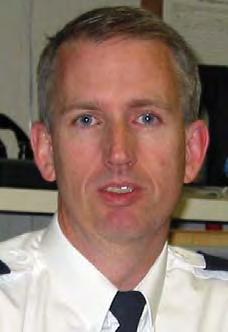
Insp Derek Cooke
“The quality we are getting is quite impressive. These are non-peace officer, status employees of the RCMP. A fully trained tactical flight officer, who is a qualified police officer, always accompanies the pilot.”
Air One has a thermal imaging camera and 30 million candlepower spotlight for tracking suspects at night, GPS-based mapping equipment, high-tech gyro stabilized binoculars and a complete communication system, capable of sending real-time video to an incident commander on the ground.
The EC-120B is the quietest single-engine helicopter in its class and also one of the most fuel efficient, which allows it to do its work effectively without disturbing the area around a crime scene; this is especially important when it’s used at night over a sleeping neighbourhood.
Air One connects directly to E-Comm’s 911 call centre, which dispatches emergency responders to the more than two million residents of southwest BC. The helicopter connects directly to the radio system used by police in the area it’s operating, which has proven more effective than using the cell phone system.
The helicopter is the only one in North America designated solely for traffic safety, to the best of their knowledge, said Insp. Derek Cooke, OIC of the Lower Mainland District Traffic Services.
“Because of where the funding came from, we are breaking some ground. Our program is in its infancy and we are prepared to see what works and what does not work with the project. We are getting excellent support from other police departments like Los Angeles, Calgary and Edmonton, who have helicopter support programs. Everyone wants success so there is excellent co-operation with other departments without any competition.”
Police forces in the Lower Mainland have been trying to get a patrol helicopter for the past 10 years. A traffic support helicopter for the area “has been a long time in coming,” admitted Jennings. “We are moving into a new age of enforcement and Air One is a tremendous asset in policing. The impact that this service has on policing is far greater than if that same money was used to employ additional police.”
The helicopter covers an area from Whistler to Hope and Jennings is concerned that servicing such a large area may mean that “Air One will not be available for all the needs that come up in the Greater Vancouver Area.”
“This announcement could not have come at a better time,” said Vancouver Police Chief Jamie Graham. “With the integration of police services, we are better able to co-ordinate the use of a helicopter across more than a dozen municipal and RCMP detachments. This law enforcement tool represents a long lasting commitment to public safety.”
BC’s enhanced road safety enforcement initiative also includes bait cars and the establishment of specialized integrated road safety units around the province. Along with targeting aggressive and impaired drivers, the units help ensure seatbelt compliance and intersection safety.
Elvin Klassen, Blue Line’s west coast correspondent, can be reached at elvin@blueline.ca
Local police should watch for terrorists Sleeper cells are likely already here
by Michael Aman
Four radical Muslim suicide bombers killed 52 people and injured some 700 when they bombed three subway trains and a double decker bus in London, England on July 7, 2005. The terrorists were all British citizens, three of them native-born. An intense investigation followed and the British House of Commons issued its report on the bombings in May.
This article is an analysis of that report, with the intention of extracting lessons that will help US and Canadian police officers detect and prevent suicide attacks. The recent takedown of a radical Muslim terror cell in Toronto shows that the North American continent is by no means immune to this threat.
Profile of the terrorists
The London suicide bombers were all male and ranged in age from 18 to 30, with their leader being the oldest. Some of them were married and had children, which distinguishes them from earlier Al Qaeda inspired terrorists such as the 9/11 hijackers. Three of the bombers had very similar backgrounds – they were all second generation immigrants of Pakistani origin – the fourth was a Muslim convert of Jamaican origin.
The three ‘Pakistanis’ seem to have grown up in something like a Muslim ghetto, an environment that precluded them from becoming truly integrated into their native British nation and culture. They were not excessively poor or disadvantaged, but Britain’s culture and way of life apparently didn’t reach them beyond outward appearances such as wearing Western clothes.
All their social life and interactions seem to have occurred within a strictly Muslim environment. The ‘Jamaican’ was the oddball of the group in that he didn’t even become a Muslim until 2000, when he was 15 years old. His personal life was marked by constant upheaval and psychological trauma; apparently this made him prone to being easily impressed and swayed towards extremist ideas and actions. Curiously, the official British report states that the terrorists were “apparently well integrated into British society.” British standards for successful integration appear to be somewhat different than those in North America.
Physical appearance during the attack
The suicide terrorists wore comfortable, casual clothing and carried rucksacks concealing their explosive devices, making it appear as if they were embarking on a camping or hiking trip. Some witnesses reported the rucksacks appeared too heavy for their size.
The bombers stood out somewhat during morning rush hour on the London Underground, however it was early July and vaca-
tion season so their casual appearance didn’t make them overly suspicious. None exhibited any hint of being a radical Muslim; they didn’t wear traditional Muslim garb or full beards, for example. They were apparently keenly aware of the tactical requirements of their mission and made a conscious effort not to attract unwanted attention.
When the group split up in an underground terminal to approach their separate targets, they were reportedly observed hugging each other and appeared euphoric. In the last seconds before they detonated their explosive devices, they were seen manipulating the tops of their rucksacks, probably arming the bombs. The last bomber, who exploded his device over an hour after the other three, appeared nervous immediately before detonation, probably because his device had initially failed.
There were apparently no last second rituals such as shouting out or murmuring religious phrases or the application of any special apparel such as bandanas. Such rituals have been observed on some occasions during suicide bombings in Israel.
Explosive devices
The bombs consisted of approximately two to five kilograms of the organic peroxide TATP, an improvised explosive that can be manufactured entirely from commercially available ingredients – hydrogen peroxide, sulfuric (battery) acid and acetone. If these are found together, the site should be treated as a bomb factory and terrorism indicator. Manufacturing instructions are readily available on the Internet and in literature such as Guerilla’s Arsenal
The manufacturing process is fairly simple but also highly dangerous. TATP is very volatile, making it dangerous to work with. It is also highly sensitive, making it easy to ignite without hard to obtain commercial detonators such as blasting caps. Overall, TATP is
an almost perfect improvised explosive for terrorist purposes.
The bombers were apparently aware that manufacturing TATP had the potential of attracting unwanted attention due to strong odours and fumes so they rented an apartment solely to use as their bomb factory. They attempted to conceal their activities with net curtains, while leaving the windows open for ventilation. The toxic fumes exuding from it killed the tops of plants just outside the apartment windows.
Hydrogen peroxide’s extreme bleaching properties caused the terrorists’ hair to grow lighter, which wasn’t noticed by their families. They tried to explain this by blaming it on exposure to swimming pool chemicals like chlorine and apparently wore face masks when working on the explosives.
They likely conducted a small scale test explosion to make sure their devices would work. The last bombing occurred over an hour after the other three, which happened almost simultaneously. The Al Qaeda manual explicitly specifies that a terrorist attack optimally should consist of four separate but simultaneous attacks. The last bomber was seen on a security camera purchasing a 9 volt battery after his three coconspirators had already blown themselves up, likely because his device malfunctioned.
Weapons
The terrorists apparently had prepared for a hostile encounter with law enforcement. Authorities discovered a 9mm handgun and additional, smaller explosive devices in one of the vehicles left behind in a railroad station parking lot. Their purpose could not be definitively established, however it is likely that they were intended as distraction devices in the event the terrorists were stopped during the drive to the railroad station in Luton, outside of London.
The Al Qaeda terrorism manual explicitly prohibits Al Qaeda members from carrying
weapons during preparatory activities for an attack. However, police officers must be prepared for violent resistance if they encounter radical Muslim terrorists during an actual mission.
Planning and preparation phase
Several pronounced and observable changes occurred in the terrorists’ appearance and behaviour during preparation for the bombing. Such changes, especially if they are rapid and unexplained, are important terrorism indicators. The bombers also engaged in physical activities typical of the planning and preparation phases of a terrorist attack such as working out in a gym, canoeing and hiking.
Besides physical fitness and the tactical value of such training, these exercises seem to have played an important role in the bonding of this particular terrorist cell. Generally, outdoor activities and tactical exercises possibly are also used during the recruitment, selection and indoctrination of prospective radical Muslim terrorists.
The British cell apparently generated within itself the initial impetus to engage in a terrorist attack. It was self-sufficient and apparently self-financed all of its activities. Its increasing radicalization became apparent in the terrorists’ outward appearance; they began wearing traditional Muslim garb, grew full beards and started openly preaching and advocating radical Muslim ideas. These changes were noticed at their mosque and radical preachers also appear to have played a part in steering the cell towards terrorist activity.
The actual terrorist indoctrination seems to have taken place at locations away from established mosques, most likely in a successful attempt to avoid detection. The names of two of the bombers appeared in an unrelated investigation of extremist activities and cell members exhibited a pronounced radicalization in their expressed opinions.
Typical ideas and opinions expressed by prospective radical Muslim terrorists, which should be treated as potential terrorism indicators when encountered in field contacts or investigations, include:
•denial of the holocaust;
•anti-Semitism;
•disregard of all material commodities;
•belief in conspiracy theories about events such as 9/11;
•expressed attraction to martyrdom such as terrorist suicide attacks;
•intolerance of religions besides Islam;
•view of oneself as a ‘warrior’ in a global struggle between Islam and the rest of the world;
•a preoccupation with the historical Christian crusades to the Holy Land, which occurred some 900 years ago.
All radical Muslim terrorists seem to share the conviction that civilians in Western countries bear responsibility for the perceived misery of the Muslim world because they support their Western ‘crusader’ governments.
At least two of the British cell members visited Pakistan about seven months before the attacks and may have visited a terrorist training camp in Pakistan or Afghanistan. Their bombing preparations became much more focused and their mind-set more tactically oriented after the trip. The cell maintained communication with an unknown contact in Pakistan in the months before the bombing.
Pakistan evidently serves as the common entry point to the terrorist training camps that still exist in Afghanistan or the Afghan-Pakistani border area. ‘Koran schools’ (madrassa) also seem to be important way points in the terrorist careers of many individuals. Repeated or extended visits to Pakistan without a clear purpose should be treated as a potential indicator of terrorism.
The terrorists changed their appearance and behaviour after returning from Pakistan, wearing Western clothing again and toning down their radical, anti-Western rhetoric. This is indicative of tactical instructions if not operational training received during the trip. No evidence was recovered, however, that would indicate a direct link between the British cell and Al Qaeda leadership in Afghanistan.
The British cell’s method of operation indicates Al Qaeda is transforming from a hierarchical terrorist organization into a virtual network of independent cells, bound not by a chain of command but rather a common ideology. Shortly before the bombing, the leader and his second-in-command quit their jobs, apparently so they could devote their undivided attention and energy to the coming attack.
Only the ‘Jamaican’ bomber exhibited erratic behaviour, seeking contacts with petty criminals and even violating certain tenets of
the radical Muslim faith by activities such as womanizing. Some of his actions can be attributed to no-future behaviour, such as spending money liberally.
By and large, the other three terrorists maintained their calm and discipline and their self-imposed seclusion from outside influences became more severe in the immediate run-up to the bombing. The terrorists went on an actual on-site dry-run of the bombing several days before the attack, making sure that their scheduling was correct. They also prepared written notes on schedules of the trains they planned to hit; these were recovered as evidence.
Investigative considerations
The bombing investigation relied to a considerable extent on closed circuit TV images of the bombers as they entered the public transportation system and at various stages during the actual attack.
Only one left a videotaped statement and a will, both recovered only after the bombing; two were also reported missing by family members. In similar attacks in the future, such reports might very well be generated before the attack, due to the extreme seclusion the suicide terrorists typically impose on themselves during the run-up to an attack.
Evidence pointing to the leader of the cell was found at three of the attack sites, showing his apparent critical position within the cell.
As mentioned, the names of two of the bombers, including the cell leader, had appeared in an unrelated investigation of radical Muslim activities. This appears to be a parallel to the 9/ 11 attacks; leader Mohammed Atta was also known to US counter-terrorism agencies but they didn’t act upon this intelligence. The antiterrorism dragnet of Western nations is apparently not tight enough and future suicide bombers will likely be able to again slip through.
Conclusion
US and Canadian involvement in the global war against terror puts both countries on the hit list of radical Muslim terrorists. Liberal immigration policies and generous protection of civil liberties makes it likely that radical Muslim terrorists similar to the ones who committed the London attacks are already in place here. Due to the disruption of its base in Afghanistan and preoccupation with the Iraq war, Al Qaeda currently appears to be incapable of launching large-scale attacks such as 9/11.
Al Qaeda’s transition into a virtual network of independent cells makes medium-scale suicide attacks along the lines of London 2005 more likely. Local law enforcement officers will play an important role in defeating this sleeper-cell threat.
Knowledge of terrorism indicators and tactical skills in countering terrorist suicide attacks will become critical for police officers.
Michael Aman is a detective in the El Paso Police Department Crimes Against Persons unit. He also worked in the cold case, gang and dignitary protection units and spent 13 years in the German Air Force. His upcoming book, Prevention of Terrorist Suicide Attacks, published by Jones and Bartlett, will be available in September.
Chief’s comments stir debate
Release of investigative details builds confidence
by Mark Giles
“The manner in which the arrest was announced shows the degree to which policing has become a public relations exercise that is changing the way the game is played,” said David Paciocco, a criminal law expert at the University of Ottawa.
Paciocco was referring to a high-profile arrest by the Ottawa Police Service (OPS) in June. His comments were part of a front-page article in the Ottawa Citizen questioning the degree to which police release investigative details. With public and media relations playing a more prominent role in managing policing and legal issues, it’s often a dilemma for law enforcement agencies faced with expectations of openness and transparency, adherence to privacy law, and pressure to limit comment on cases under investigation or before the courts.
When dealing with the media, there are generally four options for responding to questions and dealing with the release of information:
1.Tell the truth;
2.Say you don’t know and cannot speculate; 3.Say you don’t know, but will find out; or 4.Say you know, but explain why you cannot release the information.
Police spokespersons often don’t know all the details about incidents or arrests that have just occurred and shouldn’t speculate. More information can usually be provided later as it becomes available. As the dust settles, however, police are usually faced with either telling the truth or explaining why the information cannot be released.
When evidence has been gathered, arrests made and there are no further operational security concerns, information can and often should be released. It promotes awareness of community policing efforts, ensures accuracy of details, addresses rumours and speculation, and builds confidence in police resources and capabilities. It also puts a police agency in the lead, as in many cases the information will be released after an access-to-information request.
Details that cannot normally be discussed include those that would jeopardize an ongoing investigation, such as the gathering of further evidence or making additional arrests; those that would disclose police practices that may be used in the future; and those that might inappropriately influence a pending court case or violate a court order. In such situations, the spokesperson should clearly articulate the reasons for withholding information and ask that they be respected.
Once these concerns are dealt with, police spokespersons are increasingly telling it as they see it – proactively putting information out to the public. Some in the legal community are apparently not too happy about it.
“There’s a growing interest for the public to know more,” said Norm Boxall, an Ottawa defence lawyer. “That doesn’t make it right. In fact, it’s very unhelpful to the legal system.”
It may be “unhelpful” to defence counsel, but a police agency needs to be able to explain its side of the story to the public. Doing so builds public confidence, especially in controversial cases, that police are investigating criminal activity in a thorough and professional manner.
Comments stir controversy
After an arrest in relation to a 2005 homicide case, the OPS provided some details of the investigation, including the agency’s perspective, at a news conference. Stating that the accused had confessed to his neighbours and police, the chief suggested that he came forward “due to his guilt and no longer being able to deal with his conscience.” The comments led to a front-page newspaper story highlighting concern by defence counsel over his client’s chances of getting a fair trial.
“We’re not anywhere close to the stage of there being a conviction, yet certainly my client is being treated as if he is guilty,” said Michael Bisson, defence counsel for the accused.
Bisson’s comments raise some interesting questions. While only a court of law can determine guilt, and the accused is certainly entitled to due process, would his client be in custody if police didn’t at least believe he was responsible for the crime? Police investigators were confident they’d arrested the right person, so shouldn’t the chief be able to publicly confirm his confidence in police actions and provide some context for his support?
Some in the legal community say no, arguing the risk of being tried in the media, but if trial by media convicts people, then O.J. Simpson and Michael Jackson would both be in jail. There are still those, however, who feel that police should keep their thoughts and facts to themselves, preferring a response referring to cases as being before the courts. This makes interview preparation easy for police spokespersons, but is it credible?
“Saying it’s before the courts is a smokescreen,” said CBC journalist Ian Hanomansing, speaking to the Canadian Bar Association. “It’s used as a wall to shut down further questioning.”
Those responsible for the overall administration of justice and in a position to inappropriately influence a case – such as politicians or senior government officials – are probably justified in limiting their comments to saying it’s a matter before the courts. Police agencies, however, are clearly involved in putting together a case – with intent to secure a conviction – and the public wants to know more about their efforts and the challenges they face.
“People are extremely cynical about the legal system, often seeing it as soft on crime,” said Hanomansing. “We need more openness in discussing the work of the police and the courts.”
Police perspective versus a finding of guilt
If communicated appropriately – either before trial or after conviction or acquittal – police agencies should have the right to explain their actions, clearly differentiating between their perspective and actual court decisions. After the O.J. Simpson trial, the chief of the
Los Angeles Police Department (LAPD) stated that the acquittal didn’t mean his agency would be looking for any other suspects in the double-murder case – clearly implying that police were confident they had charged the right man. The chief respected the finding of the court, but that didn’t change the LAPD’s belief that Simpson committed the crime. By acknowledging this, he managed public expectations regarding any further action on behalf of his police agency.
Closer to home, the military’s director of prosecutions recently dropped a criminal charge laid after an arrest by the Canadian Forces National Investigation Service (CFNIS). Although acknowledging the right of the prosecutor to do so, the CFNIS stood by the work of its investigators and said so to the media. It was the truth, didn’t speak to the actual innocence or guilt of the accused, and there was no operational reason to withhold the unit’s position on the issue.
Lawyers are usually pretty good at splitting hairs, so they should be able to see the difference between the OPS revealing that the accused confessed – and then providing its perspective on his state of mind – and stating outright that the accused is guilty. The courts will rule on the admissibility of a confession made to neighbours or the police, the accused’s intent, and ultimately his guilt or innocence.
With the vast reach of today’s media – including cable TV, satellite radio, the Internet and now blogs – there will always be discussion of
cases and the guilt or innocence of accused persons. Judges and jurors determine the outcome of court cases and, unless they are drawn from remote parts of the world, they too will be exposed to a variety of media before a trial.
Not providing details or perspective not only brings an agency’s credibility and competence into question, it also often creates a void that is quickly filled by information from other sources. It leaves the public, judges and potential jurors absorbing information from everyone – defence counsel and others who sometimes advocate publicly for the innocence of the accused – except those who actually investigated the case.
With the speed and volume of today’s information flow, the only fair option is to allow police, defence and other interested parties to discuss their activities and perspectives. In doing so, we rely on the courts to focus on the evidence and arguments presented at trial, rather than on the news and other media programs.
I agree with Hanomansing, we need more openness in discussing the work of the police and the courts. Police spokespersons can and should comment on the work done by investigators and other frontline officers. As long as it is done fairly and accurately, leaving the actual finding of innocence or guilt to the courts, it builds public confidence by showing that police can explain what they do and why they do it.
Mark Giles is Blue Line’s correspondent for the National Capital Region (Canada), public and media relations, and military-related issues.
Security budgets for Winter Olympics may have to increase
VANCOUVER — The arrests in Toronto of 17 people with possible links to terrorism do not indicate a heightened concern with security at the 2010 Winter Olympics, says the RCMP spokesman heading the unit responsible for ensuring the safety of athletes and visitors.
But one law enforcement official said he expects the security budget for the Gamescurrently smaller than the security budgets of the last two Winter Olympics - will have to be boosted.
Sgt. John Ward, of the Vancouver 2010 Integrated Security Unit, said there is “no identifiable threat” to the 2010 Games.
The RCMP, the Vancouver police department and the Department of National Defence are among those dealing with security issues at the 2010 Winter Olympics.
Their budget is $175 million. But in Salt Lake City in 2002 - the first Games held after the Sept. 11, 2001, terrorist bombings in New York and Washington - $310 million US was budgeted. In Turin in 2006, the budget was $1.4 billion US.
Ward defended the budget. “We’re presently working within that budget and it’s not an issue for us at this particular time. We can’t compare Torino to Vancouver, we can’t compare Salt Lake City to Vancouver or to Canada.”
Solicitor General John Les also said he believed the money would be adequate.
But Insp. Rob Rothwell, with the Vancouver police, predicted more money will be needed.
“My expectation is that certainly we will require, as we move closer to 2010, additional funding and resourcing in order to properly address the threats.”
The arrests in the Toronto area are an indication that Canada’s international reputation is changing, says one observer.
Rothwell said the Vancouver department recently established its own counter-terrorism unit to deal with terrorism in conjunction with other law enforcement agencies including the RCMP.
He said the unit was formed on the belief that individual members of the public may be more comfortable speaking with their local police officers.
“The public are the ones that are going to generally stumble upon circumstances that they may find to be odd or suspicious and within those circumstances could simply be the lead that we’re looking for that uncovers the terrorist cell or network operating here,” he said.
“Somewhere in there we’re very likely to uncover the nugget that will be the tip of the iceberg and we don’t want to overlook that.”
Organized crime helping to fund terrorist groups’ activities is becoming a bigger concern for the Mounties, says RCMP Commissioner Giuliano Zaccardelli. “That is a trend we’re watching and monitoring and has the potential to cause us some serious problems,” Zaccardelli, told senators on an anti-terrorism committee. Zaccardelli says he is concerned with the emerging trend that has become increasingly evident. He says terrorist ties to organized crime have been traditionally low-level but that has changed. Zaccardelli told the committee the RCMP has become increasingly vigilant since 9/11. He says terrorism is a “real and present danger” adding it is just a matter of when Canada will encounter its own 9/11.
Cst. Donald Doucet of the Sault Ste. Marie Police Service was killed in the line of duty after being involved in a motor vehicle collision. Doucet, 41, was riding as passenger in a cruiser when it collided with a minivan, and later died in hospital from his injuries. The 12-year veteran of the Sault force was a “dedicated, loyal police officer” who was a mentor to many new recruits, says Chief Bob Davies. Doucet had a zest for life, Davies says, noting he was an outdoors man who enjoyed sports and participating in community events. The woman driving the minivan faces several charges related to the collision including impaired driving causing death and impaired driving causing bodily harm. Doucet is the first Sault Ste. Marie city officer to die in the line of duty. He is survived by his wife Debbie and two daughters, Jocelyne, 19, and Courtney, 16.
Prime Minister Stephen Harper says the federal government will introduce legislation to make street racing a new criminal offence. Harper says those who choose to street race will face stiff penalties, including driving prohibitions for those who are convicted. He says the government also plans to target multiple offenders, with the length of the driving prohibition increasing with each offence. “There will be minimum penalties ... those penalties will involve some kind of prohibition,” Harper says. “As they escalate, they will also likely involve prison terms as well.” Harper says the new bill is part the government’s efforts to crack down on crime.
Canada’s auditor general Sheila Fraser says not only was the gun registry program hundreds of millions of dollars over budget, but the former liberal government kept quiet regarding its increasing costs. In her report, Fraser says the former government gave false and incomplete information to Parliament about costs of the gun registry. Fraser says the decision to not disclose the program’s true costs is a serious matter because it does not respect the government’s own policies nor the Financial Administration Act. Fraser says the eventual costs of the gun registry program would have cost taxpayers more than $1 billion.
The Canadian Border Services Agency says delays in getting standard operating procedures in place will delay Canadian border officers being armed. The agency says it will be the fall of 2007 before the first officers are armed. Mary Claire Coupal, the Customs Excise Union president of Windsor, Ont., says she expected delays, but is disappointed it will take another year. Windsor is expected to be one of the first crossings to arm their border officers.
Putting prison costs into perspective
Ontario ends privatized prison experiment
by Ryan Siegmund
Citing the interests of prisoners and public safety, the Ontario government has elected to make its only privately run prison publicly operated.
Privatization advocates tout cost effectiveness but a lower bottom line doesn’t necessarily mean better outcomes, says Ontario Community Safety Minister Monte Kwinter.
The government undertook a five year pilot project comparing nearly identical correctional facilities in Penetanguishene and Kawartha Lakes. The intention was to compare the privately run Central North Correctional Centre (CNCC) in Penetanguishene with the publicly run Central East Correctional Centre (CECC) in Kawartha Lakes and determine the pros and cons of each.
“It was a first class opportunity to really compare a public run facility and a privately run facility with minimal variables,” says Kwinter. “They had exactly the same footprint (and) exactly the same compliment of prisoners, representing pretty well the same ethnic background.”
The government hired management consulting firm PricewaterhouseCoopers (PWC) to essentially evaluate the private provider’s contract performance. With information provided by the community safety ministry and its own research, PWC’s report found Kawartha Lakes performed better.
The government comparison study’s criteria centred on 10 categories – included security, programming, health care and recidivism – and Kawartha Lakes fared better in seven of them. The findings prompted the government to not renew the contract, signed by Ontario’s previous Conservative government, with the private provider when it expires at the end of November.
The deal was flawed from the onset, says Kwinter. Although Penetanguishene was in “material compliance” with the contract, it had “considerably less personnel than what the publicly run facility has,” and that was the main factor in its cost advantage, he says.
“The publicly run facility was faring better than the privately run facility in virtually every category,” he says. “Not withstanding, if you take into account quality of care, quality of health care, recidivism rates – there are no savings.”
Although the contract called for minimal staffing requirements, Kwinter says the direct result would have an impact on the prisoner’s outcomes.
“One of the things that is critical to the recidivism problem is integration into the community. The privately run institution had one person responsible for doing that whereas the publicly run one had nine people – and that is absolutely critical to dealing with recidivism. There were a whole range of issues.”
Touting his strong business background, Kwinter says he was open to a privately run prison. “When I became minister, I discovered they were delivering services (at) just about $100 per prisoner per day and our publicly run facility was rendering services at about $150. When you consider we are talking about 1,200 prisoners, saving that type of money immediately attracted me.”
While costs are certainly a factor, they are not the only consideration, he says.
“We have to look at security, recidivism, medical care; we have to look at all the aspects that go into running a correctional facility. To me, if they can deliver the service at a better price with equal or better quality, by all means why wouldn’t you go that route?”
Dissecting the decision
The decision to make CNCC in Penetanguishene publicly run has as much to do with providing better services to inmates as it does protecting the public, Kwinter says.
Successfully rehabilitating inmates and reintegrating them safely into communities will be forever linked, but at what cost? The decision to not renew the contract will hurt Ontario taxpayers, says Utah-based Management and Training Corporation Canada (MTCC), which ran Penetanguishene. The public-private partnership would have saved $11 million over the next five years, on top of the $23 million saved during the pilot project, the company says.
The study’s methodology was studied and approved by a third party – University of Toronto Criminology Prof. Anthony Doob –Kwinter says, but MTCC says it was done in a non-transparent manner. The government decided not to renew the contract before the study was complete, it says, and did not share the full report. MTCC says it was given only an “executive summary of an alternate report prepared by PWC, summarizing information pro-
vided by ministry staff, as well as research and analysis performed by PWC.”
Obviously disappointed with the government’s decision, the company says it strongly believes CNCC has been one of the best run correctional facilities in all of Canada. It points to a “very successful inmate bricklaying apprenticeship program” and notes more than 50 inmates graduated with Grade 12 diplomas and 30 became apprenticed stone masons. It also points to its round-the-clock, fully functional medical unit which proved useful to other Canadian correctional facilities which didn’t have such services.
The study did suggest CNCC rated higher in the variety and volume of its programs, however “programming quality” was deemed an undeterminable category because of a lack of data to support it.
“CNCC offered a lot more programs but they couldn’t determine whether or not any of these program were being taken up,” Kwinter maintains. “So you can say, ‘here are all the things that we are offering,’ but we didn’t have the ability to determine a percentage of the prisoners that participated. We did have the data for Kawartha Lakes and their programming was effective and doing what it was supposed to do.”
The US debate
Some six per cent of US prisons are run by the private sector in a trend that began in the 1980s when the government found itself in great need of additional prisoner bed space, says Paul Doucette, executive director of the Association of Private Correctional and Treatment Organizations.
The need was created when the government passed a series of very strict substance abuse laws, which he says led to overcrowded prisons full of drug dealers and users. Private contractors can build prisons more cheaply and
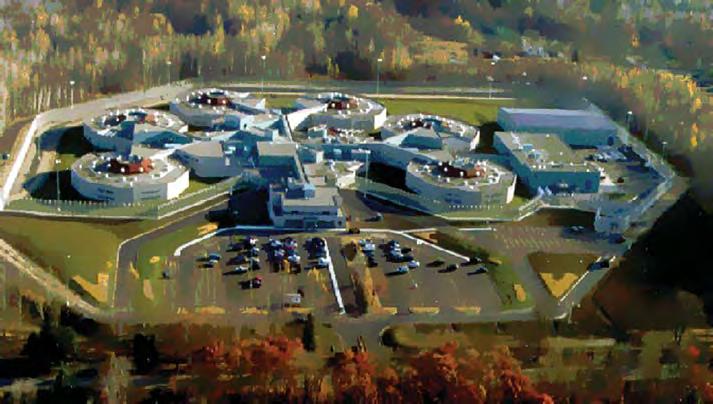
Central North Correctional Centre (CNCC) in Penetanguishene
in half the time government can, Doucette says.
“The U.S. government is forecasting a need for a lot of additional bed space – some people say more than 20 to 30 thousand new beds over the next 10 years. Our state system is about 110 per cent overcrowded and our federal system is 140 per cent overcrowded.”
Money matters and cost efficiency make private prisons an attractive option for state governance, he argues.
“Essentially what is happening is private corporations are simply making bed space for inmates because the state doesn’t have room,” says Doucette. “States have found that it is more expensive for them to do it than it would be for the private provider.”
Talk of saving money by privatization is presumptuous until studies prove otherwise, says Byron Price, an assistant professor at Rutgers University in New Jersey, who specializes in privatization, specifically prisons.
“There are no studies where you can compare apples to apples – you can only compare apples to oranges. Prisons have a place in our society but private prisons basically create the need to incarcerate in my opinion,” offers Price. “Do we need an entity that benefits from punishment? I think it’s problematic.”
Price, who has written a few books on the subject, says some private prison corporations are becoming multi national, offering Australia, South Africa and most recently Israel as examples. The fact stock in some of the companies is traded on the New York Stock Exchange leads Price to believe they are “commodifying human beings.
“You have Wall Street involved in this. Wall Street is not concerned about making the public sector run better, they are concerned about maximizing shareholders wealth.”
Doucette says some people don’t like the idea of ‘people profiting on somebody’s misery.’ “When somebody says that to me I always say, ‘Aren’t you glad that our doctors, our hospitals and our funeral directors don’t feel the same way?’ The fact of the matter is, somebody has to operate these facilities; somebody has to provide this service.
“What we need to worry about is the quality of service that is being provided and its costs – not corporate structure or the governance of how it gets done.”
Price says private prisons are profitable because the first thing they do is reduce labour
Ontario hires more probation and parole officers
Community Safety and Correctional Services Minister Monte Kwinter says the hiring of 37 new probation and parole officers in Ontario brings the government closer to fulfilling their mandate. With a commitment to hire 100, the 37 new positions will give the province a total of 92 new probation and parole officers since 2003. Twelve of the new officers will be assigned to the justice sector’s Guns and Gangs Task Force, whereas the remaining 25 will provide more intense supervision and programming for offenders in the community. Collectively, Ontario’s probation and parole officers supervise approximately 56,000 adult offenders daily.
costs; that attracts less qualified people which, in turn, implicates people’s safety.
Doucette says he has heard this argument made by union groups, but says private prisons must be accountable to their contract or they risk being fired and losing their investment.
“If you are building cars and you don’t build a good one, people aren’t going to buy them. If they are really expensive, people aren’t going to buy them.” Private corporations are in the business to make money, Doucette says, adding they profit by providing a service very efficiently.
Despite the competitive pressure to bid on and win contracts, companies do not cut corners, Doucette says. “So how do I do what needs to be done for less? I find efficiencies. I might employ some kind of electronic secu-
rity technology rather than hire people. I might be able to use on-line learning to provide for education or substance abuse programs support, rather than hire a councillor to physically work in the building.
“I don’t have to use government employees to cook all the meals, I can go out and bid on the private market for suppliers. It is kind of a combination of all of that which allows them to make a profit.”
At the end of the day, prisons make money because they are able to do what is required of them by the government for less than what the government pays them for that service, says Doucette. The difference is the profit.
Doucette says his association would encourage a comparative review of private and public sector providers.
(Continued)
Recidivism rate
Effective programs are, without question, critical to the recidivism rate, Kwinter says.
“One of our challenges is that we have people in our facilities for relatively short periods of time – the average length of stay is at about 66 days,” he says. “With federal penitentiaries and the longer sentences, you can put in place programming that will effectively change inmates’ lives...
“It is absolutely critical that in the relatively short period of time that we have them, that we try to maximize their abilities – that will put them in a better position than when they came in.” Teaching inmates the “satisfaction of working” and ensuring they have “some kind of transferable skill” is key, Kwinter says.
The government study analyzed the recidivism rate of both prisons using data from the Offender Tracking Information System. It concluded Penetanguishene’s recidivism rate among the group studied was 10 per cent higher than Kawartha Lakes (31 per cent to 21 per cent).
The five-year pilot project was a chance to learn, Kwinter says, adding no other government has compared public and private prison operators.
Over crowding
Kwinter doesn’t envision the province entering a deal with a private company in the near future, but allows the country’s ‘get tougher’ stance on crime may change things in the future.
“Certainly the minute you start increasing the severity of the penalties – if that does happen – you are going to increase the prison population. When you put more police officers on the street, there are going to be more arrests; that is going to increase the population. The federal government has already announced they are going to have to start building new jails to accommodate the new prisoners that are going to be caught up in the new legislation.”
Kwinter prefers to see the private sector finance and build a facility which the government then rents and runs. “That is a model that I think in certain instances makes sense,” he says, noting there are punitive costs regardless. “If we put the money out in building bricks and mortar ourselves, the government will suffer a greater deficit... we have a debt of about a 120 billion dollars and we are paying interest on it...
“All we are saying now is let the private sector build it and we pay the rent, which is in lieu of interest. What it does is free up our ability to do things a lot quicker, but we are not giving up the operation of those facilities.”
The biggest problem in the correctional system at the moment is that Ontario has more people in remand than serving a sentence, Kwinter says. “We are housing all these people that have not been convicted of anything – charged but not convicted – and the length of time it takes to get them to trial is problematic.”
The delays mean many of the people found guilty are free to go because their lawyers bargain for time already served – further crippling an offenders’ opportunity to rehabilitate. The overcrowded remand centres have also been noted for their violent tendencies, he adds.
Mounties honoured for volunteer work
Four RCMP members who went “above and beyond the call” in their commitment to community development were recognized for their volunteer efforts during the annual Mounted Police Foundation President’s Awards.
The members, one from each region in Canada, often spearheaded funding requests to the foundation and received funds for the community projects in which they are involved. They dedicate much extra effort in their spare time to ensure that they serve as models of civic involvement in their communities.
Cst. Grant Webber
Community Policing Co-ordinator Atlantic H Division
A native of Liverpool, Nova Scotia, Grant Webber’s list of community involvements reads like a web site for a large organization – not just one man!
Webber is involved with everything from crime prevention to teaching the DARE program in four schools, a seniors safety program and the local Crime Stoppers board. He sits on school board advisory groups, is involved with a youth volunteer project and is the contact for a youth advisory group. In conjunction with fellow officers and other police forces, he developed an Internet awareness program for parents. He’s also currently chair of the community health board.
In his spare time he loves to sail and race – and a year ago he sailed across the Atlantic. He’s also very involved with the local theatre scene – as an actor, director and administrator.
Cpl. M. P. Itwaru Detachment Commander NorthWest V Division
Itwaru spent the early years of his career in general investigative duties in Nova Scotia’s North Sydney, Reserve Mines and Cape Breton Highway Patrol before transferring to the Cole Harbour/Halifax County Detachment, where he also took on community policing responsibilities.
In tandem with his promotion to corporal he transferred to Nunavut in 2004, where he was appointed detachment commander for the Repulse Bay Detachment and is actively involved with the local cadet corps as an instructor.
He volunteers countless hours with community youth and was recognized by the Tusarvik School for his caring support and initiative in obtaining funding for the breakfast
program. He is also an active participant in programs with Cops for Cancer, Diabetes Canada and the Abilities Foundation of Nova Scotia.
Cst David Reece Integrated Proceeds of Crime
Reece has applied his many skills, enthusiasm, energy and dedication to help build what is described as ‘the finest youth organization possible.’ Since joining the Greater Vancouver branch of the Navy League of Canada in 2001 as a volunteer, he rose rapidly to the rank of commanding officer of the corps in 2004. His aggressive leadership in the campaign to increase the number of cadets focused on offering quality programs for young people with inadequate access to other conventional youth activities. He nearly doubled membership, creating one of the largest corps in the country.
He expanded the range and quality of programs and, with the active participation of the RCMP, increased community involvement and awareness. His networking skills yielded the volunteering of their expertise on a myriad of topics ranging from boating and Internet safety, to drill training, deportment and dress.
Reece’s leadership, innovation, drive and personal beliefs match the corps goals of promoting good citizenship, discipline, teamwork, healthy living and respect for self and others. He is a superlative role model to young people and the community as a whole.
Cst. Allen A. Rodgers Hamilton/Niagara Detachment
The RCMP is not the first organization to recognize Rodgers’ commitment. The Ontario Wheelchair Sports Association presented him with the Dr. Robert Jackson award in 2004 for his commitment to enhancing the quality of life of the disabled community.
His involvement with the Equestrian Association for the Disabled started with an invitation to participate in the RCMP Musical Ride pre-show in 1999. Since that time he has helped them establish partnerships with a number of businesses and organizations and volunteered his services as a work party labourer for property maintenance. He also participated in the annual summer camps and media/fundraising events as a knowledgeable speaker and worked effortlessly to raise the profile of the Association in the Hamilton/ Niagara Region community.
Rodgers has served as a director of the association since March 2000 and is also chair and vice-president, contributing hours of his time to numerous projects and events.
How to obtain stolen property convictions
Little known charge effective and easy to prove
by Larry Burden
It has become very difficult to get a conviction for Possession of Property Obtained by Crime (PSP) since the Supreme Court of Canada struck down the reverse onus status on possession of stolen property.
Unless an investigator does a considerable amount of leg work to build a case of willful blindness, or obtains a confession in a warned statement, it’s unlikely criminal charges will be pursued. Consequently too many thieves and purchasers of property obtained by crime are getting off scot free. The heady days of the accused having to prove they didn’t know the property was stolen are long gone, but that doesn’t mean convictions for PSP can no longer be obtained.
The erosion of the reverse onus factor has meant a steady increase in stolen property crimes. Too many investigators and agencies have taken the attitude that it is an insurance problem and have not bothered to build solid cases that result in criminal convictions. Part of the problem rests in the fact that too many investigators (and prosecutors) regard property crimes as being insignificant in the grand scheme of criminal activities and, frankly, have done little to address the problem.
The old adage that there is more than one way to skin a cat holds true though – investigators simply need to look at other options in the Criminal Code, such as ‘fraudulent concealment.’ The charge is seldom used – few people have even heard of it – but it has the potential to convince many to plead guilty to a lesser charge because it is a straight indictable offence and brilliantly simple to prove.
Found in ‘Part IX – Offences against rights of property,’ Section 341CC states “Every one, who for a fraudulent purpose, takes, obtains, removes or conceals anything is guilty of an indictable offence and liable to imprisonment for a term not exceeding two years.”
When it comes to stolen property, the thief or purchaser will often do something to conceal the true identity of an item so it can’t be easily identified or proven to be someone else’s property. Vehicle and boat hull identification numbers are altered, removed or replaced and vehicles and vessels re-registered or renamed solely to conceal the true identity of the item, for example. Instead of trying to prove willful blindness to support a PSP charge, investigators should use the paper trail provided by the state to illustrate how the accused changed the identity of a stolen object by obtaining a new licence or registration in their name.
Fraudulent concealment is about as straight forward a piece of legislation as there can be. Taking, obtaining or concealing anything so that one can conceal its identity is easy to prove when there is a paper trail. For example, criminals regularly re-register stolen trailers as a ‘Ubuilt’ after removing the trailers VIN. In British Columbia it’s as easy as completing an application in which they declare taxes were paid on the materials used to build it.
Signing that public document means they commit a variety of criminal offences, including Forgery, Uttering a Forged Document and Fraud. Having completed the application, the registrar acts upon that information and issues a new registration for the trailer and assigns a new licence plate. The trailers true identity has been concealed by the fraudulent actions of the accused but few investigators would consider the paper trail a part of proving a case of PSP.
After speaking to a lawyer the suspect is unlikely to admit anything to the police but by following the legal paper trail, the facts speak for themselves. All that needs to be proven is that the accused possessed the stolen property and licensed it in their name. The facts that are supported by the registration application and supporting documents can easily prove the fraudulent concealment.
Faced with a straight indictable offence that is simple to prove – along with a variety of other criminals charges such as fraud, uttering and possession – most accused would be inclined to plead to the lesser charge of possession then go to trial on a straight indictable offence.
The ramifications of utilizing Section 341 along with other charges are obvious; more accused will plead guilty to the lesser offence. Armed with evidence of a criminal conviction, the rightful owners of the property, i.e. insurance companies, may be more inclined to sue civilly for damages and consequently obtain successful judgments and compensation.
Property crime in Canada is out of control because of a combination of weak laws and a lack of action by law enforcement, resulting in a growing demand for stolen property. Stolen goods do not evaporate into thin air; they are purchased by willfully blind customers who have little to fear from being caught or prosecuted. By using the fraudulent concealment section in addition to better known charges, investigators can turn the tide on this illicit trade.
The increased likelihood of getting a criminal record and losing ones money along with the stolen goods will deter many people from purchasing them in the first place and go a long way towards countering property crime.
Larry Burden is recognized as one of the leading authorities in Canada on recreational property crime. He has received four national and international awards and has lectured internationally to both law enforcement and private industry.
I personally want to thank you and your staff for the write up in the June/July 2006 Blue Line of the two Military Police that lost their lives in Afghanistan while in action on April 22.
Little is known by other agencies of the sacrifice, dedication and self determination that it takes to be part of the CPP. These Military members are hero’s and gave unselfishly to a job not many understand, I was at Cpl Dinnings memorial and their sacrifice affected all of us, even if we did not have the pleasure of knowing or working with them. Thank you for writing the article, from my understanding these two great men won’t be recognized at the National Police memorial in September because they were not acting in a police capacity, however, I know that like myself we are military members but also we are part of the policing community and it is appreciated to be recognized with our brethrens. Thank you again.
Cpl Darrell Coughlin
22 Wing MP Flt North Bay Patrols
About two months ago I had read your article about the Gulf Coast Police needing assistance. You had put me in contact with several FCPO members, as I was expressing an interest in going down to help out. I just returned from spending a week down in Mississippi and it was an incredible experience. Your article inspired me to go down and I thank you!
Constable Aaron Groskopf 33 Division Toronto Police Service
This letter is regarding the column entitled “Peer pressure can trump penalties” by Dorothy Cotton, Blue Line, March 2006. I would like to add my comments.
Haven’t we heard enough from the bleeding heart liberals? Criminal defence lawyers and the leftist sixties survivors have given our generation the judicial paradigm shift from punishment to rehabilitation. No longer can we seek to have a convicted criminal punished and removed from society, we see great efforts to rehabilitize the offender, often as part of their plea bargain.
In her column Dr. Cotton explains the banal futility of penalties, harsh or otherwise, and rather stresses a good injection of morality and ethics, supported by peer pressure.
I wonder if Dr. Cotton has been out and about lately. I urge her to take a quick toll of the soaring recidivism evident in our courts and jails. Why did they re-offend? It couldn’t have been the short sentences, or maybe the mandatory ‘meetings,’ ‘courses’ or moralityinfused community time they were forced to perfom. We’ve had over 30 years of low to non-existant jail terms and yards of rehab initiatives that has led to what? The same people (and some new ones) doing the same things over and over again.
After many years as a “correctional officer” and a police officer, I put it to Dr. Cotton, and
I urge her to stand in front of an iron grill at a maximum security institution during a riot. What is to stop it from escalating? Not the threat of a mandatory counselling session, but the sheer threat of the pain and discomfort that will follow if it does escalate.
I’d like Dr. Cotton to witness a guns drawn episode, each side escalating with an all too familiar outcome. When a bad guy in this situation drops his or her weapon it is BECAUSE there is no penalty from the courts and the alternative is... pain, discomfort and death. With the court system there is only a few happy counselling sessions during a short incarceration.
Forget about peer pressure. Sure it works at home when getting one of the kids to eat
broccoli or when the skirt gets a bit higher throughout high school but that is about it.
It is clear to just about everyone in the law enforcement and corrections community, punishment not only works but removes the offender from the public, which was initially the whole point of incarceration.
An indicator that application peer pressure is tenuous at best in regards to criminal behaviour is ultimately voiced and confirmed by Dr. Cotton when she mentions in response to getting people to ‘see’ the wrong in their ways and chose to not ‘do it anymore’, she concluded with “We hope.”
Peter Faulhaber
by Elvin Klassen
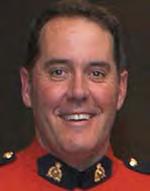
It didn’t take Surrey RCMP Cst. Marc Searle long to notice the large grass gaps between grave markers and the small, worn cenotaph covered in years of moss. It was a rainy, muddy day in the early spring of 2005 and Searle was walking through the oldest part of British Columbia’s Sunnyside Lawn Cemetery Field of Honour in South Surrey.
His research revealed that many veterans lay without tombstones to mark their service to Canada. After defending our freedoms and fighting for their country, they returned home only to be forgotten in death, their stories untold and plots unmarked for as long as 50 years.
Moved by what he saw and learned, Searle began an investigation, on his own time, that would affect thousands of people and garner attention from across Canada. With help from the city’s cemetery services department and the public library’s genealogy department, he dug through city archives and discovered that 36 veterans lay in unmarked graves at Sunnyside. All had died since 1954, their graves unmarked for a variety of reasons.
Eighteen were Canadian citizens who had served with allied nations during the First World War and then emigrated to Canada, all living here for decades before their death. They had been overlooked by past identification ef-
forts because they were not Canadian Military veterans. Searle determined from the beginning that “no man would be left behind” and all 36 unmarked graves were included in the project.
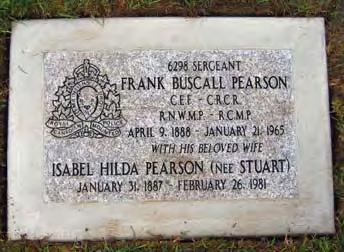
Searle discovered that Sgt. Frank Buscall Pearson, #6298, served as an officer with the Royal North West Mounted Police and the RCMP. He died on Jan. 21, 1965 when he was 76 and was buried in an unmarked grave – a grave which now has a marker, thanks to Operation Remembrance.
Pearson started his police career in Sept., 1914, according to back issues of the RCMP Quarterly , and served in towns such as Battleford, Lloydminster, Prince Albert and Swift Current. He was a member of the Canadian Expeditionary Force during the First World War, received the King George V Silver
Jubilee Medal in 1935 and finished his policing career in Cloverdale, BC, where he retired in Sept., 1939. Searle felt he owed the people in the graves some respect, since the RCMP is a paramilitary organization and his grandfather and father both served in the armed forces. The veterans had chosen to make Surrey their home and Searle began spreading the idea that the community should honour their service by marking their final resting place.
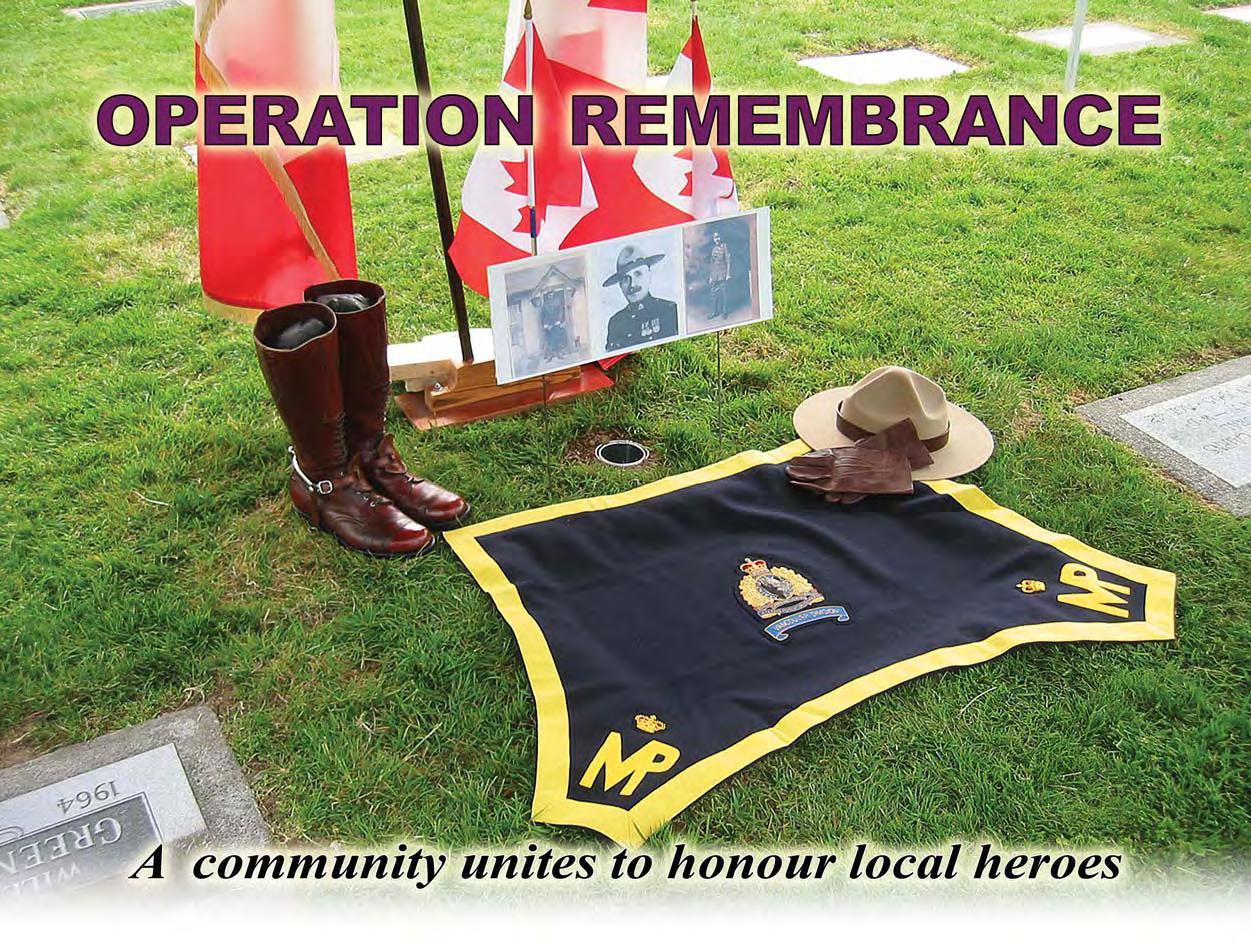
He approached the St. John Ambulance Surrey Cadet Corps for help in marking the grave of one local veteran and Operation Remembrance was born. The aim was to not just mark graves but be a catalyst to bring the community together. Armed with information from his research and a passion to honour the forgotten servicemen, Searle made over 100 presentations, on his own time, to public groups, schools, serv-
ice clubs, businesses and elected officials.
The response was overwhelming. Hundreds of residents, veterans, community service groups, the Royal Canadian Legion, Veteran’s Affairs Canada, the 39th Brigade Group of the Canadian Armed Forces, countless school children, several local businesses, the Canada Border Services Agency and the South Asian community became involved in the project.
“It was an incredible opportunity in a small way to bring honour back to fallen soldiers,” says Searle. “They’re the backbone of our community. It’s a humbling experience.” The history of the 36 dead has enabled him to become what he is today, he adds.
formation,” recalls Searle.
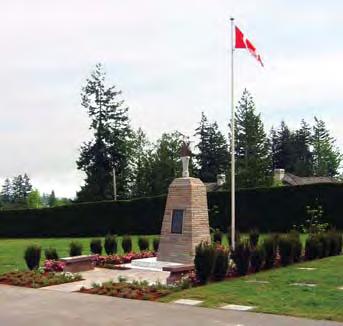
Searle was able to raise $25,000 cash; donated materials and services pushed that total to more than $35,000. That was enough to enlarge and restore the Sunnyside cenotaph, pay for 36 headstones and a new garden for the Field of Honour.
“Our role was to provide awareness to our community and raise $4,000 in ten days,” says Satbir Cheema of the South Asian Progressive Intercultural Community. “When we saw that these veterans had given so much for our country, we wanted to help.”
It was a different era then, especially after the First World War, he says. “You serve, you’re done, you’re saluted and you’re sent on your way. You maybe get a service medal and then just go back to society. Then you pass away with no estate, family or friends. The municipality was gracious enough to provide a place in a Field of Honour at minimal cost. From that point the grave is left unmarked.”
Searle shakes his head. “I don’t know how many unmarked graves across Canada there are, but there is really no one to blame.” It’s estimated there are 3,000 veterans in unmarked graves in BC alone.
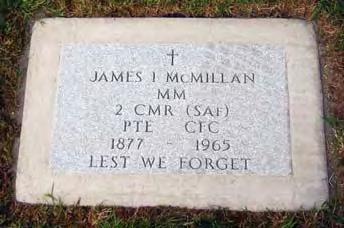
A discovery Searle made during his search of the archives gave his mission new meaning – a White Rock man, buried without a name, turned out to be a soldier linked to the very origins of what we now know as the RCMP. James Irving McMillan was a Canadian soldier who served in the Boer War and fought at the Battle of the Somme in the First World War. His heroic actions April 9, 1917 at the Battle of Vimy Ridge were recognized with the Military Medal for Gallantry; the bloody battle in many ways defined Canada as a nation.
In death he was known only as “fisherman” and, despite his long service for Canada, had lain unrecognized in an unmarked Surrey grave since 1965. “I was drawn to his file as his death certificate had numerous errors and little in-
“The errors alone very nearly prevented his life story from ever being rediscovered. It was hard to find anything about him – so it took a Mountie to start this project and to find a person who helped forge the international reputation of Canada and the RCMP that we are so proud of today.”
McMillan stayed in South Africa after the Boer War and helped integrate the Boers back
into the community, an early example of Canada’s peacekeeping accomplishments. The North West Mounted Police earned the ‘Royal’ title as a result of their service during that war, and kept the iconic Stetson hats and Strathcona boots used there; the RCMP was born in 1903. McMillan eventually settled in Surrey, became a fisherman and died at age 87.
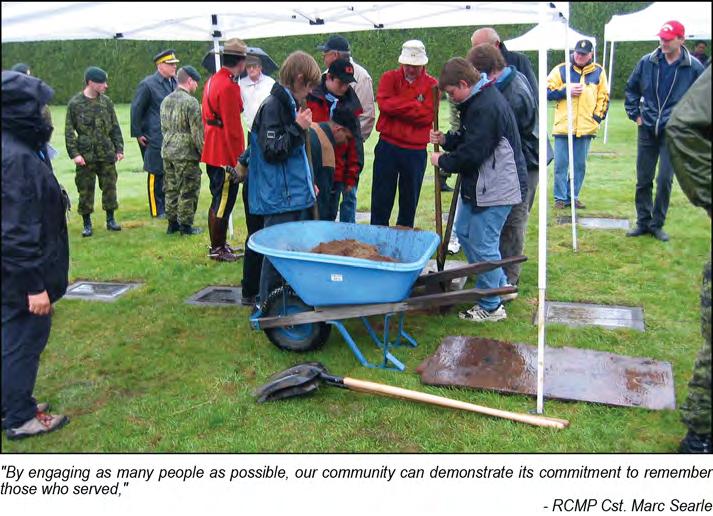
For some veterans, Operation Remembrance and youth participation in the event helped heal old wounds. “The fact McMillan came back as a war hero and died unknown is unconscionable,” commented Ken Diamond, west region vice-president of the Royal Canadian Army Service Corp, as he watched Searle turn soil at Sunnyside to prepare for the ceremony.
“This event is wonderful. It bridges the generation gap. Now a lot of the kids are more aware of veterans than their parents were 20 years ago.” Sgt. Huff Mullick, who played a big role in getting South Asians involved, is in his 22nd year with Canadian Forces and has never seen anything like Operation Remembrance.
“Just having the community involved in all aspects is outstanding,” Mullick said. “A lot of these veterans are quickly leaving us so it is important to recognize this. When Canadian vets arrive in Normandy, they are treated like pop stars, so when I see this event happen here in South Surrey, it really warms my heart.”
The project wouldn’t have been possible without the groundswell of community support, he noted, adding “this makes me proud to wear my uniform.”
Operation Remembrance helps bring veterans, active soldiers and civilians closer, says Ron Rowdon of the Last Post Fund. “It brings information to youth and communities where most people don’t know how many unmarked graves there are.”
Four public events were held at the Sunnyside Cemetery after more than a year of research and planning.
New markers were placed and older ones restored in April – the first time in Canadian history that unmarked graves were marked with the full participation of teams of youth, veterans, military and emergency services personnel.
The bagpipes droned in the distance and the rain gently fell during an official ceremony honouring the veterans and organizers of Operation Remembrance; Surrey Mayor Diane Watt and Surrey RCMP Chief Superintendent Fraser MacRae were among the participants.
A community day was held the next week, when volunteers planted flowers in the new garden around the cenotaph. The surroundings are now complete with new paving and granite benches, all adding to the poignancy of this Field of Honour.
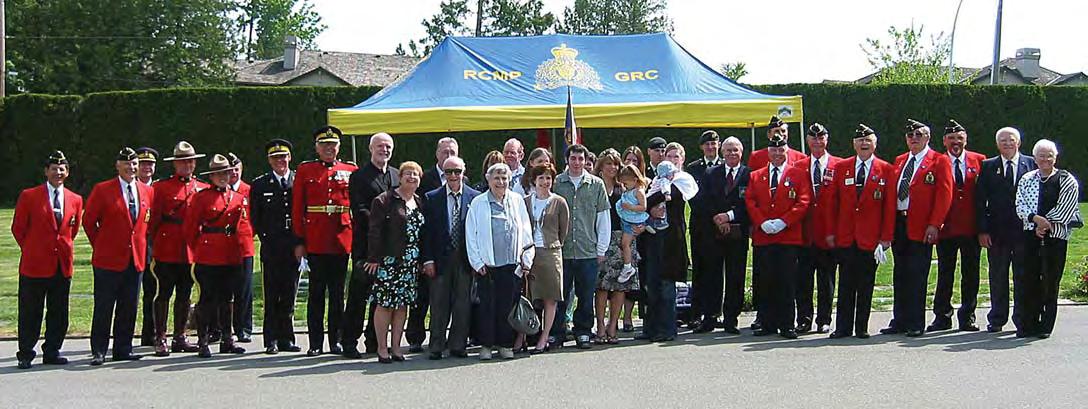
Other events included a special day for the family of Pearson, who gathered at the gravesite to hold a short memoria which was organized by members of the RCMP Veterans Association. Searle found 18 relatives – ranging from Pearson’s daughter, Alice Whiting, to his great-great-grandson, three month old Austin Drinkwalter – through an Internet search. They paid tribute to him as his grave was finally marked, 41 years after his death in White Rock. Most had never had the opportunity to visit the grave site.
“We appreciate all the work that has been done to make this possible,” said Mrs. Catherine Fryer, a granddaughter.
It was a great honour to participate in the event, said Mrs. Alice Whiting, a daughter of Pearson. “Our Dad was a great gardener and was the first to have an electric greenhouse. I wish he could be aware of what is happening today. We are very pleased. He was a person who liked people so he got on very well with the population. Father preferred to be out serving people rather than be in an office. The effort to mark his service is very wonderful. The way it’s been done has been very nice. My mother would be pleased, too.”
The unmarked graves gave the impression the veterans were forgotten but Whiting said that wasn’t the case with her father. He received a full ceremonial funeral and his grave wasn’t marked because her mother felt his soul wasn’t there – it was in heaven and there are no markers in heaven. The family kept that in mind when his wife Isabel died in 1981 and was laid to rest with her husband. Searle said he tracked down the family after realizing Pearson had also been a Mountie, and asked them for the privilege of honouring the sergeant with a marker that also signified his 20 years of policing.
A formal dedication was held at the Field of Honour later in May which included Watts and the honourable Iona Campagnolo, BC Lieutenant Governor.
“In a difficult and complicated world we will always need people like the 36 people we honour here today,” Campagnolo told the crowd of dignitaries, officers and residents. “We will not forget them and the markers we put in place today will ensure they will never
be forgotten.”
Campagnolo singled out the constable and his volunteers for special recognition. “Today we salute Searle and we salute all those who have added so much to create this remarkable remembrance,” she said.
Veterans and students from a nearby elementary school placed small flags next to the freshly laid grave markers as Canadian Forces Sgt. Huf Mullick read out their names, one by one. It was an experience not lost on 12-yearold Jake Newman, born 15 years after the last of the 36 was laid to rest.
“It’s pretty exciting,” Newman said. “We’re remembering those who served our country. We didn’t really give them respect when they died because we didn’t mark their graves.”
“By engaging as many people as possible, our community can demonstrate its commitment to remember those who served,” said Searle –but for him, the graves are just the beginning.
“Marking graves is the catalyst. It’s about community connection. It’s the service of these men that created the job that I have,” Searle said. “It comes full circle. We raised $25,000 to improve the cemetery and mark the graves, but that’s not the important part; it’s that the community got together to do it.”
The markers bear the names of the dead veterans and the inscription ‘Lest we forget.’
“November 11 is an incredibly important day, yet all too often a passive experience,” Searle said. “This is one of very few opportunities to do active remembrance. It’s an absolute good. Together, we as a province can take on these markers one at a time.”
The project has galvanized the community, said Watts. “Operation Remembrance gave our youth, our business community, our city staff, our citizens and our neighbours an opportunity to remember together,” she said. “We all stand a little taller and a little prouder for that experience.”
There’s already been many offshoots from the project, notes Searle, including further contact with youth groups “hungering for a similar experience in serving the community. It has all been very emotional for me and one of the most remarkable experiences of my career.”
Elvin Klassen, Blue Line’s west coast correspondent, can be reached at elvin@blueline.ca
Mobile Crisis Intervention Team
by Kevin Masterman
“It’s Simon. I’m going to jump.”
It’s the phone call Mobile Crisis Intervention Team (MCIT) officer Cst. Jimmy Braund dreaded. After the line went silent, Braund immediately set out on the road with RN Eric MacMullin in search of the man they had taken to hospital three times that week for severe depression.
He had given the number to Simon, hoping he’d call him for help, but his crisis had reached a boiling point.
Soon after setting out, Braund spotted a puff of smoke. It was the first signal that Simon had followed through on his plan. He had caught the smoke out of the corner of his eye and followed it to the Dowling Ave. bridge, where Simon was straddling a girder above the railway tracks after lighting his shirt on fire.
“I blasted him with a fire extinguisher,” says Braund. “I put him out and then tried to talk some sense to him and thankfully we had built up a rapport from the last week and he took it to heart.”
Two other officers arrived to help get Simon off the bridge, allowing Braund to handcuff himself to the bridge to help guide Simon in. They took him to St. Joseph’s Hospital, where staff placed him into a detox program.
The Mobile Crisis Intervention Team (MCIT) has rolled out to 11 and 14 Divisions, a second incarnation of the popular 51/52 Division response team that deals with emotionally disturbed people (EDPs). A mental health nurse rides along with an officer for on-the-fly medical expertise, responding to radio calls where there are suspected mental health issues.
Thefts, disturbances or suicidal acts are all part of a day’s work, and it is busy in Toronto’s west end, even more so than the downtown core.
“There is a higher acuity, we see increased numbers and increased severity in terms of mental health presentation,” says RN Eric MacMullin, who has worked with MCIT in the east end. There have been more agitated clients and a greater incidence of alcohol and drug abuse, he says. “You often see drugs… mental health problems often lead to drugs,” says MacMullin.
He says there are many more street people to deal with that have no supports, unlike in 51 and 52 Division where there are many social agencies.
“It’s always very interesting, a different story everyday,” says Braund, who was drawn to the work because he felt comfortable dealing with EDP calls. He figures he’s an easy person to talk to as well. “Most people are very fun to deal with – a friendly lot.”
He says patience is the key and the MCIT gives officers a chance to take the time, with-
out radio calls building up on the screens of their Mobile Work Stations (MWS).
14 Division Cst. Linda Falasca, the second officer attached to the unit, says people often reach out to emergency services in times of desperation or depression.
Many people the team deals with don’t have much money or knowledge of how to get help and end up at hospitals. Others simply need someone to talk too and reach out to 9-1-1, rather than other supports, with suicidal thoughts .
On the street, MacMullin approaches a situation, first judging whether the person is a risk to officers and, secondly, to themselves. He assesses how they are “presenting” (what signs of mental illness they may be showing) – suicidal thoughts, delusions – are they developmentally delayed, suffering from a brain injury or actually mentally ill.
From there, he establishes if they are taking pills, seeing a psychiatrist and if they have a mental health history.
“We’re trying to alleviate the overflow” of dealing with people on the spot to decide whether they are a threat to themselves or others or need hospitalization, says Falasca. “We’re not going to bring people here if they don’t need to be here.”
As a primary response officer, Falasca says, more often than not, the only recourse is to take people to hospital and wait for doctors to assess them. Without an RN to make a judgement, officers are left with little or no option.
“It’s helped us appreciate the emergency room nurses and doctors and helped them appreciate what we do,” she says.
MCIT has saved hundreds of hours for primary response units, who are often tied up at hospitals waiting for those in their custody to
be admitted. The team has a better ability to navigate the hospitals because of their constant day-to-day relationship.
MacMullin says that, for every hour the team is on the road, it saves primary response officers three hours.
St. Joseph’s medical director of mental health emergency care, Dr. David Gotlieb, says the team is valuable to an area with one of the highest densities of patients with chronic severe mental health illness in the country.
Gotlieb says that any way of making the process of being apprehended by the police and brought to hospital easier on patients is welcome.
“It’s a kinder and more humane experience,” says Gotlieb, noting that officers do not have training or experience dealing with the mentally ill – though many do well at it all the same. “Our team works with much more information and background.”
He says the team also has more knowledge of how to present a patient to the hospital and knows what information from the field should be made available to doctors, whether it is family contact information or how the person was living at the time of apprehension.
“To have a team doing this on a regular basis and have colleagues police can call for advice is beneficial,” Gotlieb says.
He says that the team advocates on behalf of patients and seeks help for those who have never been assessed by mental health professionals in the past.
“It’s always about bringing them to the hospital. It’s about making the connection with them, identifying the need and trying to brainstorm with the rest of the team, which is hospital-based, about what to do next,” says Gotlieb of referring patients to other commu-
Falasca says they can introduce people to other supports, like they did Simon.
“We’re providing an outlet for them to get better treatment,” Falasca says. “We can take it further and it’s nice to see an outcome where we can get people help.”
Braund says Falasca, says, repeat customers often gain a comfort level with them that allows them to take a step in the direction of help. “We take it one step at a time and try to help where we can.”
On a Thursday afternoon, they are patrolling the streets of Parkdale, where the majority of their work is found. Hearing a radio call about a man who stole smokes from a Queen St. convenience store, they drift over
to the area.
Spotting a man in a brown tweedy jacket and black toque matching the description, they pull to the side of King St. His heavy breaths are visible in the cold February air and he quickly admits to the theft. Falasca and Braund, who prefers a T-shirt to a parka despite the bitter cold, detain him and, after talking with the man, they not only learn he was stealing for marijuana money but also about his mental illness.
MacMullin talks to him about his medication and his psychiatrist and quickly understands that, although this man has mental health issues, he made the decision to steal quite lucidly.
“He knew what he was doing was wrong
but he wanted a high,” MacMullin says. The clerk got back the stolen cigarettes and doesn’t want to press charges so they release him.
When an issue arises about an aggressive patient, the team also liaises closely with St. Joe’s, whether it’s doctors, nurses or hospital security. They will try to let the hospital know ahead of time when they have a patient who is perhaps agitated or aggressive so staff can be better prepared.
“If you have a history, a rapport with that patient, you can help get them out of the car more easily,” says hospital protection services worker Darren Crockett of their role defusing potentially confrontational situations.
“We treat them as another part of the team,” MacMullin says, of security staff.
Later on in the afternoon, Braund and MacMullin set about finding what has become a familiar face to the team.
Janice, a 63-year-old paranoid schizophrenic, is not fond of travelling to hospital to receive her monthly medication by injection. Her doctor has filled out a Form 1, making it mandatory she attend hospital for the shot, and the team takes on the task. They know Janice will give them an earful but is otherwise harmless.
“Get out of here you filthy pigs,” she calls out to them from her bathroom, after a manager at her senior’s residence lets them into her apartment. “I’m not going – it’s not my hospital anymore.”
Braund and MacMullin patiently fulfill the routine that Janice sets out for herself when leaving, hiding her artwork, packing a bag — all while hurling abuse at them. Janice finally gets her coat on and cusses out everyone on the walk to the car, with Braund trailing behind her dutifully with the luggage she insists on taking for their monthly trips. The residence worker says Janice is just fine on her medication but degrades quickly without it.
When they get to the car, the string of expletives and paranoid delusions is delivered without abatement until Braund and MacMullin convince her to sing, knowing it will calm her down.
“We understand what’s going on, that she will eventually come to the hospital,” Braund says, of the value of the team and their history with patients.
At Toronto Western (another hospital to which the team will bring patients), the triage nurse gets them into the crisis centre quickly, where Braund and MacMullin extend their goodbyes to Janice. After all the abuse, Janice sits with arms crossed sternly but says goodbye; the stalemate is reached without confrontation.
Gotlieb says the familiarity the team has with patients is a great asset.
“A lot of the treatment in mental health ends up being about relationships. The relationship is the foundation on which other things are helpful,” says the doctor. “What this provides is not just the mental health expertise but a sense of a continuing relationship with the team. Even if the team is not there, they know the team is an important link.”
This article was reprinted from The Badge, the official newspaper of the Toronto Police Service.
A hands-on approach to communication
Police in Cape Breton, Nova Scotia are using xwave’s OnPatrol to get MDT and CAD capabilities in a wireless pocket-sized device.
On May 18, 2006, the Cape Breton Regional Police Service (CBRPS) became the first in Canada to adopt technology that may soon be in use by law enforcement agencies across Canada. The solution is called OnPatrol™, and it is changing the way officers in Cape Breton communicate and operate. OnPatrol consists of special software loaded onto a BlackBerry Wireless Handheld™. Officers can query the Canadian Police Information Centre (CPIC) database (OnPatrol is the only solution of its kind able to do so); they can query vehicle registration; and they can communicate with other officers carrying the device. They also have the features and functionality enjoyed by BlackBerry users: wireless email access; a calendar; web access; paging; a personal information manager; and cell-phone capabilities.
In essence, officers have the communication support of a desktop or cruiser laptop in a small, portable device they can carry anywhere. They can be on foot, on bikes, on a remote highway or in a crowded shopping mall. Regardless of where they are, they are connected, with crucial information at their fingertips. Moreover, they’re assured that the information they exchange will remain in the right hands: Features such as user passwords, application-lockout, and remote deactivation ensure only authorized users access the device, and state-of-the-art data encryption protects sensitive information from being intercepted.
The operational advantages of such a solution quickly become evident, as CBRPS Chief Edgar MacLeod points out: “As police officers, we face increasing demands for our services and, at the same time, a limited fiscal capacity that requires us to use our resources ever more efficiently and effectively. This technology will have a significant impact on our ability to respond to calls and investigate crime.”
The CBRPS supports a population of approximately 150,000 people spread out over an area 175 kilometres long and 140 kilometres wide. It is a region renowned for its breathtaking beauty—the Cabot Trail, for instance, being just one of the
area’s well-known natural wonders—but its rugged and diverse terrain can add to the list of challenges that arise in day-today police operations. OnPatrol helps address those challenges, making front-line officers more efficient, in part by making them more self-sufficient: By improving access to information, OnPatrol helps get more officers out from behind their desks and out of their cruisers and into their communities where they can be more visible and responsive.
OnPatrol is the culmination of xwave’s more than 15 years of technology development in justice and public safety. Related solutions include the Remote Office and Dispatch System (ROADS), which uses laptop-based software to connect officers with CAD dispatchers and enable the same database access (CPIC and motor vehicle queries) provided by OnPatrol. ROADS has been in use at RCMP detachments across Canada and is currently installed in 2,000 police cruisers across Canada. xwave’s highly-refined CAD solutions have earned a solid reputation among police and fire services, and its xwaveMap, which incorporates dynamic Global Positioning System/Automatic Vehicle Location functionality, has been referred to as one of the best in the industry.
While the integration of new technol-
ogy often brings with it the challenges of user-adoption, today’s increasingly techsavvy police officers are becoming more receptive to tools that will put them on the same playing field as the increasingly technically sophisticated criminals they are trying to apprehend. One of the advantages of OnPatrol, for instance, is the fact that it eliminates the problem of outsiders intercepting voice communication.
“This implementation has created quite a buzz among our officers,” says CBRPS Chief Edgar MacLeod. “They are clearly pleased to have a tool like this to help them catch criminals. Satisfied employees are generally more productive employees—with OnPatrol they’re also safer and better informed.”
They certainly have their hands full. In addition to its challenging topography, for example, Cape Breton is a duty-free access point for many goods coming into North America. It remains a popular tourist destination; most recently with the port of Sydney reaping the benefits of a growing cruise industry. In addition, factors such as offshore oil and gas reserves in the Laurentian Basin offer a promise of further growth in the region.
From an economic perspective this is good news. From a police standpoint, it puts additional pressure on the CBRPS, making it more challenging for officers to meet demands for continued high levels of service.
OnPatrol helps them do exactly that. As a wireless communication solution, it offers the same benefits that wireless technology offers workers in other sectors: knowledge, responsiveness, productivity. And as today’s police officers are required to be better informed, more responsive and more productive, it’s likely that Cape Breton’s officers are the first of many in Canada who will come to rely on solutions such as OnPatrol and integrate them into their daily operations.
by Elvin Klassen
Finding fact instead of fault
British Columbia coroner Karen Collins’ work takes her “on to cliffs, into water, to the middle of freeways, on to balconies, into multimillion dollar homes and to the most awful places you can imagine.”
Working for the BC Coroners Service offers the opportunity “to work with people and to help families that have experienced a recent loss,” says Collins. “I enjoy investigations; each of the 40 to 50 cases per week is different. It takes me from suicides, traffic accidents and drownings to the body of an infant that just died in a crib.”
Collins began her law enforcement career with the New Westminster Police Department in 1997 after graduating with a degree in archaeology from Simon Fraser University. She became a coroner in 2004 and has studied part time at the BC Institute of Technology for a Bachelor of Technology degree in forensic science, which she was to receive this summer.
Recently transferred to the Unidentified Human Remains Section, Collins says her eight years of experience as a police officer was a stepping-stone into her new vocation. The coroners service prefers applicants that have legal, medical and/or investigative experience and a post-secondary education.
Other qualities it looks for include dedication, concern about community safety, the ability to work with grieving families in a sensitive, supportive manner, leadership and the ability to co-ordinate scenes and communicate effectively with the public, police, medical personnel and other agencies.
BC coroners have quasi-judicial powers and can enter and search a premise without a warrant.
“Investigations run parallel,” notes Collins. “When we end up at a death scene we both have questions to answer but the mandate is very different. The police are fault finding while coroners are fact finding. Coroners never lay blame, even in a homicide situation.”
Collins misses the camaraderie she experienced as a police officer but notes she now frequently receives appreciation for her work,
something police officers might envy.
There are some 25 full-time and approximately 120 community coroners working throughout BC. Community coroners work on an as-needed basis and are on call 24 hours a day.
Collins works in the Fraser Region of the Lower Mainland and is one of five full time and four community coroners responsible for the area from Burnaby to Boston Bar. An additional five full-time and four community coroners work in the Metro Vancouver region.
Collins is also involved in a variety of educational programs, which she says are key to helping people understand a coroner’s role. She instructs police recruits about the service, emphasizing the utmost importance of officers at a scene not moving a body; its position can often help establish cause and manner of death. She also speaks to high school students,
promoting healthy lifestyles and good decisionmaking, and helps victim services groups understand a coroner’s role.
Grieving and burial traditions vary between cultures, Collins notes. Some express their grief through wailing, wanting to be present while she does her work or insist on a funeral service the next day. She attempts to interact with the families and accommodate their needs when possible. Some requests cannot be honoured; she has been asked to include a tape recorder with a body and dress a deceased in a suit prior to removing them from their home.
“I love this job because I come to people at the most vulnerable time of their lives,” she says. “Someone close to them has died. This is a hard and emotional time for them. They are looking to me to tell them what happened. That is why I do this job. I enjoy investigations but if I can help the family member find closure or make recommendations that can prevent a death – that is job satisfaction.”
Anyone may report a death to the coroner, although notification generally comes from police agencies, hospitals or physicians. The BC service is responsible for investigating all unnatural, sudden and unexpected, unexplained or unattended deaths. It is committed to thoroughly and independently examining all factors contributing to a death in order to improve community safety and quality of life. It also makes recommendations to improve public safety and prevent other deaths in similar circumstances.
The coroner is responsible for determining the identity of a deceased person and how, when, where and by what means they died. The death is then classified as natural, accidental, suicide, homicide or undetermined.
The coroner uses an investigative triangle to determine the cause of death, beginning by examining the deceased from head to toe. Next he/she examines the scene, which can include looking for a suicide note, checking prescriptions and the amount of medication left and checking the refrigerator for food expiry dates to help establish the date of death. The coroner also needs to learn the medical history of the deceased and will call their personal physician. If the cause of death is still not evident, an autopsy may be ordered.
The coroner has the authority to collect information, conduct interviews, inspect and seize documents, secure the scene of death, take possession of the human remains and authorize their removal. Relying on training and experience, the coroner decides if the findings required by law can be determined without a post mortem examination. If such a procedure is deemed necessary, a qualified pathologist performs a forensic autopsy, which includes collecting specimens for toxicological analysis.
If preliminary investigation reveals the death is a natural event, the deceased’s doctor is consulted to clarify if the nature of death is consistent with the individual’s known medical history. If no areas of concern are noted, the responsibility for certifying the death is often left to the personal physician. Allegations of delay in treatment, misdiagnosis, inappropriate care or other areas of concern in a natural death may lead to a coroner’s investigation. Information from the deceased’s family members is often an important component in this.
Once necessary post mortem investigations are completed (normally within 48 hours), the coroner will release his/her interest in the deceased’s remains, allowing funeral arrangements to proceed. The coroner then completes a Judgement of Inquiry, which answers the five questions.
Coroners hold daily briefings to discuss investigations with colleagues, including the regional coroner, who eventually receives all reports and ensures that all areas of an investigation are complete. The judgement is available by request from the Chief Coroner’s office and is a public document. It incorporates information from all agencies involved in the death, including police, ambulance and hospitals, and also contains the autopsy findings and any recommendations arising from the inquiry.
Occasionally an inquest – a formal court proceeding that allows for the public presentation of all evidence relating to a death – is held. They may be used to focus community atten-
tion on a death and/ or to satisfy residents that a death had not been overlooked, concealed or ignored. An inquest is mandatory when a death occurs in police custody but the decision otherwise lies with the investigating coroner.
During an inquest a five-person jury hears evidence from witnesses under subpoena to determine the facts of the death. The presiding coroner is responsible to ensure the jury maintains
the goal of finding facts, not fault. The jury can make recommendations in connection with the death, including suggestions on how similar deaths could be prevented. These are included in a public document, the Verdict at Coroner’s Inquest.
The family of the deceased is not required to attend the inquest unless under subpoena but may apply for standing or to be represented by legal counsel or agent.
Elvin Klassen, Blue Line’s west coast correspondent, can be reached at elvin@blueline.ca
by Richard
Police worldwide now use criminal profiling (CP) to predict the type of person likely to have committed a crime based on crime scene actions but scientific research has produced no compelling evidence that it works.
CP has gained popularity over the past 30 years as both a media topic and investigative tool and is now commonplace in police investigations. Surveys show police support using it for a variety of reasons, but a review of survey results and scientific research highlight a discrepancy between what officers reportedly believe and what the research shows.
Police opinions
The few surveys that assessed officers’ opinions of CP have produced mixed results. Taken together, they suggest police generally find it useful for their investigations. Some people use this support as an indication that CP works, but a closer look suggests police maintain a certain degree of skepticism.
FBI profiler John Douglas found CP advice was credited with solving the case in about half of 192 instances where FBI profiling was requested, but less than a quarter of officers felt it identified and located possible suspect(s). The majority reported it assisted their investigation by properly focusing it.
One of six officers surveyed in a 1993 study (Jackson, van Koppen and Herbrink) regarded CP as not very useful; three found it reasonably useful and two reported the advice was very useful. However, all six officers agreed that the profiles were not helpful for solving their investigation because they had only some of the criminal’s characteristics right, didn’t
provide new investigative information and were either too general or not very practical.
A 1995 study (Copson) found most UK police officers reported criminal profiles as being operationally useful and would consult a profiler again because many felt it furthered their understanding of the case. Others felt having an expert opinion reassured their own previously held judgments. However, only three per cent stated that the profile helped them identify the criminal, 14 per cent said it helped them solve the case and 16 per cent reported that the CP advice helped them open new lines of inquiry.
A more recent survey of 51 Canadian police officers produced slightly more positive findings (Haines, 2006). The 29 officers studied that had previously used CP reported believing it significantly contributed to their investigation, credited the profiler with making accurate predictions and regarded the profile as operationally useful. Most of the officers agreed that profilers help solve cases, CP is a valuable investigative tool and that profilers further investigators’ understanding of a case. Again, however, a closer look at the results detects a hint of skepticism among the officers; few agreed that CP should be used in court as evidence and a majority believed that there is a potential risk of a profiler misdirecting an investigation.
Overall, the message from these surveys is that police officers believe profiles can provide some useful assistance in an investigation, however many admit that CP does not really help solve cases and appear to maintain a degree of skepticism about its practice.
Scientific research
Relative to the high usage level of CP worldwide, few studies have attempted to test
profiler predictive ability scientifically. It is our contention that profilers should only advise police investigations if they can predict offender characteristics substantially more accurately than non-profilers. The results from the following studies, all of which compared profilers’ predictive accuracy to various nonprofiler groups, are meagre at best:
• Pinizzotto and Finkel (1990) asked groups of profilers, police detectives, clinical psychologists and undergraduate students to provide a profile for a homicide and a sexual assault case. The profilers got just over half of the 30 predictions correct, performed no better than any of the groups on the homicide case and outperformed only the student group on the sexual assault case.
• Kocsis, Irwin, Hayes and Nunn (2000) compared professional profilers, police officers, psychologists, students and psychics on their ability to correctly predict 30 criminal characteristics for a previously solved homicide; a 30-item multiple choice questionnaire was used in this and all of Kocsis’s subsequent studies, with some minor modifications depending on the nature of the crime. This time, the profilers got less than half of the predictions correct and there were negligible accuracy differences found between the groups.
• Kocsis, Hayes and Irwin (2002) assessed the impact of experience in police investigations on the accuracy of CP. Kocsis provided a previously solved homicide case to groups of senior, homicide and trainee detectives, police recruits and undergraduate chemistry and police students and then asked them to complete the questionnaire. In this case, the chemistry students scored the highest and there were no differences in accuracy between any
M. Cullen and Brent Snook
of the police groups.
• Kocsis (2004) measured predictive accuracy among professional profilers, fire-investigators, detectives, chemistry students and community college students on a solved arson case. The profilers outperformed only the police detectives.
• Kocsis, Middledorp and Try (2005) presented groups of profilers and chemistry students with solved murder and arson cases. They found that the profilers were more accurate than the chemistry students on the murder case but not the arson case.
•A statistical summary ( Snook, Eastwood, Gendreau, Goggin & Cullen, 2006) of the results of applicable predictive accuracy studies found that profilers were, on average, slightly more accurate than the other groups. Their predictive accuracy was moderate, however, and the effect was deemed imprecise because a statistical test showed there was a low degree of confidence associated with the measure of average predictive accuracy. It appears that criminal profilers can not predict offender characteristics better than anyone else.
• Snook et al. also reviewed the majority of all CP research to date and found many of the conclusions were based on scientifically unacceptable forms of proof such as the analysis of only one case (rather than looking for trends across a multitude of cases). The authors concluded that criminal profiling is not scientific and that police officers should exercise caution when consulting profilers be-
cause of the potential for CP to misdirect an investigation.
Why do people believe CP works?
Far from cutting edge science, many CP models are naively built on an outdated understanding of human behaviour and produce predictions that have not proven to be more accurate than those made by others. Given this state of affairs, one might wonder why police officers continue to request the assistance of profilers. We highlight eight reasons why people might believe that CP works despite the lack of research supporting this belief (see Snook, Cullen, Bennell, Taylor & Gendreau, 2006 for a more comprehensive discussion of these reasons). Because we believe that police officers should be skeptical of CP, these reasons may be used in practice as cautionary flags to indicate when a supposedly purposeful investigative technique may be nothing more than smoke and mirrors.
• The power of anecdotes.
CP accounts in books, magazines, law enforcement bulletins and peer-reviewed journal articles often rely entirely on a “case in point,” “case study,” “actual case” or “success story” to illustrate how profiling is useful in catching a criminal. For instance, Snook et al. (2006) found that 60 per cent of academic journal articles relied on anecdotes as a source of evidence, but anecdotes are inadequate for effectively validating CP for at least four reasons. First, vivid and memora-
ble stories do not reflect the mundane activities occurring in the CP environment. Second, in attempting to convince others that profiling works, a ‘professional profiler’ can surely find at least one anecdote in which a profile appears to have helped investigators. Third, anecdotal evidence from any source may exaggerate the actual usefulness of a profile in various ways. Fourth, profiling anecdotes are prone to be distorted in some way to make them more entertaining and informative.
• Repetition of the message that ‘profiling works.’
Repeating the message that CP is an effective investigative tool can contribute to the CP illusion because people tend to believe messages they hear repeatedly. Repeated claims that police officers seek profiling input for investigations because they find it helpful, for instance, can persuade other people that it is valid. Snook et al. (2006) found that the message ‘profiling works’ is clearly stated in 50 per cent of the 108 profiling articles they reviewed; 16.9 per cent reported that ‘profiling has the potential to work,’ 31.5 per cent had an unspecified opinion and only 1.9 per cent unequivocally stated that profiling does not work. The repetition of that positive message, however, does not match findings from research that has specifically examined the predictive ability of profilers.
• There is more to profiling than correct predictions.
Profilers create the impression that their pre-
dictions are highly accurate by over-emphasizing their correct predictions and conducting studies (e.g., the Kocsis studies reviewed above) that only measure accuracy as the number of correct predictions. When all the necessary and pertinent information is not explicitly reported, readers may form beliefs based solely upon the information that is presented to them. Research findings from other domains suggest that the exclusive presentation of correct predictions can lead people to overestimate the accuracy and potential utility of profiles. It is therefore not surprising that reading profiling articles might lead people to conclude that profiling is viable. In addition, incorrect predictions need to be considered because they have the potential to misdirect investigations.
• Profilers are not ‘experts.’
Experts are people who have professional competence in a specialized area. People have a tendency to accept information that is reported to them by supposed experts. However, problems can arise when people wholeheartedly believe in the power of an expert’s ‘specialized knowledge’ when that knowledge has no foundation. This is the case with CP. Research has shown that police officers tend to believe that profiles written by supposed expert profilers are more accurate than those written by other consultants, even when the same information was contained in both profiles. In practice, profilers present themselves as experts by implying that they possess accumulated wisdom, investigative and behavioural science experience and training and/or knowledge of abnormal behaviour which provides them with the necessary skills to collect and analyze crime scene information. There is no existing evidence, however, supporting profilers’ possession of any specialized skills that warrants labelling them as experts and there is no professional designation for profilers.
• We are all human.
Humans are pattern-seekers. We attempt to find order and meaning in the uncertain world and then form beliefs that can guide future behaviours. In attempting to find useful patterns, however, people sometimes find apparent patterns that are actually meaningless. When information is presented in such a way as to make us believe that CP works, it’s no wonder that this is the conclusion we reach. The information, however, may be biased in several ways. Profilers may wish to inflate their own usefulness (self-serving bias) and may actually be more confident in their own abilities than is warranted (over-confidence); people might believe that a profiler’s advice solved an investigation because they’re unaware of or don’t consider the rest of the police work involved in the case (attribution error); and people are prone to make errors whenever they partake in after-the-fact reasoning (hindsight bias). For instance, people might think that the profile solved the case because it was the last investigative technique employed before the solution, although that is not necessarily true.
• Ambiguous information can seem clear enough.
The predictions in some profiles are so ambiguous, vague and/or general that the profile (like horoscopes) can appear to describe any suspect. This is problematic for both practice and research. In a case with multiple suspects, profiles that contain many ambiguous predictions may not assist in eliminating the innocent. It is also possible that interpreting ambiguous statements (and subsequently using that interpretation to guide investigative decision-making) may contribute to arresting an innocent suspect and thus releasing, or ceasing to search for, the actual criminal. Regarding research, it is difficult to retrospectively determine and report the actual accuracy of profiles if they can be interpreted to fit many individuals. Moreover, ambiguous predictions are not falsifiable, thus the profiler can never be shown to be wrong.
• Imitation.
People tend to believe things or do tasks a certain way because that’s the way they were perceived or done in the past. In fact, a large amount of what we know is naturally acquired from other people’s behaviour and instructions. Thus, those who observe other people using CP are likely to both use it and believe it works, although the initial user might not even hold this belief. Police officers may believe CP is a good investigative technique because they observe other officers using it and spend time with them, which involves communicating skills and proper policing behaviours through both formal and informal teachings.
Through the police culture, profiling advocates – such as those officers trained to use CP – can directly or indirectly instruct other officers that it is effective. In any case, it is unlikely that any of the officers would have access to all of the information needed to properly determine whether CP works. As they use it more and more, however, each positive piece of information about CP becomes more noticeable and the likelihood of being influenced by anecdotes and correct predictions increases.
• Mistaking fiction for fact.
The public is fascinated by profiling activities because CP is a vague practice and people are generally intrigued by the ‘criminal mind.’ This observation is supported by the number of books, films and television programs dealing with profiling, as well as the recent growth in college and university courses addressing profiling issues. Part of the reason profiling caters to fantasy is because some researchers have attributed its origins to fictional detectives such as Edgar Allan Poe’s C. Auguste Dupin, Agatha Christies’s Hercule Perioit and Sir Arthur Conan Doyle’s Sherlock Holmes. Unfortunately, these fictional accounts may form the basis of real-world beliefs when they were never intended for this purpose, since people are not very adept at remembering the source of information they acquire during routine daily activity.
Conclusion
There is a growing belief that profilers can accurately and consistently predict a criminal’s characteristics based on crime scene evidence. This increased belief is evident from the fact that CP is becoming increasingly prevalent as an investigative technique and positive opinions of it are being communicated in published literature. We contend that this belief is illusory because a critical analysis of research showed that the field lacks sound theoretical grounding and strong empirical support for profilers’ predictive abilities.
We think that belief in such an unscientific practice is due to the erroneous information that police officers (and the rest of us) receive about CP and the way they process that information. Since profiling has the potential to mislead criminal investigators, thereby hindering the apprehension of guilty criminals and resulting in the wrongful conviction of innocent people, it is a practice that must be approached critically.
References
Copson, G. (1995). Coals to Newcastle? Part 1: A study of offender profiling. London: Home Office, Police Research Group.
Haines, M. (2006). Criminal profiling use and belief: A survey of Canadian police officer opinion. Unpublished honour’s thesis, Memorial University of Newfoundland, St. John’s, Newfoundland, Canada.
Jackson, J. L., van Koppen, P. J., & Herbrink, J. C. M. (1993). Does the service meet the needs? An evaluation of consumer satisfaction with specific profile analysis and investigative advice offered by the Scientific Research Advisory Unit of the National Criminal Intelligence Division (CRI) - The Netherlands. Leiden: NISCALE: Netherlands Institute for the Study of Criminality and Law Enforcement. Kocsis, R. N. (2004). Psychological profiling of serial arson skills: An assessment of skills and accuracy. Criminal Justice and Behaviour, 31, 341-361.
Kocsis, R. N., Hayes, A. F., & Irwin, H. J. (2002). Investigative experience and accuracy in psychological profiling of a violent crime. Journal of Interpersonal Violence, 17, 811-823.
Kocsis, R. N., Irwin, H. J., Hayes, A. F., & Nunn, R. (2000). Expertise in psychological profiling. Journal of Interpersonal Violence, 15, 311-331. Kocsis, R. N., Middledorp, J. & Try, A. C. (2005). Cognitive processes in criminal profile construction: A preliminary study. International Journal of Offender Therapy and Comparative Criminology, 49, 662-681. Pinizzotto, A. J. (1984). Forensic psychology: Criminal personality profiling. Journal of Police Science and Administration, 12, 32-40. Pinizzotto, A. J., & Finkel, N. J. (1990). Criminal personality profiling: An outcome and process study. Law and Human Behavior, 14, 215-233. Snook, B., Eastwood, J., Gendreau, P., Goggin, C., & Cullen, R. M. (2006). Taking stock of criminal profiling: A narrative review and metaanalysis. Manuscript submitted for publication. Snook, B., Cullen, R. M., Bennell, C., Taylor, P. J., & Gendreau, P. (2006). Explaining the criminal profiling illusion. Manuscript submitted for publication.
Joint possession based on all circumstances
by Mike Novakowski
Rather than challenging each piece of evidence a judge must look at the whole of the circumstances in deciding whether a person was in joint possession of drugs.
tor by itself. This was the wrong approach, noted Hamilton, who held:
In attempting to impeach the conclusion reached by the judge, the (accused) attacks each piece of evidence: the balaclavas, the cell phone, the money, (the accused’s) furtive glances at the car while being questioned by police – submitting that taken separately, they could be consistent with an innocent purpose and do not point to (the accused’s) ‘possession’ of the drugs.
In R. v. Jones, 2006 NSCA 50, police stopped a car after observing its occupants, the accused driver and young passenger, wearing balaclavas. An officer saw a plastic bag on the front passenger floor, in plain view, which contained 18 tinfoil balls of crack cocaine valued at about $20 each. Jones was searched and police found a cell phone and cash, including four $20 bills.
At his trial in Nova Scotia Provincial Court, Jones was convicted of possessing cocaine for the purpose of trafficking. An expert testified that the evidence was consistent with a “diala-dope” operation where traffickers use a car to deliver drugs, disguises to conceal their identity, cell phones or pagers to communicate, carry a float to make change and sometimes use youth or prostitutes to make the delivery to the purchaser.
The trial judge concluded that Jones “had the requisite knowledge and control in that he was involved in a joint enterprise with his passenger to traffic cocaine.”
Jones appealed to the Nova Scotia Court of Appeal, arguing there was insufficient evidence to prove he was in possession. Justice Hamilton, writing the judgment for the court, dismissed his appeal. In first examining the law regarding joint possession, she stated:
Where a person is charged with an offence involving possession of a prohibited drug the Crown bears the onus of establishing that the accused had knowledge of the presence of the drug, and that the accused maintained some “measure of control” over the drug… These elements may be proved by objective, relevant and admissible facts from which a rational inference may be drawn.
With respect to joint possession, where a number of individuals are occupying a car containing drugs, the issue of knowledge and consent is often determined by the nature of the relationship and mutual activities of the occupants in relation to the car and its contents…
Evidence indicating a joint enterprise with respect to the drugs permits a finding of consent on the part of those who do not have physical possession of the drugs (references omitted, paras. 8-11).
Rather than looking at all the circumstances together, Jones tried to explain away each fac-
This argument misses the point. It is the combination of all these factors which (the accused) says are benign, together with the expert testimony on the mechanics of a ‘dial-adope’ operation, that the judge was required to and did consider, that lead to the conclusion that (the accused) and his passenger were involved in a joint enterprise to traffic in cocaine (paras. 12-13).
Jones’ appeal was dismissed.
Confirming tip provides reasonable grounds
by Mike Novakowski
Significant confirmation of an informant’s tip provides police with reasonable grounds, the Ontario Court of Appeal has ruled.
In R. v. Murphy, (2006) Docket:C42133 (OntCA), a confidential informant described a male who would be armed, carrying cocaine and be at a specific location at a certain time. Police set up surveillance and observed a man matching the generic description given, heading towards the described location within the specific time frame provided.
As the male ran across the street, he appeared to reach into his shirt and hold something in his pants, which the experienced officers believed was a gun. Murphy was arrested and searched incidental to arrest. Police found a handgun tucked in his pants, as well as cocaine.
At trial in the Ontario Superior Court of
Justice the judge treated the confidential information as equivalent to information from an anonymous and unproven source. However, she concluded that the information provided, along with the police observations of Murphy prior to his arrest, provided the requisite reasonable grounds. The search that followed was pursuant to that arrest and was constitutional. In dismissing Murphy’s appeal, the Ontario Court of Appeal found, in part, that the trial judge did not err in concluding there were reasonable grounds to make the arrest. This wasn’t a case where police surveillance did not confirm any material parts of the informant’s tip. Rather, their observations of Murphy as “he ran across the street provided significant confirmation of the informant’s statement that the (accused) was armed.”
The informant’s information, along with the officers’ observation confirming that information, justified the arrest.
Vehicle search following passenger’s arrest ok
by Mike Novakowski
The British Columbia Court of Appeal has held that a warrantless vehicle search incident to arrest does not require grounds that evidence in the vehicle will be destroyed.
In R. v. Condon, 2006 BCCA 318 police received an anonymous tip of a drug deal about to take place. They were provided with a location, the names of two people involved and reference was made to a red van. Police knew the names provided in the tip. One was a drug dealer who supplied cocaine to traffickers and lived in a lakeside cabin accessible only by boat; the other was having a relationship with him. Both were on conditional sentence orders for possession for the purpose of trafficking and were not to have contact with each other.
About 40 minutes after receiving the tip police arrived at the location – near a boat launch at a lake – and saw a red van belonging to a drug user. About 15 minutes later a black truck arrived and a boat was seen travelling across the lake towards the boat launch from the direction where the drug dealer named in the tip lived. When the boat arrived on shore, people were seen talking and hugging and the boat then headed back out onto the lake.
Three people got into the red van while two entered the black truck. Both vehicles were stopped by police and the occupants arrested. The driver of the black truck had been arrested several months earlier for drug trafficking and the passenger, Condon, was a cocaine user and ‘mule.’ The black truck was searched at the scene and two plastic baggies of cocaine and other drug paraphernalia was found. The truck was then towed to a police office and searched further, which turned up more cocaine.
At trial in BC Provincial Court on charges of cocaine possession and possession for the purpose of trafficking, the judge found Condon’s arrest lawful but the vehicle search unreasonable. Although the tip was anonymous, it was compelling. It provided a specific date, time, location and names of the people involved in the drug transaction. The, search, however, wasn’t justified, the judge ruled. The occupants were under arrest and could not destroy or tamper with evidence in the truck so a warrant should have been obtained. The evidence was excluded and Condon was acquitted, but the Crown appealed to the BC Court of Appeal.
The arrest
The Crown submitted the trial judge was correct in concluding the arrest was lawful, while Condon argued the tip wasn’t specific enough and there was an insufficient connection between the tip and the black truck. Condon asserted that her arrest was premised on “guilt by association” and the police did not see any transfer of drugs between the people at the boat launch. At most, she contended, they had enough for an investigative stop, which would preclude a vehicle search for contraband.
Justice Kirkpatrick, stating the opinion of the court, rejected Condon’s argument. “It is clear from the totality of the circumstances that
there were both objective grounds for believing that a drug transaction had occurred and that the police had the requisite subjective belief that the persons observed at (the lake) were involved in the drug deal about which they had been informed,” she said.
The search
As for the search, Kirkpatrick found, it was lawful as an incident to arrest; such searches may be undertaken for the purpose of protecting the police, protecting evidence or discovering evidence. Although police do not need reasonable grounds to conduct the search, they do need an objectively valid reason related to the arrest.
Vehicles may be included in the scope of a search incident to arrest if they are in an arrestee’s immediate surroundings. In this case, the search of the black truck was for the purpose of discovering evidence. In finding the search truly incidental to Condon’s arrest Kirkpatrick said, “In my opinion, having regard to the details of the tip, the observations made at the… boat launch and the police officers’ independent knowledge of the individuals observed, there was more than a reasonable basis for (the) search of the truck.”
The appeal was allowed, the acquittal set aside and a new trial ordered.
School sniff and search ruled unreasonable
by Mike Novakowski
Randomly sniffing out drugs in a school and searching a student’s unattended backpack was an unreasonable search, Ontario’s highest court has ruled in excluding the evidence.
In R. v. M.A., (2006) Docket:C42056 (OntCA), a high school principal, concerned about the presence of drugs in his school, offered a standing invitation for police to bring drug detector dogs into the school. Two years later, three police officers with a dog arrived one morning and told the principal they wanted permission to go through the school, which was immediately granted. After students were instructed to remain in their classrooms, the officers randomly searched the school.
In a small gymnasium the dog alerted on a backpack lying unattended next to a wall. An officer looked through its contents and found 10 bags of marijuana, 10 ‘magic mushrooms,’ a pipe, lighter, rolling papers and a roach clip. The accused youth’s wallet and identification
were also found in the back pack and M.A. was charged with possession of marijuana and psilocybin for the purpose of trafficking.
At trial in the Ontario Court of Justice the judge concluded there were two searches: (1) the search using the drug dog and (2) the search of the backpack.
He also found that the search was conducted by police, not school authorities, without reasonable grounds. Both searches, he held, were unreasonable.
The trial judge also ruled the police search was disguised as a school search and, even if it was a school search, there were no reasonable grounds to believe drugs would be found. The evidence was excluded under s.24(2)
The Crown appealed to the Ontario Court of Appeal arguing, in part, that police were acting as agents of the school, the dog sniff wasn’t a search (but if it was, it was reasonable) and the backpack search was reasonable.
Search requires only one valid purpose
by Mike Novakowski
A search incident to arrest will be lawful as long as police have at least one valid purpose in mind, the Ontario Court of Appeal has found.
In R. v. Caprara, (2006) Docket:C41856 (OntCA), the accused was stopped by police and provided a false name. He was arrested for failing to identify himself under Ontario’s Highway Traffic Act and for attempting to obstruct justice. The car he was driving belonged to his brother. Police said they searched the car looking for evidence of Caprara’s true identity, but instead found drugs.
At trial in the Ontario Superior Court of Justice on four charges of possession of controlled substances for the purpose of trafficking, the judge found the stop was made for legitimate road safety concerns. The arrest was lawful and the search was incident to the arrest. Further, the judge ruled, even if the search was to look for drugs rather than to find identifying documents, it would nonetheless have been lawful as an incident to arrest, because police had reason to believe drugs might be found in the car.
Caprara appealed to the Ontario Court of Appeal arguing, in part, that the search for evidence of identity was a pretext for a drug search police had no right to conduct, since he had not been arrested for any drug related offence. He also submitted that the search for ID was unnecessary because the police already knew his identity before commencing it and further, police did not have a reasonable basis for thinking there might be identification
evidence in the vehicle. This, Caprara argued, rendered the search a breach of his s.8 Charter right.
The Court of Appeal disagreed with the trial judge’s analysis that the search for drugs was lawful as an incident to arrest:
On the facts of this case, the police had no right to search for drugs as an incident of the (accused’s) arrest because the (accused) had not been arrested for a drug or drug related offence; he had been arrested for failing to identify himself and for attempting to obstruct justice by providing the police with a false name. Accordingly, any search for evidence incident to his arrest had to be restricted to evidence of identification; it could not spill over into a search for drugs (para. 7).
However, even if the police really had two purposes for searching the car (identity and drugs), as long as one purpose was proper as an incident to arrest, the search was lawful. The search for ID was reasonable. The police were not sure of Caprara’s identity and “it was perfectly reasonable for them to think that there might be a wallet, a briefcase or perhaps a cardholder in the car containing evidence of the (accused’s) identity,” said the court.
“Furthermore, the area in which the drugs were found (around the floor mat underneath the armrest that separated the two front seats) was one where a wallet or cardholder could reasonably be expected to have been located.”
The search for ID was ruled valid incident to arrest and did not violate Caprara’s right to privacy protected by s.8. The appeal was dismissed.
Police acting as agents
Justice Armstrong, authoring the unanimous judgement, ruled that the search was a police search. The police had not been requested by any school authority that day, had not given notice of their intention to search and neither the principal nor any teacher played an active role.
“The fact that some two years earlier the school principal had issued a standing invitation to the police to search the school with the assistance of a sniffer dog does not, in my opinion, turn the search… into a search by school authorities in police uniforms,” said Armstrong.
The search
Armstrong found it unnecessary to decide whether the dog sniff alone amounted to a search. Rather, he concluded the sniff and backpack search fell within the meaning of a search under s.8 of the Charter.
Students have a reasonable expectation of privacy in the contents of their backpacks, much like an adult’s privacy in the content’s of a briefcase. Students backpacks are not searched during the normal course of a school day, nor do they expect their backpacks to be searched. The dog was a physical extension of its handler and was connected to the physical search of the backpack. Since the search was warrantless, it was prima facie unreasonable and the Crown could not rebut this presumption. Further, the search was randomly conducted with the entire student body held in detention. Armstrong wrote:
To facilitate the search, the entire student population was detained in their classrooms for a period of one and a half to two hours. Although it was the principal who made the announcement to the student body to remain in the classrooms, it is my opinion that a review of the record indicates that he did so to accommodate the police search. There was no credible information to suggest that a search was justified. There were no reasonable grounds to detain the students...
An officer cannot exercise the power to detain on a hunch, even a hunch borne of intuition gained by experience. The Supreme Court of Canada has held that there must be a clear nexus between the individual to be detained and a recent or on-going criminal offence…
Quite apart from the detention of the entire student body, of more significance is the unauthorized warrantless random search itself.
In my view, the Crown has failed to rebut the presumption that the search was unreasonable. Even if the presumption of unreasonableness did not apply, it is my opinion that there were no grounds upon which to justify a random search of the kind that was conducted in this case (references omitted, paras. 57-60).
The evidence was inadmissible and the appeal was dismissed.
Pat down of handcuffed detainee reasonable
by Mike Novakowski
An officer’s pat down search of a detainee was reasonable, even though it occurred after he handcuffed him, British Columbia’s top court has found.
In R. v. Duong, 2006 BCCA 325, police drove by a car parked in a high property crime area, known for theft of and from autos, and saw a man seated in the driver’s seat looking around inside the vehicle. Twenty minutes later the same vehicle was seen by the same officers, parked at the same location, but now the man was seated in the passenger’s seat looking out the window as if waiting for someone or something.
stolen stereo. As he exited, Duong clenched his right hand and took an aggressive stance. Initially hesitant, he complied with the officer’s instruction to place his hands on the car.
his left front pocket. Thinking the object might be a knife used to cut the stereo wires, the officer reached into Duong’s pocket and pulled out a white envelope containing 25 flaps of heroin and cocaine. At his trial on charges of possession of heroin and cocaine for the purpose of trafficking, the judge concluded the officer had articulable cause to detain Duong to investigate a potential stolen stereo. The pat down search was proper, as it was conducted for officer safety. There were no Charter breaches and the evidence was admissible.
The officer approached the car, showed his badge and asked Duong if he had a driver’s license. Duong said “yeah,” made a quick movement under the driver’s seat and pulled out a wallet. The officer saw a car stereo in plain view, with cut wires, in the back of the car. When asked who owned the car Duong, in a slow and nervous fashion, said it was his “buddy’s.” When asked whose stereo it was, Duong’s eyes widened, his mouth dropped and he again replied it was his “buddy’s.”
The officer didn’t believe Duong, asked him to get out of the car and placed him under investigative detention for the possible
The officer asked him if he had any weapons or anything sharp on him. Duong angrily shouted “No” and was then handcuffed and patted down for weapons.
As the officer patted down his midsection, Duong changed his position and moved closer toward the car. The officer repositioned him, felt a hard bulge and checked his right pocket, discovering a roll of money. A bulge on the right hip turned out to be a cell phone. Duong pushed his body against the car when the officer began to pat down his left side. The officer moved him away, continued the search and felt a hard, solid object about 4" by 3" in
Duong then plead guilty to the charges but appealed to the BC Court of Appeal, arguing the detention was arbitrary and the search for officer safety wasn’t reasonable.
The
detention
Duong contended that the trial judge only assessed the officer’s subjective belief without looking at its objective reasonableness. Justice Rowles, authoring the unanimous appeal court judgement, rejected this argument. Although the articulable cause standard requires both a subjective and objective element, the trial judge did consider both. The officer’s subjective belief that the car stereo might be stolen wasn’t a hunch and was grounded in his
Residential B&E’s report
TORONTO —A new study underscores the serious psychological, emotional, and financial impact of break-ins on victims and confirms the need for new legislation to help police reunite victims with their property.
“Every officer who has responded to a residential break-and-enter has seen first hand the devastating impact these types of property crimes have on victims,” said Cornwall Police Chief Dan Parkinson.
“This report... shows the anger, fear, guilt, anxiety and sadness that a B&E produces in victims.”
The study, released by the Ontario Association of Chiefs of Police (OACP), found significant financial consequences - including the costs victims must incur to repair damage done to their homes by criminals - and that there is a need for new legislation to govern pawnbrokers and second-hand shops in Ontario as a tool in police efforts to reunite victims with their property.
“Many victims told us that they would applaud the use of centralized provincial or national databases to register all goods - both as a means to expedite the return of their property and as a potential deterrent for offenders,” said OACP President Chief Armand La Barge.
“We will continue to work with the Ontario government to address the need for legislation that helps police return stolen property to crime victims.”
To view the study go to; http:// www.oacp.on.ca/content/news/ article.html?ID=259
observations and knowledge, which provided the objective foundation for his belief.
First, the officer saw a stereo with cut wires in the back of the car. His experience told him that car stereos are often stolen by pulling them out and cutting the wires. “This observation, in and of itself, presented an immediate and objectively reasonable concern that a property crime had been committed,” said Rowles.
Second, the officer “knew that the area in which these events were taking place had a high incidence of property crimes, specifically thefts from cars and stolen cars.”
Finally, Duong’s “demeanour changed noticeably when answering questions. His initial response about the driver’s license was “quick.” His subsequent responses about the ownership of the car and the stereo were “slow and nervous.” His facial expression also changed. (The officer) was able to articulate his concerns regarding the change in (Duong’s) pattern of speech, facial expressions and demeanour in a way that the trial judge understood and accepted as reasonable.”
Rowles ruled the trial judge did not err in concluding the officer had articulable cause to detain Duong.
The search
Duong argued that the search was unreasonable because a brief investigative detention does not permit a search for evidence, and any safety concern must be objectively verifiable, not merely premised on mere intuition, a hunch or curiosity. He suggested there were no objectively discernible facts to support the officer’s safety concerns and that the pat down search was simply done to search for contraband.
In summarizing the law on searches incident to investigative detention, Rowles wrote: There is no dispute that police officers are entitled to take reasonable steps to minimize the risks they face in the performance of their duties… Where a police officer has reason to believe that his or her safety is at risk in the course of an investigative detention, the officer is authorized to conduct a protective pat-
down search…
A “frisk search” for weapons is a relatively brief and non-intrusive procedure… Moreover, the reasonableness of a police officer’s decision to conduct a search for officer safety cannot be judged by a standard that would second-guess the officer’s actions with perfect hindsight…
The “police perception of reasonable necessity depends very much on the particular circumstances in which the police officer finds himself” (references omitted, para. 54).
Here, the officer had bona fide safety concerns rendering the pat down search justified. It was entirely reasonable for the officer to infer Duong, the sole occupant of a car containing an apparently stolen stereo, might have a knife used to cut the car stereo wires. Only when the officer felt a hard object that could be a weapon did the search progress beyond a basic pat down.
The fact Duong was handcuffed did not make the search unnecessary. Handcuffing does not necessarily eliminate officer safety concerns, either during the search or after the detainee is released. The officer thought that if Duong had a knife in his pocket, he might have been able to access it even with the handcuffs on.
The search in this case was limited in scope and reasonably necessary to ensure the officer’s safety. The appeal was dismissed.
Visit www.blueline.ca/resources/caselaw for the complete cases. E-mail caselaw@blueline.ca to reach Mike Novakowski
RCMP officers found themselves up against a 900-kilogram bull after it escaped from a veterinary clinic in the community of Steinbach, MB.
After jumping over the clinic’s fence, the bull began its kilometre run charging across a highway, past several businesses and residential streets, and doing its fair share of construction on route.
The enraged bull quickly attracted an entourage including children and the local media as word spread of its escape.
The bull withstood two tranquilizer darts fired by a veterinarian as well as the RCMP’s initial attempt to stun it with Tasers, before the fatal blow.
Witnessing the bull charge at several people, including RCMP officers, Acting Staff Sergeant Bill Richards says he was forced to shoot it dead.
Arrested and charged with breach of recognizance by having consumed alcohol, fourty-four year old Dana Jensen got himself in more trouble after showing off his teeth.
Cornwall Police had him in custody when they discovered Jensen’s dentures had been filed to a sharp edge.
“At that point, it became a weapon,” said Cornwall police spokesman Blake Paquin. “Any weapon, or imitation of a weapon, has to be confiscated.”
Paquin said the dentures were taken away before they could be used in any way.
In addition to his other charge, Jensen’s teeth got him a possession of a dangerous weapon charge.
A man whom was keen to drive despite being armless is now defending himself in court.
When Colin Smith was pulled over for speeding in Wellington, New Zealand, it was discovered he had been driving with one foot on the steering wheel and another on the pedals, a police officer testified in court.
Smith, 31, born without arms and having never had a driver’s licence, is now fighting the charge of driving in a manner likely to be dangerous to the public.
Smith entered no plea and insists he will defend himself against the charges.
He told the court he has gone years of driving in this manner without any accidents.
***
During a high school field trip, a criminology class investigating a fake crime scene went into disbelief after discovering the body of a real dead person in Fort Lauderdale’s Holiday Park.
For more than 20 years, teacher Sue Messenger has been creating mock crime scenes with fake skeletons and other evidence to give her students a realistic look at what crime scene investigators do.
Students in her forensics course, however, got more authenticity than they bargained for.
“The first thing we thought was, ‘that’s a real good dummy she set up,’” said student Juan Cantor, 15.
Messenger couldn’t believe the odds.
Police identified the body as David Wayne Bodie, 45, a homeless man who apparently died of natural causes.
***
Two Sudbury men arranged to meet Rodney Newton behind a bowling alley, with the intent to allow him the opportunity to buy back the thousands of dollars worth of items they stole from his home.
Newton agreed to the proposal and paid them $10,000 to get his possessions back.
The thieves, however, didn’t realize until later that the money he gave them was phoney.
Miffed at the turn of events, the two thieves began harassing Newton about the money and were eventually charged and sentenced for threatening him.
Jeffery Guitard was sentenced to serve 90 days on weekends, while Patrick Whissell received five months under house arrest.
***
Research by a private organization known as the Road Safety Fund suggests Colombian drivers distracted by attractive women is one of the country’s leading causes of car accidents.
The organization says men gawking at women and not paying attention to the road, accounted for nearly one in 20 crashes.
Cell phones were pegged as the biggest distraction for drivers, accounting for about 10 per cent of all accidents.
The act of drivers honking the horn at women, while issuing compliments as they drive past is what the organization dubs as “culture.”
The groups presentation included close-up images of attractive women in miniskirts to remind the audience of the extent of the danger. ***
Police in Warren, Ohio discovered a two-year old boy when they pulled over a car containing three men suspected of a home break-in.
One of the suspects says he couldn’t find a babysitter, so he decided to bring along his toddler son.
The three men are charged with breaking and entering and possession of criminal tools.
The father of the young boy is also charged with child endangerment.
The child is now in the custody of his grandmother.
***
Initially arrested for being intoxicated and causing a disturbance at his mother’s house, Bradford Gray was placed in a jail in Cat Lake, a remote First Nations community.
Gray, 33, escaped from his cell that same night, by pulling his cell door off its hinges. He was picked up and arrested again soon after his escape, shortly after being found back at his home, and transferred to a larger jail.
Fittingly, Gray has been sentenced to 90 days of house arrest and was also ordered to pay $500 for the repair of the jail cell door.
***
During June’s gun amnesty in BC, RCMP say 72 registered handguns, 124 unregistered handguns, 72 unregistered semi-automatic rifles, 34 prohibited firearms and one rocket launcher were turned in.
Staff Sgt. John Ward says the rocket launcher was found by an elderly couple in Burnaby 30 years ago when they bought a home.
Ward says the rocket launcher was certainly the most unusual piece the RCMP collected.
Fourty-four thousand rounds of ammunition were also turned in.
***
Searching for a suspect who used a shovel to smash the windows of a parked car, police let Huntsville, Ontario’s summer pests do the rest.
Hiding in a wooded area for 90 minutes, the suspect was spotted running from a bush attempting to swat away the blood thirsty mosquitos.
The officers, who promptly arrested the man, had doused themselves with insect repellent.
Korry White, 22, has been charged with arson and breach of probation.
***
An 18-year-old teenager found himself in over his head attempting to escape from a police officer.
The young man had squirmed from a police officer’s grasp at a West Vancouver beach and escaped into the water.
After swimming about 30 metres out, police say it became clear the boy was having trouble keeping his head above the water.
One of the officers who had initially confronted the teen dove in after him and successfully brought him to shore to perform first aid.
Deemed recovered from his unsuccessful escape attempt, officers let the teen recover from the effects of alcohol in a police cell.
***
Kyra Clarke, 46, of Glace Bay, Nova Scotia has been sworn-in as a constable with the Cape Breton Regional Police Service.
Clarke’s call in life was never immediately realized, having taken a back seat to a marriage that produced three children.
Clarke had worked at a local fish plant until three years ago, when she signed up for the police course at Holland College in Prince Edward Island at her husband’s urging.
Despite being the only grandmother in the class, she says her big concern was the academic demands, not the physical ones of training.
Clarke graduated in 2004 and did three months of on-the-job training with the Halifax Regional Police before landing the job back home.
The basics are key to water rescue
by Kathryn Lymburner
In a country with 891,163 square kilometres of oceans, lakes, rivers, ponds and creeks, Canadian police officers are certain to come across some form of water – either liquid or solid – during their career. Considering the remoteness of some police detachments and the patrol routes of officers in these areas, the likelihood of responding to an incident involving water increases exponentially.
There were nearly 6,000 unintentional drownings and other waterrelated deaths from 1991 and 2000, according to a Canadian Red Cross study, and more than 3,000 hospitalizations for near drownings. Of these, nearly 2,000 were boating related, while the rest involved other aquatic activities. Drowning was the fourth most common cause of death by
unintentional injury and the leading cause of death among recreational activities during that 10 year period, Statistics Canada says.
Other insights from the Red Cross study:
•There was an average of 1.8 deaths per 100,000 Canadians from 1991 to1995, but from 1996-2000 the drowning rate decreased to an average of 1.4 deaths per 100,000 Canadians, a 21 per cent improvement.
•The highest drowning rate was in the northern territories, followed by the east and west coast provinces. After 1995, the biggest improvement in drowning rates (53 per cent) was in the northern territories, followed by BC (29 per cent) and Ontario (25 per cent).
•The reduced drowning rate was attributed to Red Cross awareness campaigns that ran on radio and television between 1995 and 2000.
Typical victim profile
The Red Cross profiled a typical victim –in other words, here’s what you should look for: an adult male fishing from a small motorboat on a lake, wearing no floatation device or hypothermia protection garment, in conditions such as strong winds, large waves or cold water, with darkness approaching. Frequently, the boat capsizes and he falls overboard or is swamped and finds himself struggling in the water.
If you are called to respond to an incident on the water and don’t have a specialized marine unit to back you up, remember the basic theories of marine rescuer and recovery, which are really child’s play; take a rubber duck, for example – if you push it under the water, it bounces back to the surface because it’s buoyant. The air inside the duck is lighter than the water around it.
This buoyancy, often in the form of a life jacket or personal floatation device (PFD), will help you remove a person from the water. Buoyancy can turn anyone into Superman, so use it to your advantage.
The first necessity for a successful recovery is a lifejacket or PFD for both yourself and the victim. A person on the water without a floatation device is unlikely to survive unless officers are on scene when an incident occurs.
Lifejackets
Lifejackets were initially created for professional mariners in large ships, where there would be some advance warning to “don lifejackets” and then enter lifeboats to escape a capsizing ship or onboard fire. They were also used during storm conditions, when a person could be swept away by high seas, but these traditional lifejackets were so bulky that it wasn’t practical to wear them all the time.
These floatation devices are still used on commercial ships, including cruise ships and ferries. Despite their bulkiness, the thick foam helps to keep a person’s head above the water while also turning them on to their back so their face isn’t submerged.
PFDs
On inner lakes and rivers, it was discovered that many people were drowning shortly after falling out of boats or off water skis because they didn’t enjoy wearing the bulky, constrain-
ing and uncomfortable lifejackets. Experts studied these drowning statistics and realized that a new, comfortable approach was needed.
PFDs were created by removing some of the bulk and redistributing the thinner material around the body like a vest. This reduced performance compared to a lifejacket, but was accepted since most drowning small craft operators are within sight of a potential rescuer and would have been saved had they stayed afloat a few more moments. Performance was sacrificed for a more comfortable device that boaters would be more likely to wear.
Several years ago it was required that PFDs be only sold in red, yellow or orange to allow for higher visibility on the water. More recently other colours were approved for inland water use. Lifejackets are still required to be red, yellow or orange, since they are more likely to be used on large bodies of water, requiring a higher level of visibility.
One person recovery
It’s essential that every police officer know basic skills for removing people from water. There are several techniques for conducting solo recoveries, each best suited to a different situation:
•Recovering a conscious person can be as simple as grabbing their PFD and using it as a sling to hold their body while pulling them into the boat or onto a dock;
•Similar rescues can also be done for an unconscious recovery, but you will need to manoeuvre the person into a more vertical position in order to pull them out. Keep in mind that this type of rescue is best when the victim is directly beside you;
•A rope cinch can also be used to remove a victim from the water. Wrap a rope under their
arms and tie off a knot behind the victim, near the neck. Bounce them in the water three times to help gain momentum – gently, don’t use a submerging bounce – and then pull them up and over the side of the boat. This technique has a tendency to hurt conscious victims, since the rope bites on their chest, so is best suited for an unconscious victim;
•Other solo rescue techniques include tossing a tow line to a conscious victim or using sturdy tree branches, reaching poles or even a tossed lifejacket as improvised rescue aids.
Two person recovery
Basic two person recoveries are a little more complicated because they require some co-ordination. If you and your partner are in an inflatable or soft hulled boat (don’t try this technique on a rigid hull boat, you’ll really injure the victim), the two person parbuckling technique is the easiest and most efficient way to help someone out of the water.
You will need either two lengths of rope, snow fencing or anything else that you can wrap around a person’s body. Secure the two lengths of rope to the inside grab handles of the inflatable tubes. Separate the ropes so that one can fit under the victim’s upper arms and the other under the upper legs.
With the victim’s head pointed towards the back of the boat, bring one rope around the outside of the upper arms and the other around the upper legs. Each person should pull on one rope – think Shamu the whale in a sling – and you will roll the victim up and over the side of the soft hulled boat. This technique is great for both conscious and unconscious people, especially if they are injured.
A two person recovery that can be used in any boat is really your best bet. One rescuer should be on each side of the victim, and grab their arm from under their elbow. On a count of three, you and your partner can then lift the victim up and over the side of any boat.
Keep in mind
With these simple techniques, any officer can quickly conduct a water rescue, but always remember:
•Never rescue empty handed;
•Always keep an object between you and the person being rescued;
•Slow and steady wins the day;
•If possible, avoid getting in the water since your duty belt is heavy and could drag you under.
Perhaps most importantly, put on a PFD before going out. You are useless as a rescuer if you end up becoming a victim.
Alberta government pulls plug on aboriginal police force
EDMONTON (CP) — The provincial government has pulled the plug on an aboriginal police force in northern Alberta, citing a failure to investigate major crimes such as sexual assault, aggravated assault and one attempted murder.
Solicitor General spokesman Andy Weiler said the Lesser Slave Lake Regional Police Service’s contract was terminated in a letter June 9 and was to continue operating until Sept. 6.
“This is all about due diligence,” said Weiler. “We have a responsibility to make sure there’s adequate protective policing in the province.”
A regular review of First Nations policing is completed every two years by officials from the Solicitor General’s department and the RCMP.
Weiler said the latest review found that “highrisk files” weren’t being investigated. “If you’re a victim involved in any one of those, you’re expecting them to be investigated and, if charges are necessary, to be laid,” said Weiler. “Every Albertan deserves to live in a safe community.”
Police Chief Jon Netelonbos was fired March 9, he said, and just four of 10 officers who were with the service continue to work. Weiler couldn’t say whether the other six were fired.
The regional police service was established in 1995 and patrols six First Nations communities: Driftpile, Sawridge, Horse Lake, Kapawe’no, Sucker Creek and Swan River.
The province was providing $2.5 million, or almost half, the cost of a five-year federal-provincial contract that was due to expire March 31, 2009.
The rest of the cash, $2.7 million, came from the federal government.
RCMP from Faust, Slave Lake and High Prairie are helping patrol the communities and an RCMP officer has been appointed chief temporarily.
Aboriginal communities have lost a chance to build a police force that understands their unique needs, warns one chief whose band is affected.
“We may never have the chance to go down this road again,” said Sawridge band Chief Roland Twinn. “We’ve always had an uphill battle. We’ve been underfunded, underresourced.”
He said First Nations people historically have had a strained relationship with the RCMP and want a more culturally sensitive police force.
Swan River Chief Leon Chalifoux said the six First Nations want their own police service, and the Lesser Slave Lake Indian Council has developed a plan to save the one cancelled by the province.
“We are in the process of trying to salvage it.” “We’ve struggled with the RCMP,” said Chalifoux, who added the national force focuses on arrests and detentions. “We’re trying to focus on a prevention program.” He admitted the police service has had “issues,” but said he wasn’t free to discuss them.
Weiler said the department is working with the council to develop alternatives to the disbanded force.
Canada’s national security minister Stockwell Day says new, tighter controls will be placed on fertilizer sales, in light of the arrest of 17 people accused of plotting a terrorist attack in Toronto. Day says the sale of ammonium nitrate is already regulated under the Explosives Act, but wants to enhance the regulations. Ammonium nitrate was a key ingredient in the device used in the 1995 Oklahoma City bombing that killed 168 people. Day says the federal government will look closely at the alleged terrorist operation in Toronto, to see what other parts of Canada’s security framework needs to be improved.
Alberta’s chief medical examiner Dr. Graeme Dowling says stun gun deployment is by no means a death sentence. Dowling says there’s absolutely no electrical effect on a person’s heart because electricity from a Taser flows across the skin’s surface, not through internal organs. Dowling says incidents where people die in police custody after being tasered are often unfairly linked together. He says excited delirium, known to strike drug abusers and those with mental issues, can cause the victim to suddenly stop breathing. Dowling says officers are in a “damned if you do, damned if you don’t situation” if attempting to restrain a person who displays aggressive behaviour while in their custody.
The Manitoba government wants to crack down on black market tobacco sales by lowering the quantity of tobacco any one person can possess at one time.
Law today dictates people possessing more than 20 cartons of cigarettes can face a $20,000 fine or one year imprisonment. A tabled bill in the legislature seeks to reduce that amount to five cartons. Finance Minister Greg Selinger says anyone with more than 5 cartons are generally considered to be dealing. Selinger says the proposed changes would bring Manitoba in line with other provinces.
Manitoba Justice Minister Gord Mackintosh says the launch of a new crystal methamphetamine lab protocol in the province is “battening down the hatches.” Mackintosh says the province cannot afford to wait and will try to get ahead of the increasing amount of meth in the province. He says the protocol will see police outfitted with the latest equipment to combat potentially dangerous clandestine drug labs, and will set out agency responsibilities when a lab is discovered. The new policy he says will also unite police, firefighters, paramedics, social agencies and utilities so law enforcement can better investigate synthetic drug labs. Mackintosh says, “We have to recognize police can’t do this alone,” noting trained firefighters will also be involved in safely disposing meth productions.
Vancouver Mayor Sam Sullivan has been cleared of any criminal charges regarding his admission he gave money to addicts to buy drugs. The RCMP conducted their investigation after a request for a review by Vancouver Police Chief Jamie Graham during the fall civic election. The RCMP investigation included a statement from Sullivan, as well as advice from the Department of Justice. Sullivan has said the review request was appropriate and he’s confident he can work with the chief in his role as chairman of the Vancouver police board.
(Edmonton Sun)
by Ryan Siegmund
A rowdy pedestrian reaches for your duty belt in an attempt to swipe your pistol while you’re pedalling your patrol bike through a crowded area. How should you react –and more importantly, what could you have done to prevent this situation from occurring in the first place?
Police officers don’t realize all the potential risks associated with patrolling on a bicycle until they take a police cyclist course, says OPP Sgt. Chris Whaley, a certified police and EMS cyclist instructor – but they also don’t realize all the advantages a bike offers.
Photos: Kathryn Lymburner and the Ontario Provincial Police
Whaley, who is certified through the International Police Mountain Bike Association (IPMBA) and recently taught at an OPP police cyclist instructor course, says officers often don’t realize how much there is to learn.
“When patrolling as a police officer on a bicycle, you may be chasing a fleeing foot suspect that requires you to do a number of things,” says Whaley. “You may have to negotiate certain obstacles like curbing stairs, you have to know what to do once you have made the source of contact and evaluate if you can use the bike itself to your advantage.”
Bicycle tactics have evolved as patrols have become more common and more police services recognize the benefits of deploying two wheel patrols. Traditional bicycle units found in many of Canada’s larger policing centres are used as a permanent patrol staple, primarily because they are an efficient way of moving in areas with heavy traffic. Units are also catching on with smaller departments and are becoming a sought after position among many officers.
Purposes & advantages
Programs such as the OPP cyclist instructor course give officers an opportunity to learn all the vital patrol tactics that come with the various deployment tasks. The OPP course is designed to train officers to become basic level instructors themselves so they can take their
expertise back to the detachment.
The course is “by no means like riding a bike with your kid in the driveway,” says Whaley, noting the rigorous week of training.
Fitness aside, Whaley says officers accustomed to patrolling in a cruiser must get used to not having a car to absorb the impact of a potential crash.
“Bicycle patrol is far more dangerous than
being in the confines of a cruiser,” Whaley quips. “The liability of riding in traffic and being able to do that safely is an important staple in the training phase. We use proven, effective cycling techniques from CanBike and the Canadian Cycling Association.”
Despite the inherent dangers, travelling on a bicycle has many advantages over a cruiser – specifically allowing officers to let their sense
of sight, smell and sound to guide them.
“Comparatively, driving around in a cruiser with the air conditioning on at varying speeds may hinder an officer’s ability to notice the little things happening around him or her,” Whaley says. “The bikes are very quiet, very fast and great for catching people, especially those vandalizing, smoking pot or causing disturbances. You can’t do it with a cruiser because they can hear you coming and you can’t get to many of those locations by cruiser.”
Thousands of people spill onto the streets after a sporting event or concert and erratic behaviour often results. As a result, agencies with dedicated bicycle units are increasingly using them for crowd control, since they are essentially a “barricade on wheels,” Whaley says.
“Rather than send out a public order unit resembling ‘Darth Vader’ apparel – with the hard hat, shield and sticks – many services send out bike officers who already carry a barricade and are wearing a helmet as normal equipment,” Whaley says, noting they don’t project the intimidating presence of a public order unit.
“As the crowd sweeps through the streets, officers just ride the bikes alongside them. They can control the crowd and there is the advantage of having the bike as sort of a fence, if you will.”
Bicycle patrol is also a great public relations tool, Whaley says, and getting officers out of the car and onto a bike once in a while helps detachment morale as well.
Patrol tactics & handling skills
The training course covers fitness and nutrition because of the physically demanding nature of bicycle patrols and teaches officers how to use their bodies properly and avoid specific cyclist injuries. Whaley says you have to have a fairly decent aerobic capacity to be able
to repeatedly do such patrols, adding it is a big jump for officers to get on a bike after years of not riding one.
“I think if you looked at the different types of patrol we have, whether it is ATV, marine, snowmobile, motorcycle or foot patrol, police cycling is the most physically demanding – especially if you are doing it day after day.”
Instructors stress that those taking the training program be aware of their limits when patrolling, specifically in catching suspects as efficiently as possible, a core purpose of the OPP cycling course.
Not over-exerting oneself when riding and saving enough ‘gas in the tank’ to do other functions is crucial, says OPP acting Sgt. Troy Carlson, who teaches the new instructors how to use the bike from a firearms standpoint, while pointing out the not so obvious challenges.
“We send them on a one km. sprint, riding to and from the gun range – then they have to go through a series of firing and handcuffing,” says Carlson. “They have to learn to stay within certain limits, to get there quickly and still be able to perform the duties of a police officer when arriving at a call.”
Things are a little different when you’re on a bike, advises Carlson, noting there’s nothing to prevent officers from getting off and reverting back to the training all police officers receive.
“When riding, you are going to be wearing gloves, and normally you don’t shoot with gloves on, so the weapon has a different feel and it handles a little bit differently when you are doing mag changes, things like that.”
As a firearms and self defence instructor at the Ontario Police College, Carlson puts officers in situations that simulate vulnerable situations, such as firing and defending yourself with a bicycle on top and in front of you.
For common deployments such as crowd control, officers are taught how to position themselves to an approaching person or persons, as well as how to guide through the crowd without having something lifted from their duty belts.
Officers must also learn basic bicycle handling skills; off-roading, negotiating slow speed obstacles, riding up or down stairs and jumping curbs.
Tactical issues such as safe yet fast dismounts are also covered. Some training courses, notably in the US, teach officers how to use their bicycle as a weapon, however this practice is not taught in Canada.
Cycling forward
The OPP has approximately 350 officers trained as police cyclists, with roughly 180 bicycles at their disposal. Comparatively, the New South Whales police in Australia has the largest bicycle patrol program, with 650 officers dedicated to full-time deployment – unlike the common seasonal status agencies use here.
Despite OPP expertise and the opportunity to be formally trained, the force does not have a dedicated bicycle unit program. It’s up to each detachment to decide when and how to deploy patrols.
The drive to move the OPP bike program forward comes from the community because they are the ones who see the value in it, Whaley says. He feels the public is more apt to communicate with officers on bicycles.
OPP cyclist instructor Cst.Rob Mellon concurs. Having spent his entire 18 year career on Manitoulin Island, he says the eight communities there have embraced the program with open arms and it’s to the point where they are now demanding it be incorporated in the business plan.
Cost effectiveness is also tempting services to explore bicycle patrols, he says, noting they are cheaper than cruisers and motorcycles, though there are costs involved.
“Having a bike that works well and is safe can be an expense over time so we give you some very basic maintenance things,” says Mellon, a certified bike mechanic. Bicycle manufacturing companies have also noticed the trend and have police specific models built to take the abuse of patrol work.
The OPP training programs cover two levels of cycling; the first is basically a bike safety
course, where officers learn how to safely ride in traffic, speed skills, basic equipment needs, maintenance and fitness and nutrition. It is geared towards crowd control.
Level two deals with actual bike patrol and the tactics involved in policing on a bike; firearms training and advanced riding and low speed skills. This level is geared more towards officers seeking to patrol full-time on bicycles.
Any police service that deploys bikes will have some form of training available, including two major training forums in North America;
the Law Enforcement Bike Association and the International Police Mountain Bike Association.
“I think Canadian agencies are now catching onto the idea that bicycle patrol is not just a great public relations tool,” says Whaley. “You used to have your community services officer ride the bike once and awhile, go to the schools and talk to the kids about wearing their helmets. That is all great, but now we are realizing that when you patrol with a bike properly, you can catch a lot of bad guys.”
For more information contact; Chris.Whaley@jus.gov.on.ca
Case Law: proving a gun in court
By Cst. Rob Duttchen
The seizure of illegally possessed firearms, or firearms used in offences, seems to be occurring with increased regularity. These cases often require police members to provide proof that the item seized is a “firearm” as defined in s. 2 of the Criminal Code of Canada. As a result, an investigator can be left scrambling in response to a Crown request received days before a preliminary inquiry. The courts, however, have provided clear precedence that allows police members to meet the evidentiary burden. Courts have accepted the following techniques as means by which an exhibit can be proved to be a firearm.
Seizing police member test-fires weapon
R. v. COOK (1985 MB Court of Appeal)
The courts have recognized that when an investigator test-fires a weapon, and provides testimony to the court regarding the results of that test, the successfully tested item can be ruled a firearm within the meaning of s. 2. This method is used extensively in Ontario where forensic laboratories will only conduct test firings of guns that have been modified. As a result, various departments have developed protocols to have specialists within their department or investigators test-fire the weapons.
Certificate of Analysis
Sec 117.13 C.C.C.
s. 117 of the Criminal Code provides, pursuant to the terms within sub-section ss.117.13, for examination of an exhibit by an analyst. A
certificate of analysis may then be issued and subsequently served on the accused. This is similar to the certificate used in breath-testing. Proof-of-service and notice-of-intention to produce the certificate must be demonstrated to the court. When a firearm is submitted to the RCMP Forensic Laboratory, a certificate of analysis will be issued at the investigator’s request after the firearm has been examined.
Proof the gun was fired during the offence
R. v. Osiowy (1997 AB Court of Appeal)
Proving a firearm by this method requires the balance of physical and circumstantial evidence to corroborate the discharge of the weapon in the commission of the offence. This method allows the Crown to prove the
item used in the offence was a firearm without having to tender the gun as an exhibit. This may be due to the firearm not having been recovered subsequent to the crime.
Call the owner of the gun to testify
R. v. Sibbeston (1991 NWT Supreme Court)
Although relying on the testimony of a civilian gun owner is not the ideal investigative avenue, courts have recognized it as a valid method of proving that an exhibit meets the s.2 definition.
Testimony of a Firearms Expert
R. v. Cservik (1991 ONT Provincial Court)
When a gun is not sent for forensic analysis, and the police member cannot undertake a test firing of the gun, it can be submitted to a firearms expert. On examining the firearm, the expert can then provide opinion testimonial evidence to the Court as to whether the weapon falls within the s.2 definition. The expert may also test fire the weapon and provide evidence of the test result.
Circumstantial Evidence
R. v. Roberts (1998 N.B. Court of Appeal)
In the cited case, the accused was charged with discharging a firearm with intent to endanger life. A witness testified that the accused was observed with a gun in his hand and a shot was heard. The victim testified that he heard a “whiz.” The trial judge accepted the testimony of the victim and witness that the object used was a firearm. In this case no firearm was tendered as an exhibit.
Being conversant with each of the cited cases allows you, as the investigator, to collaborate with the Crown prior to your case coming to trial. Ultimately the Crown may request a test firing of the seized weapon by the police member or the crime lab. It is important that we are able to discuss all available evidentiary avenues with the Crown and present options. This includes reminding prosecutors that any request to the RCMP crime lab will take a minimum of 90 days to complete.
When a firearm is seized during the course of an investigation it is imperative, where firearms charges are laid, to prove the exhibit is a firearm. Investigators always strive to bring the best possible case before the Courts. Ensuring, prior to the preliminary enquiry, that an exhibit can be proven to be a firearm in Court is essential to successful firearms prosecutions.
Rob Duttchen is a constable with the Winnipeg Police Service working out of 11 Division OCS Task Force. This article has been reprinted from the Winnipeg Police Service Spotlight Newsletter of April 2006. It is not intended as an overview of WPS policy. It is only relevant as a topical overview of relevant case law.
Job sharing benefits everyone
by Val Hoglund
A rewarding police career and a chance to pursue other goals in life – you can have it all.
The Edmonton Police Service (EPS) assists its members with young families to pursue education or embark on retirement through its job sharing family support program. It’s a win-win situation for all – and it is also simply the right thing to do.
EPS was one of the first police agencies in Canada to integrate job-sharing when it began the program in 1991 in hopes of lowering female attrition rates, which were then 62 per cent. In the past 15 years, no member has resigned due to childcare reasons. Clearly, job-sharing is an extremely effective retention program. In recent years, EPS has discovered that job-sharing benefits all our members, not just childbearing women.
ton Police Association board and the EPS labour relations manager – and three females; a staff sergeant, the payroll supervisor and a constable (myself).
The force formed a job-sharing committee in 2003 to update policy and so there would be a formal committee to refer to. It was made up of two men; a sergeant who’s on the Edmon-
Thanks to the generosity and patience of police agencies across the nation, we implemented policy and contractual changes which aligned us with other Canadian police agencies.
Our research also took us south of the border. Alas, we learned that job-sharing isn’t as common in the United States as it is in Canada. I presented information on job-sharing at a conference in Colorado and it was exciting to see some agencies respond by initiating it.
After a review by our jobsharing committee, eligibility for the EPS job-share was expanded to include pre-retirement and the need to care for young children, complete education, care for elderly parents or other circumstances preventing full-time employment. Our modernized job-sharing program helps busy young men and women accomplish life goals while continuing to advance in their career.
Equally important to growing families and furthering education, the EPS is also committed to retaining indispensable senior members. Transitioning into retirement by job-sharing permits the member to gradually reduce his or her workload. EPS benefits by retaining the member, even if it is half-time, as an alternative to losing them completely to retirement.
Among the highlights of the new job-sharing policy:
1. Permitted in all positions where practicable. 2. The opportunity for temporary acting assignments.
3. Expanding job-sharing to the detective/sergeant rank.
4. A minimum of five years service, though exceptions may be made.
5. Participants may job-share indefinitely, providing they meet the criteria, although program participation is anticipated to be three to seven years.
6. Participants may apply for promotion immediately after terminating a job-share agreement.
Another aspect of the policy – a job-sharer is permitted six months to find a new partner if required, since the EPS does not accommodate half-time positions. Individuals are asked to give their job-share partner one month’s notice if they need to terminate the partnership and the EPS reserves the right to revert jobsharing members to full-time with one month’s notice.
The benefits of job sharing to members includes:
•Greater flexibility in balancing work and family responsibilities.
•Higher level of job satisfaction.
•Easier transition to full-time work.
•Less stress and burn out.
•A break from children.
•A chance to keep skills current.
•A way of keeping your foot in the door.
•More time for continuing education.
•An opportunity to phase into retirement.
Benefits for police agencies include:
•Incentive for recruitment of new employees.
•Retention of trained and experienced employees.
•Employees have more energy.
•Higher productivity.
•Employees are more innovative.
•One employee can act as a relief for another.
•Less time off for medical appointments.
•Higher morale.
•A wider spectrum of skills.
•Lower rate of absenteeism.
The Employee and Family Assistance Section (EFAS) sergeant meets with each job-sharing member on an annual basis to evaluate how the program is working for them and to re-examine their eligibility to continue. This also creates an excellent opportunity for the employer to ascertain desires for career development, which is key to sustaining a happy employee and vital to maintaining a dynamic and thriving organization.
EPS recently began encouraging its jobsharing members to mix up their partnerships by applying for new postings. Again, this is part of career enhancement. It is crucial to support the member’s career development in order to encourage their return to full-time duties. Two members currently job-share as school resource officers. My partner and I jobshare in the recruiting and diversity unit. As long as two job-sharers work in the same area, they don’t technically have to share the same office space. Although having two people sharing one position wouldn’t be practical in some jobs (ie. the canine unit), job-sharing is feasible in most areas of the service.
It is nice to see men also benefit from jobsharing. Recently a male detective requested job-share for six months to stay home with his newborn child. A man who is nearing the end of his tenure with EPS job-shares; another does so while he completes his degree.
As a member of the job-sharing committee, I am always searching for ways to improve our program. We are working on expanding the qualifying rank to include staff sergeants and are also considering different percentages other than the 50/50 split. For example, a member nearing retirement may be hesitant to cut their hours in half, but may be eager to try working only 75 per cent. A feasible partner for that member may be a female who has just finished maternity leave. Many women find it absolutely daunting to return to work at all, let alone two days a week, however they may consider working one day a week to be a good compromise.
In the above example, offering flexible percentages to these two employees may deter a retirement and dissuade a leave of absence. As a result, the organization has two employees working instead of one on leave and another gone completely.
Another benefit to incorporating varying percentages is to assist job share participants as they move back into full-time positions. For example, you may encourage a member who
has job-shared for five to seven years to strive towards returning full-time, perhaps by suggesting they work three quarter time with a partner new to the program who is willing to work 25 per cent. To be effective, a job sharing program should be structured while remaining flexible, motivating and practical. For example, there is no use instituting a job-share program if you are going to limit the tenure to only one year. The member may simply not bother, especially if their motivation is to spend more time at home until their children reach school age.
Job-sharing is a progressive initiative that allows for flexibility in the workplace, which encourages a healthy and productive work environment, not to mention a much more satisfied employee with a happier and
healthier family.
Good employers who provide guidance achieve satisfactory results, if they are lucky. Great employers who provide guidance coupled with opportunity are rewarded with happy and successful employees and a strong organization; a win-win situation. If life is a journey and not a destination, then let’s build some forks in the road to create choices for our employees.
As an unknown author observed, “Nothing is stationary. We are always evolving. We are either moving forward or backward and if you aren’t doing anything, you are moving backward.”
can be reached at val.hoglund@police.edmonton.ab.ca or 780 421-2680.
Cst. Val Hoglund
TORONTO — A three-member Ontario Court of Justice has ruled that Ontario’s police watchdog correctly reinstated Toronto Cst. Rob Kelly, the subject of an RCMP sting operation.
The Toronto Police had appealed the Ontario Civilian Commission on Policing Services (OCCOPS) ruling to send Kelly, a 16-year police veteran back to work.
Superior court Justices James Carnwath, Sandra Chapnik and William Whalen concurred with OCCOPS ruling that Kelly’s dismissal was “unduly harsh and punitive.”
Kelly was offered an ulimatum by his service - resign or be fired - after he admitted giving an informant cocaine on two occasions.
The RCMP, who caught Kelly giving a police informant cocaine, originally targeted the Toronto officer after an informant alleged he was threatened by Kelly.
The thirty-nine year-old Kelly’s past addiction to cocaine paved the way for the ruling, citing the employer’s need to accommodate disabilities under human rights law.
“Whether you are a police officer, a lawyer, a bus driver, or a journalist, that if you take treatment ... the employer has a duty to accommodate you if you show you are rehabilitated,” says Ken Jull, Kelly’s lawyer.
Initially facing two counts of possession of cocaine for the purposes of trafficking, Kelly pleaded guilty to two lesser charges of possession of cocaine in March 2004.
Kelly who has been suspended with pay, has been working in real estate.
AMHERST, N.S. — The new voyeurism section of the Criminal Code has nabbed its alleged first offender in Nova Scotia and possibly all of Canada.
Thirty-three year-old Winston Charles Patriquin is alleged to have used a video camera to secretly tape a girl having a shower.
Patriquin is also charged with one count of knowingly accessing child pornography, making child pornography, and possession of child pornography.
“This is definitely the first case of (voyeurism) to be tried in the province, and we think it may be the first case in Canada,” Chris Hansen, spokeswoman for the Nova Scotia Public Prosecution Service, said Thursday.
The new voyeurism offense increases the sentences for people convicted for possessing, making and distributing child pornography or committing an act of child molestation by ensuring those convicted serve jail time.
Patriquin’s trial will be a precedent-setting case, says Hansen, noting it is among the first cases to be tried in the country.
If convicted on the voyeurism charge, Patriquin faces a maximum five year prison sentence.
weapons.
A coroner’s jury comprised of four men and a woman, said imitation guns pose a serious threat to police and society and made five recommendations to its effect.
Two recommendations deal with getting pellet guns or air pistols treated as regulated firearms, and two others deal with how police officers are treated following a traumatic incident such as a fatal standoff.
Kolisnyk, 51, had spent five days injecting cocaine with a woman when he startled a passerby with what looked like a handgun.
A subsequent car chase by police officers led to a head-on crash with a cruiser in the parking lot of a strip mall.
With his vehicle boxed-in by four police cars, Kolisnyk started waving a gun and pointing it at his head and the woman’s.
Not listening to officers’ requests to get out of the vehicle, Kolisnyk was shot dead by police when he turned the gun in their direction.
Officers later discovered an air pistol at the scene.
Cst. David Tinnes told the jury he fired the fatal shot because he believed that Kolisnyk intended to shoot the woman.
The province’s Special Investigations Unit found Tinnes to be legally justified in shooting Kolisnyk.
ROCKVILLE, MD. — The Washington snipers’ accomplice told a Rockville, Maryland court that his colleague wanted to continue his terrorist ways on Canadian soil.
Lee Boyd Malvo, who was charged in the 2002 Washington-area sniper shootings, took to the witness stand and made his testimony against John Allen Muhammad.
Malvo, 21, gave a detailed account of the planning that went into their three-week shooting spree that left 10 people dead at gas stations and parking lots in the Washington area.
Muhammad had plans to set up shop in Canada to train children how to terrorize cities and “shut things down, ” Malvo revealed. He testified Muhammad had grand plans to extort millions of dollars from authorities, promising to end the shootings.
The money was to be used to establish a Canadian commune to train 140 homeless children in terrorist shootings and bombings to “continue the mission” elsewhere.
Both Muhammad and Malvo were arrested in October 2002, at a western Maryland rest stop.
Muhammad has already received a death sentence for a sniper murder in Virginia and Malvo got life in prison for his role.
HALIFAX — The Youth Criminal Justice Act’s stance on auto thefts poses a danger to the public and needs to be changed, the Nova Scotia government told an inquiry.
in pretrial custody. Auto theft is deemed a property offence and the penalty is only differentiated on whether the vehicle is valued at more or less than $5,000.
Justice Department official Robert Purcell says the province had raised the issue in meetings last year with federal officials and justice ministers across the country.
A stolen vehicle driven by an inexperienced young offender can be “a time bomb” because of the danger it poses to the public, Purcell says.
He suggests auto theft in some cases could be considered a violent offence necessitating a young offender being held in custody. Any decision on pretrial custody should be left to the discretion of the judge, he says.
Court cases involving young offenders take longer to resolve in Nova Scotia than anywhere else in the county, according to a report Purcell tabled to the inquiry.
The report, called ‘Perspectives on Youth Crime in Nova Scotia’ says it takes 175 days to resolve such cases compared to the national average of 141.
TORONTO — Transsexuals who are stripsearched by police have the right to choose between male or female officers or both to perform the act, the Human Rights Tribunal of Ontario has ruled.
The ruling derives from a pre-operative transsexual woman complainant, who said she was strip-searched by male Peel Region police officers, despite her request to have it conducted by female officers.
The woman had apparently been searched on several occasions and was denied her request each time.
Police policy at the time was for a male officer to conduct the search because the complainant had not yet had sex reassignment surgery.
Officers cannot “opt out” of strip-searching transsexuals unless they believe they have significant rights of their own to protect, the tribunal also ruled.
Peel Regional police have also been ordered to produce a training video on transsexuality for its officers.
FREDERICTON — New Brunswick has the responsibility to ensure bilingual policing services in the province, says the Federal Appeal Court.
The New Brunswick Acadian Society launched a lawsuit stemming from an RCMP officer’s inability to speak French to a Moncton woman stopped for speeding six years ago.
The lawsuit claims the force had the responsibility to provide bilingual services and the Federal Court agreed last year.
The Appeal Court, however, ruled recently that the RCMP’s responsibility is contractual, not constitutional.
THUNDER BAY, ON. — A four-day inquest into the police shooting death of Michael Kolisnyk concluded with the sentiment that imitation guns should be restricted like other
The Nova Scotia Justice Department wants Ottawa to broaden the act to allow for pretrial detention for youths charged with stealing motor vehicles.
Currently, only teens charged with violent offences or violating court orders can be held
Premier Bernard Lord says the province does respect the guidelines for bilingual policing enacted in 2002 in the Official Languages Act.
The case may be taken to the Supreme Court of Canada according to Acadian Society executive director, Daniel Theriault.
Police and psychologists aren’t so different
by Dorothy Cotton
A funny thing happened on the way to a conference in Calgary. The Outtatown police chief heard someone call his name and turned to see a local psychologist who turned out to be in town to attend the annual Canadian Psychological Association convention.
“Why are you in Calgary?” the psychologist asked. “Not for the same reason I am, I suspect!” Imagine his surprise when the chief told him he was also attending the convention. What on earth is a police chief doing at a psychologist convention, you may ask. Well, for the first time several sessions were devoted to ‘police psychology’ and thus it only made sense to have a police person there to make sure we were not all in left field – or at least no further out in left field than psychologists ever are.
Psychology and policing are alike in many ways. Both professions are concerned with assessing, predicting and modifying human behaviour, for example. I guess it sometimes makes police people a little uncomfortable when the behaviour psychologists want to assess, predict and modify is theirs – but really, that’s not all we do.
Oh sure, psychologists do pre-employment screenings and fitness for duty assessments. Sometimes we help figure out whether someone is better suited for ERT, undercover work or the canine squad; for the record, we do not assess the canines, although that might be an area that needs further development. We also see police persons when their marriages are falling apart, the stress of a shooting – or organizational BS – gets to them or when they just need someone to talk to outside of the guild.
A lot of the stuff psychologists do is more related to what police do than who they are. Psychologists know a lot about human learning and memory so we might help develop education and training programs. We know a whole lot about measuring and evaluating so we might help measure things, assess change and see how things are working.
We also know a lot about why people do the things they do – including bad things like crimes – so we can help get a handle of some aspects of crime. We know a lot about systems and organizations so often we can offer suggestions about how to run or change an organization, or even how to choose leaders.
One psychology colleague from New Brunswick is up to her ears in a project looking at why some people (very few) are actually good at assessing other people’s credibility. How do they do it, you ask? Er, I’ll let you know when we figure that part out. As you know, police have to assess people all the time, figuring out, for example, if that guy is stringing you a line or telling the gospel truth. Much as we all like to think we can tell the difference, the fact is that most (yes, even you!) are hopeless at this and might as well flip a coin.
Another line of research looks at how well victims of crime actually remember what happened. Do you ever wonder if the longtime delay between a crime and trial has an effect? It undoubtedly does – but the exact effect is... under investigation at the moment.
My own special research interest involves looking at how police deal with people with mental illnesses. There are all kinds of theories about whether mentally ill people get arrested more or less than others, but we don’t know for sure which are true. I’m counting and will let you know, but meanwhile a Toronto colleague has found that, while you might spend a lot of time responding to mental health crises, you do a whole lot more than that for people with mental illnesses. Our mission is to figure out exactly what you do and its effect – and what the people with mental illnesses think about it.
Ever wonder if all those training sessions you attend actually teach you anything? One of my Ottawa colleagues is looking at training techniques and has a suspicion that all the AV aids, flashy bits and neat gizmos might actually confuse as much as they educate us. Maybe less is more.
There is also all the basic psychology you
use every day in your own jobs – stuff like effective communication skills, stress management, self control strategies, effective mechanisms for unbiased line-ups and motivation issues. I could go on and on but I am running out of space. Suffice it is to say that I’m always surprised when I think about how much our occupations have in common – although many of you may not agree, or at least not completely.
I have noted that psychologists are not always on the top ten favourite people list of your average police officer. The authors of Psychology for Police Officers observe in the preface to their book that many police share the common public misconceptions that psychologists can read your mind, analyze you and discover your secrets.
A few psychologists do that sort of thing, although we’re not so hot at mind reading –you usually have to tell us what you are thinking – but we are equally concerned with ways to help ensure that you remember what went on in the morning briefing, for example. It’s not like we all spend our time in ivory towers or plush offices; about 20 per cent of us have been physically attacked by our patients.
Try thinking of us as just another member of the team. You might want to consider taking a psychology course. If your police service doesn’t conduct pre-employment psychological screening, has no EAP program and generally has no contact with psychologists, you might want to consider changing that too.
We’re really not so scary.
You can reach Dr. Dorothy Cotton, Blue Line’s psychology columnist at deepblue@blueline.ca, by fax at (613) 5303141 or mail at: Dorothy Cotton RTC(O) PO Box 22 Kingston, Ontario K7L 4V7.
Customs officer stands on guard for thee
byDonna Jacobs
The Ottawa Citizen
Sitting next to Toronto customs officer Donna Brown to watch TV interviews with the famous and the felonious makes for an animated session in detecting deception.
“Did you see that quick smile? Did you see how he touched his ear?” And, with killer Scott Peterson: “He would talk in bursts, would hesitate and then start again.”
The Canada Border Services agent and former Toronto police officer can read microexpressions — the involuntary, fleeting, hardto-cover-up expressions that even the most selfcontrolled or psychopathic individual just cannot smother.
She now uses her knowledge of face and body language and of speech patterns — on which she’s personally spent more than $65,000 and months of holiday time — to train hundreds of Canadian police officers.
“I do it to keep them safe,” she says, to give law enforcement officers an extra edge against criminals. She does it on her own time and her own dime. “Police departments don’t have the budget for this.”
(Her husband, Doug, a Toronto police sergeant, teases her about “giving it away free.”)
And, of course, she uses her skills to protect Canada — to assess people and goods at one of the busy southern Ontario commercial operations of the Canada Border Services Agency.
She started taking courses and getting certifications 25 years ago, after seeing an FBI lecture. Since then, she has studied terrorism and counterterrorism, behaviour, techniques for interviews and interrogations, statement analysis and anthropology (for culture-specific behaviour).
And, right now, she’s studying gang emblems — sign language, vocabulary and gestures that gang members use to communicate.
She starts her day with CNN for breaking news, looking for world events that could affect the border —events in Iraq, Afghanistan and U.S. security alerts.
She started her career as a clerk for the Toronto Police Services, where she studied police procedure and policy. She quickly entered the ranks as a uniformed officer, served in sev-
eral divisions, including the homicide squad, and did undercover work. Her career ended abruptly in Florida when the motorcycle she was on was hit from behind by a 16-year-old girl, drunk and high on cocaine.
After doing private investigation and security work, she became a customs officer.
These days, she’s up at 5:30 a.m. and goes for a swim four times a week — “to clear my head for the day.” She gets to work early — 7:45 for a toast-and-peanut butter breakfast with black coffee as she checks her computer for CBC news.
On the job, she clears commercial shipments coming into Canada, along with the personal effects of immigrants, work permit holders and refugees. She verifies import licenses and VIN and manufacturers’ numbers on vehicles. She looks for stolen property, drugs, weapons, software (that sometimes turn out to be pornography) and religious books (that sometimes turn out to be anti-semitic literature).
She can seize them, arrest the owners or forward information to customs’ intelligence division.
She was on the lookout for terrorists in the 1980s and 1990s when she worked at Buttonville Airport, Toronto Island Airport and Pearson International Airport. “You get lots and lots of smuggled goods — clothing, jewelry,
drugs, liquor, weapons — and on the terrorism front, you’re looking for fraudulent identification and suspicious travel patterns.” And she found those, too.
Terrorists are “very well-trained and, I believe, have an unlimited training budget.” And they can read law enforcement officers, she says, sometimes better than the reverse.
At Humber College, while studying terrorism, she learned how they finance, run and train terrorist cells. And she watched a training session for U.S. marines who were put through a mock hostage-taking — hooded, threatened and tied.
She is the only customs officer to complete training at the Canadian Police College in Ottawa, graduating in forensic interviewing, and the first Canadian law enforcement officer to graduate from the Federal Law Enforcement Training Center in Glynco, Georgia.
She’s taught some 35 courses (free) to police, and she’s taught at the Financial Management Institute in Ottawa, in addition to the occasional course requested by her own department.
She follows each murder of a police officer, she says, and wonders: “How can I get this training out there? If these officers had this training, is there some way they could have predicted the violent behaviour and survived?”
And, in customs, she says, don’t underes-
timate the importance of catching smugglers, even beer smugglers. Sexual predator and killer Paul Bernardo bragged about smuggling cigarettes and alcohol across the border. “He was one of those I-can-do-it-and-get-away-with-it people” who started off with what people would consider minor customs infractions.
“People have to take their own security very seriously. If you know someone is smuggling, someone who has shot someone, why don’t you call that information into police? You don’t even have to leave your name.
“Law enforcement needs to make it even easier. They need to have more phone lines and places to drop off tips and photos. People are sometimes afraid to step out of the box, to take a chance. Terrorists will hit our transportation, our communications. They will knock us down, shut down the city. Just remember the summer of 2003 power outage.
“Come on — it’s not rocket science.
“Everybody is so worried about video cameras and invasion of privacy and worried about giving police too much power. If you can’t get to work, if you can’t buy milk and bread because something has happened, then maybe you might not complain too much.
“We are at risk, no question.” she says, partly because Canada has clearly taken an antiterrorism stand with its involvement in Afghanistan, and its close proximity to the U.S.
“We should be more proactive, not reactive,” says Ms. Brown. “We’re too lackadaisical, too laid back, too liberal.
“The number one thing is to keep police, border and immigration and correctional ofCoke shipment intercepted
VANCOUVER — Canada’s Border Services Agency say the seizure of 50 kilograms of cocaine at Vancouver’s International Airport was one of the biggest in recent memory.
Border services officers discovered the drugs during a tarmac examination of two suitcases from a flight inbound from Mexico. Upon lifting the suitcases, officers became suspicious of the mere weight of them and investigated.
Officers found 45 bricks of cocaine inside the luggage, and turned it over to the RCMP’s drug section.
“Just keeping the drugs off the street is the biggest reward,” said Canada Border Services Agency spokesman Janis Fergusson. “Our officers take pride in their work and look for this sort of thing all the time and when they make a significant seizure, it just goes to show the work they do is important.”
At the time of the bust, it wasn’t determined where in Mexico the flight originated, however, an arrest is pending, says Fergusson.
In 2005, more than 2,200 drug seizures were made by border services officers in the Pacific region.
ficers trained. They have to read people. They have to watch, look and listen.”
Customs work has been particularly dangerous for Canadian officers, she says, who — though unarmed — must deal with armed, dangerous and hostile people coming across the border.
(By autumn next year, the Conservative government plans to arm customs officers, starting with higher-volume land border points, such as Windsor and Peace Arch in British Columbia.)
Among officers in her own department, she says, the training is “very rare, very, very rare.” She estimates that 30 per cent of U.S. customs officers take such courses.
“There are so many law enforcement officers hungry for this training. They want to pay out of their pockets.”
Sometimes they crash her sessions or arrive on their time off.
Recently, at a retirement dinner held by the Toronto Police Association, a young officer, a stranger to her, came up and surprised her by buying her a beer.
He only identified himself as an officer who had sneaked into one of her sessions. And he said that what he learned there, he believed, had saved his life one night soon afterward, when a high-risk suspect he was chasing turned out to be armed.
“He thanked me again, and said ‘I know you don’t get paid for this. I’m off.’ “ She never got his name.
She turned to her husband: “That was just like getting paid $10,000 cash.”
Police Order of Merit appointments
Forty four members of the Order of Merit of the Police Forces received their membership insignias from Governor General Micha ëlle Jean in a ceremony in Ottawa in May.
The order was approved by the Queen in October 2000; appointments recognize conspicuous merit and exceptional service by police force members and employees whose contributions extend beyond protecting the community.
All candidates for admission should be of irreproachable character, exemplified by good conduct, industry and efficiency that serves as a model for others. Nominations can be submitted to the Canadian Association of Chiefs of Police (582 Somerset Street West, Ottawa, ON K1R 5K2) by Sept. 15, 2006. More information or nomination forms visit www.cacp.ca.
—Officers
Asst. Comm. Ian Edward Atkins
Royal Canadian Mounted Police
For outstanding leadership and contribution to the advancement of an integrated model of policing within Nova Scotia, the Atlantic Region, and internationally, thus ensuring the safety and security of the communities being served.
Chief Insp. Jacques Beaupré
Sûreté du Québec
For his outstanding achievements, which have shaped the police practices of the Sûreté du Québec, and for his leadership, dedication and integrity.
Dep. Comm. John F. Carson
Ontario Provincial Police
For distinguished achievements and exemplary leadership in addressing frontline policing challenges in Ontario and Canada, and for demonstrating a strong sense of responsibility for the well-being of police officers and the community.
Asst. Dir. General Steven Chabot Sûreté du Québec
For his ongoing commitment to his organization, colleagues and partners. For his unwavering convictions and for always putting the interests of the public and the Sûreté du Québec foremost in his thoughts, decisions and actions.
Asst. Dir. Gen. Richard Deschesnes
Sûreté du Québec
For his contributions as an administrator and manager, and for his quiet, fair and effective leadership.
Doctor Ronald M. Fourney
Royal Canadian Mounted Police
For contribution to the use of DNA typing in forensic science, as well as for commitment to the effective establishment and operation of the National DNA Data Bank as a significant criminal investigative tool that enhances justice and safety for Canadians.
Chief Paul Hamelin
Midland Police Service
For dedication, integrity and commitment to the community, for developing police professionalism and expertise, and for advancing policing issues throughout the Province of Ontario and Canada.
Dep. Comm. Jay C. Hope
Ontario Provincial Police
For outstanding innovative leadership in his profession and in the community, as well as for his trail-blazing work and commitment to improve public safety, to forge ties between police and communities, and to enrich the lives of others.
Dir. John M. Janusz
Service de police de Gatineau
For his leadership, dedication and vision, which have helped to advance the policing function across Canada, particularly in Quebec. For his keen understanding of partnering, which has contributed to greater quality of service and community safety.
Chief Armand P. La Barge
York Regional Police
For contributing to ethical and competent policing, and for being recognized within multicultural and faith communities as a champion of the people and a builder of bridges of trust and tolerance between police and citizens.
Chief B. W. (Wes) Luloff
Nishnawbe-Aski Police Service
For his pioneer contribution to the development of First Nations policing, notably by profiling the issues of concern to his people and by defining a unique role for the police in increasing the quality of life for the people of the Nishnawbe-Aski Nation and other Aboriginal communities.
Asst. Comm. Alistair Donald Macintyre
Royal Canadian Mounted Police
For outstanding leadership abilities throughout the course of several major criminal investigations, for dedication to Emergency Response Teams, and commitment to specialized policing methods.
Asst. Comm. Darrell Wesley McFadyen
Royal Canadian Mounted Police
For outstanding leadership abilities within the Province of Saskatchewan, dedication to Aboriginal and community policing, and commitment to the integration of RCMP policing services with other law enforcement agencies.
Staff Sgt. William Randall Munro
Royal Canadian Mounted Police
For dedication and commitment to the national and international advancement of the restorative justice, Aboriginal and community policing programs. As an internationally recognized police expert, role model, leader, and innovator he has brought great credit to his police service and Canada.
Dep. Chief Susan P. E. O’Sullivan
Ottawa Police Service
For exceptional leadership, as well as for her drive and innovative spirit, which are highly valued throughout the policing community.
—Members—
Staff Sgt. Dominic J. Broaders
Royal Canadian Mounted Police
In recognition of outstanding leadership, dedication and commitment to the Royal Canadian Mounted Police and for providing safety and security to the people of Canada.
Chief F. Richard Bruce
Brandon Police Service
For remarkable police leadership and dedication to the community, and for serving as a model for others in his pursuit of the ideals of fairness and equality in his community and in society at large.
Staff Sergeant John A. Buis
Royal Canadian Mounted Police
For distinguished and selfless dedication to community, for his commitment to youth and those less fortunate, and for bringing credit to the police force and to Canada by his service at home and abroad.
Chief Supt. Ruby Drucilla Burns
Royal Canadian Mounted Police
For outstanding contributions to the development of leadership within the police community and for serving as a role model by demonstrating the highest standards of integrity and commitment for service to others.
Constable Gérard Carrier
Sûreté du Québec
For his communication skills, attentive listening, perseverance and loyalty to his organization, which have made him a role model to his fellow officers and an invaluable resource in police communications, and for his outstanding commitment to duty.
Chief Marshall L. Chalmers
Camrose Police Service
For exemplary leadership, innovation, and dedication in the service of the citizens of Camrose through community-based policing, and for exceptional contributions to the Alberta and Canadian police community.
Supt. Martin J. Cheliak
Royal Canadian Mounted Police
For outstanding leadership within various communities in Manitoba, Yukon, Ontario, British Columbia and Alberta, and, most especially, for exemplary leadership as District Commander on March 3, 2005, when four RCMP members were slain at Mayerthorpe, Alberta.
Insp. Paul Richard Darbyshire
Royal Canadian Mounted Police
For exceptional service, compassion and dedication to communities in various parts of British Columbia.
Dep. Chief Bartolomeo DiPasquale
Amherstburg Police
For demonstrating concern for the welfare of his fellow officers and his community to the benefit of all, thus distinguishing himself within his profession.
Insp. Karl H. Erfle
Ottawa Police Service
For exemplary commitment in providing the highest level of service to the community, as well as for outstanding leadership and excellence in policing.
Asst. Comm. Barbara George
Royal Canadian Mounted Police
For outstanding leadership abilities, commitment to the advancement of women in Canadian policing, and for dedication to the effective delivery and management of human resources, wherein she has become an influential role model for all police officers.
Sgt. Warren S. Gherasim
not available
Royal Canadian Mounted Police
For contributing to the advancement of communitybased policing in the Northwest Territories and for leadership in fugitive investigations in Canada and the Province of Ontario.
Insp. Douglas A. Handy
Ottawa Police Service
For distinguished professionalism and dedication to duty, as well as compassion for colleagues and the community, which make him a role model of the highest order.
Photos: Eric Jolin
Photo
Chief Supt. John Francis Henderson
Royal Canadian Mounted Police
For outstanding contributions to community and Aboriginal policing, for exemplary leadership skills, for dedication to disadvantaged youth, and for commitment to community voluntary service.
Inspector Daniel B. Jones
Edmonton Police Service
For valuable and dedicated service to local, national and international policing, bringing distinct credit to himself, to the Edmonton Police Service and to the international policing community.
Staff Sergeant James R. Kay
Royal Canadian Mounted Police
For outstanding leadership and distinguished service to his peers and to citizens of Canada and for contributing to overall community development.
Staff Sgt. Robert Frederick Kempf
Royal Canadian Mounted Police
For providing the highest level of dedicated and compassionate police service to many communities and citizens—both in Canada and abroad—while building cooperative working relationships between Canadian and foreign police agencies.
Asst. Comm. Roderick Robert Knecht
Royal Canadian Mounted Police
For outstanding leadership and meritorious service, particularly at the time of the Kreaver Enquiry in Ontario and the seizure of two million documents.
Captain Réal Lagacé
Sûreté du Québec
For his commitment, initiative, talent for mobilizing others, exemplary work and achievements, which do honour to the Sûreté du Québec.
Cst. Joseph Robert Sylvain L’Heureux
Royal Canadian Mounted Police
For serving as an exemplary member and as a model for his peers, both professionally and personally, and, through his professional and community involvements, for greatly exceeding expectations as well as the duties assigned to him.
Constable Carol J.J. Locas
Royal Canadian Mounted Police
For outstanding service to ordinary citizens, and for his enthusiasm, optimism, empathy, professionalism, and dedication to the community in general, and to young people struggling with addiction problems in particular.
Chief Terrence M. McLaren
Peterborough Lakefield
Community Police Service
For his significant contribution to improving policing in Ontario and Canada, as well as for playing a major role, through his leadership skills and determination, in community efforts to reduce violence.
Chief Supt. Robert Wilfred Paulson
Royal Canadian Mounted Police
For distinguished leadership in the development, implementation and promotion of advanced investigative techniques in major criminal investigations.
Chief Insp. Francis Pelletier
Sûreté du Québec
For his rigorous analytical skills, political acumen and ability to mobilize his colleagues and to reconcile the competing interests of a number of police services with a view to improving the quality of services offered to the citizens of Quebec.
Dep. Chief Rod A. Piukkala
Durham Regional Police
For distinguished and outstanding leadership, and for significant achievements in race relations, diversity, homicide investigation, as well as in national and international police training.
Corp. Michael John Quinn
Charlottetown Police Department
For exemplifying the highest standards of dedication, loyalty, compassion and leadership in providing highquality police services to his community and others.
Chief Inspector Mario Rancourt
Sûreté du Québec
For the creativity with which he transformed each unit for which he was responsible, continuously improving procedures, and for his strong commitment, discipline and passion, which have inspired the Sûreté du Québec and its members to excel.
Insp. John C. Ratcliff
Edmonton Police Service
For his dedicated service as a senior officer in the Edmonton Police Service, for his volunteer work in the community, and for bringing distinction to himself, to the Edmonton Police Service and to the community.
Constable Walter J. Silver
Royal Canadian Mounted Police
For his commitment and dedication to the youth of his community, and for his genuine concern in helping them develop strong ethics and morals to guide them in their future role of leaders of the community.
by Robert Lunney
Bart Hendriks, Toronto Police Service
Final in a series on Canada’s front line street officers
The longest street in the world, stretching 1,896 kilometres, Yonge Street would seem a daunting prospect for a foot beat assignment but Toronto Police Service (TPS) constables Bart Hendriks and Peter Murphy aren’t complaining.
The pair patrol a 15 block stretch of Yonge and a strip of adjoining streets in the center of Canada’s largest and most diverse city. TPS Chief Bill Blair restored their and other downtown Toronto beats as part of the force’s commitment to crack down on street crime and reassure the public of a safe and secure downtown environment.
Hendriks works out of 51 Division, a recently rejuvenated heritage building converted to police use. He and partner Peter Murphy, who works out of the adjoining 52 Division, are two of 20 experienced officers who conduct highly visible beat patrols 24 hours a day.
TPS selects candidates for their people skills and knowledge of the job. Hendriks honed his people skills working in various departments, including traffic, criminal investigative bureau and the fraud squad. With his 35 years of varied police experience, partner Murphy is a natural for the role. The team are always on foot except when they use streetcars or the subway to make up time.
The Yonge Street strip between Queen and Bloor streets is a heavily traveled vehicle and pedestrian corridor. It encompasses Toronto
Eaton Centre, a continuous strip of densely packed, low rise shops and restaurants and a major entertainment site at the recently constructed Dundas Square.
The Bay Street financial district, which borders one side of their beat, has scores of office buildings, hotels and the main campus of Ryerson Polytechnic University. Toronto’s multicultural population ensures diversity and, of course, Yonge Street has its share of eccentric characters and homeless street people.
Youths from all over, including gang members, congregate around Dundas Square and the Eaton Centre. Rivalries are common and many of these young men are sensitive to personal slights, real or imagined. They have a tendency to anger quickly and on little provocation. With some of them carrying weapons, problems can escalate without warning. A 15 year old girl innocently crossing Yonge last year on Boxing Day was killed when shots were fired over some supposed dispute involving suspected gang members.
crime of opportunity. “You never know when a single recorded incident of person, place, time and date may prove critical to something important,” Hendriks says. TPS partners with medical authorities to minister to psychologically troubled and handicapped people found on the street. Two officers work in a team with a public health nurse to offer assistance. When aggressive panhandlers become a nuisance to shopkeepers or passersby, Hendriks and Murphy move in and, in most cases, diplomatically resolve the problem. They also work closely with security staff at the Eaton Centre and check the public corridors connecting transportation hubs.
While shootings in other parts of the city are widely publicized and deplored, the public was exceptionally troubled over this crime, in a heavily traveled block in the city centre during the festive season. With the prevalence of guns and gang members, Hendriks agrees that officer safety is always a concern. Beat officers call for back up if they are outnumbered in a confrontation, but their first and most effective tactic is their skill in dealing with people and defusing conflict.
Beat officers monitor problem locations identified by hot spot analysis and daily briefings and develop their own sense of where they should spend their time. Street drug dealing requires constant attention, since “drugs and weapons go together,” Hendriks notes. “We talk to the kids. The troublemakers don’t like it and move along. Others stay to talk and our visibility and influence is a good thing.
“There have been times when members of the public have not stepped forward to provide information to police, but we find that, because we are accessible and interested in engaging with them, people will readily offer information on drug dealing, weapons and suspicious behaviour without being asked. Other times, of course, our informant is a competitor of a dealer and the motive is to get even. We need the help and co-operation of the public to help us do our job more effectively.”
Hendriks and Murphy complete contact sheets on regular street people who are constantly on the move and habitually looking for a
The Downtown Yonge Business Improvement Area office is at Yonge and College, midway up their beat, and is an excellent partner. It previously subsidized walking beat officers on Yonge and is currently studying the efficacy of locating video surveillance cameras in the area. TPS makes frequent use of video images from private security to ask for public assistance in identifying culprits.
Tourists seeking information about the city and its attractions are a constant feature of the beat officers’ streetscape. They find these contacts pleasant and entertaining. Toronto has a large fleet of taxis patrolling Yonge and the downtown and Hendriks reports an amicable relationship with the drivers and beat officers. The cabbies can be a vital source of information on street crime and criminals, while the officers coach them to service and use their mandatory in-car video cameras, vital to deterring and identifying would-be assailants.
The objective of the beat patrol is safe streets and, while analysis over time will determine the impact on divisional crime statistics, there is little doubt that the general public, business people and shopkeepers welcome the increased police presence.
“It’s a unique job with lots of variety,” Hendriks says. “Our principal objective is for the police to be visible to the public and, although our role is mostly preventive, our presence and our intelligence on street conditions keeps the problem people on the move and makes the bad guys apprehensive. Our purpose is to make the city safer and improve the quality of life for all people working, living and visiting downtown.
“I believe that we are making a difference.”
Robert Lunney is the former Chief of Edmonton and Peel Regional Police Services. He may be contacted via eMail to Lunney@BlueLine.ca
Motorcyclists to invade Aylmer
This ‘gang’ wears blue
Police motorcyclists from across North America will converge near the small Ontario town of Aylmer for the 8th annual Great Lakes Police Motorcycle Training Seminar, set for Aug. 23-26 at the Ontario Police College.
Hosted by the Ontario Association of Police Motorcycle Instructors, the seminar’s emphasis will be to help riders of all abilities improve their skills. A skills competition on the final day will allow participants to show off what they learned.
Although some officers might fear being ‘put to shame’ by more skilled riders and therefore decline to attend, organizers stress there’s nothing to fear.
“The seminar is one of co-operation in which the more experienced riders demonstrate and offer advice to riders who are less experienced,” the GLPMTS web site (www.glpmts.org) stresses. “The courses are designed for riders of all abilities. The competitive awards are a goal for the riders to aim for, however each rider should have the attitude that they are there to better themselves, not to be better than the next rider.”
The event has four aims, organizers says:
1)Establish and promote safe motorcycle riding skills within the police community;
2)Promote awareness of the police motorcycle officer in the public arena as a safe, responsible motorcycle officer;
3)Establish a cohesive fraternity and encourage kinship in the law enforcement motoring community;
4)Support local and regional charities affiliated with the police community.
The seminar attendees are tested on a variety of individual riding exercises designed with tight turns and lanes. Teamwork is also an area that is improved and tested during the four-day event with a course designed to test a team of two partner riders tethered together on their ability to operate in unison. This demanding and fun drill raises money for the designated charity. The seminar has been able to support local and regional charities through this and other fund-raising efforts.
Last year’s event, held in Chatham, Ontario, was hosted by the Chatham-Kent Police Service and drew police motorcycle officers from as far away as Baton Rouge, Louisiana and Folsom, California.
Like many areas of law enforcement, the police motorcycle component has become very specialized, requiring minimum training stand-
ards and progressive rider development programs. With the police world implementing the risk-management philosophy, it was inevitable that such a training medium would develop and fill the learning void, organizers say.
The first event was held in 1999 and it has since grown and developed into one of the leading police training events in North America, say organizers.
Visit www.glpmts.org or contact OPP Cst. Lise Grenier at 705 323-5537 for more information.
Lack of RCMP training makes waves
by Jim Bronskill
Jul 04 2006
OTTAWA (CP) —
You can lead a horseman to water, but you can’t make him into a trained sailor overnight.
The RCMP seems to have overlooked this point when planning a joint patrol project with the United States Coast Guard.
The Mounties neglected to provide members with actual marine-based instruction before assigning them to vessels on the waterways of the Windsor-Detroit region last year, a newly disclosed report reveals.
“The most glaring omission from the training was the absence of mock boardings and on-water training scenarios,’’ says an internal RCMP evaluation of the project.
“Classroom knowledge is not sufficient to prepare an individual for the challenges of working on water.’’
The evaluation notes the opportunity to practice in a controlled environment in advance of an operation is crucial to the success of missions and the safety of personnel.
While there were no reported injuries, the absence of such training “could have created significant liabilities’’ for the RCMP with respect to the Canadian Labour Code, the report adds.
“Specialized skill-sets are required for the effective and safe operation of the program.’’
The evaluation, completed in January, was recently obtained by The Canadian Press under the Access to Information Act.
The two-week pilot project, known as Shiprider, involved joint RCMP-U.S. Coast Guard patrols on the St. Clair River and surrounding waters in mid-September.
Mixed crews with members of both agencies manned four 25-foot boats during the experiment, intended to improve the efficiency of policing international waters.
Generally, the RCMP and U.S. Coast Guard must cease chasing suspects into each other’s waters, even if they are in hot pursuit of a possible smuggler or other criminal.
American Coast Guard personnel have told of being openly taunted by suspects aware of these limitations.
In some sections of the pilot project area, the report says, the distance between the countries is less than 800 metres, meaning a smuggler on a jet ski can make the trip in minutes.
During Shiprider, U.S. personnel served as Canadian peace officers under the direction of the RCMP while in Canadian waters. Mounties acted in a similar capacity under U.S. command when in American waters.
The four vessels conducted 45 patrols and boarded 173 pleasure craft during the trial.
“The Shiprider pilot clearly demonstrated that a sustained working relationship between the RCMP and USCG is desirable and feasible,’’ the report says.
However, it stresses the RCMP must invest “significant funds’’ into equipment and training if it hopes to pursue the Shiprider program on a wider scale.
The report found that while the U.S. Coast Guard engages in marine operations on a fulltime basis, the RCMP’s seafaring capabilities are “limited at best.’’
Only two of the 14 RCMP members who took part in the pilot were qualified boat operators. There were several equipment failures during the project. And the Mounties had no trained marine mechanics.
“This relationship is not sustainable and could conceivably be very detrimental to to cross-border relations in those areas where Shiprider is active,’’ the report says.
“It is incumbent on the RCMP to ensure that it is adequately prepared to assume the responsibilities of such an undertaking before it expands Shiprider to a Force-wide initiative.’’
The report recommends the RCMP and U.S. Coast Guard explore the possibility of two pilots, each four-to-six months in length - one in an inland area, another in a coastal regionto “more accurately assess the viability and impact’’ of an ongoing Shiprider initiative.
RCMP Cpl. Natalie Deschenes, a spokeswoman for the force, had no comment on the contents of the evaluation. No final decisions have been made on whether to pursue Shiprider further, she added.
Lt.-Col. Bud Garrick was recently appointed as commanding officer of the military's National Investigation Service (NIS) - a position equivalent to a civilian deputy chief of police. The NIS is similar to the major-crimes units of most civilian police agencies, and is responsible for serious and sensitive investigations at defence establishments across Canada and around the world.
Chief Terry McLaren of Peterborough-Lakefield Community Police has been sworn in as President of the Ontario Association of Chiefs of Police. McLaren, who succeeds Chief Armand La Barge of York Regional Police, has identified victims’ rights issues, court security costs and human resources/police service funding as key areas for the OACP to look at over the next years. “Our role as police executives is to ensure our services fulfill their responsibility to make every community in Ontario safe for every citizen,” said Chief McLaren. “I am honoured to follow in the footsteps of so many distinguished police leaders who have held the office of OACP President over the course of our 55 years as the voice of Ontario’s police leaders.”
Sgt. Mario Beaulieu of the Quebec Provincial Police and his wife Sylvie Simard , a civilian employee, were tragically killed following a headon collision. They struck an on-coming vehicle while driving on a highway near Buckingham, Quebec after an eastbound car swerved into their westbound lane. The male driver and the female passenger riding with Beaulieu and Simard survived the impact. The other driver, Michel Guigere Jr, 27, also died in the collision. Police suspect alcohol may have been a factor.
Ontario Provincial Police commissioner Gwen Boniface says mistakes were made on the day aboriginal protester Dudley George was shot and killed at Ipperwash Provincial Park. Boniface told the Ipperwash inquiry that officers could have handled certain things differently, however, did not specify what errors were made. Boniface says she is committed to “looking forward, not backward” in an effort to change the OPP’s handling of aboriginal affairs. She says she will follow incoming recommendations by Justice Sidney Linden, who is presiding over the inquiry.
DNA data bank cementing its legacy Push on for expansion
by Ryan Siegmund
The National DNA Data Bank (NDDB) is likely causing some sleepless nights for convicted offenders. Functioning much like a savings account that earns interest, police are cashing in on yesterday’s successes – the more DNA profiles deposited, the greater its potential to solve crime.
The NDDB celebrated more than its sixth anniversary in June; it also marked its 5,000th hit (match of crime scene evidence with a convicted offender). It also has achieved 815 forensic hits (matching evidence from one crime scene to another).
Located at RCMP Headquarters in Ottawa, the NDDB is part of the RCMP Forensic Science and Identification Services (FSIS), which has established itself as a valuable tool in linking crimes where no suspect has been identified, identifying and eliminating suspects and determining whether a serial offender is involved.
The post-conviction NDDB has helped law enforcement investigate 339 murders, 776 sexual assaults, 119 attempted murders, 662 armed robberies and 3,071 break and enters –and the numbers keep growing.
Since its inception, the bank’s effectiveness has become increasingly apparent, with almost half its overall hits (2,323) occurring last year alone. Comparatively, the NDDB had just 25 hits in its first year of operation.
Making a good thing better
The bank could be an even more effective crime fighting tool, several police organizations have told parliamentary committees, if the DNA Identification Act is changed to increase the number of eligible offences. Federal justice minister Vic Toews proposed reforms in June, which, if passed, would require criminals to provide DNA for more offences, including attempted murder and conspiracy to commit murder.
Individuals who fail to provide a required DNA sample would be charged with a criminal offence. Collecting DNA samples from reluctant eligible convicted offenders has been the NDDB’s biggest challenge to date.
If the amendments pass, police investigations could be wrapped up much easier and quicker, Toews says, noting it would represent a deterrence factor as well.
The RCMP does not think the inclusion of more eligible offences will slow delivery of results, say RCMP spokesman Sgt. Martin Blais. Although Blais admits it’s difficult to determine how much the bank would grow, he notes it was “built to process many more samples than it receives under the current legislation.”
The FSIS was given more funding in the March federal budget, in anticipation of the increase in crime scene DNA samples it will re-
ceive. The NDDB currently has 23 staff, consisting largely of scientists and technologists with specific training in molecular biology, biochemistry or biology.
The data bank is responsible for two separate entities – the Convicted Offender Index (COI) and the Crime Scene Index (CSI). Both have DNA profiles entered into the data bank.
Convicted offender samples are taken under very controlled conditions, allowing staff to “batch process” the samples in an automated fashion, garnering excellent quality, says Blais.
“Although we can process urgent samples for a specific request in a very short time frame, in order to be cost efficient and effective, we batch lots of 84 samples at a time,” Blais says, adding the average turn around of several hundred samples in a week is between four to seven days.
Submissions to the CSI are loaded by the Laboratoire de sciences judiciaires et de medecine legale in Montreal, the Centre of Forensic Sciences in Toronto and the six RCMP FSIS laboratories across Canada.
Once DNA profiles are loaded in the bank, several match comparisons can be run in a single day if a laboratory has a special request due to an ongoing investigation.
International DNA sharing
The international sharing of DNA profiles occurs with international partners through agreements with Interpol, as stated in the DNA Identification Act. The current agreement with Interpol, which operates the global DNA database, serves 181 countries.
The NDDB has forwarded approximately 65 international search requests on behalf of Canadian police forces and has received more than 170 requests to search its database from international partners, with most coming from the US.
In order to submit and get results quickly, Interpol has designed and launched a new, online global database called DNA Gateway, accessible via I-24/7 by police in member countries. This enhances the ability to match DNA profiles across all major marker systems and to make instant international ‘cold hits,’ which match individuals or crime scenes with no previous connections.
Member countries can submit DNA profiles electronically, conduct automated searches and receive positive or negative replies. Like the NDDB, all information must conform to strict privacy criteria. DNA profiles in the Interpol database are anonymous and member countries retain control of how the information is used and accessed.
The system allows police to know immediately whether a person of interest to them is also a suspect in another country, says Interpol Secretary General Ronald K. Noble.
“The beauty of Interpol’s DNA Gateway is that it offers investigators around the world a fast and secure way to link cases which would otherwise never be connected, and to do so without compromising either criminal investigations or the privacy of citizens.”
Interpol reports the database, which contains some 65,000 records from 37 member countries, has already led to 93 matches.
Sudbury police and emergency services are claiming a new world record for the most heads shaved in a four hour period.
In partnership with Northern Cancer Research, Canadian Cancer, INCO and a multitude of businesses and school boards, police officers and emergency service personnel made the fourth annual Shave for the Record the most successful yet.
The event, co-ordinated by the Greater Sudbury Police Service, raised just over $100,000 last year, and organizers set a goal of doubling that amount this year and breaking the old Guinness record of 228 heads shaved. Through great collaboration and strong promotion by media partners, the city “got on board like never before,” says Dan Markiewich of Sudbury Police.
“From the initial kick-off, where our own Mayor Dave Courtemanche proudly shaved his beautiful head of hair alongside our director of corporate services... this event was destined for success. This organization as well as the many partners and stakeholders have rarely seen the amount of energy created from a
fundraising event,” he says.
Participants ranged from children as young as two years of age to a gentleman in his 80s and even three generations of one family, Markiewich notes. A record 89 women participated in this year’s event and the five “committed” local hair stylists shattered last year’s benchmark of 228 heads in just 51 minutes and 25 seconds.
They had shaved 622 heads by the 2:39 mark and by the time the four hours were up, a total of 819 committed people had their ears raised by the speedy stylists.
“I could not have been more proud of this service, our community partners and, of course, our community,” commented Chief Ian Davidson. “Not only did we exceed our goal of $200,000, we have raised in excess of $340,000 dollars that will be put to very good use in our community.”
It’s not hard to find people who participated, says Markiewich. “Everywhere you look, from city councillors, our mayor and members of the media to people in shopping malls, you will see evidence of this commitment...
“Our community - our commitment’ is our core value and that was displayed in a wonderful way in this event.”
by Tom Rataj
Electronic document management, please!
We were reminiscing recently about how noisy it used to be on a busy night in the detective office just 15 or 20 years ago. One of the loudest sounds was the clatter of six to eight manual Olivetti typewriters as they were put through their paces to turn out the paperwork required to get the ‘bodies’ being processed before the courts or out the door on a Form 10.
Multi page, carbon-paper lined forms were carefully inserted in the battered old typewriters, by at times equally battered old detectives, who proceeded to hunt and peck their way through the keyboard. When everything was done the forms were duly separated into their appropriate groupings and all the paperwork was sent upon its way.
Obtaining copies of these documents at some later stage involved phoning the records department, where a clerk took the information and headed off to search for the requested file. They would return in a few minutes and usually announce that they had found it. If you wanted copies, the clerk would photocopy the pages and drop them into the internal mail system; you would usually receive them several days later.
Facsimile (fax) technology cut that wait to
a few minutes and eventually the production and storage of most paperwork migrated to computers, making them available online to be accessed when needed.
Unfortunately a few vestiges of the old ‘paper’ paperwork process still exist, holding back efficient processing of bodies and paperwork and creating a lot of extra work for a lot of people.
Court records
OPP hopes to ‘resolve’ old cases
TORONTO — A new web site is being established by the OPP that with the help of the public is hoping to identify dead and missing people in the province.
Descriptions and pictures and or artist’s renditions of human remains that cannot be identified will be posted on the ‘Resolve Initiative’ web site, say the OPP and the Ontario coroner’s office.
Dr. Barry McLellan, Ontario’s chief coroner, says the site will be one of the first of its type in the world to include pictures of the deceased that the public can access. He says a similar webbased project in Las Vegas helped identify 12 people shortly after it was launched in 2003.
Approximately 100 cases of unidentifiable remains have been found in the province.
In addition, there are 200 missing persons cases in the OPP’s jurisdiction, in which the web site also has a section seeking public assistance.
As the project grows, McLellan says cases will date back further than the 30 year-old cases being investigated today.
The OPP are planning to expand the web site to include links to local police forces across Ontario so they can post similar cases from their own jurisdictions.
A case in point, and one that just screams for an electronic solution, is access to court produced documents. In a typical scenario, an individual is arrested for an offence and held for a show cause hearing the following morning. Even though it’s a reverse-onus situation, in which there are more than ample grounds for a detention order, the individual is released the following morning on a recognizance before a judge or justice.
When the recognizance form is completed and signed and the individual is out the door (usually with a smirk on his face), the recognizance goes into the fax machine and is sent down to the records department, where it rests for a few hours or days before being entered on CPIC and subsequently filed in the appropriate place.
The original remains with the information form at the courthouse and, in most cases, a copy is also mailed or faxed to the detective in charge of the case. The individual often breaches the recognizance within a few days and is re-arrested. During processing on the Fail to Comply (FTC) with Recognizance charge and any new charges, a copy of the recognizance held by the records department needs to be sent to the detective responsible for the new charge, because not every detail is always entered on CPIC.
By the time the now twice faxed copy arrives on the detective’s desk it is often poor quality, only marginally legible and more of a hindrance than a help. As the case approaches a trial date, a certified copy of the breached recognizance and related information form is required to prove the charge. After the appropriate request form is prepared and sent to the
courthouse, a clerical staff member then needs to find and copy the recognizance and information form and stamp the copies as being certified true copies of the originals.
Back into the mail system the copies go, finally arriving on the detective’s desk, where they are filed with the paperwork to await the trial date.
Clearly there are a number of serious issues here with all the manual handling of paperwork and all the people involved in its handling, not to mention the quality of copies used for investigations.
Document management
Converting this process to a simple and efficient electronic document management system would eliminate the repeated handling and synthesize access down to a few keystrokes and mouse clicks at the detective’s end.
In its simplest incarnation, all the necessary documents generated at the courthouse, such as signed informations and recognizances, would be scanned into an electronic document repository before the end of the business day by a courthouse clerk. This would be the last time the documents need be manually handled and would prevent any delays in their future availability.
With this basic system in place, a detective investigating or processing an offender for a FTC Recognizance charge would simply search the electronic document repository, retrieve and print the appropriate documents and attach them to the paperwork.
Also, because documents scanned into this type of system are generally at a far higher quality than the standard 200 dots-per-inch (dpi) of fax machines, they are closer to the original and much easier to read. A more sophisticated system could include document authentication processes, whereby all the documents are automatically authenticated on the day they are issued and scanned into the system.
This would allow the electronic copy and any printed versions to meet the requirements of being certified and true copies of the originals, eliminating the need to handle the documents again in the future.
The cost savings of such a system would be significant. Assuming a police agency already has the computer network infrastructure in place, the addition of a document management system, even to address only this scenario, would be a simple short term project that would pay for itself in short order.
Here today
While this may all seem like some future technology, it is already available today in moreor-less off-the-shelf hardware and software solutions from a number of reputable vendors.
Perhaps one of the biggest names in the software end of the electronic document management business is Adobe Corporation’s Ac-
robat line of products and its famous, universally compatible portable document format (PDF). The company’s software solutions provide every facet of electronic document management, from simply converting documents and forms created in other software to taking acquired images of printed documents and converting them to PDF.
Its product line also offers high-end document authentication and electronic business (ebusiness) compliant document handling, electronic signatures, document encryption and auditing and just about anything else to do with electronic document handling. Adobe does not provide any hardware but its product line is designed to work with virtually all industry standard hardware.
There are a number of big name manufacturers that produce dedicated document scanners specifically for purposes such as the solution outlined above.
Kodak, best known for its photographic papers and film, has a large international presence in document scanners and related software. It offers a wide range of document scanners, from small desktop models to large standalone ‘production’ scanners, and complete electronic document management solutions.
The company’s ‘PerfectImage’ technology automatically adjusts most common scanning problems, such as rotating documents that were inserted upside down, straightening pages inserted slightly skewed and correcting contrast, brightness and balance.
Fujitsu is another well-known vendor in the
document scanning industry which offers a full range of scanners. While the company only produces hardware, it works with a number of vendors that specialize in document and image management solutions, including Kofax and Dunord Technologies.
Most entry-level document scanners cost upwards of $500 and are compact devices about the size of desktop inkjet printers or fax machines. They can scan between 15 and 50 pages-per-minute and often do simultaneous duplex scanning. Their bundled software generally includes an optical character recognition component that converts the scanned image into computer editable text, as well as other utilities that automatically convert and save scanned documents into PDF format and correct most common scanning problems. These entry-level scanners are designed for connection directly to a computer.
Workgroup or production scanners are much larger and more expensive machines which can scan more than 100 pages-perminute and come standard with a complete suite of automatic scanning optimization technologies, ensuring trouble free, top quality scans even from low quality originals.
Some of these devices are as large as freestanding photocopy machines. Many connect directly to computer networks and are designed to function without having to be connected directly to a computer.
Tom
Rataj is Blue Line Magazine’s technology editor and can be reached at technews@blueline.ca
September 17 – 21, 2006
International Association of Women Police Conference Saskatoon, SK
Hosted by the Saskatoon Police and the RCMP, the conference will address topics such as operational issues, forensics, management and leadership strategies, technological advances, human behaviour, diversity, education and police governance. Information: www.iawp2006.com or contact Sgt Sue Grant or Sgt. Shelley Ballard at iawp2006@police.saskatoon.sk.ca or 1-306220-4297(IAWP). Check out the video message from Wayne Gretzky!
December 11-15, 2006
International Fraud Investigators Conference Sheraton Centre Toronto Hotel
Hosted by the Toronto Police Fraud Squad. Provided will be a mixture of lectures, case studies and panels on a wide variety of fraud issues and practices. Cost $360.00 per person. For further information and contacts go to www.torontopolice.on.ca under seminars and conferences, or contact Allister Field at 416-8087332 or allister.field@torontopolice.on.ca; or Kerry Watkins at 416-808-7311 or kerry.watkins@torontopolice.on.ca.
April 24 & 25, 2007
Blue Line Trade Show
Markham, ON
Exhibitors take advantage of the early booking special rate prior to December 1. Contact Kathryn at 905 640 3048 or Kathryn@blueline.ca
Tactical flashlight
The new STRIKER-VG LED tactical flashlight distributed by MD Charlton is a multi-faceted lighting tool that not only provides optimal brightness but also a uniquely programmed and field-tested highpowered strobe light. This feature may momentarily disorient and temporarily blind the aggressor. Ultimately, it may cause them to turn away, ensuring you the upper hand to either apprehend, immobilize or escape.
Tactical clothing
SEALS Action Gear is the Canadian distributor of the Woolrich Elite Series line of “discreet tactical clothing” including pants, shirts and vests. Designed and built for superior durability, practicality and comfort at an affordable price. Perfect for military, law enforcement and security personnel who must “blend in” while maintaining operational capabilities.
Online courses
Force option training
PRISim PortableTrainer is a self-contained, judgment evaluation and force option training system that creates a safe, effective and realistic learning environment for law enforcement, military and security professionals. Even a small police department can now afford the PRISim software with a system that is completely upgradeable.
Command control system
TACNET , an in-vehicle command and control system that integrates in-vehicle electronics into a single, user-friendly interface and allows for crossband interoperability of radio systems. TACNET supports both current and future in-vehicle technologies.
Handheld computer
Canadian Police Knowledge Network (CPKN) and the Ontario Police College (OPC) are offering online access to OPC courses, allowing officers the flexibility to take a wider range of courses as it suits their work schedule. CPKN was created by senior police training professionals as a way to overcome emerging training challenges.
Trimble offers two base models for the Ranger Handheld Computer, the Ranger 300x: 312 MHz processor, 64 MB SDRAM and 64 MB flash disk and the Ranger 500X: 520 MHz processor, 128 MB SDRAM and 512 MB flash disk. Integrated Bluetooth short-range wireless is standard on the Ranger 500X and optional on the Ranger 300X. Integrated 802.11b wireless is optional for both.
Live fire training
Meggitt Defense Systems’ Road Range is a complete live firing training unit in a road-ready trailer. The air-conditioned, ballistically-secure unit features three full shooting stalls, rotating target systems, and a patented bullet trap. Units can be fitted together to extend range length.
Odour filters
North Safety Products’ new Pancake Series Filters provide odour relief from organic vapours, acid gases and ozone. The P100 filter has an efficiency of 99.97% for protection against dusts, mists and fumes and is designed to fit under faceshields, onto North half masks or full facepieces and can convert into a pre-filter with an adaptor for North APR cartridges.
Audio accessories
Comtrex offers a new line of professional grade radio audio accessories featuring Kevlar reinforced cabling which increases tensile strength and durability. The surveillance accessory line is designed with quick-disconnect acoustic tubes and cables which are compatible with other leading brands.
As Calgary’s population continues to grow, the city’s police service has undertaken an aggressive marketing campaign to attract more officers.
With more than 1,500 officers and 600 civilian members, the Calgary Police Service (CPS) is one of Canada’s largest police agencies and provides officers with numerous opportunities for promotion, professional development and specialization. Officers are also fortunate to have strong community support.
The CPS Recruiting Unit has now initiated two new recruitment strategies: participating in the Alberta Provincial Nominee Program and beginning the Direct Entry Officer program.
The Direct Entry Officer program (DEO) is a recruiting strategy to hire experienced police officers from across Canada. Applicants must have a minimum of two years experience, including basic training, with an accredited police service and be currently employed (or employed within one year) by a Canadian police service (including federal, provincial, municipal or regional agencies). Officers accepted into the DEO program will undergo a minimum two-week orientation and certification program. This will include demonstrating proficiency in CPS policy and procedure and hard skills to ensure a smooth transition into the CPS frontline officer culture. The program will also have a field training component.
“The Direct Entry Officer Program is an exciting initiative that will allow the CPS to add skilled officers to our team,” says Staff Sergeant Michael Watterston of the Calgary Police Service Recruiting
Calgary Police Service introduces new recruitment strategies
Unit. “We are opening our doors to all applicants from Canada and the rest of the world and we encourage officers to apply.”
The experience of officers entering through the DEO program will be recognized and they will receive the equivalent salary, benefits and holiday time as a CPS officer with similar experience. DEO candidates will be eligible to enter the Calgary Police Service and be recognized to a maximum of five years equivalent service, with accompanying benefits.
“The program reflects the efforts of the Service to increase the number of suitable candidates applying to the CPS,” says S/ Sgt. Watterston, “with the opportunity to start employment at a pay grade – including holidays and benefits – up to and including that of a first-class constable.”
The Provincial Nominee Program (PNP) is employer-driven and jointly managed by the Alberta Government and Citizenship and Immigration Canada. It allows employers to nominate international candidates to fill positions within their organization.
The CPS Recruiting Unit will identify experienced foreign applicants and, if successful during the recruiting process, they will be provided a conditional offer of employment along with a nomination into the PNP program. This program assists candidates in processing their immigration applications to Canada.
“Calgary is a dynamic city with a diverse and young population,” says S/Sgt. Watterston, “The CPS is committed to recruiting qualified candidates that will reflect the greater community, and help ensure the Service accurately reflects the city we serve.”
Diversity is also a strategic compo-
nent of the CPS staffing strategy. Recently, the Service expanded its diversity outreach programs. The Recruiting Unit is also working with the Diversity Resources Unit and School Resource Officers in identifying and attending various related events (Cultural Events and High School Career Fairs). The Recruiting Unit wants to increase awareness of the CPS as an employer of choice, provide insight into the Service and attract individuals from diverse backgrounds to a career in law enforcement.
“We have been reaching out to Calgary’s diverse population through participation in community events, meetings with senior business leaders and elders, and increasing our participation in cultural celebrations and events,” says S/Sgt. Watterston.
“The Calgary Police Service values its relationships with our diverse communities and those ethnic, religious and cultural groups have contributed tremendous strength and vitality to our community.” S/Sgt. Michael Watterston believes that all officers could make a home and a career in Calgary. “Calgary is a beautiful and active city.”
These programs are designed to attract qualified foreign applicants and experienced officers to the Calgary Police Service. CPS invites all Canadian and international officers to take advantage of these new programs and join us in Calgary.
Detailed information about the Provincial Nomination Program is available at http://www.alberta-canada.com/pnp/. More information on the Direct Entry Program will be posted shortly on the CPS website, www.calgarypolice.ca, or can be obtained by calling the CPS Recruiting Unit at 403 206-8483.
A philosophy of sheep, wolves and sheepdogs
byDave Grossman and Loren W. Christensen
“Most of the people in our society are sheep. They are kind, gentle, productive creatures who can only hurt one another by accident,” a retired colonel and Vietnam veteran once told me. Less than six in 100,000 Americans murdered another person in 2004 and 290 in 100,000 committed aggravated assaults. The vast majority of people don’t hurt one another.
Violence is still remarkably rare because most people are sheep. It’s like a pretty blue robin’s egg – the soft and gooey inside will grow into something wonderful, but the egg cannot survive without its hard blue shell. Police officers, soldiers and other warriors are like that shell, protecting people from predators.
“Then there are the wolves,” the old war vet continued, “and the wolves feed on the sheep without mercy. There are also sheepdogs and I’m a sheepdog. I live to protect the flock and confront the wolf.”
Violent people with no empathy for fellow citizens are wolves – aggressive sociopaths. Those with a capacity for violence and a deep love for their fellow citizens are sheepdogs – warriors, able to walk into the heart of darkness and walk out unscathed.
Sheep live in denial, not wanting to believe there is evil. They generally don’t like sheepdogs, who look a lot like wolves, have fangs
911 Supply18
Accident Support Services International47
Advanced Interactive Systems67
Atlantic Police & Security Supply57
Avion Travel69
BCIT52
Blueline Archive CD 44
Blue Line Reading Library 79
Blueline Show Case 43
Calgary Police Service71, 77
Canadian Innovative Protective Sol.60
Canada Law Book47
Cape Breton University73
CS&P Architects70
Cuff Cleaner Inc55 CVDS65
DaimlerChrysler27
Dalhousie University39
Daniels Electronics Ltd64
Dataradio31
davTech36
DuPont53
EADS Secure Networks4
Federal Signal9, 29
First Choice Armor2 Forensx5
Harley Davidson Canada13
Infrared Technologies Canada75
Integral Designs70
and can be violent. They don’t harm sheep but are a constant reminder that there are wolves in the land. Sheep would prefer sheepdogs to be sheep – until the wolf shows up.
Then the entire flock tries desperately to hide behind one lonely sheepdog.
The Columbine students would not normally have had any time for police. When their school was under attack though, officers had to physically peel these clinging, sobbing kids off them. This is how the little lambs feel about their sheepdog when the wolf is at the door.
Look at what happened after 9-11, when the wolf pounded hard on the door. Remember how America, more than ever before, felt differently about police and the military? Remember how many times you heard the word hero?
Understand there is nothing morally superior about sheepdogs. A sheepdog is a funny critter, always sniffing around on the perimetre, checking the breeze and barking at things that go bump in the night. Young sheepdogs yearn for a righteous battle; the old ones are a little wiser but move to the
Itronix Canada7
Law Enforcement Training & Supplies58
Leupold & Stevens15
Mega-Tech41
Municipal Health & Safety73 Panasonic80 Pelican33
Pride in Service20, 48
R. Nicholls Distributors23
Road Safety Network68
Royal Roads University59
SEALS Action Gear38
Second Chance Armor17
Seneca College46
Stantec65
Starfield Lion Apparel21
Street Crimes21
Teijin Twaron35 Telus11
Tetragon Tasse39
Toronto Police Service Fraud44
Toronto Police Gift Shop64
Triform19
TWB Design63
Underwater Kinetics75
Victoria Police Department67
Whelen Engineering61
Winchester Ammunition49
Wolverine Supplies28
xwave37
Zoll Canada25
sound of the guns when needed. Sheep pretend the wolf will never come, but the sheepdog lives for that day. Following 9/11, most citizens said, ‘thank God I wasn’t on one of the planes.’ The sheepdogs said, ‘dear God, I wish I could have been on one of those planes. Maybe I could have made a difference.’
Sheepdogs have only one real advantage – they survive and thrive in an environment that would destroy 98 per cent of the population.
A study of violent criminals showed most specifically targeted victims by body language, looking for a slumped walk, passive behaviour and lack of awareness. Like big cats, they choose victims least able to protect themselves.
Some people may be destined to be sheep or genetically primed to be wolves or sheepdogs, but most can choose. More Americans are choosing to become sheepdogs. Todd Beamer, for example, who uttered the words “Let’s roll” on Flight 93. In one hour, he and his fellow passengers transformed themselves from sheep to sheepdogs, saving an untold number of people. There is no safety for honest men except by believing all possible evil of evil men — Edmund Burke.
Denial turns people into sheep; they are psychologically destroyed by combat because denial is counterproductive and destructive, resulting in fear, helplessness and horror when the wolf shows up.
“Denial can be seductive, but it has an insidious side effect,” writes Gavin de Becker in his superb post-9/11 book, Fear Less. “For all the peace of mind deniers think they get by saying it isn’t so, the fall they take when faced with new violence is all the more unsettling.”
Denial is a ‘save-now, pay-later’ scheme for, in the long run, the denying person knows the truth on some level. The warrior must strive to confront denial in all aspects of their life and prepare for the day when evil comes.
Being a sheep or sheepdog is not an either-or dichotomy but a matter of degrees – a continuum. An abject, head-in-the-sand sheep on one end and the ultimate warrior on the other. Most of us live somewhere in between.
Since 9/11 almost everyone took a step up that continuum. Sheep began accepting and appreciating warriors and warriors took their job more seriously. The degree to which you move away from sheephood and denial determines how likely you and your loved ones are to survive, physically and psychologically, your moment of truth.
Retired US Army Ranger Lt. Col. Dave Grossman wrote On Killing and is an expert on human aggression. Loren W. Christensen is a retired Portland police officer who now writes and teaches martial arts. This edited article first ran in the June 2005 issue of Arkansas Lawman