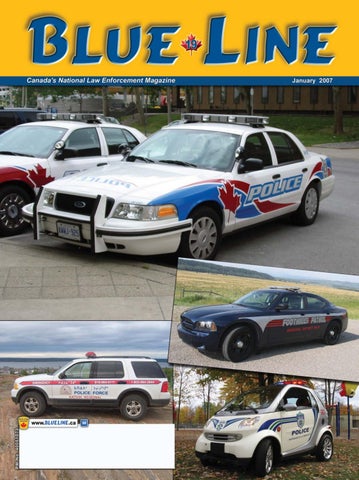
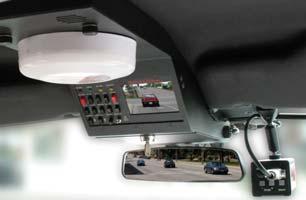
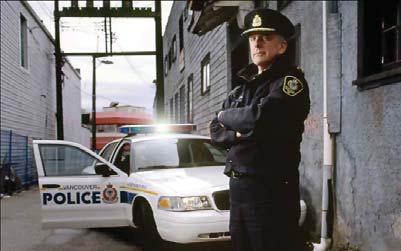
When the Dodge Magnum and Dodge Charger muscled their way onto the streets of Canada, it didn’t take long for the law enforcement community to take notice and imagine how good they would look with good guy paint and a light bar. In fact, by the time the first requests started rolling in, Dodge engineers were already well on the way to creating specially engineered police versions of both models with industry-leading innovations, exclusive safety features and heavyduty equipment that would make them the ultimate police vehicles.
Designed to serve and protect you
Law enforcement can be dangerous enough, so when road conditions or pursuit requirements increase the risk level it’s comforting to know that both Charger and Magnum have advanced safety features you won’t find anywhere else. At the heart of it all is a policespecific Electronic Stability Program (ESPTM) that works together with Brake Assist Program (BAS), All Speed Traction Control and heavyduty four-wheel Anti-lock Brakes (ABS) to provide a whole new level of rear-wheel-drive stability and control. These vehicles are the only police vehicles equipped with a standard equipment ESP system that provides two modes of operation to suit changing driving situations. Here’s how it works: ESP technology constantly compares the driver’s intended course of travel with the vehicle’s actual path. When differences in the two are detected, the system reacts by applying brakes and/or adjusting engine power to help keep the vehicle on its intended course. Does it make a difference? A study conducted by the National Highway Traffic Safety Administration (NHTSA) in the U.S. showed that ESP reduces single-vehicle crash risk for cars by 35 per cent.
Now for the customizing part: In the ESP On mode, full stability enhancement is in ef-
fect. The Partial Off setting modifies thresholds to provide a more sport-like feel. In all modes, ABS and Brake Assist remain fully functional.
They might run, but not for long
Another powerful reason behind the popularity of the Charger and Magnum police units is what’s under the hood: a 5.7-litre HEMI™ V8 that produces 340 horsepower at 5000 rpm and 390 lb-ft of torque at 4000 rpm. Not surprisingly, in Michigan State Police performance tests, Charger and Magnum finished first and second in acceleration times, vehicle dynamics and braking distances.
Unlike its legendary predecessor, today’s HEMI features fuel saving cylinder deactivation technology (MDS) that lets it seamlessly switch to four-cylinder mode when cruising. The result: massive interceptor muscle when you need it and enhanced fuel economy when you don’t. A powerful 3.5-litre high output V6 is also available, providing an outstanding blend of performance and efficiency with 250 hp and 250 lb-ft of torque.
The standard transmission on both is a fully electronic five-speed automatic that adjusts to match road conditions and driving style. Charger and Magnum are also the only police vehicles offering a five-speed automatic with Auto/Stick™ that puts the choice of automatic or manual shifting at your fingertips.
Built to take it
As you’d expect, Dodge engineers made sure these units would be up to the challenge of gruelling shift work with a long list of equipment that includes: performance tuned suspension and steering, 800 CCA battery with 20amp fused battery and ignition feeds, external oil coolers for engine oil, transmission fluid and power steering, engine hour meter, automatic oil change alert, 18 inch tires and wheels
to accommodate the largest police braking system available on a patrol car.
Another consideration during design was the cost of up-fit. Charger and Magnum come complete with a unique police equipment interface module to make connections to the electrical architecture as simple as “plug and play.” Built in wig-wag, additional wiring in the front, a multi-fit control mounting plate positioned between the two robust front bucket seats, a firewall pass-through grommet for additional wire feed and battery in the trunk for quick access to power in the rear of the vehicle. All designed to make up-fit less costly.
An open and shut case
“What we’re hearing from officers today is that they’re ready for a change from the body style that’s been in service for so long,” says Tom Money, Manager of Commercial Truck and Law Enforcement vehicles for DaimlerChrysler Canada. “When you consider the room, comfort, performance and safety advantages of these units, and combine those strengths with the inherent intimidation factor – particularly with a HEMI under the hood –it’s easy to see why Charger and Magnum are rapidly winning favour among forces throughout North America.”
To learn more about the Dodge Charger and Dodge Magnum Police units, contact the DaimlerChrysler Canada Fleet Info Line at 1-800-4633600 or visit the fleet website at www.fleet.daimlerchrysler.ca.
by Trevor Stoddart
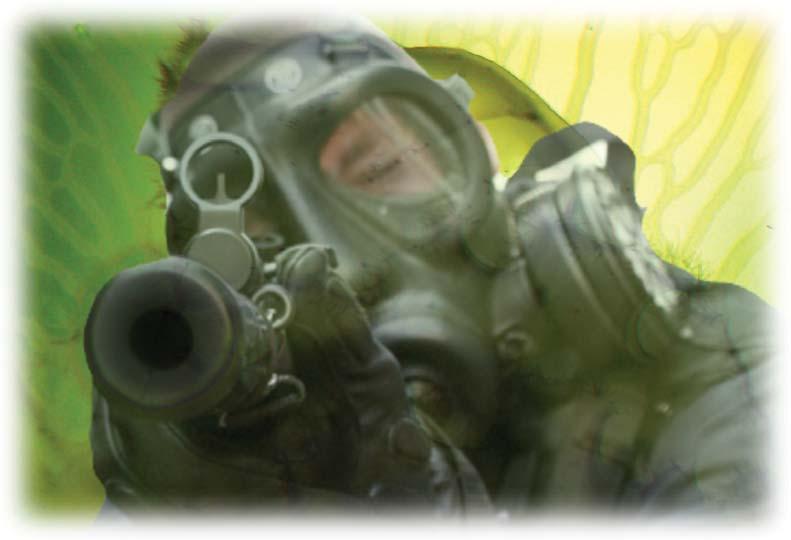
Police officers understand and, for the most part, expect the numerous threats they face on a daily basis. You take all the necessary precautions to protect yourself and relax after reaching the station at the end of a shift, knowing you’ve made it through unharmed and the most dangerous part of your job is over – or is it?
Workplace contamination is a very serious and overlooked issue. As an infection control consultant, I am deeply troubled by the overwhelming lack of concern for employee health and safety I have witnessed, especially in high risk environments where exposure to infectious pathogens are routine. Even when contracts and occupational health and safety regulations clearly state employers must provide a safe work environment, I still see gaping holes in the efforts of management and regional municipalities to control the spread of infectious diseases.
This inactivity is equivalent to staring down the barrel of a loaded gun. To understand the seriousness of this threat, it’s necessary to examine which pathogens we are most likely to come into contact with, how they infect our bodies and what workplace measures can be immediately taken to significantly reduce exposure. First, the pathogens.
Human influenza virus
There are two main categories of pathogens to concern ourselves with: viruses and bacteria. Viruses are extremely small, simply constructed cells who must use our body’s own cells to replicate and infect. Although not hearty outside us, once inside they are extremely difficult, if not impossible, to control. Antibiotics are not created for viruses, only for bacterial and fungal infections. Viruses of note are Influenza, Hepatitis, West Nile, SARS, Herpes and HIV.
E-coli bacteria
Bacteria, on the other hand, are much more complex by nature. Unlike viruses, they contain all the necessary ingredients necessary to self replicate; so much so that, in the right conditions, a few bacterial cells can replicate to several million over a few hours. They can also survive quite well in a workplace environment, again unlike viruses, easily and quickly infecting an entire staff. Bacteria can cause mild infections like skin rashes but also serious illness and even death. Some bacteria of note are Staphylococcus, Streptococcus, Botulism, Ecoli 0157, Anthrax, Tuberculosis, Salmonella, Legionnaire’s and Diphtheria.
Viruses are not adept at surviving outside the body, but these pathogens should not be considered less threatening. For example, Rhinovirus, the common cold virus, can survive at room temperature for more than 24 hours. RSV, a potentially fatal respiratory virus, can survive six to seven hours at room temperature. Hepatitis B can survive for more than a week at room temperature in the presence of dried blood and Hepatitis A can survive for a startling 30 days at room temperature in the presence of dried feces! Think about that the next time you enter your patrol car.
By now, the threat of viral and bacterial infection should be evident. Without question, we are dealing with organisms that can fatally harm us, our co-workers and families. So what can be done to limit your chances of infection? In order for these ‘micro-terrors’ to carry out their inherited designs, they must get into our bodies and luckily, there are only a few ways they can accomplish this.
The majority of infectious particles enter through our nose, eyes, mouth and broken skin (Anthrax can also enter through healthy skin), but our hands are the main culprit for transmission. I am sure you’ve heard it a million times, but the truth is that if you control the pathogens on your hands, you will significantly reduce your exposure to infections; its that simple.
Hand washing is cheap, effective and, especially if you use waterless alcohol based solutions, the easiest thing you can do to protect yourself. Be warned though, not all waterless products are created equal. Make sure the prod-
uct you use contains at least 75 per cent alcohol, as recommended by the Centers for Disease Control for emergency first responders, and some form of emollients to protect your skin from drying and cracking. Damaged skin is an easy route of access for infectious material.
Tuberculosis
Pathogens that use airborne routes to infect their hosts are very difficult to contain. Tuberculosis, SARS and Legionnaire’s disease all use this method of transmission with great success and once these viral/bacterial contaminants are in your workplace, they are extremely active. The only real means of personal protection is donning the appropriate mask, an N95 to be precise. It will effectively filter a broad spectrum of pathogenic particles and emergency first responders should never wear anything less – but even the best masks won’t protect you if you don’t wear them and this is where a problem arises.
N95 mask
Co-workers you come into contact with in the workplace may present no visible symptoms of infection but still easily transmit infectious particles; It would be improbable, even
impractical, to think you would wear your mask under these casual circumstances, even if they have obvious symptoms of infection. It is this non-compliance that helps spread diseases and threaten your health. This is where management and/or health and safety must be diligent in constantly monitoring and recording all employee infections. Through this, an accurate measure of current and potential contamination can be evaluated, proper safety instruction delivered and enforced and outbreaks contained. Properly investigating and reporting illnesses is a necessary element in creating a safe and healthy workplace.
Masks, hand washing and disease monitoring are all useful tools to help reduce the incidences of infection in the workplace, but they alone are not enough. We have yet to address the real culprit behind the growth and proliferation of workplace pathogens – hard surfaces like chairs, desks, door handles, steering wheels, dashboards and tables are common reservoirs for viral/bacterial contaminants.
Bacterias thrive on hard surfaces, especially at room temperature. Viruses are also able to exist there for long periods of time, just waiting to come into contact with a person and travel to their mouth, eyes, or nose, where they
flourish and cause disease. Because of a lack of infection control knowledge, or laziness, hard surfaces are routinely overlooked by maintenance staff and poorly cleaned even when visible contamination is observed.
These surfaces are very rarely properly decontaminated, even though they are constantly used. For example, think of a computer keyboard being used by a number of officers to submit reports each shift, then multiply that number by the amount of shifts in a week, month and year. It quickly becomes apparent that the numbers are astounding.
What’s even more disturbing is that the number of staff who could be infected by this means is doubled, even tripled, as they move about the workplace, further spreading the range of contaminants.
The steering wheel of a patrol car is another example. How many times has it been contaminated with blood or feces in a single shift or week of shifts?
Think you would notice such debris? Just remember that it takes a powerful electron microscope to observe a virus particle and in some cases it takes less than a hundred of these unseen particles to cause a life threatening illness. Lets face it, outside of a laboratory, there is no way to determine if a surface is teeming with pathogens. Despite these dire circumstances, there are means to protect yourself and those under your supervision.
There are many products specifically designed for high risk environments that don’t have the toxic components of bleach. Companies like Viraguard, Metrex and Dupont have great decontamination products designed for broad viral/bacterial/fungal control but safe for everyday use. They cost more than bleach, but such costs should never be a determining factor when making decisions that directly effect the health of an employee. How could a few dollars saved compare to a lifetime worth of
taken to handle a worker, or workers, who have become infected in order to lessen damages related to their particular infection and speed their recovery. This policy is, by far, the pertinent ingredient in establishing a safe and healthy workplace. If you need help in creating your own policy, consult an infection control professional.
I have tried to impress the importance of workplace safety and hope the multitude of unseen threats that exist in our environments are understood and respected for the potential damage they can inflict upon us all. This damage is not limited to the loss of a single officer from an acquired chronic illness, as harmful as that is. No, this damage also includes the thousands of sick days that are taken each year due to less lethal infections like Influenza or Salmonella and the millions of dollars lost through such preventable absenteeism.
Workplace contamination has to be addressed.
To be blunt, all hard surfaces need to be properly decontaminated on a regular basis in order to effectively reduce infectious material and create a safe environment. More importantly, decontamination can only take place when professional grade infection control products are used according to manufacturer instructions. This means using the right product for the job and using it the right way.
Bleach, although an effective decontamination product, should never be used in the workplace. It is corrosive, highly toxic and extremely damaging to immunodeficient persons. It also degrades very rapidly, losing its potency soon after it is mixed with air or water. I, along with other professionals, feel it has its place but the workplace is not one of them.
chronic illness or even death?
The decision to have these products at your disposal is simple, but enforcing their proper use is not. This is, again, when management has to act in the best interest of the employee and have procedures in place to ensure that decontamination is carried out on a regular basis. Such plans are called infection control policies. Your workplace may already have one, but it may have to be updated or enacted. If there is no such regulation, your workplace and fellow employees are at great risk of acquiring an infectious disease.
For those of you who are unfamiliar, such a policy is a three pronged set of guidelines set forth to ensure a safe work environment for those who work in high risk fields. Part one is a complete assessment of all potential threats employees are likely to come into contact with during the course of carrying out their duties. Part two explains what actions are to be taken to ensure that these threats are effectively reduced or eliminated through decontamination and employee education.
Part three outlines what steps are to be
Action has to be taken to meet the agreements set forth in union contracts and governmental regulations to guarantee a safe and healthy workplace. Regional municipalities are mandated to provide such environments; its up to each employee to speak up and voice their concerns if they feel such obligations are not being met.
Viruses and bacteria are ever present. They have been with us for millions of years and will continue evolving to become more resistant, virulent and fatal. It is up to us to make sure that we are doing everything we can to reduce our exposure to them in the workplace.
Trevor Stoddart , founder of ICS, Infection Control Solutions, has been studying viruses and bacteria, and their effects, for over five years. His prior work with the hospitality field, helping create pathogenic safe zone standards employers could use in order to reduce the risks of food borne contamination, has led him to help those in greater need. He is now devoted to educating and protecting those in dangerous first responder professions like Law Enforcement Officers. He can be contacted by email tstoddart@gmail.com, or phone 905 931-5183.
Alberta RCMP will replace its helicopter with a $3- million Eurocopter A-Star 350 B3 that will be in service by February.
The province covers 70 per cent of the funding for the purchase and Ottawa covers 30 per cent.
***
Canada’s chief justice of the Supreme Court of Canada, Beverley McLachlin, says the courts and jails are too often left to pick up the pieces when the health system fumbles care for the mentally ill.
McLachlin cited the gradual closure of mental institutions since the 1970s. They were shut down in favour of communitybased care that has never been properly funded to fill the gaps.
She applauds the growing number of specialized police teams trained to handle mental crises.
Corrections officials admit they don’t have the staff or resources needed to ensure the inmates in their care are released to the public in a more stable state than when they arrived.
***
The B.C. Supreme Court has thrown out a petition from a Hells Angels member who says he’s faced discrimination because of an Ontario court ruling.
Rick Ciarniello says he’s been maligned over his membership in the motorcycle club ever since an Ontario court declared the Hells Angels a criminal organization.
Crown lawyer Pat Riley, representing the federal attorney general, says the sections of the Criminal Code cited by Ciarniello don’t infringe his rights. ***
The U.S. Justice Department’s National Drug Threat Assessment says asian drug traffickers in Canada have gained control over most of the ecstacy distribution in the United States.
Distribution is now at a level similar to that of 2001, when availability peaked under the control of Israeli traffickers who have mostly been broken up by police operations.
The assessment also says the production of high-potency marijuana in Canada is a problem.
Potency of seized marijuana samples has more than doubled from 2000 through 2005.
***
The national homicide rate rose for the second straight year in 2005, reaching its highest point in nearly a decade. Firearm- related killings increased for the third year in a row.
Police services reported 658 homicides last year, 34 more than in 2004. Of these, 222 were committed with a firearm.
Most of the increase, 107 homicides, was driven by a jump in gang-related homicides in Ontario and Alberta.
The rate of firearms-related homicides has generally been declining since the mid-1970s, though there have been fluctuations based on the type of firearm used.
***
Texas has started broadcasting live images of the U.S. border on the Internet in a program that asks the public to report signs of illegal immigration or drug crimes.
The site, www.texasborderwatch.com, has eight cameras and e-mail capability to report suspicious activity. Previously, the images had only been available to law enforcement and landowners where the cameras are located.
Information e-mailed by viewers goes to the state’s operations centre and local law enforcement in that area.
The state is using US$5 million in federal security grants that have been earmarked for the web camera program. ***
Under a five-year-old federal policy, anyone convicted of first or second-degree murder must do at least two years in a maximumsecurity prison.
Last fall, the policy was loosened so wardens could grant exemptions.
In the five years before the policy was relaxed, 13 killers - or 2.25 per cent - were deemed exceptions to the rule and transferred to medium-security prisons.
In the six months after the policy was loosened, the ratio of exempted prisoners jumped to 30 per cent.
***
The mayors of Victoria and Esquimalt are making a serious push towards a single police department for all of Greater Victoria, co-signing a letter to the province’s solicitor general asking for an independent review of the issue.
The letter asks that a task force be setup to provide recommendations on whether integrating or amalgamating all the local police departments is the best option.
Both Victoria and Esquimalt councils have said they will abide by whatever recommendations are made by the proposed task force which could take six months to review with changes happening a year later.
***
Victoria’s police chief was left alone to secure a man bleeding heavily from a drug overdose in a shopping-mall washroom because the region’s emergency communication system flunked out again.
It is the latest example of how the $17.5million radio system is failing police and has left the City of Victoria demanding the committee responsible for it foot a $45,000 bill to run a working backup system.
Chief Paul Battershill saw Cst. Derek Tolmie run in to the Bay Centre on a call and followed to help. They found a man bleeding from an apparent overdose.
When Tolmie tried to radio for an ambulance and backup, his radio had no signal. So he left the police chief to cover the scene while running outside to call for help.
The system doesn’t work in police headquarters, underground parkades, shopping malls and other areas of downtown.
***
The federal government’s new bail reform package is designed to ensure those who are accused of serious crimes involving firearms don’t pose a danger to the public.
Under the new legislation, suspects accused of violent crimes will be required to prove to a judge that they’re not a danger to society.
The so-called reverse onus bail conditions mean the Crown would no longer have to prove to a judge that an accused should be detained pending trial.
Stephen Harper acknowledged the reverse onus conditions could likely face a Charter of Rights challenge, but said he’s confident it will not be struck down.
***
Canada and the United States have signed a deal to share more information quickly on guns, bullets and cartridges so they can connect crime scenes across North America.
The agreement will enable the RCMP and officials at the U.S. Bureau of Alcohol, Tobacco, Firearms and Explosives to compare evidence electronically and instantaneously instead of exchanging it manually on a caseby-case basis.
by Patrick Holliday
Leadership is about people. Consider the analogy of building a house. To build a quality house, the first action is to choose the ideal location. Once the house is built, you can alter the house in minor to major ways. But you cannot change its location. Once the site is chosen, you are committed. The same applies to the hiring of people in the organization. In the building of the house, many activities will be undertaken that will determine what the final house will look like.
•Do you carefully select the lumber from the available stock to ensure it is the best available or do you simply take from the top of the pile because it is simpler?
•Do you select trades people known for their quality work who will provide you with a quality product?
•Or, do you hire a tradesperson based on the lowest quote?
•Or, worse yet, do you do the work yourself, with some false notion that you have suddenly acquired skills for which you have no training, based simply on the fact that because you have lived in a house, you know how to build one?
•Do you make yourself aware of the latest materials and technology in house building so that the house is up to date in terms of those technological advances?
•Or do you build the house based on previous experiences because
“we’ve always done it this way?”
By now you should be seeing similarities between house building and personnel systems. Choosing the wrong location is choosing the wrong person to hire or transfer into your organization. An interview with a recruiter in a major police organization revealed that recruit selection and hiring is just that—recruits. There is no testing or even consideration of qualities that will serve the individual and the organization in later years as this person progresses in the hierarchy.
Choosing from the “top of the pile” is analogous to the senioritybased reward systems still employed by many organizations. How selective is the organization in ensuring that individuals are best suited, not to just the next level of promotion, but two levels beyond that?
Choosing trades people is analogous to the internal and external resources used by organizations in their personnel matters. Does the organization seek out the best in external consultants or do they simply look at the cost? Cost-based decisions are all too common and often result in the hiring of consultants who lack the expertise to accomplish the complex tasks associated with personnel management.
One of the practices of organizations, particularly in the public safety area, is to transfer from within to human resources positions. A review of a number of organizations showed that the people transferred from within to human resources areas such as recruiting and selection, training, labour relations, and personnel management gen-
erally had little or no formal training, education, or experience in these areas.
In our analogy, this is tantamount to hiring someone with no formal training to do the electrical in the new house. It will be quite a shock (no pun intended) when the house burns down and the insurance company will not pay for it.
It is an unfortunate reality that many organizations still select, hire, promote, and transfer individuals based on the use of outdated testing instruments, (or none at all), and outdated or non-existent job descriptions. Often there is a lack of competency descriptions for each position and/or methods of testing and developing these competencies.
The consequence is there are far too many examples of individuals who are transferred or promoted to positions for which they lack competence. This can also be said of many who are assigned responsibility for making the selections; they are not competent in the skills necessary to function at a high level of effectiveness in the selection process.
Once the house is built and it is discovered that the material used is of inferior quality, it becomes extremely expensive to repair the damage already done.
Good leaders ensure that the house is built right the first time.
One of the most important aspects of leadership, where a transformative effect can be realized, is in the careful assessment, selection, and development of people. Finding and retaining high quality, committed employees is absolutely critical to the success of any leader and any organization.
Why are these tasks so critical to success?
Whether an organization reaches its goals depends, to a great extent, on how these resources are recruited, selected, trained, and evaluated. These activities are commonly referred to as personnel or human resource management.
It is not unusual for a large police force or other justice or public safety organization to spend 80 to 90 percent of its budget on its human resources in areas such as salaries and benefits. Although the percentage will vary depending on the size of the organization, there remains little doubt that the human resource is the most expensive of an organization’s resources.
To this point, you have been introduced to knowledge and skills that can assist you in improving your effectiveness as a leader. It is critically important to understand it is the people who affect everything that occurs in an organization on an ongoing basis and that you, as a transforming leader, can have a positive impact on the organization through the effective and efficient use of personnel systems. In this way, you can become an effective systems manager.
To illustrate the need for enhanced personnel systems, pause for a moment and reflect on your own organization. When you walk into your human resources or personnel office, do you see row upon row of five-level filing cabinets, each bursting with dog-eared, yellowed papers of dubious usefulness? Or have you progressed to the point of having a computer-based system running on proprietary software that provides little of the information required for effective management and that is incompatible outside its own exclusive function?
Are your requests for information met with
looks of: I hope you don’t mean anytime soon.
When you are reviewing candidates for a transfer, are you able to obtain records on training, experience, and education? To what source do you refer when someone asks, “What am I responsible for, exactly?”
Does your organization have an effective performance-management system? What has your organization done to help you plan your career? What does your recruiting section do to ensure the organization is hiring not only the best recruits, but also those who possess the qualities to become the best future supervisors and managers?
If you are in a police organization, you likely have many effective field-training officers, but you likely have no leadership-training officers. Where are the people whose job it is to prepare leaders to assume the actual responsibilities of the positions into which they are promoted?
Who has been professionally and competently trained in your organization to manage and lead the human resource management function?
People promoted into human resource manager positions often are “rotating” in from some other section of the department without any previous training in human resource management.
Let us begin with a brief introduction to the concept of a system. There are four basic parts to any system: input, process, output, and feedback.
Although it is somewhat of an oversimplification, we can view input in the organization
as the “humans” who will become front-line staff. The processes in a personnel system are separately identifiable but interdependent. A process can be the selection and training of a new hire or the development of existing personnel to become supervisors and managers. The output is the product in terms of quality. Do we have quality front-line workers, quality supervisors, quality technicians, and quality leaders? To add complexity to these systems, we include subordinate activities as subsystems. Your role as a transforming leader is to introduce, change, facilitate, or manage the system and subsystem processes that will maximize the “human resource” contribution to the organization.
Last, the leader uses feedback to evaluate the effectiveness of systems and the people in them.
by Elvin Klassen
Proclaiming itself as the oldest Canadian municipal police department west of the Great Lakes, the Victoria Police Department is preparing to celebrate its 150th anniversary next year.
Founded in 1858, the department is known for its innovation. It was the first Canadian police force to use Tasers and pepper spray and began the first digital forensic unit. It also led the way in equipping frontline officers with patrol rifles and replaced its Harleys with more efficient Hondas.
The department’s 221 sworn officers benefit from strong community support and involvement. The 21 officers on each of its three patrol units vary from one to 20 years experience, providing an excellent mix and promoting good decision-making.
Chief Constable Paul Battershill joined the department in 1999 after serving as deputy chief of the Vancouver Police Department. “It is neat for me because I am able to work with a department that is a little smaller here,” he says. “We have had excellent relationships with the police board, city council and the media.”
Battershill spent six months on secondment as city manager this year while staff were being transitioned at Victoria City Hall. “It was great to see the other side of the city office,” he says. While there he developed a two year strategic plan for the city and a 20 year capital plan.
Victoria, the capital of British Columbia and the adjacent Township of Esquimalt are located on the southern tip of Vancouver Island. The region is noted for its natural beauty and is a world tourist destination boasting some of the most moderate weather in Canada.
The Victoria and Esquimalt Police Departments amalgamated in 2003 to enhance professional response, crime prevention and investigation in both communities. The two departments had previously co-operated and shared some services.
The amalgamation had the overwhelming support of both police chiefs and mayors. The heads of both associations committed to make the transition as painless as possible for their members and ensure that their interests were properly represented. The amalgamation has improved career opportunities, training and advancement possibilities. Thirty-nine Esquimalt sworn members, who previously trained and served as both firefighters and police officers and seven civilians transitioned to the new department.
The VPD faces considerable pressure to keep its spending under control, notes Sgt. John Craig of the human resources division. The department’s budget is based on a population of 97,000 in Victoria and Esquimalt alone, even though some 340,000 people live in the Greater Victoria Area. The city’s vibrant and historic downtown core is the business and entertainment centre for the entire area and the influx of people from neighbouring regions can stretch officers to the limit. Much time is spent
on core challenges such as substance abuse, mental health issues and homelessness.
“Greater Victoria is unique in that there are 13 municipalities with four municipal police forces and three RCMP detachments,” Craig explains. “Then there is the Capital Regional District Board. School districts are not aligned with any of the same boundaries. Each level of local government is attempting to serve what is best for their own area, leaving the VPD to look after the policing in the area where many of these people gather either to work or to attend bars and restaurants.”
Victoria Chief Paul Battershill
“Integration of the dog squad, forensics and homicide units have met with limited success. PRIME, the provincial data base, is assisting in the sharing of information between the various police agencies.”
Nearby police agencies have shown little interest in amalgamation. Small departments worry that doing so will hurt local service, while larger departments have been unable to agree on who will control such a force. The mayors of Victoria and Esquimalt made a serious push in November toward creating a single police department for all of Greater Victoria. They co-signed a letter to the solicitor general asking for an independent review of the issue and their councils agreed to abide by whatever is recommended.
“I think this takes it out of the solicitor general’s hands because he doesn’t want to use the hammer and amalgamate us,” says Victoria Mayor Alan Low. “It takes it out of the hands of the various municipal police forces because everyone wants to protect their own little empire.”
Esquimalt Mayor Chris Clement says the ideal scenario would be a single police department for the entire Capital Region. Battershill agrees, noting “amalgamation comes up all the time with various groups, including the chambers and the police.”
High housing costs in the Victoria area has made it more difficult to attract trained officers, Battershill says. The department strives to make experienced officers 50 per cent of new hires.
“Where we never use to go out and advertise for officers, the combination of the cost of living, people not turning to policing because of the good economy and people not choosing policing as a career has made this necessary,” Craig explains. “We need to get out there and explain the positive things about policing and the complexities of the career.”
The department has begun offering financial incentives to lure experienced officers, including pegging their salary to combined years of service and offering a five per cent bonus for each five year increment, beginning at the 10 year mark, although transferring officers do lose their seniority. VPD also plays up the West Coast lifestyle and benefits of working at a medium sized, friendly department.
The VPD Reserve Constable program helps groom future officers and plays an active role in promoting safety in the community. The service distributed more than 500 application forms in its search for 30 candidates last year but found only 20 that met its standards.
Reserve constables are fully uniformed but not armed and are involved in many community-policing events, including public presentations, security checks, controlling traffic at parades and ride-alongs with regular officers. They spend an unbelievable number of hours volunteering for their community, Craig emphasizes, adding that 90 per cent who want to become regular officers do so within five years – 13 in the last 24 months alone.
The department’s 2004-07 strategic plan identified communication as a key priority and
several new initiatives were begun to make improvements both internally and externally.
A full-time communications manager position was created and a civilian crime analyst was hired to ensure law enforcement efforts are led by intelligence, not driven by events. New internal communications processes, such as the ‘E-Spike’ Intranet site, better organize and disseminate operational information to staff.
Statistics Canada says there are more police on the payroll this year than there have been in a decade, although police strength remains below the levels of the 1970s and below the numbers in other western countries.
Canada had almost 62,500 police officers as of last May, up about 1,400 from last year.
In 2005, spending on policing totalled about $9.3 billion, an average of $288 for every Canadian. That was four per cent higher than in 2004 and marked the ninth consecutive increase in policing costs.
Over the last 10 years, Saskatchewan and British Columbia have recorded the largest increases in police strength, with all other provinces showing small increases or relative stability. ***
Additional police officers will be added to all 55 municipalities in Nova Scotia within the next two years.
The first round of hirings was finalized during a meeting in October of Justice Department officials and representatives from the RCMP and municipal police forces
One hundred and nine officers will be hired in the first phase, with all municipalities receiving at least one new officer by the spring.
Smaller municipalities will receive one or two officers while the Halifax Regional Municipality will get 36 and the Cape Breton Regional Municipality 10.
***
There are over 20,000 people clogging up the Vancouver police and court systems with outstanding arrest warrants.
Police are hoping to flush out that system with a new Internet page that shows some of the city’s most wanted.
Many of the people wanted are transient and it’s one of the biggest problems in con-
The VPD sponsored a Canadian Officer Safety Conference in 2005. It was a great success, Acting Inspector Les Sylven, communications manager says, noting it’s Canada’s only national conference dedicated to supporting police safety. Another conference is planned for this September and is expected to attract 300 members.
“To assist in developing the next strategic plan, we are engaging the public in a survey to see how we are doing and what they think we should be doing differently,” Sylven says. “Our volunteers will be knocking on doors to get an accurate assessment. We need the public support to do our work.”
The department also recently hired a diversity manager to work with cultural groups, especially recent immigrants who may be reluctant to talk to police because they don’t understand the department’s role in the community.
necting people to warrants and arresting them.
The website is also linked to Crime Stoppers, so people who want to report someone can do it anonymously and may even get a reward.
***
Saying you’re sorry will no longer be an admission of guilt - at least before the courts of Saskatchewan.
The provincial government has introduced an amendment to the Evidence Act that removes the legal implications of an apology.
A similar bill was introduced in the BC legislature earlier this year.
***
Edmonton’s economic good times are being partly blamed for the Alberta capital’s alarming murder rates.
A Statistics Canada study shows Edmonton has the highest murder rate among major Canadian cities.
Many are attracted by the perception of quick money in energy megaprojects, or may be visiting the city from northern boomtowns with cash stuffed in their jeans.
***
Huge trials featuring courtrooms packed with the accused are quickly bankrupting Ontario’s legal aid system.
Legal Aid Ontario has announced it’s imposing strict funding caps on big cases and will spend no more than $75,000 on a case involving one accused person.
If the cost is likely to exceed that amount, legal aid will not fund the case, apart from paying defence costs at a bail hearing.
The plan has been under financial pressure since the mid-1990s and its qualifying rules are so tight that a single person earning just $16,000 a year after taxes may now be too rich for legal aid.
Acting Inspector Les Sylven can be reached at sylvenl@police.victoria.bc.ca
by Tom Rataj
Dashing through the snow
Much of Canada is covered in snow and ice at this time of year, with roads an unpredictable mix of anything from dry and clear to wet, snowy, slushy and icy. Getting from point A to B requires a balance of driving skill, the right vehicle and tires and perhaps even a little luck.
Civilian drivers faced with poor and impassable road conditions have the option of staying put, but we police officers don’t have that luxury. Not only do we have to get out there but our normal patrol and emergency response driving presents additional demands.
Tires
Before the introduction of radial tires in the 1970s, many Canadian drivers mounted a pair of ‘snow’ tires on the drive wheels of their cars during the winter months. Studded tires were also still popular then but eventually outlawed because the steels studs damaged asphalt roads.
Radials made possible the ‘all-season’ tire, which was said to provide good performance during summer and winter alike, negating the need to use snows. While they proved to be a decent compromise, particularly during their first few thousand kilometres of tread life, they left a lot to be desired during real winter weather. Shortcomings include tread patterns that are not nearly aggressive enough for deep snow and rubber compounds that become too stiff during sub-zero conditions, making them next to useless on ice.
The early 1990s saw the introduction of a new ‘winter’ tire. Using state-of-the-art computer design technology, tire manufacturers were finally able to develop a new type of tire with advanced tread patterns that provided excellent traction in all winter road conditions.
Coupled with new manufacturing techniques and rubber compounds that help keep the tire flexible all the way down to a frosty -40°C, the new tires provide substantial improvements over even the best all-season tires. It’s like the difference between walking through the snow in dress shoes and winter boots.
A car equipped with winter tires travelling at 80 km/h on snow stopped in about 70 metres, according to Goodyear Canada data; the same car equipped with summer touring tires was still moving at 49 km/h at the 70m mark and required another 42m (for a total of 112m) to come to a full stop.
A winter tire driven on dry pavement at an ambient temperature of +5°C provides up to 25 per cent better braking performance and up to 38 per cent improved handling than an all season tire, according to the Québec Ministry of Transportation.
Given the substantial improvements, automotive experts and the tire companies recommend winter tires be mounted on all four wheels so that each has the same amount of traction.
True ‘winter’ tires are identified by a small
pictograph featuring a snowflake inside a stylized mountain outline. Older mud and snow (M+S) tires do not offer the same all round benefits. The pictograph indicates that the tire meets or exceeds a Transport Canada requirement that they provide at least 10 per cent better traction than an all-season tire.
Rubber
Much work has been done in the past decade on formulating the rubber compounds used in both all-season and winter tires. Summer and all-season tires feature rubber optimized to perform well in warm and hot weather. This is more complicated than it sounds since a tire driven for any period of time, particularly at highway speeds, heats up quite substantially. Factor in air temperatures in excess of 30°C and road temperatures of 40 or 50°C and the rubber formulation challenge becomes much greater.
to prevent hydroplaning, offer improved traction on icy patches and provide grip in slushy and snowy conditions.
Water displacement is generally handled by wider and deeper grooves that channel water away from the centre of the tire tread. Many modern snow tires feature a ‘V’ shaped groove pattern; the point is in the direction of travel and the legs are toward the sidewalls at fairly acute angles.
Traction on ice relies largely on increasing the amount of friction between the tire and ice. To accomplish this, tread patterns usually feature a large number of smaller grooves running across the face of the larger tread blocks. These smaller grooves, often referred to as ‘sipes,’ are also commonly laid out in a tight zigzag pattern along their length.
Winter tires need rubber formulations optimized for the complete opposite end of the temperature spectrum, particularly because the tire and tread need to remain flexible so that they provide a comfortable ride and good traction on a wide variety of winter road conditions.
Additives
A wide variety of additives are used in the rubber compounds for both all-season and winter tires. The most common in winter tires are silica and walnut shells. Both are ground to a very fine consistency and added to the tread to substantially improve grip, particularly on ice.
Toyo uses ‘Lamella Crystal,’ which it says helps remove moisture from the surface of the road. When these tires are driven on icy surfaces, the crystals remove the water on the surface of the ice, which makes it less slippery. Other manufacturers accomplish this through unique tread structures.
Several manufacturers, including Yokohama, also add microscopic air bubbles to the tread rubber compounds, both to improve rubber flexibility and traction on wet and icy roads. The broken air bubbles at the tread surface substantially increase the amount of surface area exposed to the road.
Treads
The tread patterns on winter tires must perform under a wider variety of conditions than a standard all-season tire, since daytime winter road conditions often remain dry for most of the winter in southern urban and suburban areas. Roads are generally ploughed and salted within the first 12 to 24 hours after a storm and quickly dry, so winter tires must provide decent ride and handling on both cold, dry roads and surfaces covered by water, ice, slush and snow.
They also must effectively displace water
As the larger tread blocks in which the sipes are located make contact with the road surface, the sipes open up, providing a series of edges which increase the effective surface area of the tire and provide much better grip. The sipes also remove some of the water from the road surface.
The largest tread blocks on winter tires enable them to cut through snow and offer traction in loose and packed snow. The blocks are designed to provide traction both in the direction of travel and laterally to provide directional stability.
Wider all-season and performance tires provide better traction than narrower tires, but the exact opposite is true with winter tires. A wider tire distributes a vehicle’s load over a wider area, which causes it to sit on top of the snow; a narrower tire concentrates the weight in a smaller area, causing it to push through and make contact with the road surface below.
Speed rating
The speed rating reflects the maximum speed at which a tire can be driven at for an extended period of time. Most standard passenger car tires are ‘S’ speed rated, signifying they’re good for a sustained speed of 180 km/h. Many performance cars are equipped with H and V rated tires, good for 210 and 240km/h respectively. I mention this because the ride and handling of all cars is developed with a particular speed rated tire as part of the equation.
High performance tires are manufactured with much stiffer and often shorter sidewalls, so they provide a much firmer ride and more precise handling. Putting S rated rubber on a car designed to ride on H or V tires will result in a soft ride and sloppy handling.
Most common winter tires use a ‘Q’ speed rating (160km/h), slightly lower than the usual S rating. It is important to keep the speed rating in mind, primarily because most
winter driving will be done on dry roads and normal speeds, so putting a Q rated winter tire on a car engineered to ride on H or V rated tires will compromise ride and handling for the four to five months the winter tires are being used.
Personal experience
The rate of winter tire usage varies greatly across Canada. It’s highest in the Atlantic province and Québec, where they are used by 75 per cent of drivers. Only 25 per cent of drivers use them in Ontario, which is towards the lower end of the scale.
I put a set of Michelin Alpin PA/2 (H rated) winter tires on my VW Golf TDi several winters ago and found the overall winter driving experience, especially on snow and ice, far superior to the original Michelin all-season tires.
While there is an initial investment — around $450 for a set of four and rims ($200 for a set of four) — they increase the life span of your all-season tires and if your car has expensive alloy wheels, gets them away from all the corrosive road salt and deadly springtime potholes.
All police agencies should consider installing winter tires on their entire fleet to improve safety. Not doing so may even be a liability in the event an officer is injured while responding to a call.
A full list of winter tires bearing the mountain and snowflake logo is available at Transport Canada’s site: http:// www.tc.gc.ca/roadsafety/tires/wintertires/tirelist.htm
All front-line Toronto police officers should have Tasers, which could have cut short a violent confrontation that ended in the death six years ago of Otto Vass, said a coroner’s jury.
The force didn’t have Tasers six years ago, but if they had, jurors said, they could have been used instead of the rubber batons the officers used to subdue Vass after he punched one of the officers in the face.
But a doctor called by the officers suggested that Vass’s heart “short-circuited” from the stress of being arrested, combined with his obesity and a lifetime of taking medication for his mental ailments.
***
A veterinary study into a degenerative disease that affects police dogs has saved the career of one Belgian Malinois in Manitoba.
Utah, with the Winnipeg Police, was accepted into the study at the Western College of Veterinary Medicine in Saskatoon after being diagnosed with degenerative lumbosacral disease which causes a dogs hind legs to become useless because the vertebrae near their tails get compressed from jumping obstacles.
When Utah was first diagnosed, police in Winnipeg weren’t sure it would be worth the $6,000 it would cost for surgery to correct the problem. But when he was accepted into the study, the costs were automatically covered by the college.
***
A youth cadet program designed to cut down on violence in the central Alberta community of Hobbema is being hailed as a huge success.
A ceremony in November was held to mark the one-year anniversary of the program in a town where many kids live in fear of gangs. Initially the program, which requires participants to march, do drills and emphasizes leadership skills, was expected to attract about 100 kids. Now, over 800 kids have enrolled in the program.
The cadet program attracts children from four aboriginal bands in central Alberta. ***
A final report into allegations that the RCMP organized mass slaughters of Inuit sled dogs between 1950 and 1970 as a way to force northerners into communities and assimilate them has found no evidence of a plot.
The report, tabled in the House of Commons, found that police officers did kill many sled dogs, but for health, safety and humanitarian reasons.
An interim RCMP report released last year reached a similar conclusion as the final version and was declared a whitewash by many in Nunavut.
Two Inuit groups are conducting their own investigations into the charges.
Openness enhances credibility Good news or bad – let
the public know
by Mark Giles
Some argue that any news is good news –that the resulting publicity can, if handled properly, benefit an organization’s or individual’s image in the long run. To a certain extent this argument may be true, especially if the opportunities are also used to enhance transparency and credibility.
Many celebrities have used this strategy, enjoying the good news and managing the bad, while protecting their reputation in the long term. While this probably won’t work for extremely bad news – such as the Michael Jackson or O.J. Simpson cases – it has been successful for many others.
Actor Hugh Grant’s arrest for his encounter with a Hollywood prostitute in 1995 is one of the better examples of quickly managing bad news in what could have been a career-ending incident. Grant was previously scheduled to appear on the Tonight Show a few days after the incident and many thought he would cancel and remain in seclusion.
To his credit, he showed up to face talkshow host Jay Leno and his television audience. “What were you thinking?” said Leno, with much emphasis. Addressing the bad news head on, Grant responded directly.
“I think you know in life what’s a good thing to do and what’s a bad thing, and I did a bad thing,” he said, “and there you have it… I’m very sorry.”
Not all celebrities or organizations are as forthright, but perhaps they should be. A CNN story carried the headline: “Hugh Grant finds honesty the best policy” and his appearance on this and several other talk shows is considered a model in defusing a crisis. Grant was able to put this incident behind him fairly quickly, although it could have gone on much longer had he chosen another option.
The Bill Clinton-Monica Lewinsky scandal of 1998 is a classic example of another option in handling bad news, at least during the early stages. Had the president come clean immediately, the story would have certainly drawn greater media coverage at first, but interest would have also dissipated much sooner. By denying the truth for many months, Clinton essentially made the bad news worse. A story about sex became one of sex, lies and much more videotape than would have likely been the case otherwise.
Police issues
Some years ago, I had to deal with a sexualassault charge that, given the role of the accused in the community, was considered newsworthy and, therefore, of interest to the media and public. Local police had laid charges and a first court appearance was pending. The appropriate communications strategy seemed simple: openness
and transparency, supplemented with appropriate messages – mitigating the bad news somewhat – and highlighting the positive efforts being made to deal with the issue.
My plan met some resistance, however, from a colleague who argued that if we released the information, it would end up on the front page of the local newspaper. I agreed that it almost certainly would, but that the price to be paid was unlikely to be lower by holding it back for another day.
Sure enough, the story led the news and was on the local newspaper’s front page the next morning. It was a one-day story, however, and other than a short additional piece after a court appearance, was not deemed to be of further interest to the public and received no additional media attention.
Sending the bad news directly to the media is a communications strategy that increases credibility. The public realizes that police agencies make mistakes, especially under stressful conditions – so when something goes wrong, be the first to admit it and communicate the lessons learned and actions being taken to prevent its reoccurrence.
A recruiting constable once said “we’re not looking for perfect police officers, but we are looking for honest ones.” The expectations of the media and the public are similar – they expect commitment, dedication, hard work and honesty, but they don’t expect perfection.
When an organization is willing to display its own ‘dirty laundry,’ the public is more willing to forgive and forget, news coverage is normally more short lived, and the media is
more receptive to covering the good news story – when it comes.
Good news stories are generally much easier to manage and, as long as they’re newsworthy, shouldn’t be overlooked. Ensuring that the public is aware of an agency’s good work and positive contributions to the community builds confidence and a reservoir of goodwill. This goodwill enhances an agency’s reputation and credibility, which may also be needed to help carry the organization through the next bad-news crisis.
Professional delivery
Whatever the means, the objective is to bring the news to key audiences, increasing awareness and allowing the community to share successes or understand that mistakes were made. Whether by on-site briefing, news conference or news release, ensure the delivery of good and bad news is done professionally, using well-prepared spokespersons and well-written communications material.
In doing so, an agency is more likely to influence the information and key messages included in media coverage. With sound media-relations strategy, the results of news delivery can be far more favourable.
To maximize the benefit of a good news story, try to isolate it from other major or competing news within your agency and others in the community. While it’s not possible to predict the future, the timing of obvious events or issues – such as major announcements or court decisions – can often be avoided.
Also consider separating good news from
bad, within your agency, where they occur simultaneously or in close proximity. Where possible, deliver all the bad news at the same time so that once the recovery process has begun, it is not interrupted. Good news, however, can be delivered all at once or in stages, so that it may be enjoyed over a period of time.
Delivering good and bad news together, in an attempt to diminish the negative story, is seldom successful and likely to result in far less coverage of the positive one. Given that the negative story will likely take precedence, the good news should be held until the bad-news issue has been dealt with.
Intentional versus coincidental timing
A similar strategy occasionally used in dealing with negative issues is to time the delivery of bad news to coincide with some other major event or crisis.
This can be risky, however, if it appears to have been done intentionally – especially if media realize there was a significant delay in informing the public. This is not an unlikely prospect considering the ease of obtaining reports through access to information and privacy legislation.
If the timing is coincidental, however, then a law enforcement agency may benefit legitimately. When investigators with the Canadian Forces National Investigation Service (NIS) laid charges for child pornography in 2005, regional and national media were focused on the Gomery inquiry into the sponsorship program. The charges were made public in a news release and later posted to the departmental web site, but with most media resources centered on the inquiry and its political implications, received very little attention.
In this case, the NIS was open and transparent when, coincidently, another major issue surfaced at the same time. This should not, however, be part of a strategy whereby an agency holds onto bad news in anticipation of some larger story consuming media interest.
The media looks for newsworthy stories, be they positive or negative for an individual or organization. If they focus on the negative, it’s often because that’s what interests their audience. There’s still room for good news, however, and organizations known for their transparency benefit not only from greater credibility, but often find media more receptive to promoting their positive contributions.
When the news is good, enjoy it. When it’s bad – don’t hesitate to put it out there. The benefits in increased public confidence and goodwill will normally far outweigh the initial price paid in negative publicity. In managing shortterm issues, it’s important to look towards mid to long-term outcomes, primarily managing reputation through developing and maintaining public confidence, which is ultimately the true measure of success.
I enjoy your magazine very much. Although I may not agree with EVERY article I have read, I find it very informative.
I don’t normally publicly voice my personal opinions on issues, however there was a letter that you published on page 22 in your latest magazine that just didn’t sit right with me. Cpl. Steve Goss apparently took issue with an article that you printed that encouraged “faith in God.” I am a firm believer in allowing free speech, however I found his comments were opinionated, close minded, confrontational and even threatening, especially when he ends his letter with “I will object to the distribution of this magazine if it continues to promote religion.”
Funny that Cpl. Goss apparently didn’t have an issue with the article from your October issue entitled “Pseudoscience in policing.” I read that article and although I may not agree with it, I am willing to keep an open mind and will not censor its content so that others may not read it.
Sgt. David P. Maludzinski Jasper, AB ***
I am very glad you published this article, Recruiting attitudes need a serious overhaul. It is, in fact, perfect timing for me and what I am going through right now.
I am 34.5 years old and a new auxiliary officer at a department here in Southwestern Ontario.
Being a laid off commercial pilot (rookie there too), I chose to take on my other career interest of policing. So far, so good, but it is going to take a cape with a big letter ‘S’ on it to succeed. The physical requirements and written testing seems to be designed to weed a candidate out – and out for good.
I will give it a shot; I have nothing to lose as I am losing my job at Ford. Mass layoffs at the St. Thomas Assembly Plant, where the mighty Vic is made.
I would like to say thank you for publishing that article, but I wonder how much they can really change the typical hiring process –and yes, it makes certain outsourced companies some good bucks!
Name Withheld ***
I would like to commend you on your article, Recruiting attitudes need a serious overhaul, and how one needs to be an opportunist and reinvent oneself to survive in this labour
market. Policing is no exception, unfortunately. I am not a police officer, nor am I associated with any police service. I’m not a bitter or disgruntled ‘could’ve been.’ I did work for the former Sol Gen as an intern for a while and I seem to remember police recruitment and retention being an issue, with the focus on the recruitment of older people to fill the retirement gap.
It has never made sense to me why the psych test is at the very end of the testing process. It is the single most critical test that a recruit has no control over that can lead to elimination. Wouldn’t it make sense to determine psychological fitness prior to testing physical and intellectual fitness?
The ‘you have to want it bad enough’ attitude. As we get older our lives become more complex and dynamic. We have more responsibilities and issues to manage. We have housing payments, relationships and maybe older parents to support. This is in contrast to the younger recruit, that may be living at home, driving the parents vehicle, be unmarried and have less responsibility. The ‘wanting it bad enough attitude’ is great when you’re young and full of testosterone and hubris, but as we age we become a little more cost/benefit oriented.
As far as the older, more experienced recruit goes, you’re going to get someone who’s had more good and bad experiences, and everything in between. You’re also going to get a recruit with a more complex and dynamic life and a more ‘complex and dynamic body.’
And finally, the expectation of ‘the full package.’ If you compare a recruit to a ‘product,’ the question to be asked is ‘how often do we buy a product that is ready to go, right out of the box?’ Every new product requires some setup and tweaking and if we want the full package, we have to pay for it. If we go discount shopping and try to get the full package at a discounted price, chances are it’s stolen or too good to be true.
As indicated before, I’m a little older, a little wiser and, out of self-knowledge and wisdom, I’ve re-evaluated. My place in the quilt of public safety will be a little bit different; a place more suitable for a person with a complex and dynamic life, and an ever complex and dynamic body. Was it because I didn’t want it bad enough? No. It was because there are other things that I want more.
Jamie Taylor Ontario
Mark Giles is Blue Line’s correspondent for public and media relations, military and international issues. He is also the chief of communications and publications with INTERPOL, based in Lyon, France.
by Kathryn Lymburner
The future of policing
There’s no denying that Canadian policing is changing, the Law Commission of Canada concludes in its final report, In search of security: The future of policing in Canada
With private police securing public shopping areas and public police securing private sporting events, it’s not hard to see how the line has blurred.
The report is a result of several years of multi-faceted research into the changing nature of policing in society. “Policing is an essential component of a well-functioning society,” the commission notes, but in the last few decades, it has become a “more integrated task that is undertaken by a variety of groups and individuals,” not just public or state police.
The fast growing private security sector now offers a wide range of services at competitive rates, whereas “public police forces are increasingly expected to justify or rationalize their resource allocations.” This occurred not because public police left a void but because a need arose for an array of “overlapping, complimentary and mutually supportive” services, the report states.
Social change and cultural diversity have also had a major impact on policing.
“Canadian society is much more diverse than it was 40 years ago and now encompasses a plurality of cultures, traditions and values,”
making “public policing more complex as organizations have endeavoured... to reflect the broad mix of society within their ranks (while meeting) the demand for a greater range of policing services.”
Another change –“new forms of property that blur the distinction between public and private spaces.” Indoor shopping malls and other forms of mass private property are privately owned and policed but frequently used by the public.
“‘Communal spaces,’ such as gated communities or private health clubs, are (also) privately owned and policed in the interests of their owners, but are used by the public... Ensuring that such policing reflects the broad public interest,” is a concern, the commission states, since “these new spaces place ever-increasing segments of society under private policing.”
The Canadian legal and regulatory framework hasn’t kept pace with changes in the industry it governs, the report says.
“To date... no Canadian government has systematically addressed the challenges that (these) networks pose for public policing... Policing-related governance and accountability
mechanisms still reflect the public-private dichotomy. This framework clearly no longer applies to the reality of policing.”
The commission recommends:
•All levels of government need to define policing in broader terms, “to encompass activities of any individuals and organizations legally empowered to maintain security or social order, in accordance with public or private contracts, legislation, regulations or policies.”
•“Governments should continue to be responsible for ensuring that policing is conducted in a way that respects core democratic values... all levels of government (need to) review laws, regulations and policies to assess their impact for all forms of policing and to foster the best possible policing arrangements.”
•Governments should collaboratively legislate the private security industry to ensure its personnel “respect the core democratic values and aspirations that Canadians commonly associate with policing.”
TORONTO — Torontonians spend more than most Canadians on police services, but their officers have one of the lowest crime-solving rates in the country, a new Statistics Canada survey suggests.
About $305 per person is spent on policing in the city, higher than the national average of $288.
But officers “clear” just 28 per cent of cases, the survey says. Across the country, clearance rates average around 33 per cent.
StatsCan looked at crime “solving” abilities as part of its annual survey on police resources in Canada.
Toronto Police Service spokesperson Mark Pugash said the force disagrees with the government’s numbers.
“We have been in discussion for some time with StatsCan and that is not a number we accept,” he said.
The force says its overall clearance rate is 50 per cent.
Toronto police are also solving more major crimes, Pugash said.
But that doesn’t square with StatsCan’s view of national trends.
When it comes to violent crimes, clearance rates have been declining in recent years, it says.
In the early 1990s, police solved three-quarters of all violent crime cases. But today, about 70 per cent are cleared.
At the same time, police spending has gone up. In 2005, governments spent about $288 per person on policing, for a total of about $9.3 billion - up four per cent from 2004.
Statistics Canada defines “cleared” crimes as those solved by police. Solved usually means a charge has been laid, but in some cases it can also mean police have identified a suspect.
The Toronto force accepts StatsCan’s definition,
Pugash said. But it would take a statistical expert to explain why they disagree on overall results, he said.
StatsCan says its information comes from a uniform crime reporting survey, which is carried out every year and based on data provided by police.
When it comes to solving crime, today’s results show that not much has changed in 30 years, despite the arrival of new crime-fighting “tools” such as DNA evidence and despite what Canadians may have come to believe from television shows such as CSI.
The results have remained stable. The volume and types of crimes today, along with the growing complexity of police investigations, may help explain why police don’t seem to be much better at cracking cases than they were in the mid-1970s, says StatsCan.
It also urges caution in comparing the clearance rates of various forces. There could be many reasons for differences that have nothing to do with the inherent crime-solving abilities of police, it says.
For instance, in some areas, there may be higher levels of crime reporting by citizens, particularly of less serious crimes such as minor thefts, which have lower clearance rates.
Police often spend less time investigating these offences, devoting their resources to more serious problems.
The Ontario Provincial Police in Greater Napanee had one of the highest clearance rates in the province, reporting 54 per cent of its cases solved.
The leader appears to be the First Nations police force of the Anishinabek Nation, which is based in Garden River, near Sault. Ste. Marie, but patrols a vast area, stretching south to Peterborough and Lake Huron.
StatsCan says it clears 79 per cent of its cases. (Toronto Star)
•Public security boards or similar institutions be created, through legislation, “to govern public police and set policing policy.” The boards, with civilian representatives, would control budgets and “have the power to appoint, dismiss and provide oversight to chiefs of police and senior public police officers... (and) act as a hub for fostering cooperation between the public police and other agencies involved in public safety and security, including private security.”
•Governments ensure “appropriate institutions or procedures for receiving and responding to public complaints concerning policing.”
•Regulation of the multitude of private security arrangements in Canada. Although many provinces “have taken steps to better regulate the private security industry, an oversight mechanism... would provide the basis for more consistency and further encourage the professionalization and standardization of the private security industry.”
•Governments establish security complaints and accreditation commissions (SCAC) to license security organizations, set training standards, establish codes of conduct uniformly across the country and investigate complaints.
•A National Policing Centre be established “to foster collaboration between all providers of policing services.” The independent centre “would have a broad mandate to foster and coordinate research, innovation and best practices in policing, policing policy and legislation.”
The full report is available on the commission’s web page (www.lcc.gc.ca).
Oversight mechanisms for public policing
The Commission for Public Complaints Against the RCMP
An independent body established by the federal government to receive complaints about member conduct. Complaints are sent to the RCMP for investigation and disposition. The commission can review the investigation and disposition and begin its own investigations and public hearings.
Military Police Complaints Commission of Canada
An external civilian oversight authority independent of the Department of National Defence and Canadian Forces. The chair has exclusive authority to investigate all complaints and may review any misconduct complaints at the complainant’s request. The commission can launch and convene investigations and public hearings, overriding existing investigations by the Provost Marshal.
British Columbia
The Police Complaint Commissioner (PCC) oversees complaints against 12 municipal police services and can order investigations or appoint an external police force to conduct an investigation. Investigations are carried out by police services. The PCC can order a public hearing when there is a public interest. Specific officers can not be compelled to be witnesses at these hearings. PCC decisions can not be appealed.
Alberta
Complaint investigation and disposition is the responsibility of police. Municipal police officers are subject to the public complaint process, including a review/appeal to the Alberta Law Enforcement Review Board. The board receives and hears public requests for review and appeals of disciplinary decisions from police officers. Two of the eight municipal police commissions have complaint monitors to receive and review all complaints and dispositions.
Saskatchewan
The Police Complaints Investigator has broad powers to deal with public complaints and conduct external investigations. Most complaints are investigated by police.
Manitoba
Established in 1985, the independent Manitoba Law Enforcement Review Agency accepts and investigates public complaints about the conduct of municipal police, using its own personnel under the commissioner’s direction.
Ontario
The Ontario Civilian Commission on Police Services ensures the adequacy of policing services and oversees the handling of public complaints. The commission hears appeals of police chief’s decision at a discipline hearing. The complainant or officer may appeal decisions to the Ontario Divisional Court. The Special Investigations Unit (SIU), a civilian
agency, investigates serious injury, sexual assault or death involving police and civilians. The SIU director determines whether charges are warranted, based on findings by agency investigators. Decisions are reported to the attorney general.
Quebec
The Bureau du Commissaire à la déontologie policière receives and investigates public complaints about municipal and regional police. Cases are presented to the ethics commission for adjudication following investigation.
New Brunswick
The New Brunswick Police Commission receives and investigates public complaints; the commission chair can refer public complaints
to a chief to resolve or investigate further. The chief must submit a report to the commission detailing actions taken. An arbitration board hears appeals of discipline penalties imposed by the chief.
Nova Scotia
Municipal police departments handle public complaints by informal resolution or investigation. The Nova Scotia Police Commission receives review requests from citizens who are dissatisfied with the way a police department has handled their complaint. The commission investigates and conducts hearings into citizens’ complaints about municipal police conduct. Its police review board hears appeals of disciplinary penalties ordered by chiefs and police boards. Investigators are retired police officers contracted by the commission on a case-by-case basis.
Newfoundland and Labrador
The Royal Newfoundland Constabulary (RNC) Public Complaints Commission receives complaints, monitors the investigation and disposition of public complaints, informally resolves public complaints and hears appeals from complainants. The commission can conduct independent investigations into the circumstances of complaints when a complainant appeals.
Implied licence authorizes driveway entry
by Mike Novakowski
The implied licence doctrine justified police arresting a suspected impaired driver on his driveway, Ontario’s highest court has ruled.
Justice Rosenberg divided the police conduct into four separate elements:
1)walking onto the driveway;
2)tapping on the window to get the accused’s attention;
3)questioning the accused about his licence, ownership and insurance;
4)making the breathalyzer demand.
The fourth element was clearly a search and seizure but the first three were not, Rosenberg stated:
In R. v. Lotozky, (2006) Docket:C43322 (OntCA) , a caller reported a driver was too intoxicated to order at a fast food drive through and provided a general description of the vehicle and licence plate number. Two police officers ran the plate and went to the registered owner’s address at about 1 am. They saw a car driving very slowly on the street, stop and flash its high beams, move and then stop again before turning into the driveway.
Lotozky fumbled with a fast food bag as they approached. One officer knocked on the window and Lotozky got out of the car and leaned against the door. The officer asked to see his licence, ownership documents and insurance. Lotozky fumbled with them and had to be asked again to provide them. He had difficulty maintaining his balance, his eyes were watery, he looked dishevelled and there was a smell of alcohol on his breath.
When asked how much he had to drink, he said one beer. An officer formed the opinion Lotozky’s ability to drive was impaired by alcohol, arrested him and had his vehicle towed. He subsequently provided two breath samples over the legal limit.
At trial in the Ontario Court of Justice the judge found police had violated Lotozky’s rights under s.8 of the Charter because they entered the driveway to investigate a criminal offence. Police were not entitled to walk up the driveway attached to a dwelling house to investigate the suspected impaired driving so the fruits of the investigation, the breath samples, were inadmissible. Charges of impaired driving and over 80mg% were dismissed.
The Crown unsuccessfully appealed to the Ontario Superior Court of Justice, which ruled Lotozky had a reasonable expectation of privacy on his driveway. Further, police exceeded the bounds of the implied licence doctrine when they entered to investigate a suspected criminal offence; by doing so they conducted a warrantless search, which was prima facie unreasonable. Since the Crown did not rebut the presumption, the search was unreasonable and the appeal was dismissed.
The Crown then appealed to the Ontario Court of Appeal arguing, in part, that Lotozky did not have a reasonable expectation of privacy in the driveway and s.8 of the Charter was therefore not triggered. Further, even if there was a reasonable expectation of privacy, entrance onto it was lawful, in part, under the implied licence doctrine.
Despite the breadth of the notion of search and seizure, merely walking on to a driveway, even with an intent to conduct an investigation involving the owner, does not, in my view, constitute a sufficient intrusion to be considered a search. There must be something more, as in the perimeter search cases, peering in windows of the home and trying to detect odours from within. Put another way, not every trespass on to private property by police can constitute a search. I would not place a possible trespass on to a driveway open to public view in the category of a search or seizure.
As regards the other two aspects of the police conduct, I tend to think that merely tapping on the window, like peering into a window with a flashlight, does not involve a search. Asking routine questions of a motorist about licence, ownership and insurance similarly would not seem to be the type of questioning that would lead to a finding of a sufficient intrusion into a reasonable expectation of privacy…
Finally, cases concerning questioning of motorists in drinking and driving situations have turned on issues such as right to counsel and detention; not search and seizure… Obviously, the fact that the courts have not dealt with this element of the drinking and driving paradigm as a search issue is not determinative, but it does suggest to me that in most cases the search and seizure threshold is not crossed until the breathalyser demand is made (references omitted, paras. 18-19).
However, even though walking onto the driveway, tapping on the window and asking for documents wasn’t a search, the breath demand was. Hence, if the police were trespassers when they made the demand, the police conduct was unlawful.
Rosenberg examined the police conduct under the implied licence doctrine. This common law doctrine recognizes that an occupier of a dwelling gives implied licence to any member of the public on legitimate business, including police, to enter onto the property. This invitation waives the privacy interest that an occupant may otherwise have in the approach to their door, provided police enter the property for the specific purpose of communicating with them. However, if police enter to secure evidence against the occupant, they are engaging in a search and have exceeded the boundaries of implied licence. If the occupant tells them to leave, the licence is withdrawn and they must leave unless they have
acquired reasonable grounds to make an arrest before that time. Rosenberg noted that this case was different than other cases involving police knocking on a door:
In my view, there is a fundamental difference between the police conduct of knocking on the door of a dwelling house to investigate the occupants… and merely entering on to a driveway. The latter does not involve an investigation of persons in their own home. A driveway is not a dwelling house; it is a place where people drive and park their vehicles. It is an open area that is visible to the public. The scope of the implied invitation must be analyzed in that context... (para. 32)
The fact that the police officer intends to pursue an investigation on the driveway, at least if the investigation relates to a motor vehicle, does not in my view exceed the bounds of the implied invitation, provided that the officer has a legitimate basis for entering on the driveway. Interpreting the common law in this way is, in my view, consistent with the broader principle… that licence may arise by implication from the nature of the use to which the owner puts the property. As I have said, the use to which this property is put is to park motor vehicles and it is an area of the property that is open to public view.
The officers in this case had a legitimate basis for entering on the driveway. They had received a report that the driver of the car associated with the address was apparently impaired. The driver drove the vehicle in an unusual fashion as he approached the driveway. The officers would have been entitled to stop the vehicle on the street under s. 48(1) of the Highway Traffic Act. For reasons of safety, they waited until the motorist had brought the vehicle safely to a stop. This was a reasonable decision to make. It makes no sense that because the officers exercised a reasonable degree of caution their actions should be characterized as illegitimate.
There are other reasons for viewing the officers’ actions as legitimately within the scope of the implied licence. It would not be good policy to interpret the law as encouraging motorists to avoid the reach of legitimate traffic investigations by heading for home and thus encouraging a high-speed police chase. Further, until the impaired driving complaint was investigated there was a risk that an impaired driver would re-enter the vehicle and drive while impaired. It is not reasonable to expect the police to devote resources to waiting outside the motorist’s house until he or she returns to the street (references omitted, paras. 35-37).
Thus, police were lawfully on the driveway in accordance with an implied invitation and were not asked to leave before forming reasonable grounds for arrest and the breath demand. There was no s.8 breach.
The Crown’s appeal was allowed, Lotozky’s acquittal set aside and a new trial ordered.
by Mike Novakowski
Hydro report justifies warrant
A hydro report which concluded electricity was being stolen from a residence was sufficient grounds to get a search warrant, British Columbia’s top court has held.
In R. v. Le & Nguyen, R. v. Tran, 2006 BCCA 298, a police officer swore an information to obtain a search warrant to investigate the theft of electricity under s.326(1)(a) of the Criminal Code. The grounds included a fax from BC Hydro stating that there was a premeter theft of electricity, based upon the measured electrical consumption going to the property compared with the timed meter consumption; the qualifications of the employee making the statement were also included.
A search warrant was issued allowing police to search for an electrical bypass and documents related to residency. Officers executed it and charged the accused with production, possession for the purpose of trafficking and theft of electricity.
At trial in BC Provincial Court the accused argued their rights under s.8 of the Charter had been violated and the evidence should have been excluded under s.24(2). The judge agreed, holding that the information to obtain was insufficient and lacking in grounds, since BC Hydro merely stated a conclusion without backing it up with any basis or factual foundation. As a result, the statements were not suffi-
cient to provide reasonable grounds for the warrant, the evidence was excluded and the accused acquitted.
The Crown appealed to the BC Court of Appeal, arguing the trial judge erred in ruling the hydro reports did not provide reasonable grounds for the warrant. For a warrant to be issued, there must be enough information to give rise to reasonable grounds that a crime has been committed. Justice Kirkpatrick, authoring the opinion of the court, described how reasonable grounds are determined:
The standard is ‘reasonable probability,’ not ‘proof beyond a reasonable doubt’ or ‘prima facie case’… A belief will be founded on reasonable grounds ‘where there is an objective basis for the belief, which is based on compelling and credible information’ (references omitted, para. 15).
Hydro’s statement that its qualified employees had compared the electricity going to the house with the meter were enough to support the warrant. The information before the issuing justice was from persons with specialized skill and training, employed by the entity complaining about the theft of its services. The source was reliable and there was no complexity about how the measurements were calculated. Kirkpatrick wrote:
The authorizing judicial officer had before her information that demonstrated that on two occasions qualified B.C. Hydro technicians
trained in detecting the theft of the company’s property attended at the dwelling house. (One) measured the total electricity going to the dwelling. (The other) measured the amount of electricity recorded by the dwelling’s meter. The measurements disclosed that more electricity was being used than was being recorded by the meter for billing purposes. Based on that discrepancy, (the technicians) stated that they believed that premetered theft was taking place (para. 21)
In each case, the judicial officer had a report from the alleged victim of the crime stating that it had determined, by checking with its own equipment, that the utility’s property was being stolen, Kirkpatrick noted.
Based on such information from a credible source, the authorizing judicial officer could have been satisfied that there was an objective basis to believe that a crime was probably being committed. Although I think that the use of the word “theft” in the Information to Obtain was unnecessary and suggests a legal conclusion, it is clear from all of the circumstances that, based on the measurements conducted, there were more than sufficient reasonable grounds to believe a “suspected theft” was occurring (para. 23)
The court concluded that the hydro reports were sufficient to support reasonable grounds to believe that a crime had occurred. The warrant was validly authorized and it allowed the appeal, set aside the acquittals and ordered new trials.
Evidence admitted despite unlawful detention
by Mike Novakowski
The Alberta Court of Appeal has upheld the admissibility of evidence following the unlawful seizure of a loaded firearm.
In R. v. Calder, 2006 ABCA 307 a police officer patrolling a summer festival saw the accused hand money to another man and return his cupped hand to his pocket. Suspecting a drug deal, the officer and his partner approached, told Calder he was under investigative detention for trafficking and patted him down for weapons.
The officer felt a long, hard object in a pocket which turned out to be a knife; a bulge in Calder’s right pocket was found to be two spitballs of cocaine. Calder was arrested and a further search located a loaded, sawed off .22 calibre rifle in his backpack, additional cocaine, bear spray, empty baggies and a digital scale. He was charged with possession for the purpose of trafficking and several weapons offences.
At trial, an Alberta Provincial Court judge found the officer did not have reasonable grounds to detain Calder so the resulting search was unreasonable. Furthermore, given the size of the spit balls, the officer could not have believed in good faith that
the bulge in the pants was a weapon. The seizure of the drugs, rifle and other items was therefore unlawful. However, the trial judge admitted the evidence under s.24(2) . The search was non-conscriptive, unobtrusive and no force was used. Moreover, having a loaded rifle in a public area favoured admission. The evidence was ruled admissible and Calder was convicted.
Calder appealed to the Alberta Court of Appeal, arguing the trial judge erred in excluding the evidence. In his view, she didn’t properly consider her finding that police lacked good faith in conducting the search and also erred in holding that the public’s outrage against crime, particularly gun crime, mitigated that bad faith.
In a 2:1 decision, the majority upheld the admissibility of the evidence. Although the trial judge found serious misconduct on the part of police, she properly considered the three-step inquiry required for admissibility:
1) trial fairness;
2) seriousness of police conduct;
3) the effects of excluding the evidence on the administration of justice.
The evidence was non-conscriptive and its admission would not affect trial fairness. Assessing the seriousness of police conduct, the
majority stated:
The trial judge… found that (the officer) did not have reasonable grounds to suspect the (accused) had been involved in a drug transaction. Further, the search that led to the arrest of the (accused) was a pat-down search incidental to an investigative detention. Such a search is lawful only if the officer believes on reasonable grounds that his or her own safety, or the safety of others, is at risk.
The trial judge found that (the officer) could not have had such reasonable grounds to search the (accused’s) pant pocket. That finding was reasonable, having regard to the evidence of the size of the items discovered in that pocket. The lack of reasonable grounds led the trial judge to conclude the search wasn’t committed in good faith, a finding that indicates a relatively serious breach of the (accused’s) rights. Balanced against this finding is the trial judge’s conclusion that the search wasn’t obtrusive.
Finally, admission of the evidence would not bring the administration of justice into disrepute. The drugs and rifle were essential to the Crown’s case and the offences serious and aggravated by the circumstances; possession of a loaded firearm in a very public place during an event attended by hundreds of people.
“Public concerns regarding the increasing threat to public safety which arises from the use and possession of firearms in the commission of offences... must be given serious consideration and in appropriate circumstances such as found here can override a finding of police misconduct,” said the majority.
“Our conclusion would have been different if there had been no loaded weapon, or if the circumstances had not involved such an evident and immediate threat to public safety.”
Justice Berger, the lone dissenter, first noted that the trial judge found the police arbitrarily detained Calder. She concluded the officer did not have reasonable grounds to suspect he was involved in a drug transaction and could not have subjectively believed the pocket bulge was a weapon because of its size. As a result, he did not have reasonable grounds to believe his safety or that of others was at risk and the resulting search and seizure was unlawful and unreasonable.
The Charter breaches were “wilful and flagrant. The police significantly overstepped the bounds of proper police conduct” and acted in bad faith. Furthermore, the officer’s testimony was “unworthy of belief.” Although the reliable evidence seized in this case was essential to the Crown’s case for a serious criminal charge, admitting it would “exact too heavy a toll on the long term integrity of the administration of justice.”
Berger would have excluded the impugned evidence, overturned the convictions and entered acquittals on all charges.
Embattled RCMP Commissioner Giuliano Zaccardelli resigned in December amid criticism over conflicting statements about the Maher Arar case. A day earlier he admitted his facts about when he first knew the RCMP had passed erroneous information to U.S. authorities were wrong when he testified at a House of Commons committee in September.
Scott Armstrong, Chief of the West Vancouver Police Department, had his contract terminated, after only 10 months on the job. The city emphasized that the termination had nothing to do with the on police premise drinking scandal that erupted a month earlier.
Saskatchewan Association of Chiefs of Police President, Terry Coleman, has been callling for a law to compel hospitals to report gunshot and stab wounds to police. The legislation would clarify the responsibilities of health-care providers when reporting injuries.
Federal Public Safety Minister Stockwell Day says the federal government is spending $10 million on helping Quebec kids stay away from street gangs.The money will go to community groups across the province to expand existing crime prevention programs or begin new ones.
Ontario’s Attorney General Michael Bryant has announced retired justices of the peace can now serve as needed for criminal and Provincial Offences Act proceedings which will increase scheduling flexibility for the court. A total of 21 additional justices of the peace are officially authorized for assignment across the province.
Justice Minister Vic Toews says it will cost $246 million to house the extra criminals he expects to put away with his package of tougher gun laws. Another $40 million a year will be needed to keep them locked up. His proposed mandatory minimum sentences for serious gun crimes are expected to nab an extra 270 offenders a year by the fifth year.
OPP Cst. David Mounsey died in hospital Nov 13 of injuries suffered in an on-duty collision on Oct 14. He began his career with the Royal Air Force in Britain before he joined the OPP’s Haldimand-Norfolk detachment. He was with the Huron County detachment when he died.
Axel Hovbrender has been appointed Director, Police Academy at the Justice Institute of BC (JIBC), effective November 20th, 2006. He was previously the Vancouver Police Department Inspector responsible for managing public safety in the southwest area of the city.
by Mike Novakowski
Sniffing bag not a search
A police officer was justified in bending over to sniff a bag at a bus depot and use the fabric softener odour he detected to support grounds for a drug arrest, Alberta’s highest court has ruled.
In R. v. Rajaratnam, 2006 ABCA 333, two plain clothes ‘Jetway Unit’ officers, who target criminal activity by watching for suspicious behaviour, were watching passengers disembark from a bus at a Calgary Greyhound depot. As Rajaratnam exited, he and an officer “locked eyes.” Rajaratnam walked over to a bag, unlocked and looked through it, then relocked it and left it beside the bus with other luggage. He continued into the terminal and the officer went over to the bag and noted it was tagged for Montreal.
He located Rajaratnam seated on the curb outside the terminal, showed him his badge and said “I’m a police officer out here at the bus depot. You’re not in any sort of trouble and you’re free to go at any time. We just talk to people as they are traveling.” The officer then asked to see his ticket and identification, enquiring about his travel plans and whether he was carrying drugs or large quantities of money. As a result of this interaction, police noted the following about Rajaratnam:
•he purchased his ticket in a false name with cash at the last minute;
•he could not credibly explain the timing and duration of his trip, alleging he was going to Montreal to visit his brother even though his ticket was valid for seven days and six of those days involved travel;
•he became nervous when police noted his identification and the name on his ticket did not match.
Another officer located Rajaratnam’s bag, which was tagged with a false name and had been loaded onto a trolley, bent over and sniffed at the seam and zipper, noting a strong odour of Bounce. In the officer’s training and experience, fabric softener sheets, like coffee and bleach, are used as camouflage agents to mask the odour of drugs. Police arrested Rajaratnam for possession and trafficking in drugs, found a key in his carry-on bag, unlocked the bag and discovered two bricks of cocaine and four sheets of Bounce.
Rajaratnam was convicted of possessing cocaine for the purpose of trafficking by the Alberta Court of Queen’s Bench. The trial judge concluded he had not been detained or subject to a search prior to his arrest and police had reasonable grounds to arrest him. The search of his bag was incidental to arrest and the accused’s Charter rights had not been breached.
Rajaratnam appealed to Alberta’s highest court, arguing he was detained when police began talking with him, officers did not have reasonable grounds to arrest him and that sniffing his baggage was a search protected under s.8 of the Charter.
The detention
The Alberta Court of Appeal ruled the trial judge did not err. Rajaratnam clearly wasn’t physically detained within the meaning of the Charter, nor was he psychologically detained in the sense that he did not have a reasonable perception that his freedom of choice was suspended.
(N)ot every conversation with the police is a detention. There must be something more: a deprivation of liberty. The law hasn’t yet reached a point that a compulsion to comply will be inferred whenever a police officer requests information, for that would mean police could never ask questions (para. 13).
Deciding whether someone is detained is a highly fact-dependent analysis which involves examining all circumstances, including:
•language the police used;
•stage of investigation;
•whether police had reasonable grounds to believe an offence was being committed at the time of the conversation;
•nature of the questioning;
•a person’s subjective belief as to whether they felt detained;
•a person’s personal experiences that might affect their perception of the questioning.
In this case, although police suspected Rajaratnam, they did not have grounds to believe he was committing an offence and told him he wasn’t in any trouble and free to go at any time. The conversation was polite, friendly and voluntary.
The sniff
Section 8 of the Charter protects a person against police investigative techniques only if they intrude upon their reasonable expectation of privacy. Although Rajaratnam had a reasonable expectation of privacy in the bag itself, he did not in the air space around it, the court wrote.
Arguably, there may be some nexus between the sniff and the contents, because a sniff may provide information about what is inside a bag. In the same way, visual observation of a soft bag that conforms to the shape of an interior object, such as a sharp pointed item, may provide information about the contents of a bag – but neither
a visual nor an olfactory human observation can be equated categorically to a search of the contents in these circumstances (para. 37).
The location of the search was also an important factor.
The bag was in an area where the traveling public (but not general public) and Greyhound employees were permitted, although (Rajaratnam) wasn’t aware that the general public would not have access. It wasn’t in a locker, or being carried on (Rajaratnam’s) person. It was checked baggage, first handled by Greyhound employees, then stored with other bags in the underbelly of a bus, then removed by other Greyhound employees and left out in the open, in the midst of luggage that would be handled by other passengers. The trial judge made a critical finding that odour emanating from the bag could have been detected by third parties, such as baggage handlers and fellow passengers and wasn’t subject to an obligation of confidentiality…
(Rajaratnam) attacks this finding, claiming that the sniff is a search of the contents of the bag, the privacy interest attaches to the contents and police cannot search the contents of luggage unless they have a warrant based on reasonable grounds.
This argument ignores the fact that the odour of the Bounce sheets escaped into the public air space, something a reasonable person would realize. In fact, the very reason the Bounce sheets were placed in the bag was to allow the pungent odour to escape and mask the smell of drugs. While the officers confirmed the presence of Bounce sheets by sniffing quite close to the bag, a reasonable person in these circumstances would foresee that others, including baggage handlers and fellow passengers, would come close enough to the bag to detect the odour (paras. 42-44).
The search wasn’t intrusive, didn’t expose any intimate details of Rajaratnam’s lifestyle, offer insight into his private life or affect his dignity, integrity, or autonomy.
The smell of Bounce did not provide any biographical information. It may have permitted inferences about (the accused’s) lifestyle, in the sense that he was a drug courier, but only when considered in light of the officers’ other observations and their training in detecting camouflage agents.
Of course, a sniff could reveal other personal information, such as perfume, or salami or body odour, if the bag contained sneakers or dirty clothes. Undoubtedly, some odours reveal intimate details or information of a biographical nature. However… this fact alone does not make a search unreasonable: it is but one factor to be weighed and balanced with the other relevant factors.
Here, a reasonable person would know that strong odours commonly escape from bags and that passengers and baggage handlers will be in close enough proximity to the bags to detect these odours. Thus, even if a sniff can expose personal information, there could be no objectively reasonable expectation of privacy in these circumstances (references omitted, paras. 50-51).
Since there was no privacy interest engaged, s.8 wasn’t triggered.
The arrest
Police may arrest a person if they have reasonable grounds to believe they are committing an indictable offence. This requires a subjective belief based on objective grounds, which are to be viewed as a whole, not in isolation. In assessing whether grounds exist, a police officer’s training and experience is relevant in determining objective reasonableness. Objects which may appear innocent to the general public may have a different meaning to an experienced drug officer.
Here, the officer testified that Bounce, although not a prohibited substance and commonly used by the general population, is also a common drug-camouflage agent. This fact alone did not provided reasonable grounds for the arrest, but was combined with other factors.
“An odour of fabric softener or other known camouflage agent will not always provide reasonable grounds for arrest, or even articulable cause to detain,” the court noted. “Similarly, the presence of a common household item will not always be dismissed as a neutral factor and ignored in the reasonable grounds calculus. Context and circumstances are key.”
Rajaratnam’s appeal was dismissed and his conviction upheld.
Visit www.blueline.ca/resources/caselaw for the complete cases. E-mail caselaw@blueline.ca to reach Mike Novakowski
Negligent investigation may be on the books
HAMILTON - The Supreme Court of Canada has reserved its decision in a case that could open police agencies across the country to a flood of civil lawsuits for failing to do proper investigations.
The Supreme Court heard appeal arguments in the case of Jason George Hill, a 36- year-old Hamilton man who spent nearly two years in jail for crimes he didn’t commit.
The arguments centred on whether police can be sued for negligent investigations, a legal right so far only recognized by lower courts.
If Canada’s top court confirms negligent investigation as a legitimate cause to sue, then the question becomes the standard police will have to meet, legal experts say.
“The devil is always in the details,” said Christopher Sherrin, a prominent advocate for the wrongly accused, who teaches law at the University of Western Ontario.
“It’s great to be able to sue for negligent investigation, but what do you have to do to prove it?”
Hill was only 25 when he was charged in 1995 with robbing 10 east-end banks.
Police were looking for a slim, clean-shaven crook with a Hispanic accent, who would hand tellers a plastic grocery bag and demand cash.
Hill, an aboriginal, had a husky build, no accent and a long, scruffy goatee. He also had
two missing front teeth - something no witnesses mentioned.
A Hamilton police officer decided he recognized Hill on a fuzzy surveillance video, and investigators plastered Hill’s face across the city and in the media. In turn, robbery witnesses were shown photo lineups in which Hill was the only native among 11 photos of white men.
All the tellers, who already knew Hill was a suspect, picked him out.
Court documents show police received tips the banks were being robbed by a man called Frank, “who was laughing that Hill was getting the rap from his robberies.”
Hill was charged and thrown in jail, but the robberies continued.
The actual “Plastic Bag Bandit,” as he became known, was Francisco (Frank) Sotomayer, a slim-built Hispanic man, who later pleaded guilty to some of the bank robberies.
Hill tried to sue police for $3-million, claiming negligence, malicious prosecution and breach of his Charter rights, but lost at trial.
The Ontario Court of Appeal dismissed his appeal, but did solidify the legal concept of investigative negligence by police.
The Supreme Court is expected to release its decision in four to six months.
(Hamilton Spectator)
by Liz Brasier-Ackerman
Take care of yourself
The youth were armed and preparing to take each other on. Someone called the police and officers intervened to defuse the situation before someone was hurt or killed – and then we voted on who we empathized with.
The confrontation took place at a convention rather than a back alley and the combatants were drama troupe members, but the result of the vote was still sobering; only two people said they felt empathy for police.
It was another illustration of why it’s so imperative for police to take care of themselves. As a chaplain, I look at the faces of officers at the scene of terrible events and wonder if they are going to get the help they need to deal with it. Few stop to consider how deeply a bad incident can affect the first responders we turn to for help.
We are holistic beings – a miraculous combination of physical, emotional, psychological and spiritual. A trauma to any one of these areas affects the others; we have to take care of all the aspects of who we are to lead a balanced life.
When a person witnesses a brutal or horrific event, they file away the memory but the emotion it stirs up needs to find an outlet. Keeping things inside and trying to stifle the effect of direct or vicarious trauma causes people to
look for less healthy outlets, such as reckless behaviour, alcohol, drugs or even family violence to release pent up emotions. If things are continually locked away, they will eventually manifest themselves in physical problems or post-traumatic stress.
Dealing with trauma is more complicated than simply telling yourself to suck it up or that if you can’t handle it, you shouldn’t have got into the business in the first place. Why do police, who do what they do because they care about people, care so little for themselves?
Taking care of yourself means talking –
February 20 - March 1, 2007
Threat Assessment and Risk Management Course
Vancouver, BC
Participants will learn how to use threat assessment and management tools to deal with specific forms of violence including sexual violence, stalking, domestic violence, school and workplace violence and group violence. Information at www.vpd.ca or contact Catherine Meiklejohn at 604-717-2653 or Keith Dormond 604-717-2657.
April 24 & 25, 2007
Blue Line Trade Show
Markham, ON
The 11 th annual trade show for law enforcement personnel from across Canada. View and purchase a wide spectrum of products and services in the law enforcement industry. Admission is free by preregistration. Four training courses are also offered and require separate pre-registration and fee. See course titles below. Registration and information is at www.blueline.ca .
April 24, 2007
Street Drug Awareness
Markham, ON
This course by instructor Steve Walton is unique in its scope and provides important and relevant information concerning the world of street drugs to field level law enforcement officers. This course is offered during the Blue Line Trade Show. See course information page XX. Register at www.blueline.ca or phone 905-640-3048.
April 24, 2007
Detecting Deception by Verbal Analysis
Markham, ON
This course by instructor Gordon MacKinnon will teach you how to detect a liar every time by analyzing their verbal responses. This all new course is invaluable to anyone who investigates. This course is offered during the Blue Line Trade Show. See course information page XX. Register at www.blueline.ca or phone 905-640-3048.
April 25, 2007
Search Warrant Preparation
Markham, ON
This one-day course by instructor Wayne Vanderlann is an invaluable resource for the police and government investigator. You will learn the proper way to draft a warrant the first time and how to cover the various hurdles that have been placed in your way. This course is offered during the Blue Line Trade Show. See course information page XX. Register at www.blueline.ca or phone 905-640-3048.
April 25, 2007
The Methamphetamine Connection
Markham, ON
This one-day course is a comprehensive and in-depth examination of a troubling and problematic street drug from a law enforcement perspective. This course is offered during the Blue Line Trade Show. See course information page XX. Register at www.blueline.ca or phone 905-640-3048.
admitting to others who were at a serious incident that it was bad, for example. Debrief in some way as soon as possible. Talking with your spouse can help. They want to feel they’re helping and can tell, perhaps better than anyone else, when an incident has gotten under your skin.
Take care of your body. It is particularly important to get rest, eat well and avoid caffeine and alcohol after a critical incident. In general, daily exercise is an excellent way to lower stress levels.
Colleagues are another place to turn to for support. There are more and more peer support groups being established for police, offering assistance and understanding to those feeling the effects of the job.
Critical incident stress management teams are often called in after exceptionally bad events and can be very helpful in decreasing the impact on the personnel involved. Employee assistance programs are also available to police officers coping with increased job stress – but what of the spiritual side?
Whether you call it the spirit or soul, there is a deeper part to all of us that we cannot deny. It makes us who we are as living, breathing, feeling individuals. No matter what you believe, this deeper part exists and it is injured by witnessing the pain and suffering of others. There are many reasons people embark on a career in law enforcement – helping others is one of the most common – and that desire comes from the spirit. When a person is traumatized, the spirit must later be cared for.
I recently had the privilege of touring all the stations of a local fire department and talking to the staff about the role of a chaplain. I explained that they can play a vital role in a person’s ability to deal with job and family stress. The chaplain is not there to lead people to faith or change their beliefs but to help when the spirit is hurting. Whatever a person’s faith, a chaplain is there to listen and walk alongside them.
Talking with a chaplain can be a very helpful way of working through difficulties. They offer another avenue of help, especially with highly personal issues that are difficult to share with friends or even a spouse. Unfortunately, that is when most officers tend to stuff their pain deep inside and suffer alone. It might work for a while, but the pain will likely find a harmful or even self-destructive outlet.
Chaplains are there to talk about faith issues that arise for police in the course of their job. They will help find other spiritual resources if needed, or simply offer a listening ear.
Those lucky enough to have a full-time chaplain on staff should know that they are another source of help. The spirit often takes the heaviest load when life gets difficult. Remember to nurture it.
Liz Brasier-Ackerman can be contacted at Liz@BlueLine.ca.
Two police officers are suing Burger King after being served burgers with a special garnish.
The officers from Los Lunas, New Mexico claim their burgers had been sprinkled with marijuana. They had eaten half of the sandwiches before discovering the substance.
They used a field test kit to confirm the substance and then went to a hospital for medical evaluations.
Three employees at the Burger King outlet, including the 33-year-old manager, have been charged with possession of marijuana and aggravated battery on an officer.
Prisoners returning to a Missouri jail damaged in a failed breakout attempt will find a radically new decor.
Would you believe pink, with blue teddy bear accents?
Dallas County Sheriff Mike Rackley says he decided on the colour scheme when extensive repairs became necessary after inmates set a fire and vandalized the interior of the facility in October.
As Rackley put it, “If they are going to act like children and commit a childish act, then we’ll create a childish atmosphere.”
It might not take long for Ottawa police to bag an armed robbery suspect who could have spent more time on his disguise.
Police say a man armed with a machete and wearing a plastic bag on his head with eye holes cut into it walked into an Esso.
The man demanded cash, but didn’t get any - so he took the bag off his head and fled the scene in a silver Toyota Tercel.
Police apparently have a good description.
A New York City detective has been suspended after testing positive for drugs.
He says his wife served him meatballs spiked with marijuana because she wanted to keep him out of harm’s way by forcing him into retirement.
Chiofalo, a 22-year-veteran assigned to the Joint Terrorism Task Force, was suspended without pay last year after a random drug test found marijuana in his system.
During an investigation, his wife said she had substituted marijuana for oregano in her meatball recipe in hopes of forcing him to leave police work.
A botched kidnapping ended with one of the assailants shooting himself in the groin.
The man had just stuck the gun in his waistband when it fired, shooting him in the left testicle. He cringed, causing the gun to fire again and strike him in the left calf.
The 23-year-old man managed to walk into
a hospital for treatment. He and his two alleged accomplices, ages 18 and 20, were arrested on attempted kidnapping charges. They were accused of trying to kidnap a teenager in a dispute over stereo speakers. ***
Police officer L.J. Scott didn’t have to go very far to make a robbery arrest.
He was standing in line at a gas station when a masked gunman walked in and demanded money.
The bandit apparently didn’t notice the uniformed officer standing there.
Scott happens to be a member of the Shreveport Police Department’s armed robbery task force. He told the would-be robber to put his hands up.
***
Pit bull dogs tend to get a lot of negative publicity, but a dog in Kamloops is being called a hero after it thwarted an attack on a woman by her ex-boyfriend.
RCMP say the man kicked in the woman’s door and grabbed her by the hair. That’s when the pit bull, owned by a friend of the woman, came to her rescue.
Bethell says the pit bull bit and tore the man’s lower lip down to the bottom of his chin.
The 38-year-old was arrested after he drove
himself to hospital to get patched up. ***
London shoppers are hearing the sound of jingling bells - thanks to police.
As part of “Operation Yuletide” London bobbies are giving silver bells to shoppers to tie on their bags to deter pickpockets..
Police Superintendent Jon Morgan says the bells will warn people if someone tries to reach into their shopping bags.
He also says the sound of the jingling bells will give criminals a wake-up call. ***
A B.C. man who got lost in northern Washington state was first rescued and then arrested on a drug charge.
Matthew Fairleigh of Langley went on a hike without camping equipment or food. He had a GPS device but it failed and he became disoriented in a whiteout.
Fairleigh was rescued by a U.S. Coast Guard helicopter after his message of “HELP’’ was seen in the snow near Church Mountain, northeast of Glacier.
Marijuana was found in a backpack and Fairleigh was jailed in Bellingham after being released from a hospital.
He is charged with possessing a controlled substance with intent to deliver.
Working together to combat evil
by Danette Dooley
Knowing a man she helped convict of sexually assaulting his own child will never see freedom again is like winning the lottery, Toronto police detective Det. Janet Sobotka said.
“Have you ever seen the commercial for the 6-49 Happy Dance? Well, that would be it,” she explained in attempting to summarize her intense feelings of relief.
Sobotka presented Laura’s Story at the 2006 Atlantic Women in Law Enforcement (AWLE), which attracted more than 200 female police officers to St. John’s and was hosted by the province’s two police forces – the Royal Newfoundland Constabulary (RNC) and the RCMP. It was the largest gathering of female officers in the history of policing in Atlantic Canada.
Sobotka’s presentation fit in nicely with the conference theme, “It takes a village to raise a child.”
The investigation unfolded on December 1, 2003 when members of the Toronto Police Service (TPS) began viewing more than 450 of what Sobotka called “disgusting and heartbreaking” images of a six-year-old girl being sexually assaulted.
The images came from an investigator with the National Crime Squad in the United Kingdom, the service said, and were believed to have been taken over several years, beginning when the child was three.
Eight TPS investigators worked to rescue the child – but before they could do that, they
needed to find her. One of the first images studied revealed some details about her abuser, Sobotka said.
“He had blurred his face but there were certain things you could tell about him as far as his features. He was male, white, he had brown hair, he had a moustache, he had a receding hairline and a scar on his neck.”
Several graphics programs were used to enlarge and enhance the photos.
“In a lot of the pictures the young girl had an orange bracelet on that had writing on it. We concentrated on that and it turned out to be
Atlantic Women in Law Enforcement awards
by Danette Dooley
The Atlantic Women in Law Enforcement honoured the most outstanding women in policing at its annual awards banquet, held in November in St. John’s, Newfoundland, The award winners are:
Officer of the Year
RCMP S/Sgt Gail Courtney , St. John’sCourtney was a member of the first female RCMP troop and the first female sergeant and staff sergeant in Newfoundland and Labrador. She is retiring this month after an extremely successful and ground-breaking policing career. The award recognizes excellence in leadership, community service, mentoring and performance.
Leadership
RCMP Cpl Sharan Sidhu, Halifax - Sidhu helped form the first dedicated sexual assault investigation unit for the RCMP in the Atlantic Region. The award recognizes superior accomplishments for continuing long-term use of leadership skills and contributes significantly to her agency and its law enforcement mission.
Excellence in Performance
RCMP Cpl Kim Hendricken, CharlottetownHendricken is a member of the provincial crisis negotiation team and a member of the RCMP International Response Group. In 2005, she helped negotiate the safe release of four
kidnapped Christian peacekeepers kidnapped in Iraq. The award recognizes acts of bravery above and beyond the call of duty, including exemplary performance during extremely dangerous situations.
Community Service
RNC Sgt Paula Walsh, St. John’s - Walsh has volunteered with organizations such as the Canadian Red Cross, YMCA-YWCA, Child Find NL, Big Brothers/ Big Sisters and Mary Queen of the World School Council. The award recognizes superior accomplishments, including developing, designing, implementing and participating in community, neighbourhood, school and business programs.
Medal of Valour
Fredericton Police Cst. Lisa ComuzziComuzzi won for displaying a valiant effort in the face of considerable danger in attempting to save the life of a man whose car had left the road and entered the Saint John River.
Team Endeavour Award
RCMP Cpl Patricia Fox and constables Glen Tuner and John Letourneau, Moncton - Fox and her team, members of the Codiac Regional RCMP Problem Oriented Policing Section, dealt with street soliciting that was causing citizens to stay inside their homes and fear for their safety. The award recognizes teams who work on a complex, comprehensive, ground-breaking or long-term project.
FunWorks – an amusement park” located in the United States.
Another image showed the child wearing a Girl Guide uniform. However, the person committing the assault had purposely blurred the troop number.
The Toronto investigators then contacted the Girl Scouts of America. It was discovered that the particular troop was from the Raleigh, North Carolina area, which coincided with the location of the park. Investigators assigned to the case continued to pour over images.
“One of the officers in my unit was looking at one of the dresses that the girl wore,” Sobotka explained. “He thought it might be a school uniform. So, he went on the web looking for school uniforms and found a dress that matched. He contacted the company that made the dress and they said, ‘Yes, that it was a school uniform,’ and that they’d distributed it to two schools in Raleigh, North Carolina.”
In some of the images, the victim was also wearing a tee-shirt with initials on it. The shirt turned up on one of the school’s web sites –leading police directly to a specific school.
When the school’s principal confirmed that the child wearing the tee-shirt was a student at the school, the Toronto officers immediately contacted the FBI. Agents staked out the victim’s home and found the child playing outside.
“They went to her home because she’d been off sick from school,” Sobotka said. The child’s father, having called in sick, was found inside the home. The FBI formulated their grounds for a search warrant and the child was rescued that same day.
Her father, Brian Schellenberg, was arrested and pled guilty to four counts of sexual exploitation of children, one count of possession of child pornography and one count of using interstate commerce facilities in the commission of murder for hire. He was sentenced to 100 years in prison.
While the father had assaulted the child for years, police learned that, at the time of his arrest, he was also setting her up to be assaulted by another man. She is now safe with her mother, who had no idea what was going on in the home. Nor did she know that her own life was in danger; her husband was plotting to have her killed.
The entire investigation took place in two days and led to the rescue of four other children – a woman in Texas was arrested for prostituting her three young children to pedophiles and a man in the United Kingdom was arrested for abusing his neighbour’s son, Sobotka said.
Sobotka and other members of the TPS sex crimes unit work with investigators throughout the world. From a police perspective, Sobotka noted, Laura’s Story stresses how important it is for all police officers to look and think outside the box and act as quickly as possible once they believe a child is being harmed in any way.
It’s also a great example of how there’s always hope, despite jurisdictional and political boundaries, she added. “We look at this way: to save one child is to save the world.”
Photo: Georgina Short
Ritual killings a growing problem
by Danette Dooley
Until they can discover the small child’s real identity, London police officers affectionately refer to him as Adam. They discovered his torso remains in the Thames River on Sept. 21, 2001.
“We said that we will be his family until his real family is found,” Andre Baker told the Atlantic Women in Law Enforcement Conference in St. John’s, Newfoundland.
Baker, commander/deputy director in the intelligence directorate of the Serious and Organized Crime Agency (SOCA), the United Kingdom’s national police agency, and New Scotland Yard detective chief inspector William O’Reilly presented Adam’s story and highlighted ritual killings.
O’Reilly heads a team of over 30 detectives who deal specifically with murder and linked rapes in London.
While investigators continue to work to identify Adam, Williams and his team have learned a great deal about the circumstances surrounding his murder.
“They found out that the boy would have been fed a concoction, which included a stupefying drug. He was held upside down and he was murdered in such a brutal way, where every drop of blood was drained from his body,” Baker explained.
With only the torso to work on, investigators followed the ‘you are what you eat’ belief.
“From the samples taken from Adam we learned that he spent a short period of time in London, a short period of time in north of Europe – not in the UK – but he spent most of his life and he was born in the South West part of Nigeria,” Baker says.
As lead investigator into Adam’s murder, O’Reilly traveled to Holland, Germany, Ireland and South Africa, where he and Baker met Nelson Mandela, who made a global appeal for assistance in the case.
In Nigeria, O’Reilly and his team learned much about human sacrifice, ritual killing and the murder his team is determined to solve. Investigators are convinced Adam was killed in a ritual murder.
The subject of ritual murder is relatively new to police officers in the Western world, though O’Reilly noted it is “ever growing.” Ritual murders have occurred in Europe as well as in Nigeria, Africa and other countries, most commonly as part of voodoo, although he noted they are not specific to any race or religion; “It’s all about belief.”
As an example of a voodoo murder, he cited one case he learned about where a threeyear-old boy in India was enticed from his family with sweets; “Because of the warped belief of this individual, they cut out his lips, cut out his tongue and then killed him.”
Ritual murders are among the most barbaric crimes ever committed, Baker said, and because of easy world-wide travel and human trafficking, educating officers about them is important.
“We believe we come with a message of dealing with all types of crime, no matter the background of the individual crime,” Baker said; “Because no one can speak for the vic-
tims, we are speaking for them.”
The investigation into Adam’s murder is now reaching a crucial stage, Baker noted. “We’re probably more hopeful than ever that we’re going to reach a satisfactory conclusion and find his true identity and bring it to justice through the courts.”
The presentation included sharing groundbreaking forensic techniques used to investi-
gate Adam’s killing, techniques that can be used anywhere in the world to solve difficult cases.
“We want to prevent these instances from occurring before they ever come near the mortuary rooms that we have to oversee,” Baker concluded.
You can reach Danette Dooley at dooley@blueline.ca
L-R: Conference co-chair RNC Constable Sue Bill; Detective Chief Inspector William (Will) O’Reilly, New Scotland Yard; Serious and Organized Crime Agency Commander/Deputy Director Andre Baker and conference co-chair RCMP Constable Colleen Fox.
Photo: Georgina Short
It’s all about believability
Police don’t make a difference unless people believe
they do
by Dorothy Cotton
I’ve been thinking about committing a crime or two. It seems like right about now is a good time.
I was reading all those statistics newspapers print when editors are bored or otherwise in an anti-police kind of mood. It turns out my hometown is at the bottom of the heap on the ‘pop-to-cop’ ratio. Police hardly ever solve crimes – or at least that’s what the data seems to indicate.
Apparently most of you are pretty rotten and unethical and go around violating all kinds of rule and laws – and if that wasn’t bad enough, I noticed that recruitment is getting to be a big problem and standards are going down the tubes, so the next batch of rookies will probably be incompetent. Clearly, this is the ideal time to commit a crime.
One of the things psychologists and police officers have in common is that we both spend time trying to figure out why people commit crimes – and how to prevent them from doing so. I call it ‘therapy’ and you call it ‘community policing,’ but it pretty much comes down to the same thing. Although we’ve both made some progress, we have yet to figure out a fool proof solution.
I was recently re-reading the famous Kansas City study where they greatly increased the number of officers on patrol and discovered, to their surprise, that it didn’t make much difference. Actually, I was reading someone else’s comments about the study and
A Tim Hortons restaurant in Saskatoon has installed black lights in its washrooms to discourage intravenous drug use.
Black light makes white objects such as the toilet and toilet paper stand out but makes darker colours - such as the blue of a veinharder to see. Tim Hortons spokeswoman Rachel Douglas says the lights were installed as “a health and safety issue.”
She notes black lights are not uncommon in the restaurant industry but there’s no chainwide policy on installing them.
Cybertip.ca has launched Project Cleanfeed Canada, which stops Internet users from unintentionally or intentionally viewing child pornography online.
Bell, Rogers, Shaw, SaskTel, Telus, Videotron and MTS Allstream are among the ISPs that will block access to a list of 500 to 800 websites.
As Cybertip.ca and authorities become aware of more sites, they will be added to the list and automatically blocked by ISPs.
these authors made the point that one of the study’s important observations was that apparently no one either knew, or noticed, the change in patrol frequency. Thus, while the ‘real’ level of policing changed, the public’s perception did not.
This was partly because the vast majority of people, in the vast majority of circumstances, tend to behave properly simply because of the pressure to do so by society as a whole. People also tend to do a good job of self regulating, and would behave most of the time even if there were no police. Most of the time is not good enough though, so we have police – or at least ‘the idea of police.’
Put another way, it can be argued that what deters people is not the real level of policing, clearance rates or anything like that but rather their perception of what’s going on. It is not the police per se but rather the whole ‘idea’ that there are police out there that deters them. For example, consider the impact of simply saying to someone, ‘Stop that or I will call the police.’ That usually works – even though, in the vast majority of cases, no one actually calls the police – and even if they do, it’s unlikely anyone would be arrested and locked up.
We all know that you folks do not spend the majority of your time actually arresting and locking people up. If the public were to stop and think, ‘Gee, there are really only a few cops out there and they hardly ever arrest people. Even when they do, there’s a good chance they won’t be convicted,’ there would be a lot more evil things being done. For most people (I said
Information will not be logged about users who try to access the offending sites.
Canada’s auditor general, Sheila Fraser, reports that only about half the employees of the RCMP, Correctional Service and Canada Border Services Agency, believe their bosses would act on reports of misconduct.
All three organizations had programs concerning values and ethics, as well as internal disclosure and audit.But, only about 20 per cent of employees had received training in values and ethics.
A survey of 400 rank-and-file employees in the three agencies showed that no more than half were familiar with agency ethics programs. While as many as 80 per cent of employees said they would report wrongdoing, they had serious doubts about their co-workers’ willingness to do so.
The extent to which management was seen to take misconduct reports seriously and probe them ranged from 60 per cent at the RCMP to a low of 45 per cent at the border agency.
MOST, not all), the ‘idea of police’ is enough to keep us in line.
This ‘police idea’ is kind of like what Freud called the superego (I am not much of a Freudian but the superego is basically that part of us said to act as the conscience, maintaining our sense of morality and prohibiting us from simply giving in to our wants and desires). It is also a little like the idea of going to hell after you die if you don’t toe the line. The ‘idea of police’– knowing that they COULD come and they MIGHT arrest us, use force or any number of other things that we’d be happy to avoid –does seem to be an important factor in determining how people behave.
So one solution to the problem of crime and disorder in our communities might be to exaggerate the number of police, their effectiveness and clearance rates, etc. If everyone THOUGHT they would be nabbed each and every time they violated a law, maybe they’d violate fewer laws. I guess this is why a police service might have a motto of ‘No call too small’ rather than ‘Most calls are worth our time but let’s get real, we cannot come running out there every time someone saunters across your lawn.’ (Besides, the latter would require getting much bigger police cars just so the motto would fit on the side.)
The hitch with all this is that while those of us who have never committed a serious infraction might possibly buy it, people who actually do violate the law would learn pretty fast that it is bunk. Pretty much everyone knows that not all speeders are ticketed, so claiming that you nab all speeders would be more likely to cause eye-rolling than less speeding.
The ‘idea of police’ is dependent on police credibility, something which is developed over time through numerous encounters. Credibility belongs to the organization rather than the individual police officer, yet it influences the outcome of individual police encounters. If the police organization is not seen as credible, people tend not to call the police – and they tend not to pay attention to direction from officers.
It’s an interesting concept. Hard to believe that something as amorphous as an ‘idea’ can have as much impact as things like minimum sentences and staffing ratios. It’s complex stuff. Apparently all the police in the world won’t make a difference if no one believes they make a difference –and very few officers can make a big difference if you can persuade people this is so.
Credibility is a big economic factor for policing. If you have it and your community believes in your effectiveness, you can accomplish more with fewer staff.
It’s all in how you look at it.
*Much of the content of this article is based on ‘Stop or I’ll call the police! ’, by Domício Proença Júnior and Jacqueline Muniz, which was published recently in the British Journal of Criminology (2006) 46, 234–257.
A passion for the double helix
Bio-chemistry pioneer begins 34th year with RCMP
by Dave Kozicki
Karl Hummel’s enthusiasm is infectious; hearing him speak on a subject, even something as mundane as raking leaves, is sure to send you home excited about doing the task yourself.
Fortunately Hummel is much more enthused about the twisting, ladder-like DNA molecule – often described as a double helix – than tidying up his backyard. Listening to him speak about the subject is sure to give police new ideas about how they can use DNA in their own investigations.
The clarity with which the biology section manager of the RCMP’s Regina forensic lab explains the subject makes it appear simple, which belies his vast level of training and knowledge on the subject. His curriculum vitae has numerous entries for published papers, lectures and expert court testimony. In presentations, Hummel doesn’t throw a lot of scientific terms around to impress his audience but instead concentrates on teaching them useful information. His dedication to helping police is immediately apparent.
Hummel was born in Holland and came to Canada when he was four years old. He developed an interest in biology and chemistry in high school and enrolled in bio-chemistry at the University of Alberta, a course he says seemed custom made for him. It was a new field of study then so instead of “following in someone’s footsteps,” Hummel became a pioneer, graduating with a B.Sc. with Honours in Biochemistry in 1973.
The RCMP Forensic Lab Services (FLS) hired him to work in its Toxicology and Serology sections in his fourth year of school. Not being born in Canada delayed his security clearance and Hummel began working in organic chemistry with a private company. The clearance came through just in time, since the company had offered him a position in Texas. Hummel and his brain didn’t drain down to the US and he instead spent the next 33 years working for the FLS at sites in Edmonton, Halifax, Regina and Ottawa.
His first posting was in Edmonton working in serology, examining biological materials and blood groupings. The serology and hair sections eventually evolved into the DNA section, since both areas deal with human material that contains DNA. The biology section began in the early 1990s.
DNA was first used in Canada in a sexual assault trial in April, 1989, Hummel says. The evidence was based on RFLP typing (Restriction Fragment Length Polymorphism), an early process that could take weeks or even months. The new science prevailed without a bunch of
theatrical cross-examination. Full disclosure was mandated and the accused pled guilty after apparently realizing the jig was up.
Hummel’s first DNA case was also a sexual assault that took place in 1993 in New Brunswick. The trial was by judge only and the accused was convicted. As an expert witness, Hummel was more concerned about how the science could be improved than the trial’s outcome – he doesn’t even recall the sentence.
Improvement came by way of PCR or ‘polymerase chain reaction,’ a faster and cheaper typing which needs less DNA material than RFLP, since it produces relatively large numbers of copies of DNA molecules from very small amounts of material. When I give tours of the Forensic Identification office in Saskatoon, I often quote Hummel and people are amazed when they learn that a profile can be generated from one-half of a billionth of a gram of DNA. This is one thousand times more sensitive than the older RFLP process. Coupled with a much quicker turn around time, the new process was a huge leap for the science.
The RCMP’s FLS and National DNA Databank (NDDB) are world leaders in using DNA in law enforcement, Hummel notes. He’s an NDDB CODIS (COmbined DNA Index Sytem) administrator and explains that, since the databank began in early 2000, more than 5,000 matches have been made between crime scene samples and convicted offenders.
Many matches involve high profile murders and sexual assaults from cold cases, but there are also less dramatic crimes that the media doesn’t mention. It’s hoped ongoing police education and the proclamation of Bill C13 will encourage greater use of the bank and more matches.
Hummel has lectured throughout Canada for many years and has helped train hundreds of police investigators in Saskatchewan alone to handle, collect, preserve and submit exhibits for lab examination. This contribution will no doubt have an effect on people in the justice system for decades to come, especially when considering his potential effect on students.
Some worry that the NDDB’s positive impact upon crime could be lessoned by a constitutional argument or court decision but Hummel is quick to point out that the databank has an equal power to exclude individuals from a ‘suspect list.’
It is not hard to think of persons exonerated through DNA profiling and Hummel is equally dedicated to excluding suspects, since that can free up an investigator to look elsewhere and perhaps apprehend the guilty individual. Defence lawyers knows this, so DNA profiling becomes a double-edged sword.
It appears unlikely that any lawyer would argue that the science should be abolished. Furthermore, the Supreme Court has already ruled that collecting discarded DNA from someone not in police custody does not violate a person’s constitutional rights.
Hummel remains focused on the science, whether it convicts or exonerates a suspect. He never exhibits an “I nailed him” attitude and appears to be a truly neutral expert witness, which makes his testimony that much more reliable. He doesn’t see himself as the guy who makes or breaks the case, instead simply doing his job and passing the information on to the investigator or courts.
This attitude should not be mistaken for cold dispassion. Hummel encourages phone calls from investigators who need advice and encourages police to submit exhibits from cold cases where he may be of assistance. Even if a file is 20 years old or more, exhibits that have been stored and handled properly may yield very beneficial results.
Civilians may not understand the need or wish to simply testify at a trial and walk away without getting caught up in the outcome. People who give expert testimony need not feel responsible for the verdict and sentence, as long as they are honest and perform to the best of their ability.
Hummel has responded to the violence he sees through his work and shown his compassion for the victims by giving blood close to 200 times and registering with the bone marrow registry, both in Canada and internationally. He used the occasion of our interview to urge law enforcement officers to respond to the great need for blood and bone marrow donors.
Society celebrates athletes, singers and actors while ignoring the contributions of doctors, teachers, parents, ministers and those in the justice system – people like Karl Hummel, who make very solid contributions but are largely undervalued and under-appreciated.
Shaking Hummel’s hand and thanking him for his 33 years of service with the RCMP is the least one can do to show their appreciation.
Cst. Dave Kozicki is a member of the Saskatoon Police Service’s Forensic Identification Unit and has greatly appreciated Hummel’s “truly dedicated intention to help.” He can be reached at dave.kozicki@police.saskatoon.sk
Photo:Sgt. Tim Mitchell — Regina F.I.S.
Vehicle tracking
Boomerang Tracking is Canada’s leader in stolen asset recovery, capable of tracking and recovering vehicles across North America. To date, Boomerang’s tracking teams have recovered more than 5,400 vehicles and other assets worth over $260 million.
Tactical scope
Kindermann Canada introduces Kahles’ Tactical Scope ZF-07 featuring a Mil Dot Reticle set in a 34mm diametre tube in the first image plane. The scope offers excellent edge to edge clarity with next to no need to refocus, due to its huge depth of field.
Multi-object tracking
DynaPel introduces CloseView, a multiobject tracking camera system for unattended video surveillance systems with intelligent tracking, zoom and image capture. CloseView automatically focuses on motion detected in its field of view.
Evidence lock
ASSA Abloy Canada’s PROTEC cylinder is the highest physical security available. The rotating disc cylinder is pick proof, bump proof, patented key control with two billion combinations per keyway and no springs or pins to wear jam or freeze.
Key cabinet
Deister Electronics’ ProxSafe electronic key cabinet prevents the removal of keys from secured areas. Authorized users gain access by transponder, keypad or both. Stand-alone and network versions are expandable and compatible with most Access Control Systems.
Locking systems
RR Brink Locking Systems specializes in the design and manufacture of high security locks, and locking devices. Our reputation has been established on product innovation, quality workmanship and installed product back-up.
Digital in-car video
Decatur Electronics’ Gemini Plus Digital In-Car Video offers easy to use, high quality digital video, recording to an internal, removable hard drive allowing transfers to computers. Offers pre-event recording and integrates with wireless audio and other options.
Visual solutions
L-3 WESCAM produces integrated Air-toGround Visual Information Solutions. Allows tactical teams to act on information delivered by multi-spectral airborne turret, moving map technology, digital microwave transmission and reception components, and slaved searchlights.
Infrared breath test
Mega-Technical carries the Intoxilyzer 8000C, a proven infrared spectrometry breath alcohol test in a new ruggedized ABS unit for mobile or stationary use. With minimal maintenance requirements,this federally approved device is the future of breath testing.
Helping the community and catching bad guys
It’s what we signed up to do
by Jamie Graham
I’ve been policing for a long time. I started full of optimism and buoyed by the seemingly limitless possibilities of being able to make a difference.
I learned that there are some things I could always count on, some I could not and many things that just happened.
A long foot chase after an offender, followed by an arrest, is always a heartpounding experience, no matter how many times you do it. Witnessing a child’s pain will always affect you – it sure did me – and you can always count on the respect and trust of the public you serve and protect.
I treasure that trust; modern police forces cannot operate without it. The public’s trust in its police is an essential resource that prevents a crucial pillar of our democracy from crumbling or deteriorating.
Over the years, whether as a recruit on patrol or a ‘long-in-the-tooth’ plain clothes supervisor, I was reassured knowing that the community respected and believed in their police. The first time I was asked to sign someone’s passport to verify their identity reminded me that my country believed in the integrity and honesty of its police officers; simply their signature was enough. Today, it is reassuring to know that, despite the often widely quoted critics, people want to be police officers for the very same reasons that attracted me to the job.
The Vancouver Police Department (VPD) recently surveyed its members to identify the messages and drivers that would
attract the best and brightest recruits. We asked a firm at the University of British Columbia (UBC) to conduct an entirely anonymous and independent survey.
A significant sample of our members shared their private thoughts on what made them want to be a police officer. They were asked about the best aspects of the job, what they expected to get out of their career and what they did get out of it. The answers were broken down by gender and four different lengths of service groupings. I was very pleased with the results.
The majority said they joined to do community service and help others. It was the number one response across the board, regardless of length of service. Next was a desire to fight crime, because they wanted a challenge, job variety and the prospect of a good career.
Almost half the respondents said they expected to have an interesting, enjoyable and fulfilling career and be able to make a difference when asked what they expected from a policing career.
Interestingly, doing community service and helping others slipped slightly to second place when officers were asked what they viewed as
the best aspect of being a police officer; more than a third said it was the camaraderie and being a team member.
I understand those sentiments. I have always taken great pride in being a police officer and have never been prouder to lead officers; leading the men and women of the Vancouver Police Department is a great honour. By the very nature of our cosmopolitan and diverse city, they face one of the most challenging policing jobs in the country. In just one part of the Downtown Eastside, VPD officers can face more life threatening situations in a week than some other Canadian officers encounter in a year.
Perhaps because it is tougher, it is also easy to understand why the third most popular aspect of being an officer is respect, pride and acknowledgement. I find it easy to agree with this one as well.
Every morning I listen to the senior officers tell me what our members encountered during the previous 24 hours, and am always impressed with the actions of our officers who routinely go beyond the call of duty. It’s important that we all share and celebrate those successes. Some outstanding cases merit an Award of Valour or Chief Constable’s Commendation, but all deserve recognition of a job well done.
Our members should also know that the public supports them and appreciates their efforts to keep the community safe. Every survey of the public done on our behalf or independently indicates the highest levels of trust and respect for VPD members. This is important to remember in the face of those who would have you believe differently.
Despite all the challenges and ever present critics, VPD members told the survey takers their policing career had met or exceeded their expectations. As they looked back, weighing the pros and cons, more than two thirds of their answers reflected a positive view.
The positives included camaraderie, variety of work and the ability to make a difference. Negative comments included excessive paperwork, an unresponsive criminal justice system and the ever unpopular shiftwork.
As I look back on my career, also weighing the pros and cons, I can tell you that being chief constable is among my proudest moments. It is difficult to describe the emotions I feel at our commendation ceremonies, listening to the inspirational stories of courage and dedication shown by the men and women who make such an incredible difference to their community.
We should all be proud and very pleased for them. After all, that’s why we signed up.
Jamie Graham is chief constable of the Vancouver Police Department.