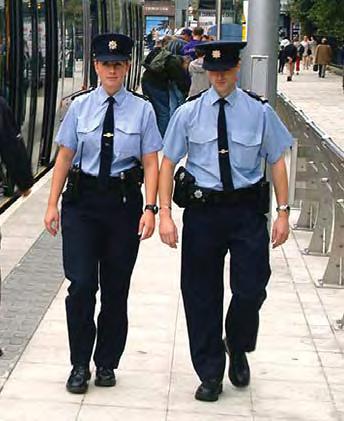
“There are 700 stations in Ireland, so to just visualize what that would be like to try and bring about any change – it is a big challenge,” she notes. “I think the important role of the Inspectorate is really to understand how their work is delivered today and help bring some of the advice towards where they want to go in the future with their police service.
“As we research, we have to look all the way around the world for best practices because it is such a smaller world today and there is no sense re-inventing the wheel.”
“When you have the opportunity to serve in a career – I was with the public service for 30 years – new opportunity knocked on the door and it was a unique opportunity that was too good to turn down. I feel privileged to have served the OPP as an organization – I loved my time there. This opportunity (working in Europe on an international level but still in policing) kind of had all the pieces of the puzzle for me.”
During its first six months of existence, the Inspectorate has gone through briefings at all levels and filed a report. Inspections slated for this year will start to create a day-to-day understanding of the workings of the Inspectorate, Boniface says.
New legislation – the Garda Síochána Act, 2005 – created the Inspectorate and ombudsman office for public complaints. The act sets out a framework for the Inspectorate for formulating operational and administrative mandates, says Boniface, noting more change is imminent from police interaction with the two new entities.
Boniface feels she gained valuable international perspective in her term as commissioner of the OPP, having worked multiple roles with the International Association of Chiefs of Police. She has always had a great interest in international policing and views her new role as very fitting from that perspective.
The adjustment to living in Dublin has been much easier than what Boniface had envisioned. She feels very welcome by everyone and has taken quite a liking to the city and the eye pleasing countryside. Her new post has allowed her to reflect back on her time with the OPP with fond memories, especially of the people.
“It amazes me looking back,” she says, noting eight years as commissioner is a long time. “You realize you have gone through 9-11, the blackout, Y2K – things that policing had never experienced before. When you watch the organization operationally adjust and change to those very new issues and work through it, you realize how proud you are. A lot of hard work was done to overcome those challenging adjustments and, for me, that was the greatest sense of accomplishment.”
In the early stages of a three-year appointment, Boniface says she will allow her role as Inspectorate to run its course before making any decisions concerning a possible return to Canadian policing.
Robert Olson
Gwen Boniface
Kathleen M. O’Toole
by Charlotte Kratchmer
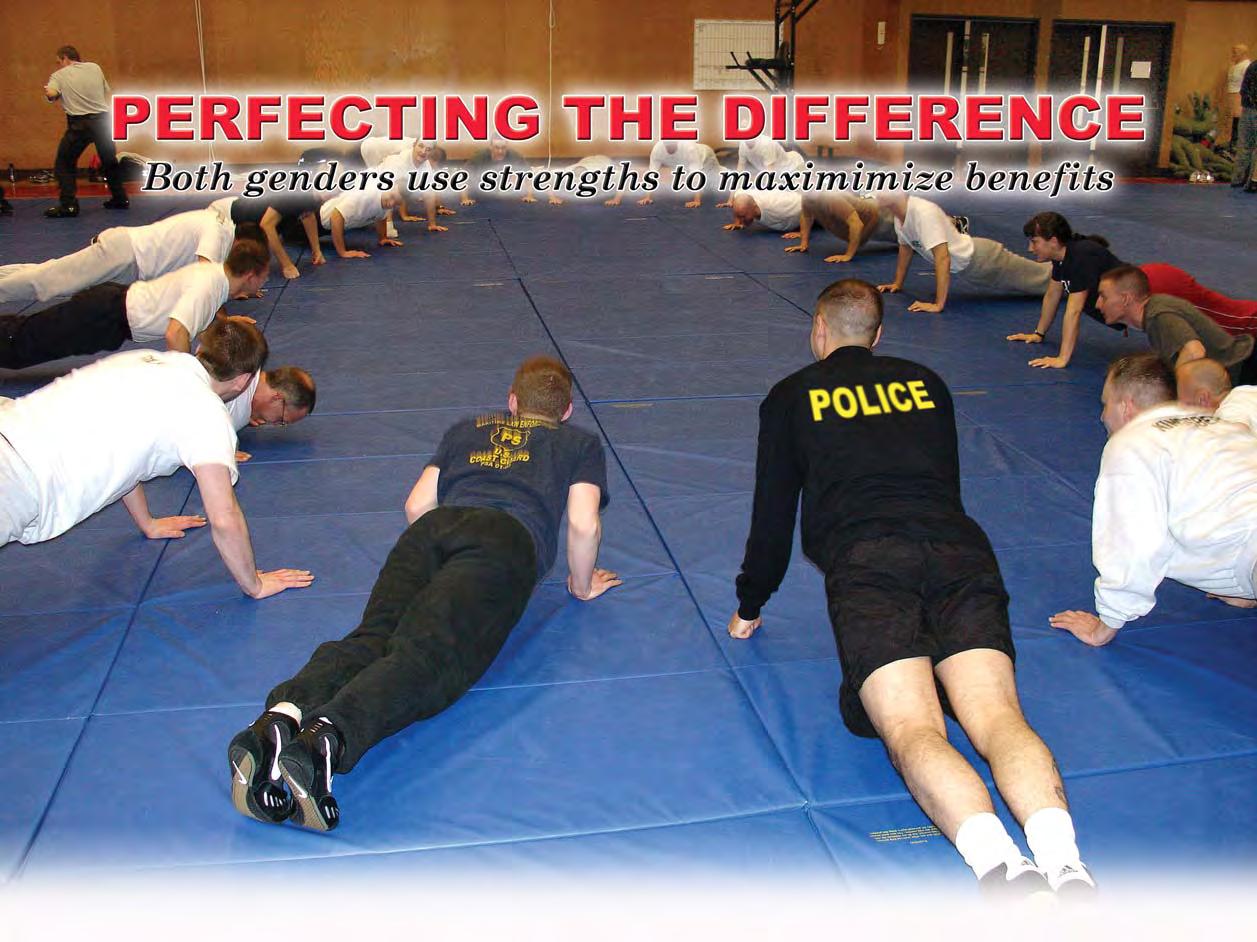
The first Atlantic Police Academy class trained using gender-separate training, which reflects the physiological differences between males and females, graduated last September.
We began in January 2000, with 13 female cadets – one left the academy due to medical issues and another didn’t qualify in firearms. The remaining 11 all passed the academic, physical, use of force and firearms components and experienced some very surprising physical growth:
The 62 male and female cadets were divided into four sub-squads, including one which was female only. It should be noted that this separation was done only at the beginning of training, after which there was total integration.
I began by asking the class for their biggest fear of being a police officer – 90
per cent said it wasn’t being able to control a physical situation. I explained how fear was a normal feeling and should not be viewed as a weakness, as it’s actually an officer’s ally. Every officer experiences it – if they tell you otherwise, I believe they are lying.
Our brain releases norepinephrine when we are fearful, which in turn causes the adrenal glands to release more adrenaline; that, in simple terms, can give us additional strength and better focus. Fear can keep us safe and increase our chances of winning when confronted with a dangerous situation.
How many officers go out on the street ashamed because they experience fear? It is what we do with these feelings that is important.
How many potential candidates never even consider law enforcement because they are afraid, judging police work by what they see on television? On police shows, someone gets shot, stabbed or taken hostage every week. I would be afraid if that was how police work truly was.
We should be able to say that fear, in and of itself, is NOT a reason to disregard law enforcement as a career.
Stress inoculation training gradually increases pressure to ensure a recruit is not placed in a high stress/fear situation without first being properly prepared. Since less than three per cent of policing requires force, let’s promote the other 97 per cent, which is challenging, exciting and a lot of fun. Doing so may not only increase our applicant pool but also diversity. Perhaps we need to take a fresh look at our recruitment process – but that is a whole article in itself.
As a group, we discussed the physiological differences between males and females. I explained that although we are not “generally” as strong as our male counterparts, we would learn how to use our strengths and abilities to their maximum benefit and the suspects’ strength and weight to our advantage.
In my initial article (Blue Line Feb., 2006) I addressed the issues of training men and women the same and how training them together often inhibits results. For example, a cadet learning a technique will normally be required to practice and perfect it with a partner. Female officers still make up a small percentile of police cadets, so it is very likely their training partner will be male and potentially twice their size and strength.
I recall from my academy days that practicing a new technique with a male was often intimidating. I barely knew it so how was I going to experience success on a male of superior size and strength? I worried so much about it not working that I really couldn’t fully concentrate or break it down to perfect it.
I also worried that the male I was working with would have to hold back so that he did not throw me half way across the gym – and I have above average strength. Training this way did nothing to develop my skill or confidence. We need to allow police officers/recruits to learn the fundamentals and any physical skill in a “positive learning environment” and prove their worth.
Stress inoculation
We do not place a recruit in a shoot/ don’t shoot scenario during the first week of training; we gradually build them up until they are confident in their physical capability and ability to communicate, make decisions and use intermediate weapons. Why should this change when we train different genders?
We first teach the skill in a comfortable learning environment and then, once they learn the fundamentals, increase the stress – putting the cadet against a larger, stronger opponent, for example. Stress inoculation training is a battle tested learning technique that no trainer would argue with.
Male and female recruits have different raw materials. As an example, we teach an advanced ground escape program at the Atlantic Police Academy. If I place a 210 pound male in the mount position (straddled over top of a female lying on the ground), I can tell you from first hand experience that this is not a good learning environment for basics.
We addressed this issue through subsquading. For the first couple months, since we don’t train control tactics each day or week, one sub-squad was female only. The vast majority had not been in a
physical sport, not to mention a physical encounter. This allowed me to give more detailed attention to the female cadets who did not necessarily understand the fundamentals of a physical confrontation.
Most of the women seemed to require more of a breakdown – to observe and be shown the benefits of using balance instead of strength to escape when on the ground, for example. Females need to use the strongest part of their body, thrusting with their hips while trapping a leg to promote the reversal. This enables them to use their force and the subject’s weight and movement to their advantage.
After breaking down the techniques and practicing them in more detail, I found the cadets could proficiently execute any of the manoeuvres they were taught. They were now confident and very anxious to train with the men, looking forward to trying out the techniques on them. Knowledge + repetition = skill and they could now use their skill, learning that even when faced with greater weight and strength, they understood the fundamentals and how to achieve the same goals as the men.
Initially we also ran gender-separate reality-based training. We used an old fire hall to do everything from communication tactics and shoot/don’t shoot scenarios to use of force decision making and force on force practicals. This allowed the women to build confidence that they were very capable of handling every type of situation. After a short period, we integrated everyone.
In my early years on the street, I struggled with knowing where my “line in the sand” was, often trying to talk my way out of situations. Sometimes I talked too long and my partner would just jump in and grab the suspect, because even he knew I talked too long. I used what I felt was my asset – my communication skills.
I have observed that, when a male is partnered with a female in use of force scenarios, he will usually be the one to initiate force and the female will follow
along with his first move. It was a great confidence builder for the women to know they are just as capable of dealing with these situations.
Since more women than men have not experienced physical situations, we need to inoculate, inoculate and then inoculate some more. It’s important that everyone knows when it is ‘go time,’ and this should not be learned on the street.
Although the women were the best communicators and mediators in our simulations, they often relied on it too much. Females partnered together for these force situations had to make their own decisions about when to use force. If they waited too long or talked too much, the scenario usually played out into a forced force situation. They soon learned the concept that force is not always used to react or defend but rather to control.
We teach our cadets to “expect failure, accept nothing but success.” For example, even before an officer decides to use their baton, they move off the line of attack/strikes, understanding that the baton may not have the desired effect. They are prepared for this and have planned their next tactic.
A cadet in the September graduating class sent us a video depicting two officers who came upon a man leaving a nightclub. A club patron advised them the male was armed and the officer immediately drew his gun and started to run after the subject, shouting out commands. The subject stopped running and went to the ground.
There were civilian cars all around the parking lot, however both officers stood in the open as the subject gave up. “I guess he wasn’t taught about cover,” the cadet noted. This statement is the crux of what we teach. Those two officers may be great shots, capable of winning an altercation if the subject decides to fire, however the odds of a win/win situation are greatly improved if they stand behind cover to give their commands.
The mind set of the subject will also be different if he sees them take cover and this alone may dissuade him from using his weapon. One-shot drops are a myth and if he does begin shooting, the chances of one of the officers being hit are significant.
This training concept was very well received by the class and will be used again at the Atlantic Police Academy.
This article is a follow-up Does size really matter?, (Blue Line Feb/2006). CharlotteKratchmer is a 15-year veteran police officer who has served with Winnipeg and Victoria. She’s currently an inspector at the Atlantic Police Academy, teaching use of force, firearms and physical training. Contact her at CMKratchmer@hollandc.pe.ca for more information.
by Kathryn Lymburner
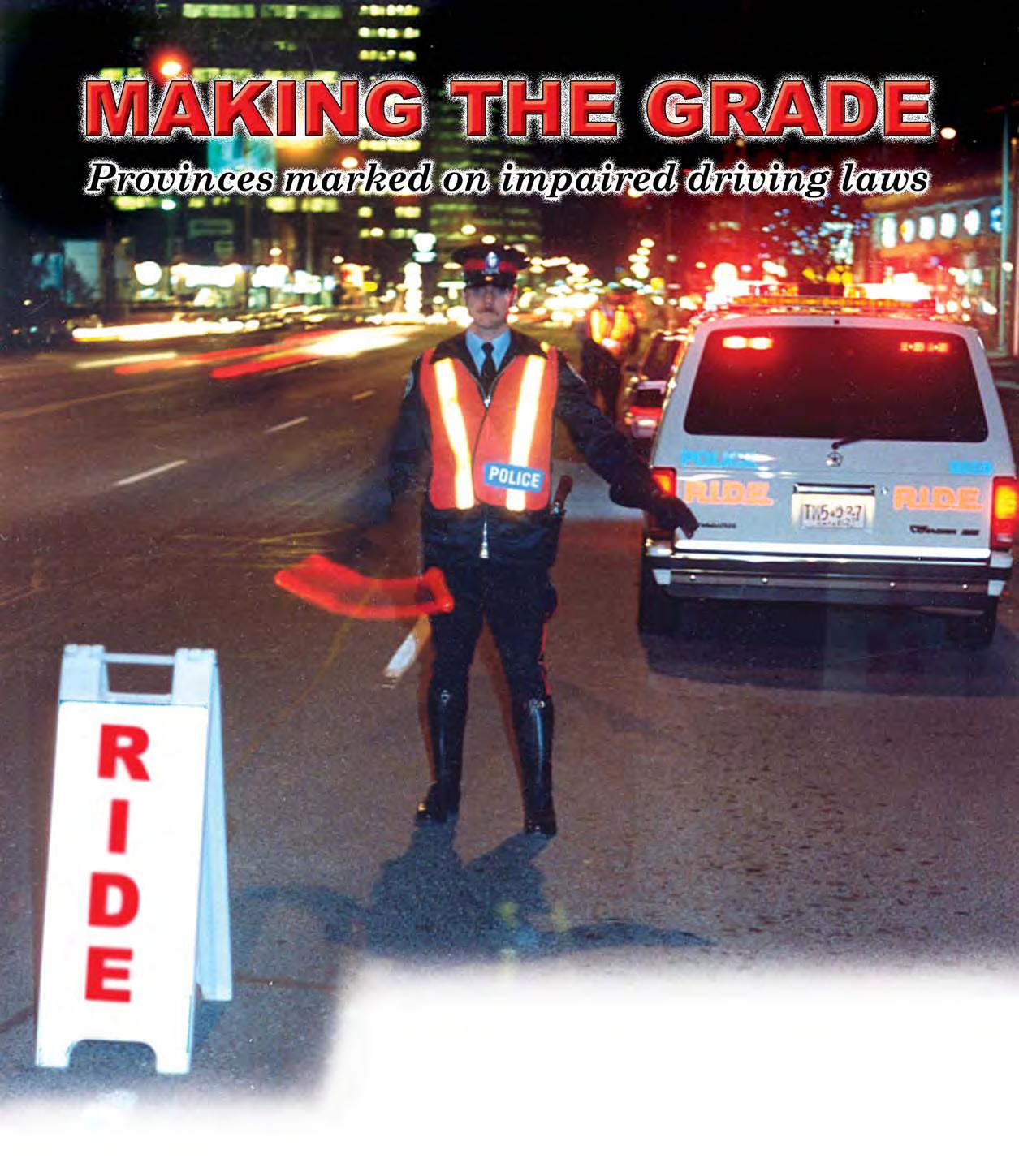
If Canada was a high school and the provinces and territories students, Manitoba would be the valedictorian. Mothers Against Drunk Driving (MADD) Canada grades drunk driving legislation every three years and put Manitoba at the head of the class again this year.
A shopping list of driver’s licensing programs, police enforcement powers, licence suspensions, revocations and remedial programs that MADD would like to see implemented are taken into account.
Two common threads run through the 2006 report card – the need for a standard field sobriety test (SFST) to detect alcohol or drugs and police authority to demand breath, blood, saliva or urine samples from suspected drivers involved in fatal or personal injury crashes.
The following are rankings (the 2003 ranking is in brackets) and descriptions excerpted from the report.
1 (1) Manitoba — AManitoba’s .00% BAC restrictions on new driv-
ers, graduated licensing enforcement, police enforcement powers, short-term administrative licence suspension and vehicle forfeiture program scored well, as did its SFST and remedial programming.
MADD didn’t like its lack of restrictions on drivers in stage two of the graduated licensing program and called for improvements in its alcohol interlock program and a 24-hour suspension for unfitness.
Manitoba police have explicit authority to stop a driver and demand licence, proof of insurance and registration cards. They can also demand an SFST; if refused, an officer can impound vehicles and suspend licenses for 90 days.
2 (2) Ontario — B
Ontario’s minimum driving age and police enforcement powers were applauded. MADD was also relatively happy with its graduated licensing enforcement and SFST but upset by a lack of restrictions on drivers in stage two of the graduated licensing program and portions of the short-term administrative licence suspension. The province needs to introduce a 24-hour suspension for unfitness, improve its alcohol interlock and remedial programs and introduce vehicle forfeiture, the association says.
Ontario police can demand any driver stop their vehicle but have no statutory power to demand documentation. The province does not give them specific authority to demand a driver submit to a SFST but can stop a vehicle under the Criminal Code to determine if there is evidence to justify demanding a breath sample. Courts have read this as allowing police to use techniques such as physical co-ordination tests to determine sobriety.
3 (6) Newfoundland and Labrador — B-
Scored well for its minimum driving age, short-term administrative licence suspension, remedial programs and vehicle impoundment program. Poor marks for its lack of police enforcement powers and restrictions on drivers in the second phase of the graduated licence program. MADD recommends the province introduce a 24-hour suspension for unfitness and vehicle forfeiture.
Newfoundland and Labrador police do not have authority to stop vehicles at random. There is no specific offence for failing to stop when requested or explicit authority to demand a driver provide documentation.
4 (7) Alberta — BScored well for its 90-day administrative licence suspension and relatively well for a graduated licensing enforcement and alcohol interlock program, poor marks were given for a low minimum driving age, lack of restrictions on drivers in stage two of graduated licensing, parts of its short-term administrative licence suspension and remedial programs. MADD says the province needs to improve its police enforcement powers and introduce a 24-hour suspension for unfitness and vehicle forfeiture.
Alberta police are authorized to demand a driver stop their vehicle and produce their licence, registration and financial responsibility card. They can also request information. Alberta legislation does not allow for 24 hours licence suspension for unfit drivers impaired by drinking or drugs.
5 (4) Saskatchewan — BSaskatchewan scored well on its 90day administrative licence suspension and relatively well on its SFST and short-term administrative licence suspension. MADD gave its police enforcement powers poor marks and says it needs to introduce a 24-hour suspension for unfitness, strengthen vehicle im-
poundment and remedial programs and introduce a vehicle forfeiture program.
The province’s police can demand drivers stop their vehicles but have no statutory authority to obtain documentation. They can request an SFST if there are reasonable grounds to suspect a driver’s BAC exceeds .04%, a new driver has consumed any alcohol or if a driver is impaired by drugs. If a test is failed or refused, a driver’s license is suspended for 24 hours.
6 (12) Northwest Territories — B-
Scored well for its graduated licensing program, police enforcement powers, 24-hour licence suspension for unfitness and 90-day administrative licence suspension. Its shortterm administrative licence suspen-
sion and alcohol interlock program were given poor marks and MADD recommends it improve vehicle impoundment and remedial programs and introduce vehicle forfeiture.
NWT police have explicit authority to demand a driver stop to determine if they and their vehicle complies with territorial law. Officers are also authorized to demand licence, insurances and vehicle registration permits.
7 (6) Yukon — C+
Scored well for its vehicle impoundment and alcohol interlock program but poorly for its lack of police enforcement powers, portions of its short-term administrative licence suspension and licence abstract and remedial programs. MADD recommends the
Yukon introduce a 24-hour unfitness suspension and vehicle forfeitures.
Yukon police have no statutory authority to demand a driver stop their vehicle or provide documentation.
8 (8) British Columbia — C+
Scored well for its minimum driving age and police authority to stop vehicles and demand documentation and relatively well for its graduated licensing program and .00% BAC restrictions on new drivers. Poor marks for its alcohol interlock program and portions of its short-term administrative licence suspension.
MADD highlighted the necessity for a 24hour unfitness suspension, strengthened 90-day administrative licence suspension program, expansion of the vehicle impoundment program and the need for vehicle forfeiture.
BC police have the legislated authority to demand a driver stop and produce their licence, ownership and insurance.
9 (4) Quebec — C
Good marks for its minimum driving age, police enforcement powers, SFST and alcohol interlock program. Its remedial driving program also fared relatively well but the province’s stage two restrictions for graduated licensing and vehicle impoundment program received poor marks. MADD would like Quebec to create a 90-day administrative licence suspension, short-term administrative
licence suspension, 24-hour suspension for unfitness and vehicle forfeiture.
Police in the province have explicit statutory authority to demand drivers stop and produce their licence and can require a physical co-ordination test if they believe a driver has been drinking to determine if a breath sample is warranted.
10 (9) Prince Edward Island — D+
The province’s 90-day administrative licence suspension was rated highly and its vehicle impoundment program did relatively well. PEI needs to improve its graduated licensing program and portions of its short-term administrative licence suspension and alcohol interlock programs, MADD says. It also recommends a 24-hour suspension for unfitness be introduced, remedial programs strengthened and the vehicle forfeiture be introduced.
Police in PEI have the statutory authority to stop vehicles and request licence and registration.
11
(4) Nova Scotia — D+
MADD approved of the province’s minimum driving age but criticized police enforcement powers and its graduated licensing and alcohol interlock/vehicle impoundment programs. It calls on the government to introduce a 24-hour suspension for unfitness and vehicle forfeiture and improve short-term administrative licence suspension.
Police in the province do not have the authority to demand a driver stop or produce documentation.
12
(10) New Brunswick — D
MADD approved of the province’s minimum driving age but not its lack of graduated licensing program restrictions, police enforcement powers, short-term administrative licence suspension and vehicle impoundment and remedial programs. The association called for a 90-day administrative licence suspension, 24-hour suspension for unfitness and vehicle forfeiture.
New Brunswick police do not have explicit authority to stop vehicles at random or demand documentation but can stop drivers for a “spot inspection” of their vehicles.
13
(13) Nunavut — F
Scored well for its police enforcement powers and for being one of two Canadian jurisdictions with a 24-hour license suspension for unfitness to drive. Poor scores were given for its short-term administrative licence suspension and graduated licensing and remedial programs. MADD recommends the territory introduce a 90-day administrative licence suspension and alcohol interlock, vehicle impoundment and forfeiture programs.
Territory police have the authority to demand stops to determine whether the driver or their vehicle complies with territorial law but no explicit statutory authority to demand documents.
After 33 years, Winnipeg police Chief JackEwatski has decided to retire early. His effective retirement date will be Sept. 15, and will allow him to fulfil his two-year term as president of the Canadian Chiefs of Police.
Ontario’s new Fire Marshal, PatrickBurke, has a reputation for helping police tear down marijuana grow operations with his aggressive approach to fire prevention. As fire chief in the city of Niagara Falls, some $1.5 million in fines under the Fire Prevention and Protection Act were levied.
Public Safety Minister StockwellDay announced that the government will not continue a program that offered tattoos to prisoners. The $700,000 project was aimed at reducing the spread of AIDS and hepatitis C by providing safe tattooing using clean needles.
BeverleyBusson has been named interim commissioner of the RCMP, replacing former boss Giuliano Zaccardelli who resigned amid controversy. Busson, who is a deputy commissioner with the force, was appointed by Prime Minister StephenHarper Busson was born in Halifax and joined the Mounties in 1974. She spent most of her career in the West, especially B.C., and became deputy commissioner for the Pacific region in 2001.
Safety and Correctional Services Minister Monte Kwinter announced that the OPP’s forensic identification unit is to be modernized as part of a $50 million investment in new facilities for frontline police officers. The new Orillia-based unit will increase the ability of the OPP to meet the demands of modern forensic investigations. The new facility will bring existing forensic units in Orillia, Barrie and Bolton under one roof and is expected to be up and running by spring 2008.
Fredericton’s police chief and the New Brunswick Association of Chiefs of Police VP, BarryMacKnight, wants to use lie-detector technology as part of his department’s hiring procedures. The association wants an exemption to the provincial Employment Standards Act which prohibits employers from using lie detectors to test the honesty of potential employees.
Halifax Regional Police Chief FrankBeazley says he’s going to make life difficult for anyone involved in the region’s illegal drug trade. A key component of the strategy will be continuing Operation Breach, which checks on violent criminals released from jail on parole or court-ordered conditions, and more officers to Halifax and Dartmouth beats.
by Ruben Sorge
Non-returnable warrants
Canadian police agencies must provide their officers with clear policy and procedure on arresting individuals wanted on warrants from other jurisdictions. Currently, officers often do not to use their powers of arrest bestowed on them by Section 503(3) of the Criminal Code of Canada (CCC).
Police agencies must also work co-operatively to ensure that serious offenders are transported. It is unacceptable to refuse this based solely on cost considerations or other expediencies. In so far as we fail in this effort, the offender benefits while the public is left unprotected and exposed to continued victimization.
The Vancouver Police Department (VPD) has attempted to address the problems posed by ‘non-returnable’ warrants over the past 25 years, but has been unable to come up with a practical, effective process.
In general, non-returnable warrants describes a situation where officers discover an outstanding warrant for an individual, issued by an outside jurisdiction, on CPIC. Since it’s not apparently executable in their area, they
let the individual go.
All police officers in Canada face this problem; it is not restricted to one particular city.
Many people have outstanding warrants for their arrest in another jurisdiction. Some are for very minor offences but many are more serious. Regardless, the person is invariably let go, leaving the officer frustrated, the offender happy and the public with no idea that such a practice occurs.
Background
The VPD Planning & Research Section conducted an exploratory study in early 2005 to determine how often the department’s officers encounter subjects for whom non-returnable warrants have been issued. Among its findings:
•The VPD made 2,183 contacts with 726 such individuals; 633 (87 per cent) were encountered by officers between one and five times and 93 had six or more contacts with police;
•Data were collected on 1,569 warrants in this study. Approximately half (48 per cent) of the warrants were issued by Alberta and 29 per cent by Ontario;
•Most of the warrants were issued by (1) Edmonton (24 per cent), (2) Calgary (16 per cent), (3) Winnipeg (10 per cent) and (4) Toronto (10 per cent);
•While all of the Alberta warrants were province-wide, 98.7 per cent of Ontario’s were restricted to a specific city or jurisdiction by way of CPIC remarks;
•On average, each warrant contained four charges;
Ross Bennett - ‘The last of the old-time judges’
(Dec 5, 2006)
HAMILTON (CP) - Ross Taylor Bennett, who became a local magistrate in 1966 and presided in Hamilton’s provincial courts for three decades, is remembered as “the last of the old-time judges.”
Bennett also had a long and distinguished career in the Royal Canadian Navy. Commodore Bennett was a former base commander of CFB Hamilton and senior officer of Canada’s 16 naval reserve units.
He was invested in 1977 as Commander of the Order of Military Merit by GovernorGeneral Jules Leger.
Bennett died November 28 at the age of 78. A private funeral was held and a memorial service was held at HMCS Star.
Judge Ross (Buck) Bennett had a droll sense of humour and got along famously with courthouse staff, but was a stern figure on the bench. His reputation for toughness inspired dread in the criminals brought before his court.
“We always said he would make somebody walk the plank one day. He ran his courtroom like a military court,” recalled veteran CHML radio reporter Bill Sturrup.
Bennett was known as the last judge in Canada to order a penal flogging of a convicted person. On May 15, 1972, he sentenced a 16-year-old youth, who robbed and clubbed a 95-year-old homeowner with a two-by-four, to 10 lashes of the whip. On hearing his punishment, the teenager leaped
from the prisoner’s box and made a desperate dash for the door. Sobbing and yelling obscenities, he struggled violently with police officers who tackled him to the floor. After being restrained, the teen was returned to face the rest of his sentence, which totalled five and a half years in prison.
Lawyer Tom Bordonaro said he will never forget the bedlam in the old provincial courtroom in Effort Square when his client bolted for the door. “I looked around and couldn’t believe what was happening. I was stunned. I immediately appealed the sentence to the court of appeal. At the same time, the issue (of corporal punishment) was being debated in Parliament. The story hit national headlines in the newspapers.”
Bordonaro’s client never did get 10 strokes of the whip. By the time his case reached the Ontario Court of Appeal, the House of Commons passed legislation banning penal flogging in Canada.
Lois Bennett said she believes her husband suspected the youth would not end up being whipped but that his sentence would nonetheless have the desired effect.
The couple was married 52 years and raised four children in Hamilton. Lois said her husband rarely missed dinner with his family despite the demands of being a full-time judge and commander of HMCS Star.
His family often travelled with Bennett in the mid-1970s when he was senior naval reserve adviser to the Chief of the Defence Staff.
•Ten per cent of the 1,569 warrants considered in the study were drug related, 23 per cent involved violence or weapons offences and more than 48 per cent various property related charges;
•There were 167 warrants for violent offences, including 49 (30 per cent) for serious violent crimes, including attempted murder (one), sexual assaults (three), robberies (17) and various serious assaults (28);
•In addition to having outstanding non-returnable warrants, 317 subjects (43.7 per cent) generated fresh criminal charges;
•Approximately 19 per cent (139) of the subjects were identified as chronic offenders; 69.1 per cent of these had active outstanding charges and 45 per cent two or more such charges. In contrast, only 38 per cent of nonchronic offenders had active charges. This suggests that chronic offenders are 84 per cent more likely to be engaging in active criminality while being wanted on non-returnable warrants;
•While only 11 per cent of this population had no previous criminal convictions, 89 per cent had at least one. In fact, 55 per cent (398) had eleven or more previous criminal convictions.
This information demonstrates that many of these offenders have significant criminal histories while continuing as active criminals in Vancouver. It stands to reason that this situation is likely found in every other major urban centre in Canada. To maximize public safety, minimize crime and bring offenders before the court, police officers must be empowered to arrest and return offenders wanted on non-returnable warrants.
Policy analysis
Police officers presently have the authority to arrest virtually all persons in our study sample, since the majority of warrants were issued for indictable offences. Officers can arrest a person wanted by another province when the warrant relates to an indictable offence under authority of s495(1)(a) and pursuant to s503(3) CCC. It’s important to note that indictable offences include all hybrid offences, at least for all preliminary purposes, including arrest (see R. v. Connors, 1998, BCCA).
Unfortunately, police do not exercise this authority. The reasons given by the jurisdictions contacted for the study include:
•Most officers believe that they do not have the authority to arrest such individuals;
•The administrative note entered on CPIC by the originating agency advises that the warrant has a restricted radius (e.g., 50 km Toronto);
•CPIC entries promote the common misunderstanding among police that non-returnable warrants are just that – non-returnable. In other words, new recruits are mentored by senior officers who advise them that ‘you can’t arrest for non-returnables.’ Few, if any, arrests occur that counter this organizational norm;
•Officers consider approaching Crown in other jurisdictions to transport individuals as a futile exercise. This creates a self-fulfilling prophecy, as the jurisdiction never transports precisely because it is never asked to do so;
•Most police departments subscribe to the notion that the removal of active criminals from their jurisdiction is beneficial because it reduces crime and increases public safety;
•Conversely, many cities and police departments aren’t much interested in having criminals returned to them. Offenders who stay away potentially reduce their crime rate and justice system costs;
•Officers often believe the cost for transportation will be so high that the jurisdiction will refuse except in the most egregious circumstances.
Officers who arrest under s503(3) are required to contact the issuing jurisdiction and ask for instructions. Options include transport or another process, using s528 to endorse the warrant in the arresting officers’ jurisdiction or refusal to act and subsequent release.
It is important to note that officers are expected to use their discretion when making an arrest under s503(3); for example, minor offences involving theft or mischief are unlikely to generate an arrest, as the benefits gained by society are minimal. Practical and operationally viable arrest criteria, however, are required to give direction to police when they contact offenders with more serious outstanding warrants from other jurisdictions – for example, violent or chronic offenders.
Using these criteria, officers would be required to contact their supervisor, who would review the nature of the outstanding charges and approve a continued arrest pursuant to s503(3). The individual would be taken to jail, a JP notified and officers would have to contact the jurisdiction where the warrant was issued to seek instruction on transportation. Al-
ternatively, the arresting jurisdiction could arrange transportation.
In Vancouver, discussions with Crown, the JP’s office and the VPD jail are still required to develop a practical system to address s503(3) arrests. However, the lack of such a refined process does not diminish an officers’ existing legal authority to make such an arrest. It should be noted that arrests will: (1) have an immediate impact on the jail, (2) require follow-up investigation by officers and (3) involve working with the Crown and JP.
Transportation
An officer may assist in the process when an outside jurisdiction agrees to transport, but often it will refuse to do so. This leaves no choice but to release the offender, but the officer must make note of his/her efforts.
To avoid continuously re-arresting offenders in what might be construed by the courts as ‘bad faith,’ police agencies should develop an arrest policy and procedure specific to nonreturnable warrants. This would assist officers after a jurisdiction declines, directing them to note in their report the person who made the decision and ensuring that records reflect the refusal.
A more refined and consolidated process is required, including an information campaign aimed at reminding police and Crown agencies across Canada about s503(3) and 528 Also, efforts should be made to ensure that CPIC comments related to a warrant’s radius are restricted to either Canada-wide or Province-wide, in keeping with s703
‘No’ an easy form of banishment
All jurisdictions will, at times, refuse to transport. Perhaps there is no likelihood of conviction, it’s not in the public interest, there is little budget for doing so or the jurisdiction uses arrest warrants as a method of informal banishment. If the warrant remains active, it might discourage the offender from returning.
In Askov (1990) and Morin (1992), the Supreme Court of Canada held that the Crown must proceed with a charge in a timely fashion. Within this context, a jurisdiction’s refusal to transport may significantly impact the viability of the charge in the future. When officers begin to arrest offenders on outside jurisdiction warrants and jail them, it will take some time to get instruction and the offender serves ‘dead’ time while waiting.
If the offender is released, any subsequent arrest on the outstanding charge will likely run into jeopardy. Defence counsel is likely to argue that police and the Crown had a chance to proceed with the charge but did not and that the offender already served time on the matter. This could result in the collapse of the charge(s), especially if the primary reason for the refusal was cost.
Limited radius arrest warrants
Officers often encounter offenders who have an arrest warrant that is limited to, for example, within 50 km of the issuing jurisdiction. These are problematic. They exist only as a remark in CPIC and are not based in law, therefore they do not appear to be of legal force or effect.
Despite the remark, examination revealed the actual warrants are province-wide, which means police are directed to arrest the person anywhere in the province. This has led to confusion and resulted in police not arresting offenders even when they have a duty to do so. One solution would be to remove these types of ‘extra-legal’ CPIC remarks. All warrant records should be in keeping with the arrest radius stated on the actual warrant – no more and no less. Police agencies should not have the ability to independently alter a warrant’s radius.
The CPIC system is a vital tool to all police and the veracity of its information is carefully and diligently protected. Deficiencies require immediate correction. Failure to address this problem leaves officers in a position where they are in breach of their duties solely because of inaccurate information entered into CPIC.
Ethics and expediency clash
Picture the following circumstance: two officers encounter a person wanted on an outstanding warrant for a serious offence in their jurisdiction and arrest them. Their sergeant compliments them on their good work. Of course, if they didn’t make the arrest, their sergeant would ask for an explanation.
‘It would cost too much to process the charge,’ the officers might say – or perhaps ‘the Crown would never proceed’ or ‘the person said they were moving to another part of the city and would not come back to this area.’ None of these reasons would be adequate. Po-
lice have a duty to protect the public and apprehend offenders.
Clearly, officers routinely arrest those wanted for serious offences in their own jurisdiction – the public would be outraged if they did not – so how can they ethically release these same types of offenders only because they’re wanted somewhere else? Once officers clearly understand their authority to arrest in these circumstances they are ethically compelled to consider doing so.
Policy initiatives and directions
The following initiatives may resolve the public safety issues related to so-called ‘nonreturnable’ warrants:
•Train officers on their arrest authority under s503(3) and the duties and procedures expected of them;
•Identify the most effective way to advise other jurisdictions of individuals who should be returned;
•Clarify the role of the JP with respect to s528 and how it interacts with s503;
•Clarify alternative processes that may be available to officers;
•In partnership with Crown, JP’s office and the jail, develop a process to expedite an officers’ investigation and the outside jurisdiction’s decision-making on these warrants.
A national standard should be agreed upon that:
•Eliminates limited radius warrants and makes all warrants either province or Canada wide, in keeping with s703;
•Develops a process by which jurisdictions
can effectively contact each other to seek instructions concerning the transportation of offenders;
•Specifies the types of offences subject to this transportation process;
•States that warrants not acted upon are extinguished and removed from CPIC;
•Develops a joint process which makes the federal government responsible for national transportation and each province responsible for transport within its boundaries;
•Develops partnerships (police boards, Crowns and municipal government) to further assist in coming up with practical solutions to this issue;
•Develops, after a detailed analysis, a comprehensive report outlining the scope, costs and benefits of implementing a national transportation system.
This article should act as a starting point to focus attention on a long-standing national issue that remains largely out of sight and needs to be discussed. Police agencies do not have clear policy or procedure for officers and there is no viable transportation network to transport offenders in an efficient and cost effective manner.
Any resolution to this issue will require the support and assistance of all levels of governments and the entire justice system. Working together, we can develop a practical and effective solution that will increase the safety of the public whom we serve.
RubenSorge is an A/Inspector with the Vancouver Police Department and can be reached at ruben.sorge@vpd.ca
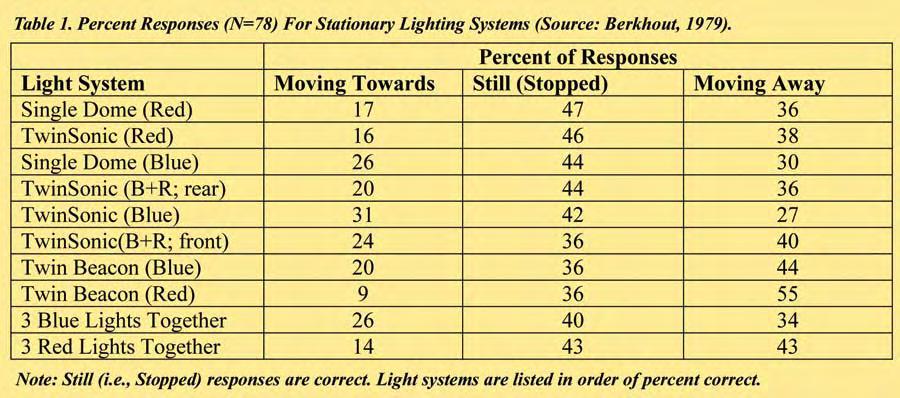
27 per cent erroneous responses of the ‘moving away or receding’ variety, respectively. On the other hand, the TwinSonic blue lighting, single dome blue and three blue lights together created the strongest illusion of movement towards the observers (31, 26 and 26 per cent erroneous responses, respectively). The table shows almost the same percentages of “toward” and “away” judgments for many lighting configurations, which might be interpreted as confusion and chance guessing.
Overall, the results do not show as strong a set of evidence for a ‘blue advancing’ phenomenon. Both ‘red receding’ and ‘blue advancing’ phenomena are subject to substantial individual differences. Direction of motion perception is quite poor in the conditions of this study, regardless of lighting systems and direction of motion.
There is some cause for concern that red lighting, under certain nighttime conditions, would be perceived as a vehicle in motion away from the observer, but this is not uniform, nor are blue lights immune from such misperceptions.
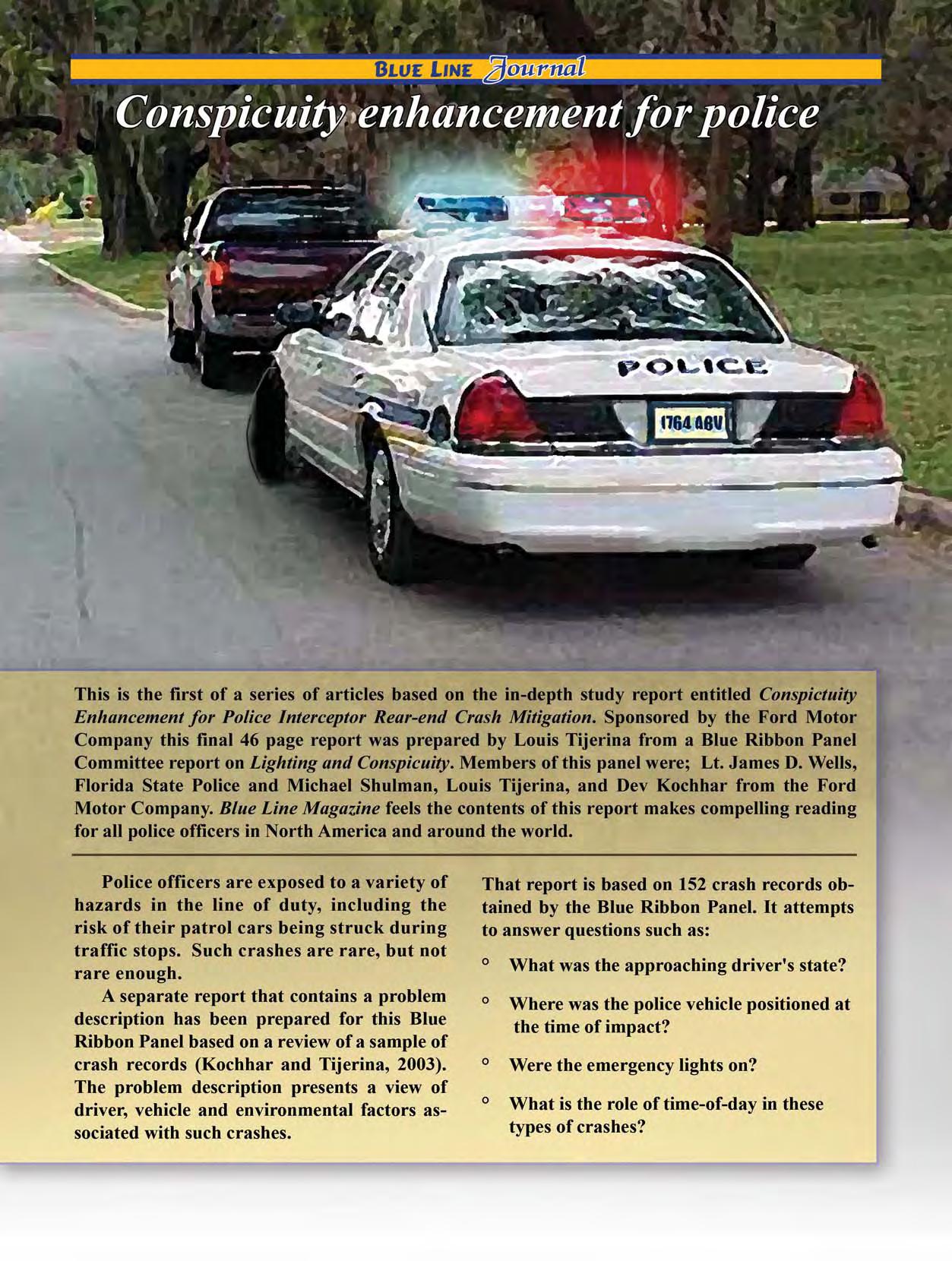
Taken together, these studies have several implications. First, red-only, alternating sideby-side lighting is a poor choice for night-time warnings of a stopped emergency vehicle. Redreceding illusory motion for a parked vehicle is of particular concern for safety.
Second, blue-only lighting will be more conspicuous (due to human visual sensitivity at night) than red lighting at night, though the
reverse holds for daylight conditions.
Third, blue lighting sometimes leads to the impression a stopped vehicle is advancing toward the stationary observer, but can also be associated with an illusion of receding. Thus, blue is also not a good cue for motion (or lack thereof).
Combining the two lights into a lighting system has some advantages. Bicolour (red and blue) lighting has been successful in reducing rear-end collisions with stationary vehicles (Pudinski, 1974). However, the perceived intensity differences have made it difficult for observers to see them as equidistant. Headlight glare also washes out blue lighting more than red and this too led to a perception that the lights were located at different distances.
To help prevent rear-end collisions with stopped emergency vehicles under night conditions and to accommodate visual sensitivity under day light and night conditions, bicolour lighting is recommended – but don’t expect that, by itself, this lighting will provide good cues to motion.
Some mention of the ‘meaning’ of different colours is in order. In American culture, red means danger or caution. In a driving context, motorists said it meant stop, stopping or prepare to stop (Texas Department of Transportation Survey, Ullman and Lewis). Depending on jurisdiction, blue may indicate ‘emergency vehicle’ while amber typically indicates ‘yield’ or ‘prepare to yield’ (Smith) Smith suggests that amber lights be sequenced to generate an arrow, directing traffic in a specific direction. Red beacons might be confused with tail lights, (Wells, 1999) points out.
A lighting system’s conspicuity will depend, at least in part, on the colour contrast between the lighting and its surround or background. A setting sun with deep reds will tend to make red lighting less noticeable. Bright sunlight and strobe lights have similar colour temperatures, suggesting that strobe lighting might blend with the daylight and therefore appear dim in bright daylight. Also, the colour effects reported by Berkhout may not hold for lighting with less saturation or purity and might be more pronounced with lighting of greater saturation or purity.
Flash rates
Motion is an especially effective visual stimulus. Central vision is of a small area (one to two degrees of visual angle), very high-resolution and (normally) full colour. Peripheral vision is of progressively lower resolution or detail, with colour vision dropping to sensitivity for yellow and blue out to 40 to 50 degrees from a central fixation point, and finally to only black and white beyond about 60 degrees in the periphery.
The rods that make up the receptors in the visual periphery are many times more sensitive to blue light than red, regardless of the colour perception. The loss of colour vision and detail in peripheral vision is made up for by greater sensitivity to movement, including flashing or blinking. This suggests that, for maximum impact, high-intensity flashing lights will capture attention even if the light source
is off-axis from the driver’s line of sight.
One concern that has been voiced about flashing lights is that they may induce nausea or epilepsy in some observers – ‘photic driving’ (Schiffman). The phenomenon is used as a routine laboratory procedure to induce epilepsy in certain individuals, generally in the six to 40 Hz range, faster than typical emergency vehicle devices. Two physicians (De Lorenzo and Eilers, 1991) report that there are no data to support a seizure risk with strobe light in emergency vehicle applications.
Rotating lights have several advantages over flashing lights (Smith). Rotating rather than turning a light on and off achieves the attention-getting effect of flashing but also continuous light output in all directions. This allows drivers from all sides to see the stopped vehicle. The continuous light output also reflects off of the ground and other objects to increase conspicuity.
Solomon (1999) considers a slowly rotating beacon a common sense approach to using warning lights. He generally advocates that emergency vehicles be equipped with fewer lights that flash less rapidly (no flash rate recommendation provided) and brightly, conveying a minimum number of messages.
ICE Ergonomics (2002) recently provided some guidance on flash rates, based on both laboratory and field work. The primary method used involved ratings, so the data should be interpreted with caution. Ratings of conspicuity and actual detection performance are not necessarily the same thing.
The report indicates that strobe (flash) warning beacons convey greater urgency but rotating beacons were considered less annoying and minimized effects of disability glare (at night). High flash rates of four Hz (240 flashes per minute) are better at conveying urgency (day or night). Low flash rates of one Hz (60 flashes per minute) minimize discom-
fort glare (day or night), disability glare (night) and perceived annoyance (day and night).
More than one beacon flashed simultaneously were detected significantly more quickly than those flashing alternately. Multiple beacons were rated as more attentiongetting than a single beacon, with four rated higher than one but less than eight. The report concludes with a recommendation for road trials.
In summary, the flash rates used in emergency vehicle beacons are generally not in the range of concern for inducing epilepsy. More flashes per minute generally imply higher conspicuity, but this is also associated with higher glare and annoyance. Multiple beacons get more attention but at the cost of annoyance. It is unclear how ratings of conspicuity relate to actual driver detection and response performance.
Luminaire types: The Code 3 data indicates there is no basis to prefer one type of lighting to another but Smith points out that strobe lighting can be less effectively bright than halogen lamps, halogen colour temperature is more compatible with coloured lenses and strobe lighting’s colour temperature can blend in with daylight, reducing conspicuity. Beyond this, strobe lighting can create a stopaction effect that creates ambiguity about a vehicle’s motion or lack of motion, among other illusions.
LEDs offer great versatility, long life, high light output and low maintenance, but they tend to be highly directional. This latter feature should be of no concern for vehicles approaching a stopped emergency vehicle from a distant, straight approach or for rotating beacons. On the other hand, they may be less conspicuous when viewed at an angle.
Next month: Vehicle colour/markings and conspicuity
You might think the dozens of cops would have been deterrent enough.
But officers in Chesterfield To w n s h i p , Michigan, report that didn’t stop a guy from trying to pass a phony cheque at a Wal-Mart.
The store was hosting the annual “Shop with a Cop” charity event.
There were 40 marked squad cars in the parking lot and 80 officers in the store.
But authorities say despite all the law, Calvin Fluckes still tried to buy nearly $850 worth of stuff with a poor photocopy of a cheque.
Over the holdiay season, the Salvation Army turned to parolees to mind their donation kettles in the Indianapolis area.
A judge had to approve the program, which uses a non-violent offenders finishing up their community service sentences.
But the Salvation Army didn’t take any chances, the donation kettles was chained and locked.
Supporters say, when the parolees rang their bells and said “Merry Christmas,” they gave something back to the community.
A breathless bandit just couldn’t get anything right during a robbery attempt at an Edmonton convenience store.
Officers say a man armed with an aluminum baseball bat entered the store and demanded cash. But before the female clerk could open the till, the impatient crook hit it with his bat and rendered the machine inoperable.
The hapless thief went behind the counter to try to open the cash register and the clerk bolted from the store. That’s when four people helped bar the door, locking the would-be robber inside.
He eventually climbed into the drop ceiling to get away - only to fall to the floor. The attempted escape stirred up a lot of dust, which aggravated his asthma and left him short of breath.
That’s when police arrested him and took him to hospital for treatment.
Who are you going to call when you buy bad crack?
Authorities say Eloise Reaves complained to a sheriff’s deputy after getting a bad rock.
Reaves was busted after she approached a Putnam County, North Carolina, deputy at a convenience store.
Reaves said instead of crack, the rock she bought was a mixture of wax and cocaine.
A local newspaper reports the woman even put the bad crack on the deputy’s patrol car for inspection.
Reaves is now charged with possession of
cocaine and is free on $1,500 bond.
***
An 81-year-old Vancouver woman who fought back against a purse snatcher was instrumental in nailing the crook.
The woman suffered serious injuries when her leg was run over by the assailant’s vehicle, but she still managed to scratch the man’s face before he got away.
The DNA found under her fingernails led police to a suspect.
Satinderpaur Singh Bagry, 28, of Vancouver is charged with robbery and aggravated assault.
***
The Canadian Forces has learned you can’t charge someone you can’t name.
A Federal Court judge rejected a request by the military to proceed with a court martial against a member of an elite commando unit.
The officer, part of Canada’s elite Joint Task Force 2, is alleged to have committed ‘serious offences,’ including the assault and ill treatment of a subordinate.
Anything to do with those assigned to the JTF2 unit is classified as secret or confidential information, meaning a member’s name, service number and rank cannot be disclosed.
The ruling is based on the fact that the military court system has been unable to draw up an order for a court martial because it would involve naming the officer.
***
Someone in the Houston area likes the law.
Some Harris County deputy constables found $100 bills under the windshield wipers of their patrol cars.
At first, the constables thought it was some sort of practical joke, but the bills are real.
Constable Ron Hickman says they now figure the C-notes are from someone who was trying to do a good deed.
The $400 will be donated to a local social services group.
***
A Wisconsin sheriff offered free rides on New Year’s Eve - and not just for those in handcuffs.
Wood County Sheriff Tom Reichert decided to give party-goers a free ride home so they wouldn’t pose a risk to others on the roads.
He also gave lifts to people in rural areas which aren’t served by taxis.
A local auto dealer loaned the sheriff a minivan so he’d have more room for revelers.
***
A Wichita, Kansas man called 911 dispatch because someone stole his pot.
The victim reported he was trying to sell a pound of pot worth about eleven-hundred bucks.
The supposed buyer came into his home and pulled out a sawed-off shotgun.
Police brought in a drug-sniffing dog and found more marijuana.
Canada’s other national police force
by Kathryn Lymburner
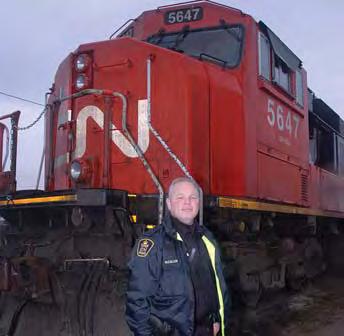
They police all across Canada, even into the United States, but only have 110 officers. They enforce speed limits and combat human smuggling but also protect corporate assets. They are armed and wear body armour but very reluctant to fire a gun in their workplace because of the serious damage a bullet could trigger.
With about 90 railway municipalities right across the country, CN Police are Canada’s second national police service. It was formed in 1923 when the Canadian National Railway Company (CNR) amalgamated with several bankrupt railways – Grand Trunk Western and Pacific, Intercontinental Railway, National Transcontinental, Canadian Northern and several other small rail lines.
Railway companies lobbied the Federal government in the 19th Century for the right to form independent police departments. Their efforts succeeded in 1860 with the passage of the Railway Act of Canada, which gave railway police similar powers of arrest and enforcement as those granted to both federal and provincial police services.
CN Police helped stem the rise of armed hold-ups and hijackings that plagued the company’s rail lines.
Officers are federally sworn under section 158 of the Canada Transportation Act and have special provincial appointments which allow for extended enforcement outside boundaries set under the act. An officer’s main duties include traffic enforcement, collision investigation, criminal investigation, crime prevention initiatives, public safety and awareness education to reduce deaths and injuries along rail lines and on rail properties.
busy railroad city with freight trains coming and going every seven minutes, was closed.
“We were gone from the community for the last 10-15 years and so we’re working hard to foster the good relationships in the community again and work with our counterparts,” says McCallum, adding that “it’s only been recently that our numbers have started to increase and we’re starting to grow as a service...
“We’re letting services know that we’re back and we want to be a team player and if there’s anything we can do to help out, then please don’t hesitate to call us.”
With the purchase of two US railways, the beat of CN officers has expanded to Detroit, Lansing, Chicago, Memphis, Jackson and New Orleans.
The service works hard to train and educate local law enforcement about the railroads in their jurisdiction.
He quips, “I mean, you wouldn’t start shooting in a rail yard, that’s for sure.”
The service works closely with a variety of agencies, both local and international, he says, and has adopted Customer Oriented Policing (COP), which aims to ensure the railroad runs smoothly without theft, vandalism or other service interruptions. The program allows officers to concentrate on promoting public safety, crime prevention, enforcement, investigation and asset protection.
It also recognizes the importance of developing excellent working relationships with jurisdictional police services, employees and the community.
“In this post-9/11 world we’re living in, where security and safety is very important, we’ve had to put a lot more emphasis on sharing information with US Customs and Border Protection and the CBSA at different border points and on inspecting cargo to fight smuggling,” notes McCallum.
Most recently, CN Police in London worked on a RIDE program with the London Police Service to increase motorist awareness about rail crossings in the area.
When an investigation needs to be conducted, officers work in conjunction with local police in a parallel investigation.
“Usually what will happen is that a coroner will appoint a coroner’s constable from a municipal force and we allow jurisdiction to go to the municipal force,” he explains. “CN will do everything in relation to the railway and (the local police will) do everything in relation to the municipality; it works hand in hand.”
The service’s large patrol area and small numbers presents challenges – McCallum is the force’s entire detachment in London, for example – but he loves the diversity in roles that come with the job.
“It’s great in the sense that we get the best of both worlds, not only with our federal powers and law enforcement duties, but also with the corporate side of the house in protecting the company and its assets,” says Scott McCallum, a CN Police officer in London.
McCallum loves his job. “We’re just like regular cops; we do everything – make arrests, issue tickets and we have all the bells and whistles, so we don’t lack for anything in terms of equipment and kit.”
CN was privatized in 1995 and the number of officers was greatly reduced. As a private company, it became entitled to the services of provincial and municipal police services so the demand for its own officers decreased.
“During this reorganization, a lot of guys chose to retire or pursue other avenues,” says McCallum. The service’s office in London, a
“Railway policing is such a specialized field,” says McCallum, “so we go as far as to go out and train other police departments in how to approach a train, how to board one and how to come into a rail yard and identify the many dangerous commodities.”
“I get to experience the perks of wearing every hat, from the detachment commander to the media relations officer. I get out to the community events, the schools, and I get to do something a little different every day, which is great!...
“Every day is a different day,” he reflects, “and it’s fun with this kind of policing because it is very specialized.”
***
This letter is in response to the article by Inspector John Mckay of the Vancouver Police Department in the October 2006 issue of Blue Line Magazine. As public health professionals we share Inspector McKay’s frustration in how slow we all as a society are moving to find solutions to substance use and abuse. We also agree that support from the Vancouver Police Department is a key component, but one perhaps not sufficiently acknowledged, to the early successes we have had with the supervised injection site in DTES. However, we strongly disagree with Inspector McKay’s suggestion that there is a hidden agenda in the Four Pillars strategy.
We also feel it is important to point out one major omission in the article – the observation that the historical sweeping prohibition of some substances, as defined by the Controlled Drugs and Substances Act, is the source of many of the harms we face from substance use and abuse.
Prohibition has created a black market and has given control of these substances to organized crime and underground manufacturing. The results are concentrated and contaminated products, leading to overdose deaths and other health problems, needle sharing and accelerated spread of infectious diseases such as HIV and hepatitis, damaged houses and community disruption. The criminalization, stigmatization and discrimination of people with addictions, that is associated with prohibition, aggravate their health and social problems.
Both enforcing prohibition and operating the black market require the use of force, resulting in all too frequent violent and tragic injuries and deaths of users, dealers, innocent bystanders and police.
The police have a very difficult job to do. They work in a system that places them at great risk everyday. Your readers may be interested to know that there are law enforcement personnel who have recognized and are speaking out about the harms of prohibition. We refer those interested to the group “Law Enforcement Against Prohibition” at http://leap.cc/ There is no “Trojan horse” in the Four Pillars strategy. There is however always room
for more dialogue. In the meantime, until alternative legal regulatory mechanisms are in place to deal with drugs, harm reduction will remain essential to reducing the harms of prohibition for everyone.
James Lu, MD MHSc Chair (2006-2008), Health Officers Council of BC
I sincerely hope that I am not the only reader of this magazine to feel as equally disturbed as Mr. Goss has stated that he is. I also hope I am not the only reader who has taken the time to respond to that letter. I say I am disturbed, however not in the same way as Mr. Goss (Correspondence, Dec. 2006). I DO believe in God.
You say, Mr. Goss, that members of law enforcement act on behalf of the State and that separation of Church and State must be maintained. I agree, but that is as far as I will go to agree with you. I am not sure how you co-relate having personal faith with being a police officer. I certainly am not a 24 hour police officer. I do have a life outside of work. That life involves family and faith and I see no juxtaposition between that and separation of Church and State!
You also accuse Blue Line Magazine of being a pulpit for the Christian right. Does an occasional article on faith make a publication religious? I think not! The article you refer to was a personal insight into what drives an individual and a member of this society and I applaud her for having the fortitude to put pen to paper and stating her views. I applaud you also, Mr. Goss, for standing up for what you believe. You have the right to do so. However, doing so in the manner you did it in, leaves some question as to your limits of tolerance.
I shudder to think of what this planet would be like if people did not believe in a God or a hereafter. I would hazard a guess that total anarchy would ensue, because what would this all be for? Why would I follow the letter of the law if there wasn’t anything to achieve in the end? Why would I not steal, rape, or murder? Religion gives us hope.
Det Cst Kevin Calhoun Ontario Provincial Police
I generally read all sections of the magazine from front to back. I don’t always agree with everything written but have never responded or commented to articles or correspondence.
The Dec. 2006 issue has changed my attitude towards commenting. The piece of correspondence attributed to a Cpl. Steve Goss requires a reply. I found Goss’s letter nothing short of a threat to producers of this magazine. I could care less what his religious belief might be but I would like to know where he obtained the information and stastics to support his rant that the vast majority of police officers are atheist.
Mr. Goss must have a fairly weak stomach if an article titled Faith in God would disturb him. I would suggest that if it was so disturbing, that he should have stopped reading the article. I would also suggest that he appears to work for a God-like policing agency and this in itself must also cause him distress.
I, apparently, come from a “minority” of police officers who is not offended by a religious story and will choose, myself, to read or not read these stories. Thanks for taking the time to read this letter & hopefully I won’t be banished to Syria for my terroristlike comments.
Hugh Muir
Stellarton, Nova Scotia
***
I had an opportunity to see this article (Canada’s best dressed police vehicles) in the Jan 2007 issue. I am writing regarding a statement pertaining to the Kativik Regional Police. In the article it was stated that they serve the Innu community and that is wrong. KRPF serve the Inuit of Nunavik which is located in Northern Quebec. The Innu and Inuit are not the same people and do not share the same area. I was one of the original members of the KRPF when it was formed from the SQ Native Constable Program. I served Nunavik for seven years before departing the area. I just wanted to clarify this issue with you. Thank you
Allen Patterson
Quebec
by Robert Lunney
How did loyalty get a bad name?
Loyalty is a precious quality. It represents something vital, a concept, a way of life, and an intelligent devotion to an idea, a cause, a person, or a government.
Everyone has a desire even an instinct, to be loyal and a man or woman who has nothing to be loyal to is an unhappy person. The simplest form of loyalty may be summarized like this; Here is my appointed place; this is my group. I must work in and with it, and if need be I must fight for it.
There are many loyalties: loyalty to one’s own principles and beliefs, loyalty to family, loyalty to a group, an organization and to one’s country. Loyalty to oneself and one’s own beliefs is something we must possess before we can truly commit our loyalty to others. At the personal level it means acting always on your own principles and beliefs and being true to yourself.
At the next level, the loyalty of personal relationships is an estimable quality. It means not fading out of the picture when our friend or partner encounters problems. It includes sympathy, mutual aid and a warm appreciation of personality.
Within a group, to be loyal is to be involved, to be a participant, to belong. The commitment to be loyal confirms one’s own personal significance and extends the bond of caring and commitment beyond mere acquaintancy.
Traditional loyalty
Every member and employee has an obligation to be loyal to the service for which they work. They should be proud of the organization and feel a reflected glory when they read reports of its activities and achievements. The goodwill and loyalty of the working force is one of the essentials of a successful operation.
To attain their highest development as a human being, a person needs to think well of their work. They must be proud to be a vital part of the team. Anyone who is connected with a cause or an organization in which they have no faith, cannot do their best work and will find it difficult to give their loyalty. They should look for another connection, in fairness both to themselves and the service.
What happened?
Loyalty is also a two way street. The responsibility of those in whom loyalty is placed cannot be overemphasized. The greater the loyalty, the greater the responsibility. People and institutions must deserve loyalty; they cannot hope to win and return it unless they themselves are loyal.
This is what we used to think. I’m not entirely sure we believe it any more. And if we don’t believe every word, if we have reservations, if we promise some degree of loyalty but not unequivocal loyalty, then what happened?
There are two things that have gravely affected the quality of leader/follower and employer/employee relationships within our police services.
First, when wave after wave of financial cut backs struck Canadian policing in the 8O’s and 90’s, police services were exhorted by boards and governments to operate like business enterprises and focus on the “bottom line” of the budget sheet. Efficiency (doing things right) and economy took precedence over effectiveness (doing the right things).
Incentives were restricted, even cancelled out. In some places, police salaries were slashed and benefits reduced. The cut backs were played out in delayering, and buy-outs. People, who had been led to believe that their contribution was respected and precious, were offered money to go away. Many accepted because the offers were fair and even tempting, but they found little dignity in the process.
It became evident to people in the ranks that their leaders no longer could deliver the resources necessary to keep pace with demands. Service standards fell and promises were broken. Leadership appeared powerless and morale sagged.
After succeeding years of this experience, there was an important change in chemistry between the leaders and followers The process took its toll of organizational spirit and people began to question whether or not they could continue to offer unequivocal loyalty. Old codes of duty, honour and loyalty fell to the cool calculation of careerism and survival. It became every one for themselves.
The second factor is that this transformation of worker attitude was not unique to policing. Many people who joined organizations to follow common ideals and who were prepared at that point to commit their loyalty, found the work place changing, turning away from an environment which valued team work
to a society that placed more emphasis on individuality. The definition of success was more often defined as personal gain. Job hopping, short-term tenure and multi-trade and professional career planning gained acceptance as models for the future. When free agency came into vogue, many people decided to trade a long-term commitment for short-term opportunism. We sent loyalty into ethical exile.
In policing today, we are loyal to our partner and we are loyal to our squad. We find it hard to extend it further. Those who do are often regarded as unrealistic idealists, or at worst, derided as pandering to authority or looking for favours. We don’t like ourselves as much as we used to. We have parked our pride in the common cause, in the badge, in the uniform and we are the poorer for it.
Restoring virtue
Loyalty is not a fugitive memory. It was not lost in transition from “the old days” regardless of what the cynics claim.
Loyalty remains an urgent human need in all life situations and an essential quality in every worthy relationship between people. We must take back our organizations from the uncaring technocrats, economists and political dilettantes that would have us run policing as a business.
Policing is a noble cause, calling for a spiritual commitment to the common good, a quality that is inherent in all people of virtue. Good policing inherently seeks truth and justice and protects and values the human rights that ensure democratic government and freedom for all. This is for everybody, not just those appointed to lead. The first steps towards reaffirmation of loyalty must come from courageous, determined individuals at all levels in the organization as it always has; from people who are not slow or timid about proclaiming their beliefs.
Loyalty is demonstrated in the hundreds of daily duties that we all must do. It embraces adherence to duty, keeping promises and being faithful to ideals. It means doing a days work in a day, in telling the truth and taking care of each other. It means being proud of your organization and what it stands for, and standing up for it when necessary. It means taking the risk of commitment to ideals and leadership.
Loyalty is the life-blood of teamwork. When you do those little things and you do them consistently and well, you make the job and the organization your own again.
BobLunney is the former Chief of Police of Edmonton and Peel Regional Police. He was a former member of the RCMP and Director of Public Safety for the city of Winnipeg. He is an occassional contributor to Blue Line Magazine and the publication’s advisor on police management and leadership. He may be contact by email: lunney@blueline.ca
by Patrick Holliday
When complexity arises, the transforming leader is responsible for seeking and implementing the strategies that will optimize the efforts of the human resources people staffing the organization. Now it is time to identify those areas where problems will have a significant negative impact on an organization’s ability to reach its goals.
To focus this section, we will draw upon information obtained through the use of a paper-based human resource instrument known as the Comprehensive Personnel System (CPS) (Anderson and Zeiner, 1989). More information about the CPS can be found at http:// www.crgleader.com/everyofficer.
The CPS was originally designed in 1986 as a paperbased introductory seminar program entitled Selecting and Developing Exceptional Employees. It was field-tested between 1987 and 1991 with over 400 small- to mediumsized companies.
The program was evaluated very positively; many of the companies have implemented parts or all of the CPS in their day-to-day operations. Most of the company owners and personnel managers who attended the one- or two-day sessions either had not taken a course in personnel management or had not implemented the principles to which they were introduced in such courses. Therefore, to their satisfaction, many of the staff problems they encountered on a day-to-day basis were addressed in the seminar.
As a group, they reported that the following 15 of their most frequently encountered problems were causing them moderate to serious concern. The information that grew out of the CPS seminars is used as a starting point in the examination of personnel issues.
Since the original seminars and subsequent consulting interventions in the police, corrections, customs, immigration, and private security fields, it has been discovered that there is a commonality of personnel issues regardless of whether an organization is in the corporate, justice, health, or public service sector.
The 15 most common problems identified were the following:
1.Not hiring the right person for a job.
2.Failing to communicate clear performance expectations.
3.Fear of telling employees the truth about their performance.
4.Forgetting to reward or recognize positive performance.
5.Losing track of personnel information.
6.Failing to collect personnel information.
7.Seeing employees make the same mistakes repeatedly without coaching them.
8.Fearing legal repercussions when firing low performers.
9.Misplacing files or information in files.
10.Seeing employees not motivated to perform well.
11.Seeing employees not doing what you want them to.
12.Failing to capitalize on strengths and talents.
13.Noting that absenteeism rates are too high.
14.Believing employees can’t problem-solve on their own.
15.Believing that training takes too much time, is not cost-effective, or is almost always ineffective.
Take a moment to reflect on this list.
•Are these comments that you would have made?
•Does your organization lose information?
•Does your organization fail to capitalize on strengths and talents?
•Does your organization fail to communicate clear performance expectations?
•Is yours a “sick” organization with inordinately high absences?
If you are answering Yes, this series deserves your special attention.
Since it would not be possible here to deal with all the issues presented in the CPS seminars, the focus is on the first few critical issues:
•ensuring selection of the “right people for the right job”; and
•continuing the development and performance-management of human resources.
Or to use the analogy of Jim Collins (2001) in his leadership bestseller, Good to Great, you want to get the wrong people off the bus and the right people on the bus and in the right seats.
Selecting and Developing Exceptional Employees
Often, organizations find themselves without a key person in a given position. This may be due to a poor front-end selection process that ignored future needs, failure to identify performance-specific needs in the position, a lack of succession planning, or simply a failure to properly identify organi-
zational needs.
Usually it is not one activity (or lack of it) that results in this “weak link” in the organization. It is most often a number of interrelated events or activities.
Sometimes these events are synergistic and can cause significant problems within the organization. And these problems increase significantly where no co-ordinated human resource management activities occur. To reduce this circumstance, it is the responsibility of a leader to pursue those activities that will help the organization select and develop the human resources that will support the organizational mission.
As will be seen in the nine-step process presented in next month’s article, every person in the organization can contribute to the betterment of the human resource processes.
Twelve key activities can be done to select and develop the people critical to the performance and productivity of the organization.
1.Screen applicants more thoroughly, accurately, and efficiently.
2.Build a database of applicant and employee information.
3.Create relevant, behaviourally based interview questions and use them.
4.Assess work behavioural style of the applicant or employee.
5.Assess work behavioural style of each job.
6.Assess past work-performance history and references.
7.Match knowledge and skills of employees with jobs.
8.Contract for employee performance enhancement.
9.Conduct and record performance reviews as a positive learning experience.
10.Develop employee career plans and career path plans as an annual and ongoing process.
11.Reward and recognize employee performance and loyalty.
12.Communicate on a regular basis, using a shared language.
Pause for a moment and reflect on each of the 12 activities listed above. Reflect in terms of how your organization deals with each issue.
•Does your organization have a valid, reliable, and defensible selection process?
•Does your organization have a database of applicant and employee information (human resource information system) that meets all legislated privacy requirements?
•How does your organization assess work behaviour in terms of both behaviour required and behaviour demonstrated by applicants?
•Do you conduct and record performance reviews? If you do, how effective is the instrument and process (performance appraisal) that you use?
•How do you reward and recognize employee performance?
The level at which you conduct those activities and the quality of instruments used will determine the output in terms of quality
human resources as described in the appendix introduction.
Results You Can Expect
The importance of an effective human resource/personnel management system has been stressed. Problems have been identified; you have had an opportunity to reflect upon the competency level of your own organization.
A list of the most commonly identified problems based on the CPS was provided. This was followed by a list of the 12 key activities that can be done to select and develop human resources.
All this information supports the idea that appropriately designed and used management and information systems and subsystems, with related tools and instruments, add productivity and efficiency to an organization or company by assisting leaders to more carefully manage all aspects of the human resource function. These are the four key components of this effective system.
1.How you select, orient, place, train, and evaluate people.
2.How you organize things and people in the work environment to make the best use of people’s talents.
3.How you record and track all personnel data.
4.How you use ideas to improve performance and morale on the job.
The primary aim of personnel systems and their related human resource tools and instruments, such as the CPS, is to provide the leader with the knowledge and tools needed to lead others effectively towards increased productivity, effectiveness, and efficiency.
Because employees differ in regard to motivation, age, maturity, experience, competency, and style of approaching people and tasks, it is important to understand each employee or applicant on an individual basis.
These types of instruments (when combined with other data within an organization’s human resource information system,) will assist those in the organization who are responsible for developing human resources to get to know each applicant or employee more quickly and carefully. It provides a record of this information that can be accessed instantly, thus enabling leaders to make more effective personnel and leadership decisions.
Access Control
Accident Reconstruction
Computer - Software
Accreditation
Addiction Treatment
Alarm Devices
Security
Alcohol Detection Devices
Ammunition
Range Supplies
Ammunition Disposal
Architecture & Engineering
Police Facilities
Armoured Car Service
Asset Tracking
Associations
ATM Service
Audio/Video Aids
Training Courses & Services
Automated Finger Printing
Forensic Services
Awards, Badges, Pins
Emblems & Decals
Jewelry
Pens
Promotional Items
Batons
Weapons - Non-lethal
Bicycles & Supplies
Binoculars & Telescopes
Night Vision Equipment
Surveillance
Body Armour
Tactical Team Equipment
Bomb Disposal
Hazardous Material Handling
Hazmat Equipment
Boots, Shoes & Footwear
Footwear
General Police Supply
Breathing Apparatus
Bullet Traps
Cameras
Photography
Security - Perimeter Control
Surveillance
Video - Mobile & Surveillance
Cases, Duty Bags, Storage
General Police Supply
CCTV, Film
Surveillance
Cigars & Accessories
Clothing & Outerwear
General Police Supply
Uniforms & Accessories
Collision Reporting Centres
Communications - Base Stations
Computer - Dispatching
Communications - Consultant
Communications - Hand-Held
Communications - Mobile
Compliance Services
Computer - Accessories
Computer - Dispatching
Communications-Base Stations
CATEGORY INDEX
Computer - Forensics
Computer - Hardware
Computer - Laptops
Computer - Records Mgmt
Computer - Software
Computer - Storage Devices
Computer - Training
Conflict Resolution
Cooling Vests
Counterfeit & Detections/Fraud
Crime Scene Reconstruction
Data Collection
Data Mining, Data Recovery
Defensive Tactics Training Schools & Institutions
Defibrillators
Digital Video Cameras
Display Trailers
Distance Education
DNA Testing Services
Dog Training & Supplies
Emblems & Decals
Awards, Badges & Pins
Uniforms & Accessories
Vehicles - Accessories
EMS Software
E-Services
Evidence Notebooks
Memo Books
Evidence/Exhibit Storage
Exercise Equipment & Clothing
Eye, Ear & Skin Protection
Gloves
Hazardous Material Handling
Range Supplies
Fabric Manufacturer
Financial Planning/Insurance
Firearms - Simulation Training
Video - Training
Weapons - Non-lethal
Firearms - Training
Firearms - Training Equipment
Firearms - Training Facility
Fleet Graphics
Vehicles - Accessories
Forensic Accounting
Forensic Aids & Investigations
Investigative Support Services
Forensic Services & Equipment
Form Holders
General Police Supply
GPS & Mapping
Vehicle Tracking Equipment
Gloves
Hazardous Material Handling
General Police Supply
Graffiti Eradication
Hats & Head Protection
Hazardous Material Handling
Bomb Disposal
Eye, Ear & Skin Protection
General Police Supply
Gloves
Safety & Rescue Equipment
Hazmat Equipment
Helicopters & Equipment
Holsters & Accessories
General Police Supply
Weapons - Accessories
HR Consulting & Support
ID Holders
Inert Explosive Devices
Investigative Support Services
Forensic Aids & Investigations
Jewelry
Awards, Badges, Pins
Promotional Items
Key Control
Laser Rangefinders
Legal Services
Licence Plate Recognition
Lights - Portable
Loading & Unloading Stations
Marine Electronics
Marine - Rigid Hull Inflatables
Memo Books
Evidence Notebooks
Motorcycles & Supplies
Vehicles - Off Road
Narcotics Equipment & Drug Tests
Forensic Services & Equipment
Needs Assessment
Night Vision Equipment
Cameras
Office Equipment & Supply
Paging
Pens
Awards, Badges, Pins
Promotional Items
Photo Identification
Photo Imaging
Photography
Cameras
CCTV, Film
Forensic Services & Equipment
Video - Mobile & Surveillance
Surveillance
Promotional Items
Awards, Badges, Pins
Jewelry
Pens
Protective Services
Publishers, Books, Printing
Training Courses & Services
Radar & Speed Equipment
Range Supplies
Ammunition
General Police Supply
Real Estate, Relocation
Records Management
Recruitment & Selection
Restraining Devices
Riflescopes
Robots
Safety & Rescue Equipment
Hazardous Material Handling
Schools & Institutions
Defensive Tactics Training
Security - Consulting & Systems
Security - Identification
Security - Penal Institutions
Security - Perimeter
Photography
Surveillance
Video - Mobile & Surveillance
Security - Training
Sirens & Emergency Lighting
General Police Supply
Vehicles - Accessories
Surveillance
Binoculars & Telescopes
Cameras
CCTV, Film
Security - Perimeter
Video - Mobile & Surveillance
Switches & Control Systems
Systems Integration & Support
Tactical Team Equipment
Body Armour
General Police Supply
Telemetry Equipment
Telescoping Masts & Antenna
Thermal Imaging
Ticket Holders
Training Courses & Services
Audio/Video Aids
Publishers, Books, Printing
Trauma Scene Cleaning
Uniforms & Accessories
Clothing & Outerwear
Emblems
General Police Supply
Holsters & Accessories
Vacations
Vehicles - Accessories
Fleet Graphics
Sirens & Emergency Lighting
Vehicles - Baiting
Vehicles - Lightbars
Vehicles - Off Road
Helicopters
Motorcycles & Supplies
Vehicles - Restoration
Vehicles - Specialty
Vehicles - Tracking Equipment
GPS & Mapping
Vessels - Accessories
Video - Mobile & Surveillance
Security - Perimeter
Surveillance
Photography
Video - Training
VIP Protection
Voice Logging Systems
Weapons - Accessories
Holsters & Accessories
Weapons - Maintenance
Weapons - Non-lethal
Batons
Firearms - Simulation Training
Weapons - Security
Weapons - Training
Wireless Communications
Access Control
Ahearn & Soper Inc
Cross Match Technologies Inc
Deister Electronic Inc
Accident Reconstruction
Visual Planning Corporation
Alarm Devices
Pantel International Inc
Alcohol Detection Devices
DAVTECH Analytical Services (Canada)
Mega-Tech
Ammunition
Tetragon Dist Inc
Winchester Ammunition
WindRiver Tactical
Wolverine Supplies
Ammunition Disposal
NABCO Inc
Architecture & Engineering
Stantec Architecture Ltd
Asset Tracking
Ahearn & Soper Inc
Deister Electronic Inc
Telus
Associations
Int’l Association for Property & Evidence
Audio/Video Aids
Bock Optronics
Visual Planning Corporation
Automated Finger Printing
Cross Match Technologies Inc
Motorola
Awards, Badges, Pins
Pride in Service
Toronto Police Gift Shop
William Scully Ltd
Bicycles & Supplies
Alpine Joe Sportswear Ltd
Binoculars & Telescopes
Current Corporation
Swarovski Optik Cda - Kindermann Cda
PRODUCT LISTING
Body Armour
Armor Express
Baker Batshield
DuPont Canada
First Choice Armor & Equipment Inc
Gordon Contract
Law Enforcement Training & Supplies
Pacific Safety Products Inc
Second Chance Armor Inc
Teijin Twaron
Valley Associates Inc
Bomb Disposal
DuPont Canada
NABCO Inc
TWB Designs Inc
Boots, Shoes & Footwear
911 Supply
Gordon Contract
Law Enforcement Training & Supplies
SEALS Action Gear
SportMeds Inc
STC Footwear
Tetragon Dist Inc
Wolverine World Wide Inc
Breathing Apparatus
A J Stone Company Ltd
Bullet Traps
Savage Range Systems
Cameras
Bock Optronics
CEID Corporation
Current Corporation
Remington
Cases, Duty Bags, Storage
911 Supply
Kirkpatrick’s Ltd
Pacific Safety Products Inc
Pelican Products Inc (Canada)
Prairie Geomatics Ltd
Tactical Advantage LE Products
Visual Planning Corporation
Cigars & Accessories
Constable Cigar Company
Clothing & Outerwear
911 Supply
Alpine Joe Sportswear Ltd
Drop Zone Tactical
DuPont Canada
Gordon Contract
Integral Designs
Murray Randolph Mfg Co
Pacific Safety Products Inc
SEALS Action Gear
Tetragon Dist Inc
William Scully Ltd
Collision Reporting Centres
Accident Support Services International
CommunicationsBase Stations
Daniels Electronics Ltd
EADS Secure Networks Canada
Pantel International Inc
CommunicationsConsultant
Dataradio Inc
Dick Buss & Associates LLC
EADS Secure Networks Canada
Pantel International Inc
CommunicationsHand Held
Bell Mobility Business Solutions
Dick Buss & Associates LLC
Itronix Canada Limited
Peltor Communications
Telus
xwave
Communications - Mobile
Bell Mobility Business Solutions
Daniels Electronics Ltd
Dataradio Inc
Dick Buss & Associates LLC
EADS Secure Networks Canada
Itronix Canada Limited
Motorola
Pantel International Inc
Telus
xwave
Compliance Services
Digital Boundary Group
Computer - Accessories
Prairie Geomatics Ltd
Computer - Dispatching
Daniels Electronics Ltd
Motorola
Tiburon Inc
Versaterm
xwave
Computer - Forensics
Cross Match Technologies Inc
Digital Boundary Group
Computer - Hardware
Itronix Canada Limited
Computer - Laptops
Itronix Canada Limited
Mega-Tech
Motorola
Computer - Records / Management
Accident Support Services International
Formdocs LLC
Versaterm
Computer - Software
Accident Support Services International
Formdocs LLC
Motorola
Versaterm
Conflict Resolution
Conrad Grebel University College
Cooling Vests
First Choice Armor & Equipment Inc
Traffic Safety Management
Data Collection
Ahearn & Soper Inc
Data Mining, Data Recovery
Accident Support Services International
Digital Boundary Group
Defensive Tactics Training
Agatsu Inc
HSS International
Defibrillators
Medtronic of Canada Ltd
Philips Medical Systems
Zoll Canada
Digital Imaging
Skana Imaging Solutions
Digital Video
Decatur Electronics
Display Trailers
Decatur Electronics
Distance Education
Athabasca Uty, Ctr. for Innovative Mgmt
Canadian Police Knowledge Network
Cape Breton University
Dalhousie Uty College of Continuing Ed
Lakeland College School of Business
Mount Royal College Continuting Ed
Royal Roads University
University of Guelph College of Mgmt
University of Guelph-Humber
University of Victoria Continuing Studies
DNA Testing Services
Maxxam Analytics Inc
Dog Training & Supplies
SportMeds Inc
E-Services
Canadian Police Knowledge Network
Emblems & Decals
Artcal Graphics
Evidence Notebooks
Visual Planning Corporation
Evidence/Exhibit Storage
Int’l Association for Property & Evidence
Exercise Equipment & Clothing
Agatsu Inc
Alpine Joe Sportswear Ltd / Arista
SportMeds Inc
Eye, Ear & Skin Protection
A J Stone Company Ltd
Best Glove
Bushnell Outdoor Accessories
Cuff Cleaner Inc
Peltor Communications
SEALS Action Gear
SportMeds Inc
Fabric Manufacturer
DuPont Canada
Firearms - Simulation Training
Advanced Interactive Systems
CAPS Inc
FATS Canada
Firearms - Training
CAPS Inc
FATS Canada
PRODUCT LISTING
Firearms - Training Equipment
Colt Canada
Firearms - Training Facility
Porta Target
Fleet Graphics
Artcal Graphics
Masterack / Crown
Forensic Accounting
Seneca College - Safety & Police Studies
Forensic Services & Equipment
Cross Match Technologies Inc
Digital Boundary Group
INOVA
Molecular World Inc
Savage Range Systems
Seneca College - Safety & Police Studies
SportMeds Inc
Form Holders
Triform Business Systems
General Police Supply
911 Supply
APS Distributors Ltd
Cuff Cleaner Inc
Kirkpatrick’s Ltd
Law Enforcement Training & Supplies
M D Charlton Co Ltd
SEALS Action Gear
Tactical Advantage LE Products
Therapeutica Inc
Global Positioning Systems / Mapping
Dataradio Inc
Prairie Geomatics Ltd
Telus
xwave
911 Supply
Best Glove
Gloves
Drop Zone Tactical
Law Enforcement Training & Supplies
Superior Glove
Valley Associates Inc
William Scully Ltd
Hats & Head Protection
William Scully Ltd
Hazmat Equipment
A J Stone Company Ltd
DuPont Canada
Peltor Communications
Primex Security Systems Ltd
Science Applications Int’l Corp (SAIC)
TWB Designs Inc
Helicopters & Equipment
Bell Helicopter
Robinson Helicopter Company
Holsters & Accessories
APS Distributors Ltd
Bushnell Outdoor Accessories
Gordon Contract
SEALS Action Gear
Tactical Advantage LE Products
ID Holders
Kirkpatrick’s Ltd
Inert Explosive Devices
Jewelry
Toronto Police Gift Shop
Key Control
Deister Electronic Inc
Laser Rangefinders
Swarovski Optik - Kindermann Canada
Lights - Portable
911 Supply
Current Corporation
Golight Inc
INOVA
Pelican Products Inc (Canada)
Traffic Safety Management
Marine - Rigid Hull
Inflatable Boats
Zodiac Hurricane Technologies Inc
Marine Electronics
Infrared Technologies Canada
Memo Books
Motorcycles & Supplies
Deeley Harley-Davidson Canada
Federal Signal Corporation
Prairie Geomatics Ltd
Narcotics Equipment
Drug Tests
DAVTECH Analytical Services (Canada)
Integrated OH&S
Night Vision Equipment
Adventure Lights Inc
Bock Optronics
Current Corporation
Golight Inc
Infrared Technologies Canada
Leupold & Stevens Inc
Remington
Swarovski Optik - Kindermann Canada
Valley Associates Inc
Office Equipment & Supply
Therapeutica Inc
Visual Planning Corporation
Paging
Dick Buss & Associates LLC
Pens
Matte Industries
Photo Identification
Ahearn & Soper Inc
Photo Imaging
Skana Imaging Solutions
Photography
CEID Corporation
Promotional Items
Artcal Graphics
Pelican Products Inc (Canada)
Protective Services
HSS International
Publishers, Books, Printing
Canada Law Book
Thomson Nelson Learning
Radar & Speed Equipment
DAVTECH Analytical Services (Canada)
Decatur Electronics
Mega-Tech
R Nicholls Distributors Inc
Range Supplies
Bushnell Outdoor Accessories
CAPS Inc
Porta Target
Savage Range Systems
Winchester Ammunition
Wolverine Supplies
Real Estate, Relocation
REMAX Vision (1990) Inc
Records Management
Accident Support Services Int’l Ltd
Int’l Assoc. for Property and Evidence
Tiburon Inc
Restraining Devices
Cuff Cleaner Inc
Peerless Handcuff Company
Riflescopes
Leupold & Stevens Inc
Wolverine Supplies
Safety & Rescue Equipment
A J Stone Company Ltd
Cuff Cleaner Inc
Drop Zone Tactical
Golight Inc
Integral Designs
M D Charlton Co Ltd
Mega-Tech
Pelican Products Inc (Canada)
Science Applications Int’l Corp. (SAIC)
Therapeutica Inc
Traffic Safety Management
PRODUCT LISTING
TWB Designs Inc
Zodiac Hurricane Technologies Inc
Schools / Institutions
Athabasca Uty - Ctre for Innovative Mgmt
Canadian Police Knowledge Network
Cape Breton University
Conrad Grebel University College
Deister Electronic Inc
Lakeland College School of Business
Mount Royal College Continuting Ed
Royal Roads University
University of Guelph College of Mgmt
University of Guelph-Humber
University of Victoria Continuing Studies
Security - Consulting & Systems
Digital Boundary Group
Integrated OH&S
Primex Security Systems Ltd
Security - Identification
Ahearn & Soper Inc
Cross Match Technologies Inc
Polar Pin
Security - Penal Institutions
Deister Electronic Inc
Security - Perimeter
Infrared Technologies Canada
Security - Training
Integrated OH&S
Seneca College - Safety & Police Studies
Sirens & Emergency Lighting
A J Stone Company Ltd
Darch Fire Inc
DAVTECH Analytical Services (Canada)
Federal Signal Corporation
Golight Inc
Masterack / Crown
Mega-Tech
R Nicholls Distributors Inc
Surveillance
Bock Optronics
Infrared Technologies Canada
Primex Security Systems Ltd
Switches and Control Systems
Daniels Electronics Ltd
Pantel International Inc
Systems Integration/ Support
Watson Dispatch
xwave
Tactical Team Equipment
A J Stone Company Ltd
APS Distributors Ltd
Baker Batshield
Bushnell Outdoor Accessories
Colt Canada
Current Corporation
Drop Zone Tactical
First Choice Armor & Equipment Inc
HSS International
Integral Designs
Leupold & Stevens Inc
M D Charlton Co Ltd
Optikon Corporation Ltd
Peerless Handcuff Company
Peltor Communications
Primex Security Systems Ltd
R Nicholls Distributors Inc
Remington
Steelite Tactical Gear
Swarovski Optik - Kindermann Canada
Tetragon Dist Inc
TWB Designs Inc
Valley Associates Inc
WindRiver Tactical
Wolverine Supplies
Thermal Imaging
A J Stone Company Ltd
Bullard
Infrared Technologies Canada
Ticket Holders
Tactical Advantage LE Products
Training Courses & Services
A J Stone Company Ltd
Agatsu Inc
Baker Batshield
BCIT Centre for Forensic Tech Studies
CAPS Inc
Conrad Grebel University College
Emergency Response Institute Canada Inc
HSS International
Int’l Assn for Property and Evidence
John E Reid and Associates Inc
Primex Security Systems Ltd
Seneca College - Police Studies
StreetCrimes.net
University of Guelph-Humber
Uniforms & Accessories
911 Supply
Alpine Joe Sportswear Ltd
APS Distributors Ltd
Drop Zone Tactical
Gordon Contract
Integral Designs
Kehoe LE Distributors
Law Enforcement Training & Supplies
Peerless Handcuff Company
PRODUCT LISTING
Tactical Advantage LE Products
William Scully Ltd
Vehicles - Accessories
Artcal Graphics
Decatur Electronics
Federal Signal Corporation
Golight Inc
Masterack / Crown
Mega-Tech
Therapeutica Inc
Whelen Engineering
Vehicles - Lightbars
Federal Signal Corporation
Masterack / Crown
R Nicholls Distributors Inc
Whelen Engineering
Vehicles - Off Road
DaimlerChrysler Canada Fleet
General Motors of Canada
Vehicles - Restoration
DaimlerChrysler Canada Fleet
Vehicles - Specialty
DaimlerChrysler Canada Fleet
General Motors of Canada
Masterack / Crown Therapeutica Inc
Vehicles - Tracking Equipment
DaimlerChrysler Canada Fleet
Prairie Geomatics Ltd
Sherlock Antitheft Marking Inc
Vessels - Accessories
Artcal Graphics
DaimlerChrysler Canada Fleet
Zodiac Hurricane Technologies Inc
Video - Mobile & Surveillance
DAVTECH Analytical Services (Canada)
Decatur Electronics
Mega-Tech
Remington
Video - Training
John E Reid and Associates Inc
Kinwood Multi-Media Inc
Securesearch Inc
StreetCrimes.net
Voice Logging Systems
CVDS Inc
ComLog
Weapons - Accessories
Bushnell Outdoor Accessories
Colt Canada
Kirkpatrick’s Ltd
Leupold & Stevens Inc
R Nicholls Distributors Inc
SEALS Action Gear
Tetragon Dist Inc
Winchester Ammunition
Wolverine Supplies
Weapons - Maintenance
Colt Canada
Weapons - Non-Lethal
APS Distributors Ltd
Defense Aerosols
Federal Signal Corporation
M D Charlton Co Ltd
Weapons - Training
CAPS Inc
Colt Canada
FATS Canada
M D Charlton Co Ltd
WindRiver Tactical
Wireless Communications
Bell Mobility Business Solutions
Daniels Electronics Ltd
Dataradio Inc
Dick Buss & Associates LLC
Itronix Canada Limited
Martin & Levesque / Blauer Canada
Pantel International Inc
Peltor Communications
Telus
xwave
CORPORATE LISTING
911 Supply
4327A Manhattan Rd SE
Calgary AB T2G 4B1 403-287-1911Fax 403-287-9740 A
A J Stone Company Ltd
141 Bentworth Avenue
Toronto AON M6A 1P6
800-205-3473Fax 416-781-2827
Accident Support Services International Ltd
111 Toryork Drive Toronto ON M9L 1X9 416-734-3301Fax 416-745-5555
Advanced Interactive Systems
665 Andover Park West Ste 201 Seattle WA 98188-3321 800-441-4487Fax 206-575-8665
William Scully Ltd 2090 rue Moreau Montreal QC H1W 2M3 514-527-9333Fax 514-521-5942
WindRiver Tactical Box 910 Magrath AB T0K 1J0 877-257-3006Fax 403-752-3385
Wolverine Supplies Box 729 River Valley Road North Virden MB R0M 2C0 204-748-2454Fax 204-748-1805
Wolverine World Wide Inc 100 - 1075 North Service Rd West Oakville ON L6M 2G2 905-847-1682Fax 905-847-1570
X
xwave 65 Iber Road Stittsville ON K2S 1E7 613-831-0888Fax 613-831-1836
Z
Zodiac Hurricane Technologies Inc 3160 Orlando Drive Unit A Mississauga ON L4V 1R5 905-677-4211Fax 905-677-7618
Valley Associates Inc
3 - 860 Taylor Creek Drive Orleans ON K1C 1T1 613-830-1880Fax 613-830-3008
Winchester Ammunition 427 North Shamrock East Alton IL 62024 618-258-2000Fax 618-258-3393
Zoll Canada 1750 Sismet Road Unit 1 Mississauga ON L4W 1R6 905-629-5005Fax 905-629-0575
More of New Brunswick’s sheriffs could be looking for a new job if they don’t get themselves in shape.
Five sheriffs, three in the Moncton area, who provide security in courtrooms and court buildings, have not had their contracts renewed because they were unable to pass a physical fitness test.
A sheriff shortage led to problems at the Moncton court house in November because judges deemed there was not adequate security in the courtroom.
A couple of prisoners were set free without trial, although one of them was re-arrested.
Alberta police and social agencies say they would like to borrow from the Manitoba government’s playbook and use civil, instead of criminal laws, to shut down drug houses and brothels.
One tactic employed by Winnipeg police is to use citizen complaints against suspected illegal operations in order to put them under surveillance, instead of getting a court ordered search warrant.
When landlords are confronted with the evidence, they often evict the bad tenants.
This method has allowed authorities to crack down on more than 200 suspected drug houses or brothels.
Inuit leaders say they’re not satisfied with a new RCMP report suggesting there was no plot to assimilate Inuit hunters behind the slaughter of thousands of sled dogs.
They want a Truth Commission to bring mistrustful elders together with the police.
The final report tabled in the House of Commons concludes that although officers did destroy many dogs between 1950 and 1970, it was for health and safety reasons.
For many Inuit, it’s common wisdom that their people were driven off the land and into communities during the 1950s by a government and RCMP plan to kill the sled dogs they depended on.
A report says a former child soldier from Sierra Leone will not face prosecution for allegedly fighting with a Winnipeg city police officer.
Under the unusual deal reached in youth court, the teen will be allowed to return to Africa with his father. But, if the teen ever sets foot in Canada again, he’ll be prosecuted on charges of assaulting a police officer, among others.
While living in Sierra Leone, the boy had been forced into combat and once in Winnipeg, the boy became involved with a street gang of boys and men with similar backgrounds.
Three Mounties once stationed at Whistler, B.C., are suing for over exposure to carbon monoxide fumes in homes rented from the RCMP.
They’re also suing the maintenance firm contracted to care for the houses and the manufacturers of the furnace.
One Mountie, Hilton Haider, is gravely ill with cancer and on medical leave while officers Blake Macleod and Tim Chad are still on
active duty in the Vancouver area.
Documents filed in B.C. Supreme Court say the officers, their wives and four children were exposed for years to fumes from leaky furnaces in rented staff housing.
The RCMP has since helped the officers gain access to top medical experts and treatment, but had not filed a statement of defence at the end of last year.
***
There were a record number of complaints against police in Manitoba last year.
The province’s Law Enforcement Review Agency says in its annual report that it worked on 532 new and ongoing investigations - the highest caseload it has seen.
A total of 251 formal complaints were filed in 2005.
Of those, 217 were completed and 15 were referred to a provincial judge for a hearing.
One improvement in 2005 was that the average time to complete an investigation dropped to 12 months from 13 months.
***
Several months after they were announced, new rules to fight drunk-driving are in effect in Manitoba.
Newly-licenced drivers will be prohibited from having any alcohol in their system while on the road for five years.
The current restriction is only three years.
The province is also starting to penalize Manitoba drivers convicted of impaired driving in the U.S.
Unlawful arrest not in lawful execution of duty
by Mike Novakowski
An officer who did not comply with the statutory requirements of an arrest wasn’t acting in the lawful execution of his duty, Ontario’s top court has held.
In R. v. Plummer, (2006) Docket:C41634 (OntCA) , a police officer stopped the accused, a taxi driver, for not wearing his seatbelt. After twice requesting a driver’s licence, ownership papers and vehicle insurance without receiving them and warning of arrest for failing to identify, he arrested Plummer under Ontario’s Highway Traffic Act (HTA). A scuffle ensued and a citizen helped subdue Plummer, who was charged with assaulting a peace officer in the execution of his duty and assault with intent to resist arrest.
Plummer was convicted of resisting arrest by the Ontario Court of Justice. The assault police officer charge was stayed due to the Kienapple principle. Plummer then unsuccessfully appealed to the Ontario Superior Court of Justice, arguing the elements of the arrestable offence under s.33 of the HTA had not been satisfied.
Checking electrical usage is not searching
by Mike Novakowski
A power company employee checking electricity consumption wasn’t acting as an agent of the state when he went on to an accused’s property, the British Columbia Court of Appeal has held.
In R. v. Wallis, 2006 BCCA 481, a police officer forwarded an anonymous tip about a marijuana grow operation to an employee contracted to BC Hydro to investigate power theft. The police agency had a policy of contacting hydro about grow-op tips and the officer expected it would investigate.
The hydro employee, an ex-police officer, checked the records and found that, if the residence had been set up as a grow-op, it was possible the power metre had been bypassed. He did a ‘stick-check’ of the metre, using an ammeter to compare the electrical consumption the metre recorded to the amount the resident was actually consuming.
The two measurements did not match and the employee faxed the police officer, stating electricity was being stolen at the residence. The officer did not yet have sufficient grounds for a drug search warrant so he obtained a conventional warrant for the theft of hydro. It was executed and police discovered an electrical bypass in the attic and a marijuana grow operation in the basement.
At trial in British Columbia Provincial Court Wallis argued that the hydro employee was acting as an agent of the police, submit-
ting they had him do by the “back-door” what they could not through the “front door.” Thus, he contended that when the hydro employee went onto his property to check the metre, he was conducting a warrantless search, thereby violating s.8 of the Charter. The information obtained by this action should therefore be expunged from supporting the search warrant and the resulting evidence obtained ruled inadmissible under s.24(2)
The trial judge, however, ruled that even though the officer had more than one motive in contacting hydro (theft of electricity/possible fire hazard and furthering his own marijuana grow investigation), his actions were lawful. He gave no instruction or direction to the hydro employee, who wasn’t acting as an agent, even though the officer expected hydro would investigate the tip.
The employee was fulfilling his contractual right of access to the property under the BC Hydro and Power Authority Electric Tariff to check on electricity usage. Wallis’ application was dismissed and he was convicted of unlawful production of marijuana.
Wallis appealed to the BC Court of Appeal, arguing the trial judge erred in finding the hydro employee wasn’t acting as a police agent. Justice Prowse, authoring the unanimous opinion of the court, held that the question concerning whether the employee was acting as an agent is largely one of fact. In this case, the trial judge’s decision was supported by the evidence.
The appeal judge rejected this claim, ruling the arrest lawful since the officer had demanded a licence twice and warned the accused he would be arrested for failing to identify. Furthermore, the court held that even if the arrest wasn’t lawful, Plummer should not have resisted. Rather, he should have complied and sought a remedy in civil or criminal court or through the police complaints bureau.
Plummer appealed to the Ontario Court of Appeal, which found the arrest unlawful by a 2:1 judgment and acquitted him. Section 217(2) of the HTA provides limited powers of arrest, stating that “any police officer who, on reasonable and probable grounds, believes that a contravention of any of the provisions of (subsection 33 (3))... has been committed, may arrest, without warrant, the person he or she believes committed the contravention.”
S33 imposes two duties on drivers. First, they must carry their licence with them while in charge of a motor vehicle and second, they must surrender it for reasonable inspection upon a police officer’s demand. If the driver is unable or refuses to do so, they may be required to provide some other form of reasonable identification, including their correct name and address. It is this latter offence that creates the arrestable offence.
Using the rules of statutory interpretation, Justice Rosenberg, authoring the majority judgement, interpreted this section to mean that, “the obligation to provide alternative identification arises only when an officer makes a separate and specific demand for alternative identification.” In other words, the officer must do something other than make a further licence demand under s.33(1) to trigger s.33(3). A separate request for alternative identification is needed to trigger the arrest power under s.217(2) for this offence, wrote Rosenberg, who concluded:
In my view, the proper interpretation of s.33(3) requires that the officer must make a specific request for identification other than a driver’s licence. Until that request for alternative identification has been made and the person has refused to comply, there is no contravention of the subsection. It follows that there can be no power to arrest without a warrant until the officer has made the request for alternative identification (para. 43).
In this case, the officer only asked Plummer, repeatedly, to provide his licence and not some other reasonable identification. The s.33(1) duty was triggered, however s.33(3) wasn’t and since Plummer did not contravene it, the officer did not have reasonable and probable grounds to make the arrest.
The arrest was therefore unlawful and the officer wasn’t in the execution of his duty, thus the offence of assaulting a peace officer in the execution of his duty wasn’t made out. Plummer’s appeal was allowed and the charges dismissed.
Officer loses suit over groundless arrest
by Mike Novakowski
The Alberta Court of Appeal has upheld a lawsuit where police lacked an objective foundation for believing the plaintiff was transporting contraband drugs.
In Kirk v. Canada, 2006 ABCA 227, a veteran drug control section officer received information that a male, travelling under a false name, went to Europe to acquire narcotics and would be bringing them back to Canada.
The officer confirmed a passenger under the false name would be arriving at the airport on a flight from Hungary via Amsterdam. Plaintiff Kirk’s name appeared on the flight manifest as this male’s companion. Police informed Canada Customs that Kirk and her male companion would be transporting drugs and made the decision to arrest her before the plane arrived.
Kirk and her male companion were read their Charter rights by customs officers and their luggage searched, but no illicit drugs were found. Kirk spoke to a lawyer and was strip searched, but again no drugs were found.
She was arrested and taken to the hospital, where her stomach was x-rayed. Nothing suggested she had ingested drugs but she was given medication to induce vomiting. This was also negative, as were the results of an enema and body cavity search.
Kirk was released and sued both the police and medical staff for battery, unlawful search and false imprisonment.
The judge found the evidence of the officers unreliable. Investigation notes had been destroyed and the police service could not locate a report. Kirk was awarded $150,000 for general damages (to be shared by the officer in charge and the physician), $30,000 for unlawful search and false imprisonment and $50,000 for exemplary and punitive damages, both against the officer in charge.
The officer appealed to the Alberta Court of Appeal, arguing, in part, that the trial judge erred when he found police did not have reasonable and probable grounds to search Kirk, including the strip search. Justice Ritter, authoring the unanimous decision, upheld the trial judge’s findings.
The informant never mentioned Kirk. She was only targeted by police when she was identified in the flight manifest as the suspected drug transporter’s companion. Since she wasn’t identified, the only grounds remaining were the observations made by airport customs officers and items found in her checked luggage.
Customs officers described her as nervous, leaning on the counter, wearing dark sunglasses and having a bloated appearance. Three cans of deodorant and a package of condoms were found in her luggage. Ritter stated:
None of these supposed indicators that (the plaintiff) was carrying drugs provide reasonable and probable grounds. Moreover, reports from customs officers disclose that (the police officers) made it clear they intended to arrest (the plaintiff and her companion) regardless of what was observed at the airport. The observations at the airport only became important to them when (the defendant) was sued. They had decided to arrest and search (the plaintiff) before she arrived in Edmonton.
This leaves practically nothing to support the existence of reasonable and probable grounds. Although (the OIC) argues that the law relating to reasonable and probable grounds has developed since this event and that he need only meet the standard that existed at the time, reasonable and probable grounds have never consisted of police feelings or hunches. Further, the law has been clear for years that the more in-
trusive the search, the more cogent must be the evidence to support the grounds...
The test here involves both a subjective and an objective element… That is, the officers had to subjectively believe that they had the reasonable and probable grounds and, looked at objectively, those grounds must exist. Although the trial judge misstated the test in concluding that “neither (police officer) could have objectively formed the opinion that they had reasonable and probable grounds to effect the searches and arrest of (the plaintiff)”… it is nevertheless obvious that he concluded the objective element of the test was missing.
Although it might be argued that this search was incidental to the arrest of (the plaintiff), the officers nevertheless required reasonable and probable grounds to arrest her in the first place. Again, the police are unable to establish, on an objective basis, that they had those grounds. Absent a legal arrest, a search incidental to arrest is also illegal (references omitted, paras. 39-44).
The OIC’s appeal of the finding of liability was dismissed.
New Ontario court opens
A new Ontario criminal court designed to handle large and complex cases opened in December in Toronto.
The downtown University Avenue facility includes extra security measures, a separate enclosed entrance for witnesses and a prisoner box that can hold multiple accused.
It also contains larger jury boxes and specialized systems to allow for the presentation of large volumes of evidence, and will be mobile, allowing it to be used in other Ontario jurisdictions.
A second court is currently under construction in the city, in north Etobicoke, and scheduled to open in late 2007.
Court accepts delayed police response
by Mike Novakowski
A busy night for police was an acceptable explanation for a delay in reaching an accident and taking breath samples, Ontario’s highest court has held in ordering a new trial.
In R. v. Carey, (2006) Docket:C43623 (OntCA), a witness telephoned 911 in the early morning hours to report that a car had struck a light standard but didn’t indicate that alcohol might be involved. About an hour later an officer, who saw the call was still outstanding, arrived on scene and arrested Carey for impaired driving. Two samples of his breath were taken at the station and both were over the legal limit. The first sample was taken one hour and 40 minutes after the accident.
At trial in the Ontario Court of Justice Carey argued that the Crown had failed to prove the breath samples were taken as soon as practicable after the accident, as required by the Criminal Code. The trial judge, however, found the delay could be explained because police did not arrive and start their investigation until some one hour and 10 minutes after the accident. Carey was convicted of over 80mg% and the impaired charge was stayed.
Carey successfully appealed to the Ontario Superior Court of Justice. The appeal judge held the trial judge erred in considering only the delay from police arrival until the tests were taken. In his view, the Crown failed to reasonably explain the delay in attending the accident. It wasn’t enough for the officer to say they were busy that night. The Crown failed to prove the breath samples were taken as soon as practicable, Carey’s appeal was allowed and his conviction quashed.
The Crown appealed the decision to the Ontario Court of Appeal. Justice Juriansz, writing the judgment of the court, agreed that the trial judge applied the wrong legal standard when he considered only the time between the officer’s arrival and the taking of breath samples. However, this wasn’t a case where a delay occurred after the driver had been detained and the breath demand had already been made. Rather, the delay that required explanation in this case occurred before the grounds for the demand developed:
In my view, the arresting officer’s testimony that it was a busy night and that other calls were waiting, coupled with the fact that there had been no suggestion in the initial call that
Compelled admission ruled inadmissible
by Mike Novakowski
A statutorily compelled statement at an accident scene about who was driving was ruled inadmissible by British Columbia’s highest court.
In R. v. Powers, 2006 BCCA 454, the accused clipped the back of another vehicle on a highway and ended up in the ditch. Both Powers and the other driver were present when police arrived. The officer asked “Who is the driver of the car in the ditch?” Powers said it was him.
The officer noted Powers had red eyes and his breath smelled of alcohol. The approved screening device demand was given and he failed. A breathalyzer demand was made and Powers subsequently provided samples of his breath in excess of 80mg%.
At trial in BC Provincial Court the judge ruled that Powers’ driving admission was inadmissible under s.24(1) of the Charter since he thought he was required to answer the officer’s question and report the accident to police. Without the admission, the officer did not have the reasonable suspicion required that there was alcohol in the body of a person operating a vehicle.
The fail reading on the approved screening device, therefore, could not be used to support grounds for the breath demand. Accordingly, the officer did not have reasonable grounds to make the demand in terms of identifying Powers as the driver of the vehicle in the ditch.
Powers was acquitted of driving over 80mg%. A Crown appeal to the BC Supreme Court was unsuccessful and it further appealed to the BC Court of Appeal.
Justice Saunders, authoring the court’s unanimous opinion, dismissed the appeal. Section 7 of the Charter guarantees that everyone has the right not to be deprived of life, liberty and security of the person except in accordance with the principles of fundamental justice, which includes the principle against self-incrimination induced by statutorily compelled information.
Section 67 of BC’s Motor Vehicle Act requires the driver of a motor vehicle involved in an accident to report the accident to police and provide information about the accident as required by police.
Although the question the officer posed was no more than a preliminary exchange, expected in a situation like this, and no more than what an interested bystander might have asked, the officer was starting to mentally complete the accident investigation report and Powers felt obligated to answer.
The statement made was self-incriminatory and its admission into the trial would contravene s.7 of the Charter. It was also not admissible for the limited purpose of establishing reasonable grounds for making a breath demand under s.254 of the Criminal Code.
The trial judge did not err in ruling the statement inadmissible under s.24(1) of the Charter.
alcohol might have been involved in the accident, was capable of supporting a finding that the delayed police arrival was reasonable in the circumstances. It was unnecessary for the Crown to call a senior officer from the detachment or the dispatcher on duty to explain how the police were deployed to the various patrol areas, or to provide details about what other calls occupied the police that night. In my respectful view, the other possible inferences suggested by the appeal judge, for example that there might have been 14 murders in town that night, were speculative (para. 16).
A new trial was ordered.
Over a year since Cst. Valerie Gignac was shot to death while answering a routine call, Laval police have named a police station in her honour.
As a further mark of respect, Laval police lit a Christmas tree with blue lights, which they will do every year, in keeping with a nation-wide blue-ribbon tradition to honour slain police officers.
***
It’s now easier to force people who spit at or bite police, firefighters or emergency workers to take blood tests after a bill accelerating mandatory blood testing passed its final hurdle in the Ontario legislature.
Under the new law, the decision to force a mandatory blood test rests with a government appointed board.
Previously, only a medical officer of health could order a blood test, which led to long delays in getting the test.
The process for blood tests will be reduced to a week from the current 70 days. People will have two days rather than a week to voluntarily undergo a blood test, and an order will be made within a week.
The bill got rare support from the opposition parties, who said it was important to protect those who provide a vital public service. ***
A new survey shows nearly two-thirds of Toronto Police Service workers are overweight.
A health survey of 2,110 police officers and civilian employees found almost 90 per cent admitted to poor nutrition habits, while 65 per cent said they were overweight.
A further 44 per cent reported an unhealthy fitness level, while around 20 per cent said they had been diagnosed as obese.
However, only nine per cent of respondents reported an unhealthy waist circumference, just 10 per cent said their alcohol intake was unhealthy and 11 per cent said they had bad smoking habits.
Police not at fault in prisoner’s actions
by Mike Novakowski
Injuries sustained by a prisoner were not sufficiently foreseeable and too remote to hold police liable, Ontario’s highest court has held.
In Rhora v. Ontario, (2006) Docket:C42091 (OntCA), the plaintiff was diagnosed with bipolar disorder and placed on a lithium regime. He stopped taking his medication and, while intoxicated, hit his head and fell unconscious. He was taken to hospital, where he was treated and released.
Five days later he phoned police to come and arrest him for growing marijuana, saying he was afraid some people would take his plants and hurt or kill him. He was armed with a knife and pellet gun, and with broken glass in his pockets, when officers arrived. His room had been trashed and he told them he had been taking heroin. He was charged with possession of weapons and taken into custody. Officers noted he was calm but acting strangely. Although they considered using s.11 of Ontario’s Mental Health Act to take him to a hospital, they decided that arresting him would address any danger to him or others.
Rhora was kept overnight at the police station and then transferred to a detention centre. While in custody, police learned from his exwife that he suffered from a chemical imbalance and had been prescribed lithium but did not pass this information on to the detention centre. Rhora’s relatives did tell centre staff that he had a six-year psychiatric history where he exhibited strange behaviour. He also acted aggressively during a visit from his brothers and was subsequently placed in the psychiatric unit cell with two other men, who he later fought with, killing one of them.
He was taken to hospital for his injuries and saw a staff psychiatrist at the detention centre the next day. No medication was prescribed and he subsequently injured himself in his cell by banging his head against the wall. He was tried for murdering his cell-mate but found not guilty by reason of mental disorder, held on a warrant of committal and then released into the community eight years later on medication.
Rhora and his family sued police, among others, for failing to immediately apply the Mental Health Act and not sending him for a psychiatric assessment. This negligence, it was suggested, resulted in Rhora killing his cellmate, receiving the committal and suffering the significant head injury.
S11 of the act reads:
Where a constable or other peace officer observes a person who acts in a manner that in a normal person would be disorderly and has reasonable cause to believe that the person:
(a)has threatened or attempted or is threatening or attempting to cause bodily harm to himself;
(b)has behaved or is behaving violently towards another person or has caused or is causing another person to fear bodily harm from him; or
(c)has shown or is showing a lack of competence to care for himself; and in addition,
the constable or other peace officer is of the opinion that the person is apparently suffering from mental disorder of a nature or quality that likely will result in:
(d)serious bodily harm to the person; (e)serious bodily harm to another person; or (f)imminent and serious physical impairment of the person;
and that it would be dangerous to proceed under s. 10 (bringing information on oath before a justice of the peace for an order for assessment by a physician), the constable or other peace officer may take the person in custody to an appropriate place for assessment by a physician
An Ontario Superior Court of Justice trial judge dismissed the action. He found that neither police nor the detention centre fell below the standard of care required of them and, even if they did, the damages the plaintiff suffered were not foreseeable and were too remote. Nor was there any systemic negligence. Further, the head injury probably resulted from his earlier fall at home, when he struck his head.
The judge also held that police may take into account neighbourhood factors and its residents when deciding what is “normal” under s.11 and need not revisit a decision to not seek an assessment.
Rhora appealed the denial of liability to the Ontario Court of Appeal. Writing the opinion of the court, Justice Feldman dismissed the appeal. Police did not breach their duty of care, and even if the defendants did not meet the standard of care required of them, the action or inaction of the defendants did not cause the damages. The failure of police to communicate information about Rhora’s mental illness to the detention centre wasn’t a proximate cause of the killing or of any further injury to him, and any damages he suffered were too remote.
Feldman, however, did note that the trial judge erred in his interpretation of what is “normal” under s.11 by allowing police to consider factors relating to the nature of the plaintiff’s neighbourhood and its residents (someone living in one of the city’s toughest neighbourhoods and involved with drugs), stating:
This type of analysis could well result in a hands-off approach by the police to people who may be in dire need of psychiatric help. This would further disadvantage those who are already living on the fringes of society. On the other hand, the police were entitled to consider the fact that the appellant told them he had been taking heroin when they assessed whether his behaviour was “disorderly” as compared to a “normal” person, in the context of s.11 (para. 18).
Despite this error, the officers involved did consider his actions to be very strange, however they determined he did not meet the other criteria under s.11 and decided not to seek an assessment. Rhora’s admission he took heroin would affect his judgment and perceptions. He was calm and compliant. The police did not err in their decision.
The trial judge also erred in holding that police need not revisit a decision not to seek an assessment under s.11 if they learn new, relevant information. If police decide not to seek an assessment but new relevant information is learned, they should revisit their decision under the section – but once again, officers saw no signs of violence in Rhora’s behaviour and were not negligent in failing to refer the plaintiff for assessment after learning of his mental illness.
Feldman also commented on the desirability of specialized training for police to assist them in dealing as effectively as possible with mentally ill prisoners.
The power of proximity Local relevance a key factor in news priority
by Mark Giles
With the news conference set to start in about 10 minutes, reporters were setting up their cameras and other equipment for the first media opportunity at Interpol’s General Assembly in Rio de Janerio. The September event had been planned for weeks and Interpol’s president and secretary general, along with Brazil’s minister of justice, were ready to address a large group of mostly local media.
Suddenly and without warning, the reporters grabbed their equipment and rushed out of the room in a stampede-like fashion. Following closely to determine the cause of such excitement, I found the reporters massed around the justice minister as he held an impromptu “scrum” in an adjacent lobby area, answering questions on a then-controversial local issue. The planned news conference, designed to address both international and Brazilian policing issues, was quickly forgotten as reporters scrambled to file their story – one of considerable interest to the local population.
The incident highlighted the power of proximity as a factor in a story’s relevance and newsworthiness. Although interested in the work of Interpol and Brazil’s co-operation with
the international police organization, the media’s top priority was the local story – one that only the country’s justice minister was in a position to comment on.
The public is usually most interested in what’s happening in – or has a significant impact on – their own community or region. National and international issues can sometimes take precedence over a local story, but generally the closer to home, the more relevant a
story is to the local audience.
Media editors deciding what makes the cut and the extent of coverage normally look for a local ‘angle.’ The same story printed towards the back of the Calgary Sun in September filled a third of page two of the Lethbridge Herald. The difference relates partially to a smaller community with less news, but the fact the story had more local relevance no doubt made it more interesting to Lethbridge residents.
Making the story a local one
The ‘stampede’ incident on the first day of Interpol’s General Assembly was perhaps unavoidable given the tremendous interest by local media in the controversial issue. It did, however, emphasize the need to provide local relevance for the Brazilian media.
Ensuring that our spokespersons were provided with information of local interest – including examples of Brazil’s co-operation with Interpol and other South American countries in countering drug trafficking, child exploitation and organized crime – we were able to highlight Interpol’s relevance to Brazil, maintaining local media interest at subsequent news conferences throughout the week.
The term ‘local’ is, of course, relative. In Brazil, it referred to coverage of national issues as opposed to international ones, but the term normally refers to regions, cities, towns or audiences within specific organizations. Although many stories are relevant for an entire city or region, some can be further refined and targeted to reach a narrower audience through the use of community and ethnic radio, television, web sites, and newspapers or other publications.
For regional and provincial police agencies, some stories can be tailored for specific areas, and in larger cities there are usually numerous communities within municipal boundaries, which can be targeted in making a story more relevant. Elements of a larger story – with specific local statistics, incidents or features on individuals or programs – can generate greater interest at the community level.
A far-reaching version of this concept is the ‘hometowner,’ often used by the Canadian Forces to highlight the activities of an individual soldier, sailor or airman doing his or her job. A type of news release, the military sends the information, normally with a picture, to the local community of a serving member.
The ‘hometowner’ is normally only of interest to very local media in smaller communities, but is often successful because it localizes a much larger story and perhaps softens otherwise hard news coming from Afghanistan and other parts of the world. Similar in concept to the popular ‘cop cards’ used by police agencies for outreach and public relations, the ‘hometowner’ introduces a human element into a media product and, in a small way, reaches
an audience not otherwise likely to focus on larger policing and military operational issues.
Reaching key audiences through local distribution
Pitching a story to the right media first can provide some advantages, including a greater likelihood of more extensive coverage and timely publication or broadcast. The media business is a competitive one and television, radio and print outlets are far more likely to run a story if it’s suitable for their audience and they either have an exclusive or are at least among the first to reach the public.
Whether a hard or soft-news story, an opinion-editorial or a feature, efforts can be made to localize both the content and the point of distribution. When Interpol’s secretary general wrote an opinion-editorial piece in November highlighting the contributions of former RCMP Commissioner Zaccardelli, it addressed a national issue. Its distribution was, however, localized when it was offered to the Ottawa Citizen as an exclusive – not because of any special connections with the Citizen, but because the newspaper is a major media player in the National Capital Region (NCR).
It was a different type of ‘local,’ targeting key stakeholders in the NCR and allowing the Canadian media ‘market’ to determine its relevance to their own communities. The editorial was picked up by the Canadian Press and then re-printed by the Montreal Devoir and other publications that deemed it relevant to their local audiences.
When the current Canadian Forces Prov-
ost Marshal, the military’s chief of police, was appointed in 2005, the story – national in scope – was offered first to his local hometown newspaper in Charlottetown, P.E.I., before its distribution nationally. Both the Zaccardelli opinion-editorial and the appointment announcement were later picked up by other media, but their limited initial distribution ensured publication and more detailed coverage for local communities and key stakeholders.
Refining the content or distribution of the hard or soft-news story for the local audience can be part of a good media-relations plan for law enforcement agencies. Done in an ethical fashion, for legitimate reasons without favouritism, and retaining factual information on both sides of an issue, specific media targeting can build credibility among reporters and editors who understand the reasoning behind the process. Most importantly, the process will often result in key messages and information reaching desired target audiences.
Proximity will always be a factor in news relevance, making some stories more newsworthy than others to local audiences. With a good media strategy and tactics aimed at localizing content and distribution, the efforts made to communicate the good work of frontline officers and investigators can result in more successful outcomes, reaching those who most want to hear the story.
MarkGiles is Blue Line’s correspondent for public and media relations, military and international issues. He is also the chief of communications and publications at Interpol, based in Lyon, France.
Weapons training to begin for Canadian border guards
Canadian border guards who want to train their colleagues in the use of weapons will have to pass a test of their own to see if they’re psychologically fit to handle a gun.
A hurried contract tender worth $74,000 was posted with a sole-source provider in mind due to what the tender calls “tight timeframes” for getting the Conservative government policy underway by July.
The contract’s objective: “to evaluate psychological readiness to carry a side arm of candidates who have applied for a ... Use of Force Trainer position.”
The government hopes to have at least 150 border guards armed and on the job by March 2008, with hundreds more added in each of the following years.
But the guards must first be trained in how to handle weapons and when to use them, so creating an in-house staff capable of providing that training is a priority.
The potential trainers are being screened for psychological problems. The tests are to include the Minnesota Multiphasic Personality Inventory and Sixteen Personality Factor, along with stress and clinical interviews.
The government notice says it intends to award the contract to Wilson Banwell Human Solutions of Calgary, because it says the company is the only firm capable of doing the work.
Co-operation key to nabbing fraudsters
by Isabelle Sauvé
Cross border enforcement cooperation and partnerships were indispensable in putting the man behind a Toronto-based multi-million dollar phoney invoice scam behind bars.
Michael Robert Petreikis, 61, an American known by many aliases, pled guilty to a number of criminal charges in October relating to the international mass mailing of fraudulent invoices and was sentenced to a significant jail term.
The investigation was led by the Toronto Strategic Partnership (TSP), which deals specifically with mass marketing fraud (MMF) –fraud committed via mass communication media and typically promoted from boiler rooms (telephone), through the Internet or by way of bulk mailings. Schemes include fake lotteries and sweepstakes involving counterfeit cheques, deceptive credit card offers and billing for nonexistent services or products. MMF includes deceptive spam but not phishing, which falls under ID theft.
There are six partnerships across the country fighting MMF:
•RCMP’s Projects Emptor (Vancouver) and Colt (Montreal);
•Vancouver Strategic Alliance;
•Alberta Partnership Against Cross Border Fraud;
•Atlantic Partnership to Combat Cross Border Fraud; and
•Toronto Strategic Partnership (TSP).
Partnership members can vary slightly across Canada but always include municipal, provincial and federal law enforcement agencies and various US and other partners.
The TSP consists of the Competition Bureau, Toronto Police Service (TPS) Fraud Squad, OPP Anti-Racket Section, PhoneBusters, RCMP GTA Commercial Crime Unit, Ontario Ministry of Government Services (MGS), the US Federal Trade Commission (FTC) and US Postal Inspection Service and the UK Office of Fair Trading.
The Canadian component of the investigative team is housed in TPS headquarters. All partners contribute to successful information sharing and co-operative law enforcement efforts to an extent consistent with their respective laws, enforcement policies and information sharing protocols.
The case
The investigation began in January 2006 when Canadian and US investigators met for an annual gathering at PhoneBusters in North Bay, Ontario. Some of the discussion revolved around MMF case selection and the FTC highlighted complaints it had received about fake billing. Several Canadian agencies had also received complaints and the case clearly required cross-border co-operation, since the suspect appeared to be based in Toronto but the victims were all abroad.
The fraudsters had been operating for several years, mass mailing fraudulent invoices ranging from a few hundred to several thou-
sand dollars to businesses who they hoped would inadvertently pay them. Advertisements were cut out of legitimate publications and pasted on bogus invoices to deceive businesses into believing the senders were legitimate service providers.
Very little was known initially about the perpetrators or the scope of their operations. Complaints indicated that the victims’ payments were made by cheque and addressed to mail boxes in Toronto. More than a dozen search warrants were executed for these mailboxes and more victims identified.
Seized invoices displayed a telephone contact number for a Toronto messaging service. The lines were paid for with cash, leaving no trace to the purchaser. A search of the company’s registration data suggested the perps intended to cloud traces of their scam by creating and registering at least 35 variations of business entities, each with different names and administrators.
TSP members conducted surveillance of a known mailbox in May and witnessed an individual picking up invoice payments, undeliverable mail and boxes containing Thomas Register Directories. They followed the person to several other mailbox locations throughout the GTA and to a residential address, where the pick-ups were delivered.
A telewarrant was obtained at 10 PM that evening. Investigators executed it an hour later and found numerous items supporting their belief that they had found the heart of the operation: boxes of directories, computers, FAX machines, scanners, photocopiers, invoices to be mailed out, returned invoice payments and cash.
They also discovered many copies of directories containing legitimate advertisements, some which had been cut out and pasted on invoices prepared for mailing. All evidence specifically implicated suspects who were not
present, so a copy of the search warrant and contact information was left at the house.
A few days later, the wife of the main suspect turned herself into the authorities and was charged. The investigation continued with efforts to locate the newly identified main suspect, William George Fisk. Seized evidence revealed that Fisk possessed multiple identities and a Canada-wide warrant was issued for his arrest.
Soon after, the US partners were informed of a crucial new finding: TSP investigators had discovered that Fisk was also known as Michael Robert Petreikis, who had already served time for fraud-related charges in the US and was a fugitive from the US, wanted for a probation violation regarding mail fraud and making false statements.
A wanted poster was compared with pictures seized in the Canadian search. Fisk (AKA Petreikis) had been declared inadmissible by Citizenship and Immigration Canada and had already been deported on two occasions. The TSP received a tip from an informant on his location in August and arrested him before the end of that month.
The fraudulent billing scheme had operated since 2001, targeting businesses in the US and more than 25 other countries. At least 10,000 companies were victimized, with a total loss in excess of $10 million.
Petreikis pled guilty in October to three charges and received three concurrent four-year sentences for fraud over $5,000 and attempt to defeat justice and false and misleading representations under the Competition Act. The sentence was in addition to the pre-trial custody he had already served. He was ordered to forfeit all property and a substantial amount of cash that had been seized during the investigation. His sentence also included a $2 million restitution order.
Shown above is the members of the Toronto Strategic Partnership. From left to right: Rich Sidhu (TPS), Janine Hancock (TPS), Garry Brennan (TPS), Tom Scott (Competition Bureau), Chris Laws (TPS), Kevin Murphy (RCMP), Catrina Marley (USPIS). Absent: Peter Henry (MGS), Cathy Kehoe (OPP), Shane Parrott (TPS), Scott Bronson (TPS)
“This sentence reflects the seriousness of these crimes,” said S/Insp Stephen Harris, unit commander of the TPS Fraud Squad, “and sends a clear and deterrent message to the criminal element that mass marketing fraud will be vigorously prosecuted in our jurisdiction.”
The FTC laid its own civil charges against Petreikis, two other individuals and an Ontario corporation. Petreikis will be sent to the US to face the criminal arrest warrant awaiting him there once he has served his Canadian sentence.
The Competition Bureau’s role
Competition Law Officer Tom Scott, who is assigned full-time to the TSP and was the lead investigator in this case, says the support received through the partnership is crucial and increases efficiency.
“The team is focused on uncovering key elements and getting results that make a difference – stopping the scams quickly (and) arresting and charging the fraudsters who commit these crimes.”
The lead investigators for TSP cases varies and can include individuals from the various organizations actively assigned to the partnership. MMF charges can be laid under numerous laws, including the Criminal Code of Canada, Competition Act and/or Ontario’s Consumer Protection Act, by police, the Competition Bureau or other law enforcement agencies.
Competition Law Officers independently initiate and pursue MMF cases from regional offices but are always grateful to receive assistance from TSP members or other polices services through the course of their investigations.
Successes
The Ontario Court of Appeal recently upheld the judgement in a Competition Act case, which led to jail time and fines totalling $850,000 against four Toronto-area residents for their involvement in a similar phoney invoice scam. They sent mail to some 900,000 Canadian businesses and non-profit organizations between May and December 2000 that falsely represented bills or invoices from Bell Canada or the Yellow Pages. The scam generated more than $1 million. (Visit www.competitionbureau.gc.ca for other Competition Bureau news releases on MMF cases.)
A better national MMF strategy
The TSP has had numerous successful cross-border MMF investigations result in arrests and prosecutions. Across the country, the six partnerships dedicated to fighting this crime have been successful, resulting in the establishment of links to organized crime, fraudsters facing extradition to the US and provincial legislation being used to seize assets.
The work done in Canada to combat MMF is already significant. Efficiency and indispensable co-operation exist through the partnerships, tactical and strategic information is gathered and shared and prevention programs raise awareness and educate consumers and businesses. However, Canadian authorities are continually looking to improve co-ordination efforts.
Canadian partners met in Ottawa in Sept. 2005 and agreed to strike a national MMF working group tasked with developing and
promoting a national strategy for neutralizing, disrupting and dismantling these criminal activities.
Co-chaired by A/Det C/Supt Robert Goodall, Commander of the OPP Investigations Bureau and Competition Bureau Dep/ Comm Raymond Pierce, current members include representatives from operational law enforcement agencies and municipal, provincial and national regulatory and policy-making agencies.
The National MMF Strategy is designed to enhance information exchange, expand intelligence capacity, improve the tools and processes already in place to combat the crime and develop new approaches to keep up with technological advances and globalization of the problem.
MMF and police
Recent intelligence information shows that MMF is sometimes linked to Canadian organized crime groups, who use the proceeds to fund their underground criminal economy. This is a significant criminal issue and all partners must participate in their own capacity to fight this growing problem, which is tarnishing Canada’s reputation as an international partner.
MMF complaints should be directed to the PhoneBusters National Call Centre (PNCC) at 1-888-495-8501 (www.phonebusters.com).
IsabelleSauvé is a Competition Law Officer based in Toronto. She can be reached at sauve.isabelle@cb-bc.gc.ca
OPP officer heads international association
by Danette Dooley
Ontario Provincial Police (OPP) Sgt. Amy Ramsay has been acclaimed president of the International Association of Women Police (IAWP).
The IAWP offers educational, networking and mentoring opportunities to female and male police officers throughout the world. Ramsay, who joined in 1993, says it’s the best thing that ever happened to her.
“If it wasn’t for the IAWP there’s no way I’d still be in policing today – I would have left long ago – and that feeling is shared by a lot of women who are part of the organization,” she says.
Before taking over as president, Ramsay served two terms each as regional co-ordinator and executive director.
Ramsay began her police career in 1989 with the Peel Regional Police Service. She joined the OPP in 1996 and soon after founded the Ontario Women in Law Enforcement (OWLE) and served as its president for four years. OWLE was instrumental in bringing the IAWP Conference to Toronto in 2000.
Ramsay’s service with the OPP includes two years as an instructor at the Ontario Police College. She is currently policy development officer with the force’s Operational Research and Development Bureau.
Glance through Ramsay’s impressive curriculum vitae and it’s evident that she’s
well qualified to lead the IAWP over the next three years. A visiting scholar/lecturer with several North American universities, she holds five degrees, including a Doctor of Philosophy in Criminal Justice from Southwest University in Louisiana and a Doctor of Philosophy, Management & Organization, with a specialization in leadership, from Minnesota’s Capella University.
She was recognized by the House of Commons in 2002 for her vision in creating OWLE. Central Michigan University presented her with an academic achievement award in 2005, the same year she was given the IAWP Leadership Award.
In a supporting letter for the IAWP award, OWLE Vice President Sgt. Myra James of the Hamilton Police Service wrote how Ramsay overcame many challenges in developing the association, including resistance from both male and female law enforcement officers.
“Early in the formation of OWLE, individuals would ask, ‘Why do the women need an organization?’ Amy persevered and demonstrated patience and professionalism when responding to these individuals,” James wrote.
Fredericton Deputy Chief Leanne Fitch
also wrote in support of Ramsay – the two met eight years ago at an Atlantic Women in Law Enforcement (AWLE) Conference.
“Amy truly strives to lead women in policing to be the best they can be. She also stands as a role model for others by demonstrating that hard work, academic pursuits and education to the profession can lead to great achievements,” Fitch wrote.
Ramsey is a “knowledgeable colleague and I am fortunate to call her a genuine friend,” says Glenda Baker, a 12 year IAWP board member and assistant chief of the Texas Alcoholic Beverage Commission.
“I have observed Amy effectively formulate strategies, tactics and action plans to achieve the most effective results for the association. Amy has distinguished herself academically and is known to many as ‘DoctorDoctor’ for her achievement in receiving two doctrine degrees.
“With her intelligence, sound fact-finding and forward-looking approach, Amy is instrumental in capitalizing on the mission of the IAWP... serves as a strong anchor and excels in maintaining high professional standards.”
Ramsay’s goals for her term as IAWP president include:
•Ensuring financial stability for the association by working closely with the board of directors to put together a strategic plan; •Increasing and retaining membership throughout the world;
•Continuing to revise and update the IAWP constitution and bylaws.
“By the end of my three-year term I’d like to see the IAWP recognized as the authorative voice for women in policing everywhere,” she says.
Ramsay says the IAWP has received tremendous support from many police leaders over the years, including former OPP Commissioner Gwen Boniface, who is now Inspectorate of Ireland’s National Police Force, An Garda Siochana.
“She’s always been a huge supporter of both OWLE and the IAWP. Her move is a great loss to all of us,” Ramsay notes.
The IAWP has come a long way since 1915, but Ramsay says there is still much to accomplish, pointing out that the number of Canadian female police officers has increased by only seven per cent over the last decade. Greater focus needs to be put on recruitment and retention, she says.
Policing comes second to raising a family for most women, she adds, so many find it impossible to take three months off to study for promotional exams.
“As a result of that, we don’t see as many women going for promotion that we’d like to see, and that’s something that we’d like to change.”
You can reach DanetteDooley at dooley@blueline.ca
A brief history of women in policing
1830s - Considered by many as Canada’s first policewoman, Rose Fortune began working as a baggage carrier, transporting luggage and provisions from ships in her wheelbarrow. Later, she implemented a rudimentary “wake-up call” service, alerting people at nearby inns in danger of missing departing ships. Fortune also imposed and enforced curfews at the wharves and the surrounding area, hence enforcing the law at early Annapolis Royal.
1845 - Women were assigned as matrons in the New York City Police Department.
1887 - ‘Mrs. Whiddon’ was hired as Toronto’s first police matron. Requirements for the position included being between 25-30 years old, well educated and living near No. 1 Station to respond promptly to calls. Whiddon searched arrested women and attended to them while they awaited court appearances.
1893 - Marie Owens was appointed by the mayor of Chicago as the first woman on the city’s police department. Owens, the widow of a police officer, was given the rank of ‘policeman,’ including powers of arrest.
1910 - Alice Stebbins Wells of Los Angeles, California became the first officer classified as a ‘policewoman.’ A graduate theology student and social worker, Wells was appointed only after she presented a petition with many prominent signatures to the mayor. She went on to pioneer youth crime prevention and protection principles and her duties were later extended to include enforcing laws in places such as dance halls, skating rinks, penny arcades, movie theatres and other places of recreation frequented by women and children. Our present day juvenile bureaus and crime prevention units can be directly traced to the foundations she laid.
1912 - Annie Jackson was hired as Edmonton’s first female police officer, winning out over a field of 47 applicants. Vancouver hired its first two female police constables, Nancy Harris and Minnie Miller. They acted as matrons in the jail, escorted women prisoners and made regular patrols of pool halls, cabarets, dances and other places where young people congregated.
1913 - Mary Minty and Maria Levitt became Toronto’s first policewomen. Along with dealing with female prisoners, they supervised dance halls, “where their visitations have a good moral effect,” and regulated fortune tellers.
1915 - International Association of Women Police (IAWP) was originally organized as the International Policewomen’s Association. The International Association of Chiefs of Police lent their support to the newly formed organization by helping to draft the original constitution and outline the association’s objectives.
1916 - The Winnipeg Police Commission resolved that “two women be appointed as constables.” The resolution was passed Dec. 22 and Mary Dunn, the force’s first female constable, was hired Dec. 27, 1916. The second, Jane Andrews, was hired on Jan. 4. Their duties consisted of working with morality officers and dealing mostly with children or distressed women. They seldom left the station and, if they did, were always accompanied by male officers.
1926 - The charter was adopted and was incorporated Washington, D.C.
1932 - The International Policewomen’s Association became a “depression casualty.” Not having had a chance to be fully implemented, the programs set into motion by the Association went by the wayside.
1956 - At a meeting of the Women Peace Officers of California, in San Diego, California, the Association was reorganized and recognized as the International Association of Police Women. Several years later the organization changed its name to the International Association of Women Police (IAWP).
1957 - Winnipeg Police began arming
policewomen with leather billets (blackjacks). They were not issued guns until the 1970’s. 1963 - IAWP began to hold annual three-day conferences.
1972 - Regulations were changed so Toronto policewomen who had babies no longer had to resign.
1974 - Toronto policewomen were armed for the first time – carrying their revolvers in specially designed handbags.
1974 - The Ontario Provincial Police hired its first female officers for active duty.
1974 - Thirty-two young women were sworn in across the country and headed to the RCMP Depot for training. At the end of six tough months, 30 graduates stood in the glare of publicity as Canada’s first female Mounties.
1975 - Nicole Juteau becomes the first woman constable in the Sûreté du Québec.
1976 - IAWP began actively recruiting male officers to join its ranks as active IAWP members.
1995 - Christine Silverberg becomes the first woman police chief in a major Canadian city with the Calgary Police Service.
2001- IAWP had grown to 2,400 members from more than 45 countries worldwide, including Africa, Asia, Australia, Canada, the Caribbean Islands, Europe and Russia, Mediterranean and Middle East, Nepal, Philippines, Pacific Islands, Central and South America, United Kingdom and United States.
From various sources, including IAWP, police department web pages and the Canadian Encyclopedia.
Fighting the terrorists in your community
by Steve Walton
In light of recent, very tragic events, terrorism has risen to new, frightening levels. North Americans have been indoctrinated for years with the term ‘domestic terrorism,’ however it used to be associated with fringe groups who, in some cases, were considered annoyances more than legitimate threats.
Times have changed and domestic terrorism has achieved a higher priority in the public eye. As a result, law enforcement now faces the challenges inherent with a stepped up initiative targeting terror groups within our own borders, in addition to existing responsibilities.
One aspect of terror’s impact is the continuing threat street drugs and related crime pose to police and the public. I investigated these crimes and the criminal groups involved in this new home grown terror for a decade.
The dangers of street drugs are very tangible on the global scale. They not only can have an obvious negative effect on the user, their subsequent production, distribution and consumption also harms the public and police forced to deal with their presence.
The three most widely used street drugs –and, not coincidentally, the most commonly produced on a clandestine basis – are marijuana, methamphetamine and cocaine.
Marijuana
Unfortunately, marijuana remains widely used and largely misunderstood. Criminals find it profitable and relatively easy to cultivate. Proceeds have always been fairly easy to calculate, as the value of an operation is based on the number of plants.
Female marijuana plants are generally the most valued, due to traditionally higher THC concentrations. A female plant, regardless of its stage of growth, has an intrinsic value of $300 to $500 each (pricing is region specific).
Grow labs pose a significant danger to police and innocent citizens, but the criminals are the greatest risk. They have a tendency to arm themselves and booby trap their operations. I discovered weapons of some sort at 90 per cent of the more than 400 marijuana grow operations I investigated. Several had traps designed to ward off intruders; booby traps remain an indiscriminate and very dangerous tactic that some criminals are prepared to deploy.
The grow environment poses the next most substantial threat. They can be notoriously high in carbon dioxide and low in oxygen and there may be explosive vapours present in the form of burning propane. Investigating officers should limit exposure and deploy vapour detectors to ensure integrity of the breathable air.
Marijuana consumers are not known to be
February20-March1,2007
ThreatAssessmentandRiskManagementCourse
Vancouver,BC
Participants will learn how to use threat assessment and management tools to deal with specific forms of violence including sexual violence, stalking, domestic violence, school and workplace violence and group violence. Information at www.vpd.ca or contact Catherine Meiklejohn at 604-717-2653 or Keith Dormond 604-717-2657.
March7-10,2007
FetalAlcoholSpectrumDisorder(FASD)
Victoria,BC
This second international conference will provide a forum to discuss and examine current research, policy and practice around the world. Legal capacity and equality before the law remain very active areas of FASD research and intervention. More information at www.interprofessional.ubc.ca or phone Joanne Nam, 604 822 7524 or ipad@interchange.ubc.ca .
April24&25,2007
BlueLineTradeShow
Markham,ON
The 11th annual trade show for law enforcement personnel from across Canada to view and purchase a wide spectrum of products and services in the law enforcement industry. Admission is free by pre-registration. Four training courses are also offered and require separate pre-registration and fee. See course titles below. Registration and information is at www.blueline.ca .
April24,2007
StreetDrugAwareness
Markham,ON
This course by instructor Steve Walton is unique in its
scope and provides important and relevant information concerning the world of street drugs to field level law enforcement officers. This course is offered during the Blue Line Trade Show. See course information page 75. Register at www.blueline.ca or phone 905-640-3048.
April24,2007
DetectingDeceptionbyVerbalAnalysis
Markham,ON
This course by instructor Gordon MacKinnon will teach you how to detect a liar every time by analyzing their verbal responses. This all new course is invaluable to anyone who investigates. This course is offered during the Blue Line Trade Show. See course information page 73. Register at www.blueline.ca or phone 905-640-3048.
April25,2007
SearchWarrantPreparation
Markham,ON
This one-day course by instructor Wayne Vanderlann is an invaluable resource for the police and government investigator. You will learn the proper way to draft a warrant the first time and how to cover the various hurdles that have been placed in your way. This course is offered during the Blue Line Trade Show. See course information page 73. Register at www.blueline.ca or phone 905-640-3048.
April25,2007
TheMethamphetamineConnection
Markham,ON
This one-day course is a comprehensive and in-depth examination of a troubling and problematic street drug from a law enforcement perspective. This course is offered during the Blue Line Trade Show. See course information page 75. Register at www.blueline.ca or phone 905-640-3048.
particularly violent, however they have been widely documented to be irrational and easily confused. This combination can lead to violent altercations and police must be prepared to elevate their vigilance when dealing with known or suspected consumers. Some, either knowingly or unwittingly, consume marijuana in conjunction with other drugs; when done intentionally, this is referred to as poly-substance or poly-drug using.
The problem for police and anyone else coming into contact with these individuals is that the other drugs may take precedence over the marijuana, making the user violent or difficult to manage. The most common drug to be combined is alcohol; others include cocaine, methamphetamine and phencyclidine.
Many of the misunderstandings revolving around marijuana use result from a lack of knowledge concerning the current status of the drug. The most active chemical it contains, THC, is a mind-altering substance normally expressed in percentage values when referring to its potency. Average THC values in the 1970s were somewhere between one and three per cent. Today’s marijuana in Alberta, Canada and British Columbia has an average THC value of 17 per cent.
Methamphetamine
Unfortunately meth, which has become a North American drug of choice in recent years in North America, presents a global type of harm. The damage it causes its consumer is widely documented but it also poses a threat in other areas. The dangers associated with handling users and the facilities where it is produced are substantial.
Meth use can cause violent and paranoid responses and users can present a very real threat to police officers and others. Emergency medical personnel and social service professionals may find themselves dealing with someone under its acute influence. These interactions can prove to be very challenging, and that’s an understatement. Not only can the drug cause violent tendencies, the altered state resulting from its use can last a long time.
The clandestine production of meth poses a very real threat to public safety. Although there has been a recent trend towards smaller, more portable laboratories, they are no less dangerous. It is incumbent on law enforcement agencies to ensure officers are properly trained and equipped to manage these sites.
It has also become necessary for police to develop meaningful partnerships with the community so as to arm the public with appropriate information concerning outward signs of clandestine laboratories. Interdicting a meth production facility presents multiple challenges. Not only is the laboratory environment extremely dangerous, but the criminals present can pose serious safety concerns.
Professional management of a clandestine laboratory is an absolute prerequisite of providing an efficient and informed policing service to a region or municipality. Meth is a powerful central nervous system stimulant that is controlled by federal drug laws. Production of this very dangerous and highly addictive drug is properly identified as a synthesis laboratory.
Cocaine
An organically-based central nervous system stimulant, cocaine’s high is generically short lived but very intense. It’s often referred to as powdered cocaine in its initial form, but properly known as cocaine hydrochloride. It’s water soluble and most often either injected intravenously or inhaled (snorted).
The drug is also available as crack, more properly known as base cocaine, which is converted cocaine hydrochloride, made through a simple process that alters the parent drug’s properties. Base cocaine is purified and much more powerful and addictive than the original form. Once converted, it’s no longer water soluble and normally smoked.
Production of cocaine hydrochloride usually occurs outside of North America, but we do have to face the conversion laboratories responsible for turning out the purified version of the drug. Although by their nature they are not as volatile as other types of production facilities such as synthesis labs, cocaine conversion still poses a significant threat to public safety. Criminals processing base cocaine have a tendency to arm themselves and are prepared to protect the laboratory site against intruders.
The following groups are the most obviously identified as organized criminal factions involved in manufacturing and distributing street drugs, therefore posing a threat to public safety:
•Outlaw motorcycle gangs
•Asian street gangs
•Mexican national gangs
•Inner-city gangs
•Aboriginal gangs
•Traditional organized crime groups
Outlaw motorcycle gangs have long been associated with producing and distributing street drugs. Of particular note are methamphetamine, marijuana and phencyclidine (angel dust). The OMG’s have well established distribution networks and are familiar with the production processes involved.
Asian street gangs have a strong foothold in North America and are associated traditionally to the distribution of heroin and both forms of cocaine. More recently they have become involved in producing marijuana and distributing ‘club drugs’ such as ecstasy.
Mexican national gangs are a relatively new phenomenon synonymous with the clandestine production of methamphetamine.
The remaining organized criminal groups should not be discounted. They have proven to be opportunistic and will involve themselves in any profitable level of drug distribution. Of particular note is the relative brutality and unsophisticated nature of the Aboriginal gangs and the widely documented involvement of inner city gangs in producing and distributing phencyclidine.
The drugs they produce and sell and the activities of these groups have demonstrated that they are indeed a home grown form of terror.
Detective SteveWalton (ret.), a 25 year veteran of law enforcement, is a qualified street drug expert and instructs in the areas of drug education, investigational techniques, and officer safety and is the award-winning and best-selling author of the First Response Guide to Street Drugs series. He will be instructing two courses at the 2007 Blue Line Trade Show: Street Drug Awareness: A Law Enforcement Perspective and The Methamphetamine Connection: A Law Enforcers Guide to Speed, April 24 & 25.
Online child abuse expected to grow in 2007
TORONTO(CP) - After a year of shocking firsts that featured precious few reasons to celebrate and a never-ending list of predators to pursue, the front-line officers in the fight against pornographers who abuse and exploit children on the Internet are bracing for a difficult 2007.
In addition to several Canadian cases of Internetbased sex abuse that garnered headlines around the world, police say 2006 will likely go down as the year that the webcam became a torment tool of choice for pedophiles who are no longer content to look at photos or video clips.
It’s the latest disturbing frontier in the rapidly evolving cyber-world of online child porn - one that has investigators not only looking for the bad guys, but also for their young, innocent and anonymous victims.
Live online abuse has become a badge of honour for Internet pedophiles, said Toronto police Det.-Cst. Warren Bulmer, one of two officers in the city’s worldrenowned child exploitation unit dedicated solely to identifying and finding victims.
“You have these individuals who feel their status or reputation as a pedophile can be brought to that next bar or next level because they’re actually bringing a child onto a webcam live and abusing that child,” Bulmer said.
Some pedophiles, many of whom relish the attention and hero-worship they receive within the child-porn community, are even offering interactive shows to their audiences, said Staff Sgt. Mike Frizzell of the RCMP’s National Child Exploitation Coordination Centre.
“Now you get instant feedback; you get instant gratification from your peers with comments like, ‘Wow, what great pics, man! You have any more of those?’” Frizzell said.
“When you’re a pedophile, you will always look to be reinforced on what you’re doing, and if it’s from other pedophiles, who cares? They’re seemingly educated and articulate and the rest of society is the problem, they tell themselves.”
Webcams also played a key role in exploitation.
“This is the first time in human history we’ve had to rely on the laws, the investigators and other countries to keep our kids safe in their own bedrooms,” Frizzell said.
“There can be extortion and harassment from another continent away - keeping our kids safe in the privacy of their own homes has now become an international issue.”
Indeed, webcams are at the forefront of a concept called compliant victimization: young people are seduced by online predators and convinced that exposing themselves online is OK and normal, said Rosalind Prober, president of the non-governmental organization Beyond Borders.
“Young people often argue with you that what they’re doing is what they want to do and the person on the Internet is really their boyfriend, they weren’t sexually exploited and they wanted to raise their shirts and show their breasts over the Internet,” Prober said.
“It takes a lot of debriefing and deprogramming to get those children to view themselves as victims, which they truly are, a compliant victim.”
Don’t give up on your resolutions
by Liz Brasier-Ackerman
We’re already more than a month into practicing our New Year’s resolutions. How’s it going? If you’re feeling discouraged, know this – you are not alone!
People resolve to do many things heading into the new year; renew their health, get fit, change their behaviour, control their temper, complain less, be more optimistic… the list goes on. January 1 presents us with a symbolic clean slate and we hope to live up to the promises we make to ourselves and those important to us.
February 1 tells the tale as to how successful we have been because, sadly, most of us quickly fall short of our goals. Change is not easy. We are truly creatures of habit and making big changes in how we do things – or look at things – can be extremely difficult.
I can attest to that personally. I used to smoke and tried repeatedly to quit for years, knowing that it was damaging my health. “It’s easy to quit – I’ve done it many times,” I’d joke. Even though I saw relatives who smoked dying of heart attacks, cancer and strokes, I continued. Getting to the point where I was ready to quit for good was extremely frustrating.
A good plan and understanding what’s involved in making a change permanent can increase your chances of success and make things
easier. There are questions you can ask to help evaluate where you are in the change process and clarify what you are trying to do differently. It’s important to consider what motivates your wanting to make a change. Is it an urgent desire or do you feel duty bound or obligated to do something differently or change your behaviour? How one looks at a problem determines their motivation level – and a positive, proactive outlook is always more effective. The
desire to make a change or break a bad habit should be compelling, in a positive way.
Being aware of potential obstacles to success is also important. Are they coming from within or from your surroundings? Changing surroundings is not always realistic.
They say we should surround ourselves with positive, encouraging people, but police rarely have that option. Having to deal with the negative aspects of society is part and parcel of the job. Encountering this day to day is unlikely to produce a station full of ‘Pollyannas!’
The point is not to find a new line of work or try to change those around you; simply be aware of the people and situations that can potentially hinder your efforts to do things differently or break damaging habits.
Identifying roadblocks before we trip over them prepares us to deal with them – and gives us time to figure out the best ways around them. Forewarned is forearmed.
A little ‘blue-skying’ is helpful too. It’s good to envisage what the future will look like as the desired change takes place. Dreaming a little about how our life will improve makes the goal real and attainable and will help you stay motivated and persevere.
A circle of friends and/or family also makes a huge difference. They should offer encouragement, support and plain old cheerleading when necessary, and they can also hold you accountable and monitor your progress.
Anything is possible if all these elements are in place. It’s important to be realistic and understand that the road ahead will be painful, but there is something magical about reaching the point of being able to say, without a doubt, that ‘I am ready to embrace this change in my life.’
Undoubtedly, about now some readers are thinking ‘this sounds too complicated,’ but no matter how insignificant a resolution seems to be, these factors, along with a sustained period of practicing the change, will help you reach your goal.
Of course, there is also another source of strength. People often say they hope and pray they will succeed – and the latter is offer a vital source of strength. Whatever your faith, be assured that prayer will sustain us as we strive to make changes. We can have faith that our higher power will give us the strength and endurance needed in order to persevere, especially when the habit we are trying to break has a stronghold on us.
It’s comforting to know that making changes in our lives does not depend entirely on us alone. Faith carries us along as we struggle. February 1 does not have to be a bleak day. Even if we’ve not done too well so far, we can keep on going, keep on praying for strength and focus on our goals until we attain them.
Liz Brasier-Ackerman can be contacted at Liz@BlueLine.ca.
The Victoria police department wants to equip all of its officers with emergency buttons on their lapels to protect them in case their radio system fails again.
About 20 officers have emergency buttons on their lapel radio microphones, clipped to their uniform or jacket. When pressed, they send a distress signal to police dispatchers.
The emergency-button idea surfaced after an officer was punched repeatedly in the face while trying to apprehend a suspect at a homeless shelter.
Her two police partners tried to call for backup but their digital radios couldn’t get a signal. Staff at the shelter had to phone 911 while police wrestled with the man.
The emergency buttons were suggested as an interim measure until the radio problem is fixed.
***
A new survey shows nearly two-thirds of Toronto Police Service workers are overweight.
A health survey of 2,110 police officers and civilian employees found almost 90 per cent admitted to poor nutrition habits, while 65 per cent said they were overweight.
A further 44 per cent reported an unhealthy fitness level, while around 20 per cent said they had been diagnosed as obese.
However, only nine per cent of respondents reported an unhealthy waist circumference, just 10 per cent said their alcohol intake was
unhealthy and 11 per cent said they had bad smoking habits.
***
There were a record number of complaints against police in Manitoba last year.
The province’s Law Enforcement Review Agency says in its annual report that it worked on 532 new and ongoing investigations - the highest caseload it has seen.
A total of 251 formal complaints were filed in 2005.
Of those, 217 were completed and 15 were referred to a provincial judge for a hearing.
One improvement in 2005 was that the average time to complete an investigation dropped to 12 months from 13 months.
***
Not having enough staff to keep Calgary’s police helicopter in the air and respond to calls is unacceptable, says a member of the police commission.
The commission will look into reports that HAWCS has had to turn down calls over the last month due to staffing shortages after two of the four pilots quit.
The commission will determine what resources are needed to make sure both helicopters respond to as many calls as possible.
But according to a former employee of HAWCS, the helicopter has been operational less than seven days during the past month.
Sources say scheduling and wage conflicts led to two pilots quitting last month and going to work for the Alberta Shock Trauma Air Rescue Society (STARS), who they say offers better pay.
***
It’s now easier to force people who spit at or bite police, firefighters or emergency workers to take blood tests after a bill accelerating mandatory blood testing passed its final hurdle in the Ontario legislature.
Under the new law, the decision to force a mandatory blood test rests with a government appointed board. Previously, only a medical officer of health could order a blood test, which led to long delays in getting the test.
The process for blood tests will be reduced to a week from the current 70 days. People will have two days rather than a week to voluntarily undergo a blood test, and an order will be made within a week.
The bill got rare support from the opposition parties, who said it was important to protect those who provide a vital public service.
***
A two year drug trafficking and smuggling investigation that stretched as far as Venezuela and the Caribbean just concluded
The RCMP drug squad in Montreal says the smugglers used a method known as torpedoing.
Duffel bags were tied to the hulls of ships while they were docked in Venezuela and then divers were sent to recover them after they arrived in Canadian ports.
In another police operation, undercover investigators, posing as drug dealers, met Colombian cocaine suppliers in the Caribbean and arranged for a shipment that ultimately did not materialize.
by Dorothy Cotton
It’s so hard to be humble
A young acquaintance of mine is currently wading his way through the RCMP application process. I presume most of you are familiar with it, as it’s not significantly different from what most police services employ.
You go for an information session, pass some written tests and a physical fitness test, get your eyes checked, fill out an application form the size of the Toronto Yellow Pages, list the names and addresses of everyone you have ever met, try to endure the heckling and dire warnings of everyone around you (I think the heckling may only apply to joining the RCMP, but I am not sure) – then proceed to the interview, which consists of many hours of questions about things you have done in the past.
Interviewers typically are looking for “behavioural competencies” and ask you to “tell me a time when…” They want to see evidence of things you have actually done, not just things you think you might do one day if push came to shove. I wasn’t actually able to pry any information about the exact questions out of my young recruit friend – he told me they would have to kill him if he revealed the secret questions – but I did look on the RCMP’s recruitment web site and found a list of the characteristics they were looking for.
Most seemed pretty self explanatory –such as a service orientation and the ability to think and communicate. The one that particularly caught my eye was “continuous learning orientation.”
Assessing an ‘orientation’ is a little trickier than assessing a specific behaviour, but certainly no less important. Sometimes it is easiest to identify a particular orientation when it is absent rather than present. We can all think of people who embody the antithesis of a continuous learning orientation – they’re the ones who won’t say, “But we have always done it this way” or, “If it ain’t broke, why fix it?”
You’re also likely to hear things like “When I started here they said…”, “In the academy they taught us…” (never mind that they were in the academy in 1963) or “We tried that once and it did not work.”
If you have ever found any of those phrases coming out of your mouth, then you can be pretty sure you have a lesion in the ‘continuous learning orientation’ part of your brain (It is actually located right beside the ‘cuz I said so’ centre). This is not a good thing. Even though you have presumably already passed the behavioural competency interview and are now a real honest-togoodness police officer, it’s a good idea to keep on learning, because otherwise you are going to be obsolete pretty quickly.
It’s really too bad that some people see ‘learning’ as synonymous with ‘going to school’ because they really are not the same thing. The idea of school gets mixed reviews in the police world. While there is no doubt that the average level of formal education among police officers is going up – and there’s also evidence this is a good thing (but that’s another column, another day) – the fact is that there are lots of ways to learn. The hitch is that, whether it’s keeping your eyes open to alternatives while on patrol or getting your PhD, it’s probably your attitude toward learning that makes the difference, not the exact nature of the learning situation.
Some people can go to school forever and stack up endless degrees and letters after their names without appearing to have learned anything, while others seem to learn stuff and evolve just by breathing. We’re not talking about IQ here, it’s a mind set that leads to learning, selfevaluation and continuous improvement. Everyone who makes it past even the first hurdle in policing is smart enough to learn – it’s just that some choose not to do so on an ongoing basis.
So what exactly does continuous learning orientation mean? My guess is, several things. Behaviourally, it means looking for learning opportunities, taking on new projects, expanding skills, even taking risks and learning from mistakes – but before beginning any learning venture, we must be able to accurately assess our own relative strengths and figure out what we need to learn. Human beings as a species are not very good at this since we all tend to think we’re pretty special.
Ninety four per cent of university professors think they are above average teachers. Most drivers think they are above average. In a series of studies I did a few years ago with police officers, I found that the amount they actually knew about mental illness was completely unrelated to how much they thought they knew. When I gave them a test, then asked if they thought they knew a lot or a little, some were really out in left field. Folks who got most of the answers wrong thought they knew everything – while some who did extremely well seemed to be unaware of how much they knew.
Except for a unique few people in the very highest echelons of skills and intellect, people consistently over-rate their own intelligence, skills and abilities. We are generally much bet-
ter at noting other’s limitations than picking up on our own. This is very good for our selfesteem and we get to go home at night thinking we are very special – but thinking we’re superior also makes us unlikely to seek out ways to improve our skills, abilities or knowledge. Part of a continuous learning orientation means knowing our relative strengths, but also when our skills and abilities can be improved.
Police officers as a whole are not generally very forthright about their limitations. In many ways, of course, this is a good thing and contributes to the ‘backbone’ you need to do the job – but when I assess police candidates looking for promotions, special job assignments or who want to move to another service, they have a definite tendency to score right off the charts on the type of scales psychologists like to refer to, snidely, as the “walks on water” scales.
Some of this has to do with competing for a limited number of positions so, of course, you’re not going to be very open about personal limitations – that’s understandable, but the fact is many people just don’t see that they have any and, to paraphrase, ‘if you don’t acknowledge it’s broken, you don’t have to fix it.’
Even knowing that you need to improve isn’t enough; you also have to be open to the idea of improving – we talk, in psychological parlance, about the personality characteristic of “openness to experience.” This is one of five basic aspects of personality (the others being conscientiousness, emotional stability, introversion/extroversion and agreeableness). A person open to new experiences is curious, ready to learn, has a wide variety of interests, is not necessarily very conventional and can appreciate the complexity of ideas and behaviours around us. The ‘open’ person is not prone to black-andwhite thinking and can see the possibilities.
One of the challenges of a continuous learning orientation is trying to hold on to it as you get older. We all see daily changes, both in the workplace and elsewhere, that seem dumb to us. It takes energy and foresight to keep learning and changing. It is always a challenge to change, learn, keep up, do things differently and see your own flaws.
The same young person who is going though the RCMP process also tells me that I really should be trying out the new version of Office, the 2007 edition. Quite frankly, I really don’t want to, but I probably will. I remember back in 1989 when I wrote a book using WordStar 3.3 on those big floppy disks, on a computer with no hard drive. Seemed fine to me.
I was annoyed when WordStar went by the wayside and I was coerced by my employer first into Word Perfect and then various incarnations of Microsoft Word. I sometimes wonder whether, if left to my own devices, I would still be using WordStar and buying obsolete computer parts off eBay.
Yikes!
You can reach Dr.DorothyCotton, Blue Line’s psychology columnist at deepblue@blueline.ca, by fax at (613) 5303141 or mail at: Dorothy Cotton RTC(O) PO Box 22 Kingston, Ontario K7L 4V7.
by Tom Rataj
‘Net’ phones have come home
There are advertisements for VoIP (Voice over Internet Protocol) telephone services pretty much everywhere you turn these days. Ads for the big names like Vonage and Primus are all over, offering complete phone service, numerous features and unlimited North American long-distance for $39.95 a month.
Also already available or coming soon are similar services from major cable TV providers, including Rogers and Shaw, and the traditional telephone companies such as Bell Canada and Telus.
Another twist on the technology is Skype, a computer based phone service. Its software allows users to make cheap calls to telephones from their computers and enjoy free voice and video communication with other Skype users. Many VoIP service providers also offer toll-free long distance calling between their own customers.
How it works
In simple terms, VoIP telephony relies on the Internet to transmit voice signals between two places. A user just needs a high-speed Internet connection, a phone connected to a VoIP adapter and an account with a service provider. This allows them to phone anywhere by simply dialing a number as usual. The hightech system does all the rest.
The VoIP adapter converts the caller’s analogue voice signal to digital and routes it into the Internet, where it travels to a connection point in the local telephone grid at the receiver’s end. There a large scale VoIP adapter automatically connects to the destination phone number and converts the caller’s digitized voice back to analogue. The receiver’s voice is routed back to the caller the same way.
While it sounds fairly simple, there is actually quite a bit of technology required to make it all work properly and provide voice and line quality equivalent to traditional wired phone service.
Hardware
The most common piece of hardware required to use VoIP service is the telephone adapter, which is widely available from a number of manufacturers and typically looks like a router or high-speed Internet modem. As with cell phone services, the adapters are usually provided at a heavy discount to new customers. Installation and configuration is a simple plug-and-play process that can be accomplished in a matter of minutes by hooking up a few cables.
A number of VoIP service providers also offer portable adapters; the smallest are specially designed USB keys that come preconfigured with all the required software. Plug it into any computer with a high-speed Internet connection and the phone software runs right off the key, without the need to install on the
host computer. The user just attaches a telephone type headset to the key, plugs it in and places a call. The key also has space for a telephone directory, photos, documents, music and the like.
Most service providers also offer WiFi (Wireless Fidelity) Internet phones that work by connecting directly to wireless computer networks, including in the home, office, coffee shops and other hotspots. These phones typically resemble larger cell or cordless phones.
VoIP for business
Some of the responsibility for effective 911 services lies with the VoIP subscriber because their account information must be kept current at all times. All residents and guests would also need to be apprised of this special 911 calling procedure.
For several years, businesses have used VoIP telephone service to dramatically slash communications costs. Large national and international businesses typically use private VoIP installations for all their in-house and external voice communications. In addition to overall cost savings, the telephones can easily be moved around offices as personnel are moved, with no need for a technician to reconnect phones and wiring.
VoIP phones are, in essence, just another piece of equipment on the corporate network which are recognized whenever and wherever they are plugged into the network.
Phone cards
The cheap long-distance phone cards typically for sale at local variety stores also use VoIP telephony to achieve their ultra-low calling rates. Independent long-distance companies use commercial VoIP equipment to route calls to any foreign destination when the caller dials through a special access number.
The downside
VoIP telephony is not without its problems and there are a number of things to consider before converting. Traditional 911 and E911 (enhanced 911) emergency services provided by traditional phone companies automatically connect callers to the local 911 call centre. E911 also provides the subscriber’s phone number and address.
That does not work on VoIP because all calls are routed over the Internet. To overcome this and comply with federal regulations, VoIP service providers operate a modified E911 service. An emergency call is routed to a call centre, along with the subscriber’s name, number and location – which is taken from their account information; the call-taker confirms that the information is correct before routing the call directly to the appropriate local 911 call centre.
Depending on the hardware being used by the caller, the service provider’s call taker may not receive any account information and would have to ask for it. This additional step may cause delays in emergency response, or potentially no response at all in cases where the caller cannot speak.
Unlike traditional phone service, VoIP is completely portable so a travelling businessperson could readily take their VoIP adapter and connected telephone along when they travel. All that’s necessary to use their phone just as if they were in their home or office is a high-speed Internet jack.
This presents a further problem, because the customer would need to constantly update their subscriber information to reflect where they are staying. While this is not difficult to do – it can all be done on-line – it requires a certain amount of diligence on the subscriber’s part and may include delays at the service provider’s end.
Complicating matters further, users can choose between keeping their exiting local number and obtaining a new one. They can also choose to use VoIP in addition to their existing traditional phone service to take advantage of the ultra-cheap long-distance rates. Since the service is location independent, a user can readily obtain a local number anywhere – St. John’s Newfoundland, for example – even though they reside in BC.
Incoming or outgoing long distance calls to or from St. John’s would be billed according to the subscriber’s existing plan, and would be included if he/she had an unlimited North American long distance plan.
Another potentially major problem with VoIP is that it relies entirely on a user’s connection to the Internet. If it fails, they will be without telephone service unless they have a traditional line or a cell phone.
Fortunately though, the design of the Internet is such that communications failures on any part are easily accommodated by its multi-redundancy design. An earthquake off the southern coast of Taiwan in late December damaged undersea cables and disrupted service in many parts of East Asia, for example, but traffic was re-routed around the damage in several days.
A cut cable between the local ISP and the customer is, of course, always a problem, as it is with traditional telephone service.
VoIP presents huge challenges to law enforcement. Because all the calls are routed through the Internet, traditional call interception techniques and equipment do not work. Individual criminals and criminal organizations can take advantage of this. Much work is underway to establish legal rules and technical frameworks to conduct call interceptions.
TomRataj is Blue Line Magazine’s technology editor and can be reached at technews@blueline.ca
Reduce adverse impacts of recruiting minorities
by Lindsy Richardson
Police diversity recruitment campaigns have been a hot topic for the last few years within many North American police services, with widespread accusations that hiring practices preclude candidates such as white males if a quota hasn’t been met.
A number of strategies can minimize the adverse impact – improving recruiting strategies for minority applicants, for example. Some police services have recently begun recruiting blitzes to respond to the small pool of minority applicants from which they draw. Because there is such an inadequate pool, the selection ratio is insufficient, which ultimately gives the impression of discriminatory hiring. By increasing the pool, the selection ratio will increase, resulting in less adverse impact.
A second strategy is to use a combination of cognitive and noncognitive predictors of employee performance. Most adverse impact issues stem from cognitive ability tests like the General Aptitude Test Battery, developed by the US Employment Service in 1947.
To prevent this type of problem, Wayne Cascio and Herman Aguinis recommend using biodata, personality inventories and structured interviews.
Almost all Ontario police service recruitment strategies are fairly well developed. They weed through top applicants but also provide
minimal adverse impact by using a combination of testing methods. For example, the standard battery of recruitment tests are:
A third strategy recommended by Cascio and Aguinis is measuring specific cognitive abilities instead of general measures. Groups generally differ less in specific cognitive abilities like fluid reasoning than in overall measures of full-scale intelligence.
The fourth strategy is assigning less weight to criterion facets requiring more general cognitive ability. Testing for this creates the largest amount of difference. To minimize between group differences, simply assign less weight to the non-specific facets of the test.
The fifth strategy is to present the testing stimuli using a variety of methods. Paper and pencil tests account for a fair bit of subgroup differences. Counteract this problem by having a subject manually complete the real work task. A video based test could also be used.
Increasing a test’s ‘face validity’ – the extent subjects believe a test probes a specific attribute – is the sixth strategy. Think back to when you wrote the MMPI-2. Remember how obscure some of the questions were? Most have a low face validity because the administrators of the inventory want to discover who their applicants are, not who they are trying to portray.
A test perceived as having poor face validity to specific groups may cause adverse impact because it’s important for motivation. Cascio and Aguinis discovered that participants taking tests with lower face validity feel less motivated to perform well.
The last strategy they offer is to implement test score banding, based on the theory that scores never have 100 per cent reliability or validity. Therefore, sometimes it is necessary to use banding, which provides some flexibility to reduce adverse impact while selecting the top scorers. The extent to which a range of scores are considered statistically equivalent is calculated. Once this range or band is determined, an employer can select employees from within the band based on employment needs.
Banding is often the most controversial selection measure because some applicants are selected ahead of others based on factors such as race, however it makes sense statistically. For example, if applicant A scored 500 on a selection measure and applicant B scored 498, they have statistically similar scores.
If B is a member of a minority the police service is targeting for recruits, he/she would be the logical choice because their score was statistically similar to applicant A.
From an objective standpoint, it appears the majority of Ontario’s Police Services make full use of these strategies. As Canada’s work environment becomes more multicultural, I expect our human resource departments will be well prepared to deal with allegations of adverse impact.
LindsyRichardson, B.A., M.Sc., is a high school liaison officer for Durham Regional Police Service. She can be reached at lrichardson@drps.ca or 905-579-1520 ext. 2582.