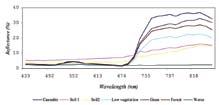
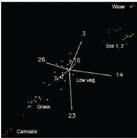
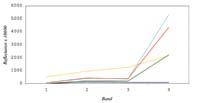
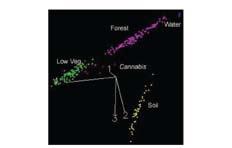
Figure 5 illustrates the spectral signatures of cannabis and other common land cover classes from the hyperspectral imagery. Figure 6 illustrates the separability of the reflectance spectra of cannabis and other land cover classes from the hyperspectral imagery.
Good separation is observed between cannabis and other land cover classes. Figure 7 illustrates the spectral signatures of cannabis and other common land cover classes from the multipsectral imagery. Figure 8 illustrates the reflectance of cannabis and other land covers from the Quickbird multispectral image. Good separation, except for low vegetation, can be seen between cannabis and other land covers.
As can be seen in Figures 7 and 8, there is considerable similarity between the signatures of low vegetation and cannabis from the multispectral imagery. In contrast, Figures 5 and 6 show a considerable difference between signatures using hyperspectral imagery so we recommend using hyperspectral imagery for the smaller grow operations seen in Canada.
Classification results of the multispectral images highlighted both the known field sites and additional sites in the imagery. However, due to the data’s limited spectral resolution, it is believed that up to 30 per cent of the additional sites highlighted by the classification are false positives. Analysis of the hyperspectral data also highlighted the known locations and most probable locations of additional sites.
The hyperspectral imagery is likely to have fewer false positives because of the data’s greater spectral resolution.
Conclusions
The CPRC study revealed that the spectral signature of cannabis is different from other common vegetation types in Western Canada. The best separability of the spectral signatures is located in specific areas of the spectrum that can be readily exploited from hyperspectral satellite or airborne imagery.
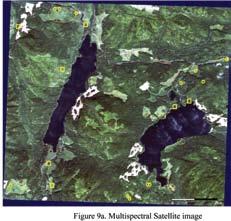
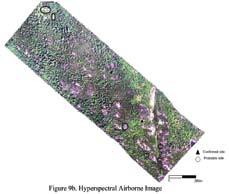
Using spectral imagery, this project identified a minimum of three unidentified probable marijuana grow operations to every one identified by police (Figure 9). This is a significant discovery for the war on drugs.
The practical result for police is that hyperspectral airborne or satellite imagery can be taken of an area and all probable outdoor marijuana grow operations can be detected. Comprehensive advance knowledge of sites will enable outdoor operations to be eradicated.
Staff Sgt Brian Thiessen is the program manager, Pacific Region, for the Canadian Police Research Centre. He can be reached at bthiessen@jibc.ca
Cool prints on hot paper
by Brian Ward
A sales clerk finishes a sale and hands the receipt to the customer, who then pulls a small calibre handgun from the waist of his pants and demands all the cash in the till. She hesitates, the suspect panics, fires and the clerk falls to the floor gravely wounded. The suspect runs into the street and disappears in a crowd of shoppers.
Officers quickly cordon off the area and wait for the forensic identification team to arrive. One of the ident officers notices a small crumpled piece of paper, the sales receipt, lying on the floor in front of the cashier’s till. He carefully photographs it and places it into an envelope for analysis back at the office – but there is a glitch in the process.
The paper receipt was part of a roll of thermal paper in the cash register and the development of fingerprints that may lead to the shooter relies on a simple but critical chemical process.
Traditional development
Thermal paper was developed by the National Cash Register Company in the 1960s, to be used in conjunction with printers employing a heat process rather than ink. It is made up of several layers, including a base coat, support coating for the paper and the thermal layer, which turns the heated image into numbers and letters.
Forensic identification officers and civilian fingerprint technicians developed fingerprints on most types of paper for years using several chemical processes, including dipping the paper in solutions of ninhydrin or DFO (1,8diazafluoren-9-one). However, thermal paper is different in its composition and in its reaction to the accepted means of development.
Prior to 1987, thermal paper reacted to ninhydrin in the same manner as regular paper. Developing latent prints on thermal paper was common. In September, 1987 though, the ‘Montreal Protocol’ banned the production and use of CFCs after January 1st, 1996 – and one of those banned substances was a critical ingredient in ninhydrin.
The implications for ninhydrin were serious. A new formula without CFCs, designed to mimic its chemical action, was introduced, but subsequent attempts using it to process thermal paper failed. The paper discoloured badly as a result of this new chemical reaction.
Cst Wade Knapp and technician Bev Broniek, two members of the Toronto Police Service Forensic Identification Service, developed a method to carefully expose thermal paper to muriatic acid and this seemed to work – but only on one side of the paper.
Eliminate the risks
BVDA (Bureau voor Dactyloscopische Artikelen), a forensic supply company, has
now introduced ThermaNin, a chemical that eliminates the risks associated with developing latent prints on thermal paper.
Working with members of the Peel Region Police Service Forensic Identification Service, University of Toronto student Jessica Rickaby recently completed a study of ThermaNin and has recommended its use.
Rickaby, who graduated from the university’s Honours Bachelor of Forensic Science program, worked as a co-op student to test the chemical and based her thesis on her study. She wrote that ThermaNin is a derivative, or hemiketal, of ninhydrin but a change in its composition renders developed images on thermal paper more stable and prevents the paper from turning black. This change in formulas was initially developed by a team of Japanese researchers.
Rickaby’s study included multiple samples of different brands of thermal paper and was also conducted using the muriatic acid development technique. Constables Dale Stansbury and Sue Gray of Peel Police’s FIS supervised the project.
“ThermaNin is superior to muriatic acid when developing latent fingerprints on thermal paper,” Rickaby wrote in her thesis, “as it is a sensitive technique which consistently develops high quality fingerprints with level two and three ridge detail, can develop latent fingerprints on both side of thermal paper as well as on ordinary office paper and can efficiently develop latent fingerprints which are at least eight weeks old.
“Development with ThermaNin was preferred over muriatic acid nine times out of 10 on the emulsion side,” she concluded. “It also developed more fingerprints of higher ridge detail and better quality than muriatic acid for both eccrine and sebaceous sweat and it was able to develop latent fingerprints on both sides of thermal paper. Additionally, ThermaNin consistently developed fingerprints throughout the eight week study.”
BVDA is a Holland based company which has manufactured and sold crime scene investigation materials and equipment since the 1930s. Its products are available in Canada through Fonthill, Ont. based Crime Sciences Inc.
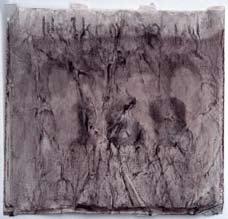
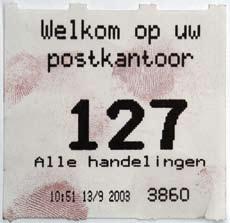
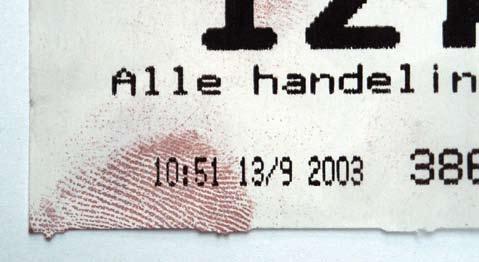
Thermal paper treated with ninhydrin (BYDA photo)
Thermal paper treated with ThermaNin (BYDA photo)
by Matt Collison
No case too cold
Three bank drafts sent home for safe keeping 24 years ago were the only clues police had in the disappearance of Mary Catherine Shanahan. The young Chicago-area native last spoke to her family from a pay phone in Moose Jaw in 1983, leaving them to wonder what had happened after the calls and letters stopped.
Due to her nomadic tendencies, they were unable to report her missing, despite several pleading attempts to police. Mary’s sisters Doreen and Margaret became detectives in their own right and spent a lot of time over the next 20 years trying to find their sister.
“We tried to contact the police in an attempt to try and find her and that was where we hit our first snag,” Doreen recounts. “We contacted the Chicago Police Department, the Moose Jaw Police Service and I was even in touch with the RCMP at one point.
“Even though the last time we spoke to her she was in Moose Jaw, basically we were told by the Moose Jaw Police that because we had last physically seen her in Chicago and because she was an American citizen, there wasn’t a thing they could do about it,” she recalls.
“We called Catholic churches and women’s shelters, anything we could think of, (but) it just never went anywhere. Always a dead end,” she says.
The pair searched tirelessly, calling police on a regular basis despite knowing they wouldn’t help. They also turned to the Internet.
“I was into Google before anyone knew what Google was,” Doreen says. “We were just fishing anywhere we could fish. Once the Internet came around, my sister Margaret was in New York, I was in Chicago and we would both constantly be hitting every site there was concerning serial killers, missing people, the mentally ill as well as unidentified bodies.
“We would go through every state’s online morgue pictures and that was a horrible thing to do, but that’s what we did for years; what else could we do?”
The case went nowhere until 2002 when ‘The Doe Network’ gave Moose Jaw Police Service Sgt Arnie Ellingson information on her disappearance. It was assigned a case number and he and Sgt. Marc Girard laid the foundation before
handing the case to Cpl. Cam Moore in 2004. He was the first to make significant progress.
It was believed Shanahan had traveled throughout Canada, but she left no trail of employment or health records; the latter was particularly worrisome as her family worried she was displaying signs of schizophrenia. The bank drafts were the only proof she had ever been in Moose Jaw.
Arlene Anhorn, hoping someone at that number would be able to respond with some information. It was basically a ‘hail-Mary’ pass.
“When she called me back she was a little shocked because she hadn’t been called Arlene Anhorn in over 30 years, since she got married.”
Though Scheibner had never known Shanahan, further questioning revealed that someone in Toronto had filed an income tax claim using Scheibner’s maiden name and social insurance number in 1987. It was the break police had been waiting for.
“The way our system works is, unless you have a crime you can’t get a search warrant,” Moore says, “so once I was able to establish that there was a possible identity theft, that really allowed the investigation to get rolling.”
“One of the last contacts we had with Mary was when she sent some letters to my cousin asking her to save three money orders for her and, on one of the money orders, the name Arlene Anhorn was signed on the memo line,” Doreen explains.
The name was unknown to the family. Moore checked to see if Anhorn was the bank employee who assisted Shanahan, but the bank had no person by that name. This apparent dead end turned out to be the key to solving the case.
The Moose Jaw Times-Herald ran a story about Shanahan and police received a tip about a website which showed an Arlene Anhorn living in Medicine Hat, Alberta. The site showed the woman had since married and her name was now Arlene Scheibner.
Moore phoned the contact number but no one was home. “I was forced to leave a message on her machine and on it I referred to her as
Moore figured Shanahan had assumed the identity of Anhorn and began following her paper trail. Aided by the probability of a crime and with help from S/Sgt. Steve Smethurst of the OPP’s Project Resolve, he was able to obtain warrants that opened the door to health records and other documents previously protected by privacy laws.
Records for an Arlene Anhorn showed up from all across the prairies – an arrest record in Edmonton in 1982; health records in Calgary, Moose Jaw and Saskatoon from 1982 to 1985; a social assistance application and finally the 1987 Toronto income tax filing.
Several documents among these records had been signed, apparently, by Arlene Anhorn, but Scheibner hadn’t left Alberta and could not possibly have signed them. They continued to trace the movements of Anhorn and were able to get the health records for a woman of the same name who had died of a pulmonary embolism in Toronto in March of 1987. Autopsy reports showed she had suffered from health problems prevalent among members of the Shanahan family.
Instead of exhuming the decades old corpse, an analysis was done of the handwriting on the Moose Jaw bank drafts and some of the documentation signed along the way by the questionable Anhorn. RCMP document expert Timothy McLean concluded Shanahan “probably did write” the Anhorn signatures in question.
An amended death certificate for Mary Catherine Shanahan was issued by the Ontario government on January 5th, 2007, finally closing the case.
“The day I was told that we had definitely found her was the same day as my 25th wedding anniversary,” recalls Moore. “I think I spent almost three hours that day trying to figure out how I was going to break the news to them.
“I talked to Margaret and it took me quite a while to finally get around to telling her that I thought we had found her but that she has passed on.”
After more than 20 years of searching the family could finally feel a sense of closure and grieve their loss. Doreen says the case would not have been solved without Moore’s hard work.
“When Cam Moore got the case, that’s when things started to really happen. He was different,” she says. “He was like a dog with a bone...without him it would not have been solved. If you don’t have the determination to do it and it seemed to us often that nobody did, it’s not going to happen.
“Cam opened the file and saw something real and he began to live it and think it and breathe it and that’s the difference. He’s just an amazing person and I don’t say that too easily; I’m a pretty tough critic. He has really restored my faith in people.”
Moore has a different take.
“They’re given to hyperbole – they can tend to go a little over the top,” he notes, chuckling.
“It was a matter of luck more than anything else that I got involved in this case at all because, unlike the earlier investigators and other people who had worked the case, I had all the skill sets needed to do it. It’s not that I’m a super-cop
or anything; it was just that all the things that needed to be done is what I was used to doing, especially with the search warrants.
“I’m kind of a relentless kind of person as well and when you’re working on something like this I’m sure it tends to help.”
Shanahan’s family also voiced frustration, demanding that the US and Canada invest more in searching for missing people.
“The search for ALL missing people is important, not solely the wealthy, the famous and children,” their statement noted. “There are many missing adults like Mary who are devalued by this lack of funding, inferior personnel deployment, lack of sharper laws and rules that truly advocate for all missing people, not just special or chosen missing people.
“Every human being is worthy of being searched for.”
Matt Collison is a staff writer with Blue Line Magazine. He may be reached at matt@blueline.ca.
New B.C. forensic unit to identify missing remains
(CP) - The B.C. Coroners’ Service is developing a plan that would give residents the thrill of helping to solve a forensic mystery and could help to end the agony for people whose family members have vanished.
A team in the coroner’s identification and disaster response division has been working for more than a year, plugging in data and developing identification frameworks that could match unidentified human remains with a name of someone missing anywhere in the world.
The team hasn’t been trying to link names and remains yet, but division director Stephen Fonseca said they have noticed similarities between missing persons inquiries and unidentified remains found in British Columbia.
“We’re very excited about it and I’m sure we’re going to bring some closure for some families in the near future,’’ Fonseca said in an interview.
That’s just what happened for the family of Susanne Tam, who disappeared on July 13, 1996.
Partial human remains were found by a hiker in September, 2005 near Whistler, the resort town about 100 kilometres north of Vancouver.
But it took two more years and an advanced forensic technique using mitochondrial DNA to determine the remains were Tam’s.
Fonseca spoke with Tam’s family and was happy to at least give them some answers a decade later.
“They have some ideas of what transpired,’’ he said. “They can get on with part of their lives.’’
Reviewing old cases, using new science, and getting the public’s help will all be part of closing cold cases.
Fonseca believes the popularity of crime-scene identification television programs will help their investigations.
“Unfortunately they’re not all realistic,’’ he laughed, adding his job is nothing like TV.
But he said it’s curiosity from the public that could help a witness see events unfold and take in more information.
“And that information is the type of lead that will help us break a case this year or in 10 years time. Who knows.’’
A website is also expected to be in operation in the next month or two looking to generate leads from the public on cases, or looking for identification on two dimensional models made from remains found.
“People have a ton of information out there, they just don’t know how important it is to us,’’ Fonseca pointed out.
The group is sharing technology with coroner and policing agencies across the country. They also plug their information into a database that can check for missing persons around the world.
The team has reviewed every singled unidentified case in British Columbia, but Fonseca said cases dating back to the 1970s and 80s are more difficult because less information is available.
They have matched names and remains on a few cases so far and Fonseca said they’re working on more connections, but he believes this is just the start.
“There are lots of folks who are desperate to find their brother, sister, mother, father,’’ he said. “And when you speak to those people you can feel their desperation.’’
“It certainly drives us to find something else that we haven’t used before.’’
Sep 03 2007
by terri theodore VANCOUVER
Dalhousie University Police Leadership Graduates Fall 2006 - Spring 2007
The Staff and Faculty of the Police Leadership Program congratulate all graduates on their success!
Administration Certificate
Sgt. Don Allen
RCMP, Sussex, NB
Sgt. Lori Lynn colbourne
RCMP, Ottawa, ON
cst. ed conway
Brandon Police Service, MB
tanya cyr
Saint John Police Force, NB
Cpl. Karen Delorey
RCMP, Toronto, ON
Captain Alain Lacelle
Military Police, Quebec City, PQ
Insp. David Wiedrick
Brantford Police Service, ON
Law and Justice Certificate
Cpl. Jacques Morneau
RCMP, Corner Brook, NL
Cst. Rodney MacDonald
RCMP, Ingonish Beach, NS
Sgt. brent H. Penner
Saskatoon Police Service, SK
Cst. Jennifer D. Russell
Bridgewater Police Service, NS
Sgt. Gordon Keith Stewart
RCMP, Amherst, NS
Det/Sgt. Ian Vickers
OPP, Orillia, ON
Service Delivery Certificate
Cpl. Ann Andrews
RCMP, Cape Breton, NS
Sgt. Don Allen
RCMP, Sussex, NB
Cpl. David R. Boyce
RCMP, Nanaimo, BC
Cst. Cynthia-Anne Martin
Waterloo Regional Police Service, ON
Cpl. Blake MacLeod
RCMP, Whistler, BC
Cst. Stephen T. Rose
RCMP, Salmon Arm, BC
Cpl. Nathan S. Rutherford
Canadian Embassy, Moscow
Supervisory Skills Certificate
A/Sgt Ward Beck
Bridgewater Police Service, NS
Sgt. Murray brown
Thunder Bay Police Service, ON
Cpl. P. Jeff Comeau
RCMP, Depot, SK
Cst. Michael Evans
RCMP, Lethbridge, AB
Sgt. Geoff Gawlinski
Calgary Police Service, AB
cst. Gord Hughes
Thunder Bay Police Service, ON cst. brent Legere
Halifax Regional Police Service, NS
Sgt. Peter Lynch
RCMP, Canadian Police College, ON
Cst. Delton McDonald
Cape Breton Regional Police, NS
Det/cst. timothy Sowers
Fredericton Police Force, NB
Det/cst Andrew Quibell
York Regional Police, ON
Advanced Police Leadership Certificate
S/Sgt. Paul L. brown
RCMP, Miramichi, NB
MCpl. Richard Draper
Military Police, CFB North Bay, ON
Insp. Gary Forward
Fredericton Police Force, NB
Wo roger Hudson
Canadian Forces Military Police Academy, ON
This list is not exclusive. Some students could not be contacted and for reasons of privacy and security some did not wish to have their names included.
MacPhail Award winner announced
Calgary Police Service
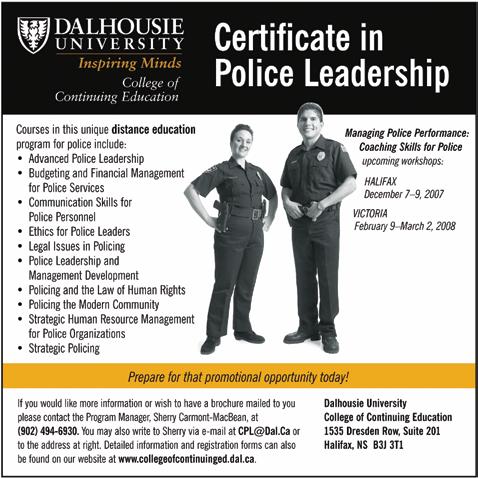
Sgt. Jason Walker is the sixth annual recipient of the Sergeant Bruce MacPhail Award for Academic Excellence in Dalhousie University’s police leadership program. Established in 2001 by Phyllis MacPhail in memory of her son, the award commemorates his dedication to life long learning in law enforcement.
Prior to being hired by the Calgary Police Service in 1997, Walker studied in the Fraser Valley while working as a correctional officer at Matsqui Institution. Walker was promoted to sergeant in 2005 and assigned to the recruit training section, known as the Chief Crowfoot Learning Centre. He remains there today, supervising recruit classes and teaching traffic law.
Walker has served the community for the past five years as a supported independent living counsellor with non-profit groups such as ‘Closer to Home Community Services’ and ‘Advocate Resources.’ His work can best be described as being a foster big brother, providing shelter and guidance to youth removed from their homes by social services.
As he began teaching recruits, Walker recognized the need to further his own education. After completing Dalhousie’s Police Leadership and Management Development course, he continued on to courses in coaching, communications, human resources and budgeting.
He also completed two of Dalhousie’s Police Leadership certificates, with concentrations in administration and supervisory skills. As a result of these and internal courses, he was granted credit for the senior police administration certificate.
As he continues with various educational pursuits, Walker intends to carry on with Dalhousie’s program. He has set a goal of completing the advanced police leadership certificate.
by Dorothy Cotton
Measuring police success is tricky
Ladies and gentleman, WHO do YOU think should be the next superstar… whatever?
The ‘superstar’ shows seem to have completely taken over the world of television. If it isn’t the ‘idol’ series, it’s the best interior designer, dancer, handyman, hair dresser or chef.
I am impatiently waiting for So you think you can psychoanalyze. It has been slightly delayed, I hear, because ethical issues arose around patient confidentiality. Canada’s Got Psychologists ran into problems with the world’s fastest IQ test segment. However, I understand both shows will be ready to air long before Bon Cop, Super Cop. What a can of worms that turned out to be! It seems no one can decide on exactly what challenges contestants ought to face.
How do you measure good policing? Is it the guy with the biggest gun? The most arrests? The fastest paperwork? Do you trail along behind officers, secretly filming like they do on What not to wear, and see who scares the most bad guys or makes the most small children smile? How would you score it?
Does the arrest of one serial killer outweigh 42 B&Es? What about the ethics? I wonder if they can get away with planting 10 bank robbers in a community and seeing which police contestant captures one first. Do you stop after one or keep going till all 10 are captured?
Deciding on the challenges means first figuring out the main point of policing. That’s easy. Everyone knows the point is… er… um… QUICK, look at your mission statement!
My sources tell me the goal is generally something to do with working toward a safe community free from the fear of crime. That sounds reasonable; I am all in favour of feeling safe. Now all we have to do is translate that into challenges and PRESTO! – we have a TV series. Luckily for me, many police services have already done a lot of the work here – and, of course, the government requires you to keep track of all kinds of stuff.
It would be pretty unusual for a police service not to have measures to help determine whether they had done a good job – things like:
• Number of arrests;
• Number of charges laid;
• Number of complaints about office misconduct;
• Call response time;
• Crime rate per population;
• Clearance rate;
• Reported versus unreported crime;
• Number of presentations made to community groups;
• Number of calls for service;
• Case load per officer.
I could go on, but won’t. The crucial question is how exactly do you link all these various measures to the real overall goal – the safe community free from fear of crime. It’s a matter of looking at “outputs” (all that stuff listed above)
versus “outcomes” (what we really wanted to achieve in the first place) – and linking all those outcomes to some global overall goal.
It also (hopefully) has something to do with the organization’s mission statement. Interestingly, it appears that not all police services are quite as good at linking those measures to the overall goal as they are at simply collecting the data. They might keep track of all this stuff but not use it to figure out if they are achieving their overall goal. The point is, measuring the outcomes of policing is easier said than done. It would be much easier if the goal of policing was something simple, like arresting people or responding quickly, but does it really
matter if you respond quickly? Do people care? Evidence suggests they generally want you to get there fast in a real emergency, but are otherwise happy if you just show up when you said you would – whenever that is. So getting there quickly when it is not necessary doesn’t really impress anyone.
Does it matter if you arrest a lot of people? If doing so makes people feel safer – or actually makes them safer, then it matters – but does it really? Besides, it also depends on the reasons why you arrested all those people.
The struggle to figure out the end point of policing is not getting any easier. In olden times, keeping track of outputs was probably enough. When a police “force” was a paramilitary and bureaucratic organization – closed and isolated from the community – outputs may have been all that really mattered. They did allow for some degree of financial control and workload management, and helped the chief argue for a larger budget and the need for more bodies, but they’re not really what contemporary policing is all about these days.
As for the reality show, there are lots of challenges we can use, but in the end, it’s the audience who gets to decide. What do you think is the ultimate outcome of policing?
You can reach Dorothy Cotton at deepblue@blueline.ca
by Liz Brasier-Ackerman
Heroes saluting heroes
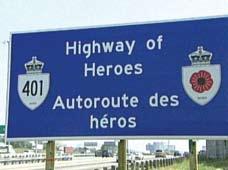
A recent public campaign convinced the Ontario government to name the stretch of Hwy 401 running from Toronto to Trenton the “Highway of Heroes.” The idea was born out of a new phenomenon – people lining overpasses to express their respect and appreciation for Canada’s fallen soldiers as they are taken to CFB Trenton from Toronto airport.
Regardless of your position on Canada’s involvement in Afghanistan or the concept and principles of war, the heart and sense of duty which inspires these individuals to risk their lives overseas deserves respect. They leave behind all that they love and walk into uncertainty.
The number of people taking part has increased since I first saw people and flags lining a Whitby overpass. Local police and fire personnel have joined in, standing on top of their parked trucks and saluting as the hearses pass by. It is a stirring sight – heroes saluting heroes. As I watched, I wonder if the officers see themselves as heroes, and hoped they understood that they deserve the same respect and appreciation as the fallen.
The dictionary defines a hero as a person who shows great courage and is admired for their noble qualities – the same qualities it takes to choose a career in policing.
A hero, says Lise Hand, has “a little gem of innocence inside you that makes you want to believe that there still exists a right and wrong; that
decency will somehow triumph in the end.” Even if your reasons for choosing a police career are more practical, that belief in right and wrong – that an individual can make a difference – is there. It may become a little worn and scratched over time, but its presence allows officers to carry on.
It takes a lot to be an everyday neighbourhood hero, going places the rest of us see only on crime shows. Job stress takes its toll over time, stretching faith in fellow human beings and a higher power to the limit. It can be difficult to get out of bed and head back into the fray.
Returning to the job after being sidelined brings challenges that also require fortitude. Facing each day with an acute awareness of the snares and dangers is not easy. It takes a real hero to get back out there, knowing their own weakness; “enduring,” as Christopher Reeves put it, “in spite of
overwhelming obstacles.”
We need heroes. There is not a city or town in this country, urban or rural, where individuals do not choose to flaunt the law, with little regard for the welfare of themselves or others. Our children can access illegal substances, no matter where we live, and the TV shows they watch offer only negative role models and glorified violence. They need heroes – real ones – who they can see at work in their neighbourhood every day.
We all need someone to look up to in this scary, messy world. Police are there for us when things go terribly wrong – heroes who, as Felix Adler said, “kindle a great light in the world,” and, “set up blazing torches in the dark streets of life for (others) to see by.”
Being seen as a hero can be intimidating but it’s part of the job. Seeing the worst of society is not easy. “One must think like a hero to behave like a merely decent human being,” May Sarton observed, and this can be very true for police in the day to day grind.
It’s important that police never forget that they are being watched – and that they are heroes to many of these people.
The officers saluting the fallen soldiers were showing their appreciation and respect for heroes. Did they know, I wonder, that many people driving by, looking up at them, also saluted them as heroes?
Top court upholds firearm blockade
by Mike Novakowski
Canada’s highest court has reversed an Ontario Court of Appeal decision and convicted two men found with guns in a roadblock outside a large strip club.
In R. v. Clayton & Farmer, 2007 SCC 32 a man across the street from the club called police at about 1:22 am, gave his name and said he saw about 10 casually dressed black males, four with handguns, congregating. The caller described four vehicles by colour and model (a tan Lexus, a black Jeep Cherokee, a black GMC Blazer and a white Acura Legend) associated with the group. When asked to check, he confirmed there was still a crowd in the parking area but that one of the vehicles had left. The gun call was dispatched and police responded.
The first officers on scene saw a group of men outside the club but no weapons. Two officers positioned at the parking lot’s rear exit at 1:26 am, intending to stop and search any exiting vehicle and its occupants. At 1:27 am, they pulled their car in front of the first vehicle to leave – a black Jaguar – even though it wasn’t described by the caller. Farmer was driving and passenger Clayton wore driving gloves, even though the night was warm. Police said they were investigating a gun call and asked the two men, both black, to step out of the vehicle.
Clayton complied but appeared nervous and was evasive when questioned. He struggled and then fled toward the club after being touched by an officer directing him to the back of the car. Police pursued and apprehended him as he tried to enter the club. A bouncer identified Clayton as one of the males having a gun and he was handcuffed. Officers found a loaded handgun in his pocket.
Farmer exited with some reluctance and only after three requests. A search at the vehicle turned up a loaded handgun tucked in the back of his pants. Both men were charged with numerous firearms offences.
The evidence was ruled admissible and both men were convicted at trial in the Ontario Superior Court of Justice. The initial brief detention to screen cars leaving the area was permissible at common law, the judge held – however, the officers intended to search the men from the moment they stopped them, even though they had no reasonable and individualized suspicion they were involved in a crime. Continuing the detention by removing them from the car for the search violated their right to be secure from arbitrary detention and unreasonable search. Despite this, excluding the guns would bring the administration of justice into greater disrepute than admitting them, the judge ruled.
Farmer and Clayton appealed. Ontario Court of Appeal Justice Doherty, writing the unanimous judgment, found their Charter rights had been seriously infringed. There was
no statutory authority for the roadblock or any reasonable individualized suspicion that could justify an investigative detention, as described by the Supreme Court of Canada in R. v. Mann Since the roadblock wasn’t used for highway safety, any authority for it would have to find mooring in the ancillary police power doctrine (Waterfield test).
At common law, the ancillary power doctrine recognizes that police conduct interfering with a person’s liberty can be justified if officers were (1) acting in the course of their duty and (2) their conduct was a justifiable use of police powers associated to that duty. A number of factors must be considered in assessing this, including:
• The duty performed;
• The liberty interfered with;
• The nature and extent of the interference;
• The extent to which some interference with liberty is necessitated to perform the duty;
• The importance of the duty to the public good.
In this case, Doherty held that police had a duty to investigate and prevent crime and stopping the car was done while acting in that course. However, officer conduct did not pass the second prong – the justifiability factors. Here, the stop engaged the criminal process against the targets of the roadblock by determining whether they were involved in criminal activity. Detaining and searching all vehicles and occupants profoundly interfered with individual autonomy and privacy.
“Being stopped by the police, questioned about guns, told to exit the vehicle and made to stand against the vehicle in a public place while the police examine the inside of the vehicle can be a frightening and humiliating experience,” noted Doherty.
Although agreeing that using roadblocks to investigate crimes and apprehend criminals might be a justifiable intrusion on individual liberties in some cases, this wasn’t one of them. Since police did not have grounds to suspect any specific person, a roadblock could only be justified if there were reasonable grounds to believe it could apprehend offenders who had just committed a serious crime. The 911 caller was detailed, describing the perpetrators as casually dressed black males and giving the specific make and models of four vehicles connected to them.
Rather than limiting their stops to people resembling the caller’s description, police cast too wide a net in stopping all departing vehicles. They didn’t have reasonable grounds to believe stopping motorists not matching the description would result in apprehending the perpetrators and recovering the guns. Had police narrowed or tailored their focus consistent with the information provided, the accused’s vehicle would not have been stopped.
Since police could not justify stopping all vehicles under the ancillary power doctrine, the stop was unlawful and the accused were arbitrarily detained. Questioning them at the vehicle and examining the interior also violated their rights under s.8. However, unlike the trial judge, the appeal court ruled the handguns inadmissible as evidence, characterizing the Charter violations as significant.
The accused were, “entitled to proceed on their way (but) found themselves in a potentially demeaning and frightening confrontation with police.” The fact Clayton and Farmer had handguns did not minimize the breach – “criminals do not have different constitutional rights than the rest of the community,” said Doherty.
The court was also very critical of police training. The officers failed to consider the relevant factors in assessing the ancillary power doctrine and didn’t balance the demands of their duties against interfering with individual liberties. They also didn’t appreciate the scope of their search powers. Police ignorance of the limits of their ancillary powers was institutional and related to their training.
The handguns were ruled inadmissible, the appeal allowed, the convictions quashed and acquittals were entered on all charges.
High court weighs in
The Crown appealed to the Supreme Court of Canada. Although all nine judges allowed the appeal and reinstated the accuseds’ convictions, they were divided on how they reached that result. The majority (six judges) ruled that police did not arbitrarily detain the accused and the resultant searches were reasonable. The minority (three judges) found the detentions arbitrary but saved by s.1, and the searches reasonable. Both the majority and minority recognized that it was important to address each stage of the police interaction.
Initial detention
Justice Abella, writing the majority opinion, first determined whether police acted within the scope of their common law powers when detaining the accused. A lawful detention at common law, she noted, is not arbitrary. In applying the criteria for the Waterfield test, the majority agreed police acted in the course of their duty to investigate and prevent crime when they stopped the car, passing the first prong of the analysis. As for the justifiability criteria, the majority parted company with Doherty, finding that stopping all vehicles was a justifiable use of police powers. Abella wrote:
The justification for a police officer’s decision to detain… will depend on the “totality of the circumstances” underlying the officer’s suspicion that the detention of a particular individual is “reasonably necessary.” If, for example, the police have particulars about the individuals said to be endangering the public, their right to further detain will flow accordingly. As explained in Mann, searches will only be permitted where the officer believes on reasonable grounds that his or her safety, or that of others, is at risk.
The determination will focus on the nature of the situation, including the seriousness of the offence, as well as on the information known to the police about the suspect or the crime and the extent to which the detention was reasonably responsive or tailored to these circumstances, including its geographic and temporal scope. This means balancing the seriousness of the risk to public or individual safety with the liberty interests of members of the public to determine whether, given the extent of the risk, the nature of the stop is no more intrusive of liberty interests than is reasonably necessary to address the risk.
In my view, both the initial and the continuing detentions of Clayton and Farmer’s car were justified based on the information the police had, the nature of the offence and the timing and location of the detention.
The police set up the initial stop in response to a 911 call identifying the presence of about ten “black guys,” four of them with guns. The police described what they were doing as setting up perimeter surveillance posts to secure the confined geographical area where the offence they were investigating had reportedly taken place.
The police had reasonable grounds to believe that there were several handguns in a public place. This represented a serious offence, accompanied by a genuine risk of serious bodily harm to the public. The police were entitled to take reasonable measures to investigate the offence without waiting for the harm to materialize and had reasonable grounds for believing that stopping cars emerging from this parking lot would be an effective way to apprehend the perpetrators of the serious crime being investigated (references omitted, paras. 30-33).
The majority found that, “requiring the police to stop only those vehicles described in the 911 call imposes an unrealistic burden on the police in this case and one inconsistent with their duty to respond in a timely manner, at least initially, to the seriousness of the circumstances.” Abella continued:
The police had reasonable grounds to believe that public safety was at risk, that handguns could be in the possession of those leaving the parking area and that stopping cars leaving that area could result in their apprehension. The steps taken by the police in this case in stopping the car, based on the information they had, were reasonable and reasonably tailored
to the information they had.
In the totality of the circumstances, therefore, the initial detention in this case was reasonably necessary to respond to the seriousness of the offence and the threat to the police’s and public’s safety inherent in the presence of prohibited weapons in a public place and was temporally, geographically and logistically responsive to the circumstances known by the police when it was set up. The initial stop was consequently a justifiable use of police powers associated with the police duty to investigate the offences described by the 911 caller and did not represent an arbitrary detention contrary to s. 9 of the Charter (paras. 40-41).
The continued detention
The majority concluded the continued detention was lawful because both men matched the race given by the caller and Clayton wore gloves on a warm night and gave strange and evasive answers on being questioned. The vehicle came from the scene of the reported crime, was the first out, left minutes after the crime was reported and used the rear rather than the front exit, where other officers were arriving. Abella stated:
Taken together, these facts objectively gave rise to the reasonable suspicion that the occupants of the Jaguar could be in possession of the handguns reported in the 911 call and that, as a result, the lives of the police officers and of the public were at risk, justifying their continued detention. This constellation of circumstances was such that the police were required to and did respond quickly and appropriately to the information they had about the possession of guns by individuals in this particular parking lot. They treated the two occupants as equally likely to be connected to the serious crime under investigation. They were reasonable in taking this approach once they saw that both individuals, in a car that had just left the crime scene, matched the general description they had.
I accept… that had the police stopped the vehicle and discovered that the occupants did not correspond to the description given by the 911 caller, they would have had no reasonable grounds for the continued detention of the occupants. For example, had the caller described individuals who were white, the police would not have had reasonable grounds for the continued detention of non-white occupants. On the particular facts of this case, however, based on their subsequent observations, there were reasonable grounds… for the police to conclude that the two occupants of the car they had stopped were implicated in the crime being investigated (paras. 46-47).
Searches of both the occupants were justified for safety reasons as an incident to their detention. “The search was necessarily incidental to the lawful investigative detention and… there was no violation of s.8,” said Abella.
The minority view
Justice Binnie, authoring the minority opinion, found police had no particular grounds against the accused and that the blockade, designed to stop all motorists regardless of description, was arbitrary. It was important to distinguish between what the police knew at the time of detention and what they knew after the detention however, when they had a chance to observe the vehicle’s occupants. Before stopping the car, officers had no individualized suspicion of the accused or their vehicle, nor did they use other criteria to tailor the roadblock. Instead, it was set-up to stop all vehicles leaving the strip club and thus arbitrary, however it was saved by s.1 of the Charter.
“The protection of society from the flaunting of illegal handguns in a crowded public place is clearly pressing and substantial,” the minority held.The roadblock was also a rational response
to the 911 gun call. Randomly stopping only some vehicles would not serve the purpose of the blockade, which was properly tailored to the circumstances. Binnie stressed the difference between the brief imposition on motorists and an investigative detention based on reasonable suspicion:
A Clayton and Farmer stop is not the same thing as a Mann investigative detention, although it may (or may not) lead in that direction. A Clayton and Farmer stop of all vehicles is established for screening purposes. A Mann inquiry may then be undertaken only if reasonable grounds for individualized suspicion emerge.
I conclude that the common law at issue in this case satisfies the requirement of propor-
tionality (in fact “tailored” is more or less a synonym for proportionality). In such circumstances, anything less than a full blockade would not serve the purpose which has already been found to be pressing and substantial. Moreover, for the reasons mentioned, the law’s salutary effects exceed its deleterious effects.
Police have the power at common law to set up a roadblock where they have reasonable grounds to believe that a serious firearms offence was committed and it may apprehend the perpetrators. Here, police arrived within five minutes of the 911 call, limited their roadblock to the club’s parking lot – where individuals would be leaving through one of two available exits. They had reasonable grounds to believe a serious crime had been committed and the perpetrators might be apprehended.
Police were also entitled to question the occupants to determine if they had information about the incident and detain them for further investigation if an individual suspicion (articulable cause) existed. This power of detention was used to screen cars for further inquiry. The
minority also held the searches lawful:
As to s.8, Mann holds that in a lawful detention situation the police may undertake a pat-down search if the officer believes “on reasonable grounds that his or her safety, or the safety of others, is at risk”….
The issue on the proper scope of the search is clouded in this case because (unlike Mann) the presence of handguns not only constitutes a police safety issue but constitutes the evidence of the offence being investigated. It is not possible to say here, as it was in Mann, that the police went too far when their search proceeded beyond safety considerations to evidence collection. Here, the two purposes were intertwined and not separable.
Nevertheless, I would affirm that after the police officers had observed the respondents and engaged in conversation with them, the police had authority here to conduct a pat-down search incidental to their continued detention. It would be illogical to hold that a pat-down search is justified where the detention relates to a non-violent offence (as in Mann) but not where the police are facing serious issues of personal safety when responding to a gun call...
Equally, it would be illogical to be solicitous of the safety of individuals who may or may not be at risk at the calling end of the 911 call (Godoy…) but not of the safety of the police who, in the course of roadblock duty, are putting themselves, at least potentially, in harm’s way. If evidence of the crime emerges in the course of a valid pat-down search incidental to the detention for the purpose of police safety, the evidence will be admissible
Once the accused were stopped, police acquired grounds of reasonable individualized suspicion to convert the initial blockade stop into an investigative detention under Mann In addition to their initial information, police determined after the stop that Clayton was black and wearing gloves on a warm night, suggesting a concern about leaving fingerprints. This provided the necessary grounds to remove him from the car for a search.
The search of Farmer was similarly reasonable, within the bounds of an investigative detention, stated Binnie:
I think that it would have been foolhardy for the police, in the context of a gun call, to leave Farmer, possibly armed, in the car while they went about their business with Clayton. Nor could the police be expected to allow Farmer to drive away. If Farmer, left alone in the driver’s seat, had taken a shot at the police, there would have been legitimate questions raised about police training and police judgment and the unreality of a law that led to such an avoidable result.
The respondents were travelling together and the concerns about officer safety raised by the glove-wearing, possibly gun-flourishing Clayton gave rise to a sufficient concern about the driver to warrant a pat-down search of Farmer for officer safety incidental (at that point) to Farmer’s continued detention.
The Crown’s appeal was allowed and the accused’s convictions restored.
Thorough search was justified
by Mike Novakowski
Searching a backpack for a weapon was reasonable, Alberta’s highest court has ruled.
In R. v. Peters, 2007 ABCA 181 three bike patrol officers responded to a call from a hotel that a man wearing a red jacket and carrying a knapsack decorated with pins and trinkets had a gun. Peters fit the description. Although officers didn’t see a gun, they patted him down and opened the knapsack for a quick look to make sure nothing was obvious.
A second officer wasn’t satisfied with the cursory search, feeling a small hidden gun or weapon could pose a threat if the knapsack was returned to Peters. He made a more thorough search and found baggies of marijuana, walkie-talkies, pipes, lighters and a bottle of isopropyl at the bottom.
Peters was convicted of possessing marijuana for the purpose of trafficking at trial in the Alberta Court of Queen’s Bench. There were reasonable grounds for the investigative detention and protective search, the judge ruled, and they were reasonable in manner and scope.
Peters appealed to the Alberta Court of Appeal. He did not challenge the validity of the initial detention, pat-down or cursory search of the upper part of the knapsack, but argued, in part, that the deeper search by the second officer breached his s.8 Charter rights.
The court upheld his conviction in a memorandum of judgment. Since there was no warrant for the investigative detention or protective search, the Crown had to demonstrate, on the preponderance of evidence, that the search was authorized by law and that the law and manner by which it was carried out were reasonable. The court noted:
In the Mann case, the Supreme Court of Canada established that an investigative detention and protective search is authorized by law and is reasonable in circumstances where carrying out proper police duties requires it. The police have the responsibility of protecting the lives of the public, including their own. In 2007 it is obvious that a member of the public who, in a public place, has a gun, is a potential threat to the public. It is clear that the risk can be as great from a hidden handgun as from a more obvious rifle (para. 5).
The trial judge did not err in finding the officer fully justified in conducting the thorough search of the knapsack, the court found. The marijuana was found during a lawful protective search and was thus admissible. Peters was then arrested, so the discovery of more drugs was incidental to the arrest.
Visit www.blueline.ca/resources/caselaw for complete cases. You can email Mike Novakowski at caselaw@blueline.ca
Vancouver’s most wanted now on web
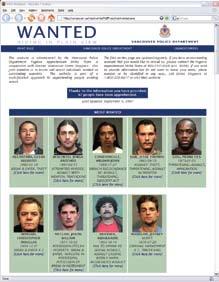
In an effort to reduce some 15,000 warrants currently outstanding, the Vancouver Police Department (VPD) has created a ‘most wanted’ website.
“WANTED: Hiding in plain view,” informs the public and police agencies about individuals wanted for committing crimes or just ignoring the justice system. Launched in November, 2006 the site can be accessed through the department’s main website (www.vpd.ca).
The ‘Wanted’ site was inundated with people trying to log in after the department highlighted it in a press release. The crush caused two city computer servers to crash the first weekend the site was up. Tips received the first week alone led to eight people being arrested – five were wanted on Canada wide and three on BC only warrants.
Visitors can either leave voice mail for the VPD’s Fugitive Apprehension Strike Team (FAST) or send their message to CrimeStoppers. Individuals who believe there may be a warrant for their arrest and want to ensure their picture does not appear on the website are encouraged to contact FAST to address the charges.
More than 100 people, wanted on a multitude of charges in BC and across Canada, were featured on the site at press time. With the co-operation of the public, government agencies and other police departments, those wanted will find it increasingly difficult to “hide in plain view,” the department notes.
For more information, contact Sgt Jeannie Yee (jeannie.yee@vpd.ca), a member of VPD’s FAST.
Making a much needed connection Advancing first responder communications interoperability
by Lance Valcour
It happens all too often – you’re only a few hundred yards away from another police officer, firefighter or paramedic but unable to transmit vital information to them. Radio systems, cell phones and PDAs are not always properly configured, aligned or even designed to allow inter-agency communication.
The Canadian Interoperability Technology Interest Group (CITIG) is working to solve this problem. Launched in April by the Canadian Police Research Centre (CPRC) in conjunction with the CACP’s Informatics Committee, the group includes representatives from public safety, industry, academia and government.
CITIG defines interoperability as, “the ability of public safety agencies to talk across disciplines and jurisdictions via voice communications systems, exchanging voice and/or data with one another on demand, in real time, when needed and as authorized.”
CITIG’s first priority has been to reach out to those interested in advancing Canadian public safety interoperability. It also aims to:
• Create forums for exchanging information and ideas and promoting discussion;
• Bring together the collective wisdom of public safety and communications leaders and experts (best and brightest);
• Respond to regulatory issues that impact public safety communications;
• Provide a test bed where aspects of the five Safecom® interoperability continuum elements (governance, standard operating procedures, technology, training and exercise and usage) can be understood, designed, tested, negotiated, implemented, trained, exercised, standardized or shared.
“When you look at the great strides in communications technology and you see the work being done south of the border and beyond, it’s clear that we have a significant opportunity to impact the state of Canadian public safety interoperability,” says CPRC Executive Director Steve Palmer.
“The CPRC serves as a single, national focal point for technology research and development efforts in support of Canada’s law enforcement community. A focus on interoperability was a natural fit for us and the opportunity to partner with other first responder agencies, organizations or private sector vendors was most welcomed.”
The CPRC and CACP have taken the lead in developing CITIG, he says, but hope to increase representation from other agencies in a model patterned after the US National Public Safety Telecommunications Council (NPSTC). That agency describes itself as, “a federation of organizations whose mission is to improve public safety communications and interoperability through collaborative leadership.”
An active drive is now on to get the right
people involved. The first Canadian Interoperability Forum, set for October 11 in Toronto, will feature guest speakers, special presentations and discussions, giving participants an opportunity to shape the group’s future direction.
Equally important, the CITIG is actively looking to fund research or development work related to interoperability. Any employee of a Canadian public safety sector agency is invited to submit a research or development proposal related to the five interoperability continuum elements – governance, standard operating procedures, technology, training and exercise and usage. The outcomes can range from guidelines and scenario exercises to scientific papers and patented intellectual property.
The current call for projects closes October 31, 2007 but submissions are always welcomed. The simple two-page application form and details about the funding eligibility and criteria are on the website. A significant portion of the group’s start-up budget will be allotted to ensuring at least one or a small number of pilot projects can begin by the end of this year.
The quest for greater public safety interoperability should not simply be viewed as a technical issue related to linking up communication or computer networks. It’s really a matter of connecting the right groups and people and moving in the same direction.
Help spread this information to those who may be interested; the more like-minded people we can assemble, the greater our chance for success.
Visit www.cprc.org/citig for more information or e-mail your suggestions, questions or concerns to citig@cprc. org . Lance Valcour is an Ottawa Police Service inspector currently seconded to the CPRC.
Call for projects
CITIG submissions will be evaluated based on the following criteria:
Impact on public safety sector interoperability
- Weight: 30%
• Will the proposed area of research and or development significantly impact public safety?
• How many agencies will be assisted in improving interoperability?
• Will it positively impact others beyond the organizations involved?
• Are there spin-off benefits?
Need for research and development in the proposed area - Weight: 30%
• Does the proposed work address a known problem or need?
• Are others currently investigating similar areas?
• Has related research been done before?
• Does it touch on one or more of the five SAFECOM interoperability continuum elements?
Desired outcomes - Weight: 30%
• Is the proposal realistic and achievable?
• Will the outcomes be easily used, transferred or adapted by others in the public safety sector?
• Can the results be used by other sectors?
Other relevant factors - Weight: 10%
• Have partners been identified and, if so, how committed are they?
• Can incentives or opportunities be leveraged in pursuing the proposed work?
• Is the proposal clear and comprehensive?
York Regional Police Const. Robert Plunkett was killed in the line of duty while making an arrest in Markham, Ont. Plunkett was working undercover when he was either struck or dragged by a moving vehicle as he tried to reach into a driver-side window to apprehend a suspect. He chaired the Ontario Special Olympics in 2000, which York Region hosted.
Rick Hanson, a former Calgary Police Service deputy chief, was selected as the new Chief of the 1400 member force upon the retirement of Chief Jack Beaton. After leaving Calgary with 32 years of service Hanson accepted a postion with the RCMP as a chief superintendent and moved to the Edmonton area. Upon Chief Beaton’s retirement announcement, he applied for the position. His selection was unanimously approved by both the Calgary Police Commission and city council last month.
OTTAWA - The first of Canada’s border guards to be authorized to carry weapons on the job have graduated after attending training in Ottawa and Chilliwack, B.C.
The training of the 39 guards, who will be deployed at border crossings across Canada, is part of a plan to enhance safety and strengthen security at Canada’s border. Prime Minister Stephen Harper announced funding for firearms training for Canada Border Servcies Agency officers at land and marine ports of entry in August 2006.
The plan includes 400 new permanent border agency officers who will be hired, trained
and equipped in order to eliminate work-alone situations.
The firearm training is something the border guards union has been awaiting for some time. The program trains border officers on various levels of threats and risks, and how to respond. The government hopes to have at least 150 border guards armed and on the job by March 2008, with hundreds more added in each of the following years.
The 2006 federal budget provided the border services agency with $101 million over two years to begin the process of providing border services officers with firearms.
Deputy Chief Delaney Chisholm of the New Glasgow Police Service, N.S., has accepted the top job with that service starting in October. Chisholm, brings 34 years of police experience to his new position, says the biggest challenge facing police services in rural areas is the retention of officers.
The leaders of Canada’s police forces are calling for a national policing framework to help clarify the roles and responsibilities between municipal, provincial and federal law enforcement agencies. Jack Ewatski , outgoing CACP president, said that the country’s various police services have been working well together for several years, but the co-operation needs to be formalized at a higher political level. He said all police forces have had to take on a variety of new tasks in recent years and the lines of responsibility have been blurred. Ewatski further stated that this is especially true in national security issues.
Ken MacLean, the chief of police in Truro, N.S., has announced his retirement after nearly 40 years on the municipal force. MacLean joined the department in 1970. He worked as a constable until his promotion to deputy chief in 1988. Eight years later he succeeded Lonnie Murray as chief.
Durham Regional Police Supt Sherry Whiteway was sworn in as the service’s new deputy police chief. Whiteway fills the vacancy left when Mike Ewles was promoted from deputy chief to chief in May. Whiteway began her DRPS career in February, 1980 and served in a frontline uniform patrol capacity in Pickering, Ajax, Uxbridge and Whitby.
Focus on priorities - let the other ‘balls’ drop
Excessive e-mail leads to increased workload, unrealistic expectations
by Mark Giles
Although it significantly affects the business and personal lives of thousands of police officers and other employees, the topic rarely discussed at work.
During the 1990s, it was referred to by some law enforcement agencies as, “doing more with less,” although a police partner of mine once sarcastically described the reality as, “doing less with less.” Back then it meant maintaining or even increasing output with fewer resources – usually personnel – in the days of government and business cutbacks.
As technology improves and the world gets faster, expectations of doing “more with less” have taken on a different twist – not so much with fewer personnel, but rather by task overload, much of it generated electronically. The development of e-mail has meant that huge volumes of electronic messages can be sent more quickly, with more content and attachments, and greater expectations.
For most of us, e-mail is no longer an option, but an absolute necessity. It has increased the pace, improved retrieval and follow-up capability – as every sent e-mail is recorded by date and time – and reduced the need for face-to-face contact on the job. These changes have some benefits, but the average police officer or employee is not a machine and faces burn-out if the pace continues.
The Blackberry – or ‘crackberry’ as some refer to it – has complicated the situation further, creating unrealistic expectations that extend far beyond the workplace. Initially those who insisted on frequently checking email by Blackberry were seen as “junkies,” but although addiction may be part of the problem, unrealistic expectations are increasingly behind the habit.
No longer limited to the ranks of senior management, the Blackberry – like the cell phone during the 1990s – is becoming much more common. It’s not unusual to see people scanning them for new messages during meetings or presentations – trying to meet the higher expectations these technologies have created.
In 2007, the “non-addictive” user who leaves the Blackberry alone for extended periods of time – even outside of business hours – may find him or herself in trouble. A senior manager was recently asked to be more diligent in tending to his Blackberry after an e-mail he received went eight minutes without a response. In another extreme case – on a weekend – a terse follow-up e-mail was sent 14 minutes after the first one went unanswered.
These new expectations – basically a significant increase in the quantity and speed of delivery – are fine as long as they go along with a recognition that quality will suffer. The problem is that they generally do not. With too many balls on the table, each task takes longer and there is a greater likelihood of errors.
“Multitasking just makes people look busy, but is not effective,” says Piers Steel, an associate professor of human resources and organizational dynamics at the University of Calgary.
Many senior managers don’t take this into account, still expecting relatively error-free performance despite increased communications and the corresponding workload. What should be an obvious inverse relationship between quantity and quality is often being overlooked. I compare it to a driver speeding along a busy downtown street at 110 km/h with expectations of avoiding collisions. The driver is trying to avoid obstacles, but is moving at such a speed that his or her reaction time is severely limited and the likelihood of hitting something is very high.
Getting out on the street
So why do police agencies and other organizations try to do too much in too little time – allowing e-mail overload and other demands to overwhelm officers and civilian employees? Two likely contributors are the “ivory-tower” syndrome and the resulting lack of awareness, and an unwillingness to say no to increasing expectations for fear of career implications.
Ivory-tower syndrome can impact all levels to varying degrees – from the chief to the street supervisor. It’s a problem that existed well before electronic communications came along. As the officer commanding Calgary’s reserve military police platoon during the 1990s, I recall running a field exercise on the outskirts of the city aimed at training platoon members in route reconnaissance, signing and traffic control.
During the exercise, one of my section commanders informed me that I’d just asked his section to cover about 15 kilometres in 25 minutes – not a reasonable expectation considering the stop-and-go nature of reconnaissance and signing a route of this distance. I quickly noted my error and re-adjusted my expectations, but upon reflection, realized I’d perhaps lost touch with some of the realities on the ground. Having worked exclusively at platoon headquarters for several years, I resolved to spend some time with the frontline jeep teams doing the actual work.
On a much broader scale, it’s not hard to find senior police officers who haven’t worked the street or investigated anything for years –sometimes even decades. As senior managers, that’s no longer their role, but as valuable as their many years of experience are, they usually loose touch with the realities of frontline policing over time and, therefore, the potential impact of their decisions.
A few years back, a deputy chief of a major Canadian police agency apparently questioned
why a patrol officer was directing traffic at an intersection without his hat. When advised that it had been quite windy that day, he responded that the officer should have been using his chin strap. As the story goes, the deputy was somewhat embarrassed when told that the issue forage caps no longer had chin straps and hadn’t for more than 20 years. I’m not sure why he was focused on such a trivial issue in the first place, but it is a good example of a senior officer out of touch with reality.
E-mail and the Blackberry have compounded the situation, reducing telephone and face-to-face contact, and making it easier to impose unreasonable expectations on subordinates. No one expects an inspector, superintendent or deputy chief to go back the street or general investigative duties, but working the odd shift or even partial shift in a front line capacity would go along way to improving awareness of the current challenges – including the management of vast amounts of e-mail –faced by front line officers.
Multi-tasking is a reality of policing in the 21st century, but given the public and officer safety issues facing law enforcement agencies today, we should be looking at minimizing its negative impact. Police officers need to be effective and excessive e-mail and unrealistic expectations from those unaware of today’s policing realities are not helpful. Some limits needs to be placed on expectations and the electronic communications that often generate them.
The reality in today’s hectic, e-mail-obsessed workplace is that some balls must drop – the only question is whether senior management is willing to admit it and let a few go. My former partner was speaking sarcastically, but he may have had a valuable point – we should be doing less with less and focusing on those priorities that really matter.
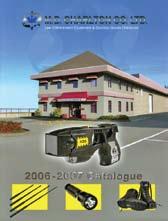
M.D. Charlton Product Catalogue
We are a leading Canadian distributor of law enforcement equipment such as; Integrian - in-car video, Point Blank/ PACA body armour, Cuff Cleaner disinfectant station, Taser, VidMicvideo recording.
The Toughbook Arbitrator CP brochure details complete features, components and specifications for this revolutionary law enforcement video capture system.
Pansonic. www.panasonic.ca
Applicant Livescan for Background Check
The CLS-i3 scanner is ideal for capturing high-quality rolled and flat prints. This brochure details the Software Data Entry and Fingerprint Capture key features, specifications, options and certifications.
Cogent Systems
Tel: 626-799-8090 www.cogentsystems.com
In-Car Video System
Technology that is so advanced and so small that the entire Digital Video System is integrated into a rearview mirror complete with: covert rear seat camera, 3.5” colour monitor, GPS, 900 MHz audio transceiver, internal microphone, and speaker.
DAVTECH Analytical Services (Canada) Inc.
613-831-6009 Ext 201 www.davtech.ca
Digital Video Flashlight
The New Generation of Digital Video technology is so advanced and so small that the entire digital video and audio recording system is integrated into a high quality, water resistant machined aluminum law enforcement style flashlight.
DAVTECH Analytical Services (Canada) Inc.
613-831-6009 Ext 201
www.davtech.ca
Kahles K312 Riflescope
For over a century, KAHLES has blazed new trails in scope design, durability and performance. Innovations include ballistic drop compensation, waterproof riflescopes and multi-coating technology in serial production as well as the revolutionary multizer0™ micromechanical ballistic compensation.
Kindermann Canada Inc
905-940-9262
www.kindermann.ca
5.11 Full Line Catalogue
This full colour, 48 page full line catalogue, produced exclusively for Canadian customers, details the authentic 5.11 Tactical Series and includes comprehensive sizing charts.
5.11 Tactical Series
Tel: 209-527-4511 www.511tactical.com
Weekly Police News Digest
This weekly digest of law enforcement news is compiled from more than 80 daily newspapers from all over North America, and e-mailed to your personal inbox each Friday. Subscribe today and stay on top of events important to you and your career.
Blue Line News Week
Tel: 905-640-3048
www.blueline.ca
Innovative law enforcement gear gains popularity among mainstream consumers
Inc. Magazine recently announced its 25th annual list of America’s 500 fastest-growing private companies. Modesto, California-based 5.11 Inc. landed in 211th place in the publication’s rankings.
The maker of innovative tactical gear for law enforcement, military and fire professionals, 5.11 is probably best known for its seven-pocket, original 5.11 Tactical Pant.
“The 5.11 brand is not only hot in the public safety field, consumers are also very intrigued with our tactical gear,” says 5.11 Inc. CEO Dan Costa. “We’ve become more of a lifestyle brand. We’re growing very quickly and are launching several new product lines this fall. It’s exciting to be ranked number 211 our first time out on this highly-respected national list.”
The company’s roots were originally based in the outdoor industry, then moved into the law enforcement arena, where officers found the clothing so comfortable, functional and well-built, they also began wearing it during their off duty hours.
5.11 Inc. reports three-year sales growth of 1,039 percent. Sales topped $55 million in 2006 with projections of $85 million for 2007.
For further detials call 209 527-4511
Undercover and plainclothes operators get innovative new covert Khakis
A new line of clothing designed for covert operations has been recently released through 5.11 Tactical Series. The 5.11 Covert Khakis are designed specifically for plainclothes and undercover operators.
The flat-front pants feature eight pockets, including two stealth thigh pockets along the seams. Comparable in weight to 5.11’s Tactical Pants, the Khakis are made of wrinkle and fade-resistant 8.8-oz., 100 per cent cotton twill that is treated with Teflon for enhanced dirt and stain resistance.
Priced around the $40 range, the pants are available in three colors: birch, oak and walnut.
Another great pant for blending into a crowd is 5.11’s slightly relaxed fit Denim Jeans. They’re traditionally styled and include a hidden rear cuff pocket and internal front pockets for concealed carry items. Constructed of 13.5-oz., 100 per cent cotton denim, Jeans pricing also begins at around the $40 range.
For further dealer information call 209-527-4511.
Redacting now made simple with new OCR technology
Nuance Corporation has announced a new method of redacting (blacking out text) in documents while they are being scanned.
The new OmniPage Professional 16 release can black out, highlight and strikethrough text with new automated mark up tools included with the product.
You’ve got a stack of evidence or statement documents that you need to share, but you want to black out sensitive information for fear of improperly identifying restricted portions or people. You may also have several documents that you want to convert while highlighting every reference to a pre-selected name or key words. As a new automated feature OmniPage will complete this task for you.
OmniPage Professional 16 can recognize and automatically mark up your text on the fly based on a list of key words, numbers or phrases which can be entered in the software before a scan of a document commences. Now you can redact text for confidentiality, quickly locate information with highlights or communicate a revision with strikethrough text.
The new OmniPage is also optimized to recognize and convert legal documents that contain special formatting including headers, footers, line number, stamps, signatures and more.
For further details call 888 781-1189.
Court sheriffs could ease police shortages
by Jacqueline Lunot
It’s no secret that Canada needs more police – we will be short 7,000 municipal police officers alone by the end of this year, according to Canadian Association of Police Boards President Ian Wilms. The answer to this problem is right in front of our noses – in our courthouses.
The BC Sheriff Services, for example, are an obvious solution to the police shortage in British Columbia. Sheriffs are defined as peace officers within the Criminal Code and BC Sheriffs Act. They are sworn, armed, provincial peace officers with limited responsibilities which could easily be expanded.
Under existing circumstances, their mandate is to act as a neutral entity within the judicial system, but they routinely make arrests within the confines of the courthouse and, occasionally, within the community. Their prime duties are:
• Providing courthouse and jail security;
• Escorting accused and convicted persons;
• Jury management;
• Document service (civil and criminal process);
• Executing court orders and warrants;
• Assisting in Coroner’s court.
Sheriffs receive their legal authority from statute and common law and court order. The fact they are bound and authorized by court order is the most significant argument for using them to assume some police duties, thereby freeing police to do what they do best – serve and protect the public.
Alberta sheriffs were given the authority to patrol the province’s highways last year and BC sheriffs have been asking to do the same. The problem is that this would
require a change in legislation and, for some reason, the BC Government has a problem with doing this.
Executing warrants and protecting witnesses are both ordered by the courts and could easily be taken over by sheriffs without any change in legislation. I’m not suggesting they completely take over warrant execution, but they could easily act as police back up during this process. No other single measure could go further in reducing police shortages.
There should be no need for police to serve bench warrants to an accused who decides not to show up for a court appearance. They already did their part by arresting the individual in the first place. Deputies could re-arrest them with far less paper shuffling and delays in assignment.
Sheriffs are also more than capable of protecting witnesses. Police should be out on the streets, not confined to looking after witnesses needed for a court appearance. This is clearly
a job for sheriffs who, after all, are already responsible for protecting jury members.
Sheriffs could also protect the judiciary outside the courthouse and transport all in-custody persons. They already transport accused and convicted persons in BC and throughout the country. In fact, it is one of the things that they do best so it seems only logical to add this to their responsibilities.
As it now stands, the RCMP transports many prisoners internationally. They could attend to more important responsibilities and leave this task to sheriffs, who could team up with immigration officers to aid in the movement.
BC deputy sheriffs receive very similar training as municipal police officers, although it is condensed to10 weeks due to budget restraints. Their training includes legal responsibilities, firearms, driving (finesse and high speed), control tactics – including baton, OC spray and Tasers – written and oral communication skills, etc.
The BC Sheriff Service has an intelligence division that already works together with police and other law enforcement agencies to track high profile criminals within the system. It should not be difficult to take this partnership to the next level and let the service be the lead investigator and apprehending agency.
The answer to BC’s police shortage is quite clear. With roughly 500 deputy sheriffs in the province who are already sworn to serve and protect the citizens, why look anywhere else?
The BC Transit system converted its special provincial constables into a successful police force virtually overnight. Sheriffs, who have been serving BC since 1856, should be considered competent enough to step outside the courthouse and perform the work that they already do within it. Other Canadian jurisdictions should also take a serious look at this valuable but under utilized resource.