Bruce Power Corporation brings its security into the new century
12Pseudoscience in policing Police forces consult psychics. Do they work?
15Policing the wheat city
Like the wheat around it, Brandon Police is growing
18Some pillars more equal than others Vancouver inspector questions Four Pillar Strategy
30Child porn investigators need support Mental health an important tool
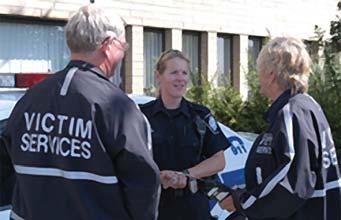
32Victim services support families/police Next of kin notification a tough job
October 2006
Volume 18 Number 8
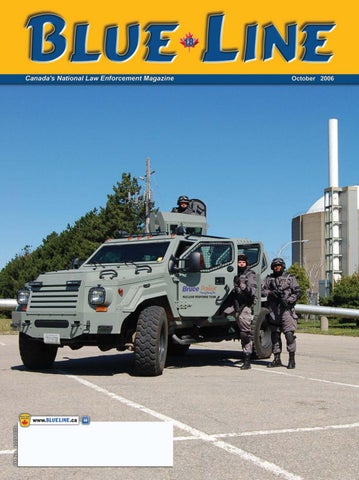
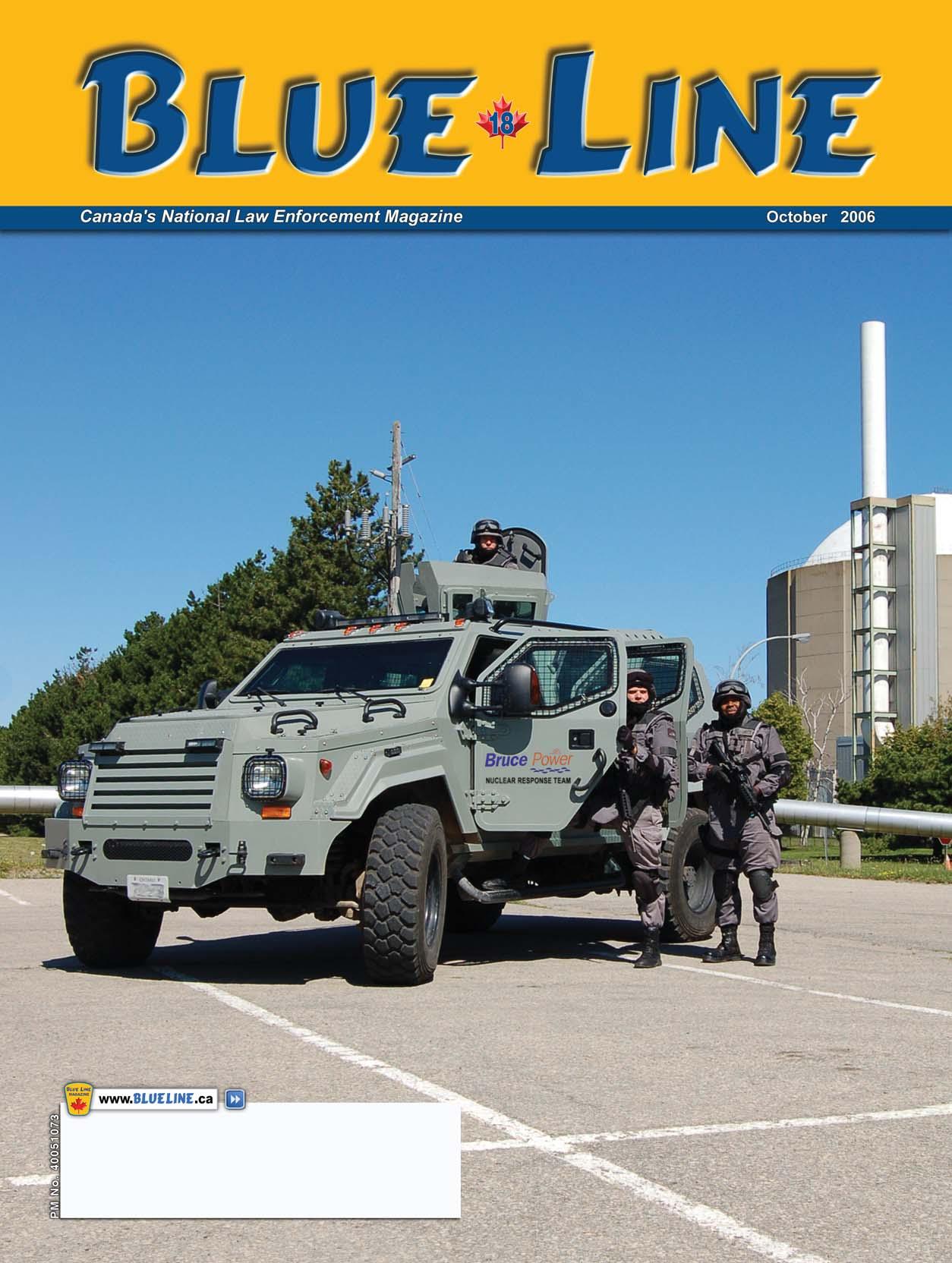
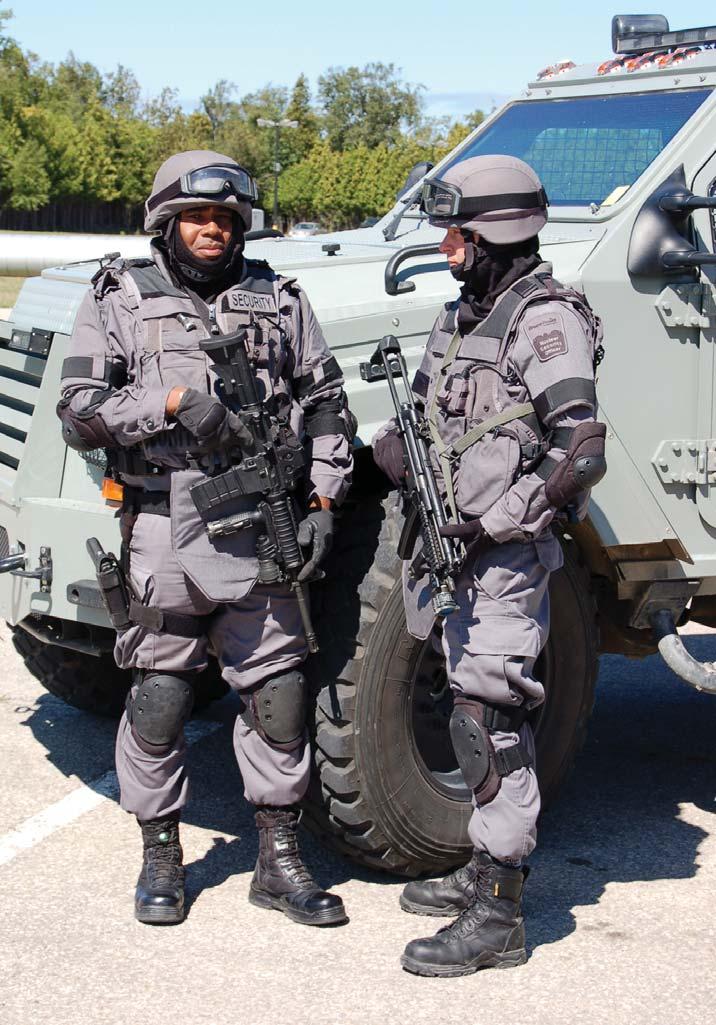
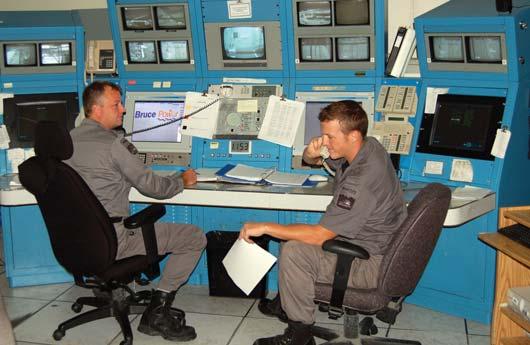
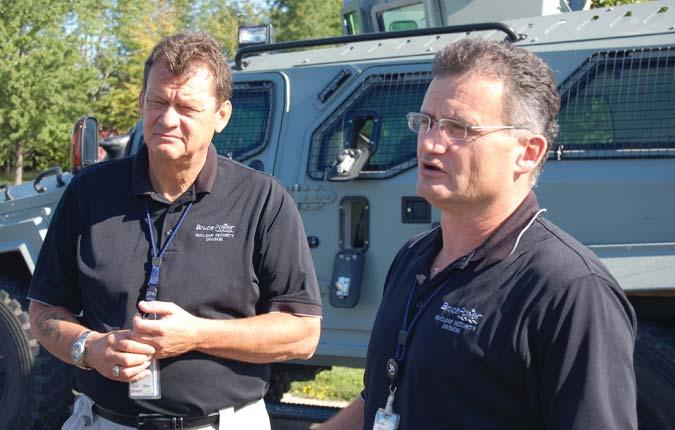
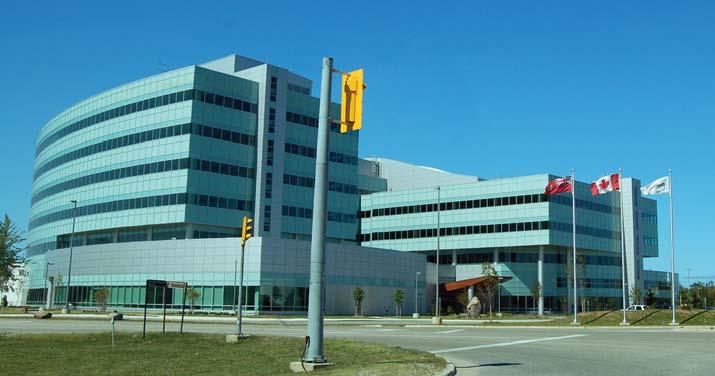
Security personnel at the Bruce Power Corporation on Lake Huron, show off their equipment and skills for Blue Line Magazine.
20Canine sniff at bus terminal okay
21Dog sniff of package not a search
22Offender must show order is disproportionate
23Proving device works not up to police
Security at risk with political delay tactics
by Morley Lymburner
Last month I addressed the issues surrounding the mysterious person in Ottawa that puts the brakes on firearms for law enforcement officers across the country. I have named this nameless and faceless person the Great Wizard of Ottawa (GWO). By all appearances in recent press releases, the GWO is prone to react childishly when he/she does not get his/her way.
Case in point was the recent announcement that Canada will finally have border services officers who will actually be able to protect themselves. By all appearances, and after much hand-wringing and badgering from many directions, the GWO relented and agreed to arming the officers – but then directed that it would take ten years to complete the task and the first officers would not be armed for another year.
To make this reality and not grudge based, we would have to ignore a lot of common sense. My memories of basic firearms training some 35 years ago may have faded but I seem to recall it took about 10 classes, including range work, to make me proficient with my firearm. So why the long delay?
Taking the number of CBSA officers to be trained and doing the math, we find that at the current glacial pace of training, the CBSA will be working on training one officer per week for the duration of the ten years it will take to arm them. It’s not a budget issue; an agency with an $800 million annual budget can surely find the $90,000 or so needed to arm and equip its officers immediately.
Interesting comparisons come out of all this. I seem to recall that around 1995, Ontario police agencies had to re-arm all their officers with semi-automatic handguns. The government of the day suggested they had five years to do the transition, yet almost all of Ontario’s 20,000 plus officers were re-equipped and retrained after just one year. Somehow they managed to find the money for the weapons, new
holsters, trainers and training time to convert everyone in one tenth the time the CBSA says it needs to train one quarter of this number.
In another comparison, in this very issue (the next page actually) you will read about a private company that got serious about securing its facilities. Bruce Power recognized the potential risk and took immediate steps to address the issue, concluding it needed to create an armed force to meet any threat. No politics, no badgering and no questions. From absolute nothing to international recognition of excellence took the company less than three years. It is interesting to view the remarks of Prime Minister Stephen Harper on this subject. An Aug. 31 news story quotes him as saying “Secure borders keep drug smugglers, carjackers and terrorists out.” With the accuracy of this statement, he has sent a clear message to smugglers, carjackers and terrorists that they now have a ten year diminishing window of opportunity to breach the border. Is this conclusion accurate?
In another story, datelined Cornwall, on the same day as Harper’s announcement we read that the Grand Chief of Akwesasne wants an
exemption for the reserve from plans to arm CBSA officers. It did not take long to get his reaction. Any guesses why?
The Mohawk council has lobbied the federal government because its lands straddle two provincial provinces and one American state. For over 15 years, there has been a free-for-all of confusion, intimidation and smuggling both ways across the border, south of Cornwall. This has included high powered rifle fire directed at unarmed CBSA officers, local armed police and politicians. Being less able to intimidate Canada’s customs officers would be very bad for business.
There is not a more vulnerable location on Canada’s border than Cornwall. I am sure terrorists must have already noted this. CBSA should be permitted to triple its strength with armed officers in that area and set up its customs gates on the Ontario mainland at the bridge. What needs to happen is very simple. The GWO must realize that there is no window of opportunity to arm border officers; the window vaporized with those two towers in New York City. Somehow Canada has got by on shear luck since then. There is no shortage of anecdotal evidence of people simply crashing the border to get into Canada. There is no shortage of stories where CBSA officers have had to walk away from incidents of intimidation and shootouts involving the border.
Canada’s new government made a promise to arm members of the CBSA but it should have been to arm them within their mandate of power. The GWO has once again hijacked a good agenda and inserted his/her own. Perhaps it is time for the government to decide who is in power. The GWO puts these long timelines on current governments in the hopes of getting a new government to reverse the announcement. Given the equipment and timeline, officers should be armed and out on the street by January. Ten years is complete hogwash. Smugglers, hijackers and terrorists do not deserve forewarning or a break.
by Morley Lymburner
In 1990 Blue Line Magazine featured a story about Ontario Hydro’s Bruce Nuclear Power development and the security issues surrounding its protection. Five years after 9/11 we thought we should re-visit this facility, now simply called Bruce Power, to see how things have changed. One of the most fundamental changes is that it was now a private business owned by share holders. One group of owners is the Ontario Municipal Employees Retirement System. All municipal police in Ontario invest their pension money through OMERS.
Upon re-visiting the Bruce Power site after 16 years we were confronted with an astonishing transformation in security. Not only had the entire security section been revamped, re-equipped and trained but they had actually become world class competition winners in nuclear facility tactical response protection.
Despite soaring temperatures of over 40 degrees Celsius the June competitions, held near Albuquerque, New Mexico, the Bruce Power Nuclear Response Team (NRT) blasted past its competitors to land first place out of 10 law enforcement agency competitors. The competition, known as the Security Protection Officer Training Competition (SPOTC), is held each year with a variety of categories. The competition was broken down into two categories: Department of Energy (DOE) and Non-DOE (Law Enforcement Agency). In addition they placed fifth overall out of a total of 17 teams. The team was further recognized by their peers for showing the best teamwork and moral support of others.
The simple fact that the Bruce Power Nuclear Response Team received first place is overshadowed by the teams they actually surpassed or came startlingly close to beating.
Sending a team that can stare down tactical units of the U.S. Department of Energy and the U.S. Marine Corp Close Quarter Battle Team is no small task. The Bruce Power’s NRT not only managed to come out on top but also managed to leave an admiring impression with each team they left behind.
“It came as no real surprise to us,” says Wade Lacroix, Chief of Security for Bruce Power. “We all knew we had a well prepared, equipped and motivated tactical team. Our only problem was finding the right place to have them compete so we could give our members a yard stick to measure themselves. Previously the NRT team finished fifth place at the ‘2005 World SWAT Challenge’ in the Nevada desert. Some of the 18 teams there included Germany’s GSG-9, LAPD SWAT, and Dallas SWAT. This spring we made eight out of 22 teams in Little Rock, Arkansas, at the ‘2006 World SWAT Challenge.’ But we did not really find our home until we competed against other teams in the nuclear world competition held in Albuquerque.”
Duncan Hawthorne, Bruce Power’s President and CEO was extremely impressed with the team’s win. “To do so well in this competition and also be recognized by your peers for the manner of performance is doubly satisfying,” he said.
A transformation
Lacroix and his staff began working three years ago to equip and train a select group of officers to specifically prevent an armed breach of the plant facilities. NRT members were selected from a wide variety of backgrounds. Some came with police backgrounds while others had military or correctional of-
ficer backgrounds.
Lacroix, a former detachment commander and inspector with the Ontario Provincial Police, was also a tactics and rescue team leader. Seconded to the Bruce Power facility he was given the job of hardening plant defences. His first task was to find the best team of tactical trainers available and convince them to move over. This wasn’t an easy task. Previously, protection was seen as a custodial job of checking the ID’s of people entering and leaving the site and watching the fences for intruders. Retired people with military or corrections experience were traditionally the type of people drawn to work at Bruce, not the young high energy people needed for tactical response.
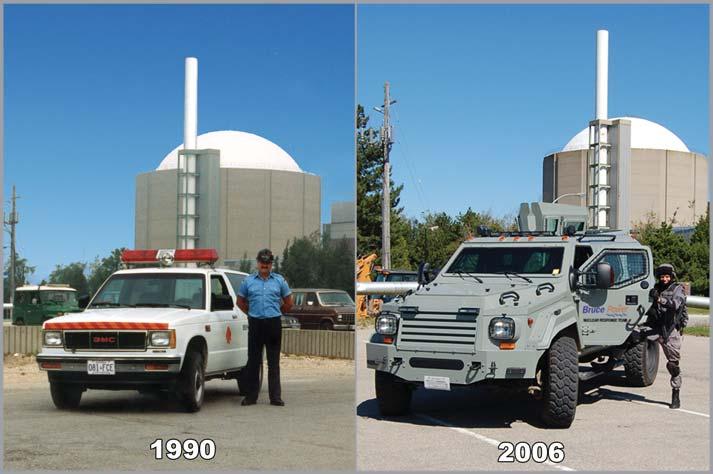
This problem can be exemplified in Blue Line’s previous article from 1990 when Bruce Power’s mandate, if attacked, was to hold back an intruder unarmed for 17 minutes, since tests had shown this was ample time to get police to the facility in an emergency. This passive defence was to be accomplished with alarms, chain link fences, locked doors and concrete walls. Officers viewing a possible problem were simply eyes and ears until armed police arrived on site.
“In this new age we live in this is simply not good enough,” Lacroix points out. “We decided from the very beginning that our defensive forces, post 9/11, should not need to rely on any help from outside our fences. This is not to say we would not call for assistance because we certainly will. But the mind set of the entire organization from the top on down must be that we can secure and hold this facility better than any other agency or group we could call in. Another way to put it is that we would be calling in the police to simply be our backup as we will be the first responders.”
The three NRT officers have a variety of experience. Clemenson was a Correction
was previously in the Canadian Army.
Legislation and equipment
Although reluctant to give specific details, Lacroix describes the Bruce Power Security Force as being larger than the city of Kingston or Chatham Kent Police Services with a tactical response capability larger than both combined. To protect the nuclear material and over 5,000 workers, the security operations are supplied with an array of state of the art equipment and legislation both provincially, federally and internationally to back them up.
Arming any officials, government or not, was once viewed as an almost betrayal of Canadian principles of non-confrontation. The concept of arming security guards was a tough pill for governmental bureaucrats to get their heads around. When it comes to nuclear facilities many Canadian regulatory agencies skimmed over international protocols requiring an appropriately armed security staff. This point became not so convenient to obscure after September,11th.
“Essentially we are here to protect nuclear material from theft and sabotage,” Chief Lacroix points out. “Internationally regulated, Canada is required to supply a design basis threat deterrence for all its nuclear facilities. The arming of the security officers is covered by the Canadian Nuclear Safety Commission which is covered by the International Atomic Energy Agency. The international authority says Canada must have an on-sight response force and an off-site response force. Ontario Power’s approach in the past was not to arm security but call for the police. But international recommendations clearly stated that there must be an on-sight response force and this was to be read that it must have the same capability as the off-site response force. Added to this each officer has powers of arrest under Section 117.08 of the Criminal Code with regard to the people and property they are protecting.”
“So in a nutshell the officers have ‘public agent’ status which basically states that if you
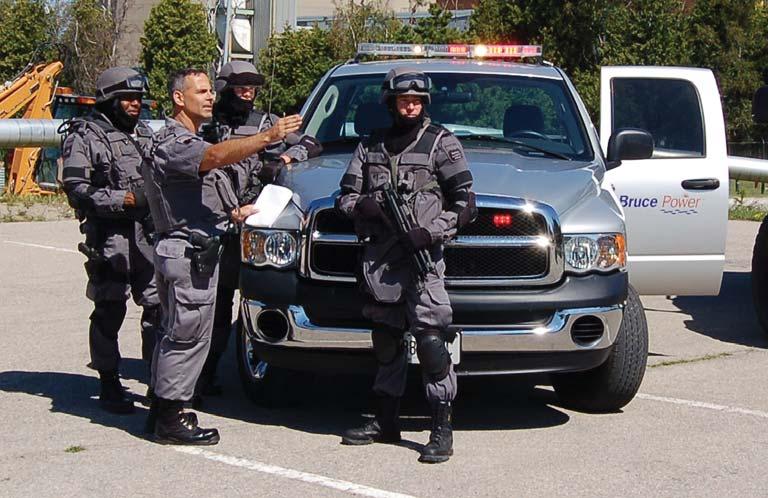
Bruce Nuclear Response Team officers Mike Clemenson, Gary Smith, Sgt. Ben Nevin stand ready with A/S.Sgt. Ken Rowe and Chief Wade Lacroix.
officer while Smith came from the Toronto Police Service and Rowe
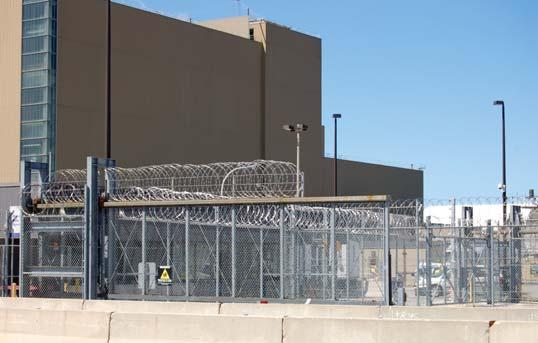
"If you are an armed intruder this is as good a look as you will get," says Section Manager and Trainer John Latouf. "Any armed threat on the other side of that fence will be neutralized."
are an agent of the federal government you can carry a gun. Our security officers are defined as ‘public agents’ under Section 117 of the Criminal Code and Public Agents under Firearms Regulations. They are required to carry firearms by authority of the Canadian Nuclear Safety Commission, a public service agency. As a result we have determined that to fulfill our mandate the security personnel must train and use such weapons as C8’s, MP5’s and Sig Sauer semi-automatics.”
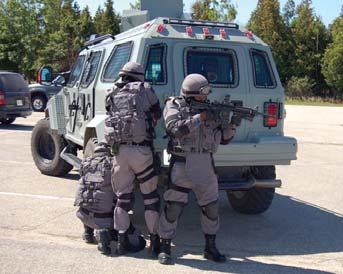
Recently, the security branch took delivery of several armoured assault vehicles custom designed for their use. The design and utility of these vehicles were so impressive that local police have already borrowed one for a special local response. These vehicles join a fleet consisting of motorized snow vehicles, patrol trucks, and mobile command posts.
All NRT uniforms were changed from blue to grey to differentiate members from police. All defensive and offensive gear conforms to standard Canadian police practice and complies with the use of force continuum well known to all police officers.
Bruce Power’s perimetre security levels were dramatically improved. Triple levels of fencing were installed with increasing degrees of deterrence. All fencing is monitored both visually and electronically with zero possibility of undetected breach. Not discussed are the levels of airborne protection but it has been long recognized that CANDU nuclear facilities can withstand a direct hit by a fully fueled commercial airliner... if it gets that far.
can secure and hold this
Security Chief Wade
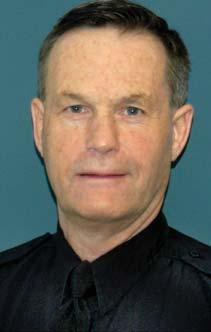
Boyd (left) and Chief Lacroix were selected for the top
extensive tactical experience in the
Protection 24-7
Bob Boyd, Operations Manager for Security Division,, confirmed Lacroix’s remarks by adding that “no one knows the plant better than those that work here and our security force knows it even more intimately than most of the over 5,000 workers on site.”
A former tactics and weapons instructor with the RCMP, Boyd speaks with confidence as he describes the amount of time, energy and money invested in the security infrastructure surrounding the facility and all its assets. “We decided the only way to move into securing the environment was to beef up the fencing and monitoring systems throughout the plant and environs that surround it.”
The challenge of remoteness is both a benefit and curse. Situated in the rolling farm lands of Ontario’s Bruce County, the Bruce Power facility faces Lake Huron half way between the communities of Kincardine and Port Elgin. Its remoteness ensures that intruders or strangers
and
are easily recognized. The down side is that help is a long way off. This was the major factor in creating such a robust onsite response force.
Although Boyd can’t divulge much of the improvements made he points out that there is no movement on or near the plant that can’t be monitored and recorded directly by security staff. “It is our goal that our 5,000 workers will simply confirm what we already know. We can then send in the appropriate response to the threat we find.”
Indeed, the threat of invasion by an all out attack is a daunting one. In the worst case scenario it would be a sudden and unexpected armed breach of the facility. Boyd points out that at varying levels beneath this there would be scenarios they could handle but some would tax their capabilities even more than a direct assault.
“An anti-nuclear protestor type attack would be the worst in my opinion,” Boyd suggests. “After evaluating this as the type
"We
facility better than any other agency or group we could call in," says
Lacroix. "We would be calling in the police to simply be our backup." Bob
jobs at Bruce Power Security due to their
military, OPP
RCMP.
The Bruce Power facility has both secure communications and a secure communications facility. The control room bunker is designed to specifictions which ensure the safety and integrity of the communications officers.
Placing all administrative staff in a single building at Bruce Power enhanced security by ensuring the safety of the workers as well as to ensure all staff are where they are meant to be. And if they have to go out for Tim Hortons... they will find it on site. Other measures included the cancelling of bus tours on the premises. The public can learn and view all they need to know at a Visitor Centre situated on a high ridge two miles to the east of the plant.
of attack, and that the attackers are actually protesters, then less lethal options would be deployed. It would be difficult, however, to determine if the protestors are legitimate or are terrorists simply using that tactic to delay or overpower lower level force delivered on our part.”
“We can take all the care we can to identify the type of threat presented to us but if there is any indication that the security of the nuclear material is at risk we can not afford to risk not raising the level of force. We are all confident that the closer an attacker gets to the core the higher the level of force we will deliver. We are equally confident that no attacker will reach that core.”
Ensuring the readiness to take on the challenge of potential attackers is the job of Section Manager John Latouf. He is in charge of Nuclear Security Training for Bruce Power and is responsible for keeping the NRT sharp. John came to Bruce Power with 20 years experience in the OPP, and most of that with the TRU team. He is a former Provincial Coordinator for the Explosive Disposal Unit and is a certified bomb tech.
“One of my jobs is to test the response capabilities of these officers on a continual basis,” John states. “We are aware that we are security and not the police. Our people are therefore not tested daily by real world events and responses to them. Due to this it’s important that we continually test and probe our security net to ensure it’s at its peak. One of the ways I do this is by designing and executing a wide variety of breaches of security to ensure the officers stay sharp. For safety reasons only high level staff are aware of when and where the tests are to happen.”
“Monitoring the location and movement of nuclear material is ultimately what we are all about,” Chief Lacroix points out. “We check the people and vehicles coming in for contraband material and monitor them as they go out for nuclear material. In my estimation no one does that better than this facility and our people.”
Labour relations
To back up the officer selection process the top managers of Bruce Power understood the concept of paying staff to the level which they’re required to perform. In a lot of industrial security facilities the poorest paid people tend to be the security personnel. This was of particular concern to Bruce Power because most people working there were highly paid professionals or tradesmen. For underpaid security personnel it became an issue of job satisfaction and self-esteem. Low pay also limited the talent pool available for applicants and
affected the ability to train them to higher levels of proficiency and retain them once trained. Recognizing the link between pay and abilities made negotiations with the Power Workers Union not as difficult as it once was. Security personnel are paid considerably better than in the past, with tactical officers starting at around $65,000 a year. On top of this there are bonuses for such things as education and physical fitness. Memos of understanding with the Union has resulted in a no strike clause which recognizes the importance of security over labour issues. Grievances are handled in a normal fashion but walking off the job is not one of the options available.
“If the competition in Albuquerque taught us anything,” notes Chief Lacroix, “it was that our training style is among the best in the world and we take great satisfaction from this. But, we also know we can’t sit on our laurels either. We have been invited back to defend our title next year and a lot of other people learned from us this year. But in the nuclear world of security this is a good thing.”
As Lacroix points out, “in the final analysis our officers are well fed, well bred and well lead. And if all this fits we can’t lose.”
Morley Lymburner is the Publisher of Blue Line Magazine and may be reached by email at Publisher@Blueline.ca. For further information about the Bruce Power facility you may contact Chief of Security Wade Lacroix at 519 361-2673 Ex. 4017
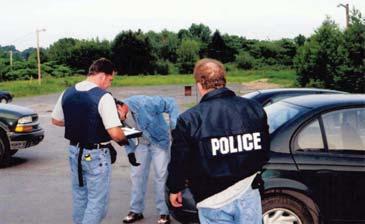
Blue Line first published a story about the Bruce Power Nuclear plant in February 1990. Recognition of a possible attack by terrorists was well known back then but preparing for the probablility of an attack, as seen in the pictures above, was a much
lower priority. Post 9/11 all that changed and a simple call to the police to remove terrorist intruders is simply not good enough. Today Nuclear ResponseTeams are suited, armed and ready to roll on site 24 hours a day.
Chief of Security Wade Lacroix
by Joseph Eastwood and Brent Snook
The use of psychics – individuals claiming paranormal abilities – by law enforcement agencies has been documented since the 1500s, when purported psychics and mediums were frequently used to elicit confessions from superstitious offenders.
In recent times, numerous anecdotal reports (often from psychics themselves) have credited psychics with providing amazingly accurate predictions in criminal investigations. Recent television shows such as Medium have popularized the idea of the ‘psychic detective,’ an individual who can solve crimes using a variety of paranormal powers. Although empirical evidence shows no support for their alleged abilities, surveys show North American police agencies actually employ the services of psychic detectives.
Do police really use them?
Police forces around the world have consulted psychic detectives on hundreds of cases (Sagan, 1996; Nickell, 1994), according to many popular books, web sites, TV documentaries and newspaper reports, for help on investigations ranging from missing persons to homicide cases. A seminal book on psychic detectives (Lyons and Truzzi, 1991) reports many confirmable anecdotes of police officers crediting psychics for generating amazingly accurate predictions used to solve real cases. Despite these published accounts, only three comprehensive surveys of psychic usage have been conducted.
Sweat and Durm (1993) questioned police chiefs of the 50 largest US cities. Thirty five percent of the 48 agencies responding reported that they either used or had used psychics during an investigation, most often in homicide
and missing persons’ cases (which are very uncertain and produce much grief and anxiety). All respondents claimed the psychics’ information was no more helpful than that obtained from other sources and 95 percent agreed it was no more valuable than that obtained from a regular source.
In a follow-up study, Sweat and Durm sent the same questionnaire to 75 medium and 75 small US cities. Twenty seven percent of the 33 police departments in the medium-sized cities that replied reported they previously used psychics during an investigation, primarily in homicide and missing persons’ cases. Again, all reported that the information provided was no more helpful or valuable than that from other sources.
Of the 32 police departments in the smallsized cities that replied, 19 percent reported having previously used psychics, once again most frequently for homicide and missing persons’ cases. All reported psychic predictions were no more helpful or valuable than information provided by other sources.
The third survey, conducted by Det. Bruce Walstad (1993), was administered to 263 police officers attending fraud seminars. He reported that 36 percent of officers agreed they would personally use a psychic in an investigation. Six percent reported that their department currently used psychics and 23 percent said their department had used one at some point in the past.
Similar to previous surveys, psychic sleuths were most often used in homicide and missing persons’ cases, most commonly by an officer personally calling one into the investigation (41 per cent of the time). Fourteen percent of respondents said the information they received was useful in solving the case, Walstad reported, although none of the officers agreed
that the case would not have been solved without the psychic’s help.
Taken together, the three surveys showed similar patterns of results, with 19 to 36 percent of respondents reporting they had used psychics during an investigation or were willing to use them in future investigations. In general, the surveys indicate police officers and agencies are skeptical about the utility of the information provided and do not believe it to be more accurate or useful than that obtained from other sources. Unfortunately, no comprehensive Canadian survey is currently available.
Some evidence for level of usage here comes from a study investigating criminal profiling usage by Canadian major crime detectives (Haines, 2006). This study reported that 18 percent of the 51 detectives interviewed stated they had previously used a psychic during the course of an investigation.
Anecdotal evidence also indicates psychics are used in Canadian criminal investigations. For example, in January 2005 CBC reported that Sgt. Steve Bank in Nelson, BC used a psychic to help locate a missing person. “Without the use of the psychic, I think I’d still be looking for this person,” he was quoted as saying.
Accuracy
Controlled experimental research on the predictive abilities of psychics began in the late 1800s and results generally favoured the idea they possessed special predictive powers. In recent years, however, the majority of that research has been discredited because of a variety of methodological errors (Schouten, 1994). In the last three decades, a handful of more methodologically sound research studies on the predictive accuracy of psychics in an investigative context have been conducted.
The first psychic detective experiment was
conducted in 1979 by Dr. Martin Reiser, then director of the LAPD Behavioral Science Services Section. He asked 12 psychics to make predictions about the likely offender for four separate cases, providing each with physical evidence and asking them to verbally report any information they could ascertain. Results from the first case showed that, on average, psychics correctly predicted two of a possible 21 indicators – a 10 percent hit rate! Results from the remaining three cases showed similar results, with average hit rates of five, eight and nine percent respectively. The most commonly correct predictions were those concerning the gender of the victim and suspect.
In a follow-up study in 1982, Reiser once again had psychics generate predictions in four separate cases. However, in this study, he also had students and detectives complete the task. Although the psychics generated responses that were six times as long as the other two groups (and contained 10 times the number of predictions), there was no difference in accuracy between the three groups. Given the results of the two studies, Reiser concluded that there was no compelling empirical evidence to support a belief that psychics could produce information useful in a criminal investigation.
Fourteen years later, Richard Wiseman and his colleagues undertook a study of three wellknown British psychic detectives, one of whom had received considerable media attention for assisting his local police force. Three students were also tested for comparison purposes. Participants were given physical evidence from three separate, previously solved, cases and asked to generate predictions they might have
about the crime in question.
They were then presented with a list of 18 statements, six of which applied to each of the three cases, and asked to align the statement with the case. Neither group performed the statement-alignment task at above chance levels; the psychic group, on average, correctly matched only two statements per case. Furthermore, although psychics made twice as many predictions as the students, there was no difference in the number of correct predictions made by the two groups. Wiseman concluded there was no compelling evidence to support their claims of predictive superiority.
O’Keefe and Alison (2000) asked eight psychics and 12 students to predict the characteristics of an unknown offender. Three separate cases were used; participants were given crime scene photos from each case and asked to make predictions. As in previous cases, psychics made many more predictions (three times more, on average) as the controls; however there was no statistically significant difference in accuracy between the groups in any of the three cases. Perhaps most interestingly, psychics made significantly more inaccurate predictions than the control group in all of the three cases. Once again, it was concluded that they did not display a level of predictive accuracy above that of ‘non-psychics.’
A final study was conducted in 2000 by Richard Kocsis and his colleagues. Although the primary purpose was to measure the accuracy of predictions about an unknown offender made by criminal profilers, a psychic group was included as a comparison. Participants, including profilers, psychologists, students, police
officers and psychics, were presented with the details of a previously solved homicide case and asked to make predictions about the unknown offender’s identity.
The psychic group produced the lowest overall accuracy score of all groups – a 34 percent hit rate. Simply completing the questionnaire by guessing the answers would produce an accuracy level of 27 per cent!
All of the studies found psychics provide a multitude of predictions, but their accuracy was below or equal to chance and easily matched by “non-psychic” comparison groups.
Psychics’ methods
Even though psychics appear to completely lack the predictive skills they claim, testimonials and anecdotes continue to promote their abilities, perhaps because of the following calculated manipulations that can convince the public and police of their abilities:
• Direct misrepresentation of past experiences. Evidence of psychics either creatively interpreting or blatantly inventing past experiences is well documented (see Nickell, 1994 for a review of this phenomenon). An excellent example of this technique was reported in the previously reviewed study by Wiseman and his colleagues. A few weeks after their experiment was completed – which clearly demonstrated a lack of the claimed abilities of the psychics involved – one of their psychic participants appeared on a national British television show and declared that “I have proved it (my psychic abilities) in laboratories. In fact, only three weeks ago I did a test at the Depart-
ment of Psychology at Hatfield University, which – I mean – they were just going around thinking “How does he do this?” I don’t know how I do it but it does happen.” Whether this and other false psychic claims is due to selective memory or intentional fabrication is not known. However, what is known is that many psychics have misrepresented their past successes and all claims should be independently verified whenever possible.
• Using vague or ambiguous statements. Otherwise known as the Barnum effect, this technique involves predicting broad or general statements that could potentially be applied or interpreted in a variety of ways. A good example of another area where this technique is used is horoscopes; by writing very vague and general statements, the majority of people can find a way to apply it to their own situation. Every psychic in a study by O’Keefe and Alison (2000) used this technique. For example, a psychic may visualize water as being important and the victim was found close to a lake. Although the prediction could have been fulfilled in a variety of ways (e.g., it rained the night of the crime, victim drowned, victim was once a lifeguard, etc.), it is still interpreted by the psychic (and possibly others) as correct.
• Use of base-rate information. Using base-rate information (also known as the “stock spiel”) involves offering statements that have a high probability of being correct in a certain situation, regardless of the particular details of a specific case. For example, it has been shown that the longer a person is
missing, the greater the chance they will not be found alive (see Keppel & Weiss, 1994). As psychics are often called in once other investigative techniques have been exhausted, a ‘safe’ prediction would to claim that the victim will not be found alive. Given the high probability of this being correct across all missing person’s cases, the psychic will invariably be right more often than wrong. This technique can be applied to any prediction that has a known probability of being correct (e.g., majority of offenders are male).
• Feedback from those involved in case
There are three broad ways in which psychics can use the ‘feedback’ technique. ‘Fishing’ - the psychic makes a vague statement in hopes of prompting a response from the person they are speaking with – is the first method. For example, they may claim they picture the letter ‘S,’ prompting an officer to reply that the primary suspect’s name is Sandy. The psychic then says the vision is becoming clearer and that they now see a male named Sandy being involved in the crime. Although a crude example, it demonstrates how, in hindsight, it may appear that the psychic had produced an impressive prediction.
A second way psychics gather information is through ‘co-operative strategies’ (O’Keefe & Allison, 2000), which involves picking up subtle hints regarding the accuracy of their line of predictions by assessing body language. For example, raised eyebrows following a prediction may indicate it has hit close to the truth and the psychic will continue to pursue that particular line of predictions. It is a very subtle
technique and those skilled in its use can often practice it without the knowledge of the people involved.
The third method is interaction with the media, local residents or police themselves. Perhaps a police officer is not aware of all of the facts that have been released to the media, for example, or that the psychic had previously interacted with another member of the force.
Through the use of any of these strategies, psychics can appear to possess information and make predictions that are impressively accurate.
What can police do?
Police agencies are obligated to follow-up any leads they receive, regardless of the source. In order to perform a complete and exhaustive investigation, predictions from psychics cannot be automatically dismissed and must be duly investigated. Pressure from outside sources such as a victim’s family may also lead to a psychic being used in order to appear to be doing all that is possible to solve the case. Moreover, the police may feel that they have “nothing to lose” in trying a psychic. Unfortunately, the use of psychics can, (and often has) lead to a waste of resources by sending police officers on wild goose chases (see Lyons & Truzzi, 1991, for examples).
Since using a psychic in an investigation cannot always be avoided, we suggest that police officers should be extremely cautious when interacting with them during an investigation. By demonstrating there is no compelling evidence to support a psychic detective’s predictive ability and reviewing the methods they use to convince people of their powers, we hope that police agencies will have the necessary repellent to ward off such pseudoscientific practices.
References
Haines, M. (2006). Criminal profiling use and belief: A survey of Canadian police officer opinion. Unpublished honour’s thesis, Memorial University of Newfoundland, St. John’s, Newfoundland, Canada. Http://www.cbc.ca/story/canada/ national/2005/01/27/psychic-body050127.html . Retrieved August 1st, 2006. Keppel, R. D., & Weis, J. G. (1994). “Time and distance as solvability factors in murder cases.” Journal of Forensic Sciences, 39, 386-401. Kocsis, R. N., Irwin, H. J., Hayes, A. F., & Nunn, R. (2000). “Expertise in psychological profiling.” Journal of Interpersonal Violence, 15, 311-331. Lyons, A. & Truzzi, M. (1991). The blue sense: Psychic detectives and crime
The Mysterious Press: New York.
Nickell, J. (1994). Psychic sleuths. Buffalo, NY: Prometheus Books. O’Keeffe, C. & Alison, L. (2000). “Rhetoric in ‘psychic detection.’” Journal of the Society for Psychical Research, 64, 26-38.
Reiser, M., Ludwig, L., Saxe, S., & Wagner, C. (1979). “An evaluation of the use of psychics in the investigation of major crimes.” Journal of Police Science and Administration, 7, 18-25.
Reiser, M., & Klyver, N. (1994) “A comparison of psychics, detectives and students in the investigation of major crimes.” In J. Nickell (Eds.), Psychic sleuths (pp. 204-211). Buffalo, NY: Prometheus Books. Sagan, C. (1996). The demon-haunted world. Science as a candle in the dark. New York: Ballantine Books.
Schouten, S. A. (1994). “An overview of quantitatively evaluated studies with mediums and psychics.” Journal of the American Society for Psychical Research , 88, 221-254.
Sweat, J. A. & Durm, M. W. (1993, Winter). “Psychics: Do police departments really use them?” Skeptical Inquirer, 148-158.
Sweat, J. A. & Durm, M. W. (1994). “Update: Psychics – do police departments really use them in small and medium-sized cities?” In J. Nickell (Eds.), Psychic sleuths (pp. 224-235). Buffalo, NY: Prometheus Books. Walstad, B. (1993). Retrieved March 1st, 2006, from http://pac-c.org/ police%20&%20psychics.htm . Wiseman, R., West, D., & Stemman, R. (1996). “An experimental test of psychic detection.” Journal of the Society for Psychical Research, 61, 34-44.
Joseph Eastwood is a graduate student in the Department of Psychology, Memorial University of Newfoundland. Joseph can be reached at je01@play.psych.mun.ca
Brent Snook is an assistant professor in the Department of Psychology, Memorial University of Newfoundland. He can be reached at bsnook@play.psych.mun.ca
by Elvin Klassen
Often referred to as ‘The Wheat City’ for its strong agricultural heritage, the growing southwestern Manitoba city of Brandon is home to some 43,000 residents. The city’s police force is also growing, going from three constables at its founding in 1882 to 78 today.
The constables back then were primarily concerned with breaking up fist fights, raiding houses of ill-repute (there were many) and fining people for reckless driving. Fights generally broke out over girlfriends, liquor or horses. Such conduct usually brought an officer of the law to the spot and the brawlers were taken before a police magistrate, who in those days was referred to as ‘The Beak.’
A big issue today is overcrowding at the force’s headquarters. Plans to build a new central building to house both the police and fire departments, with a common dispatch service, have been put on hold due to high building costs.
A framed certificate from the Commission on Accreditation for Law Enforcement Agencies (CALEA) hangs proudly in the station, testifying to the high standards BPS has set. CALEA has evaluated the service since 1993, explains Acting Chief Harley Bryson, reviewing policies and procedures and practices in the field. It does an assessment, mock test and final evaluation every three years, assuring Brandon residents that they’re getting the best service possible. The review also gives the BPS an opportunity to evaluate and make improvements where necessary, notes Bryson.
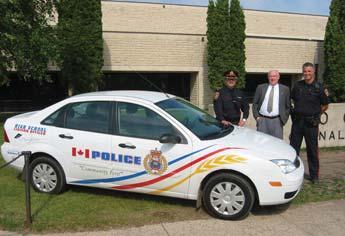
BPS was the first Canadian municipal police service to connect to the RCMP’s PROS database. Each BPS vehicle now sports a laptop which connects to the system. New vehicle decals provide better visibility and community appeal. The new design incorporates side stripping in the form of wheat – the community’s symbol, the city’s coat of arms, and the Canadian Flag, giving it a national connection. The service worked with a local firm, Accent Stripping, on the design, which was then circulated
to all staff before receiving final approval.
The service is currently searching for a new leader to succeed former chief Richard Bruce, who retired in May after more than 35 years with the service. Bruce won’t be slowing down though. He plans to earn a graduate degree in leadership and training at Royal Roads University in Victoria. His thesis project will focus on “intergenerational differences in the workplace,” and he hopes his research will be used to guide police forces in their recruitment
practices. Two police services have already expressed interest in his project. His future plans also include spending more time teaching at Brandon and Dalhousie Universities.
The BPS has trained its own recruits for more than 25 years, using its own officers. Now Assiniboine Community College (ACC) in Brandon is launching a policing curriculum that will make it easier for the province’s forces to find much-needed officers.
The police studies program, unique in
Western Canada, will make it cheaper for forces to hire recruits that have already begun training, says instructor Wayne Jacobsen. “We definitely have the demand for it,” he notes, explaining tuition fees, rather than police forces, will now help cover the costs.
The college will provide the first phase of officer training and teach subjects such as the Criminal Code and provincial statutes, physical education and military-style drills.
Police services that hire ACC grads will then provide further instruction, such as officer safety and firearms training. A dozen BPS and Dakota Ojibway Police Service recruits presently attend the college’s recruitment-training program. Five men and three women from this group will be on the streets of Brandon by this fall.
The ACC program will save the force time and money, says Inspector Leon Flannigan, since officers previously had to schedule their time to teach new recruits.
In June a Brandon chapter of the crimefighting Citizens on Patrol Program (COPP) was launched. About 30 volunteers now don bright yellow vests and comb city streets on the lookout for crime to report to police. More than 70 communities in the province have such a watchdog group, said Manitoba Justice Minister Gord Mackintosh, who travelled from Winnipeg to join the group’s kickoff.
This connects with the BPS mission statement, “To work with our community to maintain peace and order through law enforcement, education and partnerships.”
Keeping in step with this mission statement
several examples of community co-operation and cross department initiatives have been instituted by the Brandon Police Service. Two initiatives involve co-operation with schools. In the first instance police give input to students while in the second the students supply assistance to the police. A third innovation involves working closely with another municipal branch to more smoothly integrate the delivery of service to the community.
Constable earns top marks
Although he’s an 18 year veteran of the Brandon Police Service, Cst. Guy Roberts goes to school every day – and not just one school either. Roberts visits the Manitoba city’s three senior high schools daily.
He spends the majority of his time connecting with students, being a visible presence and working with school administrators when inter-
vention is needed. He investigates thefts, assaults, parking lot collisions and other problems, but his favourite activity is walking the halls and talking to students, which helps him develop relationships with even the toughest kids.
He likes to participate in events, even dying his hair gold, purple and green – the colours of the three schools – for a fundraiser to raise money to buy hampers for the Christmas cheer board. Roberts is not always Mr. Nice Guy though. He’s laid assault charges for incidents in schools, making it clear that fighting will not be tolerated.
Roberts is in the schools under a program introduced in 2005 by the school division, city and police service, using money from the province. He’s been welcomed by staff, students and parents alike as part of the school community; they also appreciate the added security.
“All of the interferences that we usually have – including the assaults, fights and blatant narcotic problems – have sort of vanished,” Vincent Massey principal Terry Osiowy notes, adding Roberts gives students the atmosphere they need to focus on school work.
“Suspensions are down in all three high schools, especially in the area of any aggressive behaviour,” reports Barry Gooden, principal of Crocus Plains Regional Secondary School. “We haven’t had the fights nor the inter-school hostility that has been present in the past because Roberts works in all three schools. Students tell me they feel safer.”
Statistics confirm Roberts’ presence has had a very positive effect, with suspensions dropping almost 11 per cent from Sept. to Dec. 2005 compared to the same period a year earlier.
Roberts mediates disputes and makes classroom presentations which promote positive decision making, credited with lowering the rate of suspensions for assaultive behaviour by 65.3 per cent.
The school resource officer has brought greater vigilance to the schools. His presence has changed the culture, prompting students to be much less tolerant of drug and alcohol related activities. Drug and alcohol suspensions have increased by 114 per cent, dramatically reducing the presence of illegal substances within the schools. That’s likely because students are more comfortable reporting such activity, explains Roberts.
“I think his presence is definitely a good thing,” says Vincent Massey Grade 12 student Nicole Robinson, who adds Roberts is someone students can talk to. She asked him to speak to her student leadership class about drinking and driving and notes “everyone likes him. Everyone thinks he’s awesome.”
Initially students were intimidated when they saw someone in uniform in the hallways, notes Roberts, but they soon became comfortable with his presence and are now very comfortable.
“One of the goals was to break down the barriers so students feel more comfortable in the presence of a police officer,” he notes. “This daily interaction has created a new comfort level on the street. A new relationship between the police and the students has developed. We have not had any negative issues from student councils or parent councils with a police of-
Shown with the School Liasion patrol car is Insp. Ian Grant, Principal Barry Gooden and Cst. Guy Roberts
ficer in the buildings.”
Being in the schools every day has instilled a deep sense of ownership in both the police service and himself, Roberts says. “I take it very personally when something inappropriate happens in the schools. I want to provide the best service possible to the schools and take ownership for the problems.
“If a dispute develops, I am here to mediate the concern and shut down a problem before it gets out of control. Prior to the program, when we were dispatched to the schools this became part of the grand scheme of things. Now the principals have my cell number and it is a priority.”
The schools have been operating a Crime Stoppers program for years, Gooden says, but Roberts has helped to modernize it and make it more effective.
Cst. Darren Sewchuk was to begin a similar program in Brandon’s kindergarten to grade 8 schools. He plans to develop important relationships and provide information on a variety of topics to students in 20 different schools, promoting healthy decision making and safety.
Students design police robot
Brandon Police Service (BPS) was faced with a dilemma last year; it needed a new robot but couldn’t afford the high cost of buying a commercial unit.
Its old robot – large and obsolete – was no longer useful so the service donated it to students in the technology class at the local secondary school to experiment on. Electronics teacher Lionel Ogg and his students in drafting and body shop soon decided they could design and build a new robot for the police service.
They developed a prototype, which was used during a training day. Feedback was used to make design changes and refine the plans. Once everyone was confident the students could build a useful robot, BPS Sgt. Doug Thompson approached local service clubs for assistance in funding it. The Rotary Club decided to help.
“Everyone is very excited about this community project,” Thompson says. Final plans are being drawn and the three departments plan to build the new police robot during the 200607 school year.
School principal Barry Gooden is excited about the partnership between students, staff and community. “This is a huge challenge for our students and it gives them an opportunity to develop their skills in a practical way. This is a real project and the enthusiasm that the students and teachers are showing is contagious.”
Blue Line will follow this venture and report on the results in a future story.
Police officers control animals
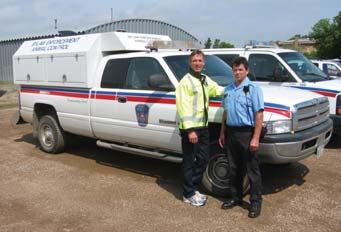
Brandon’s two animal control officers (ACO) use Brandon Police Service (BPS) as a base, under the direction of a BPS sergeant, drive BPS vehicles and wear police badges.
Acting chief Harley Bryson stresses the important fit animal control has with the police service. The two ACO officers are dispatched through the police communication system in an arrangement he says promotes safety
in the community. When police officers have a search warrant for a building and encounter fierce dogs, for example, they can call on their own animal control department to assist.
Being part of the police service provides
additional authority and back up support when required, ACO Kelly Pettinger adds. Through the authority of provincial animal care, animal disease and animal liability acts, officers also provide animal protection and lay charges for animal neglect and injury.
Pettinger says he has experienced every situation imaginable in the city during his ten years on the job, including encounters with squirrels, rabbits, moose, deer, cattle and bear. His keen interest in animals, which includes taxidermy as a hobby, makes him an excellent fit with the program.
Elvin Klassen is an assignment writer covering stories for Blue Line Magazine in western Canada. You may contact him via email at Elvin@BlueLine.ca
Some pillars more equal than others Vancouver police inspector questions program’s real agenda
by John McKay
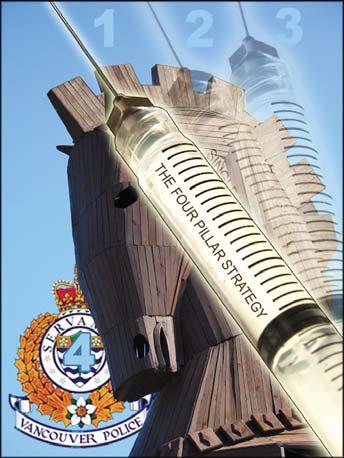
The maxim that those who do not learn the lessons of history are doomed to repeat them has become a truism of the 21st century. History’s lessons come in various forms, the most ancient and venerable being myth and legend. Enduring legends, passed down through the ages, usually illustrate an important truth or warning to future generations. One classic example is the story of the Trojan Horse.
The ancient city of Troy, besieged by the Greek army, defiantly resisted all assaults. However, when the enemy offered a colossal statue of a horse, this splendid city let down its defences and opened the gates. Some skeptical and observant Trojans objected but were denigrated by the rulers of the city, who slept while the Greek soldiers emerged from the belly of the horse, captured the heart of the city and left it in ruins.
In recent years, Vancouver too has been under siege. We have fought to defend our city from an onslaught of street disorder, property crime and violence driven by the drug trade. Like the Trojans, Vancouverites who have endured the effects of this siege were dazzled by a new and attractive concept, the Four Pillar
Strategy, which our civic leaders brought into the heart of our city, assuring us that this panacea would solve our problems and restore our city to greatness.
Like the few skeptical Trojans, some observant Vancouverites have suggested that the
Four Pillar Strategy (harm reduction, enforcement, prevention and treatment) might be, like the Trojan Horse, simply a cover for bringing about the legalization of all psychoactive drugs. Considering the chronology of this process may lead rational readers to draw their own conclusions.
As the police officer in charge of the Downtown East Side (DTES) of Vancouver for the past three years, I have had the opportunity to be a part of and observe the Four Pillars Strategy on drug addiction and analyze the chronology of its implementation in Vancouver. Unveiled five years ago, it was supposed to solve the Downtown Eastside’s drug addiction issues and end the public disorder on Vancouver streets. Medical and academic “experts” and local municipal drug policy administrators produced volumes of statistics intended to prove this concept would work and cited the approach’s great successes in Germany, Switzerland and the Netherlands. No mention however, was made of the contrary, and very successful, approach to drug addiction used by Sweden and other countries.
Police involved in the enforcement pillar were somewhat skeptical, but conditions were so bad that Vancouver Police were willing to experiment with this approach. At this time, the department was, for the most part, only charging those who trafficked cocaine, heroin or very large amounts of marijuana. Charges of possessing these drugs were simply not pursued because our lenient court system had precluded them on a public interest basis.
Police are also involved in the harm reduction pillar because, in its true sense, harm reduction is the basis of all police work: we are entrusted with the duty to protect and thereby reduce harm to all citizens. The narrow and sometimes distorted definition of harm reduction used in the context of the Four Pillar rhetoric, which limits police work to enforcement, does not include the true objective of policing. The Vancouver Police Department (VPD) supported the safe injection site when it opened in September, 2003 for a three year research study because we were willing to try new and innovative ways of dealing with drug addiction. We also supported the delivery of 10 million needles to approximately 8,000 mentally ill and drug addicted individuals ghettoized in the five block area of the DTES.
We recognized that the emerging cocaine culture would result in hundreds of addicts gathering on the streets, leading to horrendous public order problems. In response, the VPD created a 65 person squad in April, 2003 to deal with the potential problems and the entrenched street disorder problem. This squad still patrols the five blocks of the DTES around the safe injection site, which was also given cell phone access to two beat officers 22 hours daily, seven
days a week to respond to violent incidents occurring at the site. These actions clearly demonstrate that the VPD has supported the enforcement pillar very well.
In early 2004, Four Pillar Strategy advocates began asking police to not charge the so called “good traffickers,” which they defined as those who only dealt cocaine or heroin because they were addicted. Attached to this argument was a fair amount of political interference against officers who disagreed with it. Letters of complaint were written and there was a clear attempt to control and manipulate police response. It began to look as if the enforcement pillar was under siege by the very people who had created the strategy.
Larry Campbell, then mayor of Vancouver and a long time supporter of legalization, announced in the fall of 2004, on the one year anniversary of the safe injection site, that it was a huge success. Lives were being saved and crime was down because, and only because, the site was looking after the needs of 600 addicts a day, he said. Four Pillar Strategy proponents attributed this success exclusively to harm reduction. No mention was made of the role played by the 65 officers in the area. Interestingly enough, coroner’s statistics for that time period indicated that overdose deaths actually increased in the DTES while decreasing in the rest of British Columbia.
Other statistics showed that the property crime rate had dropped 10 per cent in the DTES. Thousands of arrests were made, charges were laid and, although very few people were jailed for trafficking, police succeeded in displacing much of the crime problem elsewhere. Again the enforcement pillar was taking a beating in the public forum because advocates had become quite successful at “normalizing” drug addiction and “proving” harm reduction was the key to success.
Police and the public began to realize in 2005 that the ‘treatment pillar’ was completely inadequate and really not a pillar. Addicts wanting treatment on demand had to wait six weeks. By contrast, the harm reduction pillar rapidly gained size as advocates continued their move toward legalization by lobbying police to support a safe inhalation site – a place where cocaine, methamphetamine and heroin can be smoked in a ventilated room.
Medical staff would give assisted injections to addicts who, for various reasons, are unable to inject themselves with psychoactive drugs. Both concepts are extremely disturbing on a number of levels: WCB regulations prohibit working in a contaminated environment so staff would need to be protected from the wafting heroin, crack and meth smoke, for example. It seems obvious that a police response to violent incidents at the safe inhalation site would be hazardous materials calls, requiring protective suits.
When police pointed out at a meeting between harm reduction advocates, medical doctors, research people with strong academic credentials and VPD members that assisted injections were not only illegal but violated ethical
rules of conduct, the response was that “drug addicts assist each other anyway!”
The most disturbing aspect of this meeting was a sentence at the top of an information package circulated by advocates which stated that “The Vancouver Police Department fully supports harm reduction.” The following pages presented and elaborated on the new concepts of safe inhalation and assisted injections. It would have appeared to the untrained eye that the VPD endorsed safe inhalation and assisted injections. This deceptive strategy was an attempt to coopt the VPD into supporting, or appearing to support, the move toward legalization.
To date the prevention pillar hasn’t actually materialized. Unlike the abstinence-based prevention messages used for alcohol and tobacco, there hasn’t been a single message in the media from the Four Pillar advocates or the health authorities stating that heroin, cocaine, methamphetamine or marijuana is bad for health. There was, however, ‘The Mayor’s Forum on Prevention’ in September, 2005 for advocates supporting the legalization of all psychoactive drugs. Interestingly, the same medical and research personnel who had been the stalwart supporters of harm reduction were now presenting the argument for legalization. It was clear to those who attended that prevention amounted to legalization by regulation of all psychoactive drugs. The term ‘prevention’ had now been shaped to mean ‘legalization.’
This chronology may help to clarify the true agenda of the harm reduction movement. The background information presented may lead the average person to conclude that, like the Trojan Horse, the attractive package of the Four Pillar Strategy may have been a cover for something completely different.
If the true intent had been to have four equal pillars, the prevention and treatment pillars, which would have reduced individuals’ initial experimentation with drugs and offered treatment on demand to every addicted person in need of it, would have been established, funded and promoted in the media from day one. Police enforcement, which already existed in this city, would have been supported, not attacked and discouraged. True harm reduction, not a series of measures to usher in and normalize legalization of all psychoactive drugs, would have received no more funding and attention than the other three pillars.
If these things had taken place five years ago, Vancouver might now be reaping the benefits of an actual Four Pillar Strategy that might have succeeded in assisting addicted people, reducing crime and street disorder and preventing our youth from entering the downward spiral of addiction. Could it be possible that the true agenda from the outset was to convince police and the public to accept the legalization of cocaine, heroin, methamphetamine and marijuana?
Readers can come to their own conclusions.
Vancouver Police Department Inspector John McKay heads the District 2 Beat Enforcement Teams in Vancouver’s Downtown East Side.
Canine sniff at bus terminal okay
by Mike Novakowski
A police dog sniffing a bag in a bus terminal is not a search, the Alberta Court of Appeal has ruled.
In R. v. Brown, 2006 ABCA 199, a three member plain clothes police team, along with a sniffer dog, was patrolling a Greyhound bus terminal as part of the Jetway project, which monitors the public for drugs, weapons, proceeds of crime or other contraband at airports, bus depots or train stations. Officers saw Brown getting off an overnight train, carrying a bag high over his shoulder; his behaviour drew their attention and one began talking to him. As he conversed, the officer signalled for a police dog handler to bring over a sniffer dog, which immediately indicated the presence of drugs in Brown’s bag, which he had placed on the ground. Brown was immediately arrested; a search turned up 17 ounces of cocaine in the bag and a small amount of heroin in his clothing.
for the tools, merchandise or fruits of their trade. The first question is whether the ordinary citizen who has committed no offence has a reasonable expectation of privacy which would be significantly invaded by the police action in question here. The danger of the police rifling through homes or suitcases is not so much their finding illegal items like guns, but their seeing legal intimate or personal items. So here one must first ask whether there would have been a “search” under s. 8 if (Brown) had no illegal narcotics in his luggage.
In my view (and that of the trial judge), there would not. The dog could detect nine types of illegal drugs and nothing else. Had (Brown) had none of the nine illegal drugs, the dog sniff would have had no effect. Innocent items such as medicine, food or perfume, even illegal money or burglary tools or smuggled cigarettes or guns, would have gone undetected. Non-drug odours are a red herring here, in my view (paras. 47-48).
Cote continued:
At trial in the Alberta Court of Queen’s Bench, Brown sought exclusion of the evidence under s.24(2) of the Charter because, he argued, police violated his right, among others, to be secure against unreasonable search and seizure. He submitted that the dog sniff was a warrantless search and therefore unreasonable. The trial judge concluded that the odour emanating from the bag voluntarily brought into a public transportation facility wasn’t information in which he had a reasonable expectation of privacy. Brown then appealed to the Alberta Court of Appeal, arguing the dog’s actions amounted to a search protected under the Charter.
Justice Cote, authoring the majority opinion of the court, first discussed the meaning of a search under s.8 of the Charter, which occurs when the government interferes with a person’s reasonable expectation of privacy. However, not every government examination will intrude upon this reasonable expectation and therefore will not always be a search. Referring to the Supreme Court of Canada decision R. v. Tessling, a case dealing with police use of thermal imaging, Cote noted that there are hierarchies of privacy expectations and not all information gleaned by police in a public place about contents of a private place is a search.
Cote held that the trial judge did not err in finding there was no Charter violation, writing: The privacy interests to be assessed and protected under s. 8 of the Charter are not, of course, confined to the particular activity or type of activity detected in the prosecution at hand. Finding drugs does not retroactively make any “search” disappear. The relevant question is not whether counterfeiters or fences or drug smugglers have a reasonable expectation of privacy
No home was involved, the police were in a purely public place (not the yard of a home), the dog only yielded a crude piece of information (yes or no to the presence of an unknown quantity of an unknown illegal drug), no intimate details of private lives could possibly be revealed, the odours came out passively and they were detected by something similar to (but more sensitive than) an ordinary human nose. There was no reasonable expectation of privacy for that limited information in that public place.
An obvious loud noise or obvious strong smell coming from luggage or from a locker in a bus depot can be noted and used by police, as defence counsel here properly conceded. All that is different here is the use of a dog with a nose keener than human noses, but the Supreme Court of Canada in Tessling says that that is not enough to turn this into a “ search” under s. 8…
So I would conclude here that there was no search and no unreasonable search.
I do not intend to begin compiling a catalogue myself, as the Supreme Court of Canada says not to do that, so I am not ruling on all dog sniffs at all times and all places and in all manners. What would be the situation if the dog were detecting some odour or sound from a person, or the dog were trained to give more information, or the dog climbed up onto the owner of the luggage, or the dog sniffed or listened outside a home or hotel room, or the dog poked its nose into someone’s pocket. I leave (that) for another day and another case (paras. 52-55).
Furthermore, even if the dog sniff was a search, Cote ruled the evidence would be admissible under s.24(2). The majority dismissed Brown’s appeal and his conviction was affirmed.
A second opinion
Justice Paperny, on the other hand, disagreed with the majority. In her dissenting opin-
ion she concluded that the police did violate Brown’s rights under s.8. “Odour often reveals intensely personal details of lifestyle and biographical data that individuals prefer to keep to themselves,” said Paperny.
This is evidenced by the enormous industry aimed at producing and marketing products to mask odour on the person, on our effects and in our homes. The dog sniff was also intrusive in a physical sense. Many people are afraid of dogs. The use of dogs has an historical connotation that cannot be ignored. Dogs can and often are intended to be intimidating and their proximity to an individual can be highly invasive. So too can their enhanced olfactory sense, as any person who has been sniffed by a dog, friendly or otherwise, can attest. The target of the intrusiveness here is the personal luggage and its odour; the police dog sniff permits highly accurate identification of particular contents of the bag which are not on display for all to see.
The objective unreasonableness of the use of the technique is driven by the nature and quality of the information that the technique is able to produce…. A dog sniff in the context of the special training evidenced in this case, in contrast to FLIR technology, provides nearly definitive information about the contents of luggage and can reveal private information concerning the activities of its owner.
Unlike the heat images produced by FLIR technology, the contents and odour of one’s personal luggage can reveal intimate details of one’s lifestyle and individual personal choices and thus constitute protected biographical core personal information. Further, it cannot be disputed that the reason the police wanted the information from the dog sniff was to ascertain details about Kang Brown’s personal lifestyle – that is, his involvement in illegal drug activity.
In summary, Kang Brown had a reasonable expectation of privacy in his luggage and the odour emanating from it and the dog sniff was a search. There was no warrant here. Warrantless searches are prima facie unreasonable, absent exigent circumstances….
The Crown did not establish exigent circumstances and, in any case, any exigencies would have been revealed only after the unauthorized search occurred. On the facts, the RCMP did not have reasonable and probable grounds to believe evidence of criminal activity existed (a precondition to a genuine belief that such evidence may be lost, removed, destroyed or would disappear absent the unauthorized search) until the dog gave the positive indication after sniffing the bag. The dog sniff led immediately to the arrest and, in turn, Kang Brown’s bag was physically searched to confirm the existence of the narcotics indicated by the dog (paras. 135-139).
Paperny would have excluded the evidence under s.24(2) and entered an acquittal.
Dog sniff of package not a search
by Mike Novakowski
A police dog sniffing a package did not constitute a search under the Charter, the Newfoundland Court of Appeal has ruled.
In R. v. Taylor, 2006 NLCA 41, police received information from a proven and reliable source that a package containing marijuana in the name of “Jaimie Taylor” would be at a FedEx office. The officer examined the exterior of the package, with FedEx’s consent, and noted the name ‘“amie Taylor” with an undeliverable address. A police dog was brought in and the package placed, with others, at the rear of the warehouse. The dog twice indicated there were drugs in it.
Based on the informer information and the sniffer dog hit, police obtained a search warrant and opened the package, finding a computer concealing three pounds of marijuana. The marijuana was removed, the package put back together and Taylor was arrested after he arrived at FedEx, picked up the package and placed it in his trunk.
At trial in Newfoundland Provincial Court Taylor argued the dog sniff was a warrantless search and could not be used as grounds to obtain the search warrant. The trial judge, however, rejected this submission, ruling the sniff wasn’t a search under s.8 of the Charter. The
warrant was properly obtained and the marijuana found was admissible. Taylor then appealed to the Newfoundland Court of Appeal, again arguing the sniff was a search and the evidence should be excluded under s.24(2) of the Charter.
Justice Rowe, authoring the unanimous opinion of the Newfoundland Court of Appeal, first reviewed some search and seizure jurisprudence. Section 8 of the Charter protects against unreasonable searches and seizures, however not every police examination is a “search” for constitutional purposes. Only examinations that intrude upon a person’s reasonable expectation of privacy qualify. In this light, a court will look at the totality of circumstances in deciding whether there is a reasonable expectation of privacy.
Although there may be a reasonable expectation of privacy relating to the viewing of a package’s contents, such as by opening it or using an x-ray to see inside, there was no reasonable expectation of privacy relating to the smell of the package. Rowe stated:
The contents of a package may reveal some insight into the individual’s “biographical core of personal information,” whose disclosure could affect their “dignity, integrity and autonomy”… Such information could be disclosed
by opening the package to view its contents.
Could such personal information be disclosed by the dog sniffing the package? No, because unlike opening the package (which would allow police to see whatever is in it), a dog sniffing for drugs can tell us only one thing: are there drugs in the package. There can be no reasonable expectation of privacy in that fact alone (references omitted, paras. 21-22).
Rowe also noted that police did not conduct a ‘speculative sweep.’ In other words, they were not conducting a random search of all packages at the warehouse. Rather, they acted on an informant’s information, which provided a bona fide basis for investigation, even though the source information may not have provided sufficient grounds to obtain a search warrant by itself.
In the circumstances, the Newfoundland Court of Appeal ruled the trial judge did not err in holding that the dog sniff wasn’t a search and Taylor’s appeal was dismissed.
Offender must show order is disproportionate
by Mike Novakowski
The Alberta Court of Appeal has held that the offender has the burden of showing the impact of registering as a sex offender outweighs the public interest.
In both R. v. Redhead and R. v. McIntyre, 2006 ABCA 84 two trial court judges refused to order the accused to register as sex offenders. In the first case, the defendant plead guilty to sexual assault for forcing a 28 year old female with the mental capacity of a seven year old to twice have sexual intercourse with him. He was sentenced to 30 months in custody, but the trial judge refused to order he register under the Sex Offender Information Registry Act (SOIRA) because he was drunk at the time, wasn’t a pedophile and wasn’t likely to re-offend.
In R. v. McIntyre, the defendant was convicted of sexual assault with a weapon after he picked up a prostitute, held a screwdriver to her neck and had oral sex and sexual intercourse with her. He received four years in prison, but the trial judge refused to grant a SOIRA order because the victim wasn’t a child and McIntyre had no prior related record.
The Crown appealed both cases to the Alberta Court of Appeal arguing, in part, that the trial judges erred in not granting SOIRA orders under s.490.012 of the Criminal Code. This provision requires a person convicted of a “designated offence” to comply with SOIRA unless a court is satisfied the impact of the order on the guilty person, including their privacy and liberty, would be grossly disproportionate to the public interest in protecting society. A person under a SOIRA order must provide information concerning their identity and whereabouts and report to police on an annual basis. This information is entered into a national database for convicted sex offenders and assists police in investigating sex crimes.
The Alberta Court of Appeal allowed the Crown’s appeal. Under s.490.012(4) a court may exempt a convicted sex offender from a SOIRA order only after assessing the impact on the offender and finding it disproportionate to the public interest. However, “the offender
bears the evidentiary burden of establishing that the impact of a SOIRA order on him or her would outweigh the public interest in protecting society by investigating crimes of a sexual nature.” The court stated:
The assessment of how reporting obligations might disproportionally impact an offender requires an evidentiary foundation. The focus of that inquiry must be on the offender’s present and possible future circumstances and not on the offence itself.
Different evidence is required to assess the extent to which the offender will require monitoring, which will necessarily include an examination of the nature of the particular circumstances of the offence and record of the offender, but that evidence is irrelevant to the determination of the impact of the registration and reporting on the offender.
Thus, the analysis under s. 490.012(4) is restricted to the impact of a SOIRA order on the offender. Nevertheless, that subsection clearly contemplates that factors other than the offender’s privacy and liberty interests may be considered, as it requires the court to consider the impact on an offender, including any impact on the offender’s privacy and security interests.
Other factors might include unique individual circumstances such as a personal handicap, whereby the offender requires assistance to report… Courts have also considered the intangible effects of the legislation, including stigma, even if only in the offender’s mind; the undermining of rehabilitation and reintegration in the community; and whether such an order might result in police harassment, as opposed to police tracking (paras 28-31).
The Court also rejected McIntyre’s argument that the impact of the order is self evident given the onerous obligations on the offender, such as the mandatory reporting requirements which could go on for years. The Court stated:
Given the onus on the offender to demonstrate why the impact of such an order would be disproportional to the public interest, it appears there is no presumption of impact in the
legislation arising from the length of reporting obligations alone. Patently, the impact on anyone who is subject to the reporting requirements of a SOIRA order is considerable, but absent disproportional impact, the legislation mandates that anyone convicted of a prescribed offence is subject to the prescribed reporting period (para 33).
In both cases, the lower courts overlooked the lack of evidence on the impact of the SOIRA orders on the offenders. The higher court allowed the Crown’s appeals and required both offenders to comply with SOIRA orders for 20 years.
Bow Street Magistrates Court closes
LONDON — One of London’s most famous courts has heard its last case, bringing an end to 270 years of dispensing justice.
The last day at Bow Street Magistrates Court was a typical mix, including a terrorist case, and ending with a petty offender being placed on probation for a month.
The Bow Street Court dates from 1735 when Col. Sir Thomas de Veil set up a court across the street from the present building, which opened in 1881 opposite the Royal Opera House.
London’s Metropolitan Police traces its origins to the Bow Street Runners, a group of constables recruited in 1749 by the second magistrate, the novelist Henry Fielding.
“The closure of the court, with its great legal heritage and history, is of great sadness to me and to all who are associated with this court,” Chief Magistrate Timothy Workman said at the last session.
The building housing the court has been sold to a developer and Bow Street is being merged with the Horseferry Road Magistrates Court in the latter’s building.
One of the last cases on the court’s docket was unprecedented - involving a suspected terrorist who was accused of violating his control order - restrictions that critics say are tantamount to house arrest.
The day’s other cases included alleged beggars, shoplifters and drivers of illegal taxis.
The last defendant was Jason Jonathan Handy, 33, of south London, who was accused of breaching his Anti-Social Behaviour Order, which can place all sorts of conditions on petty offenders.
He was arrested by plainclothes police after asking them for spare change - and then threatening to steal a bottle of wine if they confiscated the one he had been drinking.
Releasing Handy on probation, Workman said: “When you were arrested in Henrietta Street last night, I have no doubt you were unaware that you were to become the last defendant to appear in Bow Street after about 270 years.”
Asked how he’ll commemorate the occasion, Handy replied: “I don’t think I will be celebrating by getting drunk again.”
by
Proving device works not up to Crown
Mike Novakowski
The Crown does not have to prove a roadside screening device was working properly, an Ontario court has ruled.
In R. v. Topaltsis, (2006) Docket:C44298 (OntCA), a police officer noticed that the device had not been calibrated within the department’s guidelines before administering a roadside test. The service’s practice was to calibrate every two weeks and the device had not been calibrated for 26 days, however a manufacturer’s representative had told the officer at a trade show that this model only needed calibration every six months. The officer also checked the device to ensure it properly registered no alcohol before administering the test, which Topaltsis failed and subsequently provided a breath sample over 80mg%.
At trial in the Ontario Court of Justice the judge concluded the officer did not objectively have reasonable and probable grounds to make the breath demand because, in part, the device
OTTAWA —The Supreme Court of Canada has refined the legal definition of breach of trust, thus overturning a previous guilty verdict against Denis Boulanger, the police chief of Varennes, Quebec.
Boulanger was charged after asking a subordinate to write a traffic accident report that helped clear his daughter of blame for insurance purposes. The court, in a unanimous 7-0 ruling, said Boulanger’s actions and intentions were not serious enough to merit a conviction.
The court’s decision makes it potentially more difficult to obtain criminal convictions against politicians or public servants charged with corrupt conduct.
It marks the first time the high court has instilled a detailed definition of breach of trust under Criminal Code provisions since 1893.
Not every action that raises ethical questions is necessarily illegal, the court deemed. The Supreme Court also said it takes a higher standard of proof to convict someone of a criminal offence than it does to impose sanctions under a disciplinary or ethical code.
OTTAWA — The federal government has announced that the RCMP headquarters will be moving to a new building in Ottawa come 2008 to satisfy growing operative needs.
Headquarters will move to the former JDS Uniphase campus in Ottawa, where it will have the capacity to house 38,000 employees. The building which is over 84,000 square metres, satisfied the RCMP’s need to move into a larger more modern facility.
The building was originally slated to be the home of the National Defence Headquarters until the proposed deal fell through.
The government will lease the space for the next 25 years from a private developer and will have the option to buy the building at the end of the term.
had not been calibrated within the department’s policy. Topaltsis was acquitted on a charge of over 80mg%.
The Ontario Superior Court of Justice dismissed the Crown’s appeal, holding that the fail reading did not provide reasonable grounds because the device had not been calibrated within police guidelines. The Crown then appealed to the Ontario Court of Appeal, arguing the judge applied the wrong analysis in assessing whether the officer had reasonable and probable grounds.
In a unanimous endorsement, the Ontario
Court of Appeal set aside the acquittal. The proper test was to simply determine whether the officer had reasonable and probable grounds to believe the screening device was in proper working order. It wasn’t, as the trial judge required, for the Crown to prove the device was in fact in good working order. Since the trial judge had applied the wrong test, a new trial was ordered.
Visit www.blueline.ca/resources/caselaw for the complete cases. E-mail caselaw@blueline.ca to reach Mike Novakowski
by Robert Lunney
Mike O’Sullivan, Halifax Police Service
Final in a series on Canada’s front line street officers
Mike O’Sullivan is a veteran beat officer responsible for the busy downtown core of Halifax. For the past 1 ½ years he has patrolled the streets as a community response officer, mostly on foot but occasionally on bicycle. He works 10 hour shifts Tuesday through Friday, with some weekend assignments and dictates his own routine and priorities, in consultation with the division staff sergeant. He is one of four community response officers working from Central Division. Halifax is the vibrant centre of trade and finance for Atlantic Canada. As downtown development accelerates, the perception and reality of safe streets is a social and economic necessity.
The neighbourhood
My roots are in Halifax. That is an advantage on the job because I know so many people from school, through family connections and the many people I met during my 28 years of policing. It is amazing how often these local relationships help on the job. Be-
fore I took this current duty, I worked the paddy wagon patrolling downtown and got to know many of the street people, business people and downtown residents.
My downtown beat would be familiar to anyone who has visited Halifax – it includes Barrington Street, Spring Garden Road and the waterfront. This takes in the central business district, a large indoor mall, boutique shopping, restaurants, bars and some new high-end condominiums. Years back the service had foot patrols in this area but withdrew them when most departments put all officers into cars. Community response officers were restored when the business community asked for more police visibility to raise the perception of safety on the streets. We are making a solid contribution to downtown revitalization and there is a lot of positive feedback. People say “Nice to see the cop back on the beat again,” and they wave and smile. My downtown community feels like one big family.
The job My daily routine is mostly up to me and I normally patrol alone. Occasionally new members walk along as part of their field training. I consult with shop keepers and other contacts, identify problems and keep in close touch with officers who work the car districts that overlay my area. Priorities flow naturally from constantly staying in touch with what is happening on the street, what the problems are and who shows up to make trouble. Mostly I am in uniform, although sometimes I will go in plain clothes for observations or to conduct surveillance. If we encounter a major crime problem, HPS has a quick response unit for saturation patrols.
Crime
The problems I deal with are anything connected with crime and disorder. That might be theft, willful damage, fraud, drugs, suspicious persons and robberies. I constantly check on conditions and keep in close contact with street people. There are monthly meetings of the Downtown Security Network, a group of 1525 people – including loss prevention officers from the mall, building security and other agencies – all working together to identify and solve problems. The network heard presentations on counterfeit money and the RCMP came in to speak about port security. These meetings are helpful for gathering information and intelligence. Business association sessions are worth a drop-in visit, but my real work is on the street and I don’t spend much total time in meetings.
We had a problem with daytime robberies in the office towers. Thieves were stealing computers or other electronic equipment, staying on the property for three minutes or less. We assembled and distributed descriptions of the suspects and raised the awareness of office staff.
The city had a problem with street robberies, coinciding with March break in 2005. Street kids were surrounding pedestrians during the early evening, demanding money. The media called these incidents “swarming.” This raised the fear level and it became a big issue. Most victims could not provide good descriptions but we pieced information together, made some good arrests and put a stop to it.
Disorder
There are helping agencies and business people who try to assist those living on the street, however aggressive panhandling has been a problem and there are several tools that we use to deal with it. For example, we use the Protection of Private Property Act to prevent harassment on private property and talks are underway with the provincial government for a safe streets act that would give us more authority in public places.
Also, Halifax has an annual summer influx of transient young people from all over Canada. Most of them cause no concern but they congregate in parks and other places in the downtown and can become part of the street drug problem. Weed, crack and ecstasy are the drugs of choice. I use arrest and prosecution for any larger amounts of drugs and this puts offenders into the system and acts as a deterrent. We have also been successful in getting court orders that prohibit individuals from frequenting specific locations and/or impose curfews. Applications must be supported by evidence of a persistent problem or a threat to the community. In order to be effective, these orders must be enforced with persistent follow-up.
We took on a problem at Victoria Park in central Halifax. Seniors living in the area were fearful of using the park due to its appearance of neglect and the fact that it had been taken over by youths who loitered and used drugs and alcohol. We did surveillance and confirmed the problem. We then used police presence and law enforcement, made arrests, secured court orders barring certain individuals from the park and generally took back the space. The city removed graffiti from the benches, cleaned up debris and improved sight lines. Soon local seniors and nearby hospital workers were enjoying the park once more.
Although Halifax is known as a port city, this has little impact on street crime. The NATO fleet calls in, but the military police take care of their own. Lately there has been an increase in visiting cruise ships and the tourists come into the downtown looking for directions and help in locating shops and restaurants. I meet people from all over the world and this is a pleasant experience.
Street intelligence
The community response officer is a street intelligence officer. Much of my time is spent identifying problems, collecting and organizing information and distributing it to patrol, investigations and my private security partners. I constantly monitor who is on the street and what they are up to. I try to identify people, check names, assemble photos and link associates. Ninety-five percent of the time the system will come up with out-of-province war-
rants for people of interest.
When a crime occurs – like a street robbery, fraud or theft – I brief other downtown patrol officers on possible suspects, distribute information and pass it on to detectives. I try to prevent crime and use police presence to create a perception of safety and security, but do not rely only on pro-active tactics. In most instances, law enforcement is my most effective tool and I practice zero tolerance for serious misbehaviour and obvious law breaking.
Policing with the community
My role model was a senior constable who patrolled downtown from a wagon up until two years ago. He was unfailingly cheerful and had a gift for dealing with the down-and-out. His enthusiasm was infectious and I enjoyed work-
ing with him. He was “at one” with his community and, even today, street people ask after him. We had a lot of fun together and I try to carry that attitude forward.
Right now I am going from year to year in my career, but this job offers a lot of satisfaction. Policing has been changed by technology and even the terminology we use is more complex, but when it comes down to keeping the streets safe, it really is quite simple: Use communication and observation skills; relate positively to people; and use the tools of law enforcement.
Robert Lunney is the former Chief of Edmonton and Peel Regional Police Services. He may be contacted via eMail at Lunney@BlueLine.ca
Special constables to patrol
downtown Winnipeg
WINNIPEG — Special constables will be enforcing the Intoxicated Persons Detention Act in Winnipeg this fall to help position police to deal with more stressing matters.
Eight new officers will be hired over the next four years with $1 million from city, provincial and federal governments. The special constables will be trained to offer information about social services, shelters or counseling to some of downtown’s poorest citizens. They will also be able to pick up inebriated people and aggressive panhandlers and transport them to the drunk tank at the Main Street Project.
The program will help people feel safer downtown, local politicians say, as well as freeing up police and paramedics to deal with more pressing calls.
Freedom of action essential in policing Military police independence in investigative matters
by Mark Giles
Although the word ‘independence’ means different things to different people, in the policing context it generally refers to an agency’s ability to operate without political or other outside interference – an absolutely vital component of modern-day policing.
All police agencies must have a high degree of independence in order to properly investigate criminal and other offences. One frontline police officer defined it as the ability, if needed, to charge the mayor’s son or daughter, without repercussions. This freedom of action to enforce the law equally across the board, within an agency’s jurisdiction, is what makes our system fair. To achieve this, the Canadian justice system has numerous safeguards built into its structure and processes.
While these safeguards are fairly standard across the country, they are implemented in different ways – with varying organizational and reporting structures. For most regional and municipal police agencies, this is achieved –at least partially – by having the chief report to a commission, with representation from council and members of the community, rather than the mayor or city manager.
Federal and provincial police agencies op-
Investigators with the Canadian Forces Military Police National Drug Enforcement Team (NDET) examine a vehicle after making several arrests for drug-related offences. The NDET is part of the National Investigation Service, the military police major-crimes unit.
erate across much wider areas and different structures are used to achieve the objective of policing independence. Essential to this is the reporting relationship between the head of the agency and senior officials within their respective departments.
At the federal level, both the RCMP commissioner and Canadian Forces (CF) Provost Marshal, the de facto military chief of police, are accountable to their superiors for the overall operation of their agencies within the De-
partment of Public Safety and Emergency Preparedness, and Department of National Defence (DND) respectively. Although naturally accountable to superiors, they are the final authority for police matters.
Military police independence
Within DND/CF, the Office of the CF Provost Marshal is one of several organizations falling under the Vice-Chief of Defence Staff (VCDS), the military’s second in command. Its relationship with the VCDS is, however, unique to ensure the CF Military Police, as a law enforcement agency, is independent for investigations and police-related operations.
The VCDS provides guidance and general direction on budgets, administration and requirements for policing support and is responsible within the CF for the Office of the CF Provost Marshal, but has no direct involvement in its policing matters. The direction it provides regarding CF operations – such as anticipated troop deployments or other activities – allows the CF Provost Marshal to plan accordingly and decide on the police and security support that will be needed.
“Professional policing requires that an agency have and operate with an adequate degree of independence to maintain the confidence of the community it serves,” said Captain (N) Steve Moore, CF Provost Marshal. “We must ensure that investigations for the Defence community are conducted thoroughly, professionally and free of outside influence.”
A similar relationship also exists between senior military police officers and commanders at defence establishments across Canada and overseas. Bolstering this policing independence is the National Investigation Service (NIS), the military’s major-crimes unit – completely independent and responsible for serious and sensitive matters involving defence property and employees, and CF personnel serving around the world. Playing a significant role within the CF Military Police, the NIS consists of approximately 125 well-trained and experienced investigators working from four regional detachments across Canada, an overseas detachment in Kandahar, and its headquarters and a support detachment in Ottawa.
The NIS commanding officer reports to the CF Provost Marshal, who is the final authority on police matters. The majority of investigative issues, however, are resolved at the unit headquarters level by the commanding officer and senior operations staff – further enhancing the degree of military police independence.
Another bonus is the ongoing assignment of an RCMP inspector, who assists with serious or sensitive investigations, providing expertise from a non-military police background. This assistance was extremely valuable when investigating the Stopford case in the late 1990’s, where soldiers were alleged to have poisoned the warrant officer’s coffee over a period of time. An independent media-review agency evaluated how this issue was handled
and gave the RCMP officer at the time high marks for his performance, and a positive assessment of the openness and transparency of the CF Military Police.
Recent events, and the resulting media coverage, have provided a high profile for the NIS, which is responsible for investigating deaths, from a police perspective, of CF personnel in Afghanistan. With the tragic death of a number of soldiers in 2006, the NIS has been very busy.
Although the media coverage has been mostly neutral or even positive, some have recently questioned the unit’s ability to independently probe what they refer to as the military’s “internal affairs.” Negative media coverage –deserved or not – can quickly catapult an agency into the spotlight, bringing an unwanted and unnecessary high profile. Handled properly, however, with the release of factual information, this inaccurate perception can be moved towards reality. The reality is that the NIS is very capable of investigating the military’s so-called ‘internal affairs’ and the unit’s senior leadership is very confident of its ability to do so.
“The NIS is completely independent in terms of its investigative mandate,” said LieutenantColonel Bud Garrick, commanding officer. “We receive no direction or influence whatsoever from the chain of command regarding the initiation of investigations or their outcome.”
Charges when appropriate
A shooting at a checkpoint in March of what turned out to be an apparently innocent Afghan man was investigated by the NIS. It found that, although the death was certainly tragic, soldiers at the scene used a level of force that was within the rules of engagement and appropriate given both the potential threat they faced and the split-second decision, necessary under the circumstances.
This conclusion was reached after a thorough four-month investigation, liaison with other agencies, and considerable analysis and consultation within the NIS. It did not involve discussion with senior or general officers within the CF, the minister’s office or other stakeholders.
No charges resulted in this case because they weren’t warranted. The CF Military Police and its major-crimes unit are not shy, however, to lay charges when it is appropriate and the evidence supports such action. Within the defence community, with a population equivalent to that of a mid-sized Canadian city, there is sometimes a need to charge.
With approximately 106,000 personnel, including 25,000 reservists and 20,000 civilians, defence is the largest federal government department, with a population close to that of Kingston, Ont. Crime statistics are generally lower, in comparable categories, than those in most Canadian communities, but the CF Military Police is still kept busy monitoring, investigating and, in some cases, laying charges against CF members, DND employees or non-military personnel, within its jurisdiction for each.
With the emergence of Internet-based child pornography, the CF Military Police has worked closely with its civilian counterparts across the country to investigate and charge those involved in this form of child abuse. Not shying away from bad publicity, it charged several CF mem-
bers at bases across the country. In each of these cases, a news release was sent to local media and the details posted to the chief military judge’s web site, a public forum that lists upcoming courts martial and their outcomes.
The National Drug Enforcement Team, a sub-unit of the NIS, actively pursues drug possession, trafficking and cultivation cases, often working with the RCMP, provincial and municipal police to lay charges against both military and non-military personnel in relation to offences on defence establishments.
Time to investigate thoroughly
Occasionally media question the time military police need to complete an investigation, wondering, for example, why a death investigation will often take several months. Like serious offences investigated by civilian police, conducting detailed scene exams and forensic analysis, interviewing witnesses, and liaising with other agencies in cross-jurisdictional investigations is a time-consuming process. The challenges faced by investigators in Afghanistan and other parts of the world only further lengthen the process, as most evidence must be sent back to Canada for analysis.
“The NIS investigates these cases as quickly as possible, but we must also take the time needed to ensure they are done thoroughly and professionally,” said Garrick. “With several matters currently under investigation in Afghanistan, the NIS is using its experience and expertise, and all available resources and evidence, to reach accurate conclusions in an independent fashion.”
There are certainly times when any police agency needs to call in outside investigators, particularly when there is an actual or perceived conflict.
“We benchmark our actions against those of civilian counterparts,” said Major Rob Bell, senior NIS operations officer. “If there is a need for an outside investigation, we have established professional relationships with our civilian counterparts and will not hesitate to request the needed assistance.”
The argument that the CF Military Police lacks independence is, quite frankly, without merit. Military police are no more subject to undue influence than civilian police are to potential meddling by politicians, members of a police commission or others in the community. Police agencies must always be vigilant to ensure they are free to investigate and lay charges as appropriate. If recent media coverage furthers this cause, then it will perhaps have generated a positive outcome.
The facts speak for themselves and are laid out in the CF Provost Marshal’s annual reports, which detail domestic and international policing activities and statistics (available online at: http://www.vcds.dnd.ca/cfpm/intro_e.asp).
“Policing is a challenging business – both inside and outside the military – and the investigative results will not always please everyone,” said Moore. “As long as these results come from professionally conducted investigations, supported by the evidence, police will have done their job for the communities they serve.”
Mark Giles is Blue Line’s correspondent for the National Capital Region, public and media relations, and militaryrelated issues. He is also the communications director for the CF Provost Marshal and the NIS.
Ontario Provincial Police Commissioner Gwen Boniface is stepping down as the province’s top cop. Boniface will join a newly established three-person panel to provide oversight of the An Garda Siochana, Ireland’s 13,000-member National Police Force. Despite the fact that Boniface had recently signed a threeyear contract, Community Safety Minister Monte Kwinter said the Irish government made her an offer she couldn’t refuse and with a very short timeline in which to accept. The new oversite panel will reflect a similar panel set up in Northern Ireland 10 years ago. Boniface says she will stay on as commissioner until early October while a Canada-wide search for her replacement takes place.
Clive Weighill began his new duties as Saskatoon’s new police chief in September, replacing Russell Sabo who’s contract was not renewed. Weighill started his career as a patrol constable with the Regina Police Service in 1975. He worked general investigations, commercial crime, vice and drug sections before going on to become Deputy Chief in 1997. He held that position until being chosen as Sabo’s successor, beating out 20 other candidates. The Saskatchewan native says he is excited about a new career in Saskatoon and hints he is open to some change. He says success in his new post will hinge on “working with people collaboratively to find solutions.” Weighill says maintaining good relations with the city’s First Nations community will be an important part of his job.
Ottawa’s police chief has announced he will be leaving the service next year for personal and professional reasons. Vince Bevan says he has not found another job, but is keen to continue working in policing on an international level. “I’m very proud to have reached this point in my career and I’ve made the decision it’s time to go,” Bevan told a news conference. “My retirement from the police service comes at a time that is right for me personally and professionally and right for my family.” Bevan’s three-year contract was supposed to expire in July 2008. Deputy police Chiefs Sue O’Sullivan and Larry Hill are considered the frontrunners to replace Bevan.
Capt. Mark Giles, Blue Line Magazine’s Communications Skills editor, has been hired as the new chief of communications for INTERPOL in Lyon, France. Mark Giles is currently the spokesperson and communications director for the CF Provost Marshal. Giles spent ten years as a Calgary police officer before moving over to the Military Police. INTERPOL is located in France with bureaus around the world. Its mandate is to provide secure global communications, data and police support services for its 184 member countries. It facilitates cross-border co-operation for investigations into drugs, organized crime, human trafficking and terrorism.
Mark will continue writing for Blue Line Magazine.
by Dorothy Cotton
Borderline personalities tough to deal with
I walked into my office the other day to find one of my colleagues rifling through my desk. I figured she was looking for some of my special red file folders or my favourite purple pen, but when confronted, she confessed she was hoping I had a bottle of vodka, or a similar beverage, hidden away amongst the highlighter pens.
Alas, there was none but I made an educated guess about why she felt in need of a drink: she had just come from seeing a person diagnosed with a borderline personality disorder. These can be very tough – and frustrating – clients to deal with. One day you are their saviour and the next they hate you. I suspect you have run across such people in your own work. Perhaps you have taken them to the ER a zillion times for threatening suicide (and they are likely to be among the ones doctors will send away before you even finished doing your paperwork). You may have run into them in conjunction with a domestic abuse situation, perhaps several times. People with borderline personality disorders are a challenge and often make you stop and rethink a lot of things –about yourself, relationships, but mostly about how things often are not exactly what they seem on the surface.
I was chatting with a police colleague the other day who told of being called to the same house over and over by a woman who had received significant verbal abuse from her livein partner. Things eventually reached the stage of physical abuse. The poor woman seemed to be stuck in a relationship with a guy who appeared not to have a decent bone in his body.
On one call, the officer found himself speaking to the ‘evil’ partner rather than the woman he had talked to so often in the past. The man presented quite a different picture of things, speaking wearily of constant harassment from the complainant. No matter how hard he tried, he never got things right. The woman had tossed him out of the house many times, then phoned him (often under the influence) to say she was going to slit her wrists if he didn’t come back. In fact, the current accusation of assault arose from him wrestling with her to take away the butcher knife she was threatening to plunge into herself (he had indeed bruised her in the process).
He spoke of how lonely and isolated he was since she had driven away all his friends. He sighed as he recalled how many times she had accused him of running around (which he denied) and how she spied on him at work. He was in tears by the time he finished talking about how trapped he felt, how he knew the relationship wasn’t working, how she refused to take part in marital counselling because it was all his fault, not hers.
He sobbed when they took him down to the station to be charged, because it was the first time he had actually hit her. He knew it was wrong, he knew it wasn’t okay, but he had not known what else to do. Domestic abuse is never okay – and I must confess a little trepidation in writing this column for fear someone, somewhere would infer that I condone it in any context – which, needless to say, I do not! With that qualifier however, the fact is that sometimes things are more complex than they appear on the surface.
A little research might show the woman in question has a long history of turbulent and unstable relationships. People in her life are either perfect or the devil – there is no middle ground – and you can go from being in one camp to the other at the speed of light. The police officer she treated as her personal saviour was now cussed up and down and all around for being kind to her male partner.
What exactly is borderline personality disorder? If I might quote from the June 2006 Harvard Mental Health Letter:
“Personality disorders are defined as stable, pervasive and inflexible patterns of perception, thinking and behaviour that cause serious distress or disability. These patterns involve personal relationships, habits of thinking and the control of impulses and emotions. People with personality disorders are difficult to live and work with and respond poorly to stress and change.”
Of course all of us have our little quirks and most have a few that both drive others nuts and cause ourselves hassles in daily life, but we are able to get on with life, more or less. However, personality becomes “disordered” when that is no longer the case – when those little idiosyncrasies really get in the way of living any kind of normal or productive life. It’s not the same as being ‘crazy.’ There are generally no hallucinations or delusions, but it is a problem nevertheless.
There are many types of personality disorders, but the one we’re talking about here is the ‘borderline personality.’ Again, since the Harvard folks said this better than I can, I’ll quote:
“Its typical features are erratic moods, turbulent personal relationships, inability to control anger and self-destructive behaviour. People with borderline personality disorder are often chronically angry and quick to take offense. They become suddenly depressed, irritable, anxious or enraged for reasons not obvious to others. They cannot tolerate solitude or keep company without constant conflict.
“They fear abandonment but repeatedly provoke it by plaguing others with unreasonable demands and complaints. They either vilify or extol others and even themselves – a habit that psychiatrists call splitting. Their intense attachments may be followed by sudden rejec-
tion. One person in the life of a borderline personality is a saint, another a monster and these roles may be exchanged when the favoured person does not fulfill impossible expectations.”
Sound like anyone you know? It sure seemed to me like the woman described above. You can probably think of a number of people you have dealt with over the years who might fit the bill. A trickier question is “what are we supposed to do with these people?” As you might guess, there are no easy answers, either for you police persons or for those of us in the mental health world. Here’s a few hints.
1.Consistency is key with borderline personalities. Stay the course, follow the rules. It is easy (at least initially) to want to try to help and rescue them and thus perhaps bend the rules or go to extra lengths, but it will come back to haunt you later. Always be fair and impartial, but also professional and keep your boundaries. If the person asks you to feed the dog while they’re in hospital, refer them to the Humane Society. The most common way that people get into trouble in these situations is by trying too hard – and getting sucked into the morass.
2.Watch for “splitting.” If one client always seems to get you and your partner arguing –assuming you usually get along – you might want to stop and think.
3.Also watch for “splitting” at the ER. The borderline person will often be suicidal and it may seem very odd to you that the doc just dismisses them, but the fact is that responding to these kinds of suicidal gestures in the same way that you respond to a ‘real’ acute suicide attempt does not work – in fact, it makes it worse. You may be left wondering if the doc is completely out to lunch when she sends these kinds of people away, but she just may know what she’s doing.
4.In a case such as the one described above, gently nudge the partner about getting some counselling. He will need help to cope with what is on his plate.
5.Don’t feel like a failure when it looks like you have failed. These are complex people and the answers are not apparent. They may well try to make you feel like a failure to get what they want, but that is not the case.
6.Many people with this problem will be repeat users of the system. If your organization is dealing with a person like this constantly, put together an organized response. Talk to the local mental health agencies and ER and come up with a plan you can all live with. Thanks to Cst. Myrl Stus of the RCMP (Princeton, BC) for bringing up this topic and providing valuable information and insight.
You can reach Dr. Dorothy Cotton, Blue Line’s psychology columnist at deepblue@blueline.ca, by fax at (613) 5303141 or mail at: Dorothy Cotton RTC(O) PO Box 22 Kingston, Ontario K7L 4V7.
Inch deep faith sometimes not enough
by Liz Brasier-Ackerman
Law enforcement officers have a unique view of crisis and consequently, tend to also have a unique view of how crisis should or would affect their own lives. Continually working with those in the midst of chaos can make a person somewhat immune to the feelings associated with personal crisis. This is necessary, to some extent, in order to do the job.
Sometimes after a situation is resolved and there’s time to think about what happened, you may feel something akin to that adage “there but for the grace of God go I.” A need to insulate yourself from the suffering you have just vicariously experienced may lead you to feel somehow immune to personal crisis – “It can’t happen to me…”
Those who respond to others at times of crisis – police, firefighters, EMS personnel and chaplains – witness people at their best and worst. Coming alongside those who are facing crisis, we see what fear, grief and desperation can do to relationships. It is all too easy to observe others at these times and judge them by how they respond to trouble. Some are an inspiration – others react to trials in ways that tear their relationships apart. Some families pull together, some implode.
How about us? It is vital that we do not become complacent about the possibility of misfortune occurring in our own lives. How do we react when it does? In happy times, it certainly
is easy to love others, but how do we feel when we are facing trials in our own lives ?
Sometimes when we face unwanted change, an uncertain future or live with pain or disability, we speak the language of faith – but in reality our hearts are faint. Our talk is like a clanging cymbal. That’s when we need to search our hearts and find a deep abiding love and trust for our higher power. That trust will help us to view our circumstances through eyes of faith and a deeper peace that will add meaning to our words. Sometimes we honestly try our best to trust God, but deep down we are angry at our circumstances. Again, we need to rediscover our faith, and as we do, our faith will be strengthened and illuminated by our love.
What about our relationships? Every faith calls for respectful and loving attitudes and actions toward others, both strangers and our loved ones. Given the world that police and other first responders deal with from day to day however, this can be a daunting challenge. Sometimes we succeed at being patient and kind, humble and polite. None of us are perfect! If this is a challenge under normal circumstances, how much harder is it when we are in difficult circumstances?
When illness strikes or we are sidelined with a disability or injury, we are thrust into the position of having others care for us – and we are severely tested in our capacity to love. At such times, people feel vulnerable. For those
who are trained to suppress any feelings of, or appearance of, vulnerability, suddenly being ‘needy’ is inconceivable and intolerable! Yet it can be a reality – and when it is, we may need extra assurance that we are loved and respected. When we are sidelined and unable to work, for whatever reason, we and our loved ones are stressed, and at times no one is showing much love. We may wonder where our faith is in all this, but this is a wonderful opportunity to be an example of trust in our God and faith. We are called to love. Love is patient and kind. Love does not insist on its own way; it is not irritable or resentful. If we can show this kind of love to our neighbours, family and caregivers, we can find peace in the midst of crisis.
“Love bears all things, believes all things, hopes all things and endures all things,” the Christian Scriptures says. With prayer, in faith, we can look to our God to help us carry on in good times and in bad. Someone once said that faith in North America is miles wide and only an inch deep. An inch of faith can be enough when everything is going along as it should be in our lives, but when disaster strikes – that thing which is only supposed to happen to those we are helping – we need much more. Keep your faith central in your life and it won’t fail you when you need it most.
Liz Brasier-Ackerman may be reach by email at Liz@BlueLine.ca.
Child porn investigators need support
by Danette Dooley
Still photographs and live video of children being raped and brutalized are part of the day-to-day work for some police officers, and forces are now trying to help them find ways to deal with it.
“We don’t know the impact of this on our investigators, but we do know that it’s impossible to get used to seeing torture. You’re a passive witness to this. You’re looking at a child that you cannot save, because you don’t know where they are – and you may never know,” said RCMP Superintendent Earla-Kim McColl, officer in charge of the RCMP’s National Child Exploitation Coordination Centre (NCECC).
It’s important that officers who investigate child pornography have access to mental health professionals to help them cope with such horrific work, she told delegates attending the CACP Conference in August.
She was joined during her presentation by members of the Toronto Police Service, Ontario Provincial Police and Sûreté du Quebec. All three forces helped develop national standards for police officers’ emotional health.
“What is particularly difficult for investigators is that we’re not looking at images of children in their underwear cut out of a catalogue. We’re not looking at images of children nude on a beach. We’re looking at actual sexual assaults in progress,” McColl explained.
McColl hopes police agencies across the country will use the program the NCECC is implementing. “We want to ensure the investigators are pre-screened and that they get follow up support from psychological/mental help experts and that they do self assessments,” she said. Managers should also be trained about what to look for to ensure their investigators are coping, McColl added, and investigators who leave these units should be debriefed.
Access to long-term mental health care is also important, McColl said, “because sometimes these issues don’t surface till later on.”
As part of the RCMP’s National Police Services, NCECC provides services to police agencies throughout the country and the world for investigations related to the online sexual exploitation of children. “Our legislation calls it child pornography but we call it child sexual abuse,” McColl said.
One advantage of Internet crime to law enforcement is that it leaves a trail that can be easily traced once a search warrant is issued and a computer seized. However, because the Internet is world-wide technology, it’s often difficult to find the children being abused. It has become a haven for child predators, McColl said, adding whether people who view images of children being sexually abused are pedophiles is up to a psychologist to determine.
However, investigators are confident that individuals who look at child sexual abuse images are indeed sexually interested in children. “That puts the children in our community at risk because we don’t know who’s going to act out.” Once a person starts looking at such images, McColl said, they often need to see more.
“There doesn’t seem to be any end to the appetite for these images. In order to keep their interest up, they keep looking for new images, which means they’re looking for new victims, so children are being abused at a greater rate in order to produce these images.”
Digital cameras and scanners have added to the amount of graphic images available on the Internet. As a result of further advances in computer technology such as web cams, it’s now possible to view live online sex shows, which have also added tremendously to such Internet crime.
McColl has a strong message to parents: children don’t need web cams. “We’re in a generational gap right now where parents don’t understand the dangers. We liken it to – you wouldn’t give your child a set of car keys and send them out to drive,” she said of the dangers lurking behind the camera.
McColl also stresses that computers should be kept in a common area of the home and not in a child’s bedroom. “Children are compliant victims that go along with what they’re asked to do because they’re afraid or they’re coerced into the activity.”
McColl estimates that the NCECC handles about 200 files a year, about 20 per cent of them involving sexual violence. “The majority of these victims are girls under the age of nine and as young as infants. The adults (in some videos) are calling themselves their fathers. They’re grooming their children from a very young age in order to be sexually abused.”
NCECC tips for investigators
•Make sure investigators are there voluntarily. Not everybody has the emotional stability and intestinal fortitude to do the job.
•Make sure your investigators aren’t working in isolation. They need to be able to work uninterrupted but not alone.
•Make sure investigators separate home life from work life. They should not be working at home.
•Make sure they have access to the employee assistance program and encourage them to seek assistance.
•Ensure that they have confidential access to a mental health professional.
You may contact National Child Exploitation Coordination Centre by email to ncecc123@bellnet.ca.
You can reach Danette Dooley by email to dooley@blueline.ca
RCMP Supt. Earla-Kim McColl, officer in charge of the RCMP’s National Child Exploitation Coordination Centre.
Dalhousie University Police Leadership Graduates
Fall 2005 - Spring 2006
The Staff and Faculty of the Police Leadership Program congratulate all graduates on their success!
Administration Certificate
Sgt. David Bishop
Waterloo Regional Police Service, ON
Sgt. John W. Collyer
Bridgewater Police Dept., NS
Cpl. Dave Dubnk
RCMP, Kamloops, BC
Det/Sgt. Scott Fraser
Brockville Police Service, ON
Cst. David Fulton
Stellarton Police Service, NS
Sgt. Geoff Gawlinski
Calgary Police Service, AB
Det/Sgt. Tim Moser
Halifax Regional Police, NS
Cst. Douglas Noel
RCMP, St. John’s, NL
Sgt. John W. Pare
London Police Service, ON
Sgt. Bruce Webb
RCMP, Halifax, NS
Law and Justice Certificate
Cst. Thomas Brown
Chatham-Kent Police Service, ON
Sgt. Lori Lynn Colbourne
RCMP, Ottawa, ON
Cst. Anton Jelich
OPP, London, ON
Sgt. Manj Kaila
Port Moody Police Department, BC
Insp. Robert Killbery
RCMP, Vancouver, BC
Cst. Matthew MacGillivray
Sgt. Bruce MacPhail Award
Halifax Regional Police, NS
Cpl. Jim McNaught
DND Military Police, London, ON
Cst. Michael Saunders
Fredericton Police Force, NB
Sgt. Scott Smith
Thunder Bay Police Service, ON
Cst. Lori Timpson
Chatham-Kent Police Service, ON
Service Delivery Certificate
Special Cst. Gordon James Beagle
Grande Prairie Enforcement Services, AB
Sgt. John Burchill
Winnipeg Police Service, MB
Insp. Debbie A. Clark
Hamilton Police Service, ON
Cst. Ed Conway
Brandon Police Service, MB
Det/Cst. Greg Doerr
Hamilton Police Service, ON
Cpl. Robert A. Doyle
RCMP, Deer Lake, NL
Jean A. Durrant
Integrated Emergency Services, Halifax, NS
MS. Howard Dyke
Military Security Guard Unit, Tokyo, Japan
Cpl. Mark Hancock
RCMP, Cartwright, NL
Cst. Donovan Irving
Peel Regional Police, ON
Sgt. Marc Landry
RCMP, Comox Valley, BC
Cst. Dennis Van Ember
Fredericton Police Force, NB
Acting Detective Doug Crippen of the Calgary Police Service is the fifth annual recipient of the Sergeant Bruce MacPhail Award for Academic Excellence in Dalhousie University’s Police Leadership Program with a supervisory skills focus.
Doug joined the Calgary Police Service in September 2000 after three and a half years with the R.C.M.P. working in communications.
During his six years with the Calgary Police Service, Doug has worked in Uniform Patrol, Break and Enter Detail and is presently assigned to the General Investigation Unit as an Acting Detective.
Doug believes strongly about bettering the community and volunteers with the Calgary Big Brothers and Big Sisters Program as a “big brother” and is a volunteer bike patroller at Canada Olympic Park.
Doug is a graduate of the University of Calgary and holds a Bachelor of Arts in Sociology (minor in psychology), Bachelor of Arts in Geography and holds a certificate in Deviance and Social Control.
Doug completed Dalhousie University’s Police Leadership Certificate with a concentration in Supervisory Skills by successfully completing Police Leadership and Management Development, Communication Skills for Police Personnel , and Managing Police Performance: Coaching Skills for Police . Presently, Doug is completing Policing the Modern Community and plans to continue in the Dalhousie University Program to attain the Advanced Police Leadership Certificate.
Doug feels that Dalhousie Police Leadership courses are an excellent way to challenge oneself academically and permits police officers an avenue for improvement that focuses on the operational side of policing.
Supervisory Skills Certificate
Sgt. Perry Batchelor
Altona Police Service, MB
Cst. Marc Brunette
Greater Sudbury Police Service, ON
Det/Cst. Ben Coles
Waterloo Regional Police, ON
Cst. Glen Coolidge
RCMP, Halifax, NS
Cst. Doug A. Crippen
Calgary Police Service, AB
Deborah J. Dorken
York Regional Police, ON
S/Sgt. Gary Forward
Fredericton Police Force, NB
Cpl. Jennifer Jackson
RCMP, Lac La Biche, AB
Det/Cst David G. Publicover
Halifax Regional Police, NS
Cst. Bobbi Simmons
Fredericton Police Force, NB
Cst. Lori Thorne
RCMP, Sherbrooke, NS
S/Cst. Faith Wood
Airdrie Municipal Enforcement, AB
Advanced Police Leadership Certificate
Irene Barath
Ontario Police College, Aylmer, ON
Cst. Jed Barker
Peel Regional Police, ON
Victim services support families and police
by Lisa Smith
Notifying next of kin after serious injuries or deaths and finding time to offer support to families and friends are difficult tasks for police officers. Co-operating with communitybased program volunteers can benefit all parties involved in traumatic incidents.
The Victim Assistance Volunteer Program (VAVP), for example, works with the Burlington OPP and provides specially trained volunteers, on call 24 hours a day, to support victims and their families so officers can attend to their investigative responsibilities. There are a number of other provincial and municipal victim service agencies. Groups such as VCARS (Victim Crisis Assistance and Referral Services) provide on-site response and handle incidents involving serious injury or death. In many cases, a social worker is available at the hospital to provide information and emotional support. They may not always be available after hours though, so it’s helpful to know your local area hospitals’ staffing practice.
Hospital chaplains are another great and often under utilized, resource. Chaplains are non-denominational and can provide a wealth of emotional and practical assistance for victims and families. Most hospitals have chaplains on-call 24 hours a day and they are a valuable alternative to social workers.
The key to efficiently using victim services is knowing how to quickly reach them when they’re needed.
In-house victim services units
Some police services have in-house victim units; advantages include control over training and the role of personnel, and familiarity with a services’ protocols and procedures. In house units can become involved earlier in an investigation, even during the notification of next-of-kin, allowing members to form an earlier bond with families and make their support more effective.
Having an in-house service also improves the information sharing process. Debriefings can be easily held, if necessary, reports submitted on what services were provided and recommendations for long-term referrals can be noted and followed up.
Officers and victim service personnel can also develop a rapport that leads to a better working relationship and more understanding
of each other’s needs and expectations. This is more difficult to achieve when using an outside organization, as officers may work with someone different every time.
Many police services do not have the resources or demand for in-house units however, and benefit greatly by involving external agencies.
Efficiency
It may seem that contacting support services and introducing more people into a serious situation would take up much needed time and result in less efficiency, but this couldn’t be further from the truth. The few additional minutes required to activate a team frees officers who would otherwise have to attend to victims and families at the scene or hospital.
Particularly in cases where family members may have to remain at the hospital for an extended period of time, victim services can gather information and answer routine questions, relieving officers of some of this duty. People experiencing extreme stress will often ask the same questions over and over, which can be very time consuming.
Families may not be ready to be left alone when an officer has finished gathering information and is ready to move on to the next stage of their investigation. Having someone available to stay with them and provide comfort, guidance and support saves time and eases stress on both parties.
Every incident is different and there are many different ways that victim services can help and save officers time. A few extra minutes at the beginning of the process can make a world of difference to both the families and officers involved.
To maximize support:
•Involve victim services as early as possible;
•Brief personnel on the information they can give to the victims or families, which frees you to do other tasks;
•Tell personnel what is required and how they can best assist;
•When activating a victim service team, request enough support for the particular incident. Having two victim services members respond to assist 30 family members will not be particularly helpful;
•Take the time initially to request services and put support in place; this will save a lot of time later in investigation the incident.
The many tasks officers need to perform during the initial stages of an investigating, and the pressure to quickly carry them out, can overshadow the importance of providing support for victims and their families. The stress that people experience during these tragic events will undoubtedly have a lasting impact on their lives and police should do everything possible to reduce their trauma.
Lisa Smith MSc co-ordinated the Victim Assistance Volunteer Program. She is currently working at the University of Leicester, Forensic Psychology Section, and completing her PhD. She can be contacted at LS149@le.ac.uk or by calling 0116 223 1247.
December 11-15, 2006
International Fraud Investigators Conference
Sheraton Centre Toronto Hotel
Hosted by the Toronto Police Fraud Squad. Provided will be a mixture of lectures, case studies and panels on a wide variety of fraud issues and practices. Cost $360.00 per person. For further information and contacts go to www.torontopolice.on.ca under seminars and conferences, or contact Allister Field at 416-808-7332 or allister.field@torontopolice.on.ca; or Kerry Watkins at 416-808-7311 or kerry.watkins@torontopolice.on.ca.
April 24 & 25, 2007
Blue Line Trade Show
Markham, ON
Book your booth now and take advantage of the early booking special rate prior to December 1. Contact Kathryn at 905 640 3048 or Kathryn@blueline.ca .
by Tom Rataj
Towards a greener HQ
Police operations in Canada typically spend about 90 per cent of their budgets on salaries and benefits and the remainder on vehicles, equipment and facilities. The nature of police work means that 90 per cent is often difficult to control because of the unpredictability of daily operations.
Facility costs, on the other hand, can be successfully trimmed by taking a ‘green’ approach to new construction and renovations. Recent advances in building technologies now make it affordable and feasible to build new facilities that are not only 30 to 40 per cent more energy efficient, but provide safer and healthier work environments for employees.
These green buildings are marginally more expensive to build but provide long-term operational savings and create much fewer negative impacts on their environs. The additional up-front construction costs are typically recouped within the first five years of use and the long-term building operational cost savings free-up capitol for other needs.
Green buildings typically feature significantly better thermal insulation, high-performance windows and doors, high-efficiency heating and cooling systems and materials and equipment that pose fewer health risks to occupants. Computerized building management systems (BMS) are used to control all energy consuming equipment, further improving overall efficiency and reducing operational costs.
Site planning
Although there are numerous constraints to site planning and building placement, par-
ticularly in an urban setting, new buildings should be designed and placed in such a manner that they take optimal advantage of natural heating and cooling. Passive solar energy gain can be maximized in the winter by orienting windows towards the south and reducing the number of windows to the north.
Particularly in rural environments, where a building may be exposed to wind, natural windbreaks such as trees and other landscaping features can be added to provide shelter and decrease heat loss. Trees and other natural shading can also be used to minimize the amount of solar gain to the building.
Building envelope
A building designed with energy efficiency and conservation in mind can substantially reduce operating costs because of the way it lightens the load on heating, cooling and lighting systems. Initiatives such as the Canada Green Building Council (CaGBC) and the Leadership in Energy and Environmental Design (LEED)
green building rating system offer guidance and resources for building energy efficient buildings.
Insulated concrete wall systems from a number of vendors offer rapid building erection, resulting in solid, soundproofed and energy efficient buildings that also feature increased safety and security for occupants. These consist of two pieces of expanded polystyrene (EPS) foam connected with plastic braces to form blocks of various dimensions. The interconnected blocks are assembled into walls and the cavity between the EPS boards is filled with steel reinforcing bars and concrete.
Walls can be assembled far more rapidly than the traditional form-based concrete construction techniques and are far better quality than any wood or steel framing construction technique. Exterior and interior wall surfaces can then be finished in any number of traditional materials.
Roofing
Not much thought seems to go into roofing, other than an apparent acceptance that roofs will have to be refinished on a regular basis. A pitched roof covered with asphalt shingles can be expected to have a 15-25 year life span, while a flat tar and gravel built-up roof has a 20-25 year life span.
Fortunately, there are now a wide number of roofing materials and methods available that last the life of the building, with virtually no maintenance. These roofs are also substantially more resistant to wind, ice and fire damage than traditional roofs. Pitched roofs benefit the most with a wide variety of new materials. There are numerous types of metal roofing products available in a wide variety of styles and finishes.
Also coming to market are a number of concrete based roofing products that effectively mimic slate tiles and cedar shakes, among other styles. There are also plastic and rubber roofing products available that are manufactured from recycled materials.
The life span of a flat roof can be doubled by adding a “green” roof, which consists of a system to contain soil and a number of support and drainage layers, in which various types of low or zero maintenance perennial grasses and other plants can grow. A green roof reduces a building’s solar gain by 95 per cent in the summer and heat losses in winter by 26 per cent.
Canmore civic centre - first green compliant structure in Alberta
Windows
The importance and benefit of natural daylight on the overall health and well being of building occupants is becoming increasingly understood. Unfortunately, in much of the Canadian climate, adding more windows to buildings results in heat loss in the winter and heat gain in the summer. Fortunately there are a wide variety of high-performance double and triple glazed windows with low-emissivity (low-e) coatings now available with substantially increased thermal efficiency. High performance aluminium and fibreglass frames with thermal breaks ensure windows are as efficient as possible and easily last the lifetime of the building.
The placement and natural or structural shading of windows from direct solar exposure is an important design consideration to control cooling costs in the summer.
Heating/cooling
The most common commercial and residential heating and cooling systems in Canada are forced-air systems that use natural gas, propane or oil for fuel and a refrigerant based system for cooling. High efficiency, condensing gas furnaces offer up to 98 per cent efficiency ratings and can save substantial amounts of fuel compared to standard efficiency models.
Ground source heat pumps are a readily viable heating/cooling alternative. These systems work with a series of pipes buried below the frost line in a grid pattern. High-performance refrigerants are pumped through the underground grid, where they absorb the ambient temperatures in the ground – warm in the winter and cool in the summer.
Radiant flooring, in which heated water is circulated through or under flooring, offers excellent overall performance, efficiency and occupant comfort. Common in Europe, radiant flooring is now increasingly available in Canada.
Occupant comfort also relies heavily on indoor air quality. Not only does indoor air need to be filtered against dust and allergens, but humidity levels need to be controlled. This is best accomplished when using a central forced air system.
High efficiency particulate absorbing (HEPA) filtration is the gold standard for filtering indoor air of dust and allergens.
Lighting
After heating, lighting is the next highest energy consuming part of a commercial building. Any reductions in the need for powered lighting can help lower the operational costs of commercial buildings.
Designing buildings with their windows strategically placing for maximizing natural daylight use will reduce the need for electrical lighting. In addition to being completely free, natural daylight also provides the best quality of light because it is full spectrum. When and where natural daylight is not available, full spectrum fluorescent light bulbs should be used to maximize occupant comfort.
The latest developments in fluorescent lighting, T5 and High output T5 (HOT5) lamps and fixtures, can reduce the total number of fixtures required in a given area, while reduc-
ing energy consumption over the more common T8 lamps and fixtures. All lighting fixtures in a building should also be connected to the computerized BMS so that they can be automatically controlled by a number of criteria, such as the amount of ambient daylight coming through the windows.
Bathrooms, change-rooms and other rooms used on a less than constant basis should be fitted with occupancy sensors that turn the lights on or off automatically as occupants enter or leave.
Office equipment
Office equipment is a quiet energy hog that can account for a substantial percentage of the electricity budget. Selecting only EnergyStar compliant equipment and aggressively implementing energy saving settings on equipment can provide real savings. Centralized control of computer equipment and usage-monitoring software can further save energy by turning equipment off completely in offices that are closed during the night or weekends. Because much office equipment generates a substantial amount of heat while it is operating, this also saves money in the air conditioning budget.
Traditional cathode-ray tube (CRT) computer monitors generate substantially more heat than a comparably sized liquid crystal display (LCD) monitor, not to mention consuming more than twice as much electricity. Desktop computers can also generate a fair amount of heat, so implementing a blade computer system that moves all the computers to separate, environmentally controlled rooms, reduces the
burden on the general office climate control system. This also frees-up a fair amount of desk space, reducing noise pollution and improving overall computer system security.
Plumbing
The majority of water usage in the office environment results from the use of toilets and urinals. Long-term savings and substantial reductions in water usage and wastewater expenses can be realized by using the latest generation of low-volume, pressure assisted toilets and urinals. Electronically controlled lowflow faucets also reduce water usage substantially, while improving personal hygiene by eliminating the need for people to touch faucet controls with their dirty hands.
Natural gas, propane or electric hot water tanks are commonly used to produce and store hot water. The problem with these systems is that the water is heated and stored for long periods of time without being used, effectively wasting a lot of energy. On-demand hot water systems, common in European homes and businesses, only produce hot water when it is needed, reducing the amount of energy required for hot water by more than 50 per cent.
A number of solar hot water systems are now also available and are able to provide a substantial percentage of hot water needs in most of southern Canada during much of the year, providing real-world savings of 45 to 70 per cent.
Tom Rataj is Blue Line Magazine’s technology editor and can be reached at technews@blueline.ca
Video monocle
Zistos’ Video Monocle (VM) is a covert and portable tactical surveillance video system that provides high resolution images from any of Zistos’ cameras and poles. The waterproof and rugged VM is helmet mounted with a form fitting eyecup that tightly seals around the eye socket.
LIDAR binocular
Kustom Signals introudces the Pro-Lite+, a binocular style, handheld LIDAR device with environmental mode allowing improved performance in poor weather conditions or through windows. Pro-Lite+ weighs less than 1 lb and features an ergonomic design for reducing arm and wrist fatigue.
Digital video recorder
Electronic Services Agency introduces the K200 line of personal and body-worn digital video recorders. Featuring 4GB of compact flash memory with watermarked images, password access protection and 25 images/second.
Chem-Bio Suits
Starfield Lion introduces Lion RescueWear Tactix MT94, a multi-wear ensemble that protects against a variety of threats, including chemical/biological terrorism agents. The MT94 offers a high level of vapour and flame protection. A wide range of uses include: technical rescue, HAZ-MAT, confined space rescue, decon, high-risk entries, and bomb squads.
Concealment holster
Bianchi International released the Model 90 Vision leather concealment holster for weapons with a mounted light. The holster covers the bezel of the light to protect the lens, yet is open at the muzzle to allow debris to fall through. The holster’s belt loop allows the pistol to be carried strongside or cross draw.
Electrophysics’ 9350SCOPE, is a modular pocketscope that takes advantage of the AstroScope 9350 Gen III Central Intensifier Unit (CIU) by transforming dark scenes into bright, high-resolution images. Features a threaded tripod mount, an IR laser illuminator mount, and can interface with lenses for Canon and Nikon DSLR and SLR cameras.
Dual-illuminated reticleReinforced dress beltHard body armor
The Trijicon Compact ACOG a smaller, lighter weight version of the full-sized Trijicon ACOG is perfect for fast-moving tactical teams operating in close quarters. It clearly illuminates its reticle in bright light, low light or no light at all without having to rely on batteries. Powered by Trijicon’s patented fibre optics and tritium-based technology.
From Gould & Goodrich’s Gold Line comes the Reinforced Dress Belt made of leather with an improved layer of no-sag reinforcement to support the weight of a weapon. Available in two widths: 1 ¼” or the 1 ½” version. Both available in chestnut brown and black, with a solid brass buckle.
The New Defender series of hard body armor from Composite Armor Services is fully encapsulated so it is impervious to perspiration, oil, water, heat, humidity, etc. Provides protection against most ammunition at point-blank (15-foot) range and impacts from strikes by bats, clubs and sticks.
Blue Line advertisers at the 2006 trade show for the International Association of Chiefs of Police
Dataradio
See advertisement page 16
Access to critical information and reliable communications are significant contributors to the safety and effectiveness of field officers. As the amount of information increases, so does the need for an efficient and secure way to handle this information. Dataradio provides stateof-the-art 43.2 Kb/s private networks that are compatible with the major suppliers of dispatch software, workstations and associated products. When less secure and less robust networks overload or simply don’t cover the required territory, your Dataradio private network will continue to perform because we designed it according to your needs. Once deployed you control your network’s operation, maintenance and evolution.
Federal Signal
See advertisement page 25
Federal Signal Emergency Products Division is the leading supplier of audible and visual warning devices for vehicles. The division serves the police, fire, ambulance, tow and work vehicle markets with LED, strobe, and halogen lightbars, flashers, switch controls and high visibility beacons, as well as audible warning devices such as sirens, speakers and backup alarms. Visit our website at
www.fedsig.com to experience the latest in Federal Signal warning products for emergency vehicles. Experience Our Innovation.
First Choice Armor
See advertisement page 11 First Choice Armor & Equipment, Inc. is an international leader in personal protection technology and design. As an ISO 9001:2000 certified company, First Choice has pioneered the development of state of-the-art ballistic/ stab-shank resistant vests and protective equipment that is , lightweight and comfortable. First Choice provides their premium equipment to both law enforcement and military agencies.
Panasonic
See advertisement page 40
Panasonic manufactures a full line of rugged and semi-rugged notebook computers. The TOUGHBOOK series is designed to withstand the demanding conditions of mobile professionals in fields that include law enforcement, military, utility, and first response markets. Ruggedized features include a full or partial magnesium case that’s 20 times stronger than ordinary plastic, a shockmounted hard drive, and sealed keyboards that resist the hazards of dirt, dust and spills. Panasonic Toughbook notebook products are marketed in Canada by Panasonic Canada Inc., a principal Canadian subsidiary of
Matsushita Electric Industrial Co., Ltd., of Japan, one of the world’s largest manufacturers of quality electronic and electric products for industry, business and the home.
Winchester Ammunition
See advertisement page 4
At Winchester, we’re committed to designing, developing and manufacturing the finest handgun, rifle and shot shell ammunition in the world. We are extremely proud of the products we offer. In recent testing, Winchester Ranger Ammunition outranked the competitors. Ballistic Properties and terminal effectiveness of Winchester Law Enforcement Ammunition are monitored and controlled throughout the manufacturing, quality control and test process.
Zoll Medical
See advertisement page 23
According to the American Heart Association, portable automated defibrillation has the potential to be the single greatest advance in the treatment of ventricular fibrillation cardiac arrest since the invention of CPR. Zoll’s AED Plus with Instantaneous CPR Feedback, designed specifically for non-medical professionals, is the only public access defibrillator available today that coaches rescuers through all steps of the American Heart Association’s chain of survival.
by Daniel J. Burns
Life away from the job
Police officers deal with a variety of very scary people. Although we encounter most during the course of our duties, the most frightening are sometimes those who sit right beside us in the front seat of the patrol car.
We all know the type. He’s the guy everyone calls ‘Robo-Cop’ and if you’re looking for a collection of police stuff, he’s got it all: Cop tie tack, pen, watch, all the way down to the ‘Bad Boys’ ring tone on his cell phone. He drives a used white Crown Vic with a couple of antennas on the trunk and a bumper sticker that reads “My other car has a certified speedometre.” These are the people who eat, sleep, drink and do just about everything ‘police.’ They don’t realize that, without a distraction outside the force, a person can find themselves committed not just to, but because of their work.
I do not dispute the importance of having a police mindset. That zone we put ourselves into before the start of a shift has saved countless lives, including my own, but in many instances, the constant police or ‘cop’ attitude can be unhealthy, both personally and professionally. We have it bad enough in our personal lives. Show me an officer who has the same circle of friends after being on the job for five years as he did before wearing the badge and I’ll show you the exception. The old pals seem to go by the wayside as we surround ourselves with only those who understand “what it’s like.”
Police officers have the highest job-related heart attack rate and the highest divorce rate –the latest estimate is about 60 per cent. Twice as many commit suicide as are killed in the line of duty, according to the (US) National Association of Chiefs of Police – some 300 annually. The job puts us in a constant state of alertness. Our training dictates that, while working, we need to maintain that state to survive. Why then, at the end of the shift, do some chose to continue to surround themselves with
the things that help maintain that stress level? The constant police attitude, like many things, is good in moderation. There are some, however, who may take it just a little too far.
I had a training officer who was adamant about drawing his weapon and clearing his own house, room by room, upon returning home after his shift. “It keeps me sharp,” he’d say. This is the same guy who could not understand why, after 19 years of marriage, his wife left him for the insurance salesman. She got the house but he managed to keep his collection of ‘Cops’ episodes. On her way out, she said she was seeking “a little less adventure.”
I knew another guy who seemed normal enough until he told me that, on a first date, he brings the girl back to his house to watch the movie ‘Heat.’ If she is less than thrilled, he never calls her again. This is not normal behaviour but we see it in new and veteran officers. In most departments, this is the guy voted most likely to take off all his clothes and climb a tower with a high powered rifle.
Early in my career, I worked a night turn with a well-seasoned lieutenant. Even though the shift was boring and quite uneventful, at 7 am he said, “Come on, let’s go to the club and get a beer.” I must have looked surprised but before I could respond, he continued, “A beer
will help you sleep. I need a beer to help me sleep.” It was at that moment I swore that I will never “need” a beer to help me sleep. There are good distractions and there are bad distractions. This was an example of the latter.
The key to avoiding falling prey to bad distractions and collecting ‘everything cop’ is simple: Have an outside interest. It doesn’t have to be an expensive or all-time consuming hobby, just something to divert the day’s stresses. In fact, it’s common to find police officers whose distractions and hobbies pertain specifically to the job. For example, in order to keep up with the ever-changing innovations in technology, many officers pursue higher education while sharpening their computer skills. I knew one officer who took the downtime opportunities, while working steady third shift, to obtain his electrician’s certification. He was able to do enough electrical side work before he retired to help put his daughter through college. Many skills brought to the job can not only further your career but prepare you for life after law enforcement.
In police training terms, I was a late bloomer, not entering the academy until I was 30. Prior to policing, I was a high school English teacher. Using those skills, I soon found myself as an instructor for the State of Pennsylvania and was one of a few chosen to design the Federal Safe Schools Program for the FBI and the US Attorney’s Office.
Another benefit to having an English background: my reports could be read and understood without the aid of a translator. In 2004 I suffered a career ending injury to my back in an auto accident. I loved my job and the ability I had to make a positive change on the street. I still make those contributions, only now they come from my laptop.
Daniel J. Burns is a 12 year Duquesne city police veteran. Duquesne is just outside Pittsburgh. He has served as a training instructor for the FBI, US Attorney’s Office and State of Pennsylvania.