side your agency also improves the information sharing process. Debriefings can be easily held if necessary, reports can be efficiently filed outlining services that were provided and recommendations for long-term referrals can be noted and followed up.
Finally, from repeatedly working with each other, officers and victim service personnel can develop a rapport that leads to a better working relationship and understanding of each other’s needs and expectations. This is more difficult to achieve when using an outside organization, as officers may work with someone different every time.
Although there are police agencies running their own internal victim service units, many do not have the resources or demand to justify making them available. Officers in these services can still find great benefit from involving external agencies for assistance.
Victim services and time
It may seem that contacting these support services and introducing more people into a serious situation would take up much needed time, resulting in less efficiency. This couldn’t be further from the truth.
Although it takes a few additional minutes initially to activate a team of victim services personnel to assist at a scene or hospital, it will inevitably make officers more available by allowing them to leave victims and families, confident that they are receiving much needed support and supervision.
Particularly in cases where family members may have to remain at a hospital for an extended period of time, victim services can also gather information for the family, thereby relieving officers of some of this duty. They help to answer the routine questions families might ask, and often repeatedly answer the same questions, since people experiencing extreme stress will often ask the same questions over and over. This can be very time consuming for officers to accommodate, and victim services personnel can take the time to address these questions patiently and repeatedly, if necessary.
Officers may be finished gathering information at the hospital or other locations and ready to move on to the next stage in an investigation but a family may not be prepared to leave. Having victim services available to stay with them, ensuring that they are ready to be left alone, allows the officers to leave without worrying that the family needed further support.
Every incident is different, and there are many different ways that victim services support can help save officers time. A few extra minutes at the beginning of the process can make a world of difference, both to the families and the officers involved.
Maximizing victim services support
•Involve victim services as early as possible;
•Brief victim services personnel and let them know what information they can give to the victims or families, freeing you from having to repeatedly answer these questions;
•Let victim services personnel know what is
required, and how they can best assist in each individual incident;
•When activating a victim service teams, be sure to request enough support for the particular incident. Having two victim services members respond to assist thirty family members will not be particularly helpful;
•Spend the initial time requesting services and putting support in place in order to save a lot of time later on.
With the many tasks officers need to perform during the initial stages of an investigation, and the pressure to complete these in a timely fashion, it is easy for these priorities to overshadow the importance of providing support for victims and their families. The stress that people experience during these tragic events will undoubtedly have a lasting impact on their lives, and police should do everything they can to reduce the trauma in any way possible. This can be done effectively if appropriate services are used during the event to offer emotional and practical support.
Lisa Smith MSc co-ordinated the Victim Assistance Volunteer Program. She is currently working at the University of Leicester, Forensic Psychology Section, and completing her PhD. She can be contacted at LS149@le.ac.uk or by calling 0116 223 1247.
US victims’ assistance unit recognized
Bicknase, Bill
The US based Crime Victims Fund and Federal Service Awards gave special recognition to the Colorado State Patrol (CSP) Victims Assistance Unit. It received the Professional Innovation in Victim Services award in a special ceremony in April, 2006.
The Victims’ Assistance Unit is an integral resource within the CSP, which is one of only three highway patrols in the United States serving victims of unexpected and violent traffic crimes in this manner. Because of Colorado’s many tourists, many victims it serves are not residents and do not have family and friends nearby for support. Previously, these individuals did not have acceptable access to needed victim services.
When arriving at the scene of a crash, a victim advocate does not know if criminal charges will be filed or if the victims will be subject to the specific protections afforded by Colorado’s Victim Rights Act. From the beginning, CSP has made it a priority to serve every crash victim with the same standard of excellence, applying victims’ rights standards to every crash and every situation.
Seven advocates provided direct services to more than 3,000 victims and family members in 2004. These included providing on-scene crisis intervention, care for injured pets, lodging for uninjured passengers, transportation for out-of-state family members and assistance to school principals and counsellors of young victims.
Members of the unit are well educated in victims’ rights and bring a sense of integrity into situations in which victims must feel confident that they will be taken care of.
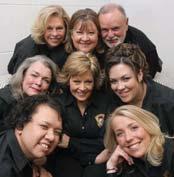
(Pictured from top row, left to right: Linda Hunter, Betzy
Brown; Middle row left to right: Jane Kay, Dolores Mitchell, Kristen Foust; Bottom row left to right: Kristina Rutter, Lacy Trostel.)
Drop and take cover in the USA
Drop and take cover in the USA
Temporary measures to protect CBSA officers from harm
Temporary measures to protect CBSA officers from harm
by Marcus Aurelius
The $800 million plan to train and arm Canadian border officers is projected to take ten years, leaving some customs officers without protection against threats for as long as a decade.
While they wait, Blue Line Magazine has learned that the Canadian Border Services Agency (CBSA) is reviving an innovative ‘passive defence’ plan called “Retreat Underground until Neutralized” (RUN), originally developed under the previous Liberal government as an alternative to arming officers.
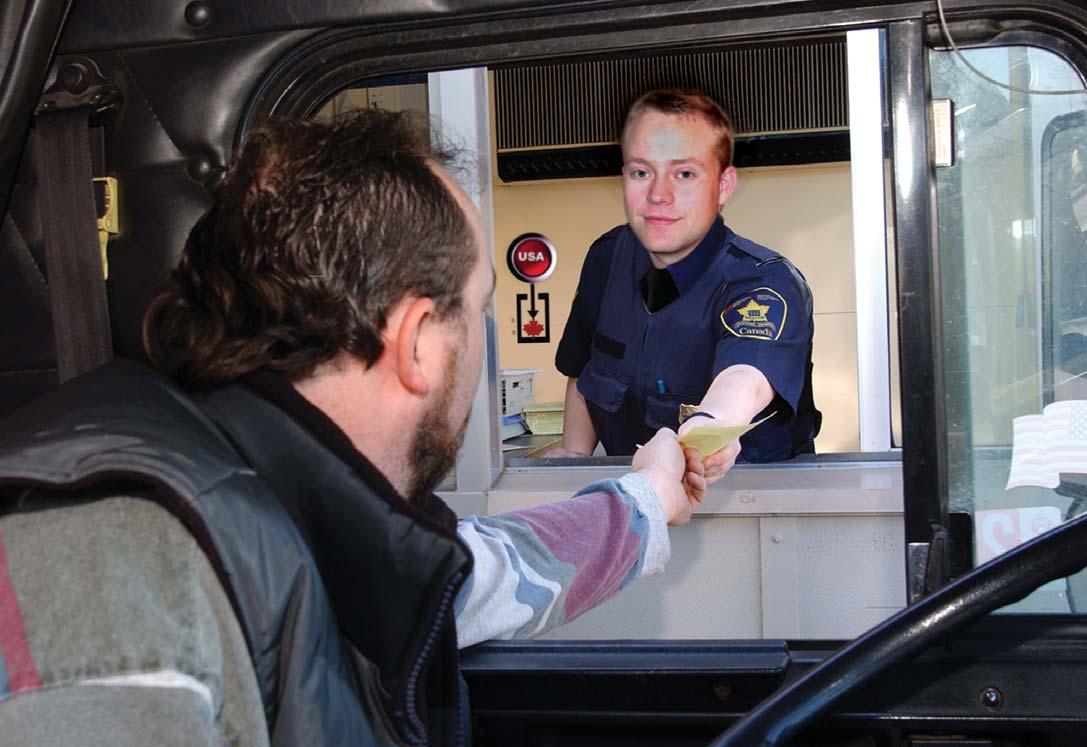
An Underground Strongroom Annex (USA) will be constructed under inspection booths, allowing officers to literally drop and take cover when they feel threatened at vehicular border crossings. The USAs will have armoured lids which close and lock automatically after an officer enters. They will be equipped with phone lines (to call police or US Customs and Border Protection for help), first aid kits and paper bags (to reduce the effects of hyper-ventilation).
A direct line to US Customs will also allow advance warning in cases where the ‘clear and imminent danger’ a Canadian officer faces may decide to return to the American side. Since officers may be in a state of terror, they will be trained and required to read a warning card, supplied by CBSA management, which reminds the Americans that:
• Hostile and dangerous individual detected at the Canadian Port of Entry;
• Entering Canada with their firearm is illegal (officially);
• Let us know if the threat leaves the port of entry;
• Please call Canadian police for assistance; Upon activating the USA escape chute, a
magnetized tracking device will be immediately ejected under the suspect car. This device will permit responding police officers to zone in on the vehicle’s location, but also has a second function. Once the device is a kilometre away from the border, the armoured door to the USA will automatically open and officers will be expected to return to their posts –and their primary task – collecting revenue.
“This plan meets all our objectives,” notes a senior CBSA official, speaking on the condition of anonymity. “It assures our front line officers will be protected without exposing them and others to additional risk. Until our officers are fully and completely trained, whenever that may be, use of guns and the threat of force will be left to local police.”
Other equipment to be used in the USAs is still being developed, but initial plans include the automatic triggering of an electronic sign which advises a motorist that an armed response is on the way – and that the CBSA officer is safely secured in the USA.
“One proposal was for the sign to advise an armed suspect to get out of their car and lay face down on the ground until police arrive,” the CBSA official notes, “but we were concerned about the health risks of laying on the road. There can be gas, diesel fuel, oil, tire dust; imagine if a suspect suffers from asthma or allergies? The liability could be enormous.”
Another suggestion was to have a voice warning, similar to ‘Alarm Force’ burglar alarms, advising a threatening suspect that police have been called and any attempt to escape will only make their situation worse. This idea was rejected because the message might be viewed as harsh and untrue, thereby affecting the credibility of the entire CBSA.
Critics have dismissed similar ideas in other jurisdictions as nothing more than “panic rooms,” a suggestion which the CBSA official strongly rejects.
“Many people are intimidated by guns and we do not want to traumatize visitors to this country. This plan offers a safe refuge in the USA and ensures security for the people who welcome visitors to our country. It also preserves our reputation as a non-violent, peaceful nation. In fact, if this is as successful as we believe it will be, we can reconsider the decision to arm our officers.”
The price tag for the interim measures are “reasonable,” the official says; “certainly no more than the $778 million it will cost to arm officers.”
The program will work well even if officers are eventually armed, the official notes, and will actually save money in the long run, since there will be no need to abandon the hundreds of unarmed university students hired each summer.
New procedures call for unarmed officers at ‘tactical inspection points’ (TIPs) to identify armed individuals. Rather than risk alarming them, TIPs will refer ‘Dangerous or Intimidating Persons (DIPs) to armed guards at “secondary inspection points” (SIPs). If the individuals refuse to comply, TIPs would hit the switch triggering the chute to the USA, simultaneously alerting the armed SIPS officers to respond.
Blue Line contacted the president of CEUDA, the union representing CBSA officers, for his response to the proposal, but much of what he said was either unintelligible, unfit to print and/or anatomically impossible.
Construction of the first Underground Strongroom Annex is expected to begin at the Pembina, Alberta, port of entry April 1.
A nurses’ union is worried about a proposed law that would give police greater access to information on patients who have been stabbed or shot.
Although Saskatchewan medical personnel already report suspicious injuries to police, the new law would give police more information on the victims.
Police say the step is necessary to fight gang violence, in which victims may be intimidated into silence. A committee is currently reviewing the impact of the proposed legislation.
Some health practitioners fear the legislation could put them at risk for retaliation.
The Saskatchewan Union of Nurses spoke out, saying the legislation could impact patient privacy, which is protected by the Health Information Protection Act.
A judge reviewing a 1999 incident in which two young men fell to their deaths from a fourth floor balcony says a raid by a police tactical team “went awry” and shows the need for more training.
Adam Miller, 21, and Huu Pham, 15, died of massive head injuries after plunging from the balcony as police staged an assault on the apartment, using a battering ram and an explosive device known as a flash-bang.
A lawyer for the Edmonton Police Service and others who testified at the fatality inquiry maintain that the raid was perfectly
planned and executed.
But Judge L.J. Wenden cites a number of police errors in a 17-page report released Wednesday, including the timing of the flashbang device that was thrown by a newly recruited member of the tactical team.
The judge concludes that these errors show the need for an overhaul of training procedures and some minor changes in the way the tactical unit is deployed.
Two senior officials testified at the inquiry that the tactical teams were sometimes used for traffic duties, crowd control and assistance at demonstrations.
The inquiry began in May 2003, but lasted more than three years because of a series of court actions and appeals.
The judge also makes no conclusion as to what caused the pair to fall head-first from the balcony as the flash-bang device was thrown by police from the ground below.
But the lawyer for one of the victim’s families says he’s surprised the judge wasn’t able to conclude that the flash-bang device caused the two young men to plunge to their deaths.
***
Manitoba’s top court has ruled a used toothbrush proved to be the smoking gun that linked a man to a bizarre underground drug lair.
Police seized the item during a 2001 raid of eight railway cars which had been buried three metres beneath the earth on a rural
property near Dauphin.
The cars were stuffed with more than 14hundred marijuana plants that could provide an annual yield of 320 kilograms of pot.
Police took DNA from the toothbrush and traced it to Erik Johnson, who was arrested and charged with being a party to one of the most unusual drug operations ever uncovered in Manitoba.
Johnson was convicted at trial and sentenced last year to four years in prison.
***
The Canadian Standards Association is spearheading an effort to develop the first national standards aimed at protecting emergency services in chemical, biological, radiological and nuclear incidents.
Canada’s fire, police and emergency medical services are first on the scene in 90 per cent of emergencies and not all have the minimum level of equipment necessary to protect themselves from the most serious forms of contamination.
There are limited protective equipment standards specific to such incidents, leaving most first-responders relying on more general hazardous material or dangerous goods standards to guide them in more serious cases.
The new standards are expected to help emergency services responders more effectively select and use specialized respiratory and whole-body protection.
Show me some ID
Our faith in identification documents is misplaced
by John Lyons and Greg Saville
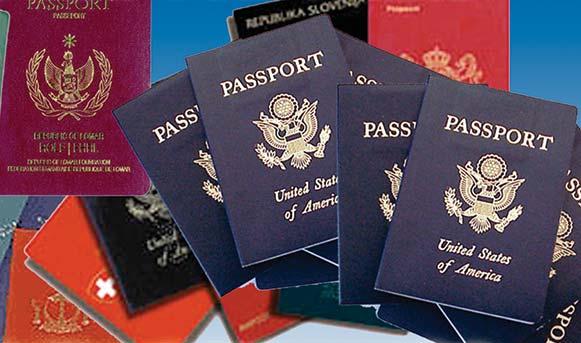
Identity thieves look for driver’s licence numbers, Ontario’s Ministry of Government Relations web site warns – yet anyone with a licence plate number and $13 can obtain a person’s driver’s licence number, full name, address and details of their vehicle. With minimal knowledge of licence numbers, they would also have their birth date.
This information is as close as the ‘ServiceOntario’ machine at the nearest large shopping mall. It is a risky business to rely on the most commonly accepted means of identification in North America – a driver’s licence –to determine if someone is who they say. Stories abound about arrests that went bad due to fake, or borrowed, driver’s licences produced during earlier encounters. At times it results in a warrant being issued for the wrong person. The impact on lives and the loss of time while untangling the situation victimizes everyone involved.
Human identity
Identification-based crime can spread like ripples from a drop in a much bigger victim pond. Identification-based crime ranges from money laundering, drug trafficking and exploiting automated payment systems to more traditional street crime by enterprise criminals, gang members and habitual offenders.
Creating an informed diligence
The best way to respond to this challenge is informed diligence and up to date knowledge at the front line. Many documents issued by governments – what we call “access tokens” – inappropriately become de facto identification documents.
There are two modus operandi underpinning identification-based crimes:
•Crimes of opportunity. They occur when personal means of identification conveniently fall into the wrong hands through circumstances such as misplaced wallets and IDs, pick pocketing, vehicle thefts and home invasion. Criminals use these to commit financial crimes, which hinge on credit worthiness, by impersonating the owner of the identification. They also use the pilfered ID to avoid recognition during chance encounters with the police.
•High level commitment concealment crimes. Organized career criminals collect personal identifiers to meet longer term objectives and apply them to forged or stolen identification document blanks, including bona fide provincially issued tokens such as driver’s licences and health cards. Their crimes include cyber crime, trafficking in drugs, stock manipulation fraud and terrorism, to mention but a few. Even though police frequently discover
and dismantle document and card manufacturing labs, demand is quickly met through easy access to a new generation of desk top publishing software, high-end scanners, embossers, thermal printers and other commercially available tools. Forgers produce driver’s licences, health and citizenship cards and other forged documents so close to the genuine in feel and quality, it is difficult to tell the difference.
The recent surge in quality and capacity to forge identification documents presents a serious logistics problem, amplified by the ease in obtaining personal identifiers from government and corporate information systems. The personal information of more than 100 million Americans may have been exposed in recently reported incidents alone. In Canada, there is no law compelling governments and corporations to report potential breaches.
Three dangerous trends converge to worsen the identification-based crime problem:
1.High quality and hard to detect forged documents
2.Easy access to legitimate personal identifiers 3.Those relying on identification must balance between diligence and delivering clientcentered services.
Means of identification(MOI)
In US law incorporates a wide assortment of personal identifiers – defined as name, social security number and date of birth – and identification devices. MOI incorporates official government issued driver’s licences and document issuer identification, alien registration, passports, employer and taxpayer identification numbers. It also includes unique biometric data, such as fingerprint, voice print, retina or iris image and/or other unique physical representation.
In the electronic medium, the definition captures unique electronic identification numbers, addresses or routing codes, telecommunication identifying information and defined access devices.
A wide variety of MOI are issued for purposes ranging from birth certificates to library cards. As law or regulatory officials who frequently rely on a driver’s licence or other government-issued MOI, it is important to know the generic roots to IDs and how they relate to each other. The ability to analyze them depends on understanding elements that combine to form a human identity. A July, 2002 UK paper on identity fraud defines three components. Building upon that work, we came up with the following:
•Legally attributed personal identifiers: components of personal information, maintained by a government authority, that record status by right, law or privilege to enter and remain in the country of issue;
•Biometric identifiers: unique physical human characteristics such as fingerprints, voice, retina, facial structure, DNA profile and hand geometry;
•Biographical information: Data accumulated over time recording life events of a person’s interaction with a structured society. Examples include education qualifications, driving history, elector register entries, benefits claimed, taxes paid, employment history, marriage and mortgage registry, insurance policies and credit history.
Legally attributed personal identifiers
These come in two categories – registries of names, dates of birth, classification and dates of entry into a country – and personal identifiers maintained for births by federal or provincial/state governments. Where the information is stored depends on who has jurisdiction. Both are legislated records of the legal status of an individual. For immigration to Canada, the legislative authority is the Immigration and Refugee Protection Act , with its accompanying regulations. For federal births the authority is the Citizenship Act and, for the various provinces and territories, it’s the Vital Statistics Acts. Identification documents affirm the existence of these legally attributed personal identifiers. The legislated custodian of the physical record issues them. ‘Status by right’ identification documents affirm a record of a right to citizenship or the granting of permanent residency. ‘Status by law or privilege’ identification documents affirm that there is a record of temporary status in the country of issue.
We limit our use of the term ‘identification document’ to these two means of identification. You may hear them referred to as ‘foundation,’
or, more inappropriately, ‘breeder’ documents. Breeder may be a somewhat applicable slang for birth records, but generates confusion around the role of identification documents that affirm the status of those temporarily in Canada.
Privileges, benefits and services tokens
All other means of identification should not be relied upon with the same amount of confidence because they are access tokens that affirm only entitlement to a privilege, benefit or service. Examples include driver’s licences, health cards, student cards and employer IDs. Accepting them in place of identification documents presents extraordinary risk.
Access tokens are not without value, since they point to a biographical record retained by the issuer. They may assist in confirming the validity of birth certificates and other identification documents where your suspicions are aroused. For example, a document may point to a prior place or time where you can locate a person. Further investigation may reveal others who knew this person.
In an interview, your subject of interest should be able to corroborate information retained by an access token issuer. The bearer of a birth certificate supported by a driver’s licence should be able to volunteer information consistent with the records maintained by the issuing Ministry of Transportation over the years the licence is in effect, such as where the licence was originally issued, address history and previous traffic violations.
Biographical records support interview skills
The key is the art of open-ended questions, which offer you the opportunity to listen for elements of deception or missing information. Closed-ended questions, which demand a yes or no answer, teach an identification criminal how to lie and reveals what you know. Here are some examples of open ended questions:
•Describe in your own words how you received permanent status in Canada?
•Tell me more about where you have lived since…
•Tell me about previous traffic tickets you have received and what the circumstances were?
Set the parameters and allow your subject of interest to choose where to begin and end in describing their biographical history – for example, throughout the years they have held a driver’s licence. This positions you to evaluate how truthful they are being, through their own words, by comparing their statement with the biographical information retained by the token issuer.
Conclusion
More than 7,000 sources can issue birth certificates in the US. Fortunately, this authority is limited to provinces and territories in Canada. Birth certificates do not have photos or biometrics and immigration documents are not widely understood, so a driver’s licence or other government issued photo ID is the de facto MOI across North America.
Unbelievably, though they are fraught with
risk, a driver’s licence is still an acceptable MOI for boarding aircraft on domestic flights in both the US and Canada. Governments bombard us with concern about terrorism and yet many provincial and state governments subcontract the issuing of driver’s licences to private vendors without a rigorous plan for maintaining integrity over the issuing process.
In all our identification-based training, we highlight the true value to investigators of driver’s licences and similar access tokens: the biographical information retained by the issuer. That biographical information can help an investigator assess how truthful a subject answers questions when identity is a concern. We incorporate training that builds competencies for maximizing intuition – your gut instinct that something isn’t quite right. That is the most important indicator of a problem, but it cannot function unless you educate yourself leading to informed diligence.
Our final article will provide more details on individual identification documents defined in this article. It will provide you with the ability to analyze the risks to privileges, benefits and services access tokens for yourself. Most are of extraordinarily high risk if accepted at face value by law and regulatory officers as affirmation that the bearer is who they say they are.
This is the second of three articles on policing identification based crime – the first, Threats of the new millennium, ran in the Nov. 2006 issue of Blue Line. John Lyons can be reached at AlterNation_jrl@cogeco.ca .
by Harry Black
Re-asserting an officer’s legal rights
Any police officer who has ever experienced a disciplinary hearing under the Ontario Police Services Act understands just how pervasive a chief’s role is in the process.
The chief causes and can initiate a complaint about an officer’s conduct, selects who investigates and causes the written report of the investigation. After reviewing the report, the chief decides whether a hearing should be held, appoints the prosecutor and either holds the hearing or appoints the hearing officer as his/her delegate. If a finding of misconduct is made on “clear and convincing evidence,” the chief or delegate decides the penalty.
The reasons for decision may include the appropriate references to ‘the burden of proof,’ ‘clear and convincing evidence,’ ‘the principles of natural justice and fairness’ and other high-sounding phrases. They do little to overcome the oft-expressed concern that the hearing is overwhelmingly stacked against the subject officer.
This ‘institutional bias’ is very much a reality and the reason the provincial legislature provided for not giving a chief the right of appeal to the Ontario Civilian Commission of Police Services (OCCOPS). The subject offic-
er’s absolute right to appeal represents their first opportunity to have the decision reviewed by someone independent of the chief. This right is obviously of the greatest importance to them.
It is in that context that the importance of the Ontario Court of Appeal’s recent decision in the case of PC Carlton Watson and Peel Regional Police (PRP) (Watson v. Peel Police Service, 2007 ONCA 41 Jan. 2007) should be seen. Watson was charged with a criminal offence and found not guilty at trial. I was not surprised when the Crown promptly appealed.
Crown prosecutors are supposed to be guided by the principle that, “the Crown never wins, the Crown never loses,” but it has been my experience that quite the opposite is true; many Crown Attorneys view the criminal trial process as winning or losing – and hate to lose.
The appeal court upheld what it described as ,“the strong findings of the trial judge,” dismissing the crown’s appeal. The former PRP chief was clearly unhappy with all of this and decided to charge Watson with discreditable conduct under the Police Services Act.
We brought a motion at that hearing that the charges should be stayed, arguing that a precedent (R. v. Wigglesworth) did not apply because the chief was in reality seeking to relitigate the identical criminal allegations,
contrary to the recent Supreme Court of Canada decision in the CUPE case.
The hearing officer listened to two days of submissions, reviewing a very considerable number of decisions. After also seeking and obtaining independent legal advice from outside counsel, he agreed with our motion. The hearing must be stayed, he decided, concluding that continuing it under the circumstances would amount to an impermissible relitigation of the essential issue which had already been determined by the trial judge.
There was much jubilation by the defence. The chief had no right of appeal and was stuck with the decision of his delegate, even though he clearly disagreed with it. We waited for the officer to be returned to his duties.
That did not happen. Instead the officer was served with an application for judicial review. The chief, having no right of appeal, was now attempting to create one.
The entire decision is available for your review on the Ontario Court of Appeal web site (www.ontariocourts.on.ca/decisions - search for Watson) and I will not review it here. It proceeded through the divisional court and then to the Ontario Court of Appeal. I would like to simply highlight a couple of principles that the appeal court asserted which are of great importance to police officers.
The court reviewed the relevant statutory provisions of the Police Services Act and noted the centrality and pervasive nature of a chief’s role in the discipline process. He is, it observed, the principle actor of the discipline process:
In logic and in policy, if the chief cannot challenge the decision of his delegate by way of appeal, he should not be able to mount a similar attack through the vehicle of judicial review. Such an attack ‘would be allowing that to be done indirectly which cannot be done directly.’
The court concluded:
If, in the absence of an explicit right of appeal, the chief were granted standing to review his decision or, as in this case, the decision of a police officer he has delegated to hold the hearing on his behalf, it could erode confidence – on the part of police generally, those subject to discipline and the public at large –in the independence and fairness of the discipline process.
Seeking to achieve, “independence and fairness” in the discipline process is very much a work in progress. It is a task that never ends, but the decision in Watson’s case represents a welcome re-statement by Ontario’s highest court that the rights and protections of a subject officer must be respected.
Carlton Watson is finally back at work.
Calgary chief Jack Beaton, who has been on the job for six years, said he will retire when his current contract expires in December. Beaton will have been on the force for 34 years when he retires and said he’s ready for more time at home. He he regrets not leaving Calgary as the safest city in Canada and that he was unable to get more funding for policing from the various levels of government.
Vancouver Police Chief Constable Jamie Graham has announced that he will leave the department when his contract ends in August. Graham announced his decision in a mass e-mail to all members of the department. He says, “the opportunity to lead the Vancouver Police over the past five years has been a wonderful experience. While the role of Police Chief is challenging, it has been the chance of a lifetime for me and I have loved every moment.”
After 18 months on the job, Chief Vernon White has announced he is leaving his Durham Regional Police job to be chief of the Ottawa Police Service. White will be replacing Ottawa’s current chief, Vince Bevan, who is retiring at the end of March. Known as a no-nonsense guy who works for the front line, White doesn’t believe in having officers “tied down to their desks,” and campaigned in Durham against the opening of another community police station.
Jack Marks , an old-school street cop who had a turbulent five-year reign as Toronto’s chief of police in the 1980s, died of cancer at the age of 80 in his Pickering home in February. He was a stern disciplinarian who insisted on polished shoes, pressed uniforms and order among his troops. Marks was credited with modernizing the force, turning its focus away from chasing criminals to promoting racial harmony and community policing.
Laval Police Det-Sgt Daniel Tessier, 42, was killed by gunfire at the start of March as police stormed a house south of Montreal. The killing comes as a blow to the service which is still recovering from the December 2005 killing of Cst Valerie Gignac. Tessier had just joined Laval’s drug squad the week prior.
Durham Regional Police Service (DRPS) are mourning the loss of PC Greg Hearn, who was killed while off-duty in a tragic snowmobiling accident March 9th on Lake Scugog. The 41-year-old began his policing career in June, 1988 with the Toronto Police Service, as a court officer, and then served as a Constable with the York Regional Police Service. He joined the DRPS in 2002.
Halifax chief Frank Beazley says the video surveillance cameras installed in the downtown core aren’t good enough. Beazley, who approved a test of the devices after a spate of violent crimes stunned the port city late last year, is not satisfied with the remote-controlled cameras which aren’t very good for following people. The service is looking into other options including fibre-optics.
Fred Sanford, a former superintendent with the Halifax Regional Police, will lead Nova Scotia’s new Public Safety Investigation Unit. The unit can investigate and shut down a property if suspected illegal activity is taking place and its powers fall under the new Safer Communities and Neighbourhoods Act.
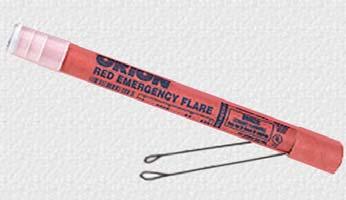
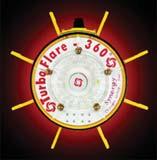
Highway flares, while not part of an emergency vehicle, are often used along side it with the intention of enhancing conspicuity. However, flares may ignite flammable materials nearby, may generate so much smoke that the flare obscures rather than renders more conspicuous, and provide a flickering light source on the road that distracts the approaching driver from the emergency vehicle itself. Together it has been suggested, these factors may actually contribute to emergency vehicle camouflage rather than to conspicuity. The studies acknowledge a lack of scientific data on such factors and cautions against inaccurate assumptions behind flare use (and other conspicuity enhancements).
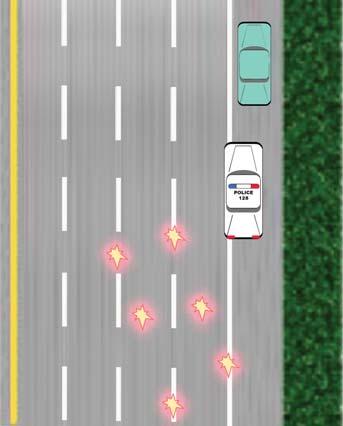
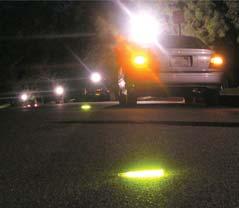
In Part II, lane lines were mentioned as important to support visual control of driving. Figure 4 presents a concept of flare use that builds on this observation. The idea is to create a path that will direct approaching motorists away from the stopped emergency vehicle. Flares might be deployed in such a manner as to create a ‘virtual runway’
that directs traffic away from the stopped police vehicle in a safe and efficient manner.
The concept of effective flare usage was tested in a 2005 Pennsylvania State University’s Transportation Insititute and Orion Safety Products Corp. The study made the following conclusions:
Motorist behaviour (passing speed, lateral separation from a disabled vehicle, and lane distribution) was evaluated under several roadway scenarios using various safety flare configurations. The treatments were installed on a flat and straight segment of a four-lane limited-access divided highway (Interstate 99) with a posted speed limit of 65 mph. Roadway sensors were used to unobtrusively observe passing vehicle behavior. Data was collected for a period of two weeks; one week of baseline data and one week of test data. A total of over 7,000 vehicles passed through the test location during the evaluation.
A significant number of vehicles passing the flare configurations moved from the right to the left lane (in the baseline condition 86.2 percent of vehicles were in the right lane whereas in the test conditions this was reduced to only 8.5 percent); vehicles that remained in the right lane moved on average 27 inches further away from the shoulder compared to baseline, and operating speeds were reduced by an average of 9.0 mph (a 15 percent reduction from baseline).
In traffic scenarios with police presence and light bar activated, the addition of roadway safety flares produced an extra traffic safety benefit. In traffic scenarios without police presence, the use of roadway flares provided a safety benefit equivalent to having a patrol car present with light bar activated.
Retro-reflective or high visibility vests
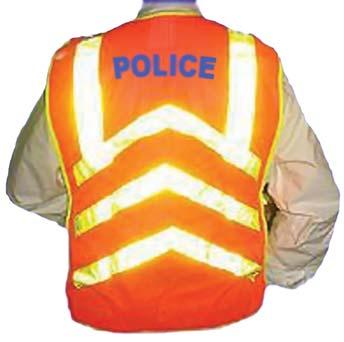
A pedestrian by the side of the road is generally noteworthy. It may also seem unlikely that a moving vehicle would be adjacent to a standing pedestrian, thus making the stationary state of the vehicle more cognitively noticeable. On the face of it, then, treatments that increase the conspicuity of a police officer or other pedestrian on the side of the road beside a stopped emergency vehicle ought to be of general benefit. High visibility clothing in the UK, for instance, is not simply retro-reflective. It aims to give a high level of conspicuity in
normal day light and limited light/bad weather as well as having highly reflective elements which work when wet (a lot of reflective clothing apparently doesn’t!) A European Standard (EN471) that includes differing specification classes covers its specification. Figure 5 depicts one version of highly reflective clothing. From the operational standpoint, the
Figure 5. Retro reflective outer wear to enhance pedestrian conspicuity.
circumstances are not so straightforward. Wells (2002, personal communication) points out that officers often do use reflective and hi-visibility vests now, but only on longer incidents such as crashes or traffic direction. In Florida, state police are currently moving to a vest that meets the new ANSI standard, but it may not be possible to meet level 3 (highest level of visibility) because it would require pants as well as a vest/coat. One difficulty is that officers can’t cover the uniform belt and hinder access to equipment. Also, some departments will advise
Figure 4. Flares used to create a ‘virtual runway.’
officers not to use retro-reflective or high visibility gear at night, at least for traffic stops. This is to reduce the risk of being seen, and possibly shot at, upon first approach. This compromise between conspicuity and others types of threats must be discussed and assessed in terms of the costs and benefits of each alternative.
Implications
Based on the literature reviewed, the following recommendations and functional specifications regarding lighting systems and vehicle markings are offered to enhance the conspicuity of a police vehicle.
Emergency Lighting Systems:
•Luminaire Type: No specific recommendations for light sources (e.g., halogen, strobe, LED) are offered at this point.
•Light Output: Compare alternative lighting systems by inspection for their perceived brightness or ‘flash energy’ as determined by Bloch’s Law rather than rely on candlepower ratings alone;
•Light Colour: Amber lenses pass greater light than red or blue lenses and so can be quite visible. Amber generally means ‘yield.’ However, amber lights might be less visible under certain daylight conditions and can be glaring under nighttime viewing conditions. Red lights signal ‘stop’ and are more readily detected in daylight than blue lights. They may also be confused with red tail lights in surrounding traffic, can be masked somewhat at dusk by a red sky, and can induce a movingaway illusion when stationary and viewed in darkness. Blue lights are more visible than red lights in dark viewing conditions and may be less glaring than amber lights at night. But, blue lights are not reliable indicators of motion or lack of motion at night. To promote conspicuity in various day and night viewing conditions, multicolour lighting is recommended. For example, the common red-blue combination of lights may be augmented by amber lights sequenced to generate an arrow to direct traffic around the stopped emergency vehicle (Smith, 1991). Note that some authorities have expressed concern that too much emergency lighting is potentially confusing (Solomon, 1999). A field comparison of different lighting systems’ complexity would be helpful in empirically resolving this issue.
•Flashing Lights and Flash Rates: Flashing lights are more easily detected in the visual periphery than a constantly glowing light. A rotating beacon can be more conspicuous than a flashing (ON-OFF) light. Use flash rates slower than the 6 to 40 flashes per second range (i.e., 360 flashes per minute to 2400 flashes per minute) to minimize the possibility of triggering epilepsy in susceptible persons. Higher flash rates (4 Hz or 240 flashes per minute) signal greater urgency than slower flash rates (1 Hz or 60 flashes per minute) but are also more annoying. Multiple beacons (e.g., 4 beacons) are rated as more attention getting than single beacons.
Markings: At present there is a need for field data to determine the effectiveness of various markings. However, theory and inspection suggest that the following may be useful in enhancement of emergency vehicle conspicuity:
•Avoid markings or colour schemes (e.g., Battenburg livery patterns) that break up the contours of the vehicle and may actually act as camouflage;
•Consider rear-end chevron patterns that consist of high-contrast colours and convey the impression of a barrier;
•Consider markings that demarcate or outline the body of the vehicle.
High visibility: Vests or outer wear may increase pedestrian officer conspicuity and so alert the approaching motorist to exercise extra caution. However, this must be weighed against other safety and security concerns such as the risk of being fired upon.
Some authorities stress the importance of flares as indicators of an emergency or presence of stopped vehicles. Other authorities claim that the flares are a potential distraction in their own right. Evidence for the latter was not found in the reviewed literature while operational experience suggests benefits to flares.
There are many research issues in the area of emergency vehicle lighting, markings, and vehicle colour. Perhaps the greatest area of need is in experiments and field studies that compare safety across different types of physical conspicuity treatments. For example, attempts were made without success to obtain British research results on the effectiveness of emergency vehicle rear-end chevron markings on emergency vehicles in the UK. Such field experience would be quite valuable if both research and analysis were properly conducted. Similarly, an analysis of the rear-end crash experience of maintenance vehicles with amber lighting and directional arrows would be instructive. A comparative field study of the impact of police vehicle colour would also be a useful follow-on to the lime-yellow fire truck research of Solomon (1990).
References
Allen, M. I. Vision and highway safety, 1970,125-199. Philadelphia: Chilton Book Co. Cited in De Lorenzo and Eilers,1991.
Berkhout, J. “Information transfer characteristics of moving light signals.” Human Factors , 1979, 21(4), 445-456.
Birren, F. “Safety on the highway.” American Journal of Ophthalmology, 43, 265-270.
Code 3, Inc. Summary of scientific research and studies regarding conspicuity of emergency warning lights and devices. Handout, 2002.
De Lorenzo, R. and Eilers, M. A. “Lights and siren: A review of emergency vehicle warning systems.” Annals of Emergency Medicine, 1991, 20(2), 1331-1335.
Fay, P., and Sferco, R. Police car conspicuity-Practice in the UK, Practice in Germany. Basledon, England: Ford Motor Company Automotive Safety Office. Internal document, July, 2002.
Green, D. Emergency vehicle warning systems and identification. New South Wales: New South Wales Department of Public Works, July, 1977.
Hills, B. L. “Vision, visibility, and perception in driving.” Perception, 1980, 9, 183-216. Cited in De Lorenzo and Eilers,1991.
ICE Ergonomics. Motor vehicle conspicuity: - Warning beacons (Informal document no. 2). Loughborough, Liecestershire, UK: ICE Ergonomics, April, 2002.
Luckiesh, M. Visual illusions: their causes, characteristics, and applications. New York: Dover Publications,1922/1965, 136-138.
National Highway Traffic Safety Administration (NHTSA). Federal specifications, ambulance emergency care vehicle (Publication No. KKK-A-1822B). Washington DC: U.S. Dept. of Transportation, National Highway Traffic Safety Administration, 1985. Cited in De Lorenzo and Eilers,1991.
Pudinski, J. W. Sequential light study . Sacramento, CA: Department of California Highway Patrol, 1974. Cited in Berkhout, 1979.
Rubin, A., and Howett, G. L. Emergency vehicle warning systems . Washington, DC: National Bureau of Standards, NBE Special Publication, 1981, 480-37.
Schiffman, H. R. Sensation and perception: An integrated approach. New York: John Wiley and Sons 1976, 272-302.
Smith, A. G. “Effective warning lights,” Law and Order , July, 1991, 57 – 62.
Solomon, S. S. “Lime-yellow color as related to reduction of serious fire apparatus accidents—the case for visibility in emergency vehicle accident avoidance.” Journal of the American Optometric Association, 1990, 61, 827-831.
Solomon, S. S. Emergency vehicle accidents: Prevention and reconstruction . Tucson, AZ: Lawyers and Judges Press, 1999, 54-56.
Solomon, S. S. and King, J. G. Why fire vehicle color is an issue of safety. 1999, 65-73. Cited in S.S. Solomon, Emergency vehicle accidents: Prevention and reconstruction Tucson, AZ: Lawyers and Judges Press, 1999.
Ullman, G. L., and Lewis, D. “Texas DOT vehicle fleet warning light policy research.” TRB Transportation Research Ecircular. Presentations from the 12th Equipment Management Workshop, E-C013, 1998.
Wells, J. Rear-end collision study. Tallahassee, FL: Florida Highway Patrol Bureau of Law Enforcement Support Services Equipment and Compliance Testing, 1999.
Wells, J. “Emergency vehicle lighting: A new perspective.” Powerpoint presentation given at the International Association of Chiefs of Police (IACP) Conference, 2002.
Taking back the community
Halifax police help residents turn around formerly bad area
by Danette Dooley
A Halifax Regional Police (HRP) initiative that has officers walking the beat, knocking on the same doors night after night, responding to calls and tossing burgers on the BBQ for community kids is making inroads in policing a particularly troublesome area of the city.
The ‘building bridges’ model is an approach that could also work for other police forces.
HRP has enhanced its 24-7 beat program over the past year by adding two Community Response Officers (CROs) in an effort to strengthen its relationship with the community. It also addresses quality of life issues and safety concerns in the city’s Gottingen Street area.
“We attend community meetings and town hall meetings with the chief in different areas of the town and one of the things we were hearing in that area was that people felt they didn’t see us enough in a positive way,” says S/Sgt Don Spicer.
“They only saw us coming in to arrest people and then leaving. They were looking for more consistent and positive contact with police.
Adding the two CROs didn’t just give the community better access to its officers, it also put a personal face on policing. CROs, Csts. Amy Lissa MacKay and Dean Simmonds, have become directly involved in youth issues and work as school response officers.
“They work in the schools with the children and they have some children that come into the office after school to work on their homework. They both volunteer on mentoring programs for youth in the area, so it’s really an opportunity to give back to the community.” It’s a win-win situation, Spicer says.
“The police officer gets to be seen as a human being rather than a police officer. They see that we’re not all that different from anyone else, and the youth in the area are better equipped to make healthy lifestyle choices, which is really what it’s all about.”
Simmonds was recently named HRP’s Person of the Year. His hard work has helped the area tremendously, noted district city councillor Dawn Marie Sloane in a letter.
“The community has come a long way in the past year... thank you for helping make the central Halifax area a great place!”
In working side-by-side with existing beat officers, the CROs found an appropriate balance between proactive policing and enforcement, Spicer says.
The force also created around-the clock staffing of a community office.
An undercover drug operation targeting street level dealers who frequented the area was also an integral part of the force’s efforts in the area, Spicer says. As a result of 23 searches, police charged 27 people, seized various drugs – including cocaine, marijuana, heroin and prescription medication – and recovered some $24,000. Five firearms were also confiscated.
An Operation Breach queue was established to ensure offenders adhere to their court imposed conditions. It focused on those living within the area or whose activities negatively
impacted on the sense of community safety.
From Feb. 1 - Oct. 31, 2006, police regularly checked 13 local individuals, completing 460 compliance checks and laying 22 breach charges. Others were charged with crimes not directly related to the checks, which also resulted in breach of condition charges.
The initiative was made possible through numerous partnerships, including with the justice and community services departments, Uniacke Square Tenants’ Association (USTA) and Metropolitan Housing Authority.
The housing authority provided police with office space and made physical improvements – including building repairs and enhanced lighting – decreasing crime and increasing citizens’ sense of safety. USTA also spearheaded the building of a community rink.
Officers partnered with the local YMCA to host basketball games with local youth.
While enforcement drives up the numbers, Spicer says his officers came face-to-face with the real results of the year-long initiative at a Fall 2006 town hall meeting.
“One woman said that it’s the first time in 15 years that she could sit out at night on her lawn furniture and enjoy the evening – and come back out the next morning for a coffee and still see the lawn furniture there.”
Another woman had wanted to move from the area for years, but changed her mind when she finally had the chance.
“She said she felt safe in the community now that the police office is there and there’s a lot of good people in the community. There’s a good sense of pride, but as in any community, there are a few people who can ruin it for everyone.”
The force already uses the model in another area, Spicer says, stressing it’s all about connecting by identifying needs.
“One of our officers coined this: ‘back to the future.’ When you talk community policing, for the most part, we did that many years ago, before we even realized there was a name for that style of policing – so, in many aspects, we’re getting back to our roots.”
A comparison of violent crime statistics from 2005 to 2006 (February to November timeframe)
• Homicides decreased by one (-100 per cent)
• Attempted homicides down by four (-400 per cent)
• Robberies dropped by 16 (-31 per cent)
• Assaults fell by 16 (-12 per cent)
• Sexual assaults declined by eight (-88 per cent)
• Weapons offences increased by three (18 per cent) It should be noted that weapons offences increased, as this category includes recovery of firearms in searches. Similarly, CDSA incidents increased by 40 per cent due to targeted enforcement strategy and execution of arrest warrants increased by 68 per cent.
Total calls for service increased to 4,914 from 4,472 during the same in 2005.
A tale of two cruisers
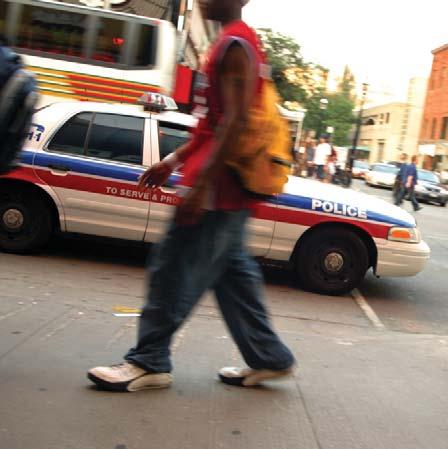
They don’t have the retro feel of the new/old OPP cars, but Toronto cruisers have a new look.
A leading safety expert says Toronto’s design is much safer than the black-and-white cars, with a modernized, more visible look that includes numerous reflective markings. They began patrolling Feb. 17.
“This is a very positive move,” Oswego, N.Y., optometrist Stephen Solomon commented recently to the Toronto Star. Solomon has studied visibility and emergency vehicle safety for 40 years.
Visibility improvements include:
•Reflective material creating a dotted silhouette of the car. Good when cars are used to block roads at night.
•Barrier tape on the rear bumper cover.
•The letter “T” painted on the roof, allowing air support to recognize the cruisers as belonging to Toronto police. The service will continue using Ford Crown Victorias.
“Comparing this to a black-and-white, this is, in my
mind, a safer vehicle,” Solomon told the Toronto Star
Although white is not the best colour for emergency vehicles, he said it is still a very good choice.
It’s expected to take three years before all 300 marked cruisers sport the new design, Toronto police spokesperson Mark Pugash said.
The OPP has gone a different way. It introduced allwhite cruisers with blue and gold striping in 1989 and, by 1993, had phased out its black and white design.
The re-introduced traditional colour scheme will give cruisers “enhanced visibility on Ontario’s highways,” the OPP said, providing the force with a “distinctive presence to enhance stepped-up efforts to bring traffic safety issues in line with other public safety issues.”
The first retro OPP cruisers began patrolling high traffic areas of 400 series highways in March. More will arrive as vehicles are replaced over the next few years. Critics of the new look site issues such as night visibility and the need for more frequent car washes.
CSO Cst. Amy Lissa MacKay poses with the student she mentors.
5.11 Tactical
ABLE
Aearo Canada Ltd
Ahearn & Soper
A J Stone Co Ltd
Artworx by Diana
Blue Line Magazine
CanCom Sales
Colt Canada
Cross Match Technologies
Current Corporation
davTech Analytical Services
Deeley Harley-Davidson
Deister Electronics
Dick Buss & Associates
Giantscape
Group Techna Inc
Gunnebo Security
HSS International Canada
International Police Association
Kinwood Multimedia Inc
Kirkpatrick’s
KM & Associates
L3 EOTech
Matte Industries
M D Charlton Co
Mega Technical
Mine Safety Appliances Co
Niagara University
Nikon Canada
ONGIA
OWLE
Panasonic Canada
Philips Medical Systems
Precision Camera Inc
Primex Security Systems
Reaction Target System
SAIC
SEALS Action Gear
Skana Imaging Solutions
Software Logistics Inc
Special Investigations Unit
Starfield-Lion Apparel
Sterlmar Equipment
Therapeutica
Thomson Nelson
Traffic Safety Management
University Guelph-Humber
Valley Associates
Whelen Canada
Winsted Group
5.11 Tactical Booth 104
5.11 Tactical Series creates superior products that enhance the safety, accuracy, speed and performance of law enforcement, military and firefighting personnel. Built on a foundation of durability, quality and value, 5.11 Tactical leads the industry by delivering functionally innovative gear, head to toe. To celebrate the 30th anniversary of the 5.11 Tactical Pant, the company just released three new, limited-edition colours: coyote, tundra and sage – in proprietary 8.5-oz., 100% cotton canvas. Also, someone new each week can win $511 worth of 5.11 gear in the “Win 511” Sweepstakes. Learn more about 5.11 Tactical Series and enter.
ABLE Booth 507
The Association of Black Law Enforcers (ABLE) is a non-profit organization formed in 1992 to address the needs and concerns of black and other racial minorities in law enforcement and the community. The membership includes police officers, correctional officers, probation and parole officers, immigration officers, customs officers, court services officers, by-law enforcement officers, sheriff’s officers, special constables and members of the community. ABLE aims to build bridges between law enforcement agencies and the community at large through education, improving the image of law enforcement, promoting racial harmony and cultural pride and promoting professionalism within both law enforcement anf the broader community.
Aearo Canada
Booth
307
Aearo is a leading manufacturer of ear, eye, respiratory and head and face protection products as well as communication headsets. Sold under the AOSafety, E.A.R. and Peltor brands, Aearo products offer a well-earned reputation for quality, selection, dependability and customer satisfaction. AOSafety products provide superior protection in a variety of styles sure to fit your needs. E.A.R. is the most recognized family of hearing conservation products on the market today. Finally, Peltor is the global leader in 2-way communication products for use in high noise environments. Come visit us at booth #307.
Ahearn & Soper
Booth
309
For complete photo ID & access control solutions, Ahearn & Soper Inc. provides powerful and reliable card printers to personalize and encode your own identification and security cards. Our card printers print cards faster and have high-definition print quality, while guar-
anteeing a low cost per card. We can print high resolution texts, coluor logos, pictures, signatures and barcodes in a few seconds. Ahearn & Soper Inc. is a 125-year old company providing high-tech solutions to industries and agencies across Canada. We are proud to be making ID cards for Blue Line Trade Show attendees. Ensure that your law employees are wearing Canada’s best-dressed cards - Ahearn & Soper is your turnkey solution provider for the best card printing on the market.
A.J. Stone Company Booth 103
For 35 years, A.J. Stone Company has been providing high quality, reasonably priced safety equipment to the municipal and industrial fire services of Canada. Today our mission is “that all men and women of the Canadian first responder and safety Industries are supplied with quality products so that they may be protected from their occupational dangers.” A.J. Stone Company is pleased to introduce those products to the law enforcement sector. Centrally located in Toronto, our customer service staff and product specialists would be happy to discuss solutions to your equipment needs by calling 1-800-205-3473 or visit our website at www.ajstone.com . Your safety is our business!
Artworx by Diana Booth 514
As a forensic artist, I specialize in: three dimensional facial reconstructions - clay method on original skull two dimensional facial reconstructions - drawing on transparent paper on top of photo of the skull postmortem drawings - based on a facial photograph, which usually is of a decomposing person with severe facial trauma comprehensive composite drawings - interviewing the victim and drawing from memory age progression to a missing childage a child to current the date age progression to a missing fugitive - age the missing fugitive to the current date disguise drawings - add facial features, different hair styles, glasses etc... video sketching - identify the assailant on camera through measuring proportions courtroom sketching - quickly rendered sketches as important documentation.
Blue Line Magazine Booth B
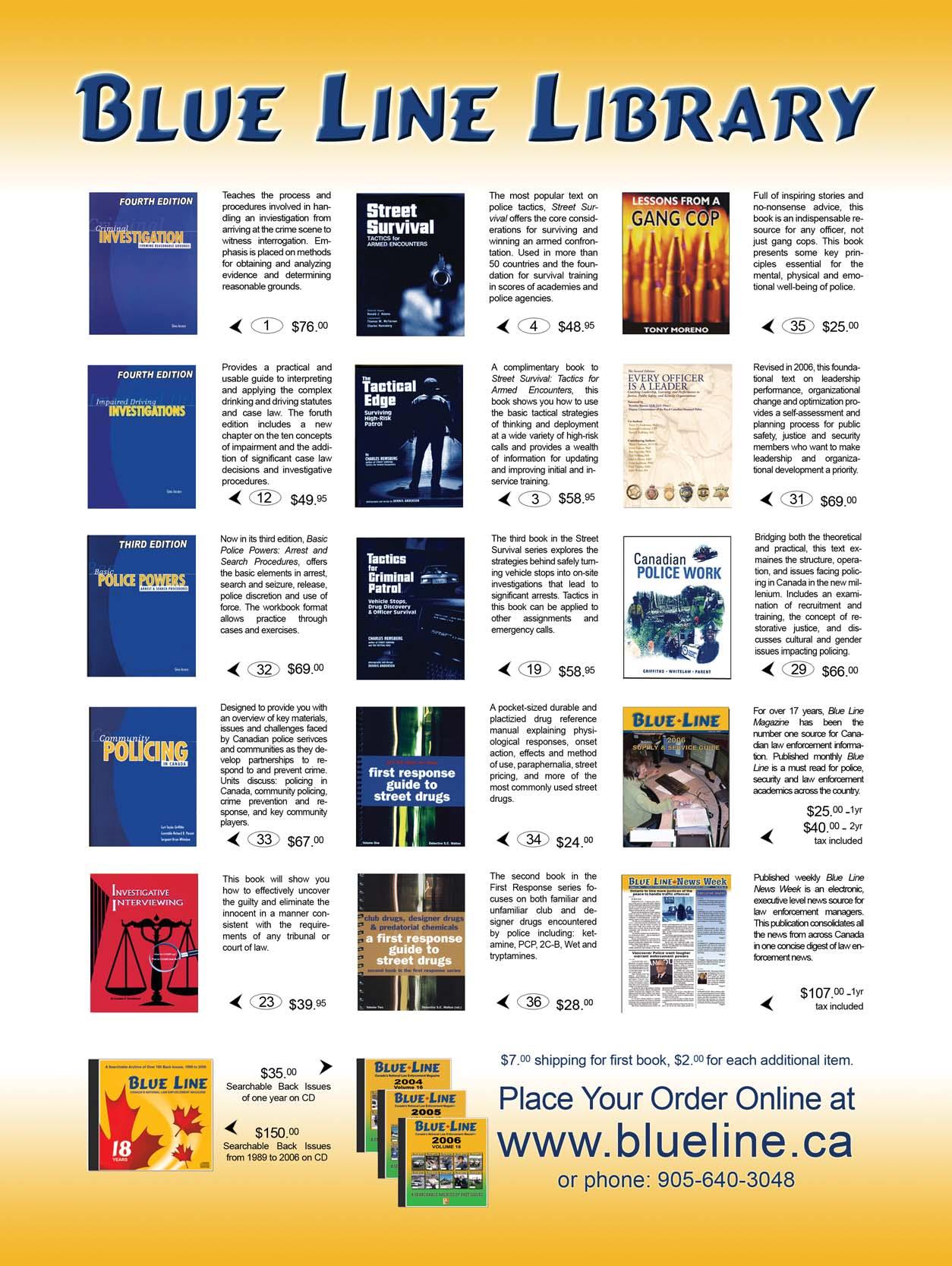
Blue Line’s complete list of books from the Blue Line Reading Library will be featured at the show. A variety of Blue Line Magazine back issues will also be available. Due to demand, the cover photo of the February 2002 cover will be available in 11x17 poster format. All regular participants on the Blue Line Forum are invited to meet for face-toface conversations.
CanCom Sales Booth 501
CanCom Sales Inc. is a Canadian manufacturer’s representative for many quality law enforcement products including safety equipment, communications gear and batteries. McKay Communications - CanCom Sales operates and distributes the McKay brand within the Canadian market.
McKay Canada offers high quality and cost effective solutions to meet all of your radio accessory needs including Speaker microphones, earpiece/surveillance kits, high noise and lightweight headsets.
Elvex Safety - Offering personal protection equipment including hearing protection, tactical earmuffs, and protective glasses & goggles.
North American Battery Company (NABC)Offers quality land mobile radio batteries for all makes/models of two-way radios and Pulse Power Chargers for automatic rapid charging with conditioning. UltraLast Alkalines and rechargeable batteries make NABC the solution for all of your battery needs.
Lenbrook Canada - offering quality Motorola 2-way radio products.
Interactive Safety Products - offering the Argus public safety helmets for increased levels of protection & superb comfort with easy adjustment to individual head sizes. The Argus helmet is specifically designed to address the hazards encountered in modern-day policing. CanCom Sales Inc. represents the industries best products and is a proud partner to the public safety community.
Colt Canada Booth 203
Colt Canada is the strategic source of supply for small arms to the Canadian government, and supplies small arms systems to roughly half of our NATO allies, including, Netherlands, Denmark, the UK and Norway. Colt Canada (formerly Diemaco) offers services directly to Canadian law enforcement agencies. Products and services include tactical weapons, patrol rifles, sniper systems, 40 mm launchers, pistols, less lethal solutions, optics, accessories, armourers’ tools, engineering, service and repair, training courses, safety equipment and technical publications.
Cross Match Technologies Inc Booth 303
Cross Match Technologies, Inc. is a leading global provider of high-quality interoperable biometric identity management applications and solutions. The company’s offerings consist of a wide range of biometric products and solutions which are used to capture and process the unique physiological characteristics of individuals to establish and verify their identity, such as fingerprint, palm scan and facial
recognition systems and solutions, enterprise and application software (including enterprise matching software), document readers, access control systems, and related services. www.crossmatch.com .
Current Corporation
Booth 200
Current Corporation is an expert in Day & Night Vision gear. In Canada, Current Corporation distributes law enforcement equipment, including night vision monocular and goggles, thermal cameras, holographic and image intensified weapon sights. Around the world, Current Corporation markets its proprietary line of Night Navigator camera systems. They provide long range day, image intensified night vision and continuous zoom thermal imaging. Current Corporation’s camera systems are installed on luxury yachts, high speed ferries, police and coast guards vessels. When Night Vision is critical the choice is clear as day – Current Corporation. For more information on our products, please visit www.currentcorp.com
davTech Analytical Services Booths 504 & 506
davTECH Analytical Services (Canada) Inc has positioned itself to become a leader in Traffic Safety Products and Solutions throughout Canada. Our product line of Radar, LIDAR, emergency LED lighting, accident investigation software, traffic analysis equipment, alcohol breath testing instruments, drugs of abuse testing and all related peripherals enable us to supply the sale while also providing authorized technical support for all of our lines. davTECH is an authorized distributor for Decatur Electronics, Laser Atlanta, Intoximeters, NPAS, Visual Statement, Eluminator Lighting, Metro Count, Medtox and Cozart Bioscience to name a few.
Deeley Harley-Davidson Canada
Booth D
Deeley Harley-Davidson Canada is the exclusive Canadian distributor for Harley-Davidson Motorcycles, parts, accessories and branded products and related services.
Deister Electornics
Booth 301
Deister Electronics develop, manufacture and distribute a wide range of security products, including Electronic Verification and Key Management Systems. Electronic verification uses a two checkpoint option (barcode and/or proximity) and applications include security patrol, weapons control and evidence tracking. The Proxsafe Key Cabinet prevents the removal of keys and small articles from secured areas, holds up to 32 key bunches and can be expanded up to 32 cabinets. The Amantag Compact Reader sounds a visible and/or audible alarm when it
detects transponder tagged articles being removed from monitored locations. Both Key Control Systems are compatible with most existing security systems or can stand alone.
Dick Buss & Associates
Booth
401
Dick Buss & Associates represents Watson Dispatch Furniture (www.watsondispatch.com) in the provinces of Manitoba and Ontario. Watson Dispatch is the leading supplier of console furniture for emergency communications. Watson pioneered the concept of ergonomically engineered adjustable furniture for public safety answering points and today we have more than 1,500 installations across the North American continent. The depth of our experience gives us unique insight into the needs and requirements of the dispatch environment, driving us to build the toughest, most comfortable, and best performing consoles in the industry. Designed to accommodate the latest radio, telephone, and CAD technologies, our consoles provide personalized fit and comfort for all emergency communications professionals. We invite you to visit our mobile showroom on site.
Giantscape
Booth
209
From your vision or ours, GIANTSCAPE will design, create, and install remarkably real life size, any size, even giant-size structures with amazing detail that result in extraordinary points of interest to people of all ages and cultures. Our sculptures are precision-carved from expanded polystyrene, and if large enoughfitted with internal steel armatures for added strength and mounting capabilities. Industrial grade armoured coatings are applied for reliable endurance, protection and quality over time in any outdoor temperature or environment. We can apply an infinite range of finishes to create the effect you desire: from realistic mineral, plant and animal textures, to smooth wood grains or marbles, rough water waves or stones, famous or fictional characters and forms, gigantic tempting food creations, authentic and detailed film sets, startling museum pieces, and much more... absolutely EVERYTHING IS POSSIBLE!
Group Techna Inc
Booth 503
Groupe Techna’s MES - mobile enforcement solution is a premiere electronic citation issuance and management solution. MES enables law enforcement agencies to create E-TICKETS for parking, traffic and city code enforcement, improving officer productivity, reducing errors and improving departmental efficiencies. E-tickets drastically improve your collection rate because up to 20 percent of manual paperbased citations are unenforceable due to officer errors or illegible handwriting.
With over 14 years of experience in mobile computing software applications, EZ TAG has made it simple and affordable to acquire ETICKETING technology. We offer turn key leasing plans that allow cash strapped agencies to implement E-TICKETS. Instead of a large up front capital expenditure, we offer affordable monthly or per citation lease payments which allows agencies to reap economic benefits immediately.
Gunnebo Security Booth 112
Gunnebo Security Inc, formally known as Chubb Lock and Safe, has been protecting people and their assets in Canada for over 50 years. Gunnebo is an international security group with 6,700 employees world wide. The Group supplies integrated security solutions for customers with high requirements on secure cash handling, access and entrance control, intrusion-burglar and fire-protection. The primary focus is on banks, retailers and sites in need of high security solutions. Gunnebo Canada has 14 service branches across Canada offering fully integrated security solutions at all levels of security.
HSS International Booth 411
HSS International is a training organization dedicated to the enhancement of law enforcement, pre-hospital trauma, first responder, homeland security, military tactics and officer safety. HSS has been conducting counterterrorism and terrorism preparedness courses, including: live-fire CQB, sniper training, waterbourne operations, counter terrorism operations, defensive tactics (DeTAC), bus interdiction, warrant service, tactical rope courses, aircraft & airport operations, VIP protection, Command Post operations, MP5 courses, K9, SWAT courses, hostage rescue and lectures given by experts from around the world. HSS International is a cost effective way to supplement your training. We look forward to training with you and/or your department.
International Police Association Booth 110
The International Police Association (IPA) is one of the most unique and interesting social organizations in the world. This fraternal organization is dedicated, “to unite in service and friendship all active and retired members of the law enforcement service throughout the world.” The IPA strives to enhance the image of the police in its member countries, and to facilitate international co-operation through friendly contacts between police officers of all continents. Membership now exceeds 300,000 officers in over 58 countries and is steadily rising. Membership is open to any serving or former Police Officer meeting the requirements as set out in the Canadian section Constitution.
Kinwood Multimedia Inc
Booth 300
Kinwood is Canada’s leading supplier of blank media and packaging to the law enforcement community since 1990. Specializing in cost effective solutions for the purchase of brand name or generic recording media, we offer the services of:
•CD and DVD duplication.
•Preprinting of blank CDR and DVDR discs.
•USB custom printing and data loading.
•Direct to disc THERMAL printing and silkscreen printing.
•Packaging options for CD, DVD, audio or videotapes.
Kinwood has been directly involved in the transition from analogue to digital technologies within this market segment. Our professionals provide top-notch service, quality product, experience and expertise to our customers.
Kirkpatrick’s
Booth 512
Kirkpatrick’s, a leather goods manufacturer since 1881, produces top quality items. Kirkpatrick’s manufactures a full range of duty gear, duty belts and identification products in leather and nylon web, including shoulder rigs, holsters, motorcycle leggings, equestrian and canine products. All of our products are handcrafted from high quality materials and workmanship to provide years of rugged service. Custom orders and alternations available on site. Visit our retail showroom for your personal equipment purchases.
KM & Associates
Booth 510
Safety-San Hand & Body Sanitizer was designed and created by a local Ontario resident. Safety-San Hand & Body Sanitizer is an enhanced Stabilized Hydrogen Peroxide Sanitizer that is easy to use, convenient and safe to use in emergency vehicles and rooms. Enhanced Stabilized Hydrogen Peroxide has been used in the medical field for years and has proven itself a safe and effective antiseptic which is environmentally friendly. Non-flammable, non-toxic & non-intoxicating, even broadcast coverage, longer dwell time, no residue/non sticky & child safe. Its convenient small size can fit in a pocket.
L3 EOTech Booth 106
The Holographic Weapon Sight (HWS) is the first electro-optic sighting system to apply holographic technology to small and medium sized weapon platforms. This revolutionary weapon optic delivers amazing speed and accuracy gains, un-compromising use of peripheral vision, leaves no muzzle side operator signature and is packaged in a compact, durable
unit. When the situation is critical, so is the performance of your equipment. Fast, accurate target acquisition can make the difference…and this is exactly what separates the HWS from any other sighting system. Engaging around physical barriers or in awkward shooting positions are made with ease while ensuring rapid reticle to target lock-on.
Matte Industries Booth 211
The cartridges of conventional ball point pens are open to permit ink to be fed to the point. The secret behind the Fisher Space Pen lies in the unique design characteristics of the ink and the high precision manufacturing tolerances of the ball point and socket. The ink is fed to the ball point by gas pressure permitting the pen to write in any position. An additional benefit of the closed design is that it keeps the pen from drying out giving the Fisher Space Pen an estimated 100 year shelf life. Due to its unique design and reputation for writing in extreme conditions the Space Pen has become the pen of choice for Law Enforcement, Military, Astronauts, Tradesmen, Fire-fighters, Coast Guard and more.
Mega-Technical
Booth
E
Mega-Tech is pleased to offer our customers a full-line of quality products and factory trained technicians. Our new BC office allows us to better serve you from three full service facilities. In many cases the products we offer are recognized as industry standards that offer the very best in quality and customer support.
M D Charlton Co
Booth C, 302
M D Charlton has been providing a wide range of top quality equipment to Canadian law enforcement agencies and security companies for the past 27 years. Featured will be Tac Wear apparel, Wiley X Eyewear, Streamlight flashlights, Original SWAT boots, ASP batons and tactical handcuffs, Hatch gloves, Hiatt handcuffs, Black Hawk tactical gear and Gould & Goodrich nylon belt accessories. We will also be displaying Laser Devices Inc. tactical weapon-mounted lighting systems and Crimson Trace laser grips along with Salient search tools.
Mine Safety Appliances Company
Booth
201
Mine Safety Appliances Company, MSA, is a global company engaged in the design, marketing, manufacturing, distribution, sales and servicing of high quality safety and instrument products. Safety has been our sole focus since 1914, when we first protected miners from lethal dangers underground. Today we protect workers, firefighters and police forces from
multiple dangers on the job. Our Police Line of products range from respiratory protection to unmatched ballistic protection. With today’s increasing need for specialized police protection, we have invested even more resources toward our state-of-the-art research and engineering capabilities. Our mission as MSA is to provide high-quality safety products, instruments and services that protect people’s health and safety throughout the world and that fulfils their trust in us.
Niagara University Booth 308
Niagara University combines a uniquely qualified faculty and a diverse student body to provide an interesting and relevant program. Classes integrate management and administration techniques, analytical and communication skills, decision-making abilities and professional ethics. Students’ powers of discrimination and judgment are enhanced, enabling them to function effectively in any organizational environment upon graduation. Graduates know how to anticipate, address and correct problems faced in the criminal justice professions in an efficient, effective and ethical manner.
Nikon Canada Booth 111
“Provide people with the tools they need to realize their visionary dreams.” Accordingly, Nikon relentlessly pursues technical innovations, passionate in its commitment to making dreams a reality. Through its core business sectors, precision equipment, imaging products and instruments, Nikon provides industry and society with vital solutions. Nikon offers a diverse line of digital SLR cameras to meet photographers’ vast range of needs. Highlights include top-of-line D2Xs, multiple-award-winning D200 and entry-level D50 digital SLRs. In addition to cameras and lenses, Nikon provides products that support every aspect of photographic imaging, including Capture NX for photo editing.
ON Gang Investigators Association Booth 205
ONGIA is proud to introduce their new public identity notogangs.org that will provide a more publicly accesible face for ONGIA. The mission of this website is to educate youth, parents, educators, social workers, clergy and all members of the community about the risks and consequences of being involved with a criminal street gang. Our ultimate goal is the prevention of youth, one at a time, from becoming involved with a gang. This year ONGIA will also administer a collaborative anti-gang initiative on behalf of the Toronto Argonauts Football Club for their 2006 Season, Ambassadors for Youth Program, which
pairs community centre programs and youth agencies with sponsor corporations. Twentyfive children and 5 adult chaperones are sent to every Toronto Argonauts’ home game, with transportation to and from the game, food and drink during the game, registration in the Argos’ Kids Club, and Ambassadors for Youth t-shirt and a Toronto Argonaut dog tag are all included. Youth programs are chosen by ONGIA for participation.
Ont. Women in Law Enforcement Booth 407
Ontario Women in Law Enforcement (OWLE) grew from an idea to bring together female members of the law enforcement field from across the province recognizing that many police services within Ontario are either too small or simply do not employ significant numbers of females to form individual organizations. The organization provides an opportunity for members to network and access professional development opportunities. Recognizing that there exists strength in unity and numbers, OWLE encourages women from each and every police service, and other affiliated law enforcement agencies within the province of Ontario, to collectively address their common interests and concerns. OWLE was granted official affiliate status with the International Association of Women Police (IAWP) in 1997.
Panasonic Canada Booth 400
Panasonic Canada Inc. manufactures a full line of rugged and semi-rugged notebook computers. The TOUGHBOOK series is designed to withstand the demanding conditions of mobile professionals. Ruggedized features include a full or partial magnesium case, a shockmounted hard drive, and sealed keyboards that resist the hazards of dirt, dust and spills. To learn more visit our web site at www.panasonic.ca.
Philips Medical Systems
Booth 202
Welcome to Philips Medical Systems. As one of the world’s leading suppliers of medical equipment and related services, we offer a patient-first approach to technology that makes sense for today’s clinical care environments. An approach based on elegant system design that matches advanced technology to the changing needs of clinicians and patients. With Philips solutions, highly sophisticated technology becomes less intrusive, more intuitive and enhances the healthcare experience for both clinicians and patients. Experience what Philips can offer to meet your needs in radiology, cardiology, oncology, women’s health, emergency and critical care, and molecular imaging. www.medical.philips.com .
Precision Camera Booth 502
For the past 25 years, Precision Camera Incorporated (PCI) has been a vanguard in the industry - bringing you the latest in technology from suppliers you’ve come to trust. More recently, we have developed a solution that addresses the immediate needs of the law enforcement community while simultaneously recognizing the implications on perceived privacy of the public. Our solution functions as a ‘standalone non-monitored’ device with built in storage and pan-tilt-zoom capability, masking, time/date stamp with camera identifier number, scheduled recordings and easy data retrieval. If desired, the solution can be easily integrated into a network – when/if such infrastructure is created. Our IP monitoring approach is a proven solution that offers many advantages over traditional CCTV. Its ease of operation and expandability has made it ubiquitous in policing, education, government, retail and many more markets. To learn more about our exciting products and solutions, come see us at the 2007 Blue Line Trade Show in booth 502.
Primex Security Systems
Booth 500
Primex Security Systems Limited represents only the most technologically advanced and proven products for weapon and explosives detection. These include tactical search and surveillance equipment, metal detector, fluoroscopes, drug and explosive detectors. We offer this equipment to the public and private sector clients on a lease or sale basis only after the client’s requirements have been carefully analyzed and fully understood. Primex offers a full range of professional security services including security surveys, training, equipment maintenance and after-sales service. Primex’ security products have been installed in a number of locations and facilities that are exposed to a high risk of possible violent acts.
Reaction Target System (RTS-Canada)
Booth F
RTS- Canada is a new Canadian based company that manufactures specific and custom steel products for Military and Police services across Canada. RTS-Canada is a 30 year veteran to the steel fabricating/manufacturing industry. Utilizing our 17,000sq/ft manufacturing facility with state of the art equipment, you will find that quality, durability and customer satisfaction is our main objective. Our product line consists of steel targets systems, paper targets, bullet traps, cabinets, entry tools and much more. For our full product line visit us at www.rts-canada.ca. RTS-Canada, manufactured by Canadians for Canadians.
SAIC Booth 403
SAIC is the USA’s largest employee owned research and engineering company, providing information technology, systems integration and eSolutions to commercial and government customers. SAIC engineers and scientists work to solve complex technical problems in national and homeland security, energy, the environment, space, telecommunications, health care, transportation and logistics. With annual revenues of nearly $7 billion, SAIC and its subsidiaries, including Telcordia Technologies, have more than 45,000 employees at offices in more than 150 cities worldwide.
SEALS Action Gear Booth 312
SEALS Action Gear is a Canadian company supplying the law enforcement and military market with the highest quality in tactical clothing and equipment. Established in 1993, SEALS Action Gear not only carries several major tactical equipment lines, but is also instrumental in the design and manufacture of tactical clothing and gear for a wide range of applications. From load-bearing vests and packs to holsters and pouches, their equipment has seen duty around the world. They also carry a full range of protective gear, including body armour, goggles and gloves, as well as footwear, hydration gear and many other tactical accessories.
Skana Imaging Solutions Booth 402
Since 1979, Skana Imaging Solutions Inc has built a solid reputation of providing leading edge imaging technology and solutions to the photo industry. Skana is pleased to showcase key products for archival at this year’s Blue Line show. Skana’s Premier Gold Archival CDs and DVDs are designed for archiving images, documents and critical data. Skana also offers custom designed CD and DVDs. As a leading edge supplier, Skana keeps up to date on the latest technology, like the new Sony SnapLab. This unit is a stand alone professional photo-finishing solution. Highly compact with a built in user friendly interface makes this dye sub printer a leader in the photo/electronic industry. Come by booth #402 at the Blue Line show and see for yourself or visit www.skanaimaging.com.
Software Logistics Inc (SLI)
Booth 204
SLI is a fully licensed CD and DVD manufacturer, your single source for any CD and DVD solutions. SLI is a leader in custom silk screened recordable media and service a number of police force’s imaging and identification departments across Canada with custom silk screened high quality CDR and DVDR media and packaging supplies. SLI offers custom products from stock, fast delivery, on-line ordering and great customer service. Please stop by our booth and have a look at the samples and packaging options.
Special Investigations Unit (SIU)
Booth 404
The mission of the Special Investigations Unit (SIU) is to increase the confidence of the people of Ontario in their police services by conducting professional and independent investigations of incidents involving the police that have resulted in serious injury, including complaints of sexual assault, or death. Under the Police Services Act, the Director of the SIU has the sole authority to decide whether or not charges are warranted based on the findings of a complete investigation.
Starfield-Lion Apparel
Booth 101
Starfield-Lion is an established company with extensive experience in building a wide range of protective clothing. We’ve been manufacturing Safety Apparel in Canada for over 27 years with our main customers being First Responders in the Police, Fire and Emergency Medical sectors. Starfield-Lion is committed to delivering high-quality, innovative products that are built with the customer’s safety as our top priority. We consider our customers to be the most valuable members of the StarfieldLion research and development team. We offer fire retardant tactical clothing including shirts, pants, coveralls and oversized jackets. For more information call 1-800-473-5553.
Sterlmar Equipment
Booth 610
We’re a proven, quality distributor, installer and service provider specializing in emergency lighting for all fields of emergency vehicles. We can custom design an equipment package for your police fleet from our long line of professional quality products including, Whelen, Sho-me/Able 2, Weldon, Havis-Shield, Setina, Pro-gard, Jotto Desk and many more at prices hard to beat. Our fit and finish prove that old fashioned quality workmanship still exists inshop or on-location. Our owner brings many years of police work and firefighting experience to his customers, we know your needs and how to meet them.
Therapeutica
Booth 107, 109
Toronto based company Therapeutica Inc. develops, manufactures and distributes unique therapeutic pillows and back supports which reduce the frequency and severity of police officers reported occupational injuries, illnesses, and fatigue associated with ergonomic discomfort. Therapeutica Back and Auto Supports manufactured with molded fibreglass and soft breathable foam for greater comfort and free, unrestricted shoulder blade movement. Unique features support the upper back, lumbar area, and the lower back and kidney area. The Auto Support helps prevent whiplash. Made of 100 % recyclable materials, non-toxic, hypoallergenic, and free of carcinogens. Covered by most Extended Healthcare Plans www.therapeutica.com 1-800-348-5729.
Thomson Nelson Booth 408
Thomson Nelson, the country’s largest Canadian-owned educational publisher and a leading publisher of criminology, fire science and EMS training resources, is proud to have a display at the 2007 Blue Line trade show. Please stop by booth 408 to view our full range of resources specifically designed for Canadian police professionals.
Traffic Safety Management Booth 409, 310
TSM will feature the Cool Zone vest. An extensive armed forces test and evaluation of the technology in the Cool Zone cool vests proved a substantial increase in productivity while wearing burdensome personal protective apparel. Cool Zone is preset to maintain the “optimum cooling temperature” for hours of effective relief from the risks associated with heat stress. They will also be offering a new hand, body and equipment sanitizer that is effective in only 30 seconds. Come check them out! GTM Canada specializes in telescopic safety products - less space, more safety:
•15 ft portable light tower: lights up a football field in 3 minutes, only 2 ft when collapsed
•12.5 ft telescopic ladder
•8 ft telescopic barricade
•28 in. lighted telescopic cone
Please visit our new telescopic website: www.telescopik.com .
University of Guelph-Humber Booth 410
The Part-time Justice Studies degree program offered by the University of Guelph-Humber was designed specifically to meet the needs of Canadian law enforcement practitioners. The courses are structured to accommodate vary-
ing schedules, and provide a flexible alternative to traditional full-time studies. The program has been recognized for excellence by the Association of Colleges of Applied Arts and Technology of Ontario and has received a Collaborative Educators Award. This program is open to all law enforcement practitioners who are sworn peace officers with a minimum of three years related experience. Applicants may receive significant advanced standing on the basis of their prior learning and completion of a college diploma. The Part-time Justice Studies program leads to a bachelors degree from the University of Guelph.
Valley Associates
Booth G
Valley Associates Group is comprised of three individual companies, including the flagship company Valley Associates Inc., in addition to Titan Tactical Inc., and Quantum Energetics Inc. We are here to provide you with the best products the world has to offer. Since its founding in 1993, Valley Associates Inc. has been providing quality products and services to the Military, Law Enforcement, and First Responders. Our family of innovative first response products effectively equip field personnel to meet manage and control ballistic, bomb, fire rescue, and bio-chemical threats quickly, safely, and securely. Some of our superior products include: bullet resistant armour, distraction devices, gas masks and breathing protection and crowd control gear.
Whelen Canada Booth 601, 603
Whelen designs and manufactures state-of-theart visual and audible warning equipment including strobe and halogen lightbars, power supplies, sirens and secondary lighting products.
Winsted Group Booth 611
Winsted Group Inc is a mobile video system specialist, providing standard and customized camera and recording components to end users across North America. The cruiser mounted Police DVR system establishes a new industry benchmark by providing a recording loop time of up to 12 days. Multicamera systems with remote audio recording capabilities ensure that your officers have the ability to gather the evidence required, while stationary or in pursuit. A complete line of thermal imaging cameras enable officers to pinpoint suspects’ location in the dark, as well as identify any object with a heat signature. Winsted specializes in tailoring camera systems to your department’s exact requirements.
All field level law enforcement officers –police, corrections, court and prisoner safety and security specialists – require a comprehensive skill set to be capable and efficient. These fundamental abilities can enhance not only their safety but also that of the people they are involved with.
These pre-requisite skills are so important to grasp and incorporate that considerable time is spent ensuring officers comprehend them. While the functions of field level officers are diverse, an important set of skills revolve around drug awareness. Not only are officers required to deal with individuals consuming or producing drugs, they also encounter those exposed to drug use and production as innocent third party victims. By the nature of their uniformed response to situations, officers may be viewed as a source for drug related information.
I will be running one-day workshops April 24 and 25 at the Blue Line Trade Show focusing on drug awareness fundamentals such as trends (current and future), drug and clandestine laboratory recognition and drugs of choice. One of the workshops is dedicated solely to methamphetamine. Either is ideal for field level officers looking to enhance their drug awareness skills.
Drugs and all of their manifestations pose a very real threat to the safety of children and put them in great danger. Some children are put at risk by drug consumption. Threats include second hand smoke, used needles and other drug paraphernalia, which can pose significant lifelong complications to their health and safety.
It goes without saying that the drug consuming caregiver lacks the prerequisite skills required to effectively and properly parent children. As a result, not only is a child at risk due to negligence or abuse, they also learn a dangerous behaviour and are indoctrinated on the drug lifestyle.
Sadly, children can also be put in harms way by exposure to the volatile environment that results with drug production. The risks are substantial and include:
• Injury or death from fire or explosion;
• Poisoning or intoxication from ingestion or absorption of chemicals or finished product;
• Acute health problems (respiratory or dermatologic);
• Chronic health problems (pulmonary, neurological, formation of cancer cells).
From a law enforcers perspective, there are indicators that a child is being endangered by exposure to drug production. Although not a 100 per cent guarantee that exposure is taking place, a child showing several of these signs certainly warrants further investigation.
Drug endangered children indicators
• Obvious lack of medical care;
• Poor hygiene;
• Malnourished;
• Inappropriately clothed;
• Unusual smells on clothing or body;
• Watery or irritable eyes;
• Burns or rashes;
• Persistent coughing;
• Chronic truancy;
• Child indicates restricted access to certain parts of their residence;
• Child indicates high volume of traffic in their residence;
• Decreased cognitive functioning;
• Emotional, behavioural, or mental health issues; Drugs continue to pose a global harm, and not just to the people who consume them. Officers need to be especially aware of the harm they can pose to the most vulnerable among us – our children.
or call
by Steve Walton
A 25 year veteran police officer and the author of A first response guide to street drugs, Steve Walton will present training sessions at the Blue Line Trade Show April 24 and 25. The first is a street drug awareness course and the second a comprehensive examination of methamphetamine drug issues facing police today. Visit www.blueline.ca
905 640-3048 to register for either course.
The Furhman/O.J. dilemma
by Wayne VanDerLaan
‘Exigent circumstances’ in a search have been a serious concern for almost every police officer ever since LAPD Det Mark Furhman testified at the O.J. Simpson trial. Determining exigent and search warrant scenarios can be a fine line.
Several years ago a colleague told me about an investigation where an informant told him a man ‘known to police’ had a habit of keeping a loaded gun under his bed at all times. A check on the address revealed that several children lived there, so he and several other officers decided it was a case of exigent circumstances, as there was a possibility the children could find the gun and hurt themselves.
They went to the residence, searched for the gun and charged the accused accordingly after finding it just where the informant said it would be.
About a year later, I saw this same officer walking out of court looking very dejected and stopped to talk to him. He complained about a defence lawyer “raking him over the coals” for the last day and a half, challenging his grounds to search for the gun.
I kept tabs on the case and later learned that the judge had ruled the search unreasonable and stayed the charges. The officer still regarded the matter as a success, as he had still removed a gun from the streets, even though the accused walked away from the charge.
I couldn’t argue with him on either point. Another gun was off the street, and there were grounds to suggest that exigent circumstances existed. Perhaps a more sympathetic judge or better articulation would have ruled in favour of the Crown.
What I could argue with though, is that had the officer taken the time to obtain a search warrant, he would likely have secured a conviction. He also likely would not have had to
spend a day and a half defending his actions in the witness box. He may even have found that the defence lawyer was much more inclined to plead his client guilty, as the Crown’s case would have been much stronger.
Keep in mind that, for an officer to act on exigent circumstances, all the grounds to obtain a warrant must exist but, due to imminent bodily harm or loss of evidence, it is not prudent to obtain a warrant. In other words, in this case the grounds existed to obtain a warrant had the officer chosen to take that route.
The officer was a highly motivated individual who did his job well and took pride in his work. He did not have much experience writing warrants and, I believe, viewed the process of obtaining one as a daunting task. This is an all too prevalent attitude in many investigative offices. The reality is that search warrants save time in the long run and make an investigator’s job much easier. They also make the court process easier, reversing the onus of proof onto the defence to show that the evidence was obtained in an unreasonable way.
At the Blue Line Trade Show in April, I will be presenting a course on writing search warrants. It will remove much of the mystery from the process and encourage officers to begin embracing this crucial investigative tool. We will cover the basic requirements of a search warrant and also present hints and shortcuts to making warrants “Charter proof.”
The course is an introduction to writing search warrants for officers who have little or no experience doing so but intend to enter the investigative field. See you there.
With close to 20 years experience in law enforcement, Wayne VanDerLaan will teach a one day course Search Warrant Preparation April 25 at the Blue Line Trade Show . Visit www.blueline.ca or call 905 640-3048 to register for the course.
A 21-year-old man remained emotionless as each jury member stood and said “guilty,” convicting him of first-degree murder in the death of Cobourg Police Cst. Chris Garrett.
In contrast, Troy Davey’s father, Peter, hung his head, covered his face and cried out loud. Davey was given life imprisonment, with eligibility for parole after 25 years.
He also got six months for charges related to explosives found in his bedroom, to be served concurrently to the murder sentence.
Assistant Crown attorney Brad Kelneck read a statement from Garrett’s only son Benjamin, who did not wish to attend the trial.
“There were no goodbyes, no last hugs, you stole that away. There was an empty seat at my Grade 8 graduation and there will be an empty seat at my high school graduation, my college graduation and my wedding,” his statement read.
Denise Leblanc, Garrett’s widow, read her statement, tears pouring down her face.
“My life is forever changed. I lost my best friend, my lover, the person I had trusted the most,” she said.
Before court was let out, defence lawyer William Trudell read a statement from Davey to the Garrett family.
“Even if words were capable of expressing my misery at this time, I feel the words would be an insult in their inadequacy, but I am truly sorry,” it read.
***
The City of London is considering a bylaw which would see property owners required to erase graffiti from their buildings or face possible fines.
If an owner doesn’t comply, city workers would do the work and the cost would be added to the owner’s tax bill.
Similar bylaws are in place in Toronto, Cambridge and many American cities.
***
Mayor Sam Sullivan has introduced a new approach to fighting drug addiction and cleaning up the city’s crime problem with a project that could surpass what’s been tried in other cities around the world.
The project is a research trial that aims to help addicts by substituting orally administered prescription medication for their illegal street drugs.
Former drug addicts say the Chronic Addiction Substitution Treatment research project, or CAST, may be the answer for people spiralling down a deadly path.
The treatment program would be available for addicts who volunteer through various agencies including those in the drug-riddled Downtown Eastside and Insite, North America’s only supervised injection site.
As part of their treatment, volunteers would also be provided with counselling and resources for mental health issues, housing and possibly employment.
The safe injection site is currently in an operating limbo because the Health Canada exemption that has allowed it to distribute heroin was only extended until the end of this year.
Watch for the implied answer
by Gord MacKinnon
In our attempts to conduct investigative interviews, police and private investigators use a number of different strategies and approaches to get an answer to the all important question –‘what happened?’
I mention in my book the “Rule of 80-20.” It applies to the percentage of time the subject and interviewer should be talking. A good rule of thumb is generally 80 per cent subject, 20 per cent interviewer. If it’s 50-50, or if the interviewer does most of the talking, they are talking too much and, most importantly, not listening.
We ask probing questions and then listen to the answer – carefully. Many experienced interviewers will tell you that, more often than not, a deceptive subject will give themselves away verbally, not physically.
While “body language” can be useful, it is not as accurate as some would have you believe. Some of the more recent studies on detecting deception tend to show verbal cues are more accurate than body language.
This will be the main course of study for us at the upcoming Blue Line Trade Show seminar on Detecting Deception Through Verbal Analysis, April 24. We will examine verbal ‘tells’ that liars almost invariably use when trying to convince the interviewer to look elsewhere.
How a person answers your questions is vitally important in diagnosing deception. One of the more common tactics that liars use is the ‘implied answer.’ Not unexpectedly, politicians are masters at this and you can learn a lot just by listening to how they answer journalist’s questions on anything from military commitment and same-sex marriage to global warming, to name but a few examples.
When a politician (or one of their aides or
advisors) is confronted with a thorny question, getting them to give a straight answer can be much like trying to nail jelly to a wall.
Have a look at this exchange between President Richard Nixon’s press secretary Ron Zeigler and reporter Helen Thomas:
Thomas: “Has the President asked for any resignations so far and have any been submitted or on his desk?”
Zeigler: “I have repeatedly stated Helen, that there is no change in the status of the White House staff.”
Thomas: “But that wasn’t the question. Has he asked for any resignations?”
Zeigler: “I understand the question and I heard it the first time. Let me go through my answer. As I have said, there is no change in status of the White House staff. There have been no resignations submitted.”
See what I mean? An implied answer is no answer.
We will look at this exchange in depth at the seminar, along with many other examples. The course is designed to help the interviewer listen for key words and phrases that people use, either when telling the truth or when practicing to deceive.
We will also look at strategies for interviewing based on these observations, and how to develop an interview so that the amount of information gathered is accurate and meaningful.
See you there.
Gord MacKinnon will teach the one day course Detecting Deception by Verbal Analysis April, 24 at the Blue Line Trade Show . Register at www.blueline.ca/tradeshow or call 905 640-3048 to register for the course.
by Mark Giles
Counter productive communication E-mail, blackberries becoming a primary form of contact
The 2007 Wesseling Seminar in February featured a strong line-up of international speakers and was designed to stimulate discussion on hot political and military related issues. The annual seminar met its objectives in a simple, relaxed atmosphere. Other than a few short PowerPoint presentations and my rapidly responding to e-mails on ‘blackberry’ in the back row, it could have been from the 1980s.
I was the only obvious e-mail ‘junkie’ in the room. Most other participants focused on the seminar free of electronic communications – although many attendees likely retired well before e-mail became popular. At break time, a few moved to check their e-mail on available computers, but most met and engaged in real conversation with other participants.
Today’s work environments are not always so simple. E-mail is relatively new, but consumes increasing amounts of time in people’s business and personal lives. After starting work at a regional headquarters in 2000, I found it amusing that people would e-mail each other from office to office. Why not just talk with each other, I wondered – after all, they were only a few feet way. The answers now appear simple – they’re too busy to talk, can e-mail several people at once and, in the ‘CYA’ world of business and law enforcement, e-mail leaves a retrievable record of each and every message.
In some workplaces, e-mail is slowly replacing traditional phones or personal conversation, forcing police and civilians to spend more and more time in front of a computer, rather than engaging and communicating in more direct ways. When used to supplement other forms of exchanging information, it can be extremely effective, allowing follow-up communications after an understanding has been reached. As an initial form of contact, however, it often causes more problems that it solves – generating a huge volume of traffic, often causing confusion due to lack of context and, generally, becoming counter productive.
Unreasonable expectations
Initially used for general notifications in the late 1990s, officers could check their e-mail weekly to stay current on departmental news. Now many patrol officers spend 20-30 minutes answering e-mail at the beginning of a shift. Senior officers, managers or program coordinators spend significantly more time dealing with e-mail. A colleague who manages operations in a busy regional public affairs office says he spends most of his business day forwarding or answering e-mails, suggesting on some days he has time for little else.
Despite its obvious limitations, such as inability to convey emotion, inflection or tone of voice – indicators that add vital context to most conversations – e-mail is becoming the dominant way to communicate in some organizations. An extreme form of voice mail, it not only al-
lows the sender to pass on responsibility but also longer, more detailed messages to multiple recipients – often not specifying what is being requested from whom – complete with attachments. It also includes the exact date and time sent – and sometimes unreasonable expectations.
A colleague working in a community college communications department received a surprise phone call recently asking for the final copy of a brochure. Not recalling the request, he was told he’d been sent an e-mail some weeks previous asking that a project be completed by that day. Digging through his ‘inbox,’ he found the unanswered e-mail. Although he had not responded, the mere fact it was sent using a recordable means led him to believe the task had been assigned.
Some might argue that this was reasonable – he should have responded. I’d argue that essential communications such as this should be done in person or by telephone at a minimum, with follow-up information sent by e-mail to confirm specifications and other details.
“A creation of the devil”
The ‘blackberry’ takes e-mail to a whole new level – some employers even ask blackberry holders to use the vibrate option so they can rapidly respond to every message. Attending a communications-related seminar in Toronto in 2005, one participant suggested the key to managing the blackberry and e-mail generally is “not allowing it to manage you.” A few minutes later, I watched him frantically checking his blackberry. Looking at me, he smiled, shrugged his shoulders and carried on.
Its addictive nature and tendency to reach well beyond the workplace prompted one police civilian employee to refer to the blackberry as “a creation of the devil.” Like e-mail accessed on a desktop computer, it can serve a purpose if expectations about its use are reasonable – not as a primary form of communication replacing all others.
Managing e-mail seems more linked to an organization’s expectations and culture rather than any personal philosophy, as employees are generally prone to use e-mail according to the expectations imposed upon them. Still some resist the trend towards increased electronic communication at the expense of personal contact. One senior National Defence official responds to e-mail at the end of the day, or even a day or two later, if she’s busy. E-mailing her on an urgent matter is unlikely to get a timely response. If it’s important, you have to use the phone or visit.
Excessive communications
A driver charged with failing to obey a traffic sign argued in court that the sheer number of traffic signs, advertising and other communication material in the vicinity was excessive, causing confusion. As I recall, he won his case with the support of expert evidence. An extreme case perhaps, but the defendant certainly believed there was a problem with excessive communications and the judge apparently agreed.
During the “1980s” Wesseling Seminar, one academic-minded presenter spoke of his interest in American public opinion on the United Nations and then dropped what was, in my opinion, one of the best lines of the event.
“I’d like to write something really thick,” he said. “You know (a document) that nobody reads – but it’d be really good.”
Very few people read thick documents today and I often wonder why they write them. We may also be reaching a point where increasing volumes of e-mails start to be ignored as well – no matter how “good” they are.
Whether it’s too many signs or too much paperwork or e-mail, excessive communication is a growing problem. As the world gets busier, organizations are increasingly turning to e-mail and electronic communications, but more information sent more efficiently doesn’t mean more efficiency. In fact, the result is often the opposite.
One of the questions I hear frequently now is: “Did you get my e-mail?” I probably did, I tell them, and it’s likely among the 100 others received that day. I then ask the person to call or drop by my office if it’s important.
There are those who argue that change is inevitable and technology will continue to advance. I agree, but more communication, whether electronic or in the form of thick documents, is not the answer. Electronic communication is here to stay, but senior officers and managers need to reflect on the extent of its use. Used properly, to supplement good overall communications, it can improve efficiency. Used almost exclusively – to the point of excluding telephone and personal conversation –it becomes counter productive.
Mark Giles is Blue Line’s correspondent for public and media relations, military and international issues. He is also the chief of communications and publications at Interpol, based in Lyon, France.
Brief questioning okay before counsel right advisory
by Mike Novakowski
Police can spend a short time asking questions after an investigative detention begins before informing a person of their right to counsel, the Ontario Court of Appeal has ruled.
the van, but didn’t advise him of his right to counsel under s.10(b) of the Charter.
Communications radioed that two suspects had bought the gift certificates with a stolen credit card and provided a vehicle description and licence plate number, which matched Suberu’s vehicle. The officer asked Suberu for identification and vehicle ownership papers. While he retrieved them, the officer saw an LCBO bag containing liquor, Wal-Mart bags and several boxes with new merchandise behind the front seat.
involvement.” Thus Suberu’s right to counsel under s.10(b) wasn’t triggered.
He was convicted of possession of a credit card obtained by crime and two counts of possession of property obtained by crime under $5,000. An Ontario Superior Court of Justice dismissed Suberu’s appeal because he wasn’t convinced the trial judge erred in his legal analysis. Suberu then appealed to the Ontario Court of Appeal.
In R. v. Suberu, 2007 ONCA 60, police were called to an Ontario liquor store. A man was trying to buy a $3 bottle of beer using a $100 LCBO gift certificate obtained earlier that day in another town with a stolen credit card. An employee tried to stall him until police arrived. Suberu asked the employee what was taking so long.
Police arrived and one officer spoke to the man trying to buy the beer; a second followed Suberu, who said “He did this, not me, so I guess I can go,” as he walked toward the exit. Suberu was detained in the parking lot as he began getting behind the wheel of a vehicle.
“Wait a minute,” the officer told him. “I need to talk to you before you go anywhere.” He had a brief conversation with Suberu and questioned him about who the male inside the store was, where he was from and who owned
Suberu was arrested for fraud, but interrupted the officer and said it was his friend, not him. When asked who owned “all the stuff” in the van, he said some of the property was his and some belonged to the man in the store. Suberu was again arrested for fraud and advised of his right to counsel. A search of the van turned up a black purse with information about the owner of the stolen credit and debit cards.
At trial in the Ontario Court of Justice the officer who detained Suberu said he searched his vehicle because he wasn’t sure whether, or how much, he was involved in the incident, and questioned him to look into what was going on. The trial judge concluded that the circumstances of the case involved a “momentary investigative detention” and the officer’s questions were “introductory and preliminary,” asked “merely to determine if their was any
Justice Doherty, writing the unanimous decision, examined investigative detentions and the application of s.10(b) to them. In describing what an investigative detention is, Doherty said:
Police officers are authorized to detain persons for investigative purposes where there is a clear nexus between that individual and a recent or ongoing criminal offence. In addition to that nexus, the detention for investigative purposes must be a reasonable detention based on all of the circumstances and must be conducted in a reasonable manner. Investigative concerns will usually justify only a brief detention, following which the officer will either have to release the individual or, if reasonable and probable grounds exist, arrest the individual. Investigative detention is not an arrest and cannot be treated as a de facto arrest by the police or by the courts (para. 40).
Doherty went on to note that all persons police detain must be advised of their right to counsel without delay and those choosing to exercise their rights must be afforded a reasonable opportunity to contact and speak privately with counsel. Police also must refrain from questioning the detainee until they have a reasonable opportunity to speak to a lawyer. However, Doherty also recognized that a conflict exists between the effective use of investigative detentions, which should be brief, and informing the detainee of their right to counsel:
There is an obvious tension between the requirement to inform detained persons of their right to counsel and the proper and effective use of brief investigative detentions. Not only will most investigative detentions justify only a brief detention of the individual, most will occur “on the street” in dynamic and quickly evolving situations. The police must move quickly in these situations to react to the circumstances as they change and to new information as it becomes available.
If the police are obliged to advise every person detained for investigative purposes of their right to counsel before asking any potentially incriminating questions, the police are presumably required to stop any questioning and facilitate contact with counsel if the detained person chooses to exercise his or her right to counsel. The delay inherent in this process, not to mention the redirection of police resources that would be required to comply with requests to consult with counsel, would render the police power to briefly detain persons for investigative purposes in aid of criminal investigations largely illusory.
for legal advice (such as learning about their right to silence or against self-incrimination) and to help them regain their liberty as quickly as possible:
The first of these two purposes – to advise detained persons of their rights – is operative in the context of a routine investigative detention. Persons who are detained for investigative purposes are usually questioned. Often, questions asked in the context of a routine investigative detention, even exploratory questions like those asked by (the officer in this case), may have an incriminatory potential. Access to legal advice in the course of an investigatory detention would give the detainee some protection against the risk of self-incrimination. That protection would, however, come with a significant cost.
“Investigative detention is not an arrest and cannot be treated as a de facto arrest by the police or by the courts.”
Acknowledging that there can be a brief time span between an initial detention for investigative purposes and the administration of the s. 10(b) rights also reflects the nature of the vast majority of investigative detentions. Like the detention in this case, most investigative detentions are the result of “psychological compulsion” and not physical restraint. It is often difficult to tell exactly when in the course of a dynamic interchange between the police and an individual that a detention based on psychological compulsion begins.
In some cases, the nature of the questions put to the person by the officer and that person’s responses to those questions will be relevant in determining whether there was a psychological detention… It seems highly artificial to select an arbitrary point in what is a fluid encounter and declare that from that point forward the person was detained and the next words out of the officer’s mouth should have been advice as to the person’s right to counsel.
Further, detainees would be held longer. In addition to the negative impact on the ability of the police to effectively investigate crimes, a requirement that the police advise detained persons of the right to counsel immediately could seriously impair the liberty interests of detained persons. If the police are required to advise a person detained briefly for investigative purposes of his or her right to counsel before asking any questions and if the person exercises that right, the detention of that person will potentially be considerably longer than it would otherwise have been.
The police may also be required to take the person into physical custody to transport that person to another location where he or she can effectively exercise the right to counsel. These lengthier detentions, accompanied in some cases by transportation to another location while in physical custody, could also necessitate personal searches of the detained persons that would not be appropriate in the context of a brief investigative detention. The interpretation of s. 10(b) urged by counsel for the (accused) in the context of brief investigative detentions would inevitably result in significant additional interference with the liberty and personal security of those detained for investigative purposes (paras. 41-42, references omitted).
Doherty reviewed the two purposes served by police advising a detainee of the right to counsel – providing them with an opportunity
The second purpose underlying the obligation to advise detained persons of their right to counsel – to assist those persons in regaining their liberty – will often not be served by requiring that individuals subject to brief investigative detentions be advised of their right to counsel. To the contrary, as indicated above, a person who is under investigative detention and who after being advised of his or her right to counsel chooses to exercise that right, will almost inevitably end up suffering a longer detention and more intrusive state conduct than he or she would otherwise have endured. (Justice Iacobucci) in R. v. Mann… recognized the potential negative impact on the detained person’s liberty when he cautioned against using s. 10(b) to artificially prolong investigative detentions (paras. 44-45).
Doherty then looked at the words “without delay” as they are used in s.10(b) of the Charter. Although this has been interpreted to mean ‘immediately’ in the context of an arrest, it has taken on broader meanings in other circumstances, such as detentions at border crossings. With this in mind, Doherty ruled that police can wait a short time – or take a brief interlude – between beginning an investigative detention and advising the detainee of their right to counsel. During this interlude, an officer can quickly assess the situation to determine whether anything more than a brief detention may be warranted:
In my view, a brief interlude between the commencement of an investigative detention and the advising of the detained person’s right to counsel under s. 10(b) – during which the officer makes a quick assessment of the situation to decide whether anything more than a brief detention of the individual may be warranted – is not inconsistent with the requirement that a detained person be advised of his or her right to counsel “without delay”…
Finally and again most importantly, I see nothing in the phrase “without delay” which precludes the interpretation I would place on s. 10(b), insofar as investigative detentions are concerned. The words “without delay” are semantically capable of a broader meaning than “immediately” in the appropriate context…
In interpreting the words “without delay” somewhat more expansively in the context of investigative detentions than in the context of arrest, I do not mean to read s. 10(b) out of police/citizen encounters that do not progress past the investigative detention stage. The time limit imposed by the words “without delay” is of necessity a tight one and can accommodate only brief interludes between commencing an investigative detention and advising the detained person of his or her right to counsel. The police activity during the brief interlude contemplated by the words “without delay” must be truly exploratory in that the officer must be trying to decide whether anything beyond a brief detention of the person will be necessary and justified. If the officer has already made up his or her mind that the detained person will be detained for something more than a brief interval, there is no justification for not providing the individual with his or her right to counsel immediately (paras. 46-54, references omitted).
In summary, Doherty noted that s. 10(b) applies to detentions for investigative purposes, however:
In deciding whether there has been compliance with s. 10(b) in the context of a brief investigative detention, the phrase “without delay” should be read so as to countenance some brief interlude between commencing a detention and advising the detained person of his or her right to counsel. During that brief interlude, the police may take appropriate steps to make a quick assessment of whether anything beyond the brief investigative detention of the individual may be warranted (para. 63, reference omitted).
Since s.10(b) wasn’t breached, it wasn’t necessary to consider s.24(2). Suberu’s appeal was dismissed.
Corroborating criminal aspect of tip unneccessary
by Mike Novakowski
The lack of corroboration of the “criminal” aspect of a tip by an untested anonymous source does not preclude finding that an arrest based on that tip was lawful, New Brunswick’s highest court has ruled.
In R. v. Goodine, 2006
NBCA 109, police received a Crime Stoppers tip that the accused had been travelling to Montreal every two to three weeks and was returning with contraband cigarettes. The tipster was untested and the tip anonymous, however the following information was provided about the accused:
•He was 39 or 40 years of age;
•He lived on the West River Road in Grand Falls, New Brunswick;
•He worked for Carvell Goodine and Sons, his father’s business;
•He was using a new Dodge pickup truck;
•He had a girlfriend who operated a Dodge FX and provided the vehicle’s plate number;
•He had returned from Montreal the previous day with contraband tobacco products.
The tipster also provided Goodine’s personal phone number and said he had been involved in buying and distributing contraband tobacco for the previous six to 12 months. He used either his truck or girlfriend’s car to ferry the tobacco from Montreal to Grand Falls, the informant said, adding his modus operandi was to deliver the contraband to locations selected by his customers. There was little traffic to and from his residence.
Police were able to confirm, by surveillance and other means, the accuracy of almost every “neutral” piece of information provided – Goodine’s place of residence, phone number and age, his girlfriend’s identity and place of residence and that both vehicles described were regularly parked at his residence. Their licence plate numbers and ownership were also verified.
Over the next four months the tipster called three more times, including twice to report Goodine had traveled to Montreal and returned with a load of contraband tobacco. On the final occasion the tipster said Goodine had gone to Montreal to pick up more tobacco products and would be returning later in the day.
At this point police believed they had reasonable and probable grounds to arrest Goodine. They set up surveillance at the Quebec-New Brunswick border and waited to see him cross into New Brunswick. In the meantime, they called his mother’s house and asked for him and were told he had gone to Montreal earlier that day and would be returning sometime before midnight. As midnight approached,
police saw his vehicle on the Quebec side of the border, heading for New Brunswick.
Goodine was followed, stopped as he entered Grand Falls and arrested for possession of contraband cigarettes. He admitted they were in the back of his truck, covered with a tarp. A warrant was subsequently obtained and 19 cases containing 50 cartons of cigarettes, along with a plastic baggie holding 37 cigarettes, were seized.
Goodine was convicted of unlawfully pos-
sessing tobacco products under the Excise Act at trial in New Brunswick Provincial Court. He appealed to the New Brunswick Court of Appeal, arguing he was arbitrarily detained under s.9 of the Charter.
In his view, he was arbitrarily detained because his arrest was unlawful for lack of reasonable grounds. The tipster was untested and only “neutral” or “innocent” bits of the information had been corroborated, not the “criminal” aspects.
Justice Drapeau, authoring the opinion of the New Brunswick Court of Appeal, ruled that corroborated “criminal” aspects of a tip are not always required in assessing whether police have reasonable grounds, stating:
Once unpacked the case on appeal boils down to the following narrow question, one of first impression in this court: must the allegation of criminal activity by an untested anonymous tipster always be corroborated through other independent investigative means before the police can lawfully act upon that allegation and proceed to arrest its target?
In my view, an affirmative answer is not ordained, as a matter of law. There are cases where a trial judge could reasonably conclude that, on the totality of the circumstances, the arresting officers had the requisite grounds to act as they did, even though the “criminal” aspect of the tip had not been corroborated in the manner suggested above. Such corroboration is certainly not required by law in cases where, like the present one, there is no suggestion of any improper motive on the tipster’s part and the corroborated “neutral” data are such that a reasonable and dispassionate observer would conclude the tipster is both closely acquainted with the target and, to some extent, privy to the criminal activity being reported.
The case against a finding of unlawfulness is the more compelling where, as here, that observer would be at a loss to point to any justification –other than farfetched speculative possibilities –for the conclusion that the tipster’s allegation of criminal conduct is unreliable (para. 2).
And further:
As I note in the introduction to these reasons, lack of corroboration of the “criminal” aspect of a tip by an untested anonymous source does not preclude a finding that an arrest based on that tip was lawful, at least where the following circumstances are in play:
(1) there is no evidence that an improper motive underlies the tipster’s report;
(2) the corroborated “neutral” data would lead a reasonable and dispassionate observer to infer that the tipster is both closely acquainted with the target and privy to the
criminal activity being reported; and
(3) that observer would be at a loss to point to any fact-based, as opposed to speculative, justification for the conclusion that the allegation of criminal conduct is unreliable.
In my view, the issue for trial judges is always whether, having regard to the totality of the circumstances, sufficient grounds existed to lawfully carry out the arrest. In other words, there is no hard and fast rule; what is required is a case-specific determination that reflects an assessment of the totality of the circumstances apparent to the arresting officers at the time they took action (para. 20).
There must be reasonable and probable grounds, or credibly based probability, in order for a warrantless arrest to be lawful. The standard is not proof beyond a reasonable doubt or a prima facie case. Although a tip by itself is insufficient to provide reasonable grounds, a tip can provide the necessary grounds if its reliability is satisfactorily established. This assessment requires a “totality of circumstances” approach. Where information is provided by an informant, a variety of factors must be considered, including:
•The degree of detail of the tip;
•The informant’s source of knowledge; and
•Indicia of the informer’s reliability (such as past performance or confirmation from other investigative sources).
In holding that the trial judge did not err in his assessment of whether Goodine’s arrest was based on reasonable and probable grounds,
Drapeau wrote:
The trial judge did not commit an error of law in rejecting the proposition that the tip upon which the officers relied to arrest (the accused) could not provide the requisite reasonable and probable grounds because its “criminal” aspect had not been independently corroborated.
Corroboration of that nature wasn’t necessary because:
(1) there is not a shred of evidence that the tipster was actuated by an improper motive;
(2) the corroborated “neutral” data, particularly the same-day trip to Montreal and back on August 28, are such that one is driven to the conclusion that the tipster was closely acquainted with (the accused) and, to a significant extent, privy to the criminal activity being reported; and
(3) no one can point to any pre-arrest statement by the tipster that might cast doubt on his or her reliability.
This case is entirely distinguishable on its facts from R. v. Cormier (R.D.) (1995), 166 N.B.R. (2d) 5… where the arresting officers acted upon “nothing more than a hunch”(para. 30).
Goodine’s appeal was dismissed.
Mike Novakowski is Blue Line Magazine’s Case Law Editor. If you have a legal question regarding some aspect of case law, or your powers or authority you may submit your question to the publisher of Blue Line Magazine at Publisher@BlueLine.ca. If you wish to contact Mike directly he is available by email at Caselaw@BlueLine.ca.
Again, it is time to stop and reflect. The critical question is whether your organization has up-to-date job descriptions for all positions. If not, why not? Many traditional police organizations (and other rank-based organizations) have emphasized rank rather than function.
In a recent review of job descriptions in a relatively large police organization, job descriptions had not been revised for 20 years.
Consider how much policing has changed over 20 years and how relevant those job descriptions must have been then.
Some managers prefer generic job descriptions because they proffer the “flexible” management style. Lack of clarity, however, can cause significant problems for the leader.
For example, at one large police organization, it was decided the operational and administrative roles, at the middle management level within an operational unit, would be separated and staffed by two employees, rather than the previous one. A section of the organization was restructured to show the two separate positions: one operational and one administrative. The two positions reported to a single senior manager. That created a problem because up to 10 operational supervisors, in effect,
would now be reporting to both positions.
This organization did not see the need to make one of the positions a staff position and remove it from the operational chain, providing functional rather than operational authority. Because policing positions are often based on the rank that is deemed appropriate to fill the position, rather than function, the 10 supervisors saw only the two equal ranks above them, without clear direction regarding the accountability chain.
The result was a gross violation of the standard principle of unity of command. The operational advice received depended on which of the middle managers was present during the supervisor’s shift. Soon the supervisors began “cherry-picking.” If they knew they wouldn’t get the answer they wanted from one of the middle managers, they simply went to the other. Accountability and reporting must generally be one person. Even when functional authority becomes an issue, authority and lines of accountability must be very clearly specified.
Now that considerable time has been spent extolling the virtues of very detailed job descriptions, a significant caveat must be raised. Recall the story earlier of the personnel officer who called the supervisor to say, “There’s a hole out there and you’re available.” There is a tendency in organizations to look for “perfect fits.” That is, staffing personnel look only for those skill sets outlined in the job description. The mind-set is to meet the present need. There is also a tendency to train only to those skill sets. The result is often the loss of beneficial skills and qualities that a person possesses outwardly or innately. Growth in the person is not encouraged. It is requested and sometimes demanded that the person do only those tasks specified within the job description; behaviour outside those parameters is seen as inappropriate.
When preparing job descriptions, do not build “boxes” from which there is no escape, no chance for freedom, and no chance to grow and contribute in new ways to the position and to the organization. Every position should be seen as simply a stepping-stone, whether vertical or lateral, to other areas in the organization.
In one police agency, the job descriptions became the criteria on which all performance reviews were based; the job descriptions were elevated to the status of working agreements. This meant the chief and a new hire would both sign the document, to indicate between the parties that the job description had been read, understood, and agreed.
This seals the document. The working
agreement is reviewed while a new employee or a newly promoted employee is being coached on the job and also when it comes time for a scheduled performance review.
Screen applicants on “paper” qualifications first
Paper screening is relevant at all levels of the organization. Selection processes (such as Assessment Centres) are costly and not welcomed in this time of budgetary restraints, unless they can be shown to be cost-effective and efficient.
Every effort should be made to ensure the “right” people move into the appropriate job roles. At this point, the need for an effective human-resource information system becomes especially evident. All information pertaining to an applicant must be centralized in a database.
For a new hire, the information is generally limited to a resume, background check, educational transcripts, references, employment records, questionnaires, employment application, medical information, security clearances, and hiring pre-tests. A note of caution: ensure your hiring pre-tests and hiring processes comply with the provisions of the appropriate labour legislation in the hiring jurisdiction.
When screening an applicant for promotion or placement, the database for that person becomes considerably larger because service records, training records, awards, disciplinary defaults, and post-hiring education must be compared to the job description/specification.
Computer course instructors often use the expression “garbage in—garbage out.” The
ability to make reliable decisions at this stage of the selection process depends almost entirely on the reliability and validity of the accumulated information. This information may be in the form of human resource instruments such as Applicant Tracking and Employee Testing or references, applications, education transcripts, pre-testing, and investigations.
Checking these documents provides the opportunity to evaluate the extent of each applicant’s training and experience. It will also provide the opportunity to arrive at a short-list, based on close examination of paper applications, letters of reference, and resumes. Given the significant costs associated with the selection process, early screening is essential but premature screening should be avoided.
If the job specification within a job description requires a specific level of training or education, the selection and placement of a person without the required level is counterproductive.
It is important to remember the importance of reviewing the paper qualifications in terms of the abilities to do the (entry-level) job now, the apparent abilities to learn the job during the training provided, and the apparent abilities that will provide the organization with individuals capable of moving well beyond entry-level positions.
Do not look just for good frontline personnel; look for future supervisors and managers. Some recruiters disagree with this approach because they believe in hiring people who are good frontline officers who do not seek promotions. This is based on the presumption that job satisfaction will remain high without vertical movement in the organization. Because there are so many variables in the concept of job satisfaction, this selection approach is highly unsound.
Career path planning
For those employees who demonstrate leadership or managerial potential or some other needed expertise in the workplace, a career path can be identified and discussed with them in advance of an opportunity or job opening. With the trend toward flatter organizations, vertical climb and career path are no longer synonymous. Lateral movement within the organization is a modern-day reality. Fewer promotional opportunities exist; providing a meaningful career path horizontally is a major human resources task.
Career path planning is a collaborative activity between the employee and the employer. The ultimate responsibility, however, lies with the employee. Only the employee can agree to and follow up on the steps deemed necessary to achieve his or her chosen career path. It is also not up to anyone else to decide what success is.
Think of success as a state of mind
For example, the police officer that becomes a member of a forensic identification unit begins a carefully scripted path of education and experience to become the best forensic identification officer he or she can be. There is a very real possibility that others, who have been socialized in the traditional hierarchy
where success is traveled vertically, will refer to the individual as “dead-ended” in the job. They do not see the growth that is occurring in the individual and how this person’s perception of success is to be the very best at what he or she does.
Career-path planning requires honesty on the part of the organization and the leaders who represent it. During a promotional competition in one police organization, a section manager approved and forwarded a request by one of his staff to enter the competition. The process guidelines were such that by forwarding the request, the manager was acknowledging the member’s readiness to compete and, if successful, be promoted.
Within a few days after the request was received, the staffing unit received correspondence from the same section manager now requesting the member’s transfer due to his inability to meet even minimal performance standards. Was the manager’s approval of the promotional process simply another way of attempting to remove a problem employee without having to resort to confrontation?
Instruments such as the Job Style Indicator and Personal Style Indicator can help an employee understand the style behaviours appropriate for current and future positions. This can help the employee formulate a motivating internal career plan and a personal development plan, feel more challenged by the work, and assume more responsibility. This combination of factors will likely even more strongly motivate him or her to seek specific positions.
People information is performance information
By using personnel systems, the leader will come to know those who work for him or her better. If a leader knows them well enough, the leader comes to understand what challenges them as individuals. If the leader comes to know what areas of responsibility the people want to assume, then he or she has a grasp on incredibly motivating information. People information is leadership information.
Frederick Herzberg (1993) asserts we cannot motivate people by improving work conditions, raising salaries, or shuffling tasks. He states:
KITA—the externally imposed attempt by management to “install generators” in employees—has been demonstrated to be a total failure. The absence of such “hygiene” factors as good supervisor–employee relations and liberal fringe benefits can make workers unhappy, but the presence of these factors will not make employees want to work harder. Essentially meaningless changes in the tasks that workers are assigned to do have not accomplished the desired objective either. The only way to motivate employees is to give them challenging work for which they can assume responsibility.
To challenge people, it is necessary to select, hire, and train the “right people for the right jobs.” Leaders need to provide challenging work with rewards that are meaningful. Leaders need information systems that will allow them to do all these things in the most ef-
ficient and effective way. Leaders need welldesigned personnel systems such as performance management, career development, and computer-based training.
All these things have a significant cost, but the cost pales in terms of the cost of not having a well-motivated, committed, and ever-developing work force in organizations. People are the most expensive resource the organization will have. Treat this resource well and there will be a significant “return on investment.”
If we can communicate with followers clearly enough to understand and appreciate the desires of their hearts—and provide opportunities for them to find the realization of these desires to some extent—we will likely find increased performance, loyalty, and longevity as a result. In achieving this result, we will have been transforming leaders.
A gun amnesty program aimed at getting weapons off the street could be jeopardizing criminal investigations, according to Toronto police.
The program, called “Piece Options,” allows weapons to be turned in to lawyers, who in turn protect the identity of the individual through lawyer/client confidentiality privileges.
Attorney Chris Morris is one of about a dozen lawyers offering the service. One of Morris’ clients recently found a sawed-off rifle, four shotgun shells and 30 hollow-point bullets in her son’s bedroom. She gave them to Morris, who then handed them over to police with no obligation to reveal the identity of the source.
Police got the weapons, but if the guns were used in a crime, they won’t get their man, and that troubles authorities.
Calgary police will soon have more eyes in the sky after hiring four new pilots for the force’s two helicopters.
One of the helicopters had been having to turn down calls late last year due to staffing shortages after two of four pilots quit.
The new pilots began their training in midMarch and should be in the sky in time for the arrival of a new helicopter in May to replace the older of the two in the fleet.
Some salary adjustments were made prior to hiring the n ew pilots and the additional staff will allow for more day-time coverage by the helicopters.
by Dorothy Cotton
Ah
yes, I remember it well Or do I?
I seem to have lost my furry red hat. Drat, I liked that hat. Not sure where I lost it. I remember having it in my suitcase on a recent trip, but can’t quite remember if it was in my suitcase. I think I put it on when I got off the plane, but that might have been a different trip. Actually, it might even have been a different hat. I have another furry hat that is very similar but not red. For that matter, maybe I didn’t even take that hat along. It wasn’t particularly cold where I was going, so I’m not sure why I would have taken a furry hat.
I’m beginning to wonder if I ever even had a furry red hat – and why my memory is completely out to lunch. I have these images of red furry hats in suitcases but the details are unclear. What hat? What suitcase? What city? Which trip?
Memory is a tricky thing and, for most of us, not terribly reliable. Computers have done a major disservice to the cause of human memory, because unless the hard drive fails or something equally dire occurs, a file or image just sits there until you want it. You can open it as many times as you like and, as long as don’t you change it, there it sits, fully intact and ready for the next time you need it. This has led many of us to think that our brains work the same way, storing memories away somewhere in pristine form, all details intact, just waiting for us to recall when needed.
Alas, it ain’t so for human brains and the memories stored there. If you’ve ever interviewed different witnesses to the same event, you’ll know how bad human memory really is. Perhaps you’ve looked high and low for your car keys because you ABSOLUTELY POSITIVELY know you left them in the front hall and they are not there. That means your wife/ husband/child/neighbour/dog has deliberately moved them just to annoy you. Then you find them in your coat pocket and thought, ‘Oops, now I remember…’
Memory is a problem for police because everyone’s memory stinks – yours, your boss, witnesses, jury members... Politicians, on the other hand, have perfect memories, but that is
outside the scope of this column.
Memory was among the things tested when most of you applied to become police officers. They show some faces, give some information and then ask about it a little while later. If you do better than ‘really awful,’ they hire you, so you folks are better than the average person on the street. That makes you only ‘pretty awful rather than ‘really awful,’ and the research bears this out.
Studies indicate that experienced police officers actually do recall more things, and recall them more accurately, than other people, and this is a good thing. A lot of police work depends on remembering what happened, to whom, when and how – and involves trying to pry accurate memories out of other people. I don’t have the space to go into the various investigative procedures, interview techniques and ways of configuring line-ups that can enhance or distort memory – but if you’re involved in prying memories out of people, there’s a lot of literature out there that you need to be aware of.
Instead, I’ll give you some useful, general purpose tidbits about memory – stuff that might actually have some bearing on your job; so here are my top 10 profound thoughts of the day: 1.There is no relationship between confidence and accuracy. A person who is absolutely sure – could be you or your witness – is no more likely to be accurate than the person who is not so sure. We like confident and positive witnesses, but bear in mind that you might be sacrificing the truth.
2.Memories are not stored like photos or Word documents. The brain files little bits – as little as it can get away with – and fills in the blanks when you need them. So, thinking of my hat, I seem to remember it was in a suitcase, but I just might be making up all the other parts about it being in a hotel room or on a plane. I might be filling in the blanks – figuring I took it on the trip and I was in a hotel, so the hat must have been in the hotel, for example.
3.Every time you retrieve a memory from the storage bin in your brain, it’s changed a little. The more you think about something,
or the more you ask other people to think about something, the more it’s changed. We play ‘fill in the blanks’ and the stuff we make up is put with the original memory, changing it over time.
4.A picture may be worth a thousand words but that doesn’t make it more accurate than the words. Some people store memories in words and others in images. If you really want to improve the accuracy of your memories, try using as many types of cues as you can. If you’re trying to remember a particular face, for example, don’t just look at it – describe it to yourself in words; ‘Gee, he is seven feet tall and has a wart on his nose and…’
5.The more often you do something, the less you tend to remember it. Try to think about what happened on the drive to work a week ago Friday. Unless you ran into a tree or forgot your pants or something, that memory likely just blends into the memories of all the other days you drove to work. You may be able to remember your first drive to work though; that was special and had what we like to call ‘emotional valence.’ If you want to remember something, you have to make it special.
6.When people say they can’t remember something, it’s just as likely that they didn’t notice it to begin with. There is no way you can actually note and store information about all the stuff going on around you so you have to choose what to pay attention to – and since you don’t know ahead of time what’s worth noticing, you often get it wrong. Bummer, but trying to pay attention is a good idea.
7.Relax. Stress and anxiety kill memory. If you haven’t slept, are pissed at your partner, preoccupied with suddenly diminished finances or juggling too many things at once, your memory will be worse. Take a deep breath and give yourself a break – that word or name will come to you... maybe.
8.Odd as it might seem, it is actually quite normal to remember long ago stuff better than recent stuff. The hitch is that you can’t really prove the stuff you remember from long ago is actually true. You might have a very clear memory of what happened on your first day of school back in 1955, but since your kindergarten teacher is dead, the school was torn down and your mother has Alzheimer’s, you’ll never know if you remember what really happened.
9.Little notebooks and post-it notes are your memory’s best friends.
10.Finally, don’t have delusions about your memory – or anyone else’s. We just aren’t that good.
A prisoner who walked away from Frontenac Institution during the height of a snowstorm came to an overnight conclusion that three hot meals a day and a place to sleep wasn’t such a bad deal after all.
A head count at the eastern Ontario prison revealed that one inmate had gone missing. The minimum-security facility was searched and police were immediately notified.
But the prison was back up to strength Sunday morning when the missing inmate turned up at the door of the facility and asked to be let back inside. Guards obliged, and he was transferred to a higher-security prison.
Anthony Frizzell had little more than a month to serve before he would have been eligible for early release.
An Ohio woman became an accidental car thief, after she used her daughter’s car key to unlock and drive a car that turned out to belong to someone else. The woman didn’t realize it was the wrong grey Toyota Camry until her daughter saw the car the next day.
Toyota says back in the 1980s there were only so many ways to cut a key, making such a mix-up possible.
The family called the real owner and gave the car back. No charges were filed.
Connecticut state police report Nakia Davis wanted to bail himself out of jail on a drug bust. So, he called his aunt to bring a small safe to the Southbury state police barracks.
But troopers say when the safe was opened, it had not only $5,000 in cash inside, but also 16 grams of cocaine.
Now, Davis is in even more trouble, facing additional drug charges and his bond was increased to $125,000.
He was later bailed out by another relative. ***
The sign says, “Danger, high voltage line.”
But a 36-year-old Greater Victoria man decided to ignore it and cut into the main power line with bolt cutters, in an ill-fated attempt to steal copper wire.
The man, who is well known to police, ended up in hospital from first, second and third-degree burns.
He’s also sporting entry and exit wounds where the high-powered current zapped through his body.
Saanich police say the biggest surprise is that he’s still alive. They believe drug addicts are stealing the copper because it’s selling for $3.20 a pound. ***
It was like a heist movie - or, make that a movie heist.
Edmonton filmmakers Dylan Pearce and Andrew Scholotiuk were in Los Angeles to promote their new movie “Baby Blues” and float another project to the studios.
But, the pair were held up at gunpoint and robbed of all their possessions.
The thieves took Scholotiuk’s bag, which held his passport, plane ticket, laptop computer, video camera and audition tapes.
The pair weren’t hurt but were shaken by the incident.
In the states, a string of recent robberies have seen convenience store clerks attacked with fiery hot drinks instead of a gun.
Typically, one of the robbers buys a coffee or hot chocolate and throws the drink in the cashier’s face while his accomplice scoops the money from the till.
At least one cashier has suffered third-degree burns in the splash-and-grab robberies that began in February.
The robbers, repeatedly caught on surveillance cameras, have hit six convenience stores in New Jersey, three in Philadelphia, five in Delaware County, one in Bucks County and one in Wilmington, Delaware.
by Tom Rataj
After a number of delays and much anticipation, Microsoft has finally released the replacement for its flagship operating system. Now known as ‘Windows Vista,’ it’s a major evolutionary overhaul of the entire user interface and underlying software foundation.
The changes may leave experienced users searching for familiar controls and settings, but the slick new ‘Aero’ look is likely to please. Microsoft extensively researched usability in developing Vista, which is designed to make computers easy to use, particularly for new users.
Windows gets a new Vista
Most people won’t see the overhaul of the software foundation but will appreciate the security-focused design philosophy. As the most used operating system, Windows is targeted by hackers worldwide and has been plagued by viruses, worms, Trojan horses and other malicious software designed to interfere, corrupt or hijack computers by exploiting security weaknesses.
As with XP, Vista is available in different versions, depending on a users’ needs and, now more than ever, their computer hardware. The
slick new Aero interface requires a substantial amount of processing power and a powerful video card to display at its fullest potential. In general, any personal computer more than about two years old may struggle to run it without a few hardware upgrades, mainly increased hard drive capacity, system memory (RAM) and a better video card.
Microsoft developed the Vista Compatibility Wizard, downloadable from its web site, to assist in assessing whether your computer has
what it takes. It analyzes both hardware and software and produces a report recommending changes and warning of potential problems.
Vista is available as an upgrade or full version. For best results, install it on an empty drive (clean installation), since Windows tends to accumulate a lot of ‘junk’ after several years of use and installation and removal of software.
Canadian prices begin at around $129 for Vista Home Basic upgrade ($259 for the full version) and climbs in increments to $299 for Vista Ultimate (upgrade) and $499 (full version).
The look
Vista’s Aero interface outshines previous Windows upgrades. Its rich, polished look and feel has subtle shading, shadows, translucent windows and dialogue boxes and many other slick 3D design elements that create a much richer user experience. Dialogue boxes and windows open and close in animated processes and control buttons glow when the mouse pointer moves over them.
The ‘start’ button is now round, features only the new Vista log and leads to a redesigned menu structure that more or less dispenses with the cascading structure. It is cleaner, more taskoriented and easier to navigate.
A nifty new feature called the ‘sidebar’ appears by default along the right side of the screen. Its eleven utilities, called ‘gadgets,’ include an analog clock, multifunction calendar, weather utility and RSS news feed utility – and there are dozens more already available online.
The overall design philosophy appears to assume most users already have a 19" or larger monitor, which is fortunately very common these days.
Security
Microsoft spent a substantial amount of development time and money making sure Vista is far more secure against malicious hackers and software than XP. Installing or modifying software, changing settings or even routine customizations will result in dialogue boxes which require manual confirmation to continue. To make sure you don’t miss the warning, the rest of the screen is dimmed, returning to normal only after a response. While this does prevent malicious software from running without permission, it can be somewhat annoying at times.
Spyware and other malware is also combatted by the included Windows Defender, an automated tool which constantly monitors the computer in conjunction with Internet Explorer 7.0. Also available as a free download for XP users, Defender automatically updates itself, periodically scanning the computer and removing any spyware it finds.
Windows firewall has also received a major overhaul. It now monitors and controls both inbound and outbound traffic to prevent unauthorized access, and prevents malicious software from accessing the Internet. It is turned on by default, automatically protecting a machine.
BitLocker Drive Encryption is a new feature which, when activated, encrypts all data, making it impossible for unauthorized users to access it. This is particularly useful for law enforcement users with confidential information on their computers.
Vista also offers a built-in disk diagnosis tool which runs automatically, monitoring hard drive performance and looking for signs of impending failure. If a problem is detected, it automates the process of backing up data, replacing the drive and restoring data onto a new drive. Since drives generally don’t fail without warning, this tool helps prevent data loss.
Parental control features have also been improved, allowing parents to have more control over what their children can do, but this doesn’t replace proper parental supervision or prevent victimization by on-line predators or cyber-bullies on social networking sites.
Hardware
Most computers which can run XP will handle Vista Home Basic without upgrades. Basic does not support the Aero interface and some other features. Hardware requirements and features increase as you advance up the line though Home Premium, Business and Ultimate versions (Enterprise is available only to large businesses). Vista will not allow features hardware cannot support to be installed.
An interesting technology included with Vista is ReadyBoost, designed to take advantage of a USB key or other flash memory card, such as those found in digital cameras, to improve overall performance. Adding more system memory requires opening the computer case, which, although not difficult, is often beyond an average users’ skill or comfort level. Now anyone can simply plug in more memory – and since flash devices are about one-third
the price of equivalent system memory modules, this makes for a cheap upgrade. Note that only products sporting the ReadyBoost logo should be used, as most generic keys and modules are not fast enough.
Hits
The overall Vista user experience is positive, primarily because of the substantial overhaul. The Aero interface, available in all versions except Home Basic, appears very rich and polished and is more enjoyable to use. The revised start menu design helps keep things tidier too.
Misses
Despite all the work polishing and improving functionality, Vista still misses on a number of fundamental design areas. Key among these, and a pet-peeve of mine, are the near uselessly small dialogue boxes. Vertical and/or horizontal scrolling is required to read all the information they display. Most should be two or even three times larger by default, or at least dynamically sizeable, especially considering most users have generous screen real estate.
Also, some features originally planned, including a more efficient and modern file system, didn’t make it into the initial release (they are still being developed and Microsoft promises to have them available in about a year).
My test rig
I installed Vista Ultimate on my two year old system, which has a 2.8Ghz Intel Pentium 4 processor, 2GB of DDR333 memory and an ATI Radeon X1300Pro video card with 256MB RAM. I upgraded to a 320GB Seagate Barracuda hard drive with 16MB cache and did a clean install since the upgrade advisor deemed my old 40GB hard drive too small.
The computer is adequately powerful enough to run Ultimate, although some features would function more satisfactorily with a little more processing power. A higher end dual or quad core processor and faster RAM would probably alleviate these issues.
The entire software installation process took a reasonable 30 minutes, which included preparing the drive, and required only eight manual setup confirmation actions to complete.
April 24 & 25, 2007
Blue Line Trade Show
Markham, ON
The 11th annual trade show for law enforcement personnel from across Canada to view and purchase a wide spectrum of products and services in the law enforcement industry. Admission is free by pre-registration. Four training courses are also offered and require separate pre-registration and fee. See course titles below. Registration and information is at www.blueline.ca .
April 24, 2007
Street Drug Awareness
Markham, ON
This course by instructor Steve Walton is unique in its scope and provides important and relevant information concerning the world of street drugs to field level law enforcement officers. This course is offered during the Blue Line Trade Show. See course information page 36. Register at www.blueline.ca or phone 905-640-3048.
April 24, 2007
Detecting Deception by Verbal Analysis
Markham, ON
This course by instructor Gordon MacKinnon will teach you how to detect a liar every time by analyzing their verbal responses. This all new course is invaluable to anyone who investigates. This course is offered during the Blue Line Trade Show. See course information page 35. Register at www.blueline.ca or phone 905-640-3048.
April 25, 2007
Search Warrant Preparation
Markham, ON
This one-day course by instructor Wayne Vanderlann is an invaluable resource for the police and government investigator. You will learn the proper way to draft a warrant the first time and how to cover the various hurdles that have been placed in your way. This course is offered during the Blue Line Trade Show. See course information page 35. Register at www.blueline.ca or phone 905-640-3048.
April 25, 2007
The Methamphetamine Connection
Markham, ON
This one-day course by instructor Steve Walton is a comprehensive and in-depth examination of a troubling and problematic street drug from a law enforcement perspective. This course is offered during the Blue Line Trade Show. See course information page 36. Register at www.blueline.ca or phone 905-640-3048.
Position Id#: OSR-MBSK-2 and OSR-ON-7 DAVTECH Analytical Services ( Canada ) Inc is seeking two well-respected, hard working individuals to join our team. DAVTECH is a premiere supplier of high quality equipment and services to law enforcement agencies across Canada. The areas that the successful applicants will be responsible for are Saskatchewan and Manitoba, and Ontario, and will ideally be located in a central location to access each area effectively. As an Outside Sales Representative, you will be responsible for prospecting and calling on agencies in your assigned territory, providing equipment demonstrations on traffic safety products to law enforcement agencies along with offering training for the equipment as required. An extensive law enforcement background is desired, with a solid background in Traffic. Please reference the above position numbers and forward a resume or any questions to jobs@davtech.ca
Tom Rataj is Blue Line Magazine’s technology editor and can be reached at technews@blueline.ca
by Liz Brasier-Ackerman
I was recently treated to an evening of exceptional music and dance by the Soweto Gospel Choir. It was a wonderful experience, hearing songs about joy, sorrow and hope in English, Zulu, Sotho – they even sang one song in Italian. Their powerful rendition of John Newton’s classic hymn Amazing Grace prompted me to later ponder the whole idea of grace; what it is and whether it’s exclusive to people of faith.
First published in 1779, the hymn’s sentiment of undeserved favour has touched the
The gift of grace
hearts of many over the centuries. Perhaps it is the story of Newton, his near-death experience at sea and abandonment of the slave trade. Maybe it is the beautiful Virginia Harmony folk melody associated with the song since people began to sing it in North America.
Whatever it is, it strikes a chord in the hearts of many, whatever their beliefs. We hear it sung soulfully by jazz singers and played by pipe bands, and it has become somewhat of a standard at funerals, especially for police officers and firefighters.
Merriam-Webster Online Dictionary de-
fines grace with such phrases as “unmerited divine assistance… disposition to or an act of kindness, courtesy, or clemency… sense of propriety or right.” It associates the word with synonyms like mercy and charity, noting these words imply “compassion that forbears punishing even when justice demands it... (and stress) benevolence and goodwill shown in broad understanding and tolerance of others.”
With these definitions in mind it is easy to say that, even though the song is a hymn, Christians certainly don’t have a corner on grace. Showing kindness, mercy and charity to others – even (or perhaps especially) when they don’t deserve it – is taught in many faith traditions.
There is the Christian teaching that, since believers have been forgiven much, so must we forgive others – but the idea of treating others with compassion and respect is universal. In fact, the tendency to be graceful with our fellow human beings is an innate part of all of us, regardless of our spiritual beliefs. The capability and desire to be filled with grace towards others is within every person. It is up to us if we are going to chose to employ grace in our life and work situations. We make the choice, consciously and subconsciously, many times each day.
What is grace?
Think about a time when you did something that caused bad consequences for another person. You deserved their anger and they had a right to retaliate, but suppose they instead chose to forgive and not pursue the incident? That is grace.
Soon after beginning a new job at a book store, I was duped into giving someone money for an item they had shoplifted and were returning. When I realized what had happened I went to my employer, assuming that the money would be taken out of my pay. Instead, he told me we are allowed a mistake when new – just don’t let it happen again. That is grace.
Grace on the job
Grace is employed every time a person steps back from a tense situation and listens to all sides of a story.
It happens when a jaded juvenile officer sees something in a young person hinting at the promise of a better life. Repressing their instinct to write the person off as a lost cause, he or she digs deeper and discovers what is really going on. That extra time, willingness to listen, concern and a few words of advice may be just what was needed to help the young person begin to turn their life around.
It happens when someone stops to talk to a homeless person and takes them to a warm coffee shop for a drink and something to eat.
It happens each time a police officer holds their temper when dealing with people who treat them with utter disrespect – or worse.
Grace is our gift to others. Every one of us, religious or not, can give it. When we allow grace to flow from ourselves to others, we add richness and depth to our lives and work.
by John Thompson
On street gangs and guns
The gang ‘crisis’ in several major Canadian cities is real enough – and becoming a growing problem. There are examples from many other countries of just how bad a gang problem can become if left unchecked. However, in a hysterical rush to action by politicians, who should have been paying attention to a growing trend for, lo, these past 15 years, it is clear that very little is understood about the phenomenon. As one citizen observed to the author, “If Johnny Lunchpail can figure out what’s going on by watching the 6:00 news, how come the politicians can’t?” Indeed.
To begin with, since much in this exposition could be dismissed by the usual suspects as being ‘inappropriate’ (i.e. politically incorrect), a piece of my family history might be entirely appropriate. One of my grandfathers and a granduncle grew up in the Irish slums of lower Manhattan at the close of the 19th century. Their father had died earlier, after inhaling live steam in an industrial accident and as there was no social welfare system to pick up the slack, their mother turned to brewing bootleg whiskey to make a living – tantamount in those days and that setting to dealing in drugs now. The neighbourhood was desperately poor, crime-ridden and the authorities were scarce on the ground.
events for the punters) and gunman before his career choice killed him in 1917. My grandfather foreswore alcohol, worked hard, stayed law-abiding and made his own way out of the slums. His three children and ward all made good, despite the vicissitudes of the Great Depression and Second World War, during their own young lives.
There are three points to draw from this:
Consequently, both boys were at considerable risk of being drawn into one of the many criminal gangs in the area. My granduncle did and ended up as a thief, extortionist, fraud artist (he rigged minor sporting
1) Any community can generate criminal gangs under the right circumstances;
2) Any community where principled individuals take action for themselves can free itself from this problem and;
3) There is always choice involved. Fundamen-
tally, every member of a gang has chosen to be one.
This also means that a community with a gang problem has either let it develop or worsen through its own inactivity and that – while circumstances of society and community often will contribute to a gang problem – nobody in the Crips, Bloods, AK Kanon, Indian Posse or whatever can claim environment and upbringing as a defence for his conduct.
In one of the many episodes of ‘The Simpsons,’ the town of Springfield is menaced by an impending comet strike. Predictably, much panic ensues until the event actually happens and turns out not to have been doomsday after all; whereupon a number of the citizens decide “Let’s burn down the observatory to make sure this never happens again!”
In the aftermath of a startling year of gang violence in Toronto – not to mention growing problems in Edmonton, Vancouver and Winnipeg – the issue has finally become important. However, gang violence is not a simple problem with a simple solution. It represents numerous failures in our education, immigration, welfare, judicial and aboriginal policies; tackling the gangs will not be easy.
Human nature being what it is, ad hoc responses from some politicians tried to blame American and Canadian handgun owners for the problem. These politicians could feel right at home in the fictional cartoon town of Springfield.
Gangs involved in narcotics don’t have to bother with these improvisations. Cash flow is no problem and they already have a clandestine pipeline for the movements of their product. It is not that difficult to move handguns into the pipeline and pay for them. Moreover, in contrast to legally manufactured handguns from legitimate European and US suppliers, a plentiful supply of high quality weapons for the gangs of the world is starting to emerge.
The Glock-17 that came off a production line in Austria has a serial number stamped on it and a documented history. The cloned copy from some unknown manufacturer in Eastern Europe, South Asia, Latin America or China might be just as good and is thoroughly untraceable and much cheaper. These are already emerging throughout Europe and are now appearing in North America’s cities.
If Canadian politicians actually “burn down the observatory to make sure this never happens again,” be sure that the abolition of legal handgun ownership will have no effect whatsoever on gang violence on Canada’s streets.