by Les Browne
by Les Browne
After more than 30 US state and local governments threatened to sue gun makers to recover costs from gun violence, a Florida arms manufacturer agreed to make sweeping changes in its design and marketing practices.
In a move widely criticized by other manufacturers, Venture Arms of Florida agreed to include child safety locks in all its firearms, require authorized dealers and distributors to undergo background checks and develop guns that will only discharge in the hands of authorized users. In return, governments agreed to exempt the company from current or future legal action.
Venture is known mostly for its licensed copies of the Colt M-16 carbine for law enforcement and a semi-automatic pistol made from stainless steel and titanium, prized by agencies such as Florida Marine Conservation and the US Navy SEALS for its outstanding resistance to corrosion in extreme conditions. While gun owners and other manufacturers saw this as bowing to pressure from the Clinton administration, Venture considered it a necessary step to its survival. By removing ever-escalating litigation costs, it was able to pour more resources into research and development and, in less than six years, made good on its promise to develop a handgun smart enough to recognize its owner – and more.
In addition to the user recognition technology, Venture also quietly developed features specifically for law enforcement. It kept this pistol under wraps and then partnered with the Oakland County Sheriff’s Department (OCSD) to test it in real world conditions.
Blue Line Magazine was recently given an unprecedented first look at this new ‘smart gun’ technology and the chance to test fire it at the OCSD Training Center in Mesa, Arizona prior to its worldwide rollout. The advanced pistol is seen by many as the greatest evolution in handgun design since the invention of the selfcontained cartridge.
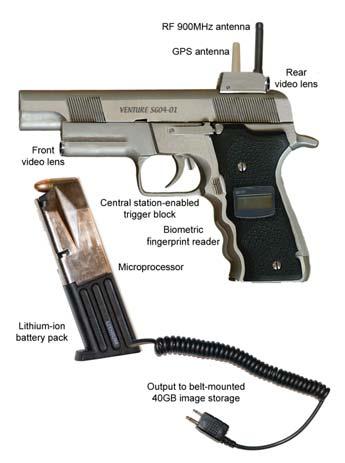
Venture spokesperson Ann Ridell wouldn’t elaborate on the computer technology in the Venture SG04-01, other than to say the cutting edge hardware which runs the gun had only recently been developed. The microprocessor is similar to one the US government plans to use in its missile defense system, she says.
“We are a relatively small company and we just didn’t have the resources to go to the supplier (she wouldn’t say which one) with such a small order. Instead we subcontracted with an eager new Chinese company, who has worked very closely with us all the way and literally spent months pouring over the specifications for our microprocessor technology.”
Biometric recognition is now commonplace but designing the SG04-01 was more complex than just slapping a fingerprint reader on the side of a gun. It not only recognizes the fingerprint of the officer using it but the print of every officer on the force, explains OCSD Sgt. Maloof (“Just call me ‘Loof’”) Lirpa.
Built-in readers on both sides of the grip

(for left or right handed users) instantly reads a print and transmits it to the central firearms dispatch centre, where it’s compared to a database containing the prints of each officer authorized to carry the new pistol.
Once a match is made, an encrypted radio signal is sent to the gun to disengage a triggerblocking device, allowing it to be fired. The pistol’s built-in RF transmitter uses the cellular phone network “so it’s every bit as reliable as your cell phone,” explains Lirpa. “We have had very few interference problems; once this gun comes out of the holster, it can be enabled and fired in as little as two seconds.”
An onboard miniature camera records two minutes of video, both front and rear, and kicks in as soon as the pistol is drawn. A constantly-activated buffer memory transmits directly to a 40GB image storage device on the officer’s belt.
“After an incident, we seize the pistol and download the video directly to the computers in our legal department, using the same reliable Windows computer you have in your home,” says Lirpa. A GPS device constantly records the exact position of the firearm and can imprint the location, time and date directly into the solid-state digital recorder.
“Since we transitioned to this pistol, we have seen an 80 per cent drop in excessive force complaints, a direct saving of some $1.2 million in legal costs and only a slight rise in officer fatalities,” Lirpa proudly reports.
It was decided during the design phase to use a central-station monitoring and enabling system rather than having the gun’s CPU control the trigger blocker. Venture Arms may one day use the simpler technology for the home defense user, says Ridell, but current plans are directed toward law enforcement and that requires the ability to read hundreds or thousands of fingerprints in fractions of a second.
The Canadian Firearms Centre is reportedly interested in adapting the technology so it can issue and revoke licences in real time, ensure weapons can be fired only by licensed users and deactivate guns when they are stolen. The Toronto Police Services Board is also said to be investigating the technology.
Blue Line was given an exclusive peek behind the scenes at both the training centre and central firearms dispatch centre. The SG04-01 has four modes of operation:
•Auto-enable - the pistol can be fired by any authorized user whose fingerprints are recorded in the database.
•Manual-enable - firing is permitted only after a signal is received from a duty officer at the central dispatch centre.
•Training mode - the pistol can be fired by anyone.
•Learning mode - the fingerprint reader scans and registers a new user.
An optional mini speaker carried on an of-
ficer’s belt can be used to broadcast a warning, in any of three languages, when the trigger is pulled and before a shot is fired. The warning can use either a male or female voice and will eventually be capable of using up to 120 languages. “We are very excited about the possibility of one day synthesizing a variety of voices, including our own chief and even celebrities such as Clint Eastwood and Steven Segal,” revealed Lirpa.
A high-capacity lithium-ion battery in the grip powers all the electronics; the pistol can go for up to four days between recharges, although drawing and firing drains the battery much faster. The magazine capacity was reduced to three rounds to accommodate the battery and electronics without making the gun too heavy and unwieldy. Each officer is issued two chargers and four spare batterypack magazines.
The pistol hadn’t yet been trained to recognize my fingerprint when I first handled it. I was startled to hear a clear electronic voice coming from the belt commanding me to “Drop this weapon! You are not authorized to possess it! Place it on the ground and put your hands on top of your head. An officer will be with you shortly.”
Once switched to learning mode by the central firearms dispatch centre, the pistol was programmed to recognize all eight of my fingers and then switched to auto-enable so I could fire at will. In nearly every instance it read my fingerprint, broadcast a warning message and discharged the first round in under two seconds.
The gun lacks sights but that’s not a problem, according to Lirpa, who demonstrated the high sideways hold now taught to all Oakland County Sheriff’s officers. “We use what we call a ‘High Offensive Manual Index Extension’ shooting grip. It is very effective and an interesting by product is that we are now recruiting more police officers from inner city gangs than ever before,” Lirpa notes.
After becoming familiar with the grip, the pistol placed every round in the centre mass of the target, although the message coming from the belt was a little distracting. “Deadly force has been authorized,” it blared before each round. “Stop or we will shoot!” Radio interference – or perhaps cell network congestion –was a problem on only one shot. That time I heard “The line is busy. Please hold for further instructions. Your call is very important to us.”
It was obvious that the design and development of this new smart gun wasn’t so much inevitable as a milestone for both the manufacturer and initial issuing agency. All of the senior Oakland officers we talked to – Lirpa explained that lower ranks were tied up responding to an unusually high call volume and unavailable for interviews – raved about the gun’s futuristic technology.
“Its potential is unlimited,” said Lirpa, as Ridell nodded in agreement. “It’s just the thing for the modern police agency looking for legal justification and the ability to centralize control of physical actions in deadly force situations.”

EDMONTON — A new surveillance unit will take to the skies this summer along the Montana-Alberta border to enhance security.
The U.S. air border patrol initiative will use Blackhawk helicopters and planes to provide a rapid response in the event of a terrorist attack and to watch for drug-runners and illegal immigrants.
The aircraft will be equipped with cutting edge photographic surveillance and monitoring equipment to watch for any suspicious activity.
Montana Republican Senator Conrad Burns secured an $18-million US appropriation from the Department of Homeland Security for the air unit, ena-

bling the initiative to begin ahead of schedule.
The 9-11 terrorist attacks revealed the northern border requires greater security and surveillance, says Matt Mackowiak, a spokesman for Burns. He says the increased border security benefits both countries.
The air border patrol unit is the third surveillance unit to open along the U.S. border with Canada. The other units operate out of Bellingham in Washington state and upstate New York. Both of these units have netted large drug shipments and have made arrests, says Mackowiak.
In the future, the U.S. plans to set up air border patrols in North Dakota and Michigan.


by Mark Giles
It’s like rush hour in Toronto or Montreal –but with a freewheeling atmosphere, minimal use of headlights, limited traffic enforcement, and hundreds of pedestrians crossing the street at random and without warning. From dawn until well after dusk, people are everywhere. So are taxis – on the prowl for local or preferably tourist business. On one busy road, I counted at least one taxi driving by every five seconds.
Welcome to Cairo – the capital of Egypt, the largest city in Africa and one of the most densely populated urban areas in the world. With a residential population of 16 million, and several million more commuting from the suburbs daily, greater Cairo is home to a quarter of the country’s population and much of its history. Vehicles may have priority, but this doesn’t stop pedestrians crossing streets – sometimes lane by lane, and frequently coming within inches of being hit. After a few days, I developed new ‘skills’ in crossing busy streets, but I never acquired the nerve of local Egyptians.
Other Egyptian cities and towns have less congestion, but the same traffic rules – or apparent lack of them. After witnessing many close calls over several days, I wondered if some sort of Egyptian magic prevented collisions and serious injury or death. The magic theory ended suddenly as I was interviewing a traffic policeman at an intersection in the city of Luxor. Hearing a loud thud, I turned to see a man lying on the ground, a short distance north of the intersection, groaning in obvious pain after apparently being struck by a vehicle while
trying to cross the street.
The ensuing traffic investigation would probably not meet Canadian expectations, but was completed in record time. Several policemen combined their efforts to route traffic around the injured man, and an ambulance was called, arriving a few minutes later. A few bystanders helped load the man – who police believed had suffered a broken leg or hip – onto a stretcher, and the ambulance left for the hospital. Within 10 minutes of the accident, the road was cleared and normal traffic flow resumed.
Realizing that in Canada an accident like this would have likely resulted in a more detailed and lengthy on-scene investigation, I inquired of the traffic policeman about their normal procedure. He responded that the accident was clearly the fault of the pedestrian – a report would be submitted and no charges laid against the driver. Based on my observations, I couldn’t disagree with his assessment.
Although their priorities may be different, the Egyptian police do seem to know what they are looking for. The police officer I spoke with in Luxor explained that his enforcement priority was speeding. After the traffic accident, which occurred after dark, I also asked about the large number of vehicles driving at night without headlights.
“That is not a problem,” said Captain Hazem Ahmed, a traffic police supervisor with the Egyptian National Police. “I am here to stop (speeders) and give them (tickets).”
It’s a diverse culture that leads to a different way of doing things. The use of headlights is thought to cause a drain on a vehicle’s bat-
tery and so many drivers, including some police, don’t use them – even at night. Smoking is common – even for on-duty policemen, but perhaps not surprising in a culture with the famous ‘shisha’ water pipe. While many women dress in traditional Muslim fashion, covered from head to toe, others dress in a more Western style. There seems to be considerable tolerance for the differences, which is highlighted in Old Cairo where a mosque, synagogue and a church are within a short distance of each other.
The diversity extends to the police, with four different types in Egypt: the Egyptian National Police, Traffic Police, Tourism and Antiquities Police, and the Internal or State Security Police. Although the Ministry of the Interior’s directorate of state security ultimately controls all aspects of policing in Egypt, the four agencies have different roles and jurisdictions.
Members of the Egyptian National Police have a function similar to most Canadian municipal, regional or provincial police agencies, with responsibility for policing cities and communities across the country, and providing police services for the general population. They can also be seen conducting traffic enforcement
in the smaller communities and occasionally in Cairo.
Traffic police are tasked with keeping the huge volumes of traffic, especially in Cairo and Alexandria, moving. They can be found at regular intervals in urban areas, often at stationary posts at junctions and merge or exit ramps on busy roads, and are quick to confront drivers not moving with the traffic flow. Without the same training as members of the other police organizations, their duties do not normally include other areas of law enforcement, and they will refer criminal complaints to the nearest national or tourist police detachment.
With tourism accounting, directly or indirectly, for 12 percent of the country’s employment, Egypt has tourism and antiquities police with specific responsibility for foreign visitors and Egyptian relics. Although not quite as prevalent as taxis, they are easy to find at most resorts, hotels, museums and other places frequented by tourists.
Internal security police are normally assigned duties seen as relating to state security such as crowd control, intelligence and foreign embassies. Under direct command of the Ministry of the Interior, they are not normally involved in the day-to day policing of most communities or tourist areas, but are deployed in special circumstances – such as the sinking of an Egyptian ferry in the Red Sea in February. Their use in controlling angry crowds at the port city of Hurghada received prominent, although not overly favourable, international media coverage.
The traditional police patrol system, com-
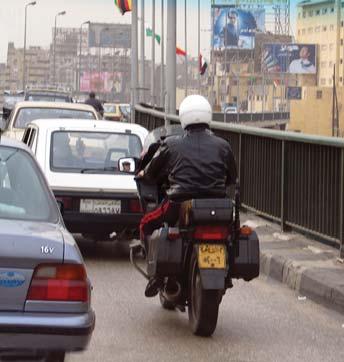
mon to most North American and European cities, doesn’t exist in Egypt. Rather, a system of static posts ensures a police presence at regular intervals and at major venues, particularly those frequented by tourists and foreign residents. Because police are predominantly on foot, they are highly visible and easily accessible. Finding a newer-model police vehicle in Egypt was difficult, but I did notice a few. Given the congestion and driving habits, especially in Cairo, older vehicles are perhaps a wiser investment. Most are older-model Toyota or Nissan pick-ups – some with canopies on the back.
The rank structure is similar to that of the Canadian Forces and other military organizations with parallel commissioned and non-com-
missioned paths. After selection, commissioned officers attend a four-year training program at the police academy in Cairo, while non-commissioned members attend a one-year program at a police institute.
Interestingly, I did find one policeman in Egypt who was trained in Canada – a Canadian Forces military policeman assigned to the embassy in Cairo. Warrant Officer Gerald Larouche works closely with the Ministry of the Interior and state security police, while managing a team of security staff and modern security systems to protect Canadian foreign affairs personnel assigned to Egypt.
Egypt has adopted many aspects of modern society, but has chosen to do some things differently. Traffic lights are rare in most areas – in fact, I don’t recall seeing any in Cairo. Rather, regular breaks in the centre median allow vehicles to complete a u-turn, head in the other direction and then turn right if needed. It seems to work, allowing traffic to flow more easily and without the congestion normally seen at a typical Canadian urban intersection.
In Egypt, keeping the traffic moving is a top priority, however, the same cannot be said of the government bureaucracy, described by many as slow moving and cumbersome. I learned this quickly after cancellation of a prearranged interview with a police commander in a downtown Cairo district – apparently because it hadn’t been cleared with state security. Realizing that the process to obtain this clearance would exceed the length of my stay, I decided to take short cuts in acquiring future police interviews.

My first opportunity came in Sharm el-Sheikh, a resort town on the tip of the Sinai Peninsula where terrorists bombed a hotel in July 2005. Identifying myself as a correspondent with Blue Line Magazine, I walked into the local police detachment, which is part of a downtown hotel. Although I had been warned not to expect much cooperation, I was greeted warmly and immediately escorted to the office of the assistant chief, who provided me with an informative 20minute interview.
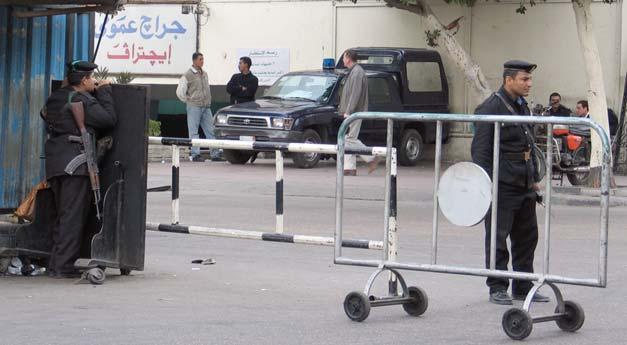
Responsible for investigations, the 30year-old commissioned officer explained the role of his detachment, part of the South Sinai policing district, in protecting visitors to Sharm el-Sheikh. With approximately 50 policemen – both uniformed and plainclothes –the detachment provides frontline police personnel for all major hotels and vital points, and a team of investigators to pursue criminal complaints.
“We are responsible for the safety of tourists here,” said Captain Ibrahim Abdallah. “That is my job. If tourists have complaints, I will (investigate) and make the arrest.”
He seemed quite committed to doing ex-
actly that, usually working long hours with a team of plainclothes investigators. After working for 20 days straight, he returns to his hometown, west of Cairo, to be with his family for 10 days. This 20-day on, 10-day off rotation is routine for many officers, requiring a considerable commitment to the job.
Since the hotel bombing, the flow of traffic has been severely restricted and tourist security is a top priority. As in Cairo, the uniformed policemen are for the most part well attired, although their equipment issue appeared inconsistent. Some are armed, while others appear not to be. A few have radios –most do not. Abdallah explained that his su-
pervisors were armed and patrolled their areas of responsibility in two, three or sometimes even fourman cars.
My reference to policemen and three or fourman cars is intentional, as I didn’t observe any police women during my visit. A government official told me later that there are some female police members, but that they are restricted to administrative duties – much like in Canada until the 1970s. Given the cultural and religious restrictions in Egypt, it is unlikely this will change any time soon.
In light of security concerns, especially given the terrorist incidents in Egypt and the Middle East in recent years, the Egyptian police have established a very visible presence. There are perimeter security measures and pedestrian and vehicle access-control points at many tourist locations, religious buildings and on major highways – especially in the Sinai. Many appeared vulnerable – almost there for the show, but I remember having the same initial observations at the White House. As a U.S. Secret Service officer pointed out to me, there are numerous behind-the-scenes security personnel and systems in place. Although I didn’t ask in Egypt, it’s likely that some of these notso-obvious resources are also available.
This philosophy of high visibility was most evident with crowd-control operations during soccer games at the Africa Cup, held in Cairo in January. While many Canadian police agencies tend to keep their crowd-control units out of sight unless they’re needed, the Egyptians put these resources out for all to see.
After nervously taking a few photos of a fully equipped crowd-control unit at a stadium entrance, I was quite satisfied that the police had the situation well in hand. When we passed a 60-man mounted crowd-control unit on the road a few minutes later, I was fully convinced. As part of the state security apparatus, this somewhat intimidating police presence serves as an obvious deterrent to would-be ‘hooligans.’
This show of force is softened somewhat by police efforts to go beyond the call of duty. After noticing the police crowd-control unit while passing the stadium by taxi, I had signaled my driver to stop. Finding myself on the wrong side of eight lanes of busy traffic, I was forced to use my recently acquired roadcrossing “skills.” With a bit of luck and the help of a rare break in traffic, I made my way across four lanes to the median – close enough to take several photos. Turning around to return, I was again faced with four lanes of traffic – this time facing an almost endless stream of vehicles, and waiting for what seemed like several minutes trying to cross. Seeing my dilemma, a traf-
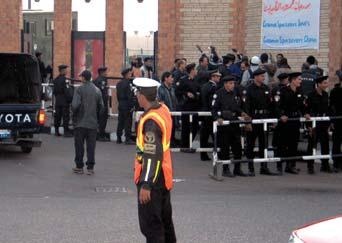
fic policeman stopped four lanes of traffic, grabbed me by the wrist, and escorted me safely back to my waiting taxi.
Not all the policemen I encountered were as enthusiastic. While police and emergency workers doing shift work are usually more susceptible to fatigue, I was surprised to see police at several static points, and in one case in a police vehicle in downtown Cairo, sleeping on the job in plain view.
For the most part, however, the police appeared alert and willing to help – as were Egyptians generally. Although a predominantly Arabic-speaking, Muslim society, Egypt makes considerable efforts to cater to Western visitors using the international language of business – English. Although the translations weren’t always smooth – the “General Department of Luxor Police sign was one example –they were definitely easier to understand for most English-speaking visitors than their equivalent in Arabic.
Whether in urban Cairo or the smaller towns, Egyptians have a strong sense of community. While the culture and policing practices are different in many ways, some things are much the same. Although I didn’t find any Tim Horton’s outlets, it is quite common to find local policemen dropping by a restaurant for coffee or a meal – and some light conversation with the restaurant owner and patrons. While I was tasting the local cuisine in Islamic Cairo, an on-duty policeman with the Egyptian National Police dropped in for coffee and a chat. After a few minutes, he responded to a radio call, and then returned a short time later to finish the conversation.
The close link between the police and the community seems to extend to religious activity as well. Arriving at the Valley of the Kings at noon, I observed two policemen join several local workers for mid-day prayer. Some might argue that their participation took them away from their policing duties, but it also sent a clear message of unity with the community they serve.
The Egyptians could probably learn a few things about policing from Canadians, but we could also learn a few things from them too. In the end, it’s not so much about being right or wrong – but accepting differences. Although there may be some gaps in the services provided by the Egyptian police, they appear to
have narrowed their focus to a few key areas, concentrating on what is most needed and what they can do well.
In its efforts to increase tourism and attract business investment, Egypt may have to take a closer look at some aspects of its policing operations. Professional standards, by most accounts, are not at the level expected by North American or European police agencies – and despite their priorities, traffic enforcement does seem to be lax. I saw a motorcyclist in Luxor run a red light directly in front of two motorcycle policemen, without any apparent action on their part.
The overall police presence was far more evident than in Canada. This could be perceived as intimidating, but it also seems to
contribute to a strong sense of street safety, perhaps acting as a deterrent to illegal activity. Whether you like them or not, there’s definitely a respect for the police among locals and tourists alike. It may be a philosophy deserving of greater scrutiny by Canadian police agencies.
As Egypt opens up to international tourism and business, opportunities for more dialogue, professional development and even officer exchanges may arise. With open minds all around, police agencies on both sides of the world could benefit.

by Ryan Siegmund
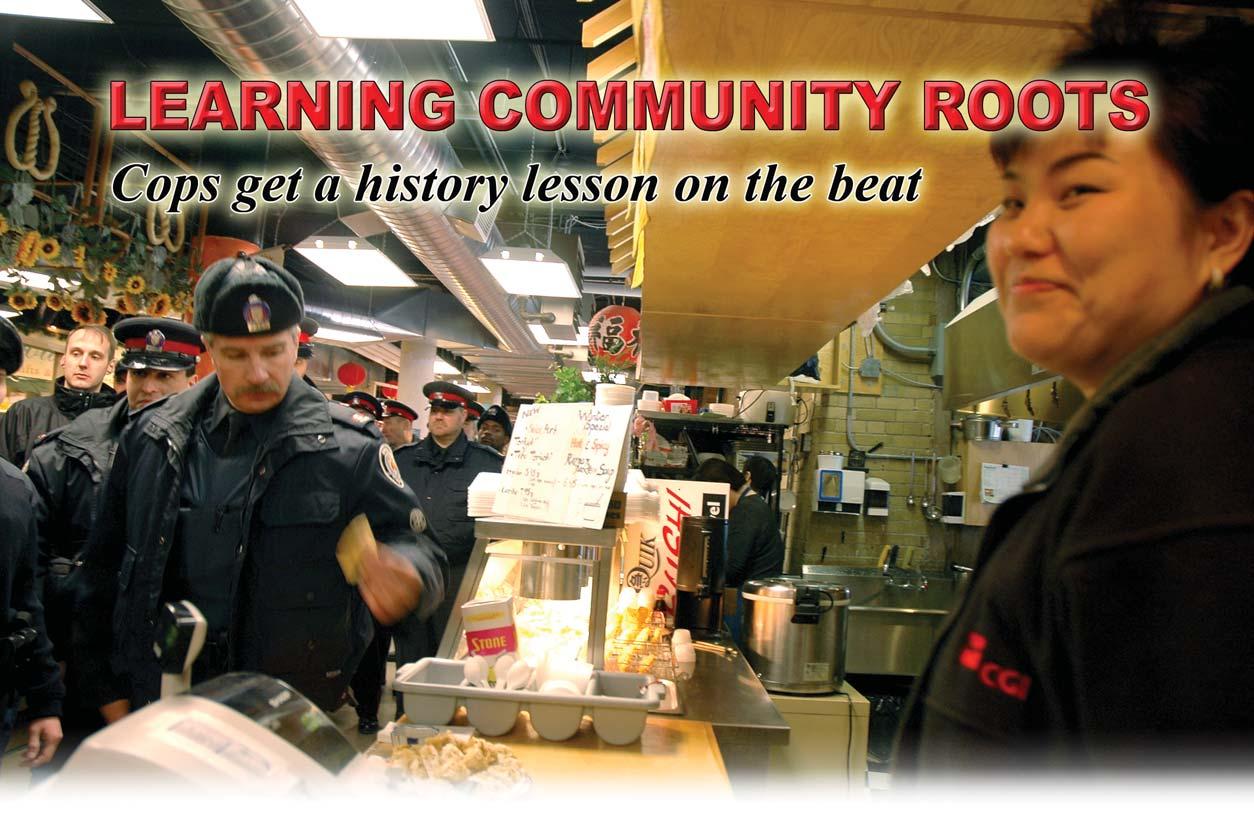
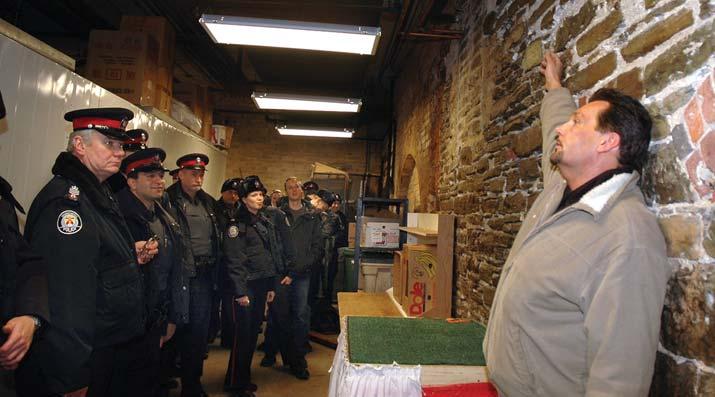
Toronto Police Service officers who patrol 51 Division ventured into the past to better understand their present-day division.
They spent a few training hours with local historian Bruce Bell, who conducted a tour of historical downtown Toronto, including the old jail cells buried beneath the bustling St. Lawrence Market.
“This is their beat, they should know the people, and history is all about people,” said Bell, who shows officers the beaten brick walls where everyone from petty thieves to those charged with treason were chained.
Many of the station’s new officers were not
born in Canada so they really don’t know the city well, says Inspector Rick Stubbings, coleader of 51 Division, who notes 23 of the 28 officers new to the division are right out of college. Anticipating the expansion of the foot patrol, Stubbings believes organized tours of the community as part of officer training properly prepares them for the area.
“These tours are to really get more of an attachment to the area they are policing... you cross different demographic backgrounds and it really gets back to exposing officers to the various issues in their beat. You don’t get to know an area until you really walk it and talk to people. We... want to get the officers more rooted into their communities.”
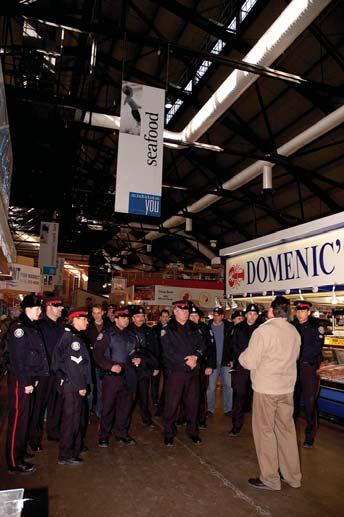
The city’s deep roots astounded Toronto Police Training Sgt. Steve Callaghan, particularly the St. Lawrence Market. Born and raised in Toronto, even he was taken aback by the rich history embedded within the market area, which is housed in some of the city’s oldest buildings. The south market building, now home to more than 50 merchants, has been known since 1901 primarily for its unique goods. It was originally close to the lake front, where ships docked to load and unload cargo. More than 250 years old, it once housed Toronto’s first police agency
and was also used as the first city hall.
“When we talk about politics – and it is always a big part of our job – it gives you a better appreciation for what might seem an easy decision,” says Callaghan. “The tour gives you a different perspective on how we originated and how the things that we see now have come full circle. The tour showed us all the remarkable changes to the building, even where the first police station was.”
Prisoners were chained in the old jail cells. “It went on like that for years until they changed the way they did business in policing,” says Callaghan. “To see the building, to see the walls, you could see the history.”
The tour allowed officers to get acquainted with the community, who stroll through the market in great numbers daily. Meeting them and sampling food from the merchants, officers get a real taste of the different cultures Toronto offers. Tempting their taste buds is also good business for the vendors, Callaghan says half jokingly, praising the excellent food.
“We generally deal with people behind closed doors; we don’t get the opportunity really to get outside and talk to people and this was an opportunity for the public to see us in numbers. From a community based perspective, it gave officers the opportunity to meet people in the area.”
Having a better view of their division –and city – allows them to rise above the sometimes negative undertones of daily police

work, he says.
To date, Callaghan has accompanied four of his five troops on the tour and says it was one of the few times officers anxiously anticipated a training exercise.
“Walking away from the (market) tour –learning about the evolution of the building and the politics behind it – you really understand we as police officers have a high profile. We are fortunate that, in our division, we can take
advantage of not only the people that are there but the history aspect.”
Toronto Chief Bill Blair is committed to neighbourhood policing and these tours have been a good example of 51 Division’s training goals, says Stubbings.
Steve Callaghan can be reached at steve.callaghan@torontopolice.on.ca

at

A Dallas based company that supplies, installs and operates photo radar is sparking controversy in two Canadian cities regarding contract agreements.
In Winnipeg, a report by the city’s auditor says a mishandled police photo-radar contract has likely cost the Manitoba capital nearly $50 million dollars.
In her report, Shannon Hunt says Winnipeg police rushed to award a contract to Affiliated Computer Services (ACS) Public Sector Solutions three years ago to get photo radar up and running quickly. She says police failed to exercise due diligence, and didn’t have the appropriate financial skills to properly evaluate ACS’s bid and misled city councillors.
“The end result was revenue projections that were significantly overstated, costs that do not appear to be reasonable for the service delivered and contracts that do not adequately protect the city from financial risk,” wrote Hunt. “Our review clearly demonstrates that citizens deserve better stewardship of financial resources.”
Hunt suggests police should reopen the contract with ACS and attempt to negotiate a better deal, despite the city being locked into a five-year agreement that gives ACS about $6 million a year.
Since implemented in 2003, more than 317,000 drivers have been victimized by photo radar enforcement in Winnipeg. The city profit of $1.8 million is well below the projected $20 million that was expected to be generated.
ACS should have been paid on a per-ticket basis instead of a flat fee, which would have mitigated the shortfall, Hunt says.
Meanwhile, two Edmonton police officers face charges stemming from an RCMP investigation into the way EPS tendered a photo radar and red light camera contract with ACS.
RCMP allege the two officers accepted secret commissions from Affiliated Computer and produced misleading documents and false statements to help the company get an untendered $90-million photoradar contract.
The RCMP have charged Det. Tom Bell, 47, the former head of Edmonton’s photo radar program and Staff Sgt. Kerry Nisbet, 49, the former head of the city police traffic section, with breach of trust and accepting secret commissions.
According to court documents, between April 1, 2002, and April 30, 2003, two officers committed a breach of trust by: “authoring and submitting documents and by making statements containing false and misleading information recommending (ACS) be awarded a sole-source contract for the provision of a photo-enforcement system,” and by wrongfully interfering with Edmonton Police Service operations designed to research the effectiveness and productivity of the speed on green program as compared to uniformed member enforcement.”
Court documents allege the officers accepted benefits from Jan. 1, 1998, to June 14, 2004, from Dallas based ACS and its predecessors - Lockheed Martin and Canadian Public Technologies - to endorse its system.
In light of those documents, the Dallas-Based ACS and its Canadian subsidiary ACS Public Sector Solutions Inc., were charged with offering secret commissions - charges that carry penalties of up to five years.
Court documents also allege ACS also gave or offered rewards to “other agents of Police Services in the Province of Alberta” in exchange for undisclosed favours related to police business. The RCMP allege the rewards were offered from January 1998 to June 2004.
Affiliated Computer supplies photo radar services to several Alberta municipalities, including Edmonton, Red Deer, St. Albert, Strathcona County, Spruce Grove and Fort McMurray.


The heart and soul of the ancient codes and ethical systems should be the foundation of modern police leadership teaching. Studying them will give police leaders emotional distance from the plethora of modern leadership theories and models now permeating our profession.
Many police leaders have become subverted to the latest leadership theory or opinion and forget the leadership lessons learned from ancient history. The more we disregard these lessons, the more deluded we become about future leadership practices. As Machiavelli, a Florence diplomat and leader in the 1500’s and one of history’s more radical thinkers, put it:
“Anyone wishing to see what is to be must consider what has been: all the things of this world, in every era, have their counterparts in ancient times… since these actions are carried out by men who have and have always had, the same passions, which of necessity must give rise to the same results.”
Truer words have never been spoken, especially when it comes to understanding ‘functional’ and ‘ethical’ law enforcement leadership today. The ancients offer police leaders a moral compass that will help set the ethical and philosophical tone of forces and, in the process, inspire others, thus ensuring departmental success both now and into the future. As exSeattle Police Chief Norm Stamper wrote in his book, Breaking Rank:
“You are a police chief. You want to move your department from where it is today to a better place. What do you do? You surround yourself with good people, set the agency on the right course and establish and enforce tough standards of performance and conduct. Then you do everything in your power to make sure that, when your time comes, you are replaced by someone who’ll do the job better than you. This means promoting the personal growth and professional development of each and every employee. That is why you delegate responsibility and authority, not because it’s the fashionable thing to do. You want your cops and all your employees to make the right decision, for the right reasons, when you’re not around.”
Police leadership is more than just meeting goals, modeling the success of others or adopting a new philosophical leadership ideology – it’s about a foundational code of conduct based upon ethics, honourable behaviour, self-respect, character and dignity. Chivalry, Bushido and the Jedi Code offers those who want to be leaders an ancient blueprint to both ethical and moral success. What is old should be made new again, especially when it comes to ‘core’ law enforcement leadership ethos.
A leader is a person of integrity who people choose to follow and can influence others
to do things that they may not otherwise do.
A police leader, through his/her own initiative, tries to improve the professional lives of those they work with, while also improving the organization as a whole. They take responsibility for their actions, rather than trying to shift the blame when things go wrong and are willing to take calculated risks. Title or rank is not relevant to leadership; many natural police leaders possess little or no rank.
A leader can motivate, strategize, enlighten, inspire, act, plan, build, institute and produce. A person must be a leader first, then a manager. A

leader can be a manager but a manager is not necessarily a leader, a concept not fully understood by some in our field. A manager has authority bestowed upon them, while a leader’s actions, not position, earns them respect.
Leadership sets the course, based upon strong ethics and values and ensures that everyone is moving in the same direction.
Transactional leadership principles are based upon ‘brokering’ and are efficient at preserving the status quo. People are rewarded for doing what they’re supposed to do and attention is directed towards those who fail to meet standards. This leadership style is preoccupied with power, politics, positioning and perks and requires a shrewd eye for opportunity and a good hand at bargaining, persuading and reciprocating.
Transformational leadership principles are based upon team spirit, sense of mission and motivation and the leader becoming a role model. They mentor, provide meaning and challenge and promote intellectual stimulation; its pillar is concentrating on the ethics and values of what a person does and how goals are accomplished.
To a degree, I support transformational rather than transactional leadership alone, although the latter style does establish clear standards and expectations of performance and builds the basis for trust in a leader. Transformational leadership can then build on these initial levels of trust by establishing a deeper sense of identification with a department’s values, mission and vision. When used appropri-
ately, a hybrid leadership model that finds synergy between the task oriented transactional model and the social/emotional oriented transformational model could be a modern police theory, strategy and practice for today’s law enforcement leader. As Stamper notes:
“Transformational leadership promises profound change… so comprehensive and pervasive that new cultures and value systems take the place of the old. It sets out, consciously and deliberately, to transform followers into leaders and leaders into moral agents; individuals who are deeply, demonstrably committed to liberty, justice and equality. A police department that embraces these values would, by definition, reject racism, sexism, homophobia and every other brand of bigotry. It would nurture a workplace in which diversity of opinion is appreciated and whose employees treat one another with dignity and respect, regardless of rank or status.”

by knights (Chivalry) and samurai (Bushido) – and each was unaware of the other for hundreds of years. The fictional Jedi Code appears to be a synthesis of both. Not unlike police officers, knights, samurai and jedi, although traditional warriors, were also peacekeepers (not pacifists) and protectors of society. They were compelled to be truthful, master both armed and unarmed tactics of their day, be loyal to king, country or feudal overlord, protect the weak, aid the poor and seek social justice.
The keys to shifting to this hybrid style are:
•Identifying the leaders in your department.
•Placing them in positions that can influence and move others toward the change.
•Creating a leadership ethos that acts as a moral compass to foster this change service wide.
The ancient moral leadership codes and ethical systems can best serve law enforcement leaders in the last point. In simple terms, Chivalry, Bushido and the Jedi Code are a way of life. The first two were developed separately

Despite their portrayal in King Arthur, it is interesting to note that many knights were ‘codeless’ and nothing more than mercenaries who raped and plundered prior to the introduction of the Code of Chivalry in the 11th Century when several Archbishops strived to bring order to chaos by developing the rudiments of the code. Both Chivalry and Bushido hold warriors to a higher ethical standard than average citizens whom the warrior serves, not unlike police officers, and restrains the knight or samurai by setting boundaries on their behaviour. They also distinguish honourable from shameful acts. The similarities between the codes are remarkable and a true testimonial to what I see as an early form of transformational leadership, based upon an ethical code of conduct and moral principles that crossed culturally diverse ideologies. With great power comes even greater responsibility and both codes recognized this concept through their teachings.
Although there was no formal written code of Chivalry, historians have identified several essential elements that formed the ‘old code.’ They translated these elements into a modern version, which can be applied to police leadership:
•Prowess: Seek excellence in all your endeavours without cutting corners or making excuses. A leader should constantly learn and challenge themselves, not for personal aggrandizement but to become a better police officer, leader and mentor to their team.
•Justice: Always do what is ethically and morally right, unencumbered by bias or personal interest. A leader holds to the highest standard of behaviour and knows that fudging the little rules weakens their authority, which is given by those who rely on them to lead in time of need.
•Faith: You must be faithful to your promise, no matter how big or small. Faith also includes trust, honesty and integrity. A leader who doesn’t inspire trust and honesty is the weak link in the chain of command.
•Humility: Never boast of your accomplishments and always value first the contributions of others.
•Generosity: Give your time, wisdom and energy to everyone you lead and you shall become a good mentor and an even better leader. Give those on your team the tools, training and experience needed to do their job.
•Courage: Take on roles outside your comfort zone and undertake difficult, tedious and/ or unglamorous tasks. Graciously accept the sacrifices that may come with such tasks.
•Nobility: Uphold your convictions at all times, even when no one is watching. Your actions and convictions will influence others and offer a compelling example of what a leader can accomplish.
•Truth and mercy: Always speak the truth, no matter how difficult, but temper it with humanity and mercy, as pure truth can sometimes bring great grief. Words and attitudes can be painful weapons; a leader exercises mercy in dealing with others to prevent hostility and antagonism.
•Hope: See a problem as a challenge, no matter how bad the circumstance or situation and provide a positive outlook to those you lead.
•Loyalty: Stay true to the ideals you choose to live by and always show an unwavering commitment to those you lead and to all others you believe worthy of such loyalty.
There was also no formal written code of Bushido. Inazo Nitobe, author of Bushido: The Soul of Japan, described it as an unwritten code which, at best, consisted of a few maxims handed down orally or written by a well-known warrior. Bushido has three kanji (meanings):
•Bu - martial arts
•Shi - gentleman/nobleman
•Do - the way or path
Bushido then is the path followed by a gentleman practitioner of the martial arts and is often described simply as ‘the way of the warrior (or Samurai).’ Seven virtues associated with it can be applied to police leadership:
•Gi (Rectitude): The power to decide upon a certain course of conduct or action in accordance with reason and morality, without wavering.
•Yu (Courage): Doing what is right – facing hazards, jeopardizing one’s self, rushing into the jaws of death and making the ‘right’ decision rather than the popular or wrong decision. A leader rises above the masses of people that are afraid to act and must have heroic courage – not blind but intelligent and strong.
•Jin (Benevolence): Through intense training a leader becomes quick and strong, both physically and mentally. Not like others, they are compassionate and help people at every opportunity; if none arises, they go out of their way to find one.
•Rei (Respect): A leader has no reason to be cruel and does not need to prove their strength. They are courteous even to nonfriends and are respected not only for their strength in work ethic but for their dealings with others.
•Makoto or Shin (Honesty): Be acutely honest in your dealings with all people. Believe in justice – not from others but from yourself. To a true leader, there are no shades of grey in honesty; there is only right and wrong.
•Meiyo (Honour): Implies a vivid consciousness of personal dignity and worth, born and bred to value the duties and privileges of one’s profession. A true leader is the only judge of their honour. The decisions you make and how you carry them out reflect who you truly are. You cannot hide from yourself.
•Chugi (Loyalty): You are part of anything you do or say and responsible for it and all the consequences that follow. A leader is intensely loyal to those in their care and remains fiercely true to them.
Jedis and leadership
Jedi knights are the fictional guardians of peace and justice in George Lucas’s Star Wars movies and the Jedi code appears to be based upon a synthesis of both Chivalry and Bushido. It has five virtues that can be applied to police leadership:
•There is no emotion, there is peace: Leaders must not show negative emotions such as hate or anger to those whom they serve or who are on their team; doing so only creates controversy and conflict.
•There is no ignorance, there is knowledge: Be circumspect and always strive to understand what it means to be a leader and mentor, always open to knowledge and education. Knowledge can be a means to victory anytime.
•There is no passion, there is serenity: Always try to find a peaceful and reasonable solution in times of conflict. Knowledge and patience are often useful tools.
•There is no chaos, there is harmony: Everything you do must be thought out and wellplanned. Remember that most plans do not survive first contact, thus the need for a plan B or even a plan C. Harmony also includes the ability to adapt, overcome and improvise in times of chaos.
•There is no death, there is the force: Fear of death can mean the difference between life
or death, since it can cause you to hesitate and not concentrate on survival. Make peace with your deity to ensure your issues surrounding death are resolved before you find yourself in a life or death situation.
The moral and ethical standards found in Chivalry, Bushido and the Jedi Code should form the foundation of any modern leadership ethos. They are about choosing to do the right things, for the right reasons, at the right times, thus allowing a police leader to:
•Recognize the need for duty and service to their team, department, community, family and loved ones.
•Understand the importance of spiritual tranquility, which is not limited to any particular faith.
•Always conduct themselves with honour and integrity.
Leadership, especially police leadership, is both a challenging and rewarding position that brings with it internal and external responsibilities and oversight. Your decisions and actions will always be scrutinized and held under the microscope. The moral and ethical standards found in Chivalry, Bushido and the Jedi Code can act as a moral compass, ensuring that leadership decisions and actions taken are ethical, moral and honourable.
Darren Laur is a sergeant with the Victoria Police Department and can be reached at laurd@police.victoria.bc.ca . He based this article, which is an edited version of a larger paper, on his 19 years of experience as a police officer and study of past warrior leadership codes and ethical systems.

Written by: David M. Tanovich
Publisher: Irwin Law, Toronto, Ontario
Reviewed by: Giles
Renaud
“Police and policing are symbolically and practically at the very core of the State; they represent one of the few institutions charged with the legitimate use of force in the service of the State and, more abstractly, the public; they are rightly visible and often contested by those who challenge how that force can and should be deployed…” pages vii-viii of the Preface to Nigel G. Fleming’s, The Police and Social Conflict (Second Edition).
I have selected this passage from a major recent work on policing to underscore the importance of police work and the contemporary phenomenon of widespread criticism of their work. I can think of no better introduction to the trail blazing work of Professor Tanovich. His detailed and scholarly review of racial profiling seeks to end the improper exercise of police powers by describing the human costs associated with a practice he describes as unconstitutional, while attempting to encourage and enhance traditional intelligence gathering and active investigation of potentially harmful activity. The resulting study provides law enforcement officers and agencies, as well as criminal law professionals and the public, with
an impressive, well written, superbly documented and presented challenge to any race based investigative methods.
Tanovich has organized his work into three parts and draws attention to this issue in ten chapters. The first part, “Understanding Racial Profiling,” guides us in understanding what racial profiling is. Tanovich exposes the abuses engendered by racial profiling through a wealth of social science evidence and compelling anecdotal testimony. In fact, I commend the varied references to interviews and focus groups involving police officers who have themselves decried the multiple stops and searches they have encountered during their off-work hours, based on appearance as opposed to activity or behaviour. By way of a limited example, on page 33, “[I am a police officer.] About every six months, like clockwork, I get pulled over just for being a black man driving.”
In the second part, Tanovich, whose publications are regularly cited in influential Court judgments, details how pervasive racial profiling is in Canada. The author’s discussion of terrorism on pages 105-117 exposes the idea that racial profiling is not only unreliable but very inefficient as it creates over-inclusive profiles that result in hindering law-enforcement efforts. The third and final part encourages Canada to move forward in its attempt to eradicate race based policing, through legislative
reform and court challenges.
Some may see this text as an attack and conclude that the entire presentation is unworthy of serious study or foundation for principled police reform; others may choose passages out of context, without regard to the nuanced and subtle arguments, in order to advance contextually wrong attacks on the policing community. Leaving aside these unfortunate but easily foreseen reactions to this book, Professor Tanovich has advanced a balanced, yet controversial, study of a complex and divisive issue that must be fully understood and further debated.
The Colour of Justice: Policing Race in Canada, will provoke debate, counter-arguments, revise policies and procedures and, most of all, bring about the kind of soul-searching that is necessary to ensure that the use of force in our society, exercised by those who serve and protect us, is consistent with the basic respect for liberty, personal dignity and autonomy that is characteristic of our country. Whether any precise argument may be countered, whether the misconduct described is widespread, episodic or rare, and whether we find agreement with all of the points raised is of secondary importance to the issue that the concerns raised must be addressed fully, fairly and without delay. Anyone interested in policing is indebted to Professor Tanovich for his plea for fairness and justice.

dangerous drivers across the Lower Mainland of B.C. will be a core function of Air One, the province’s new helicopter which launched in March.
The RCMP helicopter aims to coordinate police response in multiple jurisdictions, and “represents a long-lasting commitment to public safety,” says Vancouver Police Chief Jamie Graham.
“With the integration of police services, we are better able to coordinate the use of a helicopter across a dozen municipal and RCMP detachments,” he says.
The $2.2-million Eurocopter EC-120B Colibri, equipped with an infra-red camera and other specialized equipment, will provide service to 17 municipalities in Greater Vancouver. Air One is jointly funded by the B.C. government and ICBC, with some of the costs covered by the federal government.
B.C. Solicitor-General John Les says the helicopter will provide aerial support for police operations, adding the benefits of the new helicopter to 17 municipalities far outweigh the financial costs.
“Each year accidents and hit-and-runs kill more British Columbians than all violent crimes combined,” says Les. “The helicopter will help police spot and track dangerous drivers, and will reduce the chance of highspeed chases that put the public at risk.”
Air One will enhance police response to drivers attempting to evade capture and assist with overall crime reduction, says RCMP Deputy Commissioner Beverley Busson.
The addition of Air One continues the province’s commitment to road safety, and is expected to assist in the bait car program operations.

Written by: Harry G. Frankfurt
Published by:Princeton University Press 2005
Reviewed by: Robert Lunney

Not a shift goes by without a police officer encountering bullshit. It is everywhere. Most of us are confident we can recognize and avoid being taken in by it – and most of us contribute our share – but we generally tend to take the situation for granted so the phenomenon hasn’t aroused much concern.
However, we have no clear understanding of what bullshit is, why there is so much of it and what purpose it serves. Harry Frankfurt, a retired university professor said to be one of the world’s most influential moral philosophers, attempts to build a theory. His essay On Bullshit was first published in 1985 in an academic journal. A revised version is now available in a slim, pocket-sized volume.
Frankfurt explores the distinction between bullshit and lying, arguing that bullshitters misrepresent themselves to their audience in a different way than liars, who deliberately make false claims about what is true. Bullshit can be substantially true but still be bullshit, and those spreading it seek to communicate a certain impression without concern about whether any part of it is true. They quietly change the rules governing their end of the conversation so that claims about truth and falsity are irrelevant. It is this lack of connection to a concern with truth that is the essence of bullshit, which is characterized by carelessness with composition and content and little concern for detail, the author notes. More often than not, he says, bullshit is not true.
As for its potential damage, Frankfurt draws a worrisome conclusion. Liars at least acknowledge that it matters what is true, making bullshit a greater enemy of the truth than lies. Frankfurt also contends that although bullshit can take many innocent forms, excessive indulgence in it can eventually undermine the practitioner’s capacity to tell the truth in a way that lying does not.
Frankfurt comes to the dismal conclusion that bullshit is an inevitable byproduct of public life, since people resort to it when given an opportunity to speak extensively about matters to which they are, to some degree, ignorant.
“Bullshit is more widespread now because of the revolution in communications,” Critic Timothy Noah noted in a blog for the Wall Street Journal. “Cable TV and the Internet have created an unending demand for information and there simply isn’t enough truth to go around, so we get bullshit instead.”
Now that we have a definition and a text, perhaps police ethics should address the issue of bullshit, its role and impact on police and relations with the public.

by Danette Dooley

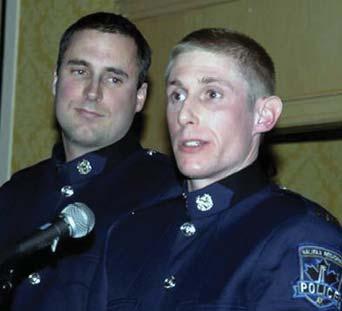
Two rookie cops have walked away with the Halifax Regional Police (HRP) Officers of the Year award.
Constables James Cooke and Justin Sheppard are beat officers who joined the force two years ago were nominated by their peers and chosen by a committee made up of representatives from the Retired Police Officers’ Association. They are seen as officers who uphold a standard of distinguished public service in policing.
Cooke and Sheppard are well known for treating citizens with respect, their extensive knowledge of the community, relentless pursuit of suspects and significant arrests, according to their nomination. “We were nominated together because we walk the best together,” Sheppard says.
The duo patrol the only area of Halifax where officers walk instead of drive. It’s a diverse region, Sheppard says, which includes houses, apartment complexes, businesses, senior citizens homes, schools, bars and a YMCA.
“We do all of our policing on foot, our two day shifts and then our two night shifts” Sheppard says, “so we’re never in a patrol car unless we’re needed to supplement a shift. If there’s back-up calls for service they’ll pull us off the beat and put us in vehicles but our primary function is to be on foot on those streets that we police.”
Officers pounding the pavement goes to the core of community policing. Cooke and Sheppard are two of eight officers assigned to foot patrol. It’s all about offering front line police work on a street level 24/7, says Sheppard.
The arrangement provides officers with an
opportunity to get to know people on a first name basis.
“As we’re walking down the streets we have an opportunity to stop and talk to business owners and people passing by. We even stop into the schools, and we’re still the same as regular patrol officers because we respond to calls as we’re dispatched. When there are no calls for service, we get to interact with the community.”
For Sheppard, being recognized by his peers at such an early stage of his policing career came as a pleasant surprise.
“There are so many good police officers that it was a surprise to both of us, but it is a tremendous honour.”
“We walk the beat with two feet and a heartbeat,” says Cooke, who has worked with Sheppard for about six months. “We get to know the community... the good people and the bad.”
Cooke sees policing on foot as an opportune way to get rub shoulders with whoever might be in the area – day or night. It really is

the heart of community policing, he says.
“People get to know the police officers and, as one of my superior officers said, ‘You can’t hide behind the windshield anymore,’ because we just don’t drive by people any more. We stop and say hi.”
Like Sheppard, Cooke is also humbled by the award.
“We were totally surprised. We wouldn’t have thought for a second that we’d be nominated for something like this. We’re just learning the job and getting our feet wet in the whole policing world so to be nominated for something like this, is pretty awesome.”
Other award recipients honoured during the February 18 ceremony include:
•Cst. Richard McDonald and Gloria Knowlton were presented with Chief’s Meritorious Service Awards, which recognizes employees who display an ongoing dedication to service, continuous professionalism, high integrity and sustained excellence.
•Sgt. Darla Perry and HRP volunteer Adam Arthur were given Community Contribution Awards for the countless hours they have spent serving the community, through fundraising, serving on community boards and attending community meetings.
•The Detective Frank Hoskins Award for excellence in investigation went to Det/Csts Perry Astephen and Blair Hussey. They were recognized for their extensive knowledge of criminal activity, which has led to the successful conclusion of several major files. Astephen and Hussey played key roles in Operation Midway, a lengthy drug investigation which led to the arrest of more than 50 people.
•Seventeen police officers and one civilian employee who retired in 2005 were also recognized for their years of service to the community. They departed HRP with 558 years of combined experience in policing.
You can reach Danette Dooley at dooley@blueline.ca
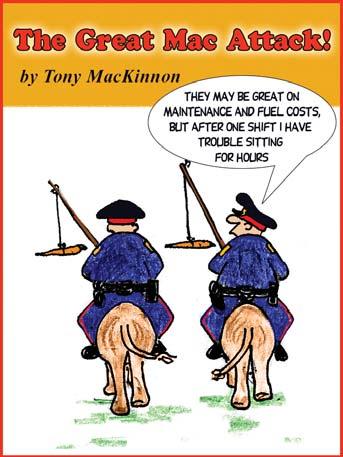
Just read your commentary on “ Smokey and the Bandit.” I have been waiting for one of your ‘to the point’ editorials about road safety. I couldn’t agree with you more. I just made some similar comments at an International road safety conference in Egypt 2 weeks ago. The public perception after viewing auto commercials and movies which include risky driving behaviour, is that there are no crashes and if there are, the characters always survive (no one dies) and if there is a crash in a movie it is always an extra that is involved. This removes emotion from the crash.
I sit on the Toronto Area Safety Coalition (TASC). In each of our monthly meetings we discuss this very issue and actually complain to the authorities about improper advertising. My opinion is that the automotive companies hire advertising firms that have only one thing in mind: sell a commercial that sells the product regardless of the consequences.
Movie makers and video game companies are only concerned about attracting paying customers.
Keep up the Road Safety messaging in Blue Line .
Theo (Ted) Holtzheuser (Sergeant Retired)
Road Safety Consultant Toronto, ON
After reading your commentary about the effects of advertisement of new cars one question came to my mind. Since every new vehicle made for the Canadian market has to conform to certain specifications dictated by Transport Canada, wouldn’t it be easy to implement a restriction to the maximum speed that a vehicle can go?
All new motor vehicles are speed limited electronically via their onboard computer, so it would be as simple has changing that limit to say 150 km/h and maybe a lot of tragedy could be adverted. Criminals, knowing that they can’t outrun the police, would possibly think twice before starting a pursuit.
Thank you for your time and keep up the good work,
Sgt François Paquette Montréal, QC ***
Where has this term “border guards” come from? (Blue Line; March 2006, Page 14. “vowing his party will stand behind its promises to arm border guards... the justice minister Vic Toews...” Page 38, “that Canada’s gun-less border guards..”)
What happened to our customs inspectors? A good friend of mine is with Canada Border Services and he notes that for 150 years we have had customs inspectors. Now customs inspectors have suddenly become “border guards.”
My friend and I get shivers when we hear the term. We have images of the East German Vopos at the Berlin Wall and their shoot-tokill orders. They were border guards.
Border guards? Are they still border guards when they are in the Customs hall at the airport? The signs say, “Customs/Douanes.”
Every time I have arrived back home, I’ve gone to Customs and spoken to a customs inspector.
How come, in the very same news stories, the U.S. Department of Homeland Security still has Customs Officers at Blaine, Washington but the guys on our side of the white line are
border guards? (Or Bill Kaufman on page 38, “frontier sentinels.”)
Are they still border guards when they are climbing through a box car in a railway yard, at the mail plant inspecting foreign arriving mail, or at a courier company going through cargo manifests.
By the sounds of things the only people our Customs Inspectors get any respect from are New York State Police when they “donated used protective vests to Canadian Customs Inspectors who had none at all.”
Brent Harding Calgary, AB

by Mike Burgess
Ontario’s Private Security and Investigative Services Act, which received Royal Assent Dec. 15, makes licensing and training mandatory for all private investigators and security personnel in the province; this includes, for the first time, Commissionaires and all in-house security staff, who were previously exempt.
An advisory committee made up of industry representatives has been working since 2005 with the Ministry of Community Safety and Correctional Services to develop regulations under the new legislation. The key areas being addressed include:
(1) A code of conduct for security practitioners and private investigators.
(2) Training and testing requirements.
(3)Standards for uniforms, vehicles and equipment.
(4) Minimum insurance requirements.
The Standing Committee on Justice Policy held hearings around the province last fall and there was also considerable debate on the bill prior to its passing. Several changes were introduced at third reading, including a revamping of the definition of ‘security guard’ and the inclusion of the Criminal Code definition of ‘peace officer’ within the exemptions. This effectively captured municipal enforcement and bylaw officers if they are tasked with duties
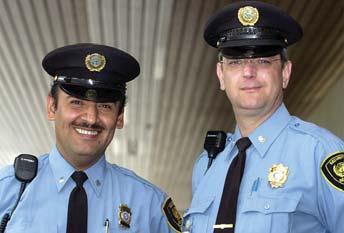
included in the new definition.
Since the summer of 2005, the advisory committee has concentrated on drafting the code of conduct and identifying the set of competencies needed by security personnel and private investigators. The elements are in various stages of progress, however there is agreement on some of the basic terms of reference.
For example, all new security applicants will need to prove that they have successfully completed a certified training program.
Those already working in the industry will only need to take the standard test to be licensed, although those who fail will have to take the certified training. Any applicant who fails the test will be allowed to retake it. Matters such as how training programs will be certified and tests administered are still under development.

How the training and licensing standards will be monitored and upheld is now clear. There will be a new inspection mandate and an expanded investigative capability has been proposed for the new private investigators and security guards branch of the ministry, which will ensure licensed practitioners meet the new standards.
The regulations are anticipated to be rolled out by the spring of 2007, however, as always, the final scheduling of such matters remains the prerogative of the government.
So how do we prepare given what we now know?
It is no secret that Ontario is closely following the 22 recommendations of the Shand coroner’s jury and basing new regulations on the Canadian General Standards Board (CGSB) platform. Many other provinces have introduced legislation or drafted discussion papers on the same issues.
CSIS, ASIS International, IFPO and others are reviewing their certification programs

VIENNA, Austria — Drug traffickers are increasingly using postal services for smuggling, the United Nations drug control agency says, urging countries to improve efforts to screen packages. Countries must enact legislation to better check international mail routes in and out of their countries, the Vienna-based International Narcotics Control Board said in its annual report.
Such legislation should also allow the search of international mail courier companies, it said.
“According to the World Customs Organization, over the last five years every region of the world has experienced an increase in such illicit activity,” the report said.
The report also highlighted the increasing presence of illegal online pharmacies.
The board called on governments to launch awareness-raising campaigns to alert the public, stressing the importance of international cooperation in targeting such pharmacies.
The report found that drug preferences differ by region:
•In Africa, the drug of choice is marijuana, abused by more than 34 million people. It is also popular elsewhere, with about 30 million people in the European Union using it during the past year.
•Prescription drug abuse is on the rise in North America - the United States, Canada and Mexico.
•In Central American countries, high unemployment and other social factors continue to make the region susceptible to drug traffickers and it continues to be a major transshipment point for cocaine bound for the United States.
•In South America, illegal coca bush cultivation is increasing in Bolivia and Peru and cocaine production and drug trafficking have continued to spread in the region.
•Almost all the heroin smuggled into Europe originates in Afghanistan.
•In South Asia, drug abuse by injection is driving up the HIV/AIDS infection rate, in particular in Nepal and India.
The full report is available at: http:// www.incb.org
and adding missing elements such as use of force, communications or customer service to address the coming tiered licensing system. They recognize that content, methodologies of delivery and program length must be in line with the new mandatory regulations in order to be recognized for provincial licensing.
The standardized testing for core level licensing will primarily be academic knowledge on core subjects, which is already covered within the CGSB standard; it is anticipated that most colleges will be able to administer these exams.
The main issue currently being debated within my circles is use of force, which also lies at the heart of the Shand inquest. Who will train the trainers or examine the examiners that administer testing for higher licence tiers?
Very few colleges and security associations provide use of force training and there is little accountability to provincial government agencies in most places when force is used by security guards during an arrest or in self-defence. Using a bit of common sense here, the bottom line is not too difficult to anticipate.
Most police, corrections and other enforcement agencies have standards in place for instructors. Standards in Ontario were designed in the early 1990s. Front line instructors are usually trained in about three weeks and the instructors in about three months. Those who test the instructor trainers and examiners need years of experience in the field and many year’s hands on experience as instructors. These standards have been vetted many times in the courts over the years, most recently in the Shand coroner’s inquest.
Civil litigation and due diligence are not new terms to police, corrections and law enforcement agencies. The lessons learned in these areas will, no doubt, be transferred to the security and private investigators standards and you can expect fairly strict guidelines when it comes to who can administer testing at the higher licensing levels.
First steps include conducting a risk-based assessment of current security services, systems and programs. Review job descriptions, professional standards for security staff, training, policies and procedures and service delivery practices to ensure they are consistent and congruent.
Audit and measure the findings against current and future industry standards and legal precedents, keeping in mind that your program must comply with Canadian law and best practices. There are many American based systems, particularly in use of force, that include methodologies and practices I suspect will not be acceptable within the new standards.
Find an auditor who has verifiable credentials and recognized expertise in all areas of training. The first place to look is the major security associations. By exercising due diligence in this manner, you will reduce risk, mitigate liability and enhance the safety and security of both persons and property.
The managing director of Burgess and Associates, Mike Burgess is a recognized authority on use of force, managing violent behaviour and preventing workplace violence. He has 25 years of experience in the law enforcement field and chairs the CGSB core competency committee. He can be reached at mike@burgessandassoc.com

WINNIPEG — Manitoba’s Integrated Organized Crime Task Force have indicted 13 individuals, including three members of the Manitoba Hells Angels chapter following a province wide investigation.
The arrests stem from an operation dubbed, Project Defense, which focused on high level members of drug trafficking cells in the province of Manitoba, including members of the Hells Angels.
A series of raids at several locations were carried out by more than 150 officers from the RCMP, Winnipeg police and Brandon Police Service. Three alleged fullpatch members of the Hells Angels, including the gang’s suspected president were among those arrested. Suspected gang associates rounded out the other arrests.
During Project Defence, a secret agent allegedly immersed himself into the gang life specifically to gather valuable information and evidence. More than seven kilograms of cocaine and three kilograms of methamphetamine have been seized since police began the case in November 2004.
“This is significant,” says RCMP Sgt. Steve Colwell. “It’s been going on for 15 months to target high-level members of these cells.”
The accused face charges of drug trafficking, extortion and belonging to a criminal organization, the latter of which can increase jail time by up to 14 years.
Manitoba Justice has signed on for a direct indictment to get the accused to trial quickly and to protect the safety of any Crown witnesses.
Those charged include Ernest John Dew, 46, president of the Manitoba chapter of the Hells Angels, and his wife, Vera Lynn Dew, 37; and Hells Angels members Ian Matthew Grant, 31, and Jeffrey David Peck, 43.
The Integrated Organized Crime Task Force’s mandate is to disrupt and dismantle organized crime in the province of Manitoba.



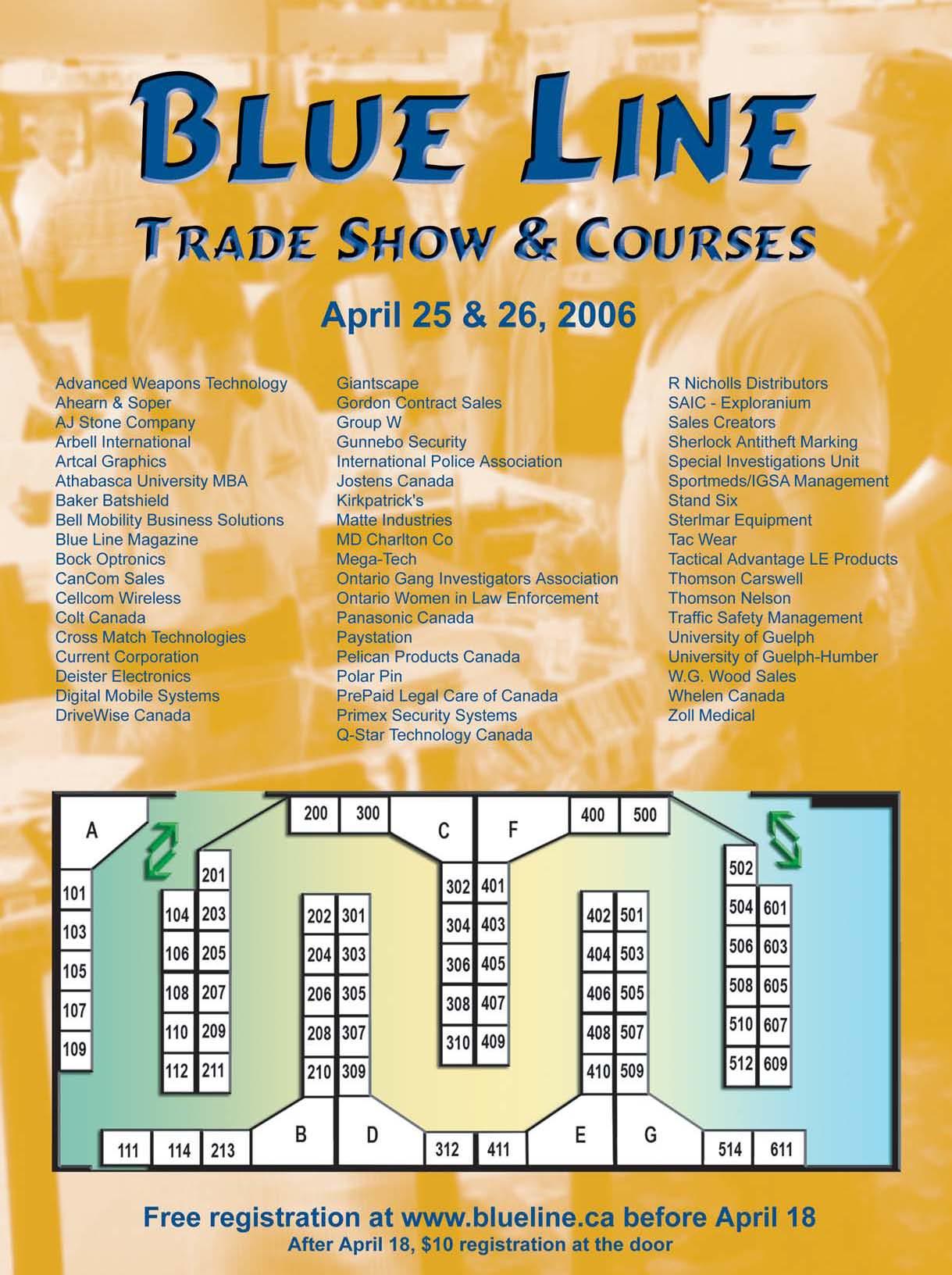
Adva nced Weapons Technology
Ahea rn & Soper
AJ Stone Com pa ny
Arbell interna ti onal
Artcal Graph ics
Ath abasca Unive rsi ty MBA
Baker Batshie ld
Be ll Mobi li ty Busi ness Solutions
Bl ue Line Magaz ine
Bock Opt ro ni cs
CanCom Sa les
Ce ll com Wi reless
Col t Canada
Cross Ma tch Tec hno logie s
Current Corpora tion
Deister El ec tron ics
Dig ital Mob ile Sys tems DriveW ise Canada
In terna tio nal Police Associa tion
Jostens Cana da Ki rkpa tr ick's
Matt e Indu stries
MD Charlton C o
Mega-Tec h
Onta rio Gang Invest igators Associa tion
Onta rio Women in Law Enforceme nt
Panaso nic Canada Pay st ation
Pelican Produ cts Ca nada
Polar Pin
PrePa id Lega l Ca re of Ca nada
R Nic holls Dis tr ib utors
SAIC - Exp loranium
Sales Creato rs
She rlock Anti theft Mark ing
Special Investigations Unit
Sportmed sJ lGSA Manage men t
Stand Six
Ste rlmar Equ ipme nt
Tac Wear
Tac tica l Adva nt age LE Products
Thomson Carswell
T homson Nelson
Traffic Sa fety Management
University of Gue lph
University of Gue lph - Humbe r W G Wo od Sa les

The tenth anniversay of Blue Line Trade Show promises to be the best yet! With over 75 companies showcasing their products and services there is bound to be a company that can meet you and your agency’s law enforcement needs. The Trade Show is open to all sectors of law enforcement and security and easily accessible from major highways. Free registration online at www.blueline.ca/tradeshow until noon April 18. After April 18, $10.00 at the door. The following pages are a listing of the exhibitors and products at this year’s show.
The Talon is a flashlight-sized launcher containing a 16 foot containment snare of nylon netting that falls over the target and ensnares them, allowing the enforcing agent to exert control. The target can easily be disarmed, regardless of the size of the perpetrator or enforcing agent, cuffed and brought under control without the use of lethal force. Come see us in the trade show lobby to test out the Talon, a non-lethal response to very lethal situations.
Booth
For complete photo ID & access control solutions, Ahearn & Soper provides powerful and reliable card printers to personalize and encode your own identification and security cards. Our card printers print cards faster and have highdefinition print quality, while guaranteeing a low cost per card. We can print high resolution texts, color logos, pictures, signatures and barcodes in a few seconds. Ahearn & Soper is a 125-year old company providing high-tech solutions to industries and agencies across Canada. We are proud to be making ID cards for Blue Line Trade Show attendees. Ensure that your law employees are wearing Canada’s best-dressed cards - Ahearn & Soper is your turnkey solution provider for the best card printing on the market.
Booth
Since 1972, A.J. Stone Co. has been providing high quality, reasonably priced safety equipment to the Municipal and Industrial Fire Services of Canada. Today our mission is ‘that all men and women of the Canadian First Responder and Safety Industries are supplied with quality products so that they may be protected from their occupational dangers.’ A.J. Stone Co. is pleased to introduce these products to the law enforcement sector. Centrally located in Toronto, our customer service staff and product specialists would be happy to discuss solutions to your equipment needs by calling 1-800205-3473 or visit our website at www.ajstone.com. Your safety is our business!
From single workbenches to complete facility-wide installations, Arlink 7000 workbenches and Arlink 8000 workstations enable users to create productive workstation environments for almost any person performing almost any task. Arbell also has modular drawer stor-
age cabinets that perfectly suit the widest range of applications. From forensics to weapons storage Arbell has a product that will suit your needs. In short, we make your workspace work.

Booth
Artcal Graphics has been working together with safety and law enforcement for over 25 years. Using up-to-date 3M retro-reflective materials, our graphics are backed by the 3M Matched Component System Warranty. Understanding our customer’s needs has led to the development of our Crown Victoria Police Interceptor and Impala rear reflective kits. These kits provide an additional four square feet of reflective safety markings and the barricade decals are up to four times brighter than conventional reflective material. Artcal, your choice for police, fire and ambulance markings. Keep Artcal in mind for other graphic needs such as banners, posters, interior and exterior signs.
As a forensic artist, I specialize in:
•Three Dimensional Facial Reconstructions: clay method on original skull.
•Two Dimensional Facial Reconstructions: drawing on transparent paper on top of photo of the skull.
•Postmortem Drawings: based on a facial photograph, which usually is of a decomposing person with severe facial trauma.
•Comprehensive Composite Drawings: interviewing the victim and drawing from memory.
•Age Progression to a Missing Child: age a child to current the date.
•Age Progression to a Missing Fugitive: age the missing fugitive to the current date.
•Disguise Drawings: add facial features, different hair styles, glasses etc.
•Video Sketching: identify the assailant on camera through measuring the proportions.
•Courtroom Sketching: quickly rendered sketches are important documentations.
The Canadian Police College (CPC) and Athabasca University’s Centre for Innovative Management have launched an innovative new partnership to collaborate on the development of specialized policing electives within AU’s online MBA program. Today’s policing professionals are dealing with complex issues relating to the proliferation of high-tech crime, threats posed by global terrorism, and the
changing context of policing work. The AU online MBA with policing electives gives leaders in the policing community the knowledge and skills they need to enhance their leadership and management competencies and contribute at a higher level to policing strategy and decision making.
We focus on innovative ballistic shields for law enforcement and security professionals. The Baker Batshield is an enabling technology for dynamic-entry, high-risk vehicle stop, activeshooter response, rapid deployment, covert VIP protection, tactical operations, and other highrisk situations. It allows officers to use their handgun or long-gun with both hands and to simultaneously move their body, the Batshield, and firearm for maximum mobility, target-coverage, and ballistic-coverage. Additionally, it automatically narrows and widens for confined spaces. “Bunker” shields can place limitations on a ballistic shield being used in certain scenarios or by specific team members; with the Batshield, many new possibilities now exist.
Bell Mobility offers a variety of industry leading wireless data solutions to help public safety networks access critical information while working in the field. Partnering with best-inclass hardware and applications providers, Bell Mobility offers unique solutions that operate via their 1X CDMA Cellular network. Bell Mobility’s 1X network was the first in Canada to meet the stringent security requirements to transmit mug shot information over a public network. Wireless Data Specialists and dedicated customer support help to ensure that wireless solutions from Bell Mobility improve efficiency and keep public safety officers armed with the up-to-date information they need while in the community.
Featured will be the complete list of books regularly listed on the Blue Line Reading Library page in the magazine and on the web site. Also available will be a variety of back issues of Blue Line Magazine. Due to demand, the cover photo of the February 2002 cover will be available in 11x17 poster format. All regular participants on the Blue Line Forum are invited to meet for face-to-face conversations.

Booth
Bock Optronics is a distributor and manufacturer of visual imaging and ground based remote sensing technologies for law enforcement, military and public safety. Since 1987, Bock Optronics’ products, knowledge, experience, service and support have provided a one stop solution for quality and technologically innovative imaging products. Showcased products include thermal cameras and handheld viewers, rapid deployment ground based remote sensors, remote visual cameras, high performance optics, and covert video systems.
CanCom Sales, representing key safety & communications equipment manufacturers within Canada, will be displaying: Peltor: the latest advancements in tactical headsets, radio accessories and hearing protection and new Peltor protective eyewear. McKay Communications: a variety of radio accessories including speaker microphones, receive kits, surveillance kits and headsets. North American Battery Company: quality land mobile radio batteries, as well as, alkaline and rechargeable batteries. Lenbrook/ Motorola: Motorola radio products.
Booth
Cellcom Wireless is Rogers largest authorized national dealer with 11 years of industry experience. We are focused on helping companies succeed by providing the best solutions and service in addition to a solid partnership throughout the rollout and lifetime of the product and services we provide. Our strategic partnership with Rogers allows not only for superior coverage, rate plans and the most up to date hardware but also unsurpassed roaming coverage, and being at the forefront of the ever-changing global telecommunications industry. Our customer base includes small to medium sized based companies as well as multi-national corporations along side government agencies and individual consumers. Our strength is in the power of one (Rogers/Cellcom) and allows us to serve all your national communications needs through one source, one team, one network.
Colt Canada is the strategic source of supply for small arms to the Canadian government, and supplies small arms systems to roughly half of our NATO allies, including, Netherlands, Denmark, the UK and Norway. Colt Canada (formerly Diemaco) offers services directly to Canadian law enforcement agencies. Products and services include tactical weapons, patrol rifles, sniper systems, 40 mm launchers, pistols, less lethal solutions, optics, accessories, armourers’ tools, engineering, service and repair, training courses, safety equipment and technical publications.
Booth
Cross Match is a leading provider of biometric security products, solutions and services to government, commercial and nonprofit organizations in over 50 countries to help protect people, buildings, infrastructure and assets against crime and terrorism. At the 2006 Trade Show, we will feature the ID 500,10 Print Live Scan System and the MV 100 Mobile Fingerprint Workstation. The Cross Match ID 500 is the smallest, lightest and easiest to use and most affordable slap and roll live scan system available today. The Cross Match MV 100 offers inthe-field identity checks using a forensic quality fingerprint scanner, an integrated Personal Digital Assistant, a digital camera, a magnetic stripe card reader and wireless communications.
Booth
Founded in 1986, Current Corporation designs, develops and manufactures its proprietary line of Night Navigator night vision systems. The Night Navigator series covers short range to very long range camera systems in the commercial marine, luxury yacht, coastal surveillance and search and rescue sectors worldwide.
Deeley Harley-Davidson Canada is the exclusive Canadian distributor for Harley-Davidson Motorcycles, parts, accessories and branded products and related services.
Booth
Deister Electronics develop, manufacture and distribute a wide range of security products, including Electronic Verification and Key Management Systems. Electronic verification uses a two checkpoint option (barcode and/or proximity) and applications include security patrol, weapons control and evidence tracking. The Proxsafe Key Cabinet prevents the removal of keys and small articles from secured areas, holds up to 32 key bunches and can be expanded up to 32 cabinets. The Amantag Compact Reader sounds a visible and/or audible alarm when it detects transponder tagged articles being removed from monitored locations. Both Key Control Systems are compatible with most existing security systems or can be stand alone.
Booth
Digital Mobile Systems (DMS) is one of Canada’s largest Motorola Two Way Radio Dealers and Authorized Service Centres with six locations. DMS is a premiere communications supplier and service provider for many of the currently deployed public safety systems in southwestern Ontario. Our product lines include all Motorola wireless products and systems, Federal Signal Lightbars and Sirens, and Acura Embedded Mobile Computing to name just a
few. DMS is a true industry leader and partner to the Public Safety Community!
DriveWise is Canada’s first turnkey driver education company incorporating high fidelity virtual reality driver simulation in all its programs. Our solutions are custom designed for Emergency Vehicle Operations, fleet, and beginner education clients. DrvieWise employs blended learning environments (classroom, simulation and in vehicle where required) to offer the most advanced driver education on the market today. Our simulator provided by the world’s largest provider L3 Communications features three visual display channels, full instrumentation, 3D Road surface models, multiple visual databases and variable traffic density and weather. Come visit us at booth 611 and experience our virtual reality environment for yourself!
ECCO began operations in 1963 as a family owned shoemaker’s shop in Denmark. Over the years it has evolved into one of the world’s leading shoe manufacturers. Our patented, one component outsole construction and heel shock absorption, keeps ECCO on the forefront of technology. ECCO also offers the most comfortable and functional Tactical Boot with full grain leather uppers, 100% waterproof Gore-Tex Duratherm insulation membrane, fully gusseted tongue for high waterproof line, full length shank, direct injected polyurethane midsole/outsole, and 1100 Denier Cordura shaft and tongue. Benefits of the ECCO Tactical Boot include: keeps out cold yet is breathable for warmer weather, anatomically shaped, light, flexible, hard wearing and quiet, shock absorbent – protects knees and back, internal shank supports full body weight for long periods of time.
From your vision or ours, Giantscape will design, create, and install remarkably real life size, any size, even giant-size structures with amazing detail that result in extraordinary points of interest to people of all ages and cultures. Our sculptures are precision-carved from expanded polystyrene, and if large enoughfitted with internal steel armatures for added strength and mounting capabilities. Industrial grade armoured coatings are applied for reliable endurance, protection and quality over time in any outdoor temperature or environment. We can apply an infinite range of finishes to create the effect you desire: from realistic mineral, plant and animal textures, to smooth wood grains or marbles, rough water waves or stones, famous or fictional characters and forms, gigantic tempting food creations, authentic and detailed film sets, startling museum pieces, and much more... absolutely everything is possible!

Gordon Contract carries a complete line of Law Enforcement, Security and EMS uniforms, accessories, body armour and footwear. We carry the leading brands including: Streamlite; Smith & Wesson; Peerless; Asp; Uncle Mike’s; HiTec Intervention; Perfect Fit; Hatch; and in footwear: Magnum, Viper, Danner, Bates, Original SWAT, Rocky and Deer Stags). Our four locations (three in Toronto, one in Winnipeg) are ready to serve you. Call for a quote and you will be impressed with our pricing. Give us an order and we will impress you with our service and the quality of our products. We look forward to serving you.
Group W is a Canadian-based research and development company specialising in the development and manufacturing of test and lighting equipment, initially focused in the automotive industry. The result of a particular interest in non-destructive testing using tuned wavelengths of light has spun this company in peculiar directions, one of which is, forensic lighting and measuring. Taking technology commonly found in the massive and very competitive automotive industry, and applying it to the forensics industry; has resulted in some truly innovative and cost effective products.
Gunnebo Security, formally known as Chubb Lock and Safe, has been protecting people and their assets in Canada for over 50 years. Gunnebo is an international security group with 6,700 employees world wide. The group supplies integrated security solutions for customers with high requirements on secure cash handling, access and entrance control, intrusion-burglar and fire-protection. The primary focus is on banks, retailers and sites in need of high security solutions. Gunnebo Canada has 14 service branches across Canada offering fully integrated security solutions at all levels of security.
The International Police Association (IPA) is one of the most unique and interesting social organizations in the world. This fraternal organization is dedicated “to unite in service and friendship all active and retired members of the law enforcement service throughout the world.” The IPA strives to enhance the image of the police in its member countries, and to facilitate international co-operation through friendly contacts between police officers of all continents. Membership now exceeds 300,000 officers in over 58 countries and is steadily rising. Membership
is open to any serving or former police officer meeting the requirements as set out in the Canadian Section Constitution.
How can you tell a hero from the rest of the crowd? The badge on your chest stands to symbolize a heroic character that is worthy of acknowledgement. Too often, we don’t recognize a hero until the ultimate test. Current events have reminded us that real heroes walk among us every day. Law Enforcement personnel, Firefighters, and EMS are true heroes for the real world. Jostens has been serving North America for over 100 years. The same craftsmen who create the Super Bowl rings will create your very own “Champions of the Community” ring.
Booth 512
Kirkpatrick’s was founded as a leather goods manufacturer in 1881 and has been producing top of the line police goods ever since. Kirkpatrick’s manufactures a full range of duty gear, duty belts and identification products. All of our products are handcrafted of top grade materials for years of service. With our reputation as a quality producer, we are a contract and sole source supplier to many police forces. In addition, we specialize in a wide range of specialty police equipment in both leather and nylon-web, including shoulder rigs, holsters, motorcycle leggings and protective equestrian and canine products. Visit us at booth 512 for your personal equipment purchases.
Booth 211
The cartridges of conventional ball point pens are open to permit ink to be fed to the point. The secret behind the Fisher Space Pen lies in the unique design characteristics of the ink and the high precision manufacturing tolerances of the ball point and socket. The ink is fed to the ball point by gas pressure permitting the pen to write in any position. An additional benefit of the closed design is that it keeps the pen from drying out giving the Fisher Space Pen an estimated 100 year shelf life. Due to its unique design and reputation for writing in extreme conditions the Space Pen has become the pen of choice for Law Enforcement, Military, Astronauts, Tradesmen, Fire-fighters, Coast Guard and more.
Mega-Tech is pleased to offer to our customers a full line of quality products and factory trained
technicians. Our Eastern Regional office allows us to better serve you from two full service facilities. In many cases the products we offer are recognized as industry standards that offer the very best in quality and customer support.
M D Charlton has been providing a wide range of top quality equipment to Canadian law enforcement agencies and security companies for the past 27 years. Featured will be Tac Wear apparel, Wiley X Eyewear, Streamlight flashlights, Original SWAT boots, ASP batons and tactical handcuffs, Hatch gloves, Hiatt handcuffs, Black Hawk tactical gear and Gould &Goodrich nylon belt accessories. We will also be displaying Laser Devices tactical weapon-mounted lighting systems and Crimson Trace laser grips along with Salient search tools.
In the year 2000, law enforcement officials from Ontario increasingly began to share their professional experiences and encounters involving gang related incidents and gang related graffiti. As a result of unwavering dedication to training and information exchange, and combined with the commitment and support of hundreds of others, ONGIA began its efforts to impact gangs and gang membership. ONGIA is the first of its kind in Canada and is recognized as an official member organization of North American Gang Investigators Association (NAGIA). The Ontario Gang Investigators Association continues to employ and support the stratagem of education, suppression, and intervention. Sworn law enforcement professionals include but are not limited to: Peace Officers, Probation & Parole, Corrections, Special Constables, and Customs & Immigration.
Ontario Women in Law Enforcement (OWLE) grew from an idea to bring together female members of the law enforcement field from across the province recognizing that many police services within Ontario are either too small or simply do not employ significant numbers of females to form individual organizations. The organization provides an opportunity for members to network and access professional development opportunities. Recognizing that there exists strength in unity and numbers, OWLE encourages women from each and every police service, and other affiliated law enforcement agencies within the province of Ontario, to collectively address their common interests and concerns. OWLE was granted official affiliate status with the International Association of Women Police (IAWP) in 1997.

Page 9
Booth 400
Panasonic manufactures a full line of rugged and semi-rugged notebook computers. The TOUGHBOOK series is designed to withstand the demanding conditions of mobile professionals in fields that include law enforcement, military, utility, and first response markets. Ruggedized features include a full or partial magnesium case that’s 20 times stronger than ordinary plastic, a shockmounted hard drive, and sealed keyboards that resist the hazards of dirt, dust and spills. Panasonic TOUGHBOOK notebook products are marketed in Canada by Panasonic Canada Inc (PCI). PCI is a principal Canadian subsidiary of Matsushita Electric Industrial Co. of Japan, one of the world’s largest manufacturers of quality electronic and electric products for industry, business and the home.
Booth 407
Paystation is the exclusive Canadian distributor of EBA Shredders and SEM Disintegrators. A long time supplier to the Federal Government, EBA Shredders (Germany), is the finest name in personal, desk-side, office and large volume shredders. Includes government approval for Type II (Top Secret), Type III (Confidential) and the new maximum security shredder approved by the US Government. SEM’s rotary knife-mill disintegrators are heavy-duty industrial machines designed to destroy a wide range of document materials including paper, hard drives, CD ROMS, diskettes, microfilm or reels, microfiche, and credit cards. These machines can ingest a vast amount of documents faster than any other type of destruction method.
Booth
The world’s most technically advanced flashlights and toughest protector cases. All Pelican flashlights are manufactured to be the brightest, toughest and safest lights in the world. Pelican protector cases are dustproof, corrosion proof and virtually indestructible. Every Pelican product is backed by our legendary lifetime guarantee – if you break it, we replace it … forever!
Booth 609
Polar Pin offers the law enforcement community custom made badges, embroidered crests, lapel pins, bullion wire crests, leather ID wallets, lanyards, and epaulets.
• Police badges for law enforcement agencies and EMS agencies
• Competitive pricing on police badges without compromise to quality
• Guaranteed satisfaction and professional service
• All police badge lettering is melted glass (cloisonne) not paint
• Solid base metals insure uniform color
• No weak adhesives used in badge construction, only strong silver soldering
You only get as much justice as you can afford. If you don’t know your rights, you simply don’t have any! Pre-Paid Legal “levels the playing field” in the justice system. With a PrePaid legal plan you can say, “I’m going to talk to my lawyer about this.” — and mean it! Kroll Background America - With the Identity Theft ShieldSM you’re backed by experienced professionals from a division of the world’s leading risk consulting company. With more than 30 years of providing legal rights protection to over 1.5 million families, Pre-Paid Legal Services, Inc. (PPLSI) is a pioneer of the prepaid legal concept in North America.
Primex Security Systems represents the most technologically advanced and proven products for weapon and explosives detection. These include tactical search and surveillance equipment, metal detector, fluoroscopes, drug and explosive detectors. We offer this equipment to the public and private sector clients on a lease or sale basis only after the client’s requirements have been carefully analyzed and fully understood. Primex offers a full range of professional security services including security surveys, training, equipment maintenance and aftersales service. Primex security products have been installed in a number of locations and facilities that are exposed to a high risk of possible violent acts.
Booth 510
Q-Star Technology (Canada) has recently introduced its newest product to the Canadian market, a digital version of the original Flash Cam 550. The new FlashCam 770 is specifically designed to deter and combat graffiti, other forms of vandalism, and illegal trash dumping. Government and private companies are using this system in schools, parks, construction sites, golf courses, water reservoirs, city streets and lanes. The results are cleaner and safer communities and significant savings in clean up and repair costs. There are currently over 2000 units in use in the US and Canada and they continue to sell at an unprecedented rate.
For more than 25 years R Nicholls Distributors has been committed to the Canadian law enforcement market by supplying organizations and public safety agencies with equipment and uniform products. Nicholls is focused on continuous improvement, aimed at providing our customers with top notch service and quality products. Nicholls carries the finest
product lines from the leading manufacturers in the United States, Europe and Canada. We also manufacture our own products under the names of Traditions 4, Rapier, Armour of America and SWAT, and are proud to offer quality products, designed specifically for the Canadian market.
SAIC is the USA’s largest employee owned research and engineering company, providing information technology, systems integration and eSolutions to commercial and government customers. SAIC engineers and scientists work to solve complex technical problems in national and homeland security, energy, the environment, space, telecommunications, health care, transportation and logistics. With annual revenues of nearly $7 billion, SAIC and its subsidiaries, including Telcordia Technologies, have more than 45,000 employees at offices in more than 150 cities worldwide.
Sales Creators features Hi Visibility self-illuminating reflective safety vests used by construction, traffic control, police and crossing guards provides added visibility during inclement weather. The revolutionary traffic Pack-A-Cone expands to regulation 18” or 28” height and collapses down to 2” in height to store flat in your trunk or under the seat. Reflective day and night visibility with quick and easy deployment with one pull. Also, eternal flashlight, great for emergency kits, car, boats etc. You will never get caught with a dead flashlight again.
Sherlock Antitheft Marking markets and distributes a patented process consisting of permanent engraving of an identification number on a vehicle in order to reduce its value on the black market and thus reducing vehicle theft. Over 52 parts on the vehicle are marked including all glass, lights, wheel covers and over thirty-five engine parts. This process has been proven over the years to be the most effective deterrent against vehicle theft. The process is presently available in Quebec, Ontario and Atlantic provinces.
The mission of the Special Investigations Unit (SIU) is to increase the confidence of the people of Ontario in their police services by conducting professional and independent investigations of incidents involving the police that have resulted in serious injury, including complaints of sexual assault, or death. Under the Police Services Act, the Director of the SIU has the sole authority to decide whether or not charges are warranted based on the findings of a complete investigation.

Booth
•Flexall long lasting pain relieving gel for muscles and joints.
•IONIC base garments wick away sweat from the skin and are permanently anti-odour, ideal under protective vests and clothing.
•X-Vest is a versatile and effective wearable training device adjustable from 1 to 84 lbs for aerobic conditioning, rehab, strength training, weight loss and fitness.
•SAWATHOTIC GTO Groin Thigh Orthotic for rehabilitation of low back, upper leg, hip and groin injuries.
•P.A.M. personal anti-fatigue mats - ergonomically designed motion controlling memory foam insoles.
•Odour control spray for boots, gloves and sports equipment.
Booth
Stand Six is an innovative company that recognizes the unique health challenges that face individuals that work in the law enforcement profession. Our founder and president is a former police officer who launched a successful nutrition-product manufacturing business. He combined his experience, knowledge and manufacturing capabilities with his passion for the people that wear the uniform to launch Stand Six, a multi-faceted health and wellness company. Stand Six has a strong emphasis on education as it relates to maintaining and improving all arenas of health. We have developed many programs, nutritional products and information resources that specifically address the unique needs of both active and retired police officers. We actively work to promote healthier bodies within the law enforcement community and healthier attitudes towards police in the community at large.
We’re a proven, quality distributor, installer and service provider specializing in emergency lighting for all fields of emergency vehicles. We can custom design an equipment package for your police fleet from our long line of professional quality products including, Whelen, Sho-me/ Able 2, Weldon, Havis-Shield, Setina and many more at prices hard to beat. Our fit and finish prove that old fashioned quality workmanship still exists in-shop or on-location. Our owner brings many years of police work and firefighting experience to his customers, we know your needs and how to meet them. On display will be the Whelen lit Kingston Police Phantom car built by Sterlmar Equipment.
Tac Wear apparel is the best solution for serious situations because it is “The Ultimate in Performance Apparel.” Made from innovative
performance fabrics, such as CoolMax Extreme with Fresh fx, Thermolite, and Nomex IIIA by Du Pont, Tac Wear apparel is ideal for use in applications where moisture management, thermal protection, comfort and ease of movement have to be assured. In your job, you cannot allow yourself to be distracted by the elements. How do we know that Tac Wear offers the best heat-cold solution for law enforcement and military personnel? Because every Tac Wear design is tested where it matters most....on duty.
We are a proudly Canadian company that manufactures Nylon Duty Gear for law enforcement. Our product lines BLACK RHINO and BLACK RHINO PROFESSIONAL have a wide portfolio of products uniquely designed for law enforcement, security, parking enforcement and paramedics, both in plain (Ballistic) and basket (Basket weave) finishing. Tactical Advantage’s product lines include standard and custom designs, such as high-grade nylon/ leather carrying cases and belts, and nylon/ leather badge wallets. Custom designs for corporate needs are one of our specialties. On top of that, we are an authorized dealer for Bianchi International and we carry the popular
Streamlight rechargeable flashlights.
Canadian law enforcement officers have relied on Carswell to provide them with innovative products and services for success in today’s high pressure world of police work. Canadian police officers continually turn to Carswell for direct access to the latest legislation, best analysis and expert insight from the finest legal minds of Canada. Since 1981, Triform has been selling law enforcement products directly to end users and through a network of dealers. The product line includes professional evidence notebooks, investigation record books and carrying cases. In 2005, Carswell became the exclusive publisher of the Triform suite of products.
Thomson Nelson, the country’s largest Canadian-owned educational publisher and a leading publisher of Canadian criminology resources, is proud to have a display at the 2006 Blue Line trade show. Please stop by booth 408 to view our full range of resources specifically designed for Canadian police professionals.


Booth 500, 502
Traffic Safety Management (TSM) will feature the Cool Zone vest. An extensive armed forces test and evaluation of the technology in the Cool Zone cool vests proved a substantial increase in productivity while wearing burdensome personal protective apparel. Cool Zone is preset to maintain the “optimum cooling temperature” for hours of effective relief from the risks associated with heat stress. They will also be offering a new hand, body and equipment sanitizer that is effective in only 30 seconds.
Come check them out! GTM Canada specializes in telescopic safety products - less space, more safety:
•15 ft portable light tower: lights up a football field in 3 minutes, only 2 ft when collapsed
•12.5 ft telescopic ladder
•8 ft telescopic barricade
•28 in. lighted telescopic cone
Please visit our new Telescopik website: www.telescopik.com
The University of Guelph’s MA (Leadership) graduate program offers a broad multi-disciplinary approach to dealing with leadership issues relevant to the public, private and not-forprofit sectors. The MA (Leadership) combines e-Learning with residential components that is designed to empower individuals with leadership knowledge and experience, allowing them
to increase their self-awareness and competency, in order to contribute to ethical leadership, organizational transformation and the betterment of society.
The University of Guelph-Humber’s Part Time Justice Studies Program offers police professionals the opportunity to obtain an accelerated Honours Bachelor of Applied Science in Justice Studies. The degree is offered in a flexible hybrid format which consists of 3 weekends of on campus study per semester supplemented by online learning.
Established in 1964 W.G. Wood Sales is one of the most experienced division 10 wholesale/ distribution firms in Canada. With over 40 years in the construction industry, we have grown and developed our firm to meet the expedited needs of the fast paced environment of construction. With full time schedulers and an engineer, we can ensure the most complicated architectural layouts can be properly evaluated and designed to meet planned ship dates to construction sites and existing facilities throughout north America. Wood Sales specializes in providing law enforcement and military facilities with personal duty lockers including: over 100 different available configurations of single and double door police lock-
ers, gun storage lockers, evidence and drug lockers as well as our own line of locker benches, washroom accessories and washroom/ shower partitions. Lockers can be prepared for padlock, keyed cylinder locks, electronic key pad digibolt or multi-lock systems.
Whelen designs and manufactures state-ofthe-art visual and audible warning equipment including strobe and halogen lightbars, power supplies, sirens and secondary lighting products.
According to the American Heart Association, portable automated defibrillation has the potential to be the single greatest advance in the treatment of ventricular fibrillation cardiac arrest since the invention of CPR. ZOLL’s AED Plus with Instantaneous CPR Feedback, designed specifically for non-medical professionals, is the only public access defibrillator available today that coaches rescuers through all steps of the American Heart Association’s Chain of Survival. It provides vital visual and audio cues to ensure effective defibrillation and CPR technique to help achieve the recommended depth and rate of chest compressions. Defibrillation combined with better CPR technique means a better chance of saving a life.


by Heinz Kuck
His body was heavy with the fatigue that comes with age. Simple things were now hard – walking, moving, lifting; looking at his hands, he wished they were strong and tanned like when he was young. His gaze moved to the ever-present blue tattooed numbers on his forearm, and he forced himself to look away.
Suddenly there was the sound of running feet and the pungent smell of fresh paint. He turned to see a large, bright, freshly painted swastika and began weeping. He despised that symbol even more today than he had in 1942.
Large cities and small towns alike are visually immobilized by the ever present “writing on the wall” – urban graffiti. Graffiti, from the Greek word Graphion (to write), can be produced by etching, spray paint, markers, pencils, stencils and slap tags and includes everything from hate crime scrawls to political activism, gang graffiti, Hip Hop Tagging, folk epigraphy and even commissioned works.
Studying graffiti is challenging. One can focus on its history, types or styles, societal costs, trends or even enforcement initiatives such as the Toronto Police Service’s Graffiti Eradication Program. I am often asked about its link with urban decay. To fully understand this association, it’s necessary to look at the community costs of illegal graffiti, which includes:
•Removal: Most projects involve simple paint overs but others require elaborate restorations using chemical solutions or sand blasters. Either entails time, labour and material, including anti-graffiti solutions/coatings to make future clean ups easier.
•Courts: Arrest, prosecution, sentencing, imprisonment and probation. International law enforcement agencies estimate that there are approximately 1,000,000 ‘taggers’ plying their trade in North America – and each year a new generation of youth joins the ranks.
•Psycho-social consequences: Decreased respect for authority, citizen fear and diminished use of public and private places. Evidence also suggests there’s an increase in other physical disorder issues, including littering, transients, public drunkenness and urination and street level prostitution. These were identified by Wesley Skogan and other researchers as precursors to neighbourhood decline. In their book Fixing broken windows, authors Kelling and Coles apply the ‘broken window theory’ to describe the spiral towards urban decay.
“We used the image of broken windows to explain how neighbourhoods might decay into disorder and even into crime if no one attends faithfully to their maintenance,” they state. “If a factory or office window is broken, the passerby observing it will conclude that no one cares or no one is in charge.
“In time, a few will begin throwing rocks to break more windows. Soon all the windows will be broken and now the passer-by will think that, not only is no one in charge of the building, no
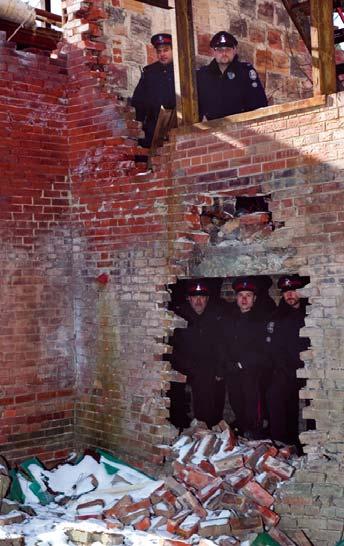
one is in charge of the street on which it faces. Only the young, the criminal, or the foolhardy have any business on an unprotected avenue and so more and more citizens will abandon the street to those they assume prowl it.”
•Collateral or associated crime costs: These include the theft of supplies, sniffing paint vapour before and during vandalism, trespassing on private property, underage drinking and assaults while fleeing citizen arrest.
•Intra-group dangers: This relates to the everpresent risk of death or injury from climbing bridges and water towers or being hit by trains. Toronto recorded its first death directly associated to the propagation of graffiti vandalism when writer ‘Alpha’ was struck and killed by a freight train as he was completing a piece on a stationary box car.
Axel Thiel (Germany) and the Graffiti Hurts Program (US) estimate these societal costs at $50 billion globally – $15 billion in the US and $1.4 billion in Canada. A 2003 study by Steve Gibbons, a lecturer at the London School of Economics, suggests urban residential property values decrease by 1.6 per cent for every 10% increase in property vandalism.
Why do our youth continually engage in this activity? Ethnographic researchers (Brewer, Christensen, Miller, 1992 and Ferrell, 1993) focused on urban youth subcultures and certain dynamics came to the forefront as to the ‘why’ in assessing this physical disorder crime. It comes down to four basic motivators for the writer:
•Fame: Seen as the primary motivator for youth perpetrators. It appeals to the ‘tagger’ to hit as many locations as possible, since this not only garners recognition from the general population (who view and comment on the work) but also from other graffiti sub-
culture members, who will witness the tagger’s proliferation and territory. This explains the ‘multiplicity phenomenon.’ Once a clean surface is tagged and not immediately cleaned, it attracts other taggers, who, in a frenzy, will soon fill the wall to display subculture existence, legitimacy and strength.
•Artistic expression: Most ‘taggers’ limit themselves to one colour, stylized monikers. The more skillful create two-dimensional ‘throw-ups’ and then advance to complex, multi colour ‘pieces.’ They use ‘piecebooks’ — bound sketchbooks which act as a repository for developing their ideas and early works which often include photos of their finished works. Writers also take time to develop their free hand style, working on things such as the symmetry of letters and how they fold and join, and take care in selecting their colour and medium.
•Power: While graffiti writers come from all socio-economic backgrounds and educational levels, there is a trend toward the triune of urbanization — the young and economically challenged. Teens see graffiti as a means of societal power. When they tag a private surface, they symbolically own it; the more property ‘hit,’ the more powerful the tagger. Power involves yet another hidden danger, the high or rush from the act. Jeff Ferrell describes it best in Crimes of style: Urban graffiti and the politics of criminality, 1993:
“Graffiti writers have told me, time and time again, that they do graffiti for the rush one gets when piecing or tagging illegally — a rush more exciting and pleasurable than any drug they know — and they emphasize that this feeling comes not from just being out at an illegal location, but from the act of painting itself, from the intersection of creativity and illegality as the paint hits the wall.”
•Rebellion: Specifically, rebellion against conventional society — urban art versus corporate art — the battle between the haves and have nots. Rebellion is also against authority and involves the erosion of elitism, such as the tagging of postal and hydro boxes, telephone booths and corporate buildings.
We need to teach youth about the criminality of graffiti and its associated societal/consequential costs and provide alternative ways they can seek and achieve recognition, non-deviant expression and non-intrusive power, all in a constructive, lawful and meaningful way. One of the most potent ways of dealing with this crime and reversing urban decay is to embrace, educate and empower our neighbourhoods, as a whole, to reclaim, rejuvenate and revitalize; this seems to be the new focus in combating urban graffiti and reversing urban decay.
S/Sgt Heinz Kuck has been a member of the Toronto Police Service since 1979 and is currently the lead coordinator of the service’s graffiti eradication program. He will present more on Project MORE in his Unmasking Urban Graffiti III course at the Blue Line Trade Show April 25, 2006. Register at www.blueline.ca/tradeshow He can be reached at 416 808-5354.

by
Police used to dismantle marijuana grow operations wearing just jeans and T-shirts, recalls Ontario Police College (OPC) trainer John O’Reilly. Unaware of the potential dangers, they had no safety equipment – not even gloves and masks.
As grow-ops and drug labs have become more common, drug officers and police colleges have come to realize the importance of safety, the proper equipment and learning the correct way to dismantle the illegal operations.
The Ontario Police College has built a new training facility which resembles a three-storey ranch style home and offers a realistic simulation of what officers can expect to find at clan-

destine operations. A meth lab is set up in the kitchen and the master bedroom has been converted into a grow-op, complete with 30 realistic looking marijuana plants, venting and lighting equipment. Another bedroom is to be set up to resemble an ecstasy production operation.
Drug-ops experts instruct officers about the dangers posed by clandestine operations.
“We are going to be able to enhance the investigative part of it, especially for our drug officers,” says O’Reilly, speaking of the facility’s potential. “For these front line officers, it will give them an awareness of what to look for – and if they do find themselves in a lab, they will know the procedures to ensure their safety and the safety of the public.”
The mock drug lab is designed to offer various levels of training and simulates the setups officers may encounter. It includes areas where the actual controlled substances are produced (synthesis labs) and areas where only some steps in the manufacturing process are carried out (extraction labs).
O’Reilly calls extraction labs “time bombs” because they can and have blown up, obliterating the entire house and badly damaging neighbouring homes. Instructors emphasize the chemical dangers associated with labs.
“You train for the worst,” O’Reilly says. “These things are airborne (and) there are toxic fumes – a lot of which are flammable. The biggest route of contamination is obviously ventilation so we stress the protective equipment that people should be wearing.”
Twenty-four people can train in the facility at once and they can all be outfitted with self-contained breathing apparatus or air purifying respirators, suits, boots and gloves.
The 400 or so recruits at the Ontario college tour the facility as part of their drug training and are taught to recognize the dangers and call in field experts. A new two-week drug course offers hands-on training, including surveillance and entry practicals and some general drug training.
Police agencies across Canada have been unable to keep up with the demand for such training, O’Reilly says. The waiting list at the Canadian police college, which has offered the course since 1996, is now over a year and demand is growing, O’Reilly says, noting high production meth labs are making their way to Ontario from western Canada.
The Ontario and Canadian police colleges have worked together to ensure they offer similar course material in their clandestine lab courses, which teach officers to be aware of the dangers of solvents, acids and bases used to make meth and stresses the need to separate them.
“You cannot mix these chemicals together without a violent reaction taking place,” explains O’Reilly. “They are taught to dismantle in such a way that the categories of chemicals are kept within themselves. The only way to instill that knowledge is through more training.”

The course begins with theory, taught in the classroom, including the ins and outs of protective equipment. Academic instruction is enhanced with practical exercises. The second week is spent in the dynamic simulation area going through five to six types of exercises, which are set up like an actual take down operation.
Officers suit up and are graded by instructors, who ensure they put the equipment on properly – a must, especially with masks, to avoid inhaling contaminants. The simulation exercise involves fire department, EMS and chemists.
A lot of cross training takes place, says O’Reilly, who notes the college is fielding calls from various municipal agencies, including health agencies and building inspectors, who are often at labs and want to know what to look for.
Intelligence based
Until the public becomes better aware of the warning signs, law enforcement is waging an uphill battle to eradicate clandestine labs, O’Reilly says, especially since meth is so easy to make.
“If you can bake cookies, you can make methamphetamine because it is a step by step process,” he points out. “The other part of it is, the ingredients to make meth are readily available. There is not a lot of control on it.”
Ephedrine or pseudoephedrine, the main ingredients in meth, should not be sold across the counter, O’Reilly says. Instructors encourage students to familiarize themselves with local sources for all meth ingredients, he adds.
“If you have a pharmaceutical company in your area, get to know those people and get them looking at who is buying large bulk amounts,” he suggests. “Also check out the chemical companies in your area because 80 per cent of chemical companies in Canada are located in Ontario. Get to know your people in the Home Depots and Canadian Tires... if people are coming in and buying all kinds of ingredients – rock salt, lithium aluminum hydrides, sulfuric acids – you have to question why a person is buying all this.”
Most Ontario meth labs are addiction based, he says – small operations set up by users to supply themselves and earn money to

finance the manufacture of more drugs. Meth use has tripled in recent years and hospitals are seeing the direct effects of people addicted to it, he notes.
The growth in meth and marijuana labs in Ontario “presents a new and dangerous chal-

help our
fight the proliferation of these illegal operations and the criminal activities they fuel.”

The Hamilton Police Service (HPS) says it has become the first force in Ontario to move its professional standards branch (PSB) to an office outside a police station.
The PSB, previously in the central police station, was moved to allow for a more open process in filing and investigating public complaints. The new office is centrally located and easily accessible by car, bus or pedestrian traffic. Complaints can also still be filed at any Hamilton police station.
“By moving the branch off-site, the service is providing the public a more open and less intimidating opportunity to file complaints,” says Chief Brian Mullan.
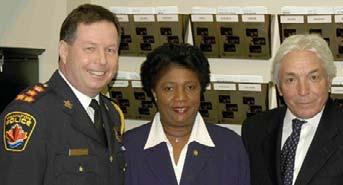
The branch’s mandate is to investigate pub-
lic complaints made against HPS members and conduct internal investigations on other issues. All complaints are investigated thoroughly and impartially, the service says, with a goal of ensuring the satisfaction of all parties.
“This new, independent location will allow us to better enhance our service delivery and provide greater accessibility, as well as a more neutral atmosphere for reporting complaints” says S/Sgt. Jack Coruzzi, PSB.
“This initiative speaks to the strong commitment of the Hamilton Police Service toward the community it serves,” said Sylvia Hudson, vice chair, outreach and community information for the Ontario Civilian Commission on Police Services (OCCOPS).
“This ground-breaking storefront location is the first of its kind in the province. It is designed to be user-friendly and to interface and build openness with the broader community. On behalf of the chair and the members of the Ontario Civilian Commission on Police Services, we extend our sincerest congratulations.”
The sixth largest police service in Ontario, HPS polices more than 512,000 residents and deploys 724 officers and 262 civilian members. It responded to more than 87,000 calls for service last year and has been recognized as one of Canada’s Top 100 Employers for the last four consecutive years.

Hamilton police not allowed to see reporter’s notes
HAMILTON — Superior Court Justice Stephen Glithero has dismissed a court application filed by the Hamilton police service, who sought a newspaper reporter’s interview notes.
City police filed the application in January, requesting Hamilton Spectator reporter Bill Dunphy hand over his notes of an interview he had with the reputed head of a crime family. Dunphy’s talks with Paul Gravelle could assist in the investigation of the 1998 murders of Ancaster, Ont., lawyer Lynn Gilbank and her husband Fred, police said.
Glithero says police failed to prove that Dunphy’s notes would provide any new evidence. The judge was not convinced police made all reasonable efforts to obtain information from Gravelle, who had offered to provide information on the murder of the Gilbanks on several occasions between 1999 and 2001.
“In my opinion, the applicant’s suggestion that the notes will afford additional information relevant to the murders falls into the category of suspicion, conjecture or hypothesis and is in that sense a fishing expedition,” Justice Glithero wrote. “Nor am I satisfied that the alternative source of any information that does exist has been investigated and that all reasonable efforts to obtain the information have been exhausted.”
Hamilton police sought Dunphy’s notes under a new Criminal Code provision called a production order, which came into effect in September 2004. Under this order, a judge can compel a person not under investigation to turn over documents or data relevant to the commission of an offence.


by Mike Novakowski
It’s what an arresting officer knows personally, not the collective knowledge of other officers, that provides reasonable grounds, BC’s highest court has held.
rest for obstructing him in the lawful execution of his duty. In the judge’s opinion, the officer’s perception of the events, when viewed objectively, would have been apparent to a reasonable person placed in the officer’s position. Richardson had crossed a police cordon set up to keep the peace and protect city workers. He had been removed once and warned to stay behind the police line. His lawsuit was dismissed.
In Richardson v. Vancouver, 2006 BCCA 36, police organized a cleanup operation after homeless people, evicted from a large vacant building, camped out on the sidewalk under the building’s canopy with their supporters.
Richardson, a lawyer and executive director of the Pivot Legal Society, attempted to cross a police line, set up to keep the peace and protect city workers removing tents, mattresses and debris. Yelling, he identified himself as a lawyer, demanded to know the police authority for cordoning off the area and tried to get through. He was told he could not cross but continued moving through the line.
A police officer took Richardson’s arm, moved him to the sidewalk and warned that if he attempted to cross again, he would be arrested for obstructing a peace officer. He did so and was arrested, handcuffed, searched, placed in a wagon and taken to jail, where he was held overnight and released without charge.
Richardson sued the City of Vancouver in British Columbia Provincial Court alleging, among other torts, that he was wrongfully arrested. The trial judge ruled that there were reasonable grounds for the officer to make an ar-
Richardson appealed to the BC Court of Appeal arguing, in part, that the trial judge erred in finding the arrest lawful since he only considered what the arresting officer saw or heard, ignoring what other police were aware of. Since other officers at the scene knew he was a lawyer who represented protestors, that he had requested to speak to the officer in charge and that he demanded to know why police barred access to the street, his arrest for obstruction was untenable, he suggested.
Justice Donald, writing the opinion of the court, disagreed. In his view, the question wasn’t whether the collective knowledge of the officers on scene provided the necessary grounds, but rather what was apparent to the arresting officer. Nor did it matter whether or not the plaintiff could have been convicted of the charge, he stated:
The lawfulness of arrest must depend on the subjective belief of the arresting officer and an objective assessment of that belief based on what the officer knew at the material time. It is a question related to the individual officer. I know of no authority that supports the notion of a collective intelligence, the sum of knowledge possessed by all the police in an operation, as the basis for judging the lawfulness of arrest. Here (the arresting officer) arrived on the scene in the middle of the action and had

no opportunity to learn what prior interaction the plaintiff had had with other officers. It cannot be said that he was indifferent or wilfully blind to relevant circumstances.
The premise of the plaintiff’s line of argument is that he wasn’t guilty of obstructing the police and he therefore could not have been lawfully arrested. This is a theme running through the wrongful arrest claim and I think, with respect, it is wrong.

The plaintiff runs together his criminal liability with the officer’s civil liability (and the city’s vicarious liability) for the tort of wrongful arrest. They each have a different set of legal rules and procedures; they must be treated separately to avoid the kind of confused thinking manifest in the plaintiff’s argument. Many lawful arrests may ultimately result in an acquittal. If an acquittal were to create exposure to tort liability, the power of arrest would be radically curtailed. There is no logical relationship between the criminal and civil determinations; they are each aimed at different questions: ‘Did the accused obstruct?’ is not the same as ‘Did the officer have reasonable and probable grounds to believe he did?’ (paras. 18-20).
The appeal was dismissed.

CALGARY — Alberta’s Court of Appeal ruled no miscarriage of justice occurred during a former Mountie’s trial concerning the shooting death of a prisoner.
After two previous trials ended in hung juries, the latest ruling indicated there was no need to order a fourth trial.
Former RCMP Cst. Mike Ferguson was convicted of manslaughter in 2004 for shooting prisoner Darren Varley in a Pincher Creek holding cell in 1999, after Varley grabbed his gun during a scuffle. Ferguson, who was given house arrest for two years less a day, appealed the decision, maintaining he fired in self-defence.
Ferguson’s lawyer wanted the conviction overturned, citing the trial judge did not act on a letter from one of the jurors claiming the jury’s decision had not been truly unanimous. The letter had arrived at the courthouse four days after the verdict.
Justice Clifton O’Brien disagreed, saying “I am satisfied that this juror’s after-the fact rationalization of what motivated her thinking - or more properly, what she now wishes she would have done - falls squarely into the category of second thoughts.’’
Had the trial judge pursued the matter further, he would have violated the strict jury secrecy rules that have governed the Canadian justice system for more than two centuries, said O’Brien.
Ferguson’s lawyer also argued the trial judge did not follow the proper procedure after the jury relayed a verbal question to him during deliberations through a court officer, instead of putting it in writing.
“I have concluded that it was a procedural irregularity only, one of a technical nature causing no prejudice to the accused,’’ O’Brien’s written statement said. “The accused had a fair trial in reality and appearance.’’
Ferguson’s house arrest sentence is scheduled to conclude in May.
The power to search incidental to arrest does not allow police to search for evidence beyond the reason for arrest, New Brunswick’s Court of Appeal has explained.
In R. v. Mitchell, 2005 NBCA 104 police in New Brunswick were watching for the accused because they had information he would travel there to sell crack cocaine, had an undertaking to remain in Nova Scotia and was being investigated for obstructing justice by falsely identifying himself. They saw his car and pulled it over. Mitchell was driving and unable to provide a driver’s licence, registration or insurance. He again provided a false name and was arrested for obstruction of justice and breach of undertaking. Police found $1,175 in cash but no drugs during a frisk search and advised him of his right to counsel. He asked to speak to a lawyer.
After informing Mitchell his uninsured vehicle would be towed to the police station, he told officers there was $2,000 in the glove box. Police said they would inventory the contents of the car and place it in a secure area. A further search revealed 24.6 grams of crack cocaine hidden behind the gas cap cover. He was arrested for this offence, again advised of his rights and subsequently charged with possession for the purpose of trafficking. At no time did officers inform the accused they suspected him of possessing cocaine or that they were going to search his car for such.
The accused filed a motion in New Brunswick Provincial Court alleging his rights under s.8 of the Charter had been breached. Officers testified that, in their opinion, Mitchell’s car contained cocaine but they did not want to arrest him for it because he then might be able to identify the informant. Police also noted they didn’t obtain a search warrant because they were searching incidental to arrest. The grounds they proffered were the informant information and the large amount of money found in Mitchells’ possession and the glove box. Mitchell submitted that the search wasn’t incidental to arrest and violated his right to be secure against unreasonable search and seizure, protected by s.8 of the Charter.
The trial judge ruled the search was reasonable. As long as police had reasonable grounds (subjective/objective test) to search the car, common law allowed them to search as an incident to arrest. The evidence was admitted and the accused convicted.
Mitchell appealed to the New Brunswick Court of Appeal. Justice Robertson, authoring the court’s unanimous judgment on the s.8 Charter issue, allowed the appeal, largely relying on the Supreme Court of Canada decision R. v. Caslake (1998) 1 S.C.R. 51. Although warrantless searches are prima facie unreasonable, a search incidental to arrest can be undertaken to secure the safety of the police and public, to protect evidence from being destroyed and to discover evidence that can be
used at trial. If the search is to find evidence related to the arrest, there must be a reasonable prospect of doing so, but this is not the same as having reasonable grounds to conduct the search, Rather, as Robertson stated: What is required is that the police have a reasonable basis for conducting the search, which is to be evaluated on both a subjective and objective level. The subjective element asks whether the police officer conducting the search was actually doing so for purposes related to the arrest. The objective component ensures that the police officer’s belief that a valid purpose would be served by conducting the search was reasonable in the circumstances… (para. 13).
In this case, police arrested Mitchell for obstruction of justice but the search wasn’t related to that reason. Robertson held:
Applying the law… to the facts of the present case, it is clear that the police did not search the (accused’s) car for purposes of finding evidence related to the reason for his arrest. The police were searching for illegal drugs. That objective is entirely unrelated to an arrest for obstruction of justice. On their own admission, the police were acting for reasons unrelated to the arrest. It follows that the search in question wasn’t truly incidental to the arrest and, therefore, the (accused’s) right to be free of unreasonable searches, under s.8 of the Charter, was violated (reference omitted, para. 19).
Nor could the search be justified as an inventory search:
As the law presently stands, inventory searches are not authorized under the common law rule applicable to warrantless searches that are truly incidental to an arrest. At the same time, it has been held that if a vehicle is taken into custody pursuant to a regulatory duty, the police may conduct an inventory search with respect to ‘visible property of apparent value’…
In the present case, the Crown made no attempt to justify the warrantless search of the appellant’s vehicle on the basis of an authorized inventory search. Even if the law recognized the validity of such searches, the search of the (accused’s) vehicle could not be justified as it went far beyond the itemizing of visible property of apparent value. The drugs were found concealed behind the gas cap (reference omitted, para. 15).
The court however was divided on the admissibility of the evidence. Justices Robertson and Deschenes were of the view the police were not acting in good faith and the evidence should be excluded under s.24(2) of the Charter. Justice Richard, on the other hand, would have admitted the evidence.
As a result of the majority’s decision the drugs were excluded, the conviction set aside and a not guilty verdict was entered.

The forensic examination of a severed head, which was earlier excluded as evidence because its discovery had been tainted, was ruled admissible after the defence referred to it twice in court.
In R. v. Savojipour, (2006) Docket:C34438 (OntCA) the accused, an experienced butcher, told police he buried the head and arms of a murder victim in a ravine. The Crown wished to present evidence that the injuries to the head were consistent with a hammer Savojipour owned. During a voire dire in the Ontario Superior Court of Justice, however, the judge ruled statements made by Savojipour were inadmissible on Charter grounds. Since the statement led police to find the head and arms (derivative evidence), they too were not admissible because they would not have been otherwise discovered and their admission would render the trial unfair. Therefore its discovery or condition could not be used in court.
The defence, however, made reference to the inadmissible statements. The Crown objected and stated if further reference was made, they would seek a new ruling on admissibility. When a forensic pathologist took the stand, defence counsel suggested the pathologist took oral swabs but the judge directed defence counsel to continue questioning without the question being answered. Crown objected, contending a mistrial might be in order because the Crown’s case had been prejudiced. The jury would know the head had been located and subject to examination and would then infer that the Crown had concealed material evidence.
Furthermore, the accused was expected to testify that the victim had been struck on the head by two intruders and the jury might wonder why the Crown had not had the head tested or think it could not rebut Savojipour’s testimony. The trial judge accepted that the defence counsel’s mistake was inadvertent, but refused to cure it by simply instructing the jury; instead he reversed his ruling and admitted the head. Savojipour was subsequently convicted of first degree murder.
He appealed to the Ontario Court of Appeal arguing, in part, that the trial judge erred
in his ruling but the court upheld the conviction, stating:
First, (the trial judge) was in the best position to assess the impact of the error in the atmosphere of the trial. In our view, the conduct of the defence gave rise to a material change in circumstances that justified a reversal of the earlier ruling… The evidence that had initially been excluded in order to preserve the fairness of the trial was now admitted to restore the fairness of the trial process. There was clearly a risk that the jury might be misled or presented with a distorted picture. The argument that the “sins” of defence counsel were improperly visited upon the client is not valid. Absent a finding of ineffective assistance of counsel, which is not suggested here, the client is fixed with the steps taken in furtherance of his defence.
Second, we do not propose to second guess the trial judge in concluding that the perception that the Crown was suppressing relevant evi-
dence that could not be cured through judicial instruction.
The new ruling made it possible for the jury to know that the (accused) had led the police to the location of the head, a matter of some importance to the defence, as it did not want the jury to think that the appellant had hidden the head and thus prevented the victim’s family from holding a proper burial. Furthermore, the (accused) in his testimony stated that when he returned to his apartment he saw the hammer in his apartment and that there was blood on it. This left the possibility that the assailants had used the hammer while the (accused) was absent from the apartment. The matter was clearly and fairly dealt with by the trial judge in his charge. Overall, trial fairness was restored and the (accused) wasn’t prejudiced by the admission of the head of the victim into evidence (reference omitted, paras. 15-17).
The appeal was dismissed.
Since police had reasonable grounds to arrest an accused for trafficking, he wasn’t arbitrarily detained, British Columbia’s highest court has ruled.
In R. v. Smith, 2006 BCCA 64, plain clothed police officers surveilled the accused after acting on a complaint from a university security service that there was open marijuana use and possible trafficking near a fountain on campus. Smith, the president of ‘Hempology 101,’ drove to the campus and set up a signboard, literature and a sound system. At 4:20 PM he yelled, “It’s 4:20 everybody” and a group of 30 to 50 people began to congregate.
He addressed the crowd about marijuana laws and its medical benefits, then removed about five cigarettes and passed them around. When one reached the undercover officer, he pocketed it. After the meeting disbanded, Smith was arrested. His briefcase and a green bag he

was carrying were searched and police found a total of 7.8 grams of marijuana. He was charged with trafficking and possession for the purpose of trafficking.
At his trial in BC Provincial Court the accused argued several of his rights under the Charter were violated, including s.9 (arbitrary detention). In his view, he was singled out by the police and targeted. Judge Kay, however, disagreed, stating:
An arbitrary detention occurs when there is an entire absence of reasonable and probable grounds for arrest. That is not the case here. The officers were at the gathering to investigate a complaint, they smelled the marijuana, saw hand rolled cigarettes in a box in Smith’s briefcase and were present when these cigarettes were lit and passed around. I find that these observations, in conjunction with the other information they had been given, gave them reasonable grounds, both objective and subjective, to believe that a law was being broken.
Upon arrest, further marijuana was found in Smith’s possession. Therefore, I find that this wasn’t a “capricious, despotic, or unjustifiable” arrest which would violate Charter rights and I find that Smith’s s.9 rights were not violated (R. v. Smith, 2005 BCPC 27, para. 33).
The accused was convicted of trafficking in a controlled substance, but appealed to the BC Court of Appeal arguing, in part, that the trial judge erred in finding he had not been arbitrarily detained. Justice Newbury dismissed the appeal. There was no error with the trial judge’s finding. She held there were reasonable grounds to arrest the accused and therefore no arbitrary detention occurred.
The officer directing a search needs reasonable grounds but not the officer carrying it out, Saskatchewan’s top court has held.
In R. v. Hall, 2006 SKCA 19, two police officers reviewed summaries of wiretap conversation obtained during an ongoing cocaine trafficking investigation. The information indicated that on a particular date the accused and another female would be transporting cocaine in a particular vehicle on a particular highway. One of the officers told a constable where the vehicle would be going, who was in it, what it looked like and that it would contain cocaine. However, she did not explain what had been said in the wiretaps so as to not compromise the ongoing investigation.
The constable saw the vehicle speeding and noticed the passenger not wearing a seatbelt and an infant child being moved from the front to the back seat. He stopped the vehicle, asked for Halls driver’s licence and told her she was being detained for driving without due care and attention. The passenger was arrested on an outstanding warrant and the vehicle was searched, which turned up rolling papers, a knife and scissors with marijuana residue. He then arrested Hall and her passenger for possession of a controlled substance. Two bags of cocaine were found in the infant’s diaper during a subsequent search at the police station and Hall was charged with possessing cocaine for the purpose of trafficking.
At trial in Saskatchewan Provincial Court the judge restricted the Crown in calling evidence from the officers directing the search, ruling the constable intended to stop and search the vehicle before he pulled it over. In his view, the instruction given to stop the vehicle was, by itself, insufficient to provide reasonable grounds and the constable wasn’t entitled to simply accept the directing officer’s opinion without satisfying himself about the facts. So, even though the constable subjectively believed he had reasonable grounds, the trial judge ruled he did not have the necessary objective foundation and excluded the evidence under s.24(2); Hall was acquitted.
The Crown appealed to the Saskatchewan Court of Appeal, arguing the trial judge erred. Justice Gerwing, writing the unanimous appeal court judgment, concluded the trial judge misunderstood the law, causing him to limit the evidence the Crown wished to deduce from the officers. In Gerwing’s opinion, “the misunderstanding related to whether or not the constable effecting the search had to have all of the details, which would provide reasonable and probable grounds for the search, or whether he was entitled to rely on instructions from superior officers who did have full information.”
Gerwing went on to note that the trial judge believed it was necessary for the constable himself to have sufficient information to conclude reasonable grounds existed. However, the Su-
preme Court of Canada has already ruled that the officer directing the search is the one who requires the reasonable grounds, while the officer conducting the search can assume the officer ordering it had the necessary grounds to do so (R. v. Debot, (1989) 2 S.C.R. 1140) Gerwing stated:
Based on Debot, the conclusions of the judge about reasonable and probable cause must be discounted. That is, he did not understand that it wasn’t necessary for (the constable) to have full information to have such reasonable and probable grounds. He declined to hear the evidence which would show that the appropriate officers did have such information (para. 23).
And further:
A search of the authorities does not provide much enlightenment on the nature of the precision required for the order to be given by the officer with information to the one who is to effect the search. This is not surprising since, given the exigencies that normally exist, shorthand instructions may be appropriate and, indeed, normal. It is frequently stated that all of the information must be considered to determine if there has been a Charter breach (para. 26).
Since the trial judge did not give the Crown an opportunity to lead testimony related to this issue, the court ordered a new trial so the issues could be fully analyzed in light of all relevant evidence.
British Columbia’s highest court has again ruled police should provide an arrestee requesting a lawyer with non-private access rather than suspending the right until privacy can be given.
In R. v. Luu & Tran, 2006 BCCA 73, a police officer responding to a parking complaint went to a basement suite to get a vehicle moved. A female asked “Who’s there?” The officer said he was a police officer and asked her to open the door. Luu and Tran stepped out and closing the door behind them. The officer noted a marijuana smell and asked Luu for identification; she appeared nervous and went back inside. Tran closed the door enough that the officer couldn’t see inside but could smell an overwhelming odour of bulk marijuana.
Tran said something in Vietnamese to Luu. The officer grabbed his arm and told him he was under arrest. Tran pulled backwards and they both stumbled into the suite. After a violent struggle the officer handcuffed Tran, arrested Luu, seated them and quickly searched the suite to ensure no one else was present.
In the computer room he saw a large garbage bag and small plastic bags containing marijuana, called for assistance and read the accused their right to counsel about 20 minutes after entry. They both wished to call a lawyer but an opportunity wasn’t provided because the officer could not afford them privacy. While waiting for a wagon, he asked Tran where he lived and was provided an address. A search warrant was ob-
tained and evidence seized, including 25 pounds of marijuana bagged in half pound quantities.
At trial in BC Provincial Court on charges of marijuana possession for the purpose of trafficking, the judge found the warrantless arrests lawful. The officer had the requisite subjective belief and objective grounds and the initial warrantless search was also ruled lawful. The officer did not deliberately enter; it occurred during the struggle to arrest Tran. The additional search was justified to ensure officer safety, so seeing the marijuana was lawful, as was the delay in reading rights to the accused, since the officer was alone until assistance arrived.
The further 10 minute delay in removing the accused was also reasonable. The evidence was admissible and the accused were convicted but appealed to the BC Court of Appeal, arguing the trial judge erred in finding their s. 8, 9 and 10(b) Charter rights were not violated. The arrests and subsequent search was unlawful and their right to counsel was breached, they argued.
The court dismissed the accused’s arbitrary detention and unreasonable search Charter arguments. The officer believed he had reasonable grounds to make an arrest and those grounds were objectively justified. The smell of marijuana may provide reasonable grounds to make an arrest depending on the circumstances. Justice Smith, authoring the unanimous opinion, stated:
I am not persuaded that the trial judge
made any error in this reasoning. Ms. Luu’s demeanour and Mr. Tran’s sudden shift from English to a language foreign to (the officer) were relevant circumstances. An objective observer in the shoes of (the officer) might have attributed Ms. Luu’s nervousness to his sudden presence at the door in the dark, as her counsel suggests. However, such an observer might also have reasonably concluded, considering the smell of marijuana and the odd behaviour of the appellants in joining him in such close quarters on the landing and in closing the door behind them, that her apparent nervousness arose from a fear that she was in danger of being implicated in criminal activity. If so, the objective observer, unable to see what was inside the suite, might well be alarmed by the sudden shift of the appellant Tran from English to a language the observer did not understand.
While it might have been open to the trial judge to draw innocent inferences from these matters, the drawing of factual inferences from the evidence was within his exclusive province. His inferences were grounded in the evidence and I would reject the submission that he erred in concluding there were objectively reasonable grounds for the arrests (para. 23).
Nor was Luu’s arrest unlawful because it was effected inside a private dwelling without a warrant. The suite was entered because of the struggle, not deliberately, forcibly or for the purpose of arresting her. Since there were reasonable grounds for the arrest, the accused were not arbitrarily detained. The cursory search that followed for officer safety was also justified.
The delay in providing access to counsel was a s.10 Charter breach however, along with questioning following arrest. Smith explained:
In my view, the trial judge erred in rejecting this submission on the basis that the delay at the scene was very short and wasn’t unreasonable in the circumstances. In R. v. Strachan, (1988) 2 S.C.R. 980, Dickson C.J.C. observed… that once police have the arrest scene under control, there is no reason not to allow the person arrested to telephone a lawyer and that the denial of the s.10(b) right to counsel begins at that point.
Chief Justice Lamer, speaking for the court in R. v. Manninen, (1987) 1 S.C.R. 1233… stated that, where a telephone is available, it is the duty of the police to offer the use of it to facilitate contact with counsel, at least in the absence of urgency. There was no urgency here and there were telephones available to be used in the residence where the appellants were arrested. Moreover, that (the officer) believed he could not offer the appellants privacy is no answer to his failure to do his duty. In R. v. Bui, 2005 BCCA 482, this Court upheld the decision of a trial judge that the failure to give the (accused) in that case the option of contacting counsel without privacy amounted to an infringement of their s. 10(b) rights.
As well, (the officer’s) questioning of Mr. Tran at the scene, after he had advised Mr. Tran of his right to counsel, was a second infringement of the s. 10(b) right (para. 30-31).

Federal Justice Minister Vic Toews says raising the age of consensual sex by two years would target adult sexual predators who prey on children. Toews says the bill is a priority of the Tory government and he believes there would be broad support within the minority parliament for such legislation. In raising the age of consent from 14 to 16, Toews says it would include a “close-in-age exemption” so teenagers having sex would not be subject to the law.
Justice Minister Vic Toews says the government wants to find a better method to deal with convicted criminals who are on statutory release. Toews says there will be a co-ordinated effort between his department and that of Public Safety Minister Stockwell Day to put more officers on the streets with better resources. How such criminals are monitored was called into question after a man free on statutory release shot dead a grocery store clerk in Winnipeg. When the man failed to report in to the halfway house he was staying at, a warrant for his arrest had been issued.

Edmonton’s police chief Mike Boyd says he plans to make the disciplinary process more transparent. Boyd says officers and complainants alike will receive letters detailing how disciplinary decisions are made. He says both will get to see everything that went into each investigation and complainants will be made to understand how he reaches disciplinary decisions. Boyd says he hopes the change will create more confidence that complaints are being dealt with fairly and openly.

Former Ontario Provincial Police Sgt. Kenneth Deane was killed in a collision on Highway 401 near Prescott, Ontario. Deane, 45, was the officer who shot and killed Dudley George at Ipperwash Provincial Park in 1995. Police say Deane’s vehicle was struck by a tractor-trailer and was pronounced dead at the scene. Deane’s death marks the third time a provincial police officer involved in the Ipperwash affair has been killed. He was to testify at an upcoming judicial probe into George’s death. Deane is survived by his wife, Lucie Sirois, a police officer.


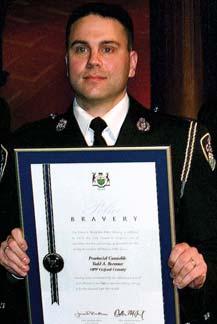
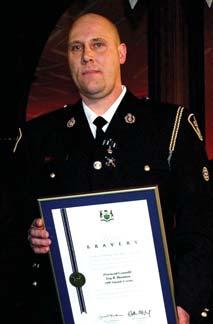
Three Ontario police officers have been recognized with the Ontario Medal for Police Bravery, honouring their outstanding courage and bravery in the line of duty.
“The heroic actions of firefighters and police officers remind us of the risks they face every day,” said the Honourable James K. Bartleman, Lieutenant Governor of Ontario. “We owe them our gratitude and our thanks for all they do to keep us safe.”
The medal was created in 1975. Winners are determined by an independent body of citizens representing all regions of the province. The 2005 recipients are:
OPP Cst. Todd Bremner, Oxford Detachment
On September 9, 2004, the Oxford OPP received a report that a transport truck driver planned to commit suicide on Highway 401 by running out in front of other trucks. Surveillance was set up immediately along the 401. Bremner was driving east on the highway when he saw a truck parked on a westbound exit ramp. The driver had left his vehicle and was walking toward the freeway. Bremner made an emergency crossover through the high volume of oncoming traffic to reach the exit, left his cruiser in the ditch and ran behind the truck driver. Reaching the passing lane, the driver was hit by two vehicles; uninjured, he kept going. Bremner put his own life at risk by running across the highway and single-handedly stopping the man in the midst of high-speed traffic.
OPP Cst. Guy Harmison, Lanark County Detachment
On March 12, 2004, a man attempted to break into

Alberta Solicitor General Harvey Cenaiko wants to include the abduction of adults in the Amber Alert system. Cenaiko says Edmonton police made a good decision when they issued the early warning system after a woman was allegedly assaulted and kidnapped by her boyfriend. The incident marked the third time the system has been used in the province since it was adopted in 2002, and first time for an adult. The Edmonton police and the solicitor general’s office are discussing the potential changes to the system.

Judge John Reilly says education, not punishment, is the key to deterring society’s criminal element. The Calgary judge says he shudders when he hears the public outcry for longer sentences, and says the belief prison terms dissuade people from committing crime is a fallacy. “One of the biggest law enforcement problems we have in Calgary is gangs and one of the ripest breeding grounds for them is jail. “Imprisoning people to teach them a lesson, to deter them from committing crimes, doesn’t work,” he says. “Deterrence is sort of a legal fiction.” Reilly says imprisoned individuals get recruited into gangs, or criminal organizations, and become an even bigger problem for society when released. He says the restorative justice approach used in aboriginal communities is much more effective.
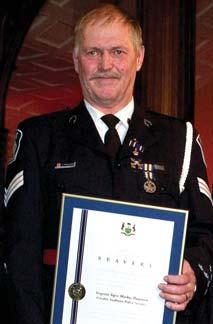
a female friend’s residence in Gatineau, Quebec. He failed and drove off across the Quebec-Ontario border. Gatineau police alerted the OPP, who attempted to stop him. The man fled at a speed of 160 kilometres per hour. Three cruisers were pursuing him when he suddenly pulled into the southbound lane, directly in front of an oncoming vehicle. To prevent a head-on collision, Harmison drove his cruiser in front of the man’s vehicle. The man slammed into the rear of the police car, sideswiping the oncoming vehicle. The fugitive’s car finally stopped and the man was arrested. Harmison was transported by ambulance to a nearby hospital with back injuries. The southbound passenger car was carrying a family of two adults and three children from the Ottawa area. Thanks to Harmison’s actions, none were seriously injured.
Sgt. Tapio Paajanen, Greater Sudbury Police Service
On January 6, 2005, a 77-year-old Naughton resident fell through the ice while cross-country skiing on Whitefish River. With little regard for his own personal safety, Paajanen crawled toward the elderly gentleman before breaking through the thin ice. He swam the rest of the way, grabbed the victim and returned to shore, breaking the ice with the elbow of his free arm until he found solid ice and pulled himself and the elderly person to safety. This water rescue proved even more difficult because the victim was still wearing his cross-country skis. The victim survived and Paajanen wasn’t injured in the incident.


A lawyer for a man impersonating a police officer says his client pulled over motorists in his Jeep because it boosted his self-esteem.
Leonard Prestidge, 47, dressed up as a Mountie last June and pulled over at least three different vehicles on Highway 59 just north of Winnipeg.
Prestidge pleaded guilty to impersonating a police officer and was granted a discharge by Manitoba provincial court Judge Ken Champagne, provided he doesn’t re-offend.
Crown attorney Christina Kopynsky said it’s not clear where Prestidge got the Mountie uniform but motorists clearly didn’t buy his antics.
Prestidge first pulled over an elderly couple and demanded to see a driver’s licence before eventually letting them go. This was followed by him issuing a stern warning to a man on a dirt bike.
The authentic police showed up in the midst of him lecturing a third motorist, after responding to complaints from the first driver and other witnesses in the area.
“This is somewhat of a bizarre incident,” Champagne told Prestidge. “It appears you were dealing with some very personal issues at the time and reacted in this very inappropriate fashion.”
Sometimes doctors never come for their patients.
Police in Fredericton responded to a burglar alarm at a medical clinic expecting to find a robber, but instead found a patient who had been locked inside.
The patient had shown up for his 11:30 a.m. appointment and was told to wait in a treatment room for his doctor. The clinic staff, however, forgot about the patient and locked up at noon and left.
Shortly after 1 p.m., the forgotten patient emerged from the treatment room to find himself alone.
Police say the man triggered the alarm when he walked out of the observation room into the main office.
As Justice Dianne Nicholas read her decision concerning a man’s impaired-driving charge, the 25-year-old accused slowly backed
out of the Ottawa court room.
“I was writing down the judge’s decision and I notice that my client has left,” said lawyer James Foord. “I guess he wasn’t satisfied with the sentence.”
Nicholas had convicted the man and had just finished concluding her thoughts on the reasoning behind the four month sentence when the man casually walked by the front security desk and ran out the door.
A week later, the man was arrested following a chase on the Trans-Canada Highway.
Police had spotted a car that was reported stolen in Thunder Bay travelling through Terrace Bay.
Provincial police say the car ran over two spike belts set up on the outskirts of Marathon, but kept going even though the front wheels were down to their rims. The car came to a stop just east of Marathon after a minor collision with a police cruiser. The driver fled, but quickly surrendered.
Ottawa police Staff Sgt. Monique Perras confirms the arrested man is the same person who bolted from the Ottawa courtroom.
***
One person’s trash is another’s treasure – especially if you are Police in Rochester, New York.
A local woman was taking a bag of garbage out to her trash can when she discovered it was being used for another purpose.
With police in search of two men who allegedly robbed a bank early that morning, one suspect sought refuge nestled inside the woman’s trash can.
While the other suspect was caught quickly, police eventually caught-up with the ‘trash can’ suspect a few streets away.
***
A man who authorities say dropped more than 30 pounds to escape custody, could have used a makeover as well.
Police in Sydney, Australia say inmate Robert Cole went on a crash diet to squeeze through a hole in a wall just 15 centimetres wide. Officers caught-up with their man a few days after his unlikely escape from a hospital.
Authorities say Cole attempted to disguise

himself by drawing a beard on his face in pen. A trimmed-down Cole has since punched his ticket into maximum security.
***
Little-known film director Nabh Kumar Raju had one requirement, and wanted a straight answer before you auditioned for his movie; “Have you ever attempted any crime?” Raju told one of India’s national newspapers that he’s trying to assemble an entire cast of criminals to star in his mafia-themed film.
Approximately 3,000 hopefuls turned up for the audition. Apparently the six people chosen included a sharpshooter, a local mafia boss facing trial, a man involved in past kidnappings and a thief.
***
Major Patrick Kitchens of the Leavenworth Police Department says it makes a cops’ job a lot easier when drug dealers advertise what they do.
That was just the case in this incident, wherein investigators in Leavenworth, Kansas, say they got a hold of one of Sylvester Williams’ business cards.
Officials say the card featured a picture of an alarm clock being hit by a boxing glove, with the slogan: “For a quick hit on time call the boss.”
Well, investigators called the “boss” and arranged a meeting place to buy some crack. Turns out, Williams was true to his word and showed up promptly, however, he was arrested by the responding officers.
***
Election officials in Berks County, Pennsylvania, say Bail bondsman Paul Sewell will have to explain why he signed his name “God” on his registration form if he wants to vote in the next election.
“God” is his legal mark, says Sewell, like the “X” used by people who are illiterate. He says he has used his legal mark on his credit card as well as his driver’s license and says it is perfectly legal.
His reasoning is that whenever he arrests a bail jumper they say, “‘Oh, God, give me another chance. Oh, God, let me go.”

VANCOUVER
— No other city in North America would tolerate the sort of open drug use seen daily on Vancouver’s streets, parks and school grounds, Vancouver police say.
And they promised they’re going to put a stop to it.
Insp. Bob Rolls, who is in charge of the northeast section of the city that includes the Downtown Eastside, announced a new enforcement program against public drug use.
He said a crucial agreement has been reached with federal prosecutors to process charges against those who use drugs in public.
Rolls said that over the years, officers have felt helpless to stop open-air drug use in the Downtown Eastside because they had no “tools” to deal with it.
There was no support from the courts, as charges were either not processed or sentences upon conviction offered no deterrence, he said.
“In the past 10 years, charges have been tapering off as there’s been recognition that drug abuse was a medical problem and so we have concentrated enforcement on the dealers,” he said.
This has led to a sense of “entitlement or empowerment by drug users to openly shoot up or smoke drugs wherever they like,” said Rolls.
“There’s no other city in North America that would put up with this,” he said. “We don’t allow this for consuming alcohol, yet we allow it for cocaine and heroin. This doesn’t make sense.”
There will be zero tolerance for crack cocaine smoking or intravenous drug injections in public, he said, noting officers have arrested five people since the crackdown began at the end of last week.
COCHRANE, Alta. — Life-size bronze statues of the four RCMP officers who were killed last year will soon stand on guard in Mayerthorpe, Alberta.
A southern Alberta couple has been selected to create the statues which will be erected in a park across the street from the Mayerthorpe RCMP detachment. The statues of constables Peter Schiemann, Anthony Gordon, Leo Johnston and Brock Myrol will stand on a central base and point north, south, east and west.
Margaret Thibault, of the Mayerthorpe Fallen Four Memorial Society, says Don and Shirley Begg of Cochrane were chosen over a dozen other artists from the province.
“Their heart is in every project, and this project, they certainly could understand the importance to us of doing this just right,” says Thibault, who knew the officers by her involvement with the Mayerthorpe RCMP victim services unit.
She says the memorial will honour all Canadian

officers, both those who have been killed in the line of duty and those who continue to serve.
The statues are expected to be ready in March 2007.
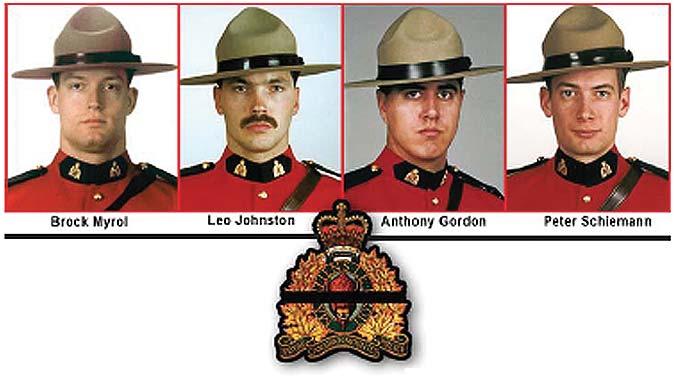
In Mayerthorpe, meanwhile, the community marked the anniversary of the Mounties’ deaths by cheering on a game of shinny between a squad of Mounties and the local old-timers team.
“We remember what happened every single day of the year,” says Thibault. “This seems like a good way to come together.”
“One evil act put Mayerthorpe on the map worldwide. We are not part of the act. We are people who care and get things done. We want to show who we are. How we loved our RCMP.”
Organizers of the hockey game had to turn away volunteers, due to the amount of people wanting to help out. The small town of Mayerthorpe have banded together since the fatal incident on March 3, 2005.


by Mark Giles
It was a different type of integrated policing when members of the Ottawa Police Service, OPP and the Canadian Forces Military Police put together a team to challenge the NHL Oldtimers Feb. 18. The Oldtimers, a group of former professional players, are touring Canadian cities to entertain fans and raise money for charity.
The police team helped with both – raising money for Special Olympics and promoting good community relations in the process. Marked police vehicles – emergency lights flashing – from all three agencies were brought onto the ice as part of the opening ceremonies, and a member of the Ottawa Police Service Tactical Unit rappelled down from the ceiling to deliver the official puck.
Play was stopped on several occasions for fun diversions, including a singing and trumpet duet, the introduction of ‘replacement players’ – minor league youth – who played against the former NHL players for a few minutes during the second period, and a ‘fire’ in the police team’s bench area. When the police bench suddenly became engulfed in smoke during the last seconds of the game, members of the
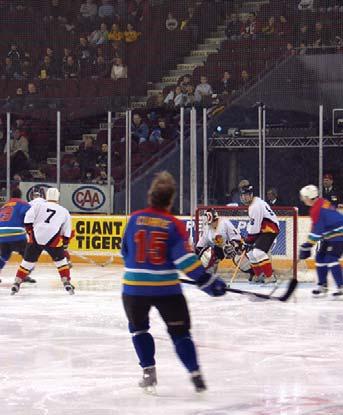
Oldtimers’ donned firemen hats and doused the ‘flames’ – and several police players – with buckets of water.
Between events, there was still time for some high-calibre hockey. The Oldtimers, including New York Islanders’ stars Brian Trottier and Mike Bossy demonstrated that they’ve retained much of the lustre of their playing days – eventually winning by a score of 16-11.

QUEBEC — Quebec’s workplace injury watchdog is urging their provincial police to stop using private security guards in high-risk drug operations.
The use of private security guards to help police crack down on outdoor marijuana growops is an “unacceptable” and “dangerous,” practice, says the Commission des lésions professionnelles.
This practice contravenes Quebec’s workplace safety laws and subjects security guards to unnecessarily dangerous situations, the Commission has ruled.
The ruling reads, “The tribunal concludes that the eradication program run by the employer is unacceptable in regards to the obligations imposed by the law because the additional danger of serious injury by armed aggression could be eliminated at source by not allowing civilians to participate in police operations.”
The province’s workplace safety board deemed the practice acceptable in an earlier decision, however, this was challenged by a group of five provincial police officers. The officers countered that marijuana plantations are often protected by armed guards and booby traps - a notion the board agreed with.
The board also noted that because civilian security guards don’t usually work with police, defending the guards in certain situations is difficult.
***
WINNIPEG — Cybertip.ca has experienced a major increase in reported cases of child exploitation since becoming Canada’s national tip line against child luring and online child exploitation.
The organization said that by the end of January 2006, 5,771 child exploitation reports were made to Cybertip.ca - a 430 per cent increase from 2004.
The Cybertip.ca website has received 9,145 public reports since 2002, resulting in the arrest of 17 individuals and 972 websites from across the globe being shut down.
An increase in public education and awareness is the reasoning behind the growth of Cybertip.ca, says McDonald.
The website began as a pilot project in Manitoba in 2002, and was launched as Canada’s national tipline against child luring and online child exploitation in January 2005.

by Dorothy Cotton
Officer Manicotti was already in a grumpy mood when the call came in and groaned when the dispatcher directed him to an apparent suicide at a railway crossing. He was in the middle of a rather messy divorce and not a happy camper.
A very distraught couple at the scene told him the deceased, their 30-something son, had recently moved in with them after falling out with his wife. They knew he was pretty upset but didn’t expect anything of this magnitude. Their son had laid down on the train tracks and was decapitated. It wasn’t a nice scene – hardly the kind of thing you’d expect to find funny.
Officer Manicotti sighed and mumbled “Another damn fool has lost his head over a woman” under his breath to his partner – just as a colleague trudged up the embankment carrying the severed head, looking for all the world like he was acting out the story of St. John the Baptist.
It was all he – and his partner – could manage not to burst out laughing
Ah, dark humour! What would we do without it? Everyone who deals with icky stuff has occasionally been overcome with the giggles at inopportune moments. There are all kinds of tasteless and rude things we in psychology and psychiatry say about people – like ‘the lights are on but no one is home,’ for example.
When I worked as a nurses’ aid in a chronic care facility, I remember locking myself in a bathroom once so a certain family member would not hear me laughing about the death of her mother. The woman had a very bad respiratory disease and it was painful just listening to her breathe. When the daughter came to tell me her mother’s breathing was not as laboured as it had been, it seemed extremely funny to me – since I knew she had stopped breathing altogether (she had died). Hilarious, eh?
No? Well, maybe yes, maybe no, but humour is an interesting thing. I would be the first to agree that, on the surface, the comments and events described above are tacky, tasteless, a bit offensive and probably best not overheard – but humour also serves a variety of constructive functions for those of us who make our livings dealing with stuff that is not always pleasant. It can be an effective coping mechanism.
At a biological level, humour can relieve tension. There are a whole bunch of physiological things that go on when you laugh, involving muscles and hormones and things I cannot spell. Laughter invokes chemical and biological reactions that are pretty well the opposite of stress and can offset the effects of intense stress in those really awful moments; let’s face it, carting around a severed head is not a whole lot of fun.
Humour is also a way of reframing things and looking at them differently so they are less stressful or horrifying. The incident when I locked myself in the bathroom laughing occurred when
I was 16 years old and had never seen a dead body. It was easier to focus on the incongruity between the daughter’s observation and the actual fact than to confront the real issue – that there was a dead body staring up at me.
Incongruity – the unexpected linking up of two unrelated items or thoughts – is a hallmark of dark humour, like relating a bible story to a train wreck, for example. It takes you by surprise – and that, of course, is the essence of a good joke.
Humour is a way people connect and ‘share’ and they use dark humour when more overt sharing of emotions is just not the thing to do. It is hard to imagine a police officer or other emergency personnel actually expressing their opinion about the ickiness of picking up body parts – but joining in a play on words or other ‘private’ joke is a way to say to each other, ‘Yeah, I know how you feel… yeah, this is gross and upsetting’ without actually saying so. It is communication.
One interesting thing about humour as a coping skill is that those who make the jokes seem to get a greater benefit than those who hear them. There seems to be something therapeutic about making the odd associations – perhaps a grim appreciation and ability to see what is really there, as opposed to denying it altogether –but is dark humour really a good thing?
One of the debates among people who seriously research humour (got that? Ha ha!) is whether dark humour reflects an increased or decreased sensitivity to the circumstances. Do people who engage in dark humour become callous and thus less effective in their work? Is it a sign of burnout and cynicism or just a healthy adaptation to a stressful circumstance? The answer is likely that it can be either or both.
Just as humour can be a team building thing and a way of communicating, it can also be used to ostracize and isolate people. When we find ourselves throwing our little jokes at people who don’t want to hear them or don’t ‘get’ them, they can be a way to avoid facing our own demons and be used as an ‘in your face’ response to others – and that’s not such a good thing.
In most cases, those of us who engage in dark humour have the where-with-all to know that others might view it as a little inappropriate and thus try to keep our little jokes out of the public eye. We use humour as a way to tell stories, build relationships, teach and illustrate, defuse and communicate.
I’m Ok with that – but don’t tell anybody.
You can reach Dr. Dorothy Cotton, Blue Line’s psychology columnist at deepblue@blueline.ca, by fax at (613) 5303141 or mail at: Dorothy Cotton RTC(O) PO Box 22 Kingston, Ontario K7L 4V7.

by Tom Rataj
Printing a document in colour adds a whole new dimension that helps to elevate it up above the bland world of plain old black text on white paper. It can substantially change the document or draw a reader to the important points.
Until very recently though, printing colour documents from a personal computer was limited to relatively cheap inkjet printers, with their expensive and smudge-prone inks, very expensive colour laser printers or even more expensive digital print shops.
Most business printing was done using monochrome (black only) laser printers, a technology that was first demonstrated in a Xerox laboratory in 1969. IBM introduced the first commercial laser printers in 1979 and QMS introduced the first colour laser in 1993.
Like inkjets, laser printers were quite expensive when originally introduced. While serious business-class monochrome laser printers continue to command prices from about $1,500 up, excellent personal and small business models are now priced quite affordably in the under $400 range. During the last year or so colour laser printers in both classes have also very rapidly declined in price, to surprisingly similar values as their monochrome siblings.
Laser printers are cheap to operate, with typical cost-per-page pricing down to around 3 cents per page for monochrome and around 10 cents per page for colour. In comparison, the cost-per-page for inkjets is typically around $1 per page.
An entry-level laser printer now makes an excellent addition to any home office because of the low purchase and supply price. Replacement toner cartridges typically cost around $100 but last for about 5,000 pages.
Pages-per-minute (ppm) speeds have risen
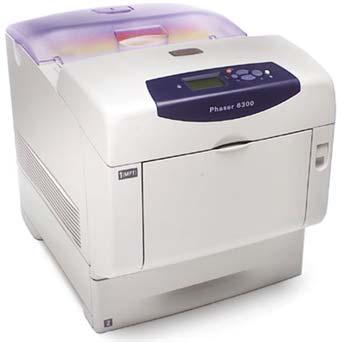
dramatically and now top 35 ppm for monochrome and 25 ppm for colour. Output resolution has also increased substantially, with many printers capable of printing at 1200x1200 dpi (dots-per-inch), making for extremely sharp output.
A number of factors other than marketing are at play here. Vast improvements in technology, efficiencies in manufacturing and the affordability of personal computers have all come together to create a market environment that keeps pushing hardware prices lower.
Laser printers are actually very complex machines that combine a number of the same technologies as photocopy machines and computers.
Each printer has a sort of minicomputer in it known as the printer controller. It has a specialized central processing unit (CPU) similar to a computer, responsible for understanding information received from a computer and coordinating it with all the mechanical and electrical components of the printer.

Most printers communicate with computers in one of two printer languages: Printer Command Language (PCL) and PostScript. These describe the page as a mathematical value. The controller converts this value to a bitmap image of the page and sends the image data off to the printing mechanism.
When the command to print comes from the controller, a photoreceptor cylinder, which is made of an extremely sensitive photoconductive material, is charged with a positive charge. The laser then draws the image of the page onto the surface of the cylinder by removing the positive charge at all the points it touches, creating a temporary negative electrostatic image of the page.
Positively charged toner is then applied to the cylinder and sticks only to the now negatively charged image of the page on the cylinder. Negatively charged paper is then rolled against the cylinder and the positively charged toner is transferred to the paper. Once the toner is transferred, the paper’s negative charge is removed.
The page is then sent through the fuser, which melts the toner to the paper, creating a permanent bond. The completed page is then placed into the output tray, still warm from the fuser assembly.
In lieu of the laser, some printer manufacturers use an array of light emitting diodes (LEDs) or liquid crystal displays (LCDs) that are cheaper to produce, although they perform the same function as the laser.
Toner consists of microscopic particles made of pigment and plastic. When the toner particles are heated in the fuser assembly, the toner melts and adheres to the paper, which is why pages printed on a laser printer are essentially smudge-proof and waterproof.
Toner comes in easy to replace cartridges; some hold nothing but toner while others include the developer and drum assembly, parts that need to be changed separately in other printers. The all-in-one design is the most common and is generally the better choice for most users although it may be more expensive depending on the make and model.
Colour laser printers are more complex because they have three additional toner cartridges: blue (cyan), red (magenta) and yellow. There are a number of different methods used to print colour, some better than others. The simplest, single-pass printers apply all the colours in one continuous process. More complex units have four separate toner and developer units on a wheel that is rotated past the page for each required colour.
Colour laser printers are generally very efficient and cost effective in producing monochrome and colour text, graphics and images. There is a wide range of printing quality and price in the market. Some printers are able to produce near photo-quality output, although the
majority cannot.
Typically, text output is excellent down to plain text sizes as small as four points. Typical business correspondence is printed between 10 and 12 points, while this article is printed at nine points (a point is 1/72nd of an inch).
Common problems with colour laser printers include improper alignment of colours that results in fine unprinted white areas between adjacent colours, referred to as misregistration. Colour balance may also be an issue with some printers, although part of this problem is linked to the differences in colour balance between the computer monitor and the printer. Manual adjustments are generally available to address these problems.
In addition to printers capable of printing the usual letter and legal sized documents, some can also print documents to tabloid size (11x17") or even 12x49".
As with other electronic equipment, using printers is not without some environmental impact. In addition to heat and noise, laser printers also produce ozone and should be kept in an area with good ventilation to avoid it building up. Some printers have ozone filters installed to keep emission levels within government-regulated levels.
Colour lasers have separate environmental concerns. Depending on the age of the design, they may, in addition to a toner cartridge and drum, have a developer and fuser unit, fuser oil and a waste toner container, all of which may need to be replaced at some point and disposed of properly. Newer models have reduced the amount of supplies down to a single toner cartridge or even cartridge free designs such as those from Kyocera.
Most better quality printers are also designed to be compliant with the EnergyStar certification process, significantly reducing power consumption when not actually printing.
Despite the initial purchase price and cost of replacement toner cartridges (around $600 for a full set), a colour laser printer is still the most cost-effective method of obtaining colour output in smaller quantities. While prices may seem high, the quality of the output is generally excellent and the cost substantially lower than inkjet output.
Tom Rataj is Blue Line Magazine’s technology editor and can be reached at technews@blueline.ca
April 5 – 8, 2006
Bruce Denniston Bone Marrow Society
Kamloops, BC
The three event weekend fundraiser for the Bruce Denniston Bone Marrow Society, will include the 17th annual Mountie Stomp, April 8th; a golf tournament, April 7th, and The Western Professional Hockey Challenge on April 5-8th. Contact: Cst. Connie Buckle, 250-828-3228 or Connie.Buckle@rcmp-grc.gc.ca .
April 25 & 26, 2006
10th Annual Blue Line Trade Show
Markham, ON
Trade show for law enforcement personnel from across Canada to view and purchase a wide spectrum of products and services of the latest technology in the law enforcement industry. Admission is free by pre-registration. Simultaneous two-day conference with four training seminars requires separate pre-registration and fee. See topics below. Registration and information at www.blueline.ca .
April 25, 2006
Unmasking Urban Graffiti III
Markham, ON
This half-day morning course by instructor Heinz Kuck, will help you understand graffiti offender motives, decipher the eight graffiti styles, teach how to design your own graffiti abatement project, and experience the development of tags by a graffiti vandal. Course details and registration at www.blueline.ca .
April 25, 2006
Methamphetamine Labs
Markham, ON
This half-day afternoon course instructed by SOLETA members will help you learn about meth. ingredients, how labs are set up, how to recognize indicators of lab activity, patrol issues related to shoplifting and officer safety when dismantling labs. Course details and registration at www.blueline.ca .
April 25 or 26, 2006
Non-Accusatory Interview Technique
Markham, ON
This one-day course by instructor Gordon MacKinnon, will draw on case law and rules of interviewing, witness psychology, teach how to detect deception and use techniques to get court admissible confessions. Course details and registration at www.blueline.ca .
April 25 & 26, 2006
Policing in the Spotlight: Media Training
Markham, ON
This two-day course by instructor Jim Stanton, will provide you with media training for your police service including proactive media techniques, workable key phrases and messages, and building alliances. Course details and registration at www.blueline.ca .
April 25 & 26, 2006
CSI Crash Data Retrieval System Operators Update
Markham, ON

This two-day course by CATAIR is for previously trained Collision Safety Institute (CSI) CDR system users. Upon
successful completion of this update class, the student will be current on the systems supported by the CDR system form their original CSI class to those supported at the time of training. An exam will be held on the second day on material covered during the update training. Course details and registration at www.blueline.ca .
April 26, 2006
Lessons from a Gang Cop
Markham, ON
This one day course by instructor Tony Moreno, LAPD, will teach you the history and culture of gangs, gang enforcement and suppression tactics plus tips needed to survive. Course details and registration at www.blueline.ca
April 30 - May 3, 2006
Aboriginal and Diversity Conference Toronto, ON
The 2nd international conference is hosted by the O.P.P, R.C.M.P, Toronto Police Service, First Nations Police Chiefs Association, Association of Black Law Enforcers, and Law Enforcement Aboriginal and Diversity (LEAD) Network. The conference theme is Building Trust and aims to bring together a wide spectrum of people who care about providing quality police service to Aboriginal and diverse communities to exchange ideas, hear from world-class presenters and build trusting and respectful relationships. For more information and registration please visit www.cacp.ca.
May 25 – May 31, 2006
PPCT Spontaneous Knife Defence System & Ground Avoidance Ground Escape (GAGE)
Oakville, ON
Hosted by the Halton Regional Police Service Training Bureau, the knife defence course is designed for police and correctional officers to raise awareness of strategies and use of techniques. GAGE is a self defense training program for those who have to confront and arrest violent offenders in close quarters. Fee is $400. Contact: Sgt Chris Collins, 905 825 4747 x5106 or chris.collins@hrps.on.ca .
May 31 – June 2, 2006
Western Canada Robbery Conference Fairmont Palliser Hotel, Calgary
Hosted by the Calgary Police Service Robbery Unit. Provided will be a mixture of lecture and case studies discussing a wide variety of fraud issues and practices. Cost is $250.00 per person. Information at http:// www.calgarypolice.ca/news/wcrc06.html or contact S/ Sgt Dave Louie at 403-206-8746 or Det. Tim Shannon at 403-206-8788 or wcrc.2006@calgarypolice.ca.
August 11 - 13, 2006
Quadra Reunion Comox, BC
A reunion by the alumni association to celebrate the 50th anniversary of the commissioning of HMCS Quadra. Calling all police officers who trained at Quadra to form a full troop in uniform for the march past of alumni. Contact Cst Gord Cave, lgcave@telus.net or www.quadraalumni.com.



by Andrew Cowan
Tired of the long Canadian winter, four RCMP officers and a chaplain, one Ottawa police officer and a Kanata firefighter headed to Gulfport, Mississippi in January.
Having the motivation to get there – using up a week of leave and paying our own way –was the easy part. The big question was whether four ‘constructionally challenged Mounties’ (believe me when I say that!), with help from the others, could make a difference for a Gulfport Police Department family recovering from Hurricane Katrina?
We (Chaplain Ben Yablonski and myselfE Div), Marc Maillet, Jacques Rainville and Krista Millar-Rainville (all C Div), Dave Stewart (Ottawa Police) and Harry Van Hofwegen (Kanata Fire Dept) were housed in a gym style dorm.
The reason we went is simple – Katrina left dozens of police officers, other first responders and their families in the Gulfport area homeless. Many lost everything and much of the damage wasn’t covered by insurance. They were literally left with only the shirts on their backs and no homes to return to after long shifts – or families either. The majority were evacuated and many still live out of state or in other areas of Mississippi.
You are struck at the shear magnitude of the damage when driving around the area. Imagine an up to three mile swath along 78 miles of coast-
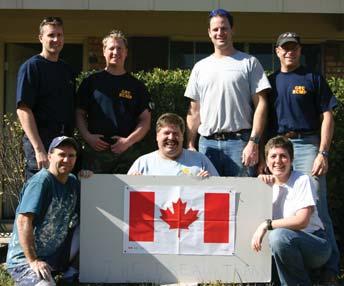
line with either nothing or very little left standing. It is as if a giant hand simply wiped away or knocked over everything in its path. Shrimp boats were tossed into tree stands, 200 year old trees snapped, huge container ships flipped on the beach and houses demolished. Words or pictures can’t accurately describe what happened; you have to see it first hand.
We were assigned to work on the Weatherford’s home. Phillip, a 20 year veteran of the Gulfport PD, went on medical pension last October. His wife Debbie lost her job when the casino she worked at was destroyed by the flood surge. Their house sustained a five foot flood surge, which destroyed all the appliances, wiring, drywall, carpet and furniture; their losses were uninsured.

The Federation of Christian Police Officers (FCPO) co-ordinated volunteers to strip the mouldy drywall and carpet, remove the ruined possessions, clean up the site and disinfect the house for mould. It also donated money to pay for drywall, insulation and new wiring and found an electrician willing to donate his time to install it – all things the Weatherfords could not afford to pay for.
Our job was to insulate and drywall the entire house, in less than a week if possible. I wasn’t kidding about our lack of construction skills. You really have no idea just how much we hoped the others knew what they were doing – although in the best tradition of Mountie/City Police rivalry, we did our best to take credit and fool everyone into thinking we were experts!
The house was basically stripped bare when we arrived and the yard a jumbled mess of tools, toys, personal possessions and tree parts. When we left it was clean and the house insulated and dry walled. We even managed to complete some of the priming. More importantly, the Weatherfords went from feeling financially ruined and hopeless to seeing the light at the end of the tunnel.
All of us knew we would make a difference in some small way, but we didn’t realize we would be so warmly welcomed or benefit so much personally. We arrived as strangers just wanting to help but left as family and friends of those we met in our travels.
FCPO, the organization co-ordinating this project, was on scene within days of the disaster with emergency supplies, well before any organized government aid began arriving. It has raised money for materials, tools and to help with travel costs of interested police members assisting in the reconstruction effort. With the ability to issue tax receipts and an organizational infrastructure on the ground in Gulfport, it has become a vehicle for many interested police officer and firefighter groups to work through, regardless of their affiliation or personal beliefs.
As time has passed, it has become clear that many police department members in the surrounding area are as bad, if not worse off, than those in Gulfport. FCPO (Canada) has committed to continuing involvement in the project until at least December.
Four Victoria Police Department members, with the generous support of their association, spent a week helping another family there at the end of January and OPP and RCMP members and retirees are also working on putting together a trip and have dates in place.
We can all think of reasons why we can’t go but what about the many reasons why we should? In the words of one team member, “to drop what I was doing, take a week off and just go was the best thing I have ever done. Count me in when we go again.”
Andrew Cowan works out of RCMP “E” Division commercial crime section in Victoria. Contact the FCPO at projectkatrina@fcpocanada.com to get involved. Visit the web site (www.fcpocanada.com) for more information or for ongoing project updates.