Tired of rising energy costs, the Lidners are utilizing solar power
By Jim Knisley
16
PRODUCTION: Demand for ABF Chicken Growing St-Hubert restaurants want to serve antibiotic-free (ABF) chicken. Are Quebec broiler producers up to the challenge?
By André Dumont
20
PIC UPDATE: Exploring Gut Immunity
Research investigates how antibiotics are affecting the chicken intestinal and immune systems
By Tim Nelson, executive director and Kimberly Sheppard, research co-ordinator
23
FEED: Mycotoxins: Their effects on health
Despite common thought, turkeys are susceptible to deoxynivalenol mycotoxin
By H.V.L.N. Swamy, PhD Alltech Canada, Guelph, Ont.
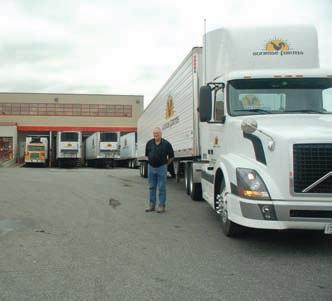
BUSINESS PROFILE: Sunrise Farms
With a knack for the chicken processing business and the right timing, Peter Shoore has built the largest individual chicken processing plant in Western Canada
By David Schmidt
FROM THE EDITOR
BY KRISTY NUDDS
We Should Be Proud
Ever wonder how the Canadian poultry industry compares to other industries around the world?
I recently had the opportunity to discover this in early July at the XXIII World’s Poultry Congress, in Brisbane, Australia. This congress, held every four years in a different country, brings together poultry scientists, students and industry representatives from around the world to discuss research on various aspects of poultry production and emerging issues that could impact future production.
Despite obvious differences in climate, politics, production systems, and consumer culture, the mandate in all countries is the same – to promote a sustainable industry, provide consumers with a safe product and ensure growers’ profitability.
Although each country and region offers its own unique challenges with respect to growing poultry, the fact that food has become a global entity means that no matter where poultry is grown, there are shared challenges.
One of the most talked about was the debate over food versus fuel. The struggle to find new energy sources and utilize feedstuffs is affecting both developed and developing countries and causing feed prices to soar. It’s also having an impact on feed quality, and the impact this will have on future production is yet to be determined.
The challenge doesn’t just lie with competition for energy, but also with supply. The influence developing countries such as China and India – whose populations are becoming richer and thus the demand for meat, and the inputs it requires – is growing steadily.
Despite the enormous uncertainty on this subject, one thing that all parties could agree on is the fact that poultry, compared with other animal protein sources, is best poised to weather this storm. Due to increases in production efficiencies – the result of research – poultry will be the number one animal protein consumed throughout the world.
On the research scene, the Congress reaffirmed my belief that Canada is a leader. Canadian research was extremely well represented at the Congress, with more than six members of the Alberta Poultry Research Centre presenting, as well as several from the University of Saskatchewan, the University of British Columbia, the University of Guelph, and the Université de Montréal. Eight Canadian students also had the opportunity to present their research: budding poultry scientists in their own right.
The most important thing to note is not just the fact that Canadian research is prolific, but that it’s relevant to the needs of Canadian producers and producers around the world.
Our system of production (supply management) allows for funding of this type of research and as a contributor, I feel that producers and those involved with the marketing agencies should be proud of the accomplishments of these researchers and continue to support them – it’s their efforts that will see the Canadian industry through future challenges and continue making it a prosperous one. ■
August 2008
Vol. 95, No. 8
Editor Kristy Nudds – knudds@annexweb.com
888-599-2228 ext. 266
Contributing Editor
Jim Knisley – jknisley@kwic.com
Publisher/Sales Manager
Marilyn White – mwhite@annexweb.com 888-599-2228 ext 237 • fax: 888-404-1129
Sales Assistant
Mary Burnie – mburnie@annexweb.com 888-599-2228 ext 234
Production Artist
Krista Misener
Editorial Director
Drew McCarthy – dmccarthy@annexweb.com
VP/Group Publisher
Diane Kleer – dkleer@annexweb.com
President Mike Fredericks – mfredericks@annexweb.com
Mailing Address
P.O. Box 530, 105 Donly Dr. S., Simcoe, ON N3Y 4N5
Publication Mail Agreement #40065710
PAP Registration #9850
RETURN UNDELIVERABLE CANADIAN ADDRESSES TO CIRCULATION DEPT., P.O. BOX 530, SIMCOE, ON N3Y 4N5. e-mail: cnowe@annexweb.com.
Periodicals postage paid at Buffalo NY. USPS 009-324, ISSN 1703-2911. Published monthly by Annex Publishing and Printing Inc. US Office of publication c/of DDM Direct.com, 1223 William St. Buffalo NY 14240. US Postmaster send address change to PO Box 611 Niagara Falls NY 14304.
Printed in Canada ISSN 1703-2911
Circulation e-mail: cnowe@annexweb.com
Tel: 866-790-6070 ext 207 Fax: 877-624-1940
Mail: P.O. Box 530, Simcoe, ON N3Y 4N5
Subscription Rates
Canada – 1 Year $ 25.44
(includes GST – #867172652RT0001) USA – 1 Year $ 60.00
See why FeatherSoft™ Nipples are the Smart Choice.
Superior Flow Rates
FeatherSoft Advantage 360° Nipples deliver up to 65 ml/min at ONLY 8" of water column and above 90 ml/min at 16". NO CUPS REQUIRED.
FeatherSoft Hi-Flow 360° Nipples deliver up to 95 ml/min at ONLY 8" of water column and above 140 ml/min at 16".
Simplistic Design
Unique, patented 3-part design reduces problem risk.
1) Stainless Steel or Stainless / Plastic Body
2) Stainless Steel Metering Pin
3) Stainless Steel Triggering Pin Nipples DO NOT REQUIRE steel balls, O-rings or seals.
Corrosion Resistant
Extruded aluminum rails do not rust, unlike conduit.
Raised Water Entry
Raised water entry point, inside pipe, eliminates the possibility of sediments from entering the nipple.
J. Dean Williamson Ltd.
London, Ontario
Tel: (519) 657.5231
Fax: (519) 657.4092
Specht-Canada Inc.
Stony Plain, Alberta
Tel: (780) 963.4795
Fax: (780) 963.5034
Glass-Pac Canada
St. Jacobs, Ontario
Tel: (519) 664.3811
Fax: (519) 664.3003
Carstairs, Alberta
Tel: (403) 337-3767
Fax: (403) 337-3590
20 Micron Test
Lubing Nipples reduce risks of blockages by allowing particles up to 20 microns to pass through. More than double the competition.
Square Pipe Advantage
Square pipe keeps nipples always in upright position.
Preassembled Shipping
Watering sections are shipped completely preassembled making installations quick and error-free.
Long Service Life
Lubing drinkers have established a reputation for outlasting any others on the market. Documented reports available of drinkers in operation for more than 30 years.
Upgrade Capabilities
Lubing can replace ALL types of sections either on conduit or other aluminum rails. FeatherSoft J-Lock and Twin-Lock Nipples with Lubing technology are available to upgrade in a "twist".
Les Equipments Avipor
Cowansville, Quebec
Tel: (450) 263.6222
Fax: (450) 263.9021
WHAT’S HATCHING HATCHING
I Minister Stands Strong on SM
n response to the release of a revised draft modalities text on agriculture by Crawford Falconer, chair of the World Trade Organization agriculture negotiations, federal Agriculture Minister Gerry Ritz issued the following statement. The statement was released prior to the talks in Geneva in late July.
“The Conservative Government is standing up for Canadian farm families at the World Trade Organization (WTO) negotiations in Geneva. We are working hard to deliver a balanced WTO agreement that benefits all Canadian farm families by protecting our supply managed sectors and creating new opportunities for exporters.
“The Government of Canada is committed to the WTO process. However, as
Ambassador Falconer’s latest text makes clear, there is still much work to be done to resolve outstanding issues. Wide gaps continue to separate many countries’ negotiating positions. Each country will have to ratify any agreement and that will be complex as key players go through elections. The reality is that an agreement in Geneva would be only one step in a long process of ratification, detailed negotiation, and gradual implementation. Canada will work together with other WTO members at the forthcoming WTO meeting of Ministers in Geneva in an effort to move the negotiations forward. An agreement on modalities would not be a final conclusion, but one more step in the process.
“Canada is working hard to level the international playing field and create new international opportunities for farm families and all
exporters. Canada will continue to push all countries to completely eliminate export subsidies and strengthen disciplines for domestic supports. The Conservative Government is committed to opening and expanding markets for our exporters.
“Canada continues to stand strong for our supply managed sectors. We firmly oppose proposals for any over quota tariff cuts or tariff quota expansion for sensitive products. The Conservative Government is committed to supporting supply management both at home and abroad.
“All countries participating in the negotiation have a great deal of work to do if wide gaps are to be bridged and an agreement is to be achieved. Canada is committed to doing its part and we will continue to work hard to move WTO negotiations forward.”
Premises Registry
Launched
ONTARIO
OnTrace Agri-food Traceability Inc. (OnTrace), announced in early July the launch of the Ontario Agri-food Premises Registry (OAPR). The fullscale, Ontario-wide OAPR system is now live.
“The launch of the OAPR fulfills OnTrace’s first key mandate, which was to deliver a premises identification registry for agriculture and agri-food in Ontario,” said Brian Sterling, CEO of OnTrace. “This was our first order of business when OnTrace started operations in December 2006. We have delivered a comprehensive and much-needed solution for both industry and
Pathogen Study
Abaseline study conducted by Alberta Agriculture and Rural Development’s Food Safety Division (FSD) has determined the presence of foodborne pathogens and bacteria in Alberta chicken carcasses is similar to that found in other jurisdictions.
The study involved collecting 1,474 samples from poultry carcasses in 65 provincially inspected abattoirs, it’s the first one conducted in the province and will be used to assess procedures introduced to improve food safety.
Efforts are underway in the province to improve good
government to use.”
The OAPR system uses a “distributed architecture” that currently layers publicly available data with producer group data to identify, characterize and validate where agricultural activity is taking place in Ontario. The OAPR system is not a duplication of information that already exists. It is a window into the data owned by various sources. Producer groups who participate do so voluntarily at this time and OnTrace has negotiated agreements with data sources, so that it can access data for emergency management purposes.
For further information, visit www.ontraceagrifood. com.
Pigeon King Demise
ONTARIO
The Waterloo, Ont.-based pigeon breeding company
Pigeon King International collapsed in early July, leaving breeders, some who had invested more than $200,000, with nowhere to sell the birds.
The market for these birds had been questionable from the start and was the subject of an investigative article in Better Farming magazine revealing that Pigeon King founder Arlan Galbraith was running a ponzi scheme. Breeders have gassed more than 30,000 of the birds since the closure. Most of the holding barns were located in southwestern Ontario.
manufacturing practices and to put into place Hazard Analysis and Critical Control Point (HACCP) based processes in the abattoirs.
It took a little more than a year to collect the samples during 2004 and 2005. The project was a collaborative project with FSD and the Regulatory Services Division, involving more than 30 people including scientists, lab technicians, veterinary epidemiologists
SEPTEMBER
September 30, 2008 19th Western Meeting of Poultry Clinicians and Pathologists (WestVet), Post Hotel, Lake Louise, Alta. For more information, visit www.westvet.com.
OCTOBER
October 1-2, 2008
Poultry Service Industry Workshop, Banff Centre, Banff, Alta. For more information, contact Kate Cheney by e-mail at info@ poultryworkshop.com, or by telephone at 1-800-267-9180, or visit www.poultryworkshop.com.
NOVEMBER
November 10-11, 2008
Poultry Innovation Conference, organized by the Poultry Industry Council (PIC). Day One comprises an afternoon of research reports. Day Two will feature very practical sessions designed by producers for producers and industry service professionals. The day will culminate in a gala dinner with special guest speaker Donald McQueen Shaver. For more information, visit www. poultryindustrycouncil.ca or e-mail pic@poultry industrycouncil.ca.
and inspectors.
The rinsed chicken carcasses were tested for non-foodborne disease-causing bacteria (total aerobic bacteria, coliform bacteria and E. coli) and food-borne disease-causing bacteria (shiga toxin-producing E. coli, salmonella and campylobacter).
The study is part of a comprehensive system of government projects looking at many types of food from farm to fork.
Source: Agri-News
We welcome additions to our Coming Events section. To ensure publication at least one month prior to the event, please send your event information at least eight to 12 weeks in advance to: Canadian Poultry, Annex Publishing, P.O. Box 530, 105 Donly Dr. S., Simcoe, Ont. N3Y 4N5; e-mail: knudds@annexweb.com; or fax 519-429-3094.
ALBERTA
HATCHING HATCHING
Made in Canada
The Conservative government has fleshed out food labelling guidelines unveiled earlier this year by Prime Minister Stephen Harper. Agriculture Minister Gerry Ritz announced that the new rules come into effect on Jan. 1, 2009, and apply to all foods produced from that day forward.
Under the new rules, foods labelled as a Canadian product must contain “all or virtually all contents” that are from Canada.
It’s currently legal to call a product “made in Canada” if 51 per cent of the production costs were incurred here and the final transformation of product was in Canada.
The government says 90 per cent of the 1,500 Canadians who filled out an online survey after Harper’s announcement in May agreed with the new guidelines.
The new guidelines come from the Food and Consumer Safety Action Plan announced by Harper in December.
Cobb and Hendrix Alliance
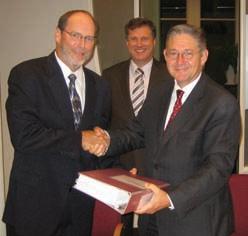
OJerry Moye, CobbVantress, shakes hands with Thijs Hendrix on the agreement as Antoon van den Berg of Hendrix Genetics looks on.
n July 4 Cobb-Vantress Inc. and Hendrix Genetics B.V. formally formed an alliance by signing an agreement to acquire preferred stock and share research.
The agreement entails:
• A Broiler Joint Venture in which Cobb-Vantress acquired Hybro in exchange for preferred stock. Terms of the acquisition have not been disclosed.
• A Joint Development Agreement (JDA) involving their respective Research & Development into
livestock genetics.
The parties have started to investigate a possible Joint Venture in which part or all activities may be combined in the future.
The Hybro organization, genetic lines and facilities have become part of Cobb. Hybro will not operate as a stand-alone division, Hybro products will be offered as part of Cobb’s portfolio. Current Cobb and Hybro customers can expect business to continue as usual.
PEOPLE IN THE NEWS
Peter Whitlock has been appointed as chair of the B.C. Broiler Hatching Egg Commission (BCBHEC) for a three-year term by the Government of British Columbia. He has spent the past 24 years as a manager in B.C.’s egg industry and chaired the Centre for Organizational Governance in Agriculture.
Dr. Karl Dawson, director of worldwide research at Alltech, was named a 2008 Fellow of the American Society of Animal Science (ASAS) in the industry category. Dawson was honoured on July 8, in Indianapolis, Ind., during the ASAS Awards Ceremony at the society’s annual meeting
Vétoquinol Canada Inc. is proud to announce the appointment of Daniel Beauchamp as general manager. Daniel has joined the Vétoquinol team on June 16, with more than 20 years’ experience in the animal health industry, acquired in sales, marketing and business development with Hoechst Roussel Vet Canada, HR Vet (now part of Intervet) and Pfizer Animal Health.
PETER WHITLOCK
KARL DAWSON
DANIEL BEAUCHAMP
Solar Savings
Tired of rising energy costs, the Lidners are utilizing solar power
by Jim Knisley
With propane costs soaring, Bruce Lidner knew something had to be done.
After investigating the alternatives the broiler producer from near Amulree, Ont., northeast of Stratford, decided to tap the sun to help heat his barns.
After looking at photovoltaic systems, which generate electricity, he opted for a system from Copperhill Solar of Norwood, Ont., that uses the sun to produce hot water that will be utilized to heat his barns.
Lidner said he expects to save about $20,000 annually on his heating costs after installing a $320,000 solar heating system.
“I was just tired of paying the propane bills,” he said.
Not only was he tired of paying the bills as they were – about $60,000 a year – he really didn’t want to face what was coming. The cost of propane has soared this year and there is no end in sight for the increases.
REDUCING COSTS
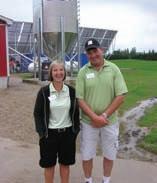
Bruce and Jane Lidner of Amulree, Ont., are the first poultry farmers to install this specially designed system, which provides a cost-effective and environmentally friendly source of heat.
When Bruce and his wife Jane took over the operation from his parents in 1991 propane cost about 18 or 19 cents a litre. In June it was about 52 cents a litre and looked like it would be even more expensive this winter.
It was absolutely clear to Lidner that “we’ve got to start doing something different.”
A key factor in his decision was a federal/provincial program that refunds 50 per cent (25 per cent from each level of government) of the cost of the system. With the money from the programs factored in, the solar heating system will pay for itself in eight years.
Lidner’s solar system is designed by Copperhill Solar and it isn’t what most people think of when they think solar.
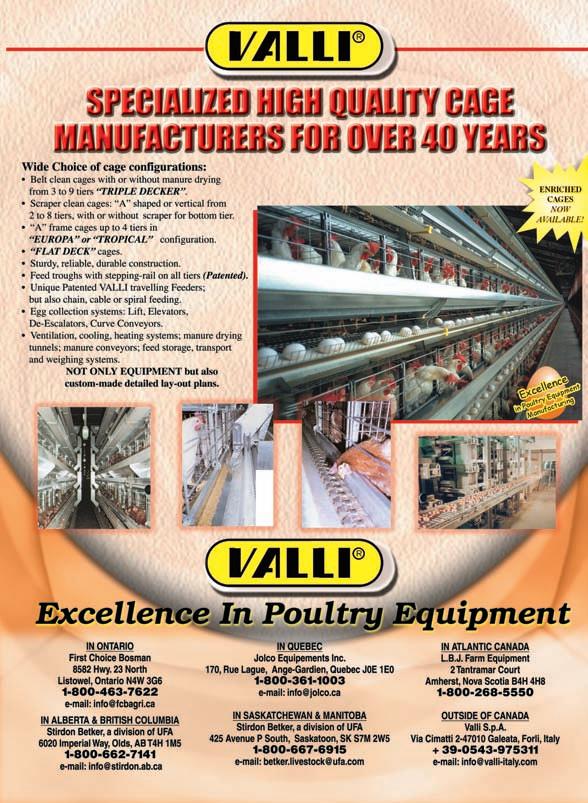
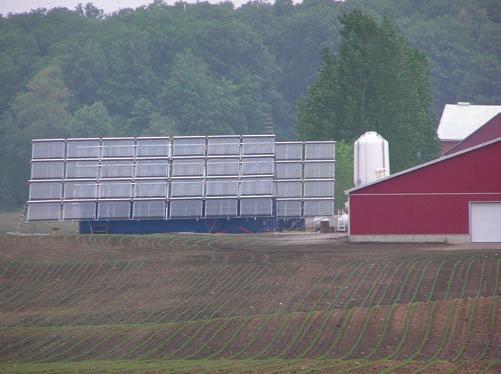
It consists of two large banks of south facing panels installed next to a new, well-insulated 17,000-square-foot barn that had floor heating installed when constructed last fall.
The panels are made up of multilayered evacuated vertical glass tubes and a thin copper tube containing a small bit of fluid.
The heat from the sun is captured by the tubes and the fluid is superheated. The copper tube then heats a mixture of food-grade antifreeze and water in a manifold. The heated water and antifreeze flows to copper coils immersed in a water tank. The coils heat the water in the tank that is in a heavily insulated shipping container located behind the panels. From there, the water is pumped into the barn.
Lidner is also using the system to heat an older nearby barn. The older barn doesn’t have a floor-heating system but it will be a simple matter to move the heated water through wall-mounted pipes.
John Verway, president of Copperhill Solar, said the panel system was designed by his company and has come through three years of testing by the Canadian Standards Association (CSA) and Bodycote, a worldwide company with 245 testing facilities.
Verway also said that patents for the industrial design and for the control panels that are part of the system are pending.
The Lidner farm is the first for Copperhill in southwestern Ontario, but the company has customers in 32 Canadian cities from Kingston to Calgary. Copperhill has distributors across Canada and all are rigorously screened. The distributors also install and try out the system on their own buildings or homes to ensure that they know how it works and how effective it is, Verway said.
COPPERHILL SOLAR DESIGNED TWO LARGE BANKS OF SOUTH FACING PANELS INSTALLED NEXT TO A NEW, WELL-INSULATED 17,000-SQUARE-FOOT BARN THAT HAS FLOOR HEATING INSTALLED ON THE LIDNER FARM.
The Lidner farm is also the first poultry operation to use the Copperhill System, but Verway sees lots of potential.
So long as the government programs continue to support the installation of solar systems – the programs could expire or be changed in September – the system is a source of extremely cost-effective, environmentally friendly heat. It can be mounted on roofs as well as steel supported stand-alone units like those on the Lidner farm.
While the system is extremely efficient, it, like any solar system, works best when the sun is shining. For very cold, cloudy days the existing propane system will be automatically activated to provide heat.
To accomplish this the Copperhill controls include sensors that will say when water from the solar system is hot enough and the propane burners can be shut down. If the water isn’t hot enough the propane system will be activated.
The controls are located in the shipping containers behind the solar panels and work with the existing controls in the barn itself.
Lidner also likes the look of the solar panels saying that he finds them attractive.
The system consists of 60 panels of 32 tubes each for a total of 1,920 tubes. Each tube is about 2.5 inches in diameter and five feet long and each panel is about 7.5 feet wide and 5.5 feet high.
It is estimated that a 60-panel system, like Lidner installed, would save more than $34,000 in electricity or almost $20,000 in oil.
Verway says the system can recover up to 48 per cent of solar energy as compared with 14 per cent with solar panels that generate electricity.
Lidner also found an added benefit to the in-floor heating system in his new barn.
He has found that he can dispense with straw for the 11,000 broilers in that barn, placing them directly on concrete. He said the heated floor dries the manure quickly and effectively and the birds are comfortable. His productivity is up, mortality down and humidity levels have been lowered, which has reduced the length of time his fans run and saved electricity.
It also means cleanup is quicker and easier.
“It’s working great,” he said.
The solar heating system was installed by Calvin Ische Plumbing and Heating of Stratford, one of 14 distributors for Copperhill who are located from Kingston to Calgary. ■
Biosecurity Doesn’t Cost – It Pays!
Stephen Lister from DuPont Animal Health Solutions writes that anyone who directly or indirectly deals with poultry has the potential to spread the disease. With this in mind, the industry needs to be in a constant state of preparedness based on sound and effective biosecurity.
Supply Squabble in N.B. Continues
BY DAN WOOLLEY
The squabble between Nadeau Poultry Farms Inc., New Brunswick’s sole poultry processor and the province’s largest chicken producer, Group Westco, over a continuing supply of chicken to Nadeau’s plant in St. Francois de Madawaska likely will continue until the end of this year.
BUYERS GUIDE
Our Buyers Guide is the only reference tool to bring the entire Canadian Poultry industry together in one directory.
DIGITAL MAGAZINE
To sign up for a free trial of Canadian Poultry magazine, Digital Version, please go to www.canadianpoultrymag.com.
E-NEWSLETTER
To sign up for our bimonthly e-newsletter, visit www.canadianpoultrymag.com. It’s free!
Peace of Mind
There’s a reason why we have been your leading supplier of vitamins, carotenoids, enzymes, essential oils, and other nutritional ingredients for the past 50 years...Safety, Quality, Reliability and Traceability.
DSM. Dedicated to your Peace of Mind.
VITAMINS
ROVIMIX ®
STAY C ®
Hy-D ®
ENZYMES
RONOZYME ®
ROXAZYME ®
CAROTENOIDS
CAROPHYLL ®
EUBIOTICS
MICROSOURCE ® S
CRINA
EUBIOS TM
PREMIXES
ROVIMIX TM
TRACE MINERALS
MICROGRAN ®
CPRC Update
Under one of its priority research programs, Avian Gut Microbiology, the Canadian Poultry Research Council (CPRC) has provided funding for a number of projects. Below are summaries of the final reports for two of them:
DETERMINING WHY NECROTIC ENTERITIS DEVELOPS
Clostridium perfringens is a bacterium commonly found in the gut of a variety of healthy animals, including chickens. However, it is also linked to necrotic enteritis (NE). There is relatively little information on how NE develops, especially in terms of the role C. perfringens plays, and why certain strains of the bacterium can cause disease. Dr. Patrick Boerlin and his team at the University of Guelph are determining which strains of C. perfringens are present in chickens and seeing if strain diversity changes when birds are suffering from NE.
Diversity
Dr. Boerlin first looked at the diversity of C. perfringens strains on a commercial broiler farm. It was unexpectedly low. Similar studies in Europe, where antimicrobial use is restricted, show higher strain diversity. Dr. Boerlin suggests that the use of bacitracin may have skewed the C. perfringens population towards a few resistant strains.
Samples from field cases of NE (these birds did not receive antimicrobials) were then compared to those from flocks with no known history of the disease. C. perfringens strains from NE-positive birds and from healthy birds from the same barn were generally the same genetic type. However, different NE outbreaks were associated with genetically diverse strains. Almost all isolates from NE-positive birds also tested positive for the NetB toxin, which was recently implicated as a contributing factor in NE. Collectively, these results suggest that something can be transferred from one strain to another (such as the netB gene) thereby affecting a strain’s ability to cause NE.
Factors
Samples were also taken from birds that were challenged with C. perfringens to artificially cause NE. All the strains tested were netB positive, but the degree to which they caused disease varied. The implication here is that netB may only contribute to NE and that other factors (such as management practices) are involved in development of the disease. Further studies are planned to determine the effects of different management practices on C. perfringens populations.
Funding for this project was provided by CPRC and the Poultry Industry Council.
STUDYING THE EFFECTS OF ANTIBIOTIC USE
There are increasing concerns over the development of
bacterial resistance to antibiotics. It is not clear if antibiotic use in poultry is a contributing factor, but it is clear that antibiotics have an effect on microbial populations in the chicken gut. It has also been shown that antibiotic use affects development of the chicken’s immune system. Drs. Joshua Gong at Agriculture and Agri-Food Canada and Shayan Sharif at the University of Guelph are leading a research program aimed at determining which microbes in the gut are most affected by antibiotics, and how these microbial changes affect the immune system.
Immune Response
Birds were fed either non-medicated diets or those supplemented with bacitracin or virginiamycin. Samples were taken from small and large intestines and microbial populations were compared. A number of bacterial groups were affected by the presence of the antibiotics, especially by virginiamycin. This antibiotic was used in a second experiment during which birds were immunized with various antigens. The presence of virginiamycin in the feed led to the enhancement of immune response to one of the antigens. This result is surprising and may provide some insight as to why low levels of antibiotics can improve broiler performance.
Several species of Lactobacillus bacteria were affected by the presence of virginiamycin in this study. Further, Lactobacillus acidophilus has been linked to increased immune response in chickens. It has been hypothesized that decreased numbers of L. acidophilus in the gut due to antibiotic use could have a negative effect on immune function in the bird. Results from this research suggest, however, that the use of virginiamycin does not negatively affect immune function in broilers. Work is ongoing to further characterize changes in immune system gene expression in response to antibiotics. This information will be crucial to finding ways to improve the chicken’s immune function, both to enhance the effectiveness of currently used antibiotics and to perhaps reduce the need for them in the future.
Funding for this project was provided by the CPRC, the Poultry Industry Council, Agriculture and Agri-Food Canada and the Natural Sciences and Engineering Research Council.
For more details on any CPRC activities, please contact Gord Speksnijder at The Canadian Poultry Research Council, 483 Arkell Road, R.R. 2, Guelph, Ont., N1H 6H8; phone 289251-2990; fax 519-837-3584; e-mail info@cp-rc.ca; or visit us at www.cp-rc.ca. ■
The membership of the CPRC consists of the Chicken Farmers of Canada, the Canadian Hatching Egg Producers, the Canadian Turkey Marketing Agency, the Canadian Egg Marketing Agency and the Canadian Poultry and Egg Processors’ Council. CPRC’s mission is to address its members’ needs through dynamic leadership in the creation and implementation of programs for poultry research in Canada, which may also include societal concerns.
This is just one of the challenges that Danisco can help you solve.
Using new Thermo Protection Technology, Phyzyme XP TPT phytase is heat stable up to 95°C. This highly effective new generation phytase is at least 20% more effective than traditional phytases in improving the digestibility of phosphorus and other nutrients contained in many feed ingredients.
Thermo Protection Technology enables Phyzyme XP TPT to be included before pelleting in the majority of feed manufacturing processes. TPT
To find out more please contact Halchemix Canada Inc
St-Hubert restaurants want to serve antibioticfree (ABF) chicken. Are Quebec broiler producers up to the challenge?
BY ANDRÉ DUMONT
When Jean-Pierre Léger speaks, Quebec broiler producers tend to take him seriously.
Earlier this year, the president of St-Hubert restaurants said publicly what industry insiders already knew: he wants to serve antibiotic-free chicken. This means more than 100,000 birds a week, for as many as 100 restaurants in Quebec, Ontario and New Brunswick.
Léger hasn’t set a specific deadline, but he warned that sooner or later, the St-Hubert clientele will request antibiotic-free chicken. If Quebec producers cannot supply the birds, he says he could turn to Ontario.
Antibiotic-free broiler production is still quite marginal in Quebec. It includes organic producers and participants in Shur-Gain’s (Nutreco) Countryside Chicken program.
In southwestern Ontario, Fisher Feeds is now producing 60,000 antibiotic-free broilers every week. The transition from traditional to antibioticfree took almost five years but now the Listowel-based company sells all of its production as “raised without antibiotics.”
The extra cash Fisher Feeds’ two most important clients pay for this chicken makes antibiotic-free production a good business case, research and
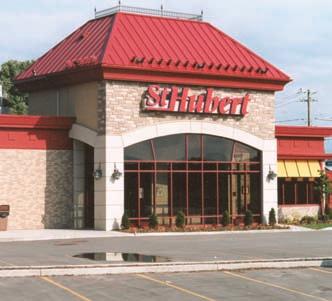
Jean-Pierre Léger (inset), president of St-Hubert restaurants, knows that his clientele will start requesting antibiotic-free (ABF) chicken.
development manager Derek Detzler says. And these clients are always ready to buy more.
Detzler believes broiler producers could be able to supply a large restaurant chain like St-Hubert with antibiotic-free chicken. Quebec producers would have to pool their efforts and most importantly, overcome all the hurdles that lay ahead of any farmer trying to stop using antibiotics. Fisher
Feeds is willing to share some of its experience, but not at the cost of revealing company secrets (see box).
RESTAURANT DEMAND
Production
QUEBEC ABF PRODUCTION
Attempts at antibiotic-free production came to an end last year at the Ferme du Coq de Bruyère, near Victoriaville. The farm was supported by the Coop des Bois-Francs, a member of the Coop fédérée network. Liquid dejections, temperature control problems and several other factors affected animal growth. Resulting financial losses caused the farm to return to antibiotic use.
At the Ferme des Voltigeurs, next to Drummondville, some flocks are raised successfully without antibiotics, but are not marketed as such. Among problems that are still occurring is a non-specific enteritis, affecting animal weight and flock uniformity. “We’ve hit a wall, but we’re still trying,” production vice-president Bernard Martel says.
Technical problems shouldn’t be the greatest obstacle to large-scale antibiotic-free production, says Jean-Pierre Vaillancourt, a professor at University of Montreal’s veterinary medicine faculty. “The problem is not that we need more research to be able to do it. It’s a matter of finding a (production and marketing) structure that will be advantageous for everyone.”
Vaillancourt believes it is absolutely possible to produce in Quebec the volume of antibiotic-free chicken St-Hubert restaurants are looking for. But one huge problem will have to be addressed right from the start: for each bird that matches exactly St-Hubert’s weight specifications, processors will have to find a buyer for five to six other birds for which they will have already paid the producer a premium for not using antibiotics.
To supply such an important client as St-Hubert (some six million chickens per year), all of Quebec’s poultry sector will have to come together, says Martin Dufresne, the president of Les Éleveurs de volailles du Québec (Quebec broiler and turkey producers). A committee of producers, hatcheries, feed mill operators and processors will soon be set up, he told Canadian Poultry magazine.
Continued on page 28
Fisher Feeds ABF Success
Fisher Feeds sells all of its broilers as antibiotic-free.
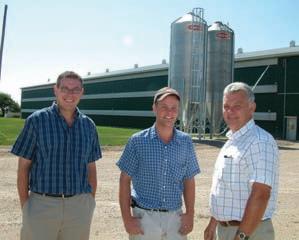
From left to right: Research and development manager Derek Detzler, farm manager Eric Martin and CEO Dr. Rae Fischer.
In southwestern Ontario , Fisher Feeds is now producing antibiotic-free broilers on all of its 14 farms. After five years, the trial and error period is now over. Over the last 12 months, its antibiotic-free production has jumped from 13,000 to 60,000 birds per week.
Fisher Feeds’ first move was to remove anti-coccidiosis drugs from the feed. Instead, the company used Intervet Schering-Plough’s Coccivac B vaccine for three rotations, but once winter hit, disease broke, and birds were give the original feed again.
The following year, the vaccine was implemented on a permanent basis. With proper ventilation and temperature control, the first winter went by with no major glitch. According to Detzler, performance was equal to or better than on a drug.
The second step involved replacing antibiotics used to control necrotic enteritis with natural products. “There are no magic bullets,” Detzler says. “But there are some products that have value. You just have to find the right combination.”
Fisher Feeds also opted for better nutrition. Chicks are fed with a red pre-starter, a feed that maximizes early uptake in the first five days. “Studies are clear that the more a bird eats post hatch, the better it performs and the stronger its gut health and immune system get,” Detzler says.
Management practices were also fine-tuned. In an attempt to anticipate disease outbreaks, more birds are weighted and more rectal temperatures are measured. Approximately 20 per cent of broilers still break out with necrotic enteritis, but Fisher Feeds found a way to treat them without antibiotic medication.
“At present, we are selling 100 per cent of our birds antibiotic-free,” Detzler says. “We are proud of what we do and we believe this is the future of chicken production.”
STAND OUT FROM THE CROWD WITH COCCIVAC®-B
As a top-level producer you have the smarts to make the grade in today’s poultry industry.
It’s time to reach for the next level with COCCIVAC®-B vaccine, the perfect match for your expertise in getting broilers to the market.
Combined with superior barn management, COCCIVAC-B vaccination can help establish long-term control of coccidiosis, reduce in-feed medication, and even let you raise antibiotic-free birds, while maintaining your current flock performance.
Find out how COCCIVAC-Bvaccine can be profitable for you - consult your veterinarian or call our technicalservices team at 1-800-605-2584.
PIC Update Exploring Gut Immunity
Research investigates how antibiotics are affecting the chicken intestinal and immune systems
BY TIM NELSON, EXECUTIVE DIRECTOR AND KIMBERLY SHEPPARD, RESEARCH CO-ORDINATOR
The use of antibiotics in poultry production has raised concerns about the development of antimicrobial resistance in microbes. Also of concern is the fact that antibiotic use often results in destabilization of the various bacteria in the gut – many of which help to develop and regulate gut function. Some bacteria are even capable of controlling food-borne pathogens such as salmonella and campylobacter . This suggests that imprudent use of antibiotics may potentially adversely affect animal health and also raises some food safety concerns.
It’s been reported that gut bacteria and changes in the microbial community could affect the chicken immune system. As the use of antibiotics in food animal production develops, having a better understanding of how antibiotics affect chicken gut microflora and the immune system could lead to the development of more effective antimicrobials.
Dr. Shayan Sharif and his research team at the University of Guelph in collaboration with Dr. Joshua Gong (Agriculture and Agri-Food Canada) have
been investigating interactions between antibiotics, gut microbes and the chicken immune system. They looked at the effects of virginiamycin on the various bacteria in the chicken gut. Their findings? They discovered that virginiamycin treatment altered the variety of bacteria, including beneficial bacteria within the Lactobacillus family (Lactobacilli are commonly used as probiotics in poultry production). Dr. Sharif and his team also showed that virginiamycin possesses immune enhancing properties and that by manipulating the gut microflora we may be able to positively impact the
Results of Dr. Shayan Sharif’s studies have provided critical information about how antibiotics are affecting the chicken intestinal and immune systems.
development of immune response in other parts of the body. These results have provided critical information about how antibiotics are affecting the chicken intestinal and immune systems. To read more, please visit www. poultryindustrycouncil.ca.
PIC Update
FEATURED RESEARCHER
Dr. Shayan Sharif graduated with a DVM degree from the Faculty of Veterinary Medicine, University of Tehran, Iran in 1991. The area of Dr. Sharif’s DVM thesis was genetic resistance to Marek’s disease in chickens, which sparked an interest in him to pursue a career in chicken immunology and immunogenetics. Upon graduation, Dr. Sharif worked for
close to two years in the broiler industry in Iran before migrating to Canada. He pursued a PhD program in the area of immunology and immunogenetics at the Ontario Veterinary College, Guelph. Dr. Sharif was recruited in 2001 as a faculty member and also a member of the PIC-sponsored Poultry Program Team by the Department of Pathobiology, University of Guelph. He is currently supervising a team consisting of four students, three technicians and twp post-doctoral fellows. There are three active research programs in Dr. Sharif’s lab: (1) Immunology and genetics of resistance against Marek’s disease, (2) Avian influenza virus immunity, and (3) Studies of chicken gut immune system in health and disease.
Methods for rapid, quantitative detection of listeria, salmonella and campylobacter contamination
Identifying methods to rapidly detect and identify pathogens in the food chain more efficiently has been widely researched over the last 20 years. One of the most promising detection methods for pathogens found in poultry and poultry products (e.g., salmonella, campylobacter and listeria) is polymerase chain reaction (PCR) technology. PCR allows for the production of millions of copies of a particular segment of DNA that allows scientists to use a very small sample, and from that sample, amplify a particular DNA sequence to detectable levels.
In order to raise pathogens to detectable levels, however, an enrichment period is usually required. This step is time consuming, rendering it less than ideal for practical use. The other disadvantage of PCR is that it does not allow for the detection of viable campylobacter, or the quantification of the actual number of pathogens in the original sample if an enrichment step is included.
There are currently several accepted (published) methods for the direct detection of bacteria in biological samples that do not involve an enrichment period. However, these meth-
Poultry Worker Award
Each year at the Annual Poultry Conference in November the industry recognizes an individual who has made a significant contribution to our industry. Anyone can nominate someone for this award. The nominations are then screened and references checked by an independent panel, who then make the final assessment and decision.
So many brilliant people work in our industry and it’s always very hard to select just one. The process takes time, so it’s really important that if you feel there is an individual who is deserving of this prestigious honour that you nominate them before Sept. 16, when nominations close.
ods usually use a very small sample size. Because pathogens are usually present in foods in low numbers and regulatory agencies require detection of as few as one cell per 25 grams of sample, large volumes should be used in the analysis to ensure that even one cell within that sample can be detected. To date, only a very small number of studies have successfully used larger samples for direct detection of very low amounts of pathogens in food.
To seek a solution to this conundrum Drs. Mansel Griffiths and Petra Wolffs at the University of Guelph have been developing a practical method for rapid quantitative assessment of salmonella, campylobacter and listeria – not only in end products but also within the production chain.
Their findings? Using a combination of a filtration “setup” and real-time PCR, Griffiths and his team have developed a method capable of detecting and quantifying salmonella and campylobacter simultaneously within four hours to levels equivalent to one cell per millilitre of sample. This is a big step foward in improving the efficiency and accuracy of rapid early detection of pathogens along the supply chain. To read more, please visit www.poultryindustrycouncil.ca.
Golf Tournament
Sept. 10, at Foxwood Golf and Country Club, filling fast. If you haven’t registered please do so today. Although we have increased capacity this year, we’re almost sold out.
Funded Research
This year 44 projects were received and of those the PIC has approved 26 for funding. The standard of applications was high. Those projects that have been granted funds are on the PIC website and details will be published in next month’s Canadian Poultry magazine. PIC is currently seeking supplementary funds to ensure that the 26 approved projects receive the maximum amount of funding possible >
MANSEL GRIFFITHS, UNIVERSITY OF GUELPH
PIC PICKS
to undertake the important work that has been proposed.
The Inaugural Poultry Innovation Conference
The first Poultry Innovation Conference will be held at Bingeman’s in Kitchener, Ont., on Nov. 10 and 11, and will offer two days of learning and networking for the whole industry. Day 1 comprises an afternoon of research reports in a similar format enjoyed by so many of you at this year’s Research Day. Day 2 will offer plenty for everyone with very practical sessions designed by producers for producers and industry service professionals. The day will culminate in a gala dinner to celebrate our industry. Spend some social time with friends and have the pleasure and privilege of hearing our guest speaker and one of our industry’s legends, Donald
PIC Update
McQueen Shaver, O.C. D.Sc.
Dr. Shaver will share his thoughts on today’s poultry industry, agriculture at large, the challenges that lay ahead and based on his vast experience and knowledge some suggestions on how to deal with them. This is an opportunity to hear someone who has “lived” the industry and played an integral role in shaping what we see today.
The opinions of this elder statesman of poultry are important, inspirational and informative – don’t miss this. For more information, call PIC.
Board Membership
Nominations for PIC Board membership for 2008/09 close on Aug. 31, 2008. Individuals interested in making a difference in our industry through research and education are invited to apply.
Please contact PIC for details or Bob
Guy at OBHECC who is the chairman of the PIC Nominating Committee.
Annual Meeting
This year’s Annual Meeting (all members are encouraged to attend) will be held at the Victoria East Golf club at 11-30 a.m. on Oct. 7. The meeting will be followed by lunch at the club at 12 noon provided by PIC.
Prior to the meeting we will be running a “report and review” session looking at the current research and the new proposals, and updating the Ontario Poultry Industry R&E Strategy – more details on this event will be published in next month’s Canadian Poultry magazine.
For more details on any of the items in the PIC Update please contact PIC at 519-837-0284 or e-mail us at pic@ poultryindustrycouncil.ca. ■
Feed
Mycotoxins: Their effects on health
Despite common thought, turkeys are susceptible to deoxynivalenol mycotoxin
BY H.V.L.N. SWAMY, PHD ALLTECH CANADA, GUELPH, ONT.
Did you know that mycotoxins are the second most important issue faced by the animal industry today next only to feed cost? This sentiment was expressed by 30 animal industry leaders – representing 15 per cent of world feed production – who attended Alltech’s President Club recently. A part of this increased concern on mycotoxins can be attributed to phenomenal increase in the cost of feed ingredients and the subsequent increased dependence on alternative raw materials.
MYCOTOXINS COST MONEY
In Canada it is often difficult to obtain a control feed free of mycotoxins to conduct animal research, thus exemplifying the magnitude of the problem. In support of the economic consequences of mycotoxins, a recent publication in the Journal of Agricultural and Food Chemistry estimates a loss of $147 million to the U.S. swine industry due to fumonisin mycotoxin alone¹. What would be the loss due to more than 300 known mycotoxins and thousands of unknown or masked mycotoxins to the entire livestock and poultry industry?
‘FIELD’ FUNGI AND MYCOTOXINS
Field fungi invade the seeds while the crop
MYCOTOXINS EXPLORED
H.V.L.N. Swamy discusses mycotoxins and their effects on turkeys, and how CFIA regulations need to be revisited.
is still in the field and require high moisture conditions (20-21 per cent). These include species of Fusarium, Alternaria, Clodosporium, Diplodia, Gibberella and Helminthosporium
The predominant Fusarium mold that infests grains in Canada is Fusarium graminearum (refer to Figures 1 and 2) but Fusarium proliferatum, Fusarium verticilloides, Fusarium moniliforme and several other Fusarium species cannot be ruled out.
The most frequent mycotoxins occurring in Canada from these molds include
deoxynivalenol (DON or vomitoxin), zearalenone (ZEA), T-2 toxin, HT-2 toxin, diacetoxyscirpenol (DAS), fusaric acid etc.
•
•
•
•
•
• Available in 24" Variable Speed and 36" Single Speed
• One piece polyethylene housing creates the most efficient venturi, resulting in incredible C.F.M.performance. (24" =10,200 C.F.M. @ 18 cfm/watt and 36" = 15,300 C.F.M. @ 26 cfm/watt.)
• A multi-position bracketallows youto tilt and lock the fan angle and air flow direction
“AIRCOOL” Centrifugal Cooling System
• A cooling system without using nozzles
• Adjustable water volume
• Mobile or stationary unit available
• Use for cooling air, humidity, recirculation, dust and odor control
RECIRCULATION FANS
Circular Recirculation Unit
• 16" and 20" diameters
• 3600 coverage using directional wind vanes
• Superb alternative to race tracking
• With Multifan or Performa+ Leeson motors
Circulating Fan
• 12" – 24" diameters • Polyethelyne housing
• with Multifan or Performa+ Leeson motors
The ‘Wave’Environmental Control
• Large 2.75" X 5" LCD Display Screen and 12 Quick Key Pads (to grouped settings) allows easy and precise Temperature, Humidity, Heating, Lighting and Airflow Management
• The ' Wave manages 4 variable stages and 8 or 16off/on relays for cooling, up to 8heaters, 4 clock outputs and up to 8 inlet zones
• Humidity control by increasing ventilation and heat activation
• History of water consumption, temperature, humidity and birdcount
Poultryhouse Fan
• High quality material and aerodynamic air inlet
• Variable speed Performa+ motor
• Dual voltage, fully enclosed motor
• Low energy consumption and noise level
• 16" and 20" modelsproducing 2792 and 4770 cfm
• Includes hanging hardware
A SMARTER OPTION FOR ADMINISTERING SOLUTIONS
INTO WATER SYSTEMS
• Select Doser performance yields highly accurate dosages all the time.
• Accuracy is 95+ percent, superior to water or electric powered pumps.
• Longer lasting with less maintenance than water powered dosers.
• A diagnostic tool for your watering system.
PSI
Unvented Unit Heater
• Total stainless steel construction
• Hi-Low switch
• Watertight enclosures
• Propane and natural gas
• Available in 20,000 to 225,000 BTU units
Totally Controlled Heat from
' The Ultimate Brooder '
• Maximum radiant surface area
• Reliable spark ignition
• Dual safety pressure switches
• Easy, unobstructed access to control components
• Various models for multiple applications (Farms, Garages, Workshops etc.)
Varifan®
• LX-641, LX-642 and LX-644 with optional SVM-1 (Smart Ventilation Inlet Module)
• DIP-1 digital Inlet Positioner
• ECS"M" Series 1, 2, 3, 4 and 5 stage controls
• IC-610 Programmable Logic Computer controls
• Plus numerous ‘Special Application’controls
• 2 yr.warranty
Feed
‘STORAGE’ FUNGI AND MYCOTOXINS
Storage fungi are those that invade grains or seeds during storage, need less moisture than field fungi (13-18 per cent) and usually do not present any serious problem before harvest. Storage fungi include species of Aspergillus and Penicillium Among the two, Penicillium fungi are more common in Canada, especially in the Manitoba region. Ochratoxin A and citrinin have been detected in grains such as wheat, rye, barley and oats, which were overwintered in the field due to weather at harvest time in the autumn.
Aspergillus species are less common in Canada, although they do occur. Aspergillus ochraceus produces ochratoxin A, whereas A. parasiticus and A. flavus produce various aflatoxins. These fungi occur predominantly in areas of high temperature (68+ F) and high humidity. Aflatoxicoses can possibly be a problem for animals and humans who consume products such as peanuts and cottonseed meal imported from warm or humid countries.
CANADIAN POULTRY FEED REGULATIONS
• Material polypropylene
• Will not harbour bacteria
• Easily cleaned
• Large 2' x 4' panels
• Reduces floor problems and breast blisters
• Keeps birds warmer, dryer, more productive
• Durable - minimal maintenance
• Easily installed
• Will not rust or corrode
LIGHT TRAP/ DARK OUT
• High light reduction
• Low resistance to air flow
• Simple Installation
• Easy to clean
• Uses P.V.C.snap release spacers
The Canadian Food Inspection Agency has set upper limits for several mycotoxins in poultry feeds (Table 1). Based on these limits and some of the research conducted on mycotoxins using purified DON, it was concluded that poultry may be resistant to DON.
This was the impetus for Prof. Trevor Smith’s laboratory at University of Guelph to initiate research on feeding DON-contaminated grains (corn, wheat and barley) to various classes of poultry and study the impact of mycotoxins on performance, neurochemistry, immunity and gut health.
The term “DON-contaminated grains” is generally used to imply grains contaminated with DON and several other Fusarium mycotoxins. The summary of the research conducted in turkeys using DON-contaminated grains at University of Guelph is presented herewith. In all the four trials turkey poults were fed three diets from 0 to 12 weeks; (1) Control diet with low level of mycotoxins, (2)
TABLE
Feed
Mycotoxin Maximum limit (ppb)
Aflatoxin B1+B2+G1+G220
Ochratoxin A2,000
T-2 toxin1,000
HT-2 toxin100
Diacetoxyscirpenol1,000
DON5,000
Ergot alkaloids9,000
Contaminated diet containing mycotoxin-contaminated corn and wheat and (3) Contaminated diet with Mycosorb® – a polymeric glucomannan mycotoxin absorbent (Alltech Inc.) derived from the cell wall of yeast.
ARE TURKEYS SUSCEPTIBLE?
Here are the results of these trials:
Trial 1: Turkey poults fed diets naturally contaminated with an average of 9.6 ppm DON, 0.9 ppm 15-acetyl DON and 0.6 ppm ZEA. They observed reductions in weight gain, plasma total protein, albumin, globulin, calcium, bilirubin and uric acid concentrations (data not shown).2
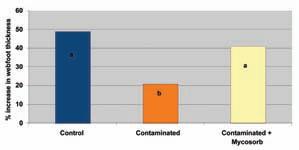
Trial 2: Turkey poults fed the same levels of mycotoxins as in Trial 1. They observed a decrease in cell-mediated immune response to dinitrochlorobenzene (DNCB) measured as per cent increase in web foot thickness.3 This implied that long-term consumption of grains naturally contaminated with Fusarium mycotoxins could render turkeys susceptible to infectious diseases where CD8+ cells play a major role.
Moreover, the results pertaining to biliary IgA indicated a need for investigation of the impact of Fusarium mycotoxins on the resistance of turkeys to intestinal infections such as coccidiosis. The research on this aspect is in progress.
Trial 3: A study was conducted similar to Trials 1 and 2, but at levels of mycotoxins three times lower.4 These levels represent the actual levels encountered in the field. DON levels in these studies were around 3 ppm. Birds fed contaminated
1. CFIA UPPER LIMITS FOR MYCOTOXIN CONCENTRATIONS IN POULTRY FEEDS
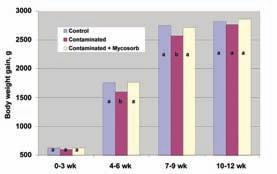
grains grew slower (Figure 3) and showed decreased cell-mediated response to DNCB (Figure 4). These observations were same as in Trial 1 and 2 and further confirmed that DON-contaminated grains depress growth and cell-mediated immunity even at low concentrations. The decrease in cellmediated immunity indicated that turkeys exposed to DON-contaminated grains will be less prepared in an event of disease outbreak.
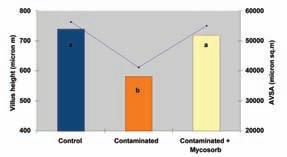
Trial 4: Study same as in Trial 3 but the focus was on gut health.5 Mycotoxin concentrations in contaminated diets are same as in Trial 3. Feeding of contaminated grains reduced villus height and absorptive villus surface area (AVSA, Figure 5) in duodenum and jejunum but not in ileum. The reduced villus height and AVSA may contribute to reduced nutrient absorption in duodenum and jejunum ultimately affecting production performance as observed in Trial 3.
Feed
It is possible that levels even lower than 3 ppm DON from naturally contaminated grains can compromise performance and health of commercial turkeys. One of the
reasons for this is that, unlike turkeys in the research facilities, turkeys in the field are subjected to various stressors related to environment, management and nutrition.
FIGURE 1: EFFECT OF LOW LEVEL DON-CONTAMINATED GRAINS ON BODY WEIGHT GAIN
FIGURE 2. EFFECT OF LOW LEVEL DON-CONTAMINATED GRAINS ON DTH RESPONSE TO DNCB
FIGURE 3. EFFECT OF LOW LEVEL DON-CONTAMINATED GRAINS ON VILLUS HEIGHT AND ABSORPTIVE SURFACE AREA IN JEJUNUM
These stressors compromise the immune system and enhance the immunosuppressive effects of mycotoxins. Another reason is that a significant amount of DON and ZEA can be present as masked mycotoxins in contaminated grains thus escaping the routine mycotoxin detection procedures.5 For this reason, their toxicity is underestimated, yet they are exerting adverse effects on turkeys.
Feeding Mycosorb® reduced the market days of turkeys exposed to mycotoxins by 3.2 days.
PREVENTING NEGATIVE EFFECTS
In general, pre-harvest control of mold growth is somewhat compromised by the inability of man to control the climate, since both insufficient and excessive rainfall during critical phases of crop development can lead to mold contamination, spoilage of grain, and mycotoxin production.
However, the post-harvest handling of grain presents many more opportunities for controlling mold growth and its consequences. Careful drying of grains and good storage management should minimize post-harvest fungal growth and therefore, mycotoxin production. Removal of affected grains, dilution of contaminated grains with clean grains, and the dietary inclusion of a broad-spectrum mycotoxin binder can be beneficial in reducing the negative effects of mycotoxins on poultry.
Similar to commercial layers, in the studies discussed above, feeding of Mycosorb® prevented most of the negative effects caused by DON-contaminated grains in turkeys (Figures 1, 2, 3).2-5 Turkeys fed Mycosorb® achieved the market weight 3.2 days before the turkeys fed mycotoxin-contaminated diet.
CONCLUSIONS
Unlike the popular belief turkeys can be susceptible to DON-contaminated grains. Caution must be exercised when diverting DON-contaminated grains into turkey diets. The findings may also suggest the need to revisit the guidelines set by Health Canada on maximum allowable concentrations of DON in poultry feed.
Feed
Producers can minimize economic losses from mycotoxins with the use of a mycotoxin absorbsent. ■
REFERENCES
1. Wu and Munkvold. 2008. J. Agric. Food Chem. 56:3900-3911.
2. Chowdhury and Smith. 2007. Can. J. Anim. Sci. 87:543-551.
3. Chowdhury et al., 2005. Poult. Sci. 84:1698-1706.
4. Girish et al., 2008. Poult. Sci. 87:421-432.
5. Girish and Smith. 2008. Poult. Sci. 87:1075-1082.
Ph: (877) 267-3473 • Fax: (877) 624-1940
New Development in Reproduction and Incubation of Broiler Chickens
The “Problem” and “What does it mean?” format makes this book easy to use and will make it a useful tool in staff training. My copy of this book will soon be well worn as I refer to it, and use it to explain the science behind our program to our hatching egg producers.
– Martin Dyck, Breeder Manager, Lilydale Foods, Alberta Robinson, Fasenko and Renema have taken highly technical information and presented it in a way that is both interesting and informative to a wide audience. New Developments in Reproduction and Incubation of Broiler Chickens is not only a useful reference, but also a valuable teaching tool for both the classroom and the field. It will be a practical guide for both academic and industry professionals.
– Dr. Derek Emmerson, VP Research and Development, Aviagen NA.
Item #: 0973101237
Optimizing Chick Production in Broiler Breeders
Managing the broiler breeder is often considered more art than science. Thankfully, the team at the Alberta Poultry Research centre has succeeded in compiling their research efforts into a reference that brings understanding to the art as well as depth to the science. Great graphics and pictures, logical format and the “What does it mean?” section after each article make this valuable resource tool a ‘must have’ for the broiler breeder production and hatchery managers in the field.
Item #: 0973101210
Production
Continued from page 18
“If we are to remove from the feed all products that classify as antibiotics – even ionophores, which some consider to be like antibiotics – it will be a big challenge,” Dufresne said.
Not all broiler producers are ready to improve their farm management to the point of no longer relying on antibiotics, Vaillancourt says. “We are asking them to produce without a safety net.”
However, according to Vaillancourt, many of them are up to the challenge and are already trying to minimize the use of antibiotics.
Production cost increases will vary significantly between farmers, Vaillancourt warns. Those with lower than average bird density will enjoy a smoother transition. Others will be faced with additional costs that could translate into 20 cents more per kilogram. This will definitely impact prices on St-Hubert’s menu.
But will this chicken really be better for human health? Many have doubts. Current regulation prevents the use of antibiotic drugs in the days before a bird reaches maturity. What’s left of antibiotics in the meat is more than a hundred times lower than accepted safety levels, Vaillancourt says.
However, Vaillancourt admits that a link does exist between antibiotic drug use in animals and resistance to antibiotics in human beings. But many believe that exaggerated use of antibiotics in human medicine is by far the greatest cause of human resistance.
If consumers request chicken raised without antibiotics and are willing to pay for it, then producers will respond, Dufresne says. But according to him, nothing really proves that this will be better for consumers’ and animals’ health.
“It’s like grain-fed chicken. What proves that it’s better or not? Chickens are omnivorous animals. When they are not fed animal protein, we can see that they don’t feel as well,” Dufresne says.
There is no need to produce antibiotic-free chicken to save humanity, Vaillancourt adds. “It’s more a matter of keeping up to date and improving. If we are able to, then why shouldn’t we do it?” ■
Business Profile Sunrise Farms
With a knack for the chicken processing business and the right timing, Peter Shoore has built the largest individual chicken processing plant in Western Canada
BY DAVID SCHMIDT
How did a Vancouverite of Scottish heritage who studied classical music in the Netherlands for seven years become an icon in the Canadian chicken industry?
“Fate” says Peter Shoore, who is celebrating the 25th anniversary of Sunrise Farms, formerly called Sunrise Poultry. “It’s a case of being in the right place at the right time.”
After earning his doctorate in music in the mid-1970s, Shoore decided to return home rather than remain in an overcrowded Europe. Deciding he couldn’t make it as a classical musician, Shoore went to work in his father’s small cannery where, among other things, he canned whole chicken.
That led to an offer from White Spot, a chicken-based restaurant chain then owned by General Foods, to run their small money-losing chicken processing plant in Surrey, B.C. He was an instant success.
“It clicked with me,” Shoore says. “Operating a chicken processing plant turned out to be something I was really good at.”
The plant was located on leased property, with the lease set to expire in early 1983. After General Foods made a failed half-hearted attempt to buy the property, Shoore was prompted by his mother to
Peter Shoore has increased capacity at Sunrise Farms from 25,000 to 600,000 birds/week, including a hatchery, further processing plant and a massive live haul fleet to the operation.
make an attempt of his own.
It was the first of many “gutsy moves” Shoore has made over the past 25 years. In fact, his holding company is fittingly called “High Noon Enterprises.” (Shoore’s various operations are structured as separate companies, which are in turn owned by the holding company. “My employees are on profit-sharing plans and I only want them to benefit from the company they’re directly involved in rather than
the whole operation,” Shoore explains.)
When the lease expired, Shoore simply told White Spot, which itself was in the process of being sold and which remains one of his customers, the lease would not be renewed, effectively daring them to remove their equipment. They didn’t – selling it to him instead.
At the time, the plant was about 20,000 square feet and killed about 25,000 birds/ week. It has since grown to 120,000 square
GOOD TIMING
Business Profile
feet and now kills over 600,000 birds/ week.
While still number three overall in British Columbia. (Lilydale and Hallmark are both bigger processors), Sunrise’s Surrey plant is the largest individual chicken plant in Western Canada. Shoore’s operations also includes a hatchery in the Fraser Valley, a former beef plant which is now used primarily for packaging and storage, a further processing plant in Abbotsford, a massive live haul fleet and, most recently, a hatchery and processing plant in Lethbridge. Among them, the various operations employ about 1,000 people. Shoore also owns three broiler farms in the Fraser Valley.
Shoore admits his timing to get into the business couldn’t have been better, displaying the B.C. Chicken Marketing Board’s annual production graphs to prove it. After flat production in the late ’70s and early ’80s, the market “went stupid” in 1983. Production has increased almost every year since and is now triple what it was 25 years ago.
Others may call it lucky, but Shoore prefers to think “we created the wave.” Unlike many others, he thinks the end is not yet in sight.
“We see a lot more growth in raw,” he says, “it would require looking for new markets but the will to do that doesn’t seem to be there in Canada.”
While he recognizes feed prices have skyrocketed and are putting the brakes on growth, he believes that is only temporary. He insists the increased feed costs are actually good for chicken, saying “the more expensive feeds become, the more reasonable chicken becomes.”
He points out that not only is chicken a much more versatile meat, meaning it can be used in a wider variety of dishes than beef or pork, but it takes only two pounds of feed to produce a pound of chicken, as compared to four pounds of feed for a pound of pork and eight pounds of feed for beef.
“Our company is always pushing for more growth. Eventually the hog price will go up and when it does, a lot more chicken will be required.”
Because chicken supply is so tightly controlled, he decided “the only way for us to grow is through further
Canadian “FLY THE
COOP”
Congratulations, you have found Brewster!
Record the page number and issue date where this ad is located on the contest ballot located at the Intervet insert in the centre fold of this magazine. Complete the remainder of the information on the ballot, attach a first class stamp and mail to: Great Canadian “Fly the Coop” Get Away Contest, c/o Canadian Poultry Magazine, Annex Printing and Publishing Inc., P.O. Box 530, 105 Donly Drive South, Simcoe, Ontario, Canada N3Y 4N5. Good Luck!
to our winners
MAY 2008
Willie Kleinsasser Jenner, Alberta
JUNE 2008
Amy Bouwmeester Rockton, Ontario
Business Profile
processed.” He therefore built his further processing plant. His forseight was justified: Opened in 1997 with one line, it now operates three cooking lines. The products are sold in both retail and HRI (hotel, restaurant, institutional) markets across Canada.
Prizes sponsored by Intervet Canada, 250 Water St., Whitby, ON, L1N 9T5
SHOORE SEES AN OPPORTUNITY TO GROW THE BUSINESS IN THE FURTHER PROCESSED AND RAW MARKETS.
The further processed plant is just one of Shoore’s innovations. In 1991, Sunrise was the first processor in Canada to go to a tray-catching system, which is not only used with automated catching machines but also allows automated loading of the killing line.
Shoore has seen tremendous change in the past 25 years, not the least of which is change in the chicken itself. When he started, chicks were sexed and it took cockerels 6 weeks and 3 days and pullets 7 weeks and 3 days to reach 3.8 pounds live weight. Today mixed flocks reach the same weight in just 32 days.
“If we sexed the birds, we could probably bring cockerels in at 28 days,” he states, adding he expects production time to continue to shorten a day/year for the next five years. “We now worry about the size of chick which goes to the barn and the actual time it gets delivered and later picked up.”
While he has faced few adversities in his 25 years, Shoore admits he was stumped by when the avian influenza outbreak hit in 2004. “That was my most difficult time in the industry because I literally didn’t know what to do. I left it up to my managers and they decided
Experience...That’s the Braemar Difference.
Business Profile
to bring in birds from outside. It was logistical nightmare but it worked.”
While AI was an expensive lesson for all sectors of the industry, Shoore doesn’t believe the lesson has been learned.
“I don’t think anyone has done a good enough job of preventing another recurrence. Producers don’t have any better biosecurity now.”
While AI remains a huge threat, urbanization may be an even bigger threat. It not only faces farmers, whose practices are under siege by increasingly urbanized neighbours, but also the processing plants whose once relatively isolated locations are now surrounded by more upscale “clean” industries and even urban residences. Yet Shoore does not relish the prospect of moving.
“If they told (the processing plants) tomorrow we were gone, where would we find land with adequate water and sewer?” he asks.
Shoore admits B.C. processors and B.C. producers continue to have a running battle over price, but has little sympathy for complaints that grower returns are insufficient.
“The fiscal year of our own farms ended in April and we had a record year,” he claims.
He suggests producers having a tough time making it should look inward. “I see returns from a good producer to a bad producer are quite different. There is also a big discrepancy between feed companies. Producers need to put more pressure on there.”
After 25 years in the business, Shoore is giving more responsibility to his upper management and starting to groom his son to take over.
“He just finished his first year at the University of the Fraser Valley and we want him to get an MBA.”
His son is also learning every aspect of the business.
“He has worked on the catching crew, done chores on the chicken farm, done all the jobs in this plant and is now working in the hatchery.”
But that doesn’t mean Shoore intends to quit the business anytime soon. “I wouldn’t know what to do with myself if I retired. I hope they carry me out of here.” ■
PLEASE CHECK ONE:
❑ Poultry Producer or Employee
❑ Government, Libraries, Schools, Universities
❑ Hatchery, Hatchery Employees
❑ Fancy or Show Poultry
❑ Wholesale Produce and Processors, Further Processing
❑ Equipment Manufacturers
❑ Drugs, Laboratories, Vaccine Companies, Chemical
❑ Veterinary and Lab Technicians
❑ Feed Manufacturers, Feed Additives, Distributors and their Salespeople
❑ Other (please specify)
Cheque - Payable to Annex Publishing & Printing Inc.
Good location with 18,658 units broiler breeder quota. 1 grower barn and 2 layer barns. Newer home with 6 bedrooms.
EDMONTON AREA
10 acre broiler farm with 36,600 units broiler quota. 3 Barns and insulated and heated shop. Beautifully renovated log home with 5 bedrooms.
BROILER BREEDER FARM
60 acres with 2 barns (50’ x 300’ and 44’ x 289’), 9126 + 1300 units annualized quota. Vencomatic & Van Gent nesting & egg gathering systems. 1230 sq. ft. bungalow with 5 bedrooms.
If you are looking to buy or sell a poultry farm, Andries
N1A 1G2 Phone 905-774-7624 or Toll
GRIMSBY AREA: 10 Acres on paved road. 32,000 sq ft of barns with auto generator. 40 x 60 x 2 driveshed used as retail outlet. 3 bdrm century brick home, pool. Call Jack
NIAGARA AREA: 45,000 sq. ft. of barns, small acreage, 3+2 bdrm home, natural gas heat. Nipple drinkers, pan feeders, radiant tube heaters. 14,000 Quota available at market price. Indoor pool and paved road location. Call Jack.
EXECUTIVE FARM ON 30 ACRES: Brick 4 bdrm, 4 bath home. Hardwood floors and ceramic, full finished basement with 2nd kitchen. 2 car garage-workshop and large barn rented long term at $800.00/month. Paved road. Priced at $599,000.00 Call Jack.
SOLD
QUOTA: 8,000 H.E.M.S available. Call Jack for details
FARMERS FARM: 1000 Head finishing barn. Total Slats. Auto Sort. Chicken barn set up for Partridge. Sold on weekly schedule. Workshop 30’ x 110’. 3 bdrm home all on 50 acres of land. Call Jack
ATTRACTIVE POULTRY FARM: East of Bismark. 2 barns, 300’x 40’x2 and 44’ x 30’ x 3. Insulated workshop. Emu fenced yard & shed. 78 acres with small woodlot. $650,000.00. Call Ross.
Howard Culligan, Broker of Record Direct: 519-272-5413 Bus: 519-348-4706 Fax: 519-348-4130 howard@culliganrealty.com
12,000 units of layer quota
Additional buyer seeking 18,000 units of layer quota. \
For more information call Howard Culligan, Broker of Record at 519-348-4706 or 519-272-5413.
Alex Veens, Real Esate Broker Tel: 519-522-0667 Fax: 519-522-0668 aveens@tcc.on.ca
Appropriately on July 4 the Globe and Mail ran an editorial subtitled “Doha is dying.”
While the Globe didn’t get into the specifics of what happened – talking about differences between developed and developing nations,the recently passed U.S. farm bill – which has more to do with vote buying than farm stability – played a role.
Amazingly, the new farm bill promises to prop up grain producer incomes while grain prices surge to record highs.
Or perhaps it isn’t all that amazing. U.S. politicians – like politicians in Canada, Europe and elsewhere – know how to count votes and know that votes in Iowa, Kansas, Montana and Missouri count while those in Africa, Asia and South America don’t.
As a result they decided not to change any of the policies that sparked international interest in a new trade agreement. They seemingly also decided to ignore international food shortages and sky-high grain prices to continue pouring billions of dollars into grain ethanol subsidies.
If you add to that the reluctance of some European nations to accept substantive change to Europe’s farm policies and the reluctance of developing nations to open up their markets to trade in services, then you have a recipe for Doha failure.
Very soon there will be a round of last gasp negotiations. These negotiations could be very, very dangerous.
Trade negotiators and departing politicians like George Bush and the rest of his administration want to leave a legacy. Perhaps they will cobble together some sort of deal. It would, after all, be deeply embarrassing and perhaps fatal to the future of the WTO, if nothing came from almost seven years of talk.
This makes it a potentially dangerous time for Canada’s supply-managed sector. An easy out for most countries would be to opt for reductions in tariffs and TRQs like the ones that protect Canada’s poultry and dairy industries.
Europe, the U.S. and others would be able to proclaim success while Canada would be left trying to figure out what to do. Canadian farm leaders and politicians are well aware of this risk but may have to work extremely hard to ensure it doesn’t happen.
Meanwhile there has been a lot of talk in recent months about helping Third World nations become more self-sufficient in food.
To its credit Canada changed its food aid program so that Canadian aid money can be used to buy food from farmers in or near the distressed region. This should help.
For too long developed nations undercut farmers in developing nations. If this were the result of superior efficiency it would have been economically excusable.
But it began, not because of efficiency, but because of political expediency in the U.S.
Way back in the 1960s the U.S. decided to make a major change in its farm policy. Unofficially, but accurately, the policy was called “cram it down their throats.”
Under the policy the U.S. adjusted its grain export subsidies daily and set them at levels that undercut both competitors and local producers.
While this made life difficult for Canadian grain growers and the Canadian government, it was absolutely devastating for farmers in poorer nations.
An example of what was happening occurred in 1967. Concerned about rising subsidies and collapsing prices the U.S., Canada, Australia and other exporters signed an international grain agreement, which set a floor price for wheat. Within months the U.S. followed by Australia and others subsidized their way through the floor.
There was a brief respite in the 1970s when the former Soviet Union jumped into the international market with huge purchases and pushed prices up.
But that was temporary and didn’t change policy fundamentals.
U.S. Agriculture Secretary John Block said in 1986: “The idea that developing countries should feed themselves is an anachronism from a bygone era. They could better ensure their food security by relying on U.S. agricultural products, which are available in most cases at lower cost.”
What Block didn’t say was that U.S. prices were lower because of subsidies.
He also didn’t say that the price of cheap grain and other farm products would include political instability as local farmers left the land to search for nonexistent jobs in the cities and greater food insecurity.
Now with widespread food shortages the world is trying to recover what was lost and is reversing Block’s policy and encouraging more food self-sufficiency.
But rebuilding local agriculture is proving devilishly difficult in a time of high fuel and fertilizer prices.
Even the Malawi model of giving small farmers a package of fertilizer and seed at discounted prices is proving expensive. This is unfortunate because in Malawi the result was a dramatic jump in production and self-sufficiency.
It seems to me that the goal of any agricultural trade deal should be to ensure that everyone, everywhere has enough to eat. If that means that some countries have trade barriers to protect their farmers from subsidized, imported products, then so be it.
Maybe Doha is dying – maybe it deserves to. ■
reliability profitabilitytraceability
It’s what you need in a feed additive and Alltech delivers on all three counts.
Through 25 years of research-driven product development, we’ve created a range of natural products that support optimal animal performance — products that are proven reliable, traceable and profitable...naturally.
For more information on our products contact Alltech Canada at 1-800-285-8617
ARITIMES: TIN KAISER
Wetaskiwin, A
80.352.8076
80.352.8091 ser@telusplan
00.263.6410
05.765.3922 .theclarkcompa singer@wmurr
• Mu
• Pul
• A-F
• Bro
• Flo
• Ma
• Lay
• Ven
• Sys
• Cho
• Can
• Exp
lti-deck Laye let Rearing S rame System iler Cage Sys or Systems nure Pelletize er Floor Syst tilation Equip tem Controlle ice of Drinke adian Wareh erienced Sta fessional Ins
The Fa System atmosp walls p the sys future c addition Plastic floors r help im quality. The do cage. The sm fitted a nesting scratch
mer Autom creates a p here for lay ovide fast, em and en onversions s to the sy erches and duce stres prove egg p rs ensure s all group co cording to boxes, per ing area.
tic Enricha leasant, pro ing hens. It imple parti ure flexibili or extensio tem. plastic-coa for the bir roduction a pacious acc mpartment U regulatio hes, nail cu