A dissertation presented to the School of Architecture, Oxford Brookes University, in part fulfilment of the regulations for BA (Hons) in Architecture.
Statement of Originality
This dissertation is an original piece of work which is made available for copying with permission of the Head of the School of Architecture.
Signed
ANNABEL WILKS
Acknowledgements
I would like to thank my parents, Emma and Andrew, as well as my supervisor, Justin Chapman, for all of their time, support and encouragement throughout my dissertation.
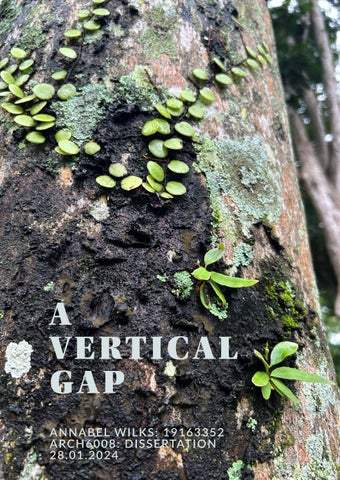
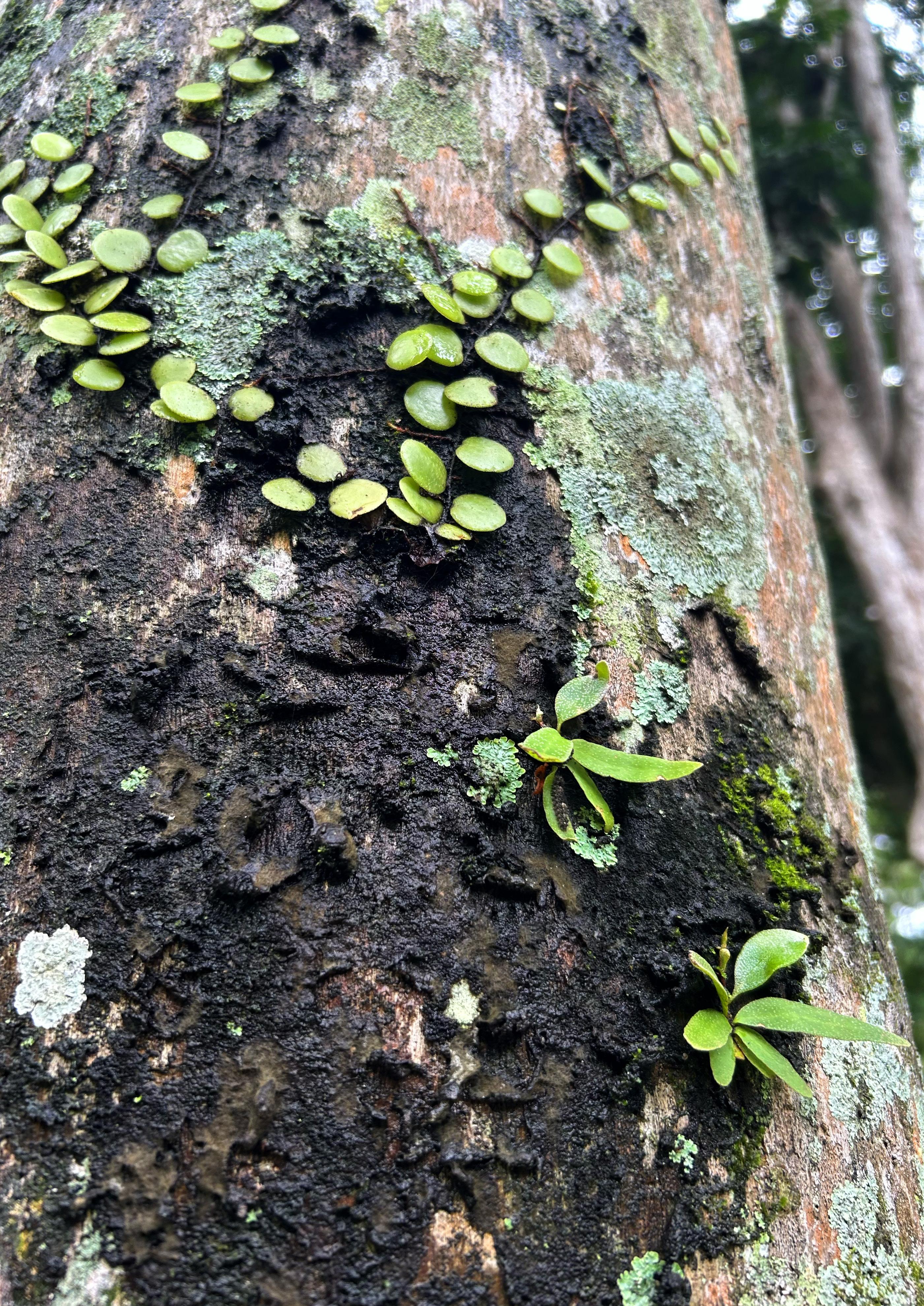
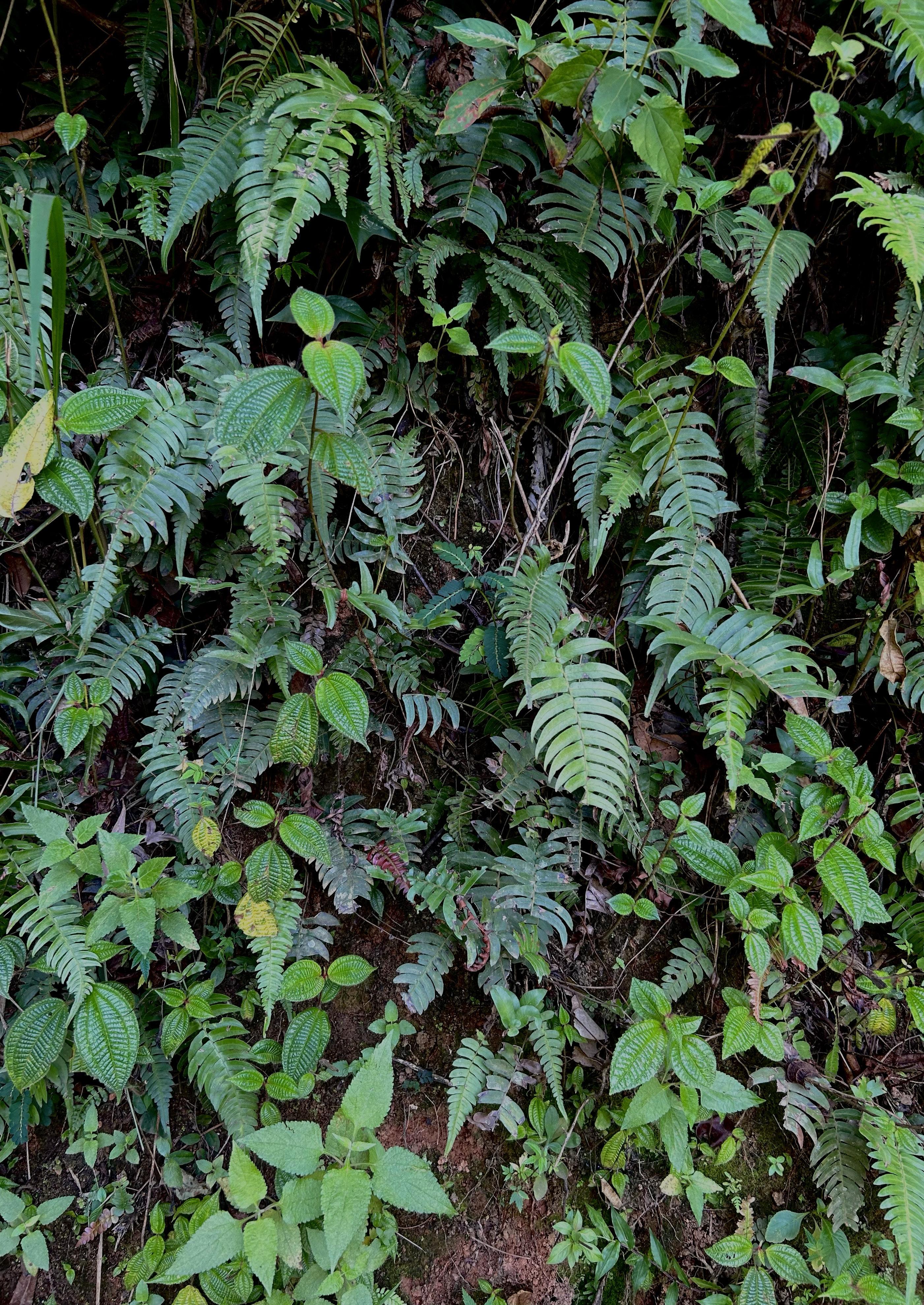
(Cover image) [Fig. 1] Tropical plants growing freely upon a large tree trunk in Sri Lanka (Wilks, 2023)
Contents
ABSTRACT
INTRODUCTION
An ecological perspective
LITERATURE REVIEW
Ecological importance
The demand for space
Room for inclusion
METHODOLOGY
CHAPTER ONE: THE RELATIONSHIP BETWEEN NATURE AND THE BUILT ENVIRONMENT
How green are we? Identifying barriers to changing perspectives
Biophilic design: a solution or part of the problem?
Re-education for re-introduction: changing minds to incite change
CHAPTER TWO: HOW GREEN IS GREEN DESIGN?
Revisiting the past to shift human-centred design perspectives
Natural Reason towards design reformation
Greening urban infrastructure: The ecological challenge
CHAPTER THREE: A VERTICAL GAP
A vertical gap
A new concept to aid urban ecology
CONCLUDING STATEMENT
BIBLIOGRAPHY OF REFERENCES
IMAGE REFERENCES
ABSTRACT
Throughout human history, mankind and nature have coexisted in a bilateral accord. However, with increasing technologies, the ability for our built environment to exert unparalleled control over the natural world has seen the once amicable relationship become unbalanced and exploitative.
What if instead we assimilated the knowledge held by our ancestors, and learnt from the natural world to re-frame our thinking. By re-introducing the importance of the planet's ecology back into our design practices we might enable nature back into our built spaces, unconstrained by the innate human desire for control.
RESEARCH QUESTION: HOW THE REDESIGN OF URBAN GREENING STRATEGIES IN BRITISH URBAN ENVIRONMENTS MAY ENABLE A BUILDING TO ENHANCE ITS LOCAL ECOLOGY.
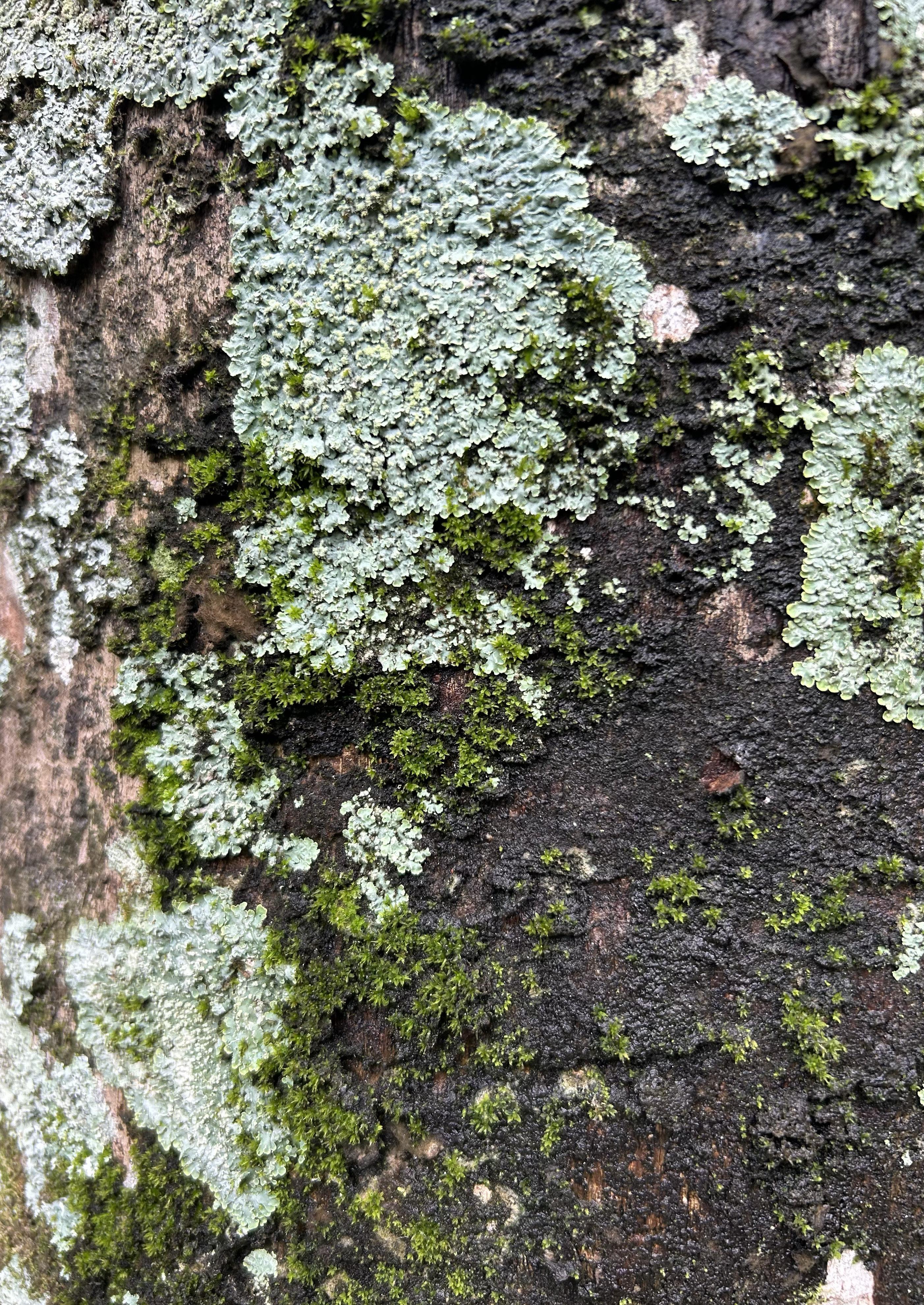
(Next page) [Fig. 2] Lichen [Parmelia caperata] and green moss [Dicranum scoparium] growing on a tree trunk in Sri Lanka (Wilks, 2023)
Introduction
An Ecological Perspective: Combating Human-Centred Design
While at first glance strategies such as urban greening seem an obvious way to benefit both humans and nature, a more nuanced investigation into these ‘sustainable’ design methodologies shows, in the majority of cases, we - mankind - are the true clientele influencing design decisions and developments. Any local or global ecological enhancement that results from a project centred around human needs can now be labelled as a deliberate and tactful design decision. However it could be argued that in actuality these results are an after-effect elicited from the ‘sustainable’ design decisions that were chosen to benefit the human clientele. I believe this clear neglect of ecological importance and its minimised inclusion into design processes has resulted in a lack of societal understanding of the issue. It has consequently led to a social blanket assumption that any urban greening must be ecologically beneficial, even if it hasn’t considered the site specific needs of local ecology.
Ecology, organisms and their ecosystems - even while arguably being the single most important contributor into the function of the planet - still remain an under-represented and overexploited group throughout the design, construction and occupancy industries of the built environment. This needs to be addressed.
Through understanding the social and economic barriers that have been constructed to limit the true freedom of nature amongst the built environment, I will consider how we might change societal perspectives on ecological interaction with urban spaces, encouraging designers not only to adopt new practices, but to embrace the idea of designing for ecology, inviting organisms to thrive, untrammelled by human centred design. By investigating current ‘sustainable’ and ‘environmental’ design strategies such as ‘biophilic design’ or ‘urban greening’ which boast of ecological improvement, I can assess the truth behind their methods and inclusion into design.
Adopting an ecological perspective when assessing these questions allows me to consider our design practices in a refreshingly new framework, criticising what might previously have been considered as irreproachable. Through analysing a range of current avaliable literature I will aim to substantiate this ecological framework through highlighting the human-centred design principles in modern day design methodologies.
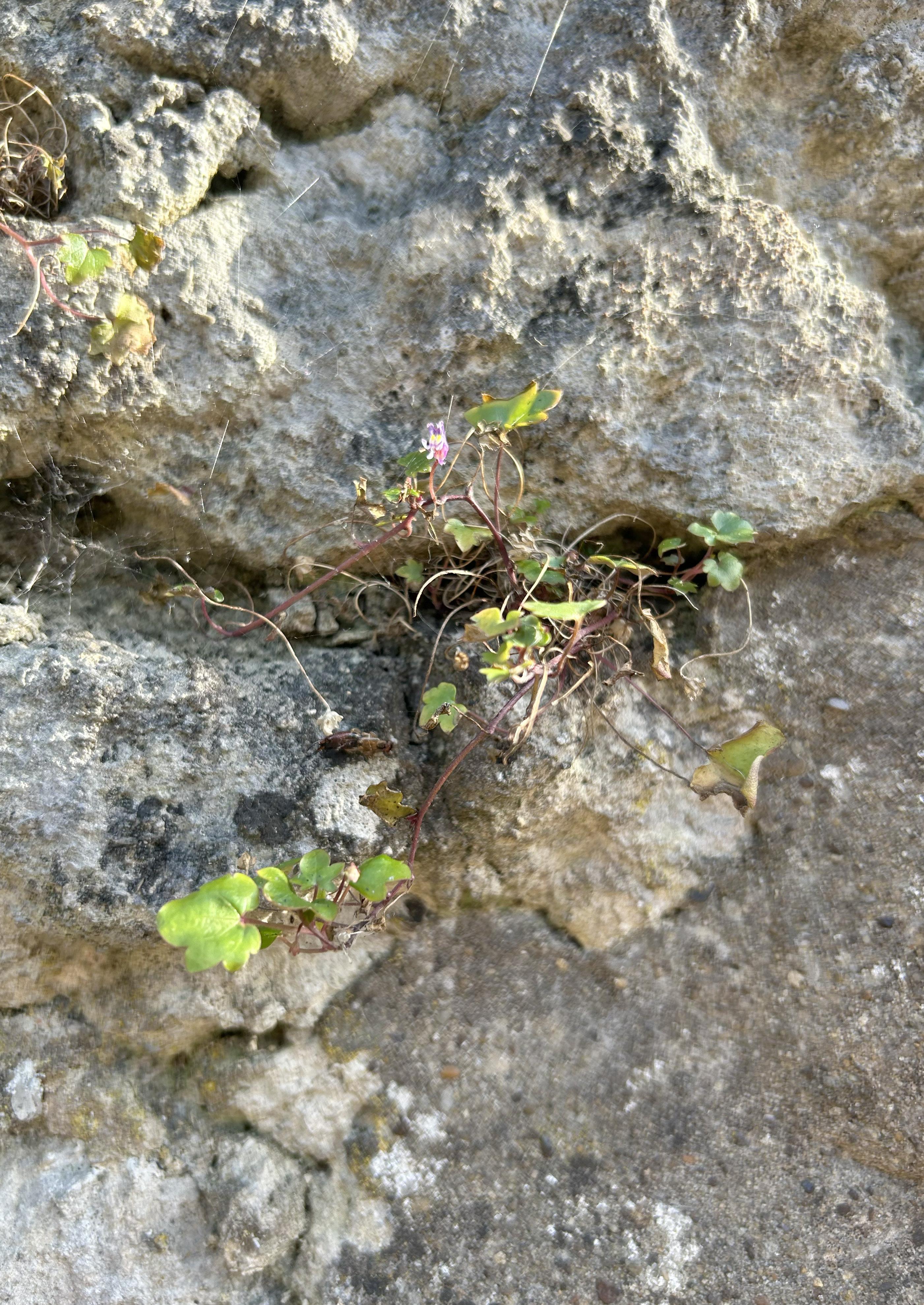
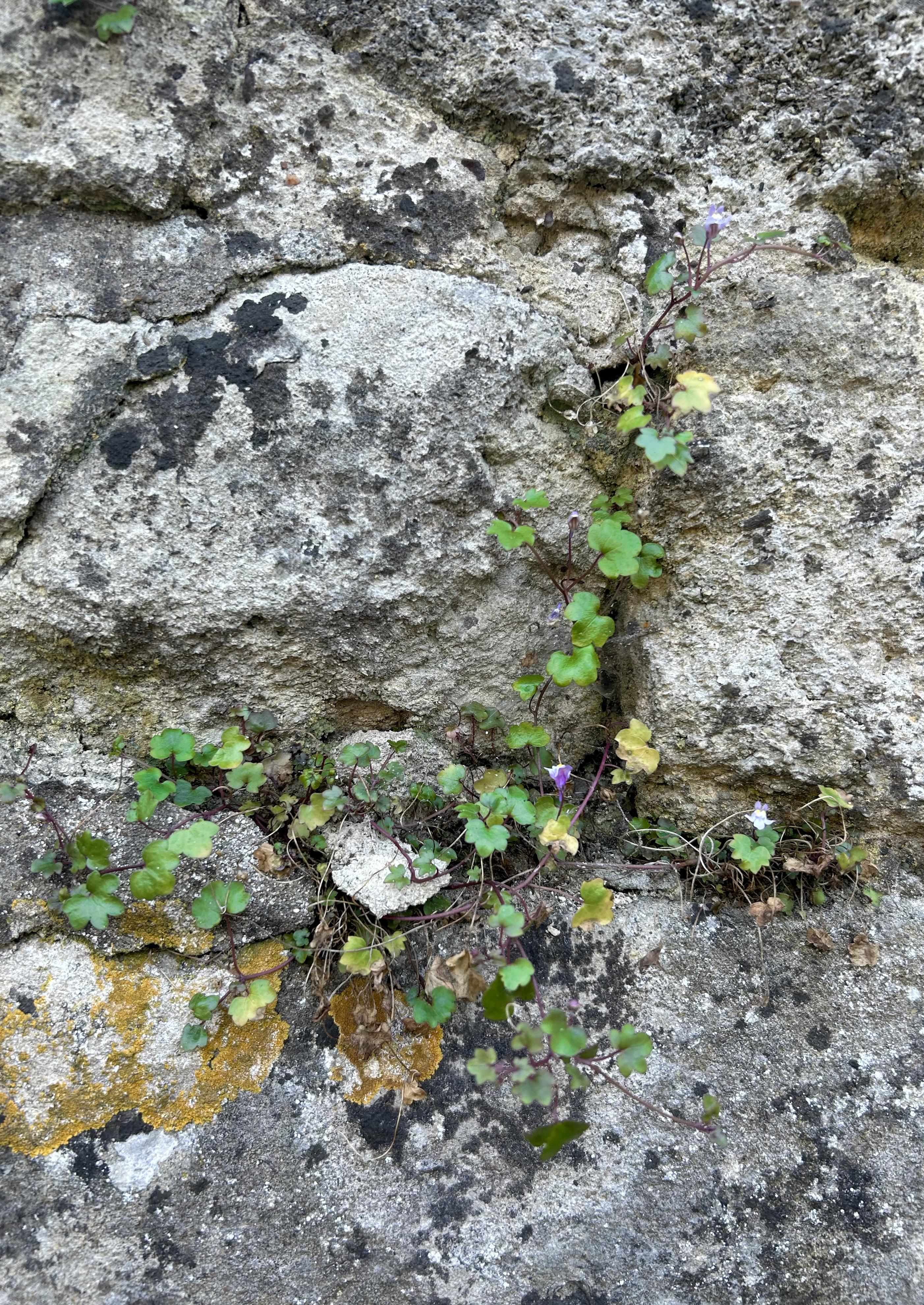
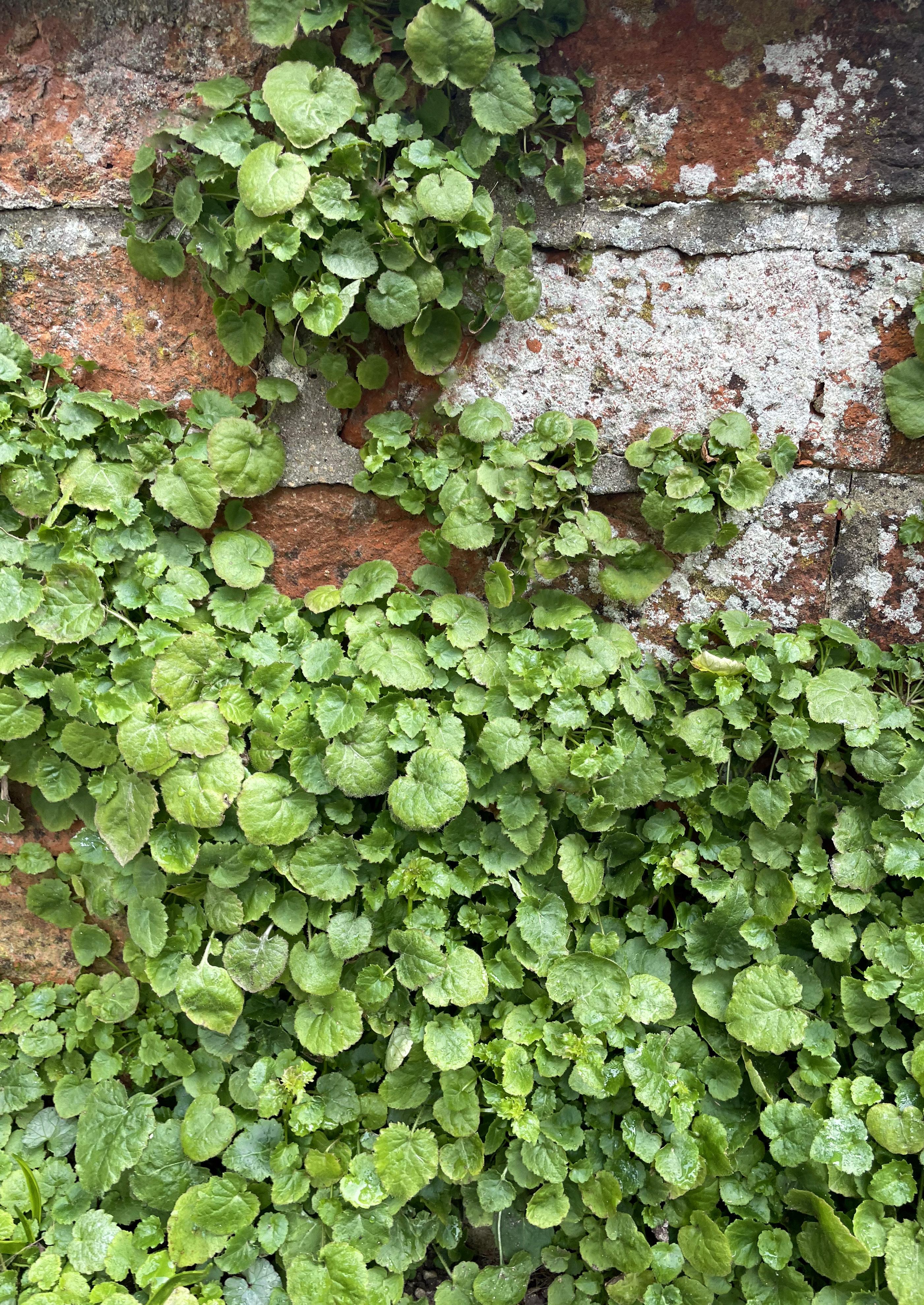
(Next page) [Fig. 3] Keinlworth ivy [Cymbalaria muralis] growing in the cracks of a weathered stone wall (Wilks, 2023)
Literature Review
Ecological Importance
It is globally acknowledged and accepted as fact that ecology and its ecosystems are inextricably linked with the functionality and health of planet Earth (Weisser et al, 2022). Khoja and Waheeb (2020); Wang, Yu and Cao (2022); Weisser et al (2022); Defra and Natural England (2019) and Gunawardena and Steemers (2023) all call attention to the damaging effects mankind has on the environment. Wang, Yu and Cao (2022); Khoja and Waheeb (2020) and Weisser et al (2022) similarly highlight the high proportion of damage the built environment causes to global ecology.
Wang, Yu and Cao (2022, p.627) state ‘Cities occupy only 3% of the earth’s land area but provide housing for more than 2/3 of the population’, and with ‘urbanization forecasted to attain approximately 83% in 2030’ in the developed countries (Shafique, Kim and Rafiq, 2018, p.757), there is clear evidence that, without major interruption and change from the planning and construction sectors, harm caused to global ecology, will increase. Zillante et al (2013) cited in Khoja and Waheeb (2020, p.33) additionally outline that ‘the construction industry consumes about three tones of the raw material, where fifty percent of the raw material is derived from nature. It also consumes forty percent of energy and produced a total of 50 percent waste’. Khoja and Waheeb (2020, p.33) set out how ‘the consumption of a large amount of energy also stresses its utilization of sustainable practices’, and with 60-80% of resources
[Fig. 4] Infographic showing population growth and resource consumption in cities by author Note: adapted from The weight of cities (Resource Panel, 2018)
being consumed in cities (Wang, Yu and Cao, 2022, p.627) thereby reinforce points made by the subsequent authors over the importance of addressing and reducing the global overconsumption of resources.
The immense volume of energy and resources being consumed has been acknowledged, but my research suggests that it is largely yet to be addressed outside written opinion. In the UK, Defra and Natural England (2019) detailed the ongoing pressure for new housing and infrastructure as a result of a growing population. This necessary urbanisation has created barriers, preventing planners from taking the time to re-evaluate and re-frame design practices towards creating a new, ecologically sympathetic methodology. Additionally, Defra and Natural England (2019) explain how the inclusion of ecology into current planning systems is not yet widely adopted, due to both unclear guidelines and low incentives for adopting approaches towards increasing biodiversity. This lack of ecological inclusion was comparably discussed by Weisser et al (2022) who suggest the ‘human’ ‘nature’ dichotomies which are so prominent in today's contemporary societies are the fundamental reason behind changing mindsets in modern disciplines.
While my research highlights substantial reasons towards the need for change (Weisser et al, 2022; Wang, Yu and Cao, 2022), there is minimal evidence to suggest any defined approaches have been established to achieve this. Thus, the necessary work to educate and thereby drive positive changes to our society's expectations - and our design practices - are yet to be made. In their book 'Flourish', Ichioka and Pawlyn (2021, p.46) quote Eileen Crist who identies the human ‘entitlement to kill, use, take over, to go wherever we please and build infrastructure [demonstrating]…an unstated sense that the earth belongs to humanity …and [that] non-humans are resources’. I believe this is something that mankind needs to understand much more deeply before we can truly advance towards an ecologically harmonious future.
The Demand for Space
Presently there are increased challenges that come with integrating ecology into urban areas. Demand for new housing and infrastructure consistently constrict available green space in the urban environment (Defra and Natural England, 2019). Increased development of urban green spaces into new infrastructure also brings greater economic benefit to developers (Wang et al, 2022).
Therefore, the already scarce volume of publicly accessible green space within cities is under increasing threat from development.
Despite the increasing demands for new infrastructure,there is a juxtaposing demand for increased greening in urban environments that comes with the growing awareness of nature's benefit to humans (Virtudes and Manso, 2016). As ‘Governments and citizens have started stressing the need for greenery in cities’ (Goal Jha and Khan, 2022, p.37815), the overwhelming evidence of ecological benefit to humans and demand for such cannot be ignored, igniting initial changes in urban planning strategies (Defra and Natural England, 2019).
As highlighted by Gunawardena and Steemers (2023), with the contrasting calls for both increased urban infrastructure and increasing urban green space there comes an opportunity to redesign traditional green spaces. They outline how ‘the challenge of realising such enhancements in densely built cities has necessitated the consideration of spatially efficient alternatives’ (Gunawardena and Steemers, 2023, p.104).
The movement to design green roofs into new infrastructure has grown significantly. By raising the ground level to rooftops,
[Fig. 5] Infographic showing the benefits of green space in urban areas by author socioeconomic benefits
social connection and cohesion physical and mental health benefits ecosystem health and services
developers can maximise the limited space at street level (Virtudes and Manso, 2016) which can secure their profits, while also meeting public demand for accessible green spaces.
Shafique, Kim and Rafiq (2018) review the benefits and opportunities of green roofs and highlight them as exemplar systems that can be used to mitigate the effects of urbanisation while at the same time improving the environment in an area. However, by contrast, Ishimatsu and Ito (2011) outline some limitations. Wang et al (2022) highlight the lack of discussion into green roofs past their social benefits, with limited discussion into ecological benefits; likewise this lack of ecological inclusion in wider scale design decisions is similarly discussed by Weisser et al (2022).
Comparably, Ishimatsu and Ito (2011) discuss the greater benefits of brown roofs over green roofs with respect to ecological and biodiversity enhancement. After outlining the ecological restraints demonstrated by green roofs, Ishimatsu and Ito (2011, p.299) discuss further how ‘intensive roofs in urban areas cannot contribute a large amount of green area, and extensive roofs cannot create high-quality green areas’. It is important to note that the studies into brown roofs are much more limited, resulting in more dated research papers. However the fundamental ideas behind Ishimatsu and Ito (2011) regarding ecological importance and the limitations of current green roof systems remain relevant. The design gap I have identified is ripe for re-evaluation amongst the development and construction industries to re-prioritise the importance of ecology within the built environment.
With the opportunity to rethink how we introduce nature back into the urban realm, there remain many under researched and underdeveloped spaces in our cities. Gunawardena and Steemers (2023, p.104) outline the need to ‘exploit the underused and abundant vertical surfaces of urban buildings’. Virtudes and Manso (2016); Goel Jha and Khan (2022) and Sheweka and Magdy (2011) are among others to highlight the importance of utilising vertical surfaces to enhance the urban environment through introduction of greening, ‘vertical surfaces in the form of bare walls remain the only space that can be utilized for providing greenery economically’ (Goel Jha and Khan, 2022, p.38715).
Wang et al (2022) observe, that there is currently limited research available into vertical greening methods which restricts the ability to understand their impact on urban environments. Virtudes and
Manso (2016) similarly highlight how the application of green wall systems is in its infancy.
This minimal research into green walls results in the limited ability to evaluate their ecological effectiveness in urban biodiversity enhancement. The available research into green walls is at first seen as primarily focused on their ‘sustainability’ and ‘environmental benefits’. However, I have noticed patterns throughout the literature reviewing these green walls which suggest the principle benefits evaluated are aimed towards serving human satisfaction. Goal Jha and Khan (2022); Virtudes and Manso (2016) and Gunawardena and Steemers (2023) discuss the economical, social, aesthetic and health and well-being benefits of vertical greening. From an ecological perspective, while these benefits may have coincidental ecological advantages, their primary focus is towards human benefit, and as such it can be concluded the design of such green walls is foremost led by human centred design considerations.
Dunnett (2006) assesses the use of green roofs as a tool for increasing biodiversity. While also a dated source, the ideas presented by the author remain relevant in today's discussions over human-centred design. The paper discusses the role of aesthetics when experiencing nature in urban settings, concluding that the public attitude towards such was based upon aspects such as ‘cues to care’. Simply put, people are much more likely to appreciate nature in an urban setting if it is presented as aesthetically pleasing - with features such as flowers - and if there is noticeable maintenance and control over the vegetation - not allowing it to become too ‘wild’. The human desire for aesthetic control over nature in our urban environments is visible.
It could be argued that, as the authors such Goal Jha and Khan (2022) and Virtudes and Manso (2016) discuss topics such as the ‘consumption of energy and water’ alongside ‘environmental benefits’, their evaluation of green walls is not primarily focused on humans and takes into consideration ecology and its needs. However, by understanding the viewpoint in which these topics have been reviewed there is clear evidence to suggest the author was concerned primarily with the human centred benefits green walls could provide.
Defra and Natural England (2019); Weisser et al (2022) and
Room for Inclusion
Wang, You and Cao (2022) all overwhelmingly concur that there is a lack of inclusion of ecological consideration in design. The requirement for public education to address environmental barriers is outlined by Sheweka and Magdy (2011) as they highlight the need to teach newer generations about the benefits ecology can have on the urban environment and the human species, consequently achieving a balance between ecology and humans. Weisser et al (2022) highlight the current limited movement towards implementing the consideration and inclusion of ecology into design processes. However there are some examples, such as the ‘Biodiversity Net Gain and Nature Recovery Strategies’ policy implemented by the UK Government which enforces a 10% biodiversity net gain over a 30 year time period on each individual construction site (Defra and Natural England, 2022). This policy, amongst others, shows there is growing action being taken towards ecological enhancement, and this sort of ‘stick’ may aid the influence and adoption of such strategies globally.
The Biodiversity Net Gain policy has understandably faced some resistance from people in planning and design sectors due to the potential cost increases due to additional labour, materials and energy requirements (Defra and Natural England, 2019). Wang, Yu and Cao (2022) further explain the lack of interdisciplinary connection when it comes to the incorporation of ecological practices in design and, along with Weisser et al (2022), pinpoint a need for interaction between designers and ecologists throughout the planning, development, construction and post occupancy stages of a building to achieve full integration of biodiversity into a building and its site.
Weisser et al (2022) further discuss resistance from the public, stemming from changing practices, and cover the ways in which we may approach changing social perception, such as showing examples of positive human nature interactions to the public in order to gain approval and understanding.
Goal Jha and Khan (2022) provide a comprehensive overview of the historical human tendencies towards interacting with nature. Briefly explained, they outline the fundamental relationship between nature and mankind, and evidence of mankind consistently learning from local climate, environment and ecology. This is also outlined by Weisser et al (2022). Khoja and Waheeb (2020)
explore vernacular architecture, how its practices were garnered from nature, and how through history, site specific ecology and climate were used to inform placement of settlements, choice of materials, and building techniques. Due to increasing technology, mankind now has a greater level of control over the environment. This new ability to urbanise environments with harsher climates emphasises the ‘phenomenon of human supremacy’ discussed by Ichioka and Pawlyn (2021, p.46).
The current lack of usable urban space for ecological enhancement and the innate need for changing ecological attitudes points towards the need to rethink our use of urban spaces and look to move in a different direction when considering ecology in design, both literally and metaphorically. By fully utilising the available space in urban environments there can be countless opportunities to provide spaces for ecology to thrive in the urban realm.
“We now need to see ourselves; as inextricably linked to the web of life and wholly dependent upon it for long-term mutual flourishing” (Ichioka and Pawlyn, 2021)
Through reviewing a wide range of literature which discuss topics of ecological involvement within the urban environment, I have established two main themes to form the basis of my dissertation:
1. There is a clear human-centred focus in the design world. This gap in true ecological intent towards design practices leaves room for a total reformation of our current mindset; thereby working towards normalising ecologically-centred design decisions over all disciplines involved in the function of the built environment.
2. There is changing awareness over the need for ecology in our urban environments but this has yet to be truly understood and practised. While current urban greening strategies make some move towards a more nature filled built environment, there is space for the redesign of these strategies to re-frame ecology as a central client, which in turn will allow the global ‘web of life’ to flourish.
(Next page) [Fig. 6] Plants rooted and growing into the mountainside in Sri Lanka (Wilks, 2023)
0.3 – Methodology
This paper will tackle ecologically pertinent ideas I have identified through a comprehensive understanding and sympathy towards the role ecology plays within the urban realm. By approaching these concepts with a ‘think global, act local’ perspective, my writing aims to educate and inspire the readers' understanding of compelling ecological subjects in order to embrace the reconsideration of ecology's position in their individual day to day lives. I hope this may encourage action of small changes that can have advantageous global impacts.
Qualitative research aims to collect and analyse non numerical data to facilitate the understanding of a theme or topic area. Application of research methods such as case studies and grounded theory will aid the development of my research into specific themes and use of logical argumentation or inductive/deductive reasoning can aid my explored theories throughout the paper.
The detailed analysis of literature forms a substantial contribution towards the ideas and themes discussed within this paper. Concluding the literature review, I have identified a gap in the joining of ecological and social thinking within design paradigms. Using these identified conclusions I aim to investigate these themes and propose solutions that may change ecological connectivity within the urban realm.
Chapter One will identify the ecological-limiting historical, cultural and social barriers visible in today's design practices. Using ethnographic observation and grounded theory methods, I will analyse how such barriers came to be and consider why they are still in place. Moreover, inductive development of theoretical reasoning will summarise the importance of societal opinion in the influence and adoption of ecologically enhancing methods in the built environment.
My paper will then contextualise the barriers by referencing the theories discussed using biophilic design as a design concept through use of further literature analysis and inductive reasoning. Thus I will aim to identify and discuss the requirement to re-educate society regarding the importance of our place within the natural environment, prior to renewal of design practices.
In Chapter Two I will build on the ideas concluded in chapter one around changing public perspectives. Through exploration of literature, I will explore vernacular architecture, understand methods and rationale behind design decisions, and aim to review the importance of effectively learning from and working with the local conditions of a site. I will expand on ideas about learning from pre-occurring instances through the use of my own photographic documentations of ‘uncontrolled' interactions between nature and the built environment in Oxford. Inductive reasoning will highlight the infinite instances of such ‘unwanted’ interactions, and expand on my premise that changing societal perspectives on ecological interactions within the built environment will require demonstrable examples of successful interactions. This personal, empirical site-specific and intentionally objective reading mirrors the site specific methodology I will go on to set out in Chapter Three.
Chapter Two will conclude by analysing selected urban greening strategies and their effectiveness in aiding urban biodiversity. Through exploratory investigation into precedents and literature surrounding green and brown roofs, I will investigate and evaluate the reasoning and effectiveness behind their respective design decisions, construction techniques, and functionality in regards to ecological enhancement.
Chapter Three will begin by identifying vertical surfaces as a pertinent solution to overcome the barriers presented by green and brown roofs. I will make this case using further brief analysis of relevant current literature surrounding modern green wall systems. Through logical argumentation and inductive reasoning I will then use case study examples to contextualise the ideas and themes discussed in the proposal of a new ‘vertical surface’. I have selected three examples presented to me in the book 'Garden City: Supergreen Buildings, Urban Skyscapes and the New Planted Space' (Yudina, 2017) ‘Third Landscape Garden; Coloco and Gilles Clement’, ‘The building that grows; Edouard François with Duncan Lewis’ and ‘Biodiversity School; Chartier Dalix’, which all encapsulate the theories and ideas that will be discussed in this dissertation, assisting the conclusion of my argument.
CHAPTER ONE
THE RELATIONSHIP BETWEEN NATURE AND THE BUILT ENVIRONMENT
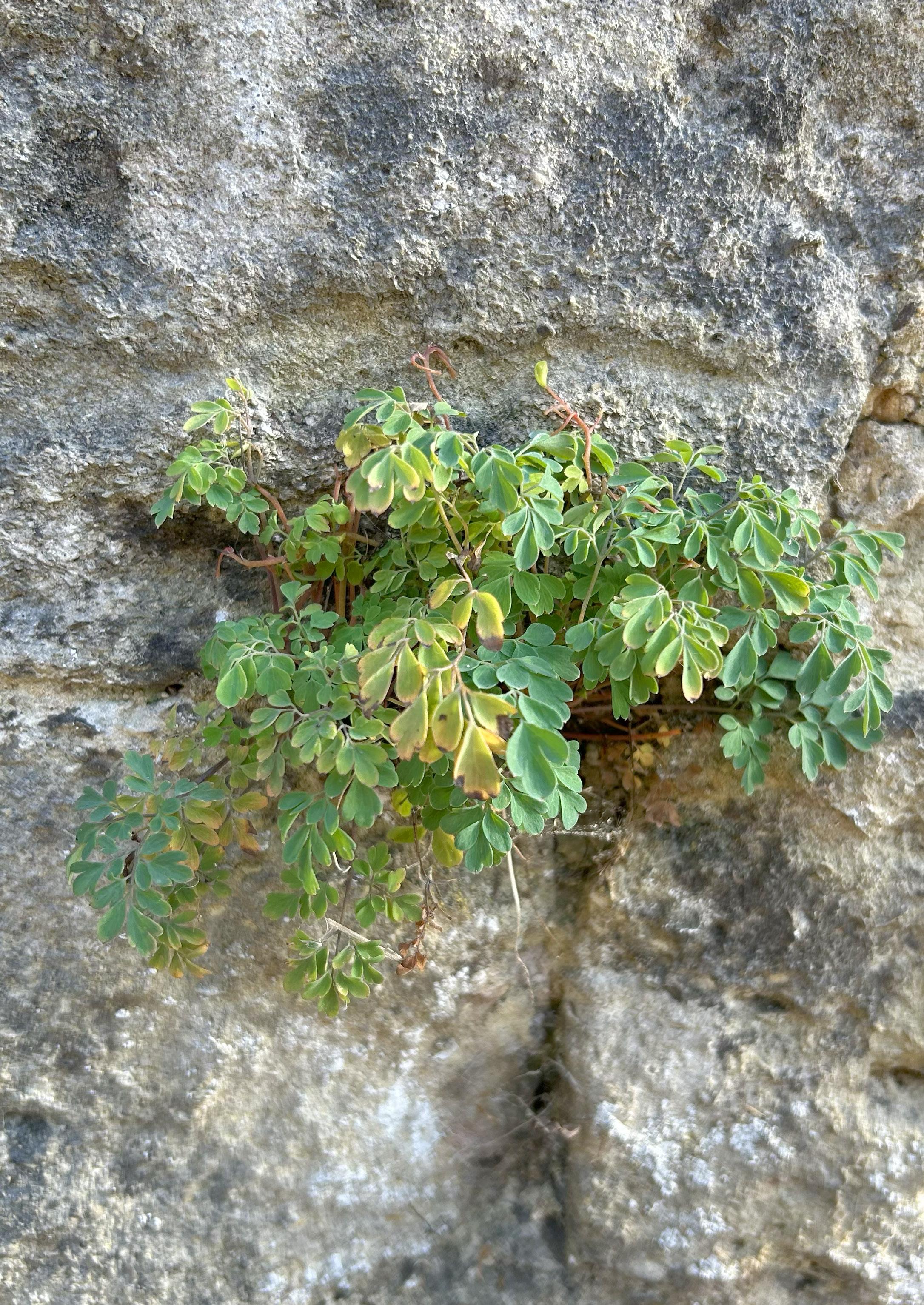
(Previous page) [Fig. 7] Rock fumewort [Pseudofumaria lutea] growing into the cracks of a weathered limestone wall (Wilks, 2023)
How green are we? Identifying barriers to changing perspectives
In modern Western culture it is an ingrained and accepted view that there is both separation and opposition between humans and nature (Haila, 2014; Ichioka and Pawlyn, 2021). This relationship can be traced back through Christianity (King James Bible,1989, Genesis 2:15-17), and also through much Western philosophy.
Dualism is defined as ‘the division of something conceptually into two opposed or contrasted aspects, or the state of being so divided.’ (Oxford Languages, no date). The concept stems from ancient Greek philosophers Plato and Aristotle (Study.com, no date; Ichioka and Pawlyn, 2021, p.45), and was based on the idea that there is separation between the mind and body. 17th century French Philosopher Descartes similarly detailed this concept of the nonphysical mind existing outside of the body (Study.com, no date; Ichioka and Pawlyn, 2021, pp.45-46) (Fig. 9). This philosophy has been expanded upon throughout history, and employed throughout cerebral and material practices across a multidisciplinary of events, including that of human nature division.
Thus, as explained by Ichioka and Pawlyn (2021), mankind has developed a dualistic mindset towards nature, uncoupling ourselves from the global ‘web of life’, consequently fabricating barriers (Fig. 8).
Examples of this innate need for control over the forces of nature can be seen across centuries of historical imagery in art, literature, landscape design and our built environment. These have
(Previous page) [Fig. 8] Web of life (Shaw,
[Fig. 9] René Descartes's illustration of dualism (Descartes, 1956-1650)
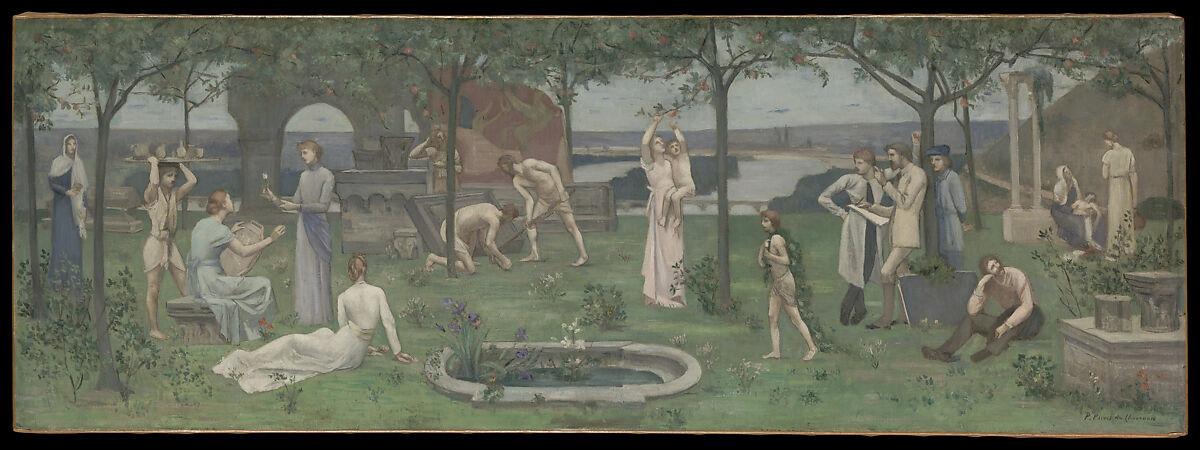
[Fig. 10] Inter artes et naturam (Between Art and Nature) (Puvis de Chavannes, 1890-95)
2002)
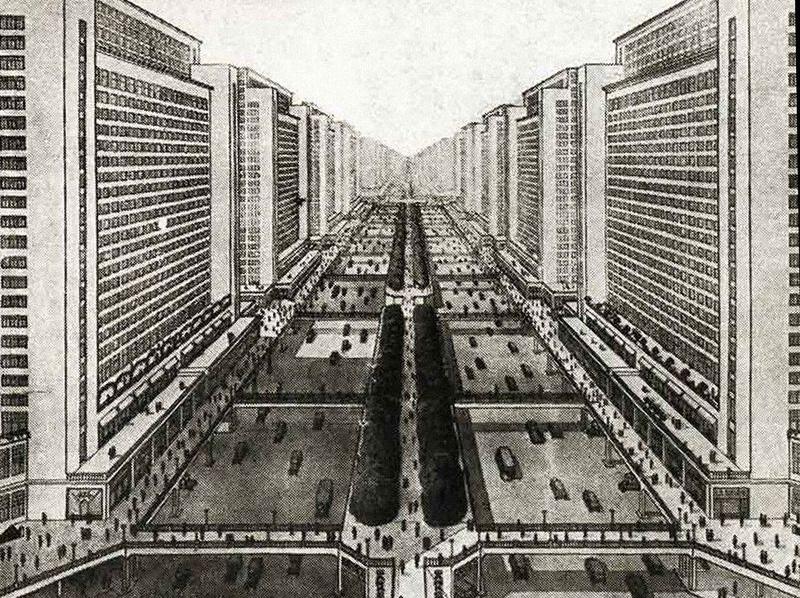
[Fig. 11] Ville Radieuse (Jeanneret-Gris, 1924)
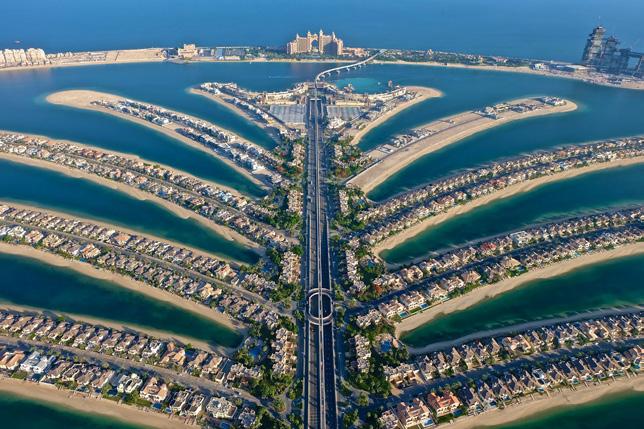
[Fig. 12] Palm Jumeirah (Axcapital, no date)]
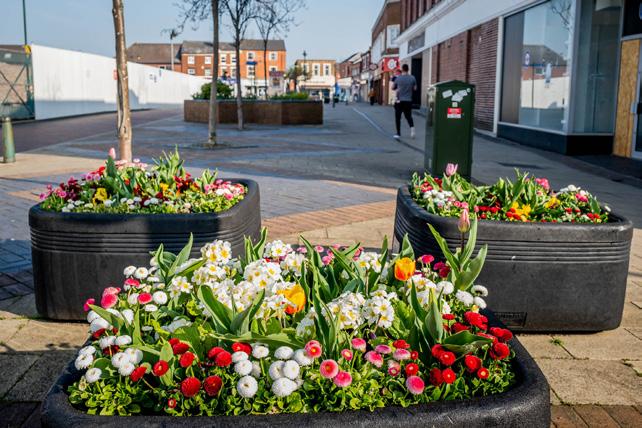
[Fig. 13] Crewe flowers (Crewe Town council, 2021)
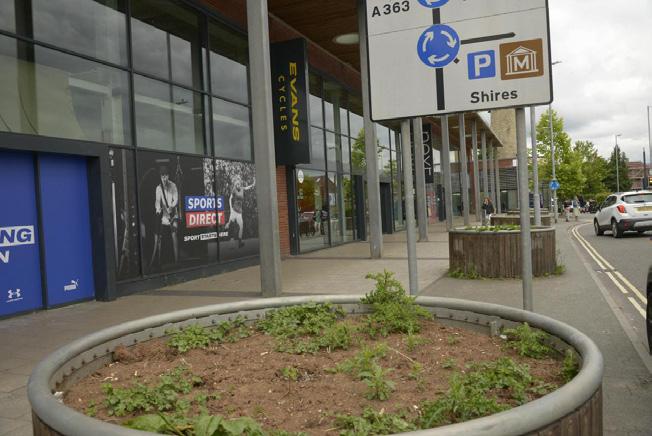
[Fig. 14] Plant pots ‘full of weeds’ (Baker, 2023)
fortified Western paradigms of our superiority over nature. Consequently, humans seek to eradicate the ‘wild’ and aspire to iteratively manicure and refine interactions between the flora and fauna we choose to live alongside (Fig. 10).
This can be seen very clearly in our urban spaces. Technological developments have advanced, further enabling us to exert this contrived control in ways once seen as unattainable (Fig. 11). Perhaps the most extreme examples can be seen in structures such as The Palm in Dubai (Fig. 12).
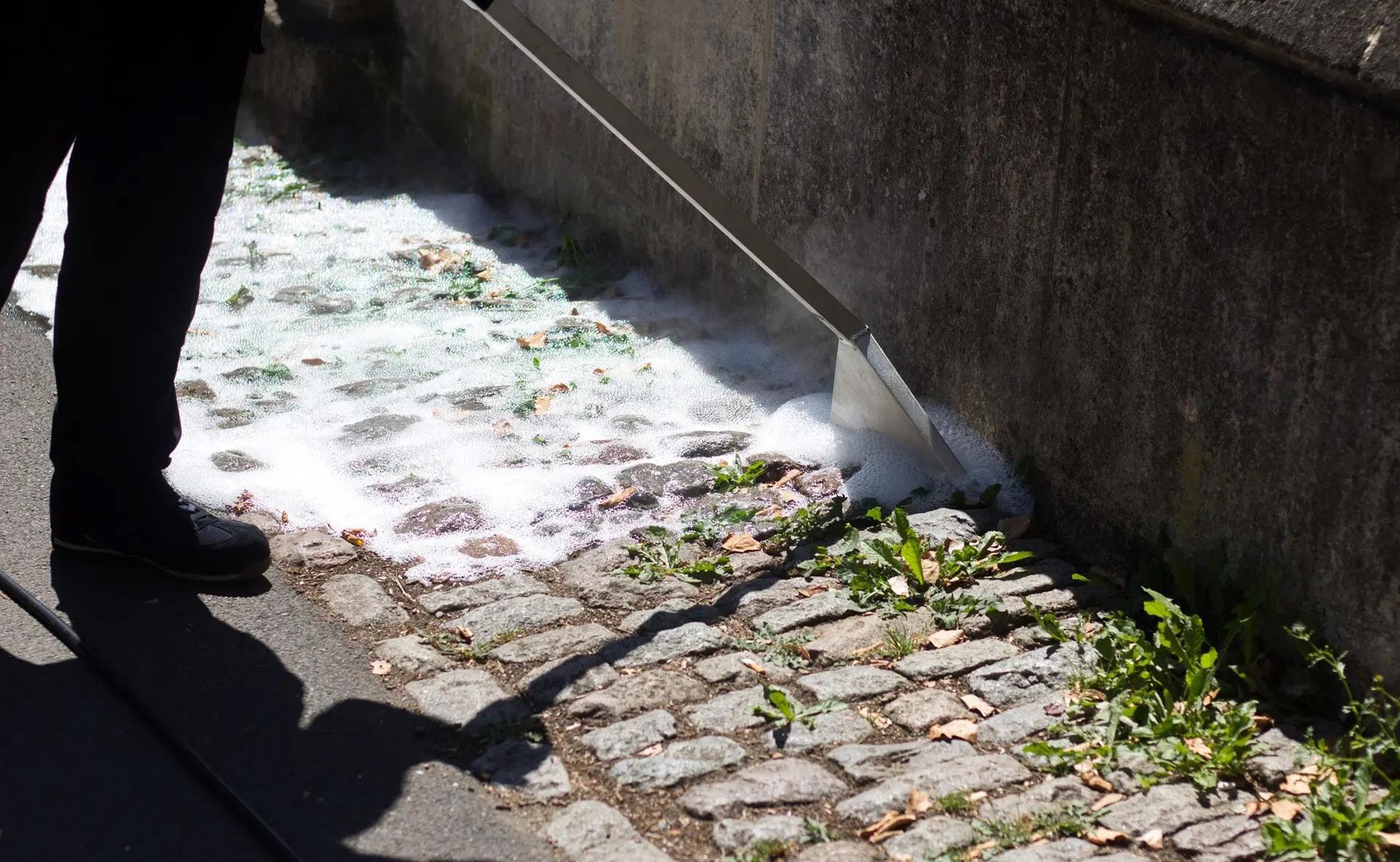
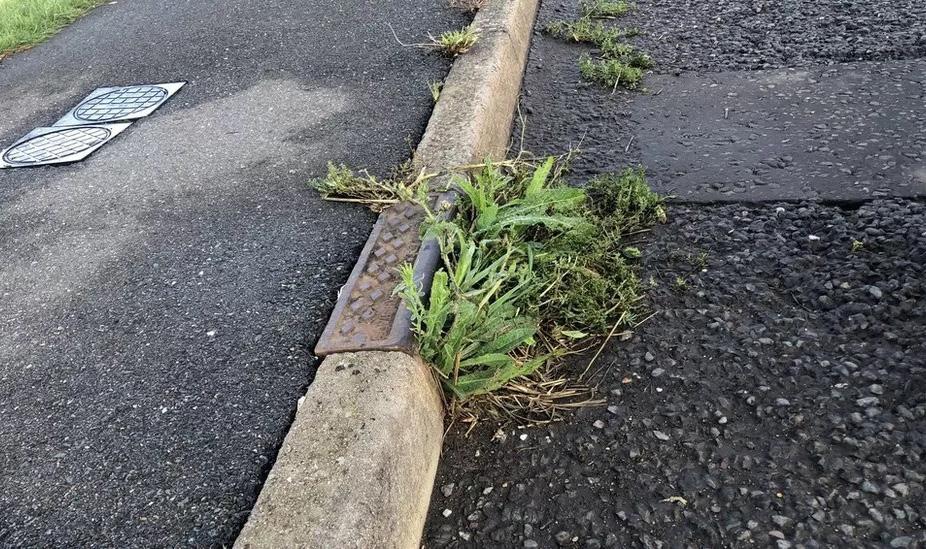
The human desire for aesthetic beauty is another notable factor in Western expectations of human control over nature (Dunnett, 2006). This directly feeds into what philosophers such as Baudrillard theorises regarding the human tendency to fabricate a ‘hyperreal’ manicured and manipulated version of nature. The ‘Britain in Bloom’ competition (Royal Horticultural Society, no date) celebrates Town Councils’ manicured floral displays (Fig. 13). The cultivated urban landscape we have developed directly results in the elimination of any external organisms that have not been actively chosen by us - indeed humans have invented the concept of ‘weeds’ to describe any interloping nature, and the public raise concerns about out of control weeds and their damages to the looks of the area (The Guardian and Weston, 2023) (Fig. 14).
Fundamentally, it can be argued, humans are deeply self-serving and lazy in nature. It suits us to do what we want to make our lives more convenient, comfortable and pleasing in spite of nature and place - and, as our species has developed, it has sought to do just that (Eileen Crist, cited in Ichioka and Pawlyn, 2021).
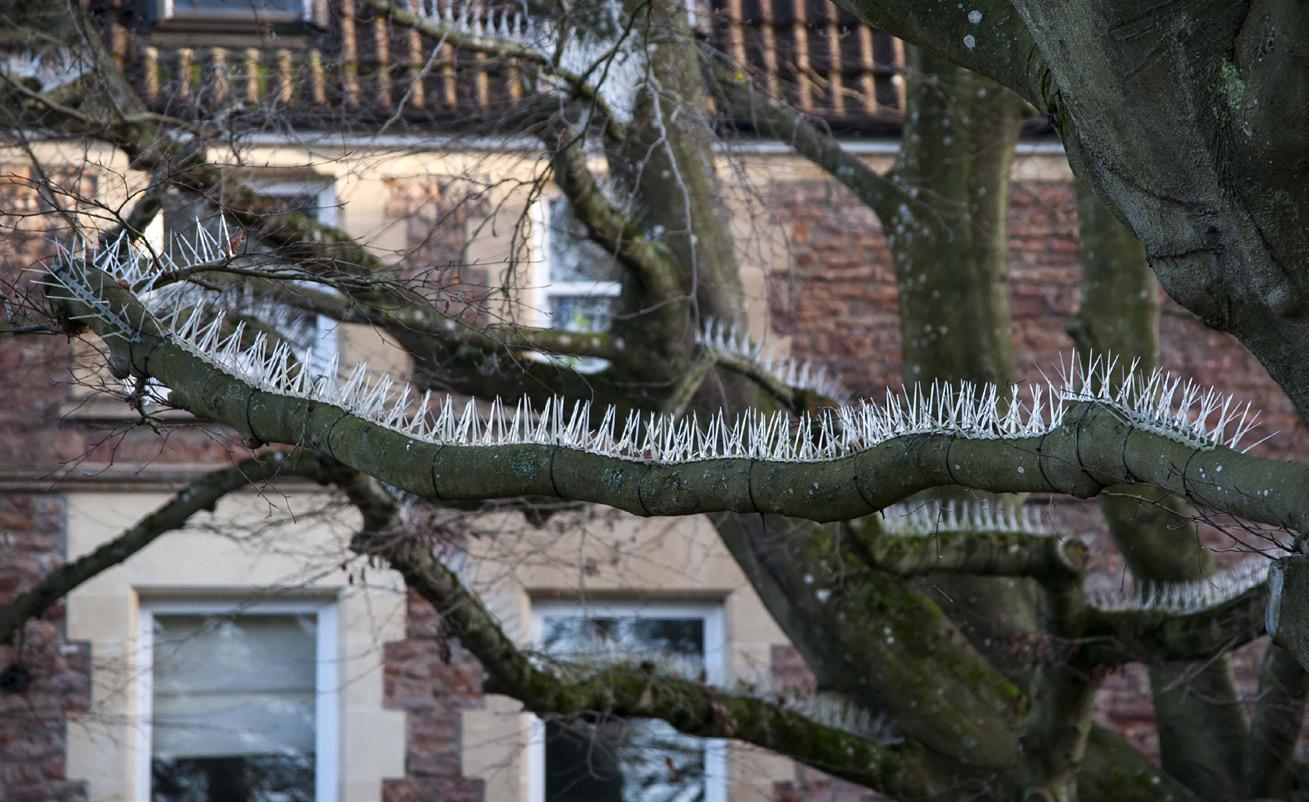
For me, these factors explain why there is limited focus on ecology within architectural design in our urban realms. As discussed, the strained relationship between ecology and mankind has led to strict supervision over the interactions between organisms and the built environment (Fig. 15; Fig. 16).
Weisser et al (2022) articulate the barriers in place that come with re-educating society regarding ecological inclusion. They define architecture as a human-centred discipline, with a building's primary function to provide human shelter. Thus human needs remain at the centre of architectural design. Weisser et al (2022) suggest that future architectural design must instead become more ‘biocentric’ and put the coexistence of non-human and human
users at the centre of the design decisions.
The result of this ingrained history and existing practice is a culture-wide ideology based on exerting control over nature for human benefit which fabricates global barriers in preventing ecocentrism from becoming a core philosophy in design. There is evidence that the Overton Window is beginning to move though, and we are beginning to change our views.
[Fig. 16] Killing weeds between cobblestones (Weedingtech, 2022)
[Fig. 15] Metal spikes covering the branches of a tree, bristol (Wren, 2017)
Biophilic design; a solution or part of the problem?
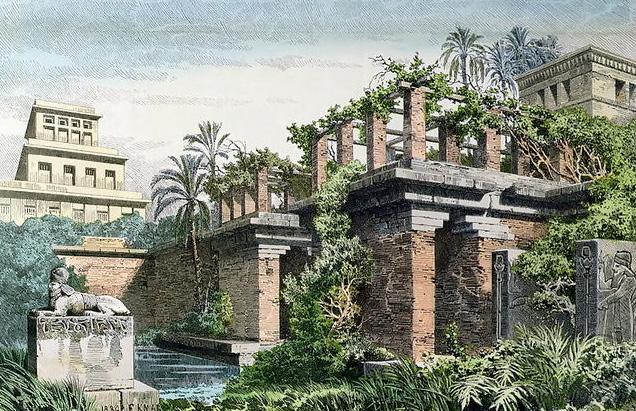
Biophilia is a term originating from the Greek, ‘philia’ meaning ‘love of’ (Planteria Group, no date). Biophilia is defined as ‘an innate and genetically determined affinity of human beings with the natural world.’ (Oxford Languages, no date). In the paper ‘Biophilic design in architecture and its contributions to health, well-being, and sustainability: A critical review’, Zhong, Schroder and Bekkering (2021) pinpoint the human use of nature in design well before the term biophilia was defined, giving examples such as the Hanging Gardens of Babylon and its’ connection to the surrounding nature; or traditional English Landscape Gardens with their intricately designed natural sceneries (Fig. 17).
Biophilic design is ‘used within [architecture and] the building industry to increase occupant connectivity to the natural environment through the use of direct nature, indirect nature, and space and place conditions’ (Wikipedia, 2024). The concept grew in popularity following publication of ‘Biophilia’ by Edward O Wilson in 1984. Professor and researcher Stephen R Kellert is another important name in discussions of biophilic design due to his highly accepted framework on the concept (Aura, no date). In their book ‘Biophilic Design: The Theory, Science and Practice of Bringing Buildings to Life’, Kellert, Mador and Heerwagen (2008) consider how basic concepts of biophilia relate to the evolution and development of both human and non-human stakeholders. They discuss the importance of human connection with nature, and outline the myriad of health and social benefits that this can provide. This text has provided a framework and methodology any planners, developers, designers, or architects can incorporate into their processes to incorporate the strategies connecting people with nature and benefit both parties.
Initial reactions towards the concept of biophilic design would likely concur that biophilic methods are sustainable and beneficial to local ecology. However, through studying the development and use of the phrase ‘biophilic design’, and the methods of its’ design inclusion, I have found that in fact a fundamental deviation from what were once the ecologically and organically sympathetic ideologies of biophilia can be seen (Fig. 19).
I would suggest that in many ways implementation of biophilic
[Fig. 17] Hanging Gardens of Babylon (Knab, 1886)
design tropes actually exemplify the societal problem I have identified as they are examples of exceptionally controlled ecological interactions caused by our fictitiously constructed cultural barriers. Where biophilia was born from ideas of the sympathetic affiliations with nature, technological development has again enabled us to excerpt control over nature undermining the natural balance it may have been thought to provide.
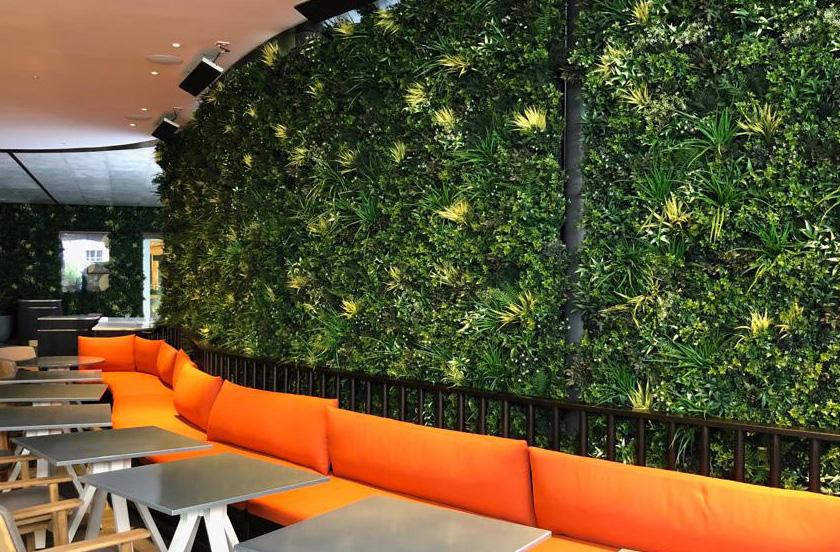
While the scientific benefits of real flora are notable (Zhong, Schroder and Bekkering, 2021), human desire to exploit and control nature has led us to these fake interactions that designers can now use to reduce costs and labour needed to support actual living organisms. We can now purchase panels of plastic plants (Fig. 18) produced through mass consumption of resources and energy, damaging the environment they are attempting to replicate - oh the irony. For many designers now, the placebo of health benefits provided by plastic plants is justification enough to choose them, saving costs but damaging the planet.
How is it that we have become so separated from nature that we would choosingly inflict damage, as opposed to simply living by the ideals that are inherently ingrained in us.
In this context, biophilia can be interpreted as another example of humans abandoning organic values of coexistence with nature. Perhaps biophilic design practices are simply a façade, when in truth they seek to make acceptable our selfish desire for human-centred benefit through human-centred design.
While biophilia as a concept is vastly beneficial, I feel we need to revert towards its origins and remember the importance of achieving a truly natural balance. Without this reset, the social barriers we have put in place by excluding interactions with nature will cause a greater disadvantage to us in the end than that of the perceived disadvantages brought through ecological inclusion.
[Fig. 19] Artificially planted wall (Green Envee, No Date)
[Fig. 18] Screenshot of google products web page then searching biophilic design (Wilks and Google, 2024)
Re-education for re-introduction: Changing minds to incite change
Weisser et al (2022. p.16) highlight the importance of considering how to encourage architects and planners to embrace their concept of an ‘ecolope’, and move from a historically anthropocentric focus on buildings and cities to a more ‘green’ approach that includes ecosystem design. This need to reform societal ways of thinking has also been emphasised by authors including Wang, Yu and Cao (2022); Sheweka and Magdy (2011); Ichioka and Pawlyn (2021) and Dunnett (2006), over several decades. The question now is how can addressing this reluctance to change our ways of thinking benefit ecology? And if we understood this, would it encourage us to re-frame our attitudes towards ecological inclusion?
Fig. 20 shows the ‘public engagement with biodiversity loss: awareness, concern and action, 2014, 2017 and 2018’ (Department for Environment, Food & Rural Affairs, 2021). From this data it can be seen that awareness and engagement over biodiversity is rising, however a significant proportion of participants remain unaware of topics covering biodiversity loss and its effects. Therefore it can be concluded that there is more to be done to educate society. It can be hoped more people will then take a stand against ecologically harmful design methods.
High engagement
Some engagement Not engaged
Not aware
Public engagement with biodiversity loss: awareness, concern and action, 2014, 2017 and 2018. United Kingdom
[Fig. 20] Chart showing public engagement with biodiversity loss: Awareness, Concern And Action, 2014, 2017 and 2018 by author
Weisser et al (2022) outline ways in which we might change societal perspectives on matters surrounding ecological inclusion in design by showing clearly how they will benefit us.
When addressing how to encourage adoption of their ‘ecolope’ into design practice, it was explained how ‘ecolopes will need to be constructed and their benefits demonstrated, to be able to convince building professionals of its potential, and that ‘demonstrated benefits of model ecolopes should be used to raise public awareness and to convince local authorities and government to act by developing policies (e.g. subsidies) that encourage architects to implement nature-based solutions such as ecolopes’ (Weisser et al, 2022, p.16). I believe clearly demonstrating the human benefits is crucial to garnering human support for new ecologically focused design concepts, and thus to changing perspectives.
The human idiosyncrasy to be self-serving is another obstacle in changing our standpoint on ecological inclusion (Leotti, Iyengar and Ochsner, 2022; Ichioka and Pawlyn, 2021). As this distinction is so ingrained into our culture, it could be argued that while the extinction of human selfishness is an ideal, this is an almost insurmountable task. Thus it can be argued it would be easier to instead work with our self-serving tendencies, rather than abolish them altogether. Through working with rather than counter to the status quo, I would hope we might combat humans’ egocentric and idle proclivities with rationales suggesting positive beneficial reasons to adopt more ecocentric designs.
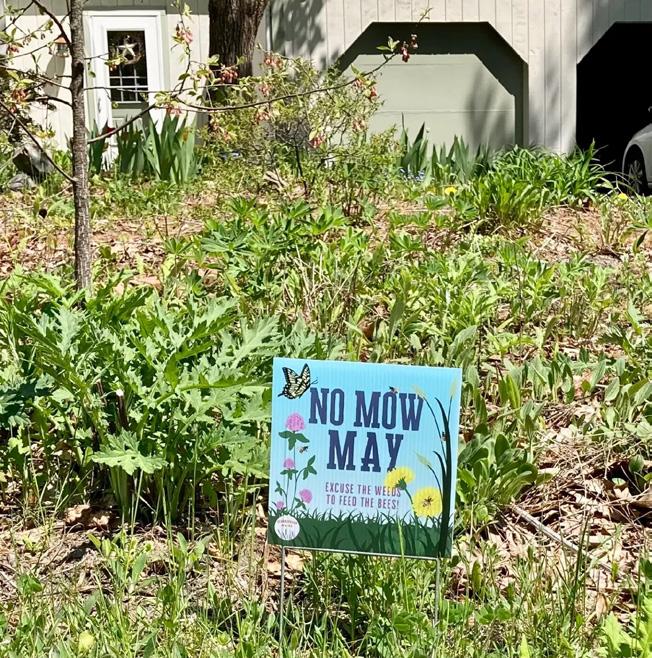
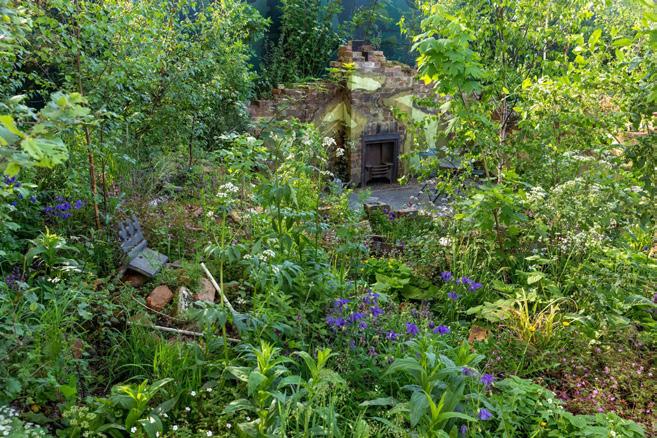
I am hopeful that this change in societal attitudes towards nature is beginning to happen in the UK. Movements such as ‘no-mow May’ (Fig. 21), started in 2019 by charity Plantlife, both recognise the problem caused by loss of ecology through human urbanisation, and offer a simple way for individuals to act to reverse the decline. In 2022 an estimated 1 million people in Britain took part (Plantlife, 2023). In recent years Chelsea Flower Show has seen many examples of gardens designed with biophilic principles. Cleve West’s Centrepoint Garden, 2023 showed nature appearing to take over a ruined house (Fig. 22), and Jihae Hwang’s ‘A letter from a million years past’ garden, 2023 replicated a natural landscape and promoted balanced ecosystems (Fig. 23). Now we just need to translate these ideas in and onto the buildings themselves and show how they too can benefit humans alongside the ecologies they enhance.
[Fig. 22] The centrepoint garden. Designed by Cleve West (Hepworth, 2023)
[Fig. 23] A letter from a million years past. Designed by Jihae Hwang (Royal Horticultural Society, 2023)
[Fig. 21] Lawn signs encouraging residents to skip mowing in May to avoid dandelions and other wild flowers from being mowed down (Washuk, 2023)
CHAPTER TWO
HOW GREEN IS GREEN DESIGN?
Revisiting the past to shift human centred design approaches
Taking forward the logic proposed by Weisser et al (2022), it is clear there is a need to inform the public and industries of the importance of a new design proposal through demonstrating its capacity to provide tangible benefits to both human and non human users. To achieve this will require physical exhibition of solutions and their services, backed up by the data that can provide the demonstrable proof of human benefits needed to influence a greater social acceptance and thus adoption of new ideas.
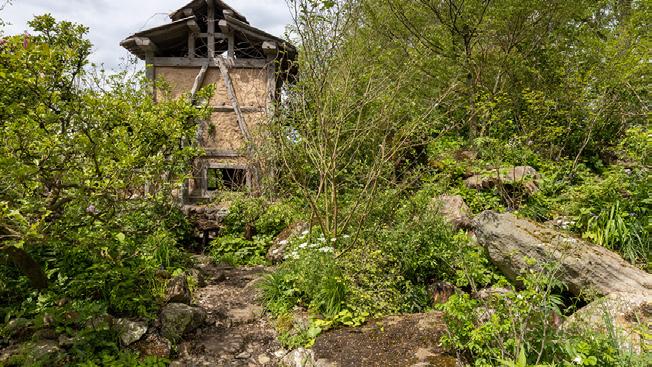
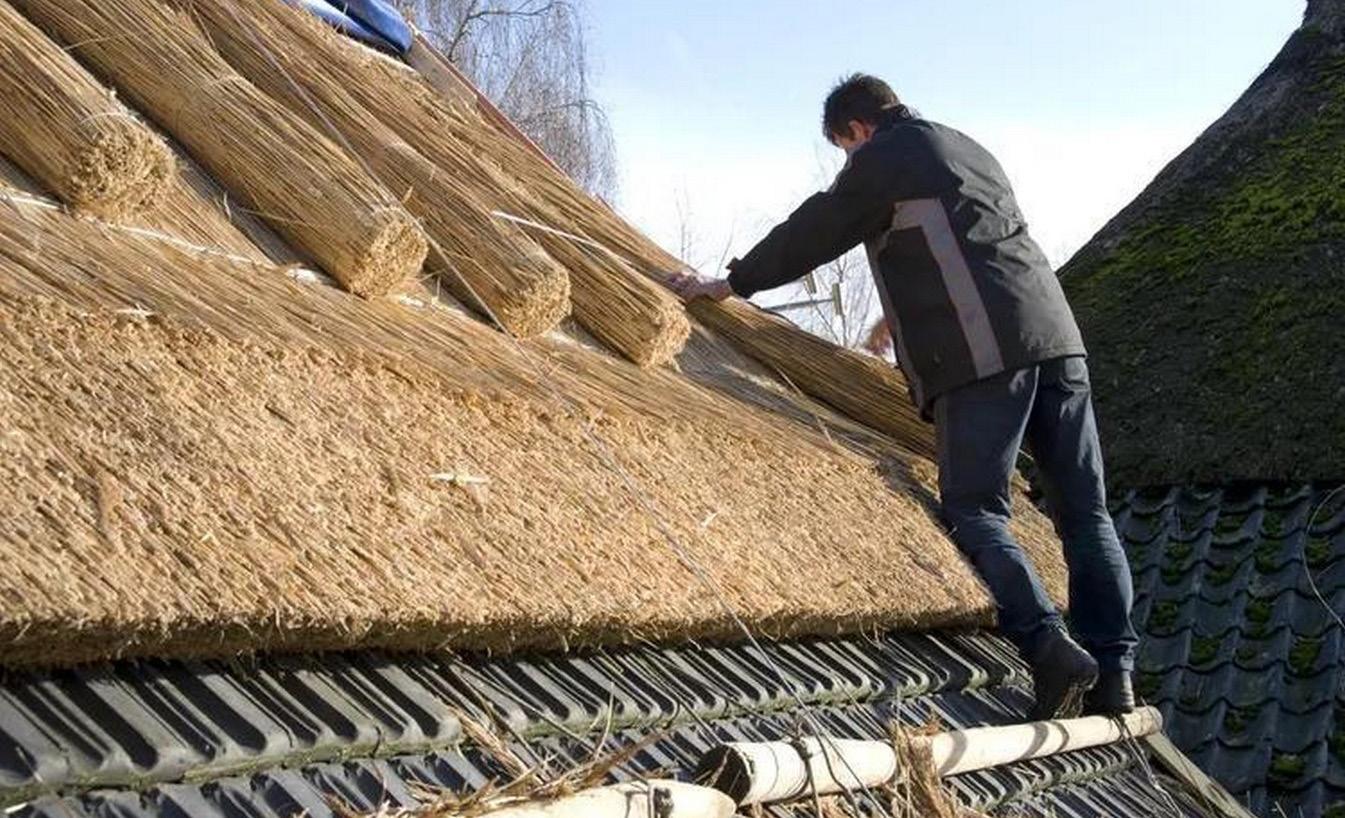
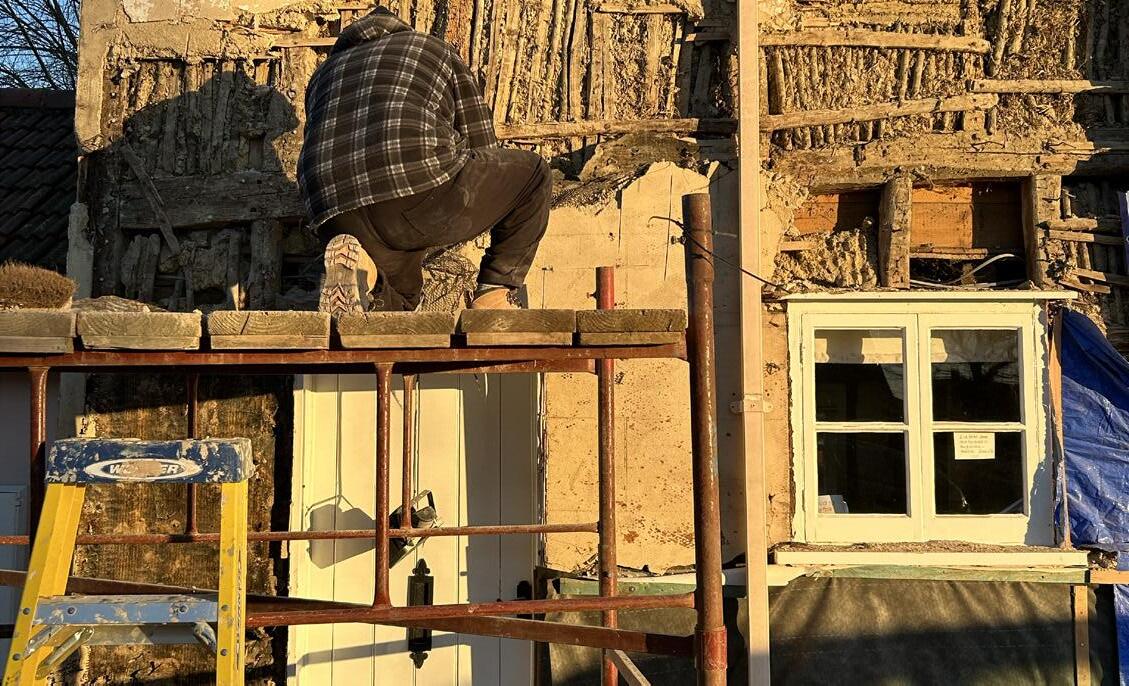
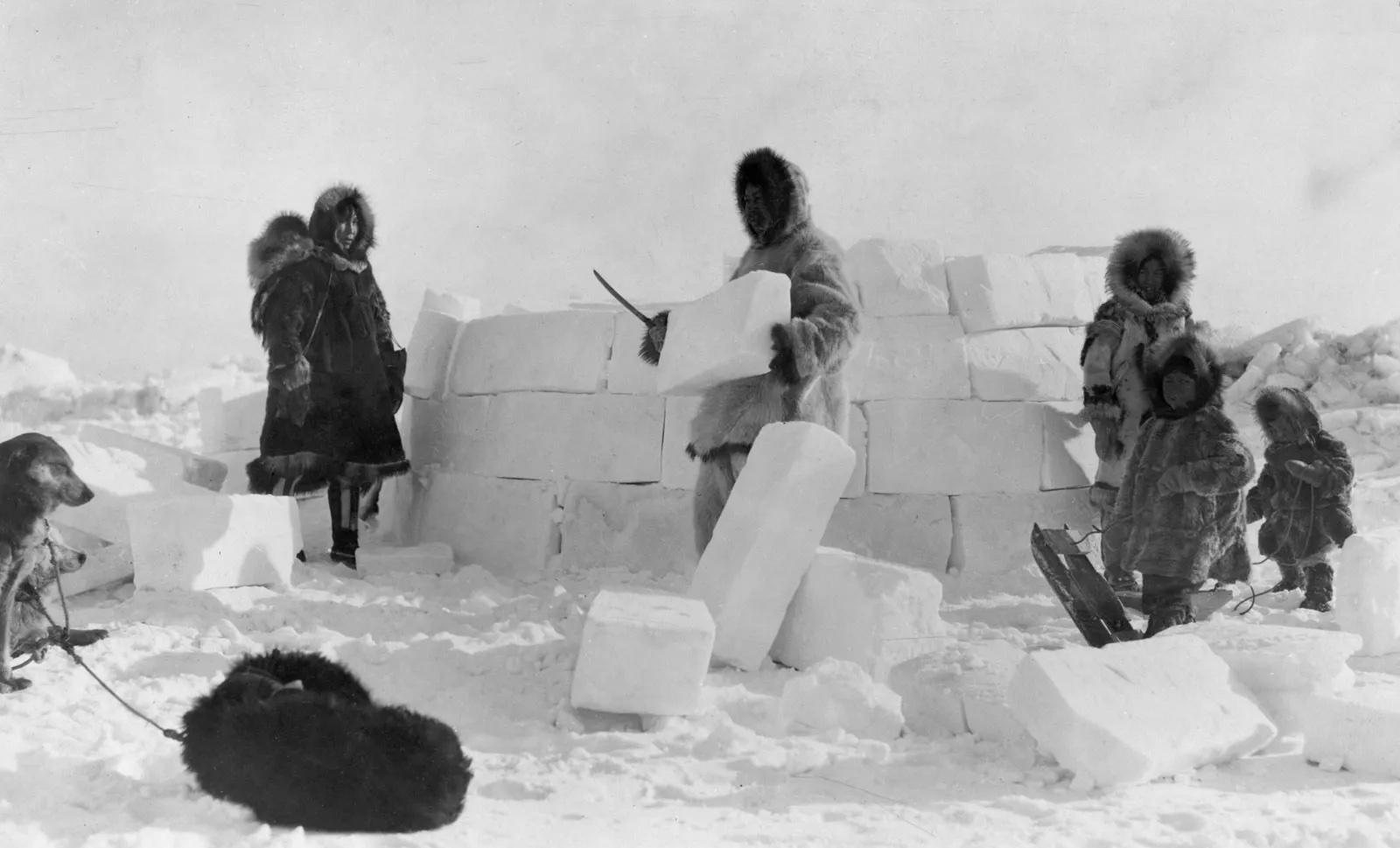
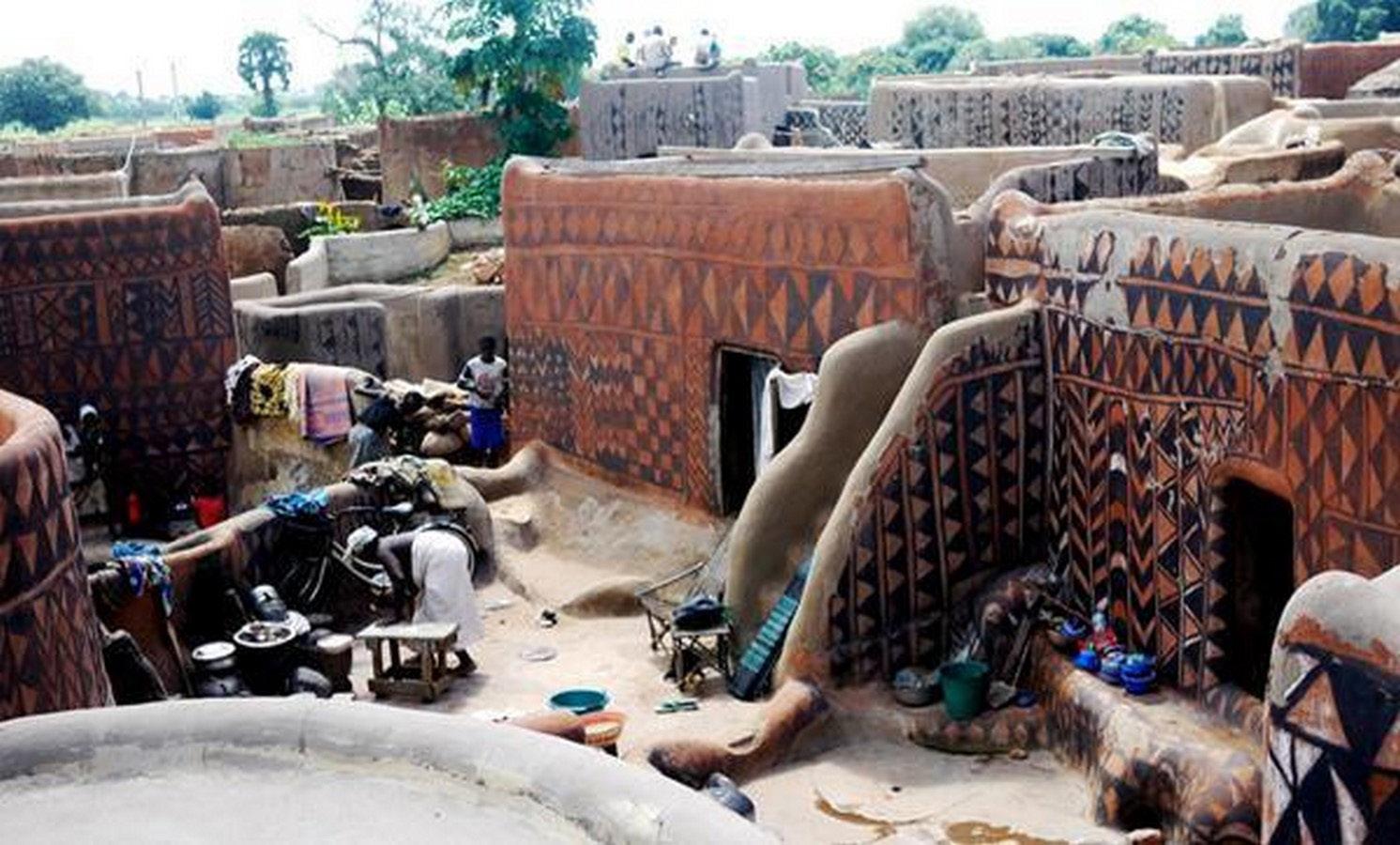
In fact I believe there already exists visible proof that an ecologically harmonious approach to design can work in the vernacular building methods of our past. When considering buildings, ‘vernacular’ is defined as ‘architecture concerned with domestic and functional rather than public or monumental buildings’ (Oxford Languages, no date). Oliver (2006) cited in Khoja and Waheeb (2020, p.34) describes vernacular architecture as the ‘native science of building’. Radoine (2017), cited in Khoja and Waheeb (2020) outlines the growing interest in vernacular practices, and how they have become a model to aid sustainable building practices (Fig. 25; Fig. 26). However vernacular techniques in modern day design remain limited due to their often specialist and localised practices.
The principles of biophilic design actually align closely with that of vernacular practices as they share the idea of an ardent connection to nature (Khoja and Waheeb, 2020). Vernacular architecture could perhaps be labelled some of the first examples of biophilia, however I believe there is still a clear distinction between biophilic practices and vernacular methods. Vernacular practices give full consideration to the environment in which they sit, accounting for aspects such as the climate, the terrain or the proximity to sources such as rivers or lakes (Zhong, Schroder and Bekkering, 2021). These factors all heavily contribute towards the outcome of vernacular structures both aesthetically and functionally as they rely on the local resources to provide materials and information for their designs to be realised (Fig. 27; Fig. 28).
Thus, vernacular architecture shows how humans once took lessons from nature, allowing the local flora and fauna to inform not just their design decisions, but their ways of life. This innate
connection to the environment is where vernacular methods become distinct from those of biophilic design. While vernacular architecture should be used as a prime example of how humans can coexist and connect with nature, and accept nature into their design practices, there is now social understanding and acceptance that we have technologies to overcome environmental factors that once may have ruled us.
As modern technologies have developed, we no longer need to find the right place to build, but bend the environment to suit ourselves, and dwell wherever we choose, whatever the environment, recreating what is needed, or repelling the external factors that once would have prevented us from living there. Thus, there remains a required cultural reformation to be made before we accept that perhaps there could be a reason to readopt these vernacular practices and use our technologies to work with the given environment rather than to overcome it. Architects could learn much from observing those things that aren't designed into an urban space, and this could influence how they might design to find a compromise where nature might live in harmony with humans.
Clockwise from left
[Fig. 25] Thatch repairs in progress (Bergh, no date)
[Fig. 26] Reconstruction of 16th century timber framed home (Wilks, 2024)
[Fig. 27] Inuit people constructing an igluvigaq with blocks of snow (Encyclopædia Britannica, no date)
[Fig. 28] West Africa, earth construction techniques have become a robust response to climate change (Worthington, no date)
Natural reason towards design reformation
There are an immeasurable number of ecological interactions with the built environment and, while it is clear humans desire control over these (Ichioka and Pawlyn, 2021) this remains an incessant task. Ecology possesses a trait our species has failed to control within today's cultures, namely the ability to move freely and unrestricted by the rules we have constructed for ourselves thus rendering organisms uncontrollable.
Fig. 30 - Fig. 37 are a series of photographs captured in Oxfordshire over the period from October 2023 to January 2024. These images exhibit an array of uncontrolled interactions between the local ecology and infrastructure.
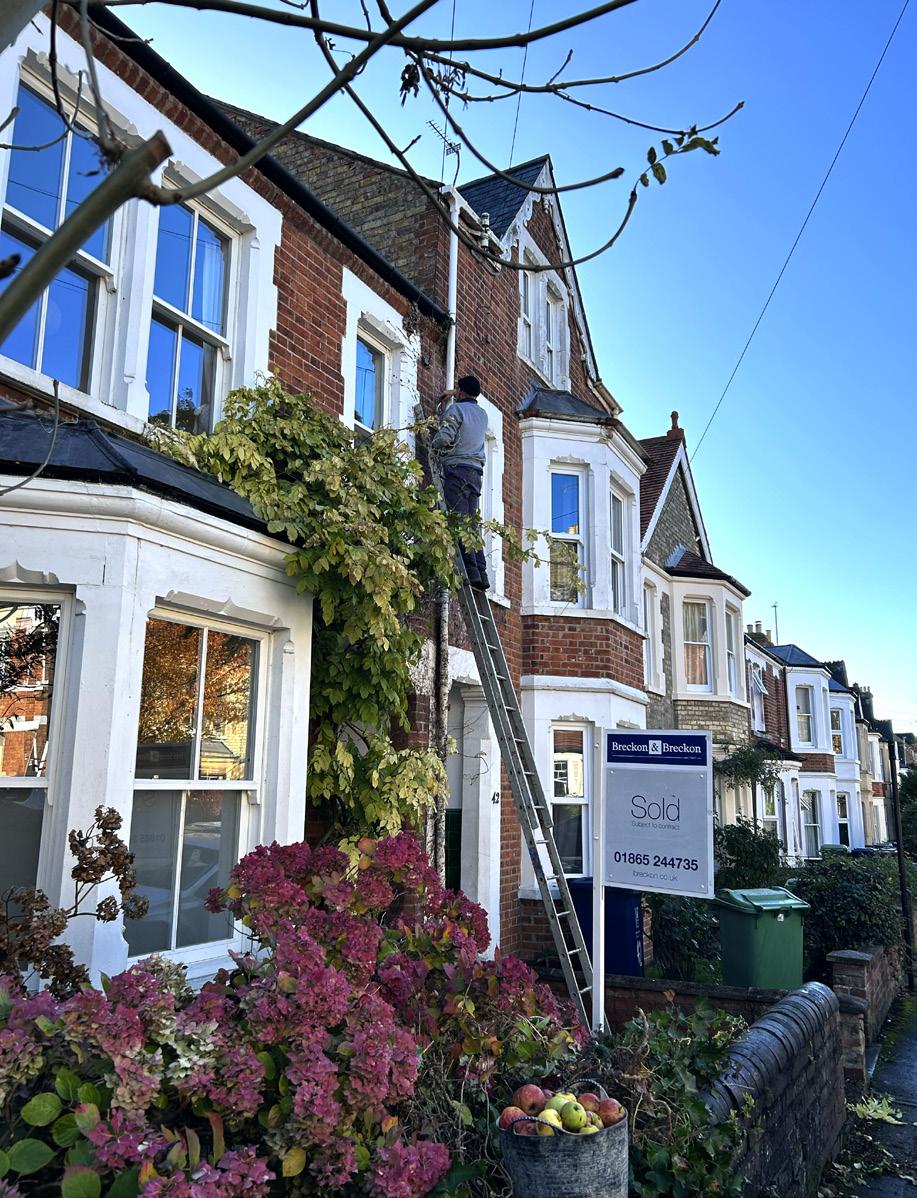
There are viable reasons for human aversion towards such interactions. With ecological inclusion come problems: organisms can and do damage our infrastructure (Hopkins and Goodwin, 2011) (Fig. 29). For example, plants can root into cracks caused by weathering, further expanding into the space and causing greater damage. Fig. 34 shows the removal of ivy from the façade of a house in progress, climbing plants like ivy can and do cause damage and result in its removal from a structure despite its ability to host a substantial and diverse number of organisms. Fig. 33 displays a tree rooted into a building frontage, likely caused by animal or wind seed dispersal. This interaction would understandably cause much angst as the sapling ages and expands into the building as there could be notable damages to the structure, resulting in the need for potentially costly repairs. With this combination of uncontrolled interaction, apprehension and aversion to invite further organisms into our built spaces is understandable. However, I feel we might re-frame the way we consider ecological freedoms which might counter human anxiety.
From an ecological perspective the freedom to disperse and root wherever they find suitable conditions is a primal occurrence of nature. Simplified, nature doesn’t follow human rules.
It could be argued then, through acceptance of our inability to fully control nature, we might better find an equitable design compromise where we retain some control over our building design, but we also make space for nature. As humans we are self-serving, but this approach provides an opportunity to solve the problems of unwanted ecological interaction and do it in a way which gives us
[Fig. 29] Weed root balls have become very well established in the town's drains (McCrystal, 2023)
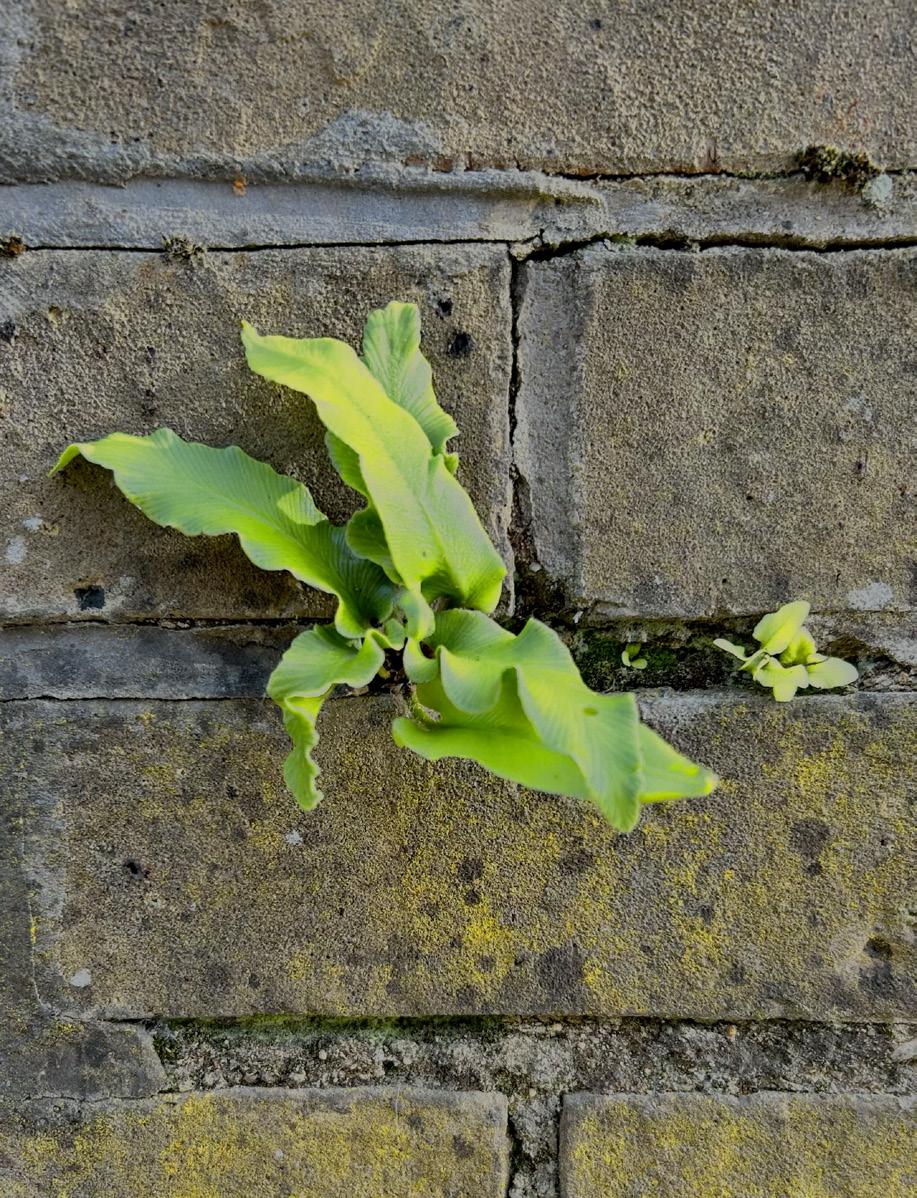
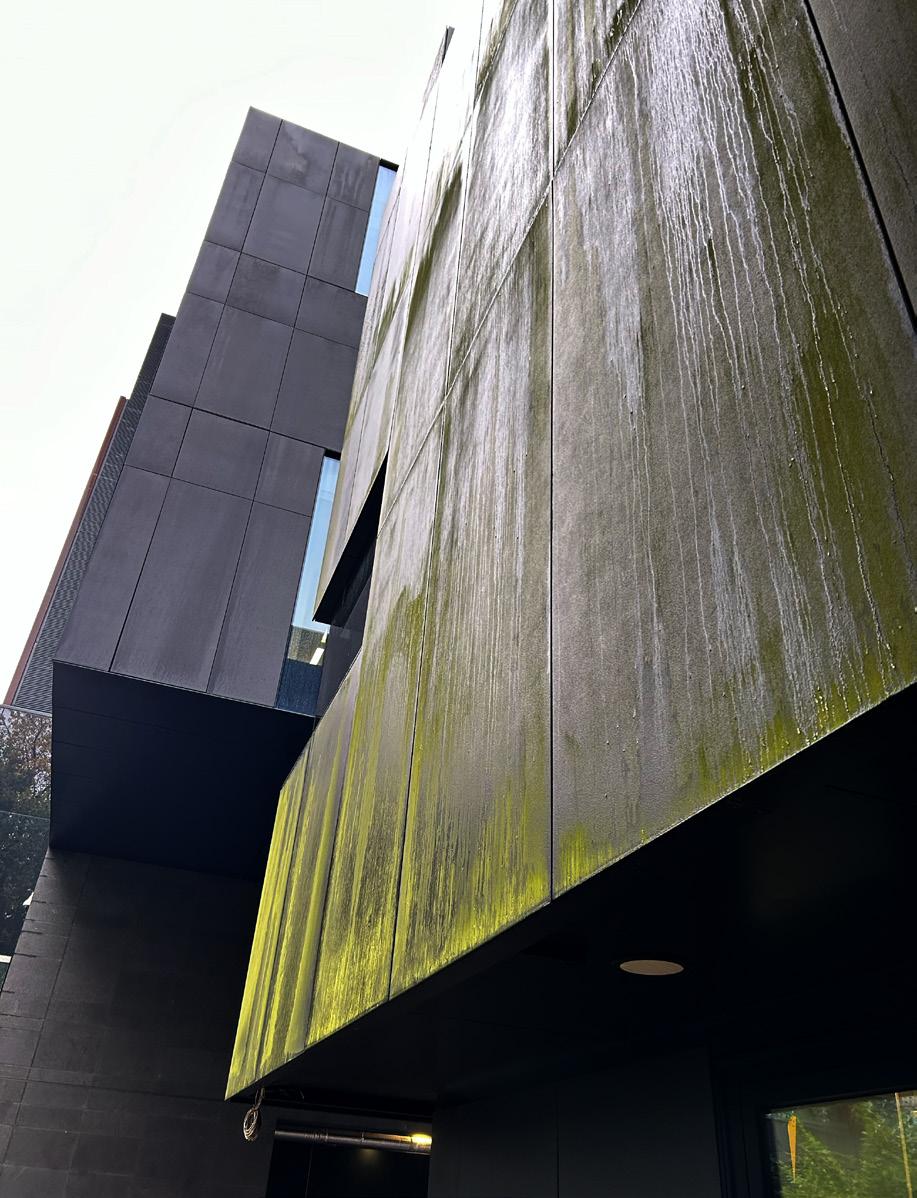
[Fig. 31] Harts-Tounge fern [Asplenium scolopendrium] growing in gap of weathered and eroding mortar between bricks (Wilks, 2023) [Fig. 32] Green algae [Chlorophyta] growing on damp, sheltered, west facing smooth stone façade (Wilks, 2023)
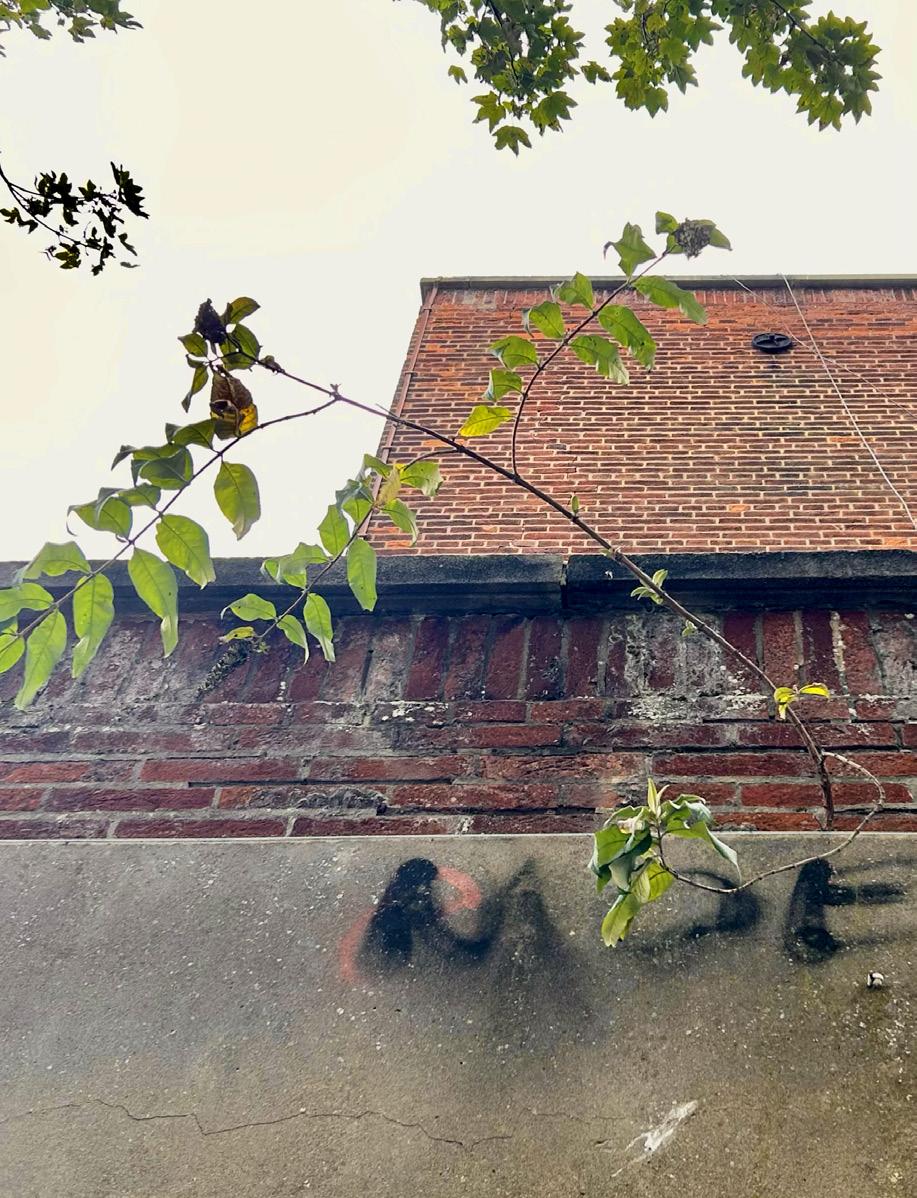
[Fig. 33] Young sycamore maple [Acer pseudoplatanus] sapling rooted between concrete and bricks into a building
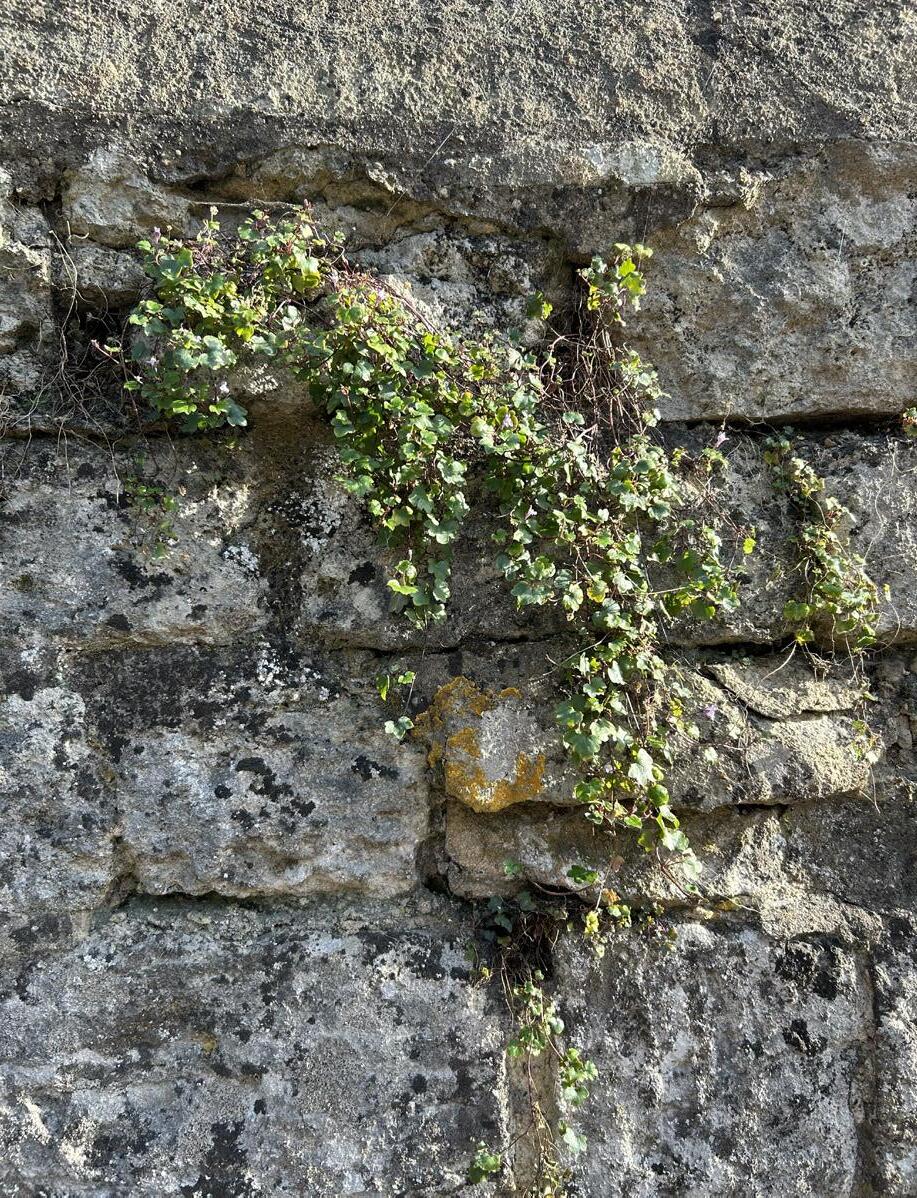
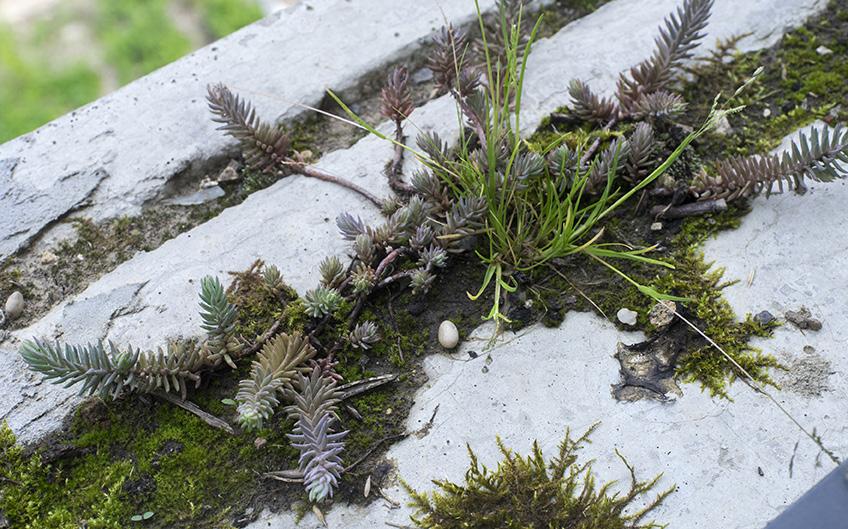
Clockwise from left [Fig. 30 Kenilworth ivy [Cymbalaria muralis] and Crustose lichen [Acarospora badiofusca] rooted into cracks into weathered limestone wall (Wilks, 2023)
façade (Wilks, 2023)
Clockwise from left
[Fig. 34] Removal of ivy [Hedera] from brick house façade in progress (Wilks, 2023)
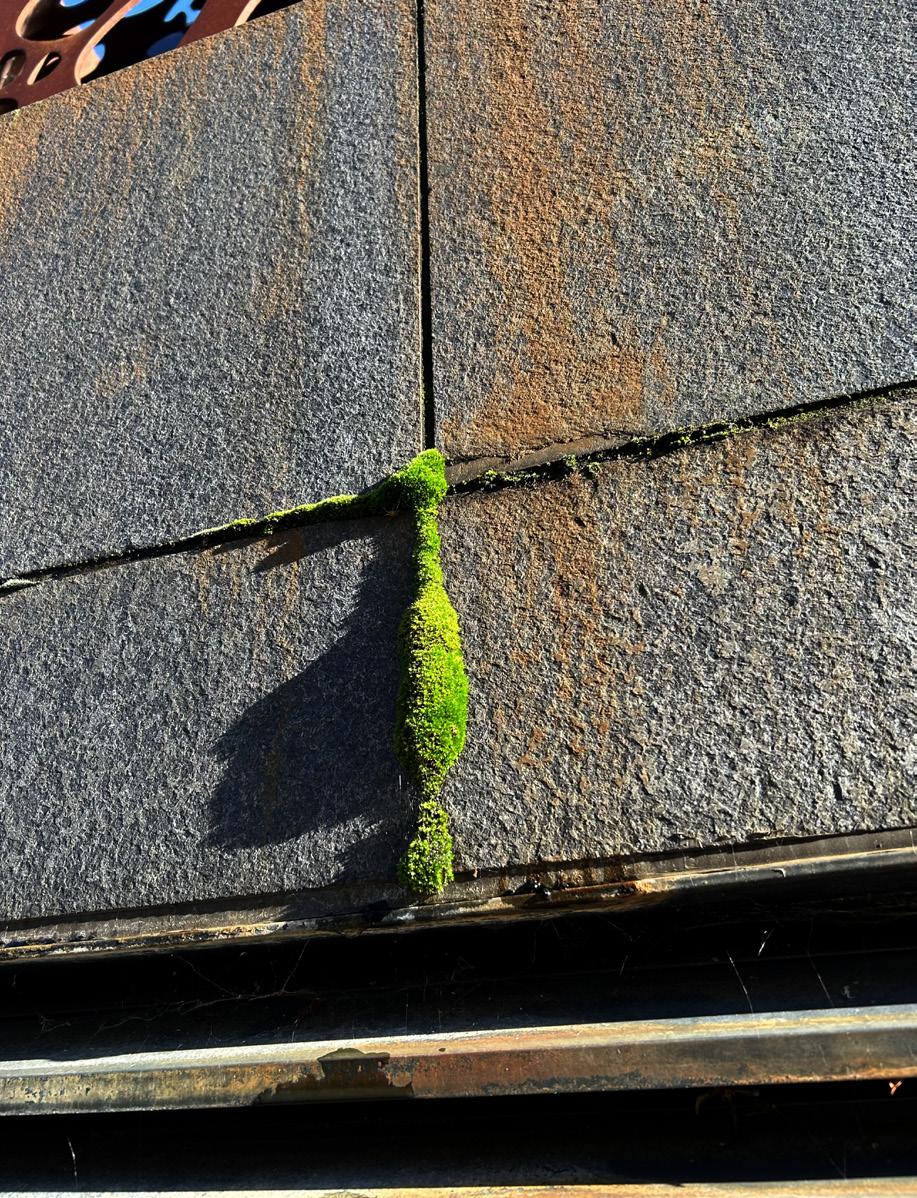
[Fig. 35] Green moss [Leucobryum glaucum] growing in the gaps eroded between stone façade panels (Wilks, 2023)
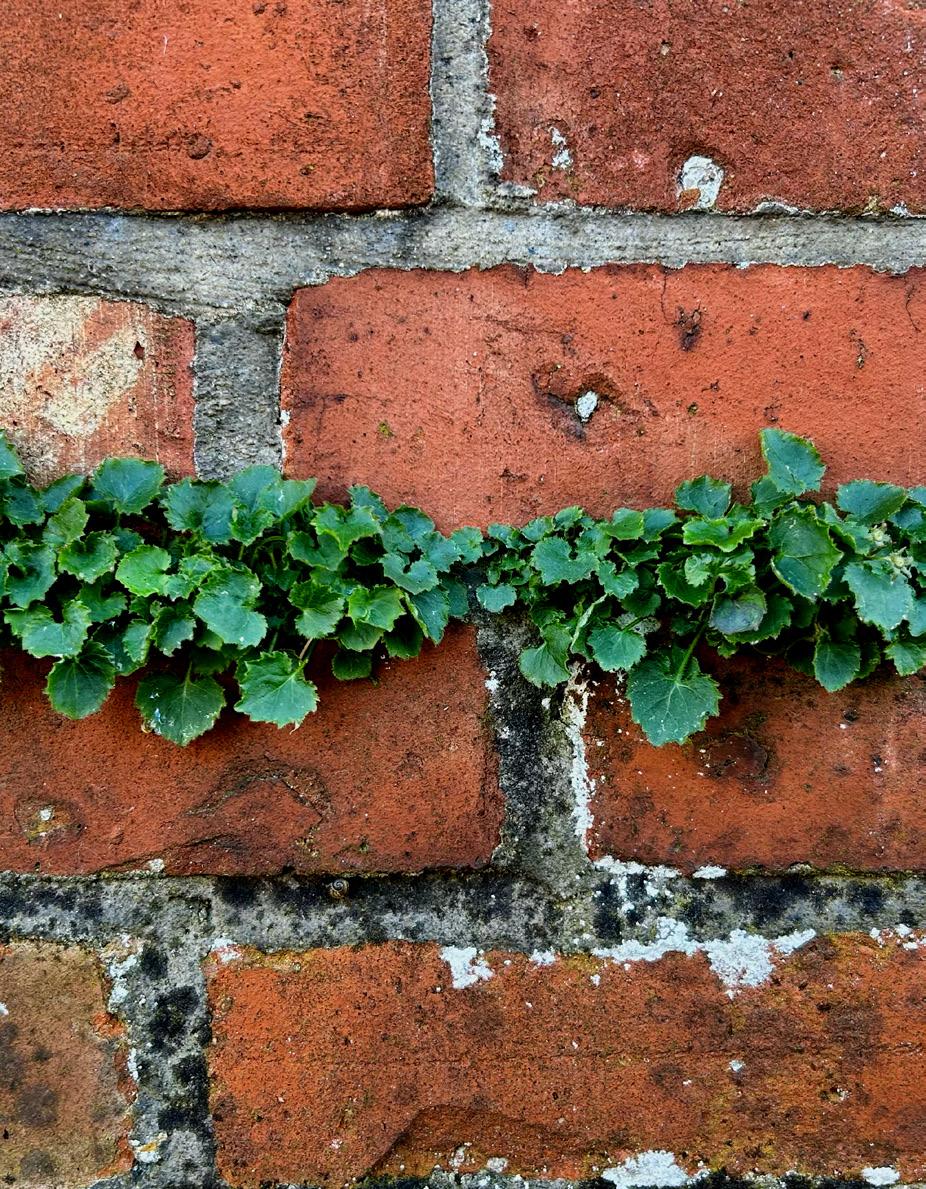
[Fig. 36] Trailing bellflower [campanula poscharskyana] growing horizontally along the gaps of eroded motar between bricks (Wilks, 2023)
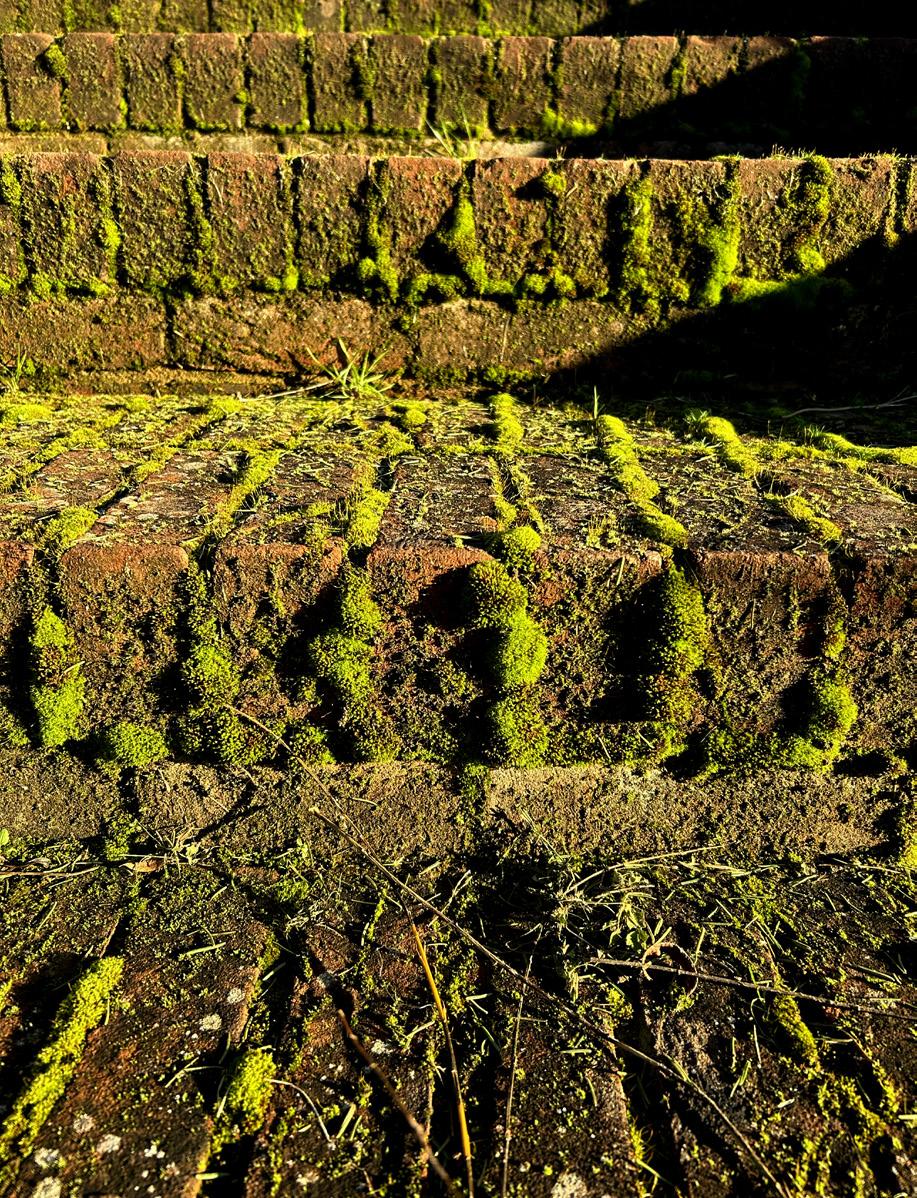
[Fig. 37] Wall screw moss [Tortula muralis] growing in place of eroded motrar between weathered brick steps (Wilks, 2024)
increased control. This could lead to us embracing such new design ideologies with greater enthusiasm.
A superior approach might be to suggest a solution that can result in a deliberate space that invites ecological interaction, allowing for plant ingress while not compromising the infrastructure (Fig. 38; Fig. 39). Thereby we might enable our species to exert a level of control, thereafter enabling the ecology to have its’ freedom in a semi-controlled environment adapted towards its’ habits.
As biophilia is defined as ‘love of life’, we need to revisit our perceptions towards ecology, understanding how we indirectly benefit from the small decisions made to encourage its flourishing. Through learning to accept and ‘love’ this ‘life’ too, we can look towards a future in which we co-exist among the ‘web of life’ with receptivity as opposed to resistance. I would go so far as to posit that such uncontrolled ecological interactions would be truly biophilic, where man and nature live circularly, benefiting from each other as the principles of biophilic design require. By reading a city through these inadvertent instances, architects could unlock an infinitely increased volume of research material derived from ecological eccentricities and in turn might inspire a new age of urban design.
[Fig. 38] Green algae [Chlorophyta] growing on damp, west facing smooth stone façade (Wilks, 2023)
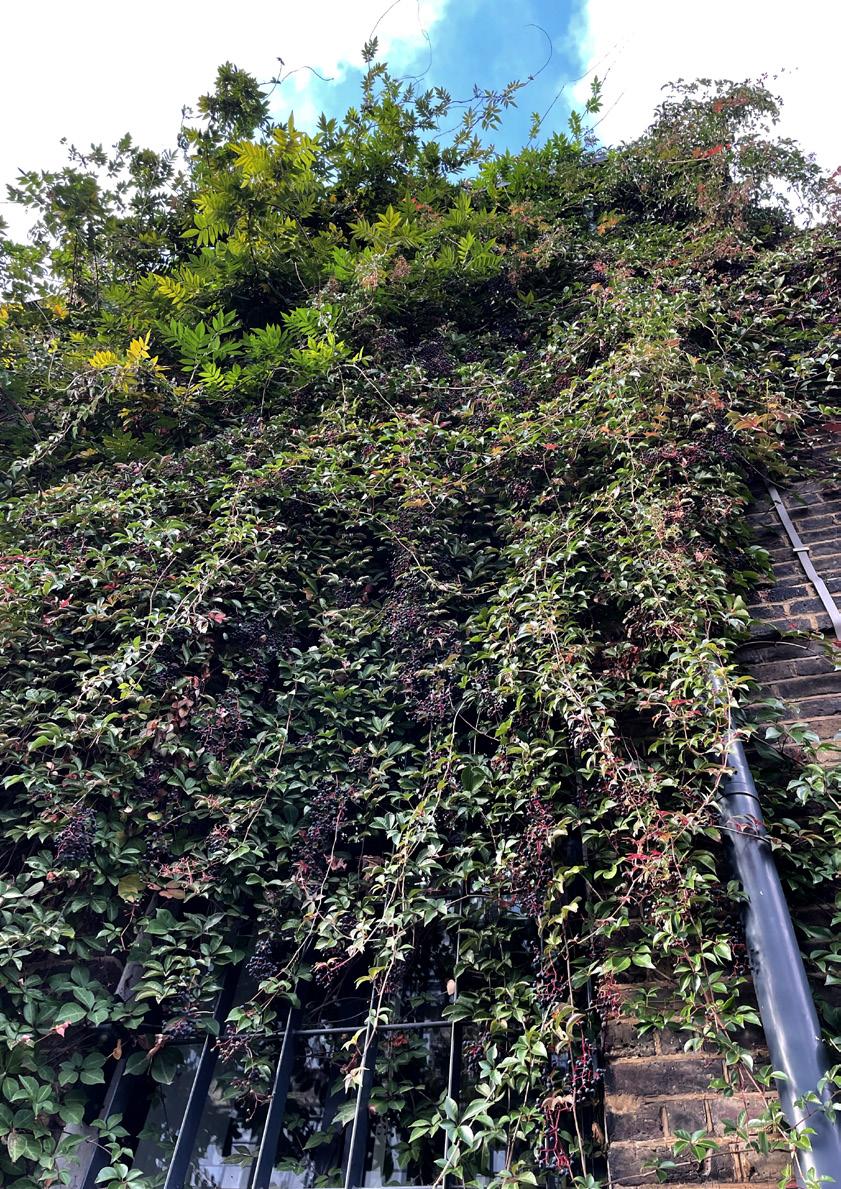
[Fig. 39] Virginia creeper [Parthenocissus quinquefolia] climbing the side of a building in London (Wilks, 2022)
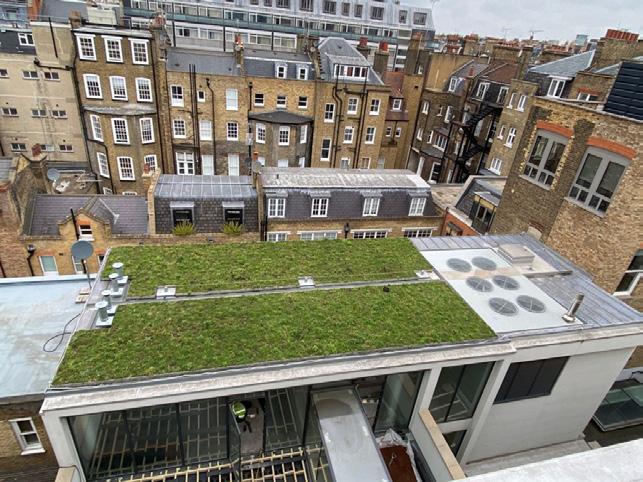
[Fig. 40] Bentinck street green roofs, London (Pritchard & Pritchard, no date)
[Fig. 41] Intensive green roof system (ZinCo, no date)
Greening urban infrastructure: The ecological challenge
Organisms are all uniquely equipped to thrive individually while providing and gaining support within an ecosystem (Weisser et al, 2022; Ishimatsu and Ito, 2011). Each ecosystem is based on extremely site-specific climatic, environmental and external conditions meaning every site will have a uniquely individual ecosystem that feeds into larger local and regional interlinking networks (Weisser et al, 2022; Ishimatsu and Ito, 2011; Wang et al, 2022). These ideas of site specificity and network function are a highly researched and respected phenomenon (Weisser et al, 2022; Ishimatsu and Ito, 2011). Yet when the words ‘sustainability’ and ‘environmental’ appear in design proposals, there appears a true lack of inclusion of such ecological individuality into any design decisions made. As discussed by Weisser et al (2022, p.), To achieve a truly ecologically enhancing design there must be a holistic and detailed evaluation of each site and its local and regional ecosystems, ecology, climate and environmental conditions. I intend to consider how this is applicable to our current systems of urban greening.
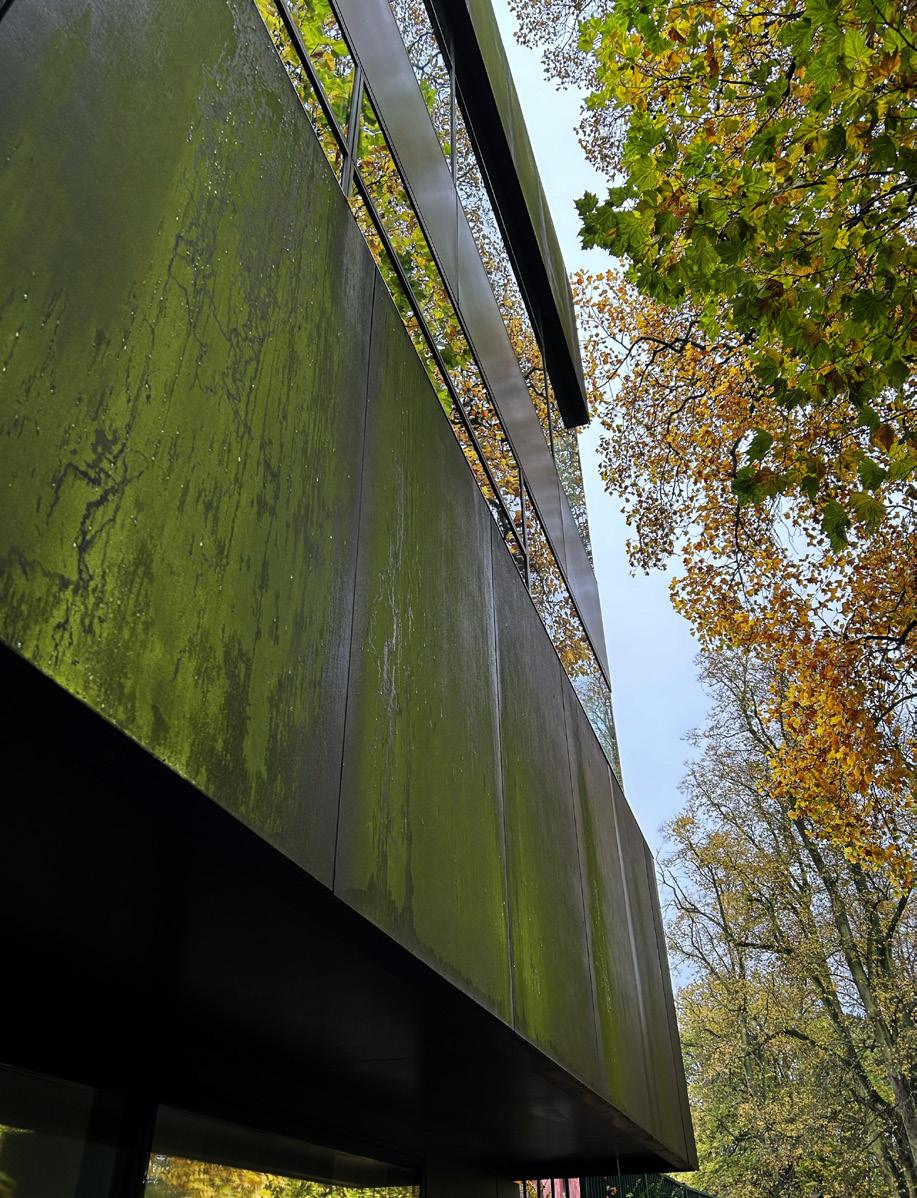
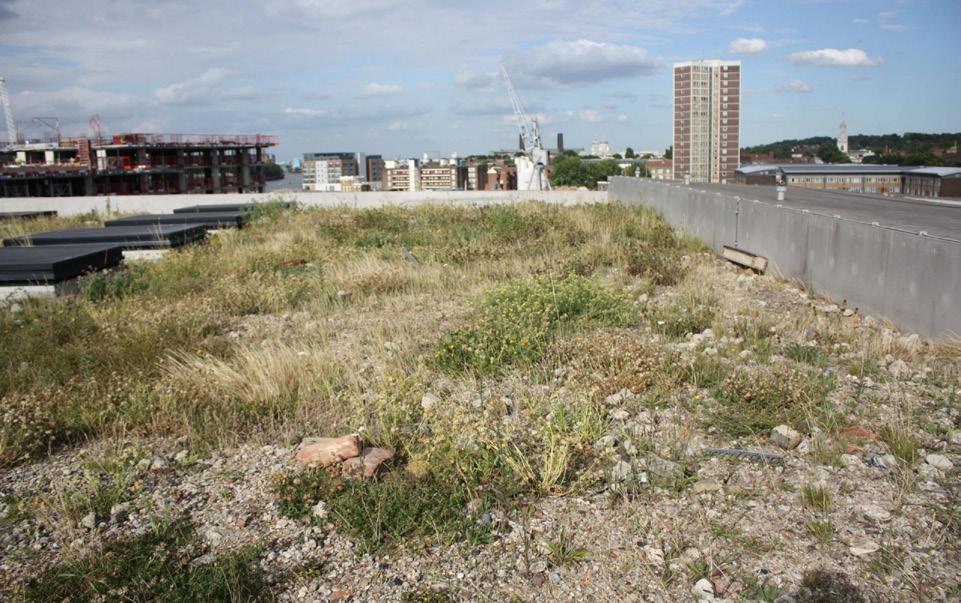
One prominent feature applied in contemporary urban greening strategies is the introduction of a green roof. Modern Green roof systems can be split into two main types, extensive (Fig. 40) and intensive (Fig.41) (Ishimatsu and Ito, 2011; Ronnie Hill, 2022). The extensive roof is identified by its usually shallow layer of substrate, lesser structural dependence and a low need for maintenance. By contrast, an intensive roof can be defined by its much greater depth of substrate and higher structural dependence which allows a much wider range of plant growth and accessibility for human users (Ishimatsu and Ito, 2011). However this also results in greater need for maintenance, specialised systems and therefore significantly higher costs for both construction and maintenance (Shafique, Kim and Rafiq, 2018).
When reviewing research and opinion of green roof systems there is overriding support towards both types and their myriad of both human and environmental benefits (Shafique, Kim and Rafiq, 2018). Hill (2022) outlines an extensive list of benefits (Fig. 42) which includes thermal properties, heating the building throughout winter and providing cooling over summer, resulting in reduced energy and fuel consumption; the reduction of air pollution as a effect of the planting; stormwater management and subsequent
flood reduction; the reduction of noise and sound pollution; improved insulation properties resulting in heat absorption, and thereby reduction of the ‘urban heat island’ effect; increased urban biodiversity through introduction of planting and habitat creation in the local and regional areas.
As with any design decision, there remain disadvantages to the implementation of a green roof. With existing buildings, issues may arise when reviewing the structural capabilities of the building (Ishimatsu and Ito, 2011; Green Roofers, no date), and this could be said to be the biggest barrier in their implementation. With new building designs, the costs of material, production and construction, and the additional implementation time, especially for an intensive green roof, may outweigh the benefits in the opinion of a designer unless the roof was a principal feature of the design (Shafique, Kim and Rafiq, 2018). A green roof, principally an intensive green roof, requires additional irrigation systems, ongoing maintenance and thereby results in additional fuel, energy and water costs post construction (Ishimatsu and Ito, 2011; Dunnett and Kingsbury, 2005).
[Fig. 42] Infographic showing benefits from green roof and rainwater harvesting system by author
Note: adapted from Benefits from green roof and rainwater harvesting system (DeYoung et al, 2017)
After much research into the topic, there is definitely a positive case for adopting the appropriate green roof system into one's designs - the benefits seem to outweigh any disadvantages. Certainly from a human-centred design perspective this can be seen to be true. However, there remains limited research into the true ecological benefits of green roof design (Coulibaly, 2023). Current research trends into the environmental, climatic and ecological benefits provided by green roofs remain, in most cases, generalised and assumptive (Weisser et al ,2022) based on the human presupposition that all things ‘green’ must directly result in benefits to the environment. As further explained by Coulibaly (2023, p.11) the interest surrounding the biodiversity of green roofs is mainly based on the ‘provision of a range of ecosystem services [ranging]…from aesthetic, cultural and recreational values to goods that have direct use value and enhance many other ecosystem services on which humans depend’. Once again this demonstrates supposedly ‘ecocentric’ design decisions as actually being based on human-centred principles.
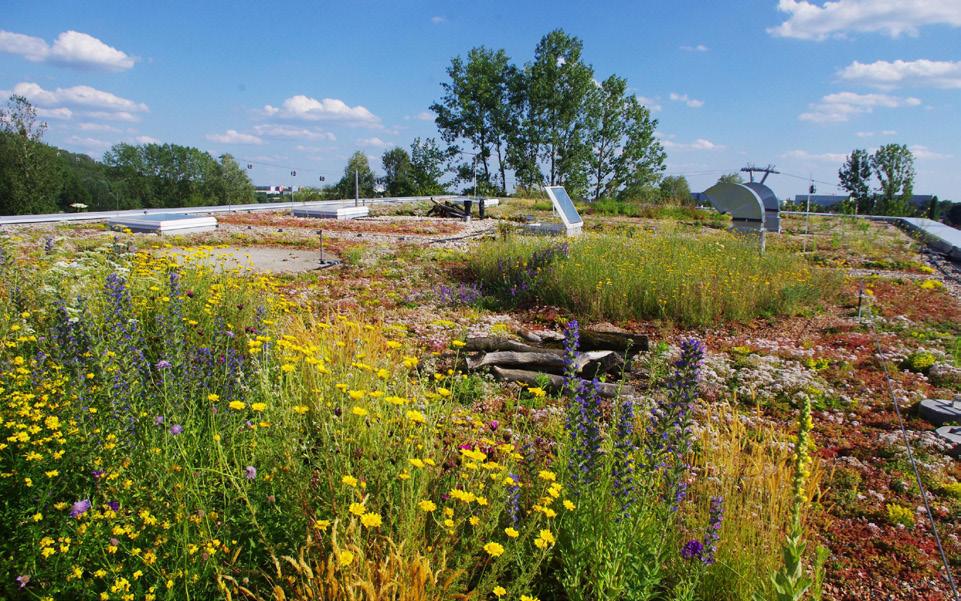
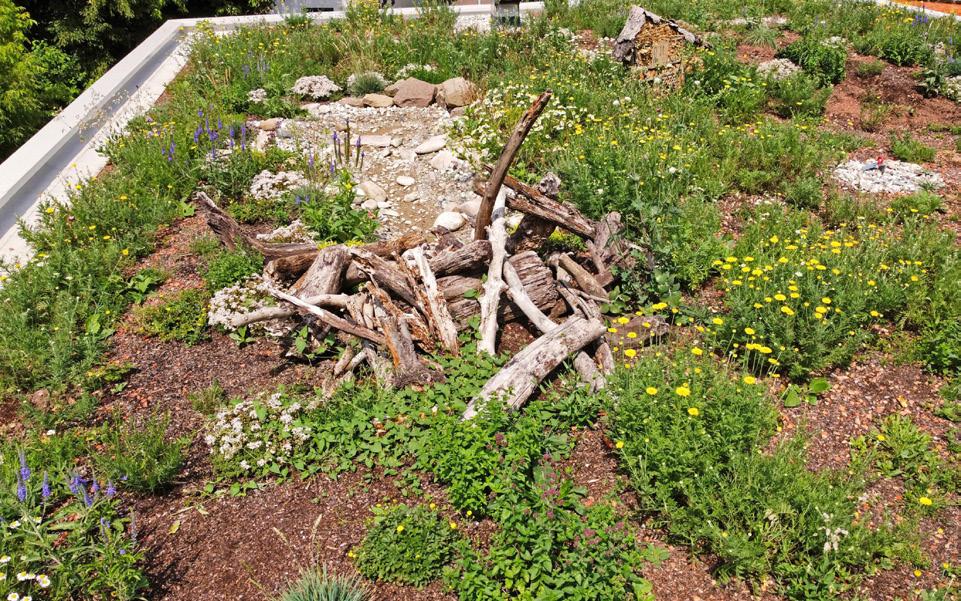
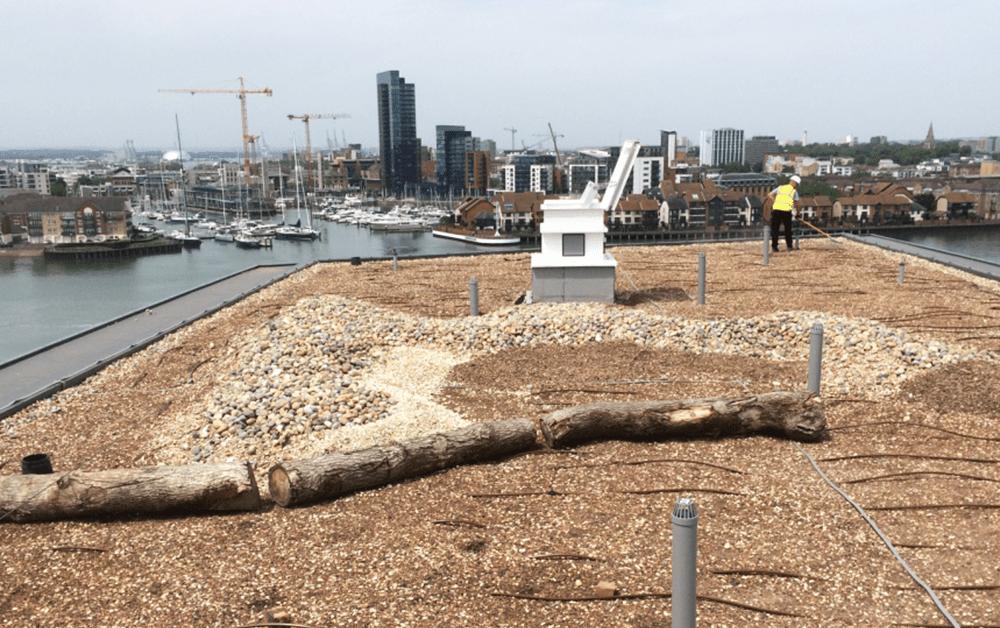
Brown roofs, also referred to as biodiverse roofs (Fig. 43; Fig. 44), are defined by IKO (no date) as having ‘self-vegetated substrates where windblown and wildlife migrated seeds create the roof finish’ and are made up of ‘soil and rubble from construction …with the vegetation selected to match local species and targeted at encouraging particular habitats’ (Richmond, 2019). The introduction of the Biodiversity Net gain policy, among others that focus on the increase and restoration of habitats (Defra and Natural England, 2019) is hoped to result in the increased implementation of brown and biodiverse roofs as it is understood that regular
[Fig. 44] “Deadwood” should really be called “biotope wood”, as it is used as a habitat by moss, lichen, beetles and flies (Hohenschlaeger, no date)
[Fig. 43] A biodiversity roof installed on the IGA visitor centre in Berlin (Hohenschlaeger, no date)
‘extensive’ sedum roofs will not suffice to meet the biodiversity net gain required (ZinCo, no date).
The move towards brown roofs over green is a major step in the right direction, ecologically speaking. There is visible effort shown to enable and enhance the habitats in which local native species can self-plant, self-sustain, maintain and extend local ecosystems (Coulibaly, 2023; Ishimatsu and Ito, 2011). Brown roofs also require fewer materials, less maintenance and lower running costs. Hence, a brown roof should be seen as a much more straightforwardly beneficial example of an urban greening strategy. Alas, aesthetics (and the human desire for control) come into play (Fig. 45; Fig. 46). The unpredictable result of plant mix and the dislike of ‘uncontrolled’ interactions with our infrastructure play a part in rendering brown roofs a less adopted urban greening strategy despite their superior offer to a local ecology. Another barrier that arises when considering a brown roof as opposed to a green roof is, again, based on the human-centred design practices and the human tendencies to take the space we desire with little regard to other species (Ichioka and Pawlyn, 2021). A brown roof must remain mainly largely untouched by external factors that could disrupt the ecosystem, thus any brown roof is ideally inaccessible to the public. With the growing demand for public green space and the decreasing ground space (Goel, Jha and Khan, 2022), ecology is subsequently placed on the backbench in design discussions defining the function of new available spaces. This leads to available roof space being made into publicly accessible green roofs rather than ecologically beneficial brown ones.
[Fig. 46] Brown roof ecology (Pritchard & Pritchard, no date)
[Fig. 45] Green roof brown roof on the laban dance centre (Dustygedge, 2020)
CHAPTER THREE
A VERTICAL GAP
Note: adapted from All in one structure solves flooding, parking and the lack of green space in cities (ThirdNature, 2016)
A vertical gap
With the demands for urban green space remaining high (Goel, Jha and Khan, 2022), and public interests understandably remaining at the core of urban planning and development processes (Defra and Natural England, 2019), we should look to supplemental spaces that might provide urban ecology room to thrive.
While horizontal greening is an obvious strategy, the area provided by the vertical surfaces is comparably vastly greater than that of the horizontal and comes with less financial implications when considering denser urban environments (Fig. 48). Despite currently being highly underutilised (Gunawardena and Steemers, 2023) there is movement towards employing urban greening strategies into the design of vertical surfaces and its benefits have already been highly regarded.
Vertical greening can be split into two main types, façade greening and living walls (Dunnett and Kingsbury, 2005), shown in Fig.
[Fig. 48] Infographic showing space saving in cities by author
49. Façade greening is defined by Gunawardena and Steemers (2023) as climbing plants growing along a wall. Dunnet and Kingsbury (2005) further explain the long standing practice of façade greening which requires no additional supports and self-cling to the surfaces of buildings, with modern versions employing a support network of trellises enabling the climbers to be held away from a building surface. Goal Jha and Khan (2022, p.38716) explain living walls as offering a ‘freedom of plant selection as well as reducing the limitations of application on higher floors of the building’ with ‘a vertical irrigation system …attached to the walls providing the required nutrients and water to the plants growing on a substrate’.
As identified in my literature review, Goal Jha and Khan (2022); Virtudes and Manso (2016) and Gunawardena and Steemers (2023) all discuss primarily human-centred benefits of vertical greening with much more generalised and limited regard to the true effects on the local ecology, highlighting a gap in a biocentric approach towards the applications and methods behind vertical greening.
The concepts behind brown and biodiverse roofs are understood as highly beneficial towards both humans and ecology, however the demand for space is an overriding barrier to implementation. Thus I am led to the logical conclusion that the principles of a brown roof can be translated vertically, thereby utilising the larger underused space in urban areas, while retaining the required accessible spaces for the public on the roof. Through using vertical surfaces to contextualise the principles and ideas discussed in this paper there is opportunity to visualise the benefits brought by increased biodiversity in our urban environments.
[Fig. 49] Infographic showing current green walls systems by author Note: adapted from current green walls systems (Virtudes and Manso, 2016)
green walls
green facades
living walls
climbers hangers
modular systems
vertical gardens
A new concept to aid urban ecology
Ichioka and Pawlyn (2021) explain the human tendency to form a ‘dualism’ mindset, separating mankind and nature. This mindset is in contrast to the ‘web of life’ thinking where humans are seen as part of nature, not separate from it. As outlined by Weisser et al (2022) physical examples of successful ecological design concepts could aid the social acceptance and understanding of our relationship with nature. Through re-teaching our vernacular methods and understanding our relationship with the global ‘web of life’ there is opportunity to change societal attitudes towards our ecological relationships and make real change towards a new future of the built environment.
In the proposal of their ‘ecolope’, Weisser et al (2022, p.15) expressed reservations towards presenting images of the potential concept as ‘it is the systematic design strategy and evaluation of the design outcome that sets an ecolope apart from other building envelopes, not its appearance’. This is a key principle in the holistic approach towards ecological design, as it understands allowing ecology to lead the design process as no two sites ecosystems and organisms will look the same. With this key value of ecological individuality understood, there are several precedents which I feel effectively conceptualise the ideas discussed in this paper.
Third Landscape Garden; Coloco and Gilles Clement; Saint-Nazaire, France
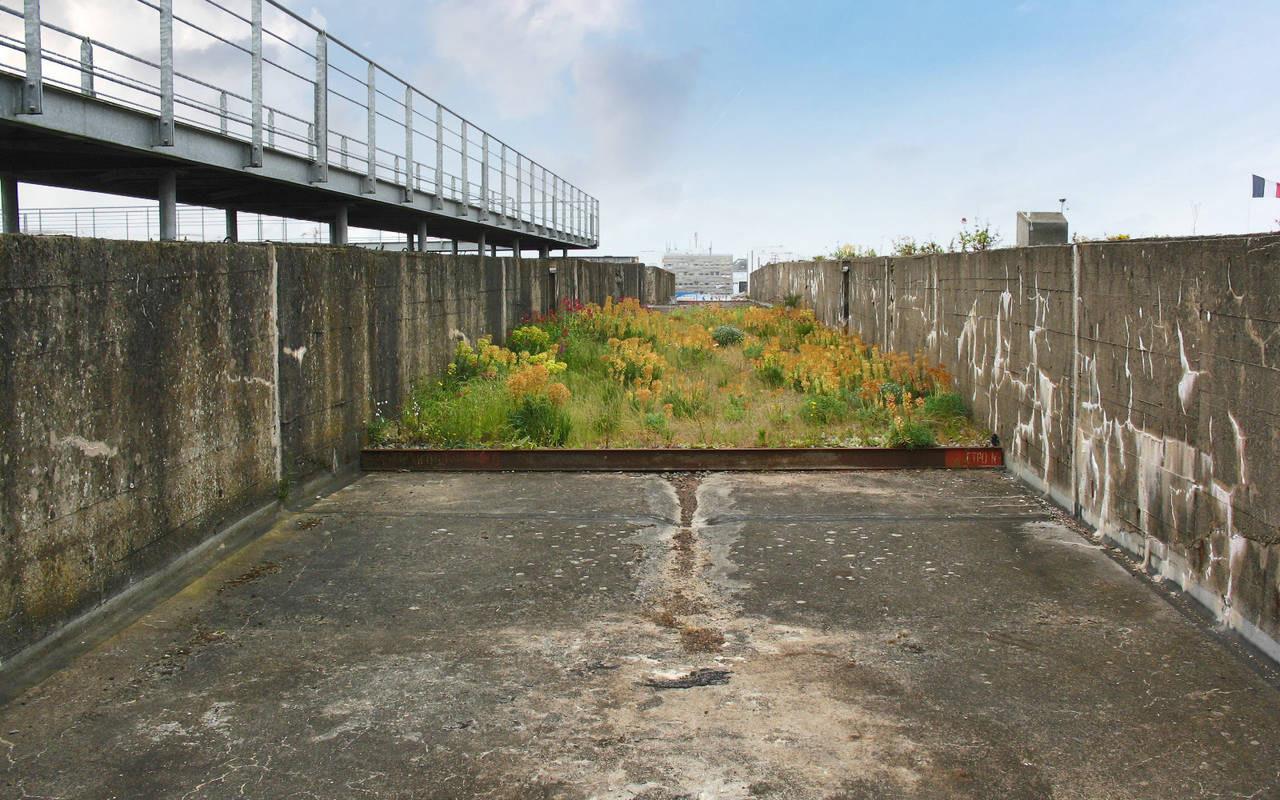
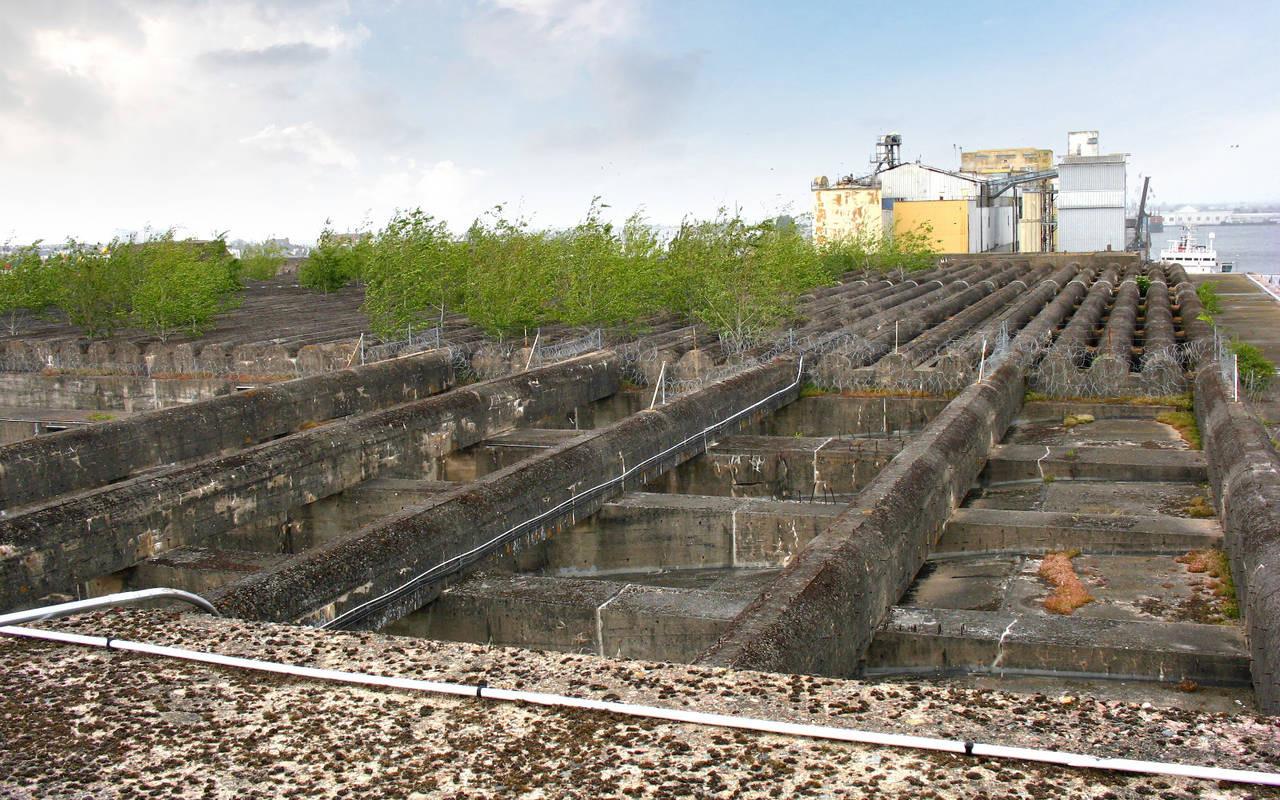
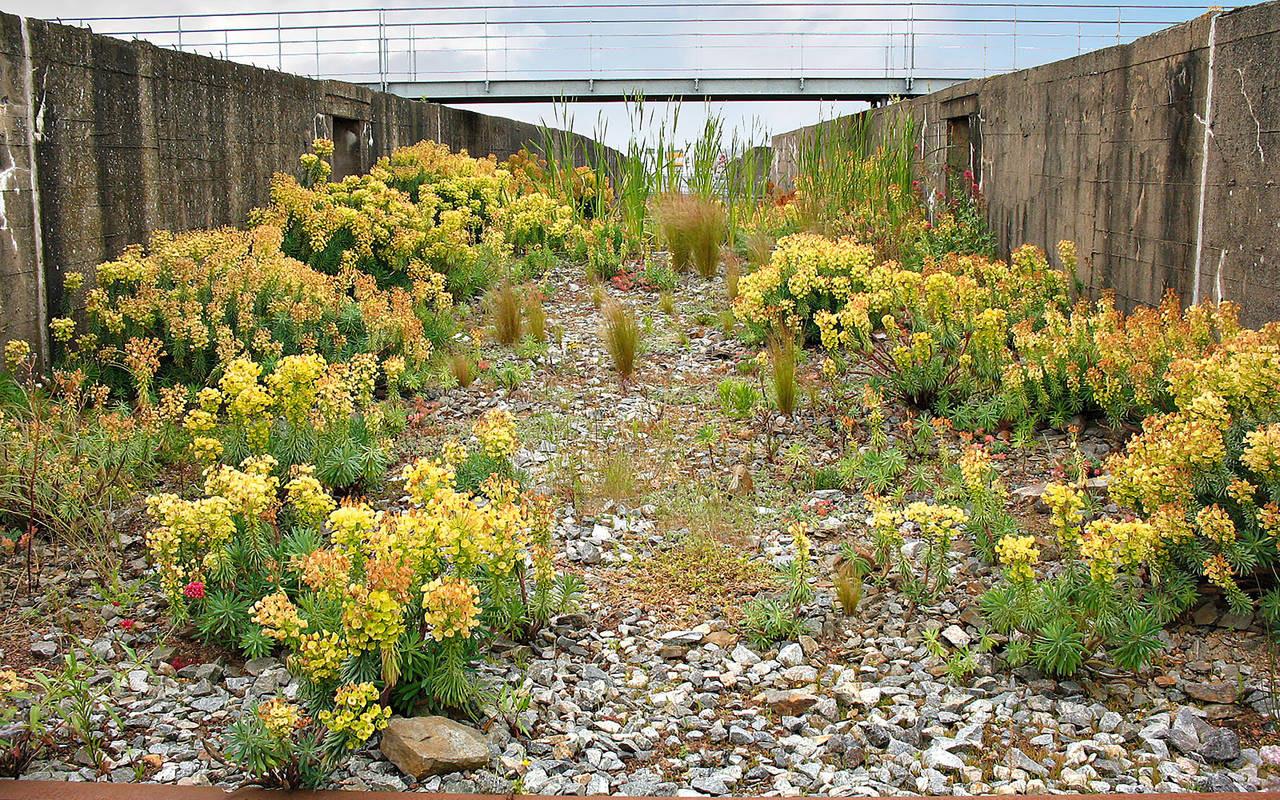
Introduced to me in the book Garden City: Supergreen Buildings, Urban Skyscapes and the New Planted Space is the Third Landscape Garden by Coloco and Gilles Clement, Located in Saint-Nazaire, France (Fig. 50; Fig. 51). Coloco and Clement, cited by Yudina (2017, pp.92-93) refer to ‘third landscapes’ as the ‘leftover spaces …inaccessible and non-cultivable areas’ which are ‘not controlled by humans’ that ‘provide a refuge for biodiversity’.
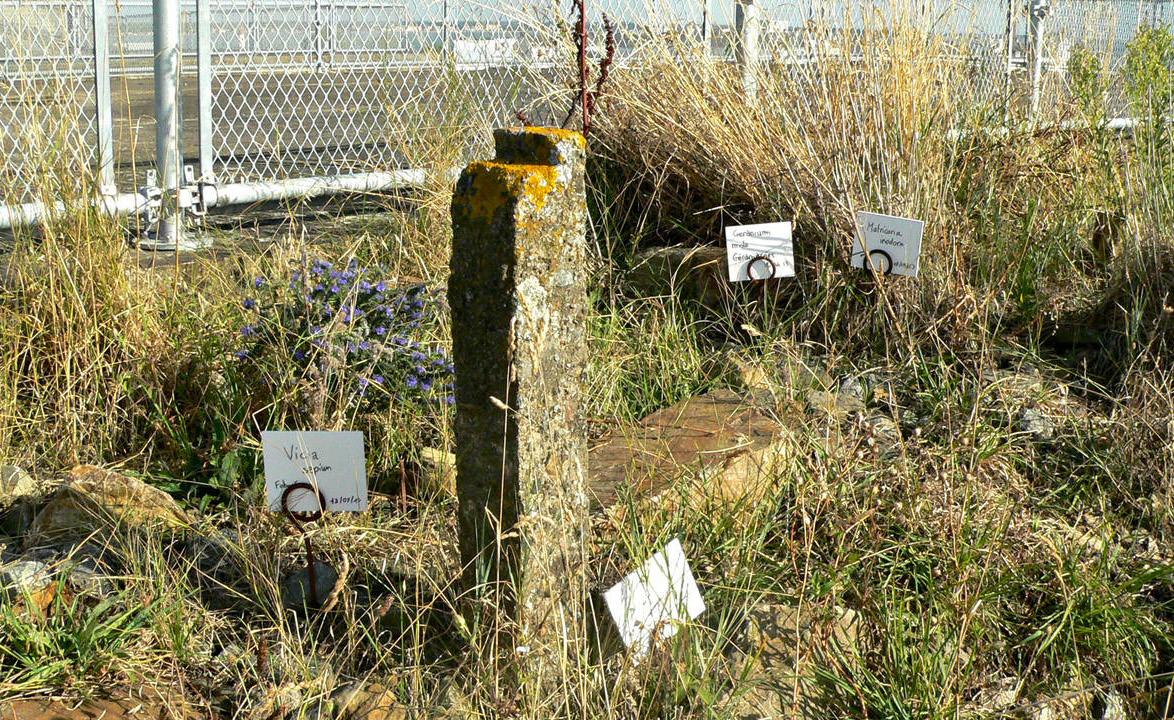
This project showed principles similar to that of a brown or biodiverse roof in an urban setting, ‘A thin substrate covers this surface in depression. The plants growing here arrive spontaneously, brought by the wind or the birds. As they emerge, they are identified and labelled’ (Coloco, 2017).
It is clear to me this Third Landscape concept is a veritable
[Fig. 50] The third landscape garden (Clement, no date)
[Fig. 51] The third landscape garden (Clement, no date)
[Fig. 52] Labels in the The third landscape garden (Georgieff, no date)
[Fig. 53] TThe third landscape garden (Clement, no date)
culmination of ecologically driven principles. The garden visually illustrates the abilities organisms carry to adapt and thrive in sparse urban environments. The labelling of the plants draws focus upon the ecological sophistication of each individual organism and elucidates the research undertaken to understand such individuality (Fig. 52).
This garden, among others which share its values, could be used as a visual tool to help change perspectives over the beauty of uncontrolled ecological interactions with our infrastructure. We have a huge respect for our national parks where we are more than content to leave nature to its own devices, and the rewilding movement is growing in both space and influence. This is an opportunity to similarly revel in nature within our urban spaces. I feel, despite the culturally constructed connotations of the word ‘weed’ the uniqueness of each individual plant should universally be seen as ‘aesthetic’. Today's garden designers are moving past defining such plants as unwanted, leading cultural change towards re-framing our ways of thinking to accept ‘nature’ and its ‘natural’ as an exquisite phenomenon of life (Fig. 53). There is an opportunity for architects and designers to do the same.
The building that grows; Edouard François with Duncan Lewis; Montpellier, France
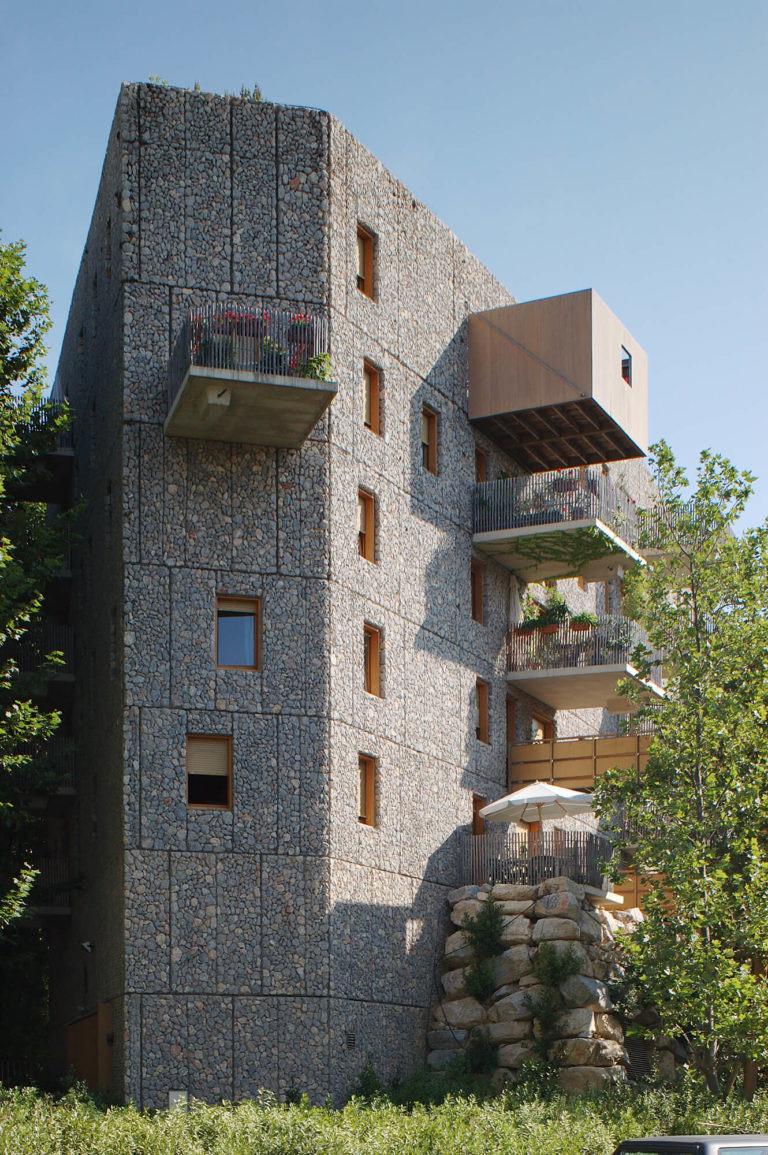
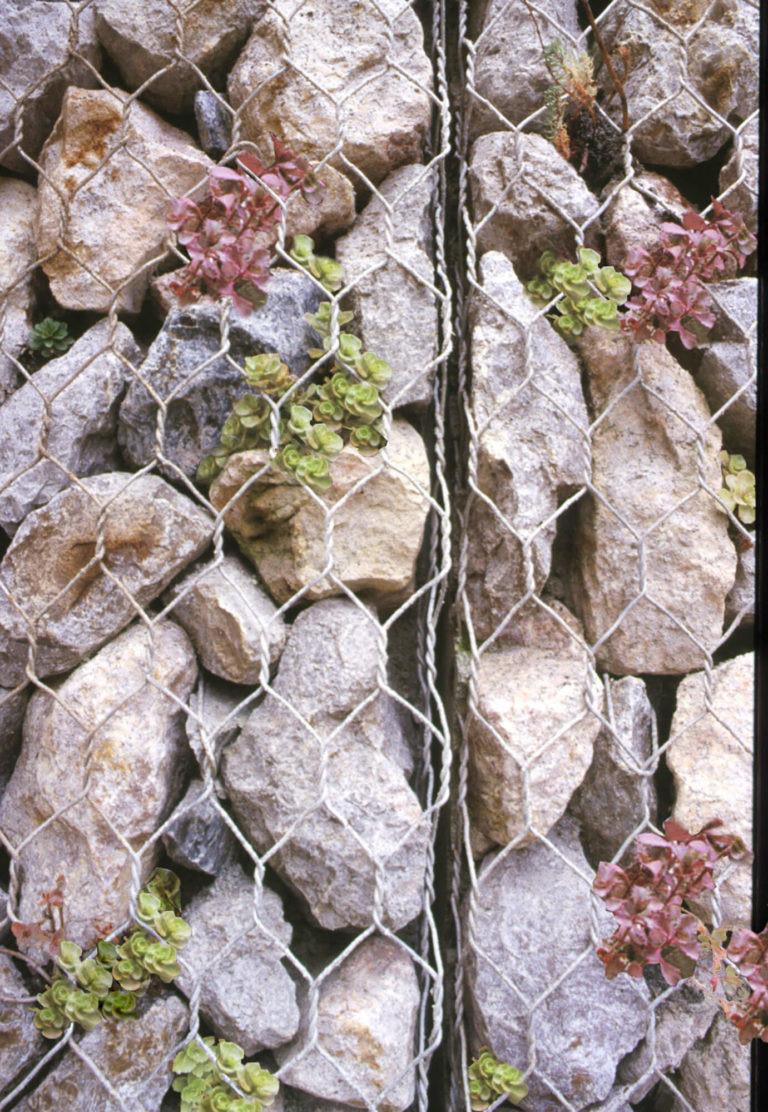
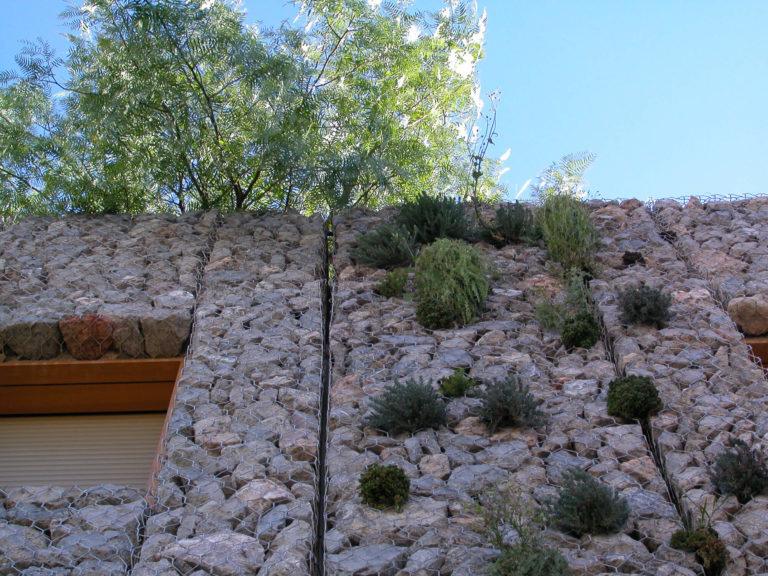
In the same book, Garden City, Yudina (2017) introduced the project The Building that Grows by Edouard François with Duncan Lewis. Located in Montpellier, France, the building is notable for its application of a ‘living skin’. The construction of this building saw ‘bags of organically fertilized potting soil carrying the seeds of various climbing plants placed behind the crushed stones [which are]...in turn, contained within cages made of stainless steel mesh’ (Yudina, 2017, pp.46-47) (Fig. 54, Fig. 55).
After the initial construction, the self seeding of plants in this concept is an example of a technique and design tool that can enable the freedom of interactions between our infrastructure and ecology. Translated from French, François (no date) explained the purpose of the design and its methods: ‘the building is growing. Slowly. Its epidermis has become a biotope. Water settles in the gaps, algae form and then die, moss develops and herbs colonize this fine soil. Here and there, traces bear witness to this transformation’ (Fig. 56).
[Fig. 54] The building that grows (François, no date)
[Fig. 55] Rocks behind steel mesh (François, no date)
This project visualises the idea of a sacrificial barrier between the plants rooting within, and the primary structure behind acting as both an effective contribution towards the building's passive climate control (Yudina, 2017, p.46), and a way to protect the infrastructure beneath. This balance between ecological freedom while sustaining human benefits should be seen as a key principle behind the methods of new design practices, idealised to be consistently realised across the urban environment.
Biodiversity School; Chartier Dalix; Boulogne-Billancourt, France
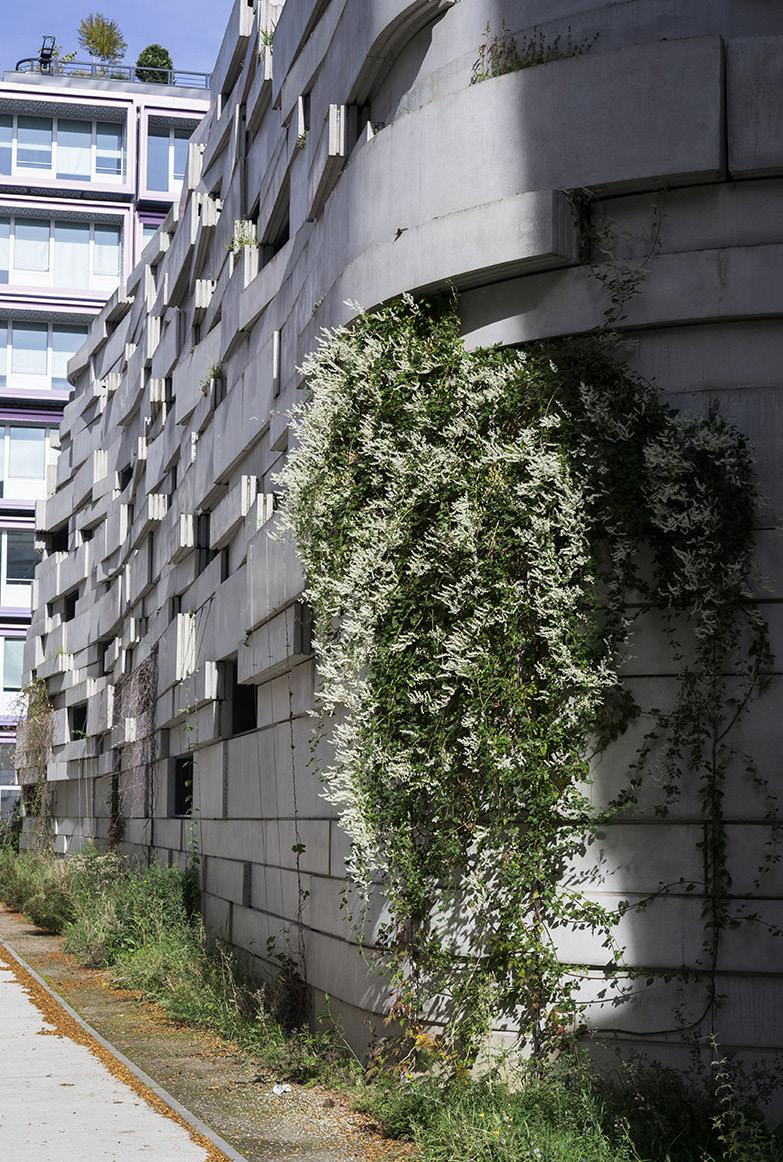
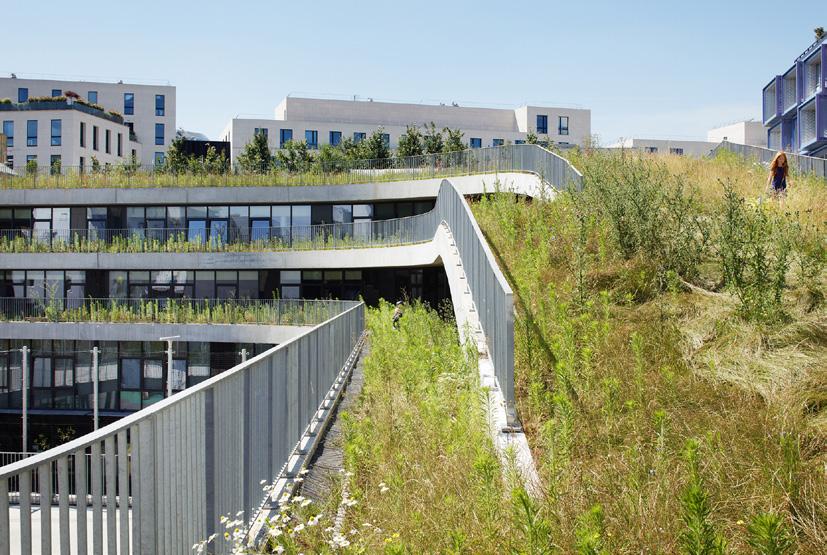
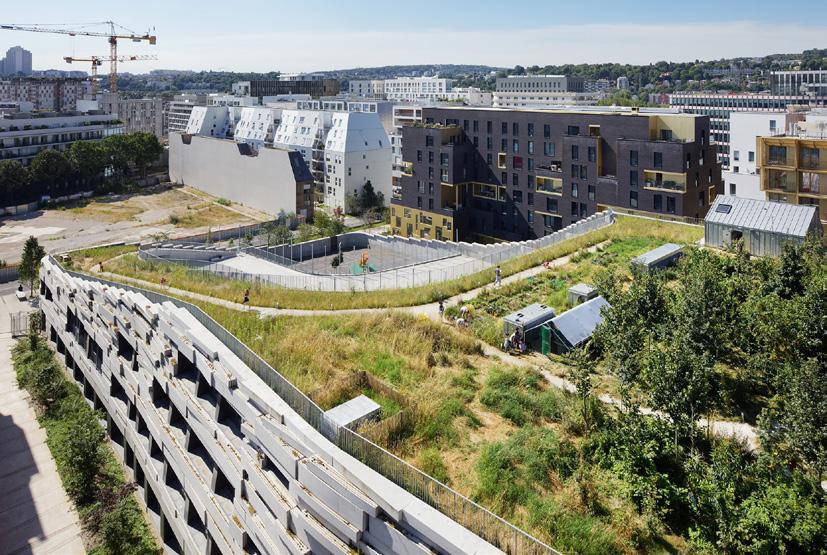
A final project introduced to me through Yudina’s (2017, pp.4849) book Garden City was the Chartier Dalix project Biodiversity School, located in Boulogne-Billancourt, France (Fig. 58 - Fig. 60). I feel this project, along with the ideas and experiments continually explored by Chartier Dalix, are an incontrovertible encapsulation of the ideas discussed in this paper.
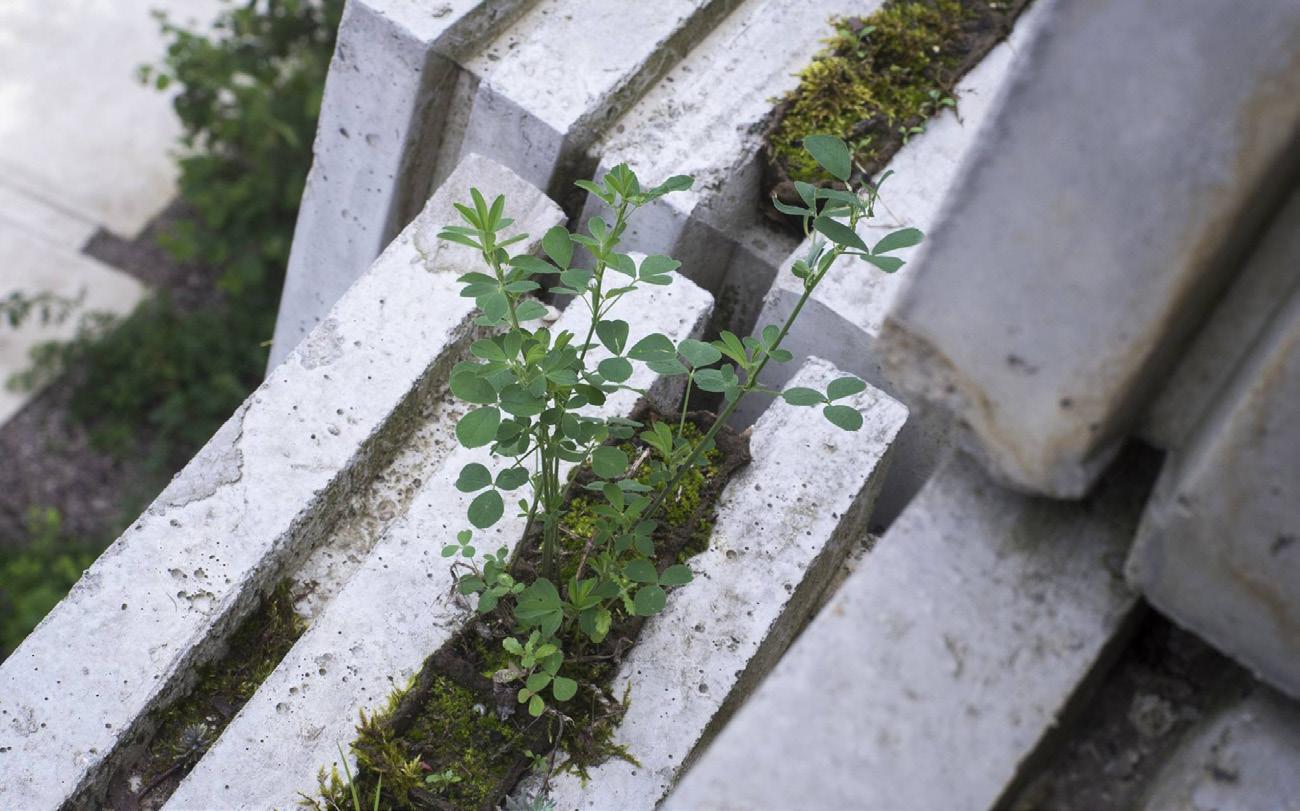
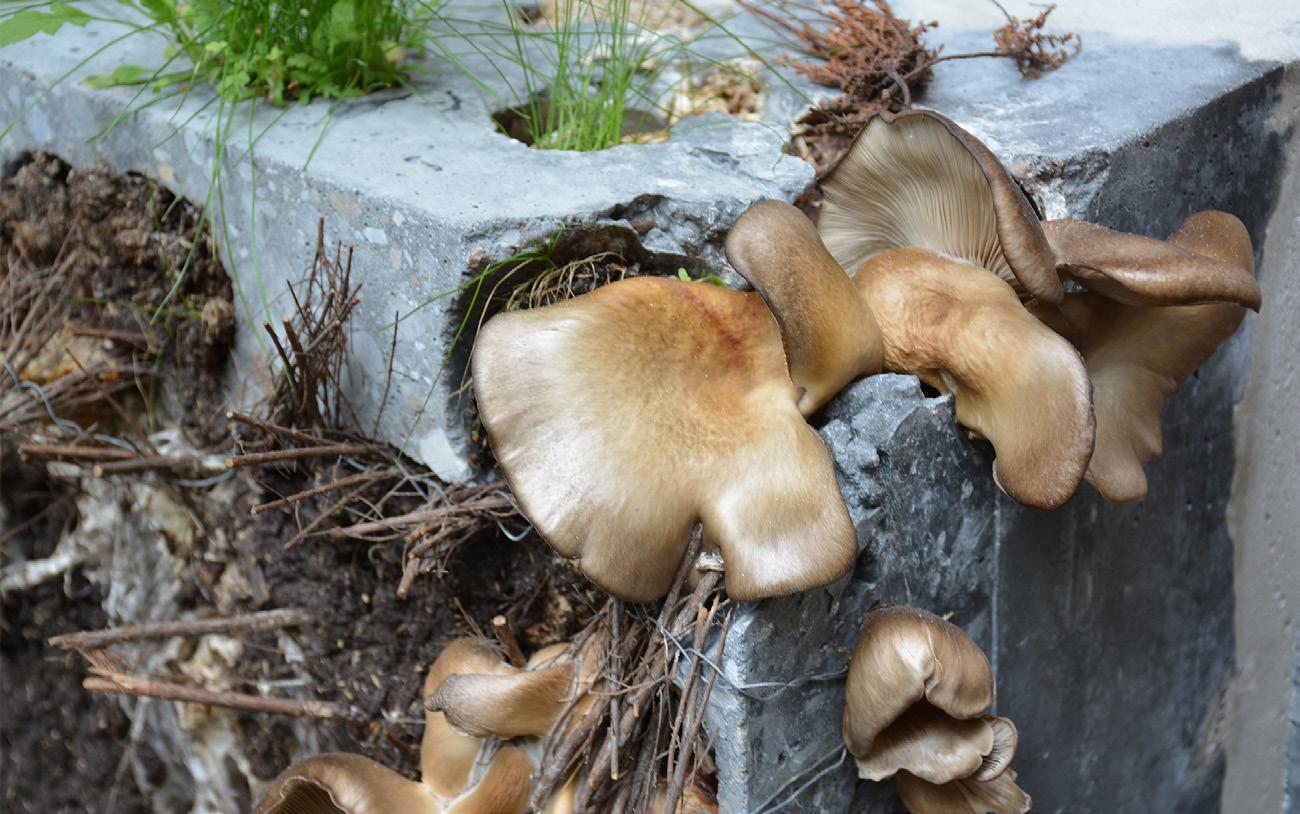
Despite the modern day architectural requirement to see buildings made up of mono-functional layers, the designers here sought to view the wall as a unitary system with the capacity to ‘accommodate the substrate and the forms necessary to host the associated fauna’ (Chartier Dalix, no date). The project featured intricately designed walls of concrete blocks, which support and encourage
[Fig. 56] Plants growing from façade (François, no date)
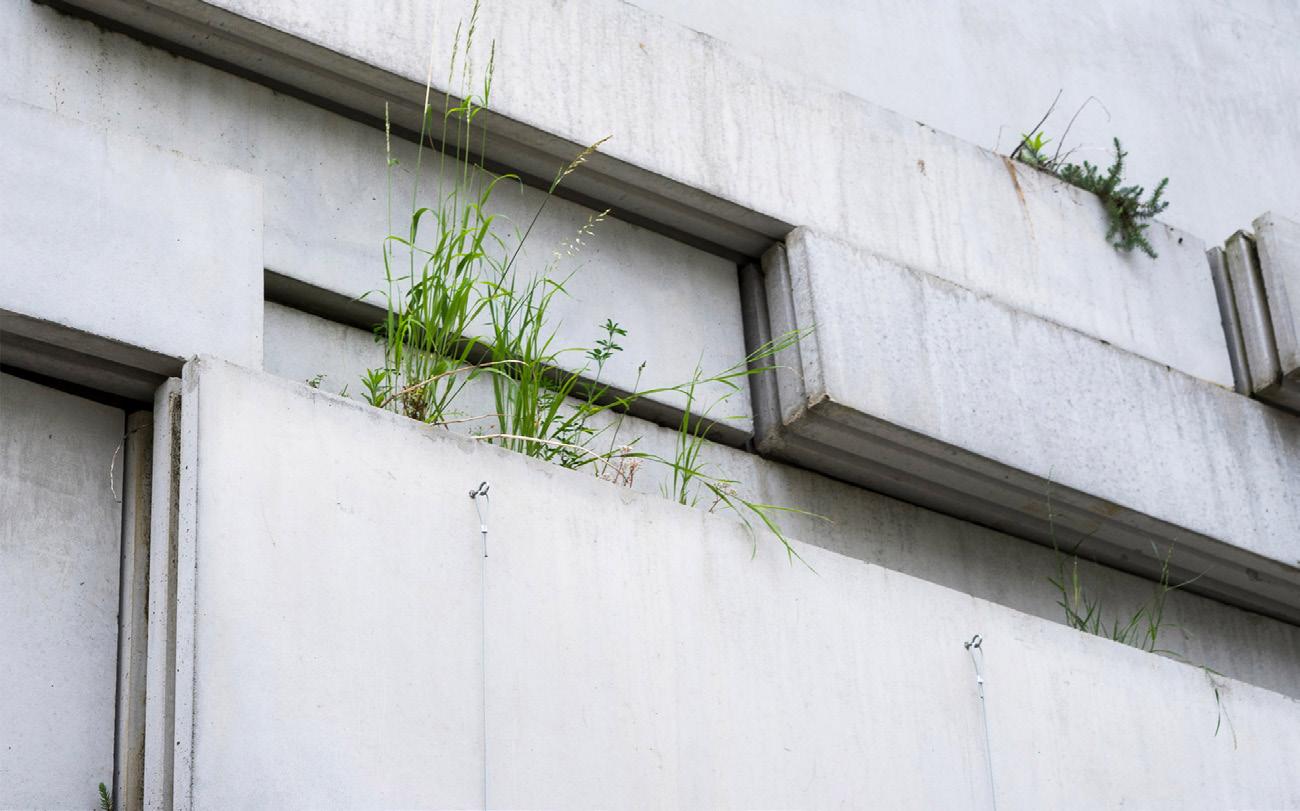
the growth of spontaneous vegetation and interaction with an array of species (Fig. 61 - Fig. 63).
The principles behind this building enabled it to evolve and change through its exchanges with the hosted ecology. Framing the building as a ‘living landscape’ and embracing the ideas of uncertainty and change that are brought with this approach renders the project's principles as truly ecologically enhanced. This core principle explores how to enable nature to interact with our infrastructure and shows a true determination to return ecology back into our urban environments (Chartier Dalix, 2022).
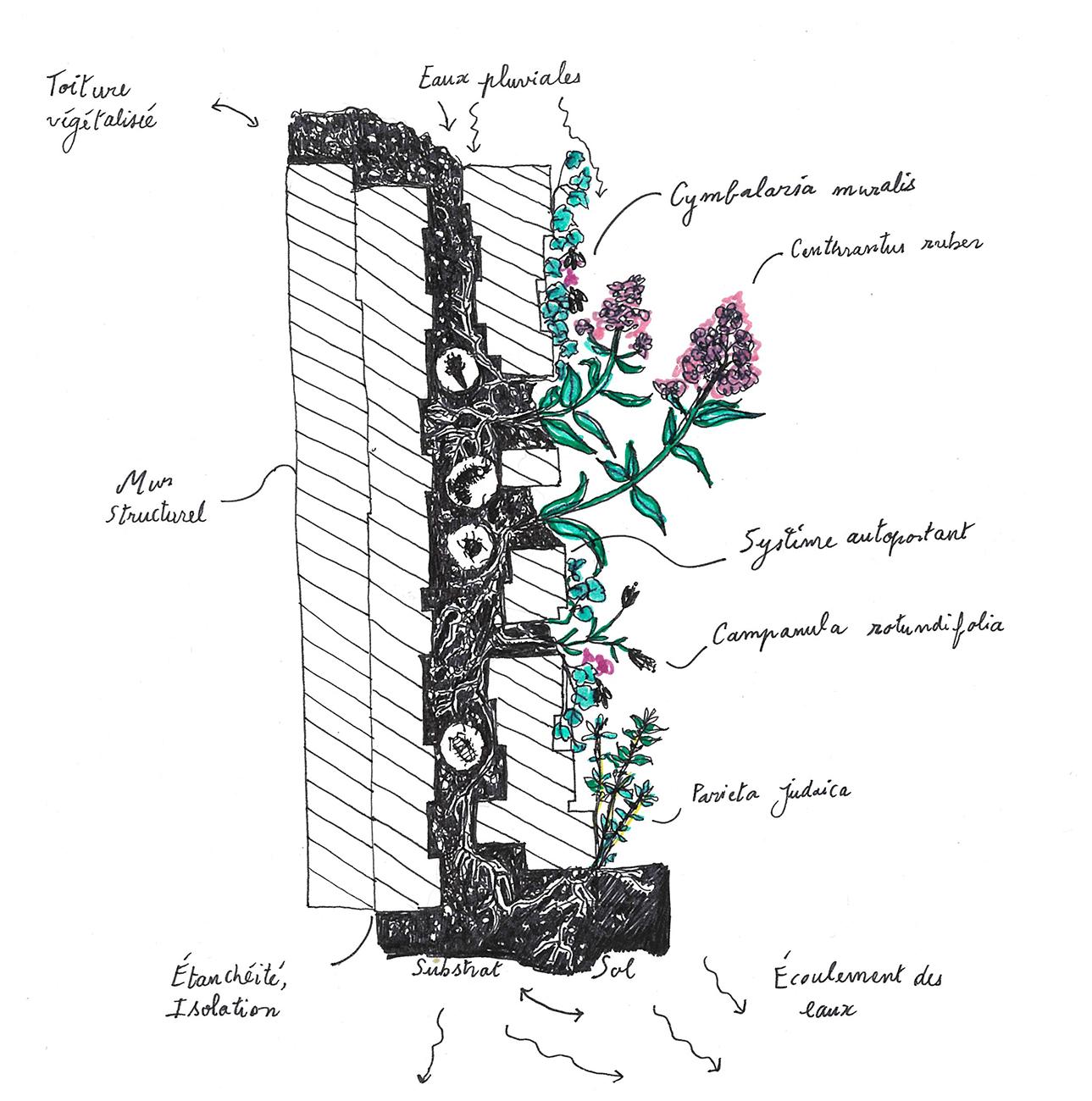
The designers of this project remain focused on their core principles of ecological freedom within the built environment. The Firm boasts projects such as the biodiversity wall, ‘a new type of vertical vegetation system designed to promote biodiversity in dense cities by welcoming local and indigenous flora and fauna’ (Fig. 57) (Chartier Dalix, 2022) which, reminiscent of my discussions on the human centred design principles, question the need for hydroponic green walls systems and instead propose a uniquely autonomous and self supporting wall, which houses the substrate required for self-seeded plants to form networks of new ecological exchange (Fig. 64) (Chartier Dalix, 2022).
(Left) [Fig. 58] Biodiversity school façade (Muratet, Shimmura and Weiner, no date) (Right) [Fig. 59] [Fig. 60] Rewilded biodiversity school roof (Muratet, Shimmura and Weiner, no date)
[Fig. 57] The biodiversity wall system (Chartier Dalix, no date)
[Fig. 61] Flora interacting with the concrete façade (Muratet, Shimmura and Weiner, no date)
[Fig. 62] Grass growing from concrete façade (Chartier Dalix, no date)
[Fig. 63] Flora interacting with the concrete façade (Chartier Dalix, 2017)
[Fig.64] The biodiversity wall (Chartier Dalix, no date)
CONCLUDING STATEMENT
This paper initially identified the lack of ecocentric design within the urban realm and set out to understand the historical, cultural and social reasoning behind our currently human-centred design practices. The resulting barriers we have constructed towards our interactions with nature have been upheld in much of Western society, and I have identified the crucial need for re-education in order to change these presumptions and move our perspectives towards ecology within the built environment. I have discerned ways in which reframing societal viewpoints on ecology may work, targeting the human idiosyncrasy to be self-serving.
Following this, my paper has framed current green roof systems not simply as ecological enhancement, but rather as a further example of human-centred design practices. I then identified brown roofs as a positive step towards truly ecologically considerate design. However, the demand for publicly accessible space in urban environments was highlighted as a significant factor limiting the implementation of such roofs and thus my paper led on to introduce the potential vertical surfaces might offer.
With current green wall systems remaining high-tech - with high fuel consumption, maintenance and costs - I concluded that mirroring the qualities of a brown roof, but vertically, offers the opportunity of a new design feature, a ‘brown wall’ of sorts, that could fill the ecological gap within our urban environments.
The question now is how to approach the implementation and incorporation of this new design practice into our urban environments, considering societal and industry ideologies into ecological inclusion. Through the ideas collected within this dissertation, I can outline certain queries, approaches and solutions that may be key in its application.
Firstly, the human desire for control over ecology within urban spaces remains a prominent proclivity, and thus the resulting desire for aesthetically pleasing results becomes a key requirement to be met if this design proposal were to be put forward and accepted. Integrating certain qualities into the design of biodiverse vertical surfaces could allow ecological freedom while retaining the ‘idealised’ requirement for control over such surfaces. Features as simple as the incorporation of neat, contained edges and boundaries to ecologically open surfaces, gained through purposeful design of the surface would assist here.
Secondly the benefits of such a brown wall concept should be explained, outlining the initial and ongoing results that will be provided through implementation of such a design. I have shown that the interaction between nature and our infrastructure is inevitable. Thus, by providing a deliberate sacrificial surface that can act as a barrier between our infrastructure and the ecology, hindrances such as the need for maintenance and repair of our infrastructure will be limited due to the increased control of interactions between ecology and the building; this will result in minimised ongoing costs. The physical and mental benefits of human interaction with nature are also well established, and by providing increased occurrences in which we can connect with nature, there is scope for cultural enhancement within our urban realms.
Finally ‘brown walls’ need some good marketing because we need to make them desirable. By renaming them and reframing their human and ecological benefits, I believe they will become more accepted as a design tool into the built environment. The use of real life examples in television shows (like ‘Grand Designs’ or ‘George Clarke’s Amazing Spaces’), or exhibits within highly visible existing events (like the RHS Chelsea Flower Show, or the Ideal Homes exhibition) would help here, alongside campaigns over social media or television to increase the exposure of good designs and their joint benefits for us and for ecology. Over time this will begin to move the paradigm towards acceptance and inclusion in our urban realm - as already discussed this has been seen to work, and work quickly - one example being the No-mow May movement.
Newly implemented changes to planning regulations demand a fresh look at the design of our urban buildings, and vertical surfaces offer us the scope and the opportunity to make the significant and positive contribution required to the local ecologies in which we all exist. This is an exciting prospect for architects, ecologists and a multitude of other diciplines to collaborate on to find new, exciting and innovative ways in which to introduce ecology back into our cities.
A BIBLIOGRAPHY OF REFERENCES
Aura. (No Date) What is Biophilic Design?. Available at: https://www.auraoffice.ca/blog/what-is-biophilic-design/#:~:text=Stephen%20Kellert%20is%20known%20as,and%20framework%20around%20the%20idea. (Accessed: 06 January 2024).
Borah, C. (No Date) What is the Social Impact of Architecture?. Available at: https://www.re-thinkingthefuture.com/narratives/ a5616-what-is-the-social-impact-of-architecture/#:~:text=Architecture%20and%20Social%20Impact&text=When%20we%20 design%20something%2C%20it,the%20social%20forms%20 of%20society.(Accessed: 06 January 2024).
Coulibaly, S., et al. (2023) ‘The Role of Green Roofs as Urban Habitats for Biodiversity Modulated by their Design: A Review’ Environmental Research Letters, Volume18(Issue7). Available at: https:// iopscience.iop.org/article/10.1088/1748-9326/acd801(Accessed: 01 January 2024).
Defra., Natural England. (2019) ‘Biodiversity net gain and local nature recovery strategies’. Available at: https://assets.publishing.service. gov.uk/government/uploads/system/uploads/attachment_data/ file/839610/net-gain-ia.pdf(Accessed: 23 September 2023).
Department for Environment Food & Rural Affairs. (2012) Biodiversity Segmentation Scoping Study - WC1056. Available at: https://randd.defra.gov.uk/ProjectDetails?ProjectID=18411(Accessed: 06 January 2024).
Department for Environment, Food & Rural Affairs (2021) UK Biodiversity Indicators 2021 Revised. Available at: https://data. jncc.gov.uk/data/31925413-3fa4-4382-962f-6ac2c168d542/ ukbi2021-summary-booklet.pdf(Accessed: 06 January 2024).
Dunnett, N. (2006) ‘Green roofs for biodiversity: reconciling aesthetics with ecology’ Greening Rooftops for Sustainable Communities, Volume 4, pp. 11-12. Available at: https://citeseerx.ist.psu.edu/ document?repid=rep1&type=pdf&doi=d585ef981aed87d722bfcca8a24b38db7d49edda(Accessed: 06 January 2024).
European Environment Agency. (2022) Who benefits from nature in cities? Social inequalities in access to urban green and blue spaces across Europe. Available at: https://www.eea.europa.eu/ publications/who-benefits-from-nature-in(Accessed: 06 January 2024).
Goel, M., Jha, B. and Khan, S. (2022) ‘Living Walls Enhancing the Urban Realm: A Review’ Environmental Science and Pollution Research , Volume29. Available at: https://link.springer.com/article/10.1007/s11356-022-19501-7#citeas(Accessed: 01 October 2023).
Green Roofers. (no date) Advantages and Disadvantages of Green Roofs. Available at: https://www.greenroofers.co.uk/green-roofing-guides/advantages-disadvantages-green-roofs/(Accessed: 08 January 2024).
Gunawardena, K. and Steemers, K. (2022) ‘Assessing the Influence of Neighbourhood- Scale Vertical Greening Application’ Buildings and Cities, Volume4(Issue1), pp. 103-123. Available at: https:// journal-buildingscities.org/articles/10.5334/bc.282(Accessed: 07 October 2023).
Haila, Y. (2014) ‘Beyond the Nature-Culture Dualism’ Biology & Philosophy, Volume 15, pp. 155-175. Available at: https://link. springer.com/article/10.1023/A:1006625830102#:~:text=It%20 is%20commonly%20accepted%20that,such%20externalization%20have%20become%20generalized.(Accessed: 06 January 2024).
Ichioka, S. and Pawlyn, M. (2021) Flourish: Design paradigms for Our Planetary Emergency. Axminster: Triarchy Press.
IKO. (no date) Brown Roof System. Available at: https://www. ikogroup.co.uk/flat-roof-build-ups/brown-roof-system/#:~:text=Brown%20roof%20systems%2C%20more%20commonly,a%20 different%2C%20thinner%20finishing%20surface.(Accessed: 08 January 2024).
Ishimatsu, K. and Keitaro, I. (2013) ‘Brown/biodiverse roofs: a conservation action for threatened brownfields to support urban biodiversity’ Landscape and Ecological Engineering, Volume 9, pp. 229-304. Available at: https://link.springer.com/article/10.1007/ s11355-011-0186-8(Accessed: 11 October 2023).
JNCC. (2020) A1. Awareness, Understanding and Support for Conservation. Available at: https://jncc.gov.uk/our-work/ukbi-a1awareness/(Accessed: 06 January 2024).
Kellert, S., Mador, M., and Heerwagen, J. (2008) Biophilic Design: The Theory, Science and Practice of Bringing Buildings to Life. New Jersey: John Wiley & Sons, Inc.
King James Bible (1989) New York: National Council of Churches.
Khoja, A. and Waheeb, S. (2020) ‘Vernomimicry: Bridging the Gap between Nature and Sustainable Architecture’ Journal of Sustainable Development, Volume20(Issue 1). Available at: https://www. researchgate.net/publication/338938354_Vernomimicry_Bridging_the_Gap_between_Nature_and_Sustainable_Architecture(Accessed: 09 October 2023).
Leotti, L., Iyengar, S. and Ochsner, K. (2022) ‘Born to Choose: The Origins and Value of the Need for Control’ Trends Cogn Sci, Volume 14(Issue 10), pp. 457-463. Available at: https://www.ncbi.nlm. nih.gov/pmc/articles/PMC2944661/#:~:text=Belief%20in%20 one%27s%20ability%20to,a%20psychological%20and%20biological%20necessity.(Accessed: 06 January 2024).
Nesta. (2022) For people and planet: moving beyond human-centred design. Available at: https://www.nesta.org.uk/blog/ for-people-and-planet-moving-beyond-human-centred-design/ (Accessed: 06 January 2024).
Oxford Languages. (No Date) Biophilic Design. Available at: https://www.oed.com/dictionary/biophilia_n?tab=factsheet#11754398(Accessed: 06 January 2024).
Oxford Languages. (No Date) Dualism. Available at: https://www.oed.com/search/dictionary/?scope=Entries&q=dualism(Accessed: 06 January 2024).
Oxford Languages. (No Date) Vernacular. Available at: https://www.oed.com/dictionary/vernacular_adj?tab=factsheet#15754442(Accessed: 07 January 2024).
Oxford Languages. (No Date) Weed. Available at: https://www.oed.com/search/dictionary/?scope=Entries&q=weed(Accessed: 07 January 2024).
Planteria Group. (No Date) Biophilia – What is it and Why is it Important?. Available at: https://www.planteriagroup.com/blog\biophilia-what-is-it-andwhy-is-it-important/#:~:text=The%20word%20biophilia%20originates%20from,drive%20imprinted%20into%20our%20DNA. (Accessed: 06 January 2024).
Plantlife. (2023) No Mow May. Available at: https://www.plantlife. org.uk/campaigns/nomowmay/(Accessed: 17 January 2024).
Richmond, S. (2019) Green, Blue, Brown and White Roofs – What Are They and Why Do We Need Them?. Available at: https://gca.org/green-blue-brown-and-white-roofs-what-arethey-and-why-do-we-need-them/#:~:text=A%20variation%20 of%20the%20green,brownfield%20habitat%20caused%20by%20 construction.(Accessed: 08 January 2024).
Ronnie Hill, S. (2022) The Rise in Popularity of Green Roofs. Available at: https://risedesignstudio.co.uk/blog/index.php/2022/10/03/ the-rise-in-popularity-of-green-roofs/#:~:text=You%20will%20 typically%20see%20an,an%20area%20of%208.3%20hectares. (Accessed: 08 January 2024).
Royal Horticultural society. (no date) Britain in Bloom. Available at: https://www.rhs.org.uk/get-involved/britain-in-bloom(Accessed: 17 January 2024).
Shafique, M., Kim, R. and Rafiq, M. (2019) ‘Green Roof Benefits, Opportunities and Challenges; A review’ Renewable and Sustainable Energy Reviews, Volume90, pp. 757-773. Available at: https://www. sciencedirect.com/science/article/pii/S136403211830217X(Accessed: 07 October 2023).
Sheweka, S. and Magdy, N. (2011) ‘The Living Walls as an Approach for a Healthy Urban Environment’ Energy Procedia, Volume6, pp. 592-599. Available at: https://www.sciencedirect. com/science/article/pii/S1876610211014792(Accessed: 07 October 2023).
Study.com. (No Date) Who Founded Dualism?. Available at: https://homework.study.com/explanation/who-founded-dualism.html#:~:text=The%20idea%20of%20dualism%20has,French%20philosopher%2C%20mathematician%20and%20scientist.(Accessed: 06 January 2024).
The Guardian and Weston, P. (2023) Weed-choked Pavements Anger Residents as ‘Rewilding’ Divides UK Towns and Cities. Available at: https://www.theguardian.com/environment/2023/aug/26/civicwars-break-out-over-rewilding-town-centres-age-of-extinction(Accessed: 06 January 2024).
Virtudes, A. and Manso, M. (2016) ‘Applications of Green Walls in Urban Design’ Earth and Environmental Science, Volume44(Issue3). Available at: https://iopscience.iop.org/article/10.1088/1755-1315/44/3/032016/pdf(Accessed: 01 October 2023).
Wang, J., Cao, S. and Yu, C. (2022) ‘Planning for Sustainable and Ecological Urban Environment: Current Trends and Future Developments’ Indoor and Built Environment, Volume32(Issue4), pp. 627-631. Available at: https://journals.sagepub.com/doi/ abs/10.1177/1420326X221135758?journalCode=ibeb(Accessed: 06 October 2023).
Wang, L., et al. (2022) ‘The relationship between green roofs and urban biodiversity: a systematic review’ Biodiversity and Conservation, Volume 31, pp. 1771-1796. Available at: https://link.springer. com/article/10.1007/s10531-022-02436-3(Accessed: 11 October 2023).
Weisser, W., et al. (2022) ‘Creating Ecologically Sound Buildings by Integrating Ecology, Architecture and Computational Design’ People and Nature, Volume5(Issue1), pp. 4-20. Available at: https://besjournals.onlinelibrary.wiley.com/doi/full/10.1002/ pan3.10411(Accessed: 14 August 2023).
Wikipedia. (2024) Biophilia. Available at: https://en.wikipedia.org/wiki/Biophilic_design(Accessed: 06 January 2024).
Yudina, A. (2017) Garden City: Supergreen Buildings, Urban Skyscapes and the New Planted Space. London: Thames & Hudson ltd.
Zhong, W., Schroder, T. and Bekkering, J. (2021) ‘Biophilic design in architecture and its contributions to health, well-being, and sustainability: A critical review’ Frontiers of Architectural Research, Volume11, pp. 114-141. Available at: https://www.sciencedirect.com/science/article/pii/S2095263521000479(Accessed: 06 October 2023).
ZinCo. (no date) Green Roofs To Preserve Biodiversity. Available at:
https://zinco-greenroof.co.uk/green-roofs-preserve-biodiversity#:~:text=That%27s%20why%20biodiverse%20green%20 roofs,building%20development%20and%20sealed%20ground. (Accessed: 08 January 2024).
FIGURE REFERENCES
Fig. 1 Wilks, A. (2023) Tropical Plants Growing Freely Upon a Large Tree Trunk in Sri Lanka. Sri Lanka.
Fig. 2 Wilks, A. (2023) Lichen [Parmelia Caperata] and Green Moss [Dicranum Scoparium] Growing on a Tree Trunk in Sri Lanka. Sri Lanka.
Fig. 3 Wilks, A. (2023) Keinlworth Ivy [Cymbalaria Muralis] Growing in the Cracks of a Weathered Stone Wall. Oxford.
Fig. 4 Resource Panel. (2018) The Weight of Cities. Available at: https://www.resourcepanel.org/reports/weight-cities(Accessed 15 January 2024).
Fig. 5 Wilks, A. (2024) Infographic Showing the Benefits of Green Space in Urban Areas.
Fig. 6 Wilks, A. (2023) Tropical Plants Rooted and Growing into the Mountainside in Sri Lanka. Sri Lanka.
Fig. 7 Wilks, A. (2023) Rock Fumewort [Pseudofumaria Lutea] Growing into the Cracks of a Weathered Limestone Wall. Oxford.
Fig. 8 Shaw. (2002) Web of Life. Available at: https://www.jeffreyshawcompendium.com/portfolio/web-of-life/(Accessed: 06 January 2024).
Fig. 9 Descartes, R. (1596-1650) René Descartes's Illustration of Dualism. Available at: https://en.wikipedia.org/wiki/ Mind%E2%80%93body_dualism#/media/File:Descartes_mind_ and_body.gif(Accessed: 06 January 2024).
Fig. 10 Puvis de Chavannes, P. (1890-95) Inter artes et naturam (Between Art and Nature). Available at: https://www.metmuseum. org/art/collection/search/437346(Accessed: 06 January 2024).
Fig. 11 Jeanneret-Gris, C. (1924) Ville Radieuse. Available at: https://www.archdaily.com/411878/ ad-classics-ville-radieuse-le-corbusier/51fadfbbe8e44ea2b0000010-ad-classics-ville-radieuse-le-corbusier-image(Accessed: 06 January 2024).
Fig. 12 Axcapital. (no date) Palm Jumeirah. Available at: https:// www.axcapital.ae/guides/palm-jumeirah(Accessed: 17 January 2024).
Fig. 13 Crewe Town Council. (2021) Crewe Flowers. Available at: https://www.crewetowncouncil.gov.uk/service/floral-displays/ (Accessed: 06 January 2024).
Fig. 14 Baker, J. (2023) Plant Pots ‘Full of Weeds’. Available at: https://www.wiltshiretimes.co.uk/news/23676884.plant-potsfull-weeds-trowbridge-shopping-centre/(Accessed: 06 January 2024).
Fig. 15 Wren, T. (2017) Metal Spikes Covering the Branches of a Tree. Available at: https://edition.cnn.com/style/article/ new-dean-harvey-james-furzer-hostile-architecture-debate/index. html(Accessed: 06 January 2024).
Fig. 16 Weedingtech. (2022) Killing Weeds Between Cobblestones. Available at: https://newatlas.com/environment/ foamstream-herbicide-weed-killing-foam/ (Accessed: 06 January 2024).
Fig. 17 Knab, F. (1886) Hanging Gardens of Babylon. Available at: https://www.wikiart.org/en/ferdinand-knab/hanging-gardens-of-babylon-1886/(Accessed: 06 January 2024).
Fig. 18 Wilks, A and Google. (2024) Screenshot of Google Products Web Page When Searching Biophilic Design.
Fig. 19 Green Envee. (No Date) Artificially Planted Wall. Available at: https://www.greenenvee.co.uk/blog-post/can-you-use-fauxplants-in-your-biophilic-space/(Accessed: 06 January 2024).
Fig. 20 Department for Environment, Food and Rural Affairs. (2021) Available at: https://data.jncc.gov.uk/data/319254133fa4-4382-962f-6ac2c168d542/ukbi2021-summary-booklet. pdf(Accessed: 06 January 2024).
Fig. 21 Washuk, B. (2023) Lawn Signs Encouraging Residents to Skip Mowing in May to Avoid Dandelions and Other Wild Flowers From Being Mowed Down. Available at: https://www.pressherald. com/2023/05/22/maine-cities-and-towns-embracing-no-mowmay/(Accessed: 07 January 2024).
Fig. 22 Hepworth, N. (2023) The Centrepoint Garden. Designed by Cleve West. Available at: https://www.gardensillustrated.com/ chelsea/cleve-west-centrepoint(Accessed: 17 January 2024).
Fig. 23 Royal Horticultural Society. (2023) A Letter from a Million Years Past: Jihae Hwang. Available at: https://www.rhs.org.uk/shows-events/rhs-chelsea-flower-show/ Gardens/2023/letter-from-million-years-past(Accessed 17 January 2024).
Fig. 24 Wilks, A. (2023) Keinlworth ivy [Cymbalaria muralis] Rooted into the Cracks of a Limestone Wall. Oxford.
Fig. 25 Bergh, F. (no date) Thatch repairs in progress. Available at: A10302-From-exhibitions-to-virtual-experiences-Evolving-storytelling-techniques-in-museums-Image-9.jpg(Accessed: 07 January 2024).
Fig. 26 Wilks, A. (2024) Reconstruction of 16th Century Timber Framed Home. Suffolk.
Fig. 27 Encyclopædia Britannica. (no date) Igluvigaq Being Built. Available at: https://www.britannica.com/topic/Inuit-people(Accessed: 07 January 2024).
Fig. 28 Worthington, S. (no date) West Africa, Earth Construction Techniques Have Become a Robust Response to Climate Change. Available at: A10302-From-exhibitions-to-virtual-experiences-Evolving-storytelling-techniques-in-museums-Image-11.jpgAccessed: 07 January 2024).
Fig. 29 McCrystal, S. (2023) Weed Root Balls Have Become Very Well Established in the Town's Drains. Available at: https://www. bbc.co.uk/news/uk-england-cambridgeshire-66936900(Accessed: 07 January 2024).
Fig. 30 Wilks, A. (2023) Kenilworth Ivy [Cymbalaria Muralis] and Crustose Lichen [Acarospora Badiofusca] Rooted into Cracks of Weathered Limestone Wall. Oxford.
Fig. 31 Wilks, A. (2023) Harts-Tounge Fern [Asplenium Scolopendrium] Growing in Gap of Weathered and Eroding Mortar Between Bricks. Oxford.
Fig. 32 Wilks, A. (2023) Green Algae [Chlorophyta] Growing on Damp, Sheltered, West Facing Smooth Stone Façade. Oxford.
Fig. 33 Wilks, A. (2023) Young Sycamore Maple [Acer Pseudoplatanus] Sapling Rooted Between Concrete and Bricks into a Building Façade. Oxford.
Fig. 34 Wilks, A. (2023) Removal of Ivy [Hedera] from Brick House Façade in Progress. Oxford.
Fig. 35 Wilks, A. (2023) Green Moss [Leucobryum Glaucum] Growing in the Gaps Eroded Between Stone Façade Panels. Oxford.
Fig. 36 Wilks, A. (2023) Trailing Bellflower [Campanula Poscharskyana] Growing Horizontally Along the Gaps of Eroded Motar Between Bricks. Oxford.
Fig. 37 Wilks, A. (2024) Wall Screw Moss [Tortula Muralis] Growing in Place of Eroded Motrar Between Weathered Brick Steps Oxford.
Fig. 38 Wilks, A. (2023) Green Algae [Chlorophyta] Growing on Damp, West Facing Smooth Stone Façade. Oxford.
Fig. 39 Wilks, A. (2022) Virginia Creeper [Parthenocissus Quinquefolia] Climbing the Side of a Building in London. London.
Fig. 40 ZinCo. (no date) Intensive Green Roof System. Available at: https://www.archiexpo.com/prod/zinco-gmbh/product-66390-420067.html(Accessed: 07 January 2024).
Fig. 41 Pritchard & Pritchard. (no date) Bentinck Street Green Roofs Central London. Available at: https://green-roofs.co.uk/ case/bentinck-street-green-roofs-central-london-zinco-system/ (Accessed: 07 January 2024).
Fig. 42 DeYoung, et al. (2017) Benefits From Green Roof and Rainwater Harvesting System. Available at: https://www.researchgate.net/figure/Benefits-from-green-roof-and-rainwater-harvesting-system-Adapted-from-DeYoung-et-al_fig1_355443238(Accessed: 07 January 2024).
Fig. 43 Hohenschlaeger. (no date) A biodiversity Roof Installed on the IGA Visitor Centre in Berlin. Available at: https:// zinco-greenroof.co.uk/green-roofs-preserve-biodiversity#:~:text=That%27s%20why%20biodiverse%20green%20roofs,building%20development%20and%20sealed%20ground.(Accessed: 07 January 2024).
Fig. 44 Hohenschlaeger. (no date) “Deadwood” should really be called “biotope wood”, as it is used as a habitat by moss, lichen, beetles and flies. Available at: https://zinco-greenroof.co.uk/ green-roofs-preserve-biodiversity#:~:text=That%27s%20why%20 biodiverse%20green%20roofs,building%20development%20 and%20sealed%20ground.(Accessed: 07 January 2024).
Fig. 45 Dustygedge. (2020) The Green Roof Brown Roof on the Laban Dance Centre. Available at: https://dustygedge.co.uk/index. php/bees/tracking-bees-on-a-green-roof-brown-roof-labandance-centre/(Accessed: 07 January 2024).
Fig. 46 Pritchard & Pritchard. (no date) Brown Roof Ecology. Available at: https://green-roofs.co.uk/green-roofs/brown-roofs/ (Accessed: 07 January 2024).
Fig. 47 Wilks, A. (2023) Ground Ivy [Glechoma Hederacea] Climbing up a Red Brick Wall. Oxford.
Fig. 48 ThirdNature. (2016) All in One Structure Solves Flooding, Parking and the Lack of Green Space in Cities. Available at: https://www.archdaily.com/880164/all-in-one-structure-solvesflooding-parking-and-the-lack-of-green-space-in-cities#:~:text=THIRD%20NATURE%2C%20a%20Danish%20architecture,their%20project%2C%20POP%2DUP.(Accessed: 12 January 2024).
Fig. 49 Virtudes, A. and Manso, M. (2016) Current Green Walls Systems. Available at: https://iopscience.iop.org/article/10.1088/1755-1315/44/3/032016/pdf(Accessed: 12 January 2024).
Fig. 50 Clement, G. (no date) Jardins du Tiers-Paysage. Available at: https://www.area-arch.it/en/jardins-du-tiers-paysage/ (Accessed: 09 January 2024).
Fig. 51 Clement, G. (no date) Jardins du Tiers-Paysage. Available at: https://www.area-arch.it/en/jardins-du-tiers-paysage/ (Accessed: 09 January 2024).
Fig. 52 Georgieff, M. (no date) Jardins du Tiers-Paysage. Available at: https://www.area-arch.it/en/jardins-du-tiers-paysage/ (Accessed: 09 January 2024).
Fig. 53 Clement, G. (no date) Jardins du Tiers-Paysage. Available at: https://www.area-arch.it/en/jardins-du-tiers-paysage/ (Accessed: 09 January 2024).
Fig. 54 François, M. (no date) L'immeuble Qui Pousse. Available at: https://www.edouardfrancois.com/projects/limmeuble-qui-pousse(Accessed: 09 January 2024).
Fig. 55 François, M. (no date) L'immeuble Qui Pousse. Available at: https://www.edouardfrancois.com/projects/limmeuble-qui-pousse(Accessed: 09 January 2024).
Fig. 56 François, M. (no date) L'immeuble Qui Pousse. Available at: https://www.edouardfrancois.com/projects/limmeuble-qui-pousse(Accessed: 09 January 2024).
Fig. 57 Chartier Dalix. (no date) The Biodiversity Wall System. Available at: https://www.chartier-dalix.com/en/resources/hosting-life-research(Accessed: 09 January 2024).
Fig. 58 Muratet, M., Shimmura, T. and Weiner, C. (no date) Biodiversity School and Gymnasium. Available at: https://www.chartier-dalix.com/en/projects/biodiversity-school-gymnasium-boulogne-92(Accessed: 09 January 2024).
Fig. 59 Muratet, M., Shimmura, T. and Weiner, C. (no date) Biodiversity School and Gymnasium. Available at: https://www.chartier-dalix.com/en/projects/biodiversity-school-gymnasium-boulogne-92(Accessed: 09 January 2024).
Fig. 60 Muratet, M., Shimmura, T. and Weiner, C. (no date) Biodiversity School and Gymnasium. Available at: https://www.chartier-dalix.com/en/projects/biodiversity-school-gymnasium-boulogne-92(Accessed: 09 January 2024).
Fig. 61 Muratet, M., Shimmura, T. and Weiner, C. (no date) Biodiversity School and Gymnasium. Available at: https://www.chartier-dalix.com/en/projects/biodiversity-school-gymnasium-boulogne-92(Accessed: 09 January 2024).
Fig. 62 Chartier Dalix. (no date) Grass Growing From Concrete Façade. Available at: https://www.chartier-dalix.com/fr/ ressources/entretien-aurelien-huguet-ecologue(Accessed: 09 January 2024).
Fig. 63 Chartier Dalix. (2017) Architecture and Biodiversity: Thinking about a new urban ecosystem. Available at: https://www.facebook.com/chartierdalix/photo s/a.150943105078340/711844368988208/?type=3(Accessed: 09 January 2024).
Fig. 64 Chartier Dalix. (no date) The Biodiversity Wall. Available at: https://www.chartier-dalix.com/en/resources/hosting-life-research(Accessed: 09 January 2024).
EXTENDED BIBLIOGRAPHY
ArchDaily (2011) ‘Vernacular Architecture and the 21st Century’. Available at: https://www.archdaily.com/155224/vernacular-architecture-and-the-21st-century(Accessed :08 October 2023).
Ardiani, Y. (2022) ‘Ecology and Architecture in the art of making an Aesthetics Artwork’ Earth and Environmental Science. Available at: https://iopscience.iop.org/article/10.1088/1755-1315/998/1/012035/pdf#:~:text=An%20 %27ecological%20understanding%20of%20systems,existing%20 natural%20ecosystem%20flow%20system.(Accessed: 09 October 2023).
Aronson, M., et al. (2016) ‘Hierarchical filters determine community assembly of urban species pools’ Ecology: Ecological Society of America, Volume97(Issue11), pp. 2952-2963. Available at: https:// esajournals.onlinelibrary.wiley.com/doi/10.1002/ecy.1535(Accessed: 14 August 2023).
Battle, G., and McCarthy, C. (2001) Sustainable Ecosystems and the Built Environment. West Sussex: Wiley-Academy.
Bishop, M., et al. (2022) ‘Complexity–biodiversity relationships on marine urban structures: reintroducing habitat heterogeneity through eco-engineering’ Biological Science, Volume 377(Issue 1857). Available at: https://royalsocietypublishing.org/ doi/10.1098/rstb.2021.0393(Accessed: 11 October 2023).
Browning, W., and Ryan, C. (2021) Nature Inside: A Biophilic Design Guide. 2nd edn. London: RIBA Publishing.
Buchanan, P. (2005) Ten Shades of Green : Architecture and the Natural World.New York: The Architectural League of New york.
Ciria (2007) Building Greener: Guidance on the use of Green Roofs, Green Walls and Complimentary Features on Buildings. CIRIA.
Defra., Natural England. (2022) ‘Biodiversity Net Gain: An Introduction to the Benefits’. Available at: https://naturalengland.blog.gov. uk/wp-content/uploads/sites/183/2022/04/BNG-Brochure_Final_Compressed-002.pdf(Accessed: 23 september 2023).
Dunnett, N., and Kingsbury, N. (2005) Planting Green Roofs and Living Walls. 2nd edn. Oregon: Timber Press Inc.
Expose Design Group Inc. (2023) The Relationship Between Architecture and the Economy is Multi-faceted. Available at: https://www.linkedin.com/pulse/relationship-between-architecture-economy-multi-faceted#:~:text=Spatial%20Design%20for%20Daily%20Life.&text=On%20the%20other%20 hand%2C%20the,design%20and%20construction%20of%20 buildings.(Accessed: 06 January 2024).
Fox, M., et al. (2022) ‘Living wall systems for improved thermal performance of existing buildings’ Building and Environment, Volume207. Available at: https://www.sciencedirect.com/science/ article/pii/S0360132321008878(Accessed: 01 October 2023).
Hill, J. (2012) Weather Architecture. Oxfordshire: Routledge.
Hopkins, G., and Goodwin, C. (2011) Living Architecture: Green Roofs and Walls. Australia: CSIRO Publishing.
ICUN (no date) Nature-based Solutions for cities. Available at: https://www.iucn.org/our-work/topic/nature-based-solutions-cities(Accessed: 23 September 2023).
Kyrö, K., et al. (2020) ‘Vegetated roofs in boreal climate support mobile open habitat arthropods, with differentiation between meadow and succulent roofs’ Urban Ecosystems, Volume 23, pp. 1239–1252. Available at: https://link.springer.com/article/10.1007/s11252-020-00978-4(Accessed: 11 October 2023).
Living Seawalls (no date) Building With Nature; Science Based Design. Available at: https://www.livingseawalls.com.au/(Accessed: 11 October 2023).
Maybey, R. (2012) Weeds: The Story of Outlaw Plants. 2nd edn. London: Profile Books Ltd.
Natural England., and DERFA Group. (2023) The Biodiversity Metric 4.0 User Guide. England: Natural England Joint Publication.
Natural England., and DERFA Group. (2023) Summary of Changes: The Biodiversity Metric Version 3.1 to 4.0. England: Natural England Joint Publication.
Natural England., and DERFA Group. (2023) The Biodiversity Metric 4.0: User Guide – Technical Annex 2. England: Natural England Joint Publication.
Natural England., and DERFA Group. (2023) The Biodiversity Metric 4.0: Short Data Input Guide. England: Natural England Joint Publication.
Natural England., and DERFA Group. (2023) The Biodiversity Metric 4.0 and Small Sites Metric -QGIS template and GIS import tool: User Guide. England: Natural England Joint Publication.
Natural England (2021) The Biodiversity Metric 4.0 (JP039) Available at: https://publications.naturalengland.org.uk/publication/6049804846366720(Accessed: 03 September 2023).
Nguyen Dang, H., et al. (2022) ‘Social Impacts of Green Roofs’ Frontier. Built Environment. Available at: https://www.frontiersin.org/articles/10.3389/fbuil.2022.1047335/full#:~:text=Green%20roofs%20are%20recognised%20as,solution%20 to%20 decreased%20energy%20 consumption.(Accessed: 07 October 2023).
Papanek, V. (1995) The Green Imperative: Ecology and Ethics in Design and Architecture. London: Thames & Hudson.
Regulatory Policy Committee (2019) Biodiversity Net Gain, Department for Environment, Food and Rural Affairs RPC Rating: Fit For Purpose. Available at: https://assets.publishing.service. gov.uk/government/uploads/system/uploads/attachment_data/ file/858037/2019.06.06_-_RPC-4277_2_-DEFRA-EA_biodiversity_net_gain.pdf(Accessed: 14 August 2023).
Strain, E., et al. (2017) ‘Eco-engineering urban infrastructure for marine and coastal biodiversity: Which interventions have the greatest ecological benefit?’ Journal of Applied Ecology, Volume 55(Issue 1), pp. 426-441. Available at: https://besjournals.onlinelibrary.wiley.com/doi/full/10.1111/1365-2664.12961(Accessed: 11 October 2023).
Stretton, M., et al. (2023) ‘Characterising the Vertical Structure of Buildings in Cities for use in Atmospheric Models’ Urban Climate, Volume50. Available at: https://www.sciencedirect.com/science/ article/pii/S2212095523001542(Accessed: 07 October 2023).
Toy, M., et al., (1997) Architectural Design. London: Academy Group Ltd.
Tilder, L., and Blostein, B. (2010) Design Ecologies: Essays on the Nature of Design. New York: Princeton Architectural Press.
University College London (no date) Building Greener Cities with Poikilohydric Living Walls. Available at: https://www.ucl.ac.uk/ bartlett/architecture/about-us/innovation-enterprise/building-greener-cities-poikilohydric-living-walls(Accessed: 01 October 2023).
Vozzo, M., et al. (2021) ‘Making seawalls multifunctional: The positive effects of seeded bivalves and habitat structure on species diversity and filtration rates’ Marine Environmental Research, Volume 165. Available at: https://www.sciencedirect.com/ science/article/pii/S0141113620310102#:~:text=After%20 12%20months%2C%20complex%20seeded,taxa%20also%20increased%20with%20complexity.(Accessed: 11 October 2023).
Watt, D (2006) Managing Biological Growth on Buildings. Available at: https://www.buildingconservation.com/articles/bio/bio. htm#:~:text=TREES%20AND%20SHRUBS,fall%3B%20and%20 shading%20of%20surfaces.(Accessed: 11 October 2023).
Williams, A. (2021) Living walls can reduce heat lost from buildings by over 30%, study shows. Available at: https://www.plymouth.ac.uk/news/living-walls-can-reduce-heat-lost-from-buildings-by-over-30-study-shows#:~:text=Writing%20in%20the%20 journal%20Building,benefits%2C%20such%20as%20added%20 biodiversity.(Accessed: 01 October 2023).
Wines, J. (2008) Green Architecture. 2nd edn. Köln: TASCHEN GmbH.
WSP (no date) Overcoming Challenges to Mainstreaming Ecosystem Restoration. Available at: https://www.wsp.com/en-us/ insights/2020-un-guide-hurdles-to-ecosystem-restoration#:~:text=The%20United%20Nations%20(UN)%2C,capacity%2C%20 finance%20 and%20 scientific% 20research.(Accessed: 23 September 2023).
Zeher, L. (1996) The Ecology of architecture: A Complete Guide to Creating the Environmentally Conscious Building. New York: Whitney Library of Design.