portfolio anna serysheva 2025

ANNA SERYSHEVA
Rotterdam, The Netherlands
aserysheva@gmail.com
+31644725755
SKILLS / LANGUAGES
Skills
Languages
Modeling: ArchiCAD (intermediate), AutoCAD (intermediate), Revit (proficient), Rhino (advanced), Grasshopper (intermediate), Rhino.Inside.Revit (intermediate), Sketchup (advanced)
Visualization: AdobeCC (advanced) , D5 Render (proficient), Enscape (advanced), Lumion (advanced), Twinmotion (advanced), VRay (proficient)
Technical: Python (beginner)
Russian (native), Czech (native), English (fluent), German (B1), Dutch (A2+)
EDUCATION
Aug 2021 - present
Aug 2018 - Aug 2021
MSc. of Architecture
Delft University of Technology, NL
BSc. of Architecture, Urbanism and Building Science
Technical University of Eindhoven, NL
PROFESSIONAL EXPERIENCE
Aug 2022- Dec 2022
Architectural Intern
INBO, NL
• Developed detailed design options for various projects using BIM and 3D modeling for effective communication and decision-making.
• Developed and presented design entry for Ministerie van Maak exhibition, demonstrating proficiency in handling complex architectural concepts.
• Expertly visualized projects from rendering to Photoshop illustration, as well as architectural models.
June 2020 - Aug 2020
Architectural Intern
CHYBIK + KRISTOF Architects & Urban designers, CZ
• Contributed to the design of the 240m Periscope Tower skyscraper, focusing on building core layouts, escape routes, and aligning structural and spatial requirements with aesthetics and safety standards.
• Collaborated with engineers, designers, and clients to address technical complexities and ensure compliance with regulations.
EXTRACURRICULAR ACTIVITY
Aug 2021- Jun 2022
Student Team SUM - Solar Decathlon
Delft University of Technology, NL
• Gained hands-on construction site experience by building a full-scale prototype for the Solar Decathlon Europe in Wuppertal, demonstrating expertise in construction techniques, project coordination, and on-site problem-solving.
Sep 2019 - Mar 2021
Student Team CASA
Technical University of Eindhoven, NL
• Coordinated events and developed strategic communication initiatives, including graphic content creation, to enhance team visibility and engage effectively with the public and stakeholders.
CONTENTS
LOCAL-INNO METAMORPH
Adaptable modular timber transformation
KOMPOSITION KONSTEPIDEMIN
Transformation of an artist collective
Deployable refugee community center

LIGHTBOX ADDITIONAL WORK
refugee school and center New philharmonic complex in Maastricht
Collection of additional academic and graphic works 44
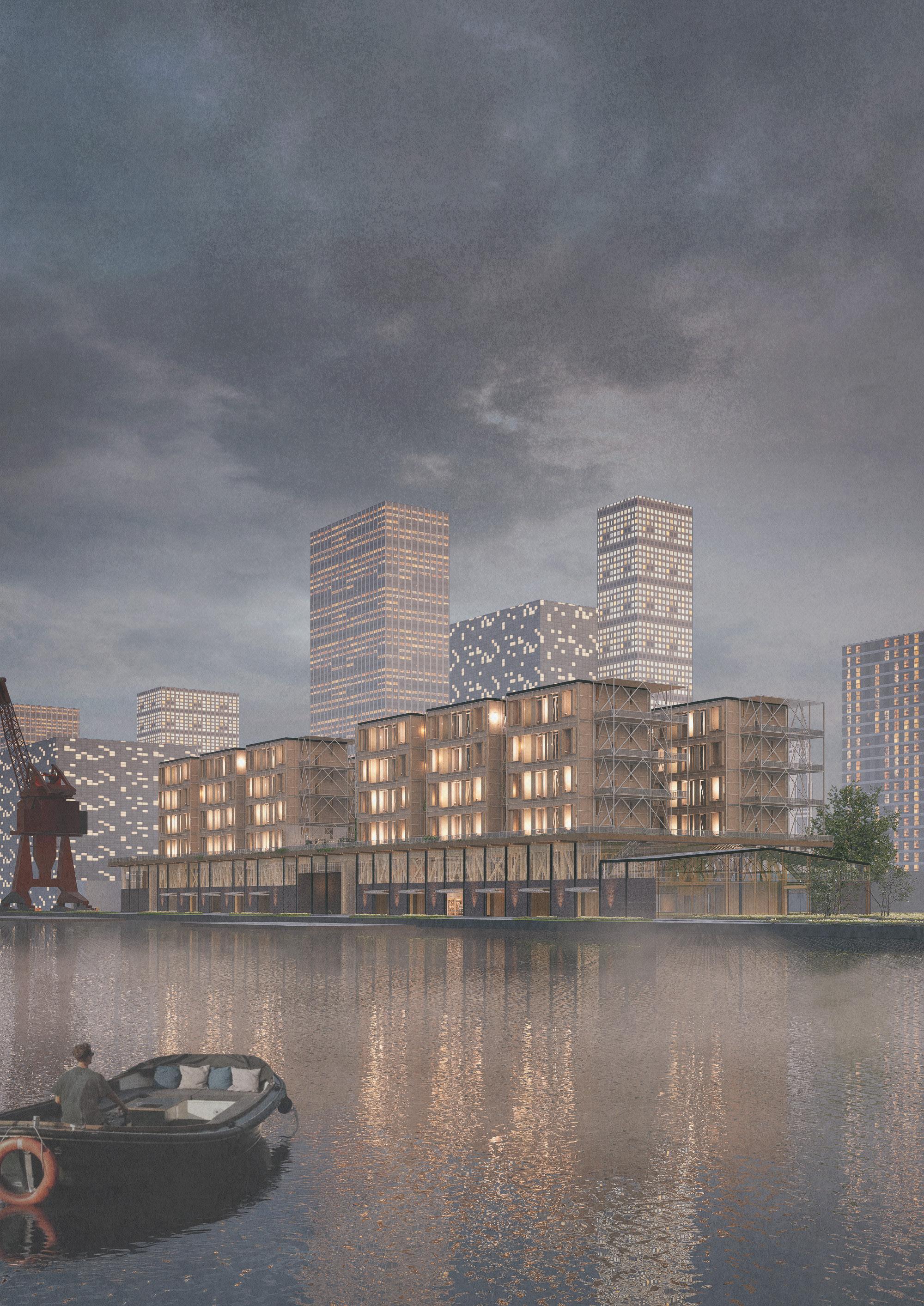
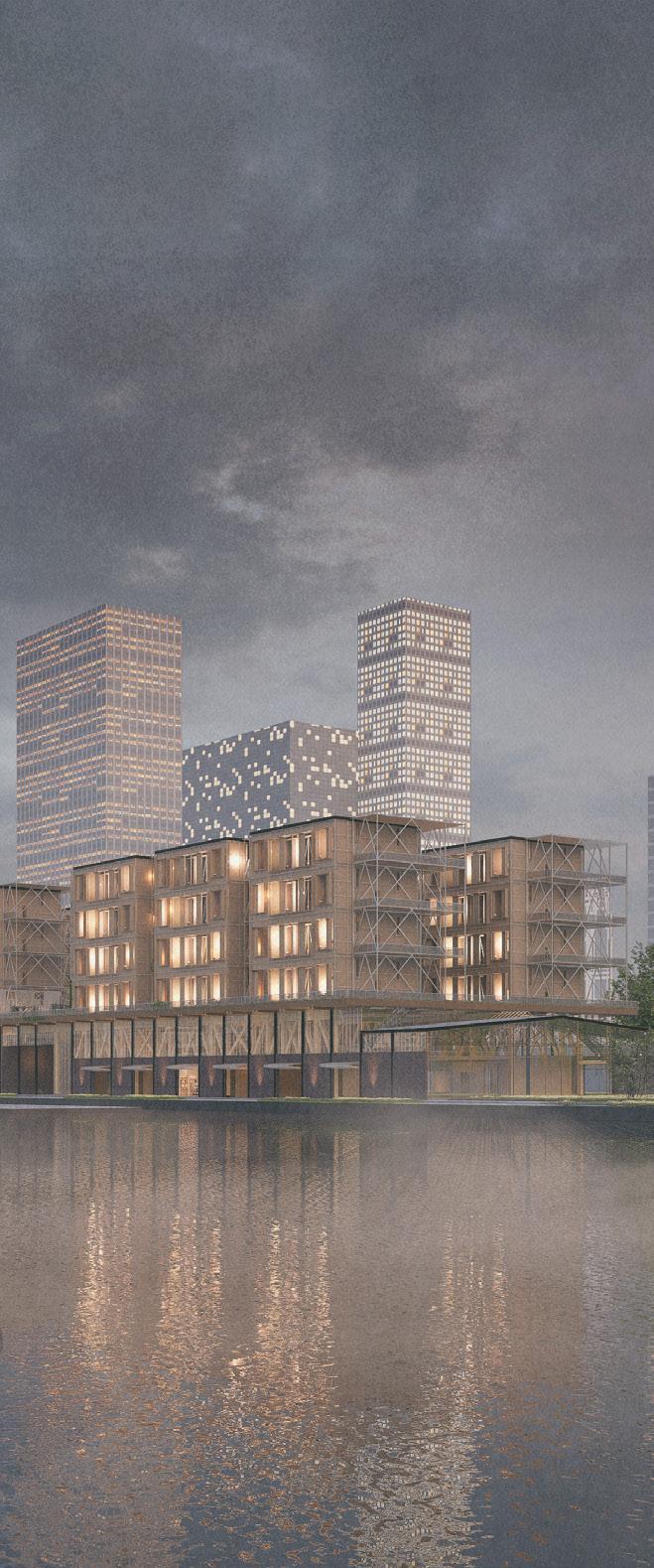
Exterior impression (Revit + D5 + Photoshop)
Location: Rotterdam, The Netherlands
Type: Transformation; Multi functional, Residential
Studio: Transformation projects
Term: 2023/24 (10 months)
Graduation individual project
METAMORPH
Adaptable modular timber transformation
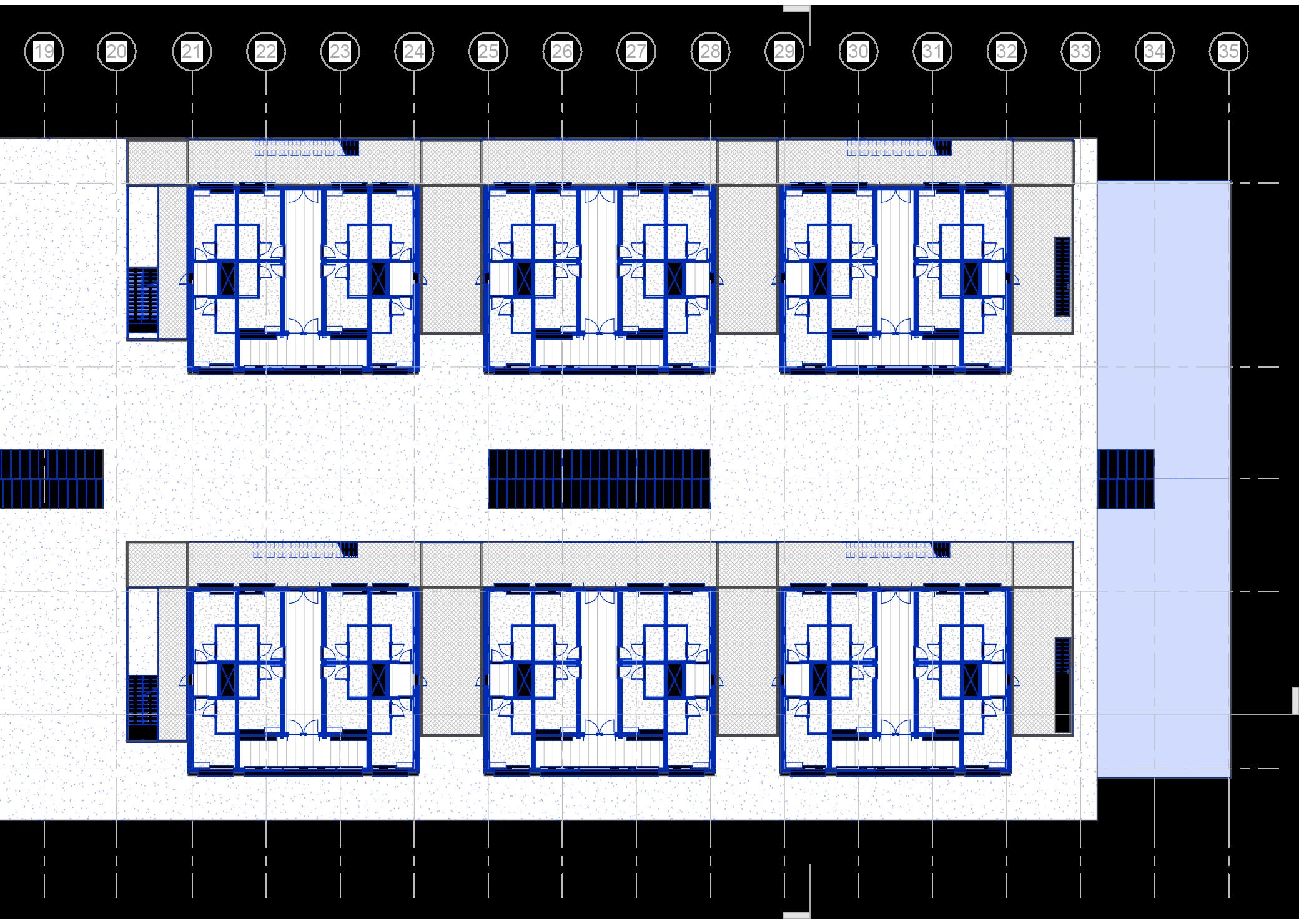
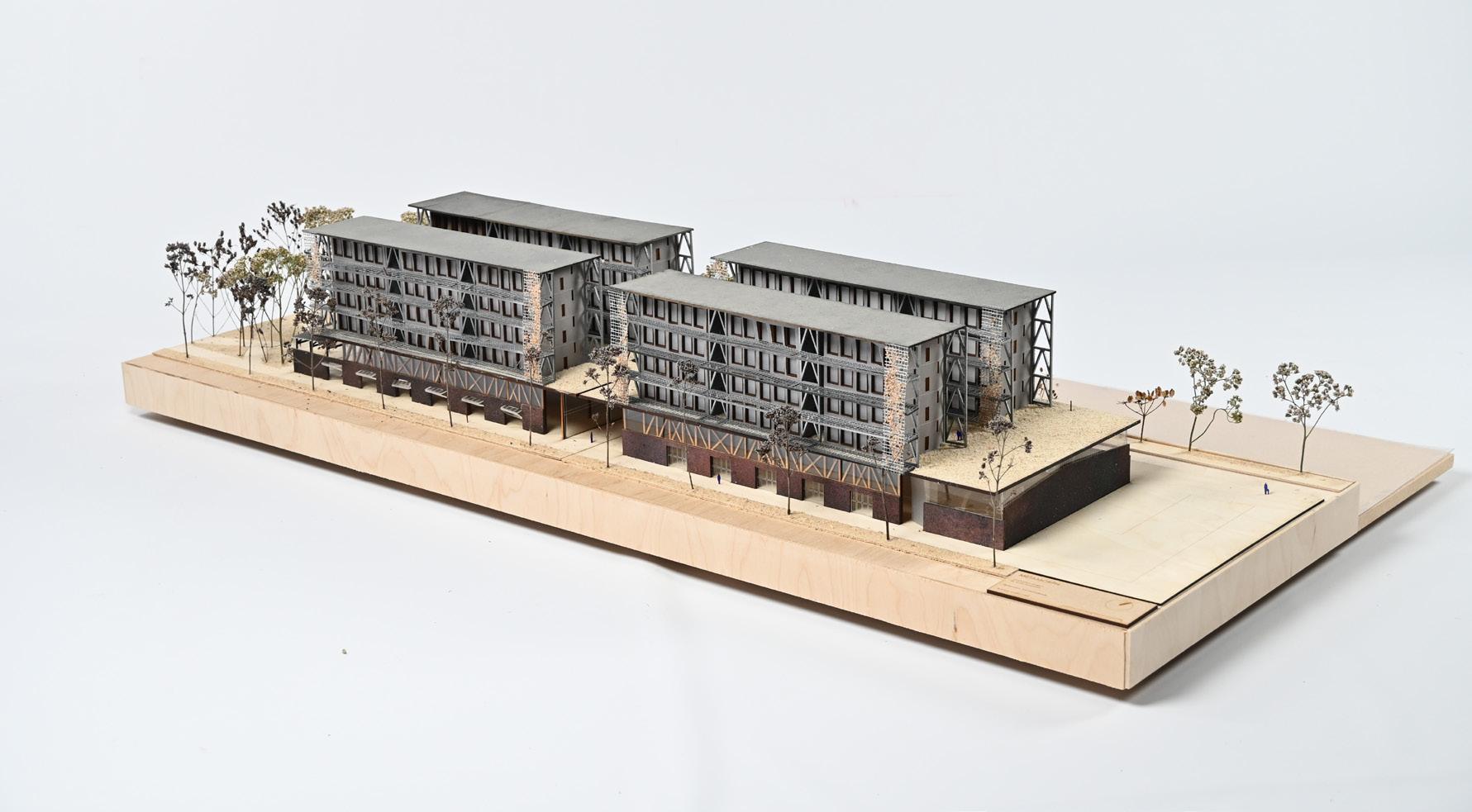
Located on the periphery of Rotterdam’s expanding central area, the Fruit Wharf requires redevelopment to address the housing shortage and unlock its potential. Warehouse number 52 was selected as a prototype for redeveloping this typology, which is common in various locations.
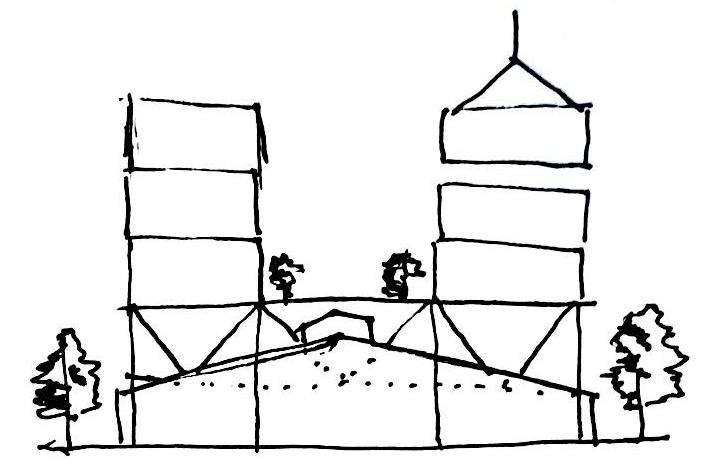
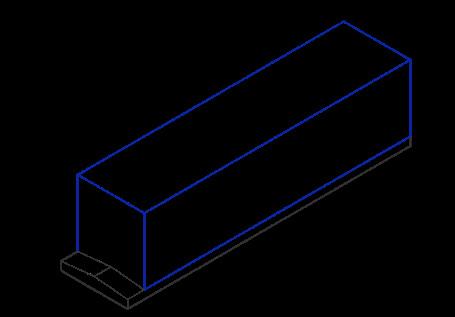
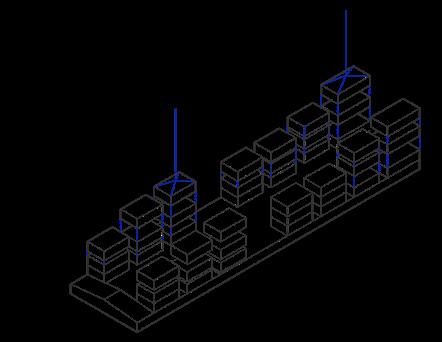
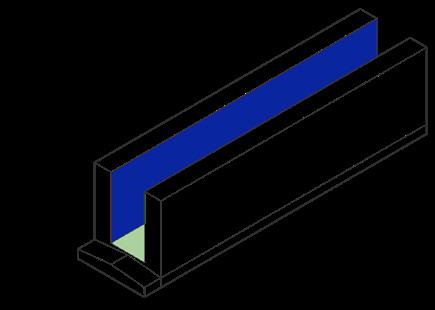
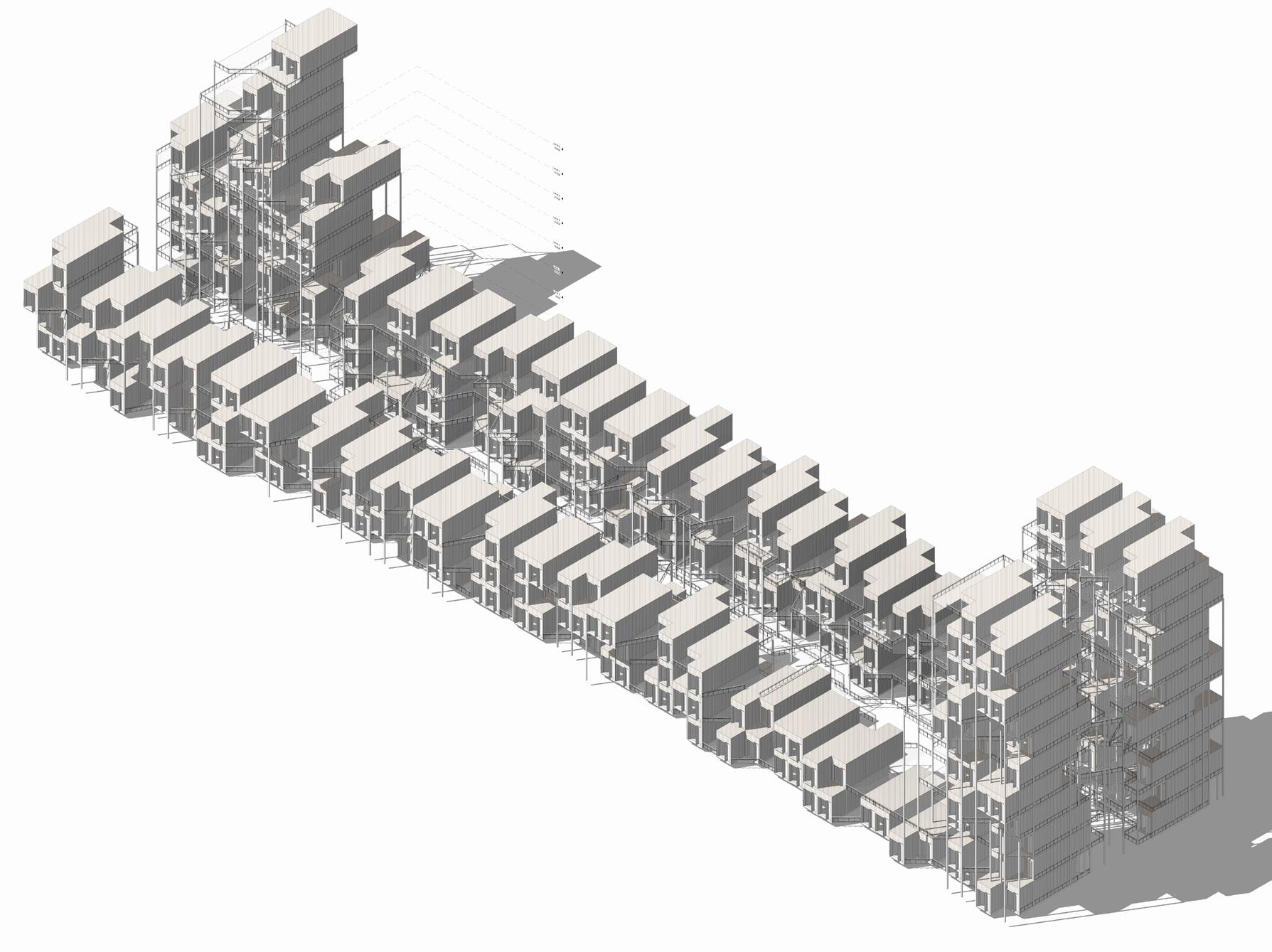
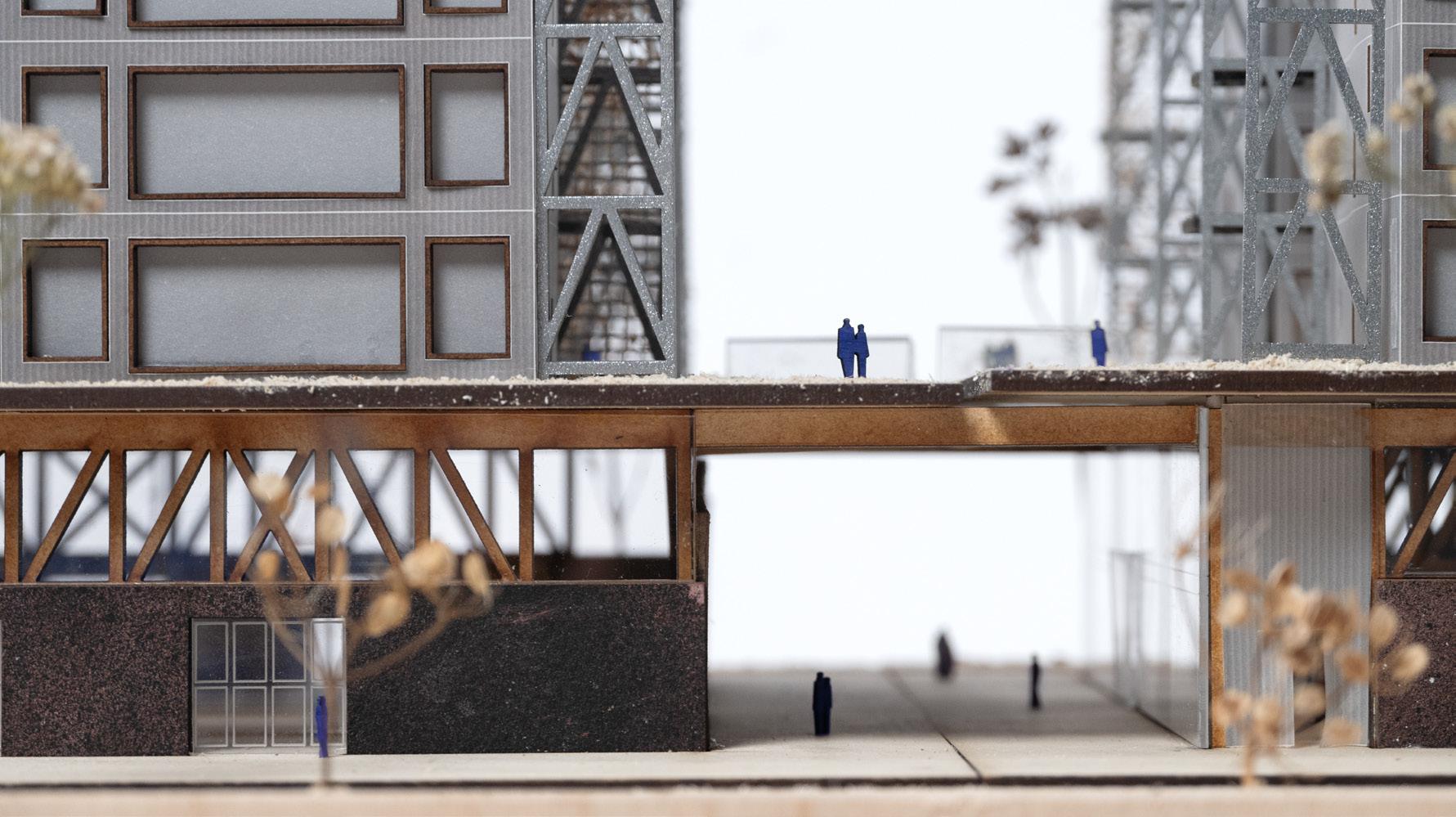
The project aims to quickly address housing needs with a prefabricated, modular design that prevents redundancy of the building by enabling adaptability. The existing building is treated as an image-defining object, with its envelope preserved and a new load-bearing timber structure inserted inside its boundaries. This structure accommodates a communal roof garden and stacks of prefabricated deployable module. These are reinforced by external steel bracing that also functions as gallery routing, enhancing flexibility. Given the area’s underdeveloped state, the initial phase is designed to serve the social housing sector with each module comprising eight loft studios and a communal balcony. As the area develops further and the social demographic of the area changes, the modules can be reconfigured to host two higher-value family apartments within the free sector, enhancing the profitability of the strategy.
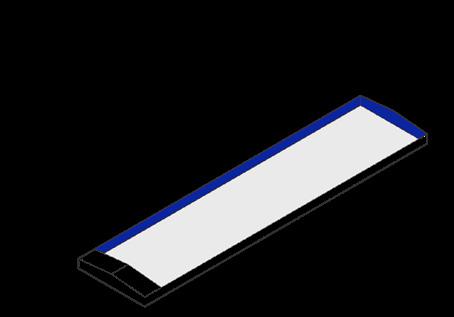
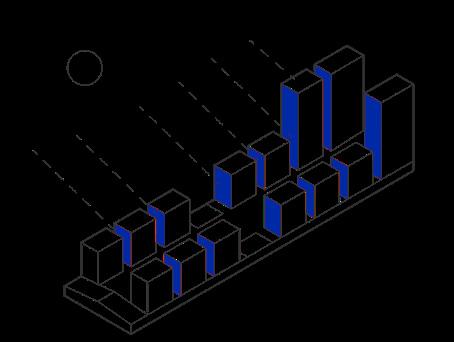
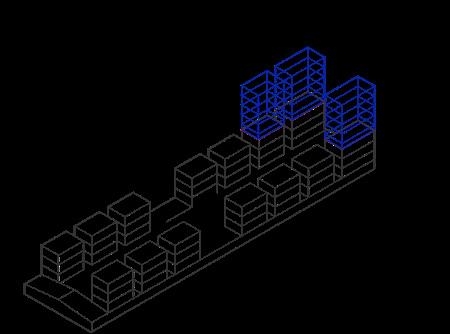
The modular design also allows vertical expansion, with limits defined by computational sun analysis. To ensure long-term adaptability, the entire structure is designed to be demountable, enabling future reconfigurations to meet evolving needs and reduce waste production.

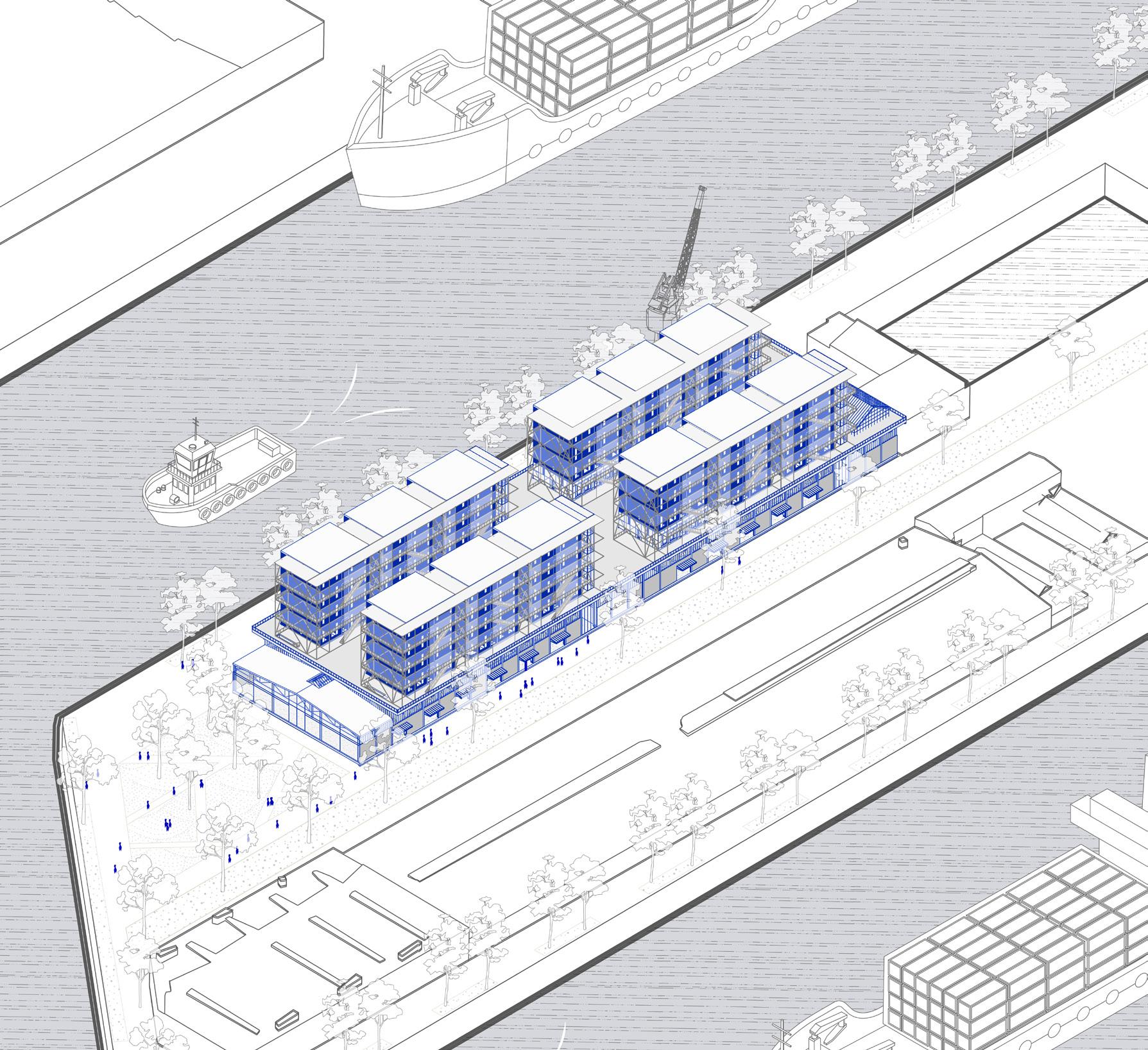
Site axonometry (Revit + Illustrator)
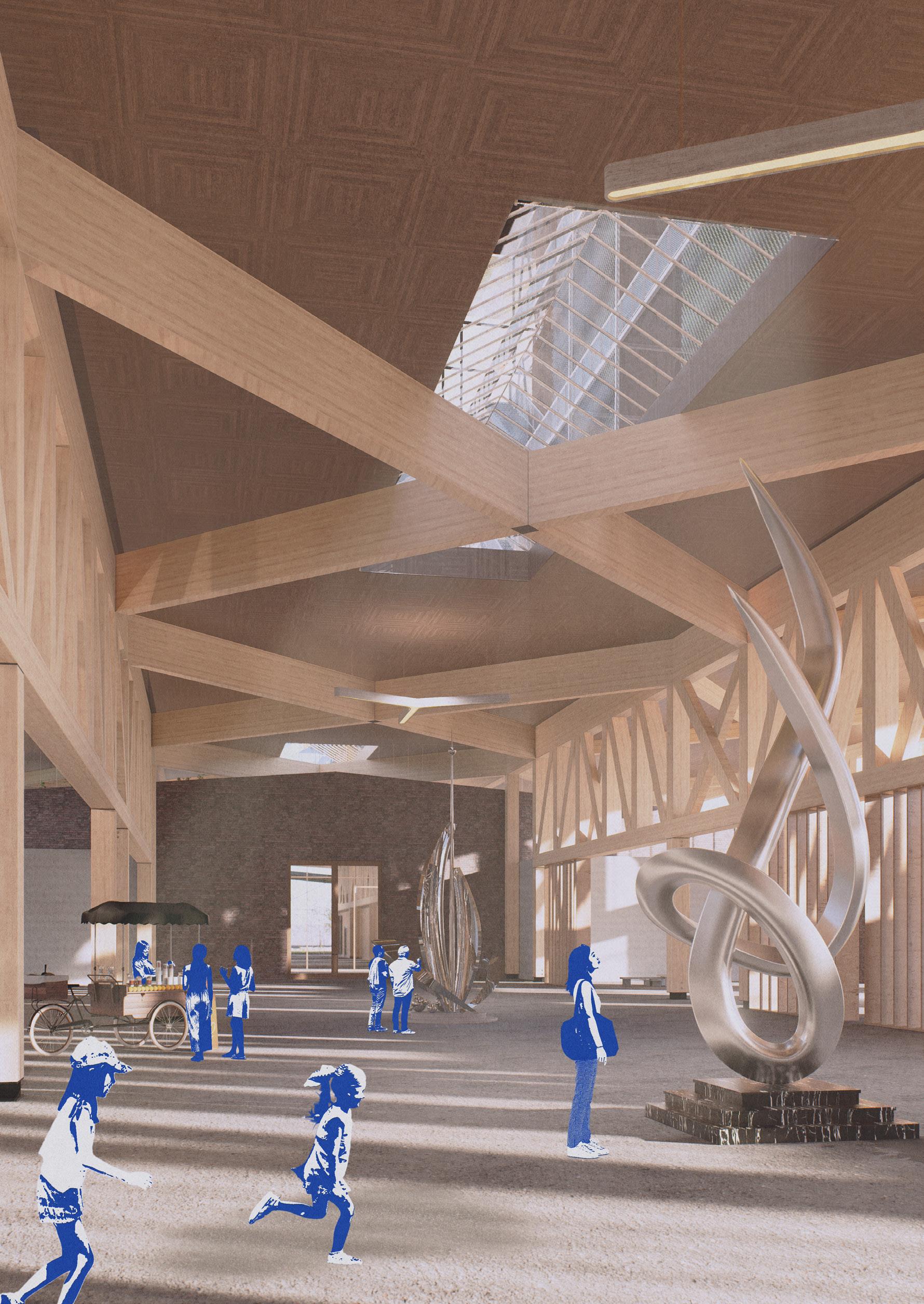
Interior impression (Revit + D5 + Photoshop)
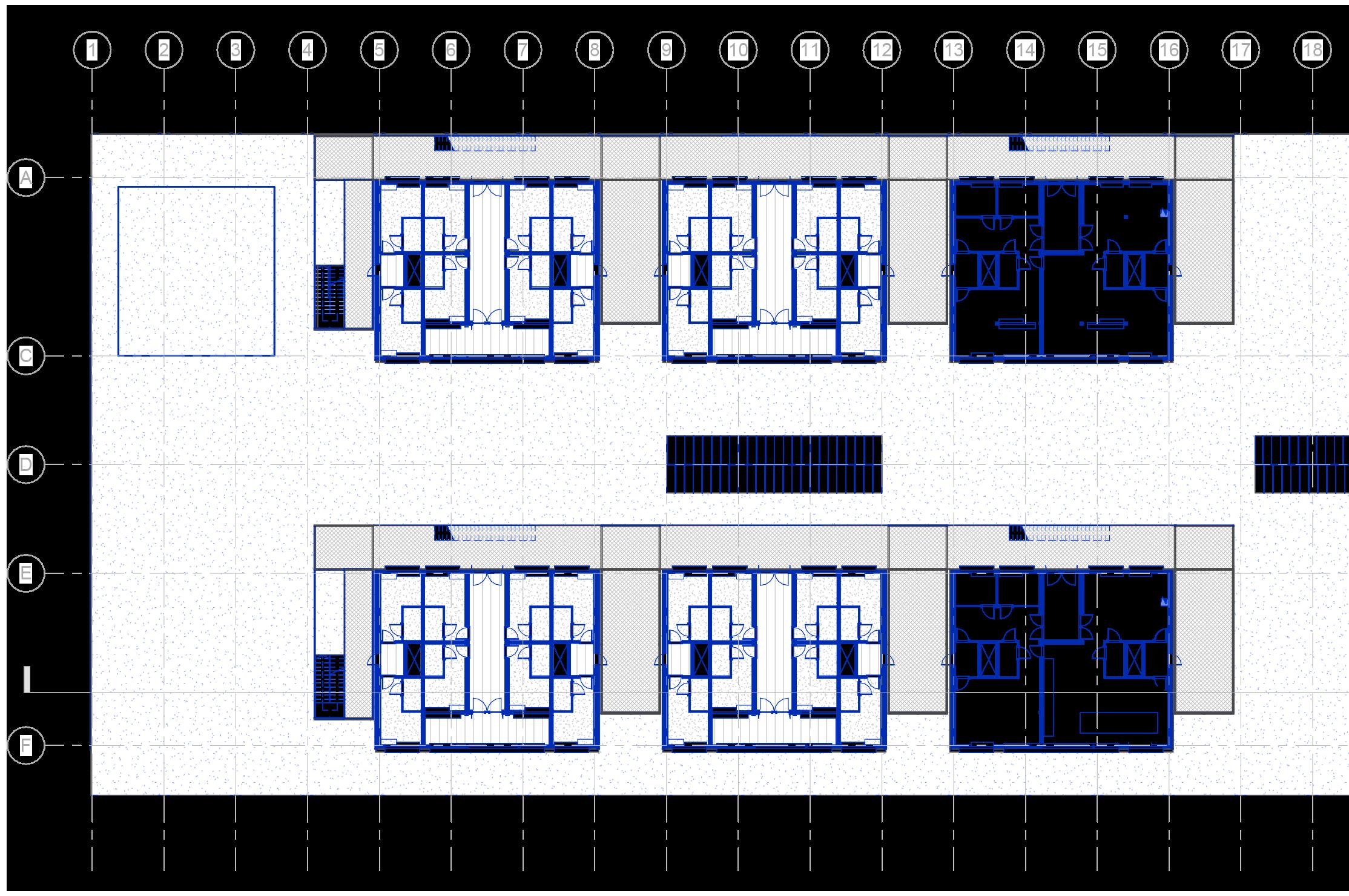
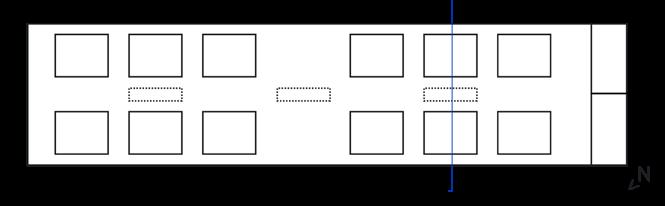
First floor - roof garden 1:500 (Revit)
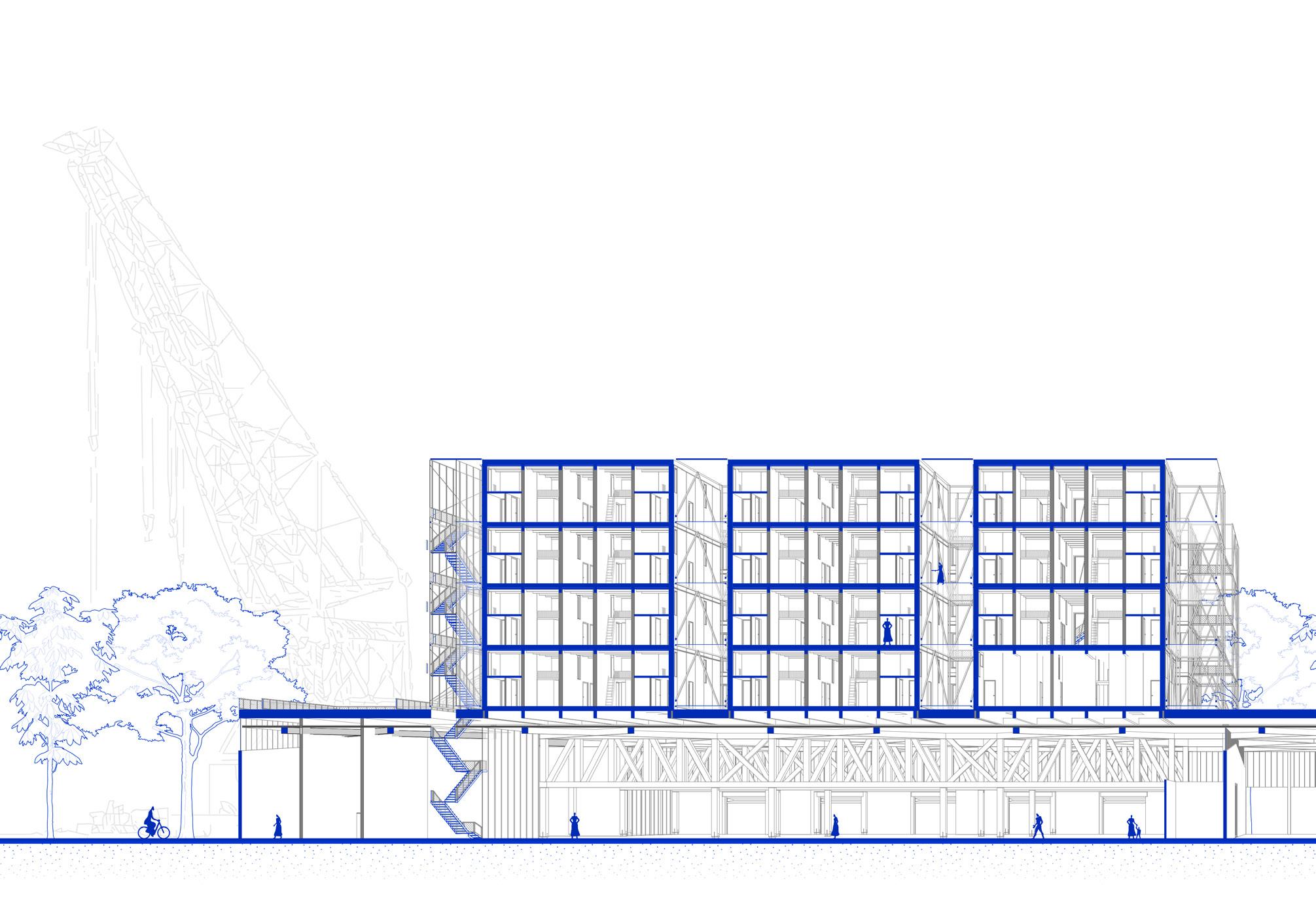
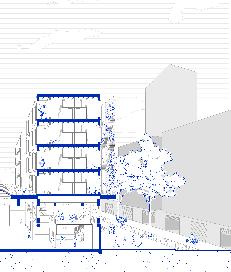
Long section (Revit + Illustrator)
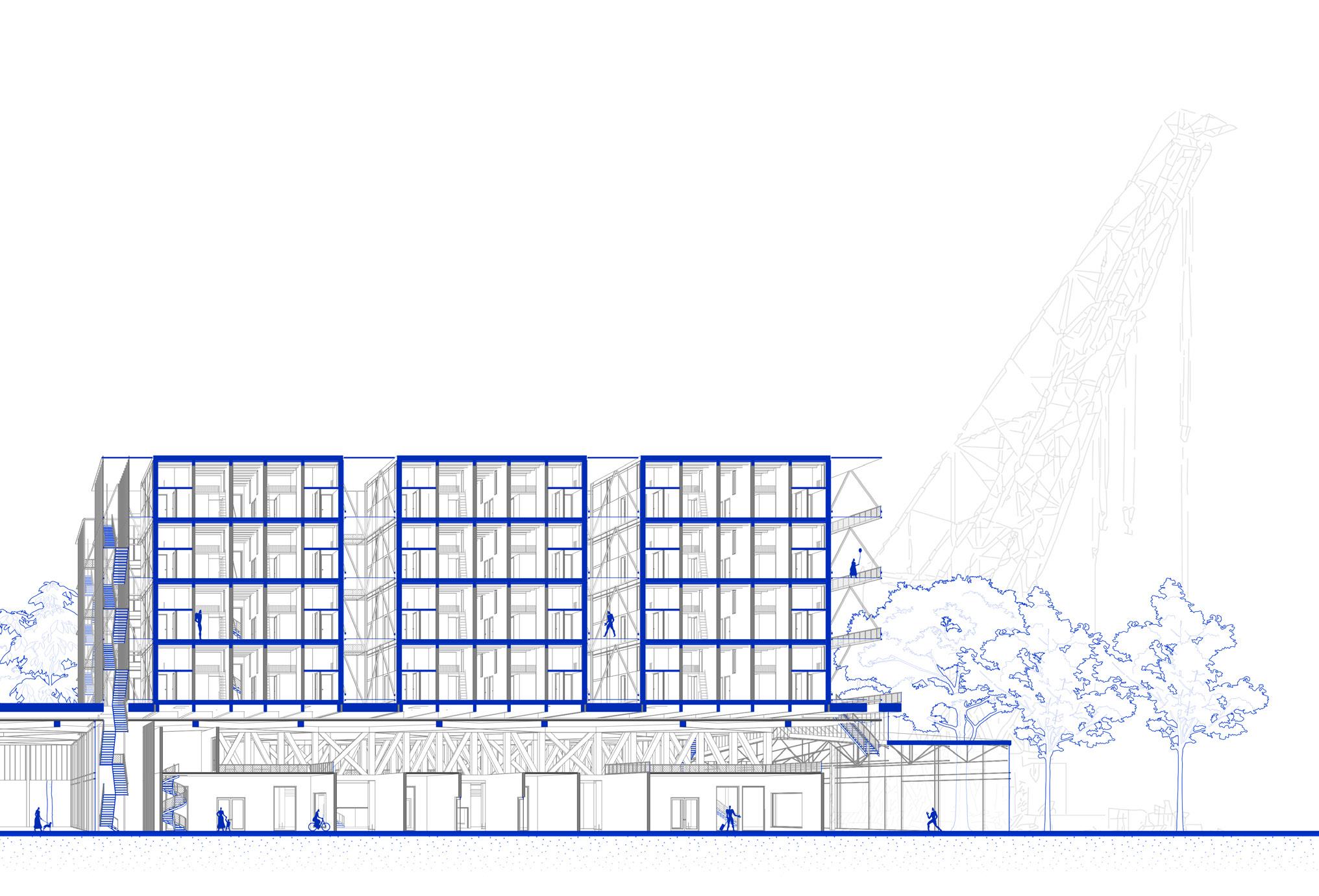
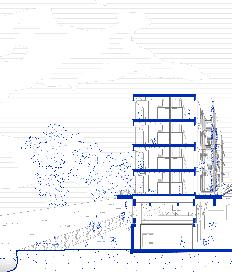
Short section (Revit + Illustrator)
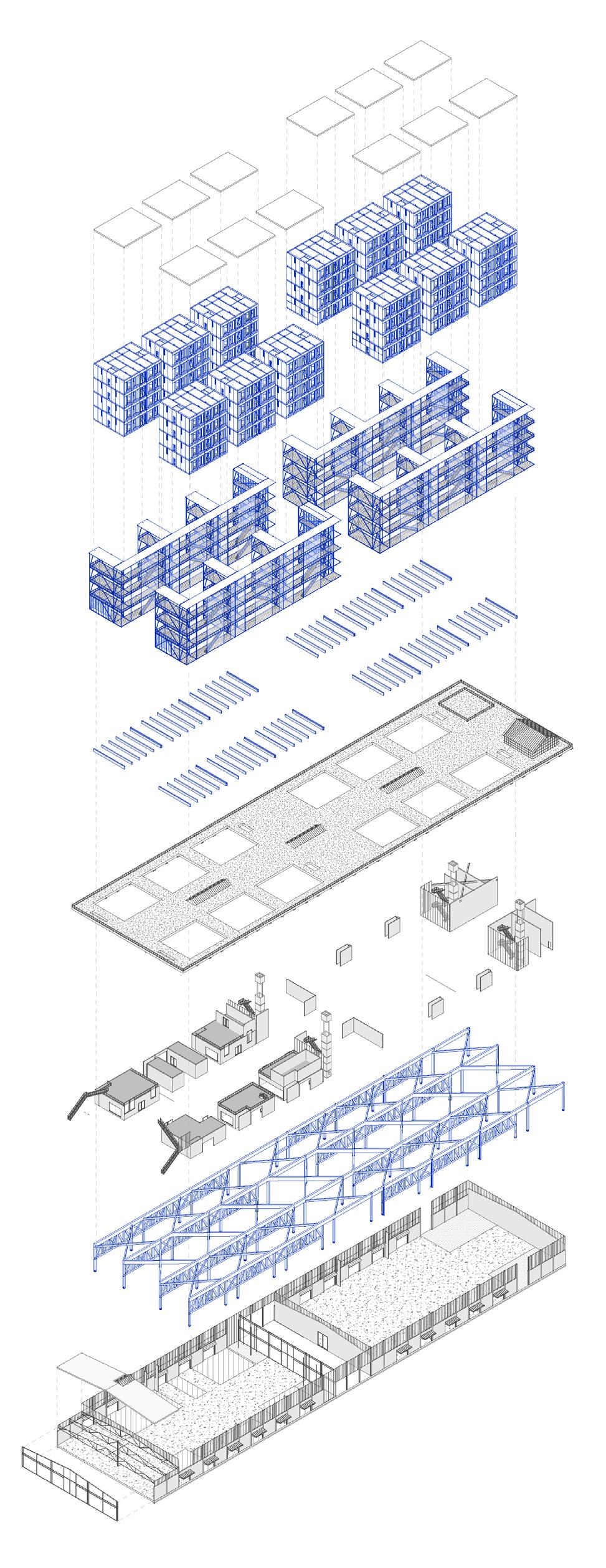
Exploded view of the building (Revit)
Structural elements:
2. Load bearing modules carrying vertical loads
3. External steel stabilization distributing transversal loads
4. Module foundation beams connecting to the truss
7. Load carrying timber truss system
Non structural elements:
1. Demountable modular roof
5.Roof deck hosting roof garden and community farming facilities, as well as reinstated skylights
6. Flexible infill of the ground floor
8. Envelope of the original building preserving the imagedefining value
9. Outdoor passage splitting the ground floor plan into 2 zones
10. Preserved fragment of the original structure serving as a tribute to the building’s architectural heritage.
11. New glass facade creating a visual invitation to the building
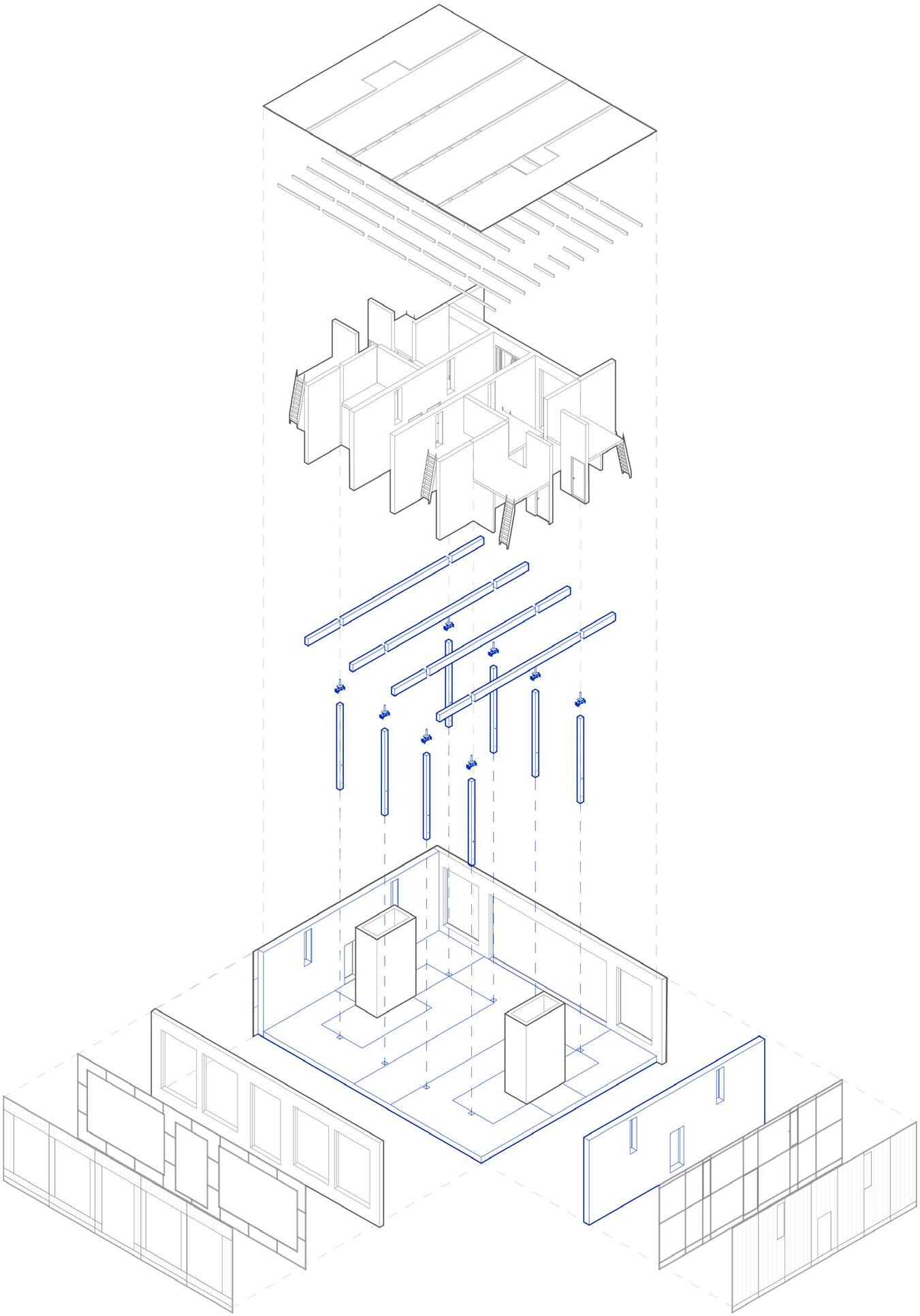
Non structural elements:
Exploded view of the module (Revit)
1. Plywood ceiling panels
2. Ceiling support beams
3. Flexible infill walls and mezzanines
4. Window side facade
5. Wooden support battens
6.Translucent polycarbonate facade
Structural elements:
7. Support Glulam beams
8. Demountable module to module connection
9. Support Glulam columns
10. Structural CLT facade
11. System shafts
12. Structural CLT floor
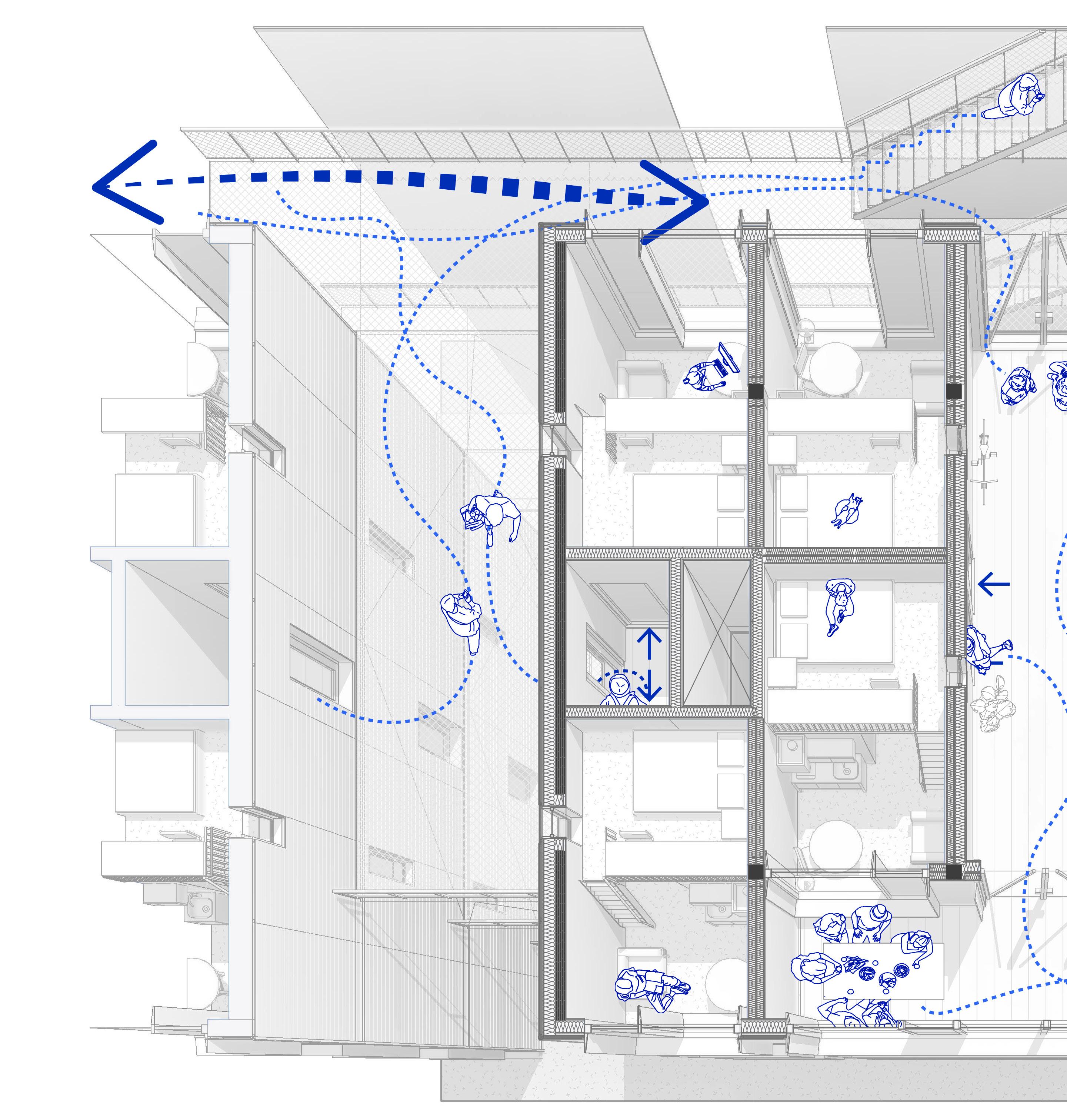
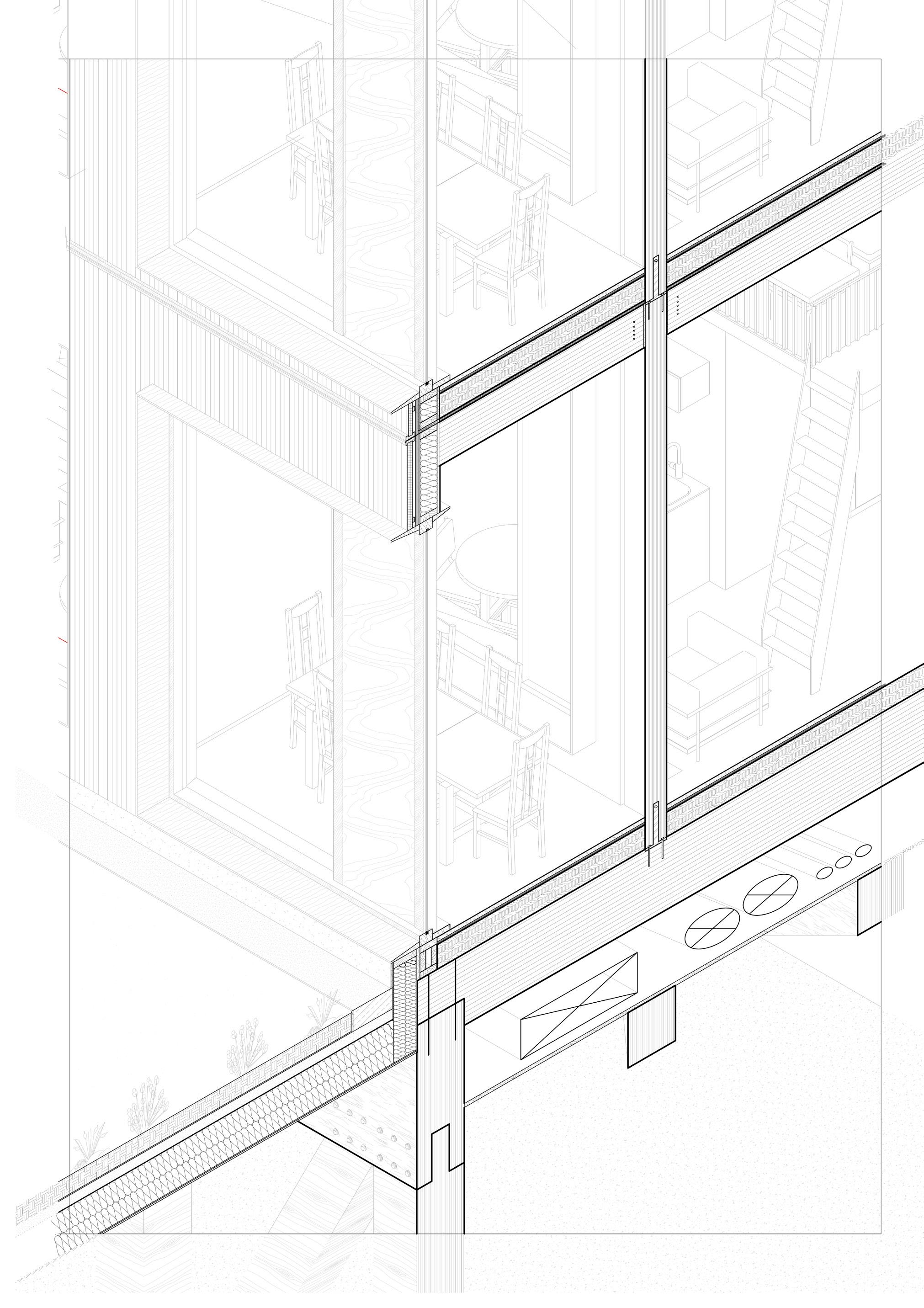
Perspective floorplan (Revit + Illustrator)
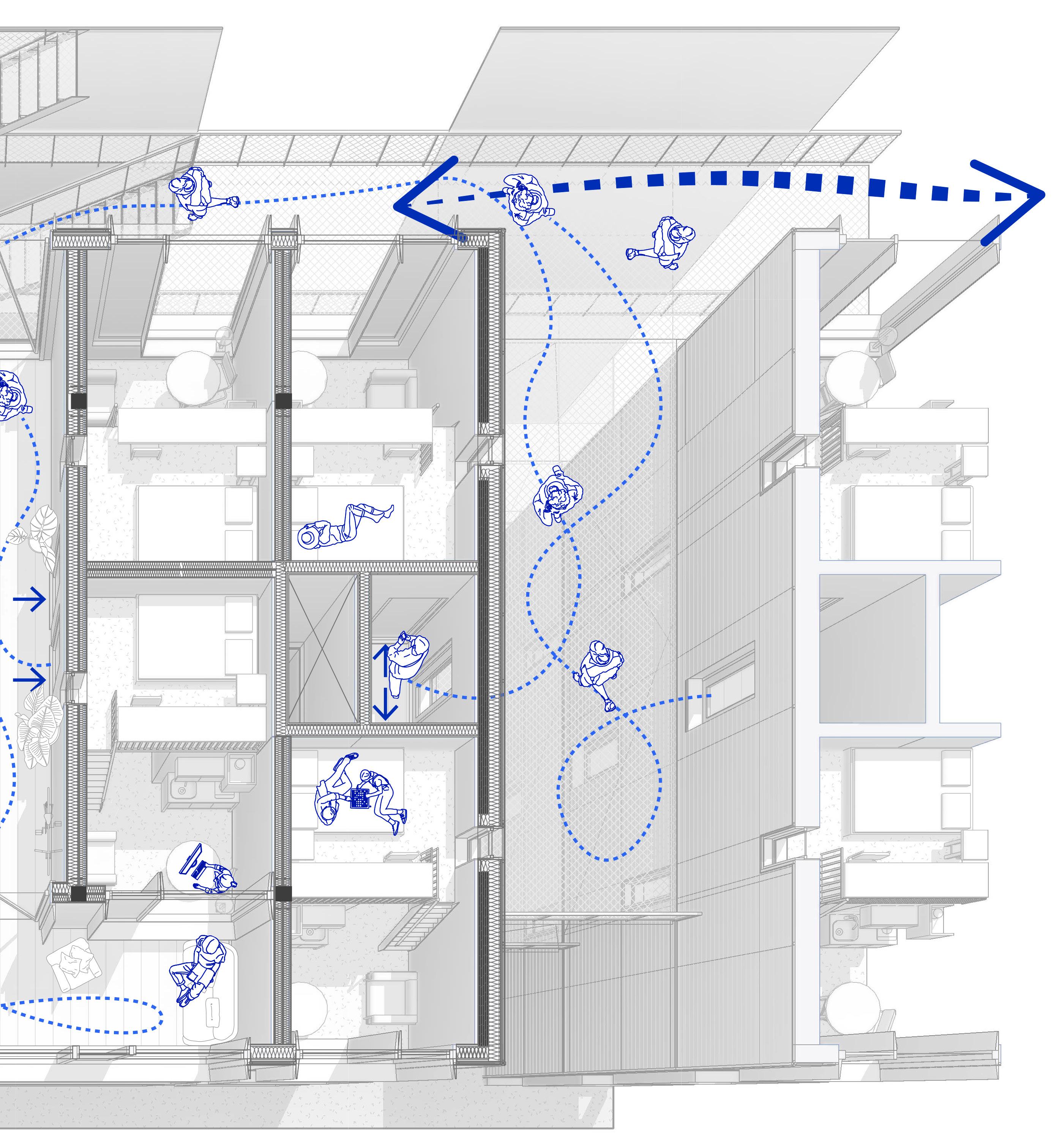
To counteract the anonymity often associated with apartment complexes, the design intentionally places studio access points away from the primary gallery pathways. This creates semi-private pockets adjacent to each studio, fostering opportunities for personalization of the porches and encouraging neighborly interactions
Each module is further equipped with an insulated collective balcony, providing an intimate communal space, particularly during the winter months when the rooftop garden may be less practical for social activities.
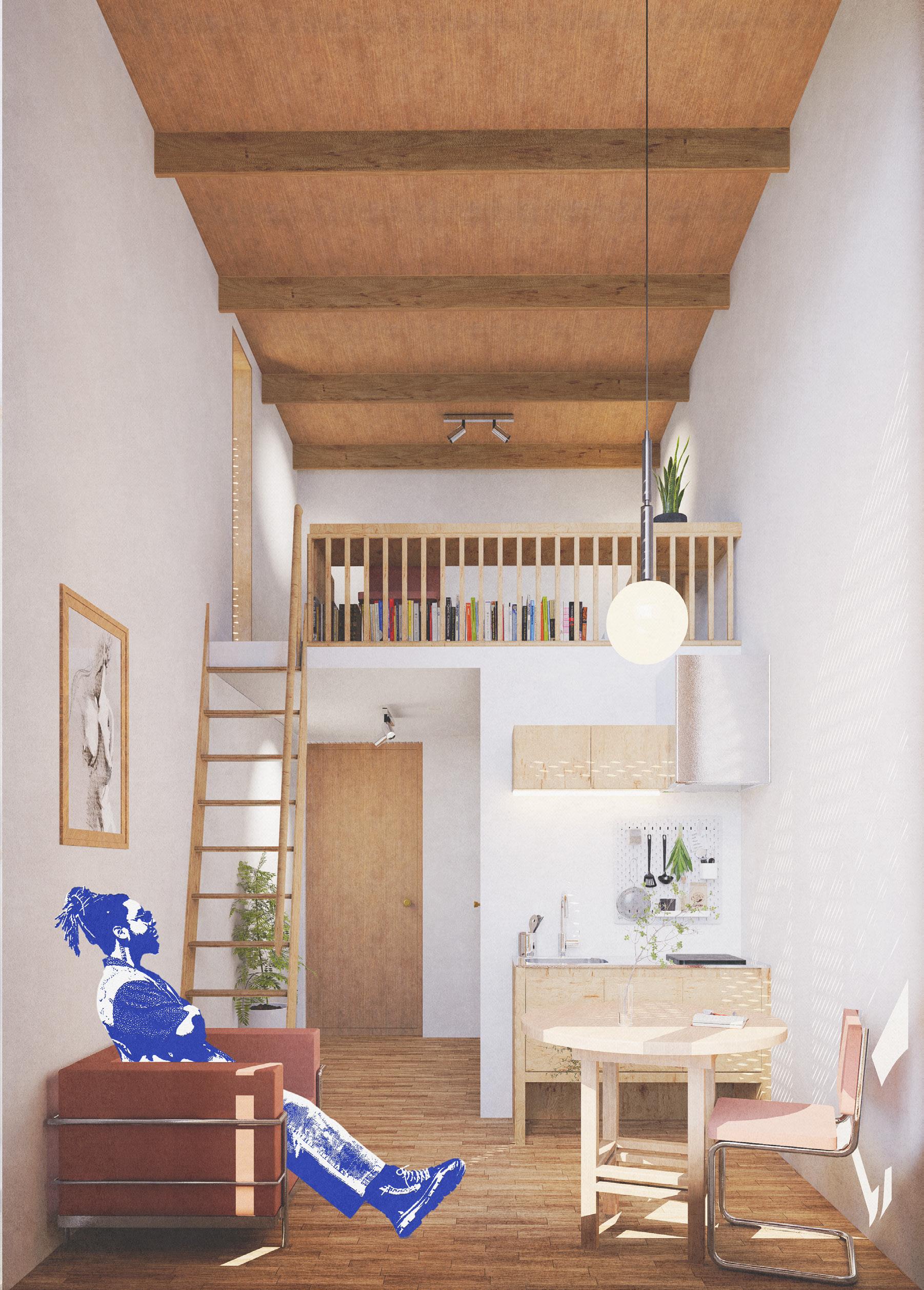
Interior impression (Revit + D5 + Photoshop)
Synthetic
Separating
Separating
Separating
Building parameters
Ground floor height
Number of floors above
ground floor
Module height
Module depth
Module width
Module displacement
Displacement factor
Gallery width
Sun exposure conditions
Winter exposure:
South facade receives min 2h of sun on Dec 21
Summer exposure:
North facade receives 2h of evening sun on Jun 21
Sunset exposure:
Analysis of sunset hours (sun angle <10°) exposure of the roofgarden during warm (average temperature > 21 °C) days
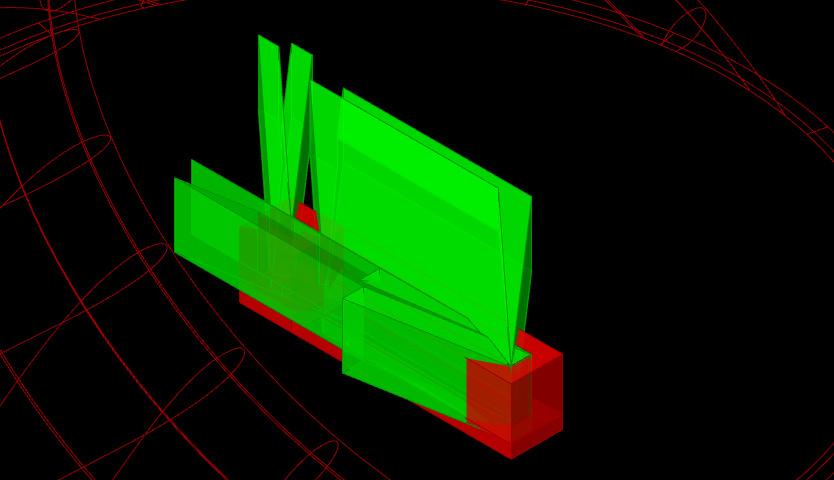
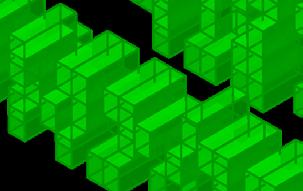
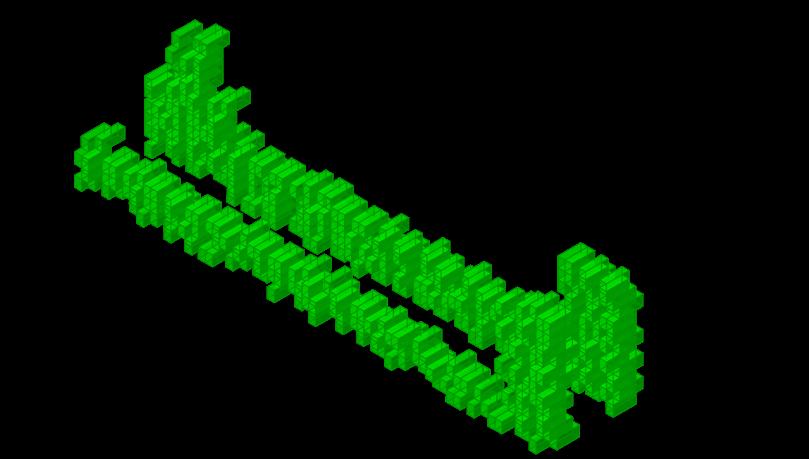

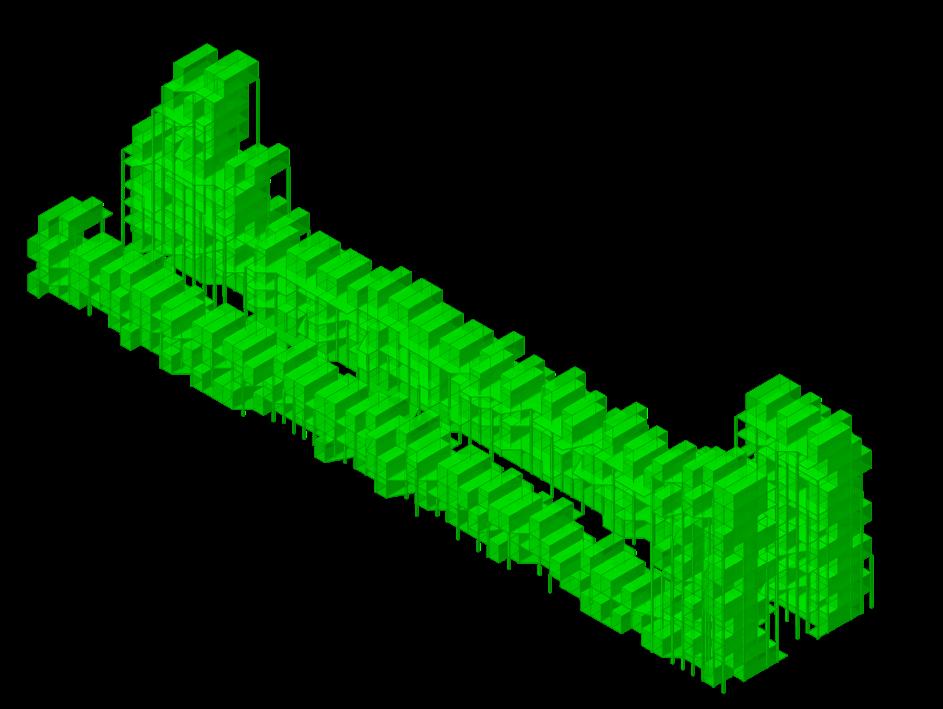
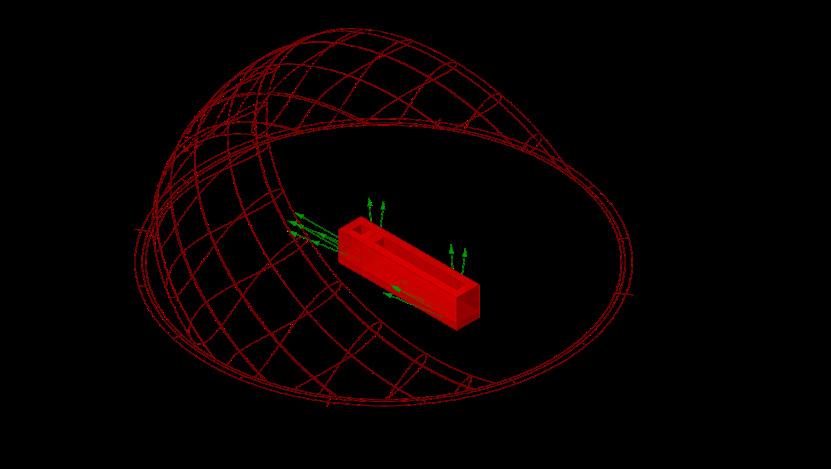
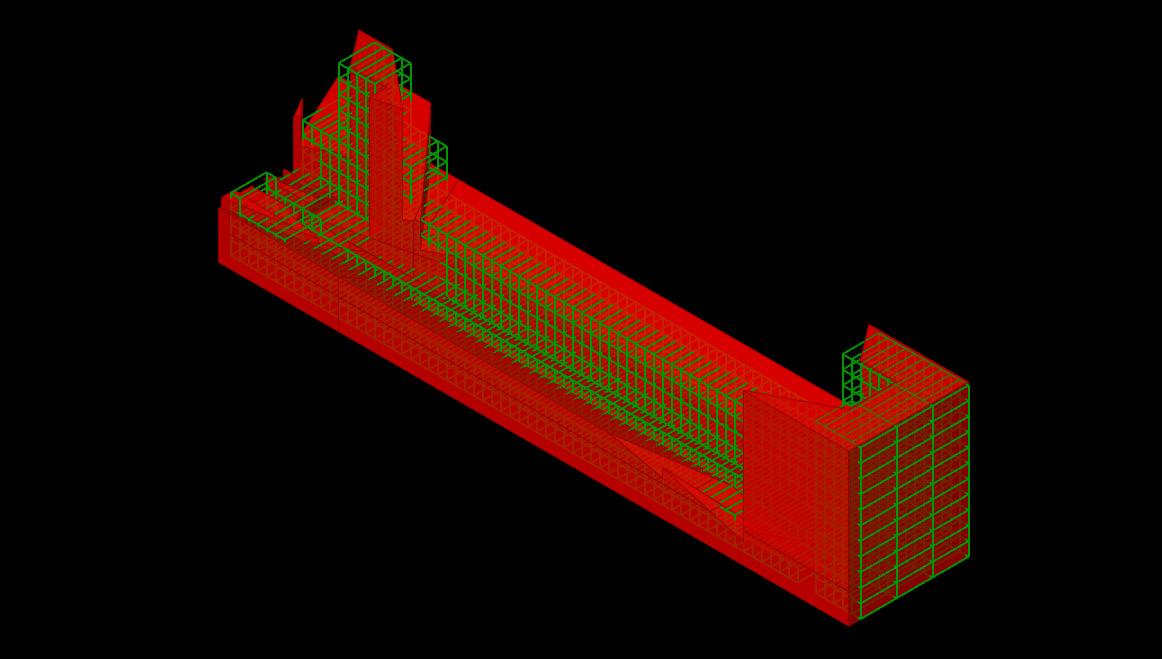
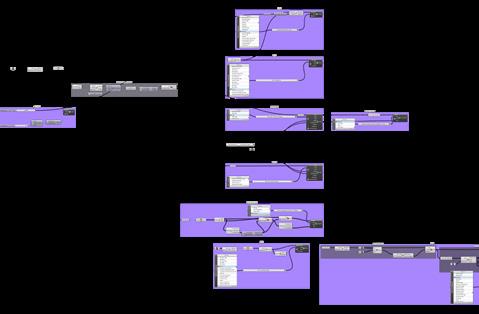
The Grasshopper script starts by defining the maximum building volume on the plot and uses Ladybug sun vector analysis to carve out the mass. This carved mass is then voxelized into adjustable modules with randomized Y-axis offsets to create dynamic facades and terraces. Certain modules are further removed from the rows to establish transversal visual connections. Galapagos optimization was tested but proved limited due to missing context. A gallery pathway, generated based on the offsets of the modules, is added between module rows and timber columns are generated based on the XY position of the gallery and modules, and the Z height of the module stack. Finally the design was translated to Revit by the use of Rhino.Inside. Revit components. The detailed design process then continued in the Revit environment.
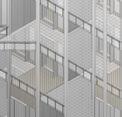
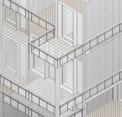
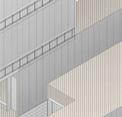
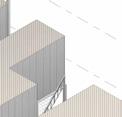


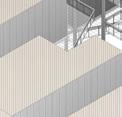
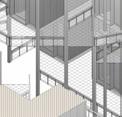
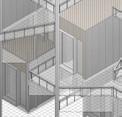
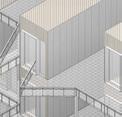
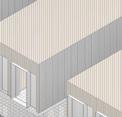
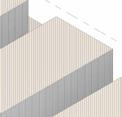
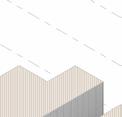
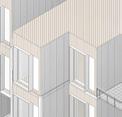
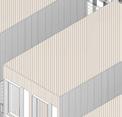
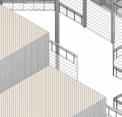
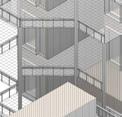
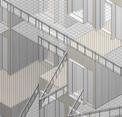
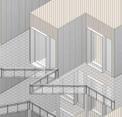
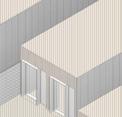
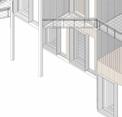
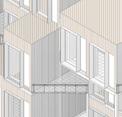
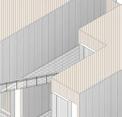
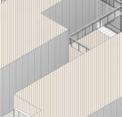
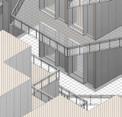
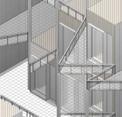
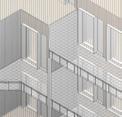

Culling and offsetting of modules (with galapagos)
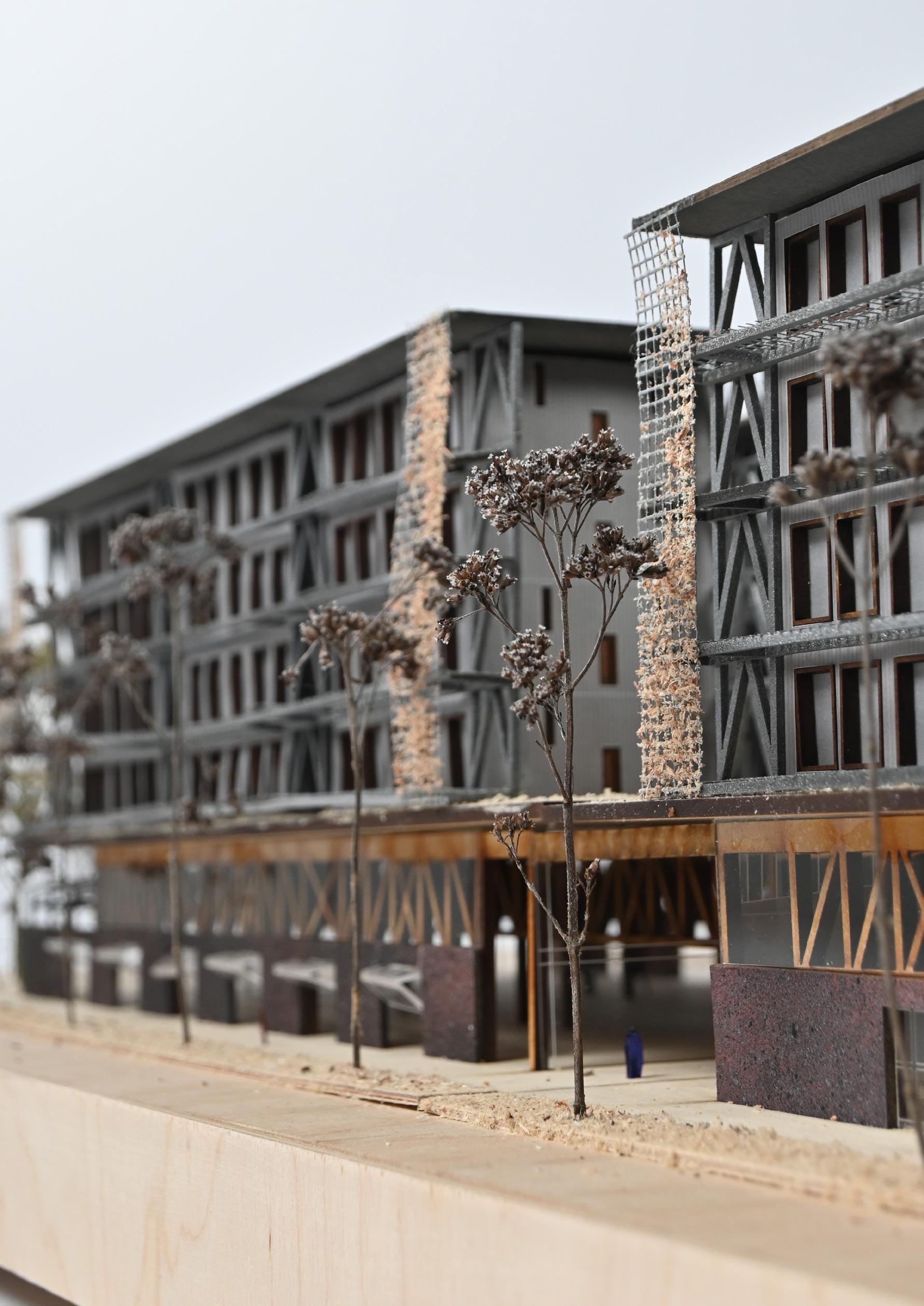
Physical model 1:200
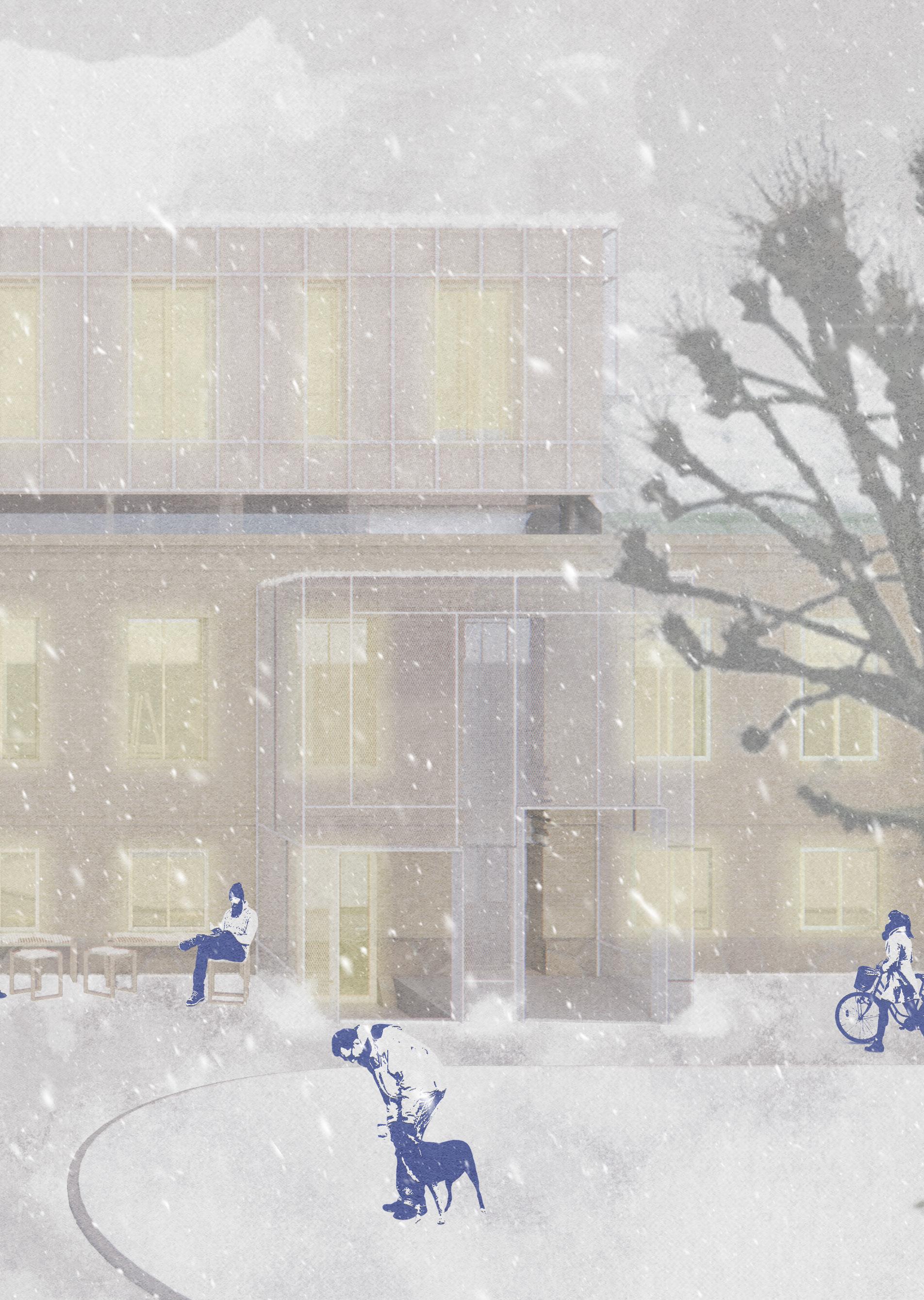
Exterior impression (Rhino > Enscape > Photoshop)
Location: Gothenburg, Sweden
Type: Transformation; Eduaction & Creative space
Studio: Transformation projects
Term: 2023, 14 weeks
Group work (3 members)
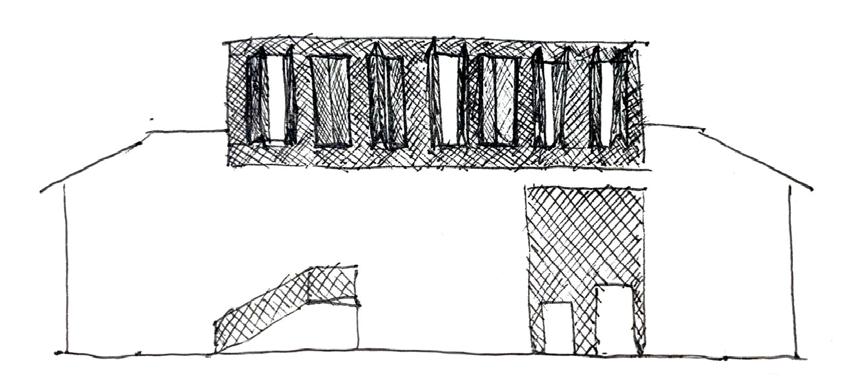
KOMPOSITION KONSTEPIDEMIN
Transformation of an artist collective
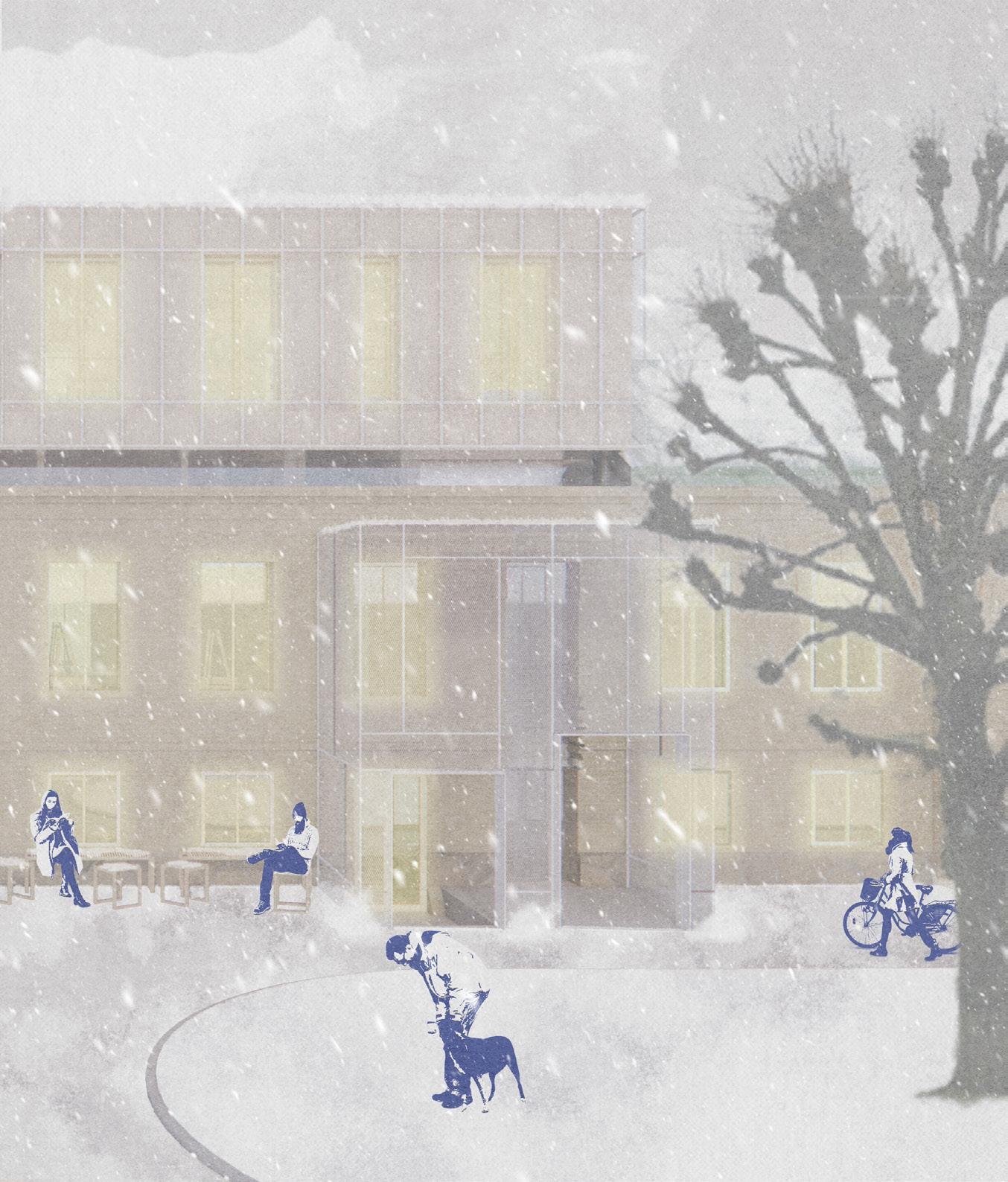
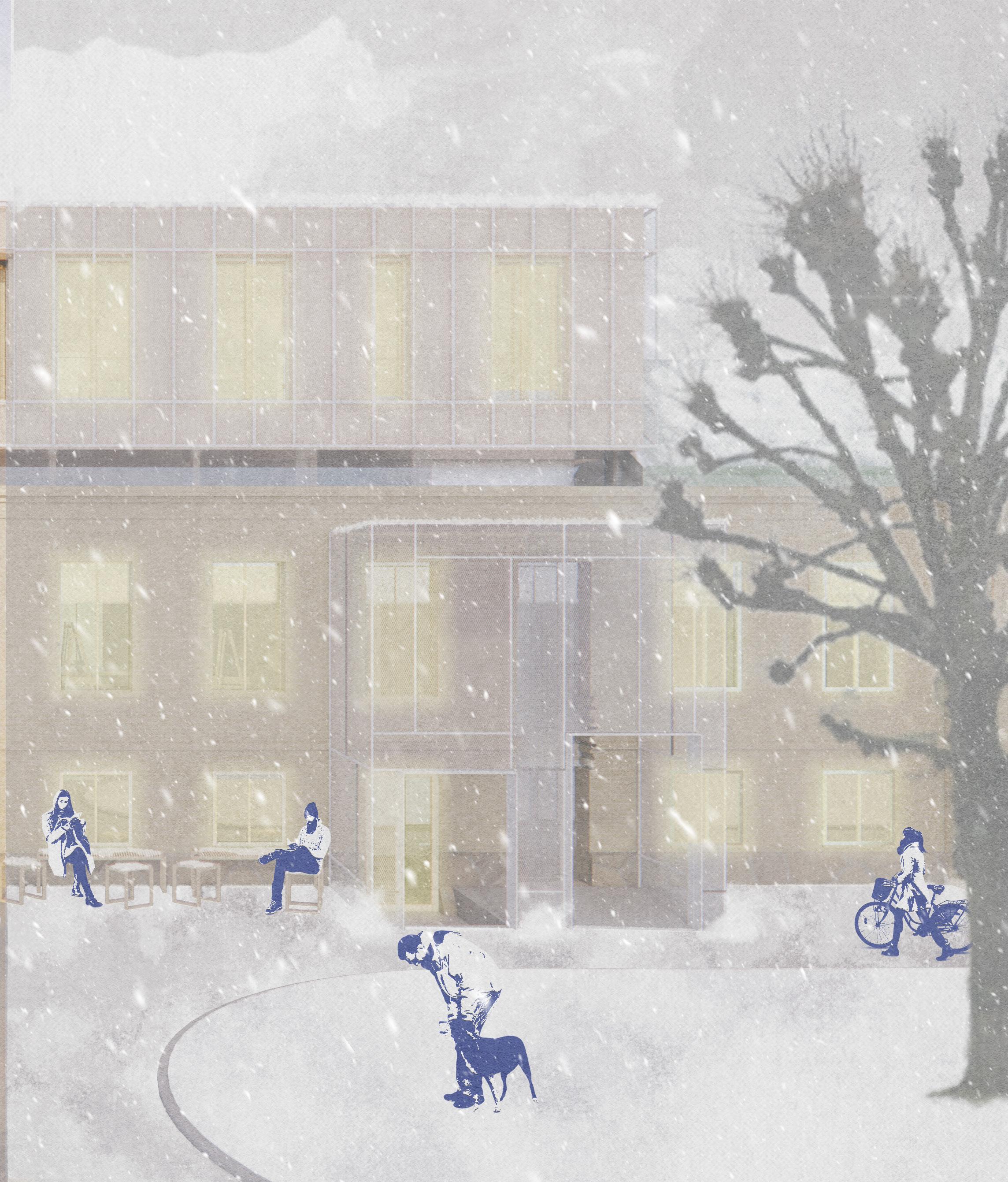
Historically an epidemic hospital, the art collective Konstepidemin is facing challenges due to the lack of diversity among its resident artists and declining relevance within central Gothenburg. The project views Konstepidemin as a Palimpsest, aiming to preserve its historical layers and introverted identity while introducing a new layer with complementary extroverted qualities to enhance collaboration and relevance. To promote diversity, art students are welcomed to communal workshops established to encourage collaboration. Vertical extensions facilitate co-working and educational workshops, while outdoor structures include flexible studios and outdoor workshops, catering to diverse stakeholder interests. The lightweight timber structure of the extensions respects existing historical buildings, while the foldable facades enhance connectivity between interior and exterior spaces, promoting communication and vitality.
Our group collaboration was marked by committed involvement from all members, with each contributing equally to the design process. Every decision was carefully discussed and argued, resulting in an thoroughly thought-through design. The responsibilities were separated in the final stage of visual production. In the team, my main role was developing a highly detailed 3D model in Rhino, serving as the basis for most of the drawings. I also handled render model setup (Enscape), production and post-production of renders. If a drawing presented in this portfolio is not mine, it’s explicitly stated for clarity.
Adaptive reuse strategies
Partially Erasing
Writing Over
Underlining
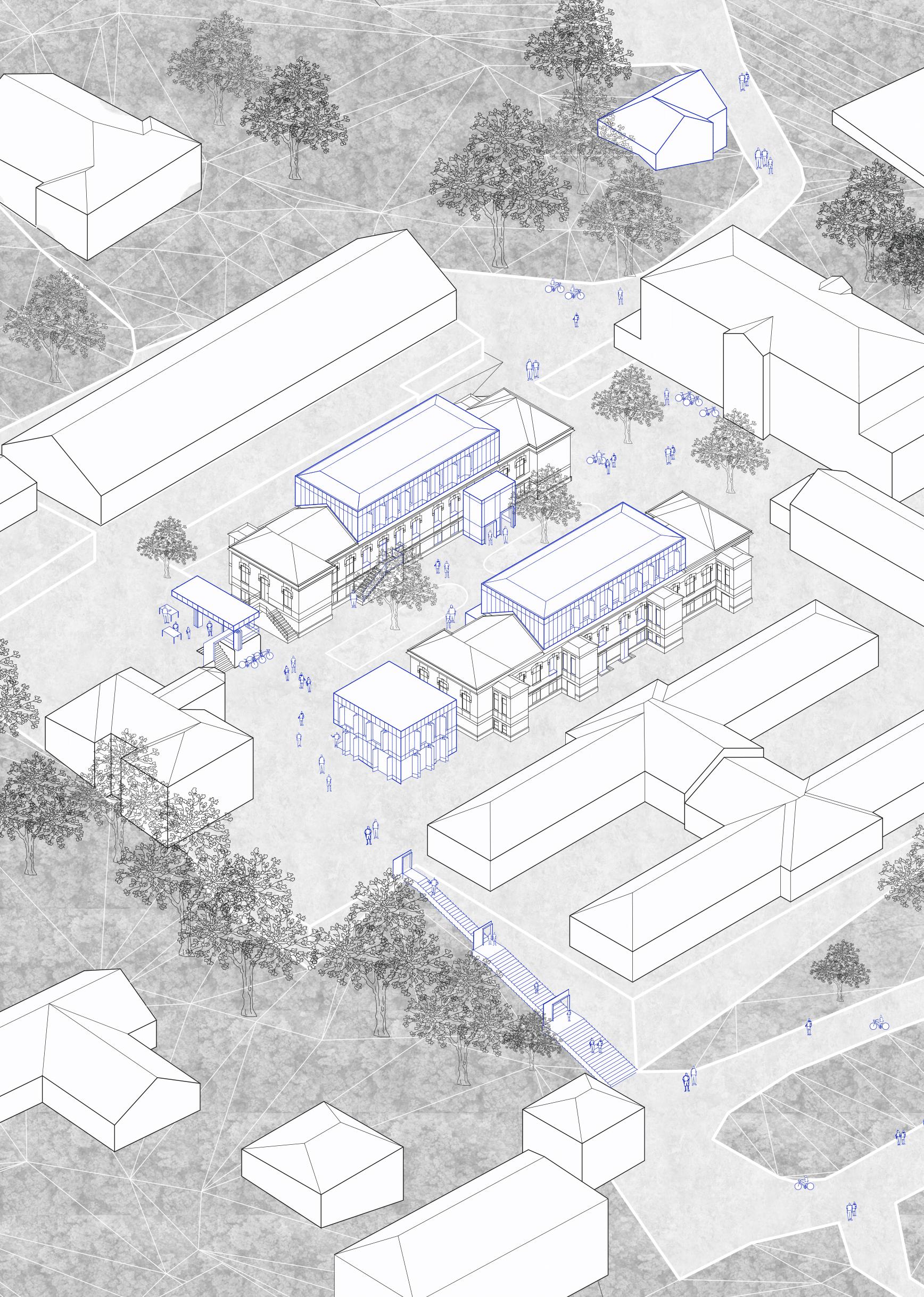
Context axonometry ((Rhino > Photoshop))
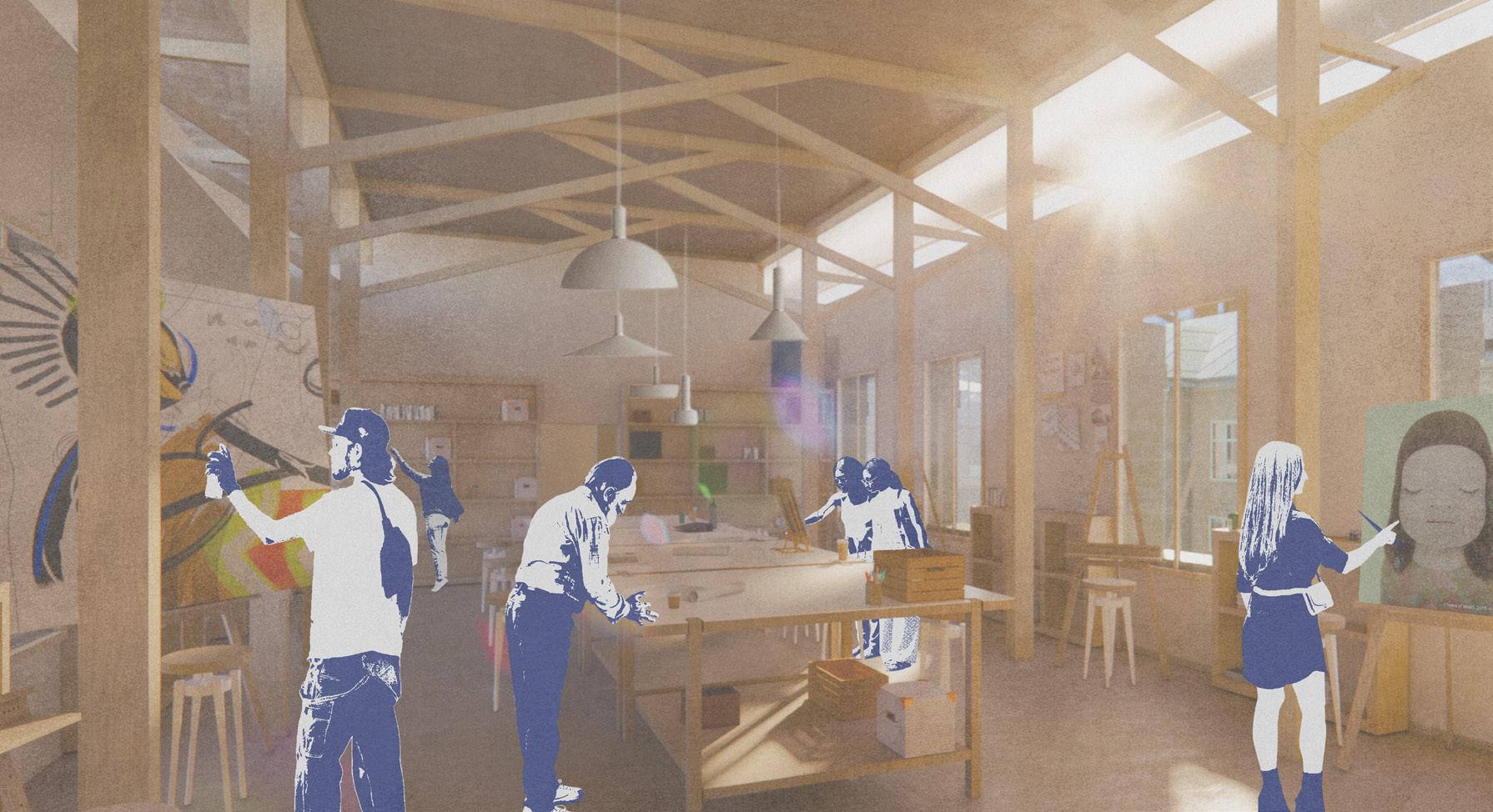
Interior impression: first floor (Rhino > Enscape > Photoshop)
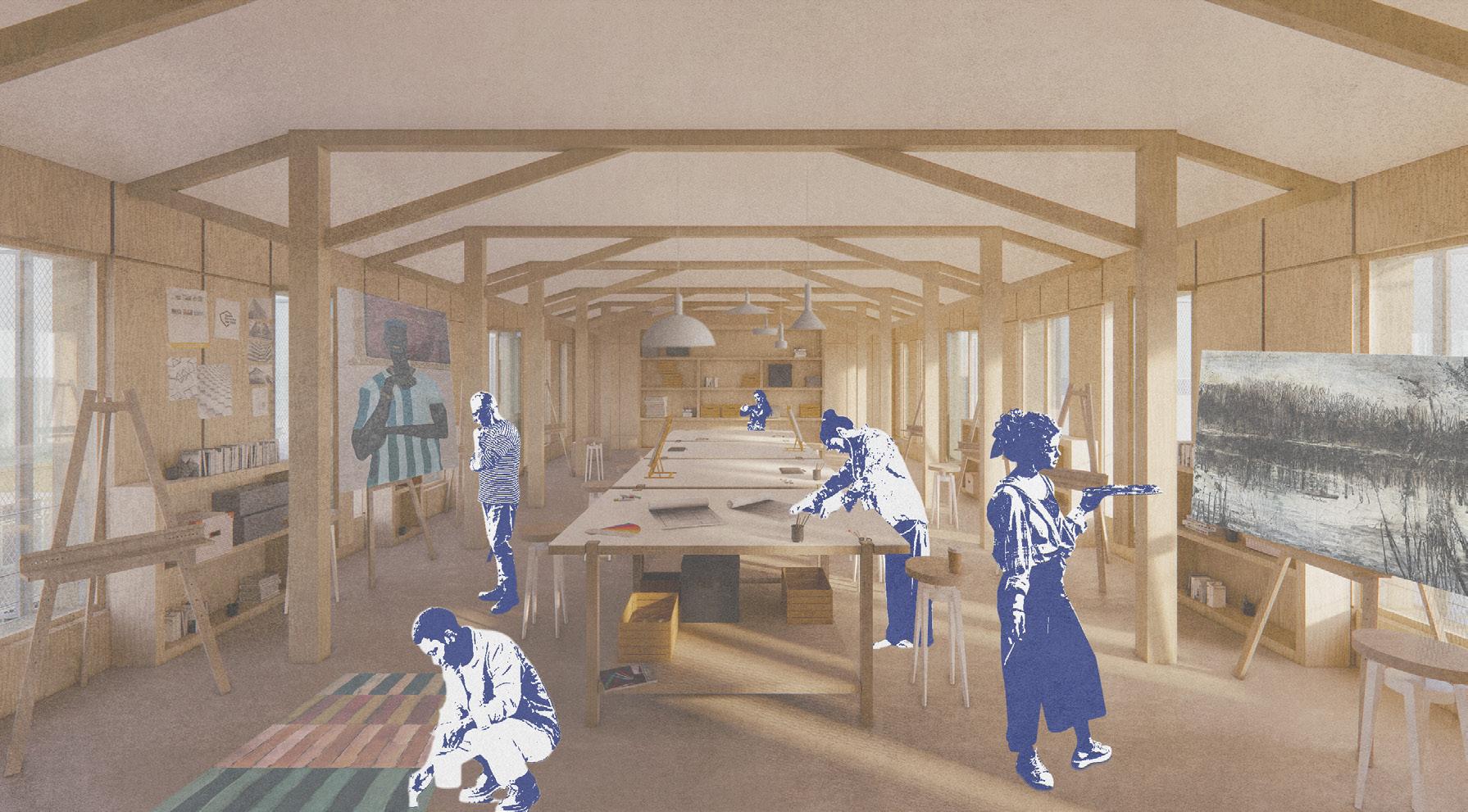
Interior impression: second floor (Rhino > Enscape > Photoshop)

1. - aluminium sheet
- support battens (40/40)
- two layers asphalt
- wooden composite board (20mm)
- wood fiber board insulation (240mm) between joists (240/50mm)
- two layers of wooden composite board (20mm)
- installation layer (electricity & sprinkler system) consisting of hard insulation (60mm)
- gypsum board (16mm) 2.
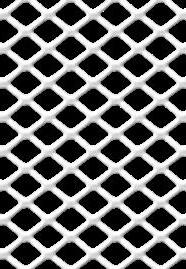
- mesh panels
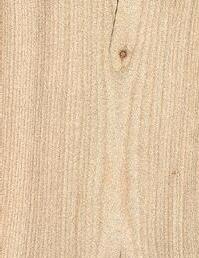
- untreated larch wooden panel (30mm)
- support battens (30/30mm) & airspace
- wooden composite board (16mm)
- flashing, zinc - wooden panel (16mm)
- wood fiber board insulation (220mm)
- installation layer (electricity) consisting of hard insulation (60mm) -gypsum board (16mm)
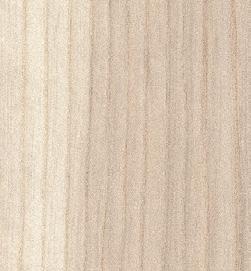
- white UV-treated ash panel (30mm)
3. - design screed
- wooden composite board (20mm)
- wood fiber board insulation (200mm) between joists (200/50mm)
- wooden composite board (20mm)
- reflective aluminium sheet on insulating panel (60mm) 4. - double glazing (horizontal & vertical) jointed by aluminium L-profile, vertical glass hanging
The delicate balance between preserving the historic identity of the site and addressing the necessity for expansion and reconfiguration to ensure the community‘s vitality was tackled by introducing a series of vertical and horizontal extensions tactfully integrated with the existing structures
Courtesy of Jessica Börjesson
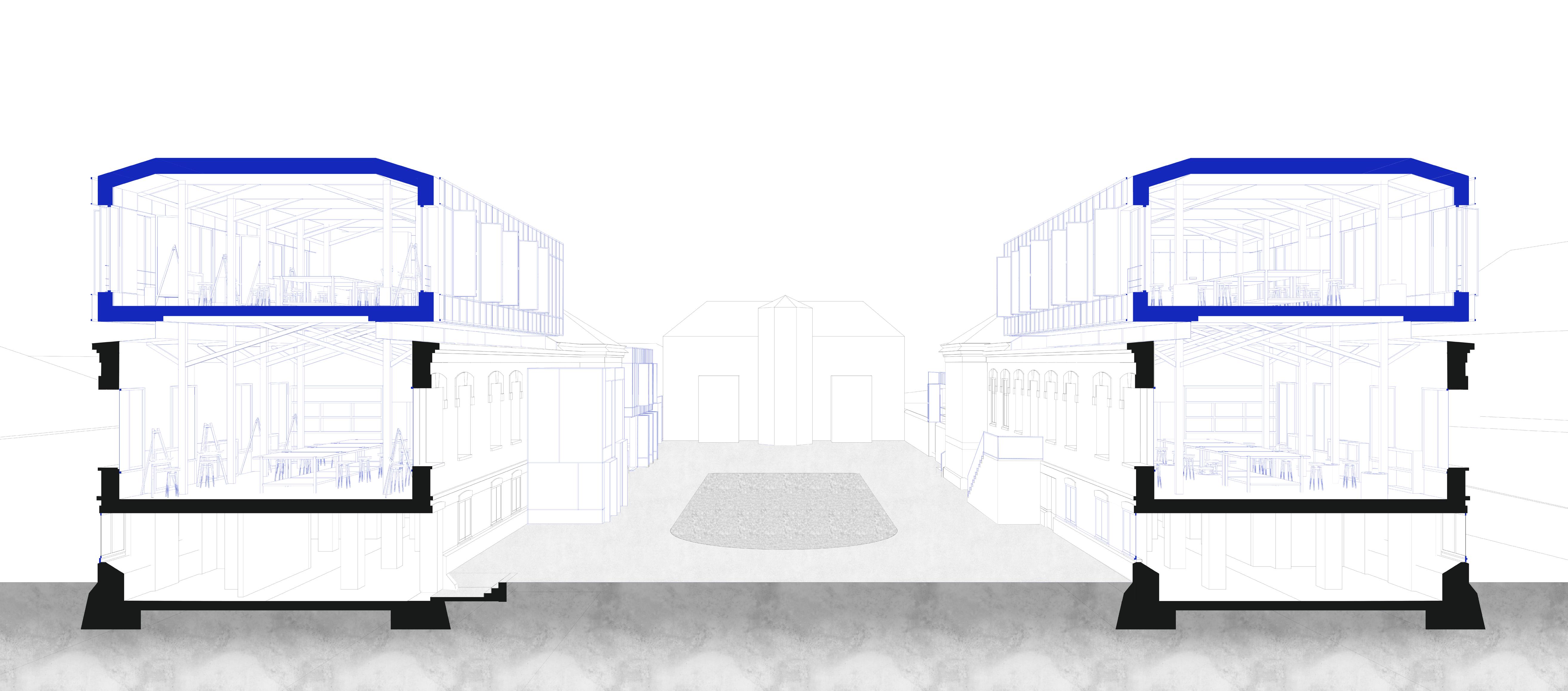
Urban section (Rhino > Photoshop)
The elevated upper boundaries of the buildings amplify the enclosure of the square between them, effectively framing the redefined extroverted space. The design establishes a dynamic interplay of levels, fostering diverse forms and degrees of interaction among users within both indoor and outdoor spaces
roof
second floor: supporting structure (wood)
second floor: slab & walls
second floor: outer facade layer (mesh)
second floor: insulating facade layer (wood)
first floor: supporting structure (wood)
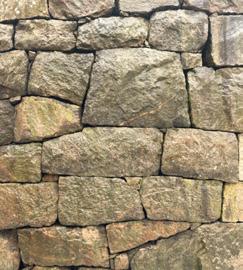
first floor: existing buidling structure (brick)
ground floor: existing buidling structure (brick)
entrance (mesh)
Exploded view (Rhino > Photoshop)
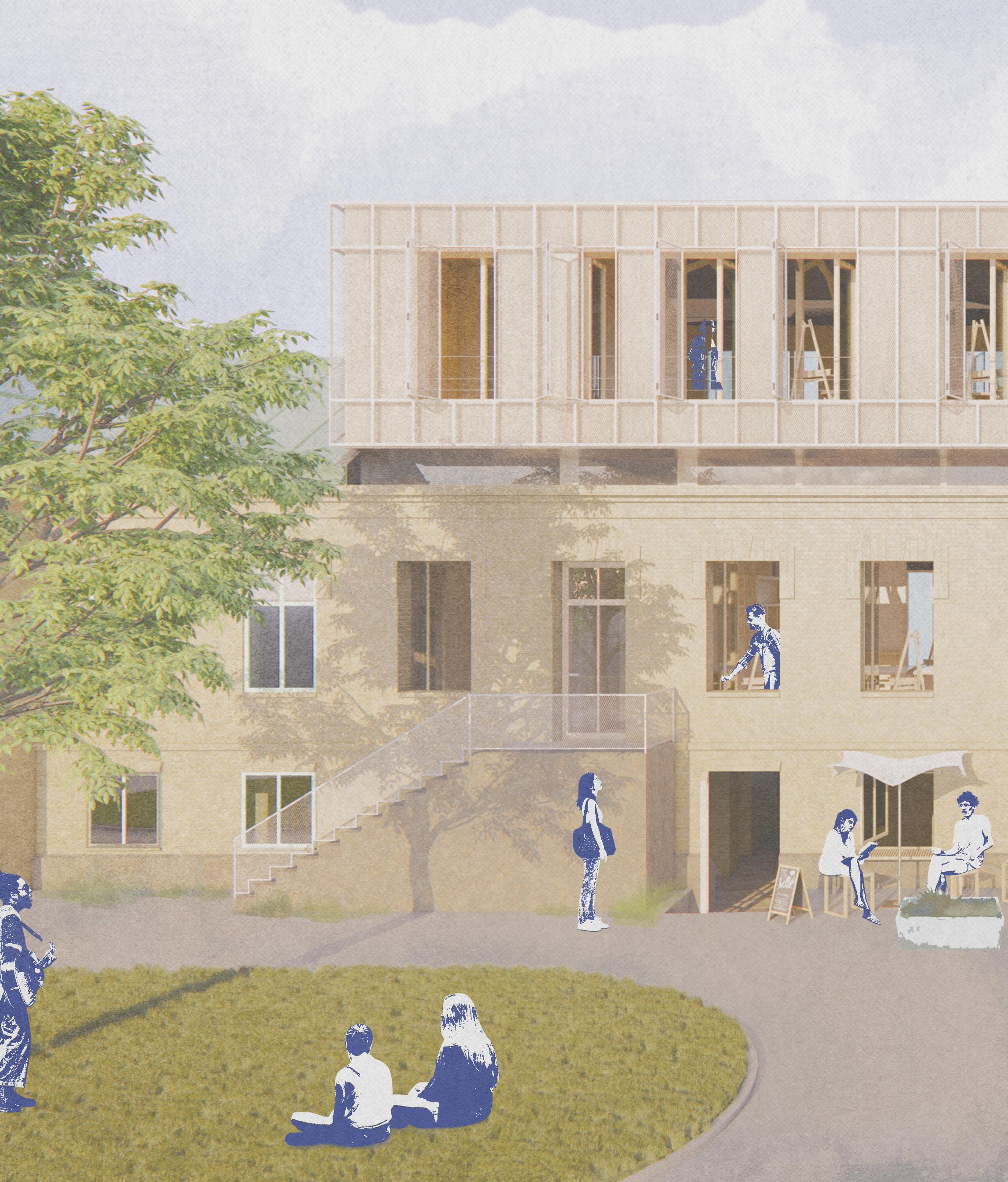
Exterior impression - Summer & Winter (Rhino > Enscape > Photoshop)
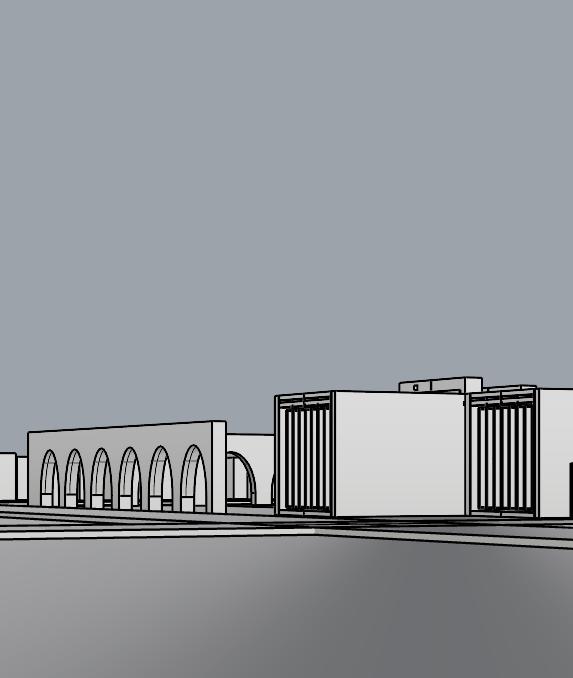
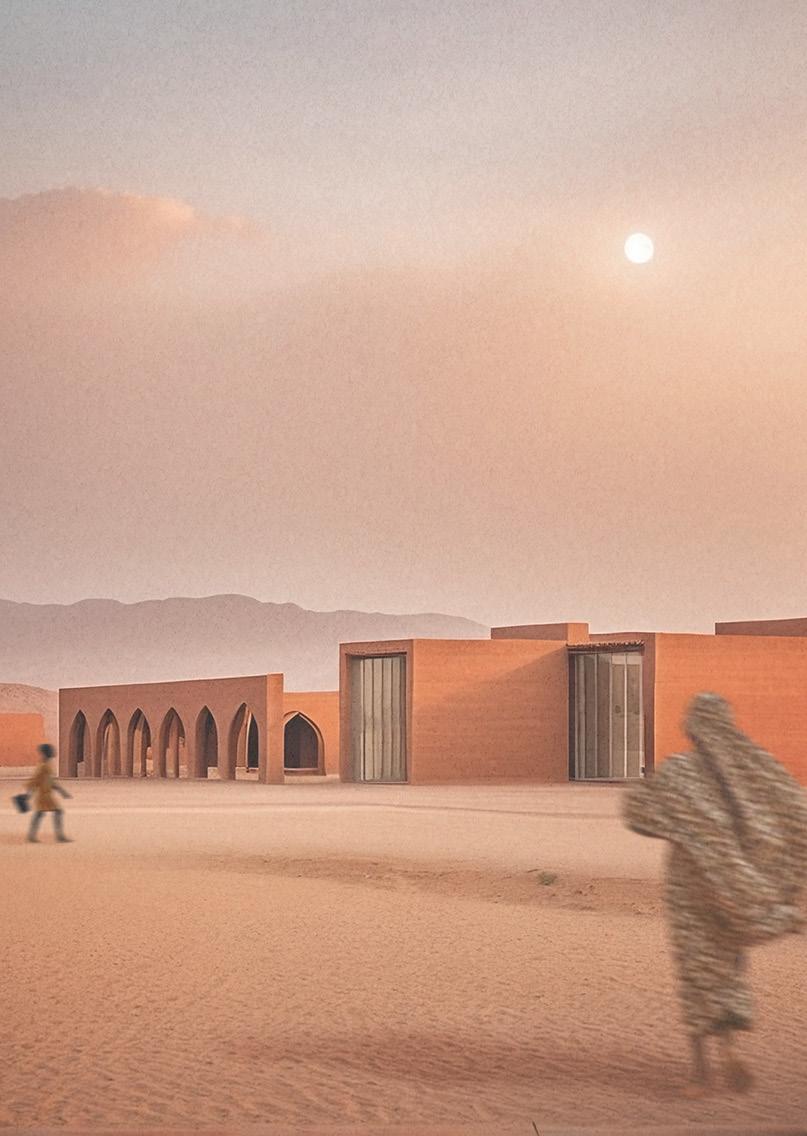
Exterior impression (Rhino > AI software (Prome AI) > Photoshop)
Location: Azraq, Jordan
Type: Education, community center; Climate design focus
Studio: Architectural engineering
Term: 2022, 10 weeks
Individual work
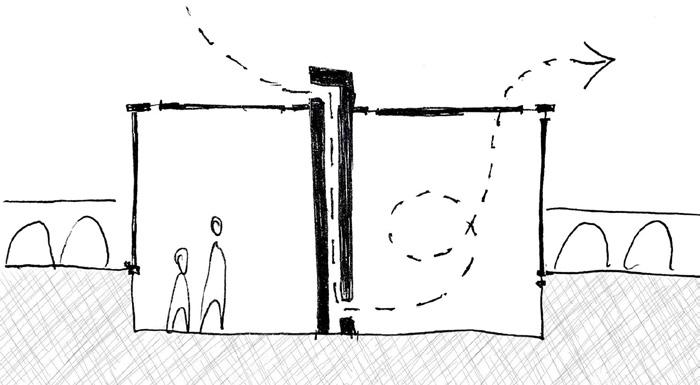
Local-Inno
Deployable lo/hi-tech school and community center in a refuge camp
Located within Jordan’s Azraq refugee camp, Local-inno attempts to blend local indoor climate control strategies with global engineering advances to improve the challenging lives of displaced communities. The deployable school concept combines easily assembled modules crafted from both local and innovative materials, integrating vernacular thermal control methods like wind catchers and thermal mass utilization for climate adaptability.
Beyond educational spaces, the design prioritizes the wellbeing of the users of the space with leisure areas and community hubs, including a community center and spaces for additional employment. To address privacy concerns, an arched arcade around hygiene areas fosters safety for women while enabling eyes-on-the-street effect and community oversight.
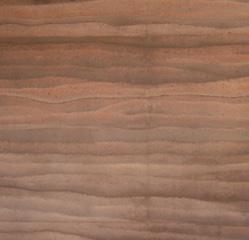
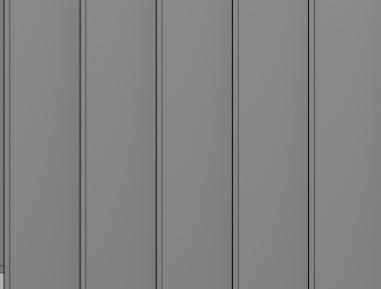
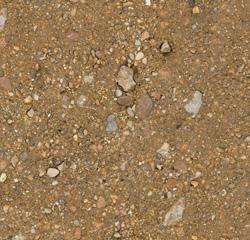
From a structural perspective, H-shaped load bearing walls are constructed by unskilled workers using local rammed earth. Slats are mounted onto reinforced fiber frames provide ventilation. This assembly ensures maximum climate comfort with phase changing material, aerogel, and trombe wall membrane aiding regulating temperatures day and night.
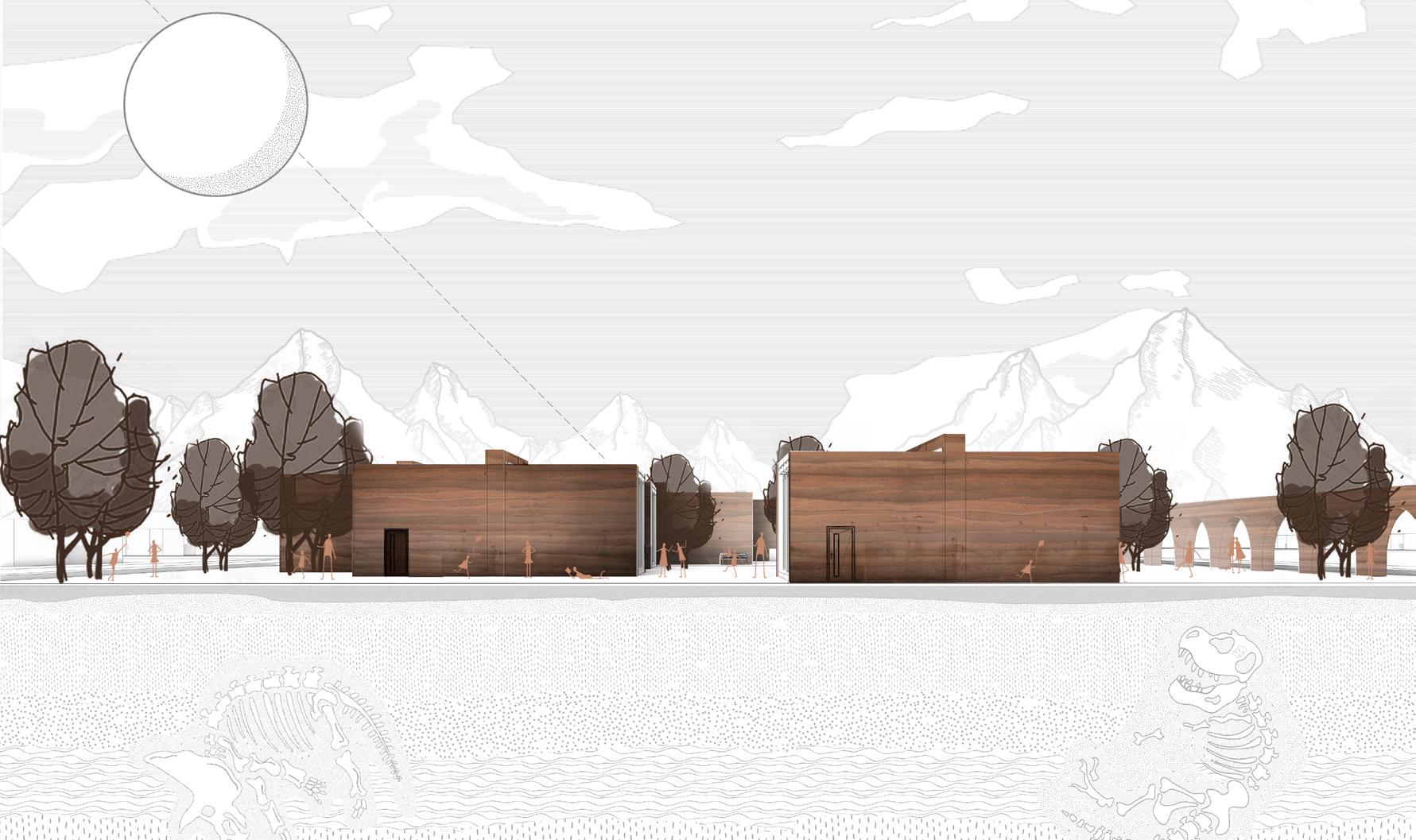
Situation elevation
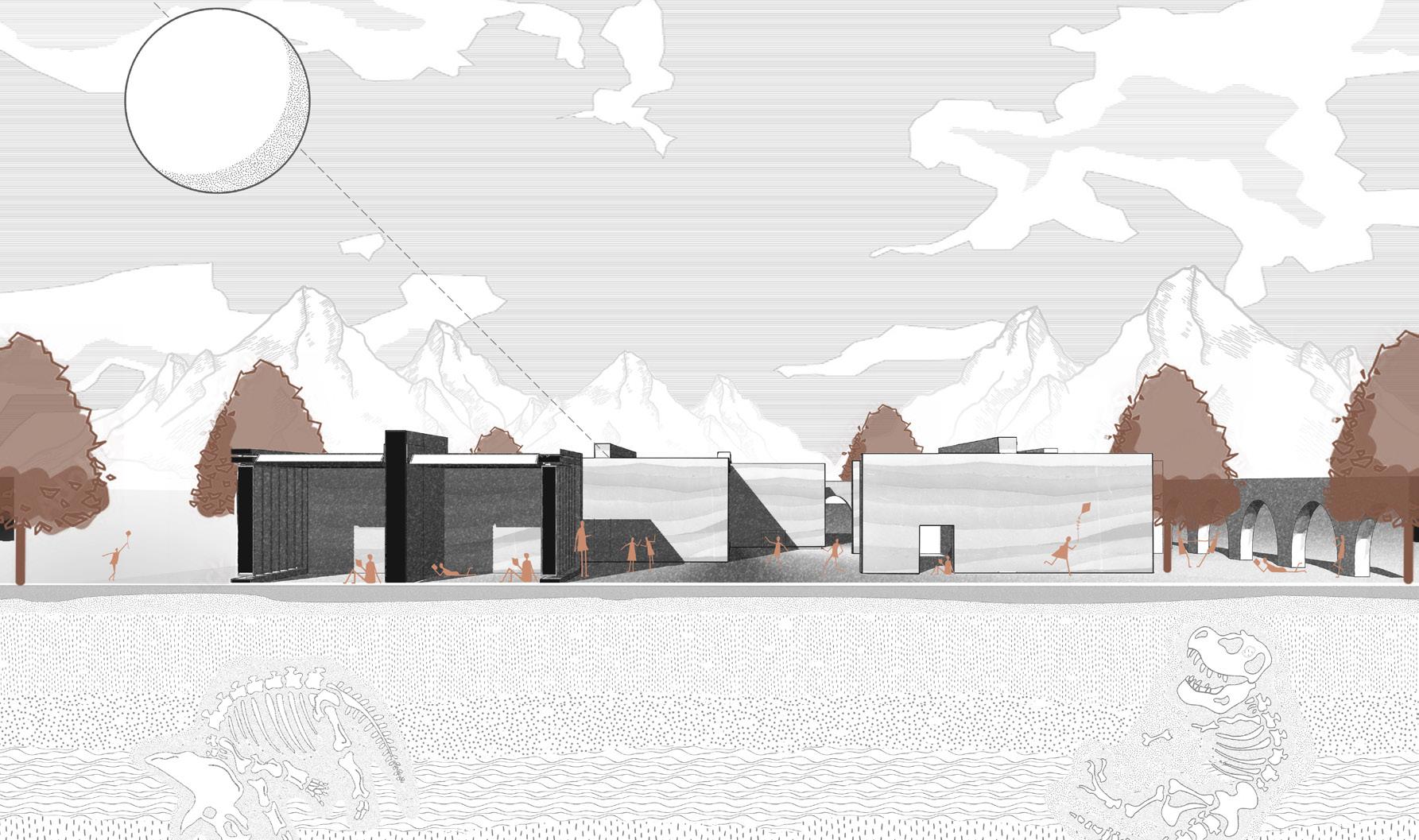
Situation section
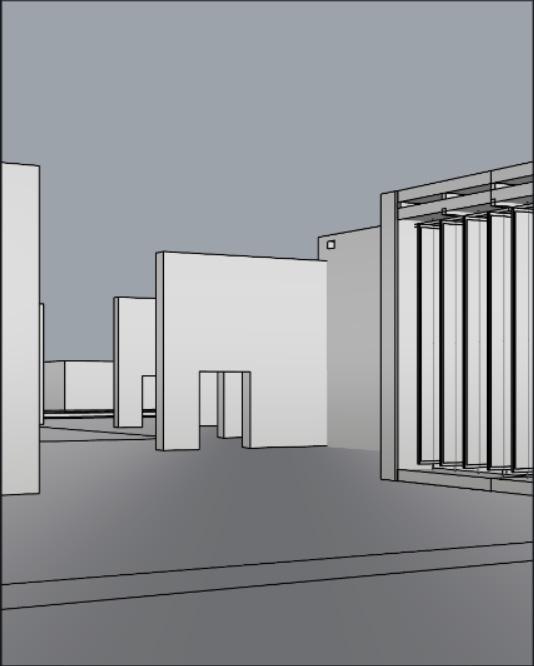
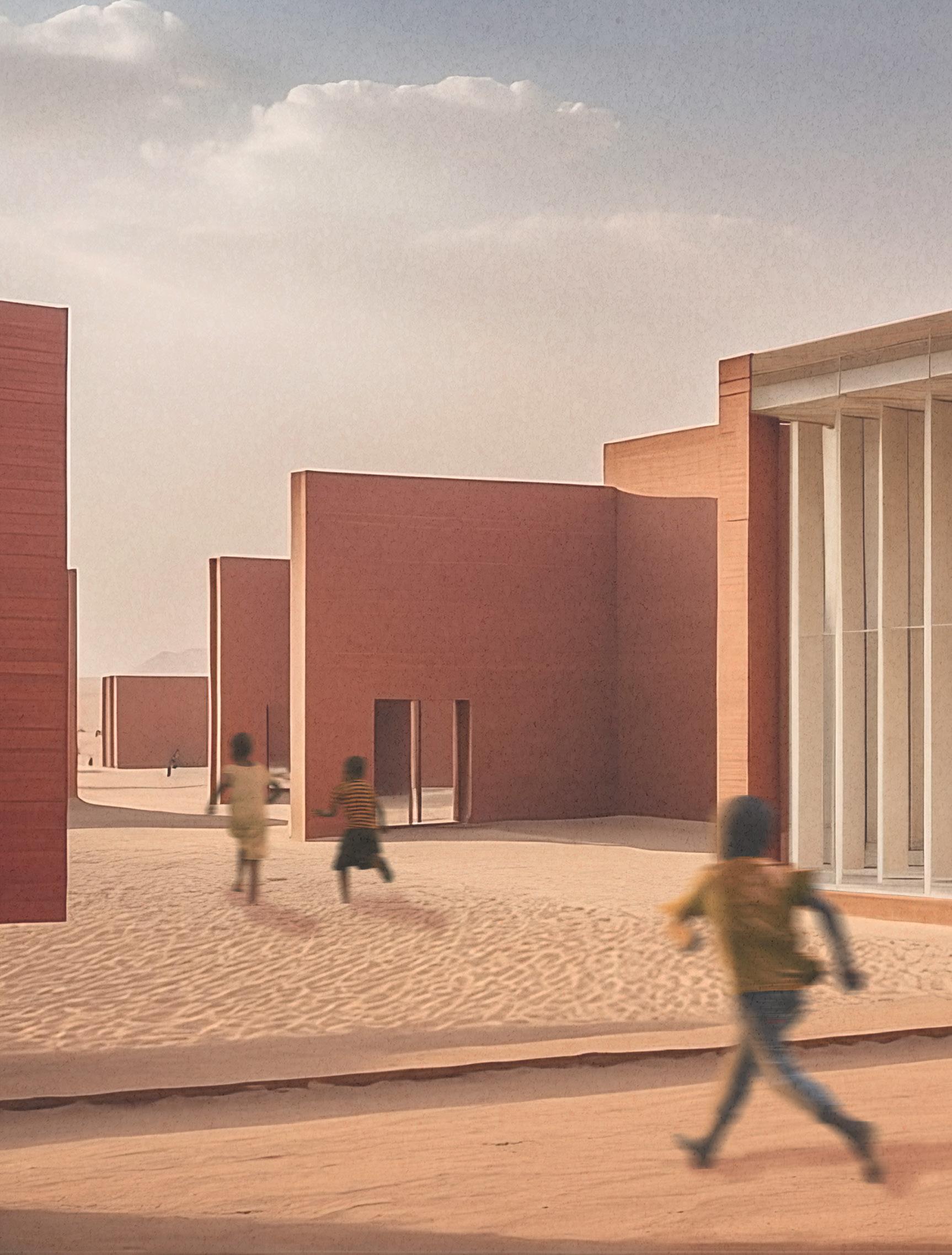
Exterior impression (Rhino > AI software (Prome AI) > Photoshop)
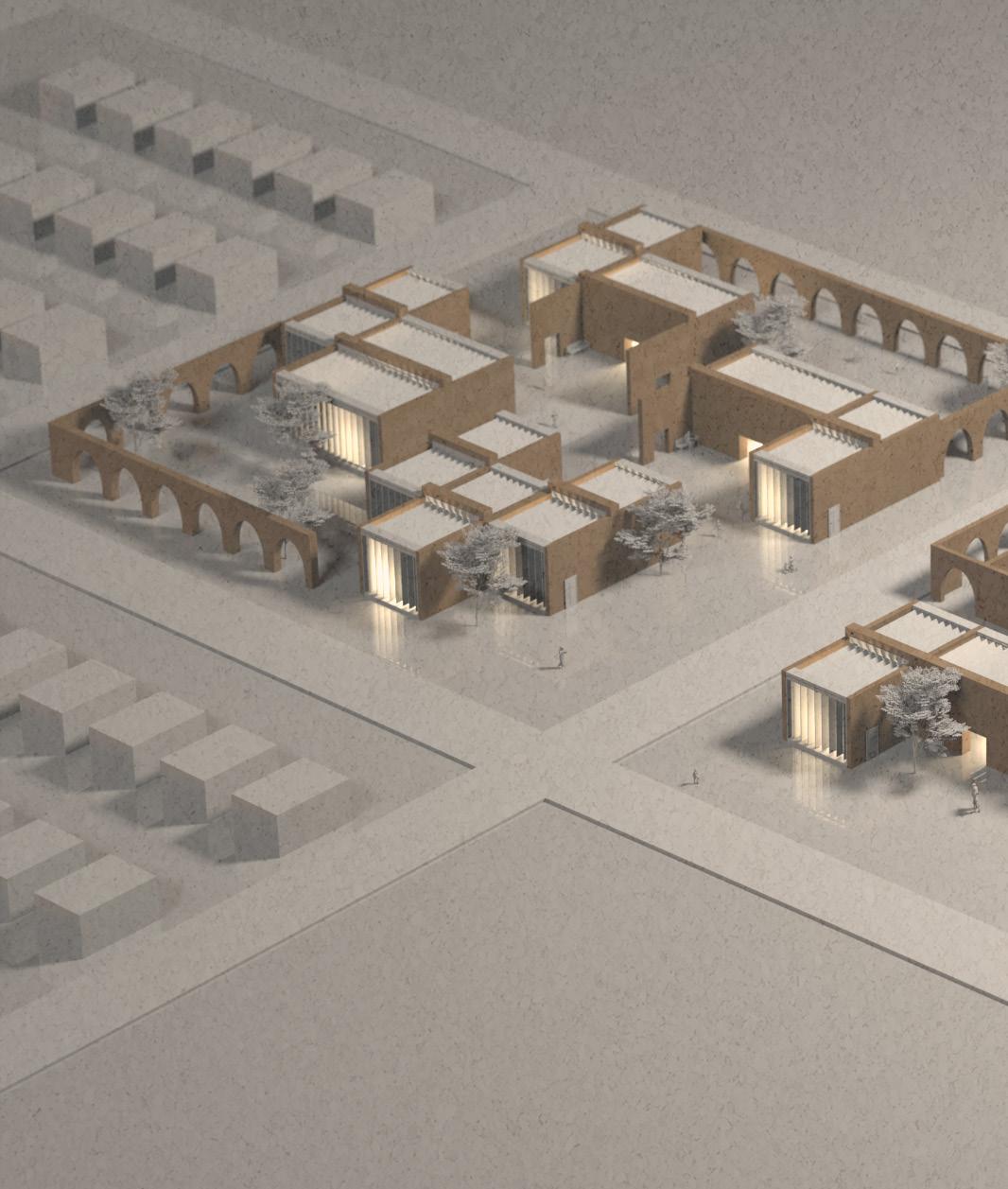
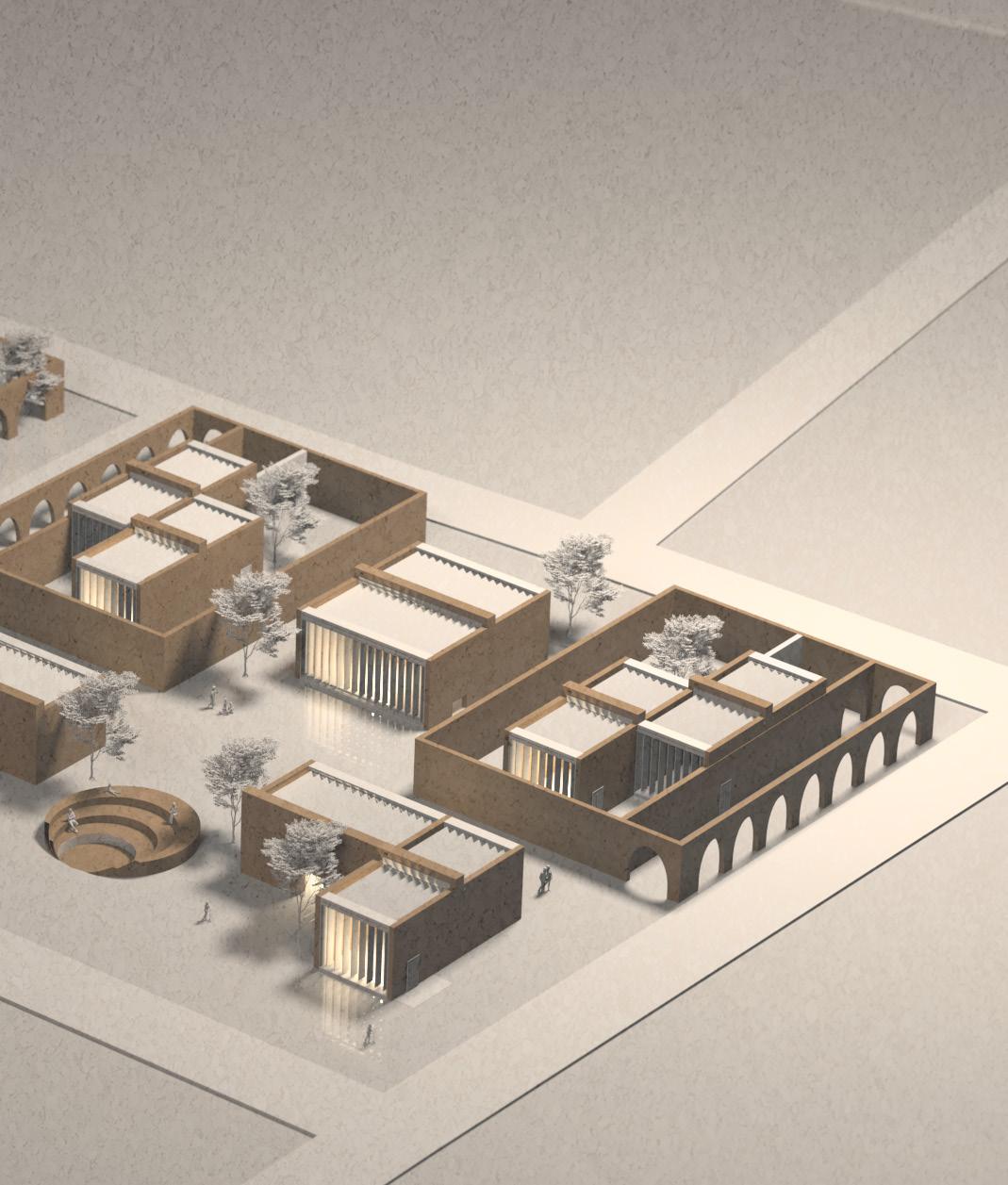
Maquette render (Rhino + VRay)
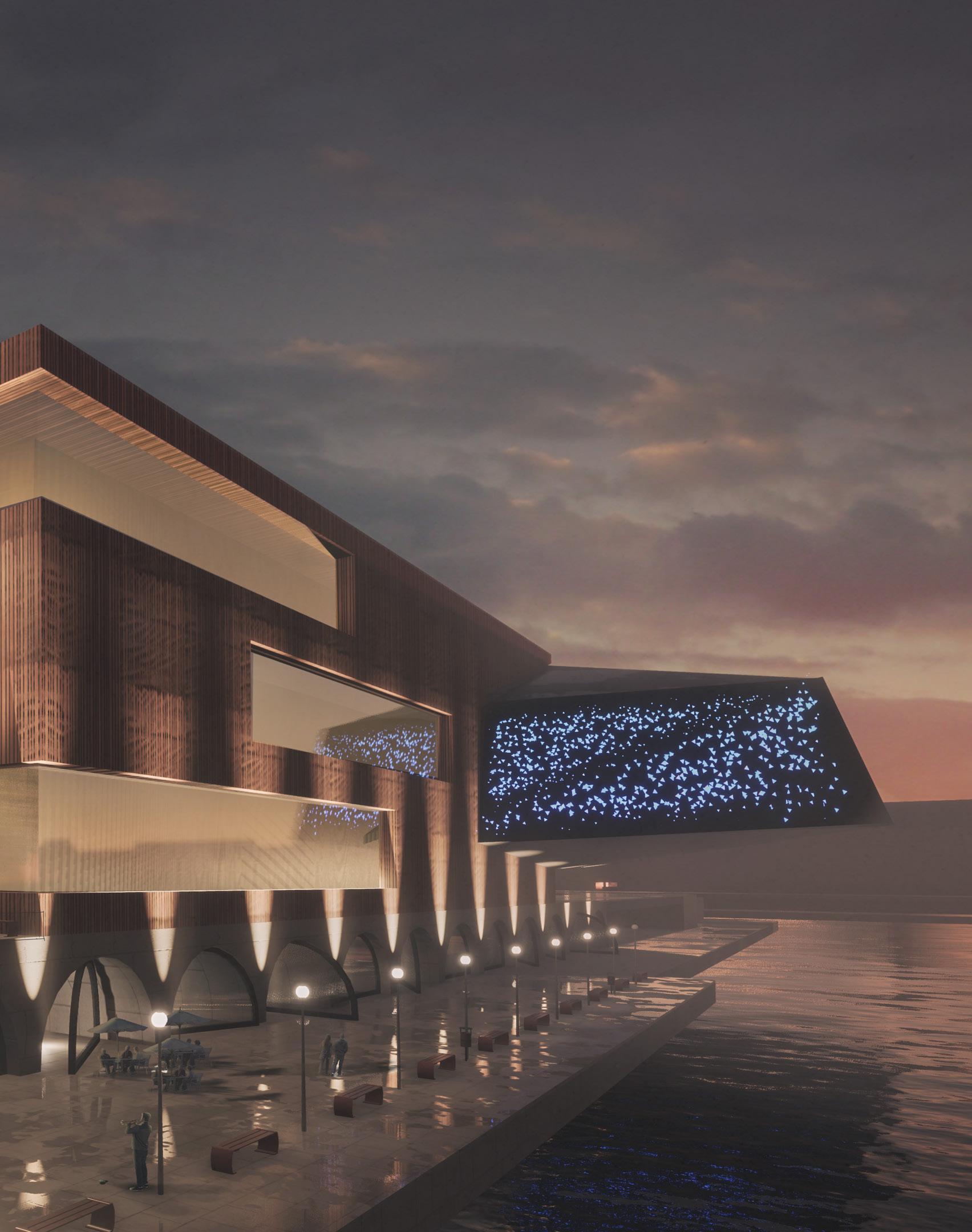

Exterior impression (SketchUp > Twinmotion)
Location: Maastricht, The Netherlands
Type: Public building, Cultural venue
Studio: Bachelor end project
Term: 2021, 20 weeks
Individual project
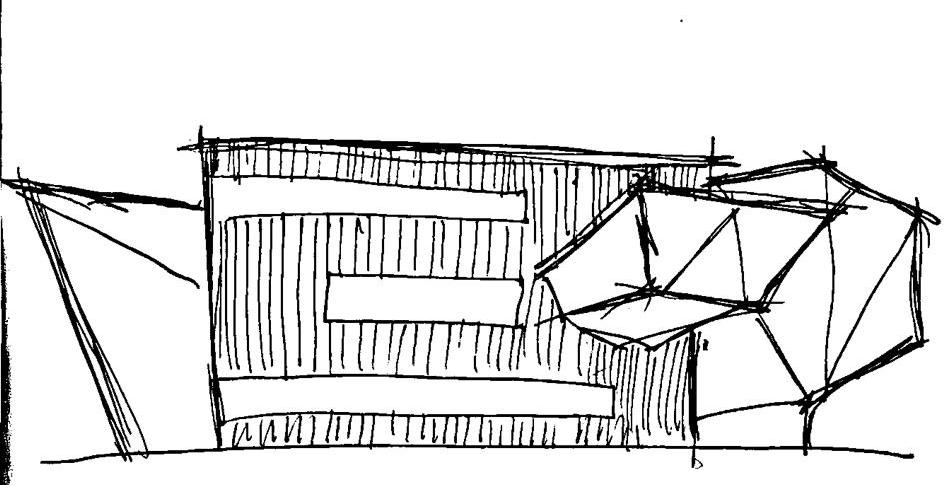
LIGHTBOX
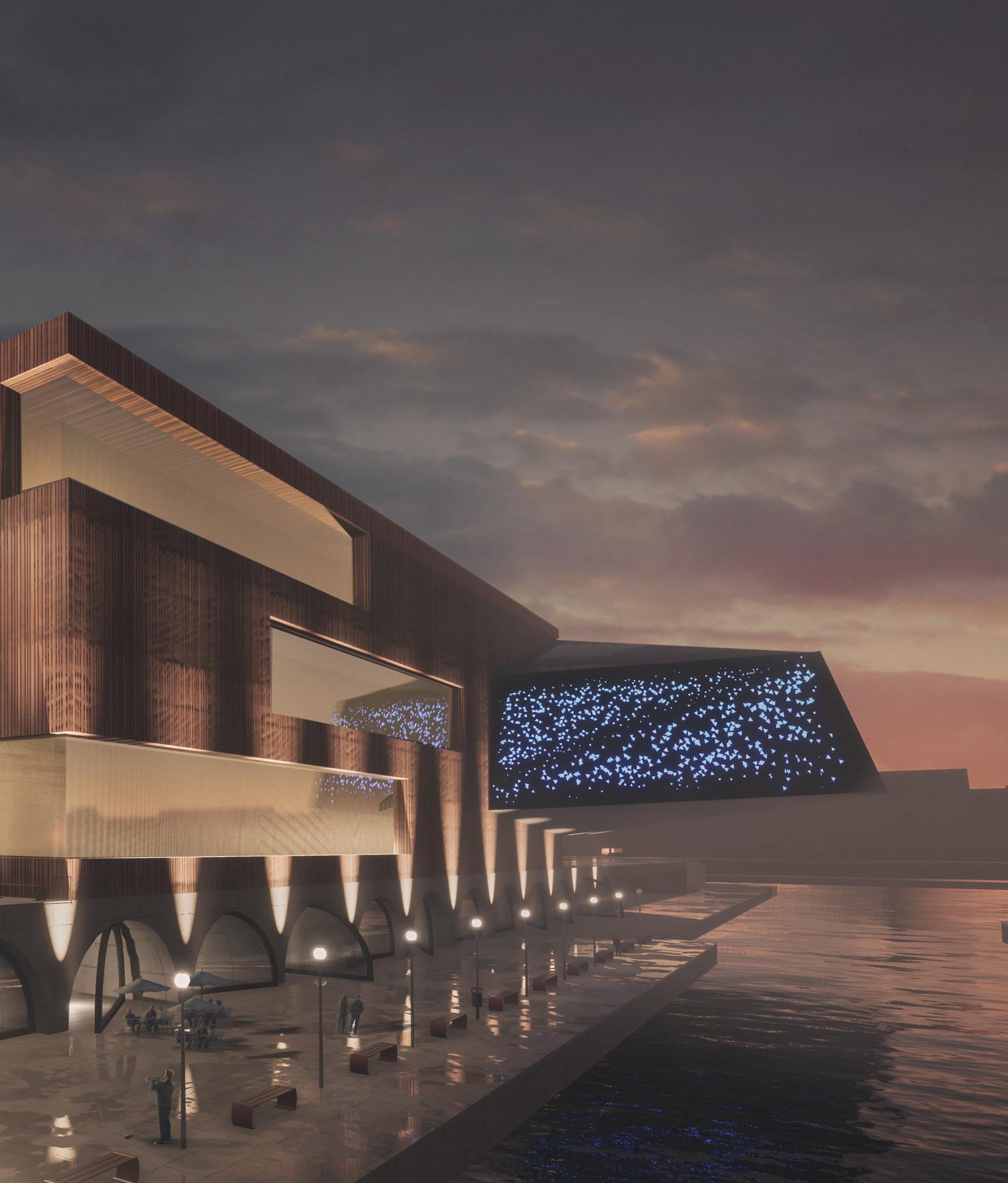
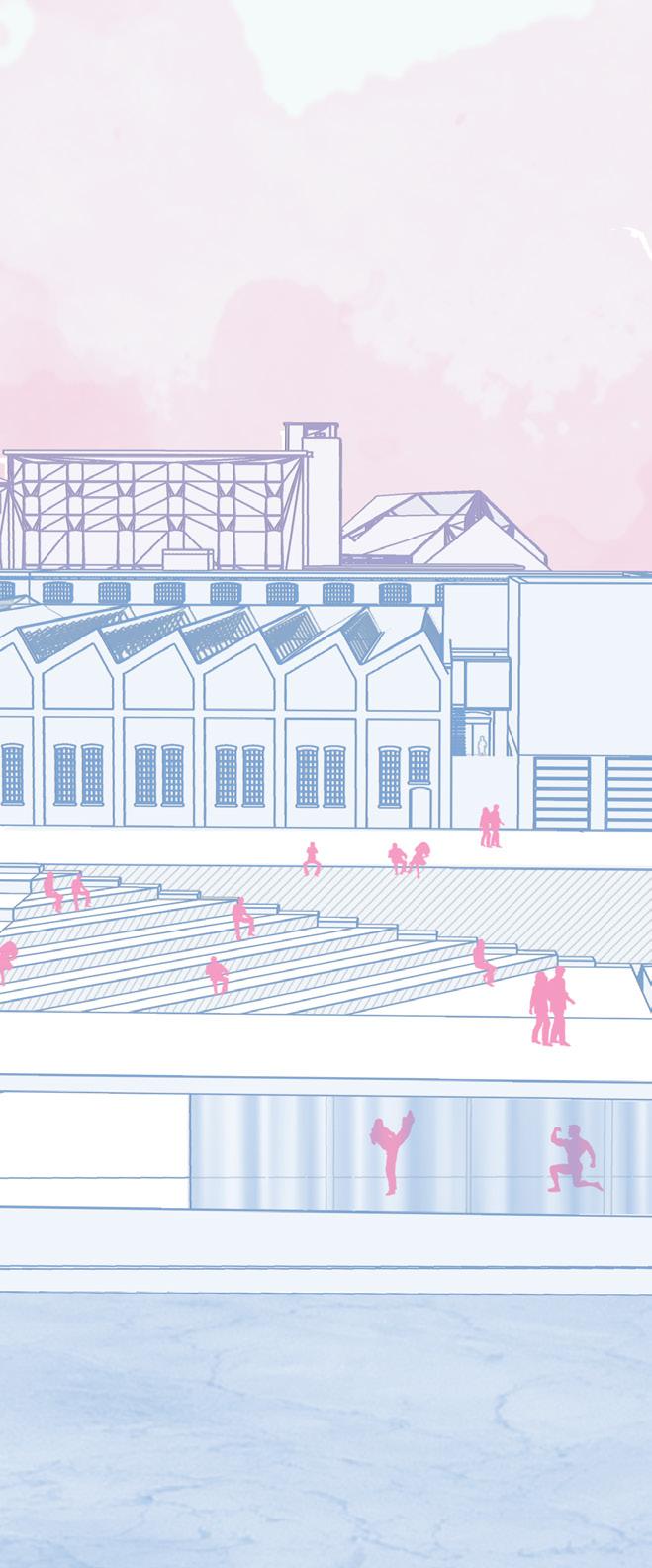
The new philharmonic in Sphinxkvartier
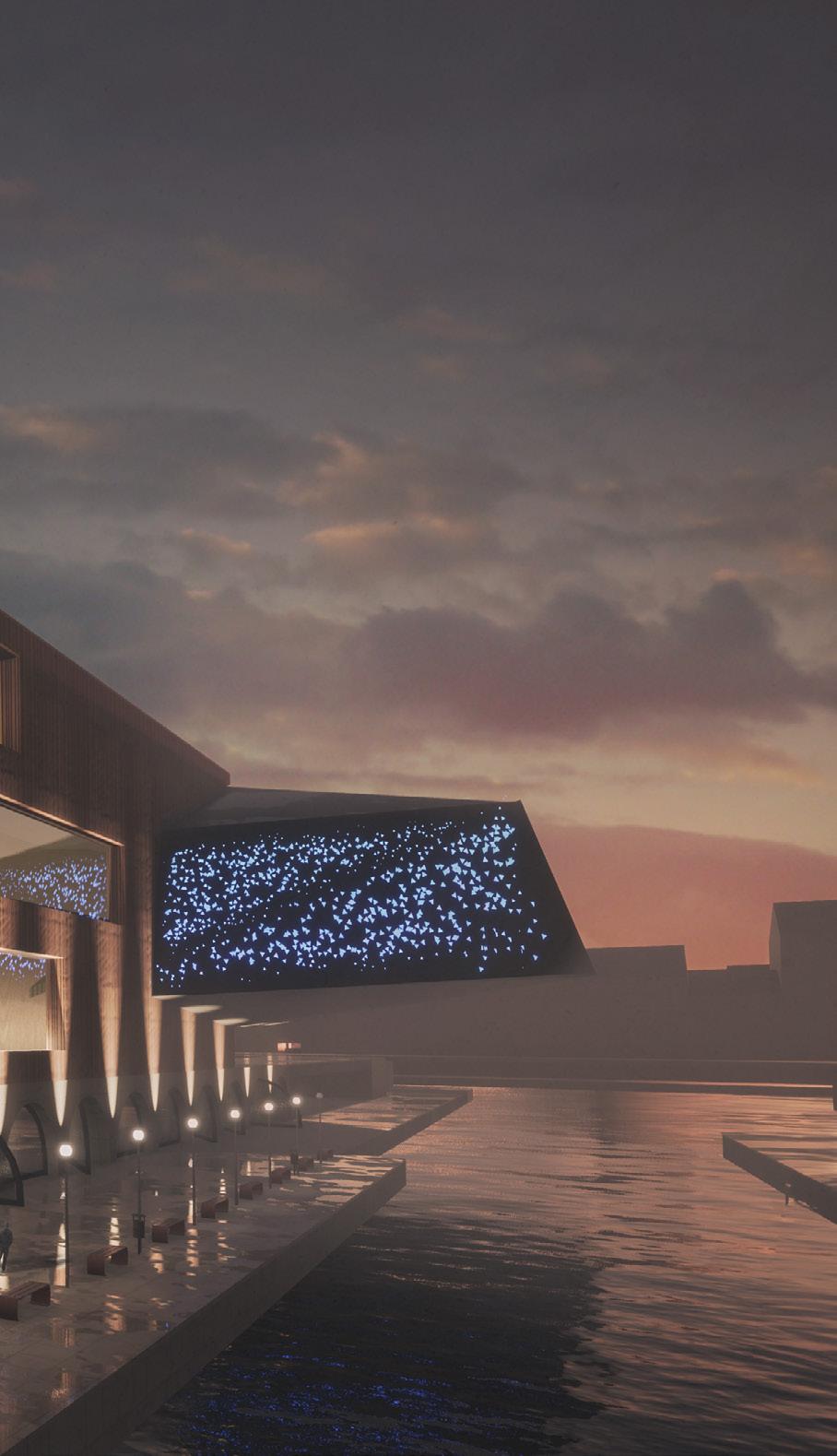
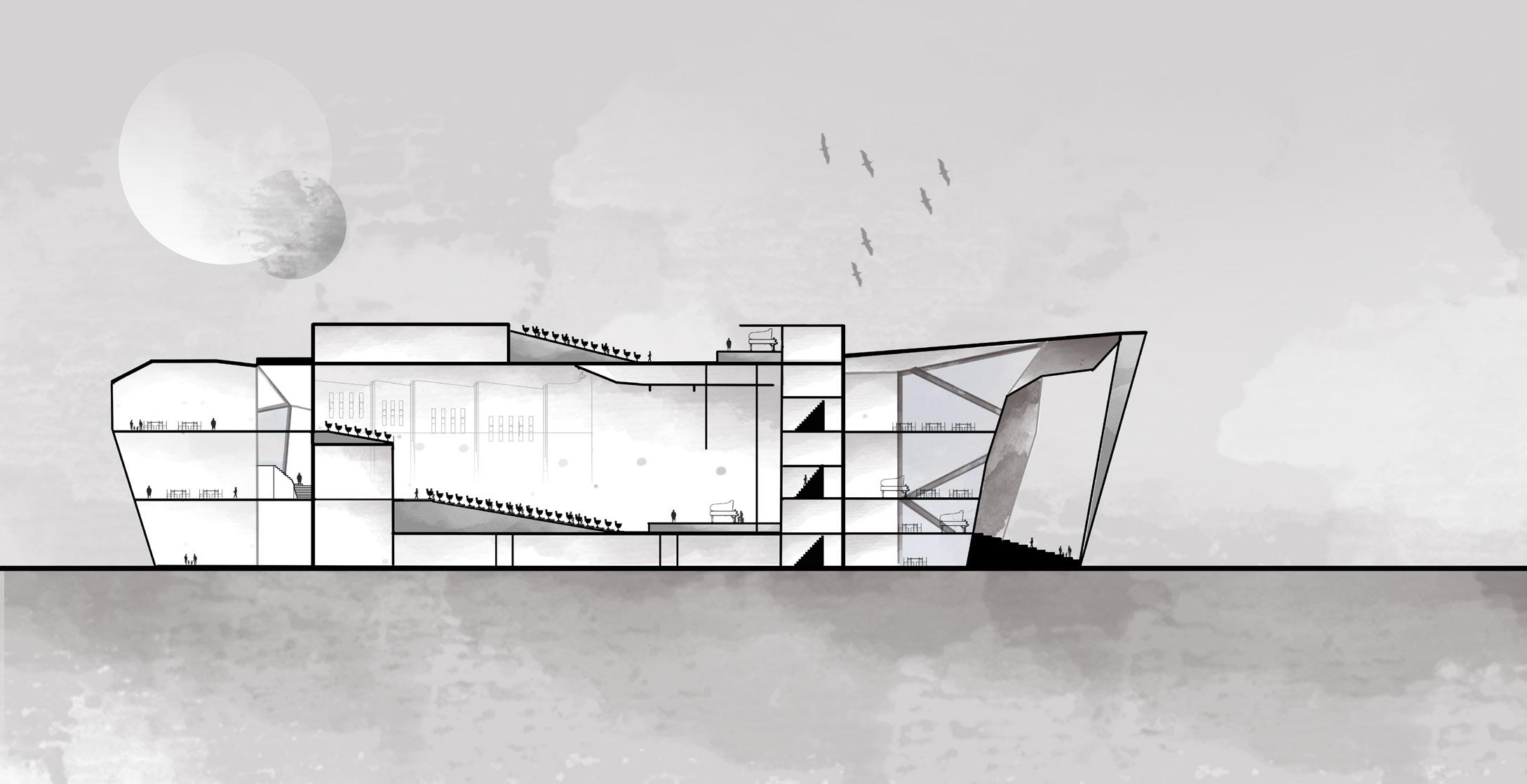
The objective of the Bachelor-end-project was to design a complex philharmonic in Maastricht, specifically in the part called Sphinxkwartier, north of city center. The brief included additional design of urban open air theatre on the same site. The proposal follows the design concept of a rectangular box inside a box with organic geode-like polygonal extensions emerging from it. The geometry creates diversity of spaces inside the building and allows separation of routing for visitors of the philharmonic and its performers, while maintaining a balanced level of experience for both. As part of my research question I investigated extending user experience of architecture through kinetic elements. As a result, the facade of the building is equipped with light installation that reflects the performance that is happening on the inside through changing colors and patterns, thus allowing users of the public space around to enjoy the performance as well. Additionally, the inside of the concert hall is equipped with kinetic walls that move with the rhythm of the performed music, accentuating the experience of listeners.
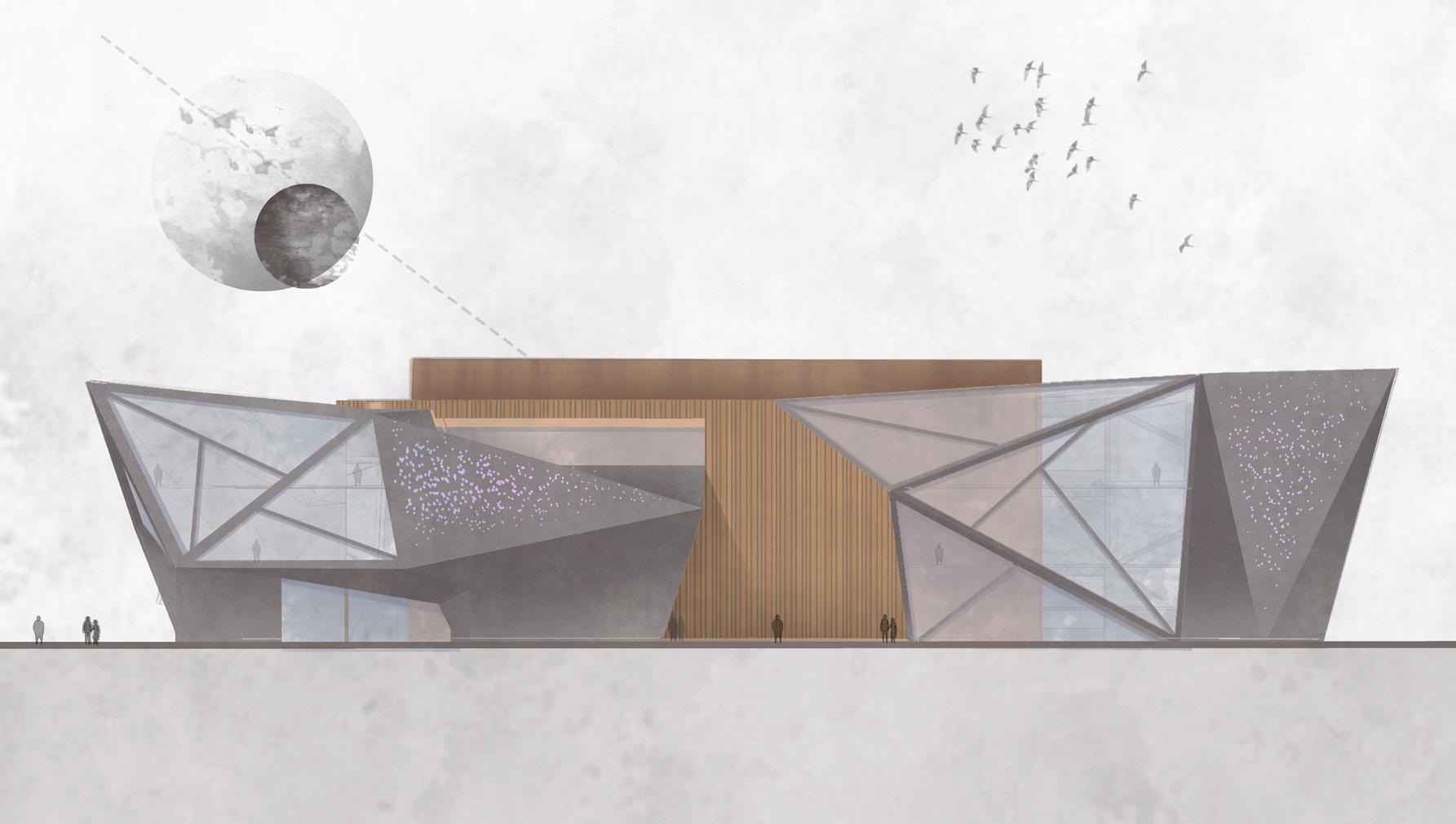
East elevation (SketchUp > Photoshop)
Long section (SketchUp > Photoshop)
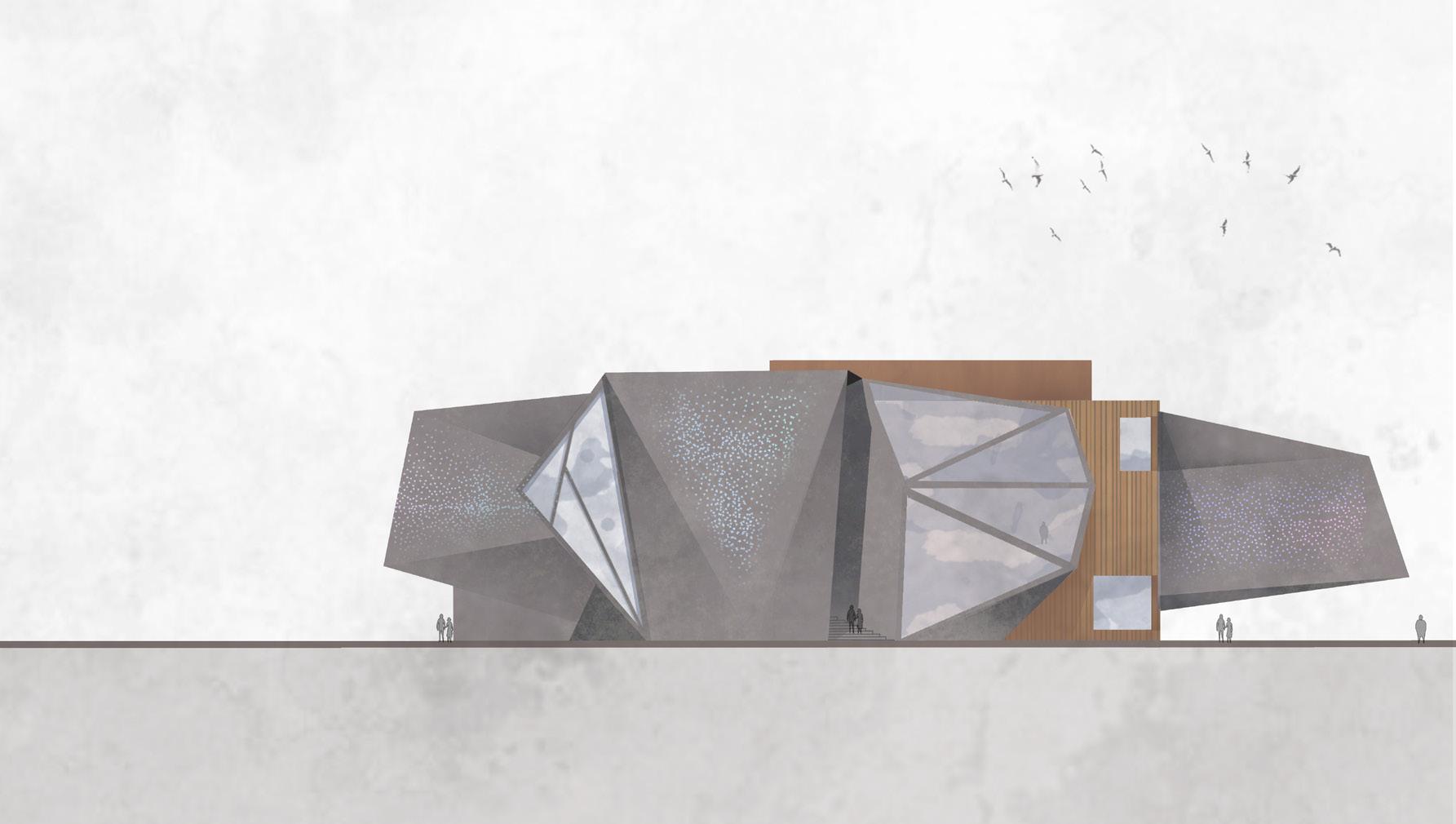
North elevation (SketchUp > Photoshop)
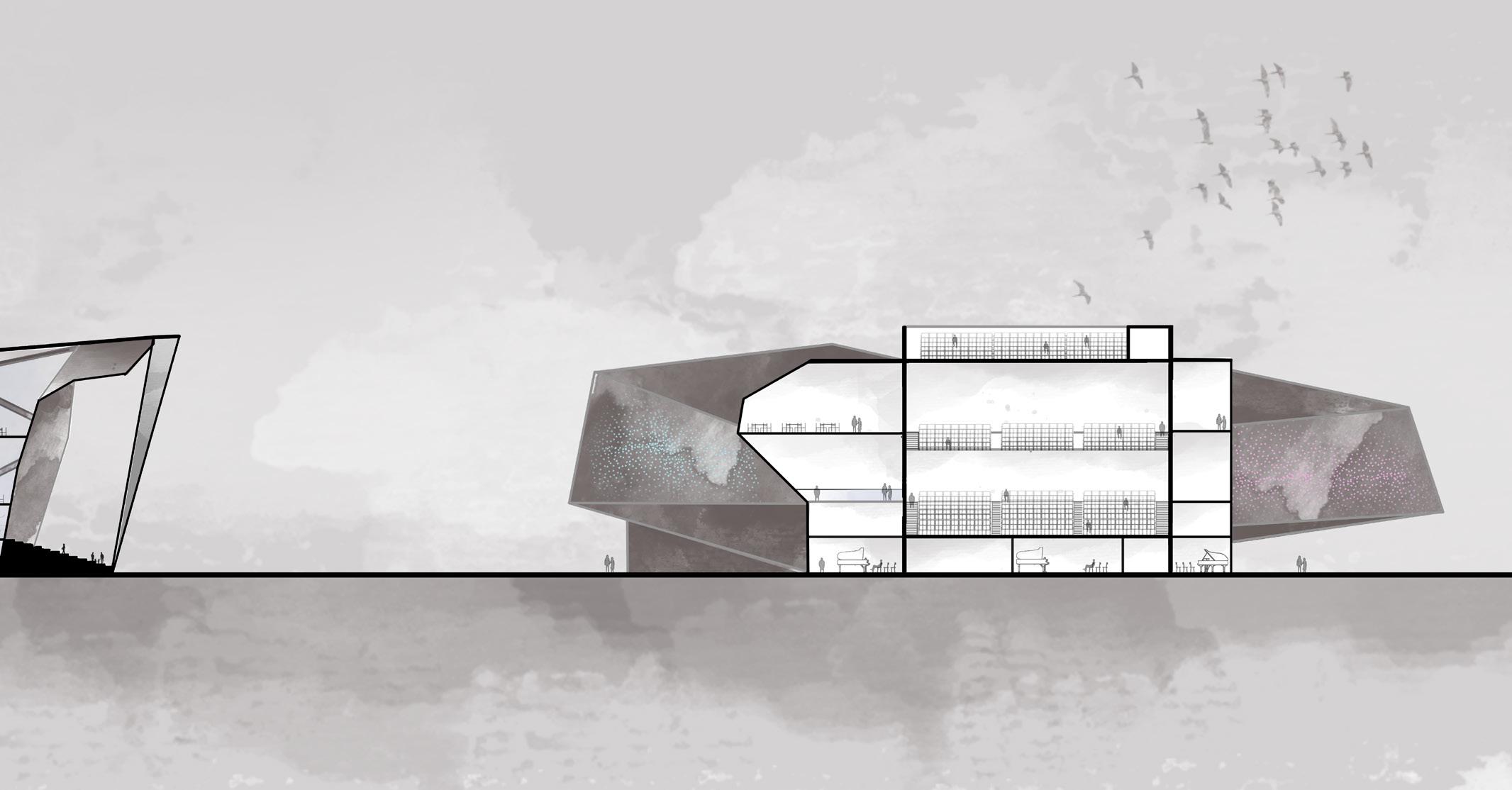
Short elevation (SketchUp > Photoshop)
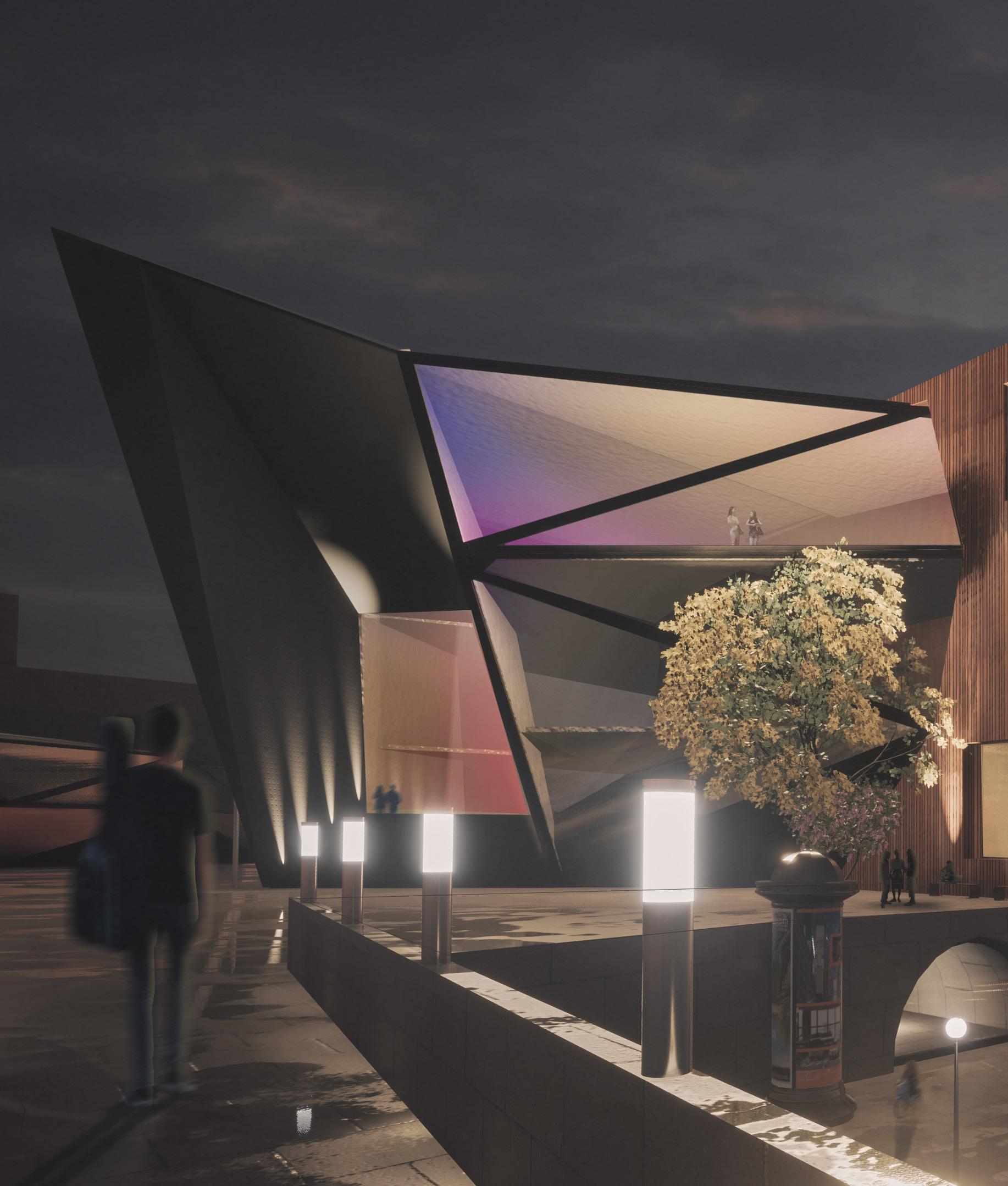
Exterior impression (SketchUp > Twinmotion)