PUBLICATION OF THE ANGLESEA COMMUNITY HOUSE
ISSUE 122 WINTER 2015
Artist: Trudy White By Terrence Hoffmann
Trudy White was born and raised in Melbourne although she has lived in Aireys Inlet for the last seven years. She studied art and design at Box Hill TAFE before completing a Bachelor of Art in Fine Art (Painting) and a Master of Fine Art at Victorian College of the Arts. Further studies in bee-keeping, plant science, writing and editing have ensured that she is well prepared for her life as a practicing artist. Trudy has published three books, contributed to several others and has illustrated the best selling novel ‘The Book Thief’. She has also held a number of exhibitions of her paintings and drawings. On the New York Times list of top selling books for much of the last few years, ‘The Book Thief’ by Markus Zusak is a novel based in World War 2 Germany. It tells a tale of a young girl, Liesel, who steals books and shares
Highlights Trudy White
1
Mr. Universe
10
Underhanded
11
Winter in Venice
13
Melinda Solly
15
Kayak Quest
21
Jessica Smith
29
Molly Powell
33
Grey Nomads
37
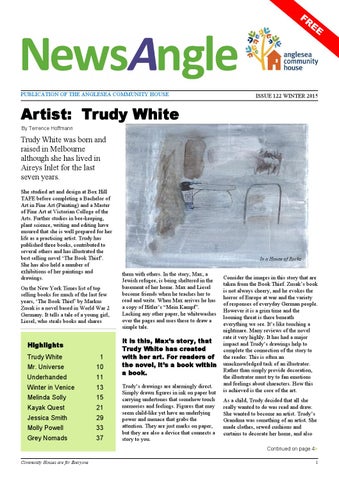
In a House of Rocks
them with others. In the story, Max, a Jewish refugee, is being sheltered in the basement of her home. Max and Liesel become friends when he teaches her to read and write. When Max arrives he has a copy of Hitler’s “Mein Kampf”. Lacking any other paper, he whitewashes over the pages and uses these to draw a simple tale.
It is this, Max’s story, that Trudy White has created with her art. For readers of the novel, it’s a book within a book. Trudy’s drawings are alarmingly direct. Simply drawn figures in ink on paper but carrying undertones that somehow touch memories and feelings. Figures that may seem child-like yet have an underlying power and menace that grabs the attention. They are just marks on paper, but they are also a device that connects a story to you.
Consider the images in this story that are taken from the Book Thief. Zusak’s book is not always cheery, and he evokes the horror of Europe at war and the variety of responses of everyday German people. However it is a grim time and the looming threat is there beneath everything we see. It’s like touching a nightmare. Many reviews of the novel rate it very highly. It has had a major impact and Trudy’s drawings help to complete the connection of the story to the reader. This is often an unacknowledged task of an illustrator. Rather than simply provide decoration, the illustrator must try to fan emotions and feelings about characters. How this is achieved is the core of the art. As a child, Trudy decided that all she really wanted to do was read and draw. She wanted to become an artist. Trudy’s Grandma was something of an artist. She made clothes, sewed cushions and curtains to decorate her home, and also Continued on page 4>
Community Houses are for Everyone
1
Published By Anglesea Community House Inc. 9.15 am - 2.30pm Monday - Friday (During school terms) 5 McMillan Street, Anglesea PO Box 43, Anglesea, VIC, 3230 Tel: 5263 2116 Fax: 5263 1077 Email: newsangle@anglesea.org.au
Feedback/Comments To be addressed to the NewsAngle Editorial Committee, c/o Anglesea Community House or by email.
Advertisers If you wish to book a casual advertisement (not annual) please request an Order Form by email. Annual advertising (all four issues) is closed for 2015. Annual advertising for 2016 will be open from September 2016. Register your interest to be notified by email.
Contributors/Writers Please leave or email news items, notices at the Community House or by email and the Editor will get in touch with you.
Distribution NewsAngle is free of charge. It is delivered to permanent residents in Anglesea and those with Aireys Inlet Post Boxes.. Copies are available from Anglesea IGA Supermarket, Maid's Pantry, Information Centre, Aireys Inlet General Store and Post Office and various other locations. NewsAngle can also be downloaded from: anglesea.org.au/news/newsangle
Deadlines Issue:
123
Casual ads:
14 Aug
Articles/Contributions :
14 Aug
Subject to availability of space. Distribution:
14 Sep
Disclaimer The views and opinions expressed in this newsletter are not necessarily those of the Community House.
2
NewsAngle | Publication of the Anglesea Community House | Community Houses are for Everyone
News from the House From the ACH Coordinator By Alex Leknius—ACH Coordinator
The Community Precinct Open Day was a great success. Over 230 people came to meet, eat, mingle and listen to live music. The kids had great fun watching the roving magician and balloonist and some couldn’t believe there was no time limit on the jumping castle! Thank you to the Playgroup, Kindergarten, Toy Library, Angair, Senior Citizens and History House for opening your doors, giving up your valuable time and for welcoming people into your space. Thanks also to the community and sporting groups who volunteered their time at the expo. Finally, a special thanks to the Anglesea & District Men’s Shed for helping out with the BBQ.
Thank you to everyone for completing the community bus survey. The results of the survey are being compiled. Discussions are currently being held with the Shire about the possibility of undertaking a trial of a community bus. We’ll keep you posted about developments in this area.
House Groups
Over the years NewsAngle has covered many interesting stories, and launched many projects and plans which add significantly to excitement in our region including:
Last year we introduced a completely new look, colour pages and higher grade paper. As a result, we are now just breaking even financially.
Water: A new land treatment plant or an upgraded ocean outfall (land treatment plant eventually established due to community interest and the efforts of “Stop the Ocean Outfall” group.). More recently, a push to save the Dam out the back of Aireys Inlet
An Editorial Committee has been established to use a greater number of community member networks and local knowledge in its production. As a group, we are actively reaching out to groups and individuals in the community to cast a light on how incredibly diverse and interesting life on the coast and in this community is.
NewsAngle By Sam Gault
A voice for the people of Anglesea was the vision of the group that started NewsAngle in1989. NewsAngle was, and remains the primary mouthpiece of the House; promoting its programmes, and providing a forum for the exchange of ideas. Over the years, every local group has advertised its existence and reached out through NewsAngle. In 1993, NewsAngle had 25 regular volunteers. In 1989, NewsAngle was a 16 page photocopied news sheet. The first edition run of 500 copies was distributed through local schools, businesses and the Shire (who sponsored its cost). By 2002, the magazine changed to an A4 format, had grown to 44 pages and was professionally printed, with a distribution of 2500, now also distributed through the post offices. By 2000, the magazine became profitable, as the second highest fund raiser after the Easter Market strongly supporting the running costs of the House.
The Resale Shed will be undergoing a small makeover soon. The Shire will be constructing a much needed verandah. Don’t forget the resale shed is open every Saturday from 10.00am – 2.00pm, where you can find an amazing array of recycled goods at very reasonable prices.
Land Development: Preservation or development of land at O’Donoghue’s Road (preservation won!) Health Care: The prospect of losing the last doctor in town (our Health Care Centre remains!) “The Ashes of Memory” publication – a collection of stories about the Ash Wednesday Bushfires in 1983 (copies available at the House!) Energy and Land/Air Quality: The debate about the future of the Alcoa Coal Mine site (What is the remediation strategy?) The establishment of Occasional Childcare (1989), Anglesea & Aireys Inlet Foodlink (1992), Training and Courses (1993), Anglesea Art Walk (2009), Aireys Inlet Community Garden (2010), Anglesea Community Garden (2010) and Anglesea & District Men’s Shed (2011).
NewsAngle | Publication of the Anglesea Community House | Community Houses are for Everyone
After more than 46 years in Anglesea, Alcoa announced it will permanently close the Anglesea coal mine and power station on August 31, 2015. We recognise the contribution that Alcoa has made to Anglesea and wish the company and it’s employees well in the future.
NewsAngle is our magazine for you! It is an important historical record of our part of the world and essential to the strengthening of our community in these fast and often incongruent times.
WRITERS WANTED!
newsangle@anglesea.org.au
Enrol now in our FREE two session NewsAngle Writers & Induction Course
SORRY … To Liz Clark—One of our wonderful regular writers—for misspelling her surname last issue (Clark with no “e”!).
3
TRUDY WHITE CONTINUED painted. This was how Trudy first encountered oil paint and how it worked. Her Grandma also travelled a lot and carried a portable typewriter to record her adventures. Trudy seems to have adopted some of Grandma’s ways. Trudy’s Dad is a jazz musician, playing in a band called the Eastside Jazz Band. Her love of music is obvious. She is currently taking harp lessons and is saving up to buy a full sized harp. At present she plays a small travel harp. She finds music a passionate respite from her occupation as a painter and writer. All demand regular practice. Writing has to be done every day as does painting and music. Trudy had written her first book ‘Table of Everything’ in 1999. She drew the pictures as well as writing the story. For a first book she believes that she was lucky to have it published by Allen & Unwin because new authors providing the pictures for their own books are not quickly accepted. Her second book ‘Japan Diary’ (Curriculum Press 2005) came about after visiting Japan and staying with a friend there. Trudy kept a diary full of sketches, ideas, train tickets and all the sorts of mementos one collects when travelling. The diary wasn’t able to be published by Allen & Unwin so she went to Curriculum Press who publish
<Continued from page 1
materials for Asian studies. The concept for the book was for it to be a diary by two exchange students. She interviewed exchange students to build a picture of how they experienced each other’s culture. She mapped what an exchange student would do in each country and how they tended to see the world from their own cultural vantage point. The book now comprises two separate diaries from fictional exchange students in Japan and Australia. “Amy Deerson” writes about her experiences in Japan staying with the Nakagawa family. “Taro Nakagawa” stays in Australia with the Deerson family. The two stories in this book highlight the cultural differences and unique qualities of each culture, but also the fact that we have very similar needs. The book is often used in schools when teaching Japanese culture or language. Trudy’s third book, ‘Could You? Would You?’ was published by Allen & Unwin in 2007. A picture book, it poses a series of questions designed for young people to explore ideas and possibilities. The book is full of whimsical pictures and contrasting points of view that will tickle the imagination of children and those who remember their childhood. Like much of Trudy’s work the book may be categorized as a children’s book, but will reward adults who like creative experiences and imaginative literature. An American edition came out recently
requiring a couple of changes. Of course the American spelling had to be used. Only one drawing had to be changed, the naked bodies in the original Japanese bath house had to have bathers put on them. While only simple line drawings, who knows where an American imagination may end up. The practice of an artist and its contemplation also puts artists in touch with other artists. This can lead to creative work together. For example, after the publication of her first book, she met ‘Book Thief ‘author Markus Zusak at a conference at which he was speaking. They soon became pen pals as he lives in Sydney and she in Victoria. Their letters to each other discuss writing, the structure of novels and films and are often about the progress and frustrations of being an artist and trying to complete a task where one is open to the experience but not knowing what the end will eventually be like. There are about thirty different editions of the ‘Book Thief’, mostly because of translations into different languages. All are slightly different. The Germans were the first to get permission to publish a foreign language version of the book. They wanted the art work to show the German version of Mein Kampf in the background, whereas Trudy’s original artwork had an English translation of it in the background. What’s interesting about the different editions is that they have such different character. The drawings are the same but there are Continued on page 6>
4
NewsAngle | Publication of the Anglesea Community House | Community Houses are for Everyone
Airport Transfers Parcels Tours
Anglesea
Business Accounts Special Occasions
Bookings recommend-
NewsAngle | Publication of the Anglesea Community House | Community Houses are for Everyone
5
TRUDY WHITE CONTINUED
<Continued from page 4
different placement of captions accompanying the drawings, the quality of papers, the different fonts, the Cantonese, Japanese and Korean language fonts give such a different feel to each version. Trudy mostly works in water colour and black ink. She paints onto very large cotton rag paper or even small A4 sized paper. She does pottery and has also studied sculpture where she learned to weld and to make her own tools. She doesn’t do preparatory sketches. She thinks you lose the freshness if you do. However she keeps a regular diary with sketches and ideas. She works with shapes that mean something to her. The shapes could be a bowl, a flower or they could also refer to deeper things like contentment or affection. Sometimes a painting is like a puzzle. She believes that the artist works best if they can clear their mind and allow something to flow through them. While the images emerge, they may have no meaning to the artist. But on reflection a theme or a set of ideas may become apparent. Working as an abstract artist permits this creative endeavor that she finds deeply satisfying.
Simon’s Drawing
Sometimes she looks back at her work and finds meanings she had not seen before. For her to paint and write, she needs to meditate and enter that space where she is in a deep zone. This demands solitude and peace. Trudy is currently working on her next book as well as her next exhibition of paintings.
Her work can be seen at Boom Gallery, 11 Rutland Street, Newtown, Geelong from August 14 to September 5. Monday – Saturday 9 – 4. Gogo Ink
Trudy White
See also: http://www.trudywhite.com
6
NewsAngle | Publication of the Anglesea Community House | Community Houses are for Everyone
Aireys Inlet District Association turns 50 By Charlotte Allen, AIDA President
For 50 years the Aireys Inlet area has been influenced and shaped by having a strong and respected local group working with the Shire, other authorities and the community to conserve its special qualities. The Aireys Inlet District Association (AIDA) - originally the Aireys Inlet Progress Association - was formed in 1965. Plans to develop a camping ground on the Painkalac Creek flats was the catalyst that led to the community coming together in opposition to the plan. The proposal was abandoned but the issue had sparked the community’s long unbroken involvement and interest in environmental, planning and land use policies in the area. AIDA’s remit has remained consistent. The 1970 annual general meeting noted that AIDA’s aim was “to conserve the natural environment, to protect the foreshore and beaches and to assist in the control of sensible local development.” Land use planning has always been a high priority for AIDA, and for five decades it has been an influential participant in the development of the Shire’s requirements and has been involved in numerous specific proposals. These have included the debates about water supply and sewerage, attempts to build a sports oval in the Painkalac Creek valley, opening the lighthouse for tourism and more recently the proposal for a supermarket. AIDA is also involved in traffic management, roads and
footpath proposals, lighting, signage and parking issues. When required AIDA has taken its objections to VCAT and it has had many successes in preventing or moderating noncompliant development proposals. The Ash Wednesday fire in 1983 brought new challenges for the community and the aftermath dominated AIDA as people rebuilt, and many new, larger houses were constructed. The character of the area from Urquhart Bluff to Eastern View is distinctive and still retains a village and rural nature. Imagine what it would have been without AIDA’s advocacy and the commitment of members, many of whom have given AIDA valuable professional planning, legal, hydrology and engineering advice. Every community along the Great Ocean Road has its unique characteristics, which helps to create a diverse beautiful coastal-rural region. In the Aireys Inlet district, these characteristics include not only a beautiful beach with its cliffs and sand dunes, but an open river valley with its stream and estuary surrounded by national park. The valley acts as a complex ecological link between the forest and the river estuary. It is a much loved and highly valued place.
NewsAngle | Publication of the Anglesea Community House | Community Houses are for Everyone
7
Happy Birthday to the Community Bank By Sue Lubcke, Corangamite Financial Services
On the 24th June 2015, the Anglesea and District Community Bank Branch will celebrate its 10th Birthday. It’s hard to believe that 10 years have passed since the Community Bank first opened its doors for business, but when reflecting back over this journey, so much has been achieved over this time. It all started over 12 years ago when a group of locals, led by Angela Allardice and Alison Sedgewick formed a subcommittee to pursue a Community Bank branch for Anglesea in the quest for greater banking services and the community benefits that the Community Bank model delivers.
support of our community with people enjoying the personalized local banking service’ said Mr. Vaughan Lamb, Chairman of Corangamite Financial Services Ltd, the local company which runs the Anglesea & Winchelsea Community Bank branches. ‘Ten years on and we still cannot share our story enough. It’s often hard to believe that a bank can be locally owned and operated and can give back to the community in so many ways.’ Mr. Lamb said ‘In addition to our bank providing professional relationship banking services, the doors are open longer than any other financial institution and our staff provide services well outside of trading hours. We have been able to re-invest over $1.2m back to local community groups and organisations through local support. There is no other business that can boast this, and it is often disbelieved that this all comes from a bank!’
Since this time, the branch has steadily grown and currently has 2000 customers with total business holdings of over $140m.
The Anglesea Community Bank® Branch staff & volunteer directors invest a lot of time & money into the local community to assist many community groups and organisations. The staff and directors are actively involved by volunteering to help out at events - BBQ cooking, assisting with the use of Community POS (point of sale) at an event, “Piggy” turning up at events to entertain, aside from the monetary contributions.
‘We are very proud of what we have been able to achieve as a result of our dedicated and passionate team, and the
‘Our support extends beyond banking services and putting money back into the community’ said Mr. Shane Madden, <Continued on page 18
8
NewsAngle | Publication of the Anglesea Community House | Community Houses are for Everyone
Anglesea Art House
By Nicky Perkin
visitors, there are also delicious Devonshire Teas on offer!
What started out as a small group of artists painting together in the Anglesea Community Hall in 1986 has grown into the Anglesea Art House; a vibrant, creative and inspiring space housed in the old Scout Hall in Cameron Road with a membership of more than 220. Every weekday groups of artists can be found creating in their chosen field be it watercolour, mosaics, glass, pottery, printmaking or painting. Facilities now include two printing presses for etching & printing, electric kiln for pottery that is suitable for bisque firing and temperatures up to firing for porcelain and a new electric kiln for glass fusing & slumping.
Another significant event in the Art House calendar is the Kids’ Art Bash held each January, where children, accompanied by an adult can get creative. Activities include: painting on canvas and paper, wooden shapes to paint, mosaics, ceramics, placemats, mobiles, picture frames etc. Past experience has shown that the accompanying adult (be it grandparent or parent!) invariably get absorbed in creating a masterpiece too! Art House membership is open to all, be you an experienced artist or a beginner wanting to learn a new skill. Details can be found on the website and Facebook or alternatively pop into the Art House during the week. www.angleseaarthouse.com.au
In addition to the weekly classes, there is a stimulating schedule of workshops throughout the year. Workshops are usually run on weekends and are open to non-members as well as members. The Annual Art and Craft show started out as a means for members to show their work and has become the highlight of the Anglesea artistic calendar. Held over the Queen’s Birthday weekend at the Anglesea Community Hall, it showcases the variety of members’ artistic and creative skills. There are several awards, judged by an independent judge including the Maiden Handicap Award, an award for an artist who has never won an award!
Gelatine Printing
The Anglesea and Aireys Inlet Primary Schools are also invited to exhibit their work at the Art Show which provides a colourful addition and encourages the pupils and parents to visit the Art Show to view their own work. If that’s not enough to encourage Kids Bash NewsAngle | Publication of the Anglesea Community House | Community Houses are for Everyone
9
On the edge of the Universe By Jenna Crawford
It is not every parent from a small seaside town, or any town as a matter of fact, who can claim they have a child who holds a world title. Ingrid and Steven von Moger can make such a claim. Their son, Calum, at the age of twenty-three was awarded the title of World Fitness Federation's "Mr Universe" in South Korea in an international competition in 2014. Calum is the fourth child of the von Moger family. As a youngster he was easy going and had a deep love of animals and birds. The family lived on a small acreage at Elphinstone, near Castlemaine, where they raised chickens, ducks and geese, and the geese ruled the roost. Calum attended Olivet Christian College in the years 1995-1998. The school offered an accredited Christian education and classes were conducted quite differently from the "run of the mill" schools that many of us have attended. Mornings were devoted to the three R's where each student was seated at an individual cubicle where they worked independently at their own pace from designated booklets. In order to progress through the booklet students had to reach an 80% pass rate.
Whilst working in this setting students did not communicate with one another, but interacted with the teacher by raising a flag to get attention. This form of education developed independence and self discipline in
Calum von Moger—Image courtesy Geelong Advertiser, March 2015
Calum, which is still very much part of his character today. The afternoons at Olivet were spent interacting with fellow students and learning cooperation and respect for others. Playing soccer with his elder brothers was an enjoyable pursuit for Calum and he developed into a solid, robust player who could always focus on the ball. Moving to Anglesea was difficult for the whole family. It was quite a culture shock and they all had to acclimatise emotionally, psychologically and educationally.
When relocating one suffers breakdowns in relationships. Calum found it hard to adjust to a sporting community where AFL football seemed to dominate. Calum’s interests were fostered by a number of locals including John Dangerfield and David Pace who helped build an aviary and taught him about the breeding cycles of the birds he loved. At the age of thirteen he was writing articles which were published in ornithological books. Michael Martinez encouraged Calum to resume playing soccer. Calum and his brothers experienced together the joy of being involved in sporting pursuits, through surfing, rock-climbing and boxing. Calum took gym lessons in Geelong
and realised that dedication and self discipline would result in higher levels of strength and fitness. In 2007, one of the brothers entered and won the title of Mr Australia and encouraged Calum to enter a Bachelor of the Year competition two years later. However, things did not always go to plan for the family. In 2007, Steven had a motor bike accident at Fairhaven and became a quadriplegic. This life changing injury had a deep impact on the whole family. Ingrid described herself as being the absent parent through the long months of Steven's rehabilitation. The siblings all stuck together, supporting one another. The family is most appreciative of the huge support they received from friends and the broader Anglesea community. Whilst in year 12, Calum played Rugby League in Geelong and then whilst attending Box Hill TAFE he played rugby for the Melbourne Victory Juniors. Because of his dedication to fitness he was selected by the World Fitness Federation to participate in two intensive weeks of gruelling training in Florida, USA.
His coordination, focus, attentiveness along with his engaging personality opened up other opportunities. Continued on page 23 >
10
NewsAngle | Publication of the Anglesea Community House | Community Houses are for Everyone
YOUTH IN ACTION
Underhanded—Music Success in Anglesea By Gary Robinson
A common theme that runs through the Anglesea community is that friendships forged in the younger years, especially during those at the Anglesea Primary school last into adult life. Cory Balloch is a classic example of this wonderful feature of village life. The child of Cheryl, a friendly and familiar face at the IGA, and Brett Balloch, our popular superintendent of works at the golf club, Cory’s friendships from school have led to a passion for music and playing in a band that is touching national fame. When he was thirteen, school mate Ian Hawkins, introduced Cory to the joys of music and particularly to the guitar. From there the two mates, along with another Anglesea mate, Jarrah Taylor, joined together in a growing desire to one day play together in a band. Practise was passionate and fun, but with little direction. Critically, at this stage, another primary school friend, Stu McKenzie, of another local band, the famous King Gizzard and the Lizard Wizard, took an interest in Cory’s development, and offered lessons and guidance.
Underhanded
Again, another example of the fortune and opportunity derived from locally grown friendships. At secondary college, Oberon High School, the boys met up with singer Patrick Doolan, from Torquay, and a bond forged through a passion for similar musical taste provided the opportunity to form a group. So now we have Ian Hawkins, the bassist, Jarrah on drums, Cory on guitar and vocals from Patrick. And so a group, Underhanded, was formed. However now the hard work begins. Hour upon hour. As days merge into weeks and months the boys build their own style and begin to experiment with writing their own music. And what is their style?, queries your wondering reporter. “What is your point of difference?” I ask. Cory responds that it is difficult Continued on page 12> NewsAngle | Publication of the Anglesea Community House | Community Houses are for Everyone
11
UNDERHANDED CONTINUED to define as their style of creative writing doesn’t fit into any particular genre. “And that’s what makes it so exciting” says Cory. “It’s a mix of grunge, Shoegaze and heavy, alternative rock” When Cory was younger, Ian’s dad, Simon Hawkins, had a music shop, Kaos Records, and the boys spent hours listening to different types of music which formed a wonderful resource for them to reference then, and in the future, as they first explored what they enjoyed, what they wanted to play, and finally what they wanted to write. For the group, the creative process is one of listening to these different styles and building from there. Everything is considered. Cory is often the initial writer and then he asks members to contribute. And slowly the piece builds, changes, is moulded and finally it is created. For the teens, this is an incredibly exciting and indescribably enjoyable experience to sit and create something entirely new with lifetime friends born in Anglesea – sorry Patrick --- and Torquay as well, of course!
Cory is quite passionate in describing how the quieter, supportive environment of Anglesea, allowed the teenagers time and uninterrupted space to work together. His love of the environment Anglesea provides along with opportunity for long lasting friendships to flourish is
12
<Continued from page 11
obvious. He recalls the opportunities that events like the Aireys Open Mike and Anglesea Live at the local pub provided and the excitement of performing live, and how this exposure built the passion to continue working hard to succeed was built into the group. And of course Underhanded are not the only musicians to emerge from this golden period in Anglesea with King Lizard and others going on to build successful musical careers. From these beginnings, the talented group soon moved on to playing around the music scene in Geelong, and their talent, soon being recognised by scouts from Melbourne, they now find themselves regulars at some of the top music spots in this city. They appear at top venues such as Cherry Bar, Ding Dong and The Espy in St Kilda. And they frequently return to the Barwon Club in Geelong as it supported them strongly in the early days. In March 2014, the group published their first single, “I don’t mind”, which was “surprisingly successful”, and in February of this year, their first EP, “Superpsycho”, was released with all tracks written by Cory and the band. Both the single and the EP are available, free, and online. When I asked, what is your proudest moment or greatest achievement to date as a band, Cory thought that recording their EP at Birdland Studio’s with Rob Long was really enjoyable and was a long time in the making. Doing a 5 week residency at Cherry Bar was also a great achievement. Continued on page 23 >
NewsAngle | Publication of the Anglesea Community House | Community Houses are for Everyone
Winter Travels in Venice By Terrence Hoffmann
When we last visited Venice it was during September. It was still warm in Autumn so the famous city attracted tourists in droves. We arrived from Florence at the Central train station and emerged to that spectacular view of the Grand Canal with vaporettos chugging up and down carrying the cities commuters. But that was not all we saw. There were five gigantic cruise ships moored nearby, towering over the highest buildings, and visible on the skyline from almost everywhere in Venice. The modern world had come to spoil a most wondrous ancient place. We purchased a day pass for the vaporetto and set off for San Marco square. On arrival we found ourselves in the midst of thousands and thousands of people. There were queues for entry into everything. A sign outside San Marco church warned to expect a four hour wait in the queue for entry. We headed off to find some lunch. Everywhere was teeming with people. We could not find anywhere with a spare table. I decided to grab a sandwich, eat it, get out and return another time. As I moved towards the lunch shop a man tapped me on the shoulder with a quick “Scuse me�. I stepped back and was pinned to the wall for minutes as the tour party streamed past me and through the narrow alley on to their next point of interest. We left and returned to Florence promising to return to Venice in saner times. We chose December this time for our visit to avoid the cruise ships and the massive influx of people. In Winter, lacking the press of visitors, it was so much better. On arrival we were greeted with the same gorgeous view of the grand canal. This time we purchased a weekly ticket for the vaporetto as we had taken a small apartment a short walk from the Rialto bridge. Despite the cool weather and a little rain, we loved this visit. Our apartment was on the third floor overlooking Piazza San Luca. I sat in the window each day overlooking the piazza and marvelling at the life of this city. Early each morning I saw men pushing wheeled trolleys loaded with all kinds of goods- bags of flour, salt and other dry goods for the bakery/cake
shop opposite, clothes on racks for the H & M clothes store, boxes of vegetables for a restaurant or boxes of wine to the enoteca. Later would come the tradesmen carrying bags of cement and plaster, or boxes of tiles, coils of copper pipes and electrical cord, or bricks. These were strong fellows to be hauling this material not just along the narrow streets and alleys, but up the steps of the many bridges and down the steps on the other side. The rubbish collectors were next with their trolleys, gathering the materials from the rubbish bins and from the collection points outside each residence. This was, of necessity, a daily collection and all done by hand. Similarly trolleys removed the building site rubbish as it accumulated. There is nowhere to store it and nowhere to park a truck waiting to be filled. Using a skip is completely out of the question. This city uses methods we have long discarded, but it still works very well. It also gives close to full employment as there is always much to do. Our first excursion, once we had settled in and unpacked, was to find the nearby supermarket and get some food. We crossed the piazza and walked beside the Bank of Venice opposite our lodgings. Then a right turn followed by a left, over a bridge and up some stairs to the Supermercado. It had everything we needed from breakfast cereal, milk, butter, bread, a deli, wine shop and butcher and all hidden inside a lovely ancient Venetian building. Fully laden we waddled back and stored our goodies. We even found some raspberries and what turned out to be a fabulous ice cream. Then to the Rialto market - we retraced our steps towards the supermarket, but a right turn this time took us down a long alley to the grand canal. We had checked our map to find routes that avoided some of the bridges as it was tiring constantly crossing them. Then in a stroke of genius we decided to catch the vaporetto one stop (as we had a weekly ticket) and avoid the long climb over the Rialto Bridge. Laden with food later, this was a wise step. The Rialto market was not very busy when we arrived. The shops lining one side had wonderful cheeses, freshly made pasta, lovely fennel flavoured sausages, strange looking
NewsAngle | Publication of the Anglesea Community House | Community Houses are for Everyone
cuts of chicken and meat, and all manner of goods. Further in were the stalls selling fresh food. We settled on a fish seller with lots of live scampi crawling about and good looking whole fish he would fillet if asked. Then a supply of fruit and vegetables. We ate grandly on this visit. Exploring Venice without the crowds is a real pleasure. Our first walk took us to San Marco square where we simply walked in to the famous church. There were no queues, no crowds and almost nobody around. The effect was to be able to calmly observe one of the most beautiful cities in the world, at one’s own pace and without stress. Our visit to the Museum of Modern Art was another good example. We saw just three or four other visitors in the gallery while we looked at some marvellous artworks as well as the extraordinary painted ceilings adorning each room of this ancient palace. Simply wandering about is something we loved as well. We found interesting buildings, many churches and other monuments not listed on any guidebook but worth seeing, especially when the visitor is from a culture lacking a long history. No visit to Venice is complete without a visit to Murano, the island in the lagoon where the glassware is made. A cruise on the vaporetto takes you there where a long canal, crisscrossed with bridges, has two rows of shops facing each other for you to browse. The tasteless and garish glassware in many is more than compensated for by the sublimely gorgeous work in others. My favourite place had the finest glassware in subtle blue or pink hues exactly copying the colour of the canals at sunset. However, I was not tempted to purchase a set of glasses as I would prefer to save the funds in case I needed to purchase another car.
Piazza San Luca
13
Anglesea SLC—Update By Peter Williams, Secretary
Easter Monday saw the completion of another successful season for Anglesea SLSC. This season the club provided over 5650 person hours of patrol and undertook some 1,800 preventative actions, which averted any major rescues having to be performed on the beach. Members performed 44 first aids, including 5 major first aids ranging from breaks and dislocations to major wounds. The Annual Development Week camp in December was the biggest in the state and had over 250 attendees. Around 800 new awards were gained over the season including 120 new Bronze Medallion holders, nearly 60 Surf Rescue Certificates plus numerous other awards including IRB, First Aid and Advanced Resuscitation certificates. The club also ran Basic Resuscitation Courses for 80 Nipper Parents and older members of the club to give them an important life saving skill.
Simpson (pictured). These awards, presented by Sarah Henderson MP, are in recognition of their commitment to patrolling the Anglesea beach over many years. This season also saw the instigation of the Anglesea SLSC Supporters Group, comprised predominately of locally based members. The group aims to support the Club in all of its endeavours and specifically with respect to encouraging greater local participation and supporting surf sport. The group has already made a significant contribution to the purchase of a new double surf ski (pictured below) that locals Tom Penny and Sam Phillips paddled to victory in the Open Double Ski event at the Victorian Titles
This summer there were around 550 kids between 6 and 14 years old participating in Anglesea’s Nipper program, held mostly over the main 2 week summer break. These kids were supported by over 100 teenagers and parents acting in water safety roles to ensure all Nippers had a fun and safe experience. Behind the scenes of this huge program is also a brilliant group of volunteers required to make everything happen, so a big thank you and congratulations goes out to all involved. A team of around 65 of these Nippers went on to represent the ASLSC at Regional then State titles held in Warrnambool over the March long weekend. Anglesea finished in 13th place overall. Stand out performers for the club were Maddie Hume, and the whole Under 12 Boys team led by Max Mauderer, Owen Solly and Max Suttle. In senior lifesaving competition Anglesea again held its head high with a win at the Victoria Championships at Ocean Grove and was again the top ranked Victoria club at the National Championships at North Kirra in Queensland where Anglesea won 6 Gold, 4 Silver and 5 Bronze Medals across the Senior and Masters competition. At the annual Carnival Day Lunch, coinciding with the Anglesea Surf Carnival on 4th January, club President Warren Clarke thanked the many sponsors and supporters, including the many local businesses that support the club in a variety of ways, for their continued support. A number of service awards were presented including the National Medal to Colin Brodie and Lloyd 14
The Club’s application for planning permission to redevelop the older of the two buildings is currently under consideration. This building, whose footprint will be essentially the same as the existing building will, when completed, provide an outstanding community resource. Over the past 20 years many community groups have utilised the club facilities; however this new development will provide a much wider range of options including the potential to be utilised as a conference facility. There has been some concern expressed at the potential loss of car parking however the only parks to be lost are where club vehicles and equipment are currently parked. In fact parking will improve marginally as both car parks will be hard surfaced and the additional storage area afforded by the redevelopment will mean that club equipment will not take up valuable parking spaces. Just because the season is over not everything stops... The Deck café is open Thursday to Sunday during the colder months and there is no better view in Anglesea than from the Deck. If you would like to find out more about the club please visit our website on www.angleseaslsc.org.au or contact Di Feudoloff in the office on 5263 1107. New members are always welcome!
NewsAngle | Publication of the Anglesea Community House | Community Houses are for Everyone
Body of Work By Jenna Crawford It is not many of us who can say we have a harmonious balance between our "real" work and our chosen hobby, but Melinda Solly has just that. Melinda completed a university degree, studying anatomy and physiology at Latrobe University to graduate with a Bachelor of Applied Science in Prosthetics and Orthotics. She is the first to admit that she was never keen on working with blood and gore and that working as an orthodist allows her the opportunity to be creative. She creates foot braces and prosthetic limbs. In doing this Melinda has the satisfaction of helping people to return to normal lifestyles, which they may never have dreamed of. Growing up, Melinda was exposed to the joys of pottery as her parents were both potters. She was always watching them create whilst playing with clay. This reinforced Melinda's desire to create fine, translucent pieces of porcelain. As she pursued this hobby she constantly sought help from her skilful Mum and Dad, but she is basically
self taught. She admits that the challenges of creating such fragile and delicate pieces can be frustrating at times, however the satisfaction is immeasurable and from my point of view, the beauty of her creations is overwhelming. Melinda stresses that the translucent and filigreed pieces allows for the penetration of light, thus creating light and shade. These really fine, sculptured pieces depict the fragility and beauty of the Surf Coast environment that deserves constant protection for future generations to enjoy. Melinda has other dimensions to her collection. She in conjunction with her father, Geoff Giles, has manufactured some beautiful lampshades from recycled timber or discarded wood with lovely fine, white porcelain shades. Many of the pots that Melinda has made are inspired by her childhood memories of moonlit waters, paper snowflakes, bubbles and fishing and playing with friends on the beach. I'm sure many of
NewsAngle | Publication of the Anglesea Community House | Community Houses are for Everyone
us would love to have the skill to recapture childhood memories in such a fantastic way. In addition to the lamps and pots Melinda has also created an inspiring jewellery range of rings and pendants. The pendants are all hand made from porcelain, some being glazed, others tinted. They come on an adjustable silver, chrome balled chain. The created rings vary considerably to suit many tastes. They too are fully adjustable. Melinda also makes decorative tiles and two dimensional porcelain sculptures. She takes a lot of her inspiration from her immediate locality, reflecting on colour, texture and patterns. Melinda sources her clay from Northcote Pottery in a solid form for moulding or throwing or in a liquid form for slip casting using plastic moulds. Melinda's studio will be open during the Surfcoast ArtsTrail in August when you can visit, view and purchase her unique creations. Her Continued on page 18>
15
Police Beat By Sergeant Kevin Warburton, Officer in Charge, Anglesea Police Station
Over recent weeks the thefts from motor vehicles along the coast have continued to challenge us. Vehicles are being left unlocked and valuables are clearly on display which is inexcusable in this day and age. It seems timely to remind everyone of a few simple precautions that may prevent you from being a victim. Tradesman’s trailers continue to be targeted for power tools. Valuable objects left in clear view make the car a prime target. So, simply the most important thing to do is to never leave valuables within sight in your car or trailer when parked. These simple tips will hopefully assist you to avoid becoming a victim of crime: Remove all valuables Park in a well- lit area Lock doors and windows Park Tradesman’s trailers out of sight and secure with padlocks Also internet and phone fraud are becoming more prominent. There are a few golden rules you can follow to prevent you from becoming a target. We have guidelines in place to investigate such frauds. The process is intended to streamline the reporting of these matters and have a consistent approach to our investigations. There are three types of fraud that police will investigate, Internet Fraud – Internet transactions Bank/Telecommunication fraud – Bank and Telecommunications transactions General Fraud - all other deceptions.
NOW FULLY LICENSED Dine in or Take Away Home Delivery or Pick-up
Victoria Police have introduced a Fraud Assessment Form and when members of the public have been victims of a fraud, the police member receiving the information will provide the victim with a copy. Contact us at the police station if you have any concerns. 16
NewsAngle | Publication of the Anglesea Community House | Community Houses are for Everyone
TUTOR PROFILE
COMMUNITY GARDEN 3231 TURNS 5!
Something for the Littlies Community Garden 3231, in Fraser Drive, Aireys Inlet, celebrated its fifth birthday on May 22nd. Since it opened in 2010, a bare block of land has been transformed to a productive and beautiful garden.
New Zealand born but now a Jan Juc local, Michelle Drury makes time in her busy schedule every Wednesday morning to get toddlers and/or their mums/dads/ grandparents/carers into the groove with dancing, singing and movement to music at the Anglesea Community House. Michelle is a trained opera singer and has also performed in musical Broadway style shows (favourite role ‘Eliza Doolittle’), as well as touring Australia with the Darfield High School Special Choir and singing jazz in cafes. She brings all this to Anglesea when she presents ‘Music & Movement for Kids’, making this half hour session energetic, fun and educational. Says Michelle ‘it is a great opportunity for parents to bond with their children. When they get up to dance and sing along with the group the kids think they are super stars!’ Michelle’s interest in early learning was sparked from conducting these classes at the Spring Creek Community Centre in Torquay where she realised she had a special connection with kids. She is now at the half way mark of her Diploma in Early Childhood Education & Care, and is hoping to go on and study for her Bachelor Degree. Ultimately she would like to create her own program to take around to kindergartens and day care centres teaching others how to entertain children actively. Come along to meet Michelle, bring your children and join in with the other little dancers on a Wednesday morning. No bookings required and only $3 per child or $5 per family.
The Mayor, Cr Margot Smith and Cr Libby Coker, who was Mayor in 2010 opened the garden, unveiled a plaque to mark the occasion. Cr Smith said “Council prizes the role of community gardens in their role in bringing people together as well as producing more food locally”. Over 70 members and guests including members of other local community groups and businesses celebrated Community Garden 3231 becoming an important presence in the community. Gretel Lamont, coordinator, commented that the garden’s success is due to members working together, generously sharing their knowledge and skills to grow fruit, vegetables and flowers. With indigenous plants around the perimeter attracting native birds and magnificent gates designed by Bill Jackman, the garden is an asset to the community. Members share communal plots and can rent a personal plot. The shared garlic grown every year is always popular as are heritage tomatoes. Fruit trees
include delicious donut peaches, figs, apricots and next year we hope to get to the quinces before the possums. There are many different herbs available all year and currently we are harvesting broccoli, parsnips, and chard. Community Garden 3231 truly is a place for growing food, friendships and community. New members are welcome. If you would like to know more, you are free to wander through the garden and pick up a membership application.
Split Point Lighthouse Tours Our 30-45 minute tour includes lighthouse stories, local history, and amazing 360o views. It’s the perfect adventure for Round the Twist fans, sightseers, photographers, budding historians and lighthouse lovers. OPEN EVERY DAY Tours begin at 11am, 12pm, 1pm, 2pm With extended hours in January and Easter
BOOKINGS Ph: 1800 174 045 (free call) See our website: www.splitpointlighthouse.com.au
NewsAngle | Publication of the Anglesea Community House | Community Houses are for Everyone
17
Happy birthday continued who has been the local Branch Manager at Anglesea for the past 10 years. ‘We have been actively involved in assisting and advocating many local projects such as the Anglesea Fire Station redevelopment and the Anglesea Men’s Shed, just to name a couple. And it’s not just the big projects either, our local Community Bank has supported over 60 local groups with a total of more than $100,000 annually for the past few years.’ Mr. Madden said. The Anglesea Community Bank ® Branch offers: Full range of competitive Bendigo Bank products Great personalized service Mobile & After Hours service Accommodating trading hours, including Saturday mornings. While Community Bank customer accounts are held with the local branch, all customers are protected by Bendigo Bank, an organisation that has passed the test of time, being over 150 years old and is protected by the Government Guarantee, as per the major banks.
18
<Continued from page 15
<Continued from page 8
So, how can you help your community? Well, it’s simple – when you choose to be a customer at the Anglesea Community Bank ® Br anch, you benefit from the competitive products & great service, and the local community shares in the income generated by your banking.
The Community Bank is a publiclyowned joint-venture; the bank supplying the banking licence and infrastructure and locals being the shareholders. Usually there are 300 to 400 shareholders from the community investing an average of $1000 to $2000 each, however the bank’s viability relies heavily on the day to day banking support of the local community. The community and the bank share any profits. For more information see:
Body of work continued husband, Matt, is also a very fine watercolour artist and you will also have the opportunity to view his beautiful paintings. The following outlets stock Melinda's work:
Tastes Lifestyle in Lorne
Guns and Roses in Anglesea
Ballyhoo Art P/L in Geelong
Wintergarden in Geelong
Eagles Nest in Aireys Inlet
Strong Creek Gallery in Daylesford
Melinda can be contacted for private visits to her studio by calling 0439 358 526. If you wish to see some of her creations go on line to www.fragility.com.au
http://www.infochoice.com.au
NewsAngle | Publication of the Anglesea Community House | Community Houses are for Everyone
Surfcoast Shire News By Cr. Libby Coker
Well, much has happened in the Anglesea Ward since last I wrote.
The State Government has announced $2.9million to fund a solution to the traffic “bottlekneck at the infamous Camp Road / Great Ocean Road roundabout.
VicRoads is about to undertake significant measures to tackle ongoing flooding and closures of the Great Ocean Road adjacent to the Anglesea Visitor Information Centre and Maids Café.
Most significantly, Alcoa has announced it will close the Anglesea coal mine and power station on August 31 this year. Alcoa’s decision to shut the coal mine, which has been a part of the town for more than 46 years, is a bitter sweet one. The closure has been welcomed by many on environmental grounds. Closure will result in decommissioning of the power plant, rehabilitation of the coal mine and plant site and hopefully, protection of the unique heathland with its inclusion into the
Great Otways National Park. The longterm future of the site must also be carefully considered in consultation with the community. However, while many have welcomed the closure, for the 85 employees, their families, contractors and suppliers, this decision, though not unexpected, is devastating. Alcoa has assured workers that it will play a leading role in supporting them via training, career counselling and transition into meaningful employment and life beyond Alcoa. Alcoa has also contributed $5 million to the Geelong Region Innovation and Investment Fund, GRIIF, to support job creation projects and help retrenched workers as they transition into other jobs. It must be acknowledged that Alcoa has been a good corporate citizen, supporting many local sporting clubs and community organisations for more than four decades. It is the end of an era but it will be many years before decommissioning and rehabilitation of the coal mine and power plant is complete. On a different note, I was very pleased to hear the Daniel Andrews Government will contribute $2.9million to fund the upgrade of the
infamous Camp Road / Great Ocean Road roundabout and intersection. The project will include new lanes on the east and west approaches, as well as the installation of pedestrian operated signals to provide a safer option for people to cross the road. This decision follows much advocacy by the Surf Coast Shire Council. It will hopefully resolve traffic queues of up to seven kilometres, often experienced during the summer peak period when the intersection can carry up to 22,000 vehicles each day. The Great Ocean Road is a significant tourism and arterial link, attracting seven million visitors each year and contributing $2.1 billion to the area’s economy. So, it is also pleasing to note that VicRoads is about undertake significant works on the Great Ocean Road to tackle ongoing flooding and closure of the road adjacent to the Anglesea Visitor Information Centre, VIC, and Maids Café. The works, to start early in the new financial year, will include raising the level of the Great Ocean Road opposite the VIC, and reconstruction of the road between Noble and Tonge streets. Vic Roads is aiming to complete the works by Christmas. So while we will continue to experience Winter rains, storm surges and river openings, these new measures, will hopefully ensure the Great Ocean Road at Anglesea is open and accessible for all to enjoy! Finally, at the time of writing this column, I am about to join in the celebration of the Aireys Inlet Community Garden which is turning five years old. I remember when the garden first began, turning the “first sod” and watching the community come together to plant the first seeds. And as we know, “from little things, big things grow”. This garden is not just a celebration of the garden itself, it is a celebration of a community which supports and nurtures one another. It will be a great birthday party! Warmest Regards, Libby
NewsAngle | Publication of the Anglesea Community House | Community Houses are for Everyone
19
Community Bus By Sam Gault
A BIG Thank you to everyone who completed the survey which appeared in last issue. The Bus committee are now working their way through the next steps in evaluating options and viability. In the meantime, you may be interested in some of the results. Frequency The vast majority of respondents said they would use a bus monthly, however it is noteworthy that almost a quarter of respondents thought they would use a bus weekly.
FREQUENCY
60 50
What’s Next? Surfcoast Air Action With the departure of Alcoa from the Anglesea scene, there is now an opportunity for the community to contemplate and discuss a vision for the Alcoa workers and for the site. The ongoing employment of Alcoa workers in Anglesea has always been a part of SCAA’s conversation with Alcoa, the Shire and the State government. Alcoa is to be commended for promising the following: asset retirement and environmental remediation costs at the site would be $49-55M employee-related closure costs would be $24.7 - 30.9 M SCAA is urging Alcoa to provide jobs in site remediation to existing workers as part of this package. Research from Environment Victoria estimates that proper rehabilitation of the Anglesea coal mine alone will create the equivalent of approximately 40 full time positions for a decade. 1. Whilst people will have a range of feelings regarding the departure of Alcoa, there is now the opportunity to ensure that the Anglesea community can discuss and take an active role in planning the future of this site for the twenty-first century.
40 30 20
Look out for forums which will be taking place in the next few months and do have your say.
10
1. Surf Coast Air Action submission to Department of the Environment discussion paper: “Working Towards a National Clean Air Agreement”
0
Weekly
Monthly
Annually
Route We asked where people would most like to go. As you can see from the graph below, it was fairly evenly split, although almost half thought they would use it to go to the Main Shopping Centre. Stay Tuned We will keep you informed as we progress.
LOCATION 70 60 50 40 30 20 10 0
Homemaker
Main Shops
WP Train
It is not too late to have your say! Drop us a line at admin@anglesea.org.au.
20
NewsAngle | Publication of the Anglesea Community House | Community Houses are for Everyone
FEATURE ARTICLE
Kayak Quest By Chris Porter, Anglesea Surf Lifesaving Club
In February 2015 three Australian kayakers completed the most challenging circumnavigation in the World, a circumnavigation of South Georgia Island in the South Atlantic by sea kayak. This article documents the history, reasons and challenges of mounting such an expedition. In the next instalment there will be a description of the highlights of the expedition. The Anatomy of an Expedition History often plays a part in these types of endeavors and this is certainly true of our expedition. On 10th May 1916, 560 days after he departed South Georgia Island, Ernest Shackleton landed back at South Georgia Island at the entrance to King Haakon Bay in a small cove known as Cave Cove. He and his five man crew of McCarthy, McNish, Worsley, Crean and Vincent had just sailed 1500km across the world’s most ferocious ocean from Elephant Island in a 6.9m double-ended whaleboat. People around the world who are interested in feats of human endeavor, would rank this journey as possibly the greatest open boat journey ever completed by man. Not only was Shackleton sailing across the most unforgiving ocean in the world but he did it in an open boat after suffering 18 months of hardship trapped in the Weddell Sea ice pack. For those who are not familiar with Shackleton’s 1914 TransAntarctic Expedition I will attempt to give a broad outline. On 5 December 1914, Shackleton's ship the Endurance left South Georgia bound for Antarctica. The Endurance’s destination was Vahsel Bay, the southernmost point of the Weddell Sea. The expedition was going to attempt to cross Antarctica from the Weddell Sea to the Ross Sea going via the South Pole on the way. Before the Endurance could reach land at Vahsel Bay it was trapped in pack ice, and by 14 February 1915 was firmly stuck, despite numerous efforts to free her. During the following months the Endurance was at the mercy of the drifting ice and slowly drifted northward until, on 27 October, she was crushed and finally sunk on 21 November. Shackleton’s’ 27 man crew had no choice but to set up camp on the floating ice and wait to see where they drifted. Shackleton's focus now shifted from the expedition to survival for his team. Shackleton initially hoped to hike across the pack ice to the nearest land and from there try to reach a location where it was possible that ships might visit. After several attempts, trying to cross open leads in the ice this idea was abandoned
and Camp Patience was established on a large ice floe. The men now waited as the floe carried them further north, towards open water. When the Endurance sank the men had scavenged all they could before setting off and this included the three lifeboats Stancomb W ills, Dudley Docker and James Caird. For more than three months the men waited on the ice until, on 8 April 1916, as the ice started to break up they finally took to the boats and headed north. Seven days sailing and rowing through ice and storms saw the men reach Elephant Island on 15 April. Elephant Island is one of the harshest environments in the world and Shackleton quickly decided that they could not remain there for long. His options were to head to the Falklands (1000km away) or the closer Deception Island both of which would both involve sailing against the prevailing winds. Finally he decided to attempt the passage to South Georgia Island in the James Caird 1500km away to the North East. Shackleton knew there were whaling stations where he could get help and possibly borrow a ship to sail back to rescue his remaining men trapped on Elephant Island. He also knew that although further he would have the benefit of following winds. Sixteen days later Shackleton and his men landed at Cave Cove on South Georgia Island. To get to the whaling stations on the northern side of the island Shackleton then had to attempt the first crossing of the island by foot, without the aid of proper mountaineering gear, maps or camping equipment. Shackleton along with Worsley and Crean covered the mountainous and glacier strewn terrain in just 36 hours. A motor boat was then sailed around to King Haakon bay to rescue the other three whilst Shackleton planned how to rescue the 22 that he had left on Elephant Island. Finally on 3rd September 1916 the entire group was rescued from Elephant Island and sailed into Punta Arenas. So back to the present. Ever since reading Shackleton’s account of his trip in his book South I have been enamoured by his and his men’s feats of endurance. I have wondered what it would have been like to live like they did nearly 100 years ago, and whether I would be capable of the same resilience. So when in March 2013 a friend with whom I had paddled the West Coast of Tasmania emailed me and asked if I would consider attempting to sea kayak around South Georgia Island, without thinking I replied yes!
NewsAngle | Publication of the Anglesea Community House | Community Houses are for Everyone
Continued on page 22> 21
KAYAK QUEST CONTINUED My friend had decided that this would be a great 50th birthday present to himself and that he only needed to find 3 other paddlers to go with him to make it viable. This person was Jan Juc resident John Jacoby, 4 times World Marathon Kayak Champion in the 80’s. He was one of the most accomplished adventure racers in the world. This lent credence to the fact that this was going to be a serious challenge and that we needed to find some other similarly skilled paddlers to make up the team. John had another friend, Andre Maffett, from University days who had moved to Perth and who he had kept in contact with. Andrew had expedition experience and had first thought of the circumnavigation years earlier after a trip to the Antarctic. That made three and we needed one more. As for me, before we started on this adventure I thought that I had done a few expeditions (Bass Strait crossings, multi day paddling trips around the country) but they were just trips, this was going to be a serious expedition. This was going to take two full years of planning. Up until then if someone asked me to go on a “trip” I could pack my gear and be ready the next day. I paddle most days and train twice a day six days a week whether it be in the gym, swimming in the pool, paddling my K1 on the river or on my surf ski in the ocean. But preparation for this trip was going to require a whole other level of commitment. Firstly I had never paddled in the cold, although I live in Victoria and paddle all winter, our winter is far warmer than summer in South Georgia. The water temperature will be around 2 degrees and the air temperature will range from +10 to -10. How uncomfortable is it going to be to have to paddle in a dry suit? What type of sea kayaks should we use? There were so many questions to answer. Foremost amongst them is, ‘How are we getting to one of the most remote places on the planet?’ South Georgia Island is a geographical anomaly. It lies around 54° south of the equator and cities like Edinburgh and Copenhagen in the Northern hemisphere lie closer to the pole than 22
<Continued from page 21
South Georgia. South Georgia is not even as far south as Cape Horn, the southern tip of the South American continent, but it does lie within the Antarctic Convergence. The convergence is a curve that circles Antarctica where cold Antarctic waters meet the warmer waters of the sub Antarctic. This convergence zone envelops South Georgia and is defined by a sudden drop in water temperature from around 6° to less than 2°. South Georgia rises steeply from the ocean and is rugged and very mountainous, with the majority of the island covered with snow and ice year around. Only during the short summer are the coastal fringes free of snow. Am I painting a picture of a harsh environment? I haven’t even mentioned the katabatic winds and the lack of sunshine. The four million seals, penguins and other birds that call South Georgia home. At the top of that food chain sits the 4 tonne elephant seal. We timed our trip to coincide with the end of their breeding season as it’s an aggressive mammal that we wanted to avoid. In truth, without going to the Antarctic continent, this is about as severe an environment as is possible in which to mount a sea kayaking expedition. From a sea kayaking perspective, South Georgia Island was one of the last few unconquered circumnavigations. Two teams had made serious attempts at it. The Royal Anglian South Georgia Expedition in 1991, who reached as far as Cape Disappointment from Brandt Cove in a clockwise route, but were unable to complete the journey due to bad conditions, and in December 1996, Wade Fairley and Angus Finney were forced by bad conditions to undertake a portage across the Shackleton Gap. The south coast remained un-kayaked by anyone. In 2005 two teams competed to be the first to complete this challenge. A British team comprising four paddlers announced that they would begin their attempt in November. The Adventure Philosophy team of three New Zealanders planned to do the same journey later in the year. Once the Kiwis found out that the British were going to attempt the same trip they brought forward their expedition to ensure they would be the
first. They courageously set out in October in freezing weather to complete their circumnavigation. The British team successfully completed their expedition later in the year and claimed the record of the fastest circumnavigation. Since then in 2010 a team of four Norwegians completed the first unsupported circumnavigation of the island taking 20 days to complete the journey.
So why attempt something like this in an extreme environment? I can only really speak for myself and in life everyone see things differently. As I sit in my office trying to write this article with the rain pouring down outside and the winds blowing I would rather be pushing myself against the elements, being outside feeling like I am really living life. I have spent the last 26 years of my life running and instructing water based outdoor education programs in Victoria and have put off opportunities to do trips like this because of family and business responsibilities. Now at 54 years of age, I hope suitably experienced, it’s time to make up for those missed opportunities. Going to an environment that is vastly different from what I am used to, being pushed out of my comfort zone, and experiencing a tiny portion of what Shackelton experienced, are all huge draw cards.
What are the Challenges? I have read numerous accounts of expeditions and there never seems to be enough detail about the logistics involved with mounting an expedition. The easiest part of our trip will be when we actually get to dip our paddles in the water and start paddling.
Continued on page 26 >
NewsAngle | Publication of the Anglesea Community House | Community Houses are for Everyone
<Continued from page 10
UNIVERSE CONTINUED Graham Lancefield, President of the National Amateur Body Building Association has been a strong mentor to Calum, but it is his individual skills of self-discipline, quiet competitiveness and recognition of other's achievements that have made his success. Howard Mandelbaum, President and Founder of Photofest New York, CEO of Self and Chief Executive of Marketree Marketing New York recognised the photogenic qualities of Calum and provided him with opportunities to pursue his ambitions. Howard has been a long time collector of photographs and an author who has contributed to the success of many famous people. Calum secured a O-1 Visa for Extraordinary Ability and travelled to Hollywood in October 2014. He will compete in body-building competitions whilst overseas. He has successfully gained sponsorship from the Muscle Development Magazine and Strong Liftwear. Personally, I feel convinced that having a strong, harmonious family background with good Christian and moral values and with his own self-discipline and dedication he will reach all of his goals. If you want to follow Calum's journey log into Calum von Moger.com.
Surfcoast Shire Youth Awards The first Surf Coast Youth Awards were recently presented at the Lorne Surf Life Saving Club. Local young people were recognised because they have made a great difference to our community and done great things in the fields of community participation, arts, music and leadership. In the music category, the judges could not split Emily De Lima and Sarah Tolley; two fantastic musicians who came through the Sweethearts band run at Matthew Flinders by the late Ross Lipson who was a great inspiration to hundreds of young musicians throughout the Surf Coast and Geelong. In the Arts category, Phoebe Markoulis, a Surf Coast Secondary College student who has had her work shown at Melbourne Fashion Week and helped tutor local budding street artists, was recognised while another Surf Coast Secondary College student, Bryson West, won the Leadership Award for throwing himself into a range of community causes and projects.The Community Participation Award was won by Anglesea’s Jess Smith. See Page 29 for her story. Congratulations to all winners, nominees and their families.
<Continued from page 11
UNDERHANDED CONTINUED A little sadly, Cory feels that the types of music written and are popular today is somewhat limiting as too many musicians and writers respond to the purchasing power of the public; a public limited in choice from their exposure to music played by commercial outlets such as radio. And so in turn young talented musicians of today are not exposed to a wide range of genres in the way members of Underhanded, and others were a few short years ago. Cory is very sure, that wherever this bright, talented emerging band goes in the future – and possibilities of touring overseas are under discussion - the super strong support of family and friends in the special environment that is the Anglesea community will have had a major contribution to their success.
For more information:
https://www.facebook.com/ theunderhanded THE UNDERHANDED - I DON'T MIND - YouTube
NewsAngle | Publication of the Anglesea Community House | Community Houses are for Everyone
23
HISTORY SPOT
Petrol 53c per gallon By Jan Morris (with information supplied by Les Barnes)
Those who drive up the road past the Community Garden are surprised to see a petrol bowser in front of History House. On closer inspection one will find that petrol is only 53 cents a gallon. Unfortunately that is where the bargain stops, as the bowser is actually a restored AMPOL bowser from the 1960s. There are several factors that alert one to realize it is not operational. 1. It does not have a hose. 2. Petrol is no longer sold under the brand AMPOL 3. Petrol from this bowser is measured in gallons. Ron Hollibone purchased this bowser second hand at Derrinallum in about 1980. He took it to his property at Lismore before bringing it to Anglesea. As it was not being used Ron’s brotherin-law Allan Poigndester brought it to the Anglesea Historical Society shed, where it sat for many years. Les Barnes, now a member of the Historical Society accepted the challenge of restoration. He was meticulous in his work of panel beating, re-chroming, and painting. He had transfers made exactly the same as the original AMPOL transfers. The AMPOL, Australian Motorists Petrol Company, was incorporated in 1936. The Wayne Tank and Pump Company made these AS70 Bullseye Petrol Bowsers exclusively for Ampol. The dial mechanism indicated the quantity of petrol dispensed, while the spindle of the measuring chamber set in motion a complex system of clockworks, which directed a series of numerated rollers. The apparatus also clearly indicated
24
the unit price and the amount due. Our bowser has the price set for fuel as $0.53 per gallon. It is interesting to note that money was shown in metric, but measurement of volume was in imperial gallons. This indicates that it was manufactured between 1966 and 1972. The ‘Bullseye’ AMPOL pumps were manufactured from 1950 at the Kelvinator factory in Adelaide under licence to Wayne Pumps Australia Ltd. These pumps were familiar to Australian motorists when they became a widespread part of the Australian service station landscape. Our bowser was in a somewhat battered and rusted state when Les Barnes collected it from the shed at History House. Les’ first task was to remove the chrome rings and ‘Wayne’ logo to have them re-chromed. The panels had numerous dents that had to be panel beaten and body filled with auto body filler. The white acrylic outer coats had to be meticulously
strip sanded to expose the original AMPOL logos and instruction labels so that the replacement decals could be reproduced accurately. Once painting on the panels was completed, they were cut and polished and then re-bolted onto the pump frame. After decals were applied, two coats of clear lacquer were applied and the whole pump was polished with auto wax. A concrete mounting pad was built by Jim Tutt who also organized members of the ‘Men’s Shed’ to assist in installation of the pump outside the History House building where it now proudly stands. History House has other restored items outdoors. They including a seamine, a wagon wheel, an agricultural seeder and a hand operated washing machine. History House is open from 2.00 – 4.00 p.m. on the second Sunday of the month.
NewsAngle | Publication of the Anglesea Community House | Community Houses are for Everyone
Art, Culture & Travel at ANGLESEA PRIMARY SCHOOL The History Box - Students in the Senior Learning Community have been investigating Australian history - in particular The First Fleet. Students participated in a workshop “The History Box” and were able to try on some ‘First Fleet’ costumes, explore some historical items from the ships of the First Fleet, make some trinkets and learn some facts from an interesting and informative presentation by the visiting experts.
The Music Man. Students from Prep to Year 6, as well as parents, took part in a series of workshops facilitated by ‘The Music Man’. Students and parents learnt to play hand-made instruments and to demonstrate their talents as they participated in musical performances throughout the day. A musical performance was held during assembly for all to enjoy. Students also made some instruments. It was a fun-filled, entertaining and exciting day!
Richard Galbraith – Cartoonist, Author and Illustrator, visited Anglesea Primary School for a day of cartooning workshops where students learnt how to draw cartoons and how to add details to their drawings. Richard also donated some books to the school. The creative workshops were well received by the students and staff. Many of the students demonstrated a talent in this area.
NewsAngle | Publication of the Anglesea Community House | Community Houses are for Everyone
25
KAYAK QUEST CONTINUED The challenges, in order of priority, are: TEAM MEMBERS – We needed to make sure that we had 4 highly skilled paddlers. We searched worldwide to find at least one other and ended up with a Tasmanian, Jim Bucirde with whom both John and I had paddled the West coast of Tasmania in 1999. For team safety we needed 4 paddlers. EXPEDITION APPLICATION – Our expedition application was 70 pages long and was submitted to the Advisory Panel who decides the fate of any expedition to South Georgia. This process takes 6-8 weeks . Mounting such an expedition is as much about paperwork and bureaucracy as it is about skill and experience. Too often adventurers travelling to remote areas of the world are not scrutinized well enough and lives are lost. KAYAKS – I have been paddling for 42 years in all types of craft and in all types of environments but deciding what kayak to paddle was very difficult. After lots of discussion with John and Andrew, as well as reading other expeditions trip notes, we decided to paddle plastic kayaks! The environment dictated the craft. We needed something durable both to survive being transported and the rocky and icy beaches. Our boats weighed over 65kg when packed so space was a premium. Compared to paddling Bass Strait all our gear will be over-
engineered to contend with the conditions so that means it will be bigger than usual and take up heaps more space RESCUE – As part of the permit requirements to do this expedition we had to provide our own rescue service. As the only way to get to South Georgia is by boat, we chartered the yacht “Pelagic” out of Stanley in the Falkland Islands. We flew into the Falklands on the weekly flight and then stepped straight onto the yacht for the 6 days sail across the southern Ocean to South Georgia. The “Pelagic” shadowed us around the island whilst we attempted our circumnavigation. If we had got into difficulty we were able to radio the yacht to come and assist us, knowing full well that we may have had to wait for the right conditions for the yacht to come to our aid. TRANSPORTING THE GEAR– South Georgia Island, being one of the most remote places on the planet coupled with being in one of the harshest environments, was not the easiest of to access. The plan was to have the boats transported to Poland to then hitch a ride on an Aurora Expeditions ship, the Polar Pioneer, that would drop them off at South Georgia about eight weeks before we got there, a total journey of about 40,000km. Unfortunately the kayaks missed the Polar Pioneer and we had to
<Continued from page 22
trans-ship then to Holland then Montevideo, Uruguay, Stanley, Falklands where finally the Polar Pioneer picked them up and dropped them of at King Edward Point on South Georgia We wouldn’t have been able to do this without the generosity of Aurora Expeditions who agreed to carry the boats for free. The biggest issue was that the kayaks left Australia at the end of June 2014 to get to South Georgia by December. This meant having the kayaks and all the gear ready, tested and packed 7 months before we paddled, and then hoping that it all arrived safely! THE WEATHER – We had an idea of what to expect, but no training fully prepares you for what we really encountered. Three of us being Australians were used to paddling in warm water, not the ice and snow, katabatic winds and extreme wind chill expected. We studied the weather patterns for the last few seasons, gained an idea of the wind strength and direction, the possible extremes of temperature, and hoped that we had accounted for those in our planning. Our dry suits supplied by Kokatat were our prime defence against the cold and without this amazing piece of gear it would not have been possible to do the expedition Hilleberg assisted us with a new expedition tent and we expected to be spending as much time in it as in our kayaks. Their black label tents are some of the best in the world and extensive research led us to decide on their brand. Clothing, footwear and other cold weather items are pretty standard and available off the shelf but for me not having ever experienced this type of cold it was going to be a challenge. THE UNKNOWN – When planning an expedition you look to plan for all contingencies. In such a remote place these plans are extensive, even to writing a will in case of the worst. But it is the unknowns that often are the undoing of expeditions. The ability for the team to adapt to all conditions and happenstances is vital but you still question yourself. Will I be able to…..? To be continued in the next edition of NewsAngle
26
NewsAngle | Publication of the Anglesea Community House | Community Houses are for Everyone
Lorne-Aireys Inlet P-12 College—Aireys
Inlet Campus
ANZAC Day Once again our students were formally invited by the Anglesea and District RSL to be part of their annual Anzac Day march. It was a great privilege, and we always feel very proud to be included in their special day. It was an extra special event this year as we marked the 100 th anniversary of the landings at Gallipoli. We marched proudly and respectfully behind the returned servicemen and women with the students from Anglesea, while parents, friends and other members of our Aireys and Anglesea communities formed a guard of honour along the street as we passed by. The march concluded at the RSL and a moving service was conducted under the beautiful Lone Pine, which was decorated with poppies and surrounded by memorial crosses made by the children from both schools. The memorial crosses bore messages written to those who paid the ultimate sacrifice on the beaches and in the trenches, and will now be sent to Gallipoli to be placed on the many lonely graves there. We would like to thank the Anglesea RSL for allowing us to be part of this special community event. There could be no greater lesson in Australian history and citizenship for our students, and they will all carry the banner into the future.
Stumpy and Spike There are two very lucky Bearded Dragons living in the Grade 1/2 classroom at Aireys. How many dragons wake up to cuddles every day? Stumpy and Spike are a long way from their home in inland Australia, but they can’t possibly be feeling homesick in their lovely warm home in our classroom. They have red sand and hollow logs in which to sleep and rocks to hide under, just like home. The children help to keep their home clean and comfy, and watch with fascination as they shed their skin as they grow. Stumpy and Spike have been much loved members of our class for many years, and will hopefully be around to watch us learn for many more to come.
Blast From the Past From 1935 until 1942, Aireys Inlet students shared their teacher with children from the Wye River school. Both of these schools were able to operate on a part-time basis, due to the dedication of the teachers assigned to the district. The teacher spent alternate weeks at each school, setting lots of homework for them to complete while he was away at the other school. Mr Croft Stocks was the teacher who was given the tasks of running both schools, which was no mean feat as can be seen by his comments. “During those years, the Great Ocean Road had just been opened and I would leave Aireys Inlet at 3.30 am on the Monday morning bound for Wye River, riding my bicycle. The trip would take between four and four and a half hours so that I usually arrived at the Wye about 8.00 am, plenty of time to change my clothes if it happened to rain, and be ready to start school at nine. The worst time of the year for travelling was during the winter and spring when I often had to ford flooded creeks.” Give a thought to Croft next time you moan and groan about getting up for work on these cold mornings! Source: A History of State School No. 3195 Keith Cecil (Anglesea & District Historical Society)
NewsAngle | Publication of the Anglesea Community House | Community Houses are for Everyone
27
Catch 22: Fire Protection vs Native Flora By Terrence Hoffman
The story so far…(from the last issue of NewsAngle (New House, New Rules))
Two friends, currently building houses in the surf coast shire, told me similar stories about their surprise at the new planning overlays that govern housing and vegetation issues on their land. In the last issue of NewsAngle I wrote about the experience of building a new house and what problems are faced. For this article, I consulted Kim Neubecker, a local horticulturist who writes vegetation reports that must be submitted along with your building plans, in order to obtain approval to commence work. She told me that depending on your address, and therefore what overlay applies to you, there are rules requiring you to reduce combustible materials around your house to lower your fire rating when building, and at the same time, another set of rules requiring you to replace vegetation removed in the build thus increasing the amount of combustible fuel around your house. Catch 22! This is what Kim told me.
The start of the problem The history of the development of Aireys Inlet and Anglesea is that they began as farms. The land was originally cleared to create grazing for livestock. Once the towns started to develop, the vegetation that regrew was indigenous. The soil in the area was very poor which is possibly why the flora was not lost to intensive farming practices. The poor soil that is here creates the most diverse flora because every plant has to find its own individual niche. As a result the flora of Anglesea and Aireys Inlet has high conservation value. There are plants here that are not seen anywhere else. Rare orchids, unusual variations of plants and a mix of flora that is internationally unique. In recent times there have been moves to protect some of the indigenous plants as they are rare, but they also support the local fauna. This is not very resilient vegetation so it does need protection if it is to survive. For example the yellow Yam (Daisy Microseris sp. ) was a great source of food for aboriginal people. Once widespread in Victoria, this plant was eaten out as it became the favourite food of sheep. The concept of net gain has been adopted by the State government to address widespread vegetation loss. Under this policy, the removal of one indigenous tree requires that three indigenous trees plus five indigenous shrubs must be planted in its place. In a typical suburban house block a single tree’s replacement of this kind would be simple. However, if ten indigenous trees had to be removed in order to build, then the requirement of thirty replacement trees as well as fifty shrubs would be almost impossible to fit onto a standard house block. After Black Saturday and the Royal Commission into bushfires, legislation was passed aimed at protecting people in the event that another major fire occurred. This is the other side of the impasse. Under the new legislation, onsite vegetation is assessed for its density and flammability and the site is accorded a BAL rating (Bushfire Attack Level). When building a new house, land must be cleared to make way for a driveway, create space for the foundations and then the building as well as room for a clothes line, garden shed, fences and the like.
vegetation away from homes and other buildings. On the other we have the need to preserve high value vegetation which demands that indigenous flora that is removed is replaced at three times the rate of removal.
The push to reduce the stock of burnable materials is frustrated by the attempt to preserve a fragile and rare indigenous vegetation. What a conundrum. This has been created because we are trying to catch up with what has happened in the past. We are in the middle of it and need to do something, but the two directions are clearly at odds. The task of surveying vegetation is conducted by people with appropriate skills and qualifications, such as Kim Neubecker. Under certain overlays, all life forms on a property need to be documented. Indigenous trees, shrubs and grasses need to be identified and described. This is a State Government issue, that is administered by the Shire through the process of planning approval. The vegetation report goes to the Department of Environment, Land, Water and Planning (DELWP) so they can see what’s on the block. DELWP also get the house plans so they can see what impact the construction will have on the flora on the site. They may need to make a recommendation. All houses in the area come under this scrutiny not just the properties that are out of the township. The overlays cover all indigenous and Victorian native flora. Even the tree or shrub you may have planted yourself now becomes protected and will be governed by these standards. If it’s a Queensland eucalypt it can be removed without consequence. However, if the tree is a Victorian native eucalypt, it is deemed protected flora . Depending on your bushfire attack level( BAL) you can’t put more combustible material back on your block, so it has to go somewhere. The problem of planting replacement flora was solved by having people buy credits towards protection of the same type of vegetation elsewhere. Companies were created to do this for you. One could simply purchase this for a price. However, the price of not just purchasing, but maintaining the flora on another site can be high. In my last article the cost for one couple was $30,000. DELWP are aware of this problem and now offer a prepurchase service to advise those buying property on which to build. However, this is not advertised, or widely known. If you buy a block of land that has Victorian or indigenous vegetation on it and you apply to remove some flora in order to build, you could find that there are no providers offering to protect elsewhere the particular kinds of flora that you intend removing. In this case, your hands are tied. You can’t build. You have a block of land that neither you nor a future buyer can use as a home site. It can only be built on if no vegetation is removed or if you can find a way to offset the vegetation that you remove by growing the same things on another site. Welcome to the modern world!
There are therefore several forces at work here that really are diametrically opposed to each other. On the one hand, there is the push to protect people from fire. That means clearing 28
NewsAngle | Publication of the Anglesea Community House | Community Houses are for Everyone
Jessica Smith—Youth Award By Terrence Hoffmann
Jessica Smith received a Community Achievement Award from the Surf Coast Shire in recognition of her work with the Anglesea Football/Netball Clubs. Jess is the Events Coordinator on the Management Committee of both bodies. The events she runs are social, but are also very significant fund raisers for both clubs. The events are run for all of the members of the clubs and that includes the families as well as the players and coaches and various teams from under age to seniors. This covers a wide age range so there needs to be a broad appeal for an event to be successful. Last year Jess ran a Sportsmans Night that attracted 200 people, and raised around $10,000 for the club. The money was put into various things in order to improve both club and community facilities. Some money went into making the gym commercial. Anyone from the community may now join as a gym member. The Netball Club also needs money to upgrade it’s club rooms and the playing area. The netball courts lack protection from rain. The courts also need benches rather than the scatter of chairs used now. Over $10,000 will be needed to pay for these improvements. However the upgrading of the Club rooms is also a high priority. The Football club enjoys new clubrooms and facilities but the Netballers have been left behind. Jess studied Sport Management and Business at the University of Ballarat. She works in the Deakin Cats Community Centre in the Community Department at Geelong Football Club (GFC). The Community Centre is home to the past players and all school and community programs are run from there. Jess’ team organizes player
visits to schools and other public appearances for players. Last week, for example Geelong footballer, Cam Guthrie, came to the Anglesea Under age football teams to run training for them. The kids were delighted to meet one of their sporting heroes like that. Her team also organizes players to go to hospital visits to conduct ward walks, and make wishes come true for sick children to meet their football heroes. She says that her work is such a rewarding job. This week over 250 requests were received by GFC for players to attend things or to obtain merchandise or other items to auction to raise money so it’s a busy job too. Jess told me that its nice to be recognized with the Community Achievement Award, but that she didn’t do the work for that reason.
“I do it because I want to do it. With my work experience it fits together well”. Jess, we are proud of your work and hope you can help teach others to share the load.
The One Act Play Festival consists of entries from all over Victoria, and performing one act plays from 20-50 mins in length, of various genres. The Festival is run by volunteers who rely on the support of the local community to attend this wonderful event. Festival runs from Saturday 22-Sunday 23 August at the Anglesea Community Hall. All enquiries to Festival Convenor: Christine Walker Mobile 0408 444 199 Email: walkercchristine@gmail.com Web: http:// www.angleseaperformers.org.au/ index.html NewsAngle | Publication of the Anglesea Community House | Community Houses are for Everyone
29
Robert Galbraith: Book Review By Karl Jacklin
In 1997 the British publisher Bloomsbury took a gamble and published the first work of Joanne Kathleen Rowling, an aspiring children’s author. The book, “Harry Potter and the Philosopher’s Stone” a fantasy novel about a boy enrolled in a school for young wizards and witches, had been previously rejected by twelve publishing houses and hit the shelves with no expectation of better than average sales. The first run is said to have been about a thousand copies. As one of Rowling’s rejection slips indicated, fantasies were no longer the vogue in children’s literature, and it was even suggested that she shouldn’t quit her day job. Perhaps publishers felt that after the definitive work had been written by J. R. R. Tolkien, the follow-up efforts of other prospective fantasy writers had largely sated the market. Television has always been a strong competitor for the attention of children. However Rowling’s novel captured the imagination of children the world over. Over the years Rowling has sold more than 400 million copies of the Harry Potter books, making her one of the most popular authors of all time. Sadly, in recent years when I asked my students whether they’d read the Harry Potter books, the numbers had declined significantly. Many of them had seen the movies (even the one’s with the “M” ratings), and perhaps it was just too easy for them to get the story without the effort. Before moving on to the real reason for this article, I might point out that many popular authors began their writing careers with rejection. Just Google “best-sellers initially rejected” and you’ll be surprised who comes up. Theodore “Dr Seuss” Geisel’s first children’s book “And to think that I saw it on Mulberry Street” was rejected by between 20 and 43 publishers (accounts vary) and he has gone on to sell more than 600 million copies of his books. With this background, I’m going to suggest a couple of books you might enjoy, and they were written by J. K. Rowling, but don’t look them up under Rowling’s name,.
The name of the author shown on the front covers is that of Robert Galbraith, however because the cat is now out of the bag, it’s likely that Rowling’s name will also be featured. After rounding off the Potter series, Rowling tried her hand at adult fiction and her first effort was “The Casual Vacancy.” I was keen to see how well she’d done with it, but before getting around to buying a copy, several of my friends suggested that although it was well written, it was somewhat
30
NewsAngle | Publication of the Anglesea Community House | Community Houses are for Everyone
BOOK REVIEW CONTINUED depressing. Unfortunately I put it on the backburner and to the date of writing, I still haven’t read it. It sold more than one million copies in the three weeks after its publication, has won a few literary awards, and has had mixed reviews. On the Goodreads web site it has a rating of three and a bit stars out of five. Then last year I read that Rowling had written another fiction book, this time a crime thriller entitled “The Cuckoo’s Calling.” What made this interesting is that, as I mentioned above, she wrote it under the pseudonym of Robert Galbraith, who the publisher initially described as "a former plainclothes Royal Military Police investigator who had left in 2003 to work in the civilian security industry" and that this was his debut novel. Fifteen hundred books were published and reviews were good, but then someone tweeted that Rowling was the real author and this was later revealed to be true. Sales went up by 4,000 percent.
<Continued from page 30
characters become more engrossing than the unravelling of the crime. So different to Harry Potter in which the developing plot keeps you turning the pages. You may need a note pad to keep track of Rowling’s characters in “The Cuckoo’s Calling.” As I said, I enjoyed the book and was delighted when the second Cormoran Strike novel appeared . It’s called “The Silkworm” and picks up where the earlier book left off. I’ll leave you to chase up the storyline, but suffice to say, I found it hard to put down, and it wasn’t just to discover the identity of the killer, I just loved the characters. If you’re into crime fiction, buy yourself the pair .
I read “The Cuckoo’s Calling” and really enjoyed it. It’s about a down-onhis-luck private investigator named Cormoran Strike who has returned from service in Afghanistan minus the lower part of one of his legs as a result of a land mine explosion. His investigative business is not doing too well, he’s broken up with his tempestuous and long-time girlfriend, has just hired a temporary secretary who he can barely afford, and against his better judgement has taken on a case involving the supposed suicide of a famous supermodel, a case which has received extensive media coverage. What I really enjoyed about the book as the story unfolds, is Rowling’s development of her characters. Strike is certainly no dashing hero like Mickey Spillane’s Mike Hammer, and you wonder where his somewhat seedy life is going. His secretary Robin is attractive, intelligent, has initiative, is very competent and enjoys her work, but she has a boyfriend who wants her out of Strike’s unsavoury business. I’m reminded of the Dashiell Hammett and Raymond Chandler novels where the NewsAngle | Publication of the Anglesea Community House | Community Houses are for Everyone
31
Our Roving Reporter FAIRY TALES FROM THE EDGE Fairies have been sighted around the district prompting this reporter to carefully reexamine his alcohol consumption. At the Aireys Pub last Saturday, a group of young men were drinking beers and enjoying each others company. In their midst a strapping fellow was dressed as a Fairy princess. Apart from the mohair stockings, the green and pink body suit and pink wings looked terrific. The star on the headband was just right too. I wondered what was going on when all of a sudden one of their number shouted out, “Time to go”, and they all finished their drinks and walked to the minibus to continue their adventure. “Bucks Party”, whispered the waitress as I looked a little confused. Still the newly brewed Aireys Pub bitter was sliding down wonderfully well. I wondered whether it was the cause of the fairy apparition. It did not stop either me or my brother buying another one. It is very good.
After a bit of a walk, I found myself at the Historical Society where a special display had been created showing the history of Anglesea. From the very early days, to the first farm and then the gradual growth from settler families to the modern resort town of today, it is a fascinating journey and one needing members to keep and maintain these records for future generations. The Child Care and Kindergarten were open to for families interested in finding a place for their children, but I kept away in case I came across more Fairies. Anyone wanting to get in touch with a local group should try the Community House on 5263 2116 or go to www.anglesea.org.au
Next weekend I was at the Anglesea Community House to check out the Open Day activities and get a free feed. I was sitting in the Community House when in walked a sprightly young Fairy princess. I had not touched a drop. True! She gracefully glided into the Kids Dancing Class where she spun around, showing off her wings and the glitter she wore. I decided to try outside to see whether the Fairies would stop following me. The Jumping Castle lady was a lovely person to meet. She gets paid as an Event Manager, but is really a well qualified Marketing and Public Relations graduate from Deakin organizing events for the Shire, Community Houses and various corporate and charitable groups. I was very tempted to do a little jumping in the bouncy castle, but too many littlies would have been endangered. They just bounce off each other and keep jumping. They are light as fairies but I play in a Sumo-class weight division. The band was playing as I walked down past the Angair plants for sale heading to the BBQ. A sausage sizzle was operarting outside the Hall, with chicken kebabs on offer, all for free. I managed to dribble enough tomato sauce on my shoes to remind me to clean them later. Inside the vast dining room of the Senior Citizens building were more goodies to eat. I had falafel, tabouli and babaganoush. Made at Bills in Torquay this was fantastic Middle Eastern food. I tried a cake too and walked into the billiard room to see the final part of a good game between two men who had clearly spent many hours moving the balls where they meant them to go. This is a different game to mine where the balls go where they want to go. It was fun to watch. Inside the Hall, I met with the various clubs and groups who were there to tell me what they did and why I might be interested in joining them. The bowls club offered a free bowling lesson and a free drink next Friday afternoon. I may go there and see whether I like the game. Same with the golf club. They have flasher brochures and offer special coaching and shorter games for those not wanting to play 18 holes. Foodlink had a display of food that one normally sees on the shelves of a supermarket. They hand this out to individuals and families in real need. Who would have thought this necessary in our community, but it is required. They wanted people to help with the packing of food parcels or with shopping. The Surf Life Saving Club had videos and some great stories. From young nippers programs to all abilities groups, the club puts on a wonderful service to make our life in the water safer.
32
NewsAngle | Publication of the Anglesea Community House | Community Houses are for Everyone
From Pt. Roadknight to State Champion By Gary Robinson
Challenges and solitude are a life mixture that local surfing champion Molly Powell finds comfortable to grow and develop. Born to well-known local identities Tim and Kylie Powell and the granddaughter of Anglesea old – timers, Russ and Margret Hattwell, Molly finds little attraction to crowded places and therefore has no plans to ever live in a large city like many other young men and women of her age. Instead Molly loves to travel and take on challenges while doing that, a wonderful inheritance from her parents who are established adventure travellers. Educated at Sacred Heart, sport and challenges rather than formal studies were Molly’s loves and recognising these passions she has been able to successfully create her life around them which sees her in a relaxed and fulfilled situation. Whether it’s surfing, snow skiing in NZ, or boxing, Molly thrives on the challenge of a new venture, and has found significant success in all her endeavours to date. Her first wave on a surfboard was at Pt Roadnight (who’s wasn’t?) on dad, Tim’s old mal. She was exhilarated when she rode her first wave from the Point to the beach (aaahhh … those were the days). Joining Anglesea nippers program as an 8 year old, she loved the paddleboard event, and from there graduated to stand up surfing. She soon joined the local “Morning Crew” and came to love early morning surfs and the exhilaration that comes from sharing the experiences of surf, sea, and sunrise with similarly minded friends.
Molly first entered competition in the Roxy Surf Jazz as an 11yo with good friend and local, Emily Bews. She found the advice given to beginners a wonderful encouragement and stayed with the Roxy competition through beginners, intermediate and advanced levels. And it became a common event for Molly, Emily and the two mums to bundle up together and travel the state to compete. However competition was tough with National champion’s Nicky van Dyke and Emily Paper often regular competitors. As a 13yo attending secondary school, travel to and from Geelong limited training times. It was during this period in her life, and while attending a SLS training camp that Molly met another local girl, Sam Suendermann. The girls had seen each other surfing at Point Roadnight, but didn’t know each other personally. A common love of surfing rapidly brought the two together, and led to their love affair with long boards. About this time, Molly was encouraged to join the Torquay Boardriders club. This elevated the level and frequency of competition and in her first competition, won both the Under 15 and Under 18 competition. A year or so back, Molly was introduced to boxing via a morning training group, and was attracted to the fierce
NewsAngle | Publication of the Anglesea Community House | Community Houses are for Everyone
competitiveness of the sport. Within a year, she finds herself training three hours per day, six days a week, and in her Division, was placed third in the State Titles. Excitingly, Molly performed outstandingly in the next few years and took State titles in 2012 to 2014. Then in mid-April 2014, Molly headed to New Zealand on an extended holiday largely for experiencing the adventure (and challenges) of skiing some of the best ski spots in the world. Returning in March of this year meant she had quite limited preparation before the first elimination rounds of the State Surfing Titles got underway. In typical fashion application and determination saw her advance to the final rounds held recently at the Point impossible break. On Saturday, 12th May, in perfect offshore conditions, Molly took her fourth consecutive state title when she won the Open Women’s division of the HIF Victorian Longboard Titles. In doing so she defeated long term friend and arch rival, Emma Webb, of Jan Juc, who is the current Australian Open women’s champion. In the final Molly opened up a strong lead with 6.00 and 8.17 point rides before backing it up with a 7.80 ride in the final minutes. She finished on a heat total of 15.97 in front of Webb’s 14.34. Sam Suendermann, 22, of Anglesea, came in third on 13.57 points with Morgan GriggsKennelly of Aireys Inlet fourth. A significant domination of talent from the local region. So it’s off to the national titles and the community of Anglesea and surrounds wish her well in her attack. (Photo courtesy Geelong Advertiser, April 2015) 33
Write Angles By Melva Stott
The joys of living in a small town : Heading out of town one morning Stan had to stop to change a tyre near Forest Road. But Shane Madden, on his way to the bank, saw us, and came back to offer a helping hand. Maybe the Anglesea Community Bank is offering roadside assistance now. I went to the Medical Centre on my special day in January and the doctor greeted me with, "Happy birthday!" On Clean Up The River Day, Mr Stabb the Butcher, supplied sausages to sustain the volunteer workers. Kangaroos are making their presence felt around town. As I was out walking two big roos, both taller than me, hurtled out of a side street and we all met at the same spot. They got a great surprise, too, and halted one each side of me. We all did a bit of dodging about. Then they veered off in different directions. They are also using the bridge to cross the river
during the day . . . and no doubt raising driver's blood pressure and causing excessive palpitations. The water must be too cold for swimming across. The new gentle exercise class with Alex at the Senior Citizens is proving to be beneficial and a lot of fun. The best time to start exercising is before you have any problems. So come along with a gold coin on Wednesdays 11-12noon. Jamie Bell's "By Any Other Name" in the last NewsAngle refers to locally-given names around Aireys Inlet. We ride our bikes through Coogoorah Park every week and I have bestowed names on some parts of it. So if anyone makes a map of the park they should consult me to locate the Black Lagoon and the Bunyip Pool. Keep smiling! And look out for kangaroos!
Tech Angle By John Cummings
Unwanted computer equipment, printer cartridges, mobile phones and batteries are a source of toxins including mercury, lead and cadmium and carcinogens if disposed of in landfill. Yet up to 90% of the components in computer equipment can be reused if recycled. These include iron, copper, gold, silicon, aluminium, lead and many others. It is thought that there are at least 15 million unused or dead mobile phones in Australia. If recycled, 90% of the components including copper, silver, gold can be reused in new products. Batteries also contain valuable components such as zinc and magnesium that can be reused. It is estimated that we throw away more than 18 million printer cartridges every year. So where do we take our e-waste? There is a free recycling service for computer equipment available at the Anglesea Landfill and Waste Transfer Station in Coalmines Road. Unwanted mobiles and printer cartridges can go to most Post Offices. Telstra outlets, Officeworks and Dick Smith stores. One can take dead batteries of all types to many places including Aldi, Anglesea Community House, Bunnings and Officeworks as well as Battery World in Newtown. More info:
www.recyclingnearyou.com.au 34
NewsAngle | Publication of the Anglesea Community House | Community Houses are for Everyone
NEW SURFCOAST WILDLIFE SHELTERS GROUP Torquay Wildlife Shelter and its wildlife foster-carers in Torquay, Bellbrae and Anglesea are pleased to announce the formation of the Surf Coast Wildlife Shelters Group Inc. Long-time Torquay residents and licensed operators of the Torquay Wildlife Shelter for the last 8 years, Robyn and Ian Rule say that with increased development and tourism on the Surf Coast, there is increasing pressure on local wildlife, including kangaroos possums, echidnas and a range of local native bird species also sea animals such as seals and little penguins. Robyn, who is a respected shelter operator and wildlife carer with many years of experience caring for a huge variety of native animals and birds, is the founding President of the new Surf Coast Wildlife Shelters Group. She says that given the increasing pressure on these animals and birds and their habitats, it was time there was a more co-ordinated response to wildlife emergencies, rescues and rehabilitation on the Surf Coast. The main objective of the Surf Coast Wildlife Shelters Group is to protect, rescue and rehabilitate and release back to the wild sick, injured and orphaned native wildlife. Surf Coast Wildlife Shelters Group will be working with the support of the Department of Environment, Land, Water and Planning and with other state and local government departments and agencies, including the Surf Coast Shire Council as well as local vets to achieve this objective. The Surf Coast Wildlife Shelters Group will be offering a highly experienced local emergency rescue response and well-resourced best practice shelter facilities at Torquay, Bellbrae and Anglesea for both the short and long term rehabilitation of all native animals on the Surf Coast that are in need of care. Robyn hopes the formation of the group will raise awareness of the plight of sick, injured and orphaned native wildlife on the Surf Coast and this will in turn lead to a better understanding of the need to protect these animals and their habitats. One of the main priorities of the Surf Coast Wildlife Shelters Group is to raise funds for desperately needed facilities including a large purpose built enclosure to allow for the safe and graduated release of orphaned joey kangaroos back into the wild. The Surf Coast Wildlife Shelters Group also hopes to add a range of specialised enclosures for the care of birds of prey, sea birds, bats and flying foxes to the already extensive facilities their shelters have to offer. Robyn says “We will be embarking on an education and awareness campaign shortly, so the community will hopefully see signs and posters providing information and contact numbers for our rescue services and shelters, as well as basic advice and assistance if they come across injured or orphaned wildlife on the Surf Coast. We see that as being an important first step towards ensuring these amazing and precious animals get the assistance and care they need.� For further information and for rescue of injured wildlife, please contact: 24 HOUR WILDLIFE RESCUE:
0490 035 006 NewsAngle | Publication of the Anglesea Community House | Community Houses are for Everyone
35
36
NewsAngle | Publication of the Anglesea Community House | Community Houses are for Everyone
Grey Nomads Discover By Mary Bremner
I first heard the term on a television documentary - perhaps it was the ABC’s “A Big Country” - featuring a woman of more advanced years, who had taken to Australia’s roads in a campervan. “They call people like us grey nomads”, she said. I loved the expression; the independence of spirit and sense of freedom it evoked. Now, there are websites and Facebook pages devoted to the grey nomadic lifestyle. They have become an essential part of the tourism economy especially in Australia’s more remote north and west - favourite destinations for those of us who time our travels to escape the southern states’ winters. To qualify as a grey nomad, you need to be at least semiretired, with sufficient time to take off on long journeys into our country’s far reaches. The standard “rig” is a 4 wheel drive vehicle towing a caravan - first names and UHF channel stenciled on the back of the van are optional. You may also be towing a camper-trailer or driving a campervan. Grey nomads usually travel in pairs, and sometimes in convoys, but there are many intrepid singles out there. There are some accepted courtesies you quickly pick up, once on the road. When you meet another vehicle towing a caravan, the drivers exchange a wave. This practice usually doesn’t commence until you cross the Victorian border.
The further north you go, the more languid the gesture - a raised finger is sufficient in the Top End. These greetings are exchanged with almost every vehicle you meet, because ordinary sedans, with nothing towed behind, are a rarity. On arriving at a caravan park, it is customary for one traveller to disembark from the vehicle to provide hand signals, sometimes accompanied by shouted directions, to the driver assigned the task of reversing into the allotted space. This provides the evening entertainment for the early arrivals, who are by now enjoying a wine or a beer, seated under their awnings in the comfort of their folding chairs. Drivers who are challenged in the backing department need not fear. At the first sign of difficulty or tension, a helpful fellow traveler will appear, stubby in hand, to take over the process of directing the reversing procedure. Once happily installed, it is time to meet your neighbours. The conversation generally revolves around three topics: where you’ve been, where you’re headed and how many kilometres you’re getting to the litre of fuel. This is a great way of finding out the best camping places and points of interest. These subjects are also discussed in the
laundry, the shower block and around the campfire. These days, with modern caravans sporting their own showers, toilets, televisions, and even washing machines, this sort of social contact is avoidable for those who prefer their own company. However, for many travellers, it is one of the big pleasures of life on the road. The rewards of the journey are to be found in discovering places of the most astounding natural beauty and fascinating historical and scientific interest, in this ancient land of ours. Many outback National Parks preserve gorges that contain species of remnant vegetation dating back to the era of Gondwanaland. Western Australia’s Shark Bay is home to the world’s largest and most diverse collection of stromatalites (structures made up of living organisms that are the oldest forms of life). To walk between the domed rocks of the Bungle Bungle ranges is to feel the spirits of its first inhabitants. There are stories from the past, such as the legend of Jandamara - the aboriginal police tracker, turned outlaw, who eluded police for years before making his last stand at Windjana Gorge in Western Australia’s Napier Range. Current issues take on a deeper significance when you’ve witnessed the situation first hand. We climbed amongst the spectacular petroglyphs on the Pilbara’s Burrup Peninsula - with up to one million engravings, part of the greatest concentration of rock art in the world. Having traced your finger over some of these magnificent etchings, perhaps 30,000 years old, it is impossible not to be outraged when you hear news that part of the site is to be turned over to a processing facility for natural gas production. Seeing kilometres of train carriages, laden with iron ore, snaking to the horizon on their journey from mine to port, opens your eyes to the enormous scale of our mining industry.
Driving warily through the ghost town of Wittenoom, that once serviced Australia’s only blue asbestos mine, reinforces the need for vigilance against exposure to the toxic substances some of our industries produce. There are characters galore along the road, but the day I met His Royal Highness, Prince Leonard, sovereign of the Hutt River Province, stands out. I’m old enough to
NewsAngle | Publication of the Anglesea Community House | Community Houses are for Everyone
Continued on page 38> 37
<continued from page 35
GREY NOMADS CONTINUED remember the controversy when Hutt River seceded from Australia back in 1970. Prince Leonard showed us around the headquarters of his sovereign state in person fortunately he wasn’t in a formal mood and didn’t require us to address him as “Your Highness”. Travel through the outback inevitably involves long stretches of arid landscapes and my travel companion and I enjoy passing these hours listening to audio -books themed with our destinations. We of the Never Never set the scene for our visit to Elsey Station, near Mataranka in the Northern Territory, giving us a real appreciation of the challenges faced by the early pioneers, as described by Jeannie Gunn, the first white woman in the area. Travelling down the Western Australian coast we were gripped by Peter Fitzsimon’s thrilling true story of the shipwreck of the Batavia in 1629. So enthralled were we in this tale of mutiny and murder, that we had to see the location for ourselves and took a light plane flight from Geraldton to the Abrolhos Islands. We gazed down on the outline in the reef marking the site of the shipwreck and spotted the remains of a fort built by one of the survivors. We landed and tried to put ourselves in the minds of the stranded sailors, cut off entirely from human civilization. These early travellers did it tough. While genetics has blessed me with hair that has not yet turned grey, I am more than happy to be part of this band of happy nomads. Must fly - time to pack the caravan for the next journey.
38
PUBLIC NOTICE ANGAIR Wildflower & Art Show 2015 Whens Saturday and Sunday 19th and 20th September 2015 Time 10.00am to 4.30pm Where Anglesea Memorial Hall, McMillan Street, Anglesea Cost Adults $5.00, Students and Concession $2, Children under 12 FREE Activities Spectacular displays of indigenous wild flowers and orchids Free guided bus tours and wildflower walks in the district Indigenous plants for sale Art and Craft exhibition and stalls Cafe with light refreshments, sausage sizzle. Children’s activities The ‘Connies’ Swap an environmental weed for a local plant Birds Australia Book stall with plant, animal and garden books Contact www.angair.org.au Phone 5263 1085 or the Show Convenor, Chris Morrissey on 9853 9269 or 5263 3131.
NewsAngle | Publication of the Anglesea Community House | Community Houses are for Everyone
NewsAngle | Publication of the Anglesea Community House | Community Houses are for Everyone
39
www.azplumbing.com.au
NewsAngle | Publication of the Anglesea Community House | Community Houses are for Everyone
40