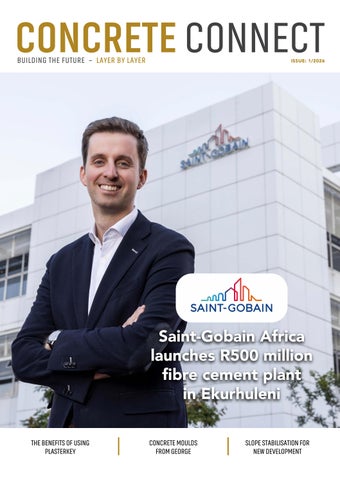
Concrete Connect Ed1 2026

Page 1


CONCRETE CONNEC T

BUILDING THE FUTURE – LAYER BY LAYE R

SAINT-GOBAIN AFRICA LAUNCHES

02 Saint-Gobain Africa launches R500 million fibre cement plant in Ekurhuleni

06 Quality aggregates are the foundation of construction

07 The benefits of using PlasterKey

08 Precision concrete moulds from George to the world

10 Environmental stewardship prioritised at wind energy facility

12 Slope stabilisation allows construction on steep sites

14 Tackling mental health in the construction industry

16 Hertex to open flagship coastal showroom in the Sibaya coastal precinct

17 Safety winners at MBA awards

18 Is 2026 South Africa’s year of water resilience?

Publisher & Advertising: Andrew Meyer (Owner)

Cell +27 (0)82 456 5175

E-mail: Andrew@concreteconnect.co.za

Editorial Director: Raymond Campling (Owner)

Cell +27 (0)76 297 2775

E-mail: Raymond@concreteconnect.co.za

Production & Administration: Lynn Malcolm

Cell +27 (0)84 031 3057

E-mail: Lynn@concreteconnect.co.za

19 Limited success for mixed-use developments

20 Readymix concrete has stood the test of time.

22 New Landtrek is a tough competitor

23 Construction equipment manufacturer wins four global awards

24 New top contender in readymix truck market

26 Choosing the right compactor for the job

28 Smart storage protects concrete roof tile performance

30 Members List

32 New fibre cement plant for Ekurhuleni

Design & Layout: dv8ion.creative

Technical Support: Tech Xperience

Distribution: Mail Blaze

Publishing Platform: ISSUU

The views expressed in this publication does not represent those of the publishers or advertisers. While every effort has been taken to ensure the accuracy of the content, the editor, writers or publishing house can’t be held responsible for any omissions or errors or damages that might arise from the content. No part of this publication can be reproduced in any form without written permission from the publishers.

SAINT-GOBAIN AFRICA LAUNCHES

R500 MILLION FIBRE CEMENT PLANT IN EKURHULENI

“This investment is about expanding capacity and is a clear demonstration of our long-term belief in South Africa as a key industrial hub for the continent”

Aerial View of the new Saint-Gobain production facility in Vulcania, Brakpan.

Saint-Gobain Africa has reinforced its long-term commitment to South African manufacturing with the official opening of a state-of-the-art fibre cement facility in Ekurhuleni.

The new plant represents an investment of more than R500 million signalling confidence in the country’s industrial potential and a tangible boost to local job creation. The inauguration brought together government representatives, industry partners and community stakeholders, underlining the role of public-private collaboration in driving industrial growth.

For more than 360 years, Saint-Gobain has been shaping global manufacturing and construction innovation. Its footprint in South Africa spans over nine decades, with the company steadily expanding local production and workforce development. The Ekurhuleni facility continues this trajectory, producing fibre cement products designed for long-lasting performance in residential, commercial and infrastructure projects.

Fibre cement is valued for its performance which makes it a preferred choice for a variety of applications ranging from cladding, ceilings, partitioning, fascias, barge boards and other critical building elements. Its adaptability suits the varied climatic conditions of South Africa and supports modern construction’s demand for durable materials.

“This investment is about expanding capacity and is a clear demonstration of our long-term belief in South Africa as a key industrial hub for the continent,” said Aymeric d’Ydewalle, CEO of Saint-Gobain Africa. “We continue to invest because we believe deeply in South Africa’s capability and the importance of strong partnerships between the public and private sectors in driving sustainable growth.”

The Ekurhuleni plant is a key component of Saint-Gobain Africa’s Make it in Africa to Build Africa (MABA) programme. Through MABA, the company aims to produce locally while simultaneously developing people, empowering communities and strengthening regional value chains.

Growing demand

Fibre cement’s appeal lies in its engineering for longevity and resilience. The material performs across indoor and outdoor applications exposed to moisture or wear and maintaining

structural stability over decades. Its uses extend from external façades to internal partitioning in moisture-prone areas, as well as roofline elements such as fascias and soffits. Fibre cement also forms part of permanent shuttering systems and flooring, making it integral to both residential and non-residential construction.

The Ekurhuleni plant will produce flat sheets and fascia boards to meet this growing demand, reducing reliance on imports and reinforcing the local construction ecosystem. The facility incorporates internationally recognised manufacturing, quality and environmental standards and SaintGobain Africa emphasises responsible resource use with operational systems designed to manage water efficient-

ly and minimise waste through reuse and recycling. The plant’s design and operation reflect a balance of modern production efficiency with sustainability considerations, aligning with the global shift toward environmentally responsible construction.

“Through MABA we focus on producing locally, developing people and contributing meaningfully to the communities in which we operate,” d’Ydewalle added. “This new plant is designed to support job creation, supplier development and skills transfer, while contributing to the revitalisation of South Africa’s manufacturing sector.”

He expanded that Saint-Gobain Africa’s approach to MABA is structured

A cross section close up of the fibre cement.

around four pillars. Sustainability is embedded across design, manufacturing and application, ensuring that the products and systems the company delivers contribute to healthier more resilient built environments. The third pillar focuses on people and communities. Saint-Gobain Africa invests in developing local talent, training contractors and applicators and supporting community upliftment initiatives. Safe and inclusive workplaces are fundamental to this approach, enabling employees to acquire skills, build careers and contribute to broader social development.

Finally, customer-centricity drives the fourth pillar. Local expertise allows Saint-Gobain Africa to understand the real needs of the market and provide high-quality, locally manufactured solutions backed by technical support.

The Ekurhuleni facility strengthens the company’s ability to deliver consistent service and reliable products to the construction industry.

Perfectly situated

The plant is located in Vulcania South, Brakpan, within the Ekurhuleni industrial zone. Its development aligns with broader economic objectives to stimulate local manufacturing and industrial growth. By producing fibre cement locally Saint-Gobain Africa is helping reduce reliance on imported building materials while enhancing supply chain resilience. The investment also supports the creation of direct and indirect jobs; underpinning skills transfer initiatives and strengthening the capabilities of local suppliers.

“Saint-Gobain’s presence in South Africa has consistently emphasised the

integration of global expertise with local operations. The Ekurhuleni plant builds on a history of innovation and quality bringing modern manufacturing technology to the regional construction market. This includes closedloop water systems, careful waste management and energy-conscious processes to reduce environmental impacts. The materials produced are also designed to last which contributes to long-term building performance and sustainability. By embedding these principles in day-to-day operations, Saint-Gobain Africa ensures that industrial growth and environmental responsibility progress hand in hand.

“The Ekurhuleni plant is a milestone in our long-term presence in South

Africa,” d’Ydewalle said. “It shows, through action, our commitment to the country: investing locally, developing skills, creating jobs and working together to build resilient communities and economies.”

Saint-Gobain Africa operates across multiple regions in Africa and is part of a global network generating €46.6 billion in sales in 2024 and employing over 161,000 people in 80 countries. On the continent, Saint-Gobain has more than 1,800 employees across 20 manufacturing sites in 16 countries. It is focused on enabling infrastructure development, urbanisation and sustainable growth through its products, solutions and local manufacturing footprint.

A walkabout at the opening of the fibre cement plant.
Aymeric d’Ydewalle, CEO of Saint-Gobain Africa.

QUALITY AGGREGATES ARE THE FOUNDATION OF CONSTRUCTION

In construction the quality of materials directly determines the strength and long-term performance of any structure. Among these materials aggregates play an essential role as long as they are correctly sized and properly graded.

“Aggregate grading is not only about particle size but rather it determines how the material compacts, how concrete mixes perform and how well load bearing structures can handle stress over time,” says Afrisam’s Amit Dawneerangen, the construction materials executive.

He explains that when aggregates are incorrectly sized or poorly graded voids can occur within the mix, reducing density and compromising strength. This often leads to issues such as cracking, shrinkage and water ingress all of which can shorten the lifespan of structures. Conversely, well-graded aggregates create dense

cohesive mixtures that enhance workability, reduce cement or binder demand and ensure more uniform compaction and stability.

Consistent aggregate quality ensures that engineers and contractors can meet design standards and regulatory specifications. Projects designed around specific grading envelopes depend on accurate and repeatable aggregate properties to perform as intended. However, achieving this level of precision requires technical expertise which is why working with a reputable quarry or construction materials supplier is critical. Trusted suppliers operate under strict quality management systems, implement regular laboratory testing and maintain calibrated crushing, screening and blending processes to ensure product consistency.

“Partnering with an established, credible supplier provides confidence that every load delivered meets specifica-

Amit Dawneerangen, Construction Materials Executive: Sales & Product Technical at Afrisam.

tion. It also means access to reliable technical advice and traceability from the source rock right through to the final product,” Dawneerangen adds.

He reminds buyers that reputable suppliers invest heavily in quality assurance infrastructure, from advanced testing laboratories to on-site quality control technicians. Their focus extends to actively collaborating with engineers and contractors to ensure that the correct material is selected for each layer or mix design. This reduces the risk of costly rework and ensures long term performance.

“Working with a trusted technically capable supplier is a quality assurance choice that safeguards the integrity and longevity of every project,” Dawneerangen concludes.

Both coarse and fine aggregates used in concrete must comply with the requirements of SANS 1083.

THE BENEFITS OF USING PLASTERKEY

Leading construction chemical company A.Shak provides tips and best practices for one of its best-selling products – Plasterkey.

For best performance when preparing a wall for plaster, users must remember that it is important to provide the plaster with a way of adhering to the surface. A common method of this is to chip the surface to increase surface area allowing the plaster to “key” onto the surface. Plasterkey is an easy and effective alternative to this method that has been trusted by the DIY and construction industries for decades.

Over those years A.Shak has strived to provide the best quality products. It is for that reason that PlasterKey has developed its reputation as the market leader in the plaster bonding agent category. We continuously strive to ensure that only the best goes to market.

For best results mix Plasterkey with 2 parts river sand and 1 part cement to create a scratch coat that you can ap-

ply with a block brush or trowel. Wait until the scratch coat is properly dry and then apply the plaster as per normal. Plasterkey works with cement and gypsum plaster. In the case of Gypsum based Plaster, simply apply the PlasterKey to the surface with a brush and then plaster straight onto the wet Plasterkey. Plasterkey is available in 210L, 25L, 10L, and 5L containers with each litre covering ± 10 square meters.

Ashak PlasterKey ia available in different sizes which are ideal for smaller projects to larger applications.

PRECISION CONCRETE MOULDS FROM GEORGE TO THE WORLD

Nigel Brown Moulds has built a reputation as one of South Africa’s trusted specialist manufacturers of concrete moulds supplying high-quality tooling for the precast concrete industry from its base in George, Western Cape.

The business is known locally and regionally for durable, well-crafted moulds that serve construction, infrastructure and industrial precast producers looking for accuracy and longevity in their tooling. This has led to the growth Nigel Brown Moulds which has grown to produce a wide range of concrete product moulds to help manufacturers create standard and specialised concrete components economically. The most popular products include:

• Concrete block moulds — standard and custom block configurations for boundary walls, retaining structures and interlocking blocks for landscaping and paving.

• Paving and slab moulds — production tools for garden pavers,

patio slabs and decorative concrete units that meet exact shape and size specifications.

• Test cube moulds — essential for civil and commercial concrete testing, ensuring consistent sample sizes for strength testing and quality control.

• Specialised forms — including “fancy cap” moulds and other bespoke dies tailored to customers’ plans or architectural requirements.

Nigel Brown’s moulds are predominantly used to cast fresh concrete products that go into building walls,

Polyurethane brick pattern wall mould replaces steel moulds

blocks, boundary structures and paving and serves both small-scale producers and larger manufacturing operations that rely on repeatable quality tooling.

“What makes our products popular beyond the Garden Route is our focus on robust construction and precise dimensions in moulds that are easy to use and this helps producers maintain tight tolerances and reduce waste in precast production. Our moulds withstand repeated use under pressure and vibration to create consistent components and ours are crafted with this durability in mind,” says Nigel Brown Moulds founder and namesake, Nigel Brown.

He adds that the company’s tooling has found favour with manufacturers across South Africa and further into neighbouring Africa and global export markets, who value affordable, dependable moulds that stand up to harsh production conditions. Locally the company’s products help reduce dependence on imported moulds to shorten lead times and lower freight costs which are significant benefits for producers on the continent.

Steel double wash trough as the traditional fibreglass ones are not really strong enough
High quality polyurethane moulds ready to be put to work

ENVIRONMENTAL STEWARDSHIP PRIORITISED AT WIND ENERGY FACILITY

Concor’s role in the construction of Mulilo De Aar 2 South Wind Energy Facility in the Northern Cape, one of the company’s first fully wrapped Balance of Plant (BoP) contracts, has a firm commitment to environmental stewardship with the operation meeting the highest standards of compliance while actively protecting biodiversity and managing sensitive ecosystems in the Northern Cape.

The company’s environmental approach is guided by strict adherence to the project’s Environmental Authorisation (EA), Environmental Management Programme (EMPr) and all other relevant permits and licences. Beyond regulatory compliance, Concor embeds best practice environmental management principles throughout the project. According to Zimasa Nodangala, environmental officer on the project, this approach forms part

of Concor’s culture of accountability and responsibility. “We see Environmental protection as part of how we build responsibly, ethically and in partnership with the environment. Every activity on site is managed to minimise impact whether it relates to dust control, water conservation or biodiversity protection.”

Concor has developed an aspects-and-impacts register aligned with the EMPr to identify and address environmental risks. “Dust suppression measures include restricting vehicle speeds on access roads to 40 km/h and 20 km/h in unconsolidated areas and using water carts for dust suppression. The project team has also implemented controlled blasting techniques to minimise both dust and fly rock,” Nodangala says.

Water usage is another key focus area.

All abstractions are authorised by the Department of Water and Sanitation (DWS) and daily monitoring through tally sheets and flow meters ensures responsible consumption. “We monitor water use daily and reinforce awareness through toolbox talks. Water is a scarce resource in this region so it is essential that we use every drop wisely.”

Stormwater management has also been prioritised with drainage systems designed to prevent erosion and direct clean water around active work areas with the goal to avoid sedimentation and protect surrounding ecosystems by managing runoff carefully. Waste management forms another critical component of Concor’s strategy. Waste is segregated at source and transported to licensed landfill sites, with recycling implemented wherever possible. “We take waste separation

Concor embeds sustainability principles into every stage of construction, ensuring projects work in harmony with their surroundings.

From dust control to water conservation, Concor ensures every site activity respects the surrounding ecosystem. very seriously not only to meet compliance requirements but because it is the right thing to do,” Nodangala says. “We also ensure that hazardous substances are stored safely and that spill kits and drip trays are available at all times.”

The protection of biodiversity has been a major focus since the start of the project. “Before construction began, a registered specialist conducted a search-and-rescue operation under project-specific permits. Indigenous vegetation was relocated where necessary and biodiversity awareness training was rolled out to every employee, subcontractor and supplier.”

Construction activities are confined to authorised servitudes to prevent disturbance of previously relocated species and sensitive habitats. The company works very hard to ensure that no unauthorised clearing takes place outside the approved footprint. Rehabilitation is done concurrently with construction so that it can restore disturbed areas as quickly as possible using indigenous plants. This helps stabilise soils, prevent erosion and promote long term ecological resilience.

Cultural heritage management has also been important, with the team ensuring that rock kraals which are heritage features of cultural significance, are properly demarcated and protected. Access to some of these sites was challenging and are now all labelled and designated as no-go areas. The company also appointed gate minders and worked closely with local landowners to ensure mutual respect and understanding.

Environmental performance is continuously monitored through monthly Environmental Compliance Reports, Environmental Control Officer (ECO) audits and quarterly HSE audits. “We take a proactive approach. If a potential non-compliance is identified, corrective action is taken immediately. We try maintaining high standards every day, not just during inspections.”

All subcontractors and service providers undergo mandatory environmental induction before commencing work with training offered in multiple languages to ensure full comprehension.

“Everyone who sets foot on site needs to understand the environmental rules and why they matter. We want people

to take ownership of their actions and understand that environmental care is part of their daily job.”

As construction progresses on the Mulilo De Aar 2 South Wind Energy Facility, Concor’s goal is to deliver a renewable-energy project of national importance and leave behind a landscape where biodiversity and ecological stability have been protected for generations to come. “Environmental responsibility is part of Concor’s DNA and it is something we take great pride in demonstrating on this project,” she concludes.

Concors strict protocols limits impact at all sites
Concor’s teams have zoned off culturally significant rock kraals, ensuring history is preserved alongside progress.

SLOPE STABILISATION ALLOWS CONSTRUCTION ON STEEP SITES

In Plettenberg Bay, the Ebenezer Estate Phase 3 Portion 2 project required a practical solution for steep, challenging terrain. The municipal initiative focuses on low-cost housing development, including erf platforms, surfaced roads, sewer and water reticulation, stormwater systems and retaining walls capable of supporting essential infrastructure.

According to Terraforce’ s Karin Johns, the site’s slopes reached heights that presented significant engineering

challenges. Walls up to 5,5 meters were required to create safe functional platforms for housing and infrastructure. Under these circumstances conventional methods were not sufficient to meet the structural and durability requirements.

Terraforce retaining walls were selected and supplied by Mossel Bay manufacturer Mobicast to address these challenges. Engineering designs by iX Engineers Cape Town, implemented on-site by Lyners & Associates George,

specified approximately 30 000 L11 blocks for the project. The blocks were reinforced with S120 Kaytape geogrid, anchored with concrete keys and backfilled with specialized infill to ensure structural stability. Terraforce 4x4 Step blocks were incorporated to provide safe and practical access points within the walls.

“Installation required careful planning and execution. The process involved systematic placement of geogrid reinforcement with precise block cutting

where necessary and the coordination of the fill materials. Strategic intervals of Kaytape reinforcement ensured that the walls could support the pressures imposed by the steep slopes.

The completed walls created stable platforms that now support residential erven, roads and municipal services.

The project demonstrates the capability of Terraforce systems to deliver effective retaining solutions for largescale municipal developments and the collaboration between Norland Construction, Mobicast and the engineering teams ensured the project met both structural and functional requirements.

Engineering Design: iX Engineers, Cape Town

On-Site Engineering: Lyners & Associates, George Main Contractor:

Norland Construction

Block Supplier:

Mobicast, Terraforce® licensed Mossel Bay Precast manufacturer

TACKLING MENTAL HEALTH IN THE CONSTRUCTION INDUSTRY

Mental health pressures across South Africa continue to rise. For those working in construction this is exacerbated by long hours, high-risk environments, tight deadlines, job insecurity and a culture of stoicism creating an environment of stress, anxiety and emotional fatigue. These pressures affect safety

and productivity as well as the lives of workers, their families and the wider community.

“International research echoes the severity of the problem,” says Petra Devereux, executive director, Master Builders Association Western Cape

(MBAWC). “We need to intensify our efforts, highlighting mental health as an essential and urgent industry priority.”

A 2020 Chartered Institute of Building (CIOB) survey of 2081 construction workers found that more than a quarter (26%) had experienced suicidal thoughts, while almost half reported poor mental health and only 56% said their workplace had a mental-health policy. The updated 2025 report shows little improvement: workers remain reluctant to seek help often suffering in silence until the strain becomes overwhelming. Of the 865 respondents in 2025, 24% reported stress, 20% fatigue, 18% anxiety, 7% depression and 2% suicidal thoughts. Rising pressures such as limited-term contracts, long commutes, time away from family and a ‘macho’ culture further exacerbate the problem.

These global concerns mirror South Africa’s own construction landscape. Local research from the Construction Industry Development Board (CIDB) and the Department of Employment and Labour confirms that construction workers shoulder significantly higher mental-health risks than most other sectors.

The reasons are systemic: unstable work opportunities, hazardous conditions, economic stress, lack of diversity, substance abuse as a coping mechanism and the persistent stigma that discourages openness. Further, the South African Forum of Civil Engineering Contractors’ (SAFCEC) recent workplace trends also pointed to a rise in anxiety and burnout among supervisors and site managers due to increased administrative and compliance demands.

“Mental health challenges have become impossible to ignore. We’re seeing increased pressure and mental fatigue across all levels from business owners to labourers who start their day with long, expensive commutes. With the surge in developments in the Western Cape and frequent project commencement delays many contrac-

tors are being pushed into impossible timelines. By raising awareness, we want to shine a light on the often-overlooked mental well-being of our workforce. Mental health is a legitimate safety concern, not an optional extra,” says Devereux.

The human impact is profound. Workers under strain are more vulnerable to accidents and slower reaction times. Productivity suffers, team cohesion breaks down and communication essential on fast-moving sites weakens. As Devereux notes, “A safe site is not only one free of physical hazards. It is one where mental wellness is protected.”

Chandré Abrahams, chairperson of the MBAWC marketing committee, agrees that cultural and systemic barriers compound the problem. “Construction has long been shaped by a ‘work through it’ mindset. Many workers fear judgement or even job loss if they speak up. Stigma remains one of the biggest obstacles especially in male-dominated environments. But talking about stress should be as normal as talking about scaffolding safety. That’s the shift we need.”

This cultural shift must begin with leadership. MBAWC emphasises that site managers and senior staff play a pivotal role in breaking down stigma and creating a climate where workers feel safe to voice concerns. “Leadership must show visible support. If managers don’t acknowledge mental health as a real issue, no policy or poster will make a difference,” says Devereux.

Practical, accessible interventions are essential. MBAWC encourages companies to embed mental well-being into their health and safety systems, just as they do with Personal Protective Equipment (PPE) or fall protection by taking the following steps:

• Incorporating mental health into site-specific health & safety policies

• Providing access to counselling or Employee Assistance Programme (EAP) services

• Scheduling monthly mental-health toolbox talks

• Training supervisors in mental-health literacy and supportive communication

• Appointing mental-health champions or ‘first aiders’ on site

• Offering anonymous reporting channels

• Ensuring fair workloads and realistic deadlines

• Encouraging peer-support groups and fostering work–life balance where possible

Many South African firms are already adopting these measures demonstrating that meaningful progress is possible even in high-pressure environments. Abrahams stresses that small, consistent habits can transform site culture. “Real change doesn’t only happen in workshops it happens in daily check-ins, in supervisors asking, ‘Are you okay?’ and in teams knowing they won’t be judged for speaking up.”

MBAWC’s commitment includes providing members with guidance, awareness materials, toolbox talk templates, and links to established resources such as the South African Depression and Anxiety Group’s (SADAG) counselling line, community mental-health organisations and sector-specific guidance from the Construction Industry Development Board (CIDB) and MBAWC.

For employers and site managers, MBAWC’s message is clear. “Mental health a safety issue, a productivity issue and a people issue. When workers feel supported, they work more safely, more efficiently and with greater resilience. Healthy businesses are built on healthy people,” says Abrahams.

“Employers must prioritise mental wellness with urgency. Our industry is built on human effort, and those individuals deserve care, support and understanding. Strong foundations aren’t only made of concrete. They are built on the wellbeing of the people who bring our projects to life.”

Petra Devereux, executive director, Master Builders Association Western Cape (MBAWC)

HERTEX TO OPEN FLAGSHIP COASTAL SHOWROOM IN THE SIBAYA COASTAL PRECINCT

South African textile and lifestyle brand, Hertex, has announced the launch of a flagship showroom within the Sibaya Coastal Precinct, one of the country’s fastest-growing and most design-driven coastal developments. The move underscores the brand’s long-term growth strategy in KwaZulu-Natal and enhances the precinct’s reputation as a high-value investment and lifestyle destination.

For Devmco Group, the development visionaries shaping Sibaya’s integrated live-work-play environment, the addition of Hertex signals strong confidence from premium national brands in the precinct’s trajectory. With worldclass commercial, residential and retail projects already underway, Sibaya continues to attract businesses committed to quality, innovation and elevated coastal living.

“Sibaya is fast becoming KZN’s most dynamic coastal node with a design-driven, lifestyle-focused and forward-thinking focus. It’s exactly where we want to be as we grow our national footprint,” says Klaus Herrmann, Hertex’s Sales Director. “Opening a flagship here strengthens our presence in the province and positions us at the heart of a precinct that aligns perfectly with our premium, design-led brand philosophy.”

Hertex’s partnership with Devmco Group is a strategic alignment built on mutual values. Devmco Group, having delivered more than R8 billion in development between Umhlanga Ridgeside and Sibaya, have become synonymous with long-term value creation, exceptional placemaking, and innovative coastal urbanism. Their latest project within the precinct, HQ Sibaya, continues this ethos by merging lifestyle, business and wellness into a single future-forward commercial ecosystem.

“Devmco’s commitment to quality and their ability to create meaningful, lifestyle-enhancing spaces reso-

nates deeply with us,” Hermann adds. “It’s not just about location; it’s about aligning with a development partner that shares our vision for enduring design and long-term value.”

Hertex’s new Sibaya showroom is drawing on the talent and experience of its in-house design team, together with the acclaimed architectural firm Craft of Architecture (COA) and specialist planners, to craft a uniquely expressive space inspired by KZN’s coastline. Designed to embody a refined coastal aesthetic with seamless indoor–outdoor flow, the flagship will feature a signature rug gallery that showcases Hertex’s renowned craftsmanship, an extensive materials library to spark inspiration for designers and developers, and an expanded HAUS homeware experience available exclusively at this location. The space will also incorporate a dedicated outdoor living zone that reflects contemporary coastal lifestyle trends, along with a purpose-built trade workspace created to support and elevate the work of design professionals.

“Our 40-year heritage of craftsmanship anchors the entire build. Every texture, material and finish has been thoughtfully selected to honour our legacy while creating a fresh, contemporary coastal mood that feels authentically Sibaya,” says Hermann.

As Sibaya continues its evolution into a vibrant coastal city, anchored by integrated residential, commercial and recreational zones, brands like Hertex add significant value to the precinct’s identity. Devmco’s broader vision seen across projects like HQ Sibaya and Sibaya Park, prioritises wellness, connectivity and cultural activation that is already attracting businesses that want to be part of a high-quality environment tailored for modern living and investment.

Hertex identifies KwaZulu-Natal as a key growth market, and the Sibaya flagship represents the brand’s commitment to expanding its footprint in the province. “As the precinct grows into a cultural and lifestyle hub, we plan to grow with it by introducing new concepts, hosting design-led experiences and continually evolving our offering to keep the space fresh and forward-thinking,” says Hermann.

Due to break ground in 2026, Hertex’s forthcoming flagship store is set to elevate both the design landscape and the investor appeal of the Sibaya Coastal Precinct, cementing it as South Africa’s most compelling coastal destination where design, lifestyle and investment converge.

The Hertex family team Klaus Herrmann, sales director, Katrin Herrmann van Dyk , creative director, Pauline Herrmann-Keys, human resources director and Carla Hermann van der Merwe, operations director

SAFETY WINNERS AT MBA AWARDS

Concor’s safety culture was in the spotlight at the recent Master Builders Association (MBA) North regional safety competition with the company winning five coveted awards.

Margaret Dube, Concor’s health, safety and environment (HSE) manager, was crowned the Construction HSE Manager of the Year, while the company’s safety representative, Mduduzi Mamba received the award for the Construction HSE Representative of the Year. Concor’s projects were also honoured in the ceremony earning first place in category F (projects valued at R100 to R250 million) for its Fourways Mall New Roof and Solar Project; second place in category G (R250 to R450 million) for the Oxford Parks Block 2A Phase 1 Project and third place in category E (R40 to R100 million) for its Ga-Rankuwa City Centre Project.

Concor contracts manager, Martin Muller, highlights the significance of this recognition in a sector where fast tracking of building projects has become the norm. The considerable deadline pressure on such projects has the potential to compromise safe working practices. “This is why safety needs to remain at the centre of our working culture every day and why we prioritise the training and support that is given to our safety officers and representatives as well as our on-site team and our subcontractors. It is a real honour to see our safety team being recognised for their contribution as their approach and commitment is critical to the success of our projects,” Muller says.

Dube says her award has been a boost to her personal motivation as a safety manager, as well as collective achievement for Concor’s entire safety team. “An award like this really motivates everyone and reinforces our commitment towards further improving our safety and project execution. It also affirms the valuable contribution we are making to the construction sector as a whole.”

She emphasises that safety is a shared culture of safety among colleagues who are concerned for each other’s well-being. While acknowledging that a safety officer needs to have a strong character to perform their duties,

Mamba concurs, saying that he joined the Concor safety team in 2016 to help build an approach to safety where site safety personnel are not ‘traffic officers’ to be feared and obeyed. He notes that one of his main areas of focus is to ensure that colleagues do not

confuse work experience with safety awareness. “Even though a person has many years of experience on a construction site they can still make mistakes if they do not embrace our safety culture. Our approach is to encourage everyone in our team to point out potential hazards and to help find and apply solutions,” he explains.

Dube says their role is to empower and educate the team.
Concor HSE Manager Margaret Dube and Safety Officer Givemore Mupondi conducting a safety file audit, demonstrating the company’s commitment to rigorous compliance and continuous improvement.
Safety is a team effort at Concor, with members of the Oxford Parks safety team collaborating daily to maintain the high standards that underpin the company’s award-winning safety performance.

IS 2026 SOUTH AFRICA’S YEAR OF WATER RESILIENCE?

South Africa has shown that it can respond decisively to national crises. Just a few years ago, electricity blackouts threatened the country’s economic and social fabric. Today, a combination of policy reform and private-sector investment has driven a marked turnaround in energy availability with local transport and logistics recovery also showing early signs of progress.

Now, water security has moved to the top of the national agenda.

During 2025, President Cyril Ramaphosa warned that “load shedding has been supplanted by the crisis of water security which poses a similar if not greater threat to the quality of life and economic prospects of all South Africans.” Deputy President Paul Mashatile has since taken a leading role telling delegates at the Association of Water and Sanitation Institutions of South Africa (AWSISA) that leaders must commit to “developing sustainable solutions that guarantee universal access to clean water and sanitation.”

A good example is George Municipality which has been grappling with severe water constraints raising fears of a potential “Day Zero” scenario reminiscent of Cape Town’s 2018 crisis. More broadly, South Africa remains a water-stressed country, with average annual rainfall of just 497 millimetres—well below continental Europe’s average of over 800 millimetres. Most

strategic water resources are already fully allocated, while aquifers, rivers and wetlands face increasing pressure from pollution and overuse.

Infrastructure challenges are compounding the problem. National water reliability stands at 68%, while water quality is declining in 60% of supply systems, according to Deputy President Mashatile. The Academy of Science of South Africa estimates that between 3 million and 14 million people lack reliable access to potable water, and the Department of Water and Sanitation projects a potential 17% water deficit by 2030.

High levels of non-revenue water, ageing infrastructure, skills shortages and governance constraints have heightened the risk. Climate change is already exacerbating these challenges through more frequent droughts, floods and heatwaves. Yet, as the country’s recent energy experience has shown, crisis can also be a catalyst for innovation and collective action.

According to Chetan Mistry, strategy and marketing manager at Xylem – WSS (AMETI), a similar shift is now emerging in water management. “There is growing uptake of water resilience among private households, schools, businesses and public services,” he says. “It mirrors what we saw in the solar market, where many individual actions combined into a national trend with meaningful results.”

Across South Africa, practical water solutions are already being deployed. Rainwater harvesting systems linked to rooftops are capturing significant volumes for irrigation, cleaning and when combined with disinfection, even consumption. Water-intensive industries including agriculture, mining, chemical processing and food and beverage are increasingly turning to scalable treatment technologies such as ultraviolet systems and dissolved air flotation to recycle and reuse water.

At the same time, smart leak detection technologies using sonar and electromagnetic methods are enabling faster identification and repair of leaks across pipeline networks. Municipalities are also adopting data-driven management through smart meters, improving revenue collection while reducing water losses via real-time monitoring, fault detection and accurate billing.

Complementary efforts, including public water education, wastewater system improvements and water source rehabilitation are reinforcing these gains.

South Africa faces a serious water challenge but it is not without options. Many of the tools needed to shift from crisis to resilience are already in use, driven by coordinated action at national, municipal, business and household levels. As Deputy President Mashatile told AWSISA delegates, “Together, we have the power to make a difference. Together, we can build a future where water is not a privilege, but a fundamental human right for all.”

That momentum is building. If sustained, 2026 could mark the year South Africa decisively moves from water crisis to water resilience.

Chetan Mistry, strategy & marketing manager at Xylem

LIMITED SUCCESS FOR MIXED-USE DEVELOPMENTS

Mixed-use developments have been on the rise for several years globally and for valid reasons. However, automatic success is not guaranteed unless there is an understanding (and implementation) of core design principles, says Marike Louw, candidate architect at BPAS Architects.

“The shift towards mixed-use is largely due to lifestyle preferences as well as changes in traditional workspaces, risk diversification, land scarcity, sustainability and place-making,” says Louw. “There’s a shift towards experimental environments rather than merely functional ones. People are looking for community with convenience and urban living. Workplace shifts have increased the demand for flexibility and spaces that can accommodate different functions. Mixed-use developments create a more vibrant urban fabric and thus support sustainability with less commuting, more walkability and diverse uses to create better-connected neighbourhoods.”

However, she says, one of the biggest misconceptions about mixed-use developments is that combining residential, retail and commercial elements

in a single building will automatically generate vibrancy. “In reality, poorly designed spaces can easily become empty, unsafe and disjointed. Mixeduse developments are not just made by stacking apartments on top of retail and commercial spaces and opening the ground floor to the public. It’s important to ensure that the combination of functions within mixed-use developments is strategic and not overcomplex and that the development matches its surrounding context.”

Louw says successful mixed-use design requires a clear understanding of how different users move through and experience a site as well as when spaces are active and where boundaries between public and private life should be drawn.

Key considerations include:

• Designing with time in mind: anticipating when each part of the development will be used to avoid overcrowding or periods of inactivity.

• Separating where necessary and integrating where beneficial: balancing privacy for residents with

activity in public spaces: separate the private and public spaces and create spaces that can act as buffers where needed.

• Creating a strong ground-floor interface: shaping the street edge as the “social interface” that makes or breaks the development’s connection to its neighbourhood.

When these elements come together, mixed-use developments can increase long-term property value.

BPAS points to two of its designs – The Radley in Bellville, Cape Town and a (as yet unbuilt) Rosebank development in Gauteng as examples of mixed-use principles applied with care.

The Radley responds to the growing demand for urban housing while still fostering a sense of community. Its elevated courtyard creates a shared social space that reconnects residents with the city beyond the building’s walls. By shaping this courtyard as the heart of the development, BPAS has ensured that communal life is a feature of the resident experience.

The Rosebank development is envisioned as a mixed-use high-rise in one of Johannesburg’s most popular suburbs. Given its dense pedestrian-orientated setting, Louw explains, the building is designed to sit on a dynamic plinth of aluminium slats that conceals structured parking and enriches the streetscape. “This solution strengthens the public interface and supports the vibrant urban character of the precinct while internal programming offers residents and visitors a blend of amenities without compromising clarity or circulation,” she says.

“Without careful planning and a nuanced understanding of context mixed-use developments risk becoming overcomplicated, underutilised or disconnected from the communities they aim to serve,” says Louw. “Mixeduse is about creating places where people genuinely want to live, work and spend time. That requires design that understands people.”

READYMIX CONCRETE HAS STOOD THE TEST OF TIME

While building materials have come and gone often falling out of favour due to practical reasons concrete has remained the backbone of modern construction.

It has been in use for thousands of years and continues to be the most widely employed material across the globe due to its affordability and longevity. Structures built today in concrete may well still be standing centuries from now which clearly demonstrates its unmatched durability.

Concrete combines attributes that few other materials can match. It can be shaped into nearly limitless forms, set as hard as stone and carry significant structural loads. It can be used in modest housing projects or towering high-rise buildings, in bridges, tunnels, industrial facilities and critical infrastructure.

However, perhaps the most important evolution of concrete in modern times is the development and use of readymix on large-scale projects with ready to place quality concrete delivered directly to the site and poured with minimal handling. Readymix concrete popularity continues to grow world-

wide and is driven by practical considerations and its performance under extreme conditions.

No other material can compete in terms of cost per structure and added to this concrete is thermally dense, fire-resistant, impact-resistant and able to withstand seismic forces. Its resilience even extends to man-made hazards giving it an edge where security and safety are critical. Advances in material science have further expanded its capabilities.

Additives and new techniques nowadays even allow concrete to compete with materials designed for specific properties whether that be lightweight construction, long-span structures or support for glass facades. Furthermore, architects and planners can approach a project with a clean slate confident that concrete will meet functional requirements while offering flexibility in design.

Modern examples highlight this versatility. The use of reinforced and high-strength concrete in skyscrapers, bridges and transport infrastructure demonstrates its capacity to combine strength with aesthetic appeal.

Fire-protection measures and protective cores in high-rise buildings illustrate how concrete contributes not only to structural integrity but also to safety. Roads, railways and freeways built with quality concrete continue to perform under heavy usage with well-designed mixes and careful construction practices.

Despite its adaptability and proven performance, concrete is only as good as its design, specification and placement. Errors can affect structural integrity and long-term durability. A clear understanding of the material and its handling is essential to getting the best results from any concrete project. As far as readymix goes there are some clear guides and principles:

1. On construction sites the first step is to select the right mix for the intended application. Readymix concrete is available in a wide variety of types, each formulated to achieve specific workability, strength and durability characteristics. A mismatch between the mix supplied and the demands of the site can compromise results.

2. Workability, slump and consisten-

cy need to be carefully agreed on before ordering along with delivery points, offloading methods and movement of concrete on site. Pumps, wheelbarrows, or other placement methods should be considered to ensure smooth workflow.

3. On complex or large projects technical support from the supplier can be invaluable providing insight into potential challenges and helping to optimise placement and handling.

4. Ordering concrete requires precision and as a result specifications must detail strength requirements, workability, delivery volumes, timing and placement procedures. Any unused concrete can represent wasted material and additional disposal costs making accurate estimation critical.

5. Coordinating deliveries, offloading and placement ensures that concrete retains its desired properties. Fresh concrete has a limited window before it begins to set and delays in offloading can affect workability, consistency and ultimately, the finished structure. Time on site must be managed carefully to avoid both material degradation and additional charges.

6. Once the concrete arrives on site preparation is key. Workers must be ready with appropriate tools and equipment and access for delivery trucks must be clear and safe. Concrete should be placed promptly, handled correctly and cured according to established procedures. Curing is an essential step that directly affects the strength and lifespan of the structure.

7. Testing during and after placement confirms that concrete meets the required standards and ensures that the project proceeds without compromise.

Using ready-mix concrete offers practical advantages over site mixing. It eliminates the need for on-site storage and reduces the risk of theft or material loss. It also keeps the site cleaner and safer allowing better order for contractors to use multiple mixes on the same site simultaneously. This means they can cater to different applications such as foundations, floors,

walls, retaining structures and facades at the same time.

Site-mixed concrete, by contrast, typically delivers only one mix at a time and requires time-consuming design, approval and testing procedures. Ready-mix solutions reduce risk and allow for better quality control across all areas of a project. Professional suppliers also bring expertise in environmental management, health and safety, as well as regulatory compliance. Concrete plants operate under strict controls and comply with onsite and transport regulations.

This same expertise extends to consistent material testing and adherence to standards for general-purpose concrete. Contractors and project managers can have confidence that the product delivered will perform as required when handled according to specification. Thereafter it’s the attention to detail on site that counts. The pace at which concrete is offloaded, the manner in which it is placed and the care taken during curing and testing all contribute to the success of a project.

A well-planned workflow minimises disruption, reduces waste and safeguards the structural performance of the finished work. With careful man-

agement ready-mix concrete can be placed efficiently achieving both structural and aesthetic objectives without unnecessary risk or expense. At this point it is critical that communication between the design team, contractors and suppliers is clear and all parties must understand the specific requirements of the project, as well as the characteristics of the concrete being used and the correct handling methods.

By planning the sequence of deliveries, placement and curing, builders can avoid common pitfalls that compromise quality. Technical support from suppliers further ensures that any challenges are addressed proactively resulting in a smooth workflow and high-quality construction.

Ultimately readymix concrete is contributing to ensuring that concrete remains an evergreen material that can meet the diverse demands of modern construction while remaining economical and durable. When used correctly ready-mix concrete provides efficient and quality-controlled solution for nearly any project from small residential developments to large-scale infrastructure.

NEW LANDTREK IS A TOUGH COMPETITOR

Peugeot, part of Stellantis South Africa, has strengthened its position in the nation’s bakkie market with the launch of the latest version of its Landtrek one-ton bakkie available in five derivatives including the Professional Single Cab 4x2, Professional Double Cab 4x2, Active Double Cab 4x4, Allure Double Cab 4x2 AT and the 4Action Double Cab 4x4 AT.

For concrete and construction workers the unusual launch of the bakkie was a fun way of showing the Landtrek’s promise of toughness and versatility. The ‘Pretty Tough Challenge: Most Dirt Wins’ was a four-day race across the Eastern Cape, where success was about covering the most dirt kilometres. “Our Landtrek was made to be driven where the tar ends,” said Moeketsi Mapogo, South Africa and SSA Head of ProOne LCV Business Unit. “It is ready for our roads, our people and our way of life.”

The launch was a four-day adventure through the rugged backroads of the Eastern Cape. Teams set out from Lady Grey climbed some of the country’s highest mountain passes en route to Rhodes, continued to Matatiele and

then descended through the Wild Coast to Port St Johns and finally reaching Coffee Bay. The route was designed to assess the Landtrek’s capability where it matters most off the tar, across mountains, rivers and remote farmlands.

Along the way Peugeot partnered with a local school and a community nature reserve to deliver essential building materials. The Professional Single Cab Landtrek with a class-leading load bed in its segment proved its strength in real-world conditions by transporting supplies across challenging terrain to their destinations.

“Since entering the South African market four years ago we have spearheaded strong growth and established our brand house,” Mapogo explained. “The Landtrek delivers what South Africans expect from their bakkies in terms of resilience, versatility, comfort and style backed by global expertise.”

With payloads above one tonne, a towing capacity of up to three tonnes and ground clearance between 214 and 235 mm the Landtrek delivers on the fundamentals. The 4x4 variants

add a transfer case and differential lock for confident driving in low-grip conditions. Inside, the Landtrek offers a 10-inch multimedia screen with Apple CarPlay and Android Auto, smart storage solutions and advanced safety features including six airbags and Trailer Sway Control.

The Landtrek combines robustness with Peugeot’s signature design DNA: a vertical grille with the lion emblem, distinctive LED lighting and alloy wheels that look equally at home in the city, on the farm or out on the trail. “South Africans want a bakkie that works hard during the week and is just as comfortable heading into the mountains, the bush or down to the coast on the weekend,” Mapogo said. “The Landtrek fits seamlessly into that lifestyle. It is practical and powerful and a true competitor in its segment.”

The Landtrek launch underscores Peugeot’s confidence in the South African market and its long-term commitment to grow locally. It represents another step in a broader strategy to bring vehicles shaped by global expertise and fine-tuned for local conditions, driving experiences and ambitions.

The ‘Pretty Tough Challenge: Most Dirt Wins’ was a four-day race across the Eastern Cape to launch the new Peugeot Landtrek

CONSTRUCTION EQUIPMENT MANUFACTURER WINS FOUR GLOBAL AWARDS

Within just a year of taking on the exclusive distribution of LiuGong’s full range of equipment in southern Africa ELB Equipment has claimed top honours at the LiuGong Annual Dealer Conference in Liuzhou, China taking the prestigious President’s Award along the way.

Upon signing the agreement with LiuGong last year, ELB Equipment CEO, Desmond van Heerden, had emphasised that the success of the partnership would demand rapid establishment of technical capabilities to support the new equipment as well as requiring a considerable effort from the company’s staff to ramp up stock across its 11-branch national footprint. This led to the team spending the remainder of 2024 and the early parts of 2025 building local inventories of capital equipment like wheel loaders, excavators, graders, backhoe loaders, skid steers and mining trucks among others, while simultaneously rolling out support capacity for the manufacturer’s existing customer base.

A year later the hard work and investment has been justified as the ELB Equipment Team with global recognition at the Dealer Conference which was attended by more than 1 300 delegates and over 500 dealers worldwide. The South African company walked away with four awards including the Best New Dealer, Outstanding Total Sales, Excellence in Compact Equipment Sales and the headline President’s Awards.

“This recognition confirms that our strategic decision is working. Our expanded product portfolio now gives long-standing customers access to a full spectrum of world-class equipment backed by our extensive established aftersales abilities. At the same time LiuGong owners in South Africa now benefit from a support structure built on decades of industry experience and sub-dealer coverage across key industrial centres throughout southern Africa.

LiuGong’s southern Africa sales manager Pu Yonghua says the market remains a priority for the manufacturer and that ELB Equipment’s strong customer-first approach is reinforcing the brand’s position in the region.

Reflecting on the whirlwind year gone by Van Heerden says the partnership has moved quickly from establishing

supply lines and building stock to outperforming global competitors in the LiuGong network. With 2026 set to bring further consolidation and expansion the collaboration is the beginning of a longer-term growth trajectory that is ready to challenge the region’s heavy-equipment sector for an increasingly large slice of the market share.

The ELB Equipment team receiving the awards are Melanie Pienaar, National Parts Manager, Keon Kardolus, Divisional Director: EMC, Desmond Van Heerden, CEO, Gerrit Kapp, Commercial Director, Lance Constable, Aftermarket Director

NEW TOP CONTENDER IN READYMIX TRUCK MARKET

Reliability of concrete mixer trucks is a top priority for South Africa’s readymix producers who operate in a market with tight margins over long distances often with service level agreements that promise tight timeframes for the delivery of fresh concrete.

The arrival of the Eicher Pro 6025 T concrete mixer therefore is a heaven sent that presents operators with new options for balanced payload and efficiency in a truck that is reliable and tested in a market that is flooded with ever-increasing numbers of brands with no history nor pedigree in the hard-working construction field.

At the core of this impressive new mixer option is a tried-and-tested 6m³ Schwing Stetter drum paired with a chassis designed to handle the harsh realities of mixing, loading and delivery cycles. With a concrete payload of approximately 14.5 tonnes the Pro 6025 T is positioned to support high-volume operations while maintaining the consistency required on modern construction sites.

Built at Eicher’s advanced manufacturing facility in India and incorporating Volvo-derived innovation and technology, the new-generation mixer is configured to deliver maximum torque at low engine speeds which is a key factor in improving fuel consumption

while ensuring reliable performance across urban routes and uneven site conditions.

Fuel efficiency is class leading and is supported by a drivetrain engineered for optimal operating ranges. The truck also introduces a new instrument cluster that assists drivers in maintaining “green band” driving, helping fleets reduce operating costs without compromising productivity. Driver wellbeing has not been overlooked. The cab incorporates next-generation features including air conditioning, USB and Bluetooth connectivity and an ergonomically designed seat to improve comfort during long shifts. This is a practical advantage in an industry that frequently runs around the clock.

From a safety and stability perspective the Pro 6025 T is equipped with ABS braking, a Domex chassis, wide-track suspension with an anti-roll bar and grease-free suspension components. Together, these features enhance both on-road handling and off-road stability when accessing construction sites. The chassis also requires less maintenance which further improves the availability of the truck.

The mixer is also PTO-enabled and integrates Canbus connectivity for vehicle control, tracking, driver management and fleet oversight. These tools

are increasingly valued by operators seeking tighter operational control and improved delivery performance. Service intervals of 500 hours or 20 000km further strengthen the truck’s profitability case by reducing downtime and maintenance interruptions. This has proven to be a significant consideration for fleet owners focused on lifecycle costs rather than outright purchase price.

South African readymix suppliers will welcome this vehicle that was specially developed in response to industry demand for a 6m³ mixer that combines power with fuel efficiency for the sector’s “always-on” delivery model. Backed by a 24/7 after sales and support structure the Pro 6025 T is aimed squarely at keeping trucks on the road and concrete moving.

With a retail price of approximately R1,273,000, the Eicher Pro 6025 T enters the local market as a serious contender for readymix fleets seeking a modern, cost-conscious mixer capable of delivering dependable performance from a stable that has brought the some of the most iconic UD and Volvo mixers to the market over the past decades.

CHOOSING THE RIGHT COMPACTOR FOR THE JOB

Compaction is one of the most critical and often underestimated aspects of paving construction in South Africa whether one looks at small projects such as residential walkway or industrial yards.

It is a fact that the long-term performance of any paved surface depends largely on how well the underlying layers are compacted. Failures such as settlement, rutting, uneven surfaces and edge collapse can almost always be traced back to inadequate compaction rather than the paving units themselves.

Reputable paving companies’ practice generally aligns with SANS and municipal specifications which require the upper pavement layers beneath paved surfaces to achieve a minimum of approximately 95% Modified Maximum Dry Density, depending on the traffic class and material type. These requirements apply equally to pedestrian pavements and motor traffic applica-

tions, with the difference lying mainly in layer thickness, material grading and compaction effort.

At the centre of these is the compactor. Plate compactors are walk-behind vibratory machines designed to densify granular materials such as crushed stone, gravel and bedding sand. They work by transmitting vibration and static load through a flat steel plate, rearranging particles and reducing voids. For paving applications plate compactors are particularly well suited to compacting sub-base layers in controlled thicknesses, as well as compacting bedding layers prior to laying pavers.

In pedestrian paving, such as sidewalks, patios and courtyards, plate compactors are often the primary compaction tool from start to finish. These applications typically involve thinner layers and lower load demands making single-direction or reversible plate compactors ideal. Their manoeuvrabil-

ity allows effective compaction along edges where larger machines struggle to achieve uniform density.

For residential driveways and light vehicular traffic, plate compactors remain effective provided the base layers are constructed in thinner lifts and compacted in multiple passes. Heavier plate compactors with higher centrifugal force are generally preferred in these situations to ensure sufficient energy transfer into the material. Many contractors also use protective rubber mats on plates to compact pavers after laying, reducing the risk of surface damage while still seating the blocks properly.

South Africa has a wide range of plate compactors available through both purchase and hire channels. These machines are widely supported, easy to maintain and suitable for most granular materials used in paving construction locally. For cohesive or clay-rich soils, however, plate compactors are

less effective and tamping rammers are often used to achieve deeper compaction before a granular layer is introduced.

While plate compactors dominate smaller paving projects there are clear situations where a roller becomes the more appropriate choice. As paving areas increase in size or where motor traffic loading becomes more significant, pedestrian or ride-on rollers offer advantages in both efficiency and consistency. Rollers apply compaction over a wider footprint, delivering more uniform density across large open surfaces such as parking areas, access roads and commercial yards.

Pedestrian rollers are commonly used on medium-sized paving projects where productivity becomes important and where surface regularity must be tightly controlled. For heavier motor traffic applications particularly where thicker base layers are required rideon rollers provide deeper and more reliable compaction that aligns better with civil engineering specifications. In these cases, plate compactors are still valuable for edge work and confined areas but should not be relied on as the sole compaction method.

The key to selecting the right compaction tool lies in understanding the

material type, layer thickness, area size and expected traffic load. Granular materials compact well under vibration, but they must be placed at the correct moisture content and compacted in layers that match the capacity of the equipment. Attempting to compact thick layers in a single pass regardless of the machine used is one of the most common causes of paving failure.

In practical terms plate compactors are best suited to pedestrian paving, residential driveways and smaller com-

mercial areas where access is restricted and precision is required. Rollers should be considered where areas are large, production speed matters or structural performance under vehicle loading is critical.

Ultimately, good paving performance must match the compaction method to the application. When the right equipment is selected and used correctly paving systems deliver the appearance and service life that South African standards are designed to achieve.

SMART STORAGE PROTECTS

CONCRETE ROOF TILE PERFORMANCE

Proper storage of concrete roof tiles is a critical yet often overlooked practice both on site and in storage yards where good handling practices can prevent loss as well as retain strength and colour consistency.

In South Africa concrete roof tiles are a go-to for roofing and our tiles are engineered to deliver decades of weather protection. However their durability begins long before they reach the roof where poor storage can introduce microcracks, edge damage, colour variation and unnecessary wastage which can impact project costs and timelines.

A disciplined storage approach ensures that every tile installed performs as designed and should be implemented by all people handling the tiles

from the hardware to the contractors or DIY builders.

Storage area

Concrete tiles must be stored on firm level ground capable of supporting concentrated loads. A pallet of tiles can weigh well over a tonne and uneven surfaces create stress points that lead to cracking within the stack. Compacted sand or reinforced concrete slabs are preferred while avoiding recently backfilled soil, soft sand or areas prone to water pooling.

Equally important is accessibility where storage zones should allow delivery vehicles, wheelbarrows or forklifts to move freely without excessive turning while bearing in mind that the fewer tiles handled, the better with a lower risk of damage.

Elevation considerations

Tiles should never sit directly on the ground and it is best to use pallets or wood to raise stacks at least 75–100 mm above surface level. Elevation prevents moisture ingress and reduces efflorescence risk and keeps packaging dry during rain.

Good airflow beneath pallets also helps stabilise moisture levels within

the tiles which is particularly important in humid coastal regions. Concrete tiles are manufactured to withstand harsh climates, but storage exposure can still affect appearance and handling where extended UV exposure may lead to uneven colour curing especially where tiles are partially covered. Shops should rotate stock where possible and avoid storing different batches in mixed sunlight patterns.

Tiles can be stored outdoors but wrapping must remain intact as torn plastic allows water to accumulate between tiles, increasing weight and making manual handling hazardous. Wind also plays a part and high winds can lift plastic covers and topple poorly stacked pallets. Under these circumstances it is best to secure wrapping and maintain stable stack heights. On the highveld repeated freeze-thaw cycles on saturated tiles can cause surface stress increasing the importance of keeping pallets covered and elevated.

Stack Heights

Most manufacturers palletise tiles to safe transport heights. These limits should remain unchanged on site unless mechanical handling equipment is used.

As a practical guideline:

• Do not double-stack pallets unless the base is engineered for the load.

• Ensure the bottom pallet is perfectly level.

• Never rest loose tiles against a pallet as this creates a collapse hazard.

Overstocking is one of the fastest ways to convert saleable stock into breakage or for homeowners to book a trip to the nearest supplier to replenish their expensive supplies.

Human Interference

Building sites and storage yards introduce risk through curiosity, shortcuts and poor handling habits.

Common damage causes include:

• Walking on pallets

• Dropping tiles during inspection

• Dragging tiles instead of lifting

• Removing strapping prematurely

Designate the tile storage area as a controlled zone. A simple barrier or signage can prevent unnecessary traffic. For retail depots, display pallets should be separate from bulk stock to limit repeated handling. Remember that concrete roof tiles are valuable and easily resold making tiles risky to be stored on pavements or open sites. It is best to store tiles within fenced perimeters, position pallets in visible areas, use site lighting where possible, schedule deliveries closer to installation dates and reducing dwell time on site as effective theft deterrents.

Handling techniques

Tiles leave the factory tightly strapped for stability. When unpacking cut straps carefully as sudden release can shift tiles, remove tiles from the top layer first, lift never slide tile to avoid edge abrasion and carry tiles vertically to reduce bending stress. In yards or on large sites use mechanical lifting equipment such as pallet forks and not improvised slings and where tiles must be moved manually it is best to use team lifting for larger volumes to reduce fatigue-related drops.

Safety habits

Tile pallets represent both crush and collapse hazards and workers should always wear gloves to prevent cement abrasion cuts, wear safety footwear as a dropped 5kg tile can cause serious injury. Remember to keep stacks away from excavation edges and at home never allow children or untrained labour near storage areas.

Batch control

Roof tiles are produced in batches and slight tonal differences are normal within industry tolerances. To ensure colour consistency always store and install tiles batch by batch or blend tiles from multiple pallets during installation. This prevents visible banding across the roof plane which is one of the most common aesthetic complaints. DIY builders frequently overlook this step, only noticing variation once the roof is complete and the house is viewed from afar.

Another clever tip is to store with Installation in mind and to plan for workflow. It is best to position pallets as close as safely possible to the structure. This shortens carrying distances and limits handling damage. On larger sites it is also a good idea to stagger deliveries to match roofing progress rather than flooding the site with excess stock. In these instances efficiency on the ground translates directly into efficiency on the roof.

The payoff

Concrete tiles are built for longevity but their performance begins with disciplined site management. Correct storage protects structural integrity, preserves appearance and keeps projects running smoothly. Whether supplying a depot, managing a housing development or building a home yourself, treat tile storage as a technical priority.

NEW FIBRE-CEMENT PLANT FOR EKURHULENI

These images capture the highlights of Saint-Gobain Africa’s official opening of its new fibre cement plant in Ekurhuleni. From the ribbon-cutting ceremony to on-site demonstrations the photographs capture some of the activities of the day. Enjoy some of our photos that showcase both the people and initiatives that brought the occasion to life and underscored SaintGobain Africa’s ongoing commitment to local manufacturing and industry development.

Turn static files into dynamic content formats.

Create a flipbook