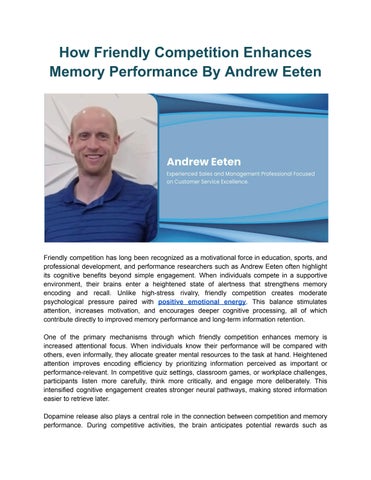
How Friendly Competition Enhances Memory Performance
By Andrew Eeten

Friendly competition has long been recognized as a motivational force in education, sports, and professional development, and performance researchers such as Andrew Eeten often highlight its cognitive benefits beyond simple engagement. When individuals compete in a supportive environment, their brains enter a heightened state of alertness that strengthens memory encoding and recall Unlike high-stress rivalry, friendly competition creates moderate psychological pressure paired with positive emotional energy. This balance stimulates attention, increases motivation, and encourages deeper cognitive processing, all of which contribute directly to improved memory performance and long-term information retention.
One of the primary mechanisms through which friendly competition enhances memory is increased attentional focus. When individuals know their performance will be compared with others, even informally, they allocate greater mental resources to the task at hand Heightened attention improves encoding efficiency by prioritizing information perceived as important or performance-relevant. In competitive quiz settings, classroom games, or workplace challenges, participants listen more carefully, think more critically, and engage more deliberately This intensified cognitive engagement creates stronger neural pathways, making stored information easier to retrieve later.
Dopamine release also plays a central role in the connection between competition and memory performance During competitive activities, the brain anticipates potential rewards such as
recognition, achievement, or social approval This anticipation triggers dopamine activity within reward circuits, particularly in areas linked to learning and reinforcement. Dopamine enhances memory consolidation by strengthening synaptic connections associated with the task When individuals answer correctly in a competitive setting, the positive reinforcement further solidifies the neural imprint. Even near-miss outcomes can enhance learning by increasing emotional investment and motivating future improvement
Friendly competition also improves memory through active recall and repeated retrieval practice Competitive environments often involve quizzes, timed challenges, or performance-based tasks that require participants to quickly retrieve stored information. Each retrieval attempt strengthens memory traces, a phenomenon widely supported by cognitive science research known as the testing effect The added motivational element of competition encourages repeated engagement, increasing the frequency of retrieval cycles. Over time, this repetition reduces recall latency and enhances retrieval fluency, making information more accessible in both competitive and non-competitive contexts.
Another important factor is moderate emotional arousal Friendly competition elicits mild physiological activation, heightening alertness without overwhelming cognitive capacity. This optimal arousal state enhances focus and improves encoding accuracy Excessive stress can impair memory by narrowing attention too sharply, but balanced competitive environments maintain enthusiasm while preserving cognitive flexibility. Participants remain engaged and motivated without experiencing performance paralysis This emotional equilibrium supports efficient learning and helps transform competitive experiences into durable memory gains
Social interaction further amplifies memory benefits Competing alongside peers fosters discussion, feedback, and collaborative analysis. These interactions encourage elaborative rehearsal, in which individuals explain their reasoning and connect concepts Verbalizing thoughts strengthens encoding by activating language centers and associative networks Observing others’ strategies also introduces alternative perspectives, prompting cognitive adaptation The combination of competition and collaboration creates a dynamic learning environment in which memory performance improves through both personal effort and shared insights.
Over time, repeated exposure to friendly competition builds cognitive resilience and confidence. Individuals become more comfortable retrieving information under mild pressure, reducing hesitation and improving recall speed The motivational structure encourages consistent practice, which is essential for strengthening long-term memory systems. Whether applied in academic settings, professional training programs, or recreational trivia nights, friendly competition provides a structured yet enjoyable pathway to cognitive enhancement As thinkers like Andrew Eeten emphasize, the strategic use of positive competition transforms ordinary learning experiences into powerful opportunities for improving memory performance and sustained mental sharpness