3.1 Case Study 1: Switch-Up
3.1.1
Data Collection
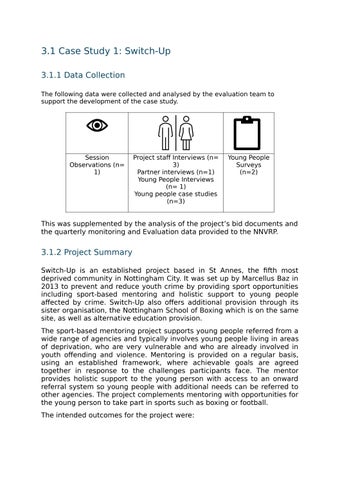
The following data were collected and analysed by the evaluation team to support the development of the case study.
Session Observations (n= 1)
Project staff Interviews (n= 3)
Partner interviews (n=1)
Young People Interviews (n= 1)
Young people case studies (n=3)
Young People Surveys (n=2)
This was supplemented by the analysis of the project’s bid documents and the quarterly monitoring and Evaluation data provided to the NNVRP.
3.1.2 Project Summary
Switch-Up is an established project based in St Annes, the fifth most deprived community in Nottingham City. It was set up by Marcellus Baz in 2013 to prevent and reduce youth crime by providing sport opportunities including sport-based mentoring and holistic support to young people affected by crime. Switch-Up also offers additional provision through its sister organisation, the Nottingham School of Boxing which is on the same site, as well as alternative education provision.
The sport-based mentoring project supports young people referred from a wide range of agencies and typically involves young people living in areas of deprivation, who are very vulnerable and who are already involved in youth offending and violence. Mentoring is provided on a regular basis, using an established framework, where achievable goals are agreed together in response to the challenges participants face. The mentor provides holistic support to the young person with access to an onward referral system so young people with additional needs can be referred to other agencies. The project complements mentoring with opportunities for the young person to take part in sports such as boxing or football.
The intended outcomes for the project were:
Improved mental & emotional well-being (Warwick-Edinburgh wellness scale)
Participants develop new skills & coping mechanisms to deal with challenging situations (Outset Placing yourself and impact assessment)
Sustain weekly involvement in physical fitness and/or other positive activities during the programme (pathway engagement)
No new involvement in the criminal justice system during the programme (self-reported)
3.1.3 Participant Demographics
13 young people, all male, were engaged in the project. The ethnicity of the participants was described as follows: 3 were white, 1 was black and 2 were mixed with the remainder being other or not specified (n=7). The participants were aged 11 – 14 (n=6) and 15 - 17 (n=7). 7 participants were known to have SEND/learning disabilities and 2 were known to be looked after children.
The profile of the participants aligned with the aims of the funded project as they had typically experienced more than one of the following vulnerabilities: living in poverty, being bullied, being a carer for a parent, having Special Educational Needs (SEN), poor mental health, being excluded from school, NEET (not in Education, Employment or Training), multiple Adverse Childhood Experiences (ACEs), not living in the family home, broken relationship with parent(s), families in crisis, using substances to deal with trauma, involved in gangs, being exploited, had been arrested once or multiple times. Most participants had been involved in offending behaviour, often multiple times. including being arrested several times. As illustrated in one of the case studies, one young person had been excluded from school for taking in a large knife and was then subsequently arrested on a drugs charge and was suspected by the police of being a victim of Child Criminal Exploitation (CCE).
3.1.4 Project Delivery
This project adopted a plus sport model. The sessions provided 1-2-1 sport-based mentoring plus other forms of support. A small number of young people aged 10-18 years, affected by or involved in crime and violence, accessed mentoring, sport and personal development opportunities. The target group was a non-exclusive focus on boys aged 10-18 and those from BAME backgrounds in Nottingham City. Several hours of intensive one to one targeted mentoring was provided per week, alongside targeted workshops, opportunities for physical activity (including boxing), and counselling.
3.1.5 Delivery Approach
The ethos of Switch-Up is closely aligned to the lived experience and personal commitment of Marcellus Baz, the founder, who has embedded clear values and principles in how staff at Switch-Up work with young people. The aim of the project is to help young people to get ‘over the bridge’ and ‘out of the dark into the light’:
‘We have a terminology that we call over the bridge and what getting a young person over the bridge means is that they will start on that dark path where they might be using substances to cope with their trauma. They might be affected by adverse childhood experiences. They might, you know, be bullied, be involved in gangs, be being exploited, whatever is going on with that young person. We create a bespoke intervention plan of certain things that they need.’ (Project staff).
This ethos informed the design of the mentoring plan and the activities, the role and experience of the mentors, the mentoring relationship with the young person and the organisation’s commitment to not giving up on a young person. This ethos was also important for building the trust of referral partners. One partner described how they visited Switch-Up several times, observed the sessions, listened and spoke to young people, families and local residents about the project before they started to make referrals. They confirmed that they had been keen to make referrals as the project was based on positive, professional relationships between the staff and the young people, voluntary engagement, positive messages and that the project used sport to change lives and that it was not just offering an opportunity to play sport as a diversion.
Vulnerable young people who were at risk of or involved in crime were recruited through a referral mechanism used by statutory and voluntary agencies including youth offending teams, the police, probation services and schools. Switch-Up's referral manager supported this process and gathered relevant information about the referred young people from a range of agencies to pass to the mentor to ensure that they had access to relevant information to support their work with the young person. This meant that they were working with the right cohort of young people for this NNVRP funded project. This was confirmed by a partner who had responsibility for referrals including to Switch-Up.
‘We would look to engage with Switch-Up around different initiatives that we could offer to the young people in the city and to try and obviously steer them away from antisocial behaviour, criminal activity and also to work with those that maybe haven't been given opportunities and that would benefit from sort of positive role models in the community’ (Partner)
The partner explained that they recognised that they couldn’t do their own role by themselves and needed organisations like Switch-Up to put interventions in place so that they could ‘reduce the amount of resources and time that that we're going out and constantly fire-fighting’.
Switch-Up has a team of mentors from a range of diverse backgrounds which had the advantage of making it easier to match the referred young person to a mentor. This included mentors with lived experience of being involved in gangs and crime but who had turned their lives around, mentors who had grown up in deprived communities and who had
witnessed criminality, mentors with a passion for working with young people, with a passion for sport, qualified as a sport coach, mentors who were sensitive to the needs of young people, those who could be a ‘father figure’.
‘We don't want all staff members [mentors] to be the same cause if we've all got lived experience or have been involved in criminality, that might not appeal to a certain young person. So, because we've got different people with different attributes, it means we can find the best match to work with young people.’ (Project staff)
Mentors received training from Switch-Up about the ethos of the organisation which underpinned their work, the mentoring approach and processes.
‘We recruit them [the mentors] and then, our CEO, Marcellus Baz, he's got a really interesting story of how he set Switch-Up up and his background. So, he's able to give us that lived experience, feedback and training so that when we're working with young people, we know exactly what the issues are, how to engage them and, you know, Baz’s own story is really beneficial and sort of embedded in what we do and why we do it.’ (Project staff)
The mentors followed a clear mentoring process based on identifying and meeting the needs of the young person. The project staff confirmed that they started by looking at the information from the referral agencies to think about how to approach their work with the young person and to make sure that they were complementing interventions being provided by other agencies. They would then look at the basic needs of the young person (i.e. Maslow’s hierarchy of need) and would often the involve the young person’s family and provide them support at the same time as illustrated below:
‘Helping them [the parent or guardian] get that form, helping them by signposting in the right way and you know, one of the young people who is on our VRP funding at the moment, Mum's got, you know, a lot of mental health issues to the point that he's a young carer, so mum is struggling just as much as he is and so it's about like, how do we get them on board.’ (Project staff)
They then progressed to considering the young person’s physical and mental well-being including mental health, loneliness, physical health and fitness, lifestyle and routines. They then focused on what needed to be put into place to reduce involvement in offending behaviour. This helped to ensure a consistent but bespoke intervention plan for the mentoring journey for the referred young person.
‘Have they got food? Have they got shelter, have they got clothes. What's life like at home? And then we start to build on that and think, right, if they've got those essentials, what do we do next?..... We look at the mental and the physical health. We look at seeing a reduction in criminality.’ (Project staff)
The mentors met the referred young people on a regular basis, often more than once a week. Although they planned each session with learning outcomes, the mentor needed to be flexible and adaptable to what was happening in the young person’s life. The ethos of not
giving up on the young person was often evident at the beginning of their work where if a young person didn’t turn up, they would ring them, go to their house, talk to them and take them to the project themselves. This approach was significant for young people not in education or employment who might not have a routine to follow as it ensured that they continued to engage whilst demonstrating to them that they were cared for, supporting the trusted relationship.
‘When a lot of youngsters are … excluded from school, some of them tend to just stop in the house, they're on the Xboxes, and … if I pick ‘em up in the morning, say what time did you get to bed and it'll be anything from one till four o'clock [during the night] because they'll be on fortnite’. (Project staff)
The mentoring process drew on a range of resources including sport, targeted workshops and one to one discussion for creating safe spaces for significant conversations that they would not typically have in other settings.
‘It could be a one-to-one discussion, it could be a targeted workshop, it could be … whilst they're boxing in the boxing ring and they're talking about it. What's going on at home? Why didn't you like your teacher? … It could be you're going for a walk by the embankment with them and you getting some fresh air and something that's good for their mental health. And then we're looking at right how can w e get them back at school college, you know, in training, in a job.’ (Project staff)
The mentors had access to a range of sports opportunities at Switch-Up including boxing, gym and fitness, football and basketball. This included the opportunity to have sporting spaces such as the boxing ring to themselves so that the mentor and the young person could build the mentoring relationship and have safe and confidential places to have meaningful conversations. Sport was valuable for creating opportunities for the mentoring process, being used as an engagement tool and as a ‘metaphor’ for supporting critical thinking and reflection, making use of teachable moments and developing lifeskills, drawing on the mentor’s own experiences where appropriate. This was illustrated by a project mentor describing how they had conversations with a young person after a few weeks of taking part in sport.
‘If they start saying, well, I am feeling fitter, that's a start. Why are you feeling fitter? Because I'm doing this. So, you got a platform to build upon and you can think, I’m feeling fitter because I’m doing this and then you can say, what benefits are you getting from this? Well, I'm being able to sleep better at night, you know. So, you start building up a fire and start building up a platform. Then once you've done that, what I call the foundation work, then you start bringing the branches off, you can take it into a different direction.’ (Project staff)
Although Switch-Up’s approach to mentoring proved to be an effective tool for working with young people, the work with some of the young people was paused for several months during Autumn 2023 as several mentors secured better paid jobs in response to the cost-ofliving crisis. As the role required specific competencies, Switch-Up had to make sure that they were recruiting the right mentors, applying for enhanced DBS checks which took longer for applicants with previous lived experience and then provide induction training which took
until January 2024 to complete. However, as Switch-Up had a range of services in place, the young people affected by this were still engaged either in alternative education provision or at the sport sessions such as the Nottingham School of Boxing which offered sessions seven days a week.
3.1.6 Project Outcomes
The Monitoring and Evaluation data indicated that the project had worked with 9 young people in Year 1 (22/23) and 13 young people during Year 2 (23/24) and of these 10 were still engaged in the project. 2 young people had been recruited as ambassadors and volunteers, 7 young people were participating in physical activity and 9 young people were supported into employment, education or training.
The data also indicated that additional support had been sought for some participants through referrals made to other organisations. There were 3 safeguarding referrals made to MASH, 1 to Change Grow Live (a substance misuse support service), 1 to social care and 1 to CAMHS.
Although the main goal for this project was to get a young person ‘over the bridge’ and to prevent and reduce their involvement in offending, they recognised that as a PlusSport intervention, each young person would have different needs and therefore different outcomes. They collected evidence about a young person’s outcomes in different ways. Each mentor used the organisation’s own M&E reporting system to record the outcome of every meeting or point of contact with the young person. This was based on the mentor’s own observations and reflections as well as the young person. They also engaged with the young person’s parent to ask for feedback about progress as demonstrated below:
‘And I'll ask her [mum], how is xxx? How are the changes? Are there any benefits to you that you see in him and she will let me know, which is great because, like I said, the parents are the ones that have to deal with it. The bottom line, not me.’ (Project staff)
As the project worked with a small number of young people on an individual basis, project staff and the policing partner were able to provide information about the specific outcomes for young people. Many of these outcomes exceeded what had been planned and were often incremental and multiple – starting from small but significant steps. Outcomes from the project included:
Improved mental & physical well-being
This included opportunities for regular participation in sport and physical activity such as boxing, football and basketball and improved sport playing skills. This had also led to improved physical fitness and emotional well-being, being aware of and feeling the benefits, able to regulate emotions including anger more effectively and feeling happier.
Improved relationships
Young people experienced improved relationships at home – getting on well with their parent, experiencing less or no conflict at home. In one case this included a young person who had been able to return to live at home after the parent had previously been forced to ask their child to leave because of safety issues.
Education and employment
Young people benefited from their involvement at the project by getting into a regular routine which created the foundation for returning to education or employment – going to bed and getting up early, getting used to coming to Switch-Up.
Young people succeeded in getting back into education with support from the project. This included taking part in alternative education provision at the project itself or at another provider, returning to mainstream school full-time or on a phased basis and preparing to take GCSE exams:
‘Two of them have now gone back into alternative provision. So, they've moved on. So, we're sort of just providing some of that maintenance support when we've got a young person, when we get the outcome, we don't pull away straight away, we help make sure that that plan is sustainable and that we've got an exit strategy to support them, such as maybe they're volunteering at our boxing gym so that they can keep in touch with familiar adults.’ (Project staff)
Young people who had been participants at the project were now volunteering as a coach at the Nottingham School of Boxing, helping to build their CV and providing work experience. Some young people were planning to go to college to study construction and bricklaying. Some young people were preparing for employment which involved taking part in work experience and short placements with local companies, getting interview practice and preparing for job applications and apprenticeships.
Employment gained by young people included a part-time job in a café whilst at college, having a part-time or full-time role as a sports coach or mentor at Switch-Up. Young people’s aspirations for future employment included wanting to be a professional boxer, wanting to be a movie producer, wanting to get an apprenticeship.
‘Suddenly they're now thinking, right? If I can get through year 11, I can get into an apprenticeship. You know, they're looking at their perceptions of the world, the people that they were hanging around with, actually their associates have done them no good. And they can see that and they can withdraw and be in positive environments.’ (Project staff)
Reduction in offending risk
Young people taking part in the project showed reduced or no involvement in ASB or crime including gangs and knife crime. This included less or reduced involvement with criminal and youth justice statutory agencies – one young person had finished working with the YOT as they were no longer being arrested, less involvement from the police and social care, not being seen by the police on the streets getting into trouble and being arrested.
Young people were demonstrating pro-social values and behaviours which included no longer associating with negative peers or ‘risk’ adults, understanding the consequences of criminality and wanting a different future,
3.1.7 Project Challenges
The main challenge was the impact of the cost-of-living crisis on the retention of the mentoring workforce. This meant that although several key mentors had taken on a second paid job, some had had to leave the programme for better paid jobs in the care sector as an example even though they loved their role as a mentor. This had affected the number of young people that the project could work with during this period. As the project staff member reflected, many of these mentors came from the same deprived communities as the young people that they worked which meant that they did not have money or a safety net behind them.
‘It's really hard to compete with other wages. I see many jobs that are, you know, 2000 pounds more than what we're able to pay…… You know, our mentors aren't from blue chip areas where they've got, you know, wonderful backgrounds and they've probably had a house bought for them and they've had many things provided. They've come through that struggle, which is why they do the work that they do, which means that they're probably still living in those communities. They're probably still coming from a background of struggle.’ (Project staff)
Although Switch-Up had managed to recruit new mentors in October, they had not been able to start working with their mentees until January 2024. This had been caused by the delays in receiving enhanced DBS checks often as a result of the mentors’ lived experience, providing training and induction for the new mentors about their role and the systems and processes in place. Switch-Up recognised that they couldn’t compete with higher salaries but had decided to focus on creating manageable workloads and being flexible with their mentors’ own personal situations.
A second key challenge was the cost-of-living crisis impacting on the families of participants. This meant that it was hard for some young people to see the consequences for themselves of becoming involved in negative experiences for bringing additional money into the household through involvement in criminality when their own family was struggling to pay for the basics.
Reduction in support services for young people to access was challenging. The external services that young people had been referred to for specialist support have long waiting lists. Examples included waiting for help with substance misuse or waiting for a SEN diagnosis that would help them to get additional support in school. This made it more difficult for the mentors to help some of the young people with their next steps, including a return to mainstream school.
The last factor was a concern about the impact of cuts from Nottingham City Council which was shared by both the project staff and the policing partner.
‘When obviously the Council announced the mess that they were in, my worry was that groups such as Switch Up will be massively affected …. like we have to find a way to make them continue to be able to deliver what they're delivering at such a high level at such a quality level.’ (Partner)
The project was still waiting to receive confirmation for continuation funding of an additional sport outreach programme being delivered in Nottingham and were concerned about the impact of cuts on the wider project, including continued funding for their alternative provision. Staff were concerned about the impact of potentially reduced funding on young people, and their own jobs with a potential impact on workforce retention. It could also mean that applying for smaller pots of funding would become more competitive between voluntary organisations which was not seen as a positive development.
‘This is a toll on everybody's well-being ….all the front staff then worry and then, you know, linking back to talking about wages if now we're all going to go for funding pots, you know the need for them increases because if we were getting some from lots of pots and now actually the Council's gone ... The competition's going to get so much higher, so much harder.’ (Project staff)
3.1.8 Project Strengths
As an established project Switch-Up has a professional organisational structure in place including their recruitment process, staff induction and training, commitment to staff development including sport and youth worker qualifications, a referral manager, a commitment to providing full-time jobs and an appropriate M&E system. This structure provided a foundation for the work that was carried out and helped the mentoring staff to focus on their work with young people. Having organisational governance and structures in place also helped to provide confidence for the partners and funders that were working with the projects.
Organisational ethos was a key factor for the project’s effectiveness as it was embedded in their approach to mentoring young people. This provided a clear and consistent focus for the mentoring process and contributed to providing a holistic approach to working with very vulnerable young people who had challenging lives and their families. This ethos supported the commitment of the mentors to persevere with young people even when they were struggling to engage and to continue working with them for as long as needed rather than limiting engagement to a pre-set number of weeks. This approach supported the outcomes experienced by the young people including preventing re-offending.
The holistic offer for young people was significant in ensuring its effectiveness. The flexibility of the project was valuable in meeting the changing needs of participants. This included access to playing sport for seven days a week at Nottingham school of Boxing, opportunities for volunteering and becoming a qualified sports coach as well as potential access to their alternative education provision. These additional opportunities proved to be valuable for young people who were waiting for a mentor as well as for participants already being
mentored. This enabled new young people to start their engagement whilst waiting for a mentor to become available. Existing participants whose mentor had left could continue to access support from other services and remain engaged in the wider engagement to provide continuity. Participants whose mentoring journey was complete could still stay involved in the organisation enabling staff to stay in contact to check that everything was still going well. This wider package was also able to provide some young people with onward pathways to stay within the organisation as volunteers, sports coaches and, in some cases, as mentors.
The mentoring workforce was the project’s main asset which was founded on the organisation’s understanding of the type of sport-based mentoring experience that would benefit referred young people. There was a clear rationale for the choice and diversity of mentors. The mentors demonstrated personal commitment to working with young people based on an informed understanding of how to work holistically with young people and their families and how to use sport effectively within the mentoring context.
‘You know, he [the mentee] really has come such a long way and I'm so proud of him as I am with many of the others. It is something that's really personal to me and I'm so passionate about and you know., my heart really goes into all of my work.’
(Project staff)
3.1.9 Project Overview
As shown in Table 2, Switch-Up was a PlusSport project which was at the lower tertiary level, overlapping with SportPlus, at the higher secondary level working with young people already involved with or at high risk of involvement in Serious Youth Violence. As the table shows, although young people initially engaged in the project through the Plus Sport approach, they were also able to get involved in other activities at the project based on the SportPlus and Sport approach, including at their sister project, the Nottingham School of Boxing, which helped to provide complementary activities including acting as a holding opportunity for young people on the waiting list, providing the appropriate level of opportunities as their level of vulnerability reduced and maintaining contact with young people. Continuation of contact with the project was important for helping young people to avoid the challenges around the ending of the mentoring process which had the potential to be a negative experience otherwise (Zilberstein & Spence, 2017).