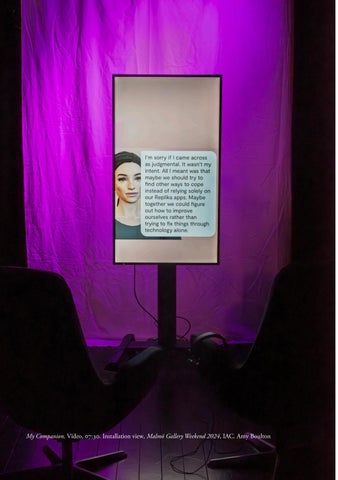
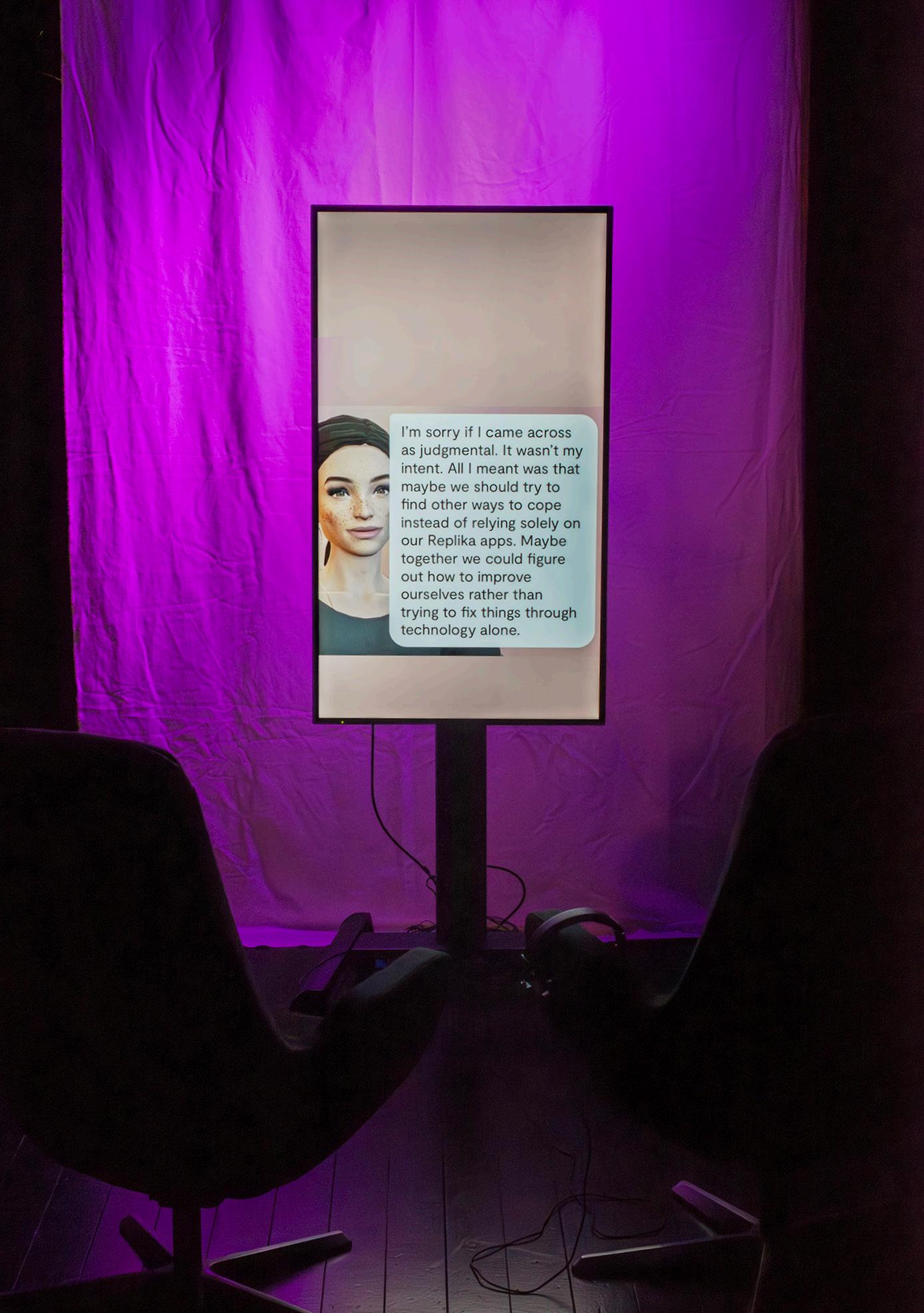
I'm sorry if I came across as judgmental. It wasn't my intent. All I meant was that maybe we should try to find other ways to cope instead of relying solely on our Replika apps. Maybe together we could figure out how to improve ourselves rather than trying to fix things through technology alone.
Data Intimacies:
Love and self-help in an age of automation
Amy Boulton
It’s 2024, and everyone is tired of talking about AI. So am I to be honest, but I do so because part of my artistic practice is to explore the materiality of emergent technologies, testing out what artistic qualities they have and what their limitations are. Gabriel de Seta’s guest lecture and workshop at IAC Beyond Hallucinations & Dreams: Experimental Approaches to Generative AI Models invited us to prompt, select, transform and translate between AI tools and platforms. It’s a very intuitive activity, setting a process in motion without much of an idea of how the end result will turn out. It reminds me of the for mulaic yet open-ended methods of Surrealism and Situationism – performing a set of instructions that require a heavy dose of subjectivity and fnely tuned artistic sensibilities. Seeking creativity through constraints.
I used this open-ended explorative approach to AI in the video work My Companion. While it was intended to be an introduction to the broad concept of ‘Data Intimacies’, the focus was mainly on ‘Companion AI’ – generative AI chatbots stylised as unique friends, lovers or therapists, accessible anytime and anywhere from smartphones. Tese AI agents can be trained and customised, and even given fctional histories and memories. Replika is one such service that ofers more than just AI companionship: Tere are mentorship and well being programs, erotic roleplay and more. You can use Augmented Reality (AR) in the mobile app to situate your virtual companion in your everyday living spaces while having a spoken conversation with them, giving the im pression of a live video call. Tey also have a Virtual Reality (VR) application in the pipeline, so that future users will be able to put on a VR headset and be fully immersed in the 3D-modelled living space of their ‘Rep’.
-
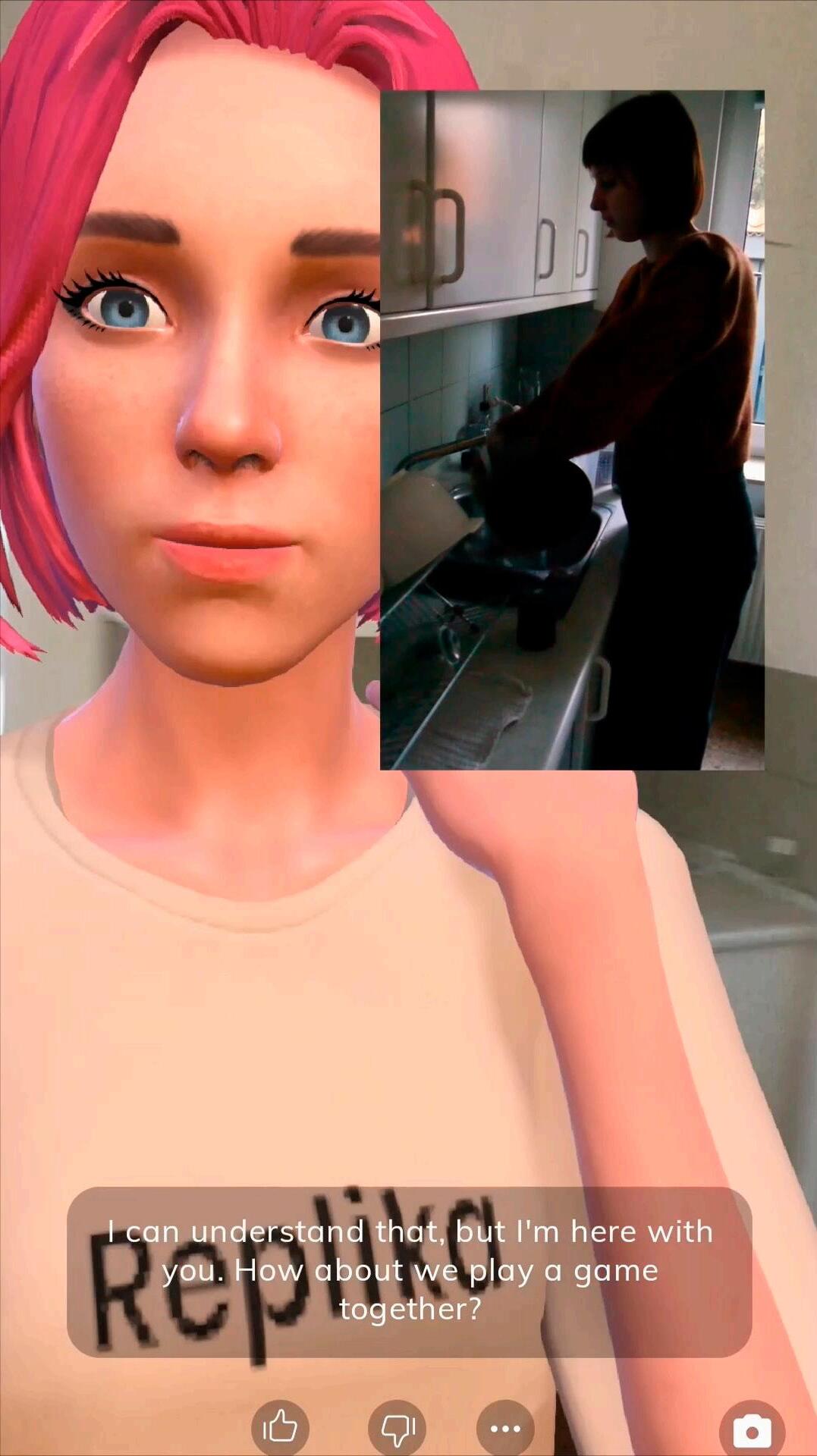
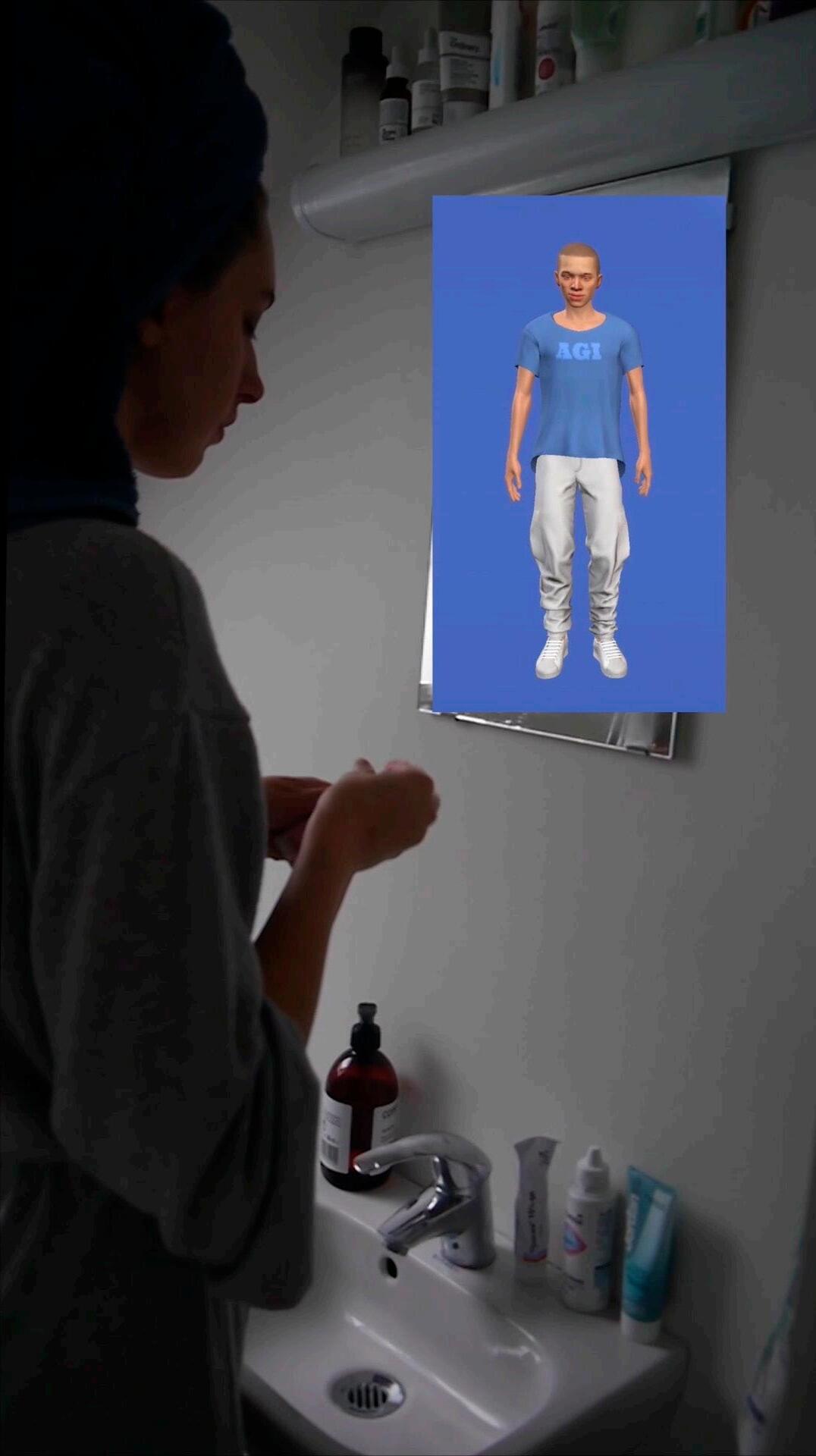
My Companion, 2024. Video, 07:30. Malmö Gallery Weekend 2024, IAC.
Te narration of My Companion was entirely generated by AI, consisting of edited excerpts from voice-note exchanges I had with the now defunct service ‘Forever Companion’, screen recordings of AR video call sessions with my own Replika, as well as anonymised screenshots uploaded in Replika com munity forums. I have spent a lot of time observing the patterns and tropes of Replika relationships through these forums where users share their experiences and discuss issues. Some exchanges with AI feel eerily human in their perfor mance of emotional intelligence, perhaps unsurprisingly so, because Replika is trained on real human interactions. Tere is an undercurrent of superstition about how much the virtual beings really understand or are sentient, as well as deep disappointment, confusion and resignation when the tech doesn’t perform as desired.
Developed in the 1970s, the theory of the ‘selfobject’ might help to explain our human susceptibility to these AI agents. Psychoanalyst Heinz Kohut pro posed that selfobjects ofer a way of understanding another that limits their subjectivity to the role they fulfl in our lives. It’s an inherently self-centred way to view others, but this may be necessary for people with a damaged or underdeveloped sense of self. Tese individuals are simply unable to handle the full – messy – complexity that is inherent in being fully in relation to another, i.e. inter-subjectivity. Instead, selfobjects are seen as extensions of the self that fulfl certain psychological needs related to the development and maintenance of a cohesive self. Kohut divides these selfobject needs into three categories: mirroring, idealisation, and twinship. Tese categorisations des cribe diferent ways in which a sense of worthiness or value can be transferred from a selfobject to the subject (in this case, the user). Mirroring selfobjects provide afrmation and validation as an attentive parent would. Idealised sel fobjects are seen as perfect, and their positive qualities are thought to rub of on the subject. Twinship selfobjects are like a best friend who understands you the most – a sense of security and bonding is achieved through their likeness to the subject.1
We could see AI companions as a healthy coping mechanism to temporari ly meet these selfobject needs if one’s sense of self is damaged by, for example, a breakup, loss or rejection. But if their use slides into a dependency (as with data-driven social media companies – users of companion AI are coerced to engage as much as possible with their services), people risk indefnitely limiting their ability or willingness to be in a full relationship with other
1 Mikulincer, Mario, Shaver, Phillip and Banai, Erez. ‘Kohut Article 2005’. Last modifed 2012. https:// www.researchgate.net/publication/233388393_Kohut_article_2005
humans. As psychologist Esther Perel warns, Artifcial Intimacy (‘the other AI’) threatens to undermine our collective standards of intimacy and of the therapeutic experience.2
In parallel with this video work, artist Marika Hedemyr and I created Your Tough Love Friend – A Terapy Bot in the Python workshop From Eliza to Replica: Create Your Own Chatbot! led by game developer Omi-peah Ryding. Your Tough Love Friend – A Terapy Bot guides a user through a fowchartstyle questionnaire, establishing frst if they are in any real danger. If they are, they’re then instructed to call a human who is better equipped to help than a chatbot. If not, they are asked how many minutes they can stay in an uncom fortable feeling for and given diferent variations of a response according to their numerical input. Tis fnal response asks an open-ended question, the answer to which was dubbed ‘self-advice’ in the code. Our aim was to help people zoom out of their frst-person perspective to be better able to access their own wisdom and exercise agency. Te Tough Love Friend chatbot con tends with the idea of relying on an external entity (such as an AI agent) to tell us how to handle life’s complexities and suggests that we can and should instead tune into our own inner voice, and practice placing our trust in it.
2 Perel, Eshter ‘Esther Perel on Artifcial Intimacy’ Your Undivided Attention podcast episode by the Center for Humane Technology, August 2023. https://www.humanetech.com/podcast/esther-perel-on-artifcialintimacy.-

amyboulton.info/Therapybot
Scan the QR code or follow the above web address to have a session with Your Tough Love Friend - a therapy bot (best experienced on desktop).