
Hans Hofmann 2026

Page 1


HANS HOFMANN

HANS HOFMANN

“Hofmann’s ability to handle paint, to fuse the action of painting and drawing into a single, immediate gesture, carried colored pigment into the viewer’s presence with the force of a bomb.”1

Frank Stella (1936-2024)

HANS HOFMANN

Frank Stella was right. The sheer pleasure of being assailed by a luminous explosion of color in the paintings of Hans Hofmann (1880-1966) is an unmatched visual experience. Few artists of his era imparted color and form onto the canvas with the exuberance of Hofmann. He had a distinctive and intuitive understanding of color and its retinal impact, and he was unrivaled in his ability to convey pictorial space and movement in his paintings. However, Hofmann’s dual legacy as an artist and a teacher has complicated the reception of his singularly strong, vibrant oeuvre. He was arguably the most influential art teacher in America of the twentieth century, responsible for laying down the pedagogical foundations that produced so many innovative and successful abstract expressionists. Hofmann’s passion for teaching has, paradoxically, both burdened and energized the critical response to his artistic practice. The time that he spent among his students in New York and Provincetown, Massachusetts, from 1934 to 1957, robbed him of time for his work, but it simultaneously provided a laboratory for him to become, in the critic Clement Greenberg’s words, “a virtuoso of invention.”2 His prominence as a teacher also served to elevate his importance as an artist. Sixty years have elapsed since Hofmann’s death in 1966, but his art remains captivating and relevant. And it speaks even more powerfully today: A new generation is free to focus solely on Hofmann, the artist—and can surrender to the intoxication of his expressive color.

1 Frank Stella, “Bombs Away: Hofmann at 2000,” Art Press, no. 278 (April 2002): 31.

2 Clement Greenberg, “Hans Hofmann,” Art and Culture: Critical Essays (Boston: Beacon Press, 1989): 189.

Hofmann regarded color as a “complete medium in itself,”3 and he expressed himself through a limited range of colors that led to unprecedented explorations of abstract composition. By the early 1940s, he had developed a path to abstraction exemplified by small works like Submerged (1940), a ravishing inquiry into the effects of white on blue. He was deeply aware of the “might of white”4 and its potential to dominate a painting, so he used it judiciously and only when, in his words, “there was a need in a certain area.”5 Much later, a similarly small yet intellectually outsized meditation on the potency and energy of red with white appears in Shimmering Red (1952). White emerges, more cogently, in 1960 in Stormy Blue and Blue Mountains and, playfully, in [Untitled] (1961).

Hans Hofmann Class Criticism, ca. 1938, Provincetown, MA

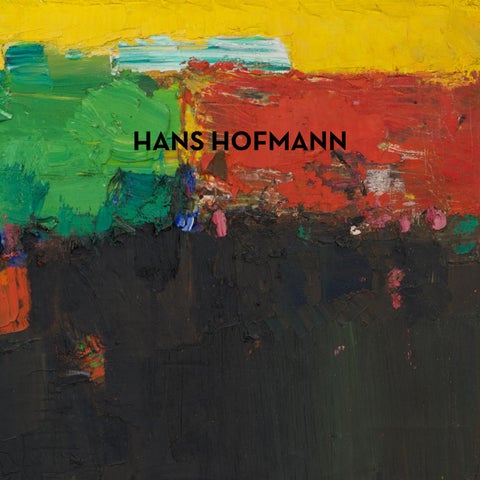
Black presented challenges similar to those Hofmann cautioned about with white, especially if it was mixed with other colors. Hofmann liked to say, “The danger is great that it will eat them.”6 It is interesting, then, that within a year of closing his art schools in Manhattan and Provincetown to devote himself to his practice, the artist made an assertive painting, Blissful Darkness (1959), with black as its dominant color. In this large, dramatic work, black is a structural force that occupies the center of the composition, but it still allows for yellows and greens and, yes, white, to appear spatially active. Although it is more experimental than the architectonic “slab” paintings for which Hans Hofmann is best known—works that exemplify his push/pull theory and that he exhibited at the Venice Biennale in 1960—it is nonetheless closely related to them. It benefits, however, from being less rigidly composed than the “slab” paintings, and Hofmann liberates it from their strictures and didacticism.

Blissful Darkness shows the palpable tension between problem-solving and self-expression. In this painting, Hofmann operates in the interstices between the two.

3 “Hofmann Lecture No. VII,” typescript, Lillian and Frederick Kiesler Papers, [circa 1910]-2003, bulk 1958-2000. Archives of American Art, Smithsonian Institution. Part of the Winter 1938-39 lecture series attended by Greenberg.

4 Loose notepaper, handwritten and undated. Hofmann Papers. Quoted in Dawn V. Rogala, “Hans Hofmann’s Last Lesson: A Study of the Artist’s Materials During the Last Decade of his Career” (PhD dissertation, University of Delaware, 2014): 277.

5 Quoted in Tina Dickey, Color Creates Light: Studies with Hans Hofmann (Salt Spring Island, B.C.: Trillistar Books, 2011): 280.

6 Ibid.

Overall, Hofmann often confined himself to a handful of bright bold colors. Reds, yellows, greens, and blues define relationships in space, and their juxtapositions elucidate the tenets of Hofmann’s principles of push/pull, in which the interplay of assorted colors creates movement and depth on the flat picture plane. Cool colors like blue and green recede, while warm ones, namely red and yellow, push forward, allowing for visual tension and a dynamic equilibrium, so they can exist together on the canvas. Hofmann believed that color should be fused expressively and plastically.7 This is clearly visible in Verde Chiaro (Light Green) (1949), an experiment on the possibilities of color proximity: Green, red, and yellow are used primarily, and they move on the surface with cyclonic energy. Verde Chiaro (Light Green) functioned as a testing surface for various color combinations and mixing techniques that found fruition fifteen years later in [Untitled] (1964). Hofmann made this lively painting, which he dedicated to his muse, Renate (who later became his second wife), during a productive period of unrestrained innovation that also marked a frenzied immersion in his work following the death in 1963 of his beloved first wife, Miz. [Untitled] (1964) is a terrific example of the artist’s comprehension of color relationships. Thickly applied blue and red paint anchor the composition and give it a voluminous weight. Hofmann also mixes in yellows and greens to push against the blue. The decision to leave some of the Upson board exposed heightens the effect by allowing the eye to focus on clusters of kaleidoscopic energy. In this painting, process is of paramount importance. It embodies Hofmann’s general observation that “a picture should be made with feeling, not with knowing.”8 Here, as with many others in Hofmann’s oeuvre, expressive abstraction conveys the vitality of nature without referring to it directly.

Nature was a guiding source for Hofmann throughout his career. Abstraction and nature are non-mutually exclusive properties of his paintings, with representation and nonrepresentation existing together. In The Bay (1952) and Fall (1960), he uses brushstrokes and color to evoke mood. In Dead Crow (1960), the black, abstracted bird becomes an active chromatic presence that animates and

7 “Plastically” in Hofmann’s terminology refers to the creation of three-dimensional depth, volume, and movement on a flat planar surface using color and form rather than perspective or lines.

8 Hans Hofmann quoted in Henry Geldzahler, Hans Hofmann: The Renate Series, exhibit catalog (New York: Metropolitan Museum of Art, 1972): 12.

Memoria in Aeternum, 1962, Oil on canvas, 7 x 6 1/8 feet (213.3 x 183.2 cm). The Museum of Modern Art, New York, NY, Gift of the artist.

balances the intensity of the resplendent colors surrounding it. Hofmann often worked en plein air in Provincetown, dragging his easel and canvases onto the sandy dunes of Cape Cod. Though he painted many works in situ, those created later in the studio, such as the jewel-like long-and-narrow horizontal works [Untitled] (c. 1960-65) (right, p. 21) and [Untitled] (1962), became afterimages of the light and color that Hofmann experienced in nature. These are experimental, portable works with a commanding presence. For Hofmann, scale does not matter. He can shout with the smallest of paintings and whisper with largest ones.

Just as we think we have figured out who Hofmann was as a painter, he proves himself to be—as Stella once noted in admiration—“a wise guy.”9 We are familiar with the painter who embraced texture and liberally applied colors (with a loaded brush or palette knife) that served to fulfil his dictum, “In nature light creates color; in the picture, color creates light.”10 Then he pivots. He thins the paint. In doing so, he creates the most ethereal and featherlight compositions of his later years. In Grief (1961), Mirage (1962), and Pénombres du Soir (1961), Hofmann severely restricts his palette and stains the canvases with splashes of color and the lightest of brushstrokes to support a gestural painterliness in which the natural world yields to the immediacy of perception. The saturation of the browns that convey dusk in Pénombres du Soir or the reds in Grief, which are so different from his reds in Shimmering Red, invite deep reflection and solace. These paintings, alongside Floating Mirage (1961), are eloquent examples of pure painting; the work itself, rather than fulfilling an illustrative function, becomes an object of

9 Frank Stella on Hans Hofmann www.youtube.com/watch?v=elB3IOj-w8w. Uploaded by Peabody Essex Museum, December 2, 2019.

10 Quoted in Barbara Rose, ed., Readings in American Art, 1900-1975 (New York: Praeger Publishers, 1975): 117.

contemplation and aesthetic enjoyment. We do not just see these paintings; we experience them. They represent direct spiritual and emotional communication from artist to viewer through form and color. It is unlikely that Hofmann would, or could, have made these works during his teaching years. The same is true of The Prophet (1962), which he finished the same year that he finished Memoria in Aeternum (Eternal memory) (1962), which was acquired by the Museum of Modern Art. It was created as an homage to five artists: Franz Kline, Jackson Pollock, Arshile Gorky, Bradley Walker Tomlin, and Arthur Beecher Carles. A bright yellow, angular shape with the heft of an anvil has been set at an angle on a background of saturated browns that exceed the boundary of the top of the canvas but do not reach the bottom. It’s as if the artist wanted to give his medium free rein. The yellow shape floats, but it also moors the painting, providing substance to its delicate background. This painting reminds us that color, in Hofmann’s estimation, had mystical, poetic, and expressive qualities.

Hofmann’s paintings never disappoint. He was both a painter of magnificence and a magnificent painter.

Submerged, 1940

Oil on panel

7 3/4 x 9 3/4 inches

19.7 x 24.8 cm

Lower right: “hans hofmann 40”

Verso lower center: “Cat. 515-1940 / Submerged / 7 3/4 x 9 3/4”

HH cat. no. 515-1940

HH cat. no. 518-1940

Estate no. U-0019

HH CR no. P308

Renate, Hans and Maria Hofmann Trust (acquired 1996)

Provenance

Estate of the artist (1966-1996)

Literature

2014 Villiger, ed., Hans Hofmann: A Catalogue Raisonné of Paintings, Vol. 2, color ill. p. 182, cat. no. P308

Verde Chiaro (Light Green), 1949

Oil on board

15 x 22 inches

38.1 x 55.9 cm

Verso center [MH; partially obscured by strainer]: “[...]-1949 / [...] chiaro (light green) / [...] cardboard / [...] x 22”

HH cat. no. 409-1949

Estate no. M-0912

HH CR no. P736

Renate, Hans and Maria Hofmann Trust (acquired 1996)

Provenance

Estate of the artist (1966-1996)

Exhibitions

1977 David Mirvish Gallery, Toronto, Canada, “Hans Hofmann,” 3 December - 3 January (solo)

Literature

2014 Villiger, ed., Hans Hofmann: A Catalogue Raisonné of Paintings, Vol. 2, color ill. p. 450, cat. no. P736

Night, 1952

Oil on panel

8 x 9 1/2 inches

20.3 x 24.1 cm

Verso lower center [MH]: “Cat. 510-52 / Night 8 x 9 1/2”

HH cat. no. 510-1952

Estate no. M-0841

HH CR no. P894

Renate, Hans and Maria Hofmann Trust (acquired 1996)

Provenance

Estate of the artist (1966-1996)

Literature

2014 Villiger, ed., Hans Hofmann: A Catalogue Raisonné of Paintings, Vol. 3, color ill. p. 36, cat. no. P894

Shimmering Red, 1952

Oil on panel

7 1/2 x 9 3/4 inches

19.1 x 24.8 cm

Verso center [MH]: “Cat. 1077-52 / Shimmering Red / oil plywood / 7 - 9 3/4 / Hans Hofmann”

HH cat. no. 1077-1952

Estate no. M-0867

HH CR no. P891

Renate, Hans and Maria Hofmann Trust (acquired 1996)

Provenance

Estate of the artist (1966-1996)

Exhibitions

1982 André Emmerich Gallery, New York, NY, “Hans Hofmann: The Small Late Paintings,” 7 - 30 January (solo)*

Literature

2014 Villiger, ed., Hans Hofmann: A Catalogue Raisonné of Paintings, Vol. 3, color ill. p. 34, cat. no. P891

The Bay, 1952 Oil on board

9 x 17 3/4 inches

22.9 x 45.1 cm

Original verso has been lined with canvas; on board attached to strainer [MH]: “Cat. 1072-1952 / The Bay / oil on cardboard / 9 x 17 3/4”

HH cat. no. 1072-1952

Estate no. M-0864

HH CR no. P895

Renate, Hans and Maria Hofmann Trust (acquired 1996)

Provenance

Estate of the artist (1966-1996)

Exhibitions

1980 Richard Gray Gallery, Chicago, IL, “Hans Hofmann: The Late Small Paintings, 1952-1965,” 15 November - 31 December (solo),* color ill. n.p., cat. no. 1

Literature

2014 Villiger, ed., Hans Hofmann: A Catalogue Raisonné of Paintings, Vol. 3, color ill. p. 36, cat. no. P895

[Untitled], c. 1960-1965

Oil on board

23 1/4 x 18 1/4 inches

59.1 x 46.4 cm

Estate no. M-0537-23

HH CR no. PW59

Renate, Hans and Maria Hofmann Trust (acquired 1996)

Provenance

Estate of the artist (1966-1996)

Literature

2014 Villiger, ed., Hans Hofmann: A Catalogue Raisonné of Paintings, Vol. 3, color ill. p. 517, cat. no. PW59

Blissful Darkness, 1959

Oil on canvas

48 x 36 inches

121.9 x 91.4 cm

Lower right: “hans hofmann / 59”

Verso upper right: “Cat. #971 / 59 / blissful darkness / oil on canvas / 48 x 36 1959 / hans hofmann”

HH cat. no. 971-1959

No Estate no. has been assigned

HH CR no. P1186

Private collection, courtesy Richard Gray Gallery, Chicago, IL (acquired 1968)

Provenance

Estate of the artist (1966-1968)

André Emmerich Gallery, New York, NY (1968)

Richard Gray Gallery, Chicago, IL (1968)

Exhibitions

1960 Kootz Gallery, New York, NY, “Hans Hofmann: Paintings of 1959,” 5 - 23 January (solo)*

1961 Feingarten Galleries, Beverly Hills, CA, “Hans Hofmann: An Exhibition at the Feingarten Galleries,” 28 May - 1 September. Traveled to Feingarten Galleries, Beverly Hills, CA, 28 May - 22 June, Feingarten Galleries, San Francisco, CA, 30 June - 24 July, and Feingarten Galleries, Chicago, IL, 15 August - 1 September (solo)*

1968 Richard Gray Gallery, Chicago, IL, “Hans Hofmann: Paintings,” 31 January - 2 March (solo)*

1979 David and Alfred Smart Gallery, University of Chicago, Chicago, IL, “Abstract Expressionism: A Tribute to Harold Rosenberg, Paintings and Drawings from Chicago Collections,” 11 October25 November (group),* cat. no. 20

Literature

1963 Hunter, Hans Hofmann, ill., n.p., pl. 99

2014 Villiger, ed., Hans Hofmann: A Catalogue Raisonné of Paintings, Vol. 3, color ill. p. 220, cat. no. P1186

Blue Mountains, 1960

Oil on panel

10 x 8 inches

25.4 x 20.3 cm

Lower right: “60 / hans hofmann”

Verso center [MH]: “1064-1960 / Blue mountains / oil on plywood / 8 x 10 1/4 [sic] / Hans Hofmann”

HH Cat. no. 1064-1960

Estate no. U-0011

HH CR no. P1244

Renate, Hans and Maria Hofmann Trust (acquired 1996)

Provenance

Estate of the artist (1966-1996)

Literature

2014 Villiger, ed., Hans Hofmann: A Catalogue Raisonné of Paintings, Vol. 3, color ill. p. 253, cat no. P1244

Dead Crow, 1960

Oil on Upson board

24 x 32 inches

61 x 81.3 cm

Lower right: “60 / hans hofmann”

Verso upper right: “Cat# 1030 / dead Crow / 24 x 32 1960 / oil on double Epson [sic] board / hans hofmann”; upper strainer [MH]: “Cat. 1030”

HH cat. no. 1030-1960

Estate no. M-0837

HH CR no. P1212

Renate, Hans and Maria Hofmann Trust (acquired 1996)

Provenance

Estate of the artist (1966-1996)

Literature

2014 Villiger, ed., Hans Hofmann: A Catalogue Raisonné of Paintings, Vol. 3, color ill. p. 237, cat. no. P1212

Fall, 1960

Oil on cardboard

11 x 9 inches

27.9 x 22.9 cm

Lower right [overlaid signature in blue paint]: “60 / hans hofmann”

Verso center [MH]: “Cat. 1073-1952”

HH cat. no. 1073-1952

Estate no. U-0020

HH CR no. P1219

Renate, Hans and Maria Hofmann Trust (acquired 1996)

Provenance

Estate of the artist (1966-1996)

Literature

2014 Villiger, ed., Hans Hofmann: A Catalogue Raisonné of Paintings, Vol. 3, color ill. p. 241, cat. no. P1219

Stormy Blue, 1960

Oil on board

14 x 11 inches

35.6 x 27.9 cm

Lower right: “Hans Hofmann 1960”

Verso obscured by backing

HH cat. no. 1044-1960

Estate no. C-0221

HH CR no. P1224

Renate, Hans and Maria Hofmann Trust (acquired 1996)

Provenance

Estate of the artist (1966-1996)

Exhibitions

1983 André Emmerich Gallery, New York, NY, “Hans Hofmann: Paintings on Paper, 1958–1965,” 6 - 29 January (solo)*

Literature

2014 Villiger, ed., Hans Hofmann: A Catalogue Raisonné of Paintings, Vol. 3, color ill. p. 243, cat. no. P1224

[Untitled], c. 1960-1965

Oil on panel

4 7/8 x 16 3/4 inches

12.4 x 42.5 cm

Estate no. M-0536-58

HH CR no. PW46

Renate, Hans and Maria Hofmann Trust (acquired 1996)

Provenance

Estate of the artist (1966-1996)

Literature

2014 Villiger, ed., Hans Hofmann: A Catalogue Raisonné of Paintings, Vol. 3, color ill. p. 513, cat. no. PW46

[Untitled], c. 1960-1965

Oil on paperboard

6 x 40 inches

15.2 x 101.6 cm

Lower right: “hans hofmann / ha / han / h”

Original verso has been lined with canvas

Estate no. M-0424

HH CR no. P1233

Renate, Hans and Maria Hofmann Trust (acquired 1996)

Provenance

Estate of the artist (1966-1996)

Literature

2014 Villiger, ed., Hans Hofmann: A Catalogue Raisonné of Paintings, Vol. 3, color ill. p. 248, cat. no. P1233

Floating Mirage, 1961

Oil on canvas

78 x 84 inches

198.1 x 213.4 cm

Lower right: “hans hofmann 61”

Verso upper right: “Cat# 1148 / Floating mirage / 78 x 84 1961 / hans hofmann”

HH cat. no. 1148-1961

HH cat. no. 1287-1961

Estate no. M-1042

HH CR no. P1325

Renate, Hans and Maria Hofmann Trust (acquired 1996)

Provenance

Estate of the artist (1966-1996)

Exhibitions

1961 Solomon R. Guggenheim Museum, New York, NY, “American Abstract Expressionists and Imagists,” 13 October - 31 December (group),* color. ill. p. 18, cat. no. 26, comm p. 28

1962 Fränkische Galerie am Marientor, Nuremberg, Germany, “Hans Hofmann,” 8 April - 13 January. Traveled to Fränkische Galerie am Marientor, Nuremberg, Germany, 8 April - 6 May, Kölnischer Kunstverein, Cologne, Germany, 30 June - 12 July, Kongreßhalle, Berlin, Germany, October - November, and Städtische Galerie München Lenbachpalais, Munich, Germany, 7 December - 13 January (solo),* cat. no. 89, as Schwebende Luftspiegelung

1998 André Emmerich Gallery, New York, NY, “Painting in Provincetown: Milton Avery, Hans Hofmann, Jack Tworkov,” June - 31 July (group)*

2011 Palmer Museum of Art, Pennsylvania State University, University Park, PA, “Installation in Galleries,” 13 June - 2013 (group)

Literature

1961 Alloway, Art International (group exh. rev), ill p. 29 Coates, The New Yorker (group exh. rev.), comm. p. 148

2002 Yohe, ed., Hans Hofmann, comm. p. 35

2014 Villiger, ed., Hans Hofmann: A Catalogue Raisonné of Paintings, Vol. 3, color ill. p. 304, cat. no. P1325

Grief, 1961

Oil on canvas

72 x 60 inches

182.9 x 152.4 cm

Lower right: “hans hofmann 61”

Verso upper right: “Cat.#1328 / grief / oil on canvas / 72 x 60 1961 / hans hofmann”

HH cat. no. 1328-1961

Estate no. M-0122

HH CR no. P1314

Renate, Hans and Maria Hofmann Trust (acquired 1996)

Provenance

Estate of the artist (1966-1996)

Exhibitions

1962 Kootz Gallery, New York, NY, “Hans Hofmann: New Paintings,” 2 January - 20 January, (solo)*

Fränkische Galerie am Marientor, Nuremberg, Germany, “Hans Hofmann,” 8 April - 13 January.

Traveled to Fränkische Galerie am Marientor, Nuremberg, Germany, 8 April - 6 May, Kölnischer Kunstverein, Cologne, Germany, 30 June - 12 July, Kongreßhalle, Berlin, Germany, October - November, and Städtische Galerie München Lenbachpalais, Munich, Germany, 7 December - 13 January (solo),* cat. no. 91, as Schmerz

Literature

1962 W.F., Die Welt (solo exh. rev.), comm., as Schmerz

Schuyler, ARTnews (solo exh. rev.), comm. p. 43

2014 Villiger, ed., Hans Hofmann: A Catalogue Raisonné of Paintings, Vol. 3, color ill. p. 297, cat. no. P1314

2019 Dickey, Hans Hofmann (solo exh. cat.; not in exhibition), color ill. p. 57

Pénombres du Soir, 1961

Oil on canvas

48 x 60 inches

121.9 x 152.4 cm

Lower right: [overlaid signature and date in yellow paint]: “hans hofmann 61”

Verso upper right: “Cat.# 1303 / penombres [sic] du soir / oil on canvas / 48 x 60 1961 / hans hofmann”

HH cat. no. 1303-1961

Estate no. M-0964

HH CR no. P1319

Renate, Hans and Maria Hofmann Trust (acquired 1996)

Provenance

Estate of the artist (1966-1996)

Exhibitions

1988 Tate Gallery, London, United Kingdom, “Hans Hofmann: Late Paintings,” 2 March - 1 May (solo),* color ill. p. 40, pl. 15, as Penombre du Soir

2012 ART in Embassies Program, Washington, DC (group),* color ill. p. 6, as Penombres du Soir

Literature

1963 Hunter, Hans Hofmann, color ill. n.p., pl. 164

2002 Yohe, ed., Hans Hofmann, color ill. p. 243

2003 Wilkin, Hans Hofmann: A Retrospective (solo exh. cat.; not in exhibition), color ill. n.p., cat. no. 52, as Pénombre du Soir

2014 Villiger, ed., Hans Hofmann: A Catalogue Raisonné of Paintings, Vol. 3, color ill. p. 301, cat. no. P1319

[Untitled], c. 1960-1965

Oil on panel

13 3/4 x 6 inches

34.9 x 15.2 cm

Lower left: stamped by the Estate of the artist “HH.”

Estate no. M-0536-35

HH CR no. PW14

Renate, Hans and Maria Hofmann Trust (acquired 1996)

Provenance

Estate of the artist (1966-1996)

Literature 2014 Villiger, ed., Hans Hofmann: A Catalogue Raisonné of Paintings, Vol. 3, color ill. p. 502, cat. no. PW14

[Untitled], 1961

Oil on Upson board

32 3/8 x 9 5/8 inches

82.2 x 24.5 cm

Lower right: “hans hofmann / 61”

Original verso has been lined with canvas

Estate no. M-0538-02

HH CR no. P1300

Renate, Hans and Maria Hofmann Trust (acquired 1996)

Provenance

Estate of the artist (1966-1996)

Literature

2014 Villiger, ed., Hans Hofmann: A Catalogue Raisonné of Paintings, Vol. 3, color ill. p. 289, cat. no. P1300

Mirage, 1962

Oil on canvas

60 x 52 inches

152.4 x 132.1 cm

Lower right: “hans hofmann 62”

Verso upper right: “Cat# 1426 / mirage / oil on canvas / 60 x 52 1962 / hans hofmann”

HH cat. no. 1462-1962

Estate no. 0956

HH CR no. P1409

Renate, Hans and Maria Hofmann Trust (acquired 1996)

Provenance

Estate of the artist (1966-1996)

Exhibitions

1963 Kootz Gallery, New York, NY, “Hans Hofmann: New Paintings at the Kootz Gallery,” 5 - 23 March (solo)*

Literature

1963 Fried, ArtInternational (solo exh. rev.), comm. p. 54 Munro, ARTnews (solo exh. rev.), comm. p. 10

2014 Villiger, ed., Hans Hofmann: A Catalogue Raisonné of Paintings, Vol. 3, color ill. p. 356, cat. no. P1409

2019 Dickey, Hans Hofmann (solo exh. cat., not in exhibition), color ill. p. 63

The Prophet, 1962

Oil on canvas

60 x 52 inches

152.4 x 132.1 cm

Lower right: “hans hofmann 62”

Verso upper right: “Cat# 1433 / the prophet / oil on canvas / 60 x 52 1962 / hans hofmann”

HH cat. no. 1433-1962

Estate no. M-0959

HH CR no. P1418

Renate, Hans and Maria Hofmann Trust (acquired 1996)

Provenance

Estate of the artist (1966-1996)

Literature

2014 Villiger, ed., Hans Hofmann: A Catalogue Raisonné of Paintings, Vol. 3, color ill. p. 361, cat. no. P1418

[Untitled], c. 1960-1965

Oil on board

8 3/4 x 24 1/2 inches

22.2 x 62.2 cm

Estate no. RH-0022

HH CR no. PW51

Private Collection, Minneapolis, MN (acquired 2005)

Provenance

Estate of the artist (1966-1996)

Renate, Hans and Maria Hofmann Trust (1996-2005)

Ameringer Yohe Fine Art, New York, NY (2005)

Literature

2014 Villiger, ed., Hans Hofmann: A Catalogue Raisonné of Paintings, Volume 3, color ill. p. 515, cat. no. PW51

[Untitled], 1962

Oil on panel

5 3/4 x 23 3/4 inches

14.6 x 60.3 cm

Lower right: “hans hofmann 62”

Formerly a double-sided painting; see PW47

Estate no. M-0536-10A

HH CR no. P1373

Renate, Hans and Maria Hofmann Trust (acquired 1996)

Provenance

Estate of the artist (1966-1996)

Exhibitions

1980 Richard Gray Gallery, Chicago, IL, “Hans Hofmann: The Late Small Paintings, 1952–1965,”

15 November - 31 December (solo),* color ill. n.p., cat. no. 11

Literature

2014 Villiger, ed., Hans Hofmann: A Catalogue Raisonné of Paintings, Vol. 3, color ill. p. 336, cat. no. P1373

[Untitled], c. 1960-1965

Oil on cardboard

9 5/8 x 8 1/8 inches

24.4 x 20.5 cm

Lower right: stamped by the Estate of the artist “HH.”

Estate no. M-1408-B

HH CR no. PW27

Renate, Hans and Maria Hofmann Trust (acquired 1996)

Provenance

Estate of the artist (1966-1996)

Exhibitions

1972 Richard Gray Gallery, Chicago, IL, “Hans Hofmann: Small Paintings 1965,” October (solo)

Literature

2014 Villiger, ed., Hans Hofmann: A Catalogue Raisonné of Paintings, Vol. 3, color ill. p. 507, cat. no. PW27

[Untitled], 1963

Oil on cardboard

10 1/2 x 8 inches

26.7 x 20.5 cm

Lower right on cardboard attached to cardboard support: “63 / hans hofmann”

Estate no. C-0043

HH CR no. P1463

Renate, Hans and Maria Hofmann Trust (acquired 1996)

Provenance

Estate of the artist (1966-1996)

Literature

2014 Villiger, ed., Hans Hofmann: A Catalogue Raisonné of Paintings, Vol. 3, color ill. p. 390, cat. no. P1463

[Untitled], 1964

Oil on Upson board

31 3/4 x 23 7/8 inches

80.6 x 60.5 cm

Verso upper right: “Gift to Renate Schmitz / hans hofmann / 1964”

Estate no. M-0419

HH CR no. P1521

Renate, Hans and Maria Hofmann Trust (acquired 1996)

Provenance

Estate of the artist (1966-1996)

Literature

2014 Villiger, ed., Hans Hofmann: A Catalogue Raisonné of Paintings, Vol. 3, color ill. p. 429, cat. no. P1521

Published on the occasion of the exhibition

HANS HOFMANN

2 April - 9 May 2026

Miles McEnery Gallery 520 West 21st Street New York NY 10011

tel +1 212 445 0051 www.milesmcenery.com

Publication © 2026 Miles McEnery Gallery

All rights reserved

Essay © 2026 Michèle Wije

Page 2: Hans Hofmann in his studio, 1961. Image courtesy of Fred W. McDarrah/Premium Archive via Getty Images

Page 4: Image courtesy of Provincetown Art Association & Museum, Provincetown, MA, photo by Tom Milius

Page 6: Digital Image © The Museum of Modern Art / Licensed by SCALA / Art Resource, New York, NY

Artwork Images

With permission of the Renate, Hans & Maria Hofmann Trust / Artists Rights Society (ARS), New York, NY

Associate Director

Julia Schlank, New York, NY

Catalogue layout by Allison Leung

Photography by Dan Bradica, New York, NY

ISBN: 979-8-3507-6282-2

Cover: Blissful Darkness, (detail), 1959

Special thanks to Patricia A. Gallagher, John J. Powers, Mary Ducran, Stacey Gerhson and Tom Behrens of the Renate, Hans and Maria Hofmann Trust.

Miles McEnery Gallery extends its sincere gratitude to Michèle Wije, curator at the Yale University Art Gallery, whose insightful essay has significantly enriched this publication.

Miles McEnery Gallery is grateful to Debra Force Fine Art for the inclusion of Blissful Darkness (1959) in support of this Hans Hofmann exhibition.

The Renate, Hans and Maria Hofmann Trust is exclusively represented by Miles McEnery Gallery.

Turn static files into dynamic content formats.
Create a flipbook