Liam Otero
Evolutionary cell biology may be Greek to me, but I do understand that it connotes the transformation of cells over time. This basic scientific definition is befittingly analogous to the evolution of abstract art, both in its execution and in how it is perceived. Frank Stella’s blunt philosophy, “What you see is what you see,” has been overwhelmingly influential since the mid-1960s. However, Stella’s outlook is not quite as definitive as it once was when it comes to contemporary abstract art—notably painting: There are artists out there who are shaking things up and pulling at the seams of abstraction to the point at which an implied figuration edges in and out—sometimes overtly, other times implicitly. Alexander Ross (b. 1960 in Denver) is one such artist. His paintings seem to simultaneously make the immaterial visible and the material invisible.
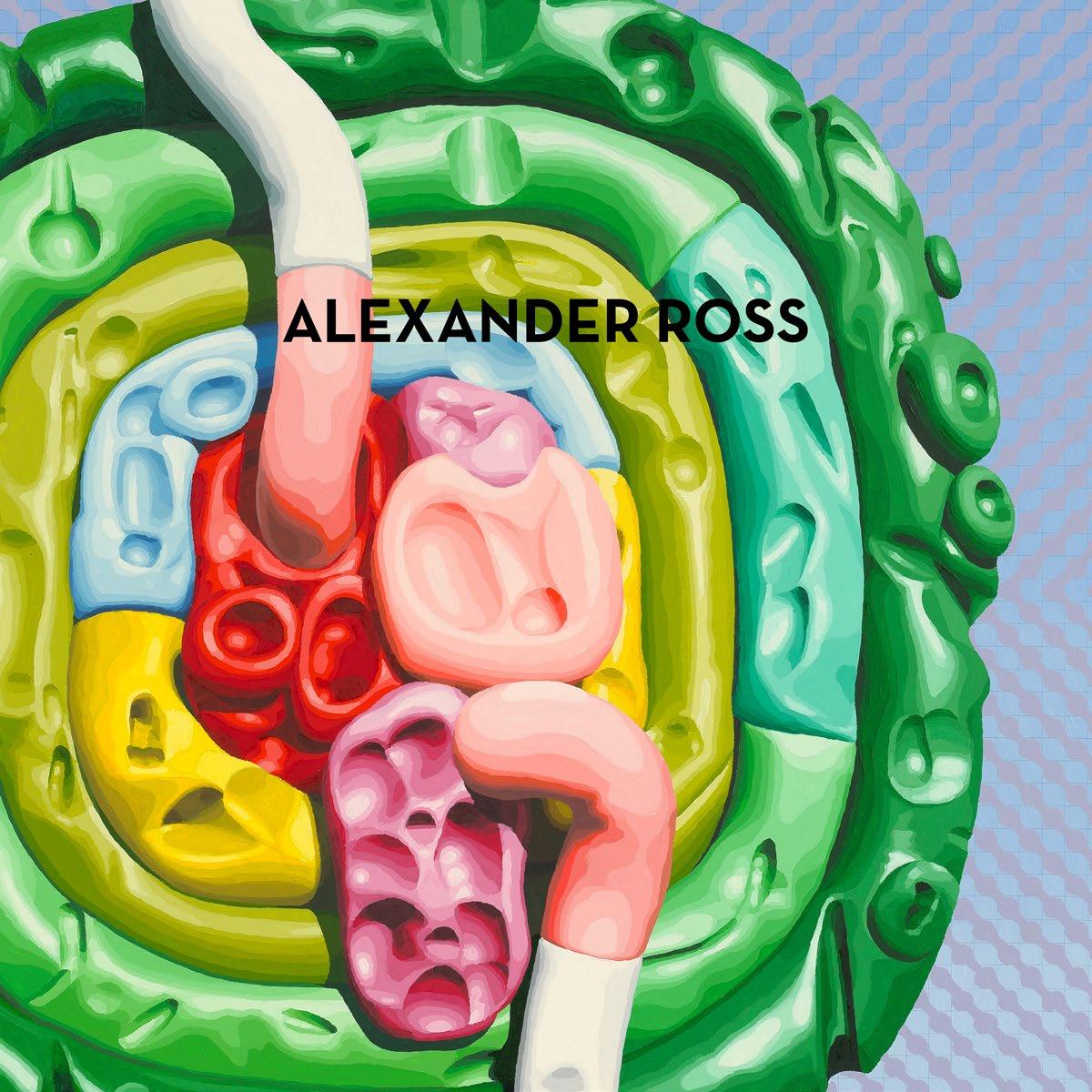
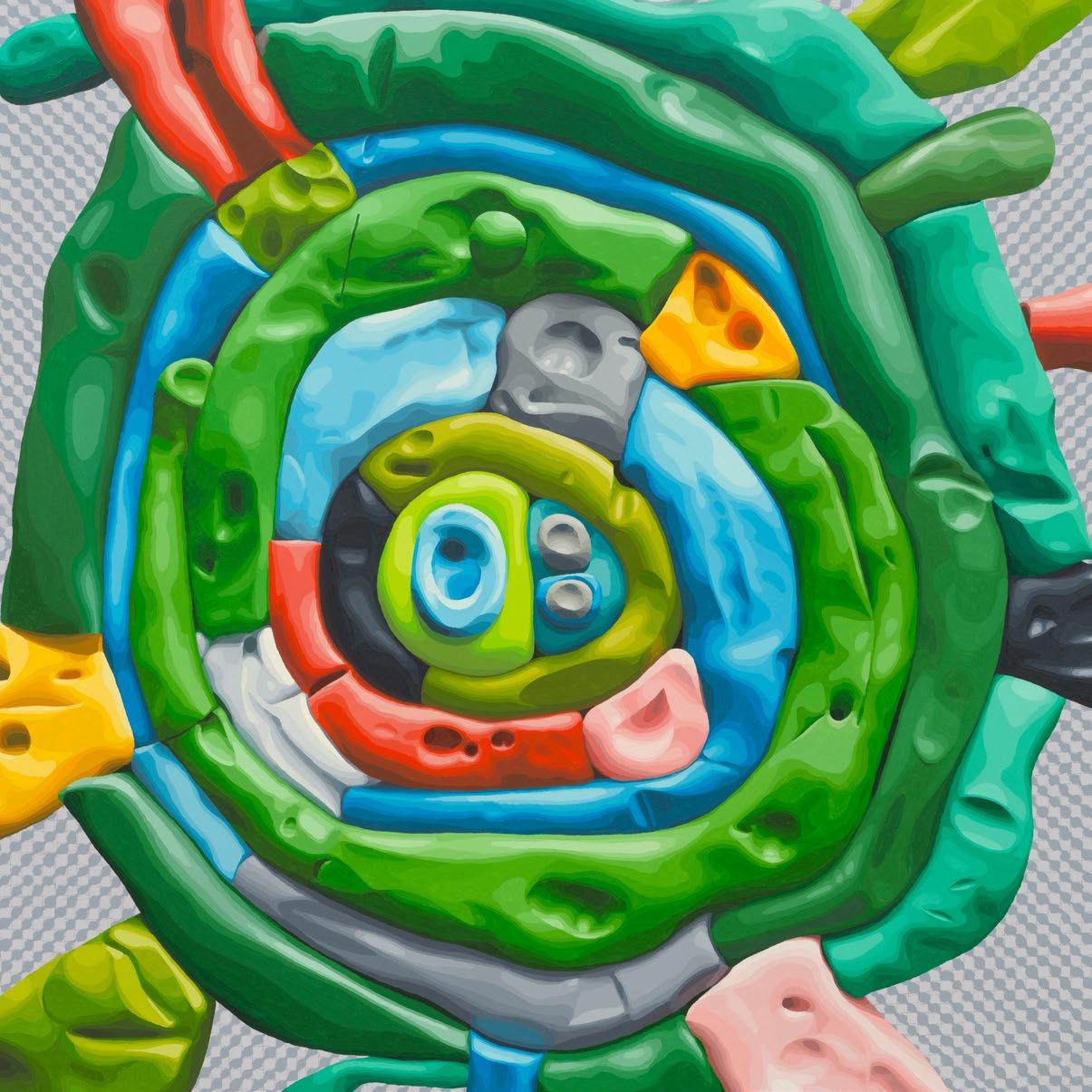
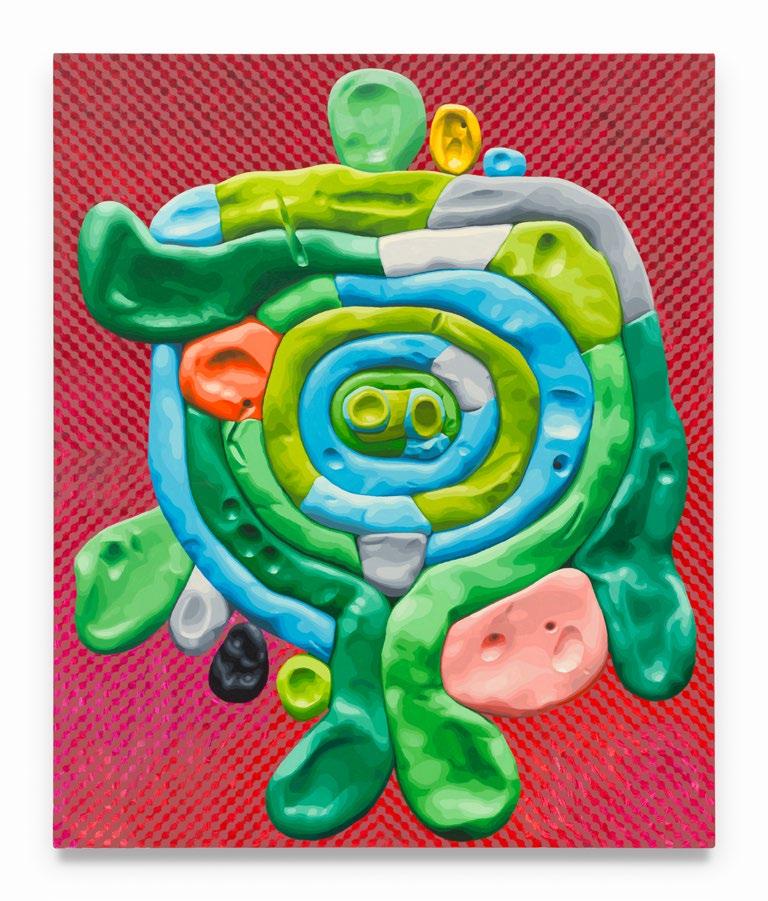
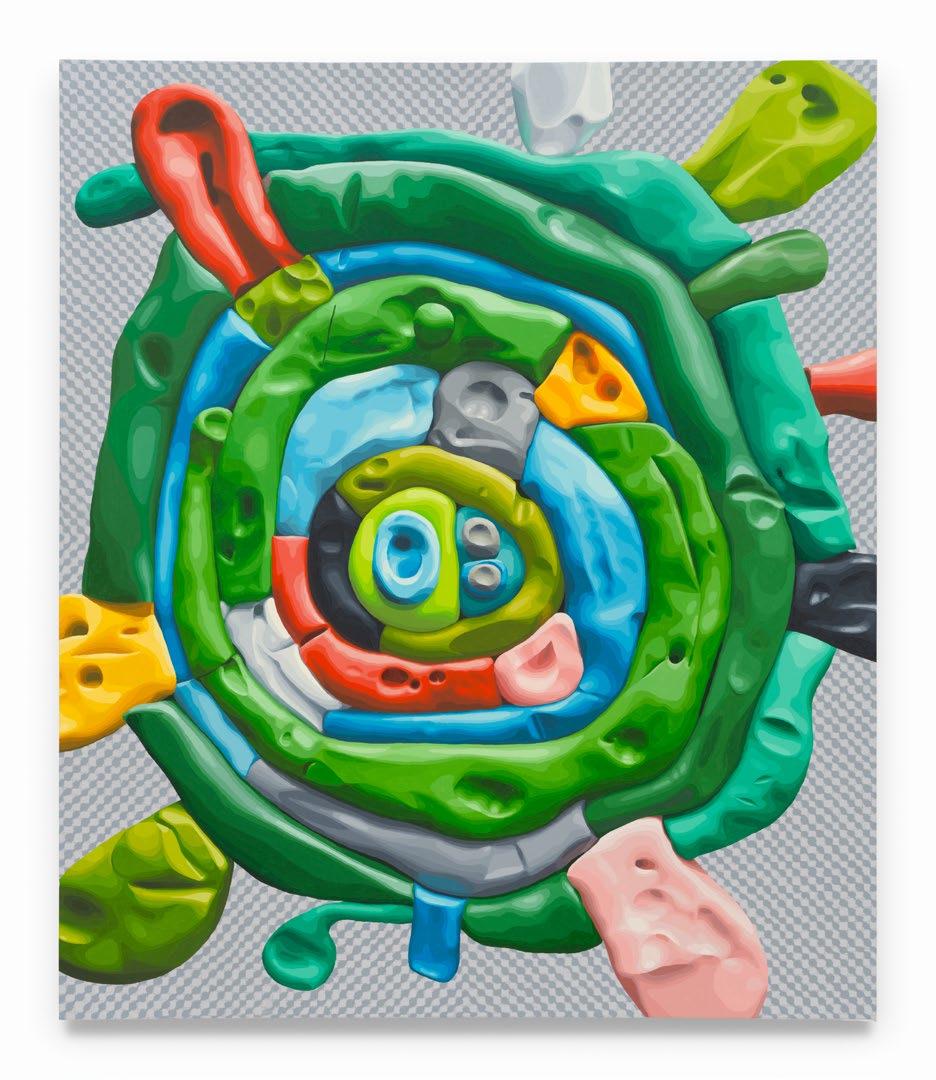
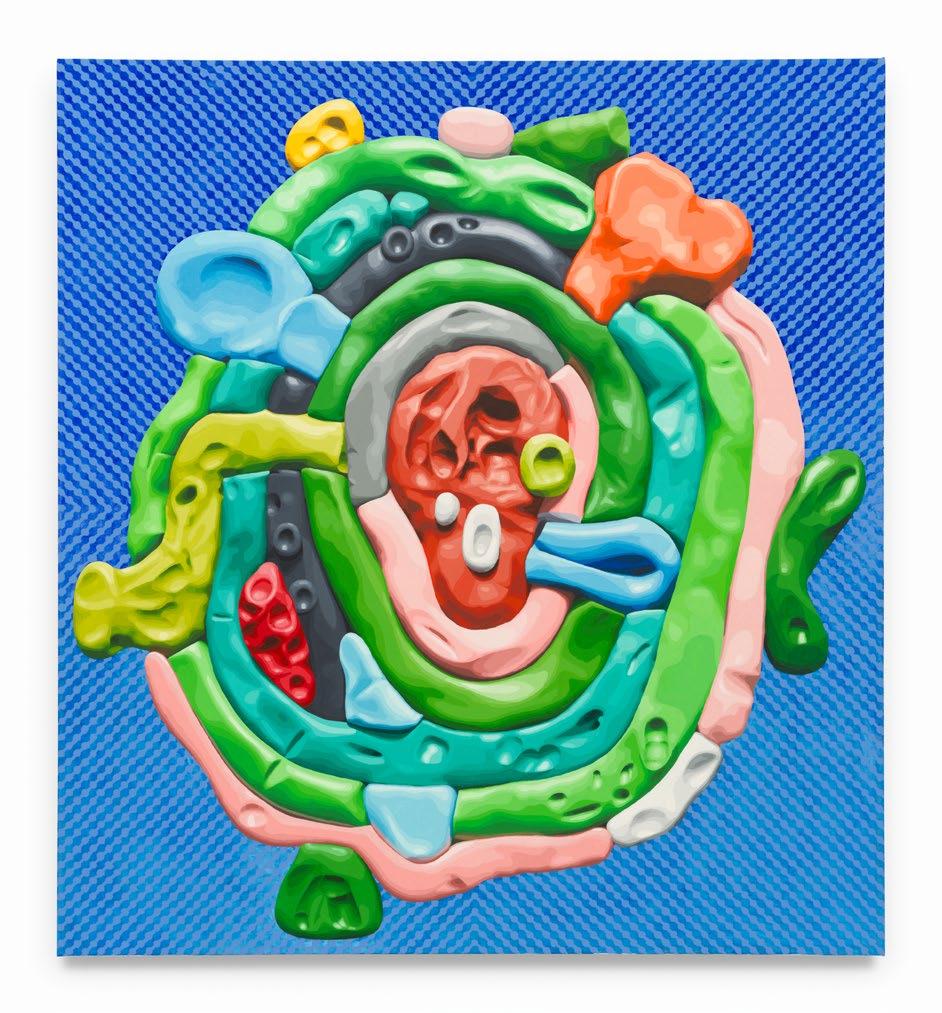
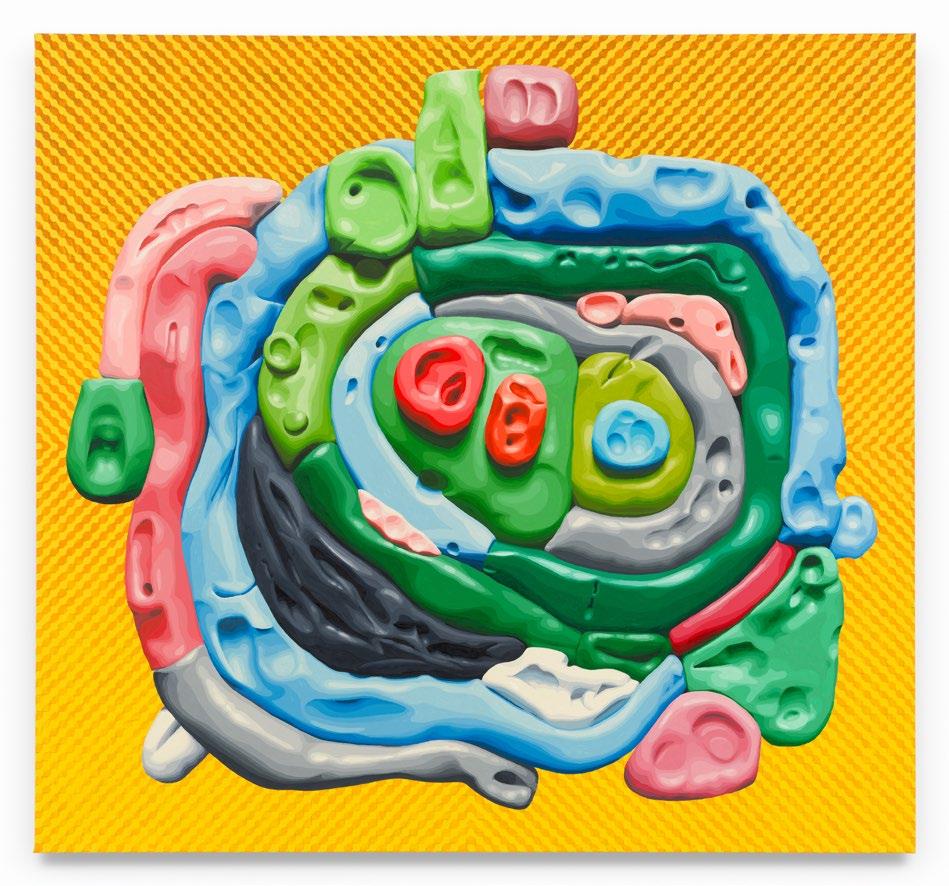
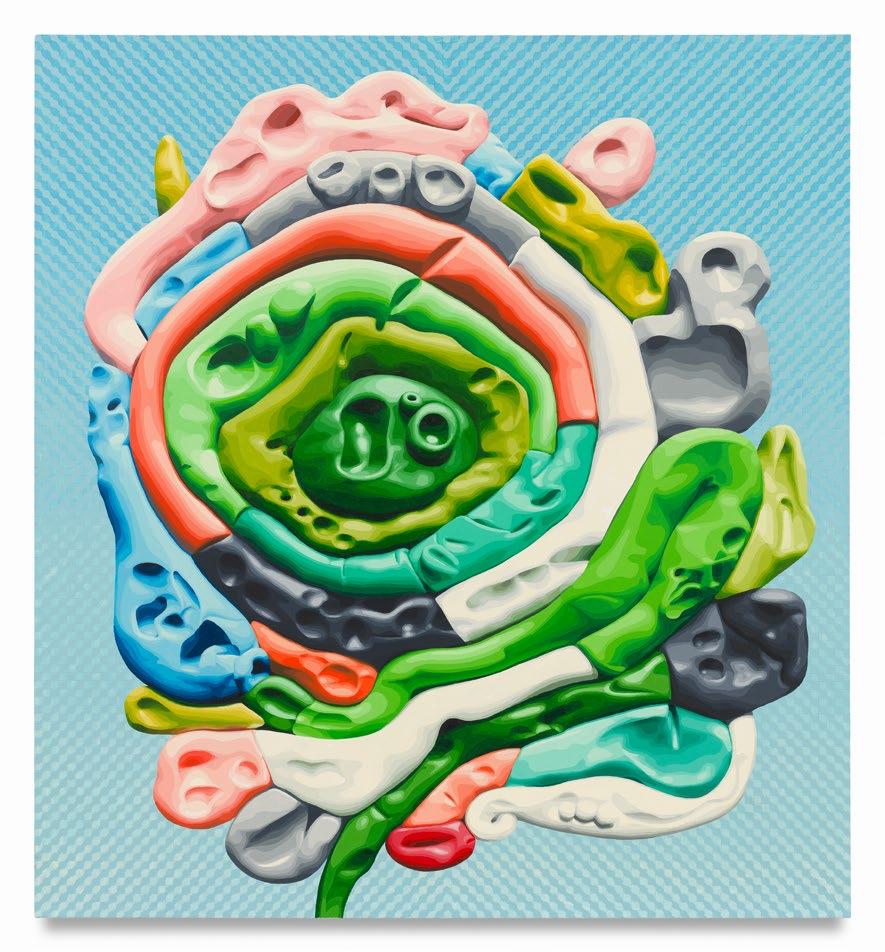
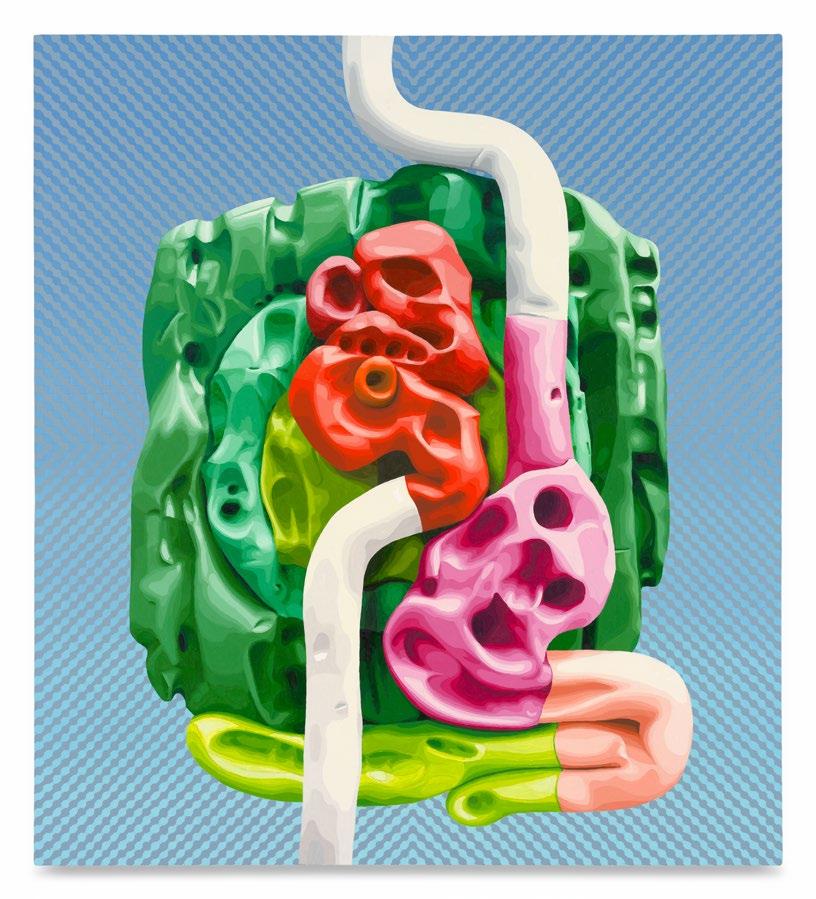
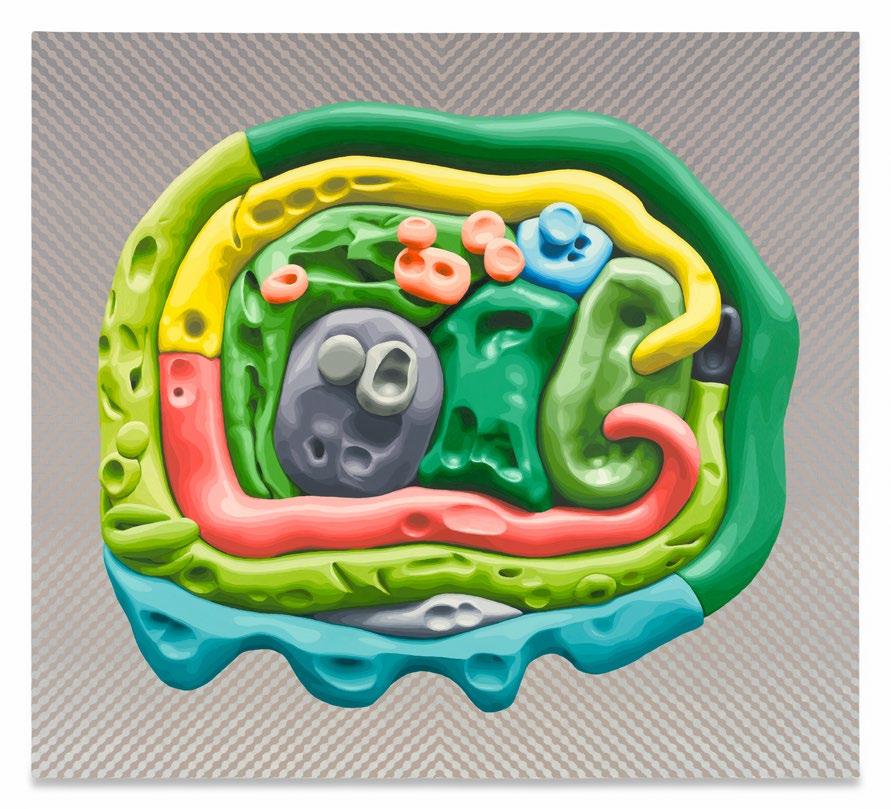
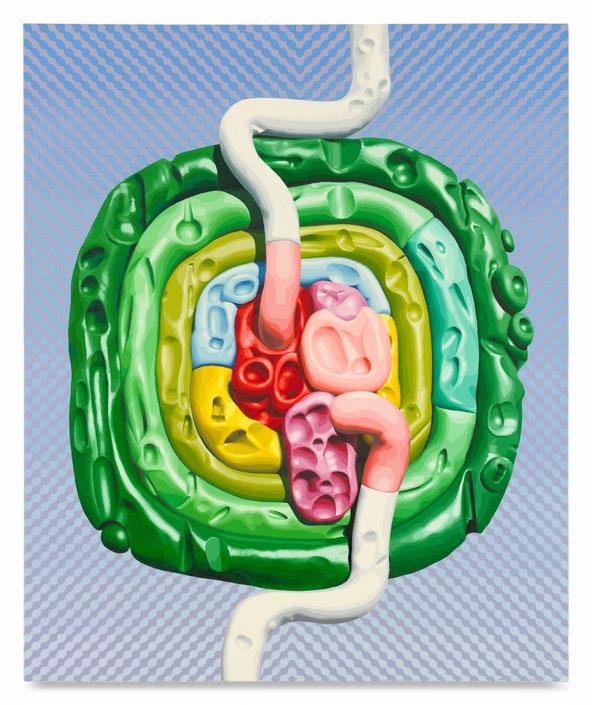
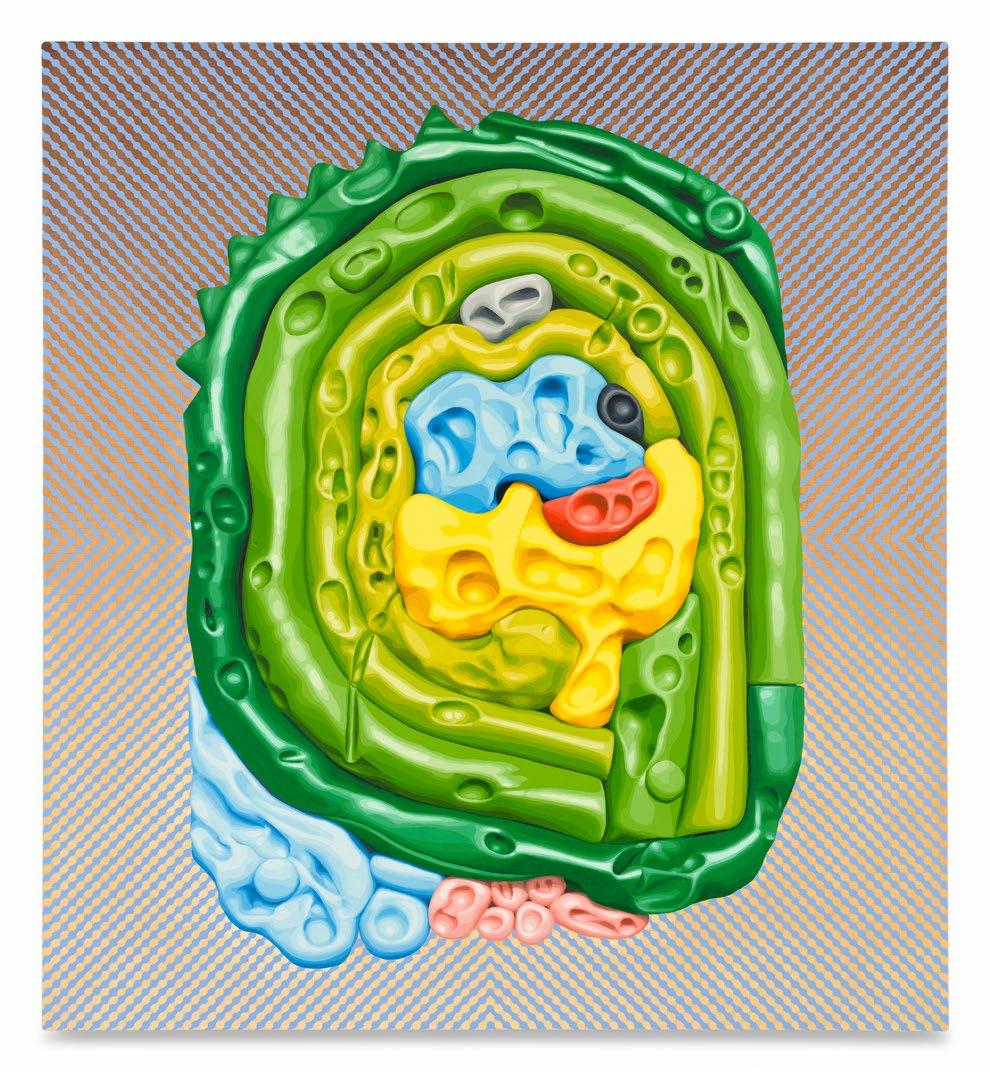
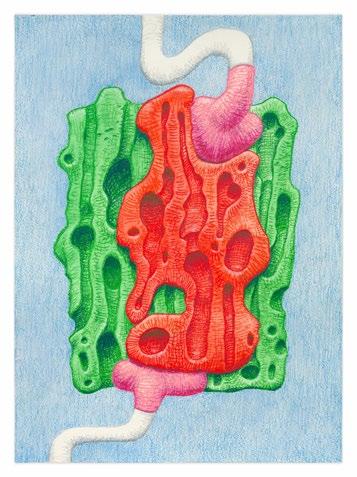
Ross’s newest series of paintings builds upon a long-standing interest in the biological sciences, an interest that has been translated into a remarkably distinct painterly language in which swarms of globular masses of color converge, morph, and detach from one another. There is a hyperreal quality to Ross’s compositions, as the selective placement of pockmarks, orifices, and protrusions in and around these strange forms evinces movement. The vibratory thrum of curved figures in tandem with the Precisionistic grouping of parts to their whole causes them to resemble what you would see under a microscope when you examine cells, bacteria, and microorganisms. Yet, the dynamism of Ross’s painterly buildup of these biomorphic shapes that float in an indeterminate space of endless chains causes the subjects to actively transform before our eyes into something altogether beyond nature or, more aptly, scientific explanation. Concurrently, these “biomorphic parts” seem to just as naturally fall into the camp of pure nonrepresentationalism—as vibrantly colored segments fitted into a formalist cohesion.
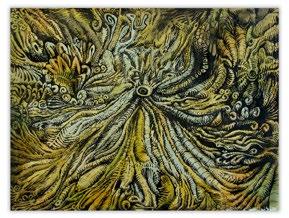
Reptilian Mind-feed, 1989, Ink on paper, 17 1/2 x 23 inches (44.45 x 58.43 cm)
The push-and-pull of “Is this abstract or is this figurative?” has been one of the defining characteristics of Ross’s art since the 1990s. Still, as consistently as it has been part of Ross’s artwork for the last three decades, his art has by no means been in a static state; change is part and parcel of Ross’s creative process. There is a scientific explanation for the evolution of cells. The same can be said of Ross’s work when it is examined through a stylistic lens.
From the late-1980s to the early-2000s, Ross’s paintings were mostly green and earth-toned images of cavernous biomes inundated with otherworldly tendrils, branches, or tentacles that felt eerily at home with the haunting illustrations of H.R. Giger; after all, Ross’s 1989 ink drawing Reptilian Mindfeed did feel as if it would make for an ideal piece of conceptual art for a science fiction horror film. The spindly tendrils did not completely disappear from his work after the 1990s; they still made appearances here and there. But his work did undergo a shift in subject type. Loosely rounded cellular forms, typically rendered in shades of green or blue, entered Ross’s oeuvre. Several untitled paintings from this time are tightly compact images that reveal a pliability of these cellular forms; they ebb and flow as much as they can in their cramped shoulder-to-shoulder compositions. The cells make further appearances as the literal building blocks of plant-like structures that could be compared to the carnivorous triffids of John Wyndham’s famous 1951 sci-fi novel, The Day of the Triffids. A more definitive figuration comes back in the 2010s and early-2020s, as Ross’s cellular forms give way to a panoply of imaginative subjects as varied as extraterrestrial landscapes and claymation-esque heads.
Ross’s most recent work is going further in exploring what it means to visually process such imagery. In fact, he seems to have collapsed the abstract and the figurative. Herein lies the beauty of Ross’s art; there is no declaratory didacticism to his paintings, for an interpretive freedom prevails in how we study them. Before we even engage in a detailed visual analysis, we notice that Ross cleverly employs made-up words that read like scientific jargon in his titles: Yellow Orbatid (2024), The Orbatroph (2025), Gazmoab (2025), etc. What better way to avoid limiting how one’s work is read than to ascribe a wholly fictitious nomenclature to it?
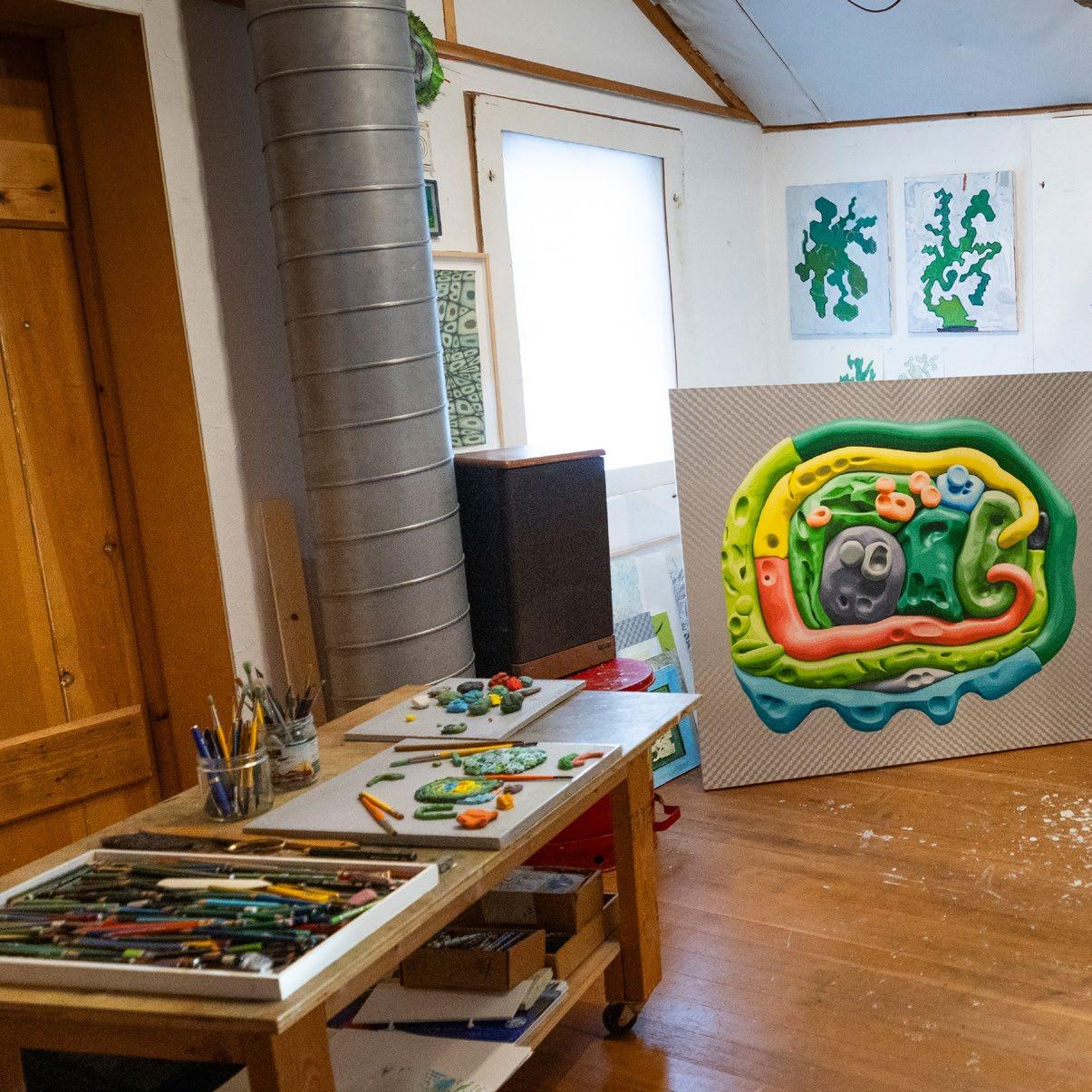
The conceptual mapping behind Ross’s work entails a multipronged process that begins with a smallscale clay sculpture that is rigorously documented in photographs before the image is digitally altered via Photoshop. But even after all of this preparation, Ross does not give in to rigid determinacy; he leaves his mind open to fresh creative possibilities.
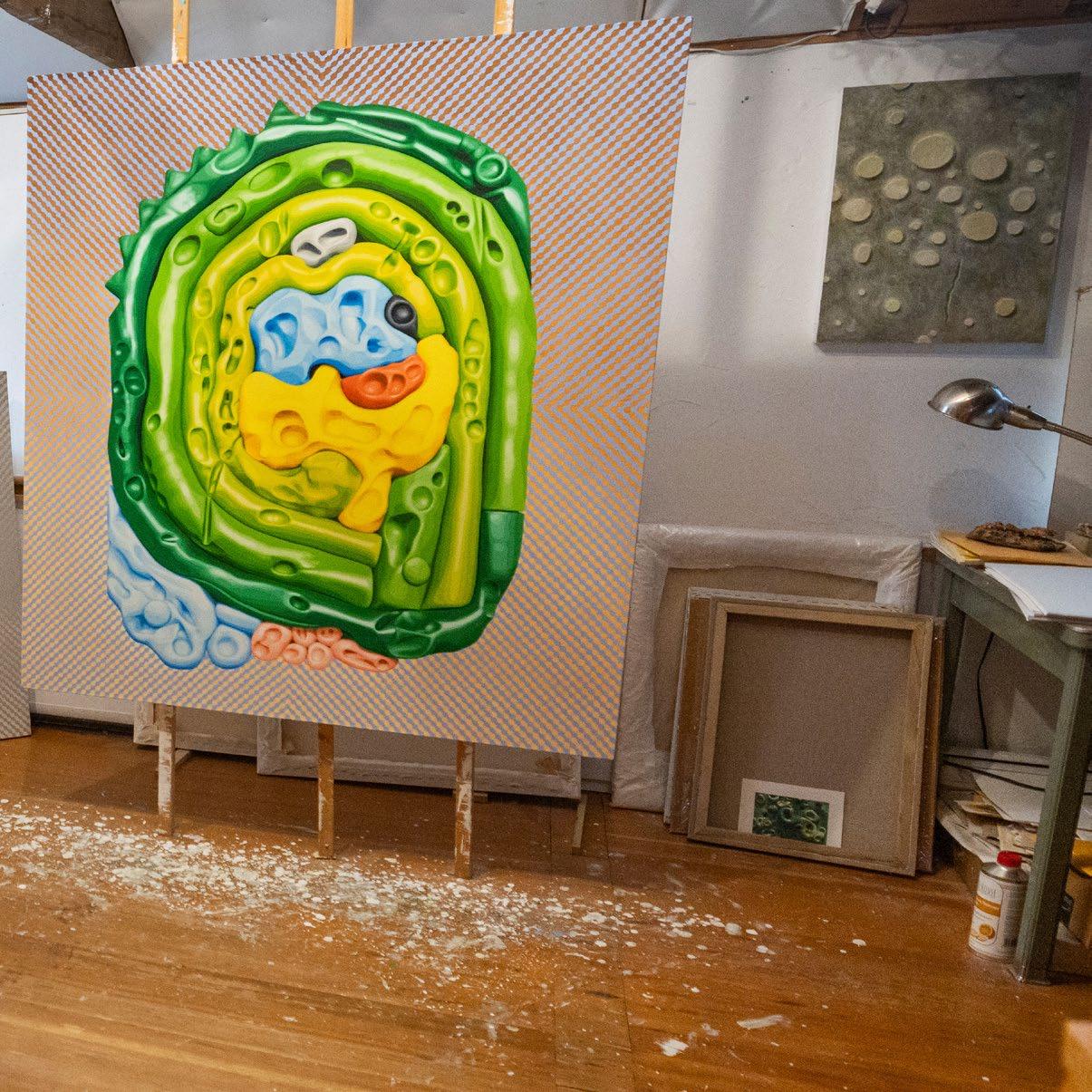
Clouding Orbigress (2025), in which the figurative trompe l’oeil is employed toward arguably abstracted content, is a terrific example of this sea change in Ross’s style. The smoothed surfaces of curvaceously limbed or branchy forms are sandwiched together with additional insertions of circular or knobby shapes that are fitted like the pieces of a jigsaw puzzle. All of these parts unite in a nebulous mass that floats or squirms around a mysterious zone defined only in the negative space by linked shapes. Slight suggestions of pulsation give a tactility to the appearance of these figures— so much so, that they almost look as if they are emerging from the canvas and into our physical space.
It’s amazing what the mind’s eye will conjure after a period of prolonged gazing, given the endless observations that can spring from any of Ross’s paintings. In the case of Orbanoog (2024), a gelatinous mess of interlocked forms depicted in garish shades initially adds up to a figure reminiscent of an eyeball, an organ, or a germ cell. But the rotational spin of its extended parts has a planetary quality. There’s even a bit of “this may be a stretch, but …” postulating in which I found myself thinking about the imposing found-object assemblages of Lee Bontecou that seem to almost swallow you whole. Ross’s paintings achieve a similar effect, but the near immersion between viewer and subject is accomplished through the magnitude of scale and the painterly vitality imbued within.
Ross’s paintings are also masterful displays of chromatic fluidity. Domain coloring, an advanced form of color theory involving the point-by-point mapping of colors in an intricate coordination system, plays an important role. Ross shared with me an image of a graph he frequently consults called Numbered and Colored Domain Adjacencies—a large orb-like shape composed of a network of numbered color patches. This graph operates like a schematic device whereby individual shades are plotted. But for Ross, it is more of a springboard for the additive juxtaposition of where his shapely forms are fitted and how they interact with their immediate neighbors.
In addition, Ross’s paintings can be described as the spiritual successors to the works of Alexander Fleming, the Scottish microbiologist who discovered the antibacterial miracle, penicillin. What many people may not realize is that Fleming was something of an artist. In addition to painting amateur landscape watercolors as a member of the Chelsea Arts Club, he created small pictures by arranging microorganisms under a microscope. Fleming was one of the earliest practitioners of microbial art, and he undertook the laborious task of meticulously arranging pigmented microbes to produce recognizable images, such as a mother caressing her newborn, two ant-like humanoids fighting one another in what appears to be a boxing ring, and a simplified human head. Because Fleming completed his germ art under a microscope and arranged his images on a circular platform, these pieces are automatically labeled micro-tondo.
Returning to Ross, his paintings can easily find kinship with the Scottish scientist’s microbial art, and there are many fascinating parallels between the two figures. Though Ross’s work can be read as abstract for abstract’s sake, his subjects look like blown-up images of cellular matter that would not be far removed from what Fleming encountered in his regular studies. Microorganisms are both visible and invisible—they are unseen by the naked eye, but they can be seen through the lens of a microscope. Fleming assiduously studied what existed at the molecular level; Ross brings a similar visual effect into his paintings on an aggrandized scale that could be alluding either to something natural or to something wholly artificial. It is critical, however, to underscore a major difference between the two: As a scientist, it was incumbent on Fleming to make sense of the mysteries of the scientific world
through cogent explanations, while Ross applies that rational methodology to create a visual and conceptual obfuscation that encourages a nonchalant open-endedness in interpretation.
The paintings of Alexander Ross are a probing reminder that one cannot flagrantly toss around the term “abstraction” to describe an image that may seem nonrepresentational at first glance, for so much else is at play. When I see Ross’s paintings either in photographic reproduction or in situ, I still feel a sense of shock that they are two-dimensional images over a canvas and not three-dimensional figures resting atop a flat surface. The visual sensation of three-dimensionality is a result of Ross endowing his subjects with a dynamism that enables them to illusorily enter our space.
There is also the question of precisely what we are looking at. Is it an unending back-and-forth of scientific connections, odd recollections, or downright formalist musings? The only thing I can resolutely affirm about Ross’s work, and a reason I am so attracted to his paintings, is that even if you try to look at his work in the Frank Stella way of “What you see is what you see,” you will inevitably go down a rabbit hole of new visual discoveries. They are about as manifold as the billions of microbes around us.
Mitted Orbinoid, 2024
48 1/4 x 40 inches
123 x 102 cm
58 3/4 x 50 inches
149 x 127 cm
56 3/4 x 52 1/4 inches
144 x 133 cm
50
127 x 137 cm
54 x 50 inches
137 x 127 cm
50 x 45 inches
127 x 114 cm
Oil on canvas
45 x 50 inches
114 x 127 cm
60 x 55 inches
152 x 140 cm
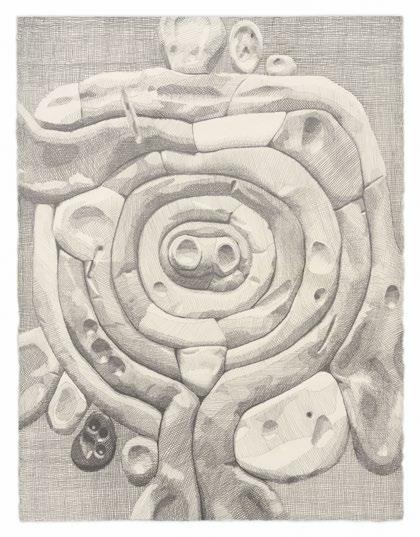
Mitted Orbanoid II, 2024
on paper
29 3/4 x 22 3/4 inches
76 x 58 cm
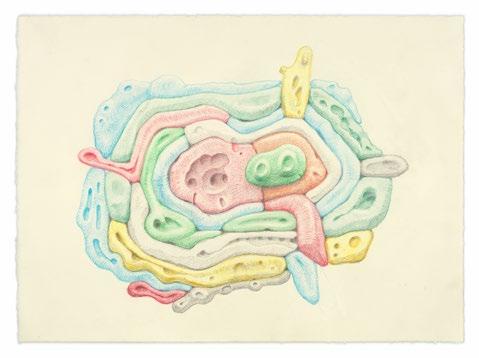
Colored pencil and graphite on paper
11 x 15 inches
28 x 38 cm
15 x 11 inches
38 x 28 cm
14 x 11 inches
36 x 28 cm
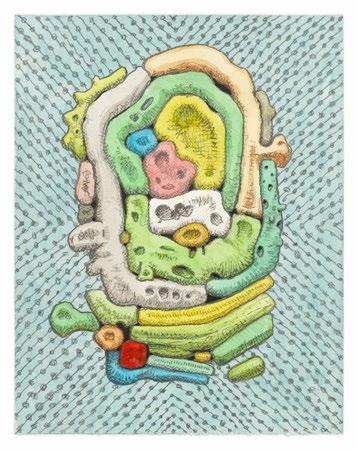
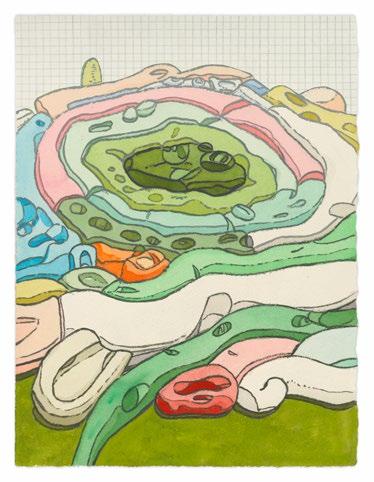
Relaxing Orbit, 2025
Watercolor, graphite and cut paper on paper
15 x 11 1/4 inches
38 x 29 cm
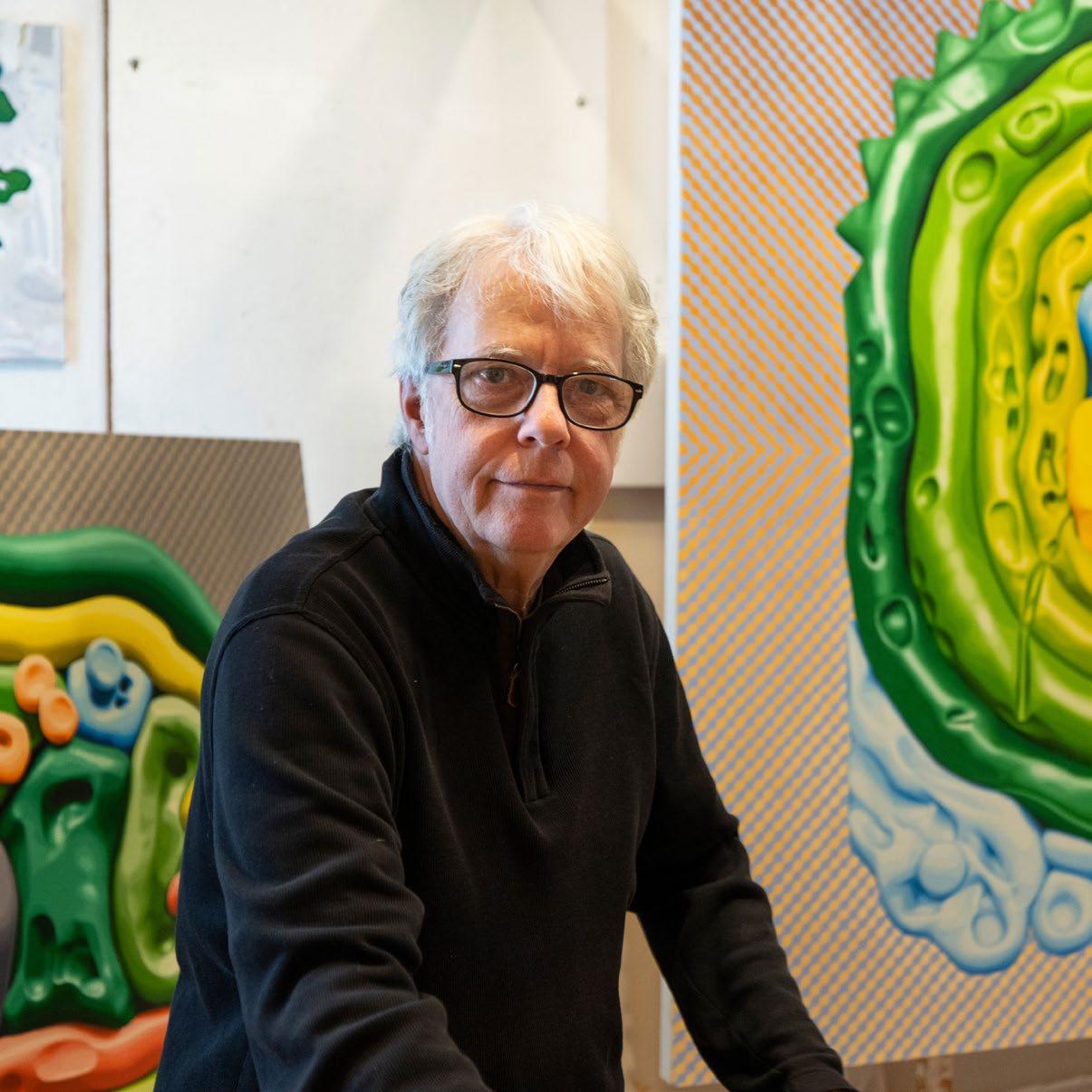
Born in 1960 in Denver, CO
Lives and works in Great Barrington, MA
1983
BFA, Massachusetts College of Art, Boston, MA
2026
Miles McEnery Gallery, New York, NY
2023
Miles McEnery Gallery, New York, NY
2022
Miles McEnery Gallery, New York, NY
2019
“Other Drawings,” FIENDISH PLOTS, Lincoln, NE
2016
“Paintings and Drawings,” LABspace, Hillsdale, NY
2014
“Recent Terrestrials,” David Nolan Gallery, New York, NY
2013
“Recent Paintings and Drawings,” Galerie Hussenot, Paris, France
2012
“Terrestrial Examplars,” Nolan Judin, Berlin, Germany
2011
“Collage Drawings,” New York Foundation for the Arts, New York, NY
“Recent Paintings,” David Nolan Gallery, New York, NY
2010
“Paintings and Drawings,” Galerie Hussenot, Paris, France
2008
“Drawings 2000-2008,” Nolan Judin, Berlin, Germany
“Recent Drawings,” David Nolan Gallery, New York, NY
“New Work,” Marianne Boesky Gallery, New York, NY
2007
“Wall at WAM,” Worcester Art Museum, Worcester, MA
2006
“Recent Work,” Daniel Weinberg Gallery, Los Angeles, CA
2005
“Recent Paintings and Drawings,” Feature Inc., New York, NY
“Survey,” Contemporary Art Museum St. Louis, St. Louis, MO
2004
“New Paintings,” Kevin Bruk Gallery, Miami, FL
“Preview of New Paintings,” Feature Inc., New York, NY
2003
“Paintings and Drawings,” Daniel Weinberg Gallery, Los Angeles, CA
“Paintings and Drawings,” Feature Inc., New York, NY
“New Paintings,” Kevin Bruk Gallery, Miami, FL
2001
“Recent Drawings,” Kevin Bruk Gallery, Miami, FL
2000
“Recent Work,” Feature Inc., New York, NY
1999
“Paintings,” Mary Boone Gallery, New York, NY
1998
“Paintings,” Feature Inc., New York, NY
2024
“All Bangers, All The Time: 25th Anniversary Exhibition,”
Miles McEnery Gallery, New York, NY
“Summer Disaster 2,” Private Public Gallery, Hudson, NY
“Faraway, So Close,” New Risen, Falls Village, CT
2022
“Odd Angles/Strange Angels,” Good Naked at The Bransford Octagon, Catskill, NY
2021
“I REMEMBER... REMEMBER?,” Private Public Gallery, Hudson, NY
“Dissecting the Cyborgian Swamp Thang,” Super Dutchess, New York, NY
“The Magic Garden,” LABspace, Hillsdale, NY
“The Power of 10,” Woodstock Byrdcliffe Guild, Woodstock, NY
2019
“They Are Made of Meat,” Platform Space, Brooklyn, NY
“Escape,” Geoffrey Young Gallery, Great Barrington, MA
“Further,” George Gallery, Brooklyn, NY
“Shapeshifter,” Gregory Lind Gallery, San Francisco, CA
“Among Friends,” The Clemente, New York, NY
“A Fairly Secret Army,” wildpalms, Düsseldorf, Germany
“Blue In Green,” Platform Space, Brooklyn, NY
2018
“The Cosmic Garden,” Orticolario, Cernobbio, Italy
“Relational Sets,” Eckert Fine Art, Kent, CT
“The Nature Lab,” LABspace, Hillsdale, NY
“Matereality,” Geoffrey Young Gallery, Great Barrington, MA
2017
“Paper Trail,” G-Module, New York, NY
“The Secret Life of Plants,” Freight + Volume, New York, NY
“Taconic North,” LABspace, Hillsdale, NY
2016
“Drawing Room” (curated by Markus Dochantschi), David Nolan Gallery, New York, NY
“Future Perfect: Picturing the Anthropocene,” University Art Museum, University at Albany, Albany, NY
2015
“Influence” (curated by Oliver Wasow), Kleinert/James Center for the Arts, Woodstock, NY
“The Guston Effect,” Steven Zevitas Gallery, Boston, MA
2014
“Spaced Out: Migration to the Interior” (curated by Phong Bui), Red Bull Studios, New York, NY
2013
“Come Together: Surviving Sandy Year 1” (curated by Phong Bui), Industry City, Brooklyn, NY
“Weinberg Gallery 40th Anniversary Show,” Ambach & Rice, Los Angeles, CA
“Imprinted Pictures,” Cheymore Gallery, Tuxedo Park, NY
“PRISMfence,” Ursa Major, Great Barrington, MA
2012
“THING” (curated by Susan Jennings), West Cornwall, CT
“Summer,” David Nolan Gallery, New York, NY
2011
“MELT,” The Frances Young Tang Teaching Museum & Art Gallery, Saratoga Springs, NY
2010
“Pastorale” (curated by Klaus Kertess), 80WSE Gallery, New York University, New York, NY
“Summer Group Show,” David Nolan Gallery, New York, NY
2009
“Morphological Mutiny: Steve DiBenedetto, Alexander Ross, and James Siena,” Galerie Judin, Berlin, Germany; traveled to David Nolan Gallery, New York, NY
“Drawing Itself: A Survey of Contemporary Practice,”
Brattleboro Museum & Art Center, Brattleboro, VT
“Extreme Frontiers/Urban Frontiers,” Institut Valencià
d’Art Modern, Valencia, Spain
“NY Masters,” Galerie Richard, Paris, France
“Slough” (curated by Steve DiBenedetto), David Nolan Gallery, New York, NY
2007
“Drawing Anyone?,” Denver Art Museum, Denver, CO
“In Monet’s Garden: The Lure of Giverny,” Columbus Museum of Art, Columbus, OH
“Horizon,” The Elizabeth Foundation for the Arts, New York, NY
“Neo-Integrity,” Derek Eller Gallery, New York, NY
2006
“Three Exhibitions Regarding Nature,” Feature Inc., New York, NY
“Surrealism, Then and Now,” Kasmin Gallery, New York, NY
“Twice Drawn,” The Frances Young Tang Teaching Museum & Art Gallery, Saratoga Springs, NY
“The 2006 deCordova Annual Exhibition,” deCordova Sculpture Park and Museum, Lincoln, MA
“Frontiers: Collecting the Art of Our Time,” Worcester Art Museum, Worchester, MA
2005
“Remote Viewing,” Whitney Museum of American Art, New York, NY; traveled to Saint Louis Art Museum, St. Louis, MO
“Realism and Abstraction: Six Degrees of Separation,”
The Nelson-Atkins Museum of Art, Kansas City, MO
“Survey,” Contemporary Art Museum St. Louis, St. Louis, MO
“Alexander Ross + Wayne Gonzalez,” Conner Contemporary Art, Washington, D.C.
“Our Grotesque” (curated by Robert Storr), SITE Santa Fe, Santa Fe, NM
“Colored Pencil,” Kerry Schuss Art, New York, NY
“Drawing II (Selected),” g-module, Paris, France
“Endless Love,” D.C. Moore Gallery, New York, NY
“SITE Sante Fe’s Fifth International Biennial,” SITE Santa Fe, Sante Fe, NM
2003
“Giverny,” Salon 94, New York, NY
“Mighty Graphitey,” Feature Inc., New York, NY
“Nature Boy,” Elizabeth Dee Gallery, New York, NY
“On Line,” Feigen Contemporary, New York, NY
2002
“Invitational Exhibition of Painting & Sculpture,” American Academy of Arts and Letters, New York, NY
“Ballpoint Inklings,” Geoffrey Young Gallery, Great Barrington, MA; traveled to Kerry Schuss Art, New York, NY (2003)
“Group Drawing Show,” Daniel Weinberg Gallery, Los Angeles, CA
“Everybody Knows This Is Nowhere,” Kevin Bruk Gallery, Miami, FL
“Painting and Illustration,” Luckman Fine Arts Complex, Cal State LA, Los Angeles, CA
2001
“Arte Contemporaneo Internacional,” Museo de Arte Moderno, Mexico City, Mexico
“Works of SOLO Impression,” Myers School of Art, University of Akron, Akron, OH
“Luck of the Drawn,” Geoffrey Young Gallery, Great Barrington, MA
“Synth” (organized by Leo Villareal), White Columns, New York, NY
“Painting/Not Painting” (curated by Peter Rostovsky and Rachel Urkowitz), White Columns, New York, NY
“Miss Universe,” Galerie Art: Concept, Paris, France
2000
“Drawings & Photographs,” Matthew Marks Gallery, New York, NY
“Drawing,” Stephen Friedman Gallery, London, United Kingdom
“Alex8,” Kevin Bruk Gallery, Miami, FL
“Paper Trail Pt. 2,” SHAHEEN Modern and Contemporary Art, Beachwood, OH
“Grok Terence McKenna Dead,” Feature Inc., New York, NY
“00: Drawings 2000,” Barbara Gladstone Gallery, New York, NY
“Useful Indiscretions: works on paper,” Geoffrey Young Gallery, Great Barrington, MA
“23rd Benefit Auction Exhibition,” New Museum of Contemporary Art, New York, NY
“Almost Something: Depictive Abstraction,” Catherine Moore Fine Art, New York, NY
“Anp City Projects,” Cokkie Snoei, Rotterdam, The Netherlands
“Hairy Forearm’s Self-Referral,” Feature Inc., New York, NY
“Group Exhibition,” M du B, F, H & G, Montreal, Canada
“Greater New York,” P.S.1 Contemporary Art Center, Long Island City, NY
“Superorganic Hydroponic Warfare,” Derek Eller Gallery, New York, NY
“Group Show” (curated by Ross Bleckner), Wetterling Gallery, Stockholm, Sweden
1999
“1999 Drawings,” Alexander and Bonin, New York, NY
“Pictorial Abstraction,” Temple Gallery, Philadelphia, PA
“What Big Is,” Geoffrey Young Gallery, Great Barrington, MA
“Alexander Ross and Lucky DeBellevue,” Stephen Friedman Gallery, London, United Kingdom
“Curious Parking @ Stupendous Strawberry,” S & H DeBuck, Ghent, Belgium
“Cookie Snow Feature Inc.,” Cokkie Snoei, Rotterdam, The Netherlands
1998
“Art on Paper,” Weatherspoon Art Gallery, University of North Carolina, Greensboro, NC
“WOp: works on/off paper” Anp, Antwerp, Belgium
“Paper View,” Geoffrey Young Gallery, Great Barrington, MA
“Spectacular Optical,” Thread Waxing Space, New York, NY
“View 3” (curated by Klaus Kertess), Mary Boone Gallery, New York, NY
1997
“Swamp Thing” (curated by Joel Beck), Salon 75, Brooklyn, NY
“New American Talent: The Thirteenth Exhibition” (curated by Robert Storr), University of North Texas Art Gallery, Denton, TX; traveled to Texas Fine Arts Association at CenterSpace, Austin, TX
1996
“Relief Pieces,” Feature Inc., New York, NY
“Ab Fab,” Feature Inc., New York, NY
“A4 Favours” (curated by Pádraig Timoney), Three Month Gallery, Liverpool, United Kingdom
1995 Mitchell Algus Gallery, New York, NY
2020
Pollock-Krasner Foundation Grant, New York, NY
2012
Adolph and Esther Gottlieb Foundation Individual Support Grant, New York, NY
Pollock-Krasner Foundation Grant, New York, NY
2010
New York Foundation for the Arts Painting Fellowship, New York, NY
2006
The Louis Comfort Tiffany Foundation Award, New York, NY
2002
John Simon Guggenheim Memorial Foundation Fellowship, New York, NY
2000
American Artists at Giverny Residency Grant, New York, NY
Art Production Fund, Brooklyn, NY
1998
The Tesuque Foundation Artist Fellowship Grant, San Mateo, CA
Art Institute of Chicago, Chicago, IL
British Museum, London, United Kingdom
Denver Art Museum, Denver, CO
The Frances Young Tang Teaching Museum and Art Gallery, Skidmore College, Saratoga Springs, NY
Hallmark Art Collection, Kansas City, MO
Herbert F. Johnson Museum of Art, Cornell University, Ithaca, NY
The Morgan Library & Museum, New York, NY
The Museum of Modern Art, New York, NY
Nelson-Atkins Museum of Art, Kansas City, MO
Rhode Island School of Design Museum, Providence, RI
Worcester Art Museum, Worcester, MA
Published on the occasion of the exhibition
19 February – 28 March 2026
Miles McEnery Gallery 525 West 22nd Street New York NY 10011
tel +1 212 445 0051 www.milesmcenery.com
Publication © 2026 Miles McEnery Gallery
All rights reserved
Essay © 2026 Liam Otero
Photo Credits p. 4: Image courtesy of the artist, Great Barrington, MA
Associate Director Julia Schlank, New York, NY
Photography by
Dan Bradica, New York, NY
Pete Mauney, Tivoli, NY
Catalogue layout by Allison Leung
ISBN: 979-8-3507-6157-3
Cover: Lassoer, (detail), 2025