News
Cruising the unknown with Falkor
University of Western Australia Oceans Institute, Schmidt Ocean Institute
A month-long expedition to Scott Reef and submerged shoals off the Kimberley coast on board the US-based Schmidt Ocean Institute’s research vessel Falkor is nearly at an end. Chief Scientist and University of Western Australia (UWA) Oceans Institute Prof. Greg Ivey, said researchers from UWA, The Australian Institute of Marine Science (AIMS), Stanford University, and Griffith University were excited about the cruise, which supports both physical and biological research. “Our combined work will improve understanding of this biological hotspot,” he said. “Results will help underpin management of this region through improved understanding of the key biophysical processes.”
The scientists are exploring the connections between ocean circulation, habitat patterns and benthic biodiversity on two deep-reef ecosystems in the region. Dr. Andrew Heyward, chief AIMS scientist on board Falkor, has made initial observations of some of the deeper water areas in previous years and is revisiting them using the advanced mapping and imaging equipment the Falkor brings to the project. “Using fixed moorings and a full suite of oceanographic sensors from the ship, the cruise will map the ocean circulation and seabed environment in fine detail, measure the structure and productivity of the overlying water column, and see how this information links to patterns of habitats observed on the seabed.” The seafloor and bottom coral communities will be mapped using the Falkor’s Remotely Operated Vehicle (ROV) sending real time high definition video to the Falkor’s Science Control Room. In addition to the live video feed, the ROV carries multiple cameras recording both forward and downward views, with the location of every image precisely known. This allows the scientists to create detailed habitat maps of the major habitats, like those dominated by deeper water corals, and understand the linkage to the local ocean circulation and turbulent mixing. The Falkor completed a two-week exploration of the Perth Canyon in March. The Canyon, a deep ocean gorge the size of the Grand Canyon in the US, starts about 30 km off Fremantle and reaches depths of more than four km.
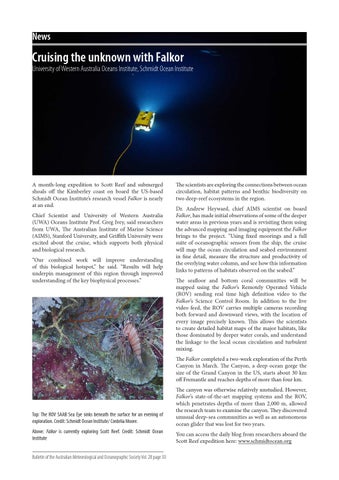
Top: The ROV SAAB Sea Eye sinks beneath the surface for an evening of exploration. Credit: Schmidt Ocean Institute/ Cordelia Moore. Above: Falkor is currently exploring Scott Reef. Credit: Schmidt Ocean Institute Bulletin of the Australian Meteorological and Oceanographic Society Vol. 28 page 30
The canyon was otherwise relatively unstudied. However, Falkor’s state-of-the-art mapping systems and the ROV, which penetrates depths of more than 2,000 m, allowed the research team to examine the canyon. They discovered unusual deep-sea communities as well as an autonomous ocean glider that was lost for two years. You can access the daily blog from researchers aboard the Scott Reef expedition here: www.schmidtocean.org