President’s Column
Exciting AMOS developments For those of us in the southern states, it’s getting cold. With Melbourne recording numerous single digit minima during April along with maxima in the low teens, it is clear that winter is on the way. I’m certain by July many of us will be fed up with the cool weather and grey skies, and will savour the opportunity to head to Brisbane for the warmer weather and, of course, the annual AMOS conference. The AMOS 2015 conference promises to be an exciting event. As I type this column, the science committee are reviewing abstracts, allocating talks, and constructing the program. We also have an outstanding group of invited speakers, along with a number of side events. Keep your eye on the conference website for more details and remember to register! Planning for the 2016 conference in Melbourne is also underway. Stay tuned for further announcements over the coming months. In addition to conferences and other regular AMOS business, I’m pleased to announce an exciting new development that promises to significantly benefit AMOS and our members. In March, AMOS signed a Memorandum of Understanding (MoU) with the American Meteorological Society (AMS). Highlights of this agreement that directly affect members are:
• AMOS members residing in Australia are now eligible to be ‘Affiliate Members’ of the AMS; the dues for Affiliate Members are currently 66% of the normal member rate. • AMOS will be listed as a co-sponsor of the AMS annual meeting, with AMOS members eligible for a reduced registration rate. The full text of the current MoU, which is valid for five years, can be found here: http://www.amos.org.au/ aboutus/cid/11/parent/0/pid/11/t/aboutus/title/rulesand-regulations. As always, a number of people helped solidify this important agreement. I’d particularly like to thank Neville Nicholls, John Zillman, and Mike Manton who met with the AMS leadership at their annual meeting in January and discussed AMOS/AMS relations. To conclude this column, I’d like to remind you that the Uwe Radok award for best PhD thesis is currently open for nominations. Please see the article opposite. This is an important way to reward excellence and encourage our early-career members.
Todd Lane
News
Satellite constellation for weather forecasting Prof. John Le Marshall
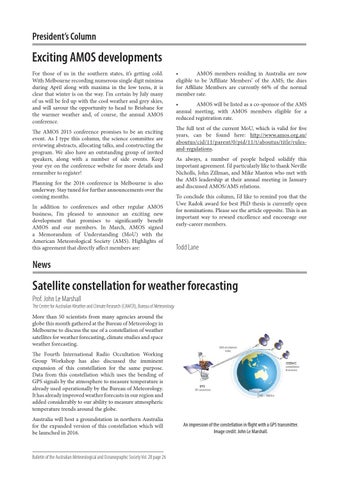
The Centre for Australian Weather and Climate Research (CAWCR), Bureau of Meteorology More than 50 scientists from many agencies around the globe this month gathered at the Bureau of Meteorology in Melbourne to discuss the use of a constellation of weather satellites for weather forecasting, climate studies and space weather forecasting. The Fourth International Radio Occultation Working Group Workshop has also discussed the imminent expansion of this constellation for the same purpose. Data from this constellation which uses the bending of GPS signals by the atmosphere to measure temperature is already used operationally by the Bureau of Meteorology. It has already improved weather forecasts in our region and added considerably to our ability to measure atmospheric temperature trends around the globe. Australia will host a groundstation in northern Australia for the expanded version of this constellation which will be launched in 2016.
Bulletin of the Australian Meteorological and Oceanographic Society Vol. 28 page 26
An impression of the constellation in flight with a GPS transmitter. Image credit: John Le Marshall.