Editorial
Going beyond the big and blue In the Disney film Finding Nemo, there’s a scene [SPOILER ALERT] where Nemo arrives in his new home—a fish tank—after being taken away from the Great Barrier Reef by a diver. He tells the other inhabitants, a.k.a. the “Tank Gang”, that he’s from the ocean. Bubbles the yellow tang fish asks, “So, the big blue, huh? What’s it like?” “Big... and... blue?” Nemo answers. And that’s how much of humanity percieve the ocean. Much like Nemo at that point in the movie, not all of us can experience the oceans in a tangible way, so the complexities of how these support life and affect climate seem difficult concepts to grasp, and therefore care about. Less than 0.1 percent of humanity has experienced diving on a coral reef. So what’s to say about the oceans beyond “big and blue”? With decades of human influences threatening the oceans, how do we better engage people with what they can’t “see”? And, perhaps more worryingly, how do the scientifically illiterate often get the upper hand when it comes to drawing the public’s attention? The most recent face of psuedo-science, “wellness blogger” Belle Gibson, faked a suite of cancers, cures and charity donations to gain worldwide media attention. She was endorsed by companies such as Apple. Her “personal experience” was the driving element that secured and inspired her loyal followers. Though she was eventually found to have fabricated these experiences, what is the lure of the personal anecdote over actual evidence? To quote oceanographer Sylvia Earle: “A picture is worth a thousand words but an experience is worth a thousand pictures”.
The AMOS sciences have many more stories to share, some of which can’t neccessarily be told with such strong visuals. Opportunities to share the stories are sometimes provided when a devastating weather event occurs (which news headlines seem dominated by at the moment; an East Coast low batters NSW as I type). And sometimes we can create other opportunities for sharing through events such as our annual AMOS conference. With this year’s conference almost upon us, AMOS is now putting the final arrangements in place. In this issue, we explore some of the speakers and topics relevant to the conference. With the main theme being “Communicating our science: from research to community”, we have quite an impressive line-up ahead! Coincidentally, we also go beyond the “big and blue”, with a few ocean stories in our News section. BAMOS is also recruiting. We now have an oceanography representative, Chris Bull, who is helping me collate newsworthy and interesting items from the oceanographic sector. Chris has very kindly pointed Nicola Maher towards BAMOS for this issue, where she takes us through her recent paper on global warming hiatuses—see page 43 for the story. We are also on the lookout for some associate science editors, to help us attract more science articles to the BAMOS peer review process—please see the ad on page 44 for more information. I hope you enjoy reading through BAMOS over the Autumn.
Melissa Lyne Editor
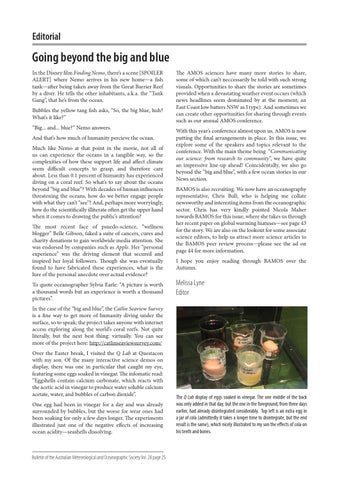
In the case of the “big and blue”, the Catlin Seaview Survey is a fine way to get more of humanity diving under the surface, so to speak; the project takes anyone with internet access exploring along the world’s coral reefs. Not quite literally, but the next best thing: virtually. You can see more of the project here: http://catlinseaviewsurvey.com/ Over the Easter break, I visited the Q Lab at Questacon with my son. Of the many interactive science demos on display, there was one in particular that caught my eye, featuring some eggs soaked in vinegar. The infomatic read: “Eggshells contain calcium carbonate, which reacts with the acetic acid in vinegar to produce water soluble calcium acetate, water, and bubbles of carbon dioxide”. One egg had been in vinegar for a day and was already surrounded by bubbles, but the worse for wear ones had been soaking for only a few days longer. The experiments illustrated just one of the negative effects of increasing ocean acidity—seashells dissolving.
Bulletin of the Australian Meteorological and Oceanographic Society Vol. 28 page 25
The Q Lab display of eggs soaked in vinegar. The one middle of the back was only added in that day, but the one in the foreground, from three days earlier, had already disintegrated considerably. Top left is an extra egg in a jar of cola (admittedly it takes a longer time to disintegrate, but the end result is the same), which nicely illustrated to my son the effects of cola on his teeth and bones.