Charts from the Past with Blair Trewin
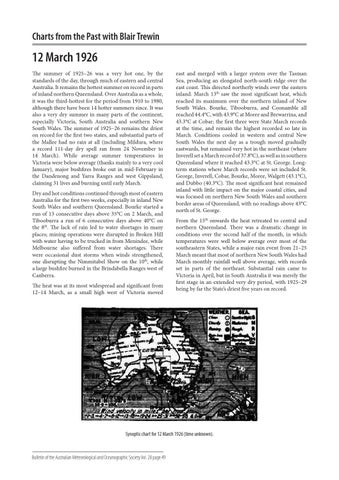
12 March 1926 The summer of 1925–26 was a very hot one, by the standards of the day, through much of eastern and central Australia. It remains the hottest summer on record in parts of inland northern Queensland. Over Australia as a whole, it was the third-hottest for the period from 1910 to 1980, although there have been 14 hotter summers since. It was also a very dry summer in many parts of the continent, especially Victoria, South Australia and southern New South Wales. The summer of 1925–26 remains the driest on record for the first two states, and substantial parts of the Mallee had no rain at all (including Mildura, where a record 111-day dry spell ran from 24 November to 14 March). While average summer temperatures in Victoria were below average (thanks mainly to a very cool January), major bushfires broke out in mid-February in the Dandenong and Yarra Ranges and west Gippsland, claiming 31 lives and burning until early March. Dry and hot conditions continued through most of eastern Australia for the first two weeks, especially in inland New South Wales and southern Queensland. Bourke started a run of 13 consecutive days above 35°C on 2 March, and Tibooburra a run of 6 consecutive days above 40°C on the 8th. The lack of rain led to water shortages in many places; mining operations were disrupted in Broken Hill with water having to be trucked in from Menindee, while Melbourne also suffered from water shortages. There were occasional dust storms when winds strengthened, one disrupting the Nimmitabel Show on the 10th, while a large bushfire burned in the Brindabella Ranges west of Canberra. The heat was at its most widespread and significant from 12–14 March, as a small high west of Victoria moved
east and merged with a larger system over the Tasman Sea, producing an elongated north-south ridge over the east coast. This directed northerly winds over the eastern inland. March 13th saw the most significant heat, which reached its maximum over the northern inland of New South Wales. Bourke, Tibooburra, and Coonamble all reached 44.4°C, with 43.9°C at Moree and Brewarrina, and 43.3°C at Cobar; the first three were State March records at the time, and remain the highest recorded so late in March. Conditions cooled in western and central New South Wales the next day as a trough moved gradually eastwards, but remained very hot in the northeast (where Inverell set a March record of 37.8°C), as well as in southern Queensland where it reached 43.3°C at St. George. Longterm stations where March records were set included St. George, Inverell, Cobar, Bourke, Moree, Walgett (43.1°C), and Dubbo (40.3°C). The most significant heat remained inland with little impact on the major coastal cities, and was focused on northern New South Wales and southern border areas of Queensland, with no readings above 43°C north of St. George. From the 15th onwards the heat retreated to central and northern Queensland. There was a dramatic change in conditions over the second half of the month, in which temperatures were well below average over most of the southeastern States, while a major rain event from 21–25 March meant that most of northern New South Wales had March monthly rainfall well above average, with records set in parts of the northeast. Substantial rain came to Victoria in April, but in South Australia it was merely the first stage in an extended very dry period, with 1925–29 being by far the State’s driest five years on record.
Synoptic chart for 12 March 1926 (time unknown).
Bulletin of the Australian Meteorological and Oceanographic Society Vol. 28 page 49