Meet a Member
Craig Macaulay Our April Meet a Member is a valuable communicator of the AMOS sciences. We caught up with him just before his retirement.
1. Where does this email find you? Preparing to retire. 2. What do you do? I provide communication support for scientists and students at the University of Tasmania’s Institute for Marine and Antarctic Studies (IMAS). I liaise with media, draft web content, and coordinate video interviews. 3. Why did you get into it? Coming from a non-science media background, I have always been interested in science in the marine, atmospheric and polar fields. 4. What is the best thing about what you do? The access I have to the many, many research projects and papers generated by scientists and students at IMAS. 5. What did you want to do when you were 10? Can’t remember back that far... 6. How do you relax? Walking in the Tasmanian bush, reading history and autobiographies, and playing golf. 7. What is your favourite holiday destination? Tasmania!
Bulletin of the Australian Meteorological and Oceanographic Society Vol. 28 page 48
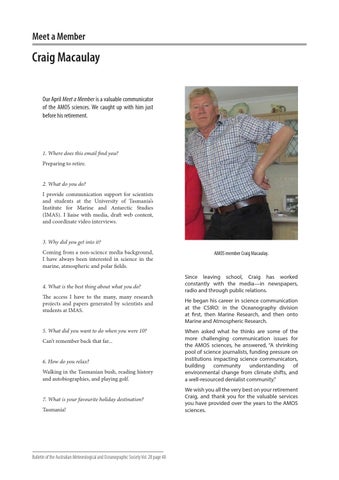
AMOS member Craig Macaulay.
Since leaving school, Craig has worked constantly with the media—in newspapers, radio and through public relations. He began his career in science communication at the CSIRO: in the Oceanography division at first, then Marine Research, and then onto Marine and Atmospheric Research. When asked what he thinks are some of the more challenging communication issues for the AMOS sciences, he answered, “A shrinking pool of science journalists, funding pressure on institutions impacting science communicators, building community understanding of environmental change from climate shifts, and a well-resourced denialist community.” We wish you all the very best on your retirement Craig, and thank you for the valuable services you have provided over the years to the AMOS sciences.