Workshop Report
Data requirements to address the WCRP Grand Challenge on weather and climate extremes Lisa Alexander Climate Change Research Centre and ARC Centre of Excellence for Climate System Science, University of New South Wales
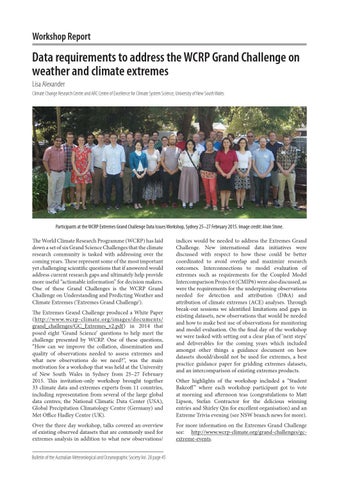
Participants at the WCRP Extremes Grand Challenge Data Issues Workshop, Sydney 25–27 February 2015. Image credit: Alvin Stone. The World Climate Research Programme (WCRP) has laid down a set of six Grand Science Challenges that the climate research community is tasked with addressing over the coming years. These represent some of the most important yet challenging scientific questions that if answered would address current research gaps and ultimately help provide more useful “actionable information” for decision makers. One of these Grand Challenges is the WCRP Grand Challenge on Understanding and Predicting Weather and Climate Extremes (‘Extremes Grand Challenge’). The Extremes Grand Challenge produced a White Paper (http://www.wcrp-climate.org/images/documents/ grand_challenges/GC_Extremes_v2.pdf) in 2014 that posed eight ‘Grand Science’ questions to help meet the challenge presented by WCRP. One of these questions, “How can we improve the collation, dissemination and quality of observations needed to assess extremes and what new observations do we need?”, was the main motivation for a workshop that was held at the University of New South Wales in Sydney from 25–27 February 2015. This invitation-only workshop brought together 33 climate data and extremes experts from 11 countries, including representation from several of the large global data centres; the National Climatic Data Center (USA), Global Precipitation Climatology Centre (Germany) and Met Office Hadley Centre (UK). Over the three day workshop, talks covered an overview of existing observed datasets that are commonly used for extremes analysis in addition to what new observations/ Bulletin of the Australian Meteorological and Oceanographic Society Vol. 28 page 45
indices would be needed to address the Extremes Grand Challenge. New international data initiatives were discussed with respect to how these could be better coordinated to avoid overlap and maximize research outcomes. Interconnections to model evaluation of extremes such as requirements for the Coupled Model Intercomparison Project 6 (CMIP6) were also discussed, as were the requirements for the underpinning observations needed for detection and attribution (D&A) and attribution of climate extremes (ACE) analyses. Through break-out sessions we identified limitations and gaps in existing datasets, new observations that would be needed and how to make best use of observations for monitoring and model evaluation. On the final day of the workshop we were tasked with setting out a clear plan of ‘next steps’ and deliverables for the coming years which included amongst other things a guidance document on how datasets should/should not be used for extremes, a best practice guidance paper for gridding extremes datasets, and an intercomparison of existing extremes products. Other highlights of the workshop included a “Student Bakeoff ” where each workshop participant got to vote at morning and afternoon teas (congratulations to Matt Lipson, Stefan Contractor for the delicious winning entries and Shirley Qin for excellent organisation) and an Extreme Trivia evening (see NSW branch news for more). For more information on the Extremes Grand Challenge see: http://www.wcrp-climate.org/grand-challenges/gcextreme-events.