Article
Warming hiatuses less likely in future climate Nicola Maher Climate Change Research Centre (CCRC), ARC Centre of Excellence for Climate System Science, University of New South Wales
In this article, PhD candidate Nicola Maher takes us through her recent publication on pauses in the rise of global average air temperatures. She also explains the likely implications for future events in the face of climate change. The much talked about pause in global average air temperatures over the past decade is not an unusual event in the observational record, even with global warming [Easterling and Wehner, 2009]. However, recent research [Maher et al., 2014] has revealed there is little chance of a hiatus decade occurring beyond 2030. Simulations from 31 Coupled Model Intercomparison Project (CMIP5) models were used in this study to investigate historical causes of hiatus decades and the likelihood of a hiatus occurring into the future. For this study hiatus periods were defined as 10-year periods with a trend in globally averaged surface air temperature (SAT) that was less than zero. The temporary pauses in surface warming over the past 100 years are found to be caused by two factors. The first are large tropical volcanic eruptions, which are known to cause a cooling of the SAT, due to an increase in sulphate aerosols in the atmosphere [Timmreck, 2012]. The second cause is a transition to a negative phase of the Interdecadal Pacific Oscillation (IPO). The IPO is a decadal mode of
1
(a) The role of anthropogenic forcing
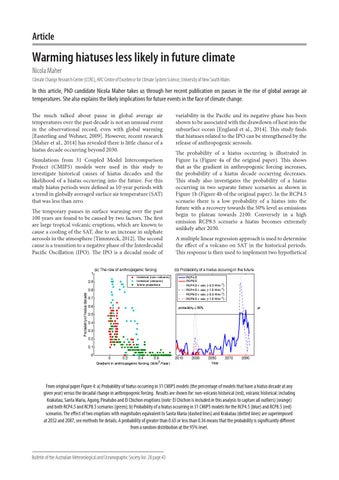
The probability of a hiatus occurring is illustrated in Figure 1a (Figure 4a of the original paper). This shows that as the gradient in anthropogenic forcing increases, the probability of a hiatus decade occurring decreases. This study also investigates the probability of a hiatus occurring in two separate future scenarios as shown in Figure 1b (Figure 4b of the original paper). In the RCP4.5 scenario there is a low probability of a hiatus into the future with a recovery towards the 50% level as emissions begin to plateau towards 2100. Conversely in a high emission RCP8.5 scenario a hiatus becomes extremely unlikely after 2030. A multiple linear regression approach is used to determine the effect of a volcano on SAT in the historical periods. This response is then used to implement two hypothetical (b) Probability of a hiatus occuring in the future
historical (non−volcanic) historical (volcanic) future projections
0.9 Probability of hiatus decade
variability in the Pacific and its negative phase has been shown to be associated with the drawdown of heat into the subsurface ocean [England et al., 2014]. This study finds that hiatuses related to the IPO can be strengthened by the release of anthropogenic aerosols.
0.8
RCP4.5 RCP8.5 −2 RCP4.5 + volc (−3.3 W/m ) −2 RCP4.5 + volc (−1.5 W/m ) RCP8.5 + volc (−3.3 W/m−2) RCP8.5 + volc (−1.5 W/m−2)
0.7 0.6
probability = 50%
pro
0.5 0.4 0.3 0.2 0.1 0
0
0.2
0.4
0.6
2
Gradient in anthropogenic forcing (W/m /Year)
2010
2030
2050 Year
2070
2090
From original paper Figure 4: a) Probability of hiatus occurring in 31 CMIP5 models (the percentage of models that have a hiatus decade at any given year) versus the decadal change in anthropogenic forcing. Results are shown for: non-volcanic historical (red), volcanic historical: including Krakatau, Santa Maria, Agung, Pinatubo and El Chichon eruptions (note: El Chichon is included in this analysis to capture all outliers) (orange) and both RCP4.5 and RCP8.5 scenarios (green); b) Probability of a hiatus occurring in 31 CMIP5 models for the RCP4.5 (blue) and RCP8.5 (red) scenarios. The effect of two eruptions with magnitudes equivalent to Santa Maria (dashed lines) and Krakatau (dotted lines) are superimposed at 2032 and 2087, see methods for details. A probability of greater than 0.65 or less than 0.36 means that the probability is significantly different from a random distribution at the 95% level.
Bulletin of the Australian Meteorological and Oceanographic Society Vol. 28 page 43