Article
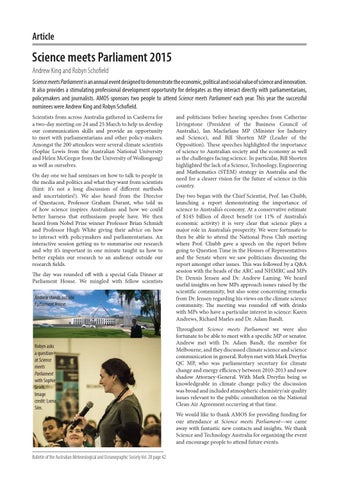
Science meets Parliament 2015 Andrew King and Robyn Schofield Science meets Parliament is an annual event designed to demonstrate the economic, political and social value of science and innovation. It also provides a stimulating professional development opportunity for delegates as they interact directly with parliamentarians, policymakers and journalists. AMOS sponsors two people to attend Science meets Parliament each year. This year the successful nominees were Andrew King and Robyn Schofield. Scientists from across Australia gathered in Canberra for a two-day meeting on 24 and 25 March to help us develop our communication skills and provide an opportunity to meet with parliamentarians and other policy-makers. Amongst the 200 attendees were several climate scientists (Sophie Lewis from the Australian National University and Helen McGregor from the University of Wollongong) as well as ourselves. On day one we had seminars on how to talk to people in the media and politics and what they want from scientists (hint: it’s not a long discussion of different methods and uncertainties!). We also heard from the Director of Questacon, Professor Graham Durant, who told us of how science inspires Australians and how we could better harness that enthusiasm people have. We then heard from Nobel Prize winner Professor Brian Schmidt and Professor Hugh White giving their advice on how to interact with policymakers and parliamentarians. An interactive session getting us to summarise our research and why it’s important in one minute taught us how to better explain our research to an audience outside our research fields. The day was rounded off with a special Gala Dinner at Parliament House. We mingled with fellow scientists Andrew stands outside Parliament House.
Robyn asks a question at Science meets Parliament with Sophie Lewis. Image credit: Lorna Sim.
Bulletin of the Australian Meteorological and Oceanographic Society Vol. 28 page 42
and politicians before hearing speeches from Catherine Livingstone (President of the Business Council of Australia), Ian Macfarlane MP (Minister for Industry and Science), and Bill Shorten MP (Leader of the Opposition). These speeches highlighted the importance of science to Australian society and the economy as well as the challenges facing science. In particular, Bill Shorten highlighted the lack of a Science, Technology, Engineering and Mathematics (STEM) strategy in Australia and the need for a clearer vision for the future of science in this country. Day two began with the Chief Scientist, Prof. Ian Chubb, launching a report demonstrating the importance of science to Australia’s economy. At a conservative estimate of $145 billion of direct benefit (or 11% of Australia’s economic activity) it is very clear that science plays a major role in Australia’s prosperity. We were fortunate to then be able to attend the National Press Club meeting where Prof. Chubb gave a speech on the report before going to Question Time in the Houses of Representatives and the Senate where we saw politicians discussing the report amongst other issues. This was followed by a Q&A session with the heads of the ARC and NHMRC and MPs Dr. Dennis Jensen and Dr. Andrew Laming. We heard useful insights on how MPs approach issues raised by the scientific community, but also some concerning remarks from Dr. Jensen regarding his views on the climate science community. The meeting was rounded off with drinks with MPs who have a particular interest in science: Karen Andrews, Richard Marles and Dr. Adam Bandt. Throughout Science meets Parliament we were also fortunate to be able to meet with a specific MP or senator. Andrew met with Dr. Adam Bandt, the member for Melbourne, and they discussed climate science and science communication in general. Robyn met with Mark Dreyfus QC MP, who was parliamentary secretary for climate change and energy efficiency between 2010-2013 and now shadow Attorney-General. With Mark Dreyfus being so knowledgeable in climate change policy the discussion was broad and included atmospheric chemistry/air quality issues relevant to the public consultation on the National Clean Air Agreement occurring at that time. We would like to thank AMOS for providing funding for our attendance at Science meets Parliament—we came away with fantastic new contacts and insights. We thank Science and Technology Australia for organising the event and encourage people to attend future events.