Article say “oh, we’ve never got money from them”, put them at the top of your list. A phone call is 10 times better than an email and a meeting with someone is 10 times better than a phone call. You are going to ring people, visit people, call in favours, get recommendations and shout people coffee. I know of an example where a $3.00 coffee led to $100,000 of science funding. Your schmoozing will be more successful if it is part of a carefully crafted communication plan. Your communicator is your friend. So before your contact sips their cappuccino, they will have seen the article on your work in the paper, read your tweets and scanned your LinkedIn profile. There are as many ways to engage with stakeholders as there are to demonstrate irrefutably the existence of human-induced climate change. Happily, you don’t have to be the climate science community’s answer to Brian Cox to take advantage of them. If you’re more of a listener than a talker, conferences, exhibitions, workshops and social events are all great opportunities to find out who’s who, and make new contacts in the coffee queue.
Never underestimate the time it will take to go from coffee to contract. I had a lead in developing the pitch for the South Eastern Australian Climate Initiative (SEACI). It took the best part of three years and the work of quite a team to bring in more than $8 million external funding. Key to our success was a series of stakeholder-led workshops. When you sense that success is imminent, ensure that you have done all the internal engagement that will be needed to complete the deal. You will have kept your manager well informed, so your achievement will be no surprise to them. Contact contracting, liaise with legal, find finance, communicate with comms, ID your IP. Your research is now secure for the foreseeable future. But before you get on to that, we just have a little organisational paperwork for you to complete. Paul Holper, with Simon Torok (CSIRO), Karen Pearce (Bloom Communication) and special guests will conduct a panel session on “attracting research funding” at the forthcoming AMOS conference in Brisbane. (12:00 p.m. to 1:30 p.m. Friday 17 July 2015.
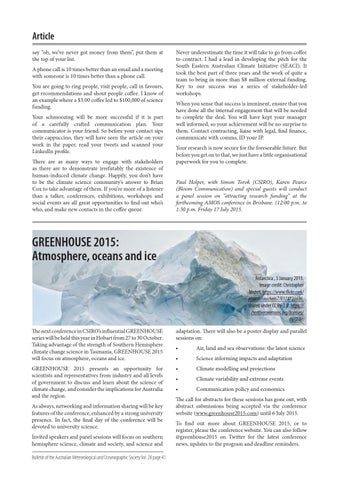
GREENHOUSE 2015: Atmosphere, oceans and ice Antarctica , 3 January 2013. Image credit: Christopher Michel, https://www.flickr.com/ photos/cmichel67/8374723696, shared under CC By-2.0: https:// creativecommons.org/licenses/ by/2.0/. The next conference in CSIRO’s influential GREENHOUSE series will be held this year in Hobart from 27 to 30 October. Taking advantage of the strength of Southern Hemisphere climate change science in Tasmania, GREENHOUSE 2015 will focus on atmosphere, oceans and ice.
adaptation. There will also be a poster display and parallel sessions on:
GREENHOUSE 2015 presents an opportunity for scientists and representatives from industry and all levels of government to discuss and learn about the science of climate change, and consider the implications for Australia and the region. As always, networking and information sharing will be key features of the conference, enhanced by a strong university presence. In fact, the final day of the conference will be devoted to university science. Invited speakers and panel sessions will focus on southern hemisphere science, climate and society, and science and Bulletin of the Australian Meteorological and Oceanographic Society Vol. 28 page 41
•
Air, land and sea observations: the latest science
•
Science informing impacts and adaptation
•
Climate modelling and projections
•
Climate variability and extreme events
•
Communication policy and economics
The call for abstracts for these sessions has gone out, with abstract submissions being accepted via the conference website (www.greenhouse2015.com) until 6 July 2015. To find out more about GREENHOUSE 2015, or to register, please the conference website. You can also follow @greenhouse2015 on Twitter for the latest conference news, updates to the program and deadline reminders.