Article
JFK and the pathway to research dollars Paul Holper Paul Holper & Associates
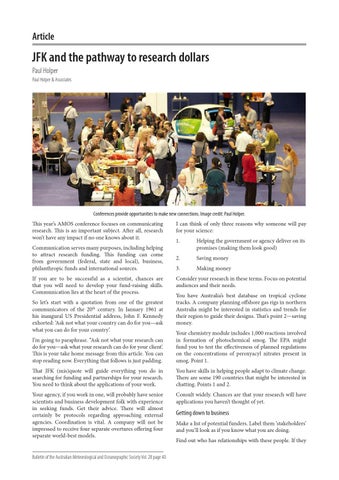
Conferences provide opportunities to make new connections. Image credit: Paul Holper. This year’s AMOS conference focuses on communicating research. This is an important subject. After all, research won’t have any impact if no one knows about it. Communication serves many purposes, including helping to attract research funding. This funding can come from government (federal, state and local), business, philanthropic funds and international sources. If you are to be successful as a scientist, chances are that you will need to develop your fund-raising skills. Communication lies at the heart of the process. So let’s start with a quotation from one of the greatest communicators of the 20th century. In January 1961 at his inaugural US Presidential address, John F. Kennedy exhorted: ‘Ask not what your country can do for you—ask what you can do for your country’.
I can think of only three reasons why someone will pay for your science: 1.
Helping the government or agency deliver on its promises (making them look good)
2.
Saving money
3.
Making money
Consider your research in these terms. Focus on potential audiences and their needs. You have Australia’s best database on tropical cyclone tracks. A company planning offshore gas rigs in northern Australia might be interested in statistics and trends for their region to guide their designs. That’s point 2—saving money.
I’m going to paraphrase. ‘‘Ask not what your research can do for you—ask what your research can do for your client’. This is your take home message from this article. You can stop reading now. Everything that follows is just padding.
Your chemistry module includes 1,000 reactions involved in formation of photochemical smog. The EPA might fund you to test the effectiveness of planned regulations on the concentrations of peroxyacyl nitrates present in smog. Point 1.
That JFK (mis)quote will guide everything you do in searching for funding and partnerships for your research. You need to think about the applications of your work.
You have skills in helping people adapt to climate change. There are some 190 countries that might be interested in chatting. Points 1 and 2.
Your agency, if you work in one, will probably have senior scientists and business development folk with experience in seeking funds. Get their advice. There will almost certainly be protocols regarding approaching external agencies. Coordination is vital. A company will not be impressed to receive four separate overtures offering four separate world-best models.
Consult widely. Chances are that your research will have applications you haven’t thought of yet.
Bulletin of the Australian Meteorological and Oceanographic Society Vol. 28 page 40
Getting down to business Make a list of potential funders. Label them ‘stakeholders’ and you’ll look as if you know what you are doing. Find out who has relationships with these people. If they