Comment
Measuring the value of science: it’s not always about the money Rod Lamberts Deputy Director, Australian National Centre for Public Awareness of Science at Australian National University
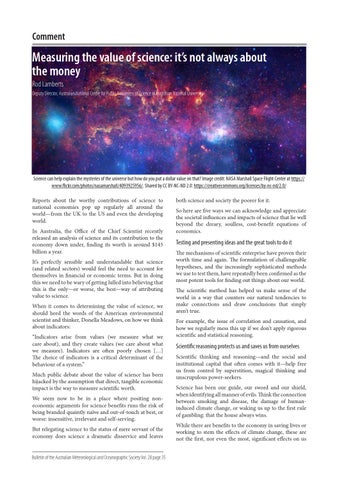
Science can help explain the mysteries of the universe but how do you put a dollar value on that? Image credit: NASA Marshall Space Flight Center at https:// www.flickr.com/photos/nasamarshall/4093925956/. Shared by CC BY-NC-ND 2.0: https://creativecommons.org/licenses/by-nc-nd/2.0/ Reports about the worthy contributions of science to national economies pop up regularly all around the world—from the UK to the US and even the developing world. In Australia, the Office of the Chief Scientist recently released an analysis of science and its contribution to the economy down under, finding its worth is around $145 billion a year. It’s perfectly sensible and understandable that science (and related sectors) would feel the need to account for themselves in financial or economic terms. But in doing this we need to be wary of getting lulled into believing that this is the only—or worse, the best—way of attributing value to science. When it comes to determining the value of science, we should heed the words of the American environmental scientist and thinker, Donella Meadows, on how we think about indicators: “Indicators arise from values (we measure what we care about), and they create values (we care about what we measure). Indicators are often poorly chosen […] The choice of indicators is a critical determinant of the behaviour of a system.” Much public debate about the value of science has been hijacked by the assumption that direct, tangible economic impact is the way to measure scientific worth. We seem now to be in a place where positing noneconomic arguments for science benefits runs the risk of being branded quaintly naïve and out-of-touch at best, or worse: insensitive, irrelevant and self-serving. But relegating science to the status of mere servant of the economy does science a dramatic disservice and leaves Bulletin of the Australian Meteorological and Oceanographic Society Vol. 28 page 35
both science and society the poorer for it. So here are five ways we can acknowledge and appreciate the societal influences and impacts of science that lie well beyond the dreary, soulless, cost-benefit equations of economics.
Testing and presenting ideas and the great tools to do it The mechanisms of scientific enterprise have proven their worth time and again. The formulation of challengeable hypotheses, and the increasingly sophisticated methods we use to test them, have repeatedly been confirmed as the most potent tools for finding out things about our world. The scientific method has helped us make sense of the world in a way that counters our natural tendencies to make connections and draw conclusions that simply aren’t true. For example, the issue of correlation and causation, and how we regularly mess this up if we don’t apply rigorous scientific and statistical reasoning.
Scientific reasoning protects us and saves us from ourselves Scientific thinking and reasoning—and the social and institutional capital that often comes with it—help free us from control by superstition, magical thinking and unscrupulous power-seekers. Science has been our guide, our sword and our shield, when identifying all manner of evils. Think the connection between smoking and disease, the damage of humaninduced climate change, or waking us up to the first rule of gambling: that the house always wins. While there are benefits to the economy in saving lives or working to stem the effects of climate change, these are not the first, nor even the most, significant effects on us