Comment “million-year” ice core. Generally, we expected the mapping surveys to reveal a picture of a stable ice sheet, not likely to be affected by changes wreaked by climate warming like the more vulnerable West Antarctica. But this view was to change.
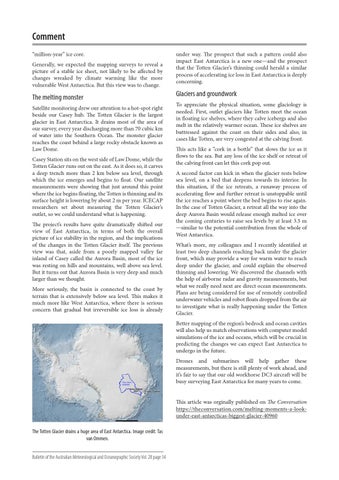
The melting monster Satellite monitoring drew our attention to a hot-spot right beside our Casey hub. The Totten Glacier is the largest glacier in East Antarctica. It drains most of the area of our survey, every year discharging more than 70 cubic km of water into the Southern Ocean. The monster glacier reaches the coast behind a large rocky obstacle known as Law Dome. Casey Station sits on the west side of Law Dome, while the Totten Glacier runs out on the east. As it does so, it carves a deep trench more than 2 km below sea level, through which the ice emerges and begins to float. Our satellite measurements were showing that just around this point where the ice begins floating, the Totten is thinning and its surface height is lowering by about 2 m per year. ICECAP researchers set about measuring the Totten Glacier’s outlet, so we could understand what is happening. The project’s results have quite dramatically shifted our view of East Antarctica, in terms of both the overall picture of ice stability in the region, and the implications of the changes in the Totten Glacier itself. The previous view was that, aside from a poorly mapped valley far inland of Casey called the Aurora Basin, most of the ice was resting on hills and mountains, well above sea level. But it turns out that Aurora Basin is very deep and much larger than we thought. More seriously, the basin is connected to the coast by terrain that is extensively below sea level. This makes it much more like West Antarctica, where there is serious concern that gradual but irreversible ice loss is already
under way. The prospect that such a pattern could also impact East Antarctica is a new one—and the prospect that the Totten Glacier’s thinning could herald a similar process of accelerating ice loss in East Antarctica is deeply concerning.
Glaciers and groundwork To appreciate the physical situation, some glaciology is needed. First, outlet glaciers like Totten meet the ocean in floating ice shelves, where they calve icebergs and also melt in the relatively warmer ocean. These ice shelves are buttressed against the coast on their sides and also, in cases like Totten, are very congested at the calving front. This acts like a “cork in a bottle” that slows the ice as it flows to the sea. But any loss of the ice shelf or retreat of the calving front can let this cork pop out. A second factor can kick in when the glacier rests below sea level, on a bed that deepens towards its interior. In this situation, if the ice retreats, a runaway process of accelerating flow and further retreat is unstoppable until the ice reaches a point where the bed begins to rise again. In the case of Totten Glacier, a retreat all the way into the deep Aurora Basin would release enough melted ice over the coming centuries to raise sea levels by at least 3.5 m —similar to the potential contribution from the whole of West Antarctica. What’s more, my colleagues and I recently identified at least two deep channels reaching back under the glacier front, which may provide a way for warm water to reach deep under the glacier, and could explain the observed thinning and lowering. We discovered the channels with the help of airborne radar and gravity measurements, but what we really need next are direct ocean measurements. Plans are being considered for use of remotely controlled underwater vehicles and robot floats dropped from the air to investigate what is really happening under the Totten Glacier. Better mapping of the region’s bedrock and ocean cavities will also help us match observations with computer model simulations of the ice and oceans, which will be crucial in predicting the changes we can expect East Antarctica to undergo in the future. Drones and submarines will help gather these measurements, but there is still plenty of work ahead, and it’s fair to say that our old workhorse DC3 aircraft will be busy surveying East Antarctica for many years to come. This article was orginally published on The Conversation https://theconversation.com/melting-moments-a-lookunder-east-antarcticas-biggest-glacier-40960
The Totten Glacier drains a huge area of East Antarctica. Image credit: Tas van Ommen. Bulletin of the Australian Meteorological and Oceanographic Society Vol. 28 page 34